

Kris Martin has put together a superb overview (Substack post and PDF copy) of the myths of New York’s Climate Leadership & Community Protection Act (Climate Act). Governor Hochul has suggested some changes to the Climate Act but even the suggestion of incorporating any lessons learned in the last six years is anathema to the legislators who foisted the Climate Act on New Yorkers and their cheerleaders in environmental NGO’s. Martin’s article describes why New York’s quest for an electric system that has zero emissions by 2040 is leading the state down an unsustainable path.
I am convinced that implementation of the Climate Act net-zero mandates will do more harm than good if the future electric system relies only on wind, solar, and energy storage because of reliability and affordability risks. I have followed the Climate Act since it was first proposed, submitted comments on the Climate Act implementation plan, and have written over 600 articles about New York’s net-zero transition. The opinions expressed in this article do not reflect the position of any of my previous employers or any other organization I have been associated with, these comments are mine alone.
Overview
The Climate Act established a New York “Net Zero” target (85% reduction in GHG emissions and 15% offset of emissions) by 2050. It includes an interim reduction target of a 40% GHG reduction by 2030. Two targets address the electric sector: 70% of the electricity must come from renewable energy by 2030 and all electricity must be generated by “zero-emissions” resources by 2040. The Climate Action Council (CAC) was responsible for approving the Scoping Plan prepared by New York State Energy Research & Development Authority (NYSERDA) that outlined how to “achieve the State’s bold clean energy and climate agenda.” NYSERDA also prepared the recent State Energy Plan that was approved by the Energy Planning Board (EPB).
In a recent post I described several initiatives that have led Governor Hochul to suggest that the timeline for the electric sector goals needs to be revised. Apparently, the proposed changes are part of the budget negotiations and there is very little information describing exactly what the Governor has proposed. The most disappointing thing to me is that clean energy proponents refuse to acknowledge that there are any issues that cannot be resolved by doubling down on current policies.
Kris Martin has put together a comprehensive list of reasons why changes are needed. She is a retired software engineer and technical writer living in western NY who writes about solar and wind buildout and opposition in rural communities. Her technical writing experience is evident in her clear and concise description of issues.
The Enemy of Good
Martin frames the issues in the context of Voltaire’s comment “Perfect is the enemy of good”. I agree with this concept. If the state were to accept “good enough” emission reductions and not insist upon zero emissions, many of the challenges for a lower emission energy system would be manageable. But as she notes:
Albany and downstate politicians want it all, and they want it now. Affordable electricity, zero emissions, reliability, and security. Lots of wind and solar, as soon as possible.
Her response is pure gold:
Unfortunately, you can’t power the electric grid with rhetoric and emotion. And good intentions don’t necessarily result in the best choices.
She summarizes the topic of the post:
The NYS Climate Act calls for “zero by 40”: all electricity generation must come from zero-emissions sources by 2040. This post looks at the myths and realities of “zero by 40.” What will it take to keep the lights on? Will meeting Climate Act goals delay unwanted effects of climate change? Is it possible to build wind and solar as quickly as we need to? Will it be cheap? Or will perfect be the enemy of good?
Myths
I highly recommend that you read the article. She addresses the following myths with a summary description of reality for each one.
- Myth: “Zero by 40” will keep climate change from getting worse
- Myth: We don’t need to be concerned about reliability
- Myth: We can replace 2,000 MW of gas generation with 2,000 MW of wind and solar
- Myth: Batteries will take care of that “intermittency” thing
- Myth: We can build our way out of this by 2040
- Myth: “Renewables” are cheaper than the alternatives
- Myth: Wind and solar have minimal impacts on their surroundings
Highlights
In this section I will highlight the points that struck a chord for me. For example, Martin points out that “Zero by 40” will keep climate change from getting worse simply because New York’s emissions are less than a half a percent of global emissions.
I think one of the biggest failures of the Hochul Administration and the Legislature implementation of the Climate Act was the politicization of the Climate Action Council (CAC). The authors of the Climate Act believed that the net-zero transition was only a matter of “political will” and that we don’t need to be concerned about reliability. The CAC members were chosen to reinforce that belief and concerns about reliability were downplayed. Considering all the reliability issues outlined by Martin and the concerns raised by the New York Independent System Operator (NYISO) this mindset does not age well. For example, CAC member Paul Shepson, Dean, School of Marine and Atmospheric Sciences at Stony Brook University, (starting at 23:39 of the 26 May 2022 Council meeting recording exemplifies this attitude:
Mis-representation I see as on-going. One of you mentioned the word reliability. I think the word reliability is very intentionally presented as a way of expressing the improper idea that renewable energy will not be reliable. I don’t accept that will be the case. In fact, it cannot be the case for the CLCPA that installation of renewable energy, the conversion to renewable energy, will be unreliable. It cannot be.
Martin addresses the idea that we can replace 2,000 MW of gas generation with 2,000 MW of wind and solar. Using NYISO figures, she compares what 2,000 MW might produce using NYS Solar capacity and capacity factors clearly showing different technologies generate different amounts of electricity.
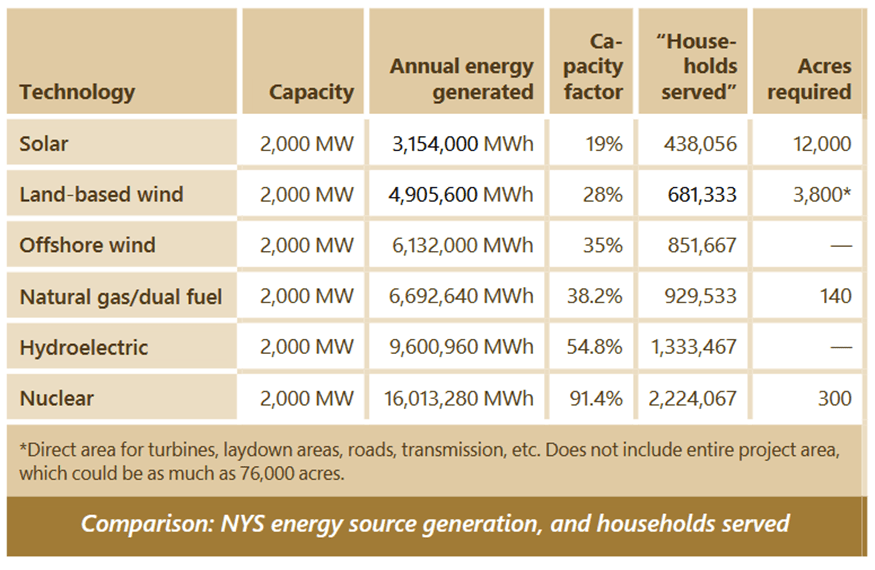
She includes the land use data to make the following points neglected by the CAC:
Additional generation is needed specifically downstate. We plan to replace NYC’s fossil plants with a combination of offshore wind, battery storage, and upstate wind and solar. But as I discussed in The missing link, right now our grid can’t deliver much of this energy downstate. Doing that will require costly investments in transmission infrastructure.
Martin addresses the challenge of intermittency and the myth that batteries can solve the associated problems. This is another example where the Hochul Administration failed to keep politics out of the CAC. The most influential member on the CAC was Dr. Robert Howarth who claims that he played a key role in the drafting of the Climate Act. As illustrated by his statement at the meeting where the Scoping Plan was approved he claims that no new technology is needed. However, the Scoping Plan, Integration Analysis, New York Independent System Operator (NYISO), New York Department of Public Service, the New York State Reliability Council, State Energy Plan, and others all have noted that a new category of generating resources called Dispatchable Emissions-Free Resources (DEFR) is necessary to keep the lights on during the periods of extended low wind and solar resource availability described by Martin. Hochul’s appointed co-chairs on the CAC did not point out that Howarth’s continued insistence that no new technology is needed is in contrast to the results of the State’s analysis is evidence of political influence rather than rational policy.
Martin addresses two facts that can no longer be ignored. She does an excellent job explaining the timelines to transition the electric system that prove we cannot build our way out of this by 2040. The other myth that renewables are cheaper than the alternatives is another persistent misconception standing in the way of rational policy.
I have been meaning to address the myth that wind and solar have minimal impacts on their surroundings. As far as I am concerned, the lack of environmental constraints on NY solar and wind development is a scandal. Martin explains:
Real grid-scale solar and wind buildout in NYS looks very different from the pretty pictures that developers show us. No one is growing crops on large-scale solar sites here. There are no grid-scale projects brimming with native wildflowers and happy pollinators. I see very occasional sheepwashing on a modest scale, but no large-scale agrivoltaics. Six-hundred-foot wind turbines do not generate silently or coexist peacefully with nearby residents. The blades don’t magically dodge birds and bats.
She goes on:
It helps to understand the scale of “renewable” development in NYS. Solar buildout by 2040 would require over a quarter of a million acres. By 2050, we can expect to have over 350,000 acres of panels. Even minimal impacts to very large areas can add up.
We’re just starting to learn the environmental drawbacks of solar and wind. Because these technologies have such enormous footprints, we need to learn much more about their effects on soils, on ecosystems, on agriculture, on the weather, and on the humans who live around these projects. Without impartial research, we risk doing extensive environmental damage and creating future environmental justice communities. Instead, we’ve largely decided in advance that these technologies are entirely benevolent. Wind and solar developers are unlikely to risk studying effects unless they can control the results, and academic institutions have become captured entities. They are often highly politicized and careful to present “renewables” in a positive light.
Myths and Morals
Martin points out that addressing climate change is often portrayed as the great moral crusade of our time. However, she argues:
Our society is defined by its use of electricity, whether we like it or not. Morality doesn’t generate electricity. It can’t wage war against the laws of physics and win. Wind and solar alone can’t provide us with a reliable grid just because we think “renewables” are a good thing. It’s time to accept that and decide how to proceed.
She goes on to recommend some pragmatic approaches. Changing the arbitrary target dates for electrifying everything is one example. As she points out:
What do we gain from the “nation-leading” status that our Climate Act is supposed to confer? Moral superiority? We haven’t gained residents, wealth, or industry; these are leaving the state at an alarming rate.
Another recommendation is moving away from “zero by 2040”:
If this is the only acceptable outcome we risk trading a working grid for a victory in virtue-signaling. We still need reliable, dispatchable generation for wind and solar to work, and we have no emissions-free resources ready to deploy. By the time we support wind and solar with DEFRs/battery storage, “renewables” will be far more expensive than most conventional alternatives.
She concludes “We can’t afford to let perfect be the enemy of good.”
Conclusion
This is an excellent overview of the problems associated with the Climate Act. It is well written and should be required reading for all New York lawmakers and recommended reading for all New Yorkers. Unfortunately, I have decided that many lawmakers have no desire to hear anything that does not comport with what they think their preferred constituencies believe. That failure to address reality is not going to end well.


