

People send me things that are often topics for this blog. When Greg Harkenrider sent an email describing the disconnect between New York energy policy “renewable” generation goals and its storage goals I asked him if I could publish it as a blog post. It is a good independent analysis of yet another challenge of the Climate Leadership & Community Protection Act (CLCPA) transition away from fossil fuels.
Greg is a retiree from the New York state Department of Transportation and the vice president of Stop Energy Sprawl, a coalition of local groups opposing large-scale wind and solar projects.
The Problem
A principal state energy goal is a zero-emissions electric grid by 2040. This requires eliminating all fossil fuel generation, maintaining existing hydro and nuclear power, and vastly increasing wind and solar power. (Recently there has been discussion of additional nuclear generation, but for now that is just in the talking stage.)
Wind and solar have two main problems: 1) their productivity is low — solar produces on average less than 20 percent of its capacity in New York state, and wind about 25 percent; and 2) they are erratic (aka “intermittent”), varying substantially by time of year and from day to day, depending on wind speed and cloud cover. New York’s policy has been to build its way out of problem #1 by massive deployment of wind and solar facilities and store its way out of #2 with batteries.
A critical question is the amount of storage needed to run the New York State grid by 2040 on wind, solar, batteries, no fossil fuels and no increase in hydro because there are no additional resources available for development or nuclear generation because the CLCPA authors thought it was unnecessary. This is not just a matter of powering up the batteries during the day, then using their power after sundown, important as that is. An electric grid powered substantially by wind and solar will have to rely on batteries for extended periods.
Battery Requirements
The analysis here uses a year’s worth of cloud cover and wind speed data from the National Weather Service to estimate how “substantial” and “extended” we are likely to get. I used current hydro and nuclear generation and added enough wind and solar power to match the New York Independent System Operators estimated demand for the year 2040. I created a spreadsheet where days of excess wind and solar production have energy added to storage, and days of deficit production have energy withdrawn from it.
When we examine electric generation and consumption on this day-to-day basis, the critical factor is not just the seven to ten consecutive days of cloudy skies and still winds that occur two or three times a year, but the three-month period from early November to early February, when bad days for wind and solar far outnumber the good days. Getting through this period with the wind/solar resource mix we are pursuing now would require 8,800 GWh of battery production capacity.
To illustrate the problem, Table 1 below uses National Weather Service daily wind speed and cloud cover data for one week of December 2023, and calculates the generation that would have been provided by the predominantly wind and solar grid described above:
Table 1: Daily Generation & Battery Need for One Week in December
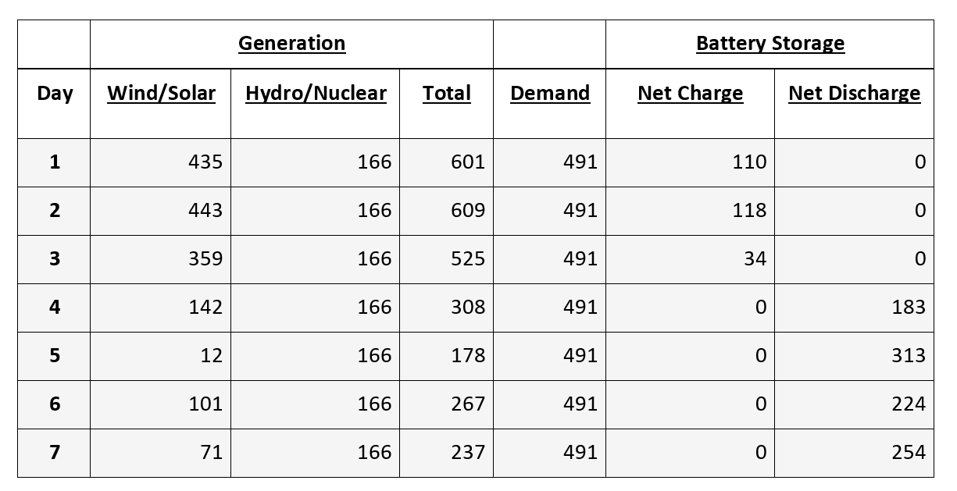
I deliberately picked a week that had both good and bad days for wind and solar. For the first three days, weather was good and we would have generated more electricity than we needed, enabling a fairly significant net increase in battery charging. It was followed by dense cloud cover and calm circulation that would have required about 1,000 GWh of battery discharge in just four days. And the problem does not last just four days. A wind/solar grid will face a shortfall for two to three months every year.
This table is based on weather conditions in December 2023, and generation totals would differ from one year to the next. But the variability of wind and solar production, and consequently the need for storage, would be the same.
When we do the math on a day-by-day basis, the result with this combination of generation is that batteries need to supply more than 6,000 GWh of power between early November and early February, when solar generation begins to improve. Batteries cannot be charged up to their full capacity, nor discharged to zero. Hence the need for 8,800 GWh of capacity.
November, December and January are the worst months for solar power. This critical factor is masked by annual averages. For instance, the Energy Information Administration (part of U.S. Dept. of Energy) reported the average 2024 capacity factor for solar facilities in New York at 17 percent. However the average for November to January was just 7 percent. And, as seen in the table, monthly averages mask daily variability.
The battery quantity would depend on their average duration. Those currently deployed are almost all four-hour duration. It is optimistic, but possible, that that could double to eight hours by 2040. Even if it did, we would need more than 1,000 GW of batteries. Contrast that with the Governor’s aspiration to get to six GW– less than 1 percent of need.
Considering that one 40-foot shipping container-sized battery unit has a capacity of about four megawatts, we would need 275,000 such units to provide that amount of storage (optimistically assuming eight-hour duration). Put another way, the largest battery storage in the country, the Moss Landing facility in California, has a capacity of three GWh. We would need to build 3,000 Moss Landings to back up a wind/solar grid, with only the existing amount of hydro and nuclear generation.
The assumption here is that the state’s future mix of wind and solar remains close to the three-fourths solar/one-fourth wind that is in process now. A grid of 14 GW of land-based wind, 7 GW of off-shore wind, 47 GW of solar and the current 4.3 GW of hydro and 3.3 GW of nuclear would (with Quebec Hydro imports), over the course of a year, provide enough power to meet 2040 demand, as projected by the New York Independent System Operator. But it would do so by over-producing at some times and under-producing at others.
Alternatives
This result is so implausible that we need to look at alternatives. If we shift the future wind/solar mix closer to half and half, the storage need is less — about 6,400 GWh — but still impossible. (There is about a two-month dry spell rather than three, as November is usually a good month for wind.)
Trying a third alternative, the story gets better, but not much. Assume roughly doubling nuclear capacity from the current 3,300 MW to 7,000, while still eliminating all fossil fuel generation. Under this scenario, the December-January battery need would remain, but at a smaller level — about 4,900 GWh. Wind, solar and hydro would provide about 68 percent of generation, close to the state’s policy goal.
Under any scenario, battery charging/discharging would have to be managed, not only centrally, but perfectly. Batteries would have to be discharged in succession, not at the discretion of private operators as they are now. Just getting averages to work does not get every kilowatt to exactly the right place at exactly the right instant. I cannot imagine this working anywhere other than on a spreadsheet.
Caiazza Comment: This is an important point because experience in Australia showed that battery system applications are more complex than generally assumed. In addition to storage backup a battery can earn revenues and justify investment by selling power capacity, speed, and availability into ancillary-service markets. This means that more batteries will be needed because the batteries will not be dedicated to energy storage applications and they cannot service both applications.
The cost of such battery deployments would be astronomical. We cannot expect the current unit costs to prevail if we attempt to procure such a quantity. Estimates range from the hundreds of billions to more than a trillion dollars, just for New York state.
Practical Scenario
So, if the current wind/solar mix is impossible, and shifting to more wind is impossible, and supplementing 70 percent “renewable” with nuclear is impossible, we need to ask what zero emission scenario could work.
The best way to answer this is to reverse our process and start with a realistic estimate of battery deployment, then manipulate the generation sources to model a functioning 2040 grid. I used 300 GWh of storage. If average battery duration improves to eight hours by 2040, that would require 37.5 GW, about six times the current goal.
Making this work requires increasing New York’s nuclear capacity by nearly five times its current level to more than 15 GW. Wind and solar were limited to the projects currently operating or in the state’s application process — about 12.9 GW of solar and 4.5 GW of wind. Empire and Sunrise were the only new off-shore wind assumed.
The key point is that to get storage needs to a realistic level, we must curtail the amount of wind and solar generation. Put another way, renewable generation and storage must be in balance. Without fossil fuels, that can only happen at a far smaller deployment of wind and solar energy than is planned now.
With this mix, 30 percent of New York’s electricity is produced by “renewable” sources. When the landmark CLCPA was passed in 2019, 26 percent was “renewable.” The 2040 New York’s Climate Act goal is “zero emissions” so this approach is compliant. What we do have is at least the possibility of a functioning, zero-emission electric grid, with an achievable amount of battery storage and the likelihood of being a net electricity exporter.
Is this any more realistic than the “impossible” alternatives? New York has four large nuclear plants operating now. This would require us to build 12 to 15 more of them, or a larger number of small, modular reactors. If the state reached a consensus to do that today, it would take a crash effort to get it done by 2040. Public and political opinion on nuclear power is beginning to shift, but we are far from resolved on such a change in policy. The resolute opposition to nuclear power that has prevailed among politicians, regulators and the public since the 1970s will take years, not months, to change. And even if it does change, we must remember that nuclear power has many good points, but speedy design and construction has never been one of them.
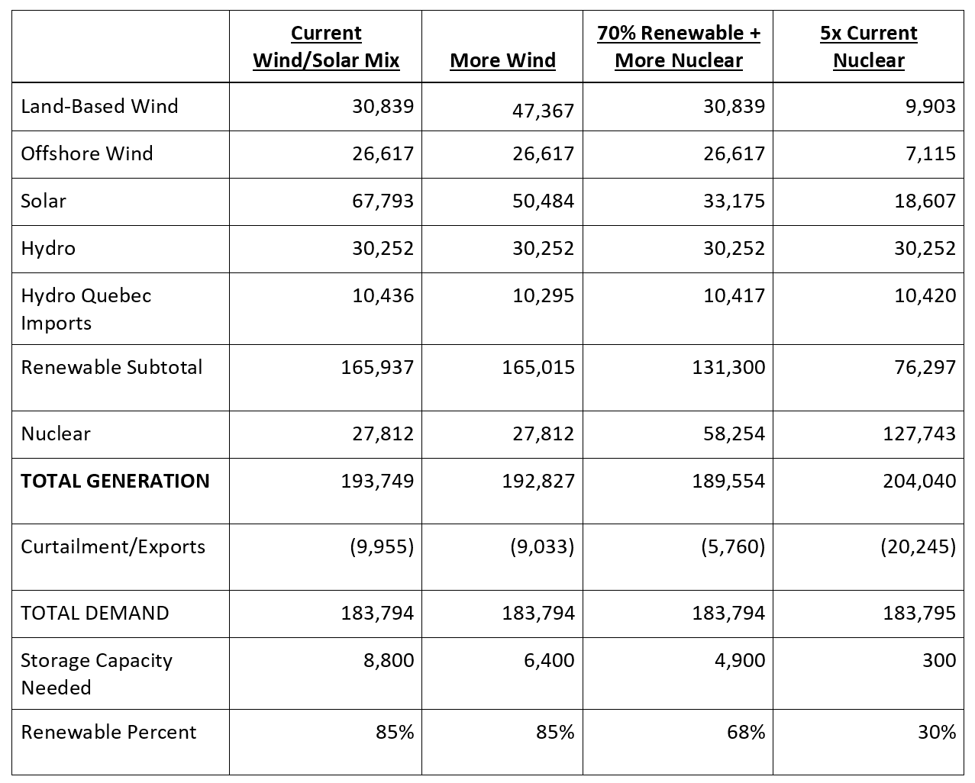
Table 2 summarizes the 2040 electricity production in GWh by generation type for the four alternatives discussed in this narrative.
Table 2: NYS Generation & Storage Needs for Zero Emissions in 2040 (GWh)
Any such analysis must pile assumptions upon assumptions. A few of mine are listed below:
- Projected demand is from the 2026 NYISO Gold Book, which is only an educated guess. Note that the 2025 Gold Book projected 2040 demand at 201,870 GWh; the 2026 version reduced that to 183,800. The 2025 book projected winter peak would exceed summer by 2039, then the 2026 version pushed that back 10 years, to 2049. It is not only meteorologists who have difficulty forecasting.
- Except for being unavailable in winter, Hydro Quebec imports would be available when needed.
- Batteries can be charged up to 85 percent of capacity and discharged to no less than 15 percent.
Conclusion:
For too long, New York state has had a policy for “renewable” energy generation that conflicts with its policy for energy storage. The state’s policy makers who are on a sprint to develop wind and solar energy have no clue how much battery storage that will require, and they don’t particularly want to learn. This paper is an attempt to show that numerically.
Comments are welcome. Greg can be contacted at stopenergysprawl@gmail.com

 Pragmatic Environmentalist of New York