

On October 15, 2026, the New Jersey Department of Environmental Protection (DEP) and Board of Public Utilities (BPU) held a joint hearing on the price of Regional Greenhouse Gas Initiative (RGGI) allowances. The most important testimony came from the owner of the largest and cleanest fleet of power plants in the state. Liam Baker, Senior Vice President of Regulatory Affairs for Alpha Generation (AlphaGen), told regulators that high RGGI clearing prices put New Jersey’s efficient plants “at a significant competitive disadvantage to coal-fueled and otherwise less efficient, and higher emitting, resources in upwind states such as Pennsylvania, West Virginia and Ohio – states that are not part of RGGI.” NJBIA summarized the hearing under a blunt headline: “How RGGI Now Incentivizes Dirtier Air in NJ.”
That is emissions leakage, and it is no longer a theoretical concern raised by program skeptics. It is a New Jersey generator telling its regulators that the program is shifting output, and emissions, to plants across the border. New York faces the same problem. This post summarizes the New Jersey testimony, explains why the same mechanism applies to New York, and describes my preliminary estimates of the RGGI leakage monitoring metric for New York for 2024 and 2025, two years that RGGI has not yet reported.
I have been involved in the RGGI program process since its inception and have been writing about problems with the RGGI program. I have worked on every cap-and-trade program affecting electric generating facilities in New York including RGGI, the Acid Rain Program, and several Nitrogen Oxide programs, since the inception of those programs. The opinions expressed in this post do not reflect the position of any of my previous employers or any other organization I have been associated with. These comments are mine alone. I acknowledge the use of Perplexity AI to generate material included in this document.
Background
RGGI is a market-based program to reduce greenhouse gas emissions from the power sector. It has been a cooperative effort among Connecticut, Delaware, Maine, Maryland, Massachusetts, New Hampshire, New York, Rhode Island, and Vermont since 2008, with New Jersey rejoining in 2020. Virginia rejoined beginning July 1, 2026 and Pennsylvania recently decided not to join. According to the RGGI program description, the states issue permits to emit a ton of CO₂ or allowances that are distributed almost entirely through regional auctions, and the proceeds are then reinvested in strategic energy and consumer programs.
That is the root of the leakage problem. RGGI’s borders are political, but the grid is not. New Jersey shares the PJM Interconnection with Pennsylvania, Ohio, and West Virginia, which are not in RGGI, and New York imports power from PJM, New England, Ontario, and Québec. When the allowance price rises, the RGGI unit’s bid rises and the non-RGGI unit outside the region is unaffected, so the non-RGGI unit runs more. If that unit burns coal and the RGGI unit is an efficient combined cycle, emissions go up, not down.
That price signal has grown dramatically. Auction 73 in September 2026 cleared at a record $37.65, up 296 percent from $9.30 in September 2021, the Cost Containment Reserve intended to keep prices low is exhausted, and the cap will be cut more than 10 percent per year from 2027 through 2033. Every one of those factors widens the cost gap between RGGI and non-RGGI generators.
What New Jersey heard
The New Jersey hearing deserves attention because of who was testifying. According to NJBIA, AlphaGen owns and operates about 4,000 MW of baseload, mid-merit and peaking generation, the largest fleet in New Jersey and also its cleanest and most efficient. This is not a coal company looking for relief. It is the type of company RGGI supporters claim the program rewards.
Baker made three points. First, RGGI costs “must be included in the price of power,” which raises costs for New Jersey consumers. Second, those costs make New Jersey’s cleaner plants “run less than the ostensibly ‘cheaper’ upwind and higher emitting power plants in those non-RGGI states.” Third, the result is that RGGI “has inadvertently led to New Jersey suffering from millions of tons of increased pollution every year,” pollution that New Jersey bears the brunt of because it is downwind of the non-RGGI states.
As an air pollution meteorologist, I want to emphasize that last point. Leakage is usually discussed as a CO₂ accounting problem, but a coal plant in western Pennsylvania or Ohio that runs more hours also emits more sulfur dioxide, nitrogen oxides, and particulate matter. Prevailing winds carry those emissions east. A program that shifts generation from a New Jersey combined cycle to an upwind coal unit is not just failing on carbon; it is making air quality worse for the people it is supposed to protect.
NJBIA’s “Rethink RGGI” campaign proposes replacing the auction price with a $7-per-ton allowance charge, which NJBIA’s Ray Cantor said could save New Jersey consumers $279 million a year. Cantor also questioned a DEP proposal to implement the latest RGGI Program Review amendments that cut allowances 90 percent over ten years amid capacity shortages and rising demand. His summary is one I agree with: “RGGI can’t just operate in a vacuum. It must be reevaluated, re-thought, in the context of the region, the need for capacity, the competition from non-RGGI states, and growing demand for energy.”
Independent modeling confirms the mechanism
The AlphaGen testimony is consistent with the independent analysis I described in June. Tabors Caramanis Rudkevich (TCR) simulated PJM with Delaware, Maryland, and New Jersey in RGGI at $20 per ton. Combined-cycle gas generation fell 6,850 GWh while coal rose 5,220 GWh. Emissions fell about 3 million short tons in the RGGI zones but rose 5.7 million elsewhere in PJM, a net increase of 2.7 million short tons per year. That was at $20 per ton; at $37.65 the leakage should be larger.
New York’s own regulators have modeling that shows the same thing, even though they did not say so. I reconstructed the comparison from the tables in the Department of Environmental Conservation (DEC) Regulatory Impact Statement for the August 2026 Part 242 amendments. Across the five modeled snapshot years, the increase in emissions in the rest of the Eastern Interconnection offset about 76 percent of the reductions at RGGI plants in one policy case and 72 percent in the other. Those are my calculations, not figures DEC reported, and they were modeled at $8.55 to $28.20 per ton (2022 dollars), well below today’s prices.
Why New York should be paying attention
New York is not in PJM, but every New York RGGI unit competes with PJM imports, so the cost gap AlphaGen described applies here too. New York law is also more explicit than RGGI about leakage. The Climate Leadership & Community Protection Act defines leakage as a reduction in emissions in the state that is offset by an increase outside the state, and ECL § 75-0109(3)(e) directs DEC to “incorporate measures to minimize leakage” when it promulgates Climate Act regulations. DEC’s Regulatory Impact Statement for the RGGI amendments relied on the RGGI electricity monitoring reports to claim there has been “no clear evidence” of leakage. However, the 2023 monitoring report itself states that “this report does not provide indicators of CO2 emissions leakage” and that its results “do not address causality.” DEC did not update its leakage analysis after allowance prices jumped.
New York leakage estimates for 2024 and 2025
The RGGI electricity monitoring reports track one metric that comes closest to measuring leakage: CO₂ emissions from all non-RGGI generation serving load in the region. For New York that includes in-state generation that is not subject to RGGI, such as waste-to-energy, landfill gas and small fossil units, plus net imports from PJM, Ontario, Québec, and New England. The most recent report covers 2023 data and was not released until December 2025. RGGI is two years behind, and the two missing years are exactly the period when allowance prices took off.
I estimated the NYISO version of this metric for 2024 and 2025 using NYISO Gold Book generation and import data and published emissions rates for the neighboring regions. Before extending the series, I tested the method against RGGI’s published 2023 NYISO numbers. It matched within 0.26 percent on generation and 0.03 percent on CO₂. Table 1 lists the results.
Table 1: CO₂ from Non-RGGI Generation Serving NYISO Load
| NYISO metric | 2006–08 baseline | 2023 (RGGI) | 2024 central (range) | 2025 central (range) |
| Non-RGGI generation serving load (million MWh) | 95.1 | 85.5 | 84.0 | 81.7 |
| CO₂ (million short tons) | 11.3 | 9.5 | 9.5 (8.4–10.2) | 10.5 (9.3–11.2) |
| Emission rate (lb/MWh) | 237 | 221 | 226 (201–242) | 257 (228–275) |
| CO₂ from net imports (million short tons) | 7.9 | 7.0 | 7.2 | 8.1 |
Sources: RGGI 2023 Electricity Monitoring Report; NYISO Gold Books; EIA, ISO-NE, and Environment and Climate Change Canada emissions data; my calculations. The 2025 emissions rates are extrapolated.
Three results stand out. First, CO₂ from non-RGGI electricity serving New York load was flat in 2024 at about 9.5 million tons but rose to about 10.5 million tons in 2025, the highest level since 2010. Second, the 2025 emission rate of 257 lb/MWh is higher than every year in the 2006–2008 baseline period, even though the amount of non-RGGI generation serving load fell. Third, emissions from net imports rose to about 8.1 million tons in 2025, slightly above the baseline average, even though import volumes declined. The non-RGGI electricity New York uses is getting dirtier.
Figure 1 puts the estimates in the context of the full RGGI record. Emissions from non-RGGI sources serving New York load bottomed out in 2020 and have risen every year since.
Figure 1: CO₂ from Non-RGGI Generation Serving NYISO Load, 2006–2025
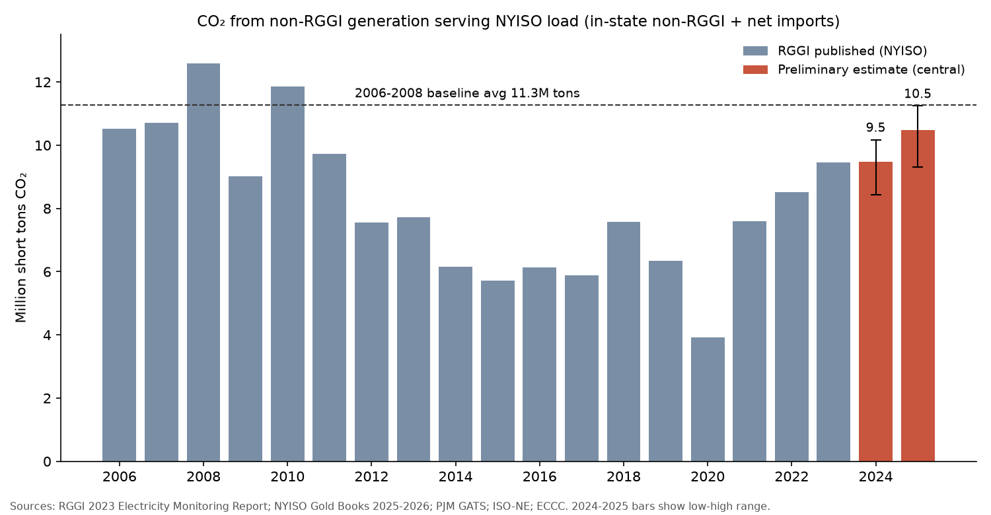
The 2006–2023 values are from the RGGI electricity monitoring reports. The 2024 and 2025 values are my preliminary central estimates, with error bars showing the low-to-high range.
What is driving the increase
I want to be careful here, because I have criticized RGGI supporters for claiming credit for emission reductions that were caused by other factors. The same standard applies to me. The 2025 increase has identifiable causes that are not necessarily RGGI. New York swung from a net importer of Québec hydropower in 2023 (+2.7 TWh) to a net exporter in 2025 (−4.9 TWh). In-state hydro output fell to 24.3 TWh. Imports from PJM rose to 21.7 TWh, while PJM’s emissions rate also climbed. Lower hydro availability and more PJM imports explain most of the change.
That said, the PJM piece is exactly the piece that AlphaGen and TCR describe. Using my central estimate of the non-RGGI PJM emissions rate (881 lb/MWh in 2025), imports from PJM alone carried roughly 9.5 million tons of CO₂ into New York’s load in 2025. That is larger than the 8.1 million tons of total net import emissions because exports to New England and Québec are netted out of the total. The point is that New York’s growing dependence on PJM imports means its non-RGGI emissions are increasingly tied to the coal and gas fleets of Pennsylvania, Ohio, and West Virginia, the same plants that are gaining market share from RGGI generators in New Jersey.
The monitoring metric does not prove that RGGI caused the 2025 increase. But the cost gap between New York RGGI generators and PJM non-RGGI generators widened sharply in 2026 and will widen further as the cap tightens. I expect leakage to be visible in the 2026 and later data. Waiting two years for RGGI to tell us is not an appropriate policy.
Problems with the RGGI monitoring numbers
These estimates exposed two problems with the RGGI reports. The non-RGGI PJM emissions rate RGGI uses (866 lb/MWh in 2023) is not documented well enough to reproduce, yet it is the most important input; the choice of PJM rate alone moves my 2025 estimate by about 1.5 million tons. RGGI has also used an Ontario import rate of 17 lb/MWh since 2020, while Canada’s national inventory shows 119 lb/MWh for 2023 and 143 for 2024. Using the inventory values would add about 0.4 million tons in 2025. If regulators cite these reports as evidence against leakage, the inputs should be current and transparent.
Discussion
The New Jersey hearing should end the argument that leakage is hypothetical. New Jersey’s cleanest generator testified that RGGI is displacing its plants with upwind coal units, independent modeling found a net emissions increase in PJM, DEC’s own tables show most RGGI-region reductions reappearing outside the region, and the non-RGGI electricity serving New York got dirtier in 2025.
None of this is surprising. RGGI’s historical reductions came mostly from cheap natural gas displacing coal and oil, when the allowance price was too low for the border to matter. Those conditions are gone.
Further reductions mean running gas plants less, and if imports from non-RGGI coal and gas units fill the gap, the CO₂ is emitted somewhere else, often upwind, along with the conventional pollutants.
The affordability consequences are just as clear. When a RGGI unit sets the clearing price, the allowance cost is paid to every accepted generator, so New York consumers pay roughly two or more times the direct allowance cost for a program that, at current prices, may be shifting emissions rather than reducing them.
Conclusion
New Jersey regulators are at least asking whether RGGI prices are hurting consumers and the environment. New York regulators are not. DEC and NYSERDA adopted the Part 242 and Part 507 amendments in August without updating their leakage analysis for current allowance prices, without addressing the statutory requirement to incorporate measures to minimize leakage, while relying on monitoring reports that explicitly disclaim any ability to identify leakage.
At a minimum, DEC should update its leakage analysis at current and projected allowance prices, including New York imports from PJM, and the RGGI states should publish the monitoring metric within a year with transparent, current import emissions rates. New York should also acknowledge what New Jersey’s largest clean generator has already said: RGGI, in its current form, raises costs and can increase emissions. When the cap tightens faster than the fleet can change, the emissions do not go away. They move across the border, and New Yorkers pay for the privilege.


