

New York’s support for the Regional Greenhouse Gas Initiative (RGGI) emphasizes what the State does with auction proceeds: “The State invests RGGI proceeds to support comprehensive strategies that best achieve the RGGI CO2 emission reduction goals.” In addition, the State claims significant energy bill savings from those investments that offset the costs of the program. However, the ratepayer costs do not reflect just the money spent for allowances at the auctions. When an investor buys an allowance and later resells it at a higher price, the additional payment does not fund New York’s programs. That distinction deserves more attention in the State’s affordability analysis.
I have been involved in the RGGI program process since its inception. I blog about the details of the RGGI program because I think it is over-rated. In this post, I examine the distinction between auction revenue and allowance costs, what the market-monitor reports show about investor participation, and what those findings mean for claims that RGGI benefits offset its costs. The opinions expressed in this post do not reflect the position of any of my previous employers or any other organization I have been associated with. These comments are mine alone. I acknowledge the use of Perplexity AI to generate material included in this document.
Background
RGGI requires covered power plants to obtain allowances for their carbon dioxide emissions. Generators can acquire allowances at quarterly auctions or in the secondary market. They can also bank allowances for future compliance. Participation is not restricted to generators: firms without compliance obligations can buy and hold allowances too.
New York’s RGGI funding status report emphasizes the benefits of investing auction proceeds. The Revised Regulatory Impact Statement says that proceeds support energy efficiency, renewable and clean energy, and other carbon-abatement investments. Its bill-impact analysis models investment benefits as a credit against electricity bills. The projected residential bill reduction of $0.24 per month appears only after accounting for those benefits.
There is an important distinction between that revenue and the costs reflected in electricity prices. New York receives the auction clearing price for each allowance it sells. A subsequent transaction does not generate another payment to the State. If an allowance originally sold for $20 changes hands later for $40, the additional $20 is not available for State-administered efficiency programs or consumer benefits.
That is the gap examined here: allowance-related costs can increase without a corresponding increase in the proceeds available to fund the benefits emphasized in the regulatory analysis.
Who Is Buying the Allowances?
The independent RGGI market monitor, Potomac Economics, distinguishes among compliance-oriented entities, investors with compliance obligations, and investors without compliance obligations. That distinction matters. A generator buying allowances beyond its expected compliance needs can also participate as an investor. Consequently, “compliance entity” and “compliance-oriented entity” are not interchangeable categories.
The auction reports (Table 1) show substantial purchases by firms other than compliance-oriented entities.
Table 1: RGGI Auction Report Summary
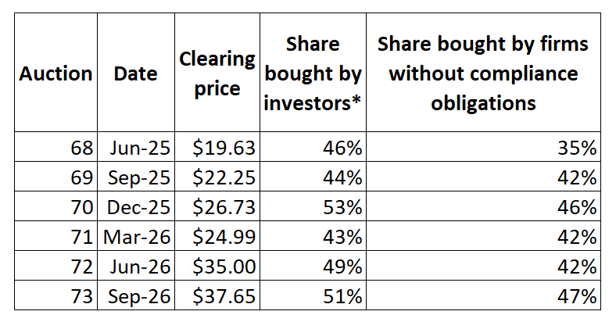
*The investor share is calculated as 100% minus the reported compliance-oriented share. The final column is 100% minus the reported compliance-entity share. Figures are regional, not New York-specific.
Across these six auctions, investors bought between 43% and 53% of the allowances offered. Firms without any compliance obligation bought between 35% and 47%. These are not incidental participants. They account for a substantial share of auction purchases.
The holdings data tell a similar story. At the end of the second quarter of 2026, approximately 178 million allowances were in circulation. Potomac estimated that about 141 million were held for compliance, leaving approximately 37 million held for investment. Investment holdings had declined from approximately 60 million a year earlier. That decline is consistent with investors drawing down their holdings, although it does not establish the purchase price, resale price, or profit on individual transactions.
Auction Prices and Secondary-Market Prices Are Different
The second-quarter market report (Table 2) provides a useful comparison. The secondary-market figures are volume-weighted averages. The physical-transfer series comes from the RGGI CO2 Allowance Tracking System, known as COATS. The ICE futures price for RGGI allowances is the price quoted on the Intercontinental Exchange (ICE) for a contract to deliver RGGI carbon dioxide allowances at a specified future date.
Table 2: RGGI Allowance Price Measures

In the second quarter of 2026, the average physical-transfer price exceeded the auction clearing price by $5.78 per allowance. The market monitor reported that secondary prices approached $44 before the June auction, which cleared at $35, and ended the quarter near $43. Approximately 21 million allowances were physically transferred between unaffiliated firms during the quarter.
These comparisons require care. A quarterly average and an individual auction price do not represent matched purchases and sales. Their difference is not a direct measure of investor profit. Nevertheless, they demonstrate why auction prices alone do not describe the prices faced by generators obtaining allowances in the secondary market.
How the Difference Reaches Electricity Customers
The relevant cost for electricity-market offers is not necessarily what a generator paid at an earlier auction. A generator purchasing an allowance in the secondary market uses the current purchase price. A generator using an allowance already in its account also faces an opportunity cost: using it means giving up the ability to sell it or retain it for future use.
The Quarter 2 2026 NYISO market monitor report attributed an approximately $9-per-megawatt-hour increase in marginal production costs to an approximately $20-per-ton increase in RGGI prices since the second quarter of 2025. Over that period, the reported ICE futures average rose from $19.98 to $40.75, an increase of $20.77. The auction clearing price increased by a smaller amount, $15.37. The comparison is consistent with current market values, rather than historical auction expenditures alone, influencing generation costs.
That does not mean every dollar of wholesale-market impact becomes investor profit. Nor does every increase in production costs translate immediately or identically into every retail bill. The primary point is that the allowance value affecting electricity prices can exceed the proceeds received when the State originally sold the allowance.
What Might the Difference Be Worth?
Consider three illustrative allowances, each hypothetically resold at the second-quarter 2026 average physical-transfer price in Table 3. These are examples, not documented trading histories. The purchase and resale prices of a particular allowance are not established by these averages.
Table 3: Example Allowance Price Differences
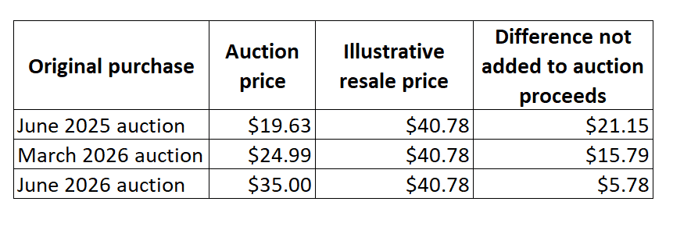
Applying the reported investor shares to Auctions 68 through 71 gives approximately 33 million allowances purchased at a weighted-average auction price of $23.72. If that quantity were subsequently sold at $40.78, the gross difference would be approximately $563 million.
That is not an estimate of actual profits, a New York ratepayer cost estimate, or a demonstrated upper bound. It is a hypothetical calculation showing the scale of the potential difference. Actual results depend on which allowances were sold, when they were sold, transaction and financing costs, and other trading positions. Investors also bear the risk that prices will fall.
Discussion
Investor participation is not, by itself, evidence of market manipulation. Investors can provide liquidity, accept price risk, and potentially increase auction proceeds through their bids. Banking also gives generators flexibility in meeting future obligations. Those considerations belong in a balanced assessment.
I have two concerns. First is the accounting used to defend affordability. New York emphasizes the benefits of investing auction proceeds. Those proceeds are not the same thing as the full allowance-related costs influencing electricity prices. My second concern is that the investors who purchased allowances in the last year are not dumb. They know allowances are going to get scarcer and that someday compliance entities are going to need the allowances they hold so they expect to make profits. I believe that means that the current allowance market price will never decrease significantly so the gap described here is the new normal.
Conclusion
The State’s affordability claims should distinguish three things: auction revenue, allowance-related electricity costs, and the benefits attributed to spending the revenue. They are related, but they are not interchangeable.
The available figures show substantial investor participation and secondary-market prices above earlier auction prices. They do not establish actual investor profits or New York-specific resale costs. They do establish a reason to demand a transparent reconciliation between what customers pay and what the State receives.
DEC and NYSERDA should explain whether their analysis captures secondary-market allowance values, how those values affect modeled electricity prices, and how the resulting costs compare with the auction proceeds available for investment.
Auction-funded investments may provide benefits. But pointing to those investments does not answer the separate question of how much allowance-related cost electricity customers ultimately bear.


