

The New York Energy Alliance recently posted an article on Facebook about the Oswego Harbor Power Plant. There are a few issues with the article and some misconceptions in the comments that I want to address in this post because this facility is not well understood and is under-appreciated.
I am a retired air pollution meteorologist who has worked on New York energy and environmental policy issues since 1981. I was responsible for reporting emissions for various programs for decades for plants in New York State including Oswego. I have extensive experience with air pollution control theory, implementation, and evaluation and supported the air permitting for the Oswego facility from 1981 to 2010. Also, I had an office at the plant from 2000 to 2010. Finally, before I joined the utility industry, I worked for consultants who supported air quality analyses for the EPA. Bottom line is that on this particular topic, I have the background and experience to explain the air quality impacts of the Oswego Steam Station.
This post consists of three parts: summary of the post itself, a summary of the comments through 4:45 PM on 10/18/26 or about seven hours after it was posted and a description of some points that I want to clarify and address.
Post Summary
The post includes the following graphic (Figure 1).
Figure 1: New York Energy Alliance Oswego Harbor Power Plant
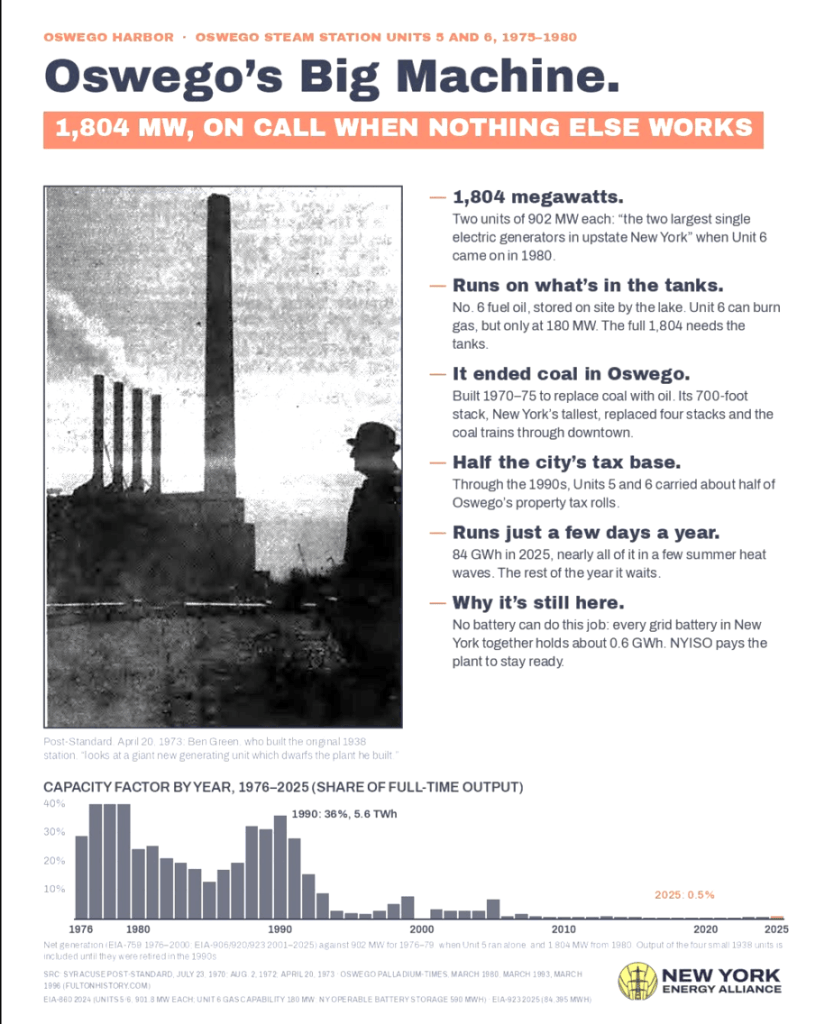
The New York Energy Alliance portrays the Oswego Harbor Power Plant as an aging but important reliability resource: two 902-megawatt oil-fired units that operate infrequently but can generate for days during periods of high electricity demand. According to the text, the plant produced just 84 gigawatt-hours in 2025—roughly a 0.5% capacity factor—but remains available to help meet demand during extreme weather, providing sustained generation that the author contrasts with short-duration battery storage.
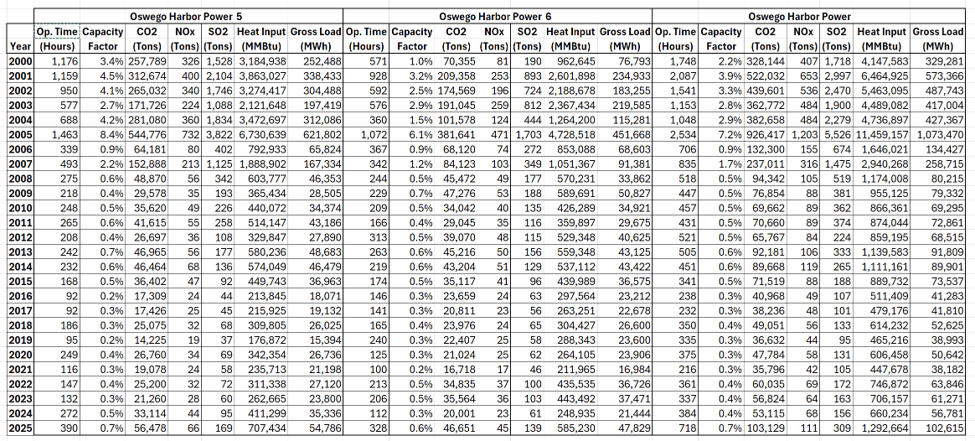
The description of the unit capacity caught my attention. In my submittals I always listed the two units as 850 MW each and I am not sure why there is a difference. My capacity factor estimates using the EPA Clean Air Markets Program Data information in Table 1 use those values. I found two different estimates of the total energy produced in 2025 Those are minor points. The key is that these two units provide enormous value as backup capacity when there are problems in the system or peak loads.
Table 1 Emissions and Operating Data from the EPA Clean Air Markets Program Data website
The Facebook description explains that units 5 and 6 were developed by Niagara Mohawk in the 1970s to replace the old coal-fired units 1-4. As shown in the bar chart in Figure 1 the plant became a major electricity supplier. It also was the cornerstone of Oswego’s property-tax base. Its role diminished as cheaper natural-gas generation entered the market, but Units 5 and 6 survived and passed through successive owners. The text describes another proposed ownership transition involving ArcLight, DigitalBridge, and SoftBank, placing the plant within investors’ growing interest in electricity supplies for artificial intelligence and data centers.
I fully support the key point that this plant is a textbook example of the tension between New York’s 2040 zero-emission electricity requirement and the continuing need for dependable, dispatchable generation. The New York Energy Alliance argues that Oswego illustrates why rarely used fossil-fuel plants remain valuable even as the state pursues decarbonization. I agree completely.
I want to comment on the closing paragraphs:
No one has filed to retire it. The grid operator leans on it. And its next owners are buying it because AI needs power. 99% of the plant’s capacity is unused, and AI is the only source of investment that will keep it available for those critical cold and heat waves.
Ben Green’s coal plant is gone. The one that dwarfed it is fifty years old, and a few evenings a year, it is the reason the lights stay on.
I think the plant survives because of capacity payments. The investors bought the plant because the NYISO recognizes the value as backup to keep the lights on a few times a year and provides a payment approach that pays to keep this resource available. It may be that the owners think that it will become more valuable as AI demand increases. In theory, it could be operated enough to supply an AI data center by itself. However, the offsite oil tank farm necessary for the historical high-capacity factors has been torn down and there is an annual operating limitation so I am not sure how feasible Oswego would be to power a data center directly.
Comments
I have a prepared a list of the comments that includes highlighted topics I want to address. The following responds to those topics.
Justin Fedder (apparently subscribes to the belief that any air quality impact is unacceptable:
And I’m sure that building is the reason this area has a higher rate of lung cancers and breathing problems compared to all the areas around us.
I mean, what would you expect when you have a heavy oil burning power station right in the middle of a city.
In my experience the power plant complies with all air quality standards. In another comment Andy Arthur states “Isn’t the tall stack to distribute the sulfur high into the atmosphere to maximize dispersion?”. He is right that the “solution to pollution is dispersion”. The facility was designed when tall stacks were an acceptable way to reduce impacts but by the time it was permitted this was no longer allowed. The air quality modeling used a lower stack height and showed compliance but the actually impacts are lower. All the modelling I did over nearly 30 years showed that the air quality impacts were far below the National Ambient Air Quality Standards (NAAQS) and that the highest projections were well beyond the city limits. Furthermore, there is not just modeling evidence. My first responsibility at Niagara Mohawk was to submit data from air quality monitoring sites around the plant. All the monitoring data confirmed the modeling impacts that showed compliance with the NAAQS. In fact, the highest observed value occurred when you could smell chocolate. In other words, the impacts of the Nestle plant in Fulton were greater.
I am not sure where Fedder’s claim of higher health impacts in the city comes from. Oswego County’s 2022–2024 Community Health Assessment reports that its age-adjusted lung-cancer incidence in 2016–2018 was the highest in Central New York. It also reports elevated chronic respiratory-disease mortality and hospitalization rates, but asthma hospitalization rates were below regional and statewide rates. These county-level findings do not establish that the City of Oswego has higher lung-cancer and respiratory-disease rates than every surrounding community or identify the cause of the differences.
Finally, note that Table 1 shows that when comparing 2000–2005 with 2020–2025:
- NOₓ emissions fell approximately 89%.
- SO₂ emissions fell approximately 94%.
- Gross generation fell approximately 89%
I maintain that there was no air quality problem even when the units were operating much more but today they run so infrequently that this claim is baseless.
Philip Wilcox made a persuasive argument that the future transition should “emphasize ‘cost-effective and reliable’, but should not abandon fossil fuels – primarily natural gas, unless and until the renewables can be counted on without bankrupting NY”. In a subsequent reply said:
I don’t think anyone can make a coherent argument that it is renewables that are bankrupting New York.
David Haarman objected to the bankrupting claim saying it was an exaggeration. Affordability is the one of my primary concerns. Bankrupting may be an overestimate but my question to Haarman is what is an acceptable cost for the transition? I believe that we already exceed any reasonable cost threshold and we are only getting started on the costs.
Haarman also claimed that there are tariff costs when we import from Canada. I did some research and found that electricity has an unusual customs status. In a FERC proceeding, NYISO noted that electrical energy carried a 0% rate under the Harmonized Tariff Schedule, was exempt from ordinary merchandise-entry requirements, and had historically been treated as outside U.S. tariff laws. Those were arguments against applying the new duties—not a definitive ruling that electricity could never be taxed. This is not to say that someday a tariff may be applied but at this time there is no extra tariff cost.
Haarman apparently supports renewables. He said:
It is bewildering to me that the loss of farmland is even considered. New York ranks in the lower 50% in agriculture output at 27th in the US. Not to mention, the reduced tax revenue, subsidies, and the fact that <10% of cropland is prime farmland. This is a separate issue altogether.
I have been on both sides of permitting applications. There is one enormous difference between my decades of experience trying to get air quality permits for power plants and permitting for wind and solar projects under the Office of Renewable Energy Siting. My permits had to meet specific quantifiable limits that could be checked by the Department of Environmental Conservation. The current policies do not include permitting standards. For example, prior to the Office of Renewable Energy Siting permitting authority, the Department of Ag and Markets recommended that no more than 10% of a solar project’s developed area could be on prime farmland. That was never established as a requirement and now is routinely ignored. The state agency expert recommendation is not a requirement. That is true across all the agencies where conditions that they felt were necessary during the previous permitting regime have been ignored.
Philip Wilcox responded to the costs discussion by pointing out that storage is necessary:
The CLCPA theorists claim that battery storage will be the panacea, but both the costs and proven reliability at utility scale is sketchy at best. So if you rely on batteries and have an extended outage that does not provide voltage support beyond the 24 hour or so battery capability will be a disaster. Zero carbon nuclear in an amount necessary to compliment intermittent wind and solar is decades away.
Figure 2 from the New York Independent System Operator (NYISO) presentation titled Winter 2025-2026 Cold Weather Operations lists the Real-Time Dispatch schedule of alternative fueled units during the January 23- February 9 2026 extreme winter weather episode. This describes the use of oil-fired units. Two fuels stand out: Ultra Low Sulfur Oil (ULSO) and Oil #6. ULSO is burned in New York City at several peaking power plants. The #6 oil-fired energy is primarily from Oswego. Clearly Oswego provided critically needed energy when the system needed it the most.
Figure 2: Alternative Fuel Mix Plot for January 23 – February 9, 2026
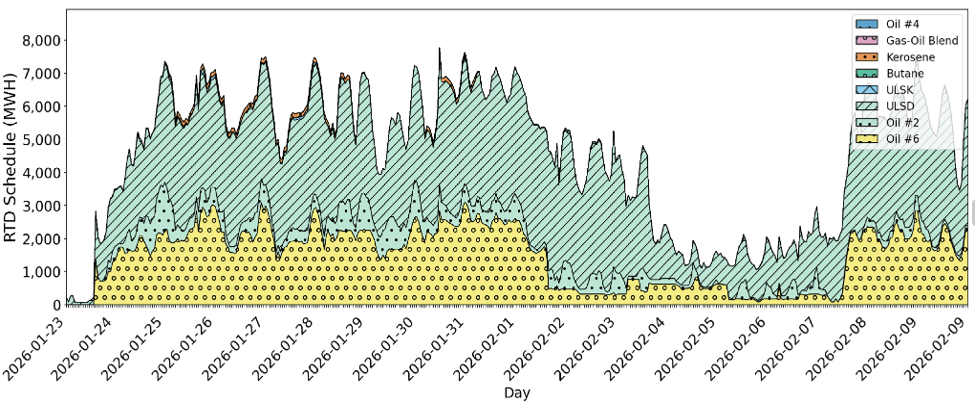
Source: Winter 2025-2026 Cold Weather Operations Presentation to NYISO Operations Committee March 19, 2025 ©Copyright NYISO 2026. All rights reserved.
Andy Arthur said “My guess is it doesn’t run much due to Acid Rain trading system, expensive to run due to the need to purchase sulfur dioxide credits to pollute.” Actually, the Acid Rain Program has been so successful that SO2 allowances are worthless. However, Oswego is subject to the Regional Greenhouse Gas Initiative and must purchase CO2 allowances. Because there is a cost differential between oil and natural gas I don’t think it markedly affects how much the units run. What it does do is make the energy produced more expensive and that directly impacts consumers.
Ivan Prock said “Are you actually celebrating the existence of a plant which burns a fossil fuel? Are you unfamiliar with the climate crisis?” The authors responded “If this plant didn’t exist, far more people would die from the climate. Hot days with no AC, cold nights with no heat kill people. This plant is a beast.” Prock responded:
The plant’s history and current existence are contributing factors to the worsening of the climate crisis. Right, so we need to be aggressively deploying non-CO2-emitting sources of electricity generation, which include solar and wind power. The plant is a relic from the past when people didn’t care about the climate.
Richard Perkins responded to him:
That seems overly critical. While the transition to solar/wind/nuclear is clearly important for climate, we can still acknowledge the historical facilities that provide needed reserve electricity for our people – powering lighting, hospitals, industry, and homes.
Prock responded:
It’s as overly critical as New York Energy Alliance’s post is overly fawning. We can acknowledge historical facilities while still acknowledging the damage that they caused and continue to cause to the climate. Reserve electricity can be acquired from a number of sources including grid-scale and residential batteries, and improved grid interties to neighboring jurisdictions.
Catskill Weather replied to that: “The lie is that we are transitioning to a world without fossil fuels. Humanity is actually on a quest to utilize all energy sources in order to maintain and build the future. Prock responded:
There is absolutely no lie since the majority of all new electricity power generation, worldwide, has come from solar and wind power. Humanity is actually on a quest to transition to avoiding the use of fossil fuel sources. Do better research before commenting further.
As I have argued repeatedly on this blog, Ivan Prock confuses the desirability of reducing emissions with the engineering requirements for keeping the lights on. The critical issue is reliability: wind and solar provide electricity when the weather cooperates, batteries store energy rather than create it and cannot sustain output beyond their available charge, and additional interties do not guarantee that neighboring systems will have surplus electricity during a widespread weather-driven shortage. These are precisely the concerns I have raised about prolonged periods of low wind and solar production and the need for dependable, dispatchable resources. Prock’s appeal to the share of new generation coming from renewables also fails to distinguish installed capacity, actual electricity production, and total energy consumption; growth in one does not, by itself, demonstrate the displacement of fossil fuels across the energy system, a distinction explored in my comparison of New York’s transition with global trends.
Conclusion
I responded to this post and the subsequent comments because I believe it addresses some important things about the existing fossil fired generators in New York. The appropriate test is not whether a plant can be dismissed as a “relic,” but whether its replacement can demonstrably provide the necessary electricity, when and where it is needed, at an affordable
Over time Oswego and other generating stations have changed how they operate as fuel costs have changed. Their ability to generate electricity when needed provides valuable support to the grid and that is why they have continued to operate. All generating facilities comply with ambient air quality standards proven both by modeling but also by measurements. I believe the existing NAAQS are sufficient to protect human health and welfare. Many environmental advocates claim that there are impacts below those levels. However, I have not seen analyses that show observed health benefits consistent with the reductions in emissions observed at all the power plants that have operated for decades.
I commend the New York Energy Alliance for a well written explanation of the value of the Oswego Harbor Power Plant.


