
Implications of NYSERDA RGGI Funding Status Report Status Results

This is the second article in a series of three on the status of the New York component of the Regional Greenhouse Gas Initiative (RGGI) as administered by the New York State Energy Research & Development Authority (NYSERDA).  This is timely because on December 18, 2024, the New York Assembly Committee on Energy held a public hearing to gather information about NYSERDA’s revenues and expenditures in order to gain a broader perspective on effectiveness of NYSERDA’s programs. 

In the first article I evaluated Environmental Protection Agency (EPA) emission data and NYSERDA documentation and found that the investments funded by RGGI auction proceeds would have been only 4.2% higher if the NYSERDA program investments did not occur.  There are unacknowledged ramifications of this emission reduction performance relative to future NYSERDA program investments and RGGI compliance mandates.

Background

I have been involved in the RGGI program process since its inception.  I blog about the details of the RGGI program because very few seem to want to provide any criticisms of the program.   I submitted comments on the Climate Act implementation plan and have written over 480 articles about New York’s net-zero transition because I believe the ambitions for a zero-emissions economy embodied in the Climate Act outstrip available renewable technology such that the net-zero transition will do more harm than good because of impacts on reliability, affordability, and the environment.  The opinions expressed in this post do not reflect the position of any of my previous employers or any other organization I have been associated with, these comments are mine alone.

RGGI is a market-based program to reduce greenhouse gas emissions (GHG) (Factsheet). It has been a cooperative effort among the states of Connecticut, Delaware, Maine, Maryland, Massachusetts, New Hampshire, New York, Rhode Island, and Vermont to cap and reduce CO2 emissions from the power sector since 2008.  New Jersey was in at the beginning, dropped out for years, and re-joined in 2020. Virginia joined in 2021 but has since withdrawn, and Pennsylvania has joined but is not actively participating in auctions due to on-going litigation. According to a RGGI website:

The RGGI states issue CO2 allowances that are distributed almost entirely through regional auctions, resulting in proceeds for reinvestment in strategic energy and consumer programs.

Proceeds were invested in programs including energy efficiency, clean and renewable energy, beneficial electrification, greenhouse gas abatement and climate change adaptation, and direct bill assistance. Energy efficiency continued to receive the largest share of investments.

On a quarterly basis permits to emit a ton of CO2 or allowances are auctioned by RGGI.  The electric generating units that have RGGI compliance obligations must surrender one allowance for each ton emitted during the compliance period.  In theory, States invest the proceeds to reduce emissions indirectly through energy efficiency programs and directly through the deployment of renewable energy that displaces fossil fired generation and supporting carbon abatement technology.  This article describes the implications of NYSERDA RGGI program emission reduction effectiveness and funding priorities on these compliance obligations.

NY Electric Generating Unit Emission Reductions

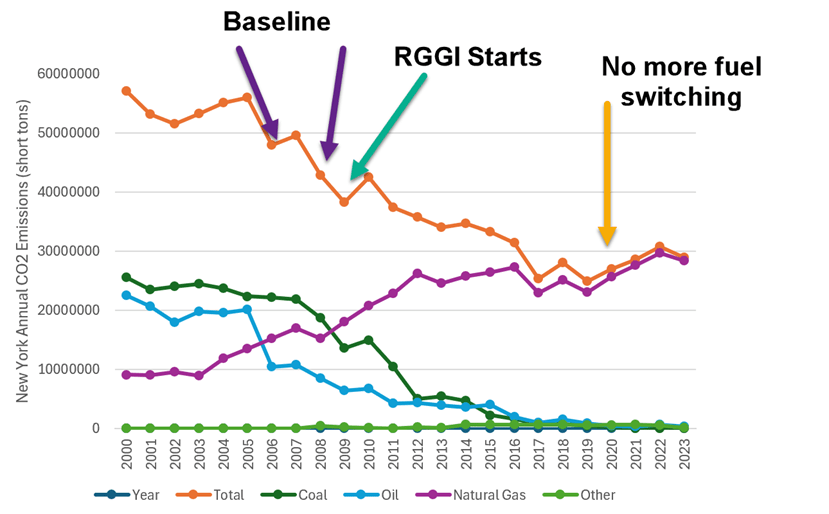
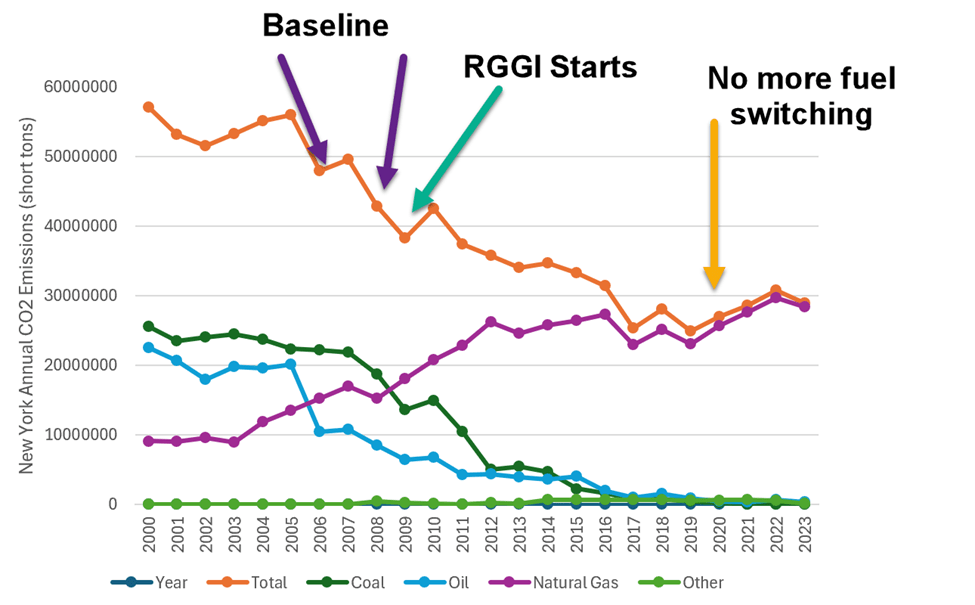
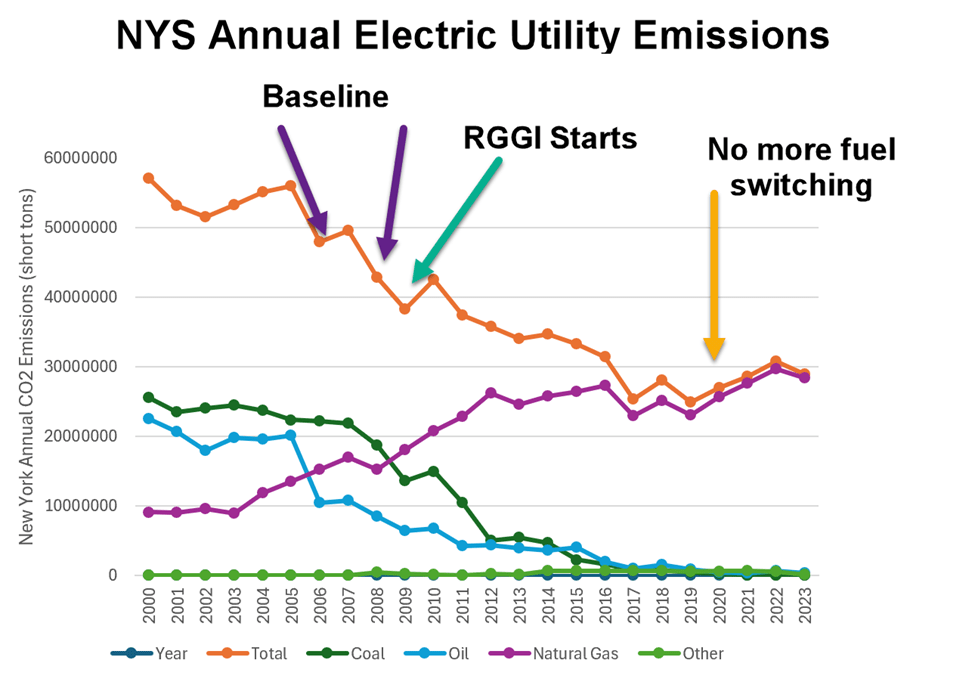
In my New York RGGI Funding Status Report Status Through 2023 post I used EPA emission data and NYSERDA documentation to determine the effect of the investments funded by RGGI auction proceeds.    In 2000, New York EGU emissions were 57,114,439 tons and in 2023 they were 28,889,913 tons, a decrease of 49%.  Figure 1 plots these data and shows emissions by fuel type.  Clearly, fuel switching is the primary driver of the observed reductions.  Since the start of the RGGI program I estimate that emissions from RGGI sources in New York would have been only 4.2% higher if the NYSERDA program investments did not occur.  The Figure 1 graph also shows that the opportunity to make further emission reductions by switching fuels is no longer available.

Figure 1: New York State Emissions by Fuel Type

New York RGGI Program Investment Reductions

Table 1 lists data from Semi-Annual Status Report through December 2023  Table 2: Summary of Total Expected Cumulative Annual Program Benefits including the cumulative annual costs of investment programs and annual tons of carbon dioxide equivalent (CO2e) saved by the investments.. The report notes that: “NYSERDA begins tracking program benefits once project installation is complete and provides estimated benefits for projects under contract that are not yet operational (pipeline benefits).“   The report presents “expected quantifiable benefits related to carbon dioxide equivalent (CO2e) reductions, energy savings, and participant energy bill savings with expended and encumbered funds” but I only consider the CO2e reductions.  Note that the emission savings evaluated in the report include carbon dioxide, methane, and nitrous oxide.  In the original table “lifetime” savings are included.  I did not use “lifetime” savings data because I am trying to compare the RGGI program benefits emission savings reductions to the RGGI compliance metric of an annual emission cap.  Lifetime reductions are clearly irrelevant. 

Table 1: RGGI Funding Status Report Table 2: Summary of Total Expected Cumulative Annual Program Benefits

NYSERDA RGGI proceed investments can produce CO2 emission savings from RGGI-affected electric generating units in two ways: directly by displacing natural gas generation by deploying zero-emissions resources or indirectly by reducing the amount of load that the affected units must provide.  I assumed that the indirect investments reduced load that directly offset RGGI-affected sources.  This has been a good assumption because load growth has been stalled but with electrification of buildings and transportation and the addition of data centers and large load centers, the presumption that indirect NYSERDA investments will reduce emissions will become weak. 

Table 2 compares the observed emissions to the NYSERDA emission savings.  These results show that emissions from RGGI sources in New York would have been only 4.2% higher if the NYSERDA program investments did not occur.  However, that estimate is an overestimate of the capability of NYSERDA investments to reduce RGGI-affected source emissions.  NYSERDA estimates of emission savings include methane and nitrous oxides, but RGGI compliance is only for CO2.  The presumption that programs that indirectly reduce emissions has qualifications that reduce the actual reductions.  The NYSERDA savings number also includes savings from programs that will not reduce RGGI-affected units’ emissions as shown in the next section.

Table 2: NY Electric Generating Unit Emissions, NYSERDA GHG Emission Savings from RGGI Investments, and Emissions by Fuel Type

NYS RGGI Funding Priorities

Table 2 overestimates relevant savings because of RGGI funding program priorities.  The October 2024 New York State Funded Programs report describes the funding priorities for the auction proceeds:

The State invests RGGI proceeds to support comprehensive strategies that best achieve the RGGI CO2 emission reduction goals. These strategies aim to reduce global climate change and pollution through energy efficiency, renewable energy, and carbon abatement technology. Deploying commercially available renewable energy and energy efficiency technologies help to reduce greenhouse gas (GHG) emissions from both electricity and other energy sources in the short term. To move the State toward the goals enacted by the Climate Leadership and Community Protection Act (Climate Act) and a more sustainable future, RGGI funds are used to empower communities to make decisions that prompt the use of cleaner and more energy-efficient technologies that lead to both lower carbon emissions as well as economic and societal co-benefits. RGGI helps to build capacity for long-term carbon reduction by training workers and partnering with industry. Using innovative financing, RGGI supports the pursuit of cleaner, more efficient energy systems and encourages investment to stimulate entrepreneurial growth of clean energy companies. All these activities use funds in ways that accelerate the uptake of low- to zero-emitting technologies.

Table 2 is misleading in the context of RGGI compliance obligations because not all the savings will affect RGGI emission sources.  There is a significant fraction of RGGI funds that goes to programs that increase rather than decrease electric generating unit emissions.  In Table 3, I categorized programs relative to RGGI compliance obligations.  The table breaks down the program allocations and expected annualized CO2 savings for three categories: direct reductions to RGGI sources, indirect reductions, and those programs that will actually increase electric generating emissions. For example, Charge NY is NYSERDA’s Clean Transportation Program that “has been pursuing five strategies to promote EV adoption by consumers and fleets across New York”.   The results in the Funding status reports show that since the start of the program NYSERDA has allocated $98.8 million to programs that directly reduce utility emissions by 199,733 tons, $702.7 million for programs that indirectly reduce utility emissions by 1,205,780, and $348.1 million for programs that will increase utility emissions by 678,804 tons.  In the last category, the GHG emission savings listed are the benefits for switching from gasoline and diesel to electric vehicles.   When those savings that do not affect RGGI source emissions are removed, total savings are 1,297,297 and the emissions from RGGI sources in New York would have been only 2.8% higher if the NYSERDA program investments did not occur.

Table 3: Summary of Expected Cumulative Annualized Program Benefits through 31 December 2023 for Programs that Directly, Directly, or Do Not Affect RGGI CO2 Emissions

Discussion

The results of NYSERDA RGGI funding have important and unacknowledged ramifications.

The comparison of observed electric generating unit emission reductions by fuel type clearly show that historical reductions were the result of fuel switching.  In addition, it is obvious that all that low-hanging fruit is gone.  Nonetheless, many ill-informed voices are clamoring for stricter RGGI emission reduction trajectories begging the question – where will the emission reductions come from?  It does not seem that NYSERDA RGGI investments will help the affected sources meet their compliance obligations.

I did not mention the observed cost per ton saved in Table 1.  It is not very encouraging that NYSERDA program investments cost $582 for each ton saved.  At that rate, New York will have to invest $16.8 billion to achieve the Climate Leadership & Community Protection Act 2040 electric sector zero-emissions mandate.  In the first 15 years New York RGGI auction proceeds are a little over $2 billion based on the sale of 480.4 million allowances.  Assuming a RGGI straight line reduction to zero by 2040, 231 million total allowances will be allotted by 2040.  At the $582 cost per ton rate the RGGI allowance price would have to be $73 per ton to provide sufficient funding to meet the compliance targets.

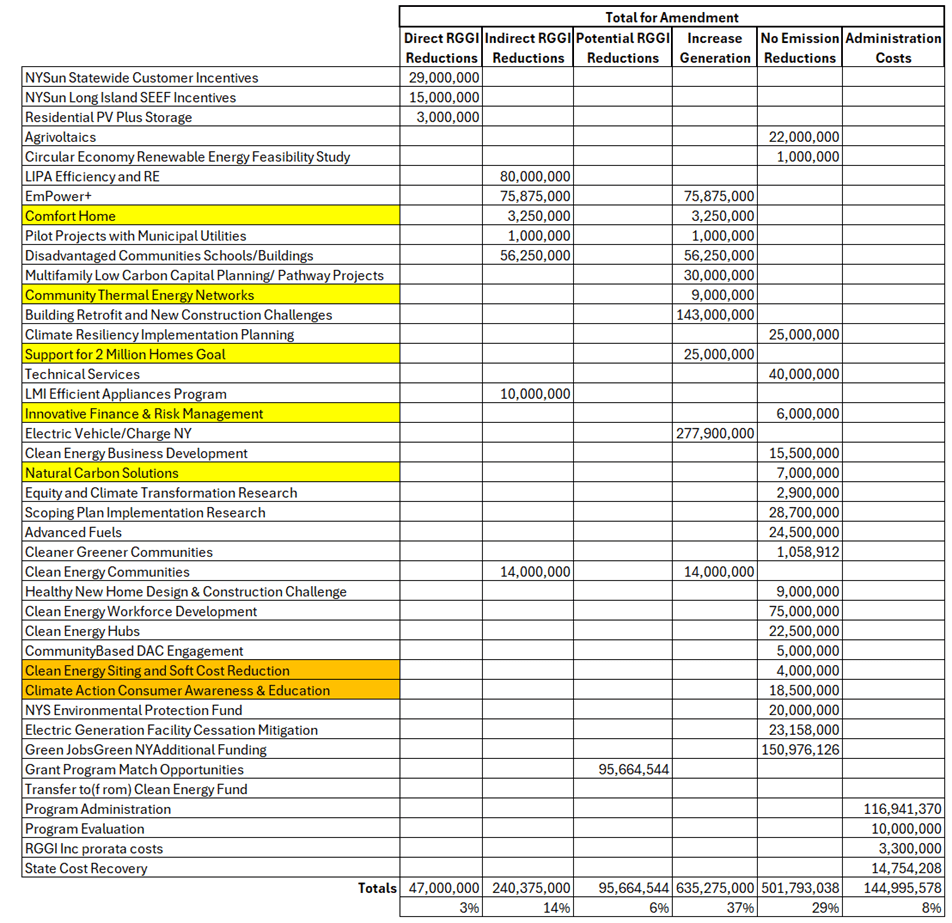
There is a huge assumption relative to the $73 allowance price funding necessary to achieve the zero-emissions by 2040 mandate.  I assumed that all the RGGI proceeds would be allotted to programs that directly or indirectly reduce emissions at electric generating stations.  Table 3 shows that for the programs that produce quantifiable benefits 32.6% of the proceeds goes to programs that increase RGGI emissions.  It is much worse than that.  In my next article in this series I will document how the latest Draft RGGI Operating Plan Amendment allocates funds to programs.  Spoiler alert only 22% goes to programs that will provide direct or indirect emission reductions.

Conclusion

This analysis of the latest NYSERDA RGGI funding plan document has important implications to New York’s plans to implement a Cap-and-Invest (NYCI) program.  RGGI is touted as a successful model for NYCI to emulate but the poor emission reduction performance suggests that the presumption that NYCI will be an effective emission reduction program is misplaced. 

There is another important issue.  NYSERDA has not acknowledged that electric generators have no options to reduce their emissions to comply with RGGI.  In the future those facilities can only meet compliance requirements if zero-emissions resources displace their generation and emissions.  If there are insufficient investments to reduce generation at the RGGI-affected sources there will be compliance issues.  The only option for affected sources to comply is to reduce or stop operations.

New York NYSERDA RGGI Funding Status Report Status Through 2023

In response to claims by New York State officials that the Regional Greenhouse Gas Initiative (RGGI) has been instrumental in reducing electric generating unit emissions I have evaluated the latest New York State Energy Research & Development Authority (NYSERDA) funding status report.  This article addresses the observed CO2 emissions reductions relative to the claimed CO2 emission reductions in the NYSERDA reports. There are ramifications of the emission reduction claims and NYSERDA program investments affecting compliance mandate requirements for RGGI that will be addressed in a subsequent article.

Background

I have been involved in the RGGI program process since its inception.  I blog about the details of the RGGI program because very few seem to want to provide any criticisms of the program.   I submitted comments on the Climate Act implementation plan and have written over 480 articles about New York’s net-zero transition because I believe the ambitions for a zero-emissions economy embodied in the Climate Act outstrip available renewable technology such that the net-zero transition will do more harm than good because of impacts on reliability, affordability, and environmental impacts.  The opinions expressed in this post do not reflect the position of any of my previous employers or any other organization I have been associated with, these comments are mine alone.

RGGI is a market-based program to reduce greenhouse gas emissions (GHG) (Factsheet). It has been a cooperative effort among the states of Connecticut, Delaware, Maine, Maryland, Massachusetts, New Hampshire, New York, Rhode Island, and Vermont to cap and reduce CO2 emissions from the power sector since 2008.  New Jersey was in at the beginning, dropped out for years, and re-joined in 2020. Virginia joined in 2021 but has since withdrawn, and Pennsylvania has joined but is not actively participating in auctions due to on-going litigation. According to a RGGI website:

The RGGI states issue CO2 allowances that are distributed almost entirely through regional auctions, resulting in proceeds for reinvestment in strategic energy and consumer programs.

Proceeds were invested in programs including energy efficiency, clean and renewable energy, beneficial electrification, greenhouse gas abatement and climate change adaptation, and direct bill assistance. Energy efficiency continued to receive the largest share of investments.

I have written multiple articles that argue that RGGI advocates mis-lead the public when they imply that RGGI programs were the driving force behind the observed 50% reduction in power sector CO2 emissions since 2000.  I did an article on CO2 emissions based on the funding status reports in December 2022.  This article updates the information through 2023.

New York Power Sector CO2 Emissions

The first step in evaluating the effect of RGGI on CO2 emissions is to determine the observed trend of New York electric utility emissions.  EPA’s Clean Air Markets Division maintains a database of all the emissions data collected by every power plant in the United States since the mid-1990’s.  I used that data for this analysis. 

The EPA database includes information such as the primary fuel type of each generating unit. Table 1 lists the total annual CO2 data from all New York units that are required to report to EPA for any air pollution control program by fuel type.  In 2000, New York EGU emissions were 57,114,439 tons and in 2023 they were 28,889,913 tons, a decrease of 49%.  Figure 1 plots these data.  Table 2 lists the reductions in New York since the start of RGGI.  I calculated a pre-RGGI baseline by averaging annual data from 2006-2008.  In NYS 2023 CO2 emissions are 38% lower than baseline emissions.  Note that the reduction percentage peaked in 2019 before Indian Point shut down and emissions increased.  The most important feature of these tables is that coal and oil emission reductions are the primary drivers of the total emission reductions.  Natural gas has increased to cover the generation from those fuels but because it has lower CO2 emission rates the New York emissions have gone down.

Table 1: New York Clean Air Markets Division Emissions Data for All Regulatory Programs

Figure 1: New York State Emissions by Fuel Type

Table 2: New York State Emission Reductions

NYSERDA RGGI Funding Status Reports

The latest New York RGGI funding report prepared by the New York State Energy Research & Development Authority (NYSERDA) is the Semi-Annual Status Report through December 2023.  It states that:

This report is prepared pursuant to the State’s RGGI Investment Plan (2022 Operating Plan) and provides an update on the progress of programs through the quarter ending December 31, 2023. It contains an accounting of program spending; an estimate of program benefits; and a summary description of program activities, implementation, and evaluation. An amendment providing updated program descriptions and funding levels for the 2022 version of the Operating Plan was approved by NYSERDA’s Board in January 2023.

The State invests RGGI proceeds to support comprehensive strategies that best achieve the RGGI CO2 emission reduction goals. These strategies aim to reduce global climate change and pollution through energy efficiency, renewable energy, and carbon abatement technology.

Table 3 from Table 1 in the latest the Semi-Annual Status Report summarizes the effectiveness of the NYSERDA investments and lists expected cumulative portfolio benefits including emissions savings.  This report notes that NYSERDA “begins tracking program benefits once project installation is complete and provides estimated benefits for projects under contract that are not yet operational (pipeline benefits).”  There is an important distinction between the cumulative annual committed savings and the expected lifetime total benefits.  For the purposes of this analysis, I did not use “lifetime” savings data because I am trying to compare the RGGI program benefits emission savings reductions to the RGGI compliance metric of an annual emission cap.  Lifetime reductions are clearly irrelevant to that metric.  Similarly, the Climate Act emission reduction metrics are annual emissions relative to a 1990 baseline so expected lifetime benefits are immaterial.

Table 3. Summary of Expected Cumulative Portfolio Benefits through December 31, 2023

Comparison of NYSERDA Cumulative Emissions Savings to Observed Emission Reductions

Table 4 presents the relevant data to compare the observed reductions and NYSERDA RGGI investment emission savings.  I list the last five years of data starting in 2019 when the emissions went up because of the closure of Indian Point but the decreases since the 2006-2008 average baseline are listed.  The emissions savings listed are cumulative annual emissions.  If the RGGI investments were not made then the total emissions would be higher by the amount of the savings.  The total cumulative annual emission savings through the end of 2023 is only 1,976,101 tons and that represents a reduction of 4.2% from the pre-RGGI baseline.  Emission reductions by fuel type clearly show that fuel switching is the primary cause of reductions.

Table 4: NY Electric Generating Unit Emissions, NYSERDA GHG Emission Savings from RGGI Investments, and Emissions by Fuel Type

Discussion

Whenever there is a public meeting about RGGI, the overview presenters state that there has been a large reduction in electric sector emissions.  For example, at the NYSERDA RGGI Stakeholder meeting on 5 December 2024, Jon Binder from the New York Department of Environmental Conservation said:

Together, we have cut New York’s power sector emissions of carbon dioxide by more than 50 %. And we’ve done this by establishing regulations that set limits on pollution while also making investments through this operating plan process in parallel with so many other critical policies at the state level and commitments to implement the Climate Leadership and Community Protection Act.

EPA emission data and NYSERDA documentation on the results of the investments funded by RGGI auction proceeds contradict this narrative that RGGI has substantially reduced emissions. This article shows that the primary reason for the observed 38% reduction from the start of RGGI is fuel switching and retirements caused by low natural gas prices.  Since the start of the RGGI program I estimate that emissions from RGGI sources in New York would have been only 4.2% higher if the NYSERDA program investments did not occur.

On December 18, 2024, the Assembly Committee on Energy held a public hearing on New York State Energy Research & Development Authority (NYSERDA) spending and program review.  John Howard, a seasoned Albany hand who retired from his post on the Public Service Commission earlier this year gave a statement.  He opened his remarks noting that “the subject of today’s hearing is the fiscal and operational oversight of NYSERDA” and went on to explain that NYSERDA is now exclusively responsible for procuring vast amounts of renewable energy consistent with the Climate Act mandates but there is no oversight of the contracts.  The RGGI investments are one example of the programs managed by NYSERDA.  I will follow this post with another article describing the unacknowledged implications of these numbers.

Conclusion

Implementing the net-zero transition mandated by the Climate Leadership & Community Protection Act is a massive challenge consisting of many moving parts.  The RGGI program is touted as a successful model for proposed components of the transition.  However, upon close review the narrative that RGGI Auction proceed investments have substantially contributed to the observed emission reductions is not true.

DEFR Implications on Solar Power Viability

I recently published an article summarizing a Syracuse Post Standard description of the transition problem by Tim Knauss who described the work done by Cornell’s Anderson Lab headed by Dr. Lindsay Anderson. I submitted a letter to the editor describing the implications of Anderson’s work arguing that pausing renewable energy development would be appropriate.  This post responds to the rebuttal of my letter by Peter Wirth, Vice President, Climate Change Awareness and Action who claims that pausing renewable energy is the last thing we should do.

I am convinced that implementation of the New York Climate Leadership & Community Protection Act (Climate Act) net-zero mandates will do more harm than good if the electric system transition relies on wind, solar, and energy storage because of reliability and affordability issues.  I have followed the Climate Act since it was first proposed, submitted comments on the Climate Act implementation plan, and have written over 480 articles about New York’s net-zero transition.  The opinions expressed in this article do not reflect the position of any of my previous employers or any other organization I have been associated with, these comments are mine alone.

Overview

The Climate Act established a New York “Net Zero” target (85% reduction in GHG emissions and 15% offset of emissions) by 2050.  It includes an interim 2030 reduction target of a 40% GHG reduction by 2030. Two targets address the electric sector: 70% of the electricity must come from renewable energy by 2030 and all electricity must be generated by “zero-emissions” resources by 2040. The Climate Action Council (CAC) was responsible for preparing the Scoping Plan that outlined how to “achieve the State’s bold clean energy and climate agenda.” The Integration Analysis prepared by the New York State Energy Research and Development Authority (NYSERDA) and its consultants quantified the impact of the electrification strategies.  That material was used to develop the Draft Scoping Plan outline of strategies.  After a year-long review, the Scoping Plan was finalized at the end of 2022.  Since then, the State has been trying to implement the Scoping Plan recommendations through regulations, proceedings, and legislation.  New York Department of Public Service (DPS) Proceeding 15-E-0302 addresses DEFR but there is no schedule for resolving the future plans for DEFR in New York.

My primary reliability concern is the challenge of providing electric energy during periods of extended low wind and solar resource availability.  Experts, including those that are responsible for electric system reliability, agree that a new category of generating resources called Dispatchable Emissions-Free Resources (DEFR) is necessary during those periods.  I have dedicated a page to DEFR which I described in an article that summarized six analyses describing the need for DEFR: the Integration Analysis, New York Department of Public Service (DPS) Proceeding 15-E-0302 Technical Conference, NYISO Resource Outlook, Richard Ellenbogen, Cornell Biology and Environmental Engineering Anderson Lab, and Nuclear New York. 

My Letter to the Editor

On the same day that the Syracuse Post Standard published the Knauss article they published the following letter to the Editor:

The Tim Knauss article on Cornell Professor Anderson’s evaluation of the future New York electric grid is a readable summary of the issues associated with the need for a new dispatchable emissions-free resource (DEFR). 

However, it does not address the implications on current NY energy policy.

The Hochul Administration has finally started its update of the NY Energy Plan.  The draft scope of the plan describes an electric system that relies on wind and solar generation.  No jurisdiction anywhere has successfully developed such a system.  The State agencies responsible for a reliable electric system agree with Professor Anderson that a wind, solar, and energy storage system requires DEFR.  It is prudent to fund a demonstration project to prove that such an electric system will work or, at the very least, complete a comprehensive renewable feasibility analysis to determine whether such a system will maintain affordability and reliability standards.

The most likely DEFR backup technology is nuclear generation because it is the only candidate resource that is technologically ready.  Nuclear power has a proven record for resilient electric production, development would not require changes to the rest of the electric system, it is not limited by weather extremes, it has lower environmental impacts, and when life cycle costs are considered is likely cheaper.   Its use as backbone energy would eliminate the need for wind, solar, energy storage, and new DEFR deployment to meet Climate Act mandates.  Renewable development should be paused until proven feasible because it is likely a dead-end approach.

Rebuttal to My Letter

Two weeks later the Syracuse Post Standard published a rebuttal to my letter by Peter Wirth entitled “Pausing cheap, renewable energy is the last thing NY should do

Roger Caiazza’s letter, “NY must not rely on wind, solar to meet its energy needs” (Nov. 20, 2024), might make sense if it were written in 1954, when Bell Labs announced the invention of the first silicon solar cell.

Today, solar power is the least expensive form of energy, growing in leaps and bounds and the technology improving year by year.

In 1954, the cell developed by Bell Labs was about 6% efficient at converting sunlight into electricity. Today’s solar cells convert 20% to 22% of sunlight into electricity. Advanced research panels have reached as high as 30% efficiency. Every year the rate of efficiency improves.

Solar energy per kilowatt is cheaper than coal, which is less expensive than gas. Nuclear energy is, by far, the most expensive. In 2019, it was reported that New York utility customers subsidized nuclear reactors in Upstate NY to the tune of $540 million.

Given that solar energy is the least expensive, we should not be surprised that solar power has seen massive growth in the U.S. Between 2000 and 2022, solar capacity increased by an average of 37% per year, doubling every 2.2 years. As of the end of 2023, the United States had nearly 210 gigawatts (GW) of solar capacity installed, enough to power 36 million homes.

Solar energy is the energy of the future!

The study by Cornell Professor Lindsay Anderson does raise valid, serious questions. The grid needs to be upgraded. Storage capacity needs to be increased. Can we bring enough renewable energy on line quick enough? What is the role of nuclear energy in the short run? This is a complex problem with many moving parts.

However, to pause renewable energy — which has a track record of being the least expensive, becoming more efficient every year and emitting no greenhouse gases, the cause of climate change — is the last thing we want to do.

My Response

There are two problems with Wirth’s response.  If the consumer cost for delivered energy is considered, then solar is not the “least expensive”.  Secondly, Wirth did not acknowledge that until the feasibility of DEFR technology is resolved solar and wind resources may not be viable.

First, I will address the Wirth claim that the “solar energy per kilowatt is cheaper” than coal or natural gas which are both cheaper than nuclear.  I agree that is true.  For example, in this Energy Information Agency analysis the total overnight cost (2022$/kW) states that nuclear is 5.8 times more expensive than solar.  However, I think most consumers care about the cost of getting electric energy delivered to their homes on a kilowatt-hour basis which is what we pay for.  When that metric is used solar is not cheaper than nuclear

For starters in 2023 the New York Independent System Operator reported in the  2024 Load & Capacity Data Report that the energy produced by all the New York utility-scale solar facilities relative to the maximum they could have produced was only 16.6% whereas the nuclear facilities generated 92.5% (Table 1).  Using the two years of data available it is reasonable to say that the ratio between nuclear capacity and solar capacity is around five.  That means to get the same kilowatt-hour production you need five times as much capacity. 

Table 1: Comparison of New York Nuclear and Solar Capacity Factors

Wind and solar resources are intermittent, and energy storage must be included to address that.  Nuclear units operate at full load for months at a time.  Solar only works during daylight.  The cost of energy storage for diurnal variations and seasonal variations must be included in the costs to deliver energy to our homes.  The implication of the study by Cornell Professor Lindsay Anderson is that DEFR is also needed beyond the short-term energy storage capacity. 

Consider the Scoping Plan projected capacity of different resources shown in Table 2.  In 2040 the Climate Act mandates that all electricity generated be 100% “zero emissions”.  The Scoping Plan projects that 40,860 MW of solar capacity and 26,580 MW of wind from various sources will be required.  To back that up an additional 15,388 MW of battery storage and 17,868 MW of zero-carbon firm resource, aka DEFR, are needed.  The cost of the solar share of the backup sources need to be considered for a “apples to apples” comparison of the cost of solar relative to nuclear.

Table 2: Scoping Plan Mitigation Scenario Summary Fuel Mix (Capacity)

But wait there is more.  The life expectancy of solar panels is on the order of 25 years whereas nuclear is at least 50 years.  Solar facilities are spread out and require transmission development. There are additional ancillary support services provided by nuclear that are not provided by solar so there are additional costs there as well.

To sum up, the solar capacity needed to produce the same capacity as nuclear is five times larger.  It is reasonable to assume that the short-term energy storage costs needed for solar and the DEFR requirement will another doubling of capacity costs.  Solar lasts half as long as nuclear so over the long-term, so there is another doubling of capacity costs.  I have no idea what the costs to provide ancillary support services would be or how much the additional transmission development would cost so I won’t include them in the total.  Overall, the long-term cost of solar power is roughly 15 times as much as nuclear power.  Even if solar energy per kilowatt is six times less than nuclear power, the delivered cost over the long term is 2.5 times higher than nuclear.

It is more disappointing that Wirth missed the point I tried to make about the implications of DEFR feasibility on the viability of solar.  Assuming that the reason was my poor description, let me try another way to explain that DEFR is a necessary requirement for renewables deployment as envisioned by the Climate Act.

Anderson and responsible agencies all agree that new DEFR technologies are needed to make a solar and wind-reliant electric energy system work reliably.  No one knows what those technologies are.  I believe the only likely viable DEFR backup technology is nuclear generation because it is the only candidate resource that is technologically ready, can be expanded as needed, and does not suffer from limitations of the Second Law of Thermodynamics. I do concede that there are commercial issues that need to be resolved. 

Here is the key point, if the only viable DEFR solution is nuclear, then the wind, solar, and energy storage approach favored by Wirth cannot be implemented without nuclear.  I estimate that 24 GW of nuclear can replace 178 GW of wind, water, battery storage, and DEFR which eliminates the need for a huge DEFR backup resource and even more massive buildout of wind turbines and solar panels sprawling over the state’s lands and water.  I suggested that it be prudent to pause renewable development until a DEFR technology is proven feasible because the choice and even the viability of any DEFR technology will affect the entire design of the future electric structure necessary to meet the Climate Act net-zero energy system.  Throwing money at renewable energy is the last thing we should do because New York cannot afford to invest in “false solutions”.

Conclusion

Over the years I have had many conversations with people who understand the electric system.  Universally they all agree that the wind, solar, battery storage, and DEFR electric system will never work.  Most also agree that the momentum of the political mandates for this approach will only be checked when there is a catastrophic blackout caused by over-reliance on renewable resources.  I have no doubt that advocates like Wirth will argue that such a blackout was caused by industry not transitioning to renewables correctly despite evidence to the contrary. 

In a recent meeting, someone from the New York State Energy Research & Development Authority suggested that there would be a five-year plan to address DEFR technologies.  In a rational world, the fact that New York is proceeding to implement a “zero emissions” electric system by 2040 that requires a new technology to be developed, tested, and deployed in that time frame would concern the Hochul Administration enough to pause implementation until a DEFR technology is proven feasible in the suggested five year plan.  The fact is that without such technology the renewables approach cannot work, and  if nuclear power is determined to be the only viable DEFR technology, then renewable investments are not needed.

Commentary on Recent Articles December 8, 2024

This is an update of articles that I have read that I want to mention but only have time to provide a brief summary.  I have also included links to some other items of interest.  Previous commentaries are available here

I have been following the Climate Leadership & Community Protection Act (Climate Act) since it was first proposed and most of the articles described below are related to the net-zero transition.  I have devoted a lot of time to the Climate Act because I believe the ambitions for a zero-emissions economy embodied in the Climate Act outstrip available renewable technology such that the net-zero transition will do more harm than good. The opinions expressed in this article do not reflect the position of any of my previous employers or any other company I have been associated with, these comments are mine alone.

California Transition

Ron Stein describes Governor Newsom’s “obliviousness to the reality that the so-called energy transition is only an electricity transition”.  California is further down the road than New York so this problem is not evident in New York yet.  Stein explains:

Governor Newsom has no comprehension that wind turbines and solar panels can only generate electricity occasionally. Wind turbines and solar panels cannot make any of the more than 6,000 products now made from crude oil, or fuels for all forms of transportation.  The Governor does not comprehend that wind turbines and solar panels are themselves 100% made from the products from oil derivatives manufactured from crude oil! Further, electricity CANNOT exist without crude oil as all the parts and components of every electricity generation system (coal, natural gas, nuclear, hydro, wind, and solar) are also made from the oil derivatives manufactured from oil.

He concludes that “It is appalling that wealthy California, with its ‘green mandates,’ continues to burden its residents with humongous costs to transition to just electricity and support unethical, immoral, and hypocritical actions to obtain exotic minerals and metals from poorer developing countries to achieve that electricity transition.”  New York is headed down the same path.

Carbon Credit Markets

Recall that New York hopes to reach “net-zero” by 2050 and that means that carbon credits will be needed.

Carbon credits are created from projects that avoid the generation of GHG emissions or that remove GHGs from the atmosphere. These projects include “nature-based solutions,” such as reforestation and regenerative agriculture efforts, and “engineered solutions,” such as combusting methane emitted from landfills to generate electricity and direct air capture.

Many climate activists including the most vocal Climate Act proponents insist upon stringent limits on the use of these credits in New York.  I believe they oppose all but the “nature-based” solutions and want stringent limits on those. 

Irina Slav has a knack for making me laugh when she describes idiotic climate transition policies.  In this post she describes the latest climate policy meeting (the Conference of Parties) created a global carbon market.  In theory this would enable countries around the world will be able to buy and sell carbon credits. 

Could they have put it in an even more needlessly complicated way? Probably, but they must have been in a hurry to make their contribution to global carbon market efforts, as in, subvert these efforts by arguing one side of the carbon trading equation is actually a trick and it should not be included in said equation until we make it a lot more complicated because it is clearly nowhere near complicated enough. We all know what sort of people like to make things complicated, don’t we? That’s right — the smart, confident erudites who work to make the world a better place for all of us with no thought of personal gain.

Many of the loudest voices in Climate Act debates are the erudites mentioned by Slav.

CO2 and Temperature

Thomas Shepstone describes an analysis by William Kininmonth, the former head of Australia’s National Climate Centre, that asks the question whether CO2 is really raising temperatures. He published the short paper raising and answering a key question: Does warm air warm the oceans or do warm oceans warm the air.  Kinimonth points out that the air temperature in the tropics is regulated by the temperature of the ocean.  He argues that the only physical mechanism for increasing concentration of atmospheric carbon dioxide to impact on tropical ocean temperature is through an increase in temperatures due to the greenhouse effect.  He concludes that “Recent global warming has its origins in ocean warming, is natural, and has nothing to do with changing atmospheric carbon dioxide concentrations.” 

This issue is one of the reasons why I am skeptical of the claims that observed warming is caused by GHG emission.  I don’t know why anyone would expect that warmer air over oceans would heat the water. Last time I boiled water I made sure the heat source was under the pan. On the other hand, changes in cloud cover and the amount of sunlight reaching the ocean sure as heck could warm the oceans. Cycles in cloud cover are not understood nor are the natural ocean cycles. Given that we do not understand natural variability claiming GHG changes are causing warming is baloney.

Weather is Not Climate

Weather is not climate – two examples.  The first example of the mainstream media mistakenly claiming an extreme weather event is caused by climate change was written by Dr. Cliff Mass.  He is a fellow of the American Meteorological Society and professor of Atmospheric Sciences at the University of Washington.  He explained that when the press has reached out to him for comments about the recent extreme weather events in the Pacific NW, he refuted their claims that bomb cyclones and atmospheric rivers have become either more frequent or more powerful. “The data just doesn’t support such claims.”   

Roger Pielke, Jr. describes an instance where the Washington Post pushes the same narrative that extreme weather events are incontrovertibly exacerbated by climate change.  His article includes quotes from the Intergovernmental Panel on Climate Change (IPCC) that say there is no evidence of trends and then presents data supporting that conclusion.  He also shows how the choice of data used can lead to a different answer.  He notes:

The Post’s reporting reminds us that there is a lot of misinformation out there related to climate, and hurricanes in particular. With The Washington Post and an IPCC author apparently willing to misrepresent what the IPCC concluded on hurricanes in service of a political hit, it can be very difficult for curious non-experts to know what’s what.

Follow the Money

Daniel Greenfield points out that the 2024 United Nations Climate Change Conference of Parties 29th edition held in Baku was all about money. 

In accordance with demands from Azerbaijan, Saudi Arabia and other Muslim oil states, COP29, as the UN conference is known, didn’t actually agree to move away from oil and gas.

It did however agree to give third world countries a whole lot of money.

The Biden-Harris administration had started out by offering $200 billion to third world kleptocracies. Azerbaijan demanded $250 billion. The Saudis called for a $500 billion payout. Eventually a deal was set at $300 billion: far short of the $1.3 trillion the third worlders wanted.

He concludes that “COP29 has demonstrated that the only purpose of the UN climate conferences is wealth redistribution from the first world to the third.”

In another example, Project Veritas notes that EPA is getting money out for climate change things before the Trump Administration comes in.  Key Quotes from Brent Efron, Special Advisor for Implementation, Environmental Protection Agency:

“Now it’s how to get the money out as fast as possible before they [Trump Administration] come in … it’s like we’re on the Titanic and we’re throwing gold bars off the edge.”

“Over the last year we’ve given out $50 billion dollars for climate things…so to go work for one of these places would be really cool.”

“We gave them [nonprofits] the money because… it was an insurance policy against Trump winning. Because they aren’t [a government agency], they’re safer from Republicans taking the money away.”

The Physics of Net Zero

Richard Lyon describes the underlying reason why Great Britain cannot run on “renewable energy”.  I think he does a good job giving examples of the concepts that he uses to make his argument that even though there is a massive quantity of wind and solar energy available it does not matter.  “But while energy quantity is necessary, it’s not sufficient.”  He explains that to do work we need a change in energy from one place to another. It might be the difference in gravitational energy between the top of a hill and the bottom. Or in chemical energy between a battery and a toy.  He notes that the energy gradient is created by a difference in energy density and defines energy density as the amount of energy stored per unit of “stuff”.  He concludes that “It’s this energy density that limits the usefulness of an energy source.”  Through the use of examples he explains an important physical reality that shows that no jurisdiction can ever run on renewable energy.

EPA’s “Insurance Policy” Against Trump

I saw this article earlier this week and think it raises an important issue  EPA Advisor: Agency Is Funneling Billions To Climate Cult Groups As “Insurance Policy” Against Trump.  This post links to work by Project Veritas who “investigates and exposes corruption, dishonesty, waste, fraud, and other misconduct in both public and private institutions to achieve a more ethical and transparent society”.  On occasion they tape an interview with someone with inside knowledge.  This post reproduces their article describing a chat with Brent Efron, a special advisor implementing Biden’s climate agenda.  It ticks most of the boxes of the Project Veritas mission statement. 

I am convinced that implementation of the New York Climate Leadership & Community Protection Act (Climate Act) net-zero mandates will do more harm than good if the electric system transition relies on wind, solar, and energy storage because of impacts on reliability, affordability, and the environment.  I have followed the Climate Act since it was first proposed, submitted comments on the Climate Act implementation plan, and have written over 480 articles about New York’s net-zero transition.  The opinions expressed in this article do not reflect the position of any of my previous employers or any other organization I have been associated with, these comments are mine alone.

Overview

The Climate Act established a New York “Net Zero” target (85% reduction in GHG emissions and 15% offset of emissions) by 2050.  It includes an interim 2030 reduction target of a 40% GHG reduction by 2030. Two targets address the electric sector: 70% of the electricity must come from renewable energy by 2030 and all electricity must be generated by “zero-emissions” resources by 2040. The Climate Action Council (CAC) was responsible for preparing the Scoping Plan that outlined how to “achieve the State’s bold clean energy and climate agenda.” The Integration Analysis prepared by the New York State Energy Research and Development Authority (NYSERDA) and its consultants quantified the impact of the electrification strategies.  That material was used to develop the Draft Scoping Plan outline of strategies.  After a year-long review, the Scoping Plan was finalized at the end of 2022.  Since then, the State has been trying to implement the Scoping Plan recommendations through regulations, proceedings, and legislation. 

One of the mostly unremarked aspects of net-zero transition legislation is that many laws incorporate  Progressive “Green New Deal” components to achieve other social aims like job creation, economic growth, and climate justice.  They are more than just emission reduction programs.  For example, New York’s Climate Act goes to great lengths to address environmental justice (EJ) issues.  The law mandates that at least 35% of the benefits of spending must be directed to disadvantaged communities.  The Climate Justice Working Group works “to ensure that while we move the State toward a carbon neutral economy, all New Yorkers will reap the economic and environmental benefits of our nation-leading transition.”

Project Veritas Article – The following is a copy of the article

It’s a turbulent time at the Environmental Protection Agency (EPA), according to a current staffer, with morale at an all-time low. As President-Elect Trump readies to take office, gloomy EPA employees are scrambling to distribute funding for their favored climate change initiatives. Brent Efron, a special advisor implementing Biden’s climate agenda, told Project Veritas the agency is frantically shoveling billions in grants to nonprofits, making sure that the Biden administration’s climate projects stay afloat — no matter who’s in charge.

“Now it’s how to get the money out as fast as possible before they [Trump Administration] come in … it’s like we’re on the Titanic and we’re throwing gold bars off the edge.” – Brent Efron, EPA Advisor

Efron spoke to a Project Veritas investigative journalist about his role in doling out over $100 billion in grants to nonprofits under Biden’s Inflation Reduction Act, which he dubs “Biden’s climate law.” The EPA’s website describes these grants as part of their mission to advance “environmental and climate justice.”

Efron even admits that the EPA is scrambling to push money out the door for projects originally designed for a Kamala Harris presidency.

“The thing that we haven’t funded yet are [sic] the local nonprofit program that was going to be an inter-Kamala Harris administration program… so now we’re getting it [funding] out as quick as possible. It’s like two billion at this point, we’ve got most of it out – like 90%.”

So committed are these staffers, Efron confesses, that they plan to work right up until the final moments on inauguration day, rushing to ensure that every possible tax-payer dollar is disbursed before a Republican administration can turn off the spigot.

“It’s until the Trump people come in and tell us we can no longer give out money. That’s at the very earliest the 20th [January 2025]. But it’s probably a little bit after because they have to get in the building and tell people what to do.”

Efron predicts that the Trump administration will swiftly issue an order to block all grants, with Congress potentially trying to claw back the EPA’s funding. Anticipating this, he reveals that the EPA has been working to funnel money to aligned nonprofits capable of implementing climate change policies at the local level, viewing it as an “insurance policy” against the upcoming Trump presidency.

“We gave them [nonprofits] the money because… it was an insurance policy against Trump winning. Because they aren’t [a government agency], they’re safer from Republicans taking the money away.”

Efron openly admits how the EPA uses nonprofits as a political buffer against Republican administrations—and reveals how he could later reap personal rewards with a cushy job at one of the nonprofits he helped fund during his tenure.

“Over the last year we’ve given out $50 billion dollars for climate things…so to go work for one of these places would be really cool.”

Indeed, the EPA’s website lists several pass-through nonprofits, each awarded between $50 million and $100 million, with the responsibility of distributing subgrants to other nonprofits—ensuring that Biden’s climate agenda keeps rolling, even after his presidency ends.

Efron and his colleagues are working feverishly until the shakeup.

“We’re throwing gold bars off the Titanic. We’re getting the money out.”

The Project Veritas article notes that

Utah Senator Mike Lee responded to Project Veritas’ investigation on X stating, “The U.S. government is actively working to undermine the American people. We’ve empowered Washington to the point that it’s become dangerous and destructive. It’s too big, too expensive, and too powerful. We must return to constitutional government.”

Commentary

The University of California Center for Climate Justice notes that Climate Justice recognizes “the disproportionate impacts of climate change on low-income communities and communities of color around the world, the people and places least responsible for the problem” and “seeks solutions that address the root causes of climate change and in doing so, simultaneously address a broad range of social, racial, and environmental injustices.”  There is no question that disadvantaged communities have suffered and continue to suffer disproportionate environmental impacts, but it is important to understand what causes the harm, and balance expectations and potential solutions. 

In addition to the obvious dishonesty, waste, fraud, and other misconduct evident in these revelations,

the problem is that the non-profits targeted for the EPA “insurance” funds have no reason to balance expectations and potential solutions.  They will never be satisfied because that ends the funding stream.  It also gives politicians and regulators a dependable demographic to support ever more stringent regulations.  I am also concerned that “Scrambling to push money out the door” is an invitation for poor oversight and management.   

For a pragmatist like me who was involved in environmental permitting before retirement, the deference given to the EJ activists is bewildering.  New York agencies bend over backwards to appease these activists so much so that I wonder how many projects can be permitted because these activists demand zero impacts to disadvantaged communities.  No mind that facilities meet all the emissions requirements and do not contribute to violations of ambient standards, if they emit anything that is unacceptable.  It has also been a source of wonder that myriad EJ organizations manage to fund slickly produced analyses that support their narratives.  I knew that EPA funding was part of their funding streams but was unaware of the magnitude of Federal largesse until reading the Project Veritas article.

Finally, I cannot help but wonder how many of the gold bars thrown off the allegorical sinking ship are aimed at New York’s Climate Act programs.  The Hochul Administration still has not acknowledged how much implementation will cost claiming that they need to know how much money will come from the Federal government.  This uncertainty may explain the delay of the release of pending regulations.

Keith Schue: New York Needs Nuclear

Keith Schue alerted me to his piece for the Empire Report titled New York Needs Nuclear, a Balanced Approach to Clean Energy.  I am always happy to publish pragmatic discussions of New York energy policy so I am re-publishing his article in this post.

Keith Schue is an electrical engineer and technical adviser on energy policy. Schue has been engaged in New York energy policy since 2010 and currently volunteers as a technical advisor for several organizations, including New York Energy & Climate Advocates. Before moving to New York, he was employed with the Florida chapter of The Nature Conservancy.  He recently co-authored a commentary in the Albany Times Union with climate scientist James Hansen, making a persuasive case for using nuclear in the future. 

Overview

The Climate Leadership & Community Protection Act (Climate Act) established a New York “Net Zero” target (85% reduction in GHG emissions and 15% offset of emissions) by 2050.  It includes an interim 2030 GHG reduction target of 40%. Two targets address the electric sector: 70% of the electricity must come from renewable energy by 2030 and a requirement that all electricity generated be “zero-emissions” resources by 2040. The Climate Action Council (CAC) was responsible for preparing the Scoping Plan that outlined how to “achieve the State’s bold clean energy and climate agenda.” The Integration Analysis prepared by the New York State Energy Research and Development Authority (NYSERDA) and its consultants quantifies the impact of the electrification strategies.  That material was used to develop the Draft Scoping Plan outline of strategies.  After a year-long review, the Scoping Plan was finalized at the end of 2022.  Since then, the State has been trying to implement the Scoping Plan recommendations through regulations, proceedings, and legislation. 

I recently published Schue’s summary of draft documents that covered three of these implementation initiatives.  In this article he references the New York Power Authority (NYPA) Draft Renewables Plan.  He noted that the Build Public Renewables Act adopted last year now forces NYPA to try installing solar, wind, and batteries even faster than the private sector is already doing with subsidies.  He suggested that comments on the NYPA renewables plan should say:

Achieving carbon-free electricity requires firm reliable power. Therefore, throwing more public money and resources at intermittent generation not only jeopardizes reliability and affordability, but also ensures that NY will remain dependent on fossil fuels. Instead of focusing on solar panels and wind turbines that the private sector can install on its own, NYPA should do what it has historically done best by working on reliable public projects for the common good, like nuclear energy, hydropower, and utility infrastructure.

In the following section I present Schue’s article that first appeared in Empire Report in its entirety.

New York Needs Nuclear, a Balanced Approach to Clean Energy

Global warming is real, as is the urgency for action to address it. However, New York will only make good on its promise of tackling the climate crisis if it pursues solutions that work in the real world.

Unfortunately, the strategic plan recently drafted by the New York Power Authority (NYPA) falls short of what’s needed—not because it fails to install enough solar panels, wind turbines and batteries, but because that is all it proposes to do.

For decades, NYPA has spearheaded vital energy projects that serve the public good. From the construction of large hydroelectric plants to positioning New York as a leader in nuclear power, the authority has consistently delivered electricity that is reliable, clean, and affordable to communities and business upstate. Indeed, NYPA is the reason why New Yorks’ upstate grid is already 90% carbon-free.

Yet, instead of building upon that impressive legacy, the plan currently proposed threatens grid stability by marginalizing firm resources and focusing on those that are fragile, intermittent, and incredibly land-intensive. It is an approach that jeopardizes greenhouse gas reduction, perpetuating dependence on fossil fuels while making electricity less reliable and more expensive.

It is also an approach that reflects outdated politics of the past.

Today, there is overwhelming consensus among engineers, industry leaders, the business community, and labor unions that a diverse mix of resources—including advanced nuclear power—will be essential to decarbonize while providing ample energy for a growing economy and workforce. Even Governor Hochul emphasized this reality at her recent Future Energy Economy Summit in Syracuse. Micron’s semiconductor manufacturing operations alone are expected to surpass the electricity demand of Vermont and New Hampshire combined. However, in addition to accommodating unprecedented growth, a zero-emission grid must be robust. Dispatchable Emission-Free Resources (DEFRs) capable of serving demand when renewables cannot are essential.  Moreover, DEFRs that operate a lot more than 2% of the time will be needed in the real world to avoid retaining large amounts of fossil fuel capacity. Batteries and hydrogen simply won’t suffice.

Rather than focusing on sprawling intermittent sources that cannot go the distance, the state should pursue compact solutions that will. NYPA should leverage its technical and financial expertise to support the Governor’s vision of integrating flexible advanced nuclear into New York’s grid. There are communities eager to embrace it. Where possible, responsible hydropower expansion can also be explored, like collaborating with the Green Island Power Authority to increase generation capacity on the Hudson River. Infrastructure improvements should be pursued as well, but in a manner that respects communities.

One thing is certain: New York’s energy strategy must change. Communities are under attack from the Office of Renewable Energy Siting, businesses are questioning whether they can survive in the state, industry is asking whether there will be energy to expand, and skilled labor is wondering if the only jobs left for them will be unpacking solar panels from China.

A successful strategy will require compromise. With a balanced expansion of solar, wind, and firm nuclear power, the state can meet its energy goals. However, NYPA’s leadership in needed more than ever to forge pragmatic solutions that work. The future of New York hinges on its ability to adapt and champion a diverse, reliable, and sustainable energy portfolio. NYPA should be a guiding force in that critical transition.

Commentary

I was happy to re-publish Keith’s article because I agree with him that nuclear power is necessary and that NYPA should be considering it along with solar and wind in the Draft Renewables Plan.  I have one minor point of emphasis difference because I think balanced expansion with wind and solar development is a dead end.  I have come to the conclusion that reliance on those resources will do more harm than good because of reliability and affordability risks.  Importantly, consider that the State agencies responsible for a reliable energy system agree that a wind, solar, and energy storage system needs a new dispatchable emissions free resource (DEFR) to account for low resource availability during periods of extended light wind and cloudiness.  At some point, New York must do a feasibility analysis to determine which DEFR technologies should be used in New York.  I believe that analysis will find that the only viable candidate for DEFR is nuclear power.  That means that a wind and solar energy system must include nuclear power as the DEFR backup technology.  However, economics suggest nuclear resources should be used as much as possible instead of as a backup. Using nuclear as the backbone of the electric system eliminates the need for the massive wind, solar and energy development proposed and addresses my concerns about reliability and affordability.

September New York Dunkelflaute or Wind Lull

I have been meaning to write this article for several months.  In September Parker Gallant noted that industrial wind turbines (IWT) in Ontario “show up at the party, almost always, after everyone has left” in a post that described poor performance of the province’s wind turbines over a five day period in September.  I looked at New York data, found that wind data was also poor in the state at the same time, and planned to do a post.  Other issues came up but a recent Dunkelflaute wind lull in Germany has spurred me to complete the post.  Better late than never, here it is. 

I have followed the Climate Leadership & Community Protection Act (Climate Act) since it was first proposed, submitted comments on the Climate Act implementation plan, and have written over 470 articles about New York’s net-zero transition.  The opinions expressed in this article do not reflect the position of any of my previous employers or any other organization I have been associated with, these comments are mine alone.

Overview

The Climate Act established a New York “Net Zero” target (85% reduction in GHG emissions and 15% offset of emissions) by 2050.  It includes an interim 2030 reduction target of a 40% GHG reduction by 2030. Two targets address the electric sector: 70% of the electricity must come from renewable energy by 2030 and all electricity must be generated by “zero-emissions” resources by 2040. The Climate Action Council (CAC) was responsible for preparing the Scoping Plan that outlined how to “achieve the State’s bold clean energy and climate agenda.” The Integration Analysis prepared by the New York State Energy Research and Development Authority (NYSERDA) and its consultants quantified the impact of the electrification strategies.  That material was used to develop the Draft Scoping Plan outline of strategies.  After a year-long review, the Scoping Plan was finalized at the end of 2022.  Since then, the State has been trying to implement the Scoping Plan recommendations through regulations, proceedings, and legislation.  Unfortunately implementation efforts to date have short-changed addressing issues that have been identified.

Dunkelflaute

The German description of a wind and solar resource lull is Dunkelflaute.  Iowa Climate Science Education explains that the term refers to “dark doldrums”.  A large high pressure system has recently affected wind and solar resources in Europe.  Daniel Wetzel notes that:

At 5 p.m. on Wednesday, solar power was only supplying a single megawatt hour. The 1602 offshore wind turbines in the North and Baltic Seas – each one the size of the Eiffel Tower – were at a complete standstill. Zero electricity production.

Earlier in the week the British electric system faced a similar situation.

Ontario Dunkelflaute

Parker Gallant’s article provided a great example:

Looking at the following IESO Power data chart from September 13th to late in the day on September 18th it is evident Ontario Demand (solid green line) clearly demonstrates the daily swings in Ontario demand during those “summery” days. It is evident, demand fluctuates by almost 6,000 MW from the middle of the night to later in the day!  Those swings in demand are even higher when you examine the data in respect to “market demand” (blue line) which reflects our imports and exports via our intertie connections with our neighbours.

From the top of the chart:  the tiny “red” represents biofuel generation and “yellow” represents generation supplied by solar panels. The “green” tells us what those industrial wind turbines are generating hourly! The “dark blue” is generation from our natural gas plants and the “light blue” is power being supplied by our hydro generation stations some of which are classified as “baseload”! The solid unwavering “orange” represents what our baseload nuclear plants provide us with!

He describes the charts:

Looking at the six days illustrated, the highest peak demand occurred September 16th reaching 21,547 MW at Hour 17 (hour ending at 5 PM) and the lowest peak demand was September 14th reaching 19,288 MW at Hour 17! Interestingly Hour 17 was the peak hour on all six days.

As the Supply chart clearly demonstrates those natural gas plants (dark blue) fluctuated widely as needed to ensure we were able to avoid blackouts each and every day by either ramping up or ramping down as required! Hydro generation also played a role by also modestly, ramping up or down in addition to supplying some of the baseload.

Gallant went on to describe how the IWT performed:

Well, the high for generation by those IWT occurred at Hour 24 (ending at midnight) September 14th when they generated 2,199 MWh or 44.8% of their capacity and the low generation occurred at Hour 11 on September 13th when they only managed to generate 22 MWh or 0.5% of their capacity. Interestingly at Hour 24 on September 14th IESO reported our net-exports were 2,956 MWh at the low price of $24.07/MWh so we apparently didn’t need that power and were forced to sell it off for a cheap price! Also IWT over the six days hit their peak generation at Hours 23, 24 or Hour 1 when peak demand is always near its lowest for each and every day! Coincidently their low generation over the same  6 days occurred at either Hours 10 or 11 when demand is accelerating!

New York Wind Data

I attempted to access the Ontario IESO generation data for the period but could not find it.  On the other hand, the New York Independent System Operator (NYISO) provides access to their data.  New York fuel-mix load available at the NYISO Real-Time Dashboard where there is a link to historical data.

The Real-Time Fuel Mix panel includes links to current and historical five-minute generation (MW) for energy generated in New York State.  I processed that data to calculate hourly averages.  The generator types include “Hydro” that includes pumped storage hydro; “Wind”, mostly land-based wind but does include 136 MW of offshore wind; “Other Renewables” that covers solar energy (394 MW of “front-of-the-meter solar”), energy storage resources (63 MW), methane, refuse, or wood; “Other Fossil Fuels” is oil; “Nuclear”; “Natural Gas”; and “Dual Fuel” which are units that burn both natural gas and oil. As an aside, oil capability is maintained as a reliability measure.

The following graph shows the hourly fuel type generation throughout the period.  Note that there are similarities with the Ontario data.  New York does not have as much nuclear, but both control areas use it as solid, unwavering baseload power. New York hydro has more diurnal variation because there are pumped storage hydro facilities used for load following.  In both control areas natural gas is relied on to provide power when needed.  New York has dual-fuel units that probably burned natural gas during this period.

The focus of this article is the Dunkelflaute, so the wind data are of most interest.  The following figure lists the wind data only.  Because I could not combine data sets, we can only consider a qualitative comparison between New York and Ontario.  The wind output is the similar – low when needed most and picking up when demand drops.

Because I have access to the actual data, I can summarize just how bad the wind was over this 192-hour period.  New York has 2,454 MW of wind capacity.  The maximum wind capacity occurred on 19 September at hour 21 when 502 MW of wind power was generated, an unimpressive 20.5% of the total capacity.  The minimum wind capacity occurred on 13 September at hour 12 when 0.2 MW of wind power was generated.  I summarized the hourly totals by category in Table 1.  There were 96 hours representing half the period when the capacity of all the wind generation in New York was less than 5%.  All but one of the hours had a capacity factor of less than 20%.

Table 1: Categorial Hourly Totals for New York State Wind Power from 12 September 2024 hour 0000 to 19 September 2024 hour 2300

The NYISO Operations Report for September 2024 Wind Performance Figure shows daily wind production over the entire month.  Those data show that the daily capacity factor was less than 10% from 9/10/24 to 9/20/24. 

Discussion

In my opinion, climate scientists tend to over-emphasize potential global warming drivers when explaining weather observations.  For example, I saw a news segment where a climate scientist claimed that warmer temperatures associated with global warming increased the rainfall associated with Hurricane Helene in western North Carolina by 15 to 20% exacerbating the flooding.  Baloney, I say.  The supposed rationale is that warmer weather increases the amount of moisture that the atmosphere can hold and climate change models are used provide numbers for these attribution statements.  I addressed the Helene hype claims earlier.  Given that there was a storm in 1916 that produced higher flood levels I don’t think that moisture content was the primary driver for the flood.  Instead, I believe that an unusual weather pattern caused the storm to stall over the region.  Even if there was some greater water capacity effect, it was small relative to the weather pattern impact.

My whole diatribe was a lead-in to make a point about weather patterns and the observed data in September 2024.  Light winds over 11 days are only possible if there is a large, slow-moving high-pressure system.  I have never seen any observational analyses claiming that they are trends in this kind of weather pattern.

More importantly, there are implications of these observations relative to the Climate Act transition to an electric system that relies on wind, solar, and energy storage capacity.  The fact that all of the New York wind generation only produced 0.2 MW during one hour must mean that the stagnant high pressure system was at least as big as New York including the offshore wind facility south of Long Island. It is hard to conclusively pick out the Ontario wind generation during the worst hour but it appears that there is very little wind generation at that time.  I maintain that to fully understand the geographical implications that a detailed analysis of meteorological data and expected wind and solar generation for New York and all the adjoining electric system control areas is necessary.  Lastly, I believe that the weather pattern that caused this wind lull could occur at any time of the year.  It may be more likely during certain times of the year but there is no reason that similar conditions could occur anytime.  This exacerbates the problem because the high-pressure systems that cause light winds often are accompanied by the most extreme temperatures which are when the observed peak loads occur.

My primary reliability concern is the challenge of providing electric energy during these periods of extended low wind and solar resource availability.  This period perfectly exemplifies this kind of extended wind lull period.  To address this problem the organizations responsible for New York State electric system reliability agree that a new Dispatchable Emissions-Free Resource (DEFR) is need as described here.  In addition to the geographical considerations noted above, planning for must evaluate as long a period as possible.  That work must consider when wind and solar can charge energy storage capacity and when short-term energy storage must be discharged to meet system requirements.  The challenge of that analysis is obvious when looking at these wind output graphs.

Conclusion

The Dunkelflaute wind lull phenomenon occurs worldwide.  The comparison of Ontario and New York data shows that these conditions can cover both jurisdictions.  The New York data show the severity of the wind lull.  It is essential that electric system planners consider the impacts of the Dunkelflaute.  I believe that New York is addressing this issue.  However, I will only feel comfortable that they have considered the worst-case situation when they assess a longer period of data covering adjacent electric system control areas.

Unfortunately, clean energy advocates continue to dismiss the extent of the problem.  Even worse, some do not acknowledge that wind, solar, and energy storage cannot be relied on during those periods and that when the power is needed the most it is most likely to be in a resource lull.  These advocates are simply wrong and should be ignored.

Attention New Visitors

The articles on this blog reflect my background as an environmental and energy analyst in the electric utility business.  Writing on behalf of industry requires documentation and backup for anything submitted as part of a regulatory proceeding.  Articles here provide that information so that readers have enough information to decide whether what I say is and is not true. .  However, it also means the posts can be dense, long, and include technical jargon. 

If you are interested in the material but do not want to wade everything in the posts, there is an alternative.  I prepare a fortnightly summary of posts that describes my recent posts with minimal technical jargon and includes links if you want to read the entire post.

If that is of interest there are two options.  For an email edition you can sign up by contacting me via the contact link at the top of this page or by sending an email to NYpragmaticenvironmentalist@gmail.com . The other option is to subscribe to my Substack where I publish a copy of the summary.  Click on this summary and there is an option to subscribe to future summaries.  

NYCP – Get Charged Up for the New York State Energy Plan

On September 9, 2024 the Hochul Administration initiated the development of the State Energy Plan announcing the release of a draft scope of the plan.  On November 15 New Yorkers for Clean Power (NYCP) sponsored a related webinar titled “Get Charged Up for the New York Energy Plan”.  My first post on this webinar described the response to my question does New York need a Climate Act feasibility analysis. This post addresses the presentation of one of the speakers.

I am convinced that implementation of the New York Climate Leadership & Community Protection Act (Climate Act) net-zero mandates will do more harm than good if the electric system transition relies only on wind, solar, and energy storage because of reliability and affordability risks.  I have followed the Climate Act since it was first proposed, submitted comments on the Climate Act implementation plan, and have written over 470 articles about New York’s net-zero transition.  The opinions expressed in this article do not reflect the position of any of my previous employers or any other organization I have been associated with, these comments are mine alone.

Takeaway Message – If you don’t have ~15 minutes to read the whole thing

This article describes the presentation by Janet Joseph who was deeply involved in the development of the Scoping Plan.  She noted that issues associated with reliability and affordability are real problems that the advocacy community must address. The insurmountable problem with that is reality bats last. 

Her presentation and the others in the webinar did not provide solid support for the listeners to address the reliability and affordability problems. In my previous post about this webinar I documented that the claim by Dr. Robert Howarth that no new technology is necessary is contradicted by the agencies and organization responsible for electric system reliability.  Janet Joseph’s presentation disparaged those professionals so I expect that will be the essence of advocate comments.   Her presentation also argued that the energy plan should align with the Scoping Plan ignoring the fact that there hasn’t been a response to critical comments on that document.  Worse, the Hochul Administration has never proven that the list of strategies in the Scoping Plan are feasible. 

Overview

The Climate Act established a New York “Net Zero” target (85% reduction in GHG emissions and 15% offset of emissions) by 2050.  It includes an interim 2030 reduction target of a 40% GHG reduction by 2030. Two targets address the electric sector: 70% of the electricity must come from renewable energy by 2030 and all electricity must be generated by “zero-emissions” resources by 2040. The Climate Action Council (CAC) was responsible for preparing the Scoping Plan that outlined how to “achieve the State’s bold clean energy and climate agenda.” The Integration Analysis prepared by the New York State Energy Research and Development Authority (NYSERDA) and its consultants quantified the impact of the electrification strategies.  That material was used to develop the Draft Scoping Plan outline of strategies.  After a year-long review, the Scoping Plan was finalized at the end of 2022.  Since then, the State has been trying to implement the Scoping Plan recommendations through regulations, proceedings, and legislation. 

Although related, the Energy Plan should not be confused with the Scoping Plan.  Every several years the New York Energy Planning Board is required to update its overall energy plan for the state. The process begins with an initial document that identifies a “scope” of work–meaning the set of things to be evaluated in the plan with a defined planning horizon of 2040. This makes the Climate Act’s 2040 goal of carbon-free electricity particularly relevant. That plan is to rely on wind, solar, and energy storage.  In my opinion, the Energy Plan must prove this will work.

Key Takeaways from the Event

The description of the New Yorkers for Clean Power sponsored a webinar titled “Get Charged Up for the New York Energy Plan” stated:

on November 15th. We are electrified by the demonstrated interest and information shared to support New York’s climate goals through the development of an ambitious and equitable State Energy Plan. To recap, our featured speakers were:

  • Janet Joseph, Principal, JLJ Sustainability Solutions (Former VP of Strategy and Market Development, NYSERDA
  • Dr. Robert Howarth, Member, New York’s Climate Action Council, and David R. Atkinson Professor of Ecology and Environmental Biology at Cornell University
  • Christopher Casey, Utility Regulatory Director for New York Climate and Energy, Natural Resources Defense Council (NRDC)

We’re excited to share the recording and slideshow from the event: Here is the recording of the event and check out the Presenters’ slides here.

Key Takeaways from the Event

  • Energy Plan is foundational to achieving New York’s climate and energy goals, aligning policies with the CLCPA.
  • Engagement from advocates, community members and developers is critical for ensuring equitable and actionable outcomes.
  • Challenges like building decarbonization and system reliability require innovative solutions and statutory changes.

This post addresses the presentations of Janet Joseph with respect to my concern that transitioning the New York electric grid to one that relies primarily on wind, solar, and energy storage will adversely affect reliability and affordability. 

Janet Joseph Presentation

The introduction for Janet Joseph notes that before her present gig with her own consulting firm she worked at the New York State Energy Research & Development Authority (NYSERDA).  In that role she was involved in the development of the Scoping Plan and earlier iterations of the Energy Plan.  Her

presentation noted that now that she is on her own, she can say what she “really thinks” about the transition dictated by the Climate Act.

One of my issues with New York’s unilateral net-zero transition is that we are such a small player in this global problem that whatever we do really cannot make a difference.  Joseph argued the opposing view that New York’s climate agenda is important.  She believes that New York needs to lead the way showing other jurisdictions how decarbonization can be accomplished.  “Mother nature’s accounting system is the only one that matters means we have to push for things that can be replicated in other regions”.  She did note that political accounting means we must push for policies that provide real co-benefits.  There were many things stated during the webinar that I take exception to, and this is one of them.  The calculation of co-benefits is largely a values judgement exercise that the Scoping Plan has biased by over-estimating benefits and ignoring disbenefits.  I could go on, but this is a minor issue relative to the Energy Plan.

Joseph explained the differences between the Energy Plan and Scoping Plan.  Her description of the Energy Plan concerns me.  She stated that the energy plan is the original place where NY’s “progressive energy policies and practices originated” due to the energy crisis of the 1970’s.  In my opinion one of the major tenets of progressivism is the preference for equity over equality which I believe adds unnecessary risks to electric system planning.  Note that the NYCP takeaways include the desire for “equitable and actionable outcomes”.  Joseph also said that the Energy Plan is “the vehicle used to push many progressive policies in New York”.    Equity “recognizes that each person has different circumstances and allocates the exact resources and opportunities needed to reach an equal outcome”.  On the other hand, “equality means each individual or group of people is given the same resources or opportunities”.   Translating that difference into electric system planning is a distraction for safe and adequate power for everyone.

Jospeh’s presentation notes that policies like renewable portfolio standards, energy efficiency, solar and storage issues all came from the energy plan.  I am disappointed by her remarks related to renewable energy.  She stated that “In the 1990’s, get this, we were debating 300 MW of renewable energy” because the opposition at the time said, “it would bring the system down”.  She concluded “Same arguments and same barriers in different decades” insinuating the proposed transition is simple.  In the first place, the scale of the renewable development is different – in 2030 wind and solar is expected to be over 100 times greater than 300 MW.  I think it is irresponsible to demonize the people who are responsible for keeping the lights on by anyone who will suffer no consequences by being wrong.  The biggest issue is that we are now debating whether the existing electric system of New York can be converted to one that relies on renewables even though no jurisdiction anywhere has successfully done so.  Disparaging New York’s electric experts gives the advocates who listened to the presentation false security and hope.

Joseph noted that while we have a comprehensive climate plan, we still must do the energy plan.  This is another point of disagreement.  In my opinion, the Scoping Plan is not comprehensive, it is just an outline of strategies that the Integration Analysis claims will comply with the Climate Act mandates. There has never been any responses to critiques raised during the Scoping Plan comment process but, more egregious from my perspective, there has never been a feasibility analysis. 

In the presentation she said that there were five things advocates should be looking  to be included in the Energy Plan but in her presentation she only described four things.

She said that the first aspect that needs to be included in the Energy Plan is alignment between the scoping plan and the energy plan.  Joseph argued that confusion and conflict between the two documents would cause delays, and we do not have time for that.  She wants “at a minimum, high level alignment, and ideally all the way down to perfect synergy of these documents”. In my opinion, the presumption made by the presenters that the Scoping Plan is feasible is simply crossing our fingers and hoping.  I raised many issues in my Draft Scoping Plan comments that were not addressed by the Climate Action Council and remain unresolved to this day.  Therefore, the Energy Plan offers the opportunity to correct the oversights and errors in the Scoping Plan.  It is inappropriate to assume alignment of the documents is appropriate.  We need to determine feasibility.

The second aspect raised was that the Energy Plan is a medium range plan from 2025 to 2040.  Her presentation urged the advocates to not debate how we will achieve the last 20%.  Joseph said that her experience has led her to believe we should focus on what we need to do to achieve the next 20% of reductions.  I disagree with this concept because it is likely that when the technologies for dispatchable emissions-free resources are selected nuclear power will be the best choice.  If that is the case, then renewables are not needed, making the current approach a costly dead end.

The third item she mentioned was that the Energy Plan has its roots in system reliability.  She said opponents to the renewables approach will be harping on reliability and affordability.  She admitted that those issues are real and that they will resonate politically.  Then she said that “the advocacy community must be armed to fight that battle and address the impact on reliability and affordability as best you can.”  She went on “System reliability issues will be the primary lenses through which recommendations will be filtered.”  Then she gave an example where the Urban Green Council partnered with a utility and a “credible analytical entity” to determine where reliability issues would not be an issue for New York City residential building electrification.  This is a common advocacy approach where “results for hire” consultants develop an analysis that supports the pre-conceived conclusions of funding organizations.  In my previous post on this webinar I documented that a similar targeted analysis that runs contrary to the findings of all the agencies of responsible for New York electric system reliability is being used to support renewable development.  In my opinion, the only way to refute concerns about reliability issues associated with renewables is to cherry pick analyses and ignore reality.

The fourth aspect energy plan she made is particularly concerning.  She said that (my transcript):

We have to evolve and expand from a narrow technocratic focus on the engineering requirements that keep the fuel flowing and the lights on to one that considers how our system, our infrastructure, and our practices need to change to increase the resiliency of human beings to survive within the new energy system dynamics and new climate extremes.

This aspirational baloney is difficult to interpret.  The interpretation and weighting of the proposed energy plan effects on “new energy system dynamics” and “new climate extremes” makes all the difference in the interpretation of her comments.  When advocates ignore the difference between weather and climate to ascribe every extreme weather event to climate change then the concept that everything needs to change to deal with the supposed existential threat is necessary.  She could be arguing that the Energy Plan must address this effect.  On the other hand, the reference to “new energy system dynamics” could be a tacit acknowledgement that relying on weather-dependent resources is an inherently less reliable approach.  I believe that relying on weather-dependent resources will inevitably mean that someday electricity will not be available when needed most.  She goes but does not clarify this distinction in my opinion:

“In short we need more focus not on just system reliability in this energy plan but resiliency.  We cannot be afraid to talk about what happens when the lights go out and how people remain safe in that event.  We will have storms, we will have downed power lines, and the lights will go out.  We need to think through this.  It is not just a New York issue.  This is a certainly a global issue.  We will have extreme weather that will affect the totality of our infrastructure. 

This is bigger than an emergency preparedness plan.  Our future energy and related infrastructure policies and practices need to be shaped with these considerations in mind.  Here too, I sat in too many conversations over the years where people are debating – That shouldn’t be in an energy plan – it should be in an adaptation plan.  “That’s not a climate plan – it should be in a resiliency plan”.  It doesn’t matter where it is folks.  We have to start thinking through the weather extremes that we will be faced with, this rapidly changing energy system and how it affects people.  We need more focus on resiliency. 

She then threw out some ideas to “make it real”.  She suggested both heating and cooling capabilities should be mandated for landlords in our future climate.  She recommended more “community resiliency facilities with backup power”.  She also suggested that home designs should include “climate-safe zones” and maybe “requirements for solar and storage on every new home and subsidies for those who can’t afford it”.  She recommended weatherization to increase passive survivability in the event of a power outage.    She admitted that we have “GW of solar that is “not going to help us from a resiliency standpoint” and concluded that we need to determine what to do to improve upon this.

She concluded that:

I think that we have made tremendous progress in New York State in the Climate Scoping Plan developing really comprehensive GHG mitigation strategies.  I am proud to have participated in that activity.  But I don’t think we really have moved the needle on policies and practices that would develop a more resilient system at the central community and local level.  Just to be clear

I am not in the camp of those people who think every change we are making to reduce GHG emissions and increase renewables is going to take the system down.  I am in the camp that we have to think through this and make sure we are building in resiliency all the way down to the local level.  So I am hopeful that this energy plan will pick up on those hard resiliency discussions in a very meaningful and substantive way.  These are hard conversations but we have to start having them. 

The interpretation of which factors affecting resiliency she is concerned about is important.  She has enough experience and background to know that the new energy system dynamics have real risks.  I have no doubt that she sincerely believes that “new climate extremes” is a real thing.  If she believe that the primary resiliency driver is more extreme weather, her suggestions boil down to whether the emphasis should be on mitigation or adaptation.  On the other hand, she could be admitting that the new energy system dynamics are a real concern that could be addressed by accepting less reliability and just dealing with blackouts better.  That is not outside the realm of possibility because I have read climate advocates who have argued that it is appropriate.  However, that response is antithetical to New York electric resource planning doctrine and I think most electric users in the state would not accept more frequent and longer blackouts as an acceptable risk for reducing GHG emissions.

Conclusion

It was interesting that Janet Joseph recognized that reliability and affordability are real.  Then she said that “the advocacy community must be armed to fight that battle and address the impact on reliability and affordability as best you can.”  The insurmountable problem with that is reality bats last.  I have three related concerns about presentations at this webinar.

The presentations gives Climate Act proponents false confidence that the proposed transition to an electric system that relies on wind, solar, and energy storage has few risks.  In my previous post about this webinar I documented that the claim by Dr. Robert Howarth that no new technology is necessary is contradicted by the agencies and organization responsible for electric system reliability.  Janet Joseph’s presentation disparaged those professionals inappropriately in my opinion.

Joseph’s remarks also argued that the upcoming Energy Plan must align with the Climate Act’s Scoping Plan.  I do not think that the Scoping Plan proved that its proposed strategies would maintain system reliability standards or that it would be affordable.  In her leadership role on the Energy Efficiency and Housing Advisory Panel she never responded to related comments and questions on the Draft Scoping Plan.  That lack of acknowledgement of criticism was true of all the critical comments made.  As a result, I think the Scoping Plan is flawed and must not be used as the template for the Energy Plan.

Finally, I disagree with the Joseph’s support for progressive equity concepts relative to the electric system.  That approach would require treating the availability and affordability of electricity differently to certain constituencies.  That is anathema to me because I think there will be serious unintended consequences.