Climate and Weather Are Not the Same

A couple of articles came to my attention recently that exemplify the mainstream narrative that climate change impacts are pervasive and catastrophic.  Both make the fundamental mistake of confusing weather and climate.  At the same time, I read two other articles that explained why the propaganda supporting the mainstream narrative is so pervasive.   This article highlights those stories because they are relevant to the rationale for New York’s Climate Leadership & Community Protection Act (Climate Act).

I have been following the Climate Act since it was first proposed, submitted comments on the Climate Act implementation plan, and have written over 350 articles about New York’s net-zero transition.  I have devoted a lot of time to the Climate Act because I believe the ambitions for a zero-emissions economy embodied in the Climate Act outstrip available renewable technology such that the net-zero transition will do more harm than good.  The opinions expressed in this post do not reflect the position of any of my previous employers or any other company I have been associated with, these comments are mine alone.

Climate Act Background

The Climate Act established a New York “Net Zero” target (85% reduction and 15% offset of emissions) by 2050.  It includes an interim 2030 reduction target of a 40% reduction by 2030 and a requirement that all electricity generated be “zero-emissions” by 2040. The Climate Action Council is responsible for preparing the Scoping Plan that outlines how to “achieve the State’s bold clean energy and climate agenda.”  In brief, that plan is to electrify everything possible using zero-emissions electricity. The Integration Analysis prepared by the New York State Energy Research and Development Authority (NYSERDA) and its consultants quantifies the impact of the electrification strategies.  That material was used to develop the Draft Scoping Plan.  After a year-long review, the Scoping Plan recommendations were finalized at the end of 2022.  In 2023 the Scoping Plan recommendations are supposed to be implemented through regulation and legislation. 

Mainstream Narrative Enforcement

I recently posted an article about Patrick Brown’s explanation of How to Publish a High-Profile Climate Change Research Paper.  There were two versions of his story and he followed up with Correcting the Record Regarding My Essay in The Free Press.  I described the story that emphasized the journal article aspect.  Charles Rotter described how Brown tried to get widespread media coverage. He used the following techniques to maximize exposure:

  • Consider the influence of climate change in isolation without any suggestion that climate change might not be the dominant driver of the impacts described;
  • Ignore or downplay practical actions that can counter the impact of climate change;
  • Focus the discussion and graphics on metrics that will generate the most eye-popping numbers; and
  • Choose the timescale for the analysis to magnify the impacts

In another article Kip Hansen explained that there are climate news organizations that provide local newspaper and TV stations with propaganda talking points and articles.  He explains:

I know that that sounds like a “conspiracy theory”… but it is not a conspiracy theory if it is true and if those involved in the act of conspiring together not only do so openly but  proudly publicize their actions.

The lesson today comes from an email I received from Covering Climate Now which characterizes itself this way:  “CCNow collaborates with journalists and newsrooms to produce more informed and urgent climate stories, to make climate a part of every beat in the newsroom — from politics and weather to business and culture”  and when they say “urgent” climate stories, they mean the more alarming and frightening, the better. 

Mainstream Narrative Example Stories

My recent morning routine was ruined by a couple of stories in the local paper.  The first was an opinion piece from the Washington Post that claimed that “My husband has farmed for 4 decades. Climate change might end his run.”  The second story was an article that argued that Canadian wildfires and extreme weather fueled a huge crop of poison ivy in Central New York this summer.
The farming article described the trial and tribulations of hay farming.  Lisa Cohen writes:

But as we come to the end of the wettest July on record, “make hay while the sun shines” has been shifting from self-evident axiom to rueful irony. Yes, you have to make hay while you can. But also you need sunshine to make hay.

Here’s how it works. It takes at least two sunny days to complete the cycle: mow, dry, rake, bale. Much of that time is waiting for the sun to do its work. (The hay must dry completely, because moisture can breed heat-producing bacteria deep inside a bale — which might then spontaneously combust and burn down a barn.) In theory, if Adam mowed a field on a Tuesday morning, he could expect to bale it late Wednesday afternoon.

In a good year — what we used to call a normal year — Adam would have extended stretches of sunny days that went like this: Mow in the morning, then unload wagons piled with bales from fields mowed two days before, then, in the afternoon, rake and finally bale the field he mowed yesterday.

In 2019 an acquaintance made a similar claim about climate change and haying.  I analyzed a Hay Harvest Climate Trend  and concluded that climate numerical analysis results are likely ambiguous, picking a climatic trend out of weather records is not simple, and, most importantly, any statistically significant trends are likely smaller than the observed inter-annual variation.   As a result, anecdotal claims of observed changes of weather parameters due to climate change are likely biased and unsubstantiated. 

My hay trend data analysis showed ambiguous results.  It suggested that there is conflicting support for a climate-change induced problem with hay harvesting in August and September.  The New York site at Mohonk House data indicate a statistically significant trend in more days suitable for harvesting hay whereas another observation site in Ithaca data indicate a trend towards less days suitable for harvesting hay but the trend is insignificant.  At both stations there is a negative statistically significant trend in the number of growing degree days.  Depending upon your intent, statistics can “prove” an argument that there is a problem or there isn’t a climate change problem.  This work supports my belief that hay harvesting variation is caused by the vagaries of weather not climate change.

The Canadian wildfires and extreme weather fueled a furious crop of poison ivy in Central New York this summer article in the Syracuse Post Standard by Steve Featherstone starts reasonably enough. 

Poison ivy is having a banner year in Central New York, climbing up trees and creeping into yards with greater vigor than ever.

“I’ve been in this business for almost 30-plus years and I’ve not seen it this bad,” said Dave Oakley, groundcrews supervisor for TJ’s Lawns Plus in Cicero.

Many landscapers and master gardeners we spoke to, from Watertown to Ithaca, Baldwinsville to Chittenango, report similar observations: poison ivy’s growth this season has been explosive.

So why is this year different? Doug Beyel, owner of Chittenango Landscape, blames last spring’s drought, which was followed by plenty of rain and warm temperatures.

“When you get a heat wave, most plants will go dormant or die,” Beyel said. “If they don’t die, as soon as they get the moisture they need to survive, they’ll explode and push out a ton of growth, and that’s exactly what happened. Plants just took off.”

The following table shows that May was dry but that the last three months were wet.  It is not surprising then that the poison ivy “explosive” growth was noticeable. 

The article could have been content to show that this was a good growing year for everything that survived the drought including poison ivy.  The article does a good job describing the plant, its growing habits, why it causes problems, and how to deal with it.  Apparently, that information was not good enough because the author also blamed climate change for the poison ivy problem this year.

Consider the claims relative to Brown’s climate change narrative techniques.  For example, one technique considers the influence of climate change in isolation without any suggestion that climate change might not be the dominant driver of the impacts described.  In this instance the following claim makes no attempt to determine if this summer’s moisture pattern was unusual or part of a trend.

Climate change is fueling the growth of many plants, especially poison ivy, which grows larger, faster, and even more potent.

The article already explained that this year’s weather was the primary cause of the plant growth pattern.  The absence of any context about climate relative to weather makes the claim that climate change had any effect whatsoever entirely without basis.

It gets worse because Featherstone invokes the threat of GHG emissions not only affecting the climate but also the growth of poison ivy.   

There’s another factor that’s fueling the growth of many plants, especially poison ivy: climate change. We’re pumping ever more carbon dioxide, a key component in photosynthesis, into the atmosphere.

Because poison ivy doesn’t have branches, stems, or a trunk to support, it can channel all that extra energy into “growing larger, faster,” said Kim Adams, extension biologist for the State University of New York College of Environmental Science and Forestry.

Adams citeda 2006 study from scientists at Duke University showing that poison ivy “benefitted hugely” from increased carbon dioxide levels, more than doubling in biomass (149%) compared to plants grown under ambient conditions.

A quick check on the 2006 study shows that the authors also followed the climate threat narrative playbook.  In the 6-year study at the Duke University Free-Air CO2 Enrichment (FACE) experiment, the study evaluated the impacts of elevated atmospheric CO2 on poison ivy growth.  However, they increased the CO2 level (200 ppm above the ambient level of ≈370 ppm) to levels unrepresentative of current conditions.  They chose a timescale for the analysis to magnify the impacts by using what they claimed represented the predicted global concentration in 2050.  In order to do that they had to use an unrealistic estimate of future emissions.  I believe these numbers are more representative of global concentration in 2100 or later.

The article goes on to quote Kim Adams, extension biologist for the State University of New York College of Environmental Science and Forestry, who notes that the article claims that urushiol production was increased.  Not mentioned was that the article said urushiol may “may increase under elevated CO2” when grown in “low resource levels and/or in competitive environments”.  I think the following is an example of focusing the discussion on metrics that will generate the most eye-popping numbers”:

What’s worse, the turbo-charged poison ivy vines were also more toxic to humans.  “The chemical that we’re allergic to, urushiol”—the compound in poison ivy sap that causes itchy blisters in 85% of the population—”was more effective,” Adams said.

I sensed that there were issues with some of these statements so I asked a friend and colleague to review this text to see if I was correct.  She asked a subject matter expert for his thoughts.  He scanned the article and picked up on the poison ivy claims.  He agreed that “in the Duke Forest FACTS site (Free-Air CO2 enrichments study), poison ivy was apparently the biggest “winner” when it came to response to CO2 enrichment.”  However, he also stated that the Duke researchers acted consistent with Patrick Brown’s characterization because they always had a “gloom and doom” agenda and consistently promoted those results above all else.

His biggest concern was a fundamental problem with the study design.  The Duke researchers tried to say that, after 5 or 6 years of CO2 exposure, the pine response flatlined (which is true) indicating that these ecosystems will quickly acclimate to higher CO2 (which is not true).  The design flaw was “In the next to last year of study, the entire stand around the FACTS site was thinned because it had reached crown closure and competition (light, nutrients, water) was resulting in a decline in growth rate – a very normal occurrence for a 15-yr-old loblolly pine stand which is why it was thinned – to reallocate resource to the best trees and increase growth rate in these trees.”  He explained that:

In wildlife biology they talk about carrying capacity (k) as the number of animals a site will maintain; the same is true for carbon – a site will only hold a finite amount of C (we can alter that via management – e.g., fertilization – but it remains a finite number).  So, what had happened at the Duke site is they didn’t consider this in the study.  In itself, that would have been fine; however, to conclude that the tress had acclimated to the high CO2 was inaccurate.

When I pointed this out at a meeting where these data were presented, I was told I didn’t know what I was talking about.  I first told them, that I was probably one of only a few at the meeting with an actual degree and experience in forestry management.  Then told them to back up their conclusion and prove me wrong – thin the study, leave the CO2 on, and see if the E/A response doesn’t return; they never did.

In my opinion, those revelations discount the probability that the poison ivy claims are as acute and pervasive as claimed in the 2006 study.  It gets worse because Adams suggests that there could be a short-term effect.  I believe the following paragraph is wild conjecture:

Earlier this summer, wildfires in Canada turned skies over Central New York a hazy, apocalyptic orange. Adams speculates that the smoky air, laden with extra carbon dioxide from the fires, might have given poison ivy vines an additional boost.

The National Oceanic and Atmospheric Administration website shows CO2 trends.  The following graph shows the large seasonal variation in Hawaii.  I could not find any short-term ambient concentration data for New York.  I imagine it would show an even more pronounced seasonal fluctuation because there is little local production in the winter.  Frankly I would be surprised if local CO2 concentrations would have shown any effect of the wildfires because the local concentrations are dominated by local vegetation.  The smoke showed up so markedly because the baseline was low.  Even if I am wrong, wouldn’t the smoke have reduced the sunlight reducing photosynthesis?  Ultimately, in the absence of local data showing a substantive increase in CO2 during the wildfire smoke episodes, there is no evidence supporting the claim the poison ivy growth was given a boost.

Conclusion

I have two issues with these articles.  In the first place both authors do not understand the difference between weather and climate.  In simple terms, climate is what you expect and weather is what you get.  Any effect of climate change on hay harvesting weather or poison ivy growth this year was unlikely to be discernable relative to natural weather variability.  Both authors presumed that there was a climate change effect but did not provide any evidence of it. 

My second problem is that climate change was included for no apparent reason other than to further the climate threat narrative.  Patrick Brown argued that:

To put it bluntly, climate science has become less about understanding the complexities of the world and more about serving as a kind of Cassandra, urgently warning the public about the dangers of climate change. However understandable this instinct may be, it distorts a great deal of climate science research, misinforms the public, and most importantly, makes practical solutions more difficult to achieve. 

This problem with climate science research also permeates the mass media’s representation of climate change.  The constant drumbeat of gloom, doom, and despair about climate change impacts associated with every unusual weather event is pushing the public into unwarranted concern and poor energy policy choices.

Post Script

I had hoped to work the following Scott Adams comic strip into the article but could not find an appropriate place to make the point that much of the claims of climate change danger are based on climate models.  I don’t think they have demonstrated enough skill to warrant their use for setting public policy so I agree with premise of the comic.

Corrected Version – Electric Ratepayer Bills Must Increase Significantly to Meet Climate Act Mandates

This is a correction to an earlier post that consolidates all the recent information on added costs associated with renewable energy development needed to meet Climate Leadership & Community Protection Act (Climate Act) targets that have been authorized or requested.  Dr. Jonathan Lesser found an error that caused the explosive cost increases estimated in the original article.  Although the correct increases are much lower, I still think that these costs are extraordinary albeit not explosive as I said in the original article.

I have been following the Climate Act since it was first proposed, submitted comments on the Climate Act implementation plan, and have written over 350 articles about New York’s net-zero transition.  I have devoted a lot of time to the Climate Act because I believe the ambitions for a zero-emissions economy embodied in the Climate Act outstrip available renewable technology such that the net-zero transition will do more harm than good.  The opinions expressed in this post do not reflect the position of any of my previous employers or any other company I have been associated with, these comments are mine alone.

Climate Act Background

The Climate Act established a New York “Net Zero” target (85% reduction and 15% offset of emissions) by 2050.  It includes an interim 2030 reduction target of a 40% reduction by 2030 and a requirement that all electricity generated be “zero-emissions” by 2040. The Climate Action Council is responsible for preparing the Scoping Plan that outlines how to “achieve the State’s bold clean energy and climate agenda.”  In brief, that plan is to electrify everything possible using zero-emissions electricity. The Integration Analysis prepared by the New York State Energy Research and Development Authority (NYSERDA) and its consultants quantifies the impact of the electrification strategies.  That material was used to develop the Draft Scoping Plan.  After a year-long review, the Scoping Plan recommendations were finalized at the end of 2022.  In 2023 the Scoping Plan recommendations are supposed to be implemented through regulation and legislation. 

Renewable Procurement Background

The NYSERDA is primarily responsible for facilitating projects to meet  Governor Hochul’s target of generating 70 percent of New York State’s electricity from renewable sources by 2030.  For background, I tried to figure out those projects will be funded.  One component is solicitations for large-scale renewables.  That includes a two-step process consisting of:

  1. Step One Eligibility Application: A qualifying step through which the proposer must provide evidence that the Bid Facility is Tier 1 eligible and other general information about the Proposer and the Bid Facility. All Step One Eligibility Applications must be submitted via the RESRFP22-1 solicitation website
  2. Step Two Bid Proposal: A competitive Bid Proposal step, through which NYSERDA will:

a. examine Bid Proposals to determine whether they demonstrate that the Bid Facility and Proposer meet the Minimum Threshold Requirements; and

b. for Bid Proposals that meet those Minimum Threshold Requirements, perform a competitive evaluation based on price and non-price factors.

The focus of this post is on ratepayer costs associated with the zero-emissions mandates.  I did some research on the funding mechanisms and this is how I think renewable energy projects are funded.  The Clean Energy Standard (CES) is the primary method used to “turn New York State’s ambitious clean energy goal into a reality.”  The CES has two mechanisms: the renewable energy standard (RES) and the zero-emissions credit (ZEC) requirement designed to help create a low carbon energy system.  According to NYSERDA:

  • The RES requires every load serving entity (LSE)  in New York State to procure renewable energy certificates(RECs)  associated with new renewable energy resources—known as Tier 1—for their retail customers. If LSEs cannot demonstrate they are meeting the Tier 1 obligation through the possession of RECs, they may make alternative compliance payments (ACPs).
  • The ZEC requirement mandates the LSEs procure ZECs from NYSERDA. The number of ZECs is based on each LSE’s proportionate amount of statewide load, or energy demanded, in a given compliance year.

In addition to these programs, NYSERDA is also advancing offshore wind energy projects through its Offshore Wind Program. NYSERDA also works with its State partners and local communities to rapidly advance new “Build-Ready” projects, prioritizing the development of existing or abandoned commercial sites, brownfields, landfills, former industrial sites, and other abandoned or underutilized sites.

According to NYSERDA:

The Renewable Energy Standard (RES) is a mechanism enacted by the Clean Energy Standard to help New York State reach its ambitious clean energy goals and transition toward a low carbon energy system. The RES requires utilities and other load serving entities in the State to procure Tier 1 renewable energy credits (RECs).

The LSEs must pay for the RECs.  NYSERDA obtains the RECs from developers in auctions.  For example, the 2022 solicitation tried to “procure approximately 4.5 million Tier 1 eligible Renewable Energy Certificates (RECs) from eligible facilities that enter commercial operation on or after January 1, 2015 and on or before May 31, 2025, unless extended to May 31, 2028.”

The costs for the RECs are passed on to consumers in several steps.  First, NYSERDA awards contracts for the RECs to specific projects.  There is no guarantee that a project that has been awarded a contract will actually get built and operate.  The Utility Intervention Unit (UIU), Division of Consumer Protection NYS Department of State recently submitted a petition that noted that “only a tiny subset of awarded projects has completed the entire solicitation cycle and reached operational status (“Operational Projects”)”.   When a project starts to operate, they are awarded RECs which are sold to the LSEs.  The LSEs pass those costs on to their customers only after the PSC authorizes the cost in a utility rate case.

Note, however, that there are other programs described in this article that are also needed to meet the zero-emissions mandate that also add to consumer utility bills.

Informational Report on Ratepayer Costs

The Department of Public Service (DPS) first annual informational report (“Informational Report”) on the implementation of the Climate Act was released in July.  The report is notable because it provided the first Climate Act ratepayer cost estimates provided by the Hochul Administration.  However, those estimates only cover projects that are in the utility rate cases in 2022.   There are many more costs that will eventually show up in electric bills.

The report was based on data submitted by utilities that were collected to pay for Climate Act projects.  The Department of Public Service presentation on the Informational Report noted that “ the estimates of total funding authorized by the Commission to date for various clean energy programs in some instances reflect actions that pre-date the enactment of the Climate Act.”  The conclusion states that the information presented “represents  direct effects of Climate Act implementation only, and only the portion of direct effects of programs over which the Commission has oversight authority.” 

In an earlier post I described Table 4: 2022 Electric CLCPA Recoveries from the report that summarizes costs recovered in 2022 by utilities for electric programs.  The table states that $1,176 million in Climate Act costs were recovered in 2022 and it shows the amount these costs affected utility bills for seven utilities and eight program categories.  I doubt that there are many people who understand what is in each of these different programs but for the purpose of trying to estimate ratepayer costs for renewable energy development we need to summarize the programs.  The CES awards discussed above accounted for $348 million of that total.  The Clean Energy Fund (CEF) “was established as a commitment to clean energy and efficiency measures”.  The latest annual performance report lists four CEF components totaling $500 million: market development, innovation & research, NY-Sun (the distributed solar program), and the NY Green Bank.  The value of distributed energy resources (VDER) also known as the Value Stack is a new mechanism to compensate energy created by distributed energy resources, like residential solar.  The EV Make Ready Program goal is to support the development of electric infrastructure and equipment necessary to accommodate an increased deployment of EVs within New York State by reducing the upfront costs of building charging stations for EVs. The Integrated Energy Data Resource (IEDR) establishes a statewide centralized computer platform that “will allow effective access to useful energy data and information from New York’s electric, gas, and steam utilities – and other sources – to support new and innovative clean energy business models that deliver benefits to New York energy customers.”  The “Electric EE/BE” program for home heating electrification using heat pumps and another for transmission upgrades needed to support the buildout of wind and solar developments.  This is the other large ($279 million) cost component.  The program categories descriptions that did not include costs total only $48 million.

The purpose of this post is to estimate the necessary cost recoveries for renewable energy development with the latest information.  Informational Report Table 8: Authorized Funding to Date “gives a sense” of some of the expenditures that will ultimately be recovered in rates. The Informational Report explains:

This annual report is a review of actual costs incurred by ratepayers to date in support of various programs and projects to implement the CLCPA and does not fully capture potential future expenditures, including estimated costs already authorized by the Commission but not yet recovered in rates. To complement this overview of cost recoveries incurred to date, we also present below a table of the various programs and the total amount of estimated costs associated with each authorized by the Commission to date. Table 8 gives a sense of expenditures that ratepayers could ultimately see recovered in rates. These values are conservative and reflect both past and prospective estimated costs.

The takeaway message from Table 8 is that the authorized funding to date of program costs that will eventually make their way to ratepayer bills totals $43.756 billion.  I assume that all the CES costs ($25.242 billion) are associated with renewable energy development.  Although there are other components that could support the zero-emissions mandates, I am not aware of proposed adjustments to any other programs.

Offshore Wind (OSW) Transmission Support

The purpose of this post is to update the data in Table 8 with the latest information on renewable energy development costs.  The first additional item is the necessary transmission upgrade for offshore wind.  Buried in a footnote is an admission that these are not all the costs authorized.  Footnote 7 in Table 8 states:

Not included in this table is the Propel NY transmission project, selected by the NYISO Board in June 2023 in response to the Commission’s declaration of a public policy transmission need (PPTN) to support injections of offshore wind energy to the Long Island system by 2030 at an estimated cost of $3.36 billion. Since the Commission did not directly approve this project, the estimated cost is not captured in the Table 8.

I posted an article about this component of the offshore wind implementation requirements earlier this year.  The Department of Public Service has an Order for Public Policy Transmission Need (PPTN) (Case 20-E-0497) regarding Climate Act requirements related to offshore wind that drive the need to expand the number of transmission facilities between Long Island and the rest of the State.  These transmission system upgrades are needed to get the generated offshore wind from where it comes on shore to where it is needed in the state.

In response to the New York Independent System Operator (NYISO) request for proposals for the PPTN 17 bids were received.   The average total cost estimate was $7.1 billion, the maximum was $16.9 billion and the minimum was $2.1 billion.  In June 2023, NYISO chose the Propel NY transmission project totaling $3.28 billion.

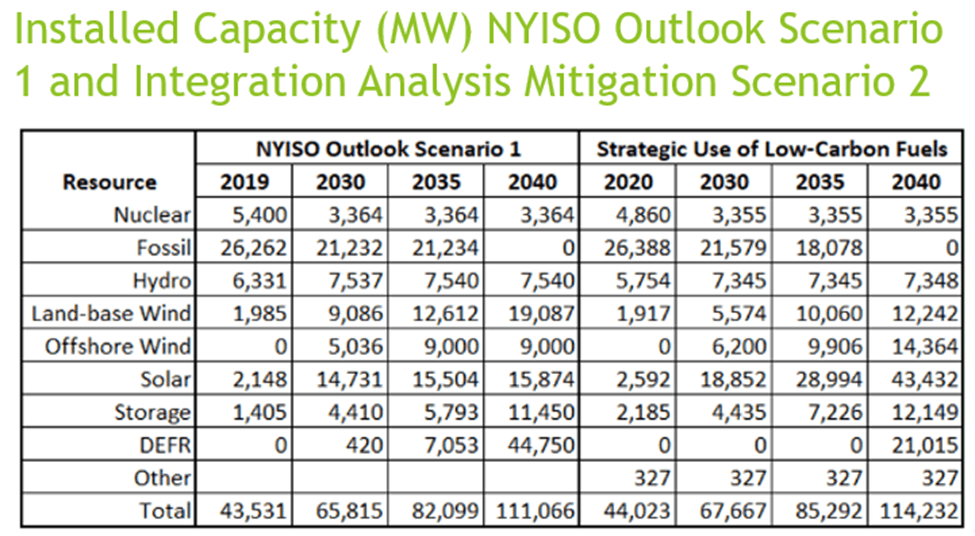
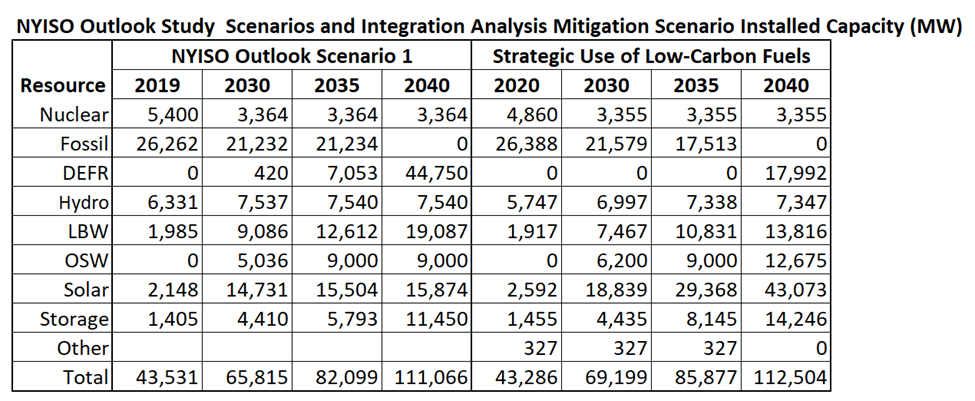
These are not the only additional costs needed to support offshore wind.  The Propel NY costs are only for a portion of the new transmission lines needed and do not include additional costs associated with the impacts on the existing transmission and distribution systems on Long Island.  This is the cost associated with 3,000 MW of offshore wind.  The Climate Act goal is for 9,000 MW and the Scoping Plan Integration Analysis projects that 12,675 MW of offshore wind will be needed by 2040 in the Strategic Use of Low-Carbon Fuels mitigation scenario. 

Offshore Wind Cost Renegotiation

The Informational Report Table 8 program costs include the costs for OSW wind projects that have contracts.  One reason for this post is that inflation and supply chain issues have led developers to ask that the contracts be renegotiated.  James Hanley writes:

Multiple offshore wind projects that are not even built yet have asked the state’s Public Service Commission (PSC) to renegotiate their strike prices—the amount they will be paid per megawatt hour (MWh) of electricity produced. (A megawatt hour is roughly enough electricity to power 750 homes for one hour.) 

One of the glaring deficiencies of the Hochul Administration’s Climate Act implementation is the lack of information about ratepayer impacts.  The Informational Report was the first report that provided any estimates of ratepayer impacts and that was a Climate Act mandate.  In order to get a feel for the ratepayer impacts of the contract renegotiations it is up to outside parties to provide estimates.  Multiple Intervenors and the Municipal Electric Utilities Association of New York State (“Customer Advocates”) recently submitted Supplemental Comments to the New York State Public Service Commission that includes estimates of the incremental costs to customers for these renegotiated contracts.

The Consumer Advocates comments addressed the NYSERDA submitted comments that estimated the change in contract strike prices that would result from contract modifications requested by offshore wind developers.  NYSERDA did not provide any estimate of the effect on consumer costs so Consumer Advocates made their own.  Their analysis found that the proposed changes could impose on customers incremental costs of between $20.8 billion and $37.6 billion.  In my original article I did not pick up on the fact that the incremental costs accrue over 30 years.  In other words I should have divided by 30 to get the annual ratepayer impact.

ACENY Tier 1 REC Adjustment

The crony capitalists representing other renewable developments lost no time in submitting their own petitions for additional money.  The Alliance for Clean Energy New York (ACENY) submitted their own petition in June 2023 that claimed:

A number of factors not seen in decades, including the COVID-19 pandemic and the war of aggression in Europe with Russia’s invasion of Ukraine, have collectively led to intractable supply chain bottlenecks and labor constraints. Meanwhile, unprecedented increases in demand for new renewable energy development relative to other goods and services as more States and countries implement their own climate change initiatives has further exacerbated these inflationary effects for the renewable energy industry, leading to wholly unpredictable upsurges in the costs of renewable energy development.

The end result: skyrocketing, unpredictable inflationary spikes. As established herein, these effects collectively (“Post-COVID Impacts”) have eroded the viability of Awarded Projects that have not already been cancelled, are not operational and are not yet nearing operation (“Under Development Projects”). Proceeding with the Tier 1 REC program on a status quo basis is, thus, no longer viable.

Using the same methodology used for the offshore wind renegotiation costs, the Consumer Advocates estimated that the ACENY petition would add another $10.69 billion to ratepayer costs.  This value needs to be divided by 30 to get the annual impact.

Transmission Project Adjustments

The ACENY petition did not over similar adjustments for the Clean Path New York (CPNY) and Champlain Hudson Express (CHPE) transmission line projects. 

CPNY submitted their own petition asking for a similar adjustment:

Clean Path New York LLC (“CPNY”) requested that the New York Public Service Commission (“Commission”) authorize the New York State Energy Research and Development Authority (“NYSERDA”) to adjust CPNY’s strike price to adjust CPNY’s strike price attributable to the generation portion of the Tier 4 Renewable Energy Certificate Purchase and Sale Agreement entered into between CPNY and NYSERDA (the “CPNY Contract”), solely by the amount of the adjustment provided in response to the petition (the “Tier 1 Petition”) filed by the Alliance for Clean Energy New York (“ACE-NY”) requesting that the Commission authorize NYSERDA to incorporate an express adjustment mechanism provision in its Clean Energy Standard Tier 1 contracts (“Adjustment Mechanism”) for projects awarded through NYSERDA’s 2021 Renewable Energy Certificate (“REC”) Solicitation (“Under Development Projects”).  As ACE-NY explained, this corrective action will produce RECs that are consistent with New York Public Service Law Section 65 and is required due to the unforeseen and severe market disruptions that have occurred since those solicitations were held. The changes have resulted in materially adverse impacts that have rendered the Under Development Projects economically infeasible.

CHPE also submitted a petition with Hydro Quebec Energy Services (HQES).  The introduction to the petition states:

Unprecedented economic factors including rising interest rates, inflation, and supply shortages are jeopardizing all clean energy infrastructure projects needed to achieve New York’s climate goals. With respect to the CHPE Project, the construction costs for its new-build transmission components have increased significantly from the time of the CHPE Project bid submission (in May 2021) to the closing on the financing for the U.S. portion of the CHPE Project in October 2022, shortly after which construction began. Notwithstanding these challenges, Petitioners’ actions allowed the CHPE Project to start construction, and they remain committed to this necessary project and to the HQUS REC Contract.

The CHPE Project is indisputably critical to maintaining reliability while achieving New York State’s longstanding goal of decarbonizing Downstate New York energy consumption. By entering service in Spring 2026 as anticipated, the CHPE Project will create sufficient “reliability margins within New York City” to push off the need to add new generating or other resources for up to five or six years.

Like the other many developers that have filed petitions, Petitioners faced global supply chain shortages and market disruption, and the substantial negative impacts of inflation and interest rate increases on construction costs in both the United States and Canada. For this reason, the CHPE Project is similarly situated to the other major New York renewable energy project petitioners seeking cost adjustments and should be treated equally and consistently with respect to any cost adjustments granted by the Commission.

Accordingly, Petitioners propose that the Commission authorize NYSERDA to adopt a program-wide cost adjustment formula covering all Approved Projects, based on the inflationary adjustment already provided by NYSERDA for new Tier 1 REC contracts.9 The adoption of a program-wide, formula-based price adjustment for construction costs for all new-build project components is Petitioners’ preference, as it would treat all developers equally.

Consumer Advocates did not calculate an impact to consumers for these two project renegotiations.  I did not try to estimate any additional ratepayer impacts for them.

Discussion

The Utility Intervention Unit, Division of Consumer Protection NYS Department of State submitted a petition responding to ACENY.  They describe the ACENY petition as follows:

The ACE-NY petition seeks a one-time adjustment mechanism for solar and wind projects claiming it would restore “viability to support project completion, while also ensuring efficiency, transparency, and simplicity in their application.” 

ACE-NY proposes an adjustment factor on each project so that Under Development Projects will become economically viable and claims this is necessary to meet a viable schedule to achieve the 2030 goal.

The Utility Intervention Unit had  issues with the ACENY petition:

Yet, PA Consulting’s assessment did not consider “specific circumstances faced by individual renewable energy project or developer.” Nor did they analyze which portion of Under Development Projects would be successful, fail, or offer new projects in subsequent solicitations due to the number of judgement calls that would be required.10 While PA Consulting focused on the financial aspects, it did not consider or speak to whether the sought adjustment mechanism could overcome supply chain or labor shortages among the increase demand of renewable resources. Therefore, it appears ACE-NY and PA Consulting are proposing an adjustment factor with no guarantee that the 2030 goal will be met. Without such guarantees, UIU opposes the petition as requested and suggests the focus be on supporting only those projects worthy of ratepayers’ support.

For markets and competition to function efficiently, contracts and obligations should be honored. Altering contracts after terms are defined can diminish the competitive process that potentially disadvantages those bidders not selected in a respective solicitation and consumers who are paying for the project. The unsuccessful bidders may have included a risk premium that could be less than the REC price adjustment ACE-NY is seeking in its petition.

I agree with UIU.  There are implications not only to costs but also to the schedule for all the factors cited by the developers. 

Consolidated Ratepayer Cost Estimate

The following table lists all authorized and incremental relief ratepayer costs that could be on the backs of New York ratepayers except for the CPNY and CHPE project costs.  The Informational Report listed $43.8 billion in costs that have been authorized but are not yet in ratepayer bills.  That report did not include the $3.3 billion Propel NY transmission project needed for offshore wind.  If total costs for the Integration Analysis offshore wind projection are proportional to the offshore wind capacity (12,765 MW to 3,000 MW) the transmission upgrades for offshore wind will be $13.9 billion. The Consumer Advocate petition estimated ratepayer costs for the NYSERDA and ACENY petitions ranging from $26.4 billion to $48.4 billion.  When the Informational Report authorized funding to date, offshore wind transmission support, and the Consumer Advocate additional funding requirements are totaled the range is $73.47 billion to $105.7 billion.

Ratepayer Potential Impacts

The Informational Report included Table 7: 2022 Typical Monthly Electric Bills with Climate Act related costs disaggregated that was the first admission by the Hochul Administration of potential costs of the Climate Act to ratepayers.  The basis for the typical electric delivery and supply bills for 2022 was provided for the following customer types:

A.           Residential customers (600 kWh per month),

B.           Non-residential customers (50 kW & 12,600 kWh per month),

C.           Non-residential customers (2,000 kW & 720,000 kWh per month), and

D.           Non-residential high load factor customers (2,000 kW & 1,296,000 kWh per month).

PSC Staff requested that utilities disaggregate the cost components reported in Table 2 (electric) to determine CLCPA related impacts on customers as shown in Table 7.  Climate Act costs added between 9.8% and 3.7% to residential monthly electric bills in 2022.

This is the point where my mistake caused the results to go off the rails.  It turns out that I made the same mistake in a previous post too.  I pro-rated the Informational Report ratepayer Climate Act cost recoveries for $43.8 billion in costs for contracts that have been awarded but not yet authorized for cost recovery but did not account for a 30-year accrual.  In the original post I showed calculations two ways but will only show the slightly more refined version here. 

Recall that Table 4: 2022 Electric CLCPA Recoveries in the Informational Report summarizes costs recovered in 2022 by utilities for electric programs.  The table states that $1,176 million in Climate Act costs were recovered in 2022 and it shows the amount these costs affected utility bills for seven utilities and eight program categories.  I assume that future ratepayer costs will increase proportionally to the

Informational Report authorized funding to date, offshore wind transmission support, and the Consumer Advocate additional funding requirements in the range of $73.47 billion to $105.7 billion if these numbers are divided by 30 to account for the appropriate accrual rate.

Instead of using the ratio of the totals I prorated costs from the Table 8 program cost categories for all the additional costs expected and then scaled costs per utility for the lower and upper bounds. This adds another 4 to 20% increase in the Climate Act costs.  Ultimately, the PSC should provide the refined numbers not the Consumer Advocates or folks like me.  New Yorkers deserve the best estimates of ratepayer costs.

Note that if you want the spreadsheet with these data please contact me.

Conclusion

I believe that the Hochul Administration is trying hard to coverup the ratepayer cost impacts.  The Informational Report is a useful first estimate of ratepayer impacts but it was a required Climate Act mandate.  It provides as little information as possible.  For example, it excludes the Propel NY transmission costs because “the Commission did not directly approve this project.”  The intent of the Climate Act mandate was to describe all the effects of the Act on ratepayers not just what is politically palatable.   

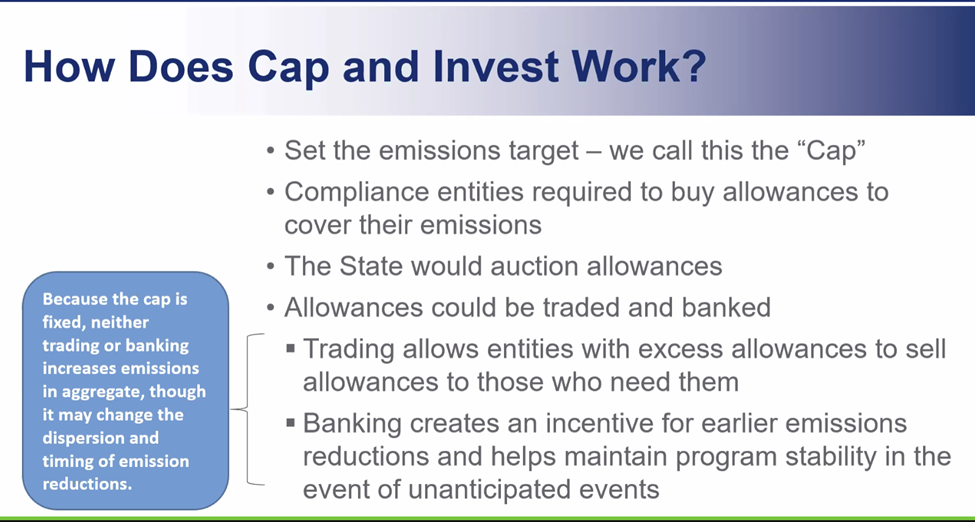
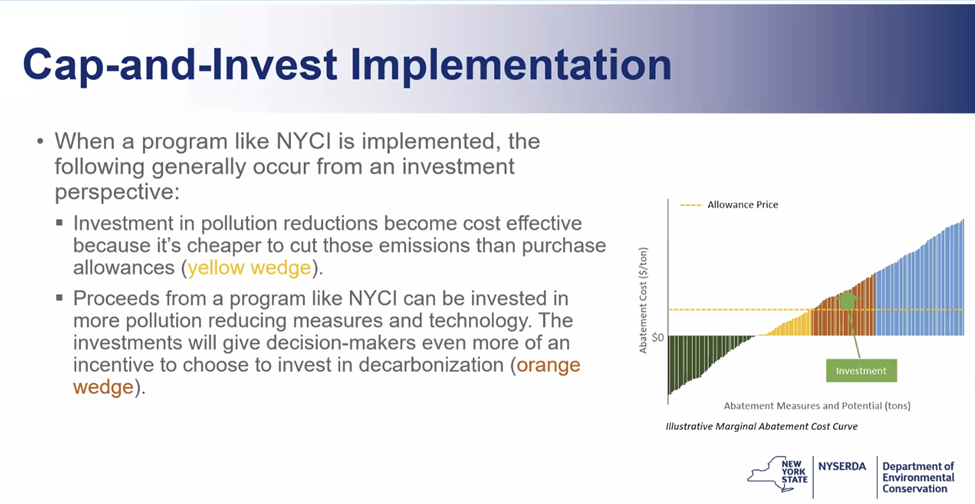
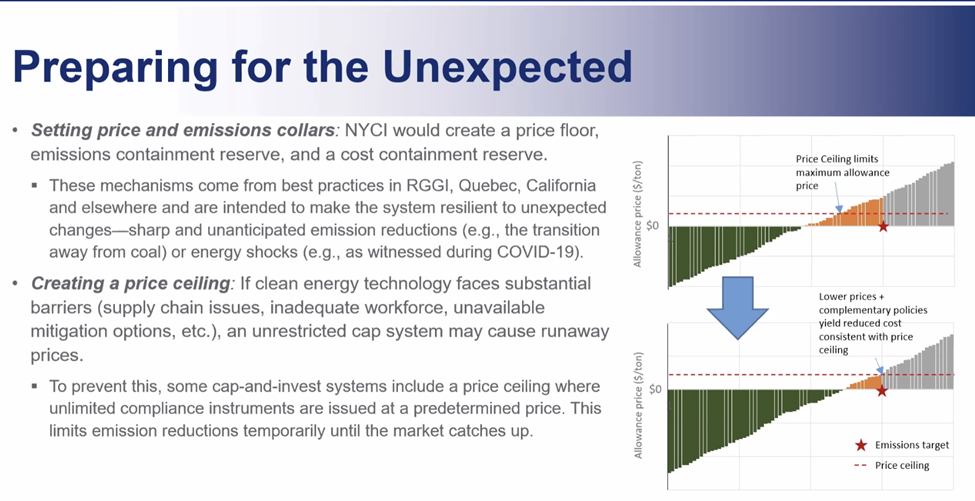
The costs shown here are notable and they are not the total costs.   All the ratepayer costs that are described in this post are only for the supply portion of utility bills.  The Hochul Administration is implementing a Cap-and-Invest program that will increase the costs of delivery.  There has been absolutely no hint of the expected costs for the cap-and-invest program but it will certainly cause an additional increase in costs.  In addition, this is just for the costs of the electricity.  The Climate Act plan is to convert homes and transportation to zero emissions energy too so New Yorkers will have to pick up those costs too.

When I thought that the Climate Act would more than double electric utility bills I said I expected that a ratepayer revolt would occur when the public caught on.  Even at these lower costs I believe that the Hochul Administration has a vested interest in covering up these costs up for as long as possible.  I am disappointed that there have not been news stories about this issue.  There always seems to be space for the latest unsubstantiated claim that an unusual weather event is proof of climate change but there does not appear to be room to show that New York’s plan to do something about climate change will make electricity unaffordable for many. The real impacts of energy poverty on health and welfare should be a higher priority than the speculative effects of climate change that New York cannot alter because New York GHG emissions are less than one half of one percent of global emissions and global emissions have been increasing on average by more than one half of one percent per year since 1990.  Anything we do is supplanted by emission increases elsewhere in less than a year.

Electric Ratepayer Bills Must Explode to Meet Climate Act Mandates

Update: There is an error in this post.  Please refer to the corrected version .   Dr. Jonathan Lesser pointed out that I need to adjust the consolidated costs described here for contracts that have been awarded but not yet authorized for cost recovery and other requested costs but did not account for a 30-year accrual.  As a result the correct increases are much lower,  but I still think that these costs are extraordinary albeit not explosive as I said here.

This post consolidates all the recent information on added costs associated with renewable energy development needed to meet Climate Leadership & Community Protection Act (Climate Act) targets that have been authorized or requested.  These costs will eventually show up in electric bills and the projected cost increases are extraordinary.

I have been following the Climate Act since it was first proposed, submitted comments on the Climate Act implementation plan, and have written over 350 articles about New York’s net-zero transition.  I have devoted a lot of time to the Climate Act because I believe the ambitions for a zero-emissions economy embodied in the Climate Act outstrip available renewable technology such that the net-zero transition will do more harm than good.  The opinions expressed in this post do not reflect the position of any of my previous employers or any other company I have been associated with, these comments are mine alone.

Climate Act Background

The Climate Act established a New York “Net Zero” target (85% reduction and 15% offset of emissions) by 2050.  It includes an interim 2030 reduction target of a 40% reduction by 2030 and a requirement that all electricity generated be “zero-emissions” by 2040. The Climate Action Council is responsible for preparing the Scoping Plan that outlines how to “achieve the State’s bold clean energy and climate agenda.”  In brief, that plan is to electrify everything possible using zero-emissions electricity. The Integration Analysis prepared by the New York State Energy Research and Development Authority (NYSERDA) and its consultants quantifies the impact of the electrification strategies.  That material was used to develop the Draft Scoping Plan.  After a year-long review, the Scoping Plan recommendations were finalized at the end of 2022.  In 2023 the Scoping Plan recommendations are supposed to be implemented through regulation and legislation. 

Renewable Procurement Background

The NYSERDA is primarily responsible for facilitating projects to meet  Governor Hochul’s target of generating 70 percent of New York State’s electricity from renewable sources by 2030.  For background, I tried to figure out those projects will be funded.  One component is solicitations for large-scale renewables.  That includes a two-step process consisting of:

  1. Step One Eligibility Application: A qualifying step through which the proposer must provide evidence that the Bid Facility is Tier 1 eligible and other general information about the Proposer and the Bid Facility. All Step One Eligibility Applications must be submitted via the RESRFP22-1 solicitation website
  2. Step Two Bid Proposal: A competitive Bid Proposal step, through which NYSERDA will:

a. examine Bid Proposals to determine whether they demonstrate that the Bid Facility and Proposer meet the Minimum Threshold Requirements; and

b. for Bid Proposals that meet those Minimum Threshold Requirements, perform a competitive evaluation based on price and non-price factors.

The focus of this post is on ratepayer costs associated with the zero-emissions mandates.  I did some research on the funding mechanisms and this is how I think renewable energy projects are funded.  The Clean Energy Standard (CES) is the primary method used to “turn New York State’s ambitious clean energy goal into a reality.”  The CES has two mechanisms: the renewable energy standard (RES) and the zero-emissions credit (ZEC) requirement designed to help create a low carbon energy system.  According to NYSERDA:

  • The RES requires every load serving entity (LSE)
     in New York State to procure renewable energy certificates(RECs)
     associated with new renewable energy resources—known as Tier 1—for their retail customers. If LSEs cannot demonstrate they are meeting the Tier 1 obligation through the possession of RECs, they may make alternative compliance payments (ACPs).
  • The ZEC requirement mandates the LSEs procure ZECs from NYSERDA. The number of ZECs is based on each LSE’s proportionate amount of statewide load, or energy demanded, in a given compliance year.

In addition to these programs, NYSERDA is also advancing offshore wind energy projects through its Offshore Wind Program. NYSERDA also works with its State partners and local communities to rapidly advance new “Build-Ready” projects, prioritizing the development of existing or abandoned commercial sites, brownfields, landfills, former industrial sites, and other abandoned or underutilized sites.

According to NYSERDA:

The Renewable Energy Standard (RES) is a mechanism enacted by the Clean Energy Standard to help New York State reach its ambitious clean energy goals and transition toward a low carbon energy system. The RES requires utilities and other load serving entities in the State to procure Tier 1 renewable energy credits (RECs).

The LSEs must pay for the RECs.  NYSERDA obtains the RECs from developers in auctions.  For example, the 2022 solicitation tried to “procure approximately 4.5 million Tier 1 eligible Renewable Energy Certificates (RECs) from eligible facilities that enter commercial operation on or after January 1, 2015 and on or before May 31, 2025, unless extended to May 31, 2028.”

The costs for the RECs are passed on to consumers in several steps.  First, NYSERDA awards contracts for the RECs to specific projects.  There is no guarantee that a project that has been awarded a contract will actually get built and operate.  The Utility Intervention Unit (UIU), Division of Consumer Protection NYS Department of State recently submitted a petition that noted that “only a tiny subset of awarded projects has completed the entire solicitation cycle and reached operational status (“Operational Projects”)”.   When a project starts to operate, they are awarded RECs which are sold to the LSEs.  The LSEs pass those costs on to their customers only after the PSC authorizes the cost in a utility rate case.

Note, however, that there are other programs described in this article that are also needed to meet the zero-emissions mandate that also add to consumer utility bills.

Informational Report on Ratepayer Costs

The Department of Public Service (DPS) first annual informational report (“Informational Report”) on the implementation of the Climate Act was released in July.  The report is notable because it provided the first Climate Act ratepayer cost estimates provided by the Hochul Administration.  However, those estimates only cover projects that are in the utility rate cases in 2022.   There are many more costs that will eventually show up in electric bills.

The report was based on data submitted by utilities that were collected to pay for Climate Act projects.  The Department of Public Service presentation on the Informational Report noted that “ the estimates of total funding authorized by the Commission to date for various clean energy programs in some instances reflect actions that pre-date the enactment of the Climate Act.”  The conclusion states that the information presented “represents  direct effects of Climate Act implementation only, and only the portion of direct effects of programs over which the Commission has oversight authority.” 

In an earlier post I described Table 4: 2022 Electric CLCPA Recoveries from the report that summarizes costs recovered in 2022 by utilities for electric programs.  The table states that $1,176 million in Climate Act costs were recovered in 2022 and it shows the amount these costs affected utility bills for seven utilities and eight program categories.  I doubt that there are many people who understand what is in each of these different programs but for the purpose of trying to estimate ratepayer costs for renewable energy development we need to summarize the programs.  The CES awards discussed above accounted for $348 million of that total.  The Clean Energy Fund (CEF) “was established as a commitment to clean energy and efficiency measures”.  The latest annual performance report lists four CEF components totaling $500 million: market development, innovation & research, NY-Sun (the distributed solar program), and the NY Green Bank.  The value of distributed energy resources (VDER) also known as the Value Stack is a new mechanism to compensate energy created by distributed energy resources, like residential solar.  The EV Make Ready Program goal is to support the development of electric infrastructure and equipment necessary to accommodate an increased deployment of EVs within New York State by reducing the upfront costs of building charging stations for EVs. The Integrated Energy Data Resource (IEDR) establishes a statewide centralized computer platform that “will allow effective access to useful energy data and information from New York’s electric, gas, and steam utilities – and other sources – to support new and innovative clean energy business models that deliver benefits to New York energy customers.”  The “Electric EE/BE” program for home heating electrification using heat pumps and another for transmission upgrades needed to support the buildout of wind and solar developments.  This is the other large ($279 million) cost component.  The program categories descriptions that did not include costs total only $48 million.

The purpose of this post is to estimate the necessary cost recoveries for renewable energy development with the latest information.  Informational Report Table 8: Authorized Funding to Date “gives a sense” of some of the expenditures that will ultimately be recovered in rates. The Informational Report explains:

This annual report is a review of actual costs incurred by ratepayers to date in support of various programs and projects to implement the CLCPA and does not fully capture potential future expenditures, including estimated costs already authorized by the Commission but not yet recovered in rates. To complement this overview of cost recoveries incurred to date, we also present below a table of the various programs and the total amount of estimated costs associated with each authorized by the Commission to date. Table 8 gives a sense of expenditures that ratepayers could ultimately see recovered in rates. These values are conservative and reflect both past and prospective estimated costs.

The takeaway message from Table 8 is that the authorized funding to date of program costs that will eventually make their way to ratepayer bills totals $43.756 billion.  I assume that all the CES costs ($25.242 billion) are associated with renewable energy development.  Although there are other components that could support the zero-emissions mandates, I am not aware of proposed adjustments to any other programs.

Offshore Wind (OSW) Transmission Support

The purpose of this post is to update the data in Table 8 with the latest information on renewable energy development costs.  The first additional item is the necessary transmission upgrade for offshore wind.  Buried in a footnote is an admission that these are not all the costs authorized.  Footnote 7 in Table 8 states:

Not included in this table is the Propel NY transmission project, selected by the NYISO Board in June 2023 in response to the Commission’s declaration of a public policy transmission need (PPTN) to support injections of offshore wind energy to the Long Island system by 2030 at an estimated cost of $3.36 billion. Since the Commission did not directly approve this project, the estimated cost is not captured in the Table 8.

I posted an article about this component of the offshore wind implementation requirements earlier this year.  The Department of Public Service has an Order for Public Policy Transmission Need (PPTN) (Case 20-E-0497) regarding Climate Act requirements related to offshore wind that drive the need to expand the number of transmission facilities between Long Island and the rest of the State.  These transmission system upgrades are needed to get the generated offshore wind from where it comes on shore to where it is needed in the state.

In response to the New York Independent System Operator (NYISO) request for proposals for the PPTN 17 bids were received.   The average total cost estimate was $7.1 billion, the maximum was $16.9 billion and the minimum was $2.1 billion.  In June 2023, NYISO chose the Propel NY transmission project totaling $3.28 billion.

These are not the only additional costs needed to support offshore wind.  The Propel NY costs are only for a portion of the new transmission lines needed and do not include additional costs associated with the impacts on the existing transmission and distribution systems on Long Island.  This is the cost associated with 3,000 MW of offshore wind.  The Climate Act goal is for 9,000 MW and the Scoping Plan Integration Analysis projects that 12,675 MW of offshore wind will be needed by 2040 in the Strategic Use of Low-Carbon Fuels mitigation scenario. 

Offshore Wind Cost Renegotiation

The Informational Report Table 8 program costs include the costs for OSW wind projects that have contracts.  One reason for this post is that inflation and supply chain issues have led developers to ask that the contracts be renegotiated.  James Hanley writes:

Multiple offshore wind projects that are not even built yet have asked the state’s Public Service Commission (PSC) to renegotiate their strike prices—the amount they will be paid per megawatt hour (MWh) of electricity produced. (A megawatt hour is roughly enough electricity to power 750 homes for one hour.) 

One of the glaring deficiencies of the Hochul Administration’s Climate Act implementation is the lack of information about ratepayer impacts.  The Informational Report was the first report that provided any estimates of ratepayer impacts and that was a Climate Act mandate.  In order to get a feel for the ratepayer impacts of the contract renegotiations it is up to outside parties to provide estimates.  Multiple Intervenors and the Municipal Electric Utilities Association of New York State (“Customer Advocates”) recently submitted Supplemental Comments to the New York State Public Service Commission that includes estimates of the incremental costs to customers for these renegotiated contracts.

The Consumer Advocates comments addressed the NYSERDA submitted comments that estimated the change in contract strike prices that would result from contract modifications requested by offshore wind developers.  NYSERDA did not provide any estimate of the effect on consumer costs so Consumer Advocates made their own.  Their analysis found that the proposed changes could impose on customers incremental costs of between $20.8 billion and $37.6 billion.

ACENY Tier 1 REC Adjustment

The crony capitalists representing other renewable developments lost no time in submitting their own petitions for additional money.  The Alliance for Clean Energy New York (ACENY) submitted their own petition in June 2023 that claimed:

A number of factors not seen in decades, including the COVID-19 pandemic and the war of aggression in Europe with Russia’s invasion of Ukraine, have collectively led to intractable supply chain bottlenecks and labor constraints. Meanwhile, unprecedented increases in demand for new renewable energy development relative to other goods and services as more States and countries implement their own climate change initiatives has further exacerbated these inflationary effects for the renewable energy industry, leading to wholly unpredictable upsurges in the costs of renewable energy development.

The end result: skyrocketing, unpredictable inflationary spikes. As established herein, these effects collectively (“Post-COVID Impacts”) have eroded the viability of Awarded Projects that have not already been cancelled, are not operational and are not yet nearing operation (“Under Development Projects”). Proceeding with the Tier 1 REC program on a status quo basis is, thus, no longer viable.

Using the same methodology used for the offshore wind renegotiation costs, the Consumer Advocates estimated that the ACENY petition would add another $10.69 billion to ratepayer costs.

Transmission Project Adjustments

The ACENY petition did not over similar adjustments for the Clean Path New York (CPNY) and Champlain Hudson Express (CHPE) transmission line projects. 

CPNY submitted their own petition asking for a similar adjustment:

Clean Path New York LLC (“CPNY”) requested that the New York Public Service Commission (“Commission”) authorize the New York State Energy Research and Development Authority (“NYSERDA”) to adjust CPNY’s strike price to adjust CPNY’s strike price attributable to the generation portion of the Tier 4 Renewable Energy Certificate Purchase and Sale Agreement entered into between CPNY and NYSERDA (the “CPNY Contract”), solely by the amount of the adjustment provided in response to the petition (the “Tier 1 Petition”) filed by the Alliance for Clean Energy New York (“ACE-NY”) requesting that the Commission authorize NYSERDA to incorporate an express adjustment mechanism provision in its Clean Energy Standard Tier 1 contracts (“Adjustment Mechanism”) for projects awarded through NYSERDA’s 2021 Renewable Energy Certificate (“REC”) Solicitation (“Under Development Projects”).  As ACE-NY explained, this corrective action will produce RECs that are consistent with New York Public Service Law Section 65 and is required due to the unforeseen and severe market disruptions that have occurred since those solicitations were held. The changes have resulted in materially adverse impacts that have rendered the Under Development Projects economically infeasible.

CHPE also submitted a petition with Hydro Quebec Energy Services (HQES).  The introduction to the petition states:

Unprecedented economic factors including rising interest rates, inflation, and supply shortages are jeopardizing all clean energy infrastructure projects needed to achieve New York’s climate goals. With respect to the CHPE Project, the construction costs for its new-build transmission components have increased significantly from the time of the CHPE Project bid submission (in May 2021) to the closing on the financing for the U.S. portion of the CHPE Project in October 2022, shortly after which construction began. Notwithstanding these challenges, Petitioners’ actions allowed the CHPE Project to start construction, and they remain committed to this necessary project and to the HQUS REC Contract.

The CHPE Project is indisputably critical to maintaining reliability while achieving New York State’s longstanding goal of decarbonizing Downstate New York energy consumption. By entering service in Spring 2026 as anticipated, the CHPE Project will create sufficient “reliability margins within New York City” to push off the need to add new generating or other resources for up to five or six years.

Like the other many developers that have filed petitions, Petitioners faced global supply chain shortages and market disruption, and the substantial negative impacts of inflation and interest rate increases on construction costs in both the United States and Canada. For this reason, the CHPE Project is similarly situated to the other major New York renewable energy project petitioners seeking cost adjustments and should be treated equally and consistently with respect to any cost adjustments granted by the Commission.

Accordingly, Petitioners propose that the Commission authorize NYSERDA to adopt a program-wide cost adjustment formula covering all Approved Projects, based on the inflationary adjustment already provided by NYSERDA for new Tier 1 REC contracts.9 The adoption of a program-wide, formula-based price adjustment for construction costs for all new-build project components is Petitioners’ preference, as it would treat all developers equally.

Consumer Advocates did not calculate an impact to consumers for these two project renegotiations.  I did not try to estimate any additional ratepayer impacts for them.

Discussion

The Utility Intervention Unit, Division of Consumer Protection NYS Department of State submitted a petition responding to ACENY.  They describe the ACENY petition as follows:

The ACE-NY petition seeks a one-time adjustment mechanism for solar and wind projects claiming it would restore “viability to support project completion, while also ensuring efficiency, transparency, and simplicity in their application.” 

ACE-NY proposes an adjustment factor on each project so that Under Development Projects will become economically viable and claims this is necessary to meet a viable schedule to achieve the 2030 goal.

The Utility Intervention Unit had  issues with the ACENY petition:

Yet, PA Consulting’s assessment did not consider “specific circumstances faced by individual renewable energy project or developer.” Nor did they analyze which portion of Under Development Projects would be successful, fail, or offer new projects in subsequent solicitations due to the number of judgement calls that would be required.10 While PA Consulting focused on the financial aspects, it did not consider or speak to whether the sought adjustment mechanism could overcome supply chain or labor shortages among the increase demand of renewable resources. Therefore, it appears ACE-NY and PA Consulting are proposing an adjustment factor with no guarantee that the 2030 goal will be met. Without such guarantees, UIU opposes the petition as requested and suggests the focus be on supporting only those projects worthy of ratepayers’ support.

For markets and competition to function efficiently, contracts and obligations should be honored. Altering contracts after terms are defined can diminish the competitive process that potentially disadvantages those bidders not selected in a respective solicitation and consumers who are paying for the project. The unsuccessful bidders may have included a risk premium that could be less than the REC price adjustment ACE-NY is seeking in its petition.

I agree with UIU.  There are implications not only to costs but also to the schedule for all the factors cited by the developers. 

Consolidated Ratepayer Cost Estimate

The following table lists all authorized and incremental relief ratepayer costs that could be on the backs of New York ratepayers except for the CPNY and CHPE project costs.  The Informational Report listed $43.8 billion in costs that have been authorized but are not yet in ratepayer bills.  That report did not include the $3.3 billion Propel NY transmission project needed for offshore wind.  If total costs for the Integration Analysis offshore wind projection are proportional to the offshore wind capacity (12,765 MW to 3,000 MW) the transmission upgrades for offshore wind will be $13.9 billion. The Consumer Advocate petition estimated ratepayer costs for the NYSERDA and ACENY petitions ranging from $26.4 billion to $48.4 billion.  When the Informational Report authorized funding to date, offshore wind transmission support, and the Consumer Advocate additional funding requirements are totaled the range is $73.47 billion to $105.7 billion.

Ratepayer Potential Impacts

The Informational Report included Table 7: 2022 Typical Monthly Electric Bills with Climate Act related costs disaggregated that was the first admission by the Hochul Administration of potential costs of the Climate Act to ratepayers.  The basis for the typical electric delivery and supply bills for 2022 was provided for the following customer types:

A.           Residential customers (600 kWh per month),

B.           Non-residential customers (50 kW & 12,600 kWh per month),

C.           Non-residential customers (2,000 kW & 720,000 kWh per month), and

D.           Non-residential high load factor customers (2,000 kW & 1,296,000 kWh per month).

PSC Staff requested that utilities disaggregate the cost components reported in Table 2 (electric) to determine CLCPA related impacts on customers as shown in Table 7.  Climate Act costs added between 9.8% and 3.7% to residential monthly electric bills in 2022.

In a previous post I pro-rated the Informational Report ratepayer Climate Act cost recoveries for the $43.8 billion in costs for contracts that have been awarded but not yet authorized for cost recovery.  I simply calculated the ratio of the authorized Climate Act funding to date ($43.8 billion) to the Climate Act costs that have been authorized and were in the 2022 residential bills ($1.2 billion).   For a rough approximation of impacts by utility I simply multiplied the ratio by each of the monthly Climate Act disaggregated cost components reported by the utilities to determine CLCPA future related impacts on customers. This will not give an exact utility-specific estimate because the money authorizations per utility for 2022 and the future will not necessarily be the same.  The following table uses the same methodology for all the expected ratepayer costs. 

These numbers are so large that I suspect that I am missing something.  I tried an alternative way to estimate ratepayer impacts.  In the alternative approach I prorated costs from the Table 8 program cost categories for all the additional costs expected and then scaled costs per utility for the lower and upper bounds.  This probably is a better estimate of utility costs but the numbers are still extraordinarily high.

I believe that when all the costs not included in the Informational Report are authorized for rate cases that residential bills will more than double, at least.  Ultimately, the PSC should provide the refined numbers not the Consumer Advocates or folks like me.  New Yorkers deserve the best estimates.

Conclusion

I believe that the Hochul Administration is trying hard to coverup the ratepayer cost impacts.  The Informational Report is a useful first estimate of ratepayer impacts but it was a required Climate Act mandate.  It provides as little information as possible.  For example, it excludes the Propel NY transmission costs because “the Commission did not directly approve this project.”  The intent of the Climate Act mandate was to describe all the effects of the Act on ratepayers not just what is politically palatable.   

Furthermore, even the additional costs that I provided in this post are not the total costs.   All the ratepayer costs that are described in this post are only for the supply portion of utility bills.  The Hochul Administration is implementing a Cap-and-Invest program that will increase the costs of delivery.  There has been absolutely no hint of the expected costs for this program but it will certainly cause an additional increase in costs.  In addition, this is just for the costs of the electricity.  The Climate Act plan is to convert homes and transportation to zero emissions energy too so New Yorkers will have to pick up those costs too.

I concluded that electric utility bills would double but I believe that is a lowball estimate.  I think that most ratepayers would be grabbing pitchforks and torches to march on Albany in protest of  these projected utility bill increases if they knew what was coming their way.  Clearly the Hochul Administration has a vested interest in covering up these costs up for as long as possible.  I am disappointed that there have not been news stories about this issue.  There always seems to be space for the latest unsubstantiated claim that an unusual weather event is proof of climate change but there does not appear to be room to show that New York’s plan to do something about it will make electricity unaffordable for many. The real impacts of energy poverty on health and welfare should be a higher priority than the speculative effects of climate change that New York cannot affect because New York GHG emissions are less than one half of one percent of global emissions and global emissions have been increasing on average by more than one half of one percent per year since 1990.  Anything we do is supplanted by emission increases elsewhere.

Climate Act Offshore Wind Costs

Update (9/17/23): I corrected an error in this post.  Dr. Jonathan Lesser pointed out that I need to adjust the offshore wind costs described here to account for a 30-year accrual. 

One of the important renewable energy components of the net-zero transition in New York’s Climate Leadership & Community Protection Act (Climate Act) is offshore wind. I recently did an update on several offshore wind issues that included a description of an offshore wind cost analysis.  This is a follow up to that discussion with an emphasis on New York offshore wind costs.  The Hochul Administration is doing everything possible to hide the costs of the Climate Act but the immense costs of offshore wind are getting too large to hide.

I have been following the Climate Act since it was first proposed, submitted comments on the Climate Act implementation plan, and have written over 350 articles about New York’s net-zero transition.  I have devoted a lot of time to the Climate Act because I believe the ambitions for a zero-emissions economy embodied in the Climate Act outstrip available renewable technology such that the net-zero transition will do more harm than good.  The opinions expressed in this post do not reflect the position of any of my previous employers or any other company I have been associated with, these comments are mine alone.

Climate Act Background

The Climate Act established a New York “Net Zero” target (85% reduction and 15% offset of emissions) by 2050.  It includes an interim 2030 reduction target of a 40% reduction by 2030 and a requirement that all electricity generated be “zero-emissions” by 2040. The Climate Action Council is responsible for preparing the Scoping Plan that outlines how to “achieve the State’s bold clean energy and climate agenda.”  In brief, that plan is to electrify everything possible using zero-emissions electricity. The Integration Analysis prepared by the New York State Energy Research and Development Authority (NYSERDA) and its consultants quantifies the impact of the electrification strategies.  That material was used to develop the Draft Scoping Plan.  After a year-long review, the Scoping Plan recommendations were finalized at the end of 2022.  In 2023 the Scoping Plan recommendations are supposed to be implemented through regulation and legislation. 

Off Shore Wind (OSW) is supposed to be a major renewable resource in the net-zero electric energy system.  The Climate Act mandates 9,000 MW of Off Shore Wind (OSW) generating capacity by 2035.  The Integration Analysis modeling used to develop the Scoping Plan projects OSW capacity at 6,200 MW by 2030, 9,096 MW by 2035 and reaches 14,364 MW in 2040.  On the other hand, the New York Independent System Operator 2021-2040 System & Resource Outlook expects 5,036 MW in 2030 and 9,000 MW in 2035 with no additional development after that.  By 2030 the Integration Analysis predicts that 14% of the electric energy (GWh) produced will come from OSW and the Resource Outlook predicts nearly as much (12%).  This is an extraordinary build-out for a resource that is currently non-existent.  There are significant differences in the buildout projections that deserve to be reconciled.

OSW Transmission Support

In order to determine the total cost to New Yorkers for OSW it is necessary to consider the transmission upgrade costs.  I posted an article about this component of the OSW implementation requirements earlier this year.  The Department of Public Service has an Order for Public Policy Transmission Need (PPTN) (Case 20-E-0497) regarding Climate Act requirements related to offshore wind that drive the need to expand the number of transmission facilities between Long Island and the rest of the State.  These transmission system upgrades are needed to get the generated offshore wind from where it comes on shore to where it is needed in the state.

The draft NYISO Long Island Public Policy Transmission Need (PPTN) report predicts that the transmission upgrades will provide savings to the system:

The Long Island PPTN project simulations all show improvements in the export capability of Long Island by adding tie lines between Long Island and the lower Hudson Valley. This added transfer capacity and upgrades to the internal Long Island system reduce the amount of curtailment from offshore wind resources. The energy produced through reduced curtailment of offshore wind resources can then be used to offset more expensive generation to meet New York’s energy demand and, therefore, produce a production cost savings. Production cost savings are also created by offsetting high-cost energy imports from neighboring regions with lower cost New York-based generation that was previously inaccessible due to transmission congestion.

In general, all of the proposed projects produce savings by unbottling offshore wind resources in Long Island and reducing the amount of imports from neighboring regions. The figure below shows the estimated production cost savings for each project over a 20-year period in 2022 real million dollars.

The New York Independent System Operator (NYISO) Electric System Planning Working Group  (March 24, 2023 and April 3, 2023) evaluated independent cost estimates developed by NYISO’s consultant for proposed projects to address this issue.  In response to the NYISO’s request for proposals for the PPTN 17 bids were received.   The average total cost estimate was $7.1 billion, the maximum was $16.9 billion and the minimum was $2.1 billion.  In June 2023, NYISO chose the Propel NY transmission project totaling $3.28 billion.

The transmission upgrades are one of the hidden costs of OSW.  Without this connection upgrade as much as 92% of 3000 MW of off-shore wind which costs $15 billion would not be deliverable.  However, it comes at an annual average subsidy of $339 million.  Unfortunately, the indirect subsidy costs described are not the only costs.  These costs are only for the new transmission and do not include additional costs associated with the impacts on the existing transmission and distribution systems on Long Island.  In addition, this is the cost associated with 3,000 MW of offshore wind.  The Climate Act goal is for 9,000 MW and the Scoping Plan Integration Analysis projects that 12,675 MW of offshore wind will be needed by 2040 in the Strategic Use of Low-Carbon Fuels mitigation scenario.  If the transmission costs are proportional that would mean that this indirect subsidy alone would be at least $1,356 million a year for the Integration Analysis.

Offshore Wind Cost Renegotiation

The primary reason for this post is that inflation and supply chain issues have led developers to ask that the contracts be renegotiated.  James Hanley writes:

Multiple offshore wind projects that are not even built yet have asked the state’s Public Service Commission (PSC) to renegotiate their strike prices—the amount they will be paid per megawatt hour (MWh) of electricity produced. (A megawatt hour is roughly enough electricity to power 750 homes for one hour.) 

One of the glaring deficiencies of the Hochul Administration’s Climate Act implementation is the lack of information about ratepayer impacts.  The Informational Report was the first report that provided any estimates of ratepayer impacts and that was a Climate Act mandate.  The report provides as little information as possible.  In order to get a feel for the ratepayer impacts of the contract renegotiations it is up to outside parties to provide estimates.  Multiple Intervenors and the Municipal Electric Utilities Association of New York State2 (“Customer Advocates”) recently submitted Supplemental Comments to the New York State Public Service Commission that includes estimates of the incremental costs to customers for these renegotiated contracts.

The Consumer Advocates comments addressed the NYSERDA submitted comments that estimated the change in contract strike prices that would result from contract modifications requested by offshore wind developers.  NYSERDA did not provide any estimate of the effect on consumer costs so Consumer Advocates made their own.  Their analysis found that the proposed changes could impose on customers incremental costs of at least $20.8 billion, and as much as $37.6 billion.

Discussion

In an earlier post I described the  first annual informational report (“Informational Report”) on the implementation of the Climate Act. It summarizes costs recovered in 2022 by utilities for electric programs and estimates that $1,175,788,000 in Climate Act costs were recovered in 2022 and it shows the amount these costs affected utility bills for seven utilities.  Table 7: “2022 Typical Monthly Electric Bills with Climate Act related costs” from that report shows that residential ratepayer utility bills already are higher by between 9.8% and 3.7% for the 2022 recovered costs.

 The following table lists the additional offshore wind authorized and incremental relief ratepayer costs that could be on the backs of New York ratepayers.  The Informational Report did not include the $3.3 billion Propel NY transmission project needed for offshore wind.  The Consumer Advocate petition estimated ratepayer costs for the NYSERDA petitions totaling $37.7 billion.  When all these costs are totaled ratepayers could be on the hook for an additional $41.0 billion for offshore wind.

In a previous post I extrapolated the Informational Report ratepayer Climate Act cost recoveries for $43.8 billion in costs for contracts that have been awarded but not yet authorized for cost recovery.  I simply calculated the ratio of the authorized Climate Act funding to date ($43.8 billion) to the Climate Act costs that have been authorized and were in the 2022 residential bills ($1.2 billion).   I did not account the fact that those costs are not applied to consumer bills in one year but in this analysis, I have assumed a 30-year accrual.  For a rough approximation of impacts by utility I simply multiplied the ratio by each of the monthly Climate Act disaggregated cost components reported by the utilities to determine CLCPA future related impacts on customers. This will not give an exact utility-specific estimate because the money authorizations per utility for 2022 and the future will not necessarily be the same.  The following table uses the same methodology for all the expected ratepayer costs due to these offshore wind projects.  I expect that the supply portion of every electric utility bill will more than double.

In response to similar extraordinary costs the British Government the recent Contracts for Difference (CfD) auction subsidies for renewable electricity generation were specified. Paul Homewood writes:

Participants in the auction bid for guaranteed prices, below a cap set by ministers in advance of the auction. The cap for offshore wind was set at £44/MWh (in 2012 prices, equivalent to around £70/MWh today). This is higher than successful bids in the past, yet no wind farm developers felt able to bid at this price. Wind industry claims that this is due to rising prices are implausible – CfD contracts are index-linked.


While offshore wind’s failure to bid may be surprising to some, perhaps even to the Government, it will come as no shock to those familiar with the long-term capital and operating cost trends for wind power, as revealed in audited financial statements. Costs have not been falling dramatically as the industry claimed. All around the world the wind industry is in trouble for the same reasons; costs remain high, and high levels of subsidy are needed to reward investors.

If New York were to revise its contracts to hold down costs I expect that the results would be the same.  That is to say, no one would bid because the industry is in deep financial trouble.

Conclusion

In conclusion it is important to note that all the ratepayer costs that are described in this post are only for the supply portion of utility bills.  The Hochul Administration is implementing a Cap-and-Invest program that will increase the costs of delivery.  There has been absolutely no hint of the expected costs for this program but it will certainly cause an increase.  Furthermore, this is just for the costs of the electricity.  The plan is to convert homes and transportation too.

Offshore wind is a key part of the planned Climate Act net-zero transition.  The New York Post notes that “In a fresh sign that New York’s state climate agenda is pure fantasy, contractors key to making good on a major piece of the so-called plan just filed to charge 54% more to build their offshore wind farms. “  This post estimates that these costs combined with all the other authorized but as yet unaccounted for ratepayer costs will be extraordinarily high.

The percentage of residential electric bill costs to meet the Climate Act mandates will increase such that between 8% and 21% of bills cover offshore wind costs and other mandates. The only reason that the public is not grabbing pitchforks and torches to march on Albany in protest of these regressive cost increases is that the public is unaware of what is coming. I am extremely disappointed that politicians and the media have not stepped up and demanded transparent accounting of expected Climate Act costs.

Climate Act Offshore Wind Update

One of the important renewable energy components of the net-zero transition in New York’s Climate Leadership & Community Protection Act (Climate Act) is offshore wind. A couple of months ago I wrote an article that described some offshore wind issues.  Since then, other issues have come up that I think deserve to be highlighted.

I have been following the Climate Act since it was first proposed, submitted comments on the Climate Act implementation plan, and have written over 350 articles about New York’s net-zero transition.  I have devoted a lot of time to the Climate Act because I believe the ambitions for a zero-emissions economy embodied in the Climate Act outstrip available renewable technology such that the net-zero transition will do more harm than good.  The opinions expressed in this post do not reflect the position of any of my previous employers or any other company I have been associated with, these comments are mine alone.

Climate Act Background

The Climate Act established a New York “Net Zero” target (85% reduction and 15% offset of emissions) by 2050.  It includes an interim 2030 reduction target of a 40% reduction by 2030 and a requirement that all electricity generated be “zero-emissions” by 2040. The Climate Action Council is responsible for preparing the Scoping Plan that outlines how to “achieve the State’s bold clean energy and climate agenda.”  In brief, that plan is to electrify everything possible using zero-emissions electricity. The Integration Analysis prepared by the New York State Energy Research and Development Authority (NYSERDA) and its consultants quantifies the impact of the electrification strategies.  That material was used to develop the Draft Scoping Plan.  After a year-long review, the Scoping Plan recommendations were finalized at the end of 2022.  In 2023 the Scoping Plan recommendations are supposed to be implemented through regulation and legislation. 

Off Shore Wind (OSW) will be a major renewable resource in the net-zero electric energy system.  The Climate Act mandates 9,000 MW of Off Shore Wind (OSW) generating capacity by 2035.  The Integration Analysis modeling used to develop the Scoping Plan projects OSW capacity at 6,200 MW by 2030, 9,096 MW by 2035 and reaches 14,364 MW in 2040.  On the other hand, the New York Independent System Operator 2021-2040 System & Resource Outlook expects 5,036 MW in 2030 and 9,000 MW in 2035 with no additional development after that.  By 2030 the Integration Analysis predicts that 14% of the electric energy (GWh) produced will come from OSW and the Resource Outlook predicts nearly as much (12%).  This is an extraordinary build-out for a resource that is currently non-existent and there are significant differences in the buildout projections that deserve to be reconciled.

Offshore Wind Environmental Impacts

One of the topics in my last article addressed environmental impacts.   I described Jim Lovgren’s article at FisheryNation.com that covered OSW environmental issues: Offshore Wind Electrical Substations; The Secret, Silent Killers.  One of the key issues is ocean noise from sonar surveys and driving ocean pile foundations.  Kevin Kilty provided some follow up information that I have been meaning to publish since then. 

In his first email Kevin expressed concern with some of the statements in the Fishery Nation piece:

I did find some puzzling statements from your links to FisheryNation.com. First there is the quoted sound level of 260dB. There is no mention of this being sound pressure level or sound intensity, but 260dB is far beyond any noise source that I am familiar with and is not even reasonable. As the 0dB sound intensity level is a power density level of 1.0 picowatt per square meter, 260dB sound intensity would be 26 powers of ten greater which would be 100 billion watts per square meter. No material could transmit such a power level, and no energy source could produce such. Even the Saturn V lift vehicle was estimated as 200 dB on the pad, but this is only a modeled estimate and could not be measured. I have no idea how people arrived at 260dB nor what bit of data they may have mangled or what they were thinking — it’s just not a credible statement as it stands.

Now, this is not to say that pile driving is not a problem. I think it is and particularly so for ocean mammals. Ocean mammals have some air filled cavities, and the acoustic interface between a low density and low speed of sound gas against a high density high speed of sound liquid takes place in living tissue. I think there is potential for trouble, but as yet I have done no literature research to inform me. We’ll see. My experience is with ultrasonic cleaners punching holes in semiconductor materials  when set at too high a power level.

Then there is the issue of AC/DC conversion equipment using a once through cooling scheme. Once through cooling was a problem that old (pre-1960s) power plants presented because of the rise in temperature of discharged water and the amount of water used, especially from rivers. This led to the development of evaporative cooling and the hyperbolic profile cooling towers so visible at thermal plants. A further development along these lines would be fin-fan cooling of thermal power plants but I know of no thermal plants using fin-fans as yet — at least no utility scale plants. AC/DC conversion is an order of magnitude smaller problem than open cycle cooling of turbine discharge in a thermal plant.  It is easier to handle. Take a 1,000MWe nuclear plant as an example. It operates at around 35% efficiency which is to say that 65% of the thermal energy has to be removed from the cycle by the cooling system. As 1000MWe at 35% efficiency is 2,860MWt, the 65% dissipated energy is then 1,860MW heat energy. Now take a power AC/DC converter handling 1,000MWe. Its over 90% efficient (maybe 92%), but let’s just use 90% as an illustration. 10% of the electrical energy is converted to heat and dissipated. Thus, around 100MW. So, you can see it is a much smaller problem that would be more localized. I’m not in favor of a once-through cycle cooling system, but comparing it to the issue that a thermal plant would raise once again leads to statements that aren’t credible.

Subsequently he followed up with another email that provided more detail and three reference papers: (here, here, and here).  Kevin wrote:

I like to think I know quite a lot about acoustics but what I know is acoustics in air. I learned something I didn’t know before, which is that underwater sound pressure levels (SPL) use a different point of reference (0dB) than do SPL values in air. In water the reference is 1 micro-Pascal of pressure and in air the reference is 20 micro-Pascal. This, as one reference points out, has led to confusion upon occasion. Also, in air we use a reference for intensity measurements (0dB) of one picowatt per meter squared. There appears to be no reference for the intensity for underwater sound. In other words, when speaking of dB level underwater we are always speaking of pressure levels.

Pile driving will produce SPL of 200+ dB, but the measurements pertain to a point very close to the pile itself. Moreover, the actual measurements of SPL pertain to the installation of much smaller turbines than what we are now speaking of with the East coast installations. The SPL levels will undoubtedly rise and the radius at which a given level is attained will be larger too.

Both these factors will increase the distance at which sea mammals can hear the sounds and at which these sounds will impact their behavior. Even if construction companies implement the sorts of strategies that the one paper outlines to reduce the possibility of injury to hearing, you and I probably think the changes in behavior are every bit as worrisome. In my case I worry about behavioral changes among mule deer, pronghorn and wapiti leading to reduced range and carrying capacity; in the case of ocean mammals, it is is fear and panic etc., leading to stranding and collisions with ships. 

What I see is that some of the issues raised by Fisherynation.com are due to misunderstanding of acoustics, as I suspected, but I was a bit ignorant about the difference in reference levels between air and water (such is technology). I doubt the level of 260dB is realistic as it appears to be an extrapolation to near zero radius of the sound sources which really have a typical dimension of a meter at least.

Nonetheless, there is real reason to worry about sound sources that don’t drop into background noise level for distances beyond 40km in the ocean, and whose actual values place to place are very difficult to estimate because of the complexities of propagation in shallow water. It is similar to the issues I have with using ISO9613-2 as a “standard” to estimate sound nuisance for wind turbines above the complex terrain of the mountainous West.  You know, I suppose, that ocean mammals are the descendants of land ungulates like the big game in the West?

One of the takeaway messages from my post describing the  Citizens Campaign for the Environment virtual forum entitled Whale Tales and Whale Facts was that ongoing monitoring programs are not being funded adequately.  Meghan Rickard, Marine Zoologist, NYS Department of Environmental Conservation described the baseline monitoring program that the New York State did (video at 11:55 of the recording).  She said there is no long-term data but whale deaths seem to be increasing especially in the New York Bight.  The emphasis of the New York Department of Environmental Conservation has been on baseline monitoring but they are planning to continue to monitor.  Unfortunately, she noted that the funding available is half of what was available for the baseline.  In my opinion, given that there is substantial evidence that offshore wind development could adversely impact whales the failure to adequately monitor this problem is a criminal dereliction of duty by New York State.  The onus is on the State to prove that there is not a problem.  Waiting to see if that is reality may have irreversible consequences.         

Offshore Wind Radar Interference

At a recent meeting a question was raised about offshore wind turbines and radar interference.  Greg Lampman who heads up the New York State Energy Research & Development Authority (NYSERDA) offshore wind program said something along the lines of “it’s a problem for land-based turbines but not for off-shore turbines”.  I followed up asking some questions and include this summary of what I found in my update.

I contacted Greg to see if he had any references.  He didn’t but Liz Hanna at NYSERDA responded  with a couple:

I located this USDOE study completed in 2013:  Assessment of Offshore Wind Farm Effects on Sea Surface, Subsurface, and Airborne Electronic Systems.  It does look like the authors were fairly confident in being able to mitigate any offshore wind project impacts on land-based radar systems in weather, air traffic control, and long-range surveillance.  The study did find some potential impacts on electromagnetic systems (see executive summary).

There was also a Aviation and Radar Assets Study conducted as part of the NYS offshore wind master plan in 2017.

I contacted another source who does radar work for a defense contractor.  He explained:

The big issue with this stuff is that the turbines are moving fast enough to give a radar return with a Doppler response of something much faster than anything that would be considered ground clutter.   His experience is that it is possible to mitigate most of the effects of a nearby wind farm through some signal processing techniques (probably like the “software” changes mentioned in one of the earlier emails here) but it could never completely get rid of the entire issue.  

With respect to modern military radar though they have advanced capabilities, any of which will have the ability to create multiple beams adapted to the environment to help with dealing with this sort of thing.  Their main concern is intentional jamming so dealing with wind turbine clutter is much less of a problem.

He did say that he did not understand the comment that over water is easier than over land.  Off-shore turbines are bigger and moving faster on the ends so should have more of an impact.  Maybe coastal radar looking overwater uses different waveforms that are more susceptible?  I wouldn’t be surprised if it’s really just the end result of no-one bothering with overland stuff.  There’s likely redundant coverage and a lot of overland systems are not looking at the horizon at long ranges the way coastal radars do.

One final note.  He thought that DOD would need to give a final ok on anything if there are military radars nearby.  Commercial radar could overcome any problems with extra radars to provide coverage behind the clutter from one site.

In my opinion, this probably is not that much of an issue.

Offshore Wind Power Isn’t “Clean and Green”

Craig Rucker summarized OSW problems in Offshore Wind Power Isn’t ‘Clean and Green,’ and It Doesn’t Cut CO2 Emissions.  He explains:

A single 12 MW (megawatts) offshore wind turbine is taller than the Washington Monument, weighs around 4,000 tons, and requires mining and processing millions of tons of iron, copper, aluminum, rare earths and other ores, with much of the work done in Africa and China using fossil fuels and near slave labor.

Relying on wind just to provide electricity to power New York state on a hot summer day would require 30,000 megawatts. That means 2,500 Haliade-X 12 MW offshore turbines and all the materials that go into them. Powering the entire U.S. would require a 100 times more than that. 

These numbers are huge, but the situation is actually much worse.

This is because offshore turbines generate less than 40% of their “rated capacity.” Why? Because often there’s no wind at all for hours or days at a time. This requires a lot of extra capacity, which means a lot more windmills will have to be erected to charge millions of huge batteries, to ensure stable, reliable electricity supplies.

Once constructed, those turbines would hardly be earth or human friendly, either. They would severely impact aviation, shipping, fishing, submarines, and whales. They are hardly benign power sources.

He quotes an analysis by David Wojick that when life cycle emissions are considered, OSW “will likely increase global CO2 emissions.”  The first issue is that until magical dispatchable and emissions free resources can backup the intermittent offshore wind, fossil-fired backup plants will have to operate inefficiently with higher CO2 emissions. Rucker explains that Wojick argues:

Second, building huge offshore wind facilities requires mining, processing, smelting, fabrication, installation, repair, replacement, decommissioning, landfilling – and transportation every step of the way. Almost everything up to installation is increasingly done overseas, nearly 100% with fossil fuels and few emission controls.

Wojick calculates that every OSW turbine installation will 14,000 tons of CO2 “just for the steel and concrete – not including the other wind turbine and electricity transmission components”.  Once the development CO2 emissions for energy storage and ancillary services are included the emissions will be even higher.  Rucker concludes: “Dr. Wojick’s study exposes the frightening fact that an honest, complete analysis of offshore wind costs and benefits, including purported atmospheric CO2 reductions, has never even been attempted.”

I want to make one other point.  The Climate Act mandates that all GHG emission sources incorporate life-cycle analyses into the energy planning process.  There is not similar requirement for wind, solar and energy storage technology so any comparisons in the Scoping Plan are biased.

OSW Costs

There have been many recent reports about OSW costs over the summer.  David Wojick describes the OSW cost crisis:

The horrific term “cost crisis” is not from me. It comes down from on high, in this case the mega-conference: US Offshore Wind 2023. Specifically the “DEVELOPER LEADERS KEYNOTE PANEL” which features this chilling title: “Tackling The Cost Crisis Through Assessing Investment Risks”. See https://events.reutersevents.com/renewable-energy/offshore-wind-usa/agenda

So there are three converging factors. Higher material and equipment costs, higher interest rates and political resistance. For example it has not gone unnoticed that the House Republicans are trying to roll back the lush subsidies granted under the amusingly named Inflation Reduction Act.

Local resistance is growing as well. The biggest developer offshore America is Ørsted and they are now suing New Jersey’s Cape May County and Atlantic City for withholding local permits needed to bring a big project’s power ashore. Anti-offshore wind demonstrations are becoming a common occurrence in coastal towns.

Of particular interest is the Dominion Energy project off Virginia. This is a huge 5,200 MW, 300 square mile, proposal just 15 miles off the world’s biggest naval base at Norfolk. Unlike the other projects this one is being built by the regulated utility itself, so there is no PPA. Instead the books are open to a degree. This includes some required cost estimates.

Dominion’s pre-crisis cost estimates for the first 2,600 MW were about $10 billion for construction and a bit over $20 billion including financing. The latter is called the “revenue requirement” which means this is the bill their customers will have to pay.

Presumably Dominion will now be required to do new, crisis-laden estimates. If these come in at, say, $14 billion and $28 billion the political reaction could be quite strong. And this assumes things will get no worse, which they easily could. We await with great interest.

There are similar issues in New York.  I have been accumulating information on New York OSW costs that deserves its own post.  Stay tuned.

Conclusion

Off shore wind development is a key component of the Climate Act net-zero transition.  This post raises points that encapsulate my problems with the whole transition.  There have been inadequate analyses for the environmental impacts.  The costs appear to be out of control.  I did not include a reliability description associated with OSW but consider this.  What happens if we build 14,364 MW of OSW capacity by 2040 and a hurricane comes along the next year and wipes a large portion of it out of service? 

Considering these challenges and risks against the background that New York’s contribution to global GHG emissions is less than the annual rate of increase in global emissions, my frustration is unbounded.  Is it too much to ask Albany politicians and Climate Act proponents to document the the environmental tradeoffs, expected costs, and the potential risks to reliable energy of the net zero transition called for in the Climate Act? 

Washington State Hints At New York Climate Act Future

Paul Fundingsland has been sending me his thoughts on the implementation of Washington State’s experiences with their cap-and-invest scheme.  His latest correspondence points to a local news article that confirms our suspicions that companies will simply pass additional costs on to their consumers. Furthermore, the companies will not be allowed to clearly explain why the costs are going up.

Paul describes himself as “An Obsessive Climate Change Generalist”.   Although he is a retired professor, he say he has no scientific or other degrees specific to these kinds of issues that can be cited as offering personal official expertise or credibility. What he does have is a two decades old avid, enthusiastic, obsession with all things Climate Change related. 

New York Climate Leadership and Community Protection Act  

The Climate Leadership & Community Protection Act (Climate Act) established a New York “Net Zero” target (85% reduction and 15% offset of emissions) by 2050.  It includes an interim 2030 reduction target of a 40% reduction by 2030 and a requirement that all electricity generated be “zero-emissions” by 2040. The Climate Action Council is responsible for preparing the Scoping Plan that outlines how to “achieve the State’s bold clean energy and climate agenda.”  In brief, that plan is to electrify everything possible using zero-emissions electricity. The Integration Analysis prepared by the New York State Energy Research and Development Authority (NYSERDA) and its consultants quantifies the impact of the electrification strategies.  That material was used to develop the Draft Scoping Plan.  After a year-long review, the Scoping Plan recommendations were finalized at the end of 2022.  In 2023 the Scoping Plan recommendations are supposed to be implemented through regulation and legislation.  New York’s cap-and-invest program is supposed to address one of those recommendations.

The New York State Department of Environmental Conservation (DEC) has developed an official website for cap and invest.  It states:

An economywide Cap-and-Invest Program will establish a declining cap on greenhouse gas emissions, limit potential costs to New Yorkers, invest proceeds in programs that drive emission reductions in an equitable manner, and maintain the competitiveness of New York businesses and industries. Cap-and-Invest will ensure the state meets the greenhouse gas emission reduction requirements set forth in the Climate Leadership and Community Protection Act (Climate Act).

Washington Climate Commitment Act

Washington’s Climate Commitment Act appears to be even more aspirational than California or New York.  The Washington Department of Ecology (“Ecology”) web page explains:

The Climate Commitment Act (CCA) caps and reduces greenhouse gas (GHG) emissions from Washington’s largest emitting sources and industries, allowing businesses to find the most efficient path to lower carbon emissions. This powerful program works alongside other critical climate policies to help Washington achieve its commitment to reducing GHG emissions by 95% by 2050.

The state plans in Washington, California, and New York all aim for net-zero emissions where greenhouse gas (GHG) emissions are equal to the amount of GHG that are removed.  Washington’s emission reduction target is 95% by 2050.  California is shooting for 85% by 2045 while New York’s target is 85% by 2050 but covers the whole economy.  In addition to the target levels and dates there are differences in what GHG emissions are included, how the mass quantities are calculated, and which sectors of the economy must comply.  Nonetheless, I am sure a case can be made that Washington is the most aspirational.

According to the Washington State Department of Ecology description of their cap-and-invest program:

In 2021, the Washington Legislature passed the Climate Commitment Act (or CCA) which establishes a comprehensive, market-based program to reduce carbon pollution and achieve the greenhouse gas limits set in state law. The program started on Jan. 1, 2023, and the first emissions allowance auction was held on Feb. 28.

Businesses covered by the program must obtain allowances equal to their emissions and submit them to Ecology according to a staggered four-year compliance schedule. The first compliance deadline is Nov. 1, 2024, at which time businesses need to have allowances to cover just 30% of their 2023 emissions.

Washington State Implementation

I published several articles (Washington State Gasoline Prices Are a Precursor to New York’s Future, Do Washington State Residents Know Why Their Gasoline Prices Are So High Now?, and Washington State Gasoline Prices and Public Perceptions) about the experiences of Washington State as they implement their cap-and-invest program because I think it is likely that New York’s experiences will be similar.   I posted material by Paul based on his  “bit of research with some comments, thoughts and a more or less rough idea of what seems to be going on in the Washington State cap-and-invest scheme” that addressed the impact of their cap-and-invest scheme on gasoline prices.  Subsequently he wrote up more research results in a second article.  He concluded:

At the end of the day, the goal of any meaningful, measurable reduction of CO2 emissions or theoretical effective pathway to stop “climate change” looks to become a glazed over afterthought in this quagmire of a Washington State bureaucratic money-making machine. 

With this scheme, Washington State Government now joins the lucrative profit side of the climate industrial complex at the expense of its constituents while giving a completely different connotation to the term “Net Zero”.

In this post Fundingsland provides another update. I provide his thoughts with my commentary below.

Cap and Hidden Tax

Earlier this year I described the book Making Climate Policy Work that shows how the politics of creating and maintaining market-based policies render them ineffective nearly everywhere they have been applied.  Despite these warning signs these programs are much in favor.  Washington’s program began this year and the cost signals are showing up.  Fundingsland writes:

Here is a local news update example on how Washington’s “Cap & Invest” (Tax & Reallocate) scheme is currently functioning. Natural Gas company Puget Sound Energy (PSE) just announced a 3% rate price hike due to their mandated “Cap & Invest” auction allowance costs. 

Just as surmised, the companies required to participate in the auction allowances are simply passing these costs to their bottom line along to their customers. In essence, the State taxes the company and the company taxes its customers. 

I believe that New York utilities asked the Public Service Commission to include cost details for state mandated programs.  Not surprisingly that request was denied.  The same thing is playing out in Washington.  Fundingsland explains what is happening and the ramifications:

What makes this particular example more disgusting than usual is the fact that PSE wanted to simply include a line item on the customer’s bill identifying this cost but the Washington Utilities and Transportation Commission (UTC) actually made it illegal to do so claiming that would make for a “lengthy confusing” bill. 

I just looked at my latest PSE bill. It has only three line items for charges: Electric Charges, Natural Gas Charges and Total Charges. There is plenty of room for one more line item called “Cap & Invest” charges. 

There are rightful allegations that preventing PSE from including this one line item is deceptive, dishonest, lacks transparency, and smacks of censorship while giving the perception that PSE is just raising the prices to gouge their customers to make more money. 

Contradictorily UTC requires PSE to include in their bills extra line item charges and credits beneficial to some of their customers such as “carbon reduction credits”, whatever those are.

In other words, UTC would have us believe adding one factual consumer financially detrimental line item to the bill would make it lengthy and confusing but adding beneficial line items for some consumers to the same bill would not. This reeks of deliberately deceptive, opaque practices.

Paragraph 19 under “Discussion and Decision” from DOCKET UG-230470 Order 01

“Second, we agree with Public Counsel that PSE should not include the proposed “carbon reduction charge” as a line item on customer bills. Public Counsel correctly observes that including all program charges on customer bills would quickly result in lengthy and confusing bills. Additionally, only those charges or credits that inure to the benefit of customers should be included as line items on customer bills. For that reason, we require the Company to include the “carbon reduction credit on customer bills, which will also signal an economic incentive for consumers to reduce their own carbon emissions.”

There is plenty of room on the PSE bill for all the line items deemed necessary to give customers a fair, comprehensive, transparent understanding of what all the charges and credits are. I’m sure any number of PSE employees or their junior high school aged kids possess the necessary skills to successfully modify the look of their one page bill in less than an hour including all the pertinent line items making it factual, legible, understandable and transparent.

New York State has prevented transparent pricing for previous government mandates.  They are unlikely to start clearly admitting the costs for the New York Cap-and-Invest boondoggle now.  The similarities to Washington are clear.  Paul writes:

It’s fairly obvious that UTC is aggressively censoring the fact that the “Cap & Invest” scheme is costing Washington State PSE customers money. 

This fits right in with our Governor’s claim that the recent jump in Washington State gasoline prices has nothing to do with the “Cap & Invest” scheme. Rather it is just big oil gouging the public. In fact these companies are just pragmatically passing along the business costs of their state mandated financial participation in “auction allowance purchases” to their customers just like PSE is doing. 

PSE is only one company among the multitude in Washington State that has been forced to purchase “emission allowances”. There are most many more stories involving these companies simply making the most logically, sensible, efficient business adjustment when they are confronted with additional mandated costs to their bottom line: just pass their added costs on to their consumers. 

Fundingsland concludes:

It just got more expensive to live in Washington State. And based on how this “Cap & Invest” scheme is actually playing out in the real world, it looks like this scheme will continue to make it more expensive with each passing year.

The original idea that this scheme would significantly reduce CO2 emissions is turning out to be just another way for the State Government to extract considerable monies from the general public, sweeping those monies into their coffers by washing it through companies who have been forced to buy emission allowances and are merely passing along their state mandated costs while rendering an imperceptible if any reduction of emissions.

Discussion

The Climate Act requires the Public Service Commission (PSC) to provide a summary of the implementation status.  In July the first annual informational report was published but there hasn’t been a lot of coverage.  This report notes that Climate Act costs that have been authorized and were in the 2022 residential bills total $1.2 billion.  The Report notes that in 2022 the costs already associated with the Climate Act increased the Upstate residential monthly electric bills 7.6% or $7.15 per month for NYSE&G customers; 7.7% or $7.54 for RG&E customers; and 9.8% or $9.38 for Niagara Mohawk customers.   The report does not attempt to project future ratepayer costs of the authorized Climate Act funding to date that total another $43.8 billion so this is just the start of expected costs.    There is no comparison between the transparency that putting this specific information on ratepayer bills relative to burying it in an obscure PSC proceeding.  This approach also reeks of deliberately deceptive, opaque practice.

I have not been able to keep up with all the cost increase news associated with the net zero transition.  The New York Post notes that “In a fresh sign that New York’s state climate agenda is pure fantasy, contractors key to making good on a major piece of the so-called plan just filed to charge 54% more to build their offshore wind farms. “  I have heard that other projects are also saying that inflation and supply chain issues means that they too need more money.  These are all costs that show up in ratepayer bills as part of the delivery component.  The cap-and-invest costs will show up in the supply component and we have no idea how much that will be.  The only thing that I am sure of is that the Hochul Administration will go to great lengths to hide the cause of the inevitable increased costs and blame the innocent just like Washington State regulators are doing.

Conclusion

I am grateful to Fundingsland for his research and commentary on the rollout of the Washington State cap-and-invest program.  Everything that is happening there will very likely happen here.  He notes that “It just got more expensive to live in Washington State”.  That is the inevitable outcome in New York too.

How to Publish a High-Profile Climate Change Research Paper

Regular readers of this blog have noticed that there aren’t many articles in high-profile journals that suggest there are any issues with the narrative that climate change impacts are pervasive and catastrophic. Patrick T. Brown explains that “There is a formula for publishing climate change impacts research in the most prestigious and widely-read scientific journals. Following it brings professional success, but it comes at a cost to society.”  His formula explains part of the reason we see so little skeptical research in those journals.

The biggest topic on this blog is climate change and the proposed greenhouse gas emission reduction solutions.  From what I have seen the pressure to conform to the narrative described here is immense and it should be kept in mind by my readers.  The opinions expressed in this post do not reflect the position of any of my previous employers or any other company I have been associated with, these comments are mine alone.

Background

Patrick T. Brown is a Ph.D. climate scientist. He is a Co-Director of the Climate and Energy Team at The Breakthrough Institute and is an adjunct faculty member (lecturer) in the Energy Policy and Climate Program at Johns Hopkins University. 

This month, he published a lead-author research paper in Nature on changes in extreme wildfire behavior under climate change. This is his third publication in Nature to go along with another in Nature’s climate-focused journal Nature Climate Change. He notes that “because Nature is one of the world’s most prestigious and visible scientific journals, getting published there is highly competitive, and it can significantly advance a researcher’s career.” 

His article is based on this publication experience, as well as through various failures to get research published in these journals.  He explains:

I have learned that there is a formula for success which I enumerate below in a four-item checklist. Unfortunately, the formula is more about shaping your research in specific ways to support pre-approved narratives than it is about generating useful knowledge for society.

Formula for Publishing Climate Changes Impact Research

Before describing his approach to get research published, he describes what is needed for useful scientific research.  He says:

It should prize curiosity, dispassionate objectivity, commitment to uncovering the truth, and practicality. However, scientific research is carried out by people, and people tend to subconsciously prioritize more immediate personal goals tied to meaning, status, and professional advancement. Aligning the personal incentives that researchers face with the production of the most valuable information for society is critical for the public to get what it deserves from the research that they largely fund, but the current reality falls far short of this ideal.

Brown explains that the “publish or perish” mentality in academic research is necessary.  In addition, it also matters “which journals you publish in”.  It turns out a “researcher’s career depends on their work being widely known and perceived as important.”  Because there is so much competition now it has become more important to publish in the highly regarded journals”  “while there has always been a tremendous premium placed on publishing in the most high-profile scientific journals – namely Nature and its rival Science – this has never been more true.”  As a result, “savvy researchers will tailor their studies to maximize their likelihood of being accepted.”  In his article he explains just how he did it.

First, he offers general advice:

My overarching advice for getting climate change impacts research published in a high-profile journal is to make sure that it supports the mainstream narrative that climate change impacts are pervasive and catastrophic, and the primary way to deal with them is not through practical adaptation measures but through policies that reduce greenhouse gas emissions. Specifically, the paper should try to check at least four boxes.

The first box to hit is that it is that “climate change impacts something of value is usually sufficient, and it is not typically necessary to show that the impact is large compared to other relevant influences.”  In order to do this there are tradeoffs:

In my recent Nature paper, we focused on the influence of climate change on extreme wildfire behavior but did not bother to quantify the influence of other obviously relevant factors like changes in human ignitions or the effect of poor forest management. I knew that considering these factors would make for a more realistic and useful analysis, but I also knew that it would muddy the waters and thus make the research more difficult to publish.

This type of framing, where the influence of climate change is unrealistically considered in isolation, is the norm for high-profile research papers. For example, in another recent influential Nature paper, they calculated that the two largest climate change impacts on society are deaths related to extreme heat and damage to agriculture. However, that paper does not mention that climate change is not the dominant driver for either one of these impacts: temperature-related deaths have been declining, and agricultural yields have been increasing for decades despite climate change.

The second box is to avoid discussion of anything that could reduce the impact of climate change:

This brings me to the second component of the formula, which is to ignore or at least downplay near-term practical actions that can negate the impact of climate change. If deaths related to outdoor temperatures are decreasing and agricultural yields are increasing, then it stands to reason that we can overcome some major negative effects of climate change. It is then valuable to study how we have been able to achieve success so that we can facilitate more of it. However, there is a strong taboo against studying or even mentioning successes since they are thought to undermine the motivation for emissions reductions. Identifying and focusing on problems rather than studying the effectiveness of solutions makes for more compelling abstracts that can be turned into headlines, but it is a major reason why high-profile research is not as useful to society as it could be.

His third component is to focus the presentation on alarm:

A third element of a high-profile climate change research paper is to focus on metrics that are not necessarily the most illuminating or relevant but rather are specifically designed to generate impressive numbers. In the case of our paper, we followed the common convention of focusing on changes in the risk of extreme wildfire events rather than simpler and more intuitive metrics like changes in the amount of acres burned. The sacrifice of clarity for the sake of more impressive numbers was probably necessary for it to get into Nature

Another related convention, which we also followed in our paper, is to report results corresponding to time periods that are not necessarily relevant to society but, again, get you the large numbers that justify the importance of your research. For example, it is standard practice to report societal climate change impacts associated with how much warming has occurred since the industrial revolution but to ignore or “hold constant” societal changes over that time. This makes little sense from a practical standpoint since societal changes have been much larger than climate changes since the 1800s. Similarly, it is conventional to report projections associated with distant future warming scenarios now thought to be implausible while ignoring potential changes in technology and resilience.

The good news is that Brown has transitioned out of a tenure-track academic position to one that does not require high-impact publications.  He explains a better approach than what is necessary to publish there:

A much more useful analysis for informing adaptation decisions would focus on changes in climate from the recent past that living people have actually experienced to the foreseeable future – the next several decades – while accounting for changes in technology and resilience. In the case of my recent Nature paper, this would mean considering the impact of climate change in conjunction with proposed reforms to forest management practices over the next several decades (research we are conducting now). This more practical kind of analysis is discouraged, however, because looking at changes in impacts over shorter time periods and in the context of other relevant factors reduces the calculated magnitude of the impact of climate change, and thus it appears to weaken the case for greenhouse gas emissions reductions. 

The final key to publication is presentation:

The final and perhaps most insidious element of producing a high-profile scientific research paper has to do with the clean, concise format of the presentation. These papers are required to be short, with only a few graphics, and thus there is little room for discussion of complicating factors or contradictory evidence. Furthermore, such discussions will weaken the argument that the findings deserve the high-profile venue. This incentivizes researchers to assemble and promote only the strongest evidence in favor of the case they are making. The data may be messy and contradictory, but that messiness has to be downplayed and the data shoehorned into a neat compelling story. This encouragement of confirmation bias is, of course, completely contradictory to the spirit of objective truth-seeking that many imagine animates the scientific enterprise.

Brown explains that despite the allowances he had to make to get it his work published there still is value in it:

All this is not to say that I think my recent Nature paper is useless. On the contrary, I do think it advances our understanding of climate change’s role in day-to-day wildfire behavior. It’s just that the process of customizing the research for a high-profile journal caused it to be less useful than it could have been. I am now conducting the version of this research that I believe adds much more practical value for real-world decisions. This entails using more straightforward metrics over more relevant timeframes to quantify the impact of climate change on wildfire behavior in the context of other important influences like changes in human ignition patterns and changes in forest management practices.

Brown explains his motivations for this post and his new plans:

But why did I follow the formula for producing a high-profile scientific research paper if I don’t believe it creates the most useful knowledge for society? I did it because I began this research as a new assistant professor facing pressure to establish myself in a new field and to maximize my prospects of securing respect from my peers, future funding, tenure, and ultimately a successful career. When I had previously attempted to deviate from the formula I outlined here, my papers were promptly rejected out of hand by the editors of high-profile journals without even going to peer review. Thus, I sacrificed value added for society in order to for the research to be compatible with the preferred narratives of the editors.

I have now transitioned out of a tenure-track academic position, and I feel liberated to direct my research toward questions that I think are more useful for society, even if they won’t make for clean stories that are published in high-profile venues. Stepping outside of the academy also removes the reservations I had to call out the perverse incentives facing scientific researchers because I no longer have to worry about the possibility of burning bridges and ruining my chances of ever publishing in a Nature journal again.

Brown concludes:

So what can shift the research landscape towards a more honest and useful treatment of climate change impacts? A good place to start would be for the editors of high-profile scientific journals to widen the scope of what is eligible for their stamp of approval and embrace their ostensible policies that encourage out-of-the-box thinking that challenges conventional wisdom. If they can open the door to research that places the impacts of climate change in the appropriate context, uses the most relevant metrics, gives serious treatment to societal changes in resilience, and is more honest about contradictory evidence, a wider array of valuable research will be published, and the career goals of researchers will be better aligned with the production of the most useful decision support for society.

My Conclusion

It is no wonder that all we hear from greenhouse gas emission reduction advocates is that climate change is an existential threat because the “science” says so.  Peeking around the curtain shows that the “science” has been perverted to reinforce and maintain this narrative.  I applaud Brown for giving insight into the way this is done.

This sums up a primary motivator for my work on this blog. New York’s planned transition to a net zero economy is a solution to a non-existent problem.  I have shown that New York GHG emissions are less than one half of one percent of global emissions and global emissions have been increasing on average by more than one half of one percent per year since 1990 so even if there was a problem our actions cannot make a difference.  Worse, the so-called solution has enormous reliability risks, eye-watering costs, and under evaluated environmental impacts.  There is no redeeming virtues to New York’s net-zero transition plan.

Articles of Note Relevant to the Climate Act September 3, 2023

Sometimes I just don’t have time to put together an article about specific posts about the net-zero transition and climate change that I have read that I think are relevant.  This is a summary of posts that I think would be of interest to my readers.

I have been following the Climate Leadership & Community Protection Act (Climate Act) Climate Act since it was first proposed and most of the articles described are related to it. I have devoted a lot of time to the Climate Act because I believe the ambitions for a zero-emissions economy embodied in the Climate Act outstrip available renewable technology such that the net-zero transition will do more harm than good.  .  The opinions expressed in this article do not reflect the position of any of my previous employers or any other company I have been associated with, these comments are mine alone.

Climate Act Background

The Climate Act established a New York “Net Zero” target (85% reduction and 15% offset of emissions) by 2050.  It includes an interim 2030 reduction target of a 40% reduction by 2030 and a requirement that all electricity generated be “zero-emissions” by 2040. The Climate Action Council is responsible for preparing the Scoping Plan that outlines how to “achieve the State’s bold clean energy and climate agenda.”  In brief, that plan is to electrify everything possible and power the electric grid with zero-emissions generating resources.  The Integration Analysis prepared by the New York State Energy Research and Development Authority (NYSERDA) and its consultants quantifies the impact of the electrification strategies.  That material was used to write a Draft Scoping Plan.  After a year-long review the Scoping Plan recommendations were finalized at the end of 2022.  In 2023 the Scoping Plan recommendations are supposed to be implemented through regulation and legislation. 

Lomborg Newsletter

Bjorn Lomborg sends out a newsletter on a regular basis that I recommend. The latest newsletter included articles that exemplify the pragmatic approach to environmental issues such as climate change and addressed climate alarmism.  One story explained that fear-mongering and the suppression of truly inconvenient truths are pushing us dangerously toward the wrong solutions.  There was a plug for his ns new book Best Things First that shows how the world’s 12 most efficient policies, for just $35 billion a year, could save more than four million lives per year, and generate annual economic benefits worth over a trillion dollars.  He frequently publishes commentary.  In his brand new article for New York Post, he writes that if we want to do better on climate, we must resist the misleading, alarmist climate narrative because panic is a terrible advisor.  In another commentary this time in the Wall Street Journal (also in New York Post without paywall) he points out that one of the most common tropes in our increasingly alarmist climate debate is that global warming has set the world on fire. But it hasn’t.

Climate Bullying

The mainstream media has ignored a story in which a group of prominent scientists bullied a scientific journal into retracting an article they did not like.  Anthony Watts describes the incident:

The paper, A critical assessment of extreme events trends in times of global warmingsaid in its abstract, “In conclusion on the basis of observational data, the climate crisis that, according to many sources, we are experiencing today, is not evident yet.” This single phrase likely triggered the demands by prominent climate scientists for the paper to be retracted. Yet that claim is true, supported by real world data and numerous conclusions presented in the Intergovernmental Panel on Climate Change’s most recent report.

This is yet one more in a growing list of shameful episodes in the catalog of climate science calumnies. It features many of the same rogues gallery of climate researchers caught playing fast and loose with data and short-circuiting peer review in the infamous ClimateGate scandal of 2009, such as Dr. Michael E. Mann and Dr. Stefan Rahmsdorf who used their influence to get this paper retracted. Here is the notice from The European Physical Journal Plus, which has officially retracted the paper with this statement:

“Retraction Note: A critical assessment of extreme events trends in times of global warming

The Original Article was published on 13 January 2022

Retraction Note: Eur. Phys J. Plus (2022) 137:112

The Editors-in-Chief have retracted this article. Concerns were raised regarding the selection of the data, the analysis and the resulting conclusions of the article. The authors were invited to submit an addendum to the article, but post publication review of the concerns with the article and the submitted addendum concluded that the addendum was not suitable for publication and that the conclusions of the article were not supported by available evidence or data provided by the authors. In light of these concerns and based on the outcome of the post publication review, the Editors-in-Chief no longer have confidence in the results and conclusions reported in this article.

  • The authors disagree with this retraction.”

Mind you the paper had already gone through peer review and the Editors didn’t cite any specific instance of the use of bad data or the drawing of unsupported conclusions, rather, it seems, unwanted attention from large mainstream media organizations and pressure from prominent outside researchers lead to a failure of “confidence” in the results. When they let “the science” through the peer review process decide, the paper was approved and published. When climate alarmism raised its ugly head objecting, the paper was retracted. This cowardly decision was the subject of Team Climate Crisis Resorts to Bullying, Againpublished at WUWT ten days ago. At that date, the paper was simply “under dispute”.

Watts referenced a couple of other accounts: Tony Thomas, How Science is Done These Days and Roger Pielke Jr “Think of the Implications of Publishing”.  All three articles document the clear machinations by climate scientists determined to protect their careers and funding streams from anyone daring to suggest that there is no climate crisis.  

Global Warming Attribution

Fortunately, the climate scientist cabal cannot cancel every article contradicting their narrative.  In my opinion when the question does mankind affect climate is asked the answer is yes.  However, the idea that all of the effects are due to GHG emissions is absurd.  I have always thought that land use changes must be a major factor and a new study suggests global warming confirms my suspicion.  The paper explains global warming could be mostly an urban problem:

A new study published in the scientific peer-reviewed journal, Climate, by 37 researchers from 18 countries suggests that current estimates of global warming are contaminated by urban warming biases.

The study also suggests that the solar activity estimates considered in the most recent reports by the UN’s Intergovernmental Panel on Climate Change (IPCC) likely underestimated the role of the Sun in global warming since the 19th century.

It is well-known that cities are warmer than the surrounding countryside. While urban areas only account for less than 4% of the global land surface, many of the weather stations used for calculating global temperatures are located in urban areas. For this reason, some scientists have been concerned that the current global warming estimates may have been contaminated by urban heat island effects. In their latest report, the IPCC estimated that urban warming accounted for less than 10% of global warming. However, this new study suggests that urban warming might account for up to 40% of the warming since 1850.

The German Experience

The Climate Act includes language that the experiences of other jurisdictions should be considered during implementation.  I submitted comments a year ago calling attention to the fact that the Climate Action Council.  In section 16 of § 75-0103 there is a mandate to consider efforts at other jurisdictions: “The council shall identify existing climate change mitigation and adaptation efforts at the federal, state, and local levels and may make recommendations regarding how such policies may improve the state’s efforts.”  To date, however, the only efforts are considered are those that are consistent with what the powers to be want to hear. Pierre Gosselin explains that Germany’s so-called Energiewende promised green energies, primarily from wind and sun, would be cheap, plentiful and clean in the future but the reality is it is bringing economic pain as energy prices are projected to keep rising until 2040.  He includes the following chart “Electricity price for private households in Germany with an electricity consumption of 4,000 kWh in the years 2004 to 2022. Source: Statista. Published by n V. Pawlik, August 1, 2023.”  New York State has not explained why New York’s transition will be any different.

Bad Energy Planning Dangerous, Irresponsible

Dennis Higgins wrote this commentary for All Otsego.

Under the 2019 Climate Leadership and Community Protection Act, a group of political appointees—the Climate Action Council—was charged with developing a scoping plan to achieve major decarbonization goals in the law. Their plan, as implemented by the state energy and research development authority, NYSERDA, would require 55 gigawatts of solar, 10 GW of onshore wind, and 17 GW of offshore wind. NYSERDA believes we’ll need storage 50 to 100 times the size of the largest lithium-ion battery complex on earth, as well as backup generation equal to or greater than the state’s entire fossil-fuel power-plant fleet. Solar and wind resources will also need new transmission lines to connect them to the existing grid.

The North American Energy Reliability Corporation just came out with a report identifying major risks to the bulk power system. The top two risks NERC identified are energy policy and grid transformation made in pursuit of that policy. In other words, it is precisely state policies arising from the CAC’s energy scoping plan, and the grid transformation currently underway, that are the top risks to our power system.

If an engineer had at their disposal a source of carbon-free baseload electricity which needed little land, could employ thousands of workers in high-paying jobs, required fewer materials than other resources, was as safe as solar or wind, and could last a hundred years, wouldn’t they make it the backbone of the grid? Or would they ignore rural opposition in order to bulldoze a million acres of farmland and forest for resources requiring new transmission, back-up generation, and storage infrastructure? Would they choose resources generating little energy and almost no permanent jobs; requiring the sacrifice of home rule, environmental review, and fair tax levies?

With pressure from big greens like Riverkeeper and support from NRDC, Sierra, AGREE, Food and Water Watch, and others, New York unplugged 2,100 MW of emission-free electricity when it shut down Indian Point. In all its safe years of operation, IP never prompted a “shelter in place” order from the governor, as recent fires at battery energy storage systems did. IP, which had supplied a quarter of metro NY’s power, was partially replaced with two big new gas power plants, increasing state emissions by tens of millions of tons annually. The grid operator NYISO notes that due to IP’s closure, energy prices have increased downstate. We see those price hikes are now percolating through upstate. Also related, NYISO’s recent second quarter reliability report indicates insufficient capacity margins for the metro region over the next decade. Even with normal weather, NYISO has predicted that New York City could experience a capacity shortfall of about 450 megawatts—meaning blackouts in the summer heat that could last many hours.

The Champlain-Hudson Power Express will bring hydro-generated electricity to the metro region. But Quebec is not obliged to send power during a polar vortex. With building electrification, New York will experience winter demand peaks.

Bad energy planning is not just irresponsible. It is dangerous. Roll-out of the state’s policy—in land-hungry panels and turbines, fiery BESS units, transmission cables, and back-up peaker plants—may ultimately be embarrassing for the governor, for NYSERDA, and for the CAC. But summer or winter power failures could prove fatal for the most vulnerable urban and rural populations: the elderly and poor.

New “environmental justice” communities are being created across rural New York. The land is being plastered with solar panels and gigantic turbines without full environmental review, over the rule of local law, robbing communities of fair revenue. And opposition is growing.

Ontario abandoned a “green energy” plan like New York’s in the face of fierce backlash from the rural north which was required to host the renewables resources expected to power the wealthier, more populous, south. Acknowledging the program’s failure, Ontario’s Energy Minister Glenn Thibeault issued a mea culpa. As reported, Economist Brady Youch at the Canadian Consumer Policy Institute said that “[the government] appears to have overridden concerns of experts” and “now you have a political electricity system, as opposed to one that’s based on economics or cost-effectiveness,” he said. Liberals ignored advice that could have saved Ontarians billions. Ontario will instead add a third generating station to the Bruce Power nuclear facility near Kincardine.

Here in New York, too, a more efficient and economical grid could be achieved by relicensing existing upstate nuclear plants and integrating new nuclear power into the grid. Nuclear does not require new transmission or new storage. Each nuclear reactor can last 80 years and support a thousand good jobs. It requires a fraction of the land needed for solar or wind. Pursuing New York’s slogan-driven policy, the first 80,000 acres of farmland bulldozed for Chinese panels will represent New York’s flawed effort to replace Indian Point’s reliable baseload generation with under-performing solar.

As gas and electricity prices continue to spike, as grid reliability declines, as rural New York becomes more resolute in its opposition to state-sponsored energy sprawl, perhaps we will hear similar mea culpa coming out of the CAC, NYSERDA, and the governor’s office in the next few years.

Dennis Higgins is a retired math/computer science professor. He and wife Katie run a farm in Otego and, as a family, they are committed to addressing climate change any way they can, including 20KW of solar panels, geothermal heat, all electric appliances, and driving an EV. Dennis has been engaged in regional energy issues for approximately 15 years.

New York Cap-and-Invest Update and Another Conundrum

One of the planned implementation components of the Climate Leadership & Community Protection Act (Climate Act) is a cap-and-invest program that sets a price on Greenhouse Gas (GHG) emissions.  The first round of stakeholder comments were due in early July and this post provides an update on the process. There also is another upcoming advocacy dogma and reliability conundrum that must be addressed.  I recently noted that the retirement of peaking power plants is considered non-negotiable by environmental justice advocates but those facilities are needed for electric system reliability.  The same advocates are demanding removal of certain components that are in every emissions trading program variation, such as the New York cap-and-invest, that must be included or the claimed affordability and cost-effectiveness benefits will not be produced.

I have been following the Climate Act since it was first proposed. I submitted comments on the Climate Act implementation plan and have written over 350 articles about New York’s net-zero transition.  I have extensive experience with air pollution control theory, implementation, and evaluation having worked on every cap-and-trade program affecting electric generating facilities in New York including the Acid Rain Program, Regional Greenhouse Gas Initiative, and several Nitrogen Oxide programs since the inception of those programs. I follow and write about the RGGI cap and invest CO2 pollution control program so my background is particularly suited for the cap-and-invest plan.   I have devoted a lot of time to the Climate Act because I believe the ambitions for a zero-emissions economy embodied in the Climate Act outstrip available renewable technology such that the net-zero transition will do more harm than good.  The opinions expressed in this post do not reflect the position of any of my previous employers or any other company I have been associated with, these comments are mine alone.

Climate Act Background

The Climate Act established a New York “Net Zero” target (85% reduction and 15% offset of emissions) by 2050 and an interim 2030 target of a 40% reduction by 2030. The Climate Action Council is responsible for preparing the Scoping Plan that outlines how to “achieve the State’s bold clean energy and climate agenda.”  In brief, that plan is to electrify everything possible and power the electric grid with zero-emissions generating resources by 2040.  The Integration Analysis prepared by the New York State Energy Research and Development Authority (NYSERDA) and its consultants quantifies the impact of the electrification strategies.  That material was used to write a Draft Scoping Plan.  After a year-long review the Scoping Plan recommendations were finalized at the end of 2022.  In 2023 the Scoping Plan recommendations are supposed to be implemented through regulation and legislation.  The cap and invest initiative is one of those recommendations.

The New York State Department of Environmental Conservation (DEC) and NYSERDA have developed an official website for cap and invest.  It states:

An economywide Cap-and-Invest Program will establish a declining cap on greenhouse gas emissions, limit potential costs to New Yorkers, invest proceeds in programs that drive emission reductions in an equitable manner, and maintain the competitiveness of New York businesses and industries. Cap-and-Invest will ensure the state meets the greenhouse gas emission reduction requirements set forth in the Climate Leadership and Community Protection Act (Climate Act).

I have written other articles that provide background on NYCI.  I recently posted a Commentary overview for the New York Cap & Invest (NYCI) program that was written for a non-technical audience. In late March I summarized my previous articles on the New York cap and invest proposal in a post designed to brief politicians about the proposal if you want more technical information.  There also is a page that describes all my carbon pricing initiatives articles that includes a section listing articles about the New York Cap and Invest (NYCI) proceeding.

NYCI Status

Recently there was an update on the status of the NYCI process at the Equity & Climate Justice Roundtable (Equity and Climate Justice Roundtable Presentation [PDF] and Session Recording).  Jonathan Binder showed the regulation development timeline that shows that DEC is near the end of the “assess input and develop pre-proposal phase” shown in the slide below.  I think there are two takeaways from this update. To date DEC has not given any indication of any particulars regarding implementation and there will be an opportunity to provide comments on the preproposal details.  This is important because once the official regulatory proposal is released the agencies can no longer discuss the contents.  The other point is that this timeline confirms that there is no way this program is going to be issued this year.  Binder said the goal is to have revenue coming in during 2025.

In June DEC hosted a series of webinars designed to spur discussion and get input on specific questions.  The comments received are available and now DEC is assessing the input.  After giving an overview of the general plans Binder described what they have heard in the comments.  His presentation listed the following points that they have been hearing from environmental justice, climate justice, and equity-related shareholders.  Note that there was no substantive discussion of the following in the presentation:

  • Prohibit or limit emissions trading solutions
  • Set caps with timetables
  • Minimize cost, emissions, and other impacts on DACs
  • Ensure adequate investments
  • Ensure emission reductions are verifiable & enforceable
  • Track GHG and co-pollutant emissions from all sources
  • Provide transparent demonstration of emissions and investments
  • Ensure Disadvantaged Community representation in oversight and program review
  • Consider burdens and job impacts on businesses located in or near DACs

In addition. he noted that stakeholders had proposed the following recommended steps:

  1. Identify stakeholder groups
  2. Establish robust communication
  3. Implement target programs based on stakeholder feedback
  4. Track and measure progress
  5. Conduct regular reviews

The primary point I want to make in this post is that there are tradeoffs that I do not think the environmental justice, climate justice, and equity-related shareholders understand.  Binder mentioned that stakeholder expectation setting is important but the rhetoric of these stakeholders is at odds with that goal.  Binder emphasized that DEC is trying to prioritize disadvantaged community (DAC) concerns saying that they need to “ensure emission reductions are prioritized in DACs while also:

  •            Raising revenue to adequately fund investments into DACs,
  •            Keeping high quality jobs and businesses available within DACs, and
  •            Decreasing energy burden and maintaining reliability.

He went on to summarize a few of the specific regulatory provisions and options being considered.  He said the following are under consideration:

  • Prohibit DAC sources from purchasing allowances from outside of the DAC.
    • Set source specific caps on DAC sources (declining caps)
    • Require DAC sources to surrender allowances at some multiple of GHG emissions rather than 1:1

He did note that there have been requests to prohibit allowance trading but that DEC expects that  there will be some allowance trading.  Allowance trading is a key to ensure “overall affordability and cost effectiveness of the program”.

Emissions Market Program Overview

Earlier this year I published an overview of cap-and-invest programs and the proposed New York program.  I concluded that New York policy makers have glommed on to Cap and Invest because they think it is a solution that will easily provide revenues  and compliance certainty.  Unfortunately, that presumption is based on poor understanding of market-based emissions programs.  The reality is that successful programs used emissions reduction strategies that are not available in the quantity or quality necessary for New York to meet its emission targets.

The deference being given to environmental justice, climate justice, and equity-related shareholders further endangers any hopes that the program will work. The proposed New York Cap-and-Invest policy is a type of an emission trading pollution control program.  EPA explains that:

Emissions trading programs have two key components: a limit (or cap) on pollution, and tradable allowances equal to the limit that authorize allowance holders to emit a specific quantity (e.g., one ton) of the pollutant. This limit ensures that the environmental goal is met and the tradable allowances provide flexibility for individual emissions sources to set their own compliance path. Because allowances can be bought and sold in an allowance market, these programs are often referred to as “market-based”.

Points Heard

In this section I will address the environmental justice, climate justice, and equity-related shareholders points that DEC has been hearing

At the top of the list was  “prohibit or limit emissions trading solutions”.  Binder did note that DEC expects that there will be some allowance trading.  EPA notes that this is a key component of any market-based program.  Binder admitted that allowance trading is a key to ensure “overall affordability and cost effectiveness of the program”.  Obviously if there is no trading then this cannot be called a cap-and-invest program and it won’t work as expected.

The suggestion that there will be “some” trading necessarily means that there will be “some” limitations.  One slide notes that the following are under consideration:

  • Prohibit DAC sources from purchasing allowances from outside of the DAC.
  • Set source specific caps on DAC sources (declining caps)
  • Require DAC sources to surrender allowances at some multiple of GHG emissions rather than 1:1

It is one thing to consider these options but it is an entirely different thing to implement any of them.  For starters note that there are several thousand DACs.   In order to prohibit DAC sources from purchasing allowances from outside of the DAC it would be necessary to label the ownership of each allowance which is unprecedented.  Setting source specific caps on DAC sources is another can of worms; what basis for each cap would be used and would there be different caps for different sectors within the DAC.  A requirement that DAC sources would have to surrender allowances at some multiple of GHG emissions rather than 1:1 sounds simple enough but the unintended consequences on the market would be immense.  In my opinion implementing something to address these options would necessitate an independent market for each DAC.  That way you could limit trading from outside the DAC, set source specific caps, and structure the market to address the multiple surrender concept.   However, given that there are several thousand DACs this clearly is not workable.

There are unappreciated problems associated with setting caps with timetables.  I have previously written about setting caps that do not account for potential strategies for making the reductions.  In other programs such as the EPA Cross State Air Pollution Rule (CSAPR) the cap was set based on historical emissions, existing control technology, and potential improvements or additions for all the sources in the CSAPR-affected states.  The CSAPR cap was determined using this control technology evaluation to set a feasible limit.  The NYCI will be a binding cap set by the Climate Act mandates that did not include any such feasibility evaluation.  GHG emissions are closely associated with energy use so a NYCI binding cap essentially limits energy use.

Another of the recommendations heard was to “minimize cost, emissions, and other impacts on DACs”.  I think this is a general goal that should apply  to the entire state.  The tradeoff between trying to address past injustices while meeting these goals will be challenging. 

The “ensure adequate investments” recommendations is important.  In order to address it the first thing needed is to define what to fund.  Presumably, the priority is providing the funds necessary to implement the control strategies necessary to make the emission reductions.  The Hochul Administration must provide an estimate of how much these investments will cost in order determine how much money must be raised by the Cap-and-Invest program.  If the investments are insufficient then the energy system will fail to meet the cap limits.  Also needed is a feasibility analysis for the transition schedule that considers supply chain and trained labor constraints.  Even if the money is available, it may not be possible to build it fast enough to meet the arbitrary CLCPA schedule.

There are several recommendations that are all characterized by a lack of understanding of what regulatory requirements are already in place.  The “ensure emission reductions are verifiable & enforceable”; “track GHG and co-pollutant emissions from all sources”; and “provide transparent demonstration of emissions and investments” all fall into this category.  There are regulations in place such that affected sources report GHG and co-pollutant emissions that are verifiable and enforceable and in the case of power plant emissions the CO2 data are completely transparent.  The whole economy requirements of the Climate Act mean that additional reporting will be necessary.  I agree that transparency for emissions and investments is important and have recommended that in my comments.

I do not disagree that the program should “ensure Disadvantaged Community representation in oversight and program review”.  Unfortunately, from what I have observed to date, environmental justice, climate justice, and equity-related shareholders believe this means that they get to set the policies.  They should have a voice but their unconditional demands have no place in the development of a pragmatic program.  Simply put there are tradeoffs that must be incorporated in a rational program.

The Bider presentation emphasized the need to “ensure emission reductions are prioritized in DACs while also: “keeping high quality jobs and businesses available within DACs, and “decreasing energy burden and maintaining reliability”.  These are related to the last recommendation, “consider burdens and job impacts on businesses located in or near DACs”.  These statements exemplify my concern about tradeoffs.   All of the proposed trading limitations mentioned above necessarily impact businesses located in or near DACs and would increase the costs to do business relative to the costs of businesses outside of DACs.  How can those affected businesses keep high quality jobs and stay in business when confronted with extra costs inherent in the allowance limitations?

There is another aspect of the emphasis on emissions within DACs that is apparently not recognized by the environmental justice, climate justice, and equity-related shareholders.  While emissions are related to the air quality impacts in a particular location, there are other factors that affect impacts.  Air quality is determined by the transport and diffusion of emissions.  At any one time, the wind direction determines which areas are impacted while the state of the atmosphere (stable or otherwise) and the characteristics of the emissions (height of release, type of release (stack or over an area), and temperature of the effluent determines how much of an impact is observed.  Importantly, there are laws in place that ensure that all sources consider these factors when proving compliance with the National Ambient Air Quality Standards.  It is unclear how these stakeholders can be placated in this regard.

Discussion

I do not think that NYCI is going to live up to the expectations of its proponents.   This program is supposed to provide funding for Climate Act implementation and ensure compliance with the Climate Act emission targets.  Earlier this year I described the book Making Climate Policy Work that shows how the politics of creating and maintaining market-based policies render them ineffective nearly everywhere they have been applied.  I think that proponents of NYCI should read that book to understand what needs to be done to make the proposed program work.

In my earlier post I noted that I agreed with the authors that the results of RGGI and other programs suggest that the NYCI will generate revenues.  However, we also agree that the amount of money needed for decarbonization is likely more than New Yorkers will accept.  The problem confronting the Administration is that in order to make the emission reductions needed they have to invest between $15.5 and $46.4 billion per year.  I don’t think that range is politically palatable.

The use of Cap and Invest as a compliance mechanism is more of a problem.  The Hochul Administration has not acknowledged or figured out that the emission reduction ambition of their Climate Act targets is inconsistent with technology reality.  Because GHG emissions are equivalent to energy use, limiting GHG emissions before there are technological solutions that provide zero-emissions energy means that compliance will only be possible by restricting energy use.  Unless a miracle occurs in 2030 when there are insufficient allowances someone must choose who gets to operate.

When the concerns of the environmental justice, climate justice, and equity-related shareholders are layered on top of these design flaws, the challenge to make a workable cap-and-invest program is increased.  I fear that the louder voices among these stakeholders will demand that their concerns be incorporated.  If that happens then I am sure that the program will fail.  Allowance costs will soar and those costs will get passed on to consumers disproportionally affecting the DACs.  If the insane idea to limit allowances within specific DACs is implemented then an artificial energy shortage within DACs is possible.

Conclusion

The New York cap-and-invest program is slowly coming together.  Implementation of something this complicated takes time (California took several years to set up their program) and must be developed by people with technical expertise.  Unfortunately, as was the case with the Scoping Plan development, the State’s approach is to excessively defer to ideologues with little relevant background experience. 

Consider this example from the Scoping Plan.  The Scoping Plan electric system recommendations rely on the ideological belief that existing technology is sufficient for the transition.  The Hochul Administration allowed a few ideologues to push that narrative despite conflicting information in the Integration Analysis and arguments from the New York Independent System Operator to the contrary.  The New York State Public Service Commission (PSC) recently initiated an “Order initiating a process regarding the zero-emissions target” that will “identify innovative technologies to ensure reliability of a zero-emissions electric grid” that recognizes a new technology that can be dispatched without generating emissions is necessary if the state is to not go nuclear.  Failing to acknowledge this requirement means that there is no “Plan B” if this new resource cannot be developed and deployed as needed to maintain the Climate Act schedule.

The Hochul Administration appears to be doing it again in the cap-and-invest process.  Presuming that past performance of emissions trading programs would be indicative of future reduction success and establishing an arbitrary emissions target that is incompatible with realistic emission reduction trajectories has established a very difficult challenge.  Addressing ideological concerns about emissions trading programs and trying to incorporate social justice concerns makes the challenge that much more difficult.  The environmental justice, climate justice, and equity-related shareholders are demanding removal of certain components that are in every emissions trading program and that were essential to past success.  Deferring to ideology rather than historical precedent can only end in failure.

Climate Act Coercion

I recently described the New York State Comptroller’s Office Renewable Electricity in New York State Review and Prospects report (“Comptroller Report”) that addressed progress and prospects for attaining New York’s Climate Leadership & Community Protection Act (Climate Act) 2040 mandate for a zero-emissions electric grid.  This post addresses the following quote from that report: “the Enacted Budget for SFY 2023-24 included a provision to hold the electric bills of low-income customers to 6 percent of household income if the customers participate in State programs to electrify home heating and appliances and undertake efficiency upgrades.”

I have been following the Climate Act since it was first proposed, submitted comments on the Climate Act implementation plan, and have written over 350 articles about New York’s net-zero transition.  I have devoted a lot of time to the Climate Act because I believe the ambitions for a zero-emissions economy embodied in the Climate Act outstrip available renewable technology such that the net-zero transition will do more harm than good.  The opinions expressed in this post do not reflect the position of any of my previous employers or any other company I have been associated with, these comments are mine alone.

Climate Act Background

The Climate Act established a New York “Net Zero” target (85% reduction and 15% offset of emissions) by 2050.  It includes an interim 2030 reduction target of a 40% reduction by 2030 and a requirement that all electricity generated be “zero-emissions” by 2040. The Climate Action Council is responsible for preparing the Scoping Plan that outlines how to “achieve the State’s bold clean energy and climate agenda.”  In brief, that plan is to electrify everything possible and power the electric grid with zero-emissions generating resources.  The Integration Analysis prepared by the New York State Energy Research and Development Authority (NYSERDA) and its consultants quantifies the impact of the electrification strategies.  That material was used to write a Draft Scoping Plan.  After a year-long review the Scoping Plan recommendations were finalized at the end of 2022.  In 2023 the Scoping Plan recommendations are supposed to be implemented through regulation and legislation. 

The provision mentioned in the Comptroller Report that conditionally limits electric bills of low-income customers to 6 percent of household income is an example of the programs that are being implemented to reach the Climate Act targets.  Until reading the quote I was unaware of this new law.  The condition “if the customers participate in State programs to electrify home heating and appliances and undertake efficiency upgrades” caught my attention and spurred this post.

Energy Affordability Program

The FY24 Enacted Budget included the following funding within the Public Service Commission’s Aid to Localities Budget (A.3003-D of 2023, signed Chapter 53 of 2023).  The Energy Affordability Program is allocated $200 million in new funding for utility bill relief for residential customers that do not currently qualify for the Department of Public Service’s current energy affordability policy program, but whose income is below the State median income. The Public Service Commission is directed to consider the feasibility of using area median income or other eligibility thresholds in the event the use of State median income prevents reaching all households that have an energy burden greater than 6%. In addition to Statewide residents, residential customers of electric corporations regulated by the Public Service Commission (PSC) and the Long Island Power Authority, and its service provider Public Service Enterprise Group-Long Island (PSEG-LI) are eligible to participate in the program. This appropriation may be disbursed to utilities, including LIPA, and then disbursed to ratepayers.

The Department of Public Service (DPS) is directed to provide an energy affordability guarantee to residential customers participating in home electrification efforts through the New York State Energy Research and Development Authority (NYSERDA)’s EmPower Plus Program such that EmPower Plus participants pay no more than 6% of household income on utility bills for the duration of the estimated useful life of an EmPower Plus electrification project.  DPS is authorized and directed to establish a cap on such customers’ energy usage applicable to the guarantee.

Discussion

Whenever I start researching a new topic for a blog article about the Climate Act, I have found that it is more complicated and leads to more questions than I had expected.  This topic was no exception.  In this case several things came up.  I was not aware of the Department of Public Service’s current energy affordability policy program.  There is a reference to a six percent energy burden target that I have seen elsewhere but have yet to find what I think represents an official definition or any status data.  I have heard of the EmPower program but never looked into it.  My primary concern is the conditional statement that is associated with EmPower program eligibility for a price guarantee.  I will address these below.

The Energy Affordability Working Group  August 15, 2023Status Report explains how this group associated with the energy affordability policy program was formed:

On August 12, 2021, the Commission issued its Energy Affordability Policy Phase 2 Order (Phase 2 Order) adopting certain modifications and improvements to the energy affordability framework established in the Affordability Order, Implementation Order, and Rehearing Order. Among the improvements to the Energy Affordability Policy directed in the Phase 2 Order, the Commission established an Energy Affordability Policy Working Group (Working Group) that encouraged participation from all interested stakeholders for the advisement of improving energy affordability.  

The working group is associated with two PSC cases: CASE 23-M-0298 In the Matter of Budget Appropriations to Enhance Energy Affordability Programs and  CASE 14-M-0565   Proceeding on Motion of the Commission to Examine Programs to Address Energy Affordability for Low Income Utility Customers.  The status report gives an overview of what they do.

One requirement is a submittal of low-income data to the docket.  On a regular basis Central Hudson Gas and Electric Corporation, Consolidated Edison Company of New York, National Fuel Gas Distribution Corporation, Brooklyn Union Gas Company, Keyspan Gas East Corporation,  Niagara Mohawk Power Corporation, New York State Electric and Gas Corporation, Rochester Gas and Electric Corporation, and, Orange & Rockland Utilities submit data in a proscribed format.  As an example of yet another question that comes up whenever I start digging note this: as far as I can tell the low-income information reports do not cover Long Island electric customers or anyone from the municipal utilities.  I think that is odd but I am not going down that rabbit hole to determine why or if my interpretation is incorrect.

I did combine available data from the most recent reports in a spreadsheet to create the following summary table.  I believe the low-income information reports only cover the participants in the utility Energy Affordability Programs.  If that is the case then the number of participants who are in arrears and the amounts owed  under estimates the state totals.  It is worrisome enough that 155,626 people were sent termination notices and their amount owed is $178.7 million.  The $200 million in this law would barely cover the emergency assistance needed of those people. 

PSC Energy Affordability Submittal Summary

I have seen references to a six percent energy burden target before but not as an official policy.  For example, a recent legislative proposal included a requirement for state agencies to identify policies to ensure affordable housing and affordable electricity (defined as electricity costs no more than 6% of a residential customer’s income) for all-electric buildings.  Alternatively, Addressing Energy Poverty in the US offers other possible criteria:

According to the U.S. Department of Energy, the average energy burden for low-income households is 8.6%. That is three times higher than for non-low income households, which is about 3%.  And according to the Kleinman Center for Energy Policy at University of Pennsylvania, more than one-third of US households are experiencing “energy poverty,” having difficulty affording the energy they need to keep the lights on and heat and cool their home. 

In my opinion there are two issues with the six percent electric burden criterion.  It appears to only apply to all-electric homes and that ignores the needs of people who heat their homes with other fuels.  With regards to the rural poor, the urban politicians who support the Climate Act overlook the fact that many people live in remote rural areas because that is the only location where they can afford housing.  As a result, transportation costs are a major part of their energy budgets because they must travel longer distances to work.

There is another problem with the energy burden criterion.  I have been unable to find where the state stands relative to the six percent target or any other energy poverty criterion  As part of a total energy transition, it seems obvious that we need a baseline status so that we can track whether the program is forcing more people into energy poverty.  The necessary data to calculate the status are not included in the energy affordability policy program reports and I could not find any summary that included it.

The impetus for this post was the condition that in order to get support for an energy affordability guarantee, customers must “participate in State programs to electrify home heating and appliances and undertake efficiency upgrades.”  I am concerned that the rural poor are being overlooked in low-income support programs and this is a specific example.  I recall that there was a qualifying statement in the Draft Scooping Plan that noted that some residential building shells could not be upgraded because of the building type or historical significance.  For example, consider that the Integration Analysis assumes that building shell upgrades are not possible for mobile homes.  Without building shell upgrades, air-source heat pumps are not a viable heating option.  Does that mean that residents in mobile homes or other structures that cannot be improved are not eligible for these benefits?

I had to research EmPower program to determine how that condition might be implemented.  According to the webpage:

EmPower+ helps low- and moderate-income households save energy and money toward energy improvements made to their property.  Through EmPower+:

  • Households can receive a no cost comprehensive home energy assessment to pinpoint where energy and dollars are being wasted and receive a customized plan to lower energy usage.
  • No-cost direct install improvements identified during the assessment can be installed by participating program contractors.
  • Households can receive financial discounts on the cost of energy efficiency improvements.

The program is open to income-eligible owners and renters of 1-4 family households.

The eligibility guidelines do not mention anything related to feasibility.  The eligibility guidelines webpage notes:

Homeowners and renters must meet income requirements to qualify for EmPower+. You may be eligible if you can answer “yes” to these statements:

My household income is below 80 percent of the State/Area Median Income or lower
OR
I reside in a single family home located in a geographically eligible territory
OR
I participate in a utility payment assistance program

I think this is an overlooked concern in the legislation.  The energy improvements are contingent upon the comprehensive home energy assessment.  I believe that there will be instances where at least some of the potential electrification options will not be effective replacements.  There may also be situations in rural areas with poor reliability that electrification of any appliance is a safety issue.  It is not clear whether there are any caveats to the requirement that only customers who participate in State programs to electrify home heating and appliances and undertake efficiency upgrades are qualified for the six percent of household income guarantee. There should be assistance programs for people who have participated in the EmPower Plus home energy assessment but may not be able to implement all the home energy improvements.

If any reader can provide insights on these topics, I would appreciate hearing from you.

Conclusion

The Climate Act-related Public Service Commission’s Aid to Localities Budget included in the FY24 Enacted Budget is an example of the myriad laws, regulations, and policies being enacted to implement the Climate Act net-zero transition.  From the start of this process there has been inadequate evaluation of these programs to ensure that they do what they are supposed to do without unintended consequences.

In this instance, I object to the implicit coercion that there will be a guarantee that the energy burden will not exceed six percent only if customers participate in State programs to electrify home heating and appliances and undertake efficiency upgrades.  It appears the authors of the law did not consider the fact that Integration Analysis admits that not all residences can be electrified effectively and safely or that there are limitations on efficiency upgrades.  If there are no relevant caveats to implementation, then needy low-income citizens will be adversely affected.

Even if my interpretation is wrong and this is not a potential issue, there is a serious shortcoming in the implementation process.  There is not official energy poverty metric that covers all energy use and there is no status data available for the frequently referenced six percent electric bill target.  How will we know if there are increasing energy poverty issues associated the transition unless someone is tracking it?