Unraveling the Narrative Supporting a Green Energy Transition

I recently wrote an article about wind intermittency that created quite a few comments for the version that was published at Watts Up With That.  The commenters were more loud than correct and I found myself wishing that I could reference a document that addressed Green Energy advocacy talking points.  Russ Schussler, aka Planning Engineer, has provided just such a document

I am convinced that implementation of the Climate Leadership & Community Protection Act (Climate Act) net-zero mandates will do more harm than good if the future electric system relies only on wind, solar, and energy storage because of reliability and affordability risks.  I have followed the Climate Act since it was first proposed, submitted comments on the Climate Act implementation plan, and have written over 500 articles about New York’s net-zero transition.  The opinions expressed in this post do not reflect the position of any of my previous employers or any other organization I have been associated with, these comments are mine alone.

Overview

The Climate Act established a New York “Net Zero” target (85% reduction in GHG emissions and 15% offset of emissions) by 2050.  Two targets address the electric sector: 70% of the electricity must come from renewable energy by 2030 and all electricity must be generated by “zero-emissions” resources by 2040. The Climate Action Council (CAC) was responsible for preparing the Scoping Plan that outlined how to “achieve the State’s bold clean energy and climate agenda.” The Scoping Plan was finalized at the end of 2022.  The Climate Act green energy transition outlined in the Scoping Plan is starting to unravel as the politician’s aspirational fantasies meet reality.

Before he retired Russ Schussler was a long-time electric utility planning engineer.  Starting in 2014 he wrote 45 articles at the Climate Etc. blog on a wide variety of topics related to the net-zero transition that is the basis of the Climate Act. He recently published a prequel to this article that discussed the narrative around the green energy transition.  He concluded that “Expectations from the green energy narrative and real-world results are not consistent and this gulf will continue to widen as long as policy makers continue to reflexively buy into the green energy narrative.”

Schussler describes his article:

The purpose of this article is to summarize and debunk many of the issues in the narrative surrounding the proposed green energy transition.   The issues are so numerous that this piece is both too long and too short. A full unraveling deserves a book or series of books. This posting however challenges the narrative through summary comments with links to previous posts and articles which can be read for a more detailed explanation or greater depth. 

Unraveling the Narrative Supporting a Green Energy Transition

In my opinion, the typical green energy transition plan is to primarily deploy wind, solar, and energy storage to replace fossil-fired sources of electric energy. Other sources are included as “green” and clean but mostly as an afterthought.  The green energy transition narrative can be summarized as GHG emissions can be reduced to some aggressive net-zero goal simply by deploying existing technology, will be cheaper because there are no fuel costs, and will not affect the reliability of the electric grid.  Schussler notes that the components of this narrative are appealing and dangerous:

This narrative is compelling to many consumers and major policy makers. Unqualified acceptance of this powerful narrative makes it clear we should all be behind the movement to increase wind and solar generation along with other efforts to expand renewable resources.  Most all of the above statements making up the narrative are “somewhat” true. Unfortunately, the collective narrative as frequently adopted is at odds with the economics and physical realities of providing electric power and supporting civilization. 

How did a “false” narrative become so widely accepted despite dismal real-world results?  A previous posting discussed, “How the Green Energy Narrative Confuses Things” through misleading language (#44). Additionally,  tribal loyalties enable distortions and suppress more realistic assessments (#18, #10,#22, #42, & #39). While others should chime in on the social psychology supporting this movement, astute observers can’t miss the power of fear-based narratives, groupthink, demonization of dissenters and misplaced altruism (#39, #18,& #10).  Incentives and their impact on key actors play a major role (#38 & #29). The media overblowing trivialities and focusing on continually emerging “good news” helps cement undeserved optimism.   Finally, it should be noted that the electric grid has been very robust. In the short run you can make a lot of “bad decisions” before negative consequences emerge to challenge the narrative.

Narrative Statements

Schussler lists 19 component statements of the green energy narrative that are “widely believed, embraced and supported by various experts, a large part of the public and far too many policy makers”.  The article provides a response to each statement that is supported by references to 45 articles he has written since 2014.   This is an excellent resource that can be used to refute the usual suspects when they make narrative claims.  The following topics are included:

  1. Renewable Energy can meet the electric demand of the United States and World
  2. Renewable Energy is economic
  3. Renewable Energy sources can provide reliable electric service to consumers and support the grid
  4. Renewable energy sources are inexhaustible and widely available
  5. Clean Energy resources don’t produce carbon and are environmentally neutral
  6. Renewable Energy Costs are decreasing over time 
  7. It will become easier to add renewables as we become more familiar with the technologies
  8. The intermittency problems associated with wind and solar can be addressed through batteries.
  9. Inverter based generation from wind, solar and batteries can be made to perform like conventional rotating generator technology  
  10. Battery improvements will enable the green transition
  11. We are at a tipping point for renewables
  12. Wind, Solar, and Battery technologies collectively contribute to a cleaner environment, economic growth, energy security, and a sustainable future
  13. The world is facing severe consequences from increased CO2 emissions.
  14. There will be an inevitable and necessary transition to clean economic renewables
  15. Green Energy will allow independence from world energy markets
  16. The clean grid will facilitate clean buses, trucks, tanks, planes
  17. The third world will bypass fossil fuels and promote global equity
  18. Replacing fossil fuels with green energy will have huge health benefits
  19. It’s all about Urgency and Action

He acknowledges that it may be argued that the responses are short and lack detailed substantial evidence. He responds:

While there is quite a bit out there that can be referenced, it should be pointed out that the arguments supporting a green transition are asserted without with much serious reasoning and far flimsier support than provided here.  That which is easily asserted without foundation should not require overly demanding refutations. Clearly when and if more detailed claims supporting a green energy transition are made, they can be answered with more detailed rebuttals.

I particularly endorse his description of the academics whose work plays an out-sized role in the Climate Act:

Academics are a key part of the problem of a sustained false narrative. Much of the “evidence” out there comes from small studies of single variables with academic models which are stretched far behind what was analyzed.  Additionally, expert opinions come from many “experts” who “preach” far outside their fields of expertise and training. There are rewards in academia for furthering optimism on the green transition.  There are not so many incentives for nay-sayers.  Academics who understand the problems and would offer caution, generally do not have the reach of those who promote optimism by clouding the facts.  The many half-truths presented from different sources cannot be summed up to imply a credible narrative, even though many have the impression this makes a strong case.  #44

Necessary Energy Transition Narrative Truths

Another section of the article lists and references truths that need to be part of energy transition narrative.  These truths include:

  1. Adequately addressing the energy future requires we understand the true costs and benefits of ALL available and potentially available technologies. #1 & #3
  2. Large grids are dependent upon and run on rotating machines. #3#7#11#26 & #12
  3. No grids run on asynchronous generation only (or majority asynchronous) without significant backup.  Asynchronous wind, solar and batteries without rotating backup resources are not feasible power supply elements for large power systems.
  4. Hydro, biomass and geothermal are fine for grid support, but are problematic and/or not available in many areas.
  5. Wind and solar face major challenges in achieving significant penetration levels and have many underdiscussed issues. 
  6. Costs of Wind and solar resources are often hidden and assigned to others. #5#6, & #31
  7. If Nuclear is the right direction, current efforts at wind and solar are misguided. Nuclear plants run best full out with low incremental cost.   Displacing nuclear power with intermittent wind and solar makes little to no sense.
  8. It’s possible to subsidize a few things that have small costs to support development of green resources, but small costs multiplied by orders of magnitude are crushing. #6
  9. Utility costs are regressive, dis-proportionally hitting those less well-off and least able to afford rising costs. These costs are more regressive than taxation schemes. #5 #6, & #31
  10. If we must cut carbon emissions without nuclear and hydro, drastically changing civilization is an option that needs to be on the table, openly and frequently discussed and given full considered.
  11. Energy markets are not working well.  Perhaps I am wrong, but experience tells us markets uncharacteristically are not working well for energy and energy services. #45
  12. Credible plans for any electric energy future, let alone a major transition, will need to integrate studies of both supply and deliverability while balancing economics, costs and public responsibility. No conclusions about what may be worthwhile is possible without such considerations. #16 & #39

Other Topics

Schussler describes other topics that need to be considered:

  1. Givern that India and China emissions are greater than US emissions what role should we play in the proposed transition?
  2. What about developing countries in the Third World?
  3. Can effective regulation, as opposed to current regulatory practices revive nuclear construction significantly?
  4. Energy density problem (EROEI) – Can solar and wind provide enough energy to be self-perpetuating considering full lifetime needs?
  5. Grid and energy prices are globally critical to healthy economies and a reasonable quality of life.
  6. How do we incentivize policy makers to prioritize long term goals versus what’s expedient the next few years. #38 & #1

The last section of text addresses the question – when will reality force a re-assessment of the myths of the green energy narrative.  I will address that section in another post.

Discussion

My experiences writing this blog parallel Schussler’s.  As a result, he provides insights that I empathize with.  For example:

Clearly there are many discontinuities between theory and what is observed in the real world with regards to the potential for wind, solar and batteries.  Milton Friedman said, “One of the great mistakes is to judge policies and programs by their intentions rather than their results.” I’d add, “What happens in the field should be more convincing what you calculated on paper”

I have long advocated for a demonstration project and was encouraged that Schussler agrees:

The case for an energy transition based on wind, solar and batteries is grossly incomplete and stands against evidence and reason.  The green narratives sub-propositions in isolation contain some truths, but they are extended in misleading ways.   A collection of 200, 800, or ten million studies showing that isolated challenges around renewable resources can be addressed cannot make a case for reliable, affordable deliverable energy.  When the resources are ready, proponents can make a case by operating a small system without connection to conventional generation that experiences  varied load conditions and real-world challenges.  When a case for large scale penetration of wind, solar, and batteries has been made with adequate considerations of costs, reliability and deliverability, it can then be reviewed and challenged with detail.

I want to emphasize an important point about Schussler’s work.  It is from an expert whose career was dedicated to electric resource planning.  The following paragraph is advice that New York politicians that think they know best for energy policy should take to heart:

Planning must balance economics, reliability and environmental responsibility using  real workable technology which conforms with the physics of the grid and meets the needs of society (#15,#16#25#23 & #32).  Electric supply and the grid are too important to base policies upon poor narratives and incomplete understandings. Hope for future improvements must be based on realistic expectations.  Going a short way down the “green” path is easy.  Adding a bit more “renewables: isn’t that expensive and the gird is plenty robust for incremental hits.  For most involved, it’s easier to go with that flow than to stand up for long-term concerns.  But we are getting closer to the cliff as costs continue to increase and reliability problems become more prevalent. 

Conclusion

I think it is frightening that someone whose expertise I admire is worried about the scope of the problem and the possible ramifications.  Schussler concludes:

Policy makers need to consider a fuller and more complete array of truths around renewables and the grid. Rigorous considerations of many complex and interlinking issues between generation and transmission are needed to build and support modern grids. No-one, even those with a lifetime in the business, fully understands everything involved. Experience and incremental changes have served the development and operation of the grid well.  Many outside “experts”,  have next to no real knowledge of the complexities involved and propose dramatic changes. Without serious and time-consuming efforts from policy makers, real grid experts can’t compete with proposals that are basically founded upon tee-shirt slogans.  Spending money, altering systems, and hoping for the best based on the green narrative alone is a recipe for disaster. 
Pew Research: How Americans View National, Local and Personal Energy Choices

A version of this article was published at Watts Up With That.

According to Pew Research, Americans still want renewable energy, but support is waning.  This comes as the impacts of the Climate Leadership & Community Protection Act (Climate Act) are becoming clear.  It would be interesting to see a similar poll for New York residents.

I have followed the Climate Act since it was first proposed, submitted comments on the Climate Act implementation plan, and have written over 400 articles about New York’s net-zero transition.  The opinions expressed in this article do not reflect the position of any of my previous employers or any other company I have been associated with, these comments are mine alone.

Overview

The Climate Act established a New York “Net Zero” target (85% reduction in GHG emissions and 15% offset of emissions) by 2050.  It includes an interim 2030 reduction target of a 40% reduction by 2030 and a requirement that all electricity generated be “zero-emissions” by 2040. The Climate Action Council (CAC) was responsible for preparing the Scoping Plan that outlined how to “achieve the State’s bold clean energy and climate agenda.” The Integration Analysis prepared by the New York State Energy Research and Development Authority (NYSERDA) and its consultants quantifies the impact of the electrification strategies.  That material was used to develop the Draft Scoping Plan outline of strategies.  After a year-long review, the Scoping Plan was finalized at the end of 2022.  Since then, State agencies and the legislature have been attempting to implement the plans.

How Americans View National, Local and Personal Energy Choices

The Pew Research Center released the results of its survey on June 27, 2024

How Americans View National, Local and Personal Energy Choices

Most Americans want more renewable energy, but support has dipped. Interest in electric vehicles has also declined

By Alec Tyson and Brian Kennedy

The planet’s continued streak of record heat has spurred calls for action by scientists and global leaders. Meanwhile, in the United States, energy development policy is being hotly debated on the national and local levels this election year. How do Americans feel about U.S. energy policy options, and what steps are they willing to take in their own lives to reduce carbon emissions? A new Pew Research Center survey takes a look.

Among the major findings:

There’s been a decline in the breadth of support for wind and solar power. The shares who favor expanding solar and wind power farms are down 12 percentage points and 11 points, respectively, since 2020, driven by sharp drops in support among Republicans.

Interest in buying an electric vehicle (EV) is lower than a year ago. Today, 29% of Americans say they would consider an EV for their next purchase, down from 38% in 2023.

Still, a majority of Americans (63%) support the goal of the U.S. taking steps to become carbon neutral by 2050. When asked which is the greater priority, far more Americans continue to say the country should focus on developing renewable energy than fossil fuel sources (65% vs. 34%).

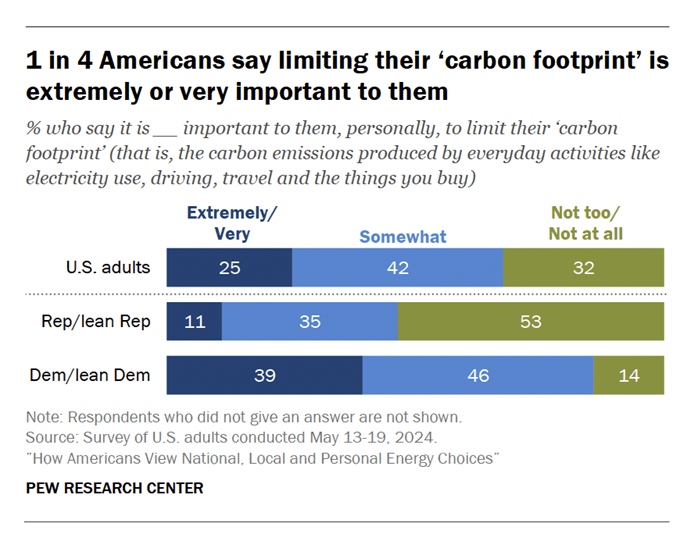
The survey, conducted May 13-19 among 8,638 U.S. adults, finds a fairly modest share of U.S. adults (25%) say it’s extremely or very important to them personally to limit their own “carbon footprint.” Far more give this middling or low priority.

These findings illustrate how large shares of Americans back more renewable energy that would decrease overall carbon emissions. Still, this general orientation does not necessarily translate into strong commitment to reducing personal carbon emissions or interest in buying an EV.

Read more: https://www.pewresearch.org/science/2024/06/27/how-americans-view-national-local-and-personal-energy-choices/

Maybe it is just me but the lead sentence claim that record heat is spurring action smacks of bias.  I checked the description of how they did the survey to see if my concerns were warranted:

Pew Research Center conducted this study to understand Americans’ views of energy issues. For this analysis, we surveyed 8,638 U.S. adults from May 13 to 19, 2024.

Everyone who took part in the survey is a member of the Center’s American Trends Panel (ATP), an online survey panel that is recruited through national, random sampling of residential addresses. This way, nearly all U.S. adults have a chance of selection. The survey is weighted to be representative of the U.S. adult population by gender, race, ethnicity, partisan affiliation, education and other categories. Read more about the ATP’s methodology.

Here are the questions used for this report, along with responses, and its Methodology.

The questions used for the survey were not overtly biased.  Nothing like “In order to save the planet from imminent doom are you in favor of solar farms?”  My only reservation is that these questions were part of a bigger survey, so it is not clear if previous questions primed the pump towards climate impact alarm.  One other point is that the methodology was different from most surveys.  Instead of a phone survey the Pew Research Center has established the American Trends Panel “a nationally representative panel of randomly selected U.S. adults who participate via self-administered web surveys.”  I have no opinion if this affects survey results.

Rather than just provide the results of the survey the Pew website description addresses the question of what’s behind the declines in support for wind and solar.

Declines in public support for renewable energy have been driven by Republicans and Republican-leaning independents, whose support started to fall sharply after President Joe Biden took office in early 2020.

  • 64% of Republicans say they favor more solar panel farms, down from 84% in 2020.
  • 56% of Republicans say they favor more wind turbine farms, a 19-point drop from 2020.

Over this same time period, views among Democrats and Democratic leaners on these measures are little changed, with large majorities continuing to support more wind and solar development.

In some cases, gaps between Republicans and Democrats over energy policy now approach the very wide partisan divides seen over the importance of climate change.

In May 2020, Democrats were 26 points more likely than Republicans to say the country’s priority should be developing renewable energy (91% vs. 65%). Four years later, that gap has ballooned to 49 points, due almost entirely to changing views among Republicans – 61% of whom now say developing fossil fuels like oil, coal and natural gas should be the more important priority.

However, the authors do admit that it is not just political affiliation:

But changes in attitudes about policies that would reduce carbon emissions are not solely the result of more negative views among Republicans. For instance, the share of Democrats who say they are very or somewhat likely to consider an EV for their next car purchase has declined from 56% to 45% in the last year. And the share of Democrats who call climate change a very big problem for the U.S. has declined from 71% in 2021 to 58% today.

New York’s Climate Leadership & Community Protection Act (Climate Act) mandates massive changes to the energy choices of New Yorkers that require action today.  I have followed the Climate Act since it was first proposed, submitted comments on the Climate Act implementation plan, and have written over 400 articles about New York’s net-zero transition.  One over-riding conclusion based on my work and discussions with others who share my concerns is that the majority of New Yorkers have no clue what is coming at them. 

Nationally the mandates and potential impacts are much less imminent, I believe that a big part of the decline in support of wind and solar is increased knowledge.  The survey includes more detailed questions regarding solar developments – Would solar development make the landscape unattractive, take up too much space, bring in more tax revenue, and lower the price you pay for electricity.  I believe that answering those questions requires personal knowledge and in my personal experience it has only been in the last several years that I have seen solar developments.  Having seen them I doubt many would think they are attractive and do not take up too much space.  The more knowledge people have the lower the favorability in my opinion.

The survey also addresses electric vehicles. 

Amid a major policy push at the federal level for electric vehicles, Americans are unenthusiastic about steps that would phase out gas-powered vehicles.

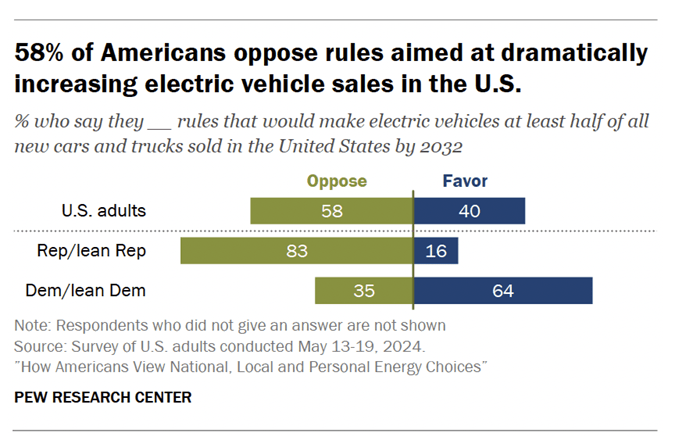
In March of this year, the Biden administration announced a rule aimed at dramatically expanding EV sales. Overall, 58% of Americans say they oppose these rules that would make EVs at least half of all new cars and trucks sold in the U.S. by 2032. Republicans overwhelmingly oppose this policy (83%). Among Democrats, 64% support these rules to expand EV sales, while 35% say they oppose them

Source: https://www.pewresearch.org/science/2024/06/27/how-americans-view-national-local-and-personal-energy-choices/

In support of my belief that knowledge spurs skeptical concerns note the following results for a question about EV reliability:

As more people hear about electric vehicle experiences the reality of problems with the technology become evident.

The survey also included questions about personal carbon footprints.

Discussions about reducing carbon emissions often include the everyday actions people can take to reduce the amount of energy they use. One-in-four Americans say it is extremely or very important to them personally to limit their own “carbon footprint.” Larger shares say this is either somewhat (42%) or not too or not at all (32%) important to them.

There is one important aspect of energy choice that was not included in the survey.  What about the costs?  The follow up questions for wind and solar development included a question asking whether respondents thought that those developments would reduce electricity prices.  There were also questions about electric vehicle cost to purchase and refuel them.  Nothing about overall costs was included.  I have yet to see a poll that indicates that people are willing to pay much for the energy transition being forced down our throats.

The description of the survey claims that “large shares of Americans back more renewable energy that would decrease overall carbon emissions.”  It also admits that “this general orientation does not necessarily translate into strong commitment to reducing personal carbon emissions or interest in buying an EV”.  If the willingness to pay aspect had been incorporated into the poll, I have no doubts that support for wind and solar would drop significantly.  I am confident that as more people become aware of the hidden costs of renewable energy the inevitable result will be much less support.

Articles of Note December 10, 2023

Sometimes I just don’t have time to put together an article about specific posts I have read about the net-zero transition and climate change that I think are relevant.  This is a summary of posts that I think would be of interest to my readers.

I have been following the Climate Leadership & Community Protection Act (Climate Act) since it was first proposed and most of the articles described are related to it. I have devoted a lot of time to the Climate Act because I believe the ambitions for a zero-emissions economy embodied in the Climate Act outstrip available renewable technology such that the net-zero transition will do more harm than good. The opinions expressed in this article do not reflect the position of any of my previous employers or any other company I have been associated with, these comments are mine alone.

Another Wind and Solar Risk to Reliability

The Climate Act mandates zero emissions electric generation by 2040 and proposes to use wind and solar. I have no doubts that wind and solar pose risks to reliability, but it is difficult to convey all of the reasons why.  Obviously, both wind and solar need energy storage for the periods when they are unavailable.  It is clear that because wind and solar energy is diffuse you need to collect the energy away from load centers so providing enough transmission to get it where it is needed is going to mean that there will be more transmission lines that are subject to weather disruptions.  There are other factors that are difficult to describe. 

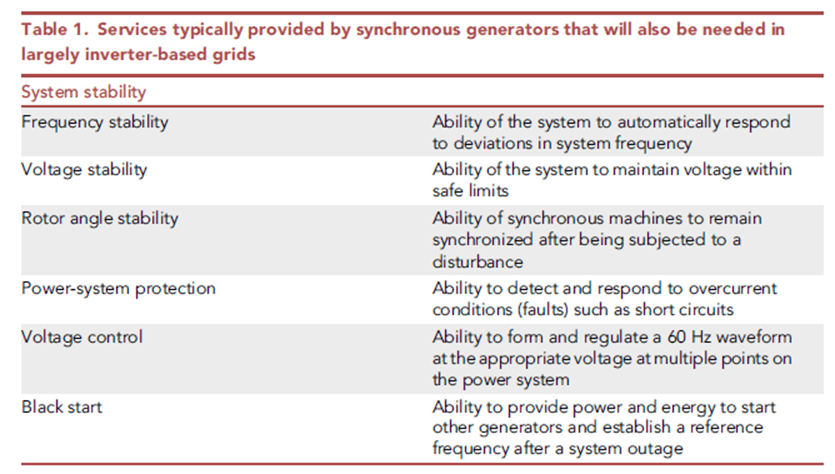
Ed Ireland describes some other issues that affect reliability.  The very nature of the energy produced by wind and solar is a reliability concern because it is different than existing generating resources. Ireland describes the history of electric generation and the implications of the alternating current frequency of 60 Hz produced by generators running at 60 revolutions per second.   Today “the critical factor underlying the integrity of electricity grids is maintaining a frequency of 60 Hz. If the frequency of the electricity moves outside the range of plus or minus 0.25 Hz, immediate countermeasures are taken to restore 60 Hz”.  The built-in inertia of mechanical rotation form existing generating plants is a necessary component for reliability.. “Inertia refers to the kinetic energy stored in large rotating generators in conventional generators that help stabilize the electrical system.”

The problem is that the wind, solar, and energy storage systems are asynchronous.  Ireland explains:

The electrical current they produce is direct current, which must be converted to alternating current by inverters, referred to as inverter-based resources, or IBRs, before the electricity is transferred to power grids. Inverters have had a history of tripping offline randomly, creating havoc on power grids. FERC has been monitoring IBR for the last few years and finally decided to enact regulations.

The article also describes other issues associated with wind and solar that are a significant problem for all US power grids.

Not Zero is Pragmatic.

Terry Etam writing at the BOE report has a way with words and story telling that I admire.  He recently described a training program open to those who have left prison and wish to be trained as automotive technicians.  He describes the program that has potential to help multiple groups of people in multiple ways, and not through handouts and then provides a lesson applicable to the plans to reduce GHG emissions:

Take what works and add to it what we can. EVs work extremely well in certain functions and particularly in urban areas. Focus on building those networks and maintaining the system that works so well in other parts of the country where EVs don’t. Try forcing a singular solution – which is a meagre post-2035 buy-electric or buy-nothing – is insanity, and it won’t work. It just won’t.

Other examples abound and they all come to the same point.  For example, the insistence on a “zero-emissions” electric grid without using nuclear means that a dispatchable emissions-free resource needs to be created, developed, and deployed that must be on the same order of size as the existing fossil-fired generating capacity but will only be used a fraction of the time.  If you calculate the emissions from fossil-fired units that only are used for the rare cases that this new technology is needed, they are small and could be reduced if new capacity were built.  It would be expensive but cheaper than an entirely new technology and we know it would work.  Not going to zero emissions is a pragmatic approach.

Climate Change Virtue Signaling

This is a funny take on the clueless activists.  Alex Berenson writes “The New York Times somehow casts a Massachusetts couple who spent $7 million on building an oceanfront (second) home as environmental activists. Can’t make it up.” 

Conference of Parties – 28

Climate Discussion Nexus on the COP28 meeting in Dubai.  This would be the meeting for 70,000 being held in new facilities built with oil money.

The conference thus perfectly symbolizes the entire modern climate movement: wealthy out-of-touch busybodies wandering about in a miraculous world made possible by affordable fossil energy feasting on fine food and wine while they discuss how everyone else should be forced to do without. And then wondering why no one is listening.

COP 28 is a really big fossil fuel trade show by David Wojick.  He writes “What was supposed to be a big deal climate treaty negotiation has morphed into an enormous trade fair. Even funnier the focus is on fossil fuel production which the UN treaty is supposed to curb.”  The article describes the meeting:

COP 28 has an astounding number of attendees, with over 100,000 official registrants, more than twice the previous record. Meanwhile the number of actual climate treaty negotiators is somewhere in the hundreds, so maybe 1% at most. The negotiations area is small and walled of, while the general attendees area is huge. What do the other 99% (or 99,000 people) do as the two week session rolls slowly by? They talk to each other and a lot of that talk is apparently business related because a lot of the attendees are reportedly corporate or trade professionals doing deals.

Lessons to Be Learned from Ontario

Parker Gallant has written three parts of a series of articles about the transition.  The articles describe happenings around the world where members of the Church of Climate Change Cult (CCCC) are starting to question their beliefs.  According to his contact link “Parker’s retirement allows him to spend time researching the energy sector and apply his banker’s common sense to analyzing the sector’s approach to the production, transmission and distribution of electricity to Ontario’s consumers.”

Part 1 pointed out that the momentum to end fossil fuel use for electricity consumption is slowing as one town council chose a natural gas plant over wind, solar and potential imported hydro.  He also addressed current trends of the electric vehicle transition rollout. 

Part 2 dug deeper into electric vehicles issues.  Electric buses in Edmonton appear to be a $41.5 million failure.  To much fanfare an electric truck and school bus manufacturer Lion Electric received $100 million in 2021 and received another $50 million that was not announced.  Even though Lion Electric’s school buses are almost 67% more expensive then fossil fueled buses they are still losing money as their September 30, 2023 quarterly report noted.  Gallant makes the cogent observation that “it appears obvious we should never trust elected politicians to pick industrial winners.” 

In Part 3, he looks into the latest resource outlooks by the Ontario version of the New York Independent System Operator (NYISO) the Independent Electricity System Operator (IESO). Similar to the NYISO’s Comprehensive Reliability Plan, IESO is projecting increases in load at the same time generating resources are in a state of change.  He points out the difficulties that renewable resource developers are having trying to stay solvent and the resulting impact on renewable energy stocks.  He concludes that “The market drop of renewable energy stocks will inevitably cause those companies to ask the various politicians in power to increase their rates for the power they supply but we consumers and taxpayers should hope we have recently elected smarter politicians, and they simply say NO!”

Temperature Trend Data

Tony Heller has spent a lot of time evaluating the temperature data archived at climate centers across the world.  He specializes in comparing raw data to the data reported by those centers for public consumption that invariably produce imaginary warming trends.  Recently he described a Climatic Research Unit (CRU) at the University of East Anglia (UEA) data availability report that states: “Data storage availability in the 1980s meant that we were not able to keep the multiple sources for some sites, only the station series after adjustment for homogeneity issues. We, therefore, do not hold the original raw data but only the value-added (i.e. quality controlled and homogenized) data.”  I commented that this is infuriating. Original data should be preserved is a cornerstone for transparency and trust. We need to be able to compare the raw data against any modifications that are done for many valid reasons.  The issue is that those modifications are subject to the biases of the researcher.

New York’s Energy Transition Club

Ron Clutz wrote an article describing an article by Irina Slav that lists the rules strictly followed by leaders of the Great Energy Transition at her substack Irina Slav on Energy.   I want to illustrate how proponents of the Climate Leadership & Community Protection Act (Climate Act) follow these rules.  In the end, however, reality will win out and the energy transition will flounder.

I have followed the Climate Act since it was first proposed, submitted comments on the Climate Act implementation plan, and have written over 350 articles about New York’s net-zero transition.  I have devoted a lot of time to the Climate Act because I believe the ambitions for a zero-emissions economy embodied in the Climate Act outstrip available renewable technology such that the net-zero transition will do more harm than good by increasing costs unacceptably, threatening electric system reliability, and causing significant unintended environmental impacts.  The opinions expressed in this post do not reflect the position of any of my previous employers or any other organization I have been associated with, these comments are mine alone.

Background

The Climate Act established a New York “Net Zero” target (85% reduction and 15% offset of emissions) by 2050.  It includes an interim 2030 reduction target of a 40% reduction by 2030 and a requirement that all electricity generated be “zero-emissions” by 2040. The Climate Action Council is responsible for preparing the Scoping Plan that outlines how to “achieve the State’s bold clean energy and climate agenda.”  In brief, that plan is to electrify everything possible using zero-emissions electricity. The Integration Analysis prepared by the New York State Energy Research and Development Authority (NYSERDA) and its consultants quantifies the impact of the electrification strategies.  That material was used to develop the Draft Scoping Plan.  After a year-long review, the Scoping Plan recommendations were finalized at the end of 2022.  In 2023 the Scoping Plan recommendations are supposed to be implemented through regulation and legislation. 

Irina Slav  describes net-sero transition leadership as “climate crusaders, climateers, a cult, and other, less polite words.”  She points out this crowd is a club that follows six rules:

Rule #1: We do not talk about the problems. (Unless we absolutely have to.)

Rule #2: Facts are obsolete. Only the transition matters. (Until facts punch you in the face.)

Rule #3: Tell a lie big enough and keep repeating it

Rule #4: If it’s failing, double down

Rule #5: Words and numbers are weapons

Rule #6: Questions are denial

Rule #1: Do Not Talk About Problems

Irina Slav gave an example for this rule citing an International Energy Agency report  that said the world needed to replace and build 50 million miles of transmission lines to make the transition work.  She explained:  

This would only take $600 billion annually by 2030, which is double the current investment rate for transmission lines. For context, the global transmission line network is half the length the IEA says we need right now.

The expansion needs to take place by 2040 because Climate Targets. In other words, the world needs to double its transmission line network in a matter of less than 20 years… after it took a century to build all the lines we currently have. Realistic, right?

In fairness, the IEA does hint that there might be a slight problem with securing all of the raw materials necessary for this enormous undertaking. It absolutely had to admit it, what with miners crying shortage all the time, annoying people. But that cannot stop the transition. Else we get global broiling.

The New York Independent System Operator’s 2021-2040 System & Resource Outlook notes that “A minimum of 5 TWh of renewable energy in 2030 and 10 TWh in 2035 is projected to be curtailed due to transmission limitations in renewable pockets.”  The report notes that “Without investment in transmission, these areas of the New York grid will experience persistent and significant limitations to deliver the renewable power from these pockets to consumers in the upcoming years.”  New York’s Energy Transition Club has not addressed supply chain materials issues, skilled labor shortages, or funding for the transmission projects necessary for the schedule needed to meet Climate Act mandates.

Rule #2: Facts are obsolete

Slav’s second rule states “Facts are obsolete. Only the transition matters. (Until facts punch you in the face.)”  She explains that the UK government had a plan to replace gas heating systems in homes with hydrogen but “following massive opposition from the target community, the government ditched the trial plan and started mumbling that maybe hydrogen for heating is not such a marvelous idea.”  She explains:

The facts: hydrogen — green hydrogen, that is — is expensive. All hydrogen is also dangerous, which makes the green variety even more expensive. At the time the plans were made, these facts were shunned. The opposition of the locals in the village of Whitby, however, prompted their return to the scene, ultimately leading to this piece of news: Hydrogen for UK home heating should be ruled out, says infrastructure adviser

Summed up, the match between facts and fantasy in hydrogen sounds like this, per the FT: ““We do not see any role for hydrogen in the future of home heating,” said Nick Winser, NIC commissioner, arguing it was “simply not ready at scale” and risked being an inefficient use of green electricity.”

The leaders of the New York’s Energy Transition Club are in the New York State Energy Research & Development Authority.  This organization is responsible for the Integration Analysis that supports the Scoping Plan and they chose to use “green” hydrogen as the place holder for the dispatchable emissions-free resource (DEFR) included in future generating resource projections.  All the issues raised by Slav are relevant for this plan.  An article by Steve Goreham expands on “green” hydrogen problems and the facts that have been ignored by NYSERDA.

Rule #3: Tell a lie big enough and keep repeating it

Slav explains the derivation of this rule.  Here’s the whole quote:

“If you tell a lie big enough and keep repeating it, people will eventually come to believe it. The lie can be maintained only for such time as the State can shield the people from the political, economic and/or military consequences of the lie. It thus becomes vitally important for the State to use all of its powers to repress dissent, for the truth is the mortal enemy of the lie, and thus by extension, the truth is the greatest enemy of the State.”

She notes:

It kind of feels I can add nothing constructive to this description of the climate change narrative, especially if you consider the source, which appears to be (though not verbatim, I understand) a little book called Mein Kampf. I mean, if a tactic was tried in one context and it worked splendidly, you can totally make it work in another, and I’m not being ironic. The tactic does work.

Despite the Climate Act requirement in section 16 of § 75-0103 to consider efforts at other jurisdictions and observed increases in energy costs in Europe, NYSERDA continues the “big lie” that the transition will be affordable.  After the Public Service Commission decision to deny an increase in contract prices for renewable projects, NYSERDA announced the award of 6.5 GW of two award groups renewable energy.  Doreen Harris, president and CEO of NYSERDA said “In this case, the two award groups combined will have an impact of about $3 a month on your average New York residential consumer” and “Affordable, but we certainly keep that central to our work.”  Unfortunately, she has never admitted how much they expect the total costs for the transition, instead deceptively claiming that “the costs of inaction are greater than the costs of action”.

Rule #4: If it’s failing, double down

Slav describes this rule:

The countries with the greatest wind and solar power generation capacity in the EU also have some of the highest electricity prices. This is a mystery to absolutely no one with rudimentary mental acuity. And yet the billions continue flowing into wind and solar. And then, once a gas crunch hits, they start flowing into households.

Wind and solar clearly cannot work at the scale their fans want them to work. It is physically and financially impossible for them to make sense at that scale at this point in time. The evidence is there on a daily basis, courtesy of Electricity Maps and, I’m sure, other real-time tracking websites.

Transition Club has no truck with evidence, however, unless it’s the right kind of evidence, such as record-setting wind/solar output for some day or another. The rest is dismissed as irrelevant, disinformation, or simply ignored. And the billions keep flowing because there are targets to be hit in wind and solar installations. Whatever it takes.

New York’s transition has not reached the point where we have performance data.  However, doubling down examples abound.  In mid-October the Public Service Commission denied requests by European energy firms Orsted, Equinor, BP and other renewable developers to charge customers billions of dollars more under future power sale contracts for four offshore wind and 86 land-based renewable projects.  “These projects must be financially sustainable to proceed,” Molly Morris, president of Equinor Renewables Americas, told Reuters, noting Equinor and BP will “assess the impact of the state’s decision on these projects.”   On the same day Governor Hochul announced a “10-Point Action Plan to Expand the Renewable Energy Industry and Support High-Quality Clean Jobs in New York State”.  A couple of weeks later NYSERDA announced the largest-ever investment in renewable energy described previously.  The Hochul Administration has never related the new cost projections to the never revealed estimates in the Integration Analysis.  The Integration Analysis assumed that renewable development costs would decrease over time and that is not happening.  Nonetheless we race ahead doubling down that someday the costs will fall.

Rule #5: Words and numbers are weapons

Irina Slav’s fifth rule:

Old but gold and put to good use by the Club. All the talk about global boiling, the highway to hell, the accelerating extreme weather, the climate catastrophe and all the rest of it are water to the Transition Club agitprop mill. It keeps the lie going.

Numbers are even better: from the 99% of climate scientists who are in agreement about the climate and related catastrophies to all the CO2 emission updates and the horrific temperature readings from this summer we get actual numbers that stoke up fears that the planet is dying and we’re on our way out with it unless we kill the oil and gas industry and go full-wind/solar.

Or unless we check how the authors of the 99% consensus study came to their conclusion and what their sample size was, what the significance of those emission updates is for the total content of CO2 in the atmosphere, and how those temperatures were measured during the summer.

This rule is commonly involked by Club members.  For example, an opinion piece by Francesca Rheannon, co-chair of the Climate Reality Project-Long Island Chapter and a member of the East Hampton Energy and Sustainability Advisory Committee, exemplifies the Club call to action:

I have long been anxiously observing our world as it moves ever closer to the boiling point, noting the growing impacts of climate chaos on our daily lives. This past summer’s orange skies were terrifyingly otherworldly. Atlantic hurricanes are not just stronger, but getting stronger faster and less predictably. This year, we have (so far) dodged the bullet. But what will happen next year or the year after that? My house insurance premium has soared and my broker said the cause was anticipated increased risk from hurricanes. And the policy only covers up to Category 2 hurricane damage; any damages above that fall entirely on me.

Roger Pielke, Jr. addresses global hurricane facts.  For the North Atlantic offshore of Long Island he explains that the National Oceanic and Atmospheric Administration has recently concluded:   

In summary, it is premature to conclude with high confidence that human-caused increases in greenhouse gases have caused a change in past Atlantic basin hurricane activity that is outside the range of natural variability, although greenhouse gases are strongly linked to global warming.

Rule #6: Questions are denial

Slav describes the sixth rule:

This rule evolved organically from following all the others and sprouted actual disinformation laws, at least in the EU, for now, and not-so-official reporting rules for the media that require the climate narrative to be reported as fact despite evidence to the contrary, said evidence being dismissed as science denial and denialist propaganda, even when — and perhaps especially when — it comes from actual scientists.

Apparently, these days there are two kinds the scientists, the right and the wrong kind. The wrong kind are those asking questions, even though science is by definition a process that involves a lot of question-asking.

Per the Oxford Dictionary science means “the systematic study of the structure and behaviour of the physical and natural world through observation, experimentation, and the testing of theories against the evidence obtained.”

Not in the transition era, it doesn’t. In the transition era, there is a right kind of observation and computer modelling to replace experimentation and testing of theories against evidence. Then there is the wrong kind, which is any systematic study of the physical and natural world that questions the right kind, using evidence.

During the development of the Climate Act Scoping Plan there was no discussion of the scientific rationale for the net-zero transition.  Any thought that there could be questions about the need to move as quickly as possible was not considered.  However, the “Questions are denial rule” was still a prominent talking point by members of the Climate Action Council.

The May 26, 2022 Climate Action Council meeting  (recording) included an agenda item for Council members to describe their impressions of comments made at the public hearings  Many commenters expressed concern about reliability.   Paul Shepson invoked this rule when he said:

Mis-representation I see as on-going.  One of you mentioned the word reliability.  I think the word reliability is very intentionally presented as a way of expressing the improper idea that renewable energy will not be reliable.  I don’t accept that will be the case.  In fact, it cannot be the case for the CLCPA that installation of renewable energy, the conversion to renewable energy, will be unreliable.  It cannot be.

Robert Howarth also invoked this rule when he said that fear and confusion is based on mis-information but we have information to counter that and help ease the fears.  He stated that he thought reliability is one of those issues: “Clearly one can run a 100% renewable grid with reliability”.  A quote from a recent New York Independent System Operator presentation question both claims that dismiss reliability issues associated with renewable energy: “Significant uncertainty is related to cost / availability of Dispatchable Emissions Free Resource IDEFR) technologies, as well as regulatory definition of ‘zero-emissions’ compliant technologies”.

Conclusion

I believe that these rules are followed by New York’s Energy Transition Club.  Slav’s description of these rules is amusing but illustrates some of the techniques used to further the net-zero transition.  She points out that people cannot be shielded from the consequences of these rules for very long because reality always wins.

Articles of Note 29 October 2023

Sometimes I just don’t have time to put together an article about specific posts about the net-zero transition and climate change that I have read that I think are relevant.  This is a summary of posts that I think would be of interest to my readers.

I have been following the Climate Leadership & Community Protection Act (Climate Act) Climate Act since it was first proposed and most of the articles described are related to it. I have devoted a lot of time to the Climate Act because I believe the ambitions for a zero-emissions economy embodied in the Climate Act outstrip available renewable technology such that the net-zero transition will do more harm than good.  .  The opinions expressed in this article do not reflect the position of any of my previous employers or any other company I have been associated with, these comments are mine alone.

Massachusetts Plan to Meet Its Climate Goals

This article describing an implementation plan for Massachusetts caught my eye becauseit argues that the first order of business is to analyze what it will cost to achieve its climate goals.  The report argues that the cost of inaction are less than the cost of action but the report “suggests that state agencies submit preliminary recommendations for how Massachusetts can come up with the money to meet its goals by the end of 2024.”

When it comes to climate and clean energy goals, Massachusetts has some of the most ambitious in the country. But what the state doesn’t have is a detailed plan to achieve them.

To help bridge this gap, the state’s Climate Chief, Melissa Hoffer, published a new report this week with 39 recommendations for how the state can do three big things: Zero-out carbon emissions by mid-century, build more clean energy and prepare for more severe weather.

Massachusetts has detailed climate goals for 2050, but it has no idea what it will cost to achieve them. So, the first order of business, according to Hoffer’s report, is a comprehensive economy-wide analysis of what the state will need to spend to decarbonize — or dramatically slash planet-warming emissions. This work entails connecting a whole lot more renewable energy to the electric grid, protecting natural lands that suck carbon out of the air, protecting coastal communities and preparing for a future with more extreme weather.

GHG Emissions and Climate Change

Francis Menton writes:

It’s by far the most important scientific question of our age: Do human emissions of CO2 and other such “greenhouse gases” cause significant global warming, aka “climate change”? Based on the belief that an affirmative answer to that question is a universally accepted truth, our government has embarked on a multi-trillion dollar campaign to transform our economy.

The authors of the two new papers beg to differ. First, we have a paper by John Dagsvik and Sigmund Moen of Statistics Norway, dated September 2023, titled “To what extent are temperature levels changing due to greenhouse gas emissions?”

The second important new paper is from Antonis Christofides and co-authors dated September 26, 2023. They introduce their paper with a long post of that date at Climate, Etc. titled “Causality and Climate.”

Both papers evaluate historical data and the results “appear to refute, and certainly does not prove, the endlessly repeated claims of impending climate doom from human CO2 emissions”.

Siemens Energy Stock

There are so many signs that the aggressive renewable deployment schedule mandated for the Climate Act that I find it very troubling that there hasn’t been any sign of concern by the Hochul Administration. For example, the green energy sector shows signs of distress, as illustrated by the plummeting shares of Siemens Energy. An article on ZeroHedge meticulously unfolds the tale of challenges and uncertainties clouding the renewable energy sector, with Siemens Energy at its epicenter. 

Wind Industry Cost Increases in Great Britain

Here is another example.  RWE Renewables has just told the Government that it needs its subsidy “strike price” to rise by 70% if any more wind farms are to be built.
 

Net Zero Watch director Andrew Montford said:

Rishi Sunak has said that there has been a long-term deception of the British public. RWE’s demand for more subsidy confirms it. The Green Blob has been lying about renewables costs for years. The truth is that wind power is expensive, and becoming more so. The energy “transition” is a transition to poverty, but few in Westminster seem to have the guts to say so.

Heat-pump nightmare

Heat pumps are a key component in the Climate Act plan to electrify home heating, but there are issues.  “It’s now clear from the evidence that heat pumps are an impractical form of heating for millions of UK homes. This is due not only to high upfront costs but also the lack of insulation in older buildings and the inability of systems driven by heat pumps to respond quickly to weather variations”

Electric Vehicles

Another key component of the Climate Act transition is to electrify transportation.  This article suggests that the plan to shove electric vehicles into every driver’s life may be in trouble.  Axios reports that a new analysis findsa”strong and enduring correlation” between political ideology and U.S. electric vehicle adoption.

Driving the newsThe working paper, from UC Berkeley’s Energy Institute at Haas, explores county-level new car registrations from 2012-2022 and compares them to voting records in presidential races.

  • “During our time period about half of all EVs went to the 10% most Democratic counties, and about one-third went to the top 5%,” the study found.
  • “There is relatively little evidence that this correlation has decreased over time, and even some specifications that point to increasing correlation.”

Why it matters:If EV uptake remains a big thing only in very blue places, it may be “harder than previously believed” to reach high market penetration, they write.

In my opinion, the idea that battery electric heavy-duty trucks will ever be a viable transportation are simply absurd.  There are too many trucks that are going so far to expect that any battery system is going to be able to effectively replace the existing system.  This article describes a National Grid study that will  begin modeling Northeast electric truck charging needs. 

National Grid’s study will focus on highways with heavy trucking traffic and areas with commercial activity like ports. Modeled sites will be in New York, New Jersey, Pennsylvania and the New England states.

“This roadmap will inform efforts by states, utilities, communities, and industry leaders to create a seamless truck charging network across the region,” Franey said.

“This study will help deepen the understanding of electrification needs and help New York State and the region strategically put more medium and heavy-duty electric trucks on the road,” said David Sandbank, vice president of distributed energy resources at the New York State Energy Research and Development Authority.

An off-hand remark supports my concern:

The work will build on National Grid’s “Electric Highways Study,” which was published in 2022 and concluded a large highway fast-charging site could have power demands similar to a small town by 2045.

If every truck stop is supposed to be replaced by a fast-charging site and they require the power demands of a small town, then the infrastructure needs will be enormous across the country.  Do these people ever go on a long trip and see how many trucks and how many truck stops there are?

Guest Post – NYS Energy Storage

Richard Ellenbogen frequently copies me on emails that address various issues associated with New York’s Climate Act.  I asked his permission to present his analysis of the New York State Energy Storage Roadmap Report as a blog post here.

I believe that he truly cares about the environment and the environmental performance record of his business shows that he is walking the walk.   Ellenbogen is the President of Allied Converters  that manufactures food packaging.  His facility is about 55,000 square feet and does a lot of manufacturing with heat to seal the bags, all electrically driven.  The facility has solar panels and uses co-generation.  He explains:

In 2008, the average energy cost per square foot for a commercial facility in  Westchester was $1.80.  We were at 16% of that 12 years later and even with the increases, we are at 62% of that 14 years later.  That has been done while having a carbon footprint 30% – 40% lower than the utility system.  The $1.80 per foot  also included commercial office space and our operation is far more energy intensive than an office.  We use energy extremely efficiently and as a result, our bills are much lower than everyone else. 

NY State Energy Storage Report

On December 28, 2022 the New York Department of Public Service and New York State Energy Research and Development Authority released New York’s 6 GW Energy Storage Roadmap: Policy Options for Continued Growth in Energy Storage (Roadmap Report).  I did a couple of posts (here and here) on the Roadmap Report that concentrated on the costs.  Ellenbogen’s analysis fills in another part of the story.  His lightly edited description of the feasibility follows.

This is another document of such questionable quality that had I presented it to my superiors when I worked for Bell Labs and asked them to implement a multi-billion dollar project based upon it, they first would have rolled on the floor laughing thinking it was a joke, and then when they realized that I was serious,  they would have promptly terminated me.   No sane entity would embark on a project based upon such questionable parameters as are shown in this document.  This is not science or engineering.  This is politics disguised under a veneer of technical terms designed to delude the public that won’t take the time to read its 104 pages.  The fact that this policy is being pursued based upon documents such as this is borderline criminal  (And maybe not so borderline.  Just plain criminal).

Note that the page numbers I list are the pages of the pdf and not the document page numbers to enable easy searching of the document using Acrobat.

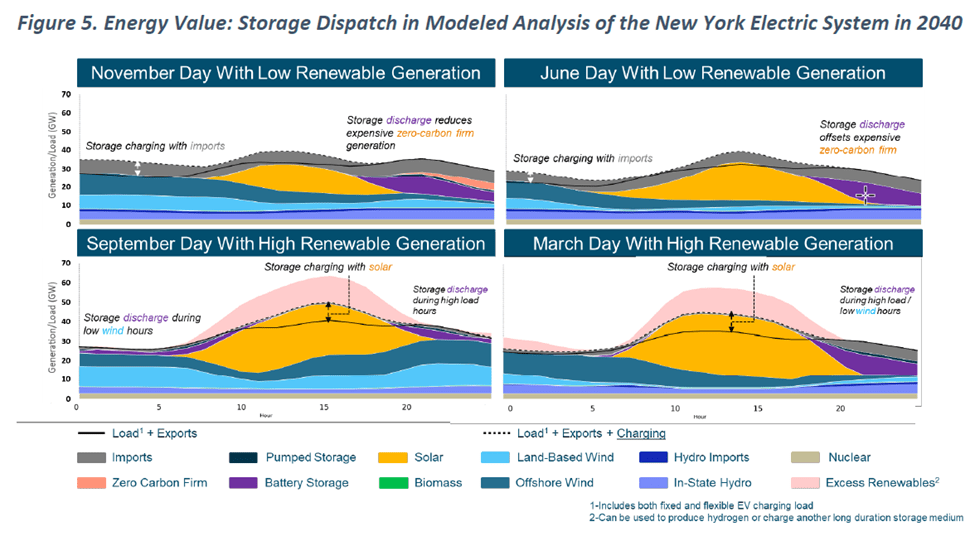
We can start with the fantasy on page 31 in Figure 5 (Also duplicated in the analysis in Appendix A) that immediately makes the entire document questionable.  It has all of the storage being charged by renewable energy by 2040 which will be impossible based upon NY State’s rate of renewable installation and the rate at which loads are being mandated to be added to the system.  (See below.  There is no fossil fuel generation even listed and it doesn’t list the composition of the “Imports”.  If they are like California’s imports, they will be coal generation.  Very environmentally friendly.)  Germany has been doing this for 32 years and has reached a 34% carbon free system with very few EV’s on the road.  While NY State is starting at 41% carbon free because of Niagara Falls and its upstate nuclear plants, the new renewables are not even going to offset the added load that has been mandated by state policy starting in 2024 and going into overdrive in 2030 and 2035 for EV’s and Heat Pumps, let alone replace all of the fossil fuel generation.  2040 is only 17 years away.  By 2050, the upstate nuclear plants will be 75 years old and nearing the end of their useful lifespan.  What will replace them?

Also, why are they using shoulder months in the analysis?  What will happen in July, August, January, and February when the electric load peaks?  That is what has to be analyzed as that is the worst-case scenario and is when the system will be most likely to fail.  The most likely reason for that is that the numbers and graphs looked so bad for those months, even in fantasy land, that they couldn’t be displayed for what they would show.

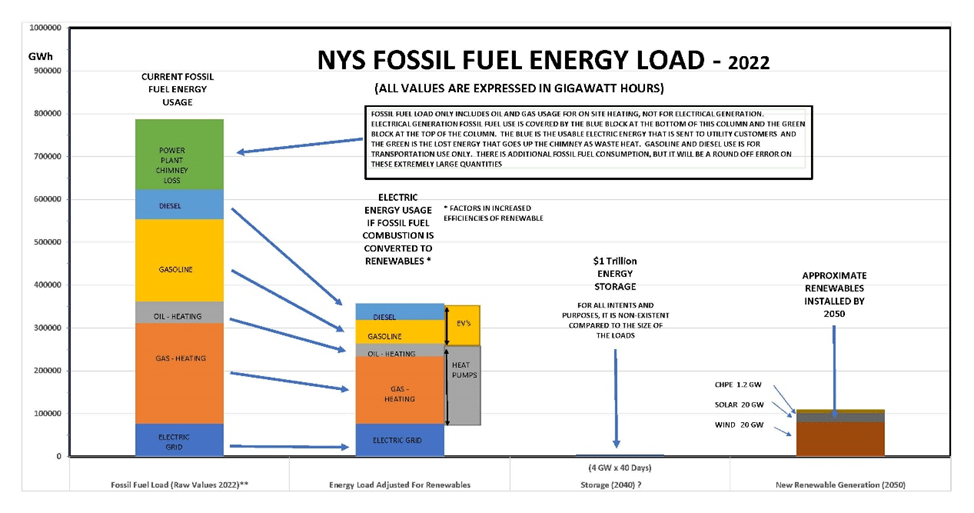
If you look at the following graph (link), the right-hand column documents the new renewables that will be available to offset the loads that they will be adding and it is clearly insufficient even if only 30% of the vehicle fleet is electrified and 10% of the buildings. 

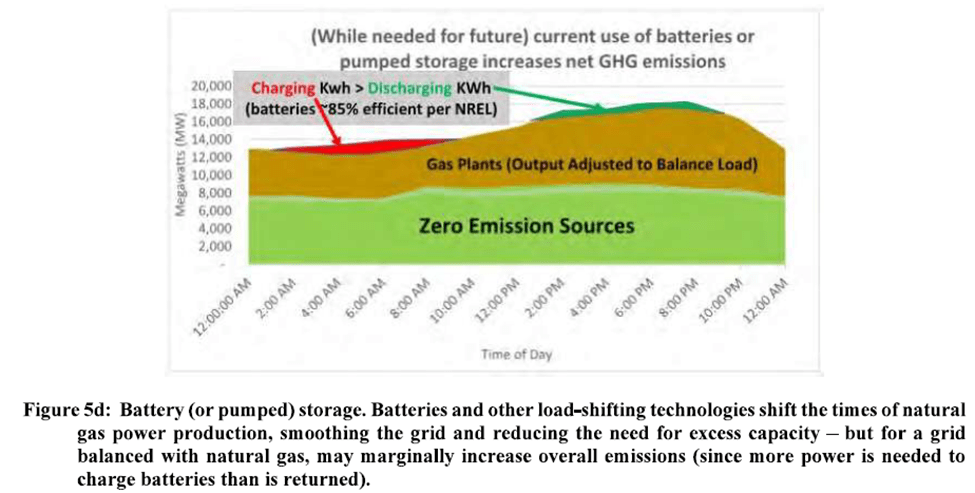
Instead of Figure 5, the reality will be closer to Figure 5d below, produced by Cornell University and the National Renewable Energy Laboratory,  which show the batteries being charged from fossil fuels and 15% to 20% of that energy being lost because of charge/discharge losses, which is actually going to increase NY State’s carbon footprint.  The storage losses are acknowledged in the Roadmap Reprt document on page 99 where it says that the battery owner will have to buy 1.15 MWh in order to sell 1.0 MWH, implying a 15% energy loss.   

If that isn’t bad enough, on page 89 the Energy Roadmpa says, 

Customer load shifting can provide many of the same flexibility attributes as battery storage, by enabling reductions in peak demand, and shifting demand to times of high renewable output. As a result, there are direct impacts of lower or higher amounts of end use flexibility on the economics of battery storage. In  the base case, 12.5% of the light duty EV charging load is assumed to be flexible by 2030, increasing to 25% by 2050. In addition, 50% of the hydrogen required economy-wide is assumed to be generated via electrolysis within New York, and this electrolysis load is assumed to be highly flexible as well to make the most of excess renewable energy when it exists.

As clearly documented, WHAT EXCESS?  What are these people looking at?  THIS DOCUMENT IS NOT BASED UPON REALITY!!!

Further, Hydrogen electrolysis loses 20% of the energy when Hydrogen is generated from the water and then about 60% of what is remaining is lost during combustion for a total energy loss approaching 70%. That’s not a great tradeoff when you don’t have enough energy to  start with.

For some reason the filed report on the NYS DPS DMM site for Case 18-E-0130 – In the Matter of Energy Storage Deployment Program includes a cover letter.  That letter lists the storage capacity as a power value and not as an energy value.  The title of the cover letter is “Re: Case 18-E-0130 – In the Matter of Energy Storage Deployment Program” and then at the top of the next page the cover page of the document says New York’s 6 GW Energy Storage Roadmap:  Policy Options for Continued Growth in Energy Storage  however, Gigawatts (GW) are Power, not Energy.  While some may think that this is nitpicking, it isn’t.  Engineering students can fail tests over incorrect units.  All of the energy storage targets are listed as power, not energy.  The system runs on energy and with an intermittent renewable driven system, the storage duration is critical.  Nowhere will anyone be able to determine how long the storage will support the system except  on page 15 and those figures should be included with the question, “Are you kidding me?” next to it.  The explanation is below.

In fact, if anyone searches the entire pdf for “WH” to find all of the references to energy that are contained in it (Gigawatt Hours – GWh, Megawatt Hours – MWh, and Kilowatt Hours – KWh) the vast majority are devoted to information about rebates and costs and not what will be available to run the system.  Most of what was found were “What”, “Why”, “Which”, but very little about system capacity except in a couple of places.  On page 15 the Energy Roadmap discusses the cancellation of 20% of the battery projects:

While the program initially procured 580 MW and 1,654 MWh of energy storage, cancellations have brought these numbers down to 480 MW and 1,314 MWh.

Keep in mind that the pre-cancellation figure of  1654 MWh of battery storage with a 580 MW Power Capacity is less than THREE hours of storage for the bargain price of $193 million in state incentives.  During a heat wave, peaker plants can run for days.  On page 25 of the pdf, it states that many of the peakers only run 5% to 10% of the year,  which equates to 440 – 880 hours annually, however much of that time is contiguous during periods of high load and is far longer than 3 hours so how can a 3 Hour battery keep the system running if replacing a peaker plant?

On page 27, the Energy Roadmap discusses the possibility of using EV’s to offset a shortage of storage.   You can tell that whoever wrote this lives in Albany and not downstate where  a large number of people live in apartments.  Vehicles parked on streets are not going to be able to discharge to support the system in times of need.  Are they planning on putting a bidirectional charger on every parking spot in every downstate garage and on every parking spot on the street?    What will that cost and who will install it?   In New Rochelle, it took several months to install about ten internet kiosks with multiple street cuts to house data cables.  How long will it take to install thousands of chargers supported by far larger megawatt power cables to enable vehicle charging?  Also, having driven a Tesla for nearly six years now, I can safely say that trying to run a domicile for any extended period with the car’s battery and still having energy remaining to commute are mutually exclusive.  Again, times of peak load can run for days during the summer.  Winter peak load durationss will be similar in NY State during future winters when large numbers of heat pumps are installed.

On page 40 of the pdf, under 4.3 “Barriers To Energy Storage”, it says:  

As highlighted in other sections of this Roadmap, one of the most critical barriers to energy storage projects relates to the uncertain and insufficient nature of the revenue available through existing markets and tariffs, particularly capacity revenue. Retail or distribution-level projects, participating in certain regions through VDER, provide investors with a more certain revenue stream; however, these projects are still difficult to underwrite given the variable nature of both capacity and energy prices. 

On page 9, it says:  

Over the past year, supply chain constraints, material price increases, and increased competition for battery cells have driven up the cost of energy storage technologies, particularly lithium-ion batteries. Many of the drivers of cost increases are expected to persist until at least 2025. These cost increases may impact the cost of any new programs designed to procure storage to be installed by 2030.  

How they can predict the cost of commodities out past five years is beyond me, but it is safe to say that with everyone trying to install storage and at least nine states mandating electric vehicles, the demand is only going to make the price of storage go up and the materials will be scarce.  That doesn’t require a Crystal Ball, only a small degree of common sense.

The document states that the residential incentive is $ 250/KWh as seen on page 17, however if you look on page 37 it says:

Since July 2021, prices for lithium carbonate, a key ingredient of lithium-ion batteries, have increased 500%. Among projects awarded NYSERDA incentives, average total installed costs for non-residential, retail projects averaged $567/kWh for installations occurring in 2022 and 2023, up from $464/kWh for installations in 2020 and 2021, an over 20% increase in total costs.  This is consistent with recent industry reports that indicate near-term increases in storage costs.

That cost increase helps to explain the battery project cancellations.

Then on page 104, it says “Stakeholders across all segments that were surveyed or engaged with brought up increases in lithium-ion battery pricing over the course of 2021 and 2022 as a fundamental challenge to deploying storage and the development of the storage market going forward.”

On page 94 it does imply that 1000 hours of storage will be needed.   “With seasonal storage (1000+ hours), the availability of a specific resource during critical weeks – or in between multiple critical weeks in a season matters less; instead, the cheapest form of energy”

Coincidentally, that is almost the same time frame (40 days) that I showed on the graph above that was created about 5 weeks ago.  However, at the current average national cost of utility grade storage of $283 per KWh, 4 GW of storage that will last for 960 hours will cost over $1 TRILLION.  The 6 GW will cost over $1.5 TRILLION.  But with the escalating costs of Lithium, that figure could easily reach $ 3 TRILLION.  That figure is fourteen times the entire NY State budget for 2023.  The Inflation Reduction Act had $387 billion allocated for renewable energy projects for the entire United States.  That will just be the cost of the storage, independent of the cost of the renewable generation needed to charge it.

Conclusion

So  basically what they are saying is, “We aren’t sure how the economics of this is going to work but we are going to mandate its installation in lieu of fossil fuel plants, with an unknown price structure, increased energy losses when there already isn’t enough energy to support the system, insufficient capacity to replace the peaker plants that we are trying to close, rapidly escalating costs for the battery storage that already is not affordable and are only going to get more expensive in the future, and cross our fingers that this won’t make it impossible to complete the installation of 6 GW of energy storage.  However, in the interim, we will have shuttered the energy plants that we have for ones that we can’t afford to install.”

They are pushing forward with it anyway when it is doomed to fail.  This  goes way beyond money.   The inevitable failure is going to cost lives and they don’t even seem to care.  I was able to produce this analysis in hours.  They’ve had years to ponder these issues.  This is insanity and again, it is borderline criminal.

If they gave a damn, they would say, “Wait a minute.  This isn’t going to work.  We’re going to kill a bunch of people.  Maybe we should rethink this.”  Unfortunately, they aren’t doing that.   

Caiazza Closing Thoughts

New York State’s GHG emissions are less than one half a percent of global emissions.  Global GHG emissions have been increasing on average by more than one half a percent per year since 1990.  That does not mean that we should not do something but it surely calls into question why these limitations of the proposed plans are being ignored.  There is time to make sure the net-zero transition does not do more harm than good. I fully agree with Ellenbogen’s frustration that fundamental feasibility questions are not being addressed and his conclusion that this is insanity.

Arctic Blast Foreshadows Problems with Climate Act Renewable Future

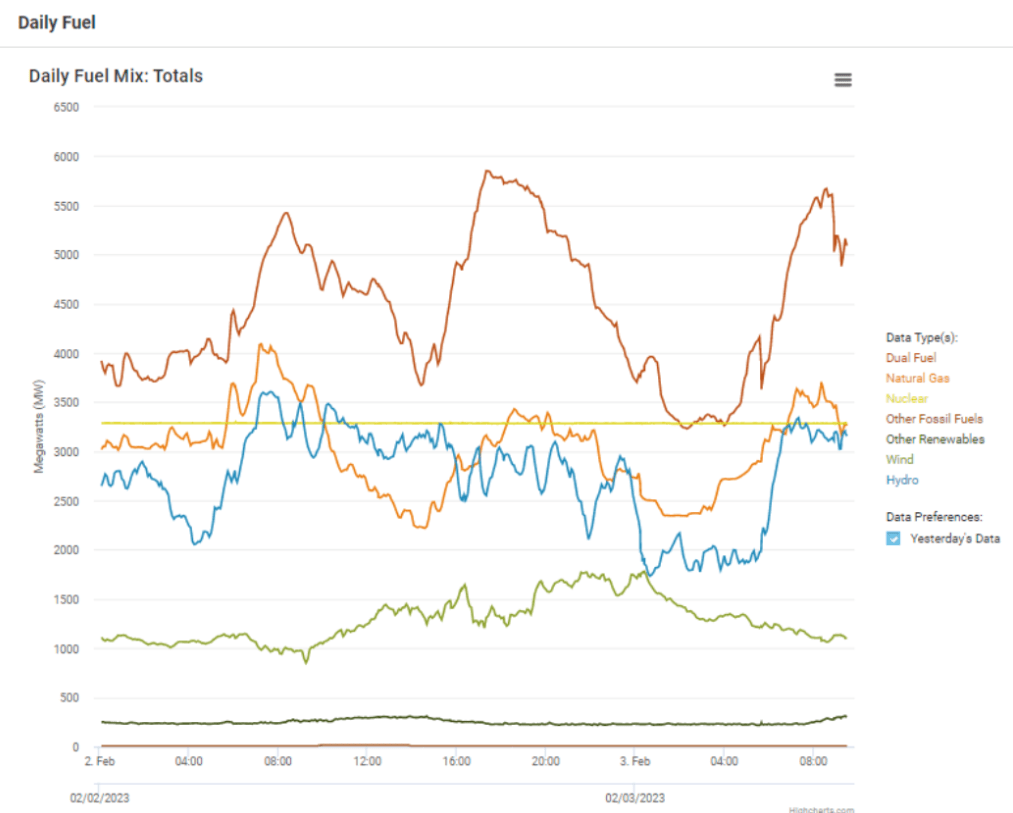
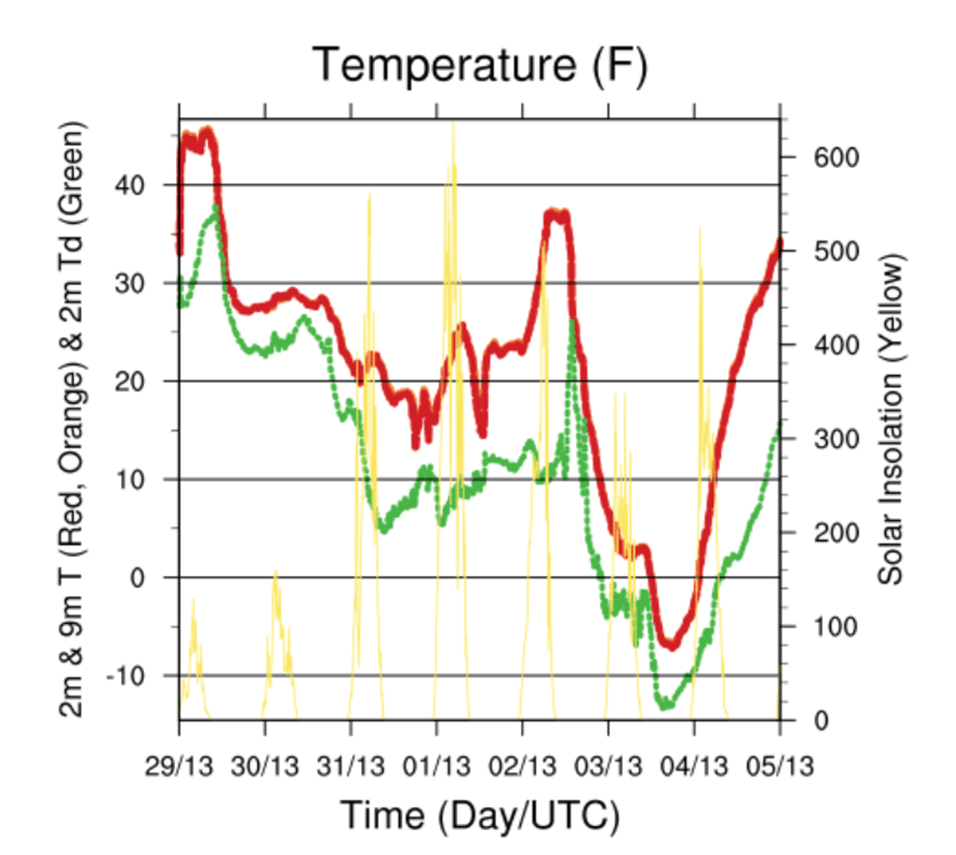
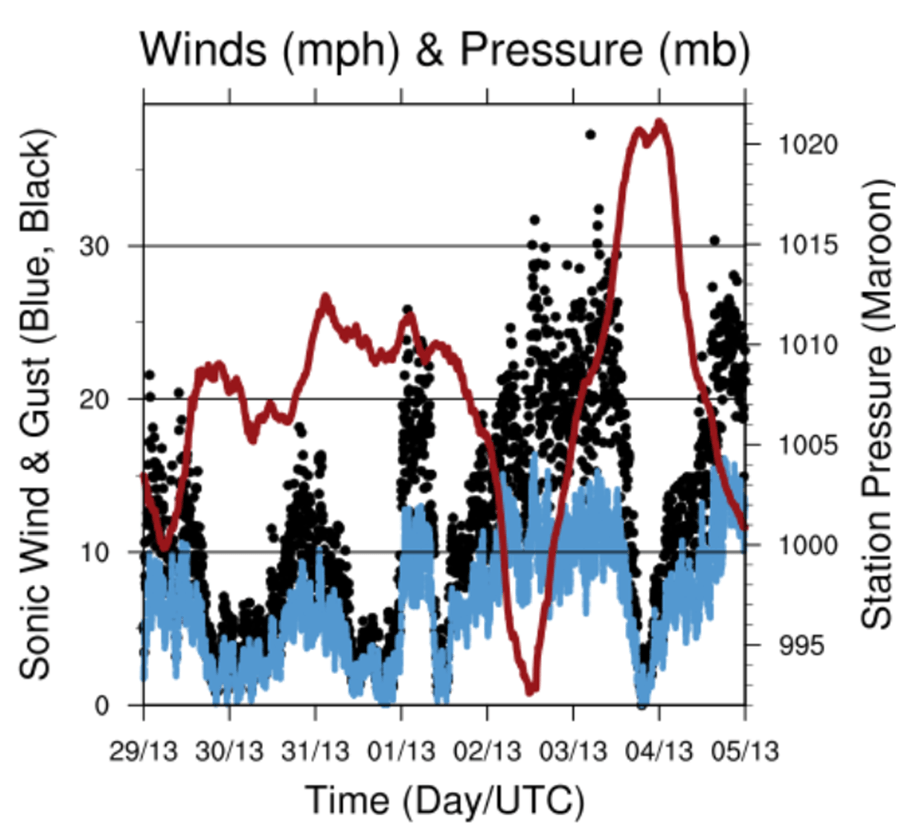
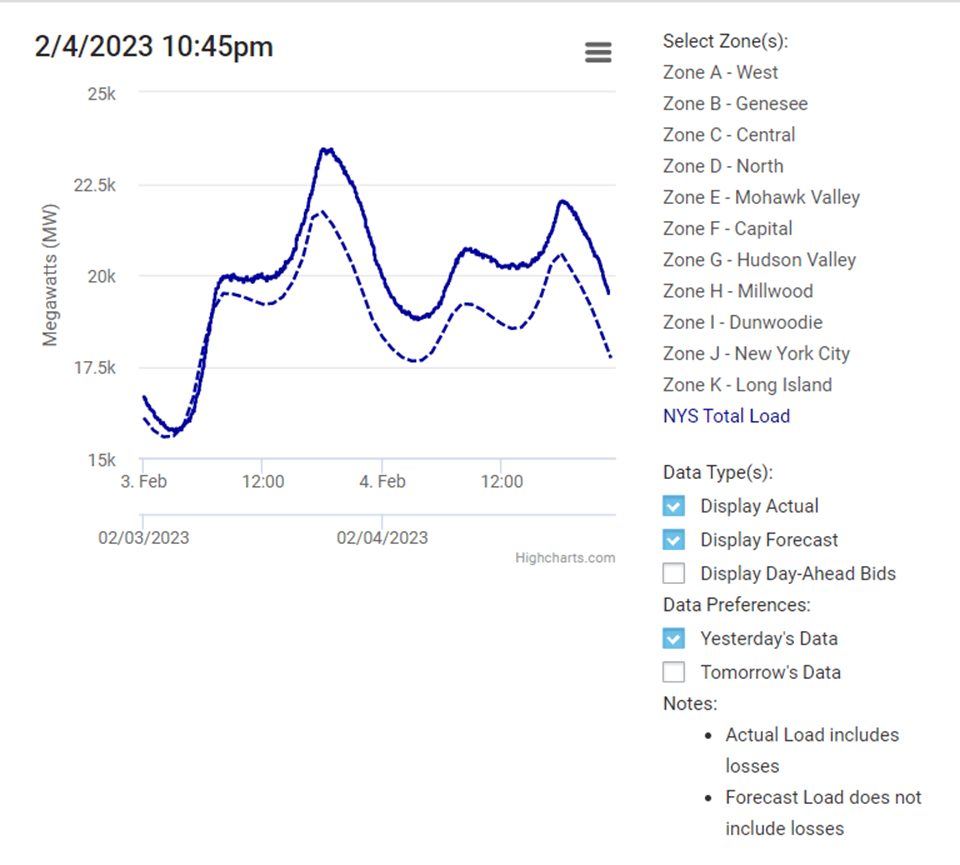
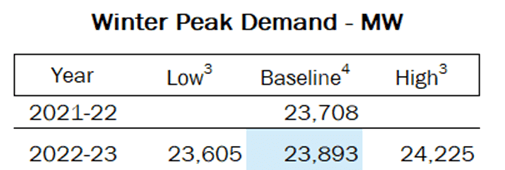
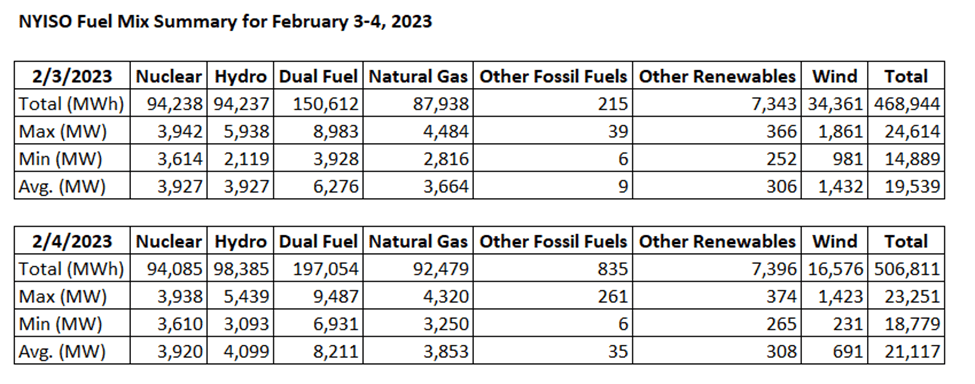
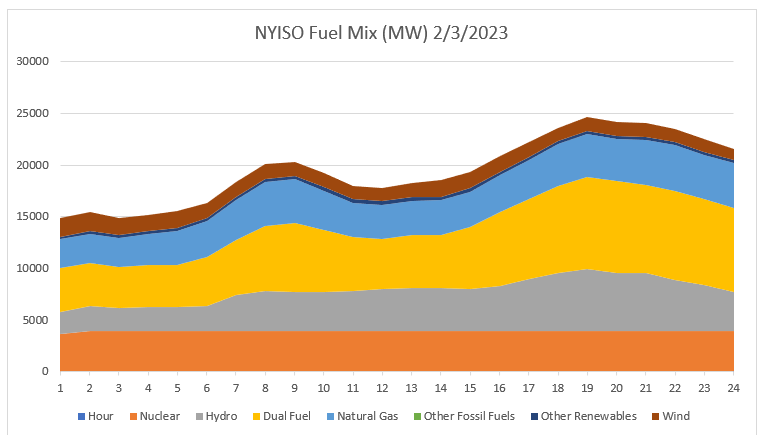
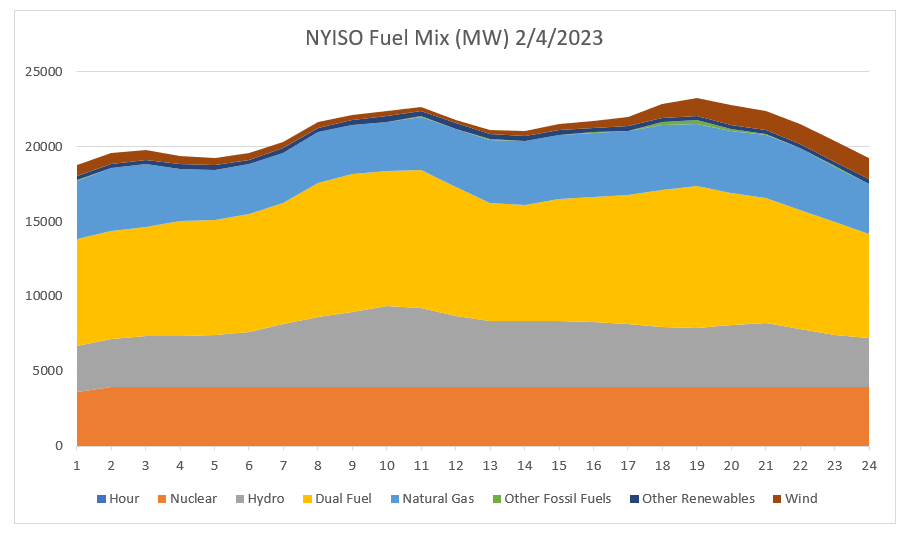
This past Friday and Saturday (February 3-4 2023) there was a brief shot intensely cold air to the Northeast US.  This post includes a couple of descriptions of the implications of this weather event relative to the Climate Leadership and Community Protection Act  (Climate Act) and I present some data describing the event.

This is another article about the Climate Act implementation plan that I have written because I believe the ambitions for a zero-emissions economy embodied in the Climate Act outstrip available renewable technology such that the net-zero transition will do more harm than good.  The opinions expressed in this post do not reflect the position of any of my previous employers or any other company I have been associated with, these comments are mine alone.

I am Thankful – Mark Stevens

Mark is a regular reader at this blog and has contributed several recent items for posting.  He is a retired science and technology teacher from Long Island.  His email to me this weekend is a perfect introduction to the issues raised by this weather event.

It was 3 degrees F Saturday morning with a wind chill of -3 degrees.  All night the north wind raged, rattling “sealed” windows and doors but still blowing frigid air through them. I did everything I could: raise the boiler’s temperature, cover the big expanse of glass on the patio doors windows, pull the shades.  I even added an electric heater in the room my tropical parrot resides so he doesn’t get a fatal pneumonia.

The possibility of a power failure crossed my mind with the overhead wires, high winds, many surrounding trees, and almost monthly power interruptions in the past.  It would be an absolutely worst-case scenario if the power went out tonight. Frozen pipes next? I have a backup generator but the thought of going out in the howling cold night, fueling it, hooking it up, starting it, and monitoring the systems wasn’t that appealing.

But LIPA’s tree trimming maintenance and generation/distribution system upkeep allowed the power to stay on through the night and into the next day as I write this. We’re cozy, comfortable and safe.  This kind of cold can kill.

I’m thankful we have a reliable, cost-effective electrical generation and distribution system.  I’m thankful I have a natural gas-fired boiler that works 24/7 keeping me and my family safe and alive.  I am thankful that I don’t rely on intermittent, expensive wind and solar generation as electricity sources that can fail at any time leaving me without power.  I’m grateful I don’t have to rely on “backup” battery power that is grossly inadequate, expensive, highly polluting to manufacture and can cause a non-extinguishable toxic gas fire. I pray it does not change.

What’s Keeping the Heat On – James Hanley

James is a Fellow at the Empire Center.  His post yesterday is a great overview of the problem facing New York as it continues the implementation of the Climate Act.

As another Arctic blast hits the Northeast and temperatures plunge, more energy is needed to keep New Yorkers warm.   Where is that energy coming from? 

A lot of it comes from natural gas, but there’s a big supply problem. Because of the state’s ban on fracking and its refusal to allow new and upgraded natural gas infrastructure, not enough gas can get to power plants to generate the electricity needed to keep the lights and heat on in everyone’s houses during times of extreme demand. 

What gas is available gets bid up to eye-wateringly high prices. It’s hard to speak meaningfully of an average price for natural gas because the market is volatile, but the 2022 high price in Pennsylvania was $12.95 per million British thermal units (mmbtu). According to one energy industry source, during last Christmas’s cold snap, the price in New York hit $100 per mmbtu. 

That translated into an electricity price of nearly 90 cents per kilowatt hour, compared to the average New York price of 19 cents. 

That assumes the power plant can even get the gas it needs to operate. With such severe gas shortages, some natural gas-fired plants had to shut down for lack of fuel. What gets burned to take their place – fuel oil – is not only expensive, but also much dirtier and producing more carbon dioxide than natural gas. 

So, ironically, because New York has limited the supply of the much cleaner burning natural gas in order to prevent pollution and CO2, the power industry has no choice at times but to spew more pollution into disadvantaged communities and add more carbon to the atmosphere. 

The hope is that renewables will one day suffice to supply the electricity we need to heat our homes on a day like this. That hope is irresponsible, because wind and solar aren’t reliable and there is no available “clean” backup power source. 

Below is a graph from the New York Independent System Operator’s (NYISO) real-time dashboard, showing fuel use on February 2 into the early hours of February 3. On what was otherwise a reasonably good day for wind power (the light green line), we can see it declining in the early hours of February 3 as the cold front moved in, while the use of dual fuel generators (the top line), which can burn fuel oil, dramatically increased. Building more wind turbines has limited effect – as the wind drops across the state, all the turbines decrease in output. 

NYISO has repeatedly warned – and the Climate Action Council’s Scoping Plan admits – that wind and solar will not be sufficient. New York will need between 25 and 45 gigawatts of dispatchable power – power that unlike wind and sun, but like natural gas, fuel oil, and hydro, can be turned on and off at will. 

To comply with the Climate Leadership and Community Protection Act (CLCPA), these sources are supposed to be emissions free, leading NYISO to coin the ugly acronym DEFRs – dispatchable emissions-free resources. But they coined that term because they can’t identify any source that meets that standard and is currently available at utility scale and a commercially competitive price. 

This means that for the foreseeable future, fossil fuels will be the only proven source of dispatchable backup to keep the heat and lights on during weather that is killingly cold. Since New York no longer has any coal plants, that can be oil – which is more polluting and has higher carbon content – or natural gas. 

The CLCPA has a clear goal of eliminating all greenhouse gas emitting power production by 2040, which would mean shutting down all natural gas-fired power plants. But it also provides a path for keeping open those plants that are necessary to ensure a reliable electrical supply. That path, however, faces considerable political opposition. 

New York will soon be forced to make a choice: plunging forward with shutting down natural gas-fired power plants, risking rolling blackouts during extreme cold, or moving forward more slowly on its emissions goals, but keeping the heat on. There is no third way.

The Numbers

The past two days were ideally suited to staying inside.  I am a numbers guy so I spent time the last several days watching the weather and the electric system using two different resources.  The go to resource for weather observations in New York is the NYS Mesonet At UAlbany.  I watched the arctic air come into the region and then tracked the event over time.  The NYISO Real-Time Dashboard is a fascinating link into the New York electricity market.  I suspected correctly that this weather would cause a spike in electric load and I could see that play out over the period.

The weather data presented here is all from the NYS Mesonet at the University of Albany.  The following graph lists the last seven days of temperature, dew point temperature, and solar irradiance data at Elbridge, NY which is near my home.  Note that at the time I write this it is February 5 at 8:00 AM and that corresponds to 05/13 or 1300 universal coordinated time or Greenwich mean time, the standard for meteorological observations.  On the night of February 2 the temperature (red) was around 38oF about 7:00 PM EST or 0000 UTC.  Then the front came through and the temperature plunged overnight and during the day before briefly leveling out a few degrees above zero until nightfall when it dropped down to 7 or so below.

The next graph is for the same time period but shows the wind speed, wind gusts, and pressure.  Frontal passage was accompanied with a dip in the station pressure.  The pressure gradient was strong for most of the period so winds were steady slightly above 10 mph with gusts peaking at 38 mph.

The NYISO Real-Time Dashboard has two relevant graphical displays:  the load and real-time fuel mix. The following graph shows the actual and forecast New York total load on February 3-4 (all times are EST).  It is noteworthy that the actual loads on both days were  significantly higher than forecast loads.  The load peaked on 2/3 at 6:50 PM at 23,447 MW and at 6:10 PM on 2/4 at 21,990 MW. 

The NYISO 2022 Load and Capacity Data report winter peak demand projections are all greater than the observed peak loads so this should not have been a demand response problem with the existing fleet.

The real-time fuel mix data shows how the existing fleet met the peak loads during this weather event.  The following table lists the daily statistics for the different fuel types.  The fuel-mix categories are Nuclear; Hydro, including pumped storage; Dual Fuel, units that burn natural gas and other fossil fuels; Natural Gas only; Other Fossil Fuels, units that burn oil only; Other Renewables are facilities that produce power from solar, energy storage resources, methane, refuse or wood; and Wind (at this time exclusively land-based wind).

The graphs show how important the fossil fuel units are to keeping the lights on.  One notable feature of the fuel type data on 2/3 is that the wind generation was not very high even though winds across the state were quite high.  I believe this is because wind turbines don’t provide optimal power if the winds are too light or too strong.  The strong winds on this date apparently affected the wind production so even on a windy day New York’s land based wind provided only 65% of the maximum potential capability.

On 2/4/2023 the wind resource was affected by light winds.  On this date New York’s land based wind provided only 32% of the maximum potential capability.

Conclusion

Stevens explains how important it is for our safety and well-being to have fossil fuels available during extremely cold weather.  Hanley showed that natural gas played an important role keeping the lights on during this arctic blast and described some of the uncertainty associated with the planned net-zero transition.  My contribution was to provide more documentation for the weather, resulting electric load peak, and the contribution of different fuels to meeting that peak.  I am going to follow up on this post with a deeper dive into the resource availability and implications to the Scoping Plan recommendations for generating resource allocations.

Hanley’s conclusion is spot on:

New York will soon be forced to make a choice: plunging forward with shutting down natural gas-fired power plants, risking rolling blackouts during extreme cold, or moving forward more slowly on its emissions goals, but keeping the heat on. There is no third way.

Guest Post: South Shore Long Island Whale Die Off

This is a guest post by Mark Stevens, a regular reader at this blog.  Mark is a retired science and technology teacher from Long Island.  I have been meaning to do a post on whales and the offshore wind industry so this was timely.

What’s Going On

The NY Post reported a 7th dead whale washed up on the Jersey shore. A humpback washed up on the Amagansett shore in December. Eight dead whales in two months?  Moreover, David Wojick recently reported that on January 18, 2023 there was a NOAA fisheries media teleconference that noted:

Since January 2016, NOAA Fisheries has been monitoring an Unusual Mortality Event for humpback whales with elevated strandings along the entire East Coast. There are currently 178 humpback whales included in the unusual mortality event.  Partial or full necropsy examinations were conducted on approximately half of the whales. Of the whales examined, about 40% had evidence of human interaction, either ship strike or entanglement. And to date, no whale mortality has been attributed to offshore wind activities.

The transcript makes for fascinating reading.  The Fisheries spokespersons went to great lengths to make the point that no whale mortalities have been directly linked to offshore wind development.  But there were notable conditions in those statements: “We do not have evidence that would support the connection between the survey work and these recent stranding events or any stranding events in the last several years.”  The other key condition is that the offshore wind development is doing survey work now and not construction.  The open question is whether or not offshore wind development could kill whales.

Bloomberg reports that planned wind projects off the New England coast threaten to harm the region’s dwindling population of endangered right whales, according to a US government marine scientist.  The warning from a top National Oceanic and Atmospheric Administration official, obtained by Bloomberg under a Freedom of Information Act request, underscores the potential legal and environmental perils of offshore wind development along the coast.  Both initial construction of wind projects and decades of expected operation threaten to imperil right whales in southern New England waters, Sean Hayes, chief of the protected species branch at NOAA’s National Northeast Fisheries Science Center, said in a May 13 letter to Interior Department officials.  The department is weighing at least 10 proposals to install wind turbines in shallow Atlantic waters — projects key to fulfilling Biden’s 2030 goal.

The NOAA fisheries media teleconference claimed that survey work had not been linked to  whale strandings.  Surveys entail prolonged use of “machine gun sonar” emits an incredibly loud noise several times a second, often for hours at a time, as the ship slowly maps the sea floor.Mapping often takes many days to complete. A blaster can log hundreds of miles surveying a 10-by-10 mile site.

There are lots of ways this sonar blasting might cause whales to die. Simply fleeing the incredible noise could cause ship strikes or fish gear entanglements, the two leading causes of whale deaths. Or the whales could be deafened, increasing their chances of being struck by a ship later on. Direct bleeding injury, like getting their ears damaged, is another known risk, possibly leading to death from infection. So there can be a big time difference between blasting and death.  Sonar blasting in one place could easily lead to multiple whale deaths hundreds of miles away. If one of these blasters suddenly goes off near a group of whales they might go off in different directions, then slowly die.  It is not guaranteed that the dead whales will wash up on shore.

The NOAA fisheries media teleconference did not address construction impacts.  Sound travels 5 times faster in water and humpback whale sounds can travel thousands of miles according to Scientific American.  Pile driving the hundreds of enormous monopiles that hold up the turbine towers and blades will be far louder than the sonic blasters, especially with eight sites going at once. These construction sites range from Virginia to Massachusetts, with a concentration off New Jersey and Long Island.  This is shown to cause whale mortality.

The impetus for the The NOAA fisheries media teleconference was related to humpback whales strandings. However, some of the dead whales off New Jersey are endangered sperm whales. And there are the severely endangered North Atlantic Right Whales throughout the area where offshore wind developments are planned.

Offshore Wind and the Climate Act

New York’s Climate Leadership and Community Protection Act (Climate Act) established a “Net Zero” target (85% reduction and 15% offset of emissions) by 2050. The Climate Act requires that by 2030, 70% of electricity will be generated from renewable energy sources such as solar and wind and calls for the development of 9,000 megawatts of offshore wind energy by 2035.

According to the New York State Offshore Wind Overview five projects have been procured: South Fork (132 MW), Empire Wind  1&2 (816 MW and 1,260 MW), Sunrise Wind (924 MW), and Beacon Wind https://www.beaconwind.com/about/(1,230 MW).  Unfortunately, the websites do not provide consistent information but the best guess number of turbines is 316 for a total of 4,362 MW.  At that rate, the 9,000 MW target will require 652 turbines with capacities between 11 and 15 MW.  On January 26, 2023 bids were due for another round of Climate Act offshore wind development.

Is it time to re-think offshore wind?

In order to do the offshore wind development site surveys an incidental harassment authorization is required.  The first  fact is that the huge 2016 jump in annual humpback mortality coincides with the huge jump in NOAA Incidental Harassment Authorizations.  The second fact is that this is just the start of whale harassment when hundreds of enormous monopiles are driven into the seabed for the massive deployment of offshore wind.  When construction gets into full swing there will be multiple pile drivers hammering away which can only result in impacts beyond incidental harassment.

In addition to the hundreds of bird strikes including bald eagles and others, wind turbines are massive killing machines here and around the world.  And the fact that they produce energy about ¼ of their nameplate capacity, cost hundreds of billions of dollars with huge taxpayer subsidies, are intermittent and still need fossil generation backup when the wind stops, require 10s of thousands of acres, have shortened life in the harsh marine environment; require more steel, concrete, copper, and materials than conventional generation of the same output; have monstrous fiberglass blades which are not recyclable, why are we blindly building them?  In addition, most wind projects are built by foreign companies. Do we want billions of ratepayer dollars and taxpayer subsidies going overseas?

According to a study by the Center For Management Analysis of CW Post/LIU, Dr. Matt Cordero determined repowering the Northport Power Station alone with state-of-the-art technology will produce 3500+ MW (more than Empire Wind), cut emissions over 90%, cost less than Empire, use fewer materials, use a fraction of the area that ALREADY EXISTS with a power station and in-place infrastructure, will have zero bird strikes and whale deaths, provide tax benefits for the community, will last decades longer and is on call 24/7 vs. intermittent (20% of the time) wind. 

Furthermore, intermittent wind and solar need massive battery backup and storage with huge costs, land requirements, massive pollution and greenhouse gas emissions for ore extraction and fabrication, and pose a deadly hazard to the region if it catches on an unextinguishable fire that emits deadly gasses.

Emission reduction by NYS will have an undetectable effect on global emissions, especially with China, Russia, India and others building dozens of coal power plants.  They will have reliable, life-saving, cost-effective electricity generation.  States with a large portion of renewables like California, Texas, North Carolina have high rates, power failures, rolling blackouts and a restricted weather operating range, and they IMPORT reliable power from other states, thus relocating emissions to surrounding states. Tesla and others left California for those reasons.  Are they really cutting emissions?

Finally,   the European Union, especially Germany and the UK have shuttered nuclear and fossil generation, relying on unreliable wind and solar sources.  Costs are so high, people must decide whether to buy electric heat or food, and  industries are leaving for other countries with cheaper and more reliable electricity, resulting in unemployment, poverty and economic collapse.

We currently have a reliable, cost-effective generation mix of fossil, wind, solar, hydro and nuclear.  New York State must seriously rethink replacing that generation with intermittent wind and solar.  Our survival and economy depend on it.

New York Energy Storage Roadmap – Cost Projections Part 2

On December 28, 2022, the New York State Energy Research & Development Authority (NYSERDA) and the New York State Department of Public Service (DPS) filed New York’s 6 GW Energy Storage Roadmap (Roadmap) to the Public Service Commission (PSC) for consideration.  I previously gave an overview of the Roadmap and looked at the way the costs were projected.  In this post I give my estimate of the costs.

Everyone wants to do right by the environment to the extent that they can afford to and not be unduly burdened by the effects of environmental policies.  I submitted comments on the Climate Act implementation plan and have written over 270 articles about New York’s net-zero transition because I believe the ambitions for a zero-emissions economy embodied in the Climate Act outstrip available renewable technology such that the net-zero transition will do more harm than good.  The opinions expressed in this post do not reflect the position of any of my previous employers or any other company I have been associated with, these comments are mine alone.

New York Energy Storage Plan

The NYSERDA Energy Storage in New York web page gives an overview of New York’s plan:

In 2019, New York passed the nation-leading Climate Leadership and Community Protection Act (Climate Act), which codified some of the most aggressive energy and climate goals in the country.

6,000 MW of Solar by 2025

70% Renewable Energy by 2030

9,000 MW of Offshore Wind by 2035

100% Carbon-free Electricity by 2040

85% Reduction in GHG Emissions from 1990 levels by 2050

3,000 MW of Energy Storage by 2030, further increased to 6,000 MW of Energy Storage by 2030 by Governor Kathy Hochul

In my previous post I pointed out that the press release for the Roadmap claimed that “the roadmap will support a buildout of storage deployments estimated to reduce projected future statewide electric system costs by nearly $2 billion”.  The state’s modeling predicts that it will cost $0.46 per month per electricity bill and the trade press has jumped on that cost as less than the cost of a slice of pizza.

I showed that Roadmap costs are misleadingly presented relative to incremental revenues: “For the proposed bulk storage procurement program, program costs are calculated as the incremental revenue, on top of revenue that storage assets can realize through commercial operation in the existing energy markets, that would allow such assets to reach their cost of capital.”  If the state were to be open and transparent, the total expected capital costs, the revenue costs, and how they expect energy storage to get paid would be presented so that readers could understand the incremental revenue.  I have come to believe that the obfuscation of the actual costs is deliberate because the numbers are so large that the public backlash would be immense.

Cost Estimates

I have written in the past that every aspect of the net-zero transition that I have evaluated has turned out to be more complicated, uncertain, and nuanced than has been portrayed by the proponents of net-zero transitions.  This calculation is no different.  On the face of it you just figure out the capacity (MW) needed or the energy generation (MWh) needed and the multiply those values by a published cost estimate. 

I am not going to discuss all the ambiguities I tried to reconcile but will give an example of one.  In order to estimate the electric resources needed to power the zero-emissions electric grid in 2040 sophisticated modeling is required.  The New York State Energy Research & Development Authority (NYSERDA) and its consultant provided that evaluation for the Scoping Plan for the net-zero transition plan required by New York’s Climate Leadership and Community Protection Act (Climate Act).   The New York Independent System Operator did modeling for its 2021-2040 System & Resource Outlook evaluation.  I looked at five of the scenarios they modeled: NYISO Outlook Scenario 1: Industry data and forecasts, NYISO Outlook Scenario 2: Assumptions aligned with Integration Analysis, Integration Analysis Scenario 2: Strategic Use of Low-Carbon Fuels, Integration Analysis Scenario 3: Accelerated Transition from Combustion, Integration Analysis Scenario 4: Beyond 85% Reduction

There are substantial differences in the methodology used for the energy storage estimates between the two approaches.  Table 1 lists the capacity (MW) and generation (GWhr) projections for the present and 2040 for the five scenarios.  Note that the storage capacity estimates are roughly the same but the generation estimates are different.  The NYISO generation is at least 13,414 GWhr in 2040 but the Integration Analsis generation is negative, so the methodologies are different.  Energy storage generation can represent two different things: the amount of electricity stored say over a year or the amount of electricity that can be stored all at once, the storage capacity.

Table 1: NYISO Outlook Study Scenarios and Integration Analysis Mitigation Scenarios

I believe that both analyses use total stored electricity for their energy storage estimates.  David Wojick recently used the storage capacity approach to estimate energy storage costs.  His approach simply takes:

  • a reasonable period of no wind and solar, say 3 days or 72 hours, and
  • a reasonable average demand on renewables over that period, say 35,000 MW, and
  • multiply them to get 2,520,000 MWh of required storage
  • which at $700,000 per MWh equals $1,764,000,000,000

Given the issues with the energy storage generation different interpretation, I chose to use Energy Information Administration overnight capital costs (2021$/kW) in the comments I submitted on the Draft Scoping Plan to make a cost estimate.  This approach does not include operating and maintenance (O&M) costs, the expected lifetime of the energy storage devices, and how the lifetime would vary depending on how it is used.  My estimate of the overnight cost to develop the resources needed to transition to a zero-emissions electric system in 2040 are generally consistent with the Scoping Plan Appendix G Figure 48 net present value of system expenditures.  Table 2 lists those costs for all five scenarios.  This approach estimates a cost three orders of magnitude less than the costs projected by Wojick.  The big difference is that both NYISO and NYSERDA include a zero-carbon firm resource or dispatchable emissions-free resource (DEFR) that can satisfy the need for extended periods of high load and low renewable energy resource availability thereby reducing the energy storage needed.

The NYISO 2021-2040 System Resource Outlook explained that to achieve a zero-emissions grid, DEFRs must be developed and deployed throughout New York.  The following Figure 38 from the Roadmap illustrates the problem.  The difference between cost estimates emphasizes why this resource is needed.  The ultimate problem of any electric system that relies on intermittent wind and solar is that there are periods when they are not available.  It turns out that the weather systems that cause light winds are large and affect all of New York at the same time and solar resources are lower in the winter when days are short and the sun is lower in the sky.  In other words, all the renewable resources in the state can go very low at the same time.  Just figuring out what the worst case of renewable resource availability is a major problem and both modeling groups agree that something besides batteries is needed.  The Outlook noted that “While essential to the grid of the future, such DEFR technologies are not commercially viable today” and went on to point that research and development efforts are needed to identify the most efficient and cost-effective technologies that can be deployed.  Needless to say, it is risky to depend on a resource that is not currently commercially viable that makes such a difference between costs.

Discussion

The Hochul Administration claims that “the roadmap will support a buildout of storage deployments estimated to reduce projected future statewide electric system costs by nearly $2 billion”.  The key point is that nowhere does the Roadmap document total costs. The fair question is what are the projected future statewide electric system costs?  Moreover, I showed previously that Roadmap costs are presented relative to incremental revenues: “For the proposed bulk storage procurement program, program costs are calculated as the incremental revenue, on top of revenue that storage assets can realize through commercial operation in the existing energy markets, that would allow such assets to reach their cost of capital.”  It is impossible to check the validity of that statement without full disclosure of all these cost components.

This analysis compares future statewide electric system costs for energy storage.  The simplest approach estimates that energy storage necessary to provide electricity when wind and solar resources are unavailable could be as much as $1.7 trillion.  NYISO and NYSERDA used more sophisticated analyses to refine how much backup was needed.  The overnight capital costs for the batteries, and only the batteries, for five different scenarios ranges from $13 to $15 billion.  There are a host of other factors that could raise those estimates.  The approach used by NYSERDA and NYISO relies on DEFR technologies that increase the cost to provide backup when wind and solar resources are unavailable totals between billion $187 and $349 billion but provide massive savings relative to any approach that does not include that kind of resource.  It is clear that whatever approach is used, that the Hochul Administration claim of “savings” of $2 billion is insignificant relative to the total costs which are at least two orders of magnitude larger.

Conclusion

The Roadmap has been presented to the Citizens of New York as a sales spiel.  The public heard that the costs of energy storage were only $2 billion and that the cost to ratepayers would be less than the cost of a slice of pizza.  The costs that ratepayers will ultimately pay is much, much higher.  The shell game manipulation of costs demonstrates that the Hochul Administration goal is hide the expenditure of hundreds of billions of dollars under so many different programs and subsidies to make it intentionally impossible to capture the total costs to consumers.  The true “Total Cost” of the Climate Act will be hidden forever from the public by design. 

My thanks to David Wojick for his review and comments.  Any errors in this analysis are my responsibility.

Getting to 100%: Six strategiesfor the challenging last 10%

A recent paper, Getting to 100%: Six strategies for the challenging last 10%, provides a concise summary of six technologies that could be used for the Climate Leadership and Community Protection Act (Climate Act) legal mandate for New York State greenhouse gas emissions to meet the ambitious net-zero goal by 2050.  I continue to be amazed that the parties responsible for Climate Act implementation continue to ignore the risks associated with these aspirational technologies so this article summarizes this useful paper.

Everyone wants to do right by the environment to the extent that they can afford to and not be unduly burdened by the effects of environmental policies.  I submitted comments on the Climate Act implementation plan and have written extensively on New York’s net-zero transition because I believe the ambitions for a zero-emissions economy embodied in the Climate Act outstrip available renewable technology such that this supposed cure will be worse than the disease.  The opinions expressed in this post do not reflect the position of any of my previous employers or any other company I have been associated with, these comments are mine alone.

Background

The implementation plan for New York’s Climate Act “Net Zero” target (85% reduction and 15% offset of emissions) by 2050 is underway.  The Climate Action Council has been working to develop plans to implement the Act.  Over the summer of 2021 the New York State Energy Research & Development Authority (NYSERDA) and its consultant Energy + Environmental Economics (E3) prepared an Integration Analysis to “estimate the economy-wide benefits, costs, and GHG emissions reductions associated with pathways that achieve the Climate Act GHG emission limits and carbon neutrality goal”.  Integration Analysis implementation strategies were incorporated into the Draft Scoping Plan when it was released at the end of 2021.  Since the end of the public comment period in early July 2022 the Climate Action Council has been addressing the comments received as part of the development of the Final Scoping Plan that is supposed to provide a guide for the net-zero transition.

I have previously written that the Climate Action Council has not confronted reliability issues raised by New York agencies responsible for keeping the lights on.  The first post (New York Climate Act: Is Anyone Listening to the Experts?) described the NYISO 2021-2030 Comprehensive Reliability Plan (CRP) report (appendices) released late last year.  The difficulties raised in the report are so large that I raised the question whether any leader in New York was listening to this expert opinion.  The second post (New York Climate Act: What the Experts are Saying Now) highlighted results shown in a draft presentation for the 2021-2040 System & Resource Outlook that all but admitted meeting the net-zero goals of the Climate Act are impossible on the mandated schedule.  Recently I wrote about the “For discussion purposes only” draft of the 2021-2040 System & Resource Outlook report described in the previous article. 

Challenges of a Zero-Emissions Electric Grid

It is generally recognized that as increasing amounts of intermittent wind and solar energy are added to the electric grid, unique issues arise as grid operators balance generation and load.  I maintain that the ultimate problem with a net-zero energy system is that increased electrification will markedly raise loads during weather conditions that cause peak loads but also can have low wind and solar resource availability.  A recent paper, Getting to 100%: Six strategies for the challenging last 10% (“Getting to 100% report”), describes approaches for providing power during peak conditions.  It describes the general peaking problem, how wind and solar will exacerbate the problem, and what the authors think is necessary to solve the future problem.

The authors from the National Renewable Energy Laboratory provided the following summary:

Meeting the last increment of demand always poses challenges, irrespective of whether the resources used to meet it are carbon free.  The challenges primarily stem from the infrequent utilization of assets deployed to meet high demand periods, which require very high revenue during those periods to recover capital costs.  Achieving 100% carbon-free electricity obviates the use of traditional fossil-fuel-based generation technologies, by themselves, to serve the last increment of demand—which we refer to as the ‘‘last 10%.’’ Here, we survey strategies for overcoming this last 10% challenge, including extending traditional carbon-free energy sources (e.g., wind and solar, other renewable energy, and nuclear), replacing fossil fuels with carbon-free fuels for combustion (e.g., hydrogen- and biomass-based fuels), developing carbon capture and carbon dioxide removal technologies, and deploying multiday demand-side resources. We qualitatively compare economic factors associated with the low-utilization condition and discuss unique challenges of each option to inform the complex assessments needed to identify a portfolio that could achieve carbon free electricity. Although many electricity systems are a long way from requiring these last 10% technologies, research and careful consideration are needed soon for the options to be available when electricity systems approach 90% carbon-free electricity.

The Getting to 100% paper describes six strategies that are summarized in the following table.  Note that the strategies are compared to an ideal solution.  Ideally, the solution for peak loads would have low capital expenses and low operating expense, low resource constraints, be technologically mature, have low environmental impacts, and work well with other resources.  Needless to say, no technology comes close to meeting those ideal conditions.  The authors note that: “Although existing studies generally highlight the same fundamental causes associated with the last 10% problem, there is a lack of consensus on the preferred strategies for meeting this challenge. This is not surprising, given the diversity of possible solutions and the speculative nature of their costs, given their early stage of development.”

Although I think the Getting to 100% paper is useful, I want to point out a few issues with it.  It is hardly unexpected that authors from the National Renewable Energy Laboratory appear to over-estimate the maturity and economics of wind and solar technologies.  Also note that in New York, the implementation plan calls for offshore wind capacity to be at least one third to over one half of the projected wind capacity but the report claimed that wind economic factors were low, capital costs low, operational expenses low and that wind has high technological maturity.  All true perhaps for land-based wind but certainly not true for off-shore wind. 

My biggest concern is that the analysis does not consider the ‘‘inverter challenge’’ as a major constraint.  Another report, “The challenges of achieving a 100% renewable electricity system in the United States”, explains that in the existing electrical system synchronous generators provide six services shown in the following table that provide system stability.  Wind and solar resources are asynchronous generators that do not provide those services.  Somebody has to provide them so this analysis that concentrates only on the levelized cost of energy that ignores those services under-estimates the cost and technological challenges to provide electricity to consumers.

The Getting to 100% paper explains that the biggest problem is making sure there is sufficient available capacity during all periods, even if that capacity is seldom used.  This problem is not new and exists in the existing system.  The paper notes:

The increase in costs associated with approaching 100% carbon-free electricity is a special case of the more general problem of meeting peak demand, which has always been part of the planning process for electric power systems. Variations in demand profiles and the existence of demand peaks are caused by variation in weather, end-use technology stock, and, ultimately, consumer preferences and behavior.

The Getting to 100% paper explains that there are differences between daily load and daily renewable energy (RE) generation over the year.  The following figure shows the seasonal patterns in the daily imbalance (daily load minus daily RE generation) for hypothetical high RE systems where about 90% of annual load is met by wind, solar, and other RE generation technologies for New York State. As noted previously the fundamental problem is that when the loads are the highest in the summer and winter, RE generation can be low.  In the spring and fall the RE resources are generally high but loads are low.   As the share of RE increases,” these aspects are increasingly accentuated”.  The paper makes the point that:

Eventually, with high enough VRE shares, the addition of new VRE capacity would offer very little benefit in reducing peaks in net load, while causing additional oversupply conditions where unusable VRE needs to be curtailed. The low capital utilization problem of meeting demand is exacerbated in high VRE systems. These issues shape the characteristics of a last 10% solution.

In the following I will address each strategy.

Variable renewable energy, transmission, and diurnal storage

This approach is “technologically conservative, as it relies only on technologies currently being deployed at gigawatt (GW) scale”. The seasonal mismatch problem is addressed by overbuilding wind and solar resources as well as adding more transmission capacity.  Diurnal storage is deployed to fill hourly supply gaps and excess wind and solar is curtailed during high-resource periods.  The authors claim: “Increasing oversupply during high-resource times decreases the amount of storage necessary to supply low-resource times.”  The authors admit that wind and solar “curtailment in such systems can reach 35%–50%”.  There is an associated problem.  As more wind and solar resources are added to minimize storage requirements, those additional resources markedly increase curtailment rates for all those resources.  

In order to address those issues, the authors claim that new developments could “make this approach more competitive” In particular: “Higher-capacity-factor system designs (low-windspeed and/or high-hub-height wind turbines; tracking PV arrays with high inverter-loading ratios preferentially increase output during low-resource periods, increasing VRE dispatchability”.  My impression however, is that those are tweaks and do not eliminate all issues.  The authors mention hybrid systems, “including concentrating solar power with thermal energy storage”, but neglect to mention that the Crescent Dunes Solar Energy Project that used this technology failed.  They also claim that “Increased long-distance transmission deployment (over distances larger than the extent of weather systems decreases curtailment, cost, and storage needs by exploiting the declining spatial correlation of VRE availability with increasing distance”.  Advocates of this approach never discuss just what distances are needed for it to work and just how it would work in practice.

According to Table 1 in the Getting to 100% paper, on the positive side the economic factors are relatively low cost and technological material is high.  The resource constraints are listed as medium but I think that is optimistic given the volume of these resources required.  Frequent claims of the low costs of wind and solar generation ignore the fact that the real cost that matters is the delivered cost.  When the costs to keep the lights on when the wind is not blowing at night are considered the low cost claims are wrong.

Other renewable energy

The study claims that “geothermal, hydropower, and biomass are renewable energy resources that do not rely on variable solar and wind resources and have higher capacity credit”. While the report claims that these resources can play an important role in a net-zero-emissions power system the fact is geothermal and hydro resources depend on certain physical site constraints so there is not a lot of potential availability in New York.  The main problem with biomass is that there are limits on how much could be produced and it is not enough to be a major contributor to the overall energy needs.  In New York there are members of the Climate Action Council that believe that zero-emissions means no combustion so there is an ideological constraint as well.

According to Table 1 in the Getting to 100% paper, on the positive side the technological material is high and some of the economic factors are favorable.  However, all the options have high resource constraints that limit the applicability of these options.

Nuclear and fossil with carbon capture

The study notes that “Nuclear and fossil with carbon capture and storage (CCS) are widely cited as potentially important resources in a decarbonized electricity system”.  There is no question that nuclear is the only emissions-free dispatchable resource that could be deployed in sufficient quantities to provide all needed baseload power.  The report notes that: ”The existing nuclear fleet comprises reactor designs with large nameplate capacities and designed to operate near their maximum output potential”, and that “Advanced nuclear reactor designs are typically smaller in scale and more flexible” .  Consequently, nuclear might be viable for the last 10% problem.  Alas New York, for example, on one hand worries about an existential threat of climate change but shuts down 2,000 MW of zero-emissions nuclear generation which suggests that this option is off the table.

The report notes that “Fossil CCS plants have yet to be deployed at scale, but some studies find significant deployment potential, including from retrofits of existing fossil fuel-fired Plants”.   The report sums up the pragmatic dilemma associated with this option:

Fossil CCS has a capture rate of less than 100%; therefore, some emission offsets are needed for fully net carbon-free electricity unless technology advancements, such as through oxy-combustion, can enable zero or near-zero emissions.  he role of fossil CCS could be impacted by how strictly the ‘‘100%’’ requirement is interpreted with respect to any remaining emissions that are not captured and emissions from upstream fuel extraction, including methane leakage.

There is another issue associated with CCS.  A fossil plant capturing CO2 has a derate of about one third because of the energy needed to run the equipment required to capture and compress the CO2 so that it can be transported and sequestered underground.  Finally, in order to safely store the CO2 particular geologic formations are required which limits where these facilities can be located.

According to Table 1 in the Getting to 100% paper, advanced nuclear has high capital expenses and moderate operating expenses; medium resource constraints, medium technological maturity, and security, supply chain, regulatory and cost uncertainties.  Fossil CCS has high capital expenses, medium operating expenses, medium resource constraints, low technological constraints, and issues with upstream emissions, CO2 transport and sequestration.

Seasonal storage

Seasonal storage refers to the use of electricity to produce a storable fuel that can be used for generation over extended periods of time later:

This group of technologies is not well defined, but it could include batteries with very low-cost electrolytes capable of longer-than-diurnal durations. Because of the requirement for very low-cost energy storage, most seasonal storage pathways focus on hydrogen, ammonia, and other hydrogen-derived fuels stored in geologic formations.

Hydrogen produced using electricity to split water (i.e., electrolytic hydrogen) is a form of storage because the energy it carries can be converted back to electricity.  Electrolytic hydrogen technology has been used at an industrial scale since the early 20th century. Although currently higher cost than hydrogen from natural gas reforming, electrolytic hydrogen production costs can be reduced if low- cost electricity, such as zero-cost otherwise-curtailed renewable energy, is used.

In the New York implementation plan the dispatchable emissions-free resource (DEFR) place holder is hydrogen produced using wind and solar.  In addition to the irrational ideological prohibition against combustion sources there are technological issues for New York.  The report notes that “current high-cost electrolyzers need to operate almost continuously to recover their capital expense” and that “Storage and transport costs would add to the delivered cost of hydrogen”. 

The New York ideologues plan is to use hydrogen in fuel cells, but the report notes:

Fuel cells have diverse applications, but their use for bulk power generation is currently limited. Given the range and scale of applications especially for transportation, substantial capital cost reductions for fuel cells are possible. With low capital costs for combustion turbines and future potential cost reductions for fuel cells, the economic case for hydrogen mainly hinges on lowering the cost of electrolytic hydrogen.

According to Table 1 in the Getting to 100% paper, it really is a stretch to say that there are any positive aspects for using hydrogen with combustion turbines or in fuel cells.  For hydrogen used in combustion turbines the report claims low capital expenses (apparently referring only to the combustion turbine but not including the generation of the hydrogen itself), medium operating expenses and resource constraints, and concerns about hydrogen storage and transport as well as competition for using hydrogen in other sectors.  For hydrogen used in fuel cells there is a potential for low capital expenses, high operating expenses, low resource constraints (apparently referring only to the fuel cell and not assuming that the hydrogen is generated with wind and solar resources), low technological maturity, and the same other considerations as hydrogen used in combustion turbines.

Carbon dioxide removal

The report describes carbon dioxide removal (CDR) strategies which are “dedicated efforts to reduce atmospheric CO2 levels.  In theory this can offset emissions from carbon-emitting power generation so that fossil-fired units can operate to fulfill the last 10% requirement. This is too far fetched to be credible in my opinion.

According to Table 1 in the Getting to 100% paper, there are no positive aspects of this technology except that there are low resource constraints for direct air capture and storage. 

Demand-side resources

Net-zero advocates are enamored with “smart planning” approaches that reduce load which reduces generating resource requirements.  The report notes that “Demand-side resources, also referred to as demand response or demand flexibility, have unique properties compared with the supply-side solutions”.  The report explains:

To a limited extent, they are already relied upon for grid planning and operations today. By reducing electricity consumption during times of system stress, these resources help avoid capital expenditures associated with new peaking capacity.  Through flexible scheduling or interruption of electricity consumption, they can also reduce operating costs or be used for important grid reliability services.

While there are indisputable advantages, I think that advocates lose track of the limitations.  There are demand-side programs in place today but the applications are limited.  Today’s programs limit reduction requests to rare instances of limited duration primarily to shave peak loads primarily by large industrial or commercial users. The problem is that applying demand-side options as a last 10% strategy for decarbonization “requires them to be reliably available over extended multi-day periods”. This means that they cannot be used for residential heating and cooling loads and electric vehicle charging. Moreover, the report notes that “Large-scale commercial or industrial customers can provide multi-day response, but extended interruptions would negatively impact these capital-intensive (non-power) applications”.  As a result, I don’t think this approach will provide adequate reductions when needed the most.

According to Table 1 in the Getting to 100% paper there are low capital expenses but there are uncertain opportunity costs.  The paper claims that resource constraints are uncertain and that the technological maturity is medium.  There are concerns about communications, control equipment and reliability.

Discussion

An Inside Clean Energy article on the paper offers a summary from the climate advocacy side.  Of note is a plug for the 100% renewable option:

A growing segment of energy researchers say that the electricity system can run on 100 percent renewable energy, which would mean renewables and energy storage would provide the last 10 percent. This approach sees no good reason to build new nuclear plants or to use carbon capture systems on fossil fuel plants, citing high costs and a variety of other concerns.

The author admits that the myth of low-cost solar and wind resources does not take into account the resources needed for reliability during periods of peak demand:

At the same time, a sizable group of energy researchers maintain that nuclear and carbon capture are essential parts of getting to carbon-free electricity. This side has doubts about the ability of renewable sources to meet all needs, citing concerns about the availability of land and the intermittent nature of wind and solar. They note that wind and solar are not a low-cost option when taking into account the amounts of storage and power line capacity needed to make those resources reliable for meeting peak demand.

I find the author’s conclusion naïve:

Within all of this is something encouraging: Researchers and energy companies have figured out how to start the transition to 100 percent carbon-free electricity and they have a pretty good idea of what the in-between steps will look like. Now, they are beginning to dig deep on how this journey to a carbon-free grid may end.

Academic researchers are not accountable for reliability and have found a cash cow for funding.  No one is funding them to make a responsible estimate of future resources that does not fit the alarmist narrative.  In a de-regulated world energy companies are also not responsible for reliability and are toeing the line of the net-zero narrative.  New York’s organizations responsible for reliability are not as optimistic (here and here). New York’s Draft Scoping Plan presumes that the State can transition to net-zero without addressing reliability and affordability feasibility but the reality is that even this report suggests that substantive issues have to be addressed.

Conclusion

I think this is a biased report that is too optimistic for future projections.  Nonetheless, it does offer a concise summary of potential approaches to address the last 10% problem that is my ultimate concern.  With respect to New York’s implementation plans, if the concerns of the National Renewable Energy Laboratory staff are ignored in the Final Scoping Plan, then New York will surely have a catastrophic blackout with consequences far beyond any impacts that can be attributed to climate change.