
Skip to content
This site addresses the balance between environmental and energy policy impacts, costs, and benefits

Pragmatic Environmentalist of New York

Balancing the risks and benefits of environmental initiatives

  • Home
  • Menu
  • About
  • Contact
  • Citizen’s Guide to the Climate Act Page
  • Twitter
  • Facebook
  • Google+
  • GitHub
  • WordPress.com
Pragmatic Environmentalist of New  York

Category: Climate Act Comments Submitted

Overview of My Comments on the Draft Scoping Plan Comment

The Climate Leadership and Community Protection Act (Climate Act) has a legal mandate for New York State greenhouse gas emissions to meet the ambitious net-zero goal by 2050.  In response to the request for comments on the Draft Scoping Plan I submitted 26 comments on specific issues primarily related to subjects raised at this blog before the end of the comment period on July 1.  This article sums up the comments I submitted as described in my executive summary comment.

Everyone wants to do right by the environment to the extent that they can afford to and not be unduly burdened by the effects of environmental policies.  I have written extensively on implementation of New York’s response to that risk because I believe the ambitions for a zero-emissions economy embodied in the Climate Act outstrip available renewable technology such that it will adversely affect reliability, impact affordability, risk safety, affect lifestyles, and will have worse impacts on the environment than the purported effects of climate change in New York.  New York’s Greenhouse Gas (GHG) emissions are less than one half one percent of global emissions and since 1990 global GHG emissions have increased by more than one half a percent per year.  Moreover, the reductions cannot measurably affect global warming when implemented.   This page documents all the comments that I submitted as part of the Climate Leadership and Community Protection Act implementation process. The opinions expressed in this post do not reflect the position of any of my previous employers or any other company I have been associated with, these comments are mine alone.

Climate Act Background

The Climate Act establishes a “Net Zero” target (85% reduction and 15% offset of emissions) by 2050. The Climate Action Council is responsible for preparing the Scoping Plan that will “achieve the State’s bold clean energy and climate agenda”.  They were assisted by Advisory Panels who developed and presented strategies to the meet the goals to the Council.  Those strategies were used to develop the integration analysis prepared by the New York State Energy Research and Development Authority (NYSERDA) and its consultants that quantified the impact of the strategies.  That material was used to write Draft Scoping Plan that was released for public comment at the end of 2021. The Climate Action Council will revise the Draft Scoping Plan based on comments and other expert input in 2022 with the goal to finalize the Scoping Plan by the end of the year.

I have been following the Climate Leadership and Community Protection Act (Climate Act) process since it started.  I used information published on my blog to submit 26 comments on various aspects of the Draft Scoping Plan since the comment period opened.  This post summarizes the executive summary comment I submitted that highlights the most important points that I think the members of the Climate Action Council should know about the Draft Plan.  Given the breadth and scope of the Climate Act transition and the Draft Scoping Plan it is unreasonable to expect that any Council member could devote enough time to evaluating it to understand the substantive nuances that have not been forthcoming from the authors of the Integration Analysis or the leadership of the Climate Action Council.

Summary of Key Recommendations

I believe that the Climate Action Council has lost sight of its primary objective to inform the next Energy Plan in the context of its Climate Act mandates as specified in § 75-0103.  Instead of focusing on specific technical issues, the Council should be considering how to address those mandates in their review of the Draft Scoping Plan that will inform the state energy plan. 

The Council should be defining criteria for safe and adequate electric service, impairing existing obligations, and increase in arrears or service disconnections for Climate Act implementation.  I recommend that those conditions be established up front, implementation plans should be evaluated against those criteria, implementation only proceed if the conditions are met, and then tracked during implementation to see if they are being maintained.  I think the safe and adequate electric service requirement means that the most important thing that has to be done before the Scoping Plan is finalized is to reconcile the NYISO projections for future resource capacity with the Integration Analysis projections. 

The final Climate Action Council mandate that needs to be considered is section 16 of § 75-0103 where there is a requirement to consider efforts at other jurisdictions.  Every jurisdiction that has attempted to transition their energy system away from fossil fuels to wind and solar has seen significant price increases that significantly affected affordability.  As a first step, I recommended that the Climate Action Council establish criteria for affordability.  My comments point out that there have been recent issues at other jurisdictions that affect both reliability and affordability that should be considered by the Council.

The Climate Act specifies that the costs and benefit have to be publicly available.  There is no breakdown of costs within sectors that is needed to evaluate the validity of Integration Analysis cost estimates. I recommended that the Council address this mandate by defining what will meet this requirement. I think that the Final Scoping Plan must describe all control measures, assumptions used, the expected costs for those measures and the expected emission reductions for the Reference Case, the Advisory Panel scenario and the three mitigation scenarios. 

I believe that the Climate Action Council should develop criteria for schedule implementation. The Scoping Plan should establish the milestones and conditions that have to be met before any existing technology is dismantled.  The Integration Analysis and the Draft Scoping Plan zero-emissions electric grid transition plan depend on a long-duration, dispatchable, and emission-free resource that does not exist.  Another comment explains why there are reasons to believe that a commercially viable and affordable resource like this may never be developed.  I conclude that the Final Scoping Plan must include a conditional implementation schedule based on the availability of this resource.

In order to plan adequately for the amount of backup resources needed the worst-case intensity, duration, and frequency of occurrence for winter-time wind lulls has to be determined.  I believe that the best way to do that is to use the longest period of historical data as possible and it has not been used as far as I can tell.  My comment made specific recommendations for this analysis.

The reality is that the benefits are imaginary but the costs are real and the Integration Analysis that provides the basis of the Draft Scoping Plan consistently over-states benefits and under-estimates the costs such that the claim that the benefits are greater than the costs is incorrect.

The Climate Action Council should address the feasibility of the Integration Analysis control measures as part of the Final Scoping Plan.  Nuclear power is the only scalable dispatchable emissions-free generating resource that has been proven to work so the Final Scoping Plan should include a Scenario that takes advantage of those capabilities. 

Carbon pricing is a great theory but in practice there are practical considerations that make it a poor choice for funding decarbonization efforts.  I explained why I believe carbon pricing will always be a regressive tax and list a number of practical reasons that carbon pricing will not work as theorized.  I recommend that this proposal be dropped.

Based on my evaluation of electric vehicles and other strategies, the final Scoping Plan has to a feasibility analysis for all the control measures showing how this could possibly work.  It is not enough to simply say they will work.

One of my biggest concerns about the massive transition to diffuse wind and solar generating resources is the cumulative effect on agriculture and the environment.  The Final Scoping Plan must include proposed thresholds for unacceptable cumulative environmental impacts based on an analysis of all the impacts of the resources projected in the Draft Scoping Plan.   

The following sections provide link to each comment submitted with a brief description.

Goal of Scoping Plan and Council Mandates

I believe that the Climate Action Council has lost sight of its primary objective to inform the next Energy Plan in the context of its Climate Act mandates. In § 75-0103. New York State Climate Action Council (11) the goal of the scoping plan is spelled out:

The council shall on or before two years of the effective date of this article, prepare and approve a scoping plan outlining the recommendations for attaining the statewide greenhouse gas emissions limits in accordance with the schedule established in section 75-0107 of this article, and for the reduction of emissions beyond eighty-five percent, net zero emissions in all sectors of the economy, which shall inform the state energy planning board’s adoption of a state energy plan in accordance with section 6-104 of the energy law. The first state energy plan issued subsequent to completion of the scoping plan required by this section shall incorporate the recommendations of the council.

I submitted comments that explained that there are specific Climate Act mandates are related to expertise, an implementation safety valve, costs and benefits documentation, and consideration of the experiences of other jurisdictions.  Instead of focusing on specific technical issues, the Council should be considering how to address those mandates in their review of the Draft Scoping Plan that will inform the state energy plan. 

My primary concern is reliability. In that context expertise is an issue. Section 2 of § 75-0103 notes that “at large members shall include at all times individuals with expertise in issues relating to climate change mitigation and/or adaptation, such as environmental justice, labor, public health and regulated industries.”  It is extremely telling that energy sector expertise is not mentioned as a specific criterion, unless you assume that regulated industries refer to the energy utilities.  At the May 26, 2022 Climate Action Council meeting some members of the Council stated that concerns about reliability with a 100% renewable grid were mis-information.  This directly contradicts the experts who authored the New York Independent System Operator (NYISO) Power Trends 2022 report that notes: “Long-duration, dispatchable, and emission-free resources will be necessary to maintain reliability and meet the objectives of the CLCPA. Resources with this combination of attributes are not commercially available at this time but will be critical to future grid reliability.” 

There are members of the Climate Action Council who believe that the energy transition must proceed no matter what because the law says so.  However, New York Public Service Law  § 66-p. “Establishment of a renewable energy program” includes a safety valve condition:  “(4) The commission may temporarily suspend or modify the obligations under such program provided that the commission, after conducting a hearing as provided in section twenty of this chapter, makes a finding that the program impedes the provision of safe and adequate electric service; the program is likely to impair existing obligations and agreements; and/or that there is a significant increase in arrears or service disconnections that the commission determines is related to the program”.  I believe that instead of getting bogged down in details of specific technologies, the Council should be defining criteria for safe and adequate electric service, impairing existing obligations, and increase in arrears or service disconnections for Climate Act implementation.  I recommend that those conditions be established up front, implementation plans should be evaluated against those criteria, implementation only proceed if the conditions are met, and then tracked during implementation to see if they are being maintained.

I think New York Public Service Law  § 66-p. is a clear mandate to address reliability.  Therefore, the most important thing that has to be done before the Scoping Plan is finalized is to reconcile the NYISO projections for future resource capacity with the Integration Analysis projections.  It is also critical that the Final Scoping Plan include reliability provisions acceptable to the NYISO and New York State Reliability Council are established that meet the safety valve provisions in § 66-p.

My background as a meteorologist led me to comment on the analyses done to date for the worst-case renewable resource availability because I believe address this is a critical reliability issue.  No electric grid proposal that relies primarily on wind and solar resources can plan adequately for the amount of backup resources unless the worst-case intensity, duration, and frequency of occurrence for winter-time wind lulls is known.  I believe that the best way to do that is to use the longest period of historical data as possible and it has not been used as far as I can tell.  My comment made specific recommendations for this analysis.

I am also very concerned about affordability.  Every jurisdiction that has attempted to transition their energy system away from fossil fuels to wind and solar has seen significant price increases that significantly impact those who can afford them the least.  As a first step, I recommend that the Climate Action Council establish criteria for affordability. 

There is a related affordability Council mandate. In section 14,b of § 75-0103 the Climate Act specifically states that the costs and benefits analysis must:

“Evaluate, using the best available economic models, emission estimation techniques and other scientific methods, the total potential costs and potential economic and non-economic benefits of the plan for reducing greenhouse gases, and make such evaluation publicly available.” 

This information is not currently available.  There is no breakdown of costs within sectors that is needed to evaluate the validity of Integration Analysis cost estimates. I recommend that the Council address this mandate by defining what will meet this requirement. In my opinion in order to fulfill this obligation, the Final Scoping Plan must describe all control measures, assumptions used, the expected costs for those measures and the expected emission reductions for the Reference Case, the Advisory Panel scenario and the three mitigation scenarios. 

Additional information was made available in May describing the cost methodologies.  I found this additional documentation describes the calculation methodology but little else.  I note that electrification of home heating is dependent upon building shell improvements.  This recently provided documentation does not provide sufficient information to understand how typical homeowners will be affected by that control measure.  Providing net system costs relative to the Reference Case is not sufficient because stakeholders don’t know the total costs.

The final Climate Action Council mandate is section 16 of § 75-0103 where there is a requirement to consider efforts at other jurisdictions: “The council shall identify existing climate change mitigation and adaptation efforts at the federal, state, and local levels and may make recommendations regarding how such policies may improve the state’s efforts.”  There has been very little discussion of efforts at other jurisdictions.  My comments point out that there have been recent issues at other jurisdictions that affect both reliability and affordability that should be considered by the Council.

I believe that the Climate Action Council should develop criteria for schedule implementation. A collective crossing of fingers that a new technology will maintain existing standards of reliability and affordability is inappropriate. I submitted a comment that explained that the Department of Environmental Conservation’s decision to disapprove two proven interim solutions eliminates reliability options when there is no other commercially proven option available.  The Scoping Plan should establish the milestones and conditions that have to be met before any existing technology is dismantled.  The Integration Analysis and the Draft Scoping Plan zero-emissions electric grid transition plan depend on a long-duration, dispatchable, and emission-free resource that does not exist.  Another comment explains why there are reasons to believe that a commercially viable and affordable resource like this may never be developed.  I conclude that the Final Scoping Plan must include a conditional implementation schedule based on the availability of this resource.

Costs and Benefits

Climate Action Council members and the public should be aware of the games played to be able to conclude that “The cost of inaction exceeds the cost of action by more than $90 billion”.   The reality is that the benefits are imaginary but the costs are real and the Integration Analysis that provides the basis of the Draft Scoping Plan consistently over-states benefits and under-estimates the costs (here, here, and here) . 

I did an extensive analysis of the claimed benefits.  The plan claims $235 billion societal benefits for avoided greenhouse gas emissions.  I estimate those benefits should be no more than $60 billion.  The Scoping Plan gets the higher benefit by counting benefits multiple times.  If I lost 10 pounds five years ago, I cannot say I lost 50 pounds but that is what the Draft Scoping Plan says.  Correcting that mis-characterization reduces the benefits below the costs. 

There are issues with the other benefit claims.  The Scoping Plan claims air quality improvement benefits range between $100 billion and $172 billion.  These benefits are due to an air quality improvement for PM2.5 of 0.35 µg/m3 that is supposed to “avoid tens of thousands of premature deaths, thousands of non-fatal heart attacks, thousands of other hospitalizations, thousands of asthma-related emergency room visits, and hundreds of thousands of lost workdays”. However, the modeled impacts rely on a linear no-threshold model.  The observed PM2.5 reduction in New York City since 2005-2007 is 5.6 µg/m3 and that is 16 times higher than the projected decrease due to the Climate Act.  Using the linear no-threshold model that means that we should be able to observe sixteen times tens of thousands of premature deaths, sixteen times thousands of non-fatal heart attacks, sixteen times thousands of other hospitalizations, sixteen times thousands of asthma-related emergency room visits, and sixteen times hundreds of thousands of lost workdays.  When the Climate Action Council and Final Scoping Plan verifies that these reductions have been observed I will accept these benefits.  Benefits are also claimed for active transportation but the Final Scoping Plan benefits should be revised to take into account the number of places where this might work. The majority of the health benefits from energy efficiency interventions in Low and Middle Income (LMI) homes are the result of “non-energy interventions” and should not be included in the Final Scoping Plan that covers energy interventions

The key point regarding the Draft Scoping Plan benefit/cost claim is that there is a caveat that the comparison is relative to the Reference Case.  It is very rarely mentioned but it makes all the difference.  Instead of using a business-as-usual case for comparing impacts, the Integration Analysis defines the Reference Case to include already “implemented” strategies.  That approach excludes legitimate Climate Act costs by mis-categorizing initiatives such as the 2035 zero-emission vehicle legislation and the 9 GW of off-shore wind mandate in the Climate Act as part of the business-as-usual Reference case. This raises the Reference Case costs relative to the mitigation scenarios so that the final costs are under-estimated.  If the costs to convert to zero-emissions vehicles and the off-shore wind are properly accounted for, the costs exceed the benefits by at least an order of magnitude.

Time limitations and lack of documentation prevented me from providing many specific comments on plans for the electric system.  I evaluated the capital costs for generating resources in the different scenarios and concluded that in order to fully verify the costs of the Scoping Plan, the Climate Action Council should insist that the authors of the Integration Analysis provide more detailed analyses.

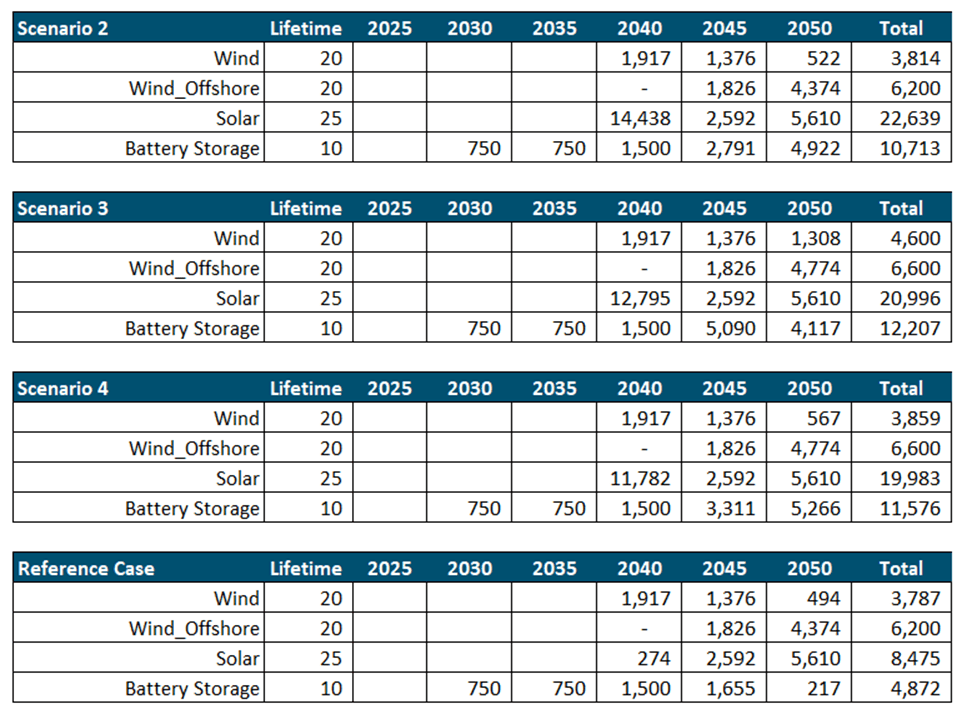
I commented that the retirement assumptions for wind, solar, and energy storage need to be changed to reflect expected lifetimes of those technologies.  This mis-characterization reduces costs on the order of 40%.  A key technology for reliability is the dispatchable, emissions-free resource.  The place-holder for this resource is hydrogen in one form or other.  My concern is that the Plan does not provide enough reliable documentation to support the speculated use of hydrogen as the technology for this critical resource.  My comments describe specific issues that need to be explicitly addressed in the Final Scoping Plan if the Climate Action Council is to make a compelling argument that hydrogen technology will keep the lights and heat on when needed most. 

I compared the capital costs (2020 $/kW) in the IA-Tech-Supplement-Annex-1-Input-Assumptions spreadsheet Resource Costs tabs against the EIA Table 1: Cost of new central station electricity generating technologies.  I show that with the exception of the capital costs for large hydro and a gas-fired combined cycle unit in Upstate New York all the other technology costs are lower and, in some cases, much lower in the Integration Analysis.  If my comparison interpretation is correct then these numbers are outrageous.  The capital costs for offshore wind are half of the EIA costs.  While there may be some interpretation of the battery energy storage cost that can explain why EIA costs are five times higher, I don’t think there is any interpretation issue with the hydrogen fuel cell technology that is five times higher in New York City and four times higher Upstate.  The Climate Action Council must explain why the Draft Scoping Plan numbers are so high for these technologies.

Scenario Comments

There was a specific request for comments on the three mitigation scenarios.  There are significant technical issues that have to be addressed to maintain current standards of reliability and affordability.  There are technologies in all the sectors that are included in all the mitigation scenarios of the Draft Scoping Plan that are not commercially available at this time but will critical to the transition requirements.  As a result of these technical constraints, I believe that mitigation scenario 2, Strategic Use of Low-Carbon Fuels should be the recommended path forward for the Final Scoping Plan simply because it relies on fewer untested technologies.

My comments on the scenarios showed that the Integration Analysis documentation for the control strategies in the three mitigation scenarios is inadequate.  There isn’t sufficient information about each control measure to be able to compare emission reductions, costs, and viability to be able to meaningfully comment on the components of the mitigation scenarios.  More importantly, the Draft Scoping Plan does not include a feasibility analysis that explains how the control measures will work in the Climate Act transition plan.  The strategies are simply listed and the citizens of New York are expected to believe that the projected emissions reductions will occur.  The Climate Action Council should address the feasibility of the Integration Analysis control measures as part of the Final Scoping Plan.

Additional time for comments would have been needed for me to provide extensive scenario specifics for key sectors.  I did manage to spend a lot of time trying to figure out how electrification of residential heating was supposed to work and how the mitigation scenarios were different.  The primary difference for new heat pump sales for the scenarios is the ramp rate.  Scenarios 3 and 4 accelerate the deployment of heat pumps in 2030 by mandating early retirement of existing furnaces instead of waiting until their end of useful life.  It is easy to include this in a framework but there are at least a couple of implementation issues.  What criteria would be used to determine who would get stuck with the added expense for premature retirements?   Shouldn’t the affected owners get an additional subsidy to cover their costs?  Do those issues make this infeasible?  Without a feasibility analysis the Final Scoping Plan will be incomplete. The Climate Action Council needs to address these questions because this sector is a primary concern for homeowners.

My comments on the mitigation scenarios noted that Mark Mills made the point that “based on today’s physics and technology, the only path to an energy system with a material intensity lower than hydrocarbons would be one focused on nuclear fission.”  Given that nuclear power is also the only scalable dispatchable emissions-free generating resource that has been proven to work, the Final Scoping Plan should include a Scenario that takes advantage of those capabilities.  The Climate Action Council needs to address why this approach has not been considered.

Carbon Pricing

I also submitted a comment on the proposal for carbon pricing.  It is a great theory but in practice there are practical considerations that make it a poor choice for funding decarbonization efforts.  I explained why I believe carbon pricing will always be a regressive tax and list a number of practical reasons that carbon pricing will not work as theorized.  My comment also referenced an analysis in Canada that concluded: “There may be many reasons to recommend carbon pricing as climate policy, but if it is implemented without diligently abiding by the principles that make it work, it will not work as planned, and the harm to the Canadian economy could well outweigh the benefits created by reducing our country’s already negligible level of global CO2 emissions.”  Substitute New York for Canada and I believe this describes this policy option.  I recommend that this economy-wide proposal be abandoned. 

Transportation

I submitted a couple of comments on electric vehicles.  The emphasis in the first comment was my finding that the Integration Analysis is simply making assumptions about future zero-emissions transportation implementation strategies without providing adequate referenced documentation.  I provided numerous recommendations for additional documentation in these comments so that New Yorkers can understand what will be expected and how much it will cost.

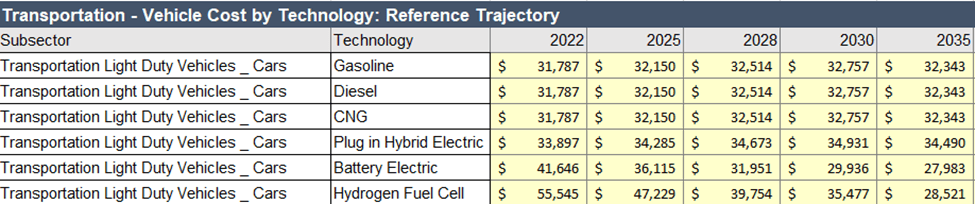
As far as I can tell, the electric vehicle costs are based entirely on new vehicle sales. There is no acknowledgement that the used car market will likely change because of the cost of battery replacement.  Sellers will likely get less relative to new cars in the battery electric vehicle market.  Buyers may get a relative deal but will lose in the end when the batteries have to be replaced.  This is a particular concern for low and middle-income citizens who cannot afford new vehicles.

There is no bigger disconnect between the zero-emission vehicle (ZEV) proposed strategy and reality than the ZEV charging infrastructure requirements.  The biggest problem is that millions of cars will have to rely on chargers that cannot be dedicated for the owner’s personal use because the owners park on the street or in a parking lot.  In order to provide a credible ZEV strategy, the final Scoping Plan has to describe a plan how this could possibly work.  It is not enough to simply say it will work.

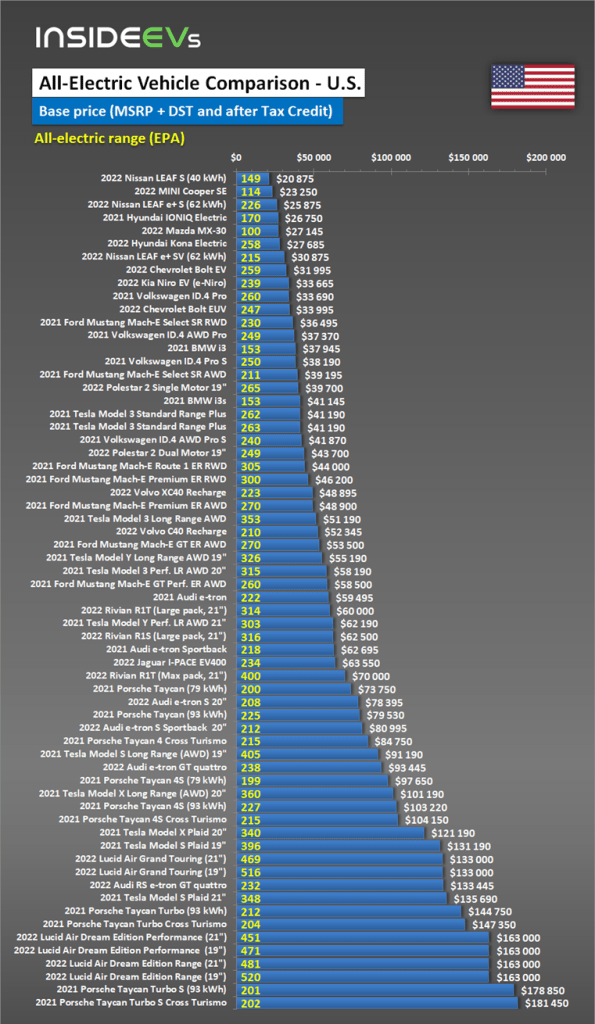
I also submitted a comment addressing electric vehicle costs.  the Integration Analysis vehicle cost projections rely on a single vehicle type for light-duty vehicles.  As a result the projections are not particularly useful for many vehicle owners.  The Climate Action Council should consider updating the Integration Analysis to better represent the types of vehicles used.

Impacts

One of my biggest concerns about the massive transition to diffuse wind and solar generating resources is the cumulative effect on agriculture and the environment.  I recommended that the Climate Action Council place a moratorium on the development of utility-scale solar projects until permitting requirements have been established for responsible solar siting and protection of prime farmlands.  The problem with cumulative environmental impacts.  The most recent environmental impact analysis only addressed a fraction of the total number of wind turbines and area covered by solar PV installations.  In addition, the environmental impacts of battery energy storage were not addressed.  It is impossible to project the impacts of the environmental impacts of the dispatchable emissions-free resource that it included in the capacity projections because a specific technology has not been specified.  My comments quantify the renewable energy resource difference between the most recent environment analysis and the Integration Analysis projections.

I recommended that the Department of Environmental Conservation propose thresholds for unacceptable environmental impacts.  I believe that without addressing this problem that it is likely that the environmental impacts from the massive wind and solar resource developments will have far worse impacts than those that can be ascribed to climate change.  For example, I project that at least 216 Bald Eagles could be killed every year when there are 9,445 MW of on-shore wind.  There were 426 occupied bald eagle nest sites in New York in 2017.  I am not a wildlife biologist but those numbers indicate to me that there will be major threats to the survivability of Bald Eagles in New York.  The Final Scoping Plan must include proposed thresholds for unacceptable environmental impacts like this.

I submitted comments that refuted many of the claims made in Section 2.1, Scientific Evidence of a Changing Climate, of the Draft Scoping Plan.  I argued that if documentation is not included that explicitly supports the claims made and contradicts my comments and the attachment, then I think those claims should be removed from the final Draft Scoping Plan.

I recommend that the Final Scoping Plan include a conditional schedule that considers the availability of necessary technology and potential impacts to reliability and affordability before implementing certain control measures.  I expect the response will be that because there is an “existential” threat due to climate change and we are seeing the effects of climate change now that we cannot wait to act.  I submitted comments that provide references by noted experts that explain why there isn’t a climate crisis and why the Draft Scoping Plan’s reliance on the Intergovernmental Panel on Climate Change summaries for policy makers is mis-placed.  I also explain that it is inappropriate to claim that every observed extreme weather event is evidence of climate change.  The risks of an unreliable and unaffordable electric system are far greater than the over-hyped risks of climate change in New York.

My final point for the Climate Action Council is that the Draft Scoping Plan does not quantify how New York’s net-zero transition will affect global warming.  My calculation shows that the expected impact on global warming would be an immeasurable 0.01°C by the year 2100.  If you cannot measure the change in temperature there is no way you can detect a change in the purported effects of that temperature change.  In addition, New York’s emissions are less than one half of one percent of global emissions and global emissions have been increasing by more than one half of one percent on average since 1990. Consequently, New York emission reductions will not have an appreciable effect on global warming.

Conclusion

I recommended that the Final Scoping Plan include an implementation schedule that is based on technological availability that maintains current standards of reliability affordability, and environmental protections.  I expect the emotional response will be that we cannot wait.  However, I submitted comments that explained that the claims of an imminent, inevitable climate catastrophe are ill-considered and it is inappropriate to claim that every observed extreme weather event is evidence of climate change.  The risks of an unreliable and unaffordable electric system are far greater than the over-hyped risks of climate change in New York.  Furthermore, because New York’s total emissions are less than one half of one percent of global emissions and total emissions have been increasing on average by more than one half of one percent per year anything New York does will get lost in the noise of global emissions changes.  A conditional schedule is the rational approach to address the many unresolved technological issues.
Unknown's avatarAuthor rogercaiazzaPosted on July 3, 2022February 18, 2023Categories Climate Act, Climate Act Comments Submitted, Climate Act Scoping Plan1 Comment on Overview of My Comments on the Draft Scoping Plan Comment

Draft Scoping Plan Transportation Incremental Benefits Associated with Scenario 4 Comment

The Climate Leadership and Community Protection Act (Climate Act) has a legal mandate for New York State greenhouse gas emissions to meet the ambitious net-zero goal by 2050.  This brief article describes a comment I submitted that was based on a post from last March.  The comment was trivial but raised some general issues relative to the way the Council is addressing comments.

Everyone wants to do right by the environment to the extent that they can afford to and not be unduly burdened by the effects of environmental policies.  I have written extensively on implementation of New York’s response to that risk because I believe the ambitions for a zero-emissions economy embodied in the Climate Act outstrip available renewable technology such that it will adversely affect reliability, impact affordability, risk safety, affect lifestyles, and will have worse impacts on the environment than the purported effects of climate change in New York.  New York’s Greenhouse Gas (GHG) emissions are less than one half one percent of global emissions and since 1990 global GHG emissions have increased by more than one half a percent per year.  Moreover, the reductions cannot measurably affect global warming when implemented.   This page documents all the comments that I submitted as part of the Climate Leadership and Community Protection Act implementation process. The opinions expressed in this post do not reflect the position of any of my previous employers or any other company I have been associated with, these comments are mine alone.

Climate Act Background

The Climate Act establishes a “Net Zero” target (85% reduction and 15% offset of emissions) by 2050. The Climate Action Council is responsible for preparing the Scoping Plan that will “achieve the State’s bold clean energy and climate agenda”.  They were assisted by Advisory Panels who developed and presented strategies to the meet the goals to the Council.  Those strategies were used to develop the integration analysis prepared by the New York State Energy Research and Development Authority (NYSERDA) and its consultants that quantified the impact of the strategies.  That material was used to write Draft Scoping Plan that was released for public comment at the end of 2021. The Climate Action Council will revise the Draft Scoping Plan based on comments and other expert input in 2022 with the goal to finalize the Scoping Plan by the end of the year.

Comments

The comment itself is a technical comment on a trivial problem and has no major bearing on Climate Act implementation.  However, it raises a pervasive issue that needs to be addressed.  All indications from the Climate Action Council meetings this year are that the plan for public involvement is simply going through the motions. There was no attempt to start identifying comments as they were submitted to determine if they rose to the level where the Council would have to address them specifically.  Instead, Council leadership has insisted that they can only respond once the comment period closes.   In addition, there is no provision for the kind of discrepancy documented here to be reconciled.  While this problem is not a big deal, the terrifying prospect is that the issues associated with reliability raised at last summer’s Reliability Planning Speaker Session could possibly be treated the same, that is to say ignored. 

Every time I have dug into the numbers, the Draft Scoping Plans numbers are not a reasonable estimate compared to my work. I have consistently found that the Scoping Plan costs estimates are biased high and the benefits proposed are biased low.  This is a specific example that shows that one of the conclusions for Scenario 4 is not correct.

In particular, this comment evaluated the transportation sector vehicle miles traveled difference between Scenarios 2 and 3 compared to Scenario 4 due to rail passenger improvements.  The Draft Scoping Plan claims that “Incremental reductions from enhanced in-state rail aligning with 125 MPH alternative detailed in Empire Corridor Tier 1 Draft EIS” will provide a reduction of 200 million light duty vehicle miles at a per unit cost of $6 per mile or $1.2 billion.  I estimate that the only valid cost for the difference between the rail alternatives is $8.4 billion and that it would only provide a reduction of 64.7 million miles.  While my estimate is for 2035, consistent with the Empire Corridor evaluation, and the Draft Scoping Plan is for 2050, I don’t think there is any question that the numbers are inconsistent.

Conclusion

I concluded that the Final Scoping Plan must provide more detailed documentation because there is little reason to trust the cost estimates in the Draft Scoping Plan because of the pervasive issues I have found.  I believe that the Final Scoping Plan documentation should provide sufficient information so that anyone can readily determine the costs and emission reductions for their particular concerns.  In my opinion in order to fulfill this obligation, the Final Scoping Plan must describe all control measures, assumptions used, the expected costs for those measures and the expected emission reductions for the Reference Case, the Advisory Panel scenario and the three mitigation scenarios. 

I have little hope that any of my comments will be considered much less acted upon.  The leadership of the Climate Action Council already has the answer from the back of book.  They are going through the motions of the public stakeholder process hoping that they can claim more people support the Draft Scoping Plan than don’t.  While comments from an individual like me may not be of consequence, the possibility that comments from the organizations responsible for reliability will also be dismissed does not portend well.

Unknown's avatarAuthor rogercaiazzaPosted on June 25, 2022February 18, 2023Categories Climate Act Comments SubmittedLeave a comment on Draft Scoping Plan Transportation Incremental Benefits Associated with Scenario 4 Comment

Climate Act Mandates that must be Considered in the Scoping Plan

The Climate Leadership and Community Protection Act (Climate Act) has a legal mandate for New York State greenhouse gas emissions to meet the ambitious net-zero goal by 2050.  To this point the Climate Action Council has failed to incorporate explicit Climate Act mandates related to expertise, an implementation safety valve, costs and benefits documentation, and consideration of the experiences of other jurisdictions.  This article describes my comment on the mandates.

Everyone wants to do right by the environment to the extent that they can afford to and not be unduly burdened by the effects of environmental policies.  I have written extensively on implementation of New York’s response to that risk because I believe the ambitions for a zero-emissions economy embodied in the Climate Act outstrip available renewable technology such that it will adversely affect reliability, impact affordability, risk safety, affect lifestyles, and will have worse impacts on the environment than the purported effects of climate change in New York.  New York’s Greenhouse Gas (GHG) emissions are less than one half one percent of global emissions and since 1990 global GHG emissions have increased by more than one half a percent per year.  Moreover, the reductions cannot measurably affect global warming when implemented.   This page documents all the comments that I submitted as part of the Climate Leadership and Community Protection Act implementation process. The opinions expressed in this post do not reflect the position of any of my previous employers or any other company I have been associated with, these comments are mine alone.

Climate Act Background

The Climate Act establishes a “Net Zero” target (85% reduction and 15% offset of emissions) by 2050. The Climate Action Council is responsible for preparing the Scoping Plan that will “achieve the State’s bold clean energy and climate agenda”.  They were assisted by Advisory Panels who developed and presented strategies to the meet the goals to the Council.  Those strategies were used to develop the integration analysis prepared by the New York State Energy Research and Development Authority (NYSERDA) and its consultants that quantified the impact of the strategies.  That material was used to write Draft Scoping Plan that was released for public comment at the end of 2021. The Climate Action Council will revise the Draft Scoping Plan based on comments and other expert input in 2022 with the goal to finalize the Scoping Plan by the end of the year.

Comments

My comment addressed four specific mandates in the Climate Act related to the Climate Action Council.  I have seen no sign that the Draft Scoping Plan will be evaluated with consideration of those mandates.  The Climate Act defines the composition and responsibilities of the Climate Action Council in § 75-0103 and I addressed the expertise, safety valve, costs and benefits, and consideration of other jurisdiction mandates.

Expertise

Section 2 of § 75-0103 notes that “at large members shall include at all times individuals with expertise in issues relating to climate change mitigation and/or adaptation, such as environmental justice, labor, public health and regulated industries.”  It is unreasonable to expect that all the members of the Climate Action Council will have the background, education, and experience to understand all the aspects of the net-zero energy transition but the ultimate product of the Scoping Plan is a set of recommendations that will inform the next Energy Plan so that expertise is needed.   Unfortunately of the 23 members of the Council only eight come from energy sector organizations or have some background in the energy sector.    

It is worrisome that some members who don’t have all that much background and experience still make flat statements that reliability is not a problem with a 100% renewable system.  The New York Independent System Operator’s 2022 Power Trends Report paints a different picture of the net-zero electric system stating flatly: “The New York grid faces unprecedented reliability challenges as the clean-energy transition gains momentum.”

Obviously, the experts responsible for maintaining current standards of reliability have to have the final say whether the recommendations for the New York Energy Plan are acceptable.  I strongly recommend that the Climate Action Council lay out a plan to work with the New York Independent System Operator (NYISO) and New York State Reliability Council experts to resolve differences between the electric generating projections in the Draft Scoping Plan and those made by the NYISO.

Safety Valve

The members of the Climate Action Council who think that there are not issues associated with reliability associated with a 100% renewable grid also believe that the energy transition must proceed no matter what because the law says so.  However, New York Public Service Law  § 66-p. “Establishment of a renewable energy program” includes a safety valve condition:  “(4) The commission may temporarily suspend or modify the obligations under such program provided that the commission, after conducting a hearing as provided in section twenty of this chapter, makes a finding that the program impedes the provision of safe and adequate electric service; the program is likely to impair existing obligations and agreements; and/or that there is a significant increase in arrears or service disconnections that the commission determines is related to the program”. 

I recommend that the Council define the safety valve provisions for safe and adequate electric service, impairing existing obligations, and increase in arrears or service disconnections.  I recommend that those conditions be established up front and then be used to guide future development. Implementation plans should be evaluated against those criteria, proceed only if the conditions are met, and then tracked during implementation to see if they are being maintained.  How else is it possible to meet those criteria?

Costs and Benefits

In section 14,b of § 75-0103 the Climate Act specifically states that the costs and benefits analysis must: “Evaluate, using the best available economic models, emission estimation techniques and other scientific methods, the total potential costs and potential economic and non-economic benefits of the plan for reducing greenhouse gases, and make such evaluation publicly available.” 

This information is not currently available.  The only costs and benefits data support the claim in the Draft Scoping Plan that “The cost of inaction exceeds the cost of action by more than $90 billion”.  Initially, the only information provided in the supporting documentation was a series of figures as I documented in an article on my blog.  No numbers for the figures were provided.  It was not until May 29 that some of the numbers that were used in the Benefits and Costs chapter of Appendix G of the Draft Scoping Plan were made available.

However, the additional information provided does not meet the mandate to make the total potential costs and benefits publicly available.  There is no breakdown of costs within sectors that is needed to evaluate the validity of the estimates. I recommend that the Council address this mandate by defining what will meet this requirement. I believe that the Final Scoping Plan documentation should provide sufficient information so that anyone can readily determine the costs and emission reductions for their particular concerns.  In my opinion in order to fulfill this obligation, the Final Scoping Plan must describe all control measures, assumptions used, the expected costs for those measures and the expected emission reductions for the Reference Case, the Advisory Panel scenario and the three mitigation scenarios. 

Other Jurisdictions

In section 16 of § 75-0103 there is a mandate to consider efforts at other jurisdictions: “The council shall identify existing climate change mitigation and adaptation efforts at the federal, state, and local levels and may make recommendations regarding how such policies may improve the state’s efforts.”  There has been very little discussion of efforts at other jurisdictions.  The few times other jurisdictions were discussed it was mostly related to calls for greater aspirational goals.  I think that the emphasis should be on lessons learned so we can avoid the problems observed at other jurisdictions and that the scope should be expanded to include international jurisdictions that are trying to enact similar net-zero programs.

At the top of the list of problems at other jurisdictions that should be considered is the February 2021 Texas energy debacle.  For whatever reason the Texas electric system did not have enough generating resources available to meet the peak load requirements when Texans needed it most.  If New York’s implementation plan for net-zero leads to a similar situation where there isn’t enough energy available, then the result will be the same: massive costs and deaths due to a lack of heat.  The Climate Action Council must make sure that the Final Scoping Plan prevents this from happening.

I also recommend that the Council expand the scope.  There were recent reliability problems in Australia have to be considered so that similar problems do not occur in New York.  The United Kingdom and German affordability problems are also a concern that should be addressed by the Council.  If we do not learn from the experience of others than we are certainly doomed to make the same mistakes.

Conclusion

I am very disappointed that the leadership of the Climate Action Council has not addressed Council meetings on the safety valve provisions.  The existence of those conditions has not even been mentioned and it should have been when the suggestion was made that even there are no checks and balances on implementation programs.  As a result, the Final Scoping Plan may not be viable against reliability and affordability criteria.

This year subgroups have been established to address the natural gas transition, advanced fuels, and an economy-wide approach to fund the transition.  All these are important topics but the underlying and unaddressed issue is how to evaluate those strategies.    I believe that the evaluation criteria should be based on New York Public Service Law  § 66-p. “Establishment of a renewable energy program” safety valve conditions.  Unfortunately, the Council has not established any evaluation criteria.

Ultimately, the lack of focus suggests to me that the State is just going through the motions of the public stakeholder process and even the Climate Action Council deliberations.  The answer is in the back of the book and it would take a miracle to make meaningful changes to the Scoping Plan that detract from the narrative that meeting net-zero is only a matter of political will.

Unknown's avatarAuthor rogercaiazzaPosted on June 24, 2022February 18, 2023Categories Climate Act, Climate Act Comments Submitted, Climate Act Scoping Plan, Climate Action CouncilLeave a comment on Climate Act Mandates that must be Considered in the Scoping Plan

Climate Act Draft Scoping Plan Hydrogen Comment

The Climate Leadership and Community Protection Act (Climate Act) has a legal mandate for New York State greenhouse gas emissions to meet the ambitious net-zero goal by 2050.  Long-duration, dispatchable, and emission-free resources will be necessary to maintain reliability and meet the objectives of the Climate Act. This article describes my comments on the plans to use hydrogen to fulfill this requirement in the Draft Scoping Plan.

Everyone wants to do right by the environment to the extent that they can afford to and not be unduly burdened by the effects of environmental policies.  I have written extensively on implementation of New York’s response to that risk because I believe the ambitions for a zero-emissions economy embodied in the Climate Act outstrip available renewable technology such that it will adversely affect reliability, impact affordability, risk safety, affect lifestyles, and will have worse impacts on the environment than the purported effects of climate change in New York.  New York’s Greenhouse Gas (GHG) emissions are less than one half one percent of global emissions and since 1990 global GHG emissions have increased by more than one half a percent per year.  Moreover, the reductions cannot measurably affect global warming when implemented.   This page documents all the comments that I submitted as part of the Climate Leadership and Community Protection Act implementation process. The opinions expressed in this post do not reflect the position of any of my previous employers or any other company I have been associated with, these comments are mine alone.

Climate Act Background

The Climate Act establishes a “Net Zero” target (85% reduction and 15% offset of emissions) by 2050. The Climate Action Council is responsible for preparing the Scoping Plan that will “achieve the State’s bold clean energy and climate agenda”.  They were assisted by Advisory Panels who developed and presented strategies to the meet the goals to the Council.  Those strategies were used to develop the integration analysis prepared by the New York State Energy Research and Development Authority (NYSERDA) and its consultants that quantified the impact of the strategies.  That material was used to write Draft Scoping Plan that was released for public comment at the end of 2021. The Climate Action Council will revise the Draft Scoping Plan based on comments and other expert input in 2022 with the goal to finalize the Scoping Plan by the end of the year.

Comments

My comment addresses the use of hydrogen in some form or other as the Draft Scoping Plan placeholder technology for the Zero-Carbon Firm Resource or Dispatchable Emissions-Free Resource (DEFR) generally accepted as a complementary requirement when intermittent resources like wind and solar make up a significant portion of the electric grid resource mix.   Energy storage is required for intermittent resources but the cost for exclusive reliance on batteries is unacceptably high.  These resources are included to maintain reliability when the wind does not blow and the sun does not shine for long periods.  I concluded that the Final Scoping Plan has to do a much better job documenting the use of hydrogen for this resource to be considered credible. 

My comments summarize background information in the Draft Scoping Plan and from the New York Independent System Operator (NYISO).  I describe the Integration Analysis description of the Carbon-Free Electric Supply and the hydrogen costs provided in an Integration Analysis spreadsheet.  I also describe the on-going NYISO update to their System and Resource Outlook that addresses DEFR.  I used Francis Menton’s article, Hydrogen Is Unlikely Ever To Be A Viable Solution To The Energy Storage Conundrum, as the outline for the comments.  Mr. Menton graciously gave me permission to use his material freely, aka plagiarize his language.   

The NYISO Power Trends 2022 report sums up the challenge: “Long-duration, dispatchable, and emission-free resources will be necessary to maintain reliability and meet the objectives of the CLCPA. Resources with this combination of attributes are not commercially available at this time but will be critical to future grid reliability.”  The Draft Scoping plan speculates without sufficient justification that the “zero-carbon firm resource” projections for the future can be met using hydrogen in one form or another.  My concern is that the Plan does not provide enough reliable documentation to support the speculated use of hydrogen as the technology for this critical resource.  The comments describe specific issues that need to be explicitly addressed in the Final Scoping Plan if the Climate Action Council is to make a compelling argument that this technology will keep the lights and heat on when needed most.

The Draft Scoping Plan calls for the use of so-called “green hydrogen” whereby hydrogen is produced by a carbon-free process of electrolysis from water.  The first probem is that the costs for hydrogen produced using this technology are entirely speculative and by any reasonable basis of estimation will be extraordinaly high.  Compared to the cost of production using natural gas natural gas to produce hydrogen, “green” hydrogen will be more than five times more expensive.

I used a Seeking Alpha analysis to estimate the hydrogen needed if it was combusted to make electricity or used to power fuel cells.  For the NYISO and Integration Analysis scenarios I found that between 73 and 155 turbines sized at 288 MW would have to be dedicated for this resource application.  At this time the world’s largest hydrogen fuel cell is only 79 MW so between 266 and 566 fuels cells of that size would be required.

My analysis calculated the generation energy needed for electrolysis to support DEFR projections.  Scoping Plan Scenaro 2 requires 3,342 GWh of energy for DEFR and 12,812 GWh for electrolysis to produce the hydrogen to cover that requirementwhich is about half the projected imported wind total in 2040.  The Draft Scoping Plan emphasizes the use of solar over wind and it appears that the electrolysis requirements are covered by the solar generation projections.  Importantly, the NYISO draft Outlook Study projected DEFR requirements are an order of magnitude higher than the mitigation scenarios.  As a result, the energy needed for the hydrogen to cover that need (130,353 GWh) is more than the projected total solar, land-based wind, and wind import energy  (121,875 GWh) in 2040.  The Climate Action Council must reconcile the differences between these two estimates because of the ramifications on the energy needed for DEFR using green hydrogen.

The difference in projections also exacerbates the problem associated with the critical winter-time wind lull DEFR condition problem.  The mitigation scenarios call for much more solar capacity (43,432 MW) than the combined land-based wind, imported wind, and offshore wind (26,606 MW) capacity.  The Final Scoping Plan must ensure that an adequate amount of hydrogen is stored before the winter because the solar resource is so poor in the winter that it is unlikely that much, if any, replenishment during the winter can be expected.  It is also critically important that the worst-case wind lull is defined correctly because it if is not then there will not be sufficient hydrogen available to cover the DEFR resources and blackouts will occur.  The Climate Action Council must ensure the Final Scoping Plan addresses both of these issues to ensure a reliable electric system when it is needed the most.

There is a clear need for a feasibility analysis for the use of hydrogen as the DEFR.  For example, where will all the combustion turbines, electrolyzers, and fuel cells be located?  I suspect that there will be significant permitting issues with all the resources needed.  The capacity factors for this resource in the Draft Scoping Plan are 2% for all mitigation scenarios so there will be implentation issues.  In the exisitng system the generating sources designed for peaking power for this reliability requirement used the cheapest technology available (simple-cycle gas turbines) and a significant portion of the backup capacity is met by residual oil burning power plants.  Meeting this requirement in the future using the hydrogen DEFR resource will be using the most expensive generating technology available. 

There are numerous technical concerns that were not addressed in the Draft Scoping Plan. It is not clear whether the Draft Scoping Plan addressed the complex and energy intesive process of  compressing and liquifying hydrogen for storage and transport.  That will require large amounts of additional energy which may be additional cost not yet figured into the calculations.   I could not determine if the Draft Scoping Plan proposed to use the existing natural gas network in all or part.  Metal embrittlement caused by exposure to hydrogen will no doubt require major modifications and replacements for the existing infrastructure.  These costs must be clearly identified and  included in the Draft Scoping Plan.

Conclusion

There are members of the Climate Action Council that believe “the word reliability is very intentionally presented as a way of expressing the improper idea that renewable energy will not be reliable.”   The worst-case renewable availability period is expected to occur in the winter because solar resource availability is low because of the season, Great Lakes induced cloudiness, and the potential for snow on solar panels when there is a wind lull reducing that resource availability.  This is the particular period when the zero-carbon firm resource will be needed most.  The problem is exacerbated because those conditions are typically associated with the coldest weather of the year.  When the state’s heating and transportation systems convert to electricity the expectation is that maximum loads will occur during those periods.  These comments describe many implementation issues associated with using hydrogen for the zero-carbon firm resource not the least of which is using mostly solar PV as a dedicated source of the electrolyzer power.  I conclude that a feasibility analysis that address the questions raised is necessary.  Even better would be a demonstration project at large scale to show how a hydrogen-based power system would work and how much it would cost after including all of the extras and current unknowns not just for producing it but also for transporting it and handling it safely. 

I don’t know how much extra our energy would cost if we forcibly got rid of all hydrocarbons and shifted to wind and solar backed up by “green” hydrogen — and neither does anybody else.  An educated guess would be that the all-in cost of energy would get multiplied by something in the range of five to ten.  Yes, that would probably be a big improvement over trying to accomplish the same thing with batteries.  But it would still be an enormous impoverishment of the New Yorkers in the pointless quest to possibly shave a few hundredths of a degree off world average temperatures a hundred years from now.  

Not so long ago the idea that natural gas could be used a bridge fuel until these aspirational dispatchable emission-free resources could be tested at the scale needed, perform like a natural gas fired generating unit, and provide power at a similar cost, was generally accepted as a rational approach. The analogy for skipping the need for a bridge fuel is that the Climate Action Council wants to jump out of a perfectly good airplane without a parachute because they assume that the concept of a parachute will be developed, proven technically and economically feasible, and then delivered in time to provide a soft landing.  That cannot end well and this won’t either.

Unknown's avatarAuthor rogercaiazzaPosted on June 23, 2022February 18, 2023Categories Clean Energy Concerns, Climate Act Comments Submitted, Climate Act Scoping PlanLeave a comment on Climate Act Draft Scoping Plan Hydrogen Comment

Climate Act Draft Scoping Plan Comments by a Business Owner

This post describes the comments submitted on the Climate Leadership and Community Protection Act (Climate Act) Draft Scoping Plan by the owner of PKG Equipment, Inc. outside of Rochester in Chili, NY.  His concerns highlighted one of the transition issues that is not being considered by the Climate Action Council.

PKG Equipment is a second-generation, family-owned company. It is a manufacturer and service provider of equipment typically used in the finishing, chemical manufacturing, steel manufacturing and glass manufacturing industries.  PKG Equipment was founded in 1969 by Sam Pontarelli, the current management team’s father, and two partners who sold their shares to him in the1970s. During the 1970s, the company began fabricating plating equipment using thermoplastics, and it purchased European plastic welding and forming machines in the early 1980s. PKG Equipment began manufacturing turnkey plating systems and also became a distributor for related equipment. 

Comments

Stephen Pontarelli is the CEO and with a little bit of help from me prepared the following comments.

I live in the Rochester area and own PKG Equipment, Inc. that employs 25 people.  Energy costs are a major consideration for my family and our business.  I am submitting these comments because the Climate Action Council has not done a satisfactory job explaining what the Climate Act transition will cost, how it might threaten energy reliability, or how it will affect my business. 

I have been unable to find any detailed cost information.  What is the expected cost of electricity?  I have seen articles that noted that energy costs in Germany have increased markedly as they implement a similar transition.  What is New York going to do differently than those other jurisdictions that have seen cost increases?

I understand that the transition plan boils down to electrifying everything.  I am particularly concerned about heating our manufacturing facility.  It sounds like the preferred electrification approach is to use heat pumps.  My understanding is that they only work well during the coldest periods of the winter if the structure is very well insulated, has improved window treatments, and reduces air infiltration.  There are a number of considerations that make those improvements problematic.  Will there be support available to upgrade our building’s insulation and windows? How am I supposed to minimize air infiltration at the loading dock? Also, our manufacturing process uses natural gas for our curing ovens and heat treating. Replacing that equipment alone would approach $1,000,000. That doesn’t include getting the appropriate amount of electricity to the building. We would need a ridiculous amount of electricity to run this equipment. Our small business can’t afford this transition. 

I understand that the future electric grid is supposed to rely on intermittent wind and solar generating resources.  I figured out that your scenarios for future implementation call for about 150% of the total existing generating capacity of the state, that land-based wind is supposed to increase by nearly an order of magnitude, and that battery energy storage capacity will be close to today’s fossil generating resources.  Surely developing all those resources is going to be incredibly expensive so it seems certain that energy costs for my business and home will increase markedly.  I think it is necessary to include a clear explanation of all the control measures proposed, the assumptions used to project the costs, and a description of the emissions reductions expected for the Draft Scoping Plan strategies.

There is another worrisome aspect of future energy resources.  The Draft Scoping Plan mentions a zero-carbon firm resource as a necessary component.  I think it is incredibly risky to rely on an unproven resource.  Finally, I was asked to consider bidding on a component system for an offshore wind turbine project.  I cannot imagine, based on my background and expertise, that all the components necessary for those systems will be available to be installed per the proposed schedule.  At the same time, I have heard that there is considerable pressure to stop all investments in existing fossil fuel infrastructure.  I am concerned that shutting down systems based on an unrealistic implementation schedule for a technology like offshore wind that has not developed the infrastructure to transport and install the turbines is a serious risk to reliability.  Therefore, I recommend that implementation is conditional based on determining upfront standards of affordability and reliability once costs for the unproven zero-carbon firm resource are determined and the development issues associated with offshore wind are known so that a realistic schedule can be developed.

I am not willing to accept higher costs, lower standards of energy reliability, or limitations to my business operations unless there is a clear tangible benefit.  I have read compelling arguments that the Draft Scoping Plan benefits are over-stated and that in fact the actual costs of the program far exceed the benefits.  In that regard, I don’t understand what is meant when the costs and benefits are presented “relative to the Reference Case”. Given the fact that total New York State greenhouse gas emissions are less than the annual increase in global greenhouse gas emissions, the obvious conclusion is that upfront standards of affordability and reliability must be set such that the Climate Act transition does not do more harm than good to New York State.

Conclusion

Frankly when I have thought about the industrial transition from natural gas to electricity that will be mandated by the Climate Act, I thought mostly about big manufacturing companies.  I have seen no sign that the Climate Action Council hasn’t been thinking the same thing.  The fact is that PKG Equipment represents the smaller companies that do not use natural gas for most of their processes but only for a couple of pieces of equipment.  Replacing that equipment will be a major burden for small companies.  In addition, those processes will require a lot of power that will very likely require service upgrades for their building and depending on the location distribution system upgrades.

I know the Pontarelli family.  They all are from New York, want to stay in New York, and, through their hard work, provide jobs for 25 people.  They are representative of many other small companies throughout the state.  I despair that the financial impositions of the Climate Act will force them and the other similar companies to leave New York in order to remain competitive with businesses outside of New York.

Unknown's avatarAuthor rogercaiazzaPosted on June 21, 2022February 18, 2023Categories Climate Act Comments Submitted, Climate Act Scoping Plan, Guest PostsLeave a comment on Climate Act Draft Scoping Plan Comments by a Business Owner

Draft Scoping Plan Electric Generating Retirement Assumptions

The Climate Leadership and Community Protection Act (Climate Act) has a legal mandate for New York State greenhouse gas emission reductions to do “something” about climate change.  I have been submitting comments as I complete them on the Draft Scoping Plan that outlines strategies for the energy transition.  This article describes a comment on the Plan I submitted describing my problem with the assumptions used for retiring renewable energy generating assets.

Everyone wants to do right by the environment to the extent that they can afford to and not be unduly burdened by the effects of environmental policies.  I have written extensively on implementation of New York’s response to climate change risk because I believe the ambitions for a zero-emissions economy embodied in the Climate Act outstrip available renewable technology such that it will adversely affect reliability, impact affordability, risk safety, affect lifestyles, and will have worse impacts on the environment than the purported effects of climate change in New York.  New York’s Greenhouse Gas (GHG) emissions are less than one half one percent of global emissions and since 1990 global GHG emissions have increased by more than one half a percent per year.  Moreover, the reductions cannot measurably affect global warming when implemented.   The opinions expressed in this post do not reflect the position of any of my previous employers or any other company I have been associated with, these comments are mine alone.

Climate Act Background

The Climate Act establishes a “Net Zero” target (85% reduction and 15% offset of emissions) by 2050. The Climate Action Council is responsible for preparing the Scoping Plan that will “achieve the State’s bold clean energy and climate agenda”.  They were assisted by Advisory Panels who developed and presented strategies to the meet the goals to the Council.  Those strategies were used to develop the integration analysis prepared by the New York State Energy Research and Development Authority (NYSERDA) and its consultants that quantified the impact of the strategies.  That material was used to write Draft Scoping Plan that was released for public comment at the end of 2021. The Climate Action Council will revise the Draft Scoping Plan based on comments and other expert input in 2022 with the goal to finalize the Scoping Plan by the end of the year.

Integration Analysis Lifetime Assumptions

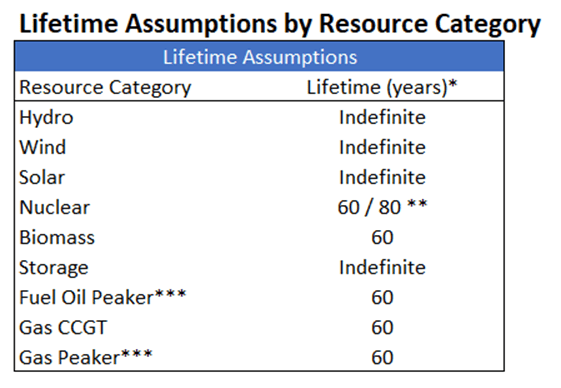
I prepared an annotated version of the Draft Scoping Plan description of the “Carbon-Free Electric Supply” in Appendix G Section.  This section describes the Integration Analysis projected future electric supply system. More detail is provided in the spreadsheet IA-Tech-Supplement-Annex-1-Input-Assumptions tab named “Retirement” that “contains expected lifetime assumptions by resource category”.  The table listing the lifetimes is shown below.

Table Notes:

* Resources with “indefinite” lifetimes are assumed to remain online throughout the study period.

** The license expiration of upstate nuclear units is determined as part of scenario definitions.

***Select units in NYISO zones J and K that are expected to retire as a result of the DEC NOx emissions rule are assumed offline by the start of  2025, based on the 2021 Gold Book.

Units that hit their 60 year lifetime threshold by 2025 but that have not yet announced retirement plans are kept online through model year 2025, due to the time it takes to complete retirement studies.

The 60-year retirement threshold is not enforced in downstate NY until 2035, to ensure local reliability is maintained in the near term. This analysis enforced LCRs in each capacity zone but did not study more detailed local reliability issues.

The reason I prepared a comment is that the lifetime assumptions for hydro, wind, solar, and storage are listed as indefinite.  While that may be true for hydro it is an inappropriate assumption for wind, solar and energy storage.  As far as I can tell that assumption was used to project future costs.

Other Wind, Solar, and Energy Storage Expected Lifetimes

My comments included the results of a quick literature search  for wind, solar, and energy storage technologies expected operating lifetimes.

According to TWI: A good quality, modern wind turbine will generally last for 20 years, although this can be extended to 25 years or longer depending on environmental factors and the correct maintenance procedures being followed. However, the maintenance costs will increase as the structure ages.  The Electricity Markets & Policy group at Berkeley Lab claims: “Our interest was in better understanding how expectations for useful life have changed over time, as the wind industry has matured. We find that most wind project developers, sponsors and long-term owners have increased project-life assumptions, from a typical term of ~20 years in the early 2000s to ~25 years by the mid-2010s and ~30 years more recently. Current assumptions range from 25 to 40 years, with most respondents citing 30 years”.  However, there is a difference between design life and actual lifetimes.  Energy Follower explains that “There is very little data on modern turbines reaching their life expectancy so it is largely unknown how long they will be operable. Modern wind turbines have over 8,000 parts (broken down into three major components) and blades as long as 262 feet, the same length as the wingspan of an Airbus. With higher efficiency modern turbines due to additional electronic components and a more powerful and massive design, there is a higher chance of something going wrong with more potential points of failure and overall added stress and load on the structure.”

There is less information available for utility-scale photovoltaic systems. The Electricity Markets & Policy group at Berkeley Lab claims: “Solar project developers, sponsors, long-term owners, and consultants have increased project-life assumptions over time, from an average of ~21.5 years in 2007 to ~32.5 years in 2019. Current assumptions range from 25 years to more than 35 years depending on the organization; 17 out of 19 organizations from which data were obtained use 30 years or more.”  It is not clear to me why these expectations are so high when it known that photovoltaic cells degrade over time.  The National Renewable Energy Lab concluded:

A history of degradation rates using field tests reported in the literature during the last 40 years has been summarized. Nearly 2000 degradation rates, measured on individual modules or entire systems, have been assembled from the literature and show a mean degradation rate of 0·8%/year and a median value of 0·5%/year. The majority, 78% of all data, reported a degradation rate of <1% per year.

There is even less information available for utility-scale energy storage systems.  Another National Renewable Energy Lab analysis did an example scenario:

An example scenario was simulated wherein an integrated battery-PV system was controlled in self-consumption mode, attempting to minimize energy exchanged with the grid. For this application, battery lifetimes ranging from 7-10 years may be expected. Without active thermal management, 7 years lifetime is possible provided the battery is cycled within a restricted 47% DOD operating range. With active thermal management, 10 years lifetime is possible provided the battery is cycled within a restricted 54% operating range.

I found one other reference that claimed that listed different types of chemical battery lifetimes between 5 and 15 years.

Integration Analysis Implications

I searched the Draft Scoping Plan for the term “retirement” and could not find any documentation for the rationale used to assume that wind, solar, and energy storage have indefinite lifetimes.  My comments recommended that the Final Scoping Plan incorporate documentation explain the retirement rationale because as I show below there are implications for the cost projections.

My annotated version of the Draft Scoping Plan section “Carbon-Free Electric Supply” in Appendix G Section I that starts at page 42.  The only annotation addition is an extracted copy of the actual data in the figures that list capacity (MW) and generation (GWh) in that section that are based on data in the IA-Tech Supplement Annex 2 Emissions Key Drivers spreadsheet.

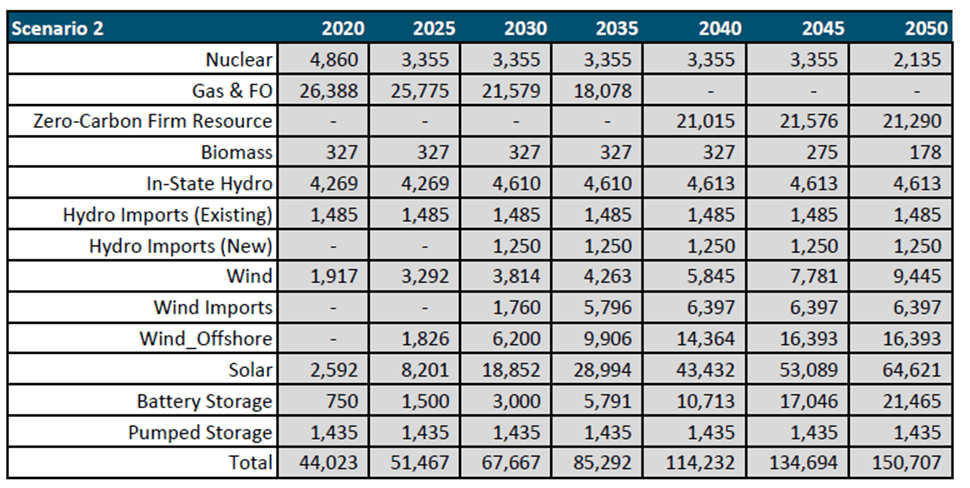
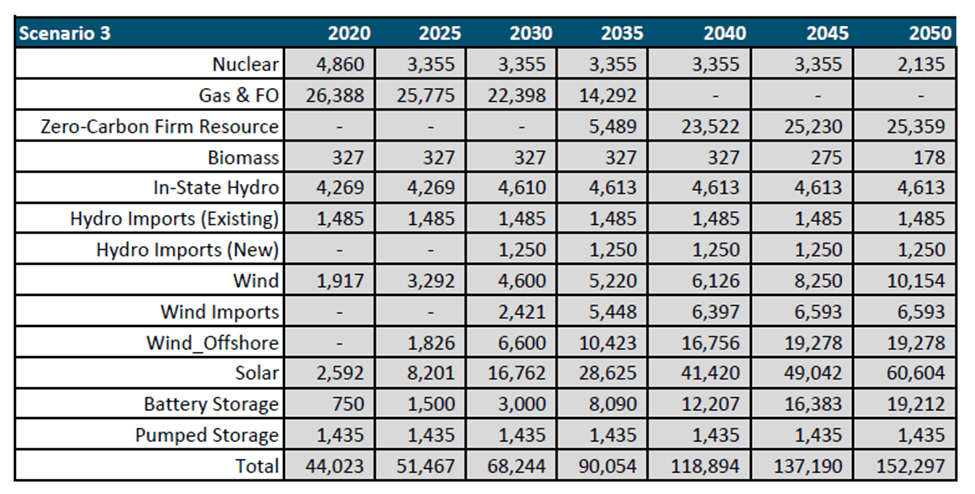
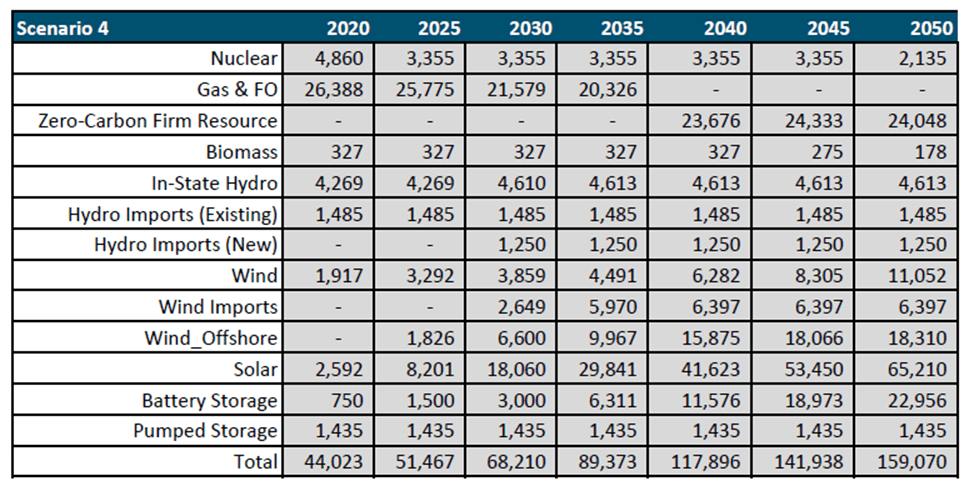
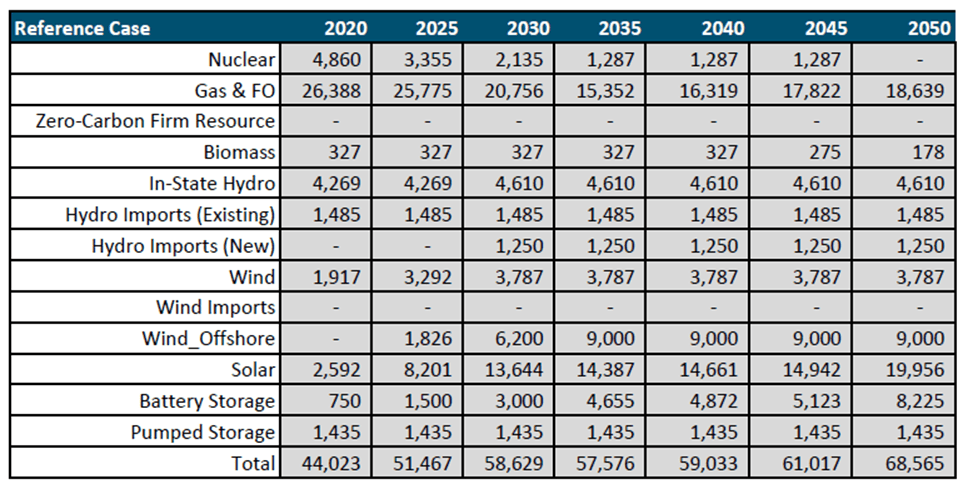
The following tables list the capacities for the Integration Analysis fuel mix categories for the Reference Case (Table 1), Scenario 2: Strategic Use of Low-Carbon Fuels (Table 2), Scenario 3: Accelerated Transition Away from Combustion (Table 3), and Scenario 4: Beyond 85% Reduction.

Table 1: Reference Case Summary Fuel Mix Capacity (MW)

Table 2: Scenario 2 Summary Fuel Mix Capacity (MW)

Table 3: Scenario 3 Summary Fuel Mix Capacity (MW)

Table 4: Scenario 4: Summary Fuel Mix Capacity (MW)

The Integration Analysis spreadsheet states that “Resources with ‘indefinite’ lifetimes are assumed to remain online throughout the study period.”  I assume that means that the 2020 wind capacity of 1.917 MW in 2020 is not replaced in the total capacity in 2040, 20 years later.  Table 5 shows that assumption under-estimates the resource builds in the wind, solar, and energy storage resource categories significantly.  If those resource builds are not included then the costs are underestimated too. 

Table 5: Additional Capacity Installed for replacement at expected lifetime

Using an indefinite retirement date for these resources underestimates the total builds needed for 2050.  For land-based wind between 3,814 MW and 4,600 MW are not included and for offshore wind between 6,200 and 6,600 MW are not included.  The amount of solar not included ranges between 22,639 MW and 19,983 MW.  Finally, for battery storage between 10,713 MW and 12,207 MW of additional resources will be need to be developed to meet the 2050 projected value. 

Another way to look at the exclusion of these resources is that land-based wind development costs could be up to 45% higher than the projections that don’t include reasonable retirement dates because that much more of the resource needs to be developed.  Off-shore wind costs could be up to 38% higher, solar costs could be up to 35% higher, and battery storage could be up to 64% higher than projections that exclude reasonable retirement dates. 

My comments included questions for the Climate Action Council.  Why shouldn’t reasonable retirement dates be included in the Final Scoping Plan.  What would the revised costs be if retirements were included?  The operational characteristics of battery storage affect expected lifetimes.  What did the Integration Analysis assume for thermal management and discharge characteristics?  Were those factors included in the estimates of the projected capacity resources?

Conclusion

I prepared this comment because I could not believe that the Integration Analysis authors would apparently ignore all the information that indicates that the lifetimes of wind, solar and battery storage are much less than other generating resources.  It appears to me that not including reasonable retirement dates is an egregious attempt to reduce the published costs of wind, solar, and battery storage.  The result is that units are assumed to remain online throughout the study period and no costs for replacements between now and 2050 are included.  However. that is a poor assumption because it is totally unreasonable to expect that, for example, the existing land-based resources will still be in operation in 2050.

The simplest way to look at the effective result of excluding these resources is that much more of the resource needs to be developed so costs are necessarily higher.    For land-based wind development costs could be up to 45% higher than the projections because that much more of the resource needs to be developed.  Off-shore wind costs could be up to 38% higher, solar costs could be up to 35% higher, and battery storage could be up to 64% higher than projections that exclude reasonable retirement dates. 

Unknown's avatarAuthor rogercaiazzaPosted on June 16, 2022February 18, 2023Categories Climate Act Comments Submitted, New York State Energy, New York State Environmental Policy1 Comment on Draft Scoping Plan Electric Generating Retirement Assumptions

Draft Scoping Plan EV Cost Comment

The Climate Leadership and Community Protection Act (Climate Act) has a legal mandate for New York State greenhouse gas emissions to meet the ambitious net-zero goal by 2050.  I was recently interviewed for a segment on the electric vehicle component of the Climate Act on Spectrum Cable’s Capital Tonight program hosted by Susan Arbetter. During the interview I suggested that one of the questions about electric vehicle costs she asked was appropriate for a comment. This article describes the comments I submitted on the issue raised in the interview.

Everyone wants to do right by the environment to the extent that they can afford to and not be unduly burdened by the effects of environmental policies.  I have written extensively on implementation of New York’s response to that risk because I believe the ambitions for a zero-emissions economy embodied in the Climate Act outstrip available renewable technology such that it will adversely affect reliability, impact affordability, risk safety, affect lifestyles, and will have worse impacts on the environment than the purported effects of climate change in New York.  New York’s Greenhouse Gas (GHG) emissions are less than one half one percent of global emissions and since 1990 global GHG emissions have increased by more than one half a percent per year.  Moreover, the reductions cannot measurably affect global warming when implemented.   This page documents all the comments that I submitted as part of the Climate Leadership and Community Protection Act implementation process. The opinions expressed in this post do not reflect the position of any of my previous employers or any other company I have been associated with, these comments are mine alone.

Climate Act Background

The Climate Act establishes a “Net Zero” target (85% reduction and 15% offset of emissions) by 2050. The Climate Action Council is responsible for preparing the Scoping Plan that will “achieve the State’s bold clean energy and climate agenda”.  They were assisted by Advisory Panels who developed and presented strategies to the meet the goals to the Council.  Those strategies were used to develop the integration analysis prepared by the New York State Energy Research and Development Authority (NYSERDA) and its consultants that quantified the impact of the strategies.  That material was used to write Draft Scoping Plan that was released for public comment at the end of 2021. The Climate Action Council will revise the Draft Scoping Plan based on comments and other expert input in 2022 with the goal to finalize the Scoping Plan by the end of the year.

One of the reasons that Capital Tonight did an interview with me was to let their viewers know that the comment period is open until July 1.  During the interview she asked me what the costs for Zero-Emissions Vehicles were in the Draft Scoping Plan.  When I told her the numbers for 2022 in the Integration Analysis spreadsheet she said: “That is a lot more than a gas-powered car”.  Later in the interview she asked what I would recommend people should write comments about.  I said that people should send comments to the Council about anything that impacts them directly.  I used the example regarding her question about the car prices as an appropriate question.  This comment specifically addresses that concern and a couple of others we did not discuss due to time constraints. 

Summary

The Integration Analysis vehicle cost projections rely on a single vehicle type for light-duty vehicles.  In the first place the value for regular vehicles seems high and, relative to all electric-vehicle prices last fall, the battery-electric costs seem low.  In my comment I recommended that the Climate Action Council consider updating the Integration Analysis to better represent different types of vehicles.   I also urged the Council to consider including the costs of used cars into the analysis particularly because low and middle-income households purchase used cars rather than new cars.  Finally, I questioned the optimistic rate of battery-electric cost price decreases used in the Integration Analysis. 

Integration Analysis Vehicle Costs

Ms. Arbetter asked me to talk about the Draft Scoping Plan costs because she knows that I have dug into the Integration Analysis enough to be able to give her specific answers.  I based the numbers I presented    on the Integration Analysis spreadsheet IA-Tech-Supplement-Annex-1-Input-Assumptions.   In the Trans_Device Cost table (excerpt below) the 2022 diesel and gas vehicle costs are both listed as $31,787 and battery electric vehicle cost is given as $41,646. The following table from Inside EVs lists the costs of battery electric vehicles on September 18, 2021.  There are 63 car models listed and there are only 13 models less than the Integration Analysis estimate.

Source: https://insideevs.com/news/534027/electric-car-prices-us-20210918/

Given the relative importance of future light-duty vehicle costs to New Yorkers I think that this analysis of vehicle costs needs to be refined.  A single category for light-duty vehicles is unacceptable.  A quick search for rental cars finds the following vehicle types: full-size, economy/sub-compact, compact, intermediate, standard, standard sport, intermediate SUV, standard SUV, premium, and luxury.  Kelly Blue Book’s buying guide for electric vehicles has another list of vehicle types.  Somewhere, someone must have compared different vehicle types to come up with a single number. 

I have the following recommendations for this aspect of the Scoping Plan.  At an absolute minimum, the rationale used for the single value must be documented.  If it was a weighted average, then the assumptions should be shown.  However, I think it would be more appropriate to incorporate more vehicle categories in the analysis that encompass a broader range of vehicles used.  While the more categories the better, why not at least provide costs for compact, intermediate, full-size in both regular and SUV models?  I am sure a more refined analysis would improve the value of these cost estimates. 

Used Cars

Due to time constraints in the interview, I was not able to make the point that the Draft Scoping Plan EV cost analysis only considers new cars.  With all the Climate Act emphasis on equity for low and middle-income New Yorkers, the document is ignoring those who cannot afford a new vehicle and that is a major flaw in the EV analysis.  According to EDF Energy:

The battery on an electric car is a proven technology that will last for many years. In fact, EV manufacturers guarantee it. Nissan warrants that its electric car batteries will last eight years or 100,000 miles, for example and Tesla offers a similar guarantee.

Future Costs

During the interview I also noted that the Draft Scoping Plan predicts that costs for battery-electric vehicles will be less than regular vehicles by 2028.  Specifically, the Integration Analysis spreadsheet projects that battery electric vehicles will be cheaper than gas/diesel by 2028: diesel/gas cost is $32,514 and battery electric is $31,951.  That is an optimistic ~5% per year decrease in costs.  Although I concede that many reports support similar cost reduction trajectories many of those reports are biased because they are from organizations with a financial stake in electric vehicle adoption and/or written by authors whose career is dependent upon the clean energy transition. 

My primary future cost concern is the cost of battery raw materials.  PWC describes the automotive supply chain and notes that:

The lithium-ion battery pack alone can account for up to 50% of the value of today’s EVs. Battery prices have fallen steadily in recent years and that share will likely be much lower over time. But even so, these batteries are primarily made by companies outside the traditional auto supply chain, creating new competition for legacy suppliers.

I believe that the Climate Action Council should address New York’s ZEV plans in the context of other similar plans in other jurisdictions particularly in regards to the world’s supply of lithium.

Conclusion

The primary purpose of this article is to show by example how to take a particular concern and put it into a comment.  Both Ms. Arbetter and I believe that more New Yorkers need to get involved in the Climate Act.  The easiest way to do that is to submit comments where you can fill out a form and directly submit a 2,000-character comment or attach a file.  If you have technical issues with the form, you can email your comment to: scopingplan@nyserda.ny.gov.

If you can describe a problem, document issues with the Draft Scoping Plan treatment of the issue, and then ask a question or recommend a revision, then I think your comment will be effective.  If that is too complicated, then simply explaining that you have general concerns about the direction of the plan would help counteract the environmental lobbying organizations letter writing campaigns.  There is a tendency on the part of many members of the Climate Action Council to claim that the quantity of comments regarding a specific issue should be the final arbiter of policy decisions.

The bottom line for my specific comment is that the Integration Analysis does a terrible job dealing with the costs of zero-emissions vehicles.  For a topic that is one of the primary interests of New Yorkers the overly simplistic approach is unacceptable.  The Integration Analysis should be revised to consider multiple vehicle category costs to improve the results and give the public a better idea what implementation of the Climate Act will mean to them personally.

Unknown's avatarAuthor rogercaiazzaPosted on June 12, 2022February 18, 2023Categories Climate Act Comments Submitted, Climate Act Electric Vehicles4 Comments on Draft Scoping Plan EV Cost Comment

Draft Scoping Plan Carbon Pricing Strategies Comment

The Climate Leadership and Community Protection Act (Climate Act) has a legal mandate for New York State greenhouse gas emissions to meet the ambitious net-zero goal by 2050.  This article describes the comments I submitted to the Climate Action Council on Chapter 17: Economy-Wide Strategies.  I am not sure why they did not refer to these as policies that effectively price GHG emissions because that is what they are talking about.

Everyone wants to do right by the environment to the extent that they can afford to and not be unduly burdened by the effects of environmental policies.  I have written extensively on implementation of New York’s response to that risk because I believe the ambitions for a zero-emissions economy embodied in the Climate Act outstrip available renewable technology such that it will adversely affect reliability, impact affordability, risk safety, affect lifestyles, and will have worse impacts on the environment than the purported effects of climate change in New York.  New York’s Greenhouse Gas (GHG) emissions are less than one half one percent of global emissions and since 1990 global GHG emissions have increased by more than one half a percent per year.  Moreover, the reductions cannot measurably affect global warming when implemented.   This page documents all the comments that I submitted as part of the Climate Leadership and Community Protection Act implementation process. The opinions expressed in this post do not reflect the position of any of my previous employers or any other company I have been associated with, these comments are mine alone.

Climate Act Background

The Climate Act establishes a “Net Zero” target (85% reduction and 15% offset of emissions) by 2050. The Climate Action Council is responsible for preparing the Scoping Plan that will “achieve the State’s bold clean energy and climate agenda”.  They were assisted by Advisory Panels who developed and presented strategies to the meet the goals to the Council.  Those strategies were used to develop the integration analysis prepared by the New York State Energy Research and Development Authority (NYSERDA) and its consultants that quantified the impact of the strategies.  That material was used to write Draft Scoping Plan that was released for public comment at the end of 2021. The Climate Action Council will revise the Draft Scoping Plan based on comments and other expert input in 2022 with the goal to finalize the Scoping Plan by the end of the year.

I prepared this comment because my extensive experience with the Regional Greenhouse Gas Initiative has shown that there is a major disconnect between the theory of a carbon pricing program and reality.  This disconnect is also evident in the NYISO carbon pricing initiative and the Draft Scoping Plan carbon pricing initiatives.

Summary

Based on the format of Section 17, it was written to address specific issues raised by the Climate Action Council.  As a result, it gets bogged down into details about specific issues raised by council members rather than looking at the big picture.  In theory, a price on carbon is a great idea.  The Council has not considered the theory relative to their perceptions. 

My overview comments explain why I believe carbon pricing will always be a regressive tax based on a post I did on carbon pricing.  I also think that there are a number of practical reasons that carbon pricing will not work as theorized.  Because a global program is impractical, leakage is always going to be a problem.  All carbon pricing proposals need to address the problem that as carbon emissions go down revenues go down relative to the fact that reductions get more difficult and expensive as control efficiency increases.  The Council members who support carbon pricing seem to be blissfully unaware of the realities of the energy market that are at odds to their theories. Based on observed results I think that indirect market signals are going to lead to less cost-effective reductions in the time frame necessary for the aggressive reduction rules.  To date, carbon pricing for the electric sector only considers generation costs which leads to cost shifting the additional costs to supply electricity when and where it is needed to be covered outside the carbon pricing framework.  Supporters under-estimate the very real problems of implementation logistics.  My concerns about carbon pricing are supported by the recently completed a relevant study done by Regulatory Analysis Project (RAP): Economic Benefits and Energy Savings through Low-Cost Carbon Management for Vermont.

In addition to my practical concerns “A Practical Guide to the Economics of Carbon Pricing by Ross McKitrick defines how carbon pricing is supposed to work in theory.  He explains that “First and foremost, carbon pricing only works in the absence of any other emission regulations.” The Guide goes to note “another important rule for creating a proper carbon-pricing system is to be as careful as possible in estimating the social cost of carbon”. He argues that “whatever the social cost of carbon is determined to be, the carbon price must be discounted below it by the marginal cost of public funds (MCPF) — that is, the economic cost of the government raising an additional dollar of tax, on top of what is already being raised”. The Draft Scoping Plan does not even recognize the importance of this aspect of carbon pricing.  Finally, he notes that: “it needs to be remembered that carbon pricing works because it is a market-based policy: it works with market forces, not against them. He concludes: “There may be many reasons to recommend carbon pricing as climate policy, but if it is implemented without diligently abiding by the principles that make it work, it will not work as planned, and the harm to the Canadian economy could well outweigh the benefits created by reducing our country’s already negligible level of global CO2 emissions.”

Affordable Revenues

I think the Climate Action Council has to define affordable.  In the absence of any numbers in the Draft Scoping Plan related to potential revenues I calculated my own estimates.  The total New York State GHG emissions in 2019 are 379.43 million metric tons of CO2 equivalent.  If the carbon price was set at the 2022 New York State Value of Carbon Guidance value of $129, then the economy wide cost would be $48.9 billion.  I submit that is not affordable for any New Yorkers and could not possibly be designed to avoid regressive impacts.

Clearly, setting a carbon price for all New York emissions is unaffordable so the Climate Action Council should consider setting a price on different sectors.  Table ES.2: 2019 New York State GHG Emissions is from the 2021 Statewide GHG Emissions Report and lists the emissions by sector. 

I used this GHG emissions information and the 2022 value of carbon of $129 to look at several emission scenarios in the next table.  Using the IA-Tech Supplement Annex 2 Emissions Key Drivers spreadsheet 2022 Gross State Product and population each scenario estimates the cost per month for each NYS resident and the cost as a fraction of the GSP.  If all the emissions were included in the carbon pricing scheme the cost per resident would be $262.50 and the costs are 3.36% of the GSP.  The Candidate scenario only includes the Energy and Industrial Processes and Product Use sectors reduces the costs slightly.  The Combustion scenario only includes in-state combustion emissions and drops the total revenues by more than half.  Finally, I excluded everything except the electric power sector.  Those costs are still pretty high: $12.05 per person per month and 0.15% of the GSP.

The estimates of current (2019) emissions coupled with the New York value of carbon yield very high revenues.  On October 26, 2021, the AP-NORC Center and the Energy Policy Institute at the University of Chicago (EPIC) released the results of a survey that claimed that a majority of Americans regard climate change as a problem of “high importance”.   It also included survey questions asking whether respondents would support, oppose, or neither support or oppose a law that imposed “a fee on carbon to combat climate change”.  The survey question asked “If the law passed, it would increase the average amount your household pays each month for energy, including electricity, heating gas, and gasoline or diesel for your car by a total of X dollars per month” where respondents were randomly assigned a $1, $10, $20, $40, $75, or $100 cost increase.  For a $1 per month increase, 45% would support, 30% would oppose, and 25% would neither support or oppose.  For a $100 per month increase, 20% would support, 62% would oppose, and 18% would neither support or oppose.  Only 45% support $1 per month per household and $1 per month per person only provides revenues of $237 million.  All of the projections in Table 2 estimate costs far higher than that level so I do not think the public perception of affordable will be met by any carbon pricing scheme that uses the New York value of carbon.

Another way to look at affordable costs is to set the costs per month per person and the costs relative to the GSP and see what revenues would be generated.  The following table provides that information.  All of the projected costs exceed the AP-NORC Center and EPIC survey category where 45% support $1 per month per household. 

The Draft Scoping Plan provides no details to recommend what is affordable.  Rather than getting bogged down in implementation issues, the Climate Action Council and the Climate Justice Working Group should address what is affordable.  That recommendation is going to drive the specifications for all three of these carbon pricing approaches.

Conclusion

The theory of carbon pricing is embraced by leading economists.  However, advocates for such a scheme in New York do not understand that the plans proposed are not like the theory.  My comments showed that there are implementation issues and that the Draft Scoping Plan proposed pricing schemes do not match the theory. Ross McKitrick sums it up: “There may be many reasons to recommend carbon pricing as climate policy, but if it is implemented without diligently abiding by the principles that make it work, it will not work as planned, and the harm to the Canadian economy could well outweigh the benefits created by reducing our country’s already negligible level of global CO2 emissions.”  Substitute New York for Canada and it describes the likely effect of the carbon pricing plans proposed.

Unknown's avatarAuthor rogercaiazzaPosted on June 9, 2022February 18, 2023Categories Climate Act Cap & Invest, Climate Act Comments Submitted, Climate Act Legislation & RegulationsLeave a comment on Draft Scoping Plan Carbon Pricing Strategies Comment

Draft Scoping Plan Comments on Electric Vehicles

The Climate Leadership and Community Protection Act (Climate Act) has a legal mandate for New York State greenhouse gas emissions to meet the ambitious net-zero goal by 2050. The plans for this transition are described in the Draft Scoping Plan. This post discusses the comments I submitted on electric vehicles in the transportation sector discussion of the Plan.

Everyone wants to do right by the environment to the extent that they can afford to and not be unduly burdened by the effects of environmental policies.  I have written extensively on implementation of New York’s response to that risk because I believe the ambitions for a zero-emissions economy embodied in the Climate Act outstrip available renewable technology such that it will adversely affect reliability, impact affordability, risk safety, affect lifestyles, and will have worse impacts on the environment than the purported effects of climate change in New York.  New York’s Greenhouse Gas (GHG) emissions are less than one half one percent of global emissions and since 1990 global GHG emissions have increased by more than one half a percent per year.  Moreover, the reductions cannot measurably affect global warming when implemented.   The opinions expressed in this post do not reflect the position of any of my previous employers or any other company I have been associated with, these comments are mine alone.

Climate Act Background

The Climate Act establishes a “Net Zero” target (85% reduction and 15% offset of emissions) by 2050. The Climate Action Council is responsible for preparing the Scoping Plan that will “achieve the State’s bold clean energy and climate agenda”.  They were assisted by Advisory Panels who developed and presented strategies to the meet the goals to the Council.  Those strategies were used to develop the integration analysis prepared by the New York State Energy Research and Development Authority (NYSERDA) and its consultants that quantified the impact of the strategies.  That analysis was used to develop the Draft Scoping Plan that was released for public comment on December 30, 2021. Comments on the draft can be submitted until July 1, 2022.

I prepared the comments described here because I found that the Integration Analysis is simply making assumptions about future zero-emissions transportation implementation strategies without providing adequate referenced documentation.  I am convinced that the Integration Analysis future energy system modeling did not consider feasibility in any of its projections.  Instead, the analysts simply tweaked projection assumptions until they got the reductions they needed. 

Cost Issues

The Integration Analysis projections for electric vehicle costs start in 2020.  Note, however, that 2020 is a modeled year,” reflecting historical trends”.  I don’t think that the observed data in 2020 and 2021 is consistent with the model projections. For one thing the analysis projects a decrease in the EV costs and this was not observed.  In my comments I recommended that the final Scoping Plan address those discrepancies. 

As far as I can tell, the electric vehicle costs are based entirely on new vehicle sales. There is no acknowledgement that the used car market will likely change because of the cost of battery replacement.  Sellers will likely get less relative to new cars in the battery electric vehicle market.  Buyers may get a relative deal but will lose in the end when the batteries have to be replaced.

My comments analyzed the Integration Analysis spreadsheet documentation.  The total costs for vehicles and a charging system for each new zero-emissions vehicle for the Reference Case are shown at the top of the Light Duty Vehicles Total New Vehicle Costs of Vehicles and Chargers table.  The cost from 2020 to 2050 is $619.6 billion.  The scenario minus reference case costs are listed for each scenario in the lower section of the table.   The biggest problem is that the device costs for zero-emissions charging technology and the vehicles themselves is presumed to decrease significantly over time.  Home EV chargers and battery electric vehicles both are claimed to go down 18% between 2020 and 2030.  The cost decreases are so large that the total costs for the zero-emissions vehicles adoption is cheaper than using existing technology by $44 billion for Scenario 2 and $37.8 billion for Scenarios 3 and 4.

One issue I have with the Integration Analysis spreadsheets is that the data provided cannot be used to reproduce the total numbers.  For example, the device costs for different types of medium-duty trucks, heavy-duty trucks, and buses are listed.  To get those cost, device prices have to be multiplied by the sales for each category.  The Integration Analysis spreadsheet provides the sales for combined medium and heavy-duty vehicles.  Without knowing how those totals are broken down by the device cost categories it is impossible to estimate the total costs.

Even without being able to calculate the costs for those vehicles there is an apparent inconsistency with the recently released net present value of system expenditures.  The transportation investment cost for the Reference case in Figure 48 is $1,056 trillion and the costs for the mitigation scenarios are higher by between $3 and $40 billion.  As shown above light-duty vehicle costs relative to the Reference Case are lower by $38 to $40 billion.  As noted above, I cannot provide precise numbers for the medium-duty trucks, heavy-duty trucks, and buses category but the device costs decrease similarly to the light duty vehicles.  I guess the costs would be an order of magnitude less.  Consequently, I am comfortable saying that the mitigation scenarios are projected to be $40 billion less than the Reference Case.  I could find no cost numbers for the other components of the transportation category such as aviation, public transit and railroads.   Light-duty vehicles account for two thirds of the total transportation sector emissions and the total costs for the light duty vehicles in my estimate of costs is about the same fraction. As a result, I don’t expect that the costs for the other sectors will be so large to account for the difference between reference case in Figure 48 $3 to $40 billion and my estimates which are negative $40 billion.  Simply put, the costs are included in the Reference Case for the cost benefit analysis in Figure 48 and the Integration Analysis spreadsheets costs are inconsistent.

Implementation Issues

There is no bigger disconnect between the ZEV proposed strategy and reality than the ZEV charging infrastructure requirements.  The biggest problem is the millions of cars will have to rely on chargers that cannot be dedicated for the owner’s personal use because the owners park on the street or in parking lot.  In order to provide a credible ZEV strategy, the final Scoping Plan has to describe a plan how this could possibly work.  The Integration Analysis simply presumes that it will work.

The Draft Scoping Plan assumes without documented analysis that zero-emissions trucks will be viable alternatives to current equipment.  It is not enough to say they are viable because they have started to appear on the market.  They must be tested.  Moreover, there is no recognition that the trucking industry is nation-wide.  If the proposed zero-emissions technologies costs are cheaper and don’t impose marked changes to operations then everyone will convert because it is a better solution.  However, if it is not a better, cheaper solution that drives adoption of zero-emissions vehicles everywhere what is the plan for out-of-state vehicles?   I cannot imagine that trucks will have to meet New York registration requirements if they are just passing through the state.  If deliveries to New York must use zero-emissions vehicles that would mean swapping the motive power and that would markedly increase costs.  Because of its importance to the viability of the Integration Analysis the final Scoping Plan should account for these issues.

My analysis of the Integration Analysis spreadsheet documentation showed another issue.  The analysis presumes an unprecedented adoption rate for light-duty electric vehicles but provides no reason why this is possible.  Anecdotally, I don’t want to accept the downsides of an electric vehicle for my lifestyle and the vast majority of my friends feel the same way.  Where is the evidence that people will willingly choose zero-emissions vehicles?

Public Engagement

A common theme in the Draft Scoping Plan is that any doubts that the public has about any aspect of the net-zero transition can be simply addressed by convincing them with appropriate information.  I guess the Draft Scoping Plan assumes that this will drive the adoption rate.  The problem is that the draft Scoping Plan only tells one-side of the story instead of presenting all the issues and making a case for their preferred approach.  Simply put, that is propaganda and it has no place in the Scoping Plan.

There is another disconnect between the public and the Climate Action Council when it comes to grid-interactive assets. This refers to using electric vehicle batteries as storage for the grid at times when the grid needs the power.  I am positive very few people know about this component of the plan and cannot imagine public acceptance when they are told about it.  The concept is that their vehicles will be grid-interactive assets and that means that they will lose control of their vehicle’s range because someone, somewhere decides that the power they have stored in their car for their own use is needed somewhere else.  The personal inconvenience of that loss of control is a losing proposition in my opinion.

There are many specific issues with zero-emissions vehicles that are not addressed in the Draft Scoping Plan.  As the United Kingdom implements their own EV mandates electric system upgrade costs have become obvious.  California is leading New York in EV adoption but there are warning signs that implementation is not working out as expected.  None of the apparent unintended consequences are addressed.  Safety issues related to fires are becoming an issue but the Draft Scoping Plan does not recognize the issue. 

Conclusion

I think that the transportation sector strategies in the Draft Scoping Plan are mostly wishful thinking.  As the technology stands now it will be a long time before there isn’t a cost premium to get comparable vehicle capabilities for both new and used vehicles.  The Integration Analysis projected deployment rates and device costs are both overly optimistic.  The final Scoping Plan should present bounded estimates of costs and impacts and provide documentation that describes the positive and negative issues associated with electric vehicle deployment.  The documentation has to make its case relative to the other side of the story and not simply ignore that there are any downsides or uncertainties.  I am particularly concerned that the feasibility of the planned transition relative to affordability and reliability has been ignored.

Unknown's avatarAuthor rogercaiazzaPosted on June 3, 2022February 18, 2023Categories Climate Act Comments Submitted, Climate Act Electric VehiclesLeave a comment on Draft Scoping Plan Comments on Electric Vehicles

Draft Scoping Plan Comments Submitted in May

The Climate Leadership and Community Protection Act (Climate Act) has a legal mandate for New York State greenhouse gas emissions to meet the ambitious net-zero goal by 2050. The Draft Scoping Plan that describes how to meet those goals was released to the public at the end of 2021 and the comment period is open until June 10, 2022.  This post describes comments that I submitted in May 2022 for your information and in hopes that others will be encouraged to submit their own comments. 

Everyone wants to do right by the environment to the extent that they can afford to and not be unduly burdened by the effects of environmental policies.  I have written extensively on implementation of New York’s response to that risk because I believe the ambitions for a zero-emissions economy embodied in the Climate Act outstrip available renewable technology such that it will adversely affect reliability, impact affordability, risk safety, affect lifestyles, and will have worse impacts on the environment than the purported effects of climate change in New York.  New York’s Greenhouse Gas (GHG) emissions are less than one half one percent of global emissions and since 1990 global GHG emissions have increased by more than one half a percent per year.  Moreover, the reductions cannot measurably affect global warming when implemented.   The opinions expressed in this post do not reflect the position of any of my previous employers or any other company I have been associated with, these comments are mine alone.

Climate Act Background

The Climate Act establishes a “Net Zero” target (85% reduction and 15% offset of emissions) by 2050. The Climate Action Council is responsible for preparing the Scoping Plan that will “achieve the State’s bold clean energy and climate agenda”.  They were assisted by Advisory Panels who developed and presented strategies to the meet the goals to the Council.  Those strategies were used to develop the integration analysis prepared by the New York State Energy Research and Development Authority (NYSERDA) and its consultants that quantified the impact of the strategies.  That material was used to write Draft Scoping Plan that was released for public comment at the end of 2021. The Climate Action Council will revise the Draft Scoping Plan based on comments and other expert input in 2022 with the goal to finalize the Scoping Plan by the end of the year.

The remainder of the article lists the summaries of comments that I submitted in May 2022.

Caiazza Comment Electric Service and Distribution System Upgrades Needed for Electric Heating

I submitted these comments on May 15, 2022.  They are based on the work of Kip Hansen.  He estimated costs associated with the distribution network for upgraded residential electric service; electrical distribution system improvements so that all homes can heat with electricity and use the “more usual and affordable” overnight electric vehicle chargers; and disconnecting natural gas supplies.  I applied his reference information to New York and found that these costs range from $16.8 to $43.1 billion.  These costs don’t include “the costs to homeowners, who must pay for the service upgrade, service entrance wires, and circuit breaker panel box. And, of course, does not include the purchase new appliances or the installation of EV chargers.”  This cost estimate also does not include disconnection costs for fuel oil or propane heated homes.  Finally, these estimates only apply to single family homes and not the 4.2 million housing units that are in multi-family buildings.

I believe the Draft Scoping Plan should describe all the control measures, provide references for assumptions, list the expected costs for those measures and list the expected emission reductions for the Reference Case, the Advisory Panel scenario and the three mitigation scenarios.  This information is not available so I could not confirm that these costs are included in the Integration Analysis or provide the opportunity to provide meaningful comments. 

Caiazza Personal Comment on the Benefits Greater than Costs Claim 

I submitted these comments on May 30, 2022 to incorporate the cost data that was released last week. The scoping plan claims that “The cost of inaction exceeds the cost of action by more than $90 billion”.   In my verbal comments at the Syracuse Climate Act public hearing I said that statement is inaccurate and misleading.  This comment explains why that the Draft Scoping Plan must address this issue and makes recommendations for changes to language to clarify the caveats associated with the claim.

These comments show that the trick used to deceive the public into hearing that benefits out-weigh costs excludes legitimate Climate Act costs by mis-categorizing initiatives such as the 2035 zero-emission vehicle mandate as part of the business-as-usual Reference case.  In addition, the Plan uses incorrect guidance to inflate the societal benefits of avoided emissions.  The final Scoping Plan should describe all the control measures, provide the assumptions used for the strategies, and list the expected costs and expected emission reduction for each measure for the Reference Case, the Advisory Panel scenario and the three mitigation scenarios so the public can decide for themselves which costs associated with “already implemented” program are appropriate. 

Caiazza Personal Comments on Benefits of Climate Action

I submitted these comments on May 31, 2022 to include the information on my Citizens Guide Climate Act Effects on Global Warming Page into the record. The Draft Scoping Plan asserts that there will be benefits from the implementation of the Climate Act but provides no documentation to support that claim.  These comments highlight the claims that must either be substantiated by analysis and documentation or removed from the final Scoping Plan.

These comments include my personal analyses of the potential effect of the Climate Act on global warming and global emissions both as an example of the analysis necessary to make claims and as a cautionary tale.  The fact is that any expectation that the Climate Act will have any detectable effect on the severity of current or future climate change is mis-placed because the expected impact on global warming is an immeasurable 0.01°C by the year 2100.  If you cannot measure the change in temperature there is no way you can detect a change in the purported effects of that temperature change.

In addition, when New York’s emissions are considered in the context of global emissions it is unreasonable to expect that other jurisdictions will be encouraged to implement similar restrictions.  In the first place, New York’s emissions are less than one half of one percent of global emissions.  At the same time, New York’s 2020 Gross State Product (GSP) ranks ninth if compared to the Gross Domestic Product (GDP) of countries in the world.  That ranking was achieved in no small part because New York has had access to abundant, reliable, and affordable energy for many years.  Expecting that countries without our wealth will be encouraged to develop costly zero-emissions energy resources is naïve and immoral.

Conclusion

There are not many days left until the end of the comment period.  I am planning to submit as many comments based on the work done in my blog as possible in that time.  If time were not so short, I would spend more time writing stand-alone articles for the blog.  As an alternative I am just going to copy the summary from comments submitted as a blog update every few days for the next couple of weeks.

If you are a New Yorker, I encourage you to submit comments at the Climate Act comment page.  I fear the only thing that we can count on from the comments submitted is a tally of how many people support the Draft Scoping Plan versus how many people don’t.  In New York’s political climate it is all about the numbers and not the science, technology, or expert opinion.  Just go to the page and you can enter 2000 characters of text as a comment.  If nothing else just explain that you have concerns about reliability, affordability, safety and lack of personal choice associated with the transition to net-zero.  Feel free to copy as much of my material as you want and do not feel obligated to mention the source.

Unknown's avatarAuthor rogercaiazzaPosted on May 31, 2022February 18, 2023Categories Climate Act Comments SubmittedLeave a comment on Draft Scoping Plan Comments Submitted in May

Posts pagination

Previous page Page 1 Page 2 Page 3 Page 4 Next page

Search

Recent Posts

  • Coalition for Safe and Reliable Energy PetitionJanuary 8, 2026
    On January 6, 2026 the Coalition for Safe and Reliable Energy filed a petition with the Public Service Commission (PSC) requesting that “the Commission act expeditiously to hold a hearing pursuant to Public Service Law § 66-p (4) to evaluate whether to temporarily suspend or modify the obligations under the Renewable Energy Program established as … Continue reading "Coalition for Safe and Reliable Energy Petition"
  • My New York State 2026 RGGI Operating Plan Amendment CommentsJanuary 6, 2026
    I submitted comments on the 2025 Operating Plan Amendment (“Amendment”) for the Regional Greenhouse Gas Initiative (RGGI).  This is the sixth time I have comments on Operating Plan amendments and this post summarizes my latest submittal. Dealing with the RGGI regulatory and political landscapes is challenging enough that affected entities seldom see value in speaking … Continue reading "My New York State 2026 RGGI Operating Plan Amendment Comments"
  • Economic Justification for Installing Rooftop Solar Arrays in Downstate New YorkJanuary 3, 2026
    Richard Ellenbogen has a proven record implementing carbon reduction programs at his own manufacturing business in Westchester County.  His factory has reduced its electric utility load by 80% while reducing its carbon footprint by 30% – 40% below that of the downstate system.   This post describes  his recent report: “An Economic Justification for Installing Rooftop … Continue reading "Economic Justification for Installing Rooftop Solar Arrays in Downstate New York"
  • Shortcomings of RGGI Caps and GHG Emissions Reporting in the Electric SectorJanuary 1, 2026
    The Regional Greenhouse Gas Initiative (RGGI) is a market-based program to reduce CO2 emissions from electric generating units.  On July 3, 2025, RGGI announced that results of the Third Program Review.  On December 10, 2025 the New York State Department of Environmental Conservation (DEC) announced amendments to their CO2 Budget Trading Program that would change … Continue reading "Shortcomings of RGGI Caps and GHG Emissions Reporting in the Electric Sector"
  • RGGI Cap-and-Invest Emission Reduction Performance in New YorkDecember 30, 2025
    The Regional Greenhouse Gas Initiative (RGGI) is a market-based program to reduce emissions from electric generating units.  On December 18, 2025, New York State Energy Research & Development Authority (NYSERDA) hosted a meeting (agenda, recording) to present proposed changes to the RGGI Operating Plan Amendment (“Amendment”) for 2026.  This post describes the trend of New … Continue reading "RGGI Cap-and-Invest Emission Reduction Performance in New York"

Categories

  • Accelerated Energy Growth & Community Benefit Act
  • Air Quality Issues
  • Alternative Energy Future
  • Article 78
  • Articles of Note
  • Clean Energy Concerns
  • Climate Act
  • Climate Act Cap & Invest
  • Climate Act Comments Submitted
  • Climate Act Costs & Benefits
  • Climate Act Electric Vehicles
  • Climate Act Environmental Impacts
  • Climate Act Feasibility
  • Climate Act Games
  • Climate Act Implementation Components
  • Climate Act Integration Analysis
  • Climate Act Legislation & Regulations
  • Climate Act Meetings
  • Climate Act NYS Reports
  • Climate Act Offshore Wind
  • Climate Act Overview
  • Climate Act Residential Heating
  • Climate Act Scoping Plan
  • Climate Action Council
  • Climate and Community Investment Act
  • Climate Change
  • Climate Justice Working Group
  • Commentary on Recent Articles
  • Comments to regulatory proceedings
  • Export
  • Global Warming
  • Guest Posts
  • Micron
  • National Grid 80 by 50
  • Natural Gas
  • Net Zero in Other Jurisdictions
  • New York Environmental Rights Amendment
  • New York State Energy
  • New York State Environmental Policy
  • NY Carbon Price Initiative
  • NY Climate & Community Protection Act
  • NY Green New Deal
  • NYISO Reports
  • NYS Energy Plan
  • NYS rate cases
  • Peaking Power Plants
  • PEONY Facebook Page
  • Pragmatic Environmentalist Principles
  • Reasons to Pause Climate Act
  • Recommended Reading
  • Regional Greenhouse Gas Initiative
  • Solar permitting
  • Transportation and Climate
  • Ultimate problem of resource availability
  • Uncategorized
  • Weather and Climate
  • Home
  • Menu
  • About
  • Contact
  • Citizen’s Guide to the Climate Act Page
  • Twitter
  • Facebook
  • Google+
  • GitHub
  • WordPress.com
Pragmatic Environmentalist of New York Blog at WordPress.com.
Pragmatic Environmentalist of New York
Blog at WordPress.com.
  • Subscribe Subscribed
    • Pragmatic Environmentalist of New York
    • Join 155 other subscribers
    • Already have a WordPress.com account? Log in now.
    • Pragmatic Environmentalist of New York
    • Subscribe Subscribed
    • Sign up
    • Log in
    • Report this content
    • View site in Reader
    • Manage subscriptions
    • Collapse this bar
 

Loading Comments...