The Climate Leadership & Community Protection Act (Climate Act) net-zero transition plan includes a requirement for “zero-emissions” electric generating by 2040. New York’s irrational energy policies preclude the only proven zero-emissions choice (nuclear energy) to meet that requirement. Instead, the emphasis is on solar and wind development. A recent post at Trust, yet verify includes a great graphic that illustrates an inherent flaw with wind and solar that Climate Act implementation must address.
I have been following the Climate Act since it was first proposed. I submitted comments on the Climate Act implementation plan and have written over 300 articles about New York’s net-zero transition. The opinions expressed in this post do not reflect the position of any of my previous employers or any other company I have been associated with, these comments are mine alone.
Climate Act Background
The Climate Act established a New York “Net Zero” target (85% reduction and 15% offset of emissions) by 2050 and an interim 2030 target of a 40% reduction by 2030. The Climate Action Council is responsible for preparing the Scoping Plan that outlines how to “achieve the State’s bold clean energy and climate agenda.” In brief, that plan is to electrify everything possible and power the electric grid with zero-emissions generating resources by 2040. The Integration Analysis prepared by the New York State Energy Research and Development Authority (NYSERDA) and its consultants quantifies the impact of the electrification strategies. That material was used to write a Draft Scoping Plan. After a year-long review the Scoping Plan recommendations were finalized at the end of 2022. In 2023 the Scoping Plan recommendations are supposed to be implemented through regulation and legislation.
Implementation
In order to get a sense of the magnitude of the renewable resource development necessary to implement the Climate Act this section shows the expected changes to load and generating resources.
The New York Independent System Operator (NYISO) 2023 Load & Capacity Data Report (also known as the “Gold Book”) 2023 Load & Capacity Data Report (Gold Book) lists the 2022 observed load and projections out to 2053. The following excerpt shows Table I 1-a baseline energy and demand data to 2040.
There are two relevant projections for future generating resources. The “official” Hochul Administration projections are in the Final Scoping Plan. The NYISO projections are in the 2021-2040 System & Resource Outlook I compare the installed capacity for Scoping Plan and the Resource Outlook in the next table. For this post I am only concerned with the total generation projections.
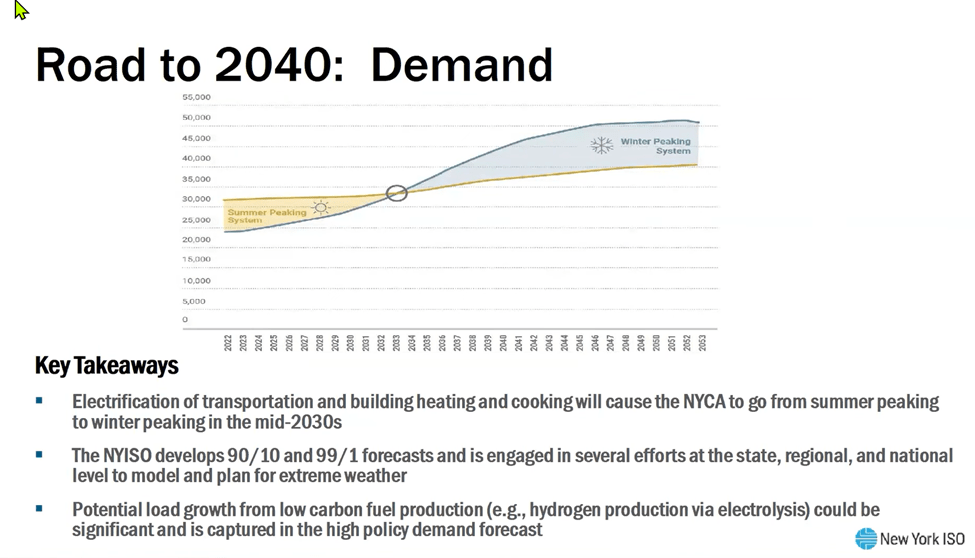
In 2022 the peak observed load was 31,709 MW and the installed summer capability 37,178 MW. In 2030 the NYISO Gold Book baseline predicted summer peak load is 32,490 MW and 36,930 MW in 2040. The peak winter load is 28,970 in 2030 and 44,800 in 2040. In the following table, I list the maximum capability and peak load data and calculate the capability to peak load margin.
The NISO Gold Book Table V-3 lists the historical Installed Reserve Margin (IRM) values for the New York Control Area and the historical minimum Locational Capacity Requirements (LCRs) approved by the NYISO for Zones G-J, Zone J, and Zone K. The IRM requirements are established each year by the New York State Reliability Council (NYSRC). The IRM represents the minimum level of capacity, beyond the forecasted peak demand, which utilities and other energy providers must procure to serve consumers. This post is not going to address the LCRs.
As shown here New York will require an unprecedented level of new wind and solar development in order to meet the net-zero transition mandates of the Climate Act. Note that the capability to peak margin calculated in the preceding table is not exactly the same as the IRM but the expectation is that the IRM will increase significantly in the future. The reason for this IRM shift is that wind and solar are intermittent and overbuilding those resources is necessary to address that intermittency. While overbuilding is suggested as the solution for the best energy plan the question is how much is enough and whether it is a solution that eliminates the need for any new resources.
One Third on Average
I am convinced that overbuilding is not as viable a solution as its proponents claim. However, trying to explain the reasons why is complicated so I have been looking for a more-easily understood graphical explanation. Michel Opdbe wrting at the at Trust, yet verify blog has just such a graphic.
Opdbe lives in Belgium and writes about renewable energy policies in Belgium and adjoining countries. His recent post addressed a claim that on average of 1/3 of the total electricity demand in the Netherlands is now supplied by sun, wind and water. The post was based on a tweet with this message (translated from Dutch):
An average of 1/3 of the total electricity demand in the Netherlands is now supplied by sun, wind and water. The record is from Sunday 24 April, with a nice 68%. The low of last winter was on November 30, with only 4%. #graphoftheday
It was accompanied by a graph showing the daily energy production by solar, wind and water as percent of total demand of the Netherlands:
He explains:
The thick yellow line is the four weeks moving average and, indeed, it ends up at roughly one third of demand at the beginning of 2023. That is however only part of the story, as also hinted by the two values that are mentioned in the text of the tweet.
Although the average ends up around one third of demand, it is derived from a incredibly wide range. According to the tweet, solar and wind together with water produced between 4% and 68% of total demand in 2022 in the Netherlands.
There is also something in this graph that drew my attention, but it is not that clear from that graph. Unfortunately, I don’t have the data from the Netherlands. Luckily, this dynamic is not unique to the Netherlands, it is exactly the same in Belgium and the Belgian data is readily available.
In my opinion this dynamic is universal across all jurisdictions that are moving to a reliance on wind and solar.
This is a recreation of that graph using the Belgian data (only solar and wind, water power in Belgium is negligible):
The Belgian figures are close to that of the Netherlands, albeit a bit lower. The average share of Belgian solar and wind as percent of demand is roughly one fourth (compared to one third of the Netherlands). The range of the Belgian data is also somewhat smaller (between 1 and 58%) compared to the Netherlands (between 4 and 68%). The overall shape is however similar. There is the same funnel shape that is widening the more capacity is added.
The following graphic illustrates the problem well.
Now it is easier to highlight a bit more the wide range that this average is derived from. These are the minimum and maximum values of the share of solar and wind in demand of each year:
It is clear that the lower and upper boundaries don’t increase in the same way The lower boundary is hardly budging, it keeps close to the x-axis over the entire period. In 2022, the lowest daily share supplied by solar and wind was only about 1% of total demand. This didn’t change much over the years: it was roughly between 0.7% and 1.8% of demand between 2014 and 2022. This tells us that a lot of dispatchable capacity will still be needed at specific times of the year (in this case, pretty close to the expected demand and, looking at its shallow slope, that might be the case for quite a while).
The upper boundary behaves different. It shoots up exponentially. In 2022, the highest daily share supplied by solar and wind was 58% of total demand, coming from around 20% in 2014.
Meaning that the difference between the lower and upper boundary will keep increasing over time. Basically, electricity production by solar and wind will at times start to exceed demand, while the need for backup at specific times of the year will stay high.
The key point illustrated in this graph is that over building wind and solar does not help much for those periods when wind and solar resources are low due to the weather.
Some people also seem to recognize this type of dynamic. Already the first comment below the tweet nails it (translated from Dutch):
If we now just install three times as much, then we have more than twice too much at the peak and are almost 90% short at the lowest point.
I couldn’t have said it better.
Discussion
Based on every study of intermittent wind and solar that I have seen, the difference between the lower and upper boundary of wind and solar output will keep increasing over time as these resources are added to any electric system. New York is not as bad as Belgium and Netherlands but it is the reason that the New York IRM will increase from around 20% to on the order of 150% in 2040. The reason for this universal truth is that meteorological conditions that cause light winds are geographically large. When the wind is light at one site in New York it is very likely that winds are light across the state. Data from Australia shows a similar effect across that entire continent.
There are a couple of ramifications. First, overbuilding is not a complete solution. Grid operators must always match load with generation. Therefore, resource adequacy planning must have a solution even at the minimum wind and solar generation output. If the overall state-wide wind generation capacity is only 10% you would need to overbuild by a factor of ten to provide power at night. Aside from the cost I believe that amount of wind development exceeds the expected wind resource availability in New York. In order to address this a new technology is needed. The New York State Public Service Commission (PSC) recently initiated an “Order initiating a process regarding the zero-emissions target” that will “identify innovative technologies to ensure reliability of a zero-emissions electric grid” for this reason.
The other part of the problem is that when wind and solar resources are over-built there will be more and more periods when their output exceeds demand. When that happens the electricity market has issues. Many wind and solar contracts are written such that the operators are paid whether or not the energy produced is needed. For example, the Ontario Independent Electricity System Operator must get rid of the unneeded power by selling it to neighboring control areas at below market costs. New York is a big purchaser of this cheap power. While those purchases drive costs down for ratepayers it also adversely affects the viability of in-state generating facilities. On the other hand, during the light wind conditions in-state generating facilities are needed so it may reach the point that they have to be subsidized to be available. Eventually New York will be in a similar position to Ontario. It turns out that the low- price sales are subsidized by Ontario ratepayers. When everyone has over-built I also wonder where the excess power will be dumped.
Conclusion
The graph of solar and wind generation resources as a fraction of the total resources shows a characteristic shape that proves that over building wind and solar generation does not help always fulfill load requirements. Electric grid operators must match the output of generating resources at all times so this means the problem has to be addressed. Further compounding the problem is the fact that peak loads are associated with temperature extremes that are linked to high-pressure systems that also create light winds. In other words the over-building effect is most pronounced when energy demand peaks exacerbating the risks to reliability when electricity is needed most.
At least one commenter understands the problem when he said “If we now just install three times as much, then we have more than twice too much at the peak and are almost 90% short at the lowest point”. I agree with Opdbe – I couldn’t have said it better.
The unanswered questions are how will the Climate Act implementation address this problem, what will it cost, and will it be able to maintain current standards of reliability.
On June 24, 2023 the Finger Lakes Times published a commentary, Alternate Energy: Scoping it out, Part VI: My humble opinion, conclusion by Jim Bobreski, a process control engineer from Penn Yan. The commentary concludes a series on the Climate Leadership & Community Protection Act (Climate Act) Scoping Plan. I started this post soon after his article was published but just got around to completing it. While I admire Bobreski’s efforts to try to decipher the Scoping Plan he makes a couple of mistakes that should be addressed.
I have been following the Climate Act since it was first proposed, submitted comments on the Climate Act implementation plan, and have written over 300 articles about New York’s net-zero transition. I have devoted a lot of time to the Climate Act because I believe the ambitions for a zero-emissions economy embodied in the Climate Act outstrip available renewable technology such that the net-zero transition will do more harm than good. The opinions expressed in this post do not reflect the position of any of my previous employers or any other company I have been associated with, these comments are mine alone.
Climate Act Background
The Climate Act established a New York “Net Zero” target (85% reduction and 15% offset of emissions) by 2050 and an interim 2030 target of a 40% reduction by 2030. The Climate Action Council is responsible for preparing the Scoping Plan that outlines how to “achieve the State’s bold clean energy and climate agenda.” In brief, that plan is to electrify everything possible and power the electric grid with zero-emissions generating resources by 2040. The Integration Analysis prepared by the New York State Energy Research and Development Authority (NYSERDA) and its consultants quantifies the impact of the electrification strategies. That material was used to write a Draft Scoping Plan. After a year-long review the Scoping Plan recommendations were finalized at the end of 2022. In 2023 the Scoping Plan recommendations are supposed to be implemented through regulation and legislation.
In the age of Trump, energy, is as big and important an issue as it ever has been. The decisions we make as nations, and as individuals about energy are as important as always to our present, and more so to our future. However, in this age of Trump, there are delusions and confusion that he and his regime has perpetrated. Trump has succeeded in creating so much doubt that the average person thinks that up is down and down is up. He has turned science upside down as well. His interference with science has so obstructed the truth that Scientific American came out to for the first time in its 175 year politically neutral history and endorsed Joe Biden. This book is a collection of articles about the politics, economics, and technology of alternate energy and its importance to the future of civilization.
Commentary
In this section I will critique the commentary. Renewable energy advocates commonly make similar mistakes relative to the electric system. Although Bobreski was in power production his expertise in process control is not particularly relevant for electric system resource adequacy issues. Consequently there are misconceptions similar to those Richard Perez made arguing that New York should embrace a solar energy future.
The commentary is a mixture of good and bad points. He starts out explaining that technology advances are necessary to make the Climate Act Scoping Plan work.
A call to grandma cost about $5 back in 1970 which is about $38 today. Now the same call is almost nothing. My point: Technology today comes in leaps and bounds and fast. It improves so fast that as soon as you buy some new device, it is obsolete in some way the minute you use it.
My concern is are we becoming dependent upon technology’s rapid evolution to solve our problems? The scoping plan appears to count on this very thing to be successful. Can it happen? I think the answer is yes, but it’s a cautionary yes.
There are limits to this analogy for the electric system. Wind and solar energy have been subsidized for decades in the hopes that the technology would evolve to the point where it could stand on its own. However, there is no sign that the need for those subsidies will disappear anytime soon.
Theresa Hansen of “T&D World” magazine says, “Some locations in the US might meet President Biden’s goal of 100% clean energy by 2035, but I don’t see the entire country being fueled by zero carbon sources 12 years from now.”
“T&D World” is a trade publication for the power transmission industry and they ought to know!
It may be true that “some” locations may have 100% clean energy by 2035 but I don’t expect that it will be any large jurisdiction. I recently described problems with the transition including the European experience showing that wind is not viable, the costs of wind and solar in Germany are untenable, and that a rapid energy transition has many risks but that information is being ignored. There is a reason trade publications are called trade rags. They will publish anything to appeal to their readership.
In the past five columns, I have tried to put together some information about the directives of the Scoping Plan for the energy future of NYS. I concentrated on solar, wind, the grid and storage systems.
I would like to call this a story, because the efforts made by the state to go “green” stretch back over 40 years. In 1982 PASNY — now NYSERDA — planned to place a wind turbine on the shore of Lake Ontario. Numerous studies in NY have been performed on wind power over those years. Whatever became of this? I have filed Freedom of Information requests on the wind turbine projects proposed by PASNY, but have had no luck finding this information. I was attempting to garner what was already known then and why it wasn’t implemented at the time.
There is one mistake here. The state power authority changed its acronym from PASNY to NYPA not NYSERDA. The New York State Energy Research & Development Authority probably did wind turbine assessments for Lake Ontario but I have never seen them either.
A history of learning from others’ mistakes
Back in the early 1980s Germany embarked on an ambitious plan to go solar and wind. The wind turbines in 2022 provided 17.2% of Germany’s electrical power; solar provided about 8%. The problem that is now realized is the cost of making this decision. It was at a time when nuclear was the “energy cure” for clean and cheap energy, production solar panels were only 10% efficient and were very expensive.
To demonstrate my point, Hoffman Electronics in 1955 offered the first solar cell at 1785/watt at 2% efficiency and at today’s prices a solar cell at 21% efficiency by comparison would cost over $18,000 a watt. Germany proceeded anyway. Today the situation is diametrically reversed. Solar is now the cheapest form of providing electrical power. Nuclear is the most expensive. Although Germany produces about 25% from solar and wind it came at too big a cost.
This argument is based on the presumption that solar is currently the cheapest form of electric power. However, that is only true if the reference is to power capacity (MW). Even if solar capacity is half the cost of fossil capacity the cost for delivered energy is much more. We pay for the kWh electric energy we use each month and we expect it to be available 24-7 throughout the year. In order to provide usable energy, other things must be considered that destroy the myth that utility-scale solar is cheaper than other types of power plants. On average a well-designed solar facility can provide (round numbers) 20% of its potential energy possible in New York. A natural gas fired power plant can operate to produce at least 80% of its potential energy over a year. In order to produce the same amount of energy, that means that you need four times as much solar capacity. Even if the solar capacity cost is half the cost for the capacity the energy cost is double simply due to this capacity factor difference.
But wait, there is more. In order to make the energy available when needed storage must be added to the cost of the solar capacity. Also consider that the life expectancy of solar panels is half of the observed life expectancy of fossil-fired power plants. There are unintended financial consequences that affect the viability of other generators that are needed for reliability that add to ratepayer costs. Because the solar resource is diffuse, it is necessary to support the transmission system to get the energy produced by solar from where space is available to site acres of solar panels to where it is needed. There are inherent characteristics of conventional generation that contribute to the stability of the transmission system that are not provided by solar or wind generation. Someone, somewhere must deploy a replacement resource to provide those ancillary transmission services and that cost should be included the cost comparison. Finally, the Integration Analysis, NYISO, New York State Reliability Council, and the Public Service Commission all agree that another resource that can be dispatched and is emissions-free (DEFR) is needed when the electric grid becomes dependent upon solar and wind resources. The state’s irrational fear of nuclear generation precludes the only proven resource that meets the necessary criteria so an entirely new resource must be developed, tested, and deployed. The Integration Analysis and NYISO 2021-2040 System & Resource Outlook both project that the DEFR resource will be comparable in size to existing fossil resources but will operate no more than 9% of the time. I have yet to see an expected cost for this resource but have no doubts that it will be extraordinarily expensive. Summing all the costs necessary to make solar power usable for electric energy reliable delivery and there is no doubt that solar is much more expensive.
The weak link in NYS’ ambitious clean energy plan is the power storage medium. Choosing the right storage medium is critical and the answer may be to wait until these technologies prove themselves. Right now lithium and fuel cells are the only “off the shelf” storage mediums we have. Both have their issues. Lithium has its safety issues of thermal runaway and current fuel cells are expensive and use platinum, a very limited resource. Lithium too is limited as to availability.
I agree with this paragraph.
It has been said that one form of insanity is repeating a past failed experiment and hoping to obtain different results. The Scoping Plan, to put it mildly, is a highly ambitious plan. It treads in uncharted waters. Its success is hinged upon technologies that are not yet developed or not fully developed. Sure technology has been transformative but is the Scoping Plan actually built around an undetermined future? Will these ambitious plans repeat the mistakes of the past?
These are relevant points and I agree. Interpretation of the mistakes of the past is a challenge. For example, I think that the energy transition problems of Germany were due to the inherent challenge of using intermittent and diffuse wind and solar to power modern electricity and not because solar was expensive at the time it was installed. Overcoming all the reasons why solar produced energy is more expensive than fossil-fired energy is likely an impossible challenge.
Like Germany’s ambitious plan for which the country is now left holding the bag. With NYS’ plan the storage system can be viewed in the same way as the German situation. In my humble opinion, large-scale storage battery technology is the linchpin for the Scoping Plan’s success, a technology essentially at its marketable infancy. You may raise a skeptical eyebrow and note the first accessible battery was invented in 1804! Yes, that is true but there was no practical use for it, ergo no market motivation. Now that also is diametrically reversed. A plethora of battery technologies have come out of the metaphorical woodwork. Improved lithium ion, magnesium, zinc, aluminum, carbon, boron, graphene, iron and who knows what. Each promising their own unique benefit such as size, power density, rechargeability, increased life expectancy.
I agree with this paragraph. New York GHG emissions are less than one half of one percent of global emissions and global emissions have been increasing on average by more than one half of one percent per year since 1990. That does not mean we should not do something but it does mean that we have time to address this problem. If the storage problem cannot be solved then there cannot be a transition so I suggest that New York should focus more on developing technology that will enable the transition than on reducing emissions that cannot have any measurable effect on global warming impacts.
Recently the House Ways and Means proposed the “Limit, Save and Grow Act” (talk about a euphemism!) which has passed Congress. This act will greatly impede the change that we can meet the goals of clean energy. Instead it wants to cripple the Inflation Reduction Act, which provides for the advancement of alternate energy and a clean energy for the future. The GOP- sponsored bill should have been implemented during the 2017-21 era when that president authorized a $2.25 trillion-a-year spending spree that is responsible for the inflation we have today. This careless spending did not improve health care, education, clean energy or our infrastructure. With this act the GOP wants to stop advancement in alternate energy and a clean environment. Let’s hope the Senate feels differently.
I don’t have any comment on this.
In questioning average citizens, they respond with the three main concerns: the plan does not seem feasible in the amount of time, the cost of converting their homes to all electric, and the costs changing the system in New York.
The Scoping Plan is highly dependent upon Biden’s IRA, which as mentioned is under attack by the GOP. The Scoping Plan is also highly dependent upon technologies which have yet to be proven.
This is an excellent synopsis of my concerns. The Scoping Plan does not include a feasibility analysis relative to existing reliability standards, did not provide cost impacts for the citizens of New York, and failed to provide justification for the ambitious schedule. It does not matter if the IRA is under attack by Republicans. The question is whether it can provide sufficient support for Climate Act implementation.
My conclusion
Yes, we have to do something! Continuing to process oil by shale or sand sites and clear cutting to get there is consequentially damaging our forests and fresh water supplies. Not to mention the added expense of cleaning up these sites. Nuclear power is way too expensive. While solar and wind power have their flaws, they are far less than the path of oil and nuclear. Gov. Hochul must make the right decisions. It might be better to wait on the predictable advance of technology than to build a questionable foundation.
Conclusion
My over-riding concern about the Climate Act is that there is insufficient support to prove that the plans will not do more harm than good. The analyses comparing environmental impacts are biased and incomplete. At this time the Hochul Administration has not prepared a cumulative environmental impact statement that considers the effects of all the wind and solar generation projected in the Scoping Plan. Affordability and reliability concerns have been ignored and it is obvious that technological advances are needed if the transition is to be successful. I agree that the it is better to make implementation contingent upon necessary technology.
The goals for two proceedings associated with the Climate Leadership & Community Protection Act (Climate Act) are not clear. The Public Service Commission (PSC) Order on Implementation of the Climate Act (Case 22-M-0149) is supposed to “both track and assess the advancements made towards meeting the CLCPA mandates and provide policy guidance, as necessary, for the additional actions needed to help achieve the objectives of the Climate Act”. The New York State Department of Environmental Conservation (DEC) and New York State Energy Research & Development Authority (NYSERDA) are implementing the New York Cap-and-Invest (NYCI) proposed by Governor Hochul which is a market-based program to raise revenues for the strategies necessary to meet the mandates of the Climate Act. The question for both programs is whether their goal is to address the Climate Act itself or the entirety of the effort needed to make the transition targets mandated by the Climate Act.
I have been following the Climate Act since it was first proposed, submitted comments on the Climate Act implementation plan, and have written over 300 articles about New York’s net-zero transition. I have devoted a lot of time to the Climate Act because I believe the ambitions for a zero-emissions economy embodied in the Climate Act outstrip available renewable technology such that the net-zero transition will do more harm than good. The opinions expressed in this post do not reflect the position of any of my previous employers or any other company I have been associated with, these comments are mine alone.
Climate Act Background
The Climate Act established a New York “Net Zero” target (85% reduction and 15% offset of emissions) by 2050 and an interim 2030 reduction target of a 40% reduction by 2030. The Climate Action Council is responsible for preparing the Scoping Plan that outlines how to “achieve the State’s bold clean energy and climate agenda.” In brief, that plan is to electrify everything possible and power the electric grid with zero-emissions generating resources. The Integration Analysis prepared by the New York State Energy Research and Development Authority (NYSERDA) and its consultants quantifies the impact of the electrification strategies. That material was used to write a Draft Scoping Plan. After a year-long review the Scoping Plan recommendations were finalized at the end of 2022. In 2023 the Scoping Plan recommendations are supposed to be implemented through regulation and legislation. This post addresses a couple of implementation components.
PSC Order on Implementation of the Climate Act
The order implementing this proceeding explains that:
The changes contemplated by the CLCPA are expected to profoundly transform the State’s regulatory landscape and impact every sector of the economy. The Public Service Commission (Commission) will play a critical role in these efforts as it continues to implement a variety of clean energy initiatives, including those related to the deployment of renewable energy resources to support the State’s transition to a zero emissions electric grid, energy efficiency, building electrification, and zero emission transportation.
The Commission has already begun to implement the many objectives of the CLCPA through a number of existing proceedings. To date, the Commission has authorized the offshore wind solicitations necessary to achieve the CLCPA goal of procuring nine gigawatts (GW), funded programs to support the electrification of buildings’ heating load and the transportation industry, supported both large scale and distributed clean energy project development, funded programs to reduce natural gas and electricity usage in the State, and instituted a coordinated planning process to evaluate local transmission and distribution system needs to support the State’s full transition to renewable generation.
The Commission has quickly taken action related to items within its jurisdiction to help put the State on a path to meet the aggressive CLCPA targets. However, in consideration of the scope of the CLCPA and the extensive work necessary to achieve its mandates, continuous monitoring of the progress made will be crucial to ensure the State remains on track to achieve these objectives. In addition, there are existing policies that will need to be reviewed, and new policies that will need to be developed, to further the enablement of the CLCPA. This proceeding will be the forum for such policy development. By this Order, the Commission institutes this new proceeding to both track and assess the advancements made towards meeting the CLCPA mandates and provide policy guidance, as necessary, for the additional actions needed to help achieve the objectives of the CLCPA.
On July 20, 2023 the first annual informational report for this proceeding was released. The Power Point presentation summarizing the results includes the following slide describing the purpose, requirements, and goals for the annual report. It explains that the PSC has statutory responsibilities in implementing the Climate Act that must be consistent with its “core mission to ensure that utilities can provide safe and adequate service at just and reasonable rates along with the reliability and resiliency of the system.” My interpretation is that the PSC is required to address all actions, both pre-and post-Climate Act enactment by the Commission to achieve the mandates of the Act.
The report describes the information provided:
The cost recoveries, benefits, and other information reported here are mainly focused on the direct effects of CLCPA implementation. Notably, the estimates of total funding authorized by the Commission to date for various clean energy programs in some instances reflect actions that pre-date the enactment of the CLCPA. With respect to both pre- and post-CLCPA measures, this report focuses only the portion of those direct effects arising from programs over which the Commission has oversight authority and does not account for programs implemented by other state agencies that are funded from other sources (e.g., Regional Greenhouse Gas Initiative (RGGI) funding). Examples of effects not captured here include property tax revenues to localities from newly developed renewable generation facilities, workforce development and job growth, and local air quality impacts, among others. It should also be noted that the benefits and costs of the measures discussed in this report do not accrue uniformly across stakeholders, and in some cases one stakeholder’s benefit is another’s cost. As such, this report generally describes a subset of benefits and costs related to the CLCPA and does so from the perspective of New York as a whole by using the Societal Cost Test. In instances where this report adopts a different perspective, it indicates what that perspective is. For those benefits that are difficult to quantify, this report includes qualitative descriptions of the nature, extent, and incidence of the benefit.
The issue I want to raise in this post relates to this description and the PSC core mission “to ensure that utilities can provide safe and adequate service at just and reasonable rates along with the reliability and resiliency of the system.” In particular, consideration of just and reasonable rates needs to consider the effect of other programs that directly impact rates. Although the Commission has no oversight authority for programs like RGGI and NYCI, the costs associated with those programs are passed through to ratepayers. Therefore, I believe that this report should include those costs and any other programs that directly affect ratepayer costs in its assessment.
New York Cap-and-Invest
In June 2023, DEC and NYSERDA hosted a series of webinars addressing NYCI implementation. The Cap-and-Invest Analysis Inputs and Methods webinar (Inputs and Methods Webinar Presentation and View Session Recording) on June 20, 2023 described proposed policy modeling. In order to evaluate the effects of different policy options, this kind of modeling analysis forecasts future conditions for a baseline or “business-as-usual” case, makes projections for different policy options, and then the results are compared relative to the baseline case.
The proposed modeling approach uses a unique approach. The Scoping Plan modeling used a reference case that included “already implemented” programs instead of the usual practice of a “business-as-usual” base case. The NYCI Cap-and-Invest Analysis Inputs and Methods webinar proposed to use the same framework. Starting with the reference case developed for the Scoping Plan, the NYCI modeling proposal will add policies enacted since then.
It is more appropriate to compare the policy cases to a base case that excludes all programs intended to reduce GHG emissions. Putting the pre-Climate Act programs and costs in the reference case means that the cost forecasts will not include all the measures necessary to meet the Climate Act mandates. One of the goals of NYCI is to “minimize potential consumer costs while supporting critical investments” but the proposed approach will only consider a subset of the total costs necessary to meet the Climate Act mandates.
Discussion
The question for both proceedings is whether the goal is to consider all the costs and benefits of the Climate Act or some sub-set. The Hochul Administration has never released its estimate of the total costs to meet any of the Climate Act targets. Instead of providing the cost and benefit components themselves only net numbers are provided to support the misleading and inaccurate party line statement that the costs of inaction are more than the costs of action. In order to make that statement the Administration used the reference case approach that hides the total implementation costs.
There are implications for these two proceedings. In order to provide the total costs, both should cover as many programs as possible. The PSC has statutory limits on its Climate Act Implementation analysis that precludes many aspects of the transition but I believe that they should incorporate the costs of Climate Act-related expenditures that get incorporated into ratepayer assessments even if they are not in a rate case proceeding. There was one relevant item not addressed in the PSC Climate Act Implementation Report. New York Public Service Law § 66-p. “Establishment of a renewable energy program” has safety valve conditions for affordability and reliability that are directly related to the PSC core mission “to ensure that utilities can provide safe and adequate service at just and reasonable rates along with the reliability and resiliency of the system.” § 66-p (4) states: “The commission may temporarily suspend or modify the obligations under such program provided that the commission, after conducting a hearing as provided in section twenty of this chapter, makes a finding that the program impedes the provision of safe and adequate electric service; the program is likely to impair existing obligations and agreements; and/or that there is a significant increase in arrears or service disconnections that the commission determines is related to the program”. I think that this mandate calls for including ratepayer costs that are not related to a rate case proceeding.
With respect to NYCI the question is what is the expectation for the revenues. The revenues needed to make the necessary changes to the energy system are not related to the legislation or regulation that drives the initiative. Therefore, the proposed modeling should evaluate the policy scenarios against a business-as-usual base case that excludes any program that exists to reduce GHG emissions. Furthermore, the proposed approach will not be able to provide an estimate of necessary revenues to meet the Climate Act mandates because it excludes already implemented policies and their associated costs.
Conclusion
The goals for these two programs should be clarified. I believe that I am not the only resident of New York that wants to know the all-in costs necessary to meet the Climate Act mandates. In order to provide those numbers both proceedings should address as many program costs as possible for the effort needed to make the transition targets mandated by the Climate Act.
I intend to evaluate the reported costs in the PSC Climate Act Implementation Analysis relative to the NYCI modeling proposal included programs. At this point I can only say the NYCI approach will be mis-leading for the revenue needs of the Climate Act transition costs but cannot estimate the magnitude of the error. Arbitrarily eliminating some costs is nothing more than a politically expedient ploy to downplay the total costs of the Climate Act.
Given that there are limitations on how often I can get letters published I must settle for responses here.
New York’s response to climate change is the Climate Leadership & Community Protection Act (Climate Act). I have been following the Climate Act since it was first proposed, submitted comments on the Climate Act implementation plan, and have written over 300 articles about New York’s net-zero transition. I have devoted a lot of time to the Climate Act because I believe the ambitions for a zero-emissions economy embodied in the Climate Act outstrip available renewable technology such that the net-zero transition will do more harm than good. The opinions expressed in this post do not reflect the position of any of my previous employers or any other company I have been associated with, these comments are mine alone.
Climate Act Background
The Climate Act established a New York “Net Zero” target (85% reduction and 15% offset of emissions) by 2050, an interim 2030 target of a 40% reduction by 2030, and 100% “zero emissions” electricity generation by 2030. The Climate Action Council is responsible for preparing the Scoping Plan that outlines how to “achieve the State’s bold clean energy and climate agenda.” In brief, that plan is to electrify everything possible and power the electric grid with zero-emissions generating resources by 2040. The Integration Analysis prepared by the New York State Energy Research and Development Authority (NYSERDA) and its consultants quantifies the impact of the electrification strategies. That material was used to write a Draft Scoping Plan. After a year-long review the Scoping Plan recommendations were finalized at the end of 2022. In 2023 the Scoping Plan recommendations are supposed to be implemented through regulation and legislation.
According to the New York Independent System Operator (NYISO) “Gold Book” load and capacity report, in 2022 there were a total of 4,444 MW of solar nameplate capacity (154 MW of utility-scale solar and 4,290 MW of behind-the-meter) on-line in the state. However, implementation of the Climate Act transition to net-zero will significantly increase that amount by 2030. By 2030 the New York State Energy Research & Development Authority (NYSERDA) and consultant Energy + Environmental Economics (E3) Integration Analysis that provides quantitative estimates of resources for the Scoping Plan projects a total of 18,852 MW and the NYISO 2021-2040 System & Resource Outlook projects 14,731 MW.
Rebuttal to Letters to My Commentary
There were two letters published in response to my commentary. The first by Shelley Conture from
Syracuse and the second by Gary McDermott from Chittenango. I have attached all the commentaries below for your information. Conture basically repeated everything Perez said and insinuated that because he has “notable credentials” he must be right. McDermott addressed the points I made and raised a couple of points that deserve clarification.
Perez claimed the Earth receives more solar energy than the total annual energy consumption of all economies, combined, in a week. I argued that ignores that availability when and where needed is a critical requirement. In New York, the winter solar resource is poor because the days are short, the irradiance is low because the sun is low in the sky, and clouds and snow-covered panels contribute to low solar resource availability.
McDermott responded: “No one is claiming solar power will be the only source, but rather a major source of power in the future. We will always use hydropower in New York.” Both statements are true but both are naïve. The Integration Analysis projects that by 2035 there will be more installed solar capacity than today’s fossil capacity so the issue is the magnitude of the reliance on solar. My concern with hydro is that we cannot add significantly more capacity so its advantages are tapped out.
McDermott goes on to address specifics associated with solar abundance. He states that “The suggestion that winter days are too short for solar fails to recognize that we also have 15-hour long days in the summer, three hours longer than Florida” but ignores the implication that reliability requires electric planners to consider the worst case. When everything is electrified, the peak load will be in the winter so we must address 9-hour long days. He says “As far as snow on panels is concerned: It’s simple to brush snow off a 35-degree slope panel, especially since we don’t get as much annual snow.” Not considering the worst case is problematic here too. It may not be so simple to brush snow off panels if it is not possible to get to the panels because there is too much snow or ice. Better would be a requirement that the utility-scale solar installations use tilting-axis panels so that they can be adjusted to minimize snow accumulation, albeit that only works if there is no power outage. More of a problem is that roof-top distributed systems may not accessible to clear off. He again ignores the worst case when he states “Also, wind power occurs at night.” Wind lulls can occur at night and then what?
I firmly believe that most people do not understand the ramifications of the Climate Act. McDermott appears to be knowledgeable but does not understand the Climate Act targets when he says “During low sunshine conditions, natural gas energy can temporarily fill in, but with greater volumes of solar power, our net gas usage would grow much smaller.” The goal of the Climate Act is no natural gas by 2040. The practicality of that mandate is the issue.
I made the point that there is no mandate that solar developments meet the Department of Agriculture and Markets prime farmland protection goal and that projects approved to date have converted 21% of the prime farmland within project areas to unusable land. I do not disagree with McDermott’s response except that I stand by the prime farmland protections. Responsible solar siting that includes agrivoltaics is appropriate but not enough. He states:
In Boulder, Colorado, farmers grow tomatoes, turnips, carrots, squash, beets, lettuce, kale, chard and peppers under 8-foot-high solar panels. I recommend that state laws require solar farm panels to be built this high, to maintain farming. With this reality in mind, the greatest threat to farm land is not solar, but rural housing developments.
McDermott’s other comments do not stand up to scrutiny. He said that “It’s pointless to complain about new transmission requirements when any new source of electricity will require additional power lines.” The point is that diffuse renewables require much more transmission and getting offshore wind into the existing grid system is extraordinarily expensive. I disagree with his statement that “Solar panels last 30 years, whereas combined-cycle gas turbines last only between 25 and 30 years, and produce more pollution.” The life expectancy of a gas plant is on the order of 40 years and I have never heard a solar developer claim 30 years. In addition, solar panels degrade 0.8% per year but fossil plants do not degrade. There are also significant environmental impacts associated with mining the rare earth metals necessary for solar panels.
Both Conture and McDermott claim solar is cheaper. McDermott says “On average, it costs about $200,000 more per megawatt to build a gas plant than it does a solar farm.” Conture just repeats what Perez said. In the limited space I had, I said:
Perez claims that “utility-scale solar electricity has become the least expensive form of electricity generation” but that only refers power capacity (MW). When you consider the relative amount of energy that can be produced annually, the storage needed to provide energy when the sun isn’t shining, the shorter life expectancy of PV panels, transmission support service requirements and the need for a new dispatchable, emissions-free resource, then the cost of solar energy provided when and where needed is much higher than conventional sources of electricity.
In my post providing background material for the commentary, I expanded on this description. The claim that “utility-scale solar electricity has become the least expensive form of electricity generation” refers only to power capacity (MW). Even if solar capacity is half the cost of fossil capacity the cost for delivered energy is much more. We pay for the kWh electric energy we use each month and we expect it to be available 24-7 throughout the year. In order to provide usable energy, other things must be considered that destroy the myth that utility-scale solar is cheaper than other types of power plants. On average a well-designed solar facility can provide (round numbers) 20% of its potential energy possible in New York. A natural gas fired power plant can operate to produce at least 80% of its potential energy over a year. In order to produce the same amount of energy, that means that you need four times as much solar capacity. Even if the solar capacity cost is half the cost for the capacity the energy cost is double simply due to this capacity factor difference.
But wait, there is more. In order to make the energy available when needed storage must be added to the cost of the solar capacity. Also consider that the life expectancy of solar panels is less than the observed life expectancy of fossil-fired power plants. There are unintended financial consequences that affect the viability of other generators that are needed for reliability that add to ratepayer costs. Because the solar resource is diffuse, it is necessary to support the transmission system to get the solar power to New York City. There are inherent characteristics of conventional generation that contribute to the stability of the transmission system that are not provided by solar or wind generation. Someone, somewhere must deploy a replacement resource to provide those ancillary transmission services and that cost should be included the cost comparison.
Finally, the Integration Analysis, New York Independent System Operator (NYISO, New York State Reliability Council), and the Public Service Commission all agree that another resource that can be dispatched and is emissions-free (DEFR) is needed when the electric grid becomes dependent upon solar and wind resources. The state’s irrational fear of nuclear generation precludes the only proven resource that meets the necessary criteria so an entirely new resource must be developed, tested, and deployed.
The Integration Analysis and NYISO 2021-2040 System & Resource Outlook both project that the DEFR resource will be comparable in size to existing fossil resources but will operate no more than 9% of the time. I have yet to see an expected cost for this resource but have no doubts that it will be extraordinarily expensive. Summing all the costs necessary to make solar power usable for electric energy reliable delivery and there is no doubt that solar is much more expensive.
Conture brings up an issue that McDermott does not address. She says:
With regard to reliability, he discusses the emerging solutions to the concern about solar energy’s intermittency. In his words these solutions, (which he enumerates) “will ensure a continuous power supply which will be available day and night year round without fail.”
Perez discounts the need for and difficulties associated with DEFR technologies that the organizations responsible for electric system reliability all agree are necessary. The NYISO’s recent reports all emphasize the point that DEFR is not “commercially available” and the PSC Proceeding is devoted to this issue. I believe that a ensuring a continuous power supply is much more difficult than Perez thinks.
Conclusion
Sadly, readers of the Post Standard will likely remember the last opinions and not mine despite the fallacies of the writers. Conture appeals to authority and simply repeats what Perez said. McDermott at least tries to address my points. Part of his reasoning is that my arguments are invalid because he underestimates the magnitude of the solar resources projected in the Scoping Plan and the Climate Act target that mandates zero emissions by 2040. My concerns are directly related to the impacts of those considerations.
Perez subscribes to the academic belief that exiting renewable technologies are sufficient and deployment will result in lower costs. The fatal flaw in the arguments supporting those points is that they don’t address the worst-case renewable energy droughts that will coincide with future larger peaks in the winter. The organizations responsible for reliability in New York State all agree that unless nuclear power is deployed that a resource that is not yet commercially available must be developed, tested, and deployed. I think that is an incredible risk unacknowledged by Perez and the authors of these letters.
I stand by the concluding remark in my commentary. This is a recipe for disaster because if the resource adequacy planning does not correctly estimate the worst-case period of abnormally low wind and solar energy availability then the energy needed to keep the lights on and homes heated will not be available when needed most. People will freeze to death in the dark.
The June 12, 2023, commentary “Five reasons New Yorkers should embrace a solar energy future” by Richard Perez, Ph.D., claims to “clarify common misunderstandings about solar energy and demonstrate its potential to provide an abundant, reliable, affordable and environmentally friendly energy future for New York.” I disagree with his reasons.
“Solar technology is improving” is another claimed reason but solar energy in New York is limited because of the latitude and weather so there are limits to the value of technological improvements. If it is so good, then why does deployment rely on direct subsidies?
While solar energy may not have environmental impacts in New York, that does not mean that there are no impacts. Instead. they are moved elsewhere, likely where environmental constraints and social justice concerns are not as strict. The rare earth metals necessary for solar, wind and battery technology require massive amount of mining and the disposal of all the solar panels are significant unconsidered environmental issues.
Perez dismisses land use issues because “a 100% renewable PV/wind future for New York would require less than 1% of the state’s total area.” There is no mandate that solar developments meet the Department of Agriculture and Markets prime farmland protection goal. Projects approved to date have converted 21% of the prime farmland within project areas to unusable land. There is no requirement for utility-scale solar projects to use tracking solar panels, so more panels are required than originally estimated.
Perez claims that “utility-scale solar electricity has become the least expensive form of electricity generation” but that only refers power capacity (MW). When you consider the relative amount of energy that can be produced annually, the storage needed to provide energy when the sun isn’t shining, the shorter life expectancy of PV panels, transmission support service requirements and the need for a new dispatchable, emissions-free resource, then the cost of solar energy provided when and where needed is much higher than conventional sources of electricity.
The suggestion that a system depending on solar energy will be more dependable than the existing system would be laughable if it were not so dangerous. The reliability of the existing electric system has evolved over decades using dispatchable resources with inherent qualities that support the transmission of electric energy. The net-zero electric system will depend upon wind and solar resources hoping they will be available when needed, additional resources to support transmission requirements, and a new resource that is not commercially available. This is a recipe for disaster because if the resource adequacy planning does not correctly estimate the worst-case period of abnormally low wind and solar energy availability then the energy needed to keep the lights on and homes heated will not be available when needed most. People will freeze to death in the dark.
This writer even refers to Perez’s stated goal which is to “clarify common misunderstandings about solar energy and demonstrate its potential to provide an abundant, reliable, affordable environmentally friendly energy future for New York” in a way that suggests that there is something questionable about this goal. I have read Perez’s essay and strongly disagree with these negative implications.
Perez is far more than a concerned citizen expressing his strong opinion. Along with other notable credentials, he heads solar energy research at SUNY Albany’s Atmospheric Sciences Research Center and has served multiple terms on the board of the American Solar Energy Society.
As intended, he covers the topics of the growth of solar technology as well as solar energy’s abundance, affordability, reliability and significantly lower environmental footprint — and he does so very well. He also addresses the concerns about its affordability and reliability in ways that should reassure people who are concerned about these issues.
With regard to reliability, he discusses the emerging solutions to the concern about solar energy’s intermittency. In his words these solutions, (which he enumerates) “will ensure a continuous power supply which will be available day and night year round without fail.”
And with regard to affordability, as with his other responses to common misunderstandings, Perez is careful to back up his statement that, “solar power is now considerably cheaper than new coal, natural gas or nuclear energy.”
What I especially objected to in the July 2 letter is the writer’s calling what Perez suggests “dangerous” and implying that we would do much better by continuing to stay with our conventional sources of electricity. This would, of course, involve the burning of fossil fuels, which is known to be the primary cause of the greenhouse gases that cause climate change.
I totally understand why people might prefer to do this. It would be more convenient and more familiar. But what I, along with many others, believe is that this is no longer a real choice. Our choice is actually between staying addicted to fossil fuels and believing the misinformation promoting them, or making difficult but ultimately better choices which could halt the continuing destruction of the planet.
No one is claiming solar power will be the only source, but rather a major source of power in the future. We will always use hydropower in New York. The suggestion that are winter days are too short for solar fails to recognize that we also have 15-hour long days in the summer, three hours longer than Florida. As far as snow on panels is concerned: It’s simple to brush snow off a 35-degree slope panel, especially since we don’t get as much annual snow. During low sunshine conditions, natural gas energy can temporarily fill in, but with greater volumes of solar power, our net gas usage would grow much smaller. Also, wind power occurs at night.
In Boulder, Colorado, farmers grow tomatoes, turnips, carrots, squash, beets, lettuce, kale, chard and peppers under 8-foot-high solar panels. I recommend that state laws require solar farm panels to be built this high, to maintain farming. With this reality in mind, the greatest threat to farm land is not solar, but rural housing developments.
It’s pointless to complain about new transmission requirements when any new source of electricity will require additional power lines. On average, it costs about $200,000 more per megawatt to build a gas plant than it does a solar farm. Solar panels last 30 years, whereas combined-cycle gas turbines last only between 25 and 30 years, and produce more pollution. People pay less for solar electricity.
A few articles and notices about Off Shore Wind (OSW) came to my attention this week. The contradictions in the viewpoints were so different that I thought a post was appropriate.
I have been following the Climate Act since it was first proposed. I submitted comments on the Climate Act implementation plan and have written over 300 articles about New York’s net-zero transition. I have devoted a lot of time to the Climate Act because I believe the ambitions for a zero-emissions economy embodied in the Climate Act outstrip available renewable technology such that the net-zero transition will do more harm than good. The opinions expressed in this post do not reflect the position of any of my previous employers or any other company I have been associated with, these comments are mine alone.
Climate Act Background
The Climate Act established a New York “Net Zero” target (85% reduction and 15% offset of emissions) by 2050 and an interim 2030 target of a 40% reduction by 2030. The Climate Action Council is responsible for preparing the Scoping Plan that outlines how to “achieve the State’s bold clean energy and climate agenda.” In brief, that plan is to electrify everything possible and power the electric grid with zero-emissions generating resources by 2040. The Integration Analysis prepared by the New York State Energy Research and Development Authority (NYSERDA) and its consultants quantifies the impact of the electrification strategies. That material was used to write a Draft Scoping Plan. After a year-long review the Scoping Plan recommendations were finalized at the end of 2022. In 2023 the Scoping Plan recommendations are supposed to be implemented through regulation and legislation.
Off Shore Wind (OSW) will be a major renewable resource in the net-zero electric energy system. The Climate Act mandates 9,000 MW of Off Shore Wind (OSW) generating capacity by 2035. The Integration Analysis modeling used to develop the Scoping Plan projects OSW capacity at 6,200 MW by 2030, 9,096 MW by 2035 and reaches 14,364 MW in 2040. On the other hand, the New York Independent System Operator 2021-2040 System & Resource Outlook expects 5,036 MW in 2030 and 9,000 MW in 2035 with no additional development after that. By 2030 the Integration Analysis predicts that 14% of the electric energy (GWh) produced will come from OSW and the Resource Outlook predicts nearly as much (12%). This is an extraordinary build-out for a resource that is currently non-existent and there are significant differences in the buildout projections that deserve to be reconciled.
New Yorkers for Clean Power
I subscribe to a New Yorkers for Clean Power mailing list. Under the heading “ICYMI: Major Milestone Reached for State’s First Offshore Wind Project!” a recent mailing included this summary describing Governor Hochul announcement on June 22 that “South Fork Wind, New York’s first offshore wind farm, has achieved its “steel in the water” milestone with the installation of the project’s first monopile foundation.”
Late last month, Governor Hochul announced that the South Fork Wind project, New York’s first offshore wind farm, has achieved its “steel in the water” milestone with the installation of the project’s first monopile foundation.
This is the first of many major milestones for New York’s first offshore wind project and South Fork is on track to become the United States’ first completed utility-scale offshore wind project in federal waters.
Once completed, the wind farm will generate enough renewable energy to power roughly 70,000 homes helping New York meet its ambitious Climate Act goals, while eliminating up to six million tons of carbon emissions, or the equivalent of taking 60,000 cars off the road annually over a 25-year period. Hundreds of U.S. workers and three Northeast ports will support South Fork Wind’s construction through late fall helping to stand up a new domestic supply chain that’s creating hundreds of local union jobs across the Northeast.
The description did not add anything beyond what was contained in the press release. The website for the project notes:
What is it?
New York’s first offshore wind farm — with 12 turbines and a state-of-the-art transmission system that will generate enough clean energy to power 70,000 average homes and offset tons of emissions each year
Who’s behind it? 50/50 partnership between Ørsted and Eversource
When is it happening? Expected to be operational by the end of 2023
Where is it? 35 miles east of Montauk Point; the underground transmission line will deliver power to the local grid in the Town of East Hampton, NY
Despite the accolades there are issues associated with OSW as noted in the following.
Offshore Wind Costs
James Hanley wrote an article The Rising Cost of Offshore Wind that describes two issues affecting all OSW projects across the world:
But this recent growth in the offshore wind industry does not necessarily reflect its long-term health. Two substantial headwinds threaten to make projects uneconomical. One is the recent high inflation, which raised the costs of materials and labor across all industries, and the other is bottlenecked supply chains that are causing a bidding-up of the prices of materials and components needed for building wind turbines.
Hanley explains the ramifications to the OSW projects in New York:
The price of offshore wind is about to go up, and electricity users across the Empire State will be on the hook for it. Two firms developing offshore wind projects — Sunrise Wind and Equinor-bp — have gone to the state Public Service Commission asking for an increase in the price they’ll receive per megawatt-hour of electricity produced.
It is not just Hanley that is raising this issue. Sheri Hickok, Chief Executive for onshore wind, GE Renewable Energy Wind farm costs are not falling:
The state of the supply chain is ultimately unhealthy right now. It is unhealthy because we have an inflationary market that is beyond what anybody anticipated even last year. Steel is going up three times…It is really ridiculous to think how we can sustain a supply chain in a growing industry with these kind of pressures…Right now, different suppliers within the industry are reducing their footprint, they are reducing jobs in Europe. If the government thinks that on a dime, this supply chain is going to be able to turn around and meet two to three times the demand, it is not reasonable.
The Climate Act includes language that requires the agencies consider the experiences of other jurisdictions. This mandate is selectively used to justify the preconceived strategies in the Scoping Plan but never to consider the potential for warning signs. As if the request for adjustments to the contracts described by Hanley is not enough, a similar situation is playing out in Great Britain. Net Zero Watch reports that:
In a move that gives the lie to years of propaganda claiming falling costs, the wind industry’s leading lobbyists have written to the Government, threatening to abandon the UK unless there are hugely increased subsidies for their companies (see RenewableUK press release).
The industry is claiming that unforeseen rising costs now necessitate and justify three actions:
1) A vast increase in the budget for the fifth auction (AR5) of Contracts for Difference subsidies, with an increase of two and half times the current levels for non-floating offshore wind alone;
2) Special new targets and thus market shares for floating offshore wind, one of the most expensive of all forms of generation, and, most importantly of all,
3) a revision to the auction rules so that the winners are not determined by lowest bids but by an administrative decision that weights bids according to their “value” in contributing towards the Net Zero targets.
This would in effect not only increase total subsidy to an industry that was until recently claiming to be so cheap that it no longer needed public support, but also provide it with protected market shares, all but entirely de-risking investors at the expense of consumers.
It would also be an open invitation to graft and corruption.
This blackmail was predicted by Net Zero Watch. Clearly the same playbook will be used by OSW developers here. Hanley explains:
Given the fiscal realities of the situation, PSC’s only two options are to grant the request or delay the development of wind energy while the state seeks new offshore wind construction bids. Either way, costs will rise.
OSW Environmental Impacts
Earlier this year I described the Citizens Campaign for the Environment virtual forum entitled Whale Tales and Whale Facts. The sponsors wanted the public to hear the story that there was no evidence that site survey work was the cause of recent whale deaths. I concluded that the ultimate problem with the forum was that they ignored the fact that construction noises will be substantially different than the ongoing site surveys and will probably be much more extensive when the massive planned construction starts. Jim Lovgren writing at FisheryNation.com describes OSW environmental issues: Offshore Wind Electrical Substations; The Secret, Silent Killers that substantiate my concern:
Despite government and wind supporters denying any proof that could link the unseen before amount of strandings to the coincidental use of geological sonar and seismic research, [usually only of a type performed by oil companies] in the near vicinity of the strandings, the evidence mounts. This week, two Humpback Whales washed ashore in Martha’s Vineyard, coincidentally only a few days after Piledriving started at a nearby wind site. Piledriving of the turbine stanchions creates a 260 DBs level sound, that no amount of “Bubble Curtains” can contain. It is deadly. A few weeks before that beaches on the south shore of Nantucket had a carpet of dead crabs, clams, and other benthic organisms that are susceptible to seismic testing, which coincidentally was taking place nearby, [“sparkers” and sub- bottom profilers are seismic equipment]. The relationship of marine animal deaths while unsafe level industrial noises are being produced in the same vicinity are too numerous to ignore, worldwide. So, stop denying them.
Lovgren argues that there is another environmental impact that should be considered. The industrial OSW developments require electrical substations. He explains:
In an official BOEM document written by Pamela Middleton and Bethany Barnhart called, “Supporting National Environmental Policy Act Documentation for Offshore Wind Energy Development related to High Voltage Direct Current Cooling Systems” the authors contend that the only feasible cooling system for a HVDC Substation is a once through, or open system. The kind that is not allowed for new power plant construction, because of its devastating effects on aquatic life. This embarrassing Official BOEM document concerning the effects of offshore wind substations admits it knows nothing about how many substations are planned, how big, and where they will be. NEPA concerns such as environmental and economic costs to other industries are totally ignored within the enormous expanse of information contained within the 4 ½ pages of actual text. Up until the Green new deal a NEPA supporting document would be hundreds, and even thousands of pages long, detailing all aspects of a proposed project.
This is another example of an issue that was the focus of an intense and emotional lobbying effort when it was related to electric power plants using once-through cooling but now this is not an issue by the environmental organizations who demanded the prohibition for new power plants.
Summary of All OSW Issues
Mark Sertoff, a science/technology educator, published an article at Natural Gas Now that argued that the “stampede to build offshore wind turbines to replace fossil fuel generation is loaded with concerns that have not been thought through or been resolved.” I recommend reading the whole article. He made the general points that all this is unnecessary. There is no climate crisis and all the hysterical claims supporting that narrative evaporate upon close examination. He also pointed out that replacing the existing electrical system will lead to higher costs.
The article then documents specific OSW concerns. He lists the many direct environmental impacts, the seabed use requirements, and the disposal problem. Then he addresses the experiences in other countries and notes all the problems that should be a wakeup call for New York. Finally, he offers an alternative approach that will reduce emissions and costs.
Conclusion
The contrast between the positions of New Yorkers for Clean Power and the authors of the articles described here is stark. Most disappointing to me is that the climate activists ignore many issues that caused previous angst. If it was so important in the past, why is it not an issue now? If they don’t demand that all construction work cease when the critically endangered North Atlantic Right Whales migrate through the OSW facilities then they will be exposed as hypocrites. The gulf between a model projection of future weather and its impacts on whales and the imminent and potentially fatal consequences of OSW development on whales is so clear how can the activists claim to be for a sustainable future unless they step up?
I cannot improve on Sertoff’s conclusion:
Entities profiting by promoting renewables are happy to pave the road to hell. Superior solutions exist backed by solid facts. We ignore them at our peril.
At the Business Council of New York 2023 Renewable Energy Conference Energy Richard Ellenbogen, President [BIO] Allied Converters, gave the keynote address. This post summarizes the power point presentation for his address: “Energy on Demand as the Life Blood of Business and Entrepreneurship in the State – Why NY State Must Rethink Its Energy Plan and Ten Suggestions to Help Fix the Problems.”
Ellenbogen frequently copies me on emails that address various issues associated with New York’s Climate Leadership and Community Protection Act (CLCPA). I have published other articles by Ellenbogen because he truly cares about the environment and the environmental performance record of his business shows that he is walking the walk. When he sent a copy of the presentation I asked if I could it post after the conference.
Climate Leadership and Community Protection Act Background
The CLCPA established a New York “Net Zero” target (85% reduction and 15% offset of emissions) by 2050 and an interim 2030 target of a 40% reduction by 2030. The Climate Action Council is responsible for preparing the Scoping Plan that outlines how to “achieve the State’s bold clean energy and climate agenda.” In brief, that plan is to electrify everything possible and power the electric grid with zero-emissions generating resources by 2040. The Integration Analysis prepared by the New York State Energy Research and Development Authority (NYSERDA) and its consultants quantifies the impact of the electrification strategies. That material was used to write a Draft Scoping Plan. After a year-long review the Scoping Plan recommendations were finalized at the end of 2022. In 2023 the Scoping Plan recommendations are supposed to be implemented through regulation and legislation.
Richard Ellenbogen
I have published other articles by Ellenbogen because he truly cares about the environment and the environmental performance record of his business shows that he is walking the walk. His bio is available at the Business Council website.
Ellenbogen’s presentation covers four major points before making recommendations. I summarize each of these points in the following.
Energy System
Ellenbogen describes the energy system as an introduction to the problem and what he thinks we should do. He explains that we want an energy system that provides reliable, affordable, and clean power but that based on what has been happening in Germany the current plan will negatively impact all those features. He argues that climate change is a real issue and that methane also needs to be addressed. He makes a good argument that the plans to eliminate natural gas before zero emission sources of electrical generation will decrease the rate of decarbonization. He projects that the costs of CLCPA implementation will exceed $4 trillion because the entire electric transmission, distribution, and electric service system will have to be replaced. These costs are far in excess of anything that the Hochul Administration has claimed. His introduction concludes that we need to adjust the plan.
Implementation
Ellenbogen describes obstacles to implementation in the next section. He lists ten specific obstacles and then goes on to highlight a few issues. He addresses heat pumps and gas stoves. His presentation points out that converting to heat pumps “will not reduce GHG emissions or energy prices on a generation system supported by fossil fuels”. Germany has tried to do this and it has not worked out as planned. In particular, he explains in Germany that “it just moved the CO2 emissions to a different location with an as large or larger CO2 footprint and with much higher operating costs!”. He points out that Germany’s past 30-year history is New York’s future. There are similar concerns about gas stove and explains why the conclusions of recent gas stove studies are “extremely questionable” that are being used to justify banning those appliances.
In order to describe the difficulties associated with implementation he delves into the physics of power and energy. They are not the same thing as shown in the following slide. CLCPA proponents often do not properly recognize the distinction and that misleads the public on the capabilities of wind and solar generation. He also describes the capabilities of different types of generation.
CLCPA Fantasy
The physics lessons are necessary to show why the CLCPA Scoping Plan is a fantasy. He compares the power and energy projections in the Integration Analysis and then explains why the documentation is using unrealistic energy estimates. As a result, he points out that “the solar energy output is being over-estimated in the CLCPA by 72%”. There is a slide that describes the CLCPA generation plan that concludes that the assumptions are unrealistic. Keep in mind that the Integration Analysis model back calculated the resources required to meet the CLCPA targets but did not incorporate a feasibility analysis to determine if those assumptions were realistic. He points out that the benefits claimed do not consider state emissions relative to the rest of the world: “NY state could eliminate 100% of its GHG emissions and not affect damages caused by climate change”. He also notes that “in the last two years the rest of the world GHG emissions increased seven times as much” as New York total emissions.
Reality
Ellenbogen summarizes New York State energy in a chart with four columns that list energy use in gigawatt-hours:
Total existing energy use
Energy use if it was fully converted to electric systems
The amount of storage expected to be installed by 2040 according to the recently released NYSERDA NY state energy roadmap
The amount of new renewable generation that will be installed by 2035.
He makes two points with the graph. The renewable energy installation schedule is falling behind as he predicted in March 2019. The other point is that converting buildings to all electric energy has a hidden problem. Natural gas deliveries to homes are “used with an efficiency over 80% to 95% during onsite combustion so replacing it will require staggering amounts of electrical generation.” In order to replace it power plants will have to generate the needed electricity because the renewables won’t be reading in time. Power plant efficiencies are in the range of 33% – 50% and there is another 7% energy loss on transmission lines delivering it to the end user.
Short-term Recommendations
His presentation explains that we need to decrease energy use and increase renewable energy development to reduce the carbon footprint. He goes on to describe problems with energy storage. All this leads up to his recommendation to keep onsite gas combustion in place so that less energy is needed to heat homes and energy storage is not needed. He makes a total of ten short-term recommendations that will rapidly reduce GHG emissions with much lower installation costs while also slowing or reversing utility bill increases. The ten recommendations are:
1 – Do not electrify buildings that run on natural gas – while it will reduce GHG at the building, it will increase it as much at the generating plants While forcing residents and the utilities to incur enormous rewiring costs. There will be no reduction in column a (fossil fuel consumption). Also, the gas stove analysis that was done recently was mathematically flawed and should not be used to set public policy. However old gas stoves should be replaced with new ones and a gas detector.
2 – Focus heat pump efforts on locations that use oil heat or that use radiant electric heat. Those locations will see a significant reduction of GHG and heat pumps will reduce grid load when compared to radiant electric heat.
3 – Focus resources on expanding grid infrastructure. This will reduce the cost of installing solar in upstate locations and reduce the number of system cancellations allowing the state to increase renewable energy development.
4 – Increasing grid infrastructure will also help with the installation of chargers for the electric vehicle wave that is about to arrive, with or without the state mandate.
5 – Do not install large amounts of battery storage until there is sufficient renewable generation to support the storage. It will increase fossil fuel usage while incurring an enormous capital outlay and starving other projects of funding. They will also decay well before sufficient renewable generation is installed.
6 – Replace older generating plants with higher efficiency combined cycle natural gas generating plants. The state will need the energy to support the EV’s and the newer plants are far more efficient. It will lower energy use, reduce gas usage and put downward pressure on the commodity price.
7 – Develop technologies other than electrolysis to generate green hydrogen (thermochemical, pyrolisis, etc.) Place an emphasis on hydrogen injection into natural gas combustion plants. It will decrease gas usage and increase combustion temperatures which reduces NOx emissions and overall energy use It will greatly lower GHG emissions at those generating Plants
8 – Focus available natural gas resources on combined heat and power systems. It will reduce the utility bills for the system owners while also reducing requirements for grid infrastructure. Allow multiple buildings to form micro-grids to utilize the thermal output and increase the generation capacity. It will greatly reduce statewide energy use and reduce the need for as much transmission infrastructure
9 – Allow Micron Technologies to build a combined cycle plant the size of Cricket Valley Energy Center on their property. The Micron facility will use more energy than the state of Vermont. With generation on-site, the thermal energy could be used at the plant and the 350 GWh of annual line loss will be eliminated. Instead of making them look “green” on paper by buying carbon credits, let them be green
in reality with high efficiency generation and have lower energy costs to make them more competitive and able to recoup the $5 billion rebate without faking it. That will eliminate the increase in statewide energy use related to the facility.
10 – Figure out how the utilities can interconnect the 9 GW of offshore wind because at the moment, no one is certain how to do it. There is limited space for underwater cables. Without that, energy curtailments will occur and impede the increase of renewable energy development, unless they use the alternative idea which is to run transmission lines across Long Island where there will be inevitable NIMBY delays.
Long-Term Recommendation
His long-term recommendations call for the development of 12 GW of nuclear generation. That is equivalent to six facilities the size of the recently closed down Indian Point plant. He suggests that they should use a circular fuel cycle to cut down on nuclear waste and be located near existing plants that already have necessary infrastructure. He argues that the fatal flaw of the state’s plan is the cost of the energy storage required to backup wind and solar. Even though nuclear is expensive the costs will be much lower than the any storage options. In addition, the land required to provide the power would only be 3% of the land for just the solar developments.
Conclusion
Ellenbogen provides a rational and pragmatic approach to greatly reduce GHG emissions at costs that would be far less expensive than the costs of the CLCPA. At some point the Hochul Administration is going to have to confront the reality that no amount of dodgy cost benefit analysis can avoid the reality of enormous costs. Also ignored are the technological challenges associated with a new resource that can be dispatched without generating emissions. Ellenbogen proposes to use the only proven resource that meets those requirements and I agree that his long-term recommendation to develop nuclear power is the only chance to succeed. I fully support his argument that New York State is headed down a path that has not worked elsewhere as described in the following slide.
I have been trying for a long time to get a letter to the editor published in the Albany Times Union. In early June they finally published my summary of flaws on the New York Cap-and-Invest Program. Dennis Higgins had another letter published describing issues raised by the New York Independent System Operator (NYISO) Power Trends report. This post provides both letters.
I published a guest post by Dennis Higgins on the importance of nuclear energy to a sustainable future in May. He spent most of his career at SUNY Oneonta, teaching Mathematics and Computer Science. He has been involved in environmental and energy issues for a decade or more. Although he did work extensively with the ‘Big Greens’ in efforts to stop gas infrastructure, his views on what needs to happen, and his opinions of Big Green advocacy, have served to separate them.
I have been following the Climate Leadership & Community Protection Act (Climate Act) since it was first proposed. I submitted comments on the Climate Act implementation plan and have written over 300 articles about New York’s net-zero transition. I have devoted a lot of time to the Climate Act because I believe the ambitions for a zero-emissions economy embodied in the Climate Act outstrip available renewable technology such that the net-zero transition will do more harm than good. The opinions expressed in my letter to the editor do not reflect the position of any of my previous employers or any other company I have been associated with, those comments are mine alone.
The Climate Action Council released the state’s energy scoping plan last year. The state continues to ignore criticism that its scheme, cooked up out of slogans, utterly disconnected from reality, will fail. The grid operator, New York Independent System Operator, just released its 2023 Power Trends report, which slams the plan. Will state leaders listen?
The state plan requires tripling energy imports and exports. New York hopes to sell — rather than dump — excess solar midsummer but wants neighbors to provide us with energy the rest of the time. What if there’s none to be had? The report states: “These reduced margins potentially limit the ability to import electricity from neighboring regions, putting greater importance on available supply and transmission within New York.”
NYISO indicates that the proposed solar and wind buildout will cause dangerous reliability issues. NYISO is constrained by federal tariffs to ensure that outages don’t happen. The report states: “Increasing levels of intermittent generation combined with increasing demand in response to electrification are expected to result in at least 17,000 MW of existing fossil-fueled generating capacity, which must be retained to continue to reliably serve forecasted ‘peak’ demand days in 2030.”
NYISO says that, with Indian Point’s closure, fossil fuels now provide half the state’s electricity. Since 2019, emissions have increased by tens of millions of tons yearly. If, in 2030, fossil fuels still provide 40 percent to 50 percent of our electricity, state leaders may realize that the 70 percent-renewable goal failed.
Texas and California show how critical it is to have sufficient grid capacity. France and Sweden decarbonized with nuclear power in 10-15 years. Canada, Britain and Japan will build emission-free nuclear. Perhaps New York will revise its dumb plan.
The Hochul Administration has started its process to develop an economywide Cap-and-Invest Program that will “establish a declining cap on greenhouse gas emissions, limit potential costs to New Yorkers, invest proceeds in programs that drive emission reductions in an equitable manner, and maintain the competitiveness of New York businesses and industries.”
There is an unrecognized dynamic between the stated goals. The New York Independent System Operator has stated that the CLCPA net-zero transition is “driving the need for unprecedented levels of investment in new generation to achieve decarbonization and maintain system reliability”.
The Administration must provide an estimate of how much these investments will cost in order determine how much money must be raised by the Cap-and-Invest program. If the investments are insufficient then the energy system will fail to meet the cap limits. Also needed is a feasibility analysis for the transition schedule that considers supply chain and trained labor constraints. Even if the money is available, it may not be possible to build it fast enough to meet the arbitrary CLCPA schedule.
The Cap-and-Invest program is described as a simple solution that will address the Administration’s goals. The ultimate compliance strategy for the program is stop using fossil fuels. If there is no replacement energy available that means that compliance will lead to an artificial energy shortage. H.L. Mencken noted that “For every complex problem there is an answer that is clear, simple, and wrong.”
Discussion
Higgins agrees with my opinion that the Power Trends report raises serious issues about reliability. It is notable that he brought up issues I did not address in my article about the report. We are in complete agreement New York’s Climate Act Scoping Plan is a dumb plan and that the NYISO Power Trends supports our position.
On June 18, 2023 the Syracuse Post Standard published a commentary, Five Reasons New Yorkers Should Embrace a Solar Energy Future by Richard Perez, Ph.D. According to the introduction “This essay aims to clarify common misunderstandings about solar energy and demonstrate its potential to provide an abundant, reliable, affordable and environmentally friendly energy future for New York”. This post explains why I disagree with just about everything in the essay.
The only reason that New York is pushing solar as part of the energy future of New York is the Climate Leadership & Community Protection Act (Climate Act). I have been following the Climate Act since it was first proposed, submitted comments on the Climate Act implementation plan, and have written over 300 articles about New York’s net-zero transition. I have devoted a lot of time to the Climate Act because I believe the ambitions for a zero-emissions economy embodied in the Climate Act outstrip available renewable technology such that the net-zero transition will do more harm than good. The opinions expressed in this post do not reflect the position of any of my previous employers or any other company I have been associated with, these comments are mine alone.
Climate Act Background
The Climate Act established a New York “Net Zero” target (85% reduction and 15% offset of emissions) by 2050 and an interim 2030 target of a 40% reduction by 2030. The Climate Action Council is responsible for preparing the Scoping Plan that outlines how to “achieve the State’s bold clean energy and climate agenda.” In brief, that plan is to electrify everything possible and power the electric grid with zero-emissions generating resources by 2040. The Integration Analysis prepared by the New York State Energy Research and Development Authority (NYSERDA) and its consultants quantifies the impact of the electrification strategies. That material was used to write a Draft Scoping Plan. After a year-long review the Scoping Plan recommendations were finalized at the end of 2022. In 2023 the Scoping Plan recommendations are supposed to be implemented through regulation and legislation.
According to the New York Independent System Operator (NYISO) “Gold Book” load and capacity report, in 2022 there were a total of 4,444 MW of solar nameplate capacity (154 MW of utility-scale solar and 4,290 MW of behind-the-meter) on-line in the state. However, implementation of the Climate Act transition to net-zero will significantly increase that amount by 2030. By 2030 the New York State Energy Research & Development Authority (NYSERDA) and consultant Energy + Environmental Economics (E3) Integration Analysis that provides quantitative estimates of resources for the Scoping Plan projects a total of 18,852 MW and the NYISO 2021-2040 System & Resource Outlook projects 14,731 MW.
Commentary
Against that backdrop I address the five reasons Dr. Perez uses to promote solar energy.
Abundance: The sun is a vast energy resource that powers our planet’s weather and sustains life. In just a few hours, Earth receives more solar energy than the total annual energy consumption of all economies, combined. In a week, it receives more solar energy than the combined reserves of coal, oil, natural gas and uranium.
So what? According to the US Geological Service water covers the about 71% of the earth’s surface and yet there are deserts with very little water available for use. The critical requirement is the need for energy when and where needed and New York solar is not situated well in that regard. The Scoping Plan strategy to decarbonize relies on electrification of homes and transportation so future expected peak loads will occur in the winter. In New York the winter solar resource is poor because the days are short, the irradiance is low because the sun is low in the sky, and clouds and snow-covered panels contribute to low expectations for solar resource availability. The New York Independent System Operator does not plan on any solar contribution to resources available for the peak winter hourly load.
Growth of solar technology: Solar technology, known as photovoltaics (PV), has experienced significant expansion. Since the 1980s, PV deployment has consistently grown at a remarkable annual rate of 30%, overcoming economic and political fluctuations. This growth is due to improvements in efficiency, versatility and cost-effectiveness, enabling solar to enter new markets successfully. Experts predict this trend will continue, and, if the stable 30% annual rate persists, by the early 2040s, there may be enough solar installations worldwide to entirely power global economies.
If it is so good, then why does deployment rely on direct subsidies? Solar proponents don’t acknowledge the incompatibility of solar resources with electric system reliability. In order to match generation with load requirements grid operators must dispatch generating resources to match the load. Solar PV facilities are not dispatchable so their deployment complicates rather than enhances grid operations. Finally, there will always be limits on just how much power can be obtained from any solar panel. Therefore, I suspect that solar will always rely on direct subsidies to make it competitive.
Affordability: Reports from leading financial advisers such as the Lazard Bank show that utility-scale solar electricity has become the least expensive form of electricity generation. Solar power is now considerably cheaper than new coal, natural gas, or nuclear energy. Experts anticipate solar electricity becoming even cheaper in the future, with a projected 50% cost decrease within the next 15 years. Moreover, solar plants can be built and operational within months, making them economically advantageous compared to the lengthy construction time for nuclear plants.
The claim that “utility-scale solar electricity has become the least expensive form of electricity generation” refers only to power capacity (MW). Even if solar capacity is half the cost of fossil capacity the cost for delivered energy is much more. We pay for the kWh electric energy we use each month and we expect it to be available 24-7 throughout the year. In order to provide usable energy, other things must be considered that destroy the myth that utility-scale solar is cheaper than other types of power plants. On average a well-designed solar facility can provide (round numbers) 20% of its potential energy possible in New York. A natural gas fired power plant can operate to produce at least 80% of its potential energy over a year. In order to produce the same amount of energy, that means that you need four times as much solar capacity. Even if the solar capacity cost is half the cost for the capacity the energy cost is double simply due to this capacity factor difference.
But wait, there is more. In order to make the energy available when needed storage must be added to the cost of the solar capacity. Also consider that the life expectancy of solar panels is half of the observed life expectancy of fossil-fired power plants. There are unintended financial consequences that affect the viability of other generators that are needed for reliability that add to ratepayer costs. Because the solar resource is diffuse, it is necessary to support the transmission system to get the solar power to New York City. There are inherent characteristics of conventional generation that contribute to the stability of the transmission system that are not provided by solar or wind generation. Someone, somewhere must deploy a replacement resource to provide those ancillary transmission services and that cost should be included the cost comparison. Finally, the Integration Analysis, NYISO, New York State Reliability Council, and the Public Service Commission all agree that another resource that can be dispatched and is emissions-free (DEFR) is needed when the electric grid becomes dependent upon solar and wind resources. The state’s irrational fear of nuclear generation precludes the only proven resource that meets the necessary criteria so an entirely new resource must be developed, tested, and deployed. The Integration Analysis and NYISO 2021-2040 System & Resource Outlook both project that the DEFR resource will be comparable in size to existing fossil resources but will operate no more than 9% of the time. I have yet to see an expected cost for this resource but have no doubts that it will be extraordinarily expensive. Summing all the costs necessary to make solar power usable for electric energy reliable delivery and there is no doubt that solar is much more expensive than conventional generation.
Reliability: Solar energy’s intermittency has been a concern, but solutions are emerging to ensure a continuous power supply available day and night year round without fail. These solutions include energy storage, optimized integration of solar and wind energy, and maintaining a small degree of flexibility with conventional power generation. The most efficient solution, however, involves overbuilding solar installations. These firm power solutions are expected to reduce the cost of reliable solar and wind electricity to levels competitive with current energy markets. The International Energy Agency predicts that most economies worldwide will achieve 100% renewable electricity generation at a cost of 3-7 cents per kWh.
The discussion of costs above listed all the resources necessary to provide reliable energy from intermittent solar resources. Renewable energy proponents don’t acknowledge or understand the resource adequacy analyses the NYISO performs to ensure the system meets New York’s stringent reliability standards. The NYISO has a process that has been developed and refined over decades that determines just how much extra power capacity is necessary to cover the unexpected loss of operating capacity at any one time. A fundamental presumption based on observations in the NYISO analyses is that conventional generating resources operate independently. The problem wih a generating system dependent upon wind and solar resources is that there is a very high correlation between wind and solar output across the state. At night every solar resource provides zero energy and whenever there is a storm large portions of the state will be covered by clouds. There are similar issues for wind resources that can last for days. NYISO and the New York State Reliability Council are just coming to grips with this correlation problem for wind and solar resources and how future resource adequacy analyses will have to be modified to refine the reliability standards. Finally, note that this problem is exacerbated by the fact that the hottest and coldest periods in New York associated with the highest electrical loads correlate very well with high pressure systems with light winds. In the summer, this improves solar resource availability but, in the winter, when the solar resource is low because days are shorter and irradiance lower this problem makes the supply challenge even more difficult. The key point is this is a huge reliability risk that will have massive health and welfare impacts if not addressed adequately.
Resource adequacy by the experts responsible for the electric system contrasts starkly by the cavalier reliability explanation in this section. Solutions are “emerging” is a hollow promise because of physics. There is a real concern because all the emerging alleged solutions must overcome the Second Law of Thermodynamics. Any energy storage system must lose energy as it is stored and then again as it comes out of storage. This limits the viability of every storage system proposed to meet this challenge.
Overbuilding is touted as the “most efficient solution” but it has consequences. This solution recognizes that storage is expensive so overbuilding solar installations reduces the periods when it is necessary to rely on storage to meet demand peaks. This affects the so-called duck curve created when distributed solar resources reduce net demand during the day (the duck’s belly) but sharply increase demnd at sunset (the duck’s neck). As more solar resources are added the difference is increased and the challenge to balance load and generation is more difficult.
Given all the issues that I described above, the statement: “These firm power solutions are expected to reduce the cost of reliable solar and wind electricity to levels competitive with current energy markets” is mis-information. Every jurisdiction that has increased the use of solar and wind resources without the use of other uniquely available resource like hydro or geothermal has seen massive increases in costs.
Environmental footprint: Solar energy has a significantly lower environmental impact compared to fossil fuels and nuclear power. While it is not entirely free of environmental concerns, it poses fewer climate, pollution and accident risks. Concerns regarding land area for solar farms are often exaggerated. Studies show that achieving a 100% renewable PV/wind future for New York would require less than 1% of the state’s total area. Furthermore, solar farming can generate revenue for communities, provide support for farmers, and be implemented efficiently. PV farms are considerably more space-efficient (50 to 200 times more) than exiting energy farming industries harvesting corn ethanol.
The comparison of environmental impacts in the Climate Act Scoping Plan and this statement is biased. The Climate Act mandates that upstream emissions and impacts be considered but does not apply the same condition on wind and solar resources. The claim that there are lower environmental impacts may be true for New York but that does not mean that there are no impacts. Instead. they are moved elsewhere, likely where environmental constraints and social justice concerns are not as strict as here.
Solar panels, wind turbines and batteries all require significant processing and mining that are not considered in this assessment of environmental footprint. Mark Mills explains:
It has long been known that building solar and wind systems requires roughly a tenfold increase in the total tonnage of common materials—concrete, steel, glass, etc.—to deliver the same quantity of energy compared to building a natural gas or other hydrocarbon-fueled power plant. Beyond that, supplying the same quantity of energy as conventional sources with solar and wind equipment, along with other aspects of the energy transition such as using electric vehicles (EVs), entails an enormous increase in the use of specialty minerals and metals like copper, nickel, chromium, zinc, cobalt: in many instances, it’s far more than a tenfold increase. As one World Bank study noted, the “technologies assumed to populate the clean energy shift … are in fact significantly MORE material intensive in their composition than current traditional fossil-fuel-based energy supply systems.”
I have summarized all my solar development articles here. Even though “a 100% renewable PV/wind future for New York would require less than 1% of the state’s total area” that does not mean that there will not be significant impacts because the Hochul administration has not developed a solar development implementation plan. There is no mandate that solar developments meet the Department of Agriculture and Markets goal for projects “to limit the conversion of agricultural areas within the Project Areas, to no more than 10% of soils classified by the Department’s NYS Agricultural Land Classification mineral soil groups 1-4, generally Prime Farmland soils, which represent the State’s most productive farmland.” Projects approved to date have converted 21% of the prime farmland within project areas. Another major failure is that there is no requirement for utility-scale solar projects to use tracking-axis solar panels. As a result, the estimates of the capacity needed are under-estimates because I have yet to find a solar development that has committed to that type of panel. Consequently, permitted facilities will have lower capacity factors than assumed in the Integration Analysis so more panels will be needed and more prime farmland lost.
Discussion
According to the article Dr. Perez:
Leads solar energy research at SUNY Albany’s Atmospheric Sciences Research Center. He has served multiple terms on the board of the American Solar Energy Society and as associate editor of Solar Energy Journal. Perez serves on the board of United Solar Energy Supporters, a statewide nonprofit group providing education and information to the public about solar energy.
I highly recommend the post by Russel Schussler Academics and the Grid because it does a good job explaining why academic studies of the energy system need to be considered carefully. He concludes:
Academic research that promotes improvements to the power greed needs to be evaluated carefully with the understanding that the grid is a complex system full of interactions. Changes to the grid involve numerous hurdles. Language is often imprecise. For instance, when readers see a statement stating “Solar and wind could attain penetration levels of X”. What the statement really means is “Based on the factors I looked at and ignoring a vast number of critical requirements I have not looked at, solar and wind may be able to replace fossil resources at a level of X. But probably not.” Unfortunately, the statement is often interpreted as “Solar and wind can attain penetration levels of X with no significant concerns.”
I believe that this is relevant to the commentary by Perez. The abundance of solar energy argument ignores that availability when and where needed is a critical requirement. Solar energy in New York is limited because of the latitude and weather so there are limits to the value of technological improvements. The complexity of reliability planning and analysis is dismissed with promises of improvements but there are fundamental problems that must be overcome. The affordability argument is a perfect example of ignoring a vast number of critical aspects and the experience of all the other jurisdictions that have tried something similar and found massive cost impacts. The claim of limited environmental impacts is only tenable if the mining and waste disposal impacts are ignored.
Conclusion
Perez concludes “By dispelling these misunderstandings and recognizing the potential of solar energy, New York can embrace an abundant, dependable, affordable, and environmentally friendly energy future.” The reasons given to address alleged misunderstandings do not stand up to scrutiny.
The suggestion that a system depending on solar energy will be dependable and affordable would be laughable if it were not so dangerous. The existing affordability and reliability of the existing electric system has evolved over decades using dispatchable resources with inherent qualities that support the transmission of electric energy. The net-zero electric system will depend upon resources subject to the vagaries of weather, that do not support grid resilience, and include an unknown resource that must overcome the second law of thermodynamics. This is a recipe for disaster because if the resource adequacy planning does not correctly estimate the worst-case period of abnormally low wind and solar energy availability then the energy needed to keep the lights on and homes heated will not be available when needed most and people will freeze to death in the dark.
The Climate Leadership & Community Protection Act (Climate Act) net-zero transition plan mandates a 40% reduction in Greenhouse Gas (GHG) emissions from a 1990 baseline. It is not clear how that target is supposed to be interpreted and much less clear what resources need to come on-line in order to make those targets. For the electric sector, however, there is a resource that provides a projection of future generating resource deployments. This post looks at that data and whether it can be used to simply estimate the status of wind and solar development relative to Climate Act targets.
I have been following the Climate Act since it was first proposed. I submitted comments on the Climate Act implementation plan and have written over 300 articles about New York’s net-zero transition. The opinions expressed in this post do not reflect the position of any of my previous employers or any other company I have been associated with, these comments are mine alone.
Climate Act Background
The Climate Act established a New York “Net Zero” target (85% reduction and 15% offset of emissions) by 2050 and an interim 2030 target of a 40% reduction by 2030. The Climate Action Council is responsible for preparing the Scoping Plan that outlines how to “achieve the State’s bold clean energy and climate agenda.” In brief, that plan is to electrify everything possible and power the electric gride with zero-emissions generating resources by 2040. The Integration Analysis prepared by the New York State Energy Research and Development Authority (NYSERDA) and its consultants quantifies the impact of the electrification strategies. That material was used to write a Draft Scoping Plan. After a year-long review the Scoping Plan recommendations were finalized at the end of 2022. In 2023 the Scoping Plan recommendations are supposed to be implemented through regulation and legislation.
Interconnection Queue
The electric power grid is the world’s largest machine. New York’s electric system is connected to the Eastern Interconnection which spans the country from Nova Scotia to Louisiana and Key West Florida to Saskatchewan. The complications associated with ever increasing dependence upon intermittent wind and solar is a major reason why I am skeptical about the Climate Act. When any new generating resource wants to connect to the New York transmission system, the New York State Independent System Operator (NYISO) must go through a detailed interconnection process to ensure compatibility between the new resource and the existing system. One product of that process is a list of all proposed projects in the Interconnection Queue available at the interconnection process website. The spreadsheet lists the projects by electrical output, type of resource and fuel used, the location, the licensing and approval status, and the proposed in-service date.
I downloaded the interconnection queue data in mid-April and summarized the current status of expected new resources. I eventually figured out that the queue included all interconnections from proposed generating resources not just one interconnection per development so I could not simply sum up the resource capacity totals. This primarily affected the offshore wind facilities that hookup to the transmission system in multiple locations. In order to address this, I manually went through the queue spreadsheet and removed projects that I thought represented multiple connections. The following table shows the generation capacity in MW expected to be developed for projects in the queue and the expected power capacity by in service year. There are relevant caveats to this information for our purpose. There is no distinction between onshore and offshore wind but all the wind proposed to interconnect in Zone J (New York City) and Zone K (Long Island) is offshore wind so the onshore wind component is the difference between the total and the sum of those zones. The NYISO process is only concerned with utility-scale solar resources that connect directly to the grid so the solar total does not include distributed solar.
The question for this post is whether this information can be used to simply estimate the status of wind and solar development relative to Climate Act targets. If we assume that the development of these resources directly displaces fossil-fired resources then we can compare the results to the target. In order to displace existing fossil-fired generation the power capacity must be converted to energy. The following tables consider only the wind and utility-scale solar power capacity (MW) in the interconnection queue accumulated by year. I converted this capacity (MW) to energy GWh by using the NYISO assumed capacity factors. The capacity factor is the average expected energy production divided by the maximum possible energy production. The cumulative expected electric generation per year is shown in the next table. Assuming that every GWh produced by these renewable resources displaces fossil generation that emits 463.9 metric tons per GWH enables an estimate of the annual displacement per year can be made. Using this methodology, the wind and solar resources in the interconnection queue will displace 51.2 million metric tons of CO2 in 2030.
Electric Sector Emissions and Targets
I estimated the 2030 target by using data from the DEC annual GHG emission inventory. The latest inventory of the Statewide GHG Emissions Report (available at this website) was published in December 2022 and contains data for 2020. The emission information is also available for download from Open Data NY. The Climate Act mandates unique emissions accounting procedures that include emissions from imported electricity, imported fossil fuels, and electric transmission as well as the direct emissions of CO2.
The following table lists the 1990 baseline, the 2030 target (40% reduction of the baseline, and the observed emissions data from the most recent inventory. DEC makes the point that the 2020 emissions were not representative and suggests using 2019 data for the current status. The electric sector total baseline emissions were 94.5 million metric tons of CO2e (MMT CO2e) so the 2030 40% reduction target is 56.7. In 2019 the total sector emissions were 50.7 MMT CO2e. Emissions for all the subsectors including the Open Data NY data are also shown. However, New York State shut down 2,000 MW of zero emissions nuclear generation at Indian Point and that increased direct fuel combustion emissions to 27.7 MMT CO2e. Assuming that the imported fossil fuels for electric power would increase in proportion to the 2019 to 2022 change in emissions and that all the other sub-sector emissions stays the same results in an overall estimate of 60.5 MMT CO2e for 2022.
Open Data NY Greenhouse Gas Emissions Electricity Sector Emissions
The previous section estimated the emissions from generation displaced by the development of the wind and solar resources in the NYISO interconnection queue. According to this crude estimate the new resources will displace fossil generation expected to produce 51.2 MMT CO2e for the fuel combustion in the electric power subsector. That is more than the combined 2022 fuel combustion and imported fossil fuels for electric power subsectors which implies that if these resources get built that compliance will be ensured. Unfortunately, this approach does not tell the whole story because it relies on averages.
Problem with Averages
In September 2021, Terry Etam wrote an article that I think clearly explained the problem with using averages like I did in the analysis above. While his predictions that there would be a European energy shortage in the winter of 2021 -2022 did not turn as he predicted, the concepts he described are relevant.
His article introduced the problem:
Well, maybe I’d like to talk about statisticians, as in the old joke about the one that drowned because he forded a river that was only three feet deep, on average. See, isn’t that better than politics already? However, as funny as a drowned statistician may be, there is a serious side to the problem with relying on averages. You really can die, for starters.
Before getting back to death and/or politics again (redundancy, I know), let’s think about the use of averages. A car may be designed for the average – one doesn’t find the tallest person on earth and design an interior to accommodate them. The exceptions get to either bang their shins or dangle their feet, but that’s the way it has to be.
In other areas, it can’t work that way. Do you insulate your house for average conditions? No, of course not. Do you install an air conditioner for average conditions? Same. And on it goes. When the risk of harm goes up, we design for the extremes, not the averages. Or we should.
A whole world of trouble will come your way if your plans are built on averages but you cannot live with the extremes. Or even with substantial variations. Europe, and other progressive energy parts of the world, are finding this out the hard way.
Etam then explained how this issue is relevant to the net-zero transition:
In the race to decarbonize the energy system, wind and solar have taken a dominant lead. Nuclear is widely despised. Hydrogen has potential, but is a long way out, as a major player. On the assumption that Hydrocarbons Must Go At Any Cost, wind and solar are the winners. Bring on the trillions. Throw up wind turbines everywhere. Blanket the countryside in solar panels.
The media loves the wattage count as fodder for headlines; big numbers dazzle people. “The United States is on pace to install record amounts of wind and solar this year, underscoring America’s capacity to build renewables at a level once considered impossible…The U.S. Energy Information Administration expects the U.S. will install 37 gigawatts of new wind and solar capacity this year, obliterating the previous record of almost 17 GW in 2016,” bleated the ironically named Scientific American website. Wow, gigawatts. No idea what those are but they sound huge.
What is the problem with all that capacity? Well, how good is it? Let’s see…at a 33 per cent capacity factor (used by the US government as apparently reasonable), that 37 GW is just over 12 GW of power contributed to the grid, on average. The assumption seems to be then that 12 GW of dirty old hydrocarbons have been rendered obsolete, and, for the energy rube, the number is an even more righteous 37 GW, because, you know, some days it is really windy all over.
But, what happens when that load factor is…zero? Because it happens.
This is the critical point. In the existing system outages are independent of each other. If there are five 100 MW gas turbines each with an 80% capacity factor it is reasonable to expect that four of the turbines will be available at any one time. That is not the case for solar and wind. None of the solar resources will be available at night. With regards to wind, it turns out that the reason for light winds is a high-pressure system and those systems are typically bigger than New York so when one wind turbine is producing low power due to light winds, odds are most of the others are too. Etam explains what has happened in Great Britain:
The current poster child for the issue is Great Britain. The UK has 24 GW of wind power installed. The media loves to talk about total renewable GW installed as proof of progress, and the blindingly rapid pace of the energy transition.
However over the past few weeks wind dropped almost to zero, and output from that 24 GW of installed capacity fell to about 1 or 2 GW.
Ordinarily, that would be no problem – just fire up the gas fired power plants, or import power from elsewhere.
But what happens when that isn’t available?
More pertinently, what happens when the likelihood of near-zero output happens to coincide with the times when that power is needed most – in heat waves, or cold spells? That brings us to the current grave situation facing Europe as it heads towards winter. Gas storage is supposed to be filling rapidly at this time of year, but it’s not, for a number of reasons.
This happens everywhere. It is exactly the issue that the Integration Analysis, New York Independent System Operator (NYISO), and New York State Reliability Council all said required an entirely new generating resource to solve but the Climate Action Council chose to ignore because one Council member with an out-sized influence but little relevant experience claimed was not an issue. Etam goes on to pull no punches when he describes the resulting impacts.
Let’s drive this energy conundrum home a little better for all these people who are, as Principal Skinner put it on the Simpsons, “furrowing their brows in a vain attempt to comprehend the situation.”
The world has been sold a faulty bill of goods, based on a pathetically simplistic vision of how renewable energy works. A US government website highlights the problem with this example: “The mean turbine capacity in the U.S. Wind Turbine Database is 1.67 megawatts (MW), At a 33% capacity factor, that average turbine would generate over 402,000 kWh per month – enough for over 460 average U.S. homes.”
Thus armed, bureaucrats and morons head straight to the promised land by multiplying the number of wind turbines by 460 and shocking-and-awing themselves with the results. Holy crap, we don’t need natural gas anymore (as they tell me in exactly those words).
So they all start dismantling the natural gas system – not directly by ripping up pipelines, but indirectly by blocking new ones, by championing ‘fossil-fuel divestment campaigns’, by taking energy policy advice from Swedish teenagers – and then stand there shivering in dim-witted stupor when the wind stops blowing, and the world’s energy producers are not in any position to bring forth more natural gas.
It’s not just Britain that is squirming. A Bloomberg article (which I cannot link to as I will never willingly send Bloomberg a cent) notes the following unsettling news: “China is staring down another winter of power shortages that threaten to upend its economic recovery as a global energy supply crunch sends the price of fuels skyrocketing. The world’s second biggest economy is at risk of not having enough coal and natural gas – used to heat households and power factories – despite efforts over the past year to stockpile fuel as rivals in North Asia and Europe compete for a finite supply.”
In my opinion this is a good representation of the situation facing New York State as a result of the Climate Act.
Conclusion
The assumption that an overall capacity factor can be used with the projected new generation capacity in the interconnection queue to estimate the displacement of fossil fuel resources is wrong because of the strong correlation between all the solar resources and all the wind resources in New York. The only way to address this is with detailed resource modeling like the analyses from the NYISO. I don’t even think that the NYISO resource adequacy modeling is currently capable of completely addressing the problem of the correlated renewable generating resources for the worst case. I know that the wind and solar variability issue is a priority for improvements. In the meantime, the NYISO modeling is the best resource we have and should be used to determine how the wind and solar resources in the queue will displace fossil-fired resource emissions. Clearly, the state deserves an analysis that shows where we stand relative to these targets using the NYISO model results.
Etam goes on to make the point that this mis-understanding is going to lead to energy shortages in worst case situations that will result if the Climate Act implementation fails:
Hundreds of millions of people without adequate heating fuel in the dead of winter is not particularly funny. If a cold winter strikes, all the yappiest energy-transition-now dogs will fade into the woodwork, distancing themselves from the disinformation they’ve propagated and the disaster they’ve engineered. People in position of responsibility will have no choice but to speak out loud the words they’ve dared not utter for a decade: you need hydrocarbons, today, tomorrow, and for a very long time yet. So start acting like it.
Dennis Higgins passes on his commentaries associated with New York’s Climate Leadership and Community Protection Act (Climate Act). I asked his permission to present his analysis of the New York State energy legislation associated with the budget. This commentary was published in the Oneonta Star.
Dennis taught for just a few years at St Lawrence and Scranton University, but spent most of my career at SUNY Oneonta, teaching Mathematics and Computer Science. He retired early, several years ago, in order to devote more time to home-schooling his four daughters. (Three will be in college next year and the youngest opted to go to the local public school, so his home schooling is ending this June.) Dennis and his wife run a farm with large vegetable gardens. They keep horses and raise chickens, goats, and beef. He has been involved in environmental and energy issues for a decade or more. Although he did work extensively with the ‘Big Greens’ in efforts to stop gas infrastructure, his views on what needs to happen, and his opinions of Big Green advocacy, have served to separate them.
Nuclear reactors are key to sustainable energy
This year’s late state budget has already been soundly criticized by regional legislators (covered in this paper — “Area reps are critical of state budget,” May 3). Most surprising, though, was that Assembly and Senate criticisms overlooked the biggest blunders in the budget’s small print: Albany has dug its heels in on a bizarre slogan-driven energy plan.
Andrew Cuomo’s last budget instituted accelerated siting of industrial solar and wind projects, enabling the state to ignore both local ordinances and thorough environmental review. Gov. Kathy Hochul’s budget continues the assault. To speed the bulldozing of farmland and forest, to silence recalcitrant communities, the budget obviated court action by upstate towns against Albany.
The legislature approved and back-dated an appraisal process that robs rural municipalities of fair tax revenue from the sprawling renewable buildout forced upon them. The governor’s budget includes a “Build Public Renewables” component, instructing the New York Power Authority to join the attack on home rule, private property and the environment. Because NYPA is a government entity, it would pay no taxes at all. Using eminent domain, NYPA can seize your property for the hundreds, perhaps thousands, of miles of transmission lines the state’s energy plan will need.
German renewable assets comprise a third of its energy capacity but they have not enabled it to decarbonize. Germany relies on biomass and fossil-fuels, including coal, for half of its electricity. On paper, 30% of California’s capacity is in intermittent resources, but California continues to burn about as much fossil fuel as ever. California imports 30% of its energy from neighbor states, much of it coal-generated. California customers pay near double the U.S. average per kilowatt-hour. Germany’s energy costs are twice those of its neighbor, France. Germany and California have invested decades and billions of dollars in order to show us how to fail calamitously if we follow a nonsensical plan — pretty simple lessons which Albany can’t seem to digest: renewable buildout fails to lower prices, cut fossil-fuel use or ensure reliability.
New York remains determined to forfeit farmland and forest to sprawling solar arrays and gigantic turbines which, mostly, generate nothing. Last year’s wind capacity factor in the state was 22%, so the proposed 10 gigawatts of onshore wind would, on average, generate just over 2 GW. But it could still gobble up a thousand square miles. New York’s solar capacity factor is not much better than Alaska’s. The 60 GW or more of solar the plan projects will generate, on average, about 7 GW, but will require 500 square miles. The state’s energy research and development authority, NYSERDA, suggests that by 2050, New York’s grid might need just 6.8 GW of 8-hour storage. In 27 years, that won’t power New York City for three hours.
Unfortunately, a reliable affordable grid can’t be designed using press releases and Big Green talking points as blueprints. No one applauding the plan seems to have taken the semester of physics or engineering needed to learn that there is a difference between power and energy.
Power is the maximal amount a resource can generate in optimal conditions, instantaneously. But the energy needed to meet demand any time anywhere depends on how many hours those solar panels, wind turbines, hydro or nuclear or gas power plants can keep generating at or near capacity.
Here is a quick lesson: A 2,100 MW nuclear plant such as Indian Point could generate 47,000 megawatt-hours of energy in a day; fully a quarter of what was needed to keep lights, elevators, heat, AC and everything else in New York City running smoothly. Although a 2,100 MW solar farm might reach full capacity for a minute or two at noon during mid-summer, it will generate, on average, only 6,000 MWh daily, possibly none of that when you need it. The nuclear power plant needed 240 acres and supported a thousand skilled workers. The solar farm might need sixty times as much land — about 15,000 acres — and have five permanent employees.
Imagine covering an area the size of Albany or Binghamton in Chinese-made glass panels every single year until 2050, and then discovering that we are still burning as much gas as ever. Backup power for intermittent resources must ramp up faster than combined-cycle gas plants. Lots of simple cycle plants — only half as efficient as combined-cycle — are needed. In fact, the state’s plan requires as much backup capacity as all our current fossil-fuel plants can deliver. The plan triples the state’s required energy imports and exports, so the grid looks reliable on scrap paper.
Albany hopes there will be eager buyers for any renewable energy we can’t use on summer days, and willing sellers for the energy we need all the rest of the time. The grid operator, NYISO, is already projecting an insufficient capacity margin for the metro region. Think for a minute about the expensive, dangerous experiment Albany is undertaking. What happened in Texas when energy failed? People died. How would New York City fare for a week in January with no electricity?
Albany is like an ostrich, head in the sand, refusing to acknowledge that there is a better way. A nuclear power plant can run day and night, generating baseload energy at 90% of capacity. While solar and wind need replacement in two decades, nuclear plants can be licensed for 80 years. According to the UN Economic Commission, “there is no science-based evidence that nuclear energy does more harm to human health or to the environment than other electricity production technologies.” Indeed, nuclear has the lowest life cycle environmental impact of any generating source. Further, the UNECE report determined that the “maximum consequences of a single [severe accident] are … still comparable with other electricity production technologies.”
Sweden and France demonstrated in the late 1970s and ’80s that decarbonizing with nuclear power could be done in about 10 years. For less money, much less land, generating hundreds of times more permanent jobs than the state’s plan, we could have reliable affordable carbon-free energy, by replacing our fossil-fuel fleet with next-generation nuclear reactors.
Comment
I think Higgins did a great job summarizing the nonsense in the “bizarre slogan-driven energy plan”. The distinction between power and energy that he defines is a critical consideration. Building power capacity is easy but providing energy when it is needed most is a challenge that proponents of the proposed Climate Act net-zero transition plan do not acknowledge adequately even if they understand. Combined with an insistence that zero is the only acceptable level of pollution the plan is unrealistic for all the reasons he describes and will have many unrecognized impacts that will do more harm than good. I agree that nuclear generation should be a feature of the future energy system.