Zero-Emissions Electric System Demonstration of Feasibility

I believe that single biggest flaw in the Climate Leadership & Community Protection Act (Climate Act) net zero transition is the failure to include a feasibility analysis.   I agree with Francis Menton, the Manhattan Contrarian, that the ultimate test would be a demonstration project to determine the feasibility of a fully wind/solar/battery electric generation system.  This post describes a series of articles by Ed A. Reid, Jr. at the Right Insight blog describing what he believes should be included in a grid-scale demonstration project.

I have followed the Climate Act since it was first proposed, submitted comments on the Climate Act implementation plan, and have written over 350 articles about New York’s net-zero transition.  I have devoted a lot of time to the Climate Act because I believe the ambitions for a zero-emissions economy embodied in the Climate Act outstrip available renewable technology such that the net-zero transition will do more harm than good by increasing costs unacceptably, threatening electric system reliability, and causing significant unintended environmental impacts.  The opinions expressed in this post do not reflect the position of any of my previous employers or any other organization I have been associated with, these comments are mine alone.

Overview

The Climate Act established a New York “Net Zero” target (85% reduction and 15% offset of emissions) by 2050.  It includes an interim 2030 reduction target of a 40% reduction by 2030 and a requirement that all electricity generated be “zero-emissions” by 2040. The Climate Action Council (CAC) is responsible for preparing the Scoping Plan that outlines how to “achieve the State’s bold clean energy and climate agenda.”  In brief, that plan is to electrify everything possible using zero-emissions electricity. The Integration Analysis prepared by the New York State Energy Research and Development Authority (NYSERDA) and its consultants quantifies the impact of the electrification strategies.  That material was used to develop the Draft Scoping Plan.  After a year-long review, the Scoping Plan recommendations were finalized at the end of 2022.  In 2023 the Scoping Plan recommendations are supposed to be implemented through regulation, PSC orders, and legislation. 

The Problem

In my opinion a feasibility analysis that addresses reliability, affordability, and cumulative environmental impacts should be a prerequisite for the proposed changes to the New York energy plan.  State leaders claim that the Scoping Plan is sufficient, but I disagree.  The Scoping Plan lists various control strategies that it claims meets the Climate Act requirements but no where does it document the expected costs, emission reductions, and assumption for the components of the control strategies in sufficient detail to verify the total costs necessary to determine expected costs to New Yorkers.  It does not even include projected ratepayer costs or an affordability standard.  Even though Climate Action Council members claimed that the Scoping Plan adequately addressed reliability, and some went so far as to say that no new technology was needed, the reality is that the New York Independent System Operator (NYISO) has raised many unaddressed reliability issues.  Furthermore, the NYISO, the Integration Analysis and the New York State Public Service Commission (PSC) agree to the need to “identify innovative technologies to ensure reliability of a zero-emissions electric grid”.  The most recent cumulative environmental impact assessment does not include between 20% and 40% more onshore wind, about twice as much offshore wind, and over three times as much distributed and utility-scale solar projected in the Scoping Plan.  In addition, no previous cumulative environmental impact analysis considered the impacts of massive energy storage facilities or the “zero-carbon firm resource” that the Integrated Analysis presumes will be provided by hydrogen resources. 

The NYISO is responsible for keeping the lights on in New York.  They have a very sophisticated resource adequacy modeling process and are required to provide regular reliability assessments.  There are staff dedicated to addressing those requirements and I have a lot of respect for their skill and body of knowledge.  They have been analyzing the electric system for many years and have a great understanding of the current electric system.  However, I have enough modeling experience and background to still be skeptical that the existing resource adequacy process will be able to address all the inter-related components and unintended consequences of the transition to an electric system that relies on weather-dependent and inverter-based resources.  As a result, I worry that some combination of circumstances will occur that causes unexpected reactions that will result in blackouts despite their best efforts.  We know that an electric grid that relies on nuclear and hydro “zero-emissions” resources will work.  What is needed is a demonstration project that can be used to test whether wind, solar, and energy storage resources can work and refine the resource adequacy modeling to address those resources.

Reid’s Renewable Demonstration

Ed Reid agrees with this need and writes “I believe it is essential that at least one large scale demonstration of a completely freestanding renewable plus storage powered grid be conducted under carefully controlled conditions.”  Even if such a project was implemented, he points out an important caveat: the long duration storage or alternative “zero-carbon firm resource” cannot be tested because neither resource is currently commercially available.

He proposes a demonstration for a selected zone within the grid. His proposal would only consider sources within the zone isolated from external sources of power and incorporate storage initially using “pseudo-storage” by tracking exports from the isolated zone and what is needed from outside the isolated zone. He suggests an iterative development process whereby:

The demonstration managers would be able to import electricity from external sources if required to avoid demonstration grid failure but would then be required to install additional generation capacity or contract for more pseudo-storage to avoid a repeat of the imminent grid failure condition. The demonstration managers should not be permitted to deliver electricity outside the demonstration zone, other than to pseudo-storage.

His first demonstration project article concludes:

It might be ideal to site the demonstration zone in the metropolitan Washington, DC area to assist agencies of the federal government and federal legislators to understand the various issues with a renewable plus storage grid in real time and work to resolve them in a timely fashion.

In the next article Reid argues that transparency should be a key component of the demonstration.  He proposes that the first step be complete documentation describing the generation and energy storage resources within the demonstration zone.  He goes on to explain:

The next step in the process would be the initial design of the renewable plus storage system to replace the existing conventional, dispatchable fossil generation resources. This would include designation of the types and capacities of the wind and solar generators, plus designation of the capacities and delivery rates of short, intermediate and long duration storage to be installed or simulated by pseudo-storage.

After a period of testing, the wind, solar, and energy storage resources “would be used to meet the contemporaneous demand of the grid and to charge both actual and pseudo-storage”.  The reporting system would track all the generation and energy usage.  He suggests that in order to address the affordability component that “all renewable generation and storage resources installed in the demonstration zone be capitalized at their full cost, with no federal or state incentives of any kind”.  

Market costs also must be tracked. 

He concludes the second article:

These approaches to the demonstration should assure that the demonstration zone facilities would be designed to be a reliable and flexible renewable electric system and that the electricity costs in the demonstration zone would representative of a renewable plus storage grid on a national scale.      

The third article suggests a reporting format for the renewable plus storage demonstration proposed.  If you are interested in those details, I refer you to the article.

The fourth article raises an important point about the ultimate viability of renewable energy plus storage electric system.  Climate Act accounting requirements mandate that fossil-fired generating resources include upstream emissions.  Reid points out that a true “zero-emissions” electric system should also eliminate emissions in the supply chain.  He argues:

The supply chain begins with the use of electric mining equipment to mine the raw materials required to fabricate the wind, solar and storage components of the renewable plus storage grid in US mines and the use of electric transportation to move these raw materials to the manufacturing facilities at which the components of the system would be fabricated. The fabrication of the components would occur in US plants using electric processing equipment.

The steel and cement required for installation of the system components would also be produced in US plants. In the case of the calcining of limestone to produce cement, carbon capture and storage (CCS) systems would be required to capture the CO2 released from the limestone.

Preparation of the installation sites for the wind and solar generators and the storage systems would be performed by US manufactured electric earthmoving equipment. The system components would be transported to the installation sites by US manufactured electric trucks or electrified trains and erected using US manufactured electric cranes.

Considering supply chain emissions introduces much more complexity.  He argues that all the claims about clean energy job creation ignore the current reality that the “current supply chains for wind turbines, solar collectors and storage batteries, all of which currently require mining and processing of minerals in Asia and Africa and frequently rely on foreign manufacture, particularly of solar collectors and wind turbines” has many jobs outside of the United States.  My concern is that it is not only the jobs but also there are lower environmental and safety considerations.  Finally, there is a moral aspect because the “mining and processing jobs in Asia and Africa and the manufacturing jobs in Asia reputedly rely on child, forced and prison labor”.

Conclusion

I think there is a clear need for a feasibility demonstration project.  Attempting to convert the current electric system that has evolved over decades to a system relying on significantly different resources by 2040 is such an enormous challenge that I think it is inappropriate to rely on modeling to check feasibility.  Reid describes a feasibility demonstration on a utility-scale.  Menton has argued for a smaller project:

Before embarking on “net zero” for a billion people, how about trying it out in a place with, say, 10,000, or 50,000, or 100,000 people.  See if it can actually work, and how much it will cost.  Then, if it works at reasonable cost, start expanding it.

While there are some large jurisdictions that have achieved very low-carbon grids, they did not do so by relying on underperforming intermittent wind and solar generation.  Instead, they achieved low emissions by using high-capacity-factor firm resources—namely hydropower and nuclear. To my knowledge no jurisdiction has demonstrated the ability to achieve “zero-emissions” using wind, solar, and energy storage.  Ideally a large-scale test such as the one proposed by Reid should be done before New York goes any further.  However, I think that even the small-scale demonstration proposed by Menton would show that the Climate Act “zero-emissions” electric system is infeasible on reliability and affordability grounds.

I believe that the fatal flaw of all “green” technologies is that they do not work all the time.  “On average”, “in general”, or for “many people”, it may be possible to argue that electric vehicles, heat pumps, or renewable generation technologies are feasible.  However, when the criteria are raised to include 24-7, 365 reliability and overall affordability with all the hidden costs included, then these technologies fail to deliver.  The only way I will be convinced otherwise is if there is a demonstration project that proves otherwise.

Coalition Calls for Rethinking of Energy Plan

A coalition of community-based environmental groups and a few individuals, including me, recently filed comments with the New York Public Service Commission (PSC).  Our comments called for reconsideration of the PSC’s plan for reducing power plant emissions principally with large-scale renewables to meet the mandates in the New York Climate Leadership & Community Protection Act (Climate Act).  This post describes the submitted comments.

I have followed the Climate Act since it was first proposed, submitted comments on the Climate Act implementation plan, and have written over 350 articles about New York’s net-zero transition.  I have devoted a lot of time to the Climate Act because I believe the ambitions for a zero-emissions economy embodied in the Climate Act outstrip available renewable technology such that the net-zero transition will do more harm than good by increasing costs unacceptably, threatening electric system reliability, and causing significant unintended environmental impacts.  The opinions expressed in this post do not reflect the position of any of my previous employers or any other organization I have been associated with, these comments are mine alone.

Overview

The Climate Act established a New York “Net Zero” target (85% reduction and 15% offset of emissions) by 2050.  It includes an interim 2030 reduction target of a 40% reduction by 2030 and a requirement that all electricity generated be “zero-emissions” by 2040. The Climate Action Council (CAC) is responsible for preparing the Scoping Plan that outlines how to “achieve the State’s bold clean energy and climate agenda.”  In brief, that plan is to electrify everything possible using zero-emissions electricity. The Integration Analysis prepared by the New York State Energy Research and Development Authority (NYSERDA) and its consultants quantifies the impact of the electrification strategies.  That material was used to develop the Draft Scoping Plan.  After a year-long review, the Scoping Plan recommendations were finalized at the end of 2022.  In 2023 the Scoping Plan recommendations are supposed to be implemented through regulation, PSC orders, and legislation.  The comments described follow a recent decision by the PSC to deny petitions seeking to amend contracts with renewable energy projects. 

Coalition Calls for Rethinking of Energy Plan

All Otsego recently described the comments submitted by an ad hoc coalition.  The submittal was filed to the Proceeding on Motion of the Commission to Implement a Large-Scale Renewable Program and a Clean Energy Standard, Case Number:15-E-0302.  The following listed parties submitted the comments: Glen Families Allied for the Responsible Management of Land (GlenFARMLand), Protect Columbia, Farmersville United, Freedom United, Litchfield United, Flyway Defense, No Big Wind, Centerville’s Concerned Citizens, Concerned Citizens of Rushford, Save Sauquoit Valley Views, StopCricketValley, Protect Orange County, Cattaraugus County Legislator Ginger D. Schroder, Esq, Gary Abraham, Esq., Roger Caiazza, David Sunderwith, and Greg Woodrich.

The All Otsego article provides a good summary of the comments:

TOWN OF COLUMBIA—A coalition of community-based environmental groups around the state filed comments with the New York Public Service Commission last week, calling for a reconsideration of the PSC’s plan for reducing power plant emissions principally with large-scale renewables.

According to the press release, the coalition is comprised of environmentally-minded people participating in the review of large-scale renewable energy projects around the state. The coalition points to physical constraints on the ability of wind and solar to contribute to carbon emission reductions and energy analysts who project that the electric grid will become less reliable as more intermittent renewables are connected. Backup power plants to ensure grid reliability and extensive infrastructure changes are needed to utilize wind and solar energy, coalition members contend, saying these are not warranted given the environmental damage renewables cause, along with potential health and safety hazards associated with the projects, including their battery storage systems.

“Large-scale renewables are being sited on prime agricultural land and are clearing thousands of acres of forests,” according to Ginger Schroder, a Cattaraugus County legislator and member of the coalition.

Schroder pointed to the 100-square-mile project area needed for the proposed Alle-Catt wind farm in western New York.

“Renewables require massive amounts of land, not only for sprawling solar and wind projects, but also for all of the additional transmission, storage, and backup generation needed. These are destroying communities,” Schroder said.

Steve Helmin with GlenFARMLand in the Town of Glen said, “Small rural communities across New York are being targeted as a result of poor planning and over-zealous expectations. The commission needs to step back and review what can work to meet our climate goals.”

Coalition member Nathan Seamon, with Protect Columbia in the Town of Columbia, added, “Since the passage of the Climate Leadership and Community Protection Act, New York State has moved from a 60 percent carbon-free grid in 2019 to one that is only 50 percent carbon-free today. Meanwhile, energy costs—for both natural gas and electricity—continue to rise.

“Upstate communities have been robbed of robust environmental review and fair tax revenue from underperforming industrial solar and wind projects which they are forced to host. How this makes any sense should be baffling to anyone who has paid attention to this over the past several years,” Seamon said.

The group is calling on the PSC to support a jobs and cost analysis of an energy transition that uses a diverse set of technologies, including nuclear and expanded hydropower, compared to one that relies on intermittent, unreliable, and environmentally unsound wind and solar.

“The Public Service Commission needs to put the words ‘leadership’ and ‘community’ back into the Climate Leadership and Community Protection Act,” coalition members insist. “Real climate leadership requires solutions that work in the real world and that do not destroy communities in the process.”

The 22-page document filed with the PSC on November 2 concludes: “…by respecting communities and embracing a balanced energy plan that supports the expansion of all carbon-free resources—including those capable of generating reliable electricity within an energy-dense footprint—the state can meet its climate goals, protect the environment and natural beauty of New York, and meet the needs of a vibrant economy. We urge the Commission to exercise its authority to help New York chart a course that accomplishes the latter.”

Can the State Respond?

Advocates for the Climate Act and the renewable energy developers argue that the energy transition must proceed no matter what because the Climate Act law says so.  However the recent PSC Order Denying Petitions Seeking to Amend Contracts with Renewable Energy Projects suggested that there are conditions that must be considered.  On page 39 of this order, it states:

We recognize that PSL §66-p(2) adds the pursuit of the 70 by 2030 and Zero Emissions by 2040 Targets to the Commission’s obligations but do not read the provisions of the more recent statute as superseding the Commission’s longstanding mandate to ensure that rates are just and reasonable. There is no indication in the statutory language or history that the legislature intended such a result, which could have the undesirable effect of driving ratepayer costs so high as to put the entire program at risk. To the contrary, the legislature provided the Commission with significant discretion under PSL §66-p(2) regarding how to establish the program to implement the 70 by 2030 and Zero Emissions by 2040 Targets by authorizing the Commission to “address impacts of the program on safe and adequate electric service in the state under reasonably foreseeable conditions,” as well as to “modify the obligations of jurisdictional load serving entities and/or the targets” based on consideration of such factors.

I believe that another provision of New York Public Service Law  § 66-p. “Establishment of a renewable energy program” includes safety valve conditions.  Section §66-p (4) states “The commission may temporarily suspend or modify the obligations under such program provided that the commission, after conducting a hearing as provided in section twenty of this chapter, makes a finding that the program impedes the provision of safe and adequate electric service; the program is likely to impair existing obligations and agreements; and/or that there is a significant increase in arrears or service disconnections that the commission determines is related to the program”. 

The PSC has a longstanding mandate to provide safe and adequate electric service.  The comments submitted describe many of the problems with the plan to use intermittent wind and solar resources that I believe will inevitably lead to unsafe and inadequate electric service.  I think that there are mechanisms that can be used to respond to the comments.  However, it is an open question whether the Hochul Administration will risk the wrath of the environmentalist constituency in the progressive left wing of her party and admit that implementation of the Climate Act may not be affordable and has unacceptable risks to reliability.

Discussion

I was asked to join the coalition late in the game so did not have a chance to provide comments to modify anything in the text.  Had I had a voice in the development of the text I would have pointed out that the claim that the New York State Department of Environmental Conservation (DEC) has not provided a Generic Environmental Impact Statement solar and wind development is incorrect.  They have done that evaluation, but it was completed in 2019 and does not consider the much larger number of wind turbines and solar panels that the Scoping Plan projects are necessary for the net-zero transition.  The cumulative ecological impact of the current plan due to its extremely low energy density and permanence of extensive infrastructure still needs to be evaluated. 

My only other quibble is the implication that fossil fuels should not be considered in the future.  Reliance on weather dependent wind and solar resources must address extreme variability in resource availability.  If that constraint is handled incorrectly, then electric energy will run out at the worst possible time.  The challenge of developing a dispatchable emissions-free resource to handle this possibility is immense.  The worst part, in my opinion, is that any long-duration storage option must push the physics envelope so this technology may be impossible.  Even if that challenge is overcome, the comments point out that the projected resources are on the order of the existing fossil fuel system resources and the expectation is that they will be used infrequently.  For example, if the future system is designed to provide support for a once in twenty-year event, then some portion of this resource will only be used every twenty years.  I cannot see any way to overcome the economics needed to pay the huge costs for this entirely new and untested resource such that it would be viable.  In order to address the problem, I think that retaining fossil fired resources for this rare but impactful event makes sense.  Even if the State came to its senses and developed nuclear resources as proposed in the comments, some share of reliable fossil resources probably makes economic sense.  The incremental global warming impact of those rarely fossil-fired resources would be insignificant.

Conclusion

The comments urge the PSC to “exercise its authority to avoid this tragedy by conducting substantive engineering, economic, and logistical analyses that should have occurred long before now.”  Obvious problems in other jurisdictions should be addressed now rather than wished away.  New York should also learn from places that successfully decarbonized. Throughout the world, “large economies that have achieved very low-carbon grids did so not by relying on underperforming intermittent generation, but instead by using high-capacity-factor firm resources—namely hydropower and nuclear—which are capable of producing abundant, reliable energy.”

The Wind is Always Blowing Somewhere Fallacy

I am fed up with rent-seeking capitalists and naïve academics who claim that wind, water, and solar resources are the only ones needed to provide reliable electric power.  This narrative was used as rationale for the Climate Leadership & Community Protection Act (Climate Act). This post shows by way of example that this is an unrealistic argument.

I have followed the Climate Act since it was first proposed, submitted comments on the Climate Act implementation plan, and have written over 350 articles about New York’s net-zero transition.  I have devoted a lot of time to the Climate Act because I believe the ambitions for a zero-emissions economy embodied in the Climate Act outstrip available renewable technology such that the net-zero transition will do more harm than good by increasing costs unacceptably, threatening electric system reliability, and causing significant unintended environmental impacts.  The opinions expressed in this post do not reflect the position of any of my previous employers or any other organization I have been associated with, these comments are mine alone.

Climate Act Background

The Climate Act established a New York “Net Zero” target (85% reduction and 15% offset of emissions) by 2050.  It includes an interim 2030 reduction target of a 40% reduction by 2030 and a requirement that all electricity generated be “zero-emissions” by 2040. The Climate Action Council is responsible for preparing the Scoping Plan that outlines how to “achieve the State’s bold clean energy and climate agenda.”  In brief, that plan is to electrify everything possible using zero-emissions electricity. The Integration Analysis prepared by the New York State Energy Research and Development Authority (NYSERDA) and its consultants quantifies the impact of the electrification strategies.  That material was used to develop the Draft Scoping Plan.  After a year-long review, the Scoping Plan recommendations were finalized at the end of 2022.  In 2023 the Scoping Plan recommendations are supposed to be implemented through regulation and legislation.  Over nine months into 2023 and reality is starting to set in and cast aspersions on the aspirational plans.

My primary focus over the last several years has been New York’s the Climate Leadership and Community Protection Act (Climate Act).   Robert W. Howarth authored sections of the Climate Act and was a member of the Climate Action Council that is responsible for preparing the Scoping Plan that outlines how to “achieve the State’s bold clean energy and climate agenda.” .  He submitted a statement supporting the Scoping Plan that exemplifies the narrative that no new technology is needed: 

I further wish to acknowledge the incredible role that Prof. Mark Jacobson of Stanford has played in moving the entire world towards a carbon-free future, including New York State. A decade ago, Jacobson, I and others laid out a specific plan for New York (Jacobson et al. 2013). In that peer-reviewed analysis, we demonstrated that our State could rapidly move away from fossil fuels and instead be fueled completely by the power of the wind, the sun, and hydro. We further demonstrated that it could be done completely with technologies available at that time (a decade ago), that it could be cost effective, that it would be hugely beneficial for public health and energy security, and that it would stimulate a large increase in well-paying jobs. I have seen nothing in the past decade that would dissuade me from pushing for the same path forward. The economic arguments have only grown stronger, the climate crisis more severe. The fundamental arguments remain the same.

I addressed Howarth’s claim and others in his statement in a post here late last year. I include this because it exemplifies the idea that wind, sun, and hydro can power New York’s electric grid completely.  In this post I consider the challenge of using wind, solar, and hydro to replace one component of the NY grid – New York City’s existing fossil fired units

According to the New York Independent System Operator (NYISO) Gold Book the New York City (Zone J) fossil generation summer capability in 2022 was 9,026 MW.  This represents the capacity needed to replace New York City’s fossil generation capacity at any hour.  For the purposes of this thought experiment,  I am going to ignore reliability rules related to transmission constraints and in-city generation.  I assume only that New York City needs dedicated availability of 9,026 MW.  There is no chance that an additional 9,026 MW of hydro can be developed in New York and there is no guarantee that the amount of capacity will only be needed during the day which means we cannot use solar.  This example estimates how much wind capacity from somewhere will be needed to provide this dedicated capacity requirement.

New York Wind Variability

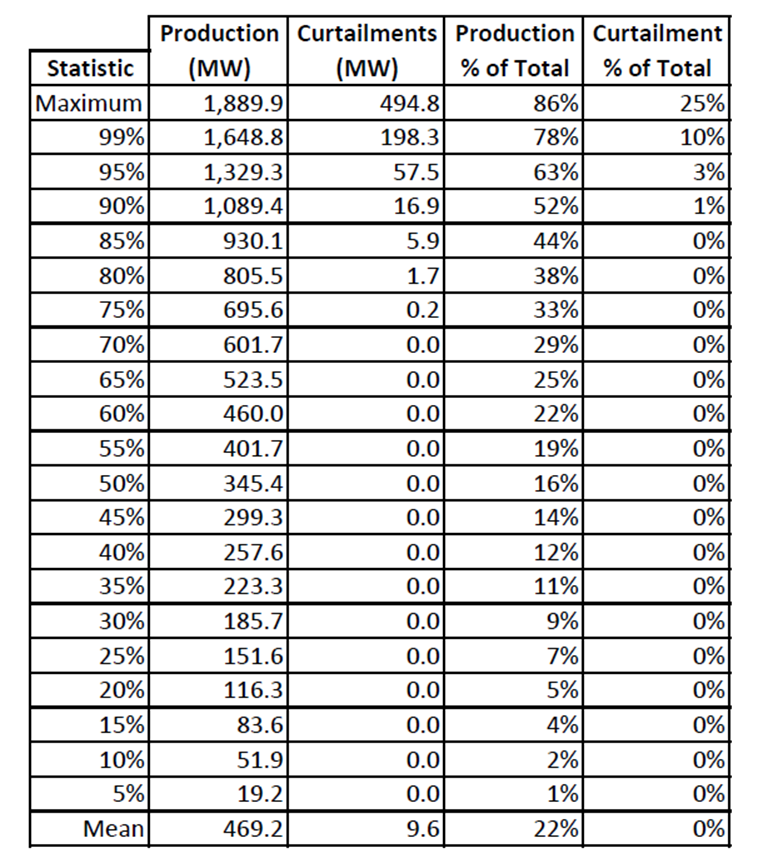
In May 2022 I published Climate Act and New York State 2021 Wind Resources that evaluated New York State onshore wind availability.  I used a New York Independent System Operator (NYISO) resource that provides 2021 wind production and 2021 wind curtailment.  The data sets list the hourly total wind production and curtailments for the entire New York Control Area (NYCA).  I have summarized the data in the following table.  Curtailments are those hours when the system load is small enough that wind production is greater than what is needed so the wind power is curtailed, i.e., not used. 

Table 1: NYISO 2021 Hourly Wind Production at the Aggregated NYCA-Wide Level

These data are representative of every wind energy resource data set I have ever seen.  See, for example, analyses for Belgium by Michel at the Trust Yet Verify website or for Australia by Anton Lang.  The crux of the problem is that low-energy density wind resources are highly correlated across wide areas.  Across New York, and other regions, the wind speeds drop across the entire area frequently.  Frequently, as in every time a high-pressure system crosses over the area.  As a result, the mean annual average availability for all the NYCA onshore wind turbines is only 22% and the median is 16%. 

Moreover, I believe it is unlikely that additional sources in a region will change the availability much.  I do not expect any significant change to the low-end onshore wind numbers when all the land-based wind resources proposed to meet the Climate Act net-zero transition are developed.  The overall distribution of expected offshore wind will be similar although the numbers will show slightly higher availability. 

Implications

Wind variability has implications on the use of wind energy to replace firm dispatchable generation.  I use these data as a starting point for this analysis to explain why the fact that the wind is always blowing somewhere does not mean it can be used cost-effectively to replace dispatchable fossil-fired generating in an electric grid that relies on wind and solar as claimed by Dr. Howarth and others.

To estimate the wind resources needed to replace New York City’s 9,026 MW of existing fossil-fired generation I will use the distribution of New York land-based wind with the following assumptions.  In the absence of offshore observed wind energy historical data, I assumed that the wind production would be increased by a five-percentile category from the onshore wind distributions.  In other words, when the onshore wind is at the 75% percentile capacity availability level, I assumed that offshore wind resources are at the 80% capacity level. 

Table 2 estimates the amount of land-based or offshore wind capacity from the New York Control Area necessary to replace  New York City’s 9,026 MW fossil capacity.  Because the observed wind production capability at the 99th percentile is 78%, 11,563 MW of wind turbine capacity are needed (9,026 divided by 78%) to assure replacement of the existing fossil-fired units in New York City.  For reliability support the wind resources must be able to cover all the levels of wind resource availability.  Half of the time (50th percentile) 55,068 MW of capacity would be needed.  In order to ensure reliability, wind capacity must be available at all hours but the wind capacities at the lower end of the distribution are unrealistic so a system dependent upon only wind energy is going to have to go wherever the wind is blowing.  The proponents of the wind is always blowing somewhere respond that all New York must do is to import electricity from outside the NYCA to address this but have not used this kind of distribution to determine how much, from how far, would be necessary

Table 2: NYCA Wind Capacity Support Requirements to Replace NYC Fossil – 9,026 MW

To determine how much wind capacity is needed outside of New York, I first determined the

potential wind energy availability within the New York Control Area (NYCA).  For capacity potential I used the larger capacity projections for land-base and offshore wind from two different modeling analyses.  The offshore wind capacity (MW) in the Integration Analysis Scenario 2: Strategic Use of Low-Carbon Fuels was 12,675 MW.  The onshore wind capacity in the NYISO  2021-2040 System & Resource Outlookwas 19,087 MW. Table 3 uses those resource projections to provide estimates of the available energy in the NYCA at each resource potential level.  For each percentile I calculated the available capacity at each percentile for on-shore and offshore wind, summed them, and listed the deficit if the sum was less than 9,026 MW.  For this thought experiment, the projected wind resources can replace the fossil resources up to the 70th percentile if all the wind power can be dedicated just to New York City at the hour when 9,026 MW of wind capacity is needed in the City.  This means that somewhere between 65% and 70% of the time, wind resources outside the NYCA must provide additional power to replace New York City’s existing fossil resources.

Table 3: NYCA Wind Energy Available from Climate Act Wind Resource Projections

Table 4 provides an estimate of the wind generated capacity available to cover the deficit margin in Table 3 outside the control area in an area similar in size and characteristics to the NYCA 500 miles away from New York City.  For this thought experiment I assumed that the wind capacity at any hour in this region would be at a production percentile 25% higher than the corresponding NYCA percentile.  I believe that there is higher level of spatial correlation than those who believe that the wind is always blowing somewhere acknowledge.  In this example, when NYCA wind levels are at the 65th percentile I presume that 500 miles away the wind resource will be at the 90th percentile. Because I believe that wind in all regions of a similar size to New York will exhibit the same wind distribution pattern, a key takeaway is that wind resources 500 miles away are insufficient to always provide support when power outside the NYCA is needed.  The 500-mile resources only cover the NYCA deficit down to 55th NYCA percentile corresponding to the 500-mile 80th percentile.  We must go out at least another 500 miles for reliable power.

Table 4: Wind Resource Availability from 10,000 MW of Turbines 500 Miles from NYC

Table 5 provides an estimate of the additional wind generated capacity needed outside the control area in an area 1000 miles away from New York City. I assumed that the wind capacity at any hour would be at a production percentile 50% higher than the corresponding NYCA percentile.  In this example, when NYCA wind levels are at the 50th percentile I presume that 1000 miles away the wind resource will be at the maximum level of 86%.   Importantly, this assumption is the same as assuming there is no correlation between NYCA wind and 1000- mile wind.  I do assume that the correlation has the same directionality.  In other words, winds in both regions go down at the same time.  Of course, it is more complicated because “somewhere else” winds could go up when NYCA winds go down.  In order to address that issue an analysis for the entire onshore and offshore wind resource availability is needed.

The 1000-mile resource availabilities cover the NYCA deficit down to 25th NYCA percentile and the 1000-mile 75th percentile so we must go out another 500 miles to assure replacement of the existing fossil generation. 

Table 5: Wind Resource Availability from 10,000 MW of Turbines 1000 Miles from NYC

Table 6 provides an estimate of the additional wind generated capacity needed within NYCA and the 500- and 1000-mile resource areas in an area 1500 miles away from New York City. I assumed that the wind capacity at any hour would be at a production percentile 75% higher than the corresponding NYCA percentile.  In this example, when NYCA wind levels are at the 5th percentile I presume that 1000 miles away the wind resource will be at the 80th percentile.   Even the addition of these resources is insufficient to cover all the power needed by New York City existing fossil resources.  However, it is so close that adding another 1,049 MW of capacity in any of the regions would assure that New York City’s existing fossil generation could be replaced by resources where” the wind is always blowing”.

Table 6: Wind Resource Availability 1500 Miles from NYC

Discussion

The forgoing analysis confirms that the wind is indeed always blowing somewhere and that wind energy resources could replace the existing fossil generation in New York City as suggested by Howarth and others  However, just because it is possible does not mean it is feasible.  The fatal flaw is that New York City requires dedicated resources to replace existing generation when it is needed to keep the lights on.  This is particularly important because the high pressure systems that characterize low wind availability over large areas also are associated with hottest and coldest periods of the year when the electric load peaks and the need for reliable power is the greatest.

Existing fossil generation capacity in New York City totals 9,026 MW.  New York’s Climate Act projected onshore and offshore wind planned capacity is 31,762 MW.  Relying on wind only requires another 30,000 MW located “somewhere else”.  The fatal flaw to the wind blowing “somewhere else” argument for New York City is that those resources must be dedicated to New York City.  The idea that anyone could afford to build 10,000 MW and 500 mile transmission lines for use as backup that will only be used 65% of the time, another 10,000 MW and 1,000 mile transmission lines for backup 50% of the time, and another 10,000 MW with 1,00 mile transmission lines for backup 25% of the time is disconnected from reality. 

Of course, there are suggestions that the surplus power could be stored in batteries or used to make “green hydrogen” to address the low wind availability problem.  However, Howarth claimed that New York “could rapidly move away from fossil fuels and instead be fueled completely by the power of the wind, the sun, and hydro”  and that “it could be done completely with technologies available at that time (a decade ago) and that that it could be cost effective”.   This simple analysis suggests otherwise.

Conclusion

I agree with Francis Menton who has argued that we need a demonstration project to prove all the wind, solar, and energy storage components necessary for a zero-emissions electric grid that does not rely on nuclear power can work.  In addition, I believe that a comprehensive analysis of wind and solar resource availability across the continent that addresses the correlation and energy density deficiencies of wind and solar is also needed.  Based on my work, I think that this sort of analysis would show the need for far more resources than anyone is contemplating at this time.  If New York does not address these concerns correctly people will literally freeze to death in the dark.

The Climate Act Needs a Feasibility Demonstration

I have been writing about the Climate Leadership & Community Protection Act (Climate Act) for over four years and a constant theme in my work has been concerns about affordability and reliability.  For all the analyses and pontification by the State of New York about the net-zero transition, there still is no documentation describing the costs of the control strategies proposed by the Scoping Plan and estimates of how New Yorkers will pay for the transition.  The focus of this post is on reliability.  I believe that the only way we can be sure that the plans proposed to operate an electric grid that relies primarily on wind and solar is to prove it with a demonstration project.  The project should include all the key elements: wind and solar generation, energy storage, a dispatchable emissions-free resource and any other resources needed to provide necessary ancillary services.   This post highlights work by Francis Menton that advocates just such a demonstration project.

I have followed the Climate Act since it was first proposed, submitted comments on the Climate Act implementation plan, and have written over 350 articles about New York’s net-zero transition.  I have devoted a lot of time to the Climate Act because I believe the ambitions for a zero-emissions economy embodied in the Climate Act outstrip available renewable technology such that the net-zero transition will do more harm than good by increasing costs unacceptably, threatening electric system reliability, and causing significant unintended environmental impacts.  The opinions expressed in this post do not reflect the position of any of my previous employers or any other organization I have been associated with, these comments are mine alone.

Climate Act Background

The Climate Act established a New York “Net Zero” target (85% reduction and 15% offset of emissions) by 2050.  It includes an interim 2030 reduction target of a 40% reduction by 2030 and a requirement that all electricity generated be “zero-emissions” by 2040. The Climate Action Council is responsible for preparing the Scoping Plan that outlines how to “achieve the State’s bold clean energy and climate agenda.”  In brief, that plan is to electrify everything possible using zero-emissions electricity. The Integration Analysis prepared by the New York State Energy Research and Development Authority (NYSERDA) and its consultants quantifies the impact of the electrification strategies.  That material was used to develop the Draft Scoping Plan.  After a year-long review, the Scoping Plan recommendations were finalized at the end of 2022.  In 2023 the Scoping Plan recommendations are supposed to be implemented through regulation and legislation.  Over nine months into 2023 and reality is starting to set in and cast aspersions on the aspirational plans.

Demonstration Project Proposal

Last February I did a post on Climate Smart Communities and I proposed a challenge to the local governments that pledged to be climate smart.  Go for it, but not just this virtue-signaling public relations gesture to get some money.  I described Francis Menton’s article explaining that a demonstration project of a mainly renewables-based electrical grid is a common sense prerequisite before there are any more plans or pledges.  I said that Climate Smart Communities of New York should prove their bona fides and develop a demonstration project for their community to address the issues he raised:

Could anybody possibly be stupid enough to believe the line that wind and solar generators can provide reliable electricity to consumers that is cheaper than electricity generated by fossil fuels? It takes hardly any thought about the matter to realize that wind and solar don’t work when it is calm and dark, as it often is, and particularly so in the winter, when it is also generally cold. Thus a wind/solar electricity system needs full backup, or alternatively storage — things that add to and multiply costs. Surely, our political leaders and top energy gurus are fully aware of these things, and would not try to mislead the public about the cost of electricity from a predominantly wind/solar system.

……………..

Nobody would be happier than me to see a demonstration project built that showed that wind and solar could provide reliable electricity at low cost. Unfortunately, I know too much about the subject to think that that is likely, or even remotely possible. But at least the rest of us need to demand a demonstration project from the promoters of these fantasies.

A few days ago Menton followed up on his February post with What Passes For A “Demonstration Project” Among Our Government Geniuses.  I recommend readers check out both articles.  I will summarize the key points from the more recent article here.

Menton describes people who don’t support the need for an encompassing fossil-fuel-free renewable grid demonstration project.  Government officials and green energy advocates won’t support this because:

(1) they are not bright enough to understand the subject, or (2) their understanding is impaired because they are too blinded by religious fervor to “save the planet,” or (3) they are intentionally deceiving the public to make money or fame or career advancement for themselves. Or it could be all three!

Instead of a single comprehensive demonstration, net-zero proponents promote projects that only “attempt to demonstrate various portions of the full system that would be needed to provide reliable 24/7/365 electricity from predominantly wind and solar generation.”  I believe a common problem of all the “green” energy solutions is that they do not work all the time and renewable resource availability is correlated over large distances which makes demonstrations of individual components worthless.

Menton agrees and describes the example of the latest news on energy storage. He explain that on October 13, the Department of Energy announced big new grants and subsidies for a series of what they call “hydrogen hubs.” Here is a report from E&E News Energy Wire. Excerpt:

The Department of Energy on Friday announced seven projects that will receive $7 billion to build landmark hydrogen hubs, delivering a major boost to a nascent U.S. industry. The long-awaited move is a key piece of the Biden administration’s climate agenda. On Friday, the White House said it expects the DOE funding to help cut 25 million metric tons of carbon dioxide annually, roughly equivalent to removing 5.5 million gasoline-powered vehicles from the road each year. “With this historic investment, the Biden-Harris administration is laying the foundation for a new, American-led industry that will propel the global clean energy transition,” said Secretary of Energy Jennifer Granholm.

The New York placeholder for dispatchable emissions-free resources is “green” hydrogen.  Menton explains that according to this further piece from Energy Wire on August 21, the Biden Administration has set a goal of having the U.S. produce 10 million metric tons of “green” hydrogen (by electrolysis from water) by 2030. The E&E piece states that the massive funding for “hydrogen hubs” is for “demonstrations.”  He points out that this is not the demonstration project needed to prove viability of the net-zero transition because the demonstrations focus on production, storage, transport and consumption but not the integrated resource necessary.  He notes:

They are clearly leaving out the critical piece of the puzzle, which is the demonstration of how much of this hydrogen, and capacity to make more of it, will be needed, and at what cost, to get the country — or even some small town — through a full year (or two or five) without need for fossil fuel backup. That completely obvious elephant is not part of this multi-billion dollar “demonstration.”

Another dispatchable emissions-free resource for New York’s net-zero transition could be long duration energy storage. Menton notes that the Department of Energy has a “separate big bucks effort called the “Long Duration Storage Shot” that is throwing bucketsful of cash at various research efforts into batteries.”  Unfortunately, he notes:

The battery efforts are even farther removed from any relevant demonstration project. From DOE’s opening webpage describing that initiative (with a date of September 2021):

The U.S. Department of Energy’s (DOE) Energy Earthshots Initiative aims to accelerate breakthroughs of more abundant, affordable, and reliable clean energy solutions within the decade. Achieving the Energy Earthshots will help America tackle the toughest remaining barriers to addressing the climate crisis, and more quickly reach the Biden-Harris Administration’s goal of net-zero carbon emissions by 2050 while creating good-paying union jobs and growing the clean energy economy. . . . The Long Duration Storage Shot establishes a target to reduce the cost of grid-scale energy storage by 90% for systems that deliver 10+ hours of duration within the decade.

On September 22, 2023 the Administration announced some $325 million for “15 projects across 17 states and one tribal nation” to “accelerate the development” of these “long duration” battery technologies. He writes:

So are these battery technologies, or any one of them, even a potential solution to the problem of making a mostly wind/solar electricity grid work without fossil fuel backup? Again, you will not find any mention at those links, or at other government or advocate sites discussing the issue of how many of these batteries would be necessary and at what cost to actually fully back up a predominantly wind/solar grid and make it into a functional 24/7/365 electricity system.

I cannot over-emphasize how challenging these two technologies are.  I fear that some aspects of some of these demonstrations will be deemed a success which will be used to argue that the concerns of  organizations responsible for keeping the lights on and skeptical technical experts who have no vested interests in the green energy scam are unwarranted.  Theory, small prototype tests, and these demonstration projects all will not prove the feasibility of a fully-functioning wind/solar/hydrogen storage 24/7/365 electricity grid.

Another aspect of this is that until we have a proof-of-concept demonstration that incorporates all the components needed to get to a reliable system, we cannot know how much it will cost.  Menton argues that a rough cost estimate  “would come to a multiple (not necessarily a huge one, but nonetheless a multiple) of what our current electricity system costs.”  He does not bother to make an estimate writing:

The reason I’m not going to do it is that there as an obvious fact that tells you all you need to know, which is that no one in the country is spending their own private money to build out this system. They are all waiting for the government handouts. If this system could be built profitably at a cost competitive with what we have, there would be investors falling all over themselves to build it. When Thomas Edison built his first electricity plant, he did not go to the government for handouts to build it.  Because this is all a fantasy kept alive by government handouts, as soon as the handouts go away or even slow down, the whole thing will dry up and fade away.

Conclusion

We do not know if the net-zero transition is technically possible.  All we have is assurances from vested interests and slick marketing claims from the state.  Richard Feynman said “For a successful technology, reality must take precedence over public relations, for Nature cannot be fooled.”  Before New York goes any further, a comprehensive demonstration project for a smaller jurisdiction is the pragmatic approach.

Offshore Wind Lulls and Energy Storage Conundrum

A recent article by Ed Reid prompted me to put together this post.  Reid compared different Offshore Wind (OSW) developer estimates of the capacity factor of a couple of projects and found inconsistencies.  This article compares his results with Climate Leadership & Community Protection Act (Climate Act) OSW projections.  I also address energy storage implications associated with OSW.

I have followed the Climate Act since it was first proposed, submitted comments on the Climate Act implementation plan, and have written over 350 articles about New York’s net-zero transition.  I have devoted a lot of time to the Climate Act because I believe the ambitions for a zero-emissions economy embodied in the Climate Act outstrip available renewable technology such that the net-zero transition will do more harm than good by increasing costs unacceptably, threatening electric system reliability, and causing significant unintended environmental impacts.  The opinions expressed in this post do not reflect the position of the New York State Reliability Council, the Extreme Weather Working Group, any of my previous employers or any other organization I have been associated with, these comments are mine alone.

Climate Act Background

The Climate Act established a New York “Net Zero” target (85% reduction and 15% offset of emissions) by 2050.  It includes an interim 2030 reduction target of a 40% reduction by 2030 and a requirement that all electricity generated be “zero-emissions” by 2040. The Climate Action Council is responsible for preparing the Scoping Plan that outlines how to “achieve the State’s bold clean energy and climate agenda.”  In brief, that plan is to electrify everything possible using zero-emissions electricity. The Integration Analysis prepared by the New York State Energy Research and Development Authority (NYSERDA) and its consultants quantifies the impact of the electrification strategies.  That material was used to develop the Draft Scoping Plan.  After a year-long review, the Scoping Plan recommendations were finalized at the end of 2022.  In 2023 the Scoping Plan recommendations are supposed to be implemented through regulation and legislation. 

Off Shore Wind (OSW) is supposed to be a major renewable resource in the “zero-emissions” electric energy system.  The Climate Act mandates 9,000 MW of Off Shore Wind (OSW) generating capacity by 2035.  The Integration Analysis modeling used to develop the Scoping Plan projects OSW capacity at 6,200 MW by 2030, 9,096 MW by 2035 and reaches 14,364 MW in 2040.  On the other hand, the New York Independent System Operator 2021-2040 System & Resource Outlook expects 5,036 MW in 2030 and 9,000 MW in 2035 with no additional development after that.  By 2030 the Integration Analysis predicts that 14% of the electric energy (GWh) produced will come from OSW and the Resource Outlook predicts nearly as much (12%).  This is an extraordinary build-out for a resource that is currently non-existent. 

Capacity Factors

The capacity factor is a useful metric to understand and compare electric generation resources.  The annual capacity factor equals the actual observed generation (MWh) divided by maximum possible generation (capacity (MW) times 8,760 hours.  At sea the wind resource higher capacity factors are higher than onshore wind resources, primarily because there are no hills and vegetation to slow down wind.  Supporters of OSW tout the higher capacity factors of this resource as a big benefit. 

Ed Reid writing at The Right Insight describes issues with Offshore Wind (OSW) data used for claiming benefits.  Reid described developer claims for two projects:

Orsted’s recently approved Ocean Wind 1 development, to be located off the New Jersey coast near Atlantic City and Ocean City, would consist of one hundred 11MW wind turbine generators, for a total capacity of 1,100 MW. This would suggest annual generation, at a 100% capacity factor, of 9,600 GWh. The International Energy Agency uses a capacity factor of 50% for offshore wind. We will use that figure here, since there is no offshore wind capacity factor data for the US East Coast. This suggests annual production of approximately 4,800 GWh for Ocean Wind 1.

……………………..

Dominion Energy’s proposed Coastal Virginia Offshore Wind (CVOW) development, to be located off the Virginia coast near Norfolk, would consist of one hundred seventy-six 15 MW wind turbine generators, for a total capacity of 2,600 MW. This would suggest annual generation, at a 100% capacity factor, of approximately 22,800 GWh, or approximately 11,400 GWh at a 50% capacity factor.

The US Energy Information Administration reports average US residential electricity consumption as 10,600 kWh per year.  The developers describe the output of their projects in terms of the number of homes served. Reid estimates capacity factors for both projects using that information. Orsted projects that Ocean Wind 1 would serve 500,000 homes. Based on these numbers, Ocean wind would have to generate 5300 GWh per year, or a capacity factor of approximately 55%. Dominion projects that CVOW would serve 660,000 homes. Using the same approach, the annual capacity factor of the Dominium CVOW would be 30%.  Thar is far lower than the IEA figure.

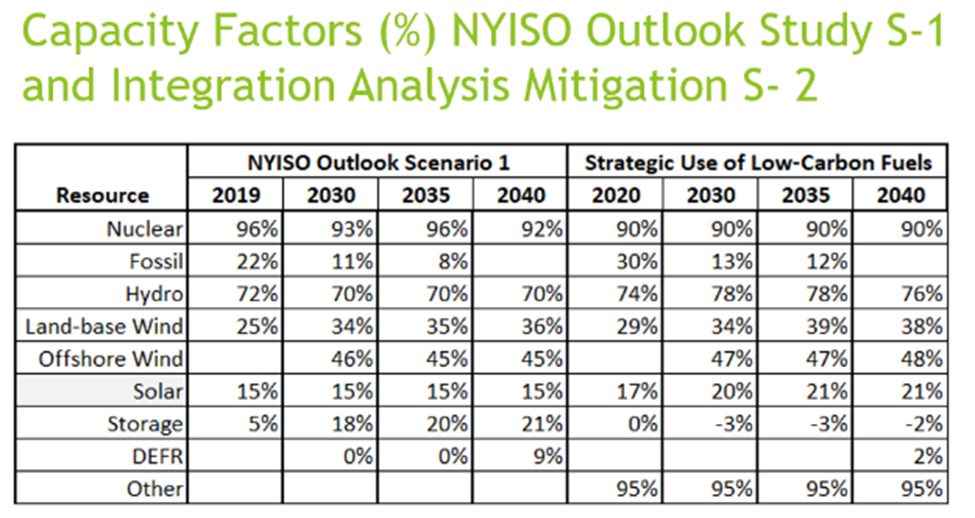
I compared the New York Independent System Operator (NYISO) 2021-2040 System & Resource Outlook  modeling analysis with the Integration Analysis modeling and determined the capacity factors used.  The following table lists the capacity factors for different generating resources including offshore wind.  There is no question that OSW resources have higher capacity factors than onshore wind or solar. The NYISO annual projections are around 45% while the Integration Analysis projects slightly higher estimates no greater than 48%  These estimates are closer to the International Energy Agency capacity factor of 50% than either Ocean 1 or CVOW.  Note that the renewable resources capacity factors represent the best they can do but that the fossil capacity factor is low because, in part, they are displaced by wind and solar.  

Estimates and Averages

Reid describes average estimates used for the OSW developer claims:

The estimates above are based on a number of averages: average wind resource; average capacity factor; average maintenance and repair allowances; and, average residential electricity consumption. The available wind resource varies on time scales from minutes to hours to days to seasons, as does residential energy consumption and demand. The use of averages loses a lot of the detail of the match between customer load and generator output.

He explains that intermittent generation from wind turbines shifts the resources used in the grid:

Since each of these industrial wind installations would be connected to a grid with a far larger customer base than the claimed number of residential customers served, above average output would be absorbed by other loads on the grids, displacing a portion of the output from some form(s) of conventional generation. Below average generator output would require support from some form(s) of conventional generation.

In my opinion, the intermittency of wind and solar projects should be addressed by the developer.  As it stands now somebody else must provide supporting conventional generation or energy storage so wind and solar get a free ride.  Reid explains the problem:

Arguably, fluctuations in generator output and customer load could also be compensated for by additions to and withdrawals from some type of energy storage capacity. However, there is no energy storage capacity included in either of the wind projects discussed above. The issue of storage can be deferred as long as there is sufficient excess conventional generating capacity available to compensate for the fluctuation of the output of the wind facilities and maintain a capacity reserve margin. However, as conventional generating capacity is retired due to age or regulation, and additional intermittent renewable generating capacity is added, addressing the issue of storage cannot be avoided.

Extremes

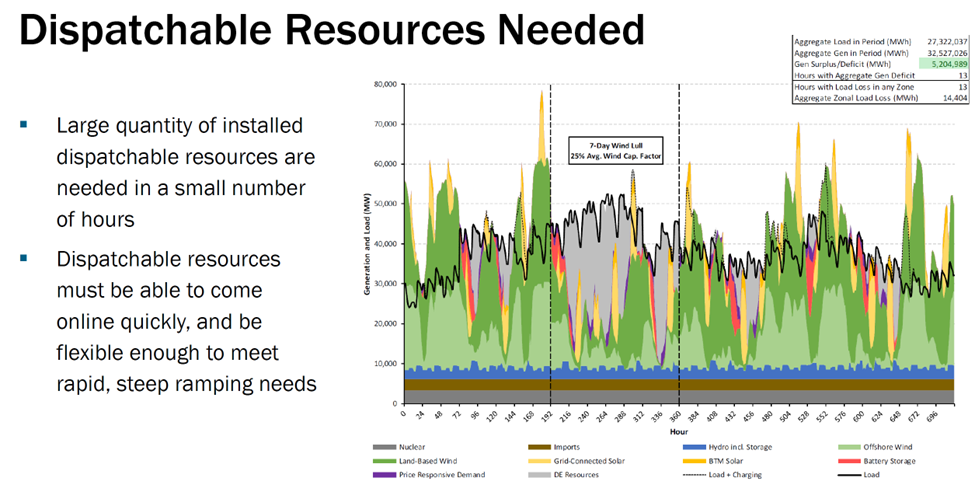
All issues related to the net-zero transition are more complicated than expected at first glance.  In order to address this complexity, more explanation and analysis are required.  For example, in this instance Reid wrote a short article addressing average fluctuating wind resources.  He did not call out the extreme case when the wind resource is essentially zero for extended periods probably because it would have made the story too long.  However, I think this is a critical consideration.  Since the beginning of the Climate Act implementation process, lulls of renewable energy production, what I call the ultimate problem, has been a concern.

In their presentation to the Power Generation Advisory Panel on September 16, 2020 Energy + Environmental Economics (E3) noted that: “The need for dispatchable resources is most pronounced during winter periods of high demand for electrified heating and transportation and lower wind and solar output”.  They also noted that: “As the share of intermittent resources like wind and solar grows substantially, some studies suggest that complementing with firm, zero emission resources, such as bioenergy, synthesized fuels such as hydrogen, hydropower, carbon capture and sequestration, and nuclear generation could provide a number of benefits.”  Of particular interest is the graph of electric load and renewable generation because it shows that this problem may extend over multiple days.

Since the time of this presentation, the New York State Independent System Operator (NYISO), New York State Reliability Council, and Public Service Commission in the Order Initiating Process Regarding Zero Emissions Target in Case 15-E-0302 all have been considering the ramifications of this problem.  The New York State Reliability Council Extreme Weather Working Group (EWWG) was established to “identify actions to preserve New York Control Area reliability for extreme weather events and other extreme

system conditions” and create a corresponding action plan to “evaluate the potential need for

new resource adequacy and transmission planning design rules for planning the system to meet

extreme weather and other extreme conditions.”  Wind lulls are one of the extreme weather events being considered by the EWWG.

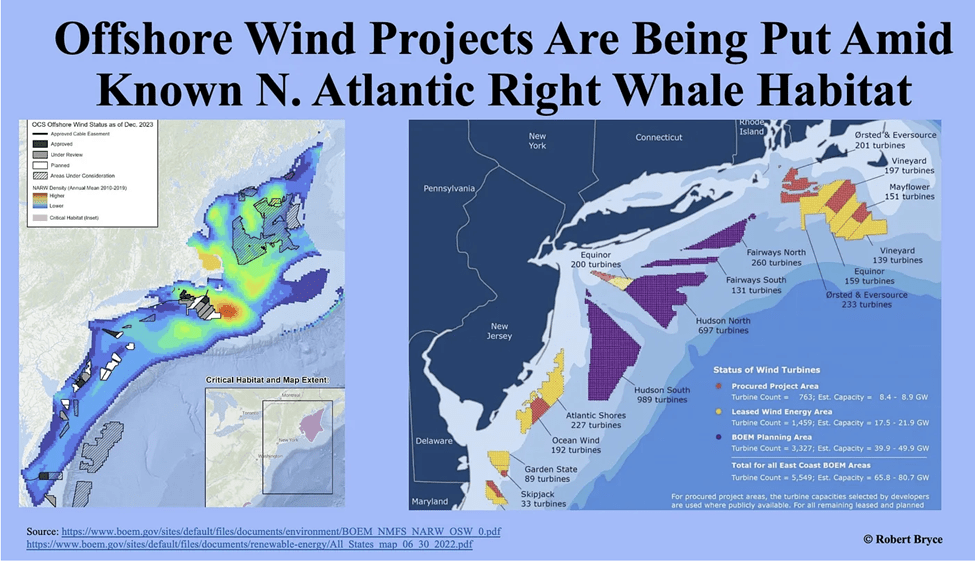
The EWWG looked at the observed correlation of the frequency and duration of low-wind episodes across the entire state, including the offshore wind development areas.  This summer they finalized a report titled Off Shore Wind Data Review – NYSRC Preliminary Findings (“OSW Report”) that is relevant to this discussion.  The OSW Report analysis was based on an NYISO analysis that made available 21 years of hourly wind data at seven wind development sites (Figure 1), extending from New Jersey to Rhode Island, prepared by its consultant DNV. DNV performed analysis of wind data translating meteorological data into detailed power profiles for each site including loss considerations.  The report describes frequency analysis and interregional impacts.

Figure 1: Seven Wind Development Sites Analyzed

The OSW Report wind lull analysis is relevant to this discussion.  The analysis defined wind lulls as periods of each hour of wind output of less than 5%-20%.  For extended periods of 24 hours or longer, lulls occur about 30 times per year on average. Wind lulls of 48 hours or longer occur on average about seven times per year, and wind lulls of 72 hours or longer occur on average two times per year.  About 70% of these wind lulls over the 21-year period occurred during the current peak load four-month summer period from June to September.

Of note, is the following finding:

Lastly an analysis was performed to identify the most persistent wind lull experienced in the 20-year wind data with net capacity factor less than 10% for the entire period across all seven wind sites. Analysis indicates wind lulls of up to 86 hours with an average energy output of approximately 5% net capacity factor occurring across all seven sites were observed in the DNV dataset (this compares to an average annual net capacity factor of approximately 45%). While data associated with longer periods than 21 years were not readily available it may be appropriate to characterize this as a 1 in 20 year extreme weather event.

Reid explained that compensating load can be provided by adjoining transmission operators.  This report addresses this concern relative to the OSW resource:

NY relies on emergency assistance from neighboring regions to achieve reliable system design, thus continued availability of surplus power from these areas is an important consideration. Similar to NY, policy makers from PJM and New England are also moving forward with policies to install large scale wind power to address decarbonization and planned shutdown of thermal units, with proposals in each region also totaling tens of thousands of MW. As noted in Section 3.0, OSW off the coast of the state of New Jersey is targeted at 7.5 GW by 2035 increasing to 11.0 GW by 2040, and similarly OSW off the coast of Rhode Island/ Massachusetts is targeted at 8.0 GW by 2035. In total PJM member States have announced off shore wind targets totaling 24 GW by 2035, and 32.7 GW by 2040.

The OSW Report compares the output from all seven wind sites during an interregional wind lull event which occurred August 8, 2017 – August 13, 2017.  Over that time period the following graph shows that the fraction of wind output from all the sites clearly correlates.  The implication is that compensating load will not be available from adjoining transmission operator’s OSW resources in periods like this.

The OSW Report concludes:

It is noted reliability of the traditional interconnected power system design relies on diversity of forced outage rates and independence of outage events. Correlation of interregional wind lulls eliminates diversity of loss of power output events associated with OSW and alters this aspect of system design.

Interregional wind lulls simultaneously impacting tens of thousands of MWs of interregional OSW located in PJM, NY and NE could reduce reserve sharing and emergency assistance available for support from neighboring control areas significantly impacting operational reliability and resource adequacy.

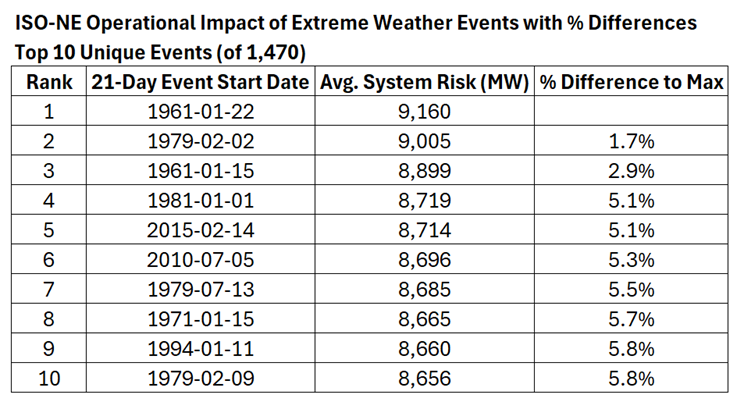
The most important point of this article is that the OSW Report documents correlation of interregional wind lulls.  I believe this problem extends to onshore and wind and solar resources.  I have looked at enough New York onshore wind data to be certain that this correlation extends to all the onshore wind resources in New York and adjoining regions.  When it comes to solar, cloudiness affecting New York State solar may not be as highly correlated with wind but at night every single solar facility will not be producing any power. 

One of the challenges faced by the EWWG is trying to determine the worst-case renewable resource lull.  NYISO has had DNV do a similar analysis for onshore wind and solar resources in New York using the same 21-year data set.  Metrological experts on the EWWG have suggested using as long an input meteorological dataset as possible for an analysis to obtain a fuller understanding of range and return period of events. 

Finally, there is one more complication.  The meteorological conditions that lead to the lowest wind resource availability are associated with the coldest and hottest periods of the year.  Those periods cause the peak annual loads.  Wind and solar may provide power most of the time but when electricity is needed the most, they are expected to provide their lowest output.  I think this is an enormous challenge to the proposed “zero-emissions” electric grid that can only be addressed by using nuclear power.

Energy Storage Implications

To always provide reliable electricity, energy storage is needed to cover periods when solar and wind are not available.  Obviously, energy storage is needed to cover the daily variation of solar.  Energy storage duration is not a large issue for this requirement.  On the other hand, there is a seasonal variation of solar irradiance and resulting power output that needs a long-duration storage solution.   There are no commercially available long-duration storage systems that can be expanded to meet New York’s requirements.  There are also seasonal variations in wind resource availability that require a long duration system.  The biggest problem is the worst-case renewable resource lull.  The EWWG analysis found a one in twenty-year resource deficiency which is something that no long-duration storage system could ever effectively address. 

There are serious energy storage technological hurdles that have not been resolved.  Francis Menton writing at the Manhattan Contrarian summarizes energy storage problems in a recent post on a new British Royal Society report “Large-scale energy storage.”  Menton explains (my emphasis added):

Having now put some time into studying this Report, I would characterize it as semi-competent. That is an enormous improvement over every other effort on this subject that I have seen from green energy advocates. But despite their promising start, the authors come nowhere near a sufficient showing that wind plus solar plus storage can make a viable and cost-effective electricity system. In the end, their quasi-religious commitment to a fossil-fuel-free future leads them to minimize and divert attention away from critical cost and feasibility issues. As a result, the Report, despite containing much valuable information, is actually useless for any public policy purpose.

As noted previously wind and solar resources will be at their lowest expected availability during periods when the electric load peaks.  When heating and transportation is electrified this problem is exacerbated, peak loads will occur in the winter when solar resources are inherently low.  The Scoping Plan glossed over this challenge and nothing since directly addresses the challenge.  The rational thing to do would be to develop demonstration projects to prove feasibility and cost of the new technology needed before dismantling the current system.  Francis Menton explains why this is necessary and how it could work. 

Conclusion

Ed Reid explains how OSW developers describe the output of their projects in terms of the number of homes served.  He found issues with their calculations.  The developers ignore the support needed to provide electricity to the homes served when the wind isn’t blowing.

Supporters of OSW tout the higher capacity factors of this resource as a big benefit.  Ed Reid describes deficiencies in their arguments using average data.  This article explains that the problem becomes more acute when shorter-term extended renewable resource lulls are considered.  OSW will perform better than other renewable resources during periods when the energy is not critically needed. The conundrum is that when it is needed most,  OSW will fail at the same time New York’s onshore wind resources fail so an as yet commercially unavailable energy storage technology is needed.  All indications are that this problem extends into the adjoining control areas so they cannot be counted on.  Addressing this issue is a critical reliability consideration.  If not addressed correctly then the grid will fail when needed most and people will freeze to death in the dark.

New Climate Reality is Passing New York By

Note: For quite a while now I have put my Citizens Guide to the Climate Act article as the top post on the website because it summarizes the Climate Leadership & Community Protection Act (Climate Act). This post updates my current thoughts about the Climate Act and will replaces that post at the top of the list of articles on October 2, 2023

There is a new climate reality and it is passing New York by.  New York decision makers are going to have to address the new reality that proves that the Hochul Administration’s Scoping Plan to implement the Climate Act will adversely affect affordability, reliability, and the environment.  This post highlights articles by others that address my concerns.

I have followed the Climate Act since it was first proposed, submitted comments on the Climate Act implementation plan, and have written over 350 articles about New York’s net-zero transition.  I have devoted a lot of time to the Climate Act because I believe the ambitions for a zero-emissions economy embodied in the Climate Act outstrip available renewable technology such that the net-zero transition will do more harm than good by increasing costs unacceptably, threatening electric system reliability, and have major unintended environmental impacts.  The opinions expressed in this post do not reflect the position of any of my previous employers or any other company I have been associated with, these comments are mine alone.

Climate Act Background

The Climate Act established a New York “Net Zero” target (85% reduction and 15% offset of emissions) by 2050.  It includes an interim 2030 reduction target of a 40% reduction by 2030 and a requirement that all electricity generated be “zero-emissions” by 2040. The Climate Action Council is responsible for preparing the Scoping Plan that outlines how to “achieve the State’s bold clean energy and climate agenda.”  In brief, that plan is to electrify everything possible using zero-emissions electricity. The Integration Analysis prepared by the New York State Energy Research and Development Authority (NYSERDA) and its consultants quantifies the impact of the electrification strategies.  That material was used to develop the Draft Scoping Plan.  After a year-long review, the Scoping Plan recommendations were finalized at the end of 2022.  In 2023 the Scoping Plan recommendations are supposed to be implemented through regulation and legislation. 

Climate Science

In the past several weeks there have been multiple articles highlighting issues that call into question the rationale for the Climate Act and Climate Act net-zero transition.   The rationale for the Climate Act is that there is an existential threat due to climate change.  However, the Epoch Times reports that is not a universally held position:

There’s no climate emergency. And the alarmist messaging pushed by global elites is purely political. That’s what 1,609 scientists and informed professionals stated when they signed the Global Climate Intelligence Group’s “World Climate Declaration.”

The article gives a good overview of the World Climate Declaration.  The declaration’s signatories include Nobel laureates, theoretical physicists, meteorologists, professors, and environmental scientists worldwide. The article quotes a few signatories who when asked by The Epoch Times why they signed the declaration stating that the “climate emergency” is a farce, they all stated a variation of “because it’s true.” 

In my case, I signed the Declaration because I do not think we understand natural climate variability well enough to be able to detect the effect of a relatively small change to the atmosphere’s radiative budget caused by mankind’s greenhouse gas (GHG) emissions.  There are so many poorly understood factors at play and the mathematical challenges of simulating the chaotic, non-linear processes are so immense that I think that claiming that Global Climate Models can simulate the atmosphere well enough to make major changes to the energy system of the world is absurd.

There is another important aspect.  One of the key points made in the Declaration is that climate science is overly politicized:

“Climate science should be less political, while climate policies should be more scientific,” the declaration begins. “Scientists should openly address uncertainties and exaggerations in their predictions of global warming, while politicians should dispassionately count the real costs as well as the imagined benefits of their policy measures.”

It seems to me that every day there is another mass media story attributing any extreme weather event to climate change and insinuating that the “science” has unequivocally shown that there is a link to mankind’s GHG emissions has made the weather more extreme.  The fact is that the latest research and the Intergovernmental Panel on Climate Change are finding that as Roger Pielke, Jr. explains the “projected climate futures have become radically less dire”.  He argues that the consensus has accepted a large change in expected warming due to a doubling of GHG emissions — from 4oC to 2.5oC or less.   Pielke notes that he has documented this trend  for years and has “been talking about the incredible shift in expectations for the future” recently.  Unfortunately he also notes: “Despite the growing recognition that our collective views of the future have changed quickly and dramatically, this change in perspective — a positive and encouraging one at that — has yet to feature in policy, media or scientific discussions of climate.”   He concludes “That silence can’t last, as reality is persistent.”

Affordability

I think this is the one issue that might force political change to the Climate Act net-zero transition.  A coalition of business organizations have called for a “reassessment” of how the Climate Act is being implemented highlighting current policies to determine “what is feasible, what is affordable and what is best for the future of the state.”  In response, Department of Environmental Conservation Commissioner Basil Seggos told Capital Tonight that “the costs of inaction are much higher.”  He goes on: “Listen, we know from two years of very intensive research that the cost of inaction on climate in New York far exceeds the cost of action by the tune of over $100 billion”I disagree.

The Scoping Plan that documents this claim by Seggos has been described as “a true masterpiece in how to hide what is important under an avalanche of words designed to make people never want to read it”.  No where is this more evident than in the tortuous documentation for this cost claim.  I documented the issues with costs and benefits in my  comments (social cost of carbon benefits, Scoping Plan benefits, and electric system costs).  In brief, the Hochul Administration has never provided concise documentation that includes the costs, expected emission reductions and assumptions used for the control strategies included in the Integration Analysis documentation making it impossible to verify their assumptions and cost estimates. 

The claim that the costs of inaction are more than the costs of action compares real costs to New Yorkers relative to societal benefits that can be charitably described as “biased high” or more appropriately “cherry picked” to maximize alleged benefits and, more importantly, do not directly offset consumer costs.  The benefits claimed are also poorly documented, misleading and the largest benefit is dependent upon an incorrect application of the value of carbon.  The plan claims $235 billion societal benefits for avoided greenhouse gas emissions.  I estimate those benefits should only be $60 billion.  The Scoping Plan gets the higher benefit by counting benefits multiple times.  If I lost 10 pounds five years ago, I cannot say I lost 50 pounds but that is what the plan says.  The cost benefit methodology was duplicitous because the cost comparisons were relative only to Climate Act requirements that did not include “already implemented” programs.  For example, this approach excludes the costs to transition to electric vehicles because that was a requirement mandated before the Climate Act.  I maintain that the total costs to transition to net-zero should be provided because that ultimately represents total consumer costs.  

It is also frustrating that the State ignores that other jurisdictions are finding costs are an issue.  In a recent article I noted that the Prime Minister of Great Britain, Rishi Sunak, said he would spare the public the “unacceptable costs” of net zero as he scaled back a string of flagship environmental policies. The fact is that every jurisdiction that has tried to transition away from fossil-fueled energy has seen a significant increase in consumer costs.  For example, Net Zero Watch recently published a report that describes six ways renewables increase electricity bills that makes that inevitable.   The article explains:

In order to reduce bills, a new generator generally has to force an old one to leave the electricity market — otherwise there are two sets of costs to cover. But with wind power, you can’t let anything leave the market, because one day there might be no wind.

The article goes on to explain that as well as adding excess capacity to the grid, renewables also have a series of other effects, each of which will push bills up further:

Renewables need subsidies, they cause inefficiency, they require new grid balancing services that need to be paid for; the list of all the different effects is surprisingly long. There is only one way a windfarm will push your power bills, and that’s upwards.

Reliability

Another flawed aspect of the Climate Act narrative is that a transition to a zero-emissions electric system is straight-forward and there are no significant technological challenges.  Terry Etam summed up the issues evident in the German transition that will also occur in New York.  In an article about the ramifications of the energy requirements for implementing artificial intelligence applications, he argued that the fossil-fired energy growth in the developing nations has been discouraged by the G7 nations.  However, those nations are pushing back on anything that is not in their best interests.  He writes:

The second big tectonic shift was on full display at the recent G20 summit. The African Union was admitted as a member, which was kind of a big deal, particularly for Africa, but also for the world in general. The addition acknowledges that other voices need to be on the world stage, a sense of humility the G7 has long lacked. The final communique issued at the end of the G20 summit included doses of common sense lacking from typical utterances of the G7: “We affirm that no country should have to choose between fighting poverty and fighting for the planet…It is also critical to account for the short-, medium-, and long-term impact of both the physical impact of climate change and transition policies, including on growth, inflation, and unemployment.” 

Contrast that with the west’s bizarre self-lobotomization when it comes to energy, as best personified by the entity furthest along the rapid-transition path, Germany: the dwindling economic powerhouse is chained to a green freight train it insists is under control, has shut down nuclear power plants with no low-emissions baseload to replace it, and in a final stunning swan dive to the pavement, is orchestrating the installation of 500,000 heat pumps per year to the grid, which will be in most demand in cold weather and will perform worst in cold weather, and will add a potential 10 gigawatts of cold-weather demand at the very instant the grid is least able to afford it, and for which there is no supply available anyway. A German energy economic university think tank says the additional cold-weather demand could only be met by new gas-fired power plants, which are not being built. In sum: Germany has shuttered its cleanest, most reliable energy; it has or is trying to banish hydrocarbons and replace them with intermittent power; and finally, is hastening adoption of devices that will function very well in 80 percent of conditions when it doesn’t matter much but will fail in a spectacularly deadly way at the point in time when they are needed the very most, because heat pumps will be turned up to 11 at the very time the grid will be the most taxed. German engineering isn’t what it used to be.

In the last several years I have concluded that intermittency of wind and solar is the fatal flaw for that technology.  The most important consideration is the need for energy storage.  Francis Menton writing at the Manhattan Contrarian summarizes energy storage problems in a recent post on a new British Royal Society report “Large-scale energy storage.”  This report suffers from the same problems afflicting the Climate Act Scoping Plan.  Menton explains:

Having now put some time into studying this Report, I would characterize it as semi-competent. That is an enormous improvement over every other effort on this subject that I have seen from green energy advocates. But despite their promising start, the authors come nowhere near a sufficient showing that wind plus solar plus storage can make a viable and cost-effective electricity system. In the end, their quasi-religious commitment to a fossil-fuel-free future leads them to minimize and divert attention away from critical cost and feasibility issues. As a result, the Report, despite containing much valuable information, is actually useless for any public policy purpose.

I believe that the insurmountable problem with energy storage backup for wind and solar is worst-case extremes.  The Royal Society report notes that “it would be prudent to add contingency against prolonged periods of very low supply”.  This contingency is the theoretical dispatchable emissions-free resource that the Integration Analysis, New York State Independent System Operator, New York State Reliability Council, and Public Service Commission in the Order Initiating Process Regarding Zero Emissions Target in Case 15-E-0302 all acknowledge is necessary.  Incredibly, the loudest voices on the Climate Action Council clung to the dogmatic position that no new technology like this resource was necessary and excluded any consideration of a backup plan to address the contingency that a not yet commercialized technology might never become commercially viable and affordable.

If New York State were to embrace nuclear energy, then there might be a chance to significantly reduce GHG emissions without affecting reliability.  Instead, the Scoping Plan placeholder option for this resource is green hydrogen.  Menton describes the hydrogen option proposal in the Royal Society report:

Since hydrogen is the one and only possible solution to the storage problem, the authors proceed to a lengthy consideration of what the future wind/solar/hydrogen electricity system will look like. There will be massive electrolyzers to get hydrogen from the sea. Salt deposits will be chemically dissolved to create vast underground caverns to store the hydrogen. Hydrogen will be transported to these vast caverns and stored there for years and decades, then transported to power plants to burn when needed. A fleet of power plants will burn the hydrogen when called upon to do so, although admittedly they may be idle most of the time, maybe even 90% of the time; but for a pinch, there must be sufficient thermal hydrogen-burning plants to supply the whole of peak demand when needed.

The Scoping Plan proposal is slightly different.  It envisions that the electrolyzers will be powered by wind and solar to create so-called “green” hydrogen.  Menton and I agree that the biggest unknown is the cost.  He raises the following cost issues:

  • How about the new network of pipelines to transport the hydrogen all over the place?
  • How about the entire new fleet of thermal power plants, capable of burning 100% hydrogen, and sufficient to meet 100% of peak demand when it’s night and the wind isn’t blowing.
  • They use a 5% interest rate for capital costs. That’s too low by at least half — should be 10% or more.
  • And can they really build all the wind turbines and solar panels and electrolyzers they are talking about at the prices they are projecting?

It gets worse in New York.  Ideologues on the Climate Action Council have taken the position that “zero-emissions” means no emissions of any kind.  They propose to use the hydrogen in fuel cells rather than combustion turbines because combustion turbines would emit nitrogen oxides emissions.  This adds another unproven “at the scale necessary” technology making it even less likely to succeed as well as adding another unknown cost.  In addition, it ignores that there are emissions associated with the so-called zero-emissions technologies that they espouse.  All they are advocating is moving the emissions elsewhere.

Environmental Impacts

I addressed the implications that the Scoping Plan only considers environmental impacts of fossil fueled energy in my Draft Scoping Plan Comments.  The life-cycle and upstream emissions and impacts are addressed but no impacts of the proposed “zero-emissions” resources or other energy storage technology are considered.  The fact is that there are significant environmental, economic, and social justice impacts associated with the production of those technologies. Furthermore, the most recent cumulative environmental impact analysis only considered a fraction of the total number of wind turbines and area covered by solar PV installations proposed in the Scoping Plan.  As a result, the ecological impacts on the immense area of impacted land and water have not been adequately addressed.

One of the more frustrating aspects of the Hochul Administration’s Climate Act implementation is the lack of a plan.  For example, consider utility-scale solar development.  There are no responsible solar siting requirements in place so solar developers routinely exceed the Department of Agriculture and Markets guidelines for protection of prime farmlands.  My solar development scorecard found that prime farmland comprises 21% of the project area of 18 approved utility-scale solar project permit applications which is double the Ag and Markets guideline. 

I am particularly concerned about environmental impacts associated with Off Shore Wind (OSW).  This will be a major renewable resource in the proposed Climate Act net-zero electric energy system.  The Climate Act mandates 9,000 MW of Off Shore Wind (OSW) generating capacity by 2035.  The Integration Analysis modeling used to develop the Scoping Plan projects OSW capacity at 6,200 MW by 2030, 9,096 MW by 2035 and reaches 14,364 MW in 2040.  I summarized several OSW issues in a recent article that highlighted an article by Craig Rucker titled Offshore Wind Power Isn’t ‘Clean and Green,’ and It Doesn’t Cut CO2 Emissions.  He explains:

A single 12 MW (megawatts) offshore wind turbine is taller than the Washington Monument, weighs around 4,000 tons, and requires mining and processing millions of tons of iron, copper, aluminum, rare earths and other ores, with much of the work done in Africa and China using fossil fuels and near slave labor.

Relying on wind just to provide electricity to power New York state on a hot summer day would require 30,000 megawatts. That means 2,500 Haliade-X 12 MW offshore turbines and all the materials that go into them. Powering the entire U.S. would require a 100 times more than that. 

These numbers are huge, but the situation is actually much worse.

This is because offshore turbines generate less than 40% of their “rated capacity.” Why? Because often there’s no wind at all for hours or days at a time. This requires a lot of extra capacity, which means a lot more windmills will have to be erected to charge millions of huge batteries, to ensure stable, reliable electricity supplies.

Once constructed, those turbines would hardly be earth or human friendly, either. They would severely impact aviation, shipping, fishing, submarines, and whales. They are hardly benign power sources.

The environmental impacts on whales of the OSW resources necessary to meet the net-zero transition are especially alarming.  Earlier this year I described the Citizens Campaign for the Environment virtual forum entitled Whale Tales and Whale Facts.  The sponsors wanted the public to hear the story that there was no evidence that site survey work was the cause of recent whale deaths.  I concluded that the ultimate problem with the forum was that they ignored the fact that construction noises will be substantially different than the ongoing site surveys and will probably be much more extensive when the massive planned construction starts.  The virtual forum noted a lack of funding for continued monitoring necessary to address the many concerns with massive offshore wind development to allay the concerns of the public.   Since then, the Save Right Whales Coalition (SRWC) has found issues with the incidental harassment of whales associated with the noise levels associated sonar surveys done in conjunction with OSW development.  I am very disappointed that the Hochul Administration is not investing in an adequate monitoring program that confirms that whales are not being harmed. 

Conclusion

This article was intended to summarize my current concerns about the impacts of the Climate Act transition on affordability, reliability, and the environment.  There is a growing realization that the alleged problem of global warming is not as big a threat as commonly assumed. Combined with the fact that New York GHG emissions are less than one half of one percent of global emissions and global emissions have been increasing on average by more than one half of one percent per year since 1990 the rationale for doing anything is weak.  It may not mean that we should not do something, but clearly we have time to address the affordability, reliability and environmental impact issues.

The Scoping Plan has not provided comprehensive and transparent cost estimates so New Yorkers have no idea what this will cost.  I explained why the Hochul Administration claim that the costs of inaction are more than the costs of action is misleading and inaccurate.  I believe that all New Yorkers should let it be known that they need to know the expected costs so they can determine if they support the transition.

When the energy system becomes all-electric the reliability of the electric system will be even more critical than today.  The State plan is to proceed as if there are no implementation issues.  The rational thing to do would be to develop demonstration projects to prove feasibility and cost of the new technology needed before dismantling the current system.  Francis Menton explains why this is necessary and how it could work.  There is no sign that is being considered.

It is particularly galling that organizations who claim to be in favor of a better environment have failed to support comprehensive cumulative environmental impact assessment and on-going impact monitoring assessment to potential impacts from wind, solar, and energy storage development on the scale necessary for the net-zero transition.  Maybe they don’t want to know that the concerns are real.

Mark Twain said: “It is easier to fool someone than it is to tell them they have been fooled.”    The politicians who support the Climate Act net-zero transition have been fooled into thinking it is affordable, will not affect reliability, and benefits the environment.  Unfortunately, it is very difficult to slow down, much less stop the unfolding train wreck of these policies.  I encourage readers to keep asking for a full cost accounting of all the proposed programs as the most obvious concern.

Reliability vs. Advocacy Dogma – Climate Act Conundrum

One notable feature of New York’s Climate Leadership & Community Protection Act (Climate Act) implementation process has been the emphasis on environmental justice (EJ) for disadvantaged communities.  A dogmatic concern of New York City EJ advocacy organizations is peaking powerplants which are alleged to be a primary air quality problem in disadvantaged communities.  Unfortunately, those generating facilities fulfill a critical reliability service so the New York Independent System Operator (NYISO) has been warning that premature shutdown of the facilities will cause reliability problems.  This post highlights a relevant NYISO filing that concisely summarizes their concerns and recent comments by EJ advocates.  Get your popcorn, it will be interesting to see how this gets resolved.

I have been following the Climate Act since it was first proposed, submitted comments on the Climate Act implementation plan, and have written over 350 articles about New York’s net-zero transition.  I have devoted a lot of time to the Climate Act because I believe the ambitions for a zero-emissions economy embodied in the Climate Act outstrip available renewable technology such that the net-zero transition will do more harm than good.  The opinions expressed in this post do not reflect the position of any of my previous employers or any other company I have been associated with, these comments are mine alone.

Climate Act Background

The Climate Act established a New York “Net Zero” target (85% reduction and 15% offset of emissions) by 2050.  It includes an interim 2030 reduction target of a 40% reduction by 2030 and a requirement that all electricity generated be “zero-emissions” by 2040. The Climate Action Council is responsible for preparing the Scoping Plan that outlines how to “achieve the State’s bold clean energy and climate agenda.”  In brief, that plan is to electrify everything possible and power the electric grid with zero-emissions generating resources.  The Integration Analysis prepared by the New York State Energy Research and Development Authority (NYSERDA) and its consultants quantifies the impact of the electrification strategies.  That material was used to write a Draft Scoping Plan.  After a year-long review the Scoping Plan recommendations were finalized at the end of 2022.  In 2023 the Scoping Plan recommendations are supposed to be implemented through regulation and legislation. 

One of the implementation issues to be resolved is the subject of a New York State Public Service Commission (PSC) “Order initiating a process regarding the zero-emissions target” that will “identify innovative technologies to ensure reliability of a zero-emissions electric grid”.  The ultimate problem with wind, solar, and energy storage technologies proposed to replace fossil-fired electric generation is that they do not work all the time.  The Integration Analysis, NYISO, New York State Reliability Council, and the PSC order all recognize that a new technology is needed to support the grid during those periods.  The problem is exacerbated because the periods when wind and solar resources provide the least power are frequently the periods of highest load when peaking power plants are needed to prevent blackouts.  

Peaking Power Plants

I set up a page dedicated to this issue.  The following is a top-level summary.

In order to provide electricity to everyone who needs it when they need it the NYISO must balance power availability with the load on the system.  NYISO is responsible not only for the real-time delivery of power but also for reliability planning.  If the load did not vary, then this would be much less difficult but the reality is that load varies diurnally and seasonally.  Most important is meeting demand when loads are highest in the summer and winter because it is necessary to provide electricity to maintain the health and well-being of customers. Ultimately the problem boils down to the fact that there are short periods when so much load is needed that there are generating units dedicated by intent or circumstances to provide power during peak load demand. 

About fifty years ago, when Consolidated Edison was responsible for generating power and providing it to their customers, they developed a fleet of around 100 simple cycle combustion turbines at locations within New York City to provide this peaking power.  Those units were cheap but relatively inefficient and had high emission rates.  In a considered process the Department of Environmental Conservation, NYISO, and the owners of the facilities are in a regulation that ensures that the units either meet more stringent NOx emission limits or shutdown if the NYISO and Consolidated Edison do not identify specific reliability issues.  My point is that there is already a process in place to address the units that have always been considered peaking units.

The 2020 PEAK Coalition report entitled: “Dirty Energy, Big Money” is a primary reason that environmental justice organizations vilify all New York City peaking power plants.  I described this work in three posts.  I published a post that provided information on the primary air quality problem associated with these facilities, the organizations behind the report, the State’s response to date, the underlying issue of environmental justice and addressed the motivation for the analysis.  The second post addressed the rationale and feasibility of the proposed plan to replace these peaking facilities with “renewable and clean energy alternatives” relative to environmental effects, affordability, and reliability.  Finally, I discussed the  Physicians, Scientists, and Engineers (PSE) for Healthy Energy report Opportunities for Replacing Peaker Plants with Energy Storage in New York State that provided technical information used by the PEAK Coalition.  

There are two relevant aspects of the PEAK Coalition report.  That report did not make a distinction between the traditional peaking simple cycle combustion turbines and other power plants that were originally designed for frequent operations.  The fuel costs to burn oil at New York power plants is so expensive that they do not generally operate except in peak load periods.  “Dirty Energy, Big Money” only defined a peaking unit as one that operates infrequently so the EJ advocates consider these relatively large steam boiler units peakers.  The second point is that I found that the presumption of egregious harm from all the peaking facilities is based on selective choice of metrics, poor understanding of air quality health impacts,  and ignorance of air quality trends.  This is not as dire a problem as it is portrayed.

Peaking Power Plant Shutdowns

Environmental justice advocates believe that it is a problem.  Marie French recently wrote a Politico article that noted that “Shutting the units down is a top priority for environmental justice groups in the city”.  The article quoted Daniel Chu, the energy planner for the NYC Environmental Justice Alliance: “We think it’s unacceptable that for the sake of reliability, we would have to sacrifice communities for two more years or potentially even longer just to ensure that we don’t have blackouts or brownouts”.  He went on to say: “We don’t want blackouts or brownouts, but we also don’t want continued pollution.”

Raya Salter who is the founder of Energy Justice Law & Policy Center and is a member of the Climate Action Council never misses an opportunity to emphasize her belief that these facilities are a root cause of air quality health impacts in New York City disadvantaged communities.  In a recent Equity and Climate Justice Roundtable session, she argued that the New York Cap-and-Invest program should make shutting down the peaking units a priority.  She believes that equity is only achieved when fossil plant emissions are zero saying that “Anything less than shutting down power plants is a distraction from the goals of the Climate Act”.  However, she also says getting to zero mush be done “in a way that prioritizes emissions and co-pollutant reductions in front line communities and does not disproportionately burden disadvantaged communities”. 

The disconnect between those goals will have to addressed in another post.  You cannot have your cake and eat it too.  In this post I will consider the unconditional demand for shutdowns relative to the concerns of NYISO.

NYISO Reliability Concerns

Last month NYISO released its quarterly assessment of reliability of the bulk electric system which found  a deficit in reliability margins for the New York City area beginning in summer 2025.  I explained that report found that without changes to existing load pattern the summer peak load demand in New York City would be “deficient by 306 MW in 2025 for a duration of 7 hours”.  It is possible, due to uncertain load demand forecasts, that the deficiency could be “446 MW over 9 hours.”  They found that: “The deficient margin is primarily due to the increased demand forecasts within New York City combined with the planned unavailability of simple-cycle combustion turbines to comply with the DEC’s Peaker Rule in 2025”.   

On August 25, 2023 NYISO submitted comments on a petition filed by Alliance for Clean Energy New York, Inc. seeking modification to Clean Energy Standard Tier 1 Renewable Energy Certificate purchase and sale agreements as part of Case 15-E-0302 – Proceeding on Motion of the Commission to Implement a Large-Scale Renewable Program and a Clean Energy Standard.  The submittal includes a succinct description of the replacement power problem. 

In the introduction to the comments, the letter states:

The NYISO is committed to operating an electric system that provides reliable service 24 hours a day, 365 days a year, and to planning a reliable system for the future grid. The Climate Action Council’s Scoping Plan accurately notes, “[w]hile transitioning away from fossil fuel use, maintaining reliable access to power, whether through centralized or distributed energy sources, is crucial for maintaining good public health in our energy-dependent society.”  The NYISO takes no position on the issue of whether, and if so how, REC Agreements should be modified as requested in the Petition and related dockets. The NYISO offers these comments to highlight the importance of developing and deploying generation resources that comply with the CLCPA requirements in a manner that is rationally coordinated with the retirement of existing fossil resources so that system reliability is not jeopardized.

The following is the letter’s comments section (without footnote references):

New Yorkers have long enjoyed reliable electric service and will expect the same level of service to continue. Reliable electric generation supports every aspect of New Yorkers’ daily lives and is vital to the state’s economy. Economic development within the state is driving the interconnection of large loads to the grid and increasing the demand for electricity. As transportation and building heat turn to the electric grid to drive the required economy-wide greenhouse gas emission reductions, people will become even more dependent on reliable electric service for their health, welfare, and safety. Reliable electric service is critical today and will become more critical to everyone’s daily life and general well-being as other sectors of the economy electrify.

Reliable, dispatchable electric generation is in jeopardy as generation retires faster than new resources become operational. Electric system margins have decreased to unprecedentedly low levels. In fact, the NYISO’s Short-Term Assessment of Reliability for 2023 Quarter 2 concluded that the New York City locality is deficient by as much as 446 MW for a duration of nine hours on the peak summer day under expected weather conditions, after accounting for forecasted economic growth and policy-driven increases in demand for electricity. The deficiency would be significantly greater if New York City experiences a heatwave or an extreme heatwave. The narrowing margins and the identified deficiency in New York City demonstrate that the addition of new resources is timely and critical.

NYISO’s ability to facilitate a reliable electric system, including delivery to consumers, requires that the introduction of new resources be coordinated with and occur prior to the orderly retirement of any existing generators. This order of operations is critical for maintaining reliability after such retirements. Electric system reliability margins are already close to minimum reliability requirements in certain areas across New York and continue to tighten, as discussed above. If these margins are totally depleted, the reliability of the grid would be at risk and power outages could disrupt normal life or negatively impact public health, welfare, and safety.

The figures below demonstrate the trend of shrinking reliability margins. Figure 1 shows how resource retirements are beginning to outpace resource additions, notably over the last three years. Figure 2 depicts how this trend is leading to tighter reliability margins in the coming years. While the state’s bulk electric system meets current reliability requirements, risks to reliability and system resilience remain. One key factor driving this risk continues to be resource retirements outpacing additions.

A sufficient fleet of new generation resources that satisfy the CLCPA must be available before more of the existing, traditional generators retire voluntarily or are forced out of service. New generation resources are required now to serve consumers’ needs and to maintain electric system reliability as load increases and existing generators retire. Large-scale renewable energy

generation, offshore wind generation, storage, and distributed energy resources are needed to satisfy CLCPA mandates and to support electric system reliability. Renewable energy generation must still increase substantially to achieve the CLCPA’s 70 percent by 2030 renewable energy requirement and then increase further between 2030 and 2040. This transition will facilitate new renewable resources entering service in the near term, fossil generation will operate less and less prior to retiring, but remain available for when it is needed to serve load and maintain system reliability.

Conclusion

Two opposing viewpoints must be reconciled to resolve the direction of Climate Act implementation.  On one hand, there are ideologues who have so far been setting Climate Act policy.  Despite their lack of energy system qualifications, they argue that the Climate Act mandates require zero emissions.  On the other side NYISO says that introduction of new resources to get to zero emissions must be coordinated with and occur prior to the orderly retirement of any existing generators. Failure to acknowledge this requirement will risk and power outages that could disrupt normal life or negatively impact public health, welfare, and safety.

I believe that those who believe that the Climate Act law has no implementation restrictions are wrong.  There are reliability and affordability safety valve provisions in New York Public Service Law  § 66-p (4). “Establishment of a renewable energy program”.   §66-p (4) states: “The commission may temporarily suspend or modify the obligations under such program provided that the commission, after conducting a hearing as provided in section twenty of this chapter, makes a finding that the program impedes the provision of safe and adequate electric service; the program is likely to impair existing obligations and agreements; and/or that there is a significant increase in arrears or service disconnections that the commission determines is related to the program”. 

I have never seen anyone else suggesting that this is a possibility so it is likely that I am wrong.  In any event, is the Hochul Administration so invested in appeasing the EJ constituency that they are willing to risk causing a blackout or out of control energy costs?  In my opinion if the pragmatic approach to put the implementation on hold until the costs are known and reliability risks are minimized, the ideologues will have a meltdown and call for Hochul’s head.  There is no sign whatsoever that they will accept any compromises or delays to their demands.  As noted in the introduction, get out the popcorn watching this unfold is going to be fascinating.

Renewable Electricity in New York State Review and Prospects

On August 1, 2023 the New York State Comptroller’s Office released Renewable Electricity in New York State Review and Prospects (“Comptroller Report”) that addressed progress and prospects for attaining New York’s Climate Leadership & Community Protection Act (Climate Act) 2040 mandate for a zero-emissions electric grid.  This post discusses the findings of that report.

I have been following the Climate Act since it was first proposed, submitted comments on the Climate Act implementation plan, and have written over 350 articles about New York’s net-zero transition.  I have devoted a lot of time to the Climate Act because I believe the ambitions for a zero-emissions economy embodied in the Climate Act outstrip available renewable technology such that the net-zero transition will do more harm than good.  The opinions expressed in this post do not reflect the position of any of my previous employers or any other company I have been associated with, these comments are mine alone.

Climate Act Background

The Climate Act established a New York “Net Zero” target (85% reduction and 15% offset of emissions) by 2050.  It includes an interim 2030 reduction target of a 40% reduction by 2030 and a requirement that all electricity generated be “zero-emissions” by 2040. The Climate Action Council is responsible for preparing the Scoping Plan that outlines how to “achieve the State’s bold clean energy and climate agenda.”  In brief, that plan is to electrify everything possible and power the electric grid with zero-emissions generating resources.  The Integration Analysis prepared by the New York State Energy Research and Development Authority (NYSERDA) and its consultants quantifies the impact of the electrification strategies.  That material was used to write a Draft Scoping Plan.  After a year-long review the Scoping Plan recommendations were finalized at the end of 2022.  In 2023 the Scoping Plan recommendations are supposed to be implemented through regulation and legislation. 

Annotated Press Release

The press release DiNapoli: State Needs to Supercharge Efforts to Meet Renewable Electricity Goals is as good a place as any to discuss the report.  In this section I will comment on the points made.

My overarching concern with the Comptroller Report is that it underestimates the technological challenges of the net-zero transition.  That is entirely consistent with the Scoping Plan and the beliefs that the politicians who dreamed up the Climate Act and the ideologues who controlled the Climate Action Council can develop rational energy policy.  The introduction basically says all we must do is try harder:

New York state will have to take multiple steps to increase renewable electricity generation to achieve the objectives of the Climate Leadership and Community Protection Act (Climate Act). Success will also require state agencies to consistently and proactively identify and address problems, continue streamlining permit and interconnection study procedures, and develop the necessary infrastructure to connect renewable projects to the grid and New Yorkers’ homes, according to a report issued today by State Comptroller Thomas P. DiNapoli.

“New York State has rightly pursued an aggressive campaign to reduce greenhouse gas emissions to limit the most dangerous impacts of climate change,” DiNapoli said. “New York’s energy goals are attainable, but require careful attention and management to address challenges, meet ambitious deadlines and avoid future pitfalls.”

My first thought when I heard that the Comptroller had issued this report was why in the world did he get involved.  The definition of comptroller, a public official who audits government accounts and sometimes certifies expenditures, wasn’t much help.  The responsibilities listed on State Comptroller website includes “Providing independent fiscal oversight on State, New York City and local finances” which I suppose could provide justification. 

Fiscal oversight means numbers and the report quotes New York Independent System Operator numbers:

DiNapoli’s report found that renewable generators in New York would need to produce an additional 78,073-gigawatt hours above 2022 levels, an increase of over 200%, to reach the Climate Act’s 2030 goal of 70% renewable electricity consumption. The analysis is based on projections from the New York Independent System Operator (NYISO).

NYISO has also projected that the state would need to add 20 gigawatts of installed renewable capacity by 2030, which is triple the 2022 capacity of approximately 6.5 gigawatts. In the last 20 years, New York added 12.9 gigawatts of total electric generation, including both fossil fuel and renewable sources.

The press release discusses the actions taken to try to meet the targets:

The state has taken steps to address these challenges:

  • Increased and consistent funding under the state’s Clean Energy Standard facilitated increases in the development of renewable electricity generation. Between 2017 and 2021, at least 1,100 megawatts of projects came under contract annually, compared to between 0 and 726 megawatts annually in the preceding years.
  • The Department of State’s Office of Renewable Energy Siting (ORES) was formed to streamline the permitting process, and the NYISO has also been improving the interconnection process to bring renewable electricity generation projects online more quickly. Continuing to improve the renewable electric project permitting and interconnection processes to allow for timely approvals, while ensuring community responsiveness and project impacts are mitigated, is critical to achieving the Climate Act goals.

The solutions proposed here are supposed to be a good thing.  I am not impressed.  Increased and consistent funding translates to throw more and more money at it without a plan that defines what the affordability tolerance level is.  ORES is a gift to the renewable energy developers that circumvents environmental protections, home rule, and anything else that could slow down much less stop renewable development.  Here is a new flash to the Albany bureaucrats – not all projects deserve to be built.  ORES has no responsible solar siting requirements in place so solar developers routinely exceed the Department of Agriculture and Markets guidelines for protection of prime farmlands.  My solar development scorecard found that prime farmland comprises 21% of the project area of 18 utility-scale solar project permitted applications which is double the Ag and Markets guideline.

The following paragraph talks about the transmission requirements.  All the points raised are legitimate and there are few technological barriers to development.  It is just a matter of cost and no one has owned up to the expected costs.  The subsequent paragraph acknowledges the problem and implies the problem can be resolved can be resolved if the state wishes hard enough to hold down the costs.

The state will also face challenges given the volume and scale of new projects. The transmission capacity for connecting upstate regions to New York City is limited and renewable facilities in some upstate regions are already being forced to curtail generation due to transmission constraints. Significant new electric transmission infrastructure is needed to allow for the transmission of renewable electricity to customers throughout the state, including interconnect offshore wind projects and additional export capacity from Long Island, and bulk transmission connecting New York City and Long Island to upstate.

The costs of incentives to encourage renewable siting and the costs of transmission projects approved by the Public Service Commission are borne almost exclusively by New York’s utility customers. The state should make every effort to clearly identify how these costs will affect consumer electric bills and must hold down these costs to the state’s electric customers.

The final section of the press release explains “where New York ranks”.  It is not clear how relevant the numbers are vis-à-vis Climate Act implementation or why the 2022 data presented in the report were not used.  Also conspicuous by its absence is where New York ranks relative to global emissions.  Clearly, acknowledging that New York GHG emissions are less than one half of one percent of global emissions and global emissions have been increasing on average by more than one half of one percent per year since 1990 is not a fact that the Comptroller wants to acknowledge lest someone ask what is the point?

In 2020, New York produced 124,912 gigawatt hours of renewable energy, ranking 6th in the nation. This figure includes both renewable fuels, such as biodiesel, and renewable electricity sources, including hydropower, solar, and wind. New York was 3rd in the nation after Washington and Oregon in the generation of hydroelectric power, 10th in generation of solar electricity, and 18th in generation of electricity with wind.

As of 2022, approximately 29% of the electricity generated in the state came from renewable sources. Of this renewable generation, roughly 75% came from hydroelectric generation, with the remaining 25% primarily split between wind and solar.

Report Topics Not Included in Press Release

The press release was not an exhaustive summation of the contents of the Comptroller Report.  The report also addressed the renewable energy goals,

The Comptroller Report notes that:

The State’s renewable electric generation averaged 20 percent of total electric generation between 2005 and 2016. Since then, the share grew to approximately 29 percent of State generation in 2022. To reach the CLCPA goal of 70 percent in 2030, renewable generators in New York would need to produce an additional 78,073 gigawatt hours above 2022 production levels, an increase of over 200 percent.

It goes on to describe the New York Independent System Operator 2021-2040 System & Resource Outlook projections for the renewable energy needed.  It concludes that the State will have to increase the rate at which renewable electricity projects are permitted and approved for interconnection to the State electric grid.

This leads into a more detailed explanation of the challenges to meet the Climate Act goals.

There are three interrelated processes that play a role in the development of renewable electric generation resources in New York, and the State has faced challenges in each of these processes. These processes work on a parallel basis and project developers do not need to have completed any of the processes before they can enter one of the other processes.

Two of them, permitting and grid interconnection, are required for any all-new sources of generation.

  • Incentives – Through various programs, particularly renewable energy certificates, incentives are provided to stimulate the market and ensure that there are enough renewable electric generation projects to meet State goals.
  • Permitting and Siting – The permitting process is intended to ensure that projects are sited in areas and under conditions consistent with State and local laws and regulations.
  • Interconnection – The interconnection process is intended to ensure that there is sufficient electric transmission and distribution infrastructure to move the electricity generated by the facilities to consumers and that electric service reliability standards are met.

The State faced three key challenges that hindered its progress: inconsistent provision of incentives; project cancellations; and lengthy project timelines due to delays in siting and operationalization.

In the discussion of the inconsistent provision of incentives the report stated that “New York State has used two basic approaches to incentivize the development of renewable electricity generation: contracts for the purchase of renewable energy certificates (RECs) from project developers proposing to build large scale facilities that sell electricity into the State grid; and incentives to reduce the cost of installing small facilities sited behind a customer meter that primarily generate electricity for the customer’s use, but also sell unused electricity into the distribution grid (BTM solar).”

The BTM solar incentive was cited as a success because distributed solar generation has grown steadily.  They claim that “the total combined capacity of complete projects and those in the pipeline for all years was approximately 7.1 gigawatts” as the result of increased funding commitments.  I don’t think the authors of the report understand that the electric energy planning commitment to providing reliable power at all times is hindered by this program.  There is no question that distributed solar generation reduce load requirements, but it creates operating challenges including short, steep changes in load that must be balanced, an oversupply risk when all the solar is operating at peak rates, and decreases resiliency when less resources are operating and available to automatically adjust electricity production to maintain grid reliability.  When the costs to address those problems are considered it is clear that success is limited.

The Comptroller Report argues that the RECs program has had mixed results. Each REC represents a megawatt hour of electricity sold into the State’s electric grid.  To date: “Most, but not all, of the large-scale renewable electricity generators that move through the permitting and interconnection processes are recipients of REC contracts.”   However, an analysis by the Comptroller’s Office shows a lot of variation in the projects that have had contracts:

Funding commitments under the State’s CES increased dramatically, resulting in a significant increase in the projects under contract, as shown in Figure 5. Whereas the last procurement under the RPS in 2016 carried a commitment of $360 million, the funding commitment for the 2017 procurement was approximately $1.4 billion.

The Comptroller Report seems to be surprised by the number of project cancellations:

Between 2005 and April 2023, 28 projects totaling 1.3 gigawatts were canceled—an amount equal to 11.3 percent of capacity under contract during those years—with the largest amount of capacity canceled in 2017, 2018 and 2020. In these years, canceled projects represented 20.4 percent of contracted capacity. Projects may be canceled for a variety of reasons including opposition to the project, changes in the finances of the developer, or unforeseen costs for transmission needed for grid integration.

The report notes that facilities that are operating but have lost their REC subsidies “could potentially enter into long term contracts with consumers outside of the State, which could prevent their generation from counting toward State goals.”  However, there is no mention of the operating facilities that already are under contract out-of-state.  Robert Bryce reviewed data published by the Department of Energy and the New England Power Pool and found that “of the nearly 4 million megawatt-hours of wind energy produced in New York in 2018, the state exported 1.2 million megawatt-hours, or 30 percent, to New England.  Furthermore, the Cassadaga Wind Project that was commissioned in 2021 produces power that was procured through the New England Clean Energy request for proposals’ in 2016 for a group of seven New England utilities.  Note that I have never seen an acknowledgement of this in any of the Scoping Plan documentation.

Two additional considerations are mentioned.  Getting the power from the wind and solar facilities to where it is needed is described:

New electric transmission and distribution capacity will be needed to connect the new renewable electric generation required to meet the CLCPA goals to the grid. Transmission capacity connecting upstate regions to New York City is limited and renewable facilities in some upstate regions are already being forced to curtail generation due to transmission constraints.

The other issue is affordability.  The report notes:  “The costs of incentivizing renewable electricity development and transmission upgrades are borne almost exclusively by New York’s utility customers through a charge per kilowatt hour of electricity consumed.”    The RECs described earlier are funded by the ratepayers.  In addition, the investments necessary to develop the transmission upgrades are buried in the rate cases.  The document suggests without justification that this problem will be addressed by existing programs.

Conclusion

Not surprisingly this political document proposes political solutions.  The acknowledged problems of the timeline can be resolved if “the projects currently under contract to sell RECs to the State and the projects in the NYISO’s interconnection queue are able to move through the interconnection and construction process and needed transmission and distribution infrastructure is completed in a timely way, the CLCPA’s goal of generating 70 percent of the State’s electricity with renewable technologies appears to be in reach.”  The Comptroller’s Report falls back on the it is only a matter of political will faith-based creed.  Reality is very likely to make that impossible.

In addition to political will, the report suggests that we can resolve issues by throwing more money at projects.  The State’s prior poor performance is chalked up to inconsistent funding commitments. At the same time, it acknowledges that “mechanisms to hold down the cost of meeting its goals on the State’s electric consumers” are necessary.

Against the background that New York’s contribution to global GHG emissions is less than the rate of increase in global emissions my frustration is unbounded.  Is it too much to ask Albany politicians to document the expected costs, the potential risks to reliable energy, and the environmental tradeoffs of the net zero transition called for in the Climate Act? 

New York Zero-Emissions Resource Proceeding

The New York State Public Service Commission (PSC) recently initiated an “Order initiating a process regarding the zero-emissions target” that will “identify innovative technologies to ensure reliability of a zero-emissions electric grid”.  Implementation of the Climate Leadership & Community Protection Act (Climate Act) started soon after the law was passed at the end of 2019.  It was recognized early that “as renewable resources and storage facilities are added to the State’s energy supply, additional clean-energy resources capable of responding to fluctuating conditions might be needed to maintain the reliability of the electric grid” but here we are three and half years later finally getting around to address this critical requirement.  This post summarizes the proceeding, gives an overview of the questions raised by the PSC, and describes the comments I submitted.

I have been following the Climate Act since it was first proposed. I submitted comments on the Climate Act implementation plan and have written over 300 articles about New York’s net-zero transition.  I have extensive experience with meteorological aspects of electric generation because I have worked in the sector as a meteorologist for over four decades.  I have devoted a lot of time to the Climate Act and the issues raised in this proceeding because I believe the ambitions for a zero-emissions economy embodied in the Climate Act outstrip available renewable technology such that the net-zero transition will do more harm than good.  I represent the Environmental Energy Alliance of New York on the New York State Reliability Council Extreme Weather Working Group.  The opinions expressed in this article do not reflect the position of the Alliance, the Reliability Council, the Extreme Weather Working Group, any of my previous employers or any other company I have been associated with, these comments are mine alone.

Climate Act Background

The Climate Act established a New York “Net Zero” target (85% reduction and 15% offset of emissions) by 2050 and an interim 2030 target of a 40% reduction by 2030. The Climate Action Council is responsible for preparing the Scoping Plan that outlines how to “achieve the State’s bold clean energy and climate agenda.”  In brief, that plan is to electrify everything possible and power the electric grid with zero-emissions generating resources by 2040.  The Integration Analysis prepared by the New York State Energy Research and Development Authority (NYSERDA) and its consultants quantifies the impact of the electrification strategies.  That material was used to write a Draft Scoping Plan.  After a year-long review the Scoping Plan recommendations were finalized at the end of 2022.  In 2023 the Scoping Plan recommendations are supposed to be implemented through regulation and legislation.  The zero emissions analysis is part of that effort.

Overview of Process

The press release describes the process to “identify innovative technologies to ensure reliability of a zero-emissions electric grid”:

The New York State Public Service Commission (Commission) has initiated a process to examine the need for resources to ensure the reliability of the 2040 zero-emissions electric grid mandated by the Climate Leadership and Community Protection Act, or Climate Act.

“The Commission’s action reaffirms efforts to ensure New York has the needed clean-energy resources to replace existing fossil fuel-fired power plants,” said Commission Chair Rory M. Christian. “I am proud that New York continues to lead by advancing important clean energy initiatives, such as the one commenced today.”

The Climate Act, passed by the State Legislature in 2019, directs the Commission to establish, among other things, a program to ensure that by 2030, at least 70 percent of electric load is served by renewable energy, and that by 2040, there are zero emissions associated with electrical demand in the State. The initiative will help deliver on the Climate Act zero-emissions electric grid mandate and will enable the necessary types of clean energy to reach all New Yorkers. The Commission’s decision follows a substantial climate package announced by Governor Kathy Hochul in the FY24 enacted State Budget that will advance sustainable buildings, clean energy, and an affordable Cap-and-Invest program.

Today’s action recognizes that as renewable resources and storage facilities are added to the State’s energy supply, additional clean-energy resources capable of responding to fluctuating conditions might be needed to maintain the reliability of the electric grid. The Commission’s work to meet the Climate Act targets must include exploration of technologies that can support reliability once fossil generation has been removed from the system. The order initiates a process to identify technologies that can close the anticipated gap between the capabilities of existing renewable energy technologies and future system reliability needs. Within the order, the Commission asks stakeholders a series of important questions, including how to define ‘zero-emissions’ for purposes of the zero emissions by 2040 target, and whether that definition should include cutting edge technologies such as advanced nuclear, long duration energy storage, green hydrogen, and demand response. The order further elicits feedback from stakeholders on how to best design a zero-emissions by 2040 program, consistent with the Climate Act’s requirement of delivering substantial benefits to disadvantaged communities and New York State’s electric grid reliability rules, while also leveraging other state and federal efforts to research, develop, and deploy zero-emission resources.

After a 60-day public comment period, Commission staff will convene at least one technical conference to examine a series of issues and questions raised in this important proceeding. The Commission may take additional actions on zero-emission resources based on the information obtained through those processes.

Questions Asked

I have included the questions asked with some brief commentary.  I chose to only address one question related to my expertise and one short-coming in the Proceeding.  The Commission wants answers to “assist the Commission in determining what, if any, subsequent actions should be taken, which may include refinements to existing policies or establishing new policies.”

Question 1: How should the term “zero emissions,” as used under PSL §66-p(2)(b), be defined?

It has taken three and a half years to define what qualifies as “zero emissions” and address the problems associated with this resource.  Given its importance this should have been an immediate and high priority for the Climate Action Council.  The Order notes:

Following enactment of the CLCPA, the Commission issued the Order Adopting Modifications to the Clean Energy Standard, which aligns the existing Clean Energy Standard (CES) with the CLCPA renewable energy targets.

The pathway established by the CES Modification Order focuses on options for procuring sufficient renewable energy resources to meet CLCPA requirements. However, several studies indicate that renewable energy resources may not be capable of meeting the full range of electric system reliability needs that will arise as fossil generation is replaced. These studies suggest that there is a gap between the capabilities of existing renewable energy technology and expected future system reliability requirements. The Independent Power Producers of New York, Inc., New York State Building and Construction Trades Council, and New York State AFL-CIO (Petitioners) also raised this issue in a petition filed in this proceeding on August 18, 2021 (Zero Emissions Petition or Petition).

I did not provide any comments on this question.

Question 2: Should the term “zero emissions” be construed to include some or all of the following types of resources, such as advanced nuclear (Gen III+ or Gen IV), long-duration storage, green hydrogen, renewable natural gas, carbon capture and sequestration, virtual power plants, distributed energy resources, or demand response resources? What other resource types should be included?

If I were to respond to this question, I would simply say the only one of these resources that has a realistic chance of providing the services necessary is advanced nuclear.  That answer is obvious to anyone who has looked at the other options pragmatically.  I do not believe that a state that shut down 2,000 MW of operating nuclear will ever pivot to nuclear so I am not going to dilute my comments by stating the obvious.

Question 3: How should a program to achieve the Zero-Emission by 2040 Target address existing and newly constructed nuclear energy resources. Should the program be limited to specific types of nuclear energy technologies and exclude others?

It is obvious that keeping existing nuclear in operation as long as it is safe should be a priority but this is New York.  Responding to the specific types of nuclear question is beyond my existing knowledge and I do not have time to research a response.

Question 4: Should new measures adopted to pursue compliance with the Zero-Emission by 2040 Target focus exclusively on generation and resource adequacy, or should they also encompass a broader set of technologies that could be integrated into the transmission or distribution system segments, or installed and operated behind-the- meter?

Responding to this is beyond my existing knowledge and I do not have time to research a response.  My impression is that the broader technologies being considered are all magical solutions that are only being included to appease the green energy advocates.  They may play a role but it will be inconsequential.

Question 5: Should any program to achieve the Zero-Emission by 2040 Target specify subcategories of energy resources based on particular characteristics, such as ramp rates, the duration of their operational availability, or their emissions profile with respect to local pollutants?

I am sure that New York’s reliability experts will address the technical aspects of the energy resources needed.  I am not qualified to do so.  My comments do address the duration of the operational availability of this resource.

Question 6: What role does technology innovation need to play to meet the CLCPA’s Zero-Emission by 2040 Target?

Given that the Commission by way of this proceeding, the New York Independent System Operator (NYISO), and the New York State Reliability Council (NYSRC) all agree that there is no commercially available resource available that meets the need identified for dispatchable emissions free generation, I would say that technology innovation is an obvious prerequisite to the 2040 target.  My comments address the reliability and affordability implications of the technological innovations needed.

Question 7: Should life cycle emissions impacts be considered when characterizing energy resources? If so, how?

It would be inappropriate for me to respond to this question because my comments would be unprofessional.  I doubt that something along the lines of the following would be considered: “Why would the State want to start becoming unbiased in its consideration of energy resources now?  All of the possible life cycle impacts of fossil sources are included and none of the life cycle impacts of wind and solar are considered.  When there was no obvious characterization methodology for fossil fuel impacts available, they just made something up – so do the same.”

Question 8: Given that the feedstocks and other resources required to produce renewable natural gas are limited and will be in demand in other sectors of New York’s economy, how should this fuel be considered in the context of this proceeding?

This question answers itself.  There will never be enough renewable natural gas available to provide a meaningful contribution.  On the other hand, there are instances where emission reductions will be required and the capture and use of renewable natural gas makes sense.

Question 9: In what ways might a program to meet the Zero-Emission by 2040 Target require reexamination and possibly revision of different tiers of the Clean Energy Standard? Should one or more of the policy approaches that have been used to implement the CES be considered to meet the Zero-Emission by 2040 Target?

Responding to this is beyond my existing knowledge and I do not have time to research a response. 

Question 10: What is necessary to align a program to meet the Zero- Emission by 2040 Target with the priority of just transition embedded within the CLCPA?

The Just Transition rubric is a political construct.  I pride myself on pragmatic comments that balance impacts, costs, and benefits.  Those are not considerations that will be included in the just transition priorities so I did not submit a response to this question.

Question 11: How might the benefits of a program to meet the Zero- Emission by 2040 Target be measured for the purpose of ensuring that, consistent with PSL §66-p(7), it delivers “substantial benefits” to Disadvantaged Communities?

The substantial benefits to Disadvantaged Community rubric is another political construct.  It is disappointing that the State has so far ignored the benefits of a reliable and affordable electric grid relative to the alleged benefits and significant affordability and reliability risks to Disadvantaged Communities.

Question 12: NYISO has adopted an effective load carrying capacity (ELCC) rubric and treatment of Zones J and K as load pockets with special resource adequacy requirements. How should these constructs and other NYISO market rules inform design of a program meant to support the development and deployment of resources capable of achieving a zero emissions grid?

Responding to this is beyond my existing knowledge and I do not have time to research a response. 

Question 13: What additional studies, if any, should the Commission undertake with respect to the development and deployment of resources capable of achieving a zero emissions grid?

In the following section I describe my response to this comment.

Question 14: Given that New York is not the only jurisdiction investigating options and opportunities for the research, development, and deployment of new technologies capable of achieving a zero emissions grid, how should the State seek to coordinate with and otherwise draw upon efforts that are underway elsewhere?

This is another question that answers itself.  Given the challenges we need all the help we can get.  How to do that is beyond my pay grade.

My Comments

My comments addressed two concerns: duration of the operational availability of the zero-emissions resources and the need to address the feasibility and affordability conditions in  New York Public Service Law  § 66-p (4). “Establishment of a renewable energy program”.

In order to determine whether any of the innovative technologies to “ensure reliability of a zero-emissions electric grid” are adequate it is necessary to determine how much energy they can provide relative to the amount needed in the worst case.  I have been whining about the ultimate problem in the Integration Analysis for nearly three years.  On September 16, 2020 In their presentation to the Power Generation Advisory Panel E3 included a slide titled Electricity Supply – Firm Capacity.  Their presentation states: “As the share of intermittent resources like wind and solar grows substantially, some studies suggest that complementing with firm, zero emission resources, such as bioenergy, synthesized fuels such as hydrogen, hydropower, carbon capture and sequestration, and nuclear generation could provide a number of benefits.”  Those are the zero-emissions resources addressed by the Proceeding.  Of particular interest is the graph of electric load and renewable generation because it shows that this problem may extend over multiple days.

My comments explained that in New York the winter solar resource is poor because the days are short, the irradiance is low because the sun is low in the sky, and clouds and snow-covered panels contribute to low solar resource availability.  If there is a period of low winds, then the zero-emissions resource is needed to provide an economically viable resource solution.  Note that the magnitude of the zero emissions resource needed to address this issue will be a  significant percentage of system peak load and that the technology (green hydrogen, long-term battery, etc.) does not presently exist for utility scale application.

I also pointed out that the reliability concern is exacerbated for several reasons.  The future peak load will be in winter because the primary decarbonization strategy is electrification.   During extreme cold weather periods, natural gas used at power plants is diverted to other users and power plants must switch to oil.  There are fewer plants that have dual-fuel capability and over an extended event or a series of events the oil in storage could be depleted.  Finally, the coldest periods are also associated with wind lull periods because extreme cold is associated with large high-pressure systems that suppress wind resources.

If there are insufficient generating resources available to serve peak loads, then a disastrous blackout will result.  In February 2021, the Texas grid was unable to provide support load and resulted in as many as seven hundred deaths and billions in damages.  I stated that this proceeding must ensure that this situation does not happen in New York.

I described the NYISO resource adequacy planning process in my comments.  It has developed over many years and provides reliability planning projections based on the current mix of electric generating resources.  One of the important characteristics of the current system is that there is insignificant correlation between the unavailability of generating resources.  I believe that one of the significant findings of the New York State Reliability Council (NYSRC) Extreme Weather Working Group (EWWG) will be the observed correlation of the frequency and duration of low-wind episodes across the entire state, including the offshore wind development areas.  I emphasized that this finding must be considered in future planning. 

I have no doubt that these issues will eventually be addressed in the resource adequacy planning process and the reliability standards for the electric system.  However, in order to determine how to do this it is necessary to understand the worst case. In order to determine how large the DEFR capacity needs to be, the State must know how much energy was available for low renewable resource episodes of different lengths.  The EWWG is addressing this issue.  However, because of its importance I believe a more extensive analysis and possibly independent analysis by different organizations would be appropriate.  It is too important to rely on a single analysis of the expected worst-case availability.  Therefore, I recommend this study be addressed as part of this Proceeding.

My comments on this topic recommended what should be included in a worst-case analysis.  The most important aspect of any such analysis is to use as long an analysis period as possible.  Fortunately, meteorological reanalysis data generated by modern weather forecast models but using original observations since 1950 are available for this application.  The analysis should identify potential periods of low wind and solar availability and their frequency and duration.  Once worst case periods are identified, modeling that projects the specific resource availability during the worst periods should be performed.  That information can be used for future resource planning.

My second comment addresses the feasibility and affordability conditions in  New York Public Service Law  § 66 “Establishment of a renewable energy program”.  The Hochul Administration has not acknowledged that there is a “safety valve” if the implementation does not work out as imagined in the Scoping Plan.

Specifically, New York Public Service Law  § 66-p (4) states: “The commission may temporarily suspend or modify the obligations under such program provided that the commission, after conducting a hearing as provided in section twenty of this chapter, makes a finding that the program impedes the provision of safe and adequate electric service; the program is likely to impair existing obligations and agreements; and/or that there is a significant increase in arrears or service disconnections that the commission determines is related to the program”.  The plain reading of that is that if implementation cannot feasibly maintain reliability standards or adversely affects affordability can “temporarily suspend or modify the obligations” of the Climate Act.

In my opinion, if the Climate Action Council had spent time looking at overarching issues rather than getting bogged down in arguments about wording and the pet concerns of its members then this would have been addressed.  In this instance, they should have defined the reliability obligations, and affordability conditions for the commission.  They could have specified the metrics to be used and the limits at which it would be appropriate to pause implementation.  Because the Climate Action Council failed to provide recommendations, I commented that the Commission must establish those criteria.

Once the criteria are established then they can be used as a test for the acceptability of the proposed zero emissions resources.  As part of the process a feasibility analysis for each resource to determine the technological risks for the resource and potential costs must be prepared.  If the analysis projects that the § 66-p (4) criteria will be exceeded then the resource should not be considered.

Finally, I noted that my primary problem with the Climate Act is the mandate to go to zero without consideration of tradeoffs.  In this instance that mandate precludes an obvious solution.  New York’s oil-fired steam-electric generating stations could be used to provide the dispatchable generation needed for the worst-case extremes.  The facilities have on-site storage, significant capacity availability, and experience operating units that run rarely.  The units could be kept on-line, used for testing, training, and to be available for use in these extreme events.  The extreme events are easily forecasted days in advance so the units can be brought on-line to be available as needed.  I suspect that the cost to maintain those facilities will be far less than the cost of any zero-emission resource.  Overall, the emissions and air quality impacts will be far less of an issue than the ramifications of a blackout.  I recommended that this option be considered as part of this Proceeding.

Conclusion

This proceeding puts to rest the myth that the technology necessary for the electric system transition is available today.  In order to meet the 2040 “zero emissions” electric generating resource requirement, this zero emissions resource is needed. 

My comments were confined to two overarching issues that must be resolved in order to evaluate New York’s “zero-emissions” resources.  The energy that the resource needs to provide to replace wind and solar resources during low availability periods must be known in order to determine how much will be needed.  I recommended that an analysis that uses as long a period as possible be included as part of the Proceeding.  My other concern is that the acceptability of zero-emissions resources should be based on well-defined standards of reliability feasibility and affordability.  I recommended that the Proceeding define these criteria.

This is a necessary component of the net-zero transition.  Unfortunately the need for this Proceeding has been known since the implementation began and it should have been part of the discussions of the Climate Action Council in 2020. 

Micron Chip Plant Impact Update

A recent report by the Syracuse Post Standard described the most recent environmental impact assessment for the Micron Technology’s planned semiconductor plant.  Last month I described the keynote address for the Business Council of New York 2023 Renewable Energy Conference Energy by Richard Ellenbogen.   I contacted Ellenbogen to let him know that the original projection of for energy use that would be the same as the state of Vermont has been expanded to the same as Vermont and New Hampshire.  This post describes Ellenbogen’s reaction to that news.

Ellenbogen is President [BIO] of Allied Converters and frequently copies me on emails that address various issues associated with New York’s Climate Leadership and Community Protection Act (CLCPA).  I have published other articles by Ellenbogen because he truly cares about the environment and the environmental performance record of his business shows that he is walking the walk.   When he sent a copy of the presentation I asked if I could it post after the conference.

Why NY State Must Rethink Its Energy Plan

Ellenbogen’s keynote address was titled “Why NY State Must Rethink Its Energy Plan and Ten Suggestions to Help Fix the Problems.”  My post on the presentation  summarized the power point presentation for his keynote address.

One of his suggestions concerned the Micron plant:

Allow Micron Technologies to build a combined cycle plant the size of Cricket Valley Energy Center on their property. The Micron facility will use more energy than the state of Vermont. With generation on-site, the thermal energy could be used at the plant and the 350 GWh of annual line loss will be eliminated. Instead of making them look “green” on paper by buying carbon credits, let them be green in reality with high efficiency generation and have lower energy costs to make them more competitive and able to recoup the $5 billion rebate without faking it. That will eliminate the increase in statewide energy use related to the facility.

Micron Environmental Impact

Glen Coin and Tim Knauss provided an update (subscribers only unfortunately) on the environmental impacts of the facility.  Their article included the following statements:

The new estimates of water and energy use are for entire the complex when finished 20 years from now. The company plans to build the four fabrication plants, or fabs, sequentially: Construction of fab 1 starting in November 2024, and work on the fourth fab completed by 2043.

When the Clay complex is complete in 2043, it would use more water and more electricity than all of the company’s factories and offices in use today. The Clay complex will consume 16 billion kilowatt-hours of electricity per year; according to the 2023 sustainability report, all of the company’s fabs now use a combined 11 billion kilowatt hours

Sixteen billion kilowatt-hours per year is enough for more than 2 million average households.

The Micron fab would use about the same amount of electricity as Vermont and New Hampshire combined, according to data from the U.S. Energy Information Administration.

Ellenbogen Update

Ellenbogen prepared the following update after I sent him the article:

I have been using the Micron facility as an example of how the CLCPA is actually going to increase NY State’s carbon footprint because transmitting all of that energy to the Micron site, as much as is used by the state of Vermont,  over long distances was going to result in an amount of lost energy on the wires that could operate 1-3/4 Cornell Universities.  One of my readers sent me an update of energy use because now it is projected that the Clay complex will consume 16 billion kilowatt-hours of electricity per year, as much as Vermont and New Hampshire combined, or 16,000 Gigawatt Hours annually (16 Tera-watt hours).  That is double the original projections and the idea that this could be supported with renewable generation is laughable.  16,000 GWh is an 11%  increase in NY State electric usage just related to the one facility.  The line loss will also double to consume the output of about  a 100 megawatt fossil fuel plant under continuous operation.

To put the Micron facility’s usage into perspective, in its last full year of operation the 2 Gigawatt Indian Point nuclear plant generated 16.3 Tera-watt hours so the Micron facility will need to be supported by a 2 Gigawatt fossil fuel or nuclear plant on site or  2.1 Gigawatts of generation off site, 5% more.  NY State’s policy makes absolutely no sense.  To run the Micron facility would require using about 4 GW of the projected 9 GW of offshore wind to support the plant or 16 GW of solar arrays covering 128,000 acres (80 acres per 10 MW)  or 200 Square miles.  NY State has 7 million acres of farmland so solar arrays to support the Micron facility  would use almost 2% of the farmland in the state and would also require an enormous amount of battery storage, the cost of which would greatly exceed the cost of a nuclear plant on site.  A combined cycle generating plant on site would be about 75% less than the cost of the nuclear plant.  Both the combined cycle gas plant and the nuclear plant on-site offer the option of recovering the waste heat and using it in the plant to make Micron even more energy efficient.  With regard to the solar and wind, NY State is having major difficulties getting all of their renewable projects finished because of cost issues and interconnection issues, let alone adding this gigantic lead weight to the Camel’s back.

The politicians can say whatever they want about the wonders of the CLCPA but the mathematical analysis of the project says that the CLCPA and the mandate for Micron to buy Carbon credits is going to raise NY State’s carbon footprint substantially while also raising Micron’s costs.  It’s a Lose-Lose proposition for everyone.

That’s what happens when you outsource utility planning to Climate Scientists and environmental activists that have no understanding of what they are doing, which is what NY State has done.

Conclusion

I agree with Ellenbogen’s points.  The obvious approach for the energy needed by Micron would be co-generation.  As much as I would like to say that this should be provided by nuclear, I agree with him that costs and implementation time preclude that option now so a combined cycle natural gas-fired plant is the pragmatic choice.  Either option produces waste heat that can be used at the facility which increases the energy efficiency.  As he says the expectation that renewables can provide the necessary power on top of the existing load needs is laughable.  Importantly, a facility like this must have uninterruptible power and providing that from wind and solar is an extreme challenge. Finally, I want to close with one of Ellenbogen’s points from his presentation: “When fantasies meet reality, reality always wins.”  The Climate Act renewable plans are fantasy and the inevitable clash with reality is going to be interesting to watch.