Department of Public Service Second Informational Report on the Climate Act

On September 18, 2025 the Public Service Commission (PSC) announced that they “received an update from Department of Public Service (DPS) staff regarding progress toward the clean energy goals of the 2019 Climate Leadership & Community Protection Act (Climate Act or CLCPA)”.  The Second Informational Report (Report) prepared by Department of Public Service (DPS) staff “focuses on Commission actions from January 2023 through August 2025, and includes the estimated costs and outcomes from 2023 through 2029 to provide the most up to date information.”  This post summarizes my first impressions of the Report.

I am convinced that implementation of the Climate Act net-zero mandates will do more harm than good if the future electric system relies only on wind, solar, and energy storage because of reliability and affordability risks.  I have followed the Climate Act since it was first proposed, submitted comments on the Climate Act implementation plan, and have written over 575 articles about New York’s net-zero transition.  The opinions expressed in this article do not reflect the position of any of my previous employers or any other organization I have been associated with, these comments are mine alone. 

Background

The Climate Act established a New York “Net Zero” target (85% reduction in GHG emissions and 15% offset of emissions) by 2050 and has two electric sector targets: 70% of the electricity must come from renewable energy by 2030 and all electricity must be generated by “zero-emissions” resources by 2040. Proponents of the Climate Act argue that the transition strategies in the law must be implemented to meet these targets.  However, they do not acknowledge that Public Service Law (PSL) Section 66-P, Establishment of a renewable energy program, is also a law. PSL 66-P requires the Commission to establish a program to ensure the State meets the 2030 and 2040 Climate Act obligations.  It includes provisions stating that the PSC is empowered to temporarily suspend or modify these obligations if, after conducting an appropriate hearing, it finds that PSL 66-P impedes the provision of safe and adequate electric service.

Report Summary

DPS Staff prepared a presentation that summarizes the report.  It explains why this report was prepared in the following slide.  Note that although this is an annual report, the previous report came out in July 2023, so it is over a year late.  I found no explanation for the delay in the document.  This absence of any explanation for the delay is notable, particularly given that this report is intended to provide transparency and accountability regarding CLCPA implementation progress to stakeholders and the public.  In my opinion, the reason it is so late is because of the messaging implications associated with explicit estimates of ratepayer costs included in the Report.  I have no doubts that the Hochul Administration reviewed every statement in this document for consistency with the political messaging affordability goal of the Administration.
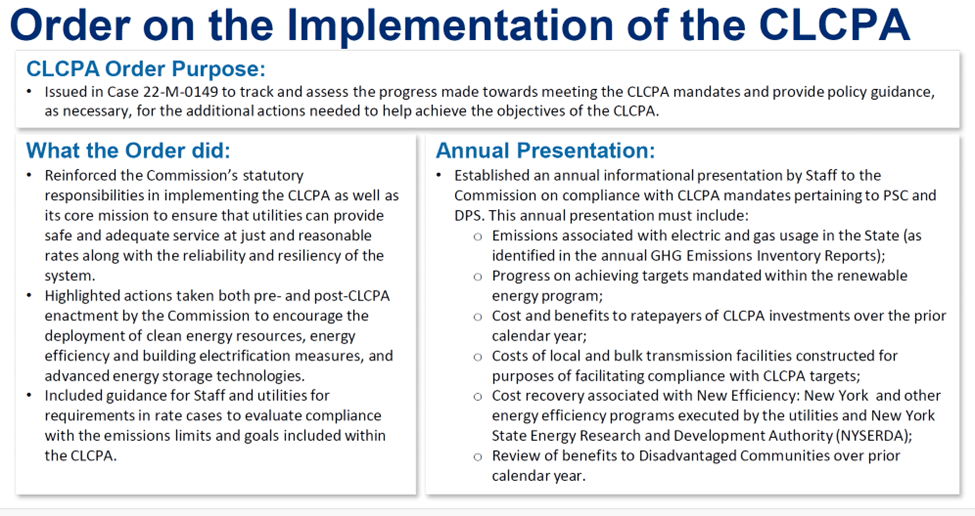
The presentation includes an outline of the Report. 

  • Introduction
  • Summary of Actions Taken to Reduce Ratepayer Impacts of the Clean Energy Transition
  • Background and Progress to Date (updates since 1st report)
  • Data Collection and General Compliance
  • Summary of Cost Recoveries and Benefits to Ratepayers of CLCPA Investments
  • Conclusion
  • Appendix:
    • Generic Cases related to the Commission’s Implementation of the CLCPA
      • Additional Data Points Regarding NYSERDA’s Clean Energy Standard (CES) Numbers
      • Historical Electric and Gas Bills 2023-2024
      • Forecasted Electric and Gas Bills 2025-2029

The Progress to Date section includes estimates of GHG emission reductions.  I will address those claims in a subsequent post.

2025 CLCPA Report Presentation Conclusion

There is a lot of information in this report making it difficult to decide what points to summarize.  This overview will concentrate on the DPS Staff conclusions because it is indicative of the intended message of the Report.

The conclusions in the presentation and my comments are listed below.

•            The CLCPA was passed by the legislature and the main source of funding to achieve its objectives is through utility rates; although the CLCPA is a component of rates, it is not the primary component of rates.

•            There are also significant compounding factors beyond the legislative directives in the CLCPA that are driving up utility rates.

The first two conclusions introduce the message that even though ratepayer costs are going up don’t blame the CLCPA for the increases.

•            New York’s utility infrastructure is aging and requires significant investment to maintain safety and reliability; replacement and upgrade costs are higher than what was experienced in the past.

•            New York is experiencing unprecedented energy demand due to economic development and electrification which is going to require tens of billions of dollars in investments, including those in generation resources, over the next several years. Investing in any new generation will drive up utility rates.

The other primary message that the Hochul Administration is trying to sell is that utility rate case increases are inevitable because of aging infrastructure.  Two points need to be considered.  Because rate case increases are so politically charged, pressure to bring down costs is huge.  Investments to replace aging infrastructure are easy to defer because there are no stakeholder advocates for them. The result is illustrated by the New York State Electric & Gas/ Rochester Gas & Electric ongoing rate case where the largest component of rate increase projects is for “legacy corrections” which is an euphemism for work that everyone agreed needed to be done in the last rate request but got cut out when the costs got too high.  That decision was made by politicians but do not expect that they will accept responsibility for the impact on costs in the current rate case.

The second point is choosing what costs are associated with state CLCPA policies to eliminate fossil fuel use is a judgement call.  The “unprecedented energy demand due to economic development and electrification” includes demand that, were it not for the push to electrify everything to reduce emissions in the CLCPA, would not be required.  For example, the push to use heat pumps everywhere ignores the reality that total energy costs are higher when heat pumps replace high efficiency gas-fired furnaces.  There will also be increased electric demand for electric vehicle charging.  Apportioning aging infrastructure replacements to upgrades only necessary to provide the extra capacity necessitated by CLCPA electrification goals is a judgement call that I believe is biased to favor keeping the CLCPA costs as low as possible.

•            New York is seeing increases in energy supply costs due to rising commodity prices in the global markets; these macroeconomic pressures directly increase New Yorkers’ utility bills.

I agree with this.  However, cynics like me could point out that if we had developed our own natural gas resources that we would not be so dependent upon global markets.

•            Some of the programs reflected in the report predate the CLCPA, and it is true that we would still be doing some of them—namely the energy efficiency programs—absent the CLCPA because they provide system- wide benefits. This makes it challenging to split out the portion of existing initiatives that are exclusively linked to the CLCPA.

This is an encouraging paragraph.  As far as I can tell, DPS staff did not try to break out costs solely due to the CLCPA law like New York State Energy Research & Development Authority (NYSERDA) did in the Scoping Plan and is doing with the Draft Energy Plan.  NYSERDA’s approach deliberately parses out costs to hide the true cost of the transition.  I applaud DPS staff for considering all costs necessary to meet the CLCPA goals.

•            There are several direct and indirect benefits of CLCPA implementation, including economic and workforce development, improved public health outcomes, and increased tax revenue. These benefits will materialize across a variety of sectors, parties, and timeframes, and are therefore difficult to standardize and quantify in a yearly report.

I am not impressed with these claims.  Proponents of CLCPA implementation tout economic development but the reality is that there are significant downsides related to cost, efficiency, job displacement, and long-term viability for jobs dependent upon subsidies like those associated with CLCPA implementation.  I found no relationship between inhalable particulates and asthma-related emergency room visits and that suggests the health outcome benefits are not as definitive as suggested.

•            The cost recoveries, benefits, and other information reported are focused on the direct effects of CLCPA implementation for which the Commission has oversight authority as well as Federal Energy Regulatory Commission (FERC) jurisdictional transmission projects associated with achieving CLCPA targets.

This is a reminder that the costs described are only a portion of the total.  For example, mandates to electrify homes and transportation will require New Yorkers to purchase more expensive infrastructure that is not included.

•            DPS will continue to explore pathways to refine data definition, collection, comparability, and accessibility.

Ratepayer Costs

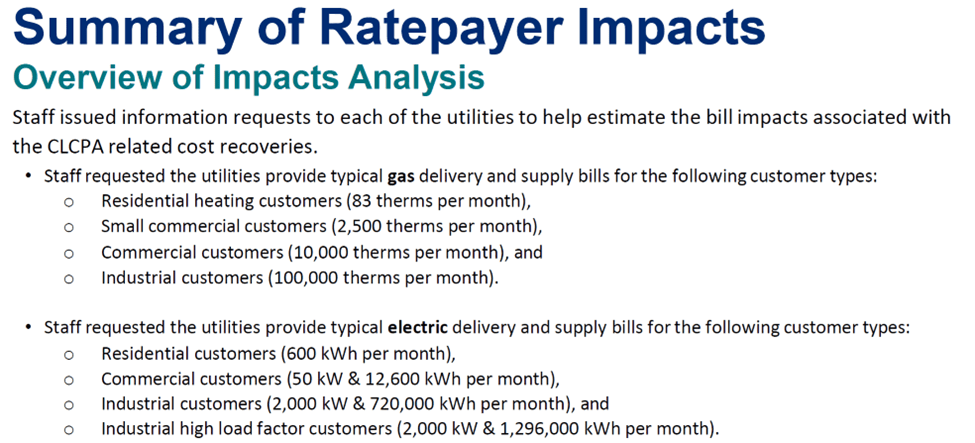
I believe costs are the biggest concern of New Yorkers.  With the caveat that the people preparing these estimates have many reasons to bias the CLCPA costs low I include the following tables from the presentation.  Costs presented for typical users are defined in the following figure.

4
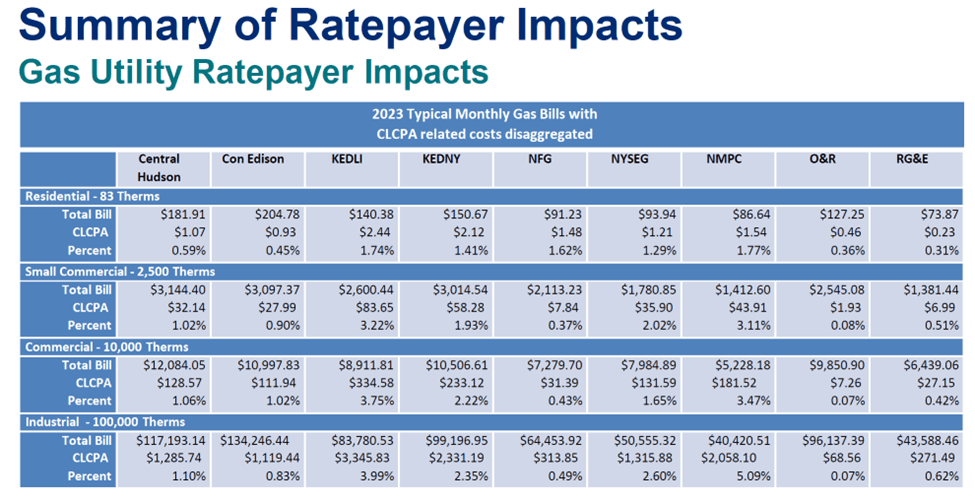
The next table describes the 2023 gas utility impacts.  CLCPA impacts are minor
The following table describes the impact of the CLCPA on 2023 electric utility ratepayers.  The numbers are indeed a small component of total costs. 
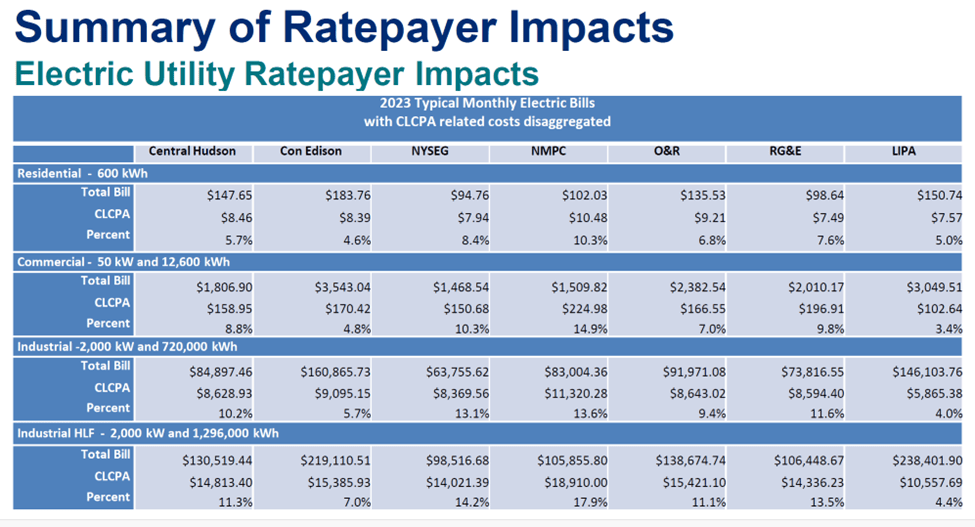
I will follow up with another post looking at the cost numbers in more detail in a subsequent post.

Discussion

Although the Informational Report quantifies ratepayer impacts, I believe that the pressure to downplay costs attributable to CLCPA projects biases the results.  The projections for the future are frankly unbelievable.  Proving that will be the subject of a later post.

The report advances two claims.  The first is the political message that even though ratepayer costs are going up don’t blame the CLCPA for the increases.  While the CLCPA costs are relatively minor, they are optional at a time when affordability is a crisis.  The second claim is that utility rate case increases are inevitable because of aging infrastructure.  As noted, the lack of investment in infrastructure is at least partially due to political limitations on those programs in previous rate cases. 

Conclusion

In my opinion, this is another New York agency report that is more about messaging than providing New Yorkers with unbiased information.  I plan to follow up on some details in this report so stay tuned.
New York State GHG Emissions Update

The Climate Leadership and Community Protection Act (Climate Act) includes a target for a 40% reduction of greenhouse gas (GHG) emissions from 1990 levels by 2030.  This post describes the latest New York State (NYS) GHG emission inventories and some implications.

This is another article about Climate Act implementation activities that I have written because I believe the ambitions for a zero-emissions economy embodied in the Climate Act outstrip available renewable technology such that the net-zero transition will do more harm than good.  The opinions expressed in this post do not reflect the position of any of my previous employers or any other company I have been associated with, these comments are mine alone.

NYS Electric Generating Unit Emissions

According to the Environmental Protection Agency (EPA): “Emissions trading, sometimes referred to as ‘cap and trade’ or ‘allowance trading,’ is an approach to reducing pollution that has been used successfully to protect human health and the environment.”  One of the requirements for such a program is a monitoring system that consistently and accurately measures the emissions.  NYS electric generating units are in different emissions trading systems and have developed an accurate measuring system that relies on continuous emissions monitoring systems that record pollution levels that are reported to EPA. 

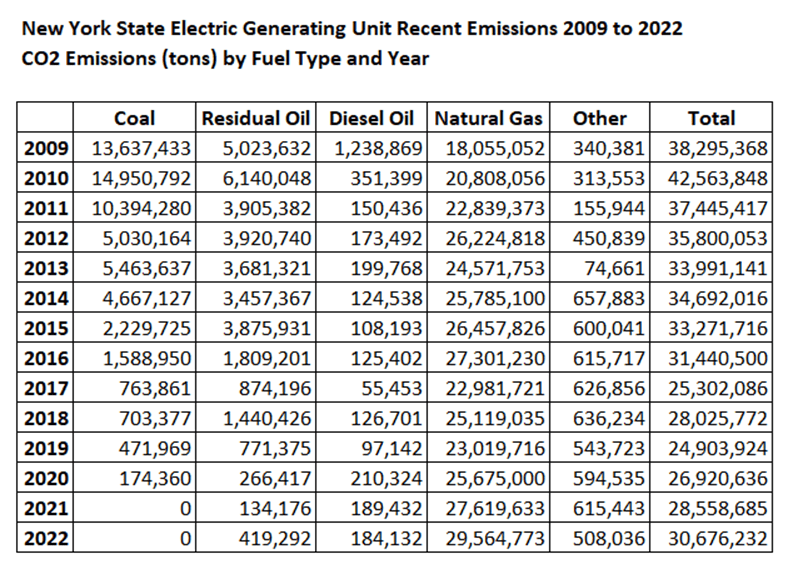
The only GHG monitored and reported to EPA is CO2.  In 2022 the units that report to EPA emitted 30.7 million short tons.  The NYS GHG inventory reports emissions as million metric tons and the 2022 emissions were 27.8 million metric tons.  As shown in the following table NYS emissions had been trending down until 2019 as generation from coal and oil was displaced by generation from natural gas.  The last three years the effect of the shutdown of the Indian Point nuclear generating station and the loss of its zero-emissions capacity have become evident.  Since 2019 CO2 emissions have increased 5.8 million tons or 23%.

NYS GHG Emissions

At the end of 2022 the New York State Department of Environmental Conservation (DEC) released the 2022 statewide GHG emissions report (2022 GHG Report).  I published an overview post of this greenhouse gas (GHG) inventory last year that described the games played using that inventory to “prove” that there are societal benefits for the emission reduction programs needed to meet the Climate Act targets. 

New York State greenhouse gas (GHG) emissions accounting it includes upstream emissions and is biased against methane.  Obviously if upstream emissions are included then the total increases but at the same time it makes the inventory incompatible with everybody else’s inventory.  There are two methane effects.  Global warming potential (GWP) weighs the radiative forcing of a gas against that of carbon dioxide over a specified time frame so that it is possible to compare the effects of different gases.  The values used by New York are compare the effect on a molecular basis not on the basis of the gases in the atmosphere so the numbers are biased.  Almost all jurisdictions use a 100-year GWP time horizon but the Climate Act mandates the use of the 20-year GWP which increases carbon dioxide equivalent values.  In addition, I believe the State is using higher emission estimates for methane production, transport, and processing.  As a result, NY GHG emission inventory estimates are nearly double values determined by other jurisdictions.

The 2022 GHG Report includes the following documents:

In order to calculate all the emissions in New York and estimate the upstream emissions it took DEC, the New York State Energy Research & Development Authority (NYSERDA) and consultants two years to produce the reports.  This article is concerned only with electricity generation especially as it relates to overall emission trends and emissions data could be used for a market-based control program. 

2020 GHG Emissions

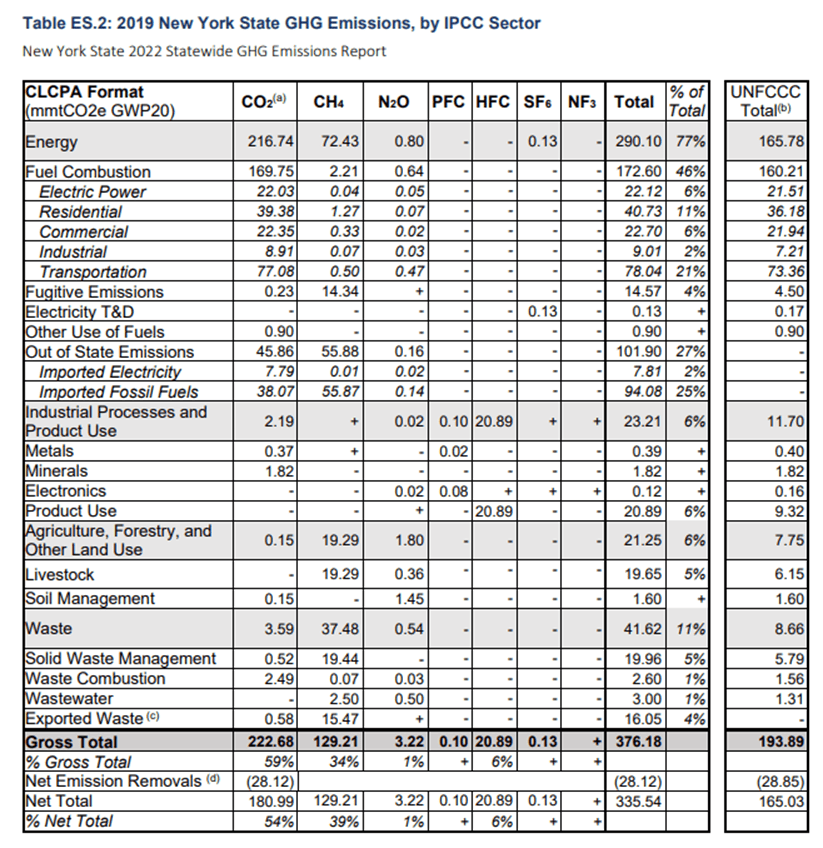
Table ES.2 in the Summary Report presents emissions for different sectors.  Electric generation emissions are listed as electric power fuel combustion, imported electricity, and as part of imported fossil fuels.  In 2020, GHG gas emissions from electric power fuel combustion totaled 22.12 million metric tons of carbon dioxide equivalent (mmt CO2e) using a 20-year global warming potential.  Imported electricity totaled 7.81 mmt CO2e.  Fuel combustion and imported electricity emissions were primarily CO2.  The Table ES.2 imported fossil fuel value shown covers all fossil fuel used in other sectors.  I found another source that breaks out the electric upstream emissions that I used to calculate emissions.

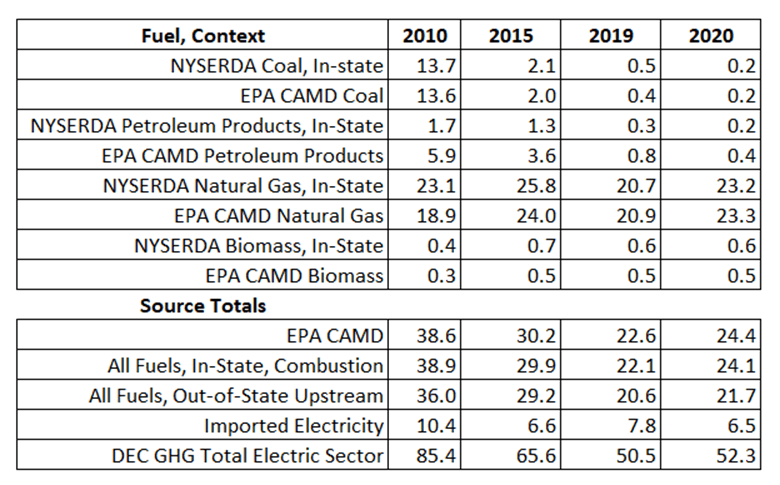
When I first started looking at the electric sector numbers, I compared the State numbers to the emissions reported by the generating companies to EPA.  The reported 2020 EPA numbers were 24.4 mmt CO2e but the 2022 GHG Report electric sector emissions were 52.3 mmt CO2e.  The 2022 GHG Report Sectoral Report 1: Energy chapter on electricity generation does not provide much detail but references a NYSERDA report: Technical Documentation: Estimating Energy Sector Greenhouse Gas Emissions Under New York State’s Climate Leadership and Community Protection Act that does provide details.  I provide more details on the calculation methodology here.  The following table combines Table 28 electric sector emissions by fuel type in that document with EPA Clean Air Markets Division emissions data.  In Table ES.2 above the total imported fossil fuel emissions in 2020 were 94.08 mmt CO2e and in the NYSERDA technical documentation the upstream emissions are 21.7 mmt CO2e.  New York’s biased accounting methodology doubles electric sector emissions from the emissions reported to EPA.  The claim that upstream emissions are on the order of direct emissions is not credible.

NYS GHG Emissions Data

The 2020 GHG Report includes a sectoral report covering the energy sector.   The results section notes:

The most significant emission reduction in this report was the decrease in fuel combustion emissions in the electricity sector from 1990 to current by over 60%. This is related to the transition away from fuels with higher combustion emissions to those with lower combustion emissions; as natural gas usage has increased, the use of coal and petroleum fuels such as residual fuel oil has declined. As described in NYSERDA (2022a), the emissions from the extraction, processing, transmission, and distribution of these fuels have not followed the same pattern.

I also evaluated the data used in the report.  It is available along with just about everything else at the NYS data website. This is part of the Open NY initiative described as:

Open NY is the award-winning initiative of policies, programs and tools that provide public access to digital data for collaboration and analysis. Empowering the public and government with data for the digital age.

Everything may be there but it is not easy to use.

The data used in the 2020 GHG emissions report are available.  I have developed a spreadsheet (documentation) that simplifies the use of the data for more refined evaluation. 

One finding in my evaluation is that there are changes in the total emissions reported relative to last year’s inventory.  The spreadsheet lists all the differences.  Importantly there is a difference between the regulatory Part 496 1990 baseline emissions of 409.78 million metric tons and this inventory that says 1990 emissions were 404.26 and last year’s baseline emissions were 402.54.  Recall that Part 496 determines the 2030 emissions limit, 245.87 million metric tons and 2050 emission limit, 61.47 million metric tons as percentages of the baseline.  At some point DEC will have to address these differences.

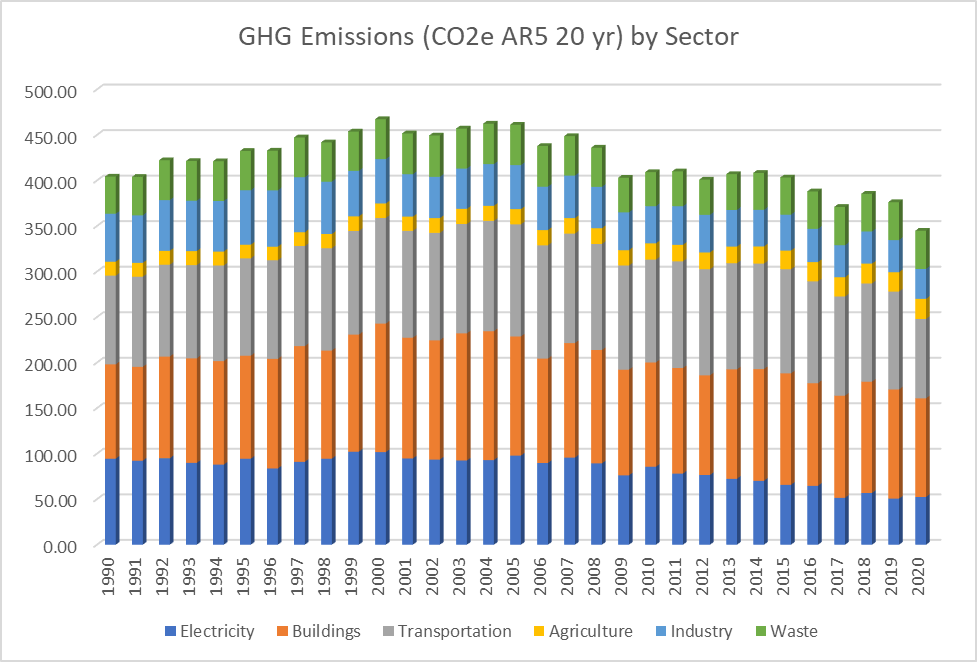
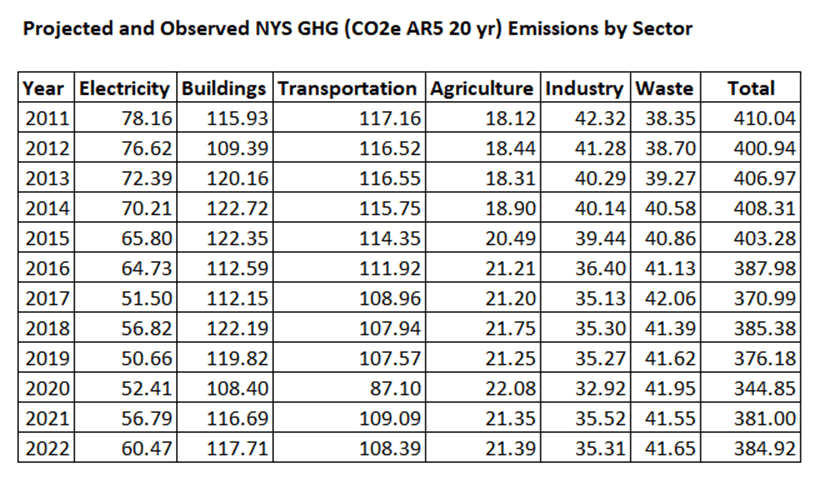
Another interesting result is the distribution of emissions by economic sector as shown in the following figure.  Overall emissions have been going down since the mid-2000’s.  The electric sector reductions have been the primary cause.  As noted previously electric sector emissions were decreasing over time until 2019 but started increasing since then.   

Projected 2021 and 2022 NYS GHG Emissions

In order to determine where NYS stands relative to the 2030 target currently, it is necessary to combine the EPA and NYS datasets.  The 2020 GHG Report notes that the pandemic shutdowns affected 2020 emissions.  In order to project 2021 emissions, I used the average of the years 2016-2020 for all sectors except electricity and for 2022 I used the average of 2017-2021 excluding 2020. 

Because the electric sector emissions include upstream and imported electricity emissions, I had to do something more refined.  The direct emissions used the EPA reported emissions.  The upstream and imported electricity emissions are in Table 28: electric sector emissions by fuel type of the  NYSERDA (2022a) technical documentation.  I took the average of the 2019 and 2020 data for the imported component.  The upstream emissions are related to the direct emissions.  I assumed that relationship was equal to the ratio of the 2019 and 2020 average EPA emissions to the out-of-state upstream emissions.  Using these assumptions, I project that the 2022 emissions increase to levels not seen since 2018.

Discussion

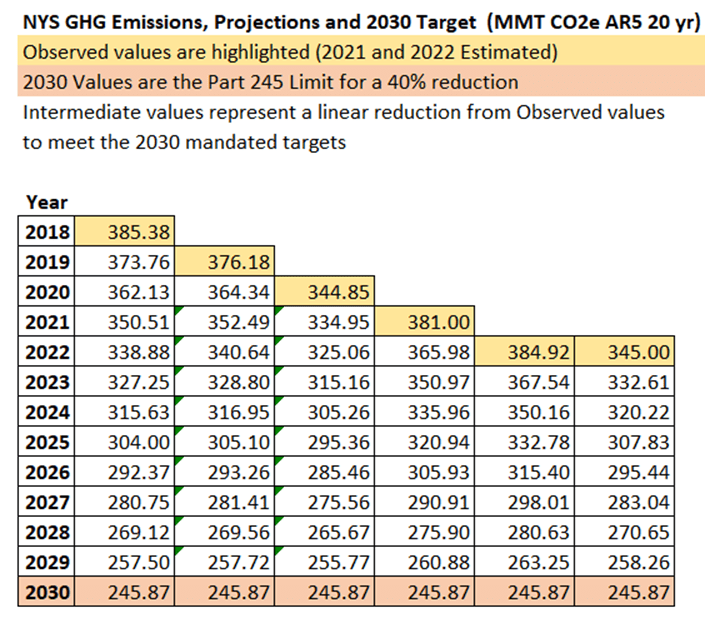
The Climate Act includes a target for a 40% reduction of greenhouse gas (GHG) emissions from 1990 levels by 2030.  The NYS Part 496 1990 baseline emissions are 404.26 mmt CO2e.  The total 2020 NYS emissions were 344.85 mmt CO2e which is a 15% reduction from the baseline.  The 2030 limit is 245.9 CO2e which will require a further 29% reduction.

I looked at alternative emission reduction trajectories to get to the 2030 limit.  The following table estimates the emissions needed to meet the targets from starting points in 2018 to 2022.  Using the observed 2020 emissions noted above would require a 2.96% reduction per year.  Using the projected 2021 emissions (381.00 mmt CO2e) the annual reduction rate would be 3.94%.  Similarly, for 2022 because the emissions have gone up the annual reduction rate would have to be 4.52%.  Even if the 2022 emissions turn out to equal the 2020 emissions the annual reduction rate would have to be 3.59%.

Because of the variation of weather-related fuel usage GHG emissions have quite a bit of interannual variability (on the order of 3%).  My impression is that the annual reduction rates required to meet the 2030 target will be a significant challenge.  It is not clear what will happen if anyone of many issues causes delays in the implementation compliance trajectory.

There is another aspect of these data that is relevant with respect to the proposed cap and invest program.  The electric generating sector has developed a verifiable emissions reporting system that provides compliance data two months after the end of the year.  That system uses traceable direct measurements.  The 2020 GHG emissions report that represents the “official” compliance reporting by the DEC takes two years to produce.  It uses fuel use data, emission factors, and many assumptions in a process that is anything but open and transparent.  There have been three iterations of NYS GHG emission inventories and the historical data has changed in each subsequent iteration.  That approach does not meet the EPA emissions trading system recommendation for a timely, consistent, and accurate emissions reporting system.

Conclusion

There are a few takeaway points with these data.  The EPA electric generating unit emissions for 2022 increase over past years because of the NYS decision to shut down 2,000 MW of zero-emissions generating capacity at Indian Point.  Clearly, if the net-zero transition is to succeed then maintaining and expanding the state’s nuclear resources is necessary.  The data also show that the emission reduction trajectory is ambitious and, I believe, unlikely to be met.

The Climate Act GHG emission reporting requirements double the electric sector emissions over the direct measurements used by EPA.  The reporting system developed for EPA gets the results in two months but the reporting system used to generate the Climate Act GHG emissions takes two years. One of the arguments used by the Climate Action Council to justify the proposal for a cap and invest market-based control program was that the Regional Greenhouse Gas Initiative (RGGI) trading system was a successful model that could be used.  RGGI uses the EPA reporting data to provide timely, consistent, and accurate data for compliance requirements.  There is no favorable comparison between the EPA system and the Climate Act reporting system.  The reality that the NYS GHG emissions reporting data are incompatible with any emissions trading system is just one of the practical problems that the cap and invest proposal must address before it can be implemented.

New York Clean Energy Industry Report

One problem I have when I am writing a blog post is that there is a target rich environment.  In this case I was working on a post about Governor Hochul’s announcement concerning the Champlain Hudson Power Express (CHPE) transmission project starting construction.  One topic I wanted to address in the post concerned jobs and another Hochul announcement about a record number of clean energy jobs came up in our discussion that needed to be addressed..  This post describes the 2022 New York Clean Energy Industry Report.

Everyone wants to do right by the environment to the extent that they can afford to and not be unduly burdened by the effects of environmental policies.  I submitted comments on the Climate Act implementation plan and have written over 250 articles about New York’s net-zero transition because I believe the ambitions for a zero-emissions economy embodied in the Climate Act outstrip available renewable technology such that it will do more harm than good.  The opinions expressed in this post do not reflect the position of any of my previous employers or any other company I have been associated with, these comments are mine alone.

Climate Act Background

The Climate Act establishes a “Net Zero” target (85% reduction and 15% offset of emissions) by 2050. The Climate Action Council is responsible for preparing the Scoping Plan that will “achieve the State’s bold clean energy and climate agenda”.  The Integration Analysis prepared by the New York State Energy Research and Development Authority (NYSERDA) and its consultants quantifies the impact of the strategies.  That material was used to write a Draft Scoping Plan that was released for public comment at the end of 2021. The Climate Action Council states that it will finalize the Scoping Plan by the end of the year.  There are two underlying problems with the Climate Action Council approach for the transition plan: the Draft Scoping Plan does not include a feasibility analysis and the Council has not considered the need for an implementation plan.

A major emphasis in the transition planning is on clean energy industry jobs.  The Climate Act required a Just Transition Working Group Jobs Study to “provide a robust understanding of the impacts of climate change mitigation, to assess potential effects on the job market, and to understand impacts to training, education, and workforce development.”  The creation of clean energy jobs has been a point of emphasis as an advantage of the net-zero transition and the Climate Act mandated regular updates on the number of clean energy jobs in the state.

Clean Energy Industry Report

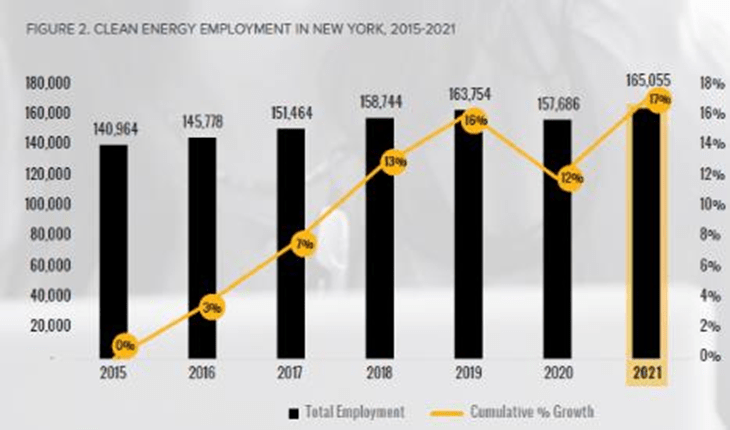
On the day before the CHPE announcements Hochul announced a record level of clean energy jobs in New York.  That claim was based on the NYSERDA New York Clean Energy Industry Report 2022 that found:

More than 165,000 New Yorkers had clean energy jobs at the end of 2021, up from 157,686 in 2020.

New York’s clean energy employment grew 5% from 2020 through 2021 – gaining over 7,000 jobs in 12 months.

Employment met or exceeded pre-pandemic levels in almost all technology sectors. Renewable electric power generation, alternative transportation, renewable fuels, grid modernization, and energy storage all reached or surpassed their pre-pandemic employment levels by the end of 2021.

The alternative transportation technology sector saw unprecedented growth between 2020 and 2021 and employment expanded by almost 26% or 2,318 jobs in just 12 months.

Solar accounted for the largest share of job gains in the renewable electric power generation technology sector.

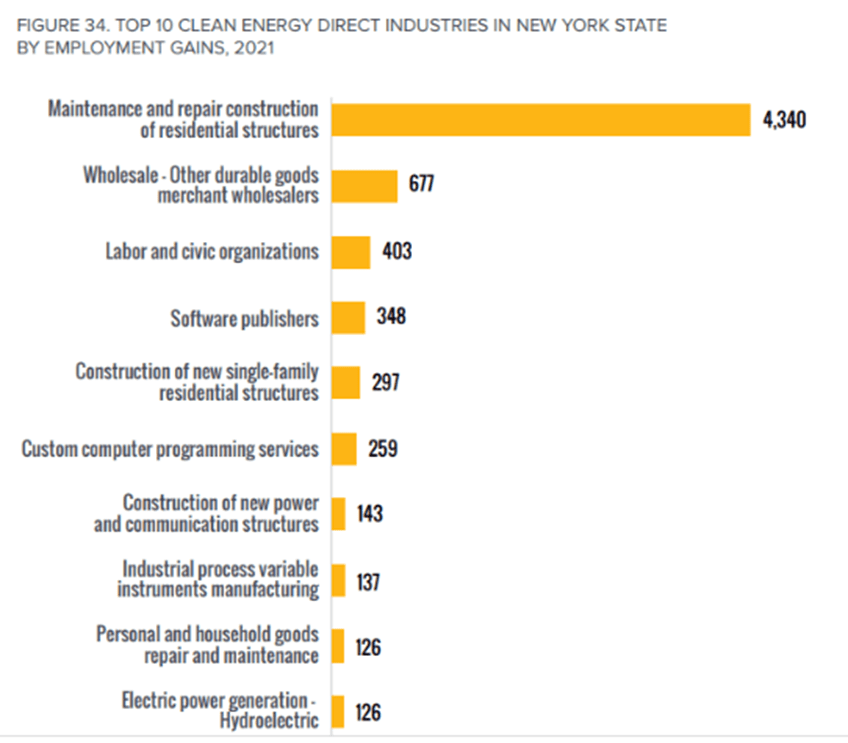
The industries with the largest job growth were labor and civic organizations, software publishers, durable goods merchant wholesalers, and machinery, equipment, and supplies wholesalers

There are times when I read something that is a “You have to be kidding me” moment.  For example, the claim that the largest clean energy job growth was in the in the labor and civic organizations sector was one of those.  The Climate Act mandates that the Just Transition Working Group estimate “the number of jobs created to counter climate change, which shall include but not be limited to the energy sector, building sector, and working lands sector”.  I am sure that labor and civic organizations sector was not necessarily what the authors of the Climate Act had in mind.

Discussion

I had been talking to Richard Ellenbogen about the CHPE announcement and the topic of jobs came up. Richard and I both critiqued the Clean Energy Industry Report that had been mentioned.  He pointed out that out of the 165,000 employed on their list, 87% (124,000) work in “Energy Efficiency” (page 15), so that could include anyone that installs insulation.  Those jobs existed before renewable energy was a thing.  He used two different insulation installers on his house in 2004 and a different one on his factory in 2000.  It appears to both of us that there is an opportunity to inflate numbers depending upon the classification of building contractors.

I dug a little deeper into the report and confirmed plenty of opportunities for NYSERDA to inflate numbers.  I found out that they use something called “clean energy employment intensity” that are “used to identify the concentration, or intensity, of clean energy activities”. The claim that there are 165,000 employed in the clean energy sector (Figure 2 from the document page 12) “includes all workers that dedicate any amount of their labor hours or work week to clean energy goods and services. As such, an electrician who spends only a quarter of their work week installing or servicing solar panels would be counted as a clean energy worker”.   For emphasis it does say any amount of their labor hours counts as a clean energy job.

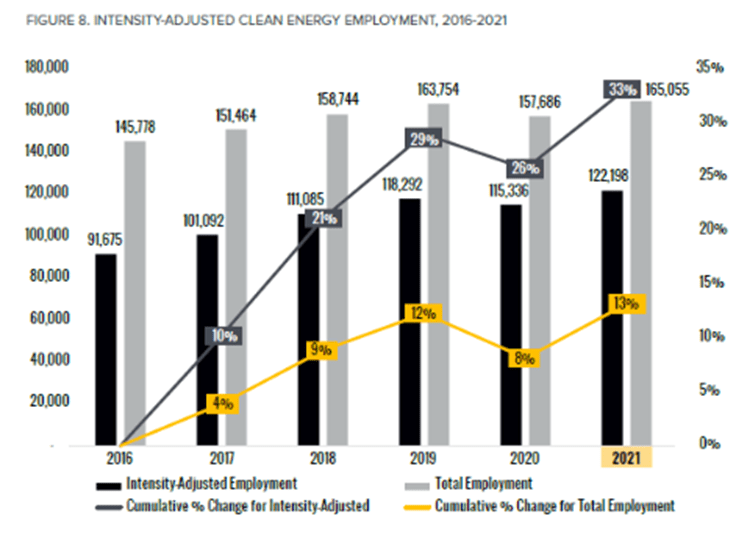
My first thought was that they include the intensity-adjusted clean energy employment metric because even they admit that the 165,000 employed in the sector claim is a stretch when anyone who spends any amount of time is counted.  Upon further review I am not convinced that is the case.  The document states (page 16):

The metric weights each job according to how much time workers were reported to spend on clean energy activities: the categories include less than half of their labor hours, half to the majority of their labor hours, or all of their labor hours. These categories correspond with the following delineations: 0 to 49 percent of labor hours, 50 to 99 percent of labor hours, and 100 percent of labor hours.

The description goes on to say:

An increase in total employment would indicate that there are more workers in the labor market overall servicing clean energy technologies, while an increase in intensity adjusted employment indicates that these workers are dedicating a larger proportion of their work week and labor hours to clean energy-specific activities; this could be the result of increased policy support or financial incentives spurring market demand for clean energy goods and services. For instance, a traditional HVAC worker might have spent only a third of their work week installing or maintaining energy efficient HVAC technologies in 2016. If a state began offering rebates in 2017 for efficient heat pumps, that traditional HVAC worker would likely be spending more of their labor hours or work week installing high-efficiency heat pumps. This increase in activity per worker would not necessarily result in overall job growth in Figure 2 but would be captured as an increase in intensity-adjusted clean energy employment in Figure 8.

The last statement in this section leads me to believe that this metric is not supposed to address the dis-information that any time whatsoever spent on clean energy work qualifies the job to be a clean energy job. It says that an increase in activity per worker would not necessarily result in overall job growth in the total numbers.  Instead, it “would be captured as an increase in intensity-adjusted clean energy employment”.  What I had hoped that the State would do was to report the clean energy jobs as full-time equivalents using the fractional time spent.  In other words, two employees that work 50% of the time on clean energy projects are equivalent to one full-time equivalent position.  The fact that they don’t do it that way and instead conjure up an intensity adjustment metric shows, as Richard Ellenbogen explains, that while they are trying to do something to explain the employment opportunities “this looks more like a political document for the non-thinking”.  

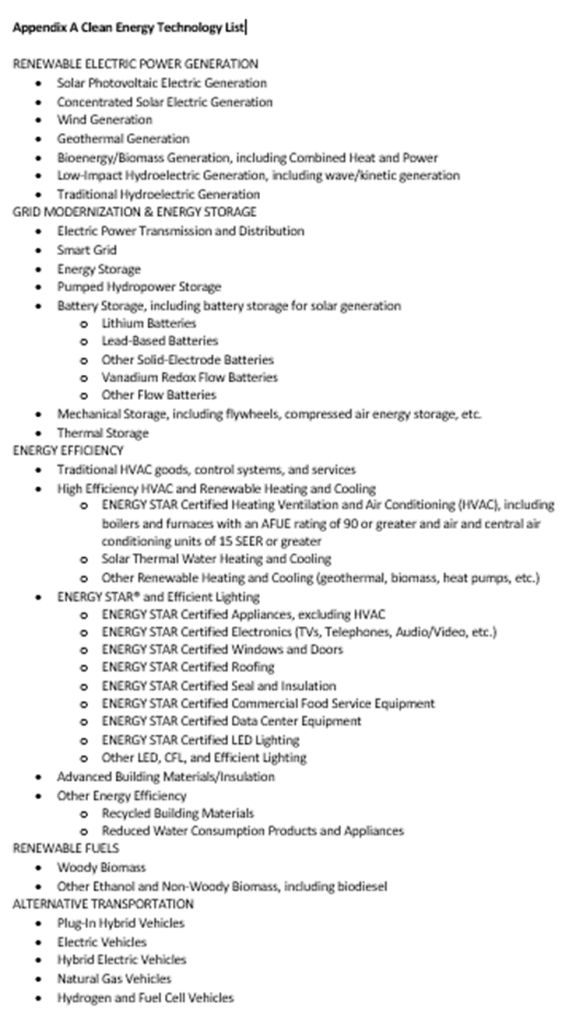
The document states that there is a full description of their methodology in Appendix A. However, there is no meat to that documentation.  The appendix is titled Clean Energy Technology List. It only includes the following text:

A clean energy job is defined as any worker that is directly involved with the research, development, production, manufacture, distribution, sales, implementation, installation, or repair of components, goods, or services related to the following sectors of the clean energy economy: Renewable Electric Power Generation; Grid Modernization and Energy Storage; Energy Efficiency; Renewable Fuels; and Alternative Transportation. These jobs also include supporting services such as consulting, finance, tax, and legal services related to energy.

The remainder of the Appendix only lists sub-sector jobs for each of the sectors of the economy listed above as shown below.  I believe that ay time spent on any job on the clean energy technology list qualifies the employee to be a clean-energy job holder.

According to the numbers, the clean energy industry jobs are an increase of 18,200 since 2016, 13,400 of those in “Energy Efficiency”.  New York State employment is at 57% of 19.5 million people or about 11.1 million.  The 165,000 is 1.4% of the state’s total workforce.  The increase in what they call “Clean Energy Jobs” is 0.0012 or about 1/10 of 1% of the state workforce over the past five years. 

The following figure from the report lists the industry sectors that had employment gains.  Keep in mind that if a labor organization changes the job description for any staff to include weekly updates of renewable energy developments that counts as one of these jobs because the claimed jobs “includes all workers that dedicate any amount of their labor hours or work week to clean energy goods and services”.  Moreover, I am not sure why any rational person would count jobs at a software publisher as a clean energy job.

Another area for misleading information is construction jobs.  A New York Daily News article about the CHPE project states: “An agreement between the developer tasked with completing the line and New York State Building and Construction Trades means the project will lead to about 1,400 union jobs.”  If one of the CHPE contractors was building a non-clean energy project but now sends his workers to build the transmission line I suspect they are counted as new clean-energy jobs.  There are two issues.  The first is that the construction jobs are temporary and this approach does not seem to take that into account.  The second is that if the contractor goes to work on another non-clean energy project after this project ends but a year later puts them to work on a new clean-energy project I am sure the State will count those as new jobs.

Ellenbogen and I talked about the issue of finding people to work.  We both have talked to contractors that told us they cannot find enough people to work.  What does that say about the future increase in these numbers?  To do what they want to do, they will have to increase that number to about 250,00 – 300,000, at least a third of that in Renewable Electric Power Generation and Grid Modernization.  The increase in those two categories over the past five years is 3,300, so at the current rate of increase it will take 50 years to reach the number that they need.  That is about 25 years after they expect to complete their plan.

Finally, there is one other aspect of the report that concerns me.  The New York Daily News article about the CHPE project notes that the project will lead to about 1,400 union construction jobs.  It will provide 1,250 MW or power to New York City.  This report does an inadequate job addressing the loss of jobs from other New York State policies.  For example, the shutdown of Indian Point meant the loss of over 1,000 permanent union jobs and 2,000 MW of New York City power.  In other words, the unknown number of permanent additional jobs in the report numbers probably means that that there has been a net loss in New York due to the Indian Point shutdown and CHPE will not replace the loss of Indian Point capacity.


Conclusion

Whenever I have evaluated any component of the Climate Act, I have found that there is no acknowledgement that issues are more complicated, uncertain, and costly than portrayed by the State.   Unfortunately, there is a bigger issue because there are instances where the documentation provided is misleading and inaccurate.  In my opinion the Clean Energy Industry Report is misleading.  It would be more appropriate to provide the impact of clean energy jobs as a function of full-time equivalents instead of counting clean energy jobs as any that “dedicate any amount of their labor hours or work week to clean energy goods and services.”  In addition, the reporting of that metric is likely high because there is a bias towards more emphasis on clean energy goods and services.  As it stands there is a clear bias towards higher numbers supporting the narratives of the Climate Act.