Citizen’s Budget Commission Comments on New York Cap-and-Invest

The Citizen’s Budget Commission (CBC) new brief, Improving NYS Cap-and-Invest Design: Recommendations for Ambitious, Affordable, Market-Driven Emissions Reductions (CBC Report), finds that the New York Cap-and-Invest (NYCI) pre-proposal includes “some promising design choices” but has limitations.  The report recommends that “the State overhaul its pre-proposal design and fully explain the impacts”.  Based on my experience with market-based programs I agree with many of the findings of the report but believe that the CBC has misplaced faith in the effectiveness of market-based GHG emission reduction programs.

I have followed the Climate Act since it was first proposed, submitted comments on the Climate Act implementation plan, and have written over 470 articles about New York’s net-zero transition.  I worked on every market-based program from the start that affected electric generating facilities in New York including the Acid Rain Program, Regional Greenhouse Gas Initiative (RGGI), and several Nitrogen Oxide programs. I follow and write about the RGGI and New York carbon pricing initiatives so my background is particularly suited for NYCI.   The opinions expressed in this article do not reflect the position of any of my previous employers or any other organization I have been associated with, these comments are mine alone.

Overview

The Climate Act established a New York “Net Zero” target (85% reduction in GHG emissions and 15% offset of emissions) by 2050.  It includes an interim 2030 reduction target of a 40% reduction by 2030. Two targets address the electric sector: 70% of the electricity must come from renewable energy by 2030 and all electricity must be generated by “zero-emissions” resources by 2040. The Climate Action Council (CAC) was responsible for preparing the Scoping Plan that outlined how to “achieve the State’s bold clean energy and climate agenda.” The Integration Analysis prepared by the New York State Energy Research and Development Authority (NYSERDA) and its consultants quantified the impact of the electrification strategies.  That material was used to develop the Draft Scoping Plan outline of strategies.  After a year-long review, the Scoping Plan was finalized at the end of 2022.  Since then, the State has been trying to implement the Scoping Plan recommendations through regulations, proceedings, and legislation.  NYCI is one such implementation initiative.

Cap-and-Invest

The CAC’s Scoping Plan recommended a market-based economywide cap-and-invest program.  The program works by setting an annual cap on the amount of greenhouse gas pollution that is permitted to be emitted in New York: “The declining cap ensures annual emissions are reduced, setting the state on a trajectory to meet our greenhouse gas emission reduction requirements of 40% by 2030, and at least 85% from 1990 levels by 2050, as mandated by the Climate Act.”  In addition to the declining cap, it is supposed to limit potential costs to New Yorkers, invest proceeds in programs that drive emission reductions in an equitable manner, and maintain the competitiveness of New York businesses and industries.         

My experience with market-based emission reduction programs is from the compliance side.  I have tracked New York emissions trends for decades and used that experience to develop comments on the NYCI pre-proposal outline of issues.   My comments showed that New York’s impressive GHG emission reductions to date have come primarily from fuel switching in the electric sector.  That was spurred by lower costs of natural gas that made fuel switching from coal and oil to natural gas economic.  There are very few opportunities for similar economic reductions.  In the future, existing sources of GHG emissions must be displaced by alternative zero-emissions resources.  New York’s experience in the effectiveness of Regional Greenhouse Gas Initiative auction revenues to reduce emissions has not been encouraging.  According to Table 2 in Semi-Annual Status Report through December 31, 2022, the cumulative annual net greenhouse gas emission committed savings are 1,725,544 tons through the end of 2022.  That is 9.5% of the observed reduction of 16,196,531 tons since the three-year baseline before the start of RGGI in 2009.  The difficulty of future emission reductions and cost ineffectiveness of auction revenues will impact NYCI implementation.

There also are issues with the theory behind the NYCI approach.  A Practical Guide to the Economics of Carbon Pricing by Ross McKitrick is at odds with NYCI.  He explains that “First and foremost, carbon pricing only works in the absence of any other emission regulations”, but NYCI is in addition to the emission regulations proposed. This is particularly important because McKitrick is arguing that market-based programs should not be expected to provide reductions on an arbitrary schedule.  He goes to note “another important rule for creating a proper carbon-pricing system is to be as careful as possible in estimating the social cost of carbon”. He argues that “whatever the social cost of carbon is determined to be, the carbon price must be discounted below it by the marginal cost of public funds (MCPF) — that is, the economic cost of the government raising an additional dollar of tax, on top of what is already being raised”. NYCI does not recognize the importance of this aspect of carbon pricing.  He concludes: “There may be many reasons to recommend carbon pricing as climate policy, but if it is implemented without diligently abiding by the principles that make it work, it will not work as planned, and the harm to the Canadian economy could well outweigh the benefits created by reducing our country’s already negligible level of global CO2 emissions.”  Substitute New York economy for Canada’s and I believe this describes the likely outcome for NYCI.

Danny Cullenward and David Victor’s book Making Climate Policy Work describe an unacknowledged NYCI problem.  There are political thresholds that limit how much money can be raised by NYCI before the electorate rebels, but investments must be sufficient to fund emission reduction projects to achieve the aspirational Climate Act schedule.  They note that the level of expenditures needed to implement the net-zero transition vastly exceeds the “funds that can be readily appropriated from market mechanisms”.  That observation and the conclusion that future New York emission reductions will come primarily from the deployment of alternative technologies means that emission reduction investments should be a priority for NYCI revenues.  However, there are competing priorities for funds including investments to advance equity and climate justice, funding for programs to reduce costs for those least able to afford higher energy prices, and funding to develop the new technology necessary for the zero-emissions electric grid.

Comments on CBC Report

In this section I will address the CBC brief, Improving NYS Cap-and-Invest Design: Recommendations for Ambitious, Affordable, Market-Driven Emissions Reductions.   I have annotated the Executive Summary with my comments.  The introductory paragraphs outline the goals of the CBC Report:

The Citizens Budget Commission (CBC) has long advocated for New York State to establish an economy-wide carbon pricing system, a market-based policy to incentivize cost-effective greenhouse gas (GHG) emissions reductions. New York Cap-and-Invest (NYCI) has the potential to be such a program. However, to do so, NYCI must be well designed and implemented, or it risks shifting emissions out of state, causing unnecessary harm to the state’s economy, and/or unduly increasing New Yorkers’ cost of living.

CBC continues to strongly support New York implementing a cap-and-invest program. However, the State’s pre-proposal program design falls short by considering some questionable design choices and not presenting sufficient information to assess the range of effects, which may include significant fiscal and economic impacts on New York’s residents and businesses.

Therefore, the State should modify the proposal in rulemaking to ensure it balances emissions reductions with economic vitality, and present more comprehensive impact information. CBC identifies additional analysis that should be released prior to or along with the NYCI draft rules and recommends specific changes to the program design.

I do not think that the CBC understands the fundamental issues associated with GHG market-based emission reduction programs that I outlined above.   Their recommendations will improve the chances that NYCI will not be a failure, but I think it is a hopeless quest. I endorse their request for additional information.  The CBC Report describes two “fundamental flaws”:

First, the materials do not include estimates of the program’s full fiscal and economic impacts—how much residents and businesses will pay for the new emissions charges and how the new costs will affect jobs and economic growth. They also do not fully explain the methods and assumptions that yield the findings. Absent these, there is no way to know how well the proposed NYCI design would drive down emissions while preserving economic growth or whether it would shift emissions, residents, and/or jobs to other states.

I agree with the concern that the lack of cost estimates and documentation for methods and assumptions makes it impossible to determine whether this will work.  I am not sure whether the CBC Report authors fully understand the Cullenward and Victor argument that the funds needed to drive emissions are so large that it is unlikely the money will be sufficient and my observation that the record of past emission reductions is irrelevant going forward because fuel switching does not reduce emissions to zero.  The CBC Report implication that NYCI has a chance to force emission reductions sufficient to meet the Climate Act goals is my major issue with this report. 

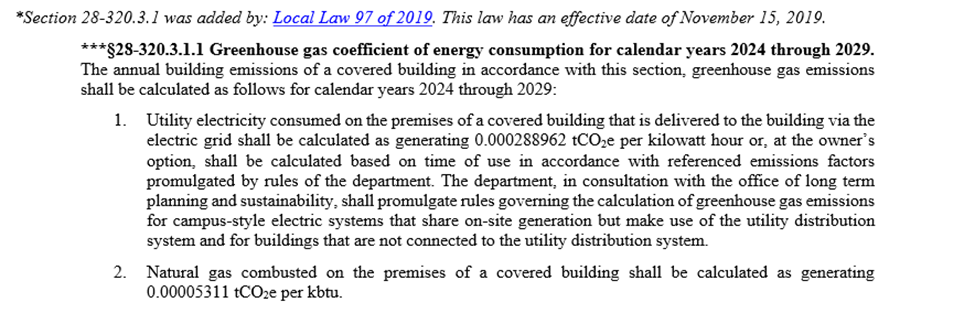
The program as presented would levy a massive new charge, economically akin to a new tax—potentially reaching $12 billion annually by 2030—which will have significant impacts on consumers and the State’s economy. This new cost is in addition to costs already passed on to utility ratepayers to fund climate-related investments and Local Law 97 compliance costs that will be paid by large building owners in New York City. Excessive costs could unduly burden businesses and families and push some to leave, especially as New York State and its localities collect more taxes per person than any other state

I agree with the authors that NYCI is essentially a new tax and a large one at that.  Their concerns that NYCI is only one component of the many costs of Climate Act implementation is important and must be addressed because of the consequences they describe.

Second, since the State’s extremely ambitious 2030 emissions reduction target would drive too-costly emissions charges, the State proposes a NYCI design in which emissions reductions ultimately are uncertain. Meeting the 2030 target would have required producers to pay prohibitive costs for the right to emit, so instead of allowing the market to set the price, the State proposes to set a lower, artificially suppressed price for the right to emit GHGs, and then allow businesses to purchase emissions allowances at that lower price, beyond what the program’s emissions cap would otherwise permit, should they choose. Ultimately, this design does not let the State determine how much emissions are reduced and makes balancing environmental benefits with program affordability and economic growth harder.

In my opinion, this paragraph makes the right point but for the wrong reason.  The CBC Report subscribes to the market theory that higher prices will drive emissions down and does not recognize that there are other factors affecting the cost of allowances.  The CBC Report is appropriately concerned about the schedule.  All the market-based programs that I have followed had an initial period of high allowance prices due to the uncertainty of the program that will mask the theoretical link between market price and emission reductions.  Based on my observations I believe the practicality of emission reductions must also be considered.  Affected source emissions must be displaced by alternative sources which NYCI advocates argue will be funded by the proceeds from the NYCI auctions. This means that there is a lag between the time proceeds are collected and invested to displace existing source emissions.  I suspect that the pace of emission reductions will also result in higher prices.  Given all these reasons NYCI is including provisions to limit prices that I think are appropriate.

Importantly, without regard to NYCI, the State already has acknowledged that it will not meet 2030 renewable electricity generation goals. This sharpens the point that NYCI’s design should not be constrained by the requirement to meet current interim goals.

I agree that the schedule is problematic.  It is not clear whether CBC understands the ramifications of the NYCI allowance reduction trajectory.  The only practical compliance option for affected sources on the Climate Act schedule is to limit operations and this leads to unintended consequences.  For example, if fuel suppliers do not have sufficient allowances, they will stop selling gasoline, creating an artificial energy shortage.  NYCI’s design must not be constrained by the current interim goals.

Reducing New York’s GHG emissions is very important; it should be done wisely by carefully balancing trade-offs to avoid damaging the State’s economy and competitiveness, and ensuring emissions are actually lowered, not just relocated out of state.

I agree that NYCI should not damage the State’s economy and competitiveness.  Those tradeoffs should keep in mind that New York’s GHG emissions are less than half a percent of global emissions and global emissions have been increasing by more than a half a percent per year for a long time.  Insisting on strict adherence to an arbitrary reduction schedule that will have a minimal effect on global emissions is not in the best interests of New York.

The CBC Report makes some reasonable recommendations that I endorse.  They argue that New York should:

  • Conduct and publicly release, before or with the draft rules, a more robust assessment of NYCI’s potential fiscal and economic impacts that details:
    • The portion of the cost borne by businesses with a direct compliance obligation and how much is passed on to other businesses and households;
    • NYCI’s costs and their impacts on various types of businesses;
    • NYCI’s impact on the economy overall, specific sectors, and by location;
    • NYCI’s impacts on households, by income and geography

I agree and would expand on this to insist on documented comprehensive numbers.  The Hochul Administration has previously provided misleading numbers that compare costs relative to alleged benefits and only cover certain cost components.  New Yorkers deserve to know the costs of all components of the entire Climate Act transition including NYCI.

  • Recalibrate the 2030 emissions reduction goal to be ambitious but feasible, so New York can leverage market-driven, cost-effective emissions reductions that are balanced with economic growth; and
    • Consider switching to the conventional emissions accounting methodology;

I agree with both these recommendations.  Note that the suggestion to switch to conventional emissions accounting is necessary to link NYCI to similar programs in other jurisdictions.

  • Proceed with rulemaking only when comprehensive assessments are public and based on recalibrated targets; and
    • Periodically evaluate and adjust the program based on experience.

I agree with both these recommendations.

Furthermore, the State should present a detailed plan to use the program’s revenue—which could exceed $30 billion over the next 5 years. Ideally, this would be part of a comprehensive State plan, incorporating the other available funds that will support the transition away from carbon-emitting energy sources.

This is a good point.  There has been very little planning for the Climate Act implementation.  Given the breadth of the proposed changes to the energy system this is unacceptable.  A comprehensive proof of concept that shows that they have enough money available to make the reductions necessary is a rational approach.

However, the State should modify several parameters to improve the pre-proposal. These include:

  • Permitting banking of allowances from the start, instead of after the first compliance period;
  • Allowing limited use of rigorously verified offsets; and
  • Modifying design elements to facilitate linkage with other systems and broaden coverage.

All these recommendations are appropriate.

Lastly, to address concerns about local health impacts, the Department of Environmental Conservation could consider regulating co-pollutants separately from NYCI, rather than including firm-specific emissions caps or limitations on emissions trading, as these could have unintended effects on program compliance costs.

I agree with this too.

Conclusion

I agree with many of the findings of the CBC Report.  It is unacceptable that the Hochul Administration has not been forthcoming on the costs of Climate Act implementation.  NYCI will add an immediate direct cost to all New Yorkers, so the documentation recommendations are appropriate.  The CBC Report recognizes that the emission reduction schedule is important and that it could have ramifications relative to NYCI.  I think that they underestimate the potential for disastrous impacts.   I applaud the CBC for supporting necessary parameters for any market-based program that have somehow become debatable.  If the allowance trading, banking, and site-specific limitations up for consideration are incorporated then the program would have no link whatsoever to previous programs. 

I do have one significant difference in opinion. Unlike the CBC Report I do not think that any GHG emissions reduction market-based programs like NYCI are likely to succeed.  The differences between emission control options and the inclusion of a zero-emissions target are too different from previous market-based programs to expect that past performance is any indication of future success.

The most important finding of my work and the CBC analysis is that we agree that the Hochul Administration rollout of NYCI has been incomplete.  Given the potential cost ramifications, we think a comprehensive State plan describing expected revenues relative to projected emission reduction costs is needed to determine if this approach is feasible.

Offshore Wind Cumulative Environmental Impacts

On October 26, 2024, Charles Rotter mentioned the availability of the Bureau of Ocean Energy Management (BOEM) final Programmatic Environmental Impact Statement (PEIS) for the offshore wind development in the New York Bight.  I have long complained that New York State has failed to consider the cumulative environmental impacts of New York’s offshore wind plans, so I reviewed the PEIS to see whehter BOEM addressed the problem.

I have followed the Climate Leadership & Community Protection Act (Climate Act)since it was first proposed, submitted comments on the Climate Act implementation plan, and have written over 450 articles about New York’s net-zero transition. The opinions expressed in this article do not reflect the position of any of my previous employers or any other organization I have been associated with, these comments are mine alone.

Overview and Background

The Climate Act established a New York “Net Zero” target (85% reduction in GHG emissions and 15% offset of emissions) by 2050.  It includes an interim 2030 reduction target of a 40% reduction by 2030. Two targets address the electric sector: 70% of the electricity must come from renewable energy by 2030 and all electricity must be generated by “zero-emissions” resources by 2040. The Climate Action Council (CAC) was responsible for preparing the Scoping Plan that outlined how to “achieve the State’s bold clean energy and climate agenda.” The Integration Analysis prepared by the New York State Energy Research and Development Authority (NYSERDA) and its consultants quantifies the impact of the electrification strategies.  That material was used to develop the Draft Scoping Plan outline of strategies.  After a year-long review, the Scoping Plan was finalized at the end of 2022.  Since then, the State has been trying to implement the Scoping Plan recommendations through regulations, proceedings, and legislation. 

The Integration Analysis Technical Supplement Appendix G Annex 2: Key Drivers and Outputs spreadsheet describes the projected resources necessary to implement the Climate Act targets.  The projections dated September 21, 2022, estimate that in 2030 New York State offshore wind will comprise 8.0% of the capacity (6,200 MW) and 15.3% of the energy production (GWh) and the percentages will increase to 12.0% of the capacity (13,484 MW) and 22.2% of the energy production in 2040.  Clearly the Scoping Plan is counting on offshore wind to be a major contributor to the future electric system.

In my Draft Scoping Plan comments I noted that on September 17, 2020 the Final Supplemental Generic Environmental Impact Statement (SGEIS) for the Climate Leadership and Community Protection Act was released.  It covered the “environmental impacts of the offshore wind and distributed solar procurement goals, and the estimate of utility-scale solar capacity required to meet the meet the 70 by 30 goal” based on the resources estimated necessary at that time.  The expected total offshore wind capacity considered was 9,000 MW.  This is much less than the Integration Analysis 2050 expected capacity of 16,905 MW.

New York Bight Offshore Wind Projections

Unfortunately, the scope of this document is limited and does not address cumulative impacts from all the projects expected.  The Executive Summary states:

This Final Programmatic Environmental Impact Statement (PEIS) assesses the potential biological, socioeconomic, physical, and cultural impacts that could result from development activities for six commercial wind energy leases in an area offshore New Jersey and New York known as the New York Bight (NY Bight), as well as the change in those impacts with avoidance, minimization, mitigation, and monitoring (AMMM) measures.

In PEIS Appendix D: Planned Activities Scenario there is a table that describes offshore wind project construction schedules.  It lists the number of foundations expected from Massachusetts to Delaware which is the same thing as estimating the number of turbines.  document describes the ongoing and planned activities that could occur in the New York Bight.  Table D-2 shows that 795 wind turbine foundations are expected by the end of 2026 for existing and ongoing projects.  Planned projects along the mid-Atlantic coast bring the total to 3,630 wind turbines by the end of 2029.  However, the PEIS only considers the 1,125 foundations/wind turbines in the New York Bight.

The Executive Summary explains that:

The PEIS assesses the potential biological, socioeconomic, physical, and cultural impacts that could result from development activities for six commercial wind energy leases in an area offshore New Jersey and New York known as the New York Bight (NY Bight), as well as the change in those impacts with avoidance, minimization, mitigation, and monitoring (AMMM) measures. The six commercial leases analyzed in this Final PEIS are OCS-A 0537, 0538, 0539, 0541, 0542, and 0544 (hereafter referred to as the NY Bight leases or NY Bight lease areas), totaling over 488,000 acres (197,486 hectares) (Figure ES-1), which were issued by the Bureau of Ocean Energy Management (BOEM) on May 1, 2022.

I conclude that the PEIS does not address the cumulative impacts of all future potential offshore wind development.

Goal of PEIS

It turns out that the PEIS was not intended to address cumulative impacts.  The Executive Summary describes the goals of the analysis:

BOEM has prepared this Final PEIS to (1) identify and analyze AMMM measures that could avoid, minimize, mitigate, and monitor impacts on resources in the six NY Bight lease areas and (2) focus future project-specific environmental analyses. This Final PEIS evaluates the potential impacts from anticipated wind energy development within the NY Bight lease areas to inform BOEM in identifying AMMM measures that BOEM may require as conditions of approval for activities proposed by lessees in Construction and Operation Plans (COPs). This Final PEIS will also facilitate the timely review of COPs submitted for the NY Bight lease areas by focusing the project-specific environmental analysis on project impacts not considered in the PEIS or those impacts that warrant further consideration. The project-specific analyses will occur after this PEIS is issued and may tier from or incorporate by reference this PEIS and could also incorporate revised, additional, or different AMMM measures as needed. This PEIS does not, by itself, impose any mitigation measures on future COPs, and instead depends on subsequent COP-specific environmental analysis. This PEIS is therefore not the consummation of the agency’s decision-making for these measures as applied to specific COPs.

The Executive Summary explains that the document describes expected issues and potential impacts to identify the AMMM measures that can mitigate impacts when the COPs are proposed.  BPEM chose this subset of projects because they are close to each other and their expected development times are similar.  They indicate that this will enable them to focus on site-specific issues for future project applications.  It describes four objectives:

  • Analyzing potential impacts if development is authorized in the six NY Bight lease areas.
  • Analyzing AMMM measures for the six NY Bight lease areas.
  • Analyzing focused, regional cumulative effects.
  • Tiering of project-specific environmental analyses.

Impacts Summary

Table ES-2 summarizes and compares impacts among alternatives that includes an assessment of cumulative impacts for different alternatives.  The following excerpt from the table lists the impacts to marine mammals.  Note that the impacts to North Atlantic Right Whales (NARW) all suggest that major impacts are possible for all the alternatives in the New York Bight.  The PEIS only considers about a third of the wind turbines expected by 2030.

North Atlantic Right Whale

Last spring Bud’s Offshore Energy (BOE) “Energy Production, Safety, Pollution Prevention, and More” website reviewed the Bureau of Ocean Energy Management and National Oceanic and Atmospheric Administration Fisheries North Atlantic Right Whale and Offshore Wind Strategy.  His key takeaways:

The document effectively summarizes the dire state of the North Atlantic Right Whale.

  • The BOEM/NOAA strategy is to monitor and further assess the impacts.
  • The need for mitigation will be determined through collaborative processes.
  • This industry-friendly strategy contrasts sharply with the restrictive operating requirements proposed for the more speculative Rice’s whale expanded area in the Gulf of Mexico.

He describes the status of the Right Whales:

NARW status (pages 7-14):

  • Roughly 237 NARWs have died since the population peaked at 481 in 2011, exceeding the potential biological removal (PBR) level on average by more than 40 times for the past 5 years (Pace III et al. 2021).
  • Human-caused mortality is so high that no adult NARW has been confirmed to have died from natural causes in several decades (Hayes et al. 2023).
  • Most NARWs have a low probability of surviving past 40 years even though the NARW can live up to a century.
  • There were no first-time mothers in 2022.
  • About 42% of the population is known to be in reduced health (Hamilton et al. 2021)
  • A NASEM study confirmed that offshore wind has the potential to alter local and regional hydrodynamics
  • “Effects to NARWs could result from stressors generated from a single project; there is potential for these effects to be compounded by exposure to multiple projects.” (p. 14)

The following map shows where the whales are expected in March.  Note that the migration route will run the gauntlet of all the wind turbine facilities expected.

Conclusion

The PEIS scope was only intended to address Construction and Operation Plans for the New York Bight.  Given that BOEM expects a total of 3,630 wind turbine foundations by 20230 and only 1,125 are expected in the New York Bight, it is notable that the PEIS acknowledged that major impacts from offshore wind development to the NARW are possible for all alternatives.

It is unfortunate that the cumulative impacts of all the wind turbines to the critically endangered NARW are being ignored.  I cannot imagine any scenario where a species this stressed will survive when thousands of massive wind turbines are built across the migration routes. 

Navigating the physical realities of the energy transition

This post was also published at Watts Up With That

A recent McKinsey Global Institute report The hard stuff: Navigating the physical realities of the energy transition (McKinsey Report) describes the challenges of the energy transition transformation for those who want a decarbonized society.  This post describes my review of the description of the power sector with respect to my primary concerns for the New York Climate Leadership & Community Leadership Act transition of the electric grid to zero-emissions by 2040.  Those concerns are the need for a dispatchable emissions-free resource (DEFR) and the enormous risk associated with determining how much DEFR must be deployed to prevent blackouts in electric grids that depend on variable renewable energy resources, .i.e., wind and solar.

I have followed the Climate Leadership & Community Protection Act (Climate Act)since it was first proposed, submitted comments on the Climate Act implementation plan, and have written over 450 articles about New York’s net-zero transition. The opinions expressed in this article do not reflect the position of any of my previous employers or any other organization I have been associated with, these comments are mine alone.

The McKinsey Report describes the realities of the global clean energy transition that proponents claim is necessary to address the existential threat of climate change.  I think the authors did a good job explaining many of the complicated issues associated with the energy transition.  The scope of the report is enormous because they are trying to cover the entire global energy system:

The energy system consists of the production, conversion, delivery, and consumption of energy resources across sectors as both fuels and feedstocks (that is, inputs for the production of different materials).  The system is a massive, interlocking physical entity that has been optimized over centuries. It has served billions of people—if not yet all of humanity—well. But in an era in which countries and companies around the world are aspiring to address climate change, the high emissions resulting from the current energy system are now firmly in focus. The world has duly embarked on a huge transformation, centered on switching from the high-emissions assets and processes on which the system is largely based to new low-emissions solutions.

The summary describes the key points in the report:

  • The energy transition is in its early stages, with about 10 percent of required deployment of low-emissions technologies by 2050 achieved in most areas. Optimized over centuries, today’s energy system has many advantages, but the production and consumption of energy account for more than 85 percent of global carbon dioxide (CO2) emissions. Creating a low-emissions system, even while expanding energy access globally, would require deploying millions of new assets. Progress has occurred in some areas, but thus far has largely been in less difficult use cases.
  • Twenty-five interlinked physical challenges would need to be tackled to advance the transition. They involve developing and deploying new low-emissions technologies, and entirely new supply chains and infrastructure to support them.
  • About half of energy-related CO2 emissions reduction depends on addressing the most demanding physical challenges. Examples are managing power systems with a large share of variable renewables, addressing range and payload challenges in electric trucks, finding alternative heat sources and feedstocks for producing industrial materials, and deploying hydrogen and carbon capture in these and other use cases.
  • The most demanding challenges share three features. First, some use cases lack established low-emissions technologies that can deliver the same performance as high-emissions ones.  Second, the most demanding challenges depend on addressing other difficult ones, calling for a systemic approach. Finally, the sheer scale of the deployment required is tough given constraints and the lack of a track record.
  • Understanding these physical challenges can enable CEOs and policy makers to navigate a successful transition. They can determine where to play offense to capture viable opportunities today, where to anticipate and address bottlenecks, and how best to tackle the most demanding challenges through a blend of innovation and system reconfiguration.

I am only going to consider the power sector and not the other six end-use sectors discussed.  Twenty-five physical challenges are described for these sectors.  Each of the challenges is described relative to the difficulty of the challenge.  This review focuses on the power sector energy transition physical challenges that are shown in the following figure.

Exhibit E1: McKinsey Global Institute The hard stuff: Navigating the physical realities of the energy transition

The description of the power sector physical challenges explains:

Addressing physical challenges in power is fundamental to the entire transition because abating emissions in the huge energy-consuming sectors—mobility, industry, and buildings—requires sweeping electrification under typical decarbonization scenarios. Two difficult challenges arise: managing the variability of renewables such as solar and wind, as they grow their share of total generation; and doing so specifically for emerging power systems that need to grow, often more rapidly and by more than advanced power systems. These two are classified as Level 3 because addressing variability challenges would require the use of novel technologies that have not yet been deployed commercially and face other substantial barriers. Four other challenges, classified as Level 2, relate to constraints on scaling more established technologies, inputs, and infrastructure, where accelerated progress would be needed for the transition.

Quality Review Concerns

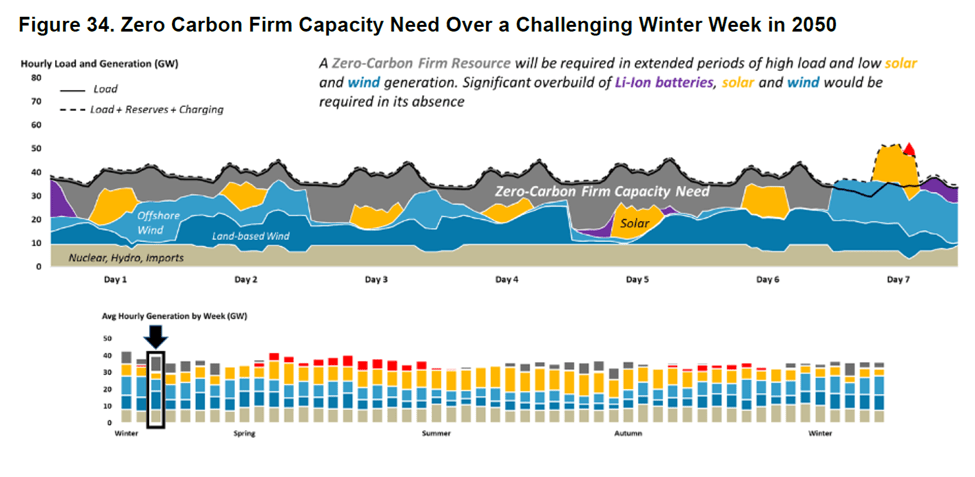
The two review concerns for a power sector depend upon weather-dependent resources that I think must be addressed in any assessment of the quality of the report are the need for a new resource to address long-term wind and solar deficits and the challenge of specifying how much of those resources is needed.

In my opinion, all credible analyses of future electric energy systems depending upon wind and solar must acknowledge the need for a new resource to backup up weather dependent resources that New York has named DEFR.  Francis Menton explains that this creates a likely impossible challenge: 

The reason is that the intermittency of wind and solar generators means that they require full back-up from some other source. But the back-up source will by hypothesis be woefully underused and idle most of the time so long as most of the electricity comes from wind and sun. No back-up source can possibly be economical under these conditions, and therefore nobody will develop and deploy such a source.

There is another aspect of DEFRs that needs to be considered.  Menton also did a post on September 28, 2023 that covered a Report then just out from Britain’s Royal Society dealing with issues of long-term energy storage to back up wind and solar generators that concisely describes my other quality concern.  He explains that the Royal Society had collected weather data for Britain for some 37 years and documented that “there are worst-case wind and sun “droughts,” comparable to rain droughts, that may occur only once every 20 years or more.” 

The Royal Society: Large-scale electricity storage, Issued: September 2023 DES6851_1, ISBN: 978-1-78252-666-7

To be a credible analysis of future power sector projected needs, ten both of these concerns need to be considered.  If they are not included, then the complexity will be underestimated and the magnitude of resources required overlooked.

McKinsey Report Analysis of Concerns

For the power sector the McKinsey report addressed six challenges.  I will describe the relevant challenges and mention the challenges that affect the global system but not the New York power sector.

Challenge 1: Managing renewables variability (Level 3):

With the energy transition, Variable Renewable Energy (VRE) sources, such as solar and wind, would be required to grow and reach a relatively high share of total generation. As this happens, the output of power systems would become progressively more variable, exceeding demand on some days but falling substantially short on others. Consider Germany. VRE could potentially account for 90 percent of all power generation by 2050, in the McKinsey 2023 Achieved Commitments scenario. Nonetheless, there could still be about 75 days a year when VRE generation would be insufficient to meet a large share of demand (meaning that at least one-quarter of demand would have to be met by other sources) (Exhibit 6). VRE-heavy power systems would therefore require much more supply-side flexibility. This could come from storage (both power and heat), backup generation capacity (including thermal generation like gas power and beyond), and interconnections. Such flexibility solutions may need to scale by as much as two to seven times faster than overall power demand globally in the next three decades.  However, these forms of flexibility in turn face significant barriers relating, for example, to critical inputs (for some forms of energy storage) and other factors such as market design mechanisms (for backup generation). Most critically, some of the technologies that would be crucial for providing flexibility to the power system over the course of seasons, including novel long-duration energy storage (LDES) and hydrogen-based generation, would need to scale hundreds of times by 2050 from a negligible base today.

The Challenge 1 description emphasizes the need for supply-side flexibility.  Exhibit 6 notes that at least one quarter of the days will require backup resources to resolve VRE intermittency explaining that “novel long-duration energy storage (LDES) and hydrogen-based generation” is needed “over the course of seasons”.  The example resources can be used for DEFR but it does not address my second concern, the worst-case wind and sun drought.  This study appears to only consider average conditions, which is a common flaw in academic assessments.  For electric system resource planners, the emphasis on reliability for all periods mandates that the analysis addresses extreme conditions.    As a result, the magnitude of DEFR support necessary to keep the lights on at all times is underestimated in this analysis.

The second challenge, “scaling emerging power systems”, is also rated as Level 3. The description notes that “Many countries, especially those that are lower-income, need faster and more significant growth in their power systems to increase access to electricity.”  This is not an issue for New York. 

The description of Challenge 3: Flexing power demand (Level 2) notes that “Alongside supply-side flexibility, there may be more opportunity for demand-side flexibility in power as the world electrifies” and does not address either concern. The McKinsey Report claims that this kind of flexibility could provide as much as 25 percent of the total amount needed to accommodate VRE in 2050, in the IEA’s Net Zero scenario.  However, it exposes a weakness in studies that use averages.  Industry planners do not rely on demand-side flexibility because in the worst-case scenarios the capability of those resources is much lower and can be essentially worthless.  This means that studies that only look at averages miss the point that to keep the lights on demand-side resources may not displace as many supply-side resources during the worst-case scenario as they project.  In my opinion, the value of any resource that does not provide firm energy during the worst-case scenario should be downrated.

Challenge 4, “securing land for renewables” is rated as Level 2.  This is a problem for any jurisdiction that tries to rely on VRE because wind and solar resources are diffuse.  This challenge does not address either of my concerns.

Challenge 5: Connecting through grid expansion (Level 2):

With the growth of the power system and the addition of more geographically dispersed energy sources such as VRE, grids would need to become larger and more distributed, interconnected, and resilient. They may need to more than double in size by 2050, growing 40 to 50 percent faster than they are currently. However, lead times for the permitting and construction of transmission lines are long, especially in mature markets such as the EU and the United States, where they have tended to be between five and 15 years. Among other initiatives, accelerating permitting with new streamlined processes could facilitate the expansion of grids.

This challenge does not address either of my concerns.

Challenge 6: Navigating nuclear and other clean firm energy (Level 2):

Increased deployment of clean firm power, such as nuclear, geothermal, and low-emissions thermal plants (for example, hydrogen, biogas, and natural gas with CCUS), could reduce the challenges of variability, land use, and grid expansion. Nuclear is an example of a clean firm technology that is mature and gaining momentum. At COP28, for example, a group of economies announced commitments to triple nuclear capacity by 2050.  Nonetheless, increasing the deployment of nuclear requires managing complex engineering, supply chain, skills, and siting issues as well as safety considerations. In combination, these issues could result in long lead times, frequent delays, and cost overruns. Addressing these would require, for instance, standardizing the design of nuclear plants and building multiple plants using the same designs to leverage shared learning, training workforces in the skills they need, and developing necessary supply chains.

These issues affect the deployment of DEFR but do not address my concerns directly.

Discussion

Although there is useful information in this report, it fails to address my concerns about the need for a new resource to address the specific problem of worst-case wind and solar “droughts” and the related problem of defining just how much of the new resources will be needed to prevent blackouts for the worst of the worst-case periods.

I think the main problem can be traced to the use of averages rather than worst-case conditions for evaluation of resource requirements.  I searched the document for the terms “worst” and “extreme”.  The term “worst” did not appear.  The term “extreme” did show up relative to battery electric vehicle use and heat pumps.  The McKinsey Report noted that special considerations were needed for the worst-case extremes for those applications.  Unfortunately, the authors did not extend that consideration to the power sector.

There is one other consideration unmentioned in the power sector challenges.  Wind and solar resources do not provide the ancillary services necessary to support the transmission system.  The McKinsey Report did note that transmission requirements would be a challenge but overlooked this aspect.

Conclusion

The report concludes that:

The path of the energy transition will not be straightforward, and stark trade-offs and consequences lie ahead. Taking time for the transition to play out, as in many physical transformations of the past, could allow for the physical realities of the transformation to be confronted more gradually with time to innovate and scale new low-emissions technologies, address bottlenecks, and reconfigure the system. While this may make navigating the physical challenges easier, such a path would almost certainly involve compromising on the climate goals that countries and companies across the world have agreed to, with consequences for rising physical risks. However, driving the transition forward without confronting physical realities would most likely compromise the performance of the energy system—and as a result challenge energy access, growth, prosperity, and support for the transition itself.

Alternatively, stakeholders could confront difficult physical challenges head-on—in fact, they could use an understanding of physical realities to guide the way forward to an affordable, reliable, competitive path to net zero. While many open questions remain on what precise path would enable the physical challenges to be addressed, this analysis sheds light on some crucial ingredients that would have to be present in a successful energy transition.

The power sector analysis appears to use averages to project future needs.  As a result, it fails to address my concerns about the need for DEFR and the related risk that improper assessment of the amount of DEFR needed threatens the reliability of the electric system.  The ultimate concern is that the conditions associated with extreme wind and solar droughts are also associated with extreme hot and cold weather when the electrified society will be most vulnerable if there is a blackout.  The report sheds some light on crucial ingredients but overlooks a potential fatal flaw.

Clearly there is no question in the minds of the authors that the transformation to net-zero is necessary. The conclusion talks about trade-offs and consequences but does not acknowledge that there may not be an “affordable, reliable, competitive path to net zero” using VRE.   Given the vulnerability risk, I remain convinced that the VRE transition will do more harm than good in New York and elsewhere.  I think the nuclear option is the only path forward for those who want to decarbonize.

Draft NY Documents Requiring Public Comment

Keith Schue sent me an email with the following information that I believe would be of interest to readers here.  New York State agencies have recently announced several draft documents that are out for public comment. It is confusing.  When Keith sent this clarifying information, I asked for permission to send it out as a post and he graciously gave me permission.

Keith Schue is an electrical engineer and technical adviser on energy policy. Keith advocates for nuclear power.  He recently co-authored a commentary in the Albany Times Union with climate scientist James Hansen, making a persuasive case for using nuclear in the future. 

Overview

The Climate Leadership & Community Protection Act (Climate Act) established a New York “Net Zero” target (85% reduction in GHG emissions and 15% offset of emissions) by 2050.  It includes an interim 2030 GHG reduction target of 40%. Two targets address the electric sector: 70% of the electricity must come from renewable energy by 2030 and a requirement that all electricity generated be “zero-emissions” resources by 2040. The Climate Action Council (CAC) was responsible for preparing the Scoping Plan that outlined how to “achieve the State’s bold clean energy and climate agenda.” The Integration Analysis prepared by the New York State Energy Research and Development Authority (NYSERDA) and its consultants quantifies the impact of the electrification strategies.  That material was used to develop the Draft Scoping Plan outline of strategies.  After a year-long review, the Scoping Plan was finalized at the end of 2022.  Since then, the State has been trying to implement the Scoping Plan recommendations through regulations, proceedings, and legislation.

Keith describes three related documents and opportunities for public comments in the following sections.  I have made some minor edits and added a few links.  He describes each document and includes a suggestion for a possible comment.

Draft Blueprint for Consideration of Advanced Nuclear Technology

A number of states throughout the country are encouraging the development of advanced next generation nuclear reactors to meet our growing energy needs, remain economically competitive, significantly reduce greenhouse gas emissions, conserve farmland, and protect nature. During last month’s Future Energy Summit in Syracuse, Governor Hochul announced that New York ought to consider advanced nuclear power, too. However, several misguided “environmental” groups who either don’t understand energy or don’t care about those things have launched a misinformation campaign involving form-letters to the governor and NYSERDA intended to create the appearance that New Yorkers oppose nuclear power.  They would rather see the state pursue an unproven, inefficient, ecologically-destructive energy strategy dominated by massive amounts of solar, wind, and batteries.

The due date for comments is Nov 8th.  A useful comment would be to say that if New York is serious about addressing climate change, providing ample reliable electricity essential for a growing economy, and protecting the integrity of rural land and nature, then it needs to join the 21st century by investing in dependable, compact carbon-free nuclear power. 

Click here to read the draft Blueprint: Read Draft Blueprint

Click here to comment on the draft Blueprint: Comment on Draft Blueprint

Draft Scope of NYS Energy Plan 

Although related, this should not be confused with the Climate Action Council’s Scoping Plan for implementation of the CLCPA that was adopted in Dec 2022.  Every several years the New York Energy Planning Board is required to update its overall energy plan for the state. The process begins with an initial document that identifies a “scope” of work–meaning the set of things to be evaluated in the plan. That draft “scope” was released last month for public comment with a defined planning horizon of 2040. This makes the CLCPA’s 2040 goal of carbon-free electricity particularly relevant. Unlike the CLCPA’s 70% renewable goal which only applies in 2030, the 2040 goal does not mandate an arbitrary quota of “renewables”. Instead, it simply mandates carbon-free electricity, which can include nuclear power. 

The due date for comments is Nov 25th.  An important comment would be to say that if New York is serious about achieving carbon-free electricity as electricity demand doubles, it needs to invest in reliable and resilient nuclear power that is made in America, instead of focusing predominantly on wasteful, fragile, intermittent, and ecologically-harmful sources of energy made mostly in China.


Click here to read the draft Scope: Read Draft Scope

Click here to comment on the draft Scope: Comment on Draft Scope

Draft NYPA Renewables Strategic Plan

Historically, the New York Power Authority (NYPA) has been a well-run public entity that has provided NY residents and business with reliable, affordable electricity by building and operating large hydropower plants and various electric infrastructure projects. In the past, NYPA even helped to develop nuclear power. However, the Build Public Renewables Act adopted last year now forces NYPA to try installing solar, wind, and batteries even faster than the private sector is already doing with subsidies. NYPA’s draft plan appears to leverage its good credit to help rescue or expedite about 31 private-sector large-scale solar/wind/battery projects. It would also build about 9 such projects itself.

The due date for comments is around Dec 8th.  A useful comment would be to say that achieving carbon-free electricity requires firm reliable power. Therefore, throwing more public money and resources at intermittent generation not only jeopardizes reliability and affordability, but also ensures that NY will remain dependent on fossil fuels. Instead of focusing on solar panels and wind turbines that the private sector can install on its own, NYPA should do what it has historically done best by working on reliable public projects for the common good, like nuclear energy, hydropower, and utility infrastructure.

Click here to read the draft NYPA Renewables Plan: Read Draft NYPA Renewables Plan
Click here to comment on the draft NYPA Renewables Plan and see the schedule of Public Hearings: https://www.nypa.gov/renewables

Conclusion

Keith’s overview is apropos and I agree with him.  I am on vacation so publishing someone else’s work is an easy way to keep the hits to the blog coming.  All of these documents and issues are of interest to me, and I intend to comment.  The bottom line is that if New York really wants to decarbonize, then nuclear must be part of the future energy mix or it will be impossible to achieve the aspirational targets.

Draft NYISO Reliability Needs Assessment Regulatory Policies Affecting Reliability

It has been a while since I have written about New York Independent System Operator (NYISO) reliability planning process documents.  This post summarizes the section describing regulatory policies affecting reliability in the draft October 2024 draft Reliability Needs Assessment (RNA). 

I have followed the Climate Leadership & Community Protection Act (Climate Act)since it was first proposed, submitted comments on the Climate Act implementation plan, and have written over 450 articles about New York’s net-zero transition. The opinions expressed in this article do not reflect the position of any of my previous employers or any other organization I have been associated with, these comments are mine alone.

Overview

The rationale for the Climate Act is the existential threat of climate change and the Hochul Administration never misses an opportunity to describe every weather extreme as a more proof.  The Climate Act established a New York “Net Zero” target (85% reduction in GHG emissions and 15% offset of emissions) by 2050.  It includes an interim 2030 reduction target of a 40% reduction. Two targets address the electric sector: 70% of the electricity must come from renewable energy by 2030 and a requirement that all electricity generated be “zero-emissions” resources by 2040. The Climate Action Council (CAC) was responsible for preparing the Scoping Plan that outlined how to “achieve the State’s bold clean energy and climate agenda.” The Integration Analysis prepared by the New York State Energy Research and Development Authority (NYSERDA) and its consultants quantifies the impact of the electrification strategies.  That material was used to develop the Draft Scoping Plan outline of strategies.  After a year-long review, the Scoping Plan was finalized at the end of 2022.  Since then, the State has been trying to implement the Scoping Plan recommendations through regulations, proceedings, and legislation.

NYISO Reliability Planning

The NYISO reliability planning process consists of two analyses: the Reliability Needs Assessment (RNA) and Comprehensive Reliability Plan (CRP). The RNA evaluates the adequacy and security of the bulk power transmission facilities over a ten-year planning period, the resources in megawatts (MW), and the locations where required to meet projected needs.  If necessary, the NYISO will request solutions for identified needs.  The CRP determines if the proposed solutions are viable and sufficient then documents the solutions meet the identified reliability needs. 

As part of this continuous process the NYISO has released a “draft for discussion purposes only” of the 2024 RNA on October 4, 2024.  The Regulatory Policies Affecting Reliability section caught my attention, so I wrote this article.

Regulatory Policies Affecting Reliability

A common theme in this blog is the risks to reliable electricity posed by political machinations.  Although the NYISO is technically an independent organization there is tremendous political pressure for the organization to comport with the politically driven narrative of the Hochul Administration.  The section discussing regulatory policies is carefully written so as not to offend the politicians:

Increasingly ambitious environmental and energy policies, evolving market rules, technological advancements, and economic factors impact the decisions by market participants and are accelerating the transition in the state’s resource supply mix. During this transition, the pace of both the addition of new resource additions and the retirement of older, higher-emitting resources are projected to exceed historical levels. Changes to demand patterns and the generation fleet driven by federal, state, and local government regulatory programs may impact the operation and reliability of New York’s bulk power system.

“May impact” operation and reliability is a massive understatement.  Consider the following:

Compliance with federal and state regulatory initiatives and environmental and permitting requirements may require investment by the owners of New York’s existing thermal power plants in order to continue operation. If the owners of those plants must make significant investments to comply, the increased cost to continue operating could lead to the retirement of these resources needed to maintain the reliability of New York’s bulk power system and, therefore, could necessitate replacement.

The document lists eight public policy initiatives that could require investment.  One of the initiatives is the “Peaker Rule:” that targets Nitrogen Oxide (NOx) emission limits for simple cycle and regenerative combustion turbines that provides an example of the challenges.  This initiative should be a model for New York energy policy.  The rule was needed for the state to comply with EPA requirements to reduce NOx to help reduce ozone concentrations.  On the other hand, the simple cycle “peaker” turbines fulfill a critical reliability function.  Recognizing this tradeoff the NY Department of Environmental Conservation (DEC), the generating companies, and NYISO worked out a plan to ensure that the facilities would eventually retire or install control equipment to reduce emissions on a proscribed schedule.  The non-regulated owners of the facilities all determined that the market would not support control equipment investment and submitted plans to retire.  The NYISO determined that temporarily retaining the peaker generators on the Gowanus 2 & 3 and Narrows 1 & 2 barges is necessary to address a reliability requirement, but the others have retired.

Another of the initiatives, “New York Power Authority (NYPA) Small Gas Power Plant Phase Out” is an example of an inappropriate energy planning initiative.  The document describes it as impacting 517 MW nameplate capacity in New York City and Long Island. It requires a plan to phase out production of electricity from fossil fuels, considering clean replacement resources and impacts on emissions and system reliability.  In particular,

NYPA is required to publish a plan by May 2025 to phase out the production of electricity from its seven small natural gas plants (simple-cycle combustion turbines) in New York City and Long Island by December 31, 2030, unless those plants are determined to be necessary for electric system reliability or emergency power service or energy from other sources that may replace energy from NYPA’s small plants would result in more than a de minimis net increase in emissions within a disadvantaged community.

The peaking power plant issue has become a major point of focus of the environmental justice community and proponents managed to convince politicians to include this legislation in the 2023-2024 enacted state budget.  I described many issues with this bogus problem last February.  In short, while there is no question that power plants do affect adjacent neighborhoods, their impacts are all less than the National Ambient Air Quality Standards and the contributions from buildings and transportation sectors are more impactful.  In my opinion, that means that they are not as evil as portrayed,  Furthermore, a DEC Cap and Invest program presentation noted that the power plants had negligible emissions relative to total state-wide emissions.  On the other hand, they fulfill a critical reliability need. 

The draft RNA explains that there are challenges for the replacing these resources:

Balancing the grid throughout this transition not only requires maintaining sufficient capacity to meet demand but also requires that new resources entering service comparably replace the capabilities and attributes of the resources leaving the system (e.g., fast starting/ramping and dispatchable both up and down, available when and for as long as needed, providing essential reliability services such as voltage and frequency control, support system’s stability during disturbances). Continued dialogue and engagement among Market Participants, policymakers, and the NYISO will be essential to support the planning processes in order to identify the needs and services required to maintain a reliable system during and after this transition period.

The NYPA Small Gas Power Plant Phase Out regulation affects modern units that have emission rates far lower than the old units affected by the Peaker Rule.  The environmental justice advocates have the mistaken impression that they can be replaced by battery energy storage powered by wind and solar resources.  This description lays down a marker. The bottom line is that the only resource that can provide the necessary attributes at this time is a fossil-fired generating unit.  Wind, solar, and battery energy storage cannot replace the capabilities and attributes described.

However, given that there have been multiple attempts to permit new replacement fossil-fired generating units to replace the existing peaker units do not underestimate political attempts to deny reality..  The DEC has, under considerable political pressure in my opinion, refused to permit any of these proposed resources citing nothing more than the project being inconsistent with the Climate Act.  Consequently, nothing to replace the old resources has been built.

Conclusion

The “Peaker Rule” promulgation and implementation predated the Climate Act.  It was a common sense approach that provided environmental benefits and protected electric system reliability, Since then reliability concerns have been given short shrift and practical reliability solutions have not been permitted.  The NYPA Small Gas Power Plant Phase Out regulation codifies the irrational New York energy policy approach whereby politicians claim to know better than the electric planner professionals responsible for maintaining a reliable electric system.  Now the NYISO must deal with this legislation that is supposed to shut down existing power plants in favor of a magical resource that does everything needed without any environmental impacts in response to a mostly non-existent problem.  At some point the Hochul Administration is going to have to step up and support the resources necessary to keep the lights on.

Catastrophic Costs of Green Energy

The New York State Comptroller Office released an audit of the NYSERDA and PSC  implementation efforts for the Climate Leadership & Community Protection Act (Climate Act) titled Climate Act Goals – Planning, Procurements, and Progress Tracking.  The audit found that: “The costs of transitioning to renewable energy are not known, nor have they been reasonably estimated”.  This post describes a couple of articles that suggest that when the costs of the Climate Act transition are finally revealed they will be extraordinarily high.

I have followed the Climate Act since it was first proposed, submitted comments on the Climate Act implementation plan, and have written over 450 articles about New York’s net-zero transition.  The opinions expressed in this article do not reflect the position of any of my previous employers or any other organization I have been associated with, these comments are mine alone.

Overview and Background

The Climate Act established a New York “Net Zero” target (85% reduction in GHG emissions and 15% offset of emissions) by 2050.  It includes an interim 2030 reduction target of a 40% reduction by 2030. Two targets address the electric sector: 70% of the electricity must come from renewable energy by 2030 and all electricity must be generated by “zero-emissions” resources by 2040. The Climate Action Council (CAC) was responsible for preparing the Scoping Plan that outlined how to “achieve the State’s bold clean energy and climate agenda.” The Integration Analysis prepared by the New York State Energy Research and Development Authority (NYSERDA) and its consultants quantifies the impact of the electrification strategies.  That material was used to develop the Draft Scoping Plan outline of strategies.  After a year-long review, the Scoping Plan was finalized at the end of 2022.  Since then, the State has been trying to implement the Scoping Plan recommendations through regulations, proceedings, and legislation. 

To date, however, the costs of the transition have not been revealed.  The Comptroller Report audit found that: “While PSC and NYSERDA have taken considerable steps to plan for the transition to renewable energy in accordance with the Climate Act and CES, their plans did not comprise all essential components, including assessing risks to meeting goals and projecting costs.”  It noted that the “PSC is using outdated data, and, at times, incorrect calculations, for planning purposes and has not started to address all current and emerging issues that could significantly increase electricity demand and lower projected generation”.  Regarding costs the audit notes that “The costs of transitioning to renewable energy are not known, nor have they been reasonably estimated” and goes on to point out that the sources of funding have not been identified.

Crippling Costs of Electrification and Net-Zero Energy Policies in the Pacific Northwest

Jonathan Lesser and Mitchell Rolling have released a new research report from Discovery Institute’s Reasonable Energy program that will “produce staggering costs to individuals and businesses without providing any meaningful environmental benefits”.  The Discovery Institute announcement of the report summarizes the report as follows.

  • Authors Jonathan Lesser and Mitchell Rolling conclude that policies in Oregon and Washington State that require their state electrical utilities to eliminate fossil-fuel energy sources to produce 100% of electricity from zero-emissions sources by 2040 (Oregon) and 2045 (Washington) will double existing electricity demand.
    • Both states have adopted California’s Advanced Clean Car rules, which require 100% of all new cars and light trucks sold to be electric by 2035.
    • Both states intend to reach zero energy-related greenhouse gas emissions by 2050, including replacing all fossil-fuel space- and water-heating systems with electric heat pumps.
    • Both states envision replacing existing fossil fuel generation and meeting the projected increase in electricity demand with thousands of megawatts (MW) of wind turbines and solar photovoltaics.

The Climate Act mandates are similar to those in Oregon and Washington.

The inherent intermittency of wind and solar power, together with peak electric demands taking place in the early evening hours when there is no solar generation available (and often no wind), means the two states will require large amounts of storage capacity, in addition to the existing hydroelectric storage dams that have been built on the Columbia River and its tributaries.

New York electric system projections highlight the same problem with intermittency as described here.

Because no new hydroelectric dams will be built, the additional storage capacity required will need to come from large-scale battery storage facilities and perhaps a few new pumped hydroelectric storage facilities, whose siting remains controversial.

New York also has no ability to build more hydro so will have to rely on battery energy storage.

  • Their research considered the costs by 2050 associated with three scenarios: 1) the renewables-only strategy; 2) a lower-cost renewable strategy (a more optimistic low-cost renewables scenario in which wind, solar, and storage capital costs decrease by 50% in real (inflation-adjusted) terms by 2050); and 3) an alternative scenario in which the electricity goal is achieved with new nuclear plants and additional natural gas generators. The assessed total costs (in inflation-adjusted dollars) are as follows:
    • Renewables Only: $549.9 Billion
    • Lower-cost Renewables: $418.5 Billion
    • Natural Gas and Nuclear: $85.9 Billion

The Climate Act precludes the pragmatic option to consider natural gas and nuclear so our costs will be closer to the high end.

  • Their research indicates that the effects on electricity bills will be devastating.
    • A typical residential customer’s bill will increase by 450%, from about $110 per month today to over $700 per month in 2050 (assuming a modest inflation rate of just 2.0% annually).
    • Commercial customers will see their monthly bills increase from an average of about $600 per month today to approximately $3,800 per month in 2050.

The Hochul Administration has not provided any ratepayer impacts, but I expect the costs will be similar in New York.

  • The negative economic impacts will not be limited to soaring electricity bills.
    • Prices for virtually all goods and services will dramatically increase.
    • Jobs will be lost as businesses relocate to other states with lower-cost energy.
    • Energy poverty rates will soar.

Negative economic impacts are a feature not a bug of net-zero transition efforts.

  • The enormous costs to consumers and businesses will be accompanied by negligible environmental benefits.
    • The reduction in greenhouse gases (GHGs) from the policies would total about 1.8 billion metric tons between 2024 and 2050, which is a small fraction of estimated 35 billion metric tons world carbon emissions in just one year.
    • If both states eliminated all energy-related GHG emissions by 2040, the resulting decrease in world temperatures would be only 0.003 ⁰C. By comparison, the best outside thermometers have an accuracy of about +/- 0.5 ⁰C, about 170 times larger.

I estimate that New York reduction in GHG emissions is about the same (1.5 billion metric ton reduction) as the reduction projected from Oregon and Washington so the estimates of environmental benefits are similar.

The report concludes that the two states would be best served by abandoning these goals, focusing instead on providing reliable and far less costly electricity from new natural gas and nuclear plants.

I believe this conclusion would be appropriate for New York.

Catastrophic Costs of Green Energy

Alex Epstein described his testimony in front of the House Budget Committee on the topic “The Cost of the Biden-Harris Energy Crisis.”  You can watch his testimony and the Q&A at the link.

The transcript of his testimony states:

The basic idea of government-dictated green energy is that the government should force us to rapidly reduce our use of fossil fuel energy and replace it with so-called “green energy,” mostly solar and wind, such that we reach net zero greenhouse gas emissions by 2050 at the latest.

There are three basic truths you need to know about the costs of government-dictated green energy. And I think these are really under-appreciated even by critics.

One is they have been enormous so far.

Two is they would have been catastrophic had it not been for the resistance of their opponents. This is very important when you hear the Biden administration has record production. That’s in spite of them, not because of them.

And three, they will be apocalyptic if not stopped in the future.

He goes on to summarize the reason for the cost increases:

So let’s talk about the cost so far of government-dictated green energy. All the energy related problems we have experienced in recent years, which have been a lot: high gasoline prices, higher heating bills, higher electricity bills, and unreliable electricity, which is a huge problem we need to talk much more about, are the result of government-dictated green energy.

And its very simple. When you shackle the most cost effective and scalable source of energy, fossil fuels, and you subsidize unreliable solar and wind, that wouldn’t otherwise be competitive, energy necessarily becomes more expensive, less reliable and less secure. So again, it’s very simple.

This is exactly what will happen in New York because of the Climate Act net-zero transition.  He goes on to explain why inflation and increased energy costs are inextricably linked:

Prices are determined by supply and demand. If oil and gas companies could control energy prices in their favor, why didn’t they do this from 2015 to 2020 when they were losing money? The truth is that government-dictated green energy policies are fundamentally responsible for all the energy related costs we experience today compared to a decade ago.

And in fact, it’s worse than that. There’s an opportunity cost. Because were it not for these policies, energy would have gotten considerably cheaper and more reliable, especially with lower natural gas prices, which should have lowered electricity prices. Instead, they’ve gone up because we’ve added a bunch of wasteful energy and unreliable stuff. And it gets worse, since energy is the industry that powers every other industry. By making energy more expensive and less reliable, we make everything more expensive and less reliable, which means government-dictated green energy drives price inflation. Very important point.

His testimony notes that at least on the Federal level that the attempts to rapidly eliminate fossil fuel use have failed.  Consequently, the nation has been spared energy ruin and a third-world grid.  Of course, reality has not stopped the Climate Act.  His testimony is a grim warning of our future if this madness continues.

Conclusion

In the absence of a clear accounting of costs for the Climate Act we can only guess what will happen here.  I believe that the crippling and catastrophic adjectives used by these authors will surely describe our energy costs.

Hurricane Helene Hype Nonsense

The basis of the emotion driven narrative that there is an existential threat of climate change is fueled by endless articles and opinion pieces in the mass media that conflate every extreme weather event with climate change.  Remember climate is what you expect, and weather is what you get.  This article describes how the hucksters incorrectly make the extreme weather devastation caused when a rare weather pattern caused the storm to stall into an example of climate change impacts when a hurricane in hurricane alley during the hurricane season occurred.

I have followed the Climate Leadership & Community Protection Act (Climate Act)since it was first proposed, submitted comments on the Climate Act implementation plan, and have written over 450 articles about New York’s net-zero transition. The difference between weather and climate has been a theme in many articles. The opinions expressed in this article do not reflect the position of any of my previous employers or any other organization I have been associated with, these comments are mine alone.

Overview

The rationale for the Climate Act is the existential threat of climate change and the Hochul Administration never misses an opportunity to describe every weather extreme as a more proof.  The Climate Act established a New York “Net Zero” target (85% reduction in GHG emissions and 15% offset of emissions) by 2050.  It includes an interim 2030 reduction target of a 40% reduction. Two targets address the electric sector: 70% of the electricity must come from renewable energy by 2030 and a requirement that all electricity generated be “zero-emissions” resources by 2040. The Climate Action Council (CAC) was responsible for preparing the Scoping Plan that outlined how to “achieve the State’s bold clean energy and climate agenda.” The Integration Analysis prepared by the New York State Energy Research and Development Authority (NYSERDA) and its consultants quantifies the impact of the electrification strategies.  That material was used to develop the Draft Scoping Plan outline of strategies.  After a year-long review, the Scoping Plan was finalized at the end of 2022.  Since then, the State has been trying to implement the Scoping Plan recommendations through regulations, proceedings, and legislation.

Good Energy Hype

I was prompted to write this post when I came across an opinion piece in the LA Times: Helene destroyed my hometown. I don’t want climate change stories of false hope by Anna Jane Joyner.  She is the founder and chief executive of the “story support nonprofit” Good Energy.  Last March I did an article about Irina Slaw’s article “Burn, Hollywood, burn” where she called out the blatant indoctrination and propaganda associated Good Energy – “Story support for the age of climate change”.

After noting that she had been checking on the weather and evacuation plans while preparing to board a plane on her way to NYC Climate Week  Joyner writes:

The hurricane didn’t come for my partner and me this time, but it destroyed my hometown in the mountains of North Carolina. I’ve spent 20 years working on climate and I live between Los Angeles and the Gulf Coast of Alabama, where I’ve reckoned with the likelihood of one day losing our home. I’ve also accepted that worsening fires, droughts and heat waves could make Southern California unlivable. But Asheville was considered a climate haven. I’ve always told family members we can never sell our homes there. It is utterly unfathomable that it would be devastated first by one of the worst climate disasters in U.S. history. Helene showed us nowhere is safe. 

Joyner went on to provide descriptions of the destruction caused by storm.  This was followed by her attempt to link the storm to climate change and her climate change false hope argument:

Scientists estimate that climate change increased Hurricane Helene’s rainfall by up to 50% in parts of the Carolinas and Georgia, dumping more than 40 trillion gallons of water. At NYC Climate Week, the annual awareness event held alongside the U.N. General Assembly, the disconnect from this shattering reality was surreal. There were fancy parties, cheerful sun imagery and giant signs reading “HOPE.” The dominant theme was: We can solve this! We need to tell hopeful climate stories! But there’s no “solving” a hurricane wiping out western North Carolina, hundreds of miles from the sea. Only focusing on optimism is like telling a cancer patient that everything will be OK if they just stay positive. At best, it comes across as out of touch; at worst, it feels callous. Yes, we can still prevent the worst impacts and must demand our governments scale solutions and act urgently, but we cannot minimize the horrors unfolding now, or that it will get worse in the coming years.

It gets worse:

Fossil fuel executives have known since the 1970s that burning oil, coal and gas would cause escalating climate catastrophes and worldwide suffering. Yet they lied, sacrificed our safety for their greed and just unleashed an apocalypse on my hometown. Their actions will condemn children today to a planet that’s more hell than Earth by the end of the century if we don’t stop them. It isn’t just a tragedy; it’s a crime against humanity.

Not to worry Joyner will be available to solve this problem by providing stories:

What’s happening in North Carolina doesn’t feel real. I have no emotional framework for this, no story to help me. Right now, what I desperately need are authentic stories that help us figure out how to be human in this changing world, to face this overwhelming crisis with bravery. Stories that help us navigate our very understandable fear, anxiety, grief, despair, uncertainty and anger in a way that allows us to feel seen. Stories that make us laugh — not in ignoring our reality, but in the midst of it — and stories that remind us there’s still so much beauty here to fight for. That capture how, in the living nightmare of climate disasters, people demonstrate extraordinary kindness and creativity, as they’re doing in Asheville and Black Mountain at this very moment. And we need stories that expose the guilt of the fossil fuel industry.

Reality

A quick review of recent articles at Watts Up With That demonstrates that the devastation of the remnants of Helene in the Asheville region was an extreme weather event and not evidence of climate change.

Paul Homewood did a nice summary of the data for Hurricane Helene.  His description of the Asheville rain notes:

In Asheville, North Carolina, a total of 13.98 inches (35.52 centimeters) of rain fell from September 25 to 27, according to National Weather Service records. The storm swamped neighborhoods, damaged roads, caused landslides, knocked out electricity and cell service, and forced many residents to evacuate to temporary shelters. Record flood crests were observed on multiple rivers in the state. Flooding was widespread across the southern Appalachians; preliminary rainfall totals neared or exceeded 10 inches (25 centimeters) in parts of Georgia, North Carolina, South Carolina, Tennessee, and Virginia.

Note that the 14 inches of rain occurred over three days.  Joyner referenced a statement that climate change increased Hurricane Helene’s rainfall by up to 50% in parts of the Carolinas and Georgia.  I found that the reference stated that “In one provisional rapid attribution statement, a trio of scientists at the Lawrence Berkeley National Laboratory said the rainfall over the 24 hours Helene moved through was made up to 20 times more likely in these areas because of global warming.”  Comparing the 24 hours in this reference to the three-day storm total makes it clear that storm motion was not considered in rapid attribution statement. 

Charles Rotter’s article on the observations of Steve McIntyre and Andy Revkin about the real lessons to be learned from the storm completes the destruction of the arguments in Joyner’s op-ed.  McIntyre explains that flood control dams were planned for some of the rivers that had devastating floods but were not built.  Clearly there are negative consequences of building dams and positive benefits associated with keeping the rivers open.  But if you want to prevent flood damage when you keep the rivers free of dams then you should take prudent actions.  Revkin points out that was not the case:

Finally, Revkin described a 1960 report “Floods on French Broad and Swannanoa Rivers around Asheville” explaining what was likely to happen:

Andy reported that the report stated that developments around Asheville “would cause these great floods of the past to be higher if they occurred again. Land fills and buildings in the flood plain and the many bridges across the streams have seriously reduced flood flow capacity.” “On the French Broad River, a flood of the same discharge as the 1916 flood would today be 3 to 4 feet higher between Pearson Bridge and West Asheville Viaduct than the actual flood elevation. On the Swannanoa River, a repetition of the 1916 flood would be up to 2. 5 feet higher today at Biltmore and up to 15 feet higher upstream from the Recreation Park dam.”

Anthony Watts described a couple of articles from Climate Realism that debunked the media claims about climate change effects on the storm.  He shows that the claims of climate change worsening storms such as Helene just don’t hold up.  Of particular note, is the reference to a massive flood in Asheville in 1916. Matthew Wielicki provides a good comparison of this storm and the 1916 storm.  He found that the 1916 flood peaked at 23 feet.  In this storm the peak was 24.7 feet. 

Note that the 1960 report projected that if there was another 1916 storm that the flood would be between 3 to 4 higher because of development.  Hurricane Helene flood waters peaked at less than two feet higher than the 1916 storm.  It was development and not climate change.

Conclusion

Joyner concluded her article:

I need help making meaning of all this, and stories have always been how humans make sense of our world. But as I grieve an unimaginable loss, the last thing I want are optimistic stories about hope. As climate scientist Kate Marvel says: “We need courage, not hope, to face climate change.”

I find it difficult to sympathize with the grief of someone who provides Hollywood “story support for the age of climate change” because reality paints a different picture of the world.  The data show that Helene was a rather typical hurricane in hurricane alley that occurred in the hurricane season.  Devastating floods in Asheville have occurred before and evidence suggests that the greater observed flood peak was probably due to development.  There is nothing to suggest that this is anything but an extreme weather event and it certainly is no evidence of any kind of worsening climate change impacts.

In my opinion, the worst part of this is that the usual suspects are using this tragedy to call for US reductions in fossil fuel to prevent this from happening again.  Putting aside the lack of a causal link between GHG emissions and specific weather events, the relative magnitude of US and global emissions, and the rate of change of those emissions, the indisputable fact is that storms causing this kind of devastation have happened before and will happen again whatever is done to mitigate emissions.  If nothing is done to adapt to this observed extreme weather, then the tragedy will inevitably occur again.  Obviously we need to reassess where we are making our investments.

Vermont Clean Heat Standard Lessons for New York

The Climate Leadership & Community Protection Act (Climate Act) could learn quite a bit from the experiences of Vermont and their Clean Heat Standard as documented by Robert Roper at his Behind the Lines Substack.  Roper did an overview of the Clean Heat Standard and a summary of the Public Utility Commission’s (PUC) long awaited Draft Clean Heat Standard Rule Companion Status Report that provide evidence that New York’s similar initiatives will run into the same problems he identifies.

I have followed the Climate Act since it was first proposed, submitted comments on the Climate Act implementation plan, and have written over 450 articles about New York’s net-zero transition.  The opinions expressed in this article do not reflect the position of any of my previous employers or any other organization I have been associated with, these comments are mine alone.

Overview

The Climate Act established a New York “Net Zero” target (85% reduction in GHG emissions and 15% offset of emissions) by 2050.  It includes an interim 2030 reduction target of a 40% reduction by 2030. Two targets address the electric sector: 70% of the electricity must come from renewable energy by 2030 and all electricity must be generated by “zero-emissions” resources by 2040. The Climate Action Council (CAC) was responsible for preparing the Scoping Plan that outlined how to “achieve the State’s bold clean energy and climate agenda.” The Integration Analysis prepared by the New York State Energy Research and Development Authority (NYSERDA) and its consultants quantifies the impact of the electrification strategies.  That material was used to develop the Draft Scoping Plan outline of strategies.  After a year-long review, the Scoping Plan was finalized at the end of 2022.  Since then, the State has been trying to implement the Scoping Plan recommendations through regulations, proceedings, and legislation.

There are two relevant initiatives.  The CAC recommended an economywide cap-and-invest program. Plan that led to the New York Cap-and-Invest (NYCI) program that will “establish a declining cap on greenhouse gas emissions, limit potential costs to New Yorkers, invest proceeds in programs that drive emission reductions in an equitable manner, and maintain the competitiveness of New York businesses and industries.”  In the Legislature the New York Home Energy Affordable Transition Act, or NY HEAT that passed the last session but has not been signed is supposed to secure “affordable, clean energy for New York households.”

Vermont Clean Heat Standard

Roper’s overview of the Clean Heat Standard put together a “pocket guide” that describes what this law is supposed to do, how it’s supposed to work, and what it looks like it will cost to fully implement.  I recommend that you read the article for full details because Rober is a good writer that explains things well in an engaging manner.  I will quote from his article and compare to New York’s situation below.

Roper explains the origin of the Clean Heat Standard:

The Clean Heat Standard is an outgrowth of the Global Warming Solutions Act (GWSA), passed over the veto of Governor Scott in 2020. The GWSA mandated that Vermonters lower our greenhouse gas emissions to 26% below 2005 levels by 2025, 40% below 1990 levels by 2030 and 80% below 1990 levels by 2050. How we were going to do this, what it would cost, or if it were even possible the lawmakers who passed the GWSA did not know, but if we failed to meet these deadlines, they inserted a provision in the GWSA that gave literally anyone standing to sue the state at taxpayer expense.

As noted in the Overview the GHG emission reduction targets for the New York Climate Act are similar.  Like New York, the Vermont politicians assumed that the transition was only a matter of political will and that the details of how to get there would be a minor, easily resolved detail.  The Climate Act does not include the provision for lawsuits if the deadlines were not met.  Not to worry the Environmental Rights Amendment to the New York constitution will provide a similar basis for litigation.

Similar to New York’s Climate Action Council, the GWSA created a Vermont Climate Council that released their Climate Action Plan in December 2021.

This plan, released in December 2021, recommended that for the thermal sector of our economy (how we heat our homes and businesses, make hot water, and cook our food), which accounts for over 40 percent of our overall greenhouse gas emissions, that the legislature pass another law establishing a Clean Heat Standard.  The legislature did this in 2023 over Governor Scott’s veto with Act 18 — again not knowing what it would cost, how it would work, or if it were possible.

Roper describes the Clean Heat Standard:

In a nutshell, the Clean Heat Standard is a system requiring importers/sellers of heating oil, kerosene, propane, natural gas, and coal, to obtain (in most cases, especially for smaller dealers, this means buy) “credits” based on the amount of carbon released into the atmosphere when the fuels they sell are ultimately burned. According to the law, a carbon credit is defined as “a tradeable, nontangible commodity that represents the amount of greenhouse gas reduction attributable to a clean heat measure.” A “clean heat measure” is one of a dozen legally approved actions taken — by anyone — to reduce greenhouse gas emissions such as weatherizing a building or installing a heat pump.

Practically speaking, a carbon “credit” it is a financial instrument, much like a cryptocurrency, that a fuel importer/seller must obtain in order to legally sell their product(s) either by “mining” the credits themselves (performing clean heat measures) or buying them from a “Default Delivery Agent” (likely Efficiency Vermont) appointed by the state.

There are similarities to NYCI but significant differences too.  Both programs require compliance entities to obtain authorizations to emit amounts of carbon.  Affected Vermonters must earn those authorizations either themselves or buying them for someone else who performed the clean heat measures.  Affected New Yorkers buy the authorizations from the auction marketplace which is supposed to use the proceeds to fund clean heat measures.  New York’s proposed NY HEAT includes mandates to force electrification of home heating away from fossil fuels.  Both state approaches are intended to reduce emissions on a mandated trajectory consistent with their GHG targets.

In both States the nasty little detail of how many homes must be modified to achieve those goals is only now being addressed.  In Vermont “According to a taxpayer funded analysis done by The Cadmus Group for the Climate Council, in order to meet just the 2030 targets Vermonters will have to weatherize 120,000 homes, install 177,107 heat pumps, 136,558 heat pump water heaters, 14,992 advanced wood heating systems, and switch 21,086 homes to using biofuels before the end of the decade.” New York’s documentation for these numbers is buried in documents but in much less detail. In both cases the costs and where the money necessary to pay for them is unresolved.

There is a huge implementation issue for both states.  In Vermont:

How is the state even supposed to ensure and verify that all of these clean heat measures take place, calculate exactly how much greenhouse gas reduction will result from each unique measure so that each measure can be monetized into a tradable carbon credit value, assign ownership of the credits, and then establish a financial exchange where the creators of credits and the parties obligated to obtain them can buy and sell them while at the same time regulators track ownership and ensure compliance? When the legislature passed Act 18, they had no idea so handed off the task of figuring all that out to the Public Utilities Commission (PUC).

In New York, the unique Climate Act emissions accounting requirements means that the State must develop reporting and tracking mechanisms for emissions, develop an allowance system for ownership, and establish a financial exchange like Vermont.  In New York the assignment for this task was given to the Department of Environmental Conservation and the New York State Energy Research & Development Authority on a time frame years less than it took California to establish a similar program.

In my opinion based on years of experience with emissions accounting and reporting New York’s challenge is impossible on the mandated schedule but the Vermont approach is much worse.  Roper writes and I agree:

If that task sounds impossibly complicated, it is. In fact, Efficiency Vermont released a memo to the PUC on September 19, stating, “The complexity of these arrangements also give rise to concerns over the veracity of projects claiming credits and the rigor of their completion… Efficiency Vermont is unsure of the efficiency or efficacy of monetizing credits…. [and] that while compliance may ultimately be achieved after several years, the buying and selling of credits itself becomes grossly inefficient, asymmetrical, and potentially more costly for all parties.” Not an expression of confidence that this is going to work at all, let alone be cheap.

Costs

Roper writes:

Supporters of the Clean Heat Standard say we don’t know what it will cost, shouldn’t speculate, and that all indications so far are that the cost to implement the program will be minimal for consumers. This first position is misleading, and the second is demonstrably false.

As for not knowing what the Clean Heat Standard will cost, that’s only true if you’re looking for an exact price tag, which, of course, can’t be determined until the program’s rules are fully designed and approved. However, it is not difficult to get a ballpark figure with all of the data that has been collected and testimony taken over the three-plus years that this policy has been under consideration.

The excuse for not providing costs in New York’s Scoping Plan was we cannot give an exact price because of all the uncertainties.  The failure to provide a ballpark figure in New York is indicative of the likelihood that the costs are politically unacceptable.  There is no reason to believe that the New York cost experience will be markedly different than Vermont.

Roper documents how much money has been spent on implementation and concludes that “Given this level of financial and human resources engaged over this extended period of time the claim that we still don’t have enough information to know basically what the Clean Heat Standard will cost – not even a ballpark understanding – defies credulity.”  Inevitably the costs must come out, but in the meantime, here is a ballpark estimate:

According the newly released potential study done by NV5 through the Department of Public Service, the estimated incentive spending required to fund the number of clean heat measures necessary to meet the GWSA reduction mandates will cost about $3.3 billion over the first four years leading up to the 2030 target (and about $10 billion total to meet the 2050 target). To raise that much money off the sale of 200 million gallons of fossil heating fuel sold annually comes out to a just over $4 per gallon.

Roper goes on to flesh out more details of the implications of the Vermont initiative.  He describes who pays and who benefits.  Most importantly, who loses: “The biggest losers in this scheme are those who can’t transition away from heating with fossil fuels even if they want to because, for example, they can’t afford the upfront costs of doing so, can’t find the labor to do the work in a timely fashion, or their homes are logistically difficult or impossible to retrofit such as those living in mobile homes, older housing stock lacking open floor plans, or multi-unit apartment buildings.”  He closes this post to explain how this is supposed to be implemented.

PUC Clean Heat Status Report

Roper’s second post is a summary of the Public Utility Commission’s (PUC) long awaited Draft Clean Heat Standard Rule Companion Status Report.  I particularly like his description of the conclusion that the Clean Heat Standard is a dead end and recommend reading it.

As he has been writing for years the PUC concludes:

The Clean Heat Standard as currently conceived requires substantial additional costs and regulatory complexity above the funding needed to accomplish Vermont’s greenhouse gas emission reduction goals. For example, the Clean Heat Standard would require establishing a credit marketplace managed by what is likely to be a costly credit platform, the potential for fraud and market manipulation, the appointment of new or varied default delivery agents with administrative costs of their own, and the participation and regulatory engagement of hundreds of fuel dealers and other actors — e.g., companies and individuals that install clean heat measures — not currently or historically regulated by the Commission.

Our work over the past year and a half on the Clean Heat Standard demonstrates that it does not make sense for Vermont, as a lone small state, to develop a clean heat credit market and the associated clean heat credit trading system to register, sell, transfer, and trade credits. Because the Clean Heat Standard introduces these additional regulatory hurdles and costs, the Commission is considering other options to achieve Vermont’s greenhouse gas emission reduction goals for the thermal sector.

Given that the Clean Heat Standard won’t work what alternative was proposed?

[A] new thermal energy benefit charge on the sale of fuel oil, propane, and kerosene. Similar to the long-standing electric efficiency charge, the Commission would set the thermal energy benefit charge based on statutory criteria, including the need to provide sufficient funding to meet the Global Warming Solutions Act requirements.

Roper describes this as:

A straightforward carbon tax on home heating fuels. Strip away the Rube Goldberg Carbon Credit contraption, and that’s what you’re left with: a direct charge on your oil, propane, and kerosene home heating bill. And to “sufficiently fund” the number of clean heat measures necessary to meet the Global Warming Solutions Act mandates, that carbon tax will necessarily be massive. In the billions massive. Of course, per the report, “The Commission is not providing a cost estimate at this time.” Uh huh. I guess give them another eighteen months.

The NYCI approach is similar, it is nothing other than a disguised carbon tax.  In fact, given the uncertainties associated with devising a “declining cap” that appropriately accounts for all the uncertainties associated with renewable resource deployment, the necessity for new technologies to account for weather-dependent resource limitations, and the regulatory infrastructure necessary to implement the cap-and-invest auction and tracking system I believe a New York carbon tax is a better option.  However, in both Vermont and New York the political optics of another tax and one that will have to be this large, makes admitting this is simply a tax untenable. 

I love Roper’s closing comment on the fact that this has always just been a tax:

Now if lawmakers take the PUC’s recommendation to implement this direct tax/fee/surcharge, that plausible deniability (implausible really, but hey, they’ve been sticking to it, bless their hearts!) is gone. Do they have the guts — or a truly principled commitment to saving the planet — to face the voters with that proposition? It’s time to separate the true believers in catastrophic, anthropogenic climate change from the virtue signaling panderers!

Conclusion

It is not surprising how many similarities there are between the Vermont approach and that of New York even though the programs are packaged differently.  At the end of the day both states will face enormous costs, and their funding approaches are no more than disguised carbon taxes.  The only question left is which state will reach the inevitable reality wall when the citizens finally understand that politicians should not make energy policy.  The current approach in both states assures that affordability and reliability will suffer.  Roper’s work describes why this is happening in Vermont and New York will fare no differently unless changes are made soon.

Personal Comments on the Allocation of New York Cap-and-Invest Proceeds

The Scoping Plan outline of implementation options for the Climate Leadership & Community Protection Act (Climate Act) suggested a market-based program as an economy-wide strategy.  This effort is known as the New York Cap-and-Invest (NYCI) program.  Last month I published an article describing the New York State Department of Environmental Conservation (DEC) and the New York Energy Research & Development Authority (NYSERDA) “proposed framework for guiding the allocation of these funds and identification of potential areas that could receive investments.” DEC and NYSERDA also posed a series of questions seeking public feedback. This article describes the comments I submitted in response.

I have followed the Climate Act since it was first proposed, submitted comments on the Climate Act implementation plan, and have written over 450 articles about New York’s net-zero transition.  I worked on every market-based program from the start that affected electric generating facilities in New York including the Acid Rain Program, Regional Greenhouse Gas Initiative (RGGI), and several Nitrogen Oxide programs. I follow and write about the RGGI and New York carbon pricing initiatives so my background is particularly suited for tNYCI.   The opinions expressed in this article do not reflect the position of any of my previous employers or any other organization I have been associated with, these comments are mine alone.

Overview

The Climate Act established a New York “Net Zero” target (85% reduction in GHG emissions and 15% offset of emissions) by 2050.  It includes an interim 2030 reduction target of a 40% reduction by 2030. Two targets address the electric sector: 70% of the electricity must come from renewable energy by 2030 and all electricity must be generated by “zero-emissions” resources by 2040. The Climate Action Council (CAC) was responsible for preparing the Scoping Plan that outlined how to “achieve the State’s bold clean energy and climate agenda.” The Integration Analysis prepared by the New York State Energy Research and Development Authority (NYSERDA) and its consultants quantifies the impact of the electrification strategies.  That material was used to develop the Draft Scoping Plan outline of strategies.  After a year-long review, the Scoping Plan was finalized at the end of 2022.  Since then, the State has been trying to implement the Scoping Plan recommendations through regulations, proceedings, and legislation.

Cap-and-Invest

The CAC’s Scoping Plan recommended a market-based economywide cap-and-invest program.  The program works by setting an annual cap on the amount of greenhouse gas pollution that is permitted to be emitted in New York: “The declining cap ensures annual emissions are reduced, setting the state on a trajectory to meet our greenhouse gas emission reduction requirements of 40% by 2030, and at least 85% from 1990 levels by 2050, as mandated by the Climate Act.”  In addition to the declining cap, it is supposed to limit potential costs to New Yorkers, invest proceeds in programs that drive emission reductions in an equitable manner, and maintain the competitiveness of New York businesses and industries.  That is the theory, but I have doubts whether it will work and others do too.

Late last year DEC and NYSERDA released the pre-proposal outline of issues that included a long list of topics.  The Agencies said that they were “seeking and appreciate any feedback provided on these pre-proposal program leanings to inform final decisions in the State’s stakeholder-driven process to develop these programs.”  In a post describing my comments I provided additional background information and my concerns.  In late June I described my letter to the editor of the Syracuse Post Standard that argued that the delays were primarily due to staffing issues.  There has not been any substantive response to any comments submitted to date.

Comments

The request for comments asked for thoughts about how the auction proceeds should be invested.  I think that they are putting the cart before the horse because no vetted path to zero emissions has been identified.  In my comments I described the following tradeoff challenges that must be resolved if NYCI is to succeed. 

Fundamentally, there are political thresholds that limit how much money can be raised by NYCI before the electorate rebels, but investments must be sufficient to fund emission reduction projects to achieve the aspirational Climate Act schedule.  This has not been acknowledged in the NYCI implementation process.  Danny Cullenward and David Victor’s book Making Climate Policy Work describe this problem.  They note that the level of expenditures needed to implement the net-zero transition vastly exceeds the “funds that can be readily appropriated from market mechanisms”.  That observation and the conclusion that New York is going to have to fund alternative technologies means that emission reduction investments should be a priority for NYCI revenues.  However, there are competing priorities for funds including investments to advance equity and climate justice, funding for programs to reduce costs for those least able to afford higher energy prices, and funding to develop the new technology necessary for the zero-emissions electric grid.

These tradeoffs can only be resolved if there is a plan in place that is based on feasibility studies.  Unfortunately, there is nothing in place that will provide that information in a timely manner. The sources that are responsible for compliance with NYCI have very few options for on-site control so must rely on somebody else to make the investments for zero-carbon emitting resources to displace their operations for emission reductions.  The costs for those investments and market mechanisms for the required investments are unknown. In addition, it is acknowledged that to reach zero-emissions new technology must be developed and deployed.  All these issues should be addressed before NYCI implementation continues.

Proponents of the cap-and-invest approach admire the NYCI feature that “ensures annual emissions are reduced”.  However, the technological challenges of the transition must be resolved and adequate investments for the transition must be provided to achieve emission reductions.  Furthermore, the NYCI allowance cap trajectory means that resolution of those issues is further constrained.   If the displacement technologies are not deployed in a timely fashion, then the only compliance option left for the affected sources is to reduce or stop operations or cease sales of fossil fuels.  That could result in an artificial energy shortage.

Conclusion

The Climate Act and the implementation programs thus far proposed are risky.  I identified problems and tradeoffs that must be resolved before NYCI implementation continues.  While there are some hints that the ramifications of an unreasonable and unachievable energy transition are becoming so evident that they cannot be ignored, those issues should be resolved before NYCI implementation continues.  The NYCI program has a long way to go before New Yorkers can be assured that implementation will not do more harm than good.

Ultimately, any market-based program intended to reduce GHG emissions is a tax on CO2 emissions. Ron Clutz found a relevant political cartoon for a similar program in Canada that applies to NYCI.

Future Energy Summit Wrap Up

On September 4-5, 2024, the Hochul Administration hosted a Future Energy Summit. I described my initial thoughts on the Summit, followed up with a second pre-meeting post, and did a first impressions post-meeting article.  I also described the pushback by anti-nuclear activists against the Summit focus on the potential for nuclear power.  This post wraps up my thoughts on this meeting.

I have followed the Climate Leadership & Community Protection  Act (Climate Act) since it was first proposed, submitted comments on the Climate Act implementation plan, and have written over 450 articles about New York’s net-zero transition.  The opinions expressed in this article do not reflect the position of any of my previous employers or any other organization I have been associated with, these comments are mine alone.

Overview

The Climate Act established a New York “Net Zero” target (85% reduction in GHG emissions and 15% offset of emissions) by 2050.  It includes an interim 2030 reduction target of a 40% reduction by 2030. Two targets address the electric sector: 70% of the electricity must come from renewable energy by 2030 and all electricity must be generated by “zero-emissions” resources by 2040. The Climate Action Council (CAC) was responsible for preparing the Scoping Plan that outlined how to “achieve the State’s bold clean energy and climate agenda.” The Integration Analysis prepared by the New York State Energy Research and Development Authority (NYSERDA) and its consultants quantifies the impact of the electrification strategies.  That material was used to develop the Draft Scoping Plan outline of strategies.  After a year-long review, the Scoping Plan was finalized at the end of 2022.  Since then, the State has been trying to implement the Scoping Plan recommendations through regulations, proceedings, and legislation.

State Summit Summary

On September 11, 2024, NYSERDA Events sent an email to attendees of the Summit.  I think it gives a good summary of the Hochul Administration’s expectations.  I quote the letter below with my annotated comments.

The first two paragraphs provide overview information:

Thank you for attending the Future Energy Economy Summit. We hope you found the convening to be informative in exploring how advanced emissions-free technologies can play a key role in supporting renewable energy and economic development while accelerating progress toward a zero-emission electricity system. 

A recording of the Summit has been posted to the Summit website. While the Summit discussions were robust and the opportunities are exciting, there is considerable work ahead.

In my opinion, the suggestion that there was a discussion is misleading.  No speakers who have openly questioned the narrative were invited to participate, no utility or the NYISO participated, and the only way to submit questions was via a networked chat feature that ensured that no controversial questions were raised. 

The important part of the email listed the following key next steps:

Complete the ongoing Public Service Commission review of the Clean Energy Standard (CES) by early 2025 and advance key actions to accelerate and expand New York’s large-scale renewable energy industry, focusing on deployment goals, interconnection reforms and the timely implementation of the RAPID Act for expedited environmental reviews and permitting of major renewable energy and electric transmission facilities.

This description of the PSC review of the Clean Energy Standard could be problematic.  The CES is just one component of the programs needed to achieve the Climate Act mandates.  The Hochul Administration Scoping Plan excluded costs of the CES in its cost-benefit analysis.  As a result, they have never admitted what the total costs of Climate Act implementation could be.  This statement could be a similar gambit to hide costs and other problems.  I think I speak for just about everyone outside the Administration when I say we want to know the total costs to meet the Climate Act mandates and not a subset of costs from different regulations and laws.  If the PSC review only addresses the CES costs, then the citizens of New York will be shortchanged again.

Advancing key actions to “accelerate and expand New York’s large-scale renewable energy industry” ignores the fact that there hasn’t been a feasibility study to show it is possible.  The Climate Act is a political construct based on the premise that implementation is only a matter of political will.  Avowed Climate Act author Robert Howarth continues to misinform the public by saying that “We can meet all of the energy needs of New York with solar, with hydro and wind and appropriate (energy) storage.’’  The Scoping Plan flatly contradicts that statement,  the New York Independent System Operator is calling for a not yet commercially available dispatchable emissions-free resource (DEFR) in its future resource projections, and the Public Service Commission ‘Zero Emissions by 2040’ proceeding acknowledges this need.

Maximize leverage of federal programs by applying for relevant funding opportunities for economic development and next generation emissions-free energy technology planning and deployment.  

Given the availability of federal funding for advanced nuclear projects the Summit discussed the possibility those funds could be used In New York.

Advance Public Service Commission action on the pending ‘Zero Emissions by 2040’ proceeding that is investigating technologies that support the 2040 zero-emissions electricity system target established through New York’s Climate Act.

As noted previously, this proceeding directly contradicts the suggestion that solar, hydro, and wind with energy storage are sufficient for the future electrical energy system.   The Summit is another acknowledgement that DEFR is needed.  Advanced nuclear designs are a leading contender for future DEFR which explains why it was featured at the Summit and why there is activist pushback on the need for DEFR itself.

Solicit industry feedback on the draft Advanced Nuclear Technologies Blueprint, and finalize the draft Blueprint by the end of this year. To review the draft Blueprint click here, and to submit comments, please click here;

I have a couple of thoughts about this Blueprint.  They are asking for “industry” feedback which suggests that they want technical commentary on their ideas.  I have always thought that the Summit was mostly a referendum on the deployment of nuclear.  I predict that there will be massive letter writing campaigns organized in response to the blueprint comment period to try to influence this decision despite the request for industry feedback.  Already the anti-nuclear letters to the editor have started showing up.  My other observation is that the comments are due in November so any decisions made will be after the current election cycle.

Ensure that the forthcoming State Energy Plan appropriately considers the role advanced emissions-free technologies can play in the State’s move to a deeply renewable electric grid and capitalization of programs that will expand the State’s economy.

The State Energy Plan is very important for the future economy of New York.  If done properly it will include a feasibility study.  If a feasibility study correctly addresses costs, technological considerations, and the risks of relying on weather-dependent resources, then it will show that a major reassessment of the Climate Act mandates, and schedule are necessary. 

We look forward to continuing this discussion and appreciate your participation at the Future Energy Economy Summit.

My Impressions

Before the summit I thought that the overarching rationale was to address concerns that have been raised about the lagging schedule and lack of cost information.  Two of the five panels addressed nuclear power, so it appeared that the Hochul Administration was attempting to gauge public opinion on that option.  The organizers went to great lengths to control who attended and did not announce who was on the panels until just before the meeting.  I also thought that a primary reason to hold the meeting in Syracuse was because of the presence of three nearby nuclear generating plants that would provide a visible demonstration in favor of nuclear power.

I did a quick summary after the summit.  Governor Hochul showed up to kick off the summit and the point was frequently made that it was her idea.  There was no substantive response to the schedule and cost issues.  Nuclear was an emphasis point and I remain convinced that the Hochul Administration is attempting to gauge public opinion on that option.  A draft Advanced Nuclear Technologies Blueprint was announced that they plan to finalize by the end of this year.  I have never seen so much security around an energy meeting but there were no incidents even though there was a demonstration in favor of nuclear power and another against nuclear power outside the hotel.  Surprisingly there was not any kind of demonstration from the local nuclear unions.  I believe the reason for having the meeting in Syracuse was to emphasize the importance of reliable electric power for the Micron chip fabrication plant and other industries.

Conclusion

Only time will tell whether the Summit was an honest attempt to address the unmistakable implementation issues being observed or it was timed and motivated for political gain.  At some point reality must be addressed.  Energy policy dictated by politicians and ideologues is not in the best interests of society.  The Climate Act is a vivid example of a well intentioned course of action that will do more harm than good.  It is time for an honest and open assessment of the plans and schedule proposed.