
Goals for PSC Annual Informational Report and NYCI Reference Case

The goals for two proceedings associated with the Climate Leadership & Community Protection Act (Climate Act) are not clear.  The Public Service Commission (PSC) Order on Implementation of the Climate Act  (Case 22-M-0149) is supposed to “both track and assess the advancements made towards meeting the CLCPA mandates and provide policy guidance, as necessary, for the additional actions needed to help achieve the objectives of the Climate Act”. The New York State Department of Environmental Conservation (DEC) and New York State Energy Research & Development Authority (NYSERDA) are implementing the New York Cap-and-Invest (NYCI) proposed by Governor Hochul which is a market-based program to raise revenues for the strategies necessary to meet the mandates of the Climate Act.  The question for both programs is whether their goal is to address the Climate Act itself or the entirety of the effort needed to make the transition targets mandated by the Climate Act.

I have been following the Climate Act since it was first proposed, submitted comments on the Climate Act implementation plan, and have written over 300 articles about New York’s net-zero transition.  I have devoted a lot of time to the Climate Act because I believe the ambitions for a zero-emissions economy embodied in the Climate Act outstrip available renewable technology such that the net-zero transition will do more harm than good.  The opinions expressed in this post do not reflect the position of any of my previous employers or any other company I have been associated with, these comments are mine alone.

Climate Act Background

The Climate Act established a New York “Net Zero” target (85% reduction and 15% offset of emissions) by 2050 and an interim 2030 reduction target of a 40% reduction by 2030. The Climate Action Council is responsible for preparing the Scoping Plan that outlines how to “achieve the State’s bold clean energy and climate agenda.”  In brief, that plan is to electrify everything possible and power the electric grid with zero-emissions generating resources.  The Integration Analysis prepared by the New York State Energy Research and Development Authority (NYSERDA) and its consultants quantifies the impact of the electrification strategies.  That material was used to write a Draft Scoping Plan.  After a year-long review the Scoping Plan recommendations were finalized at the end of 2022.  In 2023 the Scoping Plan recommendations are supposed to be implemented through regulation and legislation.  This post addresses a couple of implementation components.

PSC Order on Implementation of the Climate Act

The order implementing this proceeding explains that:

The changes contemplated by the CLCPA are expected to profoundly transform the State’s regulatory landscape and impact every sector of the economy. The Public Service Commission (Commission) will play a critical role in these efforts as it continues to implement a variety of clean energy initiatives, including those related to the deployment of renewable energy resources to support the State’s transition to a zero emissions electric grid, energy efficiency, building electrification, and zero emission transportation.

The Commission has already begun to implement the many objectives of the CLCPA through a number of existing proceedings. To date, the Commission has authorized the offshore wind solicitations necessary to achieve the CLCPA goal of procuring nine gigawatts (GW), funded programs to support the electrification of buildings’ heating load and the transportation industry, supported both large scale and distributed clean energy project development, funded programs to reduce natural gas and electricity usage in the State, and instituted a coordinated planning process to evaluate local transmission and distribution system needs to support the State’s full transition to renewable generation.

The Commission has quickly taken action related to items within its jurisdiction to help put the State on a path to meet the aggressive CLCPA targets. However, in consideration of the scope of the CLCPA and the extensive work necessary to achieve its mandates, continuous monitoring of the progress made will be crucial to ensure the State remains on track to achieve these objectives. In addition, there are existing policies that will need to be reviewed, and new policies that will need to be developed, to further the enablement of the CLCPA. This proceeding will be the forum for such policy development. By this Order, the Commission institutes this new proceeding to both track and assess the advancements made towards meeting the CLCPA mandates and provide policy guidance, as necessary, for the additional actions needed to help achieve the objectives of the CLCPA.

On July 20, 2023 the first annual informational report for this proceeding was released.  The Power Point presentation summarizing the results includes the following slide describing the purpose, requirements, and goals for the annual report.  It explains that the PSC has statutory responsibilities in implementing the Climate Act that must be consistent with its “core mission to ensure that utilities can provide safe and adequate service at just and reasonable rates along with the reliability and resiliency of the system.”  My interpretation is that the PSC is required to address all actions, both pre-and post-Climate Act enactment by the Commission to achieve the mandates of the Act.
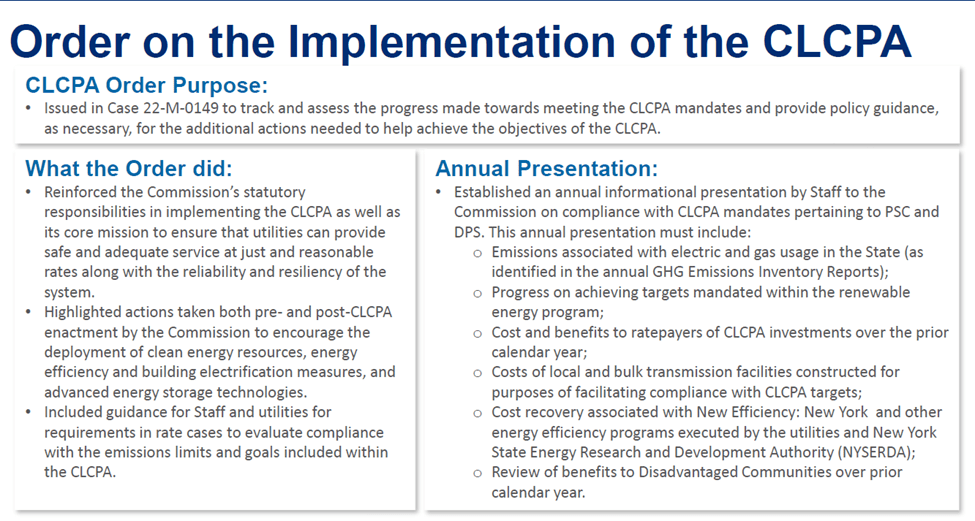
  The report describes the information provided:

The cost recoveries, benefits, and other information reported here are mainly focused on the direct effects of CLCPA implementation. Notably, the estimates of total funding authorized by the Commission to date for various clean energy programs in some instances reflect actions that pre-date the enactment of the CLCPA. With respect to both pre- and post-CLCPA measures, this report focuses only the portion of those direct effects arising from programs over which the Commission has oversight authority and does not account for programs implemented by other state agencies that are funded from other sources (e.g., Regional Greenhouse Gas Initiative (RGGI) funding). Examples of effects not captured here include property tax revenues to localities from newly developed renewable generation facilities, workforce development and job growth, and local air quality impacts, among others. It should also be noted that the benefits and costs of the measures discussed in this report do not accrue uniformly across stakeholders, and in some cases one stakeholder’s benefit is another’s cost. As such, this report generally describes a subset of benefits and costs related to the CLCPA and does so from the perspective of New York as a whole by using the Societal Cost Test. In instances where this report adopts a different perspective, it indicates what that perspective is. For those benefits that are difficult to quantify, this report includes qualitative descriptions of the nature, extent, and incidence of the benefit.

The issue I want to raise in this post relates to this description and the PSC core mission “to ensure that utilities can provide safe and adequate service at just and reasonable rates along with the reliability and resiliency of the system.”  In particular, consideration of just and reasonable rates needs to consider the effect of other programs that directly impact rates.  Although the Commission has no oversight authority for programs like RGGI and NYCI, the costs associated with those programs are passed through to ratepayers.  Therefore, I believe that this report should include those costs and any other programs that directly affect ratepayer costs in its assessment.

New York Cap-and-Invest

In June 2023, DEC and NYSERDA hosted a series of webinars addressing NYCI implementation.  The Cap-and-Invest Analysis Inputs and Methods webinar (Inputs and Methods Webinar Presentation and View Session Recording) on June 20, 2023 described proposed policy modeling.  In order to evaluate the effects of different policy options, this kind of modeling analysis forecasts future conditions for a baseline or “business-as-usual” case, makes projections for different policy options, and then the results are compared relative to the baseline case.

The proposed modeling approach uses a unique approach.  The Scoping Plan modeling used a reference case that included “already implemented” programs instead of the usual practice of a “business-as-usual” base case. The NYCI Cap-and-Invest Analysis Inputs and Methods webinar proposed to use the same framework.  Starting with the reference case developed for the Scoping Plan, the NYCI modeling proposal will add policies enacted since then. 

It is more appropriate to compare the policy cases to a base case that excludes all programs intended to reduce GHG emissions.  Putting the pre-Climate Act programs and costs in the reference case means that the cost forecasts will not include all the measures necessary to meet the Climate Act mandates.  One of the goals of NYCI is to “minimize potential consumer costs while supporting critical investments” but the proposed approach will only consider a subset of the total costs necessary to meet the Climate Act mandates.

Discussion

The question for both proceedings is whether the goal is to consider all the costs and benefits of the Climate Act or some sub-set.  The Hochul Administration has never released its estimate of the total costs to meet any of the Climate Act targets.  Instead of providing the cost and benefit components themselves only net numbers are provided to support the misleading and inaccurate party line statement that the costs of inaction are more than the costs of action.  In order to make that statement the Administration used the reference case approach that hides the total implementation costs.

There are implications for these two proceedings.  In order to provide the total costs, both should cover as many programs as possible.  The PSC has statutory limits on its Climate Act Implementation analysis that precludes many aspects of the transition but I believe that they should incorporate the costs of Climate Act-related expenditures that get incorporated into ratepayer assessments even if they are not in a rate case proceeding.  There was one relevant item not addressed in the PSC Climate Act Implementation Report.  New York Public Service Law  § 66-p. “Establishment of a renewable energy program” has safety valve conditions for affordability and reliability that are directly related to the PSC core mission “to ensure that utilities can provide safe and adequate service at just and reasonable rates along with the reliability and resiliency of the system.”  § 66-p (4) states: “The commission may temporarily suspend or modify the obligations under such program provided that the commission, after conducting a hearing as provided in section twenty of this chapter, makes a finding that the program impedes the provision of safe and adequate electric service; the program is likely to impair existing obligations and agreements; and/or that there is a significant increase in arrears or service disconnections that the commission determines is related to the program”.   I think that this mandate calls for including ratepayer costs that are not related to a rate case proceeding.

With respect to NYCI the question is what is the expectation for the revenues.  The revenues needed to make the necessary changes to the energy system are not related to the legislation or regulation that drives the initiative.  Therefore, the proposed modeling should evaluate the policy scenarios against a business-as-usual base case that excludes any program that exists to reduce GHG emissions.  Furthermore, the proposed approach will not be able to provide an estimate of necessary revenues to meet the Climate Act mandates because it excludes already implemented policies and their associated costs.

Conclusion

The goals for these two programs should be clarified.  I believe that I am not the only resident of New York that wants to know the all-in costs necessary to meet the Climate Act mandates.  In order to provide those numbers both proceedings should address as many program costs as possible for the effort needed to make the transition targets mandated by the Climate Act.

I intend to evaluate the reported costs in the PSC Climate Act Implementation Analysis relative to the NYCI modeling proposal included programs.  At this point I can only say the NYCI approach will be mis-leading for the revenue needs of the Climate Act transition costs but cannot estimate the magnitude of the error.  Arbitrarily eliminating some costs is nothing more than a politically expedient ploy to downplay the total costs of the Climate Act.

Recommended Videos

A real short post.  I have been following the Climate Leadership & Community Protection Act (Climate Act) since it was first proposed, submitted comments on the Climate Act implementation plan, and have written over 300 articles about New York’s net-zero transition.  My boilerplate introductory material notes that I have devoted a lot of time to the Climate Act because I believe the ambitions for a zero-emissions economy embodied in the Climate Act outstrip available renewable technology such that the net-zero transition will do more harm than good.  The recommended videos in this post support my position.

The opinions expressed in this post do not reflect the position of any of my previous employers or any other company I have been associated with, these comments are mine alone.

Climate Policies Hurt the Environment

There is very little career upside for anyone in a regulatory agency to speak up about the environmental impacts of wind and solar development.  Consequently, there is not much apparent support for my belief that the Climate Act net-zero transition will do more harm than good.  This post links to a video interview with John Baker, retired Assistant Chief with California Fish and Wildlife Department who describes double standards he experienced while enforcing California’s environmental laws:

“In the name of green energy, we’re sacrificing wildlife species. Because of the power mandates, we’re unable to enforce the take of that. I don’t think they have thought what that cost is to us as Californians and to the environment as a whole.”

Baker describes the pragmatic tradeoffs that have been ignored in the rush for net-zero transition. 

Climate Fearmongering

Paul Homewood introduces a video with Neil Oliver: Weather maps are among the most blatant forms of fearmongering deployed so far.  He notes that British weather maps on TV now use daily temperature maps with frightening colors.  He calls out the fearmongers by describing historical European heat waves and goes on to call attention to the hypocrisy of the loudest voices.  Finally he notes that the 99.7% of scientists meme is a “scam”.

Watts Up With That

You can view this video and more under the topic of Environmentalism on the ClimateTV page

Climate Predictions

Life is a Random Draw website notes that:

As they say in the investment business, past performance is no guarantee of future profits. Just because the climatistas consistently got it woefully wrong  in the past does not mean that this time around they aren’t right. They could be right this time. There may be a wolf for real this time.

But here’s the thing. They got it wrong in the past for a particular set of reasons. Those same reasons continue to apply in the present case too. Therefore, past performance guarantees the present performance to be precisely the same.

Here are climate predictions that turned out wrong.

For fun here is a video of mesocyclones that look like alien spacecraft from the same website.

Most climate solutions exist and are economically feasible. Not so Fast!

On July 11, 2023 the Partners for Climate Action, Hudson Valley hosted a morning coffee webinar titled “Bringing Climate Into the Classroom”.  The first presentation by Samrat Pathania included a slide that stated that climate change is not a technological problem because “most climate solutions exist and are economically feasible”.  I consider those statements net-zero transition myths that underpin the narratives of climate activists.  This article addresses them both in the context of New York’s Climate Leadership & Community Protection Act (Climate Act) 2040 mandate for a zero-emissions electric grid.

I have been following the Climate Act since it was first proposed, submitted comments on the Climate Act implementation plan, and have written over 300 articles about New York’s net-zero transition.  I have devoted a lot of time to the Climate Act because I believe the ambitions for a zero-emissions economy embodied in the Climate Act outstrip available renewable technology such that the net-zero transition will do more harm than good.  The opinions expressed in this post do not reflect the position of any of my previous employers or any other company I have been associated with, these comments are mine alone.

Climate Act Background

The Climate Act established a New York “Net Zero” target (85% reduction and 15% offset of emissions) by 2050.  It includes an interim 2030 reduction target of a 40% reduction by 2030 and a requirement that all electricity generated be “zero-emissions” by 2040. The Climate Action Council is responsible for preparing the Scoping Plan that outlines how to “achieve the State’s bold clean energy and climate agenda.”  In brief, that plan is to electrify everything possible and power the electric grid with zero-emissions generating resources.  The Integration Analysis prepared by the New York State Energy Research and Development Authority (NYSERDA) and its consultants quantifies the impact of the electrification strategies.  That material was used to write a Draft Scoping Plan.  After a year-long review the Scoping Plan recommendations were finalized at the end of 2022.  In 2023 the Scoping Plan recommendations are supposed to be implemented through regulation and legislation. 

The idea that the Climate Act has no technological issues and that the transition will be affordable is a basic component of the Act.  Robert W. Howarth, Ph.D., the David R. Atkinson Professor of Ecology & Environmental Biology at Cornell University claims that he played a key role in the drafting of the Climate Act.  His statement supporting the approval of the Scoping Plan explains (my emphasis added):

I further wish to acknowledge the incredible role that Prof. Mark Jacobson of Stanford has played in moving the entire world towards a carbon-free future, including New York State. A decade ago, Jacobson, I and others laid out a specific plan for New York (Jacobson et al. 2013). In that peer-reviewed analysis, we demonstrated that our State could rapidly move away from fossil fuels and instead be fueled completely by the power of the wind, the sun, and hydro. We further demonstrated that it could be done completely with technologies available at that time (a decade ago), that it could be cost effective, that it would be hugely beneficial for public health and energy security, and that it would stimulate a large increase in well-paying jobs. I have seen nothing in the past decade that would dissuade me from pushing for the same path forward. The economic arguments have only grown stronger, the climate crisis more severe. The fundamental arguments remain the same.

The presentation by Pathania included a slide that said that solving climate change was not a technological issue.  In the video he explains that most climate solutions exist and are economically feasible.  The remainder of this article will address those two components relative to the Climate Act requirement that all electricity generated be “zero-emissions” by 2040.  I assume New York will follow the advice of Howarth that New York can “rapidly move away from fossil fuels and instead be fueled completely by the power of the wind, the sun, and hydro”.

Before I address the claims, I want to address why academics like Howarth and the NGOs that evaluate electric energy net-zero transition programs generate misleading studies and reports. Russell Schussler wrote three articles after reading an argument that wind and solar could “easily” be made reliable.  In the first article he points out that analyses that claim reliability is not an issue don’t consider all the complex interactions in the electric system.  Frequently the difference between power and energy is not understood or misused either by the authors or those who reference the studies claiming current technology is adequate.  In the second article Schussler explains that “academics study some problems, determine those are solvable and that is then misinterpreted to imply that greater emerging problems are also solved or easily solvable”.  He states that “Barring major breakthroughs in the areas of critical technical challenges (which don’t seem to be receiving a lot of attention at the policy level) the grid cannot reliably support the envisioned increase penetration of wind and solar need to get anywhere close to a net zero goal.”  In the third article, he points out that we are a long way from figuring out how to solve for a net zero grid in terms of just theory and what might work on paper is not working as planned as new technology is deployed for many fundamental emerging grid problems.

Climate Solution Technology

A fundamental tenet of the Climate Act is that New York’s electric grid can be powered wind, solar, and hydro and that it can be done completely with currently available technologies.  In my opinion one of the greatest missed opportunities of the Climate Action Council was the failure of the Hochul Administration to confront this claim during Council deliberations.  .  On September 16, 2020 In their presentation to the Power Generation Advisory Panel E3 included a slide titled Electricity Supply – Firm Capacity.  Their presentation states: “As the share of intermittent resources like wind and solar grows substantially, some studies suggest that complementing with firm, zero emission resources, such as bioenergy, synthesized fuels such as hydrogen, hydropower, carbon capture and sequestration, and nuclear generation could provide a number of benefits.”  The Integration Analysis future generating resource projections project that this resource will equal the amount of existing fossil generation capacity in 2040.  The Scoping Plan mentions nuclear only in passing, the Council discouraged any thought of combustion with carbon capture and sequestration, and the amount of bioenergy and hydro resources that can be added to New York’s electric system are small relative to the need.   That leaves synthesized fuels.  That technology and any other possibilities are not commercially available.  Despite the best efforts of the New York State Independent System Operator (NYISO), the New York State Reliability Council (NYSRC), and several members of the Council to prod the Administration and Council into confronting the reliability ramifications of reliance on an unproven technology it was essentially ignored in the Scoping Plan.

The New York State Public Service Commission (PSC) recently initiated an “Order initiating a process regarding the zero-emissions target” that will “identify innovative technologies to ensure reliability of a zero-emissions electric grid”.  The press release states:

Today’s action recognizes that as renewable resources and storage facilities are added to the State’s energy supply, additional clean-energy resources capable of responding to fluctuating conditions might be needed to maintain the reliability of the electric grid. The Commission’s work to meet the Climate Act targets must include exploration of technologies that can support reliability once fossil generation has been removed from the system. The order initiates a process to identify technologies that can close the anticipated gap between the capabilities of existing renewable energy technologies and future system reliability needs. Within the order, the Commission asks stakeholders a series of important questions, including how to define ‘zero-emissions’ for purposes of the zero emissions by 2040 target, and whether that definition should include cutting edge technologies such as advanced nuclear, long duration energy storage, green hydrogen, and demand response. The order further elicits feedback from stakeholders on how to best design a zero-emissions by 2040 program, consistent with the Climate Act’s requirement of delivering substantial benefits to disadvantaged communities and New York State’s electric grid reliability rules, while also leveraging other state and federal efforts to research, develop, and deploy zero-emission resources.

The organizations responsible for the reliability of the electric system in New York all say that additional clean-energy resources that do not have emissions and can be dispatched as necessary are needed.  Anyone who disagrees with that is naïve, ignorant or deliberately ignoring reality.

Affordability

The myth that converting to solar and wind resources will be cheaper than using fossil fuels is very persistent.  The only way it can be perpetuated is if only relative costs are considered or if the difference between power and energy is not recognized.  The Scoping Plan claims that “The cost of inaction exceeds the cost of action by more than $90 billion” but that realtive number reduces costs by subtracting value-laden benefits.   

The cost that matters to New Yorkers are the direct costs.  I recently described my response to the claim that “Solar power is now considerably cheaper than new coal, natural gas, or nuclear energy” by Richard Perez, Ph.D.  He claimed that “utility-scale solar electricity has become the least expensive form of electricity generation” but that is true for power capacity (MW).  Even if solar capacity is half the cost of fossil capacity the cost for delivered energy is much more.  We pay for the kWh electric energy we use each month and we expect it to be available 24-7 throughout the year.  In order to provide usable energy, other things must be considered that destroy the myth that utility-scale solar is cheaper than other types of power plants.  On average a well-designed solar facility can provide (round numbers) 20% of its potential energy possible in New York.  A natural gas fired power plant can operate to produce at least 80% of its potential energy over a year.  In order to produce the same amount of energy, that means that you need four times as much solar capacity.  Even if the solar capacity cost is half the cost for the capacity, the energy cost is double simply due to this capacity factor difference.  My response went on to describe other reasons why it cannot be cheaper: the cost of storage when the sun or wind is not available, the need for ancillary transmission services not provided by wind and solar, and the need for the zero-emissions resource described above.

Since then Alex Epstein published what he called The ultimate debunking of “solar and wind are cheaper than fossil fuels.”  His analysis is not confined to resources for the electric system. He explains that:

Solar and wind are only cheaper than fossil fuels in at most a small fraction of situations. For the overwhelming majority of the world’s energy needs, solar and wind are either completely unable to replace fossil fuels or far more expensive.

I encourage any doubters to read the article but provide some highlights below.

  • On its face, justifying favoritism toward solar and wind by invoking their cheapness is highly suspicious. If they’re cheaper, why do they need coercive policies to throttle their fossil-fueled competitors (e.g., opposing fossil fuel investment, production, and pipelines) and reward solar and wind?
  • That solar and wind aren’t actually cheaper than fossil fuels should be obvious from the fact that despite enormous cultural and political hostility toward fossil fuels that makes fossil fuels artificially expensive, fossil fuel use is still growing.
  • When discussing “energy prices” we must recognize that “energy” refers to myriad specific use-cases involving different
    • Types of machines
    • Reliability requirements
    • Locations
    • Quantities
  • For the vast majority of use-cases solar and wind can’t compete with fossil fuels.
  • While it is very common to use the terms “energy” and “electricity” interchangeably, the fact is that the vast majority of machines in the world today don’t run on electricity—they run on the direct burning of fossil fuels, because that is the only or cheapest way to run them.
  • Many instances of “solar and wind are cheaper than fossil fuels” not only ignore the non-electricity uses where solar and wind are totally uncompetitive, they use a bogus metric called “Levelized Cost of Energy” (LCOE) which by its own definition ignores the issue of reliability!
  • The basic cost problem with solar and wind is their inherent unreliability. To use them to deliver reliable electricity we need to also pay for a reliable life-support grid (e.g., gas plants). This is very often wasteful; it’s usually cheaper just to pay for a reliable grid.
  • When we look at large regions that use solar and wind a lot, we see a trend of price increases and/or reliability decreases, because solar and wind add costs to the reliable grids needed to support them—and if you try to save money by shrinking the reliable grid you get reliability problems.¹¹
  • Whenever you hear someone rave about Southern California or Iowa or West Texas in making some general laudatory claim about solar and wind, you can be sure that the person is trying to dupe you through false generalization from one location to every location.
  • Note that false generalization from one location to all locations is also common for geothermal energy.
  • In addition to all their other problems, solar and wind have mining requirements that make them expensive to scale quickly.

    Yet today’s solar and wind prices are falsely generalized to be the same or lower if solar and wind scale on a crazy “net-zero-by-2050” timetable.
  • Whenever we talk about the price of energy, we need to recognize that the price of energy can change dramatically depending on the scale it is being used on.
  • Sometimes larger scales can reduce prices (economies of scale) and sometimes larger scales can increase prices (diseconomies of scale).

Saying “solar and wind are cheaper” because they might be cheaper at powering midday and afternoon air-conditioning in Dubai is like a CEO saying “teenage labor is cheaper” because it can fill some mailroom positions.

The evidence that solar and wind cannot reduce the price of electricity is overwhelming.

Conclusion

The myths that no new technologies are needed to transition away from fossil fuels and that wind and solar are cheaper than fossil fuels are common.  I recently had a commentary published that argued the solar could not be cheaper than a natural gas-fired turbine and rebuttals were published that ignored all the reasons I described here.  All that pragmatists can do is to continue to point out the facts and hope that policy makers will come to their senses before the economy is devastated by this nonsensical policy. Equally troubling is that the European experience is showing that wind is not viable, the costs of wind and solar in Germany are untenable, and that a rapid energy transition has many risks but that information is also being ignored.

The most troubling aspect of this story is that the “Bringing Climate Into the Classroom” webinar peddled these myths without any limitations.  The presentation by Samrat Pathania included a slide that stated that climate change is not a technological problem because “most climate solutions exist and are economically feasible”.  After making the statement his presentation argued that all we need to do is to make a cultural transformation.  He said that “Hope and Trust are two of the pillars of a classroom community”.  I worry that the constant barrage of existential climate Armageddon stories that can be easily solved  being peddled as in this webinar is going to destroy trust when the inevitability of reality eviscerates these myths.  Won’t the students lose hope when that happens?  Then what will they think?

Implementation and Compliance with Climate Act Requirements and Targets – First Impression

On July 20, 2023 the first annual informational report on the implementation of the Climate Leadership & Community Protection Act (Climate Act)) was released.  There is a lot of information in this report that needs to be parsed out but because this is the first report that provides any Climate Act implementation estimated costs for ratepayers, I am publishing this initial summary.

I have been following the Climate Act since it was first proposed, submitted comments on the Climate Act implementation plan, and have written over 300 articles about New York’s net-zero transition.  I have devoted a lot of time to the Climate Act because I believe the ambitions for a zero-emissions economy embodied in the Climate Act outstrip available renewable technology such that the net-zero transition will do more harm than good.  The opinions expressed in this post do not reflect the position of any of my previous employers or any other company I have been associated with, these comments are mine alone.

Climate Act Background

The Climate Act established a New York “Net Zero” target (85% reduction and 15% offset of emissions) by 2050.  It includes an interim 2030 reduction target of a 40% reduction by 2030 and a requirement that all electricity generated be “zero-emissions” by 2040. The Climate Action Council is responsible for preparing the Scoping Plan that outlines how to “achieve the State’s bold clean energy and climate agenda.”  In brief, that plan is to electrify everything possible and power the electric grid with zero-emissions generating resources.  The Integration Analysis prepared by the New York State Energy Research and Development Authority (NYSERDA) and its consultants quantifies the impact of the electrification strategies.  That material was used to write a Draft Scoping Plan.  After a year-long review the Scoping Plan recommendations were finalized at the end of 2022.  In 2023 the Scoping Plan recommendations are supposed to be implemented through regulation and legislation. 

According to the press release:

The Climate Act’s directives require the Commission to build upon its existing efforts to combat climate change through the deployment of clean energy resources and energy storage technologies, energy efficiency and building electrification measures, and electric vehicle charging infrastructure. In recognition of the scale of change and significant work that will be necessary to meet the Climate Act’s aggressive targets, the Commission directed DPS staff to assess the progress made in line with its directives under the Climate Act and to provide guidance, as appropriate, on how to timely meet the requirements of the Climate Act.

The Scoping Plan does not provide any ratepayer cost impacts but the New York State Department of Public Service First Annual Informational Report on Overall Implementation of the Climate Leadership and Community Protection Act does provide that information.  This post summarizes the ratepayer impacts provided in this report.  I will follow up with another post that delves into the details of this report later.

Programs

One of the difficulties trying to understand what expenses have been authorized to date that are covered by this report is the number of programs involved.  Seven authorized programs are covered: Clean Energy Standard (CES) Clean Energy Fund (CEF), certain Value of Distributed Energy Resources (VDER), Electric Vehicle Make Ready Program, Clean Heat programs, Integrated Energy Data Resource (IEDR), and Utility Energy Efficiency programs.  In a subsequent post I will try to address these programs and their place in the Scoping Plan strategies in detail.

The seven authorized programs support various components of Climate Act mandated strategies.  The Clean Energy Standard was originally adopted in 2016 and set a goal for 50% of the electricity consumed in the State by 2030 to be generated by renewable energy sources.  There were subsequent revisions and the initiatives been expanded, where necessary, to support Climate Act mandates.   The Clean Energy Fund provides support for innovation & research, market development, the NY Green Bank, and NY Sun.  Value of Distributed Energy Resources programs support energy generated by distributed energy resources such as solar photovoltaic, energy storage, combined heat and power, anaerobic digesters, wind turbines and small hydro and fuel cells. The Electric Vehicle Make Ready Program funds infrastructure for electric vehicles.  Clean Heat programs and promote the electrification of space and water heating by offering contractor and customer incentives for the installation of air- and ground-source heat pumps. The Integrated Energy Data Resource will be a “statewide resource to securely collect, integrate, and provide access to energy related information”. The Utility Energy Efficiency programs support energy conservation and efficiency programs.

Cost Recoveries

According to the press release:

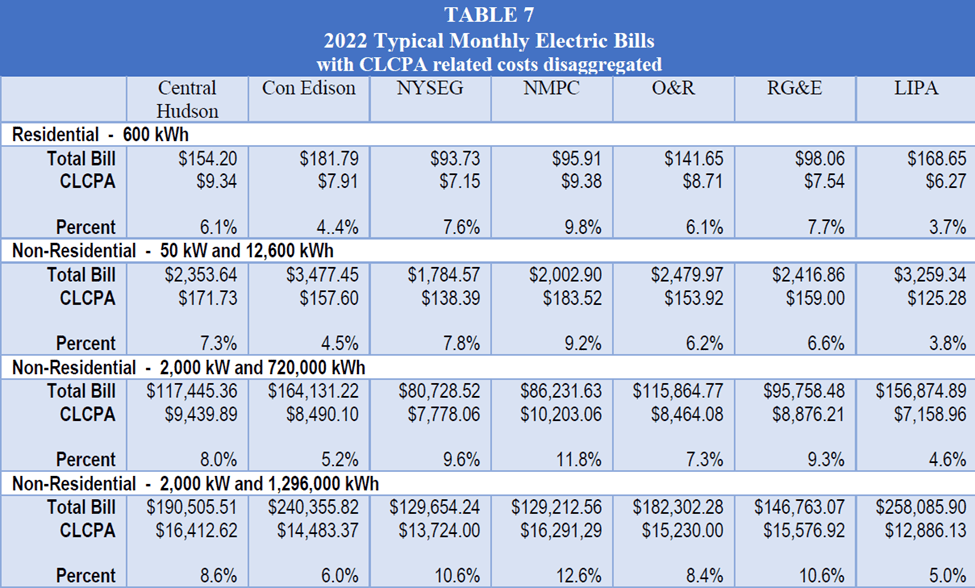
For the average residential electric customer, the rate impacts for these critically important investments, not accounting for the overall societal benefits, range from 3.7 percent to 9.8 percent, depending on the utility. The rate impacts for non-residential customer varies depending on the utility and the amount of electricity consumed.

I am not familiar with the jargon of the Department of Public Service (DPS) rate descriptions.  I believe that when DPS talks about cost recovery they are referring to costs that the utilities have incurred to implement the Climate Act requirements that have been charged back to the ratepayers.  The report notes:

For purposes of estimating the cost recoveries of CLCPA related initiatives in 2022, Staff issued information requests to each of the utilities. Specifically, Staff requested the utilities provide 2022 cost recoveries for: CES (electric only), CEF (electric only), certain VDER (electric only), Electric Vehicle Make Ready Program (electric only), Clean Heat programs (electric only), Integrated Energy Data Resource (electric only), and Utility Energy Efficiency programs (electric and gas).

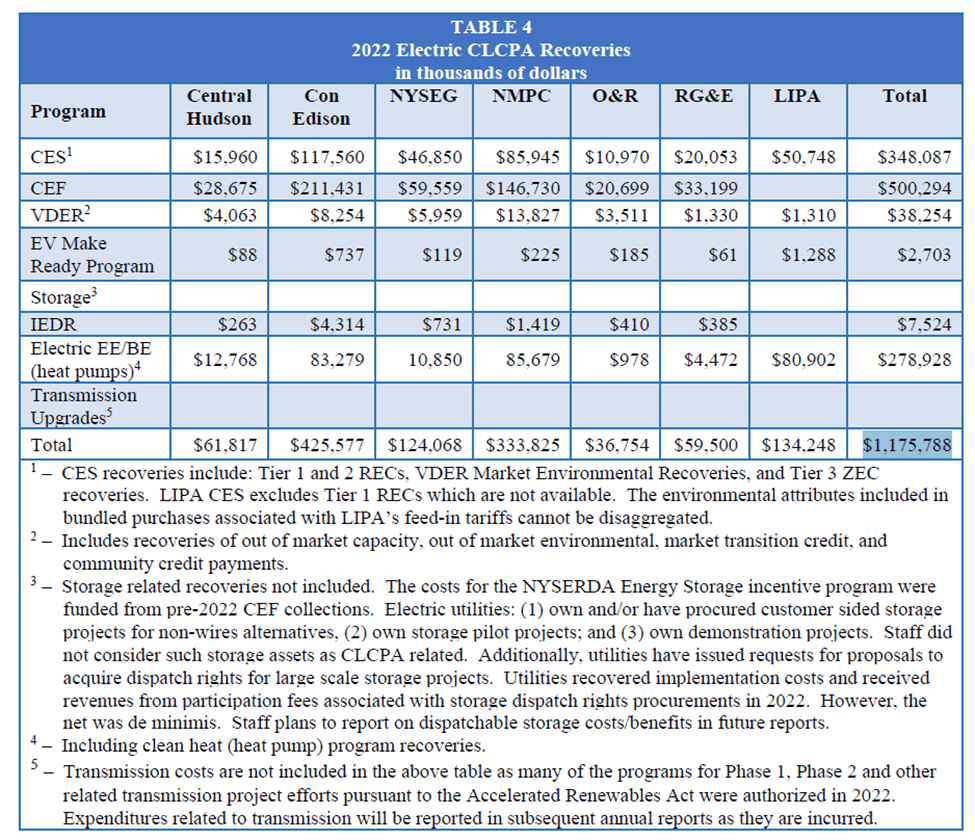
The following figure summaries the costs recovered in 2022 by the utilities associated with these gas and electric programs.  The Climate Act program costs paid by New York gas ratepayers totaled $112,967,498 in 2022 (Table 3).  Electric ratepayers paid $1,175,788,000 in 2022 (Table 4). 

These totals were converted to gas and electric ratepayer impacts in the report.

The report estimates the effect of the Climate Act programs typical monthly gas bills in Table 6 using the following assumptions:

Staff issued information requests to each of the utilities to help estimate the bill impacts associated with the CLCPA related cost recoveries. Staff requested the utilities provide typical gas delivery and supply bills for 2022 for the following customer types:

A. Residential heating customers (83 therms per month),

B. Small commercial customers (2,500 therms per month),

C. Commercial customers (10,000 therms per month), and

D. Industrial customers (100,000 therms per month).

The report estimates the effect of the Climate Act programs on typical monthly electric bills in Table 7 using the following assumptions:

Staff requested the utilities provide typical electric delivery and supply bills for 2022 for the following customer types:

A. Residential customers (600 kWh per month),

B. Non-residential customers (50 kW & 12,600 kWh per month),

C. Non-residential customers (2,000 kW & 720,000 kWh per month), and

D. Non-residential high load factor customers (2,000 kW & 1,296,000 kWh per month).

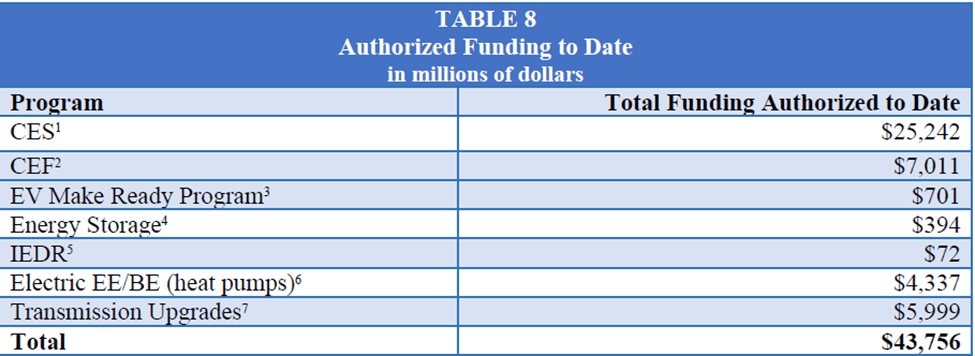
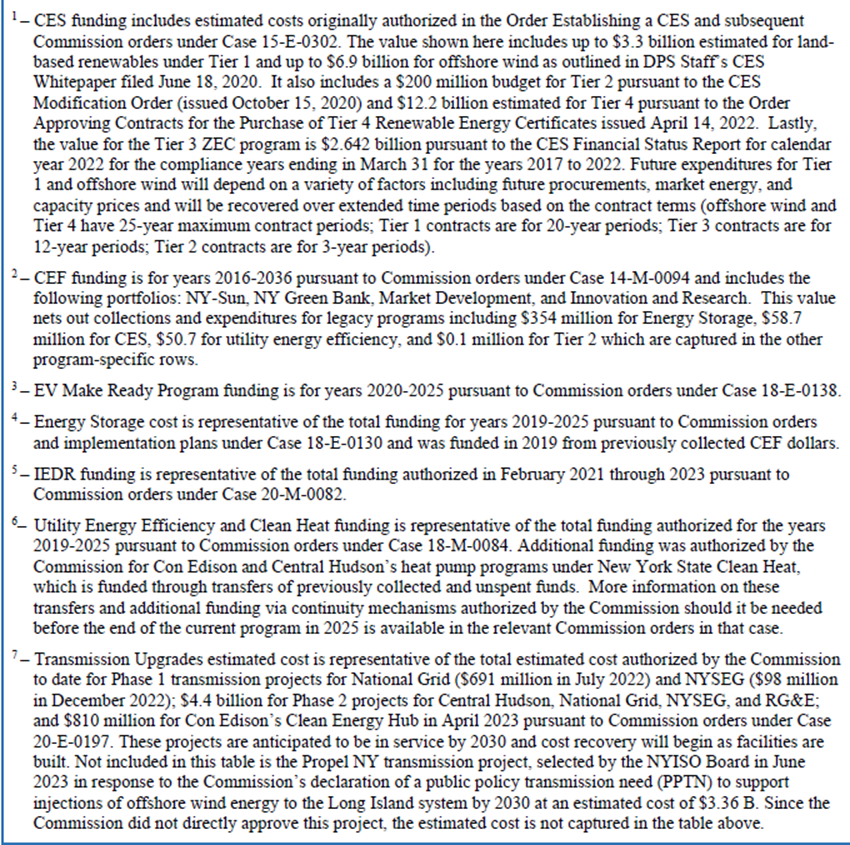
The 2022 combined total costs recovered from gas and electric ratepayers is $1,288,755,498.  Table 8 lists the costs that have been authorized but not yet captured and that total is 43,756,000,000.  Clearly ratepayer costs will have to increase more to cover these additional costs.  The report states:

This annual report is a review of actual costs incurred by ratepayers to date in support of various programs and projects to implement the CLCPA and does not fully capture potential future expenditures, including estimated costs already authorized by the Commission but not yet recovered in rates. To complement this overview of cost recoveries incurred to date, we also present below a table of the various programs and the total amount of estimated costs associated with each authorized by the Commission to date. Table 8 gives a sense of expenditures that ratepayers could ultimately see recovered in rates. These values are conservative and reflect both past and prospective estimated costs.

Conclusion

There is a lot to unpack in this report.  I plan to look at the numbers in various programs and try to reconcile them with other cost estimates.  The report also includes estimates of benefits that need to be addressed. 

Based on this first review it is already obvious that costs are significant and this is only the beginning.  Many more programs will be required to implement the net-zero transition. Stay tuned.

NYISO Short-Term Assessment of Reliability July 2023

On July 14, 2023 the New York Independent System Operator (NYISO) released its quarterly assessment of reliability of the bulk electric system.  The analysis found a deficit in reliability margins for the New York City area beginning in summer 2025. As a result, something must be done or there will be unacceptable risks to reliability that could cause power outages.  Unfortunately, it is difficult to understand the reasons for this finding because of the complexity of the subject.  This post includes a detailed explanation of the report and its implications.  If you want a good non-technical summary, then I recommend James Hanley’s post Get Ready for the New York City Blackout of 2025.

I have been following the Climate Leadership & Community Protection Act (Climate Act) since it was first proposed.  I submitted comments on the Climate Act implementation plan and have written over 300 articles about New York’s net-zero transition.  I have devoted a lot of time to the Climate Act and New York’s energy planning because I believe the ambitions for a zero-emissions economy embodied in the Climate Act outstrip available renewable technology such that the net-zero transition will do more harm than good.  Unfortunately, trying to explain the risks and issues associated with the transition is difficult because of the complexity of the problems and the fact that expert reports are dense and filled with jargon.  The opinions expressed in this article do not reflect the position any of my previous employers or any other company I have been associated with, these comments are mine alone.

Resource Adequacy Assessments

The NYISO is responsible power system reliability and competitive markets for New York.  As part of that mission NYISO determines whether generating resources and the transmission system can adequately meet expected load.  They describe the resource adequacy analyses as follows:

Resource adequacy is the ability of the electric system to supply the aggregate electrical demand and energy requirements of the firm load at all times, considering scheduled and reasonably expected unscheduled outages of system elements. The NYISO performs resource adequacy assessments on a probabilistic basis to capture the random nature of system element outages. If a system has sufficient transmission and generation, the probability of an unplanned disconnection of firm load is equal to or less than the system’s standard, which is expressed as a loss of load expectation (LOLE). Consistent with the Northeast Power Coordinating Council and New York State Reliability Council criterion, the New York State bulk power system is planned to meet an LOLE that, at any given point in time, is less than or equal to an involuntary firm load disconnection that is not more frequent than once in every 10 years, or 0.1 event days per year.

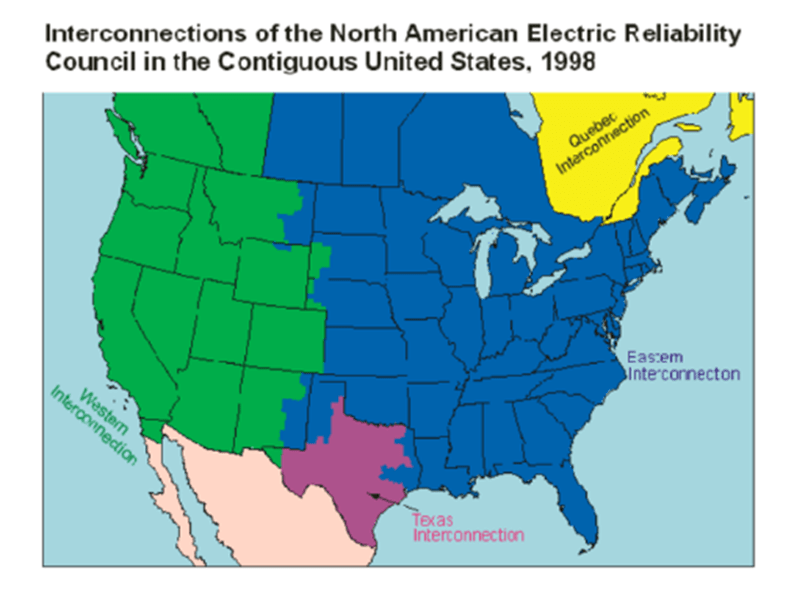
So what does that mean?  The first point is that the electric system is very complicated.  I summarized my skepticism of the net-zero transition earlier this year in an article that included an overview of the electric system.   Incredibly all the fossil, hydro, and nuclear generating stations in the Eastern Interconnection shown below work together.  In order to provide electricity, the generating turbines are synchronized to turn at 1800 revolutions per minute.  Operators keeps the voltages as constant as possible in the entire area but rely on those turbines to provide inertia as well as voltage control and that can be dispatched as necessary to match load.  The NYISO operates the New York State control area within the Interconnection.  In addition to the day-to-day operation, they plan for resource adequacy to ensure that the operators have generating resources available so that they can constantly match load. 

The NYISO resource adequacy assessments rely on decades of observed characteristics of generating resources, the transmission system, and system load to develop the likelihood  of system element outages. If a system has sufficient transmission and generation, then when a problem occurs (say lightning hits a transmission line) the system can respond without an extended outage.  The NYISO has a well-established process to identify reliability needs. The analyses consider how the system can react to various combinations of issues based on historical observations of the existing system to determine the loss of load expectation (LOLE). The organizations overseeing New York reliability,  the Northeast Power Coordinating Council and New York State Reliability Council, mandate that the New York State bulk power system is planned to meet the LOLE standard that any involuntary firm load disconnection  is not more frequent than once in every 10 years, or 0.1 event days per year.

Annotated Executive Summary

This section quotes the Executive Summary in the report and explains the contents.  As part of an on-going reliability assessment process the NYISO analyzes any expected changes to the generation and transmission system:

This report sets forth the 2023 Quarter 2 Short-Term Assessment of Reliability (“STAR”) findings for the five-year study period of April 15, 2023, through April 15, 2028, considering forecasts of peak power demand, planned upgrades to the transmission system, and changes to the generation mix over the next five years.

The analysis finds that there are issues associated with peaking power plants in New York City.  I have been involved with this problem and these facilities since 2000.  This topic has been the subject of multiple articles on this blog and I have summarized my articles as on overview that I can reference when the issue resurfaces.  The Executive Summary notes: 

This assessment finds a reliability need beginning in summer 2025 within New York City primarily driven by a combination of forecasted increases in peak demand and the assumed unavailability of certain generation in New York City affected by the “Peaker Rule.”  In 2019, the New York State Department of Environmental Conservation adopted a regulation to limit nitrogen oxides (NOx) emissions from simple-cycle combustion turbines, referred to as the “Peaker Rule” (https://www.dec.ny.gov/regulations/116131.html)  

The Peaker Rule culminated a decade-long process whereby the New York State Department of Environmental Conservation (DEC) instituted a framework to retire or control the “peakers”.  The DEC, NYISO, facility owners and Consolidate Edison, the load serving entity for New York City, all worked together to ensure that the retirement would not endanger reliability.  This latest analysis suggests that there are still issues to be resolved:

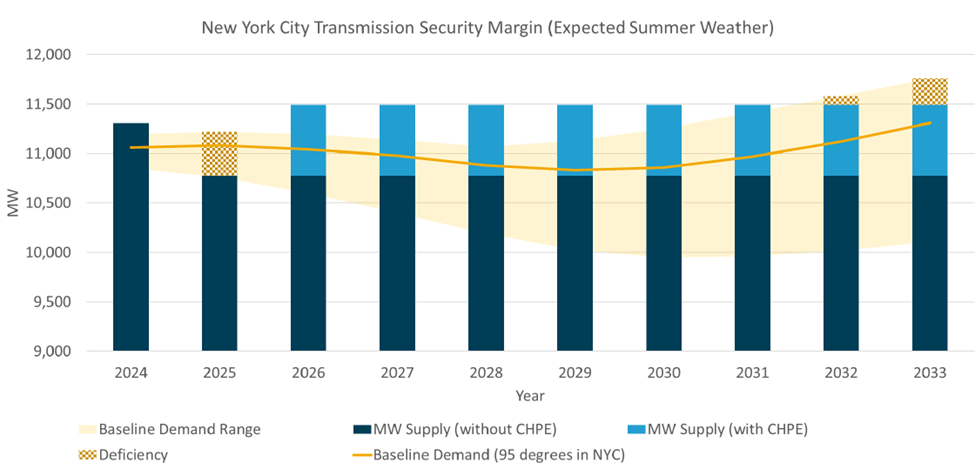
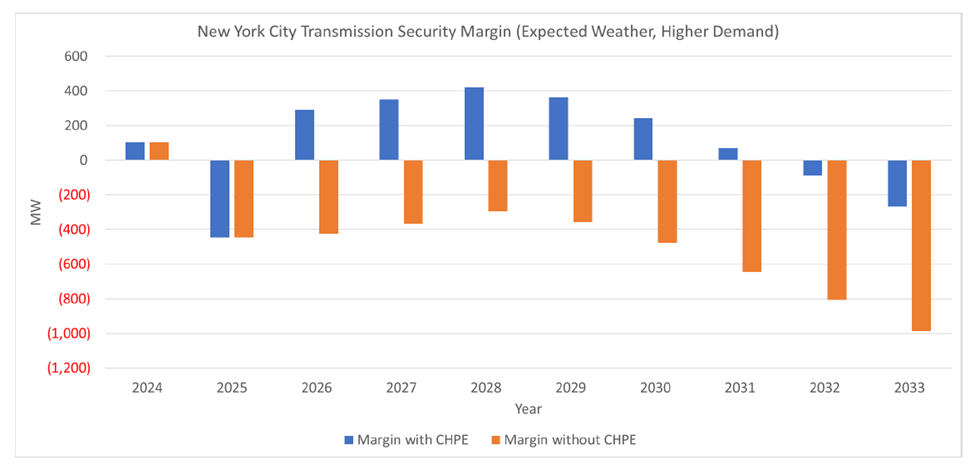
Combustion turbines known as “peakers” typically operate to maintain bulk power system reliability during the most stressful operating conditions, such as periods of peak electricity demand. As of May 1, 2023, 1,027 MW of affected peakers have deactivated or limited their operation. An additional 590 MW of peakers are expected to become unavailable beginning May 1, 2025, all of which are in New York City.   With the additional peakers unavailable, the bulk power transmission system will not be able to securely and reliably serve the forecasted demand in New York City (Zone J). Specifically, the New York City zone is deficient by as much as 446 MW for a duration of nine hours on the peak day during expected weather conditions when accounting for forecasted economic growth and policy-driven increases in demand.

The following paragraph explains that the reliability need is expected because the latest projections of generation, load, and transmission availability have changed over time:

The reliability need is based on a deficient transmission security margin that accounts for expected generator availability, transmission limitations, and updated demand forecasts using data published in the 2023 Load & Capacity Data Report (“Gold Book”). The transmission security margin represents the balance between demand for electricity and the power supply available from generation and transmission to serve that demand. This assessment recognizes that there is uncertainty in the demand forecast due to uncertainties in key assumptions including population and economic growth, the proliferation of energy efficiency, the installation of behind-the-meter renewable energy resources, and electric vehicle adoption and charging patterns. These risks are accounted for in the transmission security margin calculations by incorporating the lower and higher bounds as a range of forecasted conditions during expected weather, specified in the Gold Book as the policy scenario forecasts. The lower and higher demand policy scenario forecasts reflect achievement of policy targets through alternative pathways and assume the same weather factors as the baseline demand forecast.

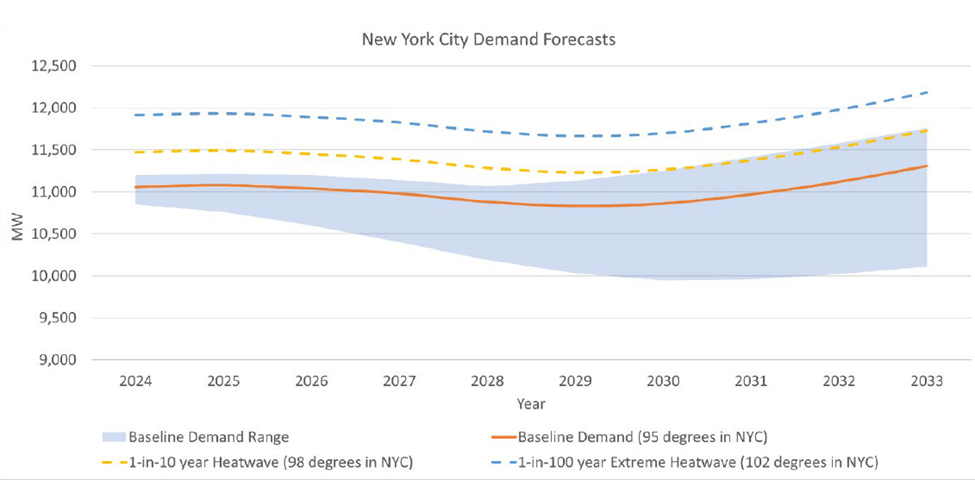
The Gold Book is the standard for electric data in New York. The following figure shows the range of the demand forecasts for New York City.  I want to point out one thing.  The emphasis is on providing generation for the peak load.  This is a significantly more difficult problem than estimating the generation necessary for an average year.  There are more short-term constraints that could affect generation and load that can be ignored on average.  

I have some experience with the resource modeling projections and cannot over-emphasize the complexity of all the factors incorporated in the models.  Unfortunately, there is a lot of uncertainty associated with projecting all those factors.  That is why the NYISO is constantly re-evaluating the model inputs and projections.  In addition, they are always looking to refine the model itself.  Based on their latest estimates:

Under the baseline forecast for coincident summer peak demand, the New York City transmission security margin would be deficient by 306 MW in 2025 for a duration of 7 hours. However, accounting for uncertainties in key demand forecast assumptions, the higher bound of expected demand under baseline weather conditions (95 degrees Fahrenheit) in 2025 results in a deficiency of 446 MW over 9 hours. The deficiency would be significantly greater if New York City experiences a heatwave (98 degrees Fahrenheit) or an extreme heatwave (102 degrees Fahrenheit).

The NYISO is banking on one project to address this problem after 2025.

Overall, the New York City transmission security margin is expected to improve in 2026 if the Champlain Hudson Power Express (CHPE) connection from Hydro Quebec to New York City enters service on schedule in spring 2026, but the margin gradually erodes through time thereafter as expected demand for electricity grows. Beyond 2025, the forecasted reliability margins within New York City may not be sufficient if (i) the CHPE project experiences a significant delay, (ii) additional power plants become unavailable, or (iii) demand significantly exceeds current forecasts. Without the CHPE project in service or other offsetting changes or solutions, the reliability margins continue to be deficient for the ten-year planning horizon. In addition, while CHPE is expected to contribute to reliability in the summer, the facility is not expected to provide any capacity in the winter.

I am uncomfortable that there is this much reliance on a single project to address the problems identified.  I discussed the start of construction late last year for the Champlain Hudson Power Express (CHPE) project.  It is a 339-mile underground transmission line capable of bringing 1,250 MW from the Province of Quebec to Astoria Queens in New York City.  I explained that I was worried about the schedule and costs of the project.  The NYISO Resource Adequacy analyses must necessarily rely on the developer’s prediction for completion.  Richard Ellenbogen and I share the timeliness concern.  Richard noted that the project was proposed in 2011 and the PSC authorized it on 4/18/13.  It has been 11.5 years since it was proposed, 9.5 years since it was authorized, and construction started a year after the funding contract was signed.  In addition, it has recently come out that landowners on sections of the right-of-way that are on land have just been informed that they will be impacted.  The likelihood of additional delays seems high.  Given that other renewable projects are being re-evaluated because of price increases due to inflation and increased cost of materials it seems that this project will also have the same problems.  Given its importance to New York City reliability, I cannot conceive of any scenario in which the State will not grant any cost overruns requested by the developers. This project is already expensive equating to an estimated increase in customer electric bills of 2.1 – 4.1% (or $2.08 – $4.08 per month for the average residential customer.  I am confident that at the end of the day the final costs will be much higher.

The STAR quarterly report did not limit its analysis to just New York City.

In addition to New York City, this assessment also evaluated the transmission security margins for the statewide system as well as Lower Hudson Valley and Long Island localities. For these localities, the planned Bulk Power Transmission Facilities (“BPTF”) through the study period are within applicable reliability criteria based on the baseline summer coincident peak demand forecast with expected weather and with the planned projects meeting their proposed in-service dates. The NYISO assessed the resource adequacy of the overall system and found no resource adequacy reliability needs.

The NYISO is a product of the de-regulated New York electric system.  As such they are ardent supporters of “market” solutions.  This adds a layer of uncertainty because NYISO must develop some sort of incentive for a developer to provide the necessary resources.  If it was an attractive investment, then I would expect that someone would already be developing the necessary resources.  In addition, Con Ed must also determine if local transmission upgrades can resolve the problem.

The short-term need observed in 2025 is a Near-Term Reliability Need. As a result, solutions will be solicited, evaluated, and addressed in accordance with the NYISO Short-Term Reliability Process. The need arises within the Con Edison Transmission District; therefore, Con Edison is the Responsible Transmission Owner for developing a regulated solution.(Reference NYISO’s Open Access Transmission Tariff Section 38.3.6)

The report identifies another particular issue that illustrates why regular STAR analyses are required and why this issue is coming up now.  Although all the affected parties may know that there will be changes to the system and have reasonable expectations what they will be, the NYISO cannot officially act until certain filings are made.

Central Hudson identified transmission security issues in its transmission district on its non-BPTF system. These are primarily driven by the assumed unavailability of certain generation in its district affected by the Peaker Rule. Given that those generators have not yet provided complete Generator Deactivation Notices to the NYISO, the local non-BPTF criteria violations identified by Central Hudson are being provided for information but were not assessed to identify possible Generator Deactivation Reliability Needs at this time.

The report also describes an upcoming issue that will be considered officially in a subsequent report. The “informational scenario” considers interconnecting large loads:  the Micron New York semiconductor manufacturing (530 MW in 2030), the Air Products and Chemicals (Q#1446), and other load changes that increase load another 694 MW.

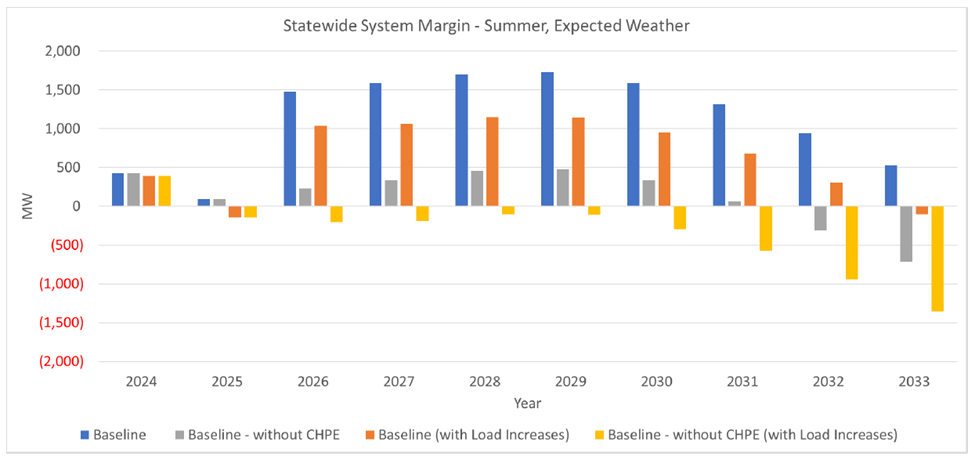
As an informational scenario, this STAR includes an evaluation of the impact of additional large load interconnection projects primarily in western and central New York. The anticipated increases to the demand forecast due to these large loads in 2025 is 764 MW which results in a corresponding reduction to the available margin, such that in 2025 the statewide system margin is projected to be deficient of 145MW. By 2033, additional large loads increase the demand by 1,224 MW which results in a corresponding deficient margin of 104 MW. If CHPE does not begin operation, the state wide system margin is projected to be deficient for all years 2025 through 2033 when considering the additional large loads. The 2023 Quarter 3 STAR will include these load projects and the associated system margin impacts. The solution to the New York City reliability need identified in this STAR may also address the state wide system margin concern.

The Executive Summary summarizes their approach:

The wholesale electricity markets administered by the NYISO are an important tool to help mitigate these risks. The markets are designed, and continue to evolve and adapt, to send appropriate price signals for new market entry and the retention of resources that assist in maintaining reliability. The potential risks and resource needs identified in the NYISO’s analyses may be resolved by new capacity resources coming into service, construction of additional transmission facilities, and/or increased energy efficiency and integration of demand-side resources. The NYISO is tracking the progression of many projects that may contribute to grid reliability, including numerous offshore wind facilities that have not yet met the inclusion rules for reliability assessments. The NYISO will continue to monitor these resources and other developments to determine whether changing system resources and conditions could impact the reliability of the New York bulk electric grid.

Note that there are three ways the problem identified can be resolved: building new capacity resources, construction of additional transmission facilities, and/or reducing load expectations with increased energy efficiency and integration of demand-side resources.  Even if the Hochul Administration came to its senses and decided to facilitate the construction of dependable generating capacity, that is to say, fossil-fired generators, there is no way that any generating resource to support reliability could get built in this timeframe.  My rule of thumb for just getting permits in New York City is a minimum of three years.  The summer of 2025 is only two years away.  Of course, the possibility of any new fossil infrastructure is very unlikely anyway.  Designing, permitting, and building additional transmission facilities may not take quite as long but I cannot imagine this solution could be available in two years.  There already are great expectations for reducing load so I cannot imagine any scenario that could reduce additional load on the order necessary to meet the identified load shortfall.

The final paragraph in the Executive Summary describes the specific filings that will trigger further STAR revisions.

As generators that are subject to the DEC’s Peaker Rule submit their Generator Deactivation Notices, the NYISO and the responsible Transmission Owners will continue to evaluate in future STARs whether Generator Deactivation Reliability Needs arise from the deactivation of Initiating Generators. (Reference NYISO’s Open Access Transmission Tariff Section 38.1 state that an “Initiating Generator” is “a Generator with a nameplate rating that exceeds 1 MW that submits a Generator Deactivation Notice for purposes of becoming Retire or entering into a Mothball Outage or that has entered into an Installed Capacity (ICAP) Ineligible Forced Outage pursuant to Section 5.18.2.1 of the ISO Services Tariff which action is being evaluated by the ISO in accordance with its Short-Term Reliability Process requirements in this Section 38 of the ISO Open Access Transmission Tariff.

Discussion

The Findings section expands the description of the problem found.  Without changes to existing load pattern the summer peak load demand in New York City would be “deficient by 306 MW in 2025 for a duration of 7 hours”.  There are uncertainties in the load demand forecasts.  Assuming the upper bound of “demand under baseline weather conditions (95 degrees Fahrenheit) in 2025 results in a deficiency of 446 MW over 9 hours.” If the weather is hotter or lasts for an extended period the “deficiency would be significantly greater.” This exemplifies the tradeoffs the NYISO and NYSRC must make when assessing resource adequacy and reliability standards.  If the deficiency is “significantly greater” then it will be impossible to manage the load without rolling blackouts.

The NYISO writes: “The deficient margin is primarily due to the increased demand forecasts within New York City combined with the planned unavailability of simple-cycle combustion turbines to comply with the DEC’s Peaker Rule in 2025”.   Apparently, it is not politically correct to point out that Hochul Administration’s policy that finalized the shutdown of 2,000 MW of nuclear power and the disapproval of a plan to build a 1,040 MW, eventually reduced to 437 MW, combined cycle facility exacerbated this problem and that if those resources were available there would not be a problem.

As it stands now, I expect that the solution will be an extension of the operating permits for the peaking turbines because there is no other viable solution to maintain reliability.

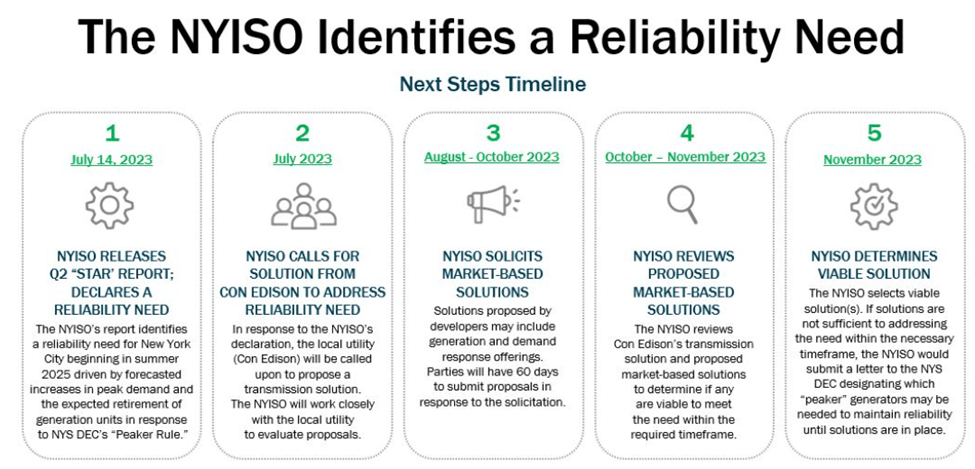
The NYISO describes the process and explains how it will be resolved in the following figure.  They have identified the reliability need.  They will ask Consolidated Edison if the problem can be resolved with transmission system revisions in Step 2.  At the same time in Step 3, NYISO will solicit  market-based solutions from other developers.  In the next step NYISO reviews the proposed solutions “to determine if they are viable and sufficient to address the identified need.”  The NYISO description of the last step notes:

Timing is an essential component of the NYISO’s evaluation. If proposed solutions are not viable or sufficient to meet the identified reliability need, interim solutions must be in place to keep the grid reliable. One potential outcome could include relying on generators that are subject to the DEC’s Peaker Rule to remain in operation until a permanent solution is in place. The DEC’s Peaker Rule anticipated this scenario when it authorized the NYISO to designate certain units to remain in operation beyond 2025 on an as-needed basis for reliability. Based on findings from its Short-Term Reliability Process, the NYISO may designate certain units, in sufficient quantity, to remain in operation for an additional two years (until May 1, 2027) with the potential of an additional two-year extension (to May 1, 2029) if a permanent solution that is needed to maintain reliability has been selected but is not yet online. The NYISO would only temporarily retain peakers as a last-step approach if it does not expect solutions to be in place when the identified reliability need is expected in 2025.

Reaction

Utility Dive described the report.  Their article quotes Zach Smith, vice president of system and resource planning for the NYISO as saying the assessment “reflects the extraordinary challenges of the grid in transition.”  It also notes that the report acknowledges “uncertainty” in the demand forecast surrounding assumptions including population and economic growth, the proliferation of energy efficiency, the installation of behind-the-meter renewable energy resources, and EV adoption and charging patterns.

The reaction of parties in New York State was predictable.  Marie French writing at Politico solicited comments from the Hochul Administration:

“To be clear: The reliability of our grid is not in question,” Hochul spokesperson Katy Zielinski said in a statement. “We are committed to ensuring New Yorkers have a reliable and affordable power supply — and we can do this while accomplishing our nation-leading climate goals. Governor Hochul remains fully committed to rapidly decreasing emissions and setting an example for how clean energy and reliability can go hand-in-hand.”

French said that Zielinski cited the planned Canadian hydropower line, the Clean Path line and offshore wind projects as ways to bring more renewables into New York City.   There is a fundamental issue with these projects because they all rely heavily on distant  transmission that is overly vulnerable to outages  One of the New York City blackouts occurred because a transmission line into the city went down and in-city generation could not be brought up fast enough to react to the loss of energy supply.  There are specific reliability rules in place that mandate a minimum capability of in-city generation when storms threaten transmission lines into the City.  I am not sure how this will be addressed in the future.  The Canadian hydropower line may not be affected by storms but still could go down unexpectedly for other reasons.  The Clean Path project is “is comprised of more than 20 renewable energy generation projects and an approximate 175-mile, underground transmission line.  I am guessing that the argument is that an underground line can provide power that is not subject to storm outages so is exempt from the transmission line reliability rule.   However, even if they are much less likely to go out, when they do have problems fixing them is much more difficult.  Counting on offshore wind as a viable replacement in the City is very risky unless it is coupled with sufficient energy storage to cover the energy needs for an entire heat wave because the meteorological conditions that cause extreme heat are associated with high-pressure systems that also have light winds.

The Peak Coalition has been the primary mover for peaking power plant environmental justice.  French mentioned their statement that notes:

PEAK Coalition is gravely concerned with the impact that the reliability deficit estimated in the Short-Term Assessment of Reliability (STAR) report for Q2 of 2023 released by the New York Independent Systems Operator (NYISO) will have on communities that live near power plants. We encourage all stakeholders involved in the energy planning process to take concrete action to prevent delaying the closure of fossil fuel peaker plants in 2025 and beyond.  These plants harm the communities that surround them every hour that they operate. PEAK refuses to accept a scenario in which environmental justice communities must suffer further harm to guarantee further profligate summertime energy consumption in commercial buildings and wealthy communities.

I have evaluated the EJ claims.  The PEAK coalition has stated that “Fossil peaker plants in New York City are perhaps the most egregious energy-related example of what environmental injustice means today.”  The influence of this position on current New York State environmental policy has led to this issue finding its way into multiple environmental initiatives. However, the presumption of egregious harm is based on selective choice of metrics, poor understanding of air quality health impacts,  and ignorance of air quality trends.  

As noted previously the NYISO is invested in market solutions. French also got a statement from the NYISO that is completely consistent with that approach:

“We’ve identified the reliability need, so we’re confident that’s present for summer 2025,” said NYISO spokesman Kevin Lanahan. “We’re also confident that we can solve the reliability [need]. That’s the nature of our planning process, to identify those issues with enough time to solve the problems so we’re confident we can find the solution and keep the system reliable.”

French also got a statement from Gavin Donohue at the Independent Power Producers:

“The pace of play is not keeping up with pace of promises, and this report makes that clear,” said Independent Power Producers of New York president and CEO Gavin Donohue, who represents the state’s existing nuclear, renewable and predominantly fossil fuel power plants. “This report should draw attention from state officials in shaping realistic public policies. I encourage the NYISO to identify solutions that are market-based so we can set ourselves on the pathway to a cleaner energy future, while maintaining the reliability of our grid at affordable rates.”

James Hanley from the Empire Center summarizes the implications well.  He concludes:

The mistake New York has made is not its goal to eventually reduce NOx emissions but its rush to shut down the peakers — and Indian Point — before developing reliable replacement sources of power. Notably, the Department of Environmental Conservation rejected proposals by NRG Energy to update nearly 1,000 megawatts of electricity production in the city to newer, cleaner-burning, and NOx-standard compliant combined-cycle power plants, claiming that NRG “failed to demonstrate the need or justification for the proposed project.”

This “shutdown first, replace later” model was a major cause of rolling blackouts on the West Coast, but New York authorities didn’t bother to learn from California’s experience. Simple common sense would indicate that the wise approach would be to find assured sources of reliable and dispatchable electricity production before taking critical power plants offline. Sadly, common sense was the first victim of New York energy policy. Even more sadly, it won’t be the last.

Conclusion

Despite assurances from Hochul spokesperson Katy Zielinski, the reliability of the New York City grid is in question. The plans rely on resources that are new to New York and that increases uncertainty.  Presuming that proposed projects will replace operational facilities on the schedule proposed is very risky. 

There is another dynamic here that will be interesting to watch.  Peaker power plants are a primary scapegoat for the New York City EJ community.  The PEAK Coalition has already gone on record stating that “If NYISO is forced to issue reliability-must-run orders, New Yorkers will know that electric utilities and state governments willingly failed to act to protect communities most impacted by fossil fuel emissions and climate change”.  The electric utilities and state government have failed to explain the potential impacts to the disadvantaged communities if fossil-fired peaking units are not replaced with proven technology.  The risks to those communities imposed by the presence of such resources are not nearly as large as the risks to those communities from blackouts.  Keeping the lights on is the better social choice.

Thanks to Russell Schussler for review and helpful comments.  Any technical errors are mine.

Syracuse Post Standard Response to View of NY Solar Energy Potential Commentary

On July 2, 2023 the Syracuse Post Standard published my letter to the editor Expert’s view of solar energy’s potential in NY is far too sunny that responded to an earlier commentary  Five Reasons New Yorkers Should Embrace a Solar Energy Future by Richard Perez, Ph.D.  On July 16, 2023, a couple of rebuttal letters responded to my commentary: In defense of solar energy development in New York

Given that there are limitations on how often I can get letters published I must settle for responses here. 

New York’s response to climate change is the Climate Leadership & Community Protection Act (Climate Act).  I have been following the Climate Act since it was first proposed, submitted comments on the Climate Act implementation plan, and have written over 300 articles about New York’s net-zero transition.  I have devoted a lot of time to the Climate Act because I believe the ambitions for a zero-emissions economy embodied in the Climate Act outstrip available renewable technology such that the net-zero transition will do more harm than good.  The opinions expressed in this post do not reflect the position of any of my previous employers or any other company I have been associated with, these comments are mine alone.

Climate Act Background

The Climate Act established a New York “Net Zero” target (85% reduction and 15% offset of emissions) by 2050, an interim 2030 target of a 40% reduction by 2030, and 100% “zero emissions” electricity generation by 2030. The Climate Action Council is responsible for preparing the Scoping Plan that outlines how to “achieve the State’s bold clean energy and climate agenda.”  In brief, that plan is to electrify everything possible and power the electric grid with zero-emissions generating resources by 2040.  The Integration Analysis prepared by the New York State Energy Research and Development Authority (NYSERDA) and its consultants quantifies the impact of the electrification strategies.  That material was used to write a Draft Scoping Plan.  After a year-long review the Scoping Plan recommendations were finalized at the end of 2022.  In 2023 the Scoping Plan recommendations are supposed to be implemented through regulation and legislation. 

According to the New York Independent System Operator (NYISO) “Gold Book” load and capacity report, in 2022 there were a total of 4,444 MW of solar nameplate capacity (154 MW of utility-scale solar and 4,290 MW of behind-the-meter) on-line in the state.   However, implementation of the Climate Act transition to net-zero will significantly increase that amount by 2030.  By 2030 the New York State Energy Research & Development Authority (NYSERDA) and consultant Energy + Environmental Economics (E3) Integration Analysis that provides quantitative estimates of resources for the Scoping Plan projects a total of 18,852 MW and the NYISO 2021-2040 System & Resource Outlook projects 14,731 MW.

Rebuttal to Letters to My Commentary

There were two letters published in response to my commentary.  The first by Shelley Conture from

Syracuse and the second by Gary McDermott from Chittenango.  I have attached all the commentaries below for your information.  Conture basically repeated everything Perez said and insinuated that because he has “notable credentials” he must be right.  McDermott addressed the points I made and raised a couple of points that deserve clarification.

Perez claimed the Earth receives more solar energy than the total annual energy consumption of all economies, combined, in a week.  I argued that ignores that availability when and where needed is a critical requirement. In New York, the winter solar resource is poor because the days are short, the irradiance is low because the sun is low in the sky, and clouds and snow-covered panels contribute to low solar resource availability. 

McDermott responded: “No one is claiming solar power will be the only source, but rather a major source of power in the future. We will always use hydropower in New York.”  Both statements are true but both are naïve.  The Integration Analysis projects that by 2035 there will be more installed solar capacity than today’s fossil capacity so the issue is the magnitude of the reliance on solar.  My concern with hydro is that we cannot add significantly more capacity so its advantages are tapped out.

McDermott goes on to address specifics associated with solar abundance.  He states that “The suggestion that winter days are too short for solar fails to recognize that we also have 15-hour long days in the summer, three hours longer than Florida” but ignores the implication that reliability requires electric planners to consider the worst case.  When everything is electrified, the peak load will be in the winter so we must address 9-hour long days.  He says “As far as snow on panels is concerned: It’s simple to brush snow off a 35-degree slope panel, especially since we don’t get as much annual snow.”   Not considering the worst case is problematic here too.  It may not be so simple to brush snow off panels if it is not possible to get to the panels because there is too much snow or ice.  Better would be a requirement that the utility-scale solar installations use tilting-axis panels so that they can be adjusted to minimize snow accumulation, albeit that only works if there is no power outage.  More of a problem is that roof-top distributed systems may not accessible to clear off.  He again ignores the worst case when he states “Also, wind power occurs at night.” Wind lulls can occur at night and then what?

I firmly believe that most people do not understand the ramifications of the Climate Act.  McDermott appears to be knowledgeable but does not understand the Climate Act targets when he says “During low sunshine conditions, natural gas energy can temporarily fill in, but with greater volumes of solar power, our net gas usage would grow much smaller.”  The goal of the Climate Act is no natural gas by 2040.  The practicality of that mandate is the issue.  

I made the point that there is no mandate that solar developments meet the Department of Agriculture and Markets prime farmland protection goal and that projects approved to date have converted 21% of the prime farmland within project areas to unusable land.  I do not disagree with McDermott’s response except that I stand by the prime farmland protections.  Responsible solar siting that includes agrivoltaics is appropriate but not enough.  He states:

In Boulder, Colorado, farmers grow tomatoes, turnips, carrots, squash, beets, lettuce, kale, chard and peppers under 8-foot-high solar panels. I recommend that state laws require solar farm panels to be built this high, to maintain farming. With this reality in mind, the greatest threat to farm land is not solar, but rural housing developments.

McDermott’s other comments do not stand up to scrutiny.  He said that “It’s pointless to complain about new transmission requirements when any new source of electricity will require additional power lines.”  The point is that diffuse renewables require much more transmission and getting offshore wind into the existing grid system is extraordinarily expensive.  I disagree with his statement that “Solar panels last 30 years, whereas combined-cycle gas turbines last only between 25 and 30 years, and produce more pollution.”  The life expectancy of a gas plant is on the order of 40 years and I have never heard a solar developer claim 30 years.  In addition, solar panels degrade 0.8% per year but fossil plants do not degrade.  There are also significant environmental impacts associated with mining the rare earth metals necessary for solar panels.

Both Conture and McDermott claim solar is cheaper.  McDermott says “On average, it costs about $200,000 more per megawatt to build a gas plant than it does a solar farm.”  Conture just repeats what Perez said.  In the limited space I had, I said:

Perez claims that “utility-scale solar electricity has become the least expensive form of electricity generation” but that only refers power capacity (MW). When you consider the relative amount of energy that can be produced annually, the storage needed to provide energy when the sun isn’t shining, the shorter life expectancy of PV panels, transmission support service requirements and the need for a new dispatchable, emissions-free resource, then the cost of solar energy provided when and where needed is much higher than conventional sources of electricity.

In my post providing background material for the commentary, I expanded on this description.  The claim that “utility-scale solar electricity has become the least expensive form of electricity generation” refers only to power capacity (MW).  Even if solar capacity is half the cost of fossil capacity the cost for delivered energy is much more.  We pay for the kWh electric energy we use each month and we expect it to be available 24-7 throughout the year.  In order to provide usable energy, other things must be considered that destroy the myth that utility-scale solar is cheaper than other types of power plants.  On average a well-designed solar facility can provide (round numbers) 20% of its potential energy possible in New York.  A natural gas fired power plant can operate to produce at least 80% of its potential energy over a year.  In order to produce the same amount of energy, that means that you need four times as much solar capacity.  Even if the solar capacity cost is half the cost for the capacity the energy cost is double simply due to this capacity factor difference. 

But wait, there is more.  In order to make the energy available when needed storage must be added to the cost of the solar capacity.  Also consider that the life expectancy of solar panels is less than the observed life expectancy of fossil-fired power plants.  There are unintended financial consequences that affect the viability of other generators that are needed for reliability that add to ratepayer costs. Because the solar resource is diffuse, it is necessary to support the transmission system to get the solar power to New York City.  There are inherent characteristics of conventional generation that contribute to the stability of the transmission system that are not provided by solar or wind generation.  Someone, somewhere must deploy a replacement resource to provide those ancillary transmission services and that cost should be included the cost comparison. 

Finally, the Integration Analysis, New York Independent System Operator (NYISO, New York State Reliability Council), and the Public Service Commission all agree that another resource that can be dispatched and is emissions-free (DEFR) is needed when the electric grid becomes dependent upon solar and wind resources.  The state’s irrational fear of nuclear generation precludes the only proven resource that meets the necessary criteria so an entirely new resource must be developed, tested, and deployed. 

The Integration Analysis and NYISO 2021-2040 System & Resource Outlook both project that the DEFR resource will be comparable in size to existing fossil resources but will operate no more than 9% of the time.  I have yet to see an expected cost for this resource but have no doubts that it will be extraordinarily expensive.  Summing all the costs necessary to make solar power usable for electric energy reliable delivery and there is no doubt that solar is much more expensive.

Conture brings up an issue that McDermott does not address. She says:

With regard to reliability, he discusses the emerging solutions to the concern about solar energy’s intermittency. In his words these solutions, (which he enumerates) “will ensure a continuous power supply which will be available day and night year round without fail.”

Perez discounts the need for and difficulties associated with DEFR technologies that the organizations responsible for electric system reliability all agree are necessary.  The NYISO’s recent reports all emphasize the point that DEFR is not “commercially available” and the PSC Proceeding is devoted to this issue.  I believe that a ensuring a continuous power supply is much more difficult than Perez thinks.

Conclusion

Sadly, readers of the Post Standard will likely remember the last opinions and not mine despite the fallacies of the writers.  Conture appeals to authority and simply repeats what Perez said.  McDermott at least tries to address my points.  Part of his reasoning is that my arguments are invalid because he underestimates the magnitude of the solar resources projected in the Scoping Plan and the Climate Act target that mandates zero emissions by 2040.  My concerns are directly related to the impacts of those considerations. 

Perez subscribes to the academic belief that exiting renewable technologies are sufficient and deployment will result in lower costs.  The fatal flaw in the arguments supporting those points is that they don’t address the worst-case renewable energy droughts that will coincide with future larger peaks in the winter.  The organizations responsible for reliability in New York State all agree that unless nuclear power is deployed that a resource that is not yet commercially available must be developed, tested, and deployed.  I think that is an incredible risk unacknowledged by Perez and the authors of these letters.

I stand by the concluding remark in my commentary. This is a recipe for disaster because if the resource adequacy planning does not correctly estimate the worst-case period of abnormally low wind and solar energy availability then the energy needed to keep the lights on and homes heated will not be available when needed most. People will freeze to death in the dark.

Caiazza Commentary

The June 12, 2023, commentary “Five reasons New Yorkers should embrace a solar energy future” by Richard Perez, Ph.D., claims to “clarify common misunderstandings about solar energy and demonstrate its potential to provide an abundant, reliable, affordable and environmentally friendly energy future for New York.” I disagree with his reasons.

Perez claim the Earth receives more solar energy than the total annual energy consumption of all economies, combined, in a week but ignores that availability when and where needed is a critical requirement. In New York, the winter solar resource is poor because the days are short, the irradiance is low because the sun is low in the sky, and clouds and snow-covered panels contribute to low solar resource availability.

“Solar technology is improving” is another claimed reason but solar energy in New York is limited because of the latitude and weather so there are limits to the value of technological improvements. If it is so good, then why does deployment rely on direct subsidies?

While solar energy may not have environmental impacts in New York, that does not mean that there are no impacts. Instead. they are moved elsewhere, likely where environmental constraints and social justice concerns are not as strict. The rare earth metals necessary for solar, wind and battery technology require massive amount of mining and the disposal of all the solar panels are significant unconsidered environmental issues.

Perez dismisses land use issues because “a 100% renewable PV/wind future for New York would require less than 1% of the state’s total area.” There is no mandate that solar developments meet the Department of Agriculture and Markets prime farmland protection goal. Projects approved to date have converted 21% of the prime farmland within project areas to unusable land. There is no requirement for utility-scale solar projects to use tracking solar panels, so more panels are required than originally estimated.

Perez claims that “utility-scale solar electricity has become the least expensive form of electricity generation” but that only refers power capacity (MW). When you consider the relative amount of energy that can be produced annually, the storage needed to provide energy when the sun isn’t shining, the shorter life expectancy of PV panels, transmission support service requirements and the need for a new dispatchable, emissions-free resource, then the cost of solar energy provided when and where needed is much higher than conventional sources of electricity.

The suggestion that a system depending on solar energy will be more dependable than the existing system would be laughable if it were not so dangerous. The reliability of the existing electric system has evolved over decades using dispatchable resources with inherent qualities that support the transmission of electric energy. The net-zero electric system will depend upon wind and solar resources hoping they will be available when needed, additional resources to support transmission requirements, and a new resource that is not commercially available. This is a recipe for disaster because if the resource adequacy planning does not correctly estimate the worst-case period of abnormally low wind and solar energy availability then the energy needed to keep the lights on and homes heated will not be available when needed most. People will freeze to death in the dark.

Conture Response

I am writing to express my disagreement with a letter in the paper on Sunday, July 2, 2023, “View of NY solar energy potential is far too sunny.” The letter writer refers to the essay, “5 reasons New Yorkers should embrace a solar energy future,” by Richard Perez, Ph.D., published June 12, 2023.

This writer even refers to Perez’s stated goal which is to “clarify common misunderstandings about solar energy and demonstrate its potential to provide an abundant, reliable, affordable environmentally friendly energy future for New York” in a way that suggests that there is something questionable about this goal. I have read Perez’s essay and strongly disagree with these negative implications.

Perez is far more than a concerned citizen expressing his strong opinion. Along with other notable credentials, he heads solar energy research at SUNY Albany’s Atmospheric Sciences Research Center and has served multiple terms on the board of the American Solar Energy Society.

As intended, he covers the topics of the growth of solar technology as well as solar energy’s abundance, affordability, reliability and significantly lower environmental footprint — and he does so very well. He also addresses the concerns about its affordability and reliability in ways that should reassure people who are concerned about these issues.

With regard to reliability, he discusses the emerging solutions to the concern about solar energy’s intermittency. In his words these solutions, (which he enumerates) “will ensure a continuous power supply which will be available day and night year round without fail.”

And with regard to affordability, as with his other responses to common misunderstandings, Perez is careful to back up his statement that, “solar power is now considerably cheaper than new coal, natural gas or nuclear energy.”

What I especially objected to in the July 2 letter is the writer’s calling what Perez suggests “dangerous” and implying that we would do much better by continuing to stay with our conventional sources of electricity. This would, of course, involve the burning of fossil fuels, which is known to be the primary cause of the greenhouse gases that cause climate change.

I totally understand why people might prefer to do this. It would be more convenient and more familiar. But what I, along with many others, believe is that this is no longer a real choice. Our choice is actually between staying addicted to fossil fuels and believing the misinformation promoting them, or making difficult but ultimately better choices which could halt the continuing destruction of the planet.

Shelley Conture

Syracuse

McDermott Response

In response to Roger Caiazza’s letter on solar power, “View of NY solar energy potential is far too sunny.”

No one is claiming solar power will be the only source, but rather a major source of power in the future. We will always use hydropower in New York. The suggestion that are winter days are too short for solar fails to recognize that we also have 15-hour long days in the summer, three hours longer than Florida. As far as snow on panels is concerned: It’s simple to brush snow off a 35-degree slope panel, especially since we don’t get as much annual snow. During low sunshine conditions, natural gas energy can temporarily fill in, but with greater volumes of solar power, our net gas usage would grow much smaller. Also, wind power occurs at night.

In Boulder, Colorado, farmers grow tomatoes, turnips, carrots, squash, beets, lettuce, kale, chard and peppers under 8-foot-high solar panels. I recommend that state laws require solar farm panels to be built this high, to maintain farming. With this reality in mind, the greatest threat to farm land is not solar, but rural housing developments.

It’s pointless to complain about new transmission requirements when any new source of electricity will require additional power lines. On average, it costs about $200,000 more per megawatt to build a gas plant than it does a solar farm. Solar panels last 30 years, whereas combined-cycle gas turbines last only between 25 and 30 years, and produce more pollution. People pay less for solar electricity.

Gary McDermott

Chittenango

Personal Comments on New York Cap and Invest Webinar Series

In June 2023, the New York State Department of Environmental Conservation (DEC) and New York State Energy Research & Development Authority hosted a series of webinars addressing Governor Hochul announced plan to use a market-based program to raise funds for the Climate Leadership & Community Protection Act (Climate Act).  The webinars posed a number of questions for stakeholder comment.  This post describes my comments.

I submitted personal comments on the Climate Act implementation plan and have written over 320 articles about New York’s net-zero transition because I believe the ambitions for a zero-emissions economy embodied in the Climate Act outstrip available renewable technology such that the net-zero transition will do more harm than good.  I also follow and write about the Regional Greenhouse Gas Initiative (RGGI) market-based CO2 pollution control program for electric generating units in the NE United States.   Over the last three decades I have had extensive experience with air pollution control theory, implementation, and evaluation having worked on every cap-and-trade program affecting electric generating facilities in New York including the Acid Rain Program, RGGI, and several Nitrogen Oxide programs. The opinions expressed in this post do not reflect the position of any of my previous employers or any other company I have been associated with, these comments are mine alone.

Climate Act Background

The Climate Act established a New York “Net Zero” target (85% reduction and 15% offset of emissions from a 1990 baseline) by 2050 and an interim 2030 target of a 40% reduction by 2030. The Climate Action Council is responsible for preparing the Scoping Plan that outlines how to “achieve the State’s bold clean energy and climate agenda.”  In brief, that plan is to electrify everything possible and power the electric grid with zero-emissions generating resources by 2040.  The Integration Analysis prepared by the New York State Energy Research and Development Authority (NYSERDA) and its consultants quantifies the impact of the electrification strategies.  That material was used to write a Draft Scoping Plan.  After a year-long review the Scoping Plan recommendations were finalized at the end of 2022.  In 2023 the Scoping Plan recommendations are supposed to be implemented through regulation and legislation.  One of these initiatives is the cap and invest program.

According to the New York Cap and Invest (NYCI) website:

An economywide Cap-and-Invest Program will establish a declining cap on greenhouse gas emissions, limit potential costs to New Yorkers, invest proceeds in programs that drive emission reductions in an equitable manner, and maintain the competitiveness of New York businesses and industries. Cap-and-Invest will ensure the state meets the greenhouse gas emission reduction requirements set forth in the Climate Leadership and Community Protection Act (Climate Act).

NYCI Webinars

In June 2023 a series of webinars  was hosted by DEC and NYSERDA “to gather feedback on the program as we develop regulations to implement the Cap-and-Invest Program.”  They asked for responses to questions posed (compiled here) during the webinars by July 1.  However, that is not a hard deadline and they still are accepting comments.  I submitted comments that addressed the major topics but did not attempt to respond to individual questions. 

In a departure from the public comment process for the Draft Scoping Plan the invitation to provide comments on the development of the regulations is much more structured. DEC and NYSERDA developed a template document [PDF] to “assist commenters in providing feedback on these topics”.   Actually, this approach is being used to categorize responses from the public to assist the agencies documenting the comments received.  The comments go to a third-party vendor, Comment Management.  In my opinion, the submittal methodology also includes extensive requests for location, constituencies, and interests which I worry could be used to prioritize attention to the comments.  For example, in response to the question: Which of the following constituencies do you most closely identify with, the first three options are:  Environmental justice or underserved communities, Labor unions/union training centers and Environment or conservation advocates.  Consumer advocacy is not even mentioned and the three categories correspond to political constituencies that are a key demographic to Governor Hochul.  It is disappointing that there aren’t any questions related to experience and background.  As a result, I fear that even though the approach is different, the Hochul Administration is again merely going through the motions for public comment.  The answer is in the back of the book and no comments that run contrary to the pre-conceived notion of the Administration will be considered seriously.

I think this is a mistake.  The industry people I work with in the electric generating sector have more experience with emission marketing programs than anyone at the state agencies.  I know my colleagues had hoped that we could have some frank discussions about our experiences and concerns.  That has not happened and our requests for meetings have been ignored.  As part of the implementation and program review for the Regional Greenhouse Gas Initiative a series of technical meetings were held that I believe led to a better product.  There is no sign that similar meetings are planned.  Personally, given what appears to be happening, there is very little incentive to provide detailed and referenced comments because I think they will simply be counting responses to specific questions by constituency and not by quality of the comments themselves. 

The following sections summarize my comments at a high level.  I submitted overarching comments and will follow up with more detail on my arguments in later posts.  This summary does not address my technical comments on the analysis inputs and methods.

NYCI Goals

I submitted overarching comments because I think that the Hochul Administration is not paying sufficient attention to what made previous emissions marketing programs work.  As a result, they are rushing ahead with implementation without considering fundamental issues.

The NYCI implementation plan is to “Advance an economywide Cap-and-Invest Program that establishes a declining cap on greenhouse gas emissions, limits potential costs to economically vulnerable New Yorkers, invests proceeds in programs that drive emission reductions in an equitable manner, and maintains the competitiveness of New York industries.”  These are political talking points and there will be significant consequences if the dynamics between these stated goals are not resolved.  In order to fund the control strategies necessary to reduce emissions on the schedule required by the Climate Act investments will be required.  The Hochul Administration has not admitted how much money will be needed but I believe that it is so large that the likely cost to “economically vulnerable New Yorkers” is incompatible with the idea that they will not be adversely impacted.  However, the Administration could pick a revenue target that is politically palatable but insufficient to fund the reductions needed.  If the emphasis is on equity rather than effective reductions then it is also possible that insufficient reductions will occur and the targets will not be met.  They can include all the politically correct language they want but in order to reduce the emissions necessary to meet the targets, then the costs will make New York industries uncompetitive with jurisdictions that do not have those requirements. There is no indication that tradeoffs between these goals are even being considered. 

There also is a scheduling problem.  Implementation of this sophisticated and complicated economy-wide program is handicapped by the aspirational legislative schedule constraints.  I understand that it took California five years with many more staff dedicated to the effort to implement their program.  New York is supposed to get this program in place by the end of the year and that is simply absurd.

If the influential book Making Climate Policy Work  had been considered by the Climate Action Council or Governor’s Office I believe that there would have been substantive changes to the plan.  Authors Danny Cullenward and David Victor show how the politics of creating and maintaining market-based policies render them ineffective nearly everywhere they have been applied.  They recognize the enormity of the challenge to transform industry and energy use on the scale necessary for deep decarbonization.  They write that the “requirements for profound industrial change are difficult to initiate, sustain, and run to completion.”  Because this is hard, they call for “realism about solutions.” 

I evaluated the Making Climate Policy Work analysis of RGGI.  I agree with the authors that the results of RGGI and other programs suggest that programs like the NYCI proposal will generate revenues.  However, we also agree that the amount of money needed for decarbonization is likely more than any such market can bear.  The problem confronting the Administration is that in order to make the emission reductions needed I estimate they have to invest between $15.5 and $46.4 billion per year.  The first fundamental issue that NYCI implementation must address is the revenue target relative to what is needed for investments to meet the Climate Leadership & Community Protection Act (Climate Act) 2030 GHG emission reduction target.  Without that information it is impossible to plan to implement the control strategies necessary to decarbonize New York.

The use of NYCI as a compliance mechanism is another problem.  The NYCI webinars have not acknowledged or figured out that the emission reduction ambition of the Climate Act targets is inconsistent with technological reality of the Climate Act schedule.  Because GHG emissions are equivalent to energy use, limiting GHG emissions before there are technological solutions that provide zero-emissions energy means that compliance will only be possible by restricting energy use.  It is essential that compliance enforcement consider this problem.  The second fundamental issue that NYCI implementation must address is a feasibility analysis whether there will be sufficient reductions to avoid limits on power plant operations, gasoline availability, and natural gas for residential use for the 2030 Climate Act 40% GHG emission reduction target.  

My comments also argued that there is no excuse to not consider changes to the schedule.  While the NYCI webinars have not acknowledged that there are relevant conditions relative to meeting the Climate Act targets, New York Public Service Law  § 66-p. “Establishment of a renewable energy program” has safety valve conditions for affordability and reliability that are directly related to the two issues described above.   § 66-p (4) states: “The commission may temporarily suspend or modify the obligations under such program provided that the commission, after conducting a hearing as provided in section twenty of this chapter, makes a finding that the program impedes the provision of safe and adequate electric service; the program is likely to impair existing obligations and agreements; and/or that there is a significant increase in arrears or service disconnections that the commission determines is related to the program”. 

Applicability and Thresholds

The webinars requested comments related to affected sources and what emissions thresholds sources should be covered by the regulations, who must report emissions and which entities must obtain and surrender allowances equal to their GHG emissions.  I made the point that regulatory obligations should be based on the potential for realistic and meaningful emission reductions.  For example, there is no realistic opportunity to replace aviation fuel for long-distance flights so the only option to reduce emissions is restricting flights.  I suggested excluding those emissions.  To their credit, the webinars did broach the subject of excluding various sectors.   The whole-economy target mandate of the Climate Act is inconsistent with the reality that there are limited financial resources such that it might be appropriate to phase in allowance obligations for sources based on the relative magnitude of emissions and the cost per ton reduced.

Allowance Allocations

The webinars asked how allowances should be allocated.  I commented that the Regional Greenhouse Gas Initiative (RGGI) provided most of the allowances through an auction system and concluded that because this aspect of RGGI works the NYCI proposal should be consistent with this aspect and any variations or exceptions to the RGGI allocation process should be avoided.

The webinars also asked for recommendations for rules in market and trading of allowances.  I am particularly concerned about comments made by environmental justice activists and environmental advocates on this topic. This economy-wide strategy is supposed to be a market-based program but the suggestions that limitations on trading and site-specific constraints in the Climate Action Council recommendations are incompatible with a market-based program. To on one hand claim the benefits of existing cap-and-invest programs but on the other hand to exclude the components that provided those benefits is a mistake.

The first component is trading.  The ability for market participants to buy, sell, or trade allowances is a prerequisite.  The RGGI Secondary Market Reports (e.g., Q1 2023) explain how the trading of physical allowances and financial derivatives, such as futures, forward, and option contracts, enable affected sources to manage risks and reduce costs to their customers.  If there is no trading then this is not an emissions market program,  it is simply a tax.

My second concern are the requests for site-specific constraints.  A prerequisite for a trading program is that it is designed to control pollutants that have regional or global impacts not local impacts.  The Climate Action Council and Climate Act emphasis on environmental justice in disadvantaged communities has raised the idea that NYCI can also be used to address local impacts.  In the first place there is no obvious way to limit allowance use for a particular area.  Allowances are not labelled for specific areas.   Excess allowance surrender proposals ignore the fact that air quality impacts are not solely based on emissions but also local transport and diffusion.  The poster child for this particular problem is a peaker power plant, but I have shown that the alleged peaker power plant problems are based on selective choice of metrics, poor understanding of air quality health impacts,  and ignorance of air quality trends. Power plants are not the only sources affecting dis-advantaged communities and it is not clear how, for example, transportation sector allowance requirements could be traced to any location.  I stated that there should be no site-specific constraints on allowances in NYCI.

This issue is most concerning in the context of the apparent approach for stakeholder comments.  I am convinced that there will be many comments from environmental justice activists and environmental advocates demanding limits on trading and requiring site-specific allowance constraints.  However strong the emotional attachment to those demands, the fact is that those constraints are incompatible with an emissions trading system.  If ten people argue the facts and thousands argue the emotions, it is likely that the Hochul Administration will simply use the numbers to establish the policy.

Program Ambition

The webinars requested input on the cap and the allowance budget for how many allowances will be available year-by-year to reach the Climate Act GHG limits. As noted in my discussion of the goals, I commented that NYCI implementation must should include a feasibility analysis to inform the allowance cap ambitions.    I also suggested that NYCI follow the approach used by RGGI wherever possible because that system has worked.  I made the point that the California Air Resources Board 2022 Scoping Plan for Achieving Carbon Neutrality (2022 Scoping Plan) that “lays out a path to achieve targets for carbon neutrality and reduce included an Uncertainty Analysis that addressed the feasibility issues I believe should be considered.

My primary interest is the electric energy system.  Because of its importance, I recommended that DEC and NYSERDA convene a panel to review electric grid reliability that includes the New York State Independent System Operator, New York State Reliability Council, Public Service Commission, and representatives from the generation and transmission industry.

Program Stability Mechanisms

The webinars asked for comments on automatic and planned program adjustments to moderate costs and sustain program ambition if emissions are higher or lower than anticipated.  RGGI has developed program adjustments and I recommended that similar adjustments be included in NYCI.

Compliance, Enforcement and Penalties

The webinars also asked for comments on compliance periods and types of enforcement mechanisms.  I suggested using a three-year compliance period because it addresses inter-annual variability.

There is an important consideration related to compliance mechanisms.  My analysis of the current state of emissions relative to the 2030 Climate Act goals leads me to believe that compliance with the arbitrary schedule is impossible.   The ultimate compliance strategy for any GHG emission limitation program is stop using fossil fuels.  If there is no replacement energy available that means that compliance will lead to an artificial energy shortage unless there is a safety valve or affected sources pay a penalty. 

If no safety valve is included then in order to prevent artificial energy shortages, the other option is for affected sources to pay penalties.  I recommended a penalty of two times the average cost of allowances over the compliance period.  That provides an incentive to meet the Climate Act target as opposed to creating an artificial energy shortage.  I said that any allowance surrender options will only exacerbate the allowance shortage so they should not be included.

Use of Proceeds

As noted in the first section, there is an unacknowledged dynamic between the use of proceeds for political goals and funding the control strategies necessary to make the required reductions.  The New York Independent System Operator has stated that the Climate Act net-zero transition is “driving the need for unprecedented levels of investment in new generation to achieve decarbonization and maintain system reliability”.  The first step for determining the use of the auction proceeds should be to provide an estimate of how much these investments will cost in order determine how much money must be raised by the Cap-and-Invest program.  If the investments are insufficient then the energy system will fail to meet the cap limits. 

Dedicating auction proceeds to the limiting potential costs to New Yorkers is a politically expedient goal.  However not only does it divert funding needed to reduce GHG emissions it also perversely discourages emissions reductions.  Higher energy costs are supposed to make changes to behavior that reduce emissions but rebates do not encourage those changes.

The Climate Act focus on environmental justice in disadvantaged communities’ mandates at least 35% of the proceeds be dedicated to those areas.  While this is entirely appropriate because the inevitable increased costs of the energy transition will have regressive impacts, it is also necessary to prioritize the investments to provide emission reductions.  Energy conservation and energy efficiency investments that reduce energy burdens for low- and middle- income citizens should be the priority for the disadvantaged  community revenues.

Emission reductions must be a priority or the oft-touted compliance certainty feature could cause artificial energy shortages

Conclusion

The allure of a source of revenues and compliance certainty using climate policies that apparently have worked in the past led the Council and Governor to put the cart before the horse.  The Cap-and-Invest Program recommended by the Climate Action Council’s final Scoping Plan and proposed in Governor Kathy Hochul’s 2023 State of the State Address and Executive Budget has not paid adequate attention to what made previous policies work and whether there are significant differences between the Climate Act requirements and previous policy goals in those other programs that might impact NYCI.  If the tradeoffs are not resolved then this program will do more harm than good.

Offshore Wind Contradictory Views

A few articles and notices about Off Shore Wind (OSW) came to my attention this week.  The contradictions in the viewpoints were so different that I thought a post was appropriate.

I have been following the Climate Act since it was first proposed. I submitted comments on the Climate Act implementation plan and have written over 300 articles about New York’s net-zero transition.  I have devoted a lot of time to the Climate Act because I believe the ambitions for a zero-emissions economy embodied in the Climate Act outstrip available renewable technology such that the net-zero transition will do more harm than good.  The opinions expressed in this post do not reflect the position of any of my previous employers or any other company I have been associated with, these comments are mine alone.

Climate Act Background

The Climate Act established a New York “Net Zero” target (85% reduction and 15% offset of emissions) by 2050 and an interim 2030 target of a 40% reduction by 2030. The Climate Action Council is responsible for preparing the Scoping Plan that outlines how to “achieve the State’s bold clean energy and climate agenda.”  In brief, that plan is to electrify everything possible and power the electric grid with zero-emissions generating resources by 2040.  The Integration Analysis prepared by the New York State Energy Research and Development Authority (NYSERDA) and its consultants quantifies the impact of the electrification strategies.  That material was used to write a Draft Scoping Plan.  After a year-long review the Scoping Plan recommendations were finalized at the end of 2022.  In 2023 the Scoping Plan recommendations are supposed to be implemented through regulation and legislation. 

Off Shore Wind (OSW) will be a major renewable resource in the net-zero electric energy system.  The Climate Act mandates 9,000 MW of Off Shore Wind (OSW) generating capacity by 2035.  The Integration Analysis modeling used to develop the Scoping Plan projects OSW capacity at 6,200 MW by 2030, 9,096 MW by 2035 and reaches 14,364 MW in 2040.  On the other hand, the New York Independent System Operator 2021-2040 System & Resource Outlook expects 5,036 MW in 2030 and 9,000 MW in 2035 with no additional development after that.  By 2030 the Integration Analysis predicts that 14% of the electric energy (GWh) produced will come from OSW and the Resource Outlook predicts nearly as much (12%).  This is an extraordinary build-out for a resource that is currently non-existent and there are significant differences in the buildout projections that deserve to be reconciled.

New Yorkers for Clean Power

I subscribe to a New Yorkers for Clean Power mailing list.  Under the heading “ICYMI: Major Milestone Reached for State’s First Offshore Wind Project!” a recent mailing included this summary describing Governor Hochul announcement on June 22 that “South Fork Wind, New York’s first offshore wind farm, has achieved its “steel in the water” milestone with the installation of the project’s first monopile foundation.”

Boskalis Bokalift 2 wind turbine installation vessel. Photo: Boskalis/South Fork Wind

Late last month, Governor Hochul announced that the South Fork Wind project, New York’s first offshore wind farm, has achieved its “steel in the water” milestone with the installation of the project’s first monopile foundation. 

This is the first of many major milestones for New York’s first offshore wind project and South Fork is on track to become the United States’ first completed utility-scale offshore wind project in federal waters.

Once completed, the wind farm will generate enough renewable energy to power roughly 70,000 homes helping New York meet its ambitious Climate Act goals, while eliminating up to six million tons of carbon emissions, or the equivalent of taking 60,000 cars off the road annually over a 25-year period. Hundreds of U.S. workers and three Northeast ports will support South Fork Wind’s construction through late fall helping to stand up a new domestic supply chain that’s creating hundreds of local union jobs across the Northeast.

Learn more about this exciting development! 

The description did not add anything beyond what was contained in the press release.  The website for the project notes:

What is it?

New York’s first offshore wind farm — with 12 turbines and a state-of-the-art transmission system that will generate enough clean energy to power 70,000 average homes and offset tons of emissions each year

Who’s behind it?
50/50 partnership between Ørsted and Eversource

When is it happening?
Expected to be operational by the end of 2023

Where is it?
35 miles east of Montauk Point; the underground transmission line will deliver power to the local grid in the Town of East Hampton, NY

Despite the accolades there are issues associated with OSW as noted in the following.

Offshore Wind Costs

James Hanley wrote an article The Rising Cost of Offshore Wind that describes two issues affecting all OSW projects across the world:

But this recent growth in the offshore wind industry does not necessarily reflect its long-term health. Two substantial headwinds threaten to make projects uneconomical. One is the recent high inflation, which raised the costs of materials and labor across all industries, and the other is bottlenecked supply chains that are causing a bidding-up of the prices of materials and components needed for building wind turbines.

 Hanley explains the ramifications to the OSW projects in New York:

The price of offshore wind is about to go up, and electricity users across the Empire State will be on the hook for it. Two firms developing offshore wind projects — Sunrise Wind and Equinor-bp — have gone to the state Public Service Commission asking for an increase in the price they’ll receive per megawatt-hour of electricity produced.

It is not just Hanley that is raising this issue.  Sheri Hickok, Chief Executive for onshore wind, GE Renewable Energy Wind farm costs are not falling:

The state of the supply chain is ultimately unhealthy right now. It is unhealthy because we have an inflationary market that is beyond what anybody anticipated even last year. Steel is going up three times…It is really ridiculous to think how we can sustain a supply chain in a growing industry with these kind of pressures…Right now, different suppliers within the industry are reducing their footprint, they are reducing jobs in Europe. If the government thinks that on a dime, this supply chain is going to be able to turn around and meet two to three times the demand, it is not reasonable.

The Climate Act includes language that requires the agencies consider the experiences of other jurisdictions.  This mandate is selectively used to justify the preconceived strategies in the Scoping Plan but never to consider the potential for warning signs.  As if the request for adjustments to the contracts described by Hanley is not enough, a similar situation is playing out in Great Britain.  Net Zero Watch reports that:

In a move that gives the lie to years of propaganda claiming falling costs, the wind industry’s leading lobbyists have written to the Government, threatening to abandon the UK unless there are hugely increased subsidies for their companies (see RenewableUK press release).
 
The industry is claiming that unforeseen rising costs now necessitate and justify three actions:
 
1) A vast increase in the budget for the fifth auction (AR5) of Contracts for Difference subsidies, with an increase of two and half times the current levels for non-floating offshore wind alone;
 
2) Special new targets and thus market shares for floating offshore wind, one of the most expensive of all forms of generation, and, most importantly of all,
 
3) a revision to the auction rules so that the winners are not determined by lowest bids but by an administrative decision that weights bids according to their “value” in contributing towards the Net Zero targets.
 
This would in effect not only increase total subsidy to an industry that was until recently claiming to be so cheap that it no longer needed public support, but also provide it with protected market shares, all but entirely de-risking investors at the expense of consumers.

It would also be an open invitation to graft and corruption.

This blackmail was predicted by Net Zero Watch.  Clearly the same playbook will be used by OSW developers here.  Hanley explains:

Given the fiscal realities of the situation, PSC’s only two options are to grant the request or delay the development of wind energy while the state seeks new offshore wind construction bids. Either way, costs will rise.

OSW Environmental Impacts

Earlier this year I described the Citizens Campaign for the Environment virtual forum entitled Whale Tales and Whale Facts.  The sponsors wanted the public to hear the story that there was no evidence that site survey work was the cause of recent whale deaths.  I concluded that the ultimate problem with the forum was that they ignored the fact that construction noises will be substantially different than the ongoing site surveys and will probably be much more extensive when the massive planned construction starts. Jim Lovgren writing at FisheryNation.com describes OSW environmental issues: Offshore Wind Electrical Substations; The Secret, Silent Killers that substantiate my concern:

Despite government and wind supporters denying any proof that could link the unseen before amount of strandings to the coincidental use of geological sonar and seismic research, [usually only of a type performed by oil companies] in the near vicinity of the strandings, the evidence mounts. This week, two Humpback Whales washed ashore in Martha’s Vineyard, coincidentally only a few days after Piledriving started at a nearby wind site. Piledriving of the turbine stanchions creates a 260 DBs level sound, that no amount of “Bubble Curtains” can contain. It is deadly. A few weeks before that beaches on the south shore of Nantucket had a carpet of dead crabs, clams, and other benthic organisms that are susceptible to seismic testing, which coincidentally was taking place nearby, [“sparkers” and sub- bottom profilers are seismic equipment]. The relationship of marine animal deaths while unsafe level industrial noises are being produced in the same vicinity are too numerous to ignore, worldwide. So, stop denying them.

Lovgren argues that there is another environmental impact that should be considered.  The industrial OSW developments require electrical substations.  He explains:

In an official BOEM document written by Pamela Middleton and Bethany Barnhart called, “Supporting National Environmental Policy Act Documentation for Offshore Wind Energy Development related to High Voltage Direct Current Cooling Systems” the authors contend that the only feasible cooling system for a HVDC Substation is a once through, or open system. The kind that is not allowed for new power plant construction, because of its devastating effects on aquatic life. This embarrassing Official BOEM  document concerning the effects of offshore wind substations admits it knows nothing about how many substations are planned, how big, and where they will be. NEPA concerns such as environmental and economic costs to other industries are totally ignored within the enormous expanse of information contained within the 4 ½ pages of actual text. Up until the Green new deal a NEPA supporting document would be hundreds, and even thousands of pages long, detailing all aspects of a proposed project.

This is another example of an issue that was the focus of an intense and emotional lobbying effort when it was related to electric power plants using once-through cooling but now this is not an issue by the environmental organizations who demanded the prohibition for new power plants.

Summary of All OSW Issues

Mark Sertoff, a science/technology educator, published an article at Natural Gas Now that argued that the “stampede to build offshore wind turbines to replace fossil fuel generation is loaded with concerns that have not been thought through or been resolved.”  I recommend reading the whole article.  He made the general points that all this is unnecessary.  There is no climate crisis and all the hysterical claims supporting that narrative evaporate upon close examination.  He also pointed out that replacing the existing electrical system will lead to higher costs.

The article then documents specific OSW concerns.  He lists the many direct environmental impacts, the seabed use requirements, and the disposal problem.  Then he addresses the experiences in other countries and notes all the problems that should be a wakeup call for New York. Finally, he offers an alternative approach that will reduce emissions and costs.

Conclusion

The contrast between the positions of New Yorkers for Clean Power and the authors of the articles described here is stark.  Most disappointing to me is that the climate activists ignore many issues that caused previous angst.  If it was so important in the past, why is it not an issue now?  If they don’t demand that all construction work cease when the critically endangered North Atlantic Right Whales migrate through the OSW facilities then they will be exposed as hypocrites.  The gulf between a model projection of future weather and its impacts on whales and the imminent and potentially fatal consequences of OSW development on whales is so clear how can the activists claim to be for a sustainable future unless they step up?

I cannot improve on Sertoff’s conclusion:

Entities profiting by promoting renewables are happy to pave the road to hell. Superior solutions exist backed by solid facts.  We ignore them at our peril.

Why NY State Must Rethink Its Energy Plan

At the Business Council of New York 2023 Renewable Energy Conference Energy Richard Ellenbogen, President [BIO] Allied Converters, gave the keynote address.  This post summarizes the power point presentation for his address: “Energy on Demand as the Life Blood of Business and Entrepreneurship in the State –  Why NY State Must Rethink Its Energy Plan and Ten Suggestions to Help Fix the Problems.” 

Ellenbogen frequently copies me on emails that address various issues associated with New York’s Climate Leadership and Community Protection Act (CLCPA).  I have published other articles by Ellenbogen because he truly cares about the environment and the environmental performance record of his business shows that he is walking the walk.   When he sent a copy of the presentation I asked if I could it post after the conference.

Climate Leadership and Community Protection Act Background

The CLCPA established a New York “Net Zero” target (85% reduction and 15% offset of emissions) by 2050 and an interim 2030 target of a 40% reduction by 2030. The Climate Action Council is responsible for preparing the Scoping Plan that outlines how to “achieve the State’s bold clean energy and climate agenda.”  In brief, that plan is to electrify everything possible and power the electric grid with zero-emissions generating resources by 2040.  The Integration Analysis prepared by the New York State Energy Research and Development Authority (NYSERDA) and its consultants quantifies the impact of the electrification strategies.  That material was used to write a Draft Scoping Plan.  After a year-long review the Scoping Plan recommendations were finalized at the end of 2022.  In 2023 the Scoping Plan recommendations are supposed to be implemented through regulation and legislation. 

Richard Ellenbogen

I have published other articles by Ellenbogen because he truly cares about the environment and the environmental performance record of his business shows that he is walking the walk.   His bio is available at the Business Council website.

Ellenbogen’s presentation covers four major points before making recommendations.  I summarize each of these points in the following.

Energy System

Ellenbogen  describes the energy system as an introduction to the problem and what he thinks we should do.  He explains that we want an energy system that provides reliable, affordable, and clean power but that based on what has been happening in Germany the current plan will negatively impact all those features.  He argues that climate change is a real issue and that methane also needs to be addressed.  He makes a good argument that the plans to eliminate natural gas before zero emission sources of electrical generation will decrease the rate of decarbonization.  He projects that the costs of CLCPA implementation will exceed $4 trillion because the entire electric transmission, distribution, and electric service system will have to be replaced.  These costs are far in excess of anything that the Hochul Administration has  claimed.  His introduction concludes that we need to adjust the plan.

Implementation

Ellenbogen describes obstacles to implementation in the next section.  He lists ten specific obstacles and then goes on to highlight a few issues.  He addresses heat pumps and gas stoves.  His presentation points out that converting to heat pumps “will not reduce GHG emissions or energy prices on a generation system supported by fossil fuels”.  Germany has tried to do this and it has not worked out as planned.  In particular, he explains in Germany that “it just moved the CO2 emissions to a different location with an as large or larger CO2 footprint and with much higher operating costs!”.  He points out that Germany’s past 30-year history is New York’s future.  There are similar concerns about gas stove and explains why the conclusions of recent gas stove studies are “extremely questionable” that are being used to justify banning those appliances.

In order to describe the difficulties associated with implementation he delves into the physics of power and energy.  They are not the same thing as shown in the following slide.  CLCPA  proponents often do not properly recognize the distinction and that misleads the public on the capabilities of wind and solar generation.  He also describes the capabilities of different types of generation.

CLCPA Fantasy

The physics lessons are necessary to show why the CLCPA Scoping Plan is a fantasy.  He compares the power and energy projections in the Integration Analysis and then explains why the documentation is using unrealistic energy estimates.  As a result, he points out that “the solar energy output is being over-estimated in the CLCPA by 72%”.  There is a slide that describes the CLCPA generation plan that concludes that the assumptions are unrealistic.  Keep in mind that the Integration Analysis model back calculated the resources required to meet the CLCPA targets but did not incorporate a feasibility analysis to determine if those assumptions were realistic.  He points out that the benefits claimed do not consider state emissions relative to the rest of the world:  “NY state could eliminate 100% of its GHG emissions and not affect damages caused by climate change”.  He also notes that “in the last two years the rest of the world GHG emissions increased seven times as much” as New York total emissions.

Reality

Ellenbogen summarizes New York State energy in a chart with four columns that list energy use in  gigawatt-hours:

  1. Total existing energy use
  2. Energy use if it was fully converted to electric systems
  3. The amount of storage expected to be installed by 2040 according to the recently released NYSERDA NY state energy roadmap
  4. The amount of new renewable generation that will be installed by 2035.

He makes two points with the graph.  The renewable energy installation schedule is falling behind as he predicted in March 2019.  The other point is that converting buildings to all electric energy has a hidden problem.   Natural gas deliveries to homes are “used with an efficiency over 80% to 95% during onsite combustion so replacing it will require staggering amounts of electrical generation.”  In order to replace it power plants will have to generate the needed electricity because the renewables won’t be reading in time.   Power plant efficiencies are in the range of 33% – 50% and there is another 7% energy loss on transmission lines delivering it to the end user.

Short-term Recommendations

 His presentation explains that we need to decrease energy use and increase renewable energy development to reduce the carbon footprint.  He goes on to describe problems with energy storage.  All this leads up to his recommendation to keep onsite gas combustion in place so that less energy is needed to heat homes and energy storage is not needed.  He makes a total of ten short-term recommendations that will rapidly reduce GHG emissions with much lower installation costs while also slowing or reversing utility bill increases.  The ten recommendations are:

1 – Do not electrify buildings that run on natural gas – while it will reduce GHG at the building, it will increase it as much at the generating plants While forcing residents and the utilities to incur enormous rewiring costs. There will be no reduction in column a (fossil fuel consumption).  Also, the gas stove analysis that was done recently was mathematically flawed and should not be used to set public policy. However old gas stoves should be replaced with new ones and a gas detector.

2 – Focus heat pump efforts on locations that use oil heat or that use radiant electric heat. Those locations will see a significant reduction of GHG and heat pumps will reduce grid load when compared to radiant electric heat.

3 – Focus resources on expanding grid infrastructure. This will reduce the cost of installing solar in upstate locations and reduce the number of system cancellations allowing the state to increase renewable energy development.

4 – Increasing grid infrastructure will also help with the installation of chargers for the electric vehicle wave that is about to arrive, with or without the state mandate.

5 – Do not install large amounts of battery storage until there is sufficient renewable generation to support the storage. It will increase fossil fuel usage while incurring an enormous capital outlay and starving other projects of funding. They will also decay well before sufficient renewable generation is installed.

6 – Replace older generating plants with higher efficiency combined cycle natural gas generating plants. The state will need the energy to support the EV’s and the newer plants are far more efficient. It will lower energy use, reduce gas usage and put downward pressure on the commodity price.

7 – Develop technologies other than electrolysis to generate green hydrogen (thermochemical, pyrolisis, etc.) Place an emphasis on hydrogen injection into natural gas combustion plants. It will decrease gas usage and increase combustion temperatures which reduces NOx emissions and overall energy use It will greatly lower GHG emissions at those generating Plants

8 – Focus available natural gas resources on combined heat and power systems. It will reduce the utility bills for the system owners while also reducing requirements for grid infrastructure. Allow multiple buildings to form micro-grids to utilize the thermal output and increase the generation capacity. It will greatly reduce statewide energy use and reduce the need for as much transmission infrastructure

9 – Allow Micron Technologies to build a combined cycle plant the size of Cricket Valley Energy Center on their property. The Micron facility will use more energy than the state of Vermont. With generation on-site, the thermal energy could be used at the plant and the 350 GWh of annual line loss will be eliminated. Instead of making them look “green” on paper by buying carbon credits, let them be green

in reality with high efficiency generation and have lower energy costs to make them more competitive and able to recoup the $5 billion rebate without faking it. That will eliminate the increase in statewide energy use related to the facility.

10 – Figure out how the utilities can interconnect the 9 GW of offshore wind because at the moment, no one is certain how to do it. There is limited space for underwater cables. Without that, energy curtailments will occur and impede the increase of renewable energy development, unless they use the alternative idea which is to run transmission lines across Long Island where there will be inevitable NIMBY delays.

Long-Term Recommendation

His long-term recommendations call for the development of 12 GW of nuclear generation.  That is equivalent to six facilities the size of the recently closed down Indian Point plant.  He suggests that they should use a circular fuel cycle to cut down on nuclear waste and be located near existing plants that already have necessary infrastructure.  He argues that the fatal flaw of the state’s plan is the cost of the energy storage required to backup wind and solar.  Even though nuclear is expensive the costs will be much lower than the any storage options.  In addition, the land required to provide the power would only be 3% of the land for just the solar developments.

Conclusion

Ellenbogen provides a rational and pragmatic approach to greatly reduce GHG emissions at costs that would be far less expensive than the costs of the CLCPA.  At some point the Hochul Administration is going to have to confront the reality that no amount of dodgy cost benefit analysis can avoid the reality of enormous costs.  Also ignored are the technological challenges associated with a new resource that can be dispatched without generating emissions.  Ellenbogen proposes to use the only proven resource that meets those requirements and I agree that his long-term recommendation to develop nuclear power is the only chance to succeed.   I fully support his argument that New York State is headed down a path that has not worked elsewhere as described in the following slide.

RGGI Investment Report Lessons for Cap and Invest Programs

This article was cross-posted at Watts Up With That

Cap-and-invest emission reduction programs are supposed to effectively reduce emissions and generate revenues.  The Regional Greenhouse Gas Initiative (RGGI) is an electric sector cap-and-invest program in the NE United States that can provide insight into the potential of these programs.  This post reviews the latest RGGI annual Investments of Proceeds report to determine how well the investments are producing emission reductions and the lessons that should be kept in mind from the observed results.

I have been following the Climate Leadership & Community Protection Act (Climate Act) since it was first proposed. I submitted comments on the Climate Act implementation plan and have written over 300 articles about New York’s net-zero transition.  I also have been involved in the RGGI program process since its inception.  I blog about the details of the RGGI program because very few seem to want to provide any criticisms of the program. The opinions expressed in this post do not reflect the position of any of my previous employers or any other company I have been associated with, these comments are mine alone.

Background

RGGI is a market-based program to reduce greenhouse gas emissions. According to RGGI:

The Regional Greenhouse Gas Initiative (RGGI) is a cooperative effort among the states of Connecticut, Delaware, Maine, Maryland, Massachusetts, New Hampshire, New Jersey, New York, Pennsylvania, Rhode Island, Vermont, and Virginia to cap and reduce power sector CO2 emissions. 

RGGI is composed of individual CO2 Budget Trading Programs in each participating state. Through independent regulations, based on the RGGI Model Rule, each state’s CO2 Budget Trading Program limits emissions of CO2 from electric power plants, issues CO2 allowances and establishes participation in regional CO2 allowance auctions.

RGGI Proceeds Investment Report

The 2021 investment proceeds report was released on June 27, 2023.  According to the press release:

The participating states of the Regional Greenhouse Gas Initiative (RGGI) today released a report tracking the investment of proceeds generated from RGGI’s regional CO2 allowance auctions. The report tracks investments of RGGI proceeds in 2021, providing state-specific success stories and program highlights. The RGGI states have individual discretion over how to invest proceeds according to state-specific goals. Accordingly, states direct funds to a wide variety of programs, touching all aspects of the energy sector.

In 2021, $374 million in RGGI proceeds were invested in programs including energy efficiency, clean and renewable energy, beneficial electrification, greenhouse gas abatement, and direct bill assistance. Over their lifetime, these 2021 investments are projected to provide participating households and businesses with $1.2 billion in energy bill savings and avoid the emission of 4.4 million short tons of CO2.

I reviewed the report on my blog.  I did not submit that review for publication here because there was nothing notably different in the annual claims that RGGI successfully provides substantive emission reductions.  The avowed purpose of the program is to reduce CO2 from the electric generating sector to alleviate impacts of climate change and the report provides data to support its “success”.  However, the report does not directly provide the information necessary to determine annual emission reductions that can be used to compare with emission targets.  New York, for example, has targets based on 2030 emissions relative to a 1990 baseline.  Lifetime emission reductions are irrelevant to evaluate the status of that metric.

The press release and report claim 4.4 million short tons of avoided lifetime CO2 emissions.  However, the sum of the annual CO2 emissions reductions is only 235,229 short tons.  I found that since the beginning of the RGGI program RGGI funded control programs have been responsible for 6.7% of the observed reductions.  When the sum of the RGGI investments is divided by the sum of the annual emission reductions the CO2 emission reduction efficiency is $927 per ton of CO2 reduced.  I concluded that although RGGI has been effective raising revenues, it is not an effective CO2 emission reduction program.

New York is planning its version of cap-and-invest and when I started an evaluation of the different investments made, I wanted to make the point that some investments are more appropriate than others because of cost-effectiveness differences.  During the analysis I realized that there were lessons to be learned that are relevant to all these programs so I submitted this article for publication here.

RGGI Investment Summary

The 2021 investment proceeds report (“Investment Report”) breaks down the investments into five major categories.  I summarized the claimed benefits of the RGGI investments in Table 1.  The Investment Report only lists the percentage of revenues for each category so I calculated the investments per category by multiplying the total revenues by each percentage share.

In the following sections I discuss the results for each sector. 

Energy efficiency

The Investment Report states:

Energy efficiency remains the largest portion of 2021 RGGI investments, at 51%. Over the lifetime of the installed measures, 2021 RGGI investments in energy efficiency are projected to save participants over $417 million on energy bills, providing benefits to more than 34,000 participating households and 570 participating businesses. They are also projected to avoid the release of 2.3 million short tons of CO2 (see Table 2).

The Investment Report explains how the investments are used:

Energy efficiency improvements can be achieved cost-effectively by upgrading appliances and lighting, weatherizing and insulating buildings, upgrading HVAC at offices, and improving industrial processes. For example, occupancy sensors automatically turn lights off when a room or building is not in use, saving significant amounts of energy. These programs allow consumers and businesses to take full advantage of modern appliances, heating, and cooling, increasing the comfort of homes, offices, and businesses while using less energy and saving on their energy bills.

Proponents of green energy investments always talk up the jobs created.  Table 1 notes that $191 million was invested in energy efficiency projects and the following text claims that the projects created 427 direct job-years.  Dividing the total revenues by the job-years yields that each job year cost $446,698.

Energy efficiency also creates jobs. Programs such as home retrofits directly spur employment gains in housing and construction, with 2021 RGGI investments projected to create an estimated additional 427 direct job-years across participating states. Lower energy costs also create numerous benefits across the economy, allowing businesses to expand and families to save and invest in other priorities.

The Investment Report goes on to extol the virtues of energy efficiency program benefits and claims that RGGI states have made the “region a leader in this field.”  Not mentioned is that energy efficiency is not a very effective annual CO2 emission reduction tool.  On an annual basis these investments reduced CO2 emissions by 114,547 tons and at a total cost of $191 million that means the reductions cost $1,665 per ton.  New York must reduce its building sector emissions about 25 million tons by 2030.  If energy efficiency were the only reduction strategy used the cost would be over $41 billion.

Clean and renewable energy

The Investment Report notes:

Clean and renewable energy represents 4% of 2021 RGGI investments in the region. Over the lifetime of the projects installed in 2021, these investments are projected to offset $604 million in energy expenses. They are also projected to avoid the release of nearly 1.8 million short tons of CO2 emissions (see Table 3).

Frankly I did not find the explanation in the Investment Report very useful describing what the projects cover:

Clean energy systems require labor to install, which creates jobs and boosts local economic activity. Energy expenditures that might otherwise flow to out-of-state fossil fuel resources stay within the region. As with energy efficiency, “behind-the-meter” programs also contribute to lowering wholesale electricity prices by lowering the demand for electricity at the wholesale level. As demand for electricity decreases, the most expensive power plants run less often, driving long-term prices down for all consumers. Households and businesses both with and without clean energy systems save money on bills.

Updated 7/3/2023 at 8:40 AM

I originally said:

Based on a skim of the state-by-state descriptions, I think clean energy projects refer to building electrification projects like installing heat pumps.  However, the description of beneficial electrification explicitly refers to heat pump installations so I am not sure.   

A comment by Nick Stokes on the Watts Up With That article cleared up my confusion:

“Based on a skim of the state-by-state descriptions, I think clean energy projects refer to building electrification projects like installing heat pumps. However, the description of beneficial electrification explicitly refers to heat pump installations so I am not sure.”

No, if you look down a bit further they clearly mean renewable generation:

“While RGGI investments are just a small part of widespread clean and renewable energy investments in the region, together these actions are having a measurable impact on the energy mix. Since 2008, RGGI states have increased their non-hydro renewable generation by 103%. In 2021 the RGGI states derived 60% of total generation from clean or renewable sources.“

The money they spent was only a small fraction of total investment. Goodness knows how they converted that to an annual saving.

I also corrected the following paragraph:

On an annual basis these investments reduced CO2 emissions by 94,822 tons and at a total cost of $15 million that means the reductions cost $158 per ton.  New York must reduce its electric sector emissions about 18 million tons by 2030.  If simple replacement of power capacity were the only conversion consideration, the cost to transition would be $2.8 billion.  Unfortunately using averages has problems so this is a massive under-estimate.

Beneficial electrification

The Investment Report describes Beneficial Electrification thusly:

Beneficial electrification refers to programs that reduce carbon emissions by displacing direct fossil fuel use with electric power. In contrast to energy efficiency programs, which reduce electricity or fuels usage, beneficial electrification programs can increase MWh consumption, but result in a net reduction in carbon emissions. Examples include programs that promote the use of electric vehicles, reducing oil consumption, or the installation of electric heat pumps, reducing heating fuel and natural gas consumption.

Beneficial electrification represents 13% of 2021 RGGI investments in the region. Over their lifetime, the investments in beneficial electrification made in 2021 are expected to avoid 369,000 short tons of CO2 emissions and result in $164 million in customer bill savings. Beneficial electrification investments will yield even greater emissions reduction benefits over time, as renewables take up a larger portion of the electric grid composition. Investments in beneficial electrification programs, and the resulting bill savings, also lead to job creation and spur local economic activity.

On an annual basis these investments reduced CO2 emissions by 25,270 tons and at a total cost of $49 million that means the reductions cost $1,924 per ton.  New York must reduce its building sector emissions about 25 million tons by 2030.  If beneficial electrification of buildings was the only reduction strategy used the cost would be $48 billion. 

There is a problem with the projects listed relative to the intent of the program.  The description of the program states: “The Regional Greenhouse Gas Initiative (RGGI) is a cooperative, market-based effort among the states of Connecticut, Delaware, Maine, Maryland, Massachusetts, New Hampshire, New Jersey, New York, Pennsylvania, Rhode Island, Vermont, and Virginia to cap and reduce CO2 emissions from the power sector”, my emphasis added.  All of the examples listed, “programs that promote the use of electric vehicles, reducing oil consumption, or the installation of electric heat pumps, reducing heating fuel and natural gas consumption” increase electric load.  Most RGGI states have exhausted switching to lower carbon-content fuels that have provided most of the observed reductions to date.  Future reductions in the electric sector will rely on the displacement of fossil fuel generation with added zero-emissions sources, primarily wind and solar.  Funding programs that increase load works against that requirement. 

Greenhouse gas abatement and climate change adaptation

The Investment Report states:

Greenhouse gas (GHG) abatement and climate change adaption (CCA) is a broad category encompassing other ways of reducing greenhouse gases, apart from energy efficiency and clean and renewable energy, as well as projects that focus on preparing for and addressing the impacts of climate change on local communities. Approximately 11% of 2021 RGGI investments supported GHG abatement and CCA programs. Over their lifetime, the investments made in 2021 are expected to avoid the release of over 10,000 short tons of CO2 (see Table 5).

Programs in the GHG abatement and CCA category may vary significantly and may drive GHG emission reductions in multiple sectors. For example, technology, research, and development programs are tracked as GHG abatement and CCA, as they may lead to advancements resulting in the reduction of greenhouse gases. Climate change policy research, coastal resilience, and flood preparedness programs are also tracked as GHG abatement and CCA.

GHG abatement and CCA programs vary in the types of benefits they provide. Some projects reduce electricity and fossil fuel use as part of their efforts to reduce overall emissions, generating economic benefits similar to those realized through energy efficiency and clean and renewable energy programs. Other projects may not return immediately trackable benefits within the scope of this report, but still provide important long-term benefits in climate preparedness and mitigation.

On an annual basis these investments reduced CO2 emissions by 659 tons and at a total cost of $41 million that means the reductions cost $62,468 per ton.  However appropriate these programs are for responses to alleged climate change impacts, the programs are not helping reduce emissions at electric generating sources meaningfully. 

Direct bill assistance

The Invest Report describes this sector:

Direct bill assistance returns money to consumers as a rebate on their energy bills. Approximately 13% of 2021 RGGI investments have funded direct bill assistance. RGGI investments in direct bill assistance in 2021 returned $30 million in bill savings to energy consumers in over 81,000 households and 38,000 businesses (see Table 6)

These programs provide rate relief to electricity consumers in the RGGI region. Some programs provide assistance specifically to low-income families, while other programs provide small on-bill credits to all consumers.

Direct bill assistance typically appears as a credit on a consumer’s electricity bill. Direct bill assistance programs support economic activity by providing funds directly to consumers, who can then spend those funds on other priorities. Unlike energy efficiency or clean energy programs (which generate benefits for the lifetime of the installed measures), direct bill assistance programs provide benefits only for the length of the bill-assistance program. Direct bill assistance programs also do not reduce or affect wholesale electricity prices.

This category accounts for 13% ($49 million) of the $374 million total revenues that were invested in 2021.  Obviously, there were no CO2 emission reductions associated with this category. There is no question that an increase in energy costs is very regressive so assisting those least able to afford higher energy costs is appropriate.  On the other hand, if the intent of a price on carbon is to change behavior, then providing rebates reduces that incentive.

Administrative costs and the costs to support RGGI, Inc. add another $26 million to the funds that do not provide any CO2 emission reductions.

Overall, the RGGI states invested $374 million of the auction revenues in 2021.  The goal of RGGI is to reduce electric sector emissions on an annual basis.  The avoided CO2 on an annual basis totaled 235,298 tons at a rate of $1,589 per ton reduced. 

Discussion

Politicians and climate activists have embraced cap-and-invest emission reduction programs as an effective solution to GHG emission reduction goals.  The allure of a source of revenues and compliance certainty using climate policies that apparently have worked in the past is strong.  The problem is these folks have not paid adequate attention to what made previous policies work and whether there are significant differences between their plans and existing programs.

In that regard there are lessons to be learned from the RGGI Investment Report for all cap-and-invest programs.   RGGI effectively raised revenues.  Chart 5: RGGI Investments as a Subset of Total Proceeds in the Investment Report shown below notes that through the end of 2021 the RGGI states raised $4.7 billion dollars.  However, there is a lesson to be learned.  The chart also reveals there is a problem with that much money and politicians.  In 2021, none of the RGGI states diverted money to the general fund but that has occurred in the past to the tune of 6% of the revenues collected.  The $282.5 million that went to general funds was political expediency pure and simple.  Just because there was no longer a line item does not mean that the practice no longer occurs.  At least in New York, agencies are using RGGI funds as a slush fund to cover administrative costs that should be covered elsewhere.

There is an unacknowledged dynamic lesson to be learned.  The rationale for this kind of pollution control program is to reduce emissions.  GHG emission reductions require investments because the reality is that most control options are not cost-effective by themselves.  However, the success of these programs in raising money has attracted all sorts of interest beyond pollution control.   While there are inappropriate uses for this money there are also proper uses like direct bill assistance.  The problem is that there is so much pressure for the revenues raised that I believe it is likely that there will be insufficient money available to fund the necessary emission reductions.  Furthermore, environmental justices is a prominent feature of recent cap-and-invest programs included to “benefit those communities that bear the most environmental burdens”.  This will put even more pressure on using auction revenues for purposes that do not directly reduce emissions.

One of the features of cap-and-invest programs is that they offer compliance certainty with emission targets.  The unrecognized problem is that previous programs included feasibility analyses to set the caps.  For example, EPA’s latest multi-state emission trading programs evaluated the existing control equipment at each electric generating station in most of the country and established its cap based on that analysis.  GHG emission targets established by legislation did not include unbiased feasibility analyses and relied on political aspirations. 

This has not been a problem in the RGGI program yet.  The aspirations for emission reductions were low when the program started in 2009.  To date the emission permits or allowances have been comfortably in excess of the cap on emissions but that is no longer the case.  So far, the poor performance of RGGI auction proceeds reducing CO2 has not been an issue.  In the future, however, reductions from RGGI investments must be improved to meet proposed program goals.   

I evaluated the influential book Making Climate Policy Work  analysis of RGGI.  Authors Danny Cullenward and David Victor show how the politics of creating and maintaining market-based policies render them ineffective nearly everywhere they have been applied.  They recognize the enormity of the challenge to transform industry and energy use on the scale necessary for deep decarbonization.  They write that the “requirements for profound industrial change are difficult to initiate, sustain, and run to completion.”  Because this is hard, they call for “realism about solutions.”  Their book includes an evaluation of RGGI.  I agree with the authors that the results of RGGI and other programs suggest that programs like the NYCI proposal will generate revenues.  However, we also agree that the amount of money needed for decarbonization is likely more than any such market can bear. 

In the future, the diversion of funds away from emission reduction efforts and the amount of money needed means that the compliance certainty feature could cause a big problem.  Fossil fuels and GHG emissions are closely linked to energy use.  The ultimate compliance strategy for any GHG emission limitation program is stop using fossil fuels.  If there is no replacement energy available that means that compliance will lead to an artificial energy shortage unless there is a safety valve or affected sources pay a penalty.  My concern is that the pressure to spend money on programs that do not reduce emissions could result in insufficient money to make the necessary reductions.

Conclusion

The lessons of RGGI should be concerning for all cap-and-invest programs.  The benefits of RGGI are not as successful as alleged and I believe that other cap-and-invest programs will have similar results.  Jobs created is touted as a benefit but they are expensive.  Politicians and money must be watched closely or the money will be diverted to unintended uses.  Although CO2 emissions in the RGGI region are down around 50% since the start of the program, RGGI funded control programs have only been responsible for 6.7% of the observed reductions.  When the sum of the RGGI investments is divided by the sum of the annual emission reductions the CO2 emission reduction efficiency is $927 per ton of CO2 reduced.  That value is far in excess of the social cost of carbon societal benefits.

I started this analysis because I thought it would identify RGGI investment programs that have effectively reduced GHG emissions.  There aren’t any.  The latest Investment Report only identifies a single category with a control effectiveness under a thousand dollars and that one is in excess of all Social Cost of Carbon costs.  Those who claim that cap-and-invest programs are an effective solution are not considering all the results of RGGI.