Feedback from Washington State on Gas Prices Increases Due to Cap and Invest 

Last week I published Washington State Gasoline Prices Are a Precursor to New York’s Future, which was a variation of an article published at Watts Up With That – Do Washington State Residents Know Why Their Gasoline Prices Are So High Now?.  I also published Washington State Gasoline Prices and Public Perceptions that consolidated responses from Washington residents in the comments from the Watts Up With That article.  All the articles addressed recent reports that gasoline prices in the State of Washington are now higher than California.  The posts show that there is an obvious link between Washington’s new cap and invest program and gasoline prices.  This post elevates a comment on my original article from Paul Fundingsland who offered his take.

Paul describes himself as “An Obsessive Climate Change Generalist”.   Although he is a retired professor, he say he has no scientific or other degrees specific to these kinds of issues that can be cited as offering personal official expertise or credibility. What he does have is a two decades old avid, enthusiastic, obsession with all things Climate Change related. 

His lightly edited comment follows.

Fundingsland Comment

In order to see why our gas prices are so high there are a few background issues that may help explain. First, Washington has no income tax other than the just instituted tax on Capital Gains over $250,000. So, the two main ways the Washington government uses to tax the populous is with a hefty gas tax, (the third highest in the nation) and a more than hefty liquor tax combined with the general state sales tax and other state taxes on marijuana etc.

Second, Washington State is basically a one-party state, much like California. So, the usual checks and balances with a two party system are very difficult to come by. Third, the current head of our one-party state, Governor Inslee, is an avowed climate change alarmist having even attempted to run for president on that issue in the last national election.

Our Governor actually thinks the world is watching what Washington state is doing to lower CO2 and that we will set the example for the rest of the world to follow. So, he exhibits obvious signs of delusion. Neither he nor basically anyone else of note in our legislative system has any idea what is going on in the rest of the world regarding energy, especially in the undeveloped world including China & India.

Our legislature is living in a national and international energy ignorant “bubble” and being led by a likable but oblivious energy ignorant crusading climate change alarmist. This is not a desirable circumstance for rational energy policy making decisions.

The legislature was bright enough to realize they couldn’t get a straight forward transparent “climate” tax passed to deal with real and projected environmental issues. Instead under the guises of combating climate change, the legislature came up with “Tax and Invest”. Hey, maybe that qualifies us to get some of that 350 billion “Inflation Reduction Act” federal money.

The Washington legislature connived up this ridiculous convoluted regressive tax scam pretending that it is going to help show the world how to reduce CO2 thus saving the planet from computer modeled future bad weather Armageddon. Never mind that this kind of tax is designed to place a specifically heavier financial load on the middle, lower and fixed income classes.

In the real world this “Tax and Invest” scam is nothing more than a regressive tax and redistribution scheme of the taxed monies supposedly for environmental benefits. Although many of these environmental projects are certainly worthy of mitigating, taxing the CO 2 emitters who then tax us after running it through who knows how many levels of paid government bureaucrats to get whatever funds are left for environmental mitigation is definitely a torturous and wasteful way of attempting to achieve fruitful goals.

At the end of the day, the CO2 emitters get to keep on emitting. It just costs them more. So of course, they just pass along the costs to us. In this case at the gas pump. “Climate Change” is thus being utilized in Washington State in a covert way to extract more “tax” money from the state populace.

And if that isn’t bad enough, the state has a sordid record of keeping its word on where even issue specific referendum voted on and “earmarked” money will be spent, let alone legislated monies. The taxed monies have an embarrassing history of disappearing from their original approved referendum or legislated intention and finding their way into the general fund.

On a state level, now the folks who pushed the “tax and Invest” scheme are saying they didn’t think or weren’t advised the gas price would go up that much. Maybe a nickel or so. Obviously, these clowns did not have a clue how this was going to work. But gee, are they ever happy about all that money they got rolling in at the constituent’s expense. As a senior citizen on a fixed income, I’m not happy about that. Some of that “tax & invest” is my money.

The Washington State “tax and Invest” scheme is a convoluted regressive tax hurting those in the middle, fixed, and lower income brackets the most. It will have zero effect on stopping the climate from changing. It’s a state tax shell game preying on the less affluent.

It’s safe to assume there is not a single legislator or bureaucrat from the Governor on down in the state of Washington who can tell you how much less warming this ridiculous, expensive counterproductive scheme will achieve.

Comments

This does not portend well for New York.  The positive thing relative to Washington is that our Governor Hochul is not an “avowed climate change alarmist”  She is just going with the flow of the Progressive climate change alarmists and grifters in the Legislature.  New York taxes everything that moves so that is a difference with Washington.  The root of the problem is that New York is also a one-party state without checks and balances just like Washington.

I worry because just about everything else described here is similar New York.  Both states think they can lead by example for the rest of the world to follow without a thought that if their poorly designed transition plans fail that they will set an example for the rest of the world that they did not intend.  Both states are scamming their citizens with a regressive tax masquerading as something else. 

I want to highlight one point Fundingsland made: “At the end of the day, the CO2 emitters get to keep on emitting. It just costs them more.”  In my opinion that is exactly what has happened with the Regional Greenhouse Gas Initiative electric utility cap-and-invest program. The affected sources treat the added cost just like a tax.  In order to displace fossil-fired electric generators it is necessary to build zero-emissions generating resources.  The point is that affected generators are not developing those alternative resources to replace their units.  That is not their business model so someone else will have to build those resources.  I suspect that this will also be the case for all affected sources in the New York program.

The crony capitalists who are building the replacement resources will only do so if the money is right   The unaddressed dynamic is the cost necessary to attract those investments relative to what the public will accept.  Authors Danny Cullenward and David Victor explain in Making Climate Policy Work  that the ultimate costs for the net-zero transition are likely higher than the public will accept so smokescreen programs like the Washington and New York cap-and-invest scams are used to delay the inevitable reckoning.

I hope that New Yorkers can be educated to understand what is coming.  The Hochul administration will come up with models and analyses that will claim, just like Washington did, that the costs for implementation will be minimal.  The real costs will be much higher, just like Washington is finding out and just like the experience of every other jurisdiction that has tried to use wind and solar to replace fossil-fired generation.  If New Yorkers are told what is coming and why, then it might be possible to hold the politicians pushing this nonsense accountable.

My thanks to Paul for providing such an exhaustive and illustrative response to my request for feedback from Washington State residents. 

Washington State Gasoline Prices and Public Perceptions

I published Washington State Gasoline Prices Are a Precursor to New York’s Future a couple of days ago that was a variation of an article published at Watts Up With That – Do Washington State Residents Know Why Their Gasoline Prices Are So High Now?.  The Watts Up With That article asked for feedback from Washington residents about the cost impacts of this cap-and-invest program policy.

Recent reports note that gasoline prices in the State of Washington are now higher than California.  This is also the first year of Washington’s cap-and-invest program  a “comprehensive, market-based program to reduce carbon pollution and achieve the greenhouse gas limits” set in the Climate Commitment Act.  The posts show that there is an obvious link between Washington’s new cap and trade program and gasoline prices.  This article discusses the comments on the Watts Up With That article.

I have been following the Climate Leadership & Community Protection Act (Climate Act) since it was first proposed. I submitted comments on the Climate Act implementation plan and have written over 300 articles about New York’s net-zero transition.  I have extensive experience with air pollution control theory, implementation, and evaluation having worked on every cap-and-trade program affecting electric generating facilities in New York including the Acid Rain Program, RGGI, and several Nitrogen Oxide programs since the inception of those programs. I follow and write about the RGGI cap and invest CO2 pollution control program so my background is particularly suited for this proposal.   I have devoted a lot of time to the Climate Act because I believe the ambitions for a zero-emissions economy embodied in the Climate Act outstrip available renewable technology such that the net-zero transition will do more harm than good.  The opinions expressed in this post do not reflect the position of any of my previous employers or any other company I have been associated with, these comments are mine alone.

Background

I refer readers to either previous article Washington State Gasoline Prices Are a Precursor to New York’s Future or Do Washington State Residents Know Why Their Gasoline Prices Are So High Now? for background information on the New York and Washington cap-and-invest programs. 

The articles explained that “The average cost of regular gasoline in Washington state has jumped by 32 cents over the past month to $4.93 a gallon, according to AAA” according to an article

California is no longer America’s most expensive state for gas.  Another article says that some experts connected the dots to the new legislation.  In my opinion, the key point is that the cost of Washington gasoline has risen more relative to the price increases elsewhere so that now Washington has the highest prices in the nation.  The first two auctions for the Washington cap-and-invest program sold 14,770,222 allowances and raised $780,829,117 averaging $52.87 per allowance.  According to the US Energy Information Administration 17.86 lbs of CO2 are emitted per gallon of finished motor gasoline which means that 112 gallons burned equals one ton.  That works out to $0.47 a gallon needed to cover the cost of allowances necessary to purchase the allowances and that is a unique Washington cost adder. 

I concluded that there is a clear link between the pass-through cost that gasoline suppliers must pay and the fact that Washington State gasoline prices have increased more than other states.  One of the reasons for my obsession following similar policies in New York is that observed significant cost increases with little real benefits should engender a political response.  If it can be shown that there are real and significant costs as opposed to the “no real impact” claims made by net-zero proponents the politicians who supported these policies should be held accountable.  The question is whether the residents of Washington have figured out that their gasoline prices are so high because of the politicians who promulgated this policy.  I closed that I would appreciate any feedback from Washington residents about the cost impacts of this cap-and-invest program policy.

Comments

The article was published in the middle of the night in the USA so the first comments were from Great Britain where it was pointed out that the Washington costs of gasoline were a fraction of the costs there. 

Ron Long and ToldYouSo  brought up the overarching issue.  Washington and New York emissions are so low relative to global emissions that nothing they will do will have any chance of affecting climate change even if there is a relationship between GHG emissions and global warming.

Alex Long submitted the first comment relative to accountability.  He argued that abortion is an overriding issue for many democrats. 

The point of this is simple: It does not matter how high gasoline will cost, it does not matter how bad crime gets, it does not matter if people’s rights are taken away because of a virus — the democrat can safely get re-elected only because they support abortion. A politician’s only concern is to get elected or re-elected. The democrats know a significant number of people will blindly vote for them because abortion. Thus, all the democrats have to do is keep abortion legal and they will safely win the election. That was the lesson I learned in 2022.

Accountability Comments

Steve Oregon said that Washington residents are clueless about the politician’s gas price hike.  He went on:

An associate of mine owns a major gas station in southern Washington and raises the issue with his customers often. The have no idea their legislature and governor raised the price of gas as the did.


ALL of the Washington media parrots the politicians with NEVER any additional clarification or truth provided.


The short of it is Washington State is a thoroughly Democrat cesspool of public deceit and dysfunction.

Jebstang66 pointed out that Washington’s hydro power is a tremendous and clean asset.  He described Washington politics.

The State is run by extreme Leftist politicians who have the majority in every important place in government here including the WA State Supreme Court. So they pass draconian climate laws without viable opposition. Cap and trade along with “The Clean Energy Transformation Act (CETA) in 2019 which requires that all utilities eliminate coal by 2025 and provide carbon neutral electricity by 2030. Many stakeholders, utility officials and industry leaders warned that losing baseload sources like coal would increase the probability of brownouts and blackouts if demand increased, a likely occurrence in the next ten years.”  It is tax scheme to increase the size and control of State Government. The media here controls the narrative so most people are misinformed.

A comment from kvt1100 described the cost difference between Washington and Oregon:

I live in Eastern WA and gas here today is $4.75/gallon and 30 miles south in Oregon it is $4.35/gallon. Last year the prices in Oregon and Washington were near equal. WA is abusing its constituents by taxing us to pay for our Governor’s pet environmental projects. None of which will amount to any meaningful decrease in wicked CO2. Neighbors and family members are unaware of the price gouging by our governor.

Waforests summarized the situation well:

I am *extremely* aware of what’s causing the price hike (in part because i pay attention; I also follow the WPC’s analysis).

This is a perfect example of politicians not understanding the policies they put in place. Inslee said it would simply be an increase of “pennies” (unless he meant 50 of them).

And it doesn’t even *do* anything: it doesn’t help the planet in a meaningful way, and it just hurts poor and rural folk the most.

John Hultquist described the situation in Washington and raised the point that this will disproportionately hit the poor:

 Without looking stuff up:
A Washington State initiative was passed a few years ago to raise taxes by about 25¢/gallon for each of two years. Roads and bridges were in need of repair and cost of labor and materials were increasing. Work around the State is noticeable. That is good.


Washington has no internal sources of petroleum. Imports have come from Alaska and B.C. to the Cherry Point Refinery. Also, gasoline reaches central WA at Moses Lake via the 531 mile Yellowstone Pipeline from Billings, MT. From Moses Lake, it is delivered by truck to farther destinations, such as where I live 71 miles west. All not so good.


I do not think most people in Washington State are aware of the cap-and-invest program. The State is about 60% Democrat affiliated and the elites from the Inslee administration on down are pleased with themselves. Summarizing: WA is leading in the green movement to save the Planet.
If the poor suffer – we don’t give a schist.Dreadful.

There were a couple succinct responses.  I liked Janice Moore’s response to the question whether residents are aware of the problem and the reason: “Yes, some of us do. Answer: Democrats.” 

Alexei stated: “The “cap & invest” program is clearly a carbon tax and promoted by our departing governor Inslee but I doubt it will be met with much resistance by the credulous climate electorate here that have kept him in office for so long.”

Beta Blocker gave a detailed response:

I live in a rural area of the southeastern corner of the state in a place which is a wide spot in the road you would miss altogether if you didn’t already know it was there.

Concerns are being raised inside the local public utility districts, and among knowledgeable people familiar with energy issues in the US Northwest, that the coal plants which serve the region are being closed faster than they are being replaced.

A decade ago, the plan was to replace those coal plants with gas-fired power plants. Ten years later, new-build gas-fired power generation is completely off the table as an alternative to coal.

Nuclear hasn’t been formally rejected in Washington State, but the hard reality is that new-build nuclear couldn’t be delivered in a time-frame which would make any real difference to the emerging situation.

This trend towards closing coal-fired plants without replacement by equivalent generation is certain to continue and is even likely to accelerate as the Biden Administration and the EPA put more pressure on the region’s politicians and on the power utilities to reduce their carbon emissions in accordance with the EPA’s new emission rules.

The Western Electricity Coordination Council and the Northwest Power and Conservation Council are both downplaying the risks of electricity shortages in the US west and in the US northwest.

Inside the power planning models, megawatt-hours saved through energy conservation measures are being employed as fully equivalent to megawatt-hours generated and consumed. This is the means by which the risk of blackouts is being pencil-whipped away.

The bottom line is that the risk of blackouts occurring in the US Northwest is increasing rapidly. One independent risk analysis cited in a recent behind-the-paywall article in ANS Nuclear News sees our blackout risk increasing from 5% today in the year 2023 to greater than 25% after 2025.

Just like it is in California and in New York State, there isn’t one person in a hundred living in the US Northwest who has a clue about what is now happening with the reliability of our electricity supply.

Finally, Major Meteor describes the ultimate response to this kind of program:

The impact this is having on Washington residents is that some of them are moving to states that have common sense. So moving to Tennessee I figure my cost of living is easily $5K to $6K less with about $500 per year of that being gas taxes and I don’t even drive much. So if I am handing them $6K per year, I just want to know what they do with that extra money. Doesn’t look like society or my family benefits from the extra burden at all. I’m out.

Conclusion

Unfortunately, these responses are completely consistent with my experiences in New York.  Very few people know about these programs and the potential ramifications.  I am disappointed that even when Washington residents are confronted with inarguable proof that the programs are leading to significant cost increases that many of those affected still have not caught on.

I think the problem is that this issue and the programs to address it are just background noise.  Every day there is another story claiming it is climate change is here now and once in a while there is a political statement bragging about doing something.  When the time comes to vote, other issues are more important and the Progressives still get elected.  The point is that they did not get elected to pursue the cockamamie climate change control programs even if they think that they did.  How about a referendum to ask the people whether they want to proceed down this path?

Letters to the Albany Times Union – Alter Climate Plan and Flaws in Cap and Invest

I have been trying for a long time to get a letter to the editor published in the Albany Times Union.  In early June they finally published my summary of flaws on the New York Cap-and-Invest Program.  Dennis Higgins had another letter published describing issues raised by the New York Independent System Operator (NYISO) Power Trends report.  This post provides both letters.

I published a guest post by Dennis Higgins on the importance of nuclear energy to a sustainable future in May.  He spent most of his career at SUNY Oneonta, teaching Mathematics and Computer Science.  He has been involved in environmental and energy issues for a decade or more. Although he did work extensively with the ‘Big Greens’ in efforts to stop gas infrastructure, his views on what needs to happen, and his  opinions of Big Green advocacy, have served to separate them.

I have been following the Climate Leadership & Community Protection Act (Climate Act) since it was first proposed. I submitted comments on the Climate Act implementation plan and have written over 300 articles about New York’s net-zero transition.  I have devoted a lot of time to the Climate Act because I believe the ambitions for a zero-emissions economy embodied in the Climate Act outstrip available renewable technology such that the net-zero transition will do more harm than good.  The opinions expressed in my letter to the editor do not reflect the position of any of my previous employers or any other company I have been associated with, those comments are mine alone.

Our letters follow.

State needs to alter ‘dumb’ climate plan

Dennis Higgins, Otego

The Climate Action Council released the state’s energy scoping plan last year. The state continues to ignore criticism that its scheme, cooked up out of slogans, utterly disconnected from reality, will fail. The grid operator, New York Independent System Operator, just released its 2023 Power Trends report, which slams the plan. Will state leaders listen?

The state plan requires tripling energy imports and exports. New York hopes to sell — rather than dump — excess solar midsummer but wants neighbors to provide us with energy the rest of the time. What if there’s none to be had? The report states: “These reduced margins potentially limit the ability to import electricity from neighboring regions, putting greater importance on available supply and transmission within New York.”

NYISO indicates that the proposed solar and wind buildout will cause dangerous reliability issues. NYISO is constrained by federal tariffs to ensure that outages don’t happen. The report states: “Increasing levels of intermittent generation combined with increasing demand in response to electrification are expected to result in at least 17,000 MW of existing fossil-fueled generating capacity, which must be retained to continue to reliably serve forecasted ‘peak’ demand days in 2030.”

NYISO says that, with Indian Point’s closure, fossil fuels now provide half the state’s electricity. Since 2019, emissions have increased by tens of millions of tons yearly. If, in 2030, fossil fuels still provide 40 percent to 50 percent of our electricity, state leaders may realize that the 70 percent-renewable goal failed.

Texas and California show how critical it is to have sufficient grid capacity. France and Sweden decarbonized with nuclear power in 10-15 years. Canada, Britain and Japan will build emission-free nuclear. Perhaps New York will revise its dumb plan. 

Flaws In New York’s Cap-and-Invest Proposal

Roger Caiazza, Liverpool

The Hochul Administration has started its process to develop an economywide Cap-and-Invest Program that will “establish a declining cap on greenhouse gas emissions, limit potential costs to New Yorkers, invest proceeds in programs that drive emission reductions in an equitable manner, and maintain the competitiveness of New York businesses and industries.” 

There is an unrecognized dynamic between the stated goals.  The New York Independent System Operator has stated that the CLCPA net-zero transition is “driving the need for unprecedented levels of investment in new generation to achieve decarbonization and maintain system reliability”.

The Administration must provide an estimate of how much these investments will cost in order determine how much money must be raised by the Cap-and-Invest program.  If the investments are insufficient then the energy system will fail to meet the cap limits.  Also needed is a feasibility analysis for the transition schedule that considers supply chain and trained labor constraints.  Even if the money is available, it may not be possible to build it fast enough to meet the arbitrary CLCPA schedule.

The Cap-and-Invest program is described as a simple solution that will address the Administration’s goals.  The ultimate compliance strategy for the program is stop using fossil fuels.  If there is no replacement energy available that means that compliance will lead to an artificial energy shortage.  H.L. Mencken noted that “For every complex problem there is an answer that is clear, simple, and wrong.”

Discussion

Higgins agrees with my opinion that the Power Trends report raises serious issues about reliability.  It is notable that he brought up issues I did not address in my article about the report.  We are in complete agreement New York’s Climate Act Scoping Plan is a dumb plan and that the NYISO Power Trends supports our position.

Washington State Gasoline Prices Are a Precursor to New York’s Future

Recent reports note that gasoline prices in the State of Washington are now higher than California.  This is also the first year of Washington’s cap-and-invest program  a “comprehensive, market-based program to reduce carbon pollution and achieve the greenhouse gas limits” set in the Climate Commitment Act.  This post shows that there is an obvious link between Washington’s new cap and trade program and gasoline prices.

I have been following the Climate Leadership & Community Protection Act (Climate Act) since it was first proposed. I submitted comments on the Climate Act implementation plan and have written over 300 articles about New York’s net-zero transition.  I have extensive experience with air pollution control theory, implementation, and evaluation having worked on every cap-and-trade program affecting electric generating facilities in New York including the Acid Rain Program, RGGI, and several Nitrogen Oxide programs since the inception of those programs. I follow and write about the RGGI cap and invest CO2 pollution control program so my background is particularly suited for this proposal.   I have devoted a lot of time to the Climate Act because I believe the ambitions for a zero-emissions economy embodied in the Climate Act outstrip available renewable technology such that the net-zero transition will do more harm than good.  The opinions expressed in this post do not reflect the position of any of my previous employers or any other company I have been associated with, these comments are mine alone.

Climate Act Background

The Climate Act established a New York “Net Zero” target (85% reduction and 15% offset of emissions) by 2050 and an interim 2030 target of a 40% reduction by 2030. The Climate Action Council is responsible for preparing the Scoping Plan that outlines how to “achieve the State’s bold clean energy and climate agenda.”  In brief, that plan is to electrify everything possible and power the electric grid with zero-emissions generating resources by 2040.  The Integration Analysis prepared by the New York State Energy Research and Development Authority (NYSERDA) and its consultants quantifies the impact of the electrification strategies.  That material was used to write a Draft Scoping Plan.  After a year-long review the Scoping Plan recommendations were finalized at the end of 2022.  In 2023 the Scoping Plan recommendations are supposed to be implemented through regulation and legislation. 

The New York Cap and Invest program is one of the Scoping Plan recommendations.  The New York State Department of Environmental Conservation (DEC) and New York State Energy Research and Development Authority (NYSERDA)  are hosting webinars designed “to inform the public and encourage written feedback during the initial phase of outreach” for New York’s proposed cap and invest program. 

DEC and NYSERDA have developed an official website for cap and invest.  It states:

An economywide Cap-and-Invest Program will establish a declining cap on greenhouse gas emissions, limit potential costs to New Yorkers, invest proceeds in programs that drive emission reductions in an equitable manner, and maintain the competitiveness of New York businesses and industries. Cap-and-Invest will ensure the state meets the greenhouse gas emission reduction requirements set forth in the Climate Leadership and Community Protection Act (Climate Act).

I have written other articles that provide background on the New York Cap-and-Invest program (NYCI).  I recently posted a Commentary overview for the New York Cap & Invest (NYCI) program that was written for a non-technical audience. In late March I summarized my previous articles on the New York cap and invest proposal in a post designed to brief politicians about the proposal if you want more technical information.  There also is a page that describes all my carbon pricing initiatives articles that includes a section listing articles about the New York Cap and Invest (NYCI) proceeding.

Washington Climate Commitment Act

Although a bit late to the party for addressing the threat of climate change, Washington’s Climate Commitment Act appears to be even more aspirational than California and New York.  The Washington Department of Ecology (“Ecology”) web page explains:

The Climate Commitment Act (CCA) caps and reduces greenhouse gas (GHG) emissions from Washington’s largest emitting sources and industries, allowing businesses to find the most efficient path to lower carbon emissions. This powerful program works alongside other critical climate policies to help Washington achieve its commitment to reducing GHG emissions by 95% by 2050.

The state plans in Washington, California, and New York all aim for net-zero emissions where greenhouse gas (GHG) emissions are equal to the amount of GHG that are removed.  Washington’s emission reduction target is 95% by 2050.  California is shooting for 85% by 2045 while New York’s target is 85% by 2050.  In addition to the target levels and dates there are differences in what GHG emissions are included, how the mass quantities are calculated, and which sectors of the economy must comply.  Nonetheless, I am sure a case can be made that Washington is the most aspirational.

A key component of the strategy of all three states is an emissions market program variation called cap-and-invest.  According to NYSERDA the permits to emit a ton of pollution (the allowance) are distributed freely in a cap and trade program but in a cap-and-invest program the allowances are sold at auction and the proceeds are invested to enable the reductions required.  A more cynical description of the difference would say that cap and trade programs are market-based systems that encourage the free market to find the least cost approach to meet the limits while cap-and-invest programs are disguised carbon taxes.

Cap-and-invest Analytics

My primary interest at the moment is the New York State cap-and-invest program initiative.  As part of the stakeholder outreach process, on June 20, 2023 a webinar (presentation slide deck and session recording) on the program’s analysis inputs and methods that will “assess potential market outcomes and impact from the proposed New York Cap-and-Invest (NYCI) program”.  What caught my attention was a comment that the McKinsey Vivid Economics team would model the cap-and-invest auction and that they had done similar analytic projects for the State of Washington (Video at 13:42).

According to a Ecology web site the Vivid Economics report  shows “new climate change initiatives deliver significant benefits at minimal costs.”  I have never been impressed with most economic analyses of emissions trading program.  John von Neumann famously said “With four parameters I can fit an elephant, and with five I can make him wiggle his trunk.”  I am skeptical about the value of global climate models because so many parameters are needed to simulate different physical processes in the atmosphere but at least there are physical relationships involved.  Analytical models of cap-and-invest programs parameterize just about everything including human behavior.  I have no confidence in their results.  During the webinar I asked whether the Vivid Economics model had been verified.  Not surprisingly there was no answer.

The Ecology web site report  specifically addressed gasoline price projections based on economic modeling:

Economic report shows little impact on gas prices

Washington’s new Clean Fuel Standard will mean less than a 1-cent per gallon difference in the price consumers pay at the gas pump in 2023, according to estimates in a third-party economic analysis. Prices could rise up to 2-cents in 2024, and 4-cents in 2025, the report shows. 

Ecology commissioned Berkeley Research Group to evaluate the Clean Fuel Standard’s impact on the retail cost of gas and diesel fuels, and the electricity for electric vehicles. Berkeley is an independent, globally-recognized consultant with a long track record of providing high-quality reports across a wide range of markets and industries.

Research shows regulations like the Clean Fuel Standard play a minor role in gas prices compared to the shifts in the U.S. economy and disruptions to crude oil supply and demand caused by global events, such as the pandemic and Russia’s invasion of Ukraine.

Legislators passed the Clean Fuel Standard in 2021. It will take effect in 2023. It requires fuel suppliers to gradually reduce the “carbon intensity” of transportation fuels 20% by 2038, enough to cut Washington’s statewide greenhouse gas emissions by 4.3 million metric tons per year. Transportation is the largest source of greenhouse gas emissions in Washington, accounting for 45% of total emissions.

The analysis shows price impacts vary over the next 12 years, and then drop to nearly zero as the number of electric cars increase and there’s a shift to cleaner energy.

Read the report on the Clean Fuel Standard webpage.

Washington Gasoline Prices

What actually happened?  “The average cost of regular gasoline in Washington state has jumped by 32 cents over the past month to $4.93 a gallon, according to AAA” according to an article, California is no longer America’s most expensive state for gas.  Another article says that some experts connected the dots to the new legislation. 

Clearly the reasons for gasoline price volatility are always complicated. Another article explains:

What is causing the spike is a matter of intense debate. Some point to the state’s new “cap and invest” emissions program, which was implemented in January. The program sets a limit — or cap — on overall carbon emissions in the state and requires businesses (including fuel suppliers) to obtain allowances equal to their covered greenhouse gas emissions. These allowances can be obtained through quarterly auctions hosted by the Washington State Department of Ecology. They can also be bought and sold on a secondary market, similar to a stock or bond.

According to Todd Myers with the Washington Policy Center, this program means drivers will pay more at the pump.  “The way fuel suppliers in California and Washington have done it is that they have simply, rather than try to speculate what the future prices will be, incorporated the cost of the allowances immediately into gas prices,” Myers told KIRO Newsradio. “So, what you see is, the gas price almost immediately reflects what those prices are.”

But Luke Martland, Climate Commitment Act Implementation Manager with the state Department of Ecology, claimed it’s not that simple.  “What determines what we pay at the pump in Washington is supply and demand: The war in Ukraine, what Saudi Arabia may do, how much profit oil companies take from the sales. It’s a whole bunch of factors — and cap and invest might be one of those factors. But to say there’s a direct connection is simply not accurate.”

Patrick DeHaan, Head of Petroleum Analysis for GasBuddy, said the link between the cap-and-trade program and gas price increases is clear.

In my opinion, the key point is that the cost of Washington gasoline has risen more relative to the price increases elsewhere so that now Washington has the highest prices in the nation.  The first two auctions for the Washington cap-and-invest program sold 14,770,222 allowances and raised $780,829,117 averaging $52.87 per allowance.  According to the US Energy Information Administration 17.86 lbs of CO2 are emitted per gallon of finished motor gasoline which means that 112 gallons burned equals one ton.  That works out to $0.47 a gallon needed to cover the cost of allowances necessary to purchase the allowances and that is a unique Washington cost adder.  I agree with DeHaan – the link is clear.

Ramifications

There is a clear link between the pass-through cost that gasoline suppliers must pay and the fact that Washington State gasoline prices have increased more than other states.  One of the reasons for my obsession following similar policies in New York is that observed significant cost increases with little real benefits should engender a political response.  If it can be shown that there are real and significant costs as opposed to the “no real impact” claims made by net-zero proponents the politicians who supported these policies should be held accountable.  The question is whether the residents of Washington have figured out that their gasoline prices are so high because of the politicians who promulgated this policy.

 I cannot over-emphasize my belief that similar cost increases are coming to New York as a result of the NYCI proposal.  Although the Hochul Administration professes the desire to make the program affordable the inescapable fact is that there have been significant cost increases where ever a jurisdiction has tried to eliminate GHG emissions.  In addition, there is a complicating consideration inasmuch as higher costs are necessary/  The New York Independent System Operator has stated that the Climate Leadership & Community Protection Act (Climate Act) net-zero transition is “driving the need for unprecedented levels of investment in new generation to achieve decarbonization and maintain system reliability”.  The analytical modeling must consider the balance between affordability and investing in Disadvantaged Communities principles against the investments needed.  If the investments are insufficient then the energy system will fail to meet the cap limits.  The modeling also must address the feasibility of the transition schedule that considers permitting delays, supply chain issues and trained labor constraints.  Even if the money is available, it may not be possible to build it fast enough to meet the arbitrary Climate Act schedule and the modeling must reflect that possibility.

I conclude that in order to generate the revenues necessary to meet the Climate Act emission reduction targets that significantly higher energy prices will be required just like we are observing in Washington.  When those cost increases become evident I hope that the politicians who supported the Climate Act are held accountable for the costs and limited benefits.

Five Reasons New Yorkers Should Not Embrace a Solar Energy Future

On June 18, 2023 the Syracuse Post Standard published a commentary, Five Reasons New Yorkers Should Embrace a Solar Energy Future by Richard Perez, Ph.D.  According to the introduction “This essay aims to clarify common misunderstandings about solar energy and demonstrate its potential to provide an abundant, reliable, affordable and environmentally friendly energy future for New York”.  This post explains why I disagree with just about everything in the essay.

The only reason that New York is pushing solar as part of the energy future of New York is the Climate Leadership & Community Protection Act (Climate Act).  I have been following the Climate Act since it was first proposed, submitted comments on the Climate Act implementation plan, and have written over 300 articles about New York’s net-zero transition.  I have devoted a lot of time to the Climate Act because I believe the ambitions for a zero-emissions economy embodied in the Climate Act outstrip available renewable technology such that the net-zero transition will do more harm than good.  The opinions expressed in this post do not reflect the position of any of my previous employers or any other company I have been associated with, these comments are mine alone.

Climate Act Background

The Climate Act established a New York “Net Zero” target (85% reduction and 15% offset of emissions) by 2050 and an interim 2030 target of a 40% reduction by 2030. The Climate Action Council is responsible for preparing the Scoping Plan that outlines how to “achieve the State’s bold clean energy and climate agenda.”  In brief, that plan is to electrify everything possible and power the electric grid with zero-emissions generating resources by 2040.  The Integration Analysis prepared by the New York State Energy Research and Development Authority (NYSERDA) and its consultants quantifies the impact of the electrification strategies.  That material was used to write a Draft Scoping Plan.  After a year-long review the Scoping Plan recommendations were finalized at the end of 2022.  In 2023 the Scoping Plan recommendations are supposed to be implemented through regulation and legislation. 

According to the New York Independent System Operator (NYISO) “Gold Book” load and capacity report, in 2022 there were a total of 4,444 MW of solar nameplate capacity (154 MW of utility-scale solar and 4,290 MW of behind-the-meter) on-line in the state.   However, implementation of the Climate Act transition to net-zero will significantly increase that amount by 2030.  By 2030 the New York State Energy Research & Development Authority (NYSERDA) and consultant Energy + Environmental Economics (E3) Integration Analysis that provides quantitative estimates of resources for the Scoping Plan projects a total of 18,852 MW and the NYISO 2021-2040 System & Resource Outlook projects 14,731 MW.

Commentary

Against that backdrop I address the five reasons Dr. Perez uses to promote solar energy.

Abundance: The sun is a vast energy resource that powers our planet’s weather and sustains life. In just a few hours, Earth receives more solar energy than the total annual energy consumption of all economies, combined. In a week, it receives more solar energy than the combined reserves of coal, oil, natural gas and uranium.

So what?  According to the US Geological Service water covers the about 71% of the earth’s surface and yet there are deserts with very little water available for use.  The critical requirement is the need for energy when and where needed and New York solar is not situated well in that regard.  The Scoping Plan strategy to decarbonize relies on electrification of homes and transportation so future expected peak loads will occur in the winter.  In New York the winter solar resource is poor because the days are short, the irradiance is low because the sun is low in the sky, and clouds and snow-covered panels contribute to low expectations for solar resource availability.   The New York Independent System Operator does not plan on any solar contribution to resources available for the peak winter hourly load.

Growth of solar technology: Solar technology, known as photovoltaics (PV), has experienced significant expansion. Since the 1980s, PV deployment has consistently grown at a remarkable annual rate of 30%, overcoming economic and political fluctuations. This growth is due to improvements in efficiency, versatility and cost-effectiveness, enabling solar to enter new markets successfully. Experts predict this trend will continue, and, if the stable 30% annual rate persists, by the early 2040s, there may be enough solar installations worldwide to entirely power global economies.

If it is so good, then why does deployment rely on direct subsidies?  Solar proponents don’t acknowledge the incompatibility of solar resources with electric system reliability.  In order to match generation with load requirements grid operators must dispatch generating resources to match the load.  Solar PV facilities are not dispatchable so their deployment complicates rather than enhances grid operations.  Finally, there will always be limits on just how much power can be obtained from any solar panel.  Therefore, I suspect that solar will always rely on direct subsidies to make it competitive.

Affordability: Reports from leading financial advisers such as the Lazard Bank show that utility-scale solar electricity has become the least expensive form of electricity generation. Solar power is now considerably cheaper than new coal, natural gas, or nuclear energy. Experts anticipate solar electricity becoming even cheaper in the future, with a projected 50% cost decrease within the next 15 years. Moreover, solar plants can be built and operational within months, making them economically advantageous compared to the lengthy construction time for nuclear plants.

The claim that “utility-scale solar electricity has become the least expensive form of electricity generation” refers only to power capacity (MW).  Even if solar capacity is half the cost of fossil capacity the cost for delivered energy is much more.  We pay for the kWh electric energy we use each month and we expect it to be available 24-7 throughout the year.  In order to provide usable energy, other things must be considered that destroy the myth that utility-scale solar is cheaper than other types of power plants.  On average a well-designed solar facility can provide (round numbers) 20% of its potential energy possible in New York.  A natural gas fired power plant can operate to produce at least 80% of its potential energy over a year.  In order to produce the same amount of energy, that means that you need four times as much solar capacity.  Even if the solar capacity cost is half the cost for the capacity the energy cost is double simply due to this capacity factor difference. 

But wait, there is more.  In order to make the energy available when needed storage must be added to the cost of the solar capacity.  Also consider that the life expectancy of solar panels is half of the observed life expectancy of fossil-fired power plants.  There are unintended financial consequences that affect the viability of other generators that are needed for reliability that add to ratepayer costs. Because the solar resource is diffuse, it is necessary to support the transmission system to get the solar power to New York City.  There are inherent characteristics of conventional generation that contribute to the stability of the transmission system that are not provided by solar or wind generation.  Someone, somewhere must deploy a replacement resource to provide those ancillary transmission services and that cost should be included the cost comparison.  Finally, the Integration Analysis, NYISO, New York State Reliability Council, and the Public Service Commission all agree that another resource that can be dispatched and is emissions-free (DEFR) is needed when the electric grid becomes dependent upon solar and wind resources.  The state’s irrational fear of nuclear generation precludes the only proven resource that meets the necessary criteria so an entirely new resource must be developed, tested, and deployed.  The Integration Analysis and NYISO 2021-2040 System & Resource Outlook both project that the DEFR resource will be comparable in size to existing fossil resources but will operate no more than 9% of the time.  I have yet to see an expected cost for this resource but have no doubts that it will be extraordinarily expensive.  Summing all the costs necessary to make solar power usable for electric energy reliable delivery and there is no doubt that solar is much more expensive than conventional generation.

Reliability: Solar energy’s intermittency has been a concern, but solutions are emerging to ensure a continuous power supply available day and night year round without fail. These solutions include energy storage, optimized integration of solar and wind energy, and maintaining a small degree of flexibility with conventional power generation. The most efficient solution, however, involves overbuilding solar installations. These firm power solutions are expected to reduce the cost of reliable solar and wind electricity to levels competitive with current energy markets. The International Energy Agency predicts that most economies worldwide will achieve 100% renewable electricity generation at a cost of 3-7 cents per kWh.

The discussion of costs above listed all the resources necessary to provide reliable energy from intermittent solar resources.  Renewable energy proponents don’t acknowledge or understand the resource adequacy analyses the NYISO performs to ensure the system meets New York’s stringent reliability standards.  The NYISO has a process that has been developed and refined over decades that determines just how much extra power capacity is necessary to cover the unexpected loss of operating capacity at any one time.  A fundamental presumption based on observations in the NYISO analyses is that conventional generating resources operate independently.  The problem wih a generating system dependent upon wind and solar resources is that there is a very high correlation between wind and solar output across the state.  At night every solar resource provides zero energy and whenever there is a storm large portions of the state will be covered by clouds.  There are similar issues for wind resources that can last for days.   NYISO and the New York State Reliability Council are just coming to grips with this correlation problem for wind and solar resources and how future resource adequacy analyses will have to be modified to refine the reliability standards. Finally, note that this problem is exacerbated by the fact that the hottest and coldest periods in New York associated with the highest electrical loads correlate very well with high pressure systems with light winds.  In the summer, this improves solar resource availability but, in the winter, when the solar resource is low because days are shorter and irradiance lower this problem makes the supply challenge even more difficult.  The key point is this is a huge reliability risk that will have massive health and welfare impacts if not addressed adequately. 

Resource adequacy by the experts responsible for the electric system contrasts starkly by the cavalier reliability explanation in this section.  Solutions are “emerging” is a hollow promise because of physics.  There is a real concern because all the emerging alleged solutions  must overcome the Second Law of Thermodynamics.  Any energy storage system must lose energy as it is stored and then again as it comes out of storage.  This limits the viability of every storage system proposed to meet this challenge.

Overbuilding is touted as the “most efficient solution” but it has consequences.  This solution recognizes that storage is expensive so overbuilding solar installations reduces the periods when it is necessary to rely on storage to meet demand peaks.   This affects the so-called duck curve created when distributed solar resources reduce net demand during the day (the duck’s belly) but sharply increase demnd at sunset (the duck’s neck).  As more solar resources are added the difference is increased and the challenge to balance load and generation is more difficult.

Given all the issues that I described above, the statement: “These firm power solutions are expected to reduce the cost of reliable solar and wind electricity to levels competitive with current energy markets” is mis-information.  Every jurisdiction that has increased the use of solar and wind resources without the use of other uniquely available resource like hydro or geothermal has seen massive increases in costs.

Environmental footprint: Solar energy has a significantly lower environmental impact compared to fossil fuels and nuclear power. While it is not entirely free of environmental concerns, it poses fewer climate, pollution and accident risks. Concerns regarding land area for solar farms are often exaggerated. Studies show that achieving a 100% renewable PV/wind future for New York would require less than 1% of the state’s total area. Furthermore, solar farming can generate revenue for communities, provide support for farmers, and be implemented efficiently. PV farms are considerably more space-efficient (50 to 200 times more) than exiting energy farming industries harvesting corn ethanol.

The comparison of environmental impacts in the Climate Act Scoping Plan and this statement is biased.  The Climate Act mandates that upstream emissions and impacts be considered but does not apply the same condition on wind and solar resources.  The claim that there are lower environmental impacts may be true for New York but that does not mean that there are no impacts.  Instead. they are moved elsewhere, likely where environmental constraints and social justice concerns are not as strict as here.

Solar panels, wind turbines and batteries all require significant processing and mining that are not considered in this assessment of environmental footprint.  Mark Mills explains:

It has long been known that building solar and wind systems requires roughly a tenfold increase in the total tonnage of common materials—concrete, steel, glass, etc.—to deliver the same quantity of energy compared to building a natural gas or other hydrocarbon-fueled power plant. Beyond that, supplying the same quantity of energy as conventional sources with solar and wind equipment, along with other aspects of the energy transition such as using electric vehicles (EVs), entails an enormous increase in the use of specialty minerals and metals like copper, nickel, chromium, zinc, cobalt: in many instances, it’s far more than a tenfold increase. As one World Bank study noted, the “technologies assumed to populate the clean energy shift … are in fact significantly MORE material intensive in their composition than current traditional fossil-fuel-based energy supply systems.”

Another ignored environmental issue is the disposal of the solar panels when they no longer work.  A recent BBC podcast, “The Climate Question,” raises serious issues about the lifespan and end-of-life management of solar panels.  Note that the Hochul Administration has not prepared a cumulative environmental impact assessment for the increased wind and solar development projected in the Integration Analysis so these impacts are not adequately addressed.

I have summarized all my solar development articles here.  Even though “a 100% renewable PV/wind future for New York would require less than 1% of the state’s total area” that does not mean that there will not be significant impacts because the Hochul administration has not developed a solar development implementation plan.  There is no mandate that solar developments meet the Department of Agriculture and Markets  goal for projects “to limit the conversion of agricultural areas within the Project Areas, to no more than 10% of soils classified by the Department’s NYS Agricultural Land Classification mineral soil groups 1-4, generally Prime Farmland soils, which represent the State’s most productive farmland.”   Projects approved to date have converted 21% of the prime farmland within project areas.  Another major failure is that there is no requirement for utility-scale solar projects to use tracking-axis solar panels.  As a result, the estimates of the capacity needed are under-estimates because I have yet to find a solar development that has committed to that type of panel.  Consequently, permitted facilities will have lower capacity factors than assumed in the Integration Analysis so more panels will be needed and more prime farmland lost.

Discussion

According to the article Dr. Perez:

Leads solar energy research at SUNY Albany’s Atmospheric Sciences Research Center. He has served multiple terms on the board of the American Solar Energy Society and as associate editor of Solar Energy Journal. Perez serves on the board of United Solar Energy Supporters, a statewide nonprofit group providing education and information to the public about solar energy.

I highly recommend the post by Russel Schussler Academics and the Grid because it does a good job explaining why academic studies of the energy system need to be considered carefully.  He concludes:

Academic research that promotes improvements to the power greed needs to be evaluated carefully with the understanding that the grid is a complex system full of interactions. Changes to the grid involve numerous hurdles. Language is often imprecise. For instance, when readers see a statement stating “Solar and wind could attain penetration levels of X”. What the statement really means is “Based on the factors I looked at and ignoring a vast number of critical requirements I have not looked at, solar and wind may be able to replace fossil resources at a level of X. But probably not.”    Unfortunately, the statement is often interpreted as “Solar and wind can attain penetration levels of X with no significant concerns.”

I believe that this is relevant to the commentary by Perez.  The abundance of solar energy argument ignores that availability when and where needed is a critical requirement.  Solar energy in New York is limited because of the latitude and weather so there are limits to the value of technological improvements.  The complexity of reliability planning and analysis is dismissed with promises of improvements but there are fundamental problems that must be overcome.  The affordability argument is a perfect example of ignoring a vast number of critical aspects and the experience of all the other jurisdictions that have tried something similar and found massive cost impacts.  The claim of limited environmental impacts is only tenable if the mining and waste disposal impacts are ignored.

Conclusion

Perez concludes “By dispelling these misunderstandings and recognizing the potential of solar energy, New York can embrace an abundant, dependable, affordable, and environmentally friendly energy future.”  The reasons given to address alleged misunderstandings do not stand up to scrutiny. 

The suggestion that a system depending on solar energy will be dependable and affordable would be laughable if it were not so dangerous.  The existing affordability and reliability of the existing electric system has evolved over decades using dispatchable resources with inherent qualities that support the transmission of electric energy.  The net-zero electric system will depend upon resources subject to the vagaries of weather, that do not support grid resilience, and include an unknown resource that must overcome the second law of thermodynamics.  This is a recipe for disaster because if the resource adequacy planning does not correctly estimate the worst-case period of abnormally low wind and solar energy availability then the energy needed to keep the lights on and homes heated will not be available when needed most and people will freeze to death in the dark.

NYISO Power Trends 2023

To her credit Susan Arbetter, the host of Spectrum News Capital Tonight program, has tried to expose viewers to issues related to the Climate Leadership & Community Protection Act (Climate Act).  Recently she interviewed Rich Dewey CEO of the New York Independent System Operator (NYISO) about the recent release of the annual NYISO Power Trends report and its findings relative to Climate Act implementation.  Both Arbetter and Dewey have roles to play in the Albany political scene that require them to be diplomatic and politically correct.  As a result, the severity of the problems mentioned was not made clear.

I have been following the Climate Act since it was first proposed. I submitted comments on the Climate Act implementation plan and have written over 300 articles about New York’s net-zero transition.  I have extensive experience with air pollution control theory, implementation, and evaluation having worked on every cap-and-trade program affecting electric generating facilities in New York including the Acid Rain Program, RGGI, and several Nitrogen Oxide programs since the inception of those programs. I follow and write about the RGGI cap and invest CO2 pollution control program so my background is particularly suited for the New York Cap and Invest proposal to provide compliance certainty for the Climate Act schedule that has unacknowledged risks associated with the Power Trends report.   I have devoted a lot of time to the Climate Act because I believe the ambitions for a zero-emissions economy embodied in the Climate Act outstrip available renewable technology such that the net-zero transition will do more harm than good.  The opinions expressed in this post do not reflect the position of any of my previous employers or any other company I have been associated with, these comments are mine alone.

Climate Act Background

The Climate Act established a New York “Net Zero” target (85% reduction and 15% offset of emissions) by 2050 and an interim 2030 target of a 40% reduction by 2030. The Climate Action Council is responsible for preparing the Scoping Plan that outlines how to “achieve the State’s bold clean energy and climate agenda.”  In brief, that plan is to electrify everything possible and power the electric grid with zero-emissions generating resources by 2040.  The Integration Analysis prepared by the New York State Energy Research and Development Authority (NYSERDA) and its consultants quantifies the impact of the electrification strategies.  That material was used to write a Draft Scoping Plan.  After a year-long review the Scoping Plan recommendations were finalized at the end of 2022.  In 2023 the Scoping Plan recommendations are supposed to be implemented through regulation and legislation.  The New York Cap and Invest (NYCI) initiative is one of those recommendations.

According to the NYCI overview webinar documentation, NYCI will “establish a declining cap on greenhouse gas emissions, limit potential costs to New Yorkers, invest proceeds in programs that drive emission reductions in an equitable manner, and maintain the competitiveness of New York businesses and industries.”  There is an unrecognized dynamic between the goals of a declining cap and the need to limit potential costs.  One touted feature of NYCI is that the declining cap provides compliance certainty so that the Climate Act targets (e.g., 40% reduction in GHG emissions by 2030) will be met.  There is no question that there will be massive costs associated with the transition to zero emissions across the economy, but NYCI is supposed to limit potential costs.  If the investments necessary to deploy zero emissions resources are insufficient then the energy system will fail to meet the cap limits.  Even if the money is available, it may not be possible to build it fast enough to meet the arbitrary CLCPA schedule.  My biggest concern is that the ultimate compliance strategy for the NYCI program is stop using fossil fuels even if replacement energy sources are not available.  In that case, that means that compliance certainty will lead to an artificial energy shortage. 

Interview with Dewey

Arbetter’s interview with Dewey is a good overview of the issues facing the NYISO.  That organization has a mission to “Ensure power system reliability and competitive markets for New York in a clean energy future”.  Arbetter explained that “Decarbonizing New York while at the same time ensuring the seamless functioning of the state’s electric grid takes a delicate balance”.  The description of the interview states:

If fossil fuels are eliminated before enough renewable energy comes on-line, that balance will be disrupted.

The New York Independent System Operator (NYISO), the state’s nonprofit electric grid operator, in part, oversees that balance. Each year, NYISO publishes a report called Power Trends.

This year, the report warns the state is facing “declining reliability margins.”

While the grid operator is “fully committed” to New York state’s aggressive decarbonization goals under the Climate Leadership and Community Protection Act (CLCPA), NYISO President and CEO Rich Dewey told Capital Tonight that they must consider reliability first.

“Reliability is the top job,” he said. “When you’re managing the power grid, you’ve got to make sure that you’ve always got adequate supply to balance that demand.”

Currently, according to Dewey, there’s a “tremendous” buildout of new supply, which is largely renewable. But hooking up those new plants to the grid – a process call interconnectivity — is taking a lot of time.

Meanwhile, older legacy fossil fuel plants are being shut down. NYISO is responsible for the due diligence and research that go into interconnectivity.

According to Dewey, there are efforts underway to make that process more efficient.

“It’s a gigantic priority for me and for our organization,” Dewey said. “The challenge really arises from the fact that the new solar and wind resources are being built and interconnected at points on the grid where there does not exist already a generating plant.”

During the interview itself Dewey explained that NYISO reliability concerns about the transition to zero-emissions intermittent resources must be coordinated with retirements of existing fossil-fired resources.  It is necessary to develop wind and solar and get the power from those resources to where it is needed before the existing resources can be retired or problems will ensue.  It is often unrecognized that connecting the new resources to the grid is not a trivial task and Dewey explained they are working on the need for more support in this regard.  The transition is also complicated by the fact that the decarbonization strategy for other sectors is electrification which will necessarily increase demand.

Power Trends 2023

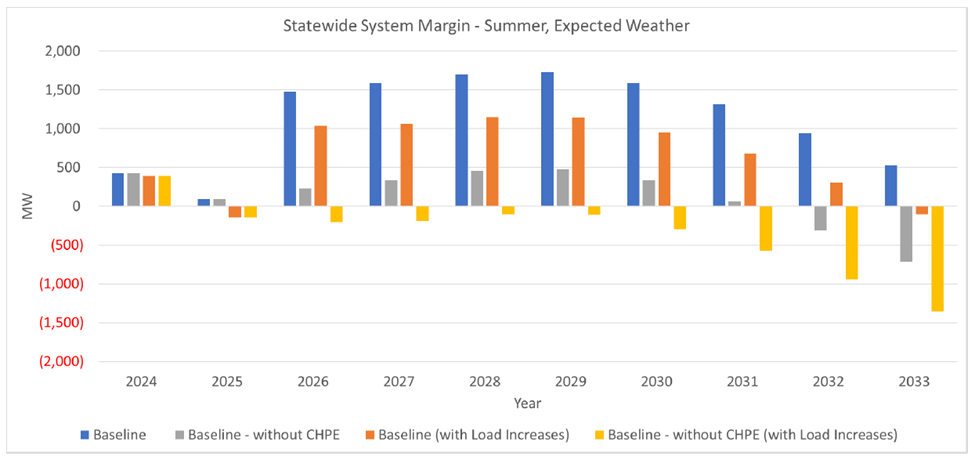
The annual Power Trends report describes recent history and trends on the electric system.  NYISO has prepared a key takeaways fact sheet in addition to the Power Trends 2023 report itself.  The following graphic summarizes the key messages.

I will address each of these takeaways in the rest of this section.

The first takeaway “Public Policies are driving rapid change in the electric system in the state, impacting how electricity is produced, transmitted, and consumed” states the obvious that the Climate Act mandate to completely transform the energy system of the state affects everything in the electric system.

The second takeaway address’s reliability margins which are shrinking because fossil-fired generators are retiring at a faster pace than new renewable supply is entering service. What are they talking about?  The Installed Reserve Margin (IRM) is “the minimum level of capacity, beyond the forecasted peak demand, which utilities and other energy providers must procure to serve consumers”.  Power Trends notes “The IRM for the 2023-2024 capability year is 20.0% of the forecasted New York Control Area peak load, an increase from 19.6% last year. Based on a projected summer 2023 peak demand of 32,048 MW and the IRM, the total installed capacity requirement for the upcoming summer capability period is 38,458 MW”.

There is a significant underlying issue with this metric.  In order to determine resource adequacy for the IRM, NYISO has a process that has been developed and refined over decades.  Over the years this work has determined just how much extra power capacity is necessary to cover the unexpected loss of operating capacity at any one time.  Importantly, a fundamental presumption based on observations in the NYISO analyses is that conventional generating resources operate independently.  One of the biggest issues with a generating system dependent upon wind and solar resources is that there is a very high correlation between wind and solar output across the state.  At night every solar resource provides zero energy.  The primary cause for low wind energy output is a high-pressure system which is typically larger than New York.  That means that the output for all the wind facilities in New York are highly correlated now and even when offshore wind comes on line this will continue.  NYISO and the New York State Reliability Council are just coming to grips with this problem and how future resource adequacy analyses will have to be modified to refine the IRM standard. Finally, note that this problem is exacerbated by the fact that the hottest and coldest periods in New York associated with the highest electrical loads correlate very well with high pressure systems with light winds.  In the winter when the solar resource is low because days are shorter and irradiance lower this problem is even more difficult.

The reliability margin takeaway discussion also raises implementation schedule concerns: “The potential for delays in construction of new supply and transmission, higher than forecasted demand, and extreme weather could threaten reliability and resilience of the grid.”  This is one of my primary concerns with NYCI.  Even if the technologies needed actually work, they might not be deployed fast enough to meet the NYCI cap limits.

The next takeaway addresses the issue of interconnection.  It notes that “The NYISO’s interconnection process balances developer needs with grid reliability”.  There is a lot of pressure on the NYISO to approve facility interconnection requests by those who will bear no responsibility if the rush to approve creates unanticipated issues.  This is complicated.  A reliable electric power system is very complex and must operate within narrow parameters while balancing loads and resources and supporting synchronism.  New York’s conventional rotating machinery such as oil, nuclear, and gas plants as well as hydro generation provide a lot of synchronous support to the system. This includes reactive power (vars), inertia, regulation of the system frequency and the capability to ramping up and down as the load varies. Wind and solar resources are asynchronous and cannot provide this necessary grid ancillary support.  The New York State Reliability Council (NYSRC) has proposed a new reliability rule for large asynchronous resources that is necessary but will likely add unavoidable delays to the interconnection process.

The Climate Action Council has the responsibility to develop the Scoping Plan to implement the Climate Act.  Unfortunately, the members were chosen more for ideology than technical expertise and one of the primary ideological beliefs of many on the Council was that existing technology is sufficient for the transformation of the electric sector.  The next takeaway argues otherwise: “To achieve the mandates of the CLCPA, new emission-free supply with the necessary reliability services will be needed to replace the capabilities of today’s generation.”  Note that this position is supported by the Integration Analysis, the NYSRC, and even the Public Service Commission (PSC) that recently convened a proceeding to address this particular issue.  The Council’s misunderstanding of this requirement could have serious consequences.

This new resource is an instance where the NYISO must placate the supporters of the Climate Act by downplaying the difficulty of developing this resource.  The Power Trend takeaway states:  “Such new supply is not yet available on a commercial scale” but they have not publicly come out bluntly and said how difficult this might be.  In my draft scoping plan comments I argued there is a real concern because any resource that is emission-free and provides necessary reliability services must overcome the Second Law of Thermodynamics.  Any energy storage system must lose energy as it is stored and then again as it comes out of storage.  This limits the viability of every storage system touted for this resource.

The final takeaway addresses the wholesale electricity market.  The NYISO is a creation of the deregulated electric system and its market.   It is not surprising that the NYISO touts their critical role in the transition in this regard.  However, in my opinion, the market adds a layer of complexity.  It is not enough to just determine what resources are necessary to keep the lights on but it is also necessary to develop a market incentive to provide that resource.  What happens if the PSC proceeding recommends an emissions free resource that provides the grid support needed but nobody wants to risk the money for a resource that is needed for a limited period during critical demand peaks?

Peaking Power Plants

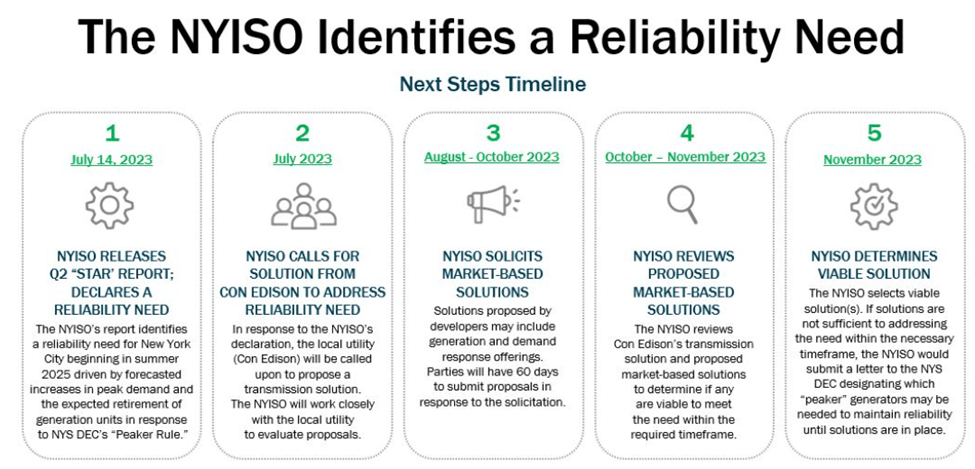
There were other press reports describing Power Trends.  Reuters emphasized the “balanced and carefully planned transition” theme.  New York Focus chose to point out that the report indicates that “Air-polluting “peaker” plants were a top priority for closure in New York’s green transition. But the state isn’t building clean energy fast enough to replace them on time.” Arbetter also raised the “peaker” power plant issue. Dewey said there are “dirty” units that reside in “underprivileged communities” and Arbetter said they cause “lots of pollution and environmental racism”.   

This is a complicated problem that has become embroiled in emotional arguments.  There are some old power plants that are only used to provide power during the highest load demand periods.  They are old, relatively dirty, and many are located in low- and middle-income disadvantaged communities in New York City so have become the poster child of disproportionate impacts on over-burdened communities.  No politically correct organization dares raise any objections to the argument that this is a problem.  On the other hand, I not only have subject matter expertise but also have no voice.  I have shown that the alleged peaker power plant problems are based on selective choice of metrics, poor understanding of air quality health impacts,  and ignorance of air quality trends. In other words they are not as much of a problem as environmental advocates claim.

This is a particular problem for the NYISO.  The new resource that must be developed is needed for this particular problem.  These are the facilities that Dewey wants to be kept available in New York City until a viable alternative is provided.  Someone with a voice is going to have to come out and say that until we have alternatives that will work, have lower risks to the communities where they reside, and are affordable, some peaker power plants may have to remain available.  Whether or not they ever point out that the arguments used to vilify the facilities don’t hold water is another matter.

Conclusion

I agree completely with the following.  The New York Focus article quotes C. Lindsay Anderson, an energy specialist at Cornell University’s school of engineering, who said it’s hard to avoid such gaps in an energy transition with so many moving parts.

“Everything has to move sort of in sync to make the plan work,” Anderson said. “Taking [peakers] offline is an important signal that we’re making progress. But with many other pieces of the plan having been delayed, it’s not surprising that we may need to delay this a little bit to let the other pieces catch up.”

The necessity to toe the line of political correctness in the Capital District prevented Dewey from explicitly connecting some of the Power Trends takeaways and the Climate Act implementation process.  For example, the concern about timing and suggestions that delays are inevitable directly impacts the NYCI emission caps.  The caps are based on the arbitrary Climate Act deadlines that were not chosen based on any kind of a feasibility analysis.  To my knowledge, NYISO has not been asked to provide their best estimate of the timing of the wind and solar resources necessary to  displace the existing resources required to meet the Climate Act mandates.  Their resource adequacy modeling and other work is the only credible way to determine if the schedule is reasonable and would likely show the current schedule is not viable.  Because GHG emissions are primarily associated with energy use meeting the unrealistic NYCI emission caps means the only compliance strategy is to create an artificial energy shortage. 

New York GHG emissions are less than one half of one percent of global emissions and global emissions have been increasing on average by more than one half of one percent per year since 1990.  While this may not be a reason to not do something about climate change, it certainly suggests that adjustments to the arbitrary Climate Act schedule are justified.  The Power Trends report certainly implies that adjustments to the schedules appear to be necessary.

New York Cap and Invest Safety Valve

The New York State Department of Environmental Conservation (DEC) and New York State Energy Research and Development Authority (NYSERDA)  are hosting webinars designed “to inform the public and encourage written feedback during the initial phase of outreach” for New York’s proposed cap and invest program.  When I get around to submitting my feedback one of my major themes will be the need to do a feasibility analysis to ensure that the resources necessary to enable the reductions required to meet the net-zero transition can be deployed as necessary.  This post addresses this concern.

I have been following the Climate Leadership & Community Protection Act (Climate Act) since it was first proposed. I submitted comments on the Climate Act implementation plan and have written over 300 articles about New York’s net-zero transition.  I have extensive experience with air pollution control theory, implementation, and evaluation having worked on every cap-and-trade program affecting electric generating facilities in New York including the Acid Rain Program, RGGI, and several Nitrogen Oxide programs since the inception of those programs. I follow and write about the RGGI cap and invest CO2 pollution control program so my background is particularly suited for this proposal.   I have devoted a lot of time to the Climate Act because I believe the ambitions for a zero-emissions economy embodied in the Climate Act outstrip available renewable technology such that the net-zero transition will do more harm than good.  The opinions expressed in this post do not reflect the position of any of my previous employers or any other company I have been associated with, these comments are mine alone.

Climate Act Background

The Climate Act established a New York “Net Zero” target (85% reduction and 15% offset of emissions) by 2050 and an interim 2030 target of a 40% reduction by 2030. The Climate Action Council is responsible for preparing the Scoping Plan that outlines how to “achieve the State’s bold clean energy and climate agenda.”  In brief, that plan is to electrify everything possible and power the electric grid with zero-emissions generating resources by 2040.  The Integration Analysis prepared by the New York State Energy Research and Development Authority (NYSERDA) and its consultants quantifies the impact of the electrification strategies.  That material was used to write a Draft Scoping Plan.  After a year-long review the Scoping Plan recommendations were finalized at the end of 2022.  In 2023 the Scoping Plan recommendations are supposed to be implemented through regulation and legislation.  The cap and invest initiative is one of those recommendations.

DEC and NYSERDA have developed an official website for cap and invest.  It states:

An economywide Cap-and-Invest Program will establish a declining cap on greenhouse gas emissions, limit potential costs to New Yorkers, invest proceeds in programs that drive emission reductions in an equitable manner, and maintain the competitiveness of New York businesses and industries. Cap-and-Invest will ensure the state meets the greenhouse gas emission reduction requirements set forth in the Climate Leadership and Community Protection Act (Climate Act).

I have written other articles that provide background on NYCI.  I recently posted a Commentary overview for the New York Cap & Invest (NYCI) program that was written for a non-technical audience. In late March I summarized my previous articles on the New York cap and invest proposal in a post designed to brief politicians about the proposal if you want more technical information.  There also is a page that describes all my carbon pricing initiatives articles that includes a section listing articles about the New York Cap and Invest (NYCI) proceeding.

The Need for a Safety Valve

The NYCI implementation plan is to “Advance an economywide Cap-and-Invest Program that establishes a declining cap on greenhouse gas emissions, limits potential costs to economically vulnerable New Yorkers, invests proceeds in programs that drive emission reductions in an equitable manner, and maintains the competitiveness of New York industries.”  In my opinion, the State has not considered that there will be significant consequences if the dynamics between these stated goals are not resolved.  There is no indication that tradeoffs between these goals are even being considered.  Furthermore, implementation of this sophisticated and complicated economy-wide program is handicapped by the aspirational legislative constraints on timing and targets.

If the influential book Making Climate Policy Work  had been considered by the Climate Action Council or Governor’s Office I believe that there would be substantive changes to the plan.  Authors Danny Cullenward and David Victor explain how the politics of creating and maintaining market-based policies render them ineffective nearly everywhere they have been applied.  They recognize the enormity of the challenge to transform industry and energy use on the scale necessary for deep decarbonization.  They write that the “requirements for profound industrial change are difficult to initiate, sustain, and run to completion.”  Because this is hard, they call for “realism about solutions.” 

NYCI proponents point to the “success” of the Regional Greenhouse Gas Initiative (RGGI) and presume that their proposed program will work as well.  I evaluated the Making Climate Policy Work analysis of RGGI.  I agree with the authors that the results of RGGI and other programs suggest that programs like the NYCI proposal will generate revenues.  However, we also agree that the amount of money needed for decarbonization is likely more than any such market can bear.  The problem confronting the Administration is that in order to make the emission reductions needed I estimate they have to invest between $15.5 and $46.4 billion per year.  The first issue that NYCI implementation must address is the revenue target relative to what is needed for investments to meet the Climate Act 2030 GHG emission reduction target.

The use of NYCI as a compliance mechanism is also a problem.  The NYCI webinars have not acknowledged or figured out that the emission reduction ambition of the Climate Act targets is inconsistent with the technological reality of the Climate Act schedule.  Because GHG emissions are equivalent to energy use, limiting GHG emissions before there are technological solutions that provide sufficient zero-emissions energy means that compliance will only be possible by restricting energy use.  The second issue that NYCI implementation must address is a feasibility analysis whether there will be sufficient allowances to avoid limits on power plant operations, gasoline availability, and natural gas for residential use for the 2030 Climate Act 40% GHG emission reduction target.  This issue is the focus of this post.

There is no excuse to not include a safety valve that could make changes to the schedule based on the results of a feasibility analysis.  The NYCI webinars have not acknowledged that there are conditions relative to meeting the Climate Act targets, but there is one available.  New York Public Service Law  § 66-p. “Establishment of a renewable energy program” has safety valve conditions for affordability and reliability that are directly related to the two issues described above.   § 66-p (4) states: “The commission may temporarily suspend or modify the obligations under such program provided that the commission, after conducting a hearing as provided in section twenty of this chapter, makes a finding that the program impedes the provision of safe and adequate electric service; the program is likely to impair existing obligations and agreements; and/or that there is a significant increase in arrears or service disconnections that the commission determines is related to the program”.   If the feasibility analysis finds that reliability or affordability issues are likely due to implementation issues, then this could be used to modify the schedule.

California Uncertainty Analysis

One of the principles of NYCI is Climate Leadership which is defined as: “Catalyze other states to join New York, and allows linkage to other jurisdictions”.  In order to link to other jurisdictions, it is necessary to be consistent with their cap and invest programs.  The California Air Resources Board (CARB) has a GHG emissions cap-and-trade program that has been in place since 2019.  Even though the Climate Act differs from the California plan because the Climate Act requires that all GHG emissions must be accounted for rather offering some exemptions, I am disappointed that there does not seem to be much sign that New York is considering using the methodological approaches used by California. 

Last year CARB prepared a 2022 Scoping Plan for Achieving Carbon Neutrality (2022 Scoping Plan) that “lays out a path to achieve targets for carbon neutrality and reduce anthropogenic greenhouse gas (GHG) emissions by 85 percent below 1990 levels no later than 2045, as directed by Assembly Bill 1279.”  This is one example where New York’s efforts could be informed by the California process and it addresses my feasibility concern.  The California Air Resources Board 2022 Scoping Plan issued in November 2022 included a 2030 Uncertainty Analysis.  The report explains that the implementation effort requires additional efforts beyond those already in place but notes:

There is also uncertainty that the current mix of policies (regulations, incentives, and carbon pricing) will be sufficient to achieve California’s 2030 target, at least 40% below 1990 greenhouse gas (GHG) emissions. Uncertainty is an inherent part of emissions forecasting and modeling – there is no model capable of predicting the future with perfect accuracy. As the on-going global COVID-19 pandemic and recovery has demonstrated, unexpected events can dramatically impact human welfare, economic activity, and GHG emissions.

In this analysis, we identify the drivers of uncertainty and analyze the potential impact of implementation delays on GHG emissions in 2030. That is, what if delayed implementation of actions as defined in the Scoping Plan Reference Scenario fail to achieve anticipated GHG reductions by 2030? This uncertainty analysis focuses on progress in achieving the 2030 target of at least 40% below 1990 levels by 2030 and does not include an assessment of the uncertainty faced in implementing the Scoping Plan scenario for achieving carbon neutrality by 2045.

We construct two scenarios that capture the largest emissions impact in 2030 from delays in implementation under the Scoping Plan Reference Scenario: delayed renewable capacity and delayed transportation electrification. We quantify the magnitude of the emissions impact under these two scenarios, highlighting the importance of these two actions in achieving the reductions outlined in the Scoping Plan Reference Scenario to hit California’s 2030 climate target.

This is exactly what I believe is necessary for NYCI.  The report notes that:

The main drivers of future GHG emissions – technology costs, energy prices, macroeconomic conditions, and policy implementation – are not known with perfect certainty. Modelers make informed assumptions about these drivers and estimate a range of GHG emissions based on historic, current, and potential future trends.

Unanticipated changes in these variables impact GHG emissions, however they are largely outside the control of policy makers. In just the past few years, we have seen global geopolitical and macroeconomic events dramatically alter energy prices, technology costs, and GHG emissions in California. The impacts of these events are still being felt and will continue to impact California’s economy and emissions – but are largely outside the control of the State.

The uncertainty analysis considered two scenarios: one for delayed renewable development and another for delayed transportation electrification.  The delayed renewable capacity scenario description notes:

In the Scoping Plan Reference Scenario, California has a 38 MMT GHG constraint in the power sector and achieves a 60% Renewable Portfolio Standard (RPS) by 2030 as required in SB 100. Under the delayed renewable capacity scenario, we construct an emissions trajectory from 2022 to 2030 under a 5-year delay in renewable capacity including infrastructure for existing renewable facilities as well as delays in permitting and construction for new renewable generation and transmission.

The delayed transportation electrification scenario description explains:

In the transportation sector, there are two assumptions driving emissions in 2030 in the Scoping Plan Reference Scenario- per-capita vehicle miles travelled (VMT) are reduced 4% below 2019 levels by 2045 and 40% of light-duty vehicle (LDV) sales are zero emission vehicles (ZEV) by 2030 (with minimal medium-duty and heavy-duty vehicle decarbonization) aligned with California Institute for Transportation Studies (ITS) BAU scenario. In California, per-capita VMT increased from 2017 to 2019. Therefore, the assumption that VMT decreases, even marginally, without additional action is a risk to achieving the 2030 emissions under the Scoping Plan Reference Scenario. However, the overall emissions impact in 2030 of failing to achieve the 4% per capita VMT reduction is relatively small under the Scoping Plan Reference Scenario as compared to the emissions impact of near-term transportation electrification.

The analysis concludes:

California’s path to carbon neutrality by 2045 is predicated on achieving the emission reductions outlined in the Scoping Plan Reference Scenario. We find that delaying renewable capacity by 5 years will increase California emissions by 8% in 2030 while delaying vehicle electrification will increase emissions by 6% in 2030. While the magnitude of these values may seem small, the risks are high. 2030 is just over seven years away and the gap to achieving the sector targets in the Scoping Plan Reference Scenario are large.

These emission reductions outlined in the Scoping Plan Reference Scenario are not guaranteed and while some of the risk and uncertainty is global and largely exogenous, there are risks associated with implementation. These risks can potentially be reduced or eliminated with targeted policy interventions. While in this analysis we have highlighted the impact of delayed renewable capacity and transportation electrification, there are uncertainties in each implementation assumption across California’s economic sectors. The magnitude of the emissions impact will vary as will any potential policy or regulatory intervention.

This analysis has focused on the risks associated with California achieving the GHG emissions outlined in the Scoping Plan Reference Scenario. Any increase in emissions on the pathway to 2030 will impact California’s ability to achieve carbon neutrality by 2045. In addition, the technologies and fuels needed to achieve carbon neutrality will also face significant uncertainties in the future. While outside the scope of this analysis, the same implementation risks discussed in relation to renewable capacity may be relevant to emerging technologies like carbon dioxide removal or carbon capture and renewable hydrogen production.

Discussion

The California analysis found that delays in renewable energy deployment would increase emissions 8% (~ 28 million metric tons) and vehicle electrification would increase emissions by 6% (~21 million metric tons).  These are significant emission increases.  If there are similar issues relative to the New York implementation plans, then it would threaten the compliance with the cap.

The NYCI implementation plan includes a goal for a declining cap on greenhouse gas emissions that provides compliance certainty.  In my opinion, the State has not considered that there will be significant consequences related to the use of NYCI as a compliance mechanism if the deployment of zero-emissions resources necessary to make the reductions is delayed.  The Hochul Administration has not acknowledged or figured out that the emission reduction ambition of their Climate Act targets is inconsistent with technology reality.  Because GHG emissions are equivalent to energy use, limiting GHG emissions before there are technological solutions that provide zero-emissions energy means that compliance will only be possible by restricting energy use. 

I do not understand why Climate Act proponents don’t acknowledge that restrictions on energy use because there are insufficient allowances available would catastrophically impact their ambitions.  It is indisputable that New York GHG emissions are less than one half of one percent of global emissions and global emissions have been increasing on average by more than one half of one percent per year since 1990.  I would not want to argue to the public that they cannot have gasoline for their cars or fossil fuels for their homes because the allowances ran out attempting to reduce New York emissions a fraction of the total when the total emissions are globally irrelevant.  It is not necessarily inappropriate to do something but disallowing changes to the schedule based on feasibility or the reality that emissions are greater than the aspirational targets leading to artificial energy shortages will surely cause massive pushback by most New Yorkers.

Conclusion

The allure of a source of revenues and compliance certainty using climate policies that apparently have worked in the past led the Council and Governor to put the cart before the horse with their NYCI recommendations.  The Cap-and-Invest Program recommended by the Climate Action Council’s final Scoping Plan and proposed in Governor Kathy Hochul’s 2023 State of the State Address and Executive Budget has not paid adequate attention to what made previous policies work and whether there are significant differences between the Climate Act requirements and previous policy goals in those other programs that might impact NYCI.   There are provisions for a safety valve that enable adjustments to the schedule.  The recent announcements that there are delays in the offshore wind projects suggests that there are potential issues. Failing to plan and incorporate a feasibility analysis to determine the reasonableness of the deployment of wind and solar resources necessary to meet the targets relative to the Climate Act schedule will likely lead to serious problems in the future. 

The Problem with Averages

The Climate Leadership & Community Protection Act (Climate Act) net-zero transition plan mandates a 40% reduction in Greenhouse Gas (GHG) emissions from a 1990 baseline.  It is not clear how that target is supposed to be interpreted and much less clear what resources need to come on-line in order to make those targets.  For the electric sector, however, there is a resource that provides a projection of future generating resource deployments.  This post looks at that data and whether it can be used to simply estimate the status of wind and solar development relative to Climate Act targets.

I have been following the Climate Act since it was first proposed. I submitted comments on the Climate Act implementation plan and have written over 300 articles about New York’s net-zero transition. The opinions expressed in this post do not reflect the position of any of my previous employers or any other company I have been associated with, these comments are mine alone.

Climate Act Background

The Climate Act established a New York “Net Zero” target (85% reduction and 15% offset of emissions) by 2050 and an interim 2030 target of a 40% reduction by 2030. The Climate Action Council is responsible for preparing the Scoping Plan that outlines how to “achieve the State’s bold clean energy and climate agenda.”  In brief, that plan is to electrify everything possible and power the electric gride with zero-emissions generating resources by 2040.  The Integration Analysis prepared by the New York State Energy Research and Development Authority (NYSERDA) and its consultants quantifies the impact of the electrification strategies.  That material was used to write a Draft Scoping Plan.  After a year-long review the Scoping Plan recommendations were finalized at the end of 2022.  In 2023 the Scoping Plan recommendations are supposed to be implemented through regulation and legislation. 

Interconnection Queue

The electric power grid is the world’s largest machine.  New York’s electric system is connected to the Eastern Interconnection which spans the country from Nova Scotia to Louisiana and Key West Florida to Saskatchewan.  The complications associated with ever increasing dependence upon intermittent wind and solar is a major reason why I am skeptical about the Climate Act. When any new generating resource wants to connect to the New York transmission system, the New York State Independent System Operator (NYISO) must go through a detailed interconnection process to ensure compatibility between the new resource and the existing system.  One product of that process is a list of all proposed projects in the Interconnection Queue available at the interconnection process website.  The spreadsheet lists the projects by electrical output, type of resource and fuel used, the location, the licensing and approval status, and the proposed in-service date.

I downloaded the interconnection queue data in mid-April and summarized the current status of expected new resources.  I eventually figured out that the queue included all interconnections from proposed generating resources not just one interconnection per development so I could not simply sum up the resource capacity totals.  This primarily affected the offshore wind facilities that hookup to the transmission system in multiple locations.  In order to address this, I manually went through the queue spreadsheet and removed projects that I thought represented multiple connections. The following table shows the generation capacity in MW expected to be developed for projects in the queue and the expected power capacity by in service year.  There are relevant caveats to this information for our purpose.  There is no distinction between onshore and offshore wind but all the wind proposed to interconnect in Zone J (New York City) and Zone K (Long Island) is offshore wind so the onshore wind component is the difference between the total and the sum of those zones.  The NYISO process is only concerned with utility-scale solar resources that connect directly to the grid so the solar total does not include distributed solar.

The question for this post is whether this information can be used to simply estimate the status of wind and solar development relative to Climate Act targets. If we assume that the development of these resources directly displaces fossil-fired resources then we can compare the results to the target.  In order to displace existing fossil-fired generation the power capacity must be converted to energy.  The following tables consider only the wind and utility-scale solar power capacity (MW) in the interconnection queue accumulated by year.  I converted this capacity (MW) to energy GWh by using the NYISO assumed capacity factors.  The capacity factor is the average expected energy production divided by the maximum possible energy production. The cumulative expected electric generation per year is shown in the next table.  Assuming that every GWh produced by these renewable resources displaces fossil generation that emits 463.9 metric tons per GWH enables an estimate of the annual displacement per year can be made.  Using this methodology, the wind and solar resources in the interconnection queue will displace 51.2 million metric tons of CO2 in 2030.

Electric Sector Emissions and Targets

I estimated the 2030 target by using data from the DEC annual GHG emission inventory. The latest inventory of the Statewide GHG Emissions Report (available at this website) was published in December 2022 and contains data for 2020.  The emission information is also available for download from Open Data NY.  The Climate Act mandates unique emissions accounting procedures that include emissions from imported electricity, imported fossil fuels, and electric transmission as well as the direct emissions of CO2. 

The following table lists the 1990 baseline, the 2030 target (40% reduction of the baseline, and the observed emissions data from the most recent inventory.  DEC makes the point that the 2020 emissions were not representative and suggests using 2019 data for the current status.  The electric sector total baseline emissions were 94.5 million metric tons of CO2e (MMT CO2e) so the 2030 40% reduction target is 56.7.  In 2019 the total sector emissions were 50.7 MMT CO2e.  Emissions for all the subsectors including the Open Data NY data are also shown.  However, New York State shut down 2,000 MW of zero emissions nuclear generation at Indian Point and that increased direct fuel combustion emissions to 27.7 MMT CO2e.  Assuming that the imported fossil fuels for electric power would increase in proportion to the 2019 to 2022 change in emissions and that all the other sub-sector emissions stays the same results in an overall estimate of 60.5 MMT CO2e for 2022.

Open Data NY Greenhouse Gas Emissions Electricity Sector Emissions

The previous section estimated the emissions from generation displaced by the development of the wind and solar resources in the NYISO interconnection queue.  According to this crude estimate the new resources will displace fossil generation expected to produce 51.2 MMT CO2e for the fuel combustion in the electric power subsector.  That is more than the combined 2022 fuel combustion and imported fossil fuels for electric power subsectors which implies that if these resources get built that compliance will be ensured.  Unfortunately, this approach does not tell the whole story because it relies on averages.

Problem with Averages

In September 2021, Terry Etam wrote an article that I think clearly explained the problem with using averages like I did in the analysis above.  While his predictions that there would be a European energy shortage in the winter of 2021 -2022 did not turn as he predicted, the concepts he described are relevant.

His article introduced the problem:

Well, maybe I’d like to talk about statisticians, as in the old joke about the one that drowned because he forded a river that was only three feet deep, on average. See, isn’t that better than politics already? However, as funny as a drowned statistician may be, there is a serious side to the problem with relying on averages. You really can die, for starters.

Before getting back to death and/or politics again (redundancy, I know), let’s think about the use of averages. A car may be designed for the average – one doesn’t find the tallest person on earth and design an interior to accommodate them. The exceptions get to either bang their shins or dangle their feet, but that’s the way it has to be.

In other areas, it can’t work that way. Do you insulate your house for average conditions? No, of course not. Do you install an air conditioner for average conditions? Same. And on it goes. When the risk of harm goes up, we design for the extremes, not the averages. Or we should.

A whole world of trouble will come your way if your plans are built on averages but you cannot live with the extremes. Or even with substantial variations. Europe, and other progressive energy parts of the world, are finding this out the hard way. 

Etam then explained how this issue is relevant to the net-zero transition:

In the race to decarbonize the energy system, wind and solar have taken a dominant lead. Nuclear is widely despised. Hydrogen has potential, but is a long way out, as a major player. On the assumption that Hydrocarbons Must Go At Any Cost, wind and solar are the winners. Bring on the trillions. Throw up wind turbines everywhere. Blanket the countryside in solar panels.

The media loves the wattage count as fodder for headlines; big numbers dazzle people. “The United States is on pace to install record amounts of wind and solar this year, underscoring America’s capacity to build renewables at a level once considered impossible…The U.S. Energy Information Administration expects the U.S. will install 37 gigawatts of new wind and solar capacity this year, obliterating the previous record of almost 17 GW in 2016,” bleated the ironically named Scientific American website. Wow, gigawatts. No idea what those are but they sound huge. 

What is the problem with all that capacity? Well, how good is it? Let’s see…at a 33 per cent capacity factor (used by the US government as apparently reasonable), that 37 GW is just over 12 GW of power contributed to the grid, on average. The assumption seems to be then that 12 GW of dirty old hydrocarbons have been rendered obsolete, and, for the energy rube, the number is an even more righteous 37 GW, because, you know, some days it is really windy all over.

But, what happens when that load factor is…zero? Because it happens.

This is the critical point.  In the existing system outages are independent of each other.  If there are five 100 MW gas turbines each with an 80% capacity factor it is reasonable to expect that four of the turbines will be available at any one time.  That is not the case for solar and wind.  None of the solar resources will be available at night.  With regards to wind, it turns out that the reason for light winds is a high-pressure system and those systems are typically bigger than New York so when one wind turbine is producing low power due to light winds, odds are most of the others are too.  Etam explains what has happened in Great Britain:

The current poster child for the issue is Great Britain. The UK has 24 GW of wind power installed. The media loves to talk about total renewable GW installed as proof of progress, and the blindingly rapid pace of the energy transition. 

However over the past few weeks wind dropped almost to zero, and output from that 24 GW of installed capacity fell to about 1 or 2 GW. 

Ordinarily, that would be no problem – just fire up the gas fired power plants, or import power from elsewhere.

But what happens when that isn’t available? 

More pertinently, what happens when the likelihood of near-zero output happens to coincide with the times when that power is needed most – in heat waves, or cold spells? That brings us to the current grave situation facing Europe as it heads towards winter. Gas storage is supposed to be filling rapidly at this time of year, but it’s not, for a number of reasons.

This happens everywhere.  It is exactly the issue that the Integration Analysis, New York Independent System Operator (NYISO), and New York State Reliability Council all said required an entirely new generating resource to solve but the Climate Action Council chose to ignore because one Council member with an out-sized influence but little relevant experience claimed was not an issue.  Etam goes on to pull no punches when he describes the resulting impacts. 

Let’s drive this energy conundrum home a little better for all these people who are, as Principal Skinner put it on the Simpsons, “furrowing their brows in a vain attempt to comprehend the situation.”

The world has been sold a faulty bill of goods, based on a pathetically simplistic vision of how renewable energy works. A US government website highlights the problem with this example: “The mean turbine capacity in the U.S. Wind Turbine Database is 1.67 megawatts (MW), At a 33% capacity factor, that average turbine would generate over 402,000 kWh per month – enough for over 460 average U.S. homes.”

Thus armed, bureaucrats and morons head straight to the promised land by multiplying the number of wind turbines by 460 and shocking-and-awing themselves with the results. Holy crap, we don’t need natural gas anymore (as they tell me in exactly those words).

So they all start dismantling the natural gas system – not directly by ripping up pipelines, but indirectly by blocking new ones, by championing ‘fossil-fuel divestment campaigns’, by taking energy policy advice from Swedish teenagers – and then stand there shivering in dim-witted stupor when the wind stops blowing, and the world’s energy producers are not in any position to bring forth more natural gas.

It’s not just Britain that is squirming. A Bloomberg article (which I cannot link to as I will never willingly send Bloomberg a cent) notes the following unsettling news: “China is staring down another winter of power shortages that threaten to upend its economic recovery as a global energy supply crunch sends the price of fuels skyrocketing. The world’s second biggest economy is at risk of not having enough coal and natural gas – used to heat households and power factories – despite efforts over the past year to stockpile fuel as rivals in North Asia and Europe compete for a finite supply.”

In my opinion this is a good representation of the situation facing New York State as a result of the Climate Act.

Conclusion

The assumption that an overall capacity factor can be used with the projected new generation capacity in the interconnection queue to estimate the displacement of fossil fuel resources is wrong because of the strong correlation between all the solar resources and all the wind resources in New York.  The only way to address this is with detailed resource modeling like the analyses from the NYISO.  I don’t even think that the NYISO resource adequacy modeling is currently capable of completely addressing the problem of the correlated renewable generating resources for the worst case.  I know that the wind and solar variability issue is a priority for improvements.  In the meantime, the NYISO modeling is the best resource we have and should be used to determine how the wind and solar resources in the queue will displace fossil-fired resource emissions.  Clearly, the state deserves an analysis that shows where we stand relative to these targets using the NYISO model results.

Etam goes on to make the point that this mis-understanding is going to lead to energy shortages in worst case situations that will result if the Climate Act implementation fails:

Hundreds of millions of people without adequate heating fuel in the dead of winter is not particularly funny. If a cold winter strikes, all the yappiest energy-transition-now dogs will fade into the woodwork, distancing themselves from the disinformation they’ve propagated and the disaster they’ve engineered. People in position of responsibility will have no choice but to speak out loud the words they’ve dared not utter for a decade: you need hydrocarbons, today, tomorrow, and for a very long time yet. So start acting like it.

Our Chaotic Climate System

The rationale for the Climate Leadership & Community Protection Act (Climate Act) net-zero transition plan is based on model assessments that project an existential threat.  Ron Clutz writing at Science Matters does an excellent job explaining why it is difficult to predict the effects of greenhouse gases on the climate system.  A recent National Review article draws the implications: “The range of predicted future warming is so enormous – apocalyptism is unwarranted”

I have been following the Climate Act since it was first proposed. I submitted comments on the Climate Act implementation plan and have written over 300 articles about New York’s net-zero transition. The opinions expressed in this post do not reflect the position of any of my previous employers or any other company I have been associated with, these comments are mine alone.

Climate Act Background

The Climate Act established a New York “Net Zero” target (85% reduction and 15% offset of emissions) by 2050 and an interim 2030 target of a 40% reduction by 2030. The Climate Action Council is responsible for preparing the Scoping Plan that outlines how to “achieve the State’s bold clean energy and climate agenda.”  In brief, that plan is to electrify everything possible and power the electric gride with zero-emissions generating resources by 2040.  The Integration Analysis prepared by the New York State Energy Research and Development Authority (NYSERDA) and its consultants quantifies the impact of the electrification strategies.  That material was used to write a Draft Scoping Plan.  After a year-long review the Scoping Plan recommendations were finalized at the end of 2022.  In 2023 the Scoping Plan recommendations are supposed to be implemented through regulation and legislation.  I submitted comments on Scoping Plan Section 2.1 Scientific Evidence of Our Changing Climate that refuted many of the apocalyptic claims made in Section 2.1 of the Draft Scoping Plan. 

Chaotic Systems

The first Intergovernmental Panel on Climate Change report stated: “The climate system is a coupled non-linear chaotic system, and therefore the long-term prediction of future climate states is not possible. Rather the focus must be upon the prediction of the probability distribution of the system’s future possible states by the generation of ensembles of model solutions.”  But what does that mean?

Edward Lorenz discovered the underlying mechanism of deterministic chaos.  In brief: “Chaos theory is the study of how systems that follow simple, straightforward, deterministic laws can exhibit very complicated and seemingly random long-term behavior.”  This is the so-called butterfly effect in which a butterfly’s wings can disturb the atmosphere in Brazil such that a tornado eventually results in Texas.

The reason for this post is Ron Clutz’s clear example of how this works in a short article.  I recommend that you read his post to see the animation examples.  He gives examples of simple systems and how the addition of one new variable creates a much more complex system.  In particular, adding a pendulum to the ball of another pendulum creates a complex trajectory that with significant effort “complex equations have been developed that can and do predict the positions of the two balls over time”.  The kicker to this:

If you arrive to observe the double pendulum at an arbitrary time after the motion has started from an unknown condition (unknown height, initial force, etc) you will be very taxed mathematically to predict where in space the pendulum will move to next, on a second to second basis. Indeed it would take considerable time and many iterative calculations (preferably on a super-computer) to be able to perform this feat. And all this on a very basic system of known elementary mechanics

Climate System

Clutz goes on to point out:

This is a simple example of chaotic motion and its unpredictability. How predictable is our climate with so many variables and feedbacks, some known some unknown? Consider that this planet’s weather/climate system is chaotic in nature with many thousands (millions?) of loosely coupled variables and dependencies, and many of these variables have very complex feedback features within them.

The central question underpinning the Climate Act net-zero transition is the effect of GHG emissions on the radiation budget of the world.  He sums up by quoting climate scientist Richard Lindzen’s summary from a presentation:

I haven’t spent much time on the details of the science, but there is one thing that should spark skepticism in any intelligent reader. The system we are looking at consists in two turbulent fluids interacting with each other. They are on a rotating planet that is differentially heated by the sun. A vital constituent of the atmospheric component is water in the liquid, solid and vapor phases, and the changes in phase have vast energetic ramifications. The energy budget of this system involves the absorption and reemission of about 200 watts per square meter. Doubling CO2 involves a 2% perturbation to this budget. So do minor changes in clouds and other features, and such changes are common. In this complex multifactor system, what is the likelihood of the climate (which, itself, consists in many variables and not just globally averaged temperature anomaly) is controlled by this 2% perturbation in a single variable? Believing this is pretty close to believing in magic. Instead, you are told that it is believing in ‘science.’ Such a claim should be a tip-off that something is amiss. After all, science is a mode of inquiry rather than a belief structure.

Conclusion

I cannot improve on Clutz’s summation:

For now, though, navigating the climate debate will require translating the phrase “climate denier” to mean “anyone unsympathetic to the most aggressive activists’ claims.” This apparently includes anyone who acknowledges meaningful uncertainty in climate models, adopts a less-than-catastrophic outlook about the consequences of future warming, or opposes any facet of the activist policy agenda. The activists will be identifiable as the small group continuing to shout “Denier!” The “deniers” will be identifiable as everyone else.

Articles Related to the Climate Act June 9, 2023

This post describes some articles I have noted recently that relate to the Climate Leadership & Community Protection Act (Climate Act) net-zero transition plans.  At the core of the Climate Act the key questions are is there a problem that warrants the complete conversion of our energy system and can the alternatives proposed replace the existing system affordably while maintaining current standards of reliability.  The articles referenced here address those questions.

I have been following the Climate Act since it was first proposed. I submitted comments on the Climate Act implementation plan and have written over 300 articles about New York’s net-zero transition. The opinions expressed in this post do not reflect the position of any of my previous employers or any other company I have been associated with, these comments are mine alone.

Climate Act Background

The Climate Act established a New York “Net Zero” target (85% reduction and 15% offset of emissions) by 2050 and an interim 2030 target of a 40% reduction by 2030. The Climate Action Council is responsible for preparing the Scoping Plan that outlines how to “achieve the State’s bold clean energy and climate agenda.”  In brief, that plan is to electrify everything possible and power the electric gride with zero-emissions generating resources by 2040.  The Integration Analysis prepared by the New York State Energy Research and Development Authority (NYSERDA) and its consultants quantifies the impact of the electrification strategies.  That material was used to write a Draft Scoping Plan.  After a year-long review the Scoping Plan recommendations were finalized at the end of 2022.  In 2023 the Scoping Plan recommendations are supposed to be implemented through regulation and legislation.

Health Impacts

Health impacts are a rallying call by activists opposed to most sources of electricity.  One of the driving factors relative to the public fear of nuclear power is the argument that there is no safe level of radiation.  The basis of that argument is the linear no-threshold (LNT) model.  Steve Milloy writing at JunckScience.Com describes the extensive research by Dr. Edward Calabrese of UMass Amherst on the origins and development of the LNT.   He recommends that that readers “first watch and have their minds blown by the amazing 22-part Health Physics Society (HPS) video series featuring the incomparable Calabrese’s unparalleled research: HPS.org | YouTube.com. It is 10 hours of truly incredible content. No exaggeration. A written summary of the video series is here (Web | PDF).”

The LNT model approach claims that there are no thresholds for cancer risk associated with radiation exposure.  It has been used by regulatory agencies to set permitted exposure standards for radiation.  .  The article documents how “Calabrese’s research and video series expose the dishonest way the LNT was developed and cemented into regulatory risk assessment, these emails expose the dishonesty, scheming and unscientific behavior of those trying to keep the LNT cemented in place.”

It is of particular interest to me because the concept is also applied to air pollutants.  The result is that now we have environmental justice advocates claiming that even if air quality levels meet the National Ambient Air Quality Standards that further reductions are necessary because of alleged health effects calculated using the LNT approach.  The mindless pursuit to eliminate risk from ever lower pollution levels at the expense of reliability, affordability, and unintended adverse environmental impacts of the proposed solutions is exemplified by the Climate Act.

Climate Change Problem

There are three items related to the climate change problem of interest.  Judith Curry announced that her new book Climate Uncertainty and Risk  has been published.  I am waiting for my copy to arrive so a review will have to wait until later but I am sure it will be a must read.

In the last summary of articles I described The Frozen Climate Views of the IPCC: report that reviews the latest Intergovernmental Panel on Climate Change reports on the state of the climate.  The Clintel Newsletter describes reactions to the report that provide overview summaries in different formats:

Coverage of our report in the blogosphere and alternative media has been fine. WUWTJudith CurryRoger Pielke Jr all paid attention to it and Scott Morrison wrote several articles about it on the Daily Sceptic.

Andy May (co-editor of the report) gave a talk/interview about the report at the excellent Tom Nelson Podcast show. You can find the written version of the talk here and the full interview here.


Marcel Crok (co-editor of the report) gave a talk for the really interesting lecture series of the Irish Climate Science Forum (run by Jim O’Brien). In his talk Marcel gave an overview of the Clintel report.

Finally, I want to call attention to work by Roger Pielke, Jr. on hurricanes and climate change.  His latest analysis updates earlier work that tells the story about hurricanes that the media doesn’t tell.  He makes five points:

  1. In short —trends in hurricane activity outside the range of documented variability have not been detected, nor is there high confidence in connections of hurricane behavior to greenhouse gas emissions.
  2. Hurricane landfalls along the continental U.S. show no trends since at least 1900.
  3. Development and growth are sufficient to explain why hurricane damage has increased dramatically
  4. Climate change is important, but far more important for understanding trends and causes of increasing disaster costs is societal change, especially what we build, where we build and how we build.
  5. The largest climate signal — by far — in the damage record of U.S. hurricanes is the El Niño/Southern Oscillation or ENSO

Proposed Solutions

One of the common narratives supporting the transition to solar and wind power is that the development costs for those resources are cheaper than fossil-fired resources.  Willis Eschenbach describes the Lazard April 2023 annual report on the Levelized Cost of Energy (LCOE) that is often used as a reference for that narrative.  He summarizes the problem with the approach:

The LCOE estimates the total capital, operations, and maintenance costs for new electric power plants coming into service. People use the Lazard LCOE all the time to claim that renewable electricity sources are now cheaper than fossil fuel electricity. However, the Lazard data has a problem—it doesn’t include the cost of backup and other costs for renewable energy. These costs fall into four groups: backup costs, balancing costs, grid connection costs, and grid reinforcement/extension costs.

Another article looks at this issue differently but comes to the same conclusion.  Gail Tverberg’s  article analyzes renewable energy development at her blog Our Finite World.  Her blog highlights her research on “figuring out how energy limits and the economy are really interconnected, and what this means for our future”.  She looks at the modeling rationale for using renewable energy and finds that “if a person looks at them narrowly enough–such as by using a model–wind and solar look to be useful”.   However, she concludes that energy modeling misses important points and finds that “profitability signals are much more important.”

Robert Bryce explains that “onshore and offshore, from Iowa to Ireland, and Colombia to New Jersey, renewable projects have been getting hammered by a tidal wave of opposition”.  He concludes:

I will end by repeating two points that I’ve been making for years. First, the key problem with wind and solar (in addition to their incurable intermittency) is their low power density. For wind, it is 1 watt per square meter. Solar’s power density is about 10 watts per square meter. That low power density means they need lots of land (or ocean) to produce significant quantities of electricity. And we don’t have any “vacant” land available. Indeed, the Renewable Rejection Database proves that local communities from Maine to Hawaii have been resisting the energy sprawl that comes with wind and solar for years.

Second, if we are serious about reducing emissions, the way forward is obvious. It is N2N: natural gas to nuclear. Both technologies are low- or no-carbon, mature, affordable, and scalable. Better still, they have power densities that are measured in hundreds, or even thousands, of watts per square meter.

Alas, big business, big banks, and big law firms can’t make as much money off of natural gas and nuclear as they can from wind and solar. Indeed, Congress has dropped a neutron bomb of cash on the wind and solar industries that I have calculated will cost federal taxpayers some $240 billion between now and 2031 –– and that number is almost certainly too low.

Charlie Munger famously said, “show me the incentive and I’ll show you the outcome.” The multi-billion-dollar incentive for Big Wind and Big Solar is to continue pushing their landscape- and marine-mammal-destroying projects on our landscapes and oceans. Given that incentive, we shouldn’t be surprised at the outcome.

New York’s Climate Act Scoping Plan claims that the costs of inaction are greater than the costs of action.  The largest claimed benefit is from the societal impacts of reducing carbon using the social cost of carbon (SCC) parameter.  Canada recently raised their SCC rate from $54 to $247.  Ross McKitrick describes the shenanigans that resulted in the higher numbers:

Countless SCC estimates already exist ranging from small negative amounts (i.e. carbon dioxide emissions are beneficial) to many thousands of dollars per tonne. Every such estimate is like a complex “if-then” statement: if the following assumptions hold, then the SCC is $X. Yale economist William Nordhaus won the 2018 Nobel Memorial Prize in economics for developing some of the first methods for combining all the “if” statements into systems called Integrated Assessment Models or IAMs. And using conventional economic and climate modelling methods, he tended to get pretty low SCC values over the years, which has long been a sore point among climate activists and the politicians who share their agenda.

But economists are on the case. The $247 figure referenced by Guilbeault comes from a new report from the Biden administration that tossed out all the previous models, including Nordhaus’s, and instead cobbled together a set of new models that when run together yield much higher SCC values.

In many ways the new models are just like the old ones. For example, they persist in using an Equilibrium Climate Sensitivity of 3 degrees C. This refers to the warming expected from doubling the amount of CO2 in the atmosphere. The authors cite the Sixth Assessment Report of the Intergovernmental Panel on Climate Change as the basis for this decision, apparently unaware that that estimate has already been shown in the climate literature to be flawed. Using the IPCC’s own method on updated data yields a sensitivity estimate of about 2.2 C or less, and as I have shown in a recent publication this is enough to cause the SCC estimate in a standard model to drop to nearly zero.

New York State has a mandate to go all electric for school buses.  From what I hear the school districts are adopting a “you go first” approach.  Duggan Flanakin explains that is probably because the costs are extraordinary.  He includes the following example:

Take the Dallas (TX) Independent School District, which has about 860 buses. To replace the entire fleet with large diesel buses would cost, therefore, about $86 million.  But those 860 buses, if battery-electric, would cost a minimum of $275 million. And that does not include the cost of charging stations and retraining mechanics. That’s over three times as many taxpayer dollars the school district would have to extract from voters.

I have a friend who is in the car business and he is unimpressed with the future of electric vehicles.  One problem he has mentioned is that the used EV market is non-existent for a variety of reasons.  The implications of that problem have yet to be addressed by the Hochul Administration.  In this vein I found this article by an early adopter who is becoming increasingly disillusioned interesting:

I bought my first electric hybrid 18 years ago and my first pure electric car nine years ago and (notwithstanding our poor electric charging infrastructure) have enjoyed my time with both very much. Electric vehicles may be a bit soulless, but they’re wonderful mechanisms: fast, quiet and, until recently, very cheap to run. But increasingly, I feel a little duped. When you start to drill into the facts, electric motoring doesn’t seem to be quite the environmental panacea it is claimed to be.

Shuttering LIs Power Stations   

Mark Stevens, a regular reader at this blog, send me an article suitable for a post that got pushed to the bottom of the pile.  In the meantime, it was picked up at Natural Gas Now.  Mark is a retired science and technology teacher from Long Island.  I am including it in its entirety below because it is a topic that is on my list to address:

The EPA’s proposed rules for cutting emissions are so onerous that older generators like Northport and Port Jefferson as well as hundreds around the country will be shut down because the expense to upgrade would be prohibitive. Electricity costs will massively increase. These power stations have operated since the ‘60’s with incredible reliability and cost-effectiveness. They have blessed Long Island and the communities that host them with tax income and life-sustaining, consistent energy.  The developed world survives on this. A main difference between our society and the third world is their lack of affordable, reliable energy.  It is also a matter of survival; one can broil in the heat and freeze in the cold. One can starve for lack of food and water. One can die from inadequate health care facilities and resources. 

Note well that these power plants have operated within EPA pollution regulations. Now the EPA is moving the goal posts.  Companies, towns and cities that have relied on the energy for our civilization will be in mortal danger. 

It is extremely difficult, costly and lengthy to site, plan, permit and build a new power station.  The real estate is gone. The possibility of rebuilding an old power station to new standards, repowering, may not be cost-effective, especially if there are the preferential power purchase agreements that put wind and solar electricity ahead of fossil fuel generation.

Another consideration is ChinaRussia, India, and the Global South in general are building fossil-fueled power plants, including coal, at a breathtaking rate, hundreds a year. Why do China, with one of the biggest industrial economies in the world and IndiaSouth AfricaThailand, Cambodia and even Germany and the UK open coal-fueled power plants?  Did they consider prosperity and survival paramount? Decarbonization of NYS and US power plant emissions will have no effect.

Furthermore, wind and solar power operate on average, about 20% of the nameplate capacity of generation. Spinning reserves are mandatory.  Battery backup, aside from the huge expense, child labor and devastation to the environment in obtaining rare earths, may work for a few hours. Where is that coming from if Northport, PJ and other power stations are closed?

Planet Earth, throughout its billions of years, experienced much higher temperatures and CO2.  In fact the Holocene Period, the greatest explosion of flora and fauna in history, flourished with way higher temperatures and CO2.  Life adapted and thrived.  In fact, thousands of scientists confirm there is NO CO2 crisis.

Buy some candles if this goes through.