Enough Land  How will solar development affect upstate New York agriculture?

I have been writing about the Climate Leadership & Community Protection Act (Climate Act) for over four years and one of my primary concerns is the effect of solar developments on New York agriculture.  Kris Martin sent me the Enough Land:  How will solar development affect upstate New York agriculture? white paper (“White Paper”) on agricultural land use and solar buildout in Upstate NY that she just completed. It is a well-researched analysis that looks at how much solar capacity we need to meet Climate Act goals and how much farmland that will require..  Kris has kindly offered to let me provide it to my readers.

I have followed the Climate Act since it was first proposed, submitted comments on the Climate Act implementation plan, and have written over 350 articles about New York’s net-zero transition.  I have frequently written about issues related to solar development and Upstate agriculture. I have devoted a lot of time to the Climate Act because I believe the ambitions for a zero-emissions economy embodied in the Climate Act outstrip available renewable technology such that the net-zero transition will do more harm than good by increasing costs unacceptably, threatening electric system reliability, causing significant unintended environmental impacts, and adversely affecting the way of life in rural New York.  The opinions expressed in this post do not reflect the position of any of my previous employers or any other organization I have been associated with, these comments are mine alone.

Climate Act Background

The Climate Act established a New York “Net Zero” target (85% reduction and 15% offset of emissions) by 2050.  It includes an interim 2030 reduction target of a 40% reduction by 2030 and a requirement that all electricity generated be “zero-emissions” by 2040. The Climate Action Council is responsible for preparing the Scoping Plan that outlines how to “achieve the State’s bold clean energy and climate agenda.”  In brief, that plan is to electrify everything possible using zero-emissions electricity. The Integration Analysis prepared by the New York State Energy Research and Development Authority (NYSERDA) and its consultants quantifies the impact of the electrification strategies.  That material was used to develop the Draft Scoping Plan.  After a year-long review, the Scoping Plan recommendations were finalized at the end of 2022.  In 2023 the Scoping Plan recommendations are supposed to be implemented through regulation and legislation. 

Kris Martin

Kris sent me the following biographical information:

I grew up in a western NY farming community with three colleges; I’ve had a lifelong interest in agriculture and technology. I earned a BA from SUNY Empire State College and an MS in technical communication from Rensselaer Polytechnic Institute.  After graduating, I worked as a software engineer and technical writer at IBM Research receiving national and international awards for my writing. Upon retiring, I moved back to western NY. 

The preface describes the impetus for the white paper.  She had heard the argument that the solar buildout for New York would only require 1% of the state’s farmland.  She did a quick analysis and realized that a more realistic estimate was needed.  She explains:

Maybe I could come up with more realistic estimates. Supporters of large-scale solar and those who opposed it needed some real numbers. I could produce them in a couple of weekends. That was over three years ago.

I can certainly sympathize with that time estimate.  In my experience, nothing associated with any component of the Climate Act is as simple as it first appears.  As a result, any analysis and documentation takes much longer than I originally thought.  That is especially true if you want to document exactly what you found so that the analysis is credible.  The description of the document includes this disclaimer: “This document is neither a statistical analysis nor an academic work; it should not be used as a formal reference.”  It may not be a peer-reviewed work but it is referenced well, the calculations documented, and the conclusions are supported by the work.  It is citizen-science at its finest and I would have no qualms quoting it in my work.

Enough Land

Martin describes the document:

Many upstate New York residents object to solar development on farmland, arguing that we should prioritize food production over energy generation. Others dismiss these concerns as unnecessary. This paper uses government and industry data—along with stated assumptions—to estimate how much agricultural land New York State’s expected level of solar buildout will require. The assessment also places solar land use in the larger context of the state’s farmland losses.

The chapters that follow address these overall questions:

  • Why do we need to site solar facilities on farmland?
  • How much solar capacity will the state need by 2050?
  • How much farmland will this require?
  • How much agricultural land do we have?
  • What effects does solar buildout have on agriculture?

Appendices provide more information on related topics.

She explains that the questions addressed in the white paper are simple: how much solar energy do we need, and how much farmland will it re-quire and what do these amounts mean for upstate agriculture?

Results

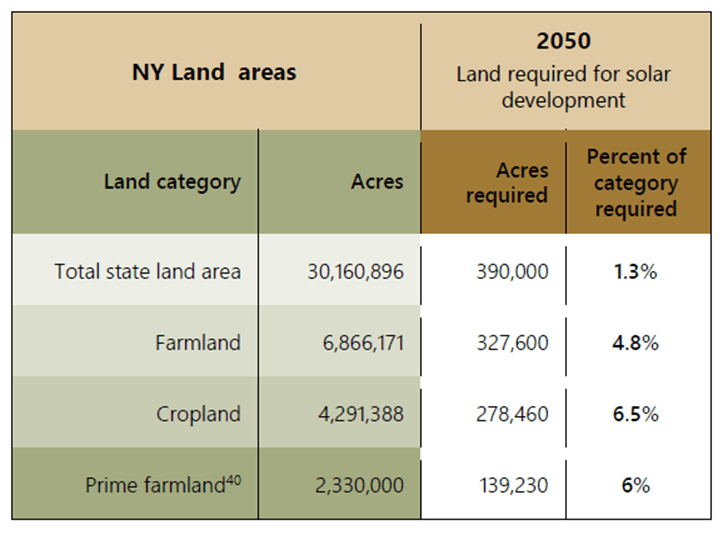
Cutting to the chase, Martin compares the acreage of New York State farmland as of 2017 and the acreage required by 2040 and 2050 for solar development in the following table.  She explains:

The claim that solar development will require only 1% of New York State’s land is roughly correct. On the other hand, solar buildout will require more than 1% of the state’s farmland.

Note that these numbers reflect acreage on the facility site; they do not include land used for mitigation or land taken out of production around facilities because it is less accessible or abandoned for other reasons.

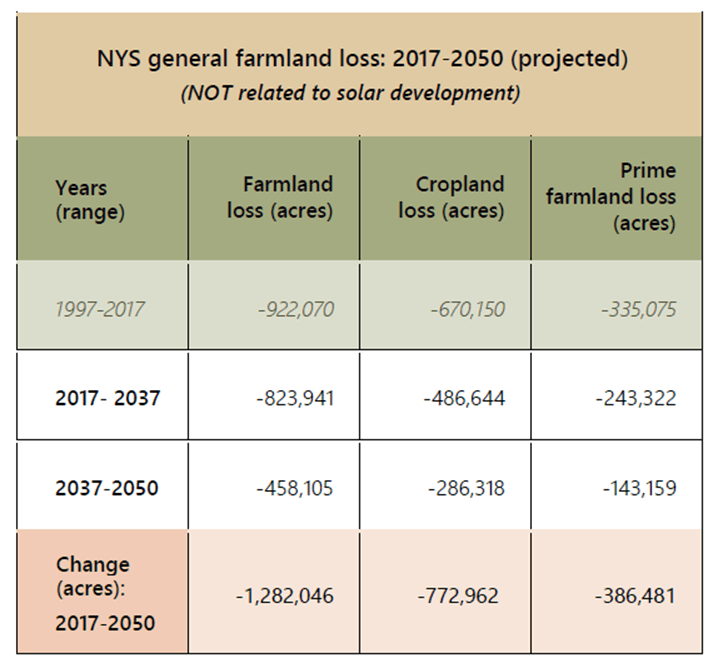
I like the White Paper because it provides context for everything covered.  Estimating the amount of land is dependent upon area per solar panel installation and how much capacity is required for the Climate Act.  Those topics are covered in sufficient detail that it is clear why the numbers used were chosen.  This extends to the results.  There is a chapter that “considers the loss of farmland that has been occurring over the last century and speculates on the reasons for farmland conversion over that period.”  The White Paper provides a projection of expected additional farmland and cropland losses by 2050 not related to solar development.  While there are inconsistencies in the data used such that there is “missing” land, the results are troubling.

The section “How Much Land” assesses cumulative farmland losses from both solar and non-solar causes and puts the estimates in context.  Martin addresses the question whether this is a little or a lot but finds that more context is needed.  She explains: “Let us consider some of the factors relating to our current and future land use, and their relationship to solar development.” 

  • The explanation takes up an entire chapter.  The chapter looks at the following issues:
  • Climate change and agriculture
  • Farmland values in New York and other states
  • Farming and farmers
  • Concentrations of solar development, with examples
  • Agrivoltaic solutions

I really liked this chapter because it frames the issues very well.  My goal as a pragmatic environmentalist is to try to provide the information that I think should be considered when decisions are made.  Invariably there are tradeoffs and the decisions made will reflect value judgements.  This chapter provides the information and avoids making conclusions about which tradeoffs are appropriate. 

One aspect of solar development that I had not considered previously is the effect of co-locating solar developments in the same area.  When several grid-scale solar projects are concentrated in one agricultural area there are adverse impacts to the remaining farmers.  I have long contended that the State has failed to provide a cumulative environmental impact assessment for the currently projected amount of solar and wind development.  The Final Supplemental Generic Environmental Impact Statement (SGEIS) for the Climate Leadership and Community Protection Act was released on September 17, 2020 and only included 13,200 MW of utility-scale solar.  This analysis assumes that utility-scale solar will be on the order of 45,000 MW or over three times what the State analyzed.

Discussion

After three years of extensive work Kris Martin has assembled a great resource on solar development and its potential impacts on New York agriculture.  She confronts the tradeoffs:

Ultimately, we may be facing a conflict between the rights of landowners to use farmland for any legal purpose and our collective need for farmland as a vital resource. Because most of us do respect the long hours, hard work, and inherent risks that farmers take, we naturally sympathize with their decisions to take farmland out of production or change the focus of their operations by leasing or selling land for solar development.

Farming is not an altogether benevolent activity. It can reduce biological diversity, introduce harmful chemicals into the environment, and consume massive subsidies that fail to improve life for many farmers or increase the production of affordable, healthy food and other agricultural products.

Do we have enough farmland for solar buildout on the scale required to meet Climate Act goals? Keep in mind that the Climate Act is a law, not simple policy. Its success depends on our having more farmland than we need in order to produce food, fiber, and fuel.

The answer to this question may be somewhat subjective. We may not even know the answers until it is too late to do much about the issue.

She includes recommendations for state policymakers, solar developers, community leaders, other individuals, and host farmers.

Conclusion

My takeaway from the White Paper is that it provides the context that the Hochul Administration should have provided for solar development.  The fact is that there still is no utility-scale solar development plan for the Climate Act.  There is no mandate to follow the Department of Agriculture & Markets targets for conversion of agricultural lands or explanation why meeting the targets should not be mandated.  The Scoping Plan estimates for solar capacity availability assume that tracking solar panels are used but the that is not mandated so fixed panel systems are being installed.  That means even more land will be taken up by industrial solar development.  Finally, there is no mandate for agrivoltaics.  This White Paper shows what should have been done. 

I agree with Martin’s conclusion:

We cannot afford to make bad decisions about farmland or energy production. Today’s priorities may become tomorrow’s regrets. The conflicts identified here will require all our efforts, open-mindedness, and thoughtful engagement to negotiate.

New York’s Energy Transition Club

Ron Clutz wrote an article describing an article by Irina Slav that lists the rules strictly followed by leaders of the Great Energy Transition at her substack Irina Slav on Energy.   I want to illustrate how proponents of the Climate Leadership & Community Protection Act (Climate Act) follow these rules.  In the end, however, reality will win out and the energy transition will flounder.

I have followed the Climate Act since it was first proposed, submitted comments on the Climate Act implementation plan, and have written over 350 articles about New York’s net-zero transition.  I have devoted a lot of time to the Climate Act because I believe the ambitions for a zero-emissions economy embodied in the Climate Act outstrip available renewable technology such that the net-zero transition will do more harm than good by increasing costs unacceptably, threatening electric system reliability, and causing significant unintended environmental impacts.  The opinions expressed in this post do not reflect the position of any of my previous employers or any other organization I have been associated with, these comments are mine alone.

Background

The Climate Act established a New York “Net Zero” target (85% reduction and 15% offset of emissions) by 2050.  It includes an interim 2030 reduction target of a 40% reduction by 2030 and a requirement that all electricity generated be “zero-emissions” by 2040. The Climate Action Council is responsible for preparing the Scoping Plan that outlines how to “achieve the State’s bold clean energy and climate agenda.”  In brief, that plan is to electrify everything possible using zero-emissions electricity. The Integration Analysis prepared by the New York State Energy Research and Development Authority (NYSERDA) and its consultants quantifies the impact of the electrification strategies.  That material was used to develop the Draft Scoping Plan.  After a year-long review, the Scoping Plan recommendations were finalized at the end of 2022.  In 2023 the Scoping Plan recommendations are supposed to be implemented through regulation and legislation. 

Irina Slav  describes net-sero transition leadership as “climate crusaders, climateers, a cult, and other, less polite words.”  She points out this crowd is a club that follows six rules:

Rule #1: We do not talk about the problems. (Unless we absolutely have to.)

Rule #2: Facts are obsolete. Only the transition matters. (Until facts punch you in the face.)

Rule #3: Tell a lie big enough and keep repeating it

Rule #4: If it’s failing, double down

Rule #5: Words and numbers are weapons

Rule #6: Questions are denial

Rule #1: Do Not Talk About Problems

Irina Slav gave an example for this rule citing an International Energy Agency report  that said the world needed to replace and build 50 million miles of transmission lines to make the transition work.  She explained:  

This would only take $600 billion annually by 2030, which is double the current investment rate for transmission lines. For context, the global transmission line network is half the length the IEA says we need right now.

The expansion needs to take place by 2040 because Climate Targets. In other words, the world needs to double its transmission line network in a matter of less than 20 years… after it took a century to build all the lines we currently have. Realistic, right?

In fairness, the IEA does hint that there might be a slight problem with securing all of the raw materials necessary for this enormous undertaking. It absolutely had to admit it, what with miners crying shortage all the time, annoying people. But that cannot stop the transition. Else we get global broiling.

The New York Independent System Operator’s 2021-2040 System & Resource Outlook notes that “A minimum of 5 TWh of renewable energy in 2030 and 10 TWh in 2035 is projected to be curtailed due to transmission limitations in renewable pockets.”  The report notes that “Without investment in transmission, these areas of the New York grid will experience persistent and significant limitations to deliver the renewable power from these pockets to consumers in the upcoming years.”  New York’s Energy Transition Club has not addressed supply chain materials issues, skilled labor shortages, or funding for the transmission projects necessary for the schedule needed to meet Climate Act mandates.

Rule #2: Facts are obsolete

Slav’s second rule states “Facts are obsolete. Only the transition matters. (Until facts punch you in the face.)”  She explains that the UK government had a plan to replace gas heating systems in homes with hydrogen but “following massive opposition from the target community, the government ditched the trial plan and started mumbling that maybe hydrogen for heating is not such a marvelous idea.”  She explains:

The facts: hydrogen — green hydrogen, that is — is expensive. All hydrogen is also dangerous, which makes the green variety even more expensive. At the time the plans were made, these facts were shunned. The opposition of the locals in the village of Whitby, however, prompted their return to the scene, ultimately leading to this piece of news: Hydrogen for UK home heating should be ruled out, says infrastructure adviser

Summed up, the match between facts and fantasy in hydrogen sounds like this, per the FT: ““We do not see any role for hydrogen in the future of home heating,” said Nick Winser, NIC commissioner, arguing it was “simply not ready at scale” and risked being an inefficient use of green electricity.”

The leaders of the New York’s Energy Transition Club are in the New York State Energy Research & Development Authority.  This organization is responsible for the Integration Analysis that supports the Scoping Plan and they chose to use “green” hydrogen as the place holder for the dispatchable emissions-free resource (DEFR) included in future generating resource projections.  All the issues raised by Slav are relevant for this plan.  An article by Steve Goreham expands on “green” hydrogen problems and the facts that have been ignored by NYSERDA.

Rule #3: Tell a lie big enough and keep repeating it

Slav explains the derivation of this rule.  Here’s the whole quote:

“If you tell a lie big enough and keep repeating it, people will eventually come to believe it. The lie can be maintained only for such time as the State can shield the people from the political, economic and/or military consequences of the lie. It thus becomes vitally important for the State to use all of its powers to repress dissent, for the truth is the mortal enemy of the lie, and thus by extension, the truth is the greatest enemy of the State.”

She notes:

It kind of feels I can add nothing constructive to this description of the climate change narrative, especially if you consider the source, which appears to be (though not verbatim, I understand) a little book called Mein Kampf. I mean, if a tactic was tried in one context and it worked splendidly, you can totally make it work in another, and I’m not being ironic. The tactic does work.

Despite the Climate Act requirement in section 16 of § 75-0103 to consider efforts at other jurisdictions and observed increases in energy costs in Europe, NYSERDA continues the “big lie” that the transition will be affordable.  After the Public Service Commission decision to deny an increase in contract prices for renewable projects, NYSERDA announced the award of 6.5 GW of two award groups renewable energy.  Doreen Harris, president and CEO of NYSERDA said “In this case, the two award groups combined will have an impact of about $3 a month on your average New York residential consumer” and “Affordable, but we certainly keep that central to our work.”  Unfortunately, she has never admitted how much they expect the total costs for the transition, instead deceptively claiming that “the costs of inaction are greater than the costs of action”.

Rule #4: If it’s failing, double down

Slav describes this rule:

The countries with the greatest wind and solar power generation capacity in the EU also have some of the highest electricity prices. This is a mystery to absolutely no one with rudimentary mental acuity. And yet the billions continue flowing into wind and solar. And then, once a gas crunch hits, they start flowing into households.

Wind and solar clearly cannot work at the scale their fans want them to work. It is physically and financially impossible for them to make sense at that scale at this point in time. The evidence is there on a daily basis, courtesy of Electricity Maps and, I’m sure, other real-time tracking websites.

Transition Club has no truck with evidence, however, unless it’s the right kind of evidence, such as record-setting wind/solar output for some day or another. The rest is dismissed as irrelevant, disinformation, or simply ignored. And the billions keep flowing because there are targets to be hit in wind and solar installations. Whatever it takes.

New York’s transition has not reached the point where we have performance data.  However, doubling down examples abound.  In mid-October the Public Service Commission denied requests by European energy firms Orsted, Equinor, BP and other renewable developers to charge customers billions of dollars more under future power sale contracts for four offshore wind and 86 land-based renewable projects.  “These projects must be financially sustainable to proceed,” Molly Morris, president of Equinor Renewables Americas, told Reuters, noting Equinor and BP will “assess the impact of the state’s decision on these projects.”   On the same day Governor Hochul announced a “10-Point Action Plan to Expand the Renewable Energy Industry and Support High-Quality Clean Jobs in New York State”.  A couple of weeks later NYSERDA announced the largest-ever investment in renewable energy described previously.  The Hochul Administration has never related the new cost projections to the never revealed estimates in the Integration Analysis.  The Integration Analysis assumed that renewable development costs would decrease over time and that is not happening.  Nonetheless we race ahead doubling down that someday the costs will fall.

Rule #5: Words and numbers are weapons

Irina Slav’s fifth rule:

Old but gold and put to good use by the Club. All the talk about global boiling, the highway to hell, the accelerating extreme weather, the climate catastrophe and all the rest of it are water to the Transition Club agitprop mill. It keeps the lie going.

Numbers are even better: from the 99% of climate scientists who are in agreement about the climate and related catastrophies to all the CO2 emission updates and the horrific temperature readings from this summer we get actual numbers that stoke up fears that the planet is dying and we’re on our way out with it unless we kill the oil and gas industry and go full-wind/solar.

Or unless we check how the authors of the 99% consensus study came to their conclusion and what their sample size was, what the significance of those emission updates is for the total content of CO2 in the atmosphere, and how those temperatures were measured during the summer.

This rule is commonly involked by Club members.  For example, an opinion piece by Francesca Rheannon, co-chair of the Climate Reality Project-Long Island Chapter and a member of the East Hampton Energy and Sustainability Advisory Committee, exemplifies the Club call to action:

I have long been anxiously observing our world as it moves ever closer to the boiling point, noting the growing impacts of climate chaos on our daily lives. This past summer’s orange skies were terrifyingly otherworldly. Atlantic hurricanes are not just stronger, but getting stronger faster and less predictably. This year, we have (so far) dodged the bullet. But what will happen next year or the year after that? My house insurance premium has soared and my broker said the cause was anticipated increased risk from hurricanes. And the policy only covers up to Category 2 hurricane damage; any damages above that fall entirely on me.

Roger Pielke, Jr. addresses global hurricane facts.  For the North Atlantic offshore of Long Island he explains that the National Oceanic and Atmospheric Administration has recently concluded:   

In summary, it is premature to conclude with high confidence that human-caused increases in greenhouse gases have caused a change in past Atlantic basin hurricane activity that is outside the range of natural variability, although greenhouse gases are strongly linked to global warming.

Rule #6: Questions are denial

Slav describes the sixth rule:

This rule evolved organically from following all the others and sprouted actual disinformation laws, at least in the EU, for now, and not-so-official reporting rules for the media that require the climate narrative to be reported as fact despite evidence to the contrary, said evidence being dismissed as science denial and denialist propaganda, even when — and perhaps especially when — it comes from actual scientists.

Apparently, these days there are two kinds the scientists, the right and the wrong kind. The wrong kind are those asking questions, even though science is by definition a process that involves a lot of question-asking.

Per the Oxford Dictionary science means “the systematic study of the structure and behaviour of the physical and natural world through observation, experimentation, and the testing of theories against the evidence obtained.”

Not in the transition era, it doesn’t. In the transition era, there is a right kind of observation and computer modelling to replace experimentation and testing of theories against evidence. Then there is the wrong kind, which is any systematic study of the physical and natural world that questions the right kind, using evidence.

During the development of the Climate Act Scoping Plan there was no discussion of the scientific rationale for the net-zero transition.  Any thought that there could be questions about the need to move as quickly as possible was not considered.  However, the “Questions are denial rule” was still a prominent talking point by members of the Climate Action Council.

The May 26, 2022 Climate Action Council meeting  (recording) included an agenda item for Council members to describe their impressions of comments made at the public hearings  Many commenters expressed concern about reliability.   Paul Shepson invoked this rule when he said:

Mis-representation I see as on-going.  One of you mentioned the word reliability.  I think the word reliability is very intentionally presented as a way of expressing the improper idea that renewable energy will not be reliable.  I don’t accept that will be the case.  In fact, it cannot be the case for the CLCPA that installation of renewable energy, the conversion to renewable energy, will be unreliable.  It cannot be.

Robert Howarth also invoked this rule when he said that fear and confusion is based on mis-information but we have information to counter that and help ease the fears.  He stated that he thought reliability is one of those issues: “Clearly one can run a 100% renewable grid with reliability”.  A quote from a recent New York Independent System Operator presentation question both claims that dismiss reliability issues associated with renewable energy: “Significant uncertainty is related to cost / availability of Dispatchable Emissions Free Resource IDEFR) technologies, as well as regulatory definition of ‘zero-emissions’ compliant technologies”.

Conclusion

I believe that these rules are followed by New York’s Energy Transition Club.  Slav’s description of these rules is amusing but illustrates some of the techniques used to further the net-zero transition.  She points out that people cannot be shielded from the consequences of these rules for very long because reality always wins.

Update on Washington State Cap-and-Invest Program Impacts

Paul Fundingsland has been sending me his thoughts on the implementation of Washington State’s experiences with their cap-and-invest “putting a price on carbon” scheme.  This dispatch from the front lines of the cap-and-invest war on citizens covers three items: the letter he got from Puget Sound Energy about his natural gas bill,  an opinion piece describing ways to reduce the cost burden on citizens, and an article explaining how the program is affecting trucking companies.  I believe this is what is headed to New York and appreciate the time he has taken sending the information.

Paul describes himself as “An Obsessive Climate Change Generalist”.   Although he is a retired professor, he says he has no scientific or other degrees specific to these kinds of issues that can be cited as offering personal official expertise or credibility. What he does have is a two decades old avid, enthusiastic, obsession with all things Climate Change related. 

Background

The Climate Leadership & Community Protection Act (Climate Act) established a New York “Net Zero” target (85% reduction and 15% offset of emissions) by 2050.  It includes an interim 2030 reduction target of a 40% reduction by 2030 and a requirement that all electricity generated be “zero-emissions” by 2040. The Climate Action Council is responsible for preparing the Scoping Plan that outlines how to “achieve the State’s bold clean energy and climate agenda.”  In brief, that plan is to electrify everything possible using zero-emissions electricity. The Integration Analysis prepared by the New York State Energy Research and Development Authority (NYSERDA) and its consultants quantifies the impact of the electrification strategies.  That material was used to develop the Draft Scoping Plan.  After a year-long review, the Scoping Plan recommendations were finalized at the end of 2022.  In 2023 the Scoping Plan recommendations are supposed to be implemented through regulation and legislation.  New York’s cap-and-invest program is supposed to address one of those recommendations.

The New York State Department of Environmental Conservation (DEC) has developed an official website for cap and invest.  It states:

An economywide Cap-and-Invest Program will establish a declining cap on greenhouse gas emissions, limit potential costs to New Yorkers, invest proceeds in programs that drive emission reductions in an equitable manner, and maintain the competitiveness of New York businesses and industries. Cap-and-Invest will ensure the state meets the greenhouse gas emission reduction requirements set forth in the Climate Leadership and Community Protection Act (Climate Act).

I started writing about the effects of the Washington Cap-and-Invest Program last summer.  Washington State Gasoline Prices Are a Precursor to New York’s Future and the article published at Watts Up With That – Do Washington State Residents Know Why Their Gasoline Prices Are So High Now? addressed the observation that gas prices in Washing spiked soon after the first auction of the program.  I also published Washington State Gasoline Prices and Public Perceptions that consolidated responses from Washington residents in the comments from the Watts Up With That article. 

Paul contacted me soon after those articles came out with his thoughts that I turned into posts here. The first article on Washington State gas prices described his opinion of how the program came to be and concluded that it is a “state tax shell game preying on the less affluent”.  He later sent a long email that I turned into a post that described how the program has been evolving. 

My initial impression of Washington GHG emissions is that there are no “easy” emission reductions because the target sectors are transportation, residential-industrial-commercial heating, and “other”.  Fundingsland agrees pointing out that:

It’s going to be extremely difficult and may not even be possible for Washington State to be able to claim any meaningful or significant emission reductions based on this tax-and-reallocate scheme given the state’s overall energy use configuration combined with all the various emission allowance exemptions. 

In fact, there is a very high probability there will be next to zero emission reductions and perhaps even an increase.

Washington Climate Commitment Act

Washington’s Climate Commitment Act appears to be even more aspirational than California or New York.  The Washington Department of Ecology (“Ecology”) web page explains:

The Climate Commitment Act (CCA) caps and reduces greenhouse gas (GHG) emissions from Washington’s largest emitting sources and industries, allowing businesses to find the most efficient path to lower carbon emissions. This powerful program works alongside other critical climate policies to help Washington achieve its commitment to reducing GHG emissions by 95% by 2050.

The state plans in Washington, California, and New York all aim for net-zero emissions where greenhouse gas (GHG) emissions are equal to the amount of GHG that are removed.  Washington’s emission reduction target is 95% by 2050.  California is shooting for 85% by 2045 while New York’s target is 85% by 2050 but covers the whole economy.  In addition to the target levels and dates there are differences in what GHG emissions are included, how the mass quantities are calculated, and which sectors of the economy must comply. 

According to the Washington State Department of Ecology description of their cap-and-invest program:

In 2021, the Washington Legislature passed the Climate Commitment Act (or CCA) which establishes a comprehensive, market-based program to reduce carbon pollution and achieve the greenhouse gas limits set in state law. The program started on Jan. 1, 2023, and the first emissions allowance auction was held on Feb. 28.

Businesses covered by the program must obtain allowances equal to their emissions and submit them to Ecology according to a staggered four-year compliance schedule. The first compliance deadline is Nov. 1, 2024, at which time businesses need to have allowances to cover just 30% of their 2023 emissions.

Puget Sound Energy Response

Paul sent information that was used for another article based on a local news update noting that natural gas company Puget Sound Energy (PSE) had announced a 3% rate price hike due to their mandated “Cap & Invest” auction allowance costs. He noted that:

The companies required to participate in the auction allowances are simply passing these costs to their bottom line along to their customers. In essence, the State taxes the company and the company taxes its customers. 

What makes this particular example more disgusting than usual is the fact that PSE wanted to simply include a line item on the customer’s bill identifying this cost but the Washington Utilities and Transportation Commission (UTC) actually made it illegal to do so claiming that would make for a “lengthy confusing” bill. 

Even though PSE was not allowed to include the costs of the program in their utility bill they are not keeping silent on the reason for the associated cost increase.  Paul’s latest correspondence noted that: PSE is being very transparent about why this price increase is happening. It is a direct result of the State’s mandated “Cap & Invest” program. 

As far as I can tell according to this web site pse.com/cca my November bill will increase somewhere in the neighborhood of 3%. This is the second documented result of the Washington State required “emissions allowances auctions” (forced permit purchases required to emit greenhouse gases) held quarterly affecting businesses like PSE and ultimately it’s customers. The first example being this past summer’s overnight increase of $.43 a gallon for gas attributed to this scheme.

Since the state mandates that PSE and other companies in the state identified as emitting notable amounts of CO2 must participate in quarterly scheduled “emission allowances auctions”, it is easy to anticipate these kinds of price increases will continue to rise, perhaps at an alarming rate in both transparent and un-transparent ways for the foreseeable future.

The following letter from PSE indicates I can also expect a price increase for the same reasons on my electrical bill from them once they work out those cost details. When that happens, that will be the third documented price increase as a direct result of the recently initiated Washington State “emission allowances auctions” under its “Cap (Tax) & Invest” scheme.

Paul explains:

These are just the obvious examples of Washington State forced increased bottom line public business costs being passed on to their customers. Most of the affected companies in the Washington State scheme do not have the high profile of a utility or refinery with their traceable and identifiable costs and results. The price increases for the other companies will also be passed along to their customers but are much more difficult to identify and document. But they are there none the less, un-transparently adversely affecting the finances of every state citizen especially the lower-, middle-, and fixed-income brackets.

Affordability

The New York Cap-and-Invest Program is supposed to address affordability with a political solution.  According to the official website for cap and invest:   “Governor Hochul’s Consumer Climate Action Account will deliver at least 30 percent in future Cap-and-Invest proceeds to New Yorkers every year to mitigate consumer costs.”

Paul sent along an opinion piece describing political solutions for Washington.  It states:

Today, there are four proposals on the table. Most legislators in the majority have remained silent, and presumably want to use these funds to pay for new or existing programs. Sen. Mark Mullet, D-Issaquah, would like to use these funds to reduce car-tab fees for two years, but this would shortchange the transportation budget resulting in a shell-game in which Carbon Commitment Act (CCA) dollars are used to backfill transportation funds. His proposal also calls for lowering compliance obligations in the short-term, which means increasing carbon emissions.

Finally, Senate Republican Leader John Braun wants to use these funds for property-tax exemptions and credits to renters.

Rep. Mary Dye, R-Pomeroy, and I have a simpler plan. We would send all extra funds back to Washington drivers as CAR check. Unlike Sen. Mullet’s proposal, our bill would not change car-tab fee amounts or emission reductions. Drivers get a rebate, and we adhere to our emission reduction goals.

Fundingsland notes that these represent signs of pushback as the “climate taxes” imposed by the State’s scheme are being realistically viewed as exorbitant and start to adversely affect the citizens. He explains:

Various groups appear to be trying to come up with ways to get funds back out of the state government and returned to the citizens.   Let’s see: Washington State taxes the companies. The companies pass those costs along to their consumers. Some of those monies are somehow then given from the State back to the citizens. And, of course there will bureaucratic “processing” costs at every level of the monies going in and coming back out.

Can it be any more convoluted? It Probably will if given a chance.

Sector Fuel Exemptions

Finally, Paul sent another article describing another political solution to the cost problem.  Certain industry sectors are supposed to be exempt from any fuel surcharges fuel companies pass along to customers due to the cap-and-trade program.  The article explains:

Last week, Joel Creswell – the Washington State Department of Ecology’s climate pollution reduction program manager – touted progress regarding exempting certain industries from paying a fuel tax based on the state’s carbon emission auctions.

“So, we’ve really made significant progress on the exempt fuels issue,” he told the Senate Environment, Energy & Technology Committee on Oct. 9.

According to the Department of Agriculture, certain types of fuel or categories of fuel usage in the agriculture, maritime and aviation sectors are exempt from the fuel surcharge.

The Center Square reached out to various organizations to get their take on Creswell’s assessment.

Washington Trucking Association President and CEO Sheri Call was less sanguine about implementation of the fuel tax exemption.

“It’s definitely more rosy than in reality, and it still doesn’t take into consideration the complex nature of the trucking industry and multiple things that our members do, so I’m still disappointed, honestly,” Call said of Creswell’s assessment. “The work group didn’t really produce much of anything.”

…….

Call said small carriers – mentioning a two-truck operation in eastern Washington – are being hit especially hard, noting that not all of them have “a direct line of sight to covered entities.”  She went on to say, “So, they’re not going to make a 50-mile round trip out of their way to buy fuel from a supplier who has offered this exemption.”

Small carriers are struggling, she explained.  “For those small carriers who have no choice, they’re trying to fuel as efficiently and cheaply as they can,” she said.

Call mentioned some dollar figures to bring home the impact of the fuel surcharge.  “This two truck operation – to them, it’s a $20,000 to $25,000 additional cost to fuel a year, and that’s just one story,” Call said. “I have people who are spending $20,000 to $25,000 a month on fuel because of the surcharge. So, it’s still significant. People are still hurting. and it’s, honestly, it’s a really bad time.”

The current state of the economy isn’t helping, she lamented.  “So for us to be suffering with the highest or second-highest fuel prices in the nation right now when the economy is doing so poorly, especially for freight, it’s just a bad combination,” Call said. “It’s a terrible thing to be doing business in Washington. But I’m hearing from carriers who, because of the economic situation, they’re basically instructing their drivers to top off in Washington but do not fuel.”

Honestly, I distrust any political “fix” to a problem created by a political policy.  Paul agrees:

Let’s see: Washington State taxes the companies. The companies pass those costs along to their consumers. Some of those monies are somehow then given from the State back to the citizens. And of course there will bureaucratic “processing” costs at every level of the monies going in and coming back out.  Can it be any more convoluted? It Probably will if given a chance.

Conclusion

These developments are fascinating.  I am impressed that Puget Sound Energy went to its customers directly to explain why the costs spiked in October.  Frankly, I don’t see that happening with New York utilities.  It is telling that politicians are starting to figure out that being associated with higher energy costs is not necessarily a good political position.  However, tacking on another political “fix” is unlikely to work.  This is made clear by the trucking industry problems.  There is a program to help certain sectors but it is not working in practice and the little guys are getting hurt the most.

The reason I appreciate hearing from Paul and publishing his thoughts is that everything that is happening in Washington will likely happen in New York.  I believe that proponents of cap-and-dividend programs have unrealistic expectations for these programs.  Setting caps that can only be met indirectly by substitution of an alternate “zero-emissions” resource is dangerous because if the alternatives do not become available to meet the arbitrary emission reduction targets, then the only option for affected sources to comply is to shut down.  Even if that “works” I completely agree with Paul’s cost observation:

Washington State thinks it is encouraging greenhouse gas emitting companies to change their ways with its “Cap (Tax) & Invest” scheme when in fact it is just punishing its own citizens through these companies with an unreasonable heftier financial burden now, for an unverifiable, seriously dubious, theoretical computer modeled climate benefit 80 years in the future.

I sympathize with him when he told me that he is not looking forward to the effects of the next quarterly emissions allocations auction circus because of the associated financial consequences.  It is coming to New York and will also cause energy prices to spike.  He concludes:

This money “circus” will be interesting to watch unfold. But not so much fun watching my money help pay for this absurd spectacle.

The Wind is Always Blowing Somewhere Fallacy

I am fed up with rent-seeking capitalists and naïve academics who claim that wind, water, and solar resources are the only ones needed to provide reliable electric power.  This narrative was used as rationale for the Climate Leadership & Community Protection Act (Climate Act). This post shows by way of example that this is an unrealistic argument.

I have followed the Climate Act since it was first proposed, submitted comments on the Climate Act implementation plan, and have written over 350 articles about New York’s net-zero transition.  I have devoted a lot of time to the Climate Act because I believe the ambitions for a zero-emissions economy embodied in the Climate Act outstrip available renewable technology such that the net-zero transition will do more harm than good by increasing costs unacceptably, threatening electric system reliability, and causing significant unintended environmental impacts.  The opinions expressed in this post do not reflect the position of any of my previous employers or any other organization I have been associated with, these comments are mine alone.

Climate Act Background

The Climate Act established a New York “Net Zero” target (85% reduction and 15% offset of emissions) by 2050.  It includes an interim 2030 reduction target of a 40% reduction by 2030 and a requirement that all electricity generated be “zero-emissions” by 2040. The Climate Action Council is responsible for preparing the Scoping Plan that outlines how to “achieve the State’s bold clean energy and climate agenda.”  In brief, that plan is to electrify everything possible using zero-emissions electricity. The Integration Analysis prepared by the New York State Energy Research and Development Authority (NYSERDA) and its consultants quantifies the impact of the electrification strategies.  That material was used to develop the Draft Scoping Plan.  After a year-long review, the Scoping Plan recommendations were finalized at the end of 2022.  In 2023 the Scoping Plan recommendations are supposed to be implemented through regulation and legislation.  Over nine months into 2023 and reality is starting to set in and cast aspersions on the aspirational plans.

My primary focus over the last several years has been New York’s the Climate Leadership and Community Protection Act (Climate Act).   Robert W. Howarth authored sections of the Climate Act and was a member of the Climate Action Council that is responsible for preparing the Scoping Plan that outlines how to “achieve the State’s bold clean energy and climate agenda.” .  He submitted a statement supporting the Scoping Plan that exemplifies the narrative that no new technology is needed: 

I further wish to acknowledge the incredible role that Prof. Mark Jacobson of Stanford has played in moving the entire world towards a carbon-free future, including New York State. A decade ago, Jacobson, I and others laid out a specific plan for New York (Jacobson et al. 2013). In that peer-reviewed analysis, we demonstrated that our State could rapidly move away from fossil fuels and instead be fueled completely by the power of the wind, the sun, and hydro. We further demonstrated that it could be done completely with technologies available at that time (a decade ago), that it could be cost effective, that it would be hugely beneficial for public health and energy security, and that it would stimulate a large increase in well-paying jobs. I have seen nothing in the past decade that would dissuade me from pushing for the same path forward. The economic arguments have only grown stronger, the climate crisis more severe. The fundamental arguments remain the same.

I addressed Howarth’s claim and others in his statement in a post here late last year. I include this because it exemplifies the idea that wind, sun, and hydro can power New York’s electric grid completely.  In this post I consider the challenge of using wind, solar, and hydro to replace one component of the NY grid – New York City’s existing fossil fired units

According to the New York Independent System Operator (NYISO) Gold Book the New York City (Zone J) fossil generation summer capability in 2022 was 9,026 MW.  This represents the capacity needed to replace New York City’s fossil generation capacity at any hour.  For the purposes of this thought experiment,  I am going to ignore reliability rules related to transmission constraints and in-city generation.  I assume only that New York City needs dedicated availability of 9,026 MW.  There is no chance that an additional 9,026 MW of hydro can be developed in New York and there is no guarantee that the amount of capacity will only be needed during the day which means we cannot use solar.  This example estimates how much wind capacity from somewhere will be needed to provide this dedicated capacity requirement.

New York Wind Variability

In May 2022 I published Climate Act and New York State 2021 Wind Resources that evaluated New York State onshore wind availability.  I used a New York Independent System Operator (NYISO) resource that provides 2021 wind production and 2021 wind curtailment.  The data sets list the hourly total wind production and curtailments for the entire New York Control Area (NYCA).  I have summarized the data in the following table.  Curtailments are those hours when the system load is small enough that wind production is greater than what is needed so the wind power is curtailed, i.e., not used. 

Table 1: NYISO 2021 Hourly Wind Production at the Aggregated NYCA-Wide Level

These data are representative of every wind energy resource data set I have ever seen.  See, for example, analyses for Belgium by Michel at the Trust Yet Verify website or for Australia by Anton Lang.  The crux of the problem is that low-energy density wind resources are highly correlated across wide areas.  Across New York, and other regions, the wind speeds drop across the entire area frequently.  Frequently, as in every time a high-pressure system crosses over the area.  As a result, the mean annual average availability for all the NYCA onshore wind turbines is only 22% and the median is 16%. 

Moreover, I believe it is unlikely that additional sources in a region will change the availability much.  I do not expect any significant change to the low-end onshore wind numbers when all the land-based wind resources proposed to meet the Climate Act net-zero transition are developed.  The overall distribution of expected offshore wind will be similar although the numbers will show slightly higher availability. 

Implications

Wind variability has implications on the use of wind energy to replace firm dispatchable generation.  I use these data as a starting point for this analysis to explain why the fact that the wind is always blowing somewhere does not mean it can be used cost-effectively to replace dispatchable fossil-fired generating in an electric grid that relies on wind and solar as claimed by Dr. Howarth and others.

To estimate the wind resources needed to replace New York City’s 9,026 MW of existing fossil-fired generation I will use the distribution of New York land-based wind with the following assumptions.  In the absence of offshore observed wind energy historical data, I assumed that the wind production would be increased by a five-percentile category from the onshore wind distributions.  In other words, when the onshore wind is at the 75% percentile capacity availability level, I assumed that offshore wind resources are at the 80% capacity level. 

Table 2 estimates the amount of land-based or offshore wind capacity from the New York Control Area necessary to replace  New York City’s 9,026 MW fossil capacity.  Because the observed wind production capability at the 99th percentile is 78%, 11,563 MW of wind turbine capacity are needed (9,026 divided by 78%) to assure replacement of the existing fossil-fired units in New York City.  For reliability support the wind resources must be able to cover all the levels of wind resource availability.  Half of the time (50th percentile) 55,068 MW of capacity would be needed.  In order to ensure reliability, wind capacity must be available at all hours but the wind capacities at the lower end of the distribution are unrealistic so a system dependent upon only wind energy is going to have to go wherever the wind is blowing.  The proponents of the wind is always blowing somewhere respond that all New York must do is to import electricity from outside the NYCA to address this but have not used this kind of distribution to determine how much, from how far, would be necessary

Table 2: NYCA Wind Capacity Support Requirements to Replace NYC Fossil – 9,026 MW

To determine how much wind capacity is needed outside of New York, I first determined the

potential wind energy availability within the New York Control Area (NYCA).  For capacity potential I used the larger capacity projections for land-base and offshore wind from two different modeling analyses.  The offshore wind capacity (MW) in the Integration Analysis Scenario 2: Strategic Use of Low-Carbon Fuels was 12,675 MW.  The onshore wind capacity in the NYISO  2021-2040 System & Resource Outlookwas 19,087 MW. Table 3 uses those resource projections to provide estimates of the available energy in the NYCA at each resource potential level.  For each percentile I calculated the available capacity at each percentile for on-shore and offshore wind, summed them, and listed the deficit if the sum was less than 9,026 MW.  For this thought experiment, the projected wind resources can replace the fossil resources up to the 70th percentile if all the wind power can be dedicated just to New York City at the hour when 9,026 MW of wind capacity is needed in the City.  This means that somewhere between 65% and 70% of the time, wind resources outside the NYCA must provide additional power to replace New York City’s existing fossil resources.

Table 3: NYCA Wind Energy Available from Climate Act Wind Resource Projections

Table 4 provides an estimate of the wind generated capacity available to cover the deficit margin in Table 3 outside the control area in an area similar in size and characteristics to the NYCA 500 miles away from New York City.  For this thought experiment I assumed that the wind capacity at any hour in this region would be at a production percentile 25% higher than the corresponding NYCA percentile.  I believe that there is higher level of spatial correlation than those who believe that the wind is always blowing somewhere acknowledge.  In this example, when NYCA wind levels are at the 65th percentile I presume that 500 miles away the wind resource will be at the 90th percentile. Because I believe that wind in all regions of a similar size to New York will exhibit the same wind distribution pattern, a key takeaway is that wind resources 500 miles away are insufficient to always provide support when power outside the NYCA is needed.  The 500-mile resources only cover the NYCA deficit down to 55th NYCA percentile corresponding to the 500-mile 80th percentile.  We must go out at least another 500 miles for reliable power.

Table 4: Wind Resource Availability from 10,000 MW of Turbines 500 Miles from NYC

Table 5 provides an estimate of the additional wind generated capacity needed outside the control area in an area 1000 miles away from New York City. I assumed that the wind capacity at any hour would be at a production percentile 50% higher than the corresponding NYCA percentile.  In this example, when NYCA wind levels are at the 50th percentile I presume that 1000 miles away the wind resource will be at the maximum level of 86%.   Importantly, this assumption is the same as assuming there is no correlation between NYCA wind and 1000- mile wind.  I do assume that the correlation has the same directionality.  In other words, winds in both regions go down at the same time.  Of course, it is more complicated because “somewhere else” winds could go up when NYCA winds go down.  In order to address that issue an analysis for the entire onshore and offshore wind resource availability is needed.

The 1000-mile resource availabilities cover the NYCA deficit down to 25th NYCA percentile and the 1000-mile 75th percentile so we must go out another 500 miles to assure replacement of the existing fossil generation. 

Table 5: Wind Resource Availability from 10,000 MW of Turbines 1000 Miles from NYC

Table 6 provides an estimate of the additional wind generated capacity needed within NYCA and the 500- and 1000-mile resource areas in an area 1500 miles away from New York City. I assumed that the wind capacity at any hour would be at a production percentile 75% higher than the corresponding NYCA percentile.  In this example, when NYCA wind levels are at the 5th percentile I presume that 1000 miles away the wind resource will be at the 80th percentile.   Even the addition of these resources is insufficient to cover all the power needed by New York City existing fossil resources.  However, it is so close that adding another 1,049 MW of capacity in any of the regions would assure that New York City’s existing fossil generation could be replaced by resources where” the wind is always blowing”.

Table 6: Wind Resource Availability 1500 Miles from NYC

Discussion

The forgoing analysis confirms that the wind is indeed always blowing somewhere and that wind energy resources could replace the existing fossil generation in New York City as suggested by Howarth and others  However, just because it is possible does not mean it is feasible.  The fatal flaw is that New York City requires dedicated resources to replace existing generation when it is needed to keep the lights on.  This is particularly important because the high pressure systems that characterize low wind availability over large areas also are associated with hottest and coldest periods of the year when the electric load peaks and the need for reliable power is the greatest.

Existing fossil generation capacity in New York City totals 9,026 MW.  New York’s Climate Act projected onshore and offshore wind planned capacity is 31,762 MW.  Relying on wind only requires another 30,000 MW located “somewhere else”.  The fatal flaw to the wind blowing “somewhere else” argument for New York City is that those resources must be dedicated to New York City.  The idea that anyone could afford to build 10,000 MW and 500 mile transmission lines for use as backup that will only be used 65% of the time, another 10,000 MW and 1,000 mile transmission lines for backup 50% of the time, and another 10,000 MW with 1,00 mile transmission lines for backup 25% of the time is disconnected from reality. 

Of course, there are suggestions that the surplus power could be stored in batteries or used to make “green hydrogen” to address the low wind availability problem.  However, Howarth claimed that New York “could rapidly move away from fossil fuels and instead be fueled completely by the power of the wind, the sun, and hydro”  and that “it could be done completely with technologies available at that time (a decade ago) and that that it could be cost effective”.   This simple analysis suggests otherwise.

Conclusion

I agree with Francis Menton who has argued that we need a demonstration project to prove all the wind, solar, and energy storage components necessary for a zero-emissions electric grid that does not rely on nuclear power can work.  In addition, I believe that a comprehensive analysis of wind and solar resource availability across the continent that addresses the correlation and energy density deficiencies of wind and solar is also needed.  Based on my work, I think that this sort of analysis would show the need for far more resources than anyone is contemplating at this time.  If New York does not address these concerns correctly people will literally freeze to death in the dark.

The Climate Act Needs a Feasibility Demonstration

I have been writing about the Climate Leadership & Community Protection Act (Climate Act) for over four years and a constant theme in my work has been concerns about affordability and reliability.  For all the analyses and pontification by the State of New York about the net-zero transition, there still is no documentation describing the costs of the control strategies proposed by the Scoping Plan and estimates of how New Yorkers will pay for the transition.  The focus of this post is on reliability.  I believe that the only way we can be sure that the plans proposed to operate an electric grid that relies primarily on wind and solar is to prove it with a demonstration project.  The project should include all the key elements: wind and solar generation, energy storage, a dispatchable emissions-free resource and any other resources needed to provide necessary ancillary services.   This post highlights work by Francis Menton that advocates just such a demonstration project.

I have followed the Climate Act since it was first proposed, submitted comments on the Climate Act implementation plan, and have written over 350 articles about New York’s net-zero transition.  I have devoted a lot of time to the Climate Act because I believe the ambitions for a zero-emissions economy embodied in the Climate Act outstrip available renewable technology such that the net-zero transition will do more harm than good by increasing costs unacceptably, threatening electric system reliability, and causing significant unintended environmental impacts.  The opinions expressed in this post do not reflect the position of any of my previous employers or any other organization I have been associated with, these comments are mine alone.

Climate Act Background

The Climate Act established a New York “Net Zero” target (85% reduction and 15% offset of emissions) by 2050.  It includes an interim 2030 reduction target of a 40% reduction by 2030 and a requirement that all electricity generated be “zero-emissions” by 2040. The Climate Action Council is responsible for preparing the Scoping Plan that outlines how to “achieve the State’s bold clean energy and climate agenda.”  In brief, that plan is to electrify everything possible using zero-emissions electricity. The Integration Analysis prepared by the New York State Energy Research and Development Authority (NYSERDA) and its consultants quantifies the impact of the electrification strategies.  That material was used to develop the Draft Scoping Plan.  After a year-long review, the Scoping Plan recommendations were finalized at the end of 2022.  In 2023 the Scoping Plan recommendations are supposed to be implemented through regulation and legislation.  Over nine months into 2023 and reality is starting to set in and cast aspersions on the aspirational plans.

Demonstration Project Proposal

Last February I did a post on Climate Smart Communities and I proposed a challenge to the local governments that pledged to be climate smart.  Go for it, but not just this virtue-signaling public relations gesture to get some money.  I described Francis Menton’s article explaining that a demonstration project of a mainly renewables-based electrical grid is a common sense prerequisite before there are any more plans or pledges.  I said that Climate Smart Communities of New York should prove their bona fides and develop a demonstration project for their community to address the issues he raised:

Could anybody possibly be stupid enough to believe the line that wind and solar generators can provide reliable electricity to consumers that is cheaper than electricity generated by fossil fuels? It takes hardly any thought about the matter to realize that wind and solar don’t work when it is calm and dark, as it often is, and particularly so in the winter, when it is also generally cold. Thus a wind/solar electricity system needs full backup, or alternatively storage — things that add to and multiply costs. Surely, our political leaders and top energy gurus are fully aware of these things, and would not try to mislead the public about the cost of electricity from a predominantly wind/solar system.

……………..

Nobody would be happier than me to see a demonstration project built that showed that wind and solar could provide reliable electricity at low cost. Unfortunately, I know too much about the subject to think that that is likely, or even remotely possible. But at least the rest of us need to demand a demonstration project from the promoters of these fantasies.

A few days ago Menton followed up on his February post with What Passes For A “Demonstration Project” Among Our Government Geniuses.  I recommend readers check out both articles.  I will summarize the key points from the more recent article here.

Menton describes people who don’t support the need for an encompassing fossil-fuel-free renewable grid demonstration project.  Government officials and green energy advocates won’t support this because:

(1) they are not bright enough to understand the subject, or (2) their understanding is impaired because they are too blinded by religious fervor to “save the planet,” or (3) they are intentionally deceiving the public to make money or fame or career advancement for themselves. Or it could be all three!

Instead of a single comprehensive demonstration, net-zero proponents promote projects that only “attempt to demonstrate various portions of the full system that would be needed to provide reliable 24/7/365 electricity from predominantly wind and solar generation.”  I believe a common problem of all the “green” energy solutions is that they do not work all the time and renewable resource availability is correlated over large distances which makes demonstrations of individual components worthless.

Menton agrees and describes the example of the latest news on energy storage. He explain that on October 13, the Department of Energy announced big new grants and subsidies for a series of what they call “hydrogen hubs.” Here is a report from E&E News Energy Wire. Excerpt:

The Department of Energy on Friday announced seven projects that will receive $7 billion to build landmark hydrogen hubs, delivering a major boost to a nascent U.S. industry. The long-awaited move is a key piece of the Biden administration’s climate agenda. On Friday, the White House said it expects the DOE funding to help cut 25 million metric tons of carbon dioxide annually, roughly equivalent to removing 5.5 million gasoline-powered vehicles from the road each year. “With this historic investment, the Biden-Harris administration is laying the foundation for a new, American-led industry that will propel the global clean energy transition,” said Secretary of Energy Jennifer Granholm.

The New York placeholder for dispatchable emissions-free resources is “green” hydrogen.  Menton explains that according to this further piece from Energy Wire on August 21, the Biden Administration has set a goal of having the U.S. produce 10 million metric tons of “green” hydrogen (by electrolysis from water) by 2030. The E&E piece states that the massive funding for “hydrogen hubs” is for “demonstrations.”  He points out that this is not the demonstration project needed to prove viability of the net-zero transition because the demonstrations focus on production, storage, transport and consumption but not the integrated resource necessary.  He notes:

They are clearly leaving out the critical piece of the puzzle, which is the demonstration of how much of this hydrogen, and capacity to make more of it, will be needed, and at what cost, to get the country — or even some small town — through a full year (or two or five) without need for fossil fuel backup. That completely obvious elephant is not part of this multi-billion dollar “demonstration.”

Another dispatchable emissions-free resource for New York’s net-zero transition could be long duration energy storage. Menton notes that the Department of Energy has a “separate big bucks effort called the “Long Duration Storage Shot” that is throwing bucketsful of cash at various research efforts into batteries.”  Unfortunately, he notes:

The battery efforts are even farther removed from any relevant demonstration project. From DOE’s opening webpage describing that initiative (with a date of September 2021):

The U.S. Department of Energy’s (DOE) Energy Earthshots Initiative aims to accelerate breakthroughs of more abundant, affordable, and reliable clean energy solutions within the decade. Achieving the Energy Earthshots will help America tackle the toughest remaining barriers to addressing the climate crisis, and more quickly reach the Biden-Harris Administration’s goal of net-zero carbon emissions by 2050 while creating good-paying union jobs and growing the clean energy economy. . . . The Long Duration Storage Shot establishes a target to reduce the cost of grid-scale energy storage by 90% for systems that deliver 10+ hours of duration within the decade.

On September 22, 2023 the Administration announced some $325 million for “15 projects across 17 states and one tribal nation” to “accelerate the development” of these “long duration” battery technologies. He writes:

So are these battery technologies, or any one of them, even a potential solution to the problem of making a mostly wind/solar electricity grid work without fossil fuel backup? Again, you will not find any mention at those links, or at other government or advocate sites discussing the issue of how many of these batteries would be necessary and at what cost to actually fully back up a predominantly wind/solar grid and make it into a functional 24/7/365 electricity system.

I cannot over-emphasize how challenging these two technologies are.  I fear that some aspects of some of these demonstrations will be deemed a success which will be used to argue that the concerns of  organizations responsible for keeping the lights on and skeptical technical experts who have no vested interests in the green energy scam are unwarranted.  Theory, small prototype tests, and these demonstration projects all will not prove the feasibility of a fully-functioning wind/solar/hydrogen storage 24/7/365 electricity grid.

Another aspect of this is that until we have a proof-of-concept demonstration that incorporates all the components needed to get to a reliable system, we cannot know how much it will cost.  Menton argues that a rough cost estimate  “would come to a multiple (not necessarily a huge one, but nonetheless a multiple) of what our current electricity system costs.”  He does not bother to make an estimate writing:

The reason I’m not going to do it is that there as an obvious fact that tells you all you need to know, which is that no one in the country is spending their own private money to build out this system. They are all waiting for the government handouts. If this system could be built profitably at a cost competitive with what we have, there would be investors falling all over themselves to build it. When Thomas Edison built his first electricity plant, he did not go to the government for handouts to build it.  Because this is all a fantasy kept alive by government handouts, as soon as the handouts go away or even slow down, the whole thing will dry up and fade away.

Conclusion

We do not know if the net-zero transition is technically possible.  All we have is assurances from vested interests and slick marketing claims from the state.  Richard Feynman said “For a successful technology, reality must take precedence over public relations, for Nature cannot be fooled.”  Before New York goes any further, a comprehensive demonstration project for a smaller jurisdiction is the pragmatic approach.

Articles of Note October 15 2023

Sometimes I just don’t have time to put together an article about specific posts about the net-zero transition and climate change that I have read that I think are relevant.  This is a summary of posts that I think would be of interest to my readers.

I have been following the Climate Leadership & Community Protection Act (Climate Act)

Climate Act since it was first proposed and most of the articles described are related to it. I have devoted a lot of time to the Climate Act because I believe the ambitions for a zero-emissions economy embodied in the Climate Act outstrip available renewable technology such that the net-zero transition will do more harm than good.  .  The opinions expressed in this article do not reflect the position of any of my previous employers or any other company I have been associated with, these comments are mine alone.

lawsuit is filed in New York.

Climate Act Background

The Climate Act established a New York “Net Zero” target (85% reduction and 15% offset of emissions) by 2050.  It includes an interim 2030 reduction target of a 40% reduction by 2030 and a requirement that all electricity generated be “zero-emissions” by 2040. The Climate Action Council is responsible for preparing the Scoping Plan that outlines how to “achieve the State’s bold clean energy and climate agenda.”  In brief, that plan is to electrify everything possible and power the electric grid with zero-emissions generating resources.  The Integration Analysis prepared by the New York State Energy Research and Development Authority (NYSERDA) and its consultants quantifies the impact of the electrification strategies.  That material was used to write a Draft Scoping Plan.  After a year-long review the Scoping Plan recommendations were finalized at the end of 2022.  In 2023 the Scoping Plan recommendations are supposed to be implemented through regulation and legislation. 

Videos of Note

For those of you who would rather watch a video than read about a topic I list a few interesting videos.  This video describes historic global temperatures and how ancient temperatures are estimated.  I think it does a good job describing a complicated subject.

This interview of Judith Curry by John Stossel is a good overview of the climate science hype.

Offshore Wind Costs

Renewable developments are struggling due to soaring interest rates and rising equipment and labor costs.  Reuters describes two “procured” projects that have been cancelled:

On Monday, Avangrid (AGR.N), a U.S. subsidiary of Spanish energy firm Iberdrola (IBE.MC), said it filed agreements with power companies in Connecticut to cancel power purchase agreements for Avangrid’s proposed Park City offshore wind project.

“One year ago, Avangrid was the first offshore wind developer in the United States to make public the unprecedented economic headwinds facing the industry,” Avangrid said in a release.

Those headwinds include “record inflation, supply chain disruptions, and sharp interest rate hikes, the aggregate impact of which rendered the Park City Wind project unfinanceable under its existing contracts,” Avangrid said.

Avangrid has said it planned to rebid the Park City project in future offshore wind solicitations.

Also over the past week, utility regulators in Massachusetts approved a proposal by SouthCoast Wind, another offshore wind developer, to pay local power companies a total of around $60 million to terminate contracts to provide about 1,200 MW of power.

Rich Ellenbogen described how the Offshore Wind Market is broken all over the world in an email.  First he mentioned this Avangrid project buyout of their contractual obligations.  He also pointed out that at a recent  UK wind auction, there were no bidders because the maximum selling price for the electricity was not high enough to justify the investment.  Their installation costs have risen by about 40% and the UK government did not factor that in to the allowable costs. He explains:

The article states that the wholesale price of electricity in the UK is £80 /Megawatt hour (MWh).  With an exchange rate of $1.23 per pound-sterling, that equates to  $98.40 per MWh.  The article also states that they would need £60  per MWh to make the wind farms profitable, or $73.80 per MWh.   However, according to this link, “the wholesale price for electricity in NY State in calendar year 2023 has increased from $24.57/MWh to $42.97/MWh over the last year.”, 47% lower than the wholesale cost in the UK  and 72% lower than what the wind installers say that they need to be profitable.

If the Wind installers can get $73.80/MWh installing wind farms in the UK but they can only get $42.97/MWh installing Wind farms here, 42% less,  while also having no ships to do the installation because of the Jones Act, where do you think that they will install the wind farms?  This is a global market.

The other way to look at this is that the energy from Offshore Wind will cost 72% more than what the ratepayers of NY State are currently paying. This is not a good economic model for the NY State rate payers.  72% increases are well outside of what surveys have said the public will tolerate.  Coupled with 15% increase in delivery costs from the utilities, the number of ratepayers, currently  1.2 million ratepayers that are $1.8 billion in arrears, will greatly increase making NY State even less affordable than it already is.

In New York, on October 12, 2023 the Public Service Commission turned down a request to address the same cost issues.  Times Union writer Rick Karlin summarizes:

At issue was a request in June by ACE NY, as well as Empire Offshore Wind LLC, Beacon Wind LLC, and Sunrise Wind LLC, which are putting up the offshore wind tower farms.

All told, the request, which was in the form of a filing before the PSC, represented four offshore wind projects totaling 4.2 gigawatts of power, five land-based wind farms worth 7.5 gigawatts and 81 large solar arrays.

All of these projects are underway but not completed. They have already been selected and are under contract with the New York State Energy Research and Development Authority, or NYSERDA, to help New York transition to a clean power grid, as called for in the Climate Leadership and Community Protection Act, approved by the state Legislature and signed into law in 2019.

Developer response suggests that “a number of planned projects will now be canceled, and their developers will try to rebid for a higher price at a later date — which will lead to delays in ushering in an era of green energy in New York”. Karlin also quotes Fred Zalcman, director of the New York Offshore Wind Alliance: “Today’s PSC decision denying relief to the portfolio of contracted offshore wind projects puts these projects in serious jeopardy,”

Francis Menton did an overview of the status of offshore wind projects that summarizes all the issues confronting offshore wind development.

Renewable Costs

Francis Menton also did an overview of renewable costs.

Another article in the Telegraph also addresses green energy costs.

Weather and Climate

The September edition of Climate Fact Check debunks ten bogus climate claims from last month.  There is a description of the analysis here. 

Electric Vehicles

Electric van maker on verge of bankruptcy

EV owners facing soaring insurance costs

The Solution to Extreme Weather Issues is not to Reduce GHG Emissions

As a meteorologist I find it frustrating that every extreme weather event is considered a reflection of “a “new normal” due to the effects of climate change”.  As a pragmatic environmentalist, it is even more frustrating when a report comes out criticizing New York’s infrastructure resiliency to minimize the effects of extreme weather but fails to pick up the tradeoffs between resiliency infrastructure investments versus reducing greenhouse gas emissions that will supposedly prevent extreme weather.   This article describes an example of this dynamic: the New York City Metropolitan Transit Authority (MTA) extreme weather resiliency plan.

I have followed the Climate Leadership & Community Protection Act (Climate Act) since it was first proposed, submitted comments on the Climate Act implementation plan, and have written over 350 articles about New York’s net-zero transition.  I have devoted a lot of time to the Climate Act because I believe the ambitions for a zero-emissions economy embodied in the Climate Act outstrip available renewable technology such that the net-zero transition will do more harm than good by increasing costs unacceptably, threatening electric system reliability, and causing significant unintended environmental impacts.  The opinions expressed in this post do not reflect the position of the New York State Reliability Council, the Extreme Weather Working Group, any of my previous employers or any other organization I have been associated with, these comments are mine alone.

Climate Act Background

The Climate Act established a New York “Net Zero” target (85% reduction and 15% offset of emissions) by 2050.  It includes an interim 2030 reduction target of a 40% reduction by 2030 and a requirement that all electricity generated be “zero-emissions” by 2040. The Climate Action Council is responsible for preparing the Scoping Plan that outlines how to “achieve the State’s bold clean energy and climate agenda.”  In brief, that plan is to electrify everything possible using zero-emissions electricity. The Integration Analysis prepared by the New York State Energy Research and Development Authority (NYSERDA) and its consultants quantifies the impact of the electrification strategies.  That material was used to develop the Draft Scoping Plan.  After a year-long review, the Scoping Plan recommendations were finalized at the end of 2022.  In 2023 the Scoping Plan recommendations are supposed to be implemented through regulation and legislation. 

New York City Flooding

On September 29, 2023, CNN reported that “Record rain in New York City generates ‘life-threatening’ flooding, overwhelms streets and subways”.  Fox News said New York received record rain:

“Friday’s deluge dropped 8.05 inches of rain at JFK Airport, making it the wettest day on record, beating Hurricane Irene’s daily record set back on Aug. 14, 2011, the National Weather Service said. Widespread rain totals of 4 to 6 inches were New York City, Long Island and Hudson Valley, with locally higher amounts in excess of 7 inches of rain.

Tony Heller does a great job documenting historical accounts of extreme weather events.  He found that on October 8, 1903 New York received 10.04 inches of rain.

Ryan Maue checked out the Central Park precipitation data and found that on September 23, 1882 the site measured the highest daily value of 8.28” and that this recent event was the 9th wettest day at that site.

Nonetheless, it did not prevent the usual suspects, including Governor Hochul from blaming climate change: “This is unfortunately what we have to expect as the new normal”.  She also described the storm as “Mother Nature at her most powerful.”  “This was the kind of rain that was once unimaginable — we called them once-in-a- century storms,” Hochul said Saturday. “But this is the third time since I was sworn in two years ago, I’ve had a once-in-a-century storm.” 

Of course, this storm will also be used as more justification by the same crowd to implement the Climate Act.  Because it is generally accepted that climate change caused by GHG emissions did not kick in until after 1950, the higher historical precipitation in 1882 and 1903 conclusively falsify the Governor’s “new normal” and the idea that GHG emission reductions can prevent further similar storms. 

MTA Climate Resilience Upgrades

Flooding caused major disruptions to New York’s subway system, according to the Metropolitan Transportation Agency.  The flash flood caused “full or partial suspension of service on half the lines in the system, with MTA officials saying full service was restored by 8:30 p.m after 20 million gallons of water were pumped out of the subway”. On a personal note, the subway closures forced my grand-daughter to stay with a classmate in Manhattan rather than going home to Brooklyn that day.

A couple of days earlier, the MTA published a 20-year needs assessment report that said “Some 400 miles of subway tracks, half of Metro-North’s Hudson Line and several Long Island Rail Road stations are in dire need of upgrades to stave off flooding and other extreme weather exacerbated by climate change.”  The Resilience Improvement weblink states:

Climate change is here—and we must prepare. Over the next two decades, climate change projections indicate that the New York region will experience more frequent and intense coastal storms, more than twice the current number of torrential rainfall events, and triple the current number of extreme heat days over 90 degrees. Meanwhile, sea levels will rise approximately 2.5 feet by the 2050s and almost 5 feet by the 2080s.

Our infrastructure was not built to withstand future climate conditions. We’ve made significant progress retrofitting, renovating, and rebuilding infrastructure in anticipation of future climate conditions, but climate change won’t wait for us to finish. For our systems to keep running as lifelines through the coming climate-induced crises, we must move faster.

On the same day of the storm, the State Comptroller’s office released “Risk Assessment and Implementation of Measures to Address Extreme Weather Conditions”.   The objective of this audit was:

To determine whether the Metropolitan Transportation Authority (MTA) – New York City Transit (Transit) identified potential damage to its system and developed plans to mitigate the effect of extreme weather conditions and flooding. We also determined whether the MTA tested/updated the plans and inspected and maintained the equipment to ensure they can be deployed when needed. Our audit covered the period from April 2009 to August 2022.

The key findings of the report include the following:

To date, the MTA has not implemented one of the most important recommendations of the 2009 Report – the development of the climate change adaptation master plan. Since Superstorm Sandy, Transit has assessed and identified areas of its system that are at risk of flooding from extreme weather events and developed and carried out capital projects to both correct damage caused by Superstorm Sandy and mitigate potential flooding conditions in the Transit system. Further:

  • Our review of a sample of 23 of 221 capital projects intended to correct or prevent damage found that projects were often incomplete in scope of work, not finished on time or within budget, or insufficiently documented. Just two of six critical stations that Transit indicated should have been made more watertight and resistant to potential flooding were completed in one project we reviewed. Another project was initiated to prevent flood water from entering 14 fan plants; however, only 11 fan plants were mitigated. Transit officials stated the three remaining fan plants were completed but did not provide documentation to support their statements. (Fan plants are facilities with large vent gratings and fans located atop shafts connected to the Transit tunnels.)
  • Transit did not sufficiently document inspections of individual pieces of equipment. Instead, it reported more broadly by subway stations or by rooms in off-site facilities that were inspected. In one instance, because not all rooms were inspected at a facility, we were able to determine that 51 of 72 pieces of equipment in our sample were not inspected between January 2021 and August 2022.
  • While Transit has developed winter, hurricane, rain, and extreme heat plans, we found that these plans were inconsistently activated, with no documentation explaining the rationale for decision making. In our sample of 18 weather events, plans were not activated for six events that included tropical storms, hurricanes, or coastal flooding.

I support the concept to identify and address potential flooding conditions. My problem with this report is that it does not recognize the differences between weather and climate, namely weather is going to cause flooding conditions whether or not climate change exacerbates the impacts.  It seems that climate change must be included as part of the marketing to get support for the audit.

Discussion

Response to the 20-year plan included the concern by advocates that no costs were attached to the plans for the improvements that MTA says is necessary.  For example:

“While the MTA’s needs assessment is thorough and shows that our transit system is in dire need of investment, it lacks dollar figures showing exactly how much money will be needed to fix the subways, buses, and commuter railroads,” wrote Rachael Fauss with the good government group Reinvent Albany in an email. “The needs of everyday riders must come first. In an environment of limited resources, it is essential that we prioritize capital projects based on objective measures of need, not politics, to repair the subways, buses and commuter railroads and ensure that they continue to best serve New Yorkers in this era of climate change.”

I think it is important to consider whether the net-zero transition GHG emission reduction measures in New York State will have any material effect on the extreme weather events that caused the problems observed during the latest flash flood.  The answer to that question is no.  As noted previously, the fact that there were days with greater rainfall before GHG emissions allegedly became the driver of observed global warming suggests that GHG emissions reductions would have to go to pre-industrial levels to just keep rainfall rates at the same level as 1882.  That is clearly an ambitious target even if you believe that GHG concentrations are a driver of extreme weather and I don’t believe that.  It gets worse.  New York GHG emissions are less than one half of one percent of global emissions and global emissions have been increasing on average by more than one half of one percent per year since 1990.  Even if GHG emissions in New York were to get to zero, that reduction will be supplanted by increases elsewhere in less than a year.

Conclusion

One of my pragmatic principles is Russel Schussler’s observation that “We can do almost anything we want, but we can’t do everything”.  In this instance the costs of the Climate Act’s net-zero transition should be considered relative to the MTA plan.  The upgrades necessary to prevent extreme rainfall events and storm surge from flooding New York’s subway system will be enormous but at the end of the day those investments would have a measurable effect.  In order to get to net-zero, the costs will be an order of magnitude greater than “enormous” with no hope for a measurable effect on severe weather.  I agree with Rachel Fauss: “it is essential that we prioritize capital projects based on objective measures of need, not politics”.

The disconnect between MTA, the media, and even Fauss in this example is frustrating.  For example, Rachael Fauss noted that the investments are necessary “in this era of climate change” misses the point that climate is what you expect and weather is what you get.  Climate change had very little effect on this event and certainly not enough to cause the storm or materially change its impacts.  Ultimately, throwing away money on a pointless virtue-signaling net-zero transition will likely forestall the investments needed to maintain and strengthen the resiliency of the subway system.  Reducing New York GHG emissions in a quest to minimize  extreme weather issues in New York is not going to work and will be counter-productive for real solutions.

Offshore Wind Lulls and Energy Storage Conundrum

A recent article by Ed Reid prompted me to put together this post.  Reid compared different Offshore Wind (OSW) developer estimates of the capacity factor of a couple of projects and found inconsistencies.  This article compares his results with Climate Leadership & Community Protection Act (Climate Act) OSW projections.  I also address energy storage implications associated with OSW.

I have followed the Climate Act since it was first proposed, submitted comments on the Climate Act implementation plan, and have written over 350 articles about New York’s net-zero transition.  I have devoted a lot of time to the Climate Act because I believe the ambitions for a zero-emissions economy embodied in the Climate Act outstrip available renewable technology such that the net-zero transition will do more harm than good by increasing costs unacceptably, threatening electric system reliability, and causing significant unintended environmental impacts.  The opinions expressed in this post do not reflect the position of the New York State Reliability Council, the Extreme Weather Working Group, any of my previous employers or any other organization I have been associated with, these comments are mine alone.

Climate Act Background

The Climate Act established a New York “Net Zero” target (85% reduction and 15% offset of emissions) by 2050.  It includes an interim 2030 reduction target of a 40% reduction by 2030 and a requirement that all electricity generated be “zero-emissions” by 2040. The Climate Action Council is responsible for preparing the Scoping Plan that outlines how to “achieve the State’s bold clean energy and climate agenda.”  In brief, that plan is to electrify everything possible using zero-emissions electricity. The Integration Analysis prepared by the New York State Energy Research and Development Authority (NYSERDA) and its consultants quantifies the impact of the electrification strategies.  That material was used to develop the Draft Scoping Plan.  After a year-long review, the Scoping Plan recommendations were finalized at the end of 2022.  In 2023 the Scoping Plan recommendations are supposed to be implemented through regulation and legislation. 

Off Shore Wind (OSW) is supposed to be a major renewable resource in the “zero-emissions” electric energy system.  The Climate Act mandates 9,000 MW of Off Shore Wind (OSW) generating capacity by 2035.  The Integration Analysis modeling used to develop the Scoping Plan projects OSW capacity at 6,200 MW by 2030, 9,096 MW by 2035 and reaches 14,364 MW in 2040.  On the other hand, the New York Independent System Operator 2021-2040 System & Resource Outlook expects 5,036 MW in 2030 and 9,000 MW in 2035 with no additional development after that.  By 2030 the Integration Analysis predicts that 14% of the electric energy (GWh) produced will come from OSW and the Resource Outlook predicts nearly as much (12%).  This is an extraordinary build-out for a resource that is currently non-existent. 

Capacity Factors

The capacity factor is a useful metric to understand and compare electric generation resources.  The annual capacity factor equals the actual observed generation (MWh) divided by maximum possible generation (capacity (MW) times 8,760 hours.  At sea the wind resource higher capacity factors are higher than onshore wind resources, primarily because there are no hills and vegetation to slow down wind.  Supporters of OSW tout the higher capacity factors of this resource as a big benefit. 

Ed Reid writing at The Right Insight describes issues with Offshore Wind (OSW) data used for claiming benefits.  Reid described developer claims for two projects:

Orsted’s recently approved Ocean Wind 1 development, to be located off the New Jersey coast near Atlantic City and Ocean City, would consist of one hundred 11MW wind turbine generators, for a total capacity of 1,100 MW. This would suggest annual generation, at a 100% capacity factor, of 9,600 GWh. The International Energy Agency uses a capacity factor of 50% for offshore wind. We will use that figure here, since there is no offshore wind capacity factor data for the US East Coast. This suggests annual production of approximately 4,800 GWh for Ocean Wind 1.

……………………..

Dominion Energy’s proposed Coastal Virginia Offshore Wind (CVOW) development, to be located off the Virginia coast near Norfolk, would consist of one hundred seventy-six 15 MW wind turbine generators, for a total capacity of 2,600 MW. This would suggest annual generation, at a 100% capacity factor, of approximately 22,800 GWh, or approximately 11,400 GWh at a 50% capacity factor.

The US Energy Information Administration reports average US residential electricity consumption as 10,600 kWh per year.  The developers describe the output of their projects in terms of the number of homes served. Reid estimates capacity factors for both projects using that information. Orsted projects that Ocean Wind 1 would serve 500,000 homes. Based on these numbers, Ocean wind would have to generate 5300 GWh per year, or a capacity factor of approximately 55%. Dominion projects that CVOW would serve 660,000 homes. Using the same approach, the annual capacity factor of the Dominium CVOW would be 30%.  Thar is far lower than the IEA figure.

I compared the New York Independent System Operator (NYISO) 2021-2040 System & Resource Outlook  modeling analysis with the Integration Analysis modeling and determined the capacity factors used.  The following table lists the capacity factors for different generating resources including offshore wind.  There is no question that OSW resources have higher capacity factors than onshore wind or solar. The NYISO annual projections are around 45% while the Integration Analysis projects slightly higher estimates no greater than 48%  These estimates are closer to the International Energy Agency capacity factor of 50% than either Ocean 1 or CVOW.  Note that the renewable resources capacity factors represent the best they can do but that the fossil capacity factor is low because, in part, they are displaced by wind and solar.  

Estimates and Averages

Reid describes average estimates used for the OSW developer claims:

The estimates above are based on a number of averages: average wind resource; average capacity factor; average maintenance and repair allowances; and, average residential electricity consumption. The available wind resource varies on time scales from minutes to hours to days to seasons, as does residential energy consumption and demand. The use of averages loses a lot of the detail of the match between customer load and generator output.

He explains that intermittent generation from wind turbines shifts the resources used in the grid:

Since each of these industrial wind installations would be connected to a grid with a far larger customer base than the claimed number of residential customers served, above average output would be absorbed by other loads on the grids, displacing a portion of the output from some form(s) of conventional generation. Below average generator output would require support from some form(s) of conventional generation.

In my opinion, the intermittency of wind and solar projects should be addressed by the developer.  As it stands now somebody else must provide supporting conventional generation or energy storage so wind and solar get a free ride.  Reid explains the problem:

Arguably, fluctuations in generator output and customer load could also be compensated for by additions to and withdrawals from some type of energy storage capacity. However, there is no energy storage capacity included in either of the wind projects discussed above. The issue of storage can be deferred as long as there is sufficient excess conventional generating capacity available to compensate for the fluctuation of the output of the wind facilities and maintain a capacity reserve margin. However, as conventional generating capacity is retired due to age or regulation, and additional intermittent renewable generating capacity is added, addressing the issue of storage cannot be avoided.

Extremes

All issues related to the net-zero transition are more complicated than expected at first glance.  In order to address this complexity, more explanation and analysis are required.  For example, in this instance Reid wrote a short article addressing average fluctuating wind resources.  He did not call out the extreme case when the wind resource is essentially zero for extended periods probably because it would have made the story too long.  However, I think this is a critical consideration.  Since the beginning of the Climate Act implementation process, lulls of renewable energy production, what I call the ultimate problem, has been a concern.

In their presentation to the Power Generation Advisory Panel on September 16, 2020 Energy + Environmental Economics (E3) noted that: “The need for dispatchable resources is most pronounced during winter periods of high demand for electrified heating and transportation and lower wind and solar output”.  They also noted that: “As the share of intermittent resources like wind and solar grows substantially, some studies suggest that complementing with firm, zero emission resources, such as bioenergy, synthesized fuels such as hydrogen, hydropower, carbon capture and sequestration, and nuclear generation could provide a number of benefits.”  Of particular interest is the graph of electric load and renewable generation because it shows that this problem may extend over multiple days.

Since the time of this presentation, the New York State Independent System Operator (NYISO), New York State Reliability Council, and Public Service Commission in the Order Initiating Process Regarding Zero Emissions Target in Case 15-E-0302 all have been considering the ramifications of this problem.  The New York State Reliability Council Extreme Weather Working Group (EWWG) was established to “identify actions to preserve New York Control Area reliability for extreme weather events and other extreme

system conditions” and create a corresponding action plan to “evaluate the potential need for

new resource adequacy and transmission planning design rules for planning the system to meet

extreme weather and other extreme conditions.”  Wind lulls are one of the extreme weather events being considered by the EWWG.

The EWWG looked at the observed correlation of the frequency and duration of low-wind episodes across the entire state, including the offshore wind development areas.  This summer they finalized a report titled Off Shore Wind Data Review – NYSRC Preliminary Findings (“OSW Report”) that is relevant to this discussion.  The OSW Report analysis was based on an NYISO analysis that made available 21 years of hourly wind data at seven wind development sites (Figure 1), extending from New Jersey to Rhode Island, prepared by its consultant DNV. DNV performed analysis of wind data translating meteorological data into detailed power profiles for each site including loss considerations.  The report describes frequency analysis and interregional impacts.

Figure 1: Seven Wind Development Sites Analyzed

The OSW Report wind lull analysis is relevant to this discussion.  The analysis defined wind lulls as periods of each hour of wind output of less than 5%-20%.  For extended periods of 24 hours or longer, lulls occur about 30 times per year on average. Wind lulls of 48 hours or longer occur on average about seven times per year, and wind lulls of 72 hours or longer occur on average two times per year.  About 70% of these wind lulls over the 21-year period occurred during the current peak load four-month summer period from June to September.

Of note, is the following finding:

Lastly an analysis was performed to identify the most persistent wind lull experienced in the 20-year wind data with net capacity factor less than 10% for the entire period across all seven wind sites. Analysis indicates wind lulls of up to 86 hours with an average energy output of approximately 5% net capacity factor occurring across all seven sites were observed in the DNV dataset (this compares to an average annual net capacity factor of approximately 45%). While data associated with longer periods than 21 years were not readily available it may be appropriate to characterize this as a 1 in 20 year extreme weather event.

Reid explained that compensating load can be provided by adjoining transmission operators.  This report addresses this concern relative to the OSW resource:

NY relies on emergency assistance from neighboring regions to achieve reliable system design, thus continued availability of surplus power from these areas is an important consideration. Similar to NY, policy makers from PJM and New England are also moving forward with policies to install large scale wind power to address decarbonization and planned shutdown of thermal units, with proposals in each region also totaling tens of thousands of MW. As noted in Section 3.0, OSW off the coast of the state of New Jersey is targeted at 7.5 GW by 2035 increasing to 11.0 GW by 2040, and similarly OSW off the coast of Rhode Island/ Massachusetts is targeted at 8.0 GW by 2035. In total PJM member States have announced off shore wind targets totaling 24 GW by 2035, and 32.7 GW by 2040.

The OSW Report compares the output from all seven wind sites during an interregional wind lull event which occurred August 8, 2017 – August 13, 2017.  Over that time period the following graph shows that the fraction of wind output from all the sites clearly correlates.  The implication is that compensating load will not be available from adjoining transmission operator’s OSW resources in periods like this.

The OSW Report concludes:

It is noted reliability of the traditional interconnected power system design relies on diversity of forced outage rates and independence of outage events. Correlation of interregional wind lulls eliminates diversity of loss of power output events associated with OSW and alters this aspect of system design.

Interregional wind lulls simultaneously impacting tens of thousands of MWs of interregional OSW located in PJM, NY and NE could reduce reserve sharing and emergency assistance available for support from neighboring control areas significantly impacting operational reliability and resource adequacy.

The most important point of this article is that the OSW Report documents correlation of interregional wind lulls.  I believe this problem extends to onshore and wind and solar resources.  I have looked at enough New York onshore wind data to be certain that this correlation extends to all the onshore wind resources in New York and adjoining regions.  When it comes to solar, cloudiness affecting New York State solar may not be as highly correlated with wind but at night every single solar facility will not be producing any power. 

One of the challenges faced by the EWWG is trying to determine the worst-case renewable resource lull.  NYISO has had DNV do a similar analysis for onshore wind and solar resources in New York using the same 21-year data set.  Metrological experts on the EWWG have suggested using as long an input meteorological dataset as possible for an analysis to obtain a fuller understanding of range and return period of events. 

Finally, there is one more complication.  The meteorological conditions that lead to the lowest wind resource availability are associated with the coldest and hottest periods of the year.  Those periods cause the peak annual loads.  Wind and solar may provide power most of the time but when electricity is needed the most, they are expected to provide their lowest output.  I think this is an enormous challenge to the proposed “zero-emissions” electric grid that can only be addressed by using nuclear power.

Energy Storage Implications

To always provide reliable electricity, energy storage is needed to cover periods when solar and wind are not available.  Obviously, energy storage is needed to cover the daily variation of solar.  Energy storage duration is not a large issue for this requirement.  On the other hand, there is a seasonal variation of solar irradiance and resulting power output that needs a long-duration storage solution.   There are no commercially available long-duration storage systems that can be expanded to meet New York’s requirements.  There are also seasonal variations in wind resource availability that require a long duration system.  The biggest problem is the worst-case renewable resource lull.  The EWWG analysis found a one in twenty-year resource deficiency which is something that no long-duration storage system could ever effectively address. 

There are serious energy storage technological hurdles that have not been resolved.  Francis Menton writing at the Manhattan Contrarian summarizes energy storage problems in a recent post on a new British Royal Society report “Large-scale energy storage.”  Menton explains (my emphasis added):

Having now put some time into studying this Report, I would characterize it as semi-competent. That is an enormous improvement over every other effort on this subject that I have seen from green energy advocates. But despite their promising start, the authors come nowhere near a sufficient showing that wind plus solar plus storage can make a viable and cost-effective electricity system. In the end, their quasi-religious commitment to a fossil-fuel-free future leads them to minimize and divert attention away from critical cost and feasibility issues. As a result, the Report, despite containing much valuable information, is actually useless for any public policy purpose.

As noted previously wind and solar resources will be at their lowest expected availability during periods when the electric load peaks.  When heating and transportation is electrified this problem is exacerbated, peak loads will occur in the winter when solar resources are inherently low.  The Scoping Plan glossed over this challenge and nothing since directly addresses the challenge.  The rational thing to do would be to develop demonstration projects to prove feasibility and cost of the new technology needed before dismantling the current system.  Francis Menton explains why this is necessary and how it could work. 

Conclusion

Ed Reid explains how OSW developers describe the output of their projects in terms of the number of homes served.  He found issues with their calculations.  The developers ignore the support needed to provide electricity to the homes served when the wind isn’t blowing.

Supporters of OSW tout the higher capacity factors of this resource as a big benefit.  Ed Reid describes deficiencies in their arguments using average data.  This article explains that the problem becomes more acute when shorter-term extended renewable resource lulls are considered.  OSW will perform better than other renewable resources during periods when the energy is not critically needed. The conundrum is that when it is needed most,  OSW will fail at the same time New York’s onshore wind resources fail so an as yet commercially unavailable energy storage technology is needed.  All indications are that this problem extends into the adjoining control areas so they cannot be counted on.  Addressing this issue is a critical reliability consideration.  If not addressed correctly then the grid will fail when needed most and people will freeze to death in the dark.

New Climate Reality is Passing New York By

Note: For quite a while now I have put my Citizens Guide to the Climate Act article as the top post on the website because it summarizes the Climate Leadership & Community Protection Act (Climate Act). This post updates my current thoughts about the Climate Act and will replaces that post at the top of the list of articles on October 2, 2023

There is a new climate reality and it is passing New York by.  New York decision makers are going to have to address the new reality that proves that the Hochul Administration’s Scoping Plan to implement the Climate Act will adversely affect affordability, reliability, and the environment.  This post highlights articles by others that address my concerns.

I have followed the Climate Act since it was first proposed, submitted comments on the Climate Act implementation plan, and have written over 350 articles about New York’s net-zero transition.  I have devoted a lot of time to the Climate Act because I believe the ambitions for a zero-emissions economy embodied in the Climate Act outstrip available renewable technology such that the net-zero transition will do more harm than good by increasing costs unacceptably, threatening electric system reliability, and have major unintended environmental impacts.  The opinions expressed in this post do not reflect the position of any of my previous employers or any other company I have been associated with, these comments are mine alone.

Climate Act Background

The Climate Act established a New York “Net Zero” target (85% reduction and 15% offset of emissions) by 2050.  It includes an interim 2030 reduction target of a 40% reduction by 2030 and a requirement that all electricity generated be “zero-emissions” by 2040. The Climate Action Council is responsible for preparing the Scoping Plan that outlines how to “achieve the State’s bold clean energy and climate agenda.”  In brief, that plan is to electrify everything possible using zero-emissions electricity. The Integration Analysis prepared by the New York State Energy Research and Development Authority (NYSERDA) and its consultants quantifies the impact of the electrification strategies.  That material was used to develop the Draft Scoping Plan.  After a year-long review, the Scoping Plan recommendations were finalized at the end of 2022.  In 2023 the Scoping Plan recommendations are supposed to be implemented through regulation and legislation. 

Climate Science

In the past several weeks there have been multiple articles highlighting issues that call into question the rationale for the Climate Act and Climate Act net-zero transition.   The rationale for the Climate Act is that there is an existential threat due to climate change.  However, the Epoch Times reports that is not a universally held position:

There’s no climate emergency. And the alarmist messaging pushed by global elites is purely political. That’s what 1,609 scientists and informed professionals stated when they signed the Global Climate Intelligence Group’s “World Climate Declaration.”

The article gives a good overview of the World Climate Declaration.  The declaration’s signatories include Nobel laureates, theoretical physicists, meteorologists, professors, and environmental scientists worldwide. The article quotes a few signatories who when asked by The Epoch Times why they signed the declaration stating that the “climate emergency” is a farce, they all stated a variation of “because it’s true.” 

In my case, I signed the Declaration because I do not think we understand natural climate variability well enough to be able to detect the effect of a relatively small change to the atmosphere’s radiative budget caused by mankind’s greenhouse gas (GHG) emissions.  There are so many poorly understood factors at play and the mathematical challenges of simulating the chaotic, non-linear processes are so immense that I think that claiming that Global Climate Models can simulate the atmosphere well enough to make major changes to the energy system of the world is absurd.

There is another important aspect.  One of the key points made in the Declaration is that climate science is overly politicized:

“Climate science should be less political, while climate policies should be more scientific,” the declaration begins. “Scientists should openly address uncertainties and exaggerations in their predictions of global warming, while politicians should dispassionately count the real costs as well as the imagined benefits of their policy measures.”

It seems to me that every day there is another mass media story attributing any extreme weather event to climate change and insinuating that the “science” has unequivocally shown that there is a link to mankind’s GHG emissions has made the weather more extreme.  The fact is that the latest research and the Intergovernmental Panel on Climate Change are finding that as Roger Pielke, Jr. explains the “projected climate futures have become radically less dire”.  He argues that the consensus has accepted a large change in expected warming due to a doubling of GHG emissions — from 4oC to 2.5oC or less.   Pielke notes that he has documented this trend  for years and has “been talking about the incredible shift in expectations for the future” recently.  Unfortunately he also notes: “Despite the growing recognition that our collective views of the future have changed quickly and dramatically, this change in perspective — a positive and encouraging one at that — has yet to feature in policy, media or scientific discussions of climate.”   He concludes “That silence can’t last, as reality is persistent.”

Affordability

I think this is the one issue that might force political change to the Climate Act net-zero transition.  A coalition of business organizations have called for a “reassessment” of how the Climate Act is being implemented highlighting current policies to determine “what is feasible, what is affordable and what is best for the future of the state.”  In response, Department of Environmental Conservation Commissioner Basil Seggos told Capital Tonight that “the costs of inaction are much higher.”  He goes on: “Listen, we know from two years of very intensive research that the cost of inaction on climate in New York far exceeds the cost of action by the tune of over $100 billion”. I disagree.

The Scoping Plan that documents this claim by Seggos has been described as “a true masterpiece in how to hide what is important under an avalanche of words designed to make people never want to read it”.  No where is this more evident than in the tortuous documentation for this cost claim.  I documented the issues with costs and benefits in my  comments (social cost of carbon benefits, Scoping Plan benefits, and electric system costs).  In brief, the Hochul Administration has never provided concise documentation that includes the costs, expected emission reductions and assumptions used for the control strategies included in the Integration Analysis documentation making it impossible to verify their assumptions and cost estimates. 

The claim that the costs of inaction are more than the costs of action compares real costs to New Yorkers relative to societal benefits that can be charitably described as “biased high” or more appropriately “cherry picked” to maximize alleged benefits and, more importantly, do not directly offset consumer costs.  The benefits claimed are also poorly documented, misleading and the largest benefit is dependent upon an incorrect application of the value of carbon.  The plan claims $235 billion societal benefits for avoided greenhouse gas emissions.  I estimate those benefits should only be $60 billion.  The Scoping Plan gets the higher benefit by counting benefits multiple times.  If I lost 10 pounds five years ago, I cannot say I lost 50 pounds but that is what the plan says.  The cost benefit methodology was duplicitous because the cost comparisons were relative only to Climate Act requirements that did not include “already implemented” programs.  For example, this approach excludes the costs to transition to electric vehicles because that was a requirement mandated before the Climate Act.  I maintain that the total costs to transition to net-zero should be provided because that ultimately represents total consumer costs.  

It is also frustrating that the State ignores that other jurisdictions are finding costs are an issue.  In a recent article I noted that the Prime Minister of Great Britain, Rishi Sunak, said he would spare the public the “unacceptable costs” of net zero as he scaled back a string of flagship environmental policies. The fact is that every jurisdiction that has tried to transition away from fossil-fueled energy has seen a significant increase in consumer costs.  For example, Net Zero Watch recently published a report that describes six ways renewables increase electricity bills that makes that inevitable.   The article explains:

In order to reduce bills, a new generator generally has to force an old one to leave the electricity market — otherwise there are two sets of costs to cover. But with wind power, you can’t let anything leave the market, because one day there might be no wind.

The article goes on to explain that as well as adding excess capacity to the grid, renewables also have a series of other effects, each of which will push bills up further:

Renewables need subsidies, they cause inefficiency, they require new grid balancing services that need to be paid for; the list of all the different effects is surprisingly long. There is only one way a windfarm will push your power bills, and that’s upwards.

Reliability

Another flawed aspect of the Climate Act narrative is that a transition to a zero-emissions electric system is straight-forward and there are no significant technological challenges.  Terry Etam summed up the issues evident in the German transition that will also occur in New York.  In an article about the ramifications of the energy requirements for implementing artificial intelligence applications, he argued that the fossil-fired energy growth in the developing nations has been discouraged by the G7 nations.  However, those nations are pushing back on anything that is not in their best interests.  He writes:

The second big tectonic shift was on full display at the recent G20 summit. The African Union was admitted as a member, which was kind of a big deal, particularly for Africa, but also for the world in general. The addition acknowledges that other voices need to be on the world stage, a sense of humility the G7 has long lacked. The final communique issued at the end of the G20 summit included doses of common sense lacking from typical utterances of the G7: “We affirm that no country should have to choose between fighting poverty and fighting for the planet…It is also critical to account for the short-, medium-, and long-term impact of both the physical impact of climate change and transition policies, including on growth, inflation, and unemployment.” 

Contrast that with the west’s bizarre self-lobotomization when it comes to energy, as best personified by the entity furthest along the rapid-transition path, Germany: the dwindling economic powerhouse is chained to a green freight train it insists is under control, has shut down nuclear power plants with no low-emissions baseload to replace it, and in a final stunning swan dive to the pavement, is orchestrating the installation of 500,000 heat pumps per year to the grid, which will be in most demand in cold weather and will perform worst in cold weather, and will add a potential 10 gigawatts of cold-weather demand at the very instant the grid is least able to afford it, and for which there is no supply available anyway. A German energy economic university think tank says the additional cold-weather demand could only be met by new gas-fired power plants, which are not being built. In sum: Germany has shuttered its cleanest, most reliable energy; it has or is trying to banish hydrocarbons and replace them with intermittent power; and finally, is hastening adoption of devices that will function very well in 80 percent of conditions when it doesn’t matter much but will fail in a spectacularly deadly way at the point in time when they are needed the very most, because heat pumps will be turned up to 11 at the very time the grid will be the most taxed. German engineering isn’t what it used to be.

In the last several years I have concluded that intermittency of wind and solar is the fatal flaw for that technology.  The most important consideration is the need for energy storage.  Francis Menton writing at the Manhattan Contrarian summarizes energy storage problems in a recent post on a new British Royal Society report “Large-scale energy storage.”  This report suffers from the same problems afflicting the Climate Act Scoping Plan.  Menton explains:

Having now put some time into studying this Report, I would characterize it as semi-competent. That is an enormous improvement over every other effort on this subject that I have seen from green energy advocates. But despite their promising start, the authors come nowhere near a sufficient showing that wind plus solar plus storage can make a viable and cost-effective electricity system. In the end, their quasi-religious commitment to a fossil-fuel-free future leads them to minimize and divert attention away from critical cost and feasibility issues. As a result, the Report, despite containing much valuable information, is actually useless for any public policy purpose.

I believe that the insurmountable problem with energy storage backup for wind and solar is worst-case extremes.  The Royal Society report notes that “it would be prudent to add contingency against prolonged periods of very low supply”.  This contingency is the theoretical dispatchable emissions-free resource that the Integration Analysis, New York State Independent System Operator, New York State Reliability Council, and Public Service Commission in the Order Initiating Process Regarding Zero Emissions Target in Case 15-E-0302 all acknowledge is necessary.  Incredibly, the loudest voices on the Climate Action Council clung to the dogmatic position that no new technology like this resource was necessary and excluded any consideration of a backup plan to address the contingency that a not yet commercialized technology might never become commercially viable and affordable.

If New York State were to embrace nuclear energy, then there might be a chance to significantly reduce GHG emissions without affecting reliability.  Instead, the Scoping Plan placeholder option for this resource is green hydrogen.  Menton describes the hydrogen option proposal in the Royal Society report:

Since hydrogen is the one and only possible solution to the storage problem, the authors proceed to a lengthy consideration of what the future wind/solar/hydrogen electricity system will look like. There will be massive electrolyzers to get hydrogen from the sea. Salt deposits will be chemically dissolved to create vast underground caverns to store the hydrogen. Hydrogen will be transported to these vast caverns and stored there for years and decades, then transported to power plants to burn when needed. A fleet of power plants will burn the hydrogen when called upon to do so, although admittedly they may be idle most of the time, maybe even 90% of the time; but for a pinch, there must be sufficient thermal hydrogen-burning plants to supply the whole of peak demand when needed.

The Scoping Plan proposal is slightly different.  It envisions that the electrolyzers will be powered by wind and solar to create so-called “green” hydrogen.  Menton and I agree that the biggest unknown is the cost.  He raises the following cost issues:

  • How about the new network of pipelines to transport the hydrogen all over the place?
  • How about the entire new fleet of thermal power plants, capable of burning 100% hydrogen, and sufficient to meet 100% of peak demand when it’s night and the wind isn’t blowing.
  • They use a 5% interest rate for capital costs. That’s too low by at least half — should be 10% or more.
  • And can they really build all the wind turbines and solar panels and electrolyzers they are talking about at the prices they are projecting?

It gets worse in New York.  Ideologues on the Climate Action Council have taken the position that “zero-emissions” means no emissions of any kind.  They propose to use the hydrogen in fuel cells rather than combustion turbines because combustion turbines would emit nitrogen oxides emissions.  This adds another unproven “at the scale necessary” technology making it even less likely to succeed as well as adding another unknown cost.  In addition, it ignores that there are emissions associated with the so-called zero-emissions technologies that they espouse.  All they are advocating is moving the emissions elsewhere.

Environmental Impacts

I addressed the implications that the Scoping Plan only considers environmental impacts of fossil fueled energy in my Draft Scoping Plan Comments.  The life-cycle and upstream emissions and impacts are addressed but no impacts of the proposed “zero-emissions” resources or other energy storage technology are considered.  The fact is that there are significant environmental, economic, and social justice impacts associated with the production of those technologies. Furthermore, the most recent cumulative environmental impact analysis only considered a fraction of the total number of wind turbines and area covered by solar PV installations proposed in the Scoping Plan.  As a result, the ecological impacts on the immense area of impacted land and water have not been adequately addressed.

One of the more frustrating aspects of the Hochul Administration’s Climate Act implementation is the lack of a plan.  For example, consider utility-scale solar development.  There are no responsible solar siting requirements in place so solar developers routinely exceed the Department of Agriculture and Markets guidelines for protection of prime farmlands.  My solar development scorecard found that prime farmland comprises 21% of the project area of 18 approved utility-scale solar project permit applications which is double the Ag and Markets guideline. 

I am particularly concerned about environmental impacts associated with Off Shore Wind (OSW).  This will be a major renewable resource in the proposed Climate Act net-zero electric energy system.  The Climate Act mandates 9,000 MW of Off Shore Wind (OSW) generating capacity by 2035.  The Integration Analysis modeling used to develop the Scoping Plan projects OSW capacity at 6,200 MW by 2030, 9,096 MW by 2035 and reaches 14,364 MW in 2040.  I summarized several OSW issues in a recent article that highlighted an article by Craig Rucker titled Offshore Wind Power Isn’t ‘Clean and Green,’ and It Doesn’t Cut CO2 Emissions.  He explains:

A single 12 MW (megawatts) offshore wind turbine is taller than the Washington Monument, weighs around 4,000 tons, and requires mining and processing millions of tons of iron, copper, aluminum, rare earths and other ores, with much of the work done in Africa and China using fossil fuels and near slave labor.

Relying on wind just to provide electricity to power New York state on a hot summer day would require 30,000 megawatts. That means 2,500 Haliade-X 12 MW offshore turbines and all the materials that go into them. Powering the entire U.S. would require a 100 times more than that. 

These numbers are huge, but the situation is actually much worse.

This is because offshore turbines generate less than 40% of their “rated capacity.” Why? Because often there’s no wind at all for hours or days at a time. This requires a lot of extra capacity, which means a lot more windmills will have to be erected to charge millions of huge batteries, to ensure stable, reliable electricity supplies.

Once constructed, those turbines would hardly be earth or human friendly, either. They would severely impact aviation, shipping, fishing, submarines, and whales. They are hardly benign power sources.

The environmental impacts on whales of the OSW resources necessary to meet the net-zero transition are especially alarming.  Earlier this year I described the Citizens Campaign for the Environment virtual forum entitled Whale Tales and Whale Facts.  The sponsors wanted the public to hear the story that there was no evidence that site survey work was the cause of recent whale deaths.  I concluded that the ultimate problem with the forum was that they ignored the fact that construction noises will be substantially different than the ongoing site surveys and will probably be much more extensive when the massive planned construction starts.  The virtual forum noted a lack of funding for continued monitoring necessary to address the many concerns with massive offshore wind development to allay the concerns of the public.   Since then, the Save Right Whales Coalition (SRWC) has found issues with the incidental harassment of whales associated with the noise levels associated sonar surveys done in conjunction with OSW development.  I am very disappointed that the Hochul Administration is not investing in an adequate monitoring program that confirms that whales are not being harmed. 

Conclusion

This article was intended to summarize my current concerns about the impacts of the Climate Act transition on affordability, reliability, and the environment.  There is a growing realization that the alleged problem of global warming is not as big a threat as commonly assumed. Combined with the fact that New York GHG emissions are less than one half of one percent of global emissions and global emissions have been increasing on average by more than one half of one percent per year since 1990 the rationale for doing anything is weak.  It may not mean that we should not do something, but clearly we have time to address the affordability, reliability and environmental impact issues.

The Scoping Plan has not provided comprehensive and transparent cost estimates so New Yorkers have no idea what this will cost.  I explained why the Hochul Administration claim that the costs of inaction are more than the costs of action is misleading and inaccurate.  I believe that all New Yorkers should let it be known that they need to know the expected costs so they can determine if they support the transition.

When the energy system becomes all-electric the reliability of the electric system will be even more critical than today.  The State plan is to proceed as if there are no implementation issues.  The rational thing to do would be to develop demonstration projects to prove feasibility and cost of the new technology needed before dismantling the current system.  Francis Menton explains why this is necessary and how it could work.  There is no sign that is being considered.

It is particularly galling that organizations who claim to be in favor of a better environment have failed to support comprehensive cumulative environmental impact assessment and on-going impact monitoring assessment to potential impacts from wind, solar, and energy storage development on the scale necessary for the net-zero transition.  Maybe they don’t want to know that the concerns are real.

Mark Twain said: “It is easier to fool someone than it is to tell them they have been fooled.”    The politicians who support the Climate Act net-zero transition have been fooled into thinking it is affordable, will not affect reliability, and benefits the environment.  Unfortunately, it is very difficult to slow down, much less stop the unfolding train wreck of these policies.  I encourage readers to keep asking for a full cost accounting of all the proposed programs as the most obvious concern.

Siena College Poll and the Climate Act

A recent Siena College poll found that respondents thought that the cost of living in New York is the top issue for Governor Hochul and the Legislature to address and that threats to the state’s environments was a primary concern for only 4% of the respondents.  This post argues that implementation of New York’s Climate Leadership & Community Protection Act (Climate Act) is inconsistent with the concerns expressed in the poll.

I have followed the Climate Act since it was first proposed, submitted comments on the Climate Act implementation plan, and have written over 350 articles about New York’s net-zero transition.  I have devoted a lot of time to the Climate Act because I believe the ambitions for a zero-emissions economy embodied in the Climate Act outstrip available renewable technology such that the net-zero transition will do more harm than good by increasing costs unacceptably, threatening electric system reliability, and have major unintended environmental impacts.  The opinions expressed in this post do not reflect the position of any of my previous employers or any other company I have been associated with, these comments are mine alone.

Climate Act Background

The Climate Act established a New York “Net Zero” target (85% reduction and 15% offset of emissions) by 2050.  It includes an interim 2030 reduction target of a 40% reduction by 2030 and a requirement that all electricity generated be “zero-emissions” by 2040. The Climate Action Council is responsible for preparing the Scoping Plan that outlines how to “achieve the State’s bold clean energy and climate agenda.”  In brief, that plan is to electrify everything possible using zero-emissions electricity. The Integration Analysis prepared by the New York State Energy Research and Development Authority (NYSERDA) and its consultants quantifies the impact of the electrification strategies.  That material was used to develop the Draft Scoping Plan.  After a year-long review, the Scoping Plan recommendations were finalized at the end of 2022.  In 2023 the Scoping Plan recommendations are supposed to be implemented through regulation and legislation. 

Siena College Poll

According to the press release for a recent Siena College Poll Conducted by the Siena College Research Institute:

More than eight in ten voters say that the cost of living in New York is a major problem – including at least 80% of Democrats, Republicans and independents – and 27%, a plurality, say it is the most important issue that the Governor and Legislature should be working on now. Crime, the recent influx of migrants and the availability of affordable housing are the next three most important issues for New Yorkers. Fifty-seven percent say the quality of life in the state is getting worse, while 27% say it’s staying the same and 14% say it’s getting better, according to a new Siena College poll of registered New York State voters released today.

The poll of 804 New York registered voters was conducted September 10 – 13, 2023.  I spent some time looking at the poll results and think that there are ramifications of this poll on Climate Act implementation.  Consistent with my personal beliefs,  responses to questions about the direction of the state, the fiscal condition of the state, and quality of life were all negative as shown below.

The response to the question “Is New York State on the right track, or is it headed in the wrong direction?” yielded the following results:

               Right track                         35%

               Wrong direction                52%

               Don’t know/No opinion  13%

The question “How would you describe the fiscal condition of New York State right now? Would you describe it as excellent, good, fair, or poor?” generated he following:

               Excellent                             6%

               Good                                    20%

               Total Positive                     26%

               Fair                                      32%

               Poor                                     27%

               Total Negative                  69%

Don’t know/No opinion  5%

The quality-of-life question, “As you consider all aspects of living in New York State, do you think the quality of life in the state is getting better, staying the same, or getting worse?” provided the following responses:

Getting better                                                 14%

Staying the same                                            27%

Getting worse                                                 57%

Vol: Combination (Better and worse)        1%         

Don’t know/Refused                                      2%

In addition to the press release highlighted results, questions related to issues confronting New York were included.  The poll asked respondents whether seven issues were “a major problem for New York State, a minor problem for New York State, or not really a problem for New York State.”  The responses ranked by percentage that thought it was a major problem and including the question number follow

Q27: Cost of living in New York

               Major problem                  83%

               Minor problem                  12%

               Not really a problem        4%

               Don’t know/Refused        0%

Q25: The availability of affordable housing

               Major problem                  77%

               Minor problem                  15%

               Not really a problem        6%

               Don’t know/Refused        1%

Q23: Crime

               Major problem                  75%

               Minor problem                  20%

               Not really a problem        6%

               Don’t know/Refused        2%

Q24: The recent influx of migrants

               Major problem                  62%      

               Minor problem                  22%

               Not really a problem        14%

               Don’t know/Refused        2%

Q28: Access to quality, affordable health care

               Major problem                  52%

               Minor problem                  28%

               Not really a problem        16%

               Don’t know/Refused        4%

Q26: Threats to the state’s environment

               Major problem                  44%

               Minor problem                  34%

               Not really a problem        15%

               Don’t know/Refused        6%

Q29: New Yorkers choosing to leave the state for other parts of the country

               Major problem                  38%

               Minor problem                  25%

               Not really a problem        33%

               Don’t know/Refused        4%

The final question in the poll asked which of these issues “is the single most important issue that the Governor and Legislature should be working on now?”.  The ranked order results:

The cost of living in New York      27%

               Crime                                                 19%

The recent influx of migrants       18%

Affordable housing                          17%

Having access to health care        8%

Threats to the environment          4%

New Yorkers leaving the state      4%

               Something else                                2%

               Don’t know/Refused                       1%

With respect to the Climate Act there are two notable results.  The Climate Act narrative is that there is an existential threat to society due to climate change.  The question concerning threats to the state’s environment found that only 44% agreed that environmental threats was a major problem.  That 49% thought that threats to the state’s environment were either a minor problem or not really a problem is inconsistent with the “existential” threat narrative.  Furthermore, only 4% of respondents thought this was the most important issue for the Governor and Legislature to consider.

The Hochul Administration has not provided clear and transparent costs to ratepayers for expected energy costs nor the costs of electrification of homes and transportation.  All my analyses suggest that the costs to achieve the Climate Act mandates will be extraordinary and there is no question that they will add to the cost of living.  The only issue nearly all respondents responded to was the cost of living in New York and 83% of respondents thought this was a major issue.  This was also the highest ranked of the most important issues questions.

Discussion

There is no question that Climate Act implementation will add to the cost of living in New York.  I recently described expected ratepayer costs due to the New York Climate Act.  James Hanley explained: that multiple offshore wind projects that are not even built yet have asked the state’s Public Service Commission (PSC) to renegotiate their strike prices which will add to costs.  Colin Kinniburgh wrote an article that notes that the renewable energy developers are not in agreement that bailing out struggling projects is appropriate.

In other jurisdictions that are further down the net-zero transition there are concerns.  In the Climate Act, section 16 of § 75-0103, there is a mandate to consider efforts at other jurisdictions: “The council shall identify existing climate change mitigation and adaptation efforts at the federal, state, and local levels and may make recommendations regarding how such policies may improve the state’s efforts.”   Although not expressly noted, I believe that this should extend to other jurisdictions wherever they are.

The Prime Minister of Great Britain, Rishi Sunak, recently said he would spare the public the “unacceptable costs” of net zero as he scaled back a string of flagship environmental policies. A summary of articles about this new position suggests that New York Climate Act implementation plans should pay attention to the lessons learned in Great Britain.  A few highlights follow,

The Daily Telegraph, 20 September 2023 states that:

The Prime Minister warned that voters would revolt against making the UK a net zero carbon emitter by 2050 unless politicians were more honest and “realistic” about the costs involved.

Mr Sunak delayed the ban on new petrol car sales from 2030 to 2035, pushed back the ban on new oil boiler sales from 2026 to 2035, and increased heat pump grants to £7,500.

An editorial in the The Daily Telegraph, 21 September 2023 notes that “Market forces and scientific advancement should create a greener world. We won’t get there by impoverishing Britain and alienating voters”.

The Sun, 21 September 2023 editorializes that:

The Sun launched our Give Us A Brake campaign because we knew the hasty, random, unrealistic climate deadlines he inherited would hurt our readers.

His predecessors had no idea how anyone would afford their headlong charge for net zero and didn’t seem to care.

It was neither fair nor wise to impose vast change without public consent.

This PM’s sensible and modest tweaks deal honestly with reality, not green fantasy and wishful thinking.

Another editorial, The Times, 21 September 2023 states that:

Those disappointed by Rishi Sunak’s sensible decision to delay the deadlines that set the pace of the British economy’s transition to net zero should not blame the prime minister. It was Boris Johnson, playing as statesman as the United Kingdom prepared to host the Cop26 climate summit, who rushed forward by a decade the ban on new petrol and diesel vehicles. It was Theresa May, in the final weeks of her premiership, who led the desultory 90 minutes of parliamentary debate that waved a legally binding 2050 net zero target onto the statute book. Both decisions were symptomatic of a political culture that has persistently failed to reckon with the true costs of a policy that will fundamentally reshape the Britain’s economic landscape.

Those articles provide a backdrop to an essay by Ben Pile that calls the entire Great Britain transition into question.  The essay is a worthwhile read.  He describes six failures of green policy:

  • “No politician has any clue how to realize Net Zero targets.”  This extends to New York because there is no implementation plan just a scoping plan outline.  The failure to include details ensures that the plans will fail.
  • “The green lobby has LONG promised lower prices and greater energy security but has failed to deliver.”  As noted above the New York renewable lobbyists are asking for money before projects even break ground.  Electric reliability issues have been ignored to date by the Climate Action Council.
  • “Behind the scenes, the failure of both global and national climate policy has been known for a long time — since the Paris Agreement (PA) at the latest.”  New York GHG emissions are less than one half of one percent of global emissions and global emissions have been increasing on average by more than one half of one percent per year since 1990.  Why is there any urgency in New York?
  • “Despite claims that other countries are steaming ahead with boiler bans, car bans, heat pumps, and championing Net Zero policies, especially in Europe, they are in fact creating deep schisms between and within EU member states”.  We are starting to see this occur in the United States.
  • “Environmental, Social, and Governance is failing.”  Pile explains that investing using these principles does not provide adequate returns.
  • “ Ukraine, Russia, and the realignment of geopolitics.”  Pile explains that “Who really believes that Western diplomats now have any chance of bringing Russia, China, and India into the Net Zero suicide pact? “

Pile concludes:

Sunak could not have done less to correct this mess. But what he has done is a good thing. And it includes setting a trap for the eco-catastrophists. The more they howl and wail, the more they will expose their utter contempt for ordinary people. It is not in Sunak’s gift, even if he wanted it, to reverse the entire sorry policy agenda. Too much stands in his way. But every scream and tantrum from the blobbers will bring that possibility closer to him or a successor. Because no person with a functioning brain believes that banning the boiler earlier, rather than later, is a good thing. And so the blobbers are set to out themselves, for the duration of this controversy, as brainless ideological zombies. Long may it continue.

Conclusion

The Climate Act narrative is that climate change impacts are pervasive and catastrophic, the primary way to deal with them is not through practical adaptation measures but through policies that reduce greenhouse gas emissions, and the emission reduction strategies will be cheaper because wind and solar are “free”.  I believe that all those beliefs are flawed but have been discouraged because it seems that the media pushes the narrative so much that there is little hope that the net zero transition will be slowed down or stopped.   However, the experience in Great Britain clearly shows that the costs of the net-zero transition are enormous there and will be here too.

The Siena College Research Institute poll showed that despite the relentless climate threat propaganda, the public does not agree that there is an existential threat to society due to climate change.  Most of the respondents to the poll thought that threats to the state’s environment were either a minor problem or not really a problem. Only 4% of respondents thought environmental threats was the most important issue for the Governor and Legislature to consider.  Those results contradict the Climate Act existential threat narrative.

The only issue nearly all respondents responded to was the cost of living in New York and the highest percentage of respondents thought this was a major issue.  This was also the highest ranked of the most important issues questions.  It is obvious from the situation in Great Britain that renewable energy costs will increase the cost of living.   This should make all New York politicians stop to think.

It is not unfair to ask the Hochul Administration to define what is unaffordable, what reliability risks are too great, and which environmental impacts are unacceptable.  This poll offers some hope that if the potential costs are made clear that the politicians will consider pausing implementation until the costs are described completely, the reliability risks addressed, and a cumulative environmental impact assessment of the impacts of all the wind and solar developments that are estimated to be needed by the Scoping Plan is completed.