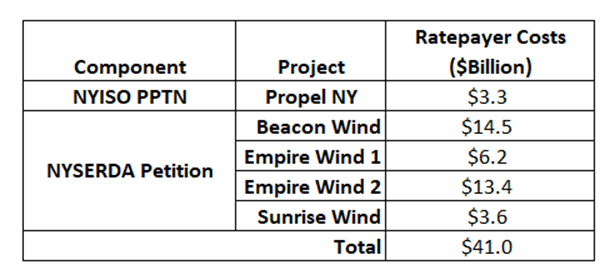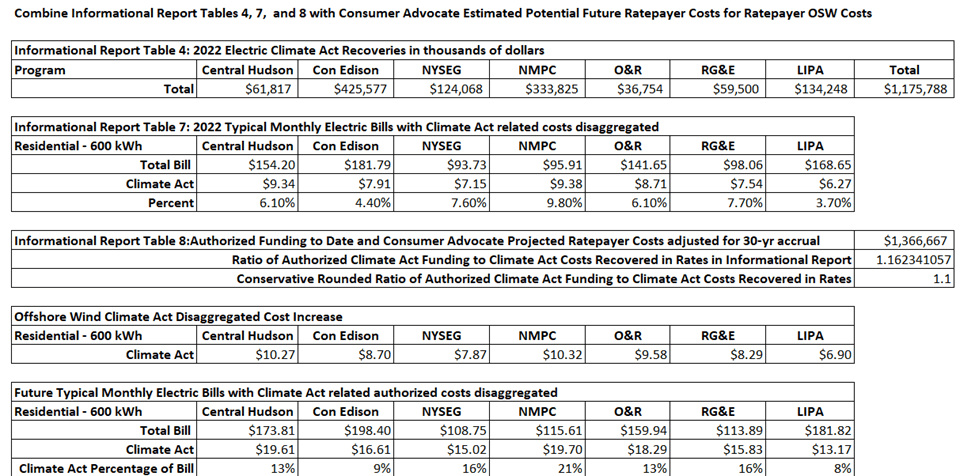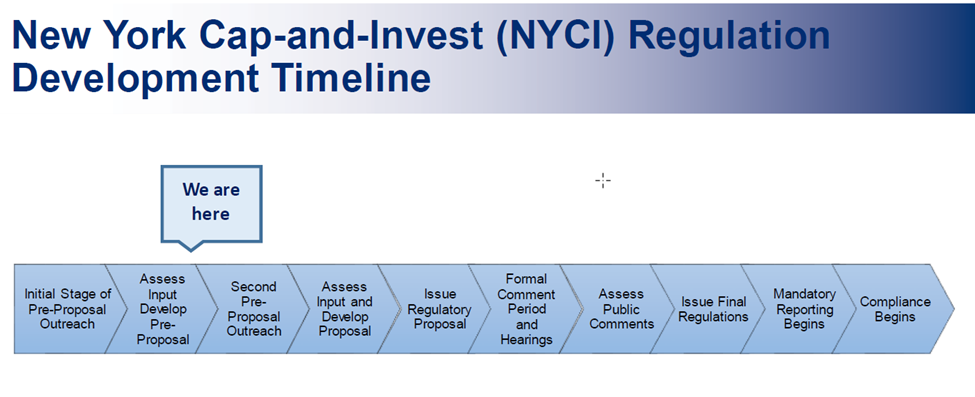

Climate Act Cost Tracking and EV Supply Equipment Example

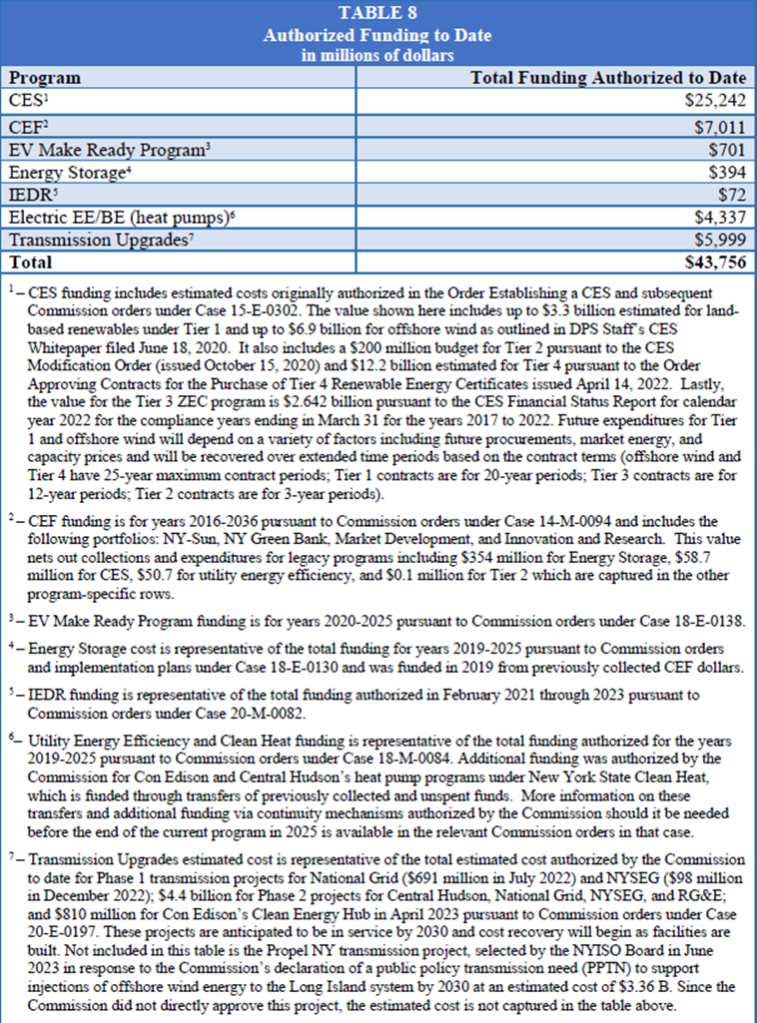
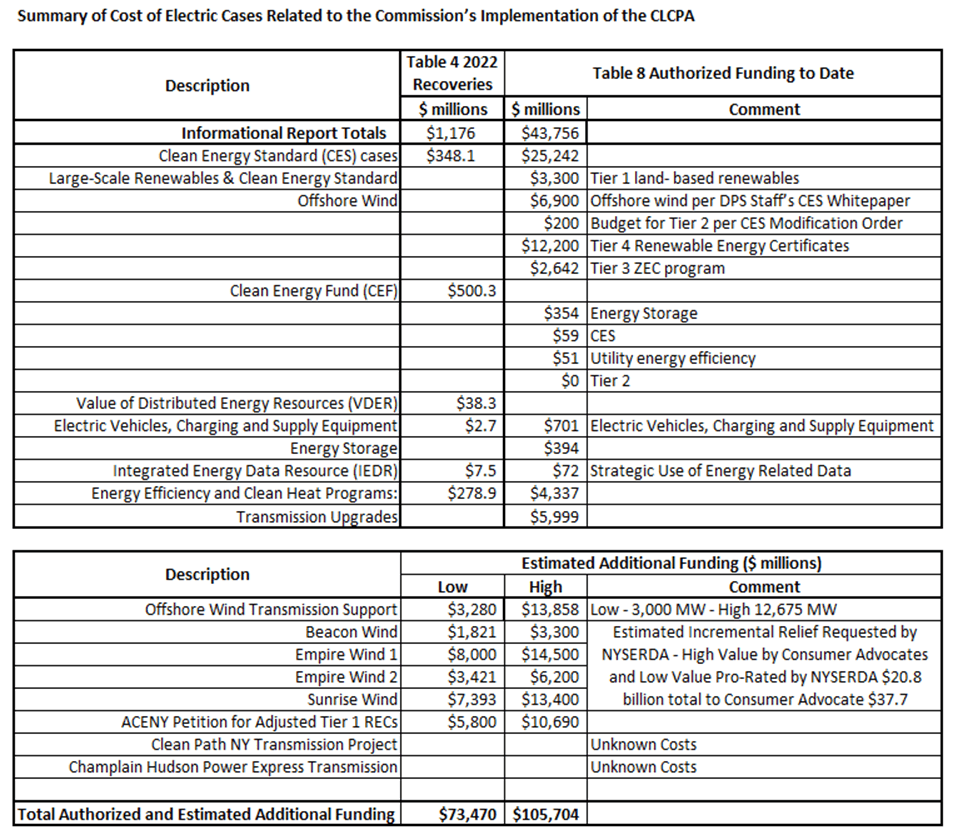
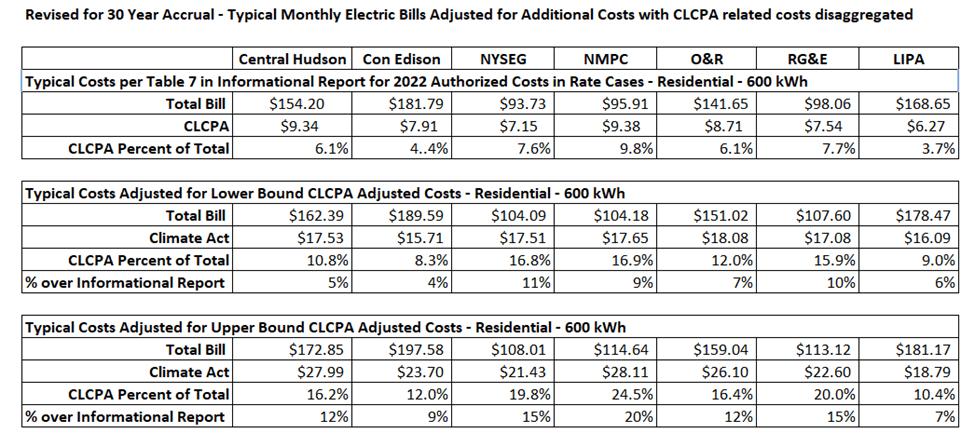
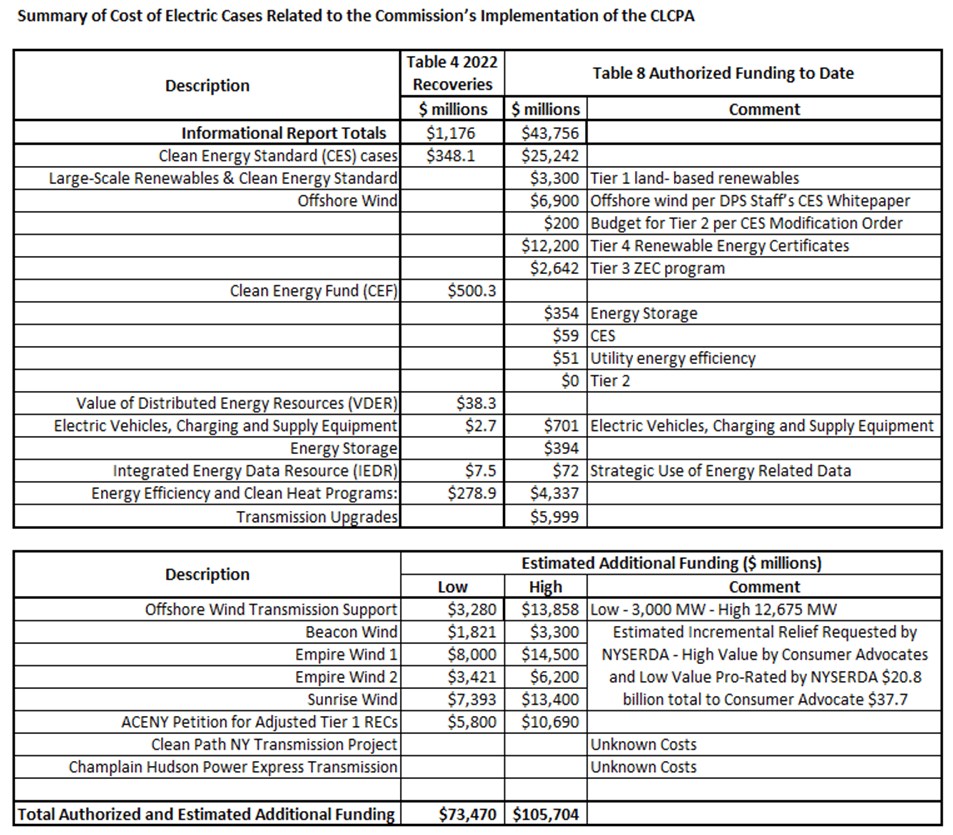
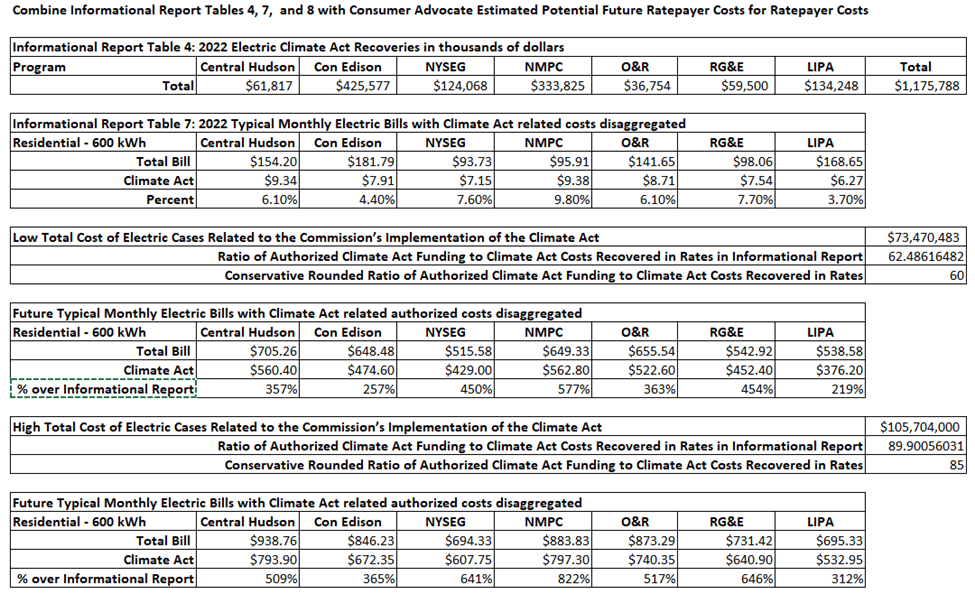
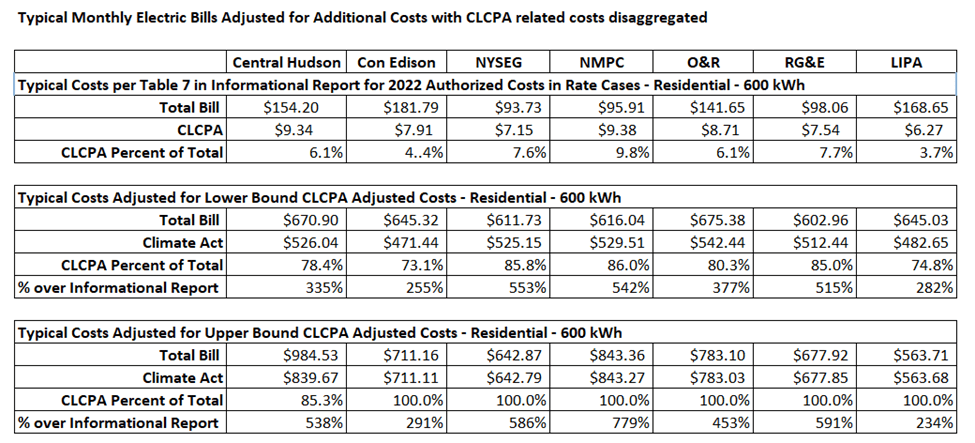
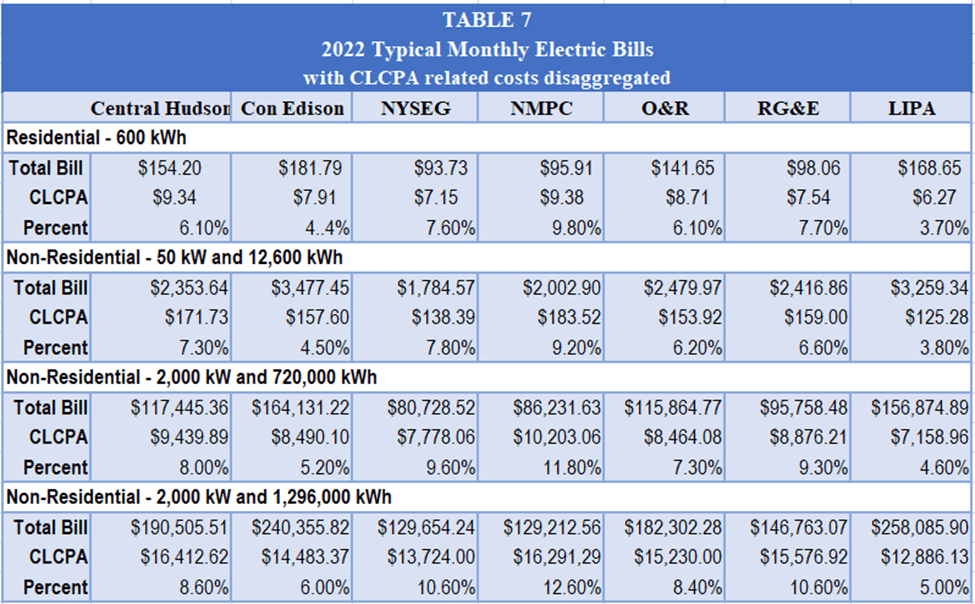
The expected costs associated with the  Climate Leadership & Community Protection Act (Climate Act) are poorly documented.  There are very few instances where the Hochul Administration provides specific estimates of ratepayer costs. As I run across reports that include costs, I will update my scorecard of residential ratepayer costs.   This article reviews the Department of Public Service Staff Electric Vehicle Make-Ready Program Midpoint Review and Recommendations Whitepaper (Make Ready report)which provide recommendations for modification to the Make-Ready Program that subsidizes electric vehicle supply equipment and infrastructure.

Everyone wants to do right by the environment to the extent that they can afford to and not be unduly burdened by the effects of environmental policies.  I submitted comments on the Climate Act implementation plan and have written over 300 articles about New York’s net-zero transition because I believe the ambitions for a zero-emissions economy embodied in the Climate Act outstrip available renewable technology such that the net-zero transition will do more harm than good.  Every indication is that the costs will be astronomical as well.  The opinions expressed in this post do not reflect the position of any of my previous employers or any other company I have been associated with, these comments are mine alone.

Background

The implementation plan for New York’s Climate Act “Net Zero” target (85% reduction and 15% offset of emissions) by 2050 is underway.  At the end of 2022 the Climate Action Council completed a Scoping Plan that makes recommends strategies to meet the targets.   The Hochul Administration is developing regulations and proposing legislation to respond to those recommendations in 2023.

Unfortunately, the Scoping Plan is just a conglomeration of control strategies that are projected to provide the emission reductions required.  The inadequate documentation does not demonstrate the feasibility of the recommended strategies.  Furthermore the costs of the program and potential costs to individual New Yorkers are hidden in a shell game con for hiding the true costs.  In the Scoping Plan costs are compared to a Reference Case that includes already “incremented programs”.  As a result, the costs that are presented do not include all the costs of the net-zero transition.  There has been no attempt to provide the expected ratepayer cost increases.

Climate Act Cost Scorecards

Given the lack of cost information I am starting to keep track of the observed costs of the Climate Act.  My initial thought was that I would try to account for all the documented costs to a typical residential customer in a single scorecard.  However, the effort involved trying to consolidate disparate cost estimates into this parameter is beyond my capabilities so I am going to track costs in several ways.

I naively thought that all the Department of Public Service rate cases associated with Climate Act related decisions would include typical residential customer information.  However, I have found that is the exception rather than the rule.  I have set up one scorecard for those rate case decisions that provide these data.

In order to simplify interpretation of the cost numbers provided I am going to use four other scorecards.  One way to hide Climate Act costs is with subsidies.  I am going to track direct subsidies and indirect subsidies in separate scorecards.  I have a scorecard that tracks increased costs for various components of the Climate Act transition plan.  Finally, I have a scorecard that tracks the differences between cost estimates in the Integration Analysis with what has been observed.

The format of each scorecard is similar.  The specific program or component is listed along with the costs for the specific reference.  I try to make an estimate of the total costs.  For example, the residential rate cost increases necessary to support 3.5 GW of renewable energy transmission are listed but I also extrapolated the costs for an additional 6.9 GW target in the Scoping Plan.  Each entry also includes a reference that provides more details for the costs.

The following section documents one example.

Electric Vehicle Supply Equipment and Infrastructure – Direct Subsidies

This is an example of a direct subsidy.  I tried and eventually gave up trying to convert these costs to residential cost impacts.  Marie French wrote an article published in Politico’s Weekly NY and NJ Energy newsletter that described the 18-E-0138 proceeding and the mid-point review:

MORE EV CHARGER SUBSIDIES FLOATED: The New York Department of Public Service staff wants to boost a ratepayer-funded program to support electric vehicle charging infrastructure from $701 million to $1.1 billion. A mid-point review of the “make ready” program, which the Public Service Commission approved in July 2020, found uneven progress in different utility territories to achieve the public charger goals of the program. Overall, only 630 fast charger plugs of a targeted 1,500 and only 12,475 of a targeted more than 53,000 Level 2 chargers by 2025 have been completed or committed.

While Con Edison is about halfway to its fast charger and Level 2 charger targets, National Grid is only 16 percent of the way to its Level 2 goal and 44 percent of the way to its fast charger target. Central Hudson is 1 fast charger shy of its program goal but has only hit 16 percent for its Level 2 target. NYSEG/RG&E are far behind.

DPS staff concludes that the incentives in the make ready program are insufficient and proposes boosting the available subsidies. New targets for the number of plugs are also proposed, including a new sub-category for chargers at apartment buildings. The new targets increase the number of public fast chargers to about 6,300 and reduce the number of level 2 chargers to about 43,000. A new $25 million micro-mobility program for disadvantaged communities is also proposed and the staff supports increasing a medium- and heavy-duty vehicle electrification pilot by $30 million to $54 million.

Electric Vehicle Supply Equipment and Infrastructure – Cost Documentation

The Make Ready report lists costs that I put in two of my scorecards.  The numbers provided conflict with the Integration Analysis cost estimates:

The Make-Ready Order determined per-plug average costs for L2 chargers to be $11,298 within Con Edison’s service territory, and $6,000 for all other utilities’ territories. The per-plug average costs for DCFCs was determined to be $100,109 in Con Edison’s service territory, and $55,000 for all other utilities’ territories.

The integration analysis that provides the quantitative support to the Scoping Plan lists charger costs in Electric Vehicle Supply Equipment: Per-Vehicle Costs ($2020) table Light Duty Vehicle Battery Electric EVSE category for 2022 $2,716 per charger.  It appears that the Make Ready Report estimate of the cheaper residential charging system is four times higher than the Integration Analysis.

The Make Ready program is a direct ratepayer-funded program subsidy but no specific ratepayer costs are described.  The announced subsidies are $1.1 billion through 2025.  I estimate that the subsidy will increase to $1.3 billion by 2030

Discussion

There is an important aspect of the Make Ready example.  The Hochul Administration cost narrative is that the costs of inaction of outweigh the costs of action but that statement has an important caveat.  It is misleading because it only includes the costs of the Scoping Plan components and does not include the costs of “already implemented” programs.  The already implemented programs include the following:

  • Growth in housing units, population, commercial square footage, and GDP
  • Federal appliance standards
  • Economic fuel switching
  • New York State bioheat mandate
  • Estimate of New Efficiency, New York Energy Efficiency achieved by funded programs: HCR+NYPA, DPS (IOUs), LIPA, NYSERDA CEF (assumes market transformation maintains level of efficiency and electrification post-2025)
  • Funded building electrification (4% HP stock share by 2030)
  • Corporate Average Fuel Economy (CAFE) standards
  • Zero-emission vehicle mandate (8% LDV ZEV stock share by 2030)
  • Clean Energy Standard (70×30), including technology carveouts: (6 GW of behind-the-meter solar by 2025, 3 GW of battery storage by 2030, 9 GW of offshore wind by 2035, 1.25 GW of Tier 4 renewables by 2030)

I assume that the Make Ready costs are part of the zero-emissions vehicle mandate.  As a result, the $1.3 billion just to support public electric vehicle charging infrastructure is not included in the cost claim narrative.  I suspect that detailed analysis of all the costs necessary to for just zero-emissions vehicles would exceed the alleged net benefits of between $115 and $130 billion.

Conclusion

Although trying to keep track of the hidden costs of the Climate Act is likely a Sisyphean task, I am going to give it a shot.  At least until I can document that the admitted costs of the Scoping Plan are biased low and incomplete anyway. Any reader contributions are welcome!

Guest Post: More Hidden Costs – Gas Stove Replacements

Richard Ellenbogen frequently copies me on emails that address various issues associated with New York’s Climate Leadership and Community Protection Act (Climate Act).  I asked his permission to present his analysis describing the incorrect and hidden costs associated with installing induction ranges for residential cooking.

I have published other articles by Ellenbogen because he truly cares about the environment and the environmental performance record of his business shows that he is walking the walk.   Ellenbogen is the President of Allied Converters  that manufactures food packaging.  His facility is about 55,000 square feet and does a lot of manufacturing with heat to seal the bags, all electrically driven.  The facility has solar panels and uses co-generation.  He explains:

In 2008, the average energy cost per square foot for a commercial facility in  Westchester was $1.80.  We were at 33% of that 12 years later and even with the increases, we are at 62% of that 14 years later.  That has been done while having a carbon footprint 30% – 40% lower than the utility system.  The $1.80 per foot  also included commercial office space and our operation is far more energy intensive than an office.  We use energy extremely efficiently and as a result, our bills are much lower than everyone else. 

Induction Cooktops

The impetus for his analysis was an article was in the NY Times entitled How to Buy the Best Induction Cooktop.   Richard’s evaluation addresses the costs in detail.  The following is his text.

Nowhere does it mention the hidden costs of conversion and with one exception, the cooktops all over $1000 before tax.  Also, those are just cooktops with no oven.  Complete cooktops  and ovens can cost $2500 or more.  You have to click on one of the links in the article to find  information about the conversion costs and the link does not go into great detail about those costs.  It just says that you will have to call an electrician.

The apartment building where my daughter lives in New York City was built in 2003, so it is a new building by City standards.  As a reference, I just replaced the gas stove in her apartment last week.  It cost $1150 including tax, delivery, and installation.  It also included an oven.  A gas detector is available from Amazon for about $25 for anyone concerned about methane emissions.

Below are two photos of her breaker panel.  An induction range needs a 2 pole 50 amp circuit breaker.  As you can see from the photos, the capacity of the panel is 125 amps but it is already fully populated with 2 air conditioners and other appliances on the panel.  While breakers could be rearranged to fit a breaker for the induction range, the panel would be operating at or above its capacity.  There is no extra capacity on the panel to support the induction range.  Installation would require new, higher capacity lines from the basement of the building plus a new breaker panel with a capacity of about 200 amps.

That also doesn’t explain where the manpower will come from to install all of these cook tops/induction ranges when there is a shortage of electricians.

You can add about $2000 for the new breaker panel and the new circuit for the stove, plus painting and patching to fix the holes that the electrician will leave behind.  You can also add $300 – $400 for new pots that will work with your range.  Running a new service from the basement to support the larger panel would add an additional $2000 – $4000 per apartment that would have to be covered by the building management and would end up reflected in higher common charges.  This is all to replace a device that is used about 2 hours per day.  In older buildings, the costs would likely be higher.  It doesn’t take long to reach $8000 in costs, or about eight times what just replacing the gas range would cost using far less labor.

At least 60% of the state lives in even older housing stock that would have similar issues.  Con Ed is having difficulty just supporting air conditioning in many older buildings because their electrical services date to the 1940’s – 1950’s or earlier and the electrical services weren’t sized for that, let alone adding hundreds of induction ranges to these buildings.

There are so many other issues of a far larger magnitude that need to be dealt with prior to incurring the expenses of building electrification that will yield relatively little, if any, improvement in GHG emissions.

However, the media doesn’t want to delve deeply into the downsides for fear of angering their readers.  It’s far easier to paint a rosy picture of induction ranges saving the world and keeping Greenland from melting.

And for those that say that gas stoves cause childhood asthma, there is a slide from my upcoming PowerPoint copied below.

Old gas stoves should be replaced, but we don’t need to spend an extra  $72 billion doing it.

Closing Remarks

This is another very good evaluation by Ellenbogen.  His analysis addresses a topic that I did not evaluate but it reinforces my disappointment that the Scoping Plan did not offer adequate documentation to verify their prediction.  Every check on the Integration Analysis numbers that form the basis of the Scoping Plan shows that problems.  I found no suggestion that the wiring issues raised by Ellenbogen have been included in the Scoping Plan.  Comparison of their unit costs of cooking equipment with what is on the market today shows huge differences.  The exclusion of ovens from the cooking costs is biases the estimates low. 

I did have one concern about the analysis and after discussion with him there is another overlooked issue.   I checked the Integration Analysis input assumptions spreadsheet to check Ellenbogen’s estimate of total costs using the data in the following table. 

I multiplied the number of cooking appliances by the documented unit costs and found that the cost to convert all fossil-fired cooking appliances to induction stoves using the 2023 unit cost is $1.9 billion and increases to $3.2 billion if electric resistance stoves have to be converted too.  The Integration Analysis unit costs are bogus because they don’t include ovens and are laughably low compared to today’s prices.  Assuming more realistic $2500 for a induction cooktop and oven, $735 for electric resistance, and $1,175 for natural gas range and oven, the cost difference to replace the gas and LPG equipment with the induction alternative is $6.1 billion and increases to $12 billion if the electric resistance stoves have to be converted too.  That does not address the hidden cost of the electric service upgrades.  Ellenbogen estimates that cost is around $8,000.  I think that is high overall so I assumed that all the natural gas and LPG homes would have to get upgraded electric service for the cooking equipment at $4,000.  That kicks the total conversion costs to $23.8 billion.  If the electric resistance stoves have to get upgraded to more efficient induction equipment and no electric service upgrades are required that brings the total to $29.7 billion.  That is less than his estimate but still a huge number compared to any estimate using the Integration Analysis. 

Residential Cooking Stocks and Costs in Integration Analysis

IA-Tech-Supplement-Annex-1-Input-Assumptions Tabs Bldg_Res Stock and Bldg_Res Device Cost

I sent my version of this analysis to Ellenbogen for review and comment.  I was particularly interested in his thoughts about my numbers.  He responded that he had talked to his electrical contractor about the prices.  The contractor confirmed that these cost prices are valid for Westchester County and Long Island but are low for New York City.  Ellenbogen made the point to me that addressing the cost differential is necessary because New York City is 42% of the population of the state and Westchester and Long Island add another 23%.  Our work shows that in order to credibly calculate the electric service upgrades necessary for induction cooktops the Integration Analysis should have determined what was necessary for the three categories of residential housing (single family, small multi-family, and large multi-family) and included regional variations in labor costs across the state. 

Incredibly there is no sign that electric upgrade costs were included at all.  I believe that the Scoping Plan residential cooking costs that incorporate the necessary electric service upgrades are short between $30 and $72 billion.  That is a significant fraction of the alleged benefits of between $115 and $130 billion.

Climate Act and NY Heat Proposed Legislation

In order to implement the Climate Leadership & Community Protection Act (Climate Act) the plan in 2023 is to promulgate regulations and implement legislation to facilitate the control strategies needed to meet the net-zero transition plan.  The NY HEAT proposed legislation is intended to protect the climate and keep energy costs down.  This post describes an article by one of the co-sponsors.

I have been following the Climate Act since it was first proposed. I submitted comments on the Climate Act implementation plan and have written over 300 articles about New York’s net-zero transition because I believe the ambitions for a zero-emissions economy embodied in the Climate Act outstrip available renewable technology such that the net-zero transition will do more harm than good.  The opinions expressed in this post do not reflect the position of any of my previous employers or any other company I have been associated with, these comments are mine alone.

Climate Act Background

The Climate Act established a New York “Net Zero” target (85% reduction and 15% offset of emissions) by 2050 and an interim 2030 target of a 40% reduction by 2030. The Climate Action Council is responsible for preparing the Scoping Plan that outlines how to “achieve the State’s bold clean energy and climate agenda.”  In brief, that plan is to electrify everything possible and power the electric grid with zero-emissions generating resources by 2040.  The Integration Analysis prepared by the New York State Energy Research and Development Authority (NYSERDA) and its consultants quantifies the impact of the electrification strategies.  That material was used to write a Draft Scoping Plan.  After a year-long review the Scoping Plan recommendations were finalized at the end of 2022.  In 2023 the Scoping Plan recommendations are supposed to be implemented through regulation and legislation.

Assemblymember Patricia Fahy and Senator Liz Krueger have sponsored a bill (S2016) NY HEAT that is intended “to ensure that state regulation and oversight of gas utilities provides for the equitable achievement of the climate justice and emission reduction mandates set forth in the Climate Leadership and Community Protection Act.   The intent is to provide the “Public Service Commission with the authority and direction to align gas utility regulation and gas system planning with the CLCPA’s mandates.”  It will remove “the legal basis and subsidies driving the expansion of gas systems and requires the commission to adopt rules to provide for the timely and strategic decarbonization and right-sizing of the gas distribution system in a just and affordable manner prioritizing low-to-moderate income customers and disadvantaged communities, and encouraging neighborhood-scale transitions.”

Rather than going through the legislation itself this post addresses an article by Fahy about it in the Gotham Gazette –We Can Protect the Climate and Keep Energy Costs Down with NY HEAT.  In the following section I have annotated the article with my comments.

We Can Protect the Climate and Keep Energy Costs Down with NY HEAT

Per usual the political approach is to appeal to authority to provide the rationale for the action.  Advocates like Fahy and Krueger don’t acknowledge that the Intergovernmental Panel on Climate Change has a political agenda that threatens the credibility of claims that we have to act now.

In March, the Intergovernmental Panel on Climate Change (IPCC) warned that the planet will cross a critical threshold for global warming within the next decade if we don’t take immediate action to curb emissions and meet ambitious climate mandates laid out in New York’s climate law.

The sponsors of the bill claim that concerns about affordability risks are unwarranted.  I am not sure I understand their reasoning however.  There is an implication that the gas utilities should be the ones that shoulder the costs and not the customers.  The idea that the costs would be passed on seems to be missing.

As expected, gas utilities are casting doubt on the affordability of these needed reductions. Let’s be clear — New Yorkers and their families should not shoulder the burden of our clean energy transition.

Affordability is a major concern but we don’t need to weaken our nation-leading climate law to save the planet and save New Yorkers money. As the name suggests, legislation I sponsor with Senator Liz Krueger, the New York Home Energy Affordable Transition (NY HEAT) Act would help keep costs down for New Yorkers while accelerating our energy transition away from polluting fossil fuels and addressing affordability, keeping us on track to meet the goals of our climate law.

The focus on the bill is to outlaw a provision that gas utilities must provide hook ups to the system for new customers within 100 feet of existing pipelines.  The authors claim that this subsidy forces ratepayers to pay $200 million in subsidies and they apparently think that stopping it will make the transition affordable. 

For decades, New Yorkers have been subsidizing the very infrastructure the gas industry’s profits rely on. The industry’s business models are premised on the perpetual taxpayer-subsidized expansion of gas infrastructure and services. Currently, due to the 100-foot rule mandate – which requires gas utilities to hook up all new customers to gas lines at no charge – ratepayers are footing the $200 million annual bill for this continued expansion of polluting gas infrastructure.

This reasoning is egregious innumeracy because this cost is peanuts compared to all the subsidies needed to transition away from natural gas and go all electric.  Consider that the ratepayers are going to have to pony up $339 million to upgrade the electric  transmission system  to reduce curtailment of 3 GW of offshore wind capacity which is just one component of the net-zero transition.  The total cost for all the subsidies is not readily available but is very likely at least an order of magnitude greater than the savings claimed by this legislation.  It may reduce the cost a little but reducing this cost will not make the Climate Act affordable.

The article goes on to claim that because National Grid is looking to sell parts of its pipeline network it is “adapting and adjusting”.  I am at a loss how this will benefit consumers.  Moreover, I don’t see how the ownership of the pipeline network will affect any of the transition issues.

The NY HEAT Act (A4592/S2016) will relieve us of the hook-up cost, and stop the continued expansion of the gas system that is moving New York further away from the goals of the climate law. Thankfully, utilities like National Grid are already adapting and adjusting: as New York considers legislation like NY HEAT, the company is looking to sell parts of its pipeline network to meet future clean energy demand. Last year, it sold a majority share of its gas distribution business in the United Kingdom.

If those reasons are not enough to ensure savings, the authors proposed legislation will simply mandate that a price cap.  In typical political fashion the target constituency (low- and middle- income families) gets the benefits of the price cap but the question of who pays the transition costs is ignored.  I agree that there should be an energy poverty component to the Climate Act implementation because this policy should not hurt those least able to afford the increased energy costs.  However, I have tried and failed multiple times to find out where New York stands relative to the 6% of income threshold referenced in the following paragraph.  Does it cover just the cost of electricity and natural gas utilities?  Does it include other energy costs such as personal transportation for rural residents?  How many families exceed this threshold today and how will the future policies affect the totals?  All that information must be known to find out how much the rest of the ratepayers will have to pay to subsidize the price cap.

The savings don’t end there. For low- and middle-income families, NY HEAT would put a price cap on electricity bills, to limit paying no more than 6% of income to stay warm and cook dinner. 

In the last legislative session the Utility Thermal Energy Network and Jobs Act was passed to spur development of thermal energy networks which are just community-based ground water heat pump systems.  The authors of this legislation claim that NY HEAT will support that initiative by preventing billions of dollars to replace natural gas infrastructure. Left unsaid is just how much this more expensive technology will cost relative to the existing fossil-fired system.

NY HEAT clears a path for utilities to build renewable thermal energy networks instead of replacing and expanding the gas network. Doing so will create thousands of new clean, green energy jobs for union pipefitters and electrical workers for decades to come. It could also prevent the billions of dollars of spending on replacement pipes that gas utilities are planning by 2040 and gas customers would get stuck paying for in the decades to come.

I have often said that there is a disconnect between reality and the understanding of proponents of the Climate Act.  Fahy’s claims in the next paragraph provides a vivid example. 

New York’s electrical grid maintains a surplus of energy that will support new, all-electric construction. While gas furnaces on the market today require electricity to power their electronics and fans, there are new technologies that keep electric equipment like heat pumps running when the power goes out.

Fahy claims that there is “a surplus of energy that will support new, all-electric construction”.  However, she references the installed reserve margin which is the “minimum level of capacity, beyond the forecasted peak demand, which utilities and other energy providers must procure to serve consumers.”  For starters the installed reserve margin is a capacity measure and not energy.  More importantly, that parameter is used to ensure that the existing system can reliably meet peak loads.  It is the minimum level of reserve capacity to keep the lights on.  It provides no surplus available for additional load associated with new electric construction.  Reality is that the New York Independent System Operator’s Resource Outlook includes four key findings: an unprecedented buildout of new generation is needed, load will increase when we electrify everything, transmission is necessary and must be expended to get diffuse renewables to New York City and a new resource has been identified: Dispatchable Emissions-Free Resource (DEFR).  (see following figure) Those findings suggest significant concerns totally overlooked by the Progressive politicians pushing Climate Act implementation legislation.

The other claim is that there are new technologies to keep electric equipment running when the power goes out refers to using power from charged personal electric vehicles to “ power key devices, like cell phones, and appliances, and even your entire home for multiple days.”  Maybe on the best day but during a really cold period the idea that family electric car can power the home as needed is wishful thinking and overlooks the point that if it is powering the home it cannot be used for transportation. 

Fahy and other advocates refuse to acknowledge the possibility that fossil fuel interests could align with the interests of the majority of New Yorkers who appreciate and value the resiliency and affordability of our existing fossil-fueled infrastructure.   Their response is to denigrate any of their arguments as shown in the following paragraph.  The article referenced refers to proposed legislation that would have changed the emissions accounting system.  I think that it was much ado about nothing.  What has not been recognized in any commentary on the cap and invest proposal is that New York’s unique approach makes it impossible for New York to join other jurisdictions in such a program.  As a result, New York will have to develop all the infrastructure for its own system at a significant cost and implementation time delay.

The gas industry wants to prevent alternative options for a reliable, affordable, and green transition. Unsurprisingly, they were a force behind the recent unsuccessful push to undermine New York’s climate law – which would have enabled the combustion of more gas, for longer.

Proponents earnestly believe that the Climate Act Scoping Plan is a credible design for the future energy system.  I disagree.  There is no feasibility analysis that proves that the list of strategies in the Integration Analysis will work as proposed and can be implemented on the schedule necessary to meet the Climate Act targets.  There is inadequate documentation for the costs of each strategy and we are left only with a hollow slogan that the costs of inaction are more than the costs of action.  The Hochul Administration has refused to provide estimates of consumer impacts to date.  When the cap and invest cost estimates were recently calculated, the Administration floated the idea to change the accounting methodology.  Despite promises they have yet to provide detailed cost documentation.  The Administration has not provided a cumulative environmental impact assessment for the Scoping Plan mitigation scenarios which include substantially more wind and solar resource development and an entirely new dispatchable emissions-free resource than included in any assessments to date.  There is no implementation plan.  As a result, there are no limits on utility-scale solar development impacts on prime farmland, inadequate on-going monitoring and no backup plan if offshore wind development construction is found to adversely affect whales, and no plan to develop the dispatchable emissions-free resource that is necessary but does not currently exist.  I am convinced that the Scoping Plan will do more harm than good.

Our climate plan was years in the making. It was created in consultation with multiple expert advisory panels, subject to public hearings, and incorporated tens of thousands of New Yorkers’ comments. New Yorkers know that we can get off gas and have affordable, reliable energy and a stable climate — but that will take ratepayer funds currently used for expanding fossil fuel infrastructure to be reallocated.

Fahy’s claim that the $200 million savings due to the proposed legislation will save New Yorkers money ignores the costs of the alternatives.  That subsidy is peanuts compared to all the costs of alternate technologies.

If we want to save New Yorkers money and lead on climate, we must stop asking New York families to foot the $200 million per year bill to continue constructing and maintaining fossil fuel infrastructure that will inevitably become obsolete. As the Legislature continues its post-budget session, we must pass NY HEAT to move towards our clean energy future.

Conclusion

Proponents refuse to acknowledge the possibility that the majority of New Yorkers appreciate and value the resiliency and affordability of our existing fossil-fueled infrastructure.  New York GHG emissions are less than one half of one percent of global emissions and global emissions have been increasing on average by more than one half of one percent per year since 1990.  Therefore the effect of eliminating our emissions will be wiped out by emission increases elsewhere. While that does not mean that New York State should not do something, it does mean that there is time to address the ramifications of the proposed wholesale shift to unwanted technology without proper accounting of costs, impacts to reliability, environmental impacts and implementation consequences. 

The Hochul Administration has not admitted to the total costs, has provided inadequate documentation for anyone to derive the costs from their analyses, and has refused to provide consumer cost estimates.  Until such time that there is a full accounting of the costs necessary to achieve the full net-zero transition and not just the Climate Act program costs, I think it is inappropriate to pass any implementing legislation like the NY HEAT bill.  As shown here, the rationale used by the authors of this particular legislation is not credible to support its claims.

Cap and Invest Summary for All Otsego

Darla Youngs from the All Otsego website asked me to prepare a guest column on the Hochul Administration’s plan to implement the Climate Leadership & Community Protection Act (Climate Act).  I prepared a commentary that I thought would be too long and too technical on the market-based pollution control program called ‘’cap and invest”. This post presents the commentary after my introductory boilerplate.

I have been following the Climate Act since it was first proposed. I submitted comments on the Climate Act implementation plan and have written over 300 articles about New York’s net-zero transition because I believe the ambitions for a zero-emissions economy embodied in the Climate Act outstrip available renewable technology such that the net-zero transition will do more harm than good.  The opinions expressed in this post do not reflect the position of any of my previous employers or any other company I have been associated with, these comments are mine alone.

Climate Act Background

The Climate Act established a New York “Net Zero” target (85% reduction and 15% offset of emissions) by 2050 and an interim 2030 target of a 40% reduction by 2030. The Climate Action Council is responsible for preparing the Scoping Plan that outlines how to “achieve the State’s bold clean energy and climate agenda.”  In brief, that plan is to electrify everything possible and power the electric gride with zero-emissions generating resources by 2040.  The Integration Analysis prepared by the New York State Energy Research and Development Authority (NYSERDA) and its consultants quantifies the impact of the electrification strategies.  That material was used to write a Draft Scoping Plan.  After a year-long review the Scoping Plan recommendations were finalized at the end of 2022.  In 2023 the Scoping Plan recommendations are supposed to be implemented through regulation and legislation.

The impetus for the program is a recommendation in the Final Scoping Plan.  The following is the commentary that tries to cover the basics of this complicated proposal for a general audience.  In late March I summarized my previous articles on the New York cap and invest proposal in a post designed to brief politicians about the proposal if you want more technical information.  I really appreciate the opportunity to educate the All Otsego readers on this topic that will affect all New Yorkers.

All Otsego Commentary

As part of the Hochul Administration’s plan to implement the Climate Leadership & Community Protection Act (Climate Act), a market-based pollution control program called ‘’cap and invest” was proposed earlier this year in legislation associated with the budget. It was not included in the final budget bill but it will be considered later this year. This is an overview of this complicated proposal that has affordability and energy use implications.

The Climate Act Scoping Plan identified the need for a “comprehensive policy that supports the achievement of the requirements and goals of the Climate Act, including ensuring that the Climate Act’s emission limits are met.” It claimed that the policy would “support clean technology market development and send a consistent market signal across all economic sectors that yields the necessary emission reductions as individuals and businesses make decisions that reduce their emissions” and provide an additional source of funding. The authors of the Scoping Plan based these statements on the success of similar programs but did not account for the differences between their proposal and previous programs.

The cap and invest proposal is a variation of a pollution control program called cap and trade. In theory, placing a limit on pollutant emissions that declines over time will incentivize companies to invest in clean alternatives that efficiently meet the targets. These programs establish a cap, or limit, on total emissions.  For each ton in the cap an allowance is issued.  The only difference between these two programs is how the allowances are allocated.  The Hochul Administration proposes to auction the allowances and invest the proceeds but, in a cap-and-trade program, the allowances are allocated for free. The intent is to reduce the total allowed emissions over time consistent with the mandates of the Climate Act and raise money to invest in further reductions. 

The Environmental Protection Agency administers cap and trade programs for sulfur dioxide (SO2) and nitrogen oxides (NOx) that have reduced electric sector emissions faster, deeper, and at costs less than originally predicted.  In the EPA programs, affected sources that can make efficient reductions can sell excess allocated allowances to facilities that do not have effective options available such that total emissions meet the cap. Also note that EPA emission caps were based on the feasibility of expected reductions from addition of pollution control equipment and a schedule based on realistic construction times.

However, there are significant differences between those pollutants and greenhouse gas pollutants that affect the design of the proposed cap and invest program.  The most important difference is that both SO2 and NOx can be controlled by adding pollution control equipment or fuel switching.  Fuel switching to a lower emitting fuel is also an option for carbon dioxide (CO2) emissions but there are no cost-effective control equipment options.  Consequentially, CO2 emissions are primarily reduced by substitution of alternative zero-emissions resources.  For example, in the electric sector replacing fossil-fired units with wind and solar resources.  The ultimate compliance approach if there are insufficient allowances available is to limit operations.

New York State is already in a cap and invest program with an auction for CO2 emissions from the electric generating sector. Although significant revenues have been raised, emission reductions due to the program have been small. Since the Regional Greenhouse Gas Initiative started in 2009, emissions in nine participating states in the Northeast have gone down about 50 percent, but the primary reason was fuel switching from coal and residual oil to natural gas enabled by reduced cost of natural gas due to fracking. Emissions due to the investments from the auction proceeds have only been responsible for around 15 percent of the total observed reductions.

The Hochul Administration has not addressed the differences between existing market-based programs and the proposed cap and invest program. Although RGGI has provided revenues, the poor emission reduction performance has been ignored despite the need for more stringent reductions on a tighter schedule to meet the arbitrary Climate Act limits. The Hochul Administration has not done a feasibility analysis to determine how fast the wind and solar resources must be deployed to displace existing electric generation to make the mandated emission reductions. Worse yet, the Climate Act requires emission reductions across the entire economy and the primary strategy for other sectors is electrification, so electric load is likely to increase in the future.

In late March, the Hochul Administration proposed a modification to the Climate Act to change the emissions accounting methodology to reduce the expected costs of the cap and invest program.  New York climate activists claimed that the change would eviscerate the Climate Act and convinced the Hochul Administration to delay discussion of the cap and invest proposal. This cost issue will have to be resolved in the upcoming debate. 

In addition, the Hochul Administration has proposed a rebate to consumers that will alleviate consumer costs. This raises a couple of issues. The market-based control program intends to raise costs to influence energy choices, so if all the costs are offset there will not be any incentive to reduce consumer emissions by changing behavior. The other issue is that the auction proceeds are supposed to be invested to reduce emissions. If insufficient investments are made to renewable resources, then deployment of zero-emission resources to offset emissions from fossil generating units will not occur.

The final issue related to the cap and invest proposal is that it provides compliance certainty. The plan is to match the allowance cap with the Climate Act emission reduction mandates. As noted previously, there are limited options available to reduce CO2 emissions. The primary strategy will be developing zero-emissions resources that can displace emissions from existing sources. That implementation is subject to delays due to supply chain issues, permitting delays, and costs as well as other reasons that the state’s transition plan has ignored. Once all the other compliance alternatives are exhausted, the only remaining option is to reduce the availability of fossil fuel and its use.

The cap and invest proposal is a well-meaning but dangerous plan. It necessarily will increase the cost of energy in the state. If the costs are set such that the investments will produce the necessary emission reductions to meet the Climate Act targets, it is likely that the costs will be politically toxic. If the investments do not effectively produce emission reductions, then the compliance certainty feature will necessarily result in artificial energy shortage. Given that this is a disguised tax, it probably is better to just establish a tax so that the compliance certainty does not arbitrarily limit fossil fuel use to produce electricity, heat our homes, or drive our cars.

Articles Related to the Climate Act – May 2023

This post describes some articles I have noted recently that relate to the Climate Leadership & Community Protection Act (Climate Act) net-zero transition plans.  At the core of the Climate Act the key questions are is there a problem that warrants the complete conversion of our energy system and can the alternatives proposed replace the existing system affordably while maintaining current standards of reliability.  The articles referenced here address those questions.

I have been following the Climate Act since it was first proposed. I submitted comments on the Climate Act implementation plan and have written over 300 articles about New York’s net-zero transition. The opinions expressed in this post do not reflect the position of any of my previous employers or any other company I have been associated with, these comments are mine alone.

Climate Act Background

The Climate Act established a New York “Net Zero” target (85% reduction and 15% offset of emissions) by 2050 and an interim 2030 target of a 40% reduction by 2030. The Climate Action Council is responsible for preparing the Scoping Plan that outlines how to “achieve the State’s bold clean energy and climate agenda.”  In brief, that plan is to electrify everything possible and power the electric gride with zero-emissions generating resources by 2040.  The Integration Analysis prepared by the New York State Energy Research and Development Authority (NYSERDA) and its consultants quantifies the impact of the electrification strategies.  That material was used to write a Draft Scoping Plan.  After a year-long review the Scoping Plan recommendations were finalized at the end of 2022.  In 2023 the Scoping Plan recommendations are supposed to be implemented through regulation and legislation.

Climate Change Problem

The rationale for the Climate Act is that there is a climate crisis.  The Intergovernmental Panel on Climate Change (IPCC) is the United Nations organization that assesses science related to climate change and the IPCC reports were referenced in the Scoping Plan.  In March the latest Synthesis Report describing the latest IPCC AR6 assessment was released.  Climate Intelligence (CLINTEL)  has published a new report entitled “The Frozen Climate Views of the IPCC: Analysis of the AR6”:

“The new Report provides an independent assessment of the most important parts of AR6. We document biases and errors in almost every chapter we reviewed. In some cases, of course, one can quibble endlessly about our criticism and how relevant it is for the overall ‘climate narrative’ of the IPCC. In some cases, though, we document such blatant cherry picking by the IPCC, that even ardent supporters of the IPCC should feel embarrassed.”

Judith Curry described this report in a recent post.  She describes the key issue:

The IPCC focuses on “dangerous anthropogenic climate change,” which leads to ignoring natural climate change, focusing on extreme emissions scenarios, and cherry picking the time periods and the literature to make climate change appear “dangerous.”

I recommend her post as a good overview of the flaws in the IPCC assessment.  I endorse Curry’s conclusion:

In any event, UN-driven climate policy has moved well past any moorings in climate science, even the relatively alarming version reported by the IPCC.  The insane policies and deadlines tied to greenhouse gas emissions are simply at odds with the reality of our understanding of climate change and the uncertainties, and with broader considerations of human well-being.

Proposed Solutions

I think one of the fundamental flaws associated with the Scoping Plan is the presumption that the raw materials necessary for the electrification proposed are readily available.  Furthermore, the “clean energy” and “zero emissions” descriptions in the Plan ignore the total life cycle impacts of those raw materials.  On April 26, 2026 Mark P. Mills, Senior Fellow, Manhattan Institute, gave testimony before the Subcommittee on Environment, Manufacturing, and Critical Materials, U.S. House Committee on Energy and Commerce Hearing on: “Exposing the Environmental, Human Rights, and National Security Risks of the Biden Administration’s Rush to Green Policies”.  His testimony makes a strong case that New York’s presumptions are misplaced.

His introduction includes the following:

Permit me to begin by observing two indisputable facts about our future. First, economic growth is the fundamental driver of energy demand. And second, while periods of slow growth and recessions are inevitable in all societies, those periods always end. But any subsequent growth can be stifled if energy supplies are either unavailable or too expensive.

Energy supply itself is not as much a matter of finding resources as it is one of building machines, regardless of the natural resource used, whether sun, wind, water, oil, gas, coal, or uranium. Thus realities around machine-building determine costs and all the associated environmental, social, and geopolitical impacts.

We know a lot about those impacts—both the good and the bad—associated with energy machines that use hydrocarbons because we’ve been using those technologies at scale for a long time, and because that’s how 85 percent of U.S. and global energy is supplied. We’ve learned a lot less about impacts from wind, solar, and battery technologies because they’re relatively new and, so far, supply only a few percent of society’s overall energy.

 The Biden Administration has a stated policy goal to see America powered increasingly, eventually entirely by renewable energy. I should like to stipulate that the future will doubtless see far greater use of wind and solar technologies, and electric cars, if for no other reason than the sheer scale of future energy needs, and because developed countries are wealthy enough to pay higher costs.

However, there are many misconceptions about the realities of renewable energy technologies at scale, especially if the goal is to replace rather than supplement hydrocarbons. It begins with the core reality that renewables aren’t green. In fact, nor are renewable technologies inherently cheaper, nor more geopolitically secure.

That renewable energy isn’t green is a consequence of an unavoidable feature of wind and solar resources; they have very low energy density. That means, compared to using hydrocarbons, one must build machines that occupy roughly ten-times more of the earth’s surface to deliver the same amount of energy to society—whether it’s an hour of heat, or light, or computing time, or a mile of driving.

Essentially all life occupies the thin, surface interface of our planet, whether it’s land or water. One of humanity’s greatest achievements has been the radical reduction in the amount of that interface we use to deliver increasing quantities of food and fuel.

The inherent low-energy-density of renewables also means that far more machinery must be fabricated to deliver the same energy as now supplied by hydrocarbon machines. That in turn translates into a radical increase in global mining and minerals processing to supply all the critical materials needed to build renewable machinery.

Renewable plans proposed or underway will require from 400 percent to 8,000 percent more mining for dozens of minerals, from copper and nickel, to aluminum, graphite, and lithium. The IEA says the world will need hundreds of new mines, soon. Given regulatory realities, those won’t be here. Instead, most will be in emerging economies and most will be on or near the lands of indigenous people in areas that are culturally and ecologically valuable and fragile.

And given machine realities, the huge jump in mining required will increase energy use in that sector, thus offsetting a lot, in some cases all the CO2 emissions saved later by replacing hydrocarbons in powerplants and cars. Global mining today already accounts for 40 percent of worldwide industrial energy use, which is dominated by hydrocarbons, and will be for decades.

Mills makes similar arguments in a couple of videos available at PragerU.

Electric Vehicles

I also want to highlight a couple of articles about the electric vehicle mandates in New York and elsewhere.  Robert Bryce asked how can the conversion to electric vehicles possibly work out when Ford loses $66,446 per vehicle sold?  He argues that Ford can currently swallow the losses incurred by its electric vehicle sales but:

If a business isn’t profitable it isn’t sustainable. The history of electric vehicles goes back more than a century and that history is one of failure tailgating failure. In 1915, the Washington Post declared “Prices on electric cars will continue to drop until they are within reach of the average family.”  Today, 108 years later, Ford and other EV makers are still trying to make that prediction come true.

Timothy Nash described 25 reasons why Biden’s EV goals are economically and environmentally harmful.  One of the points he made was that thermal runaway issues with the battery packs are a problem. An industry insider told me recently that there is some talk about limiting vehicle range because battery over heating is more of a problem with the bigger batteries.  Given that range is a major concern that tradeoff is especially problematic.  The ultimate question is what is supposed to happen when people don’t buy the electric vehicles required by the government mandates.

Conclusion

The Climate Act is an example of an insane policy with unrealistic deadlines that is tied to the IPCC analyses.  In 2023 the Scoping Plan recommendations are supposed to be implemented.  The legislature is in session for another month or so and it will be interesting to see how things play out. The disconnect between reality and the aspirations of the Climate Act is still evident.  I hope that the issues described in these articles get addressed in the conversations.

New York Sea-Level Rise Projection Methodology Update

This article describes my response to the New York State Department of Environmental Conservation (DEC) request for comment on its proposed method for development of updated projections of sea level rise along New York State’s tidal coast.  The proposed methodology is consistent with the one-sided science in the Climate Leadership & Community Protection Act (Climate Act).  In this case, however, DEC will actually respond to the comments received.

When DEC adopted the Projected Sea-level Rise regulation in February 2017 I was still working and had not started this blog but I did review the initial projections for sea-level rise. So this is a follow up to my earlier work.  I have been following the Climate Act since it was first proposed. I submitted comments on the Climate Act implementation plan and have written over 300 articles about New York’s net-zero transition because I believe the ambitions for a zero-emissions economy embodied in the Climate Act outstrip available renewable technology such that the net-zero transition will do more harm than good.  The opinions expressed in this post do not reflect the position of any of my previous employers or any other company I have been associated with, these comments are mine alone.

Background

The “Request for Pre-Proposal Comment” document included a background description of the proceeding:

On September 22, 2014, Governor Andrew Cuomo signed into law the Community Risk and Resiliency Act, Chapter 355 of the Laws of 2014 (CRRA). CRRA is intended to ensure that decisions regarding permits regulated by the Uniform Procedures Act and certain expenditures and facility-siting regulations consider future physical risk due to climate change, including sea level rise. Among other things, CRRA amended the New York State Environmental Conservation Law (ECL) to require DEC to adopt regulations establishing science-based State sea level rise projections and to update those projections at least every five years (ECL § 3- 0319). Pursuant to this requirement, DEC adopted 6 NYCRR Part 490, Projected Sea-level Rise1 in February 2017 and is now seeking comment related to the required update.

The announcement for the pre-proposal request for comments stated:

Pursuant to the Community Risk and Resiliency Act, the New York State Department of Environmental Conservation (DEC) is preparing to update the official New York State sea level rise projections as codified in 6 NYCRR Part 490, Projected Sea-level Rise. DEC requests pre-proposal comment on its method for development of updated projections of sea level rise in New York State’s tidal waters. Pre-proposal comments should focus on the method DEC has proposed for development of projections and the resulting projections, and not on application of those projections in regulatory, planning, funding or other decision-making processes. DEC will consider all comments received on its proposed methodology and projections in preparing its final proposed projections for the update to Part 490.

The Climate Act established a New York “Net Zero” target (85% reduction and 15% offset of emissions) by 2050 and an interim 2030 target of a 40% reduction by 2030. The Climate Action Council is responsible for preparing the Scoping Plan that outlines how to “achieve the State’s bold clean energy and climate agenda.”  In brief, that plan is to electrify everything possible and power the electric gride with zero-emissions generating resources by 2040.  The Integration Analysis prepared by the New York State Energy Research and Development Authority (NYSERDA) and its consultants quantifies the impact of the electrification strategies.  That material was used to write a Draft Scoping Plan.  After a year-long review the Scoping Plan recommendations were finalized at the end of 2022 but there was no compilation of responses to comments received.  In 2023 the Scoping Plan recommendations are supposed to be implemented through regulation and legislation.  Note that there is no explicit link between the Climate Act and the projections for sea-level rise in Part 490.  However, I was struck by the overt bias towards extreme values in the proposed methodology that is entirely consistent with the rationale of the Climate Act.

Proposed Methodology Comments

The “Request for Pre-Proposal Comment” document described the proposed methodology to project future sea-level rise:

In its Part 490 update, to ensure consistency in its regulatory and other programs, DEC intends to maintain the projection format used in the original Part 490 regulation. That is, the express terms will provide low, low-medium, medium, high-medium and high projections for three tidal regions of the State, as defined in the original regulation. However, the 2020s projections will be replaced by projections for the 2030s. Projections for the 2050s, 2080s and 2100 will be included, as in the original regulation. As discussed below, DEC proposes to include projections for the year 2150 in the updated regulation and to include a very high projection that reflects a potential low-probability, high-consequence rapid ice melt (RIM) scenario.

I refer readers to the “Request for Pre-Proposal Comment” document for a full description of the proposed methodology.  My comments addressed two aspects of the proposal: how well did the earlier projections do compared to observed sea-level rise since 2017 and whether the choice of the sea-level rise scenarios covers the full range of the possible projections of sea-level rise.

My background includes extensive air quality model development and model verification experience.  As a result, I strongly believe that model predictions should be compared to observations whenever possible.  In this case, the Battery sea-level rise monitoring site, which has the longest record in New York State, can be compared to the previous projections .  According to the documentation:

The mean sea level (MSL) trend at The Battery, NY, USA is +2.91 mm/year with a 95% confidence interval of ±0.08 mm/year, based on monthly mean sea level data from 1856 to 2023. That is equivalent to a change of 0.95 feet in 100 years. (R‑squared = 0.839)

Figure 1 from SeaLevel.info lists the monthly data and the calculated trend. 

Figure 1: Mean Sea Level at The Battery, NY, USA  (NOAA 8518750, 960-121, PSMSL 12)

I compared the observed data with the DEC Part 490 Table 2 projections from 2017 and the proposed projections for this update.  I downloaded the seasonally-adjusted monthly MSL data from NOAA in CSV format and calculated five-year average MSL and trend values.  Figure 2 plots those values and the Part 490 Table 2 2025 projections from the 2017 regulation and the 2035 Projections in the proposed methodology.  The low projection made in 2017 for the 2020’s is comparable to the last 5-year average observed data but it appears that the trend will still be lower than the projection.  None of the other projections or the 2035 projections using the proposed methodology are credible relative to the observed sea-level rise. 

Figure 2: Observed 5-Year Average Battery Sea-Level Rise and Part 490 Table 2 2025 Projections from 2017 and 2035 Projections in the Proposed Methodology

My understanding of the goal is that DEC wants to ensure that the sea-level projections cover the full range of possible futures that planners should consider.  In that case, then it is obvious that a projection based on extrapolation of the existing trend should be included.   It is easy to do that for the Battery location and the Montauk site also has historical data that can be used.  If the goal is to address flooding in the upper reaches of the Hudson River, for example in Albany/Troy, it gets more complicated.  In that case, rainfall flooding (as in 1984) should be included.  Albany tidal influences are regulated by the Sea Level at the Battery and rainfall flooding is not considered in sea level rise estimates.

My comments also addressed my model verification background concerns.  I pointed out that there is another aspect of the comparison between the projected sea-level rises in the current Part 490 and the observed sea-level rise show in Figure 2.  Weather forecasting skill evaluations use two naïve forecasts: persistence and climatology.  If a forecaster does consistently make a maximum temperature forecast for tomorrow that is better than simply assuming tomorrow’s maximum temperature equals todays and the average climatological temperature, then the forecaster has no skill.  The difference between the observed sea-level rise and the projections does not suggest a skillful forecast using the previous methodology.  The projections for the proposed methodology suggest an even greater sea-level rise than the previous methodology so I think they are even less likely to be skillful.

My comments also addressed DEC’s choice of three of the seven sea-level rise scenarios from IPCC AR 6 projections that are readily available.  According to the “Request for Pre-Proposal Comment” document:

To provide for consideration of a range of possible futures, including potential for low-probability, high-consequence sea level rise scenarios associated with rapid melt of land-based ice, DEC proposes adoption of projections based on a blending of projections associated with three illustrative scenarios:

  • SSP2-4.5 – consistent with Paris Agreement Nationally Determined Contributions
  • SSP5-8.5 – medium confidence – additional amplifying feedback mechanisms
  • SSP5-8.5 – low confidence – includes some rapid ice melt

It is disappointing that DEC proposes to use two illustrative scenarios that rely on the widely debunked SSP5-8.5 emission scenarios.  I referenced a recent “primer” by Roger Pielke, Jr. that describes the out-of-date scenarios of the IPCC.  He explains why the scenario is “obviously, undeniably implausible”:

All of RCP8.5, SSP5-8.5 and SSP3-7.0 assume that the world is going to massively increase consumption of coal in the future. The scenarios project that we will replace natural gas with coal, we will replace nuclear with coal, we will replace wind and solar, we will even chose to abandon gasoline for cars and use coal-to-liquid as fuel. If that sound ridiculous — it is!

My comments recommend that at least one of the SSP-8.5 scenarios be replaced with SSP2-3.4 which Pielke suggests represents a “central scenario based off of current trends and near-term projections”.  I argued that failure to include a plausible emissions scenario means that the Part 490 projections do not represent the full range of projected sea-level scenarios.

Discussion

As noted by DEC the CRRA amended the New York State Environmental Conservation Law (ECL) to require DEC to adopt regulations establishing science-based State sea level rise.  My comments noted that I am disappointed with the overt apocalypse bias in the Part 490 projection methodology proposed and used in the previous assessment.  In both cases, DEC has chosen to hype the worst-case (“low probability, high consequence) projections by selectively choosing the scenarios that further the narrative of an existential climate crisis.  I don’t think science-based regulatory proceedings should selectively choose scenarios to bias results.  It is inappropriate on one hand to invoke the IPCC “science” as the ultimate rationale for the projections, but then invoke “expert judgement” to maximize the projections by claiming that IPCC did not provide sufficient rigor.  I believe the result is a set of projections that do not provide representative sea-level rise projections for planning purposes.

Conclusion

The proposed methodology guarantees that Part 490 projections of sea-level rise for New York State’s tidal coast will over-estimate potential planning requirements.  The proposed methodology provides biased estimates of sea-level rise through the selective choice of IPCC sea-level rise scenarios that are based on an unlikely emissions future.  I recommended in my comments that the projections include one that extrapolates the observed trend of sea-level rise and one of the IPCC SSP-8.5 emission scenarios be replaced with the SSP2-3.4 emission scenario.

It will be interesting to see how DEC responds to the suggestion to include reasonable lower bound estimates of sea-level rise.  Although DEC typically responds the responses can simply be thank you for your thoughts.  That acknowledgement is more than I received for any of the extensive comments I submitted on the Climate Act Scoping Plan so at least I will know that someone read them.

One final note, this is the start of this proceeding.  It will be interesting to see how they address the application of the projections in regulatory, planning, funding or other decision-making processes.  At that time I expect more parties to participate in the process.  Stay tuned.

NYS Climate Act Town Hall in Poughkeepsie on May 18 2023

Betsy Cashen wrote to let me know that her local group (website is neighbors2neighbors.net) has planned an educational event in Poughkeepsie, NY on Thursday, May 18th, 2023 from 7-9pm.  She asked me to share the meeting notice with anyone in the area who may be interested in learning more about the Climate Act.

Organizers

The group organizing the meeting represents Columbia County residents who want to create a resilient community by informing our neighbors and asking questions.  Some of the questions of concern:

  • Why the sudden push to ban the appliances we use to cook and heat our homes?
  • How feasible and reliable is it to heat our homes with expensive and vulnerable electricity made with fossil fuels?
  • Why blanket our best farmland with solar panels?
  • Why is New York State overriding home rule?
  • Why insist there is consensus when there isn’t?
  • Why does the State insist there is only one answer to a problem?

My impression is that they are trying to reach out to the Climate Smart Communities (CSC) program supports  I described that program earlier this year.  It is supposed to help local governments take action to reduce greenhouse gas emissions and adapt to a changing climate. The questions raised point out that the ‘Climate Smart’ slogan is great marketing but doesn’t seem all that smart. 

Meeting Announcement

This is a follow up to a meeting held on February 16, 2023 (video here).  There will be three speakers: James Hanley, Sara Traberman, and Bobbie Ann Cox, followed by Q&A. Key points that will be covered by the speakers and why it’s important for all stakeholders– local & county officials, Climate Smart task force members, and the general public- to attend:

  • The NYS Climate Act and CAC Scoping Plan is a “Lose-Lose” for upstate towns and counties
  • The “all electric” mandates are infeasible and present a health and safety danger to all New Yorkers
  • Permitting process for solar and wind farm developers renders local laws, codes, and master plans irrelevant and inconsequential
  • Part N in the 2023 NYS Budget provides an 80% property tax break to solar/wind developers leaving towns and counties to make up the revenue shortfall
  • Proper environmental impact reviews are not conducted and represent significant danger to habitats, waterways, farmland
  • No decommissioning or recycling plan or process for solar panels or EV batteries at end of useful life
  • Who pays for the hazardous waste disposal of solar panels and EV batteries?
  • The CAC Scoping Plan feigns to have included input from an advisory committee representing local and county governance; however, the committee did not include anyone currently holding a public office.
  • Local elected officials and their constituents must have a say in how solar and wind projects will be implemented in their towns and counties.  Join us to learn more and ask questions at the Climate Act Town Hall on Thursday, May 18th, 2023 7-9pm at Faith Assembly of God, 25 Golf Club Lane, Poughkeepsie.

Speakers: Dr. James Hanley, Empire Center for Public Policy – empirecenter.org

Sensible Solar for Rural New York – sensiblesolarny.org

Bobbie Anne Cox, Esq. Uniting NYS – unitingnys.com

The meeting will be held on Thursday, May 18th, 2023, from 7-9pm, at Faith Assembly of God,

25 Golf Club Lane, Poughkeepsie, NY

The flyer announcement notes:

When the Climate Leadership and Community Protection Act (CLCPA–aka The Climate Act) passed in 2019, few New Yorkers even knew what happened. Albany legislators set extreme, unrealistic targets for carbon reductions without specifying how those goals would be accomplished. That would be left to an appointed Climate Action Council (CAC). In December 2022, the CAC submitted its final plan to the Governor and legislature for implementation. Plans to force people to convert to electric homes, water heaters, cars, stoves, and buildings or face substantial surcharges and carbon taxes will backfire. We can’t afford tens of thousands of dollars in new costs! Nor do we want the electric grid to become even more unreliable, or see electric rates soar. The details of the CLCPA/Climate Act raise huge concerns, and you owe it to yourself to learn more, and make your voice heard!

What we don’t know can hurt us.

Comment

If I were not 3.5 hours away from the meeting I would attend.  I encourage readers to pass this on to anyone in the mid-Hudson Valley because I agree with their concerns.  Most New Yorkers are still unaware of the magnitude of the changes and costs required to implement the mandated transition to net-zero by 2050.  I have been following the Climate Act since it was first proposed and have written over 300 articles about it.  I am convinced that the Hochul Administration does not understand the magnitude of the changes, the risks to reliability, the impacts on affordability, and the environmental impacts of the wind and solar resources that they propose to use.  The Scoping Plan is a list of control strategies but there hasn’t been a feasibility analysis to prove that it will work.  Worse, there is no implementation plan.  There are virtually no limitations on the deployment of utility-scale solar and as a result I estimate that over 6,000 acres of prime farmland will be covered by solar panels by projects approved to date.  Unless the Hochul Administration gets its act together this will continue unabated.

Climate Act Offshore Wind New Uncertainty

This is a short post that illustrates my observation that any every component of the Climate Leadership & Community Protection Act (Climate Act) net-zero transition plans are more uncertain, more complicated, and likely more expensive than admitted by the Hochul Administration.  This example concerns off-shore wind development.

I have been following the Climate Act since it was first proposed. I submitted comments on the Climate Act implementation plan and have written over 300 articles about New York’s net-zero transition because I believe the ambitions for a zero-emissions economy embodied in the Climate Act outstrip available renewable technology such that the net-zero transition will do more harm than good.  The opinions expressed in this post do not reflect the position of any of my previous employers or any other company I have been associated with, these comments are mine alone.

Climate Act Background

The Climate Act established a New York “Net Zero” target (85% reduction and 15% offset of emissions) by 2050 and an interim 2030 target of a 40% reduction by 2030. The Climate Action Council is responsible for preparing the Scoping Plan that outlines how to “achieve the State’s bold clean energy and climate agenda.”  In brief, that plan is to electrify everything possible and power the electric gride with zero-emissions generating resources by 2040.  The Integration Analysis prepared by the New York State Energy Research and Development Authority (NYSERDA) and its consultants quantifies the impact of the electrification strategies.  That material was used to write a Draft Scoping Plan.  After a year-long review the Scoping Plan recommendations were finalized at the end of 2022.  In 2023 the Scoping Plan recommendations are supposed to be implemented through regulation and legislation.

The authors of the Climate Act included some arbitrary renewable energy development requirements.  The offshore wind mandate is 9,000 MW of offshore wind by 2035.  This is a big component of the capacity (10%) and energy produced (16%) in the Integration Analysis projections for the 2035 energy mix.  By 2040 the projections increase offshore wind capacity to between 12,675 MW and 15,358 MW and the energy produced to over 20% of the total GWhr.  On the other hand the New York Independent System Operator (NYISO) 2021-2040 System & Resource Outlook does not add any additional offshore wind after the 2035 goal.

I believe the attraction of offshore wind for Climate Act proponents is its capacity factor.  The annual capacity factor equals the actual observed generation (MWh) divided by maximum possible generation (capacity (MW) times the 8,760 hours.  Offshore wind turbines are supposed to have capacity factors of over 45% which is more than double the Integration Analysis projection for solar capacity factors.  The high capacity factor is possible because there are no wind speed reductions due to rough terrain and the plan is to build huge turbines.  The U.S. Department of Energy says the cost of offshore-wind power has fallen by more than 50% since 2014, thanks largely to increasing scale.  Turbine output depends on the area of the circle swept by the blades and wind speed, which is stronger higher up. That means fewer turbines, and less raw material, for the same amount of power

How Big is Too Big?

The impetus for this post was two items that came across my desk on the same day.  A trade press outlook for New York renewable energy development claimed that the 132-MW South Fork Offshore Wind Project, being developed by Ørsted A/S and Eversource Energy, will start operations in 2023.  According to the facility website: “South Fork Wind brings unparalleled experience to Long Island. The 132 MW offshore wind farm will address East Hampton’s energy needs, producing enough clean energy to power 70,000 homes. When complete, the 12 turbines will be out of sight from East Hampton beaches. Construction started in early 2022.”  Dividing 132 MW by 12 turbines finds that they are building 11 MW turbines.

The second article How Big is Too Big for an Offshore Wind Turbine by Ed Ballard included the following figure that shows that offshore wind turbines are getting bigger over time.  It appears that the South Fork Wind 11 MW turbines will equal the forecast average turbine size in Europe.    However, the article points out there is a problem with these large turbines.

In particular, a renewable-energy insurance provider has reported “ that component failures in turbines with 8-megawatt capacity or greater occur on average after just over a year.”  According to their experience that compares with over five years for turbines of 4-to-8 megawatts.  The insurer, GCube, owned by Japan’s Tokio Marine HCC, report was based on its claims data and information from other market participants. The company says it has insured more than 100 gigawatts of renewables assets since the 1980s.

Ballard writes:

Some problems reflect the rapid introduction of new models. Losses from defective materials or workmanship, electrical failures and gearbox failures are rising, GCube said.  Other issues show how larger turbines are testing the industry’s supply chain. Some 55% of claims involved turbines of 8 megawatts or more and occurred during the construction phase, reflecting the difficulty of handling them, GCube said.

The average claim size has increased from 1 million pounds, worth approximately $1.25 million, in 2012, to over $7 million. GCube said that is down to the cost of parts and repairs on larger systems. Only a few of the vessels that install turbines can handle the largest ones, and diverting them for repair jobs is expensive.

Discussion

The Integration Analysis provided the quantitative support for the Scoping Plan control strategies.  However, the Scoping Plan just provides a list of possible strategies that the Integration Analysis modeling claims provides the emission reductions necessary to meet the Climate Act net-zero transition targets.  The State’s analysts have yet to do a feasibility analysis that shows how all the component pieces will work together and evaluates the timeline.  The ultimate problem is that even a feasibility analysis is dependent upon projections of future resource development using new technologies.  The problem described here is one of the lessons learned that I think are difficult to incorporate into a feasibility analysis projection but will have significant impacts.

There are a couple of offshore wind ramifications.  I doubt that the cost of insurance was included in the cost projections for offshore wind development buried in the Integration Analysis modeling and I am certain that there was no documentation explicitly listing what costs were included in the offshore wind projections.  I suspect that increased insurance costs were not included in the developer plans. More importantly, the big attraction of offshore wind turbines that are larger than 10 MW was the high capacity factor.  If there are component failures and issues making repairs, then the capacity factor benefits will be wiped out.  That affects the energy production estimates which in turn affects the amount of capacity needed to keep the lights on. 

Conclusion

South Fork Wind expects to come on line in 2023.  The failure rate of the 11 MW turbines being installed hasn’t been publicly considered by the developer or the Hochul Administration.  I am sure when South Shore Wind comes on line and starts producing power that there will be press releases claiming that this is proof that the net-zero transition is on target.  If there are component failures that news will be buried.  Worse, the startup of offshore wind generation will be used to argue that existing fossil fired power plants can be shut down despite the unknown reliability performance of this new technology.

New York Gas Stove Ban – Beginning of the End or End of the Beginning?

New York State recently banned the use of natural gas from most new buildings that was described as: “a major win for climate advocates, but a move that could spark pushback from fossil fuel interests”.   I have been following New York’s net-zero transition plan for years and there are some interesting aspects associated with the “major win for climate advocates”.

I have been following the Climate Act since it was first proposed. I submitted comments on the Climate Act implementation plan and have written over 300 articles about New York’s net-zero transition because I believe the ambitions for a zero-emissions economy embodied in the Climate Act outstrip available renewable technology such that the net-zero transition will do more harm than good.  The opinions expressed in this post do not reflect the position of any of my previous employers or any other company I have been associated with, these comments are mine alone.

Climate Act Background

The Climate Leadership & Community Protection Act (Climate Act) established a New York “Net Zero” target (85% reduction and 15% offset of emissions) by 2050 and an interim 2030 target of a 40% reduction by 2030. The Climate Action Council is responsible for preparing the Scoping Plan that outlines how to “achieve the State’s bold clean energy and climate agenda.”  In brief, that plan is to electrify everything possible and power the electric gride with zero-emissions generating resources by 2040.  The Integration Analysis prepared by the New York State Energy Research and Development Authority (NYSERDA) and its consultants quantifies the impact of the electrification strategies.  That material was used to write a Draft Scoping Plan.  After a year-long review the Scoping Plan recommendations were finalized at the end of 2022.  In 2023 the Scoping Plan recommendations are supposed to be implemented through regulation and legislation

New York’s official website for the Climate Act promotes the strategies in the Scoping Plan including a fact sheet describing the plans to decarbonize New York’s buildings.  It includes the following:

Adopt Zero-Emission Codes and Standards: More efficient, zero-emissions equipment for heating and cooking is increasingly available. That makes replacing existing equipment and appliances with cleaner and healthier alternatives an easy choice for New Yorkers. New construction projects will be required to install zero-emissions equipment in 2025 for single-family and low-rise buildings and in 2028 for high-rise and commercial buildings.

The Scoping Plan includes specific recommended strategies for the buildings sector.  The relevant theme, “Adopt Zero-Emission Codes and Standards and Require Energy Benchmarking for Buildings”, included three strategies:

  • B1. Adopt Advanced Codes for Highly Efficient, Zero-Emission, and Resilient New Construction
  • B2. Adopt Standards for Zero-Emission Equipment and the Energy Performance of Existing Buildings
  • B3. Require Energy Benchmarking and Disclosure

The text states:

In existing buildings, the best opportunity for energy improvements is during routine home and capital improvements and when HVAC equipment is retired from service. Since the useful life of HVAC equipment ranges from 15 to 30 years, seizing the opportunities to electrify

buildings by 2050 requires near-term action.

Electrification and efficiency improvements in existing buildings present a larger challenge of sheer scale.  The New York State Energy Research and Development Authority (NYSERDA), DEC, and New York State Department of State (DOS) should work together to adopt regulatory requirements that will bring about the end of fossil fuel combustion in buildings by prohibiting replacement of fossil fuel equipment at end of useful life, coordinated with action taken by the PSC and New York State Department of Public Service (DPS) to regulate gas utilities and with New York State Department of Labor (DOL) and the Office of Just Transition to promote workforce development. Building performance standards also will compel efficient operation of buildings and capital investments in high-performance building envelopes and efficient HVAC systems.

New York Legislation

As noted previously the plan for 2023 is to promulgate new regulations and pass new legislation to implement the Scoping Plan recommendations.  New York’s strange political process includes an annual legislative self-made crisis in which legislation is held hostage to the annual budget.  On May 2, over a month past the April 1 due date, the Legislature and Administration finally passed the budget bill that included the gas stove ban that got so much attention.  The point of this article is that there were interesting aspects of the budget discussions this year that have bigger implications than the passage of the ban.

In my opinion, and certainly the belief of the climate activists, the Scoping Plan is pretty clear that fossil-fueled equipment is to be banned outright.  Indeed, the legislation prohibits installation of “fossil-fuel equipment and building systems” in newly constructed buildings seven stories or less, except new commercial or industrial buildings over 100,000 ft2 on or after 12/31/25, and for all other buildings on or after 12/31/28”.  However, the prohibition does not apply to :

  • The repair, alteration, addition, relocation, or other changes to pre-existing buildings
  • The fossil-fuel prohibition shall exempt equipment and systems used for emergency back-up power and standby power; manufactured homes, and building used as a manufacturing facility, commercial food establishment, laboratory, car wash, laundromat, hospital, other medical facility,  critical  infrastructure, agricultural building, fuel cell system, or crematorium.
  • To the “fullest extent feasible”, fossil-fuel equipment and building systems in such buildings are to be limited to areas where a prohibition is infeasible, and such areas must be “electrification ready”, except for those serving manufacturing or industrial processes.  Emissions from allowed use must be minimized.  “Financial considerations shall not be sufficient basis to determine physical or technical infeasibility.”
  • The Energy Code shall exempt new building construction that requires new or expanded electric service, pursuant to §31.1 of the Public Service Law, when electric service cannot be reasonably provided by the grid.

When the ban on natural gas in new construction was first announced there was intense pushbackApologists and the Governor were quick to point out that the ban only affected new construction and that nobody was coming to take away existing natural gas appliances.  However, the Scoping Plan recommendations make it clear that the plan is to eventually ban the replacement of most existing fossil-fired infrastructure. Furthermore, the original language did not include all the caveats that ended up in the final bill described above.  I interpret that to mean that the reality is that accommodations have to be made to pass Climate Act implementing legislation.

Emissions Accounting

The New York political theater starts with the Governor’s State of the State address in early January that outlines her legislative agenda for the year.  This is followed by specific legislative proposals from the Administration, Senate, and Assembly.  This year the initial budget bills from the Governor, Senate and Assembly included significant policy aspects related to the Climate Act that did not get included in the final budget bill but the debates are instructive.

For example, sometime during this process there was a revelation that prompted a specific legislative proposal to modify the emissions accounting because of excessive costs.  Climate Action Council co-chairs Doreen Harris and Basil Seggos explained that:

“First and foremost, the governor is trying to maintain New York’s leadership on climate. It’s a core principle that she brought into office and we have been carrying that out for several years,” said Seggos.

But Gov. Hochul instructed both the DEC and NYSERDA to look at the affordability of Cap & Invest.

“We began running the numbers on that, based on some of the metrics being used by Washington state and some of our own, and revealed some…potentially extraordinary costs affiliated with the program,” Seggos explained. “So that’s really what this is.  It isn’t a focus necessarily on methane itself, or any particular pollutant. It is how do we implement the CLCPA in a way that doesn’t put extraordinary costs on the pockets of New Yorkers.”

It seems astounding to me but it does appear that someone in the Administration finally started really looking at the potential costs of the Climate Act.  When the first auction of allowances for the Washington state program produced costs higher than expected, DEC and NYSERDA ran the numbers and the results were a reality slap to the Administration.  The response was to propose a change to the unique emissions accounting scheme used in the Climate Act.

In order to maximize the purported harm of natural gas use the Climate Act specified the use of global warming potential over 20 years rather than over 100 years as used by the Intergovernmental Panel on Climate Change, the United States government, and every other jurisdiction (since its implementation the state of Maryland has also begun to specify GWP-20).  The result is that the number of tons of carbon dioxide equivalent emissions are increased and when that emission total was  multiplied by the closing price of the Washington state auction the result was “extraordinary costs”.

In one word the response by climate activists to this legislation was  “meltdown”.  For example, NY Renews, a coalition of over 300 environmental, justice, faith, labor, and community groups that bills itself as the “force behind the nation’s most progressive climate law” had this to say:

S6030/A6039 is part of a larger pattern of attacks by the fossil fuel industry that threaten to sabotage New York’s nation-leading climate law, the Climate Leadership and Community Protection Act, and roll back hard-won standards for accurately accounting for the impacts of greenhouse gas emissions, particularly methane. If passed, the bill would change how the state measures methane and carbon dioxide emissions, pave the way for polluting corporations to emit without consequence, and harm the health and well-being of frontline community members who live, work, play, and pray in neighborhoods across NYS. 

NY Renews unequivocally opposes the inclusion of this bill in the state budget and any deal that would include it. We’re calling on the state legislature to uphold the Climate Act as written into law and reject amendments that would threaten its power to protect and prepare New Yorkers facing the worst effects of the climate crisis.

In response to the outcry the Administration backed down from the proposal.  They claimed that it distracted from the importance of passing the budget bill.  Nonetheless, Seggos said “The fundamental takeaway is it’s full steam ahead for cap and invest with the climate action rebate and any other elements we’ll take up as soon as we can.”

Discussion

The reason that I am encouraged rather than discouraged by the enacted gas appliance ban on new construction is that a couple of issues came up that will have to be addressed.  The political approach to punt difficult problems down the road can only work so long.

The initial blowback to the gas stove ban prompted the Administration to propose legislation that gradually eliminates fossil fuel-burning heating equipment from nearly all New York buildings, consistent with the Climate Action Council plan, but takes less aggressive steps to reduce the use of gas stoves.  The proposed changes:

  • Dec. 31, 2025: Prohibit all equipment (including stoves) that burn fossil fuels in new construction of single-family homes or apartment buildings of three stories or less.
  • Dec. 31, 2028: Prohibit all fossil fuel-burning equipment (including stoves) in new construction of commercial buildings and multifamily structures of four stories or more.
  • Jan. 1, 2030: Prohibit installation of heating or hot water equipment (but not stoves) in any single-family home or apartment building of three stories or less.
  • Jan. 1, 2035: Prohibit installation of fossil fuel heating or hot water systems (but not stoves) in any commercial building or larger multifamily structure.

The final legislation only addressed the first two components.  The Administration apparently hopes that the Scoping Plan recommendation to mandate electrification when existing fossil-fired appliances reach their end of life can be made palatable if gas stoves are exempted.  I think that is naïve because so many people appreciate the resiliency and capabilities of fossil-fueled furnaces and hot water heaters too.  When the legislation to implement a prohibit in-kind replacement of existing appliances comes up, I believe there will be intense blowback.

The final budget bill also included legislation for distribution of the proceeds from a cap and invest auction.  I don’t see an easy path for the Administration to walk back their statements that the auction will result in extraordinary costs.  They are on record saying the costs are unacceptable so how do they reconcile that?

Conclusion

At the start of the year the idea that the government is coming for your gas stove was dismissed as a right wing conspiracy:

  • NYT: “No One Is Coming for Your Gas Stove Anytime Soon” 
  • Time: “How Gas Stoves Became the Latest Right-Wing Cause in the Culture Wars”
  • Salon: “Rumors of a gas stove ban ignite a right-wing culture war”
  • MSNBC: “No, the woke mob is not coming for your gas stove.”
  • AP News: “FACT FOCUS: Biden administration isn’t banning gas stoves”
  • The Washington Post: ​​“GOP thrusts gas stoves, Biden’s green agenda into the culture wars”

However, New York’s Climate Act implementation demonstrates that a net-zero transition requires such a ban.  It is not going to be possible to put off a debate about personal choice options and the advantages of fossil fuel for residential use because the New Yorkers who are blissfully unaware of this aspect of the Climate Act will demand to be heard.

The other aspect of this relates to the cap and invest program and the costs of the program.  The Hochul Administration narrative is that the costs of inaction for the net zero Climate Act transition outweigh the costs of action but that statement is misleading unless they issue a caveat that the costs in the Scoping Plan do not include the costs of “already implemented” programs. My analyses of costs have found that there are other  significant “already implemented” program costs (for example the costs of transportation electrification) and that means that the Administration claim does not include all the costs to transition to net-zero.  It gets worse because as far as I can tell the Integration Analysis does include the benefits of already implemented programs while it excludes the costs.  In order to get the desired result, the State analyses have a thumb pressing down on one side of the scale and the other thumb is pushing up the other side of the scale.  I don’t see how the Administration can avoid a meaningful discussion of the costs that they admit are extraordinary.

CNN described the New York State ban on the use of natural gas from most new buildings as “a major win for climate advocates, but a move that could spark pushback from fossil fuel interests”.   Advocates refuse to acknowledge the possibility that fossil fuel interests could align with the interests of the majority of New Yorkers who appreciate and value the resiliency and affordability of our existing fossil-fueled infrastructure.  The proposed wholesale shift to unwanted technology without proper accounting of costs will be under intense scrutiny this year.  I do not see how the Hochul Administration can avoid an open debate about the implications of the Climate Act for all New Yorkers.

Guest Post: Energy and Climate Content in the Budget Bill

I have been meaning to write a post about the energy climate content in the recently enacted state budget bill.  Keith Schue prepared summary and graciously consented to let me post his work. 

Keith has a master’s degree in engineering and worked in the private sector for fourteen years in hardware design. Before moving to New York, he was employed with the Florida Chapter of The Nature Conservancy on issues relating to the impacts of human development and infrastructure on ecosystems. He has been engaged in New York energy policy since 2010, and currently volunteers as a technical advisor for New York Energy & Climate Advocates. He has provided technical input on the federal Clean Power Plan, NYS Energy Plan, NYS Clean Energy Standard, NYS Scoping Plan for climate action, industry regulations, legislation, and various projects.

Unjust State-Mandated Appraising of Solar/Wind Projects

Part N within the Revenue budget bill mandates the use of an appraisal model that shortchanges communities by preventing local governments from receiving adequate tax revenue for the solar/wind projects forced upon them. It also explicitly interferes with active litigation filed by several towns which had argued that the model was developed in violation of the State Administrative Procedures Act (SAPA). Part N exempts the state model from SAPA with a back-dated effectivity, thereby rendering the litigation mute. This blatant disregard of home rule and due process was strongly opposed by numerous communities, contributing to growing unrest among upstate residents in both parties. 

NYPA Authorization to Build Renewable Projects

Over the past few years, an ecosocialist far-left subset of climate activists have pushed for legislation requiring the government, through the New York Power Authority (NYPA), to build renewable energy projects. This has been based on a mistaken belief that the biggest problem facing the state is that solar/wind projects are simply not being built fast enough. However, those who understand energy realize that the biggest obstacles to solar/wind are system-related (transmission, storage, & reliable firm generation). Although there are ways that NYPA could help address these system-level issues, advocates of the Build Public Renewable Act (BPRA) have been myopically focused on the CLPA’s “renewable” quota. Various unintelligible versions of the BRPA were proposed. So eventually, succumbing to pressure, the Governor proposed her own version in this year’s budget. While still focused on the buildout of solar/wind, her bill was more sensibly written, granting NYPA authority without allowing it to be hijacked by ideological interests. Her proposal also established a Renewable Energy Access and Community Help (REACH) program to assist people within disadvantaged communities by providing bill credits tied to renewable energy generation. 

The governor’s bill became the template for legislation adopted, but several changes were made to accommodate advocates of the BPRA. A requirement was added to prepare a biannual strategic plan tied to the state’s renewable energy targets, developed with input from various groups and subject to public comment. The benefits of REACH were targeted to low and middle-income people. Labor benefits were added, as well as a requirement to use mostly domestically made components–although this can be waived if doing so would cost more (which is likely). The legislation also requires that NYPA shut down the “small natural gas plants” (peakers) that it owns by 2030 (actually sooner than Hochul had proposed). But as pointed out in analysis by Fred Stafford, NYPA’s peakers are actually less polluting than many of those downstate which are privately owned. So, this could ironically benefit private power producers while increasing pollution. The legislation partially addresses this by allowing NYPA peakers to continue operating if more than “de minimis” emissions would otherwise occur in disadvantaged communities. But emission rates could still increase generally. New York will likely learn the hard way that a plan focused on intermittent solar/wind results in more use of peaker plants, not less. (Note: Stafford identifies himself as a socialist–which I am not–but I respect his technical prowess and understanding of energy.) The legislation also provides $25 Million in funding to the Dept of Labor for programs to help workers transition into renewable energy jobs. 

Importantly, since NYPA is a state authority, it does not pay taxes. Therefore, any solar/wind projects that it builds will generate zero property tax revenue for local governments. The legislation vaguely says that NYPA’s strategic plan should consider ways of minimizing negative tax revenue impacts on municipalities and PILOT agreements, but nothing specific is actually required. Based on “willing seller” language, it appears that NYPA cannot use eminent domain to acquire property for renewable projects. But this is not so for transmission and a lot more will be needed to support a renewable buildout.  

Electrification of Buildings

As covered by the media, there has been significant public uproar over building electrification mandates, heat pumps, and the possible banning of gas stoves. Apparently, the governor and legislature believe they have addressed this by limiting such mandates to NEW buildings. After 2025, new buildings 7 stories or less in height would be prohibited from installing fossil fuel equipment. After 2028, this prohibition would apply to new buildings generally. However, the legislation also includes a number of exceptions, such as for large commercial, restaurants, industry, manufactured homes, car washes, laundromats, hospitals, back-up generators, and critical infrastructure.  Exceptions may also be granted by the PSC if adequate grid service is not reasonably available (which could be in a lot of places). For existing buildings, fossil fuel equipment can be used and replaced with new fossil fuel equipment indefinitely, for now.

In addition, the legislation requires that NYPA prepare decarbonization action plans for 15 of the highest-emitting state-owned facilities by January 2026, along with annual progress reports starting in 2025. Decarbonization would be required “to the extent practicable” and there does not appear to be a clear requirement for when such efforts must be complete. For this, decarbonization is defined as eliminating on-site combustion of fossil-fuels and co-pollutants except for back-up emergency generators and redundant systems, providing heating and cooling with thermal energy from non-combustion sources, and to the greatest extent feasible producing on-site electricity from renewables.

No Cap & Invest Program in Budget

The Climate Action Council recommended that the state create a Cap & Invest program (a version of Cap & Trade) to systematically reduce greenhouse gas emissions from sources statewide over time. Essentially, this involves setting a statewide cap on total emissions that gets reduced every year. Then emission allowances are auctioned off to emitters, with proceeds invested in various climate initiatives. The Governor and legislature included versions of Cap & Invest legislation within their respective budget proposals. However, no Cap & Invest legislation made it into the final budget. . DEC claims that it does not actually need legislative authority to create a Cap & Invest program, but this could depend on the extent of the program implemented. Cap & Invest was a major recommendation of the Climate Action Council, so it is unclear what will happen next. It may still be considered during the legislative session.

Creation of a Climate Action Fund

The budget creates a Climate Action Fund for the purpose of helping to compensate for the increased cost to New Yorkers of implementing climate action. The fund is divided into three different accounts: a Consumer Climate Action Account (at least 35%); an Industrial Small Business Climate Action Account (up to 3%); and a Climate Investment Account (at least 67%), with the last one having particular focus on disadvantaged communities. The legislation also requires that a Climate Affordability Study be prepared by January 2024 on the appropriate distribution and use of such funds. In the Governor’s proposal, money for the Climate Action Fund was to come from proceeds of a Cap & Invest program. But since no such program exists yet, it is unclear how the fund will be supported.