The Climate Leadership and Community Protection Act (Climate Act) has a legal mandate for New York State greenhouse gas emission reductions to do “something” about climate change. I have been submitting comments as I complete them on the Draft Scoping Plan that outlines strategies for the energy transition. This article describes a comment on the Plan I submitted describing my problem with the assumptions used for retiring renewable energy generating assets.
Everyone wants to do right by the environment to the extent that they can afford to and not be unduly burdened by the effects of environmental policies. I have written extensively on implementation of New York’s response to climate change risk because I believe the ambitions for a zero-emissions economy embodied in the Climate Act outstrip available renewable technology such that it will adversely affect reliability, impact affordability, risk safety, affect lifestyles, and will have worse impacts on the environment than the purported effects of climate change in New York. New York’s Greenhouse Gas (GHG) emissions are less than one half one percent of global emissions and since 1990 global GHG emissions have increased by more than one half a percent per year. Moreover, the reductions cannot measurably affect global warming when implemented. The opinions expressed in this post do not reflect the position of any of my previous employers or any other company I have been associated with, these comments are mine alone.
Climate Act Background
The Climate Act establishes a “Net Zero” target (85% reduction and 15% offset of emissions) by 2050. The Climate Action Council is responsible for preparing the Scoping Plan that will “achieve the State’s bold clean energy and climate agenda”. They were assisted by Advisory Panels who developed and presented strategies to the meet the goals to the Council. Those strategies were used to develop the integration analysis prepared by the New York State Energy Research and Development Authority (NYSERDA) and its consultants that quantified the impact of the strategies. That material was used to write Draft Scoping Plan that was released for public comment at the end of 2021. The Climate Action Council will revise the Draft Scoping Plan based on comments and other expert input in 2022 with the goal to finalize the Scoping Plan by the end of the year.
Integration Analysis Lifetime Assumptions
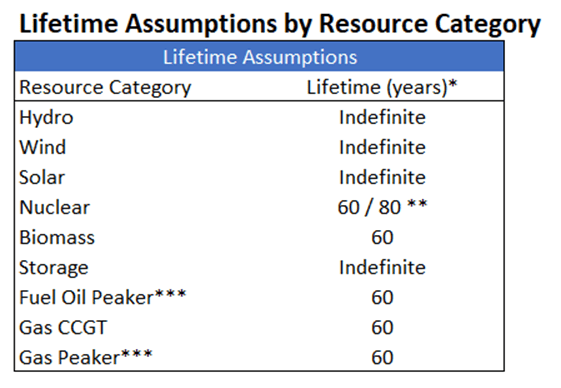
I prepared an annotated version of the Draft Scoping Plan description of the “Carbon-Free Electric Supply” in Appendix G Section. This section describes the Integration Analysis projected future electric supply system. More detail is provided in the spreadsheet IA-Tech-Supplement-Annex-1-Input-Assumptions tab named “Retirement” that “contains expected lifetime assumptions by resource category”. The table listing the lifetimes is shown below.
Table Notes:
* Resources with “indefinite” lifetimes are assumed to remain online throughout the study period.
** The license expiration of upstate nuclear units is determined as part of scenario definitions.
***Select units in NYISO zones J and K that are expected to retire as a result of the DEC NOx emissions rule are assumed offline by the start of 2025, based on the 2021 Gold Book.
Units that hit their 60 year lifetime threshold by 2025 but that have not yet announced retirement plans are kept online through model year 2025, due to the time it takes to complete retirement studies.
The 60-year retirement threshold is not enforced in downstate NY until 2035, to ensure local reliability is maintained in the near term. This analysis enforced LCRs in each capacity zone but did not study more detailed local reliability issues.
The reason I prepared a comment is that the lifetime assumptions for hydro, wind, solar, and storage are listed as indefinite. While that may be true for hydro it is an inappropriate assumption for wind, solar and energy storage. As far as I can tell that assumption was used to project future costs.
Other Wind, Solar, and Energy Storage Expected Lifetimes
My comments included the results of a quick literature search for wind, solar, and energy storage technologies expected operating lifetimes.
According to TWI: A good quality, modern wind turbine will generally last for 20 years, although this can be extended to 25 years or longerdepending on environmental factors and the correct maintenance procedures being followed. However, the maintenance costs will increase as the structure ages. The Electricity Markets & Policy group at Berkeley Lab claims: “Our interest was in better understanding how expectations for useful life have changed over time, as the wind industry has matured. We find that most wind project developers, sponsors and long-term owners have increased project-life assumptions, from a typical term of ~20 years in the early 2000s to ~25 years by the mid-2010s and ~30 years more recently. Current assumptions range from 25 to 40 years, with most respondents citing 30 years”. However, there is a difference between design life and actual lifetimes. Energy Follower explains that “There is very little data on modern turbines reaching their life expectancy so it is largely unknown how long they will be operable. Modern wind turbines have over 8,000 parts (broken down into three major components) and blades as long as 262 feet, the same length as the wingspan of an Airbus. With higher efficiency modern turbines due to additional electronic components and a more powerful and massive design, there is a higher chance of something going wrong with more potential points of failure and overall added stress and load on the structure.”
There is less information available for utility-scale photovoltaic systems. The Electricity Markets & Policy group at Berkeley Lab claims: “Solar project developers, sponsors, long-term owners, and consultants have increased project-life assumptions over time, from an average of ~21.5 years in 2007 to ~32.5 years in 2019. Current assumptions range from 25 years to more than 35 years depending on the organization; 17 out of 19 organizations from which data were obtained use 30 years or more.” It is not clear to me why these expectations are so high when it known that photovoltaic cells degrade over time. The National Renewable Energy Lab concluded:
A history of degradation rates using field tests reported in the literature during the last 40 years has been summarized. Nearly 2000 degradation rates, measured on individual modules or entire systems, have been assembled from the literature and show a mean degradation rate of 0·8%/year and a median value of 0·5%/year. The majority, 78% of all data, reported a degradation rate of <1% per year.
There is even less information available for utility-scale energy storage systems. Another National Renewable Energy Lab analysis did an example scenario:
An example scenario was simulated wherein an integrated battery-PV system was controlled in self-consumption mode, attempting to minimize energy exchanged with the grid. For this application, battery lifetimes ranging from 7-10 years may be expected. Without active thermal management, 7 years lifetime is possible provided the battery is cycled within a restricted 47% DOD operating range. With active thermal management, 10 years lifetime is possible provided the battery is cycled within a restricted 54% operating range.
I found one other reference that claimed that listed different types of chemical battery lifetimes between 5 and 15 years.
Integration Analysis Implications
I searched the Draft Scoping Plan for the term “retirement” and could not find any documentation for the rationale used to assume that wind, solar, and energy storage have indefinite lifetimes. My comments recommended that the Final Scoping Plan incorporate documentation explain the retirement rationale because as I show below there are implications for the cost projections.
My annotated version of the Draft Scoping Plan section “Carbon-Free Electric Supply” in Appendix G Section I that starts at page 42. The only annotation addition is an extracted copy of the actual data in the figures that list capacity (MW) and generation (GWh) in that section that are based on data in the IA-Tech Supplement Annex 2 Emissions Key Drivers spreadsheet.
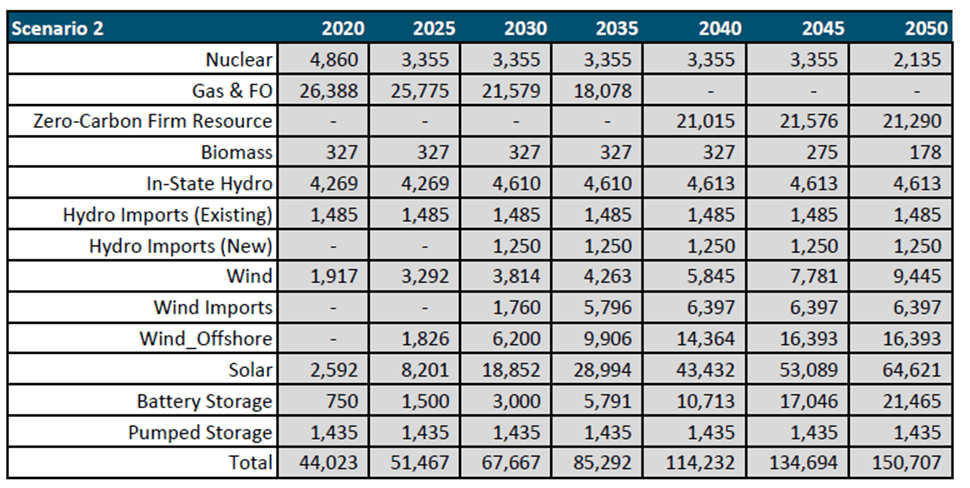
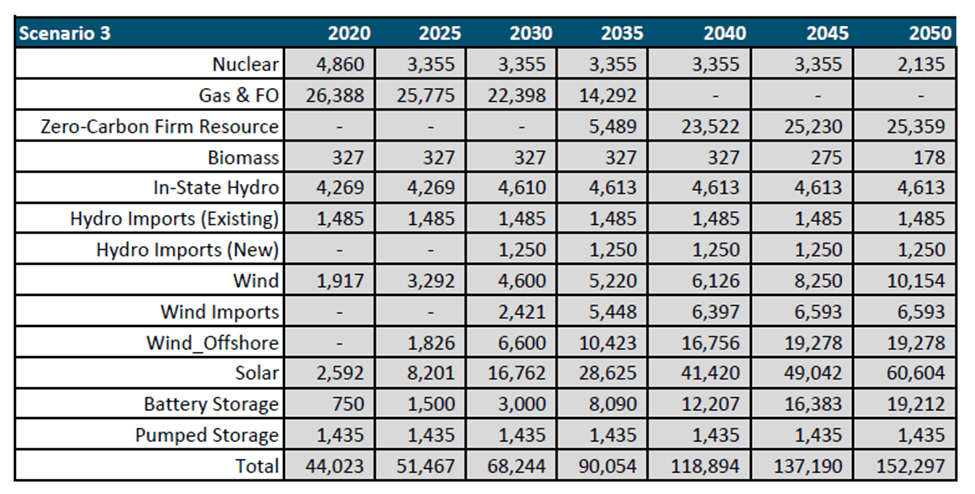
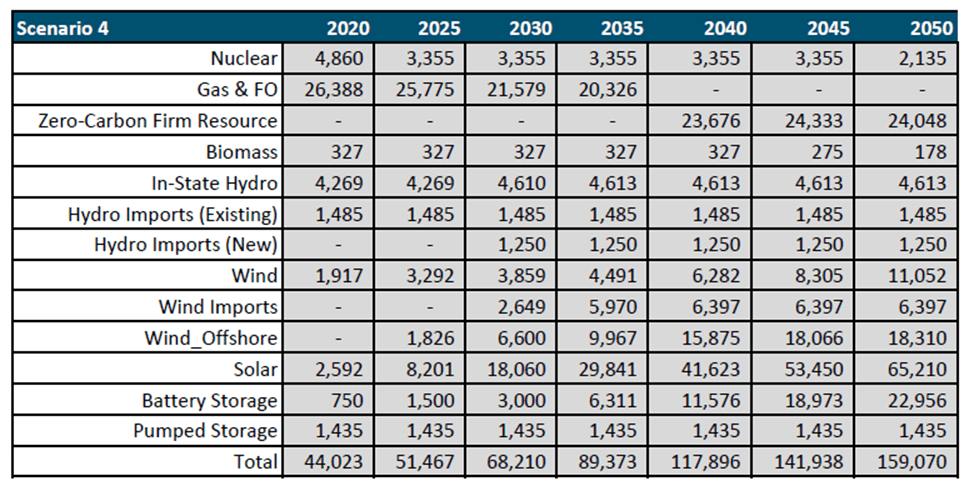
The following tables list the capacities for the Integration Analysis fuel mix categories for the Reference Case (Table 1), Scenario 2: Strategic Use of Low-Carbon Fuels (Table 2), Scenario 3: Accelerated Transition Away from Combustion (Table 3), and Scenario 4: Beyond 85% Reduction.
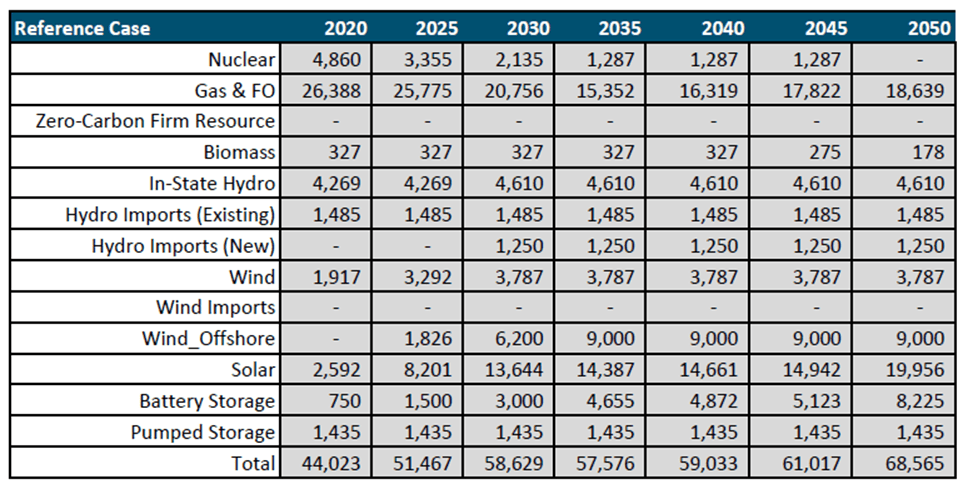
Table 1: Reference Case Summary Fuel Mix Capacity (MW)
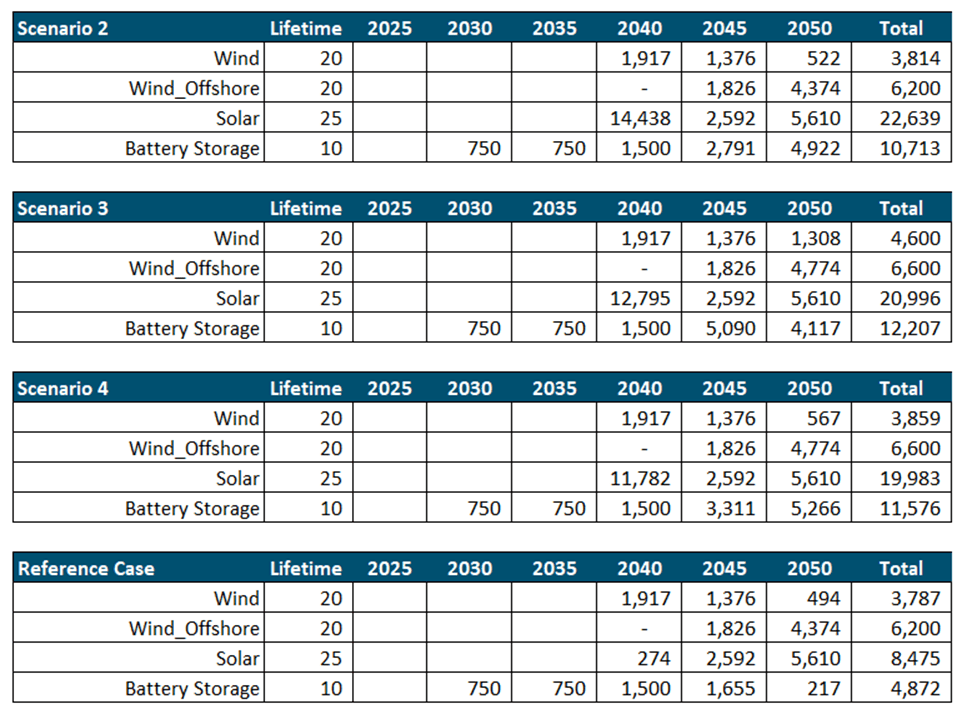
The Integration Analysis spreadsheet states that “Resources with ‘indefinite’ lifetimes are assumed to remain online throughout the study period.” I assume that means that the 2020 wind capacity of 1.917 MW in 2020 is not replaced in the total capacity in 2040, 20 years later. Table 5 shows that assumption under-estimates the resource builds in the wind, solar, and energy storage resource categories significantly. If those resource builds are not included then the costs are underestimated too.
Table 5: Additional Capacity Installed for replacement at expected lifetime
Using an indefinite retirement date for these resources underestimates the total builds needed for 2050. For land-based wind between 3,814 MW and 4,600 MW are not included and for offshore wind between 6,200 and 6,600 MW are not included. The amount of solar not included ranges between 22,639 MW and 19,983 MW. Finally, for battery storage between 10,713 MW and 12,207 MW of additional resources will be need to be developed to meet the 2050 projected value.
Another way to look at the exclusion of these resources is that land-based wind development costs could be up to 45% higher than the projections that don’t include reasonable retirement dates because that much more of the resource needs to be developed. Off-shore wind costs could be up to 38% higher, solar costs could be up to 35% higher, and battery storage could be up to 64% higher than projections that exclude reasonable retirement dates.
My comments included questions for the Climate Action Council. Why shouldn’t reasonable retirement dates be included in the Final Scoping Plan. What would the revised costs be if retirements were included? The operational characteristics of battery storage affect expected lifetimes. What did the Integration Analysis assume for thermal management and discharge characteristics? Were those factors included in the estimates of the projected capacity resources?
Conclusion
I prepared this comment because I could not believe that the Integration Analysis authors would apparently ignore all the information that indicates that the lifetimes of wind, solar and battery storage are much less than other generating resources. It appears to me that not including reasonable retirement dates is an egregious attempt to reduce the published costs of wind, solar, and battery storage. The result is that units are assumed to remain online throughout the study period and no costs for replacements between now and 2050 are included. However. that is a poor assumption because it is totally unreasonable to expect that, for example, the existing land-based resources will still be in operation in 2050.
The simplest way to look at the effective result of excluding these resources is that much more of the resource needs to be developed so costs are necessarily higher. For land-based wind development costs could be up to 45% higher than the projections because that much more of the resource needs to be developed. Off-shore wind costs could be up to 38% higher, solar costs could be up to 35% higher, and battery storage could be up to 64% higher than projections that exclude reasonable retirement dates.
Everyone wants to do right by the environment to the extent that they can afford to and not be unduly burdened by the effects of environmental policies. I have written extensively on implementation of New York’s response to climate change risk because I believe the ambitions for a zero-emissions economy embodied in the Climate Act outstrip available renewable technology such that it will adversely affect reliability, impact affordability, risk safety, affect lifestyles, and will have worse impacts on the environment than the purported effects of climate change in New York. New York’s Greenhouse Gas (GHG) emissions are less than one half one percent of global emissions and since 1990 global GHG emissions have increased by more than one half a percent per year. Moreover, the reductions cannot measurably affect global warming when implemented. The opinions expressed in this post do not reflect the position of any of my previous employers or any other company I have been associated with, these comments are mine alone.
Climate Act Background
The Climate Act establishes a “Net Zero” target (85% reduction and 15% offset of emissions) by 2050. The Climate Action Council is responsible for preparing the Scoping Plan that will “achieve the State’s bold clean energy and climate agenda”. They were assisted by Advisory Panels who developed and presented strategies to meet the goals. Those strategies were used to develop the Integration Analysis prepared by the New York State Energy Research and Development Authority (NYSERDA) and its consultants that quantified the impact of the strategies. That analysis was used to develop the Draft Scoping Plan that was released for public comment on December 30, 2021. Comments on the draft can be submitted until July 1, 2022.
I recently posted an article describing the composition, responsibilities and consideration requirement mandates in the Climate Act related to the Climate Action Council. Of particular relevance to this article is the requirement that “at large members shall include at all times individuals with expertise in issues relating to climate change mitigation and/or adaptation, such as environmental justice, labor, public health and regulated industries.” There are three aspects of the final Scoping Plan that have to be considered by the Climate Action Council according to the Climate Act. The Climate Act specifically states that the costs and benefits analysis must: “Evaluate, using the best available economic models, emission estimation techniques and other scientific methods, the total potential costs and potential economic and non-economic benefits of the plan for reducing greenhouse gases, and make such evaluation publicly available.” There also is a mandate to consider efforts at other jurisdictions: “The council shall identify existing climate change mitigation and adaptation efforts at the federal, state, and local levels and may make recommendations regarding how such policies may improve the state’s efforts.” Finally, in, § 66-p. “Establishment of a renewable energy program” there is a safety valve: “The commission may temporarily suspend or modify the obligations under such program provided that the commission, after conducting a hearing as provided in section twenty of this chapter, makes a finding that the program impedes the provision of safe and adequate electric service; the program is likely to impair existing obligations and agreements; and/or that there is a significant increase in arrears or service disconnections that the commission determines is related to the program”.
Climate Action Council Discussion of Public Hearing Comments
The May 26, 2022 Climate Action Council meeting included an agenda item for Council members to describe their impressions of comments made at the public hearings I have prepared an overview summary of all the comments made during the Update on Public Hearings and Comments agenda item. It lists names, affiliations, and the time for the start of their comments for each speaker on the recording and my notes on the points they made.
The original schedule for the entire meeting only allocated 90 minutes. This agenda item alone took 75 minutes. The discussion started at 14:36 in the video recording. Every speaker went out of their way to laud the organization, format and logistics of the public hearings so I am not going to include that in my discussion of the comments.
Sarah Osgood, Director of the Climate Action Council, gave the update on the public hearings (15:25 of the recording). She noted that 700 people spoke at the hearings. In general, most were in support of the direction of the plan but she explained that there were more themes within that support. The themes that she mentioned were the importance of environmental justice and equity, requests for more financial incentives and concerns about lack of funding, concerns about potential job losses, affordability of electricity in the transition, the use of green hydrogen, and that speakers noted the importance of public awareness and community outreach campaigns. She said more people Downstate addressed public health impacts while reliability and EV implementation concerns were more of a concern Upstate. Finally, she said that there were requests for comment period extensions. That was a topic discussed later in the meeting. For the record, the Council has since extended the comment period until July 1.
I have one thought about her overview. I agree with the perception that most speakers were in support of the idea that we need to do something. That point was also made by many of the Council members when they described their perceptions. At the Syracuse meeting my breakdown of the speakers counted only twelve who voiced reservations or opposition; 26 supported of the Climate Act because of their concerns about climate change impacts; another 17 supporters supported it because they had an agenda beyond concerns about climate change impacts; and another four crony capitalists who showed up to support their business model.
While I agree that most speakers supported the direction of the plan, there were Council members that implied that those speakers were a representative sample of all New Yorkers. Peter Iwanowicz, Executive Director, Environmental Advocates NY (starting at 40:16 of the recording) said “we heard from a lot of average New Yorkers at these hearings”. He went on to say the speakers represent the “can do spirit” of people and businesses who are ready to go with the clean energy economy. In my opinion those who want to participate in the clean energy economy were motivated to show up because they were aware of this effort whereas many New Yorkers still are not. In my breakdown of supporters nearly half have the ulterior motive trying to make money off this. This is the same group of folks that Osgood noted were requesting more financial incentives and had concerns about lack of funding. None of the people in this category represent “average” New Yorkers.
One aspect of the overview not mentioned by Osgood was the support of nuclear power. Dr. James Hanson is very well known for his climate change advocacy. According to Wikipedia his 1988 Congressional testimony on climate change helped raise broad awareness of global warming. He has also advocated action to avoid dangerous climate change. Speaking at 39:31 in the recording at the Albany meeting he said he was shocked by this plan, went on to explain that nuclear power is necessary going forward, and said it would not work out well if it was not given more emphasis. The nuclear support theme was mentioned by multiple speakers at most of the hearings I listened to. It is not clear whether not mentioning those speakers was an oversight.
Another theme concerned negative comments. For example, Co-Chair of the Council Basil Seggos, Commissioner, New York State Department of Environmental Conservation discussed his thoughts starting at 19:50 of the recording. He brought up the subject of public engagement. He admitted that when they got out into public that they gained a better appreciation of the scale of the challenge. He said it was tough to communicate the challenges and went on to say there is lots of “misinformation and misunderstanding but also lots of excitement and support”. Raya Salter, Lead Policy Organizer, NY Renews (speaking at 37:27 of the recording) claimed that there are two lobbying groups: paid advocacy community and the paid misinformation community. She said there were well-funded efforts to spread the misinformation and that there is no voice challenging it. My perception of these comments is that they both believe that anyone who disagrees is wrong and must be shut up because they are all paid shills of the evil fossil fuel industry. In the following I will address several of the examples of claimed mis-information and misunderstanding.
Clean Energy Worker Transition
Paul Shepson, Dean, School of Marine and Atmospheric Sciences at Stony Brook University (starting at 22:05 of the recording) picked up on the misunderstanding and misinformation label in his comments. He was the first to disparage the speakers who were worried about loss of livelihood. He said that they were misinformed because they apparently think that job impacts would be immediate. He went on to say that the transition will be gradual, giving lots of people lots of time to adjust, re-train and so on. His attitude is personally disappointing to me. The fact is that they will have plenty of time to change their careers. No appreciation that changing careers means starting over, very likely in a job that will never pay as well as they are paid now. For an academic shielded from job security issues through tenure for much of his career to dismiss their concerns as a misunderstanding is tone-deaf and insulting.
Residential Heating
Another example of claimed misinformation was that commenters were making disparaging remarks about heat pumps for heating electrification. I think Council members also were aware of the public relations campaign that has raised awareness about their residential heating electrification plans. Robert Howarth, Professor, Ecology and Environmental Biology at Cornell (starting at 32:52 of the recording) said that another area for misinformation is heating electrification using heat pumps. He has one and loses no opportunity to say that heat pumps work in cold climates because his does. He said that “Anyone who says otherwise is just misinforming”. He went on to say that there are forces out there that are working to counter our messages with misinformation. Robert Rodriguez, Acting Secretary of State, New York State Department of State (starting at 43:25 of the recording) also addressed this topic. He said that the Council has to communicate directly with homeowners and rate payers about what this means. He claimed that the misinformation campaign listed four different numbers for home electrification and was using hyperbole about the impacts to scare senior citizens.
I spent a lot of time delving into the Integration Analysis for my comments and am pretty comfortable saying that I know more about what is specifically in the Integration Analysis and the Draft Scoping Plan about residential heating electrification than just about anyone on the Climate Action Council. Last month I described what I had picked out of those documents in an interview on Capital Tonight:
Ground source heat pumps are more effective in cold weather than air source heat pumps, but they are also more expensive. For example, according to the draft scoping plan device cost estimates, an air source heat pump will cost about $14,678, plus another $1,140 for the electric resistance backup.
Installation for a ground source heat pump is much more involved and could cost a homeowner $34,082, according to Caiazza.
If you invest in a basic shell to insulate your home, the cost would be $6,409. The cost of a deep shell would be upwards of $45,136.
According to Caiazza, the price range for heat pumps, installation and supplemental heat could be between $22,227 and $79,218, using the scoping plan’s estimates.
I want to make a specific point about the Rodriguez claim that four different cost estimates for home electrification means it has to be misinformation. There are two types of heat pumps and two levels of building shell improvements in the Integration Analysis. As a result, there are four cost estimates in the Draft Scoping Plan. My reading is that depending on where you live you could have a comfortable home with the cheaper air source heat pump and a basic building shell in some areas of the state like Long Island but in the coldest areas like Lake Placid, you might need to go with the more expensive ground source heat pump and the more expensive deep building shell. However, the Draft Scoping Plan does not explain what is expected of homeowners but the implication is clear that you need to improve your building shell when you install a heat pump. Dr. Howarth may be right when he says that the technology to make it work is available but I have never heard him mention building shell upgrades are required. Furthermore, no one associated with the Climate Act has ever admitted that the cost savings from the efficiency improvements for the heat pump and building shell improvements are not enough to offset the conversion costs for a natural gas fired home, see for example this research. There are savings for propane and fuel oil but not natural gas.
Reliability
I am just going to raise a couple of questions for this topic because it deserves its own post. Paul Shepson Dean, School of Marine and Atmospheric Sciences at Stony Brook University Mis-representation at 23:39 of the recording said:
Mis-representation I see as on going. One of you mentioned the word reliability. I think the word reliability is very intentionally presented as a way of expressing the improper idea that renewable energy will not be reliable. I don’t accept that will be the case. In fact, it cannot be the case for the CLCPA that installation of renewable energy, the conversion to renewable energy, will be unreliable. It cannot be.
Robert Howarth, Professor, Ecology and Environmental Biology at Cornell (starting at 32:52 of the recording) picked up on that theme. He said that fear and confusion is based on mis-information but we have information to counter that and help ease the fears. He stated that he thought reliability is one of those issues: “Clearly one can run a 100% renewable grid with reliability”.
I was so taken aback by Shepson’s comment that I dashed off an email to him. (Not surprisingly he never responded.) I called his attention to one of my recent posts. He dismissed the difficulties of a transition to a renewable resource but the fact is that the Council has not listened to the reliability experts at the New York Independent System Operator or the New York State Reliability Council. My article highlighted two quotes from a recent NYISO presentation: “Significant uncertainty is related to cost / availability of Dispatchable Emissions Free Resource IDEFR) technologies, as well as regulatory definition of ‘zero-emissions’ compliant technologies” and “Some scenarios do not represent realistic system performance but are helpful in identifying directional impacts and sensitivity to key variables”. That is as close as a technical report can come to saying this won’t work as you can get without actually saying it. Furthermore, during the presentation discussion the point was made that the capacity projected numbers indicate an enormous amount of generation is needed to replace the shutdown of fossil-fired generation and implement the transition. That result was described as just “stunning”. Someone asked whether anyone on the Council is looking at what this means. These experts are clearly worried about the enormous resources that have to be built to meet to transition the New York electric grid to a net-zero.
Here are questions for these academics who consider themselves experts on the reliability of the zero-emissions electric grid. Firstly, name a single jurisdiction that has successfully entirely converted their electric grid away from fossil fuels by using wind and solar renewables. Secondly, name a single jurisdiction that has started the transition to an electric grid that relies on wind and solar that has not seen a marked increase in costs. Thirdly, explain how the Scoping Plan’s electric grid plans will prevent the electric market reliability issues seen in Australia on June 13, 2022.
Voices of Reason
I would be remiss to not point out the rational comments from a couple of the Council members. Rose Harvey, Senior Fellow for Parks and Open Space, Regional Plan Association (starting at 46:52 of the recording) pointed out that information labeled as misleading might not be misinformation. She said these topics are so complex that it is easy to not understand everything. She admitted she doesn’t understand everything Council members are saying. I think that is a key admission. Some of the more vocal Council members talk a good game but there is no indication that they have the background and experience to have an educated opinion on some of the topics they so confidently talk about. A little more humility and a lot more reliance on subject matter experts would markedly improve the quality of the final Scoping Plan.
Dennis Eisenbach, President, Viridi Parente (51:09 of the recording) felt it was necessary to speak up because he said he was “starting to get concerned about some of the comments made by some Council members”. He said that: “It is almost like we are dismissing critical input maybe because we don’t agree with it or doesn’t flow naturally in what we are trying to do with the scoping plan document so that concerns me a little bit.” He suggested that “If there are issues that are out there brought up by the public or whoever brought them up that kind of like create a misunderstanding or misleading premise let’s develop a frequently asked questions section of our plan”. He concluded: “I don’t want us to be in a position that we are determining what is valid and what is not valid from the eyes of the individuals trying to provide input because if you want to shut down input this is a good way of doing it”. It is well worth listening to all his comments.
Discussion
I am very concerned about the majority of comments made about the speakers at the public hearings. For one thing, the natural tendency to focus on those speakers whose views align with your own definitely colored the summary descriptions. There was no recognition that speakers only had two minutes to speak and that might be the reason there were so few dissenting topics. Finally, the suggestion that the speakers were a representative sample of average New Yorkers may lead to the conclusion that they have overwhelming support. However, there is no reason to believe that the distribution of comments made represents the feelings of even a fraction of New Yorkers. In my opinion the Council needs to get out into the average New Yorker’s world and strike up conversations about particular aspects of the Scoping Plant that directly affect people. I have found that when I tell people the plan is to switch to electric heat the most frequent response is “what am I supposed to do when the electricity goes out?”. Average New Yorkers have figured out that natural gas, fuel oil and propane heating system fuels are much less likely to have outages than the electric “fuel” proposed. How do Council members propose to respond to that?
I applaud Rose Harvey for stating the obvious fact that it is impossible for all Council members to be experts in all aspects of the enormous scope of the Scoping Plan. Unfortunately, that leads to a lack of understanding of the caveats and conditions of many of the claims made. At the top of my list of examples of this problem is the cost benefit analysis. I am pretty sure that the majority of the Council don’t understand that the claim “The cost of inaction exceeds the cost of action by more than $90 billion” includes the caveat that the benefits are “relative to the Reference Case”. The authors of the Draft Scoping Plan and the leadership of the Council have completely neglected explaining the implications and ramifications of that condition. Based on my analyses this claim that the benefits out-weigh the costs is incorrect. There are other similar claims in the Draft Scoping Plan that do not explain the implications of the caveats and conditions used.
I think that the emphasis on misinformation and misunderstanding by vocal members of the Council is hypocritical. Ostensibly the public comment period is to ask for full representation of the issues. The impression I got was that regardless of your expertise if you are on the wrong side of the majority plan you are deemed wrong and dismissed out of hand. That’s insulting and should be beneath those enabling it. The Council leadership should take the comments of Dennis Eisenbach to heart and follow his advice: “I don’t want us to be in a position that we are determining what is valid and what is not valid from the eyes of the individuals trying to provide input because if you want to shut down input this is a good way of doing it”.
My biggest concern is reliability and that comes from working in the electric generating industry for over 40 years. However, I am only a professional not an expert. There is a clear need to respect the opinion of professionals who are experts in the area of reliability rather than the dismissive conclusions of academics from other disciplines entirely. Confronting this issue openly and transparently with the organizations and their experts is a critical need that does not appear to be on the docket for the Climate Action Council. A little more humility on the part of certain Council members and a lot more reliance on subject matter experts would markedly improve the quality of the final Scoping Plan.
Conclusion
In the overview of the Climate Act above I described four Climate Act mandates for the Council. Instead of focusing on how the public perceives specific issues like reliability and heat pumps, the Council should be considering how to address those mandates in their review of the Draft Scoping Plan.
The Climate Act has always been more about political theater than truly trying to address climate change while maintaining current standards of affordability, reliability, and environmental protections. This extends to the membership of the Climate Action Council. The political definition for Council qualifications, “at large members shall include at all times individuals with expertise in issues relating to climate change mitigation and/or adaptation, such as environmental justice, labor, public health and regulated industries” gave lip service to expertise but ending up naming at large members by affinity group associations. With all due respect to the agency heads the technical expertise necessary to meaningfully contribute to the development of the Scoping Plan was not a qualification criterion for those positions. That has led the Climate Action Council astray because members cannot be experts in all the aspects of the energy transition.
The Climate Act specifically states that the costs and benefits analysis must: “Evaluate, using the best available economic models, emission estimation techniques and other scientific methods, the total potential costs and potential economic and non-economic benefits of the plan for reducing greenhouse gases, and make such evaluation publicly available.” The Council has not but should address this requirement by defining what will meet this requirement. In my opinion in order to fulfill this obligation, the Final Scoping Plan must describe all control measures, assumptions used, the expected costs for those measures and the expected emission reductions for the Reference Case, the Advisory Panel scenario and the three mitigation scenarios.
There also is a mandate to consider efforts at other jurisdictions: “The council shall identify existing climate change mitigation and adaptation efforts at the federal, state, and local levels and may make recommendations regarding how such policies may improve the state’s efforts.” As I write this there is an electric grid market issue that may lead to widespread load shedding and blackouts in Australia. The ultimate problem is a hostile environment for dispatchable power generators has led to a shortage when wind and solar resources are low. The Council should consider how similar energy transition programs have affected reliability and affordability so that the Climate Act transition does not have similar problems.
Finally, there are members of the Climate Action Council who believe that the energy transition must proceed no matter what because the law says so. However, New York Public Service Law § 66-p. “Establishment of a renewable energy program” includes a safety valve condition: “(4) The commission may temporarily suspend or modify the obligations under such program provided that the commission, after conducting a hearing as provided in section twenty of this chapter, makes a finding that the program impedes the provision of safe and adequate electric service; the program is likely to impair existing obligations and agreements; and/or that there is a significant increase in arrears or service disconnections that the commission determines is related to the program”. The Council should be defining the provisions for safe and adequate electric service, impairing existing obligations, and increase in arrears or service disconnections. Those conditions should be established up front, implementation plans should be evaluated against those criteria, and then tracked during implementation to see if they are being maintained.
The Climate Leadership and Community Protection Act (Climate Act) has a legal mandate for New York State greenhouse gas emissions to meet the ambitious net-zero goal by 2050. I was recently interviewed for a segment on the electric vehicle component of the Climate Act on Spectrum Cable’s Capital Tonight program hosted by Susan Arbetter. During the interview I suggested that one of the questions about electric vehicle costs she asked was appropriate for a comment. This article describes the comments I submitted on the issue raised in the interview.
Everyone wants to do right by the environment to the extent that they can afford to and not be unduly burdened by the effects of environmental policies. I have written extensively on implementation of New York’s response to that risk because I believe the ambitions for a zero-emissions economy embodied in the Climate Act outstrip available renewable technology such that it will adversely affect reliability, impact affordability, risk safety, affect lifestyles, and will have worse impacts on the environment than the purported effects of climate change in New York. New York’s Greenhouse Gas (GHG) emissions are less than one half one percent of global emissions and since 1990 global GHG emissions have increased by more than one half a percent per year. Moreover, the reductions cannot measurably affect global warming when implemented. This page documents all the comments that I submitted as part of the Climate Leadership and Community Protection Act implementation process. The opinions expressed in this post do not reflect the position of any of my previous employers or any other company I have been associated with, these comments are mine alone.
Climate Act Background
The Climate Act establishes a “Net Zero” target (85% reduction and 15% offset of emissions) by 2050. The Climate Action Council is responsible for preparing the Scoping Plan that will “achieve the State’s bold clean energy and climate agenda”. They were assisted by Advisory Panels who developed and presented strategies to the meet the goals to the Council. Those strategies were used to develop the integration analysis prepared by the New York State Energy Research and Development Authority (NYSERDA) and its consultants that quantified the impact of the strategies. That material was used to write Draft Scoping Plan that was released for public comment at the end of 2021. The Climate Action Council will revise the Draft Scoping Plan based on comments and other expert input in 2022 with the goal to finalize the Scoping Plan by the end of the year.
One of the reasons that Capital Tonight did an interview with me was to let their viewers know that the comment period is open until July 1. During the interview she asked me what the costs for Zero-Emissions Vehicles were in the Draft Scoping Plan. When I told her the numbers for 2022 in the Integration Analysis spreadsheet she said: “That is a lot more than a gas-powered car”. Later in the interview she asked what I would recommend people should write comments about. I said that people should send comments to the Council about anything that impacts them directly. I used the example regarding her question about the car prices as an appropriate question. This comment specifically addresses that concern and a couple of others we did not discuss due to time constraints.
Summary
The Integration Analysis vehicle cost projections rely on a single vehicle type for light-duty vehicles. In the first place the value for regular vehicles seems high and, relative to all electric-vehicle prices last fall, the battery-electric costs seem low. In my comment I recommended that the Climate Action Council consider updating the Integration Analysis to better represent different types of vehicles. I also urged the Council to consider including the costs of used cars into the analysis particularly because low and middle-income households purchase used cars rather than new cars. Finally, I questioned the optimistic rate of battery-electric cost price decreases used in the Integration Analysis.
Integration Analysis Vehicle Costs
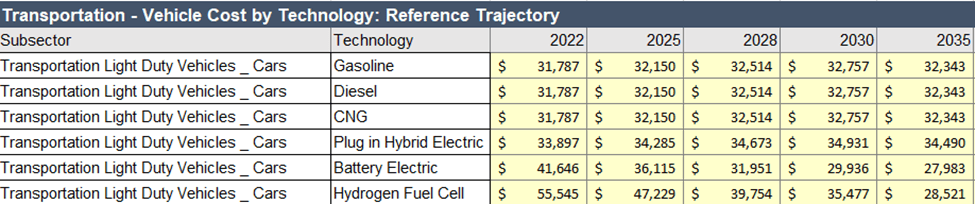
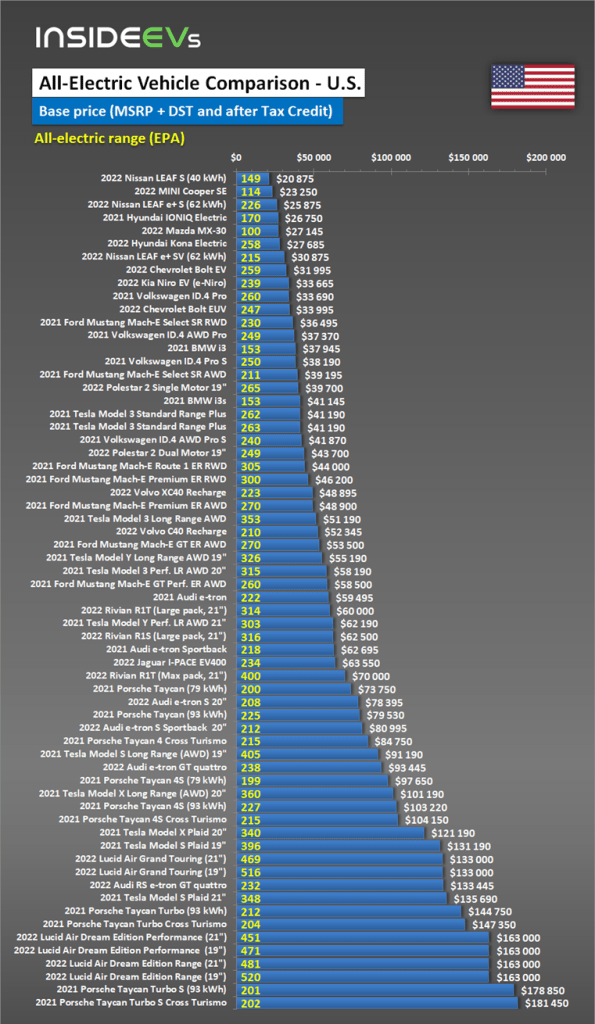
Ms. Arbetter asked me to talk about the Draft Scoping Plan costs because she knows that I have dug into the Integration Analysis enough to be able to give her specific answers. I based the numbers I presented on the Integration Analysis spreadsheet IA-Tech-Supplement-Annex-1-Input-Assumptions. In the Trans_Device Cost table (excerpt below) the 2022 diesel and gas vehicle costs are both listed as $31,787 and battery electric vehicle cost is given as $41,646. The following table from Inside EVs lists the costs of battery electric vehicles on September 18, 2021. There are 63 car models listed and there are only 13 models less than the Integration Analysis estimate.
Given the relative importance of future light-duty vehicle costs to New Yorkers I think that this analysis of vehicle costs needs to be refined. A single category for light-duty vehicles is unacceptable. A quick search for rental cars finds the following vehicle types: full-size, economy/sub-compact, compact, intermediate, standard, standard sport, intermediate SUV, standard SUV, premium, and luxury. Kelly Blue Book’s buying guide for electric vehicles has another list of vehicle types. Somewhere, someone must have compared different vehicle types to come up with a single number.
I have the following recommendations for this aspect of the Scoping Plan. At an absolute minimum, the rationale used for the single value must be documented. If it was a weighted average, then the assumptions should be shown. However, I think it would be more appropriate to incorporate more vehicle categories in the analysis that encompass a broader range of vehicles used. While the more categories the better, why not at least provide costs for compact, intermediate, full-size in both regular and SUV models? I am sure a more refined analysis would improve the value of these cost estimates.
Used Cars
Due to time constraints in the interview, I was not able to make the point that the Draft Scoping Plan EV cost analysis only considers new cars. With all the Climate Act emphasis on equity for low and middle-income New Yorkers, the document is ignoring those who cannot afford a new vehicle and that is a major flaw in the EV analysis. According to EDF Energy:
During the interview I also noted that the Draft Scoping Plan predicts that costs for battery-electric vehicles will be less than regular vehicles by 2028. Specifically, the Integration Analysis spreadsheet projects that battery electric vehicles will be cheaper than gas/diesel by 2028: diesel/gas cost is $32,514 and battery electric is $31,951. That is an optimistic ~5% per year decrease in costs. Although I concede that many reports support similar cost reduction trajectories many of those reports are biased because they are from organizations with a financial stake in electric vehicle adoption and/or written by authors whose career is dependent upon the clean energy transition.
My primary future cost concern is the cost of battery raw materials. PWC describes the automotive supply chain and notes that:
The lithium-ion battery pack alone can account for up to 50% of the value of today’s EVs. Battery prices have fallen steadily in recent years and that share will likely be much lower over time. But even so, these batteries are primarily made by companies outside the traditional auto supply chain, creating new competition for legacy suppliers.
I believe that the Climate Action Council should address New York’s ZEV plans in the context of other similar plans in other jurisdictions particularly in regards to the world’s supply of lithium.
Conclusion
The primary purpose of this article is to show by example how to take a particular concern and put it into a comment. Both Ms. Arbetter and I believe that more New Yorkers need to get involved in the Climate Act. The easiest way to do that is to submit comments where you can fill out a form and directly submit a 2,000-character comment or attach a file. If you have technical issues with the form, you can email your comment to: scopingplan@nyserda.ny.gov.
If you can describe a problem, document issues with the Draft Scoping Plan treatment of the issue, and then ask a question or recommend a revision, then I think your comment will be effective. If that is too complicated, then simply explaining that you have general concerns about the direction of the plan would help counteract the environmental lobbying organizations letter writing campaigns. There is a tendency on the part of many members of the Climate Action Council to claim that the quantity of comments regarding a specific issue should be the final arbiter of policy decisions.
The bottom line for my specific comment is that the Integration Analysis does a terrible job dealing with the costs of zero-emissions vehicles. For a topic that is one of the primary interests of New Yorkers the overly simplistic approach is unacceptable. The Integration Analysis should be revised to consider multiple vehicle category costs to improve the results and give the public a better idea what implementation of the Climate Act will mean to them personally.
The Climate Leadership and Community Protection Act (Climate Act) has a legal mandate for New York State greenhouse gas emissions to meet the ambitious net-zero goal by 2050. I was interviewed for a segment on the electric vehicle component of the Climate Act on Spectrum Cable’s Capital Tonight program hosted by Susan Arbetter. This post provides documentation for the information I provided in the interview and expands on some comments that could not be covered completely.
Everyone wants to do right by the environment to the extent that they can afford to and not be unduly burdened by the effects of environmental policies. This blog emphasizes that pragmatic environmentalism is all about balancing the risks and benefits of both sides of policy issues. The opinions expressed in this post do not reflect the position of any of my previous employers or any other company I have been associated with, these comments are mine alone.
Climate Act Background
The Climate Leadership and Community Protection Act (Climate Act) is New York’s response to climate change. The Climate Action Council is responsible for preparing the Draft Scoping Plan that defines how to “achieve the State’s bold clean energy and climate agenda”. They were assisted by Advisory Panels who developed and presented strategies to the meet the goals to the Council. Those strategies were used to develop the Integration Analysis prepared by the New York State Energy Research and Development Authority (NYSERDA) and its consultants that quantified the impact of the strategies. That analysis was used to develop the Draft Scoping Plan that was released for public comment on December 30, 2021. The deadline for submitting comments is July 1, 2022
Climate Act Transportation Sector Strategies
The Climate Action Council strategies to achieve net-zero are described in the Draft Scoping Plan document. The overall plan to reduce greenhouse gas (GHG) emissions is to electrify as much as possible and produce the electricity using mostly wind and solar generation. Electrification is also a key component of the transportation sector strategy. Chapter 11 explains that the reductions in the transportation sector are important because the transportation sector emits 27% of the total GHG emissions, second only to buildings.
According to Table 8 from the Plan, there are four themes to the transportation sector emission reduction plan. The first, transitioning to ZEVs and equipment, was the focus of the interview. Both the enhancing public transportation and mobility alternatives and smart growth and mobility-oriented development themes aim to lower emissions by reducing the use of personal vehicles. The last theme, market-based solutions and financing, addresses paying for the strategies. The interview discussed personal vehicles so I am going to focus on light-duty vehicles.
The transportation sector theme transitioning to ZEVs and equipment has two strategies. The first, Light-Duty ZEV Adoption, proposes to transition light duty vehicles to battery electric or hydrogen fuel cell power. Note that because hybrid vehicles still use some fossil fuel, they are not acceptable. The second theme, Adoption of Zero-Emission Trucks, Buses, and Non-Road Equipment, is very similar to the light-duty vehicle strategy except for different kinds of vehicles.
The Integration Analysis developed three scenarios for meeting the Climate Act targets. I recently did a post summarizing the differences between those scenarios and the reference or business-as-usual case for the transportation sector. I based my analysis on the Annex 2: Key Drivers and Outputs Spreadsheet. The spreadsheet Tab: Scenario Definitions lists specific programs in the Reference Case which I summarized in Table 1.
The first question addressed in the interview is when is this supposed to happen. There is legislation in place that mandates that all new vehicles sold in 2035 must be zero-emissions vehicles (ZEVs). At this time only 5% of vehicles sold are zero-emissions. The expected transition over time varies between the three mitigation scenarios but note that in 2030 the Integration Analysis projects that over 90% of the vehicles sold will be ZEVs. The sales transition to ZEVs is expected to occur naturally. In other words, the expectation is that enough people will be willing to purchase ZEVs that this won’t need to be regulated before 2035. However, note that the mitigation scenarios expect that in 2025, 33% of all vehicles sold will be ZEVs. Also note that two of the mitigation scenarios propose to accelerate the adoption of ZEVs and reduce emissions faster by mandating early retirements in 2030. I believe that it is overly optimistic to expect that one of every three cars will be a ZEV in three years so it is possible that if not enough people are willing to shift to ZEVs that New York may believe it is necessary to eventually add early retirement regulations.
Another question addressed in the interview was how much will this cost. I explained that the Integration Analysis documentation in the Scoping Plan says that in 2022 diesel/gas vehicle cost is $31,787 and battery electric vehicle cost is $41,646. Note that the Draft Plan projects that battery electric vehicles will be cheaper than gas/diesel by 2028: diesel/gas cost is $32,514 and battery electric is $31,951. That is an optimistic ~5% per year decrease in costs. The following table from Inside EVs lists the costs of battery electric vehicles on September 18 2022. There are 63 car models listed and there are only 13 models less than the Integration Analysis estimate.
There is another important vehicle cost issue. I think there is an omission in the Draft Scoping Plan because they only talk about new car sales. There is no discussion how the used car market will change. Because batteries will have to be replaced in used cars and they are a major expense I think that will have a significant impact on the used car market.
Another component cost of electric vehicles is charger costs. As shown in the Integration Analysis table below the 2022 cost for a light-duty vehicle is $2,176 and in 2035 the analysis expects costs to go down to $2,018. There is a lack of detail about charger types. I found a reference that describes two types of home chargers: Level 1 chargers that with a cost to install of $1800 can recover 4 to 5 miles of range per hour and Level 2 chargers costing $2200 that recover 25 to 30 miles of range per hour. I assume that the Integration Analysis cost estimat is for Level 2 chargers that can fully charge vehicles overnight. However, we also need to consider the costs for fast Level 3 chargers as part of overall costs even though they are not suitable for home use. They are much more expensive $50,000+ but can recover 100 miles of range per hour. Anytime an owner is on a long trip they are going to either need to find one of these chargers or interrupt their trip for an extended duration stop. In my opinion, charging limitations would effectively preclude New Yorkers from driving south for spring break.
There is another massive omission in the Draft Scoping Plan relative to chargers. What about renters and people who park on the street? Who is going to pick up the tab for all those chargers? Chargers could be assigned in parking lots but on the street that would be problematic. In both instances snow removal becomes an issue too.
In my opinion personal choice limitations are the biggest concern of the electric vehicle transition. ZEVs have range limitations and I personally want the ability to travel long distances without range anxiety. There is a safety issue buried in the necessity for longer fueling times. In order to match the 2000 cars that a typical filling station can service in a busy 12 hours, a future station would require 600 Level 3 chargers at an estimated cost of $24 million and a supply of 30 megawatts of power from the grid. Imagine the chaos if an evacuation was needed, everyone was driving a ZEV, and this limitation over-whelmed the capacity of available charging systems.
Discussion
There was insufficient time to fully address a couple of other issues. Past transformative energy transitions occurred because the perception of the new technology was that it was better because it improved personal choice and opportunities as well as offering clear cost savings up front and over the lifetime of the vehicle. This transition is different. We are being forced to use technology that limits our ability to travel when and where we want and it costs more than what we are paying today. The benefits are for a problem that New York cannot solve on its own and alleged impacts that we cannot question. In my opinion that is a pretty hard pill to take.
We did not get a chance to talk about why aren’t hybrids good enough. In brief, the Climate Act mandates zero-emissions and hybrids use fossil fuels. The reality is that New York’s GHG emissions are so small relative to global emissions that there will not be any effect on the state’s climate and global climate change impacts to New York. Global emissions have annually increased by more than one half of one percent per year and New York’s total share of global emissions is less than one half of one percent. In other words, whatever New York does to reduce emissions will be supplanted by global emissions increases in a year. If New York allowed hybrids as a control option even if it meant some emissions costs would be lower and many of the personal choice limitations would be addressed.
Conclusion
Ms. Arbetter and I agree that many people are unaware of the implications of the Climate Act. She asked me to describe what the Draft Scoping Plan has to say about zero emission vehicles because that is one of the components that has the most impacts to New Yorkers. I tried to describe what is included and what is not included in the Plan to help spread the word.
We both agree that New Yorkers should take the opportunity to provide comments so that the Climate Action Council gets engagement from as many people as possible. I hope that readers will follow up and submit comments. While you could try to wade through the Draft Scoping Plan itself, the document has been described as follows:
The plan is a true masterpiece in how to hide what is important under an avalanche of words designed to make people never want to read it. Here’s an example: “Regardless, any transition must be carefully planned, detailed, and clearly communicated to ensure that expectations are aligned across stakeholders.”
Instead of reading the document I suggest spending some time reading about issues and research things that are of particular interest to you at the Climate Act website and my Citizens Guide. Once you have your thoughts together go to the comment website and submit your comment. For your information I have summarized all my comments here. One final note, I submitted comments based on the interview discussion that are described here.
The Climate Leadership and Community Protection Act (Climate Act) has a legal mandate for New York State greenhouse gas emissions to meet the ambitious net-zero goal by 2050. This article describes the comments I submitted to the Climate Action Council on Chapter 17: Economy-Wide Strategies. I am not sure why they did not refer to these as policies that effectively price GHG emissions because that is what they are talking about.
Everyone wants to do right by the environment to the extent that they can afford to and not be unduly burdened by the effects of environmental policies. I have written extensively on implementation of New York’s response to that risk because I believe the ambitions for a zero-emissions economy embodied in the Climate Act outstrip available renewable technology such that it will adversely affect reliability, impact affordability, risk safety, affect lifestyles, and will have worse impacts on the environment than the purported effects of climate change in New York. New York’s Greenhouse Gas (GHG) emissions are less than one half one percent of global emissions and since 1990 global GHG emissions have increased by more than one half a percent per year. Moreover, the reductions cannot measurably affect global warming when implemented. This page documents all the comments that I submitted as part of the Climate Leadership and Community Protection Act implementation process. The opinions expressed in this post do not reflect the position of any of my previous employers or any other company I have been associated with, these comments are mine alone.
Climate Act Background
The Climate Act establishes a “Net Zero” target (85% reduction and 15% offset of emissions) by 2050. The Climate Action Council is responsible for preparing the Scoping Plan that will “achieve the State’s bold clean energy and climate agenda”. They were assisted by Advisory Panels who developed and presented strategies to the meet the goals to the Council. Those strategies were used to develop the integration analysis prepared by the New York State Energy Research and Development Authority (NYSERDA) and its consultants that quantified the impact of the strategies. That material was used to write Draft Scoping Plan that was released for public comment at the end of 2021. The Climate Action Council will revise the Draft Scoping Plan based on comments and other expert input in 2022 with the goal to finalize the Scoping Plan by the end of the year.
I prepared this comment because my extensive experience with the Regional Greenhouse Gas Initiative has shown that there is a major disconnect between the theory of a carbon pricing program and reality. This disconnect is also evident in the NYISO carbon pricing initiative and the Draft Scoping Plan carbon pricing initiatives.
Summary
Based on the format of Section 17, it was written to address specific issues raised by the Climate Action Council. As a result, it gets bogged down into details about specific issues raised by council members rather than looking at the big picture. In theory, a price on carbon is a great idea. The Council has not considered the theory relative to their perceptions.
My overview comments explain why I believe carbon pricing will always be a regressive tax based on a post I did on carbon pricing. I also think that there are a number of practical reasons that carbon pricing will not work as theorized. Because a global program is impractical, leakage is always going to be a problem. All carbon pricing proposals need to address the problem that as carbon emissions go down revenues go down relative to the fact that reductions get more difficult and expensive as control efficiency increases. The Council members who support carbon pricing seem to be blissfully unaware of the realities of the energy market that are at odds to their theories. Based on observed results I think that indirect market signals are going to lead to less cost-effective reductions in the time frame necessary for the aggressive reduction rules. To date, carbon pricing for the electric sector only considers generation costs which leads to cost shifting the additional costs to supply electricity when and where it is needed to be covered outside the carbon pricing framework. Supporters under-estimate the very real problems of implementation logistics. My concerns about carbon pricing are supported by the recently completed a relevant study done by Regulatory Analysis Project (RAP): Economic Benefits and Energy Savings through Low-Cost Carbon Management for Vermont.
In addition to my practical concerns “A Practical Guide to the Economics of Carbon Pricing by Ross McKitrick defines how carbon pricing is supposed to work in theory. He explains that “First and foremost, carbon pricing only works in the absence of any other emission regulations.” The Guide goes to note “another important rule for creating a proper carbon-pricing system is to be as careful as possible in estimating the social cost of carbon”. He argues that “whatever the social cost of carbon is determined to be, the carbon price must be discounted below it by the marginal cost of public funds (MCPF) — that is, the economic cost of the government raising an additional dollar of tax, on top of what is already being raised”. The Draft Scoping Plan does not even recognize the importance of this aspect of carbon pricing. Finally, he notes that: “it needs to be remembered that carbon pricing works because it is a market-based policy: it works with market forces, not against them. He concludes: “There may be many reasons to recommend carbon pricing as climate policy, but if it is implemented without diligently abiding by the principles that make it work, it will not work as planned, and the harm to the Canadian economy could well outweigh the benefits created by reducing our country’s already negligible level of global CO2 emissions.”
Affordable Revenues
I think the Climate Action Council has to define affordable. In the absence of any numbers in the Draft Scoping Plan related to potential revenues I calculated my own estimates. The total New York State GHG emissions in 2019 are 379.43 million metric tons of CO2 equivalent. If the carbon price was set at the 2022 New York State Value of Carbon Guidance value of $129, then the economy wide cost would be $48.9 billion. I submit that is not affordable for any New Yorkers and could not possibly be designed to avoid regressive impacts.
Clearly, setting a carbon price for all New York emissions is unaffordable so the Climate Action Council should consider setting a price on different sectors. Table ES.2: 2019 New York State GHG Emissions is from the 2021 Statewide GHG Emissions Report and lists the emissions by sector.
I used this GHG emissions information and the 2022 value of carbon of $129 to look at several emission scenarios in the next table. Using the IA-Tech Supplement Annex 2 Emissions Key Drivers spreadsheet 2022 Gross State Product and population each scenario estimates the cost per month for each NYS resident and the cost as a fraction of the GSP. If all the emissions were included in the carbon pricing scheme the cost per resident would be $262.50 and the costs are 3.36% of the GSP. The Candidate scenario only includes the Energy and Industrial Processes and Product Use sectors reduces the costs slightly. The Combustion scenario only includes in-state combustion emissions and drops the total revenues by more than half. Finally, I excluded everything except the electric power sector. Those costs are still pretty high: $12.05 per person per month and 0.15% of the GSP.
The estimates of current (2019) emissions coupled with the New York value of carbon yield very high revenues. On October 26, 2021, the AP-NORC Center and the Energy Policy Institute at the University of Chicago (EPIC) released the results of a survey that claimed that a majority of Americans regard climate change as a problem of “high importance”. It also included survey questions asking whether respondents would support, oppose, or neither support or oppose a law that imposed “a fee on carbon to combat climate change”. The survey question asked “If the law passed, it would increase the average amount your household pays each month for energy, including electricity, heating gas, and gasoline or diesel for your car by a total of X dollars per month” where respondents were randomly assigned a $1, $10, $20, $40, $75, or $100 cost increase. For a $1 per month increase, 45% would support, 30% would oppose, and 25% would neither support or oppose. For a $100 per month increase, 20% would support, 62% would oppose, and 18% would neither support or oppose. Only 45% support $1 per month per household and $1 per month per person only provides revenues of $237 million. All of the projections in Table 2 estimate costs far higher than that level so I do not think the public perception of affordable will be met by any carbon pricing scheme that uses the New York value of carbon.
Another way to look at affordable costs is to set the costs per month per person and the costs relative to the GSP and see what revenues would be generated. The following table provides that information. All of the projected costs exceed the AP-NORC Center and EPIC survey category where 45% support $1 per month per household.
The Draft Scoping Plan provides no details to recommend what is affordable. Rather than getting bogged down in implementation issues, the Climate Action Council and the Climate Justice Working Group should address what is affordable. That recommendation is going to drive the specifications for all three of these carbon pricing approaches.
Conclusion
The theory of carbon pricing is embraced by leading economists. However, advocates for such a scheme in New York do not understand that the plans proposed are not like the theory. My comments showed that there are implementation issues and that the Draft Scoping Plan proposed pricing schemes do not match the theory. Ross McKitrick sums it up: “There may be many reasons to recommend carbon pricing as climate policy, but if it is implemented without diligently abiding by the principles that make it work, it will not work as planned, and the harm to the Canadian economy could well outweigh the benefits created by reducing our country’s already negligible level of global CO2 emissions.” Substitute New York for Canada and it describes the likely effect of the carbon pricing plans proposed.
The Climate Leadership and Community Protection Act (Climate Act) has a legal mandate for New York State greenhouse gas emissions to meet the ambitious net-zero goal by 2050. This article describes the comments I submitted to the Climate Action Council describing the differences between the projections for future electricity generation by the New York Independent System Operator (NYISO) and those in the Draft Scoping Plan.
Everyone wants to do right by the environment to the extent that they can afford to and not be unduly burdened by the effects of environmental policies. I have written extensively on implementation of New York’s response to that risk because I believe the ambitions for a zero-emissions economy embodied in the Climate Act outstrip available renewable technology such that it will adversely affect reliability, impact affordability, risk safety, affect lifestyles, and will have worse impacts on the environment than the purported effects of climate change in New York. New York’s Greenhouse Gas (GHG) emissions are less than one half one percent of global emissions and since 1990 global GHG emissions have increased by more than one half a percent per year. Moreover, the reductions cannot measurably affect global warming when implemented. The opinions expressed in this post do not reflect the position of any of my previous employers or any other company I have been associated with, these comments are mine alone.
Climate Act Background
The Climate Act establishes a “Net Zero” target (85% reduction and 15% offset of emissions) by 2050. The Climate Action Council is responsible for preparing the Scoping Plan that will “achieve the State’s bold clean energy and climate agenda”. They were assisted by Advisory Panels who developed and presented strategies to the meet the goals to the Council. Those strategies were used to develop the integration analysis prepared by the New York State Energy Research and Development Authority (NYSERDA) and its consultants that quantified the impact of the strategies. That material was used to write Draft Scoping Plan that was released for public comment at the end of 2021. The Climate Action Council will revise the Draft Scoping Plan based on comments and other expert input in 2022 with the goal to finalize the Scoping Plan by the end of the year.
The key point is that the Scoping Plan “shall inform the state energy planning board’s adoption of a state energy plan” but the Climate Action Council membership is generally lacking the background, experience, and education to decide technical matters such as the fuel mix of the future generating system. Thomas Sowell said “It is hard to imagine a more stupid or more dangerous way of making decisions than by putting those decisions in the hands of people who pay no price for being wrong”. Therefore, my comments explained why I believe the differences between the Draft Scoping Plan and the NYISO have to be addressed in a public forum.
Summary
The New York Independent System Operator (NYISO) is currently (June 6, 2022) updating its System and Resource Outlook. The last Outlook Study Status presentation (April 26, 2022) noted that the draft report will be issued in June 2022. One of the supporting documents for this study is the Capacity Expansion Zonal Results Analysis spreadsheet. The projected new generating resources in the preliminary modeling results are different than the capacity additions in the Draft Scoping Plan Integration Analysis. The projection for future generation capacity and energy for the baseline case with a forecast for Climate Act is shown in the following table.
The Draft Scoping Plan Appendix G: Integration Analysis Technical Supplement “summarizes, reports, and documents the findings, results, and methodology of the Integration Analysis developed to support the Climate Action Council in its development of the Draft Scoping Plan pursuant to the Climate Act”. For this analysis I relied on data in the Appendix G: Annex 2: Key Drivers and Outputs spreadsheet. The following two tables list the installed capacity and annual generation for the three mitigation scenarios in the Draft Scoping Plan.
The capacity (MW) and generation (GWh) for the NYISO outlook study baseline with CLCPA case forecast scenario and integration analysis mitigation scenarios were combined in a spreadsheet and a table that is too large to include in this article. The point of my comment was that although the total generation capacity is pretty close between the analyses, the Climate Action Council and the NYISO have to reconcile four significant differences in the projections. The NYISO analysis projects dispatchable emissions-free resources capacity on the order twice as much as the three Integration Analysis mitigation scenarios. The NYISO analysis projects land-based wind capacity development about three times larger than the three Integration Analysis mitigation scenarios. The NYISO analysis projects off-shore wind capacity about 50% less than the three Integration Analysis mitigation scenarios. The NYISO analysis projects that solar will provide about one tenth the projected capacity of the three Integration Analysis mitigation scenarios.
Conclusion
The NYISO presentation notes that their study should be finalized this summer: “July 2022: Seek Board of Directors review and approval”. I believe that it is important that when the NYISO report and projections are finalized the differences between the Integration Analysis and this report are reconciled.
At one of this year’s Climate Action Council meetings, I believe the idea of workshops to consider specific issues as suggested. I think this would be an ideal candidate topic for just such a meeting. In the first place there is a clear need to determine which analysis should be the primary driver for the ultimate energy plan. In addition, this workshop could also include sessions to address other reliability issues.
The Climate Leadership and Community Protection Act (Climate Act) has a legal mandate for New York State greenhouse gas emissions to meet the ambitious net-zero goal by 2050. This post describes Climate Act requirements for the Climate Action Council responsible to develop the plan to meet that goal.
Everyone wants to do right by the environment to the extent that they can afford to and not be unduly burdened by the effects of environmental policies. I have written extensively on implementation of New York’s response to that risk because I believe the ambitions for a zero-emissions economy embodied in the Climate Act outstrip available renewable technology such that it will adversely affect reliability, impact affordability, risk safety, affect lifestyles, and will have worse impacts on the environment than the purported effects of climate change in New York. New York’s Greenhouse Gas (GHG) emissions are less than one half one percent of global emissions and since 1990 global GHG emissions have increased by more than one half a percent per year. Moreover, the reductions cannot measurably affect global warming when implemented. The opinions expressed in this post do not reflect the position of any of my previous employers or any other company I have been associated with, these comments are mine alone.
Climate Act Background
The Climate Act establishes a “Net Zero” target (85% reduction and 15% offset of emissions) by 2050. The Climate Action Council is responsible for preparing the Scoping Plan that will “achieve the State’s bold clean energy and climate agenda”. They were assisted by Advisory Panels who developed and presented strategies to the meet the goals to the Council. Those strategies were used to develop the integration analysis prepared by the New York State Energy Research and Development Authority (NYSERDA) and its consultants that quantified the impact of the strategies. That analysis was used to develop the Draft Scoping Plan that was released for public comment on December 30, 2021. Comments on the draft can be submitted until July 1, 2022.
This post was drafted as part of my analysis to determine how the comments will be considered by the Climate Action Council. As shown below there are specific mandates for the Scoping Plan and public comments in the Climate Act itself.
Climate Action Council in the Climate Act
The Climate Act defines the composition and responsibilities of the Climate Action Council in § 75-0103.
In this section I will summarize the sections of the law related to the Council and provide comments.
Section 1 establishes the Climate Action Council and describes its membership. Up until last month there were 22 members, but now another member has been added. Twelve members are agency heads appointed by the Governor. The remaining “at large” members are non-agency “experts”, two appointed by the governor, three each appointed by majority leaders of the Assembly and Senate and one each appointed by the minority leaders of the Assembly and Senate. It is not clear who decided to add a position and who chose the new member who represents labor unions. Naïve me would think it would require a change to the law.
Note the member responsibilities. All but three are high-ranking administrators which presumably means that in order to provide any meaningful responses they have to rely on their staff to provide synopses of the material presented to the Council so that they can make comments and keep up with their other responsibilities. Frankly I would be shocked if most of the agency heads do anything other than what they are told to do by the Administration. There are only three staff level people who I expect would have to provide comments based entirely on their own work.
I prepared a summary table of Council membership. Of the 23 members of the Council only 8 come from energy sector organizations or have some background in the energy sector. Four of the energy sector members are agency heads and two others represent renewable energy organizations. Gavin Donohue represents the Independent Power Producers of New York an organization that represents both renewable and traditional energy organizations. The only member from the traditional energy sector is Donna DeCarolis, President of National Fuel Gas. She is the only member outside of state agencies that has any responsibility for keeping energy available to customers and who has no ties to the zero-emissions agenda. On the other hand, there are four appointees and one agency head that are primarily interested in environmental interests. One of these members also represents environmental justice interests.
Section 2 notes that “at large members shall include at all times individuals with expertise in issues relating to climate change mitigation and/or adaptation, such as environmental justice, labor, public health and regulated industries.” It isn’t clear to me what this language intended. Does “include at all times individuals with expertise in issues relating to climate change mitigation and/or adaptation” mean they are all supposed to have climate change expertise representing environmental justice, labor, public health and regulated industries? I have not seen indications that many at large members have any particular expertise in climate change mitigation and/or adaptation albeit those terms are so loose to not have a lot of meeting. It is extremely telling that energy sector expertise is not mentioned as a specific criteria unless you assume that regulated industries refers to the energy utilities.
Sections 3 and 4 state that members will not be compensated and defines that the Commissioner of the Department of Environmental Conservation and head of the New York State Energy Research & Development Authority will be co-chairs.
One reason for this post is to try to understand how the Council will make decisions about the Scoping Plan. Section 5 states that “each member of the council shall be entitled to one vote”, and that “The council’s approval and adoption of the final scoping plan pursuant to this section, and any subsequent interim updates thereto, shall require a supermajority of the council.”.
Section 6 explains how to replace vacancies. It is not clear to me that at-large members would change if the ruling party in the assembly or senate changes. I think it is important to note that the Governor directly chose two members and indirectly chose 12 others through the agency heads. Consequently, the administration controls the actions of the Council and that could change with a different governor.
Section 7 describes the Advisory Panels that provided “recommendations to the council on specific topics, in its preparation of the scoping plan, and interim updates to the scoping plan, and in fulfilling the council’s ongoing duties”. They no longer are active so I am not going to discuss them here. I did a posts on the Power Generation Advisory Panel and their enabling initiatives last year if you are interested.
Section 8 convenes a just transition working group. In my opinion, this was a political ploy to garner support from specific constituencies. With regards to my primary concerns related to the Scoping Plan this group has little influence.
Section 9 basically mandated that NYSERDA will provide the support necessary to complete the Scoping Plan.
Section 10 states that “The council shall consult with the Climate Justice Working Group (CJWG) established in section 75-0111 of this article, the Department of State Utility Intervention Unit, and the federally designated electric bulk system operator.” I believe that there is inordinate deference paid to the CJWG but will address that in a separate article. It is not clear to me whether the federally designated electric bulk system operator refers to the New York Independent System Operator (NYISO). If so, I have not seen many signs of that consultation. If not then excluding NYISO is an egregious error. In any event the New York State Reliability Council should have been included.
Section 11 defines the Scoping Plan and schedule for reporting:
The council shall on or before two years of the effective date of this article, prepare and approve a scoping plan outlining the recommendations for attaining the statewide greenhouse gas emissions limits in accordance with the schedule established in section 75-0107 of this article, and for the reduction of emissions beyond eighty-five percent, net zero emissions in all sectors of the economy, which shall inform the state energy planning board’s adoption of a state energy plan in accordance with section 6-104 of the energy law. The first state energy plan issued subsequent to completion of the scoping plan required by this section shall incorporate the recommendations of the council.
The New York Energy Plan is the “comprehensive roadmap to build a clean, resilient, and affordable energy system for all New Yorkers”. When I started working in the New York electric utility sector the emphasis was on reliability and affordability and the energy plan was developed by energy experts. The last Reliability Study was in 2012. Since then, the emphasis has shifted such that now politically correct “clean” energy is the top priority. In addition, the energy plan is no longer drafted by energy sector experts. Instead it is supposed to “incorporate the recommendations of the council” with minimal Council member energy system expertise. There is no question in my mind that reliability and affordability are at risk with this approach.
Section 12 sets the logistical requirements. It specifies that the draft scoping plan will be developed in “consultation with the environmental justice advisory group, and the climate justice working group”, hold regional public comment hearings, and provide “meaningful opportunities for public comment from all segments of the population that will be impacted by the plan”. Finally, it mandates that “On or before three years of the effective date of this article, the council shall submit the final scoping plan to the governor, the speaker of the assembly and the temporary president of the senate and post such plan on its website.”
In my opinion, the Climate Act and the scoping plan process have focused too much on specific aspects and not enough on the big picture. In Section 13 there are specific requirements to “ensure the attainment of the statewide greenhouse gas emissions limits”. The measures and actions considered in such scoping plan shall at a minimum include:
a. Performance-based standards for sources of greenhouse gas emissions, including but not limited to sources in the transportation, building, industrial, commercial, and agricultural sectors.
b. Measures to reduce emissions from the electricity sector by displacing fossil-fuel fired electricity with renewable electricity or energy efficiency.
c. Land-use and transportation planning measures aimed at reducing greenhouse gas emissions from motor vehicles.
d. Measures to achieve long-term carbon sequestration and/or promote best management practices in land use, agriculture and forestry.
e. Measures to achieve six gigawatts of distributed solar energy capacity installed in the state by two thousand twenty-five, nine gigawatts of offshore wind capacity installed by two thousand thirty-five, a statewide energy efficiency goal of one hundred eighty-five trillion British thermal units energy reduction from the two thousand twenty-five forecast; and three gigawatts of statewide energy storage capacity by two thousand thirty.
f. Measures to promote the beneficial electrification of personal and freight transport and other strategies to reduce greenhouse gas emissions from the transportation sector.
g. Measures to achieve reductions in energy use in existing residential or commercial buildings, including the beneficial electrification of water and space heating in buildings, establishing appliance efficiency standards, strengthening building energy codes, requiring annual building energy benchmarking, disclosing energy efficiency in home sales, and expanding the ability of state facilities to utilize performance contracting.
h. Recommendations to aid in the transition of the state workforce and the rapidly emerging clean energy industry.
i. Measures to achieve healthy forests that support clean air and water, biodiversity, and sequester carbon.
j. Measures to limit the use of chemicals, substances or products that contribute to global climate change when released to the atmosphere, but are not intended for end-use combustion.
k. Mechanisms to limit emission leakage as defined in subdivision eleven of section 75-0101 of this article.
l. Verifiable, enforceable and voluntary emissions reduction measures.
Section 14 specifies how the Council will develop the Scoping Plan. The Council is supposed to “Consider all relevant information pertaining to greenhouse gas emissions reduction programs in states in the United States Climate Alliance, as well as other states, regions, localities, and nations.” Unfortunately, I haven’t seen much sign in the draft plan that discusses the experience of other jurisdictions. I cannot help but wonder if that is related to the fact that experiences elsewhere have seen affordability and reliability issues.
Section 14 also states:
b. Evaluate, using the best available economic models, emission estimation techniques and other scientific methods, the total potential costs and potential economic and non-economic benefits of the plan for reducing greenhouse gases, and make such evaluation publicly available. In conducting this evaluation, the council shall quantify:
i. The economic and social benefits of greenhouse gas emissions reductions, taking into account the value of carbon, established by the department pursuant to section 75-0113 of this article, any other tools that the council deems useful and pertinent for this analysis, and any environmental, economic and public health co-benefits (such as the reduction of co-pollutants and the diversification of energy sources); and
ii. The costs of implementing proposed emissions reduction measures, and the emissions reductions that the council anticipates achieving through these measures.
c. Take into account the relative contribution of each source or source category to statewide greenhouse gas emissions, and the potential for adverse effects on small businesses, and recommend a de minimis threshold of greenhouse gas emissions below which emission reduction requirements will not apply.
d. Identify measures to maximize reductions of both greenhouse gas emissions and co-pollutants in disadvantaged communities as identified pursuant to section 75-0111 of this article.
In my opinion, the Draft Scoping Plan does not include “the total potential costs and potential economic and non-economic benefits of the plan for reducing greenhouse gases” so it does not “make such evaluation publicly available”. In order to meet that requirement, I believe that all control measures should be listed, with the assumptions used, with the costs and expected emission reductions for each one provided. The Draft Scoping Plan does include cost and benefit analyses. Unfortunately, even though specific cost numbers are not available my analysis disagrees with theirs.
In Section 15 there is a requirement to update the plan at least once every five years and “make such updates available to the governor, the speaker of the assembly and the temporary president of the senate and post such updates on its website”.
Section 16 includes another mandate to consider efforts at other jurisdictions. It states: “The council shall identify existing climate change mitigation and adaptation efforts at the federal, state, and local levels and may make recommendations regarding how such policies may improve the state’s efforts.”
Finally, Section 17 requires the council to “maintain a website that includes public access to the scoping plan and greenhouse gas limit information”.
Update on Public Hearings and Comments
At the May 26, 2022 Climate Action Council meeting there was an update on the public hearings held and a discussion on the plan to deal with the comments. The following slide notes the highlights. At the time of the meeting, they had received nearly 18,000 written comments. Obviously, those will take an enormous effort to review. The comment response plan presented says that every comment will be reviewed. The comments will be categorized by staff reviewers. The Council will get a summary of the comment categories and “synthesis” of the comments. Then the Council and sub-groups will be consider comments. Staff will provide “proposed approaches to incorporate/respond to feedback”. They promised that the comments will be posted on the Climate Act website.
My reading of this and the impression I got from the meeting is that the Climate Action Council is going through the motions of the public comment process. From what I have seen the review process has not started in earnest. If the public comments were truly going to be considered then I think it would be appropriate to make comment distillation an on-going process from the get go. I also don’t see why the comments have not been posted to the website. It would be relatively easy to just provide a list of comments as they have been received and there is no reason why they couldn’t also list the comments in some broad categories. At the meeting there was some discussion asking why there hasn’t been any information about the comments provided to the Council. The response was that because past experience showed there are a lot of submissions received at the end of the comment period that they didn’t want to deal with that. That does nothing to dissuade my impression that the comment process is all for show.
Discussion
This post was drafted as part of my analysis to determine how the comments will be considered by the Climate Action Council. It is impossible for any individual to review even the 18,000 comments received to date. Therefore, I agree that the only way to handle this is for staff reviewers to categorize and summarize comments. Even with that approach the sheer number of comments that have to be addressed is daunting. As a result, there will be a lot of judgement on the part of staff relative to the comments that rise to the level where review by the Climate Action Council is deemed necessary.
This is where my concerns about expertise come to the fore. A fraction of the comments will obviously not require Council consideration for a variety of reasons like being outside the scope of the Draft Scoping Plan. The response will simply be “thank you but your comment is outside the scope”. Comments that support particular points also fall into the no controversy category. The problem is that when it comes to controversial issues only eight members have energy sector expertise so it is not clear how energy controversies will be resolved correctly. I am particularly concerned that comments could be summarily dismissed in the screening process either by staff or in initial discussions by Council members that simply don’t have enough background and experience to understand the issue raised.
For example, consider my comments regarding the claimed benefits of the social cost of carbon. I raised a technical issue that affects the claim that the “cost of inaction exceeds the cost of action by more than $90 billion”. I showed that the methodology used inflates the numbers but most importantly, it is inappropriate to claim the benefits of an annual reduction of a ton of greenhouse gas over any lifetime or to compare it with avoided emissions. The Draft Scoping Plan claims benefits of between $235 and $250 billion but my calculation shows that the true benefit should be less than $60 billion. I am pretty comfortable saying that no one on the Council understands this issue so how are they going to be able to knowledgably vote on how to respond to this comment?
Finally, the voting process is mostly for show anyway. Because the Governor directly or indirectly appointed 14 members to the Council, those beholden to the Administration will vote as they are told. This is where it is going to get interesting. There are some vocal at large members who hold some extreme views on future strategies. For example, there are those that believe that the Climate Act has a mandate for no combustion because that is the only zero-emissions “solution”. Realistically, however, that precludes a lot of things that have no practical alternative (aviation is at the head of that list) or are strong personal preferences. Strictly speaking no combustion means no wood burning and that is simply unacceptable to many in rural areas who cannot afford any other alternative. Given the political pushback from rural areas I cannot imagine that Administration votes for the Scoping Plan would endorse the no combustion approach.
Conclusion
There are three aspects of the final Scoping Plan that have to be considered by the Climate Action Council according to the Climate Act. Unfortunately, I don’t think they will necessarily be addressed based on the the composition of the Council membership.
The Climate Act specifically states that the costs and benefits analysis must: “Evaluate, using the best available economic models, emission estimation techniques and other scientific methods, the total potential costs and potential economic and non-economic benefits of the plan for reducing greenhouse gases, and make such evaluation publicly available.” That information is not in the Draft Scoping Plan and the Council has not raised the issue.
The Climate Act includes a mandate to consider efforts at other jurisdictions: “The council shall identify existing climate change mitigation and adaptation efforts at the federal, state, and local levels and may make recommendations regarding how such policies may improve the state’s efforts.” That information is not in the Draft Scoping Plan and the Council has not raised the issue.
Some of the at large members have taken the position that implementation is necessary without restrictions because the Climate Act has specific emission reduction targets. However, § 66-p. “Establishment of a renewable energy program” includes a safety valve: “The commission may temporarily suspend or modify the obligations under such program provided that the commission, after conducting a hearing as provided in section twenty of this chapter, makes a finding that the program impedes the provision of safe and adequate electric service; the program is likely to impair existing obligations and agreements; and/or that there is a significant increase in arrears or service disconnections that the commission determines is related to the program”. I believe that requires the final Scoping Plan to consider reliability (safe and adequate electric service) and affordability (significant increase in arrears or service disconnections).
In my opinion, the Climate Act and the scoping plan process have focused too much on specific aspects and not enough on the big picture. For example, one council member said that staff should look into community ground-based heat pumps initiatives and the final draft addresses that concern. That is an in the weeds initiative that is well within the noise of emission reduction projections. The big picture is maintaining reliability and affordability. What the Council should be addressing is the standards for safe and adequate electric service and the criteria for significant increase in arrears or service disconnections. The current reliability acceptability standard is a loss of load expectation one day in ten years. When the electric system is dependent upon variable sources of wind and solar is that stringent enough? Will another reliability criterion have to be developed? A recent legislative proposal included a requirement for state agencies to identify policies to ensure affordable housing and affordable electricity (meaning that electricity costs no more than 6% of a residential customer’s income) for all-electric buildings. The Council should address whether that is the appropriate metric for the Climate Act and insist that the current status of that parameter be included in the final Scoping Plan.
Gary R. Schoonmaker is a lifetime citizen of New York State; a licensed Landscape Architect with over 18 years experience at an electric and gas utility in New York State; and involvement in many environmental organizations in Central New York. He designed and built an energy efficient home in 1978 which had an air-to-air heat pump and now has solar panels; and has over 40 years experience in real estate development.
Schoonmaker Verbal Comments
On April 26, 2022, Schoonmaker used his two minutes at the public hearing at the College of Environmental Science and Forestry in Syracuse (3:22:15 of the video recording) to present his credentials and raise serious concerns about the practical limitations on implementing the plan as proposed in the draft scoping plan. If you want a good overview of the comments then I recommend his comments in no small part because of his effective presentation.
He described his verbal comments as follows:
In my testimony, I questioned the reasonableness of coercing compliance from state residents instead of offering people a solution similar to previous energy transitions where people chose the change themselves, e.g. kerosene or whale oil to electricity, or horses to automobiles. One could add any number of other transitions: pony express to telegraph, telegraph to radio, radio to television; crank telephone to corded telephone to wireless to cell phones; coal or wood to other fossil fuels for space heating; open windows to air conditioning; the list goes on and on! The commonality for all of these is that people chose to adopt these changes for themselves because they believed the new technologies bettered their lives and were in their own best interests. The government did not dictate or coerce the whole of society to change based on their assumed wisdom. They trusted the people to make the best decisions for themselves.
In the present situation however, the government, in the form of the State Legislature, the Governor, the Climate Action Council, and other agencies (including the Public Service Commission), have now decided they know best and are proposing to use the power of the State to coerce change because they think they know best. No gas connections after 2024; no gas appliances after 2030; no fossil fueled vehicles after 2035……. And on and on with little regard for the desires of the citizens or their freedom to live their lives as they see fit.
I also addressed the impracticality of doubling the capacity of the electrical system: generation; transmission; distribution, in the next eight years as proposed. Ask anyone in the utility industry with experience in constructing new facilities how long it takes to design, get approval for and construct new or even upgraded facilities and they will tell you that doubling capacity in eight years (or less) is not only impractical, but impossible. Even if by fiat the State was to order such a change, there is little recognition in the plan for the social upheaval that would result from constructing hundreds of miles of new transmission lines and digging up every urban area and suburban neighborhood with underground utility services for years in order to implement the upgrades.
Written Comments
I have posted the complete set of comments for your information. Because they are so extensive, I am not going to provide them all here. Instead, I will provide some highlights of the main points presented.
The comments pointed out the practical problems converting the entire energy system to electricity. The schedule is impractical solely due to the number of conversions of homes, businesses, and vehicles. Throw in supply chain, technology development needs, and supporting infrastructure requirements he notes that the level of this transition on the proposed schedule just can’t work as proposed.
He raises philosophical concerns. He asks “how sure are we that climate change is real; that man is the principal driver of climate change; that man’s actions can be modified to effect a meaningful change; and that such change would actually benefit mankind?” I particularly like his discussion of “settled science”:
Man-induced climate change is not “settled science” no matter what we are told. In fact “settled science” is an oxymoron to science itself. Science is the continual process of questioning everything. When someone tells you not to question, they have stopped being scientists and become politicians with an agenda. In fact, there are many highly qualified scientists who question the theory of man-induced climate change and the practicability of man being able to control the climate in meaningful ways. Honestly, the idea that men can control climate is egotistical at best and ridiculous at worst. Man is much more capable of adapting to, rather than controlling climate or weather.
He also raises technical issues with climate modeling. I like this comment:
They are trying to project the climate for the next hundred years. Really!?! There are so many data points and interactions, that such an effort is futile. Considering that the input data is from a couple of hundred of years at best, the period of record seems horrifically short considering that climate has been changing for thousands of years. Then they want us to believe that they understand and have programmed the models to accurately predict the interactions of the millions of variables.
He also raises two legal issues:
When is the New York State Environmental Quality Review Act (SEQRA) triggered and the plan subjected to that review?
The plan appears to violate the “taking” provision of the United States Constitution’s 5th amendment and the New York State Constitution.
In my opinion the response to the SEQRA question raised will be that they did do an analysis. However, to my knowledge they have not evaluated the current projections for wind, solar, and energy storage development. Also note that there is a generating type called dispatchable, emission-free resource that is projected to have a capacity (MW) approximately equal to the current fossil-fired capacity. They cannot possibly determine environmental impacts without knowing what that resource will be.
The legal question about the taking” provision of the United States Constitution’s 5th amendment and the New York State Constitution is an interesting point. As he points out “the forced abandonment of natural gas systems, fossil fired generation facilities, natural gas appliances, personal and commercial fossil fueled vehicles, and perhaps other privately held property, would constitute a “taking” and therefore require compensation”. There is no indication in the Draft Scoping Plan that those costs have been considered.
Schoonmaker also raised ethical issues:
At what point does the concept of individual freedom become subservient to the State’s coercive powers? This is something that is questioned in far more than the subject at hand, but in this case, as in earlier energy transitions, people should not be coerced under an arbitrary and unsubstantiated timeline, but allowed to choose for themselves as the change actually benefits them at the proper time. In the meantime, we can all adapt as we see fit.
He concludes:
Instead of the heavy-handed coercion of the present plan (and even legislation), we should slow down and let people choose for themselves as the technology matures and provides the incentives for people to change if it benefits them. I have a friend who just bought a hybrid pick-up truck and he is very happy with it. Perhaps that is a better way to go than pure electric. This draft plan doesn’t allow for that option.
Natural gas is a relatively clean fuel as is nuclear, but both are excluded.
Hydrogen and fuel cell technology also hold significant promise for working towards the goals of the plan, but would be excluded if the plan was to be implemented as scheduled. People at the hearings made strong arguments for winterizing older homes as an initial step towards reaching the goals of the plan, but they were apparently dismissed for not being aggressive enough. Actually, aggression is a good word to describe the proposed plan: aggressive and confrontational and offensive to the American principles of individual freedom, free choice and justice.
My Thoughts
I had not thought of the transition in the way Schoonmaker described it in his comments before I heard him speak. His point that this transition is different is spot on. In the past energy transitions occurred because it was in the best interests of society because of cost and quality of life improvements. In this transition we are expected to swallow more expensive, less convenient energy options because we are told the science says we have to do it. However, when we ask questions about that science, we are told it cannot be questioned and that we are deniers for even considering that maybe the rationale is not as strong as we have been told. Schoonmaker questions the climate science but notes that he is not a climate scientist. Neither am I but at its core the belief that anthropogenic greenhouse gas emissions will cause an inevitable climate crisis is an air pollution meteorology problem. I have 45 years experience in that field and I know the air pollution science does not support the energy transition proposed. The climate science part of this is only a portion of the whole issue and very few climate scientists have the air pollution background necessary to understand the limitations of their approach.
The same tactic is being used for the energy transition. Schoonmaker has enough experience in the electric energy sector to know that transitioning away from the current system to one dependent upon wind and solar generation poses real risks to affordability and reliability. The Climate Action Council’s last meeting included one member claiming that raising that concern is “misinformation”. With all due respect, he simply does not understand if that is what he believes. The Council has not adequately addressed the reliability concerns raised by people who understand the issues. If the Administration does not step in and insist that the Final Scoping Plan reconcile their concerns, then it will lead to unaffordable electricity and catastrophic reliability problems.
The Climate Leadership and Community Protection Act (Climate Act) has a legal mandate for New York State greenhouse gas emissions to meet the ambitious net-zero goal by 2050. The plans for this transition are described in the Draft Scoping Plan. This post discusses the comments I submitted on electric vehicles in the transportation sector discussion of the Plan.
The Climate Act establishes a “Net Zero” target (85% reduction and 15% offset of emissions) by 2050. The Climate Action Council is responsible for preparing the Scoping Plan that will “achieve the State’s bold clean energy and climate agenda”. They were assisted by Advisory Panels who developed and presented strategies to the meet the goals to the Council. Those strategies were used to develop the integration analysis prepared by the New York State Energy Research and Development Authority (NYSERDA) and its consultants that quantified the impact of the strategies. That analysis was used to develop the Draft Scoping Plan that was released for public comment on December 30, 2021. Comments on the draft can be submitted until July 1, 2022.
I prepared the comments described here because I found that the Integration Analysis is simply making assumptions about future zero-emissions transportation implementation strategies without providing adequate referenced documentation. I am convinced that the Integration Analysis future energy system modeling did not consider feasibility in any of its projections. Instead, the analysts simply tweaked projection assumptions until they got the reductions they needed.
Cost Issues
The Integration Analysis projections for electric vehicle costs start in 2020. Note, however, that 2020 is a modeled year,” reflecting historical trends”. I don’t think that the observed data in 2020 and 2021 is consistent with the model projections. For one thing the analysis projects a decrease in the EV costs and this was not observed. In my comments I recommended that the final Scoping Plan address those discrepancies.
As far as I can tell, the electric vehicle costs are based entirely on new vehicle sales. There is no acknowledgement that the used car market will likely change because of the cost of battery replacement. Sellers will likely get less relative to new cars in the battery electric vehicle market. Buyers may get a relative deal but will lose in the end when the batteries have to be replaced.
My comments analyzed the Integration Analysis spreadsheet documentation. The total costs for vehicles and a charging system for each new zero-emissions vehicle for the Reference Case are shown at the top of the Light Duty Vehicles Total New Vehicle Costs of Vehicles and Chargers table. The cost from 2020 to 2050 is $619.6 billion. The scenario minus reference case costs are listed for each scenario in the lower section of the table. The biggest problem is that the device costs for zero-emissions charging technology and the vehicles themselves is presumed to decrease significantly over time. Home EV chargers and battery electric vehicles both are claimed to go down 18% between 2020 and 2030. The cost decreases are so large that the total costs for the zero-emissions vehicles adoption is cheaper than using existing technology by $44 billion for Scenario 2 and $37.8 billion for Scenarios 3 and 4.
One issue I have with the Integration Analysis spreadsheets is that the data provided cannot be used to reproduce the total numbers. For example, the device costs for different types of medium-duty trucks, heavy-duty trucks, and buses are listed. To get those cost, device prices have to be multiplied by the sales for each category. The Integration Analysis spreadsheet provides the sales for combined medium and heavy-duty vehicles. Without knowing how those totals are broken down by the device cost categories it is impossible to estimate the total costs.
Even without being able to calculate the costs for those vehicles there is an apparent inconsistency with the recently released net present value of system expenditures. The transportation investment cost for the Reference case in Figure 48 is $1,056 trillion and the costs for the mitigation scenarios are higher by between $3 and $40 billion. As shown above light-duty vehicle costs relative to the Reference Case are lower by $38 to $40 billion. As noted above, I cannot provide precise numbers for the medium-duty trucks, heavy-duty trucks, and buses category but the device costs decrease similarly to the light duty vehicles. I guess the costs would be an order of magnitude less. Consequently, I am comfortable saying that the mitigation scenarios are projected to be $40 billion less than the Reference Case. I could find no cost numbers for the other components of the transportation category such as aviation, public transit and railroads. Light-duty vehicles account for two thirds of the total transportation sector emissions and the total costs for the light duty vehicles in my estimate of costs is about the same fraction. As a result, I don’t expect that the costs for the other sectors will be so large to account for the difference between reference case in Figure 48 $3 to $40 billion and my estimates which are negative $40 billion. Simply put, the costs are included in the Reference Case for the cost benefit analysis in Figure 48 and the Integration Analysis spreadsheets costs are inconsistent.
Implementation Issues
There is no bigger disconnect between the ZEV proposed strategy and reality than the ZEV charging infrastructure requirements. The biggest problem is the millions of cars will have to rely on chargers that cannot be dedicated for the owner’s personal use because the owners park on the street or in parking lot. In order to provide a credible ZEV strategy, the final Scoping Plan has to describe a plan how this could possibly work. The Integration Analysis simply presumes that it will work.
The Draft Scoping Plan assumes without documented analysis that zero-emissions trucks will be viable alternatives to current equipment. It is not enough to say they are viable because they have started to appear on the market. They must be tested. Moreover, there is no recognition that the trucking industry is nation-wide. If the proposed zero-emissions technologies costs are cheaper and don’t impose marked changes to operations then everyone will convert because it is a better solution. However, if it is not a better, cheaper solution that drives adoption of zero-emissions vehicles everywhere what is the plan for out-of-state vehicles? I cannot imagine that trucks will have to meet New York registration requirements if they are just passing through the state. If deliveries to New York must use zero-emissions vehicles that would mean swapping the motive power and that would markedly increase costs. Because of its importance to the viability of the Integration Analysis the final Scoping Plan should account for these issues.
My analysis of the Integration Analysis spreadsheet documentation showed another issue. The analysis presumes an unprecedented adoption rate for light-duty electric vehicles but provides no reason why this is possible. Anecdotally, I don’t want to accept the downsides of an electric vehicle for my lifestyle and the vast majority of my friends feel the same way. Where is the evidence that people will willingly choose zero-emissions vehicles?
Public Engagement
A common theme in the Draft Scoping Plan is that any doubts that the public has about any aspect of the net-zero transition can be simply addressed by convincing them with appropriate information. I guess the Draft Scoping Plan assumes that this will drive the adoption rate. The problem is that the draft Scoping Plan only tells one-side of the story instead of presenting all the issues and making a case for their preferred approach. Simply put, that is propaganda and it has no place in the Scoping Plan.
There is another disconnect between the public and the Climate Action Council when it comes to grid-interactive assets. This refers to using electric vehicle batteries as storage for the grid at times when the grid needs the power. I am positive very few people know about this component of the plan and cannot imagine public acceptance when they are told about it. The concept is that their vehicles will be grid-interactive assets and that means that they will lose control of their vehicle’s range because someone, somewhere decides that the power they have stored in their car for their own use is needed somewhere else. The personal inconvenience of that loss of control is a losing proposition in my opinion.
There are many specific issues with zero-emissions vehicles that are not addressed in the Draft Scoping Plan. As the United Kingdom implements their own EV mandates electric system upgrade costs have become obvious. California is leading New York in EV adoption but there are warning signs that implementation is not working out as expected. None of the apparent unintended consequences are addressed. Safety issues related to fires are becoming an issue but the Draft Scoping Plan does not recognize the issue.
Conclusion
I think that the transportation sector strategies in the Draft Scoping Plan are mostly wishful thinking. As the technology stands now it will be a long time before there isn’t a cost premium to get comparable vehicle capabilities for both new and used vehicles. The Integration Analysis projected deployment rates and device costs are both overly optimistic. The final Scoping Plan should present bounded estimates of costs and impacts and provide documentation that describes the positive and negative issues associated with electric vehicle deployment. The documentation has to make its case relative to the other side of the story and not simply ignore that there are any downsides or uncertainties. I am particularly concerned that the feasibility of the planned transition relative to affordability and reliability has been ignored.
The Climate Leadership and Community Protection Act (Climate Act) has a legal mandate for New York State greenhouse gas emissions to meet the ambitious net-zero goal by 2050. The comment period for the Draft Scoping Plan is open until June 10, 2022. The Council requested feedback on the components of three mitigation scenarios. My overview summary of the components described the scenarios and I previously described the building sector scenarios. This post discusses the control measures in the transportation sector and supplements an earlier article addressing transportation costs.
Everyone wants to do right by the environment to the extent that they can afford to and not be unduly burdened by the effects of environmental policies. I have written extensively on implementation of New York’s response to that risk because I believe the ambitions for a zero-emissions economy embodied in the Climate Act outstrip available renewable technology such that it will adversely affect reliability, impact affordability, risk safety, affect lifestyles, and will have worse impacts on the environment than the purported effects of climate change in New York. New York’s Greenhouse Gas (GHG) emissions are less than one half one percent of global emissions and since 1990 global GHG emissions have increased by more than one half a percent per year. Moreover, the reductions cannot measurably affect global warming when implemented. The opinions expressed in this post do not reflect the position of any of my previous employers or any other company I have been associated with, these comments are mine alone.
Climate Act Background
The Climate Act establishes a “Net Zero” target (85% reduction and 15% offset of emissions) by 2050. The Climate Action Council is responsible for preparing the Scoping Plan that will “achieve the State’s bold clean energy and climate agenda”. They were assisted by Advisory Panels who developed and presented strategies to the meet the goals to the Council. Those strategies were used to develop the integration analysis prepared by the New York State Energy Research and Development Authority (NYSERDA) and its consultants that quantified the impact of the strategies. That analysis was used to develop the Draft Scoping Plan that was released for public comment on December 30, 2021. Comments on the draft can be submitted until July 1, 2022.
Integration Analysis Reference Case and Scenarios
Appendix G: Integration Analysis Technical Supplement of the Draft Scoping Plan was prepared by Energy and Environmental Economics (E3) and Abt Associates in December 2021. I refer you to my building sector scenario post for more details. The Integration Analysis initially “evaluated a future that represents business-as-usual inclusive of implemented policies (Reference Case) and a representation of a future based on the recommendations from the Council’s Advisory Panels (Scenario 1)”. Subsequently, the consultants developed three mitigation scenarios that were “designed to meet or exceed GHG limits and achieve carbon neutrality”. The three mitigation scenarios are described in Section I on page 14. This article describes the transportation sector actions.
Table 16. Level of Transformation by Scenario: Transportation from Appendix G Section I page 118 lists the transformation strategies for the transportation sector. It would take an extraordinary amount of work to debunk these wishful thinking strategies that may sound good for the Draft Scoping Plan but will not necessarily work in the real world. I will give just one example: rail transportation.
I previously addressed one particular aspect of transportation sector costs: the transportation sector vehicle miles traveled difference between Scenarios 2 and 3 relative to Scenario 4. The Draft Scoping Plan claims that “Incremental reductions from enhanced in-state rail aligning with 125 MPH alternative detailed in Empire Corridor Tier 1 Draft EIS” will provide a reduction of 200 million light duty vehicle miles at a per unit cost of $6 per mile or $1.2 billion. I estimate that the only valid cost for the difference between the rail alternatives is $8.4 billion and that it would only provide a reduction of 64.7 million miles. While my estimate is for 2035, consistent with the Empire Corridor evaluation, and the Draft Scoping Plan is for 2050, I don’t think there is any question that the numbers are inconsistent.
Within the non-road transportation category in Table 16, the rail component for all three scenarios states “90% electrification, 10% hydrogen use in 2050”. There is no detail of how those categories are broken out. According to Appendix G, Scenario 4 would get additional vehicle miles traveled reductions by using the “125 MPH alternative detailed in Empire Corridor Tier 1 Draft EIS”. That alternative calls for an electrified passenger rail line from New York to Buffalo, including a completely new line between Albany and Buffalo. I cannot say if the plan is to add catenary to electrify the railroads or use battery-electric locomotives. Hydrogen (via electrolysis) is listed under the low-carbon fuels category and is supposed to be used for medium and heavy-duty vehicles and freight rail. Because freight transportation energy use exceeds passenger energy use, I assume that freight locomotives will be a mix of hydrogen and electric power.
There are two issues. The Appendix G Scenario 2 transportation investment category is only $3 billion more than the Reference Case, $15 billion for Scenario 3 and $40 billion for Scenario 4. In the absence of documentation, I can only guess that the different railroad transportation strategies in Scenario 4 reflect the added costs. Secondly, my interpretation of this strategy is that the Draft Scoping Plan expects that within New York State, railroad locomotives will have state-specific limitations. The problem is that the major railroads operate their locomotives over much greater distances than New York State. A train carrying containers from the West Coast might change locomotives once or twice but certainly runs through from the Midwest. Is the Scoping Plan expectation that there will be a change of locomotives at the state line? Theory may be fine but the practical implementation introduces a whole host of logistical issues and hidden costs.
Electric Vehicles
The Annex 2: Key Drivers and Outputs Spreadsheet, Tab: Scenario Definitions table lists specific programs in the Reference Case. Table 1 extracts assumption data from that spreadsheet so that the Reference Case and mitigation scenarios can be compared.
Consider the light duty vehicle strategies. For all motor vehicle registrations in New York in May 2022 there are only 62,123 electric vehicles statewide. The Integration Analysis projects that there will be 138,156 light-duty electric vehicles in 2025 in the Reference case. Scenario 2 projects 257,718 LDEV in 2025 and both Scenarios 3 and 4 project 275,417. In order to reach those levels, there will have to be a significant increase in electric vehicle sales.
My concern is that this increase in EV sales is based on no documented references. As Christian Twiste writes the current reality is very much different:
The average electric vehicle cost $65,977 as of March, compared to an average price of $45,927 across the entire industry, and a much lower price of $26,052 for a compact car, meaning going electric will cost a frugal family over 250% more than opting for a small car mainstay like a Toyota Corolla or Honda Civic. Even if you have the funds and are willing to spend them, Politico reported last weekend that most models are sold out until next year. Ford and Volkswagen both anticipate no new vehicles being available until 2023. Tesla’s least expensive model won’t be available until December, and Rivian, a new entry in the market, was forced to cut production in half this year due to supply chain issues.
The unprecedented buildout proposed in these Draft Scoping Plan scenarios has to be documented to be considered viable.
EV Charging
The LDV charger cost comparison table extracts data from the IA-Tech-Supplement-Annex-2-Key-Drivers-Outputs spreadsheet related to charger systems. The Electric Vehicle Supply Equipment: Per-Vehicle Costs section at the top of the table lists cost directly from the Integration Analysis spreadsheet. In a previous article I found a reference bus charging infrastructure. The Center for Transportation and the Environment (CTE) Charging Infrastructure webinar listed costs between $5,000 and $7,000 for an AC level 2 charger and between $50,000 and $70,000 for a DC level 3 charger. There is an obvious disconnect between those numbers and the $24,000 value for 2020 in this table. More disturbing are the cost projections over time. The Integration Analysis projects a cost decrease of 18% for light duty vehicle battery chargers between 2020 and 2030, a 41% decrease between 2020 and 2040, and a 61% decrease between 2020 and 2050. The first ten years the price decreases by 18%, the second ten years the price decreases another 27% and the last ten years the price decreases another 34%. Sorry I am not buying this incredibly optimistic assessment of future cost reductions without documentation. The fact that the battery charging cost reductions are identical to the hydrogen fuel cell cost reductions suggests that some analyst simply made an assumption.
The total costs of course reflect these optimistic charger costs. Assuming that every new car needs a new charger, I multiplied the number of new battery electric light duty vehicles by the charger cost. Relative to the Reference Case the projected costs of battery electric light duty vehicles is projected to be $15 billion for Scenario 2 and $18.5 billion for Scenarios 3 and 4. Note that if the cost for chargers stays the same then the the projected cost is $37 billion for Scenario 2 and $42 billion for Scenarios 3 and 4. There is an associated issue that I could not address due to the poor documentation. The expected lifespan of an electric vehicle charging system is ten years. I don’t know if the final costs in the Draft Scoping Plan incorporate the lifespan adjustment that is going to increase costs markedly. That adjustment means that the real charger cost has to account for all the cars in the New York fleet. The final Scoping Plan should clarify whether those costs were included.
Light-Duty Vehicle Costs
The LDV Zero-Emission Vehicle Costs table extracts data from the IA-Tech-Supplement-Annex-2-Key-Drivers-Outputs spreadsheet related to the costs of light-duty vehicles themselves. The Transportation – Vehicle Cost by Technology: Reference Trajectory section at the top of the table lists cost directly from the Integration Analysis spreadsheet. Note the cost of zero-emissions battery electric $43,794 and hydrogen fuel cell vehicles $58,392. The following table from Inside EVs lists the costs of battery electric vehicles on September 18 2022. There are 63 car models listed and there are only 13 models less than the Integration Analysis estimate.
Similar to the car charging the cost projections over time are disturbing. The Integration Analysis projects a cost decrease of 35% for light duty battery electric vehicles between 2020 and 2030, a 42% decrease between 2020 and 2040, and a 44% decrease between 2020 and 2050. The first ten years the price decreases by 18%, the second ten years the price decreases another 11% and the last ten years the price decreases another 3.4%. Sorry I am not buying this optimistic assessment of future cost reductions without documentation.
I also calculated the total costs for vehicles over the period 2020 to 2050 in the LDV Zero-Emission Vehicle Costs table. The total cost for new vehicles in the Reference Case is $619.6 billion. Scenario 2, Strategic Use of Low-Carbon Fuels, total costs are $575.6 billion so the Draft Scoping Plan claims that converting to zero-emission vehicles will cost less than the Reference Case by $44 billion. The assumptions for Scenarios 3 and 4 must be identical because they both have a total cost of $581.8 billion for a difference of $37.8 billion. The massive cost reductions projected for zero-emissions vehicles is most of the reason that converting to zero-emissions is cheaper. Note that the apparent difference between the scenarios is the use of hydrogen fuel cell vehicles in Scenario 2.
Conclusion
In order to provide meaningful comments, the documentation has to be improved. In the first place, I recommend that all control measures should be listed, with the assumptions, costs and expected emission reductions provided. That information could clarify the questions about the differences between scenarios for the railroad projections. Without it I can only note that the projections seem inconsistent with the primary source mentioned.
Both the charger cost and zero-emission vehicle cost projections are overly optimistic about the future. The final Scoping Plan must update the analysis to incorporate what has happened since the Integration Analysis projections were completed. Costs have not been going down as projected for 2022. If they cannot forecast a couple of years ahead correctly then estimates out to 2050 are not credible.
The purpose of this analysis was to compare the transportation scenarios for the three mitigation scenarios. There is insufficient documentation to determine if the differences are meaningful. I cannot make any comments on the transportation sector scenario differences.