I have been meaning to write a post about the energy climate content in the recently enacted state budget bill. Keith Schue prepared summary and graciously consented to let me post his work.
Keith has a master’s degree in engineering and worked in the private sector for fourteen years in hardware design. Before moving to New York, he was employed with the Florida Chapter of The Nature Conservancy on issues relating to the impacts of human development and infrastructure on ecosystems. He has been engaged in New York energy policy since 2010, and currently volunteers as a technical advisor for New York Energy & Climate Advocates. He has provided technical input on the federal Clean Power Plan, NYS Energy Plan, NYS Clean Energy Standard, NYS Scoping Plan for climate action, industry regulations, legislation, and various projects.
Unjust State-Mandated Appraising of Solar/Wind Projects
Part N within the Revenue budget bill mandates the use of an appraisal model that shortchanges communities by preventing local governments from receiving adequate tax revenue for the solar/wind projects forced upon them. It also explicitly interferes with active litigation filed by several towns which had argued that the model was developed in violation of the State Administrative Procedures Act (SAPA). Part N exempts the state model from SAPA with a back-dated effectivity, thereby rendering the litigation mute. This blatant disregard of home rule and due process was strongly opposed by numerous communities, contributing to growing unrest among upstate residents in both parties.
NYPA Authorization to Build Renewable Projects
Over the past few years, an ecosocialist far-left subset of climate activists have pushed for legislation requiring the government, through the New York Power Authority (NYPA), to build renewable energy projects. This has been based on a mistaken belief that the biggest problem facing the state is that solar/wind projects are simply not being built fast enough. However, those who understand energy realize that the biggest obstacles to solar/wind are system-related (transmission, storage, & reliable firm generation). Although there are ways that NYPA could help address these system-level issues, advocates of the Build Public Renewable Act (BPRA) have been myopically focused on the CLPA’s “renewable” quota. Various unintelligible versions of the BRPA were proposed. So eventually, succumbing to pressure, the Governor proposed her own version in this year’s budget. While still focused on the buildout of solar/wind, her bill was more sensibly written, granting NYPA authority without allowing it to be hijacked by ideological interests. Her proposal also established a Renewable Energy Access and Community Help (REACH) program to assist people within disadvantaged communities by providing bill credits tied to renewable energy generation.
The governor’s bill became the template for legislation adopted, but several changes were made to accommodate advocates of the BPRA. A requirement was added to prepare a biannual strategic plan tied to the state’s renewable energy targets, developed with input from various groups and subject to public comment. The benefits of REACH were targeted to low and middle-income people. Labor benefits were added, as well as a requirement to use mostly domestically made components–although this can be waived if doing so would cost more (which is likely). The legislation also requires that NYPA shut down the “small natural gas plants” (peakers) that it owns by 2030 (actually sooner than Hochul had proposed). But as pointed out in analysis by Fred Stafford, NYPA’s peakers are actually less polluting than many of those downstate which are privately owned. So, this could ironically benefit private power producers while increasing pollution. The legislation partially addresses this by allowing NYPA peakers to continue operating if more than “de minimis” emissions would otherwise occur in disadvantaged communities. But emission rates could still increase generally. New York will likely learn the hard way that a plan focused on intermittent solar/wind results in more use of peaker plants, not less. (Note: Stafford identifies himself as a socialist–which I am not–but I respect his technical prowess and understanding of energy.) The legislation also provides $25 Million in funding to the Dept of Labor for programs to help workers transition into renewable energy jobs.
Importantly, since NYPA is a state authority, it does not pay taxes. Therefore, any solar/wind projects that it builds will generate zero property tax revenue for local governments. The legislation vaguely says that NYPA’s strategic plan should consider ways of minimizing negative tax revenue impacts on municipalities and PILOT agreements, but nothing specific is actually required. Based on “willing seller” language, it appears that NYPA cannot use eminent domain to acquire property for renewable projects. But this is not so for transmission and a lot more will be needed to support a renewable buildout.
Electrification of Buildings
As covered by the media, there has been significant public uproar over building electrification mandates, heat pumps, and the possible banning of gas stoves. Apparently, the governor and legislature believe they have addressed this by limiting such mandates to NEW buildings. After 2025, new buildings 7 stories or less in height would be prohibited from installing fossil fuel equipment. After 2028, this prohibition would apply to new buildings generally. However, the legislation also includes a number of exceptions, such as for large commercial, restaurants, industry, manufactured homes, car washes, laundromats, hospitals, back-up generators, and critical infrastructure. Exceptions may also be granted by the PSC if adequate grid service is not reasonably available (which could be in a lot of places). For existing buildings, fossil fuel equipment can be used and replaced with new fossil fuel equipment indefinitely, for now.
In addition, the legislation requires that NYPA prepare decarbonization action plans for 15 of the highest-emitting state-owned facilities by January 2026, along with annual progress reports starting in 2025. Decarbonization would be required “to the extent practicable” and there does not appear to be a clear requirement for when such efforts must be complete. For this, decarbonization is defined as eliminating on-site combustion of fossil-fuels and co-pollutants except for back-up emergency generators and redundant systems, providing heating and cooling with thermal energy from non-combustion sources, and to the greatest extent feasible producing on-site electricity from renewables.
No Cap & Invest Program in Budget
The Climate Action Council recommended that the state create a Cap & Invest program (a version of Cap & Trade) to systematically reduce greenhouse gas emissions from sources statewide over time. Essentially, this involves setting a statewide cap on total emissions that gets reduced every year. Then emission allowances are auctioned off to emitters, with proceeds invested in various climate initiatives. The Governor and legislature included versions of Cap & Invest legislation within their respective budget proposals. However, no Cap & Invest legislation made it into the final budget. . DEC claims that it does not actually need legislative authority to create a Cap & Invest program, but this could depend on the extent of the program implemented. Cap & Invest was a major recommendation of the Climate Action Council, so it is unclear what will happen next. It may still be considered during the legislative session.
Creation of a Climate Action Fund
The budget creates a Climate Action Fund for the purpose of helping to compensate for the increased cost to New Yorkers of implementing climate action. The fund is divided into three different accounts: a Consumer Climate Action Account (at least 35%); an Industrial Small Business Climate Action Account (up to 3%); and a Climate Investment Account (at least 67%), with the last one having particular focus on disadvantaged communities. The legislation also requires that a Climate Affordability Study be prepared by January 2024 on the appropriate distribution and use of such funds. In the Governor’s proposal, money for the Climate Action Fund was to come from proceeds of a Cap & Invest program. But since no such program exists yet, it is unclear how the fund will be supported.
This is a guest post by Mark Stevens, a regular reader at this blog. Mark is a retired science and technology teacher from Long Island. He has put together a good overview of issues associated with Long Island wind power.
The stampede to build offshore wind turbines to replace fossil fuel generation is loaded with concerns that have not been thought through or been resolved.
1- There is no climate crisis: thousands of scientists and meteorologists around the world have published studies that LOCAL extreme events are caused by cyclical weather (decades, centuries, millennia): solar activity, ocean cycles, cosmic ray intensity, volcanic activity (surface and undersea), orbital cycles and planetary cycles to name some. CO2 is NOT causing global warming. In fact, its role is trivial and it is enabling record plant, forest, and crop production. Sea level rise is often due to land subsidence (sinking). There is record polar ice, polar bears are flourishing, and the earth has cooled over the last decade. Coral reefs are fine and Pacific Islands are increasing in area. United Nations Intergovernmental Panel on Climate Change (IPCC) doom and gloom reports have been crying for decades that the end of the planet is here; the reports use faulty input data, have extreme projections divorced from reality, and are written by people with political and career agenda.
2- The call to close reliable, cost-effective fossil and nuclear power plants will lead to blackouts and higher costs. In 2021 New York onshore wind nameplate capacity output was 22% and utility-scale solar nameplate capacity was 18%. Although the Scoping Plan claims higher values in the future, the sun does not always shine and the wind does not always blow. The wind turbines need 10 times more steel, concrete and rare earths (foreign sourced) than conventional power. Mining and refining the massive amounts of copper, aluminum, rare earths and steel disrupts the environment and emits many times more CO2 than the manufacture of conventional generation. They shut down in weather extremes (Texas and N. Carolina) and have a significantly shorter life in the harsh marine environment. End-of-life disposal of giant turbine blades is expensive and difficult.
3- Thousands of miles of redundant new transmission cables and towers must be built (increasing pollution emissions) and billions spent in backup battery power when the unreliables (renewable wind and solar) fail. Several battery storage facilities have ignited in unquenchable, toxic fires. Fossil plants must be constantly running anyway for spinning reserves when unreliable wind and solar fail. Starting and stopping loads increases emissions in the fossil-fueled generators.
4- The recent mass deaths of whales and dolphins from New England to Mid-Atlantic is directly correlated with offshore wind site surveys. Seismic surveys, machine gun sonar, pile driving, blasting and other construction sounds are greatly amplified and transmitted underwater to mammals like whales and dolphins. They become deaf, have nervous system infections, and get disoriented which facilitate beaching and ship collisions. Even if it turns out that the mapping activities are not the cause, construction activities are different and there are no plans to evaluate those concerns before construction begins.
5- The massive turbines create subsonic sounds which are vastly amplified via underwater transmission and injure whales’ and dolphins’ hearing.
6- The huge turbine blades kill thousands of sea and land birds, including Bald Eagles and bats each year.
7- The turbine blades weighing hundreds of tons, are not recyclable and pose a massive disposal problem.
8- Wind and solar require hundreds of times more seabed and land area than the equivalent fossil generation. This area is forever damaged for natural purposes.
9- Europe and the UK, especially Germany, have embraced wind and solar for years. The power delivery has been so poor that they are reopening many coal power plants. The price of electricity has increased 600% rendering Europe’s industry non-competitive and many factories have shuttered.
10- If unreliables (wind and solar power) were so good, they would not need hundreds of billions of taxpayer subsidy dollars shoved into foreign and domestic companies.
11- With Russia, China, India and other countries opening hundreds of fossil fuel and nuclear plants, a zero-emission New York State will have NO measurable effect on global pollution.
12- The Governor’s plan to electrify heating, cooking and vehicles in New York will require quantities of electricity and backup storage that will be impossible to obtain and afford. Europe has tried it resulting in electricity costs so high and unreliable that businesses and manufacturing have closed and many must choose between heating and buying food. Before our leaders see the disaster, they caused, we can only work toward reversing this coming disaster.
13- Fossil and nuclear power plants must remain open and running (spinning reserves) to plug the frequent gaps in solar and wind generation. There is little or no emissions reduction and rates shoot up to pay for both systems of generation.
14- The Unreliables (wind and solar) industry, foreign and domestic, have spent millions lobbying for these projects. Gore, Kerry, Bloomberg and others have made billions trading carbon credits and investing in “green” companies. Foreign and domestic wind and solar companies are making a windfall in government taxpayer subsidies. They will get rich while we burn candles.
This is a guest post written by Gary R. Schoonmaker. Gary sent me four essays he wrote describing his concerns about the Climate Leadership and Community Protection Act’s impacts on freedom of choice and the implementation of the Act. Because I think he raises some important issues I am publishing his essays in this post.
Gary R. Schoonmaker is a lifetime citizen of New York State; a licensed Landscape Architect with over 18 years experience at an electric and gas utility in New York State; and involvement in many environmental organizations in Central New York. He designed and built an energy efficient home in 1978 which had an air-to-air heat pump and now has solar panels; and has over 40 years experience in real estate development. I published a post describing his comments on the Climate Act last spring.
Where is Freedom Going? The threat to Freedom in the United States is serious, but here in New York State the situation is dire!!! What has happened to the desire for freedom here? Are we really so willing to submit to the tyranny of the Democrat legislature and governor; to be taken care of by the nanny state that we will leave our freedom in the rear view mirror?
We are being told that the government knows so much better than we do what is best for us! When did we get to the point that we are willing to accept that? There are many examples over the last few years, but my principal concern today is with the Climate action initiatives. The state is on a path to do away with any but electric cars and using electricity for everything. Why is it reasonable that the state can dictate such a policy? What happened to our free will/agency as citizens/human beings?
No natural gas or propane appliances – stoves, furnaces, dryers; no gasoline operated vehicles or equipment; no wood burning at all. When did we give them the authority to dictate those conditions where we have no choice?
Our ancestors who worked so hard to give us this country/State would kick our butts for letting this happen!! My ancestors have lived and worked in New York State since before 1650 and I shudder to think what Hendrick would say if he was to show up and see what we have allowed our representatives to do. Frederick helped finance the American side in the Revolutionary War; do you really think he would support us giving up our freedoms to choose for ourselves what kind of transportation, heating, or other appliances are best for us?
If we allow this situation to continue, we have ceased being citizens and become subjects.
Which is more stable: A one legged stool or one with three or more legs?
The Climate Action Council is moving quickly to implement a program to terminate the use of any energy in the State of New York except electricity. That would leave us with an energy stool sitting on one leg. Have you ever tried to sit on a one-legged stool?
Right now, we have a stool with multiple legs: we have electricity yes, but we also have natural gas, propane, gasoline, etc. Why, when so many people are clamoring for diversity, and financial advisors recommend that no one put all their money in a single investment; does the State legislature and Governor think it wise to get rid of all forms of energy except electricity? I won’t argue in this article about the efficacy of the climate change arguments, but just ask that you consider the wisdom of the proposed action.
If a fire had to be put out, would it be wise to only have water? Today, fire departments have a large number of options, depending on the type of fire they are asked to fight. Would it be advisable for the Legislature to dictate that the fire department only be able to use water? If the logical answer is no, then why is it wise to allow the legislature to dictate that we citizens only be able to use electricity to address our individual energy needs?
Beyond the logic is one significant threat that accompanies the sole use of electricity. There are two possible situations where this threat manifests itself: solar flares and an electromagnetic pulse (EMP). Either of these threats can destroy the electrical grid as well as each and every unprotected appliance/vehicle. That is a threat today, but the threat to our survival is magnified many times if the only energy we are allowed to have is electricity, because as opposed to today, we would have no backup for heat, cooking or transportation.
Can you say 1850?
Is there some kind of media blackout around the Climate Action Council’s Activities?
The New York State government (Legislature and governor), passed a law in 2019 called the Climate Leadership and Community Protection Act (Climate Act). That act set a goal of “net-zero carbon emissions for the entire state economy by 2050”. In order to implement that goal the legislation commissioned a Climate Action Council to develop a draft Action Plan and then a Final Action Plan. In January 2022, the draft action plan was published and public hearings were subsequently held across New York State. If this is news to you, I expect you are in the majority of citizens of New York State.
When I heard about the public hearing in Syracuse, it was only a couple of days before they were to be held and I had seen nothing on the news or in newspapers about them. I heard about it on a local Saturday morning radio program discussing how to maintain your home. I got online and researched what they were talking about and couldn’t believe what I was reading.
I labored about what to do, if anything, and finally decided to go to the public hearing and express my deep concerns for what they were proposing. Imagine my surprise when I got to the only public hearing in Central New York to find there was not a single news crew covering the event. Maybe there was a reporter there (I didn’t see one), but no one was doing tv or interviewing any of the presenters as far as I could see. You know how these things usually are, reporters crowding around fighting to ask questions or get a quote for a story they are writing.
After waiting for over three hours, I got to make my two minute presentation. Many of the other people were from universities or environmental advocacy groups. There were a few people from business or unions there advising caution, but the vast majority of presenters were supportive of the State’s climate initiative.
When I got home, I watched the local news and saw not a word about the hearing that had just finished up regarding one of the most consequential plans to affect New York State since the Erie Canal. CRICKETS!! Over the following weeks, I saw no reports about any of the other hearings either. How is that possible? After the hearings, there was an opportunity to provide written comments so I sent in a six-page document elaborating on my two-minute presentation at the hearing. I still heard nothing in news programs about the Climate action plan. So, I decided to send my written comments to local and national news outlets and commentators. I received no response from any of them, nor was there any report about the plan, the council, or the comments. The closest I got was a brief acknowledgement on the Saturday morning radio program that had started me on my journey. To their credit, they have continued to talk about the plan off and on.
But beyond them….very little recognition of the building tyranny!
Is there really a legitimate Constitutional basis for New York State’s Climate Action Plan?
There are many ways to address this question: first, is climate change really an existential threat to New York State; and even if it is, does the State have the constitutional authority to take such draconian measure as are being proposed? While I personally do not believe that climate change is anything more than the natural order of the earth (Remember your elementary school studies where we were told that New York State was covered by thousands of feet of ice just 10,000 years ago?), I will leave that subject to others to debate. I don’t believe that it is in the governments’ authority to dictate the proposals being promoted in the Climate Action Plan (CAP).
It is part of our national fabric that freedom is a primary right of citizens. Everybody claims it personally and collectively, and yet the CAP is a direct assault on our personal freedom to choose and make our own decisions. Can anyone disagree with that? The Preamble to New York State’s Constitution states: “We the people of the State of New York, grateful to Almighty God for our freedom, in order to secure its blessings, DO ESTABLISH THIS CONSTITUTION.” The CAP unilaterally prohibits people from choosing what cars to drive, what heat to have in their homes, and how to cook their food, for a start. How is that securing the blessings of freedom for the people of the State of New York?
They are effectively destroying businesses that now sell natural gas, propane, gas appliances, firewood, and all associated businesses like auto repair, the list is endless! When we transitioned in the past, (think horses to autos, or kerosene to electricity etc…) people chose the change themselves. If you thought the change would be good for you, you invested your resources to make the change. If you had to buy a car, or wire your house you paid for it because you chose to do so. If you wanted to forgo the “modernization” you could do so also. Even today, we are still free to choose to light our houses with candles or kerosene, or ride horses instead of driving a car. Under the State’s CAP, we lose the ability to make those choices for ourselves (although perhaps we could still ride a horse, but who knows for sure?). So, who pays for the businesses that go out of business? In the past changes, businesses either adjusted or went out of business because their customers made personal decisions to not buy their products. But under CAP, businesses are being put out of business by an action of the State. Both the New York State and United States Constitutions prohibit the taking of private property for public use without just compensation. Can anyone really argue that closing down businesses (private property) for the CAP (a public use) doesn’t qualify for just compensation? The CAP does not plan for that, but it should!
I am not a constitutional attorney, but it seems pretty clear that the State constitution does not grant the government the right to unilaterally void the freedoms of our citizens. On the contrary, the constitution explicitly states that it was created to secure the blessings of freedom for the people of the State of New York.
The Climate Action Plan does exactly the opposite!
Concluding Remarks from the Pragmatic Environmentalist
In my opinion, the Climate Action Council did not do a good job justifying its actions. They have not provided adequate documentation documenting the costs of the control strategies that they have recommended and only now appear to be willing to acknowledge that it will be expensive. From what I have seen lately the real costs will be far in excess of what they are acknowledging now because the devil is in the details, More importantly, the Scoping Plan has not addressed reliability in enough detail to determine if the conglomeration of control strategies that they have cobbled together will actually work. Finally, the Hochul Administration has not updated its cumulative environmental impact statement to consider their latest estimates of the solar, onshore wind, offshore wind, energy storage, and whatever resource has to be deployed to provide zero-emissions dispatchable electricity. Combine that with the fact that the life-cycle of those resources have not been considered the Scoping Plan is an insult to environmental protections. Ultimately, the ideological insistence on zero emissions has taken alternative strategies off the table that would likely be less costly, maintain current standards of reliability, and have fewer environmental impacts. Against that backdrop there is absolutely no justification to implement the draconian policies described by Schoonmaker.
Richard Ellenbogen frequently copies me on emails that address various issues associated with New York’s Climate Leadership and Community Protection Act (Climate Act). I asked his permission to present his analysis explaining why New York’s building decarbonization push it is going to fail, just as Germany’s has, and will drive up state GHG emissions and raise utility costs for decades. He has consolidated all of his material on this topic in one document and has included recommendations for an alternative approach.
I have published other articles by Ellenbogen because he truly cares about the environment and the environmental performance record of his business shows that he is walking the walk. Ellenbogen is the President of Allied Converters that manufactures food packaging. His facility is about 55,000 square feet and does a lot of manufacturing with heat to seal the bags, all electrically driven. The facility has solar panels and uses co-generation. He explains:
In 2008, the average energy cost per square foot for a commercial facility in Westchester was $1.80. We were at 16% of that 12 years later and even with the increases, we are at 62% of that 14 years later. That has been done while having a carbon footprint 30% – 40% lower than the utility system. The $1.80 per foot also included commercial office space and our operation is far more energy intensive than an office. We use energy extremely efficiently and as a result, our bills are much lower than everyone else.
Ellenbogen on Building Decarbonization
While it is being proposed with good intentions, NY State’s building decarbonization push is going to fail, just as Germany’s has, and will drive up state GHG emissions and raise utility costs for decades. The analysis to justify that conclusion follows. While there is new material included, a portion is a synopsis of prior emails but as NY State gets closer to committing energy suicide, I felt obligated to put it all in one document. As it is written, the state’s energy plan is going to be the fossil fuel company’s best friend. NY State is adopting a “Chicken Little” approach to energy policy. It is so focused on the acorn of fossil fuels and a belief that the sky is falling that it is ignoring science in the process. As a result, the state will fall victim to the fox of energy failures, high GHG emissions, and incredibly high utility rates that are going to eat NY State citizens and businesses. For those who declare that NY State must exhibit “Climate Leadership”, this policy isn’t that. It is copying a failed policy from Germany. For those not interested in the minutiae of the reasoning, the figure headlines and the final recommendations will give an accurate picture of the problems.
There is a way to get about a 44% GHG reduction in NY State while also having enough generation to support the system without imposing extremely high costs on the state’s residents and businesses. It can be implemented in one-quarter the time of the state’s current plan using a combination of improved fossil fuel plants and renewables, while replacing old gas equipment with newer gas equipment that won’t require an entire rewiring of NY State.
In lieu of doing something that will actually work, the state’s plan will face the following issues:
1 – Cost – Trillions of Dollars
First of all, the cost of the project will not be anywhere near as inexpensive as the $200 billion figure that is being thrown around. Going through all of the figures, it will be at least $600 billion for the electrification portion, before adding storage and renewable generation to the totals. For anyone that doubts that, the cost of a single 400 mile cable from Quebec to NY City has now risen to $6 billion and try to name a single infrastructure project in NY State that has come in on budget. The Champlain Hudson Power Express Cable was projected to cost $2 billion in 2013. That cost is now up to $6 billion, a 232% increase in inflation adjusted dollars. Does anyone seriously believe that the entire state can be rewired for less than 100 times that cost? If you add in storage costs at the present cost of Lithium Ion Batteries, the cost rises to approximately $4 trillion plus the cost of the renewable generation. Even if you could get a 75% reduction in storage costs using a different technology, the total cost will be well over $1.5 trillion and much of that will depend on the usable life of the new storage. At present, battery storage only lasts 10 years. Pumped Storage would likely be much more cost effective but where in NY State can a utility site a large reservoir. Also, based upon Con Ed’s experience with Storm King Mountain between 1960 and 1980, no utility will even try to build a pumped storage facility.
2 – Logistics – Size of Project and Lack of Labor will result in it requiring Over 60 Years – Policy is going to create situations where the mandates cannot be fulfilled
There are 112,000 miles of roads in NY State. Of those, about 22,000 miles are major highways and likely don’t have electric distribution lines on them, leaving about 90,000 miles of distribution lines that were designed and sized for an era where onsite heating was delivered from fossil fuels or wood. The vast majority of the transformers and conductors will not handle a tripling of the electric load during the during the winter. If you eliminate 18,000 miles (20%) for areas upstate that are already using electric heat, that leaves 72,000 miles of distribution network to be rewired. 8,000 of those miles are in NY City where a substantial portion of the infrastructure is buried and the costs will be higher still.
When I did the utility project with Con Ed back in 2010 where we demonstrated that we could reduce transmission loads and line losses using reactive power correction on the local distribution system, I added power monitoring devices to four transformers. On hot days during the summer, three of the four transformers where the project was executed were operating at or near their capacity on a hot summer day. If heat pumps are added to the system, the winter time load on a cold day will be substantially higher than the summer time load on a hot day. That is not my speculation. The NYISO has determined that NY State will need an additional 25 Gigawatts of generation to support heat pumps in NY State. during the winter. Winter peaks are expected to exceed summer peaks starting in the early 2030’s.
As a result, a substantial portion of that 90,000 miles will need to be rewired to support onsite electrification. Using an existing project in California as a reference, PG&E has been required to bury 10,000 miles of high voltage transmission lines in the fire prone areas. In 2022, they replaced 71 miles of cable. By 2025, they expect to increase that to a rate of 1200 miles per year. That doesn’t include replacing transformers or services to people’s homes which would be required to electrify onsite heating. Even larger conductors will have to be added in rural areas of NY State where they expect to interconnect large solar arrays so that the projects don’t keep getting canceled because of interconnection costs. While replacing overhead lines would take less time than burying them, replacing old equipment with higher capacity equipment for the larger heating loads and the additional time needed to increase the service sizes into people’s homes would about offset the time difference.
At 1200 miles per year, rewiring 72,000 miles of distribution lines in NY state will take 60 years to upgrade. They have been burying larger electric and gas services in New Rochelle to support the extra 9,000 units of housing that they are building here and the roads have been like a slalom course for about 4 years to fix about 10 miles of services so the 60 years is not an unrealistic estimate. NY City may take even longer to rewire and that is 40% of the state’s population. What is going to happen to the people that cannot replace their gas equipment in areas where the service has not been upgraded to support the higher electric loads imposed on the system by NY State policy ?
3 – Bad Science Is Driving Initiatives – Results Will be Far worse than Estimated and It will add Enormous Costs On the Backs of the State’s Citizens
I have read extensively about the PAF (Population Attributable Fraction) technique that was used as the analytical tool to do the analysis for the recent paper about gas stoves and childhood asthma. A slide from an upcoming PowerPoint that I will be presenting is below. The caption at the bottom of the slide was copied from the introduction of a paper discussing PAF by people that developed an improvement to PAF. However, the improved version needs very specific data directed at the variables involved, and not 30 – 40 year old data that was not asking the necessary questions from a time when the focus on health issues was very different. Every PAF study with multiple variables warns of bias in the study and questionable results, whether it is from sugar intake and type 2 diabetes to comorbidities and Covid. Asthma falls into the multiple variable category. Risk factors can include tree pollen, second hand smoke, proximity to large emission sources such as factories or power plants, pet dander, vehicle exhaust, nutrition, and yes, even gas stoves, among others. But unless all of the data on the other variables was collected in the survey, PAF will return garbage, even in the updated format proposed by the authors of the PAF improvement. Thus, the conclusions of the gas stove report have no validity.
Another issue never explained by the authors of the gas stove study is why the top ten states for cases of asthma in the US are all 80% electric stoves and the top eight states for childhood asthma are 80% electric stoves. If gas stoves were that large of a factor, at least one of the five states that is primarily gas stoves would appear higher on those lists. The conclusions of the study could possibly be correct, but no one could be sure because the study was so poorly conceived, conducted, and analyzed. It certainly should not be used as the basis for a public policy affecting 19.5 million people that is going to add an additional $72 billion in costs onto the backs of the state’s utility customers. Results that will be at least 95% – 98% as effective can be obtained at a fraction of that cost using other techniques.
4 – Existing Transmission and Distribution System Will Not Support Installation of Large scale Renewable Generation – Too Many Resources are Being Wasted on Projects that will Yield No Environmental Benefits. Not Enough is being spent On Grid Infrastructure to support renewables and vehicle electrification.
Another major issue, and one that is severely impacting the installation of renewables is the fact that the state’s utility system is wired backwards for what policy makers are trying to do with it. The utility system was wired to have large sources of generation distributing energy outward from a few locations. Now, the state is trying to site large generation sources in remote locations where the infrastructure won’t support it. As a result, renewable generation installers are faced with long transmission line runs to interconnect into the system, making the projects non-cost effective. The projects are being cancelled and as a result, NY State is falling well behind in their installation schedule that was already insufficient to fulfill the state’s requirements.
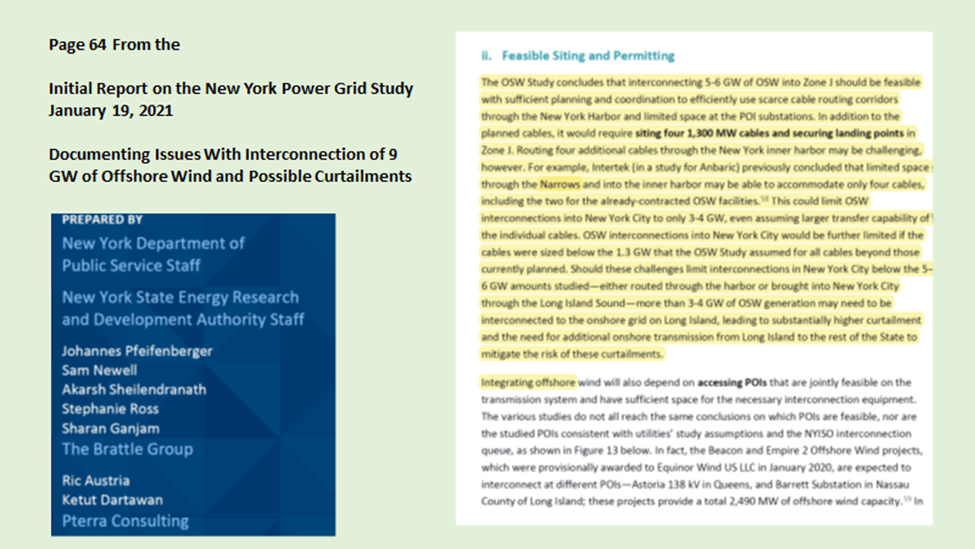
This is also apparent with regard to the 9 GW of offshore wind. There is a major concern about the availability of space to run the cables to interconnect the energy to where it is needed. One possibility is running the cables across Long Island in an environment where every infrastructure project is faced with lawsuits. As a result, even if they can build the 9 GW of Atlantic Wind, they may only be able to interconnect about 6 GW to where it is needed. That is clearly shown in another slide from the upcoming PowerPoint documenting a critical page in a NY State Power Grid report, below. Transferring renewable generation installation projects to NYPA may increase the rate of installation slightly but the node analyses will still have to be done that takes five years at present and the transmission lines will still have to be installed so the price will not be reduced.
5 – Air Source Heat Pumps On a System Not Fully Supported By Renewable Generation Will Not Reduce GHG. There are not Enough Drillers to install Ground Source Heat Pumps, which actually work, in any time frame that will yield significant results.
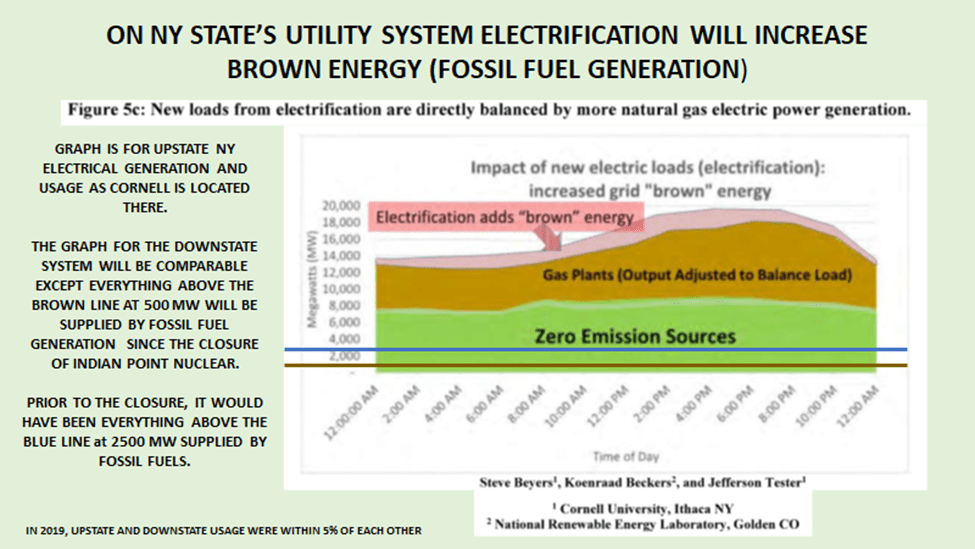
As is clearly documented in the slide below, putting electric onsite heating into buildings that are not fully supported by renewables just shifts the load to existing generating plants. In Germany, heat pump installation, primarily air source, exceeds gas combustion installation. However, despite installing massive amounts of renewable generation, while their household carbon emissions have declined by 28% since 1999, their utility system carbon emissions only declined by 3.4%. While they closed nuclear plants, they actually installed more Gigawatt hours of renewables. They should have seen a large GHG decrease, but heat pumps running on a system that uses fossil fuel generation add marginal additional load to the fossil fuel plants with higher emissions than an efficient gas boiler/furnace.
Germany is playing “Whack-A-Mole” with its building emissions and NY State is about to do the same thing. They beat down the emissions in one place and they pop up somewhere else. That chart was copied from a Yale publication “Can Germany revive its stalled energy transition?” published in about 2018. Based upon events 4 years later, the answer has been a resounding “NO” Even prior to the war in Ukraine, Germany was reopening coal plants. After the war started and they lost their gas supply, they opened even more coal plants and there were news articles about people across Europe stealing firewood, cutting down trees, and burning anything that they could find to stay warm. That will be the future of NY State with the proposed policies. Germany has been exceedingly lucky this year with a relatively warm winter, however they recently signed an agreement with Qatar to import 20 million metric tons of Liquid Natural Gas over the next ten years.
As the chart shown below from a Cornell Geothermal report clearly show, all additional load added to the system is supported by fossil fuel generation. Blue and Brown lines were added after to explain the difference between the upstate and downstate generation sources which in 2019 were within 5% of each other. However, in terms of zero emissions sources, they were worlds apart. The downstate system is almost entirely supplied by fossil fuels.
6 – Battery Storage is being added to the System Prematurely. The batteries will wear out at least 50 years before the state has enough renewable generation to charge them. As a result, they will be charged with fossil fuel generation with a 15% – 20% higher carbon footprint than the actual generation.
As all marginal generation in NY State is provided by fossil fuel generation, all new battery systems that are added will increase fossil fuel generation by a minimum of 15% related to that stored energy as 15% of the battery’s energy is lost in the Charge/Discharge cycle. The batteries will need to be replaced after about 10 years, well before the system will be supported by renewable generation. This is great news for Elon Musk, but not that good for the taxpayers and utility customers in NY State. The following slide was also borrowed from the same report.
7 – An Energy “Shell Game” is Being Used to Make the New Micron Technology Facility Appear Greener than it Actually Will Be under CLCPA rules. However, it could be made far “Greener” in reality by siting a combined cycle generating plant next to the Micron Facility. Nuclear generation would be better still, but that would take far longer to build and would have much higher upfront costs.
The New Micron Technology Facility in Clay, NY will eventually use more energy than the state of Vermont. NY State and NYPA have said that they will provide 140 Megawatts of NY Hydro to the plant. For lack of a better word, that policy is a farce. All of the NY State Hydro has been allocated for years. If they allocate it to the Micron Facility, those customers that are currently using it will then effectively be using fossil fuels. They want Micron to use all renewable energy. From Where? A solar array that could generate enough energy to support that facility would occupy 100 square miles. They want Micron the buy Carbon Credits. From whom? NY State’s two largest neighbors to the south and west, Pennsylvania and Ohio, average 1.5% renewable energy. If NY State has to import energy from either of those states to support the Micron facility, it will all be from fossil fuel generation, gas or coal fired, at a lower efficiency than a combined cycle generator. The import of energy from long distances to the Micron Site will increase transmission line losses by approximately 350 Gigawatts compared with a generator on-site. The new rules are going to make the Micron facility less energy efficient, more polluting, and also increase Micron’s operational costs while imposing environmental costs on the state. Forcing Micron to buy Carbon Credits does nothing to help the environment. It literally papers over the problem while raising Micron’s costs and doing nothing tangible to reduce greenhouse gas emissions.
8 – Renewable Generation Installation Rates are Insufficient to Support NY State’s Plan
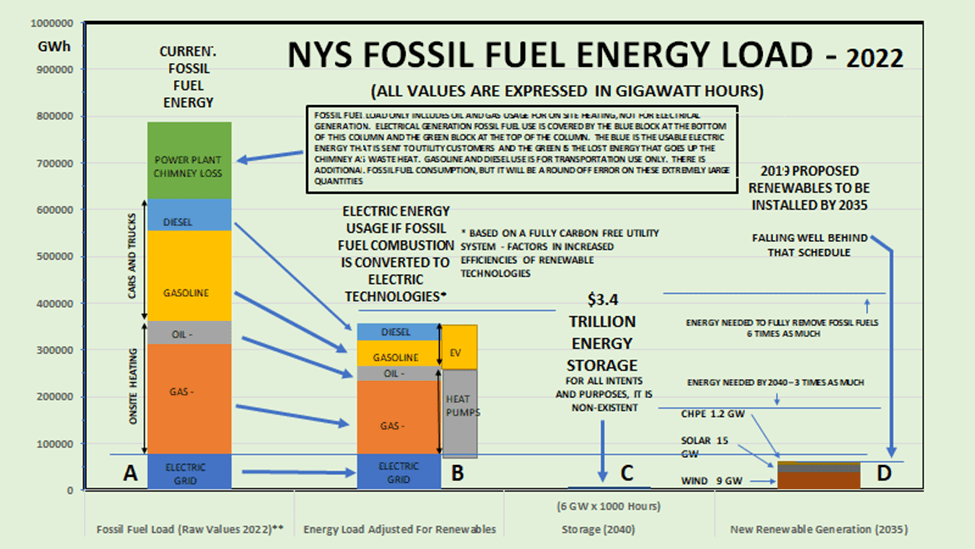
Even prior to many of the recent cancellations of renewable generation projects, NY State was not going to have enough renewable generation installed for about 60 years. Prior to the cancellations, NY State was going to be at least 120,000 Gigawatt hours short of what it would need to support the system on all renewables by 2035 as is shown in the slide below. With onsite fossil fuel combustion about to be banned in new building and replacement equipment banned after 2035, while EV’s are mandated for all sales after 2035, the system load is going to grow far more rapidly than the expansion of renewable generation resulting in an energy shortfall. Beyond the transmission issues facing the Atlantic Wind projects mentioned earlier, the Jones Act is going to slow the rate of installation for offshore wind by limiting the number of jack ships that will be available. While NY State is short on land, money, and grid capacity, the one thing that NY State has in abundance is lawyers so that any renewable project will be faced with years of NIMBY lawsuits and the resulting delays.
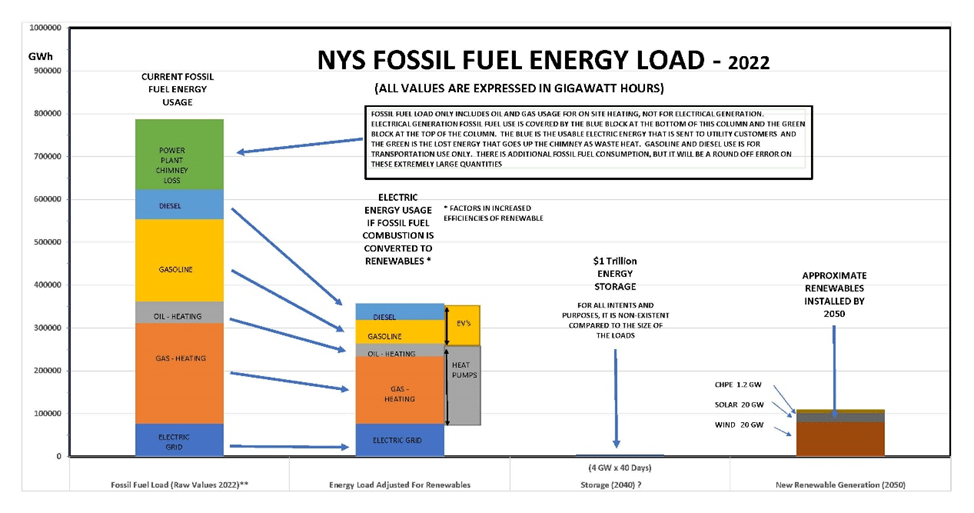
Just because California tried it that doesn’t mean that NY State should. California has a Mediterranean climate and is 20 degrees warmer in the winter so the orange and gray “energy blocks” in the fossil fuel column A on the chart below are much smaller. If NY State had the same climate as California, it would eliminate a need for about 150,000 Gigawatt hours of renewable generation on the future system. Keep in mind that California is having difficulty keeping the lights on without the albatross of onsite heating around their neck.
Four columns on the chart above are labeled A,B,C,D and are referred to in the conclusion.
“A” is the Existing Fossil Fuel Consumption in NY State. “B” is the Electric Load if all of that was converted to electric technologies on a fully GHG free generation system. “C” is 6 GW of 1000 hour storage as mentioned in the NY State Energy Storage report. Current cost using Lithium-Ion batteries, $3.4 Trillion. NY State is betting on technologies that don’t exist commercially yet and at present, have shorter lifespans than the 10 years of Lithium-Ion. “D” was the projected renewable installation for 2035 estimated in 2019 using figures provided by NY State. With solar projects being canceled, in 2023 that is an overly optimistic estimate.
Even if all of the existing fossil fuel generation remained static and no fossil fuel plants are closed, the additional load being mandated is going to outstrip the rate of renewable installation. As NY State is not allowed to build any new fossil fuel generation, one of two things will happen as a result of the energy shortfalls shown in the slide above. NY State citizens will be without lights and heat, or NY State will have to import large amounts of fossil fuel generation from out of state, just as California has had to do. When the neighboring states don’t have it available, NY State will have to impose rolling blackouts just as California now does, only the blackouts will occur on the coldest days of winter which will be far more deadly than the hot days during the California summer.
If Climate Change is truly the existential crisis that the authors of the CLCPA claim it to be, and if the recent UN report about the need to halve atmospheric carbon within 10 years is true, then NY State’s 60 – 70 year plan that is going to increase carbon emissions for at least the first 30 years needs some rethinking.
Keep in mind that NY States total GHG emissions are 350 million metric tons annually. Worldwide GHG emissions increased in 2021 by 2 billion metric tons, 40% of that from increased coal combustion in China, India, Germany, Japan, and other countries. So, the increase in worldwide GHG emissions in 2021 was six times NY State’s total annual emissions.
Because of the above fact, it is apparent that the rate of Climate Change is not in the purview of NY State policy makers. As resources are limited, instead of wasting money on building electrification that will yield no holistic improvements in GHG emissions, resources should be used to harden infrastructure against the inevitable negative effects of Climate Change, whether that is on grid infrastructure or flood mitigation. The most expensive and severe impacts of Sandy were on the underground infrastructure of NY City and along the Hudson River. Venice type barriers might be considered for under the Verrazano and the Triborough Bridges, however that will never happen if the state wastes $600 billion on an electrification plan with no positive upside.
A Better Plan –
The following, if executed properly could result in the energy chart, below, where the right hand column actually can supply NY State’s energy needs at a fraction of the cost of the current plan while also reducing fossil fuel energy use and the associated GHG emissions by 44%. However, people will have to allow techniques that don’t meet the current standard of ideological purity in NY State.
By eliminating the push to electrify buildings, the energy savings and carbon reductions will actually be greater than what the CLCPA will yield in practice. This alternative plan will need far less labor and storage resources. Existing resources can be allocated to grid infrastructure to support renewable installation and vehicle electrification. Vehicle electrification is the fastest way to improve GHG emissions. Eliminating storage requirements will reduce battery demand and costs, making EV’s cheaper.
All is not Doom and Gloom
What can be done to reduce GHG emissions considering the state’s lack of financial resources and the lack of sufficient renewable generation for at least seven decades? The following is a list of ten ideas that can be implemented relatively quickly that will help to rapidly lower GHG without breaking the piggy bank while also slowing or reversing the increase in utility bills
Do not electrify buildings that run on natural gas – while it will reduce GHG at the building, it will increase it as much at the generating plants while forcing residents and the utilities to incur enormous rewiring costs. There will be no reduction in current fossil fuel energy, Column A in the New York Fossil Fuel Energy Load figure. Also, the gas stove analysis that was done recently was mathematically flawed and should not be used to set public policy.
Focus heat pump efforts on locations that use oil heat or that use radiant electric heat. Those locations will see a significant reduction of GHG and heat pumps will reduce grid load when compared to radiant electric heat.
Focus resources on expanding grid infrastructure. This will reduce the cost of installing solar in Upstate locations and reduce the number of system cancellations allowing the state to increase the proposed renewable generating resources, Column D in the New York Fossil Fuel Energy Load figure.
Increasing grid infrastructure will also help with the installation of chargers for the electric vehicle wave that is about to arrive, with or without the state mandate.
Do not install large amounts of battery storage until there is sufficient renewable generation to support the storage. It will increase current fossil fuel energy (Column A in the New York Fossil Fuel Energy Load figure) while incurring an enormous capital outlay and starving other projects of funding. They will also decay well before sufficient renewable generation is installed.
Replace older generating plants with higher efficiency combined cycle natural gas generating plants. The state will need the energy to support the EV’s and the newer plants are far more efficient. It will lower Column A, reduce gas usage and put downward pressure on the commodity price.
Place an emphasis on hydrogen injection into natural gas combustion plants. It will decrease gas usage and increase combustion temperatures which reduces NOx emissions and lowers current fossil fuel energy, Column A. It will greatly lower GHG emissions related to those generating plants
Focus available natural gas resources on combined heat and power systems. It will reduce the utility bills for the system owners while also reducing requirements for grid infrastructure. Allow multiple building to form micro-grids to utilize the thermal output and increase the generation capacity. It will greatly reduce Column A
Allow Micron Technolgies to build a combined cycle plant the size of Cricket Valley Energy Center on their property. The Micron facility will use more energy than the state of Vermont. Instead of letting them be “green” on paper by buying carbon credits, let them be green in reality with high efficiency generation and have lower energy costs to make them more competitive and able to recoup the $5 billion rebate without faking it. That will eliminate the increase in column a related to the facility.
Figure out how the utilities can interconnect the 9 GW of offshore wind because at the moment, no one is certain how to do it. There is limited space for underwater cables. Without that, energy curtailments will occur and impede the increase of column d, unless they use the alternative idea which is to run transmission lines across Long Island.
Ellenbogen Conclusion
Ellenbogen Follow Up
The next day Ellenbogen followed up with another email with this warning.
In a speech to the British Parliament in 1948, Winston Churchill said, ‘Those who do not learn history are doomed to repeat it”.
As a conclusion to my email of yesterday, March 28, the following should serve as a warning to those proposing the current NY State Energy plan and expensive projects that are going to raise utility rates but do little for the environment.
The statement above by Churchill not only applies to NY State following Germany’s failed energy program. It also applies to something that happened just across Lake Ontario, much closer to home.
In 2009, Ontario, Canada passed the Green Energy Act. Ontario has a similar population distribution to NY State with large population centers to the south and more rural areas to the north. Hardships were incurred by the more rural areas in the building of renewable generation and sending the energy to the wealthier, more densely populated southern areas. In reading some articles on the subject, it was portrayed as a class war. The act might have survived that issue, except energy costs skyrocketed along with the perceived injustices and the combination led to the repeal of the Act after only 10 years. The Green Energy Act from 2009 is available here and an article documenting the repeal is here.
As I documented above, the state’s energy policies are going to cost trillions of dollars with far fewer carbon emission reductions than could otherwise be obtained at a far lower cost. Hundreds of square miles of solar arrays and wind farms are going to have to be built in rural areas that are already exhibiting a substantial resistance to the projects. The 2019 repeal of the act gave municipalities the right to control what energy projects could be built within their borders, just the opposite of NY State’s proposed legislation.
The quest for the perfect will be anything but and the inevitable voter rebellion that is going to occur in the not-too-distant future is going to leave the state with massive debt, extremely high utility costs, and little to no GHG reduction to show for it. In the interim, a decade will have passed where functional, inexpensive programs could be implemented that will actually reduce GHG in the real world, as opposed to the current program that only might work in Mark Zuckerberg’s fantasy Metaverse. It certainly hasn’t worked in any cold climate on Earth where it has been tried.
Utility customers are already feeling enormous amounts of pain. I have been receiving emails of late from politicians excoriating Con Ed for raising rates, however most of the increase is needed to comply with the mandates of the CLCPA. The increases are due to terrible policy and not utility rate gouging. As a clear example of how upside down this policy is, it actually has me defending Con Ed after they said some rather nasty things about me in a tariff hearing 12 years ago. I have a long memory and no love for Con Ed but this energy policy is going to end up turning the state’s utilities into piñatas through no fault of their own.
The utility rate increases are going to be far worse going forward as the costs documented in my email of yesterday are not figments of my imagination. The plan will not be sustainable. The state can’t borrow its way out of trillions of dollars of costs in an effort to subsidize utility rate payers to ease the pain that will be caused by this.
Beyond the actual costs, there is going to be a huge opportunity cost in terms of lost time imposed by the CLCPA that prevents working solutions from being executed, along with a souring of popular attitudes towards any future programs to reduce GHG.
In their overreach for an unrealistic fantasy, they are going to achieve nothing. Unfortunately, as bad as that is, that situation will be the best-case scenario. The worst-case scenario will be that they continue to push forward, ignoring utility customers pain, still achieving no GHG reductions, while creating energy shortages that result in loss of life.
The current energy policy has no long-term positive outcomes.
Caiazza Concluded Remarks
I could quibble with a few numbers and my take is slightly different for a few aspects but I am in complete agreement that this cannot possibly work. The biggest flaw in the Hochul Administration’s net-zero transition plan is the lack of a feasibility analysis. In 2018 I wrote the following.
We’re choosing between as yet undefined but surely expensive options trying to understand which one (or what mix) will be the least expensive. Unfortunately we don’t know but we need to start now because we’ve been told that we have to make reductions by 2030. If we make a good pick then we’ll spend the least amount of a lot of money and will be left with the fewest negative outcomes, but if we get it wrong, we will be left with many more negative outcomes and even higher costs for a long time.
Since then, the only thing I would change is that it is not just about the money, the possibility of catastrophic reliability outcomes must be considered because present wind, solar, and energy storage technology must be coupled with other ill-defined and speculative resources in order to work reliably. Clearly the first step and priority should be a feasibility analysis before anymore time and money is spent on this.
Roger Pielke, Jr. has been analyzing climate change risks since 1994. This post highlights his article published today that explains “explosive testimony this week argues that climate research has a serious conflict of interest problem.” At a recent meeting I heard several people who have caught on that this is a problem based on their gut instincts. Here’s documentation proving that they are correct.
Pielke’s climate research has strayed from the orthodoxy so he has been decried as a heretic. As he puts it:
I have argued that climate change poses risks and deserves significant action in response. I’ve also argued that our response efforts to date have been woefully inadequate. My views, which I have not been shy about sharing, have led some to try to exclude or remove me from the discussion, with some considerable success.
Blowback to his work is so bad now that when I did an internet search for his credentials the popup list of search suggestions included “Roger Pielke Jr climate denier”. He must have struck a nerve when he documented the fact that the continuing litany of so-called proof of climate apocalypse is not supported by the data because he was attacked by many. Based on the flak he receives he must be over the target because powerful people have tried all sorts of things to shut him up.
Here is his article in its entirety
Recently I was surprised to see a Tweet from a climate researcher who I’ve known for a while that looked like an advertisement for a particular renewable energy company. The researcher was promoting the company to his many followers. Reading on, I saw that the researcher disclosed that he was being paid by the company and had an equity interest. So it was an advertisement. Academics can also be investors, right? So no problem?
Well, here is the problem. This researcher was one of the central analysts whose work was used to design and then promote the passage of the Inflation Reduction Act. The company he is promoting is a direct beneficiary of that legislation. At the same time, the researcher claims that his analyses offer an “independent environmental and economic evaluation of federal energy and climate policies.” BS. There’s a sucker born every minute.
I called out the researcher on Twitter for taking money not just from one but from many companies that are direct beneficiaries of the legislation he helped to design and sell to policymakers and the public. He responded to me in a huff — proclaiming his noble intent and track record of advocacy for renewable energy for many years (almost as bad as the climate researcher who told me she could not have a conflict of interest because her husband was a preacher). All that may well be true, but goodness, this absolutely stinks.
I’m not naming the researcher (you can find him easily enough), because his case is far from unique in climate research these days, and this post is about a far bigger more important issue.
There is a gold rush going on in climate research right now, as researchers scramble to cash in on their new-found access to politicians and philanthropists. As Professor Jessica Weinkle of the University of North Carolina-Wilmington stated in her opening remarks in testimony before the U.S. Senate last week, “Today, it is not easy to separate the going-ons in climate change research from the special interests of financial institutions.”
She continues:
The landscape of climate change research is made complicated by an outcropping of non-profit advocacy organizations that double as analytic consultants, hold contracts with private companies and government entities, and engage in official government expert advisory roles- all while publishing in the peer reviewed literature and creating media storms.
This is not really an issue of any one entity. It is pervasive.
Experts monetizing their expertise is one important reason why people become experts, and there is no problem with people seeking to make a buck. But where expertise and financial interests intersect, things can get complicated. That is why there are robust mechanisms in place for the disclosure and mitigation of financial conflicts of interest, a subject I’ve focused on for decades.
All of this is just common sense. Your doctor can’t prescribe you drugs from a company that pays him fees. You wouldn’t think much of a report on smoking and health from a researcher supported by the tobacco industry. Should climate researchers play by a different set of rules, because the cause is so important?
Call me a stickler, but in my view, the more important the cause, the more important it is to enforce standards of research integrity.
Following her testimony, Weinkle addressed a few questions that were raised at the Senate hearing. Here is her response to the first one:
Well… I don’t know if it was really a question. It was a set up to imply that the only conflicts of interest that should matter are those coming from the fossil fuel industry.
I don’t agree. At. All.
Frankly, that’s absurd.
In fact, when people argue that the only conflicts of interest that matter are those held by their opponents they are saying that the rules of the game don’t apply to themselves or those that support them.
Conflicts of interest are a concern for scientific integrity no matter where the money is coming from.
Further, it was implied in the hearing that only the fossil fuel industry hides what they are doing by donating to non profit groups that then do research. No.
I encourage you to read Professor Weinkle’s testimony in full. She cites three examples of many that raise serious questions of financial conflicts of interest in climate research (see the testimony for all the footnotes, which I removed here):
Central bank stress testing scenarios are developed by researchers who are also lead authors on IPCC reports and have important roles in organizing the international modeling community in the development of IPCC scenarios. Funding for central bank scenario development and the most recent meeting of the scenario modeling community comes from influential organizations including, Bloomberg Philanthropies, ClimateWorks, and the Bezos Earth Fund.
McKinsey & Company used a climate consultancy to produce a series of widely influential reports on climate change financial risks. In defense of their use of RCP 8.5 the report cited a peer-reviewed publication written by its own consultants. The researchers did not declare their COI as consultants for McKinsey or their association with the asset management firm, Wellington. Shortly after publication of the article one of its authors landed a political position while the authors’ home institution announced coordinated efforts with Wellington to influence SEC regulatory decisions.
The Risky Business Project, an academic-industry research collaboration was organized by three wealthy politicians with the goal to “mak[e] the climate threat feel real.” Research products are important components to national climate and sea level rise assessments, and a policy advocacy tool used to evaluate real estate flood risk. Core members of the research collaboration move seamlessly between private consulting, policymaker science advisory positions, and academic research.
Again, this stinks.
Nothing could be more delegitimizing to climate science and policy than a toxic combination of unmitigated financial conflicts of interest and claims that climate researchers, by virtue of the noble cause, are exempt from the rules that govern every other setting where expertise and money intersect.
I’ll let Professor Weinkle have the last word today:
Climate change science demonstrates an underappreciated dynamic system of conflicts of interest among climate change researchers, advocacy organizations, and the financial industry.
If you haven’t subscribed to Professor Weinkle’s Substack, called Conflicted — run, don’t walk, and sign up — link below.
Early this year I described the outsized influence of a few individuals on the Climate Act and the Climate Action Council. When the Council deigned to address any dissenting comments regarding the implementation analyses, most of the members dismissed those considerations as misinformation funded by the fossil fuel industry. I believe they ignored a more serious instance of a conflict of interest.
Richard Ellenbogen frequently copies me on emails that address various issues associated with New York’s Climate Act. I asked his permission to present his analysis of the New York State Energy Storage Roadmap Report as a blog post here.
I believe that he truly cares about the environment and the environmental performance record of his business shows that he is walking the walk. Ellenbogen is the President of Allied Converters that manufactures food packaging. His facility is about 55,000 square feet and does a lot of manufacturing with heat to seal the bags, all electrically driven. The facility has solar panels and uses co-generation. He explains:
In 2008, the average energy cost per square foot for a commercial facility in Westchester was $1.80. We were at 16% of that 12 years later and even with the increases, we are at 62% of that 14 years later. That has been done while having a carbon footprint 30% – 40% lower than the utility system. The $1.80 per foot also included commercial office space and our operation is far more energy intensive than an office. We use energy extremely efficiently and as a result, our bills are much lower than everyone else.
NY State Energy Storage Report
On December 28, 2022 the New York Department of Public Service and New York State Energy Research and Development Authority released New York’s 6 GW Energy Storage Roadmap: Policy Options for Continued Growth in Energy Storage (Roadmap Report). I did a couple of posts (here and here) on the Roadmap Report that concentrated on the costs. Ellenbogen’s analysis fills in another part of the story. His lightly edited description of the feasibility follows.
This is another document of such questionable quality that had I presented it to my superiors when I worked for Bell Labs and asked them to implement a multi-billion dollar project based upon it, they first would have rolled on the floor laughing thinking it was a joke, and then when they realized that I was serious, they would have promptly terminated me. No sane entity would embark on a project based upon such questionable parameters as are shown in this document. This is not science or engineering. This is politics disguised under a veneer of technical terms designed to delude the public that won’t take the time to read its 104 pages. The fact that this policy is being pursued based upon documents such as this is borderline criminal (And maybe not so borderline. Just plain criminal).
Note that the page numbers I list are the pages of the pdf and not the document page numbers to enable easy searching of the document using Acrobat.
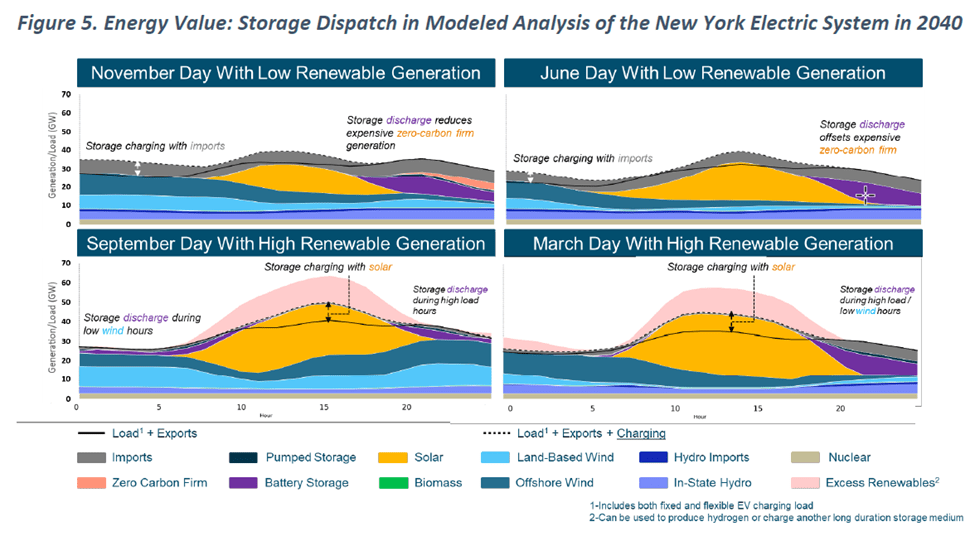
We can start with the fantasy on page 31 in Figure 5 (Also duplicated in the analysis in Appendix A) that immediately makes the entire document questionable. It has all of the storage being charged by renewable energy by 2040 which will be impossible based upon NY State’s rate of renewable installation and the rate at which loads are being mandated to be added to the system. (See below. There is no fossil fuel generation even listed and it doesn’t list the composition of the “Imports”. If they are like California’s imports, they will be coal generation. Very environmentally friendly.) Germany has been doing this for 32 years and has reached a 34% carbon free system with very few EV’s on the road. While NY State is starting at 41% carbon free because of Niagara Falls and its upstate nuclear plants, the new renewables are not even going to offset the added load that has been mandated by state policy starting in 2024 and going into overdrive in 2030 and 2035 for EV’s and Heat Pumps, let alone replace all of the fossil fuel generation. 2040 is only 17 years away. By 2050, the upstate nuclear plants will be 75 years old and nearing the end of their useful lifespan. What will replace them?
Also, why are they using shoulder months in the analysis? What will happen in July, August, January, and February when the electric load peaks? That is what has to be analyzed as that is the worst-case scenario and is when the system will be most likely to fail. The most likely reason for that is that the numbers and graphs looked so bad for those months, even in fantasy land, that they couldn’t be displayed for what they would show.
If you look at the following graph (link), the right-hand column documents the new renewables that will be available to offset the loads that they will be adding and it is clearly insufficient even if only 30% of the vehicle fleet is electrified and 10% of the buildings.
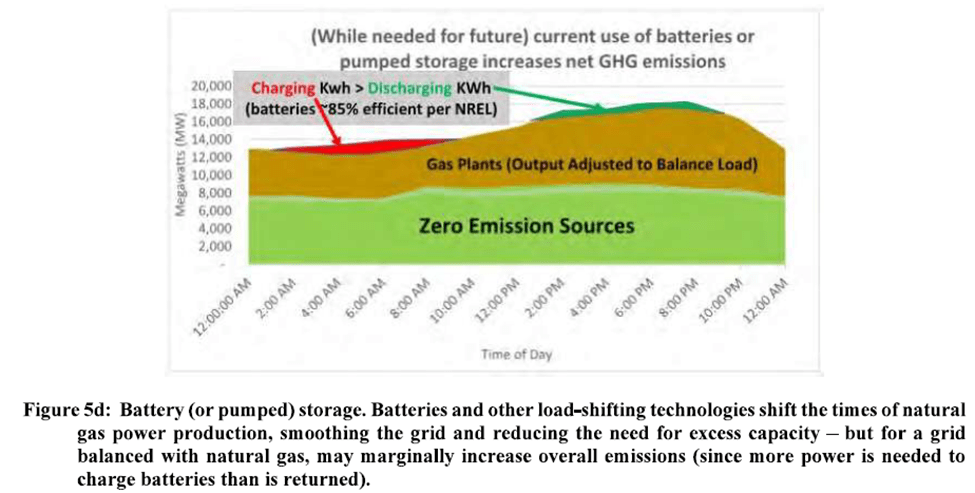
Instead of Figure 5, the reality will be closer to Figure 5d below, produced by Cornell University and the National Renewable Energy Laboratory, which show the batteries being charged from fossil fuels and 15% to 20% of that energy being lost because of charge/discharge losses, which is actually going to increase NY State’s carbon footprint. The storage losses are acknowledged in the Roadmap Reprt document on page 99 where it says that the battery owner will have to buy 1.15 MWh in order to sell 1.0 MWH, implying a 15% energy loss.
If that isn’t bad enough, on page 89 the Energy Roadmpa says,
Customer load shifting can provide many of the same flexibility attributes as battery storage, by enabling reductions in peak demand, and shifting demand to times of high renewable output. As a result, there are direct impacts of lower or higher amounts of end use flexibility on the economics of battery storage. In the base case, 12.5% of the light duty EV charging load is assumed to be flexible by 2030, increasing to 25% by 2050. In addition, 50% of the hydrogen required economy-wide is assumed to be generated via electrolysis within New York, and this electrolysis load is assumed to be highly flexible as well to make the most of excess renewable energy when it exists.
As clearly documented, WHAT EXCESS? What are these people looking at? THIS DOCUMENT IS NOT BASED UPON REALITY!!!
Further, Hydrogen electrolysis loses 20% of the energy when Hydrogen is generated from the water and then about 60% of what is remaining is lost during combustion for a total energy loss approaching 70%. That’s not a great tradeoff when you don’t have enough energy to start with.
For some reason the filed report on the NYS DPS DMM site for Case 18-E-0130 – In the Matter of Energy Storage Deployment Program includes a cover letter. That letter lists the storage capacity as a power value and not as an energy value. The title of the cover letter is “Re: Case 18-E-0130 – In the Matter of Energy Storage Deployment Program” and then at the top of the next page the cover page of the document says New York’s 6 GW Energy Storage Roadmap: Policy Options for Continued Growth in Energy Storage however, Gigawatts (GW) are Power, not Energy. While some may think that this is nitpicking, it isn’t. Engineering students can fail tests over incorrect units. All of the energy storage targets are listed as power, not energy. The system runs on energy and with an intermittent renewable driven system, the storage duration is critical. Nowhere will anyone be able to determine how long the storage will support the system except on page 15 and those figures should be included with the question, “Are you kidding me?” next to it. The explanation is below.
In fact, if anyone searches the entire pdf for “WH” to find all of the references to energy that are contained in it (Gigawatt Hours – GWh, Megawatt Hours – MWh, and Kilowatt Hours – KWh) the vast majority are devoted to information about rebates and costs and not what will be available to run the system. Most of what was found were “What”, “Why”, “Which”, but very little about system capacity except in a couple of places. On page 15 the Energy Roadmap discusses the cancellation of 20% of the battery projects:
While the program initially procured 580 MW and 1,654 MWh of energy storage, cancellations have brought these numbers down to 480 MW and 1,314 MWh.
Keep in mind that the pre-cancellation figure of 1654 MWh of battery storage with a 580 MW Power Capacity is less than THREE hours of storage for the bargain price of $193 million in state incentives. During a heat wave, peaker plants can run for days. On page 25 of the pdf, it states that many of the peakers only run 5% to 10% of the year, which equates to 440 – 880 hours annually, however much of that time is contiguous during periods of high load and is far longer than 3 hours so how can a 3 Hour battery keep the system running if replacing a peaker plant?
On page 27, the Energy Roadmap discusses the possibility of using EV’s to offset a shortage of storage. You can tell that whoever wrote this lives in Albany and not downstate where a large number of people live in apartments. Vehicles parked on streets are not going to be able to discharge to support the system in times of need. Are they planning on putting a bidirectional charger on every parking spot in every downstate garage and on every parking spot on the street? What will that cost and who will install it? In New Rochelle, it took several months to install about ten internet kiosks with multiple street cuts to house data cables. How long will it take to install thousands of chargers supported by far larger megawatt power cables to enable vehicle charging? Also, having driven a Tesla for nearly six years now, I can safely say that trying to run a domicile for any extended period with the car’s battery and still having energy remaining to commute are mutually exclusive. Again, times of peak load can run for days during the summer. Winter peak load durationss will be similar in NY State during future winters when large numbers of heat pumps are installed.
On page 40 of the pdf, under 4.3 “Barriers To Energy Storage”, it says:
As highlighted in other sections of this Roadmap, one of the most critical barriers to energy storage projects relates to the uncertain and insufficient nature of the revenue available through existing markets and tariffs, particularly capacity revenue. Retail or distribution-level projects, participating in certain regions through VDER, provide investors with a more certain revenue stream; however, these projects are still difficult to underwrite given the variable nature of both capacity and energy prices.
On page 9, it says:
Over the past year, supply chain constraints, material price increases, and increased competition for battery cells have driven up the cost of energy storage technologies, particularly lithium-ion batteries. Many of the drivers of cost increases are expected to persist until at least 2025. These cost increases may impact the cost of any new programs designed to procure storage to be installed by 2030.
How they can predict the cost of commodities out past five years is beyond me, but it is safe to say that with everyone trying to install storage and at least nine states mandating electric vehicles, the demand is only going to make the price of storage go up and the materials will be scarce. That doesn’t require a Crystal Ball, only a small degree of common sense.
The document states that the residential incentive is $ 250/KWh as seen on page 17, however if you look on page 37 it says:
Since July 2021, prices for lithium carbonate, a key ingredient of lithium-ion batteries, have increased 500%. Among projects awarded NYSERDA incentives, average total installed costs for non-residential, retail projects averaged $567/kWh for installations occurring in 2022 and 2023, up from $464/kWh for installations in 2020 and 2021, an over 20% increase in total costs. This is consistent with recent industry reports that indicate near-term increases in storage costs.
That cost increase helps to explain the battery project cancellations.
Then on page 104, it says “Stakeholders across all segments that were surveyed or engaged with brought up increases in lithium-ion battery pricing over the course of 2021 and 2022 as a fundamental challenge to deploying storage and the development of the storage market going forward.”
On page 94 it does imply that 1000 hours of storage will be needed. “With seasonal storage (1000+ hours), the availability of a specific resource during critical weeks – or in between multiple critical weeks in a season matters less; instead, the cheapest form of energy”
Coincidentally, that is almost the same time frame (40 days) that I showed on the graph above that was created about 5 weeks ago. However, at the current average national cost of utility grade storage of $283 per KWh, 4 GW of storage that will last for 960 hours will cost over $1 TRILLION.The 6 GW will cost over $1.5 TRILLION. But with the escalating costs of Lithium, that figure could easily reach $ 3 TRILLION. That figure is fourteen times the entire NY State budget for 2023. The Inflation Reduction Act had $387 billion allocated for renewable energy projects for the entire United States. That will just be the cost of the storage, independent of the cost of the renewable generation needed to charge it.
Conclusion
So basically what they are saying is, “We aren’t sure how the economics of this is going to work but we are going to mandate its installation in lieu of fossil fuel plants, with an unknown price structure, increased energy losses when there already isn’t enough energy to support the system, insufficient capacity to replace the peaker plants that we are trying to close, rapidly escalating costs for the battery storage that already is not affordable and are only going to get more expensive in the future, and cross our fingers that this won’t make it impossible to complete the installation of 6 GW of energy storage. However, in the interim, we will have shuttered the energy plants that we have for ones that we can’t afford to install.”
They are pushing forward with it anyway when it is doomed to fail. This goes way beyond money. The inevitable failure is going to cost lives and they don’t even seem to care. I was able to produce this analysis in hours. They’ve had years to ponder these issues. This is insanity and again, it is borderline criminal.
If they gave a damn, they would say, “Wait a minute. This isn’t going to work. We’re going to kill a bunch of people. Maybe we should rethink this.” Unfortunately, they aren’t doing that.
Caiazza Closing Thoughts
New York State’s GHG emissions are less than one half a percent of global emissions. Global GHG emissions have been increasing on average by more than one half a percent per year since 1990. That does not mean that we should not do something but it surely calls into question why these limitations of the proposed plans are being ignored. There is time to make sure the net-zero transition does not do more harm than good. I fully agree with Ellenbogen’s frustration that fundamental feasibility questions are not being addressed and his conclusion that this is insanity.
I recently got an email from Ronald Stein that raised an energy literacy issue that has been something I wanted to write about for some time. New York’s Climate Leadership and Community Protection Act (Climate Act) mandates a transition of the energy system to one with no fossil fuel infrastructure. What about the 6,000 products that are manufactured using fossil fuel feedstocks?
Everyone wants to do right by the environment to the extent that they can afford to and not be unduly burdened by the effects of environmental policies. Unfortunately, looking solely at fossil fuels as evil and not considering the enormous benefits of fossil fuel as an energy source and as the material used to manufacture so many items used by society is misplaced. I submitted comments on the Climate Act implementation plan and have written over 275 articles about New York’s net-zero transition because I believe the ambitions for a zero-emissions economy embodied in the Climate Act outstrip available renewable technology such that the net-zero transition will do more harm than good. The opinions expressed in this post do not reflect the position of any of my previous employers or any other company I have been associated with, these comments are mine alone.
Energy Literacy
In this section I quote and paraphrase the material from the email.
Ronald Stein is a professional engineer, energy advisor, and national TV commentator, Ron has spent much of his life trying to get more people to truly understand energy – where it comes from, how it works, and what we can expect in the future. After starting off his career as a project manager for refineries and chemical plants, Ron later did a stint at Universal Studios where he oversaw the building of the Jaws ride. Eventually, he would start his own company, PTS Advance, which partners with engineering firms and refineries to augment their core staff when excess needs arise. The family-owned business now has locations across the country, with over 1000 contractors staffing various energy infrastructure projects.
His email explained:
Energy literacy starts with the knowledge that renewable energy is only intermittent electricity generated from weather dependent breezes and sunshine. For the 8 billion on this planet, wind turbines and solar panels cannot manufacture any of the 6,000 products in our daily lives, nor any of the fuels for ships, planes, militaries, and space programs.
It went on to provide a few takeaways on energy literacy, i.e., the elephant in the room that no one wants to talk about:
The potential for nuclear fusion for unlimited zero-emission electricity is exciting. It has the potential, in the decades ahead, to wean the world from coal and natural gas for electricity generation.
Facing reality, fusion, like wind, solar, nuclear, and hydro, ONLY generate electricity. None can manufacture any products, or fuels for transportation infrastructures needed by the 8 billion on this planet.
On the other hand, we have crude oil that is never used for generating electricity, AND is virtually useless until its manufactured into usable products via the 700 refineries around the world.
Today, the world’s 8 billion are dependent on more than 6,000 products made from the oil derivatives manufactured from crude oil, and the 50,000-merchant ships and 50,000 jets, and militaries, and space programs are based on the fuels manufactured from crude oil.
We may have long-range plans to generate electricity from wind, solar, and nuclear fusion, but no plans to replace crude oil that is manufactured into everything in our daily lives.
Energy literacy will enhance one’s comprehension that the cost of energy affects everything, from the food we eat, the clothes we wear, transportation, communications, housing, healthcare, and the leisurely living made possible by energy.
The world needs to comprehend that energy is more than intermittent electricity from wind and solar. Ever since the discovery of the versatility of products available from petroleum derivatives, and the beginning of manufacturing and assembly of cars, truck, airplanes, and military equipment, the world has had almost 200 years to develop clones or generics to replace the crude oil derivatives that are the basis of more than 6,000 products we use such as: medications, electronics, communications, tires, asphalt, and fertilizers.
The social needs of our materialistic societies are most likely going to remain for continuous, uninterruptable, and reliable electricity from coal, natural gas, or nuclear electricity generation backup, and for all those chemicals derivatives that get manufactured out of crude oil, that makes everything else that’s part of our daily lifestyles and economies.
The purpose of the email was to announce a podcast posted January 14, 2023 at Energy Media about the elephant in the room, the products manufactured from fossil fuels that built the world from 1 to 8 billion in less than 200 years, beginning right after the discovery of oil. Ron explains:
There’s no doubt about it, our entire modern society – from medication to food to infrastructure and beyond – all was made possible thanks to the discovery of oil. When talking about the energy transition, Ron cautions dropping oil and gas before reliable alternatives are readily available. To him, that’s like “jumping out of a plane without a parachute.”
For more, check out Ron’s interview with The Epoch Times for a video that has already been viewed more than 200,000 times! “The 35-minute YouTube video is a conversation about the elephant in the room that no one wants to talk about: the lack of energy literacy in the bizarre California energy policies.” The emphasis on the video is on California’s policies. It is entirely relevant to New York’s Climate Act.
Climate Act Implications Conclusion
One of the talking points of proponents of the Climate Act is that many clean energy jobs will be created. Stein’s work makes the point that the clean energy jobs are only associated with making electricity. In addition, most of the clean energy jobs are construction jobs and not associated with operating the generating resources. New York’s over-riding emphasis on reducing GHG emissions means that fossil fuels that can be used to make electricity but also provide fuel for heating and transportation and support manufacturing will be prohibited. I am pretty sure that is going to lead to a net loss of jobs.
The other relevant point is that the Climate Act fails to consider any positive impacts of fossil fuels. Eliminating fossil fuel infrastructure in the state means that no manufacturing that uses fossil fuels as feed stock will be welcome in the state. I also find it hypocritical that there is no backup plan for the replacing fossil fuel feedstocks used to make the products in the following figure.
Stein makes the important point that today’s society requires not only reliable electricity but all the chemicals derivatives that get manufactured out of crude oil and natural gas. Failure to consider the value of 6,000 products that are manufactured using fossil fuel feedstocks under values fossil fuel benefits to society in the Climate Act.
This is a guest post by Mark Stevens, a regular reader at this blog. Mark is a retired science and technology teacher. When he sent an email with this I asked if I could post it and he agreed.
Cut Greenhouse gasses! Save The Planet! A better vehicle! Really?
I didn’t know EVs (electric vehicles) are about 1000 lbs. heavier than their petroleum equivalents and therefore have higher brake wear (increased particulates), tire wear (increased nano particles), and require more charging energy.
I didn’t know EVs’ batteries lose power in the cold and reduce their range, and the batteries need replacing after several years approaching half the cost of the vehicle.
I didn’t know the rare elements needed in EVs like lithium, cobalt, copper, nickel are mined in third world countries where child slave labor is used to mine the metals and the metals obtained are refined resulting in mass poisoning of the land and water and massive greenhouse gas emissions are emitted in the refining.
I didn’t know the grid doesn’t have the capacity to charge EVs on a massive scale which will lead to rolling blackouts like California, North Carolina and Texas when many families are charging at the same time.
I didn’t know that electricity providers will boost rates significantly higher to charge EVs at home resulting in cost-of-operation higher than a gasoline car.
I didn’t know the total greenhouse gas emissions in EV cars from obtaining rare earths to fabrication to end-of-life disposal is greater than that of conventional cars.
I didn’t know that if EVs were really viable they wouldn’t need thousands of dollars of taxpayer subsidies.
I didn’t know EV batteries can suddenly explode in an unstoppable fire that emits toxic gasses. This results in ordinances requiring EVs to NOT park in garages.
I didn’t know the EVs’ components are not easily recyclable and end-of-life disposition is a major problem for landfills, recyclers and incinerators.
I didn’t know Connecticut’s fleet of electric busses were withdrawn due to several catastrophic fires.
I didn’t know a home charger costs thousands of dollars.
I didn’t know a 500 mile trip would require hours of recharging on the way.
I didn’t know I would have to detour and spend time finding a street charger.
I didn’t know low and middle-income Americans will find using and affording a new or used electric car will be unaffordable.
I didn’t know the tax on your gasoline to keep our roads maintained will soon be replaced by a special tax on your electric vehicle registration as make-up.
PKG Equipment is a second-generation, family-owned company. It is a manufacturer and service provider of equipment typically used in the finishing, chemical manufacturing, steel manufacturing and glass manufacturing industries. PKG Equipment was founded in 1969 by Sam Pontarelli, the current management team’s father, and two partners who sold their shares to him in the1970s. During the 1970s, the company began fabricating plating equipment using thermoplastics, and it purchased European plastic welding and forming machines in the early 1980s. PKG Equipment began manufacturing turnkey plating systems and also became a distributor for related equipment.
Comments
Stephen Pontarelli is the CEO and with a little bit of help from me prepared the following comments.
I live in the Rochester area and own PKG Equipment, Inc. that employs 25 people. Energy costs are a major consideration for my family and our business. I am submitting these comments because the Climate Action Council has not done a satisfactory job explaining what the Climate Act transition will cost, how it might threaten energy reliability, or how it will affect my business.
I have been unable to find any detailed cost information. What is the expected cost of electricity? I have seen articles that noted that energy costs in Germany have increased markedly as they implement a similar transition. What is New York going to do differently than those other jurisdictions that have seen cost increases?
I understand that the transition plan boils down to electrifying everything. I am particularly concerned about heating our manufacturing facility. It sounds like the preferred electrification approach is to use heat pumps. My understanding is that they only work well during the coldest periods of the winter if the structure is very well insulated, has improved window treatments, and reduces air infiltration. There are a number of considerations that make those improvements problematic. Will there be support available to upgrade our building’s insulation and windows? How am I supposed to minimize air infiltration at the loading dock? Also, our manufacturing process uses natural gas for our curing ovens and heat treating. Replacing that equipment alone would approach $1,000,000. That doesn’t include getting the appropriate amount of electricity to the building. We would need a ridiculous amount of electricity to run this equipment. Our small business can’t afford this transition.
I understand that the future electric grid is supposed to rely on intermittent wind and solar generating resources. I figured out that your scenarios for future implementation call for about 150% of the total existing generating capacity of the state, that land-based wind is supposed to increase by nearly an order of magnitude, and that battery energy storage capacity will be close to today’s fossil generating resources. Surely developing all those resources is going to be incredibly expensive so it seems certain that energy costs for my business and home will increase markedly. I think it is necessary to include a clear explanation of all the control measures proposed, the assumptions used to project the costs, and a description of the emissions reductions expected for the Draft Scoping Plan strategies.
There is another worrisome aspect of future energy resources. The Draft Scoping Plan mentions a zero-carbon firm resource as a necessary component. I think it is incredibly risky to rely on an unproven resource. Finally, I was asked to consider bidding on a component system for an offshore wind turbine project. I cannot imagine, based on my background and expertise, that all the components necessary for those systems will be available to be installed per the proposed schedule. At the same time, I have heard that there is considerable pressure to stop all investments in existing fossil fuel infrastructure. I am concerned that shutting down systems based on an unrealistic implementation schedule for a technology like offshore wind that has not developed the infrastructure to transport and install the turbines is a serious risk to reliability. Therefore, I recommend that implementation is conditional based on determining upfront standards of affordability and reliability once costs for the unproven zero-carbon firm resource are determined and the development issues associated with offshore wind are known so that a realistic schedule can be developed.
I am not willing to accept higher costs, lower standards of energy reliability, or limitations to my business operations unless there is a clear tangible benefit. I have read compelling arguments that the Draft Scoping Plan benefits are over-stated and that in fact the actual costs of the program far exceed the benefits. In that regard, I don’t understand what is meant when the costs and benefits are presented “relative to the Reference Case”. Given the fact that total New York State greenhouse gas emissions are less than the annual increase in global greenhouse gas emissions, the obvious conclusion is that upfront standards of affordability and reliability must be set such that the Climate Act transition does not do more harm than good to New York State.
Conclusion
Frankly when I have thought about the industrial transition from natural gas to electricity that will be mandated by the Climate Act, I thought mostly about big manufacturing companies. I have seen no sign that the Climate Action Council hasn’t been thinking the same thing. The fact is that PKG Equipment represents the smaller companies that do not use natural gas for most of their processes but only for a couple of pieces of equipment. Replacing that equipment will be a major burden for small companies. In addition, those processes will require a lot of power that will very likely require service upgrades for their building and depending on the location distribution system upgrades.
I know the Pontarelli family. They all are from New York, want to stay in New York, and, through their hard work, provide jobs for 25 people. They are representative of many other small companies throughout the state. I despair that the financial impositions of the Climate Act will force them and the other similar companies to leave New York in order to remain competitive with businesses outside of New York.
Gary R. Schoonmaker is a lifetime citizen of New York State; a licensed Landscape Architect with over 18 years experience at an electric and gas utility in New York State; and involvement in many environmental organizations in Central New York. He designed and built an energy efficient home in 1978 which had an air-to-air heat pump and now has solar panels; and has over 40 years experience in real estate development.
Schoonmaker Verbal Comments
On April 26, 2022, Schoonmaker used his two minutes at the public hearing at the College of Environmental Science and Forestry in Syracuse (3:22:15 of the video recording) to present his credentials and raise serious concerns about the practical limitations on implementing the plan as proposed in the draft scoping plan. If you want a good overview of the comments then I recommend his comments in no small part because of his effective presentation.
He described his verbal comments as follows:
In my testimony, I questioned the reasonableness of coercing compliance from state residents instead of offering people a solution similar to previous energy transitions where people chose the change themselves, e.g. kerosene or whale oil to electricity, or horses to automobiles. One could add any number of other transitions: pony express to telegraph, telegraph to radio, radio to television; crank telephone to corded telephone to wireless to cell phones; coal or wood to other fossil fuels for space heating; open windows to air conditioning; the list goes on and on! The commonality for all of these is that people chose to adopt these changes for themselves because they believed the new technologies bettered their lives and were in their own best interests. The government did not dictate or coerce the whole of society to change based on their assumed wisdom. They trusted the people to make the best decisions for themselves.
In the present situation however, the government, in the form of the State Legislature, the Governor, the Climate Action Council, and other agencies (including the Public Service Commission), have now decided they know best and are proposing to use the power of the State to coerce change because they think they know best. No gas connections after 2024; no gas appliances after 2030; no fossil fueled vehicles after 2035……. And on and on with little regard for the desires of the citizens or their freedom to live their lives as they see fit.
I also addressed the impracticality of doubling the capacity of the electrical system: generation; transmission; distribution, in the next eight years as proposed. Ask anyone in the utility industry with experience in constructing new facilities how long it takes to design, get approval for and construct new or even upgraded facilities and they will tell you that doubling capacity in eight years (or less) is not only impractical, but impossible. Even if by fiat the State was to order such a change, there is little recognition in the plan for the social upheaval that would result from constructing hundreds of miles of new transmission lines and digging up every urban area and suburban neighborhood with underground utility services for years in order to implement the upgrades.
Written Comments
I have posted the complete set of comments for your information. Because they are so extensive, I am not going to provide them all here. Instead, I will provide some highlights of the main points presented.
The comments pointed out the practical problems converting the entire energy system to electricity. The schedule is impractical solely due to the number of conversions of homes, businesses, and vehicles. Throw in supply chain, technology development needs, and supporting infrastructure requirements he notes that the level of this transition on the proposed schedule just can’t work as proposed.
He raises philosophical concerns. He asks “how sure are we that climate change is real; that man is the principal driver of climate change; that man’s actions can be modified to effect a meaningful change; and that such change would actually benefit mankind?” I particularly like his discussion of “settled science”:
Man-induced climate change is not “settled science” no matter what we are told. In fact “settled science” is an oxymoron to science itself. Science is the continual process of questioning everything. When someone tells you not to question, they have stopped being scientists and become politicians with an agenda. In fact, there are many highly qualified scientists who question the theory of man-induced climate change and the practicability of man being able to control the climate in meaningful ways. Honestly, the idea that men can control climate is egotistical at best and ridiculous at worst. Man is much more capable of adapting to, rather than controlling climate or weather.
He also raises technical issues with climate modeling. I like this comment:
They are trying to project the climate for the next hundred years. Really!?! There are so many data points and interactions, that such an effort is futile. Considering that the input data is from a couple of hundred of years at best, the period of record seems horrifically short considering that climate has been changing for thousands of years. Then they want us to believe that they understand and have programmed the models to accurately predict the interactions of the millions of variables.
He also raises two legal issues:
When is the New York State Environmental Quality Review Act (SEQRA) triggered and the plan subjected to that review?
The plan appears to violate the “taking” provision of the United States Constitution’s 5th amendment and the New York State Constitution.
In my opinion the response to the SEQRA question raised will be that they did do an analysis. However, to my knowledge they have not evaluated the current projections for wind, solar, and energy storage development. Also note that there is a generating type called dispatchable, emission-free resource that is projected to have a capacity (MW) approximately equal to the current fossil-fired capacity. They cannot possibly determine environmental impacts without knowing what that resource will be.
The legal question about the taking” provision of the United States Constitution’s 5th amendment and the New York State Constitution is an interesting point. As he points out “the forced abandonment of natural gas systems, fossil fired generation facilities, natural gas appliances, personal and commercial fossil fueled vehicles, and perhaps other privately held property, would constitute a “taking” and therefore require compensation”. There is no indication in the Draft Scoping Plan that those costs have been considered.
Schoonmaker also raised ethical issues:
At what point does the concept of individual freedom become subservient to the State’s coercive powers? This is something that is questioned in far more than the subject at hand, but in this case, as in earlier energy transitions, people should not be coerced under an arbitrary and unsubstantiated timeline, but allowed to choose for themselves as the change actually benefits them at the proper time. In the meantime, we can all adapt as we see fit.
He concludes:
Instead of the heavy-handed coercion of the present plan (and even legislation), we should slow down and let people choose for themselves as the technology matures and provides the incentives for people to change if it benefits them. I have a friend who just bought a hybrid pick-up truck and he is very happy with it. Perhaps that is a better way to go than pure electric. This draft plan doesn’t allow for that option.
Natural gas is a relatively clean fuel as is nuclear, but both are excluded.
Hydrogen and fuel cell technology also hold significant promise for working towards the goals of the plan, but would be excluded if the plan was to be implemented as scheduled. People at the hearings made strong arguments for winterizing older homes as an initial step towards reaching the goals of the plan, but they were apparently dismissed for not being aggressive enough. Actually, aggression is a good word to describe the proposed plan: aggressive and confrontational and offensive to the American principles of individual freedom, free choice and justice.
My Thoughts
I had not thought of the transition in the way Schoonmaker described it in his comments before I heard him speak. His point that this transition is different is spot on. In the past energy transitions occurred because it was in the best interests of society because of cost and quality of life improvements. In this transition we are expected to swallow more expensive, less convenient energy options because we are told the science says we have to do it. However, when we ask questions about that science, we are told it cannot be questioned and that we are deniers for even considering that maybe the rationale is not as strong as we have been told. Schoonmaker questions the climate science but notes that he is not a climate scientist. Neither am I but at its core the belief that anthropogenic greenhouse gas emissions will cause an inevitable climate crisis is an air pollution meteorology problem. I have 45 years experience in that field and I know the air pollution science does not support the energy transition proposed. The climate science part of this is only a portion of the whole issue and very few climate scientists have the air pollution background necessary to understand the limitations of their approach.
The same tactic is being used for the energy transition. Schoonmaker has enough experience in the electric energy sector to know that transitioning away from the current system to one dependent upon wind and solar generation poses real risks to affordability and reliability. The Climate Action Council’s last meeting included one member claiming that raising that concern is “misinformation”. With all due respect, he simply does not understand if that is what he believes. The Council has not adequately addressed the reliability concerns raised by people who understand the issues. If the Administration does not step in and insist that the Final Scoping Plan reconcile their concerns, then it will lead to unaffordable electricity and catastrophic reliability problems.