
Comments on RGGI Performance and Implications for NYCI

My last three published articles described the status of the New York component of the Regional Greenhouse Gas Initiative (RGGI) as administered by the New York State Energy Research & Development Authority (NYSERDA).  The ulterior motive for those articles was the need to describe the implications of NYSERDA observed performance relative to historical emission trends for two submittals.  NYSERDA’ was taking comments on its Regional Greenhouse Gas Initiative (RGGI) Operating Plan Amendment for 2025 and the New York Assembly Committee on Energy was taking public statements as part of its public hearing on NYSERDA spending and program review.  This post summarizes my submittals because advocates of the New York Cap-and-Invest (NYCI) program frequently refer to RGGI as a successful model.

Although I was tempted to state in my submittals that no one in the state has more experience with RGGI than me, I settled on say I was uniquely qualified to comment on issues related to RGGI. I have been involved in the RGGI Program since it was first proposed and continue to review and comment in stakeholder processes including the NYSERDA RGGI Operating Plan stakeholder processes to this day.   At one time I even purchased RGGI allowances from an auction and held the allowances for several years.  I continue to follow and write about the details of the RGGI program in my retirement because its implementation affects whether I will be able to continue to be able to afford to live in New York.   I have extensive experience with air pollution control theory, implementation, and evaluation of results having worked on every cap-and-trade program affecting electric generating facilities in New York including the Acid Rain Program, Regional Greenhouse Gas Initiative (RGGI) and several nitrogen oxide programs.   The opinions expressed in this post do not reflect the position of any of my previous employers or any other organization I have been associated with, these comments are mine alone.

Background

RGGI is a market-based program to reduce greenhouse gas emissions (GHG) (Factsheet). It has been a cooperative effort among the states of Connecticut, Delaware, Maine, Maryland, Massachusetts, New Hampshire, New York, Rhode Island, and Vermont to cap and reduce CO2 emissions from the power sector since 2008.  New Jersey was in at the beginning, dropped out for years, and re-joined in 2020. Virginia joined in 2021 but has since withdrawn, and Pennsylvania has joined but is not actively participating in auctions due to on-going litigation.

My last three RGGI articles were related. In the first article I evaluated Environmental Protection Agency (EPA) emission data, determined that the primary reason for the observed 49% reduction in electric sector emissions was due to fuel switching from coal and oil to natural gas.  I also evaluated NYSERDA documentation and found that the investments funded by RGGI auction proceeds would have been only 4.2% higher if the NYSERDA program investments did not occur.  In the second article I showed that the cost per ton reduced from the NYSERDA RGGI operating plan investments was $582 per ton of CO2. The final article described the program allocations in the 2025 Draft RGGI Operating Plan Amendment.  There are unacknowledged ramifications of the emission reduction performance, funding program priorities, and RGGI compliance mandates.  I will only summarize the findings in this article because details are available in the previous articles and my comments referenced below.

Operating Plan Amendment

NYSERDA designed and implemented a process to develop and annually update an Operating Plan that summarizes and describes the initiatives to be supported by RGGI auction proceeds.  On an annual basis, the Authority “engages stakeholders representing the environmental community, the electric generation community, consumer benefit organizations and interested members of the general public to assist with the development of an annual amendment to the Operating Plan.”  I have submitted comments on the annual amendments since 2021.  Previously I discussed every program included but because I think the NYSERDA stakeholder process is broken I limited my comments to the implications of the observed emissions trend, the funding program priorities, and RGGI compliance mandates. 

Energy Committee Public Hearing

On December 18, 2024, the New York Assembly Committee on Energy held a public hearing to gather information about NYSERDA’s revenues and expenditures in order to gain a broader perspective on effectiveness of NYSERDA’s programs.  I submitted testimony describing NYSERDA’s RGGI program effectiveness.  My submittal to the Energy Committee included two documents: the public statement and an attachment that documented the analysis of the trends and cost-effectiveness.  I believe that it is appropriate for authors who comment on public policy to provide sufficient information so that readers can check my work and come to their own conclusions so I also included a link to the spreadsheet that generated all the trends and graphs.

Electric Sector Emission Trend

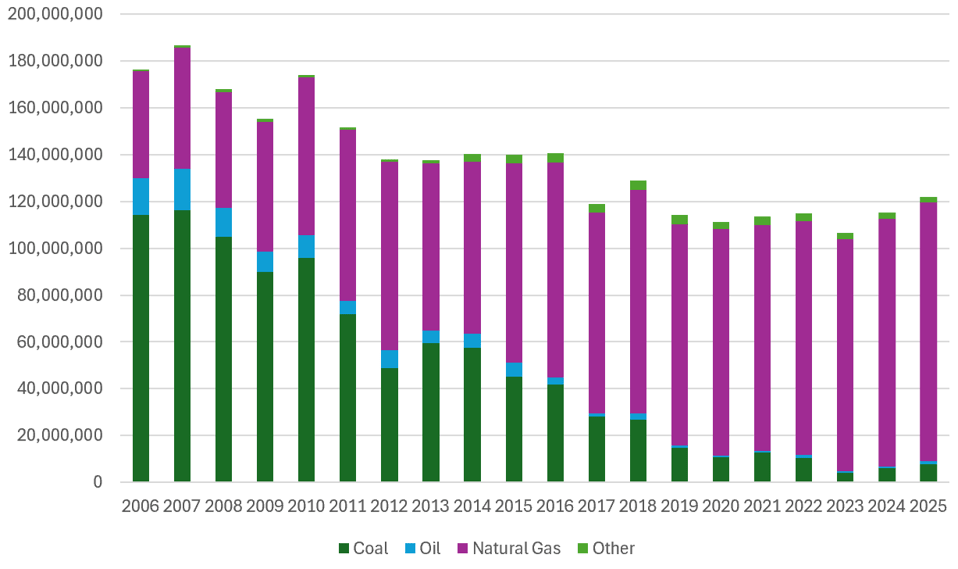
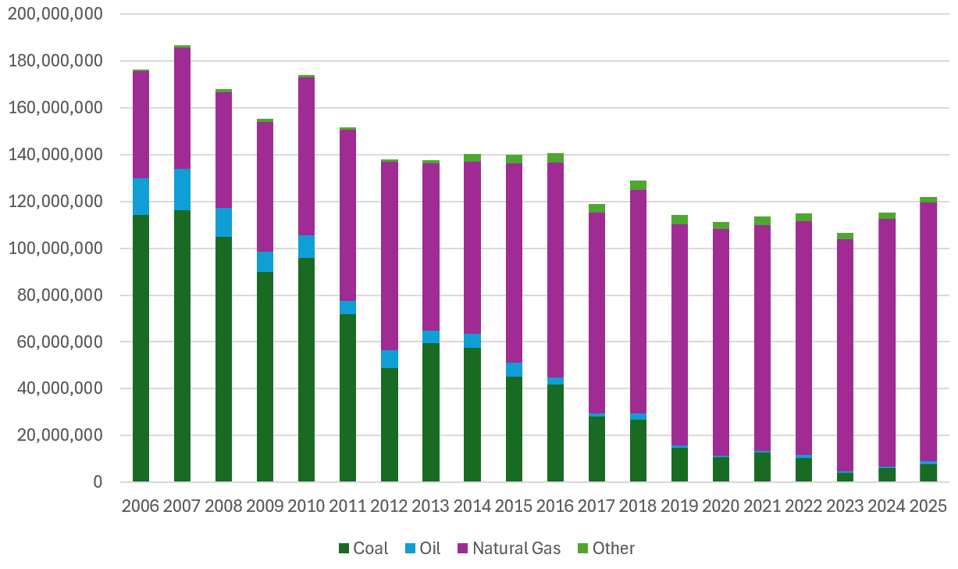
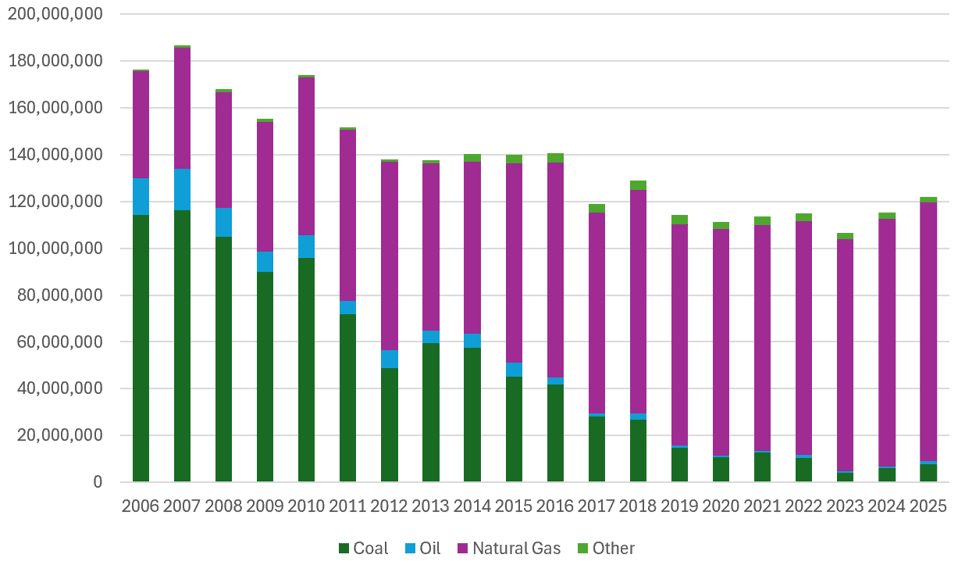
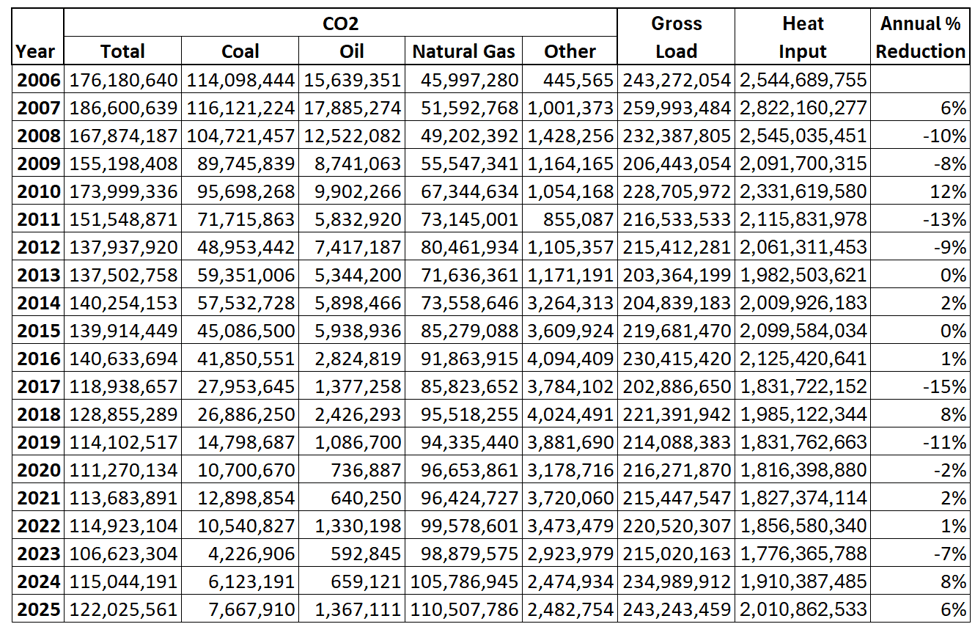
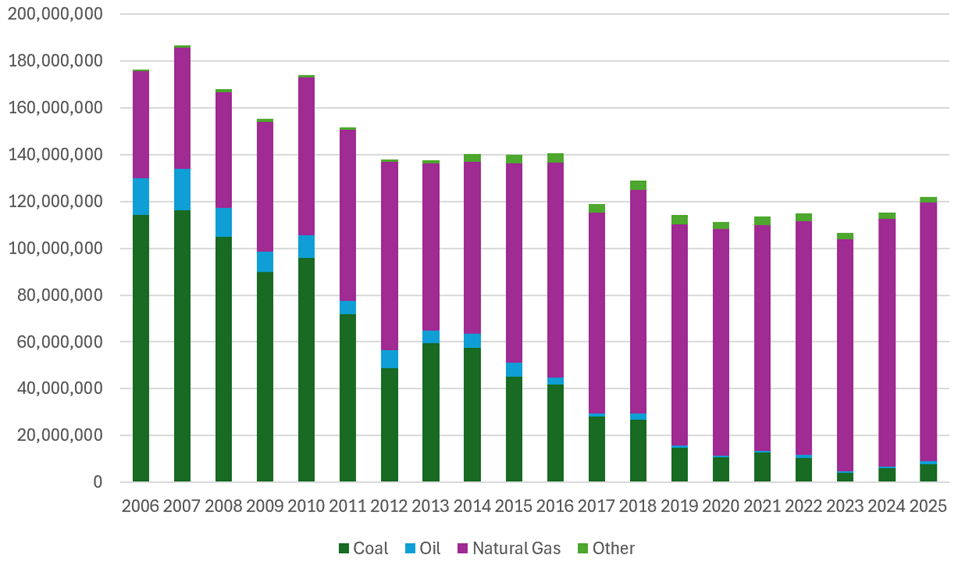
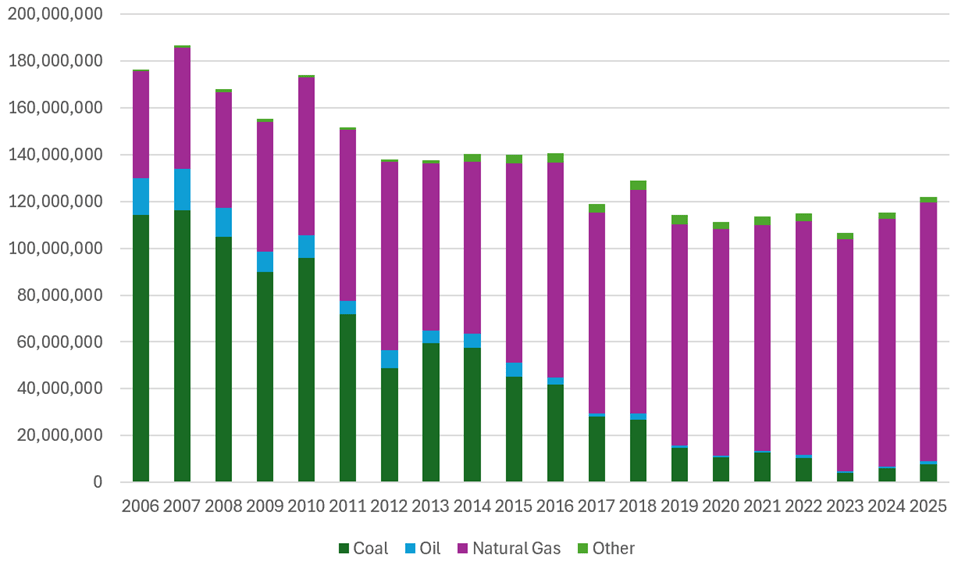
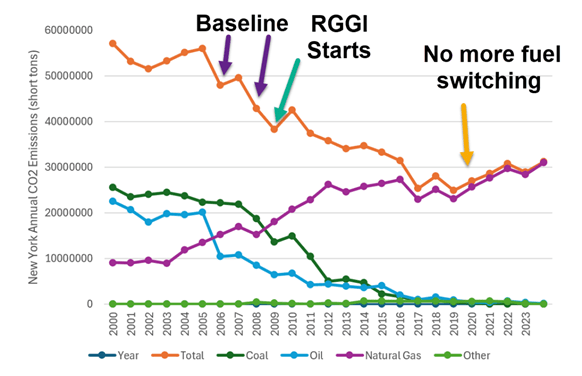
Both submittals discussed the observed emission reduction trend because the effectiveness of RGGI as a pollution control program is determined by the observed emission trend.  Figure 1 describes the annual electric sector emissions and emissions by fuel type.  It clearly shows that the observed emission reductions are due to fuel switching from coal and oil to natural gas.  Natural gas CO2 emissions are lower per MWhr so even though natural gas generation went up the overall CO2 emissions have gone down.  The other important finding in Figure 1 is that fuel switching emission reductions are no longer available. 

Figure 1: New York State Annual Electric Sector Emissions by Fuel Type

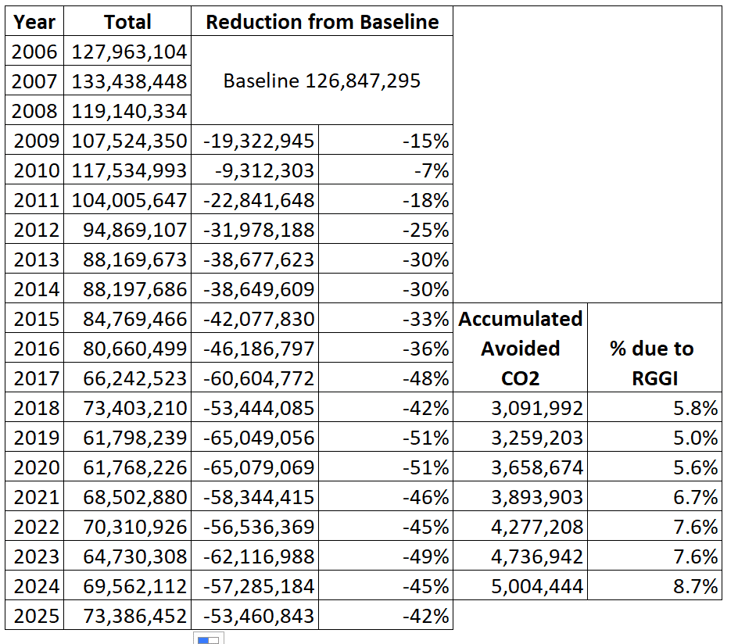
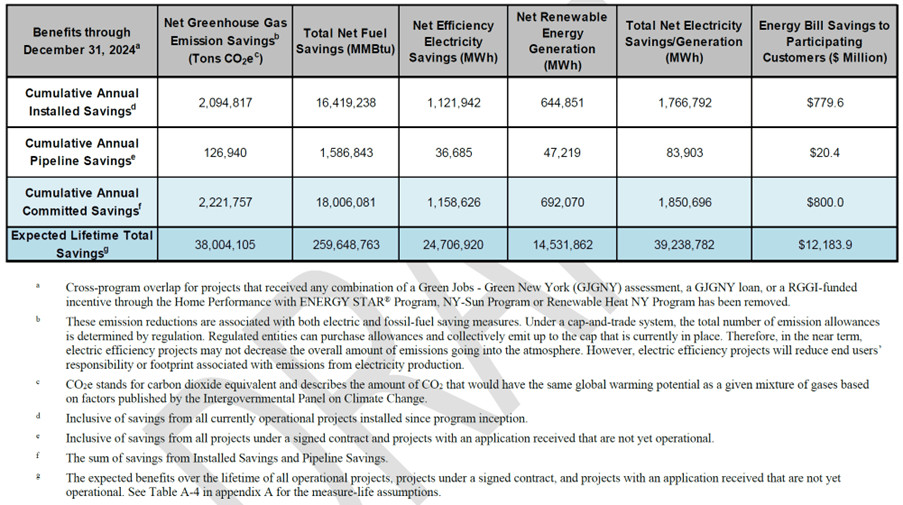
On a regular basis NYSERDA publishes a status update of the progress of their program activities, implementation, and evaluation.   According to the latest update, the total cumulative annual emission savings due to NYSERDA program investments through the end of 2023 is 1,976,101 tons.  That means that emissions from RGGI sources in New York would have been only 4.2% higher if the NYSERDA program investments did not occur.  According to the report, cumulative combined costs for those programs was $1,149 million which means that the cost per ton reduced is $582.

The funding status reports also break out emission savings and costs for NYSERDA programs. NYSERDA RGGI proceed investments can produce CO2 emission savings from RGGI-affected electric generating units in two ways: directly by displacing natural gas generation by deploying zero-emissions resources or indirectly by reducing the amount of load that the affected units must provide.  I categorized programs for three categories: direct reductions to RGGI sources, indirect reductions, and those programs that will actually increase electric generating emissions. One program that increases emissions is NYSERDA’s Clean Transportation Program that “has been pursuing five strategies to promote EV adoption by consumers and fleets across New York”.   The results in the Funding status reports show that since the start of the program NYSERDA has allocated 10% of its investments to programs that directly reduce utility emissions by 199,733 tons, 58% to programs that indirectly reduce utility emissions by 1,205,780 tons, and 32% to programs that will increase utility emissions by 678,804 tons.  When those savings that do not affect RGGI source emissions are removed, total savings are 1,297,297 and the emissions from RGGI sources in New York would have been only 2.8% higher if the NYSERDA program investments did not occur.

The proposed Amendment to the Operating Plan does not address the need to focus on emission reductions.  It allocates only 22% to programs that directly, indirectly, or could potentially decrease RGGI-affected source emissions.  Programs that will add load that could potentially increase RGGI source emissions total 37% of the investments.  Programs that do not affect emissions are funded with 29% of the proceeds and administrative costs total another 8%. 

There is one other notable aspect of the NYSERDA funding in the Draft Amendment for 2025. The Funding Status report states that annual cumulative program investments are $1.1 billion through the end of 2023 whereas the cumulative total revenues in the Operating Plan Amendment are $2.4 billion through FY 23-24.  There is no discussion of the differences.  Most of the difference is probably due to collected but unspent revenues.  It is notable that more than half of the money collected has not been spent.

Implications

The Climate Leadership & Community Protection Act (Climate Act) Scoping Plan recommended an economy-wide market-based program as part of the net-zero transition.  In response New York regulators have been developing the NYCI program.  Advocates for this approach frequently refer to RGGI as the successful model for NYCI citing observed emission reductions and the quantity of funds raised.  The prevailing perception of NYCI is exemplified by Colin Kinniburgh’s description in his recent article in New York Focus.  He describes the theory of a cap-and-invest program as a program that will kill two birds with one stone.  “It simultaneously puts a limit on the tons of pollution companies can emit — ‘cap’ — while making them pay for each ton, funding projects to help move the state away from polluting energy sources — ‘invest.'”

In the real world there are issues.

The missing piece for NYCI is that setting a cap on carbon emissions is all well and good in theory, but where are the emission reductions going to come from.  Reducing carbon emissions to zero is hard because the only way to get there is to replace existing technology with something that has zero emissions.   In the electric sector, the owners of the generating units are not building zero-emission replacements.  NYSERDA must motivate somebody else to do it. 

Danny Cullenward and David Victor’s book Making Climate Policy Work describe another related aspect of these programs that has not been acknowledged by NYSERDA or NYCI proponents.  The authors note that the level of expenditures needed to implement the net-zero transition vastly exceeds the “funds that can be readily appropriated from market mechanisms”.  The RGGI experience corroborates these findings and should be considered by the Energy Committee.  It is also concerning that NYSERDA has never addressed my repeated comments describing these issues and the implications on their funding priorities.

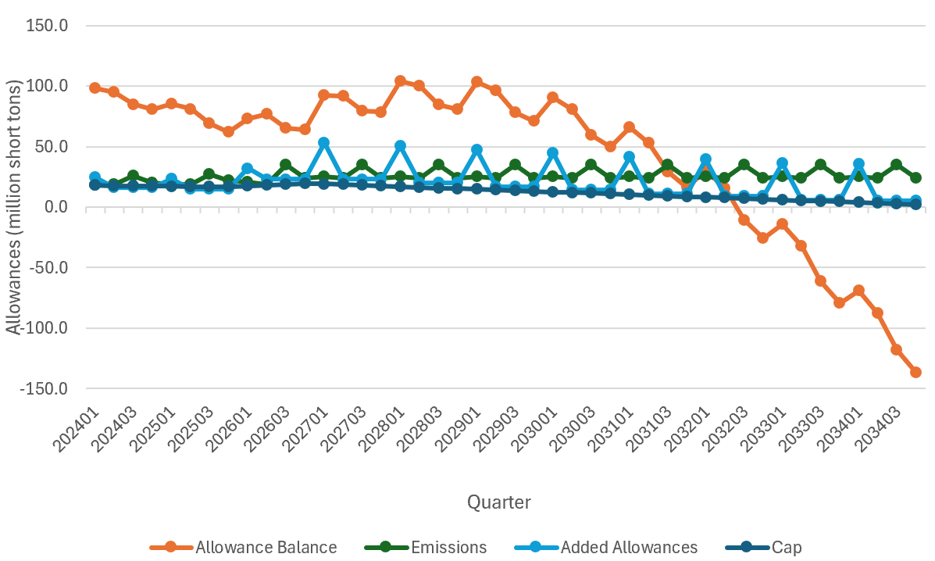
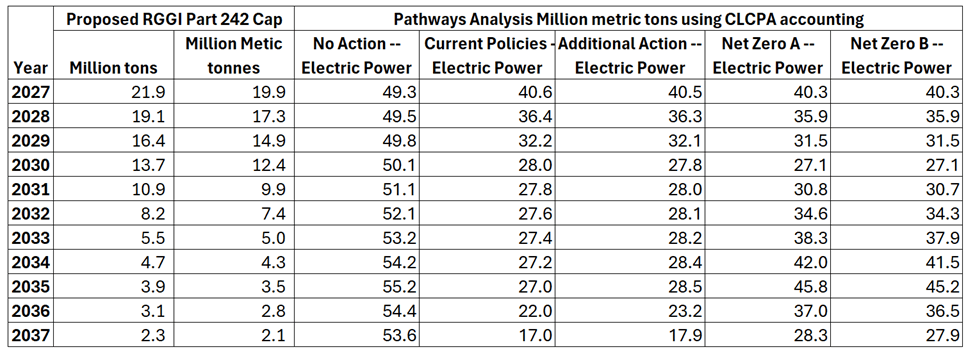
There is another inconvenient aspect of cap-and-invest programs.  RGGI and NYCI both have defined emission reduction trajectories that determine how many allowances are offered for sale.  That means that the implementation of the zero-emission technology that must displace existing technology to get the necessary reductions is on a schedule with ramifications.  If the replacement technology deployment is delayed, then it is likely that there will not be enough allowances available for compliance.  The only option available for affected sources is to reduce or stop operations.  In other words, an artificial energy shortage.

Conclusion

The implication of this work is that the proposed NYCI plan to have NYSERDA manage the investments like they do with RGGI is not likely to succeed as shown by their performance to date.

My comments to NYSERDA argued that their RGGI auction proceed investments have done little to reduce emissions.  I always have argued that NYSERDA funding priorities over emphasize Climate Leadership and Community Protection Act (Climate Act) initiatives at the expense of the electric generating unit RGGI emission goals.  I take the simple position that RGGI was promulgated as an emission reduction program for the electric generating sector.  NYSERDA investments must be revised to displace the generation needed from RGGI-affected sources because that is the only compliance option left with no reliability implications. 

My public statement on NYSERDA program effectiveness of the RGGI auction proceeds followed the same reasoning.  Observed reductions are mostly unrelated to the NYSERDA investments so that is not a success.  The observed cost per ton reduced is very high and funding priorities do not recognize the compliance obligations, so these are not accomplishments.  I also argued that the NYSERDA stakeholder process is broken because there are clear problems with the current strategy, but the latest operating plan amendment makes no changes. 

There is one final note.  If NYSERDA provided a comprehensive explanation of all the emission reduction strategies in the Scoping Plan along with the expected emission reductions, anticipated costs, and potential sources of funding for their strategies then it would be possible to determine if NYSERDA has planned for the necessary reductions via other programs.  If NYSERDA published documentation of their response to submitted comments on their Operating Plan amendments, they could have explained their strategy for RGGI compliance. The lack of transparency in both instances precludes any reassurance that NYSERDA can be trusted to continue to operate without more governance and transparency.

Implications of NYSERDA RGGI Operating Plan Investments

This is the third article in a series of three on the status of the New York component of the Regional Greenhouse Gas Initiative (RGGI) as administered by the New York State Energy Research & Development Authority (NYSERDA).  This is timely because on December 18, 2024, the New York Assembly Committee on Energy held a public hearing to gather information about NYSERDA’s revenues and expenditures in order to gain a broader perspective on effectiveness of NYSERDA’s programs. 

In the first article I evaluated Environmental Protection Agency (EPA) emission data and NYSERDA documentation and found that the investments funded by RGGI auction proceeds would have been only 4.2% higher if the NYSERDA program investments did not occur.  In the second article I showed that the cost per ton reduced from the NYSERDA RGGI operating plan investments was $582 per ton of CO2. This article describes the program allocations in the 2025 Draft RGGI Operating Plan Amendment.  There are unacknowledged ramifications of the emission reduction performance, funding program priorities, and RGGI compliance mandates. 

Background

I have been involved in the RGGI program process since its inception.  I blog about the details of the RGGI program because very few seem to want to provide any criticisms of the program.   I submitted comments on the Climate Act implementation plan and have written over 480 articles about New York’s net-zero transition because I believe the ambitions for a zero-emissions economy embodied in the Climate Act outstrip available renewable technology such that the net-zero transition will do more harm than good because of impacts on reliability, affordability, and environmental impacts.  The opinions expressed in this post do not reflect the position of any of my previous employers or any other organization I have been associated with, these comments are mine alone.

RGGI is a market-based program to reduce greenhouse gas emissions (GHG) (Factsheet). It has been a cooperative effort among the states of Connecticut, Delaware, Maine, Maryland, Massachusetts, New Hampshire, New York, Rhode Island, and Vermont to cap and reduce CO2 emissions from the power sector since 2008.  New Jersey was in at the beginning, dropped out for years, and re-joined in 2020. Virginia joined in 2021 but has since withdrawn, and Pennsylvania has joined but is not actively participating in auctions due to on-going litigation. According to a RGGI website:

The RGGI states issue CO2 allowances that are distributed almost entirely through regional auctions, resulting in proceeds for reinvestment in strategic energy and consumer programs.

Proceeds were invested in programs including energy efficiency, clean and renewable energy, beneficial electrification, greenhouse gas abatement and climate change adaptation, and direct bill assistance. Energy efficiency continued to receive the largest share of investments.

NYSERDA Operating Plan

NYSERDA designed and implemented a process to develop and annually update an Operating Plan which summarizes and describes the initiatives to be supported by RGGI auction proceeds.  On an annual basis, the Authority “engages stakeholders representing the environmental community, the electric generation community, consumer benefit organizations and interested members of the general public to assist with the development of an annual amendment to the Operating Plan.”

The latest Draft RGGI Operating Plan Amendment explains that

New York State invests RGGI proceeds to support comprehensive strategies that best achieve the RGGI greenhouse gas emissions reduction goals pursuant to 21 NYCRR Part 507.  The programs in the portfolio of initiatives are designed to support the pursuit of the State’s greenhouse gas emissions reduction goals by:

  • Deploying commercially available energy efficiency and renewable energy technologies;
  • Building the State’s capacity for long-term carbon reduction;
  • Empowering New York communities to reduce carbon pollution, and transition to cleaner energy;
  • Stimulating entrepreneurship and growth of clean energy and carbon abatement companies in New York; and
  • Creating innovative financing to increase adoption of clean energy and carbon abatement in the State.

The latest Operating Plan process is on-going at the time of this writing.  The Advisory Stakeholder meeting was held Thursday, December 5, 2024.  The presentation and webinar recording for the meeting are available.  The meeting described the proposed programs for the latest amendment.  Comments are due on December 23, 2024.

2025 Amendments to Operating Plan

The Stakeholder presentation notes that the 2025 Amendment assumes a future auction allowance price of $15.71.  This value is a conservative estimate based on the average price of the past ten auctions.  Note, however, that the auction price has settled higher in the most recent auctions so the FY25 Operating Plan budget assumes the allowance price of $19.59 which is the average of actual prices for first two RGGI auctions conducted this fiscal year and $15.71 per ton allowance estimate for the second two auctions.

It is notable that there is no mention of the total revenues expected.  That value equals the number of New York allowances in the auctions times the expected allowance prices.  I believe that New York will auction 21,783,380 allowances next year which means that the proceeds available in the Amendment total somewhere between $342,216,900 and $426,736,414 for FY 25.  At the Assembly Committee on Energy public hearing John Williams, Executive Vice President, Policy and Regulatory Affairs, NYSERDA stated that in the NYSERDA budget “RGGI allowance sales account for $191 million” at 15:30 in the video.  I have no idea why there is such a discrepancy between the actual proceeds and the NYSERDA RGGI Budget or why the 2025 Amendment presentation did not provide the totals expected.

Implications

Note that only one of the five goals described previously to “support the pursuit of the State’s greenhouse gas emissions reduction goals” addresses emission reductions.  The others are vague cover language to justify the use of RGGI auction proceeds to bury administrative expenses, force ratepayers to cover inconvenient costs related to Climate Act implementation and provide funding for other politically favored projects at the expense of programs that affect CO2 emissions from RGGI affected sources.  The question I tried to answer is just how much is allocated to reducing emissions.

Table 1 from the 2025 Draft RGGI Operating Plan Amendment lists all the proposed programs.  Highlighted programs indicate newly funded programs or additional funding to existing programs.  The original table highlights programs that “indicate newly funded programs or additional funding to existing programs”.  The notes to the table also explain that “Totals may not sum exactly due to rounding and that the fiscal years begin on April 1st and end on March 31st.  The document provides brief descriptions of the proposed programs in most instances, but not all the programs have descriptions.

As part of my annual comments, I evaluated these programs in the Operating Amendment relative to their value for future EGU emission reductions.  In my comment analysis, I reviewed each proposed program and classified each program relative to six categories of potential RGGI source emission reductions.  The first three categories cover programs that directly, indirectly or could potentially decrease RGGI-affected source emissions.  I also included a category for programs that will add load that could potentially increase RGGI source emissions such as programs to incentivize electrification.  The two other categories consider programs that do not affect emissions and administrative costs respectively.

Table 2 presents the results of my interpretation of the potential for RGGI EGU emission reductions for the programs in the proposed amendment.  The five programs without documentation highlighted in yellow.  The orange highlighted programs will be discussed in a later post.  The first three categories cover programs that directly, indirectly, or could potentially decrease RGGI-affected source emissions.  They account for only 22% of the investments.  Programs that will add load that could potentially increase RGGI source emissions and whose emissions savings are unrelated to the electric sector total 37% of the investments.  Programs that do not affect emissions are funded with 29% of the proceeds and administrative costs total another 8%.  Clearly there is no preference for reducing emissions.

Table 2: Potential for RGGI Reductions for Funding Allocations for 2025 Operating Plan Amendments

Discussion

In the previous two RGGi status articles I made the point that the observed emission reductions are the primary reason for the observed reductions.  Figure 1 clearly shows this.  Since the start of the RGGI program I estimate that emissions from RGGI sources in New York would have been only 4.2% higher if the NYSERDA program investments did not occur and only 2.8% higher when projected savings that do not affect RGGI source emissions are removed.

Figure 1: New York State Emissions by Fuel Type

To date the lack of investment in electric sector emission reduction programs has not been an issue because fuel switching has provided the emission reductions necessary to comply with RGGI reduction requirements.  However, eventually there will be a problem because no more fuel switching reductions are available while RGGI allowance allocations continue to decrease. 

NYSERDA has shown no indication that it is aware of this concern.  In my previous article, I pointed out that the observed investments have not made emission reductions a priority.  Since the start of the program NYSERDA has allocated $98.8 million to programs that directly reduce utility emissions by 199,733 tons, $702.7 million for programs that indirectly reduce utility emissions by 1,205,780, and $348.1 million for programs that will increase utility emissions by 678,804 tons.  In the last category, the GHG emission savings listed are the benefits for switching from gasoline and diesel to electric vehicles.   

Furthermore, this post shows that NYSERDA has not addressed this concern for future investments either.  The proposed Amendment to the Operating Plan allocates only 22% to programs that directly, indirectly, or could potentially decrease RGGI-affected source emissions.  Programs that will add load that could potentially increase RGGI source emissions total 37% of the investments.  Programs that do not affect emissions are funded with 29% of the proceeds and administrative costs total another 8%. 
There is one other notable aspect of the NYSERDA funding in the Draft Amendment – there is no mention of the total revenues expected.  That value equals the number of New York allowances in the auctions times the expected allowance prices.  I believe that NYSERDA will have between $342 and $426 million in FY25-26.  John Williams stated that in the NYSERDA budget “RGGI allowance sales account for $191 million” at 15:30. Also note that the Funding Status report annual cumulative investments for the programs described with benefits totals $1.1 billion whereas the cumulative total revenues in the Operating Plan Amendment are $2.4 billion.  The difference in those two values represents even more money not likely to address the need for electric sector emission reduction programs.  In my opinion, the lack of a clear description reconciling these differences is at least in part due to NYSERDA recognizing that there is no non-incriminating way to explain it.

Conclusion

Given my decades-long background in the electric sector, it is not surprising that I have compliance concerns.  In all my comments to NYSERDA on their operating plan amendments I have argued that funding priorities over emphasize Climate Leadership and Community Protection Act (Climate Act) initiatives at the expense of the electric generating unit RGGI emission goals.  I take the simple position that RGGI was promulgated as an emission reduction program for the electric generating sector.  The failure of affected sources to comply with the RGGI compliance requirements has ramifications.  Sas a final point of emphasis, NYSERDA does not acknowledge that because fuel switching opportunities are no longer available that affected sources can only comply by reducing or stopping operations. To prevent that from occurring, NYSERDA investments must displace the generation needed from RGGI-affected sources because that is the only compliance option left with no reliability implications.

I conclude that NYSERDA must reassess its program funding priorities to ensure that sufficient funding is available for programs that displace electric sector generation to zero-emissions sources.  If NYSERDA provided a comprehensive explanation of all the emission reduction strategies in the Scoping Plan along with the expected emission reductions, anticipated costs, and potential sources of funding for their strategies then it would be possible to check that NYSERDA has planned for the necessary reductions via other programs.  If NYSERDA published documentation of their response to submitted comments on their Operating Plan amendments, they could have explained their strategy for RGGI compliance. The lack of transparency precludes that reassurance.

Implications of NYSERDA RGGI Funding Status Report Status Results

This is the second article in a series of three on the status of the New York component of the Regional Greenhouse Gas Initiative (RGGI) as administered by the New York State Energy Research & Development Authority (NYSERDA).  This is timely because on December 18, 2024, the New York Assembly Committee on Energy held a public hearing to gather information about NYSERDA’s revenues and expenditures in order to gain a broader perspective on effectiveness of NYSERDA’s programs. 

In the first article I evaluated Environmental Protection Agency (EPA) emission data and NYSERDA documentation and found that the investments funded by RGGI auction proceeds would have been only 4.2% higher if the NYSERDA program investments did not occur.  There are unacknowledged ramifications of this emission reduction performance relative to future NYSERDA program investments and RGGI compliance mandates.

Background

I have been involved in the RGGI program process since its inception.  I blog about the details of the RGGI program because very few seem to want to provide any criticisms of the program.   I submitted comments on the Climate Act implementation plan and have written over 480 articles about New York’s net-zero transition because I believe the ambitions for a zero-emissions economy embodied in the Climate Act outstrip available renewable technology such that the net-zero transition will do more harm than good because of impacts on reliability, affordability, and the environment.  The opinions expressed in this post do not reflect the position of any of my previous employers or any other organization I have been associated with, these comments are mine alone.

RGGI is a market-based program to reduce greenhouse gas emissions (GHG) (Factsheet). It has been a cooperative effort among the states of Connecticut, Delaware, Maine, Maryland, Massachusetts, New Hampshire, New York, Rhode Island, and Vermont to cap and reduce CO2 emissions from the power sector since 2008.  New Jersey was in at the beginning, dropped out for years, and re-joined in 2020. Virginia joined in 2021 but has since withdrawn, and Pennsylvania has joined but is not actively participating in auctions due to on-going litigation. According to a RGGI website:

The RGGI states issue CO2 allowances that are distributed almost entirely through regional auctions, resulting in proceeds for reinvestment in strategic energy and consumer programs.

Proceeds were invested in programs including energy efficiency, clean and renewable energy, beneficial electrification, greenhouse gas abatement and climate change adaptation, and direct bill assistance. Energy efficiency continued to receive the largest share of investments.

On a quarterly basis permits to emit a ton of CO2 or allowances are auctioned by RGGI.  The electric generating units that have RGGI compliance obligations must surrender one allowance for each ton emitted during the compliance period.  In theory, States invest the proceeds to reduce emissions indirectly through energy efficiency programs and directly through the deployment of renewable energy that displaces fossil fired generation and supporting carbon abatement technology.  This article describes the implications of NYSERDA RGGI program emission reduction effectiveness and funding priorities on these compliance obligations.

NY Electric Generating Unit Emission Reductions

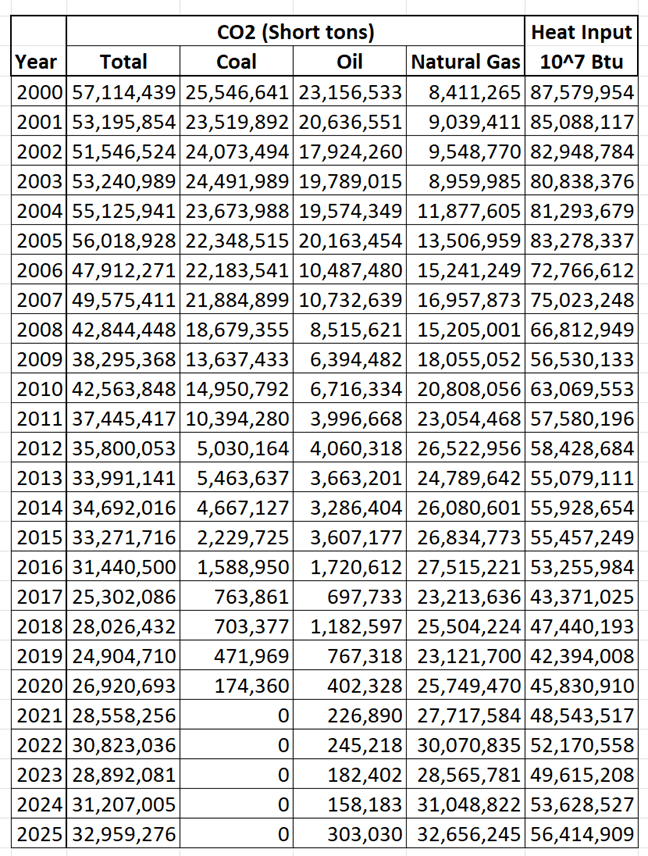
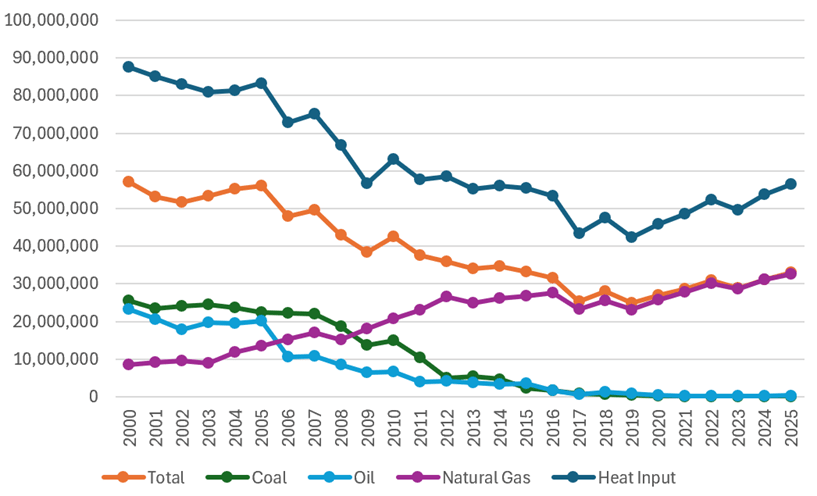
In my New York RGGI Funding Status Report Status Through 2023 post I used EPA emission data and NYSERDA documentation to determine the effect of the investments funded by RGGI auction proceeds.    In 2000, New York EGU emissions were 57,114,439 tons and in 2023 they were 28,889,913 tons, a decrease of 49%.  Figure 1 plots these data and shows emissions by fuel type.  Clearly, fuel switching is the primary driver of the observed reductions.  Since the start of the RGGI program I estimate that emissions from RGGI sources in New York would have been only 4.2% higher if the NYSERDA program investments did not occur.  The Figure 1 graph also shows that the opportunity to make further emission reductions by switching fuels is no longer available.

Figure 1: New York State Emissions by Fuel Type

New York RGGI Program Investment Reductions

Table 1 lists data from Semi-Annual Status Report through December 2023  Table 2: Summary of Total Expected Cumulative Annual Program Benefits including the cumulative annual costs of investment programs and annual tons of carbon dioxide equivalent (CO2e) saved by the investments.. The report notes that: “NYSERDA begins tracking program benefits once project installation is complete and provides estimated benefits for projects under contract that are not yet operational (pipeline benefits).“   The report presents “expected quantifiable benefits related to carbon dioxide equivalent (CO2e) reductions, energy savings, and participant energy bill savings with expended and encumbered funds” but I only consider the CO2e reductions.  Note that the emission savings evaluated in the report include carbon dioxide, methane, and nitrous oxide.  In the original table “lifetime” savings are included.  I did not use “lifetime” savings data because I am trying to compare the RGGI program benefits emission savings reductions to the RGGI compliance metric of an annual emission cap.  Lifetime reductions are clearly irrelevant. 

Table 1: RGGI Funding Status Report Table 2: Summary of Total Expected Cumulative Annual Program Benefits

NYSERDA RGGI proceed investments can produce CO2 emission savings from RGGI-affected electric generating units in two ways: directly by displacing natural gas generation by deploying zero-emissions resources or indirectly by reducing the amount of load that the affected units must provide.  I assumed that the indirect investments reduced load that directly offset RGGI-affected sources.  This has been a good assumption because load growth has been stalled but with electrification of buildings and transportation and the addition of data centers and large load centers, the presumption that indirect NYSERDA investments will reduce emissions will become weak. 

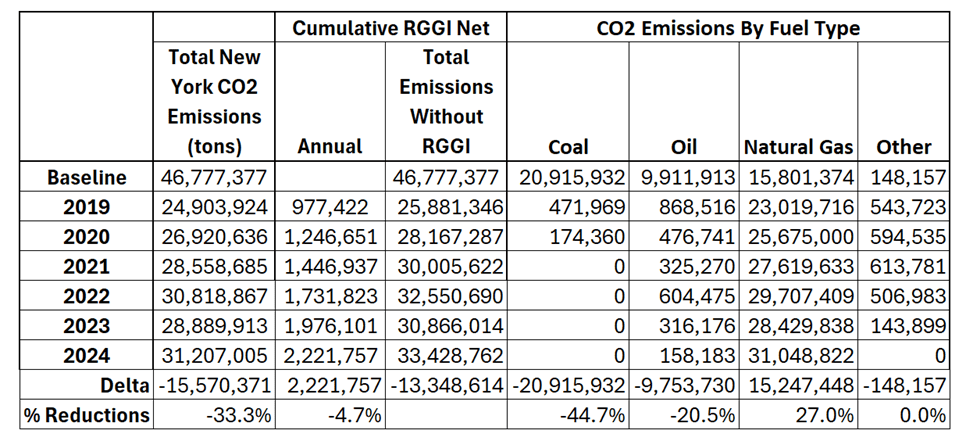
Table 2 compares the observed emissions to the NYSERDA emission savings.  These results show that emissions from RGGI sources in New York would have been only 4.2% higher if the NYSERDA program investments did not occur.  However, that estimate is an overestimate of the capability of NYSERDA investments to reduce RGGI-affected source emissions.  NYSERDA estimates of emission savings include methane and nitrous oxides, but RGGI compliance is only for CO2.  The presumption that programs that indirectly reduce emissions has qualifications that reduce the actual reductions.  The NYSERDA savings number also includes savings from programs that will not reduce RGGI-affected units’ emissions as shown in the next section.

Table 2: NY Electric Generating Unit Emissions, NYSERDA GHG Emission Savings from RGGI Investments, and Emissions by Fuel Type

NYS RGGI Funding Priorities

Table 2 overestimates relevant savings because of RGGI funding program priorities.  The October 2024 New York State Funded Programs report describes the funding priorities for the auction proceeds:

The State invests RGGI proceeds to support comprehensive strategies that best achieve the RGGI CO2 emission reduction goals. These strategies aim to reduce global climate change and pollution through energy efficiency, renewable energy, and carbon abatement technology. Deploying commercially available renewable energy and energy efficiency technologies help to reduce greenhouse gas (GHG) emissions from both electricity and other energy sources in the short term. To move the State toward the goals enacted by the Climate Leadership and Community Protection Act (Climate Act) and a more sustainable future, RGGI funds are used to empower communities to make decisions that prompt the use of cleaner and more energy-efficient technologies that lead to both lower carbon emissions as well as economic and societal co-benefits. RGGI helps to build capacity for long-term carbon reduction by training workers and partnering with industry. Using innovative financing, RGGI supports the pursuit of cleaner, more efficient energy systems and encourages investment to stimulate entrepreneurial growth of clean energy companies. All these activities use funds in ways that accelerate the uptake of low- to zero-emitting technologies.

Table 2 is misleading in the context of RGGI compliance obligations because not all the savings will affect RGGI emission sources.  There is a significant fraction of RGGI funds that goes to programs that increase rather than decrease electric generating unit emissions.  In Table 3, I categorized programs relative to RGGI compliance obligations.  The table breaks down the program allocations and expected annualized CO2 savings for three categories: direct reductions to RGGI sources, indirect reductions, and those programs that will actually increase electric generating emissions. For example, Charge NY is NYSERDA’s Clean Transportation Program that “has been pursuing five strategies to promote EV adoption by consumers and fleets across New York”.   The results in the Funding status reports show that since the start of the program NYSERDA has allocated $98.8 million to programs that directly reduce utility emissions by 199,733 tons, $702.7 million for programs that indirectly reduce utility emissions by 1,205,780, and $348.1 million for programs that will increase utility emissions by 678,804 tons.  In the last category, the GHG emission savings listed are the benefits for switching from gasoline and diesel to electric vehicles.   When those savings that do not affect RGGI source emissions are removed, total savings are 1,297,297 and the emissions from RGGI sources in New York would have been only 2.8% higher if the NYSERDA program investments did not occur.

Table 3: Summary of Expected Cumulative Annualized Program Benefits through 31 December 2023 for Programs that Directly, Directly, or Do Not Affect RGGI CO2 Emissions

Discussion

The results of NYSERDA RGGI funding have important and unacknowledged ramifications.

The comparison of observed electric generating unit emission reductions by fuel type clearly show that historical reductions were the result of fuel switching.  In addition, it is obvious that all that low-hanging fruit is gone.  Nonetheless, many ill-informed voices are clamoring for stricter RGGI emission reduction trajectories begging the question – where will the emission reductions come from?  It does not seem that NYSERDA RGGI investments will help the affected sources meet their compliance obligations.

I did not mention the observed cost per ton saved in Table 1.  It is not very encouraging that NYSERDA program investments cost $582 for each ton saved.  At that rate, New York will have to invest $16.8 billion to achieve the Climate Leadership & Community Protection Act 2040 electric sector zero-emissions mandate.  In the first 15 years New York RGGI auction proceeds are a little over $2 billion based on the sale of 480.4 million allowances.  Assuming a RGGI straight line reduction to zero by 2040, 231 million total allowances will be allotted by 2040.  At the $582 cost per ton rate the RGGI allowance price would have to be $73 per ton to provide sufficient funding to meet the compliance targets.

There is a huge assumption relative to the $73 allowance price funding necessary to achieve the zero-emissions by 2040 mandate.  I assumed that all the RGGI proceeds would be allotted to programs that directly or indirectly reduce emissions at electric generating stations.  Table 3 shows that for the programs that produce quantifiable benefits 32.6% of the proceeds goes to programs that increase RGGI emissions.  It is much worse than that.  In my next article in this series I will document how the latest Draft RGGI Operating Plan Amendment allocates funds to programs.  Spoiler alert only 22% goes to programs that will provide direct or indirect emission reductions.

Conclusion

This analysis of the latest NYSERDA RGGI funding plan document has important implications to New York’s plans to implement a Cap-and-Invest (NYCI) program.  RGGI is touted as a successful model for NYCI to emulate but the poor emission reduction performance suggests that the presumption that NYCI will be an effective emission reduction program is misplaced. 

There is another important issue.  NYSERDA has not acknowledged that electric generators have no options to reduce their emissions to comply with RGGI.  In the future those facilities can only meet compliance requirements if zero-emissions resources displace their generation and emissions.  If there are insufficient investments to reduce generation at the RGGI-affected sources there will be compliance issues.  The only option for affected sources to comply is to reduce or stop operations.

Personal Comments on RGGI Program Review October 2024

The Regional Greenhouse Gas Initiative (RGGI) is a market-based program to reduce emissions from electric generating units.  One aspect of RGGI is a regular review of the program status and need for adjustments.  This article describes my latest comments on the Third Program Review process.

I have been involved in the RGGI program process since its inception.  I blog about the details of the RGGI program because very few seem to want to provide any criticisms of the program.   I submitted comments on the Climate Act implementation plan and have written over 450 articles about New York’s net-zero transition because I believe the ambitions for a zero-emissions economy embodied in the Climate Act outstrip available renewable technology such that the net-zero transition will do more harm than good.  The opinions expressed in this post do not reflect the position of any of my previous employers or any other organization I have been associated with, these comments are mine alone.

Background

RGGI is a market-based program to reduce greenhouse gas emissions (GHG) (Factsheet). It has been a cooperative effort among the states of Connecticut, Delaware, Maine, Maryland, Massachusetts, New Hampshire, New York, Rhode Island, and Vermont to cap and reduce CO2 emissions from the power sector since 2008.  New Jersey was in at the beginning, dropped out for years, and re-joined in 2020. Virginia joined in 2021 but has since withdrawn, and Pennsylvania has joined but is not actively participating in auctions due to on-going litigation. According to a RGGI website:

The RGGI states issue CO2 allowances that are distributed almost entirely through regional auctions, resulting in proceeds for reinvestment in strategic energy and consumer programs.

Proceeds were invested in programs including energy efficiency, clean and renewable energy, beneficial electrification, greenhouse gas abatement and climate change adaptation, and direct bill assistance. Energy efficiency continued to receive the largest share of investments.

The RGGI States regularly review successes, impacts, and design elements of the program.  This is the third iteration of the review program.  It started in February 2021 and there is no schedule for its completion.  The description states:

To support the Third Program Review, the states will:

  • Conduct technical analyses, including electricity sector modeling, to inform decision-making related to core Program Review topics, such as the regional CO2 emission cap.
  • Solicit input from communities, affected groups, and the general public on the Program Review process and timeline, core topics and objectives, modeling assumptions and results, and other policy and design considerations.
  • Convene independent learning sessions with experts and other interested parties on key design elements.

I have previously posted an article describing my earlier comments to RGGI addressing the disconnect between the results of RGGI to date relative to the expectations in the RGGI Third Program Review modeling.  I have also described other comments submitted to RGGI.

The overarching problem with GHG emission market-based programs is that carbon dioxide emissions are directly tied to fossil-fuel combustion and energy production.  If for any number of reasons, the zero-emissions are not deployed fast enough there won’t be enough credits within the cap available to cover the emissions necessary to provide the energy needs.  In the worst case, an electric generating unit needed to keep the lights on will refuse to operate because they have insufficient allowances. I do not think that this program review pays sufficient attention to this problem.

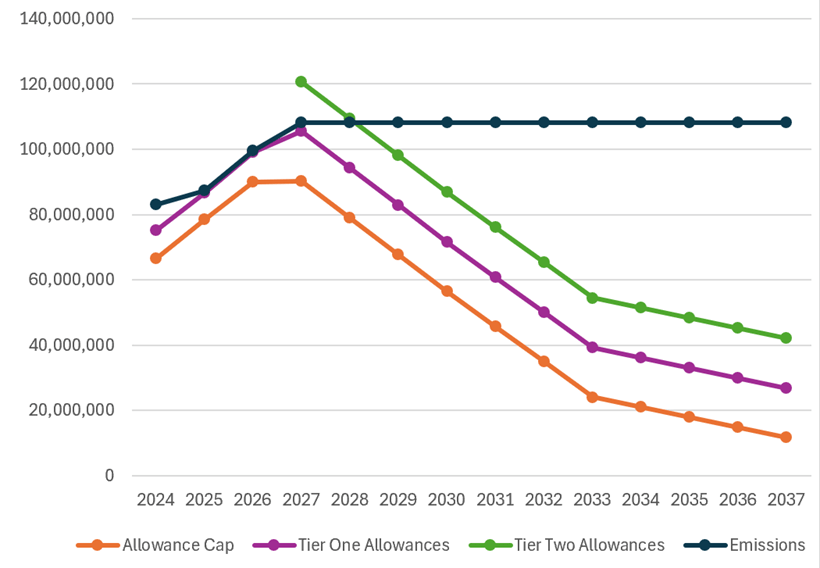
The Program Review Update describes the September 23, 2024 update.  There are two distinct components to this update: the release of another modeling scenario and a request for suggestions on how to accommodate other states without upsetting the “environmental ambition” of the states currently participating in RGGI.

IPM Emission Modeling Comments

The basis of the RGGI state program review proposal is modeling done by ICF using the Integrated Planning Model (IPM).  There is not much documentation for the IPM analysis.  The Program Review Update is the only documentation and that consists of “informational slides”.  The “detailed modeling results” are presented in a spreadsheet that does not include a table with explanations of the data provided.  Even though I have reviewed every previous iteration of RGGI IPM modeling results, I had to spend a lot of time trying to decipher what they were doing.  If someone decided to review the modeling analysis without any experience, they would have a very hard time trying to figure out what is going on.  I do not think this lack of documentation is appropriate.

The presentation slides note that “The RGGI states have conducted modeling analysis of an additional exploratory policy scenario”.  In this type of analysis, the policy scenario results are compared to a base case or business as usual scenario. Two cap scenarios were modeled:

  • Flat Cap Scenario consistent with current program design
  • Exploratory Policy Scenario with an increased reserve price, declining cap to 2037 and a new two-tier CCR.

Results from two cases of the “Exploratory Policy Scenario” are presented in the spreadsheet.  Case A includes “currently contracted renewables only” and Case B includes “on-the-books policies and mandates”.  The Flat Cap Scenario includes on-the-book policies and mandates and the exploratory scenario projects what would happen with the policy changes.  The documentation also notes that renewable cost data has been updated to align with NREL’s 2024 release of the Annual Technology Baseline dataset.  I believe that the updated data were different enough that it was appropriate to do a new current program design base case, i.e., the Flat Cap Scenario. 

I have reservations about the analysis because the IPM projected emissions in 2028 are not credible.  Table 1 lists the observed EPA Clean Air Markets Division annual CO2 emissions for the last three years and the Integrated Planning Model (IPM) projected 2028 emissions for the three modeling scenarios from the results spreadsheet.  IPM projects an overall reduction of more than 50% in four years for Case A  I believe that the analysis over-estimates potential CO2 reductions in the ten RGGI states.  Reductions in this time frame can only occur when wind and solar resources displace the RGGI source generation. My first impression is that it is unlikely that enough wind and solar can be built in that time frame.

Table 1: Comparison of Observed RGGI CO2 Emissions and IPM Projected Emissions (million tons)

Modeling scenario Case A includes “currently contracted renewables only and Case B, used in the Flat case, includes “on-the-books policies and mandates”.  I do not believe that the modeling addresses the fact that renewable rollouts are not going according to contracted renewable plans.  The New York Department of Public Service (DPS) Case Number: 15-E-0302,: Proceeding on Motion of the Commission to Implement a Large-Scale Renewable Program and a Clean Energy Standard recently asked for comments on the DPS staff and the New York State Energy Research and Development Authority’s (NYSERDA) July 1, 2024, filing of the Draft Clean Energy Standard Biennial Review.  Comments submitted by EDF Renewables noted that:

Reflecting on Sections 4 and 5 of the Draft Review with a look at the current state of contracted

renewables and the path to achieving the 70% Goal:

  • Out of 156 RES Tier 1 projects that have been awarded, approved, or are pending approval by NYSERDA since 2004, 30 are operational and 23 are still under development.
  • 11 of 25 land‐based wind projects are operational and 9 of 116 solar projects are operational. Operational projects have added 1,016 MW of capacity, 821 MW of which are land based wind projects.

11,000 MW of capacity has been cancelled or is still under development.

The Draft Clean Energy Standard Biennial Review itself acknowledged this problem.  It concludes that New York’s Climate Leadership & Community Protection Act 70% renewable energy by 2030 target will not be met until 2033.  The Biennial Review notes:

New York’s progress has been and will continue to be affected by conditions in the larger global markets.  The complex renewable energy supply chain is a global network of materials procurement, processing, production, materials recovery, infrastructure, and logistics operations. As the United States and other nations raise their goals for emission reductions, those supply chains are stressed. Geopolitical tensions and policies incentivizing domestic production of major energy generation equipment also impact the cost and availability of materials and components. High interest rates and inflation – which were prevalent from mid-2021 through mid-2023 across the renewable energy supply chain – also play a role in raising the baseline for renewable energy input prices. While such prices have recently stabilized, input prices are higher than what was forecasted prior to the 2021-2023 inflationary period.

The IPM modeling does not address this reality.  In the absence of documentation citing just how much solar PV, onshore wind, and offshore wind resources were assumed to be deployed in the RGGI IPM modeling analysis I made my own estimate.

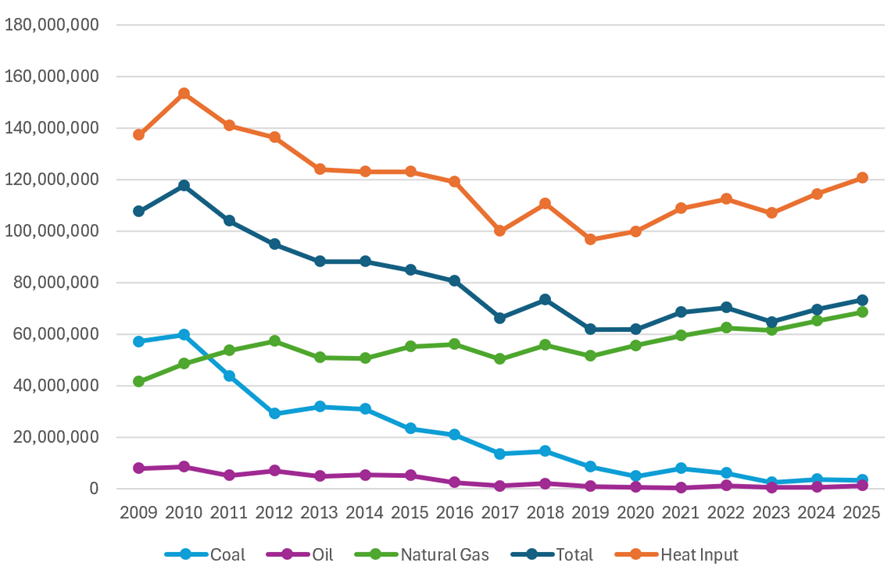
My projection of necessary renewable energy is based on evaluation of historical emissions data.  Table 2 lists the observed annual CO2 emissions from the ten-state RGGI region from the EPA Clean Air Markets Division (CAMD) database.  Details on the methodology are available in my comments, a supplementary attachment, and a spreadsheet that describes the analysis details.  Note that there has been a significant drop in CO2 emissions in the RGGI region, but a large portion of those reductions were due to fuel switching from coal and oil to natural gas and retirements of fossil-fired units.  Importantly, the opportunity for further fuel switching reductions is small.  This is the basis for my assertion that most future emission reductions must come from reduced operations at existing fossil-fired power plants due to displacement by renewable deployments. 

Table 2: 10-State EPA CAMD All Program Annual CO2 Emissions by Fuel Type

I used these data and the IPM modeling results to make a projection out to 2028.  I assumed the coal, oil, and other fuel types would go to zero by 2028 and that natural gas emissions equal the emissions projected by IPM in 2028.  I also used these data to project renewable requirements. I used the EPA load data and emissions to calculate the load per ton of CO2 for each fuel type.  I used those parameters to estimate the load associated with the IPM projected emissions in 2028.

In Table 3 I list the estimated renewable displacement load (MWh) value for each scenario.  At the top of the tables, the fossil fired generation load that must be displaced by renewable energy is listed.  For example, 88,630,916 MWh is the amount in the Case A, Exploratory Policy Scenario.  I determined the relative contributions of solar PV, onshore wind, and offshore wind based on results in the IPM modeling spreadsheet.  Those percentages were multiplied by the total load that renewables must displace to estimate how much each type would be needed  I assumed some conservatively high capacity factors for the renewable resources and calculated the capacity (MW) of each resource.  In my opinion, there is very little chance that these levels of solar PV, onshore wind and offshore wind can be deployed by 2028 because of the problems noted in the Biennial Review.

Table 3: Estimated Renewable Deployment Necessary to Achieve IPM RGGI 2028 Emissions

There are other potential problems that could have bigger ramifications.  IPM integrates “wholesale power, system reliability, environmental constraints, fuel choice, transmission, capacity expansion, and all key operational elements of generators on the power grid in a linear optimization framework”.  I think that the optimization process presumes that wind and solar resources can be freely substituted for other dispatchable resources in its estimates of the future electric power system.  However, wind and solar resources are not dispatchable.  It is not clear whether the IPM approach is appropriate for an electric system that has a large renewable component.

Furthermore, I do not know how IPM handles weather dependency of wind and solar in its projections.  My back-of-the-envelope projection for renewable generation necessary to displace fossil fueled resource generation assumes that the replacement is on a one for one MWh basis.  Presently, wind and solar generation is dispatched first because there is no fuel cost.  Fossil resources are being used more and more only as backup when wind and solar is unavailable.  As a result, wind and solar resources displace less and less fossil, as more resources are added.  For example, fossil support for solar resources can never be eliminated at night.  The same holds true for wind because there is a significant correlation of wind facilities across large areas.  For example, on 9/13/2024 at hour 1200 the New York Independent System Operator (NYISO) real-time fuel mix generation from over 2,500 MW of wind capacity across the state, including an offshore wind facility, was zero. 

To accurately project future fossil generation in an electric grid with increasing amounts of intermittent wind and solar, dispatchability and weather dependency must be incorporated.  I understand that the NYISO resource planners use historical meteorological data and associated wind and solar output to account for weather dependency and their resource planning approach incorporates dispatchability concerns.  If IPM does not address this issue correctly, then the results for the future projections have little value and should not be relied on to make future predictions of the RGGI electric system. It would be prudent to compare the IPM modeling results with the projections for future resources developed by regional transmission operators in the region before completing the Third Program review process.

Allowance Price Modeling Comments

One of the key outputs in the Program Design modeling is the price of allowances.  As described in my comments I am not enamored of the ability of the IPM analysis to project allowance prices.  The documentation notes that IPM considers “long-term fundamentals, generation assumptions & costs, economic growth forecast, and government policies.”  I think this is a fatal flaw of the approach because the model has no way to incorporate uncertainty, and the model has perfect foresight.  This is a problem in the first place because the assumptions used for the considerations are subject to change. For example, cost predictions necessarily are affected by future rates of inflation, and no one predicted the recent large changes.  Secondly, these considerations introduce significant uncertainties that affect the deployment of the renewable resources necessary to displace fossil generating units and reduce their emissions.  This in turn affects the scarcity of allowances relative to emissions and that affects allowance prices.   As shown earlier, there are limited remaining opportunities to switch fuels so any delays in renewable deployment will affect future emissions and allowance prices.  The IPM allowance modeling estimates cannot handle these uncertainties, so they are little more than educated guesses.   

Modeling Scenario Comment Conclusion

Given the enormous uncertainties of the transition to zero-emissions in the RGGI states it would be prudent to address this issue directly.  I commend the states for proposing a two-tier CCR solution that, depending on how it is implemented, could deal with the problem simply. 

RGGI has already adopted the Cost Containment Reserve (CCR).  The CCR established a “quantity of allowances in addition to the cap which are held in reserve.”  If allowance prices exceed predefined price levels, these allowances are sold. The CCR is replenished at the start of each calendar year.

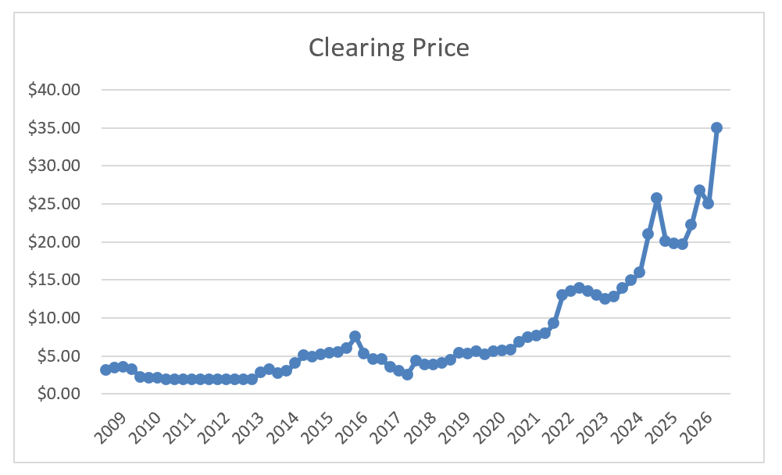
Table 4 lists CCR and trigger prices over time.  Note that the March 13, 2024 allowance auction clearing price was $16.00 so the CCR allocation was completely used up.  In the most recent auction, the clearing price was $25.75 which exceeds the 2030 trigger price.  In the two-tier approach another set-aside of allowances will be available for sale in an auction if the price exceeds the second trigger.

Table 4: RGGI Cost Containment Reserve

The ultimate issue is how the allowances allocated for the annual caps compare and the bank of already allocated allowances held compare with actual emissions.  Environmental activists demand that the allowance cap “bind” emissions to ensure that the reductions occur on their arbitrary trajectory.  They don’t accept that a binding cap will limit emissions even if the zero-emissions resources are not available to displace the existing emissions and that the ramifications of that situation are enormous.  In the worst case, an electric generating unit needed to keep the lights on will refuse to operate because they have insufficient allowances.  The two-tier CCR resolves this problem.

Response to “Environmental Ambition” Questions

The second component notes that: “The RGGI states are interested in exploring potential market solutions that could enable such states to link to the RGGI market in the future, including potentially at a cap trajectory which may not align with the RGGI cap trajectory resulting from the Third Program Review.”  In particular, the RGGI states seek stakeholder feedback on potential accommodation mechanisms such as:

  • The potential application of allowance trading or compliance ratios between entities in states that have and have not adopted the cap trajectory resulting from the Third Program Review.
  • The potential application of volume limits in trading or compliance between entities in states that have and have not adopted the cap trajectory resulting from the Third Program Review.
  • The proper basis to determine such potential allowance trading/compliance ratios, or volume limits, including respective emissions cap levels, reduction trajectories, price levels, and/or other relevant factors.
  • Other potential mechanisms that would allow for participation by states implementing a cap trajectory that is different than the cap trajectory resulting from the Third Program Review, such as a cap trajectory previously adopted in regulations to be consistent with the current RGGI program, while safeguarding any new environmental ambition achieved by the current RGGI participating states as a result of the Third Program Review.

These mechanisms all would introduce significant logistical tracking and reporting issues.  In addition, the accommodation mechanisms create an incongruous compliance system.  Consider two trading regions:

  • Region 1 starting emissions are 1,000 and the region target is zero in ten years, so the allowance reduction trajectory is 100 allowances per year
  • Region 2 starting emissions are 2,000 and the region target is zero in twenty years, so the allowance reduction trajectory is also 100 allowances per year

In the first year the sum of the allowance caps for the two regions is 2,800.  If in the first year Region 1 emissions are 1,000 and the Region 2 emissions are 1,800 the sum of the emissions is 2,800 and the two regions are in overall compliance with the combined limit.  However, within Region 1 the sources are out of compliance if they are treated differently.  The desired environmental impact is achieved but all the accommodation mechanisms proposed penalize the sources.

What is the point of all the additional complexity?  The only rationale is that the ambition is different for timing in two different regions and that needs to be considered.  However, the difference in a ton reduced now versus a ton reduced in 2050 is inconsequential to global climate change.  Therefore, I do not think that any of the potential accommodation mechanisms are necessary.

Conclusion

In the comments submitted I address problems I see with the IPM modeling that underpins the Third Program Review proposals.  IPM estimates that CO2 emissions will be 50% lower across the RGGI region by 2028.  I do not think that is reasonable.  I estimated how many renewable resources would need to be deployed to displace RGGI-affected source emissions and this confirmed my concerns. 

I think the results are related to the limitations of IPM.  Documentation related to the New York biennial review of the observed progress of its GHG emission reduction goals has identified supply chain, higher interest rates, inflation, and workforce limitations that have delayed progress in the rollout of New York wind and solar resource deployment.  All these issues add significantly to model input uncertainty.

I have serious concerns with the modeling results.  My comments note that the IPM modelling approach cannot reconcile the deployment uncertainties observed in New York.  Furthermore, it is not clear how well IPM addresses issues related wind and solar weather related dispatchability.   These ambiguities compound the inherent challenges related to allowance price estimates.  As a result, I believe that the limitations of the IPM projections must be addressed in the Program Design elements.

I commend the RGGI proposal to add second CCR tier.  It is a reasonable response to the intractable uncertainties.  It should be an effective response to my concerns if the parameters are chosen correctly.

Finally, I review the proposed solutions to address environmental ambition if other jurisdictions join RGGI.  I do not believe that the additional complexity and logistical implementation issues associated with the proposals is warranted because the difference in ambition is more symbolic than real.

New York RGGI Operating Plan Amendment Update October 2024  

The Regional Greenhouse Gas Initiative (RGGI) is a market-based program to reduce emissions from electric generating units.  This post describes my comments on the updates to the New York State Energy Research & Development Authority (NYSERDA) Regional Greenhouse Gas Initiative (RGGI) Operating Plan Amendment (“Amendment”) for 2024.  The latest RGGI auctions settled at prices higher than expected so the Amendment presents plans to allocate the $146 million windfall.

I have been involved in the RGGI program process since its inception.  I blog about the details of the RGGI program because very few seem to want to provide any criticisms of the program.   I submitted comments on the Climate Act implementation plan and have written over 450 articles about New York’s net-zero transition because I believe the ambitions for a zero-emissions economy embodied in the Climate Act outstrip available renewable technology such that the net-zero transition will do more harm than good.  The opinions expressed in this post do not reflect the position of any of my previous employers or any other organization I have been associated with, these comments are mine alone.

Background

RGGI is a market-based program to reduce greenhouse gas emissions (GHG) (Factsheet). It has been a cooperative effort among the states of Connecticut, Delaware, Maine, Maryland, Massachusetts, New Hampshire, New York, Rhode Island, and Vermont to cap and reduce CO2 emissions from the power sector since 2008.  New Jersey was in at the beginning, dropped out for years, and re-joined in 2020. Virginia joined in 2021 but has since withdrawn and Pennsylvania has joined but is not actively participating in auctions due to on-going litigation. According to a RGGI website:

The RGGI states issue CO2 allowances that are distributed almost entirely through regional auctions, resulting in proceeds for reinvestment in strategic energy and consumer programs.

Proceeds were invested in programs including energy efficiency, clean and renewable energy, beneficial electrification, greenhouse gas abatement and climate change adaptation, and direct bill assistance. Energy efficiency continued to receive the largest share of investments.

Note that although the goal of the program is to reduce GHG emissions, the investment descriptions include beneficial electrification, climate change adaptation, and direct bill assistance that do not reduce electric sector emissions.

NYSERDA Operating Plan Amendment

NYSERDA designed and implemented a process to develop and annually update an Operating Plan which summarizes and describes the initiatives to be supported by RGGI auction proceeds.  On an annual basis, the Authority “engages stakeholders representing the environmental community, the electric generation community, consumer benefit organizations and interested members of the general public to assist with the development of an annual amendment to the Operating Plan.”

The Amendment describes the plans to use New York’s RGGI proceeds in the next several years.  On September 19, 2024, NYSERDA hosted a webinar meeting to present proposed changes to the Operating Plan initiated because auction revenues were significantly higher than assumed last December.  The meeting materials include the following:

The draft Amendment explains that New York State is supposed to invest RGGI proceeds to support comprehensive strategies that best achieve the RGGI greenhouse gas emissions reduction goals pursuant to 21 NYCRR Part 507.  The programs in the portfolio of initiatives are designed to support the pursuit of the State’s greenhouse gas emissions reduction goals by:

  • Deploying commercially available energy efficiency and renewable energy technologies;
  • Building the State’s capacity for long-term carbon reduction;
  • Empowering New York communities to reduce carbon pollution, and transition to cleaner energy;
  • Stimulating entrepreneurship and growth of clean energy and carbon abatement companies in New York; and
  • Creating innovative financing to increase adoption of clean energy and carbon abatement in the State.

The NYSERDA RGGI operating plan amendment process exemplifies the Hochul Administration approach to Climate Act implementation.  For all the talk about welcoming stakeholder comments, the reality is far different.  I published my first article on the NY RGGI operating plan in December 2017 and have submitted comments on the last few operating plan amendments.  The stakeholder process reached a low point last December.  Per their obligations NYSERDA prepared an amendment update for the operating plan, announced an Advisory Stakeholder meeting, and held the meeting.  As I documented in my low point post public access to the meeting was not available because someone forgot to provide it. 

Realizing their mistake and recognizing open meetings obligations, NYSERDA did follow up with an “Opportunity for Public Discussion” webinar.  The recording of the meeting supports my concern that public engagement is not a real priority.  They were clearly just going through the motions.  The meeting consisted of agency staff reading scripted spiels that recited information in the operating plan amendment with no additional context or details.

Most disappointing was that the webinar only set aside 30 minutes to respond to questions.  I submitted 16 questions before the meeting that they did not bother to try to address until there were only five minutes left.  They only addressed four of them.  That exemplifies the stakeholder comment approach for the Climate Act.  They go through the motions of asking for comments, don’t respond to most comments submitted, and when they do respond they ignore the implications of the question.

Comment Summary

 Although supporters of RGGI claim that it is a successful model to emulate, my comments explain the implications of the actual results affect not only the RGGI program but also the Climate Leadership and Community Protection Act (Climate Act).  The comments I submitted to respond to this request were similar to the comments I submitted last December.   I documented my analyses that show that observed New York State (NYS) emission reductions from the electric sector since 2000 are primarily due to fuel switching and retirements.  The reductions directly attributable to RGGI are only on the order of 10% of the total.  Coupled with the facts that there are no significant fuel switching opportunities available and that additional retirements threaten reliability, this means that we cannot expect emission reductions to continue as before.  The Operating Plan must ensure that adequate funding for emissions reductions are available to ensure that the emission mandates are achieved.

In my comments I included my concern that the zero-emissions resources being deployed to displace the affected RGGI sources must include a new technology.  It is clear that new technology is needed to achieve the goals. As part of the proceeding to implement a large-scale renewable program and the Clean Energy Standard (Proceeding 15-E-0302), the Public Service Commission held a technical conference on December 11 and 12, 2023 entitled “Zero Emissions by 2040” that included a session titled “Gap Characterization.”  The session described the gap between the capabilities of existing renewable energy technologies and future system reliability needs.  Speakers acknowledged that generation from wind and solar alone could not fill it and recognized the need for some new resource needs to be developed to provide electricity to meet demand when wind and solar production are low.  They referred to this new, not-yet-existing, hypothetical technology as the Dispatchable Emissions-Free Resource, or “DEFR.” 

The need for emission reductions and need for new technology should be the top priorities for the NYSERRDA RGGI Operating Plan in general and this Amendment in particular.  Adequate funding for zero-emission electric generation is a prerequisite for a successful transition.  The transition cannot occur unless this new technology necessary for the zero-emissions electric grid is developed.  A feasibility analysis is needed as soon as possible to determine how much money will be needed for emission reductions consistent with the goals and to determine what is needed for new technology development and deployment.  Such an analysis would also determine a realistic schedule.  I acknowledge that there are competing priorities to minimize costs for low- and middle- income customers that should also be prioritized but the key point is that there are proposed programs that do not address any of the priorities.

DEFR Resource Recommendation

As a meteorologist I have a particular concern about the DEFR technology.  To determine how much DEFR must be developed, it is necessary to characterize the wind and solar resource “gap”.  The characteristics of the resource gaps must be quantified not only for New York but also for adjoining regional systems presuming that they also transition to an electric system with a similar reliance on wind and solar.

Some work in this regard has been completed.  For example, as part of the recently completed NYISO 2023-2042 System & Resource Outlook, DNV modeled “long-term hourly simulated weather and generation profiles for representative offshore wind (OSW), land-based wind (LBW), and utility- scale solar (UPV) generators”.  The analysis covered the period 2000 to 2021 and was limited to the New York Control Area.  At the September 27, 2024 New York State Reliability Council (NYSRC) Extreme Weather Working Group (EWWG) meeting, Thomas Primrose from PSEG Long Island presented his analysis of data from the DNV work.  Among other things, his evaluation found that all New York solar, onshore wind, and offshore wind capacity averaged less than 10% for 73 hours starting November 23, 2016 at 1600.  I found that if the renewable resources projected in the Integration Analysis, without any fossil-fired resources, were operating at that time that there would have been a cumulative generation deficit of up to 103,465 MWh within the lull.  Note that the lull deficiency projection length is dependent upon the location of the solar and wind facilities, so this is an approximation.  Nonetheless, it exemplifies the challenge that DEFR must resolve

Recommendation

For anyone who is really interested, my comments describe the proposed programs in the Amendment, so I am not going to describe them here.  I ranked the proposed programs by the emission reduction obligation for RGGI-affected sources, energy conservation and efficiency programs for consumers, and feasibility analysis criteria into three categories.  The highest priority programs address one or more of these criteria or an issue that must be resolved for the transition to succeed.  In my comments recommended that program funding incorporate these priority category rankings.

Highest priority – addresses technological gap for emission reductions, consumer energy savings, or electric sector feasibility

  • DEFR Gap Feasibility Study
    • Scoping Plan Implementation Research
    • Technical Services
    • Circular Economy Renewable Energy Feasibility Study

Medium priority – directly supports emission reductions, consumer energy savings, or electric sector feasibility

  • Disadvantaged Communities Schools/Buildings
    • Comfort Home

Lowest priority – no emission reductions, no consumer energy savings and does not address electric sector feasibility

  • ChargeNY
    • Green Jobs – Green New York
    • Building Retrofit and New Construction Challenges

Conclusion

The State of New York has consistently allocated RGGI auction proceeds inconsistent with the stated goals of the program.  As long as emissions were going down then this had no impact on RGGI program goals.  The emission reduction low-hanging fruit are gone now, and cost-effective and efficient emission reductions are needed to maintain compliance with the RGGI limits.  The failure of the 2024 RGGI operating plan to recognize this need could very well mean that RGGI reduction goals and the Climate Act emission reduction targets will not be achieved.  It gets worse because the New York Cap-and-Invest (NYCI) program that is supposed to be developed in 2024 will also include compliance limits.  If state investments do not produce emission reductions consistent with the NYCI limits, then the only compliance option would be to stop running. In other words, the stakes have been raised and NYSERDA has not accounted for that in the program review.

The regulatory review stakeholder process does not include a real attempt to address stakeholder input.  In my retirement it has become a hobby of mine to continue my involvement with the Climate Act regulatory proceedings.   I respond to requests for comments knowing full well that if I am lucky, I will get some indication that someone read the comments, but I expect nothing else.  With all due respect to the State agencies, colleagues and I have more experience and background for this particular topic than their staff so it would be appropriate for a real dialogue with the state’s subject matter experts.  Even in the absence of the State’s lack of discussion I persevere because I consider my submitted comments a marker.  When this inevitably all blows up, the record will show that they had been warned.  Unfortunately, the odds are that the ideologues pushing these policies will have moved on to a new grift so they will never be held accountable.

Lessons from the RGGI Investment Proceeds Reports

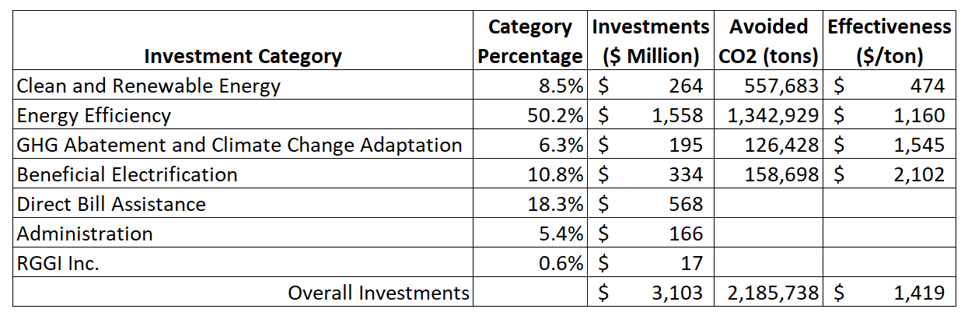
I have prepared seven annual updates on the Regional Greenhouse Gas Initiative (RGGI) annual Investments of Proceeds report.  While preparing the most recent edition I realized that there were some lessons to be learned concerning the relative emission reduction effectiveness of the different investments categories used in the reports.  This post compares the dollars per ton of CO2 reduced for five investment categories.

I have been involved in the RGGI program process since its inception.  I blog about the details of the RGGI program because very few seem to want to provide any criticisms of the program. The opinions expressed in this post do not reflect the position of any of my previous employers or any other company I have been associated with, these comments are mine alone.

Background

RGGI is a market-based program to reduce greenhouse gas emissions (Factsheet). It has been a cooperative effort among the states of Connecticut, Delaware, Maine, Maryland, Massachusetts, New Hampshire, New York, Rhode Island, and Vermont to cap and reduce CO2 emissions from the power sector since 2008.  New Jersey was in at the beginning, dropped out for years, and re-joined in 2020. Virginia joined in 2021 and dropped out at the end of 2023.  Pennsylvania has joined but is not actively participating in everything due to on-going litigation. According to a RGGI website: “The RGGI states issue CO2 allowances which are distributed almost entirely through regional auctions, resulting in proceeds for reinvestment in strategic energy and consumer programs. Programs funded with RGGI investments have spanned a wide range of consumers, providing benefits and improvements to private homes, local businesses, multi-family housing, industrial facilities, community buildings, retail customers, and more.”

Proceeds Investment Report

The 2022 investment proceeds report was released on July 8, 2024.  For general information I refer you to my most recent  update.  In this article I am going to present data from the last five reports.  Each report breaks down the investments into major categories.  The 2022 investment report explains:

Energy efficiency makes up 49% of 2022 RGGI investments and 61% of cumulative investments. Programs funded by these investments in 2022 are expected to return about $1.5 billion in lifetime energy bill savings to more than 189,000 participating households and over 2,000 businesses in the region and avoid the release of 6.5 million short tons of CO2.

Clean and renewable energy makes up 7% of 2022 RGGI investments and 6% of cumulative investments. RGGI investments in these technologies in 2022 are expected to return over $139 million in lifetime energy bill savings and avoid the release of more than 660,000 short tons of CO2.

Beneficial electrification makes up 12% of 2022 RGGI investments and 4% of cumulative investments. RGGI investments in beneficial electrification in 2022 are expected to avoid the release of 315,000 short tons of CO2 and return over $97 million in lifetime savings.

Greenhouse gas abatement and climate change adaptation makes up 3% of 2022 RGGI investments and 8% of cumulative investments. RGGI investments in greenhouse gas (GHG) abatement and climate change adaptation (CCA) in 2022 are expected to avoid the release of more than 11,000 short tons of CO2.

Direct bill assistance makes up 21% of 2022 RGGI investments and 15% of cumulative investments. Direct bill assistance programs funded through RGGI in 2022 have returned over $77 million in credits or assistance to consumers.

Emission Reduction Cost Efficiency

Ultimately RGGI is supposed to be a CO2 emission reduction program. GHG emission reduction efforts are complicated by the fact that there are no cost-effective add-on GHG emission controls available for existing sources.  That means the owners of the electric generating units in RGGI have only two options to reduce emissions: switch to lower CO2 emitting fuels or operate less.  Importantly, in order maintain reliability in the electric system when facilities run less, somebody else must develop replacement zero-emissions generating resources to replace their output. Proponents of cap-and-dividend programs like RGGI tout the use of the auction proceeds to fund the deployment of alternative resources and load reduction programs.  However, as is the case with any source of funding controlled by a political bureaucracy, money can get diverted away from the original purpose of the program in many ways.  There always is a rationale for all the other purposes but if insufficient resources are not available to support the deployment of alternative resources there will be problems providing sufficient load when it is needed while complying with the RGGI requirements.

All my summaries of the RGGI Investment Proceeds reports have found the same results.  Since the beginning of the RGGI program RGGI funded control programs have been responsible for a small fraction of the observed reductions (e.g., only 7.5% in 2022).  The primary reason for the observed reductions has been fuel switching away from coal and oil to natural gas.  Importantly, the availability of potential fuel switching in the RGGI fleet of electric generating units is running out.  Consequently, future reductions will have to rely on the deployment of zero-emission generating resources and load reductions which makes cost-effective emission investments important. 

This makes the cost-effective investment for alternative resources all the more important.  I calculate cost effectiveness by dividing the RGGI total investments divided by the estimated avoided CO2 emissions. In my annual summaries I only looked at the overall values.  In 2022 the CO2 emission reduction efficiency was $941 per ton of CO2 reduced.  In 2023 NY RGGI emissions totaled 28,654,177. If RGGI investments were the sole approach for emission reductions, then it would cost $27.0 billion to go to zero.

There is one more complication that I should note.  I believe that the appropriate methodology to calculate the CO2 emissions reduction efficiency is to use the annual investment and avoided emission estimates.  The problem is that the RGGI reports provide annual values and expected lifetime values.  The metric for net-zero is annual emissions so it is inappropriate to consider lifetime values.  The Proceeds reports always include a caveat that the states continually refine their estimates and update their methodologies, but the historical annual numbers are not included in the proceed reports so my estimates do not reflect subsequent refinements. 

In the following sections I will provide specific information for each of the investment categories

Energy Efficiency

The RGGI report glossary describes energy efficiency programs as follows:

Programs designed to improve energy efficiency by reducing overall energy use without degrading functionality. This includes programs directed at assisting low-income families and small businesses. Program costs include evaluation and measurement. Examples: home energy audit programs, home and building weatherization, energy efficient appliance or industrial equipment rebate programs, compact fluorescent light bulb programs, and energy efficiency workforce training programs.

The following table lists information for this investment category for the last five years.  Note that the effectiveness ($ per ton removed) ranges from $249 per ton to $1,665 per ton and the five-year average is $687 per ton.  The range is so large that it suggests that there is an inconsistency.  It could be differences due to different methodologies amongst the state agencies who prepared data for the report and interannual variation between analysts.  Based on my experience with similar estimates this is more art than science because the assumptions and input data used can lead to markedly different estimates. In addition, the states included in the analysis varies so the effects of methodological differences changes.  In my opinion, those issues would not account for the this wide a range so the possibility that there were typos in the data could also be a factor.  The RGGI state decision to not update the annual values also could be a factor inasmuch they might have identified an error that subsequent analyses corrected.  It is also possible that I made an error that is responsible for the variation.

Clean and renewable energy

The RGGI report glossary describes clean and renewable programs as follows:

Programs directed at accelerating the deployment of renewable or other non-carbon emitting energy technologies. Program costs include evaluation and measurement. Examples include incentives for residential solar panels, financing of commercial renewable energy projects through green banking, research and development of new energy technologies.

The following table lists information for this investment category for the last five years.  Note that the effectiveness ($ per ton removed) ranges from $158 per ton to $862 per ton with a 5-year average of $429.  Because of the wide range in values the previously mentioned caveats for potential errors are also relevant here.

Beneficial electrification

The RGGI report glossary describes beneficial electrification programs as follows:

Programs designed to reduce fossil fuel consumption by implementing or facilitating fuel-switching to replace direct fossil fuel use with electric power. Examples include incentives for electric vehicles and home appliances, and installation of electric vehicle infrastructure. Program costs include evaluation and measurement.

This category is complicated.  The report notes that:

Often, these programs result in an increase in MWh, but do reduce carbon emissions overall. As the grid becomes cleaner, the emissions from electrified appliances become cleaner, as opposed to the fixed emissions intensity of fossil-powered appliances.

The report argues that net emissions are lower, but the details of the calculations are not provided.  The net emissions calculation is highly dependent upon the characteristics of the electric generation resources that are displaced so I am skeptical with this claim.  The reported values may also be affected if the power and energy estimates consider the energy losses between the generating stations and the electrification applications.  This category was added in 2020 so the following table lists information for this investment category for the last three years.  The cost effectiveness ranges from $1,769 to $2,198 per ton with a 3-year average of $1,986 per ton. Note that there is not as much variation in the cost per ton reduced effectiveness but that the cost efficiencies are much higher than the other investment categories.

Greenhouse gas abatement and climate change adaptation

The RGGI report glossary describes GHG abatement and climate change adaptation programs as follows:

Programs promoting the research and development of advanced energy technologies, the reduction of vehicle miles traveled, the reduction of emissions in the power generation sector, tree-planting projects designed to increase carbon sequestration, other initiatives to reduce greenhouse gases, and climate adaptation and community preparedness initiatives. Some projects can support multiple functions, such as natural area restoration that also serves flood mitigation planning purposes. Program costs include evaluation and measurement.

The following table lists information for this investment category for the last five years.  Note that the 2021 and 2022 reports did not include avoided power and bill savings information.  There is a huge variation in the cost effectiveness values with 2021 listed as 100 times higher than the lowest value.  It appears that the avoided CO2 value is much lower than the other values.  If that value is incorrect then it would explain the high outlier.  The average value excluding the outlier is $842 per ton removed.

Direct bill assistance

The RGGI report glossary describes direct bill assistance programs as follows:

Programs providing energy bill payment assistance, including direct bill assistance to low-income ratepayers. Program costs include evaluation and measurement.

This category does not provide any emission reductions.  The following table lists information for this investment category for the last five years.  Note that the total direct bill assistance totals $243 million.

Administration and RGGI, Inc.

There are two other categories for administrative costs that do not provide any emission reduction benefits.  The RGGI report glossary describes administration as “Funds directed to administrative overhead expense associated with all RGGI-funded programs, including outsourced and in-house overhead expenses” and RGGI Inc. as: “Funds provided to RGGI, Inc. to support and implement state CO2 Budget Trading programs.”

The following tables show the information for the last five years.  Administration costs total $89 million and RGGI costs total $13 million.

Summary

I summed the values for each category over the last five years to provide the following summary.  Note that the overall cost effectiveness is $959 per ton avoided.

Cost Effectiveness Implications

RGGI is supposed to be an emissions reduction program.  One of my big concerns about any cost on carbon emissions is that it is a regressive stealth tax on energy.  There is a tradeoff between trying to minimize those impacts and reducing emissions.  In the last five years $243 million or 17.4% of the RGGI auction proceeds went to direct bill assistance which is good but that means that much less was available to reduce emissions.  Throw in the $102 million over the last 5 years for administration that means that 24.7% of the RGGI auction proceeds were not used to reduce emissions.

The primary goal of this article is to compare the cost effectiveness of emission reductions for the following investment categories: energy efficiency, clean and renewable energy, beneficial electrification, greenhouse gas abatement and climate change adaptation.  The following table summarizes the cost effectiveness.  For the investment categories that provided emission reductions Clean and Renewable Energy was the most effective way to reduce emissions.  As far as I can tell this category provides the most funding for projects that directly reduce emissions.  It is encouraging that the energy efficiency is right around the average over all the categories.  This means that energy efficiency programs targeted at low- and middle-income households most affected by this energy tax will still provide effective emission reductions. 

On the other hand, programs promoting the research and development of GHG abatement and climate change adaptation are less effective at reducing emissions.  Perhaps a greater emphasis on programs promoting reduction of emissions in the power generation sector and advanced energy technologies and less emphasis on programs for the reduction of vehicle miles traveled, tree-planting projects designed to increase carbon sequestration, and climate adaptation and community preparedness initiatives would improve emission reduction efforts consistent with the emission reduction goal of RGGI.

The worst emission reduction programs are associated with beneficial electrification that are “designed to reduce fossil fuel consumption by implementing or facilitating fuel-switching to replace direct fossil fuel use with electric power.“  This category was added recently.  There are two ways to look at the high numbers.  On one hand, it could be that it recognizes that reductions of overall fossil fuel consumption require efforts across all sectors.  On the other hand, I think it inappropriately transfers costs to the electric sector that do not provide efficient emission reductions.

Discussion

As noted previously, since the beginning of the RGGI program RGGI funded control programs have been responsible for a small fraction of the observed reductions (e.g., only 7.5% in 2022).  The primary reason for the observed reductions has been fuel switching away from coal and oil to natural gas. There are limited opportunities to make further fuel switching changes.   Consequently, future reductions will have to rely on the deployment of zero-emission generating resources.  This means that compliance with the RGGI emission caps is out of the control of the affected generating units and that RGGI investments must fund much of the reductions needed.

There are associated ramifications with the  RGGI Third Program Review currently underway but stalled for months.  The Acadia Center has been lobbying to resolve the impasse and “Set a new cap that is in line with the States’ goals, we are in support of a cap that goes to zero by 2040”. The most effective compliance strategy to date, fuel switching, cannot reduce emissions to zero.   The affected sources are unable to guarantee compliance because the deployment of zero-emissions resources are out of their control.  The recently released Clean Energy Standard Biennial Review Report found that New Yorks deployment of renewable resources is incompatible with the 2030 Climate Act goal to reach 70% by 2030.  Combined with the inefficient emission investment results, it is clear that Acadia’s position is incompatible with the reality of these findings.

Conclusion

To this point RGGI implementation has been able to rely on emission reductions from fuel switching at affected sources.  In the current program review process, climate activists are demanding that the future emission reduction trajectory be consistent with a zero-emissions electric grid at some point.  This means that fuel switching will eventually not be a viable option and, given that fuel switching opportunities are more limited than in the past, the ramifications are likely soon.  This is troubling because the ultimate compliance strategy for an affected source that has insufficient allowances due to an inappropriate reduction strategy is to simply stop running.

If RGGI investments could effectively support the development of zero-emissions resources or reduce load efficiently, then the affected sources could meet reasonable emission reduction trajectories.  Unfortunately, the results shown here suggest that RGGI investments have not been particularly cost efficient.  The bigger issue is that pressure to use RGGI funds to support electrification of other sectors not only causes an increase in load and likely emissions for the affected sources, but these results show that those investments have the worst cost per ton removed efficiencies.  Coupled with pressure to make equity-based investments that may or may not be efficient, this means that RGGI investments may be inadequate to support aspirational emission reductions targets.  All this suggests that the likelihood that RGGI compliance requirements will cause artificial energy shortages when units stop operating because they have inadequate allowances is increasingly likely.

Investment of RGGI Proceeds Report for 2022  

This is the seventh installment of my annual updates on the Regional Greenhouse Gas Initiative (RGGI) annual Investments of Proceeds report.  This post compares the claims about the success of the investments against reality.  As in my previous posts I have found that the claims that RGGI successfully provides substantive emission reductions are unfounded and that the revenue investments cost per ton reduced far exceed all social cost of carbon estimates.

I have been involved in the RGGI program process since its inception.  I blog about the details of the RGGI program because very few seem to want to provide any criticisms of the program. The opinions expressed in this post do not reflect the position of any of my previous employers or any other company I have been associated with, these comments are mine alone.

Background

RGGI is a market-based program to reduce greenhouse gas emissions (Factsheet). It has been a cooperative effort among the states of Connecticut, Delaware, Maine, Maryland, Massachusetts, New Hampshire, New York, Rhode Island, and Vermont to cap and reduce CO2 emissions from the power sector since 2008.  New Jersey was in at the beginning, dropped out for years, and re-joined in 2020. Virginia joined in 2021 and dropped out at the end of 2023.  Pennsylvania has joined but is not actively participating in everything due to on-going litigation. According to a RGGI website: “The RGGI states issue CO2 allowances which are distributed almost entirely through regional auctions, resulting in proceeds for reinvestment in strategic energy and consumer programs. Programs funded with RGGI investments have spanned a wide range of consumers, providing benefits and improvements to private homes, local businesses, multi-family housing, industrial facilities, community buildings, retail customers, and more.”

Proceeds Investment Report

The 2022 investment proceeds report was released on July 8, 2024  According to the press release:

The participating states of the Regional Greenhouse Gas Initiative (RGGI) today released a report tracking the investment of proceeds generated from RGGI’s regional CO2 allowance auctions. The report tracks investments of RGGI proceeds in 2022, providing state-specific success stories and program highlights. The RGGI states have individual discretion over how to invest proceeds according to state-specific goals. Accordingly, states direct funds to a wide variety of programs, touching all aspects of the energy sector.

In 2022, $364 million in RGGI proceeds were invested in programs including energy efficiency, clean and renewable energy, beneficial electrification, greenhouse gas abatement, and direct bill assistance. Over their lifetime, these 2022 investments are projected to provide participating households and businesses with $1.8 billion in energy bill savings and avoid the emission of 6.6 million short tons of CO2.

The largest share of the investments was directed to energy efficiency, with 49% of the 2022 total. Other categories receiving significant investments include direct bill assistance, clean and renewable energy programs, beneficial electrification, and greenhouse gas abatement and climate adaptation programs. Approximately 30% of these investments went towards environmental justice and equity focused programs. For more details on both 2022 and cumulative investments and benefits, see the full report, Investment of RGGI Proceeds in 2022.

The report breaks down the investments into five major categories:

Energy efficiency makes up 49% of 2022 RGGI investments and 61% of cumulative investments. Programs funded by these investments in 2022 are expected to return about $1.5 billion in lifetime energy bill savings to more than 189,000 participating households and over 2,000 businesses in the region and avoid the release of 6.5 million short tons of CO2.

Clean and renewable energy makes up 7% of 2022 RGGI investments and 6% of cumulative investments. RGGI investments in these technologies in 2022 are expected to return over $139 million in lifetime energy bill savings and avoid the release of more than 660,000 short tons of CO2.

Beneficial electrification makes up 12% of 2022 RGGI investments and 4% of cumulative investments. RGGI investments in beneficial electrification in 2022 are expected to avoid the release of 315,000 short tons of CO2 and return over $97 million in lifetime savings.

Greenhouse gas abatement and climate change adaptation makes up 3% of 2022 RGGI investments and 8% of cumulative investments. RGGI investments in greenhouse gas (GHG) abatement and climate change adaptation (CCA) in 2022 are expected to avoid the release of more than 11,000 short tons of CO2.

Direct bill assistance makes up 21% of 2022 RGGI investments and 15% of cumulative investments. Direct bill assistance programs funded through RGGI in 2022 have returned over $77 million in credits or assistance to consumers.

Emissions Reductions

In my previous articles on the Proceeds reports, I have argued that RGGI mis-leads readers when they claim that the RGGI states have reduced power sector CO2 pollution over 50% since 2009. In the following table, I list the 9-state RGGI emissions and percentage reduction from a three-year baseline before the program started in 2009.

I have argued that the implication in the report’s 50% claim is that the RGGI program investments were primarily responsible for the observed reduction even as the economy grew (Chart 1 from the report).

I believe that their insinuation that RGGI was primarily responsible for the emission reductions is wrong.  The following table lists the emissions by fuel types for ten RGGI states.  It is obvious that the primary cause of the emission reductions was the fuel switch from coal and residual oil to natural gas.  This fuel switch occurred because it was economic to do so.  I believe that RGGI had very little to do with these fuel switches because fuel costs are the biggest driver for operational costs and the cost adder of the RGGI carbon price was too small to drive the use of natural gas over coal and oil. 

I believe that the appropriate measure of RGGI emissions reductions is the decrease due to the investments made with the auction proceeds so I compared the annual reductions made by RGGI investments.  The biggest flaw in the RGGI report is that it does not provide the annual RGGI investment CO2 reduction values accumulated since the beginning of the program.  In order to make a comparison to the CO2 reduction goals I had to sum the values in the previous reports to provide that information. 

The following table lists the annual avoided CO2 emissions generated by the RGGI investments from previous reports.  The accumulated total of the annual reductions from RGGI investments is 4,277,230 tons while the difference between the three-year baseline of 2006-2008 and 2022 emissions is 56,704,448 tons.  The RGGI investments are only directly responsible for 7.5% of the total observed annual reductions over the baseline to 2022 timeframe! 

Although proponents claim that this program has been an unqualified success I disagree.  Based on the numbers there are some important caveats to the simplistic comparison of before and after emissions.   The numbers in the previous paragraph show that emission reductions from direct RGGI investments were only responsible for 6.7% of the observed reductions.   In a detailed article I showed that fuel switching was the most effective driver of emissions reductions since the inception of RGGI and responsible for most of the reductions.

Benefits

Table 1 from the report lists two benefits of 2022 RGGI Investments: emission reductions and energy bill savings.  Energy bill savings derive from investments in energy efficiency savings and other efforts that directly reduce costs to consumers.  These energy saving benefits typically account for total savings over the lifetime of the project investment.  RGGI does the same thing with the CO2 emission reductions but I think that is misleading because the emission reduction metric is annual emissions and not lifetime emissions. 

Emission Reduction Cost Efficiency

There is another aspect of this report that is mis-leading and after arguing with RGGI and New York State about the issue, I have concluded that the deception is intentional.  I believe that a primary concern for GHG emission reduction policies is the cost effectiveness of the policies and I have argued that this report should provide the information necessary to determine a cost per ton reduced value for control programs for comparison to the social cost of carbon.  If the societal benefits represented by the social cost of carbon for GHG emission reductions are greater than the control costs for those reductions, then there is value in making the reductions.  If not, then the control programs are not effective.

Recall that RGGI provides lifetime CO2 emission reductions but I think that is misleading because it suggests that the emission reduction cost efficiency of the investments is the total investments divided by the lifetime benefits of those benefits.   For example, dividing the 2022 investments of $364 million by the lifetime avoided CO2 emissions (7,507,128) yields a value of $49.  The Biden administration is re-evaluating the social cost of carbon values but for the time being has announced an initial estimate of $51 per ton and this suggests that RGGI investments are close to being cost effective relative to the Federal social cost of carbon.

However, the social cost of carbon value is calculated for an annual reduction of one ton.  In particular,

the social cost of carbon is an estimate, in dollars, of the present discounted value of the benefits of reducing annual emissions by a metric ton. I believe that using the lifetime emissions approach is wrong because it applies the social cost multiple times for each ton reduced.  It is inappropriate to claim the benefits of an annual reduction of a ton of greenhouse gas over any lifetime or to compare it with avoided emissions. In my comments on the New York Climate Act Scoping Plan, I explained that the value of carbon for an emission reduction is based on all the damages that occur from the year that the ton of carbon is reduced out to 2300.  Clearly, using cumulative values for this parameter is incorrect because it counts those values over and over.  I contacted social cost of carbon expert Dr. Richard Tol about my interpretation of the use of lifetime savings and he confirmed that “The SCC should not be compared to life-time savings or life-time costs (unless the project life is one year)”. 

In order to calculate the CO2 emissions reduction efficiency consistent with the social cost of carbon, the proper estimate is the total investments since the start of the program divided by sum of the annual emission reductions.  The problem is that the RGGI reports do not provide that total and instead only provide the sum of the annual lifetime CO2 avoided emissions.  The Proceeds reports always include a caveat that the states continually refine their estimates and update their methodologies, but the annual numbers are not updated to reflect those changes.  Ideally to get the best estimate of the annual numbers the RGGI states should provide the revised annual numbers for each year of the program. Because that is not the case, I have had to rely on the original annual numbers provided in previous editions of the report.  I summed the values in the previous reports to provide that information as shown in the Accumulated Annual Regional Greenhouse Gas Initiative Benefits Through 2022 table shown above.  The accumulated total of the annual reductions from RGGI investments is 4,277,230 tons through December 31, 2022. The sum of the RGGI investments in the previous table is $4,023,548,913 over that time frame.  The appropriate comparison to the social cost of carbon is $4.024 billion divided by 4,277,230 tons or $941 per ton reduced. 

Conclusion

The 2022 RGGI Investment Proceeds report tries to put a positive spin on the poor performance of RGGI auction proceeds reducing CO2.  The alleged purpose of the program is to reduce CO2 from the electric generating sector to alleviate impacts of climate change.  Since the beginning of the RGGI program RGGI funded control programs have been responsible for 7.5% of the observed reductions.  The report does not directly provide the numbers necessary to calculate that estimate which I have come to believe is deliberate.  When the sum of the RGGI investments is divided by the sum of the annual emission reductions the CO2 emission reduction efficiency is $941 per ton of CO2 reduced.  I conclude that although RGGI has been effective raising revenues it is not an effective CO2 emission reduction program.

Status of RGGI Third Program and Acadia Center RGGI Letter to State Officials

The Acadia Center recently sent me an email asking if I would sign a letter to State Officials regarding the Regional Greenhouse Gas Initiative (RGGI) Third Program Review.  That prompted me to prepare this article that summarizes the status of the Third Program Review and describes my response to the Acadia Center.

I am a retired air pollution meteorologist and worked on every cap-and-trade program affecting electric generating facilities in New York since 1990 including the Acid Rain Program, Regional Greenhouse Gas Initiative, and several Nitrogen Oxide programs since the inception of those programs. I also participated in RGGI Auction 41 and successfully won allowances which I held for several years. When I retired I started this blow where a regular topic is the RGGI cap and invest CO2 pollution control programThe opinions I express do not reflect the position of any of my previous employers or any other company I have been associated with, these comments are mine alone.

Background

RGGI is a market-based program to reduce greenhouse gas emissions. According to RGGI:

The Regional Greenhouse Gas Initiative (RGGI) is a cooperative effort among the states of Connecticut, Delaware, Maine, Maryland, Massachusetts, New Hampshire, New Jersey, New York, Pennsylvania, Rhode Island, Vermont, and Virginia to cap and reduce power sector CO2 emissions. 

RGGI is composed of individual CO2 Budget Trading Programs in each participating state. Through independent regulations, based on the RGGI Model Rule, each state’s CO2 Budget Trading Program limits emissions of CO2 from electric power plants, issues CO2 allowances and establishes participation in regional CO2 allowance auctions.

The description of RGGI program review states:

The RGGI participating states are committed to comprehensive, periodic review of their CO2 budget trading programs, to consider successes, impacts, and design elements (Program Review). The RGGI states completed the First Program Review in February 2013 and completed the Second Program Review in December 2017, resulting in the 2017 Model Rule.

On February 2, 2021, the RGGI states released a statement announcing the plan for the Third Program Review, and in Summer 2021 the states released a preliminary timeline for conducting the Third Program Review. In November 2022, the states released a Program Review Update which includes an updated Program Review timeline.

Last September RGGI hosted a public meeting as part of the process and discussed the following topics:

  • Environmental Justice and Equity
  • Program Elements for Consideration
  • Electricity Sector Analysis

I prepared two articles after the meeting.   The first described the disconnect between the results of RGGI to date relative to the expectations in the RGGI Third Program Review modeling that I addressed in my comments to RGGI.  I followed up with another article that described the comments submitted at the time by others.  Aside from an announcement on May 21, 2024 that “The participating states in the Regional Greenhouse Gas Initiative (RGGI) released the RGGI CO2 Emissions Dashboard on the RGGI website” there hasn’t been any other signs of progress on the program review process.

Acadia Center Draft Letter to RGGI

On May 22 I received an email that included the following:

I hope you’re doing well. I’m reaching out to ask for your support by signing onto another one of our RGGI letters, and this time we’re sending it to State Officials. The two-page letter aims to both ask for more information on the timeline on the Third Program Review and urge state officials to prioritize equity considerations in their decision-making processes for Third Program Review. Your signature would amplify our message and encourage your state officials to prioritize equity in their decision-making.

The draft letter is set up to go representatives in each of the RGGI states.  The New York draft is addressed to  Department of Environmental Conservation (DEC) Deputy Commissioner Jon Binder and the Chair of the New York Public Service Commission Rory Christian.  There are two requests in the letter.  Previous program reviews were completed much quicker than this one and included more collaborative opportunities between the States and stakeholders.  The first request asked, “when should we expect the RGGI states to take action to complete the Program Review?”  In the following discussion of my impression of the status of the program I will describe why I think this process is dragging but I certainly do not disagree with this request.  The second request in the letter is a request on the “need for the RGGI states to respond, from a substantive point of view to the comments you solicited, and we provided.”  I do not disagree with either sentiment.  The problem is that I don’t think they are able to respond to either one at this time as I will explain below.

My bigger issue with signing the letter is that I disagree with the following section of the letter:

Environmental justice and equity concerns for electricity ratepayers and frontline communities is notably the overarching issue that stands out among the many comments filed with the RGGI states. Of the various issues raised in the two rounds of 2023 program review stakeholder comments, 17 of the 38 filings from March and September mirror the language of the RGGI state’s initial Program Review announcement. They request that the RGGI states prioritize the needs of frontline communities.

The number of filings is only one piece of this story–it is also important to look at who filed comments. Multiple organizations signed on to comment letters. For example, the RGGI Advocates Coalition filing represents 18 organizations, while the Earthjustice et al. comments were signed by 16 organizations. Thus, an overwhelming majority of the organizations submitting 2023 program review filings urged the RGGI states to prioritize environmental justice-related issues in their program review. These issues and accompanying requests and recommendations include:

  • Adopt a definition of “environmental justice”, a necessity for states that do not have one;  
  • Set a percentage commitment of funds to allocate towards the RGGI ratepayers that have historically suffered from unfair treatment and disproportionate exposure to the harmful environmental conditions;
  • Increase frontline community participation in decision-making and participation in investment planning;
  • Address frontline community members’ exposure to poor air quality from criteria pollutants exacerbated by the electric generators covered by the program, and generators that are not yet covered by the program;
  • Lower the 25 MW program threshold to include smaller generating units in the program;
  • Expand air quality monitoring, particularly in disproportionately impacted areas at relevant levels of granularity
  • Set a new cap that is in line with the States’ goals, we are in support of a cap that goes to zero by 2040.

Before addressing my specific issues with this section of the letter I will describe all the comments.

Impression of Comments

My article on the comments submitted to RGGI was published on November 7, 2023 but RGGI posted another tranche of comments on November 9, 2023.  I did not update my article to address the comments that came in after the requested submittal date.  I noted that the comments concentrated on particular aspects of the proposed revisions to the RGGI program.  My article categorized the first set of comments and I updated that summary of comments for this article.  In brief these were the major themes:

  • Biomass Concerns – The Partnership for Public Policy and five individuals from Vermont complained about biomass power plants and the existing provision for “eligible” biomass to be treated as having zero emissions. 
  • Emissions Traders – One emission trading company and the International Emissions Trading Association submitted comments that I believe have market implications that traders could exploit at the expense of everyone else.
  • Support the Narrative – Five commenters including the Acadia Center agreed with the RGGI States suggestion to tighten the allowance caps and incorporate an environmental justice component. 
  • Cashing in on Advocacy – One comment on behalf of seven organizations in Pennsylvania read like a mission statement for advocates hoping to cash in on RGGI auction proceeds.
  • The Nature Conservancy comments were in a class by themselves.  They supported most of the issues raised in the Acadia Center letter but their support was based on naïve understanding of the issue.  They apparently have committed to offset projects that most environmental advocacy organizations do not accept.
  • Industry Concerns – Four industry comments argued for caution in any proposed changes because the compliance success to date is threatened as the program goes into unprecedented levels of allowance supply relative to expected emissions.  Another important point made is that the technology necessary to eliminate fossil fuel electric generating units does not exist today so setting a zero-emissions target must consider technological feasibility.

I also submitted personal comments.  I described my comments in an earlier post.  I explained that I am afraid that the RGGI States are placing so much reliance on their analysis results that they could propose unrealistic allowance reduction trajectories.  It is naïve to treat any model projections of the future energy system without a good deal of skepticism because the electric grid is so complex and currently dependent upon dispatchable resources.  Replacement of RGGI-affected sources with intermittent and diffuse wind and solar resources that cannot be dispatched is an enormous challenge with likely unintended consequences.  Therefore, the modeling results should be considered relative to historical observations. 

Most advocates do not recognize that since the beginning of the RGGI program, RGGI funded control programs have been responsible for only 6.7% of the observed reductions.  My analyses indicate that most of the observed reductions of emissions are due to fuel switching from coal and residual oil to natural gas and that there are few opportunities for additional switching reductions in most RGGI States.  That means that future reductions are going to have to rely on displacing existing generator operations with zero-emission alternatives.  Ostensibly the auction revenues from RGGI are supposed to encourage development of those alternatives.  I have  found that when the sum of the RGGI investments is divided by the sum of the annual emission reductions the CO2 emission reduction efficiency is $927 per ton of CO2 reduced.  I think that the cost per ton reduced is too high to afford to develop the resources necessary for the reductions required to meet the aggressive allowance trajectories proposed.  In addition, as the allowances available go down either allowance prices will have to increase sharply or the revenues available for reduction investments will drop sharply.

My impression of the comments affect my response to the Acadia Center emphasis on equity portion of the draft letter to State Officials.  There is no question that many disadvantaged communities suffer disproportionate environmental impacts but it is important to understand what causes the harms and balance expectations and potential solutions. I agree that a definition of environmental justice for all RGGI states is needed  On the other hand, specific percentage commitment of funds is a problem for me because it will likely reduce the already poor effectiveness of investments to reduce emissions.  None of the RGGI states have a good record reducing emissions. The overall cost effectiveness of $927 per ton of CO2 reduced far exceeds the current Social Cost of Carbon.  Because fuel switching options to reduce emissions are just about tapped out, future emission reductions will only be possible when zero-emissions resources displace fossil plants.  The feasibility of that transition has never been proven and no jurisdictions have succeeded in that transition when depending upon wind and solar resources.  The recent New York technical conference that characterized the observed wind and solar resource cap and the resources necessary to address it conclusively show that existing technology is insufficient.

Another of the themes of the Acadia Center equit portion of the letter is to get the environmental justice communities more involved in the regulatory process: “Increase frontline community participation in decision-making and participation in investment planning”.  Electric and environmental resource planning is complex and there are reliability considerations that preclude some options that are endorsed by environmental justice advocates and the non-governmental organizations that provide them with technical support.  I certainly do not have an issue with their involvement but I do not see much value given their level of understanding.  Worse if it is impossible to accommodate all their demands the responses have not been constructive.

Environmental Justice advocates want to reduce “exposure to poor air quality from criteria pollutants exacerbated by the electric generators covered by the program, and generators that are not yet covered by the program”.  The New York City peaking power plant issue is a prime example of this concern and the disconnect between reality and activist demands.  Even though direct emissions from those plants comply with all existing environmental regulations and have dropped significantly over time, activists claim that they are the “most egregious energy-related example of what environmental injustice means today.”   Activists got a consultant to give them arguments to that effect and they have been promoting the issue ever since.  However, the presumption of egregious harm is based on selective choice of metrics, poor understanding of air quality health impacts, and ignorance of air quality trends.  In fact, analyses for the New York Cap-and-Investhave shown that was that the inhalable particulate emissions claimed as a particular problem are primarily from other sources based on the expanded air quality monitoring in disadvantaged communities.  Despite that finding the calls for shutdowns continue despite the fact that the organizations responsible for electric system reliability are on record saying that is unacceptable at this time.

Finally, the Acadia letter suggests setting a new cap that is in line with the States’ goals.   As noted previously this is problematic because the technology required is not available. 

Third Program Review Status

In my opinion the delays in the implementation of the Third Program Review recommendations are related to two problems: the participation of Virginia and Pennsylvania and the conflicting de-carbonization goals of the RGGI States.

The participation of Virginia and Pennsylvania has been mired down in politics and litigation.  Virginia is officially out currently but there is pending litigation to re-join.  Pennsylvania has never officially participated, and litigation is still holding back joining.  The problem is that both states have significant emissions and opportunities for further reductions.  In 2022, Virginia emissions were 23% of total RGGI emissions, Pennsylvania emissions were 27% of RGGI emissions including Virginia and 32% of total emissions excluding Virginia.  The allowance reduction trajectory feasibility depends on their participation so I suspect there is reluctance by the RGGI states to commit to something that will have to be scrapped if Virginia and Pennsylvania participation changes.

The other issue is that the de-carbonization goals of the RGGI states differ.  New York State has a law that mandates zero-carbon electric emissions by 2040.  Other states have different targets.  I believe that New York wants RGGI to comport with their mandate, but other states may not want to be so ambitious.  New York is setting up an economy-wide cap-and-invest program like RGGI but the latest version includes safety valves for reliability concerns.  I do not recall that the RGGI presentations have acknowledged that might be necessary so there is another controversy that must be resolved.

I am not surprised that the RGGI states have not been able to proceed with the Third Program Review.  I do not think it is possible to submit a letter that will accelerate the process given the complexity of the issues and all the uncertainties. The Acadia Center draft letter requested that the RGGI states to “respond, from a substantive point of view to the comments you solicited, and we provided.”  Given the wide range of possible outcomes and disparate interests of the states I do not think that they are able to respond to the comments now.

Conclusion

I agree with the concepts in the Acadia Center draft letter to State Officials.  An update on the status is overdue and responses to comments are appropriate.  However, I don’t think the status update is going to satisfy anyone because of all the uncertainties that preclude a firm schedule.   Until the differences between Virginia and Pennsylvania participation and RGGI state policy differences are reconciled it is impossible to respond to the proposed letter.  Therefore, I do not plan to sign the letter even if I am still welcome after this article is published.

My primary concern with RGGI relates to its ultimate goal of CO2 emissions reductions while maintaining a reliable and affordable electric system.  The Acadia Center letter and most of the comments were notable with respect to the motivations of the authors.  They mostly were at odds with the emission reduction goal.  There is a faction that despises a biomass facility in Vermont and commented on that.  Emissions traders support revisions to their advantage and not the rest of us.  One comment was a blatant marketing proposal to get money but it could be argued that many other commenters were doing the same thing just less obviously.

The RGGI state narrative now is to incorporate environmental justice considerations and comments supporting that were frequent.  In a recent post I addressed the tradeoffs between equity in a zero-sum approach relative to a positive-sum approach.  All the comments supporting environmental justice equity promoted the zero-sum approach with no recognition of potential unintended consequences.  I think the well-meaning emphasis on environmental justice is a problem because advocates are unduly pessimistic.  They ignore current environmental quality and improvements and focus on much smaller and less certain environmental risks all the while ignoring the benefits of a reliable electric system. 

New York RGGI Operating Plan Amendment 2024

The Regional Greenhouse Gas Initiative (RGGI) is a market-based program to reduce emissions from electric generating units.  This post describes my comments on the New York State Energy Research & Development Authority (NYSERDA) Regional Greenhouse Gas Initiative (RGGI) Operating Plan Amendment (“Amendment”) for 2024. 

The Amendment describes the plans to use the RGGI proceeds in the next several years.  Although supporters of RGGI claim that it is a successful model to emulate, my comments explain the implications of the actual results not only to the RGGI program but also for the Climate Leadership and Community Protection Act (Climate Act).  There are no substantive changes in this regard since I submitted comments on last year’s operating plan.  What has changed is my tolerance for the perfunctory responsiveness of NYSERDA to stakeholder comments. 

I have been involved in the RGGI program process since its inception.  I blog about the details of the RGGI program because very few seem to want to provide any criticisms of the program.   I submitted comments on the Climate Act implementation plan and have written over 370 articles about New York’s net-zero transition because I believe the ambitions for a zero-emissions economy embodied in the Climate Act outstrip available renewable technology such that the net-zero transition will do more harm than good.  The opinions expressed in this post do not reflect the position of any of my previous employers or any other company I have been associated with, these comments are mine alone.

Background

RGGI is a market-based program to reduce greenhouse gas emissions (Factsheet). It has been a cooperative effort among the states of Connecticut, Delaware, Maine, Maryland, Massachusetts, New Hampshire, New York, Rhode Island, and Vermont to cap and reduce CO2 emissions from the power sector since 2008.  New Jersey was in at the beginning, dropped out for years, and re-joined in 2020. Virginia joined in 2021 but has since withdrawn and Pennsylvania has joined but is not actively participating in auctions due to on-going litigation. According to a RGGI website: “The RGGI states issue CO2 allowances which are distributed almost entirely through regional auctions, resulting in proceeds for reinvestment in strategic energy and consumer programs. Programs funded with RGGI investments have spanned a wide range of consumers, providing benefits and improvements to private homes, local businesses, multi-family housing, industrial facilities, community buildings, retail customers, and more.” 

NYSERDA Operating Plan Amendment

NYSERDA designed and implemented a process to develop and annually update an Operating Plan which summarizes and describes the initiatives to be supported by RGGI auction proceeds.  On an annual basis, the Authority “engages stakeholders representing the environmental community, the electric generation community, consumer benefit organizations and interested members of the general public to assist with the development of an annual amendment to the Operating Plan.”

The draft Amendment explains that New York State invests RGGI proceeds to support comprehensive strategies that best achieve the RGGI greenhouse gas emissions reduction goals pursuant to 21 NYCRR Part 507.  The programs in the portfolio of initiatives are designed to support the pursuit of the State’s greenhouse gas emissions reduction goals by:

  • Deploying commercially available energy efficiency and renewable energy technologies;
  • Building the State’s capacity for long-term carbon reduction;
  • Empowering New York communities to reduce carbon pollution, and transition to cleaner energy;
  • Stimulating entrepreneurship and growth of clean energy and carbon abatement companies in New York; and
  • Creating innovative financing to increase adoption of clean energy and carbon abatement in the State.

The draft Amendment notes that the initiatives described represent program activity proposed for the 2024 Operating Plan. The funding levels for each program include previously approved and the amounts proposed for FY24-25 through FY26-27. 

This post summarizes the comments I submitted on the proposed Operating Plan Amendment.  Given the obvious disdain that NYSERDA has for public stakeholder input I did not expend the level of effort I did last year. My comments rely heavily on last year’s analyses and are separated into two main parts.  The first repeats my 2023 evaluation that described the observed New York State (NYS) emission reductions from the electric sector since 2000.  The Plan needs to focus its efforts and put more emphasis on programs that directly, indirectly, or potentially reduce carbon dioxide (CO2) from the electric generating units affected by RGGI.  Failure to do so will cause problems achieving the Climate Act 2030 mandates to produce 70% of electricity from renewable sources and increasing energy efficiency from 2012 levels by 23%.  The second section offers my comments on the specific programs in the 2024 Amendment.  Finally, I document the poor public stakeholder engagement process. To address that I copied the Board in my submittal so that I could be sure that they at least had the opportunity to see my comments.

Comment Summary

I think the ultimate problem in the Amendment is that RGGI proceeds are used to support too many Climate Act programs outside of the electric sector. RGGI is an electric sector emissions reduction program, so it is inappropriate to use the auction proceeds for any program that will not materially decrease emissions directly or indirectly through energy efficiency reductions.  There are multiple programs in the amendment that do not meet those criteria.  Those mis-allocated funds should be transferred to programs that do affect emissions.

RGGI supporters claim that the RGGI funds have played a meaningful role in the observed emission reductions at RGGI sources, but that claim is exaggerated.  The historical emission trends of NYS electric generating units (EGU) provide valuable insight for future emission strategies.  I found that between 2000 and 2021 New York EGU emissions have dropped from 57,114,438 tons to 28,546,529 tons, a decrease of 50%.  NYS EGU CO2 emissions were 35% lower in 2022 than the three-year baseline emissions before RGGI started.  However, I showed that emissions have dropped primarily because coal and oil fueled generation has essentially gone to zero.  Natural gas has increased to cover the generation from those fuels but because it has lower CO2 emission rates New York emissions have gone down.

According to Table 2 in Semi-Annual Status Report through December 31, 2022, the cumulative annual net greenhouse gas emission committed savings are 1,725,544 tons through the end of 2022.  That is 9.5% of the observed reduction of 16,196,531 tons since the three-year baseline before the start of RGGI. I conclude that the primary reason for the observed electric sector emission reductions in New York was due to fuel switching.

These observations are relevant for the future of EGU emission reductions required for RGGI and the Climate Act. Fuel switching is no longer an option in New York.  Coal is no longer used and oil emissions from the RGGI affected sources are as low as they are going to get without retirement of oil-fired sources.  The average CO2 emissions reduction per year from RGGI investments has been 95,716 tons since 2013.  New York Part 242 CO2 Budget Trading Program specifies an annual reduction of RGGI allowances of 880,493 per year starting in 2022 and continuing to 2030.  That reduction is nearly ten times more than the reductions from RGGI auction proceed investments.  The Climate Act is going to require even more emission reductions.  Electric generating unit owners and operators have no options available for additional emission reductions other than reducing their operating times.  It is incumbent upon NYSERDA to invest RGGI funds to incentivize and subsidize carbon-free generation and reduce energy use so that the RGGI sources can reduce operations and not jeopardize system reliability.  If the sources are unable to reduce operations safely, then the Climate Act targets will be jeopardized.

In the second section of the comments, I evaluated the Amendment programs.  The comments describe program investments for six categories.  The first three categories cover programs that directly, indirectly or could potentially decrease RGGI-affected source emissions.  Those programs total 33% of the investments.  I also included a category for programs that will add load that could potentially increase RGGI source emissions which totals 24% of the investments.  Programs that do not affect emissions are funded with 35% of the proceeds and administrative costs total another 8%.  Because there is inadequate documentation, my categorizations are estimates.  Even if those estimates were refined, I believe this represents an improper allocation of resources.

In order to address the need for strategies that can displace RGGI-affected source generation the RGGI Operating Plan Amendment needs to reevaluate priorities.  NYSERDA must verify that other investments will provide the necessary reduction in RGGI-affected source emissions in order to justify spending more than half the RGGI proceeds on programs unrelated to RGGI emissions.  My comments on specific amendments recommended that most of the unrelated programs not be funded.

I only had specific comments on one proposed program. The Climate Act is pushing the envelope of zero-emissions technology, so the Scoping Plan Implementation Research program is certainly appropriate.  I recommend that this program fund projects for dispatchable emissions-free resource DEFR) requirements and the question of wind and solar resource availability during winter doldrums.

Stakeholder Process

I have been involved with stakeholder comments for regulatory proceedings in New York since 1981 and the NYSERDA engagement process is the least responsive.  Before the turn of the century, New York agencies asked questions early in the process, were receptive to comments received, and valued input from subject matter experts no matter their affiliation.   After 2000, that dynamic started to shift – agencies did not seek input from subject matter experts as much and there was less and less response to comments.  Recently the comments I submit ,and comments from industry in general, are submitted knowing that a substantive response is unlikely.

I think there are two reasons for this attitude change.  The first is simply the political emphasis on all decisions.  Over the years I have become friends with people in the regulatory agencies and privately they admit that all decisions are ultimately made based more on politics than technical feasibility.  The political appointees only hear what they want to hear from the agency technical staff.  The second reason is a shift away from pragmatic science-based approaches.  I recently posted an article about Righteous Risks and the Climate Act that describes the introduction to a series of articles by David Zaruk that characterizes the new approach.  He defines righteous risks as the “threat of harm to societal well-being arising from a value-based approach that filters facts and data with an ethical perspective.”  The problem with this approach is that “decisions are influenced by what is perceived as ethical rather than what is rational or scientific.”

There is another dynamic with respect to stakeholder comments for NYSERDA programs.  New York has always had a strong commitment to research and development.  Before de-regulation of the electric and gas industry utilities were required to fund R&D programs themselves with oversight from state agencies.  After de-regulation the funding commitment for R&D remained but state agencies, primarily NYSERDA, gained complete control.  It did not take long for the politicians to glom onto this pot of money for their own ends.  The stakeholder process has become a perfunctory obligation rather than an opportunity for improvement.  Without the threat of independent research by the utilities NYSERDA arrogantly assumes that they are the only subject matter experts that matter and don’t need input from anyone other than those chosen by politicians to further their aims.  

The final stakeholder process dynamic is that the State uses RGGI proceeds as a slush fund.  In the most egregious example, Governor Patterson diverted $90 million of the RGGI revneues for budget deficit reduction in 2009.  In 2018, Environmental Advocates of New York released a report that found that the Cuomo Administration was more circumspect, they simply supplanted costs associated with existing programs that pursued the State’s greenhouse gas emissions reduction goals.  Not to be outdone by the Administration, the Legislature passed the Electric Generation Facility Cessation Mitigation Program and diverted $69 million from RGGI proceeds to provide property tax relief for local governments and school districts facing a loss of revenue attributed to the closure, temporary or otherwise, of a power plant.  I have no doubts whatsoever that many of the RGGI-funded programs under the Hochul Administration continue this sorry tradition in one way or another.  I submitted these comments knowing that money talks and that the chance of reallocating money in the state bureaucracy has a vanishingly small chance of happening no matter how rational or scientific the arguments for change.

NYSERDA Stakeholder Responsiveness

The NYSERDA Use of Auction Proceeds website states:

Similar to other programs that NYSERDA administers, stakeholder input is important to us. On an annual basis, the Authority engages stakeholders representing the environmental community, the electric generation community, consumer benefit organizations and interested members of the general public to assist with the development of an annual update to the Operating Plan. NYSERDA seeks feedback on the design and implementation of programs described in the Operating Plan to help us maximize the effectiveness of RGGI funded programs.

In reality it is apparent that NYSERDA does not take this obligation seriously.  A proper stakeholder process demonstrates appreciation of the obligation by responding to the comments.  There must be some indication that someone read them, considered the points made, and took the stakeholder input into account.  The 2023 Operating Plan amendment process showed no sign of that.

Last year I spent a lot of time preparing detailed comments on the 2023 Operating Plan Amendment. 

The NYSERDA Planning Committee approved the 2023 RGGI Operating Plan at their January 25, 2023 meeting.  The proposed revisions to the Regional Greenhouse Gas Initiative Operating

Plan was presented to the Committee by John Williams, Executive Vice President for Policy and Regulatory Affairs. His opening statement reflects the perfunctory nature of the approval and includes the only acknowledgement and response to stakeholder comments:

Thank you Shere and everybody. We’ll move this one along pretty quickly. We’re here with our

annual routine RGGI approval process. So the, the Members have received both the three year

plan that we’re proposing as well as a memo of summarizing all that. Just some high points here

for awareness. You know, we did engage our annual process to come up with our proposal and

present that to stakeholders. And on December 12th we held a webinar for receipt of stakeholder input on that. So some participation there and some exchange of thoughts happening at that December 12th webinar. The proposal was also open for written public comments through January 6th, and we did receive a couple of comments there. The proposal you have was you know, does take those public feedback into account.

It is very easy to say the proposal takes public feedback into account but there is no available documentation explaining what feedback was included, what feedback recommendations were excluded, or why those decisions were made.  In fact, there is no indication of how feedback was addressed.  If they were serious, NYSERDA staff would prepare a report that lists all the points made in the comments with recommendations on how they should be handled for management review and approval.  Williams’s response mentions a memo but there is no indication of what it included, and it is not available as part of the record.  I think that it should be part of the record and that it should contain the summary of stakeholder comments and the NYSERDA responses.

This year’s stakeholder process actively discouraged public involvement.  The Amendment and meeting announcement were posted on December 1.  The Operating Plan Stakeholder Meeting was held on December 8, 2023.  The opportunity to join the meeting by phone or webinar required the use of a password that was not provided. There is no indication in the meeting recording that any participant figured out that nobody outside of NYSERDA joined the webinar. The video of the 12/8/23 meeting was not put online until December 15, 2023. To NYSERDA’s credit a separate webinar to offer the public an opportunity to ask questions on December 20.  However, they only allocated a half an hour.  I submitted questions before the webinar and time ran out before they responded to all of them.  The video recording of the Q&A meeting was provided on 12/27/23.  Comments were due by the close of business on December 29, 2023.  Expecting meaningful comments two weeks after the posting of the video with the Christmas holiday in between is not realistic.  In fact, it seems to be a deliberate attempt to squelch input.

Given the lack of responsiveness to those comments and the dismissive approach taken to the stakeholder process this year I saw no value in spending as much time on this operating amendment as I did last year.  I did not update all the analyses to use the most current data.  In order to be sure that the NYSERDA Board members had at least had the opportunity to see my comments I copied them in my submittal.

Conclusion

The State of New York has consistently allocated RGGI auction proceeds inconsistent with the stated goals of the program.  As long as emissions were going down then this impropriety had no impact on RGGI program goals.  The emission reduction low-hanging fruit are gone and now cost-effective and efficient emission reductions are needed.  The failure of the 2024 RGGI operating plan to recognize this need could very well mean that the Climate Act emission reduction targets will not be achieved.  It gets worse because the New York Cap-and-Invest (NYCI) program that is supposed to be developed in 2024 will include compliance limits.  If state investments do not produce emission reductions consistent with the NYCI limits then the only compliance option could be to stop emitting to produce electricity. In other words, the stakes have been raised and NYSERDA has not caught on.

The regulatory review stakeholder process is a game.  In my retirement it has become a hobby of mine to continue my involvement with the Climate Act regulatory proceedings.   Given the change in attitudes at state agencies I respond to requests for comments knowing full well that if I am lucky, I will get some indication that someone read the comments, but I expect nothing else.  I persevere because I consider my submitted comments a marker.  When this inevitably all blows up the record will show that they had been warned.  Unfortunately, the odds are that the ideologues pushing these policies will have moved on to a new grift so they will never be held accountable.
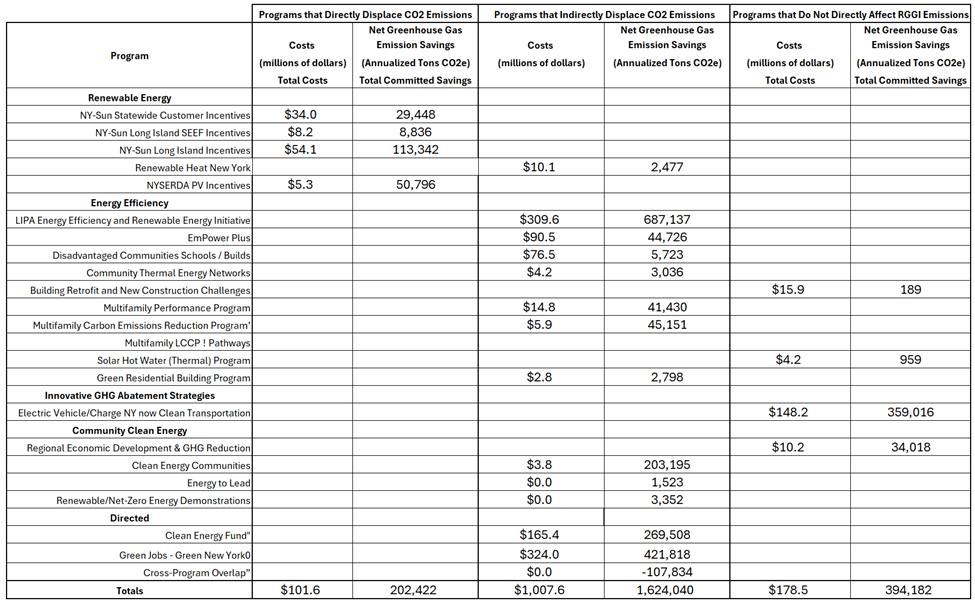
NY RGGI Operating Plan Stakeholder Process Checking the Box

Yesterday I described the New York State Energy Research & Development Authority (NYSERDA) stakeholder process for investing the proceeds received from the Regional Greenhouse Gas Initiative (RGGI).  Yesterday’s post explained that NYSERDA had inappropriately prevented participants from asking questions about the RGGI operating plan amendment at the Stakeholder Meeting on 12/8/23.  In order to address the requirement for stakeholder participation a webinar was held today for discussion and questions.  While NYSERDA staff said they appreciated the questions I submitted before the meeting their responses demonstrated that they really could have cared less, 

I have been involved in the RGGI program process since its inception.  One of my retirement hobbies is to blog about the details of the RGGI program because very few seem to want to provide any criticisms of the program. The opinions expressed in this post do not reflect the position of any of my previous employers or any other company I have been associated with, these comments are mine alone.

Background

For background information on RGGI and the operating plan refer to yesterday’s post.

This article and yesterday’s post explain why I believe that NYSERDA does not take the shareholder engagement obligation seriously.  From what I see it is a formality and there is no real interest in dealing with anything inconsistent with their preconceived narrative and investment plans.

NYSERDA 2024 RGGI Operating Plan Amendment Schedule

NYSERDA designed and implemented a process to develop and annually update an Operating Plan which summarizes and describes the initiatives to be supported by RGGI auction proceeds.  The operating plan amendments are submitted to the NYSERDA Board of Directors for approval after a stakeholder process that “engages stakeholders representing the environmental community, the electric generation community, consumer benefit organizations and interested members of the general public to assist with the development of an annual amendment to the Operating Plan.” 

The timeline for this year’s public stakeholder process is the first sign that the commitment to engage stakeholders to assist with the Operating Plan is a hollow gesture.  As shown in the following timeline the schedule is so tight and crosses a holiday, that it is unrealistic to expect meaningful input:

  • On 11/27/23 NYSERDA sent an email announcing the annual New York State Regional Greenhouse Gas Initiative (RGGI) Operating Plan Advisory Stakeholder meeting will take place on Friday, December 8, 2023.
  • Sometime before the meeting the NYSERDA RGGI Meeting and Planning Documents website was updated with a copy of the draft 2023 Operating Plan Amendment and instructions for stakeholder remote access. 
  • On 12/8/23 NYSERDA hosted the Advisory Stakeholder meeting
  • On 12/14/23 NYSERDA announced a public session on 12/20/to answer questions about the DRAFT 2024 RGGI Operating Plan Amendment or information presented during the past meeting. 
  • 12/20/23 Opportunity for Public Discussion of DRAFT 2024 RGGI Operating Plan Amendment webinar
  • 12/29/23 Written comments due

Issues with the Advisory Stakeholder Meeting

I tried to join the 12/8/23 meeting but failed to get in because no password was provided.  I wrote to the email address used for commenting on the amendment explaining that I was not able to join the meeting.   I received the following response after the meeting: “I’m sorry to hear that you had trouble accessing the webinar. We’ll have the recording posted to our website shortly for your reference.”
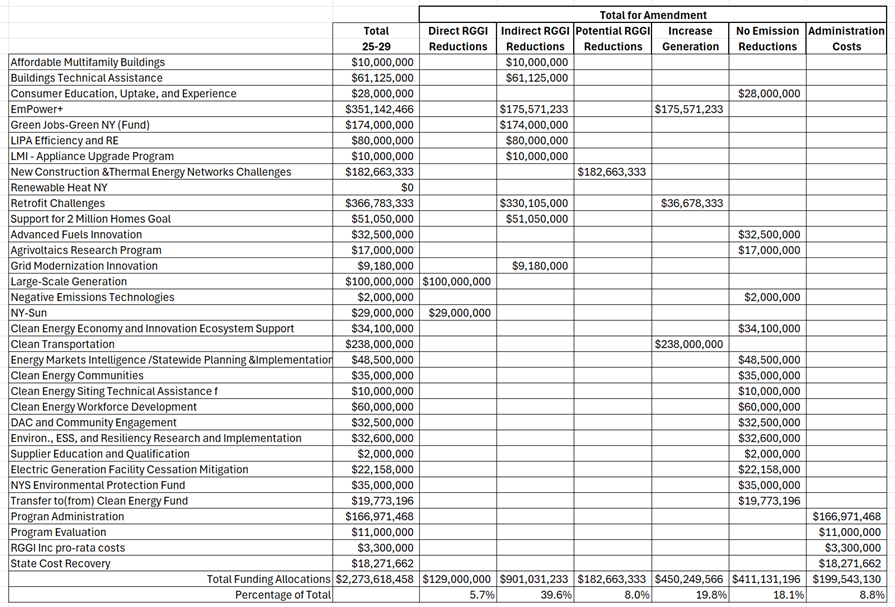
The recording lasts 49 minutes and it is clear that no one associated with the meeting figured out that no members from the public were on the call.  At 45:50 of the video the host announced the opportunity for public comment from anyone who was visiting and attending in the room as well as comments from anyone who might be participating remotely.  No one attended the meeting in person.   The host said “No questions seem to have come in from the webinar.  After 30 seconds or so they moved on.  It is inconceivable to me that no one on the call has access to the attendee list that showed no one was on it.  Therefore I conclude that they did not care and likely were pretty happy that they did not have to deal with trouble makers who asked questions that would mean more work or lead to uncomfortable responses.

Six days later NYSERDA announced the December 20, 2023 Opportunity for Public Discussion Webinar.  I read this to mean that I was not the only one who could not join the webinar.  I can think of two reasons for the webinar keep up the impression that they cared about stakeholder engagement or possibly there is some provision in the open meetings law that requires that the public actually have the chance to ask questions that they were required to have a meeting that allowed questions.

The  recording of the meeting supports my concern that public engagement is not a real priority.  They were clearly just going through the motions.  The meeting consisted of agency staff reading scripted spiels.  The introductions described the narrative and little else.  NYSERDA staff descriptions of the projects recited information in the operating plan amendment with no additional context or details.

Issues with the Opportunity for Public Discussion Webinar

In yesterday’s post I explained that I followed the directions for the webinar.   I reviewed the presentation recording, studied the transcript of the meeting, compared the meeting slide presentation to the draft amendment, and checked my draft set of comments on the amendment to prepare questions for NYSERDA that I submitted the day before the meeting. 

I described some of the more important questions and linked to all the questions in yesterday’s post. The questions were in three categories: specific concerns with the operating plan amendment, questions on the presentations describing the amendment, and over-arching questions for discussion at the public session. 

The response to questions during the webinar further reinforces my belief that NYSERDA is only paying lip service to the public engagement commitment.  They only set aside 30 minutes to respond to questions. Near the end of the call I heard “We have to be respectful of people’s time” which translates to NYSERDA staff time and not these trouble making members of the public who forced us to have this call.

They did not get through all the questions I posed.  They took questions posed in the chat function of the webinar.  I did not get a chance to make a copy of the chat window before the webinar was shut down so I cannot provide details.  All the chat questions addressed specifics of programs.  In my opinion, the responses gave short shrift to the questions posed. 

It was not until 25 minutes in until they begrudgingly started to answer my questions.  In other words,they almost got away avoiding everything that I took the time to send to them before the meeting.  In my written questions I asked five questions related to specific concerns with the operating plan amendment, five questions about the presentations describing the amendment, and six questions addressing over-arching questions for discussion.  They answered two of the questions related to specific concerns with the operating plan amendment, none of the questions about the presentations describing the amendment, and two questions addressing over-arching questions for discussion. 

The responses to questions related to the specific concerns with the operating plan amendment are not of general interest but the responses to the others are worth noting.

The answer to the following question missed the point:

During his overview presentation at the beginning of the Operating Plan Advisory Stakeholder Meeting, Jonathan Binder said “First, it resulted in real carbon dioxide emission reductions. In fact, since 2005, we’ve seen emissions from power plants subject to the program go down by around sixty percent region wide.”  In the comments that I submitted last year I argued that the primary reason emissions went down so much was because of fuel switching from coal and residual oil to natural gas.  In the comments I intend to submit I show that the investments of RGGI auction proceeds only were responsible for 11% of the observed reductions.  Are DEC and NYSERDA claiming that all the observed reductions are due to RGGI?  How much of the observed reduction does NYSERDA claim for RGGI auction proceed investments and why?

The responder claimed that the answer to this question was included in the following report: New York’s RGGI-Funded Programs Status Report – Semiannual Report through June 30, 2023.  According to Table 1. Summary of Expected Cumulative Portfolio Benefits through June 30, 2023 in that report, the cumulative annual installed Net GHG emissions savings were 1,807,679 tons of CO2e.  In 2022 emissions were down 16,196,531 tons relative to the 2006-2008 annual average baseline.  That works out to 11%.  The Status Report does not compare the expected portfolio emission reduction against the observed reduction, so the response did not answer the question.  This is important.  The point is that the DEC and NYSERDA have never admitted that RGGI investments are only responsible for a fraction of the observed reductions.  I think that suggests that investing in more effective programs would be appropriate.   I raised that point in one of the unanswered questions:

In my comments I focus on the allocation of investments in the operating plan amendment.  I reviewed the program allocations and allocated program investments into six categories.  The first three categories cover programs that directly, indirectly, or could potentially decrease RGGI-affected source emissions.  Those programs only total 33% of the investments.  I also included a category for programs that will add load that could potentially increase RGGI source emissions which totals 24% of the investments.  Programs that do not affect emissions are funded with 35% of the proceeds and administrative costs total another 8%.  Given the necessity of state investments in zero-emissions resources and load reduction these allocations are troubling.  When the investment allocations were determined was the necessity to invest in programs that could decrease RGGI-affected source emissions necessary to meet the RGGI allowance trajectory considered?

They did respond to the following question:

While you mention costs, the operating plan includes years when the cap and invest program will impact allowance prices and the cost of electricity in the state.  How is that change reflected in the plan?

The other discussion questions were asked to see if there had been any strategic consideration of investments and expected reductions relative to the Climate Act emission targets.  The State has not had to worry about that but RGGI-affected sources in New York have limited options for future reductions.  There are no fuel-switching options left and there are no cost-effective add-on controls available. RGGI is a trading program and if there are allowances available from outside New York, in-state sources can purchase allowances but that does not necessarily lead to in-state emissions reductions. The New York Cap-and-Invest program is considering limits on trading in areas such as disadvantaged communities, that would make this option unavailable.  The only guaranteed remaining option is to reduce operating time.  I think it is incumbent upon the state to incentivize zero-emissions generation and reduce load so that NY RGGI sources can reduce operations and not jeopardize system reliability.  NYSERDA staff at the meeting ducked the question: Has NYSERDA estimated how much additional zero-emissions generation and load reduction is necessary to reduce New York RGGI emissions consistent with the allowance reduction trajectory? 

I believe they think they are the smartest people in the room, and I know that there is overt pressure from the Hochul Administration to support the narrative.  This combination of hubris and bias is dangerous.  They are refusing to consider comments that use observed results in the plans for future investments or anything else from outside their bubble.   Consequently, they are endangering the Climate Act targets they are supposed to be supporting.

There was one final disappointment that epitomized the meeting.  I asked if NYSERDA would publish responses to my questions and respond to comments submitted.  Long winded and evasive answer boiled down to no.  With all due respect, if I were on the NYSERDA Board and had to vote on how to spend over $250 million per year I would like to see documentation that addressed public stakeholder input.  As it is the NYSERRDA staff presentation to the Board says we considered stakeholder input but provides no documentation. 

Conclusion

In yesterday’s post I mentioned that today’s meeting would be an opportunity for my readers to experience firsthand New York’s Climate Act transition planning process.  I hoped nobody wasted their time doing so.  This meeting was embarrassing even by Albany agency standards.

This year’s stakeholder process actively discourages public engagement.  The expectation that meaningful comments could be prepared two weeks after the posting of the video of the meeting and ten days after the chance to ask questions with the Christmas holiday in between is not realistic.  The response to questions today suggests that it would not matter anyway.  the refusal to provide answers to all the questions submitted seems to be a deliberate attempt to squelch input.

NYSERDA gives lip service to public stakeholder participation but the actions during this process clearly show the bottom line is they don’t care.  The public participation meeting just checked the box that there was public participation.