Climate Act Scoping Plan Overview Presentation – Affordability and Reliability

The Climate Leadership and Community Protection Act (Climate Act) has a legal mandate for New York State greenhouse gas emissions to meet the ambitious net-zero goal by 2050. I recently was given the opportunity to brief my New York State Senator, John Mannion, about my concerns related to affordability and reliability in the Climate Act Draft Scoping Plan.  This post describes the slide presentation and provides a link to the documentation handout for it.

Everyone wants to do right by the environment to the extent that they can afford to and not be unduly burdened by the effects of environmental policies.  I have written extensively on implementation of New York’s response to that risk because I believe the ambitions for a zero-emissions economy embodied in the Climate Act outstrip available renewable technology such that it will adversely affect reliability, impact affordability, risk safety, affect lifestyles, and will have worse impacts on the environment than the purported effects of climate change in New York.  New York’s Greenhouse Gas (GHG) emissions are less than one half one percent of global emissions and since 1990 global GHG emissions have increased by more than one half a percent per year.  Moreover, the reductions cannot measurably affect global warming when implemented.   The opinions expressed in this post do not reflect the position of any of my previous employers or any other company I have been associated with, these comments are mine alone.

Climate Act Background

The Climate Act establishes a “Net Zero” target by 2050. The Climate Action Council is responsible for preparing the Scoping Plan that will “achieve the State’s bold clean energy and climate agenda”.  They were assisted by Advisory Panels who developed and presented strategies to the meet the goals to the Council.  Those strategies were used to develop the integration analysis prepared by the New York State Energy Research and Development Authority (NYSERDA) and its consultants that quantified the impact of the strategies.  That analysis was used to develop the Draft Scoping Plan that was released for public comment on December 30, 2021. Comments on the draft can be submitted until June 10, 2022.

Presentation

I list the presentation slides below.  The documentation summarizes what I said for each slide and provides references for the statements.   I highlight some of the key points I tried to make in this description of the slides.

I tried to make the point in the following slide that most New Yorkers are unaware of the Climate Act.  Not only that but fewer still understand the scope and magnitude of the changes required in order to meet the Climate Act targets and even fewer are aware of the costs, benefits, and threats to reliability inherent in the massive transition of our existing energy system to the net-zero targets of the Act.  The presentation hit the points that I think the public should understand.

In my presentation I explained that I think the root problem of the Scoping Plan approach is over simplification of possible solutions.  Reality is that there are many issues with every aspect of the proposed energy transition.  I said that there are two particular problems with the proposed solutions: they don’t work all the time and they are more complicated than existing technology.  As a result, there are ramifications that need to be considered.

I included this slide to just hit the highlights of the Act.  I mentioned that the 100% zero-carbon electricity by 2040 target was a particular worry of mine.

This slide more or less presented the material in the Climate Act Background section above.  I did mention that 10 public hearings have been scheduled.

The point of this slide was to point out that the transportation vision requires massive changes to the transportation system and significant limitations on personal choice.  I believe that most people recognize that there are limitations to electric vehicles and have decided that they are not a viable option as the primary household vehicle even if they could afford one.  The primary limitation that people in Upstate New York understand is that electric vehicles don’t work so well in cold weather.  In addition, electric vehicles are more complicated because at-home charging has infrastructure requirements and another daily chore to hook the car up for charging.  This is a concern for those of us who have the option to charge at home but what about all those people who park on the street or in a parking lot?  Providing infrastructure for them will be very expensive.

In order to prove the Climate Act is in the best interests of the State, the Scoping Plan claims benefits.  I explained that I thought that the proposed health benefits were exaggerated, that I have been unable to verify their estimates and that they are all societal benefits that will not directly affect consumer costs. 

The largest benefit proposed is for avoided GHG emission impacts on climate change.  I estimate that these benefits should be on the order of $60 billion dollars based on eliminating New York’s maximum annual GHG emissions overnight and multiplying by New York’s value of carbon.  The Scoping Plan claims benefits of at least $235 to $250 billion by counting the benefits multiple times. This is the same as claiming that a weight loss of ten pounds five years ago represents a 50-pound reduction. Obviously, that is wrong and if that error is corrected the costs are greater than the benefits.

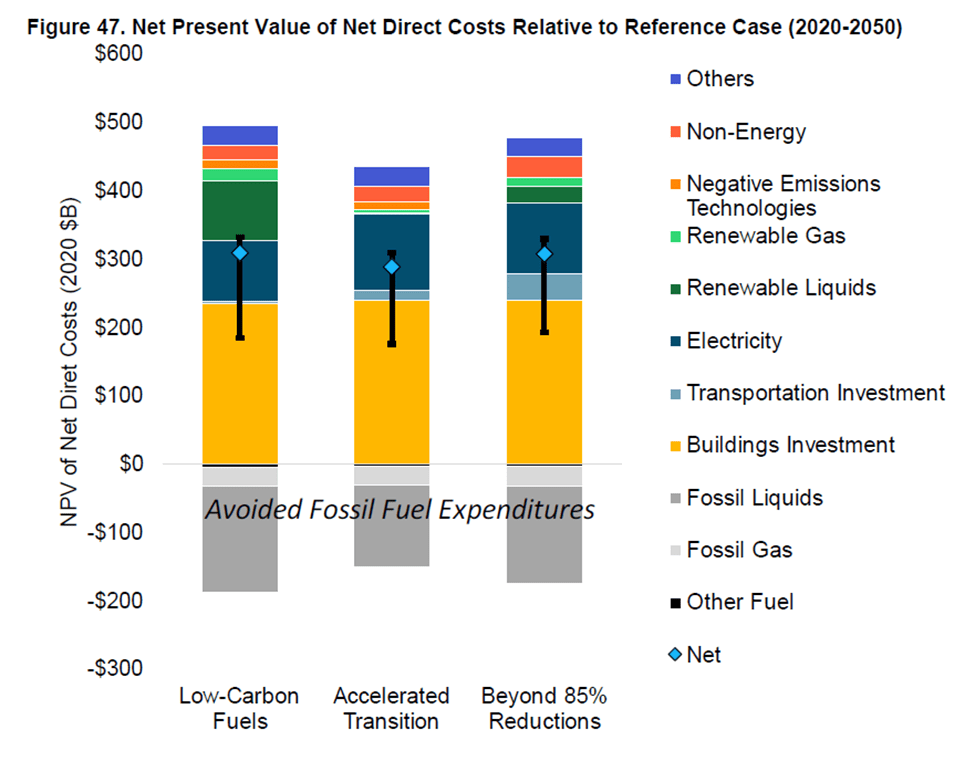
This graph has been shown at public comment hearings and is the support for the Draft Scoping Plan claim that “The cost of inaction exceeds the cost of action by more than $90 billion”.  I explained that there were issues with cost numbers in addition to the benefits problems described previously. In particular, it is necessary to parse the language to understand how the Integration Analysis presents the costs.  They are presented as net direct costs because the cost to use fossil fuels are subtracted from the costs to meet the reduction targets.  The bigger issue is that the net present value of benefits and costs are presented relative to Reference Case.  I admit that I did not pick up on the implications of that condition for five months.  It turns out that vehicle electrification costs appear to be included in the Reference Case because the electric vehicle legislative mandate was an “implemented policy”.  However, the $700 billion costs to electrify the transportation investment category are a necessary cost for the net-zero transition.  I don’t think they should be included in the Reference Case because those costs are a necessary transition expense.  If those costs are moved from the Reference Case to the mitigation scenarios where they belong, the costs are much greater than the benefits.

I also made the point that this graphic is representative of the abysmal cost documentation in the Scoping Plan.  For the most part the only numbers provided are in bar charts like this and none of the cost category values are quantified.  This inexcusable shortcoming of the Draft Scoping Plan is the subject of a post which provides more information.  I believe that the cost for every category in the Draft Scoping Plan should be listed in a spreadsheet and that costs for each measure that make up the category costs should also be included.  Without this information it is impossible to provide meaningful comments on the financial viability of the scenarios.

The following slide explains that corrections to the inaccurate benefits and misleading costs presented in the Scoping Plan invalidate the claim that the benefits are greater than the costs.  Approximately $700 billion should be added to the net system costs column in the revised section of the table and the  avoided GHG benefits should be only $60 billion.  The costs are greater than the benefits by at least $760 billion.   

In 2040 the electric grid is supposed to be converted to zero emissions.  In order to describe potential reliability issues associated with that transition this slide and the following two slides discuss the electric grid.  The point of this slide is that the electric grid is big, complex and currently dependent upon generating resources that can be dispatched by the operators who match load with generation on a minute-by-minute basis.

This slide explains that significant infrastructure is required for the transition and that it will complicate matching generation and load.  Wind and solar are not dispatchable without energy storage, transmission and ancillary services resources.  I pointed out that short-term variations in wind and solar require an energy storage resources that is relatively small but will be used frequently.  The Li-Ion 4-hour storage batteries work well for this requirement.  There are significant diurnal variations in renewable resources if solar is a major component.  This needs to be addressed by energy storage resources that are on the order of the size of the solar capacity in the system.  In my opinion this resource has not been implemented on a commercial scale. In addition, additional  energy storage is needed for cloudy days. The resources needed for both these applications will be used regularly.  The biggest problem is the energy storage needed for infrequent but extended periods of low wind and solar output.  A large amount of long-term storage capacity is needed to cover a multi-day renewable resource drought but it will not be used a lot.  If it is not used much how will the market pay for the resource?

If the grid operators cannot match the load with available generation, then blackouts similar to the February 2021 blackouts in Texas are inevitable.  The operators task is made more difficult because load is not constant.  Ultimately the problem of most concern is that the periods when the renewable resources are lowest are also periods when load is expected to be highest once home heating is electrified.  This is an enormously important issue but I don’t think it has received the appropriate level of consideration by the Climate Action Council.

I recently posted an article that highlighted the content (Presentation) and conversations at a NYISO meeting on March 24, 2022 that addressed the System & Resource Outlook Update effort with the Electric System Planning Working Group.  I prepared the table that shows the existing capacity, the capacity proposed for the three Draft Scoping Plan scenarios, and the base case for the Update options discussed at the meeting.  One of the concerns at this meeting of New York State reliability experts was the amount of new infrastructure needed.  The total of new generation required is around three times the 2021 total existing generation.  That does not include the ancillary services and transmission upgrades needed.  The other concern was the Zero-Carbon Firm Resource.  This is the “large amount of long-term capacity needed to cover a multi-day renewable resource drought that it is not used a lot” resource needed when the loads are predicted to be highest in the future.  The problem is that there isn’t any commercially demonstrated resource available today or expected for this resource in the near future.  The table shows that this resource is need to provided capacity that is greater than current installed capacity.  The conversation that caught my attention is when the experts said: The results are “stunning” and “Is anyone listening”.  They are clearly worried and the Climate Action Council has shown no sign of concern about this issue.

There is another issue for the Council.  Comparing the Draft Scoping Plan capacity resource distributions with the NYISO projected capacity shows significant differences.  It is not clear how will those differences will be resolved. 

Unfortunately, the Climate Action Council seems to be more concerned about activist claims to stop all new fossil fuel infrastructure than the critical need for a proven replacement.  It seems to me that it would be prudent to make the implementation schedule conditional upon the availability of the necessary technology.  That Council leadership has not stepped up and said that fossil fuel infrastructure is needed until we have a viable alternative is necessary is not a good sign.

Even though electric grid reliability is an important topic it also it is one that most people don’t have any experience with so I included a description of reliability and affordability related to home electrification that we all understand.  Because the buildings sector is the largest source of GHG emissions, decarbonization is a primary strategy.  My primary residential reliability concern is what happens when there is an extended electric outage?  There is not a lot of information available about the cost affordability for residential home heating so I added slides discussing residential heating sector costs.

The primary solution for residential home heating in the Draft Scoping Plan is heat pumps: “Modern heat pumps that work in very cold weather are commercially available and able to keep homes and businesses comfortable year-round, as long as they are properly chosen, sized, and paired with an energy-efficient building envelope. “  Frankly, everything I have seen on social media from NYSERDA about heat pumps is propaganda because it only shows the benefits and does not mention any downsides.  The Plan notes three caveats for success: properly chosen, sized, and paired with an energy efficient building envelope or building shell. 

The unmentioned downside is the building shell requirement.  The Scoping Plan analysis included two levels: basic shell – 27-44% reductions and deep shell – 57-90% reductions. The Integration Analysis projects that residential building stocks will be 66% basic shell and 26% deep shell by 2050.  In my opinion the description of what is required for the two levels is inadequate.  I assume that the deep upgrade must meet the international standard for passive buildings that includes following measures: Improved thermal insulation, considerably improved airtightness, use of high quality windowsreduction of thermal bridges, and ventilation with highly efficient heat recovery.   In my opinion deep shells will be needed more than the Plan assumes and bringing homes up to that level will be difficult and costly.

The upper half of table in the following slide shows the Retrofit Costs based on the referenced Integration Analysis spreadsheet.  According to the device costs in the Draft Scoping Plan an air source heat pump plus electric resistance backup will cost $15,818.  The other option is a ground source heat pump and that costs $40,491.  The unpublicized costs are $6,409 for a basic building shell improvement or $45,136 for a deep building shell improvement.  Combining the two, the air source heat pump option totals $22,227 for the basic shell and $60,954 for the deep shell.  For a ground source heat pump the totals range from $40,491 for a basic shell to $79,218 for a deep shell.

The lower half of table subtracts out the replacement costs of the existing system to calculate the retrofit costs.  In 2030 when you can no longer purchase anything but a heat pump you won’t have to buy the replacement appliance so you can subtract that cost.  For example, if you own a distillate boiler the $9,260 replacement cost can be subtracted from the component costs – an air source heat pump with a basic shell is $12,967 instead of $22,227. As with all other aspects of the implementation there is a complication. In 2030 you will have to replace your existing appliance when it breaks with a heat pump.  If it breaks during the winter, you won’t necessarily be able to do a deep shell retrofit at the same time because it is a big investment in time and effort.   That will be a serious imposition on the homeowner.

It is also relevant that we keep the context of New York’s emissions relative to the rest of the world vis-à-vis global warming in mind.  Although activists claim New York should do something because the state is “large” relative to other countries when it comes to our economy (9th), we should also consider the fact that our emissions are small relative to many others (35th).  Moreover, when you consider GHG efficiency (the country’s emissions divided by its GDP) we are already doing a good job -New York ranks third behind only Norway and Sweden.

More importantly, New York’s 2016 GHG emissions were less than one half of one percent of global emissions in 2016 and global emissions are increasing by more than one half of one percent per year.  Because global emissions are increasing so much, they will replace all of our emissions completely in about a year.  Therefore, I expect no change of global warming effects on weather.

The presentation concluded that everybody wants to do something about climate change and do right by the environment.  However, it is important that we don’t do something that will do more harm than good when we try to address climate change.  Based on my analysis of the proposed strategies in the Scoping Plan it will do more harm than good.  It boils down to the fact that existing technology is just not ready for the magnitude and schedule of the transition outlined in the Scoping Plan. 

Recommendations

I did not prepare a slide with my recommendations.  I think that politicians worried about the issues raised in this presentation should submit comments to the Climate Action Council but also send a copy to Co-Chairs Doreen Harris and Basil Seggos.  The Council has to be made aware that there are real concerns from the public and I encourage public comments to the comment portal.

I suggest comments on a couple of topics.  There have been suggestions that the Council will setup workshops on particular issues.  I am going to submit a comment that includes a request for full disclosure on particular issues.  Too often in the past only one side of the story has been heard.  I think the workshops should be used to provide stakeholders with a venue to ask questions and get answers.  When the meeting is announced it should offer an opportunity for stakeholder questions to be submitted before hand so that they can be addressed during the workshop.  In my opinion workshops on the following topics would be appropriate: how reliability concerns in the electricity sector will be addressed and resolved, cost benefit calculations, residential electrification, and transportation strategies.

I am also going to submit a comment arguing that the Council has to make reliability and affordability a priority.  As shown in the presentation it seems prudent that the implementation schedule should be conditional based on the availability of proven technology needed for reliability per experts from NYISO and NYS reliability council.  The Council has to make it a priority to listen to the experts who are responsible for New York reliability.  Thomas Sowell said “It is hard to imagine a more stupid or more dangerous way of making decisions than by putting those decisions in the hands of people who pay no price for being wrong”. That is exactly what we will be doing if the Council does not listen to the experts. 

I am also going to submit a comment saying that the Draft Scoping Plan cost documentation is inadequate.  The cost categories for every cost in every figure in the Scoping Plan should be documented in a spreadsheet that lists the totals, the cost categories within the total,s and the costs for each measure that is included in the cost categories.

The Council should also establish criteria for reliability and affordability. The reliability criteria should define the implementation schedule conditions.  They should provide guidelines for the NYISO and NYS Reliability Council definition of acceptable technology such as for the “Zero-carbon firm resources”.  For example, technology X has been proven commercially on the scale necessary for New York’s requirements so we can proceed with implementation that requires it.  Until a technology is available there has to be a hold on the schedule. Similarly, the Council should define affordability thresholds.  For this parameter, the number of service disconnects or percentage of New Yorkers in fuel poverty should not be greater than value X would be appropriate conditions.

Conclusion

I listened to the introduction of one of the public hearings and the overview presentation was mostly an advertisement for the Climate Act.  There was no suggestion that there might be issues associated with reliability.  The machinations that “prove” that the benefits are greater than the costs indicate that the analysis was done so they claim a pre-determined conclusion.  I hope that this overview gives readers a taste of the reasons why I am convinced that without changes the impacts of this so-called solution will be worse than the effects of climate change.  Anything we do will be displaced in a year, cost a lot of money and risk catastrophic blackouts. 

If any reader is interested in having me give this presentation to a group, let me know at NYpragmaticenvironmentalist@gmail.com.

Pragmatic Principles and the Climate Act

The Climate Leadership and Community Protection Act (Climate Act) has a legal mandate for New York State greenhouse gas emissions to meet the ambitious net-zero goal by 2050. I have not mentioned my principles for pragmatic environmentalism in quite a while.  This post explains how the Climate Act relates to them. 

Everyone wants to do right by the environment to the extent that they can afford to and not be unduly burdened by the effects of environmental policies.  I have written extensively on implementation of New York’s response to that risk because I believe the ambitions for a zero-emissions economy embodied in the Climate Act outstrip available renewable technology such that it will adversely affect reliability, impact affordability, risk safety, affect lifestyles, and will have worse impacts on the environment than the purported effects of climate change in New York.  New York’s Greenhouse Gas (GHG) emissions are less than one half one percent of global emissions and since 1990 global GHG emissions have increased by more than one half a percent per year.  Moreover, the reductions cannot measurably affect global warming when implemented.   The opinions expressed in this post do not reflect the position of any of my previous employers or any other company I have been associated with, these comments are mine alone.

Climate Act Background

The Climate Act establishes a “Net Zero” target by 2050. The Climate Action Council is responsible for preparing the Scoping Plan that will “achieve the State’s bold clean energy and climate agenda”.  They were assisted by Advisory Panels who developed and presented strategies to the meet the goals to the Council.  Those strategies were used to develop the integration analysis prepared by the New York State Energy Research and Development Authority (NYSERDA) and its consultants that quantified the impact of the strategies.  That analysis was used to develop the Draft Scoping Plan that was released for public comment on December 30, 2021. Comments on the draft can be submitted until June 10, 2022.

Pragmatic Environmentalist Principles

I put together my principles for pragmatic environmentalism to describe a pragmatic approach to environmental issues.  So far, I have listed 13 principles that exemplify pragmatic environmentalism.  Five of these principles are my own but the rest have been developed by others.  I am going to describe four principles that directly relate to climate change and four that indirectly affect Climate Act implementation in this post.  This post will also be used to support an upcoming post on my pragmatic recommendations for the Climate Act.

All four of the relevant principles that directly relate to climate change have been developed by others.  The Climate Act does not correctly differentiate between weather and climate. Frequently events that are simply extreme examples of normal weather variation to climate change are used as “proof” that climate change effects are apparent now. The first principle addresses this issue.  Dr, Cliff Mass’s  Golden Rule of Climate Extremes states that the more extreme a climate or weather record is, the greater the contribution of natural variability.  Dr. Mass explained why this happens in a series of posts on the Pacific Northwest heatwave of 2021.  He concluded in his analyses that global warming was responsible for only 1 to 2o F of the observed 30 – 40o F anomaly above normal.

There are two principles related to climate change economics.  Gresham’s Law of Green Energy is named after Sir Thomas Gresham, a 16th-century British financier who observed that “bad money drives out the good.” Jonathan Lesser has coined “Gresham’s Law of Green Energy” to describe the green economy.  The transition to a zero-emissions energy system relies on green energy subsidies that transfers wealth and does not create wealth. The subsidies or “bad” money take money out of the system that was “good” inasmuch as it was being used productively. In particular, Lesser argues that   “subsidized renewable resources will drive out competitive generators, lead to higher electric prices, and reduce economic growth”.  The second economic principle, Ridley’s Paradox, states that economic damage from man-made ‘climate change’ is illusory whereas damage from man-made ‘policies’ to fight the said change is real.  Both principles suggest that issues lie ahead for the Climate Act net-zero transition.

Roger Pielke, Jr’s Iron law of climate simply states that while people are often willing to pay some price for achieving environmental objectives, that willingness has its limits.  The Climate Act requires the Climate Action Council to “[e]valuate, using the best available economic models, emission estimation techniques and other scientific methods, the total potential costs and potential economic and non-economic benefits of the plan for reducing greenhouse gases, and make such evaluation publicly available” in the Scoping Plan.  However, at this time this requirement is not being met.  There is insufficient information to determine how much New Yorkers will have to pay for achieving the net-zero targets.  Consequently, we will have to wait to see how his principle plays out.

I authored one of the four principles that indirectly relate to the Climate Act.  It is pretty obvious in industry but I haven’t found anyone who has made the Air Pollution Control Costs point that as air pollution control efficiency increases the control cost per ton goes up exponentially.  If we were only trying to reduce our GHG emissions by 50% the costs would be much less than the net-zero 85% reduction combined with 15% sequestration target.

That principle is related to the Pareto Principle  or 80-20 rule that states that 20% of efforts or inputs can yield 80% of results or outputs.  If the Climate Act did not mandate net-zero, then we could get most of the benefits for the “easy” emission reductions.  Accepting that outcome removes most of the affordability and reliability risks associated with the radical transformation of the energy system needed to meet Climate Act targets.

The resources necessary to implement the Climate Act are rationalized as necessary to fight climate change.  However, the necessary actions are not considered relative to other environmental and social issues.  For example, there are water infrastructure issues across New York that must be addressed before systems break down completely.  There are disadvantaged communities that have lead pipes and lead paint in their homes.  Advocates have not considered that in order to implement Climate Act initiatives these other environmental issues may not be addressed simply because the resources available are finite per the principle: We can do almost anything we want, but we can’t do everything:

A glittering generality is an emotionally appealing phrase so closely associated with highly valued concepts and beliefs that it carries conviction without supporting information or reason.  The climate change is an “existential” threat narrative and the idea that power will be cheap because the sun and wind are free are both Glittering Generalities that do not represent Pragmatic Environmentalism.  In “A ‘Plan B’ for addressing climate change and the energy transition” Judith Curry sums up the problem with the glittering generalities in all net-zero energy transition programs:

“In a nutshell, we’ve vastly oversimplified both the problem of climate change and its solutions.  The complexity, uncertainty, and ambiguity of the existing knowledge about climate change is being kept away from the policy and public debates.  The dangers of manmade climate change have been confounded with natural weather and climate variability. The solutions that have been proposed for rapidly eliminating fossil fuels are technologically and politically infeasible on a global scale.” 

Conclusion

There are very few aspects of the Climate Act that represent a pragmatic approach to climate change mitigation.  The rationale for the Climate Act frequently refers to extreme weather events that are more likely due to natural variability than climate change.  The Draft Scoping Plan is littered with glittering generalities that carry conviction without supporting information or reason. 

The economics in the Draft Scoping Plan are not pragmatic.  The reliance on subsidized renewable resources will drive out competitive generators, lead to higher electric prices, and reduce economic growth.  The economic damage from man-made ‘climate change’ in New York is illusory whereas damage from the Climate Act ‘policies’ to fight the said change is real.  When the costs are finally publicized to the general public, we will see how much New Yorkers are willing to pay for achieving greenhouse gas emission reduction objectives and whether that willingness has limits.

Given that air pollution control efficiency increases the control cost per ton goes up exponentially and that 20% of efforts or inputs can yield 80% of the results or outputs, a more pragmatic approach would be to determine some lower level of “good enough” that will achieve emissions reductions without risking current standards of reliability and affordability.   Ultimately, we can do almost anything we want, but we can’t do everything so the enormous commitment to the Climate Act net-zero targets has to be considered relative to other pressing environmental and social problems.

Climate Act Scoping Plan Recommended Reading

The Climate Leadership and Community Protection Act (Climate Act) has a legal mandate for New York State greenhouse gas emissions to meet the ambitious net-zero goal by 2050. On April 1, 2022 the Department of Environmental Conservation’s Strategic Communications Director for Climate sent an email to the mailing list of people who have signed up to learn about climate news and developments.  On the same day I ran across a superb summary entitled Inconvenient Truths About Energy.  This post summarizes the Denver Gazette perspective piece by Chris Wright in the context of the Climate Act.

I have written extensively on implementation of the Climate Act because I believe the ambitions for a zero-emissions economy outstrip available renewable technology such that it will adversely affect reliability and affordability, risk safety, affect lifestyles, and will have worse impacts on the environment than the purported effects of climate change in New York.  New York’s Greenhouse Gas (GHG) emissions are less than one half one percent of global emissions and since 1990 global GHG emissions have increased by more than one half a percent per year.  Moreover, the reductions cannot measurably affect global warming when implemented.   The opinions expressed in this post do not reflect the position of any of my previous employers or any other company I have been associated with, these comments are mine alone.

Climate Act Background

The Climate Act establishes a “Net Zero” target by 2050. The Climate Action Council is responsible for preparing the Scoping Plan that will “achieve the State’s bold clean energy and climate agenda”.  They were assisted by Advisory Panels who developed and presented strategies to the meet the goals to the Council.  Those strategies were used to develop the integration analysis prepared by the New York State Energy Research and Development Authority (NYSERDA) and its consultants that quantified the impact of the strategies.  That analysis was used to develop the Draft Scoping Plan that was released for public comment on December 30, 2021.

Climate Action Council Draft Scoping Plan Comments and Toolkit

In 2022, the Climate Action Council is required to finalize the Scoping Plan.  At the first Climate Action Council meeting on March 3, 2022 (recording here) the activity plan overview shown below mentioned a plan to rollout communications and educational materials.  The email sent on April 1 under the title “Climate Action Council Draft Scoping Plan Comments and Toolkit” is part of the rollout of those materials.

I agree with the letter’s point that encouraging all New Yorkers to review the Draft Scoping Plan and share comments by June 10, 2022 is important and necessary.  According to the text:

This email serves as a resource and toolkit on how you can comment and be involved in the process, and to help the Council spread the word and encourage others to weigh in on the Draft Scoping Plan. An overview of the plan for your review and use can be found here. Additional overview slide decks specific to each sector are forthcoming. There are several ways to provide public comments, with oral and written comments receiving equal weight. 

1.       The Council will be holding 10 public hearings, eight in-person and two virtual, in April and May. Additional information on the public hearings and the option to pre-register for hearings can be found here

2.       Comments can also be submitted via the online public comment form here or via email to scopingplan@nyserda.ny.gov

3.       Comments can also be sent via U.S. Mail to Attention: Draft Scoping Plan Comments, NYSERDA, 17 Columbia Circle, Albany, NY 12203-6399. 

I believe that one of the problems with the Climate Action Council is that they do not recognize the complexity, uncertainty, and ambiguity of the existing knowledge about climate change and naively believe that transitioning to zero-emissions solutions will be simple.  In no small part that has been reinforced by the ignoring anyone who does not subscribe to that narrative.  I think that the rollout of these communications and educational materials will continue to disregard any inconvenient issues.

The email also notes:

If you would like to request a presentation on the Draft Scoping Plan for your group or organization, please email ClimateAct@dec.ny.gov. Requests will be accommodated based on staffing and scheduling. 

If you would like to be more involved in the process and help in our efforts to increase awareness about the Scoping Plan and the state’s overall climate efforts, please see the social media toolkit below, or email haley.viccaro@dec.ny.gov with additional opportunities and/or questions. Spreading the word about this opportunity and increasing awareness of the Climate Act is crucial to the successful implementation of the law. 

Unfortunately, there is every indication that the public comment process is intended to simply fulfill the requirement to have a public comment period and not develop information to improve the transition plan.  Soliciting help to increase awareness and “spreading the word about this opportunity” suggests that a primary purpose for the communications rollout is propaganda.  I doubt very much that the Strategic Communications Director for Climate intends this public awareness campaign to address risks to reliability and affordability.

My Citizens Guide to the Climate Act is intended to be a layman summary of the net-zero transition.  I developed it to try to highlight transition risks.  I have posted articles recommending books that do a much better job than I have done to explain the problems here and here.  Unfortunately reading a book is a big commitment and I have been looking for a more concise description problems with the net-zero transition.  I am happy to point out that Inconvenient Truths About Energy describes most of the issues that worry me.

Chris Wright is chairman and CEO of Liberty Energy, a Denver-based hydraulic fracturing company. Much of the material in this is also included in his company’s 2020 ESG report.  If the article described here interests you then I recommend that report as well.  There is a wealth of more detailed information supporting his assertions there.

Inconvenient Truths About Energy

The following sections reproduce the Inconvenient Truths About Energy article with my indented and italicized comments.

The energy transition is not happening. Or not nearly at the pace that everyone believes or wishes. At current rates the “transition” is set to finish in the mid-2600s. The U.N. Rio Convention and subsequent Kyoto Protocol launched the energy transition drive in 1992. Global energy consumption from hydrocarbons has grown massively since then, with market share only declining by four percentage points over the last 30 years from 87% in 1992 to 83% today. I am not celebrating this fact as I have spent years working on energy transition technologies.

Using the latest available data for New York, hydrocarbon market share has decreased from 82% to 71% over the last 30 years.

The energy transition isn’t failing for lack of earnest effort. It is failing because energy is hard, and 3 billion people living in energy poverty are desperate for reliable and scalable energy sources. Meanwhile, 1 billion energy-rich people are resistant to diminishing their standard of living with higher cost and an increasingly unreliable energy diet.

That the energy transition is hard is not recognized by most members of the Climate Action Council.

There is no “climate crisis” either. If there is a term more at odds with the exhaustive literature surveys of the Intergovernmental Panel on Climate Change (IPCC) than “climate crisis,” I have not heard it.

Climate change is a real global challenge that is extensively studied. Unfortunately, the facts and rational dialogue about the myriad tradeoffs aren’t reaching policy makers, the media, or activist groups. Or are they are simply ignoring these inconvenient truths?

For example, we hear endlessly about the rise in frequency and intensity of extreme weather. This narrative is highly effective at scaring people and driving political action. It is also false. The reality is detailed in countless publications and summarized in the IPCC reports. Deaths from extreme weather have plunged over the last century, reaching new all-time lows last year, an outcome to be celebrated. This is not because extreme weather has declined. In fact, extreme weather shows no meaningful trend at all. Deaths from extreme weather events have declined because highly energized, wealthier societies are much better prepared to survive nature’s wrath.

I completely endorse this summary.  The 2020 ESG report documents these facts.

Recognizing reality

You are not supposed to say out loud that there is no climate crisis or that the energy transition is proceeding at a glacial pace. These are unfashionable and, to many, offensive facts. But let’s be honest. Energy transition ambitions must recognize reality. Otherwise, poor investment decisions and regulatory frameworks will lead to surging global-energy and food prices. This is exactly what is happening. We are here today in large part because energy transition efforts that previously encompassed solely aggressive support of alternative energy policies, economics be damned, have recently supplemented this strategy with growing efforts to obstruct fossil fuel development. Fossil fuels make the modern world possible.

The real crisis today is an energy crisis. It began to reveal itself last fall with a severe shortage in globally traded Liquified Natural Gas (LNG). The LNG crisis has not abated and it gives Russia’s Vladimir Putin tremendous leverage over Europe. Without Russian gas, the lights in Europe go out. Amid war, public outrage, and intense sanctions, Russian gas flows to Europe remain unchanged. Russian oil exports have continued with minimal interruption. The world can talk tough about sanctioning Russian energy exports, but those exports are vitally needed; hence they continue. Energy security equals national security.

The world energy system, critical to human wellbeing, requires meaningful spare capacity to handle inevitable bumps in the road. In the electricity sector, which represents only 20% of global energy but 40% in wealthy countries, this is called reserve capacity. In the oil market, spare production capacity today is shrinking and concentrated in OPEC nations like Saudi Arabia and the United Arab Emirates. Also, there is a massive global storage network in both surface tanks and underground caverns. In natural gas markets, there are both extensive underground storage reservoirs and typically spare export capacity through pipelines and large industrial LNG export and import facilities.

The last several years have seen this spare capacity whittled away due partly to lower commodity prices and poor corporate returns shrinking the appetite to invest. Excess capacity has also shrunk due to regulatory blockage of critical energy infrastructure like pipelines and export terminals. Roadblocks for well permitting and leasing on federal lands, together with a mass public miseducation campaign on energy and climate alarmism, are also stymieing hydrocarbon development. Investment capital is further constrained by a corporate Environment, Social and Governance (ESG) movement, and divestment campaigns. These factors are shrinking hydrocarbon investment below what it otherwise would be in response to price signals and outlook for supply and demand. The net result is a constrained supply of oil, natural gas, and coal, which means higher prices and greater risk of market dislocations like the one unfolding today.

High energy and food price inflation is the cruelest form of tax on the poor. After a few specific examples, I’ll return to what we should do now to reverse these damaging and deeply inequitable trends.

The Scoping Plan strategies will inevitably impact affordability and reliability and those least able to respond will be affected the most.

In denial about demand

Why does the world today suffer from a severe shortage of LNG? Demand for natural gas has been growing strongly for decades. It provides a much cleaner substitute for coal in electricity production, home heating, and a myriad of industrial and petrochemical uses. Rising displacement of coal by natural gas has been the largest source of GHG emission reductions. Unfortunately, the aforementioned factors have prevented supply from keeping pace with rising demand. Energy shortages drive rapid prices rises and have cascading impacts on everything else. Energy is foundational to everything humans do. Everything.

Perhaps the most critical use of natural gas is nitrogen fertilizer production. Roughly a century ago, two German chemists, both subsequently awarded Nobel Prizes, developed a process to produce nitrogen fertilizer on an industrial scale. Before the Haber-Bosch process innovation, nitrogen content in soil was a major constraint on crop productivity. Existing nitrogen sources from bird guano, manure, and rotating cultivation of pea crops were limited. Today, elimination of natural gas-synthesized nitrogen fertilizer would cut global food production in half.

The now six-months-long LNG crisis translates into a worldwide food crisis as skyrocketing fertilizer prices are cascading into much higher food prices. Wheat prices are already at a record high and will likely head higher as spring plantings suffer from under fertilization.

Global LNG markets are tight because rising demand has outrun the growth in LNG export capacity in the United States, now the largest LNG exporter. We have an abundance of natural gas in the United States. Unfortunately, we have a shortage of pipelines to transport this gas and LNG export terminals, preventing us from relieving the energy crisis in Europe and around the world. These pipeline and export terminal shortages are due in large part to regulatory blockage. The result is that natural gas prices in the United States and Canada are five to ten times lower than in Asia and Europe. This deeply disadvantages consumers and factories (like fertilizer factories) in Europe and Asia that rely on LNG imports to fulfill their needs.

Failed energy policies

Russia’s invasion of Ukraine did not cause today’s energy crisis. Quite the reverse. Today’s energy crisis is likely an important factor in why Russia chose to invade Ukraine now. Europe’s energy situation is both tenuous and highly dependent on Russian imports. Russia is the second-largest oil and natural gas producer after the United States. Russia is the largest exporter of natural gas, supplying over 40% of Europe’s total demand. Additionally, Russia is the largest source of imported oil and coal to Europe. Europe put itself in this unenviable position by pursuing unrealistic, politically-driven policies attempting to rapidly transition its energy sources to combat climate change. Europe’s energy pivot has been a massive failure on all fronts: higher energy costs, grave energy insecurity, and negligible climate impacts.

New York’s unrealistic, politically-driven Climate Act policies attempting to rapidly transition our energy sources to combat climate change will inevitably follow Europe’s massive failure on all fronts: higher energy costs, grave energy insecurity, and negligible climate impacts

Germany is the poster child of this failure. In 2000, Germany set out to decarbonize its energy system, spending hundreds of billions of dollars on this effort over the last 20 years. Germany only marginally reduced its dependence on hydrocarbons from 84% in 2000 to 78% today. The United States matched this 6% decline in hydrocarbon market share from 86% in 2000 to 80% today. Unlike in the US, Germany more than doubled its electricity prices — before the recent massive additional price increases — by creating a second electric grid. This second grid is comprised of massive wind and solar electric generating sources that only deliver 20% of nameplate capacity on average, and often less than 5% for days at a time. The sun doesn’t always shine and the wind doesn’t always blow. Hence, Germany could only shrink legacy coal, gas and nuclear capacity by 15%. It now must pay to maintain both grids. The legacy grid must always be flexing up and down in a wildly inefficient manner to keep the lights on, hospitals functioning, homes heated, and factories powered. Outside of the electricity sector, Germany’s energy system is largely unchanged. It has long had high taxes on gasoline and diesel for transportation, and lower energy taxes on industry. Germany subsidizes industrial energy prices attempting to avoid the near-complete deindustrialization that the UK has suffered due to expensive energy policies across the board.

If the Climate Action Council ignores the requirements for reliable and affordable in Public Service Chapter 48, Article 4 § 66-p. Establishment of a renewable energy program  then the result will be same here.

Over the last 20 years, the United States has seen two shale revolutions, first in natural gas and then in oil. The net result has been the U.S. producing greater total energy than consumed in 2019 and 2020 for the first time since the 1950s. The U.S. went from the largest importer of natural gas to the second-largest exporter in less than fifteen years, all with private capital and innovation. The shale revolution lowered domestic and global energy prices due to surging growth in U.S. production. Surging US propane exports are reducing the cost and raising the availability of clean cooking and heating fuels for those in dire energy poverty still burning wood, dung, and agricultural waste to cook their daily meals. U.S. GHG emissions also plunged to the lowest level on a per capita basis since 1960. Imagine the world’s energy situation today with the American shale revolution.

We are starting to hamstring and squander the enormous benefits of the shale revolution. The same misinformed anti-hydrocarbon crusade that impoverished Europe and made it heavily dependent on Russia is now sweeping the US. California and New England had already adopted European-style energy policies driving up electricity prices, reducing grid reliability, and driving manufacturing and other energy-intensive, blue-collar jobs out of their states. Colorado is not far behind.

This article ignores New York but the Liberty ESG 2020 report calls out New York’s irrational war on hydrocarbons.

California, a state with a plentitude of blessings, managed to create the highest adjusted poverty rate in the nation with an expensive, unstable power grid increasingly reliant on coal-powered electricity imports from Nevada and Utah.

New England’s proximity to Pennsylvania’s clean low-cost natural gas resources was a stroke of luck. But it refused to expand the natural gas pipelines running from Pennsylvania, leaving it chronically short of natural gas, its largest source of electricity and cleanest option for home heating. Instead, it remains heavily reliant on fuel oil for home heating and occasionally imports LNG from Russia to keep the lights on. Last winter New England burned copious amounts of fuel oil to produce electricity which went out of fashion in the 1970s elsewhere in the US.

New York’s pipeline policies have also contributed to this absurd situation.

Texas has not been immune from energy illiteracy and collateral damage. Texas’ poorly designed electric grid, structured to encourage investment in renewables, led to hundreds dying last year in the Uri cold spell. No one would pay the same price for an Uber that showed up whenever convenient for the driver and dropped you off wherever they desired. But that is what Texas does with electricity: paying the same price for reliable electricity that balances the grid as they do for unreliable, unpredictable electricity. No wonder the reliability of the Texas grid has declined and is headed for more trouble.

Misplaced faith

The common thread in these cases is unrealistic beliefs in how rapidly new energy systems can replace demand for hydrocarbons, currently at all-time highs. Political intervention and miscalculation have led to over-investment in unreliable energy sources and, far worse, under-investment in reliable energy sources and infrastructure. The full costs of this colossal malinvestment have been somewhat hidden from view as spare capacity in the global energy network has mostly kept the train on the tracks. Now that excess capacity has shrunk to a critically low level, more impacts are hitting home.

New York’s environmental community fully subscribes to the naïve belief that today’s wind, solar, and energy storage technologies are capable of rapidly replacing hydrocarbons and are advocating for legislation to accelerate the transition requirements in the Climate Act.

Like the disease itself, the cure takes years to run its course. But that longer time frame is no excuse not to act now in a thoughtful fashion to begin rectifying historical blunders. Steel, cement, plastics and fertilizer are the four building blocks of the modern world and all are highly reliant on hydrocarbons.

Most critically this means removing the growing myriad obstacles to hydrocarbon development, justified in the name of fighting climate change. This is nonsense. Overly cumbersome hurdles to hydrocarbon development in the U.S. do nothing to change oil and gas demand. They simply displace U.S. production overseas where production practices are less stringent and less ethical. Resulting in increased GHG emissions and other air pollutants, reduced economic opportunities for Americans, and increased geopolitical leverage of Russia and OPEC — see the invasion of Ukraine.

Climate change is a long-term problem best addressed with technologies cost-effective today like natural gas, energy efficiency, and nuclear. The solution requires combining today’s commercial low-carbon energy sources with research and technology development in carbon sequestration, next-generation geothermal, and economical energy storage to make solar and wind more viable.

New York’s policies that prematurely eliminate nuclear and natural gas technologies that have markedly reduced air pollution and environmental impacts for unproven solar, wind, and energy storage technologies is analogous to jumping out of a perfectly good airplane without a parachute hoping that the concept of a parachute will be developed, proven technically and economically feasible, and then delivered in time to provide a soft landing. 

Today the price mechanism must destroy energy demand to bring it in line with short-term supply. This reduces the quality of living, especially for low-income families. The price mechanism will also incent new supply to the extent possible in the face of growing regulatory hurdles, infrastructure shortages, and capital starvation. A revaluation of all three of these factors is urgently needed. Is the overarching goal “energy transition” at all costs? Or is it humane policies that better human lives and expand opportunities for all? We need to replace the former mindset with the latter.

New York has the lowest per capita energy usage in the US so the low-hanging fruit for energy demand reductions are gone.  New York’s ban on hydraulic fracking ensures that we cannot control the price of new supply.  The inevitable result will be higher costs for low-income families.

Conclusion

Unfortunately, the belief that climate change is an existential threat has become a matter of religious dogma for many and no rational arguments can dissuade them from that belief.  I fear that the unrelenting propaganda that we can ban hydrocarbons and get an energy system that is greener and cheaper is leading to a similar dogmatic position.  Those emotional beliefs have brought us to the precipice of the Climate Act where costs will skyrocket and dangerous impacts to reliability are likely.  However, all the evidence suggests that the supporters of net-zero transition programs haven’t thought they would have to pay much for it, or alter their own lifestyles.  An honest communications rollout would explain that lifestyle changes are needed and that there are affordability and reliability risks.  It would also quantify the expected effect of the Climate Act on climate change so that New York’s citizens could have the opportunity to provide comments based on all information. 

I am not optimistic that will happen.  Stay tuned to this space because I am working on my own overview presentation of the Climate Act’s risks to reliability and affordability.  Needless to say it will very likely differ in tone and content from the State’s version.

New York Climate Act: Cost Estimate Sleight of Hand

The major concerns for any net-zero transition program are the effects on reliability and affordability.  On March 25, 2022 an article of mine was posted: New York Climate Act: What the Experts are Saying Now that explained why the experts responsible for the reliability of the New York electric grid are concerned about the mandated transition to a “zero-emissions” electric grid by 2040. This post addresses affordability showing that the costs presented in the plan for the transition are mis-leading at best.

Background

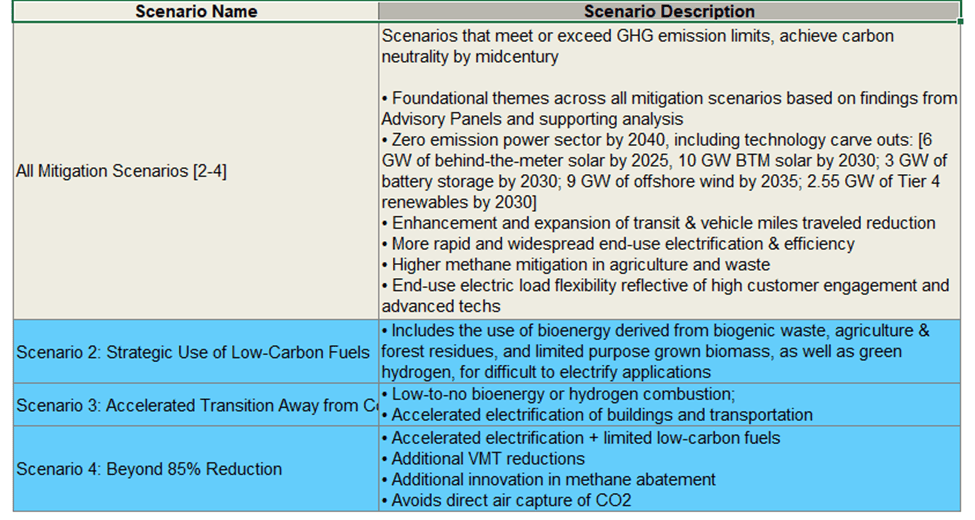
New York’s Climate Leadership and Community Protection Act (Climate Act) was passed in 2019 and became effective on 1/1/2020. The Climate Action Council has been working since then to develop plans to implement the Act.  Over the summer of 2021 the New York State Energy Research & Development Authority (NYSERDA) and its consultant Energy + Environmental Economics (E3) prepared an Integration Analysis to “estimate the economy-wide benefits, costs, and GHG emissions reductions associated with pathways that achieve the Climate Act GHG emission limits and carbon neutrality goal”. Three Integration Analysis implementation strategies were incorporated into the Draft Scoping Plan when it was released for public comment at the end of 2021.  These scenarios include different policy options to meet and exceed the Climate Act targets. 

My last post highlighted results shown in a draft presentation at a New York Independent System Operator (NYISO) meeting about an analysis being done to project the amount and type of generating capacity needed to transition the New York electric grid to “zero-emissions” by 2040.  The experts at the meeting are concerned because “Some scenarios do not represent realistic system performance” and the total projected wind, solar, energy storage and “dispatchable emissions-free resources” capacity additions projected are on the order of double the total current capacity.   The 2021-2030 Comprehensive Reliability Plan report concludes “While there are hundreds of projects in the NYISO interconnection queue, there are none that would be capable of providing dispatchable emission-free resources that could perform on a multi-day period to maintain bulk power system reliability. Such resources are not yet widely commercially available.”   That resource alone is greater than the total existing capacity so there certainly are reliability concerns.

A couple of weeks ago I posted an article on my blog showing an egregious example of hiding the true costs of the Scoping Plan. While I was drafting an overview presentation on the Draft Scoping Plan for my state Senator, I took another look at information supporting the assertion that the “cost of inaction exceeds the cost of action by more than $90 billion”.  I realized my concerns with the cost projections could be more clearly explained using the figures in Draft Scoping Plan Appendix G: Integration Analysis Technical Supplement Section I (Appendix G).  This post is the result.

Benefits and Costs Summary

Appendix G Figure 51. Net Present Value of Benefits and Costs relative to Reference Case, Including GHG benefits, Health Benefits, and Net Direct Costs (2020 – 2050) on page 69 is the primary documentation for the assertion that the “cost of inaction exceeds the cost of action by more than $90 billion”.  Note that three scenarios are shown: “Strategic use of low carbon fuels”, “Accelerated transition away from combustion”, and “Beyond 85% Reductions”.  This net-zero program plans to reduce greenhouse gas emissions by 85% and then offset the remaining 15% to get to “net-zero”. The $90 billion number is the net benefit difference between the net system costs and the total benefits.  My first impression was that these numbers represented the total costs for New York State to meet the net-zero mandate.  I should have known better. 

Unpacking the title: the numbers are the “net present values”.  According to the Draft Scoping Plan the integration analysis included calculations for three cost metrics: net present value (NPV) of net direct costs, annual net direct costs, and system expenditures.  The Plan defines NPV of Net Direct Costs as the levelized costs in a given scenario incremental to the Reference Case from 2020 through 2050 using a discount rate of 3.6% and including incremental direct capital, investment, operating expenses, and fuel expenditures.  The annual Net Direct Costs are defined as the levelized costs in a given scenario incremental to the Reference Case for a single year snapshot and include incremental direct capital investment, operating expenses, and fuel expenditures.  I don’t have the background to comment on the impact of these definitions relative to the acceptability of the projections. 

System Expenditures

System Expenditures are defined as an estimate of absolute direct costs (not relative to the Reference Case) and do not reflect direct costs in some sectors that are represented with incremental costs only. Appendix G Figure 48, New Present Value of System Expenditures in Reference Case and Scenarios 2-4 (2020-2050) shown below describes these costs.   

An important aside: the Climate Act requires the Climate Action Council to “[e]valuate, using the best available economic models, emission estimation techniques and other scientific methods, the total potential costs and potential economic and non-economic benefits of the plan for reducing greenhouse gases, and make such evaluation publicly available” in the Scoping Plan.   This figure and the others included represent most of the cost documentation.  For example, the component costs in the reference case in this figure are not included in any supporting documentation.  There are spreadsheets that document other figures in the Draft Scoping Plan with the data tables used to generate the figures but I have been unable to find this information for any of the cost figures.  I submit that the Council has not fulfilled this requirement.

Figure 51 notes that the values listed are relative to the Reference Case.  Figure 48 is important because other than a text mention that the Reference Case is $2.7 trillion, it is the only documentation for Reference Case values.  It looks like the scenarios are all approximately $3 trillion consistent with the difference relative to the Reference Case ~$300 billion costs in Figure 51. 

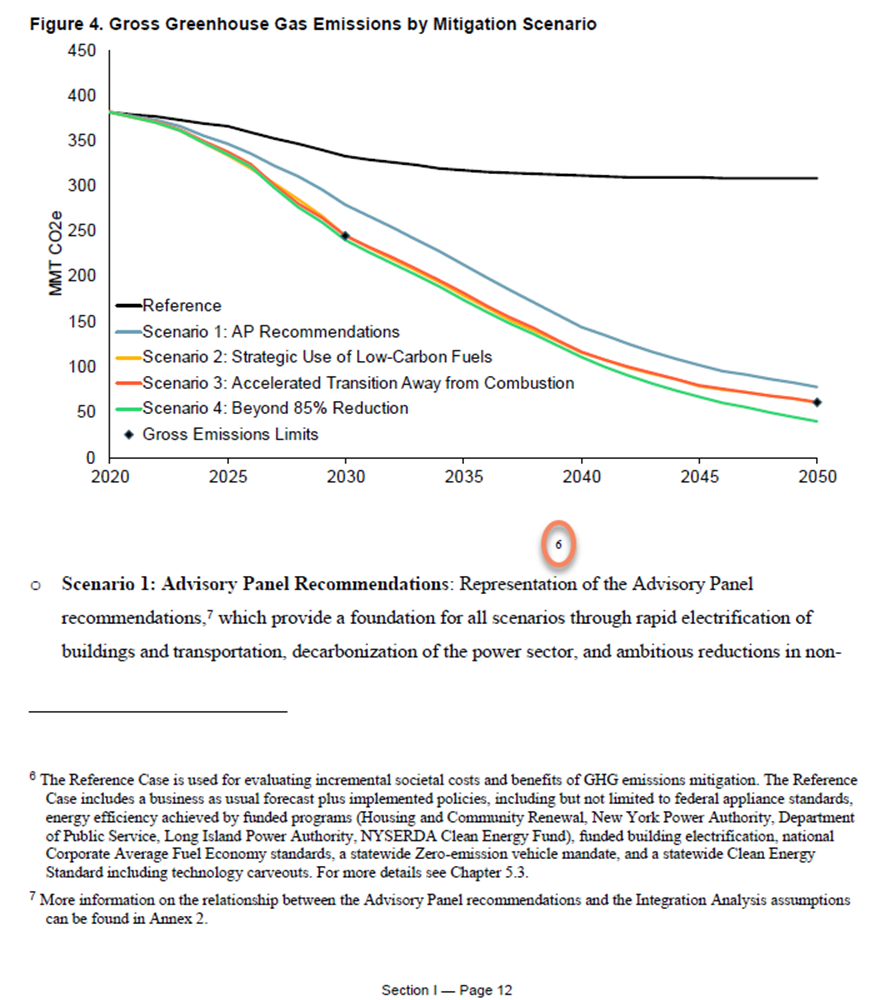
In my recent article looking at this issue I described what was included in the Reference Case.  I searched the Draft Scoping Plan and the technical supplements for the phrase “Reference Case” for the analysis.  The best description of the Reference Case contents was in Appendix G, Section I on page 12 in a footnote for Figure 4: Gross Greenhouse Gas Emissions by Mitigation Scenario:

The Reference Case is used for evaluating incremental societal costs and benefits of GHG emissions mitigation. The Reference Case includes a business as usual forecast plus implemented policies, including but not limited to federal appliance standards, energy efficiency achieved by funded programs (Housing and Community Renewal, New York Power Authority, Department of Public Service, Long Island Power Authority, NYSERDA Clean Energy Fund), funded building electrification, national Corporate Average Fuel Economy standards, a statewide Zero-emission vehicle mandate, and a statewide Clean Energy Standard including technology carveouts.

If the documentation included a cost component breakdown that would enable readers to determine whether the reference case is a reasonable estimate of the costs without the Climate Act.  In my opinion many of those programs should not be in the Reference Case.  Looking at the bar chart the four biggest cost components are electricity, transportation investment, buildings investment and fossil liquids.  Note that the transportation investment (~700 billion) does not vary much between the four bars.  Keep that in mind.

Costs Relative to Reference Case

Appendix G Figure 47 lists the NPV of net direct costs relative to the reference case.  This illustrates what is meant by the net direct costs label.  In each of the mitigation scenarios there are avoided fossil fuel expenditures that are subtracted from the total costs of the implementation strategies to get the ~$300 billion net direct costs. 

Note that the transportation investments listed are no more than $30 billion for the scenario, Beyond 85%”, with the highest costs.  My original impression of Figure 51 was that it represented all the costs necessary for New York to get to net-zero.  Clearly $30 billion is nowhere near the cost to replace all the approximately 10 million vehicles in New York with electric vehicles that use batteries or fuel cells even if the cost differential was $3,000.  The total cost has to be higher to include the cost for personal electric charging stations or public electric chargers, at least. 

I think that the true cost to electrify New York transportation is shown in Figure 48.  The system expenditures listed suggest the transportation investment component cost is around $700 billion which makes more sense.  The justification to put those costs in the Reference case is a bit of semantic sleight of hand based on the footnote that says that the Reference Case includes a “business as usual forecast plus implemented policies”.  It is true that New York passed legislation setting a goal for all new passenger cars and trucks sold in New York State to be zero-emissions by 2035 in April 2021 so the Scoping Plan is consistent with the only explanation of the Reference Case components.

However, suggesting that this “implemented policy” should not be included in the Climate Act implementation costs is disingenuous. The press release announcing that the Governor signed the legislation states: “The actions announced today in advance of Climate Week 2021 support New York’s ambitious goal of reducing greenhouse gas emissions by 85 percent by 2050, as outlined in the Climate Leadership and Community Protection Act.”  It goes on to quote Governor Hochul: “New York is implementing the nation’s most aggressive plan to reduce the greenhouse gas emissions affecting our climate and to reach our ambitious goals, we must reduce emissions from the transportation sector, currently the largest source of the state’s climate pollution”.  I think that these statements pretty well represent any dispassionate observer’s belief that the only reason for the law is to support the Climate Act.  As such those are not legitimate Reference Cases costs.

Conclusion

The major concerns for any net-zero transition program should be the effects on reliability and affordability.  It is not in the best interests of society to implement a policy that does more harm than good.  Ultimately the underlying problem for the Texas Energy Debacle of February 2021 was poor reliability planning. As mentioned here, the rush to implement an energy policy that depends on a non-existent dispatchable emissions-free resources technology surely increases the possibility of a similar blackout in New York.  This post that the total costs for the New York energy system (2020-2050) are on the order of $3 trillion but that the costs attributable to the Climate Act are subject to interpretation. The affordability comparison of costs and benefits is strongly affected by that interpretation.

Appendix G Figure 51: Net Present Value of Benefits and Costs relative to Reference Case shows that costs relative to the Reference Case are on the order of $300 billion and that benefits are on the order of $400 billion to justify the claim that the “cost of inaction exceeds the cost of action by more than $90 billion”.  The Draft Scoping Plan claimed that vehicle electrification costs should be included in the Reference Case because the electric vehicle legislative mandate was an “implemented policy”.  However, the $700 billion costs to electrify the transportation investment component of Figure 48 system expenditures are a necessary cost for the net-zero transition and should not be included in the Reference Case.  Clearly those costs are a necessary transition expense.  If those costs are moved from the Reference Case to the mitigation scenarios where they belong, the costs are much greater than the benefits.

The Draft Scoping Plan was written to prove the desired conclusion that the benefits were greater than the costs.  In order to make that case both benefits and cost estimates have been perverted.  I have shown elsewhere that the benefits are uniformly exaggerated and the largest benefit is dependent upon an incorrect application of the social cost of carbon. The cost estimates are inadequately documented and, as shown here, a semantic trick was used to claim that the cost to de-carbonize transportation was claimed to be “business as usual” because the electric vehicle conversion legislation was already “implemented”.

—————————————————————————————————————————————

Roger Caiazza blogs on New York energy and environmental issues at Pragmatic Environmentalist of New York.  More details on the Climate Leadership & Community Protection Act are available here. This represents his opinion and not the opinion of any of his previous employers or any other company with which he has been associated.

New York Climate Act: What the Experts are Saying Now  

On February 6, 2022 an article of mine was posted: New York Climate Act: Is Anyone Listening to the Experts?  This post shows that the experts are saying now that there is a major problem with New York’s plan for a “zero-emissions” electric grid by 2040. Unfortunately, the message is buried in a technical analysis product and expressed in jargon so the warning will likely be ignored.

Background

New York’s Climate Leadership and Community Protection Act was passed in 2019 and became effective on 1/1/2020. The Climate Action Council has been working since then to develop plans to implement the Act.  Over the summer of 2021 the New York State Energy Research & Development Authority (NYSERDA) and its consultant Energy + Environmental Economics (E3) prepared an Integration Analysis to “estimate the economy-wide benefits, costs, and GHG emissions reductions associated with pathways that achieve the Climate Act GHG emission limits and carbon neutrality goal”.  Integration Analysis implementation strategies were incorporated into the Draft Scoping Plan when it was released at the end of 2021. 

My last post here described the New York Independent System Operator’s (NYISO) 2021-2030 Comprehensive Reliability Plan (CRP) report (appendices) released late last year.  The difficulties raised in the report are so large that I raised the question whether any leader in New York listening to this expert opinion.  This post highlights results shown in a draft presentation that all but admits meeting the net-zero goals of the Climate Act are impossible on the mandated schedule.

Ultimate ProblemI have discussed the ultimate problem before so will only sum up here.  In their presentation to the Power Generation Advisory Panel on September 16, 2020 E3 included the following figure. The problem is that there are significant periods when winds are so low that wind generation output is negligible and, especially in the winter, solar output is also low: “The need for dispatchable resources is most pronounced during winter periods of high demand for electrified heating and transportation and lower wind and solar output”.  The presentation notes: “As the share of intermittent resources like wind and solar grows substantially, some studies suggest that complementing with firm, zero emission resources, such as bioenergy, synthesized fuels such as hydrogen, hydropower, carbon capture and sequestration, and nuclear generation could provide a number of benefits”.   New York has substantial existing hydro resources but cannot be expected to develop much more.  Nuclear is the obvious choice going forward but New York policies shut down 2,000 MW of nuclear capacity in the last couple of years so that is unlikely for the net-zero plan.  The ultimate problem is what Dispatchable Emission Free Resource (DEFR) will be used to supply electricity during multi-day winter wind lulls.  In the CRP NYISO stated:

“While there are hundreds of projects in the NYISO interconnection queue, there are none that would be capable of providing dispatchable emission-free resources that could perform on a multi-day period to maintain bulk power system reliability. Such resources are not yet widely commercially available.”

NYISO Analysis

A bit of background about the NYISO.  It is the Regional Transmission Organization/Independent System Operator for New York State.  Independent System Operators (ISO) grew out of the orders that enabled de-regulation of the electric system.  The concept of an Independent System Operator was one way for existing tight power pools to satisfy the requirement of providing non-discriminatory access to transmission. The Federal Energy Regulatory Commission encouraged the voluntary formation of Regional Transmission Organizations (RTO) to administer the transmission grid on a regional basis throughout North America (including Canada).

The NYISO Electric System Planning Working Group (ESPWG) is the stakeholder group that provides Market Participant input on the NYISO’s comprehensive planning processes. On March 24, 2022 the NYISO Economic Planning Department made a presentation to the EPSWG on their System & Resource Outlook Update.  The presentation itself is a draft – “for discussion purposes only” so the specific numbers are not finalized.  The point of referencing this analysis is to show what the experts are saying now about the critical dispatchable emissions-free resource needed for the net-zero electric system transition.  The purpose of the System & Resource Outlook analysis is to project what electric generating resources will be needed to maintain a reliable electric system in the future.  The Economic Planning Department is collaborating with EPSWG and the presentation was to designed to solicit EPSWG and stakeholder input.

This type of capacity expansion modeling analysis develops a reference case that represents what is expected to happen to the system without any changes to “business as usual”.  Then the analysis develops “Policy” case simulations and the model calculates an optimized projection of what capacity is needed as the Climate Act policy is implemented. The presentation described 27 different policy case scenarios that covered a wide range of different possible outlooks for the future.  For example, they included two different low load projections for the future that, not surprisingly, were predicted to need much less future generation capacity.  Scenarios to consider increased imports from Canada, different cost projections for wind and solar capacity, changes in nuclear retirements, and lower hydro output were also included.  In addition, there were six scenarios that considered different future projections for DEFR were included. 

In response to a request from the EPSWG three DEFR build types were addressed:

  • High Capital, Low Operating (HcLo)
  • Medium Capital, Medium Operating (McMo)
  • Low Capital, High Operating (LcHo)

As has been the case for all the other analyses to date, these build types are only proxies for what could happen if a DEFR were to be developed with the identified characteristics. The authors chose three cost and operational profiles to show what kinds of DEFR would be built.  These build types were included so that the capacity expansion model can provide solutions to load requirements and build resources if they are economic to build using the assumed characteristics.

What the Experts are Saying

The following two slides from the presentation are the focus of my claim that the experts are warning there are problems with the New York transition to net-zero.  The first slide describes one of the policy case scenarios in the analysis described above.  I have highlighted one of the caveats: Significant uncertainty related to cost / availability of DEFR technologies, as well as regulatory definition of “zero-emissions” compliant technologies.

Figure 1: NYISO System & Resource Outlook Update Dispatchable Emission Free Resource (DEFR) Scenario Description in March 24, 2022 Presentation to EPSWG.

The following DEFR capacity expansion scenarios slide describes the assumptions used for five different scenarios.  I have highlighted the note: Assumption included in the scenarios are not an endorsement or estimate of the validity of the values modified. Some scenarios do not represent realistic system performance but are helpful in identifying directional impacts and sensitivity to key variables.

Figure 2: NYISO System & Resource Outlook Update Dispatchable Emission Free Resource (DEFR) Scenario Description in March 24, 2022 Presentation to EPSWG.

Experts from the NYISO, the organization primarily responsible for keeping the lights on, said there is “Significant uncertainty related to cost / availability of DEFR technologies, as well as regulatory definition of “zero-emissions” compliant technologies” and that “Some scenarios do not represent realistic system performance but are helpful in identifying directional impacts and sensitivity to key variables”.  For people familiar with the jargon and the electric system these are red flags.  Let me unpack the statements for everyone else.

Dispatchable emissions free resource technologies do not exist at this time to provide power for the long-duration periods when wind and solar resources are expected to provide minimal generation.  This kind of technical report says “significant uncertainty” because they can’t flatly say “we don’t think this will occur”.  Because they don’t think there is a resource that will be available, they certainly can’t guess a cost.  A scenario that does not represent “realistic system performance” pretty clearly says that we cannot expect the system to perform as needed with the scenario’s resources.  This is as close to telling the Climate Action Council that their “plan” to go to zero emissions by 2040 is not going to happen as it gets without actually explicitly saying that.  In a perfect world an “independent” organization would just tell it like it is, but this is the state of New York so politics color everything including the future of the electric system.

Furthermore, during the presentation discussion the point was made that the capacity projected numbers indicate an enormous amount of generation is needed. That result was described as just “stunning”.  Someone asked whether anyone on the Council is looking at what this means.  These experts are clearly worried about the enormous resources that have to be built to meet to transition the New York electric grid to a net-zero.  That concern is above and beyond my concern about DEFRs.

There is one other aspect of the first statement that needs to be addressed.   The reference to the “regulatory definition of ‘zero-emissions’ compliant technologies” is included because the Climate Action Council has not defined what is meant by “zero-emissions”.  Several of the most vocal members of the Council believe that zero-emissions means no combustion and are determined to impose that restriction.  All of the New York analyses that have tried to project what types of generation and how much from each type will be needed for the future net-zero electric system have included combustion generation using hydrogen or renewable natural gas.  The leaders of the Council have not had the courage to tell the members who have no reliability responsibilities and little relevant expertise “Sorry, even if we combust those arguably zero-emission fuels, there still are great risks to a feasible system that is reliable.  If we don’t use them the feasibility risks are so high that the system will be unreliable”.

Conclusion

The NYISO capacity expansion modeling has been forced to be consistent with the Draft Scoping Plan by using DEFR technology and building enormous amounts of generating capacity.  The capacity resource modeling is based on what is needed to keep the lights on rather than whether dispatchable emissions-free resources that provide those resources will actually be available.  The authors of the report essentially say that they don’t think DEFR technologies will be available but I don’t think the message is blunt enough to force the Climate Action Council to respond.

Not so long ago the idea that natural gas could be used a bridge fuel until these aspirational dispatchable emission-free resources could be tested at the scale needed, perform like a natural gas fired generating unit, and provide power at a similar cost, was generally accepted as a rational approach. The analogy for skipping the need for a bridge fuel is that proponents want to jump out of a perfectly good airplane without a parachute because they assume that the concept of a parachute will be developed, proven technically and economically feasible, and then delivered in time to provide a soft landing.  That cannot end well and this won’t either.

—————————————————————————————————————————————

Roger Caiazza blogs on New York energy and environmental issues at Pragmatic Environmentalist of New York.  More details on the Climate Leadership & Community Protection Act are available here. This represents his opinion and not the opinion of any of his previous employers or any other company with which he has been associated.

Climate Act Public Hearing Announcement

New York’s Climate Leadership and Community Protection Act (Climate Act) has a legal mandate for New York State greenhouse gas emissions to meet the ambitious net-zero goal by 2050. The Climate Action Council is responsible for preparing the Scoping Plan that will “achieve the State’s bold clean energy and climate agenda”.  On March 3 the Council finally got around to having a meeting to discuss the plan for 2022 (recording here).  Subsequently they announced the public hearing schedule.  The purpose of this post is to publicize those hearings, emphasize the need for public involvement, and, for anyone who wants to submit comments but hesitates to submit them directly for whatever reason, to offer the opportunity for me to submit your comments anonymously.  

I have written extensively on implementation of the Climate Act because I believe the ambitions for a zero-emissions economy outstrip available renewable technology such that it will adversely affect reliability and affordability, risk safety, affect lifestyles, will have worse impacts on the environment than the purported effects of climate change in New York, and cannot measurably affect global warming when implemented.   The opinions expressed in this post do not reflect the position of any of my previous employers or any other company I have been associated with, these comments are mine alone.

Climate Act Background

The Climate Act establishes a “Net Zero” target by 2050. The Climate Act requires the Climate Action Council to “[e]valuate, using the best available economic models, emission estimation techniques and other scientific methods, the total potential costs and potential economic and non-economic benefits of the plan for reducing greenhouse gases, and make such evaluation publicly available” in the Scoping Plan.  The integration analysis developed by the New York State Energy Research and Development Authority (NYSERDA) and its consultants was used to develop the Draft Scoping Plan that was released for public comment on December 30, 2021. At this time they are accepting public comments on the draft through June 10, 2022.

Public Hearings

The press release announcement of the public hearing schedule said that the Department of Environmental Conservation (DEC) and New York State Energy Research and Development Authority (NYSERDA), Co-Chairs of the Climate Action Council will host eight in-person hearings in locations across the State, as well as two virtual hearings. In-person hearings will also be live-streamed to allow for remote viewing of the proceedings. “All persons, organizations, corporations, and government agencies are encouraged to attend the public hearings and to submit oral or written comments.”

Climate Action Council Public Hearing Schedule
DateTimeLocationVenue
Tuesday, April 5, 20224:00 PMBronxBronx Community College
Roscoe Brown Student Center
Hall of Fame Play House
2155 University Avenue
Bronx, NY 10453
Wednesday, April 6, 20224:00 PMBrookhavenBrookhaven Town Hall
1 Independence Hill
Farmingville, NY 11738
Tuesday, April 12, 20224:00 PMBinghamtonBinghamton University 
Symposium Hall
85 Murray Hill Road
Vestal, NY 13850
Thursday, April 14, 2022 4:00 PM AlbanyEmpire State Plaza
Meeting Room 6 
Albany, NY 12242
Tuesday, April 26, 2022 4:00 PMSyracuseSUNY College of Environmental Science and Forestry 
Gateway Center 
1 Forestry Drive 
Syracuse, NY 13210 
Wednesday, April 27, 2022 3:30 PMBuffaloBuffalo & Erie County Public Library 
Mason O. Damon Auditorium 
1 Lafayette Square 
Buffalo, NY 14203 
Tuesday, May 3, 2022 4:00 PMBrooklynNew York City College of Technology 
The Theater at City Tech 
285 Jay Street 
Brooklyn, NY 11201 
Saturday, May 7, 2022 10:00 AMVIRTUALVia WebEx

Event number: 2599 706 6384
Event password: climate
Call in number: +1-415-655-0003
Call in access code: 2599 706 6384
Tuesday, May 10, 2022 4:00 PMTupper LakeThe Wild Center 
45 Museum Drive 
Tupper Lake, NY 12986 
Wednesday, May 11, 20224:00 PMVIRTUALVia WebEx

Event number: 2595 530 3236
Event password: climate
Call in number: +1-415-655-0003
Call in access code: 2595 530 3236

Commenting Instructions

Pre-registration is encouraged but not required for the in-person hearings. Priority in seating and speaking will be given to those who pre-register. Individuals can pre-register at the Climate Act website. Hearings will be webcast for viewing purposes only, professionally recorded, and transcribed as part of the official record and posted on the Climate Act website.

Members of the public who want to provide oral comment must attend either in-person or join a virtual hearing. Equal weight will be given to oral and written statements. 

Written comments can be submitted through June 10, 2022, via the online public comment form, via email to scopingplan@nyserda.ny.gov, or via U.S. Mail to Attention: Draft Scoping Plan Comments, NYSERDA, 17 Columbia Circle, Albany, NY 12203-6399.

Remarks

The description of the public meetings did not mention the plan for public speakers.  At the March 3, 2022 Climate Action Council meeting (33:27 in the recording) they noted that they plan to limit speakers to two minutes.  I think that is insufficient time for anything meaningful.  Instead, it is about enough time for a speaker to say that they are in favor or not in favor of the plan.  Ultimately this means the Council is simply going through the motions for the public input requirement of the Climate Act.  Nonetheless it still is useful to attend because it is certain that the activists will be there and if substantial numbers of skeptical comments are received it may give the Council the idea that not everyone is on board with the draft scoping plan.

My experience with respect to the public comments is that they are mostly for show. Written submittals are the real opportunity to provide substantive comments.  In this instance I recommend that you copy your legislators on your submittals.  If you are looking for ideas for comments there is a page on the Citizens Guide that lists the comments that I have submitted.

In response to requests I prepare a summary of the articles posted here that is sent out every couple of weeks.  One of the recipients contacted me and suggested that there may be people who would like to comment but do not feel comfortable submitting comments under their own name and email address.  If any reader is in that position, I offer to submit your comments though my name and this blog email address.  The introduction to the comments would simply state that I am submitting comments under my name because a reader of my blog does not feel comfortable submitting comments because of potential ramifications with his employer.  Of course, I can only make this offer for comments that are credible and that decision will be made in communication with the author.

Conclusion

One of the readers of this blog wrote: “I’m not saying that people shouldn’t comment, however, it almost feels like we are lending credence to a farce of a process.  I am not being critical of everyone’s efforts; I am just wondering if it really matters”.  I responded that I too often wrestle with the question whether participating in the public hearings and comments has any value.  Frequently the answer is in the back of the book so it is hard to claim any value to the effort required to comment.  Unfortunately, there are indications that this might be the case for this public input process.

I think in this instance that it is important to let the people in charge know that this law goes too far, too fast and that this cure could easily be worse than the alleged problems.  I cling to the belief that there are many politicians who privately question the scope of the Climate Act but are afraid to object.  They have been bullied into silence by a vocal segment of society and their party leadership.  I am hoping that there will be enough of a public outcry that when implementing legislation is considered later this year that they will have the courage to stand up for their constituents and say no to, for example, changing building codes to ban fossil fuel use in homes.

In conclusion I think that comments have value and encourage readers to comment.  Don’t forget that if you have problems submitting your own comments that I am willing to submit your comments.

New York Needs $15 Billion in Climate Funding Now – Not!

One of the most glaring omissions in New York’s Climate Leadership and Community Protection Act (CLCPA) is the fact that it did not include a funding mechanism.  In the leadup for the New York budget NY Renews has organized a $15 billion budget demand for climate justice in the New York State 2022-2023 budget.  This post comments on an opinion piece written by New York State Assemblymember Dr. Anna Kelles supporting the demand and the CLCPA.

I have written extensively on implementation of the CLCPA because I believe the ambitions for a zero-emissions economy outstrip available renewable technology such that it will adversely affect reliability and affordability, risk safety, affect lifestyles, will have worse impacts on the environment than the purported effects of climate change in New York, and cannot measurably affect global warming when implemented.   The opinions expressed in this post do not reflect the position of any of my previous employers or any other company I have been associated with, these comments are mine alone.

NY Renews Budget Demand

This post is not going to address the budget demand described here directly.  Instead, I am going to focus on the opinion piece written by the Assemblymember in support of it.  For background here is a summary of the demand:

NY Renews is currently organizing around a $15 billion budget demand for climate justice in the New York State 2022-2023 budget. We are calling on the New York State legislature to allocate funds to the priorities outlined in the Climate and Community Investment Act: community investment, good green jobs, building a renewable economy, making polluters pay for the just transition, protecting ratepayers, and ultimately making New York the nation’s climate leader.

Budget Demand Materials:

      • One-page description of why New York State needs $15 billion for climate, jobs, and justice in the 2022–2023 state budget
      • Where our $15 billion ask comes from

Anna Kelles Opinion

Democratic Assemblymember Dr. Anna Kelles represents the 125th District, including Tompkins County and the southwest of Cortland County.  This district includes the metropolitan areas of Ithaca and Cortland as well as 17 smaller municipal towns and villages in both counties. For those readers unfamiliar with the area Ithaca is home to Cornell University and Ithaca College and a college in the State University of New York system is in Cortland.  This is not a conservative rural district.   On March 11, 2022 her opinion piece “New York Needs $15 Billion in Climate Funding Now” was published in The Ithaca Voice.  Because I think it is a good summary of the views on climate change of the progressive wing of the New York Democratic Party I have provided the text with my indented and italicized comments on it below. 

Last week, the UN’s Intergovernmental Panel on Climate Change (IPCC) released a comprehensive report on the impacts of climate change on humanity and our planet. UN secretary-general António Guterres called the report “an atlas of human suffering and a damning indictment of failed climate leadership.” Our window to mitigate the very worst impacts of climate change is narrowing. Across the globe, we are already experiencing destructive storms, flooding, droughts, and fires. To protect our planet, preserve our food systems, and adapt, we must take bold, transformational action now.

There is another side to the report released by the IPCC.  Roger Pielke, Jr. writes that the IPCC is “an important organization with a primary purpose to assess the scientific literature on climate in order to inform policy” but notes that the IPCC report “has strayed far from its purpose to assess and evaluate the scientific literature, and has positioned itself much more as a cheerleader for emissions reductions and produced a report that supports such advocacy”. He goes on to explain that there are many examples where the report cited by Dr. Kelles does not accurately represent the literature used to reference its claims of impacts due climate change that are being used to justify mitigation actions like the CLCPA.  He also points out that damages are based on what would happen if climate changes projected for 2100 are imposed upon current society. These studies have in fact eliminated the possibility of adaptation in projecting the future even though the report is supposed to consider adaptation.

 Any impacts of any air pollution assessment are directly proportional to the projected emissions considered.  Pielke notes that many of the studies used as the basis for the scarier claims are based on emissions from “the out-of-date and implausible extreme RCP8.5 scenario to project climate changes for 2100. So not only is society frozen in time, unable to adapt — which is clearly implausible, but future climate change is projected based on an extreme scenario that is also implausible. Implausibility built on implausibility offers no practical insight as to the role of adaptation in reducing vulnerabilities and increasing resilience. We might expect this sort of thing from a passionate advocacy group spinning science for theatrical effect, but not the IPCC.” 

Three years ago, New York State took a critical first step. We passed the Climate Leadership and Community Protection Act (CLCPA), which requires us to achieve 70% renewable electricity by 2030, 100% zero-emission electricity generation by 2040. The law also mandates that we cut climate change pollutants by half by 2030 and an 85% reduction by 2050. The CLCPAion Council (CAC) established by the CLCPA recently outlined a plan to reach these goals. According to a NYSERDA analysis in the plan, the state needs to spend $10 billion annually, with increases every year, to meet our 2050 goal of a fully net-zero economy. Other researchers, including those at the University of Massachusetts Political Economy Research Institute (PERI), put the yearly number at $31 billion. We will not achieve the substantial infrastructure change in our energy grid, buildings, transportation system, agriculture and other critical sectors needed to meet our climate goals with our current planned investments.  

The estimate that the state needs to spend $10 billion annually comes from an Integration Analysis claim that “in the early years on the order of $10 billion per year, equivalent to 0.6% of GSP in 2030 and that in the later years on the order of $50 billion per year, equivalent to 2.0% of GSP in 2050”.  The problem is that the numbers are not documented well enough to determine if they are credible claims and the fact that other researchers project costs three times higher suggests that the cost estimates are suspect.  In addition, I believe that Dr. Kelles does not realize that the NYSERDA analysis gives net direct costs relative to a reference case that includes expenses needed to reach the CLCPA targets which makes the net direct costs presented lower than what will be the case.  I believe that the renewable energy deployment  costs are vastly underestimated.

The truth is that we cannot afford not to act now and invest the necessary funds to meet our climate goals. According to the Department of Environmental Conservation (DEC), each ton of Carbon Dioxide (CO2) causes more than $125 in damages. Given the DEC’s most recent 2019 estimate of net CO2 emissions (350 million metric tons) this results in nearly $30 billion annual cost as a result of climate pollution in New York State. Every storm that hits the downstate region, every warm winter reducing tourism in the Adirondacks and the Finger Lakes, every flood destroying crops upstate, has a significant direct cost to New Yorkers. Every child and medically vulnerable individual that requires costly medical care and hospitalization from breathing in polluted air is a substantial and unnecessary cost to our state. All those who experience a disproportionate level of air pollution in predominantly black and brown communities due to our current fossil fuel-based energy production system is a healthcare cost and a loss of economic productivity. We can reduce all of these costs by prioritizing emissions reductions. 

The DEC analysis of the damages caused by a ton of CO2 is biased and flawed.  I have found that the CLCPA manipulates emissions to increase benefits and uses a lower discount rate than current Federal guidance resulting in societal benefits of GHG emission reductions that are 5.4 times higher for 2019 emissions than other jurisdictions.  The largest impact of the CLCPA for these benefits is based on an incorrect guidance for calculating benefits.  In particular, the benefits of reductions are counted multiple times.  Kelles statement that the avoided cost benefit is a nearly $30 billion annual cost, indicates that she has made the same mistake.  It is incorrect to count the avoided cost benefits calculated out to 2300 more than once.  To do so would be the same as if claiming that if you lost five pounds ten years ago that you lost 50 pounds total.  If only that error is corrected then the costs are greater than the benefits for the CLCPA.

Kelles statements about storms causing significant direct costs and that we can reduce those costs by prioritizing emissions reductions fails on two counts.  In the first place she does not understand the difference between weather and climate.  It is very unlikely that every aspect of every storm that is deemed unusual and thus caused by climate change by the media and opportunistic politicians is, in fact, due to changes in the climate.  Instead, the majority of those impacts are due to natural weather variability.  Ultimately, the claimed existential threat of climate change is hype.  In the second place, even if reducing CO2 emissions could be proven to have an effect on New York weather, New York’s emissions are less than half a percent of the world’s emissions.  Because global emissions have been increasing by more than a half a percent annually for several decades, any effect on any of the impacts alleged to occur because of climate change from the CLCPA CO2 emissions reductions will be erased by increases elsewhere in less than a year.

It is clear that it is significantly cheaper to invest in climate solutions than to stand behind business as usual. I’m calling on my colleagues in the legislature and the Governor to allocate $15 billion for climate, jobs, and justice in this year’s budget. This investment is both reasonable and necessary to meet New York’s climate goals, protect our state from the worst elements of the climate crisis, and prepare our workforce for the important green jobs of the future. 

A quick review of what has happened in Europe as they have tried to implement their own version of a new-zero energy economy demonstrates that it is not cheaper to invest in climate solutions.  As Europe took apart its electric system by closing coal and nuclear operating for its idealized energy future costs have sky-rocketed.  In the 4th quarter of 2021, the International Energy Agency reported that average European wholesale electricity prices were more than four times their 2015-2020 average. Households are set to pay an average of 54% more for energy than they did two years ago.  Until we have affordable and reliable low-carbon energy, the rush to the net-zero goal of the CLCPA will come at enormous expense to the public.

Last year, New York State took in nearly $13 billion in greater revenue than expected. Although it is important to replenish our reserve funds, investing a portion of these gains into reducing our fossil fuel dependency, building up our renewable energy infrastructure, expanding our green jobs sector, and investing in environmental justice communities that will reduce future costs and provide clear social and economic protections is a prudent investment. Every year we spend $1.5 billion on tax subsidies to the fossil fuel industry prolonging our commitment and dependency on dirty and economically volatile fossil fuels. This is another source of funding that could be diverted to an effort to move our physical infrastructure and economy forward into the new green economy instead of backwards on fossil fuel dependency.  Finally, we need to reexamine our economic development investments through the state’s Regional Economic Development Council’s. Instead of prioritizing large scale initiatives averaging about $9 billion annually that are politically motivated and provide little economic return and even fewer jobs, we can shift investments to a transparent and comprehensive focus on green energy manufacturing and infrastructure development. Rather than focusing taxpayer dollars on direct investments in for-profit companies, we should prioritize our communities and build a transition to a fully renewable and stable economy. 

I have no knowledge of the New York State budget so I won’t comment on most of the claims of this paragraph.  I do wonder about the claim that “Every year we spend $1.5 billion on tax subsidies to the fossil fuel industry”.  In other analyses that make similar claims it turns out that a significant portion of the fossil fuel subsidies claimed turn out to be home heating assistance programs that help low-income residences pay their fossil fuel bills. 

I believe a winning social and economic strategy for New York is to listen to the world’s leading scientists, stop funding fossil fuels, and start funding climate, jobs, and justice starting today with the recommended annual $10-15 billion in our state budget.  

I disagree. As proposed, I believe New York’s CLCPA will markedly increase the cost of energy and lead to blackouts which will severely impact those least able to afford the resulting costs.

Conclusion

A recent article by Judith Curry, “A ‘Plan B’ for addressing climate change and the energy transition” in the latest issue of International Affairs Forum, Climate Change and Energy sums up the problem with all net-zero energy transition programs:

“In a nutshell, we’ve vastly oversimplified both the problem of climate change and its solutions.  The complexity, uncertainty, and ambiguity of the existing knowledge about climate change is being kept away from the policy and public debates.  The dangers of manmade climate change have been confounded with natural weather and climate variability. The solutions that have been proposed for rapidly eliminating fossil fuels are technologically and politically infeasible on a global scale.” 

I would only add that the CAC has not provided a feasibility plan for the CLCPA that proves rapidly eliminating fossil fuels in New York is technologically feasible.  She goes on to describe a framework for an alternative approach:

Here’s a framework for how we can get to a Plan B.  A more pragmatic approach to dealing with climate change drops the timelines and emissions targets, in favor of accelerating energy innovation. Whether or not we manage to drastically curtail our carbon dioxide emissions in the coming decades, we need to reduce our vulnerability to extreme weather and climate events.

Ultimately the problem is that today’s renewable energy technology is just not up to the task.  I have described other more reasoned approaches consistent with Dr. Curry that recognize technological limitations and are at odds to the path advocated by the CLCPA and Kelles (here and here).  Based on my evaluation of the CLCPA in over 170 blog posts, the failure to accept that we just don’t have acceptable options for the net-zero transition on the schedule proposed can only end badly for New York. Throwing $15 billion towards CLCA implementation could be better spent on water infrastructure, low and middle income energy efficiency programs, and energy innovation.  Any money spent implementing existing wind, solar, and energy storage technology is a waste.

New York 10GW Solar Roadmap’s Disconnect from Reality

New York’s Climate Leadership and Community Protection Act (Climate Act) has a legal mandate for New York State greenhouse gas emissions to meet the ambitious net-zero goal by 2050 and has included specific renewable energy deployment targets.  On December 17, 2021 the New York State Energy Research and Development Authority (NYSERDA) and New York State Department of Public Service Staff (DPS Staff) released “New York’s 10 GW Distributed Solar Roadmap: Policy Options for Continued Growth in Distributed Solar” that proposes a pathway to achieve a goal of 10 GW of distributed solar deployment by 2030.  This post addresses the solar policy options related to agricultural protection and land use in that document and what is actually happening to agricultural land as a result of New York’s poor planning.

I have written extensively on implementation of the Climate Act because I believe the ambitions for a zero-emissions economy outstrip available renewable technology such that it will adversely affect reliability and affordability, risk safety, affect lifestyles, will have worse impacts on the environment than the purported effects of climate change in New York, and cannot measurably affect global warming when implemented.   The opinions expressed in this post do not reflect the position of any of my previous employers or any other company I have been associated with, these comments are mine alone.

Background

The Executive Summary in the New York’s 10 GW Distributed Solar Roadmap: Policy Options for Continued Growth in Distributed Solar document describes the plan:

The current 6 gigawatt (GW) NY-Sun distributed solar program target is nearly achieved, with more than 93 percent of the target either completed or at an advanced stage of development.1 As called upon by New York State Governor Kathy Hochul during Climate Week 2021, the New York State Energy Research and Development Authority (NYSERDA) and New York State Department of Public Service Staff (DPS Staff) have analyzed the current distributed solar market in New York State and found that costs and NYSERDA-provided incentives have declined over time, while a thriving solar market has created approximately 12,000 jobs in New York. Together, these facts demonstrate the success of the NY-Sun program in transforming New York’s distributed solar industry. Additionally, NYSERDA directed further analysis of future revenues, costs, and market support mechanisms needed for distributed solar development beyond the 6 GW target.

Informed by this analysis, NYSERDA and DPS Staff developed this Distributed Solar Roadmap (Roadmap) to propose a pathway to achieve 10 GW of distributed solar deployment by 2030. With the current 6 GW by 2025 goal nearly achieved, the Roadmap explores various options for setting incentive levels to achieve the expanded NY-Sun goal of an incremental 4 GW (Incremental 4 GW Target). These options include various procurement structures, pricing models, and funding mechanisms

The press release bragging about the new framework to achieve at least 10 GW of distributed solar by 2030 included the following statement by Rory M. Christian, CEO of the Department of Public Service:

“I would like to thank Governor Hochul for her ardent support, encouraging the development of and access to solar energy in New York State. The roadmap that has been developed provides New York with the tools it needs to accelerate the transition to a clean-energy economy and meet our critically important climate goals.”

Since the NY-Sun initiative was launched, NYSERDA has worked closely with local governments, agricultural communities, other state agencies, and a wide range of stakeholders to ensure that projects are developed and sited in a manner that fully considers land use and are advanced in close collaboration with local stakeholders and agricultural communities. NYSERDA will extend its ongoing technical assistance for all municipalities in the state to assist localities in aligning solar development with local priorities. In addition, projects sited in New York State Department of Agriculture and Markets’ designated Agricultural Districts must follow Guidelines for Agricultural Mitigation for Solar Energy Projects and will be subject to an additional review process with the NYSDAM, as well as with local agricultural boards. Those projects that exceed 30 acres of impact to prime agricultural soils will be subject to mitigation fees.

Agricultural Protection and Land Use

This section lists the contents of Section III.a.4 Agricultural Protection and Land Use.   In my opinion, if the policy is employed as they claim, then it should offer protection to prime farmland and local farming communities from distributed solar project development.

Farmland protection and the maintenance of a vibrant agricultural economy are important State policy goals. New York State recognizes the importance of collaboration between the agriculture and clean energy sectors as a critical part of the State’s overall decarbonization strategy. NYSERDA works in close coordination with the Department of Agriculture and Markets (NYSAGM) and other stakeholders to responsibly support the development of renewable energy projects. In the 2019 NY-Sun Expansion Petition, NYSERDA described the interaction of distributed solar with agriculture in New York:

“The majority of projects in [the Upstate C/I] market sector are expected to be ground-mounted arrays ranging between 5 MW and 7.5 MW in size, which occupy approximately 20 – 25 acres of land, typically on rural properties that are leased or sold to the solar developer by the landowner. Notably, this includes properties that are currently used, or could potentially be used for, agricultural production. While NYSERDA expects that the total agricultural acreage utilized for distributed solar projects will remain modest as compared to total farmland in New York State, through its implementation efforts, NYSERDA will act to ensure that negative impacts to farmland and the State’s agricultural economy are avoided and minimized, and where they are unavoidable, mitigated. NYSERDA, working with partner agencies and stakeholders, has already taken multiple actions along these lines and will pursue additional actions under an expanded NY-Sun program.” (This section is from the NY-Sun Petition, p. 21.) 

In the subsequent two years, NYSERDA and NYSAGM have continued to work in partnership to put in place requirements for solar projects to minimize impact to farming and agricultural soils.  (These requirements include, inter alia: complying with New York State Agriculture and Markets Law; submitting appropriate notices to NYSAGM and local Agricultural and Farmland Protection boards; executing a copy of the Guidelines for Solar Energy Projects – Construction Mitigation for Agricultural Lands document published by NYSAGM; and making a Mitigation Fund payment or committing to other mitigation measures where impacted agricultural soils exceed 30 acres.) These requirements have already demonstrated their effectiveness: In 2021 to date, all 50 distributed solar projects subject to these requirements, totaling 1,037 acres of affected area, have committed to avoiding and minimizing impacts to prime soils in consideration of the solar layout. For 48 of these projects, all unaffected portions of the farms hosting the solar projects, a total of 3,385 acres, will remain in agricultural production. Many of the farmers hosting projects on a portion of their land report that the steady lease revenue from the solar projects has enabled them to continue farming on most of their property despite challenging agricultural economic pressures.

This Roadmap foresees the existing requirements being extended to distributed solar projects developed through the Incremental 4 GW Target. The State’s Agricultural Technical Working Group (A-TWG), an independent advisory body convened by NYSERDA early in 2021, will continue to serve as the primary forum for stakeholder and interagency collaboration on policies and practices pertaining to distributed solar and agriculture.  Guidance provided by the A-TWG and the New York State Farmland Protection Working Group will continue to inform agricultural preservation and mitigation requirements and practices going forward. NYSERDA also continues to provide and expand resources to landowners and local governments through the New York State Solar Guidebook and direct technical assistance.

Utility-Scale Solar Reality

Assuming that these numbers are correct, then I applaud the efforts of NYSERDA and NYSAGM.  There is a major problem however.  The majority of these distributed solar projects are “expected to be ground-mounted arrays ranging between 5 MW and 7.5 MW in size, which occupy approximately 20 – 25 acres of land”.  The reality is that a large fraction of the projected solar generation capacity will be utility-scale solar facilities that are much larger and have bigger impacts than the developers admit.

For example, consider two utility-scale solar projects, the Trelina Solar Project and Garnet Energy Center

That are both being developed by NextEra Energy Resources. According to NextEra, Trelina will have 80 MW of solar capacity located on 418 acres within a 1,067-acre project area.  Garnet is a 200-megawatt solar project with 20 megawatts of energy storage with a project area of 2,288 acres and facility area (area within in project fence line) of 1,054 acres. Both projects have Article Ten applications and Michael Saviola, an Associate Environmental Analyst with the New York State Department of Agriculture & Markets (“Department”) submitted testimony describing the nature and extent of potential impacts of the projects on agricultural land.

Saviola’s prepared testimony responded to the question whether the projects had been “sited to avoid and/or minimize impacts to land uses within the Study Area and Project Area to the maximum extent practicable”.  For Trelina his testimony noted that “the Department finds the Applications proposed siting is not consistent with the Department’s siting policy because it will occur on more that 10% of active farmland classified as Prime Farmland”. It goes on to explain that “the Department estimates that greater than 68% of the of the limits of disturbance includes the conversion of farmland classified as Prime Farmland Soil”.  While the application claims that solar panels will cover 325 acres, the testimony shows that “areas located outside of fenced areas will likely become fallow or orphaned as a result of screening requirements and setbacks” and this “will eliminate crop production on much more than 325 acres of agriculture lands for a minimum of 30 years -worth of crop yields from some of the most productive farmland soils in the State”. The application claims that there will be temporary impact to agricultural land and farming, but the testimony argues that “a 30-year loss of the production of crops, livestock and livestock products constitutes a permanent conversion to a nonagricultural use.”  Finally, even though a decommissioning plan has been prepared, the testimony states: “there is virtually no reasonable assurance that the project will be decommissioned and that the full resumption back to agricultural use will be reestablished.”

Saviola’s testimony for Garnet was very similar.  The conclusion is the same: “the Department finds the Applications proposed siting is not consistent with the Department’s siting policy”.  In this instance almost 30% of the project will be on active farmland classified as Prime Farmland.  His testimony explains that “the Application update states that the project will occupy nearly 1,000 acres of land to generate up to 200 MW of electricity, however, areas located outside of fenced areas will likely become fallow or orphaned as a result of screening requirements and setbacks”. Nearly three times as much land will lose crop production on “agricultural lands for a minimum of 30 years-worth of crop yields from some of the most productive farmland soils in the State”. The same points about temporary claimed impacts and decommissioning assurances were made.  His testimony concludes: “It is the Department’s opinion that the facility will result in or contribute to a significant and adverse disproportionate agricultural impact upon the local farming community. They have not avoided, offset or minimized agricultural impacts to the maximum extent practicable using verifiable measures”.

Despite the recommendations of the Department, on November 30, 2021 the New York State Board on Electric Generation Siting and the Environment granted approval to Trelina Solar Energy Center to build and operate the 80-megawatt solar farm.  According to a state press release, the Siting Board’s decision “follows a detailed review and robust public participation process to ensure that the solar farm meets or exceeds all siting requirements”.  Clearly, the fact that the Department of Agriculture and Markets finding that the project was not consistent with their siting policy belies that claim.

The Garnet Energy Center Article Ten public comment period is open until May 1, 2022.  While Saviola’s testimony is similar for both cases it is not identical.  The Department requested information from NextEra and documented the responses.  In general, NextEra’s response to questions simply repeated statements in the already submitted materials.  The testimony notes that in response to a question about agricultural co-utilization: “The Applicant indicates that they have not considered incorporating agricultural co-utilization as part of the Project. They indicate that there is not sufficient space for co-utilization.” Saviola goes on to say he does not agree with this response: “There is ample space inside the fence for agricultural activities such as sheep grazing, apiary incorporation and pollinator species, and small-scale grass hay production, nor have they demonstrated any reduced impacts to agriculture from the increased density of the panels. The Applicant should work with hosting farmers to explore dual-use, or agrivotalic projects.”

NY-Sun Disconnect from Reality

As quoted earlier the State’s press release about the release of the framework was all praise.  It claimed that NYSERDA has worked closely with local governments, agricultural communities, other state agencies, and a wide range of stakeholders to ensure that projects are developed and sited in a manner that fully considers land use and are advanced in close collaboration with local stakeholders and agricultural communities. In the future, they state that “projects sited in New York State Department of Agriculture and Markets’ designated Agricultural Districts must follow Guidelines for Agricultural Mitigation for Solar Energy Projects and will be subject to an additional review process with the NYSDAM, as well as with local agricultural boards.”  The problem is that those initiatives only address distributed-solar projects.

Table 1 lists projected future New York State solar generating capacity for the Reference Case, Scenario 1 that represents recommendations by the Advisory Panels and Scenarios 2-4 that represent Integration Analysis mitigation scenarios.  The mitigation scenarios were constructed so that the Climate Act targets could be achieved.  Unfortunately, the Draft Scoping Plan does not document how much of the solar capacity is expected to come from distributed solar projects and how much from utility-scale projects.  Assuming half is utility-scale solar that means we can expect 32.3 GW of industrial solar installations in Scenario 2. Two utility-scale projects are discussed in this article and they have average 5.26 MW per acre of fenced area covered with panels.  Using that estimate, Scenario 2 utility-scale solar project solar panels will cover 170,000 acres or 266 square miles in 2050.  The Department testimony explains that considering only the fenced area impacts underestimates the amount of land that actually be lost to most agricultural uses.  The reality is that the impacts for utility-scale solar project will dwarf the land taken up by distributed solar projects (much of which is sited on buildings)  in NY-Sun and there are no equivalent farmland protections for massive utility-scale projects under development.

Table 1: Mitigation Scenarios Solar Capacity (MW)

Integration Analysis – Key Drivers and Outputs (updated December 29, 2021)

 2020202520302035204020452050
Reference Case2,5928,20113,64414,38714,66114,94219,956
Scenario 12,5928,20116,95425,58240,34350,12762,463
Scenario 22,5928,20118,85228,99443,43253,08964,621
Scenario 32,5928,20116,76228,62541,42049,04260,604
Scenario 42,5928,20118,06029,84141,62353,45065,210

Discussion

I submitted comments on March 17 to the Garnet Energy Center Article Ten application docket contending that the project should follow responsible solar siting guidelines.  In my post describing the comment submittal I argued that responsible siting guidelines based on the American Farmland Trust report, the state’s policies for distributed solar described above in the 10GW Solar Roadmap and the New York State Energy Research & Development Authority’s Agricultural Technical Working Group analyses will likely eventually be used to form the basis of a state-wide policy for utility-scale solar development.  Without those policies in place, it is inappropriate to allow projects like the Garnet project to proceed.  Obviously, the fact that the Department of Ag & Markets testified that “the facility will result in or contribute to a significant and adverse disproportionate agricultural impact upon the local farming community” demonstrates that the project is inconsistent with the NY-Sun’s commitment to responsible solar development.

Given the magnitude of the potential impacts to prime farmland I also submitted a comment to the Climate Action Council recommending that they impose a moratorium on the development of utility-scale solar projects until permitting requirements have been established for responsible solar siting and protection of prime farmlands.  I said that even though the Department of Agriculture and Markets has policies on solar energy projects, the Article Ten Trelina Solar Project was approved despite the fact that it did not adhere to that policy.  I argued that, at a minimum, all utility-scale projects should adhere to those policies.  A moratorium would not only protect communities and farmland but it would also help meet Climate Act goals.  Using the Draft Scoping Plan solar projections and land use estimates for solar projects in the Article Ten queue in 2020 suggest that the smallest Scoping Plan scenario solar equipment area covered will be 266 square miles.  Moreover, there are Climate Act considerations.  The law has a “net-zero” target by 2050 that requires 15% sequestration.  One of the strategies to meet that target is soil carbon management.  Taking productive farmland out of production hinders that goal. 

Conclusion

New York’s 10 GW Distributed Solar Roadmap: Policy Options for Continued Growth in Distributed Solar document outlines a policy approach for responsible distributed solar siting.  I have no argument with their approach or their results.  However, there is a major problem.  The majority of these distributed solar projects are “expected to be ground-mounted arrays ranging between 5 MW and 7.5 MW in size, which occupy approximately 20 – 25 acres of land”.  There are no similar guidelines in place for the larger utility-scale projects.  Even though the Draft Scoping Plan does not specify how much projected solar generation capacity will be distributed as opposed to utility-scale, it is clear that massive amounts of land will be required for utility-scale development. 

In December 2021 the State announced that NY-Sun projects are developed and sited in a manner that fully considers land use and are advanced in close collaboration with local stakeholders and agricultural communities.  However, in the same month the Trelina Solar Project was approved despite the fact that the Department of Ag & Markets testified that “the proposed siting is not consistent with the Department’s siting policy because it will occur on more that 10% of active farmland classified as Prime Farmland”.  There are numerous initiatives underway to ensure that the solar developments necessary to meet the Climate Act goals are sited in a responsible fashion.  However, projects that inconsistent with those guidelines are being developed and will remove “agricultural lands for a minimum of 30 years-worth of crop yields from some of the most productive farmland soils in the State”.  It is time for a moratorium on these developments until that guidance is in place.

Status of Garnet Energy Center Application

Last year I was contacted by one of the organizers of Conquest Against Industrial Solar and since then I have been following the Article 10 application of the Garnet Energy Center.  This post describes the latest filed documents in the case that I used as the basis for a comment on the project.

My primary concern with this project is how it relates to the Climate Leadership and Community Protection Act. In particular, I believe that the massive resouces that have to be devoted to diffuse and intermittent renewable energy development will have worse impacts on the environment than the purported effects of climate change in New York. The opinions expressed in this post do not reflect the position of any of my previous employers or any other company I have been associated with, these comments are mine alone.

Trelina Energy Center

There is another utility-scale solar project being developed near the Garnet project.  Late last year the New York State Board on Electric Generation Siting and the Environment (Siting Board) granted approval to build and operate the Trelina Solar Project, an 80 megawatt (MW) solar farm in the Town of Waterloo, Seneca County that is being developed by NextEra Energy Resources, the same company that is developing the Garnet Energy Center.  I published an article about the approval process and noted that despite the fact that the New York Department of Agriculture and Markets (Ag & Markets) testimony clearly demonstrated that the project did not meet the Department’s siting policies the project was approved.

As part of the regulatory analysis of the project Michael Saviola, an Associate Environmental Analyst with Ag & Markets submitted prepared testimony on the Trelina Solar Project application.  His testimony made a compelling case against the project.  In response to the question “What Department policies are subject to the proceeding”, he responded (Line 20, page 6):

As previously mentioned, The Department discourages the conversion of farmland to a non-agricultural use. However, to support the New York State’s CLCPA initiatives, the Department has developed a siting policy supportive of solar development efforts on agricultural lands if (his emphasis added) the proposed projects are properly sited on lands other than the State’s most productive farmland. The Department’s goal is for projects to limit the conversion of agricultural areas within the Project Areas, to no more than 10% of soils classified by the Department’s NYS Agricultural Land Classification mineral soil groups 1-4, generally Prime Farmland soils, which represent the State’s most productive farmland. Soils classified with the soil groups 5-10 are identified as having soil limitations. The only responsible position the Department can take to stay true to the 7 AML Article 25-AA §300 and to support the NYS CLCPA renewable energy initiative is to ensure the preservation of agricultural areas involving soils classified as soil groups 1-9 for the production for food and fiber, as well as not object to proposed development on lesser productive soils, i.e. agriculture lands comprised on classified mineral soil groups 5-10.

The overall Project Area is 1,067 acres and “only approximately 44.4 percent will be used for Project Components within a fenced area of approximately 418 acres to generate 79.5 to 80 MW of renewable energy”.  Note, however, that the testimony notes that “The Department’s goal is for projects to limit the conversion of agricultural areas within the Project Areas, to no more than 10% of soils classified by the Department’s NYS Agricultural Land Classification mineral soil groups 1-4, generally Prime Farmland soils, which represent the State’s most productive farmland.”  The testimony also notes that “The Department estimates that greater than 68% of the of the limits of disturbance includes the conversion of farmland classified as Prime Farmland Soil”. 

The application argues that the project only disturbs 4.9% of all the prime farmland in the Town of Waterloo and presumably would argue that means they meet the intent of the Department policy.  The problem with that is there is no master plan for development and no assurances that other more responsibly sited facilities could not be constructed in the Town of Waterloo that would raise the town total over the 10% goal of the Department.  The Ag and Markets testimony also argues against the claims that only 10.05 acres will be permanently disturbed.  The testimony explains that 474.1 acres will be permanently disturbed because “as long as NYS incentives for the development of renewable energy exists, the complete decommissioning of solar electric energy generation, and full resumption to agricultural use is not likely to occur”.

I concluded that the press release describing the Siting Board’s decision statement that the process “follows a detailed review and robust public participation process to ensure that the solar farm meets or exceeds all siting requirements” is demonstrably false. 

Ag & Market Solar Energy Project Policies

On March 10, 2022 Michael Saviola submitted prepared testimony on the Garnet Energy Center application.  As before his responsibility was “to determine if the Project as proposed follows the Department’s Guidelines for Agricultural Mitigation for Solar Energy Projects.”  This section provides some background on Ag & Market/Department policies.  He notes that the Department of Ag and Markets does not have an opinion on the need for utility-scale solar generation but (Page 6, line 3):

The Department discourages the conversion of farmland to a non-agricultural use. This effort is in accordance with Section 4 of Article 14 of the 2018 New York State Constitution, which provides for the conservation of agricultural lands, as well as NYS Agriculture and Markets Law (AML), Article 25-AA, §300, which more specifically states:

“It is, therefore, the declared policy of the state to conserve, protect and encourage the development and improvement of its agricultural land for production of food and other agricultural products. It is also the declared policy of the state to conserve and protect agricultural lands as valued natural and ecological resources which provide needed open spaces for clean air sheds, as well as for aesthetic purposes.”.

After acknowledging that the Department is aware of the Climate Act and supports the general initiative, the testimony goes on to state that these projects are permanent installations (Page 6, line 20):

The Department will continue to discourage the conversion of agriculture land to a non-agricultural use.  Prior to large-scale solar development, the Department has not been associated with PSL 22 Article 10 cases that constitute large, long-term conversion of agricultural lands to non-agricultural uses. Commercial wind generating facilities generally allow for farming activity to continue once the project is in-service. In comparison, the solar industry arguably eliminates the ability to perform normal viable agricultural operations within, and potentially immediately surrounding the facility. This constitutes a long-term conversion to a non-agricultural use. Due to increasing NYS energy goals encouraging renewable energy development, we see no reason facilities will not be upgraded and re-leased to maintain the growing or static renewable energy demand, in this case, 35 years from energization. The Department further asserts that as long as NYS incentives for the development of renewable energy exists, the complete decommissioning of solar electric energy generation, and full resumption to agricultural use is not likely to occur. 

In response to the question “What Department policies are subject to the proceeding”, he responded (Line 17, page 7):

As previously mentioned, The Department discourages the conversion of farmland to a non-agricultural use. However, to support the New York State’s CLCPA initiatives, the Department has developed a siting policy supportive of solar development efforts on agricultural lands if (his emphasis added) the proposed projects are properly sited on lands other than the State’s most productive farmland. The Department’s goal is for projects to limit the conversion of agricultural areas within the Project Areas, to no more than 10% of soils classified by the Department’s NYS Agricultural Land Classification mineral soil groups 1-4, generally Prime Farmland soils, which represent the State’s most productive farmland. Soils classified with the soil groups 5-10 are identified as having soil limitations. The only responsible position the Department can take to stay true to the 7 AML Article 25-AA §300 and to support the NYS CLCPA renewable energy initiative is to ensure the preservation of agricultural areas involving soils classified as soil groups 1-9 for the production for food and fiber, as well as not object to proposed development on lesser productive soils, i.e. agriculture lands comprised on classified mineral soil groups 5-10.  Additionally, the Department requires the Applicant to follow Department Guidelines for constructing solar facilities in agricultural lands. Draft Certificate Condition 47 and 95 identifies the Applicant’s agreement to comply with Department’s Guidelines entitled Solar Energy Projects – Construction Mitigation for Agricultural Lands (Revision 10/18/2019), specifying construction mitigation techniques intended to protect and restore agricultural soil resources. Furthermore, the Applicant has agreed to consult with the Department for any potential deviation from the Guidelines to develop applicable construction and restoration alternatives.

In response to the question: What are the primary agricultural impacts associated with the construction of a commercial solar energy generation facility on agricultural lands the testimony states: (Line 16, page 8)

The construction of a commercial solar energy generation facility within agricultural land constitutes a long-term impact and permanent conversion of farmland to an industrial (non-agricultural) use. The development of solar arrays and ancillary facilities (including panels, panel racking, transformer/inverter equipment pads, access roads, security fencing, substations, energy storage options, operation and maintenance facilities, planted visual screening areas, etc.) makes it infeasible to continue farming on viable agricultural land within the Project area. Furthermore, the location of project-related infrastructure- panel spacing and alignment in agricultural fields create obstacles that the farm operator will have to avoid during numerous types of agricultural equipment operations; including, but not limited to, cultivation, seeding, nutrient recycling, weed management, harvest, etc. The difficultly created by the obstacles forces the farm operator to abandon use of the field.

Impacts to agricultural lands remaining outside of the security fencing also has a high likelihood to become abandoned and/or orphaned. More specifically, these generally narrow areas outside the fenced facility are created by development limitations (municipal setbacks, buffers, etc.) and limit the conduct of mechanized farming. The scenarios cited above create narrow strips of land that although may be available to some agricultural producers are unattractive for most commercial farm operators, as they are inefficient to harvest crops due to the limitations of acreage and maneuverability for modern mechanized farming equipment. These “indirect” impacts often result in the loss of additional farmland which, in turn, result in a decrease in mechanized farming efficiency leading to a reduction in the production of crops, livestock and livestock products necessary for food production and security.

On page 10 line 8, the testimony asks the question How does the siting of commercial solar project-related infrastructure impact agricultural operations?

There are several potential impacts. Farms demand a certain acreage to meet their business, long-term staffing, and environmental objectives and to remain viable. If leased land is abruptly lost to another use, such as a solar installation, the farm will grow and market less produce, grains, forages, and livestock products; may have to downsize and lay-off employees; and could be challenged to have adequate acreage for proper manure nutrient recycling. Such changes may force the farm to close. As in other sectors, farmers seek improvements to management and efficiency to remain competitive and viable. Larger, more efficient tillage, planting, crop management, and harvesting equipment is one example of how farmers have adapted to remain viable and more productive. Often, this equipment can include two pieces of harvesting or tillage equipment pulled by a single tractor. As the size of the farming equipment has increased over the years, the turning radius for the equipment has also increased. The location of access roads and other project-related infrastructure in an agricultural field creates an obstacle which the farm operator has to avoid during field planting and harvesting operations. Placement of project-related infrastructure in agricultural fields can result in a loss of productive acreage as well as a decrease in field operation efficiency or viability with the larger planting and harvesting equipment because of the increased turning radii required. Depending on the location of project-related infrastructure, primarily solar arrays and access roads, the loss of acreage available to farming, and the loss of farming efficiency or farm viability can be significant and, in some cases, devastating to farms and for food production.

Garnet Energy Center

The Garnet Energy Center is a proposed 200-megawatt solar project with 20 megawatts of energy storage located in the town of Conquest in Cayuga County, N.Y.  NextEra Energy Resources is also developing this project.  According to the July 2021 Proposed Array Layout the project area is 2,288 acres and the facility area (area within in project fence line) is 1,054 acres.  The fenced area encloses the solar arrays, inverters, energy storage modules and the project substation. 

On Page 12, line 18 of Saviola’s testimony he addresses the question “Does the facility layout follow the Department’s Solar Guidelines and does it align with the Department’s siting policy?”

In general, access roads should follow field edges and the solar arrays should not be sited in a manner in which agricultural areas become orphaned as described in my testimony above. Additionally, the Department finds the Applications proposed siting is not consistent with the Department’s siting policy because it will occur on almost 30% of active farmland classified as Prime Farmland (Generally, Mineral Soil Groups 1-4) within the proposed project. The Application update states that the project will occupy nearly 1,000 acres of land to generate up to 200 MW of electricity, however, areas located outside of fenced areas will likely become fallow or orphaned as a result of screening requirements and setbacks. This will eliminate crop production on nearly 1,000 acres of agricultural lands for a minimum of 30 years-worth of crop yields from some of the most productive farmland soils in the State. While the Applicant describes the impact to agricultural land and farming, in general, as temporary, a 30-year loss of the production of crops, livestock and livestock products constitutes a long-term conversion to a nonagricultural use and a long-term loss of food production. Although a decommissioning plan has been prepared, there is virtually no reasonable assurance that the project will be decommissioned and that the full resumption back to agricultural use will be reestablished.

As if this is not enough the testimony goes on to respond negatively to NextEra’s response to questions.  For example, “True long-term impacts include the approximate 30 plus year loss in the production of crops, livestock and livestock products as a result of project-related components being constructed inside the fence. Nearly 1,000 acres of farmland will be taken out of production.” (Page 14 line 5).  On Page 15, line 18 agricultural co-utilization is discussed: “The Applicant indicates that they have not considered incorporating agricultural co-utilization as part of the Project. They indicate that there is not sufficient space for co-utilization.” And goes on to say he does not agree with this response: “There is ample space inside the fence for agricultural activities such as sheep grazing, apiary incorporation and pollinator species, and small-scale grass hay production, nor have they demonstrated any reduced impacts to agriculture from the increased density of the panels. The Applicant should work with hosting farmers to explore dual-use, or agrivotalic projects.  Similarly, the response to questions about subsurface drainage systems was eviscerated. 

On page 19, line 18 comes this: “It is the Department’s opinion that the facility will result in or contribute to a significant and adverse disproportionate agricultural impact upon the local farming community. They have not avoided, offset or minimized agricultural impacts to the maximum extent practicable using verifiable measures”.

Responsible Solar Energy Siting

There are other efforts that define what is needed to site utility-scale solar projects to minimize impacts.  In December 2021 New Yorkers for Clean Power (NYCP) and Alliance for Clean Energy NY (ACENY) co-hosted a workshop “What’s the Deal with Renewable Energy & Agriculture?” that discussed the compatibility of renewable energy and agriculture in New York State and  all the speakers advocated responsible solar development that minimizes the loss of prime farmland.  Three other examples follow.

The Saviola testimony describes a document on responsible siting of utility-scale solar development:

The American Farmland Trust published a study in February 2022 on smart solar siting on farmland in New York State. This study was completed with input from, and collaboration with, advisory members from government and non-governmental organizations, solar industry advocates, not-for profit land trusts, solar developers, and academia. The study was conducted to develop smart solar strategies to meet climate goals while supporting its agricultural economy and future food security. The report reveals trends that show that good quality farmland has been a first-choice site for solar development. As in with this proceeding here. The lowest hanging fruit. The study strongly recommends against siting solar infrastructure on prime farmland or farmlands comprised of Mineral Soil Groups 1-4 and to site infrastructure on marginal lands. The Study also indicates that farmers are interested in agrivotalics. The Study concludes by stating that the choices we make today about where and how solar projects, particularly large-scale facilities, are sited on active farmland will make a difference to rural economies and influence our ability to farm and grow food in New York to feed ourselves and reap environmental benefits now and into the future.

In addition to this testimony there has been progress on other initiatives for responsible solar siting that should be considered in the Garnet permit proceeding.  The New York’s 10 GW Distributed Solar Roadmap: Policy Options for Continued Growth in Distributed Solar document includes a section on  Agricultural Protection and Land Use (Section III.a.4):

Farmland protection and the maintenance of a vibrant agricultural economy are important State policy goals. New York State recognizes the importance of collaboration between the agriculture and clean energy sectors as a critical part of the State’s overall decarbonization strategy. NYSERDA works in close coordination with the Department of Agriculture and Markets (NYSAGM) and other stakeholders to responsibly support the development of renewable energy projects. In the 2019 NY-Sun Expansion Petition, NYSERDA described the interaction of distributed solar with agriculture in New York:

“The majority of projects in [the Upstate C/I] market sector are expected to be ground-mounted arrays ranging between 5 MW and 7.5 MW in size, which occupy approximately 20 – 25 acres of land, typically on rural properties that are leased or sold to the solar developer by the landowner. Notably, this includes properties that are currently used, or could potentially be used for, agricultural production. While NYSERDA expects that the total agricultural acreage utilized for distributed solar projects will remain modest as compared to total farmland in New York State, through its implementation efforts, NYSERDA will act to ensure that negative impacts to farmland and the State’s agricultural economy are avoided and minimized, and where they are unavoidable, mitigated. NYSERDA, working with partner agencies and stakeholders, has already taken multiple actions along these lines and will pursue additional actions under an expanded NY-Sun program.” (This section is from the NY-Sun Petition, p. 21.)” 

In the subsequent two years, NYSERDA and NYSAGM have continued to work in partnership to put in place requirements for solar projects to minimize impact to farming and agricultural soils.  (These requirements include, inter alia: complying with New York State Agriculture and Markets Law; submitting appropriate notices to NYSAGM and local Agricultural and Farmland Protection boards; executing a copy of the Guidelines for Solar Energy Projects – Construction Mitigation for Agricultural Lands document published by NYSAGM; and making a Mitigation Fund payment or committing to other mitigation measures where impacted agricultural soils exceed 30 acres.) These requirements have already demonstrated their effectiveness: In 2021 to date, all 50 distributed solar projects subject to these requirements, totaling 1,037 acres of affected area, have committed to avoiding and minimizing impacts to prime soils in consideration of the solar layout. For 48 of these projects, all unaffected portions of the farms hosting the solar projects, a total of 3,385 acres, will remain in agricultural production. Many of the farmers hosting projects on a portion of their land report that the steady lease revenue from the solar projects has enabled them to continue farming on most of their property despite challenging agricultural economic pressures.

Finally, the New York State Energy Research & Development Authority Agricultural Technical Working Group is working on a “Smart Solar Siting“ scorecard to encourage responsible siting of renewables on agricultural land. The scorecard lists five area to avoid:

  • Avoid prime agricultural soils
  • Farmland in active cultivation
  • Forested land
  • Wetlands
  • Grass lands

Conclusion

In my opinion, the American Farmland Trust report, the state’s policies for distributed solar and the Agricultural Technical Working Group analyses will eventually be used to form the basis of a state-wide policy for responsible siting of utility-scale solar development.  In the meantime, it is inappropriate to allow projects like the Garnet project to proceed. 

The Garnet Energy Center permit decision will be a litmus test to see if the State is going to protect farming communities.  I believe that the testimony clearly demonstrates that the proposed project is inappropriate because “the facility will result in or contribute to a significant and adverse disproportionate agricultural impact upon the local farming community”.  Ag and Markets testimony for the Trelina project was similarly negative but that got approved.  At a minimum the project approval should be delayed until guidelines for responsible utility-scale solar development are available and I submitted comments to the docket to that effect.  If the Siting Board ignores the Ag and Markets testimony and the clear need to wait for guidelines, then it will be clear that the State is not going to protect farming communities.

The Climate Act and the Astoria Gas Turbine Power Replacement Project

The implementation strategy for New York’s Climate Leadership and Community Protection Act (Climate Act) is being finalized by the Climate Action Council  in 2022.  Because the schedule is so ambitious state agencies have been making decisions based on what they think will be in the implementing regulations even before regulations are promulgated and the transition strategies are finalized.  This post documents comments I submitted on the New York State Department of Environmental Conservation (DEC) decision to deny the NRG Astoria Gas Turbine Power Replacement Project Title V Permit Application and a similar comment to the Climate Action Council submittal portal.  This turns out to be another example of the state putting the Climate Act cart before the horse without regard for the ramifications of the action.

I have written extensively on implementation of the Climate Act because I believe the ambitions for a zero-emissions economy outstrip available renewable technology such that it will adversely affect reliability and affordability, risk safety, affect lifestyles, will have worse impacts on the environment than the purported effects of climate change in New York, and cannot measurably affect global warming when implemented.   The opinions expressed in this post do not reflect the position of any of my previous employers or any other company I have been associated with, these comments are mine alone.

I am a retired air pollution meteorologist with over 40 years-experience analyzing the relationship between air quality and environmental standards.  I submitted comments based on my familiarity with the NRG Astoria Gas Turbine facility, the role of the facility as a provider of necessary peaking power, and the history of various attempts to re-power it since NRG Energy purchased the facility. Before I retired from NRG in 2010, I was responsible for compliance with the NOx RACT averaging plan and worked with a couple of re-powering applications.  Although I had no involvement whatsoever in the latest re-powering plan, I think my background is unique.

Climate Act Background

The Climate Act establishes a “Net Zero” target by 2050. The Climate Action Council is responsible for preparing the Scoping Plan that will “achieve the State’s bold clean energy and climate agenda”.  The Climate Act requires the Climate Action Council to “[e]valuate, using the best available economic models, emission estimation techniques and other scientific methods, the total potential costs and potential economic and non-economic benefits of the plan for reducing greenhouse gases, and make such evaluation publicly available” in the Scoping Plan. Starting in the Fall of 2020 seven advisory panels developed recommended strategies to meet the targets that were presented to the Climate Action Council in the spring of 2021.  Those recommendations were translated into specific policy options in an integration analysis by the New York State Energy Research and Development Authority (NYSERDA) and its consultants. 

The integration analysis was used to develop the Draft Scoping Plan that was released for public comment on December 30, 2021. The public comment period for the Plan was recently extended to mid-June. The Council will consider the feedback received as it “continues to discuss and deliberate on the topics in the Draft as it works towards a final Scoping Plan for release by January 1, 2023”.  Once that is complete the Energy Plan will be revised to set the state’s energy policies. The goal of the Energy Plan process is to “map the state’s energy future by showing how the state can ensure adequate supplies of power, reduce demand through new technologies and energy efficiency, preserve the environment, reduce dependence on imported gas and oil, stimulate economic growth, and preserve the individual welfare of New York citizens and energy users”.

NRG Astoria Peaking Generation

The proposed project is described by NRG as follows:

NRG is taking measures to fight climate change while minimizing costs and maximizing benefits to New York through the Astoria Replacement Project (the Project). The Project is expected to replace 50-year old power generators in 2023 with state-of-the-art technology reducing the total generating capability of the site and lowering on-site peak air emission rates by up to 99% per hour, while continuing to provide reliable power to New Yorkers when they need it most. This critical infrastructure project will be constructed at no cost to taxpayers or ratepayers. The Project modifies a previously proposed configuration, which was fully approved by the state. In support of New York’s leading efforts to fight climate change, the Project will use technology that can be fully converted to zero-carbon fuel in the future.

In 1999, NRG acquired the 15-acre Astoria Gas Turbines site from Con Edison, which is situated within a larger 300+ acre complex. This complex has hosted electrical generation, transmission, distribution and associated energy activities since the 1890s and remains exclusively a major electric generating and manufacturing complex. In 1999, the site consisted of 33 gas turbine units with total generating capacity of 646 MW. In 2010, NRG proposed to replace the units with a 1,040 MW combined cycle facility. NRG’s modified 2020 Project proposes to replace the 24 remaining units with a single new state-of-the-art simple cycle GE combustion turbine generator having a total generating capability of 437 MW.

Policy Issues

There is a problem because the State of New York is making decisions based on how they believe the Climate Act implementation plan will work before it is complete.  For example, the Department of Environmental Conservation proposed policy to deal with air permit applications is based on compliance with the Climate Act scoping plan which is still a draft.  I posted an article describing my comments that argued that the guidance should be revised to incorporate electric system reliability considerations.  My comments showed there are reliability concerns related to existing electrical generators so the guidance must not preclude continued operation of existing units.  I also argued that DEC should not prevent operators from developing modern generating units that are more reliable than the existing aging units.  Finally, I explained the State has to consider the mandate for safe and adequate electric service as well as the Climate Act requirements. 

I described the DEC’s proposed policy to incorporate Climate Act considerations into air permitting policy before implementing regulations were promulgated as putting the cart before the horse.  Incredibly last year DEC rejected permits for the Danskammer Energy Center and Astoria Gas Turbine Power Project replacement generating facilities because they were inconsistent with the Climate Act.  Clearly, making that decision before a policy was developed was putting the cart before the horse was purchased.  In any event that decision precipitated lawsuits from the developers of both facilities.  I missed the opportunity to comment on the Danskammer permit but did submit comments for Astoria. 

Reliability Comments

I was able to develop a set of comments very quickly because of previous work.  With regards to reliability concerns I essentially re-packaged my comments submitted on the DEC guidance document. 

I noted that the rejection of the permit application is especially troubling because in the DEC’s “Notice of Denial of Title V Air Permit” for the Astoria Gas Turbine Power Project (DEC ID: 2-6301-00191/00014), DEC rejected the use of both hydrogen and renewable natural gas (RNG) as a 2040 compliance mechanism.  The rationale was because the DEC labeled them “speculative” and “aspirational”.  However, the Draft Scoping Plan’s placeholder for a dispatchable, emission-free resource is hydrogen.  Governor Hochul’s recent State of the State address proposes that New York position itself to compete for nearly $10 billion in federal funding for green hydrogen R&D under the federal infrastructure bill.  Obviously, it is in the state’s best interest to preserve the option to use hydrogen in the future.  In the meantime, the options to supplant the dispatchable energy from those facilities with energy storage and renewable energy alternatives are no less “speculative” and “aspirational”.  DEC’s decision to reject the permit on this basis is a serious threat to reliability.

A key component of my comments is that there is a Public Service Commission mandate that overrides the Climate Act requirements.  Public Service (PBS) CHAPTER 48, ARTICLE 4, § 66-p. Establishment of a renewable energy program (4) states:

The commission may temporarily suspend or modify the obligations under such program provided that the commission, after conducting a hearing as provided in section twenty of this chapter, makes a finding that the program impedes the provision of safe and adequate electric service; the program is likely to impair existing obligations and agreements; and/or that there is a significant increase in arrears or service disconnections that the commission determines is related to the program.

I interpret that to mean that the Climate Act has to meet the obligation to not impede the provision of safe and adequate electric service (i.e., reliability).  DEC’s focus on meeting the Climate Act targets in its rejection of the Astoria permit ignores this obligation.

The DEC decision letter claimed that “the Project would be inconsistent with or would interfere with the attainment of the Statewide greenhouse gas (GHG) emission limits established in Article 75 of the Environmental Conservation Law (ECL)”.  Because DEC was unable to satisfy elements required by Section 7(2) of the Climate Leadership and Community Protection Act” the application was denied. However, it seems to be a stretch to claim that the permit has to be denied when the only current regulations associated with the Climate Act specify the GHG emissions targets.  Nothing has been promulgated to specify how the State will meet those limits so I believe it is premature to speculate how future regulations could impact the application.

Air Quality Impacts

The DEC decision letter noted that DEC reviewed information submitted by Astoria, including in the initial Title V air permit application as well as supplemental materials provided in response to requests for additional information, the Supplemental Draft Environmental Impact Statement prepared for the Project, and over 6,600 public comments received from individuals or organizations during the public comment period.  In my opinion, the 6,600 public comments were a primary driver for the decision because I believe most of them argued that the continued operation of the facility was an environmental justice issue.  Unfortunately, the basis for that claim is weak.

The National Ambient Air Quality Standards (NAAQS) “provide public health protection, including protecting the health of ‘sensitive’ populations such as asthmatics, children, and the elderly”.  According to the EPA nonattainment/maintenance status summary, there are multiple counties In New York that do not attain the NAAQS for ozone and New York County does not meet the coarse particulate matter standard.  Note that all of New York State meets the inhalable particulate NAAQS.  All the other pollutants are in attainment.  My career is based on the presumption that air quality that meets the NAAQS is acceptable.

Despite the fact that New York City is in attainment for inhalable particulates, this pollutant is used as a rationale for shutting down peaking power plants because of claims that reducing inhalable air quality impacts is beneficial.   For example, the New York City Department of Health and Mental Hygiene’s (DOHMH) Air Pollution and the Health of New Yorkers report is often referenced in this regard.  The DOHMOH report concludes: “Each year, PM2.5  pollution in [New York City] causes more than 3,000 deaths, 2,000 hospital admissions for lung and heart conditions, and approximately 6,000 emergency department visits for asthma in children and adults.”  These conclusions are for average air pollution levels in New York City as a whole over the period 2005-2007 of 13.9 µg/m3.

At this time, New York State energy and environmental policy is more about optics than facts.  Nowhere is this more apparent than the recent spate of opinion pieces, reports, and policy proposals related to peaking power plants and the alleged health impacts of inhalable particulates.  In 2020 the PEAK Coalition released a report entitled: “Dirty Energy, Big Money” that has been used by environmental justice organizations to vilify all New York City’s peaking power plants, including the Astoria Gas Turbines.  I have described this work in three posts on my blog Pragmatic Environmentalist of New York.  I published a post that provided information on the primary air quality problem associated with these facilities, the organizations behind the report, the State’s response to date, the underlying issue of environmental justice and addressed the motivation for the analysis.  The second post addressed the rationale and feasibility of the proposed plan to replace these peaking facilities with “renewable and clean energy alternatives” relative to environmental effects, affordability, and reliability.  Finally, I discussed the  Physicians, Scientists, and Engineers (PSE) for Healthy Energy report Opportunities for Replacing Peaker Plants with Energy Storage in New York State that provided technical information used by the PEAK Coalition.

In my comments I showed that the 2018-2020 average PM2.5 concentration was 7.4 µg/m3 which is substantially lower than the DOHMOH goal of reaching 10.9 µg/m3.  All the inhalable particulate health impact projections are based on epidemiological models that have not been validated.  If they are correct, then because inhalable particulate levels have come down uniformly across the country then there should be significant observed health benefits.  Until such time that the projected health impacts are validated with observed data, I remain skeptical.

Furthermore, even if you accept the inhalable particulate health benefit premise, I don’t think that the arguments made by activists makes a convincing case that the peaking power plants are the primary driver of environmental burdens on neighboring communities.  The ultimate problem with this approach is that the peak unit justification relies on environmental burdens from ozone and particulate matter air quality impacts.  However, ozone is a secondary air pollutant and the vast majority of ambient PM2.5 from power plants is also a secondary pollutant.  As a result, there is a lag between the time emissions are released and creation of either ozone or PM2.5. That means that the peaking power plants do not create the air quality impact problems alleged to occur to the environmental justice communities located near the plants.  In fact, because NOx scavenges ozone the peaker plants reduce local ozone if they have any effect at all.  DEC knows this and the fact that they don’t acknowledge it does not reflect well on their scientific rigor.

Conclusion

The comments I submitted on the Astoria permit application argued that the Climate Act has the obligation to not impede the provision of safe and adequate electric service.  DEC’s denial of the Astoria Gas Turbine Title V application because it: ”Does not demonstrate compliance with the requirements of the Climate Leadership and Community Protection Act”  is at odds with that mandate.

DEC’s transparent appeasement of the many commenters who submitted comments based on misleading air quality impacts from the grey literature PEAK CoalitionDirty Energy, Big Money” report is ill conceived.   The alleged health impacts are all due to secondary ozone and inhalable particulates.  Because they are secondary pollutants they are not formed until they have been transported away from the immediate neighborhoods that Peak Coalition claims are affected.  Unfortunately, there is no currently available technology that has been proven at the scale necessary that can replace fossil-fired generation in New York City reliably and affordably.  With all due respect to the environmental justice organizations like the Peak Coalition, they have no reliability or affordability responsibilities so their priorities differ.  If reliability and affordability are not prioritized it could easily result in an electric system that does not maintain current standards.  More importantly, those issues impact disadvantaged communities more than other communities so they should be the over-arching priority.

The bottom line is that New York State should be grateful that someone is willing to come in and provide an interim solution that will guarantee New York City electric system reliability standards are maintained. All that DEC needs to do is to add a permit condition that makes it clear that the operating certificate will be pulled if certain conditions are met.  If technology is proven available to replace the proposed Astoria Replacement Project on the Climate Act schedule, then the facility gets shut down at that time.  If it turns out that the “zero-emissions” technology solution is hydrogen combustion in a turbine designed to burn that fuel as well as natural gas as proposed by the applicant, then the facility can continue to operate with that fuel.  It is not clear how DEC can reconcile throwing away these reliability options when there is no other option available.

I concluded that the Climate Action Council should develop criteria for schedule implementation. A collective crossing of fingers that a new technology will maintain existing standards of reliability and affordability is inappropriate. In this instance, DEC’s decision to disapprove two proven interim solutions eliminates reliability options when there is no other commercially proven option available.  The Scoping Plan should establish the milestones and conditions that have to be met before any existing technology is dismantled.