Commentary on Recent Articles January 18, 2025

This is an update of articles that I have read that I want to mention but only have time to summarize briefly.  I have also included links to some other items of interest.  Previous commentaries are available here

I have been following the Climate Leadership & Community Protection Act (Climate Act) since it was first proposed and most of the articles described below are related to the net-zero transition.  I have devoted a lot of time to the Climate Act because I believe the ambitions for a zero-emissions economy embodied in the Climate Act outstrip available renewable technology such that the net-zero transition will do more harm than good. The opinions expressed in this article do not reflect the position of any of my previous employers or any other company I have been associated with, these comments are mine alone.

Videos

Recommended – Steve Koonin – Is there a climate emergency

Alex Epstein and Jordan Peterson – How to Solve All of America’s Energy Problems Transcript and Video

Brian Gitt – Confessions of an environmentalist

Sea-Level Rise News

I recently described the responses by the Department of Environmental Conservation (DEC) to my comments on the Amendment to Part 490 Projected Sea-Level Rise. My primary criticism was that the DEC methodology yields absurdly high estimates of sea level rise.  The biggest driver of that was because they rely on estimates of the future global warming based on emission projections that are acknowledged by most scientists as impossible.  I did not mention that they also relied on a limited number of controversial analyses that claimed that rapid Antarctic ice melt was possible. 

Kip Hansen recently reported that:

Antarctic ice melt has been an ongoing scientific controversy for more than a decade.  Oddly, the warring parties are all at the same U.S. Federal Agency.  The war, which involved  salvos of papers between the NASA’s GRACE Ice Mass team and H. Jay Zwally and his team.

Hansen reports the news that:

The news is that some clever scientists — Collin M. Schohn, Neal R. Iverson, Lucas K. Zoe , Jacob R. Fowler, and Natasha Morgan-Witts — had decided that instead of blindly following the long-standing formulas for glacier ice flow, maybe they ought to find out, using real experiments, if those formulas actually reflect what happens in the physical universe where glaciers, ice under pressure, are flowing and melting.  It took them ten years.

The story is covered in this SciTechDaily article:  Glacier Experts Uncover Critical Flaw in Sea-Level Rise PredictionsThe article is a press release from Iowa State University (the by line is theirs).  It says:

New research shows temperate glacier ice flows more steadily than previously thought, leading to lower projections of sea-level rise.

The bottom line described by Hansen is further evidence that the sea level rise projections in Part 490 are unacceptably high:

New research shows temperate glacier ice flows more steadily, linearly and not exponentially,  contrary to our previous understanding,  and this leads to far lower projections of future sea-level rise due to any glacier melt in Greenland and Antarctica.

Climate Discussion Nexus (CDN)

CDN is run by John Robson and produces a highly recommended weekly newsletter. The latest edition includes a story about access to electricity.  His piece starts with complaints about some technical problems with electronic gadgets including Gmail’s “The operation cannot be performed because the message has been changed”, surely the most useless bug in history”.  He goes on to say “If you think we’re being petty and whiny about First World problems, you’re right. Because what people should hate is that, for instance, 17 million human beings in Latin America and the Caribbean alone never face any of those issues because they don’t have access to electricity, never mind a frozen web page.”   Robson goes on to point out:

Half a billion people don’t have to worry about the light switch not working because there isn’t one. And yet countless well-fed activists with more selfies on their phone than they can sort look at those numbers and think we must prevent them from burning natural gas or coal, stop them building nuclear reactors and keep inhaling particulates from wood and dung if they stupidly persist in cooking what little food they’ve managed to obtain. While hating us for lacking compassion and concern for the future.

Energy Transition Challenges

Rick Dunn described the visions, delusions, and nightmares of the proposed energy transition in a well-documented piece that includes good graphics.  He made a good point that transition challenges are related to primary energy consumption.  In 2023 “wind and solar only represented 2.6% of total U.S. primary energy consumption in 2023, and ‘evil’ fossil fuels (hydrocarbons) represented 83%.”  He notes:

To help digest the stunningly low numbers for wind and solar it is important to keep in mind that energy represents the capacity to do work and that direct use of combustible fuels in residential, commercial, industrial and transportation sectors is where the vast majority of work on the planet is being done today.

I concur with his conclusion that “Dogma has replaced physics, engineering, and economics in shaping energy policies. Citizens must demand far more from their elected officials and utility leaders.”

Americans rejected Biden’s expensive climate agenda, but New York still offers it a safe haven

Kevin Killough wrote an article describing New York’s climate agenda that I mention here because he referenced my work extensively.  I think he captured my concerns well. 

Caiazza said that nuclear power is the only viable DEFR option. Though there are financial challenges that need to be addressed with nuclear energy, that’s true of any emissions-free, reliable option. And nuclear energy would overwhelm intermittent resources. 

“Here is the thing. If the only viable DEFR solution is nuclear, then the wind, solar, and energy storage approach they are advocating cannot be implemented without nuclear power. I estimate that 24 GW of nuclear can replace 178 GW of wind, water and battery storage. Developing nuclear eliminates the need for a huge DEFR backup resource and massive buildout of wind turbines and solar panels sprawling over the state’s lands and water,” Caiazza said.

California Withdraws EPA Clean Truck Waiver Request

Here is another reason that the Climate Act transition is not going to happen.  The regulations necessary to convert heavy duty trucks to zero-emissions alternatives are not going forward.  According to a Reuters news report:

California said on Tuesday it has withdrawn its request for a federal waiver to require commercial truckers to transition to zero-emissions vehicles, preempting an expected denial from the incoming administration of President-elect Donald Trump.

The withdrawal was among several pollution-fighting waiver requests filed with the Environmental Protection Agency that was dropped by the California Air Resources Board (CARB), according to documents posted on Tuesday.

“The withdrawal is an important step given the uncertainty presented by the incoming administration that previously attacked California’s programs to protect public health and the climate and has said will continue to oppose those programs,” CARB Chair Liane Randolph said in a statement.

California’s Advanced Clean Fleets rule aimed to set timelines for operators of trucks carrying everything from U.S. mail and UPS packages to 40-foot containers of goods and other cargo, to switch to zero-emissions vehicles such as those powered by electric batteries.

Exxon Litigation

Doomberg described (paywalled) an Exxon lawsuit against California Attorney General Rob Bonta personally, along with five environmental groups, accusing the defendants of disparagement, defamation, tortious interference, and civil conspiracy after Bonta and these groups sued Exxon for their advanced plastic recycling technologies. “Exxon’s opening 40-page salvo in this case is quite the page-turner.  The brief says “It is also a case about the corrupting influence of foreign money in the American legal system and about the sordid for-profit incentives and outright greed that tries to hide behind so-called public impact litigation.”

The thrust of the Exxon’s argument is that Bonta’s legal assault was actually the brainchild of the brash Australian billionaire Andrew Forrest, founder of Fortescue Mining Group.  The article explains that Forrest had a scheme to address plastic pollution that Exxon refused to join because it was a clear violation of US antitrust law.  Now Forrest is funding this high-profile environmental litigation attack through the State of California and stand-in environmental groups.  Doomberg closed by asking how many attacks on fossil fuel energy infrastructure might be funded by wealthy foreign interests with hidden agendas as opposed to truly spontaneous political uprisings funded by concerned citizens?  In my humble opinion, the irrational and over-the-top attacks on natural gas is likely one such example.

Implications of the Moss Landing Battery Plant Fire

Note – This post was updated with revised cost numbers on January 17 at 8:00 PM EST

According to the Mercury News “Flames and smoke in the community of Moss Landing and the Elkhorn Slough area in northern Monterey County largely were just smoldering late Friday morning following a major fire at a battery storage plant that brought evacuations.”  I think it is appropriate to consider the implications of this fire on their proposal by the PEAK Coalition who is dedicated to the shutdown of New York City peaking power plants.  In their report from last year,  Accelerate Now! The Fossil Fuel End Game 2.0 they described their plan to address harmful and racially disproportionate health impacts of the city’s peaker plants by replacing them with renewable energy and energy storage solutions. 

I am convinced that implementation of the New York Climate Act net-zero mandates will do more harm than good if the future electric system relies only on wind, solar, and energy storage because of reliability and affordability risks.  I have followed the Climate Act since it was first proposed, submitted comments on the Climate Act implementation plan, and have written over 490 articles about New York’s net-zero transition.  The opinions expressed in this article do not reflect the position of any of my previous employers or any other organization I have been associated with, these comments are mine alone.

Overview

The PEAK coalition has stated that “Fossil peaker plants in New York City are perhaps the most egregious energy-related example of what environmental injustice means today.”  The influence of this position on current New York State environmental policy has led to this issue finding its way into multiple environmental initiatives. I have prepared a summary of this issue that explains why the presumption of egregious harm is based on selective choice of metrics, poor understanding of air quality health impacts,  and ignorance of air quality trends.  The page documents my concerns based on my background in air pollution control theory, implementation, and evaluation over my 45+ year career as an air pollution meteorologist and extensive personal experience with peaking power plants and their role during high energy demand days.

Peak Coalition and Battery Storage

The Accelerate Now! The Fossil Fuel End Game 2.0 report concludes that “The pace of renewable energy, energy storage, and transmission development must increase.”  The following energy storage recommendations were made:

  • The most immediate and pressing step is to address the short-term reliability challenges that led NYISO to issue reliability must-run scenarios for the Gowanus and Narrows peaker plants. Governor Hochul must direct key decision-makers to fund and develop transmission and energy storage assets before May 2025 in order to minimize or eliminate the use of these peaker plants.
  • NYPA must be held accountable for the linked mandate to phase out their peaker plants in New York City and Long Island by accelerating the process of issuing, evaluating, awarding, and developing battery storage projects at the sites.
  • NYSERDA can and must develop new large-scale and community-led renewable energy and energy storage projects in an expedient manner and prioritize applications that will transition fossil fuel operations or develop distributed energy resources capacity.
  • Local leaders can play a significant role in educating the public on issues such as developing responsible solutions to address safety concerns without overburdening renewable energy and battery storage development due to misinformation.

Also note that the Peak Coalition emphasizes equity for the transition from traditional power plants for neighboring communities.  The report notes that the “phaseout of fossil fuel peaker plants creates new opportunities for communities to take back control over their future.”  This includes a demand to “allow community governance in renewable energy and battery storage”. 

The Peak Coalition webinar entitled Replacing NYC’s Peaker Plants with Clean Alternatives: Progress, Barriers, and Pathways Forward on February 6, 2024, also discussed battery storage.  Victor Davila, Community Organizer, THE POINT CDC included the following slide in his presentation that demands that battery storage replace peaking power plants.

Megan Carr, Skadden Fellow – Environmental Justice Program, New York Lawyers for the Public Interest talked about regulatory barriers including those for battery storage.  She illustrated her comments with the following slide.

 Regarding battery storage she said:

I want to talk about regulatory barriers.  There are real challenges to developing battery storage in New York City.  The city has additional codes and safety standards beyond the state standards when it comes to siting battery storage.  FDNY has a site-specific approval process for every potential energy development.  There are set back and clearance requirements that limit the possibility of rooftop solar across the city.  There are fire code regulations that continue to prevent lithium-ion batteries from being installed indoors and the second use of lithium-ion batteries is banned in New York City.  These limitations stem from real safety concerns.  We’ve all been horrified by the deadly e-bike fires that we’ve read about in the news.  To increase energy storage development in New York City without sacrificing safety we need greater education for the public and policymakers alike that looks at the nuance between different types of battery storage and does not just fear monger in the public about the risk of storage. 

The literal poster child for the Peak Coalition proposal is the Rise Light & Power Renewable Ravenswood initiative, a plan to transition Ravenswood Generating Station (shown below) into a clean energy hub. The plan involves the replacement of Ravenwood’s remaining peaking capacity with a mix of offshore wind, upstate renewables, district heating, and large-scale battery storage.

Not so Fast

A couple of years ago I put together a substantive post that discussed battery energy storage system (BESS) concerns.  I concluded that these systems must overcome space constraint issues and are not proven technology.  When a leading expert on batteries says: “Everybody has to be educated how to use these batteries safely”, I think the best course of action is to follow his advice.  It is not appropriate to make the residents of the disadvantaged communities near a BESS become unwilling lab rats to test whether a technology that can generate toxic gases, fires, and explosions is appropriate in an urban setting.  I am sure Ms. Carr believes that my article is “fear mongering the public about the risk of storage”.

Reality is confirming my concerns.

The Vistra Moss Landing Energy Storage Facility is the largest lithium battery energy storage system in the world, located in Moss Landing, California. It has a total capacity of 750 MW and 3,000 MWh, providing critical support to California’s electricity grid.  On January 16, 2025 a fire was reported at the facility shortly after 3 PM.  Mercury News reported that:

Fire Chief Joel Mendoza of the North County Fire Protection said at a Friday morning press conference said the fire had died down significantly by 8:30 a.m., down from its peak about 12 hours earlier.  The evacuations remained in place at 11 a.m. for about 1,200 residents

I understand that fire was in the 300-megawatt Phase I energy storage facility and reports indicated that 75% of the facility had burned.  The nearby Tesla storage facility was unharmed.

This is the third fire at the facility in the last three years.  They evacuated 8 square miles and closed a major highway.  What would happen in New York City if there was a fire at the poster child storage facility.

New York City Battery Storage Fire Impacts

Richard Ellenbogen saved me from having to figure out the impacts.  The following text in italics is from his email on the fire.

The Moss Landing Battery Plant fire is burning at a temperature of between 2500 – 5000 degrees Fahrenheit.   From reports, the fire encompasses 40% of the 300 MW facility.  At about 4 MW fitting in a 40 foot sea container sized package, there are about 30 sea container sized units on fire.  The first responders won’t be able to get close enough to the fire to fight it, a lot of the water sprayed on it would likely turn to steam before it hit the batteries, and Lithium battery fires turn water that does come into contact with them into hydrogen and oxygen.  Explosive fuel, an oxidizer, and a heat source aren’t a great combination.  At $400 per Kilowatt, $400,000 per Megawatt, that is $48 million in damage for the 120 Megawatts that are burning, not counting clean up costs and please explain to me how the technology can qualify as zero emission.

RC comment: Later reports said 75% of the 300 MW facility burned making it $90 million in damages.  The $400 per Kilowatt, $400,000 per Megawatt, that is $48 million numbers were updated to $400 per  KWh, $1600 per Kilowatt-hr or $1.6 million per megawatt – hr for four hour storage.  The costs are four times higher or $360 million.

Not to mention that any water sprayed on it would carry heavy metals and other toxins into the ground or into Monterey Bay. 

Besides the ridiculous cost of the storage and the short lifespan, this has been one of my arguments against these facilities for years.

At Moss Landing, there are 7676 acres under evacuation with only 1214 people living there.  At 640 acres per square mile, that is 12 square miles.  It is a circle with a radius of about two miles, much of which is over the Pacific Ocean.

RC comment:  Rich recalculated the radius to be 2.6 miles instead of 2 miles so even more of Manhattan would be in the danger zone.

RC Comment: Richard evaluated the impacts of a similar fire and evacuation recommendation for the poster child Ravenswood facility.

They are building a similar sized storage facility using the same technology at the location of the old Ravenswood Power Plant in Queens.  There is nothing that can be done to make it any safer than the Moss Landing Plant except the population in the evacuation area would be nearly one million.  The Ravenswood location is the Red Stick Pin on Vernon Blvd. across the East River from Roosevelt Island shown below. 

The average population density of NY City is 30,000 people per square mile.  It is the most densely populated city in the United States, except that figure also includes less densely populated areas in the outer boroughs.  The average population density of Manhattan is 73,000 people per square mile and a 12 Square mile evacuation zone would cover some of the most densely populated areas of Queens, Brooklyn, and Manhattan.  The evacuation zone would cover most of the map shown.   Two miles from Ravenswood extends to the West Side of Central Park due west, southwest to the Empire State building on 33rd Street and 5th Avenue, all of the East side of Manhattan above 30th Street up to 106th Street, and Queens and Brooklyn from the RFK Bridge down to Greenpoint.  That is the entire area circled by Routes 278 and 495.  Those are the Brooklyn Queens Expressway and the Long Island Expressway, roads that are notorious for being parking lots on a normal day. 

What would happen during a mass evacuation because of a battery fire that could also potentially impact the utility system and mass transit in a worst-case scenario, eliminating subways as a viable means of egress?  Grand Central Station would also fall within a 2 mile radius evacuation zone so would Metro North trains be able to operate?  What contamination would enter the East River during a similar fire at Ravenswood?  How many people would die in an evacuation like that from heart attacks, being crushed in a crowd or run over by vehicles, and how many other types of accidents that could occur in an evacuation of that size?  A 2 mile evacuation zone would also include all of the hospitals between  60th Street and 70th Street near the East River including Sloan Kettering and Weill- Cornell, and also NYU Langone Medical Center on 34th Street and the East River.  How will those facilities be evacuated?

Conclusion

The Peak Coalition demands that regulators “allow community governance in renewable energy and battery storage”.  I worry that addressing this constraint distracts from the complex issues involved with peaking power plant needs and fire safety mandates.

When Ms. Carr talked about the Fire Department of New York response to energy storage permitting her voice suggested that she did not agree with their requirements.   Even though she acknowledged that their “limitations stem from real safety concerns” she said: “To increase energy storage development in New York City without sacrificing safety we need greater education for the public and policymakers alike that looks at the nuance between different types of battery storage and does not just fear monger in the public about the risk of storage.”  These fires have implications for this recommendation.

The Peak Coalition has a very narrow focus that is based almost entirely on emotion.  Most importantly, they have no accountability when they disparage the agencies and organizations that are responsible for environmental protection, electric system reliability, and in this case fire hazards.  In my previous article I concluded that we should follow the advice of experts who say: “Everybody has to be educated how to use these batteries safely”.  Given the experience of Moss Landing, I think it is fair to ask if they can be operated safely and that it would be prudent to delay implementation until that can be shown. 

The alleged impacts of peaking power plants pale in comparison to the disastrous impacts of a battery energy storage fire.  That risk must be considered as the energy transition implementation plan is rolled out.  Crossing fingers and hoping that a fire will not happen is a prescription for disaster.

New York Cap-and-Invest State of the State Update

Recently I posed some questions that I think need to be resolved associated with the New York Cap-and-Invest Program (NYCI) because I believed that Governor Hochul would announce the next steps associated with the implementation of this program when she presented the 2025 State of the State.  I was completely wrong.  The policy initiatives in the 2025 State of the State book only included this reference to NYCI: “Over the coming months, the Department of Environmental Conservation (DEC) and the New York State Energy Research and Development Authority (NYSERDA) will take steps forward on developing the cap-and-invest program, proposing new reporting regulations to gather information on emissions sources, while creating more space and time for public transparency and a robust investment planning process.”  This post describes the official announcements and schedule impacts.  I will follow up with another post describing reactions later.

I am convinced that implementation of the New York Climate Leadership & Community Protection Act (Climate Act) net-zero mandates will do more harm than good if the future electric system relies only on wind, solar, and energy storage because of reliability and affordability risks.  I have followed the Climate Act since it was first proposed, submitted comments on the Climate Act implementation plan, and have written over 490 articles about New York’s net-zero transition.  The opinions expressed in this article do not reflect the position of any of my previous employers or any other organization I have been associated with, these comments are mine alone.

Overview

The Climate Act established a New York “Net Zero” target (85% reduction in GHG emissions and 15% offset of emissions) by 2050.  It includes an interim 2030 reduction target of a 40% GHG reduction by 2030. Two targets address the electric sector: 70% of the electricity must come from renewable energy by 2030 and all electricity must be generated by “zero-emissions” resources by 2040. The Climate Action Council (CAC) responsible for preparing the Scoping Plan to “achieve the State’s bold clean energy and climate agenda” recommended a market-based economywide cap-and-invest program. 

The program works by setting an annual cap on the amount of greenhouse gas pollution that is permitted to be emitted in New York: “The declining cap ensures annual emissions are reduced, setting the state on a trajectory to meet our greenhouse gas emission reduction requirements of 40% by 2030, and at least 85% from 1990 levels by 2050, as mandated by the Climate Act.”  In addition to the declining cap, it is supposed to limit potential costs to New Yorkers, invest proceeds in programs that drive emission reductions in an equitable manner, and maintain the competitiveness of New York businesses and industries.  

I have looked for the original schedule for NYCI implementation but could not find anything to document my recollection that the program was planned to be in place and operating so that auction revenues would start in 2025.  There is no doubt that the announcement that the program is taking steps forward on developing the cap-and-invest program “over the coming months” admits that the program is being delayed.  Let’s take a look at the information available and possible reasons for the delay.

NYCI Schedule

The State of the State Book and the NYSERDA State of the State Announcement provided nothing concrete about the schedule.  The only reference to time was “over the coming months”. 

The Nature Conservancy in New York released a statement from Jessica Ottney Mahar, policy and strategy director that is likely to be the most accurate timeline because her husband is the acting Commissioner of the Department of Environmental Conservation.  Her statement included the following:

Unfortunately, in a concerning setback for climate action, Governor Hochul is delaying the implementation of a Cap and Invest Program that would reduce the air pollution that causes global warming. Rather than advancing draft regulations this month, as had been widely discussed, the Governor’s address states that partial program details will be released sometime this year”.

Discussion

Obviously, the Hochul Administration is stalling the progress of NYCI.  Not surprisingly, advocates are “concerned” but the fact is that the aspirational Climate Act schedule is at odds with reality as developments last summer showed. 

Administration descriptions of the 2025 State of the State said; “It includes more than 200 initiatives that will put money back in people’s pockets, keep New Yorkers safe, and ensure the future of New York is a place where all families can thrive.”  The reality is that NYCI will be expensive and at odds with the affordability theme of the State of the State.  At the Energy Access and Equity Research webinar sponsored by the NYU Institute for Policy Integrity on May 13, 2024 Jonathan Binder stated that the New York Cap and Invest Program would generate proceeds of “between $6 and $12 billion per year” by 2030.  In my opinion, costs are primary driver for the delay.

Last September I wrote an article that discussed several reports that should also have influenced the decision to slow down NYCI implementation.  On July 16, 2024 the New York State Comptroller Office released an audit of the NYSERDA and Public Service Commission (PSC) of their implementation efforts for the Climate Act titled Climate Act Goals – Planning, Procurements, and Progress Tracking.  The key finding summary states: “While PSC and NYSERDA have taken considerable steps to plan for the transition to renewable energy in accordance with the Climate Act and Clean Energy Standard, their plans did not comprise all essential components, including assessing risks to meeting goals and projecting costs.”  It recommended:

  • Begin the required comprehensive review of the Climate Act, including assessment of progress toward the goals, distribution of systems by load and size, and annual funding commitments and expenditures.
  • Conduct a detailed analysis of cost estimates to transition to renewable energy sources and meet Climate Act goals. Periodically update and report the results of the analysis to the public.
  • Assess the extent to which ratepayers can reasonably assume the responsibility for covering Climate Act implementation costs. Identify potential alternative funding sources

The Climate Act requires the Public Service Commission (PSC) issue a biennial review for notice and comment that considers “(a) progress in meeting the overall targets for deployment of renewable energy systems and zero emission sources, including factors that will or are likely to frustrate progress toward the targets; (b) distribution of systems by size and load zone; and (c) annual funding commitments and expenditures.”  The draft Clean Energy Standard Biennial Review Report released on July 1, 2024 fulfills this requirement.  Key findings from the report include:

  • New York is likely to miss its 2030 target of achieving 70% renewable electricity.
  • The state is projected to reach this goal by 2033 instead.
  • There is a significant gap of 42,145 GWh or 37% towards meeting the 70% renewable energy goal by 2030

The Final report was due by the end of 2024, but Department of Public Service staff recently announced that publication would be delayed.

The Scoping Plan is an outline of possible strategies that could reduce emissions consistent with the Climate Act mandates.  The State Energy Plan is a comprehensive roadmap to build a clean, resilient, and affordable energy system for all New Yorkers.  That process started last fall with the release of a draft scope of the plan.  The energy plan required analyses have not been updated since 2015.  Section 6-104, State Energy Plan (2) (b) says the state energy plan shall include:

(b) Identification and assessment of the costs, risks, benefits, uncertainties and market potential of energy supply source alternatives, including demand-reducing measures, renewable energy resources of electric generation, distributed generation technologies, cogeneration technologies, biofuels and other methods and technologies reasonably available for satisfying energy supply requirements which are not reasonably certain to be met by the energy supply sources identified in paragraph (a) of this subdivision, provided that such analysis shall include the factors identified in paragraph (d) of this subdivision.

The expectation is that the final Energy Plan scope will be completed in early 2025 and the document will be released for public review in the summer of 2025.  I do not see any way that the Plan will be completed before the end of 2025.

In summary, there are several on-going initiatives that are going to put costs and schedule issues out in the open.  In my opinion, they all should be completed before implementation proceeds.  The Comptroller report emphasized the need for transparent costs.  The Biennial Review is supposed to address those costs albeit I am sure that the Hochul Administration does not want to provide those numbers in the detail that the Comptroller requested.  The Energy Plan also must fulfill a cost documentation mandate and will address issues glossed over in the Scoping Plan or made obsolete by industry and financial changes since the publication of the Scoping Plan.  A major unresolved issue is how to pay for these expected costs.

Conclusion

There are clear reasons for delaying implementation of NYCI.  I have commented numerous times on what I think is the biggest issue associated with the aforementioned initiatives – the obvious need for a feasibility analysis to determine a viable decarbonization strategy for New York.  The Scoping Plan and the organizations responsible for New York State electric system reliability agree that a new technology is needed to support the proposed wind, solar, and energy storage electric energy system envisioned by the Climate Act during extended periods of low resource availability.  It is ridiculous to proceed full speed down an implementation path without knowing if the necessary technology is available to maintain current standards of system reliability.

The other viability constraint is cost.  I believe that it is becoming evident even to the true believers in the Hochul Administration that the costs are so large that they are a political liability.   I believe that costs are the likely reason that the Hochul Administration is delaying NYCI implementation.

I believe that the NYCI reporting regulations will be enacted in 2025.  Based on my extensive reporting experience I think it would be appropriate to give the affected sources time to implement the reporting infrastructure necessary to comply with the new regulations.  I also believe that the Hochul re-election plan will avoid having the auction start in the 2026 election year because this billions a year tax is inimical to claiming to be concerned about affordability.

New York Affordable Energy Future

Politico’s Marie French recently reported that “Two reports backed by environmental advocates found distributing money raised from a cap-and-trade program would leave households better off.”  New York’s Affordable Energy Future included recommendations for allocating the revenues from the New York Cap-and-Invest program.  I did not address the primary claim but did calculate the expected emission reductions from the investments in the proposed allocations to the reductions needed to meet the Climate Leadership & Community Protection Act (Climate Act) 2030 and 2050 targets.  

I have been involved in the RGGI program process since it was first proposed prior to 2008.  I follow and write about the details of the RGGI program because the results of that program need to be considered for Climate Act implementation.   The opinions expressed in these comments do not reflect the position of any of my previous employers or any other organization I have been associated with, these comments are mine alone.

Overview

The Climate Act established a New York “Net Zero” target (85% reduction in GHG emissions and 15% offset of emissions) by 2050.  It includes an interim 2030 reduction target of a 40% GHG reduction by 2030.  The Climate Action Council (CAC) was responsible for preparing the Scoping Plan that outlined how to “achieve the State’s bold clean energy and climate agenda.”  The Scoping Plan was finalized at the end of 2022 and included a recommendation for a market-based economywide cap-and-invest program. 

In response to that recommendation, the New York State Department of Environmental Conservation (DEC) and New York State Energy Research & Development Authority (NYSEDA) have been preparing implementation regulations for the New York Cap-and-Invest (NYCI) program.    The program works by setting an annual cap on the amount of greenhouse gas pollution that is permitted to be emitted in New York: “The declining cap ensures annual emissions are reduced, setting the state on a trajectory to meet our greenhouse gas emission reduction requirements of 40% by 2030, and at least 85% from 1990 levels by 2050, as mandated by the Climate Act.”  In addition to the declining cap, it is supposed to limit potential costs to New Yorkers, invest proceeds in programs that drive emission reductions in an equitable manner, and maintain the competitiveness of New York businesses and industries.  I recently summarized some of my concerns with the proposed program.

My decades long experience with market-based pollution control programs has always been from the compliance side.   Starting with the Acid Rain Program in 1990 I spent 20 years tracking electric generating station emissions, submitting emissions data to EPA, and working internally to assure that the compliance obligations of the company were assured before I retired.  Over that period, DEC and EPA modified the regulations setting the caps on emissions.  I was responsible for evaluating whether the company could meet the new caps.  When EPA set new limits, the new standard was based on an evaluation of what the generating units could do, arguments revolved around whether their assessment was appropriate for individual units, and whether their schedule for implementing the new limits was achievable.  The Climate Act mandates were arbitrary with no regard to feasibility of limits or timing.

One of the concerning elements of NYCI is the near total disregard for the compliance obligations of affected sources.  Last month I evaluated the performance of RGGI relative to compliance obligations in a series of three articles.  In the first article I evaluated Environmental Protection Agency (EPA) emission data and NYSERDA documentation and found that the investments funded by RGGI auction proceeds would have been only 4.2% higher if the NYSERDA program investments did not occur.  In the second article I showed that the cost per ton reduced from the NYSERDA RGGI operating plan investments was $582 per ton of CO2. The final article described the program allocations in the NYSERDA  2025 Draft RGGI Operating Plan Amendment.  I showed that the observed  49% emission reduction since 1990 were primarily due to fuel switching and there are no more fuel switching opportunities available. These analyses also generated a cost per ton of CO2 removed for different NYSDERDA programs that was used in the following analysis.

New York Affordable Energy Future

One of the reports described by Marie French “was produced by Switchbox and paid for by WE ACT for Environmental Justice, Environmental Defense Fund, and Earthjustice”.  The recommended citation is

Smith, Alex, Rina Palta, Max Shron, and Juan-Pablo Velez. 2025. “New York’s Affordable Energy Future.” Switchbox. January 13, 2025.  I will refer to the report as Smith et al., 2025.  I asked Marie about Switchbox and she explained that it was “set up basically to do research for environmental groups in NY/other parts of the country. The project is described by Earthjustice here

This kind of report bothers me because it is grey literature.  One description of grey literature emphasizes the point that it is not subject to peer review but another claims that “it may be the best source of information on policies and programs”.  My problem with grey literature performed at the behest of environmental advocacy organizations is that those organizations promote the results without acknowledging the biases.  Incredibly, these reports have impacted New York policy.  Policy makers cite these works without critical appraisal of the analyses and citations used. The biggest problem is when policy makers neglect to account for potential publication bias when including grey literature in their decision-making process.  Of course, I must admit that all of my work is grey literature.  The reason that my articles are so long is because I provide the background and data necessary for my readers to assess my results and conclusions.  I included this discussion because this report is unique as it is only available on-line at the Switchbox website.  That makes assessment of their analysis and data more difficult which I think is the point of that approach.

Program Allocations

French notes that this report focuses on how the revenue from “cap and invest” should be spent and how households could benefit from electrifying their homes.  Two revenue scenarios corresponding to the range of expected proceeds proposed by NYSERDA and DEC were analyzed:

  • Scenario A would set a $24 per-unit ceiling on allowances in 2025, rising to $26 in 2026, $58 in 2027, and by 6% annually thereafter.
  • Scenario C would set a $14 per-unit ceiling on allowances in 2025, rising to $15 in 2026, $27 in 2027, and by 6% annually thereafter.

Smith et al., 2025 state that:

In 2030, the state would collect $6 billion in NYCI revenue under scenario C, and $13 billion under scenario A.

These sums would cover 54 – 115% of NYSERDA’s 2030 cost estimate and are equivalent to 3 – 5% of New York State’s $237 billion 2025 budget.

Their proposed funding scenario allocates resources to seven categories (Table 1).  In the revenue projections examined by the report, NYCI would raise a total of between $61 – $126 billion over the first 11 years of the program. 

Table 1: Funding by program under proposed spending program with 11-year total revenues

The NYSERDA RGGI Funded Program Status reports provide estimates of the effectiveness of the programs that NYSERDA manages using RGGI proceeds.  Table 2 uses data from NYSERDA’s Table 2. Summary of Expected Cumulative Annual Program Benefits through December 31, 2023 in the most recent status report.  The costs and emission savings columns in Table 2 are directly from the NYSERDA report.  I assigned different NYSERDA programs to the proposed programs in Smith et al., 2025 in the remaining columns. For example, the NYSERDA Charge New York programs support infrastructure deployment for electric vehicles.  I summed up all the relevant costs and benefits and calculated a cost effectiveness for each category by dividing the total costs by the expected emission savings:

  • Transportation: $917 per ton of CO2e removed
  • Commercial Decarbonization: $446 per ton of CO2e removed
  • Residential Decarbonization: $457 per ton of CO2e removed
  • Place-based Investments: $239 per ton of CO2e removed

Table 2: Summary of Expected Cumulative Annualized Program Benefits through 31 December 2023 Categorized by Smith et al, 2025 NYCI Proposed Programs

Combining these data, it is possible to determine how effective the proposed allocations will be for providing the emission reductions necessary to meet the Climate Act goals.  The expected reductions in each for each program equal the funds available divided the cost per ton expected.  The question is whether the investments will achieve compliance.   The Scoping Plan did not provide a schedule for emission reductions expected for their reduction strategies, so we must do our own estimate.  In 2022, the total GHG emissions for New York equaled 371.08 million tons.  In 2030 GHG emissions must meet a 40% reduction of 1990 emissions or 294.07 million tons.  To get to that level emissions must go down 9.6 million tons per year.  For Scenario A we expect to reduce emissions 119.63 million tons and there is a surplus of 13.75 million tons over the 11 year period total to reach the 2030 target.  However, Scenario C does not meet the target and the 2050 target will not be met for either scenario.

Table 3: Funding by program , expected cost efficiency and projected 11-year reductions

Discussion

While most advocates do not acknowledge that cap-and-invest programs probably will not guarantee compliance with the emission reduction goals, this report did.  One of the features of the proposed program is a price ceiling on the allowance cost that will limit the impact on consumers.  Smith et al., 2025 note that “This is why economists often describe a price ceiling as converting cap-and-trade into a carbon tax at that price point.”  In my opinion NYCI is simply a re-branded carbon tax.  The authors’ described price ceilings:

However, they have the effect of weakening the cap: if the auction price ended up being higher than the price ceiling for a given year, the state would sell unlimited allowances at the ceiling price, resulting in more allowances sold than the cap would otherwise allow.

Price ceilings therefore sacrifice the state’s ability to control the level of climate pollution in exchange for the ability to control the price of climate pollution. A declining cap would thus be unable to single-handedly decarbonize New York by 2050, and Cap-and-Invest would need to be paired with complementary policies.

There is a reference to the last sentence that states “As documented in the book Making Climate Policy Work (Cullenward and Victor 2020), this is true of all real-world cap-and-trade systems.”  In a recent article I made the same point that Cullenward and Victor believe that the level of expenditures needed to implement the net-zero transition vastly exceeds the “funds that can be readily appropriated from market mechanisms”.  The numbers derived from the New York RGGI experience corroborates that conclusion. 

I worry that there are limited emission reduction options for the compliance entities.  There are no add-on controls that can achieve zero emissions for any sector.  The only strategy is to convert to a different source of energy which takes time because some components are out of the control of the entity that is responsible for compliance.  For example, fuel suppliers are responsible for transportation sector compliance, but the strategy is to convert to zero-emission vehicles.  They have no control over that.  As noted previously, the Climate Act schedule was determined by politicians.  I have long argued that New York needs to do a feasibility study to confirm that the Scoping Plan emission reduction strategies themselves and the arbitrary schedule of the Climate Act are possible. 

The problem with NYCI is that it establishes a compliance schedule.  If the schedule or the reduction technologies are not feasible, then there will be compliance implications.  Organizations are unwilling to knowingly violate compliance requirements because the programs are designed to severely penalize non-compliance.  The only remaining option for the fuel suppliers to ensure compliance is to simply stop selling fuel.  I do not think that the resulting artificial energy shortage will be received well by anyone.

I did not address any aspects of the Smith et al., 2025 analysis other than the compliance obligation aspect.  This analysis shows the investments from the NYCI program cannot achieve the annual emission reduction rate necessary to meet the 2050 goal but for the highest revenue scenario the rate could be achieved.  This does not mean that NYCI investments will ensure that the 2030 goal can be met.  The program hasn’t even been proposed.  There won’t be any revenues available until 2026 and the programs need to be proposed, contracts let, and deployment started before there will be any emission reductions. Frankly, I doubt that there will be any meaningful emission reduction from NYCI investments by 2030.  This finding emphasizes the need for a pause in implementation until the funding requirements for meaningful reductions are identified.

I expect to follow up with another post on this report later to address the main claim that the higher revenue scenario would “reduce household costs”.

Conclusion

The Smith et al., 2025 analysis proposes an allocation scheme for NYCI revenues.  I did not address the specifics of their proposal.  My interest was the acknowledgement of the Cullenward and Victor work that persuasively argues that the level of expenditures needed to implement the net-zero transition vastly exceeds the “funds that can be readily appropriated from market mechanisms”.  The performance of NYSERDA investment of RGGI proceeds confirms that argument. 

The biggest question is the appetite of New Yorkers to accept a $13 billion-dollar annual carbon tax whatever the investment benefits claimed.  Governor Hochul will be running for re-election in 2026 so I believe the political machinations regarding costs will be the over-riding factor in the choice of the allowance ceiling price and the costs to consumers.  Unacknowledged by most are the compliance obligations that could have massive unintended consequences.  Stay tuned.

Commentary on Recent Articles January 12, 2025

This is an update of articles that I have read that I want to mention but only have time to summarize briefly.  I have also included links to some other items of interest.  Previous commentaries are available here

I have been following the Climate Leadership & Community Protection Act (Climate Act) since it was first proposed and most of the articles described below are related to the net-zero transition.  I have devoted a lot of time to the Climate Act because I believe the ambitions for a zero-emissions economy embodied in the Climate Act outstrip available renewable technology such that the net-zero transition will do more harm than good. The opinions expressed in this article do not reflect the position of any of my previous employers or any other company I have been associated with, these comments are mine alone.

Videos

Mark Mills – Electric Vehicle Myths

John Robson  comments on key items from the latest Climate Discussion Nexus weekly “Wednesday Wakeup” newsletter.

Hochul Hypocrisy

Governor Hochul has taken at least 30 flights aboard private jets since 2021.  I am sure that she can argue why that was necessary for convenience or effective use of her time,  However, this is the same person pushing policies that will force me to use electric vehicles that are neither convenient or effective for me.  At some point this kind of thing has to catch up with her.

Prospect for Nuclear Power in Japan

Doomberg is a great source of energy-related content but articles are behind a paywall.  Nonetheless, I wanted to point out that a recent article pointed out that Japan will release its Seventh Strategic Energy Plan (SEP)  that will “address energy mix targets, sector-specific plans, energy efficiency measures, decarbonization targets, and international collaboration agendas.”  The point of the article was that despite all the issues Japan has had with nuclear energy, there is a good chance that the upcoming plan will return to nuclear power development which will “also shape public-private investment initiatives, with vast sums of money directed toward achieving the country’s collective energy goals that could have an outsized impact on the global nuclear power sector.”

One thing that struck me in the article was that following the Fukushima meltdown  “citizens were asked to participate in massive efficiency drives” and that likely represents a reasonable maximum for energy efficiency improvements. Eyeballing a graph I estimate that Japan reduced demand by only 13%. Climate Act proponents who want to minimize new generating resources and despise nuclear development are claiming their “smart grid” fantasy will result in energy efficiency improvements much larger than 13%. I don’t think these results support their beliefs.

In comments to the Doomberg article JohnS’s Newsletter included a link to his article How the US can make nuclear energy cheap again.  The article explains why nuclear power became expensive in the US:

Nuclear power in the early 1970s was the cheapest form of electricity. The US was on a fast track to a rapid transition to this emission-free source of energy. Instead, it was stopped by excessive regulation, regulation applied retroactively to plants under construction, opposition by activist groups, inflation during the 1970s, cheap natural gas, and faith in solar and wind power as a superior alternative. However, as the difficulties of relying on intermittent energy are becoming clearer, interest in nuclear energy is once again on the rise.

The article argues that cheaper nuclear generation should be possible with standardization and modularization.  If a single design is used that incorporates many modules that can be built in an assembly line someplace costs should come down.  I would add that permitting a standard design would be easier too.  One of the points made in the article is that the nuclear development industry in the United States must be rebuilt. His analysis concludes that it is possible to build nuclear generation with an expected lifespan of 80 years that would be close to natural gas development and far cheaper than the firm, dispatchable cost of wind and solar.  If you want a deep dive into the prospects of nuclear development I recommend this article.

LA Fires

Here are some articles related to the LA fires.  Given the enormity of the destruction this is going to have ramifications across the country. 

A media advisory from AccuWeather estimates the total damage and economic loss from the fires will be between $135-$150 billion.  This estimate includes “the damage and destruction of thousands of homes and businesses, damage to utilities and infrastructure, the financial impact of evacuation orders for more than 100,000 people, the long-term cost of rebuilding or relocation for people in densely populated areas whose homes were destroyed, anticipated cleanup and recovery costs, emergency shelter expenses, as well as immediate and long-term health care costs for people who were injured or exposed to unhealthy air quality from wildfire smoke.”

I am disappointed that climate ideologues have used this tragedy as an opportunity to publicize their narrative that every extreme weather event proves that there is an existential climate crisis.  Mainstream media outlets parrot their claims.  Craig Rucker argues that “if the media was doing its job, reporters would vet these claims by following up with, how meaningful was the climate change impact on this event?”   I recommend four articles on the LA fires that explain why the impact of climate change was minimal and how misallocation of resources exacerbated the problems:

Patrick T. Brown published an overview article describing the causes and potential solutions to the disaster.

Earlier Patrick T. Brown described the meteorological factors like the Santa Ana winds that drive fire behavior.  He concludes that climate change plays a marginal role compared to solutions like fire management and ignition prevention.

Chris Martz evaluated all the Santa Ana fires in Southern California over 70 years and finds that humans caused them all.  The primary problems are human activities and poor land management.

Rober Bryce notes that the Los Angeles Department of Water and Power’s latest annual report is a 59-page paean to the gods of sustainability, solar energy, “green” hydrogen, decarbonization, diversity, equity, and, of course, the “clean energy transition.”  Those programs are described in great detail but “the report contains precisely one paragraph on wildfire mitigation.”

Anthony Watts’ makes the same arguments that concern me the most.  The media focus on climate change ignores the real drivers of damages related to extreme weather.

Ultimately the problem with the misplaced media focus is that California’s obsession with climate change siphons resources from actionable solutions that would have mitigated the effects of this tragedy. I submit that the political emphasis on climate change policies are based on the massive misconception that fixing the weather is a simple matter of just stopping the use of fossil fuels and replacing them with renewables that will be cheaper, more resilient, and more secure.  The experience of European countries that are further along in their renewable energy transition programs proves that the transition will be more expensive, less resilient, and will create major reliability risks.

Yet Another Warning Sign in Great Britain

A recent cold snap in Great Britain is a prime example of the resiliency threats to a reliable electric energy system.  Tallbloke’s Talkshop notes that the UK has experienced a “particularly long cold spell”  Paul Homewood notes that load peaked so high that reserves were low even with all the natural gas units working flat out and using 9 GW of interconnections to Europe.  He raises the salient point that “demand for electricity will start to rise rapidly as we transition to heat pumps and EVs”.  At the same time there are no plans to build any new natural gas fired units.  They are coming to grips with the fact that wind and solar will be no help for these wintertime peaks but have not proposed solutions.

Wind Incidents

Bud’s Offshore Energy (BOE) provides a great resource for wind turbine incidents:

Given the absence of industry and government data on wind turbine incidents, Scotland Against Spin (SAS) has done yeoman’s work in filling the void. SAS gathers information from press reports and official releases. A PDF of the latest SAS update summary (through 2024) is available.  You can view their complete incident compilation (324 pages) here. Kudos to SAS for their diligence.

Be sure to see the introductory text at the top of the attached table. Some key points:

  • The table includes all documented cases of wind turbine incidents which could be found and confirmed through press reports or official information releases.
  • SAS believes that this compendium of accident information may be the most comprehensive available anywhere.
  • SAS believes their table is only the “tip of the iceberg” in terms of numbers of accidents and their frequency:
    • On 11 March 2011 the Daily Telegraph reported that RenewableUK confirmed that there had been 1500 wind turbine incidents in the UK alone in the previous 5 years.
    • In July 2019 EnergyVoice and the Press and Journal reported a total of 81 cases where workers had been injured on the UK’s windfarms since 2014. SAS data includes only 15 of these (<19%).
    • In February 2021, the industry publication Wind Power Engineering and Development admitted to 865 offshore accidents during 2019. SAS data include only 4 of these (<0.5%).
    • SAS includes other examples supporting their “tip of the iceberg” claim.

Although SAS is committed to reforming the Scottish government’s wind energy policy, their incident data summaries are credible. It’s disappointing that the wind industry is unwilling to publish comprehensive incident data that would help protect lives and the environment, and improve the performance of all participants.

New York Cap-and-Invest Issues to Resolve in 2025

After spending most of my time dealing with the December rush of comments submitted for various Climate Leadership & Community Protection Act (Climate Act) initiatives, I finally have time for issues that I would like to see resolved in 2025.  At the top of the list are concerns associated with the New York Cap-and-Invest Program (NYCI).

I am convinced that implementation of the New York Climate Act net-zero mandates will do more harm than good if the future electric system relies only on wind, solar, and energy storage because of reliability and affordability risks.  I have followed the Climate Act since it was first proposed, submitted comments on the Climate Act implementation plan, and have written over 490 articles about New York’s net-zero transition.  The opinions expressed in this article do not reflect the position of any of my previous employers or any other organization I have been associated with, these comments are mine alone.

Overview

The Climate Act established a New York “Net Zero” target (85% reduction in GHG emissions and 15% offset of emissions) by 2050.  It includes an interim 2030 reduction target of a 40% GHG reduction by 2030. Two targets address the electric sector: 70% of the electricity must come from renewable energy by 2030 and all electricity must be generated by “zero-emissions” resources by 2040. The Climate Action Council (CAC) was responsible for preparing the Scoping Plan that outlined how to “achieve the State’s bold clean energy and climate agenda.” The Integration Analysis prepared by the New York State Energy Research and Development Authority (NYSERDA) and its consultants quantified the impact of the electrification strategies.  That material was used to develop the Draft Scoping Plan outline of strategies.  After a year-long review, the Scoping Plan was finalized at the end of 2022.  Since then, the State has been trying to implement the Scoping Plan recommendations through regulations, proceedings, and legislation. 

There are many issues that remain unresolved even while the Hochul Administration rushes ahead to build as much solar, wind, and energy storage as possible as quickly as possible.  This post poses questions related to NYCI;

The CAC’s Scoping Plan recommended a market-based economywide cap-and-invest program.  The program works by setting an annual cap on the amount of greenhouse gas pollution that is permitted to be emitted in New York: “The declining cap ensures annual emissions are reduced, setting the state on a trajectory to meet our greenhouse gas emission reduction requirements of 40% by 2030, and at least 85% from 1990 levels by 2050, as mandated by the Climate Act.”  In addition to the declining cap, it is supposed to limit potential costs to New Yorkers, invest proceeds in programs that drive emission reductions in an equitable manner, and maintain the competitiveness of New York businesses and industries.  

New York Cap-and-Invest Concerns

The draft cap-and-invest rule was originally slated for release in summer 2024 after the last public comment period ended in March 2024.  The first question is when are the regulations going to come out?  At the August 2024 Update on the New York Cap-and-Invest Plan  the following slide was included that states that the “Allocation of funds will be finalized through State Budget Process.“   Consequently, I believe that the NYCI regulations will be released in conjunction with the State Budget process that will consume everyone’s attention in Albany for the next couple of months.

There are many questions related to how NYCI fund allocation would be done.  At the top of that list is the revenue goals.  I don’t see any way to include something in the budget unless they estimate costs.  Do not ever forget that these climate initiatives are primarily about scoring political points.  Governor Hochul appears to have figured out that the costs of implementing the Climate Act are enormous.  I am sure that packaging the costs of NYCI as a benefit and not just another tax is a major reason why the regulations have been delayed.  The resulting question is how much will this cost?

Two years ago, the Hochul Administration floated the idea of changing the GHG emissions accounting to the one used by nearly every jurisdiction in the world. That would enable New York to participate in trading programs with other jurisdictions, eliminate the need to develop an entirely new accounting framework, and would reduce the number of allowances in the auction.  The last reason was the primary driver because it was alleged that it would reduce costs.  There was immediate and intense blowback from environmental organizations and the proposal was dropped.  I would not be shocked if it reappears.  It is fair to ask how New York will ever be able to participate with other jurisdictions as long as New York insists on a unique accounting system.

The Regional Greenhouse Gas Initiative (RGGI) is often cited as a model for the NYCI program, but last month I showed that RGGI electric sector performance and New York State Energy Research & Development Authority (NYSERDA) investment effectiveness raise concerns.  I question whether NYCI can improve on the results shown in NYSERDA reports that indicate RGGI has not been a very effective emission reduction mechanism.

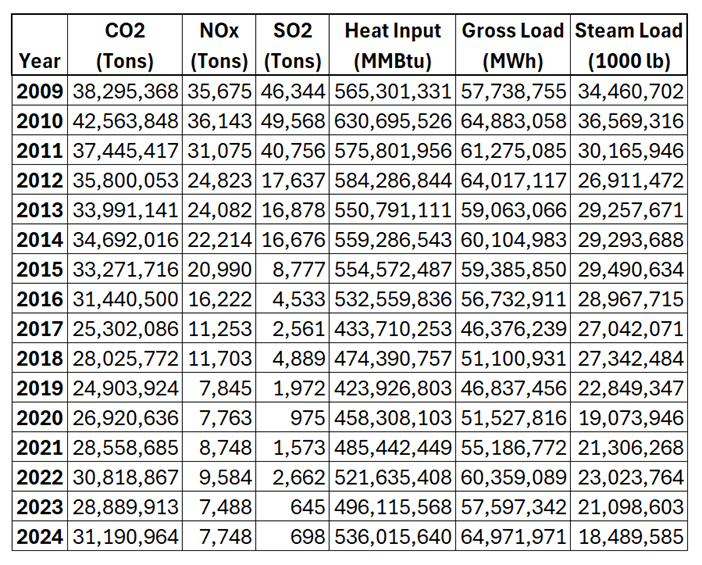
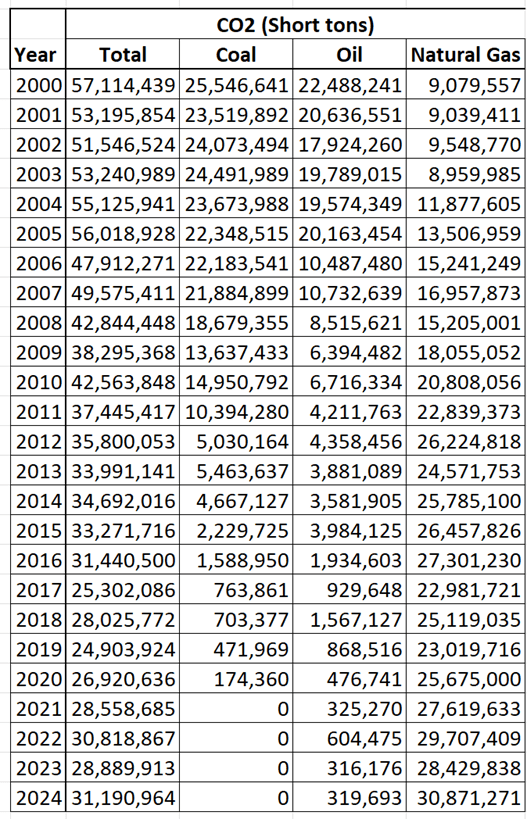
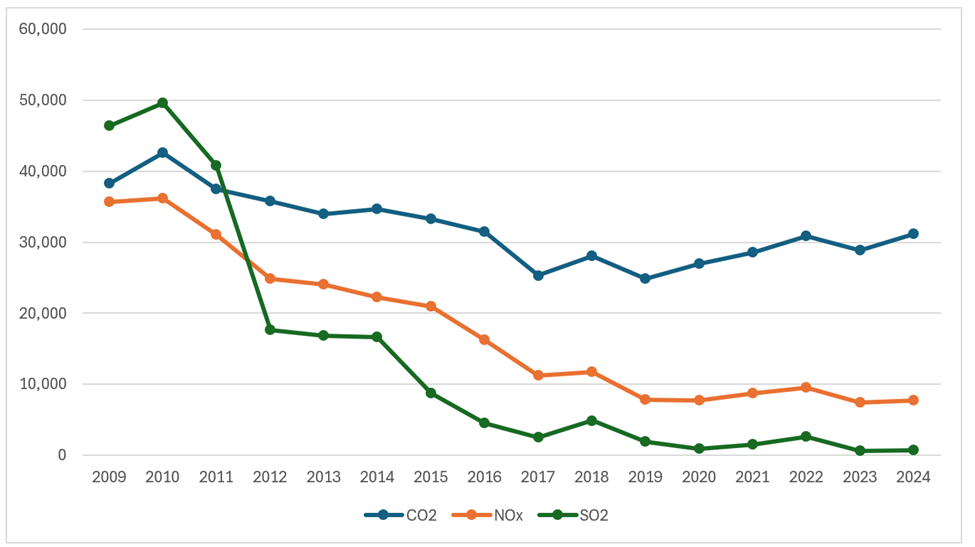
  • I evaluated Environmental Protection Agency (EPA) emission data and NYSERDA documentation.  The figure below shows that electric sector economic fuel switching from oil and coal to natural gas is the primary reason for the observed reduction in emissions.  It also shows that there are no more fuel switching emission reductions possible.
  • On a regular basis NYSERDA publishes a status update of the progress of their program activities, implementation, and evaluation.   According to the latest update, the total cumulative annual emission savings due to NYSERDA program investments of RGGI proceeds through the end of 2023 is 1,976,101 tons.  That means that emissions from RGGI sources in New York would have been only 4.2% higher if the NYSERDA program investments did not occur.  I showed that according to the report, cumulative combined costs for those programs was $1,149 million which means that the cost per ton reduced is $582.
  • I also showed that the results in the Funding status reports show that since the start of the program NYSERDA has allocated 10% of its investments to programs that directly reduce utility emissions by 199,733 tons, 58% to programs that indirectly reduce utility emissions by 1,205,780 tons, and 32% to programs that will increase utility emissions by 678,804 tons.  When those savings that do not affect RGGI source emissions are removed, total savings are 1,297,297 and the emissions from RGGI sources in New York would have been only 2.8% higher if the NYSERDA program investments did not occur.
  • The proposed NYSERDA Amendment to the RGGI Operating Plan allocates only 22% to programs that directly, indirectly, or could potentially decrease RGGI-affected source emissions.  Programs that will add load that could potentially increase RGGI source emissions total 37% of the investments.  Programs that do not affect emissions are funded with 29% of the proceeds and administrative costs total another 8%. 

The proposed Amendment to the RGGI Operating Plan indicates that NYSERDA has not incorporated the need to fund RGGI emission reduction programs now that fuel switching is no longer an effective option.  Before we start implementing NYCI it is appropriate to check on implementation plans for RGGI.  Where does NYSERDA expect the emission reductions necessary for RGGI compliance to come from?

With respect to NYCI and the non-electric sector economy, there are no fuel switching opportunities that will save fuel costs.  Has NYSERDA determined how much auction revenue is needed to fund the emission reduction strategies necessary to meet the Climate Act mandates?  When that amount is combined with the mandates c to fund benefits to disadvantaged communities and Hochul Administration promises for rebates what is the expected starting cost for the allowance auctions? According to the latest GHG emission inventory, the 2022 GHG emissions were 371.08 MMT CO2e and need to reach 245.47 by 2040 which means that NYS must reduce emissions by 33.8% over 18 years.  Will NYCI target auction prices increase to make up for the reduced number of allowances?

In addition to these relatively broad issues there are numerous technical concerns.  NYCI is supposed to be an economy-wide program.  Does that mean every sector will participate?  The electric sector is already covered by RGGI.  Will the electric sector be exempt from NYCI or will there be some accounting mechanism to ensure that ratepayer don’t pay twice. 

There are technical issues associated with timing for the start of the program.  The 2024 Statewide GHG Emission Report released at the end of December covers data from 1990 to 2022.  RGGI emissions are reported by the end of the following January and compliance determined 30 days later.  Will NYCI mandate reporting similar to that schedule or one compatible with the official inventory.  I spent more time than I care to remember dealing with emission inventories during my career and a major concern was compatibility.  How will that be resolved in NYCI considering the report timing?

Discussion

California was the first in the nation legislate a “solution” to climate change with its AB32 Global Warming Solutions Act of 2006.  I recently posted an article describing the Breakthrough Journal article by Jennifer Hernandez and Lauren Teixeira entitled Time to reset California’s climate leadership.  After fourteen years the inevitable effects of reality are getting the attention of the politicians that supported the law.  The authors explained:  

California’s Democratic Assembly leader Richard Rivas opened the new Legislative session signalling a strong focus on meeting voter concerns about housing and the state’s extraordinarily high cost of living, specifically calling out the state’s climate policies: “California has always led the way on climate. And we will continue to lead on climate,” he told his Assembly colleagues. “But not on the backs of poor and working people, not with taxes or fees for programs that don’t work, and not by blocking housing and critical infrastructure projects. It’s why we must be outcome driven. We can’t blindly defend the institutions contributing to these issues.”

I think it is incumbent upon the Hochul Administration to consider whether the Climate Act will have similar impacts to New York.  My analysis of the RGGI program indicates that RGGI is a hidden tax that is not working as advertised.  My overarching concern is that any increase in costs is regressive and affects those least able to afford them the most.  The Hochul Administration has included promises to reduce those impacts, but the reality is that it is easier said than done.  For example, rebates to those adversely affected will lag payments and there is the danger that many in need will not get rebates. 

New York’s stakeholder process is another hinderance to effective policy.  Comments submitted go off into the bureaucracy and there is no indication which comments are addressed and how.  When the regulations come out agencies are not allowed to discuss issues.  Revolving issues requires dialogue, and the New York process effectively shuts that down. 

There is another stakeholder issue.  The desire for inclusivity is a laudable goal and the State has committed to encouraging participation by constituencies that claim that past practices have ignored their concerns.  In theory that is great.  In practice, if those aggrieved parties demand zero impacts and are unwilling to consider compromises or the existing structure of environmental protections, then the stakeholder process gets mired down, off track, and becomes ineffective.  The Hochul Administration has yet to resolve that problem.

Conclusion

The premise for NYCI was that it would be an effective policy that would provide funding and ensure compliance because existing programs worked.  The RGGI program results show that cap-and-invest programs can raise money but have not shown success in reducing emissions.  My biggest concern is that NYCI has not acknowledged this problem.  Past results are no guarantee of future success, especially when past results are not triumphs.  This is another instance where I believe that the Climate Act implementation will do more harm than good.

California Tipping Point

A slightly different version of this post appeared at Watts Up With That.  If this topic interests you I suggest that you check out the comments there too.

I recently posted an article describing how the Breakthrough Journal article by Jennifer Hernandez and Lauren Teixeira entitled Time to reset California’s climate leadership was relevant to New York State Climate Leadership & Community Protection Act (Climate Act) implementation.  I agree with the authors that both states need to reevaluate their climate policies until the states can cut “emissions while assuring that home ownership, an affordable cost of living, and good jobs are available to all.”  This post highlights a remarkable description of what is needed to reduce transportation sector emissions on the way to climate nirvana. 

I am convinced that implementation of the New York Climate Act net-zero mandates will do more harm than good if the future electric system relies only on wind, solar, and energy storage because of reliability and affordability risks.  I have followed the Climate Act since it was first proposed, submitted comments on the Climate Act implementation plan, and have written over 490 articles about New York’s net-zero transition.  The opinions expressed in this article do not reflect the position of any of my previous employers or any other organization I have been associated with, these comments are mine alone.

Overview

The Climate Leadership & Community Protection Act (Climate Act) established a New York “Net Zero” target (85% reduction in GHG emissions and 15% offset of emissions) by 2050.  It includes an interim 2030 reduction target of a 40% GHG reduction by 2030. Two targets address the electric sector: 70% of the electricity must come from renewable energy by 2030 and all electricity must be generated by “zero-emissions” resources by 2040.  Since the completion of the Scoping Plan at the end of 2022 New York has been trying to implement the Scoping Plan recommendations through regulations, proceedings, and legislation. 

California Climate Leadership

California was the first in the nation legislate a “solution” to climate change with its AB32 Global Warming Solutions Act of 2006.  After fourteen years the inevitable effects of reality are getting the attention of the politicians that supported the law.  Hernandez and Teixeira’s introductory paragraph explains that:

Faced with the election of Donald Trump to a second term, soaring inequality, and a decline in support from the state’s non-white majority, California’s Democratic leaders have begun asking hard questions about the state’s vaunted climate policies. California’s Democratic Assembly leader Richard Rivas opened the new Legislative session signalling a strong focus on meeting voter concerns about housing and the state’s extraordinarily high cost of living, specifically calling out the state’s climate policies: “California has always led the way on climate. And we will continue to lead on climate,” he told his Assembly colleagues. “But not on the backs of poor and working people, not with taxes or fees for programs that don’t work, and not by blocking housing and critical infrastructure projects. It’s why we must be outcome driven. We can’t blindly defend the institutions contributing to these issues.”

Hernandez and Teixeira compared several metrics for California, Florida, Texas, and the United States to determine how successful California’s claim to lead the way on climate has been. They explained that:

California’s claims to eco-superiority long predate the passage of AB32, the 2006 law that committed the state to ambitious climate targets and established a cap-and-trade system by which to achieve them. Even before this landmark bill, the state’s per capita carbon emissions were far lower than the national average.

The authors show that a primary reason for California’s low per capita emissions was because their electric sector emissions were low to start.  Texas and Florida reduced their electric sector emissions without climate policies because generating units “transitioned from coal to natural gas for largely economic reasons”.  California’s climate policies limit future generation technologies to solar, wind, and battery storage.  The unanticipated costs associated with deploying those technologies has made California electricity prices second only to Hawaii. 

In my previous article I compared California to New York.  New York observed emission reductions also occurred because of natural gas fuel switching.  The deployment costs for wind, solar, and energy storage are starting to become obvious and will force rates up to compete with California and Hawaii as the most expensive.  Another similarity is that both California and New York are going to have to find emission reductions from other sectors going forward.  The sector with the most emissions in California is transportation and, because of the climate difference, the building sector has the highest emissions in New York.  Transportation emissions are only slightly lower.  This article highlights the description by Hernandez and Teixeira of what emissions reduction strategies are planned for the California transportation sector to meet their climate goals.

Transportation Sector Strategies

Hernandez and Teixeira raised an issue that has been acknowledged by New York agencies but very few understand the implications.  Future emission reductions won’t come from the electric sector because the incremental benefits are small:

The rooftop solar and other signature California climate policy choices, despite their rising cost, increasingly brought diminishing returns, as much of the easy emissions reductions had already been realized, thanks to lower baseline electricity consumption and early adoption of natural gas. Carbon emission reductions from expensive new renewable energy additions were never going to be large. The state therefore increasingly prioritized aggressively reducing emissions from the transportation sector—the state’s largest source of emissions.

In New York the building sector is the largest source of emissions because of our climate.  Nonetheless the Climate Act targets are so extreme that New York and any other jurisdiction that wants to go to net zero must eventually pursue the same aggressive transportation sector reduction strategies espoused by California:

Compared to places like Texas and Florida, California’s emissions reductions since 2006 have come disproportionately from the transportation sector, not the electricity sector. Low carbon fuel requirements, new regulations on refineries, and electric vehicle mandates, have collectively increased the cost of driving substantially. California routinely now has the second highest gas costs in the country second only to Hawaii, which must import all of its gasoline by ship. The state has mandated the phase-out of internal combustion engines in vehicles by 2035 and its gasoline prices now seems poised to surpass even Hawaii: a few days after the election, the California Air Resources Board (CARB) voted to further tighten the Low Carbon Fuel Standard, a measure that is expected to further increase gas prices by up to 85 cents per gallon.

I find it hard to believe that Californians are going to passively accept those massive increases in gasoline costs.  But that is not all.

Even more ambitiously, California’s climate regulators have demanded that even after California converts to electric vehicles, local governments and regional planning agencies should reduce automobile use by 30%—a reduction in “vehicle miles travelled” that would be 2.5 times greater than the decline in miles driven during the depths of the Covid pandemic lockdown. To achieve this objective, CARB recommends and provides funding for local governments to eliminate traffic lanes through so-called “road diets,” intended to increase drive times and traffic congestion and incentivize use of public transit, even as massive investments in public transit have failed to reverse ridership declines that began pre-COVID and have caused massive transit system operating deficits.

Discussion

The mother of all reality slaps is coming to the regulators that think that road diets will be accepted by citizens.  Public transit is fine in concept, but the reality is that our society is now dependent upon personal transportation for most of the country. One hundred years ago there was an extensive network of trolley and interurban railroads in every city and the cities were compact enough that this transit option was viable.  By viable I mean that people could get from where they lived to where they worked using transit in a reasonable amount of time.  However, one hundred years ago those trolley systems started to go out of business because relying on public transit is inconvenient.  Most of those systems are gone now.   Even when replaced by bus systems, the fact is that public transit takes more time and using it forces you into a schedule.  Over the last 100 years development has spread out and the ability for public transit to get many people from where they live to where they work is limited to major cities.  This makes personal transportation demand inelastic.  Only fools think that road diets are going to incentivize the use of public transit.  This affects the emission reduction goals because the reductions in transportation sector emissions envisioned are never going to happen.

Conclusion

I hope that frequent visitors to my blog are aware of the difficulties associated with the net-zero transition plans imposed by reality.  When you are aware of the physical challenges the inevitable impacts on personal choice and quality of life of the transition policies become evident.  Unfortunately, most people are unaware of what is coming at them.

The public is faced with incessant propaganda that there is an existential climate crisis that is evident in every extreme weather event.  All they hear is the lie that fixing the weather is only the simple matter of stopping the use of fossil fuels which will be cheaper, more resilient, more secure, and improve the quality of life. 

California fossil fuel transition plans include policies “intended to increase drive times and traffic congestion and incentivize use of public transit”.  Eventually that will seep into the consciousness of the public.  I cannot imagine a scenario where this will not create massive blowback.  Will the charade end in California when the wind and solar system causes a massive blackout or when Californians are required to pay 85 cents more per gallon, or they are required to give up personal transportation options?  Hopefully California will hit the green transition wall soon enough and hard enough that New York policies will change before the impacts seen there inevitably arrive here.

Time for Resets in California and New York

The Breakthrough Journal published an article by Jennifer Hernandez and Lauren Teixeira entitled Time to reset California’s climate leadership that I think is relevant to New York.  I have recently argued that because there are so many unanswered questions and unresolved issues that the logical next step for New York is to pause in Climate Leadership & Community Protection Act (Climate Act) implementation until we understand how to decarbonize our electric system without adversely affecting affordability and current reliability standards.   Hernandez and Teixeira come to the same conclusion but with arguments that I have not made but are applicable to New York too.

I am convinced that implementation of the New York Climate Act net-zero mandates will do more harm than good if the future electric system relies only on wind, solar, and energy storage because of reliability and affordability risks.  I have followed the Climate Act since it was first proposed, submitted comments on the Climate Act implementation plan, and have written over 490 articles about New York’s net-zero transition.  The opinions expressed in this article do not reflect the position of any of my previous employers or any other organization I have been associated with, these comments are mine alone.

Overview

The Climate Act established a New York “Net Zero” target (85% reduction in GHG emissions and 15% offset of emissions) by 2050.  It includes an interim 2030 reduction target of a 40% GHG reduction by 2030. Two targets address the electric sector: 70% of the electricity must come from renewable energy by 2030 and all electricity must be generated by “zero-emissions” resources by 2040.

Responsible New York agencies all agree that new Dispatchable Emissions-Free Resource (DEFR) technologies are needed to make a solar and wind-reliant electric energy system work reliably during periods of extended periods of low wind and solar resource availability.  Because DEFR is needed and because we don’t know what technology can be used, I think that the Climate Act schedule needs to be paused.  In that light I was interested in this article calling for California to “go back to the drawing board”.

Jennifer Hernandez and Lauren Teixeira are both well versed in California energy policies.  Hernandez has practiced land use and environmental law for more than 30 years and has received numerous civil rights awards for her work on overcoming environmentalist opposition to housing and other projects needed and supported by minority communities.  Teixeira is a Climate and Energy Analyst with the Breakthrough Institute. 

California Climate Leadership

California was the first in the nation legislate a “solution” to climate change with its AB32 Global Warming Solutions Act of 2006.  After fourteen years the inevitable effects of reality are getting the attention of the politicians that supported the law.  The introductory paragraph explains:

Faced with the election of Donald Trump to a second term, soaring inequality, and a decline in support from the state’s non-white majority, California’s Democratic leaders have begun asking hard questions about the state’s vaunted climate policies. California’s Democratic Assembly leader Richard Rivas opened the new Legislative session signalling a strong focus on meeting voter concerns about housing and the state’s extraordinarily high cost of living, specifically calling out the state’s climate policies: “California has always led the way on climate. And we will continue to lead on climate,” he told his Assembly colleagues. “But not on the backs of poor and working people, not with taxes or fees for programs that don’t work, and not by blocking housing and critical infrastructure projects. It’s why we must be outcome driven. We can’t blindly defend the institutions contributing to these issues.”

Hernandez and Teixeira compared several metrics for California, Florida, Texas, and the United States to determine how successful California’s claim that they lead the way on climate has been. They explained that:

California’s claims to eco-superiority long predate the passage of AB32, the 2006 law that committed the state to ambitious climate targets and established a cap-and-trade system by which to achieve them. Even before this landmark bill, the state’s per capita carbon emissions were far lower than the national average.

Table 1 compares the data from CA, FL, TX, and the US along with New York and the original ten Regional Greenhouse Gas Initiative (RGGI} states.  I included the RGGI states because they also claim to be climate mitigation leaders.  The authors chose to compare current emissions to 2006 when California’s landmark climate law AB32 was passed.  I analyzed Energy Information Administration  data and added two other years. I included 1990 because that is the base year for most net-zero transition programs and 2000 because that has been used by New York State in recent analyses.  The results show that New York is close to California for most years. Note that compared to the other jurisdictions New York is the worst performer almost every year.

Table 1: Per capita energy-related carbon dioxide emissions

Hernandez and Teixeira explained the reason for the decreases was the same as what I have found in New York:

The reason why states like Texas and Florida were able to reduce greenhouse gas emissions with practically no climate policy to speak of is quite simple: natural gas. Emissions reductions in Texas and Florida were driven by the electricity sector, which had transitioned from coal to natural gas for largely economic reasons. Indeed, by 2017, 41 out of 50 U.S. states had decoupled economic growth from emissions, a phenomenon widely attributed to this transition.

New York politicians were undoubtedly influenced by California’s AB32 because we have similar restrictions on the what technologies were acceptable for reducing GHG emissions:

Along with its climate commitments, California’s political leaders also decreed that further carbon emission reductions in the electricity sector would need to be achieved with a limited suite of renewable energy technologies: solar, wind and battery storage. (Both legacy technologies like hydropower and nuclear, and technologies considered renewable in other states and countries such as biomass, did not meet the state’s narrow definition of “renewable” energy.)

This decision had consequences. Costly renewable energy power purchase agreements, combined with the expense of integrating intermittent resources into the grid, helped to make California’s retail electricity prices the highest in the country (second only to Hawaii). Meanwhile, the state’s remarkable rate of rooftop solar adoption—due to the combination of costly retail electricity, generous state subsidies to often-wealthy homeowners, and rooftop solar mandates—ended up raising electricity prices still further, pushing costs disproportionately onto renters and low-income households who do not have their own rooftop solar.

Given California’s fourteen-year head start I am not surprised that New York’s rates have not shown comparable increases, but double-digit rate case settlements and all the other costs required for the transition will inevitably show similar impacts at some point.  The important point made here is that California’s policies have disproportionately increased costs for those least able to afford it.  I have always thought that was a likely outcome but here is proof.

Decarbonization at the expense of growth and civil rights?

In the introduction, Hernandez and Teixeira quoted Speaker of the Assembly Richard Rivas who said “California has always led the way on climate. And we will continue to lead on climate, but not on the backs of poor and working people, not with taxes or fees for programs that don’t work, and not by blocking housing and critical infrastructure projects.”  The authors also addressed his concerns about effects of AB32 on the economy.

At first glance, California’s impressive economy—the world’s fifth largest, as state officials are fond of reminding the press and populace—would seem to vindicate its climate policy, demonstrating by virtue of its enormity that economic prosperity and deep decarbonization can coexist.

But the state’s wealth masks some troubling trends. While growth in California has significantly outstripped the rest of the country, it has been highly concentrated in just a few high-income places. Since 2001, California’s real GDP has grown by 82%–23 percentage points higher than the U.S. average of 55%. This difference disappears, however, when you take out the three Bay area counties that house Silicon Valley. Bolstered by four of the world’s seven companies with trillion dollar valuations, real GDP in these counties rose at four times the rate of the U.S. average. This remarkable and hyperlocal rise accounted almost entirely for California’s above-average growth:

New York proponents of the Climate Act also trot out New York’s economy relative to the world but don’t mention recent growth.  New York does not have the benefit of four massively successful companies so growth is much worse than California.  Hernandez and Teixeira note that even with those companies, recent growth is problematic:

But even with massively outsized contributions from Silicon Valley, California’s growth in recent years is not very impressive. Between 2017 and 2023, real GDP in California grew by only 18.5%, slightly above the national average (15.6%), and well behind real GDP in red state competitors Texas (25.7%) and Florida (27.3%).

I dug up some comparable gross state product numbers for New York.  Between 2017 and 2023 the gross state product only grew by 10%, well behind all three states and the nation.  Hernandez and Teixeira broke down growth by county and showed that the growth was unevenly distributed.  They also showed there was a racial disparity to growth.  I could not find similar data for New York, but I don’t think it is a stretch to imagine similar patterns are present in New York.

Hernandez and Teixeira also noted that growth is affected by environmental regulations:

California’s strict environmental regulatory regime has not helped to improve this unbalanced state of affairs; in fact, it has likely exacerbated it. Despite abundant natural reserves, the state’s once-mighty oil production industry—a source of well-paying jobs for non-college educated workers—is threatened with terminal decline due to a hostile regulatory environment. After 145 years in California, Chevron is moving its headquarters to Texas.

New York’s ban on hydraulic fracking has certainly limited growth in the same way.  The authors addressed other issues raised by Speaker of the Assembly Richard Rivas.  In both examples, the situation in New York is identical:

Conclusion

Hernandez and Teixeira summed up by making several points:

  • Considering California’s environmental and economic record since 2006, one can reasonably conclude one of two things: either it is not possible to achieve deep emissions reductions without slowing growth and making economic inequality worse, or California is doing something wrong.
  • California’s climate policies have contributed to slow economic growth for most of the state and have disproportionately punished the poor and non-college educated workers.
  • Until the state demonstrates that it can cut its emissions equitably, such that working people once more see the Golden State as a land of opportunity rather than fleeing it, California should not be held up as a model of climate governance.
  • Expensive policies, supported by high end keyboard economy tax revenue, are simply not exportable to the rest of the country, much less the rest of the world.

Buried somewhere in the Climate Act language is a mandate for New York to consider what is happening at other jurisdictions who are developing their own net-zero transition plans.  Typically, California is considered an example of what we should be doing.  In this instance I agree with the conclusion of Hernandez and Teixeira that: “While some state leaders may still be tempted to double down on current climate policies, the state, its political leaders, its economy, and the climate will be far better served by going back to the drawing board—as Speaker Rivas has urged.”  I also think that New York would be well served by their recommendation: “California’s claims to climate leadership now depend not upon proving that the state is willing to cut its emissions at any cost but rather demonstrating that it can cut its emissions while assuring that home ownership, an affordable cost of living, and good jobs are available to all.”

Climate Science New Year Rant

As I age, I am becoming less willing to play along with the Climate Leadership & Community Protection Act (Climate Act) narrative that there is an existential threat to mankind from man-made climate change and that an energy system that relies on wind, solar, and energy storage can solve that threat.  One aspect of playing along is to appease supporters by accepting that there is a reason to reduce GHG emissions and agreeing that solar and wind resources should be part of the future electric energy system.  Ron Clutz’s recent article “Lacking data, climate models rely on guesses” included information that spurred this article.

I am convinced that implementation of the New York Climate Act net-zero mandates will do more harm than good if the future electric system relies only on wind, solar, and energy storage because of reliability and affordability risks.  I have followed the Climate Act since it was first proposed, submitted comments on the Climate Act implementation plan, and have written over 480 articles about New York’s net-zero transition.  The opinions expressed in this article do not reflect the position of any of my previous employers or any other organization I have been associated with, these comments are mine alone.

The Climate Act established a New York “Net Zero” target (85% reduction in GHG emissions and 15% offset of emissions) by 2050.  The authors of the Climate Act believed that “our State could rapidly move away from fossil fuels and instead be fueled completely by the power of the wind, the sun, and hydro” and that “it that it could be done completely with technologies available at that time (a decade ago)”.  In my opinion we need a feasibility analysis to determine if this presumption is correct.  This article addresses the questions: should we be trying to reduce GHG emissions in hopes of affecting the climate and even if we accept that decarbonization is a worthy goal should we try to rely on wind and solar.

Is There an Existential Threat?

Keep in mind that climate models provide all the evidence that there is an existential threat.  Despite the constant claims in the main stream media, attributing extreme weather events to man-made climate change is a claim no one without a vested interest in that answer is willing to make.  Ron Clutz’s recent article “Lacking data, climate models rely on guesses” described the response to a question about climate model accuracy by Dr. Keith Minor.  The following is parts of the summary from Ron’s post.

A recent question was posed on  Quora: Say there are merely 15 variables involved in predicting global climate change. Assume climatologists have mastered each variable to a near perfect accuracy of 95%. How accurate would a climate model built on this simplified system be?  Keith Minor has a PhD in organic chemistry, PhD in Geology, and PhD in Geology & Paleontology from The University of Texas at Austin. 

Minor responded with bolds by Clutz:

I like the answers to this question, and Matthew stole my thunder on the climate models not being statistical models. If we take the question and it’s assumptions at face value, one unsolvable overriding problem, and a limit to developing an accurate climate model that is rarely ever addressed, is the sampling issue. Knowing 15 parameters to 99+% accuracy won’t solve this problem.

The modeling of the atmosphere is a boundary condition problem. No, I’m not talking about frontal boundaries. Thermodynamic systems are boundary condition problems, meaning that the evolution of a thermodynamic system is dependent not only on the conditions at t > 0 (is the system under adiabatic conditions, isothermal conditions, do these conditions change during the process, etc.?), but also on the initial conditions at t = 0 (sec, whatever). Knowing almost nothing about what even a fraction of a fraction of the molecules in the atmosphere are doing at t = 0 or at t > 0 is a huge problem to accurately predicting what the atmosphere will do in the near or far future.

These problems boil down to the challenge of measuring the meteorological parameters necessary to initiate weather and climate models.   The reference to t = 0 relates to the start time of the model. Minor explains that there are many sources of variability within the models themselves too including:

  • The inability of the models to handle water (the most important greenhouse gas in the atmosphere, not CO2) and processes related to it;  e.g., models still can’t handle the formation and non-formation of clouds;
  • The non-linearity of thermodynamic properties of matter (which seem to be an afterthought, especially in popular discussions regarding the roles that CO2 plays in the atmosphere and biosphere), and
  • The always-present sampling problem.

Minor goes on to describe how these issues affect weather forecasting and how more sampling could improve certain forecasts.  He concludes:

So back to the Quora question, with regard to a cost-effective (cost-effect is the operational term) climate model or models (say an ensemble model) that would “verify” say 50 years from now, the sampling issue is ever present, and likely cost-prohibitive at the level needed to make the sampling statistically significant. And will the climatologist be around in 50 years to be “hoisted with their own petard” when the climate model is proven to be wrong? The absence of accountability is the other problem with these long-range models into which many put so much faith.

Clutz also references a quote by esteemed climate scientist Richard Lindzen that I think sums up whether we should rely on climate models to make the policy decision to transition away from fossil fuels.   In a presentation (here) Lindzen states:

I haven’t spent much time on the details of the science, but there is one thing that should spark skepticism in any intelligent reader. The system we are looking at consists of two turbulent fluids interacting with each other. They are on a rotating planet that is differentially heated by the sun. A vital constituent of the atmospheric component is water in the liquid, solid and vapor phases, and the changes in phase have vast energetic ramifications. The energy budget of this system involves the absorption and re-emission of about 200 watts per square meter. Doubling CO2 involves a 2% perturbation to this budget. So do minor changes in clouds and other features, and such changes are common. In this complex multifactor system, what is the likelihood of the climate (which, itself, consists in many variables and not just globally averaged temperature anomaly) is controlled by this 2% perturbation in a single variable? Believing this is pretty close to believing in magic. Instead, you are told that it is believing in ‘science.’ Such a claim should be a tip-off that something is amiss. After all, science is a mode of inquiry rather than a belief structure.

Can We Transition Away from Fossil Fuels

A recurrent theme at this blog is that the electric energy system absolutely needs new technology to achieve decarbonization.  Responsible New York agencies all agree that new Dispatchable Emissions-Free Resource (DEFR) technologies are needed to make a solar and wind-reliant electric energy system work reliably.  Because DEFR is needed and because we don’t know what should be used, I think that the Climate Act schedule needs to be reconsidered or at least paused.

I believe the only likely viable DEFR backup technology is nuclear generation because it is the only candidate resource that is technologically ready, can be expanded as needed, and does not suffer from limitations of the Second Law of Thermodynamics. I do concede that there are financial issues that need to be addressed.  The bigger issue is that DEFR is needed as a backup during extended periods of low wind and solar resource availability, but nuclear power is best used for baseload energy.  I estimate that 24 GW of nuclear could replace 178 GW of wind, water, battery storage.  Developing nuclear eliminates the need for a huge DEFR backup resource and massive buildout of wind turbines and solar panels sprawling over the state’s lands and water.  Until the New York Energy Plan settles on a DEFR solution the only rational thing to do is to pause the implementation process.

Lest you think that I am the only skeptical voice about the viability of an electrical energy transition relying on wind and solar resources I list some recent articles below.

Thomas Shepstone describes a fact sheet from the Empowerment Alliance that outlines why the electric grid is headed to a crisis:

America’s Electrical Grid Crisis is on the brink of a crisis that no one is talking about. Government mandates and pledges from utilities to achieve “net zero” emissions by 2050 or sooner have led to the closure of traditional power plants fueled by coal, natural gas and nuclear energy.

However, the wind and solar energy that is supposed to replace these sources is intermittent, unreliable and artificially supported by government subsidies. “Net zero” policies may sound nice on paper but they are not ready for practice in the real world.

In fact, the crisis may have already begun. A recent capacity auction by the largest U.S. electrical grid operator resulted in an over 800% price increase for these very reasons. And, everyday Americans are going to pay the price through higher bills for less reliable electricity.

  • One study of electricity plans in the Midwest found that, “Of the 38 major investor-owned utilities spanning the Great Lakes region, 32 are pledged to net zero by 2050 or sooner. Of the seven states analyzed in this report, three have net zero mandates by law, one has net zero mandates through regulation and the other three have no net zero mandates at the state level.”
  • “The Midcontinent Independent Systems Operator, the grid operator for much of the Midwest, projects that by 2032, none of the five Great Lakes states in its territory will have enough electricity capacity to meet even the most conservative projection of demand load.”
  • “Wind and solar cannot be relied on as a one-for-one replacement of existing generation sources, like coal, natural gas and nuclear. If the grid relies on forms of generation that are uncontrollable and unreliable, it must also maintain backup sources that are controllable and reliable. Because wind and solar production can fall to near zero at times, utilities may need to maintain up to another grid’s worth of generation capacity.”

Source:

Joshua Antonini and Jason Hayes, “Shorting The Shorting The Great Lakes Grid: Great Lakes Grid: How Net Zero Plans Risk Energy Reliability,” Mackinac Center for Public Policy, 2024

Thomas Shepstone describes a report by the Fraser Institute regarding the real costs of electricity produced from solar and wind facilities, compared to other energy sources.  Tom highlights the money paragraphs with his emphasis added:

Often, when proponents claim that wind and solar sources are cheaper than fossil fuels, they ignore [backup energy] costs. A recent study published in Energy, a peer-reviewed energy and engineering journal, found that—after accounting for backup, energy storage and associated indirect costs—solar power costs skyrocket from US$36 per megawatt hour (MWh) to as high as US$1,548 and wind generation costs increase from US$40 to up to US$504 per MWh.

Which is why when governments phase out fossil fuels to expand the role of renewable sources in the electricity grid, electricity become more expensive. In fact, a study by University of Chicago economists showed that between 1990 and 2015, U.S. states that mandated minimum renewable power sources experienced significant electricity price increases after accounting for backup infrastructure and other costs. Specifically, in those states electricity prices increased by an average of 11 per cent, costing consumers an additional $30 billion annually. The study also found that electricity prices grew more expensive over time, and by the twelfth year, electricity prices were 17 per cent higher (on average).

Finally, Chris Martz compares the impacts of wind and solar vs. nuclear power. I should note that he is not including DEFR support in his estimates. He concludes:

In order to power the same number of homes that a 1,000 MW nuclear power plant can, it would require either:

• For 𝐬𝐨𝐥𝐚𝐫 𝐏𝐕: Approximately 4,000 MW of installed power (equivalent to four nuclear facilities) and 24,000 acres of land (some 37.5 × as much land area than a nuclear plant).

• For 𝐨𝐧𝐬𝐡𝐨𝐫𝐞 𝐰𝐢𝐧𝐝: Approximately 2,800 MW of installed power (equivalent to 2.8 nuclear facilities) and 89,600 acres of land (some 140 × as much land area than a nuclear power generation station).

But, I should caution you that these estimates are in fact conservative. Why? Because they do 𝒏𝒐𝒕 take into consideration land area required for battery storage due to their intermittency in overcast sky conditions, low wind speed and/or overnight.

Conclusion

It is terrifying that the rationale and proposed solution to a New York policy that could cost hundreds of billions is based on fantasy.  Richard Lindzen describes the made-up rationale: “In this complex multifactor system, what is the likelihood of the climate (which, itself, consists in many variables and not just globally averaged temperature anomaly) is controlled by this 2% perturbation in a single variable? Believing this is pretty close to believing in magic.”  Keith Minor explains that even if this perturbation was the climate change driver that we can never provide enough data to to ensure that a model could accurately project the impacts.  The myth that wind and solar can replace fossil fuels on the schedule mandated by the Climate Act is dependent upon the fantastical notion that a resource that does not exist can be developed, tested, permitted, and deployed by 2040.

I can only conclude that allowing politicians to set energy policy will turn out to be an unmitigated disaster.

Commentary on Recent Articles January 4, 2025

This is an update of articles that I have read that I want to mention but only have time to provide a brief summary.  I have also included links to some other items of interest.  Previous commentaries are available here

I have been following the Climate Leadership & Community Protection Act (Climate Act) since it was first proposed and most of the articles described below are related to the net-zero transition.  I have devoted a lot of time to the Climate Act because I believe the ambitions for a zero-emissions economy embodied in the Climate Act outstrip available renewable technology such that the net-zero transition will do more harm than good. The opinions expressed in this article do not reflect the position of any of my previous employers or any other company I have been associated with, these comments are mine alone.

Videos

Gorilla Science is the creation of Martin Durkin and Tom Nelson.  Their first video looks at heat waves and finds that careful analysis of the data contradicts the mainstream narrative.

The Unpopular Truth    

John Robson at Climate Discussion Nexus released a video of a talk with Dr. Javier Vinós. The interview covered his book Solving the Climate Puzzle, his reasons for challenging the prevailing orthodox “Enhanced CO2 Hypothesis” about climate change, including the spectacular weakness of computer climate models, and his alternative explanation for the cooling and warming of planet Earth.

Ben Pile talks about the net-zero initiative in Great Britain.

True Cost of Wind Energy

John Droz describes ten unacknowledged costs that wind energy proponents overlook when talking about costs.  He states “The system is setup to grease the skids for wind energy developers — not ratepayers. When it comes to wind energy, we are dealing with 21st century snake oil salespeople. They have a sophisticated multi-part strategy to profit at the public’s expense.”  His post explains why.

Coal Plants

Ron Stein compares coal-fired power plants in the United States and China.  There are 200 operating coal plants in the USA, 1,142  in China, and over 2,400 in the world.  He notes that “Due to onerous regulations by the Biden Administration and the overreach of his BLM and EPA, approximately 170 of the remaining coal-fired plants in the U.S. are scheduled to be de-commissioned by 2030, and there are no plans to build any new coal-fired plants in the U.S.”  Based on my experience I think that a coal plant with modern pollution controls can be a pragmatic component of an electric system.  There is no getting around the CO2 emissions, but all the other pollutants can be controlled well.  Importantly, they are resilient because fuel can be stored on-site, and the US has tremendous coal reserves.  Also, in my experience the coal mined in the western US can be done responsibly and the land reclaimed acceptably.  On the other hand, mining that removes mountain tops in West Virginia does not meet those criteria.

Solar Site Selection In New York

Paces tackles climate change through technology.  They analyzed solar energy siting trends in 12 states “offering a comprehensive perspective of the challenges and opportunities developers face.”  In New York they found:

  • Suitable sites for solar Decreased 9.6%, from 6,908 sites in January to 6,245 by October, and is projected to drop to 5,372 by mid-2025.
  • Smaller Parcels Are Increasing Project Complexity New York: Decreased 4.9%, from 41.0 acres in January to 39.0 acres by October, and is projected to drop to 37.6 acres by mid-2025.
  • Declining Feeder Capacity Adds Complexity New York: Decreased 5.9%, from 3.54 MW in January to 3.33 MW by October, and is projected to drop to 3.20 MW by mid-2025.

This Year in Gas

Doomberg is an excellent blog that covers energy issues but most articles are behind a paywall.  This article describes energy markets and makes some good points.  Someday I will try to address this description of energy markets relative to New York’s cap and invest proposed program:

To understand energy markets, one need only internalize four things. First, energy is life—a point so central to our framework of macroeconomic and geopolitical analysis that it needs no further elaboration in today’s pages. Second, energy is fungible, and all primary forms of energy, being additive to the human endeavor, will be greedily consumed in its pursuit. Third, energy prices are highly inelastic, such that mere percentage points of regional supply imbalances cause wild market swings. Finally, the energy industry is reliably incapable of self-discipline, unable to resist the allure of drilling the next well.

I was more interested in the following quote.  I believe that burning natural gas at base-load power plants wastes a valuable resource that should be used more elsewhere.  I think that the idea that heavy and medium duty trucks can be converted to all-electric battery vehicles is nuts.  On the other hand, it is relatively easy to convert a diesel truck to burn liquified natural gas.  Further proof of my belief that this approach is a pragmatic solution to the diesel inhalable particulate matter environmental justice concerns was provided here:

Despite a parade of dire predictions about depleting shale wells, wars in the Middle East, and this-time-we-really-mean-it producer discipline, the world exits 2024 with oil down for the year and clinging to the bottom of its heavily-managed range. As measured in ounces of gold, the stuff has basically never been cheaper. We turn to China for a key reason why:

Trucking fleets in China are embracing cleaner-burning liquefied natural gas (LNG) for fuel, a trend neighbouring India wants to emulate, accelerating a decline in diesel demand and rattling suppliers to the world’s biggest oil importer.

The rise of LNG trucks in China comes on top of world-leading electric vehicle (EV) adoption there and a prolonged economic slowdown, dampening demand in what for decades has been the main driver in oil consumption growth, with crude imports down 2.8% so far this year, weakening global prices.

Offshore Wind

David Wojick has written many articles about offshore wind issues and compiled them into a summary recently.  His work emphasizes the impacts of the proposed massive developments on whales in general and the North Atlantic Right Whale in particular.  For example, in this article he documents new links about organizations that advocate for whales but “when it comes to offshore wind they look to have abandoned the whales in favor of green nirvana.”

New York Transition Update

Francis Menton published a good update of New York’s standing in the race to be the first jurisdiction to hit the “Green Energy Wall” where it becomes obvious that the future powered by wind and sun cannot work.  In an earlier post he declared Germany to be the winner in the race because “Its pursuit of the ‘renewable’ wind and solar electricity fantasy has put it in a spot where regular wind/sun droughts cause huge electricity price spikes, and major industries have become uncompetitive.  It has no solution to its dead end and can go no farther.”  He wrote:

If Germany has “hit the wall,” what is the appropriate analogy for New York?  New York passed its Climate Act with great fanfare in 2019.  The Act orders that we are to have a “net zero” energy system by 2050, with interim deadlines along the way.  The first serious deadline arrives in 2030, where the official mandate is 70% of electricity generation from “renewables” (aka “70 x 30”).  That deadline is now just five years away.  Within the past year, all the efforts to move toward the 70 x 30 goal are falling apart, as anybody who had given the subject any critical thought knew that they inevitably would.  But nobody in authority has yet been willing to acknowledge that this has turned into a farce.

Here’s my analogy: New York is like the cartoon character Wile E. Coyote, who has run off the cliff and is now suspended in mid-air, apparently not knowing what will happen next.