Balancing the risks and benefits of environmental initiatives
Author: rogercaiazza
I am a meteorologist (BS and MS degrees), was certified as a consulting meteorologist and have worked in the air quality industry for over 40 years. I author two blogs. Environmental staff in any industry have to be pragmatic balancing risks and benefits and (https://pragmaticenvironmentalistofnewyork.blog/) reflects that outlook. The second blog addresses the New York State Reforming the Energy Vision initiative (https://reformingtheenergyvisioninconvenienttruths.wordpress.com). Any of my comments on the web or posts on my blogs are my opinion only. In no way do they reflect the position of any of my past employers or any company I was associated with.
Frequent readers of this blog know that many of my posts are long because I get bogged down documenting my statements. This is because of my background in industry where it is necessary to prove my arguments to have credibility. One disadvantage of that is that many articles that get my attention are not mentioned here because of a lack of time. I tried to address that with a fortnightly update on those articles but am going to try an experiment where I add a little commentary to articles that are of interest on a more frequent basis.
I have been following the Climate Leadership & Community Protection Act (Climate Act) since it was first proposed and most of the articles described below are related to the net-zero transition. I have devoted a lot of time to the Climate Act because I believe the ambitions for a zero-emissions economy embodied in the Climate Act outstrip available renewable technology such that the net-zero transition will do more harm than good. The opinions expressed in this article do not reflect the position of any of my previous employers or any other company I have been associated with, these comments are mine alone.
Physical Restraints to the Transition
In the Climate Act and elsewhere the strategy is to electrify everything possible. Many practical issues are overlooked by transition proponents such as the enormous requirements for copper necessary for electric infrastructure to replace fossil fuels. Substack Penguin Empire Reports explains that “A renewables grid is far more ‘copper hungry’ than a fossil fuel/ nuclear grid for two reasons: The ‘greener the grid,’ the more generators you’ll probably need to produce the same amount of electricity (on average) …multiplied by…. Each renewable generator needs more copper per unit than fossil fuel generators.”
Irinia Slav addresses the copper shortage situation. Copper prices have gone up because demand is greater than supply. Why aren’t miner rushing to mine more? Slav describes the “monumental wall of reasons for miners to not be looking for copper growth opportunities and that wall is standing right in the way of trillions in transition investments planned, hoped for, and cherished by politicians, activists and Fatih Birol.”
The Climate Act Scoping Plan cost estimates assume that implementation costs will go down in the future but given the scarcity of the raw materials necessary for the transition is that an appropriate assumption?
Prosperity issues can only be sold to people who can afford a heat pump or an ecological package. For most young people, however, it is clear: they will not retire at 70, they will not buy a house, and they may not be able to support a family – and if they do, their children will grow up in problem areas, in rural wasteland or in an environment of left-wing indoctrination.
The New York State Energy Research and Development Authority (NYSERDA) announced that $5 million is now available for demonstration projects that co-locate solar and agriculture within the state. Each project can receive up to $750,000. The state aims to expand the body of knowledge on the technical and financial viability of solar agrivoltaic facilities.
Sounds good because the Hochul Administration has still not mandated that utility-scale solar developers meet the NYS Department of Agriculture & Markets (NYSDAM) prime farmland guideline: “The Department’s goal is for projects to limit the conversion of agricultural areas within the Project Areas, to no more than 10% of soils classified by the Department’s NYS Agricultural Land Classification mineral soil groups 1-4, generally Prime Farmland soils, which represent the State’s most productive farmland.”
Here is what I do not understand:
According to NYSERDA summary documentation, eligible crops, livestock, and livestock products include, but are not limited to:
Field crops, including corn, wheat, oats, rye, barley, hay, potatoes and dry beans.
Fruits, such as apples, peaches, grapes, cherries and berries.
Vegetables, such as tomatoes, snap beans, cabbage, carrots, beets and onions.
Horticultural specialties, including nursery stock, ornamental shrubs, ornamental trees, and flowers.
Livestock and livestock products, including cattle, sheep, hogs, goats, horses, poultry, ratites (such as ostriches, emus, rheas and kiwis), farmed deer, farmed buffalo, fur bearing animals, wool bearing animals (such as alpacas and llamas), milk, eggs, and furs.
Maple sap.
Christmas trees derived from a managed Christmas tree operation whether dug for transplanting or cut from the stump.
Aquaculture products, including fish, fish products, water plants and shellfish.
Woody biomass, which means short rotation woody crops raised for bioenergy, and does not include farm woodland.
Apiary products, including honey, beeswax, royal jelly, bee pollen, propolis, package bees, nucs and queens. “Nucs” are defined as small honeybee colonies created from larger colonies, including the nuc box – a smaller version of a beehive, designed to hold up to five frames from an existing colony.
Actively managed log-grown woodland mushrooms.
Industrial hemp as defined in Section 505.
Eligible crops include apples, peaches, cherries, maple trees, and Christmas trees? Trees will shade solar panels. So, this approach is inconsistent with my understanding that the intent of agrivoltaics was to use the farmland within the solar panels to try to make up for the loss of the productive farmland. The intent of the NYSDAM guideline won’t be addressed either. So what am I missing?
Charles Rotter passed along a link to an article by a solar energy developer in New York that claims disinformation campaigns were hurting New York’s implementation of the Climate Leadership and Community Protection Act (Climate Act). After I looked at the article, I can safely say that it’s another example of my pragmatic environmental principle Observation on Environmental Issue Stakeholders: The more vociferous/louder the criticisms made by a stakeholder the more likely that the stakeholder is guilty of the same thing. This post looks at disinformation claims associated with a solar development project in New York.
I have followed the Climate Act since it was first proposed, submitted comments on the Climate Act implementation plan, and have written over 400 articles about New York’s net-zero transition. The opinions expressed in this post do not reflect the position of any of my previous employers or any other organization I have been associated with, these comments are mine alone.
Overview
The Climate Act established a New York “Net Zero” target (85% reduction in GHG emissions and 15% offset of emissions) by 2050. It includes an interim 2030 reduction target of a 40% reduction by 2030 and a requirement that all electricity generated be “zero-emissions” by 2040. The Climate Action Council (CAC) was responsible for preparing the Scoping Plan that outlined how to “achieve the State’s bold clean energy and climate agenda.” In brief, that plan is to electrify everything possible using zero-emissions electricity. The Integration Analysis prepared by the New York State Energy Research and Development Authority (NYSERDA) and its consultants quantifies the impact of the electrification strategies. That material was used to develop the Draft Scoping Plan outline of strategies. After a year-long review, the Scoping Plan was finalized at the end of 2022.
Correction 6/13/2024: Keith Schue contacted me to say that I had used the wrong numbers in this statement: “The Integration Analysis projects that 5,574 MW by 2030 compared with 21,058 MW in 2023 so solar deployment must double over the next seven years.” Boy did I ever use the wrong numbers. Those are the onshore wind numbers. The utility-scale solar facility capacity that is included in the NYISO market in 2023 was only 254 MW and the Behind the Meter (BTM) distributed solar included in the Integration Analysis estimate was 5,172 MW for a solar total of 5,426. NYISO projects that BTM solar in 2030 will be 10,015 MW and the Integrated Analysis projected 2030 solar capacity is 18,646 MW which means that utility-scale solar capacity will have to increase from 254 MW to 8,631 MW.
Hecate Energy Shepherd’s Run Solar Farm
Hecate Energy’s Shepherd’s Run is a 42 MW utility-scale solar facility located in Copake, NY in the Hudson River Valley southeast of Albany. According to Hecate: “It will be configured as a ground-mounted solar facility with PV panels on galvanized steel tracker racking structures. It will include rows of single-axis trackers, oriented in a north-south direction, that rotate the PV panels from east to west following the sun’s daily path.” They also claim that “The 42-MW solar farm is expected to annually generate approximately 70,000 MWh of energy — enough to meet the average annual consumption of over 9,500 New York households.” That works out to a capacity factor of 19.3%. The permitting documents note that the project area is 880 acres, the project footprint is 267 acres and there will be 138.3 acres “located inside the Project security fencing” which I assume means that is the area to be covered by solar panels.
This area of the Hudson Valley has attracted influential folks with money from New York City because of the beauty and rural character of the region which has led to a couple of things. I think that contributes to the attention this project has received in the national media. Bloomberg Opinion described it as “The Solar farm that almost destroyed Copake, NY”. In a Reveal podcast, The Center for Investigative Reporting also addressed the project in “Sunblocked: Resistance to Solar in Farm Country” with the byline “Across the country, rural communities are pushing back against large-scale solar development”. The other aspect of the moneyed class influence is the desire and the money to fight against anything that detracts from the reasons the “Citidiots” invaded this area.
In 2017 Hecate identified this area for solar development because it offered room for solar development, a nearby electrical substation, and according to the Bloomberg article “Democratic political leadership, and a relatively liberal bent, Copake seemed poised to be a welcoming environment for renewable energy.” I believe Hecate originally submitted a permit application under New York’s original electric utility siting program, but I cannot find any links for that application. However, local opposition sprang up early in that process. The town changed its zoning rules to stymie large solar developments. Hecate changed to a new permitting process implemented to expedite renewable energy development. On November 23, 2021, they submitted a notice of intent to file for an application to the New York State Office of Renewable Energy (ORES) that can overrule any “home rule” regulations by the residents directly affected by a solar or wind facility.
In June 2021 the town of Copake joined 12 other municipalities along with some environmental and conservation advocate organizations in filing a lawsuit in state Supreme Court of Albany County against the state Office of Renewable Energy Siting, an agency created to fast-track the permitting process for new renewable energy projects. The suit alleged that the agency was attempting to circumvent local zoning laws. In May 2023, Justices of the Third Department state Appellate Court upheld a lower court ruling dismissing the lawsuit.
The NPR article went on to explain the remaining parts of the permitting process that included public hearings in January. However in early January the public hearings were called off because the Town of Copake filed a motion to dismiss the application because 60 acres of the project property were sold to someone who did not want anything to do with the project. The ORES permit application website notes under “denied applications” that the application was denied without prejudice.
Disinformation Campaign
After years of effort and cost, Hecate was not happy with the decision. The article “Disinformation Campaigns Are Hurting New York’s Clean Energy Future” was published at RealClearEnergy and authored by Matt Levine who is the “project director for the Shepherd’s Run Solar Farm and senior director of development for Hecate Energy.” He claims that the opposition was the result of disinformation as noted in the excerpts below.
After the obligatory praise for “the ambitious goals set by the landmark climate law passed in 2019” he jumps right into the evils of disinformation campaigns:
Whether or not you support accelerating clean energy projects, we should all be able to agree that disinformation campaigns are a disservice to the public. Honest policy debates demand clear and accurate information. But earlier this year, NPR highlighted the prevalence of disinformation and increasing pressure on local officials, who are often charged with approving renewable energy projects.
Their reporting focused on groups like Citizens for Responsible Solar, who are part of a growing national effort to orchestrate opposition to renewable energy in rural communities across the U.S. The national group has helped smaller local groups fight solar projects in at least 10 states, according to its website.
This NPR article referenced a group called Citizens for Responsible Solar that argues that “Solar belongs on rooftops, near highways, commercial, industrial-zoned land, marginal or contaminated areas, not on rural-agricultural land.” The organization and a group of locals organized opposition to a solar project in Virginia but there is no indication that there is any link between that group and anything at the Shepherd’s Run Solar Farm. Levine goes on:
By blocking projects that could generate economic activity and passive tax revenue in rural areas, these campaigns are hurting the communities they purport to protect, both economically and environmentally. Nevertheless, groups like these are becoming so successful at spreading disinformation that a 2022 report by the Sabin Center at Columbia University found 121 local policies around the country that are aimed at blocking or restricting renewable energy development, a 18% increase from the previous year.
Solar developers are quick to point out that a landowner gets revenue when a solar project is developed and there are tax incentives. However, when land is taken out of production it will reduce farm jobs. While economic activity may be improved during construction once the facility is operational there are very few economic benefits to essential local businesses. Furthermore, taking the land out of production may make other farmers who have been renting that land to make their operations viable will not be able to support investments they have made in facilities, livestock, or equipment. Levine continues:
In New York, an investigation by the Public Accountability Initiative found that since 2016, a multifaceted campaign by the fossil fuel industry has spent more than $15.5 million to undermine efforts to promote clean energy. Unfortunately, much of that work has relied on false and misleading information.
The claim that there is an enormous effort by the fossil fuel industry to provide false and misleading information ignores the funding and level of effort by non-governmental organizations who espouse the climate industry’s narrative and the source of their funding. The Natural Resources Defense Council had a total income of $193,144,386 and paid $125,417,997 in salaries in 2023. Their experts web page notes a position for the Utility Regulatory Director, New York, Climate & Energy and that 69 other experts have done analyses in New York. That is just one organization. There are dozens more organizations in New York that support the climate industry and their work is rife with false and misleading information.
The playbook is usually the same. Groups with innocuous sounding names — New Yorkers for Affordable Energy, for example – claim the mantle of grassroots support while actually doing the bidding of the natural gas industry. They lean heavily on misleading industry talking points that falsely claim the transition to renewable energy would “damage New York’s families and businesses.
I can find nothing to disagree with his characterization that New Yorkers for Affordable Energy is funded by the natural gas industry. However, the docket for the project does not include anything from the organization or the one individual mentioned on their web page in the 627 filed documents or the 1,000 public comments in the docket for the permit. He simply names an industry supported organization and suggests that their very existence is unacceptable.
Eventually Levine gets to Shepherd’s run and blames misinformation as the reason that there was so much vociferous opposition.
As a renewable energy developer working in several states in the Eastern U.S., I see the impact of these efforts on the ground. Take the town of Copake in Upstate New York, where Hecate Energy plans to build the 42 GW Shepherd’s Run Solar Farm.
This is exactly the type of project New York must accelerate if the state has any chance of meeting the state’s renewable energy goals. Yet, opponents have implemented tactics that have delayed the project for years, running the now-standard playbook.
See if this sounds familiar: a group with an innocuous sounding name – in this case Sensible Solar for Rural New York – bills itself as a grassroots organization and claims to support clean energy. Media reports and state disclosure forms show them hiring the same lobbying firms and marketing teams employed by the fossil fuel industry and its allies to oppose clean energy projects.
They echo the same talking points used by national opposition groups, relying on false or misleading claims about farmland being permanently destroyed, adverse impacts to nearby watersheds, and reduction in property values.
I recommend the Reveal Podcast “Sunblocked: Resistance to Solar in Farm Country” because it describes the nuances of the Shepherd’s Run support and opposition. Interviews with one family that sold leases to Hecate, Hecate spokesmen, another farmer who was using the land that will no longer be available, Town Board members, an expert on support and opposition to similar projects, and organizers of Sensible Solar for Rural New York provide a good cross section of those involved. While some of the opponents were against the project simply because it is in their backyards many argued that they would accept the project if it were done sensibly.
I was involved in many development projects in my career, so I sympathize with the Hecate project developers. There is no way that you can make everyone happy, and some individuals will never be satisfied. In my opinion, the solution is to be upfront with the facts and be sure to meet or exceed all the regulatory guidance.
Prime Farmland
I am not a big fan of solar development in New York and have published a page that describes my concerns. My biggest concern is that the Hochul Administration has not required solar developers to adhere to all the NYS Department of Agriculture and Markets (NYSDAM) guidelines that have been described in prepared testimony that I believe represent best practices and should be mandatory going forward. In particular, “The Department’s goal is for projects to limit the conversion of agricultural areas within the Project Areas, to no more than 10% of soils classified by the Department’s NYS Agricultural Land Classification mineral soil groups 1-4, generally Prime Farmland soils, which represent the State’s most productive farmland.” I think this is a reasonable guideline and one that should be a mandatory requirement for all future projects.
The initial application for the project Agricultural Appendix 15 February 2022 stated that: “Relative to agricultural soils, the Project Area includes approximately 12.41% (218.00 acres) of land classified as Prime Farmland, 5.33% (93.70 acres) as Prime Farmland if Drained, 10.27% (180.42 acres) as Farmland of Statewide Importance, and 21.99% (386.44 acres) as Not Prime Farmland.” Note that they admit that they exceed the NYSDAM guidelines.
In a revised version of the Agricultural Appendix submitted on January 2023 this discussion is revised:
The total Project Footprint will include approximately 265 acres and includes the limits of all temporary and permanent impacts associated with the construction and operation of the Project. There are 197.69 acres of active agricultural land in the Project Footprint. The Project is designed within a fenced and contained area, and no active agricultural practices will occur within the fenced area containing the solar arrays during the operation of the Project. Therefore, the applicable NYSDAM Guidelines will be followed during construction with respect to temporary features (such as construction laydown yards). If applicable NYSDAM Guidelines cannot be implemented, the Applicant will consult with NYSDAM to discuss acceptable and appropriate alternatives. The Applicant will follow the NYSDAM Guidelines during Project decommissioning and site restoration.
Two comments on this. The prime farmland numbers are missing and the NYSDAM Guidelines they refer to are the construction guidelines and not the guidelines for the protection of prime farmland that NYSDAM staff references in their prepared testimony for every application.
Hecate Energy Columbia County 1 LLC (the Applicant) has developed this Agricultural Plan in accordance with 19 NYCRR § 900-2.16 in order to avoid, minimize, and mitigate agricultural impacts to active agricultural lands within NYS Agricultural Land Classified Mineral Soil Groups (MSG) 1 through 4 to the maximum extent practicable, consistent with the New York State Department of Agriculture and Markets (NYSDAM) Guidelines for Solar Energy Projects (“NYSDAM Guidelines” or “Guidelines”).
Two comments on this section. The reference to prime farmland has switched to the technical description of soil types and the references to Guidelines are again for the construction impacts. The phrase that they tried to avoid, minimize, and mitigate agricultural impacts is not exactly true because they picked only the NYSDAM guidance that that they were required to follow. Furthermore, in response to a notice of incomplete application they were asked to provide the acreages for each soil classification. Their response in the final revision states:
There are approximately 200 acres of active agricultural land in the Project Footprint. As described in Exhibit 15 Section 15(b) of the Application, of the 199.98 acres of active agricultural land in the Project Footprint, 143.86 acres are classified as MSG 1-4. The Project is designed within a fenced and contained area, and no active agricultural practices will occur within the fenced area containing the solar arrays during the operation of the Project. Of the 162.8 acres of MSG 1-4 in the Project Footprint, and 143.86 acres are identified as active agricultural land. Therefore, the applicable NYSDAM Guidelines will be followed during construction with respect to temporary features (such as construction laydown yards) and permanent features (such as permanent access roads) within the 143.86 acres of active agricultural lands, as defined by 19 NYCRR § 900-2.16(c), within New York State Agricultural Land MSGs 1-4. If applicable NYSDAM Guidelines cannot be implemented, the Applicant will consult with NYSDAM to discuss acceptable and appropriate alternatives. The Applicant will follow the NYSDAM Guidelines during Project decommissioning and site restoration.
Note that the incriminating percentages were not included. Obfuscation is the name of the game for the acreages. Elsewhere the project footprint is listed as 267 acres but here they describe the active agricultural land (200 acres). They do admit that 143.86 acres are prime farmland and that works out to 16% of the project area of 880 acres (also not provide in this paragraph) far exceeding the NYSDAM protection of prime farmland protection guidance of no more that 10%.
Maps of the locations of prime farmland and the location of the solar panels show that the developers chose the expedient and cheapest development option. If the land is flat and has no trees then installing solar panels is simplified. The example map below shows why the residents are so exercised by the development.
Figure 15-11. Map 3 of 5 ORES and Local Zoning Requirements with MSG 1-4 Soils-Active June 2023
Discussion
The Hochul Administration has not mandated that utility-scale solar development must comply with all Department of Agriculture and Markets guidelines. Solar developers routinely ignore that guideline. My latest scorecard of this parameter shows that only seven of the 20 projects included as updated in March 2024 met the prime farmland guidance and that overall solar projects have destroyed 8,801 acres of prime farmland and totaling 20% of the project areas. However, it does show that meeting the guideline can be done.
This is not the fault of the solar developers. In the absence of any requirement to meet that guidance the cost-effective solution for the out-of-state developers is to ignore the guidance. The fact that the Hochul Administration has instituted that requirement for smaller distributed solar projects is infuriating to me and has the distinct whiff of cronyism and lobbyist influence. That is not the only missing protection. There are no requirements for agrivoltaics that at least try to support farming or requirements for tilting axis solar panels consistent with the implementation plans. To their credit, Hecate was planning to use the tilting axis panels and their projected a capacity factor of 19.3% is better than last year’s statewide average. Using fixed panels means that more panels must be installed.
I do not have any sympathy for Hecate project manager Matt Levine’s claims that a pervasive cult of fossil-fuel funded disinformation was the primary driver for the opposition to the project. Clearly, they took the expedient approach to develop the prime farmland in the project area knowing full well that it exceeded New York guidelines for farmland protection. Moreover, the language in the article and application cover up that decision. If the application is not above board in every respect, then the locals sense they are being taken for a ride. Unfortunately, the only reason that the project was rejected was because of a last-minute change in ownership that nullified the application. If it not for that reason, then the application would have been approved despite the well-founded local opposition.
Conclusion
I do not think that solar energy that will not provide adequate support to the electric grid when it is needed the most (winter peak loads) is a sustainable electric grid resource so I oppose its use for utility-scale applications. But if that is state policy to develop solar then at least deployment should minimize impacts. That is not the case in New York. The real disinformation in this instance is the insistence that there are no legitimate problems with solar deployment as suggested by the author of “Disinformation Campaigns Are Hurting New York’s Clean Energy Future”.
put together an article about every relevant topic I have discovered. This is a summary of articles that I think would be of interest to my readers.
I have been following the Climate Leadership & Community Protection Act (Climate Act) since it was first proposed and most of the articles described below are related to the net-zero transition. I have devoted a lot of time to the Climate Act because I believe the ambitions for a zero-emissions economy embodied in the Climate Act outstrip available renewable technology such that the net-zero transition will do more harm than good. The opinions expressed in this article do not reflect the position of any of my previous employers or any other company I have been associated with, these comments are mine alone.
New York City Panel Discussion on Net-Zero Economy
Francis Menton invites folks to a panel discussion on the costs and consequences of pursuing a “net zero” economy. Experts Benny Peiser and Francis Menton will share their outlook for Europe’s present and America’s future.
Net-zero by 2050 is simply not happening. Paul Homewood writes:
professor emeritus at the University of Manitoba and a best-selling author of 47 books. Whenever Smil publishes something new, people in the energy space pay attention. That’s certainly the case with his latest publication, a 48-page report titled “Halfway Between Kyoto and 2050: Net Zero Carbon Is a Highly Unlikely Outcome.” In the report, Smil details efforts to date by global governments to reduce greenhouse gas emissions and finds them wholly inadequate to achieve the goal of net-zero by 2050.
Energy Storage Issue
The LS Power Gateway Energy Storage project is located in San Diego County California. As far as I can tell it has a 250 MW capacity and can provide 250 MWh oF energy. The fact that it caught fire and kept re-igniting was a news story that did not get much coverage. There have been evacuation orders because of “harmful” gases. Here is another story.
Inverter-Based Resources
Meredith Angwin gives a great overview of wind and solar inverter-based resources and why it matters. Spoiler – it is another complication that has already led to blackouts. She quotes the scary bit in the NERC Odessa report that addresses an incident in Texas:
“In many cases, industry is not proactively identifying abnormal performance of inverter-based resources…the recommendations outlined in NERC reliability guidelines are not being adequately adopted….Plants stated that no mitigating actions are being done (or planned) to improve the performance of the resources involved in the event.”
Continent Sized Wind Lull
Australia example of the extent of a wind lull. “Australia has built 11.5 GW of theoretical total wind power capacity on the National Energy Market (NEM) spread across 80 locations on the Eastern Seaboard, and at one point today only 4.1% of it was working. Another gigawatt of generation on the Western side is only generating at 3 – 5% capacity.”
Solar Panel Trash
Harvard Business Review notes that solar panels are going into landfills. Of course they don’t suggest that “this should raise serious doubts about the future or necessity of renewables”. They claim “Compared with all we stand to gain or lose, the four decades or so it will likely take for the economics of solar to stabilize to the point that consumers won’t feel compelled to cut short the life cycle of their panels seems decidedly small.” Yet another example of build as much as you can as fast as you can and hope that it all works out.
Environmental Issues are Not Simple
Lucy Biggers describes her epiphany at the Free Press – Finally, I’m admitting it out loud. “In my heart of hearts, I always knew environmental issues were more complicated than the way I sold them to my true-believer followers.”
It really wasn’t until 2021, by which time I was 31 and had left NowThis, that I was finally willing to confront the complications I’d avoided during all those years as a sustainability influencer. I began reading books and news sources that strayed from the progressive party line, titles like Unsettled by Steve Koonin, Apocalypse Never by Michael Shellenberger, and Fossil Future by Alex Epstein. I realized that the environmental causes I had so breathlessly championed were much more complicated than good versus evil.
Do fossil fuels cause our planet to warm? Yes. They also make modern life possible, freeing women from hours of labor and empowering us in a million different ways. They’re singularly cost-effective and versatile as an energy source. This is something that the “keep it in the ground” climate activists never acknowledge. Nor do they admit that the promised panacea of renewable energy, like solar and wind, are nowhere near close to replacing fossil fuels and in fact, have their own dark environmental footprint.
Bjorn Lomborg
His Newsletter cites a new op-ed for The Wall Street Journal (also accessible here) that the West should make economic growth a priority again and stop hemorrhaging their resources on climate policies that mostly enrich China.
Climate hysteria is, at its most basic level, a luxury belief that can be afforded by neurotic, well-to-do westerners. For many of those who are loudest about the green agenda, these beliefs are actually a status symbol.
Robert Bradley points out that solar has had 15 subsidy exemptions. “But nothing is so permanent as a temporary government program.” (Milton and Rose Friedman, Tyranny of the Status Quo, 1983, p. 115)
Marie French is a correspondent for Politico New York and notes that at the close of the New York legislative session: “Lawmakers departed Albany – 5 years after CLCPA – without any significant action this year to reduce emissions or support achievement of the state’s climate law”.
Congestion Pricing
New York City’s congestion pricing program was supposed to take effect at the end of June. Energy Mix quoted Governor Hochul: “After careful consideration I have come to the difficult decision that implementing the planned congestion pricing system risks too many unintended consequences,” Hochul said June 5. “I have directed the MTA [Metropolitan Transportation Authority] to indefinitely pause the program.” It is all part of the political calculus and Hochul backed off due to the costs. “I can’t do anything right at this time that would also suck the vitality out of this city when we’re still fighting for our comeback,” she told reporters at a news conference.
This raises a question. The congestion pricing plan was expected to generate $1 billion a year. At the Energy Access and Equity Research webinar sponsored by the NYU Institute for Policy Integrity on May 13, 2024 Jonathan Binder stated that the New York Cap and Invest Program would generate proceeds of “between $6 and $12 billion per year” by 2030. At what level will the cap and invest program suck the vitality out of New York State?
Syracuse Post Standard reporter Tim Knauss recently wrote two articles that expose the disconnect between the executives in the electric industry and their customers. The Climate Leadership & Community Protection Act (Climate Act) will cost enormous amounts of money at the same time it increases reliability risks. The politicians supporting it and the leadership of the utility companies all have not admitted just how much it will cost ratepayers. This post uses National Grid’s “Net-Zero Overhaul” as an example.
I have followed the Climate Act since it was first proposed, submitted comments on the Climate Act implementation plan, and have written over 400 articles about New York’s net-zero transition. The opinions expressed in this post do not reflect the position of any of my previous employers or any other organization I have been associated with, these comments are mine alone.
Overview
The Climate Act established a New York “Net Zero” target (85% reduction in GHG emissions and 15% offset of emissions) by 2050. It includes an interim 2030 reduction target of a 40% reduction by 2030 and a requirement that all electricity generated be “zero-emissions” by 2040. The Climate Action Council (CAC) was responsible for preparing the Scoping Plan that outlined how to “achieve the State’s bold clean energy and climate agenda.” In brief, that plan is to electrify everything possible using zero-emissions electricity. The Integration Analysis prepared by the New York State Energy Research and Development Authority (NYSERDA) and its consultants quantifies the impact of the electrification strategies. That material was used to develop the Draft Scoping Plan outline of strategies. After a year-long review, the Scoping Plan was finalized at the end of 2022. In 2023 the Scoping Plan recommendations were supposed to be implemented through regulation, PSC orders, and legislation. That process is falling behind as the enormity of the challenge becomes clearer.
National Grid Net Zero Overhaul
I live in Upstate New York and National Grid is my electric utility. National Grid is the electricity system operator for Great Britain. In 2000 National Grid started purchasing utilities in the United States and now is “an electricity, natural gas, and clean energy delivery company serving more than 20 million people through our networks in New York and Massachusetts.” They tout plans for National Grid for “a smarter, stronger, cleaner energy future — transforming our networks with more reliable and resilient energy solutions to meet state climate goals and reduce greenhouse gas emissions.”
Someday I may return to this topic and focus on the “more reliable and resilient solutions” claim. For the time being I will content myself with just saying this is codswallop. I don’t think it will ever be possible for New York to meet its state climate goals as presently outlined without a catastrophic blackout because the energy storage and dispatchable emissions free resources necessary to meet the worst-case low wind and solar resource drought are impractical. Utility executives know that this is an issue but play along with the plans for their own self-interest not the interests of their customers.
This article will address the proposed plan for the “cleaner energy future”. In particular, Nation Grid recently announced plans for a £60bn Net Zero overhaul of National Grid. That total is for all the National Grid companies. The US National Grid press release included the following quote:
Group CEO of National Grid John Pettigrew said: “Today’s announcement is a clear illustration that National Grid is committed to playing our part in achieving the ambitious decarbonization targets that New York and Massachusetts governments have set. The increased investment we’re announcing today follows positive engagement with our regulators in these states, reflecting a willingness to upgrade electricity networks to provide long term affordable energy to all, and reduce emissions across our gas networks.”
The $16 billion plan represents a 60% increase over what National Grid has spent during the past five years. It includes a $4 billion project under way to improve 1,000 miles of transmission lines, which National Grid calls the “Upstate Upgrade.” Other projects have not yet been identified.
Knauss also quoted spokesperson Jared Paventi: ““Will there be an impact for the customer? Yes, but I believe that it’s going to be negligible based on the time period that we’ll be recovering those costs,” Paventi said.” While the quote suggests that this is his personal opinion, I have no doubts that is the story he was charged to say.
Rate Case Proposal
The press release for the upcoming New York rate case gives the highlights:
Critical investments to ensure the reliability and safe operation of the company’s energy delivery system that serves 2.3 million upstate New York residential and business customers.
Enhanced system resiliency and reliability measures to manage and reduce the impact of frequent and severe weather and enable continued strong storm response.
Integrated energy planning to consider interactions between gas, electric and customer energy systems to achieve long-term climate goals in a safe and affordable way.
Infrastructure investments to support economic development, connect clean energy, and enhance security.
Targeted programs and dedicated teams to better serve residential, commercial and industrial customers.
Enhanced energy affordability programs and services, and programs to enable clean energy and energy efficiency benefits for disadvantaged communities.
In 2020 National Grid asked for a $142 million increase in annual electric and gas delivery revenues. This year, the utility is asking for $673 million. If the Public Service Commission goes along, that would raise National Grid’s electric delivery revenues by 20% and its gas revenues by 28%. A typical household would pay $440 a year more for electricity and gas.
National Grid describes the reasons for the increase as a catchup from the last rate case when “the company and regulators put a top priority on holding down an increase” and “Inflation and supply-chain constraints have raised the cost of transformers, poles, cables and other equipment” Knauss writes that they also admit that: “the power grid requires significant new investments to make way for more electric vehicles, electric-heat buildings, and other elements of New York’s planned transition away from fossil fuels.” I doubt that the attribution of costs to these reasons will be readily available.
Discussion
The impetus for this article was spokesperson Jared Paventi’s claim that the costs for the investments will be “negligible”. Knauss provides the data that suggests otherwise. He points out that “In an order issued last year to approve $4.4 billion in new transmission lines planned by several utilities, the state Public Service Commission estimated the work could increase residential bills by about $3.50 a month, decreasing over time.” The New York Net Zero Overhaul estimate is $16 billion. That will cause residential bills to increase an additional $12.73 per month. I don’t call that negligible and that is only a small portion of the total increases proposed in the rate case.
The other thing that caught my eye was the comment by Group CEO of National Grid John Pettigrew that the New Zero Overhaul announcement “follows positive engagement with our regulators in these states”. Cynic that I am, this sounds like the executives got an audience with the Hochul Administration and promised to follow their script for Climate Act implementation right before the rate case was released. Maybe it is just a coincidence, but it smells like a backroom deal to me that has corporate and political interests at its heart with the welfare of the ratepayers ignored. Hochul recently nominated three environmental ideologues to the Public Service Commission. I have no doubts where their biases lie and believe that any costs for the great net-zero transition will be approved by those three.
Conclusion
I do not think that there is any question that electric utilities have determined that implementation of net-zero transition plans will be risky and costly for their customers. However, I believe they have also determined that implementation is in their financial best interest. Similarly, the regulatory agencies certainly have technical experts who understand the risks but the political appointees in charge ignore their counsel because their handlers are catering to a specific constituency. This does not portend well for everybody else.
There is a glimmer of hope. It is only a matter of time until the cost blowback begins on these rate cases. On June 5, 2024 Hochul indefinitely paused implementation of the New York City congestion pricing plan. The rate cases will cause the costs of energy to increase for more people and the Climate Act is a big part of the increase. Hochul said, “it’s not the right time” for congestion pricing as “New Yorkers face a cost-of-living crisis”. Hopefully this will be draft language for a walk back on the aspirational Climate Act implementation plan when the true costs become clear.
I have been following issues associated with wind and solar resource availability for many years. My thinking has evolved to the point where I now believe that in a rational world it would be recognized that any electric grid relying on wind and solar is doomed to failure. This post explains why.
I am a retired electric utility meteorologist and have taken every opportunity I have had to raise my concerns about wind and solar resource availability in New York regulatory proceedings. I have followed the Climate Act since it was first proposed, submitted comments on the Climate Act implementation plan, and have written over 400 articles about New York’s net-zero transition. The opinions expressed in this post do not reflect the position of any of my previous employers or any other organization I have been associated with, these comments are mine alone.
Overview
The Climate Act established a New York “Net Zero” target (85% reduction in GHG emissions and 15% offset of emissions) by 2050. It includes an interim 2030 reduction target of a 40% reduction by 2030 and a requirement that all electricity generated be “zero-emissions” by 2040. The Climate Action Council (CAC) was responsible for preparing the Scoping Plan that outlined how to “achieve the State’s bold clean energy and climate agenda.” In brief, that plan is to electrify everything possible using zero-emissions electricity. The Integration Analysis prepared by the New York State Energy Research and Development Authority (NYSERDA) and its consultants quantifies the impact of the electrification strategies. That material was used to develop the Draft Scoping Plan outline of strategies. After a year-long review, the Scoping Plan was finalized at the end of 2022. In 2023 the Scoping Plan recommendations were supposed to be implemented through regulation, PSC orders, and legislation. That process is falling behind as the enormity of the challenge becomes clearer.
Background
The North American Electric Reliability Corporation (NERC) recently convened a webinar for the Cold Weather Preparedness Small Group Advisory Sessions (SGAS) to “provide an educational opportunity for registered entities to meet with NERC and Regional Entity representatives to discuss the cold weather preparedness Standards and possible compliance approaches in an open and non-audit environment.” The impetus for this initiative was the February 2021 Texas event described in the following slide. The regulatory fallout for this event is not finished but the need to discuss how best to address these events is so acute that SGAS was established in “an open and non-audit environment”.
The takeaway point is that there are already electric grid resource adequacy issues in the existing system during extreme weather events. I am most concerned about the future grid that relies on weather impacted resources. Even though Texas has substantial wind and solar resources their presence did not contribute meaningfully to this Texas blackout. Instead, it was the failure of many components of the traditional generating and transmission systems to be sufficiently hardened to extreme cold. In the future the weather dependent grid will cause similar problems more frequently and, as I will show, may not be able to prevent a catastrophic blackout.
My primary concern is the feasibility for the New York Climate Act implementation plan. or more appropriately the lack of a proper feasibility analysis, that addresses the worst-case wind and solar energy resource drought. In September 2021, I described the reliability challenges for the Climate Act described by the organizations responsible for electric system reliability. All the credible analyses done for future grid reliability point out the expected worst-case scenario – When New York electrifies heating and transportation the peak load will be in the winter when temperatures are coldest. The Integration Analysis identified a multi-day period winter wind lull. The New York Independent System Operator has done similar analyses and showed that winter wind lulls that coincide with low solar availability and high loads will be the ultimate problem. The New York Department of Public Service also has identified the Renewable Energy Gap as a major issue. In my opinion, however, no analysis done to date has identified the worst-case scenario because they have all used relatively short periods of historical data.
All credible renewable resource projection analyses use historical meteorological data, projections of future load during those periods, and estimates of electric resource availability based on assumed deployment of wind, solar, energy storage, and other technologies needed to supply the expected load. Hourly profiles of weather variables produced via the weather forecast modeling techniques are used to develop hourly demand forecasts and energy output profiles for wind and solar resources for the periods being studied. The credible analyses only differ in their assumptions for the characteristics of the buildouts and the sophistication of potential availability based on climatological and geographical constraints. Once the analysis is complete the resulting data can be used to identify the worst case.
The New York Independent System Operator (NYISO) is working with its consultant DNV to develop New York onshore wind, offshore wind, and solar resource availability. Their analysis uses a 23-year historical meteorological database for the New York State renewable resource areas. Similar analyses are underway in other regional transmission operator regions. It has also been recognized that larger areas need to be treated similarly. The Electric Power Research Institute has a Low-Carbon Resources Initiative that has been looking at the North American continent. Researchers outside of the industry have also done analyses of wind and solar power droughts using the ERA5 reanalysis data from 1950 to the present. The reanalysis data analysis uses current weather forecast models and historical observations to provide hourly meteorological fields. These data can be further refined to finer scales to project the wind and solar resource availability.
The magnitude, duration, and widespread geographic impacts identified by this preliminary analysis are quite significant and will be compounded by load growth from electrification. This highlights the importance of reliability considerations associated with offshore wind and wind lulls be accounted for in upcoming reliability assessments, retirement studies, and system adequacy reviews to ensure sufficiency of system design to handle the large offshore wind volume expected to become operational in the next five to ten years.
The NYISO/DNV analysis used a 21-year database. In a similar type of analysis, the Independent System Operator of New England (ISO-NE) Operational Impact of Extreme Weather Events, the ERA5 data were used to prepare a database covering 1950 to 2021. The analysis evaluated 1, 5, and 21-day extreme cold and hot events.
One of the important results presented in the ISO-NE analysis was a table of projected system risk for weather events over the 72-year data record. In the analysis, system risk was defined as the aggregated unavailable supply plus the exceptional demand during the 21-day event. Note that the analysis considered sliding windows for the 21-day events by shifting the 21-day window every seven days. The unsurprising point I want to highlight is that the system risk increases as the lookback period increases. If the resource adequacy planning for New England only looked at the last ten years, then the system risk would be 8,714 MW, but over the whole period the worst system risk was 9,160 and that represents an resource increase of 5.1%.
Source: ISO-NE Operational Impact of Extreme Weather Events, available here
Note that there was an EWWG analysis of Historical Weather and Climate Extremes for New York performed by Judith Curry and myself that identified the January 1961 event as the probable worst-case scenario. We found that there was a 15-day period from January 20 until February 3, 1961 that will likely turn out to be the worst-case cold wave. This was a period when high-pressure systems dominated the weather in the Northeast and those conditions mean light wind speeds.
Discussion
I do not think we can ever have an electric grid that will provide reliable power when it is needed the most. Today electric system resource adequacy planners don’t have to worry that many generating resources might not be available at the same time. In a future electric grid that relies on wind and solar the fact that those resources correlate in time and space is what I think is the insurmountable planning problem. All solar goes away at night and wind lulls affect entire regional transmission organization (RTO) areas at the same time. This issue is exacerbated by the fact that the wind lull will cover multiple RTO areas at the same time the highest load is expected.
The reason we can never trust a wind, solar, and energy storage grid is because if we depend on energy-limited resources that are a function of the weather, then a system designed to meet the worst-case is likely impractical. Consider the ISO-NE events where it was found that the most recent 10-year planning lookback period would plan for a system risk of 8,714 MW. However, if the planning horizon covered the period back to 1961, the worst-case to 1950, an additional 446 MW would be required to meet the system risk. I cannot imagine a business case for the deployment of energy storage or the magical dispatchable emissions free resource that will only be needed once in 63 years. For one thing, the life expectancy of these technologies is much less than 63 years. Even over a shorter horizon such as the last ten years, how will a required facility be able to stay solvent when it runs so rarely without subsidies and very high payments when they do run.
As I described in an earlier article, the New York Department of Public Service (DPS) Proceeding 15-E-0302technical conference Zero Emissions by 2040 highlighted concerns about this Gap resource gap and how it could be addressed. Besides the fact that the preferred candidate technologies have not been commercially proven, they all will be extraordinarily expensive. I believe that makes worst-case solutions impractical.
On the other hand, the alternative to ignore the worst case is unacceptable. In the net-zero fantasy world that is supposed to rely on wind and solar when heating and transportation is supposed to be electrified the need for reliable electricity is magnified. If we don’t provide resources for the observed worst case, when those conditions inevitably reoccur then there will be a blackout when electricity is needed the most to keep people from freezing to death in the dark because they are unable to flee.
The tradeoff between practicality and necessity is not going to be resolved by the resource adequacy planning groups doing the analyses described. I don’t think organizations like the New York State Reliability Council or NERC will make the decisions either. This is something that will have to be decided by politicians at the highest levels. Hopefully the problem will be considered in an open and transparent manner, but political lobbying pressures will be immense because the viability of the politically correct current plan to depend on wind and solar in New York and elsewhere is threatened.
Conclusion
I have long argued that New York should perform a feasibility study to determine if the net-zero outline to comply with the Climate Act in the Scoping Plan could possibly work. Francis Menton has convinced me that it would be better to do a demonstration project in some smaller jurisdiction to prove that it can work. The described tradeoff between the practicality of deploying resources for the observed worst-case resource deficit and the necessity to do so to prevent a catastrophic blackout should be a key consideration in either workability evaluation.
In my opinion any electric system that depends on wind and solar is impractical. Obviously, if the goal is a zero-emissions electric system then nuclear must be the cornerstone. If affordability is a concern, then the pragmatic acceptance of a large reduction in emissions rather than a zero target would allow the use of some natural gas as proposed by Russell Schussler and myself last year. Given the entrenched crony capitalists and special interests supporting wind and solar any shift in direction, even if necessary to protect health and safety, will be a tremendous lift.
Last year I published an article describing the New York Independent System Operator (NYISO) Load & Capacity Data Report (also known as the “Gold Book”) and how I used it. This post uses the latest edition to determine the wind and solar capacity factors last year.
I have followed the Climate Act since it was first proposed, submitted comments on the Climate Act implementation plan, and have written over 400 articles about New York’s net-zero transition. The opinions expressed in this post do not reflect the position of any of my previous employers or any other organization I have been associated with, these comments are mine alone.
Overview
The Climate Act established a New York “Net Zero” target (85% reduction in GHG emissions and 15% offset of emissions) by 2050. It includes an interim 2030 reduction target of a 40% reduction by 2030 and a requirement that all electricity generated be “zero-emissions” by 2040. The Climate Action Council (CAC) was responsible for preparing the Scoping Plan that outlined how to “achieve the State’s bold clean energy and climate agenda.” In brief, that plan is to electrify everything possible using zero-emissions electricity. The Integration Analysis prepared by the New York State Energy Research and Development Authority (NYSERDA) and its consultants quantifies the impact of the electrification strategies. That material was used to develop the Draft Scoping Plan outline of strategies. After a year-long review, the Scoping Plan was finalized at the end of 2022. In 2023 the Scoping Plan recommendations were supposed to be implemented through regulation, PSC orders, and legislation. That process is falling behind as the enormity of the challenge becomes clearer.
Capacity Factor
The capacity factor is a useful metric to understand electric generation resources. The annual capacity factor for a generator equals the actual observed generation (MWh) divided by maximum possible generation (capacity in MW times the hours in a year). Projections for the amount of future wind and solar generation capacity needed for the Climate Act depend on capacity factor assumptions.
Not surprisingly, the aspirational schedule of the Climate Act has proven to be more difficult to implement than planned and many aspects of the transition are falling behind. Worse, there has not been any indication that the Scoping Plan is being refined to incorporate the lessons learned in the years since it was drafted or address any of the issues u raised in the comments. The capacity factor assumptions are a prime example of an issue that needs to be addressed.
Wind and Solar Capacity Factor Projections
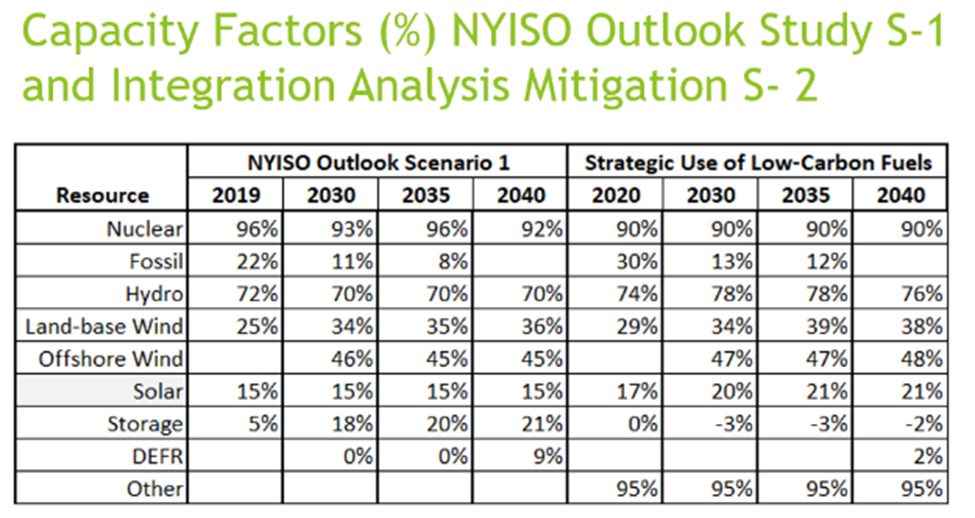
I have previously summarized future resource projections. The New York Independent System Operator (NYISO) 2021-2040 System & Resource Outlook is part of the NYISO Comprehensive System Planning Process. That analysis included several scenarios for the future grid that includes capacity factor projections. The Integration Analysis also included several scenarios and capacity factor projections. In both instances the capacity factor projections determine how much wind and solar capacity will be needed in the future.
I am not the only one who submitted comments about the Scoping Plan capacity factors. I pointed out that the Integration Analysis land-based wind capacity factors were unrealistically high. The model projected the 2020 generation with a capacity factor of 29% but the 2021 observed capacity factor was only 22%. The Integration Analysis model could not even get the starting year correct. As a result, the Integration Analysis projections for the land-based wind capacity needed to meet the load are too low. It is particularly disturbing that the State has never attempted to reconcile the NYISO projections and assumptions with the Integration Analysis. For all renewable resources the Integration Analysis capacity factors are higher than the NYISO projections as shown below.
2023 Wind and Solar Observed Capacity Factors
The New York Independent System Operator (NYISO) 2024 Load & Capacity Data Report (also known as the “Gold Book”) is now available and has been posted on the NYISO website: 2024 Load & Capacity Data Report (Gold Book). Many of the most useful tables are also provided as spreadsheets. The following supplemental materials have also been posted:
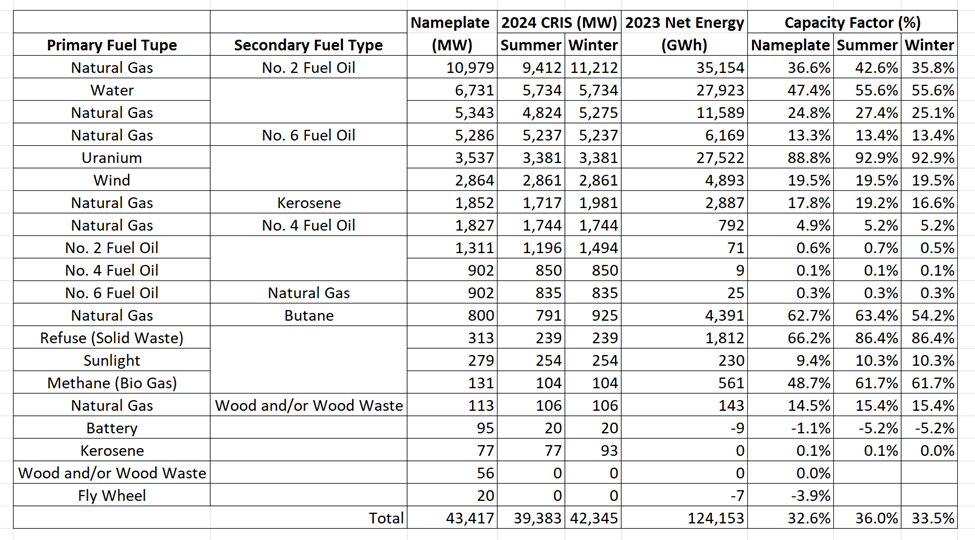
The Existing Generating Facilities spreadsheet was used to calculate New York capacity factors. The first table sums the capacities and net energy for all the combinations of primary fuel type and secondary fuel type for all the generators tracked by the NYISO. This includes units that are in the market system as well as others that are not. The nameplate capacity of generating units that use natural gas and can also burn number 2 fuel oil is the largest category in the state.
2024 NYISO Gold Book Tables III – 2a NYISO Market Generators and Table III – 2b Non-Market Generators 2023 Capacity, Energy, and Capacity Factors
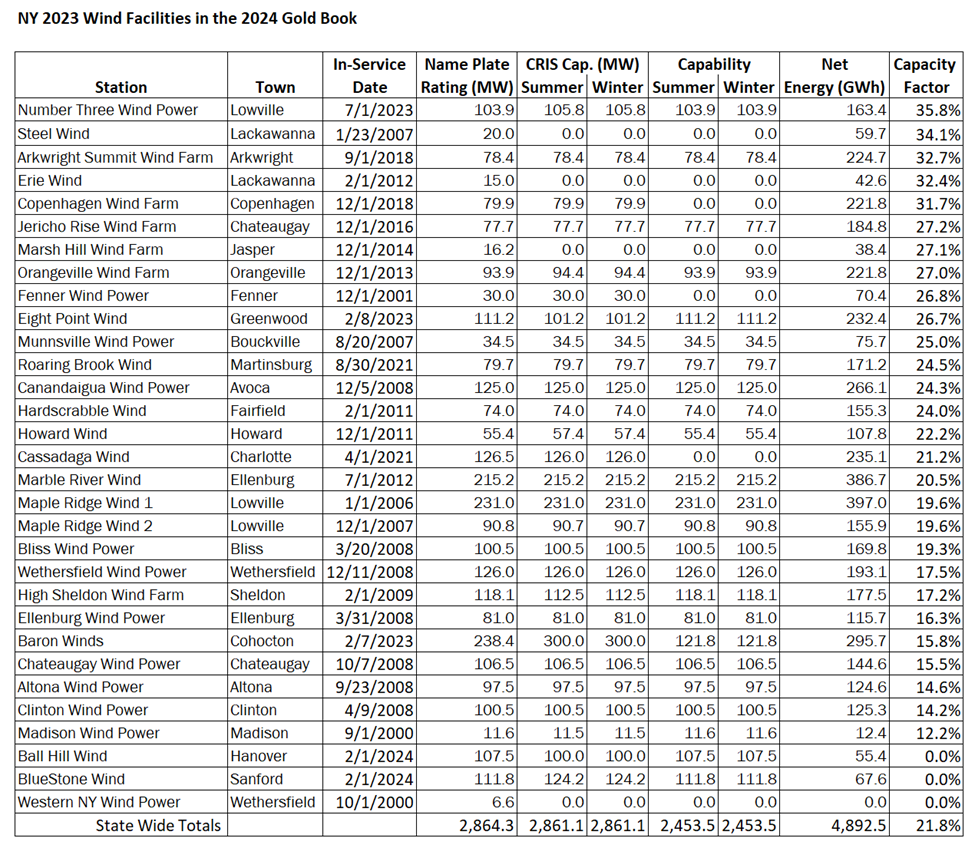
The next table lists the capacity data and net energy produced for the wind generating units in New York. Using that data, it is possible to calculate the capacity factors for each facility. The NYISO Resource Outlook and the Integration Analysis both assume a 34% capacity factor in 2030. Only two wind farms exceeded 34% and there were only three more that were over 30% capacity of the 31 wind farms in New York. The overall capacity factor was 21.8%. In order to achieve the assumed capacity factor for 2030 most of the existing wind farms will have to be replaced. The Integration Analysis does not retire any of the existing wind farms which I suspect is so that the cost estimate does not have to include those costs.
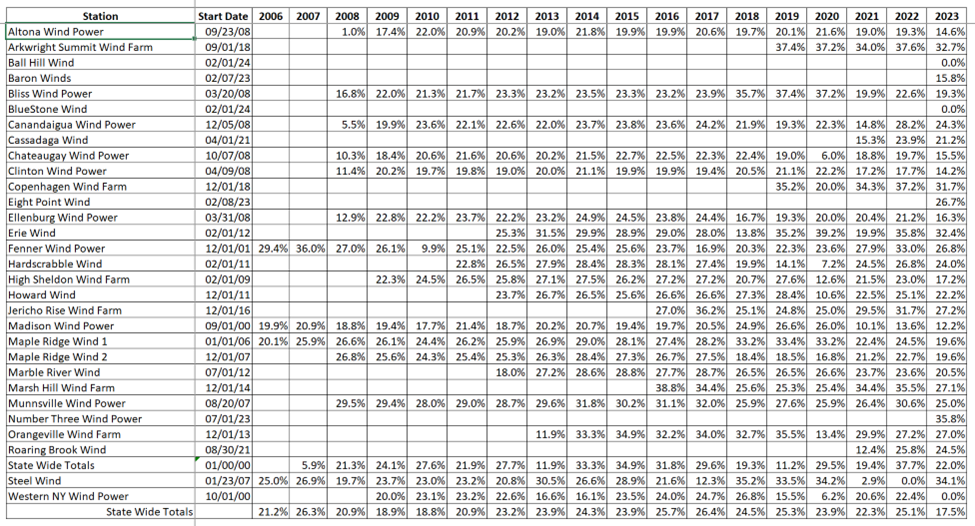
I have been tracking the wind farm capacity factors since 2006 as shown in the next table. There is nothing to suggest that 2023 was an abnormal year. In order to meet the 2030 projections these wind farms are going to have to be replaced or a large number of wind farms with much higher capacity factors that will bring the average up will have to be built. The data shown are also interesting as they show large interannual variation by site and the state overall. Finally note that the NYISO wind capacity factor for 2019 was modeled as 25% but the observed capacity factor was 22.3%. The Integration Analysis did not get their first year correct either. It modeled the 2020 capacity factor as 29% but the observed capacity factor was only 23.9%.
New York State Wind Facility Capacity Factors Based on NYISO “Gold Book” Load & Capacity Data Reports Table III-1
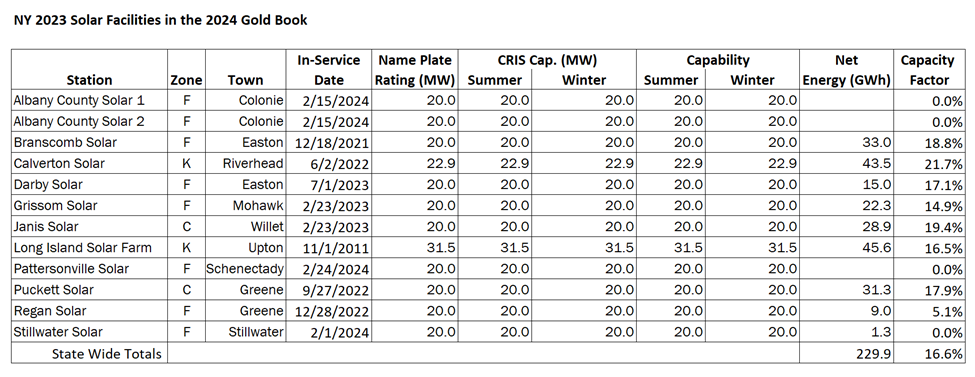
There is much less historical information available for solar facilities so only the 2023 data are presented. In 2023 the capacity factor of the solar facilities in New York was 16.8%, the highest capacity factor was 21.7% and the lowest credible capacity factor was 14.9%. The NYISO assumed a capacity factor of 15% from 2019 to 2040. On the other hand, the Integration Analysis assumed a capacity factor of 17% in 2020 increasing to 20% by 2030.
Discussion
The NYISO has interesting generation resource information available in its Gold Book. As shown here, that information can be used to calculate the capacity factors for wind and solar resources in New York. The annual capacity factors observed are consistently lower than the values used in the Integration Analysis which is being used to implement the state plan to meet the Climate Act mandates. As a result, The Scoping Plan is underpredicting the wind and solar resources necessary to generate the energy they project will be needed. That also means that their cost projections are too low.
It is troubling that the differences shown here between the NYISO capacity factors and the Integration Analysis capacity factors have not been reconciled. Worse, none of the differences between the two sets of projected resource projections have been addressed. This matters not only because the differences affect the projected outcomes and the costs, but also because Integration Analysis projections are being used for the New York Cap-and-Invest (NYCI) Program proposal. A key component of the NYCI plan is the trajectory for allowance allocations. NYCI’s reduction trajectory is based on the Integration Analysis and the overly optimistic capacity factors used means that they are projecting lower emissions than is likely to occur. That imbalance could have significant consequences to the allowance market.
One other point is that these are annual metrics. In order to assure that the electric grid will be able to provide energy when it is needed the most the NYISO must deal with resource availability over shorter periods. Think of it as the capacity factor over the coldest week of the year. That is a much more difficult issue and one that the Scoping Plan has not addressed.
Conclusion
This post documents the most recent wind and solar capacity factors observed in New York. It is notable that the wind data show a lot of interannual variation that should be considered when projecting future resource availability. These data have not been incorporated into an updated analysis of the generating resources needed to achieve the Climate Act goals.
I have long argued that the State’s plans for implementing the Climate Act mandates must include a feasibility study that could address the observed variability and lower capacity factors. Given the tremendous uncertainties like these shown here, I have recently decided that a feasibility study is not enough. No jurisdiction anywhere has successfully demonstrated an electric grid that depends on wind and solar to the extent that the Scoping Plan does. Before New York goes any further it should prove it can be done with a demonstration project. Anything less risks catastrophic blackouts and enormous costs.
Environmental Justice (EJ) advocates like the PEAK coalition argue that “Fossil peaker plants in New York City are perhaps the most egregious energy-related example of what environmental injustice means today.” This post critiques a recent General Accounting Office (GAO) report on “Information from Peak Demand Power Plants” that was prepared in response to a question about pollution from these facilities by some congressional representatives.
This topic is a particular concern of mine because issues associated with peaking power plants have been one of my responsibilities since 2000. Initially, my concerns were associated with developing an emissions tracking system to ensure compliance with air quality requirements for peaking plants. Later I participated in the regulatory process to develop regulations to reduce their emissions but also keep the lights on, keep the costs down, and achieve improved air quality. It took many years but New York State developed a rule that fulfilled those requirements. I doubt that I am the only one who participated in that process who was taken aback when environmental advocacy groups started campaigning against the power plants covered by the regulations put in place to address the peaking power plant pollution.
Further information on peaking power plants is available on a page that documents my concerns based on my extensive experience with air pollution control theory, implementation, and evaluation over my 45+ year career. The opinions expressed in this post do not reflect the position of any of my previous employers or any other organization I have been associated with, these comments are mine alone.
Introduction
The GAO website summary for the report explains why they did the study:
Environmental advocacy groups, and some congressional leaders have expressed concerns that peakers may be less efficient than non-peakers, meaning peakers may expend more energy that is not converted into electricity than other types of plants. Further, due to the nature of their operations, peakers may also negatively affect the air quality in communities around the plants, which may be historically disadvantaged or disproportionately low-income.
GAO was asked to examine pollution from peakers across the nation. This report provides information on the number and location of peakers in the U.S., their proximity to historically disadvantaged or disproportionately low-income communities, to what extent they emit pollutants and how these pollutants affect the health of people exposed, and alternatives for replacing them. To perform this work, GAO analyzed data from EPA, the U.S. Department of Energy, and other sources, reviewed relevant literature, and interviewed federal officials and stakeholders from 19 state, industry, and nongovernmental organizations representing a diversity of perspectives about peakers.
I am unimpressed with this report. It is not clear to me whether the political implications of this topic or the naivete of the authors was the reason for the poor quality. Whatever the reason, the report confirmed the biased concerns of environmental advocacy groups without addressing the fundamental problematic issues associated with peaking power. It is especially galling that the report ignored air quality protections already in place.
Peaking Power Problem
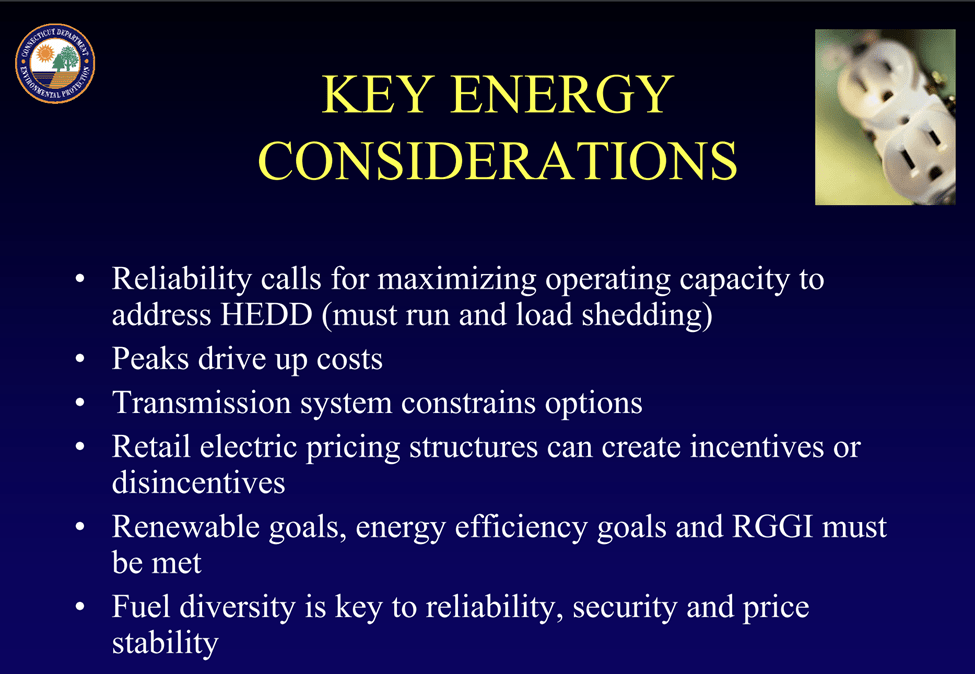
I think the GAO report missed the opportunity to highlight the implications of peak power demand and how it could and should be addressed. An Ozone Transport Commission presentation of issues associated with High Energy Demand Days (HEDD) from 2006 describes the tradeoffs. Air quality and energy planning both prioritize energy demand peaks because the highest electric demand and worst air quality tend to coincide. This is because the meteorological conditions that cause peak loads also exacerbate the air quality impacts of the increased emissions needed to match peak loads. Reliably meeting the peaks results in using the dirtiest and most expensive units. The key energy considerations slide describes the issues.
The GAO report overlooked this aspect of the peaking power plant issue. Instead, when they explained why this issue matters, they only talked about daily peaks. I think that devalues the criticality of the peak issue. The real problem is that peak loads occur when customers need power the most. If it is unavailable, then immediate acute safety and health problems occur. While the daily peak is a problem it is far less impactful than the annual peak load.
GAO Report
The GAO report determined how many peakers are in the country and where they are located. This discussion failed to discuss another impactful nuance. The GAO analysis determined the number of peaking power plants as a function of how much power plants ran in 2021:
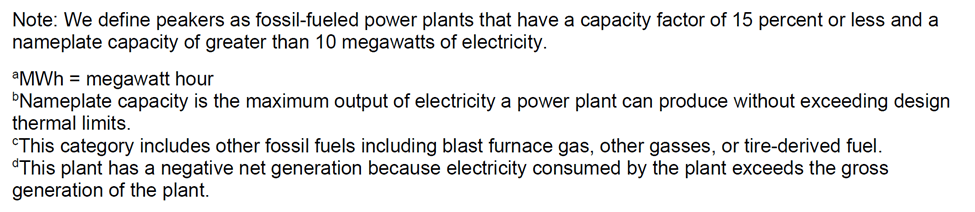
For the purpose of our report, we generally define peakers as plants that use fossil fuels, including natural gas, coal, and oil; have a capacity factor (the percent of energy produced over a certain time frame, out of what could have been produced at continuous full power operation) of 15 percent or less; and have a nameplate capacity (the designed full-load sustained output of a facility) of greater than 10 megawatts (MW) of electricity.
This is a similar methodology to that used by Physicians, Scientists, and Engineers (PSE) for Healthy Energy in their report Opportunities for Replacing Peaker Plants with Energy Storage in New York State. There is an unrecognized shortcoming to the approach. The GAO report states that “Peakers are used to supplement other types of power plants, such as baseload plants, which run consistently throughout the day and night, and intermediate plants, which run mostly during the day and less at night”. There is a difference between power plants designed to meet peaking applications and many facilities that now operate as intermediate or peaking units. For example, around 1970 Consolidated Edison of New York needed peaking capacity within New York City that would only run infrequently but also needed to startup quickly. They responded by building a fleet of around 100 simple-cycle natural gas turbines that were the cheapest capacity available. Today many of the units that meet the GAO definition were originally designed as base-load units and cannot start up quickly. I used to work at the Oswego Harbor generating station that had two 850 MW oil-fired units and took over a day to startup. The units have met the capacity factor criteria for peaking units for years, but they were not designed to operate that way.
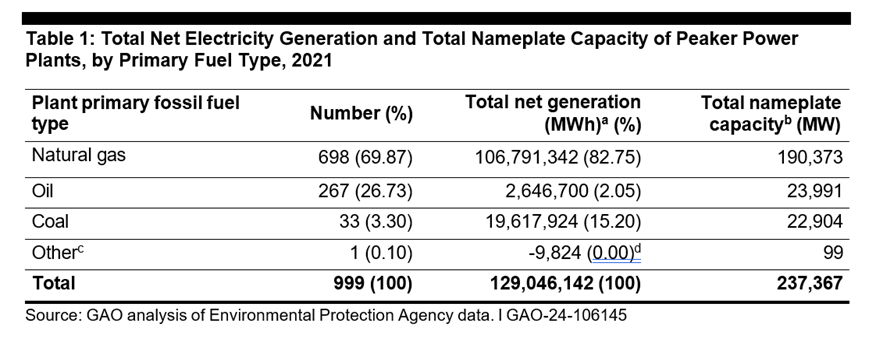
The GAO report includes a map of plant locations but there is no capability to identify the plants on the map. If you are interested in specific facilities, the EPA Power Plants and Neighboring Communities website presents that information. The GAO summary lists 999 peaking power plants in the following table. The overall capacity factor of these plants is 6%.
The GAO analysis determined how closely peakers are located to historically disadvantaged and low- income communities. This analysis, the Physicians, Scientists, and Engineers, and even the draft New York regulations to address these facilities all use distance between the disadvantaged communities and the power plant as the metric of concern. The GAO claims that “For example, based on our model and main definition of a peaker, a community that is 71 percent historically disadvantaged is expected to be 9 percent closer to the nearest peaker than the average community, which is 40 percent historically disadvantaged.”
I do not think this is an unexpected result, but I also think it is meaningless. The air quality impacts of any facility do not depend entirely upon distance between the source and a receptor location. The stack characteristics (gas temperature, height of the stack, and stack exit dimensions) as week as meteorological conditions (wind direction, wind speed, and atmospheric stability) all affect air quality impacts. The Con Ed turbines had exit ducts that released the pollutants that were less than 100 feet and the location of maximum downwind impact was relatively close. On the other hand, the Oswego plant had 700’ stacks and the location of maximum downwind impact was quite a way from the plant.
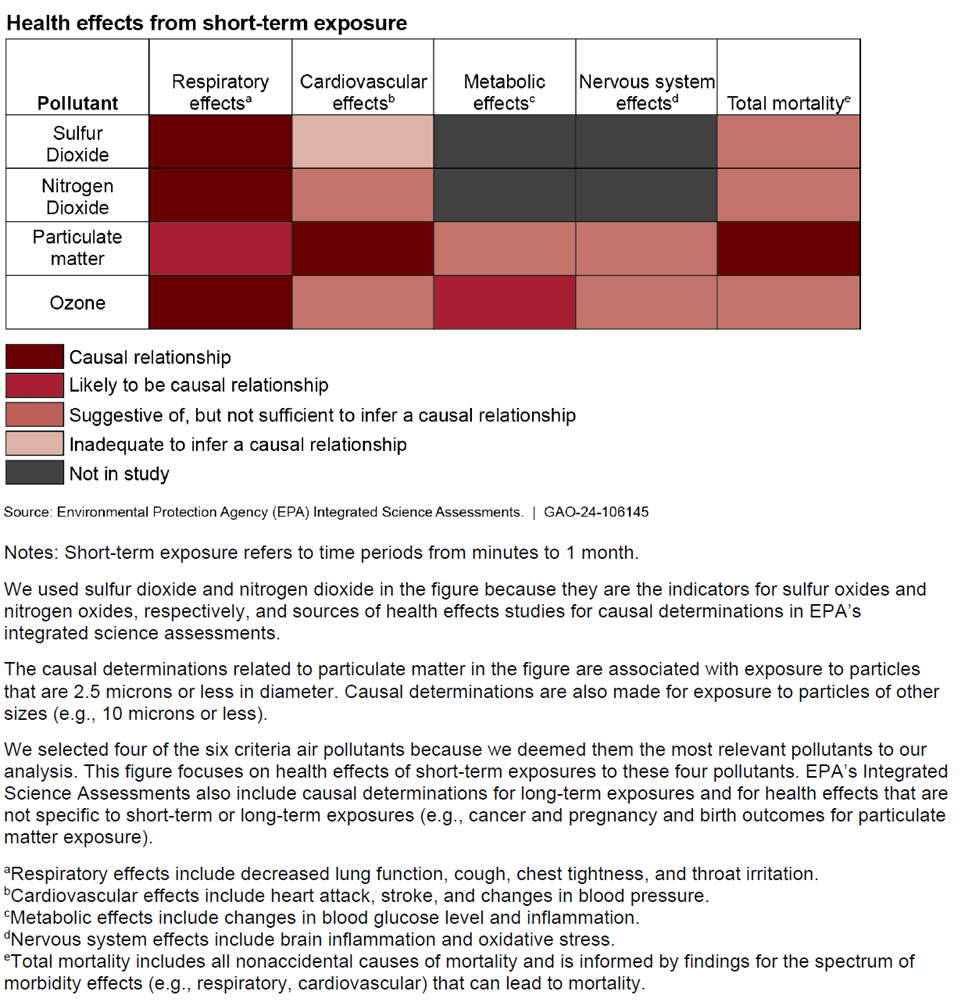
The GAO report addressed the impact of emissions and the resulting health impacts: “When operating, peakers emit similar types of pollutants to other power plants that also use fossil fuels, and these pollutants are associated with various negative health effects, according to existing literature.” The impacts section notes:
Compared to non-peakers, peakers emitted more pollutants—such as nitrogen oxides and sulfur dioxide—per unit of electricity generated, but fewer total annual pollutants in 2021, according to our analysis of EPA data (see table 2). In other words, peakers emit less in total because there are fewer peakers and they operate less frequently overall than non-peakers. However, when they do operate, they emit more pollution per unit of electricity produced. For example, the median sulfur dioxide emission rate for natural gas fueled peakers was 1.6 times more per unit of electricity generated than the median emission rate for non-peakers.
This language parrots the talking points of EJ advocates but is much ado about nothing. It is obvious that fewer peakers that run less would have lower emissions than more numerous non-peakers that run more. Advocates harp on the fact that emission rates are higher for peakers than non-peakers. Highlighting the finding that “natural gas fueled peakers was 1.6 times more per unit of electricity generated than the median emission rate for non-peakers” is a naïve point because 0.008 versus 0.005 lb SO2 per MWhr is negligible for air quality impacts. Moreover, I think there is an error in the methodology because the sulfur content in fuel determines the emissions not how it is burned, so there should be no difference in the rates.
Another issue I have with this analysis and other similar analyses is that they don’t recognize that the primary air quality issue with peaking power plants is ozone. These units operate when energy demand is highest in the summer and those periods are typically hazy, hot, and humid. Those conditions are conducive to the highest ozone levels (some of the haze) and there has been immense pressure to reduce their emissions to reduce ozone levels. Ozone is a secondary pollutant produced in a photo-chemical reaction from nitrogen oxides and volatile organic compounds. The conversion to ozone takes time and means that by the time it occurs the emissions from a power plant in a disadvantaged community have moved downwind. For example, the location of highest downwind conditions for emissions from New York City is in Connecticut, far beyond neighboring disadvantaged communities. Moreover the reality is that nitrogen oxides scavenge ozone so that the peaking power plants actually reduce ozone concentrations close to the facility.
I have been involved with air quality issues since I started working in 1976. The fundamental presumption has always been that the National Ambient Air Quality Standards (NAAQS) is the health metric used to determine health impacts. EPA explains:
The Clean Air Act, which was last amended in 1990, requires EPA to set National Ambient Air Quality Standards (40 CFR part 50) for six principal pollutants (“criteria” air pollutants) which can be harmful to public health and the environment. The Clean Air Act identifies two types of national ambient air quality standards. Primary standards provide public health protection, including protecting the health of “sensitive” populations such as asthmatics, children, and the elderly. Secondary standards provide public welfare protection, including protection against decreased visibility and damage to animals, crops, vegetation, and buildings.
As an air pollution meteorologist one of my jobs was to run air quality models to determine the air quality impacts of existing and proposed facilities. The primary consideration was whether the modeling proved that the projected impacts were less than the NAAQS. The basis of my work was that when I showed compliance with those standards, I proved that we were protecting the health of “sensitive” populations such as asthmatics, children, and the elderly. Regulatory agencies are required to ensure that any facility that cannot show compliance with the NAAQS must to modify its permitted operations or it cannot be allowed to operate.
The GAO report does not mention the NAAQS protections. Instead, the analysts follow the lead of EJ activists and claim that there are health effects from peaking power plants. The health effects section states: “Multiple pollutants that are emitted from peakers and other plants are associated with various negative health effects for the people exposed, according to federal agency reports we reviewed”. What they reviewed were the EPA Integrated Science Assessments:
EPA’s Integrated Science Assessments integrate information on criteria pollutant exposures and health effects from controlled human exposure, epidemiologic, and toxicological studies to form conclusions about the causal nature of relationships between exposure and health effects. For more information, see the EPA Preamble for Integrated Science Assessments at Preamble To The Integrated Science Assessments (ISA) | ISA: Integrated Science Assessments | Environmental Assessment | US EPA (accessed 8/30/2023).
The presumption in the report is that any level of pollution is bad: “For instance, short-term exposure to sulfur dioxide—the indicator for sulfur oxides used in EPA’s assessments—can lead to negative respiratory effects, such as decreased lung function, cough, chest tightness, and throat irritation.” The GAO report summarizes health effects from short-term exposures. All this is nice but it ignores the NAAQS process to determine acceptable ambient air quality levels.
The EJ activists pushing the negative impacts of the peaking power plants presume that there are alternatives. The GAO report looked at some available alternatives that could potentially replace fossil-fueled peakers at the same high-level used throughout the analysis. The report claims that “alternatives such as battery storage systems could potentially replace fossil-fueled peakers, according to studies we reviewed and stakeholders we interviewed”. The report lists battery storage, pumped-hydro storage, thermal energy storage, and notes that renewable energy systems (e.g., wind and solar) may be paired with energy storage. It claims that “adding roof-top solar and battery storage to houses could reduce the demand for peakers in adjacent areas.” It includes two other possibilities:
Transmission and distribution infrastructure improvements: Upgrades or expansions to increase the capacity of current infrastructure that transmits and distributes electricity. These upgrades or expansions may help enable existing underutilized plants to meet peak demand.
Efforts to decrease consumers’ use of power during peak times: Efforts to incentivize consumers to reduce or shift electricity use during times of peak use to off-peak times.
To its credit the report does address the “potential challenges of replacing peakers” including cost, reliability, and location. In my opinion, the responses downplayed those challenges.
The report notes that “some alternatives may have higher capital and operating costs compared to current fossil-fueled peakers”:
Replacing peakers, some of which have already paid off their capital costs, will likely lead to additional up-front or operating costs compared to keeping the existing peakers. Further, the U.S. Energy Information Administration (EIA) reported that solar and wind plants had higher average construction costs compared to natural gas-fired plants in 2023.
It is remarkable that this Federal report documented that construction costs of solar and wind are greater than natural gas plants but there is a missing nuance. While I am not an economist, I still question what kind of business model could justify developing a new resource that will operate as a peaking facility running less than 15 percent of the time. Surely the facility will have to charge very high rates when it does operate.
Appropriately the report notes that “current alternatives may not be able to provide the same reliability of current fossil-fueled peakers”:
Similarly, some alternatives may create reliability challenges. For the grid to be reliable, the energy resources in an area need to be able to supply power to meet peak demand for as long as it lasts, according to U.S. Department of Energy (DOE) officials. Some battery storage systems provide up to 4 hours of output, but peak demand may be longer in some areas. In contrast, a fossil-fueled peaker is only limited by fuel availability—a natural gas-fueled peaker could keep operating so long as natural gas is available.
This is an important point universally ignored by the activists that want to shut down peaking power plants now. The other nuance is that the overly broad definition of a peaking power plant covers facilities that provide different services than just peaking support. The 1700 MW at Oswego Harbor are within ten miles of three nuclear units. Nuclear units are required to shutdown when the grid goes down and in the 2003 blackout Oswego Harbor came on line to replace those units until the grid stabilized.
The GAO report also noted that “alternatives may not be able to be installed because of space and location concerns”:
Some alternatives may also run into space constraints or location concerns. For example, a densely populated urban community likely would not have sufficient space for a large renewable energy system paired with battery storage to help meet peak electricity demand.
I agree with this point, but it could have been expanded. Location matters within the grid. The transmission system is designed based on the location of the generating resources. The requirement that energy must be available at the location of the New York City peaking power plants is not acknowledged by the EJ activists, but it is a critical reliability constraint.
Most disappointing to me is that the report does not acknowledge the following challenges to the end of the main report. I believe that at least a hint of the following information should have been right up front:
In general, recognizing these challenges, some officials with whom we spoke identified trends that may lead to the continued use of fossil-fueled peakers. According to DOE officials, some U.S. peakers may not be able to be replaced with existing alternatives within cost, reliability, and location constraints.
Combinations of electricity generation and storage technologies, transmission and distribution improvements, and efforts to decrease consumer’s use of power during peak times may be too costly for consumers in some areas to provide an adequate level of grid reliability. Further, officials at two utilities noted that due to increased use of intermittent renewable resources on the grid (e.g., wind and solar power), the continued use of peakers to meet electricity demand may be necessary to maintain grid reliability. For example, the availability of sunlight for a solar installation may not match with peak demand in the evening when the sun goes down. Therefore, additional supplemental energy resources would be needed to fill the gaps and meet demand.
It gets worse. Buried in the technical appendix the last sentence in the last paragraph before the end notes is the caveat that there is no basis for concern (my highlight):
Limitations. We took several steps to assess the validity and sensitivity of our models, but certain limitations remain. Importantly, our measure of distance does not include other aspects—such as stack height, wind speed, or wind direction— that play important roles in the dispersion of pollutants and potential populations exposure. In addition, although we include some variables to control for factors that could influence the findings, it is possible that other controls might be important and were not accounted for in our model. Inclusion of a state fixed- effect partially addresses this by controlling for factors that vary by state. Still, our findings of associations between distance to peakers and historically disadvantaged racial and ethnic communities does not imply any causal relationships.
NY Peaker Rule
The New York Independent System Operator (NYISO) 2020 Reliability Needs Assessment includes a detailed summary of the New York Department of Environmental Conservation (DEC) “Peaker Rule”: Ozone Season Oxides of Nitrogen (NOx) Emission Limits for Simple Cycle and Regenerative Combustion Turbines. This rule exemplifies how these units should be regulated to reduce emissions while maintaining reliability standards.
After years of discussion DEC issued requirements to reduce emissions of ozone-forming pollutants from
peaking generation units in late 2019. The rule was implemented as part of the state’s attainment planning requirements to achieve the ozone NAAQS. The focus of the rule was on units designed to provide peaking power, the combustion turbines known as “peakers”. NYISO explained that:
That peakers typically operate to maintain bulk power system reliability during the most stressful operating conditions, such as periods of peak electricity demand. In addition, these units are often called upon at any time, seven days a week and 24 hours a day, to be able to respond to contingencies or other near real time changes on the electric system. By being available on call, the peakers provide value to system reliability even when not actually generating power.
Many of these units also maintain transmission security by supplying energy within certain areas of New York City and Long Island — known as load pockets. Load pockets represent transmission-constrained geographic areas where electrical demand can only be served by local generators due to transmission limitations during certain operational conditions.
The Peaker Rule phased in compliance for approximately 3,300 MW of simple-cycle turbines located mainly in the lower Hudson Valley, New York City and Long Island. The owners of the units were required to submit compliance plans to the DEC in March 2020 to either install pollution control equipment or retire the units over a phase in period. The NYISO resource adequacy planning process determined whether unit retirements would adversely affect reliability. The NYISO Reliability Needs Assessment indicated that “approximately 1,800 MW of nameplate capacity (approximately 1,500 MW of net operating capability) are proposed to ultimately be unavailable during the summer to comply with the emissions requirements “.
One of the important features of the rules is a provision to allow an affected generator to continue to operate up to two years, with a possible further two-year extension, after the compliance deadline if the generator is designated by the NYISO or the local transmission owner as needed to resolve a reliability need until a permanent solution is in place. Earlier this year this provision was involved for a couple of facilities.
I think this is the appropriate way to deal with these facilities. Keep in mind that if these facilities had been shown to contribute directly to a local non-attainment issue modifications to their permits would have been required in a different process.
Lastly, in my opinion, this rule and the New York City peaking power plant replacement issue is an artifact of New York electric system deregulation. Prior to deregulation, when DEC identified the problem the utilities owning the peakers would have proposed either installing control equipment or replacing the units themselves with modern clean and more efficient turbines. The Department of Public Service would have reviewed the proposal with the DEC and eventually an approved rate case would include the proposed solution. In the de-regulated market the owners of the facilities considered those options and in at least a couple of cases developed permits to install replacements. However, market considerations led to the decision by the owners to go ahead with the replacements. Without de-regulation there is no question in my mind that all of the old peaking turbines would have been replaced before 2010. Unfortunately, it also appears that the EJ activists would still have made this an issue.
Discussion
The GAO was asked to respond to a question about pollution from peaking power plants by some congressional representatives. The response is a disappointment. The report summary found that:
Historically disadvantaged racial or ethnic communities tend to be closer to peakers.
Fossil-fueled peakers are primarily fueled by natural gas and emit air pollutants associated with various negative health effects, including on respiratory, cardiovascular, and nervous systems.
Alternatives are available that could potentially replace or provide similar services as peakers, but we identified challenges for their use related to costs, reliability, space, and location.
I do not dispute that disadvantaged racial or ethnic communities tend to be closer to peakers but the fact the “findings of associations between distance to peakers and historically disadvantaged racial and ethnic communities does not imply any causal relationships” indicates that the basis for the concerns is weak. If the GAO report had evaluated the status of the communities of concern relative to the NAAQS or at least mentioned that there are standards designed to protect those communities, it would have been obvious that this is a non-problem conjured up by activists.
The second finding is another lost opportunity to inject reality into the conversation. Obviously, fossil-fueled peakers emit air pollutants and they can be “associated with various negative health effects, including on respiratory, cardiovascular, and nervous systems.” The complete disregard of the NAAQS protections in place unnecessarily scares the residents in the communities of concern. In addition, regarding emissions in isolation, focusing only on the negatives and disregarding any benefits creates an unnecessarily pessimistic outlook, hinders growth, and could lead to unintended consequences.
The final summary point begrudgingly admits that there are “costs, reliability, space, and location challenges” for replacements to peaking power plants. The GAO report should have emphasized these challenges in my opinion. The reality is that in order to deal with peaking power plants and the net-zero ambitions we do not have the generating or transmission technologies needed.
Conclusion
The GAO report fails to adequately address the challenges ignored by the congressional representatives who asked for the report and the EJ activists who have conjured this up as an issue. In doing so they did a real disservice to society. The reality is that we need peaking units and the public is protected from direct harm from these units by the NAAQS.
It is troubling that the report does explain why the concerns are unwarranted, but the presentation hides them. It is only possible through a complete reading of the entire report to discover contrary evidence eviscerating this as an issue.
The bigger picture problem is the potential threat that political and activist pressure will force premature retirement of peaking power plants with a marked increase in potential reliability risks. A blackout will have real ramifications as opposed to the over-hyped risks claimed. I believe that if this report had emphasized the issues instead of burying them that the possibility of a rash premature retirement initiative would have been much reduced.
I have been following the Climate Leadership & Community Protection Act (Climate Act) since it was first proposed and most of the articles described below are related to the net-zero transition. I have devoted a lot of time to the Climate Act because I believe the ambitions for a zero-emissions economy embodied in the Climate Act outstrip available renewable technology such that the net-zero transition will do more harm than good. The opinions expressed in this article do not reflect the position of any of my previous employers or any other company I have been associated with, these comments are mine alone.
National Grid announced their plans to “invest an estimated $75 billion across the company’s service territory in the UK and US over the next five years, with nearly half of the funding dedicated to US energy system improvements in Massachusetts and New York.” Their announcement includes:
In New York, National Grid is investing around $21 billion between now and 2029. Among those investments is the Upstate Upgrade which comprises more than 70 transmission enhancement projects across Upstate New York. The portfolio of projects will transform the grid, improve reliability and resilience, and enable National Grid to deliver renewable energy to homes and businesses across the state. This investment will also generate thousands of new jobs and create additional economic growth, all while ensuring the grid is able to meet the growing demand for electricity.
In New England, our five-year investment will total roughly $14 billion. As part of this investment, National Grid will implement innovative solutions, like smart meters, to help consumers manage energy use; build modernized energy infrastructure; construct and upgrade infrastructure to make it less susceptible to extreme weather events; and maintain and improve the quality of our existing gas and transmission assets.
Wind Energy Follies
I had intended to link to Robert Bryce’s article on last year’s wind energy but instead I suggest you check out Ron Clutz’s summary because he has some hilarious cartoons to illustrate his summary of the article. Bryce found that “Weather-dependent generation sources are…weather dependent: Last year, despite adding 6.2 GW of new capacity, U.S. wind production dropped by 2.1%.”
Environmentalism is Dead
I admire the work of Robert Bryce. In this post he argues that concerns for the environment that “once aimed to protect landscapes, wildlands, whales, and wildlife — has morphed into the NGO-corporate-industrial-climate complex. Rather than preserve wildlands and wildlife, today’s “green” NGOs have devolved into a sprawling network of nonprofit and for-profit groups aligned with big corporations, big banks, and big law firms” pushing “climatism and renewable energy fetishism.” He documents the “anti-industry” industry money and finds it is a $4.7 billion-per-year business. He concludes:
America needs a new generation of activists who want to spare nature, wildlife, and marine mammals by utilizing high-density, low-emission energy sources like natural gas and nuclear energy. We need advocates and academics who will push for a weather-resilient electric grid, not a weather-dependent one. Above all, we need true conservationists who promote a realistic view of our energy and power systems. That view will include a positive view of our place on this planet, a view that seeks to conserve natural places, not to pave them.
EPA Clean Power Plan
Before retirement I would have been very involved in the response to these new regulations. I am very happy that I don’t have to try to respond because this is madness. This summary of the rule explains:
Coal and natural gas plants provide 60% of the U.S.’ affordable, reliable, and baseload power. In a time of increased electricity demand, America needs to double down on harnessing these sources—not abandon them.
The Environmental Protection Agency (EPA)’s recently finalized Clean Power Plan 2.0 (CPP) rule, however, takes the country in the wrong direction. Under this regulation, one that is arguably illegal, existing coal and new natural gas power plants will be mandated to install emissions control technologies that aren’t yet commercially viable. Plants that don’t comply risk permanent closure. This unrealistic mandate is advanced under the guise of reducing greenhouse gas emissions 90% by 2032.
If this initiative was accompanied by an announcement of a nuclear renaissance it would be one thing. However, the worst thing about this is that the Biden Administration apparently believes that these resources can be replaced by wind and solar. That will never work.
Net-Zero Challenges
Ed Reid describes the all-electric experiment. He runs the numbers and finds that the costs of storage could be between 7 and 70 times the cost of wind and solar.
Bud’s Offshore Energy describes the glauconite challenge. When pile drivers attempt to drive the monopiles for wind turbines into sediments with the mineral glauconite transforms them into a sticky, clay-like sediment that can “cause pile refusal or difficulty installing the foundation to its target depth”. This mineral has been identified in the lease area for the recently approved Empire Wind project off Long Island. Not to worry New York has plenty of money to cover any unforeseen construction problems.
Energy and the Economy
Gail Tverberg notes that “Energy and the economy work together in very strange ways” in her recent article about offshored industrialization. This article notes that:
Industry is based on the use of fossil fuels. Electricity also plays a role, but it is more like the icing on the cake than the basis of industrial production. Industry is polluting in many ways, so it was an “easy sell” to move industry offshore. But now the United States is realizing that it needs to re-industrialize. At the same time, we are being told about the need to transition the entire economy to electricity to prevent climate change.
I find her work fascinating but, in my opinion, her emphasis on finite resources does not account enough for technical innovation. Nonetheless, I agree with her point that maintaining fossil fuel supply should be a priority over trying to move away from them because of the importance of fossil fuels to today’s society. She argues that:
The feasibility of moving away from fossil fuels without killing off a very major portion of the world’s population seems to be virtually zero. The world economy is a dissipative structure in physics terms. It needs energy of the right kinds to “dissipate,” just as humans are dissipative structures and need food to dissipate (digest). Humans cannot live on lettuce alone, or practically any other foodstuff by itself. We need a “portfolio” of foods, adapted to our bodies’ needs. The economy is similar. It cannot operate only on electricity, any more than humans can live only on high-priced icing for cakes.
The Acadia Center recently sent me an email asking if I would sign a letter to State Officials regarding the Regional Greenhouse Gas Initiative (RGGI) Third Program Review. That prompted me to prepare this article that summarizes the status of the Third Program Review and describes my response to the Acadia Center.
I am a retired air pollution meteorologist and worked on every cap-and-trade program affecting electric generating facilities in New York since 1990 including the Acid Rain Program, Regional Greenhouse Gas Initiative, and several Nitrogen Oxide programs since the inception of those programs. I also participated in RGGI Auction 41 and successfully won allowances which I held for several years. When I retired I started this blow where a regular topic is the RGGI cap and invest CO2 pollution control program. The opinions I express do not reflect the position of any of my previous employers or any other company I have been associated with, these comments are mine alone.
Background
RGGI is a market-based program to reduce greenhouse gas emissions. According to RGGI:
The Regional Greenhouse Gas Initiative (RGGI) is a cooperative effort among the states of Connecticut, Delaware, Maine, Maryland, Massachusetts, New Hampshire, New Jersey, New York, Pennsylvania, Rhode Island, Vermont, and Virginia to cap and reduce power sector CO2 emissions.
RGGI is composed of individual CO2 Budget Trading Programs in each participating state. Through independent regulations, based on the RGGI Model Rule, each state’s CO2 Budget Trading Program limits emissions of CO2 from electric power plants, issues CO2 allowances and establishes participation in regional CO2 allowance auctions.
The RGGI participating states are committed to comprehensive, periodic review of their CO2 budget trading programs, to consider successes, impacts, and design elements (Program Review). The RGGI states completed the First Program Review in February 2013 and completed the Second Program Review in December 2017, resulting in the 2017 Model Rule.
On February 2, 2021, the RGGI states released a statement announcing the plan for the Third Program Review, and in Summer 2021 the states released a preliminary timeline for conducting the Third Program Review. In November 2022, the states released a Program Review Update which includes an updated Program Review timeline.
Last September RGGI hosted a public meeting as part of the process and discussed the following topics:
Environmental Justice and Equity
Program Elements for Consideration
Electricity Sector Analysis
I prepared two articles after the meeting. The first described the disconnect between the results of RGGI to date relative to the expectations in the RGGI Third Program Review modeling that I addressed in my comments to RGGI. I followed up with another article that described the comments submitted at the time by others. Aside from an announcement on May 21, 2024 that “The participating states in the Regional Greenhouse Gas Initiative (RGGI) released the RGGI CO2 Emissions Dashboard on the RGGI website” there hasn’t been any other signs of progress on the program review process.
Acadia Center Draft Letter to RGGI
On May 22 I received an email that included the following:
I hope you’re doing well. I’m reaching out to ask for your support by signing onto another one of our RGGI letters, and this time we’re sending it to State Officials. The two-page letter aims to both ask for more information on the timeline on the Third Program Review and urge state officials to prioritize equity considerations in their decision-making processes for Third Program Review. Your signature would amplify our message and encourage your state officials to prioritize equity in their decision-making.
The draft letter is set up to go representatives in each of the RGGI states. The New York draft is addressed to Department of Environmental Conservation (DEC) Deputy Commissioner Jon Binder and the Chair of the New York Public Service Commission Rory Christian. There are two requests in the letter. Previous program reviews were completed much quicker than this one and included more collaborative opportunities between the States and stakeholders. The first request asked, “when should we expect the RGGI states to take action to complete the Program Review?” In the following discussion of my impression of the status of the program I will describe why I think this process is dragging but I certainly do not disagree with this request. The second request in the letter is a request on the “need for the RGGI states to respond, from a substantive point of view to the comments you solicited, and we provided.” I do not disagree with either sentiment. The problem is that I don’t think they are able to respond to either one at this time as I will explain below.
My bigger issue with signing the letter is that I disagree with the following section of the letter:
Environmental justice and equity concerns for electricity ratepayers and frontline communities is notably the overarching issue that stands out among the many comments filed with the RGGI states. Of the various issues raised in the two rounds of 2023 program review stakeholder comments, 17 of the 38 filings from March and September mirror the language of the RGGI state’s initial Program Review announcement. They request that the RGGI states prioritize the needs of frontline communities.
The number of filings is only one piece of this story–it is also important to look at who filed comments. Multiple organizations signed on to comment letters. For example, the RGGI Advocates Coalition filing represents 18 organizations, while the Earthjustice et al. comments were signed by 16 organizations. Thus, an overwhelming majority of the organizations submitting 2023 program review filings urged the RGGI states to prioritize environmental justice-related issues in their program review. These issues and accompanying requests and recommendations include:
Adopt a definition of “environmental justice”, a necessity for states that do not have one;
Set a percentage commitment of funds to allocate towards the RGGI ratepayers that have historically suffered from unfair treatment and disproportionate exposure to the harmful environmental conditions;
Increase frontline community participation in decision-making and participation in investment planning;
Address frontline community members’ exposure to poor air quality from criteria pollutants exacerbated by the electric generators covered by the program, and generators that are not yet covered by the program;
Lower the 25 MW program threshold to include smaller generating units in the program;
Expand air quality monitoring, particularly in disproportionately impacted areas at relevant levels of granularity
Set a new cap that is in line with the States’ goals, we are in support of a cap that goes to zero by 2040.
Before addressing my specific issues with this section of the letter I will describe all the comments.
Impression of Comments
My article on the comments submitted to RGGI was published on November 7, 2023 but RGGI posted another tranche of comments on November 9, 2023. I did not update my article to address the comments that came in after the requested submittal date. I noted that the comments concentrated on particular aspects of the proposed revisions to the RGGI program. My article categorized the first set of comments and I updated that summary of comments for this article. In brief these were the major themes:
Biomass Concerns – The Partnership for Public Policy and five individuals from Vermont complained about biomass power plants and the existing provision for “eligible” biomass to be treated as having zero emissions.
Emissions Traders – One emission trading company and the International Emissions Trading Association submitted comments that I believe have market implications that traders could exploit at the expense of everyone else.
Support the Narrative – Five commenters including the Acadia Center agreed with the RGGI States suggestion to tighten the allowance caps and incorporate an environmental justice component.
Cashing in on Advocacy – One comment on behalf of seven organizations in Pennsylvania read like a mission statement for advocates hoping to cash in on RGGI auction proceeds.
The Nature Conservancy comments were in a class by themselves. They supported most of the issues raised in the Acadia Center letter but their support was based on naïve understanding of the issue. They apparently have committed to offset projects that most environmental advocacy organizations do not accept.
Industry Concerns – Four industry comments argued for caution in any proposed changes because the compliance success to date is threatened as the program goes into unprecedented levels of allowance supply relative to expected emissions. Another important point made is that the technology necessary to eliminate fossil fuel electric generating units does not exist today so setting a zero-emissions target must consider technological feasibility.
I also submitted personal comments. I described my comments in an earlier post. I explained that I am afraid that the RGGI States are placing so much reliance on their analysis results that they could propose unrealistic allowance reduction trajectories. It is naïve to treat any model projections of the future energy system without a good deal of skepticism because the electric grid is so complex and currently dependent upon dispatchable resources. Replacement of RGGI-affected sources with intermittent and diffuse wind and solar resources that cannot be dispatched is an enormous challenge with likely unintended consequences. Therefore, the modeling results should be considered relative to historical observations.
Most advocates do not recognize that since the beginning of the RGGI program, RGGI funded control programs have been responsible for only 6.7% of the observed reductions. My analyses indicate that most of the observed reductions of emissions are due to fuel switching from coal and residual oil to natural gas and that there are few opportunities for additional switching reductions in most RGGI States. That means that future reductions are going to have to rely on displacing existing generator operations with zero-emission alternatives. Ostensibly the auction revenues from RGGI are supposed to encourage development of those alternatives. I have found that when the sum of the RGGI investments is divided by the sum of the annual emission reductions the CO2 emission reduction efficiency is $927 per ton of CO2 reduced. I think that the cost per ton reduced is too high to afford to develop the resources necessary for the reductions required to meet the aggressive allowance trajectories proposed. In addition, as the allowances available go down either allowance prices will have to increase sharply or the revenues available for reduction investments will drop sharply.
My impression of the comments affect my response to the Acadia Center emphasis on equity portion of the draft letter to State Officials. There is no question that many disadvantaged communities suffer disproportionate environmental impacts but it is important to understand what causes the harms and balance expectations and potential solutions. I agree that a definition of environmental justice for all RGGI states is needed On the other hand, specific percentage commitment of funds is a problem for me because it will likely reduce the already poor effectiveness of investments to reduce emissions. None of the RGGI states have a good record reducing emissions. The overall cost effectiveness of $927 per ton of CO2 reduced far exceeds the current Social Cost of Carbon. Because fuel switching options to reduce emissions are just about tapped out, future emission reductions will only be possible when zero-emissions resources displace fossil plants. The feasibility of that transition has never been proven and no jurisdictions have succeeded in that transition when depending upon wind and solar resources. The recent New York technical conference that characterized the observed wind and solar resource cap and the resources necessary to address it conclusively show that existing technology is insufficient.
Another of the themes of the Acadia Center equit portion of the letter is to get the environmental justice communities more involved in the regulatory process: “Increase frontline community participation in decision-making and participation in investment planning”. Electric and environmental resource planning is complex and there are reliability considerations that preclude some options that are endorsed by environmental justice advocates and the non-governmental organizations that provide them with technical support. I certainly do not have an issue with their involvement but I do not see much value given their level of understanding. Worse if it is impossible to accommodate all their demands the responses have not been constructive.
Environmental Justice advocates want to reduce “exposure to poor air quality from criteria pollutants exacerbated by the electric generators covered by the program, and generators that are not yet covered by the program”. The New York City peaking power plant issue is a prime example of this concern and the disconnect between reality and activist demands. Even though direct emissions from those plants comply with all existing environmental regulations and have dropped significantly over time, activists claim that they are the “most egregious energy-related example of what environmental injustice means today.” Activists got a consultant to give them arguments to that effect and they have been promoting the issue ever since. However, the presumption of egregious harm is based on selective choice of metrics, poor understanding of air quality health impacts, and ignorance of air quality trends. In fact, analyses for the New York Cap-and-Investhave shown that was that the inhalable particulate emissions claimed as a particular problem are primarily from other sources based on the expanded air quality monitoring in disadvantaged communities. Despite that finding the calls for shutdowns continue despite the fact that the organizations responsible for electric system reliability are on record saying that is unacceptable at this time.
Finally, the Acadia letter suggests setting a new cap that is in line with the States’ goals. As noted previously this is problematic because the technology required is not available.
Third Program Review Status
In my opinion the delays in the implementation of the Third Program Review recommendations are related to two problems: the participation of Virginia and Pennsylvania and the conflicting de-carbonization goals of the RGGI States.
The participation of Virginia and Pennsylvania has been mired down in politics and litigation. Virginia is officially out currently but there is pending litigation to re-join. Pennsylvania has never officially participated, and litigation is still holding back joining. The problem is that both states have significant emissions and opportunities for further reductions. In 2022, Virginia emissions were 23% of total RGGI emissions, Pennsylvania emissions were 27% of RGGI emissions including Virginia and 32% of total emissions excluding Virginia. The allowance reduction trajectory feasibility depends on their participation so I suspect there is reluctance by the RGGI states to commit to something that will have to be scrapped if Virginia and Pennsylvania participation changes.
The other issue is that the de-carbonization goals of the RGGI states differ. New York State has a law that mandates zero-carbon electric emissions by 2040. Other states have different targets. I believe that New York wants RGGI to comport with their mandate, but other states may not want to be so ambitious. New York is setting up an economy-wide cap-and-invest program like RGGI but the latest version includes safety valves for reliability concerns. I do not recall that the RGGI presentations have acknowledged that might be necessary so there is another controversy that must be resolved.
I am not surprised that the RGGI states have not been able to proceed with the Third Program Review. I do not think it is possible to submit a letter that will accelerate the process given the complexity of the issues and all the uncertainties. The Acadia Center draft letter requested that the RGGI states to “respond, from a substantive point of view to the comments you solicited, and we provided.” Given the wide range of possible outcomes and disparate interests of the states I do not think that they are able to respond to the comments now.
Conclusion
I agree with the concepts in the Acadia Center draft letter to State Officials. An update on the status is overdue and responses to comments are appropriate. However, I don’t think the status update is going to satisfy anyone because of all the uncertainties that preclude a firm schedule. Until the differences between Virginia and Pennsylvania participation and RGGI state policy differences are reconciled it is impossible to respond to the proposed letter. Therefore, I do not plan to sign the letter even if I am still welcome after this article is published.
My primary concern with RGGI relates to its ultimate goal of CO2 emissions reductions while maintaining a reliable and affordable electric system. The Acadia Center letter and most of the comments were notable with respect to the motivations of the authors. They mostly were at odds with the emission reduction goal. There is a faction that despises a biomass facility in Vermont and commented on that. Emissions traders support revisions to their advantage and not the rest of us. One comment was a blatant marketing proposal to get money but it could be argued that many other commenters were doing the same thing just less obviously.
The RGGI state narrative now is to incorporate environmental justice considerations and comments supporting that were frequent. In a recent post I addressed the tradeoffs between equity in a zero-sum approach relative to a positive-sum approach. All the comments supporting environmental justice equity promoted the zero-sum approach with no recognition of potential unintended consequences. I think the well-meaning emphasis on environmental justice is a problem because advocates are unduly pessimistic. They ignore current environmental quality and improvements and focus on much smaller and less certain environmental risks all the while ignoring the benefits of a reliable electric system.
I think this marvelous Robert Parham essay deserves wide distribution. It addresses the mis-placed pessimism of students in colleges today. Parham is an assistant professor at the University of Virginia’s McIntire School of Commerce. Witnessing firsthand the growing distress among college students, Parham originally published his essay “To the Class of 2024: You Are All Diseased,” in The Free Press. This post addresses the parallels between his college concerns and the environmental movement.
The opinions expressed in this post do not reflect the position of any of my previous employers or any other organization I have been associated with, these comments are mine alone.
To the Class of 2024
I recommend reading the essay but will summarize it here. The introduction states:
If you are graduating from college this year, I suspect you’re not too familiar with George Carlin. So before you become inflamed about the (intentionally) harsh title, let me tell you I plagiarized it from Carlin, who was one of the best American comedians of the last 100 years. His show You Are All Diseased is available on YouTube, and it is so good that I was willing to start by alienating you a bit just to plug it here. You’re welcome. It is especially recommended if you’re in any kind of altered state of mind.
Speaking of states of mind: I’m worried about yours.
Rates of anxiety, depression, and suicide among people your age in the U.S. are skyrocketing. I myself lost a student to suicide a few years ago—an experience I wish on no one. I’m here to tell you that I think it’s partly our (your professors’) fault. We, along with others, have been feeding you a distorted view of the world and your place in it, and I think this has caused a considerable part of the existential angst you all feel.
But I’m not just aiming to point fingers.
I want to lay a vision of the present and future, which I genuinely believe and yet know many of you don’t share. After all, exposing you to unfashionable ideas is a core part of a healthy education. My deeper hope in doing so is to start a conversation on changing this sad state of affairs and to get you on your way to a happy and healthy life. Isn’t that what commencements are all about?
The thrust of the article is that today’s college students are deeply pessimistic about the future despite, as he argues, the fact that human beings have never had it so good.
Based on every objective measure of well-being—safety, health, wealth—if you are a college student in America today you are better off and wealthier than the king of England was 300 years ago. You have better access to education, entertainment, leisure, and healthcare. You have cleaner water and more abundant food. You have a significantly safer and longer life. And you have access to all of the world’s knowledge, including this piece, in the palm of your hand.
Then he states: “Which then raises the question: Why? Why is it that “everything is amazing and nobody is happy”? He explains that the reason why we don’t think of ourselves as better off than the King of England:
We economists call this phenomenon “relative wealth concerns” or “keeping up with the Joneses.” These are just fancy terms to describe a simple psychological fact: we are constantly busy comparing ourselves to our peer group, and feel bad when we fall short in that comparison.
He goes on to describe our peer group:
“Peer group” is an essential term in the previous sentence. No one cares that they’re enormously better off than their grandparents; they just care that they’re worse off than Jeff Bezos or Elon Musk. You don’t feel wealthy, despite the fact the median human lives on the equivalent of $5,000 per year. Yes, you read that right. Imagine if you lived in the U.S., but only spent $5K a year at current U.S. prices, and you’ve imagined the life of the median human today. Your “peer group” isn’t humanity; it’s social media influencers and billionaires, and you are deeply unsatisfied when comparing your lives to theirs.
You live in the wealthiest country in the history of the world, yet you feel economic anxiety. The late Charlie Munger summarized it succinctly: “The world is not driven by greed. It’s driven by envy.” And in this era of instantaneous communication networks and social media, envy has been put into hyperdrive.
Professor Parham is not a fan of the emphasis on equity or fairness. He argues that envy is no longer a deadly sin, it has become the fairness virtue. He points out fairness issues for American college graduates relative to the rest of the world:
The world is unfair. Deeply so. It’s just that you’re the lucky ones. You won the birth lottery.
In a truly fair world, any dollar you make or spend above $5,000 a year would instead be given to someone else. Maybe a poor Kenyan, or Bangladeshi, or Indian. But that’s not the kind of fairness and equity anyone talking about “fairness” and “equity” around you seeks.
You’ve been lied to. You’ve been told, by the media, social networks, and not least your professors, that this fantastic world we live in is evil. Not only that, you’ve been told it’s your fault. You’re too racist, too greedy, too white, too privileged, not sufficiently attuned to the plight of the marginalized. It is not enough to be non-racist, they say, you must be anti-racist. Anything less than that, and you’re complicit in evil. Some of you are better by default due to some accidents of birth; some of you are worse. Small wonder you feel suffocated, anxious, and depressed.
Any human, weighed down with this responsibility and guilt, would be just as down. The cognitive dissonance of being told colonialism is evil, American slavery is uniquely evil, that wealth and the markets that enable it are evil, while going to school at a top-tier U.S. institution built on “Monocan land” using slave labor would incapacitate anyone.
He includes an informative description of the concept of money and how that creates a transaction where both parties become better off because of it. As society has evolved away from one-on-one transactions between people, now the transactions are between people and corporations. People earn money and can purchase what they need and want. He explains that when that happens: “We’re better off, the company we bought things from is better off, its employees and suppliers are better off, and so are their employees and suppliers. But in colleges today capitalism is frequently described as evil:
Without fail, at the end of the class a few students tell me that the content of the course was diametrically opposed to what they had been taught so far. Prior, they had class discussions about the exploitative nature of the market system and its inherent unfairness; the evil and greed of corporations; and the fight of exploited workers against oppressive capitalists.
In response he states:
I point out to them that these paradigms imply a zero-sum world in which wealth can only be created by taking it from others, whereas they live in the positive-sum world of markets, in which wealth is created by exchange. Markets have deposited a magic wand in their hands, which allows them to freeze moments in time, observe what is currently happening in foreign lands, and conjure loved ones for a face-to-face conversation out of thin air. Kings would have given half their kingdom for such a wand, but now anyone can have it for the low, low price of $69.99 per month. Or about five hours of student work. This is how we got wealthy.
He goes on to say:
My students arrive at my class steeped in zero-sum ideas, in which one person’s gain must be another person’s loss, and the only way to get a thing is by “oppressing” it from someone else. Then, they are shocked to hear heretical ideas about a world in which wealth is created, not stolen, and human interactions can be win-win and make all of us immensely well-off. The dissonance is severe, and they’re unsure how to deal with all the shame and guilt accumulated by years of accused “oppression.”
I hence want to close by telling you, the class of 2024: it’s not your fault. You are not evil. Being white / black / privileged / downtrodden / well-educated / illiterate / wealthy / poor / healthy / sickly / cisgendered / non-conforming does not make you bad (or good, for that matter). The sins of your forefathers are not your own. You did nothing wrong by being born. Yes, aiming to improve the state of human affairs is noble, but choosing instead to study, play games, and make out with the cute person you have your eye on does not make you bad. It makes you a normal, healthy human being. And no one seems to bother to tell you that. So there, I said it. You are not subject to the “original sin.” Go forth and have a happy and healthy life. There is still (much) room for progress, but things are currently better than they’ve ever been, and improving fast.
Or as Carlin put it, in his direct way: “Life gets really simple once you cut out all the bullshit they teach you in school.”
Environmental justice Parallels
I believe the environmental parallel is related to the “zero-sum idea”. The common perception is that emissions from a power plant or a factory are exploitive and come at the expense of harm to others, especially environmental justice communities. The concept that, within limits, emissions have positive-sum benefits is ignored.
No where is this dissonance more pronounced than the environmental justice movement. The EPA defines environmental justice:
“Environmental justice” means the just treatment and meaningful involvement of all people, regardless of income, race, color, national origin, Tribal affiliation, or disability, in agency decision-making and other Federal activities that affect human health and the environment so that people:
are fully protected from disproportionate and adverse human health and environmental effects (including risks) and hazards, including those related to climate change, the cumulative impacts of environmental and other burdens, and the legacy of racism or other structural or systemic barriers; and
have equitable access to a healthy, sustainable, and resilient environment in which to live, play, work, learn, grow, worship, and engage in cultural and subsistence practices
The difference between zero-sum and positive-sum environmental approach is in the definition of “disproportionate and adverse human health and environmental effects”. The environmental justice position I hear most often is a demand for no health and environmental effects.
In that regard I think my career is an instructive positive-sum example. When I completed my master’s degree in 1976 the United States Environmental Protection Agency (EPA) was only six years old and corporate America was just coming to grips with environmental management. I worked for five years for three different consulting companies that did contract work for EPA. In 1981 I started to work for Niagara Mohawk Power Corporation a vertically integrated electric utility. The environmental progress since I started working in the New York electric generating business has been astounding but is ignored by environmental justice activists.
One of my responsibilities at Niagara Mohawk was to prepare and submit emissions data to regulatory agencies. I recently found annual emissions data back to 1984. One of our facilities was the coal-fired Dunkirk Generating Station in Western NY. The facility had two 100 MW units and two newer 200 MW units. In 1984 the facility emitted 54,709 tons of SO2 at a rate of 3.26 lb per mmBtu and 10.020 tons of NOx at a rate of 0.598 lb per mmBtu. Over my time supporting the station, they installed controls for SO2, NOx, particulates, and mercury. In my last year with responsibilities for reporting at the station (2010) the facility emitted 7,380 tons of SO2 at a rate of 0.505 lb per mmBtu and 2,342 tons of NOx at a rate of 0.160 lb per mmBtu. Since then, the facility has been shut down. In 2023, the total electric generating sector emissions in the entire state of New York were 645 tons of SO2 at a rate of 0.003 lb per mmBtu and 7,488 tons of NOx at a rate of 0.030 lb per mmBtu. That is astounding progress.
Despite this tremendous reduction, environmental justice activists carry on about the egregious harm caused by power plants and claim numerous health effects from existing sources. However, if their health effect claims were true then there should be enormous observable improvements from the improvements made since 1984. I have not seen any such analysis. The other counter narrative is that the reason for the improvement is that natural gas became the cheapest fuel source and that occurred because of the fracking revolution that the environmental justice activists love to hate.
Discussion
My takeaway from Parham’s speech is that things are much better than portrayed by many academics. “There is still (much) room for progress, but things are currently better than they’ve ever been, and improving fast.” That sentence sums up the status of the environment in the US. There are environmental issues that still need to be addressed. However, the health of the environment has never been better in this country. There has been tremendous improvement over the last 40 years.
My concern is that as is the case with the academic focus on pessimism there are those who ignore environmental improvements and focus on current much smaller environmental risks all the while ignoring the benefits of a reliable electric system. The New York City peaking power plant issue is a prime example. Even though direct emissions from those plants comply with all existing environmental regulations, activists claim that they are the “most egregious energy-related example of what environmental injustice means today.” The activists paid a consultant to give them that answer and have been promoting the issue ever since. However, the presumption of egregious harm is based on selective choice of metrics, poor understanding of air quality health impacts, and ignorance of air quality trends. In fact, analyses for the New York Cap-and-Investhave shown that was that the inhalable particulate emissions claimed as a particular problem are primarily from other sources.
Nonetheless, environmental justice activists are demanding that those facilities shut down. This is a problem because we do not have a zero-emissions technology that can replace them and maintain the same levels of reliability. If they are shut down too soon then blackouts are inevitable that will cause real impacts rather than the conjured impacts used to argue for the shutdowns. Their efforts would be better served by promoting inhalable particulate emission reductions from diesel trucks. Environmental justice advocates are arguing that would be appropriate but imagine that a zero-emissions solution is necessary. There could be a tremendous improvement using existing technology that only needs development of infrastructure but compressed natural gas has emissions and the natural gas used would be fracked so this practical solution is ignored.
Conclusion
Parham’s essay stands on its own as a great message for today. The difference between a zero-sum society in which wealth can only be created by taking it from others, and a positive-sum society in which wealth is created by exchange is being improperly ignored. Worse academics are promoting the zero-sum concept to the detriment of their students.
In my opinion, I think there are zero-sum versus positive-sum environmental parallels. The United States has developed a comprehensive set of environmental standards and there have been unquestioned overall environmental quality improvements over the last several decades. The sum of benefits and costs are positive. Regarding emissions in isolation, focusing only on the negatives and disregarding any benefits is an approach like the zero-sum concept of wealth. It creates an unnecessarily pessimistic outlook, hinders growth, and could lead to unintended consequences.