More Reliability Concerns that Need to be Considered by the Climate Action Council

The Climate Leadership and Community Protection Act (Climate Act) has a legal mandate for New York State greenhouse gas emissions to meet the ambitious net-zero goal by 2050.  I have previously noted that there are members of the Climate Action Council who deny the challenge of the electric grid transition from existing sources to one dependent upon wind and solar resources.  This article describes a couple of recent articles that highlight transition issues.

Everyone wants to do right by the environment to the extent that they can afford to and not be unduly burdened by the effects of environmental policies.  I submitted comments on the Plan and have written extensively on implementation of New York’s response to that risk because I believe the ambitions for a zero-emissions economy embodied in the Climate Act outstrip available renewable technology such that this supposed cure will be worse than the disease.  The opinions expressed in this post do not reflect the position of any of my previous employers or any other company I have been associated with, these comments are mine alone.

Climate Act Background

The Climate Act establishes a “Net Zero” target (85% reduction and 15% offset of emissions) by 2050. The Climate Action Council is responsible for preparing the Scoping Plan that will “achieve the State’s bold clean energy and climate agenda”.  They were assisted by Advisory Panels who developed and presented strategies to the meet the goals to the Council.  Those strategies were used to develop the integration analysis prepared by the New York State Energy Research and Development Authority (NYSERDA) and its consultants that tried to quantify the impact of the strategies.  That material was used to write a Draft Scoping Plan that was released for public comment at the end of 2021. The Climate Action Council states that it will revise the Draft Scoping Plan based on comments and other expert input in 2022 with the goal to finalize the Scoping Plan by the end of the year.

In my comments on the Draft Scoping Plan I noted that the Plan and the Climate Action Council have downplayed the reliability risks of the Climate Act transition to renewables.  Equally troubling there are vocal members of the Climate Action Council that deny the existence of any implementation issues associated with a renewable energy resource dependent electric system.  At the May 26, 2022 Climate Action Council meeting, Paul Shepson Dean, School of Marine and Atmospheric Sciences at Stony Brook University claimed that the conversion cannot be unreliable at 23:39 of the recording.  Robert Howarth, Professor, Ecology and Environmental Biology at Cornell (starting at 32:52 of the recording) said: “Clearly one can run a 100% renewable grid with reliability”.   In this article, I describe a couple of recent articles that highlight some of the issues associated with this conversion that the academics overlook.

Renewable Energy Systems

I have prepared a page that documents the work of various authors that describe the complexities of the energy system and problems associated with over-reliance on intermittent wind and solar generating resources.  One of the resources is a series of posts at Climate Etc by Planning Engineer who posts under the pseudonym because he wanted to frankly share his personal views and not have them tied directly to his current employer.  Recently he posted an article entitled Will California “learn” to avoid Peak Rolling Blackouts? that provides a good overview of upcoming reliability issues.

The article presents a graph that shows recorded peaks and the projected 2022 value that caused issues earlier in September.  Then he explains that:

The most basic planning criteria is that a system should be able to survive the loss of the largest generating resource and the most critical transmission element during a peak load with no loss of load and no severe voltage declines or undamped system oscillations. Looking at the variability in load levels here, no particular challenges to planners are apparent. If “green” resources were capable of replacing traditional resources with minor adjustments, we would not see the problems we are seeing.

He goes on to explain why there was a problem.

Why is California challenged now and why might it continue to see challenges in the future?  Primarily because the focus on green energy is increasing the percentage of “green” intermittent resources. “Green” resources are not as dependable as traditional rotating machinery nor do they support the system as well. It is likely that these resources have been credited with more ability to provide capacity than is warranted, and when the rubber meets the road, they don’t perform as “expected”. Intermittent resources cause problems on both the generation side and the load side. Intermittent solar on the residential side serves to reduce load as seen by the Cal ISO. When solar is not performing well available load which is not displaced by solar on the residential side increases concurrent with solar reduction on the supply side.

If California were more honest about the capabilities of “green” intermittent resources planning would be enhanced. However, being honest about the capabilities of “green” resources would have consequences that some would find unacceptable. There has been a big push to make “green” options appear much more economic and capable than they are so that they will be more competitive. Subsidization of “green” resources by traditional uses occurs in many ways. In addition to crediting “green” resources above their dependable capability, others subsidies include directing costs associated with such additions to others. Being honest makes the “green” dream a much harder sell. Assuming that “green” resources work well saves other investment in the grid. This subterfuge tends to limit the cost increase that should be imposed by these resources, but does so at the cost of reliability. This tradeoff takes a while to see as we have built the electric grids to have very high levels of reliability at the bulk level. In the short term it looks like you are getting a cleaner, equally reliable system at a moderate cost increase. But as penetration levels increase, cost get higher and reliability gets much worse.

He points out that California policy makers are responsible for resource investment, resource allocations and how and when grid improvements are made to enhance reliability. Earlier in September there were reliability issues and extreme weather was blamed.  Obviously, the planning failed to account for weather but proper reliability planning has to account for the effects of extreme weather.  Planning Engineer points out that if “there truly was something unusual about the weather as driven by climate change, shouldn’t this have been anticipated by those responsible?” 

He concludes:

Ideally the power system represents the best balance between economics, reliability and public responsibility. California has reached a balance skewed by false expectations that “green” resources cannot meet. Creating a balance that looks at the true costs and reliability impacts of green resources should benefit electric users in California.

Ramping Up Renewables Can’t Provide Enough Heat Energy in Winter

Gail Tverberg writing at Our Finite World explains that one of the unappreciated benefits of fossil fuels is their ability to store energy that can be used to provide heat in the winter.  She notes that:

In some ways, the lack of availability of fuels for winter is a canary in the coal mine regarding future energy shortages. People have been concerned about oil shortages, but winter fuel shortages are, in many ways, just as bad. They can result in people “freezing in the dark.”

The article goes on to describe eight issues involved with winter energy use.  She points out that “batteries are suitable for fine-tuning the precise time during a 24-hour period solar electricity is used” but they cannot be scaled up to store solar energy from summer to winter.  There is no long duration energy storage resource available.

The article addresses hydro and wind energy resources in this context.  She argues that “ramping up hydro is not a solution to our problem of inadequate energy for heat in winter” and that “wind energy is not greatly better than hydro and solar, in terms of variability and poor timing of supply”.

She also lists five specific reasons that “when wind and solar are added to the grid, the challenges and costs become increasingly great”.  All of these concerns are concerning by themselves and the combination of problems directly contradicts the Climate Act narrative that there are no serious challenges to reliability.  Two deserve attention.  The inherent variability of wind and solar generation creates power transients and those fluctuations need to be addressed.  The problem is that the magnitude of this problem is new and it is likely that learning how to address it is difficult to anticipate so corrections will be reactions to problems.  Supporters of the Climate Act transition seem to think that existing wind, solar and energy storage resources only need to be scaled up to the quantity needed.  What they miss is that the more resources built the less those resources will be used.  Tverberg points out that low-capacity factors hurts energy return on investment payback.  All of these issues should be considered but have not been addressed in the Scoping Plan.

Tverberg also point that the word “sustainable” has created unrealistic expectations with respect to intermittent wind and solar electricity.  She illustrates this issue as follows:

A person in the wind turbine repair industry once told me, “Wind turbines run on a steady supply of replacement parts.” Individual parts may be made to last 20-years, or even longer, but there are so many parts that some are likely to need replacement long before that time. An article in Windpower Engineering says, “Turbine gearboxes are typically given a design life of 20 years, but few make it past the 10-year mark.”

She notes that “energy modeling has led to unrealistic expectations for wind and solar”.  This is evident in the Integration Analysis projections.  It should be obvious that the Scoping Plan projections for future generating resources have to be reconciled with the work of the New York Independent System Operator but, so far, no plan has been announced to do that.

Finally, Tverberg argues that current pricing plans that enable the growth of wind and solar electricity have consequences.  They are displacing existing dispatchable resources such that those resources are no longer viable.  The result is “pushing a number of areas in the world toward a “freezing-in-the-dark” problem”.  She concludes: “The world is a very long way from producing enough wind and solar to solve its energy problems, especially its need for heat in winter.”

Conclusion

I cannot improve on Planning Engineer’s conclusion.  Substitute New York for California and his conclusion sums up the issue that the Climate Action Council should address in the Scoping Plan:

Will California learn to avoid peak rolling blackouts?  If reliability were a primary concern, this situation shouldn’t bubble up again in a few years. California should be able to properly credit the ability of its power resources and match them to projected weather ensuring adequate power. If other priorities prevent responsible steps to ensure reliability, then those priorities, not the weather, should claim responsibility for the consequences. If California wants to continue as they have, they should be honest and make statements such as the following:

This is the end of affordable, reliable electric service as we understood it for most of the last 50 years. We are choosing to go with “green “technology to deal with the climate crisis. Keeping past reliability levels will raise your costs tremendously. As we try to put on limit on costs this will decrease your reliability. At times the power will not be there. We’ve all got help each other out.

The Latest from the Experts on New York’s Climate Act Implementation

This article was first published at Watts Up With That

I have published two previous articles about New York Independent System Operator (NYISO) analyses related to New York’s Climate Leadership and Community Protection Act (Climate Act).  This post describes what I believe is an important new analysis of the future of New York’s electric system.

New York’s Climate Leadership and Community Protection Act (Climate Act) Act establishes a “Net Zero” target (85% reduction and 15% offset of emissions) by 2050.  I have written extensively on implementation of the Climate Act.  Everyone wants to do right by the environment to the extent that efforts will make a positive impact at an affordable level.  My analysis of the Climate Act shows that the ambitions for a zero-emissions economy outstrip available renewable technology such that the transition to an electric system relying on wind and solar will do more harm than good.  The opinions expressed in this post do not reflect the position of any of my previous employers or any other company I have been associated with, these comments are mine alone.

Background

The implementation plan for New York’s Climate Act “Net Zero” target (85% reduction and 15% offset of emissions) by 2050 is underway.  The Climate Action Council has been working to develop plans to implement the Act.  Over the summer of 2021 the New York State Energy Research & Development Authority (NYSERDA) and its consultant Energy + Environmental Economics (E3) prepared an Integration Analysis to “estimate the economy-wide benefits, costs, and GHG emissions reductions associated with pathways that achieve the Climate Act GHG emission limits and carbon neutrality goal”.  Integration Analysis implementation strategies were incorporated into the Draft Scoping Plan when it was released at the end of 2021.  Since the end of the public comment period in early July 2022 the Climate Action Council has been addressing the comments received as part of the development of the Final Scoping Plan that is supposed to provide a guide for the net-zero transition.

Unfortunately, the Climate Action Council has not confronted reliability issues raised by New York agencies responsible for keeping the lights on.  The first post (New York Climate Act: Is Anyone Listening to the Experts?) described the NYISO 2021-2030 Comprehensive Reliability Plan (CRP) report (appendices) released late last year.  The difficulties raised in the report are so large that I raised the question whether any leader in New York was listening to this expert opinion.  The second post (New York Climate Act: What the Experts are Saying Now) highlighted results shown in a draft presentation for the 2021-2040 System & Resource Outlook that all but admitted meeting the net-zero goals of the Climate Act are impossible on the mandated schedule.  This article describes the “For discussion purposes only” draft of the 2021-2040 System & Resource Outlook report described in the previous article.  While there may be minor changes to the document itself, I am comfortable saying that the major findings will not change substantively.

System and Resource Outlook Summary

The Executive Summary makes the point that the Climate Act is driving changes to the generating system, the transmission grid and the demand landscape.  As a result, this “leads to re-thinking how and where electric supply and storage resources evolve, and how to efficiently enable their adoption to achieve energy policy targets”.  The summary goes on to note:

This 2021 – 2040 System & Resource Outlook (the Outlook), conducted by the New York Independent System Operator (NYISO) in collaboration with stakeholders and state agencies, provides a comprehensive overview of potential resource development over the next 20 years in New York and highlights opportunities for transmission investment driven by economics and public policy in New York State. The Outlook together with the NYISO’s 2021-2030 Comprehensive Reliability Plan (CRP) represent the marquee planning reports that provide a full New York power system outlook to stakeholders, developers, and policymakers.

The Outlook examines a wide range of potential future system conditions and enables comparisons between possible pathways to an increasingly greener resource mix. By simulating several different possible future system configurations and forecasting the transmission constraints for each, the NYISO:

  • Projected possible resource mixes that achieve New York’s public policy goals while maintaining grid reliability;
  • Identified regions of New York where renewable or other resources may be unable to generate at their full capability due to transmission constraints;
  • Quantified the extent to which these transmission constraints limit delivery of renewable energy to consumers, and;
  • Identified potential opportunities for transmission investment that may provide economic, policy, and/or operational benefits.

There are many potential paths and combinations of resource and transmission builds to achieving New York’s climate change requirements. As the current power system continues to evolve, evaluating a multitude of expansion scenarios will facilitate identification of common and unique challenges to achieving the electric system mandates New York State has set for 2030 and 2040. A thorough understanding of these challenges will help build a path for investors and policymakers to achieve a greener and reliable future grid efficiently and cost effectively. Through this Outlook several key findings were brought to light:

Four potential futures are evaluated to best understand the challenges ahead. A Baseline Case evaluates a future with little change from today. A Contract Case includes approximately 9,500 MW of renewable capacity procured by the state and evaluates the impact of those projects. Finally, a Policy Case postulates and examines two separate future scenarios that meet New York policy mandates.

Energy planning analyses such as this work normally evaluate different scenarios of the future by comparing them to a business-as-usual scenario.  In this instance the business-as-usual scenario does not include any of New York’s climate initiatives.  On the other hand, Climate Act Draft Scoping Plan analyses were perverted to “prove” the desired conclusion that the benefits were greater than the costs by comparing future scenarios against a reference scenario.  The Integration Analysis used a semantic trick to claim that some de-carbonization costs (such as de-carbonizing transportation costs) necessary to meet Climate Act targets did not have to be included in the comparison scenario because the electric vehicle conversion legislation was already “implemented”.  That approach took legitimate implementation costs out of the projections.  Of course, this also makes comparison of the NYISO work relative to the Draft Scoping Plan problematic.

The second estimate of the future in the Resource Outlook considered only those projects currently under contract:

Through an annual request for proposals, NYSERDA solicits bids from eligible new large-scale renewable resources and procures Renewable Energy Certificates (RECs) and Offshore Renewable Energy Certificates (ORECs) from these facilities. This Outlook included approximately 9,500 MW of new contracted renewable resources, including 4,262 MW of solar, 899 MW of land-based wind, and 4,316 MW of offshore wind. The addition of these resources to the existing system representation provides insights regarding their impact on system performance in the future.

The Outlook report noted the following Key Takeaways for the contracted renewables scenario:

The pace of renewable project development is unprecedented and requires an increase in the pace of transmission development. Every incremental advancement towards policy achievement matters on the path to a greener and reliable grid in the future, not just at the critical deadline years such as 2030 and 2040. In general, resource and transmission expansion take many years from development to deployment.

Coordination of project additions and retirements is essential to maintaining reliability and achieving policy. Coordination of renewable energy additions, commercialization and development of dispatchable technologies, fossil fuel plant operation, and staged fossil fuel plant deactivations over the next 18 years will be essential to facilitate an orderly transition of the grid.

Many more renewable resources have to be developed to meet the overall Climate Act net-zero goal by 2050 and the interim 2040 goal of “zero-emissions” electricity generation.  The NYISO analysis looked at two Policy Case scenarios that meet those targets:

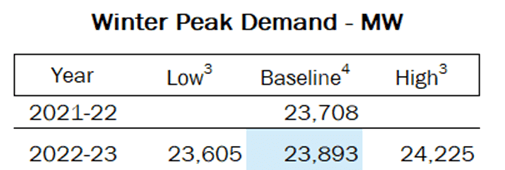
Scenario 1 utilizes industry data and NYISO load forecasts, representing a future with high demand (57,144 MW winter peak and 208,679 GWh energy demand in 2040) and assumes less restrictions in renewable generation buildout options.

Scenario 2 utilizes various assumptions consistent with the Climate Action Council Integration Analysis and represents a future with a moderate peak but a higher overall energy demand (42,301 MW winter peak and 235,731 GWh energy demand in 2040).

Both scenarios project a blend of land-based wind, offshore wind, utility-scale solar, behind-the-meter solar, and energy storage will be needed to meet the CLCPA policy mandates through 2035. There are significant differences between these scenarios and the equivalent Draft Scoping Plan mitigation scenarios.  One of the big differences is the magnitude of a new generating resource called “dispatchable emission-free resources” (DEFRs):

These resources represent a proxy technology that will meet the flexibility and emissions-free energy needs of the future system but are not yet mature technologies that are commercially available (some examples include hydrogen, renewable natural gas, and small modular nuclear reactors). As more wind, solar, and storage plants are added to the grid, dispatchable emission-free resources must be added to the system to meet the minimum statewide and locational resource requirements for serving system demand when intermittent generation is unavailable.

The report warns:

Both scenarios include significant DEFR capacity by 2035, but it is important to note that the lead time necessary for development, permitting, and construction of DEFR power plants will require action much sooner if this timeline is to be achieved.

As part of the analysis the NYISO considered what would be needed if the DEFR capacity is not developed. They found that “The exclusion of DEFRs as a new technology option, while enforcing the retirement of fossil generators via the zero-emission by 2040 policy, exhausts the amount of land-based wind built and results in the replacement of 45 GW of DEFR capacity in Scenario 1 with 30 GW of offshore wind and 40 GW of energy storage.”  They also noted that the alternative did not address ancillary service requirements needed for the transmission system.

The Outlook report noted the following Key Takeaways for the Policy Case Scenarios:

Significant new resource development will be required to achieve CLCPA energy targets. The total installed generation capacity to meet policy objectives within New York is projected to range between 111 GW and 124 GW by 2040. At least 95 GW of this capacity will consist of new generation projects and/or modifications to existing plants. Even with these additions, New York still may not be sufficient to fully meet CLCPA compliance criteria and maintain the reliable electricity supply on which New York consumers rely. The sheer scale of resources needed to satisfy system reliability and policy requirements within the next 20 years is unprecedented.

To achieve an emission-free grid, dispatchable emission-free resources (DEFRs) must be developed and deployed throughout New York. DEFRs that provide sustained on-demand power and system stability will be essential to meeting policy objectives while maintaining a reliable electric grid. While essential to the grid of the future, such DEFR technologies are not commercially viable today. DEFRs will require committed public and private investment in research and development efforts to identify the most efficient and cost-effective technologies with a view towards the development and eventual adoption of commercially viable resources. The development and construction lead times necessary for these technologies may extend beyond policy target dates.

As the energy policies in neighboring regions evolve, New York’s imports and exports of energy could vary significantly due to the resulting changes in neighboring grids. New York is fortunate to have strong interconnections with neighboring regions and has enjoyed reliability and economic benefits from such connections. The availability of energy for interchange is predicted to shift fundamentally as policy achievement progresses. Balancing the need to serve demand reliably while achieving New York’s emission-free target will require continuous monitoring and collaboration with our neighboring states.

The important findings in the report led to the following recommendations:

Future uncertainty is the only thing certain about the electric power industry. From policy advancements to new dispatchable emissions-free resource technology innovation and ultimate development, the system is set to change at a rapid pace. Situational awareness of system changes and continuous assessment are critical to ensure a reliable and lower-emissions grid for New York. The Economic Planning databases and models will be continually updated with new information and the Outlook study will be improved and performed on a biennial basis.

To meet the minimum capacity requirement in 2040, at least 95 GW of new emission-free resources, including approximately 9.5 GW of new renewable resources, will be required to come on-line. Furthermore, to fully achieve the emission-free grid target by 2040, even more resources will likely be needed along with transmission to deliver the clean power to consumers. The scope of the additional renewable resource need is both substantial and unprecedented. Compared to the 2.6 GW capacity entering service in the past five years while New York experienced a net loss of approximately 2.2 GW, the installation rate in the next 20 years must increase significantly to achieve state law climate change requirements. State agencies should consider releasing a more detailed procurement schedule for renewable resources to guide the long-term system planning and provide clarity to the market.

Discussion

I noted earlier that I was comfortable saying that the major findings in this draft report will not change substantively when it is finalized.  I base that mostly on the fact that the NYISO Market Marketing Unit has reviewed the draft.  As part of their market monitoring responsibilities Potomac Electricreviewed the document relative to implications to New York’s de-regulated electric markets.  If you are interested in that particular aspect of electric system planning, I suggest checking out the memo.  For the rest of us, I only note that they state: “The 2021 Outlook is a major improvement to NYISO’s previous planning studies and provides important insights on the potential impacts of state policies on the NYISO system.”

More importantly, what about the Climate Action Council?  Unfortunately, as I pointed out before the Climate Action Council has not confronted reliability issues raised by New York agencies responsible for keeping the lights on.  In a series of meetings over the next couple of months the Council will have to address the Draft Scoping Plan comments made by the NYISO and the New York State Reliability Council that raised reliability concerns.  I hope. without any supporting evidence, that the Integration Analysis team is working with the NYISO planning staff to reconcile the differences between this analysis and theirs.

In the meantime, there are vocal members of the Climate Action Council that deny the existence of any implementation issues associated with a renewable energy resource dependent electric system.  At the May 26, 2022 Climate Action Council meeting Council members described their impressions of comments made at the public hearings.  I have prepared an overview summary of all the comments made during the Update on Public Hearings and Comments agenda item and wrote an article highlighting relevant comments.  In this regard, Paul Shepson Dean, School of Marine and Atmospheric Sciences at Stony Brook University talked about mis-representation at 23:39 of the recording:

Mis-representation I see as on-going.  One of you mentioned the word reliability.  I think the word reliability is very intentionally presented as a way of expressing the improper idea that renewable energy will not be reliable.  I don’t accept that will be the case.  In fact, it cannot be the case for the CLCPA that installation of renewable energy, the conversion to renewable energy, will be unreliable.  It cannot be.

Robert Howarth, Professor, Ecology and Environmental Biology at Cornell (starting at 32:52 of the recording) picked up on that theme.  He said that fear and confusion is based on mis-information but we have information to counter that and help ease the fears.  He stated that he thought reliability is one of those issues: “Clearly one can run a 100% renewable grid with reliability”.   Obviously, these views are at odds with this report.

There is one other point.  In addition to the reliability concerns of the net-zero transition I am very concerned about affordability.  The Draft Scoping Plan has avoided any mention of ratepayer impacts to date.  The NYISO projection methodology has that information because it is inherent in the models. It is a shame that it is not being reported.

Conclusion

This is an important report for New York but I also believe that there are ramifications for other net zero transition programs.  These findings must be reconciled with the Draft Scoping Plan projections for the future generating system.  The leadership of the Climate Action has repeatedly punted the responsibility for a feasibility study down the road as somebody else’s problem. This report highlights multiple feasibility concerns that must be addressed to have any hope of this working.  I believe that it shows that implementation on the schedule proposed will prove impossible.  The report also highlights the need for implementation planning.  Currently there is no plan for siting renewable resources where they are needed for the future system and this shows that it must be done.

With respect to other net-zero transition programs I think the discussion and implications of the dispatchable emissions-free resource are of interest.  The analysis shows that in order to minimize the storage and renewable over-build requirements this resource could be a better choice.   However, the report notes that DEFRs such as hydrogen, renewable natural gas, and small modular nuclear reactors are not commercially viable today. “DEFRs will require committed public and private investment in research and development efforts to identify the most efficient and cost-effective technologies with a view towards the development and eventual adoption of commercially viable resources.”  There is that nasty planning and feasibility is necessary component again.

Guest Post Draft Scoping Plan Comments on Practicality and Others

This post describes the comments submitted on the Climate Leadership and Community Protection Act (Climate Act) Draft Scoping Plan by Gary R. Schoonmaker. If I knew how to do guest posts on this site, I would have made this a guest post.  My apologies but I am going to have to wing it.

Gary R. Schoonmaker is a lifetime citizen of New York State; a licensed Landscape Architect with over 18 years experience at an electric and gas utility in New York State; and involvement in many environmental organizations in Central New York. He designed and built an energy efficient home in 1978 which had an air-to-air heat pump and now has solar panels; and has over 40 years experience in real estate development.

Schoonmaker Verbal Comments

On April 26, 2022, Schoonmaker used his two minutes at the public hearing at the College of Environmental Science and Forestry in Syracuse (3:22:15 of the video recording) to present his credentials and raise serious concerns about the practical limitations on implementing the plan as proposed in the draft scoping plan.  If you want a good overview of the comments then I recommend his comments in no small part because of his effective presentation.

He described his verbal comments as follows:

In my testimony, I questioned the reasonableness of coercing compliance from state residents instead of offering people a solution similar to previous energy transitions where people chose the change themselves, e.g. kerosene or whale oil to electricity, or horses to automobiles. One could add any number of other transitions: pony express to telegraph, telegraph to radio, radio to television; crank telephone to corded telephone to wireless to cell phones; coal or wood to other fossil fuels for space heating; open windows to air conditioning; the list goes on and on! The commonality for all of these is that people chose to adopt these changes for themselves because they believed the new technologies bettered their lives and were in their own best interests. The government did not dictate or coerce the whole of society to change based on their assumed wisdom. They trusted the people to make the best decisions for themselves.


In the present situation however, the government, in the form of the State Legislature, the Governor, the Climate Action Council, and other agencies (including the Public Service Commission), have now decided they know best and are proposing to use the power of the State to coerce change because they think they know best. No gas connections after 2024; no gas appliances after 2030; no fossil fueled vehicles after 2035……. And on and on with little regard for the desires of the citizens or their freedom to live their lives as they see fit.

I also addressed the impracticality of doubling the capacity of the electrical system: generation; transmission; distribution, in the next eight years as proposed. Ask anyone in the utility industry with experience in constructing new facilities how long it takes to design, get approval for and construct new or even upgraded facilities and they will tell you that doubling capacity in eight years (or less) is not only impractical, but impossible. Even if by fiat the State was to order such a change, there is little recognition in the plan for the social upheaval that would result from constructing hundreds of miles of new transmission lines and digging up every urban area and suburban neighborhood with underground utility services for years in order to implement the upgrades.

Written Comments

I have posted the complete set of comments for your information.  Because they are so extensive, I am not going to provide them all here.  Instead, I will provide some highlights of the main points presented.

The comments pointed out the practical problems converting the entire energy system to electricity.  The schedule is impractical solely due to the number of conversions of homes, businesses, and vehicles.  Throw in supply chain, technology development needs, and supporting infrastructure requirements he notes that the level of this transition on the proposed schedule just can’t work as proposed.

He raises philosophical concerns.  He asks “how sure are we that climate change is real; that man is the principal driver of climate change; that man’s actions can be modified to effect a meaningful change; and that such change would actually benefit mankind?”  I particularly like his discussion of “settled science”:

Man-induced climate change is not “settled science” no matter what we are told. In fact “settled science” is an oxymoron to science itself. Science is the continual process of questioning everything. When someone tells you not to question, they have stopped being scientists and become politicians with an agenda. In fact, there are many highly qualified scientists who question the theory of man-induced climate change and the practicability of man being able to control the climate in meaningful ways. Honestly, the idea that men can control climate is egotistical at best and ridiculous at worst. Man is much more capable of adapting to, rather than controlling climate or weather.

He also raises technical issues with climate modeling.  I like this comment:

They are trying to project the climate for the next hundred years. Really!?! There are so many data points and interactions, that such an effort is futile. Considering that the input data is from a couple of hundred of years at best, the period of record seems horrifically short considering that climate has been changing for thousands of years. Then they want us to believe that they understand and have programmed the models to accurately predict the interactions of the millions of variables.

He also raises two legal issues: 

When is the New York State Environmental Quality Review Act (SEQRA) triggered and the plan subjected to that review?

The plan appears to violate the “taking” provision of the United States Constitution’s 5th amendment and the New York State Constitution.

In my opinion the response to the SEQRA question raised will be that they did do an analysis.  However, to my knowledge they have not evaluated the current projections for wind, solar, and energy storage development.  Also note that there is a generating type called dispatchable, emission-free resource that is projected to have a capacity (MW) approximately equal to the current fossil-fired capacity.  They cannot possibly determine environmental impacts without knowing what that resource will be.

The legal question about the taking” provision of the United States Constitution’s 5th amendment and the New York State Constitution is an interesting point.  As he points out “the forced abandonment of natural gas systems, fossil fired generation facilities, natural gas appliances, personal and commercial fossil fueled vehicles, and perhaps other privately held property, would constitute a “taking” and therefore require compensation”.  There is no indication in the Draft Scoping Plan that those costs have been considered.

Schoonmaker also raised ethical issues:

At what point does the concept of individual freedom become subservient to the State’s coercive powers? This is something that is questioned in far more than the subject at hand, but in this case, as in earlier energy transitions, people should not be coerced under an arbitrary and unsubstantiated timeline, but allowed to choose for themselves as the change actually benefits them at the proper time. In the meantime, we can all adapt as we see fit.

He concludes:

Instead of the heavy-handed coercion of the present plan (and even legislation), we should slow down and let people choose for themselves as the technology matures and provides the incentives for people to change if it benefits them. I have a friend who just bought a hybrid pick-up truck and he is very happy with it. Perhaps that is a better way to go than pure electric. This draft plan doesn’t allow for that option.

Natural gas is a relatively clean fuel as is nuclear, but both are excluded.

Hydrogen and fuel cell technology also hold significant promise for working towards the goals of the plan, but would be excluded if the plan was to be implemented as scheduled. People at the hearings made strong arguments for winterizing older homes as an initial step towards reaching the goals of the plan, but they were apparently dismissed for not being aggressive enough. Actually, aggression is a good word to describe the proposed plan: aggressive and confrontational and offensive to the American principles of individual freedom, free choice and justice.

My Thoughts

I had not thought of the transition in the way Schoonmaker described it in his comments before I heard him speak.  His point that this transition is different is spot on.  In the past energy transitions occurred because it was in the best interests of society because of cost and quality of life improvements.  In this transition we are expected to swallow more expensive, less convenient energy options because we are told the science says we have to do it.  However, when we ask questions about that science, we are told it cannot be questioned and that we are deniers for even considering that maybe the rationale is not as strong as we have been told.  Schoonmaker questions the climate science but notes that he is not a climate scientist.  Neither am I but at its core the belief that anthropogenic greenhouse gas emissions will cause an inevitable climate crisis is an air pollution meteorology problem.  I have 45 years experience in that field and I know the air pollution science does not support the energy transition proposed.  The climate science part of this is only a portion of the whole issue and very few climate scientists have the air pollution background necessary to understand the limitations of their approach.

The same tactic is being used for the energy transition.  Schoonmaker has enough experience in the electric energy sector to know that transitioning away from the current system to one dependent upon wind and solar generation poses real risks to affordability and reliability.  The Climate Action Council’s last meeting included one member claiming that raising that concern is “misinformation”.  With all due respect, he simply does not understand if that is what he believes.  The Council has not adequately addressed the reliability concerns raised by people who understand the issues.  If the Administration does not step in and insist that the Final Scoping Plan reconcile their concerns, then it will lead to unaffordable electricity and catastrophic reliability problems.

Climate Act and New York State 2021 Wind Resources

The Climate Leadership and Community Protection Act (Climate Act) has a legal mandate for New York State greenhouse gas emissions to meet the ambitious net-zero goal by 2050. One of the targets is a zero-emissions electricity grid by 2040.  In order to meet that target the plan is to expand wind and solar generating resources.  This post looks at the 2021 wind resource availability relative to Climate Act expected wind resource builds.

Everyone wants to do right by the environment to the extent that they can afford to and not be unduly burdened by the effects of environmental policies. I have written extensively on implementation of New York’s response to climate change risk because I believe the ambitions for a zero-emissions economy embodied in the Climate Act outstrip available renewable technology such that it will adversely affect reliability, impact affordability, risk safety, affect lifestyles, and will have worse impacts on the environment than the purported effects of climate change in New York. New York’s Greenhouse Gas (GHG) emissions are less than one half one percent of global emissions and since 1990 global GHG emissions have increased by more than one half a percent per year. Moreover, the reductions cannot measurably affect global warming when implemented.  The opinions expressed in this post do not reflect the position of any of my previous employers or any other company I have been associated with, these comments are mine alone.

Climate Act Background

The Climate Act establishes a “Net Zero” target by 2050. The Climate Action Council is responsible for preparing the Scoping Plan that will “achieve the State’s bold clean energy and climate agenda”. They were assisted by Advisory Panels who developed and presented strategies to the meet the goals to the Council. Those strategies were used to develop the integration analysis prepared by the New York State Energy Research and Development Authority (NYSERDA) and its consultants that quantified the impact of the strategies. That analysis was used to develop the Draft Scoping Plan that was released for public comment on December 30, 2021.

Draft Scoping Plan Wind Resources

The Integration Analysis has three mitigation scenarios.  The Mitigation Scenarios Summary Fuel Mix table projects that 9,445 MW of on-shore wind capacity will need to be developed in the Scenario 2, “Strategic Use of Low-Carbon Fuels”; 10,154 MW in Scenario 3, “Accelerated Transition Away from Combustion”; and 11,052 MW in Scenario 4, “Beyond 85% Reductions”. 

At this time the New York Independent System Operator (NYISO) is preparing its capacity expansion projections.  I previously described that effort and noted that the analysis includes 27 sensitivity cases in addition to the preliminary baseline.   With the caveat that those projections are the first draft and could change significantly, it is important to note that the preliminary baseline projection for land-based wind is 22,789 MW and that the sensitivity cases range from 16,702 MW to 31,678 MW.  Clearly, at some point the differences between the Integration Analysis and the NYISO projections have to be resolved given that the NYISO is projecting on the order of double the Integration Analysis.

2021 Wind Resources

The NYISO Gold Book summarizes New York load & capacity data.  It includes a table that lists pertinent information for every generating unit in New York.  I have been extracting wind facility information so that I could calculate capacity factors for many years as shown in this table.   In 2021 two new facilities came on line.  At the start of the year the nameplate capacity of all the wind facilities was 1,985 MW and it increased to 2,191 MW after the new facilities came on line.  However, the capacity factor, the actual generation produced relative to the maximum possible generation was only 22.3%.

I found another NYISO resource dated March 31, 2021 that provides the 2021 wind production  the 2021 wind curtailment.  The data sets list the hourly total wind production and curtailments for the entire New York Control Area (NYCA).  I have summarized the data in the following table.  Curtailments are those hours when the system load is small enough that wind production is greater than what is needed so the wind power is curtailed, i.e., not used. 

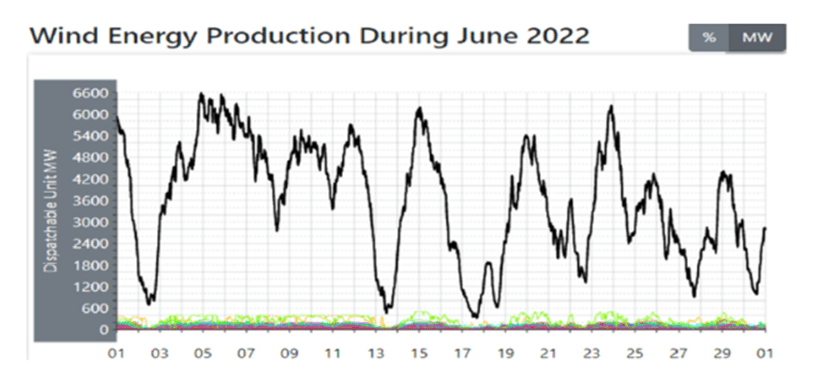
With respect to production, I believe that these data show that the New York wind resource is not particularly good.  The percentiles are shown in the first column and the data indicate that wind power is greater than 78% of the total capacity only 87 hours (99th percentile) in 2021.  Three quarters of the time the production is less than 696 MW equivalent to one third of the total capacity.  If you assume that production less than 10% is the threshold for no value then wind won’t be producing appreciable power 30% of the time.   

Discussion

These results have an important ramification for resource planning.  The existing wind facilities are spread across the state.  NYISO cannot provide individual unit generation so I cannot definitively say that those facilities are highly correlated.  However, given that half the time the total generation capacity is only 16% of the total I am sure that is the case.  As a result, that improving energy production at the lower levels requires a lot more generation capacity.  For example, at the 25th percentile the total capacity is 151.6 MW.  If planners predict we need wind generation capacity to equal 1,000 MW 75% of the time. then, based on 2021 data, the state land-based wind capacity would have to increase to 13,900 MW, over six times greater than current capacity

The key point of this article is that there are limitations to New York’s wind resource capability.  Dietmar Detering and I have corresponded about the Integration Analysis wind resource projections.  He has found that “The Integration Analysis predicts between 10,997 MW and 13,239 MW of land-based wind installed within New York by 2050, and estimates annual generation between 31,224 GWh and 37,896 GWh which corresponds to a capacity factor of about 33%.  My capacity factor table shows that the maximum state-wide capacity was 28% in 2014 and was only 22.3% in 2021.  The Climate Action Council needs to reconcile those differences.

There are a few possible explanations.  New York’s decreasing capacity factors could reflect the age of the fleet.  The Integration Analysis could reflect larger wind turbines that have higher capacity factors because they can reach higher wind speed layers.  In either case that suggests that all the New York existing land-based wind facilities need to be replaced.  There is insufficient documentation available in the Draft Scoping Plan to confirm whether the Plan assumes complete replacement.  As far as I can tell the Integration Analysis assumes “indefinite” expected lifetimes for energy storage, wind and solar infrastructure and assigns lifetimes to other resources despite the fact that renewable resource lifetimes are half that of other resources.  Given that creative bookkeeping I doubt that existing resource replacements are included in the total costs of the mitigation scenarios.

Conclusion

The Climate Act 2040 zero-emissions target will require much greater reliance on wind and solar generating resources.  Unfortunately, the authors of the Climate Act did not recognize limitations for those resources.  These results show that land-based wind in New York is not a particularly good resource.  Winter time solar is poor because of New York’s high latitude with short days in the winter and excess cloudiness downwind of the Great Lakes.   Overall, New York’s has a poor wind and solar resource capability.

It is imperative that the State conduct a detailed evaluation of renewable energy resource availability to determine the generation and energy storage requirements of the future New York electrical system.  As these results show, the annual wind resources capabilities are low. I submitted comments in March that explain that in order to ensure electric system reliability for an energy system that depends on renewable generators and energy storage, the resources available during periods of low wind and solar energy production must be known.  To date, many studies do not consider the importance of worst-case conditions on reliability planning and I believe that the Draft Scoping Plan also fails to address this issue.  The comments explained that there is a viable approach that could robustly quantify the worst-case renewable energy resources and provide the information necessary for adequate planning.