Making Climate Policy Work, RGGI, and New York Cap and Invest

One of my pragmatic interests is market-based pollution control programs.  In this post I am going to address the take on the Regional Greenhouse Gas Initiative (RGGI)  in an influential book Making Climate Policy Work.  There are also important lessons to be heeded as New York considers a Cap and Invest program.

I follow and write about the RGGI market-based CO2 pollution control program for electric generating units in the NE United States.   I have extensive experience with air pollution control theory, implementation, and evaluation having worked on every cap-and-trade program affecting electric generating facilities in New York including the Acid Rain Program, RGGI, and several Nitrogen Oxide programs. The opinions expressed in this post do not reflect the position of any of my previous employers or any other company I have been associated with, these comments are mine alone.

Making Climate Policy Work Overview

The description of the book states:

For decades, the world’s governments have struggled to move from talk to action on climate. Many now hope that growing public concern will lead to greater policy ambition, but the most widely promoted strategy to address the climate crisis – the use of market-based programs – hasn’t been working and isn’t ready to scale.

Danny Cullenward and David Victor show how the politics of creating and maintaining market-based policies render them ineffective nearly everywhere they have been applied. Reforms can help around the margins, but markets’ problems are structural and won’t disappear with increasing demand for climate solutions. Facing that reality requires relying more heavily on smart regulation and industrial policy – government-led strategies – to catalyze the transformation that markets promise, but rarely deliver.

The authors recognize the enormity of the challenge to transform industry and energy use on the scale necessary for deep decarbonization.  They write that the “requirements for profound industrial change are difficult to initiate, sustain, and run to completion.”  Because this is hard, they call for “realism about solutions.”  Cullenward and Victor recommend clear thinking and strategy as opposed to “Efforts spent tilting at ephemeral, magical policy solutions waste scarce resources that should instead be invested in things that work.”  The goal of their book is to explain how market-oriented climate policies have fallen far short and how they might be modified so that they work.

RGGI Results

One of my first posts at this blog is still in the top ten viewed articles: Academic RGGI Economic Theory of Allowance Management.  In that article I argued that economic value theory for an allowance market fails to account for the behavior of the affected sources.  In particular, the owners and operators of sources treat the allowances primarily as compliance instruments and not as financial assets.  The important difference is that the academic economic theory holds that affected sources are looking years down the road but in reality, there is no such long-term time horizon for affected sources.  Compliance entities decide to buy allowances based on their expected operations in the period between auctions or, at most, the entire 3-year compliance period including a small margin for operational variations and regulatory compliance.  Contrary to theory there is little attempt to make the allowances a profit center.

I have regularly evaluated RGGI performance on this blog.  Last December I evaluated the 2020 RGGI Investment Proceeds report that describes the results of RGGI investments over the entire region.  I found that since the beginning of the RGGI program CO2 emissions have been reduced more than 50% but that RGGI funded control programs have been responsible for only 5.6% of the observed reductions.  In late December I did a similar analysis of just the New York investment proceed results and found that in New York since the beginning of the RGGI program to 2021 CO2 emissions have been reduced 39% but the reduction was 47% until the State shutdown the Indian Point nuclear station.  The RGGI funded control programs have been responsible for only 16% of the observed reductions.  The main reason for the reductions in RGGI and New York State has been fuel switching to natural gas unrelated to RGGI.

I also recently evaluated New York’s operating plan that guides the investment of RGGI proceeds.  In the next fiscal year, the operating plan has 30 programs but only two programs claim direct CO2 reduction savings.  Over the years 2013 to 2021, the total investment for those two programs is $565 million and the claimed savings are 1,684,616 MWh and 861,442 tons of CO2e with a calculated cost benefit of $656 $/ton.  I classified each program relative to six categories of potential RGGI source emission reductions.  The first three categories cover programs that directly, indirectly or could potentially decrease RGGI-affected source emissions.  Those programs total 45% of the investments.  I also included a category for programs that will add load that could potentially increase RGGI source emissions which totals 27% of the investments.  Programs that do not affect emissions are funded with 21% of the proceeds and administrative costs total another 7%.  In summary, even though the ostensible purpose of RGGI proceeds is to reduce emissions from RGGI-affected sources, less than half of the investments expect to do so.

Even though many RGGI proponents claim the program has been a success, my work shows that depends on how success is defined.  If success is defined as significant cost-effect emission reductions from affected sources then that is not the case.  If success is defined as a functional market-based system that provides proceeds then it is a success.  There is no question the program components work well.  The misuse of RGGI funds for affected source emission reductions is not the fault of the system but the politicians who control fund disbursement. 

Making Climate Policy Work and RGGI

I wondered if this book talked about RGGI and how they rated its results relative to my analyses.  I went through the document searching for and documenting every reference to RGGI to see whether I agreed with their description and evaluation of the program.

The first chapter describes the vision and the reality of carbon reduction market-based policies.  Three example policies are described, including RGGI.  The RGGI description states:

RGGI’s vision is the most realistic and generally applicable precisely because it is the most pragmatic about what is able to be achieved. The program encompasses states with varied political interests around climate change, ranging from the highly ambitious to the cautiously engaged. It covers only the electricity sector – where the technologies for cutting emissions are most mature – with transparent and predictable program rules. Even in the power sector, however, RGGI is not the only or even main show in decarbonizing its participating states’ electric grids. Other policy programs are having a bigger impact, including state renewable portfolio standards; subsidies that keep nuclear power plants, which are prodigious suppliers of zero-carbon power, from shutting down; and other government-managed regulatory and procurement efforts all aimed at making the RGGI states’ power infrastructure less carbon-intensive. In many respects, the RGGI system represents the high-water mark for what subnational markets can do: RGGI supports the broader goal of deep decarbonization, generates discretionary revenue streams for participating governments, and increases the static economic efficiency of a policy portfolio – all in a single sector. Its benefits are clear and relatively  modest. Among purists, RGGI is often mocked because its prices are low (about $5–6 per metric ton of CO2 emissions in 2019) and coverage is limited to just one sector. We see the experience through a completely different lens: RGGI works because its architects knew what they were doing and designed a system that is politically feasible and durable.

I have slightly different takes on some of these points but overall I agree with their characterization.

The next two chapters and Chapter 5 only mention RGGI in passing.  Chapter 2: Ambition makes the case that the theory of flexible and economically efficient carbon markets should make them ideal for maximizing the effort to control carbon pollution. This chapter explains why carbon markets have failed to live up to the expectations.  The only reference to RGGI discussed the political process that underpins participation.  The RGGI framework is flexible enough so that the addition and deletion of participating states when political regimes change does not affect the viability of the overall program.  It concludes: “Firms and governments participating in RGGI know that states may come or go, with the consequences managed through an informal political process rather than a legal one.”  Chapter 3 on coverage and allocation notes that RGGI is limited to the electric sector.  Chapter 5 on offsets notes that even though offsets are allowed they have not been a factor in RGGI.  I agree with their characterizations. 

Chapter 4: Revenue and Spending delves into the disbursement of funds collected in the market.  The total RGGI cumulative auction proceeds at the time of this writing is $5,895,274,757.14 since the first auction in September 2008 so RGGI has successfully generated revenues. With regards to spending the chapter notes that “How societies spend the money raised through these sales is vital to understanding the politics of emissions trading.” 

The chapter discussion on RGGI points out that each state controls its revenue spending.  There is a graph from the 2017 RGGI proceeds investment report that describes revenue uses in three categories: general funds; revenue recycling (earmarking revenues for spending that benefits citizens); and green spending (energy efficiency, clean energy, and climate mitigation).  Given the difficulties I have had trying to interpret the RGGI proceeds reports, it is not surprising that there isn’t more detail.

The authors did pick up on some of the revenue problems in RGGI:

The RGGI program also reveals some of the political dynamics that can emerge when political leaders decide to re-purpose funds. The Governors of New York and New Jersey have both diverted RGGI revenues to the state’s general fund at points in the program’s history, raising concern from environmental NGOs and others who have supported a green spending agenda.  

In a section within this chapter titled “Why green spending becomes green pork” the authors explain that there is not much scrutiny how the money is spent.  They define pork as an expenditure that is designed to disproportionately benefit a special interest rather than the broader public good.  They claim that “the organizations that spend RGGI funds are better designed to provide more discipline and accountability on how those funds are spent” than the other example programs discussed. While that may be true with respect to RGGI as a whole, it is not the case for New York.  For example, the authors did not manage to tease out the fact from various unclear reports that New York uses RGGI funds to cover costs that were covered by general funds, i.e., a hidden diversion of revenue to the general fund.  I am sure that had the authors looked into New York’s operating plan for RGGI auction proceed expenditures they would have agreed with my conclusion that green pork is a prominent part of New York’s expenditures.

Chapter 6: Market Links discusses the “institutional challenges of managing cross-border market governance”.  With regards to RGGI I agree with their characterization:

Critically, what holds this system together is not law and the creation of robust, tradeable property rights, but rather a shared vision of parallel efforts at low levels of ambition. Design decisions are made according to the evolving political views of current and prospective participants. And because RGGI features so many parties – none of which hegemonically dominates the group’s overall agenda – the program  must be transparent and predictable. The largely egalitarian cooperation of RGGI states works because it is anchored in stability-oriented market design features that make market behavior more predictable and risk management more tractable.

Chapter 7: Getting the Most Out of Markets explains how to increase program ambition, for example, attracting more jurisdictions or setting more ambitious targets.  The RGGI discussion does a good job explaining how the program addressed an oversupply condition:

The northeastern United States’ RGGI program takes a similar approach through a pair of one-time cap adjustments, as well as a dynamic intervention that resembles the Market Stability Reserve. Like the EU ETS, RGGI experienced market oversupply conditions and very low prices in the 2010s. The situation with RGGI was more extreme, however, because this cap-and-trade program only applies to the electricity sector and the United States’ electricity sector began a profound transformation alongside (but not because of) RGGI. Not only did many of its participating states implement aggressive renewable energy and energy efficiency regulations, but also the rise of cheap natural gas from fracking dramatically accelerated the replacement of high-emitting coal-fired electricity with relatively clean natural  gas and zero-carbon renewables. Emissions have been falling steadily, despite – not because of – anemic RGGI prices. As emissions fell owing to exogenous forces, the market became oversupplied. In response, RGGI’s two cap adjustments removed almost 140 million allowances – about two years’ worth of total emissions – from the supply of allowance budgets through program year 2020.[1]

In addition to these one-time adjustments, RGGI also developed a dynamic mechanism to alter the supply of allowances.[2] This additional market feature is triggered by observed market prices, rather than the EU ETS Market Stability Reserve’s measurement of excess allowance supplies. Like the EU ETS Reserve, RGGI’s approach is two-fold: RGGI features a Cost Containment Reserve that releases 10% of the program-wide allowance budget into the market if prices reach $13 per allowance in 2021; and if prices fall below $6 per allowance in 2021, an Emissions Containment Reserve will absorb 10% of the program’s annual allowance budget and remove these allowances from circulation. When the market remains in between the two triggering prices, allowances supplies are fixed – just as in the EU ETS, where supplies are fixed so long as the total number of surplus allowances stays within a specified range. (Both triggering prices increase at 7% per year to increase ambition over time, but not even the high-end prices are significant when compared to the policy incentives supporting renewable or nuclear energy in participating RGGI states.)[3]

The final chapter is entitled “Rightsizing markets and industrial policy”.  One of the problems identified in the book is that the level of expenditures needed to implement the net-zero transition vastly exceeds the “funds that can be readily appropriated from market mechanisms”.  The chapter describes RGGI as the “the cap-and-trade system  whose design is most purely oriented around generating and spending revenue”.  The authors note that the October 2019 report “The Investment of RGGI Proceeds in 2017” indicates that New York has mobilized just $100 million per year for green spending.  My review of the latest plan to invest New York RGGI auction proceeds indicates that the design plan is supposed  to “support the pursuit of the State’s greenhouse gas emissions reduction goals”.  Of the five goals listed, only one addresses emission reductions.  The others are vague cover language to justify the use of RGGI auction proceeds as a slush fund for hiding administrative expenses and costs related to Climate Act implementation at the expense of programs that affect CO2 emissions from RGGI affected sources. 

Making Climate Policy Work and New York Cap and Invest

Governor Hochul recently announced a plan to use a market-based Cap and Invest program to raise funds for the Climate Leadership & Community Protection Act.  I submitted comments on the Draft Scoping Plan that made opposed the recommendation for such a program.  My initial impression of the Cap and Invest program is that it is more style than substance.  If I had read this book before drafting the comments or my initial impression article, I would have highlighted the findings in this book as part of my arguments against this approach.

The program public relations summary claims that “A Cap-and-Invest Program is the most feasible, efficient, and affordable method to attain a more sustainable future.”  I have been surprised by the amount of support for the plan.  At the February 14, 2023 New York Senate Environmental and Ways and Mean legislative public hearing on the 2023 executive budget the majority of the speakers supported the proposal.  I don’t think that any of the comments that support the program realize the many flaws in that proposal that are described in this book.

In my opinion, a fundamental flaw in the Scoping Plan is that it does not include feasibility analyses to determine whether the laundry list of control strategies will be feasible.  The Plan does not demonstrate that the proposed strategies will be maintain current standards of reliability and safety or can keep energy costs affordable.  This lack of analysis extends to the Cap and Invest proposal.  Proponents claim that it is the most feasible option but that is relative to a short list of options and does not necessarily mean that it will work as proposed.  The preface of the book notes the importance of feasibility:

In telling the story of how market-based climate policy works in the real world, we adopt the premise that idealized markets would be desirable if they were feasible. We hope this choice allows us to reach readers who identify strongly with the power of market forces, since we hope to change their minds. We want them to understand how political forces constrain what market-based policies can do, especially at the early stages of deep decarbonization, because wishing those forces away isn’t practical and hasn’t worked.

The Cap and Invest fact sheet notes that this program will be similar to RGGI that “has helped reduce greenhouse gases from power plants by more than half and raised nearly $6 billion to support cleaner energy solutions”.  As noted previously my analyses show that RGGI was only a minor cause of the observed emission reductions.  Chapter 1 this book also argues that RGGI is not the primary cause: “Other policy programs are having a bigger impact, including state renewable portfolio standards; subsidies that keep nuclear power plants, which are prodigious suppliers of zero-carbon power, from shutting down; and other government-managed regulatory and procurement efforts all aimed at making the RGGI states’ power infrastructure less carbon-intensive.”  Based on my work I believe fuel switching has been the primary cause of New York observed reductions but there are two aspects to consider.  The reductions were because natural gas was a cheaper alternative than coal and oil.  However, the subsidies for nuclear power plants kept emissions from rising.  That is until the State made the irrational decision to shut down 2,000 MW of nuclear power at Indian Point.  Since 2019, when the staged closure began, New York electric utility CO2 emissions have increased 5.8 million tons or 23%.

The Scoping Plan recommendation for an economy-wide strategy to address the financing and emission limitations is based on a naïve understanding of market-based programs.  Cullenward and Victor explain the reality:

Market-based policies on a planetary scale, the theory goes, would empower firms and governments with the flexibility to focus investment on the least expensive options for controlling emissions. Flexibility would reduce costs, allowing more environmental protection with fewer resources; in turn, frugality would make it easier to mobilize business and voter support for ever-deeper climate pollution reductions.

They go on to explain that this vision has completely failed:

Many pollution markets exist, but nearly all are smokescreens that create the impression that market forces are cutting emissions when, in fact, other policies are doing most of the real work of decarbonization. Almost everywhere that market systems are in place they operate at prices that are so low as to have little impact on key decisions such as whether to invest in or deploy new technologies.

The Cap and Invest solution is being marketed as both a compliance and financing tool.  The belief is that the cap will establish compliance limits and the auction will provide the funding to make the reductions.  There are issues with these tools.

The use of the cap as a binding compliance mechanism is unprecedented.  Consider, for example, the EPA Cross State Air Pollution Rule (CSAPR).  This cap-and-trade program is in place to limit nitrogen oxide (NOx) emissions in the eastern United States for ozone compliance.  There have been multiple iterations of this rule that have progressively reduced the cap.  The distinction between CSAPR and a binding cap is that EPA evaluated emissions, existing control technology, and potential improvements or additions for all the sources in the CSAPR-affected states.  The cap was determined using this control technology evaluation to set a feasible limit.  A binding cap is one chosen arbitrarily without any such feasibility evaluation.  In 2030 New York GHG emissions must be 40% lower than the 1990 baseline but this is an arbitrary target mandated by the Climate Act. 

There is another aspect of any GHG emissions reduction program.  There are no cost-effective add-on control technologies available for existing sources.  The only options available for an affected source are to change the fuel to something with lower GHG emissions, make the system more efficient, to reduce operations, or shut down.  As noted previously, New York reduced its electric system emissions significantly because of fuel switching but that strategy is tapped out for any future significant reductions.  In order to get more reductions from the electric generating system, zero-emissions resources must be deployed to displace the fossil resources.  This is particularly difficult because the loss of Indian Point’s zero emissions generation has increased recent emissions.  The control strategies are similar for all other sectors. 

Cullenward and Victor make the point that it is easier to make reductions with existing technology:

In a few places, carbon prices from market-based policies have been powerful enough to induce some changes in emission patterns – such as when firms decide whether to produce electricity from high-emission coal plants or lower-emission rivals. Those impacts, however, have nearly always involved commercially mature technologies competing in stable environments and under other highly restrictive conditions.

In order to meet the 2030 GHG emissions target technology that has not been proven commercially viable at the necessary scale is needed.  This challenge is a problem with the Climate Act deep de-carbonization targets that the Scoping Plan recommendations ignore:

On another front, what markets do best – creating transparent, marginal price signals that encourage firms and households to optimize their choices – is misaligned with the industrial challenges facing deep decarbonization today. In most sectors the world is not far along with deep decarbonization: key technologies, demonstration projects, and the emergence of new firms to back low-carbon technologies are fledgling at best (see Figure 1.2).9 Industrial firms and consumers aren’t waiting for a faint, marginal signal from markets to nudge their behavior. Instead, they need active programs to mobilize and apply resources to new technologies that, with time and effort, will launch the global process of deep decarbonization and displace incumbent industries. Well-designed market signals, at best, are good at encouraging optimization when technologies are commercially mature and strategic choices are clear – such as when the UK electricity market had a signal to select mature renewable energy technologies and gas instead of coal. The hardest challenges of deep decarbonization involve redirecting  investment toward technologies and businesses that are the opposite: beset with risk and danger for first movers. Creating those new industries requires a policy strategy – industrial policy, in effect – that is focused on the problem at hand, rather than inducing marginal changes in behavior with known technologies and production methods.

The authors address three issues related to the fact that the existing systems have failed to live up to expectations.  The first issue is related to the technology issues noted above:

We explain why idealized, “first-best” designs for pollution markets envision systems that produce high carbon prices as a powerful incentive for change. In the real world, the outcome has been the opposite: prices are low and often volatile, which undercuts the incentive to invest in ambitious new technologies and to make changes in production methods beyond those that are straightforward with few risks. First-best visions for pollution markets also imagine that markets should cover many sectors simultaneously, allow extensive interconnection with markets overseas, raise large amounts of revenue, and spend those revenues efficiently to offset distortions in the economy. On every front the real world has produced outcomes that are the opposite from theory: markets are fragmented, links are few, sectoral coverage mostly is narrow, and revenues raised are small.

Details for the proposed Cap and Invest program are sketchy but my impression from what I have heard is that it will also be the opposite of this theory.

As an alternative, the author describe how to make market-based programs more effective.  Their second issue is necessary market reforms:

Some reforms are needed to make market signals more reliable – an outcome that requires shifting away from cap-and-trade systems, where market structures create volatile prices, and toward systems where prices are managed within narrow bands. In effect, cap-and-trade systems can be made more effective when they are designed to behave more like taxes; it is no accident that the few jurisdictions with the highest prices and the greatest level of effort use taxes, not cap-and-trade. More stable prices will make it easier for firms to invest in anticipation of market signals and to build political coalitions that are supportive of that investment. Systems that are designed like taxes also perform better in the real world where market policies are implemented alongside other regulatory programs. In that setting, cap-and-trade schemes merely trade the residual and get little work done in cutting emissions – they are Potemkin markets. Tax approaches, by contrast, create a clear incentive for change (the specified tax level), which persists even as other policy instruments have big impacts on behavior as well.

This approach is basically RGGI without a binding cap.  Unfortunately, Climate Act proponents are convinced that the transition schedule is possible despite the lack of any evidence supporting evidence and that the climate crisis necessitates the aggressive schedule of the Climate Act.  Even though New York GHG emissions are less than one half of one percent of global emissions and global emissions have been increasing by more than one half of one percent per year this rationale for the Climate Act schedule is a major obstacle against this common sense approach.

In addition to the compliance mechanism the proposed Cap and Invest program is intended to provide revenues for the transition.  I have no doubts that the program will generate revenues and suspect that the Hochul Administration will decide the revenue targets based on just how much they think they can get away with rather than basing them on the results of their RGGI auction proceeds.  Cullenward and Victor address this aspect:

Our playbook for market reform offers some insights into why so many of the visions for market-oriented climate policy won’t happen under real-world political conditions. For  example, many advocates for market-based policies imagine that the adoption of market schemes will occur alongside massive policy reforms that roll back regulation. We explain why, politically and administratively, those regulatory and industrial policies are not easily rolled back. Moreover, we explain why pushing for that outcome would be a bad idea – since those other regulatory policies, in fact, are doing most of the serious work in cutting emissions.

One of the most important contributions of markets is among the least appreciated today: well-designed market schemes can raise revenue. A politically savvy strategy for market reforms requires paying closer attention to how program revenues are spent – and specifically to allocating funds to activities that will build experience with new technologies and thus also catalyze new interest groups that are supportive of accelerating deep decarbonization.

Because of the enormity of the challenge another issue is discussed.  In particular, what else is needed:

The key is to channel resources into the sectors that are critical for deep decarbonization. Rather than link all sectors together into a common market system, each must be treated independently because each has its own political economy and state of technology. In sectors where technologies are immature, industrial policy should focus on research, development, and demonstration (RD&D) in a diverse array of options – an approach that yields knowledge and also builds political coalitions around new low-carbon industries.

The New York Climate Act covers all sectors.  It may be possible to breakout the sectors based on such a recommendation.  However, the looming problem is that a binding cap will limit emissions even if the zero-emissions resources are not available to displace the existing emissions.  Carbon dioxide emissions are directly tied to fossil-fuel combustion and energy production.  If for any number of reasons, the zero-emissions are not deployed fast enough in all the sectors there won’t be enough credits available to cover the emissions necessary to provide the energy needs.  In the worst case, an electric generating unit needed to keep the lights on will refuse to operate because they have insufficient allowances. 

The obvious solution to this concern is a feasibility analysis of the schedule for technological innovations necessary to maintain affordability and reliability.  The authors suggest “Doing better requires recognizing the structural limits to what is achievable with market-based approaches – limits that are rooted in how the politics and technological opportunities are organized in each sector.”

Conclusion

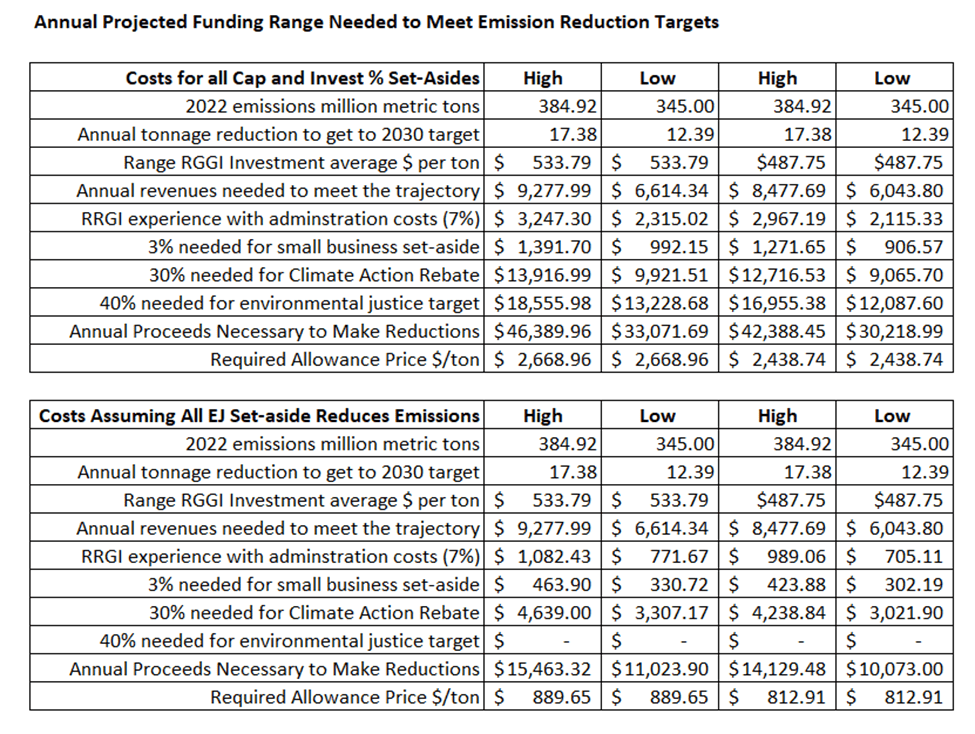
The Hochul Administration proposes a Cap and Invest program that will provide revenues and establish a compliance mechanism.  I agree with the authors that the results of RGGI and other programs suggest that the Cap and Invest proposal will generate revenues.  However, we also agree that the amount of money needed for decarbonization is likely more than any such market can bear.  The problem confronting the Administration is that in order to make the emission reductions needed they have to invest between $15.5 and $46.4 billion per year.  I don’t think that range is politically palatable.

The use of Cap and Invest as a compliance mechanism is more of a problem.  The Hochul Administration has not acknowledged or figured out that the emission reduction ambition of their Climate Act targets is inconsistent with technology reality.  Because GHG emissions are equivalent to energy use, limiting GHG emissions before there are technological solutions that provide zero-emissions energy means that compliance will only be possible by restricting energy use.  Unless a miracle occurs in 2030 when there are insufficient allowances someone has to choose who gets to operate.

This is a good book and I recommend it to anyone interested in energy and climate policy and emissions trading programs.


[1] The Regional Greenhouse Gas Initiative, “Elements of RGGI,” https://www.rggi.org/program-overview-and-design/elements; see also The Regional Greenhouse Gas Initiative, “RGGI Program Review: Summary of Proposed Changes to RGGI Regional CO2 Allowance Budget” (Nov. 21, 2013); The Regional Greenhouse Gas Initiative, “Second Control Period Interim Adjustment for Banked Allowances Announcement” (March 17, 2014).

[2] The Regional Greenhouse Gas Initiative (2014), supra note 11.

[3] New York and Illinois (the latter of which is not in RGGI) created the first zero-emission credit (ZEC) subsidy programs for nuclear energy in the United States. See Nuclear Energy Institute, “Zero-Emission Credits” (Apr. 2018). These policies were challenged in court  and ultimately upheld in two parallel cases. Coalition for Competitive Electricity v. Zibelman, 906 F.3d 41 (2nd Cir. 2018) (New York); Electric Power Supply Association v. Star, 904 F.3d 518 (7th Cir. 2018) (Illinois). Following these favorable outcomes, New Jersey (once again part of RGGI) adopted a similar program. Robert Walton, “New Jersey moves ahead on nuke subsidies, approving ZEC application process,” Utility Dive (Nov. 21, 2018). For an overview of state renewable energy policies, see Galen L. Barbose, “US Renewables Portfolio Standards: 2019 Annual Status Update,” Lawrence Berkeley National Laboratory (2019), https://emp.lbl.gov/projects/renewables-portfolio.

New York Annual Climate Act Cap and Invest Revenue Targets

One of the biggest questions related to Governor Hochul announced plan to use a market-based program to raise funds for the Climate Leadership & Community Protection Act (Climate Act) is the revenue target.  I incorporate the latest 2020 GHG emissions inventory data and some other bits of information to follow up on a couple of earlier posts that addressed this issue. 

I submitted personal comments on the Climate Act implementation plan and have written over 280 articles about New York’s net-zero transition because I believe the ambitions for a zero-emissions economy embodied in the Climate Act outstrip available renewable technology such that the net-zero transition will do more harm than good.  I also follow and write about the Regional Greenhouse Gas Initiative (RGGI) market-based CO2 pollution control program for electric generating units in the NE United States.   Before I retired I had extensive experience with air pollution control theory, implementation, and evaluation having worked on every cap-and-trade program affecting electric generating facilities in New York including the Acid Rain Program, RGGI, and several Nitrogen Oxide programs. The opinions expressed in this post do not reflect the position of any of my previous employers or any other company I have been associated with, these comments are mine alone.

Background

The first related article I posted gave my initial impression of the New York cap and invest program.  That post gives background information on the Climate Act’s  economy-wide strategy and my overarching concerns.  I explained that I had evaluated New York’s RGGI auction proceeds funding status report and found that the projected costs of the current programs are $776.1 million, the net greenhouse gas emission savings are 1,656,198 tons and that works out to emission cost per ton removed of $469.  If all the RGGI administrative and operating costs are included another $113 million is added to the total and the emissions cost per ton removed is $537 per ton.   I also evaluated existing emissions and the reduction trajectory necessary to meet the 2030 Climate Act emissions target.  Those numbers will be updated in this post.  The post also lists some practical considerations that should be a concern for this initiative.

The second related article determined different annual revenue targets.  I determined the emissions reduction trajectory needed to meet the 2040 GHG emissions target, calculated the control cost per ton removed based on the RGGI auction proceed investments, and found that a total of $7.9 billion per year is needed.  That is the low-end cost of the projections.  At the upper end three projections exceed $45 billion a year.  I will update those projections below.

New York GHG Emissions

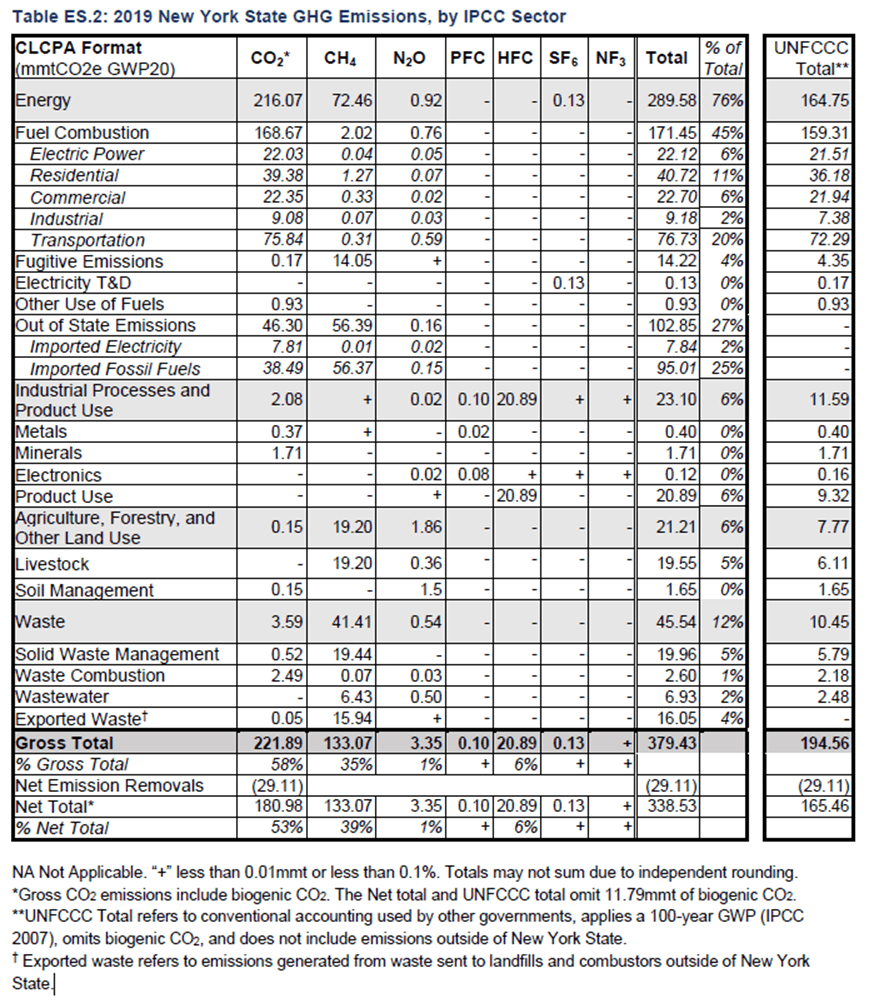
In order to understand the challenge it is necessary to know where we stand for our GHG emissions.  The following table (the link is to the full table because I cannot figure out how to make tables in the text get bigger when a reader clicks on it) lists the New York State GHG emissions (MMT CO2e AR5 20 yr) by sector from the DEC emissions inventory .  It also includes the annual change in emissions since 1997.

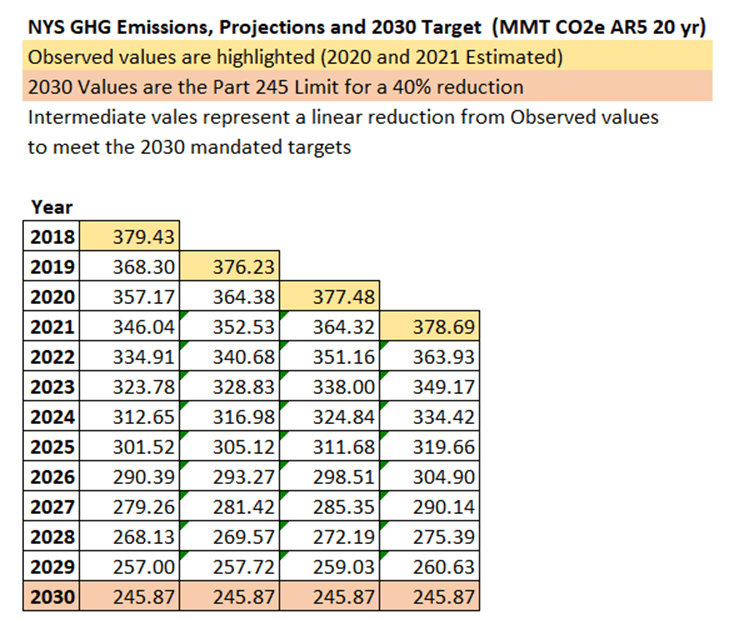
I evaluated current emissions relative to the 2030 Climate Act target of a 40% reduction by 2030.  The following table lists the trajectory of observed, projected, and interpolated emissions consistent with the 2030 requirement to reach 245.87 million metric tons of CO2e.   New York State has released the official GHG emissions for New York State for 2018, 2019, and 2020 and they are highlighted in gold.  I estimated emissions for 2021 and 2022 using the observed electric generating unit emissions and historical averages for other sectors.  Note that emissions increase due to the shutdown of the Indian Point nuclear generating facility.  The 2030 levels are fixed and are highlighted in rose. There are six columns that list the emissions trajectory necessary to get from the observed emissions (gold) to the target.  The annual reduction in the trajectory is the difference between the observed emissions and the 2030 target divided by the number of years.  For example, the estimated GHG emissions in 2021 were 381 million metric tons. If the emissions are reduced by 15 million tons per year, then in 2030 the emissions will meet the target of 245.87 million metric tons.  Two projections are listed for 2022 that give bounds to the reductions necessary.  One uses the estimated emissions and the other assumes that total state GHG emissions stay constant between 2020 and 2022. 

Ostensibly the goal of the cap and invest program is to generate the revenues necessary to make the required reductions.  The following table uses the range of 2022 emission estimates (384.92 and 345 million metric tons of CO2e) and the range of cost per ton reduced ($533.79 and $487.75) to place bounds on the required reduction costs.  If the assumption is made that all the reduction costs will be financed by auction proceed investments, then the annual revenue needed for the high bound is $9.278 billion and the low bound is $6.044 billion.  That assumes that all the money collected is invested.  However, Hochul announced that there would be a Climate Action Rebate of 30%.  In order to maintain the revenue needed to meet the emission targets that means that the total collected has to increase from $9.278 billion to $12.254 billion increasing the cost per ton reduced to $763.  In addition, she announced another 3% for small businesses and, this being New York, I assume that the administrative costs will be the same as the 7% as in RGGI.  Incorporating those costs raises the total needed to between $15.463 million and $10.073 billion.  That assumes that all the environmental justice targeted money can be invested in reductions that benefit environmental justice communities.  If the interpretation of the 40% for environmental justice communities is in addition to the investments needed to meet the reduction targets, then the annual totals increase between $46.390 billion and $30.219 billion.

There are a couple of other potential annual revenue target methodologies.  The clearing price at the last RGGI auction was $12.99 and assuming that 385 million allowances were auctioned off the revenues would be $5 billion.  The highest auction clearing price would increase revenues to $5.35 billion.  Keep in mind that that the allowances auctioned will decrease over time so this is the upper bound.  In addition, there are mandates for set asides so that is not a true reflection of the number of allowances that would be auctioned.  The annual reductions could also be set to the NYS Value of Carbon which is set at $129 in 2025 and $172 in 2050.  The estimates for those revenues range between $1.6 and $3.0 billion.

Discussion

The sectors affected by the Climate Act Cap and Invest Program are most interested in the revenue target for the auction.  Regulatory staff claim that they are interested in the emission reductions and not the revenues which would argue for setting the cap at a defensible value that could provide the reductions necessary.  There are many issues with this simple approach.  It is assumed that there are no other sources of funding to make the reductions.  It also assumes that the cost per ton reduced is constant but control programs will increase as control efficiencies necessarily get tighter.  There are also issues with how the EJ set-aside is invested and how much money is used for administration.

Conclusion

There is no clear and obvious revenue target.  As with all GHG market-based control programs the real concern is that the costs necessary to make reductions are so high that they exceed the Value of Carbon and the likely limits of the public’s willingness to pay.

There is another concern.  The Scoping Plan requires an ambitious emission reduction trajectory.  Because there are no cost-effective control options for GHG emissions, the reductions will have to come from indirect displacement of fossil-fired energy use or simply reducing fossil-fuel use.  The ultimate compliance control strategy is stop operating when there are no allowances available to be had.  Energy demand is inelastic so there will be interesting times ahead as this plays out.

Climate Act Scoping Plan Toolkit

The Climate Leadership & Community Protection Act (Climate Act) website was extensively revised at the start of 2023.  It includes a link for the Scoping Plan Toolkit which is described as “resource to help community and partner organizations” with specific “resources to facilitate conversations about New York’s climate work.”  As I was working on an article about the cap and invest program I noticed that there were two fact sheet pdf files for cap and invest: Cap-and-Invest One Pager [PDF] and Cap-and-Invest vs. Cap-and-Trade vs. Carbon Tax [PDF].  This is a short post about the new format of the website and the cap and invest “toolkits”.

The opinions expressed in this post do not reflect the position of any of my previous employers or any other company I have been associated with, these comments are mine alone.

Climate Act Website

The Climate Act website was revised at the start of 2023.  Now it is a public relations site to sell the Climate Act.  It has been revised so that it is more accessible to smart phones with large text fonts and splashy graphics.  The main internal links cover “Our Impact”, “Get Involved”, News & Events”, “Resources” and “Partner Toolkit”.  I list the links within each of these categories below:

“Our Impacts”

“Get Involved”

“News & Events”

“Resources”

“Partner Toolkit” Fact Sheets

There is blog post fodder in every one of these links. For example, the lead for the Addressing Energy Affordability Concerns link says “As energy prices rise, we must power our future focused on clean and renewable resources.”  Not included in the platitudes and talking points within the link is a reference to the experience of any jurisdiction that has pushed the use of wind and solar resources over fossil fuel that has actually lowered consumer bills.  It is all flash and style for pushing the narrative without substance. 

Cap and Invest Toolkit Fact Sheets

This post is going to introduce issues associated with the cap and invest toolkits.  There are two fact sheets for the cap and invest program:  Cap-and-Invest One Pager [PDF] and Cap-and-Invest vs. Cap-and-Trade vs. Carbon Tax [PDF].  When I first started looking at these resources. I found that they both linked to the cap and invest program one pager.  I alerted a contact I have known for years because there is no contact on the web pages.  The next morning the link to the Cap-and-Invest vs. Cap-and-Trade vs. Carbon Tax  was changed so someone else caught the problem.  I also question the label of the one pager document. The author’s interpretation is that a one pager means two sides of one page.  I think the generally accepted implication is to condense the summary to a single page.

I am going to do a more detailed post on the cap and invest plan toolkits but for now I just want to make one point.  Both fact sheets extoll the virtues and success of the Regional Greenhouse Gas Initiative (RGGI) cap and invest program.  New York utilities have been covered by that program since 2009 and New York agencies never lose the opportunity to claim that it has been a success.  I have been involved in the RGGI program process since its inception and have written many articles about the details of the RGGI program.

In early December I evaluated the 2020 RGGI Investment Proceeds report that describes the results of RGGI investments over the entire region.  I found that since the beginning of the RGGI program CO2 emissions have been reduced more than 50% but that RGGI funded control programs have been responsible for only 5.6% of the observed reductions.  The main reason for the reductions has been fuel switching to natural gas.  When the sum of the RGGI investments is divided by the sum of the annual emission reductions the CO2 emission reduction efficiency is $818 per ton of CO2 reduced. 

In late December I did a similar analysis of just the New York investment proceed results.  I found that in New York since the beginning of the RGGI program CO2 emissions have been reduced 39% in 2021 but the reduction was 47% until the State shutdown the Indian Point nuclear station.  The RGGI funded control programs have been responsible for only 16% of the observed reductions.  The main reason for the reductions has been fuel switching to natural gas.  When the sum of the RGGI investments is divided by the sum of the annual emission reductions the CO2 emission reduction efficiency is $565 per ton of CO2 reduced. 

I conclude that RGGI is not an effective CO2 emission reduction program and that because the emission reduction efficiency of the RGGI investments is far greater than any social cost of carbon metric yet proposed that the investments are not cost-effective.  RGGI success is the eye of the beholder.

New York Annual Climate Act Investment Requirements

I recently described my initial impression of the New York cap and invest program  and noted that it was not clear what the target revenue cap would be.  This post looks at some alternative revenue projections.

I submitted comments on the Climate Act implementation plan and have written over 270 articles about New York’s net-zero transition because I believe the ambitions for a zero-emissions economy embodied in the Climate Act outstrip available renewable technology such that the net-zero transition will do more harm than good.  I also follow and write about the Regional Greenhouse Gas Initiative (RGGI) market-based CO2 pollution control program for electric generating units in the NE United States.    I have extensive experience with air pollution control theory, implementation, and evaluation having worked on every cap-and-trade program affecting electric generating facilities in New York including the Acid Rain Program, RGGI, and several Nitrogen Oxide programs. The opinions expressed in this post do not reflect the position of any of my previous employers or any other company I have been associated with, these comments are mine alone.

Climate Act Background

The Climate Act established a “Net Zero” target (85% reduction and 15% offset of emissions) by 2050. The Climate Action Council is responsible for the Scoping Plan that outlines how to “achieve the State’s bold clean energy and climate agenda.”  In brief, that plan is to electrify everything possible and power the electric gride with zero-emissions generating resources by 2040.  The Integration Analysis prepared by the New York State Energy Research and Development Authority (NYSERDA) and its consultants quantifies the impact of the electrification strategies.  That material was used to write a Draft Scoping Plan that was revised in 2022 and the Final Scoping Plan  was approved on  December 19, 2022.  Unfortunately, the revisions only addressed the language of the draft plan and not the substance of the numbers used from the Integration Analysis.

Investment Projection

My initial impression of the New York cap and invest program post calculated a revenue projection for the proposed cap and invest program.  From 2025 to 2030 I estimate that emissions will have to go down 14.76 million tons per year to meet the 2030 GHG emissions target.  New York’s investments in the Regional Greenhouse Gas Initiative yield an expected cost per ton reduced of $537 for a total of $7.9 billion.  Governor Hochul proposed “legislation to create a universal Climate Action Rebate that, subject to a stakeholder and rulemaking process, is expected to drive more than $1 billion in annual cap-and-invest proceeds to New Yorkers”.  If the $1 billion is added then the total revenues would be $9 billion per year.

Scoping Plan Cost Projection

The primary documentation for the numbers presented in the Scoping Plan is the Tech Supplement Annex 2. Key Drivers Outputs spreadsheet. The Scoping Plan has been described as a “true masterpiece in how to hide what is important under an avalanche of words designed to make people never want to read it.”  The spreadsheet is worse.  Not only is the information provided buried in a massive spreadsheet but the authors of the Integration Analysis presented misleading, inaccurate, and biased data to support the narrative that the costs of inaction are more than the costs of action. I have extracted the relevant tabs from the massive reference spreadsheet into my analysis spreadsheet to address the first concern.

The data in the Integration Analysis that is used in the Scoping Plan is misleading.  On one hand as many numbers are possible are only provided relative to a Reference Case instead of a status quo or business-as-usual case that represents the full costs of the control strategies necessary to meet the net-zero by 2050 Climate Act goal.  I maintain that the true cost of New York’s net-zero transition by 2050 should include all costs associated with all programs designed to reduce GHG emissions.  The authors of the Integration Analysis and Scoping Plan excluded decarbonization costs that I believe should be included and provided insufficient documentation to enable anyone to determine what is in or out of the Reference Case.  For example, consider the supporting data for Figure 48 (Fig 48 tab in my spreadsheet). 

Note the transportation investments in the Reference Case total $1.056 trillion but that the cost for the Low-Carbon Fuels scenario is only $3.4 billion more.  That means most of the costs associated with capital and operating expenses for light-duty vehicles, medium- and heavy-duty vehicles, and buses as well as charging infrastructure costs are buried in the Reference Case because these costs are a lot more than $3.4 billion.

The cost data in the Integration Analysis that is used in the Scoping Plan is inaccurate.  For example, in the calculations for the new wind, solar, and energy storage resources needed to replace existing fossil-fired resources it is assumed that none of the existing or newly developed resources reach their effective life expectancy.  Wind, solar, and energy storage resources all have expected lifetime less than 25 years and it is more than 25 years to 2050 so this inaccurately underestimates the cost of electric generation.

The data in the Integration Analysis that is used in the Scoping Plan is biased.  Wind and solar resources are intermittent so the assumption of the amount of energy produced affects the projected capacity of resources needed.  Without exception the future amount of energy from wind and solar resources is biased high relative to the New York Independent System Operator projections.  As a result, the costs projected are unreasonably low.  Based on my evaluation the Integration Analysis biased every choice to make the zero-emissions replacement resources cheaper.

I emphasize that the annual revenue numbers that I believe should be clearly listed in the Integration Analysis and Scoping Plan are not provided so I can only make an estimate.  Given all the limitations described above, the revenue values in the final row in the Figure 48 table shown above should be used cautiously.  The annual expenditure values listed are the difference between the mitigation scenarios and the Reference Case divided by the number of investment years (27) from 2024 to 2050.  The values range between $10 and $11 billion.

Other Cost Projections

I have heard other numbers tossed around so I did a bit of research to find other values.

In testimony regarding the environmental provisions of Governor Cuomo’s Executive Budget Proposal for SFY 2020-2021, Peter Iwanowicz, Executive Director, Environmental Advocates of NY, January 27, 2020 stated:

The costs of inaction are enormous. Based on the widely accepted social cost of carbon pollution of $50 per ton, New York has $10.2 billion dollars in costs per year attributed to the pollution we emit that is fueling climate change. This is a staggering blow to our health, our environment, our communities, and our economy.

Back calculating this projection assumes 204 million tons which is about the total CO2 emissions for 2017.  The problem is that social cost of carbon parameter can only be applied once because it represents all the impacts from the time of the reduction to 2300.  Counting them more than once is the same as claiming that because I lost ten pounds five years ago that I lost 50 pounds.

New York Lawyers for the Public Interest Nov. 8 Elections show that New Yorkers Overwhelming Support Climate Funding:

The Bond Act is a good start—but it’s not enough. It’s been three years since New York passed our landmark climate law, the Climate Leadership and Community Protection Act (CLCPA), and we’re far from achieving the law’s mandate of largely decarbonizing the state economy by 2040. The state’s own analysis shows that we’ll need to invest roughly $15 billion a year by 2030, and $45 billion a year by 2050.

The Integration Analysis does include annual projections for net direct costs of between $10.4 and $12.2 billion for 2030 and between $41.0 and $41.3 billion in 2050.

New York Renews: Climate Coalition launches campaign for state action

Among NY Renews’ key goals for the upcoming legislative session is the creation of a $10 billion Climate and Community Protection Fund, modeled after the state’s Environmental Protection Fund. It’s an amount in line with the Climate Action Council’s estimates of what meeting the goals in the climate plan will cost: $10 to 15 billion a year, whether the costs are paid by the state, the federal government, industry, ordinary New Yorkers, or a mix of all of the above.

There are enough options for guessing what the Council estimates as costs that these numbers are consistent.

I found a couple of independent estimates of the total costs to meet the net-zero target by 2050: An article by Ken Gregory critiques a report  by Thomas Tanton “Cost of Electrification: A State-by-State Analysis and Results”.  In Tanton’s analysis the estimated total installed cost (overnight) is approximately for New York is $1.465 trillion or $54.3 billion per year.  Gregory’s total national capital cost of electrification is $433 trillion and New York’s proportional share based on Tanton is $22.2 trillion.  Overbuilding solar and wind by 21% reduces New York overall costs to $18.2 trillion.  Allowing fossil fuels with carbon capture and storage to provide 50% of the electricity demand reduces New York’s estimated costs to $1.2 trillion or $44.4 billion per year.

Conclusion

The New York Senate held a public hearing to examine legislative and budgetary actions necessary to implement the Climate Act Scoping Plan on January 19, 2023.  One of the primary concerns of the legislative and budgetary actions has to be how much money is required.  I modified the draft of this post to submit as a comment.  The main point I wanted to make is that it is very important that the Legislature understand that the numbers presented in the Scoping Plan are inappropriate for any future legislative actions.  Those actions must be based on the total costs of implementation and not just the costs relative to a Reference Case.  Beyond that I offered no substantive recommendation for revenues needed because of the inadequate documentation in the Scoping Plan.

I determined the emissions reduction trajectory needed to meet the 2040 GHG emissions target, calculated the control cost per ton removed based on the RGGI auction proceed investments, and found that a total of $7.9 billion per year is needed.  That is the low-end cost of the projections.  At the upper end three projections exceed $45 billion a year.  All these estimates will impose extraordinary cost burdens on New Yorkers.  No one in the Hochul Administration has owned up to these costs.  When will this news become public knowledge?

Finally, all the cost per ton reduced estimates in these projections exceed the New York State Value of Carbon guidance.  The Frequently Asked Questions guidance states:

The term value of carbon is any representation of monetary cost applied to a unit of greenhouse gas emissions, expressed in terms of the net cost of societal damages (i.e., the “social cost of carbon”), marginal greenhouse gas abatement cost, or using another approach. DEC recommends that State agencies use a damages-based value of carbon for cost-benefit analysis, for describing societal benefits, and evaluating other types of decisions, such as state procurement, contracts, grants, or permitting.

This means that all these projected costs exceed the cost-benefit analysis for describing societal benefits.  New York’s greenhouse emissions are less than one half of one percent of global emissions and global emissions have been increasing by more than one half of one percent per year.  The facts that the expected investments exceed the societal benefits values and that all New York emission reductions will be replaced by emissions from elsewhere in a year does not mean that we should not do something, but it does mean we should take the time to do it right. 

Initial Impression of New York Cap and Invest Program

On January 10, 2023 New York Governor Kathy Hochul delivered her 2022 State of the State Address. This post describes my initial impressions of the announced plan to use a market-based program to raise funds for the Climate Leadership & Community Protection Act (Climate Act) implementation.  I believe that this will be a future textbook example of how perverting the previously successful concept of a market-based pollution control program to fit the ideological purposes of a political agenda inevitably leads to failure.

I submitted comments on the Climate Act implementation plan and have written over 270 articles about New York’s net-zero transition because I believe the ambitions for a zero-emissions economy embodied in the Climate Act outstrip available renewable technology such that the net-zero transition will do more harm than good.  I also follow and write about the Regional Greenhouse Gas Initiative (RGGI) market-based CO2 pollution control program for electric generating units in the NE United States.    I have extensive experience with air pollution control theory, implementation, and evaluation having worked on every cap-and-trade program affecting electric generating facilities in New York including the Acid Rain Program, RGGI, and several Nitrogen Oxide programs. The opinions expressed in this post do not reflect the position of any of my previous employers or any other company I have been associated with, these comments are mine alone.

Climate Act Background

The Climate Act established a “Net Zero” target (85% reduction and 15% offset of emissions) by 2050. The Climate Action Council is responsible for the Scoping Plan that outlines how to “achieve the State’s bold clean energy and climate agenda.”  In brief, that plan is to electrify everything possible and power the electric gride with zero-emissions generating resources by 2040.  The Integration Analysis prepared by the New York State Energy Research and Development Authority (NYSERDA) and its consultants quantifies the impact of the electrification strategies.  That material was used to write a Draft Scoping Plan that was released for public comment at the end of 2021 and approved on   December 19, 2022. 

The Final Scoping Plan noted:

The Climate Action Council (Council) has identified the need for a comprehensive policy that supports the achievement of the requirements and goals of the Climate Act, including ensuring that the Climate Act’s emission limits are met . A well-designed policy would support clean technology market development and send a consistent market signal across all economic sectors that yields the necessary emission reductions as individuals and businesses make decisions that reduce their emissions. It would provide an additional source of funding, alongside federal programs, and other funding sources, to implement policies identified in this Scoping Plan, particularly policies that require State investment or State funding of incentive programs, including investments to benefit Disadvantaged Communities.  Equity should be integrated into the design of any economywide strategy, prioritizing air quality improvement in Disadvantaged Communities and accounting for costs realized by low- and moderate income (LMI) New Yorkers. Pursuant to the Climate Act, a policy would be designed to mitigate emissions leakage. Finally, an economywide strategy would be implemented as a complement to, not as a replacement for, other strategies in the Scoping Plan. A well-designed economywide program will bring about change in the market and promote equity in a way that does not unduly burden New Yorkers or with the global economy.

It is no surprise that the Scoping Plan recommends a market-based program.  New York was a primary driver for RGGI and has consistently touted its success.  However, the reality is that RGGI is not as successful as they claim.  I will explain why the experiences of RGGI should be warning signs for this program.  If you are interested in a good overview of Hochul’s cap and invest program I recommend James Hanley’s article: Cap and Invest or Cap and Divest.

Comments on the Draft Scoping Plan Economy-Wide Strategy

I submitted comments on the Draft Scoping Plan chapter on a market-based approach to provide an additional source of funding for policies that “require State investment or State funding of incentive programs, including investments to benefit Disadvantaged Communities”.  I will summarize some of my overarching concerns in this section.

My comments described general issues for a carbon pricing market-based approach.  One major difference between controlling CO2 and other pollutants is that there are no cost-effective control technologies that can be added to existing sources to reduce emissions.  Combine that with the fact that  CO2 emissions are directly related to energy production, the result is that the primary way to reduce emissions is to reduce operations.  Consequently, CO2 emission reductions require replacement energy production that can displace existing production.  This necessarily increases costs to consumers and is why I believe carbon pricing will always be a regressive tax. 

There are other practical reasons that carbon pricing will not work as theorized.  Leakage is an insurmountable problem.  Pollution leakage refers to the situation where a pollution reduction policy simply moves the pollution around geographically rather than reducing it.  Ideally the carbon price should apply to all sectors across the globe so that leakage cannot occur. Preventing leakage in an area as small as New York is impossible because, for example,  car owners on the border will simply cross the border to purchase fuel.   A fundamental problem with all carbon pricing schemes is that funds decrease over time as carbon emissions decrease unless the carbon price is adjusted significantly upwards over time.  The Regulatory Analysis Project (RAP) recently completed a relevant study: Economic Benefits and Energy Savings through Low-Cost Carbon Management for Vermont that concludes “carbon pricing alone will be a weak tool to deal with the realities of consumer behavior, our historic buildings infrastructure, rural settlement patterns, and the many barriers that working families and businesses face in choosing to invest in energy efficiency or other low-carbon options”.  Based on investment results for RGGI proceeds, the programs funded are not cost-effectively reducing emissions.  The Climate Act mandate for funding in Disadvantaged Communities will exacerbate that issue because cost-effectiveness will not be a primary consideration.

In addition to my practical concerns “A Practical Guide to the Economics of Carbon Pricing by Ross McKitrick defines how carbon pricing is supposed to work in theory.  His guide is at odds with the Final  Scoping Plan for every point.  He explains that “First and foremost, carbon pricing only works in the absence of any other emission regulations”, but the cap and invest program proposed by Hochul is in addition to the emission regulations of the Climate Act itself. The Guide goes to note “another important rule for creating a proper carbon-pricing system is to be as careful as possible in estimating the social cost of carbon”. He argues that “whatever the social cost of carbon is determined to be, the carbon price must be discounted below it by the marginal cost of public funds (MCPF) — that is, the economic cost of the government raising an additional dollar of tax, on top of what is already being raised”. The Scoping Plan does not even recognize the importance of this aspect of carbon pricing.  He concludes: “There may be many reasons to recommend carbon pricing as climate policy, but if it is implemented without diligently abiding by the principles that make it work, it will not work as planned, and the harm to the Canadian economy could well outweigh the benefits created by reducing our country’s already negligible level of global CO2 emissions.”  Substitute New York for Canada and I believe this describes this Hochul’s cap and invest program.

Results of the Existing Cap and Invest Program

New York fossil-fired electric generating stations are already in a cap and invest program.  I previously mentioned that I have evaluated the RGGI program.  This section describes the results of that work especially as they relate to the proposed program.

The costs per ton reduced exceed any estimates of the societal value of carbon reductions.  Since 2009 when the RGGI program started, I found that the cost per ton removed of the investment proceeds from RGGI auctions is $818 per ton for the entire RGGI region.  According to the latest NYSERDA RGGI funding status report the projected costs of the current programs are $776.1 million, the net greenhouse gas emission savings are 1,656,198 tons and that works out to emission cost per ton removed of $469.  If all the RGGI administrative and operating costs are included another $113 million is added to the total and the emissions cost per ton removed is $537 per ton.   It is not clear to me how much of this funding meets the criteria for disadvantaged community investments.

I evaluated current emissions relative to the 2030 Climate Act target of a 40% reduction by 2030.  The following table lists the trajectory of observed, projected, and interpolated emissions consistent with the 2030 requirements.  New York State has released the official GHG emissions for New York State for 2018 and 2019 and they are highlighted in gold.  I estimated emissions for 2020 and 2021 based on observed RGGI emission levels.  Note that they increase due to the shutdown of the Indian Point nuclear generating facility.  The 2030 levels are fixed and are highlighted in rose. There are four columns that list the emissions trajectory necessary to get from the observed emissions to the target.  The annual reduction in the trajectory is the difference between the observed emissions and the 2030 target divided by the number of years.  For example, the estimated GHG emissions in 2021 were 378.69 million metric tons. If the emissions are reduced by 14.76 million tons per year, then in 2030 the emissions will meet the target of 245.87 million metric tons.

The emissions reduction trajectory of 14.76 million tons per year is  going to be a challenge.  The following table (the link is to the full table because I cannot figure out how to make tables in the text get bigger when a reader clicks on it) lists the New York State GHG emissions (MMT CO2e AR5 20 yr) by sector from the DEC emissions inventory .  There have been years when the annual reductions have exceeded that trajectory but there have also been years when it went up by that much.  RGGI has a three-year compliance period intended to smooth out the inter-annual variation.  Whether the compliance period for the Climate Act program will do something similar is one of those details that remains to be worked out.

I think the fundamental cap-and-invest program issues that New York energy users and suppliers will have to deal with this year is the disconnect between the theory of cap and trade with what is proposed, the practical considerations necessary to make it work, and the preconceived notions of the environmental community. 

There are two fundamental issues.  The theory of market incentives is that raising the cost of carbon will let the market innovate to produce the least cost approach to provide carbon reductions.  That takes time and that makes the schedule problematic. It may not be possible for the innovation necessary to replace a system that took decades to build to coincide with the 27-year arbitrary schedule of the Climate Act net-zero by 2050 target.  The other fundamental theoretical issue looms huge.  The state is going to “invest” the proceeds.  Government investments pick winners and losers and governments don’t have a good record in that regard.

The second overall concern is the practical considerations necessary to make any market-based program  work.  At the top of that list is emissions monitoring.  In the RGGI cap-and-invest program there were minor monitoring implementation issues because all the affected sources were already providing the data necessary to run the program. Hochul’s cap-and-auction program affects distributors of heating and transportation fuels and large-scale emitters of greenhouse gasses outside the electric utility industry that are not in similar programs so they have to create a new reporting system.  The program is going to have to determine how to define compliance and establish penalties for failure to comply.  Every sector has the issue of weather-related variations in energy use.  The RGGI program addressed that with a three-year compliance period.

The biggest practical concern is the revenue target.  The New York State value of carbon guidance cost ranges between $121 per ton in 2020 and $137 per ton in 2030.  That could be used as the auction allowance price target.  Presumably the auction will use the same features as in RGGI that establish boundary limits to keep the price near the target.  The potential revenues using the emissions trajectory and the New York value of carbon yields a little over $40 billion in 2024 and $34 billion in 2030.  According to the Citizen’s Budget Commission New York State’s personal income tax revenues were $47.1 billion in state fiscal year 2015-2016.  I cannot imagine that the DEC and NYSERDA will use regulations to propose a cap-and-invest revenue scheme that is on the order of the leading source of tax revenue.  One alternative possibility is to calculate the money needed to get the 14.76 million tons per year reductions required by multiplying it by the observed $537 per ton reduction cost from RGGI investments.  That total of $7.9 billion divided by the 2025 emissions, 320 million tons, yields a target allowance cost of $24.76.  That is a more reasonable value that may enable the Hochul Administration to avoid legislation for the program.

There are other practical considerations that mostly add funding and effort.  All affected entities must provide consistent emissions data and the State has to develop a new system to track that information.  There is a significant logistical effort for entities to participate in the auctions that must include another tracking system.  It is necessary to setup a market monitoring presence so someone is making sure that there isn’t market manipulation going on.

The last practical considerations are more of a problem.  New York’s Climate Act mandates that upstream emissions must be considered.  How is a fuel distributor supposed to keep track of where and how his fuel is coming from?  Hochul’s speech claims that New York wants to get other states involved but New York’s unique emissions requirements would require other states to adopt them too.

The final concern is the response of environmental advocates to market-based programs.  As far as I can see, they oppose these programs because evil industry is not punished enough. In order to push their notion that zero-risk pollution control approaches are the only consideration and there are no tradeoffs, they have a list of market program talking points.  Emission trading programs create hot spots because some locations don’t decrease their emissions as much as others.  There is a persistent suspicion that somehow industry cheats on the emissions monitoring.  Finally, they think that industry is getting windfall profits from these programs.  As a result, more and more limitations are added to the program making is less and less efficient.

Hochul’s announcement specifically included environmental justice complications.  Offsets are not allowed because sources would not make reductions near some disadvantaged community. Recall that CO2 emission reductions require replacement energy production that can displace existing production.  If New York State investments do not provide sufficient displacement results then there will be a scarcity of allowances and the price of allowances will go up.  In the RGGI program there was a feature that released extra allowances if the price exceeded an acceptability threshold.  I suspect that the environmental advocates will oppose adding allowances to the system because it threatens the response to the “existential crisis.”  The problem is that if allowances are not available then the only compliance option left is to not operate which could threaten reliability.  I have seen no sign the environmental advocates recognize this threat.

Another issue is the requirement to invest at least 35 percent with a goal of 40 percent, so they directly benefit disadvantaged communities.  I fear that this means that program funding is going to be more based on consistency with this mandate and not cost-effectiveness.  There are 15 programs listed in the latest NYSERDA RGGI funding status report that have cost and GHG emission savings estimates.  As noted above, the sum of the costs divided by the tons reduced is $537 per ton, but the cost per ton reduced for the 15 programs ranges from $61 to $2,515 with a standard deviation of $681.  If programs are chosen in the upper end of the costs per ton reduced to favor politically connected constituencies then it will be more difficult to meet the aggressive schedule and ambitious annual reduction targets of the 40% reduction in GHG emissions by 2030 mandate.

The final environmental justice issue is that Governor Hochul will “propose legislation to create a universal Climate Action Rebate that, subject to a stakeholder and rulemaking process, is expected to drive more than $1 billion in annual cap-and-invest proceeds to New Yorkers”.  I previously estimated that the cost of the investments to meet the necessary reduction trajectory would be $7.9 billion.  Presumably we must increase that cost by more than $1 billion to cover the cost of the Climate Action Rebate so I choose the cost to be $9 divided by the 2025 emissions, 320 million tons, which yields a target allowance cost of $28.13.  I guess that is still a reasonable value that may enable the Hochul Administration to avoid legislation for the program.

Conclusion

The Final Scoping Plan states that “A well-designed policy would support clean technology market development and send a consistent market signal across all economic sectors that yields the necessary emission reductions as individuals and businesses make decisions that reduce their emissions”. I conclude that the conditions noted in the Hochul speech preclude such a “well-designed” policy.

The Scoping Plan states that “Equity should be integrated into the design of any economywide strategy, prioritizing air quality improvement in Disadvantaged Communities and accounting for costs realized by low- and moderate income (LMI) New Yorkers”.  It is not clear how they propose to prioritize air quality improvements in any particular location in a statewide emissions market.  You can say it but that does not mean you can do it.  The costs for LMI New Yorkers are addressed with a Climate Action Rebate that simply passes costs along to everybody else.

The Scoping Plan notes that “Pursuant to the Climate Act, a policy would be designed to mitigate emissions leakage.”  Again, it is easy to say that it will mitigate leakage but how can it possibly be tracked, much less be prevented.  James Hanley addresses this issue well in his critique

The plan goes on to say that “an economywide strategy would be implemented as a complement to, not as a replacement for, other strategies in the Scoping Plan” and that “A well-designed economywide program will bring about change in the market and promote equity in a way that does not unduly burden New Yorkers or with the global economy.”  The theory is fine but the theory is raise the price of carbon, return all the proceeds to the consumers, and let the market evolve over time to the least-cost emission reduction solutions.  That is not what is proposed.

Hochul’s address stated that “New York’s Cap-and-Invest Program will draw from the experience of similar, successful programs across the country and worldwide that have yielded sizable emissions reductions while catalyzing the clean energy economy.”  Hochul’s cap-and-invest proposal will proscribe a certain cost for permits to operate, control all the revenues, and determine how they are spent.  In my opinion that is exactly like a tax and nothing like similar market-based programs.  The proposed cap-and-invest program is a carbon tax with complicating factors that make it more likely to fail to provide the claimed benefits.  I conclude that it will not end well.

New York Independent System Operator Siena College Carbon Pricing Poll

In an example of polling to achieve a desired public relations outcome, on September 28, 2020 the New York Independent System Operator (NYISO) and the Siena College Research Institute released a new poll of New Yorkers which they say found a large majority of respondents are in favor of incorporating a social cost of carbon dioxide emissions into competitive wholesale energy markets.  I have been following and commenting on the NYISO carbon pricing proposal since the beginning and I want to bring up some points that I think would have changed the outcome of the poll.

I first became involved with pollution trading programs nearly 30 years ago and have been involved in the Regional Greenhouse Gas Initiative (RGGI) carbon pricing program since it was being developed in 2003.  During that time, I analyzed effects of these programs on operations and was responsible for compliance planning and reporting.  I write about the issues related to the energy and environmental interface from the viewpoint of staff people who have to deal with implementing these programs.  This represents my opinion and not the opinion of any of my previous employers or any other company I have been associated with.

The basic problem with the Siena poll is that polling on carbon pricing to someone who probably has never heard about carbon pricing or the social cost of carbon (SCC) means that the description of those concepts can bias the results.  In this post I will provide background on carbon pricing and the SCC then discuss the poll itself to show that the description provided biases the poll answers.

Background

I recommend Bjorn Lomborg’s latest book titled “False Alarm: How Climate Change Panic Costs Us Trillions, Hurts the Poor, and Fails to Fix the Planet” and agree with most of his arguments.  His first recommendation for fixing climate change is to “effectively implement a tax on CO2 emissions.  He notes that “Most economists agree that the most effective way to reduce the worst damage of climate change is to levy a tax on CO2 emissions.”  The basic theory is that the true costs of CO2 emissions are not reflected in the cost to the consumer so the solution is to incorporate those costs with a carbon price.  Someday I will explain my issues with the theory of the approach and his reasoning but in this instance the only thing I want to discuss is his description of the carbon tax.  He states that the optimal climate policy requires a globally coordinated carbon tax.  In other words, he advocates a tax on all sectors that emit CO2 across the world.

I have been following the concept of carbon pricing for quite some time.  While I agree that the theory that setting a carbon price could lead to the least-cost decarbonization, I also believe that there are a whole host of practical problems that mean it won’t work as suggested by the theory.  That is especially true if the carbon price is not implemented globally across all sectors.  Those concerns include the following: leakage, revenues over time, theory vs. reality, market signal inefficiency, control options, total costs of alternatives, and implementation logistics.  I will discuss the most pertinent of these concerns to the NYISO carbon pricing proposal: leakage and market signal inefficiency.

Pollution leakage refers to the situation where a pollution reduction policy simply moves the pollution around geographically rather than actually reducing it.  Ideally you want the carbon price to apply to all sectors across the globe so that cannot occur.  Lomborg notes “that is possible only in a fairy-tale world” and that it won’t happen in real life.  As a result, a carbon price in one jurisdiction and not others will very likely cause leakage.  The NYISO carbon price proposal is proposed for just for the New York control area in a highly connected regional electric transmission grid that is designed to operate the lowest cost generation.  Any significant carbon price just in New York will incentivize generation outside New York simply moving the CO2 pollution elsewhere.  Note that it is even worse because the carbon price is only on the electric generating sector. Even worse, if the price gets too high then sources that stay in New York could generate their own electricity outside of the NYISO carbon price market.

Setting the market price is a controversial topic.  Lomborg explains how economists calculate the costs of carbon emissions today on the future.  The theory is that when you have calculated all the climate change costs then you can back-calculate the appropriate carbon price for today to prevent those future losses.  Lomborg strays from the carbon price orthodoxy by arguing that it is appropriate to balance the costs of the program against the climate change costs.  He calculates his carbon price estimates based on “creating the best possible world for the generations that succeed us; that is to create the maximum possible welfare for subsequent generations”.   He advocates a realistic, moderate, and increasing carbon tax policy that starts with a price of around $20 per ton and ends up at $270 per ton by the end of the century.  The NYISO carbon pricing proposes to use a carbon price value determined by New York State.

The Climate Leadership and Community Protection Act includes a provision that mandates the Department of Environmental Conservation develop a value on carbon.  I prepared a non-technical summary on the value of carbon or Social Cost of Carbon (SCC) earlier this year.  The law states that “The social cost of carbon shall serve as a monetary estimate of the value of not emitting a ton of greenhouse gas emissions”. The Social Cost of Carbon (SCC) is the present-day value of projected future net damages from emitting a ton of CO2 today.  The value chosen depends on a lot of assumptions and value judgements.  The Obama Administration Interagency Working Group (IWG) on the Social Cost of Carbon developed a 2020 value of about $50 per ton but the Trump Administration disbanded the IWG and stated that the estimates generated by the Interagency Working Group were not representative of government policy.  Currently, Federal projects use SCC estimates based on the same approach as the IWG that differ in two aspects: the only damages that were considered were those in the United States and different values were used to convert to present costs.  That value is only $7 per ton.

The NYISO claims benefits for their carbon pricing proposal based on the presumption that the funds received will be spent effectively or that the addition of the carbon price will change the viability of CO2 emitting plants relative to carbon-free plants.   I have evaluated the results of the investments made by regulatory agencies to date in New York’s existing carbon pricing program, the Regional Greenhouse Gas Initiative (RGGI).  The RGGI states have been investing investments of RGGI proceeds since 2008 but their investments to date are only directly responsible for less than 6% of the total observed reductions.  Furthermore, from the start of the program in 2009 through 2018, RGGI has invested $2,775,635,415 and reduced annual CO2 emissions by 3,091,992 tons.  The resulting cost efficiency, $898 per ton reduced, far exceeds the $50 per ton IWG SCC that represents the value of reducing CO2 today to prevent damages in the future.  It is also unlikely that the carbon price adder suggested will affect the economic viability of existing plants.

An even more controversial topic is what should be done with the proceeds.  In theory, the costs of the carbon price will be returned to the consumers so that this does not become a regressive tax.  However, I generally have doubts that the State of New York will return a revenue stream of any kind without taking some kind of cut or taking the all the money.  I am particularly worried that the Climate Leadership and Community Protection Act (CLCPA) advisory panels all seem to think that this revenue stream will be available to fund the projects they want developed to meet their sector targets.

The Poll Results

According to the NYISO press release, these were the key findings from the Siena College poll:

When respondents were first asked about the NYISO proposal, a plurality were in favor: 47% support, 36% oppose, and 17% don’t know/no opinion.

After learning more about the proposal and its benefits: 71% of respondents were more likely to support the proposal if they knew the proposal would replace the oldest, most polluting plants with cleaner, less polluting generators; 68% of respondents were more likely to support the proposal when told the growth in clean technology would benefit the state’s economy; 62% of respondents were more likely to support when told the proposal would reduce emissions in urban communities most impacted by power plant emissions; and 54% of respondents were more likely to support the proposal when told investments in new carbon-free energy would increase.

Respondents were then asked again how they felt about the proposal and support increased significantly: 62% support (+15 pts); 27% oppose (-9 pts); and 11% don’t know/no opinion (-6)

The poll, conducted by the Siena College Research Institute, also found that 79% of respondents support the 2030 and 2040 goals laid out in the Climate Leadership and Community Protection Act (CLCPA). Notably, that support extended across all ideological, race, sex, age, geographic, income and religious crosstabs.

The Poll Questions

I am skeptical of polling results because I believe that the poll questions can bias the responses to get the outcome desired.  The Siena Poll Questions provided by the NYISO clearly justify my skepticism.  I will list the questions used in the poll and provide my italicized comments for each.

Q33: Currently, NYS gets about 25% of its electricity from renewable sources.  Do you support or oppose the goal of NYS getting 70% of its electricity from renewable sources by 2030, increasing to 100% from zero-emitting sources by 2040?

I have not been able to get to the Siena College Research Institute web page because it took too long to respond.  The label suggests that there were questions before this one.  If those questions discussed renewable energy it could certainly color the response to this question. 

 More importantly, there is an error in this question. The CLCPA includes nuclear as renewable and that was not included in the question “NYS gets about 25% of its electricity from renewable sources”.  According to the NYISO Annual Net Energy Generation by Zone and Type – 2019 renewable sources including nuclear 61.4% of the total.  That anyone would support a goal that requires increasing energy from renewable resources from 25% to 70% in less than ten years clearly does not understand the electric energy system.

Q34.  One proposal is to add the social cost of carbon to the price of electricity.  The social cost of carbon is an estimate, in dollars, of the economic and public health damages that could result from emitting GHG into the atmosphere.  One estimate is that this proposal could increase customer costs in the short run but return larger cost savings to consumers in the long run.  Do you support or oppose adding the social cost of carbon to the price of electricity?

The definition is adequate but providing only a single defining statement that suggests that costs today will provide savings in the long run is inadequate and biases the responses.  My non-technical summary explains that the increase to customer costs are real but the social cost of carbon “benefit” value depends on the judgement of those developing the numbers. The benefits change if global impacts, nation-wide impacts, or for the sake of argument, just the benefits that would accrue to New Yorkers if NY emissions are reduced because of the carbon price.  This short description does not explain that the IWG costs and benefits are calculated out three hundred years.  Because the biggest climate change impacts occur near the end of that period “returning cost savings to consumers” means consumers many generations in the future.  There is another aspect to paying now for potential damages far in the future.  The money spent today is not available to spend on projects that could alleviate future damages.

Q35.  Industry experts say that adding the SCC to the price of electricity will lead to a number of outcomes.  For each prediction that experts have made, tell me if that outcome makes you more likely to support adding the social cost of carbon to electricity, less likely or that it has no effect on your position.

The NYISO has a vested interest in promoting its carbon pricing proposal.  Naturally the following questions tout the benefits claimed for the proposal.  As shown above there are issues with the NYISO’s benefit claims.

Q35A.  They predict the oldest, most polluting power plants in NY will be replaced with cleaner, less polluting generators.

The NYISO carbon pricing proposal alleges that the added cost from the addition of the SCC price to the sources emitting CO2 will cause the replacement of the old, dirty power plants.  In order for that to happen, then the additional cost has to make the old plants less competitive than other operating plants.  I think there is evidence that is not the case and that means the only effect of the carbon price will be to increase consumer prices to cover the carbon price cost for plants that need to run to maintain reliability.

Q35B.  They predict emissions will be reduced in urban communities most impacted by power plant emissions.

The only NY urban community directly impacted by power plant emissions is New York City.  Because the City is mostly on islands which results in transmission constraints, power plants need to operate in the City.  The old “peaker” units that fulfill this need have been recently targeted as having disproportionate impacts to environmental justice communities.

 The NYISO was put in place to operate the electricity system in a de-regulated market.  The press release says “Carbon pricing uses market-based price signals to achieve reductions in emissions from fossil fuel-based generators”.  The de-regulated market relies on market signals for all its future planning strategies. 

 The NYISO claims “competitive wholesale electricity markets have provided, and continue to provide, significant benefits to electricity consumers, including fuel cost savings, improved generation efficiency, reduced reserve requirements, and reduced emissions.”  However, in the case of the oldest, most polluting power plants in New York City, it has been a failure with respect to the most likely outcome for regulated electric utilities.  There has been a need to replace the old peaking turbines in the City for years and there have been multiple attempts by the merchant owners to develop new and much cleaner replacement units since 2000.  However, none of the units have been built apparently because the market signal was insufficient for the investment.  Because of the clear need I have no doubt that the DEC would have explained the need, a regulated utility would have applied to build replacements, and the Department of Public Service would have approved the construction of clean new power plants to reduce local impacts in the City.  To claim that the carbon price will change the current dynamic in and of itself is wishful thinking.

Q35C.  They predict investments in new carbon free energy technology will increase.

This is true if the carbon price proceeds are directed to investments in new carbon free energy technology.  If that is the case then there will be less and possibly no money available to offset the higher electricity prices for those least able to pay.

35D.  They predict growth in clean technology will benefit New York’s economy.

This is the mantra of the CLCPA.  Who am I to argue that a clean technology economy that depends on subsidies to survive can only grow as long as the subsidies continue?

Q36.  Some experts now predict that adding the social cost of carbon to electricity could result in a savings to consumers within a year.  Regardless of whether or not you accept that prediction, after thinking about this proposal for a moment, do you support or oppose NYS moving towards adding the SCC to the electricity or not.

If I had time, I would like to track down the basis for the statement “Some experts now predict that adding the social cost of carbon to electricity could result in a savings to consumers within a year”.  As noted previously the climate change impact benefits will not be evident for years so that won’t result in any savings in a year.  I cannot imagine a realistic scenario where adding to the cost of electricity to consumers will result in savings to consumers.  The only thing I can think of is that the economic modeling used to support the carbon pricing scenario produced that result.  If so, that is an example of hiring a consultant, hoping for a particular answer, getting the answer, and ignoring the absurdity of the result.

Conclusion

The take home message from the poll was that a “large majority of respondents are in favor of incorporating a social cost of carbon dioxide emissions into competitive wholesale energy markets”.   The announcement came out just before the NYISO goes to the Federal Energy Regulatory Commission’s Carbon Pricing in Organized Wholesale Electricity Markets technical conference and argues for their carbon pricing proposal.  It is the culmination of a public relations campaign that includes a web site, datasheet, and videos extolling the virtues of their plan.  The poll clearly was written to get the desired answer.

Unfortunately, while the theory of carbon pricing is admirable, there are practical reasons why it won’t work in practice.  At the top of the list for the NYISO carbon pricing proposal is the fact that it covers one sector in one area in a highly interconnected system.  If the market signal is strong enough to effectuate change then the most likely change is to leak generation outside New York without actually reducing CO2 emissions.  I believe the most likely outcome for New Yorkers is that the NYISO carbon pricing proposal will simply increase the cost of electricity with few if any offsetting benefits.  This poll made no attempt to explain these concerns.

The poll claims that a “large majority of respondents are in favor of incorporating a social cost of carbon dioxide emissions into competitive wholesale energy markets”.   In the first place they did not discuss competitive wholesale electric markets in the questions that were provided.  They asked the public about other concepts that they very likely were hearing about for the first time.  The description of the social cost of carbon and carbon pricing simplified the concepts so much that the possibility of any negative consequences was not mentioned.  The explanations that caused respondents to increase their support for the carbon pricing were based on benefits that are controversial.  As a result, the claim that there is support for this carbon price proposal is based on a biased poll.  I am sure that rewording the poll to reflect an unbiased explanation of carbon pricing and social cost of carbon would have changed the results.