More Reasons to Pause Climate Act Implementation

I am very frustrated with the New York Climate Leadership & Community Protection Act (Climate Act) net zero transition because the reality is that there are so many issues coming up with the schedule and ambition of the Climate Act that it is obvious that we need to pause implementation and figure out how best to proceed.  This article describes reasons to pause implementation.

I am convinced that implementation of the Climate Act net-zero mandates will do more harm than good because the energy density of wind and solar energy is too low and the resource intermittency too variable to ever support a reliable electric system relying on those resources. I have followed the Climate Act since it was first proposed, submitted comments on the Climate Act implementation plan, and have written over 500 articles about New York’s net-zero transition.  The opinions expressed in this article do not reflect the position of any of my previous employers or any other organization I have been associated with, these comments are mine alone.

Overview

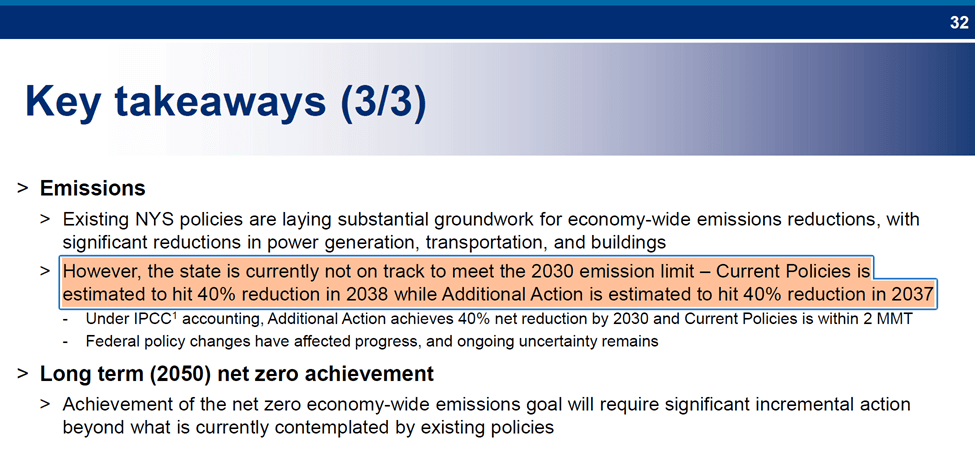
The Climate Act established a New York “Net Zero” target (85% reduction in GHG emissions and 15% offset of emissions) by 2050.  It includes an interim reduction target of a 40% GHG reduction by 2030. The Climate Action Council (CAC) was responsible for preparing the Scoping Plan that outlined how to “achieve the State’s bold clean energy and climate agenda.”  After a year-long review, the Scoping Plan was finalized at the end of 2022.  Since then, the State has been trying to implement the Scoping Plan recommendations through regulations, proceedings, and legislation. 

Energy Austerity Dangers

David Turver writing at Eigen Values explains that as more energy dense sources of power were used in England that less time and effort to survive was needed.  That freed up time and resources were made available for innovation and development of art and culture.  Furthermore, he states “Arguably, the availability of cheap, abundant energy enabled the Slavery Abolition Act to be passed in 1833 and the British Empire had sufficient surplus of energy, men and money to afford a Royal Navy to enforce the ban in the North Atlantic.”  The use of cheap, abundant energy has transformed society in many positive ways.

There are problems brewing:

Unfortunately, the expansion of energy and wealth can lead to complacency and we collectively forget what it was that allowed us to create the most prosperous society the world has ever known. Bad ideas like Malthusianism can flourish and luxury beliefs that undermine the very principles on which society was built can begin to take over.

………………..

In the name of saving the planet, we are being forced to give up on concentrated, reliable energy and energy supply is dwindling as shown by the orange line in Figure 3 below.

Energy prices have risen as supply has fallen through a combination of taxes on hydrocarbons, subsidising expensive renewables and incurring the extra costs of intermittency and remote connections. As a result, energy consumption is falling and the economy is stagnating as shown by the blue line in Figure 3 (data sourced from OWID).

Turver goes on to argue that the wealth gap will increase as the energy use per person decreases. People will have to spend more of their time just getting by so that societal disorders will increase.  He concludes that “If we continue down this Net Zero path, we will soon find that political change from energy austerity gets very ugly, very quickly.”  England is further down this unsustainable path, but New York will surely follow unless we acknowledge the folly of chasing intermittent and diffuse energy.

Zero-Emissions Transportation

Chapter 11 in the Scoping Plan outlines the zero-emissions strategy for the transportation sector:

Transitioning the transportation sector to zero-emission technologies is central to achieving GHG emission reduction requirements. In most cases, this means replacing existing vehicles that run on gasoline or diesel fuel with either battery electric, hydrogen fuel cell, or future zero-emission propulsion technologies.

Recent experience in Korea is not encouraging for the hydrogen fuel cell option.

In my comments on the Draft Scoping Plan I noted the admission in the document that the “transition to ZEVs for this subsector will entail a mix of battery electric and hydrogen fuel cell vehicles” depends on technologies that are “just beginning to emerge into the market”.   The text goes on to say: “Achieving the aggressive transition in this market will require a mix of regulations, incentives (which will require identifying new sources of funding), and removal of market barriers and depends on industry greatly accelerating the expansion of production capacity for these vehicles”.  I commented that the Final Scoping Plan must include a feasibility analysis to prove that these strategies are viable.  This suggestion was ignored. 

So how is deployment of hydrogen fuel cells working out in Korea?  Hyundai Motor Company has sold over 1,000 hydrogen fuel cell buses in Korea. On May 15, 2025, MPR Korea Certification described  Hyundai’s Elec City FCEV bus:

  • Equipped with a 180 kW fuel cell system, an 875-liter hydrogen tank, and a 78.4 kWh high-output battery.
  • Offers a driving range of up to 550 kilometers per charge.
  • Each bus can reduce CO₂ emissions by approximately 72 tons annually

According to the MPR website: “Hydrogen drive related components and equipment usually require KGS certification in order to be approved for import and sale in Korea.”  “KC Certification (also known as KC Safety Certification or KC Mark Korea Certification) is a product certification that proves the compliance of products with Korean safety regulations.”

Someone has a sense of humor because on May 21, 2025, Hydrogen Insight reported that:

Hyundai is recalling all units of its hydrogen-powered Elec City buses in South Korea after a faulty part was found to create a risk of hydrogen leakage, according to the country’s Ministry of Land, Infrastructure and Transport (Molit).

Nick Carter notes that:

In September, the South Korean government decreed that 25 per cent of its metropolitan bus fleet would be powered by hydrogen by the decade’s end.

Three months later, a hydrogen-fueled bus exploded, sending debris into the face of a refueling station attendant in the city of Chungju and injuring two innocent passers-by.

Carter reports on the net-zero transition in Australia.  He pointed out that like New York, the net-zero transition is supposed to rely on green hydrogen to decarbonize hard to electrify sectors.  He explains:

Green hydrogen is vital to the government’s plan for net-zero emissions by 2050. In October, Chris Bowen set a target of producing a million tonnes of green hydrogen by the end of the decade, earmarking $8 billion in subsidies to achieve that goal.

That won’t happen, no matter how much borrowed money the government might throw at it. In Europe, EU member countries are scaling back their expectations and preparing to renege on their obligation under the European Union’s Renewable Energy Directive, which set a target of 42% green hydrogen usage in industry by 2030.

In a Facebook post, Norwegian cabinet minister Ola Borten Moe admitted that the technology was “light years away from being justifiable or sensible”.

New York is further behind in adoption. There are pilot programs in Rochester and New York City for hydrogen fuel cell buses.  They are also used in forklifts in the warehouse sector but there is no evidence that any private vehicles are using fuel cells.

Another Example of a Net-Zero Plan Disaster in the Making

The Energy Bad Boys recently described a partnership with the Arizona Free Enterprise Club to analyze the Integrated Resource Plan (IRP) of Arizona Public Service (APS).  Their findings were published in a March report detailing how APS’s self-imposed Environmental and Social Governance (ESG) goals of reaching 100 percent Net Zero by 2050 are going to cost its ratepayers billions of dollars in unnecessary costs and undermine grid reliability.

The IRP Preferred Plan proposes to replace coal and meet load growth with wind, solar, batteries, and demand management.  The Preferred Plan does see some savings in fuel expenses, but these savings are far dwarfed by the additional cost of building and maintaining new wind, solar, and battery storage facilities.

The authors conclude that “even in states without mandates for unreliable energy sources, monopoly utilities are rushing in to close down their reliable power plants to replace them with billions of dollars in new capital expenditures in the form of solar panels, battery facilities, and wind turbines.”  The inescapable conclusion is that even those resources aren’t very productive utilities are sacrificing reliability because it actually helps the utility’s bottom line.

One Big Beautiful Bill NY Implications

The environ MENTAL blog had an article that described changes in the recent “One Big Beautiful Bill Act” (1BBB) passed by the U.S. House of Representatives last week.  If the Senate passes a version of the bill without substantive changes to Title IV “Energy and Commerce” where 1BBB hammers or eliminates the key federal tax incentives that have underpinned wind and solar energy for too long, primarily by targeting “clean energy” tax credits, accelerating their expiration and imposing strict new eligibility requirements it will remove critical incentives to the renewable energy industry. 

The hyperbolic response to the loss of the endless subsidy stream by renewable energy developers chronicled in the article belie the argument that a transition to wind and solar will be cheaper.  The Energy Bad Boys article mentioned the passage of this legislation and included a figure that showed the subsidy extensions. 

The chart below summarizes the change to the subsidies.

If this passes it will have an immediate and substantial impact to New York’s renewable energy development plans.  I believe that many of the proposed wind and solar projects proposed for New York will not be viable without the subsidies.  If New York cannot develop those resources, then it is clear that a pause in Climate Act implementation is necessary.

Conclusion

New York cannot “solve” climate change on its own because our greenhouse gas contributions to the atmosphere are dwarfed by emissions elsewhere.  The best we can help for is a successful model for other jurisdictions, but the continuing ride of unresolved questions and unacknowledged issues suggests that the current approach is not on the right path.  Pausing the insanity before it does more damage is the only rational path.

Spain and Portugal Blackout – Another Reason to Pause the Climate Act

I am very frustrated with the New York Climate Leadership & Community Protection Act (Climate Act) net zero transition because the reality is that there are so many issues coming up with the schedule and ambition of the Climate Act that it is obvious that we need to pause implementation and figure out how best to proceed.  This article explains that the ramifications of the recent blackout in Spain and Portugal need to be considered to ensure that the cause of the blackout is not a feature of all renewable-energy dependent electric systems.

I am convinced that implementation of the Climate Act net-zero mandates will do more harm than good because the proposed green energy programs are crimes against physics.  The energy density of wind and solar energy is too low and the resource intermittency too variable to ever support a reliable electric system relying on those resources. I have followed the Climate Act since it was first proposed, submitted comments on the Climate Act implementation plan, and have written over 500 articles about New York’s net-zero transition.  The opinions expressed in this article do not reflect the position of any of my previous employers or any other organization I have been associated with, these comments are mine alone.

Overview

The Climate Act established a New York “Net Zero” target (85% reduction in GHG emissions and 15% offset of emissions) by 2050.  It includes an interim target of a 100% zero-emissions electric system by 2040. The Climate Action Council (CAC) was responsible for preparing the Scoping Plan that outlined how to “achieve the State’s bold clean energy and climate agenda.”  After a year-long review, the Scoping Plan was finalized at the end of 2022.  Since then, the State has been trying to implement the Scoping Plan recommendations through regulations, proceedings, and legislation. 

In 2023 the New York Independent System Operator (NYISO) reports that solar capacity was 254 MW for utility scale facilities and 5,172 MW for behind-the-meter solar capacity.  NYISO data shows that the utility-scale capacity factor was only 16.6%.  The Scoping Plan Strategic Use of Low-Carbon Fuels scenario projects that 40,860 MW of total solar capacity will be needed to meet the 2040 zero-emissions target.  The report projects that solar will be 30% of the total capacity of New York.

Spain and Portugal Blackout – April 29,2025

Earlier this week there was a massive blackout that started in Spain.  According to Reuters:

At around 12:30 p.m. (1030 GMT), electricity generation in Spain dropped rapidly from around 27 gigawatts to just over 12 GW. The 15 GW loss was equivalent to 10% of Spain’s total installed capacity.

The sudden drop in grid load destabilized electricity flows, which require an extremely stable frequency of 50 Hertz to maintain supply. This, in turn caused a break in the Spanish and French electricity interconnection that goes through the Pyrenees mountains, resulting in the total collapse of the Spanish power system.

Spain exports electricity to Portugal, so the collapse of power in Spain quickly spread throughout the Iberian Peninsula. Some areas in France also suffered brief outages on Monday.

The blackout in Spain is projected to cost 2-4 billion euros.  It is imperative to figure out what caused it.  Currently there hasn’t been any definitive explanation.  Nonetheless, there are reasons tp believe that it could have been caused by Spain’s reliance on wind and solar.

Potential Causes Related to Wind and Solar

Net Zero Watch described a potential problem:.   

Grid analysts have suggested a high likelihood that the extent of yesterday’s blackout in Iberia was a result of the Spanish grid operating almost entirely on renewables at the time. The stability of power grids depends on so-called ‘inertia’, a resistance to rapid change that is an inherent feature of large spinning turbines, such as gas-fired power stations, but not of wind and solar farms. Too much renewables capacity on a grid can therefore mean inadequate inertia. As a result, in grids dominated by wind and solar, faults can propagate almost instantaneously across grids, leading to blackouts.

In a recent Net Zero Watch paper, entitled Blackout Risk in the Great Britan Grid, energy system analyst Kathyn Porter pointed out that the Great Britain electricity system is becoming increasingly unstable. “Large fluctuations in grid frequency – the first sign of problems – are becoming much more common”.  This has not been observed in New York, yet.

Richard Ellenbogen sent an email with more information.  He explained:

While the exact cause of the blackout is uncertain, both Spain and Portugal have become heavily reliant on renewables.  The power loss was caused by the sudden disappearance of 15 GW of generation for five seconds. To understand the scale of the problem, the five nuclear power plants in Spain have a combined installed capacity of 7.4 GW. 

There is a reliability criterion in New York that boils down to keeping enough generation capacity online and available to that if the largest source of power trips offline that the spare capacity can replace it easily.  If we have to worry about all the solar going offline this quickly there is a huge challenge to resolve.  Ellenbogen explained that a few minutes before the blackout, 60% of Spain’s energy was coming from solar.  He also quoted an article by Robert Bryce:

The best explanation of grid inertia and its importance was published in 2016 by University of Queensland professor Simon Bartlett. In a paper written for the Energy Policy Institute of Australia, “The ‘Pressure Cooker’ Effect of Intermittent Renewable Generation on Power Systems,” Bartlett declared that the “practical upper limit for renewables is around 40% of total electricity generated.” He continued, “The scale-up of intermittent renewables not only diminishes the robustness of a particular power system but can also magnify the short and long-term risk of investing in non-renewable generation assets and the power grid itself.”

Ellenbogen also provided a link that provides an explanation about utility frequency issues for anyone that wants to read further.

Discussion

Ellenbogen closed his email with the thought that “with all of the investment that has been made in their renewable infrastructure, will we see a realistic report from the Spanish utility?  An article in Reuters by Ron Bousso titled “Don’t blame renewables for Spain’s power outage” supports Ellenbogen’s concern that advocates for renewables are too invested in them to admit their proposed use may be irretrievably flawed. The article opens:

While it may be tempting to blame the unprecedented power outage that hit the Iberian peninsula this week on the rapid growth of wind and solar power in Spain, reliance on renewables is not to blame. Rather, the issue appears to be the management of renewables in the modern grid.

I love this.  We don’t know what happened, but he claims it could not have been the renewables.  This was followed by the description of what occurred that I quoted earlier.  The next section noted that the “cause of the initial drop that led to the catastrophic cascade of events is unclear, though a collapse in Spain’s solar power system was certainly involved.”  At least he admits that the solar power system was “certainly involved”.  Bousso notes:

One possible contributor is the lack of so-called ‘grid inertia’ as a result of the relatively small share of nuclear and fossil fuel generation in Spain’s power mix.

Inverter-based wind and solar power, which generated just under 70% of Spain’s total electricity at the critical moment on Monday, does not involve physical rotation and therefore inertia could not compensate for the sudden loss of power.

What grid management of renewables in the modern grid is possible?  His short-term solution?  “An obvious short-term solution to avoid a repeat of the blackout would be to maintain a higher baseload of rotating power generation.”  The current generation payment system that gives solar and wind power preferential treatment means that wholesale changes to the payment system would have to be implemented. Furthermore, if we must keep enough rotating power generation on-line to cover the sudden loss of all wind and solar due, then it begs the question why we just don’t use those resources and skip the charade of green energy.

His long-term solution is batteries:

Over the long term, however, power systems will need to invest heavily in battery capacity to store electricity as well as technologies for synchronising the grid that are critical to maintaining the 50 Hz frequency. In theory, this should be doable, as battery costs have declined sharply in recent years and are being deployed at scale around the world.

There is a critical caveat that is glossed over when he says “this should be doable”.  One of the poorly understood aspects of inverter-based resources like wind and solar is the energy management systems in the inverters.  It is beyond my experience to explain but the experts that I have talked to about this note that distinguishing between a problem with the equipment that requires a shutdown to protect the equipment and a grid problem that requires the system to stay on and support the system is no easy task.  It gets worse when you consider that there are behind-the-meter resources like residential solar that cannot be expected to have sophisticated energy management systems.  The other aspect is the cost:

But all this would still require heavy investment. While spending on new solar capacity reached around $500 billion last year, investment in grids was only at around $400 billion, becoming bottlenecks for the energy transition, according to the International Energy Agency.

Professor Simon Bartlett declared that the “practical upper limit for renewables is around 40% of total electricity generated. The New York Scoping Plan projects that in 2040 solar capacity will be 40,860 MW, onshore wind 13,096 MW, and offshore wind 13,484 MW so the renewable total is 67,440 MW.  The question is whether the Scoping Plan analysis capped the amount of wind and solar output at any one time at 40%.  I doubt it but this is a nuance that cannot be answered by looking at the impenetrable Scoping Plan documentation.  Clearly this is another reason to pause implementation because now we know that this can be a billion-dollar risk and we don’t know how the Scoping Plan or for that matter the NYISO analyses addressed it.

Conclusion

In the coming months the green energy apologists will be saying that it is unfair to blame renewables for Spain’s power outage.  My first observation is that it would be incredibly insulting to the public to say that renewables were not the original cause of the problem.  The question is whether an electric system can be designed and operated to address this problem.  I have the utmost respect for electric system planners and their ability to design the system to address known problems.  However, given the complexity of the electric generating and transmission system I do not think that they can anticipate every potential problem that could cause a blackout.  Another important consideration is whether the proposed New York electric system has incorporated features that would preclude the observed problem from happening here when we become as dependent upon inverter-based resources.

This is another reason to pause the Climate Act implementation.  We simply don’t know if the proposed zero-emissions system that relies so much on wind and solar will work.  If New York decides that the future electric system must be zero-emissions and it turns out that no more than 40% of the power at any time can come from wind and solar, then the only viable approach is nuclear power. Nuclear replace can replace renewables, eliminate the need for a massive backup resource to address this problem, and provide an electric system that we know can maintain current standards of reliability.  Therefore, it would be prudent to pause renewable development until this issue is resolved because nuclear generation may be the only viable path to zero emissions.

NY State Senate Energy and Telecommunications Committee Air Quality Considerations

In March 2025 Senator Mattera invited Richard Ellenbogen to Albany to address the NY State Senate Energy & Telecommunications Committee regarding NY State’s energy situation relative to the Climate Leadership & Community Protection Act (Climate Act).  I was impressed that the meeting showed that the Committee agreed with Ellenbogen that there are implementation issues and course corrections are necessary.  I previously described the emissions analysis  I did for the Committee.  This post describes the air quality aspects of New York power plant emissions.

Overview

The Climate Act established a New York “Net Zero” target (85% reduction in GHG emissions and 15% offset of emissions) by 2050.  It includes an interim reduction target of a 40% GHG reduction by 2030. The Climate Action Council (CAC) was responsible for preparing the Scoping Plan that outlined how to “achieve the State’s bold clean energy and climate agenda.”  After a year-long review, the Scoping Plan was finalized at the end of 2022.  Since then, the State has been trying to implement the Scoping Plan recommendations through regulations, proceedings, and legislation. 

Senate Energy and Telecommunications Committee Meeting

On March 18, 2025 Senator Mattera invited Richard Ellenbogen to Albany to address the NY State Senate Energy & Telecommunications Committee regarding NY State’s energy situation.  Senator Parker, the committee chair, gave Ellenbogen time to describe his thoughts on the Climate Act transition, describe his proposal to use of existing technology that will not get to zero but will maintain system reliability, and answer questions.  There is a video of the hearing available and a previous post includes links to specific discussions within the video.

Ellenbogen’s presentation argued that there is a better way that “adheres to reality”.  He believes that repowering existing power plants with combined cycle gas turbines gives significant carbon reductions.  Replacing the old units reduces emissions, decreases reliability risks because the old units are so old that they are more likely to fail, and because the combined cycle plants are more efficient, they would burn less fuel to produce the same amount of electricity.

During the discussions at the meeting, Chairman Parker said a couple of times that he wanted to get specific numbers for potential emission reductions.  I described the detailed description of the emissions analysis I provided to the Committee in another post.  The last thing I want to address is air quality associated with New York electric generating units. 

Context

The detailed analysis that I submitted to the Committee included this section on context.  I joined Niagara Mohawk Power Corporation (NMPC) in 1981 and one of my responsibilities until I retired in 2010 was accounting and reporting air pollution emissions.  I think it is important to understand that there have been massive reductions in electric generating unit emissions in New York since the time I joined the utility industry.  The earliest records I have date back to 1984.  At the time NMPC owned and operated oil-fired facilities in Albany and Oswego and coal-fired plants in Dunkirk and Tonawanda.  In 1984 those facilities emitted 136,684 tons of sulfur dioxide (SO2), 37,221 tons of nitrogen oxides (NOx), and 12,530,220 tons of carbon dioxide.  In 1995, according to the Environmental Protection Agency all the fossil fueled power plants in New York emitted 239,183 tons of sulfur dioxide, 120,138 tons of nitrogen oxides, and 54,000,913 tons of carbon dioxide. In 2024 all the fossil fueled power plants in New York emitted 698 tons of sulfur dioxide, 7,757 tons of nitrogen oxides, and 31,201,251 tons of carbon dioxide. The following table (NY Emissions Analysis.xls “NYS” tab) lists the annual values from 1980 until 2024.

New York Electric Generating Unit Annual Emissions from EPA Clean Air Markets Division

Air Quality Trends

There have been recent reports that noted that the American Lung Association (ALA) reported that dangerous air pollution is affecting more Americans than last year.  Behind the headlines is the fact that the data they used included “exceptional (e.g., wildfires) and natural events (e.g., stratospheric intrusions)” that are the reason air quality worsened.  Not mentioning the fact that the deteriorating air quality has very little to do with humans would  not help their agenda and fund raising so that information isn’t included in the news stories.  In this context, however, it leads the general public to believe that this indicates a trend towards worse air quality. 

The National Ambient Air Quality Standards (NAAQS) establish air quality levels that are protective of public health and welfare with an adequate margin for safety, including protecting the health of ‘sensitive’ populations such as asthmatics, children, and the elderly”.  From a regulatory standpoint, there is nothing that local jurisdictions can do to reduce exceptional and natural events.  Consequently, the high air quality associated with those events is not counted against the attainment designation relative to the NAAQS.  The air quality was worse last year in many places but in the absence of exceptional and natural events the air quality is getting better.  I also believe that while there are extreme weather events that cause things like wildfires, that climate change is not exacerbating extreme weather to any observable degree.

Without those events the observed emission reductions have been accompanied by improvements in air quality.  SO2 levels have decreased dramatically, with a 98% reduction in annual average levels from 2009 to 2017.  I found that nitrogen dioxide one-hour ambient levels decreased 63%.  There also have been decreases in particulate matter

For the most part New York air quality reflects national and regional trends.  According to the EPA nonattainment/maintenance status summary, there are multiple counties In New York that do not attain the current NAAQS for ozone and New York County does not meet the coarse particulate matter standard.  Note that all of New York State meets the inhalable particulate (PM2.5) NAAQS.  All the other pollutants are in attainment. Finally, note that over the years the NAAQS limits have become more stringent.

Despite the fact that there have been significant improvements and New York is mostly in attainment with the NAAQS there is another approach to air quality health impacts that regulators and activists have used to claim more reductions are necessary.  They claim that levels of pollution lower than the NAAQS have health impacts based on simplistic epidemiological extrapolations that assume there are no health impact thresholds.

For example, even though New York City is in attainment for inhalable particulates, this pollutant is used as a rationale for shutting down peaking power plants because of claims that reducing inhalable air quality impacts is beneficial.   The New York City Department of Health and Mental Hygiene’s (DOHMH) 2011 Air Pollution and the Health of New Yorkers report is often referenced in this regard.  The DOHMOH report concludes: “Each year, PM2.5  pollution in [New York City] causes more than 3,000 deaths, 2,000 hospital admissions for lung and heart conditions, and approximately 6,000 emergency department visits for asthma in children and adults.” These conclusions are for average air inhalable particulate pollution levels in New York City over the period 2005-2007 of 13.9 µg/m3.

I submitted comments on the Draft Scoping Plan where I showed that the New York City 2018-2020 average PM2.5 concentration was 7.4 µg/m3 which is substantially lower than the DOHMOH goal of 10.9 µg/m3.  If the epidemiological linear no-threshold model is correct, then because inhalable particulate levels have come down In New York City there should be significant observed health benefits since the 2011.  However,  DOHMH has not verified their projections against observations.  Until such time that the projected health impacts using this approach are validated with observed data, I will be skeptical of this metric. The fact that asthma and other health impacts have not improved at the same rate as the air quality improvements suggests that other factors are driving those outcomes. In my opinion, there should be a commitment to determining the more likely causes rather than wasting money on reducing already low power plant emissions.  

Current Air Quality Conditions

During the Energy & Telecommunications Committee hearing on March 18, 2025 Chairman Parker questioned air quality levels around power plants.  He said that there are “people sitting in the shadow of both industrial plants and nuclear power plants who are developing health outcomes that are negative because of these plants”.  I need to address this misconception as it applies to fossil-fired power plants.  First, I want to point out that there is no credible health outcome threat of air quality related to nuclear power plants.

I think that Chairman Parker has been misled by a “righteous risk”.  In a post on this risk I noted that these risks arise from a “value-based policy approach that filters out facts and data within an ethical perspective.”  The importance of these risks are “influenced by what is perceived as ethical rather than what is rational or scientific.”  The Climate Act includes specific mandates to address righteous risks.

The Climate Act includes a commitment to address equity  for “communities within New York that have been historically overburdened by environmental pollution”.  One of the most repeated claims is related to air quality levels around power plants and reductions in co-pollutants is a prime benefit of the Climate Act..  The PEAK coalition has stated that “Fossil peaker plants in New York City are perhaps the most egregious energy-related example of what environmental injustice means today.”  I believe this argument influenced Senator Parker. However, the presumption of egregious harm is based on selective choice of metrics, poor understanding of air quality health impacts, and ignorance of air quality trends.  I have documented my concerns based on my extensive experience with air pollution control theory, implementation, and evaluation over my 45+ year career. 

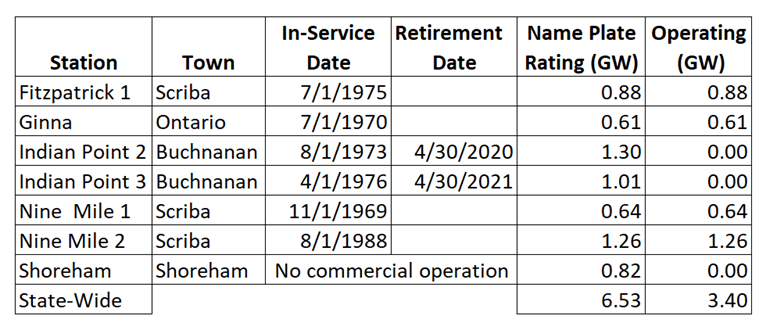
One of the legislative attempts to facilitate the Climate Act is the Build Public Renewables Act that gives the New York Power Authority (NYPA) renewable development responsibilities.  This law is supposed to speed up the energy transition but it also includes a requirement for NYPA to shut down its existing fossil-fired power plants including a number of peaking power plants in New York City.  I think this is as poor a policy choice as the decision to shutdown of the Indian Point nuclear power plant.

I have been an air quality meteorologist for 45+ years.  A foundational presumption in my career is that if the ambient air quality effect of any polluting source is lower than the NAAQS then public safety and welfare is protected.  There are two additional levels of air quality security.  When the NYPA peaking power plants were permitted NYPA had to demonstrate that the increase in pollution due to the facilities was less than the Prevention of Significant Deterioration increment put in place to assure that new sources of pollution do not meaningfully worsen the air quality.  In addition, the facilities had to install Lowest Achievable Emission Rate air pollution control equipment which is as good as it gets.  My point is that the facilities that New York politicians are forcing to close may not have zero impacts, but they are close enough to no impacts, that they cannot possibly adversely affect health outcomes.

Discussion

After much thought I think I have an analogy that puts this in perspective.  Think of power plant controls like cleaning the kitchen floor.  Power plants have different levels of control equipment just like we all have different options to clean the floor.  Keeping the kitchen floor clean is necessary for food safety given the likelihood of spills.  In my opinion, sweeping the floor daily and mopping it regularly is “good enough”.  Many don’t think that mopping the floor is good enough now because there are more sophisticated options like the Swiffer PowerMop or even steam mops. For some once-a-week mopping is not good enough and they may want to do that daily.  The point is that there is a tradeoff between time and money for cleaning the floor “good enough”.  In my opinion, the NYPA peaking power plants in New York City with Lowest Achievable Emission Rate controls are equivalent to using a steam mop several times a day.  Demands to shut down the NYPA power plants is equivalent to deciding not use the kitchen because it is not clean enough even when using a steam mop several times a day.

Conclusion

A state-of-the-art combined cycle natural gas-fired turbine provides great grid support and is so efficient that it has significantly lower CO2 emissions than existing fossil-fired units in New York.  To correctly consider the value of this technology for New York’s electric system it is necessary to use appropriate comparison metrics, have a comprehensive understanding of air quality health impacts, and consider air quality trends.Three things described in my emissions status article should also be considered.  I found that a future electric system that uses nuclear power as the backbone and natural gas-fired combined cycle combustion turbines for backup support resolves the reliability risks and overall costs of a wind, solar, and energy storage system.  At the same time it could reduce emissions from about 30 million tons per year today to less than 2 million tons per year in the future.  I also noted New York GHG emissions are less than one half of one percent of global emissions and global emissions have been increasing on average by more than one half of one percent per year since 1990. Even Senator Parker acknowledges that this means “at the end of the day  New York is not going to solve the climate crisis”.  Finally, I pointed out that New York’s impact on global warming is unmeasurable.  These three points lead to the inescapable pragmatic conclusion that nuclear power as the backbone combined with combined cycle combustion turbines is good enough for environmental risks even if there are some GHG emissions and co-pollutant emissions are not zero.

NY State Senate Energy and Telecommunications Committee Meeting – Emission Status

On March 18, 2025 Senator Mattera invited Richard Ellenbogen to Albany to address the NY State Senate Energy & Telecommunications Committee regarding NY State’s energy situation relative to the Climate Leadership & Community Protection Act (Climate Act).  I was impressed that the meeting showed that the Committee agreed with Ellenbogen that there are implementation issues and course corrections are necessary.  This post describes the emission estimates that I provided and puts electric generating unit emissions in context.

Overview

The Climate Act established a New York “Net Zero” target (85% reduction in GHG emissions and 15% offset of emissions) by 2050.  It includes an interim reduction target of a 40% GHG reduction by 2030. The Climate Action Council (CAC) was responsible for preparing the Scoping Plan that outlined how to “achieve the State’s bold clean energy and climate agenda.”  After a year-long review, the Scoping Plan was finalized at the end of 2022.  Since then, the State has been trying to implement the Scoping Plan recommendations through regulations, proceedings, and legislation. 

Senate Energy and Telecommunications Committee Meeting

On March 18, 2025 Senator Mattera invited Richard Ellenbogen to Albany to address the NY State Senate Energy & Telecommunications Committee regarding NY State’s energy situation.  Senator Parker, the committee chair, gave Ellenbogen time to describe his thoughts on the Climate Act transition, describe his proposal to use existing technology that will not get to zero but will maintain system reliability, and answer questions.  There is a video of the hearing available and my previous post includes links to specific discussions within the video.

Ellenbogen’s presentation argued that there is a better way that “adheres to reality”.  He believes that repowering existing power plants with combined cycle gas turbines gives a carbon reduction of “30 to 40%.”  Replacing the old units reduces emissions, decreases reliability risks because the old units are so old that they are more likely to fail, and because the combined cycle plants are more efficient, they would burn less fuel to produce the same amount of electricity.

During the discussions at the meeting, Chairman Parker said a couple of times that he wanted to get specific numbers for potential emission reductions.  In my description of the meeting, I promised to publish a post describing my supplemental emissions analysis that provided those numbers.  This article fulfills that promise. 

Observed and Projected Electric Generating Unit Emissions Analysis

Following the meeting I sent Ellenbogen material to send on to Senator Parker.  The evaluation of observed electric generating unit carbon dioxide (CO2) emissions for selected New York power plants that represent the current state-of-the-art compared with other existing units included the information requested.  My submittal included a detailed description of the analysis as well as the spreadsheet that generated the data in each table in the report.  The description includes references to each tab within the spreadsheet that provides the data for every table.  I am only going to summarize the evaluation because the documentation provides the details.

The analysis was complicated because it was necessary to combine two different data sets for the comparison.  I used the EPA Clean Air Markets Division data that includes CO2, SO2, and NOx emissions along with several operating parameters.  Unfortunately, the EPA load data represents gross load and net loads are needed to project CO2 emissions for the different scenarios.  The New York Independent System Operator (NYISO) annual load and capacity data report, universally known as the “Gold Book, provides net loads. I chose 2020 because I wanted to include the Somerset coal-fired power plant information to represent the highest CO2 emissions.  Because of naming convention and facility component differences, it was not possible to include all the steam turbine, combined cycle or cogeneration units in the state.  However, the 43 units (Note that the report refers to 45 units but there are only 43 units in the tables) included provide a representative sample of the state, representative data for state-of-the-art generating units and includes specific units that were requested by the Committee.

I manually combined 2020 data from the two data sets for 43 electric generating units as shown in Table 3 from the report (NY Emissions Analysis.xls “Compare 2020” tab).   It combines the NYISO net energy (GWh) and the EPA CO2 emissions (tons) to determine the state-of-the-art CO2 emission rate (tons/GWh). Note that the CO2 emission rate ranges from just over 400 for the combined cycle gas turbines to 1200 tons per GWh for a coal plant.    I assumed that the new Cricket Valley, CPV-Valley, and Caithness combined cycle gas turbines represent a state-of-the art combined cycle power plant.  Table 3 shows that those three facilities do represent the lowest emission rates and that the Bethlehem Energy Center is within their ranges so also state-of-the-art.  I assumed that the average of the blue highlighted cells represents a representative state-of-the-art combined cycle power plant CO2 emission rate (410.8 tons CO2 per GWh).

Table 3 : Combine the NYISO Net Energy (GWh) and the EPA CO2 Emissions (tons) to Determine State of the Art CO2 Emission Rate

Table 4 (NY Emissions Analysis.xls “2020 Projections” tab) compares existing emissions to estimated emissions if the facility were replaced with a state-of-the art combined cycle combined cycle gas turbine power plant with and without a carbon capture and sequestration (CCS) control equipment.  The observed CO2 Mass column lists 2020 annual emissions.  The state-of-the-art projected CO2 emissions column equals the state-of-the-art combined cycle power plant CO2 emission rate (410.8 tons CO2 per GWh times the observed 2020 net energy rate.  The column that adds the CCS control at 90% efficiency lists the emissions if the control equipment were in place.  There are also columns that list the difference between observed emissions and these projections.

Table 4: Projected CO2 Emissions – Replace with Combined-Cycle GT or Combined-Cycle GT with Carbon Capture

In 2020 the electric sector emitted 26,920,636 tons of CO2.  The 45 units included in this analysis emitted 21,305,661 tons representing 79% of the total.  If all 45 units were state-of-the-art combined cycle natural gas fired combustion turbines, the emissions would be reduced to 17,955,036 tons which is a 16% reduction.  If all 45 units added carbon capture and sequestration control equipment, the emissions would be reduced to 1,795,504 tons, a 76% reduction.  My results are less than the Ellenbogen presentation because I did not account for the improved efficiency and resulting lower fuel use that would reduce emissions more. 

Future Electric System

I also projected 2040 CO2 emissions for a pragmatic future electric system that relies on nuclear power but uses state-of-the-art combined cycle natural gas fired combustion turbines (CCGT) for peaking support. Making projections for future electric energy sector resource allocations is best left to the professional electric system planners who can use complex and sophisticated models that can incorporate the nuances of the capabilities and performance of different types of generation.  The biggest problem is that an electric system that relies on wind and solar resources needs to overbuild wind and solar capacity.  That introduces a significant error in my projection approach.  Nonetheless, this analysis gives a rough idea of potential emissions for two scenarios – building CCGT instead of renewables and building nuclear for everything except peaking generation.

The detailed description of the analysis provides specifics. In brief, I first chose a New York Independent System Operator (NYISO) annual energy forecast for the emissions projection.  The second step was to allocate the generation needed to provide the NYISO future energy projection.   I made many assumptions to establish the arbitrary generation resource categories I used in my projections. 

I considered two future scenarios for 2040.  In Scenario 1 the existing nuclear and hydro capacity and generation stay the same but new combined cycle gas turbines provide all the capacity and generation necessary to meet the NYISO forecast.  In Scenario 2 the existing hydro capacity and generation stayed the same, new combined cycle gas turbines provide the peaking power and all the remaining capacity and generation necessary is provided by nuclear power.

My results showed that significant reductions are possible with these scenarios.  If nuclear and hydro stay the same and new CCGT is used to make up the capacity and energy necessary to match the NYISO forecast, then the emission projection is 70,301,856 tons of CO2 or 7,030,186 tons with 90% CCS controls.  This is an overestimate because the NYISO projection incorporates over-building wind and solar capacity that would not be necessary if conventional generating resources are used.  The second scenario in which nuclear is used for everything except peaking generation and CCGT is only used for peaking purposes is probably closer to a realistic estimate.  That scenario predicts that using fossil fuels solely for that purpose would produce 1,226,718  tons of CO2 and only 122,672 tons if 90% CCS was employed.  This also is an over-estimate because of the renewable over-building but the significantly lower emissions shows how effective nuclear power is for reducing emissions.

Relative Impacts

The nuclear/CCGT approach does not eliminate 100% of CO2 emissions.  However, New York GHG emissions are less than one half of one percent of global emissions and global emissions have been increasing on average by more than one half of one percent per year since 1990. Even Senator Parker acknowledges that this means  “at the end of the day  New York is not going to solve the climate crisis”. 

There is one other argument in favor of this pragmatic approach.  In short, New York’s impact on global warming is unmeasurable.  Table 9 (NY Emissions Analysis.xls “Warming Averted” tab) projects the amount of global warming “savings” for the projection scenarios and historical emissions.  The calculations are based on a Perplexity AI query “What is the expected change in global warming per ton of CO2 reduced”.  None of the emission scenarios for the projected warming predict measurable changes in global warming.

Table 9: Potential Warming Savings for Emission Scenarios and Historical Emissions

Conclusion

The purpose of this analysis is to show that a state-of-the-art combined cycle natural gas-fired turbine is so efficient that it has significantly lower CO2 emissions than existing fossil-fired units in New York.  If a cost-effective carbon capture and sequestration system could be added to those facilities the emissions are reduced much more.  When combined with nuclear power for baseload electric power, there are advantages to using a system with combined cycle gas turbines when compared to using a system based on using wind, solar, and energy storage.  The energy density of wind and solar energy is so low and the resource intermittency so variable hat no electric system relying on those resources for most of its energy can ever hope to provide reliable electricity. The low energy density requires a massive buildout of transmission, and an intermittent weather-dependent system requires an unproven dispatchable emissions-free resource.  The nuclear/CCGT approach resolves those challenges.  When the potential effects of New York emissions on global warming are considered, it is apparent that zero emissions mandates do not provide any measurable benefits.

The negligible relative impacts of New York emissions does not mean that we should do nothing, but it does suggest that strategies that do not go to zero should not be rejected.  That is especially true if those strategies can be implemented for a fraction of the cost of the current plan.  In addition, the emissions from combined cycle gas turbines used to replace existing generation would not meaningfully contribute to global warming but their continued use not only reduces emissions over historical levels but also resolves reliability challenges that must be addressed if zero emissions are mandated.  The concept of natural gas as a bridge fuel for even lower emission alternatives is a pragmatic approach.

NY State Senate Energy and Telecommunications Committee Meeting 18 March 2025

On March 18, 2025 Senator Mattera invited Richard Ellenbogen to Albany to address the NY State Senate Energy & Telecommunications Committee regarding NY State’s energy situation.  This article describes the presentation and documents meeting materials and follow up information.

Ellenbogen is the President [BIO] of Allied Converters and frequently copies me on emails that address various issues associated with the New York Climate Leadership and Community Protection Act (Climate Act). I have published other articles by Ellenbogen including a description of his keynote address to the Business Council of New York 2023 Renewable Energy Conference Energy titled: “Energy on Demand as the Life Blood of Business and Entrepreneurship in the State -video here:  Why NY State Must Rethink Its Energy Plan and Ten Suggestions to Help Fix the Problems”. He is an engineer who truly cares about the environment and is an early adopter of renewable technologies at both his home and business.

Overview

The Climate Act established a New York “Net Zero” target (85% reduction in GHG emissions and 15% offset of emissions) by 2050.  It includes an interim reduction target of a 40% GHG reduction by 2030. The Climate Action Council (CAC) was responsible for preparing the Scoping Plan that outlined how to “achieve the State’s bold clean energy and climate agenda.”  After a year-long review, the Scoping Plan was finalized at the end of 2022.  Since then, the State has been trying to implement the Scoping Plan recommendations through regulations, proceedings, and legislation. 

Senate Energy and Telecommunications Committee Meeting

On March 18, 2025 Senator Mattera invited Richard Ellenbogen to Albany to address the NY State Senate Energy & Telecommunications Committee regarding NY State’s energy situation.  Senator Parker, the committee chair, was extremely gracious and essentially gave him an unlimited amount of time to describe his thoughts on utility decarbonization using existing technologies.  There is a video of the hearing available.   Ellenbogen’s presentation starts at 12:40.

Senator Parker has shown signs of pragmatism regarding the implementation of the Climate Act.  During the 2023 budget process he co-sponsored a bill to modify the Climate Act to use the 100-year global warming potential (GWP) that the Environmental Protection Agency and the Intergovernmental Panel on Climate Change use instead of the 20-year GWP mandated by the Climate Act.  The only reason to use the 20-year GWP is the irrational belief that methane is a significant threat to global climate.  New York’s environmental community went ballistic calling the proposed revision an attempt to gut the Climate Act.  The proposal was quietly withdrawn in response to the pressure.  Frankly, I thought that experience would mean that Ellenbogen’s presentation on the heretical idea that using natural-gas fired combined cycle combustion turbines with carbon capture (that can get a 90% CO2 reduction but not reach zero emissions) would be given short shrift but it wasn’t.

Ellenbogen Presentation

Ellenbogen referred to a handout during his presentation and the full version of the document is available.  He also referenced recent comments on  utility system decarbonization 15-e-0302 that provide more background information.  The remainder of this section describes highlights of the hearing with links to the video for each highlight.

Ellenbogen’s presentation started with a description of his background.  As noted in the introduction he has a proven record of reducing GHG emissions, waste reductions, and energy efficiency deployment at both his home and manufacturing facility.  He emphasized that his strategies reduced emissions significantly but did not eliminate them entirely so his efforts would not be enough to meet Climate Act mandates.

Ellenbogen made the point that the Climate Act authors placed too much reliance on Academic “Science”.  He gave an example describing how the emphasis on methane is misplaced.  I agree that the methane obsession in the Climate Act is irrational.

Ellenbogen offered to discuss his concerns about the results of Ignoring science during his summary of the problem.  His personal decarbonization experience made him aware of logistical issues so the labor and supply chain that are delaying the Climate Act strategies were no surprise to him.  He argues that physics makes the reliance on wind and solar an impossible proposition.  He has explained to me that the energy density of wind and solar energy is too low and the resource intermittency too variable to ever support a reliable electric system relying on those resources

Ellenbogen says that one of the huge issues is New York’s existing fossil load.  He described the following chart explaining that the first column is the load in 2019.  If we were to electrify everything you would get the second column because many of the electric technologies are more efficient.  The problem is that without energy storage the system breaks down.  The third column shows the energy storage in the NYSERDA report New York’s 6 GW Energy Storage Roadmap: Policy Options for Continued Growth in Energy Storage.  Column D lists the state plan for renewables in 2035.   The point of the graph is that the projected renewables do not come anywhere near what is needed.

Ellenbogen’s presentation argued that there is a better way that “adheres to reality”.  He believes that repowering existing power plants with combined cycle gas turbines gives a carbon reduction of “30 to 40%.”  Replacing the old units reduces emissions, decreases reliability risks because the old units are so old that they are more likely to fail, and because the combined cycle plants are more efficient, they would burn less fuel to produce the same amount of electricity.

Note: I will eventually publish a post describing my supplemental emissions analysis of this proposal. For this article note that when I evaluated 2020 emissions and I found that if 45 existing New York fossil-fired units were replaced by state-of-the-art combined cycle natural gas fired combustion turbines, annual emissions would be reduced 16%. My results are lower than the Ellenbogen presentation because I did not account for the improved efficiency and resulting lower fuel use that would reduce emissions more.  Ellenbogen’s email description of the analysis provides background information until I do a detailed post on emissions.

Questions

I am not going to address all the questions and issues that were raised during the presentation.  The following are some highlights.

Senator Parker had questions about methane.  Ellenbogen responded that the emphasis on methane reductions is misleading because recent analysis shows that anthropogenic activities are not the primary source of methane in the atmosphere.   Consequently, reducing natural gas in New York is not going to significantly affect potential global warming.

 There was a cost discussion. Ellenbogen did not respond to the issues raised during the presentation because he needed to review recent information.  He did respond to the questions in a follow-up letter that referenced a Central Hudson response to a rate case question about the costs of the Climate Act.  It has been my experience that every issue I have looked at is more complicated than it appears at first glance.  Such is the case with the Central Hudson $4.269 trillion cost estimate based on the Scoping Plan.  Suffice to say here that there is a lot of uncertainty associated with that figure.  I have addressed some of the affordability problems recently but will explain the issues associated with the Scoping Plan cost estimates some other time.

I want to discuss is the comment by Parker that the state will not be repealing the Climate Act.  He asked Ellenbogen what we can do to make it successful.  Ellenbogen responded that we need to broaden the terms to overcome physics reality.  He explained that the energy density of wind and solar is insufficient for what is needed.  Intermittency is another issue because it needs over-building and storage.  Ellenbogen’s recommendation is for a non-zero alternative because it is energy-dense and dispatchable.  There still are significant reductions but reliability risks are eliminated.

Parker said he would need to see the difference between the various options described.  We know  existing emissions levels but he also wants to see the improvements due to more efficient combined cycle units and the improvements if carbon capture is added to that.  The analysis of mine described earlier was prepared to directly respond to these questions.

When Ellenbogen was asked for recommendations going forward, he said “We have to be realistic” because the reality is that physics and math limit what can be done for the transition.  That leads to his recommendation to pursue combined cycle combustion turbines with carbon capture until other proven zero-emissions technologies like nuclear can be deployed.

Parker re-iterated his request for emission numbers and noted that the timeline may have to shift to accommodate numbers and physics.  He admitted that we are not on track for a variety of reasons.  More importantly he also said that  at the end of the day NY is not going to solve the climate crisis but we can still provide leadership.

Discussion

Ellenbogen’s recommendation is a pragmatic solution that I support.  Unfortunately, there was no one at this hearing who was aware of the recent history of re-powering proposals for combined cycle natural gas plants and relevant nuances of the Climate Act that make this approach a tough sell.

For example, at one point Senator Parker stated that if there are companies out there that want to submit proposals for combined cycle plants, they should submit proposals.  The problem is that three repowering project applications have all been rejected or withdrawn since the Climate Act passed.  The Danskhammer Energy Center proposed a replacement gas-fired combined-cycle combustion turbine but DEC denied the permit  stating that “The proposed project would be inconsistent with or would interfere with the statewide greenhouse gas emissions limits established in the Climate Act.”  Although not a combined cycle proposal, NRG Energy proposed replacing their old units with modern units but the DEC decision letter claimed that “the Project would be inconsistent with or would interfere with the attainment of the Statewide greenhouse gas (GHG) emission limits established in Article 75 of the Environmental Conservation Law (ECL)”.  A subsidiary of Eastern Generation LLC proposed to repower their old turbines at Gowanus and Narrows with modern simple cycle turbines.  As far as I could tell everyone at this hearing understood the benefits of replacing old with new and trying to avoid stranding the investments.  This development was for barge mounted turbines.  Once it was clear that they could be replaced with something consistent with the Climate Act they could have been moved elsewhere but the company withdrew their application because of DEC’s position on consistency with the Climate Act.

There also is a problem with the recommendation to capture the carbon.  My reading of the Climate Law is that it prohibits the use of carbon capture and sequestration for an electric generating unit.  The references to sequestration in the law are associated with the definition of “Greenhouse gas emission offset projects” that includes the following project: carbon capture and sequestration.  Section 75-0109 “Promulgation of regulations to achieve statewide greenhouse gas emissions reductions (4. a.)” states that “The department may establish an alternative compliance mechanism to be used by sources subject to greenhouse gas emissions limits to achieve net zero emissions.”  However, carbon capture and sequestration at electric units is expressly prohibited in § 75-0109, (4,f) “Sources in the electric generation sector shall not be eligible to participate in such mechanism.”

Conclusion

I was very encouraged by the meeting.  Senator Parker’s admission that there are implementation issues and course corrections are necessary is refreshing because most of his colleagues have not shown any departure from the orthodoxy.  At one point during the meeting Senator Mattera and Senator Parker agreed on the need to be more flexible which Richard Ellenbogen notes is the equivalent of seeing a Unicorn.  All this suggests that there might be support for a course correction of the Climate Act.

Nonetheless, I want to point out that at the end of the meeting Ellenbogen left a gift for Albany – a wand in a glass case with a note saying  in case of a blackout break glass.  A magical solution still may be the last hope.

Implication of Assessment of Extreme Renewable Resource Lulls

Note: A version of this article was posted at Watts Up With That

I am convinced that implementation of the New York Climate Leadership & Community Protection Act (Climate Act) could have devastating impacts on New York residents as long if proponents ignore lessons that could be learned elsewhere and continue down the current path.  This post describes work done in Great Britain that has direct bearing on New York’s implementation plans and shows we need to re-think the tradeoffs of Climate Act implementation.

I believe that implementation of the Climate Act net-zero mandates will do more harm than good if the future electric system relies only on wind, solar, and energy storage because of reliability and affordability risks.  I have followed the Climate Act since it was first proposed, submitted comments on the Climate Act implementation plan, and have written over 500 articles about New York’s net-zero transition.  The opinions expressed in this article do not reflect the position of any of my previous employers or any other organization I have been associated with, these comments are mine alone.

Overview

The Climate Act established a New York “Net Zero” target (85% reduction in GHG emissions and 15% offset of emissions) by 2050.  It includes an interim reduction target of a 40% GHG reduction by 2030. The Climate Action Council (CAC) was responsible for preparing the Scoping Plan that outlined how to “achieve the State’s bold clean energy and climate agenda.”  After a year-long review, the Scoping Plan was finalized at the end of 2022.  Since then, the State has been trying to implement the Scoping Plan recommendations through regulations, proceedings, and legislation.  Recently, the State initiated the State Energy Plan process to update it to be consistent with the Climate Act.  It is not clear whether this proceeding will consider stakeholder comments that were ignored during the Scoping Plan process.

Renewable Resource Lulls

The Scoping Plan, Integration Analysis, New York Independent System Operator (NYISO), New York Department of Public Service, the New York State Reliability Council, and others all have noted that a new category of generating resources called Dispatchable Emissions-Free Resources (DEFR) is necessary to keep the lights on during periods of extended low wind and solar resource availability.  The frequency, duration, and intensity of wind and solar availability gaps must be known to properly plan to provide the generation, storage, and DEFR resources necessary to maintain reliable service.  Analyses done by the New York State Reliability Council Extreme Weather Working Group have shown that extended periods of low wind and solar resource availability will be challenging for the future New York electric system. 

On December 24, 2024 I submitted testimony for the December 18, 2024, Assembly Standing Committee on Energy Public Hearing regarding NYSERDA Spending and Program Review. I noted that the biggest feasibility challenge is the identified “gap” when wind and solar resources are low for long periods.  As one example of appropriate feasibility funding, I recommend analyzing the variability in low wind and solar resource availability.  The characteristics of the resource gaps must be quantified not only for New York but also for adjoining regional systems presuming that they also transition to an electric system with a similar reliance on wind and solar.

The Independent System Operator of New England (ISO-NE) Operational Impact of Extreme Weather Events  completed an analysis that addresses this need for New England.  The study evaluated 1-, 5-, and 21-day extreme cold and hot events using a database covering 1950 to 2021. The results found that the system risk or “the aggregated unavailable supply plus the exceptional demand” during an event increased as the lookback period increased.  If the resource adequacy planning for New England only looked at the last ten years, then the system risk would be 8,714 MW, but over the whole period of record, the worst system risk was 9,160 MW which represents a resource increase of 5.1%.  This means that the low renewable resource analysis should cover as long a period as possible to determine the longest period of exceptional demand and low renewable resources.

Great Britain Renewable Assessment

David Turver blogs about energy issues in Great Britain. In an October 2023 post  he describes a report from the Climate Change Committee (CCC),  their equivalent to New York’s Climate Action Council. He explains that the Royal Society (RS) Large Scale Electricity Storage report authored by Professor Chris Llewellyn-Smith claims that Great Britain can meet its demand for electricity with wind and solar, supported by large-scale hydrogen storage.  Large-scale hydrogen storage is the placeholder DEFR technology in the Scoping Plan, so this analysis is directly applicable to New York’s DEFR resource issue.

Turver argues that the report is deeply flawed. Among his concerns are the following:

They begin by assuming that electricity demand will be 570TWh in 2050 which represents roughly halving the energy demand across residential, transport and industrial and commercial categories. The evidence from Our World in Data shows that rich economies require high energy consumption to thrive. There are no rich countries with low energy consumption and those countries that have reduced energy consumption have grown more slowly, or even shrunk. The first extraordinary claim of low energy consumption fails because the evidence shows that if we allow that to happen, we will be much poorer.

The report then goes on to assume that the profile of electricity demand will be the same as today. However, as we move from gas to electricity to heat our homes and offices, the winter surge in electricity demand will be further exaggerated. Moreover, demand will change from year to year such as during the cold winter in 2010 that also coincided with a calm period when we would have generated much less renewable electricity. These variations in demand profile will lead to more generation capacity and an even bigger energy store than RS assumes, pushing up costs.

He goes on to argue that there are other flaws.  the report assumes unrealistic load factors for both onshore and offshore wind. It underestimates the amount of offshore wind needed and goes on to assume efficiencies and costs for hydrogen electrolysers, storage, and generation that do not stand up to scrutiny.  He also points out that the economic assumptions are flawed. 

He describes the “main positive aspect of the report”:

The thing that stands out most is the painstaking analysis that has been conducted to understand the very significant changes in the weather that occur on yearly and decadal timescales. They analysed wind and solar records over 37 years to estimate the level of variation we might expect from wind power.

In a recent article Turver includes a graphic that shows this issue using the 37 year database.

The analysis of 37 years is longer than anything done to date for New York.  He also points out an aspect of DEFR that relies on hydrogen storage that I had not considered previously.  It is not just the annual worst-case episode but there can be multi-year issues:

They found that we can sometimes have several consecutive years where the wind speed is lower than average. This means that if we are to have a grid powered solely by wind, solar and storage, then we need to build up massive stores of energy in the windy years to be used in the calmer years. They conclude that to consistently deliver their 570TWh of electricity each year, we would need 123TWh of hydrogen storage. Some of that hydrogen may have to be stored for a decade or more before it is used.

He also points out that the requirement for decadal storage is another flaw for any DEFR backup resource:

This has important implications for the economics of storage and effectively rules out batteries as the storage medium. Who would want to spend millions on building a battery or hydrogen storage cavern, even more to fill it and maintain it, yet not see any revenue from it for years after it was completed?

DEFR Backup Reliability Risk

Turver’s article raises the ultimate reliability risk for a weather-dependent electric system.  Today’s electric system resource planners for a conventional system base the amount of capacity that they think will be needed based on decades of observations of the fallibility of power plants.  The result is that they know the probability there will be a shortage of available capacity to meet load when the installed reserve system capacity margin is a fixed percentage of the expected load very well.  In New York State the installed reserve margin to meet the accepted probability of a loss of load expectation of an outage no more than once in ten years reliability metric is around 20%.

A fundamental observation is that there is no expectation that the failure of conventional power plants will be correlated.  We do not expect that many will fail at the same time.  That in turn means that even if we decided to set the reliability metric based on a one in thirty-year probability that there would not be much of an increase in the installed reserve margin.

That all changes when the electric system transitions to one dependent upon wind and solar weather-dependent resources.  We know that solar energy is zero and night and much lower in the winter.  Similarly, we know that wind energy is much lower in a high-pressure system, and that those systems are huge and cover all Great Britain and much of western Europe or eastern North America at the same time.  Exacerbating the problem is the fact that those conditions are associated with the hottest and coldest episodes with the greatest expected electric loads.

Turver’s post shows that looking at one year is absurd.  Not looking at the worst year on record is nearly as bad: “They used 1987 as a 1-in-20 year stress test, when they admit that 2010 was a 1-in-50 year event”.  The insurmountable problem is that we know that if an even longer period of record was used there would very likely be an even worse event.  Instead of the confidence in the current planning process that increasing the lookback period will not markedly change the resources needed for the worst case, relying on weather-dependent resources means that inevitably there will be a period of extreme weather that exceeds the planning criteria chosen and the expected resources based on those criteria.  The costs to provide DEFR backup support will be extraordinary and building excess capacity for a very rare event will significantly add to those costs.  This trade-off means that eventually there will be a catastrophic blackout when the load exceeds the storage capacity.

Conclusion

Turver’s articles are further evidence of the DEFR “gap” problems for any electric system that relies upon weather-dependent renewable resources.  The first problem is that you have to determine how much DEFR capacity is needed using as long record as possible.  The second problem is that there is no commercially available DEFR technology that is available to deploy for the aspirational Climate Act targets.  Thirdly, until a DEFR strategy is proposed we have no idea how much this will all cost so any claims that the Climate Act will be “affordable” are incomplete.  Finally, there is the insurmountable weather-related probability that eventually there will be a unusual set of weather conditions and load requirements that exceed the DEFR resources deployed. 

To sum up: we know that a new resource will be needed, we don’t know how much, what it will be, how much it will cost, and that whatever we do eventually it won’t be enough so people will die in a catastrophic blackout.  This is insanity.

JP Morgan Energy Study and the Climate Act

Energy Bad Boys Isaac Orr and Mitch Rolling describe nine takeaways in the JP Morgan Chase 15th Annual Energy Paper that provide more reasons why the New York net-zero transition should be paused. 

I am convinced that implementation of the New York Climate Act net-zero mandates will do more harm than good if the future electric system relies only on wind, solar, and energy storage because of reliability and affordability risks.  I have followed the Climate Act since it was first proposed, submitted comments on the Climate Act implementation plan, and have written over 500 articles about New York’s net-zero transition.  The opinions expressed in this article do not reflect the position of any of my previous employers or any other organization I have been associated with, these comments are mine alone.

Background

The Climate Leadership & Community Protection Act (Climate Act) established a New York “Net Zero” target (85% reduction in GHG emissions and 15% offset of emissions) by 2050. The Climate Action Council (CAC) was responsible for preparing the Scoping Plan that outlined how to “achieve the State’s bold clean energy and climate agenda.” The Integration Analysis prepared by the New York State Energy Research and Development Authority (NYSERDA) and its consultants quantified the impact of the electrification strategies.  After a year-long review, the Scoping Plan was finalized at the end of 2022.

Orr and Rolling introduce their post:

On March 4th, JP Morgan Chase released its 15th Annual Energy Paper (hereinafter “JPMC”). The report, written by Michael Cembalest, is a 55-page analysis with hundreds of graphs and charts on the state of the energy industry.  It spans most aspects of the energy industry, discussing costs for wind and solar, conventional fuels, electrification and heat pump adoption, a status update on the deindustrialization of Europe, and the use of green hydrogen.

I am documenting  reasons to pause the Climate Act and this article explains how the takeaways are relevant to the Climate Act implementation and why the findings are more reasons to pause the Climate Act implementation until the issues raised are resolved.

Takeaways

Wind and solar prices continue to rise. 

According to the JP Morgan Chase Report, power purchase agreement (PPAs) prices for wind have more than doubled since 2019, and solar PPAs are near $60 per megawatt hour.  Prices are rising due to US tariffs on Chinese solar panels, a tripling of insurance premiums in MISO, ERCOT, and SPP due to weather events, supply/demand gaps due to permitting delays, higher interest rates, and increased corporate demand for green power. Keep in mind that PPAs almost always show the subsidized cost of an energy source, so in reality, the cost of these resources is even higher.

The Scoping Plan was based on the Integration Analysis quantitative assessment of emission reduction strategies and cost estimates.  The Integration Analysis included projections starting in 2020.  I believe that the cost projections for wind and solar were projected to decrease and here is evidence that is not happening.  It is time to verify that the projections in the Scoping Plan are tracking with reality. 

Battery costs are coming down

Battery storage prices are falling again after a price spike in 2022. According to Energy Storage News, the main drivers of the fall are cell manufacturing overcapacity, economies of scale, low metal and component prices, a slowdown in the EV market, and increased adoption of lithium iron phosphate (LFP) batteries, which are cheaper than nickel manganese cobalt (NMC) batteries.

On the face of it this is good news.  However, the costs are still extraordinarily high.  The Scoping Plan needs to be re-assessed to determine consistency with the cost observations and whether the main drivers in the cost decreases will continue to lower prices.  Most importantly, there must be an honest assessment of the battery price point that makes battery energy storage “affordable”.

US Transmission Line Growth is far below DOE Targets

The JPMC report notes that annual additions of transmission lines are far, far below the levels envisioned by the Biden Administration’s Department of Energy, as you can see in the graph below.

I do not know where New York transmission line growth stands relative to the needs of the Climate Act.  The status of the buildout relative to the Scoping Plan needs to be assessed to determine if the Climate Act schedule is achievable.

Wind and solar do not replace reliable capacity

The JPMC report acknowledge just how ineffective wind and solar are at reducing our dependency on dispatchable generators.  The graph below from the report shows that for every megawatt of wind or solar installed in various regions, it only offsets 10 to 20 percent of gas capacity.

Making the numbers easier to understand, installing 10 MW of wind or solar in MISO would only offset the need for natural gas capacity by 2 MW. In the Southeast, adding 10 MW of wind or solar would only offset the need for 1 MW.

Adding 10 MW wind or solar in New York would only offset the need for natural gas capacity by a little over 1 MW.  I do not believe that the Integration Analysis modeling incorporates this observed effect.  There are clear implications for the Climate Act transition of this observed effect.

MISO and PJM Are Concerned About Reliability

MISO continues to see its reserve margin dwindle as its margin for error sits at just four percent. The JPMC report notes MISO’s warnings of “serious challenges to grid reliability due to increased exposure to wind/solar intermittency, having averted a capacity shortfall in 2023 only due to postponement of planned thermal capacity retirements.”

The post also includes a figure showing the risks for different regional transmission operators.

Fortunately, New York’s strong commitment to reliability means that there is a low likelihood of electricity supply shortfall assuming that the Progressive politicians keep their paws off the electric sector.  Nonetheless, the Scoping Plan presumes significant imports from outside new York and this result indicates that those imports may not be available.  This risk should be evaluated.

Fossil Fuels, Nuclear, and Hydro Power U.S. Data Centers

The JPMC report notes, “Hyperscalers will probably have to walk back green power commitments and run data centers primarily on natural gas, as they have been. The pie chart shows power consumption of US data centers based on their respective locations, their MW of maximum power consumption and the grid mix in that state.”

Projections for New York load also show increases.  The plans for the proposed Micron chip fab plant that will add load equivalent to the load of New Hampshire and Vermont call for the use of renewables.  This major source of load was not included in the Scoping Plan and needs to be considered in a reassessment.

High Electricity Prices Impede Electrification

Wind and solar advocates argue we must rapidly “electrify everything” by using electric vehicles and converting our home heating systems from natural gas, propane, or fuel oil to electric heat pumps. The problem? Doing so costs much more than using natural gas to keep warm in winter.

The JPMC report states:

“The high cost of electricity compared to natural gas (particularly in places without a carbon tax) is another impediment to electrification that is not easy to solve since this ratio reflects relative total costs of production and distribution.”

Natural gas remains much more affordable than using electricity for home heating in states throughout the country, and even heating oil and propane are more affordable than electricity on a nationwide basis.

The high cost of electricity versus natural gas is a major hinderance to converting to heat pumps.  The Scoping Plan presumption that New Yorkers would willing convert to a more expensive, less resilient, and likely less comfortable source of heating is not likely to occur.  How will this affect implementation?

Green Deindustrialization Continues Apace in Europe

The JPMC report notes: “Europe is the world leader with respect to the pace of decarbonization. However, Europe is paying a steep price for this transition. Its energy prices have risen from 2x to 4x US levels, and its residential electricity prices are now 5x-7x higher than in China and India.

The report also touched on Germany’s coming EnergieweimarDespite Deutschland’s heavy investments in wind and solar, the country has become a net importer of electricity. Long story short, installed power capacity continues to rise but actual generation is falling. The same story is unfolding in the United Kingdom.

The Scoping Plan claims that special carve outs and concessions to energy intensive and trade exposed industries will keep them viable in New York.  The results in the UK and Germany indicate otherwise.  The State needs to reassess these impacts.

Grim Realities for the Green Hydrogen Hype Train

Despite heavy subsidies and much hype, the so-called green hydrogen industry is floundering. Quarterly mentions of hydrogen project delays and cancelations are skyrocketing in the news and in company disclosures.

The report included this quote, with the caveat that it somewhat exaggerates the plight of green hydrogen:

“Electrolyzers, which do not exist, are supposed to use surplus electricity, which does not exist, to feed hydrogen into a network that does not exist in order to operate power plants that do not exist. Alternatively, the hydrogen is to be transported via ships and harbors, which do not exist, from supplier countries, which – you guessed it – also do not exist.”

According to the report:

“Hydrogen has an “original sin” problem: early estimates of lectrolier costs were too low. It started with an influential IRENA paper in 2020 estimating electrolyzer costs at $750 per kW. The European Energy Transitions Commission now concedes that costs are far higher, at least when sourced from Western manufacturers; the latest estimates for 2024 range from $2,100 to $3,200 per kW. This revised assessment had led to a 5x increase in Western 2030 electrolyzer cost projections from BNEF and the Hydrogen Council relative to initial projections.”

This quote pretty much sums up the “energy transition.” Boosters of unproven and expensive technologies assure us that their preferred energy sources are already cheaper, or will soon be much cheaper, than the reliable, affordable technologies we already use. Within a few years, the promises fail to materialize, and they move on to some other unicorn technology, and the hype cycle repeats itself.

A key reason for the problems plaguing green hydrogen is the cost. Even after assuming optimal electrolyzer utilization rates (which won’t materialize in the real world if they are, in fact, powered by wind and solar), the cost is still massive. In Texas, green hydrogen production is around $6.50 per kilogram (kg). In New York, the cost is around $7.50 per kg.

It takes approximately 7.4 kg of hydrogen to produce 1 million British thermal units (MMBtu) of energy, and it takes 10 MMBtus to produce one megawatt hour (MWh) of electricity in a combustion turbine power plant. This means the fuel cost of green hydrogen is approximately $481/MWh in Texas and $555/MWh in New York. At that price, it’s no wonder the industry is hitting hard times.

The Scoping Plan placeholder technology for the dispatchable emissions-free resource (DEFR) acknowledged as necessary is green hydrogen.  These results show that the “solution” is unlikely to be viable. The fundamental problem is that the wind, solar, and energy storage approach envisioned in the Scoping Plan will only work if DEFR is developed and deployed. In my opinion, the most promising DEFR backup technology is nuclear generation because it is the only candidate resource that is technologically ready, can be expanded as needed, and does not suffer from limitations of the Second Law of Thermodynamics. If the only viable DEFR solution is nuclear, then renewables cannot be implemented without it.  But nuclear can replace renewables, eliminating the need for a massive DEFR backup resource.  It is obviously prudent to pause renewable development until DEFR feasibility is proven because nuclear generation may be the only viable path to zero emissions

Conclusion

Orr and Rolling conclude:

There is a lot to digest in the report, but the long and short of it is that the so-called energy transition is hitting the brick wall of reality. Let’s hope policymakers come to their senses and end the subsidies for wind and solar so we can get back to rational energy policies.

I hope that the brick wall of reality reaches New York. I believe the best way to ensure that policymakers come to their senses is to pause the program and reevaluate the presumptions and projections.

Renewables are Cheaper Because of Fuel Volatility

I have run into a couple of instances where New York Climate Leadership & Community Protection Act (Climate Act) proponents have claimed that renewable energy development can reduce costs.  This article responds to the argument that reduced fuel price volatility will make renewables cheaper.

I am convinced that implementation of the New York Climate Act net-zero mandates will do more harm than good if the future electric system relies only on wind, solar, and energy storage because of reliability and affordability risks.  I have followed the Climate Act since it was first proposed, submitted comments on the Climate Act implementation plan, and have written over 500 articles about New York’s net-zero transition.  The opinions expressed in this article do not reflect the position of any of my previous employers or any other organization I have been associated with, these comments are mine alone.

Renewable Energy Can Reduce Costs

I am disappointed that the renewable energy can reduce costs claim has made it into the New York State Energy Plan process.  The Energy Plan is “a comprehensive roadmap to build a clean, resilient, and affordable energy system for all New Yorkers”.  When the Energy Planning Board met on March 3, 2025 to adopt the scope for the state energy plan the claim was mentioned.  One item on the agenda was a discussion of the “planned approach for techno-economic pathways analysis”.  This is the analysis work whereby the state agencies and their consultants will “prove” the pre-conceived notion that the Climate Act net-zero transition concocted by politicians will work. 

The presentation by Jeff Freedman from the Atmospheric Sciences Research Center, University at Albany, Albany, New York included the following slide that makes the claim that renewable energy can reduce costs. One characteristic of the New York State Energy Research & Development Authority (NYSERDA) documentation for the implementation plan is inadequate documentation, so it is not surprising that the justification for the claim is not readily available.

Table 6-1 was in New York State Climate Impacts Assessment Chapter 06: Energy.  That chapter does not address renewable energy costs specifically.  I searched for references for costs in the chapter and found only one relevant reference on page 370:

Energy costs: Fossil fuel prices are increasingly volatile, largely because they are traded on global markets. In contrast, a power sector composed of large volumes of renewable resources that have no fuel costs could lead to less volatile energy bills due to the elimination of this driver of variability in energy costs. The presence of distributed resources amplifies this effect. Whether the costs of a clean power sector are lower than, comparable to, or higher than the status quo, they will be more predictable and less likely to create indirect costs that arise from unexpected price changes.

I am aware of one other instance where this rationale was mentioned.  The December 18, 2024 New York Assembly Committee on Energy public hearing enabled legislators to question NYSERDA and the New York State Department of Public Service (DPS) staff about Climate Act progress. When Jessica Waldorf, Chief of Staff & Director of Policy Implementation, DPS was asked what impact Climate Act GHG emission reductions would have given that New York emissions are smaller than the observed annual increases in global GHG emissions. Waldorf said that there are other reasons “to build renewable energy resources in New York that are not just related to emissions.”  She gave two reasons: energy security and price volatility. 

The other thing I would say about energy security is price volatility.  Customers are beholden to the whims of the fossil fuel industry and the up and down markets that we see from fossil fuels.  Localizing our energy production and renewables allows us for price stability.  That is definitely a benefit of building resources here. 

The presumption in this article is that the basis of these claims that renewable energy will be cheaper and less volatile is that a renewable energy dependent electric system will have less unstable fuel costs resulting in cheaper and more secure energy.  This in turn is based on two presumptions: fuel prices are volatile because of global markets and renewables would eliminate this cost driver.

Fuel Volatility

The US Energy Information Administration (EIA) noted in June 2024 that fossil fuel price volatility has shown significant changes over time, with recent years experiencing particularly high levels of volatility: “In 2022, natural gas price volatility reached extreme levels, with historical volatility peaking at 171% in February 2022, the highest since at least 1994.”  Note that EIA is only discussing natural gas volatility which has become a much larger electric generating fuel source in recent years.  In my opinion, the increasing reliance on a single fuel could be the fundamental reason for the observed increase in volatility.

In any case, the New York agency global market argument picks just one driver for fuel price volatility.  The EIA  gave other reasons for natural gas variability in August 2022:

Increased uncertainty about market conditions that affect natural gas supply and demand can result in high price volatility. Events that have contributed to changing market conditions include:

  • Production freeze-offs
  • Storms
  • Unplanned pipeline maintenance and outages
  • Significant departures from normal weather
  • Changes in inventory levels
  • Availability of substitute fuels
  • Changes in imports or exports
  • Other sudden changes in demand

U.S. natural gas prices are typically more volatile during the first quarter of a year because of the fluctuating demand for natural gas for space heating as weather changes. Factors that contributed to heightened volatility in the first three months of this year include:

Of the eight events that contribute to changing market conditions and fuel volatility is the only one is related to global market conditions.

Jurisdictional Proof

When I get around to submitting a comment on the weakness of this argument, I intend to demand that the proponents of the Climate Act offer an example of a jurisdiction where the electric system has become reliant on wind and solar renewable generation and consumer costs have gone down because the fuel volatility has decreased.  To my knowledge, all jurisdictions have seen consumer cost increases. 

I used Perplexity AI to research electric energy prices as a function of wind and solar deployment.  My experience showed the weaknesses of AI research.  The response to the question whether consumers in any jurisdiction have seen decreased costs when transitioning their electric system to rely on wind and solar claimed that it was true.  The response said: “This trend is driven by the rapidly declining costs of renewable energy technologies and their increasing cost-competitiveness compared to conventional fossil fuel sources.”  The reference cited was from Ember-Energy “a global energy think tank that accelerates the clean energy transition with data and policy” that can hardly be considered an unbiased source.  The response also does not address consumer rate costs.  It makes the mistaken claim that the cost of developing renewable technologies has little relation to the delivered cost of electricity to consumers. In the real world, the cost of storage to address intermittency, the cost of additional transmission support to address diffuse wind and solar, and the cost to provide the ancillary transmission support services not available from wind and solar, make renewables much more expensive than fossil fuels.   I was unable to frame a question that provided an answer that acknowledged that the costs necessary to provide consumers with reliable power made delivered renewable energy more expensive.

German Experience

However, if the claim is true then proponents should be able to point to jurisdictions where wind, solar, and energy storage have make electric prices cheaper.  The best example of the claim that renewable energy is cheaper because it reduces fuel volatility should be Germany.  Oil, coal and gas prices spiked in the immediate aftermath of Russia’s invasion of Ukraine and have been volatile ever since. Germany’s Energiewende is the country’s planned transition to a low-carbon, nuclear-free economy and is often cited as an example of what New York should do. Enerdata reports that “According to the German Federal Network Agency, the installed renewable power capacity in Germany increased by nearly 20 GW (+12%) to nearly 190 GW in 2024.” If the proponent’s claim is true then prices should be trending down.  However, since 2000, electricity prices for German households have risen by 116%, from 13.94 to 30.43 cents per kilowatt-hour in 2019 .  As of April 1, 2024, households with basic supplier contracts were paying around 46 cents per kilowatt-hour, making it “the most expensive option compared to other providers or special contracts” .

Another way to look at the claim is to compare electricity prices within the European Union.  I highly recommend  the Nemeth Report for its coverage of European energy issues. The post EU Action Plan for Affordable Energy  includes just such a comparison.  It quotes Ursula von der Leyen, President of the European Commission, as saying: “We’re driving energy prices down and competitiveness up. We have already significantly reduced energy prices in Europe by doubling down on renewables. “

However, the data in the following figure do not support her claim. 

The analysis states that:

Note that the household price average shows a large difference between EU countries that use coal, nuclear, and gas vs those that have focused on wind and solar. For example, as shown in the chart above, according to Statista, using 2023 data, Hungary’s electricity price was 9.68 Eurocents/kwh (50% of their electricity is from nuclear, 38% coal & gas) and Bulgaria which relies mostly on coal and nuclear was around 11 Eurocents/kwh, whereas Germany, which has “doubled down on renewables” (and closed down its nuclear), was the highest at 44.97 Eurocents/kwh and Denmark which has a small population and a whole lot of windmills was at 39.44 Eurocents/kwh! 

Data sources and the year of the data matters. Eurostat uses numbers from the first quarter of 2024 which reorder some of the countries but the overall argument, that countries that “doubled down on renewables” and made other poor choices of shutting down nuclear power plants and/or coal experienced higher prices, remains supported. 

Discussion

Roger Pielke, Jr recently posted an article about the politicization of expertise that is relevant here.  He argues that society needs to depend on the expertise of specialists in many fields – “Nobody knows enough to run the government”.  As a result, society needs all of us.  He explains that “We do not have to agree on everything, but we do have to work together”.  Then he points out that “In recent years, credential expertise—like many things—has become pathologically politicized.”         

Such is the case shown by the politicization of the Climate Act implementation led by NYSERDA.   Consider, for example, the presentation by Jeff Freedman to the Planning Board.  It is concerning on a couple of levels.  In the first place, the Planning Board is composed of agency heads and political appointees who for the most part do not have background and experience in the energy sector.  Freedman was presented as an expert from the energy sector whose claim that “renewable energy can reduce costs” was probably taken as the gospel.  However, his main research focus is on “renewable energy and atmospheric boundary layer (ABL) processes” so his bias is towards renewable energy virtues and he has no energy sector experience that qualifies him to make such a statement.  He was a spokesman because of his adherence to the narrative.

In the second place, the presentations at the meeting suggest that NYSERDA will follow the Scoping Plan approach in the stakeholder process for the Energy Plan.  The primary purpose of the meeting was to approve the final scope of the Energy Plan.  As was the case with the Climate Act Scoping Plan the NYSERDA response to stakeholder comments is to document the number of comments received by category and provide general descriptions of key themes and “responsive Scope revisions”.  My problem with this is that if anyone provides specific comments or raises specific issues with claims, there is no documentation that the submittal was addressed, and nothing included to respond to the issue raised.  For example, the claim that renewable energy can reduce costs was undocumented in Freedman’s presentation.  I have no doubts that NYSERDA will continue the charade that renewable energy can reduce costs and that costs of inaction are worse than the costs of action.  They have never responded to related issues raised and will continue to do so as long as they can get away with it.  In my opinion this is another instance of pathologically politicized expertise by NYSERDA because they are so arrogant that they don’t see any need to respond to stakeholder comments.

Conclusion

The biggest threat to Climate Act progress is the inevitable extraordinary cost of implementation.  The Hochul Administration has ducked the issue since the Climate Act was passed.  They can only hide reality for so long.  The question is whether the issues associated with the net-zero transition will be addressed before New York’s economy is severely compromised.

In the meantime, if you ever hear anyone say renewable energy can reduce costs, please ask them why German electric prices are so high or to cite an example of any jurisdiction that is transitioning their electric system that has reduced ratepayer bill costs when using the Climate Act strategy to rely wind, solar, and energy storage resources.

Net Zero Cure is Worse Than the Disease

David Turver supports my belief that New York’s Climate Leadership & Community Protection Act (Climate Act) is not in the best interests of New Yorkers.  The basis of his arguments is the unfolding disaster in Great Britain.  His post includes a video of a talk on the topic, copy of the slides, and the argument summary described below.

I am convinced that implementation of the Climate Act net-zero mandates will do more harm than good if the future electric system relies only on wind, solar, and energy storage because of reliability and affordability risks.  I have followed the Climate Act since it was first proposed, submitted comments on the Climate Act implementation plan, and have written over 500 articles about New York’s net-zero transition.  The opinions expressed in this post do not reflect the position of any of my previous employers or any other organization I have been associated with, these comments are mine alone.

Overview

The Climate Act established a New York “Net Zero” target (85% reduction in GHG emissions and 15% offset of emissions) by 2050.  It includes an interim reduction target of a 40% GHG reduction by 2030. The Climate Action Council (CAC) was responsible for preparing the Scoping Plan that outlined how to “achieve the State’s bold clean energy and climate agenda.” The Scoping Plan was finalized at the end of 2022.  Since then, the State has been trying to implement the Scoping Plan recommendations through regulations, proceedings, and legislation. 

Net Zero Cure is Worse Than the Disease

Turver introduces his arguments by noting that climate change impacts are exaggerated:

Although people like Antonio Guterres have made the foolish claim we have entered the era of global boiling, we have to acknowledge that the world has warmed a bit since pre-industrial times. The alarmist response to this is Net Zero which is an example of a so-called mitigation strategy that calls for everyone to reduce their emissions of carbon dioxide to save the planet.

Earlier this year I quoted Richard Lindzen’s description of the made-up rationale: “In this complex multifactor system, what is the likelihood of the climate (which, itself, consists in many variables and not just globally averaged temperature anomaly) is controlled by this 2% perturbation in a single variable? Believing this is pretty close to believing in magic.” 

The following paragraph eviscerates the entire rationale of the Climate Act.  Turver explains that the mitigation can never work:

The trouble with this approach is that it can only work if two conditions are met. First, mitigation can only work if CO2 is the only climate control knob. But we know this to be wrong, because the IPCC’s first report showed marked temperature fluctuations over thousand-, ten thousand- and million-year timescales when CO2 levels in the atmosphere were pretty constant. Second, mitigation can only work if everyone else follows the same strategy. But we know that global emissions of greenhouse gases are rising sharply even though ours have fallen into insignificance. Global consumption of coal, oil and gas are at record levels. Neither condition is met, so the UK’s Net Zero mitigation strategy can never work.

Turver is as frustrated as I am about the impact of net zero policies like the Climate Act:

Nevertheless, this has not stopped politicians and policymakers rushing headlong into Net Zero policies that have resulted in the UK having the most expensive industrial electricity costs in the IEA, some 4X those of the US and 2.6X Korean prices. This is leading to energy austerity with UK primary energy consumption down 23% since 1990 while global energy consumption is up 72% over the same period. Our National Energy System Operator, NESO wants to double down on energy austerity and halve our energy consumption per capita from 2023 levels by 2050.

High energy prices coupled with energy austerity have led to economic stagnation. There is a strong correlation between reduced energy use and slow growth, with the EU27 and US growing faster than the UK because they have had smaller cuts to energy use. Korea, India China and the rest of the world are using much more energy and their economies are powering ahead.

I do not see any scenario where these impacts will not occur in New York.

The rationale for the Climate Act is that we have a problem, that it can be solved by reducing greenhouse gas emissions, and that there is an easy way to reduce emissions.  Turver describes the myths created to promote renewables:

Despite the obvious economic and social costs of Net Zero, a series of myths have been created to support the renewables agenda. They claim renewables are cheap, but we pay £11bn/yr in renewables subsidies, £2.5bn for grid balancing and a further £1bn for the capacity market. National Grid have announced £112bn in spending on grid expansion by 2035 which will also find its way on to our bills. Moreover, the cost of renewables is rising and projects like Norfolk Boreas and Hornsea Project Four have been cancelled because the developers cannot make money at the prices they agreed. Ed Miliband wants to spend £260-290bn by 2030 on his Clean Power plan to save only around £7bn/yr of the money we spend on gas-fired generation.

Turver explains that the ideologues pursuing these policies think that it will improve the economy:

The second myth is that Net Zero will create jobs and growth. But the truth is expensive energy costs are destroying high-productivity industries like chemicals, petrochemicals, ceramics and steel that are growing more slowly than the rest of the economy or outright shrinking. Instead we are growing less energy intensive low-productivity sectors that are damaging productivity and growth for the whole economy. Green energy jobs are destroying real jobs and cost around £250K/yr per job.

Turver describes another myth that has been used in New York:

The third myth is that renewables increase energy security. But intermittent sources like wind and solar can never deliver security because we cannot control the weather. As a result we came close to blackouts last month as NESO suffered a margin call. We cannot rely upon interconnectors either, because the Norwegian Government fell because of the impact interconnectors are having on their electricity prices.

The Climate Act mandates that all environmental impacts of fossil fuels be considered but pointedly ignores any consideration of wind and solar development impacts.  Turver notes that this is a common flaw:

Finally, it is claimed that wind and solar renewables are green and kind to the environment. But both have very high mineral intensity, meaning massive mines will be scarring the landscape to produce the copper, silver, cobalt and rare earth metals required. They also take up a lot of land, land that would be better utilised to grow food.

The Climate Act does include a requirement to consider adaptation.  Turver explains that adaptation is a superior strategy:

By contrast, adaptation is a far superior strategy. Deaths from natural disasters and weather events have fallen more than 10-fold over the past century as we have used cheap, abundant energy to tame nature. Global life expectancy has doubled since 1850 and cereal yields are up three times since 1961. These remarkable achievements have come despite, some might argue because of, the rise in temperatures and global CO2 levels.

In my opinion, New York short changes this strategy because at its root the Climate Act is a political tool.  Politicians passed the law to cater to specific constituencies but the opportunities to make money via adaptation are small. Given that there are no organized rallies organized by politically connected constituencies at the Capitol lobbying for adaptation policies this strategy is not a priority.

Turver concludes that nuclear power is the answer:

Turning now to the answer. For humanity to thrive, we need cheap, abundant and reliable energy. This will give us the surplus energy that we need to continue to adapt by building flood defences, improving irrigation developing new crop varieties and so on. Adaptation has the big advantage is that it works regardless of the cause of global warming or climate change. The only technology that is proven to work at scale is nuclear power. This will take time, so we need gas as a transition technology. Nuclear power has the added advantage of being energy dense, reliable and requires very little mining so has the smallest overall environmental footprint. We need nuclear power everywhere all at once.

I agree that developing nuclear power is a better choice.  His pragmatic approach to use natural gas as a bridge fuel used to be the accepted path forward.  The vilification of natural gas is based almost entirely upon emotion and precludes a strategy that has proven success.

Conclusion

Philosopher George Santayana, originally stated, “Those who cannot remember the past are condemned to repeat it”.  In this instance New York is ignoring what is currently happening with respect to the net-zero transition in Great Britain.  The consequences will be the same.  Turver concludes:

Net Zero is ineffective in achieving its primary goal and can never stop the weather changing. The impact of Net Zero policies is devastating for the economy and high productivity, energy intensive industries in particular. Renewables are not kind to the environment and the lies being told to promote them are untenable. The Net Zero cure is worse than the climate change disease.