Climate Act Cost of Inaction Misinformation

I have argued repeatedly that claims that reliance on intermittent wind and solar resources to meet the net-zero Climate Leadership and Community Protection Act (Climate Act) mandated targets have no potential reliability issues is simply incorrect.  My other big concern is affordability and this article addresses the supposed cost benefits of the Climate Act.  In particular, a recent segment by Spectrum News report Nick Reisman addressed the costs of the Climate Act that included an argument that the cost of inaction is far greater than the cost of action.  I believe that is also simply incorrect.

Everyone wants to do right by the environment to the extent that they can afford to and not be unduly burdened by the effects of environmental policies.  I submitted comments on the Climate Act implementation plan and have written extensively on New York’s net-zero transition because I believe the ambitions for a zero-emissions economy embodied in the Climate Act outstrip available renewable technology such that this supposed cure will be worse than the disease.  The opinions expressed in this post do not reflect the position of any of my previous employers or any other company I have been associated with, these comments are mine alone.

Climate Act Implementation Background

The Climate Act establishes a “Net Zero” target (85% reduction and 15% offset of emissions) by 2050. The Climate Action Council is responsible for preparing the Scoping Plan that will “achieve the State’s bold clean energy and climate agenda”.  They were assisted by Advisory Panels who developed and presented strategies to the meet the goals to the Council.  Those strategies were used to develop the Integration Analysis prepared by the New York State Energy Research and Development Authority (NYSERDA) and its consultants that tried to quantify the impact of the strategies.  That material was used to write a Draft Scoping Plan that was released for public comment at the end of 2021. Following a six month public comment period, the Climate Action Council states that it will revise the Draft Scoping Plan based on comments and other expert input in 2022 with the goal to finalize the Scoping Plan by the end of the year.

I have written multiple articles (summarized here) documenting my belief that the Climate Action Council has not confronted reliability issues raised by New York agencies responsible for keeping the lights on.   Because those agencies have raised substantive issue based on the work of their subject matter experts I believe that the members of the Council that have downplayed reliability as a concern and have claimed that those concerns are misinformation  are the ones guilty of misinformation.  This post addresses the public’s perception of the claim that the costs of inaction are greater than the costs of action.

Can clean energy changes avoid dinging New Yorkers’ wallets?

The Nick Reisman story addressed the costs of the Climate Act and included a discussion of costs.  I think the genesis of the presentation was Children’s Environmental Health Day where advocates gathered at the State Capitol to urge the Climate Action Council to release a strong Climate Action Plan.  Reisman interviewed a local politician to explain the rationale for the request:

Elected officials and climate advocates are pushing for an aggressive plan to address global warming and reduce pollution. New Lebanon Supervisor Tistrya Houghtling says her community is especially vulnerable to extreme weather.   A school bus garage is vulnerable to flooding and farmers are hurt by fluctuations in weather and temperature.  “Between the drought and the flooding, and kind of what I call our bipolar weather where it goes back and forth so quickly, a lot of our farmers are struggling with their crops and other things,” she said.

For once there appears to be recognition that there is a difference between weather and climate because Houghtling correctly says that weather is causing the problems.  Nonetheless the implication is that a strong Climate Action Plan could affect these weather events.  No New York State regulatory policy related to climate change has ever quantified the potential effect of the regulation on global warming itself.  The reason is simple.  I have calculated the  expected impact on global warming as only 0.01°C by the year 2100 if New York’s greenhouse gas (GHG)  emissions are eliminated. That change is simply too small to be measured much less have a meaningful effect on any New York weather event. 

The interview goes on: “But at the same time, she does not want the changes to hit the wallets of her neighbors, especially lower income people who may struggle to pay to upgrade their homes with an electric car charging or a new heat pump.”  Reisman provides some background on the requirements:

In the coming years, New York plans to phase out gas-powered cars for electric vehicles. Buildings and homes will be electrified. The transition will mean a major change for how homes and businesses are powered, requiring major infrastructure upgrades along the way.

Of course, these actions will cost money and it is not clear just how much.  The news report notes:

Republicans, including Senate Minority Leader Robert Ortt, are skeptical utility ratepayers won’t take the brunt of the costs.  “What is the cost of these policies? Can we do these things?” Ortt said at a news conference recently.

New Yorkers have already been contending with high gas prices and an expected increase in home heating bills this winter.  “It’s not going to be at the pump so much that it’s going to be in their mailbox,” he said. “It’s going to be their utility bills. And it’s going to be the cost to heat their homes.”

The final interview is the reason I prepared this post.  In rebuttal to Ortt:

New Paltz Mayor Tim Rogers says the cost of inaction on climate is far greater.  “If we don’t make these investments,” he said, “if we don’t make these conversions, we will be paying many trillions more in costs for our communities.”

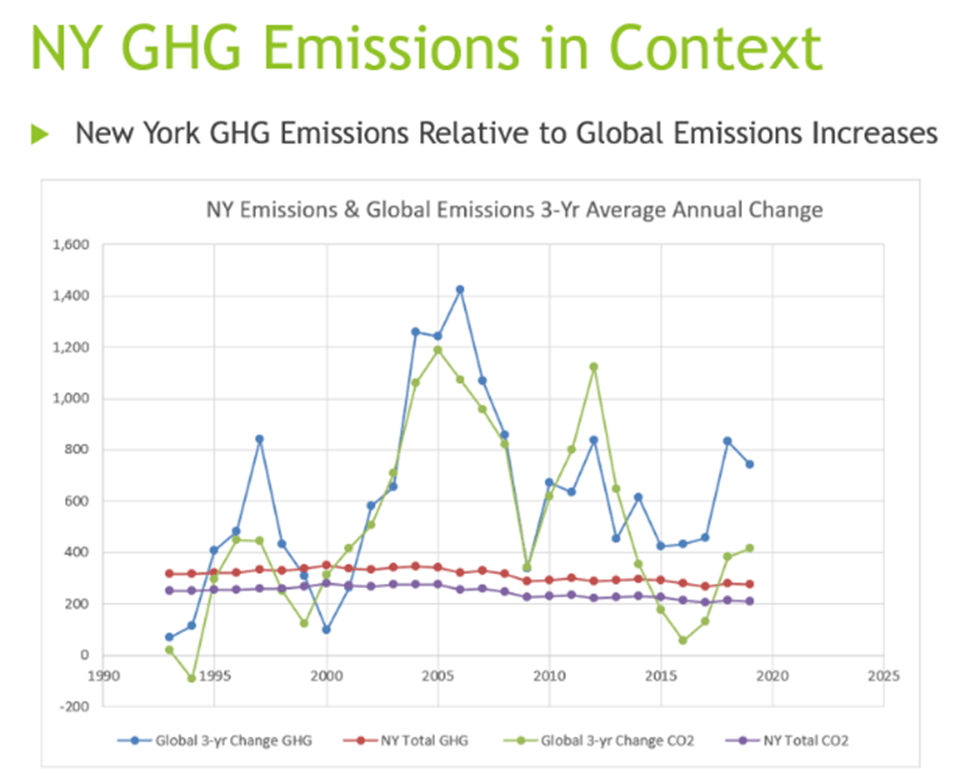
There are egregious mistakes in Rogers’ quote.  As noted previously, the presumption that implementation of the Climate Act reductions will actually have any effect on the observed weather and associated impacts is wrong simply because any New York emission reductions are simply too small to affect global warming.  In addition, New York GHG emissions have to be considered relative to global emissions.  I found that New York emissions are less than one half of one percent of global emissions.  On average, global emissions have been increasing by more than one half of one per cent per year for many years.  Therefore, any effect New York could possibly have on global warming will be offset by global emission increases in a year.

Draft Scoping Plan Cost and Benefits Claims

There is another egregious mistake in Rogers’ quote, namely the implication that reducing New York emissions prevent trillions in costs.  The Draft Scoping Plan estimates of potential benefits are much lower.  In order to bolster the claim that the costs of inaction are greater than the costs of action the Draft Scoping Plan conjures up as many speculative benefits as possible.   Figure 46 in the Draft Scoping Plan lists the net present value of benefits from 2020 to 2050 and the largest estimate is $420 billion or less than one half a trillion dollars. 

There is another problem.   I think the cost-benefit analysis is flawed and said so in my comments.  Because I have seen no indication in recent Climate Action Council meetings of any suggestion that stakeholder comments questioned the Draft Scoping Plan cost benefits claims I think it appropriate to summarize those comments.

The first problem is the lack of detailed cost documentation in the Draft Scoping Plan.  In my opinion the lack of detailed cost information in the Plan and the lack of response to questions about them is politically motivated because the costs will be eye watering.  Moreover, I maintain that the cost information provided is misleading.  In my comments on the Draft Scoping Plan I showed that in order to further the narrative that there is value to the Climate Act’s costs the reported numbers are carefully presented to give the impression that the cost of inaction is greater than the cost of action.  I documented a trick used to deceive the public that benefits out-weigh costs by excluding legitimate Climate Act costs.  For example, the analysis did not include the costs of the 2035 zero-emission vehicle mandate as part of the modeling comparison case because the “program was already implemented”.  That decreased the costs of compliance.  In addition, the Plan incorrectly interprets guidance to inflate the societal benefits of avoided emissions. That increases the alleged benefits.  When those errors are corrected the costs are greater than the benefits.

There is another issue with the benefit claims.  James Hanley from the Empire Center submitted written testimony to the Climate Action Council that addressed the cost and benefits of the Climate Act.  Although the messaging is that the benefits surpass the costs, Hanley commented that:

But what is obfuscated in this message is that all the costs fall on New Yorkers, while they receive only a portion of the benefits. Avoided economic costs due to reduced greenhouse gas emissions estimated at $260 billion are global benefits, although the plan fails to specify this important detail. This becomes clear only to those who are aware that the $260 billion estimate is based on the Department of Environmental Conservation’s social cost of carbon, which in accordance with the CLCPA is explicitly a global benefit. This is not clearly specified in the Scoping Plan, leaving the unwary reader with the mistaken impression that the benefit to New York outweighs the cost to New York.           

He goes on to explain that a careful analysis of the Draft Scoping Plan shows that the costs are greater than the benefits:

Nor does the Integration Analysis prepared by Energy+Environmental Economics make any attempt to disaggregate that $260 billion global benefit to discern what share accrues to the people who will be paying for it. But New York contributes approximately four-tenths of one percent of global greenhouse gas emissions. If we assume the state receives roughly the same share of the benefit, New York’s share of that benefit is only $1.4 billion. If we generously multiply that by 10 (assuming for the state what is likely a highly disproportionate share of the benefit), the benefit to New York would be $10.4 billion. If we subtract the $260 billion from the claimed $420 to $430 billion in benefits, then add back in that assumed benefit of $10.4 billion, we get a total net benefit to New York of $170.4-180.4 billion.  Against a cost of $280 – $340 billion, this means there is no net benefit to New Yorkers, but a net loss of $100-170 billion. Simply put, by the state’s own analysis the cost to New York outweighs the benefit to New York.

Conclusion

Despite the far-reaching impacts of the Climate Act, I remain convinced that most New Yorkers are unaware of what is coming.  In that context Spectrum News is to be congratulated for addressing this topic.  Unfortunately, like the majority of other news stories on this topic it accepts the basic talking points of both sides of the story without any investigation.  Advocates for action rely on talking points and typically respond to criticism by dismissing it as “misinformation”.

Investigation into the statements by both politicians would show their comments are real misinformation.  Houghtling implied that the Climate Act can reduce the potential risks to her jurisdiction but the State has never quantified those impacts or admitted that New York’s emissions relative to global emission increases negates anything we can do.  Rogers’ claim “if we don’t make these conversions, we will be paying many trillions more in costs for our communities” is not supported by the Draft Scoping Plan that projects benefits on the order of half a trillion over the period 2020-2050. Finally, careful review of the claimed benefits show that there are methodological issues and, importantly, that most of the benefits will accrue outside of New York. The costs will be real but the benefits are imaginary.
The news story interviewed politicians who supported a strong Climate Action Plan.  They don’t understand or don’t want to understand the enormous costs associated with the net-zero transition implementation.  To their defense the Hochul Administration has not provided sufficient information for anyone to find out what the state expects those costs to be.  Shouldn’t the fact that the Administration has refused to provide specific cost information for the proposed control strategies for a program that will radically transform the entire energy system of the state be the real story?

Climate Act Misinformation: Renewable Energy Reliability Risks

If you read this blog regularly you know that one of my persistent topics addresses the myth that the transition to the net-zero Climate Leadership and Community Protection Act (Climate Act) mandated targets relying on intermittent wind and solar resources has no potential reliability issues.  I have a long list of other potential topics to discuss but given its importance and the recent publication of a relevant blog post, I am going to try again to explain the reliability challenges embedded in the Climate Act implementation plans.   In particular I am going to call your attention to two recent blog posts The Penetration Problem Part I: Wind and Solar – The More You Do the Harder it Gets and The Penetration Problem Part II: Will the Inflation Reduction Act Cause a Blackout?.  This post excerpts some of the key points and explains the context relative to New York’s implementation plans.

Everyone wants to do right by the environment to the extent that they can afford to and not be unduly burdened by the effects of environmental policies.  I submitted comments on the Climate Act implementation plan and have written extensively on New York’s net-zero transition because I believe the ambitions for a zero-emissions economy embodied in the Climate Act outstrip available renewable technology such that this supposed cure will be worse than the disease.  The opinions expressed in this post do not reflect the position of any of my previous employers or any other company I have been associated with, these comments are mine alone.

Climate Act Implementation Background

The Climate Act establishes a “Net Zero” target (85% reduction and 15% offset of emissions) by 2050. The Climate Action Council is responsible for preparing the Scoping Plan that will “achieve the State’s bold clean energy and climate agenda”.  They were assisted by Advisory Panels who developed and presented strategies to the meet the goals to the Council.  Those strategies were used to develop the integration analysis prepared by the New York State Energy Research and Development Authority (NYSERDA) and its consultants that tried to quantify the impact of the strategies.  That material was used to write a Draft Scoping Plan that was released for public comment at the end of 2021. The Climate Action Council states that it will revise the Draft Scoping Plan based on comments and other expert input in 2022 with the goal to finalize the Scoping Plan by the end of the year.

My concern about misinformation arises from the response to stakeholder comments.  The leadership of the Climate Action Council has overly emphasized responses to comments by the Climate Justice Working Group and certain members of the Council itself.  Because the favored few members were appointed to their positions because of their ideological opinions and not their technological expertise the over-arching legal mandate to provide input to the Scoping Plan that “shall inform the state energy planning board’s adoption of a state energy plan” has suffered.  The Climate Act has always been more about the politics than reality and the politicians who are driving this process naïvely believe that the technology needed is only a matter of political will.  Many of the appointed ideologues also ascribe to that view, and some of the more vocal members of the Council have downplayed reliability as a concern going so far to claim that those concerns are misinformation.  I believe there is no greater example of actual misinformation than the claim that there are no risks to reliability inherent in the net-zero transition plan described in the Draft Scoping Plan.

Reliability Concerns

I have previously written that the Climate Action Council has not confronted reliability issues raised by New York agencies responsible for keeping the lights on.  The first post (New York Climate Act: Is Anyone Listening to the Experts?) described the New York Independent System Operator (NYISO) 2021-2030 Comprehensive Reliability Plan (CRP) report (appendices) released late last year. The second post (New York Climate Act: What the Experts are Saying Now) highlighted results shown in a draft presentation for the 2021-2040 System & Resource Outlook that all but admitted meeting the net-zero goals of the Climate Act are impossible on the mandated schedule.  Recently I wrote about the draft of the 2021-2040 System & Resource Outlook report described in the previous article and the concerns raised.  Another post detailed the differences between the Resource Outlook and the Draft Scoping Plan Integration Analysis and recommended that those differences be reconciled in a public forum.  Most recently, I explained why the response to the reliability concerns to date has been even worse than I imagined possible.

There was never any response to my suggestion early in the process that everyone associated with the Climate Act transition get a briefing to explain how the electric grid works and highlight potential issues associated with the net-zero transition. As an example of potential topics I referred to the renewable energy systems page that I maintain.  The page provides links to posts that I recommend that anyone who is interested in researching the story behind the complexities of the energy system and relying on renewable wind and solar energy read.  All of the relevant articles by the author of the recommended articles are referenced there.

Retired registered Professional Engineer Russell Schussler writes under the pen name Planning Engineer at Judith Curry’s blog Climate Etc He initially wrote under a pseudonym so that his comments would not be taken as representing his employer.  He continues to use it there because he is well known at the website and he believes his ideas should stand on their own merits, not on claims of expertise.  He hasa BSEE is from The Ohio State University and a Masters of Electrical Engineering from University of Southern California. He worked in generation and transmission for over 30 years for different sized utilities, participated and held leadership roles in various research groups and reliability organizations before his retirement.

In the articles listed above I repeatedly tried to explain the risks inherent in the Draft Scoping Plan reliance on intermittent wind and solar.  I believe the Planning Engineer’s expertise and more accessible writing style makes a better case than I have to date so this post describes his concerns.

Wind and Solar – The More You Do the Harder it Gets 

In the first post Schussler explains:

There seems to be a belief that increasing the level of wind and solar projects will make subsequent progress with these resources easier. Nothing could be further from the truth.  Increasing penetration levels of wind and solar is like a Sisyphean task, except that it is worse. The challenge may be better understood as akin to pushing a huge rock which is getting heavier and heavier, up a hill of a steeper and steeper slope while the ground below gets slicker and more unstable. The problems associated with increased penetration swamp any potential benefits that might be achieved through economies of scale. 

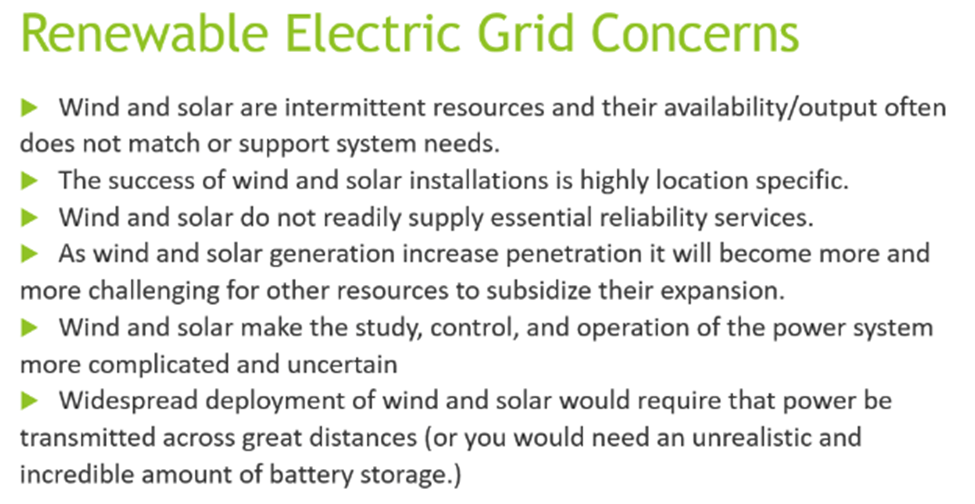
He provides eight reasons why “increasing the penetration levels of renewables will lead to rapidly increasing costs as well as rapidly decreasing reliability”.   I have annotated my New York centric concerns relative to the Draft Scoping Plan to the list of his challenges below.  For further information I refer you to the original article.

Wind and solar do not readily supply essential reliability services. 

The Draft Scoping Plan does not consider these ancillary services in any meaningful way.

Wind and solar are intermittent resources and their availability/output often does not match or support system needs.

The New York Independent System Operator (NYISO) 2021-2040 System & Resource Outlook projected resources necessary to match system needs are significantly different than the resources in the Draft Scoping Plan.  There is no indication of any urgency to resolve those differences.

The success of wind and solar installations is highly location specific.

This is a particular concern for New York solar resources.  New York is not only a high latitude state with weaker winter insolation and shorter days but large portions of the state have high wintertime snowfall and cloudiness due to the Great Lakes.

Wind and solar depend on materials which must be mined and their ability may be limited.

The Draft Scoping Plan calculates life-cycle impacts for anything related to fossil fuels but ignores all life-cycle impacts for “zero” emission wind and solar components.

As wind and solar generation increase penetration it will become more and more challenging for other resources to subsidize their expansion.

The Draft Scoping Plan ignores this issue.

It takes a lot of energy to build wind and solar facilities.

The Draft Scoping Plan ignores this issue.

Wind and solar make the study, control and operation of the power system more complicated and uncertain.

The Draft Scoping Plan ignores this issue.

Widespread deployment of wind and solar would require that power be transmitted across great distances (or you would need an unrealistic and incredible amount of battery storage.) 

Th NYISO resource outlook raises transmission concerns but the Draft Scoping Plan ignores the issue.

Schussler talks about how the challenges might be overcome.  He argues that “it’s hard to imagine that any economies of scale would allow these resources to leap the formidable challenges” and that “it does not appear that significant improvements in economies of scale are to be expected”. He points out that nuclear energy could be a piece of the net-zero transition because none of the challenges apply.  Unfortunately, even though hydro is zero-emissions and works well with the power system, there are “negligible to no potential locations to expand hydro generation”.

He concludes:

It is way too soon to be envisioning a 100% renewable future with significant contributions from current wind and solar capabilities. It is not a good strategy to support current “green” technologies and retire and prohibit conventional generation hoping that a miracle will occur when we need it. Perhaps with the extensive deployment of nuclear power, carbon capture and other technologies we might be able to approach a zero-carbon grid. At best, current wind and solar technologies will play at most a small part in such a plan.

Will the Inflation Reduction Act Cause a Blackout?

The second post could have been renamed “Will the Climate Act cause a blackout” because the issues raised are directly applicable to the New York net-zero transition.  Schussler sums up the challenge:

Replacing conventional synchronous generating resources, which have been the foundation of the power system, with asynchronous intermittent resources will degrade the reliability of the grid and contribute to blackout risk. The power system is the largest, most complicated wonderful machine ever made. At any given time, it must deal with multiple problems and remain stable. No resources are perfect; in a large system you will regularly find numerous problems occurring across the system. Generally, a power system can handle multiple problems and continue to provide reliable service. However, when a system lacks supportive generation sources, it becomes much more likely it will not be able function reliably when problems occur.

I like his description of the cumulative effects of adding renewable resources:

Just as a pile of dry wood and flammable material can be sparked from many potential sources, or a very unhealthy person could succumb to many different threats, a weakened power system is more vulnerable to many conditions than a robust one. In this post I discussed responsibility for the Texas winter blackout. Many things went wrong that day in Texas. But often many things do go wrong – the real problem was that the Texas market did not provide incentives for standby resources.  In Texas there were not enough committed resources to provide for the system load levels and potential contingencies. Texas relied on an energy market designed to favor wind and solar resources and it failed them. However, many analyses of the Texas blackout focused on the proximate conditions (problems of the sort that are common) ignoring or denying the major underlying problem.

Heat Pumps

One of the key Draft Scoping Plan emissions reduction components for buildings is electrification of the heating system using heat pumps.  Schussler describes electric system issues with heat pumps as the number of heat pumps increased.  The argument in favor of heat pumps is that they are more efficient producing heat because they move energy rather than create it.  In his description of the technology, he states that:

Because of their behavior at colder temperatures, heat pumps are not appropriate for all parts of the country. In the north the many hours they would have to run with resistance heat makes them both environmentally irresponsible and too expensive. Natural gas is a better option. 

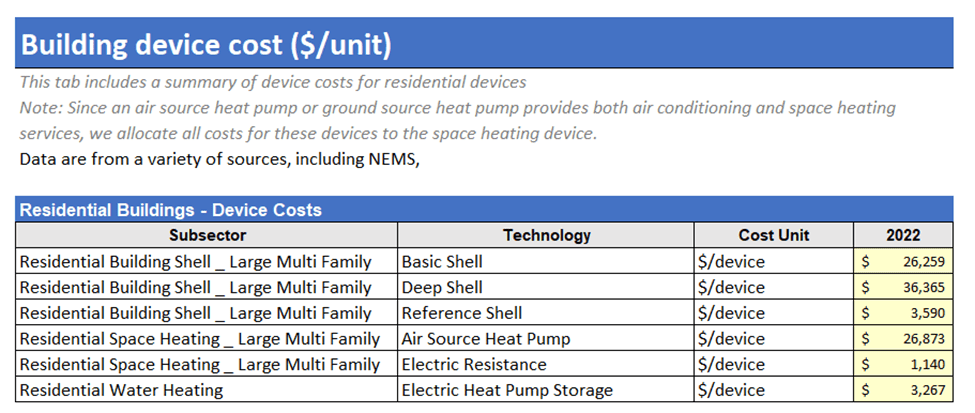
I think this is a fundamental problem in the Climate Act.  In their zealous pursuit of zero risk, they are foisting technology upon the citizens of the state that is not appropriate.  Of course, they have an answer: “In all scenarios electric heat pump space heating technologies are predominantly cold climate air source heat pumps (ASHPs) with electric backup and a significant role for ground source heat pumps (GSHPs)”.  I submitted 23 pages of comments on residential heating electrification and I argued that at many locations in the state all air source heat pumps will have insufficient energy to transfer and will require resistance heat backup.  The New York narrative is that they work in the Nordic countries where it is even colder so they should work in New York too.  Proponents neglect to point out that the reason they work there is that the housing units are smaller and much more energy efficient. 

The particular heat pump problem described by Schussler was that as more heat pumps were introduced the peak annual load shifted to the winter because during cold snaps inefficient electric resistance heating kicked in.  As a result, the electric system design requirements have to change and despite warning signs that this could be a problem, the resulting change in peak load requirements affected average energy costs.  He concludes this section noting that “While almost no one wanted to see it coming, once the effects hit, most everyone in the power supply chain wished they had. This was a terrible blow to rural electric cooperatives who had invested big to improve their load factor, only to find they had subsidized a worse winter load factor”.  Importantly, the same thing is coming to New York and someday down the road there will be unintended consequences.

Renewable Resources

Schussler goes on to discuss how the Inflation Reduction Act will enable blackouts by its encouragement of renewable resources. I believe New Yorkers can substitute Climate Act for Inflation Reduction Act to estimate impacts in the state:

The Inflation Reduction Act seeks to decarbonize the grid. In looking at the grid, you should not make one goal a priority but should instead seek to balance competing objectives. See Balance and the Grid for a discussion of how efforts to maximize one objective without due attention to other major goals can result in a worsening condition for all goals. It seems apparent that all the “green” measures in the Inflation Reduction Act were included because independently they all seem capable of reducing carbon. I have not seen any evidence that any consideration was given to system reliability or how these measures might interact to create problems.

Schussler then goes on to explain how the measures encouraged by the inflation Reduction Act, and Climate Act I believe, will lead to generic blackouts in many situations  He provides a specific prediction for the winter peak demand period: that I believe is applicable to New York:

Winter peaks can be extreme, much more so than summer peaks. As temperatures climb in the summer, air conditioners reach a saturation point. The climb in summer peak demand with each additional increase in temperature typically flattens out. In the winter each additional degree drop can increase demand more than the one before. There are a lot of potential sources of resistive heat that increase demand. In severe cold more and more heating elements come into play and the increase in demand rather than flattening can go up exponentially. Peak winter loads tend to hit just before sunrise. The system sees a rapidly rising peak, often described as needle shaped, which drops as the sun comes up and temperatures warm.  Such peaks can easily be 5 to 20% above normal winter peaks in many areas.   Thus, these conditions have the potential to cause more severe concerns than California sees during extreme summer conditions.

The Climate Act encourages and is projecting significant solar development.  Because the peak load is just before sunrise all this solar provides no support for the peak.  All the virtue-signaling homeowners with solar panels that have insufficient or no battery backup will not only be not providing any power but will be putting maximum demand on the grid.  He points out that “The infrastructure needs to supply a home which only puts a demand on the system a few hours a year concurrent with other uses maximum demand is basically the same as the infrastructure need to support a full requirements home.”  It is difficult for an electric rate structure to cover those system costs so either the needed infrastructure improvements are delayed or everyone else ends up subsidizing residential solar panel households.

Schussler also explains that wind resources are a problem too:

The Act encourages wind development. Like solar, wind will push other better suited resources out of the supply pool. Wind is generally slower just before sunrise and winter is not generally peak wind season. In any case wind is intermittent and some of the times during cold weather wind is not available. Some say that wind tends to rise up as temperatures get colder and there are ways to keep turbines from freezing,. Nonetheless, we do see freezing problems and a tendency for wind to be there is not a guarantee. Green resources perform much better in theory than practice. At least at sometimes wind power will not likely be a great asset during winter morning peaks demand conditions.

Another way to address this requirement is to encourage energy efficiency.  There is no question that this helps reduce load and, if the energy efficiency upgrades are consistent with the Nordic country requirements, then the amount of resistance heating necessary can be reduced.  Schussler points out some unintended consequences:

The Act encourages efficiency. This could help to reduce load and thereby make severe outages less likely. But the real problem with peak demand is the difference in demand during the extreme peak period and other more normal high load periods. If efficiency reduces load, you will likely see a reduction in generating resources to serve the load at all high load levels. The risk from peak conditions is more attributable to the delta between the winter peak demand and more common high load levels.  This is because regular loads drive generation additions more than extreme conditions. I don’t know that efficiency measures work better during the most extreme winter temperatures than it does at normal winter cold temperatures (probably less so), therefore its mitigating impact may be small to none. Also, there are those who might argue that consistent with Jevon’s Paradox efficiency efforts lead to increased energy consumption. The basic mechanism, behind this counterintuitive theorem, is illustrated by mechanisms observed such as   individual consumers with more efficient homes choosing to heat more rooms or increase comfort because you get more for your money in an efficient home.

On my long list of analyses that I would like to do is to compare the New York State Energy Research & Development Authority energy efficiency targets and goals with the actual observed improvements.  I have no reason to believe that they have ever come close to meeting their targets, in part, because of some the aforementioned issues.  As a result, I have no reason to believe that New York will achieve the levels of energy efficiency necessary to meaningfully, much less eliminate, the effect of resistance heaters affecting the peak load.

Schussler summarizes this section:

The chart below shows the US typical resource generation by major energy source. Imagine how this chart will look as fossil fuel is phased out. Hydro only makes up about 6% of the mix and expansion there is limited. Nuclear could replace these resources but it is not great for ramping up and down to follow needle peaks. If wind and solar step up to replace fossil fuels this leave us vulnerable to energy shortages during winter peaks just before daybreak. Battery capability would need to be huge, expansive and probably would not be procured in advance of demonstrated needs.

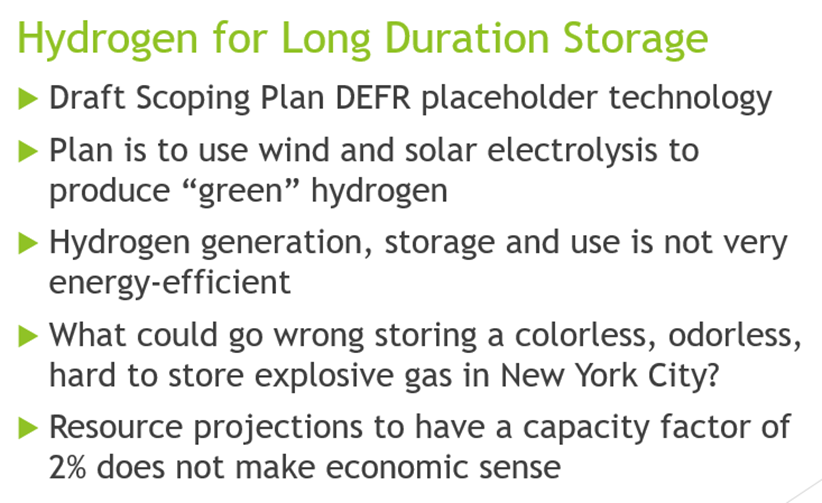
Recall that New York’s residential heating electrification magical solution is cold climate air source heat pumps that allegedly extract energy for home heating on the coldest days.  New York’s answer to the resource requirements quandary is another magical solution: dispatchable emissions-free resources.  This is a resource that has all the electric grid capabilities of a fossil-fired power plant without the emissions.  The NYISO Power Trends 2022 report sums up the challenge: “Long-duration, dispatchable, and emission-free resources will be necessary to maintain reliability and meet the objectives of the CLCPA. Resources with this combination of attributes are not commercially available at this time but will be critical to future grid reliability.” The Draft Scoping Plan uses “green hydrogen” as its placeholder for this resource and I addressed issues with that pipe dream in my comments on the Draft Scoping Plan.

Specific Blackout Prediction

Schussler lists the following set of conditions that he believes are inevitable in many areas including New York:

  • Very cold pre-dawn extreme temperatures
  • Backup quick start fossil fuel combustion turbines have been largely driven out of the resource mix,
  • Nuclear, hydro and battery resources are tapped out
  • Solar is absent from the distribution side and not available on the generation side
  • Wind may or may not be blowing
  • Heat pumps are operating maxed out in resistance mode, along with other resistive heating to drive system load to extreme heights
  • As with every power system there will be a few problems on the system
  • System will be forced to deliberately shed a lot of load or may go unstable and suffer crippling blackouts

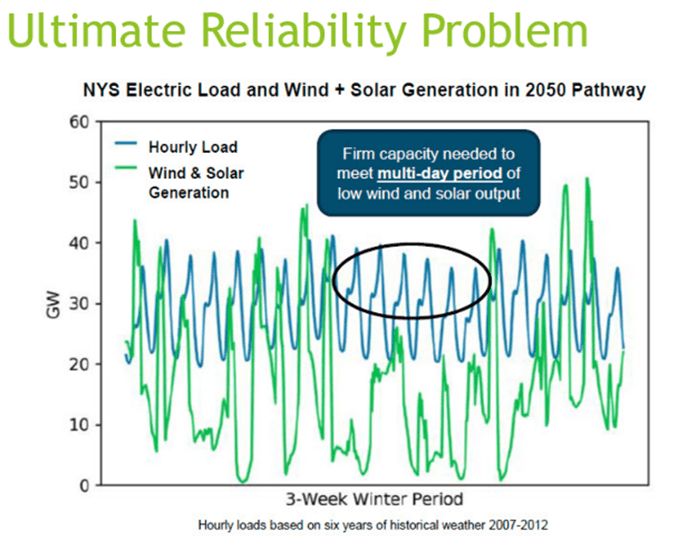
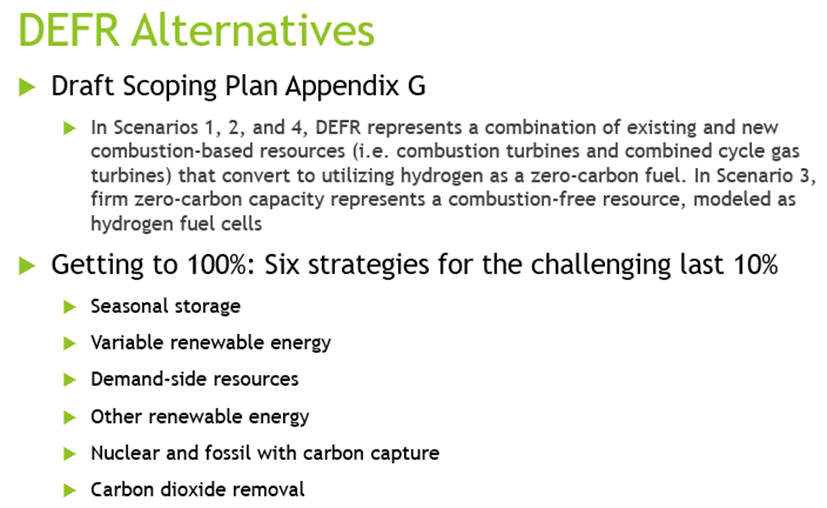
Schussler emphasized this diurnal set of conditions.  I maintain that the ultimate problem with a net-zero energy system is that increased electrification will markedly raise loads during weather conditions that cause peak loads but also can have low wind and solar resource availability over extended periods.  I recently described a paper, Getting to 100%: Six strategies for the challenging last 10%, describes approaches for providing power during peak conditions that are not included in his analysis.  I believe that an extended period of low wind resources in the winter will exacerbate these conditions and tap out all the energy stored in batteries. 

Although New York is surrounded by other sources of electricity and most of the jurisdictions have not committed to either the renewable development targets or aggressive schedule of the Climate Act, there is a particular New York problem.  New York City is a load pocket and has specific reliability mandates that I believe will be violated in the scenario outlined.  That constraint exacerbates all the conditions.  The result will be another catastrophic New York City blackout.

Conclusion

Schussler offers some suggestions to avoid this worst-case outcome.  Unfortunately, New York’s Climate Act mandates and policy actions are working against every one of his suggestions.  I believe that the Climate Action Council naïvely believes that there isn’t a potential reliability issue and has resisted requests to confront the rationales for the differences between the Integration Analysis and the NYISO resource outlook.  An open and comprehensive resolution of those differences should be done before the Scoping Plan is finalized but I have seen no indications that will be done.

To paraphrase Schussler: “The Climate Act is promoting a system with less stability, robustness and reliability”.  I cling to the hope that somebody will step up and be responsible enough to address the reliability concerns described so well by Mr. Schussler.  Unfortunately, I am not optimistic because the Hochul Administration has to this point refused to even address the claims of Climate Action Council members that argue that anyone suggesting there are reliability threats in an electric system that relies on renewable energy is misinformation.  That claim is just wrong and is the real misinformation.

Climate Action Council Question: Thruway EV Infrastructure

The Climate Leadership and Community Protection Act (Climate Act) has a legal mandate for New York State greenhouse gas emissions to meet the ambitious net-zero goal by 2050 and the process to develop the implementation plan is well underway.  Unfortunately, Governor Kathy Hochul’s administration does not appear to be focused on reliability and affordability issues and is instead placating the ideologues on the Climate Justice Working Group (CJWG) and particular members of the Climate Action Council.  This post illustrates the problem by looking at one particular question about the electric vehicle (EV) charging infrastructure at the redeveloped New York State Thruway service centers that was brought up at the September 29, 2022 Council meeting (presentation and recording).

Everyone wants to do right by the environment to the extent that they can afford to and not be unduly burdened by the effects of environmental policies.  I submitted comments on the Climate Act implementation plan and have written extensively on New York’s net-zero transition because I believe the ambitions for a zero-emissions economy embodied in the Climate Act outstrip available renewable technology such that this supposed cure will be worse than the disease.  The opinions expressed in this post do not reflect the position of any of my previous employers or any other company I have been associated with, these comments are mine alone.

Climate Act Background

The Climate Act establishes a “Net Zero” target (85% reduction and 15% offset of emissions) by 2050. The Climate Action Council is responsible for preparing the Scoping Plan that will “achieve the State’s bold clean energy and climate agenda”.  They were assisted by Advisory Panels who developed and presented strategies to the meet the goals to the Council.  Those strategies were used to develop the Integration Analysis prepared by the New York State Energy Research and Development Authority (NYSERDA) and its consultants that tried to quantify the impact of the strategies.  That material was used to write a Draft Scoping Plan that was released for public comment at the end of 2021. The Climate Action Council states that it will revise the Draft Scoping Plan based on comments and other expert input in 2022 with the goal to finalize the Scoping Plan by the end of the year.

I recently described my concerns about the Climate Action Council response to stakeholder comments.  In brief, there is no indication that any comment that raised issues inconsistent with the narrative will be addressed.  Most concerning to me is that there is no apparent realization that it is inappropriate to not reconcile the differences between the Integration Analysis generating resource projections with the estimates made by the New York Independent System Operator (NYISO) in their 2021-2040 System & Resource Outlook report.  Another concern is that the leadership of the Council has paid so much attention to questions and issues raised by some of the more vocal but energy illiterate members of the Council that substantive issues will not be addressed.  Throughout the Council’s Scoping Plan development process, the leadership has allowed those members to go off on tangents to address their particular personal agendas rather than keeping the meetings focused on the overall objective to “inform the state energy planning board’s adoption of a state energy plan”. 

Thruway Electric Vehicle Charging

In my article on the September 29, 2022 Climate Action Council meeting I gave an example of one of the frivolous questions from the Council.  At 22:28 of the meeting recording Peter Iwanowicz asked about the New York State Thruway Service Area Redesign and Redevelopment Project that is presently underway.  He asked if anyone in the administration could give the Council an idea what’s going on with respect to fast charging at the Thruway rest stops stating: “I was personally blown away at driving into one of the newly reopened ones to see no electric vehicle charging there”.  He went on to say that “it’s pretty shocking to me, one as a member of the Council but two as an EV driver not to see chargers in the newly reopened station charging”.  In this case the response was “Let us get back to you”.  I noted that I would address this in more detail in a future post.

The New York State Thruway is a toll road that runs just under 500 miles from New York City north to Albany, west to Syracuse and Buffalo then on to the Pennsylvania line near Erie, PA.   The New York State Thruway Service Area Redesign and Redevelopment Project explains that there is an effort underway to redevelop 27 service areas along the toll road.  It took very little effort to find an answer to the Iwanowicz question.  The website’s Frequently Asked Questions explains that they are working on it:

Additionally, under direct guidance and consultation with the New York Power Authority (NYPA), Empire plans to implement a passenger vehicle electric charging program at all Service Areas to further New York’s goals of reducing emissions and expanding electric vehicle infrastructure across the State.

While they are “working on it” is the simple answer, the real concern of the Climate Action Council should be on the expectations for electric vehicle charging.  As has been the case for every component of the transition plan that I have researched the answers are more complicated and uncertain than implied in the Draft Scoping Plan.  When the electric car mandate came out, I posted an article that was republished at Watts Up With That.  One of the comments on the republished article caught my eye.  Steven Pfeiffer stated:

I’m sure that the New York State officials have carefully taken into account the impact of EV’s on the electrical grid in NY. /SARC

Where it could get interesting is the peak demand with fast chargers, because a lot of them will be needed even with many people charging at low levels overnight or at work.

Let’s say a typical “Quick Mart” has 16 gas pumps. Each gas pump now has a fractional HP pump, maybe a load of 500 Watts per pump. So maybe 8 kW total peak demand.

Replace those (or add) today’s “fast” chargers, say 16 of those at a nominal 250 kW (that may be on the low end, Tesla’s may be 350 kW).

16 x 250 = 4,000 kW or 4 MW of connected load. So suddenly every suburban or rural Quick Mart has an electric load (design peak demand) equal to a paper mill, auto assembly plant, or a medium size college campus.

And if I’m doing my math correctly, a 250 kW charger (with 15% loss) adds a net of about 3.5 kWh per minute to the EV battery, so it will be adding about 12-14 miles range per minute of actual charge time.

Compare that to my sedan, where I can add over 300 miles of range in about two minutes of actual full time, or 150 miles per minute.

Either electric or gas cars will have similar time requirements to pull in, park, initiate the process with a payment method, etc. So the actual “fill time” is what is important.

Most EV proponents assume the in the future, new batteries and chargers will be developed that will make EV charging “as convenient” as filling the tank of an IC engine vehicle.

If that ever becomes reality then the impact on the grid will be monumental – based on simple calculations, the supercharger load will be about 4 megawatts per charger – that is 4 MW for ONE charger supplying ONE car, to be able to match the miles added per unit of time attainable with a conventional IC engine car.

In the following section I am going to adapt his analysis (spreadsheet) for an example service center. Note, I did not double check his assumptions.  I used the New York program to develop electric vehicle infrastructure, Evolve NY electric chargers for more information.  I presume this NYPA program will be combined for the service center implementation of passenger vehicle charging stations.  The description of these charging stations states that charging speeds range between 150-350kW. 

Warners Service Center Electric Vehicle Charging

Google Maps satellite view of NYS Thruway Warners Service Center

I arbitrarily chose to look at the closest service center to my home primarily because the re-development has not started there yet.  There are ten automotive fuel pumps and one truck pump.  I counted the parking spots in the automotive lot and found that there were 154 parking spaces: 6 handicapped, 97 spaces in the interior and 51 spaces on the edge where I presume it would be possible to install an electric charger.

Steven Pfeiffer’s example considered 16 gas pumps but Warners only has 10. Each gas pump has a fractional HP pump, with “maybe a load of 500 Watts per pump”. Warners has a peak load 5 kW.  The common comparison metric for load is a typical household which is 1 kWh/day with a peak load of 100kW.  In this case the peak load at the service center is equivalent to 5% of a typical household.

Pfeiffer’s example compared those gas pumps to a “fast” charger with a charging rate of 250 kW.  That works out to a peak load of 2,500 kW which is equivalent to the peak load of 25 households.  Note, however, that the Evolve NY chargers include 350 kW chargers.  That works out to a peak load of 3,500 kW and that is equivalent to the peak load of 35 households.

Travelers don’t really care about the electricity requirements.  Their main concern is how long it takes to fuel up.  For this analysis assume that an internal combustion engine (ICE) automobile gets 25 miles to the gallon, has a 12-gallon tank (so it has a 300-mile range), and that a motorist would fill up when the tank is 1/6 full so that 10 gallons would be pumped.  If the gas pump fills at 5 gallons per minute, then pumping takes 2 minutes and 250 miles are added to the range.

Pfeiffer notes that if he is doing his math correctly: “a 250-kW charger (with 15% loss) adds a net of about 3.5 kWh per minute to the EV battery, so it will be adding about 12-14 miles range per minute of actual charge time.”  Assuming that the charger adds 13 miles of range per minute of charging time it will take 19.2 minutes to get the same mileage with the 250-kW charger.  I assumed that all the values were proportional for the 350-kW charger and found that it will take 13.7 minutes to get 250 miles of additional range.

Cars will have similar time requirements to pull in, park, initiate the process with a payment method and do everything else necessary to fuel.  I assume that those requirements add three minutes to the car fill up.  Using these assumptions an ICE automobile can get filled up in five minutes, an EV can get charged in 22 minutes with a 250-kW charger and 17 minutes with a 350-kW charger.

I maintain that the question about the availability of charging systems at the Thruway service center was inappropriate because it is so limited.  I believe it would be more appropriate for the Climate Action Council to be discussing bigger picture expectations.  In this instance it would be more appropriate to discuss whether the EV plan for the Thruway service center redevelopments should be to provide equivalent re-fueling capabilities such that the same level of service is available in the future.  The existing Warners service center has ten pumps and can fuel 600 vehicles per hour.  In order to match that hourly rate, the service center would need 44 250-kW chargers or 33 350-kW chargers.

In order to provide that level of service the peak load will increase.  For the 250-kW chargers the peak load is 11,115 kW which is equivalent to 111 households.  For the 350-kW chargers the peak load is 11,550 kW which is equivalent to 116 households.  At this point complicating questions about the electric distribution service availability come up.  At a minimum, additional transformers will be needed.  Many of these service centers are in rural areas and additional upgrades may be required for the power supply.  The Council should know whether those complications are considered in the Draft Scoping Plan.

Pfeiffer points out that “Most EV proponents assume the in the future, new batteries and chargers will be developed that will make EV charging “as convenient” as filling the tank of an IC engine vehicle.”  He explains that “If that ever becomes reality then the impact on the grid will be monumental – based on simple calculations, the supercharger load will be about 4 megawatts per charger – that is 4 MW for one charger supplying one car, to be able to match the miles added per unit of time attainable with a conventional IC engine car”.  In this example that would increase the peak load at the service center to 40,000 kW which is equivalent to 400 households.  At that level I would expect that a new substation might be required.

In addition to the power constraints, installation of EV charging stations needs to consider site constraints.  Recall that there are 154 parking spaces: 6 handicapped, 97 spaces in the interior and 51 spaces on the edges.  Here is another appropriate overview discussion for the Council.  There is a tradeoff between parking available for people who need to attend to personal needs (restaurants and bathrooms) and for chargers.  At some point in the future placing EV chargers in the current fueling area will be possible but that transition has to be planned.  The ultimate question is how long and whether New York intends to provide fossil fuels to out-of-state visitors and grandfathered vehicles owned by residents.

Google Maps Satellite View of NYS Thruway Warners Service Center Parking Area

On a practical level I assume that that the preferred location for chargers would be on the edges.  Depending on the fast charger type between 33 and 44 chargers provide equivalent service and there are 51 spaces on the exterior.  The first practical question is whether additional parking spots are needed to respond to the loss of spots to chargers.  I imagine there will also be installation issues for the electric power and infrastructure needed for the charging points.  Another issue is whether there should be provision for charging services for vehicles towing trailers.

The bigger challenge is New York winters.  One issue is that the charging efficiency and the vehicle range are both reduced in cold weather.  The current re-fueling capabilities are not seasonally dependent.  Should there be additional chargers added because more people will need to stop to charge and it will take charging longer in the winter?  The bigger issue in my opinion is snow.  While it is more practical to put the charging stations on the edges of the parking lot that is also the only place that snow removed from the lot can initially go.  Parking lot designs that do not take into account snow removal can cause safety issues and certainly affect the time necessary to clean up after snow storms.

Discussion

On the list of issues confronting the state’s energy transition this particular question is pretty low on the priority list.  We have already seen the leadership of the Council claim that there is too little time to reconcile the electric grid projections made by the NYISO with the Integration Analysis.  Nevertheless, a Council member thinks that it is appropriate to cut into the precious little time available for the Council to consider the entirety of the energy transition with his personally biased question.  More importantly this is just an example of a recurring theme throughout the Scoping Plan process.  Any question from the CJWG and certain members of the Council gets a response no matter how removed from the issue at hand. 

I highlighted this particular question because it illustrates my bigger concern.  The Climate Action Council should be focused on big picture items that affect not only the net-zero transition but also the public’s use of energy.  Instead, the leadership has allowed the membership to go off on tangents like this.  In this example, the relatively trivial issue is what can be expected at the Thruway service areas and over-arching questions arose.  What does the Council recommend for future planning: minimizing resources required which increases public inconvenience or the opposite?  How does the Draft Scoping Plan address these tradeoffs?  What is the expectation for resources like this during the transition?  Unfortunately, those big picture items are not getting addressed while Staff tries to track down answers to questions like this.

There are many over-arching net-zero transition issues that the membership of the Council seems OK ignoring as the Scoping Plan development process unfolds.  I am particularly concerned that the Draft Scoping Plan only provides aggregated costs relative to societal benefits and there are significant unresolved differences between the generation resource projections for the net-zero transition between the Integration Analysis and the NYISO Resource Outlook.  It is not clear that the aspirational technology deployments proposed in the Draft Scoping Plan are feasible with respect to affordability and reliability.  I believe the Council should define their expectations for those two aspects.  What does affordable mean; how should it be tracked as the transition unfolds to protect the low- and middle-income citizens who are least able to afford regressive energy cost increases; and what does the Scoping Plan project will happen in this regard?  Reliability is a bigger concern because it directly affects public safety.  Does the Council believe that current reliability standards must be maintained in the future?  How will that be enforced?  In particular, if the organizations responsible for reliability believe the current reliability standards are threatened what is the plan?

Conclusion

I have shown that even a trivial question about New York State Thruway service centers raises more important general issues that should be the focus of the Climate Action Council.  Not so long ago, affordability and reliability were the paramount concerns for the New York energy system.  At that time the idea that the existing system would be dismantled without proven technology in place would be dismissed out of hand.  It was generally accepted that, for example, natural gas could be used a bridge fuel until the aspirational dispatchable emission-free resources could be tested at the scale needed, perform like a natural gas fired generating unit, and provide power at a similar cost, was generally accepted as a rational approach. The analogy for the current approach is that proponents including some members of the Climate Action Council want to jump out of a perfectly good airplane without a parachute because they assume that the concept of a parachute will be developed, proven technically and economically feasible, and then delivered in time to provide a soft landing.  The risks of the current approach are not even being discussed by the Council as they fritter away time dealing with politically expedient Integration Analysis updates and personal agenda items of the membership.  I am not optimistic about the future.

Comparison of NYISO Resource Outlook and Draft Scoping Plan Generating Resource Projections

The final version of the important New York Independent System Operator (NYISO) 2021-2040 System & Resource Outlook that addresses New York’s Climate Leadership and Community Protection Act (Climate Act) was released on September 22, 2022.  This post compares the projections for resources needed to meet the Climate Act targets in this report and the Draft Scoping Plan. 

Everyone wants to do right by the environment to the extent that they can afford to and not be unduly burdened by the effects of environmental policies.  I submitted comments on the Climate Act implementation plan and have written extensively on New York’s net-zero transition because I believe the ambitions for a zero-emissions economy embodied in the Climate Act outstrip available renewable technology such that this supposed cure will do more harm than good.  The opinions expressed in this post do not reflect the position of any of my previous employers or any other company I have been associated with, these comments are mine alone.

Background

The implementation for the New York’s Climate Act “Net Zero” target (85% reduction and 15% offset of emissions) by 2050 is underway.  The Climate Action Council has been working to develop plans to implement the Climate Act.  Over the summer of 2021 the New York State Energy Research & Development Authority (NYSERDA) and its consultant Energy + Environmental Economics (E3) prepared an Integration Analysis to “estimate the economy-wide benefits, costs, and GHG emissions reductions associated with pathways that achieve the Climate Act GHG emission limits and carbon neutrality goal”.  Integration Analysis implementation strategies were incorporated into the Draft Scoping Plan when it was released at the end of 2021.  Since the end of the public comment period in early July 2022 the Climate Action Council has been addressing the comments received as part of the development of the Final Scoping Plan that is supposed to provide a guide for the net-zero transition.

I have previously written that the Climate Action Council has not confronted reliability issues raised by New York agencies responsible for keeping the lights on.  The first post (New York Climate Act: Is Anyone Listening to the Experts?) described the NYISO 2021-2030 Comprehensive Reliability Plan (CRP) report (appendices) released late last year and the difficulties raised in the report are large. The second post (New York Climate Act: What the Experts are Saying Now) highlighted results shown in a draft presentation for the 2021-2040 System & Resource Outlook that all but admitted meeting the net-zero goals of the Climate Act are impossible on the mandated schedule.  Recently I wrote about the “For discussion purposes only” draft of the 2021-2040 System & Resource Outlook report described in the previous article and the concerns raised.  It is amazing to me that these issues continue to be ignored.

Description of Resource Outlook and Draft Scoping Plan Mitigation Scenarios

This section compares two alternate approaches to meeting the Climate Act net-zero transition requirements. 

The NYISO Resource Outlook report includes two scenarios that “reflect full achievement of the Climate Act targets”. 

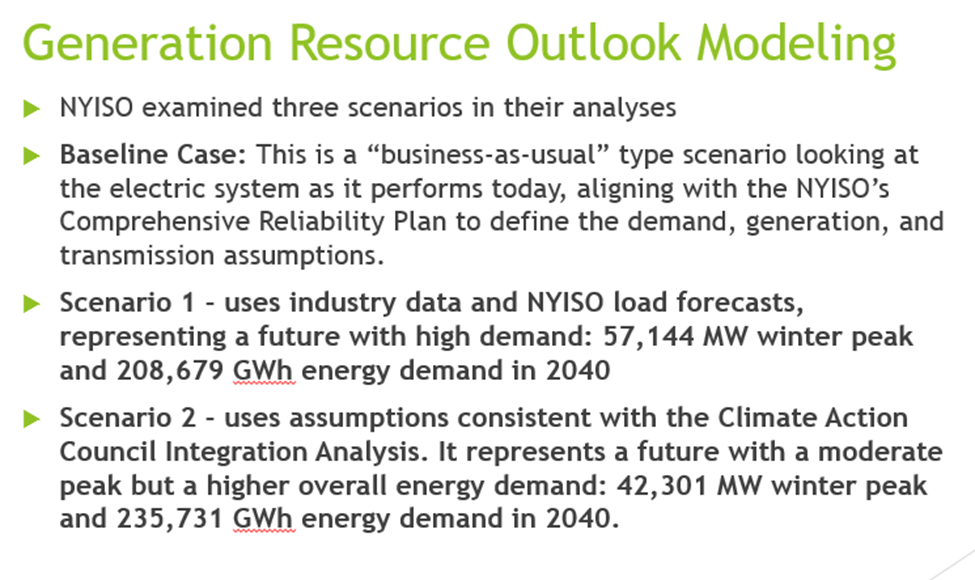
Outlook Scenario 1 – Utilizes industry data and NYISO load forecasts, representing a future with high demand (57,144 MW winter peak and 208,679 GWh energy demand in 2040) and assumes less restrictions in renewable generation buildout options.

Outlook Scenario 2 – Utilizes various assumptions consistent with the Climate Action Council Integration Analysis and represents a future with a moderate peak but a higher overall energy demand (42,301 MW winter peak and 235,731 GWh energy demand in 2040).

The Resource Outlook describes the scenarios:

In both Policy Case scenarios, a significant amount of land-based wind capacity was built by 2040. The model selected land-based wind due to its assumed capital cost, energy output, and capacity ratings. In both scenarios, land-based wind capacity builds to the assumed capacity build limits imposed (~16 GW).

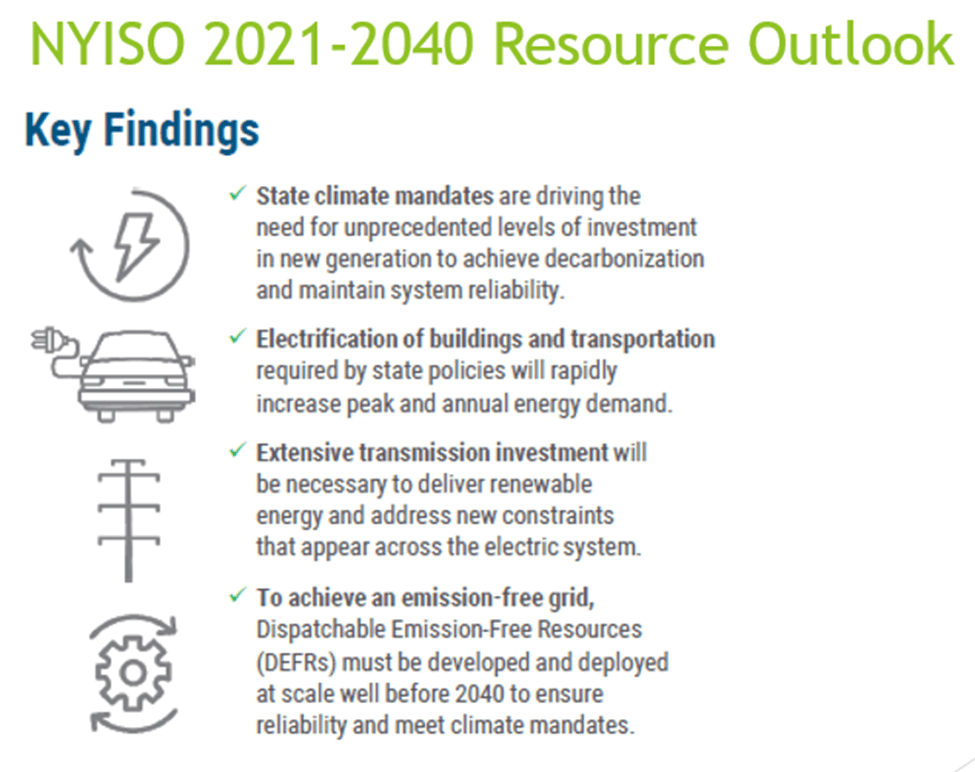
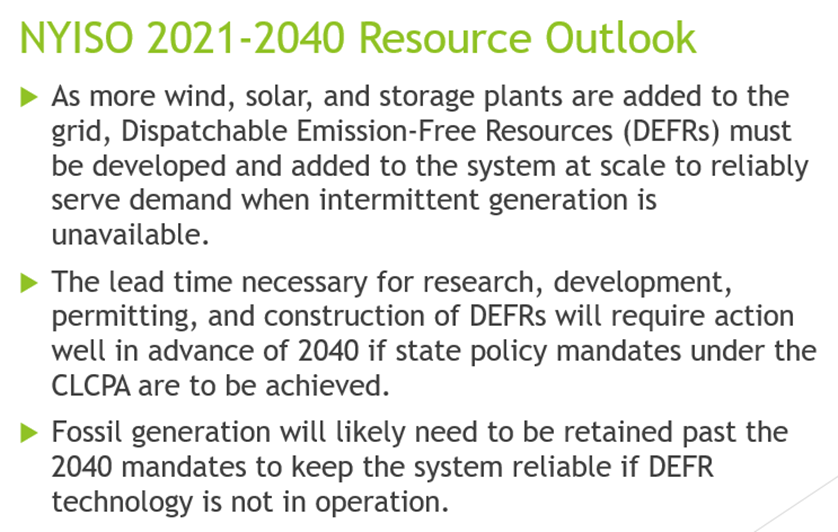
In both scenarios, a significant amount of capacity from renewable generation and dispatchable emission free resources (DEFRs) is projected by 2040, with the most installation forecasted in the last five years, to help offset the projected fossil-fueled generation retirements. Dispatchable emission free resources are a proxy generator type assumed for generation expansion in the Policy Case to represent a yet unavailable future technology that would be dispatchable and produces emissions-free energy (e.g., hydrogen, RNG, nuclear, other long-term season storage, etc.). As noted above, all existing fossil-fueled generation (~26 GW) was modeled as retired by 2040 due to the CLCPA requirement of a zero emissions grid by 2040. In addition, in Scenario 2 the age-based retirement assumption captured the retirement of 12 GW, nearly half the fossil fleet. The models expanded to approximately 111 GW of total capacity for Scenario 1 and 124 GW of total capacity for Scenario 2, inclusive of NYCA generators, BTM-PV, and qualifying imports from Hydro Québec. This level of total installed capacity would be needed in 2040 to satisfy the state policy, energy, and resource adequacy constraints for Scenario 1 and Scenario 2, respectively. Of this total, approximately 85 GW to 100 GW represent generation expansion for Scenario 1 and Scenario 2, respectively, beyond the 9.5 GW planned through state contracts.25 For comparison, the Contract Case has approximately 51 GW of total installed capacity by 2040.

In general, resources take years from development to deployment. By year 2030, roughly seven years from the publication of this report, an estimated 20 GW of additional renewable generation needs to be in-service to support the energy policy target of 100% zero-emission generation by 2040. For reference, 12.9 GW of new generation has been developed since wholesale electricity markets began more than 20 years ago in 1999. Over the past five years, 2.6 GW of renewable and fossil-fueled generators came on-line while 4.8 GW of generation deactivated26. This Outlook demonstrates the need for an unprecedented pace of project deployment, which will require significant labor and materials available for New York over a long period of time.

Offshore wind capacity buildout remains near the 9 GW policy objective through 2040 for both scenarios. This outcome results primarily from the assumed high capital cost of offshore wind technology in the model, which was the highest cost renewable technology available. Additionally, considering the declining marginal capacity reliability value curves assumed, offshore wind at the levels modeled is an inefficient resource to meet peak capacity needs and Locational Capacity Requirements because the capacity contribution of intermittent renewable resources declines as more are added to the system.

Overall, results for Scenario 2 showed a higher level of renewable buildout than Scenario 1, most notably in utility-scale solar capacity, and had a different projection of the capacity expansion throughout the study period as compared to Scenario 1 for all generator types. The main factors for these differences are the assumptions for load forecasts and differences in generator types eligible for capacity expansion as well as the maximum allowable capacity builds by technology type modeled between the two scenarios. One major difference in Scenario 2 is that a reduced land-based wind capacity limit was used, which changed the projection of capacity builds for all types. Notably, the projections for offshore wind were higher earlier in the model horizon (e.g., 2030) in Scenario 2 as compared to Scenario 1 to help achieve the 70 x 30 target.

Two primary drivers are attributable to increased renewable resources in capacity expansion: (1) high operating cost of dispatchable generators, and (2) low capital costs for renewable generators. High fuel (e.g., natural gas prices, clean DEFR fuel prices) and/or high CO2 emissions prices result in significant decrease in fossil generation and subsequent increase in renewable generation earlier than otherwise projected. Low capital costs for renewable generators result in capacity builds much earlier than otherwise projected, and often an increase in the total amount of capacity built.

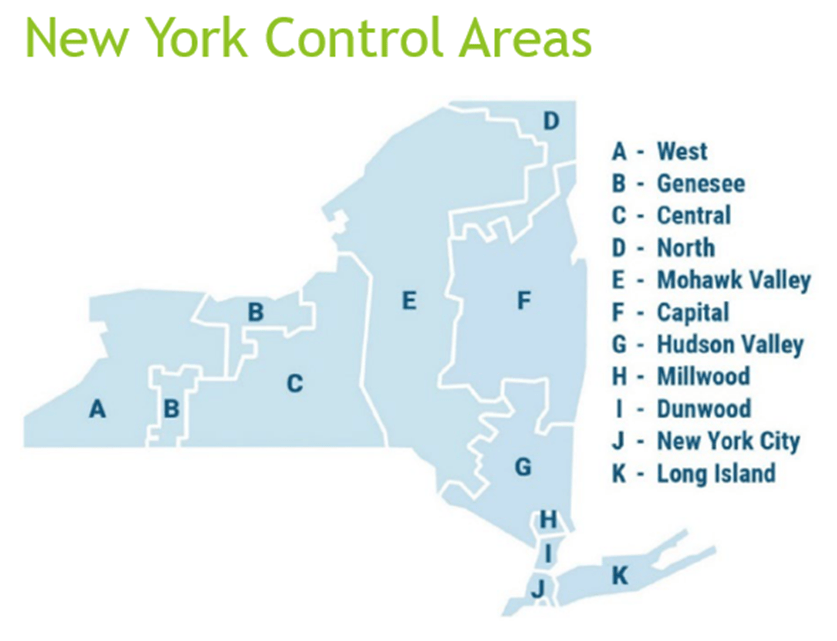
In terms of the zonal location for capacity buildouts determined by the capacity expansion model, limitations were imposed on the zonal level as to which generator type(s) could build in each zone. For instance, land-based wind was eligible for expansion in upstate regions (Zones A-G), utility-scale solar was eligible for expansion in upstate regions and Long Island (Zones A-G and Zone K), and offshore wind was eligible for expansion in New York City and Long Island (Zones J and K). Dispatchable emission free resource (DEFR) technologies and battery storage were included as generation resource options in all NYCA zones.

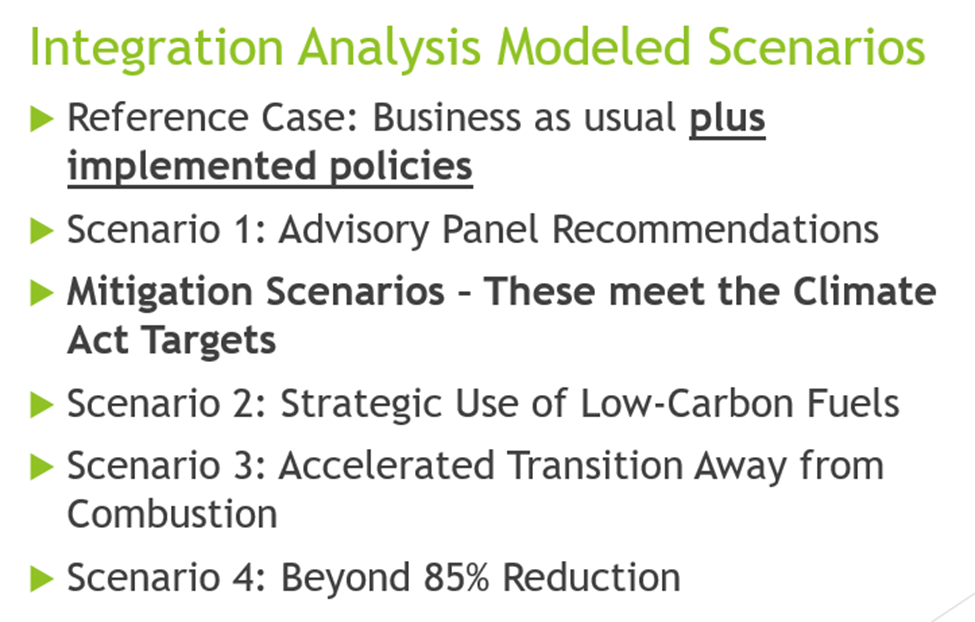
The Draft Scoping Plan includes a reference case and four mitigation scenarios.  The first mitigation scenario only includes the initial recommendations of the Climate Act Advisory Panels but it did not meet the targets.  The three remaining mitigation scenarios meet or exceed GHG emission limits and achieve carbon neutrality by 2050.  They all include:

  • Zero emission power sector by 2040
  • Enhancement and expansion of transit & vehicle miles traveled (VMT) reduction
  • More rapid and widespread end-use electrification & efficiency
  • Higher methane mitigation in agriculture and waste
  • End-use electric load flexibility reflective of high customer engagement and advanced technologies

The three mitigation scenarios that meet the Climate Act targets address concerns raised by the Climate Action Council membership:

Draft Scoping Plan Scenario 2: Strategic Use of Low-Carbon Fuels: Includes the use of bioenergy derived from biogenic waste, agriculture & forest residues, and limited purpose grown biomass, as well as green hydrogen, for difficult to electrify applications

Draft Scoping Plan Scenario 3: Accelerated Transition Away from Combustion: Includes Low-to-no bioenergy and hydrogen combustion and accelerated electrification of buildings and transportation

Draft Scoping Plan Scenario 4: Beyond 85% Reduction:  Accelerated electrification + limited low-carbon fuels: This scenario adds additional VMT reductions; additional innovation in methane abatement; and avoids direct air capture of CO2

I prepared Draft Scoping Plan comments on these mitigation scenarios that includes descriptions and a comparison of the differences between them based on Appendix G of the Draft Scoping Plan.  Unfortunately, the documentation is so poor that it does not explain the rationale for the generation sector differences described in the next section.

Comparison of Scenarios

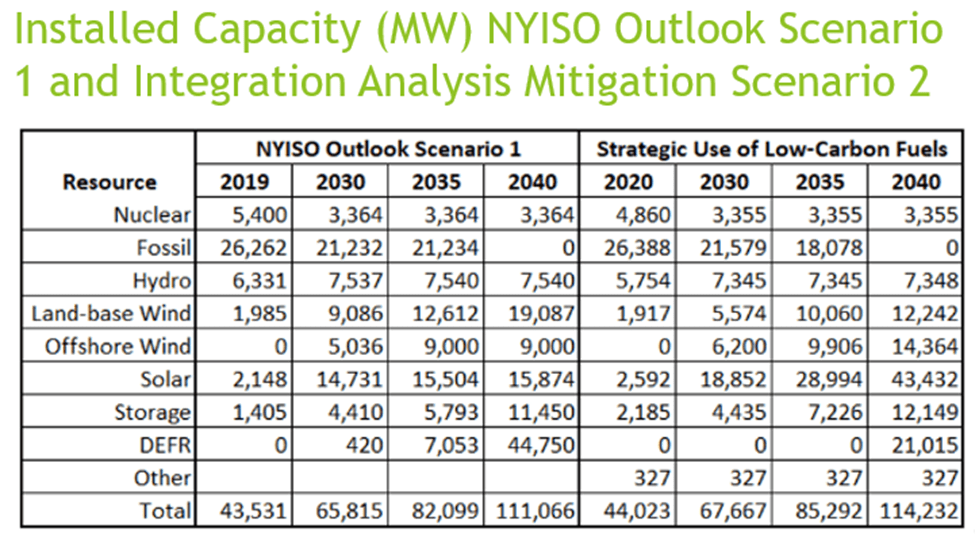
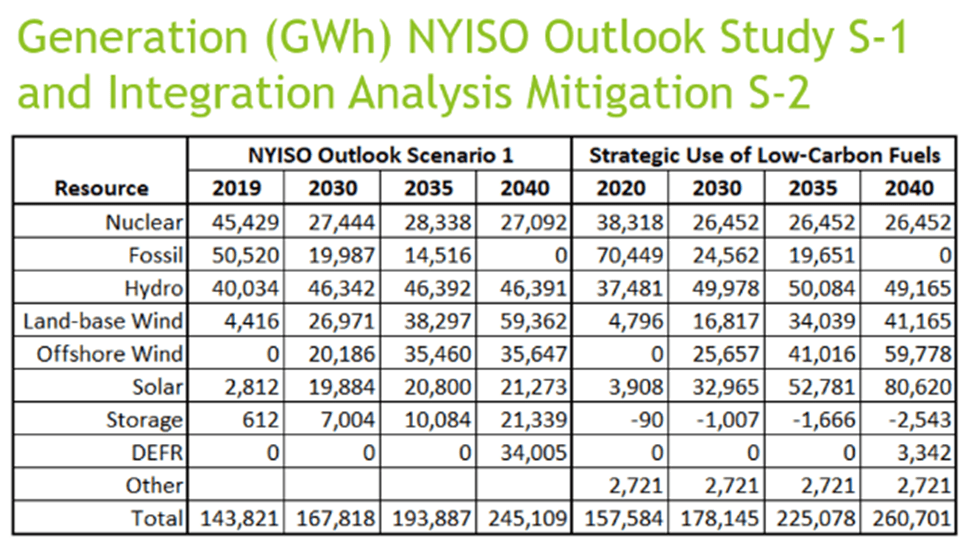
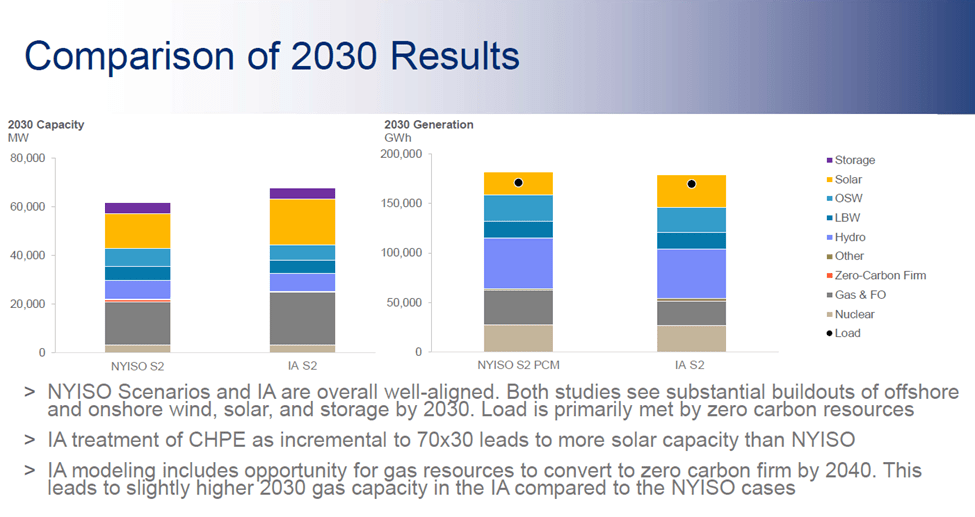
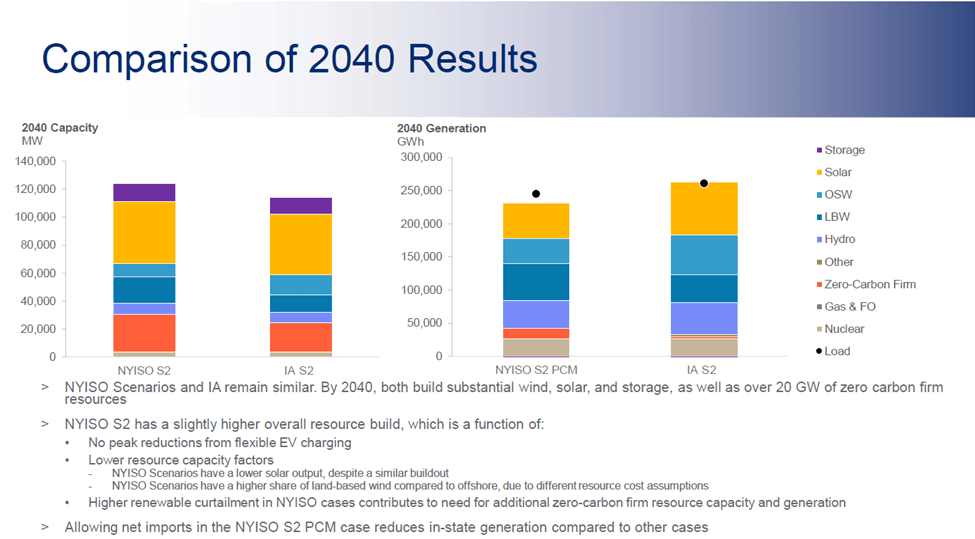
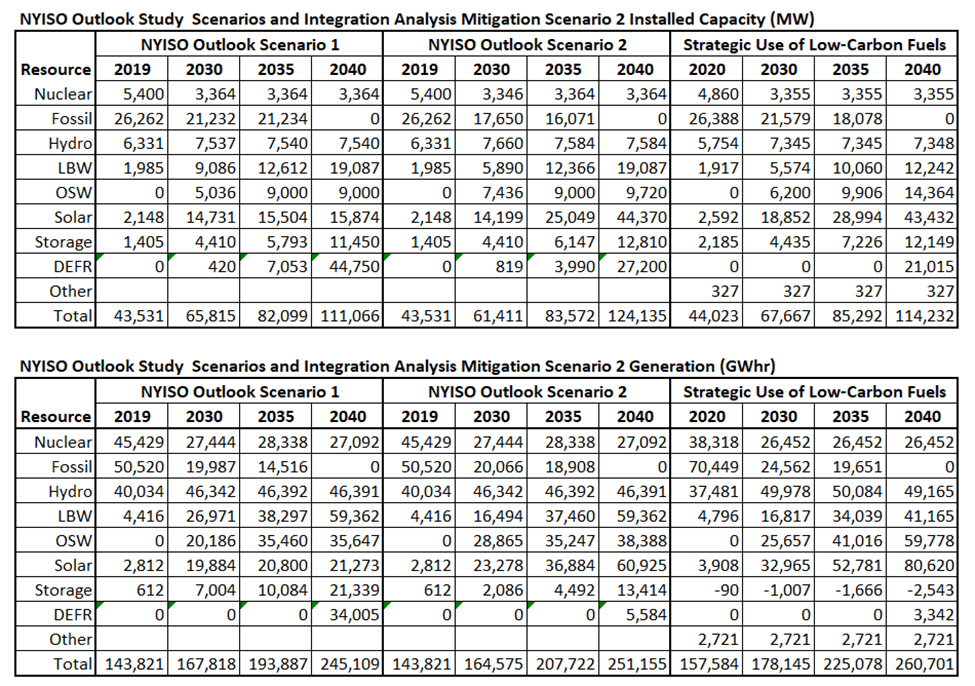
The following table provides an overview of the capacity (MW) and energy generated (GWhr) generating resources in the five scenarios described above.  Because it is difficult to read the table I have also provided a spreadsheet with the table and the input data extracted from the NYISO and Integration Analysis spreadsheets.  I will compare each of the resource categories in the following from 2019 up to 2040 when the state’s electric grid is supposed to be zero-emissions.

The first resource category is nuclear.  There is no significant difference in the capacity and power generated between the scenarios.  They all reflect the irrational shutdown of over 2,000 MW at the Indian Point Nuclear Station and continued operation of the remaining nuclear facilities to 2040.  Despite the fact that nuclear is the only dispatchable emissions-free generating resource that can be scaled up neither analysis believes that additional nuclear power generation could be part of New York’s future.

There are interesting differences between the scenarios in the fossil generation resource category.  Resource Outlook Scenario 1 reduces fossil capacity 19% from 2019 to 2030, keeps it the same in 2035, and then goes to zero in 2040.  Resource Outlook Scenario 2 reduces fossil capacity 33% from 2019 to 2030, reduces it another 9% by 2035, and then goes to zero in 2040.  Note that the energy produced is the same for both scenarios in 2030 but in 2025 Scenario 1 is reduced 8% more. So even though there is more fossil capacity in 2035 in Scenario 1 it is used less.  This is problematic for me because it means that the production resource model is treating the fossil resources differently between the scenarios.  It is not clear what would cause this difference.

The Integration Analysis scenario fossil projections raise similar concerns.  Scenario 2, Accelerated Transition from Combustion, capacity and generation is higher in 2030 compared to the other two scenarios but then does show a marked decrease in 2035.  If it is accelerated, why is it higher in 2030?  Integration Analysis Scenarios 2 and 4 are comparable to Resource Outlook Scenario 1 and Integration Analysis Scenario 3 is comparable to Resource Outlook Scenario 2.  I assume that this reflects similar assumptions by the analysts at NYISO and NYSERDA.

All the Hydro category scenarios show an increase in capacity between 2019 and 2030.  I assume that a large part of that is due to the Clean Path New York (CPNY) and Champlain Hudson Power Express projects. 

The remaining categories are the key parts of the transition.

The land-based wind (LBW) resource category is the first where there are significant differences between the Resource Outlook and the Integration Analysis scenarios.  Resource Outlook Scenario 1 increases LBW capacity 3.1 times whereas Scenario 2 only doubles the amount in 2030.  Integration Analysis Scenario 2 also doubles capacity by 2030, Scenario 3 goes up 2.7 times, and Scenario 4 goes up 2.4 times.  The differences between scenarios disappear by 2035 but the Resource Outlook projects land-based wind capacity will be 53% higher than the mitigation scenarios in the Integration analysis with 42% more generation.

The NYISO production resource model apparently does not think that offshore wind is a cost-effective option because both scenarios do not increase the projected capacity significantly beyond the Climate Act mandate of 9,000 MW.  On the other hand, the Integration Analysis scenarios nearly double the amount of offshore wind resources projected.   Overall, the Resource Outlook offshore wind capacity is 40% lower than the average of the Integration Analysis scenarios and generation is 43% lower. 

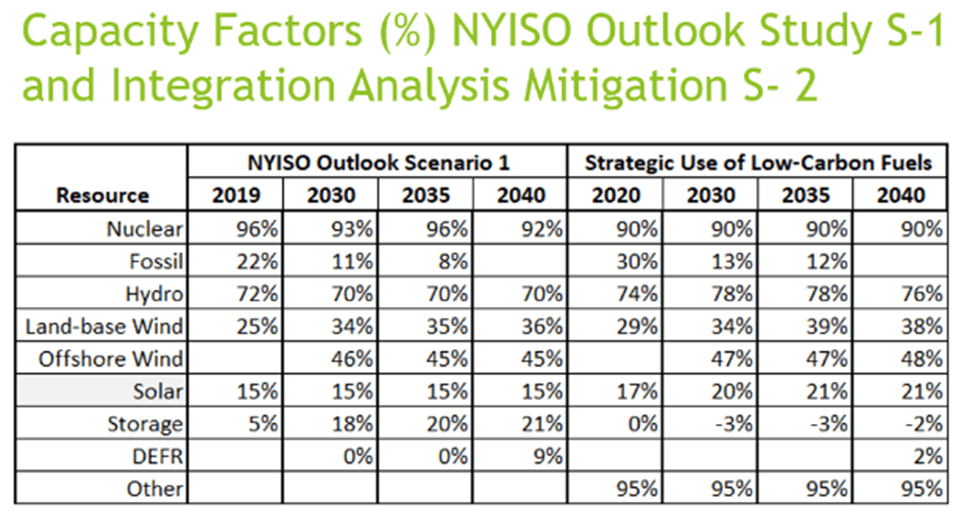
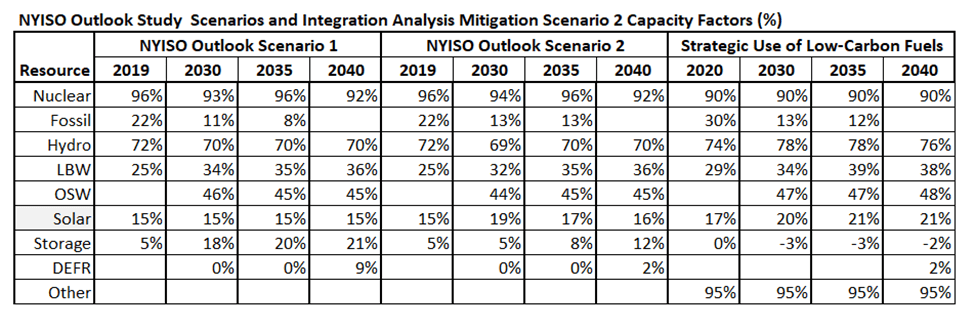
For the solar resource there is a significant difference between Resource Outlook Scenario 1 and all the other scenarios.  The capacity is 63% lower and the generation is 71% lower than the averages of the other scenarios.  In 2040 the capacity factor for the projected resource capacity and expected generation is a reasonable 15% for Resource Outlook Scenario 1 whereas Resource Outlook Scenario 2 is 17% but 21% for the Integration Analysis scenarios.  In my opinion I question why there is a difference for the Resource outlook scenarios. I don’t think that the Integration Analysis expectation that the solar capacity factor can bas high as 21% in 2040 is reasonable for New York’s latitude and snowfalls.

The energy storage resource category capacity values are pretty much the same all the scenarios.  However, the generation projections are presented differently so that it is not possible to compare them.

As noted in the Resource Outlook, the Dispatchable Emissions-Free Resource (DEFR) category is a proxy generator type that represents a yet unavailable future technology that would be dispatchable and produces emissions-free energy (e.g., hydrogen, RNG, nuclear, other long-term season storage, etc.).  The DEFR capacity and generation is substantially higher in Resource Outlook Scenario 1 and all the other scenarios.  Even Resource Outlook Scenario 2 is higher than the Integration Analysis scenarios.  In addition, Resource Outlook Scenario 1 capacity factor is 9% whereas the others are all around 2%.

Getting to 100%: Six strategies for the challenging last 10%

My most recent post described a recent paper, Getting to 100%: Six strategies for the challenging last 10%, that provides a concise evaluation of six zero-emissions technologies.  It is instructive to consider these strategies in the context of these projections.  The authors from the National Renewable Energy Laboratory provided the following summary of the challenge:

Meeting the last increment of demand always poses challenges, irrespective of whether the resources used to meet it are carbon free.  The challenges primarily stem from the infrequent utilization of assets deployed to meet high demand periods, which require very high revenue during those periods to recover capital costs.  Achieving 100% carbon-free electricity obviates the use of traditional fossil-fuel-based generation technologies, by themselves, to serve the last increment of demand—which we refer to as the ‘‘last 10%.’’

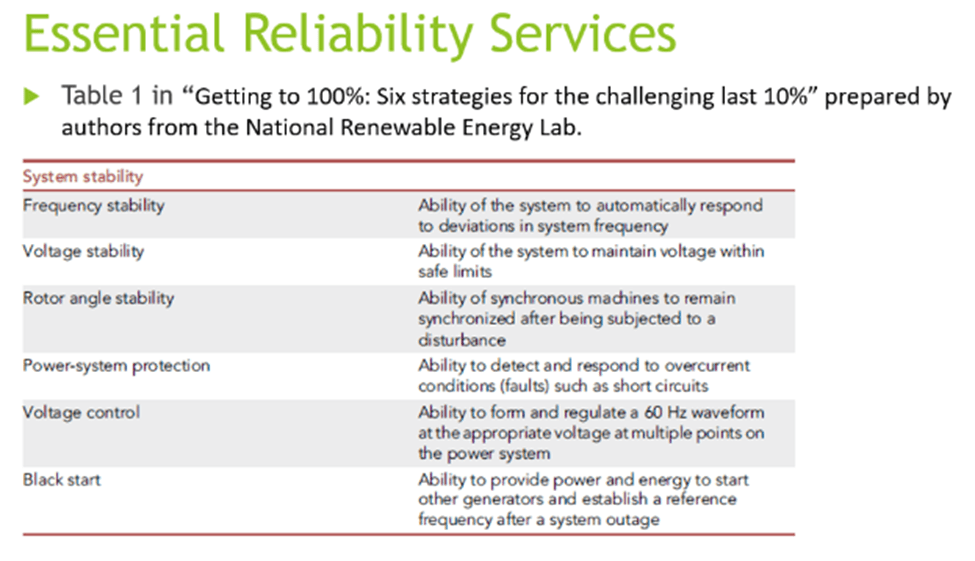
The Getting to 100% paper describes six strategies that are summarized in the following table.  Note that the strategies are compared to an ideal solution.  Ideally, the solution for peak loads would have low capital expenses and low operating expense, low resource constraints, be technologically mature, have low environmental impacts, and work well with other resources.  Needless to say, no technology comes close to meeting those ideal conditions.  The authors note that: “Although existing studies generally highlight the same fundamental causes associated with the last 10% problem, there is a lack of consensus on the preferred strategies for meeting this challenge. This is not surprising, given the diversity of possible solutions and the speculative nature of their costs, given their early stage of development.”

The Getting to 100% paper described strategies for the last 10% challenge which for this resource refers to increasing the use of wind, solar, and storage to cover what I call the ultimate problem.  Both the Resource Outlook and the Integration Analysis models predict that the primary resource for this challenge will be seasonal storage using DEFR.  Although there are mentions of the other strategies the emphasis is on the dispatchable emissions-free resource.  The proxy technology in the Integration Analysis is hydrogen although the production and use options are not specified. 

There are other options for seasonal storage.  The report notes:

This group of technologies is not well defined, but it could include batteries with very low-cost electrolytes capable of longer-than-diurnal durations. Because of the requirement for very low-cost energy storage, most seasonal storage pathways focus on hydrogen, ammonia, and other hydrogen-derived fuels stored in geologic formations.

Ultimately the Getting to 100% paper evaluates hydrogen used either in a combustion turbine or a fuel cell for electricity production.  In the New York implementation plan the dispatchable emissions-free resource (DEFR) place holder is hydrogen produced using wind and solar.  There are members of the Climate Action Council that insist that the hydrogen has to be used in a fuel cell rather than a combustion turbine because combustion causes emissions.

The Draft Scoping Plan calls for the use of so-called “green hydrogen” whereby hydrogen is produced by a carbon-free process of electrolysis from water. The Draft does not include a feasibility analysis of the production and use of hydrogen in some form as the placeholder technology for DEFR.  The Resource Outlook does not specify a specific technology but emphasizes the risks of depending upon an unproven technology: “Both scenarios include significant DEFR capacity by 2035, but it is important to note that the lead time necessary for commercialization, development, permitting, and construction of DEFR power plants will require action much sooner if this timeline is to be achieved.”

I submitted a Draft Scoping Plan comment specifically addressing this presumption.  I do not believe that the Integration Analysis correctly accounted for the energy needed to produce the hydrogen needed for the DEFR requirement. I think that there will be siting issues for all the fuel cells, electrolyzers, pipelines, and hydrogen storage facilities.  .  In the exisitng system the generating sources assigned for peaking power for this reliability requirement used the cheapest technology available (simple-cycle gas turbines).  Meeting this requirement in the future using the hydrogen DEFR resource will be using the most expensive generating technology available.  The capacity factors for this resource in the Draft Scoping Plan are 2% for all mitigation scenarios so it will be difficult to cover these costs for the short periods needed.  I guarantee the usual suspects will complain about profiteering when the costs spike during these periods.

In addition, the Getting to 100%: Six strategies for the challenging last 10% report notes that “current high-cost electrolyzers need to operate almost continuously to recover their capital expense”.  The Draft Scoping Plan plans to use intermittent wind and solar that preclude any continuous processes.  That issue has been completely ignored in the Draft Scoping Plan. 

Recall that there are members of the Climate Action Council that insist that hydrogen used for electric generation has to be used in fuel cells.  The Getting to 100% paper addresses fuel cells:

Fuel cells have diverse applications, but their use for bulk power generation is currently limited. Given the range and scale of applications especially for transportation, substantial capital cost reductions for fuel cells are possible. With low capital costs for combustion turbines and future potential cost reductions for fuel cells, the economic case for hydrogen mainly hinges on lowering the cost of electrolytic hydrogen.

According to Table 1 in the Getting to 100% paper, it really is a stretch to say that there are any positive aspects for using hydrogen.  For hydrogen used in combustion turbines the report claims low capital expenses (apparently referring only to the combustion turbine but not including the generation of the hydrogen itself), medium operating expenses and resource constraints, and concerns about hydrogen storage and transport as well as competition for using hydrogen in other sectors.  For hydrogen used in fuel cells there is a potential for low capital expenses, high operating expenses, low resource constraints (apparently referring only to the fuel cell and not assuming that the hydrogen is generated with wind and solar resources), low technological maturity, and the same other considerations as hydrogen used in combustion turbines.

Discussion

This analysis found significant differences between the projections for land-based wind, offshore wind, energy storage and dispatchable emissions-free resources in the Resource Outlook and the Integration Analysis.  I think that those differences should be discussed in an open forum.  Most importantly to New York citizens the costs associated with the different options have to be made available from the NYISO and Climate Action Council.  I am pretty sure costs account for the differences in the NYISO scenarios but without that information we cannot be sure.  Most importantly, the feasibility of a dispatchable emissions-free resource has to be addressed and the projected DEFR utilization difference between Resource Outlook Scenario 1 and all the other scenarios reconciled.  I also believe that both organizations have to address the economic viability challenge of DEFR stemming from the infrequent utilization of those assets deployed to meet high demand periods, which require very high revenue during those periods to recover capital costs. 

Moreover, the forum should also address implementation concerns raised by the New York State Reliability Council in their Draft Scoping Plan comments.  They made the point that the new resources required are enormous and also raised other concerns:

Practical considerations affecting the availability, schedule and operability for new interconnections include: interconnection standards; site availability; permitting; resource equipment availability; regulatory approval; large volume of projects in NYISO queue and study process; scalability of long-term battery storage and other technologies; operational control; impact of extreme weather; consideration of a must- run reliability need for legacy resources. In addition, the pace of transportation and building electrification, the timing of any natural gas phase-out and their impact on the electric T&D system must also be carefully studied from technical, economic and environmental perspectives. Together, these practical considerations require the development of reliable zero emission resources to be conscientiously sequenced and timed in the near term (through 2030) to ensure broader GHG reductions in all sectors beyond 2030.

One final point about the modeling analyses.  The programs are proprietary and the documentation is sparse so it is not possible to fully understand the results.  For example, the Integration Analysis Accelerated Transition Away from Combustion scenario has higher fossil generation projections in intermediate years than the other scenarios.  Untangling the reason for that would be a challenge.  I believe that the models can create projection differences as much by input tweaks as by the projection algorithms.  Because the models are so complicated and include so many input parameters the modelers have to be careful to limit changes between scenarios that could affect the outcomes.

Conclusion

I have repeatedly made the point that the differences between the NYISO projected resources and the Integration Analysis projections need to be reconciled.  This post attempted to explicitly list those differences.  Unfortunately, this concern does not seem to be shared by the Climate Action Council and the Hochul Administration.  It is only a matter of time until the ramifications of this abrogation of responsibility affects reliability and affordability of the state’s electric grid.

The other unresolved issue is the feasibility of any dispatchable emissions-free resource.  It is staggering that the State is pushing ahead without an independent analysis of the options available for this critical resource.  As it stands it will not end well.

Getting to 100%: Six strategiesfor the challenging last 10%

A recent paper, Getting to 100%: Six strategies for the challenging last 10%, provides a concise summary of six technologies that could be used for the Climate Leadership and Community Protection Act (Climate Act) legal mandate for New York State greenhouse gas emissions to meet the ambitious net-zero goal by 2050.  I continue to be amazed that the parties responsible for Climate Act implementation continue to ignore the risks associated with these aspirational technologies so this article summarizes this useful paper.

Everyone wants to do right by the environment to the extent that they can afford to and not be unduly burdened by the effects of environmental policies.  I submitted comments on the Climate Act implementation plan and have written extensively on New York’s net-zero transition because I believe the ambitions for a zero-emissions economy embodied in the Climate Act outstrip available renewable technology such that this supposed cure will be worse than the disease.  The opinions expressed in this post do not reflect the position of any of my previous employers or any other company I have been associated with, these comments are mine alone.

Background

The implementation plan for New York’s Climate Act “Net Zero” target (85% reduction and 15% offset of emissions) by 2050 is underway.  The Climate Action Council has been working to develop plans to implement the Act.  Over the summer of 2021 the New York State Energy Research & Development Authority (NYSERDA) and its consultant Energy + Environmental Economics (E3) prepared an Integration Analysis to “estimate the economy-wide benefits, costs, and GHG emissions reductions associated with pathways that achieve the Climate Act GHG emission limits and carbon neutrality goal”.  Integration Analysis implementation strategies were incorporated into the Draft Scoping Plan when it was released at the end of 2021.  Since the end of the public comment period in early July 2022 the Climate Action Council has been addressing the comments received as part of the development of the Final Scoping Plan that is supposed to provide a guide for the net-zero transition.

I have previously written that the Climate Action Council has not confronted reliability issues raised by New York agencies responsible for keeping the lights on.  The first post (New York Climate Act: Is Anyone Listening to the Experts?) described the NYISO 2021-2030 Comprehensive Reliability Plan (CRP) report (appendices) released late last year.  The difficulties raised in the report are so large that I raised the question whether any leader in New York was listening to this expert opinion.  The second post (New York Climate Act: What the Experts are Saying Now) highlighted results shown in a draft presentation for the 2021-2040 System & Resource Outlook that all but admitted meeting the net-zero goals of the Climate Act are impossible on the mandated schedule.  Recently I wrote about the “For discussion purposes only” draft of the 2021-2040 System & Resource Outlook report described in the previous article. 

Challenges of a Zero-Emissions Electric Grid

It is generally recognized that as increasing amounts of intermittent wind and solar energy are added to the electric grid, unique issues arise as grid operators balance generation and load.  I maintain that the ultimate problem with a net-zero energy system is that increased electrification will markedly raise loads during weather conditions that cause peak loads but also can have low wind and solar resource availability.  A recent paper, Getting to 100%: Six strategies for the challenging last 10% (“Getting to 100% report”), describes approaches for providing power during peak conditions.  It describes the general peaking problem, how wind and solar will exacerbate the problem, and what the authors think is necessary to solve the future problem.

The authors from the National Renewable Energy Laboratory provided the following summary:

Meeting the last increment of demand always poses challenges, irrespective of whether the resources used to meet it are carbon free.  The challenges primarily stem from the infrequent utilization of assets deployed to meet high demand periods, which require very high revenue during those periods to recover capital costs.  Achieving 100% carbon-free electricity obviates the use of traditional fossil-fuel-based generation technologies, by themselves, to serve the last increment of demand—which we refer to as the ‘‘last 10%.’’ Here, we survey strategies for overcoming this last 10% challenge, including extending traditional carbon-free energy sources (e.g., wind and solar, other renewable energy, and nuclear), replacing fossil fuels with carbon-free fuels for combustion (e.g., hydrogen- and biomass-based fuels), developing carbon capture and carbon dioxide removal technologies, and deploying multiday demand-side resources. We qualitatively compare economic factors associated with the low-utilization condition and discuss unique challenges of each option to inform the complex assessments needed to identify a portfolio that could achieve carbon free electricity. Although many electricity systems are a long way from requiring these last 10% technologies, research and careful consideration are needed soon for the options to be available when electricity systems approach 90% carbon-free electricity.

The Getting to 100% paper describes six strategies that are summarized in the following table.  Note that the strategies are compared to an ideal solution.  Ideally, the solution for peak loads would have low capital expenses and low operating expense, low resource constraints, be technologically mature, have low environmental impacts, and work well with other resources.  Needless to say, no technology comes close to meeting those ideal conditions.  The authors note that: “Although existing studies generally highlight the same fundamental causes associated with the last 10% problem, there is a lack of consensus on the preferred strategies for meeting this challenge. This is not surprising, given the diversity of possible solutions and the speculative nature of their costs, given their early stage of development.”

Although I think the Getting to 100% paper is useful, I want to point out a few issues with it.  It is hardly unexpected that authors from the National Renewable Energy Laboratory appear to over-estimate the maturity and economics of wind and solar technologies.  Also note that in New York, the implementation plan calls for offshore wind capacity to be at least one third to over one half of the projected wind capacity but the report claimed that wind economic factors were low, capital costs low, operational expenses low and that wind has high technological maturity.  All true perhaps for land-based wind but certainly not true for off-shore wind. 

My biggest concern is that the analysis does not consider the ‘‘inverter challenge’’ as a major constraint.  Another report, “The challenges of achieving a 100% renewable electricity system in the United States”, explains that in the existing electrical system synchronous generators provide six services shown in the following table that provide system stability.  Wind and solar resources are asynchronous generators that do not provide those services.  Somebody has to provide them so this analysis that concentrates only on the levelized cost of energy that ignores those services under-estimates the cost and technological challenges to provide electricity to consumers.

The Getting to 100% paper explains that the biggest problem is making sure there is sufficient available capacity during all periods, even if that capacity is seldom used.  This problem is not new and exists in the existing system.  The paper notes:

The increase in costs associated with approaching 100% carbon-free electricity is a special case of the more general problem of meeting peak demand, which has always been part of the planning process for electric power systems. Variations in demand profiles and the existence of demand peaks are caused by variation in weather, end-use technology stock, and, ultimately, consumer preferences and behavior.

The Getting to 100% paper explains that there are differences between daily load and daily renewable energy (RE) generation over the year.  The following figure shows the seasonal patterns in the daily imbalance (daily load minus daily RE generation) for hypothetical high RE systems where about 90% of annual load is met by wind, solar, and other RE generation technologies for New York State. As noted previously the fundamental problem is that when the loads are the highest in the summer and winter, RE generation can be low.  In the spring and fall the RE resources are generally high but loads are low.   As the share of RE increases,” these aspects are increasingly accentuated”.  The paper makes the point that:

Eventually, with high enough VRE shares, the addition of new VRE capacity would offer very little benefit in reducing peaks in net load, while causing additional oversupply conditions where unusable VRE needs to be curtailed. The low capital utilization problem of meeting demand is exacerbated in high VRE systems. These issues shape the characteristics of a last 10% solution.

In the following I will address each strategy.

Variable renewable energy, transmission, and diurnal storage

This approach is “technologically conservative, as it relies only on technologies currently being deployed at gigawatt (GW) scale”. The seasonal mismatch problem is addressed by overbuilding wind and solar resources as well as adding more transmission capacity.  Diurnal storage is deployed to fill hourly supply gaps and excess wind and solar is curtailed during high-resource periods.  The authors claim: “Increasing oversupply during high-resource times decreases the amount of storage necessary to supply low-resource times.”  The authors admit that wind and solar “curtailment in such systems can reach 35%–50%”.  There is an associated problem.  As more wind and solar resources are added to minimize storage requirements, those additional resources markedly increase curtailment rates for all those resources.  

In order to address those issues, the authors claim that new developments could “make this approach more competitive” In particular: “Higher-capacity-factor system designs (low-windspeed and/or high-hub-height wind turbines; tracking PV arrays with high inverter-loading ratios preferentially increase output during low-resource periods, increasing VRE dispatchability”.  My impression however, is that those are tweaks and do not eliminate all issues.  The authors mention hybrid systems, “including concentrating solar power with thermal energy storage”, but neglect to mention that the Crescent Dunes Solar Energy Project that used this technology failed.  They also claim that “Increased long-distance transmission deployment (over distances larger than the extent of weather systems decreases curtailment, cost, and storage needs by exploiting the declining spatial correlation of VRE availability with increasing distance”.  Advocates of this approach never discuss just what distances are needed for it to work and just how it would work in practice.

According to Table 1 in the Getting to 100% paper, on the positive side the economic factors are relatively low cost and technological material is high.  The resource constraints are listed as medium but I think that is optimistic given the volume of these resources required.  Frequent claims of the low costs of wind and solar generation ignore the fact that the real cost that matters is the delivered cost.  When the costs to keep the lights on when the wind is not blowing at night are considered the low cost claims are wrong.

Other renewable energy

The study claims that “geothermal, hydropower, and biomass are renewable energy resources that do not rely on variable solar and wind resources and have higher capacity credit”. While the report claims that these resources can play an important role in a net-zero-emissions power system the fact is geothermal and hydro resources depend on certain physical site constraints so there is not a lot of potential availability in New York.  The main problem with biomass is that there are limits on how much could be produced and it is not enough to be a major contributor to the overall energy needs.  In New York there are members of the Climate Action Council that believe that zero-emissions means no combustion so there is an ideological constraint as well.
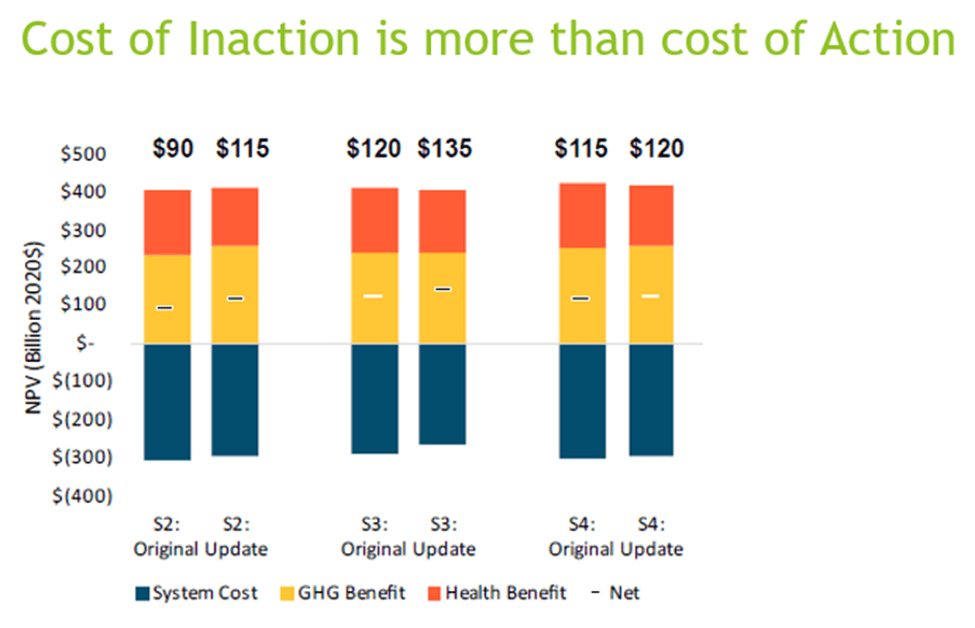
According to Table 1 in the Getting to 100% paper, on the positive side the technological material is high and some of the economic factors are favorable.  However, all the options have high resource constraints that limit the applicability of these options.

Nuclear and fossil with carbon capture

The study notes that “Nuclear and fossil with carbon capture and storage (CCS) are widely cited as potentially important resources in a decarbonized electricity system”.  There is no question that nuclear is the only emissions-free dispatchable resource that could be deployed in sufficient quantities to provide all needed baseload power.  The report notes that: ”The existing nuclear fleet comprises reactor designs with large nameplate capacities and designed to operate near their maximum output potential”, and that “Advanced nuclear reactor designs are typically smaller in scale and more flexible” .  Consequently, nuclear might be viable for the last 10% problem.  Alas New York, for example, on one hand worries about an existential threat of climate change but shuts down 2,000 MW of zero-emissions nuclear generation which suggests that this option is off the table.

The report notes that “Fossil CCS plants have yet to be deployed at scale, but some studies find significant deployment potential, including from retrofits of existing fossil fuel-fired Plants”.   The report sums up the pragmatic dilemma associated with this option:

Fossil CCS has a capture rate of less than 100%; therefore, some emission offsets are needed for fully net carbon-free electricity unless technology advancements, such as through oxy-combustion, can enable zero or near-zero emissions.  he role of fossil CCS could be impacted by how strictly the ‘‘100%’’ requirement is interpreted with respect to any remaining emissions that are not captured and emissions from upstream fuel extraction, including methane leakage.

There is another issue associated with CCS.  A fossil plant capturing CO2 has a derate of about one third because of the energy needed to run the equipment required to capture and compress the CO2 so that it can be transported and sequestered underground.  Finally, in order to safely store the CO2 particular geologic formations are required which limits where these facilities can be located.

According to Table 1 in the Getting to 100% paper, advanced nuclear has high capital expenses and moderate operating expenses; medium resource constraints, medium technological maturity, and security, supply chain, regulatory and cost uncertainties.  Fossil CCS has high capital expenses, medium operating expenses, medium resource constraints, low technological constraints, and issues with upstream emissions, CO2 transport and sequestration.

Seasonal storage

Seasonal storage refers to the use of electricity to produce a storable fuel that can be used for generation over extended periods of time later:

This group of technologies is not well defined, but it could include batteries with very low-cost electrolytes capable of longer-than-diurnal durations. Because of the requirement for very low-cost energy storage, most seasonal storage pathways focus on hydrogen, ammonia, and other hydrogen-derived fuels stored in geologic formations.

Hydrogen produced using electricity to split water (i.e., electrolytic hydrogen) is a form of storage because the energy it carries can be converted back to electricity.  Electrolytic hydrogen technology has been used at an industrial scale since the early 20th century. Although currently higher cost than hydrogen from natural gas reforming, electrolytic hydrogen production costs can be reduced if low- cost electricity, such as zero-cost otherwise-curtailed renewable energy, is used.

In the New York implementation plan the dispatchable emissions-free resource (DEFR) place holder is hydrogen produced using wind and solar.  In addition to the irrational ideological prohibition against combustion sources there are technological issues for New York.  The report notes that “current high-cost electrolyzers need to operate almost continuously to recover their capital expense” and that “Storage and transport costs would add to the delivered cost of hydrogen”. 
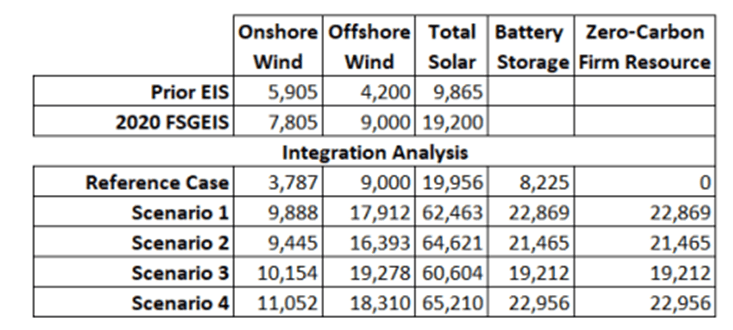
The New York ideologues plan is to use hydrogen in fuel cells, but the report notes:

Fuel cells have diverse applications, but their use for bulk power generation is currently limited. Given the range and scale of applications especially for transportation, substantial capital cost reductions for fuel cells are possible. With low capital costs for combustion turbines and future potential cost reductions for fuel cells, the economic case for hydrogen mainly hinges on lowering the cost of electrolytic hydrogen.

According to Table 1 in the Getting to 100% paper, it really is a stretch to say that there are any positive aspects for using hydrogen with combustion turbines or in fuel cells.  For hydrogen used in combustion turbines the report claims low capital expenses (apparently referring only to the combustion turbine but not including the generation of the hydrogen itself), medium operating expenses and resource constraints, and concerns about hydrogen storage and transport as well as competition for using hydrogen in other sectors.  For hydrogen used in fuel cells there is a potential for low capital expenses, high operating expenses, low resource constraints (apparently referring only to the fuel cell and not assuming that the hydrogen is generated with wind and solar resources), low technological maturity, and the same other considerations as hydrogen used in combustion turbines.

Carbon dioxide removal

The report describes carbon dioxide removal (CDR) strategies which are “dedicated efforts to reduce atmospheric CO2 levels.  In theory this can offset emissions from carbon-emitting power generation so that fossil-fired units can operate to fulfill the last 10% requirement. This is too far fetched to be credible in my opinion.

According to Table 1 in the Getting to 100% paper, there are no positive aspects of this technology except that there are low resource constraints for direct air capture and storage. 

Demand-side resources

Net-zero advocates are enamored with “smart planning” approaches that reduce load which reduces generating resource requirements.  The report notes that “Demand-side resources, also referred to as demand response or demand flexibility, have unique properties compared with the supply-side solutions”.  The report explains:

To a limited extent, they are already relied upon for grid planning and operations today. By reducing electricity consumption during times of system stress, these resources help avoid capital expenditures associated with new peaking capacity.  Through flexible scheduling or interruption of electricity consumption, they can also reduce operating costs or be used for important grid reliability services.

While there are indisputable advantages, I think that advocates lose track of the limitations.  There are demand-side programs in place today but the applications are limited.  Today’s programs limit reduction requests to rare instances of limited duration primarily to shave peak loads primarily by large industrial or commercial users. The problem is that applying demand-side options as a last 10% strategy for decarbonization “requires them to be reliably available over extended multi-day periods”. This means that they cannot be used for residential heating and cooling loads and electric vehicle charging. Moreover, the report notes that “Large-scale commercial or industrial customers can provide multi-day response, but extended interruptions would negatively impact these capital-intensive (non-power) applications”.  As a result, I don’t think this approach will provide adequate reductions when needed the most.

According to Table 1 in the Getting to 100% paper there are low capital expenses but there are uncertain opportunity costs.  The paper claims that resource constraints are uncertain and that the technological maturity is medium.  There are concerns about communications, control equipment and reliability.

Discussion

An Inside Clean Energy article on the paper offers a summary from the climate advocacy side.  Of note is a plug for the 100% renewable option:

A growing segment of energy researchers say that the electricity system can run on 100 percent renewable energy, which would mean renewables and energy storage would provide the last 10 percent. This approach sees no good reason to build new nuclear plants or to use carbon capture systems on fossil fuel plants, citing high costs and a variety of other concerns.

The author admits that the myth of low-cost solar and wind resources does not take into account the resources needed for reliability during periods of peak demand:

At the same time, a sizable group of energy researchers maintain that nuclear and carbon capture are essential parts of getting to carbon-free electricity. This side has doubts about the ability of renewable sources to meet all needs, citing concerns about the availability of land and the intermittent nature of wind and solar. They note that wind and solar are not a low-cost option when taking into account the amounts of storage and power line capacity needed to make those resources reliable for meeting peak demand.

I find the author’s conclusion naïve:

Within all of this is something encouraging: Researchers and energy companies have figured out how to start the transition to 100 percent carbon-free electricity and they have a pretty good idea of what the in-between steps will look like. Now, they are beginning to dig deep on how this journey to a carbon-free grid may end.

Academic researchers are not accountable for reliability and have found a cash cow for funding.  No one is funding them to make a responsible estimate of future resources that does not fit the alarmist narrative.  In a de-regulated world energy companies are also not responsible for reliability and are toeing the line of the net-zero narrative.  New York’s organizations responsible for reliability are not as optimistic (here and here). New York’s Draft Scoping Plan presumes that the State can transition to net-zero without addressing reliability and affordability feasibility but the reality is that even this report suggests that substantive issues have to be addressed.

Conclusion

I think this is a biased report that is too optimistic for future projections.  Nonetheless, it does offer a concise summary of potential approaches to address the last 10% problem that is my ultimate concern.  With respect to New York’s implementation plans, if the concerns of the National Renewable Energy Laboratory staff are ignored in the Final Scoping Plan, then New York will surely have a catastrophic blackout with consequences far beyond any impacts that can be attributed to climate change.

New York Zero Emission Vehicle Mandate

The Climate Leadership and Community Protection Act (Climate Act) has a legal mandate for New York State greenhouse gas emissions to meet the ambitious net-zero goal by 2050.  On September 29, 2022 Governor Hochul directed the New York Department of Environmental Conservation to take major regulatory action that will require all new passenger cars, pickup trucks, and SUVs sold in New York State to be zero emissions by 2035.  As has been the case with all of the Administration’s global warming regulatory initiatives the pronouncement is not supported by any documentation.

Everyone wants to do right by the environment to the extent that they can afford to and not be unduly burdened by the effects of environmental policies.  I submitted comments on the Climate Act implementation plan and have written extensively on New York’s net-zero transition because I believe the ambitions for a zero-emissions economy embodied in the Climate Act outstrip available renewable technology such that this supposed cure will be worse than the disease.  The opinions expressed in this post do not reflect the position of any of my previous employers or any other company I have been associated with, these comments are mine alone.

Climate Act Background

The Climate Act establishes a “Net Zero” target (85% reduction and 15% offset of emissions) by 2050. The Climate Action Council is responsible for preparing the Scoping Plan that will “achieve the State’s bold clean energy and climate agenda”.  They were assisted by Advisory Panels who developed and presented strategies to the meet the goals to the Council.  Those strategies were used to develop the integration analysis prepared by the New York State Energy Research and Development Authority (NYSERDA) and its consultants that tried to quantify the impact of the strategies.  That material was used to write a Draft Scoping Plan that was released for public comment at the end of 2021. The Climate Action Council states that it will revise the Draft Scoping Plan based on comments and other expert input in 2022 with the goal to finalize the Scoping Plan by the end of the year.

In 2019 greenhouse gas (GHG) emissions from the transportation sector accounted for 28.2% of total GHG emissions so it is necessary to reduce transportation sector emissions to meet the Climate Act targets.  However, I explained in my comments that the Draft Scoping Plan did a poor job evaluating how a zero-emissions mandate would be implemented and an even worse job projecting the potential costs.  I will highlight some of the points made in my comments and also put this new mandate in context.

Hochul’s Announcement

The following is a substantial portion of the press release announcing the mandate:

Governor Kathy Hochul today commemorated National Drive Electric Week by directing the State Department of Environmental Conservation to take major regulatory action that will require all new passenger cars, pickup trucks, and SUVs sold in New York State to be zero emissions by 2035. This is a crucial regulatory step to achieving significant greenhouse gas emission reductions from the transportation sector and is complemented by new and ongoing investments also announced today, including electric vehicle infrastructure progress, zero-emission vehicle incentives, and ensuring New York’s communities benefit from historic federal climate change investments.

“New York is a national climate leader and an economic powerhouse, and we’re using our strength to help spur innovation and implementation of zero-emission vehicles on a grand scale,” Governor Hochul said. “With sustained state and federal investments, our actions are incentivizing New Yorkers, local governments, and businesses to make the transition to electric vehicles. We’re driving New York’s transition to clean transportation forward, and today’s announcement will benefit our climate and the health of our communities for generations to come.”

Proposing draft State regulations is a crucial step to further electrify the transportation sector and help New York achieve its climate requirement of reducing greenhouse gases 85 percent by 2050, while also reducing air pollution, particularly in disadvantaged communities. The State Department of Environmental Conservation (DEC) is expediting this regulatory process to implement legislation Governor Hochul signed last year and turn those goals into progress in fully transitioning to new zero-emission cars and trucks. California’s action finalizing the Advanced Clean Cars II regulation last month unlocked New York’s ability to adopt the same regulation.

The regulation will build upon existing regulations enacted in New York in 2012 by requiring all new sales of passenger cars, pickup trucks, and SUVs to be zero-emission by 2035. It would require an increasing percentage of new light-duty vehicle sales to be zero-emission vehicles (ZEV) starting with 35 percent of sales in model year 2026, 68 percent of sales by 2030, and 100 percent of sales by 2035. New pollutant standards for model year 2026 through model year 2034 passenger cars, light-duty trucks, and medium-duty vehicles with internal combustion engines would also be required. The regulation provides manufacturers with flexibility in meeting the emission requirements and achieving a successful transition to cleaner vehicles.

Adoption of Advanced Clean Cars II is included among the recommendations in the Climate Action Council’s Draft Scoping Plan and will be instrumental in achieving the greenhouse gas emissions reductions required in the Climate Leadership and Community Protection Act. In addition, reducing emissions will provide significant air quality benefits to many of New York’s disadvantaged communities, predominantly home to low-income Black, Indigenous, and People of Color, and often adjacent to transit routes with heavy vehicle traffic. The regulation will help address disproportionate risks and health and pollution burdens affecting these communities.

Department of Environmental Conservation Commissioner and Climate Action Council Co-Chair Basil Seggos said, “Governor Hochul is demonstrating her sustained commitment to the successful implementation of the Climate Act and ensuring all New Yorkers benefit from the State’s actions to address climate change. DEC will continue to work under her direction to rapidly issue this regulation and reach another milestone in the transition from fossil fuels so that more people, businesses, and governments will have the ZEV options to meet their needs and help improve the health of their communities.”

The directed regulatory action announced today builds on New York’s ongoing efforts to reduce emissions of greenhouse gases, including the adoption of the Advanced Clean Trucks regulation in December 2021. That regulation will drive an increase in the number of medium- and heavy-duty ZEV models available as purchase options for vehicle purchasers and fleets. In addition, several transit agencies including the Niagara Frontier Transportation Authority, the Rochester-Genesee Regional Transportation Authority, and the Metropolitan Transit Authority are leading by example with second wave deployments of electric buses. DEC, New York State Energy Research and Development Authority (NYSERDA), New York Power Authority (NYPA), and DOT (Department of Transportation) are assisting these authorities with these efforts.

Draft Scoping Plan Transportation Comments

I submitted a couple of comments on electric vehicles.  The emphasis in the first comment was my finding that the Integration Analysis is simply making assumptions about future zero-emissions transportation implementation strategies without providing adequate referenced documentation.  I provided numerous recommendations for additional documentation in these comments so that New Yorkers can understand what will be expected and how much it will cost.

As far as I can tell, the electric vehicle costs are based entirely on new vehicle sales. There is no acknowledgement that the used car market will likely change because of the cost of battery replacement.  Sellers will likely get less relative to new cars in the battery electric vehicle market.  Buyers may get a relative deal but will lose in the end when the batteries have to be replaced.  This is a particular concern for low and middle-income citizens who cannot afford new vehicles.

There is no bigger disconnect between the zero-emission vehicle (ZEV) proposed strategy and reality than the ZEV charging infrastructure requirements.  The biggest problem is that millions of cars will have to rely on chargers that cannot be dedicated for the owner’s personal use because the owners park on the street or in a parking lot.  In order to provide a credible ZEV strategy, the final Scoping Plan has to describe a plan how this could possibly work.  It is not enough to simply say it will work.

I also submitted a comment addressing electric vehicle costs.  the Integration Analysis vehicle cost projections rely on a single vehicle type for light-duty vehicles.  As a result, the projections are not particularly useful for many vehicle owners.  In order to accurately project the costs for this mandate the types of vehicles used has to be updated. 

Discussion

There is a paragraph in the press release that needs to be addressed:

The regulation will build upon existing regulations enacted in New York in 2012 by requiring all new sales of passenger cars, pickup trucks, and SUVs to be zero-emission by 2035. It would require an increasing percentage of new light-duty vehicle sales to be zero-emission vehicles (ZEV) starting with 35 percent of sales in model year 2026, 68 percent of sales by 2030, and 100 percent of sales by 2035. New pollutant standards for model year 2026 through model year 2034 passenger cars, light-duty trucks, and medium-duty vehicles with internal combustion engines would also be required. The regulation provides manufacturers with flexibility in meeting the emission requirements and achieving a successful transition to cleaner vehicles.

In 2026 the State will require 35% of all new vehicle sales to be zero-emission vehicles.  As of May 1, 2022 there were a little over 62,000 electric cars registered in New York out of the over 11 million vehicles registered.  The Integration Analysis projections for battery electric vehicles in 2026 range from 7.8% in the reference case to 24.3% in the most optimistic mitigation scenarios.  One of my criticisms of the Draft Scoping Plan is that the increase in projected sales is not supported by any recommendations for implementation. 

I have documented many electric vehicles issues but it is by no means an exhaustive list of the reasons I will never purchase an electric vehicle.  The State apparently believes that all that is necessary is a proclamation and all the reservations of all the people who are perfectly happy with internal combustion engines will be overcome.

Hochul’s proclamation fails to address the low and middle-income consumer concerns expressed by Robert Bryce in testimony before the House Select Committee on the Climate Crisis:

EVs … impose … societal costs that are likely to exacerbate inequality and lead to more energy poverty,” Bryce continued. “Those costs include taxpayer-funded subsidies given to EV buyers, publicly funded charging stations, and the grid upgrades that will be needed to support the electrification of light and heavy-duty vehicles. Those costs will impose a significant cost burden on low and middle-income consumers, even though those consumers are unlikely to purchase EVs.

Bryce also raised other issues in his testimony that are ignored in the grandstanding announcement:  

Electrifying parts of our transportation system may result in incremental reductions in greenhouse gas emissions, but a look at history, as well as an analysis of the supply-chain issues involved in manufacturing EVs, the resource intensity of batteries, and the increasingly fragile state of our electric grid – which is being destabilized by bad policy at the state and national levels – shows that a headlong drive to convert our transportation systems to run on ‘green’ electricity could cost taxpayers untold billions of dollars, increase greenhouse gas emissions, be bad for societal resilience, make the U.S. more dependent on commodity markets dominated by China, make us less able to respond to extreme weather events or attacks on our infrastructure, and impose regressive taxes on low and middle-income Americans in the form of higher electricity prices.

Finally, the ultimate rationale for this inane policy is to do something about climate change.  The reality is that New York emissions are inconsequential so this is nothing more than politically expedient climate virtue signaling.  New York’s GHG emissions are less than one half a percent of total global emissions and, on average, global GHG emissions have been increasing by more than one half a percent per year.  Anything we do will be wiped out be emissions elsewhere in a year.  Furthermore, the State has never published an estimate of the effect of New York emission reductions on global warming itself.  I estimate that the change to global warming from eliminating New York GHG emissions is only 0.01°C by the year 2100 which is too small to be measured much less have an effect on any of the purported damages of greenhouse gas emissions. 

Conclusion

In the press release Hochul claimed that “New York is a national climate leader and an economic powerhouse, and we’re using our strength to help spur innovation and implementation of zero-emission vehicles on a grand scale”.  The State’s obsession with being a climate leader is pointless.  Worse there is no recognition that the pursuit of zero emissions has unintended consequences and will likely cause more harm than good.  The lack of a public discussion of pragmatic considerations for the net-zero transition will ultimately seriously affect New York.
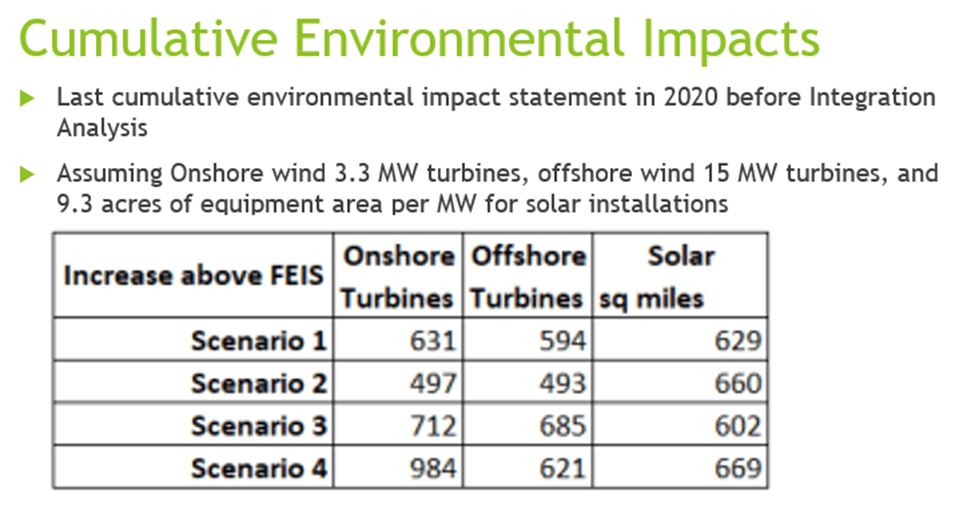
Climate Act Hubris

The Climate Leadership and Community Protection Act (Climate Act) has a legal mandate for New York State greenhouse gas emissions to meet the ambitious net-zero goal by 2050.  The Hochul Administration subscribes to the belief that a collective crossing of fingers will ensure that the electric system that has taken decades to develop can transition to a system not using the fossil fuels, the foundational building block of progress and prosperity, by 2040.  This post highlights comments by New York State Department of Environmental Conservation Commissioner Basil Seggos that epitomize this position.

Everyone wants to do right by the environment to the extent that they can afford to and not be unduly burdened by the effects of environmental policies.  I submitted comments on the Climate Act implementation plan and have written extensively on New York’s net-zero transition because I believe the ambitions for a zero-emissions economy embodied in the Climate Act outstrip available renewable technology such that this supposed cure will be worse than the disease.  The opinions expressed in this post do not reflect the position of any of my previous employers or any other company I have been associated with, these comments are mine alone.

Climate Act Background

The Climate Act establishes a “Net Zero” target (85% reduction and 15% offset of emissions) by 2050. The Climate Action Council is responsible for preparing the Scoping Plan that will “achieve the State’s bold clean energy and climate agenda”.  They were assisted by Advisory Panels who developed and presented strategies to the meet the goals to the Council.  Those strategies were used to develop the integration analysis prepared by the New York State Energy Research and Development Authority (NYSERDA) and its consultants that tried to quantify the impact of the strategies.  That material was used to write a Draft Scoping Plan that was released for public comment at the end of 2021. The Climate Action Council states that it will revise the Draft Scoping Plan based on comments and other expert input in 2022 with the goal to finalize the Scoping Plan by the end of the year.

The Independent Power Producers of New York hosted a conference on September 14, 2022 that included a couple of relevant presentations.  Writing in the Albany Times Union, Rick Karlin described the presentation by Michael Mehling, deputy director of the Center for Energy and Environmental Policy Research at the Massachusetts Institute of Technology.  Mehling argued that given the affordability and reliability issues evident in Europe at this time, that a Plan B backup using existing technology and natural gas is an appropriate approach.

According to Karlin’s article, Commissioner Seggos disagreed:

“I don’t think there is a Plan B,” state Environmental Commission Basil Seggos told those at the gas conference.  Seggos echoed the thoughts of environmentalists who believe the need to reduce carbon emissions in order to fight global warming is so urgent that the shift to renewables needs to push ahead, even though there will be costs. “I think we are on the edge right now when it comes to global emissions,” Seggos added.

 I will address this supposition in this article.

Some Ohm Truths About the Great Green Fantasy

After I saw the Seggos quotes I was prompted to write this article when I read an article by Peter Smith in Quadrant outline that made points about similar efforts in Australia.  Smith introduces his concerns:

No sane person should be fooled. A climate-cult madness has infected governments and their activist agencies; exemplar, the Australian Energy Market Operator (AEMO). Delusions of grandeur is a common manifestation of madness. Climate cultists fit the profile. Clothing themselves in virtue, they strut about proclaiming that they can save the earth from a fiery end if only we would give away the foundational building block of progress and prosperity; namely, fossil fuels.

New York is different inasmuch as the New York market operator, New York Independent System Operator (NYISO), is not driving the Climate Act bus.  Instead, the state’s politicians passed legislation that gave the keys to the Climate Action Council’s politically-chosen ideologues.  Seggos is co-chair of the Climate Action Council and has gone to the COP26 Glasgow meeting and the signing ceremony for the Inflation Reduction Act to tout New York’s climate virtues. 

I maintain the biggest shortcoming of the Climate Act is the lack of a feasibility analysis.  Smith describes a similar situation in Australia:

As Stephen Kruiser puts it, they act “as if we can go from Point A to Point Z without hitting any of the 24 points between them. They truly believe that they can mandate the future.” As I said, delusions of grandeur; epitomised by AEMO and its “2022 Integrated System Plan.” A plan having the delusional and grandiose objective of engineering “a true transformation of the NEM [National Electricity Market, which excludes WA and NT] from fossil fuels to firmed renewables.”

New York just assumes that they too can get from the current electric system to a zero-emissions electric system by 2040. 

The recently released NYISO 2021-2040 System & Resource Outlook report notes that:

  • Significant new resource development will be required to achieve CLCPA energy targets.
  • To achieve an emission-free grid, dispatchable emission-free resources (DEFRs) must be developed and deployed throughout New York. It is important to note that the lead time necessary for commercialization, development, permitting, and construction of DEFR power plants will require action much sooner if this timeline is to be achieved.
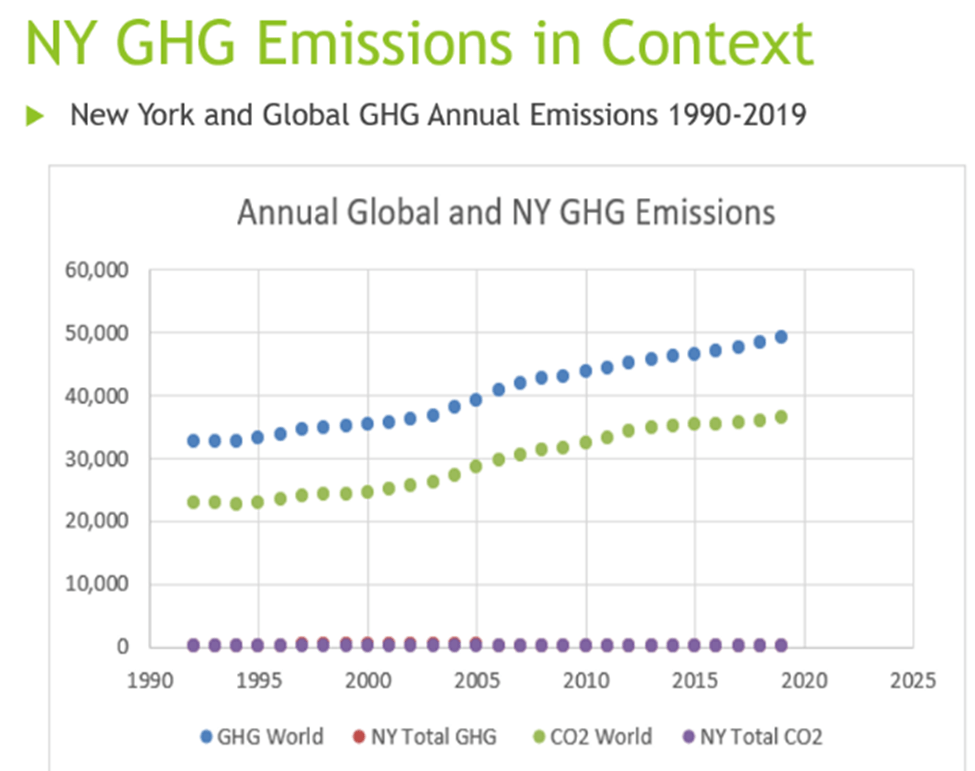
  • As the energy policies in neighboring regions evolve, New York’s imports and exports of energy could vary significantly due to the resulting changes in neighboring grids.

In Australia “The plan calls for the supply of electricity to almost double by 2050; from just under 180 terawatt hours (TWh), to 320 TWh.”  New York load is projected to increase less by 2040, it increases slightly less from 146 TWh to at least 245 TWh.  Smith goes on to explain that the amount of electricity needed when transport, industry, offices and residences are electrified is extraordinary and claims that the official projections are underestimated.  To meet this demand Australia and New York both increase the amount of wind and solar in operation tremendously.  So much in fact that the presumption that the equipment can be permitted, fabricated, and constructed in the time frames required strains credulity.  Both Australia and New York need to build significant amounts of transmission with the same limitations and the same concerns apply to this build out too.  New York has studiously avoided any estimates of consumer costs but surely the build out of all this infrastructure will be enormous.  Smith also points out that the labor needed to install all this infrastructure will also be a constraint.  Smith concludes: “To wit, it’s a case of delusions being not delusional enough. Increased madness required.” 

Conclusion

Seggos believes that “the need to reduce carbon emissions in order to fight global warming is so urgent that the shift to renewables needs to push ahead, even though there will be costs”.  The entire intent of my blog is to discuss tradeoffs between environmental and energy policies.  The political agenda of the Hochul Administration precludes an honest discussion of any tradeoffs.  They just ignore anything inconsistent or inconvenient. 

Seggos claims we are on the edge with respect to global emissions.  If New York’s emission reductions could truly make a difference it would be one thing, but the State has never offered an estimate of the Climate Act effect on global emissions or global warming.  I have found that New York’s emissions are only 0.45% of global emissions.  The change to global warming from eliminating New York GHG emissions is only 0.01°C by the year 2100 which is too small to be measured much less have an effect on any of the purported damages of greenhouse gas emissions.  Furthermore, whatever New York does to reduce emissions will be supplanted by global emissions increases in less than a year.

The Draft Scoping Plan repeats the consensus story that imminent climate catastrophe is inevitable.  However, those claims are based on model assessments and not observations.  A recent paper concludes that “on the basis of observational date, the climate crisis that, according to many sources, we are experiencing today, is not evident yet”.

Pushing ahead with renewables no matter what risks the reliability and affordability of the system.  The comments by the NYISO and the New York State Reliability Council raise significant concerns that the Climate Action Council has to date ignored.  As noted, the State has so far refused to produce any estimate of consumer cost estimates but, surely, they will be significant.  I fear that the ideological agenda of the administration will prevent an open and transparent discussion of these issues before serious impacts occur.

More Reliability Concerns that Need to be Considered by the Climate Action Council

The Climate Leadership and Community Protection Act (Climate Act) has a legal mandate for New York State greenhouse gas emissions to meet the ambitious net-zero goal by 2050.  I have previously noted that there are members of the Climate Action Council who deny the challenge of the electric grid transition from existing sources to one dependent upon wind and solar resources.  This article describes a couple of recent articles that highlight transition issues.

Everyone wants to do right by the environment to the extent that they can afford to and not be unduly burdened by the effects of environmental policies.  I submitted comments on the Plan and have written extensively on implementation of New York’s response to that risk because I believe the ambitions for a zero-emissions economy embodied in the Climate Act outstrip available renewable technology such that this supposed cure will be worse than the disease.  The opinions expressed in this post do not reflect the position of any of my previous employers or any other company I have been associated with, these comments are mine alone.

Climate Act Background

The Climate Act establishes a “Net Zero” target (85% reduction and 15% offset of emissions) by 2050. The Climate Action Council is responsible for preparing the Scoping Plan that will “achieve the State’s bold clean energy and climate agenda”.  They were assisted by Advisory Panels who developed and presented strategies to the meet the goals to the Council.  Those strategies were used to develop the integration analysis prepared by the New York State Energy Research and Development Authority (NYSERDA) and its consultants that tried to quantify the impact of the strategies.  That material was used to write a Draft Scoping Plan that was released for public comment at the end of 2021. The Climate Action Council states that it will revise the Draft Scoping Plan based on comments and other expert input in 2022 with the goal to finalize the Scoping Plan by the end of the year.

In my comments on the Draft Scoping Plan I noted that the Plan and the Climate Action Council have downplayed the reliability risks of the Climate Act transition to renewables.  Equally troubling there are vocal members of the Climate Action Council that deny the existence of any implementation issues associated with a renewable energy resource dependent electric system.  At the May 26, 2022 Climate Action Council meeting, Paul Shepson Dean, School of Marine and Atmospheric Sciences at Stony Brook University claimed that the conversion cannot be unreliable at 23:39 of the recording.  Robert Howarth, Professor, Ecology and Environmental Biology at Cornell (starting at 32:52 of the recording) said: “Clearly one can run a 100% renewable grid with reliability”.   In this article, I describe a couple of recent articles that highlight some of the issues associated with this conversion that the academics overlook.
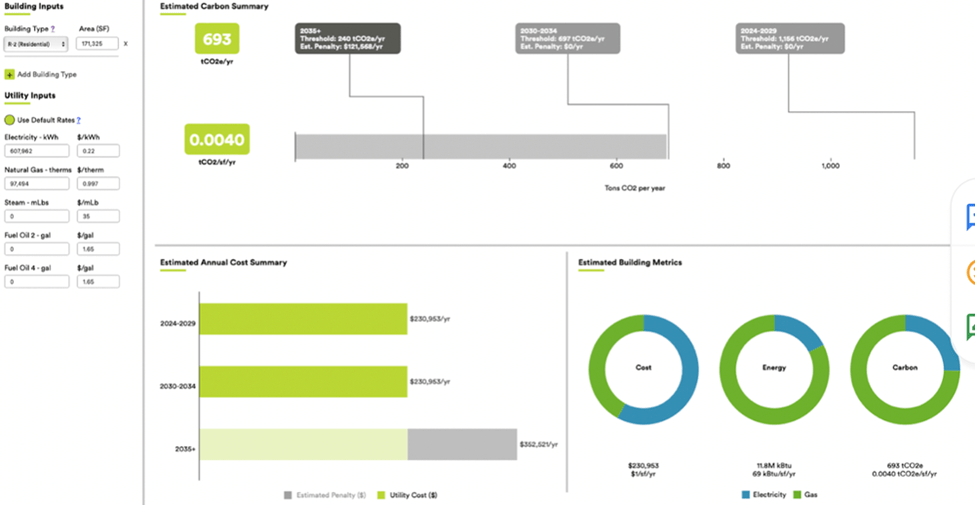
Renewable Energy Systems

I have prepared a page that documents the work of various authors that describe the complexities of the energy system and problems associated with over-reliance on intermittent wind and solar generating resources.  One of the resources is a series of posts at Climate Etc by Planning Engineer who posts under the pseudonym because he wanted to frankly share his personal views and not have them tied directly to his current employer.  Recently he posted an article entitled Will California “learn” to avoid Peak Rolling Blackouts? that provides a good overview of upcoming reliability issues.
The article presents a graph that shows recorded peaks and the projected 2022 value that caused issues earlier in September.  Then he explains that:

The most basic planning criteria is that a system should be able to survive the loss of the largest generating resource and the most critical transmission element during a peak load with no loss of load and no severe voltage declines or undamped system oscillations. Looking at the variability in load levels here, no particular challenges to planners are apparent. If “green” resources were capable of replacing traditional resources with minor adjustments, we would not see the problems we are seeing.

He goes on to explain why there was a problem.

Why is California challenged now and why might it continue to see challenges in the future?  Primarily because the focus on green energy is increasing the percentage of “green” intermittent resources. “Green” resources are not as dependable as traditional rotating machinery nor do they support the system as well. It is likely that these resources have been credited with more ability to provide capacity than is warranted, and when the rubber meets the road, they don’t perform as “expected”. Intermittent resources cause problems on both the generation side and the load side. Intermittent solar on the residential side serves to reduce load as seen by the Cal ISO. When solar is not performing well available load which is not displaced by solar on the residential side increases concurrent with solar reduction on the supply side.

If California were more honest about the capabilities of “green” intermittent resources planning would be enhanced. However, being honest about the capabilities of “green” resources would have consequences that some would find unacceptable. There has been a big push to make “green” options appear much more economic and capable than they are so that they will be more competitive. Subsidization of “green” resources by traditional uses occurs in many ways. In addition to crediting “green” resources above their dependable capability, others subsidies include directing costs associated with such additions to others. Being honest makes the “green” dream a much harder sell. Assuming that “green” resources work well saves other investment in the grid. This subterfuge tends to limit the cost increase that should be imposed by these resources, but does so at the cost of reliability. This tradeoff takes a while to see as we have built the electric grids to have very high levels of reliability at the bulk level. In the short term it looks like you are getting a cleaner, equally reliable system at a moderate cost increase. But as penetration levels increase, cost get higher and reliability gets much worse.

He points out that California policy makers are responsible for resource investment, resource allocations and how and when grid improvements are made to enhance reliability. Earlier in September there were reliability issues and extreme weather was blamed.  Obviously, the planning failed to account for weather but proper reliability planning has to account for the effects of extreme weather.  Planning Engineer points out that if “there truly was something unusual about the weather as driven by climate change, shouldn’t this have been anticipated by those responsible?” 

He concludes:

Ideally the power system represents the best balance between economics, reliability and public responsibility. California has reached a balance skewed by false expectations that “green” resources cannot meet. Creating a balance that looks at the true costs and reliability impacts of green resources should benefit electric users in California.

Ramping Up Renewables Can’t Provide Enough Heat Energy in Winter

Gail Tverberg writing at Our Finite World explains that one of the unappreciated benefits of fossil fuels is their ability to store energy that can be used to provide heat in the winter.  She notes that:

In some ways, the lack of availability of fuels for winter is a canary in the coal mine regarding future energy shortages. People have been concerned about oil shortages, but winter fuel shortages are, in many ways, just as bad. They can result in people “freezing in the dark.”

The article goes on to describe eight issues involved with winter energy use.  She points out that “batteries are suitable for fine-tuning the precise time during a 24-hour period solar electricity is used” but they cannot be scaled up to store solar energy from summer to winter.  There is no long duration energy storage resource available.

The article addresses hydro and wind energy resources in this context.  She argues that “ramping up hydro is not a solution to our problem of inadequate energy for heat in winter” and that “wind energy is not greatly better than hydro and solar, in terms of variability and poor timing of supply”.

She also lists five specific reasons that “when wind and solar are added to the grid, the challenges and costs become increasingly great”.  All of these concerns are concerning by themselves and the combination of problems directly contradicts the Climate Act narrative that there are no serious challenges to reliability.  Two deserve attention.  The inherent variability of wind and solar generation creates power transients and those fluctuations need to be addressed.  The problem is that the magnitude of this problem is new and it is likely that learning how to address it is difficult to anticipate so corrections will be reactions to problems.  Supporters of the Climate Act transition seem to think that existing wind, solar and energy storage resources only need to be scaled up to the quantity needed.  What they miss is that the more resources built the less those resources will be used.  Tverberg points out that low-capacity factors hurts energy return on investment payback.  All of these issues should be considered but have not been addressed in the Scoping Plan.

Tverberg also point that the word “sustainable” has created unrealistic expectations with respect to intermittent wind and solar electricity.  She illustrates this issue as follows:

A person in the wind turbine repair industry once told me, “Wind turbines run on a steady supply of replacement parts.” Individual parts may be made to last 20-years, or even longer, but there are so many parts that some are likely to need replacement long before that time. An article in Windpower Engineering says, “Turbine gearboxes are typically given a design life of 20 years, but few make it past the 10-year mark.”

She notes that “energy modeling has led to unrealistic expectations for wind and solar”.  This is evident in the Integration Analysis projections.  It should be obvious that the Scoping Plan projections for future generating resources have to be reconciled with the work of the New York Independent System Operator but, so far, no plan has been announced to do that.

Finally, Tverberg argues that current pricing plans that enable the growth of wind and solar electricity have consequences.  They are displacing existing dispatchable resources such that those resources are no longer viable.  The result is “pushing a number of areas in the world toward a “freezing-in-the-dark” problem”.  She concludes: “The world is a very long way from producing enough wind and solar to solve its energy problems, especially its need for heat in winter.”

Conclusion

I cannot improve on Planning Engineer’s conclusion.  Substitute New York for California and his conclusion sums up the issue that the Climate Action Council should address in the Scoping Plan:

Will California learn to avoid peak rolling blackouts?  If reliability were a primary concern, this situation shouldn’t bubble up again in a few years. California should be able to properly credit the ability of its power resources and match them to projected weather ensuring adequate power. If other priorities prevent responsible steps to ensure reliability, then those priorities, not the weather, should claim responsibility for the consequences. If California wants to continue as they have, they should be honest and make statements such as the following:

This is the end of affordable, reliable electric service as we understood it for most of the last 50 years. We are choosing to go with “green “technology to deal with the climate crisis. Keeping past reliability levels will raise your costs tremendously. As we try to put on limit on costs this will decrease your reliability. At times the power will not be there. We’ve all got help each other out.