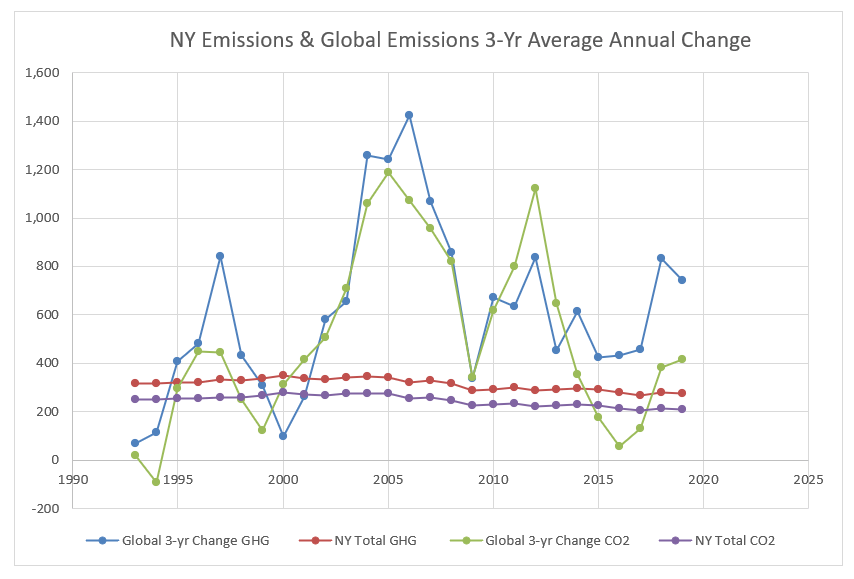
This post was updated on 10/24/22 to replace the second graph included and include data to 2019
The Climate Leadership and Community Protection Act (Climate Act) establishes a “Net Zero” target by 2050. The Draft Scoping Plan defines how to “achieve the State’s bold clean energy and climate agenda” and claims that there are significant direct and indirect benefits if New York’s greenhouse gas emissions (GHG) are reduced to net-zero but there is no mention of New York’s emissions relative to the rest of the world. I explained that any claim of benefits is illusory because in the context of global impacts New York’s contribution is miniscule. This short post puts the numbers into a couple of graphs.
Everyone wants to do right by the environment to the extent that they can afford to and not be unduly burdened by the effects of environmental policies. I submitted comments on the Climate Act implementation plan and have written extensively on New York’s net-zero transition because I believe the ambitions for a zero-emissions economy embodied in the Climate Act outstrip available renewable technology such that this supposed cure will be worse than the disease. The opinions expressed in this post do not reflect the position of any of my previous employers or any other company I have been associated with, these comments are mine alone.
New York and Global GHG Emissions
The purpose of this post is to illustrate how New York GHG relate to global emission increases. I found CO2 and GHG emissions data for the world’s countries and consolidated the data in a spreadsheet earlier this year. I downloaded the data again for this post and found data out to 2019. The following graph shows global and CO2 emissions for the world and New York plotted on the same graph. New York emissions are essentially zero.
The trend results indicate that the year-to-year trend in GHG emissions was positive 21 of 26 years and for CO2 emissions was positive 24 of 30 years. In order to show this information graphically I calculated the rolling 3-year average change in emissions by year. The following graph shows that rate of change in emissions has been consistently higher than New York emissions since 1990.
Conclusion
By any measure New York’s complete elimination of GHG emissions is so small that there will not be any effect on the state’s climate and global climate change impacts to New York. I previously showed that although New York’s economy would be ranked ninth relative to other countries, New York’s emissions are only 0.45% of global emissions which ranks 35th. This post graphically shows New York emissions are negligible compared to global emissions. The change to global warming from eliminating New York GHG emissions is only 0.01°C by the year 2100 which is too small to be measured much less have an effect on any of the purported damages of greenhouse gas emissions. Finally, this post shows global emissions have increased more than New York’s total share of global emissions consistently since 1990. In other words, whatever New York does to reduce emissions will be supplanted by global emissions increases in a year.
The only possible conclusion is that the Climate Act emissions reduction program is nothing more than virtue-signaling. Given the likely significant costs, risks to reliability, and other impacts to New York society, I think that the schedule and ambition of the Climate Act targets needs to be re-assessed for such an empty gesture.
I have argued repeatedly that claims that reliance on intermittent wind and solar resources to meet the net-zero Climate Leadership and Community Protection Act (Climate Act) mandated targets have no potential reliability issues is simply incorrect. My other big concern is affordability and this article addresses the supposed cost benefits of the Climate Act. In particular, a recent segment by Spectrum News report Nick Reisman addressed the costs of the Climate Act that included an argument that the cost of inaction is far greater than the cost of action. I believe that is also simply incorrect.
Everyone wants to do right by the environment to the extent that they can afford to and not be unduly burdened by the effects of environmental policies. I submitted comments on the Climate Act implementation plan and have written extensively on New York’s net-zero transition because I believe the ambitions for a zero-emissions economy embodied in the Climate Act outstrip available renewable technology such that this supposed cure will be worse than the disease. The opinions expressed in this post do not reflect the position of any of my previous employers or any other company I have been associated with, these comments are mine alone.
Climate Act Implementation Background
The Climate Act establishes a “Net Zero” target (85% reduction and 15% offset of emissions) by 2050. The Climate Action Council is responsible for preparing the Scoping Plan that will “achieve the State’s bold clean energy and climate agenda”. They were assisted by Advisory Panels who developed and presented strategies to the meet the goals to the Council. Those strategies were used to develop the Integration Analysis prepared by the New York State Energy Research and Development Authority (NYSERDA) and its consultants that tried to quantify the impact of the strategies. That material was used to write a Draft Scoping Plan that was released for public comment at the end of 2021. Following a six month public comment period, the Climate Action Council states that it will revise the Draft Scoping Plan based on comments and other expert input in 2022 with the goal to finalize the Scoping Plan by the end of the year.
I have written multiple articles (summarized here) documenting my belief that the Climate Action Council has not confronted reliability issues raised by New York agencies responsible for keeping the lights on. Because those agencies have raised substantive issue based on the work of their subject matter experts I believe that the members of the Council that have downplayed reliability as a concern and have claimed that those concerns are misinformation are the ones guilty of misinformation. This post addresses the public’s perception of the claim that the costs of inaction are greater than the costs of action.
The Nick Reisman story addressed the costs of the Climate Act and included a discussion of costs. I think the genesis of the presentation was Children’s Environmental Health Day where advocates gathered at the State Capitol to urge the Climate Action Council to release a strong Climate Action Plan. Reisman interviewed a local politician to explain the rationale for the request:
Elected officials and climate advocates are pushing for an aggressive plan to address global warming and reduce pollution. New Lebanon Supervisor Tistrya Houghtling says her community is especially vulnerable to extreme weather. A school bus garage is vulnerable to flooding and farmers are hurt by fluctuations in weather and temperature. “Between the drought and the flooding, and kind of what I call our bipolar weather where it goes back and forth so quickly, a lot of our farmers are struggling with their crops and other things,” she said.
For once there appears to be recognition that there is a difference between weather and climate because Houghtling correctly says that weather is causing the problems. Nonetheless the implication is that a strong Climate Action Plan could affect these weather events. No New York State regulatory policy related to climate change has ever quantified the potential effect of the regulation on global warming itself. The reason is simple. I have calculated the expected impact on global warming as only 0.01°C by the year 2100 if New York’s greenhouse gas (GHG) emissions are eliminated. That change is simply too small to be measured much less have a meaningful effect on any New York weather event.
The interview goes on: “But at the same time, she does not want the changes to hit the wallets of her neighbors, especially lower income people who may struggle to pay to upgrade their homes with an electric car charging or a new heat pump.” Reisman provides some background on the requirements:
In the coming years, New York plans to phase out gas-powered cars for electric vehicles. Buildings and homes will be electrified. The transition will mean a major change for how homes and businesses are powered, requiring major infrastructure upgrades along the way.
Of course, these actions will cost money and it is not clear just how much. The news report notes:
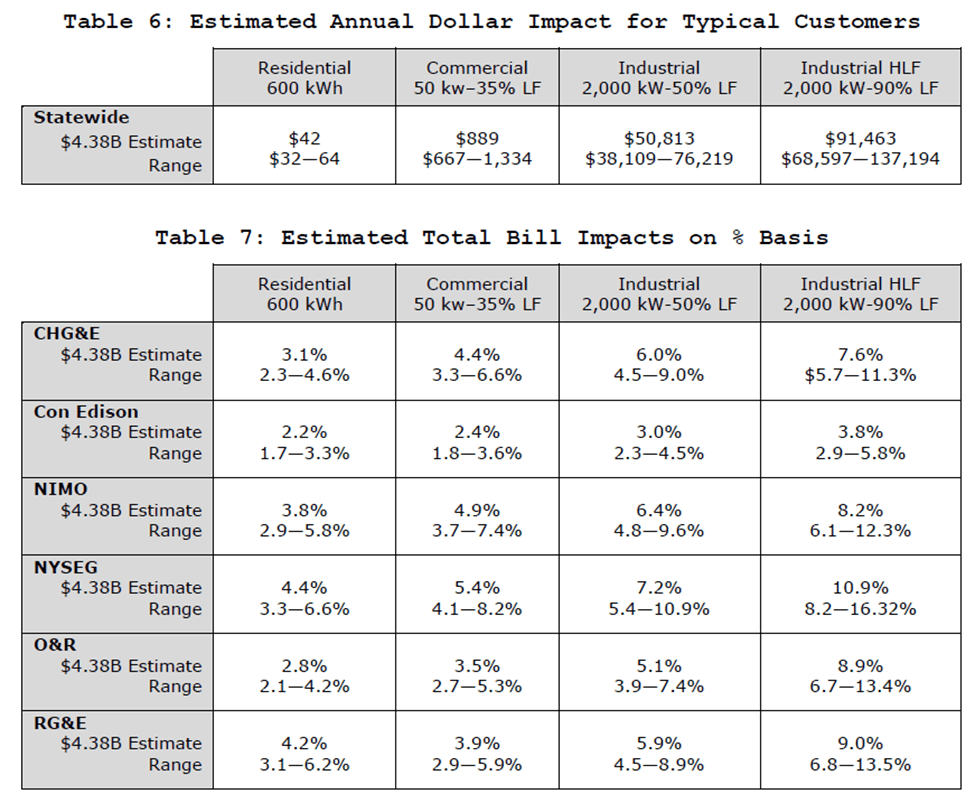
Republicans, including Senate Minority Leader Robert Ortt, are skeptical utility ratepayers won’t take the brunt of the costs. “What is the cost of these policies? Can we do these things?” Ortt said at a news conference recently.
New Yorkers have already been contending with high gas prices and an expected increase in home heating bills this winter. “It’s not going to be at the pump so much that it’s going to be in their mailbox,” he said. “It’s going to be their utility bills. And it’s going to be the cost to heat their homes.”
The final interview is the reason I prepared this post. In rebuttal to Ortt:
New Paltz Mayor Tim Rogers says the cost of inaction on climate is far greater. “If we don’t make these investments,” he said, “if we don’t make these conversions, we will be paying many trillions more in costs for our communities.”
There are egregious mistakes in Rogers’ quote. As noted previously, the presumption that implementation of the Climate Act reductions will actually have any effect on the observed weather and associated impacts is wrong simply because any New York emission reductions are simply too small to affect global warming. In addition, New York GHG emissions have to be considered relative to global emissions. I found that New York emissions are less than one half of one percent of global emissions. On average, global emissions have been increasing by more than one half of one per cent per year for many years. Therefore, any effect New York could possibly have on global warming will be offset by global emission increases in a year.
Draft Scoping Plan Cost and Benefits Claims
There is another egregious mistake in Rogers’ quote, namely the implication that reducing New York emissions prevent trillions in costs. The Draft Scoping Plan estimates of potential benefits are much lower. In order to bolster the claim that the costs of inaction are greater than the costs of action the Draft Scoping Plan conjures up as many speculative benefits as possible. Figure 46 in the Draft Scoping Plan lists the net present value of benefits from 2020 to 2050 and the largest estimate is $420 billion or less than one half a trillion dollars.
There is another problem. I think the cost-benefit analysis is flawed and said so in my comments. Because I have seen no indication in recent Climate Action Council meetings of any suggestion that stakeholder comments questioned the Draft Scoping Plan cost benefits claims I think it appropriate to summarize those comments.
The first problem is the lack of detailed cost documentation in the Draft Scoping Plan. In my opinion the lack of detailed cost information in the Plan and the lack of response to questions about them is politically motivated because the costs will be eye watering. Moreover, I maintain that the cost information provided is misleading. In my comments on the Draft Scoping Plan I showed that in order to further the narrative that there is value to the Climate Act’s costs the reported numbers are carefully presented to give the impression that the cost of inaction is greater than the cost of action. I documented a trick used to deceive the public that benefits out-weigh costs by excluding legitimate Climate Act costs. For example, the analysis did not include the costs of the 2035 zero-emission vehicle mandate as part of the modeling comparison case because the “program was already implemented”. That decreased the costs of compliance. In addition, the Plan incorrectly interprets guidance to inflate the societal benefits of avoided emissions. That increases the alleged benefits. When those errors are corrected the costs are greater than the benefits.
There is another issue with the benefit claims. James Hanley from the Empire Center submitted written testimony to the Climate Action Council that addressed the cost and benefits of the Climate Act. Although the messaging is that the benefits surpass the costs, Hanley commented that:
But what is obfuscated in this message is that all the costs fall on New Yorkers, while they receive only a portion of the benefits. Avoided economic costs due to reduced greenhouse gas emissions estimated at $260 billion are global benefits, although the plan fails to specify this important detail. This becomes clear only to those who are aware that the $260 billion estimate is based on the Department of Environmental Conservation’s social cost of carbon, which in accordance with the CLCPA is explicitly a global benefit. This is not clearly specified in the Scoping Plan, leaving the unwary reader with the mistaken impression that the benefit to New York outweighs the cost to New York.
He goes on to explain that a careful analysis of the Draft Scoping Plan shows that the costs are greater than the benefits:
Nor does the Integration Analysis prepared by Energy+Environmental Economics make any attempt to disaggregate that $260 billion global benefit to discern what share accrues to the people who will be paying for it. But New York contributes approximately four-tenths of one percent of global greenhouse gas emissions. If we assume the state receives roughly the same share of the benefit, New York’s share of that benefit is only $1.4 billion. If we generously multiply that by 10 (assuming for the state what is likely a highly disproportionate share of the benefit), the benefit to New York would be $10.4 billion. If we subtract the $260 billion from the claimed $420 to $430 billion in benefits, then add back in that assumed benefit of $10.4 billion, we get a total net benefit to New York of $170.4-180.4 billion. Against a cost of $280 – $340 billion, this means there is no net benefit to New Yorkers, but a net loss of $100-170 billion. Simply put, by the state’s own analysis the cost to New York outweighs the benefit to New York.
Conclusion
Despite the far-reaching impacts of the Climate Act, I remain convinced that most New Yorkers are unaware of what is coming. In that context Spectrum News is to be congratulated for addressing this topic. Unfortunately, like the majority of other news stories on this topic it accepts the basic talking points of both sides of the story without any investigation. Advocates for action rely on talking points and typically respond to criticism by dismissing it as “misinformation”.
Investigation into the statements by both politicians would show their comments are real misinformation. Houghtling implied that the Climate Act can reduce the potential risks to her jurisdiction but the State has never quantified those impacts or admitted that New York’s emissions relative to global emission increases negates anything we can do. Rogers’ claim “if we don’t make these conversions, we will be paying many trillions more in costs for our communities” is not supported by the Draft Scoping Plan that projects benefits on the order of half a trillion over the period 2020-2050. Finally, careful review of the claimed benefits show that there are methodological issues and, importantly, that most of the benefits will accrue outside of New York. The costs will be real but the benefits are imaginary.
The news story interviewed politicians who supported a strong Climate Action Plan. They don’t understand or don’t want to understand the enormous costs associated with the net-zero transition implementation. To their defense the Hochul Administration has not provided sufficient information for anyone to find out what the state expects those costs to be. Shouldn’t the fact that the Administration has refused to provide specific cost information for the proposed control strategies for a program that will radically transform the entire energy system of the state be the real story?
This is a follow up to my article published at Watts Up With That Resources for the Future: Retail Electricity Rates Under the Inflation Reduction Act of 2022 and re-published here. The article addressed the Resources for the Future (RFF) Issues Brief titled Retail Electricity Rates Under the Inflation Reduction Act of 2022 claim that the legislation, will “save typical American households up to $220 per year over the next decade and substantially reduce electricity price volatility.” I got a comment here that raised two flaws in my arguments. I used data from the United States Energy Information Administration (EIA) Electricity Data Browser for Texas to test the hypothesis that increased renewable energy resources would lower electricity costs. This article addresses the flaws raised.
When I follow your directions for your chart using the EIA data you describe, I get a very different picture. Avg residential power prices in Texas peak in mid 2008, then fall for several years before coming up more recently. Your chart is showing something other than what you describe.
Further, inflation adjusted power prices have been falling over the 2001-2022 period. Using CPI data with January 2022 = 100, average real price in early 2001 was about 12.5 cents then jumped up to 18.5 cents in mid 2008 before falling back to about 12.5 cents in 2022.
I hypothesized that if I used the United States Energy Information Administration (EIA) Electricity Data Browser tool I could find data that showed that prices would go up in states where renewable energy development has increased the fraction of renewable energy generated and I used Texas an example. I downloaded the monthly total net generation (GWh) and the net generation from just renewable resources so I could calculate the percentage of renewable generation energy. Then I downloaded the average monthly residential average price of electricity.
I went back and reviewed my work and have to apologize to everyone because I mistakenly used the wrong monthly residential cost data. Dr. Giberson used the correct data as shown below. The Texas data do not illustrate any relationship between the percentage of monthly renewable energy generated per month (left axis) and the monthly residential electric price (right axis). What it does show is that the observed variability of the monthly prices is large in Texas.
Importantly, this result invalidates my hypothesis that these two parameters could be used to show that when the Texas electric system added more renewable energy the costs went up. Obviously, these data do not confirm that hypothesis. Upon further review in order to pick out a trend in the cost data I should have adjusted for inflation as Dr. Giberson suggested. The variation in the data before the renewable energy production kicked in also suggests that picking out a trend is more complicated than I thought it would be.
An alternative hypothesis is that this is an issue with just the Texas data so I did the same thing with California data. The results shown below are significantly different than Texas. There is less cost variability and the increase after 2005 is not as pronounced. It does appear that costs go up and renewable penetration goes up but I did not adjust for inflation to test that theory.
The axes in the Texas and California charts are different so inter-comparison is difficult. When combined the results are messy but there are a couple of interesting things. Texas residential electric costs are significantly lower (89% in 2021) and the spread has increased over time. However, during the years 2005 to 2009 the Texas energy costs were less than 20% lower apparently because something happened to the Texas market in that time. Dr. Giberson notes that the inflation adjusted real price in early 2001 was about 12.5 cents then jumped up to 18.5 cents in mid-2008 before falling back to about 12.5 cents in 2022. The other interesting point is that as the percentage of renewable generation increases the spread between the monthly values increases which I think reflects seasonal variations in resource availability.
I also extracted data for the United States as a whole. Note that US residential electric costs increased at the same time Texas rates increased after 2005. The same volatility increase as additional renewable power is added is apparent. It is notable that historically there has been a clear annual cycle of costs peaking in the summer and troughing out in the winter. With regards to the RFF cost projection, I don’t think there is much evidence that increasing renewable penetration has increased cost but the annual cycle appears to be becoming less pronounced. Of course, trying to analyze a trend when there was a pandemic is likely to end up with massive uncertainty.
As noted, there is one aspect that is consistent for all the renewable penetration data. As the percentage of renewable energy production increases the volatility of the monthly production increases. Wind resources are generally higher when there is a greater contrast in air masses in the spring and fall. Obviously solar resources are lower in the winter when days are shorter. I believe that there is an important outcome of that finding. The RFF brief claims that adding more renewable resources will “substantially reduce electricity price volatility”. I believe that the argument is that the price of fossil fuels is subject to many extraneous factors that affect price but those factors are smaller for renewable resources. I think these data suggest that the inherent variability in a weather-dependent source of power generation could increase electric price volatility as the system becomes more dependent upon those resources.
The following figure lists cost data for Texas. California, and the country as a whole. What interests me are the outliers. For example, in March 2014 the monthly residential price of electricity in California was 15.86 cents. It dropped to 10.12 cents in April then rebounded to 16.46 cents in May. Subsequent outliers are all either in October or April for the next five years. This might represent increased wind availability but it is not clear why it is not as pronounced before or after this period if that is the case.
More important are the high outliers. In California, the monthly price was 15.17 cents in June 2005, jumped to 16.65 cents in July, and then dropped to 14.89 cents in August. In Texas, the monthly price was 11.4 cents in January 2021, jumped to 12.74 cents in February, and then went down to 11.5 cents in March. The Texas blackout was the cause for the energy price spike in February 2021 but I don’t know of any specific problem in California in July 2005. I suspect that these events will become more common as renewable penetration increases but the data do not show that yet.
Conclusion
Obviously, I need to double check my data analyses before publishing. I found that using the correct data leads to an analysis that is consistent with every other aspect of the net-zero transition that I have looked at. Everything is more complicated than it appears at first glance and any conclusions drawn are more uncertain. Any claims about conclusive evidence should be regarded cynically.
The RFF Retail Electricity Rates Under the Inflation Reduction Act of 2022 issues brief claims that the legislation, will “save typical American households up to $220 per year over the next decade and substantially reduce electricity price volatility.” My original conclusion was that the Texas cost and renewable generation data showed that it was unlikely that there would be cost savings due to increased renewable energy but I used incorrect data. Using the correct data, I could argue that the Texas results did not show a decrease which is contrary to the RFF projection, but it is also reasonable to argue that were it not for the renewable generation that costs would have increased more than they did. At first glance and without adjusting for inflation, California data suggested that increased penetration of renewable resources increases costs but there are clear uncertainties that make this a tenuous conclusion.
Despite the problems with my analysis, I remain convinced that the RFF projection is unlikely. The models used for this kind of analysis do not do future changes to the electric system well. For example in the comments on my original post, Rud Istvan explained why wind renewables cannot reduce electricity prices. He showed that EIA LCOE estimates do not accurately project future costs for renewable energy development because they don’t include the costs to make the energy generated available when and where it is needed. Francis Menton recently made a persuasive argument that all projections for future electric systems overbuild the wind and solar resources resulting in higher costs. Worse, you still need a backup dispatchable resource and someone also has to provide ancillary services to maintain the grid’s ability to move power around. I believe that the modeling down by RFF and others does not adequately take those factors into account and if it did it would not show reduced costs.
One final point about the data. There is a real trend in the renewable energy generation data that needs to be watched in the future. All the data show that as the percentage of renewable energy production increases the volatility of the monthly production increases. The RFF brief claims that adding more renewable resources will “substantially reduce electricity price volatility”. While there is no apparent impact in retail costs due to this observed volatility in these data, I suspect that will change in the future.
Resources for the Future (RFF) has published an Issues Brief titled Retail Electricity Rates Under the Inflation Reduction Act of 2022. According to the report the Inflation Reduction Act (IRA) legislation, will “save typical American households up to $220 per year over the next decade and substantially reduce electricity price volatility.” This setoff my BS detector so I got some data from Texas to see if the state with the most total renewable energy production has seen reduced costs from their wind and solar development.
The Climate Act establishes a “Net Zero” target (85% reduction and 15% offset of emissions) by 2050. I have written extensively on implementation of the Climate Act. Everyone wants to do right by the environment to the extent that efforts will make a positive impact at an affordable level. Based on my analysis of the Climate Act I don’t think that will be the case. I believe that the ambitions for a zero-emissions economy outstrip available renewable technology such that the transition to an electric system relying on wind and solar will do more harm than good. The opinions expressed in this post do not reflect the position of any of my previous employers or any other company I have been associated with, these comments are mine alone.
I am not going to address the IRA provisions directly. The Institute for Energy Research described the huge renewable tax incentives and subsidies earlier this week. Anthony Watts applauded the Wall Street Journal and Bjorn Lomborg for showing how useless the IRA is at tackling climate. H. Sterling Burnett explained that the claims made about its effects on greenhouse gas emissions are “pure fantasy”. The RFF report was one of the analyses that alleged that the IRA would benefit consumers and I will focus solely on that. This analysis is of particular interest to New Yorkers because this type of study was used in the Integration Analysis and I expect the drawbacks described below are present in that work as well.
RFF analyzed the effects on the crucial electricity sector using their in-house Haiku Electricity Market Model to “project electricity retail rates for a range of potential scenarios that account for variability in future fuel prices, capital and technology costs, and uptake of specific provisions of the legislation. The analysis found that if the legislation is passed:
Retail costs of electricity are expected to decline 5.2-6.7 percent over the next decade, saving electricity consumers $209-278 billion, given expected natural gas prices.
The average household will experience approximately $170-$220 in annual savings from smaller electricity bills and reductions in the costs of goods and services over the next decade.
Ratepayers are insulated from volatility in natural gas prices, with electricity rates projected to decrease even under a high natural gas price scenario.
2030 electricity sector emissions are projected to drop to 69.8 percent to 74.9 percent below 2005 levels, compared to 48.5 percent below 2005 levels without the policy.
The RFF Haiku model analyzes regional electricity markets and interregional electricity trade in the continental United States. It is all the rage for consulting companies to develop an in-house model suitable for projecting future electric system resources. RFF claims that:
“The model accounts for capacity planning, investment, and retirement over a multi-year horizon in a perfect foresight framework, and for system operation over seasons of the year and times of day. Market structure is represented by cost-of-service (average cost) pricing and market-based (marginal cost) pricing in various regions. The model includes detailed representation of state-level policies including state and regional environmental markets for renewable energy and carbon emissions and frequently has been used to advise state and regional planning.”
I have had to deal with these electric production and costs models for over 40 years. I cannot over emphasize that even the most sophisticated of these models have difficulties dealing with the generation capacity needed for peak loads and the intricacies of the transmission grid. The Haiku Electricity Market Model documentation shows that the model is so simplified that I don’t think it can get reasonable projections correct. For example, the model simulates the contiguous United States with 21 regions and calculates the transmission between those regions in order to estimate capacity requirements. New York alone has eleven control areas and the transmission constraints for those areas and adjoining regions are needed to accurately estimate generating resource needs. All the little constraints that are averaged out in the RFF model mask a major portion of the capacity requirements and energy needs that under-estimate costs. This is a particular problem as more and more wind and solar energy resources are added to systems. The RFF model and others like it have consistently under-estimated the emission reductions from fuel switching from coal and oil to natural gas electricity production and I think they are under estimating the difficulty replacing natural gas generation with wind and solar. Moreover, somebody, somewhere has to account for the intermittent nature and lack of ancillary services from wind and solar. I don’t think a simple model can capture those costs.
On the other hand, if adding renewable resources in certain jurisdictions has led to lower costs then my reservations are wrong. According to a recent US News and World Report article Texas produces produce the most total renewable energy (millions of megawatt-hours), according to the U.S. Energy Information Administration. That article notes that: “In the first quarter of 2022, Texas led all states in overall renewable energy production, accounting for over 14% of the country’s totals, due in large part to the state’s prolific wind energy program”.
The United States Energy Information Administration (EIA) Electricity Data Browser enables a user to access electricity generation and consumption data as well as electricity sales information. The data can be filtered as needed. I filtered the data to look only at Texas data. I downloaded the monthly total net generation (GWh) and the net generation from just renewable resources so I could calculate the percentage of renewable generation energy. Then I downloaded the average monthly residential average price of electricity. The following graph shows the results. The residential cost of electricity has been increasing steadily since 2001. The percentage of renewable energy has increased from almost nothing in 2001 to recent months over 30%. I am not seeing that the deployment of renewable resources produced a reduction in costs.
In conclusion, the Texas data do not show that renewable energy deployment reduces costs. The RFF projections that the IRA will reduce costs due to renewable development are very unlikely because the overly simplified model cannot reproduce the features of the electric system that lead to higher prices from intermittent wind and solar resources.
If anyone, anywhere can find any jurisdiction where the development of massive amounts of wind and solar reduced prices please let me know. In the meantime, I call your attention to the comments of Rud Istvan at the Watts Up with That article who explains that:
The EIA LCOE has since at least 2015 claimed on shore wind was at parity with CCGT. This is simply false, based on deliberately bad underlying assumptions. The worst is that EIA explicitly assumes both have useful capital lives of 30 years. That is at best gross negligence, at worst deliberate prevarication. The modern on shore big wind turbines (~2-3 MW each) have at best 20 year lives. The problem is inherent in the uneven axial bearing loading since wind at the top has a higher velocity than wind at the bottom. Axial bearing failure is sudden death, and for an older turbine not worth a very expensive repair. CCGT has at worst a 40 year life (GE warranty). And in practice 45-50.
Some years ago (2016 IIRC) over at Judith’s I posted ‘True cost of wind’ illustrating then fixing the basic obvious EIA errors. The result was CCGT LCOE about $58/MWh, while wind (based on the Texas ERCOT grid at then about 10% penetration) was $146/MWh.
No amount of IRA incentivizing or Biden pontificating can fix the basic problem that wind is MUCH more expensive. And this is also easily demonstrated for Europe without EIA LCOE annuity calculations by simply graphing wind penetration versus retail electrify rates by country. A very strong positive linear correlation. Higher penetration always means higher rates.
One of the key claims in the Draft Scoping Plan documentation is that “The cost of inaction exceeds the cost of action by more than $90 billion”. Last month I consolidated documentation that had been presented in multiple earlier posts that supports my statement that the costs far exceed the benefits. The single most glaring omission of the Draft Scoping Plan is the near complete lack of cost documentation but with two weeks left in the comment period some of the numbers that were used in the Benefits and Costs chapter of Appendix G were made available. This post uses the new information provided to evaluate the benefits claim.
Everyone wants to do right by the environment to the extent that they can afford to and not be unduly burdened by the effects of environmental policies. I have written extensively on implementation of New York’s response to climate change because I believe the ambitions for a zero-emissions economy embodied in the Climate Act outstrip available renewable technology such that it will adversely affect reliability, impact affordability, risk safety, affect lifestyles, and will have worse impacts on the environment than the purported effects of climate change in New York. New York’s Greenhouse Gas (GHG) emissions are less than one half one percent of global emissions and since 1990 global GHG emissions have increased by more than one half a percent per year. Moreover, the reductions cannot measurably affect global warming when implemented. Bottom line for me is that in its present form the Climate Act will do more harm than good. The opinions expressed in this post do not reflect the position of any of my previous employers or any other company I have been associated with, these comments are mine alone.
Climate Act Background
The Climate Leadership and Community Protection Act (Climate Act) establishes a “Net Zero” target by 2050. The Climate Action Council is responsible for preparing the Draft Scoping Plan that defines how to “achieve the State’s bold clean energy and climate agenda”. They were assisted by Advisory Panels who developed and presented strategies to the meet the goals to the Council. Those strategies were used to develop the Integration Analysis prepared by the New York State Energy Research and Development Authority (NYSERDA) and its consultants that quantified the impact of the strategies. That analysis was used to develop the Draft Scoping Plan that was released for public comment on December 30, 2021.
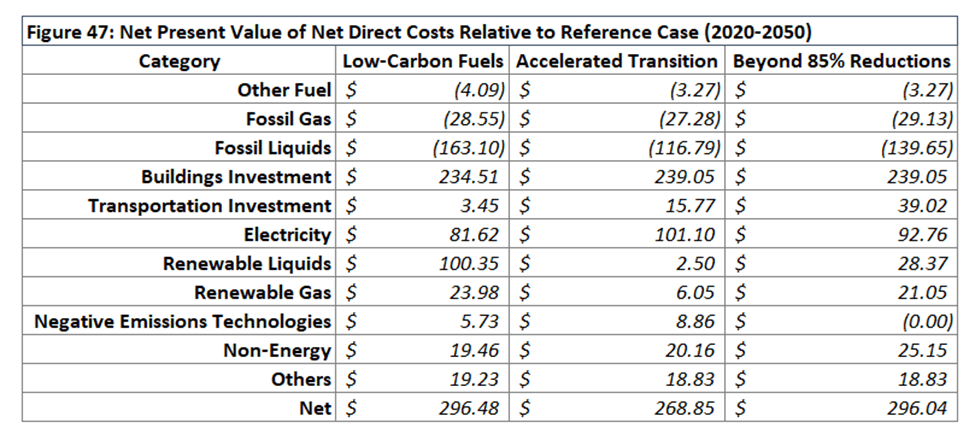
At a recent meeting there was an opportunity for the public to ask questions about the New York State Energy Research & Development Authority (NYSERDA) work supporting the Draft Scoping Plan. I asked about the missing cost information and John Williams, Vice President, Policy and Regulatory Affairs, responded: “In response to your inquiry for additional cost information, we have added clarifying information to the existing Excel document, ‘Appendix G Annex 2: Key Drivers and Outputs,’ which can be found on the Climate Action Council Draft Scoping Plan website.” I extracted all the new tables to a separate spreadsheet. The spreadsheet table summarizing the cost methods is difficult to read so I have also extracted that information in a document. Also note that more detailed documentation for my cost-benefit analysis is available here and here.
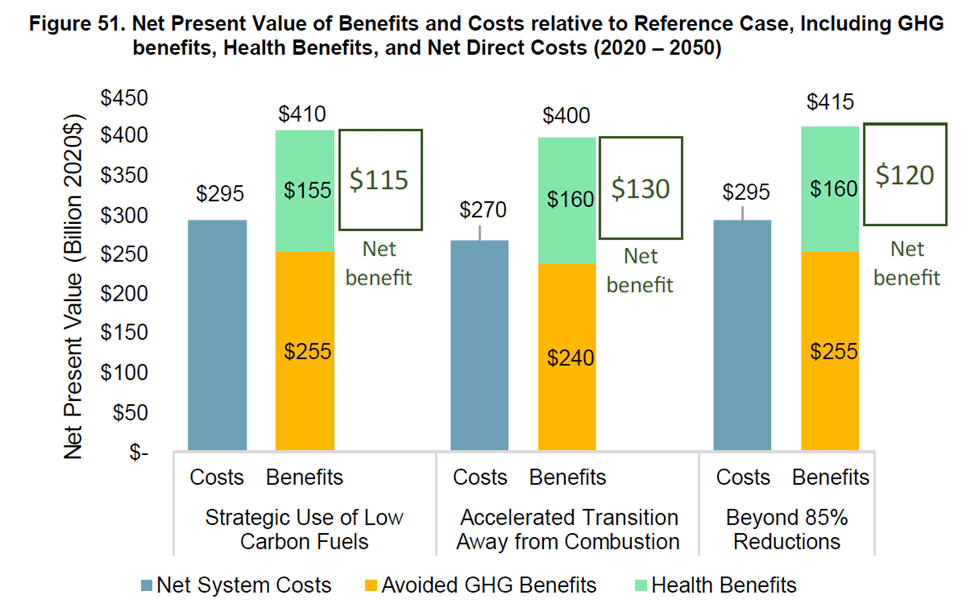
Benefits Exceed the Costs Claim The Draft Scoping Plan claim that “The cost of inaction exceeds the cost of action by more than $90 billion” is presented in Figure 51 in Appendix G Integration Analysis Technical Supplement. The Climate Act overview presentation for the public hearings included a similar figure and made the claim. However, there is a caveat or in this case, a trick. In the following figure I have highlighted the description that notes that the benefits are “relative to Reference Case”. By the way, that caveat is usually not noted when these results are presented. The clarifying data in the updated spreadsheet lists all the values in the table. Because the values are exactly the same, I believe the updated spreadsheet numbers were simply pulled from the figure and not from the analyses themselves.
Reference Case Costs
The next figure I evaluated in my analysis of the benefits claim was the total system expenditures shown in Figure 48. My biggest gripe was that the values in the Figure were not quantified. Thankfully the clarifying data in the updated spreadsheet provides numbers. The Reference Case total in the following table lists the net present value of system expenditures as $2,665 billion. Scenario 2, low-carbon fuels expenditures are $2,974 billion; Scenario 3, accelerated transition expenditures are $2,953 billion; and Scenario 4, beyond 85% reductions expenditures are $2,972 billion. More importantly the category costs are now available. Note that these numbers are not rounded in any way so I believe that they were copied from a different spreadsheet or model.
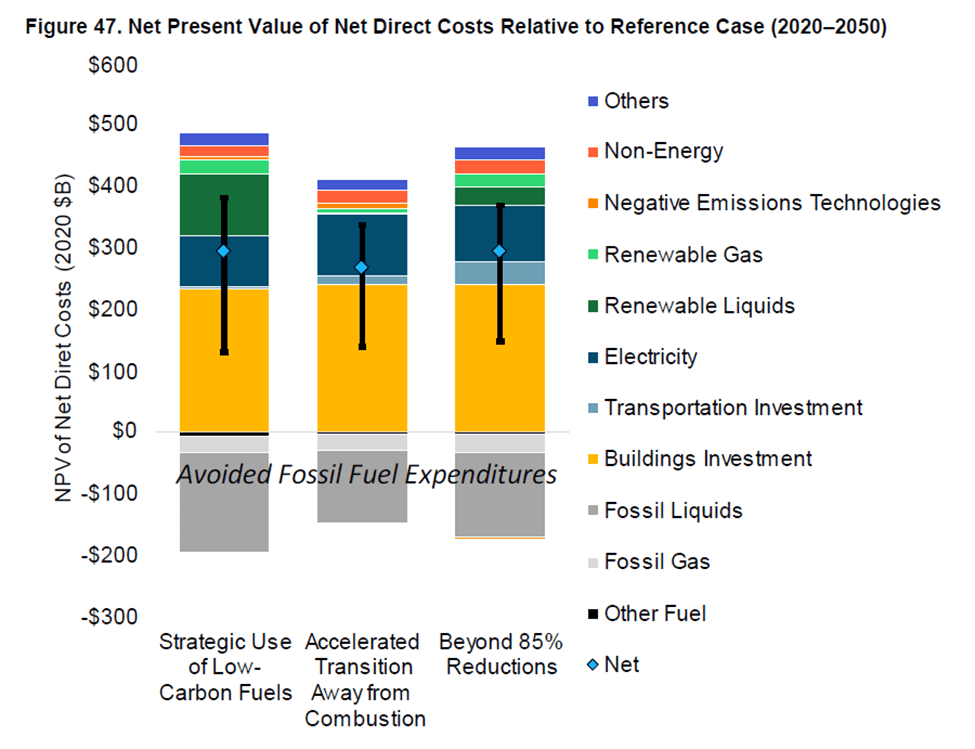
I have frequently heard Climate Action Council member refer to the net cost totals in Figure 47 as the costs of Climate Act implementation. However, these costs are relative to Reference Case for the three mitigation scenarios. In other words, the numbers presented subtract out the Reference Case costs. As explained in the previous post, the rationale for this approach is those estimates include not only the business-as-usual programs but also programs that are already implemented. This new cost information can be used to see if these already implemented programs are really business-as-usual strategies.
Category Cost Implications
The clarifying information update provides numbers associated with each category in Figures 47 and 48. In this section I will address three of the more impactful categories.
The “Buildings Investment” category “Includes capital and operating expenses for building equipment and appliances (e.g., space heaters, air conditioners, water heaters) and investments for building shell upgrades”. The net present value of system expenditures from 2020 – 2050 is $565 billion for the Reference Case. The building sector costs for the mitigation scenarios only range from $235 billion to $240 billion (42% increase) but the emission decreases relative to the Reference Case are 95% greater. In my opinion, that seems inconsistent with the Reference Case costs. It appears that Reference Case cost reductions per ton are double the mitigation scenarios. This anomaly could be caused by excluding the costs but including the emission reductions from the presented numbers.
The ”Transportation Investment” category “Includes capital and operating expenses for light-duty vehicles, medium- and heavy-duty vehicles, and buses, in addition to charging infrastructure costs”. The net present value of system expenditures from 2020 – 2050 is $1,056 billion for the Reference Case. Previously it appeared that the bar chart components difference to add charging infrastructure and the additional costs of electric vehicles relative to current alternatives seemed unacceptably low. According to the Integration Analysis, Scenario 2 transportation initiatives will reduce emissions 79% relative to the Reference Case at a cost of only $2.97 billion. Obviously, this does not pass the smell test. Something is overlooked or deliberately manipulated to make this claim.
The Figure 47 category label is Electricity but the description in the cost methods overview table is Electricity Incremental. I assume they are the same. The description of this category states that it “Includes capital and operating costs for electricity generation, transmission, costs to upgrade existing distribution system, and in-state hydrogen production costs.” The net present value of system expenditures from 2020 – 2050 is $424 billion for the Reference Case. The Integration Analysis described in the Draft Scoping Plan projects that the additional costs necessary to transition the electric grid to zero-emissions ranges between $89 and $111 billion. According to the Integration Analysis that covers the cost of between 5,659 and 7,265 MW on additional land-based wind, 7,393 and 9,310 MW of additional off-shore wind, 40,648 and 45,254 MW of additional solar, and 10,987 and 14,731 MW of additional energy storage beyond the capacity expected in the Reference Case. The additional costs necessary to the transition the electric grid to zero-emissions range between $89 and $111 for incremental electricity. Many things are overlooked or deliberately manipulated to make this claim. A US Energy Information Agency (EIA) report “Capital Cost and Performance Characteristic Estimates for Utility Scale Electric Power Generating Technologies” published in 2020 estimates that a 200 MWh battery energy storage system has a capital cost of US $65.9 million. Assuming that the average of the additional energy storage capacity provides four hours of energy for every MW and using the EIA cost number, energy storage costs alone are $213 billion.
Discussion
In my previous post I argued that the authors of the Draft Scoping Plan apparently included the already implemented transportation investment statewide zero-emission vehicle mandate in the Reference Case. I pointed out that suggesting that the zero-emissions vehicle “implemented policy” should not be included in the Climate Act implementation costs is disingenuous at best. The press release announcing that the Governor signed the legislation states: “The actions announced today in advance of Climate Week 2021 support New York’s ambitious goal of reducing greenhouse gas emissions by 85 percent by 2050, as outlined in the Climate Leadership and Community Protection Act.” It goes on to quote Governor Hochul: “New York is implementing the nation’s most aggressive plan to reduce the greenhouse gas emissions affecting our climate and to reach our ambitious goals, we must reduce emissions from the transportation sector, currently the largest source of the state’s climate pollution”. I think that these statements pretty well represent any dispassionate observer’s belief that the only reason for this mandate is to support the Climate Act. As such those costs are not legitimate Reference Case business-as-usual costs.
I also pointed out the claim that “The cost of inaction exceeds the cost of action by more than $90 billion” includes a caveat that the comparison is relative to the Reference Case. I showed how the semantic justification that the transportation investments were already implemented excluded the costs of the zero-emissions vehicle mandate from the costs side of the comparison. In order to further tilt the results, the emission reduction benefits attributed to the transportation investments were not excluded in the comparison. In other words, the comparison takes out the costs that would hurt their case but leaves in emission reduction benefits that help make the case that the benefits are greater than the costs.
The newly released categorial cost data provide evidence of similar manipulation of the data for other categories to provide the desired result. The building sector costs for the mitigation scenarios only range from $235 billion to $240 billion (42% increase) but the emission decreases relative to the Reference Case are 95% greater. The numbers also confirm my initial transportation initiative concerns. According to the Integration Analysis, Scenario 2 transportation initiatives will reduce emissions 79% relative to the Reference Case at a cost of $2.97 billion. The Integration Analysis projects that just the cost of battery electric vehicle chargers will be over $15 billion for Scenario 2 relative to the Reference Case. Finally, the claim that the additional costs necessary to transition the electric grid to zero-emissions range between $89 and $111 for incremental electricity are ludicrous. I estimate that the additional energy storage costs alone are $213 billion more than the Reference Case costs.
Conclusion
In my opinion the Climate Act claim that the benefits out-weigh costs is obviously incorrect. I have shown the recently released numbers confirm my earlier analyses. The Climate Act requires the Climate Action Council to “[e]valuate, using the best available economic models, emission estimation techniques and other scientific methods, the total potential costs and potential economic and non-economic benefits of the plan for reducing greenhouse gases, and make such evaluation publicly available” in the Scoping Plan. In order to fulfill this obligation, the Draft Scoping Plan must describe all control measures, assumptions used, the expected costs for those measures and the expected emission reductions for the Reference Case, the Advisory Panel scenario and the three mitigation scenarios. Given the overt manipulation of the data used to erroneously claim that “The cost of inaction exceeds the cost of action by more than $90 billion”, I have no faith in any cost numbers presented without that documentation.
Note: This post was updated to add a revised link to the spreadsheet that lists all the clarifying information update on May 29, 2022.
The Climate Leadership and Community Protection Act (Climate Act) has a legal mandate for New York State greenhouse gas emissions to meet the ambitious net-zero goal by 2050. The Draft Scoping Plan that describes how to meet those goals was released to the public at the end of 2021 and the comment period is open until June 10, 2022. This post announces the fact that the with two weeks left in the comment period the numbers that were used in the Benefits and Costs chapter of Appendix G of the documentation are now available.
Everyone wants to do right by the environment to the extent that they can afford to and not be unduly burdened by the effects of environmental policies. I have written extensively on implementation of New York’s response to that risk because I believe the ambitions for a zero-emissions economy embodied in the Climate Act outstrip available renewable technology such that it will adversely affect reliability, impact affordability, risk safety, affect lifestyles, and will have worse impacts on the environment than the purported effects of climate change in New York. New York’s Greenhouse Gas (GHG) emissions are less than one half one percent of global emissions and since 1990 global GHG emissions have increased by more than one half a percent per year. Moreover, the reductions cannot measurably affect global warming when implemented. The opinions expressed in this post do not reflect the position of any of my previous employers or any other company I have been associated with, these comments are mine alone.
The Draft Scoping Plan claims that “The cost of inaction exceeds the cost of action by more than $90 billion”. In my recent verbal comments at the Syracuse Climate Act public hearing I said that statement is inaccurate and misleading. I recently published an article that consolidates documentation that supports my contention that the costs far exceed the benefits. A main finding in my cost-benefit analysis is that most of the values in the supporting documentation (Section 3.4 Benefits and Costs, Appendix G Integration Analysis Technical Supplement Section I) are only presented in bar charts. In other words, the values of the numbers are not included.
At a recent meeting there was an opportunity for the public to ask questions about the New York State Energy Research & Development Authority (NYSERDA) work supporting the Draft Scoping Plan. I asked about the cost information and John Williams, Vice President, Policy and Regulatory Affairs, responded. He indicated that detailed information was available and suggested that I follow up for more information. I sent him an email asking for specific information. I explained that, for example, in Appendix G, Section I, Figure 48 lists the net present value of system expenditures in Reference Case and Scenarios 2-4. The only associated number given in the text is a mention that the Reference Case totals $2.7 trillion. I said that I believe that at a minimum the values of the cost categories listed on the right-hand side of the bar charts should be available in a table somewhere for each of the scenarios. I also said that detailed control measure costs should also be available so that the public can check the category costs and critique specifics.
On May 27 Mr. Williams responded:
In response to your inquiry for additional cost information, we have added clarifying information to the existing Excel document, “Appendix G Annex 2: Key Drivers and Outputs,” which can be found on the Climate Action Council Draft Scoping Plan website. At the end of the workbook, you will see a series of green tabs. The “Cost Methods Overview” tab describes how costs were calculated throughout the analysis. Accompanying tabs provide the data associated with the cost figures published in the Draft Scoping Plan.
We hope this will help you and all stakeholders better understand how our cost analyses were performed. Please reach out if there are any questions.
My hats off to Mr. Williams for responding to my request. He is the only one in the Administration that has responded to any of my comments.
Conclusion
While I really appreciate the response it is a problem that this obvious need was not included until there are only two weeks left in the comment period. Unfortunately, only two things were provided: the numbers associated with the cost figures in Section 3.4 Benefits and Costs of Appendix G and a table summarizing the cost methods. I also believe that it is problematic that a casual reader would have no idea that this new information has been included in an update because the appendices listing on the Climate Act Draft Scoping Plan page does not mention that an update is available. Finally, tacking 15 tables at the end of an already huge spreadsheet does not foster easy use. I have extracted all the new tables in a separate spreadsheet. The spreadsheet table summarizing the cost methods is difficult to read so I have also extracted that information in a document.
I will follow up with another post later regarding the information provided.
The Climate Leadership and Community Protection Act (Climate Act) has a legal mandate for New York State greenhouse gas emissions to meet the ambitious net-zero goal by 2050. In order to implement the changes needed additional legislation is needed. Environmental advocates are pushing Renewable Heat Now bills including the All-Electric Building Act. This post puts that legislation into the context of the current electricity reliability crisis facing New Yorkers.
Everyone wants to do right by the environment to the extent that they can afford to and not be unduly burdened by the effects of environmental policies. I have written extensively on implementation of New York’s response to climate change risk because I believe the ambitions for a zero-emissions economy embodied in the Climate Act outstrip available renewable technology such that it will adversely affect reliability, impact affordability, risk safety, affect lifestyles, and will have worse impacts on the environment than the purported effects of climate change in New York. New York’s Greenhouse Gas (GHG) emissions are less than one half one percent of global emissions and since 1990 global GHG emissions have increased by more than one half a percent per year. Moreover, the reductions cannot measurably affect global warming when implemented. The opinions expressed in this post do not reflect the position of any of my previous employers or any other company I have been associated with, these comments are mine alone.
Climate Act Background
The Climate Act establishes a “Net Zero” target by 2050. The Climate Action Council is responsible for preparing the Scoping Plan that will “achieve the State’s bold clean energy and climate agenda”. They were assisted by Advisory Panels who developed and presented strategies to the meet the goals to the Council. Those strategies were used to develop the integration analysis prepared by the New York State Energy Research and Development Authority (NYSERDA) and its consultants that quantified the impact of the strategies. That analysis was used to develop the Draft Scoping Plan that was released for public comment on December 30, 2021.
I previously described two bills that address the building sector components that need to be changed for the net-zero transition. According to the Advanced Code Act: “Buildings are the single largest user of energy in the State of New York, accounting for almost 60% of all energy consumed by end-use in the State.” Revisions to building codes will be “directly impacting a building’s energy load and carbon footprint”. The Gas Ban notes that the Climate Act “requires greenhouse gas emission reductions from all sectors, which will entail, among other things, converting buildings throughout the state from heating and cooking with combustible fuels to heating and cooking with non-emitting sources such as energy-efficient air, ground, and water sourced electric heat pumps which also provide cooling, and electric and induction stoves”. I understand that the Advanced Code Act has already passed.
All Electric Building Act
I described the public hearing for this legislation that establishes the All-Electric Building Act. As has been the case with other legislation the bill assumes that there are no technology limitations and that all new buildings can be built without fossil fuel infrastructure without any issues.
The proposed legislation revises the state energy conservation construction code to “prohibit infrastructure, building systems, or equipment used for the combustion of fossil fuels in new construction statewide no later than December 31, 2023 if the building is less than seven stories and July 1, 2027 if the building is seven stories or more”. It allows the building code council to exempt systems for emergency back-up power, or buildings specifically designated for occupancy by a “commercial food establishment, laboratory, laundromat, hospital, or crematorium, but in doing so shall seek to minimize emissions and maximize health, safety, and fire-protection.” However, it limits the areas where the combustion of fossil fuels is allowed and the building must be designed as all-electric ready.
The legislation includes a provision for affordability. It requires state agencies to identify policies to ensure affordable housing and affordable electricity (meaning that electricity costs no more than 6% of a residential customer’s income) for all-electric buildings by February 1st, 2023. Note that I have been unable to determine the current affordability status of New York.
Affordability
Energy affordability, in general, and electricity affordability, in particular, should be a major concern. There is no question that there is a home energy crisis:
According to WE ACT for Environmental Justice, an organization whose mission is to combat environmental racism and build healthy communities for people of color, 13 percent of all residential households—about 1,137,000 in total—are 60 days in arrears on their utility bills, with an average of $1,427.71 in debt. The debt level is even higher for Con Ed customers, averaging about $2,085 per residential household/customer.
More than 471,629 disconnection notices were sent out in April 2022 for residential customers across New York State, with Orange and Rockland counties leading the way, with 79 shutoffs that month. For commercial customers, there were more than 77,651 disconnection notices overall, with almost 2,544 already carried out. National Grid (KEDLI) had the highest number of service terminations, 882, followed by Con Edison at 831 terminations and National Grid (KEDNY) at 310. Residential terminations in March were at 131 and commercial terminations stood at 1,688.
The proposed legislation addresses affordability but puts the cart before the horse by evaluating electricity affordability after the bill is enacted:
§ 11-111. Additional reporting. On or before February first, two thousand twenty-three, the department of public service, the division of housing and community renewal, the department of state, and the New York state energy research and development authority shall report jointly to the governor, the temporary president of the senate, the minority leader of the senate, the speaker of the assembly, and the minority leader of the assembly, regarding what changes to electric rate designs, new or existing subsidy programs, policies, or laws are necessary to ensure that subdivisions six and seven of section 11-104 of this article do not diminish the production of affordable housing or the affordability of electricity for customers in all-electric buildings. For the purpose of this subdivision, “affordability of electricity” shall mean that electricity does not cost more than six percent of a residential customer’s income.
In 2016, New York State set a target that low-income New Yorkers should pay no more than 6% of their income toward energy bills and I applaud its inclusion in this legislation. However, I have not been able to find out how New York State stands relative to this target. I did find an analysis for New York City that showed that over 460,000 low-income families in New York City are paying over 6% of their pre-tax income toward their energy bills. That works out to 14.6% of the households.
All Electric Building Act Costs
I have yet to see an evaluation of the potential costs of this legislation. The Integration Analysis spreadsheets that support the Draft Scoping Plan include a table with device costs. In order to ensure that heat pumps work at all times in New York’s winters upgrades to the building shell (insulation, infiltration and windows) are needed. According to device cost table an air source heat pump runs $14,678 and a deep shell upgrade of $45,136 totaling $59,814 or a ground source heat pump ($34,082) and a basic shell upgrade ($6,409) totaling $40,491 for single family homes. This legislation would mandate adding those costs above the cost of an efficient furnace or boiler ranging from $3,085 to $8,975. Obviously, those added costs are going to add to the affordability burden for New Yorkers.
Conclusion
The bill requires a study after the law becomes effective to ensure it does not “diminish the production of affordable housing or the affordability of electricity for customers in all-electric buildings”. That is an example of the cart before the horse mindset of this legislation and the Climate Act itself. This bill should be amended to include a specific affordability target and only proceed as long as the metric is achieved. I think that there should be a state-wide goal for the percentage of customers that don’t meet the 6% target and the State should make the current value readily available. Without that information it is inappropriate to implement this legislation.
By any measure New York’s complete elimination of GHG emissions is so small that there will not be any effect on the state’s climate and global climate change impacts to New York. New York’s emissions are only 0.45% of global emissions. I have shown that global emissions have increased more than New York’s total share of global emissions since 1995. In other words, whatever New York does to reduce emissions will be supplanted by global emissions increases in a year. Against that backdrop it is not clear why any increase in New York energy costs from any renewable heat legislation should be considered until the electricity energy crisis is resolved.
The Climate Leadership and Community Protection Act (Climate Act) has a legal mandate for New York State greenhouse gas emissions to meet the ambitious net-zero goal by 2050. The scoping plan claims that “The cost of inaction exceeds the cost of action by more than $90 billion”. In my recent verbal comments at the Syracuse Climate Act public hearing I said that statement is inaccurate and misleading. This post consolidates documentation that has been presented in multiple earlier posts that supports my statement that the costs far exceed the benefits.
Everyone wants to do right by the environment to the extent that they can afford to and not be unduly burdened by the effects of environmental policies. I have written extensively on implementation of New York’s response to climate change because I believe the ambitions for a zero-emissions economy embodied in the Climate Act outstrip available renewable technology such that it will adversely affect reliability, impact affordability, risk safety, affect lifestyles, and will have worse impacts on the environment than the purported effects of climate change in New York. New York’s Greenhouse Gas (GHG) emissions are less than one half one percent of global emissions and since 1990 global GHG emissions have increased by more than one half a percent per year. Moreover, the reductions cannot measurably affect global warming when implemented. Bottom line for me is that in its present form the Climate Act will do more harm than good. The opinions expressed in this post do not reflect the position of any of my previous employers or any other company I have been associated with, these comments are mine alone.
Climate Act Background
The Climate Leadership and Community Protection Act (Climate Act) establishes a “Net Zero” target by 2050. The Climate Action Council is responsible for preparing the Draft Scoping Plan that defines how to “achieve the State’s bold clean energy and climate agenda”. They were assisted by Advisory Panels who developed and presented strategies to the meet the goals to the Council. Those strategies were used to develop the Integration Analysis prepared by the New York State Energy Research and Development Authority (NYSERDA) and its consultants that quantified the impact of the strategies. That analysis was used to develop the Draft Scoping Plan that was released for public comment on December 30, 2021.
Benefits Exceed the Costs Claim
The Draft Scoping Plan claim that “The cost of inaction exceeds the cost of action by more than $90 billion” is presented in Figure 51 in Appendix G Integration Analysis Technical Supplement. The Climate Act overview presentation for the public hearings included a similar figure and made the claim. However, there is a caveat or in this case, a trick. In the following figure I have highlighted the description that notes that the benefits are “relative to Reference Case”. By the way, that caveat is usually not noted when these results are presented.
Reference Case Costs
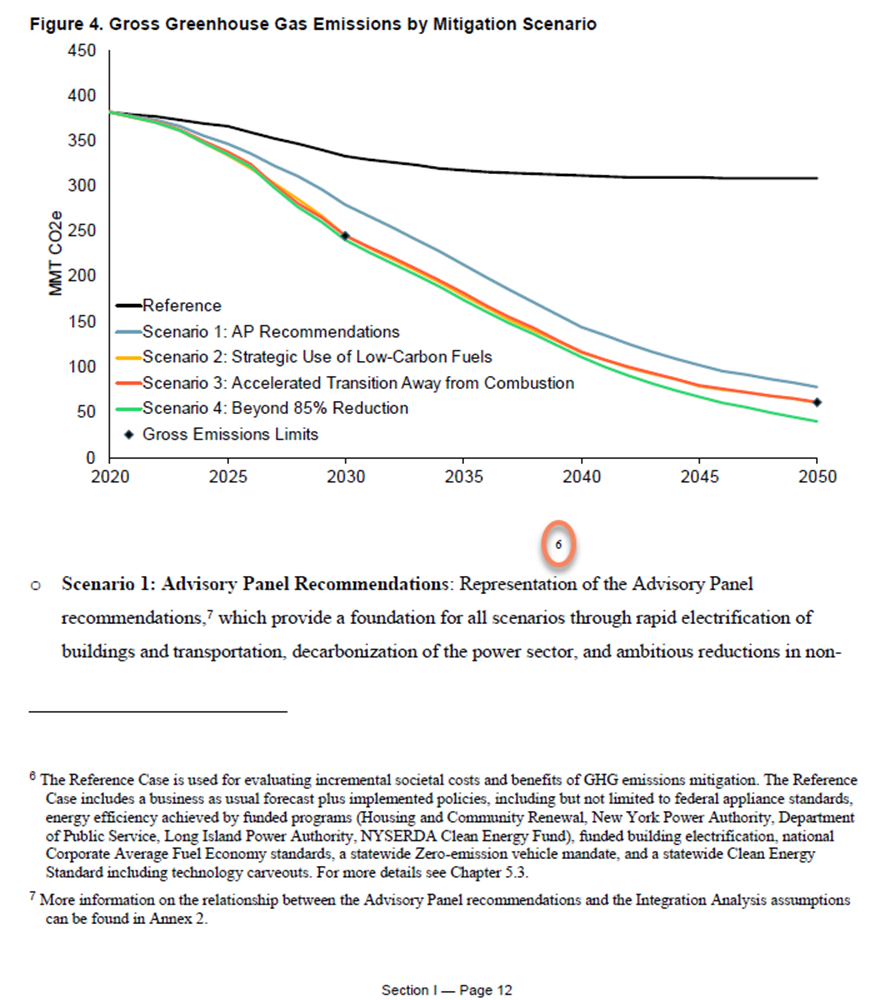
The important point is that the costs shown subtract the reference case costs from the costs attributed to the Climate Act. As a result, the control measures included in the Reference Case make all the difference in the claim. I did not pick up on this nuance for several months. When I did notice the qualifying statement, I started looking for Reference Case documentation in the Draft Scoping Plan. Ultimately, I ended up searching the document for the phrase “reference case. The following figure reproduces the page with the documentation on page 12 in Appendix G Integration Analysis Technical Supplement Section I. The documentation is buried in the footnote for the circled reference for the blank caption to Figure 4. Given its importance to this critical claim I can’t help but wonder why this important definition is buried.
The footnote text describes what is in the Reference Case. It includes a “business as usual” forecast plus implemented policies. The implemented policies include but are not limited to:
Federal appliance standards
Energy efficiency achieved by funded programs (Housing and Community Renewal, New York Power Authority, Department of Public Service, Long Island Power Authority, NYSERDA Clean Energy Fund)
Funded building electrification
National Corporate Average Fuel Economy standards
Statewide Zero-emission vehicle mandate
Statewide Clean Energy Standard including technology carveouts
The Climate Act requires the Climate Action Council to “[e]valuate, using the best available economic models, emission estimation techniques and other scientific methods, the total potential costs and potential economic and non-economic benefits of the plan for reducing greenhouse gases, and make such evaluation publicly available” in the Scoping Plan. In order to fulfill this obligation, I think the Draft Scoping Plan should describe all control measures, the expected costs for those measures and the expected emission reductions for the Reference Case, the Advisory Panel scenario and the three mitigation scenarios. While there is a large amount of information provided, this information is not available as far as I can tell. Particularly concerning is the complete lack of detailed cost information.
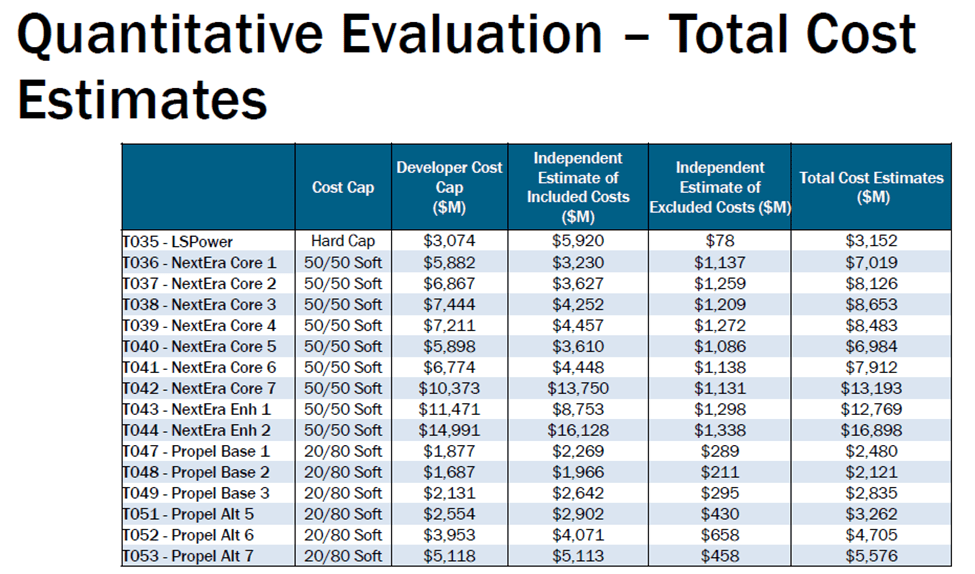
The total system expenditures are shown in Figure 48. The text notes that the reference case total is $2.7 trillion but that is the only quantified reference. I estimate that the mitigation scenarios are around $3 trillion making the costs relative to the reference case around $300 billion for the three mitigation scenarios. Also note that the values of the expenditure categories on the right are not listed so readers can only guess the values based on the size of the bars.
Figure 47 lists costs relative to Reference Case for the three mitigation scenarios. In other words, the numbers presented subtract out the Reference Case costs. The trick used to claim that the benefits are greater than the costs is to argue that significant costs that are needed to meet Climate Act targets are in programs that are already implemented. For example, consider transportation investments that I estimate total around $700 billion. There are two already implemented transportation investment programs in the Reference Case: national corporate average fuel economy standards and statewide zero-emission vehicle mandate. I accept that Federal fuel economy standards don’t represent a cost for the Climate Act. New York passed legislation setting a goal for all new passenger cars and trucks sold in New York State to be zero-emissions by 2035 in April 2021 so this is technically an already implemented program.
However, suggesting that the zero-emissions vehicle “implemented policy” should not be included in the Climate Act implementation costs is disingenuous at best. The press release announcing that the Governor signed the legislation states: “The actions announced today in advance of Climate Week 2021 support New York’s ambitious goal of reducing greenhouse gas emissions by 85 percent by 2050, as outlined in the Climate Leadership and Community Protection Act.” It goes on to quote Governor Hochul: “New York is implementing the nation’s most aggressive plan to reduce the greenhouse gas emissions affecting our climate and to reach our ambitious goals, we must reduce emissions from the transportation sector, currently the largest source of the state’s climate pollution”. I think that these statements pretty well represent any dispassionate observer’s belief that the only reason for this is mandate is to support the Climate Act. As such those costs are not legitimate Reference Case costs.
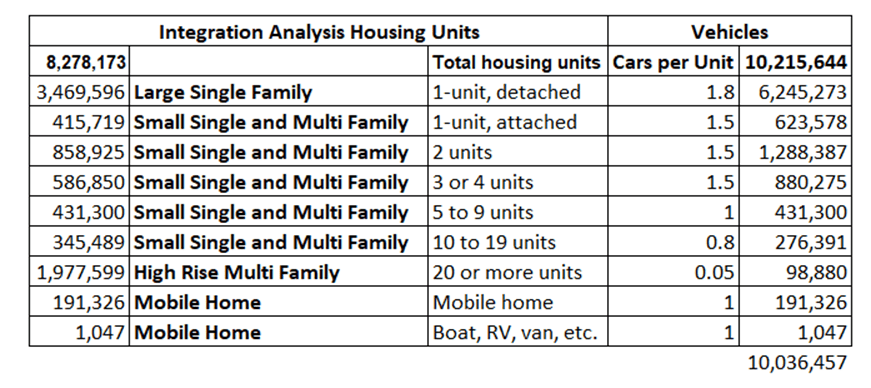
If the Draft Scoping Plan provided the costs for each of the control measures as I believe is appropriate, then it would be a simple matter to determine what the costs for Transportation Investments should be. Instead, I had to eyeball guess the size of the transportation investment bar in Figure 48 to be around $700 billion. While that total includes the costs for the Federal fuel economy standard, that has to be much smaller than all the costs associated with going to zero-emissions vehicles. There are about 10 million vehicles in the state so assuming that the Federal fuel economy standard will cost $7,000 per vehicle that means that the total cost is $70 billion and that zero-emissions vehicles cost $630 billion. As a result, the direct costs increase by $630 billion.
Avoided Cost of Carbon Benefits
In Figure 51 the costs are compared to benefits. As shown in Figure 46, the largest benefit comes from avoided GHG benefits. I believe there is an error in that calculation. Scoping Plan relies on flawed DEC Value of Avoided Carbon Guidance. The Guidance includes a recommendation to estimate emission reduction benefits for a plan or goal. I believe that the guidance approach is wrong because it applies the social cost multiple times for each ton reduced. I maintain that it is inappropriate to claim the benefits of an annual reduction of a ton of greenhouse gas over any lifetime or to compare it with avoided emissions. The social cost calculation that is the basis of the Scoping Plan carbon valuation sums projects benefits for every year for some unspecified lifetime subsequent to the year the reductions. As shown above, the value of carbon for an emission reduction is based on all the damages that occur from the year that ton of carbon is reduced out to 2300. Clearly, using cumulative values for this parameter is incorrect because it counts those values over and over. I contacted social cost of carbon expert Dr. Richard Tol about my interpretation of the use of lifetime savings and he confirmed that “The SCC should not be compared to life-time savings or life-time costs (unless the project life is one year)”.
Corrections to Figure 51 Net Present Value of Benefits and Costs
The following table corrects the issues described here. If we fix the misleading trick then the Draft Scoping Plan net system costs are increased by $630 billion. Correcting the multiple counting error drops the avoided GHG benefits estimate to $60 billion. The result is that the costs exceed the benefits by at least $690 billion.
There’s More
There is another issue associated with the claim that “The cost of inaction exceeds the cost of action by more than $90 billion”. As shown, there is a caveat that the comparison is relative to the Reference Case. I showed how the semantic justification that the transportation investments were already implemented excluded the costs of the zero-emissions vehicle mandate from the costs side of the comparison. In order to further tilt the results, the benefits attributed to the transportation investments were not excluded in the comparison. In other words, the comparison takes out the costs that would hurt their case but leaves in benefits that help make the case that the benefits are greater than the costs.
Conclusion
In my opinion the Climate Act story that the benefits out-weigh the costs is incorrect. I have shown how the trick to deceive the public works. If the Draft Scoping Plan described all the control measures, the expected costs for those measures and the expected emission reductions for the Reference Case, the Advisory Panel scenario and the three mitigation scenarios, then the public would be able to decide for themselves which costs associated with “already implemented” program are appropriate. The lack of documentation prevents that.
More detailed documentation information is available here and here.
The Climate Leadership and Community Protection Act (Climate Act) has a legal mandate for New York State greenhouse gas emissions to meet the ambitious net-zero goal by 2050. I recently was given the opportunity to brief my New York State Senator, John Mannion, about my concerns related to affordability and reliability in the Climate Act Draft Scoping Plan. This post describes the slide presentation and provides a link to the documentation handout for it.
Everyone wants to do right by the environment to the extent that they can afford to and not be unduly burdened by the effects of environmental policies. I have written extensively on implementation of New York’s response to that risk because I believe the ambitions for a zero-emissions economy embodied in the Climate Act outstrip available renewable technology such that it will adversely affect reliability, impact affordability, risk safety, affect lifestyles, and will have worse impacts on the environment than the purported effects of climate change in New York. New York’s Greenhouse Gas (GHG) emissions are less than one half one percent of global emissions and since 1990 global GHG emissions have increased by more than one half a percent per year. Moreover, the reductions cannot measurably affect global warming when implemented. The opinions expressed in this post do not reflect the position of any of my previous employers or any other company I have been associated with, these comments are mine alone.
Climate Act Background
The Climate Act establishes a “Net Zero” target by 2050. The Climate Action Council is responsible for preparing the Scoping Plan that will “achieve the State’s bold clean energy and climate agenda”. They were assisted by Advisory Panels who developed and presented strategies to the meet the goals to the Council. Those strategies were used to develop the integration analysis prepared by the New York State Energy Research and Development Authority (NYSERDA) and its consultants that quantified the impact of the strategies. That analysis was used to develop the Draft Scoping Plan that was released for public comment on December 30, 2021. Comments on the draft can be submitted until June 10, 2022.
Presentation
I list the presentation slides below. The documentation summarizes what I said for each slide and provides references for the statements. I highlight some of the key points I tried to make in this description of the slides.
I tried to make the point in the following slide that most New Yorkers are unaware of the Climate Act. Not only that but fewer still understand the scope and magnitude of the changes required in order to meet the Climate Act targets and even fewer are aware of the costs, benefits, and threats to reliability inherent in the massive transition of our existing energy system to the net-zero targets of the Act. The presentation hit the points that I think the public should understand.
In my presentation I explained that I think the root problem of the Scoping Plan approach is over simplification of possible solutions. Reality is that there are many issues with every aspect of the proposed energy transition. I said that there are two particular problems with the proposed solutions: they don’t work all the time and they are more complicated than existing technology. As a result, there are ramifications that need to be considered.
I included this slide to just hit the highlights of the Act. I mentioned that the 100% zero-carbon electricity by 2040 target was a particular worry of mine.
This slide more or less presented the material in the Climate Act Background section above. I did mention that 10 public hearings have been scheduled.
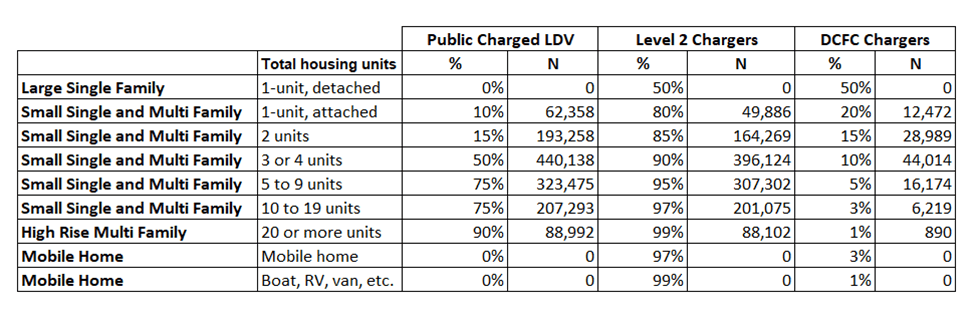
The point of this slide was to point out that the transportation vision requires massive changes to the transportation system and significant limitations on personal choice. I believe that most people recognize that there are limitations to electric vehicles and have decided that they are not a viable option as the primary household vehicle even if they could afford one. The primary limitation that people in Upstate New York understand is that electric vehicles don’t work so well in cold weather. In addition, electric vehicles are more complicated because at-home charging has infrastructure requirements and another daily chore to hook the car up for charging. This is a concern for those of us who have the option to charge at home but what about all those people who park on the street or in a parking lot? Providing infrastructure for them will be very expensive.
In order to prove the Climate Act is in the best interests of the State, the Scoping Plan claims benefits. I explained that I thought that the proposed health benefits were exaggerated, that I have been unable to verify their estimates and that they are all societal benefits that will not directly affect consumer costs.
The largest benefit proposed is for avoided GHG emission impacts on climate change. I estimate that these benefits should be on the order of $60 billion dollars based on eliminating New York’s maximum annual GHG emissions overnight and multiplying by New York’s value of carbon. The Scoping Plan claims benefits of at least $235 to $250 billion by counting the benefits multiple times. This is the same as claiming that a weight loss of ten pounds five years ago represents a 50-pound reduction. Obviously, that is wrong and if that error is corrected the costs are greater than the benefits.
This graph has been shown at public comment hearings and is the support for the Draft Scoping Plan claim that “The cost of inaction exceeds the cost of action by more than $90 billion”. I explained that there were issues with cost numbers in addition to the benefits problems described previously. In particular, it is necessary to parse the language to understand how the Integration Analysis presents the costs. They are presented as net direct costs because the cost to use fossil fuels are subtracted from the costs to meet the reduction targets. The bigger issue is that the net present value of benefits and costs are presented relative to Reference Case. I admit that I did not pick up on the implications of that condition for five months. It turns out that vehicle electrification costs appear to be included in the Reference Case because the electric vehicle legislative mandate was an “implemented policy”. However, the $700 billion costs to electrify the transportation investment category are a necessary cost for the net-zero transition. I don’t think they should be included in the Reference Case because those costs are a necessary transition expense. If those costs are moved from the Reference Case to the mitigation scenarios where they belong, the costs are much greater than the benefits.
I also made the point that this graphic is representative of the abysmal cost documentation in the Scoping Plan. For the most part the only numbers provided are in bar charts like this and none of the cost category values are quantified. This inexcusable shortcoming of the Draft Scoping Plan is the subject of a post which provides more information. I believe that the cost for every category in the Draft Scoping Plan should be listed in a spreadsheet and that costs for each measure that make up the category costs should also be included. Without this information it is impossible to provide meaningful comments on the financial viability of the scenarios.
The following slide explains that corrections to the inaccurate benefits and misleading costs presented in the Scoping Plan invalidate the claim that the benefits are greater than the costs. Approximately $700 billion should be added to the net system costs column in the revised section of the table and the avoided GHG benefits should be only $60 billion. The costs are greater than the benefits by at least $760 billion.
In 2040 the electric grid is supposed to be converted to zero emissions. In order to describe potential reliability issues associated with that transition this slide and the following two slides discuss the electric grid. The point of this slide is that the electric grid is big, complex and currently dependent upon generating resources that can be dispatched by the operators who match load with generation on a minute-by-minute basis.
This slide explains that significant infrastructure is required for the transition and that it will complicate matching generation and load. Wind and solar are not dispatchable without energy storage, transmission and ancillary services resources. I pointed out that short-term variations in wind and solar require an energy storage resources that is relatively small but will be used frequently. The Li-Ion 4-hour storage batteries work well for this requirement. There are significant diurnal variations in renewable resources if solar is a major component. This needs to be addressed by energy storage resources that are on the order of the size of the solar capacity in the system. In my opinion this resource has not been implemented on a commercial scale. In addition, additional energy storage is needed for cloudy days. The resources needed for both these applications will be used regularly. The biggest problem is the energy storage needed for infrequent but extended periods of low wind and solar output. A large amount of long-term storage capacity is needed to cover a multi-day renewable resource drought but it will not be used a lot. If it is not used much how will the market pay for the resource?
If the grid operators cannot match the load with available generation, then blackouts similar to the February 2021 blackouts in Texas are inevitable. The operators task is made more difficult because load is not constant. Ultimately the problem of most concern is that the periods when the renewable resources are lowest are also periods when load is expected to be highest once home heating is electrified. This is an enormously important issue but I don’t think it has received the appropriate level of consideration by the Climate Action Council.
I recently posted an article that highlighted the content (Presentation) and conversations at a NYISO meeting on March 24, 2022 that addressed the System & Resource Outlook Update effort with the Electric System Planning Working Group. I prepared the table that shows the existing capacity, the capacity proposed for the three Draft Scoping Plan scenarios, and the base case for the Update options discussed at the meeting. One of the concerns at this meeting of New York State reliability experts was the amount of new infrastructure needed. The total of new generation required is around three times the 2021 total existing generation. That does not include the ancillary services and transmission upgrades needed. The other concern was the Zero-Carbon Firm Resource. This is the “large amount of long-term capacity needed to cover a multi-day renewable resource drought that it is not used a lot” resource needed when the loads are predicted to be highest in the future. The problem is that there isn’t any commercially demonstrated resource available today or expected for this resource in the near future. The table shows that this resource is need to provided capacity that is greater than current installed capacity. The conversation that caught my attention is when the experts said: The results are “stunning” and “Is anyone listening”. They are clearly worried and the Climate Action Council has shown no sign of concern about this issue.
There is another issue for the Council. Comparing the Draft Scoping Plan capacity resource distributions with the NYISO projected capacity shows significant differences. It is not clear how will those differences will be resolved.
Unfortunately, the Climate Action Council seems to be more concerned about activist claims to stop all new fossil fuel infrastructure than the critical need for a proven replacement. It seems to me that it would be prudent to make the implementation schedule conditional upon the availability of the necessary technology. That Council leadership has not stepped up and said that fossil fuel infrastructure is needed until we have a viable alternative is necessary is not a good sign.
Even though electric grid reliability is an important topic it also it is one that most people don’t have any experience with so I included a description of reliability and affordability related to home electrification that we all understand. Because the buildings sector is the largest source of GHG emissions, decarbonization is a primary strategy. My primary residential reliability concern is what happens when there is an extended electric outage? There is not a lot of information available about the cost affordability for residential home heating so I added slides discussing residential heating sector costs.
The primary solution for residential home heating in the Draft Scoping Plan is heat pumps: “Modern heat pumps that work in very cold weather are commercially available and able to keep homes and businesses comfortable year-round, as long as they are properly chosen, sized, and paired with an energy-efficient building envelope. “ Frankly, everything I have seen on social media from NYSERDA about heat pumps is propaganda because it only shows the benefits and does not mention any downsides. The Plan notes three caveats for success: properly chosen, sized, and paired with an energy efficient building envelope or building shell.
The unmentioned downside is the building shell requirement. The Scoping Plan analysis included two levels: basic shell – 27-44% reductions and deep shell – 57-90% reductions. The Integration Analysis projects that residential building stocks will be 66% basic shell and 26% deep shell by 2050. In my opinion the description of what is required for the two levels is inadequate. I assume that the deep upgrade must meet the international standard for passive buildings that includes following measures: Improved thermal insulation, considerably improved airtightness, use of high quality windows, reduction of thermal bridges, and ventilation with highly efficient heat recovery. In my opinion deep shells will be needed more than the Plan assumes and bringing homes up to that level will be difficult and costly.
The upper half of table in the following slide shows the Retrofit Costs based on the referenced Integration Analysis spreadsheet. According to the device costs in the Draft Scoping Plan an air source heat pump plus electric resistance backup will cost $15,818. The other option is a ground source heat pump and that costs $40,491. The unpublicized costs are $6,409 for a basic building shell improvement or $45,136 for a deep building shell improvement. Combining the two, the air source heat pump option totals $22,227 for the basic shell and $60,954 for the deep shell. For a ground source heat pump the totals range from $40,491 for a basic shell to $79,218 for a deep shell.
The lower half of table subtracts out the replacement costs of the existing system to calculate the retrofit costs. In 2030 when you can no longer purchase anything but a heat pump you won’t have to buy the replacement appliance so you can subtract that cost. For example, if you own a distillate boiler the $9,260 replacement cost can be subtracted from the component costs – an air source heat pump with a basic shell is $12,967 instead of $22,227. As with all other aspects of the implementation there is a complication. In 2030 you will have to replace your existing appliance when it breaks with a heat pump. If it breaks during the winter, you won’t necessarily be able to do a deep shell retrofit at the same time because it is a big investment in time and effort. That will be a serious imposition on the homeowner.
It is also relevant that we keep the context of New York’s emissions relative to the rest of the world vis-à-vis global warming in mind. Although activists claim New York should do something because the state is “large” relative to other countries when it comes to our economy (9th), we should also consider the fact that our emissions are small relative to many others (35th). Moreover, when you consider GHG efficiency (the country’s emissions divided by its GDP) we are already doing a good job -New York ranks third behind only Norway and Sweden.
More importantly, New York’s 2016 GHG emissions were less than one half of one percent of global emissions in 2016 and global emissions are increasing by more than one half of one percent per year. Because global emissions are increasing so much, they will replace all of our emissions completely in about a year. Therefore, I expect no change of global warming effects on weather.
The presentation concluded that everybody wants to do something about climate change and do right by the environment. However, it is important that we don’t do something that will do more harm than good when we try to address climate change. Based on my analysis of the proposed strategies in the Scoping Plan it will do more harm than good. It boils down to the fact that existing technology is just not ready for the magnitude and schedule of the transition outlined in the Scoping Plan.
Recommendations
I did not prepare a slide with my recommendations. I think that politicians worried about the issues raised in this presentation should submit comments to the Climate Action Council but also send a copy to Co-Chairs Doreen Harris and Basil Seggos. The Council has to be made aware that there are real concerns from the public and I encourage public comments to the comment portal.
I suggest comments on a couple of topics. There have been suggestions that the Council will setup workshops on particular issues. I am going to submit a comment that includes a request for full disclosure on particular issues. Too often in the past only one side of the story has been heard. I think the workshops should be used to provide stakeholders with a venue to ask questions and get answers. When the meeting is announced it should offer an opportunity for stakeholder questions to be submitted before hand so that they can be addressed during the workshop. In my opinion workshops on the following topics would be appropriate: how reliability concerns in the electricity sector will be addressed and resolved, cost benefit calculations, residential electrification, and transportation strategies.
I am also going to submit a comment arguing that the Council has to make reliability and affordability a priority. As shown in the presentation it seems prudent that the implementation schedule should be conditional based on the availability of proven technology needed for reliability per experts from NYISO and NYS reliability council. The Council has to make it a priority to listen to the experts who are responsible for New York reliability. Thomas Sowell said “It is hard to imagine a more stupid or more dangerous way of making decisions than by putting those decisions in the hands of people who pay no price for being wrong”. That is exactly what we will be doing if the Council does not listen to the experts.
I am also going to submit a comment saying that the Draft Scoping Plan cost documentation is inadequate. The cost categories for every cost in every figure in the Scoping Plan should be documented in a spreadsheet that lists the totals, the cost categories within the total,s and the costs for each measure that is included in the cost categories.
The Council should also establish criteria for reliability and affordability. The reliability criteria should define the implementation schedule conditions. They should provide guidelines for the NYISO and NYS Reliability Council definition of acceptable technology such as for the “Zero-carbon firm resources”. For example, technology X has been proven commercially on the scale necessary for New York’s requirements so we can proceed with implementation that requires it. Until a technology is available there has to be a hold on the schedule. Similarly, the Council should define affordability thresholds. For this parameter, the number of service disconnects or percentage of New Yorkers in fuel poverty should not be greater than value X would be appropriate conditions.
Conclusion
I listened to the introduction of one of the public hearings and the overview presentation was mostly an advertisement for the Climate Act. There was no suggestion that there might be issues associated with reliability. The machinations that “prove” that the benefits are greater than the costs indicate that the analysis was done so they claim a pre-determined conclusion. I hope that this overview gives readers a taste of the reasons why I am convinced that without changes the impacts of this so-called solution will be worse than the effects of climate change. Anything we do will be displaced in a year, cost a lot of money and risk catastrophic blackouts.