
JP Morgan Energy Study and the Climate Act

Energy Bad Boys Isaac Orr and Mitch Rolling describe nine takeaways in the JP Morgan Chase 15th Annual Energy Paper that provide more reasons why the New York net-zero transition should be paused. 

I am convinced that implementation of the New York Climate Act net-zero mandates will do more harm than good if the future electric system relies only on wind, solar, and energy storage because of reliability and affordability risks.  I have followed the Climate Act since it was first proposed, submitted comments on the Climate Act implementation plan, and have written over 500 articles about New York’s net-zero transition.  The opinions expressed in this article do not reflect the position of any of my previous employers or any other organization I have been associated with, these comments are mine alone.

Background

The Climate Leadership & Community Protection Act (Climate Act) established a New York “Net Zero” target (85% reduction in GHG emissions and 15% offset of emissions) by 2050. The Climate Action Council (CAC) was responsible for preparing the Scoping Plan that outlined how to “achieve the State’s bold clean energy and climate agenda.” The Integration Analysis prepared by the New York State Energy Research and Development Authority (NYSERDA) and its consultants quantified the impact of the electrification strategies.  After a year-long review, the Scoping Plan was finalized at the end of 2022.

Orr and Rolling introduce their post:

On March 4th, JP Morgan Chase released its 15th Annual Energy Paper (hereinafter “JPMC”). The report, written by Michael Cembalest, is a 55-page analysis with hundreds of graphs and charts on the state of the energy industry.  It spans most aspects of the energy industry, discussing costs for wind and solar, conventional fuels, electrification and heat pump adoption, a status update on the deindustrialization of Europe, and the use of green hydrogen.

I am documenting  reasons to pause the Climate Act and this article explains how the takeaways are relevant to the Climate Act implementation and why the findings are more reasons to pause the Climate Act implementation until the issues raised are resolved.

Takeaways

Wind and solar prices continue to rise. 

According to the JP Morgan Chase Report, power purchase agreement (PPAs) prices for wind have more than doubled since 2019, and solar PPAs are near $60 per megawatt hour.  Prices are rising due to US tariffs on Chinese solar panels, a tripling of insurance premiums in MISO, ERCOT, and SPP due to weather events, supply/demand gaps due to permitting delays, higher interest rates, and increased corporate demand for green power. Keep in mind that PPAs almost always show the subsidized cost of an energy source, so in reality, the cost of these resources is even higher.

The Scoping Plan was based on the Integration Analysis quantitative assessment of emission reduction strategies and cost estimates.  The Integration Analysis included projections starting in 2020.  I believe that the cost projections for wind and solar were projected to decrease and here is evidence that is not happening.  It is time to verify that the projections in the Scoping Plan are tracking with reality. 

Battery costs are coming down

Battery storage prices are falling again after a price spike in 2022. According to Energy Storage News, the main drivers of the fall are cell manufacturing overcapacity, economies of scale, low metal and component prices, a slowdown in the EV market, and increased adoption of lithium iron phosphate (LFP) batteries, which are cheaper than nickel manganese cobalt (NMC) batteries.

On the face of it this is good news.  However, the costs are still extraordinarily high.  The Scoping Plan needs to be re-assessed to determine consistency with the cost observations and whether the main drivers in the cost decreases will continue to lower prices.  Most importantly, there must be an honest assessment of the battery price point that makes battery energy storage “affordable”.

US Transmission Line Growth is far below DOE Targets

The JPMC report notes that annual additions of transmission lines are far, far below the levels envisioned by the Biden Administration’s Department of Energy, as you can see in the graph below.

I do not know where New York transmission line growth stands relative to the needs of the Climate Act.  The status of the buildout relative to the Scoping Plan needs to be assessed to determine if the Climate Act schedule is achievable.

Wind and solar do not replace reliable capacity

The JPMC report acknowledge just how ineffective wind and solar are at reducing our dependency on dispatchable generators.  The graph below from the report shows that for every megawatt of wind or solar installed in various regions, it only offsets 10 to 20 percent of gas capacity.

Making the numbers easier to understand, installing 10 MW of wind or solar in MISO would only offset the need for natural gas capacity by 2 MW. In the Southeast, adding 10 MW of wind or solar would only offset the need for 1 MW.

Adding 10 MW wind or solar in New York would only offset the need for natural gas capacity by a little over 1 MW.  I do not believe that the Integration Analysis modeling incorporates this observed effect.  There are clear implications for the Climate Act transition of this observed effect.

MISO and PJM Are Concerned About Reliability

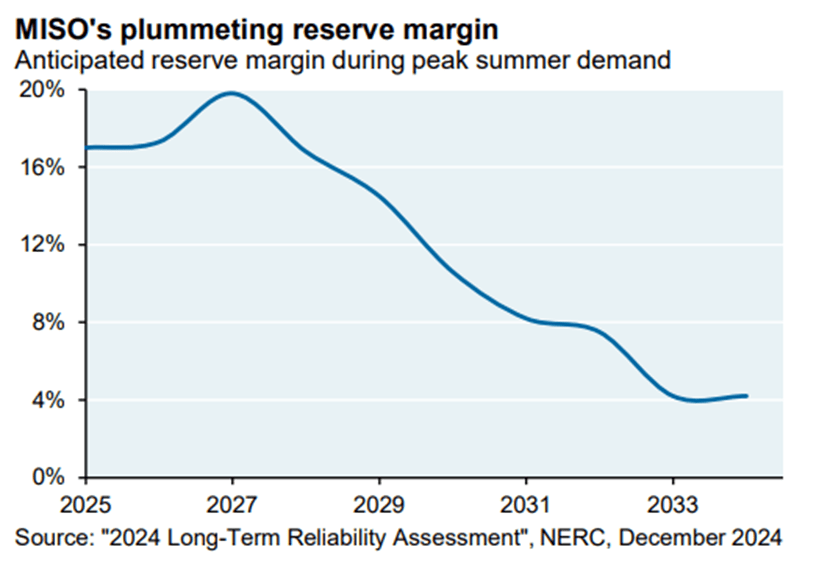
MISO continues to see its reserve margin dwindle as its margin for error sits at just four percent. The JPMC report notes MISO’s warnings of “serious challenges to grid reliability due to increased exposure to wind/solar intermittency, having averted a capacity shortfall in 2023 only due to postponement of planned thermal capacity retirements.”

The post also includes a figure showing the risks for different regional transmission operators.

Fortunately, New York’s strong commitment to reliability means that there is a low likelihood of electricity supply shortfall assuming that the Progressive politicians keep their paws off the electric sector.  Nonetheless, the Scoping Plan presumes significant imports from outside new York and this result indicates that those imports may not be available.  This risk should be evaluated.

Fossil Fuels, Nuclear, and Hydro Power U.S. Data Centers

The JPMC report notes, “Hyperscalers will probably have to walk back green power commitments and run data centers primarily on natural gas, as they have been. The pie chart shows power consumption of US data centers based on their respective locations, their MW of maximum power consumption and the grid mix in that state.”

Projections for New York load also show increases.  The plans for the proposed Micron chip fab plant that will add load equivalent to the load of New Hampshire and Vermont call for the use of renewables.  This major source of load was not included in the Scoping Plan and needs to be considered in a reassessment.

High Electricity Prices Impede Electrification

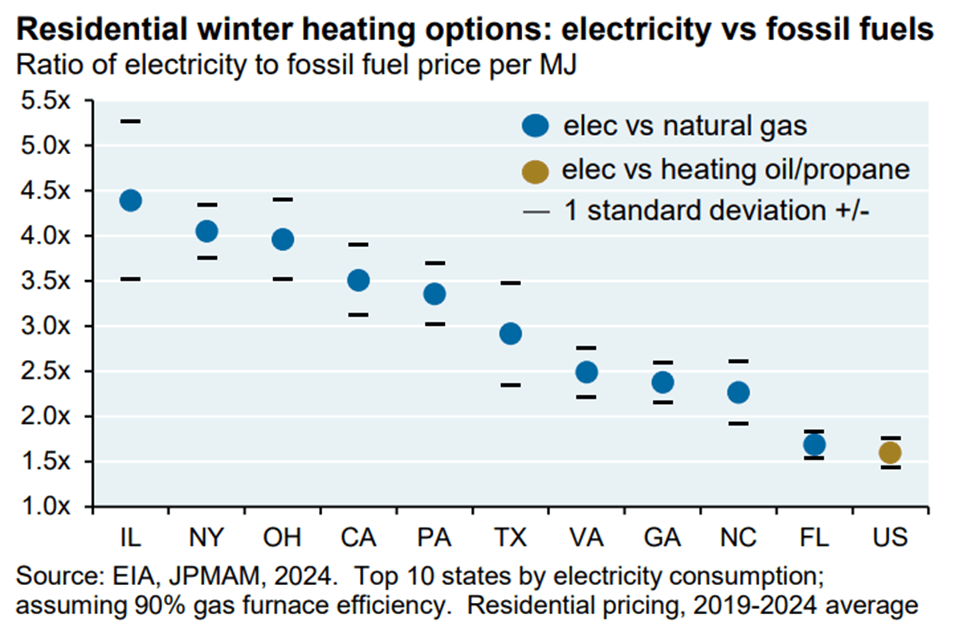
Wind and solar advocates argue we must rapidly “electrify everything” by using electric vehicles and converting our home heating systems from natural gas, propane, or fuel oil to electric heat pumps. The problem? Doing so costs much more than using natural gas to keep warm in winter.

The JPMC report states:

“The high cost of electricity compared to natural gas (particularly in places without a carbon tax) is another impediment to electrification that is not easy to solve since this ratio reflects relative total costs of production and distribution.”

Natural gas remains much more affordable than using electricity for home heating in states throughout the country, and even heating oil and propane are more affordable than electricity on a nationwide basis.

The high cost of electricity versus natural gas is a major hinderance to converting to heat pumps.  The Scoping Plan presumption that New Yorkers would willing convert to a more expensive, less resilient, and likely less comfortable source of heating is not likely to occur.  How will this affect implementation?

Green Deindustrialization Continues Apace in Europe

The JPMC report notes: “Europe is the world leader with respect to the pace of decarbonization. However, Europe is paying a steep price for this transition. Its energy prices have risen from 2x to 4x US levels, and its residential electricity prices are now 5x-7x higher than in China and India.

The report also touched on Germany’s coming EnergieweimarDespite Deutschland’s heavy investments in wind and solar, the country has become a net importer of electricity. Long story short, installed power capacity continues to rise but actual generation is falling. The same story is unfolding in the United Kingdom.

The Scoping Plan claims that special carve outs and concessions to energy intensive and trade exposed industries will keep them viable in New York.  The results in the UK and Germany indicate otherwise.  The State needs to reassess these impacts.

Grim Realities for the Green Hydrogen Hype Train

Despite heavy subsidies and much hype, the so-called green hydrogen industry is floundering. Quarterly mentions of hydrogen project delays and cancelations are skyrocketing in the news and in company disclosures.

The report included this quote, with the caveat that it somewhat exaggerates the plight of green hydrogen:

“Electrolyzers, which do not exist, are supposed to use surplus electricity, which does not exist, to feed hydrogen into a network that does not exist in order to operate power plants that do not exist. Alternatively, the hydrogen is to be transported via ships and harbors, which do not exist, from supplier countries, which – you guessed it – also do not exist.”

According to the report:

“Hydrogen has an “original sin” problem: early estimates of lectrolier costs were too low. It started with an influential IRENA paper in 2020 estimating electrolyzer costs at $750 per kW. The European Energy Transitions Commission now concedes that costs are far higher, at least when sourced from Western manufacturers; the latest estimates for 2024 range from $2,100 to $3,200 per kW. This revised assessment had led to a 5x increase in Western 2030 electrolyzer cost projections from BNEF and the Hydrogen Council relative to initial projections.”

This quote pretty much sums up the “energy transition.” Boosters of unproven and expensive technologies assure us that their preferred energy sources are already cheaper, or will soon be much cheaper, than the reliable, affordable technologies we already use. Within a few years, the promises fail to materialize, and they move on to some other unicorn technology, and the hype cycle repeats itself.

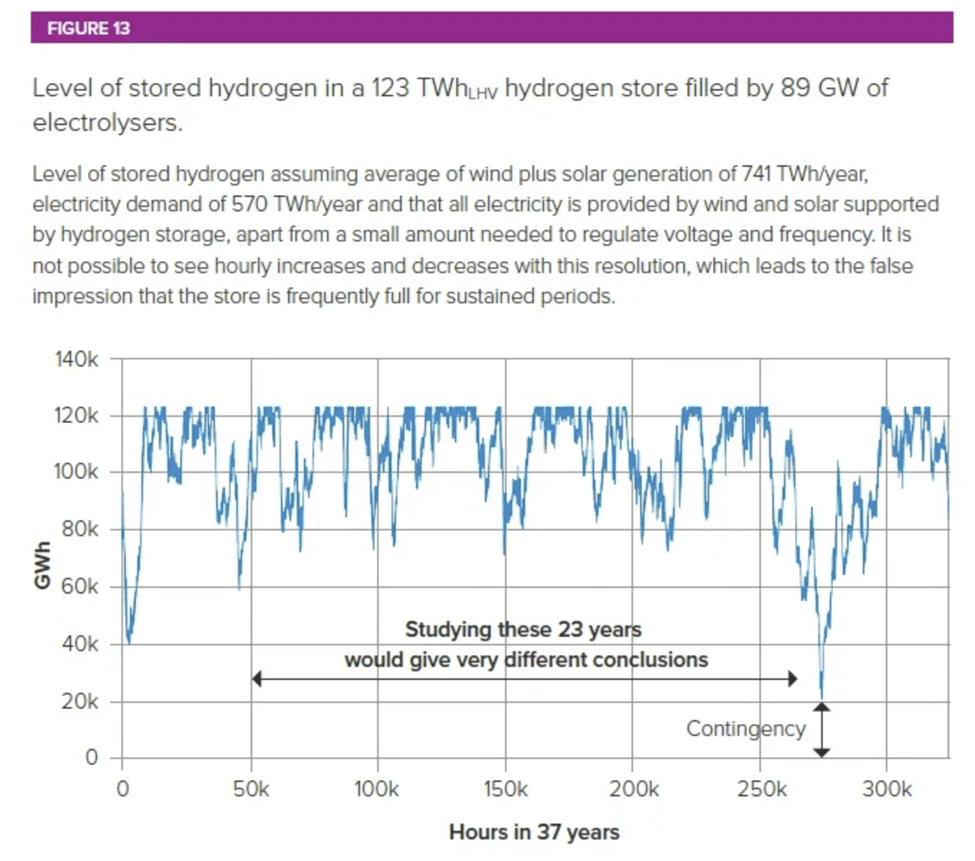
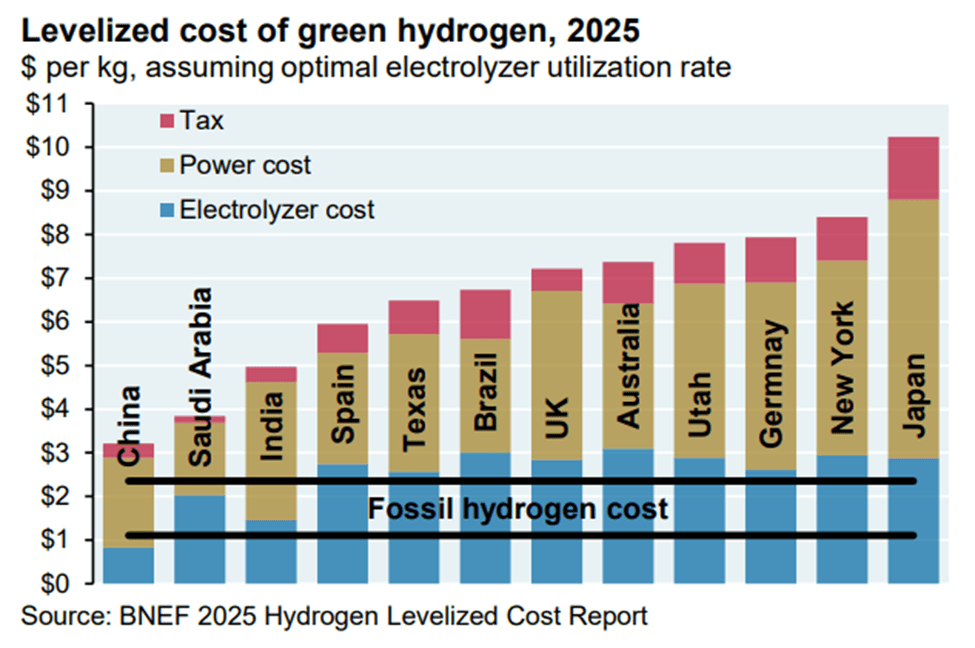
A key reason for the problems plaguing green hydrogen is the cost. Even after assuming optimal electrolyzer utilization rates (which won’t materialize in the real world if they are, in fact, powered by wind and solar), the cost is still massive. In Texas, green hydrogen production is around $6.50 per kilogram (kg). In New York, the cost is around $7.50 per kg.

It takes approximately 7.4 kg of hydrogen to produce 1 million British thermal units (MMBtu) of energy, and it takes 10 MMBtus to produce one megawatt hour (MWh) of electricity in a combustion turbine power plant. This means the fuel cost of green hydrogen is approximately $481/MWh in Texas and $555/MWh in New York. At that price, it’s no wonder the industry is hitting hard times.

The Scoping Plan placeholder technology for the dispatchable emissions-free resource (DEFR) acknowledged as necessary is green hydrogen.  These results show that the “solution” is unlikely to be viable. The fundamental problem is that the wind, solar, and energy storage approach envisioned in the Scoping Plan will only work if DEFR is developed and deployed. In my opinion, the most promising DEFR backup technology is nuclear generation because it is the only candidate resource that is technologically ready, can be expanded as needed, and does not suffer from limitations of the Second Law of Thermodynamics. If the only viable DEFR solution is nuclear, then renewables cannot be implemented without it.  But nuclear can replace renewables, eliminating the need for a massive DEFR backup resource.  It is obviously prudent to pause renewable development until DEFR feasibility is proven because nuclear generation may be the only viable path to zero emissions

Conclusion

Orr and Rolling conclude:

There is a lot to digest in the report, but the long and short of it is that the so-called energy transition is hitting the brick wall of reality. Let’s hope policymakers come to their senses and end the subsidies for wind and solar so we can get back to rational energy policies.

I hope that the brick wall of reality reaches New York. I believe the best way to ensure that policymakers come to their senses is to pause the program and reevaluate the presumptions and projections.

Renewables are Cheaper Because of Fuel Volatility

I have run into a couple of instances where New York Climate Leadership & Community Protection Act (Climate Act) proponents have claimed that renewable energy development can reduce costs.  This article responds to the argument that reduced fuel price volatility will make renewables cheaper.

I am convinced that implementation of the New York Climate Act net-zero mandates will do more harm than good if the future electric system relies only on wind, solar, and energy storage because of reliability and affordability risks.  I have followed the Climate Act since it was first proposed, submitted comments on the Climate Act implementation plan, and have written over 500 articles about New York’s net-zero transition.  The opinions expressed in this article do not reflect the position of any of my previous employers or any other organization I have been associated with, these comments are mine alone.

Renewable Energy Can Reduce Costs

I am disappointed that the renewable energy can reduce costs claim has made it into the New York State Energy Plan process.  The Energy Plan is “a comprehensive roadmap to build a clean, resilient, and affordable energy system for all New Yorkers”.  When the Energy Planning Board met on March 3, 2025 to adopt the scope for the state energy plan the claim was mentioned.  One item on the agenda was a discussion of the “planned approach for techno-economic pathways analysis”.  This is the analysis work whereby the state agencies and their consultants will “prove” the pre-conceived notion that the Climate Act net-zero transition concocted by politicians will work. 

The presentation by Jeff Freedman from the Atmospheric Sciences Research Center, University at Albany, Albany, New York included the following slide that makes the claim that renewable energy can reduce costs. One characteristic of the New York State Energy Research & Development Authority (NYSERDA) documentation for the implementation plan is inadequate documentation, so it is not surprising that the justification for the claim is not readily available.

Table 6-1 was in New York State Climate Impacts Assessment Chapter 06: Energy.  That chapter does not address renewable energy costs specifically.  I searched for references for costs in the chapter and found only one relevant reference on page 370:

Energy costs: Fossil fuel prices are increasingly volatile, largely because they are traded on global markets. In contrast, a power sector composed of large volumes of renewable resources that have no fuel costs could lead to less volatile energy bills due to the elimination of this driver of variability in energy costs. The presence of distributed resources amplifies this effect. Whether the costs of a clean power sector are lower than, comparable to, or higher than the status quo, they will be more predictable and less likely to create indirect costs that arise from unexpected price changes.

I am aware of one other instance where this rationale was mentioned.  The December 18, 2024 New York Assembly Committee on Energy public hearing enabled legislators to question NYSERDA and the New York State Department of Public Service (DPS) staff about Climate Act progress. When Jessica Waldorf, Chief of Staff & Director of Policy Implementation, DPS was asked what impact Climate Act GHG emission reductions would have given that New York emissions are smaller than the observed annual increases in global GHG emissions. Waldorf said that there are other reasons “to build renewable energy resources in New York that are not just related to emissions.”  She gave two reasons: energy security and price volatility. 

The other thing I would say about energy security is price volatility.  Customers are beholden to the whims of the fossil fuel industry and the up and down markets that we see from fossil fuels.  Localizing our energy production and renewables allows us for price stability.  That is definitely a benefit of building resources here. 

The presumption in this article is that the basis of these claims that renewable energy will be cheaper and less volatile is that a renewable energy dependent electric system will have less unstable fuel costs resulting in cheaper and more secure energy.  This in turn is based on two presumptions: fuel prices are volatile because of global markets and renewables would eliminate this cost driver.

Fuel Volatility

The US Energy Information Administration (EIA) noted in June 2024 that fossil fuel price volatility has shown significant changes over time, with recent years experiencing particularly high levels of volatility: “In 2022, natural gas price volatility reached extreme levels, with historical volatility peaking at 171% in February 2022, the highest since at least 1994.”  Note that EIA is only discussing natural gas volatility which has become a much larger electric generating fuel source in recent years.  In my opinion, the increasing reliance on a single fuel could be the fundamental reason for the observed increase in volatility.

In any case, the New York agency global market argument picks just one driver for fuel price volatility.  The EIA  gave other reasons for natural gas variability in August 2022:

Increased uncertainty about market conditions that affect natural gas supply and demand can result in high price volatility. Events that have contributed to changing market conditions include:

  • Production freeze-offs
  • Storms
  • Unplanned pipeline maintenance and outages
  • Significant departures from normal weather
  • Changes in inventory levels
  • Availability of substitute fuels
  • Changes in imports or exports
  • Other sudden changes in demand

U.S. natural gas prices are typically more volatile during the first quarter of a year because of the fluctuating demand for natural gas for space heating as weather changes. Factors that contributed to heightened volatility in the first three months of this year include:

Of the eight events that contribute to changing market conditions and fuel volatility is the only one is related to global market conditions.

Jurisdictional Proof

When I get around to submitting a comment on the weakness of this argument, I intend to demand that the proponents of the Climate Act offer an example of a jurisdiction where the electric system has become reliant on wind and solar renewable generation and consumer costs have gone down because the fuel volatility has decreased.  To my knowledge, all jurisdictions have seen consumer cost increases. 

I used Perplexity AI to research electric energy prices as a function of wind and solar deployment.  My experience showed the weaknesses of AI research.  The response to the question whether consumers in any jurisdiction have seen decreased costs when transitioning their electric system to rely on wind and solar claimed that it was true.  The response said: “This trend is driven by the rapidly declining costs of renewable energy technologies and their increasing cost-competitiveness compared to conventional fossil fuel sources.”  The reference cited was from Ember-Energy “a global energy think tank that accelerates the clean energy transition with data and policy” that can hardly be considered an unbiased source.  The response also does not address consumer rate costs.  It makes the mistaken claim that the cost of developing renewable technologies has little relation to the delivered cost of electricity to consumers. In the real world, the cost of storage to address intermittency, the cost of additional transmission support to address diffuse wind and solar, and the cost to provide the ancillary transmission support services not available from wind and solar, make renewables much more expensive than fossil fuels.   I was unable to frame a question that provided an answer that acknowledged that the costs necessary to provide consumers with reliable power made delivered renewable energy more expensive.

German Experience

However, if the claim is true then proponents should be able to point to jurisdictions where wind, solar, and energy storage have make electric prices cheaper.  The best example of the claim that renewable energy is cheaper because it reduces fuel volatility should be Germany.  Oil, coal and gas prices spiked in the immediate aftermath of Russia’s invasion of Ukraine and have been volatile ever since. Germany’s Energiewende is the country’s planned transition to a low-carbon, nuclear-free economy and is often cited as an example of what New York should do. Enerdata reports that “According to the German Federal Network Agency, the installed renewable power capacity in Germany increased by nearly 20 GW (+12%) to nearly 190 GW in 2024.” If the proponent’s claim is true then prices should be trending down.  However, since 2000, electricity prices for German households have risen by 116%, from 13.94 to 30.43 cents per kilowatt-hour in 2019 .  As of April 1, 2024, households with basic supplier contracts were paying around 46 cents per kilowatt-hour, making it “the most expensive option compared to other providers or special contracts” .

Another way to look at the claim is to compare electricity prices within the European Union.  I highly recommend  the Nemeth Report for its coverage of European energy issues. The post EU Action Plan for Affordable Energy  includes just such a comparison.  It quotes Ursula von der Leyen, President of the European Commission, as saying: “We’re driving energy prices down and competitiveness up. We have already significantly reduced energy prices in Europe by doubling down on renewables. “

However, the data in the following figure do not support her claim. 

The analysis states that:

Note that the household price average shows a large difference between EU countries that use coal, nuclear, and gas vs those that have focused on wind and solar. For example, as shown in the chart above, according to Statista, using 2023 data, Hungary’s electricity price was 9.68 Eurocents/kwh (50% of their electricity is from nuclear, 38% coal & gas) and Bulgaria which relies mostly on coal and nuclear was around 11 Eurocents/kwh, whereas Germany, which has “doubled down on renewables” (and closed down its nuclear), was the highest at 44.97 Eurocents/kwh and Denmark which has a small population and a whole lot of windmills was at 39.44 Eurocents/kwh! 

Data sources and the year of the data matters. Eurostat uses numbers from the first quarter of 2024 which reorder some of the countries but the overall argument, that countries that “doubled down on renewables” and made other poor choices of shutting down nuclear power plants and/or coal experienced higher prices, remains supported. 

Discussion

Roger Pielke, Jr recently posted an article about the politicization of expertise that is relevant here.  He argues that society needs to depend on the expertise of specialists in many fields – “Nobody knows enough to run the government”.  As a result, society needs all of us.  He explains that “We do not have to agree on everything, but we do have to work together”.  Then he points out that “In recent years, credential expertise—like many things—has become pathologically politicized.”         

Such is the case shown by the politicization of the Climate Act implementation led by NYSERDA.   Consider, for example, the presentation by Jeff Freedman to the Planning Board.  It is concerning on a couple of levels.  In the first place, the Planning Board is composed of agency heads and political appointees who for the most part do not have background and experience in the energy sector.  Freedman was presented as an expert from the energy sector whose claim that “renewable energy can reduce costs” was probably taken as the gospel.  However, his main research focus is on “renewable energy and atmospheric boundary layer (ABL) processes” so his bias is towards renewable energy virtues and he has no energy sector experience that qualifies him to make such a statement.  He was a spokesman because of his adherence to the narrative.

In the second place, the presentations at the meeting suggest that NYSERDA will follow the Scoping Plan approach in the stakeholder process for the Energy Plan.  The primary purpose of the meeting was to approve the final scope of the Energy Plan.  As was the case with the Climate Act Scoping Plan the NYSERDA response to stakeholder comments is to document the number of comments received by category and provide general descriptions of key themes and “responsive Scope revisions”.  My problem with this is that if anyone provides specific comments or raises specific issues with claims, there is no documentation that the submittal was addressed, and nothing included to respond to the issue raised.  For example, the claim that renewable energy can reduce costs was undocumented in Freedman’s presentation.  I have no doubts that NYSERDA will continue the charade that renewable energy can reduce costs and that costs of inaction are worse than the costs of action.  They have never responded to related issues raised and will continue to do so as long as they can get away with it.  In my opinion this is another instance of pathologically politicized expertise by NYSERDA because they are so arrogant that they don’t see any need to respond to stakeholder comments.

Conclusion

The biggest threat to Climate Act progress is the inevitable extraordinary cost of implementation.  The Hochul Administration has ducked the issue since the Climate Act was passed.  They can only hide reality for so long.  The question is whether the issues associated with the net-zero transition will be addressed before New York’s economy is severely compromised.

In the meantime, if you ever hear anyone say renewable energy can reduce costs, please ask them why German electric prices are so high or to cite an example of any jurisdiction that is transitioning their electric system that has reduced ratepayer bill costs when using the Climate Act strategy to rely wind, solar, and energy storage resources.

Net Zero Cure is Worse Than the Disease

David Turver supports my belief that New York’s Climate Leadership & Community Protection Act (Climate Act) is not in the best interests of New Yorkers.  The basis of his arguments is the unfolding disaster in Great Britain.  His post includes a video of a talk on the topic, copy of the slides, and the argument summary described below.

I am convinced that implementation of the Climate Act net-zero mandates will do more harm than good if the future electric system relies only on wind, solar, and energy storage because of reliability and affordability risks.  I have followed the Climate Act since it was first proposed, submitted comments on the Climate Act implementation plan, and have written over 500 articles about New York’s net-zero transition.  The opinions expressed in this post do not reflect the position of any of my previous employers or any other organization I have been associated with, these comments are mine alone.

Overview

The Climate Act established a New York “Net Zero” target (85% reduction in GHG emissions and 15% offset of emissions) by 2050.  It includes an interim reduction target of a 40% GHG reduction by 2030. The Climate Action Council (CAC) was responsible for preparing the Scoping Plan that outlined how to “achieve the State’s bold clean energy and climate agenda.” The Scoping Plan was finalized at the end of 2022.  Since then, the State has been trying to implement the Scoping Plan recommendations through regulations, proceedings, and legislation. 

Net Zero Cure is Worse Than the Disease

Turver introduces his arguments by noting that climate change impacts are exaggerated:

Although people like Antonio Guterres have made the foolish claim we have entered the era of global boiling, we have to acknowledge that the world has warmed a bit since pre-industrial times. The alarmist response to this is Net Zero which is an example of a so-called mitigation strategy that calls for everyone to reduce their emissions of carbon dioxide to save the planet.

Earlier this year I quoted Richard Lindzen’s description of the made-up rationale: “In this complex multifactor system, what is the likelihood of the climate (which, itself, consists in many variables and not just globally averaged temperature anomaly) is controlled by this 2% perturbation in a single variable? Believing this is pretty close to believing in magic.” 

The following paragraph eviscerates the entire rationale of the Climate Act.  Turver explains that the mitigation can never work:

The trouble with this approach is that it can only work if two conditions are met. First, mitigation can only work if CO2 is the only climate control knob. But we know this to be wrong, because the IPCC’s first report showed marked temperature fluctuations over thousand-, ten thousand- and million-year timescales when CO2 levels in the atmosphere were pretty constant. Second, mitigation can only work if everyone else follows the same strategy. But we know that global emissions of greenhouse gases are rising sharply even though ours have fallen into insignificance. Global consumption of coal, oil and gas are at record levels. Neither condition is met, so the UK’s Net Zero mitigation strategy can never work.

Turver is as frustrated as I am about the impact of net zero policies like the Climate Act:

Nevertheless, this has not stopped politicians and policymakers rushing headlong into Net Zero policies that have resulted in the UK having the most expensive industrial electricity costs in the IEA, some 4X those of the US and 2.6X Korean prices. This is leading to energy austerity with UK primary energy consumption down 23% since 1990 while global energy consumption is up 72% over the same period. Our National Energy System Operator, NESO wants to double down on energy austerity and halve our energy consumption per capita from 2023 levels by 2050.

High energy prices coupled with energy austerity have led to economic stagnation. There is a strong correlation between reduced energy use and slow growth, with the EU27 and US growing faster than the UK because they have had smaller cuts to energy use. Korea, India China and the rest of the world are using much more energy and their economies are powering ahead.

I do not see any scenario where these impacts will not occur in New York.

The rationale for the Climate Act is that we have a problem, that it can be solved by reducing greenhouse gas emissions, and that there is an easy way to reduce emissions.  Turver describes the myths created to promote renewables:

Despite the obvious economic and social costs of Net Zero, a series of myths have been created to support the renewables agenda. They claim renewables are cheap, but we pay £11bn/yr in renewables subsidies, £2.5bn for grid balancing and a further £1bn for the capacity market. National Grid have announced £112bn in spending on grid expansion by 2035 which will also find its way on to our bills. Moreover, the cost of renewables is rising and projects like Norfolk Boreas and Hornsea Project Four have been cancelled because the developers cannot make money at the prices they agreed. Ed Miliband wants to spend £260-290bn by 2030 on his Clean Power plan to save only around £7bn/yr of the money we spend on gas-fired generation.

Turver explains that the ideologues pursuing these policies think that it will improve the economy:

The second myth is that Net Zero will create jobs and growth. But the truth is expensive energy costs are destroying high-productivity industries like chemicals, petrochemicals, ceramics and steel that are growing more slowly than the rest of the economy or outright shrinking. Instead we are growing less energy intensive low-productivity sectors that are damaging productivity and growth for the whole economy. Green energy jobs are destroying real jobs and cost around £250K/yr per job.

Turver describes another myth that has been used in New York:

The third myth is that renewables increase energy security. But intermittent sources like wind and solar can never deliver security because we cannot control the weather. As a result we came close to blackouts last month as NESO suffered a margin call. We cannot rely upon interconnectors either, because the Norwegian Government fell because of the impact interconnectors are having on their electricity prices.

The Climate Act mandates that all environmental impacts of fossil fuels be considered but pointedly ignores any consideration of wind and solar development impacts.  Turver notes that this is a common flaw:

Finally, it is claimed that wind and solar renewables are green and kind to the environment. But both have very high mineral intensity, meaning massive mines will be scarring the landscape to produce the copper, silver, cobalt and rare earth metals required. They also take up a lot of land, land that would be better utilised to grow food.

The Climate Act does include a requirement to consider adaptation.  Turver explains that adaptation is a superior strategy:

By contrast, adaptation is a far superior strategy. Deaths from natural disasters and weather events have fallen more than 10-fold over the past century as we have used cheap, abundant energy to tame nature. Global life expectancy has doubled since 1850 and cereal yields are up three times since 1961. These remarkable achievements have come despite, some might argue because of, the rise in temperatures and global CO2 levels.

In my opinion, New York short changes this strategy because at its root the Climate Act is a political tool.  Politicians passed the law to cater to specific constituencies but the opportunities to make money via adaptation are small. Given that there are no organized rallies organized by politically connected constituencies at the Capitol lobbying for adaptation policies this strategy is not a priority.

Turver concludes that nuclear power is the answer:

Turning now to the answer. For humanity to thrive, we need cheap, abundant and reliable energy. This will give us the surplus energy that we need to continue to adapt by building flood defences, improving irrigation developing new crop varieties and so on. Adaptation has the big advantage is that it works regardless of the cause of global warming or climate change. The only technology that is proven to work at scale is nuclear power. This will take time, so we need gas as a transition technology. Nuclear power has the added advantage of being energy dense, reliable and requires very little mining so has the smallest overall environmental footprint. We need nuclear power everywhere all at once.

I agree that developing nuclear power is a better choice.  His pragmatic approach to use natural gas as a bridge fuel used to be the accepted path forward.  The vilification of natural gas is based almost entirely upon emotion and precludes a strategy that has proven success.

Conclusion

Philosopher George Santayana, originally stated, “Those who cannot remember the past are condemned to repeat it”.  In this instance New York is ignoring what is currently happening with respect to the net-zero transition in Great Britain.  The consequences will be the same.  Turver concludes:

Net Zero is ineffective in achieving its primary goal and can never stop the weather changing. The impact of Net Zero policies is devastating for the economy and high productivity, energy intensive industries in particular. Renewables are not kind to the environment and the lies being told to promote them are untenable. The Net Zero cure is worse than the climate change disease.

Wind Blowing Somewhere Does Not Solve the Intermittency Problem

A version of this article was published at Watts Up With That

In October 2023 an article of mine was published that addressed the wind is always blowing somewhere fallacy used by green energy proponents to argue that large amounts of storage and any new dispatchable emissions-free resources are not necessary in a future electric system that relies on wind and solar generating resources.  I recently discovered the US Energy Information Administration Hourly Electric Grid Monitor that provides hourly net generation by energy source for the Lower 48 states.  This article describes 2024 energy source data with an emphasis on wind energy relative to the “wind is always blowing somewhere” claim.

I am convinced that implementation of the Climate Act net-zero mandates will do more harm than good if the future electric system relies only on wind, solar, and energy storage because of reliability and affordability risks.  I have followed the Climate Act since it was first proposed, submitted comments on the Climate Act implementation plan, and have written over 500 articles about New York’s net-zero transition.  The opinions expressed in this post do not reflect the position of any of my previous employers or any other organization I have been associated with, these comments are mine alone.

Overview

The Climate Act established a New York “Net Zero” target (85% reduction in GHG emissions and 15% offset of emissions) by 2050.  Two targets address the electric sector: 70% of the electricity must come from renewable energy by 2030 and all electricity must be generated by “zero-emissions” resources by 2040. The Climate Action Council (CAC) was responsible for preparing the Scoping Plan that outlined how to “achieve the State’s bold clean energy and climate agenda.” The Scoping Plan was finalized at the end of 2022.  Schussler’s article is relevant because the Scoping Plan proposes to meet the zero-emissions mandate using wind, solar, and energy storage.  In 2040, the Scoping Plan projected that39% of the electric energy would be provided by wind generation and 30% by solar.

Wind Lulls

CAC member Dr. Robert Howarth claims that he played a key role in the drafting of the Climate Act and his statement  at the meeting where the Scoping Plan was approved claims that: ”A decade ago, Jacobson, I and others laid out a specific plan for New York (Jacobson et al. 2013). In that peer-reviewed analysis, we demonstrated that our State could rapidly move away from fossil fuels and instead be fueled completely by the power of the wind, the sun, and hydro. We further demonstrated that it could be done completely with technologies available at that time (a decade ago)”.  More recently, Mark Jacobsen of Stanford acknowledges that wind intermittency is a challenge but claims that it can be simply addressed by developing interconnections, a mix of renewable energy sources, including wind, water, and solar, and implementing energy storage solutions.  The question addressed here is the extent of the interconnections needed to get to the wind blowing somewhere from New York

In the real world most analysts are not claiming that there is a simple solution to extended periods of low wind and solar resources.  In September Parker Gallant noted that industrial wind turbines (IWT) in Ontario “show up at the party, almost always, after everyone has left” in a post that described poor performance of the province’s wind turbines over a five day period in September 2024.  I evaluated the performance of New York’s 2,454 wind turbine fleet and found that there was an hour when the total generation was 0.2 MW during this September event.  David Theilen directly addressed the wind is always blowing somewhere argument with this graph using data from the US Energy Information Administration Hourly Electric Grid Monitor.

Figure 1: US Energy Information Administration Hourly Electric Grid Monitor December 2024

EIA data

I used the data dashboard at the US Energy Information Administration Hourly Electric Grid Monitor as the source of the hourly 2024 generation by energy source data used in this analysis.  EIA notes that this is “Hourly total net generation and net generation by energy source for the Lower 48 states.”   The settings widget enables a user to change the time and period albeit hourly data are only available for up to 31 days, so I had to import data by month.  There is another issue.  January generation categories included Wind, Solar, Hydro, Unknown, Other, Petroleum, Natural Gas, Coal, and Nuclear.  December generation categories changed to Battery storage, Solar with integrated battery storage, Pumped storage, Unknown energy storage, Wind, Solar, Hydro, Unknown, Other, Petroleum, Natural Gas, Coal, and Nuclear.  I made no attempt to account for the different categories when I downloaded the data.

Figure 2: US Energy Information Administration Hourly Electric Grid Monitor

I wanted to show the installed capacity for the different energy sources but I was only able to find EIA values for solar – 107,400 MW.  Figure 3 shows the Maximum Hourly Generation (MW) in 2024 for the primary energy source categories that gives an idea how much capacity is installed for each energy source.  Note the maximum solar is 75% of the EIA installed capacity.  I expect the percentage of installed wind relative to the observed maximum hourly MW would be even less.

Figure 3: US Energy Information Administration Hourly Electric Grid Monitor 2024 Maximum Hourly Generation (MW)

Figure 4 lists the US Energy Information Administration Hourly Electric Grid Monitor 2024 Total Energy (GWh).  I was frankly surprised how much wind capacity was generated on an annual basis.  However, totals and averages are not the primary planning issue – determining how much energy is needed in the worst case is a prerequisite for reliability planning.

Figure 4: US Energy Information Administration Hourly Electric Grid Monitor 2024 Total Energy (GWh)

Table 1 summarizes nationwide energy source hourly data for 2024.  Solar has the most hourly variability because it is unavailable at night.  Wind has 95% variability and petroleum that is used for peaking purposes has 99% variability.  Only nuclear has less variability than the total energy.  The distribution of wind energy hourly output is notable. 

Table 1: US Energy Information Administration Electric Grid Monitor 2024 Hourly Data Distribution

For a general idea of the variability of the wind resource across the Lower 48 consider Figure 5 a graph of annual hourly data.

Figure 5: US Energy Information Administration Hourly Electric Grid Monitor 2024 Hourly Wind Energy Production (MW)

I could not find a map of wind energy facilities at the EIA website.  Synapse Energy has developed an interactive map of U.S. power plants, including wind facilities which is shown as Figure 6.

Figure 6: Synapse Energy Map of U.S. Wind Power Plants

Assuming that the EIA wind energy facilities are similar to those used by Synapse Energy, it is clear that there is a wide spatial distribution across the Lower 48.  Consider that if a wind lull in New York City was caused by a high-pressure system that covers everything east of the Mississippi that dedicated transmission to dedicated wind turbines 1,000 miles away would be required to ensure that New York State wind energy could be supplanted by wind elsewhere.  In the next step I analyzed temporal variation. 

Table 2 provides an estimate of wind lulls at different thresholds.  I evaluated the hourly data to determine the total available wind energy (GWh) available when the total available wind capacity was less than six percentile thresholds.  At the first percentile only 14,440 MW or less was generated.  This level is 15% of the maximum observed hourly wind capacity.  There were 14 episodes that met this threshold and total energy generated during those periods was 988 GWh.  From a planning standpoint the maximum duration is important.  There was a 14-hour period when all the Lower 48 wind facilities produced less than 15% of the maximum observed capacity and the total energy generated was only 29 GWh which is only 2% of the capability over that period.  At the 25th percentile, all the wind facilities produced 40% of the maximum observed capacity.  There were 180 episodes that met this threshold and total energy generated during those periods was 63,430 GWh.  For the maximum duration there was a 115-hour period when all the Lower 48 wind facilities produced less than 40% of the maximum observed capacity and the total energy generated was 2,319 GWh which is 21% of the capability over that period.

Table 2: US EIA Electric Grid Monitor 2024 Hourly Wind Lulls

Discussion

It is a stretch to try to extrapolate these data for planning purposes to determine the resource gap for a specific area.  A sophisticated analysis that addresses the location of the wind facilities, the interconnections between the facilities, and the generation from other resources on an hour-by-hour basis is required.  Nonetheless, using the data to guess the impacts is instructive.

To take advantage of the wind blowing somewhere argument it would be necessary to upgrade the transmission system.  Assuming that transmission is available there is still a clear need for backup energy.  If the entire wind energy system would need to produce 50% of the maximum observed capacity to cover both local and distant energy needs note that this analysis found that 25% of the time only 40% of the maximum was available. The worst case was a 115-hour period when all the Lower 48 wind facilities produced only b2,319 GWh of a possible 11,150 GWh.  Assuming 50% of the maximum is needed to support the system there would be an energy gap of 3,256 GWh over this 115-hour period.  At a cost of $148/kWh to $400/kWh the storage needed for this event would be $482 to $1,302 billion.

Recently, Russ Schussler (the Planning Engineer) published an article that argued that the intermittency issue addressed here might be solvable: “The long-term problems associated with wind and solar due to their intermittency could and may likely be made manageable with improved technology and decreasing costs.”  In my opinion, practically speaking it is not possible.  It would be necessary to upgrade the electric transmission system, deploy short-term storage, and develop and deploy a dispatchable emissions-free resource all to address short and infrequent periods and to somehow finance those resources with those constraints.

Importantly, even if intermittency can be addressed Schussler argues that there is a fatal flaw:

Overcoming intermittency though complex and expensive resource additions at best gets us around a molehill which will leave a huge mountain ahead. Where will grid support come from?  Wind, solar and batteries provide energy through an electronic inverter. In practice, they lean on and are supported by conventional rotating machines. Essential Reliability Services include the ability to ramp up and down, frequency support, inertia and voltage support. For more details on the real problem see this posting. “Wind and Solar Can’t Support the Grid” describes the situation and contains links to other past postings provide greater detail on the problems.

Conclusion

Green energy advocates who minimize the challenge of transitioning the electric grid to wind and solar rely on the claim that the “wind is always blowing somewhere”.   The 2024 wind energy data suggest otherwise.  I have no doubt that a proper electric reliability resource planning analysis would verify that my intermittency concerns are real and that revolving the issues would be prohibitively expensive.  Coupled with the grid support issues, the green dream of a wind and solar electric generating system is a fantasy that will never be viable.

How the Green Energy Narrative Confuses the Climate Act

Russ Schussler, aka Planning Engineer, has published a prequel to an upcoming article discussing the narrative around the green energy transition that is a prominent component of the Climate Leadership & Community Protection Act (Climate Act).

I am convinced that implementation of the Climate Act net-zero mandates will do more harm than good if the future electric system relies only on wind, solar, and energy storage because of reliability and affordability risks.  I have followed the Climate Act since it was first proposed, submitted comments on the Climate Act implementation plan, and have written over 500 articles about New York’s net-zero transition.  The opinions expressed in this post do not reflect the position of any of my previous employers or any other organization I have been associated with, these comments are mine alone.

Overview

The Climate Act established a New York “Net Zero” target (85% reduction in GHG emissions and 15% offset of emissions) by 2050.  Two targets address the electric sector: 70% of the electricity must come from renewable energy by 2030 and all electricity must be generated by “zero-emissions” resources by 2040. The Climate Action Council (CAC) was responsible for preparing the Scoping Plan that outlined how to “achieve the State’s bold clean energy and climate agenda.” The Scoping Plan was finalized at the end of 2022.  Schussler’s article is relevant because the Scoping Plan proposes to meet the zero-emissions mandate using wind, solar, and energy storage.

Green Energy Narrative

Schussler describes the narrative of the wind and solar proponents aka green energy:

The green energy narrative works somewhat like a magician’s patter, overemphasizing many things of irrelevance and distracting the audience from the important things going on. Misdirection ensures small truths are misinterpreted and magnified, leading to completely unrealistic hopes and expectations.

For example, there have been many simple studies examining how much energy might be produced by a green resource, or set of green resources, such as wind and solar power. These studies ignore important issues such as deliverability, timing, reliability and costs. Based on simple studies the media, activists and policy makers frequently conclude that such resources can be used near universally on a large scale to provide electric service to consumers effectively, efficiently and economically.

This is precisely what happened in New York when the Climate Act authors developed the targets and mandates of the law.  These ideologues misinformed the Legislature and Governor Hochul with claims that “our State could rapidly move away from fossil fuels and instead be fueled completely by the power of the wind, the sun, and hydro” and “that it could be done completely with technologies available at that time (a decade ago), that it could be cost effective, that it would be hugely beneficial for public health and energy security, and that it would stimulate a large increase in well-paying jobs.”

Schussler explains the problem with this argument:

In the green energy narrative costs have been demonstrated, environmental impacts have been demonstrated, reliability has been demonstrated, deliverability has been demonstrated and all shown to possibly work, BUT NOT AT THE SAME TIME. In the eyes of many, such demonstrations cumulatively strengthen the green energy narrative. However, the gullible audience will be shocked when wind, solar and batteries are not at all well suited to support electric generation on their own.

Schussler highlights three tricks of the green energy narrative: misleading language, false problem and narrative control.

Misleading Language

Schussler addresses the term “renewable” calling it “one of the most misleading bits of language advancing the green agenda.”  He notes:

Different “renewable” resources have vastly differing capabilities. There is vast potential to develop some ‘renewables”. Some “renewables do a great job supporting the grid. Some “renewables” have low energy costs in some areas. Some “renewables” are environmentally sound in some areas. No matter how well individual “renewable” resources might be combined to tick off all the boxes of importance, that doesn’t mean that any combination of “renewable” resources can be found that will work well for any given area. It means little that hydro and geothermal provide excellent support for the grid in an area where you can only add wind and solar. Similarly, just because solar and wind have potential environmental benefits that doesn’t cancel out environmental concerns around hydro in delicate ecosystems.

The problem is that in most areas including New York, “there are no compatible combinations of renewables that at any significantly high penetration level that can provide  affordable, environmentally responsible energy in a reliable manner. Referring broadly to what “renewables” can and might do, serves to hide this inconvenient truth.”

The False Problem – Intermittency is not THE problem for Wind and Solar

Schussler argues that:

It is a fallacy to assume that because part or some of the difficulties associated with a technology can be overcome, that therefore all of the problems associated with a technology can be overcome. Worst case for a “partial solutions fallacy” is when a major problem is hidden by presenting a minor problem as the major stumbling block. Primarily focusing on the minor problem incorrectly implies that there will be smooth sailing once this solvable problem is overcome by hiding the large problem.

To implement a green transition bolstered by heavy wind and solar, all associated problems must be addressed. The major problem associated with wide-scale use of these resources  cannot be ignored.

Schussler goes on to argue:

The real problem is that wind, solar and batteries do not readily provide essential reliability services and support the grid. Most of the talk is around addressing intermittency through batteries and other storage approaches. Misdirection here focuses on intermittency, the smaller problem, while ignoring the major problem.

Schussler believes that it may be possible to address intermittency:

The long-term problems associated with wind and solar due to their intermittency could and may likely be made manageable with improved technology and decreasing costs. But such changes will not make wind, solar and batteries comparable to more conventional generating resources, such that they can play a large role in a green energy transition, because the large problem is not intermittency.

The point of his discussion is that there is another, more serious problem that is a fatal flaw:

Overcoming intermittency though complex and expensive resource additions at best gets us around a molehill which will leave a huge mountain ahead. Where will grid support come from?  Wind, solar and batteries provide energy through an electronic inverter. In practice, they lean on and are supported by conventional rotating machines. Essential Reliability Services include the ability to ramp up and down, frequency support, inertia and voltage support. For more details on the real problem see this posting. “Wind and Solar Can’t Support the Grid” describes the situation and contains links to other past postings provide greater detail on the problems.

I think that in an electric system that is reliant on weather dependent wind and solar resource, intermittency creates an unacceptable reliability risk.  Current resource assessments are based on observations of the existing uncorrelated generating resources over many years that show that unplanned outages do not happen at the same time.  There is no reason to expect, for example, that all the nuclear plants will be forced offline at the same time.  This characteristic enables the resource planners to determine how much generating capacity is necessary to meet the probability of losing load not more than once in ten years loss of load expectation (LOLE) reliability criterion.  Importantly, I believe that the lack of correlation also means that the capacity needed above firm system load would not change substantially if the LOLE planning horizon was shifted to 1 day in 20 years or more.

The problem with weather intermittency is that it is correlated over large areas at the same time. As a result, variations in weather affecting wind and solar resource availability will require changes to electric resource planning.  Everyone has heard of a hundred-year flood which is the parameter used for watershed planning.  This is the one in a hundred probability that the water level in a river or lake will exceed a certain level in a given year.  Similar estimates of low wind and solar resource availability must be developed and incorporated into electric resource planning. Based on New York data I think a hundred-year planning horizon is appropriate.  The problem is that the costs for such a threshold are huge and the resources will be used less than their expected operating lifetimes.  The resulting reliability risk is that affordable backup resources will be insufficient to support the load during the hundred-year low wind and solar availability event and a catastrophic blackout will result.

Russ and I discussed my interpretation of this reliability risk, and we agreed that we are making the same point in different ways.  If money is not an issue, then it is possible that the intermittency issue can be overcome by overbuilding wind and solar resources, short-term energy storage, long-term energy storage to deal with extended low wind and solar resource periods, and transmission.  However, affordability is a fatal flaw because the costs necessary would be astronomical for a resource that would only be used less than the expected lifetime of the resources.  On the other hand, the grid support requirements cannot be resolved by throwing any amont of money at the problem so that is unsolvable.

Narrative Control – Shameless Hucksterism and the Media

The last green energy narrative trick is controlling the narrative.  Schussler explains:

The green energy narrative is propelled by stories of success. Often these “successes” are very different from what seemed to be represented. We see great stories of planned projects that should do wonderful things, but they go down the memory hole as they prove not to work out. We see incomplete stories where they talk of power generated but not of associated costs or how much better other alternatives might have been.

He goes on to describe an example headline that claims that seven countries get 99.7% of their electricity from geothermal, hydro, solar, and wind power. However, he points out:

Without the spin, collectively those countries get close to 99% of their energy from rotating synchronous geothermal and hydro resources and less that 2% of their combined electric energy from wind and solar. The fact that some countries have high amounts of hydro, does not provide evidence that we are approaching a tipping point involving wind and solar. In fact, one could observe that high levels of renewable penetration are associated with low levels of wind and solar.

Conclusion

Schussler and I agree that it is becoming increasingly apparent that wind, solar and batteries when pursued at high penetration levels result in high costs, lower reliability and poorer operational outcomes. He points out that “Expectations from the green energy narrative and real-world results are not consistent and this gulf will continue to widen as long as policy makers continue to reflexively buy into the green energy narrative.”

The high expectations in the green energy narrative shaped the promulgation of the Climate Act and is driving its implementation.  Schussler describes the inherent misinformation and other various deceptions to hide the real-world challenges for New York’s net-zero transition. As reality sets in, proponents must push this narrative harder and louder to hide the obvious flaws.  I look forward to Schussler’s follow up article that “will more systemically examine the components of the green energy narrative and raise many items of critical importance considerations that the green energy narrative ignores.”

Comments on DPS Definitions for Establishment of a Renewable Energy Program

On November 4, 2024, the Department of Public Service (DPS) staff proposed definitions for two key components of the 2040 target.   This post describes some of the comments submitted on the draft.  It is necessary to read between the lines of the electric industry comments to appreciate their concerns about the future electric system.

I am convinced that implementation of the New York Climate Leadership & Community Protection Act (Climate Act) net-zero mandates will do more harm than good if the future electric system relies only on wind, solar, and energy storage because of reliability and affordability risks.  I have followed the Climate Act since it was first proposed, submitted comments on the Climate Act implementation plan, and have written over 500 articles about New York’s net-zero transition.  The opinions expressed in this article do not reflect the position of any of my previous employers or any other organization I have been associated with, these comments are mine alone.

Summary – if you don’t have over ten minutes to read the whole thing

The Climate Act has a target that all electricity must be generated by “zero-emissions” resources by 2040. DPS staff proposed a definition of “zero-emissions” in November 2024 nearly five years after the law was promulgated.  It is increasingly obvious that the Scoping Plan is inadequate for the task of implementing a “zero emissions” electric system. Both the electric grid operator and a consortium of electric utilities provided comments on the proposed definition that emphasized the need for a comprehensive plan that prioritizes electric reliability.  Environmental advocacy organization comments underestimate the reliability challenges and recommend changes that would hinder development of a reliable grid.  I believe that the Hochul Administration is at a crossroads, and it is not clear that they will change direction to a rational approach based on reality or continue the present path of ideological purity.

Overview

The Climate Act established a New York “Net Zero” target (85% reduction in GHG emissions and 15% offset of emissions) by 2050.  Two targets address the electric sector: 70% of the electricity must come from renewable energy by 2030 and all electricity must be generated by “zero-emissions” resources by 2040. The Climate Action Council (CAC) was responsible for preparing the Scoping Plan that outlined how to “achieve the State’s bold clean energy and climate agenda.” The Scoping Plan was finalized at the end of 2022.  Since then, the State has been trying to implement the Scoping Plan recommendations through regulations, proceedings, and legislation. 

I believe that the biggest shortcoming of the Hochul Administration’s implementation of the Climate Act is the lack of a plan.  For example, to implement a transition to meet the mandate that all electricity must be generated by “zero-emissions” resources by 2040 it is first necessary to define “zero emissions”.  Amazingly, draft definitions were not proposed for over four years.  On November 4, 2024, the DPS staff proposal concerning definitions for key terms (Staff Proposal) in Public Service Law §66-p that finally defined “zero emissions”.  The Introduction of the Staff Proposal explains:

In this proposal, the Department of Public Service Staff (Staff) suggests interpretations of key terms in the provisions of the Climate Leadership and Community Protection Act (Climate Act), codified in Section 66-p of the Public Service Law (PSL), which directs the Public Service Commission (Commission) to establish a renewable energy program and design it to achieve particular targets. At issue in this proposal is the language of PSL §66-p(2)(b), which directs the Commission to establish a program pursuant to which, by the year 2040, the “statewide electrical demand system will be zero emissions.” Of particular note, neither of the terms “statewide electrical demand system” nor “zero emissions” are expressly defined in the Climate Act or in the PSL. This lack of statutory definition requires the Commission’s interpretation of these terms to ensure proper regulatory implementation.

This post describes some of the comments submitted on these definitions.

New York Independent System Operator (NYISO)

NYISO runs the electricity market and is “dedicated to planning a reliable grid of the future, leveraging open and fair electricity markets, and informing policymakers and stakeholders.”  They submitted their comments on January 21, 2025.  The NYISO frustrates me because they pull their punches when they file comments.  Rich Ellenbogen shares my frustration and sent me an email describing their filing that exemplifies my concern.  He wrote: “The NYISO is screaming between the lines of their filing again.  The filing is attached and addresses electricity reliability margins across the state”.  He commented on three of their comments.

NYISO comment on Page 4:

To achieve the zero-emission standard, significant quantities of new resources, which satisfy the zero-emission definition, and provide the necessary energy and reliability attributes, will be required to support a reliable electric system. Development, permitting, siting, and interconnection of existing and emerging zero-emission electricity supply will require significant capitalization over a relatively short period of time.

Ellenbogen Response:

Regarding the above statement, financing, siting, permitting, and interconnection will do nothing if the technologies don’t exist at scale to implement the plan.  At present, the necessary technologies don’t exist at scale or don’t exist at all, with the exception of nuclear which is a four-letter word in NY State.  You can’t buy and install Dispatchable Emission Free Resources (DEFR’s) that aren’t available and sufficient nuclear generation won’t exist at scale until well after the CLCPA mandated dates even if planning was started today.

NYISO comment on Page 5:

Overly restrictive compliance obligations could prevent emitting generators from operating to support system reliability or serving consumer demand and potentially force generators to retire before suitable replacement resources are available. Insufficient availability of electric generation could adversely impact public health, welfare, and safety.

NYISO comment on Page 6:

Electric system reliability margins are already close to minimum reliability requirements in certain areas across New York and are tightening. If these margins are totally depleted, the reliability of the grid would be at an unacceptable risk and power outages could disrupt normal life or negatively impact public health, welfare, and safety.  The NYISO’s 2024 Reliability Needs Assessment (“RNA”) identifies a reliability need beginning in summer 2033 within New York City, primarily driven by a combination of forecasted increases in peak demand, limited additional supply, the assumed retirement of the NYPA small gas plants based on state legislation, and assumed unavailability of generators impacted by the DEC Peaker Rule.

Ellenbogen Response:

A translation for the two statements above, simply put is: “If you don’t let us run the existing generation that we have and force us to shut them down to meet your standards of ideological purity, you won’t have any lights or electricity for anything else.  We are already running on fumes, and it is going to get worse.”

Why the NYISO can’t just come out and say what they mean without such subtlety is a disservice to the people of NY State.  No one wants to say outright how ridiculously bad the state energy policy is so everyone keeps beating around the bush and in the interim, the state is like a runaway train headed towards a collapsed bridge. 

The utilities aren’t doing a service for their ratepayers or themselves either.  I understand that they don’t want to run afoul of the state government and lose their certification, but they are the ones that are going to be turned into piñatas when this goes bad, which is inevitable.  It’s not a matter of if, just when.  Are people actually going to have to die before someone comes out directly and acknowledges how bad this energy policy is?

Joint Utilities

An ad hoc group of utilities also submitted comments.  The Joint Utilities are Central Hudson Gas & Electric Corporation, Consolidated Edison Company of New York, Inc. Niagara Mohawk Power Corporation d/b/a National Grid, New York State Electric & Gas Corporation, Orange and Rockland Utilities, Inc., and Rochester Gas and Electric Corporation. As Ellenbogen noted these companies face existential threats if they speak out too strongly in the politically charged New York environment because there are proposals to take them over and have the State operate them.  Even if the politicians don’t shut them down, the Hochul Administration certainly can punish the companies when their rate cases are decided.  Nonetheless, I agree that they are doing a disservice to their customers by not speaking out. Their comments on this proceeding are a step forward because they made recommendations that imply there are problems.

I was encouraged by the following statement because it aligns with my argument that there is no plan in place to implement the Climate Act:

The reliability of electricity in the state is of primary importance to the Joint Utilities. For the reasons set forth below, the Joint Utilities request that the Commission direct Staff to collaborate with the NYISO and the Joint Utilities to develop a comprehensive plan to achieve zero emissions generation to meet New York State’s demand by 2040 in a manner that ensures reliability of the electric system throughout the clean energy transition to a zero emissions electric system. This plan should address current supply and demand trends within the power sector. If the cessation of greenhouse gas-emitting generation post-2040 creates a large gap between supply and demand, the plan should also include strategies of how best to retain, manage and retire generation to maintain system reliability and resource adequacy.

It is important to read between the lines of this paragraph:

Clear guidance and decisive action are essential to advancing our state’s zero-emission targets while ensuring resource adequacy and affordability are not compromised. There are fewer than five years before the first target takes effect and only fifteen years to achieve zero emissions by 2040, so it is crucial to act promptly. From an electric planning, permitting, and construction perspective, the feasibility of this timeline will be significantly challenging.

My interpretation is that they are saying there isn’t clear guidance and decisive recommendations for action that ensure resource adequacy and affordability are not compromised.  I wholeheartedly agree. They also point out time is getting short to meet the electric sector targets.  When regulated companies with significant exposure to political retribution say “significantly challenging” they are really saying this won’t work!  The Joint Utility comments go on:

The Joint Utilities recommend that the Commission direct Staff to develop a clear roadmap that addresses future system needs, potential gaps in supply and demand and clear methodologies to characterize those gaps, clean energy technology readiness, sufficient access to generation to the extent gaps are identified, and resource attributes necessary for the reliable operation of New York’s electric system amid ongoing growth in intermittent renewable supply and electric demand.

I have been taught that failing to plan is planning to fail.  This comment is a clear indictment of the Scoping Plan and the transition implementation to date because it says that there is no comprehensive plan that addresses these concerns.  I endorse the Joint Utility recommendation that:

Given the potential for New York’s clean energy resources to fall short of demand, or suffer from delayed entry for various reasons, and the challenges associated with the commercial availability and maturity of new energy technologies, the Commission should require Staff to develop a plan for the development of incremental renewables, the retirement of non-compliant resources, and methodologies to address gaps between existing resources and the reliability needs of the system, while also ensuring that reliability and resource adequacy do not suffer.  Staff should also consider the development status and lead time of new and existing technologies from research and development to their commercial deployment. It is imperative to address these issues, set expectations and identify needs for the journey towards the 2040 zero emissions target.

The missing point is an explicit statement explaining if the Commission does not follow these recommendations, then there will be blackouts.  There is one other comment I want to highlight:

Lastly, the Coordinated Grid Planning Process (“CGPP”) confirms the conclusion of the NYISO and academic research that there is a large gap between supply and demand and “there is no consensus among CGPP participants about the technologies that could be deployed to meet the estimated 17GW need.” These factors are concerning, and it is imperative to incorporate these realities into the roadmap assumptions. While transitioning to a clean energy system, it is also imperative to ensure adequate generating resources are retained and available, regardless of technology, which is permissible because the Clean Energy Standard does not require the retirement of existing generators.

The large gap between supply and demand is referring to the dispatchable emissions-free resource (DEFR) issue that I discuss whenever I suggest a feasibility study is needed before any more money and effort is invested in what could be a false technology solution.  Note that the last sentence emphasizes that existing facilities should not be shut down prematurely. 

Environmental Advocacy Comments

Earthjustice, Sierra Club, the Alliance for Clean Energy New York, NY Renews, and Fossil Free Tompkins also filed comments.  I think that these organizations underestimate the challenge of meeting the large gap between supply and demand.  They submitted comments in June arguing that the December 2023 technical conference presentations had overestimated the magnitude of the gap.  In July I filed a comment  explaining that if anything, projections of the severity of the gap have been under-estimated because winds across large areas are correlated . Earthjustice and Sierra Club responded arguing among other things that “There is no reason to believe that wind speeds offshore of New York City, Long Island, and the Massachusetts Cape will be significantly correlated with land-based wind resources located in Upstate New York.”  I dropped the ball and have not responded to that documenting the results of an analysis released after their comments were filed that shows that New York onshore and offshore winds do correlate. 

I did publish an article describing a New York wind lull last September that shows that land-based wind resources do correlate with New York’s South Fork offshore wind project.  New York presently has 2,454 MW of wind capacity.  I analyzed a 192- hour period from 12 September 2024 hour 0000 to 19 September 2024 hour 2300. I found that the minimum wind capacity occurred on 13 September at hour 12 when a total of 0.2 MW of wind power was generated.  There were 96 hours representing half the period when the capacity of all the wind generation in New York was less than 5%.  All but one of the hours had a capacity factor of less than 20%.  Even the best was unimpressive.  The maximum wind capacity occurred on 19 September at hour 21 when 502 MW of wind power was generated, only 20.5% of the total capacity.  Because South Fork was in operation and included in the total, it is reasonable to assume that for at least 96 hours the wind speeds offshore were significantly correlated with New York land-based wind. 

The emphasis in the environmental organization comments on the zero-emission definition was ideological support of the strictest interpretation of “zero”.  They disagreed with pragmatic Department of Public Service recommendations and suggested that: “the Public Service Commission adopt a plain meaning interpretation of “emissions” that includes both greenhouse and non-greenhouse gases and interpret the “statewide electrical demand system” to include behind-the-meter resources that participate indirectly in jurisdictional markets.  Their suggestions make what I think is already impossible challenge even more difficult and expensive.

Conclusion

This post notes that both the NYISO and the Joint Utilities’ comments on the zero-emission definitions suggest that there will be consequences if there is no plan and recommend a re-assessment of the schedule.  I agree completely.

The environmental organizations who commented reiterated their ideological position that zero emissions of all pollutants is required and must occur as fast as possible to maintain the Climate Act schedule.  Those comments disregard all the indications that it is impossible,

The Trump Administration’s recent announcements, last summer’s acknowledgment that the 2030 electric sector goal would not be met, and the increasingly desperate comments by New York’s electric sector are all warnings to the Hochul Administration.  It seems to me that a pause to re-assess what can be done without endangering affordability and reliability could be proposed because of all the factors beyond New York’s control.

Ellenbogen asked whether people are going to have to die before someone comes out directly and acknowledges how bad this energy policy is.  I wish I was optimistic that this will not be the case but there is no evidence yet that the leadership of New York is willing to back off their ideological soapbox and admit the current Climate Act energy policy cannot work despite a plethora of evidence.

Time for Resets in California and New York

The Breakthrough Journal published an article by Jennifer Hernandez and Lauren Teixeira entitled Time to reset California’s climate leadership that I think is relevant to New York.  I have recently argued that because there are so many unanswered questions and unresolved issues that the logical next step for New York is to pause in Climate Leadership & Community Protection Act (Climate Act) implementation until we understand how to decarbonize our electric system without adversely affecting affordability and current reliability standards.   Hernandez and Teixeira come to the same conclusion but with arguments that I have not made but are applicable to New York too.

I am convinced that implementation of the New York Climate Act net-zero mandates will do more harm than good if the future electric system relies only on wind, solar, and energy storage because of reliability and affordability risks.  I have followed the Climate Act since it was first proposed, submitted comments on the Climate Act implementation plan, and have written over 490 articles about New York’s net-zero transition.  The opinions expressed in this article do not reflect the position of any of my previous employers or any other organization I have been associated with, these comments are mine alone.

Overview

The Climate Act established a New York “Net Zero” target (85% reduction in GHG emissions and 15% offset of emissions) by 2050.  It includes an interim 2030 reduction target of a 40% GHG reduction by 2030. Two targets address the electric sector: 70% of the electricity must come from renewable energy by 2030 and all electricity must be generated by “zero-emissions” resources by 2040.

Responsible New York agencies all agree that new Dispatchable Emissions-Free Resource (DEFR) technologies are needed to make a solar and wind-reliant electric energy system work reliably during periods of extended periods of low wind and solar resource availability.  Because DEFR is needed and because we don’t know what technology can be used, I think that the Climate Act schedule needs to be paused.  In that light I was interested in this article calling for California to “go back to the drawing board”.

Jennifer Hernandez and Lauren Teixeira are both well versed in California energy policies.  Hernandez has practiced land use and environmental law for more than 30 years and has received numerous civil rights awards for her work on overcoming environmentalist opposition to housing and other projects needed and supported by minority communities.  Teixeira is a Climate and Energy Analyst with the Breakthrough Institute. 

California Climate Leadership

California was the first in the nation legislate a “solution” to climate change with its AB32 Global Warming Solutions Act of 2006.  After fourteen years the inevitable effects of reality are getting the attention of the politicians that supported the law.  The introductory paragraph explains:

Faced with the election of Donald Trump to a second term, soaring inequality, and a decline in support from the state’s non-white majority, California’s Democratic leaders have begun asking hard questions about the state’s vaunted climate policies. California’s Democratic Assembly leader Richard Rivas opened the new Legislative session signalling a strong focus on meeting voter concerns about housing and the state’s extraordinarily high cost of living, specifically calling out the state’s climate policies: “California has always led the way on climate. And we will continue to lead on climate,” he told his Assembly colleagues. “But not on the backs of poor and working people, not with taxes or fees for programs that don’t work, and not by blocking housing and critical infrastructure projects. It’s why we must be outcome driven. We can’t blindly defend the institutions contributing to these issues.”

Hernandez and Teixeira compared several metrics for California, Florida, Texas, and the United States to determine how successful California’s claim that they lead the way on climate has been. They explained that:

California’s claims to eco-superiority long predate the passage of AB32, the 2006 law that committed the state to ambitious climate targets and established a cap-and-trade system by which to achieve them. Even before this landmark bill, the state’s per capita carbon emissions were far lower than the national average.

Table 1 compares the data from CA, FL, TX, and the US along with New York and the original ten Regional Greenhouse Gas Initiative (RGGI} states.  I included the RGGI states because they also claim to be climate mitigation leaders.  The authors chose to compare current emissions to 2006 when California’s landmark climate law AB32 was passed.  I analyzed Energy Information Administration  data and added two other years. I included 1990 because that is the base year for most net-zero transition programs and 2000 because that has been used by New York State in recent analyses.  The results show that New York is close to California for most years. Note that compared to the other jurisdictions New York is the worst performer almost every year.

Table 1: Per capita energy-related carbon dioxide emissions

Hernandez and Teixeira explained the reason for the decreases was the same as what I have found in New York:

The reason why states like Texas and Florida were able to reduce greenhouse gas emissions with practically no climate policy to speak of is quite simple: natural gas. Emissions reductions in Texas and Florida were driven by the electricity sector, which had transitioned from coal to natural gas for largely economic reasons. Indeed, by 2017, 41 out of 50 U.S. states had decoupled economic growth from emissions, a phenomenon widely attributed to this transition.

New York politicians were undoubtedly influenced by California’s AB32 because we have similar restrictions on the what technologies were acceptable for reducing GHG emissions:

Along with its climate commitments, California’s political leaders also decreed that further carbon emission reductions in the electricity sector would need to be achieved with a limited suite of renewable energy technologies: solar, wind and battery storage. (Both legacy technologies like hydropower and nuclear, and technologies considered renewable in other states and countries such as biomass, did not meet the state’s narrow definition of “renewable” energy.)

This decision had consequences. Costly renewable energy power purchase agreements, combined with the expense of integrating intermittent resources into the grid, helped to make California’s retail electricity prices the highest in the country (second only to Hawaii). Meanwhile, the state’s remarkable rate of rooftop solar adoption—due to the combination of costly retail electricity, generous state subsidies to often-wealthy homeowners, and rooftop solar mandates—ended up raising electricity prices still further, pushing costs disproportionately onto renters and low-income households who do not have their own rooftop solar.

Given California’s fourteen-year head start I am not surprised that New York’s rates have not shown comparable increases, but double-digit rate case settlements and all the other costs required for the transition will inevitably show similar impacts at some point.  The important point made here is that California’s policies have disproportionately increased costs for those least able to afford it.  I have always thought that was a likely outcome but here is proof.

Decarbonization at the expense of growth and civil rights?

In the introduction, Hernandez and Teixeira quoted Speaker of the Assembly Richard Rivas who said “California has always led the way on climate. And we will continue to lead on climate, but not on the backs of poor and working people, not with taxes or fees for programs that don’t work, and not by blocking housing and critical infrastructure projects.”  The authors also addressed his concerns about effects of AB32 on the economy.

At first glance, California’s impressive economy—the world’s fifth largest, as state officials are fond of reminding the press and populace—would seem to vindicate its climate policy, demonstrating by virtue of its enormity that economic prosperity and deep decarbonization can coexist.

But the state’s wealth masks some troubling trends. While growth in California has significantly outstripped the rest of the country, it has been highly concentrated in just a few high-income places. Since 2001, California’s real GDP has grown by 82%–23 percentage points higher than the U.S. average of 55%. This difference disappears, however, when you take out the three Bay area counties that house Silicon Valley. Bolstered by four of the world’s seven companies with trillion dollar valuations, real GDP in these counties rose at four times the rate of the U.S. average. This remarkable and hyperlocal rise accounted almost entirely for California’s above-average growth:

New York proponents of the Climate Act also trot out New York’s economy relative to the world but don’t mention recent growth.  New York does not have the benefit of four massively successful companies so growth is much worse than California.  Hernandez and Teixeira note that even with those companies, recent growth is problematic:

But even with massively outsized contributions from Silicon Valley, California’s growth in recent years is not very impressive. Between 2017 and 2023, real GDP in California grew by only 18.5%, slightly above the national average (15.6%), and well behind real GDP in red state competitors Texas (25.7%) and Florida (27.3%).

I dug up some comparable gross state product numbers for New York.  Between 2017 and 2023 the gross state product only grew by 10%, well behind all three states and the nation.  Hernandez and Teixeira broke down growth by county and showed that the growth was unevenly distributed.  They also showed there was a racial disparity to growth.  I could not find similar data for New York, but I don’t think it is a stretch to imagine similar patterns are present in New York.

Hernandez and Teixeira also noted that growth is affected by environmental regulations:

California’s strict environmental regulatory regime has not helped to improve this unbalanced state of affairs; in fact, it has likely exacerbated it. Despite abundant natural reserves, the state’s once-mighty oil production industry—a source of well-paying jobs for non-college educated workers—is threatened with terminal decline due to a hostile regulatory environment. After 145 years in California, Chevron is moving its headquarters to Texas.

New York’s ban on hydraulic fracking has certainly limited growth in the same way.  The authors addressed other issues raised by Speaker of the Assembly Richard Rivas.  In both examples, the situation in New York is identical:

Conclusion

Hernandez and Teixeira summed up by making several points:

  • Considering California’s environmental and economic record since 2006, one can reasonably conclude one of two things: either it is not possible to achieve deep emissions reductions without slowing growth and making economic inequality worse, or California is doing something wrong.
  • California’s climate policies have contributed to slow economic growth for most of the state and have disproportionately punished the poor and non-college educated workers.
  • Until the state demonstrates that it can cut its emissions equitably, such that working people once more see the Golden State as a land of opportunity rather than fleeing it, California should not be held up as a model of climate governance.
  • Expensive policies, supported by high end keyboard economy tax revenue, are simply not exportable to the rest of the country, much less the rest of the world.

Buried somewhere in the Climate Act language is a mandate for New York to consider what is happening at other jurisdictions who are developing their own net-zero transition plans.  Typically, California is considered an example of what we should be doing.  In this instance I agree with the conclusion of Hernandez and Teixeira that: “While some state leaders may still be tempted to double down on current climate policies, the state, its political leaders, its economy, and the climate will be far better served by going back to the drawing board—as Speaker Rivas has urged.”  I also think that New York would be well served by their recommendation: “California’s claims to climate leadership now depend not upon proving that the state is willing to cut its emissions at any cost but rather demonstrating that it can cut its emissions while assuring that home ownership, an affordable cost of living, and good jobs are available to all.”

Climate Science New Year Rant

As I age, I am becoming less willing to play along with the Climate Leadership & Community Protection Act (Climate Act) narrative that there is an existential threat to mankind from man-made climate change and that an energy system that relies on wind, solar, and energy storage can solve that threat.  One aspect of playing along is to appease supporters by accepting that there is a reason to reduce GHG emissions and agreeing that solar and wind resources should be part of the future electric energy system.  Ron Clutz’s recent article “Lacking data, climate models rely on guesses” included information that spurred this article.

I am convinced that implementation of the New York Climate Act net-zero mandates will do more harm than good if the future electric system relies only on wind, solar, and energy storage because of reliability and affordability risks.  I have followed the Climate Act since it was first proposed, submitted comments on the Climate Act implementation plan, and have written over 480 articles about New York’s net-zero transition.  The opinions expressed in this article do not reflect the position of any of my previous employers or any other organization I have been associated with, these comments are mine alone.

The Climate Act established a New York “Net Zero” target (85% reduction in GHG emissions and 15% offset of emissions) by 2050.  The authors of the Climate Act believed that “our State could rapidly move away from fossil fuels and instead be fueled completely by the power of the wind, the sun, and hydro” and that “it that it could be done completely with technologies available at that time (a decade ago)”.  In my opinion we need a feasibility analysis to determine if this presumption is correct.  This article addresses the questions: should we be trying to reduce GHG emissions in hopes of affecting the climate and even if we accept that decarbonization is a worthy goal should we try to rely on wind and solar.

Is There an Existential Threat?

Keep in mind that climate models provide all the evidence that there is an existential threat.  Despite the constant claims in the main stream media, attributing extreme weather events to man-made climate change is a claim no one without a vested interest in that answer is willing to make.  Ron Clutz’s recent article “Lacking data, climate models rely on guesses” described the response to a question about climate model accuracy by Dr. Keith Minor.  The following is parts of the summary from Ron’s post.

A recent question was posed on  Quora: Say there are merely 15 variables involved in predicting global climate change. Assume climatologists have mastered each variable to a near perfect accuracy of 95%. How accurate would a climate model built on this simplified system be?  Keith Minor has a PhD in organic chemistry, PhD in Geology, and PhD in Geology & Paleontology from The University of Texas at Austin. 

Minor responded with bolds by Clutz:

I like the answers to this question, and Matthew stole my thunder on the climate models not being statistical models. If we take the question and it’s assumptions at face value, one unsolvable overriding problem, and a limit to developing an accurate climate model that is rarely ever addressed, is the sampling issue. Knowing 15 parameters to 99+% accuracy won’t solve this problem.

The modeling of the atmosphere is a boundary condition problem. No, I’m not talking about frontal boundaries. Thermodynamic systems are boundary condition problems, meaning that the evolution of a thermodynamic system is dependent not only on the conditions at t > 0 (is the system under adiabatic conditions, isothermal conditions, do these conditions change during the process, etc.?), but also on the initial conditions at t = 0 (sec, whatever). Knowing almost nothing about what even a fraction of a fraction of the molecules in the atmosphere are doing at t = 0 or at t > 0 is a huge problem to accurately predicting what the atmosphere will do in the near or far future.

These problems boil down to the challenge of measuring the meteorological parameters necessary to initiate weather and climate models.   The reference to t = 0 relates to the start time of the model. Minor explains that there are many sources of variability within the models themselves too including:

  • The inability of the models to handle water (the most important greenhouse gas in the atmosphere, not CO2) and processes related to it;  e.g., models still can’t handle the formation and non-formation of clouds;
  • The non-linearity of thermodynamic properties of matter (which seem to be an afterthought, especially in popular discussions regarding the roles that CO2 plays in the atmosphere and biosphere), and
  • The always-present sampling problem.

Minor goes on to describe how these issues affect weather forecasting and how more sampling could improve certain forecasts.  He concludes:

So back to the Quora question, with regard to a cost-effective (cost-effect is the operational term) climate model or models (say an ensemble model) that would “verify” say 50 years from now, the sampling issue is ever present, and likely cost-prohibitive at the level needed to make the sampling statistically significant. And will the climatologist be around in 50 years to be “hoisted with their own petard” when the climate model is proven to be wrong? The absence of accountability is the other problem with these long-range models into which many put so much faith.

Clutz also references a quote by esteemed climate scientist Richard Lindzen that I think sums up whether we should rely on climate models to make the policy decision to transition away from fossil fuels.   In a presentation (here) Lindzen states:

I haven’t spent much time on the details of the science, but there is one thing that should spark skepticism in any intelligent reader. The system we are looking at consists of two turbulent fluids interacting with each other. They are on a rotating planet that is differentially heated by the sun. A vital constituent of the atmospheric component is water in the liquid, solid and vapor phases, and the changes in phase have vast energetic ramifications. The energy budget of this system involves the absorption and re-emission of about 200 watts per square meter. Doubling CO2 involves a 2% perturbation to this budget. So do minor changes in clouds and other features, and such changes are common. In this complex multifactor system, what is the likelihood of the climate (which, itself, consists in many variables and not just globally averaged temperature anomaly) is controlled by this 2% perturbation in a single variable? Believing this is pretty close to believing in magic. Instead, you are told that it is believing in ‘science.’ Such a claim should be a tip-off that something is amiss. After all, science is a mode of inquiry rather than a belief structure.

Can We Transition Away from Fossil Fuels

A recurrent theme at this blog is that the electric energy system absolutely needs new technology to achieve decarbonization.  Responsible New York agencies all agree that new Dispatchable Emissions-Free Resource (DEFR) technologies are needed to make a solar and wind-reliant electric energy system work reliably.  Because DEFR is needed and because we don’t know what should be used, I think that the Climate Act schedule needs to be reconsidered or at least paused.

I believe the only likely viable DEFR backup technology is nuclear generation because it is the only candidate resource that is technologically ready, can be expanded as needed, and does not suffer from limitations of the Second Law of Thermodynamics. I do concede that there are financial issues that need to be addressed.  The bigger issue is that DEFR is needed as a backup during extended periods of low wind and solar resource availability, but nuclear power is best used for baseload energy.  I estimate that 24 GW of nuclear could replace 178 GW of wind, water, battery storage.  Developing nuclear eliminates the need for a huge DEFR backup resource and massive buildout of wind turbines and solar panels sprawling over the state’s lands and water.  Until the New York Energy Plan settles on a DEFR solution the only rational thing to do is to pause the implementation process.

Lest you think that I am the only skeptical voice about the viability of an electrical energy transition relying on wind and solar resources I list some recent articles below.

Thomas Shepstone describes a fact sheet from the Empowerment Alliance that outlines why the electric grid is headed to a crisis:

America’s Electrical Grid Crisis is on the brink of a crisis that no one is talking about. Government mandates and pledges from utilities to achieve “net zero” emissions by 2050 or sooner have led to the closure of traditional power plants fueled by coal, natural gas and nuclear energy.

However, the wind and solar energy that is supposed to replace these sources is intermittent, unreliable and artificially supported by government subsidies. “Net zero” policies may sound nice on paper but they are not ready for practice in the real world.

In fact, the crisis may have already begun. A recent capacity auction by the largest U.S. electrical grid operator resulted in an over 800% price increase for these very reasons. And, everyday Americans are going to pay the price through higher bills for less reliable electricity.

  • One study of electricity plans in the Midwest found that, “Of the 38 major investor-owned utilities spanning the Great Lakes region, 32 are pledged to net zero by 2050 or sooner. Of the seven states analyzed in this report, three have net zero mandates by law, one has net zero mandates through regulation and the other three have no net zero mandates at the state level.”
  • “The Midcontinent Independent Systems Operator, the grid operator for much of the Midwest, projects that by 2032, none of the five Great Lakes states in its territory will have enough electricity capacity to meet even the most conservative projection of demand load.”
  • “Wind and solar cannot be relied on as a one-for-one replacement of existing generation sources, like coal, natural gas and nuclear. If the grid relies on forms of generation that are uncontrollable and unreliable, it must also maintain backup sources that are controllable and reliable. Because wind and solar production can fall to near zero at times, utilities may need to maintain up to another grid’s worth of generation capacity.”

Source:

Joshua Antonini and Jason Hayes, “Shorting The Shorting The Great Lakes Grid: Great Lakes Grid: How Net Zero Plans Risk Energy Reliability,” Mackinac Center for Public Policy, 2024

Thomas Shepstone describes a report by the Fraser Institute regarding the real costs of electricity produced from solar and wind facilities, compared to other energy sources.  Tom highlights the money paragraphs with his emphasis added:

Often, when proponents claim that wind and solar sources are cheaper than fossil fuels, they ignore [backup energy] costs. A recent study published in Energy, a peer-reviewed energy and engineering journal, found that—after accounting for backup, energy storage and associated indirect costs—solar power costs skyrocket from US$36 per megawatt hour (MWh) to as high as US$1,548 and wind generation costs increase from US$40 to up to US$504 per MWh.

Which is why when governments phase out fossil fuels to expand the role of renewable sources in the electricity grid, electricity become more expensive. In fact, a study by University of Chicago economists showed that between 1990 and 2015, U.S. states that mandated minimum renewable power sources experienced significant electricity price increases after accounting for backup infrastructure and other costs. Specifically, in those states electricity prices increased by an average of 11 per cent, costing consumers an additional $30 billion annually. The study also found that electricity prices grew more expensive over time, and by the twelfth year, electricity prices were 17 per cent higher (on average).

Finally, Chris Martz compares the impacts of wind and solar vs. nuclear power. I should note that he is not including DEFR support in his estimates. He concludes:

In order to power the same number of homes that a 1,000 MW nuclear power plant can, it would require either:

• For 𝐬𝐨𝐥𝐚𝐫 𝐏𝐕: Approximately 4,000 MW of installed power (equivalent to four nuclear facilities) and 24,000 acres of land (some 37.5 × as much land area than a nuclear plant).

• For 𝐨𝐧𝐬𝐡𝐨𝐫𝐞 𝐰𝐢𝐧𝐝: Approximately 2,800 MW of installed power (equivalent to 2.8 nuclear facilities) and 89,600 acres of land (some 140 × as much land area than a nuclear power generation station).

But, I should caution you that these estimates are in fact conservative. Why? Because they do 𝒏𝒐𝒕 take into consideration land area required for battery storage due to their intermittency in overcast sky conditions, low wind speed and/or overnight.

Conclusion

It is terrifying that the rationale and proposed solution to a New York policy that could cost hundreds of billions is based on fantasy.  Richard Lindzen describes the made-up rationale: “In this complex multifactor system, what is the likelihood of the climate (which, itself, consists in many variables and not just globally averaged temperature anomaly) is controlled by this 2% perturbation in a single variable? Believing this is pretty close to believing in magic.”  Keith Minor explains that even if this perturbation was the climate change driver that we can never provide enough data to to ensure that a model could accurately project the impacts.  The myth that wind and solar can replace fossil fuels on the schedule mandated by the Climate Act is dependent upon the fantastical notion that a resource that does not exist can be developed, tested, permitted, and deployed by 2040.

I can only conclude that allowing politicians to set energy policy will turn out to be an unmitigated disaster.

Why New York Renewables?

On December 18, 2024, the New York Assembly Committee on Energy held a public hearing to gather information about New York State Research & Development Authority (NYSERDA) revenues, expenditures, and the effectiveness of NYSERDA’s programs.  During questioning, members of the committee asked NYSERDA and New York Department of Public Service staff questions about implementation of the Climate Leadership & Community Protection Act (Climate Act).  This article discusses the response to the question can New York rely solely on wind and solar.

This is the 800th post at this blog.  I am convinced that implementation of the New York Climate Act net-zero mandates will do more harm than good if the future electric system relies only on wind, solar, and energy storage because of reliability and affordability risks.  I have followed the Climate Act since it was first proposed, submitted comments on the Climate Act implementation plan, and have written over 480 articles about New York’s net-zero transition.  The opinions expressed in this article do not reflect the position of any of my previous employers or any other organization I have been associated with, these comments are mine alone.

Overview

The Climate Act established a New York “Net Zero” target (85% reduction in GHG emissions and 15% offset of emissions) by 2050.  It includes an interim 2030 reduction target of a 40% GHG reduction by 2030. Two targets address the electric sector: 70% of the electricity must come from renewable energy by 2030 and all electricity must be generated by “zero-emissions” resources by 2040. The Climate Action Council (CAC) was responsible for preparing the Scoping Plan that outlined how to “achieve the State’s bold clean energy and climate agenda.” The Integration Analysis prepared by the New York State Energy Research and Development Authority (NYSERDA) and its consultants quantified the impact of the electrification strategies.  That material was used to develop the Draft Scoping Plan outline of strategies.  After a year-long review, the Scoping Plan was finalized at the end of 2022.  Since then, the State has been trying to implement the Scoping Plan recommendations through regulations, proceedings, and legislation. 

The New York Assembly Committee on Energy hearing was intended to gather information about NYSERDA’s revenues and expenditures in order to gain a broader perspective on effectiveness of NYSERDA’s programs.  I submitted written testimony describing NYSERDA’s RGGI program effectiveness that included two documents: my public statement and an attachment that documented the analysis of the trends and cost-effectiveness.  I also included a link to the spreadsheet that generated all the trends and graphs.

At the end of this article is a complete transcript of the questions and responses.  The body of the article is not going to provide specific references.  Assembly Member Philip Palmesano asked the question about renewables that is the subject of this article.  Jessica Waldorf, Chief of Staff & Director of Policy Implementation, New York State Department of Public Service and John Williams, Executive Vice President, Policy and Regulatory Affairs, New York State Energy Research and Development Authority responded.

Why Renewables

I frequently make the point that New York GHG emissions are less than one half of one percent of global emissions and global emissions have been increasing on average by more than one half of one percent per year since 1990.  Even if New York were to successfully eliminate its GHG emissions the increases elsewhere we supplant our efforts in less than a year. 

Palmesano made the same point that New York emissions are not going to affect global warming and asked what impact the emission reduction programs are going to have.  I think that is an obvious question and it appeared that Waldorf and Williams had prepared to respond to it.

Waldorf said that there are other reasons “to build renewable energy resources in New York that are not just related to emissions.  She gave two reasons: energy security and price volatility.  Palmesano followed up early in her response questioning whether the emphasis on wind and solar was putting all our eggs in one basket provided energy security. 

Waldorf’s explanation of energy security mentioned “localizing energy production here”.  She went on to state:

The other thing I would say about energy security is price volatility.  Customers are beholden to the winds of the fossil fuel industry and the up and down markets that we see from fossil fuels.  Localizing our energy production and renewables allows us for price stability.  That is definitely a benefit of building resources here. 

With regards to energy security, my interpretation is that the Agency position believes that if we develop the wind and solar resources called for in the Scoping Plan that we will not be dependent upon other jurisdictions for our electricity.  That ignores the fact that the supply chain for the rare earth elements necessary for wind, solar, and energy storage has significant risks:

Despite their global importance, the production of rare earth elements has become increasingly concentrated in China over recent years. Not only does this present a geopolitical and economic risk to most of the developed world, but it is also indicative of possible future supply constraints which could interrupt progress toward a decarbonized future.

There is another flaw in this vision for New York electricity system independence using wind and solar – weather variability.  In my comments on the Draft Scope of the Energy Plan I argued that this is an unresolved issue that must be addressed sooner rather than later.  All solar goes away at night and wind lulls can affect all of New York and adjoining regional transmission organization (RTO) areas at the same time. Therefore, when a future electric grid relies on wind and solar those resources will correlate in time and space.  This issue is exacerbated by the fact that the wind lulls occur at the same time the highest load is expected.  I do not believe we can ever trust a wind, solar, and energy storage grid because if we depend on energy-limited resources that are a function of the weather, then a system designed to meet the worst-case is likely impractical.  For example. I believe that in the last 70 years the worst-case weather lull occurred in 1961.  I cannot imagine a business case for the deployment of enough of any Dispatchable Emissions Free Resources (DEFR) technology that will only be needed once in 63 years.  For one thing, the life expectancy of the candidate technologies is much less than 63 years

At first glance, the price volatility argument is persuasive because we have all experienced the impact of increased fuel costs in recent memory.  However, in the last two months the European electric market has shown what happens when an electric system becomes overly dependent upon wind and solar:

From November 2 to November 8 and from December 10 to December 13, Germany’s electricity supply from renewable energies collapsed as a typical winter weather situation with a lull in the wind and minimal solar irradiation led to supply shortages, high electricity imports and skyrocketing electricity prices.

The electric transmission connections to other countries raised prices elsewhere.  Prof. Fritz Vahrenholt says they went up so much in Norway that the energy minister “wants to cut the power cable to Denmark and renegotiate the electricity contracts with Germany”.  Swedish Energy Minister Ebba Busch stated: “It is difficult for an industrial economy to rely on the benevolence of the weather gods for its prosperity.” He went on to respond directly to Habeck’s green policy: “No political will is strong enough to override the laws of physics – not even Mr. Habeck’s.

Finally, note that the DEFR technologies are proposed as backup with expected operations of under ten percent per year.  Those resources will have to be paid very high rates during those hours when needed to be economically viable.  That makes price volatility of a wind and solar electric system inevitable.

Waldorf also responded to Palmesano’s question about over-reliance on wind and solar:

The other thing I would say is we’re not putting all our eggs in one basket when it comes to generation resources.   The points that were discussed earlier and in the zero by forty proceeding, we are looking at other zero emission resources and the value that they can bring into the grid.  So, it’s not the case that we’re just looking at solar and wind.  We are looking at energy storage, at nuclear, and at other resources and how they fit into the picture.

At other times during their response to questions Waldorf and Williams touched on the need for DEFR to back up wind and solar resources during extended periods of calm winds and low solar availability.  In that context, they said the state was looking at these other resources.  They are trying to make the need for DEFR resources a feature not a flaw. 

Responsible New York agencies all agree that new DEFR technologies are needed to make a solar and wind-reliant electric energy system work reliably.  No one knows what those technologies are.  I believe the only likely viable DEFR backup technology is nuclear generation because it is the only candidate resource that is technologically ready, can be expanded as needed, and does not suffer from limitations of the Second Law of Thermodynamics. I do concede that there are financial issues that need to be resolved for nuclear, but this is an issue for any of the DEFR options. 

Waldorf and Williams ignore the following point.  If the only viable DEFR solution is nuclear, then the wind, solar, and energy storage approach they are advocating cannot be implemented without nuclear.  I estimate that 24 GW of nuclear can replace 178 GW of wind, water, battery storage.  Developing nuclear eliminates the need for a huge DEFR backup resource and massive buildout of wind turbines and solar panels sprawling over the state’s lands and water.  If I had the opportunity to ask them a question I would have asked if it would be prudent to pause renewable development until a DEFR technology is proven feasible because the choice and even the viability of any DEFR technology will affect the entire design of the future electric structure necessary to meet the Climate Act net-zero energy system.  Throwing money at renewable energy without knowing that there is a viable backup resource is the last thing we should do because New York cannot afford to invest in “false solutions”.

One last point, Waldorf and Williams did not mention the effect of global warming conceding the fact that New York emission reductions are not going to make any difference.

Conclusion

I have always wondered how state agencies would respond to the point that New York GHG emissions are smaller than the observed increase in global emissions thus making our efforts inconsequential.  The energy security and price volatility response given at this hearing was rehearsed and flawed. 

The “localized” energy security advantage for the wind, solar, and energy storage approach is easily rebutted.  Deployment of the resources is dependent upon supply chains that are anything but secure.  Because all New York wind and solar resource availability is correlated, that means we will be reliant upon resources outside of New York for support.  Finally it is hardly secure that we must develop and deploy new DEFR technologies that are not currently commercially available on an ambitious schedule.

The intermittency of wind and solar has two impacts on price volatility.  During peak demands and likely low renewable resource availability we need DEFR technologies that will likely be expensive.  Even in the absence of DEFR, European experience shows that extreme price volatility occurs during these periods.

There are so many unanswered questions and unresolved issues that the only logical next step is a pause in Climate Act implementation until we truly understand how to decarbonize our electric system without adversely affecting affordability and current reliability standards.    

Transcript of the Why Renewables Question

There is a video of the entire presentation available at the NYS Assembly website.  The question and response is in the video available in the sub-listing of questions in Assemblyman Palmesano’s second link.  The following is a transcript of the entire exchange that I captured using the Dictate application in Microsoft Word and then edited for clarity.

Palmesano Question during second round of questions at 2:05:32

New York contributes 0.4% of total global missions.  China contributes 30%, has 1000 coal plants and is building more every week.  In fact they expanded their coal generating capacity actually by 70 gigawatts, double our total generating capacity including wind, solar, hydro, nuclear, and natural gas.  What true impact are we really making with this process?  Are we just driving out more families, farmers, small businesses, and manufacturers because this only affects New York.  It doesn’t affect China, India, or Russia which is 42% of total emissions.  It doesn’t affect Pennsylvania.  What impact are we truly going to make?

Waldorf response at 2:06:11

I’ll respond to that first and say that there are other reasons to build renewable energy resources in New York that are not just related to emissions.  Some of them relate to things like energy security so localizing energy production here.  Some of them also relate to a point that one of my colleagues made earlier which is a lot of the different fuel sources that provide our energy today are …. 

Palmesano interrupted her here.

Palmesano follow up question at 2:06:32

You mentioned energy security.  I’m supportive of wind and solar and support wind and solar as part of the energy portfolio but you’re putting all your eggs in one basket of full electrification. We don’t have the technology out there for 2040.  Natural gas is used by 60% percent of New York homes for heating.  Natural gas should be a part of the portfolio just like the diversified 401K.  That’s what we should be doing with her energy portfolio if you want to stabilize prices and have energy security in New York You’re going away from that.  It’s not gonna work.  It’s not very successful.  It’s gonna be very costly.

Waldorf response at 2:07:10

The other thing I would say about energy security is price volatility.  Customers are beholden to the winds of the fossil fuel industry and the up and down markets that we see from fossil fuels.  Localizing our energy production and renewables allows us for price stability.  That is definitely a benefit of building resources here.  The other thing I would say is we’re not putting all our eggs in one basket when it comes to generation resources.   The points that were discussed earlier and in the zero by forty proceeding we are looking at other zero emission resources and the value that they can bring into the grid.  So, it’s not the case that we’re just looking at solar and wind we looking at energy storage, at nuclear, and at other resources and how they fit into the picture.

On electrification we’re certainly mindful of the breakdown of how customers get their heating and electricity services today.  In things like gas transitioning and our gas policy planning proceeding we are looking at the best way to make an equitable transition and what that looks like for the current customers that rely on those fuels today.  It is not the case that we’re asking everybody to make the switch tomorrow.  We see this as a transition that’s going to span several years, several decades in terms of meaningful returns transitioning away those customers that currently rely on natural gas to a cleaner source.  It’s not the case that it is an overnight switch.  We are really looking at the long term and trying to achieve those objectives.  

Williams response at 2:08:35

If I could just add on the long-term objectives, focusing particularly on the generation aspects.  We are in the midst of an energy plan process.   We recently launched that and we had a meeting of the planning committee last week where we brought in a representative of the North American electric reliability council and representatives from the New York independent system operator.  What we were asking them to really inform us about was how we should be approaching planning, over the next 15 years that’s our energy plan horizon.  We asked what the nature of the resources that we should be bringing in.  They responded that we must look at all the attributes that various resources can bring into the system.   The emissions aspect is one thing, but we have to understand the varying different contributions to all of the engineering that’s necessary to run a secure and reliable electricity system.  It’s not just a question of just the energy but we need to look at all of those other aspects of electricity whether it’s frequency or voltage. What are the nature of the resources that are necessary to do that.   We are going to be taking a look at that through our energy plans.

DEFR Implications on Solar Power Viability

I recently published an article summarizing a Syracuse Post Standard description of the transition problem by Tim Knauss who described the work done by Cornell’s Anderson Lab headed by Dr. Lindsay Anderson. I submitted a letter to the editor describing the implications of Anderson’s work arguing that pausing renewable energy development would be appropriate.  This post responds to the rebuttal of my letter by Peter Wirth, Vice President, Climate Change Awareness and Action who claims that pausing renewable energy is the last thing we should do.

I am convinced that implementation of the New York Climate Leadership & Community Protection Act (Climate Act) net-zero mandates will do more harm than good if the electric system transition relies on wind, solar, and energy storage because of reliability and affordability issues.  I have followed the Climate Act since it was first proposed, submitted comments on the Climate Act implementation plan, and have written over 480 articles about New York’s net-zero transition.  The opinions expressed in this article do not reflect the position of any of my previous employers or any other organization I have been associated with, these comments are mine alone.

Overview

The Climate Act established a New York “Net Zero” target (85% reduction in GHG emissions and 15% offset of emissions) by 2050.  It includes an interim 2030 reduction target of a 40% GHG reduction by 2030. Two targets address the electric sector: 70% of the electricity must come from renewable energy by 2030 and all electricity must be generated by “zero-emissions” resources by 2040. The Climate Action Council (CAC) was responsible for preparing the Scoping Plan that outlined how to “achieve the State’s bold clean energy and climate agenda.” The Integration Analysis prepared by the New York State Energy Research and Development Authority (NYSERDA) and its consultants quantified the impact of the electrification strategies.  That material was used to develop the Draft Scoping Plan outline of strategies.  After a year-long review, the Scoping Plan was finalized at the end of 2022.  Since then, the State has been trying to implement the Scoping Plan recommendations through regulations, proceedings, and legislation.  New York Department of Public Service (DPS) Proceeding 15-E-0302 addresses DEFR but there is no schedule for resolving the future plans for DEFR in New York.

My primary reliability concern is the challenge of providing electric energy during periods of extended low wind and solar resource availability.  Experts, including those that are responsible for electric system reliability, agree that a new category of generating resources called Dispatchable Emissions-Free Resources (DEFR) is necessary during those periods.  I have dedicated a page to DEFR which I described in an article that summarized six analyses describing the need for DEFR: the Integration Analysis, New York Department of Public Service (DPS) Proceeding 15-E-0302 Technical Conference, NYISO Resource Outlook, Richard Ellenbogen, Cornell Biology and Environmental Engineering Anderson Lab, and Nuclear New York. 

My Letter to the Editor

On the same day that the Syracuse Post Standard published the Knauss article they published the following letter to the Editor:

The Tim Knauss article on Cornell Professor Anderson’s evaluation of the future New York electric grid is a readable summary of the issues associated with the need for a new dispatchable emissions-free resource (DEFR). 

However, it does not address the implications on current NY energy policy.

The Hochul Administration has finally started its update of the NY Energy Plan.  The draft scope of the plan describes an electric system that relies on wind and solar generation.  No jurisdiction anywhere has successfully developed such a system.  The State agencies responsible for a reliable electric system agree with Professor Anderson that a wind, solar, and energy storage system requires DEFR.  It is prudent to fund a demonstration project to prove that such an electric system will work or, at the very least, complete a comprehensive renewable feasibility analysis to determine whether such a system will maintain affordability and reliability standards.

The most likely DEFR backup technology is nuclear generation because it is the only candidate resource that is technologically ready.  Nuclear power has a proven record for resilient electric production, development would not require changes to the rest of the electric system, it is not limited by weather extremes, it has lower environmental impacts, and when life cycle costs are considered is likely cheaper.   Its use as backbone energy would eliminate the need for wind, solar, energy storage, and new DEFR deployment to meet Climate Act mandates.  Renewable development should be paused until proven feasible because it is likely a dead-end approach.

Rebuttal to My Letter

Two weeks later the Syracuse Post Standard published a rebuttal to my letter by Peter Wirth entitled “Pausing cheap, renewable energy is the last thing NY should do

Roger Caiazza’s letter, “NY must not rely on wind, solar to meet its energy needs” (Nov. 20, 2024), might make sense if it were written in 1954, when Bell Labs announced the invention of the first silicon solar cell.

Today, solar power is the least expensive form of energy, growing in leaps and bounds and the technology improving year by year.

In 1954, the cell developed by Bell Labs was about 6% efficient at converting sunlight into electricity. Today’s solar cells convert 20% to 22% of sunlight into electricity. Advanced research panels have reached as high as 30% efficiency. Every year the rate of efficiency improves.

Solar energy per kilowatt is cheaper than coal, which is less expensive than gas. Nuclear energy is, by far, the most expensive. In 2019, it was reported that New York utility customers subsidized nuclear reactors in Upstate NY to the tune of $540 million.

Given that solar energy is the least expensive, we should not be surprised that solar power has seen massive growth in the U.S. Between 2000 and 2022, solar capacity increased by an average of 37% per year, doubling every 2.2 years. As of the end of 2023, the United States had nearly 210 gigawatts (GW) of solar capacity installed, enough to power 36 million homes.

Solar energy is the energy of the future!

The study by Cornell Professor Lindsay Anderson does raise valid, serious questions. The grid needs to be upgraded. Storage capacity needs to be increased. Can we bring enough renewable energy on line quick enough? What is the role of nuclear energy in the short run? This is a complex problem with many moving parts.

However, to pause renewable energy — which has a track record of being the least expensive, becoming more efficient every year and emitting no greenhouse gases, the cause of climate change — is the last thing we want to do.

My Response

There are two problems with Wirth’s response.  If the consumer cost for delivered energy is considered, then solar is not the “least expensive”.  Secondly, Wirth did not acknowledge that until the feasibility of DEFR technology is resolved solar and wind resources may not be viable.

First, I will address the Wirth claim that the “solar energy per kilowatt is cheaper” than coal or natural gas which are both cheaper than nuclear.  I agree that is true.  For example, in this Energy Information Agency analysis the total overnight cost (2022$/kW) states that nuclear is 5.8 times more expensive than solar.  However, I think most consumers care about the cost of getting electric energy delivered to their homes on a kilowatt-hour basis which is what we pay for.  When that metric is used solar is not cheaper than nuclear

For starters in 2023 the New York Independent System Operator reported in the  2024 Load & Capacity Data Report that the energy produced by all the New York utility-scale solar facilities relative to the maximum they could have produced was only 16.6% whereas the nuclear facilities generated 92.5% (Table 1).  Using the two years of data available it is reasonable to say that the ratio between nuclear capacity and solar capacity is around five.  That means to get the same kilowatt-hour production you need five times as much capacity. 

Table 1: Comparison of New York Nuclear and Solar Capacity Factors

Wind and solar resources are intermittent, and energy storage must be included to address that.  Nuclear units operate at full load for months at a time.  Solar only works during daylight.  The cost of energy storage for diurnal variations and seasonal variations must be included in the costs to deliver energy to our homes.  The implication of the study by Cornell Professor Lindsay Anderson is that DEFR is also needed beyond the short-term energy storage capacity. 

Consider the Scoping Plan projected capacity of different resources shown in Table 2.  In 2040 the Climate Act mandates that all electricity generated be 100% “zero emissions”.  The Scoping Plan projects that 40,860 MW of solar capacity and 26,580 MW of wind from various sources will be required.  To back that up an additional 15,388 MW of battery storage and 17,868 MW of zero-carbon firm resource, aka DEFR, are needed.  The cost of the solar share of the backup sources need to be considered for a “apples to apples” comparison of the cost of solar relative to nuclear.

Table 2: Scoping Plan Mitigation Scenario Summary Fuel Mix (Capacity)

But wait there is more.  The life expectancy of solar panels is on the order of 25 years whereas nuclear is at least 50 years.  Solar facilities are spread out and require transmission development. There are additional ancillary support services provided by nuclear that are not provided by solar so there are additional costs there as well.

To sum up, the solar capacity needed to produce the same capacity as nuclear is five times larger.  It is reasonable to assume that the short-term energy storage costs needed for solar and the DEFR requirement will another doubling of capacity costs.  Solar lasts half as long as nuclear so over the long-term, so there is another doubling of capacity costs.  I have no idea what the costs to provide ancillary support services would be or how much the additional transmission development would cost so I won’t include them in the total.  Overall, the long-term cost of solar power is roughly 15 times as much as nuclear power.  Even if solar energy per kilowatt is six times less than nuclear power, the delivered cost over the long term is 2.5 times higher than nuclear.

It is more disappointing that Wirth missed the point I tried to make about the implications of DEFR feasibility on the viability of solar.  Assuming that the reason was my poor description, let me try another way to explain that DEFR is a necessary requirement for renewables deployment as envisioned by the Climate Act.

Anderson and responsible agencies all agree that new DEFR technologies are needed to make a solar and wind-reliant electric energy system work reliably.  No one knows what those technologies are.  I believe the only likely viable DEFR backup technology is nuclear generation because it is the only candidate resource that is technologically ready, can be expanded as needed, and does not suffer from limitations of the Second Law of Thermodynamics. I do concede that there are commercial issues that need to be resolved. 

Here is the key point, if the only viable DEFR solution is nuclear, then the wind, solar, and energy storage approach favored by Wirth cannot be implemented without nuclear.  I estimate that 24 GW of nuclear can replace 178 GW of wind, water, battery storage, and DEFR which eliminates the need for a huge DEFR backup resource and even more massive buildout of wind turbines and solar panels sprawling over the state’s lands and water.  I suggested that it be prudent to pause renewable development until a DEFR technology is proven feasible because the choice and even the viability of any DEFR technology will affect the entire design of the future electric structure necessary to meet the Climate Act net-zero energy system.  Throwing money at renewable energy is the last thing we should do because New York cannot afford to invest in “false solutions”.

Conclusion

Over the years I have had many conversations with people who understand the electric system.  Universally they all agree that the wind, solar, battery storage, and DEFR electric system will never work.  Most also agree that the momentum of the political mandates for this approach will only be checked when there is a catastrophic blackout caused by over-reliance on renewable resources.  I have no doubt that advocates like Wirth will argue that such a blackout was caused by industry not transitioning to renewables correctly despite evidence to the contrary. 

In a recent meeting, someone from the New York State Energy Research & Development Authority suggested that there would be a five-year plan to address DEFR technologies.  In a rational world, the fact that New York is proceeding to implement a “zero emissions” electric system by 2040 that requires a new technology to be developed, tested, and deployed in that time frame would concern the Hochul Administration enough to pause implementation until a DEFR technology is proven feasible in the suggested five year plan.  The fact is that without such technology the renewables approach cannot work, and  if nuclear power is determined to be the only viable DEFR technology, then renewable investments are not needed.