
New York’s Climate Act Scoping Plan Process Template

This post was first published at Watts Up With That.

The Climate Leadership and Community Protection Act (Climate Act) Scoping Plan framework for the net-zero by 2050 transition plan has been under development for the last two years.  A meeting of the Climate Action Council to vote on the Draft Final New York State Climate Action Council Scoping Plan

will be held on Monday, December 19, 2022, at 1:00 p.m.  This post describes my overview impression of the process and the likely outcome of the vote.  I think it is relevant outside of New York because it gives a template for implementing a net-zero transition program.

Climate Act Background

The Climate Act establishes a “Net Zero” target (85% reduction and 15% offset of emissions) by 2050. The Climate Action Council is responsible for preparing the Scoping Plan that will outline how to “achieve the State’s bold clean energy and climate agenda.”  In brief, that plan is to electrify everything possible and power the electric grid with zero-emissions generating resources by 2040.  The Integration Analysis prepared by the New York State Energy Research and Development Authority (NYSERDA) and its consultants quantifies the impact of the electrification strategies.  That material was used by staff from various State agencies to write a Draft Scoping Plan that was released for public comment at the end of 2021. The Climate Action Council is required to finalize the Scoping Plan by the end of the 2022 so this meeting will meet that requirement.  If anyone has a masochistic desire to view the meeting, details are available at the Climate Act meetings and events page.

Legislation enacting net-zero targets by 2050 are political ploys catering to specific constituencies.  The prime narrative of the Climate Act is featured on their web page:

Our Future is at stake and that’s why New York State is committed to the most aggressive clean energy and climate plan in the country. Each of us has a role in protecting our communities and ensuring a sustainable future for every New Yorker. If we each do our part, we’ll lower harmful emissions in the air we breathe while transforming New York’s economy, creating new jobs, and building more resilient communities.

The authors of the Climate Act legislation believed that meeting the net-zero target was only a matter of political will.  I believe that any similar legislation will follow the script used in New York.  Despite the apparent objectivity of the implementation framework, it is just is a façade. The Climate Act established the Climate Action Council to direct the development of the Scoping Plan.  It consists of 22 members that were chosen by ideology not expertise.  There are 12 agency members: all appointed by the Governor, and 10 at-large members: two non-agency representatives appointed by the Governor, three representatives appointed by the Speaker of the Assembly, one representative appointed by the minority leader of the Assembly, three representatives appointed by the Temporary President of the Senate, and one representative appointed by the minority leader of the Senate.  Not surprisingly, the legislation passed when both the Senate and Assembly were controlled by the Democratic party so all but two Council members are slanted one way.  The upcoming vote on the Scoping Plan must pass by a super majority of 15 votes but it is purely a formality because of the makeup of the Council.  The only question is whether anyone will cast a symbolic “no” vote for approval.

Public Comments

Similar programs will make a big deal about public participation.  The Council has bragged about their stakeholder process noting that the comment period was longer than required.  The Climate Act public comment period covered six months and included eleven Public Hearings where 700 people spoke.  Approximately 35,000 comments were received but around 25,000 comments were “potentially the same or substantially similar”, i.e., form letters.  That left on the order of 10,000 unique comments.  It was obviously impossible for the Council members to read them all so agency staff had to read, categorize, and summarize all the comments. That filter certainly shaped the response to the comments because they got to pick and choose which comments received attention.

Agency staff presentations to the Council described themes of the comments with very little specificity.  There was clear bias in the theme presentations – anything inconsistent with the narrative was disparaged, downplayed, or ignored.  I recently noted that the Climate Action Council treatment of stakeholder comments basically ignored anything that conflicted with the narrative of the Climate Act.   I suspect that any similar program will also have a phony public participation process.

There is another problem I believe will be common with other initiatives.  The Council emphasis was on the language in the Draft Scoping Plan and not on any technical issues.  I spent an inordinate amount of time evaluating technical issues associated with the Integration Analysis this year and prepared a summary that described all my comments.  No comments associated with Integration Analysis technical methodology or errors were discussed at any of the Climate Action Council meetings and it is not clear that the Council members are even aware that specific integration analysis issues were raised.  I have no illusions that my comments were necessarily important but the fact that technical comments from organizations responsible for the New York electric grid were also ignored is beyond troubling. 

What’s Next

The political motivation for the Climate Act was we must do something to address the existential threat of climate change. In the political calculus the important thing was to establish a politically correct target and ignore implementation details.  In New York the biggest missing piece was how to fund all the necessary components of the net-zero transition.   When something similar comes to your state watch the bait and switch between supporting legislation that is subject to voter disapproval and agency regulation which is more or less at the whim of the Administration.

Next year the Department of Environmental Conservation (DEC) will promulgate enforceable regulations to ensure achievement of the Statewide GHG emission limits. The regulations will be based on the Scoping Plan framework. The Plan does not include a feasibility analysis so it is not clear how regulations can be promulgated when the implementation risks to reliability, affordability, and the environment are unknown.  When questions arose about those nasty little details came up at Council meetings the response by the leadership was that the Scoping Plan was just an outline and those issues would be addressed later.  I fully expect that when the regulations are discussed in the public consultatin process the nasty little details will be ignored because the Hochul Administration will say the Scoping Plan is a mandate of the legislation.  The circular argument can only end badly.

Conclusion

The New York Scoping Plan approval vote will be on December 19.  I predict that the vote will be overwhelmingly in favor of approving the Plan.  Each council member will be given the opportunity to make a statement when they vote.  I predict those statements will be laden with emotion and likely fact-free. I also predict that if the ideologues continue control the implementation process then  costs will sky rocket, that there will be a catastrophic blackout that causes death and destruction, and that blanketing the state with wind mills and solar panels will cause significant environmental harm. 

I will publish an update with the highlights of the meeting when they post the link to the meeting recording. 

Champlain Hudson Power Express Construction Begins

Richard Ellenbogen and I have been corresponding about Governor Hochul’s announcement that the Champlain Hudson Power Express transmission project has started construction. According to the press release this “accelerates progress to achieve New York’s goal of 70 percent of electricity statewide from renewable sources by 2030 on path to a zero-emission grid”. Unfortunately, Richard and I agree that there is more to the story than appears on the surface.

Everyone wants to do right by the environment to the extent that they can afford to and not be unduly burdened by the effects of environmental policies.  I submitted comments on the Climate Act implementation plan and have written over 250 articles about New York’s net-zero transition because I believe the ambitions for a zero-emissions economy embodied in the Climate Act outstrip available renewable technology such that it will do more harm than good.  The opinions expressed in this post do not reflect the position of any of my previous employers or any other company I have been associated with, these comments are mine alone.

Climate Act Background

The Climate Act establishes a “Net Zero” target (85% reduction and 15% offset of emissions) by 2050. The Climate Action Council is responsible for preparing the Scoping Plan that will “achieve the State’s bold clean energy and climate agenda.”  The Integration Analysis prepared by the New York State Energy Research and Development Authority (NYSERDA) and its consultants quantifies the impact of the control strategies.  That material was used to write a Draft Scoping Plan that was released for public comment at the end of 2021. The Climate Action Council states that it will finalize the Scoping Plan by the end of the year.  I maintain that there are two underlying issues with the Climate Action Council approach for the transition plan: the Draft Scoping Plan does not include a feasibility analysis and the Council has not developed an implementation plan.

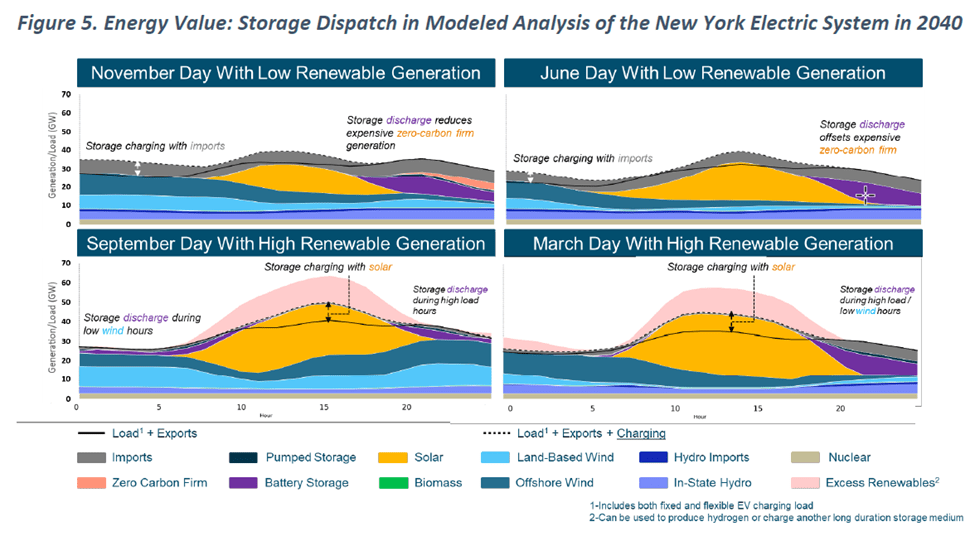
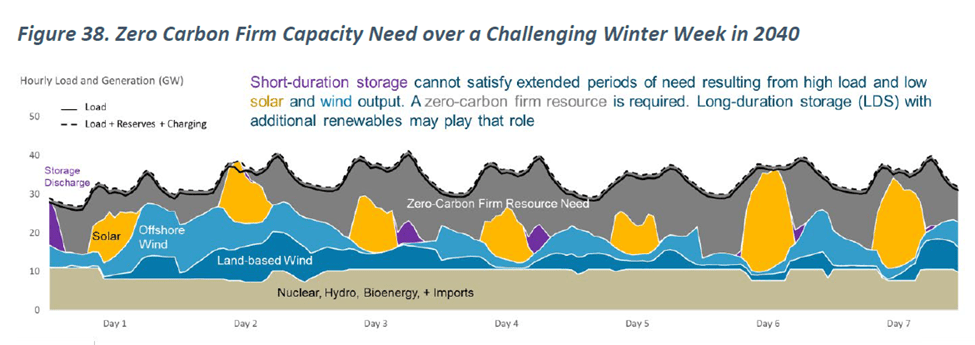
The ultimate problem for the future electric grid that is dependent upon wind and solar are weak when the load peaks in the winter because space heating is electrified.  Wind lulls can reduce wind resources for days and solar resources are inherently low availability because the days are shorter, the sun is lower in the sky, and areas downwind of the Great Lakes are obscured with lake-effect clouds. The experts responsible for electric system reliability at the New York Independent System Operator (NYISO) and the New York State Reliability Council (NYSRC) both highlighted (here and here) the importance of Dispatchable Emissions-Free Resources (DEFR) to address future winter-time wind lulls in their Draft Scoping Plan comments.  The Draft Scoping Plan also includes DEFR as a necessary component of the future grid to address this problem.  I am particularly concerned that the Hochul Administration has not confronted the feasibility of DEFR.  What options are there, how likely are they to be available when needed to meet the schedule of the Climate Act and how much will they cost should be a priority but the Council has essentially ignored the challenge and has not responded to NYISO and NYSRC comments.  Furthermore, if an implementation plan was in place, it could encourage zero-emissions resources availability during future winter-time wind lulls, for example by discouraging utility-scale solar development where lake-effect snow is heavy.

Champlain Hudson Power Express

The Champlain Hudson Power Express (CHPE) project is a 339-mile underground transmission line capable of bringing 1,250 MW from the Province of Quebec to Astoria Queens in New York City.  According to the press release it “accelerates progress to achieve New York’s goal of 70 percent of electricity statewide from renewable sources by 2030 on path to a zero-emission grid.  It also is touted as bringing zero-emissions hydro electricity from Hydro Quebec directly into New York City so it can displace fossil-fired generating units. 

I have published two previous articles about the project.  The first described the residential cost impacts of the New York State Energy Research and Development Authority (NYSERDA) contracts with H.Q. Energy Services (U.S.) Inc. (HQUS) for the CHPE project.  A year ago on November 30, 2021 Governor Hochul announced that the finalized contract for CHPE was awarded as part of the Tier 4 Clean Energy Standard that is intended to increase the penetration of renewable energy into New York City.  My focus was on Department of Public Service petition: “The costs of program payments for the purchase of Tier 4 Renewable Energy Credits from the projects are projected as $5.9 – $11.6 billion, equating to an estimated increase in customer electric bills of 2.1 – 4.1% (or $2.08 – $4.08 per month for the average residential customer) on average across the State for the 25-year period of the Tier 4 contracts.”  This is one of the few admissions of potential costs by the Hochul Administration.  I estimated that if those costs represent subsidies needed for all the Integration Analysis renewable resources that the annual ratepayer cost increase range would between $168 and $359 for the average residential customer. 

The second article described the comments submitted by Nuclear New York to the Department of Public Service on the Tier 4 contracts.  Their comments pointed out that the contract payment formula treats CHPE like baseload power sources but without actually getting baseload service:

Quebec and NYC often experience the same weather. Consequently, CHPE will deliver electricity during low or moderate demand periods. But Hydro Quebec will keep all power at home during grim winter weeks, such as on January 22 of this year: Exports to ISO-NE (the New England grid) were reduced to the contracted minimum, and, instead of exporting power to New York, Quebec needed to import power from New York. On really cold days in the Northeast, NYC will get no power via CHPE and will again rely on fossil-fueled “peaker plants”. Yes, CHPE will get paid little for their electricity in the wholesale market if they fail to serve NYC in times of most desperate need. However, New Yorkers are still going to pay plenty for the Renewable Energy Credits generated during “nice weather” hours.

The lack of an implementation plan directly relates to this problem.  As noted above the ultimate problem is getting as much zero-emissions electric energy as possible in order during the low renewable resource periods that are also expected to the highest load periods.  Without an implementation plan in place, New York State committed to paying CHPE for capacity that is not guaranteed when we need it the most. 

Implementation Issues

Three implementation issues concern me: the schedule, the costs, and jobs.

One of the most challenging aspects of the Climate Act is the schedule.  As part of their planning responsibilities the New York State Independent System Operator (NYISO) recently released the  2022 Reliability Needs Assessment (RNA) that highlighted this concern concluding “while there is not an immediate reliability need, changes in the economy, new generation technology, extreme weather and policy drivers are creating challenges for the future grid that may require actions to avoid interruptions in electric service.”  NYISO specifically referenced the CHPE project in the RNA findings:

The summer reliability margins improve in 2026 with the scheduled addition of the Champlain Hudson Power Express (CHPE) connection from Hydro Quebec to New York City but reduce through time as demand grows within New York City.  While CHPE will contribute to reliability in the summer, the facility is not obligated to provide any capacity in the winter. The NYISO is expected to be a winter peaking system in the next decade as vehicle fleets and buildings electrify.

While transmission security within New York City is maintained through the ten-year period in accordance with current design criteria, the margins are very tight and decrease to approximately 50 MW by 2025. With the addition of CHPE project in 2026, the margin improves but reduces to near 100 MW by 2032.

The reliability margins within New York City may not be sufficient even for expected weather if the CHPE project experiences a significant delay.

Richard Ellenbogen and I share this concern.  Richard described the project timeline.  The project was proposed in 2011 and the PSC authorized it on 4/18/13.  It has been 11.5 years since it was proposed, 9.5 years since it was authorized, and construction just started a year after the funding contract was signed.  The likelihood of additional delays seems high.

The Draft Scoping Plan does not include detailed control strategy costs but from what I have been able to ascertain, it is clear that the potential costs are minimized.   The record of this project reinforces my concerns.  Ellenbogen points out that the CHPE website has an entry from 11/1 noting that financing for the $6 billion project had been obtained but it was originally $2 billion when it was proposed ($2.65 billion in 2022 dollars). That cost is 2.3 times the original cost.  We agree that these projects are rarely ever completed on budget and with all the issues with supply chains and worldwide inflation I think this one will not be completed anywhere near the budgeted cost.

The Hochul press release said “the clean energy line is an example of how officials in the state are working to “confront climate change challenges and energy challenges together, in the meantime, creating great jobs for a cleaner, healthier New York.”  It is notable that the New York State Energy Research & Development Authority press release for the construction start announcement emphasized a “major project labor agreement”:

The construction of this green infrastructure project, which begins following the execution of a major union labor agreement between the developer and New York State Building and Construction Trades, is expected to bring $3.5 billion in economic benefits to New Yorkers while creating nearly 1,400 family-sustaining union jobs during construction.

I recently addressed the State’s Clean Energy Industry Report and its handling of these “great” jobs.  One point overlooked by Hochul is that while there may be “1,400 family-sustaining union jobs during construction” the number of permanent jobs is miniscule.  Furthermore, the project will provide 1,250 MW of power to New York City but this is a fraction of 2,000 MW of power lost due to the shutdown of Indian Point.  That shutdown meant the loss of over 1,000 permanent union jobs.  While this project may “confront climate change challenges and energy challenges together” it does not replace the loss of Indian Point that was more effective in that regard.

Conclusion

I agree that this line is needed to maintain New York’s electric grid reliability and that the start of construction is encouraging.  However, there are associated reliability and affordability feasibility concerns.  The latest NYISO RNA report emphasizes that there could be reliability problems if there are further delays to completion of this project.  The Climate Act transition plan schedule is ambitious and the Council has not considered a “Plan B” if there are unavoidable implementation delays for any of the components of the plan.  This project is expensive equating to an estimated increase in customer electric bills of 2.1 – 4.1% (or $2.08 – $4.08 per month for the average residential customer) for just one component of the total resources needed.  The Climate Action Council has not disclosed the total expected costs of the Integration Analysis transition plan or expected ratepayer impacts.

In addition to the feasibility issues this project exposes failures of the state’s lack of an implementation plan. The biggest challenge for the future zero-emissions electric grid is the winter-time lull when renewable resources are low.  This project is not obligated to provide any capacity during those periods.  Consequently, it is likely that more DEFR will be required. Unless the Hochul Administration comes to its senses and starts encouraging the development of the only scalable proven dispatchable emissions-free resource, nuclear power, this increases the risk that DEFR won’t be available as planned because the alternative technologies are speculative at this time.

Initial Impression of Climate Action Council Response to Public Comments on Transportation

The Climate Leadership and Community Protection Act (Climate Act) has a legal mandate for New York State greenhouse gas emissions to meet the ambitious net-zero goal by 2050.  The comment period for the Draft Scoping Plan that outlines how to meet that goal recently ended.  The last two meetings of the Climate Action Council have offered some insights into the plans to address those comments.  I am not encouraged by what I have seen so far.

Everyone wants to do right by the environment to the extent that they can afford to and not be unduly burdened by the effects of environmental policies.  I submitted comments on the Plan and have written extensively on implementation of New York’s response to that risk because I believe the ambitions for a zero-emissions economy embodied in the Climate Act outstrip available renewable technology such that this supposed cure will be worse than the disease.  The opinions expressed in this post do not reflect the position of any of my previous employers or any other company I have been associated with, these comments are mine alone.

Climate Act Background

The Climate Act establishes a “Net Zero” target (85% reduction and 15% offset of emissions) by 2050. The Climate Action Council is responsible for preparing the Scoping Plan that will “achieve the State’s bold clean energy and climate agenda”.  They were assisted by Advisory Panels who developed and presented strategies to the meet the goals to the Council.  Those strategies were used to develop the integration analysis prepared by the New York State Energy Research and Development Authority (NYSERDA) and its consultants that tried to quantify the impact of the strategies.  That material was used to write a Draft Scoping Plan that was released for public comment at the end of 2021. Since the close of the public comment period in early July staff has been updating the Integration Analyses and working through the comments to provide the Council with summaries for their review.

In this article, I will describe the response to the Transportation sector comments relative to the comments I submitted on this sector.  I submitted two comments on electric vehicles.  I noted that the Integration Analysis is making assumptions about future zero-emissions transportation implementation strategies without providing adequate referenced documentation.  The other comment addressed electric vehicle costs.  I also submitted a comment on high-speed intercity passenger rail transportation that is relevant to the September 13, 2022 Climate Action Council Presentation that will be the focus of this article.

Transportation Comments Response

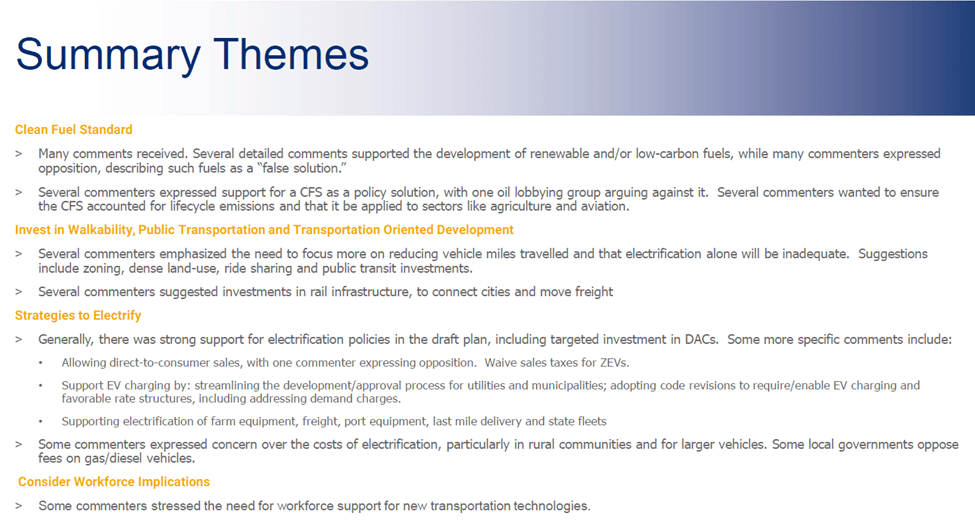
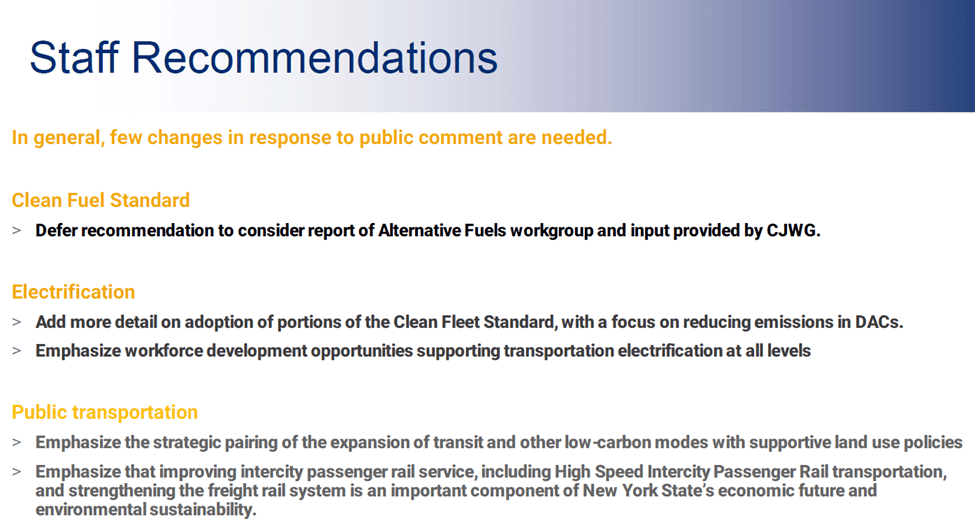
The discussion of Transportation Summary Themes at the September 13, 2022 Climate Action Council meeting included “Several commenters suggested investments in rail infrastructure, to connect cities and move freight”. 

The staff recommendations stated that few changes in response to public comments were needed.  Relative to the railroad theme they noted that: “Emphasize that improving intercity passenger rail service, including High Speed Intercity Passenger Rail transportation, and strengthening the freight rail system is an important component of New York State’s economic future and environmental sustainability.”

I submitted a comment on high-speed intercity passenger rail transportation that is ignored in this response.  The Federal Railroad Administration (FRA), in cooperation with the New York State Department of Transportation (NYSDOT) completed the Empire Corridor Environmental Impact Statement (EIS) in 2014 to “evaluate proposed system improvements to intercity passenger rail services along the 463-mile Empire Corridor, connecting Pennsylvania (Penn) Station in New York City with Niagara Falls Station in Niagara Falls, New York.” This is the primary reference for Draft Scoping Plan Scenario 4 high speed intercity passenger rail transportation upgrades.

I evaluated the transportation sector vehicle miles traveled difference between Scenarios 2 and 3 compared to Scenario 4 due to rail passenger improvements.  Note that this basically proposed the development of a dedicated high-speed rail corridor between Buffalo and Albany.  The Draft Scoping Plan claims that “Incremental reductions from enhanced in-state rail aligning with 125 MPH alternative detailed in Empire Corridor Tier 1 Draft EIS” will provide a reduction of 200 million light duty vehicle miles at a per unit cost of $6 per mile or $1.2 billion.  I estimated that the only valid cost for the difference between the rail alternatives is $8.4 billion and that it would only provide a vehicle mile reduction of 64.7 million miles. 

Discussion

There are multiple issues associated with the presentation response to comments.  At the previous meeting the State acknowledged that they had not worked their way through the comments submitted as attachments.  My comment was submitted as an attachment so it is possible that it has not even been reviewed yet.  In my opinion, the only way to make detailed comments is through an attachment so I think many of the substantive comments may not have been evaluated yet.

It is not clear whether this presentation was only meant to be an overview of the comments received.  Alternatively, it could represent the entirety of the discussion of the comments for each of the sectors (Transportation, Agriculture and Forestry, Land Use, Local Government, and Waste) discussed. My specific comment was not mentioned and it is not clear if this was because they have not reviewed it yet or whether it was inconvenient for them to respond.  If this is supposed to be the final word on the comments for each of these sectors then it is clear that the stakeholder public comment process is just window dressing and that no meaningful revisions will be incorporated.

At one point the Council promised to provide all the comments for public review.  Of course, the odds that the comments will be provided in format that enables it to be evaluated easily is another thing.  I believe all the comments should be available by topic in a searchable formatted document.

I believe my specific comment has to be addressed on two levels.  On the first level, I identified a problem with their numbers.  Shouldn’t they have to respond to that error?  While it might not rise to the level where an explicit Climate Action Council decision is needed, I do think the Council has to decide what level of high-speed intercity passenger rail transportation improvements they are recommending. The response to this topic at this meeting “Emphasize that improving intercity passenger rail service, including High Speed Intercity Passenger Rail transportation, and strengthening the freight rail system is an important component of New York State’s economic future and environmental sustainability” is just a bunch of words devoid of meaningful comment.

I also noticed a bias in the comment descriptions.  For example, “Generally, there was strong support for electrification policies in the draft plan” compared to “Some commenters expressed concern over the costs of electrification, particularly in rural communities and for larger vehicles” inappropriately indicates the rates the level of support based on numbers.  The value of a comment is the quality of the argument not the number of people who submitted the argument.  The statement “Several detailed comments supported the development of renewable and/or low-carbon fuels, while many commenters expressed opposition, describing such fuels as a ‘false solution’ “ is particularly problematic because it suggests that no matter how strong the technical argument, if enough ideologues using slogans oppose it that the Council is going to side with the slogans. 

Conclusion

I am not surprised that my comments were ignored.  However I am terrified that the Council may ignore the comments submitted by the New York Independent System Operator and the New York State Reliability Council.  There was no mention of any need to reconcile the Integration Analysis with the recent NYISO 2021-2040 System & Resource Outlook report.  The projections are significantly different and the citizens of New York deserve to have them reconciled clearly and transparently.  It is entirely inappropriate for the state to be committed to go down a transformational energy policy path based on the work of unelected bureaucrats who are not responsible for keeping the lights on without incorporating the input of the state’s experts who are responsible.

The Latest from the Experts on New York’s Climate Act Implementation

This article was first published at Watts Up With That

I have published two previous articles about New York Independent System Operator (NYISO) analyses related to New York’s Climate Leadership and Community Protection Act (Climate Act).  This post describes what I believe is an important new analysis of the future of New York’s electric system.

New York’s Climate Leadership and Community Protection Act (Climate Act) Act establishes a “Net Zero” target (85% reduction and 15% offset of emissions) by 2050.  I have written extensively on implementation of the Climate Act.  Everyone wants to do right by the environment to the extent that efforts will make a positive impact at an affordable level.  My analysis of the Climate Act shows that the ambitions for a zero-emissions economy outstrip available renewable technology such that the transition to an electric system relying on wind and solar will do more harm than good.  The opinions expressed in this post do not reflect the position of any of my previous employers or any other company I have been associated with, these comments are mine alone.

Background

The implementation plan for New York’s Climate Act “Net Zero” target (85% reduction and 15% offset of emissions) by 2050 is underway.  The Climate Action Council has been working to develop plans to implement the Act.  Over the summer of 2021 the New York State Energy Research & Development Authority (NYSERDA) and its consultant Energy + Environmental Economics (E3) prepared an Integration Analysis to “estimate the economy-wide benefits, costs, and GHG emissions reductions associated with pathways that achieve the Climate Act GHG emission limits and carbon neutrality goal”.  Integration Analysis implementation strategies were incorporated into the Draft Scoping Plan when it was released at the end of 2021.  Since the end of the public comment period in early July 2022 the Climate Action Council has been addressing the comments received as part of the development of the Final Scoping Plan that is supposed to provide a guide for the net-zero transition.

Unfortunately, the Climate Action Council has not confronted reliability issues raised by New York agencies responsible for keeping the lights on.  The first post (New York Climate Act: Is Anyone Listening to the Experts?) described the NYISO 2021-2030 Comprehensive Reliability Plan (CRP) report (appendices) released late last year.  The difficulties raised in the report are so large that I raised the question whether any leader in New York was listening to this expert opinion.  The second post (New York Climate Act: What the Experts are Saying Now) highlighted results shown in a draft presentation for the 2021-2040 System & Resource Outlook that all but admitted meeting the net-zero goals of the Climate Act are impossible on the mandated schedule.  This article describes the “For discussion purposes only” draft of the 2021-2040 System & Resource Outlook report described in the previous article.  While there may be minor changes to the document itself, I am comfortable saying that the major findings will not change substantively.

System and Resource Outlook Summary

The Executive Summary makes the point that the Climate Act is driving changes to the generating system, the transmission grid and the demand landscape.  As a result, this “leads to re-thinking how and where electric supply and storage resources evolve, and how to efficiently enable their adoption to achieve energy policy targets”.  The summary goes on to note:

This 2021 – 2040 System & Resource Outlook (the Outlook), conducted by the New York Independent System Operator (NYISO) in collaboration with stakeholders and state agencies, provides a comprehensive overview of potential resource development over the next 20 years in New York and highlights opportunities for transmission investment driven by economics and public policy in New York State. The Outlook together with the NYISO’s 2021-2030 Comprehensive Reliability Plan (CRP) represent the marquee planning reports that provide a full New York power system outlook to stakeholders, developers, and policymakers.

The Outlook examines a wide range of potential future system conditions and enables comparisons between possible pathways to an increasingly greener resource mix. By simulating several different possible future system configurations and forecasting the transmission constraints for each, the NYISO:

  • Projected possible resource mixes that achieve New York’s public policy goals while maintaining grid reliability;
  • Identified regions of New York where renewable or other resources may be unable to generate at their full capability due to transmission constraints;
  • Quantified the extent to which these transmission constraints limit delivery of renewable energy to consumers, and;
  • Identified potential opportunities for transmission investment that may provide economic, policy, and/or operational benefits.

There are many potential paths and combinations of resource and transmission builds to achieving New York’s climate change requirements. As the current power system continues to evolve, evaluating a multitude of expansion scenarios will facilitate identification of common and unique challenges to achieving the electric system mandates New York State has set for 2030 and 2040. A thorough understanding of these challenges will help build a path for investors and policymakers to achieve a greener and reliable future grid efficiently and cost effectively. Through this Outlook several key findings were brought to light:

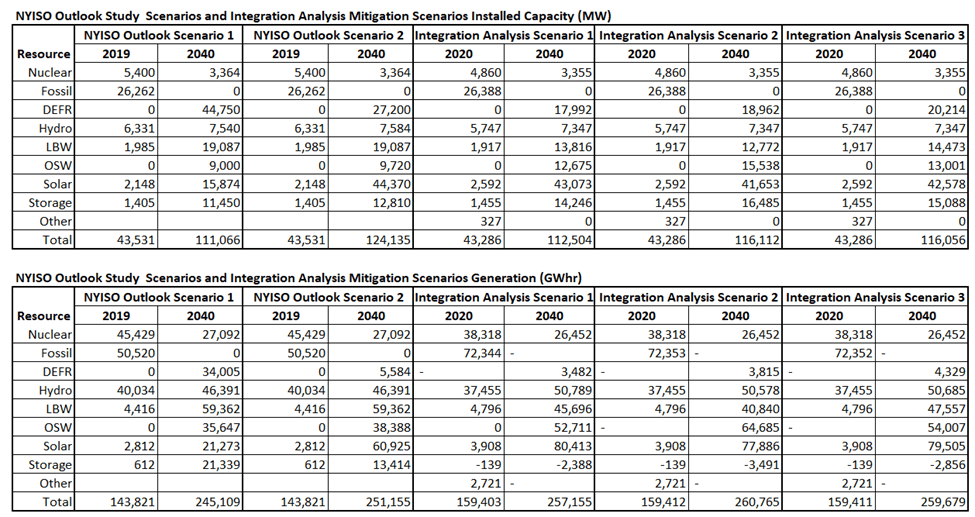
Four potential futures are evaluated to best understand the challenges ahead. A Baseline Case evaluates a future with little change from today. A Contract Case includes approximately 9,500 MW of renewable capacity procured by the state and evaluates the impact of those projects. Finally, a Policy Case postulates and examines two separate future scenarios that meet New York policy mandates.

Energy planning analyses such as this work normally evaluate different scenarios of the future by comparing them to a business-as-usual scenario.  In this instance the business-as-usual scenario does not include any of New York’s climate initiatives.  On the other hand, Climate Act Draft Scoping Plan analyses were perverted to “prove” the desired conclusion that the benefits were greater than the costs by comparing future scenarios against a reference scenario.  The Integration Analysis used a semantic trick to claim that some de-carbonization costs (such as de-carbonizing transportation costs) necessary to meet Climate Act targets did not have to be included in the comparison scenario because the electric vehicle conversion legislation was already “implemented”.  That approach took legitimate implementation costs out of the projections.  Of course, this also makes comparison of the NYISO work relative to the Draft Scoping Plan problematic.

The second estimate of the future in the Resource Outlook considered only those projects currently under contract:

Through an annual request for proposals, NYSERDA solicits bids from eligible new large-scale renewable resources and procures Renewable Energy Certificates (RECs) and Offshore Renewable Energy Certificates (ORECs) from these facilities. This Outlook included approximately 9,500 MW of new contracted renewable resources, including 4,262 MW of solar, 899 MW of land-based wind, and 4,316 MW of offshore wind. The addition of these resources to the existing system representation provides insights regarding their impact on system performance in the future.

The Outlook report noted the following Key Takeaways for the contracted renewables scenario:

The pace of renewable project development is unprecedented and requires an increase in the pace of transmission development. Every incremental advancement towards policy achievement matters on the path to a greener and reliable grid in the future, not just at the critical deadline years such as 2030 and 2040. In general, resource and transmission expansion take many years from development to deployment.

Coordination of project additions and retirements is essential to maintaining reliability and achieving policy. Coordination of renewable energy additions, commercialization and development of dispatchable technologies, fossil fuel plant operation, and staged fossil fuel plant deactivations over the next 18 years will be essential to facilitate an orderly transition of the grid.

Many more renewable resources have to be developed to meet the overall Climate Act net-zero goal by 2050 and the interim 2040 goal of “zero-emissions” electricity generation.  The NYISO analysis looked at two Policy Case scenarios that meet those targets:

Scenario 1 utilizes industry data and NYISO load forecasts, representing a future with high demand (57,144 MW winter peak and 208,679 GWh energy demand in 2040) and assumes less restrictions in renewable generation buildout options.

Scenario 2 utilizes various assumptions consistent with the Climate Action Council Integration Analysis and represents a future with a moderate peak but a higher overall energy demand (42,301 MW winter peak and 235,731 GWh energy demand in 2040).

Both scenarios project a blend of land-based wind, offshore wind, utility-scale solar, behind-the-meter solar, and energy storage will be needed to meet the CLCPA policy mandates through 2035. There are significant differences between these scenarios and the equivalent Draft Scoping Plan mitigation scenarios.  One of the big differences is the magnitude of a new generating resource called “dispatchable emission-free resources” (DEFRs):

These resources represent a proxy technology that will meet the flexibility and emissions-free energy needs of the future system but are not yet mature technologies that are commercially available (some examples include hydrogen, renewable natural gas, and small modular nuclear reactors). As more wind, solar, and storage plants are added to the grid, dispatchable emission-free resources must be added to the system to meet the minimum statewide and locational resource requirements for serving system demand when intermittent generation is unavailable.

The report warns:

Both scenarios include significant DEFR capacity by 2035, but it is important to note that the lead time necessary for development, permitting, and construction of DEFR power plants will require action much sooner if this timeline is to be achieved.

As part of the analysis the NYISO considered what would be needed if the DEFR capacity is not developed. They found that “The exclusion of DEFRs as a new technology option, while enforcing the retirement of fossil generators via the zero-emission by 2040 policy, exhausts the amount of land-based wind built and results in the replacement of 45 GW of DEFR capacity in Scenario 1 with 30 GW of offshore wind and 40 GW of energy storage.”  They also noted that the alternative did not address ancillary service requirements needed for the transmission system.

The Outlook report noted the following Key Takeaways for the Policy Case Scenarios:

Significant new resource development will be required to achieve CLCPA energy targets. The total installed generation capacity to meet policy objectives within New York is projected to range between 111 GW and 124 GW by 2040. At least 95 GW of this capacity will consist of new generation projects and/or modifications to existing plants. Even with these additions, New York still may not be sufficient to fully meet CLCPA compliance criteria and maintain the reliable electricity supply on which New York consumers rely. The sheer scale of resources needed to satisfy system reliability and policy requirements within the next 20 years is unprecedented.

To achieve an emission-free grid, dispatchable emission-free resources (DEFRs) must be developed and deployed throughout New York. DEFRs that provide sustained on-demand power and system stability will be essential to meeting policy objectives while maintaining a reliable electric grid. While essential to the grid of the future, such DEFR technologies are not commercially viable today. DEFRs will require committed public and private investment in research and development efforts to identify the most efficient and cost-effective technologies with a view towards the development and eventual adoption of commercially viable resources. The development and construction lead times necessary for these technologies may extend beyond policy target dates.

As the energy policies in neighboring regions evolve, New York’s imports and exports of energy could vary significantly due to the resulting changes in neighboring grids. New York is fortunate to have strong interconnections with neighboring regions and has enjoyed reliability and economic benefits from such connections. The availability of energy for interchange is predicted to shift fundamentally as policy achievement progresses. Balancing the need to serve demand reliably while achieving New York’s emission-free target will require continuous monitoring and collaboration with our neighboring states.

The important findings in the report led to the following recommendations:

Future uncertainty is the only thing certain about the electric power industry. From policy advancements to new dispatchable emissions-free resource technology innovation and ultimate development, the system is set to change at a rapid pace. Situational awareness of system changes and continuous assessment are critical to ensure a reliable and lower-emissions grid for New York. The Economic Planning databases and models will be continually updated with new information and the Outlook study will be improved and performed on a biennial basis.

To meet the minimum capacity requirement in 2040, at least 95 GW of new emission-free resources, including approximately 9.5 GW of new renewable resources, will be required to come on-line. Furthermore, to fully achieve the emission-free grid target by 2040, even more resources will likely be needed along with transmission to deliver the clean power to consumers. The scope of the additional renewable resource need is both substantial and unprecedented. Compared to the 2.6 GW capacity entering service in the past five years while New York experienced a net loss of approximately 2.2 GW, the installation rate in the next 20 years must increase significantly to achieve state law climate change requirements. State agencies should consider releasing a more detailed procurement schedule for renewable resources to guide the long-term system planning and provide clarity to the market.

Discussion

I noted earlier that I was comfortable saying that the major findings in this draft report will not change substantively when it is finalized.  I base that mostly on the fact that the NYISO Market Marketing Unit has reviewed the draft.  As part of their market monitoring responsibilities Potomac Electricreviewed the document relative to implications to New York’s de-regulated electric markets.  If you are interested in that particular aspect of electric system planning, I suggest checking out the memo.  For the rest of us, I only note that they state: “The 2021 Outlook is a major improvement to NYISO’s previous planning studies and provides important insights on the potential impacts of state policies on the NYISO system.”

More importantly, what about the Climate Action Council?  Unfortunately, as I pointed out before the Climate Action Council has not confronted reliability issues raised by New York agencies responsible for keeping the lights on.  In a series of meetings over the next couple of months the Council will have to address the Draft Scoping Plan comments made by the NYISO and the New York State Reliability Council that raised reliability concerns.  I hope. without any supporting evidence, that the Integration Analysis team is working with the NYISO planning staff to reconcile the differences between this analysis and theirs.

In the meantime, there are vocal members of the Climate Action Council that deny the existence of any implementation issues associated with a renewable energy resource dependent electric system.  At the May 26, 2022 Climate Action Council meeting Council members described their impressions of comments made at the public hearings.  I have prepared an overview summary of all the comments made during the Update on Public Hearings and Comments agenda item and wrote an article highlighting relevant comments.  In this regard, Paul Shepson Dean, School of Marine and Atmospheric Sciences at Stony Brook University talked about mis-representation at 23:39 of the recording:

Mis-representation I see as on-going.  One of you mentioned the word reliability.  I think the word reliability is very intentionally presented as a way of expressing the improper idea that renewable energy will not be reliable.  I don’t accept that will be the case.  In fact, it cannot be the case for the CLCPA that installation of renewable energy, the conversion to renewable energy, will be unreliable.  It cannot be.

Robert Howarth, Professor, Ecology and Environmental Biology at Cornell (starting at 32:52 of the recording) picked up on that theme.  He said that fear and confusion is based on mis-information but we have information to counter that and help ease the fears.  He stated that he thought reliability is one of those issues: “Clearly one can run a 100% renewable grid with reliability”.   Obviously, these views are at odds with this report.

There is one other point.  In addition to the reliability concerns of the net-zero transition I am very concerned about affordability.  The Draft Scoping Plan has avoided any mention of ratepayer impacts to date.  The NYISO projection methodology has that information because it is inherent in the models. It is a shame that it is not being reported.

Conclusion

This is an important report for New York but I also believe that there are ramifications for other net zero transition programs.  These findings must be reconciled with the Draft Scoping Plan projections for the future generating system.  The leadership of the Climate Action has repeatedly punted the responsibility for a feasibility study down the road as somebody else’s problem. This report highlights multiple feasibility concerns that must be addressed to have any hope of this working.  I believe that it shows that implementation on the schedule proposed will prove impossible.  The report also highlights the need for implementation planning.  Currently there is no plan for siting renewable resources where they are needed for the future system and this shows that it must be done.

With respect to other net-zero transition programs I think the discussion and implications of the dispatchable emissions-free resource are of interest.  The analysis shows that in order to minimize the storage and renewable over-build requirements this resource could be a better choice.   However, the report notes that DEFRs such as hydrogen, renewable natural gas, and small modular nuclear reactors are not commercially viable today. “DEFRs will require committed public and private investment in research and development efforts to identify the most efficient and cost-effective technologies with a view towards the development and eventual adoption of commercially viable resources.”  There is that nasty planning and feasibility is necessary component again.

NYISO Offshore Wind Profile Development

The implementation plan for New York’s Climate Leadership and Community Protection Act (Climate Act) “Net Zero” target (85% reduction and 15% offset of emissions) by 2050 is underway.  I think the biggest problem confronting any net-zero transition effort is matching variable wind and solar generation with load at all times.  This post describes an effort by the New York Independent System Operator (NYISO) to address that problem for offshore wind resources.  It is a great start but needs to be expanded for other sources of renewable generation and for as long a period as possible.

I have written extensively on implementation of the Climate Act.  Everyone wants to do right by the environment to the extent that efforts will make a positive impact at an affordable cost.  Based on my analysis of the Climate Act I don’t think that will be the case as proposed.  I believe that the ambitions for a zero-emissions economy outstrip available renewable technology such that the transition to an electric system relying on wind and solar will do more harm than good.  I am a retired meteorologist who started working for Niagara Mohawk in 1981 and have continued to work in the New York electric generating industry continuously since then.  Over that time, I have been involved in many energy planning activities that included meteorological components. The opinions expressed in this post do not reflect the position of any of my previous employers or any other company I have been associated with, these comments are mine alone.

Climate Act Background

The Climate Act established the Climate Action Council who is responsible for preparing the Scoping Plan that will “achieve the State’s bold clean energy and climate agenda”.  They were assisted by Advisory Panels who developed and presented strategies to meet the goals.  Those strategies were used to develop the Integration Analysis prepared by the New York State Energy Research and Development Authority (NYSERDA) and its consultants that quantified the impact of the strategies.  That analysis was used to develop the Draft Scoping Plan that was released for public comment on December 30, 2021 and will be finalized in 2022. 

Renewable Resource Adequacy

I called the renewable resource adequacy problem the ultimate problem for the Climate Act as early as September 2020.  On August 2, 2021, the New York State Energy Research and Development Authority (NYSERDA) held a Reliability Planning Speaker Session to describe New York’s reliability issues to the advisory panels and Climate Action Council.  All the speakers but one made the point that today’s renewable energy technology will not be adequate to maintain current reliability standards and that a “yet to be developed technology” will be needed.  A recent article by David Wojick at PA Pundits International titled Unreliability Makes Solar Power Impossibly Expensive does a great job describing how renewable resource availability affects reliability.  I adapted his work to New York to analyze the impact on the Draft Scoping Plan.

There are serious problems when extreme weather affects the grid.  The Federal Energy Regulatory Commission (FERC) and the North American Electric Reliability Corporation (NERC) report on the February 2021 cold weather outages in Texas and the South Central United States described the event, the impacts and made recommendations.  According to the report this event was the fourth cold-weather event in the last ten years to affect bulk electric system reliability.  Cold weather caused problems that required rolling blackouts to avoid system instability and even worse problems for the electric grid.  Given that the weather conditions that caused these problems occurred recently I am taken aback that resources were not devoted to preventing re-occurrence.  Among the many recommendations two are relevant: “improving near-term load forecasts for extreme weather conditions” and additional study of “potential effects of low-frequency events on generators in the Western and Eastern Interconnections”.

In order to address this renewable resource variability problem, it is necessary to determine the worst-case meteorological conditions affecting wind and solar availability.   As long as the NYISO and other agencies responsible for electric system reliability understand the worst-case renewable availability conditions they can plan to prevent low availability impacts.  I submitted comments on the Draft Scoping Plan’s treatment of wind and solar resource availability and concluded that it was inadequate in this regard. I recommended that the State undertake a more comprehensive analysis of wind and solar availability to serve as input for future reliability planning.  I have also been trying to get the NYISO and New York State Reliability Council to consider the recommendations I made for a comprehensive availability analysis.  So far, I have not had any success getting a response.

Offshore Wind Power Profile Study

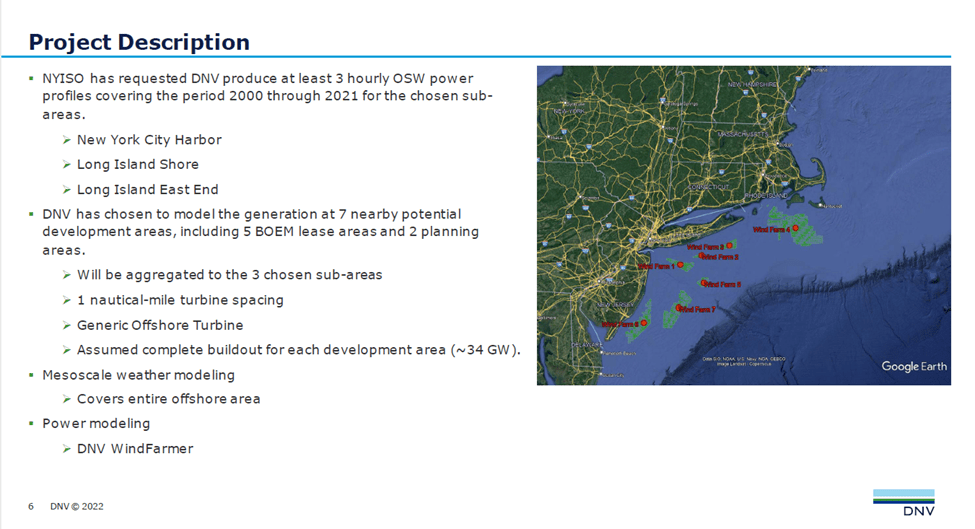
Despite my personal lack of success I was encouraged that the NYISO started a project in July to address offshore wind profile development.  In particular, they plan to develop wind power estimates for the New York offshore wind development areas that will estimate resource availability for a 20-year period.  I am going to highlight some of the slides in the presentation by DNV describing their work for the NYISO ICAP/MIWG/PRLWG Meeting on September 07, 2022.  Note that all the slides are copyrighted to either NYISO or DNV and are labeled as draft for discussion purposes only.  I am including a couple of slides to show what should be done on a more comprehensive basis for the Final Scoping Plan.

In my opinion, the critical consideration is the frequency, duration, and severity of periods when wind and solar resources are in “droughts” or low resource availability.  I described several recent applicable papers in my comments describing analyses to estimate the frequency and duration of periods with those conditions.  In order to provide a robust estimate of the wind and solar availability during worst case conditions I believe it is necessary to analyze as long a time period of historical meteorological data as possible. Fortunately, meteorological reanalysis descriptive data generated by modern weather forecast models but using observed data from decades ago is available for this application. This is exactly what DNV is proposing to do.

The DNV project description slide explains that they will use the historical data to generate detailed wind maps using a weather forecast model.  This output is combined with their model that projects wind energy output as a function of wind speed.  They are going to model wind energy production for seven potential development areas off Long Island and New Jersey.

The weather model slide describes their approach.  They are going to use a forecast model that takes historical data and calculates wind speed and direction on an hourly basis.  The inputs for their modeling include not only the observed meteorological data but also surface characteristics and surface temperatures.  Note that the model inputs extend far beyond the offshore wind study area.

The presentation also includes slides on wind power modeling, wind turbine power curve output, and describes their validation analyses.  They also described four different aspects that cause reductions in power output in their analysis.  At some point I should compare their assumptions with those used in the Draft Scoping Plan.  In order to minimize wake effects DNV is proposing 1 nautical mile spacing which seems higher than I have noticed elsewhere.

Discussion

I think that this analysis is a great start.  I only have one concern relative to the scope of work.  As far as I could tell the meteorological input data is available back to 1980.  However, this project only goes back to 2000.  I think it would be better to evaluate the 1980 to 2000 data specifically looking for wind droughts.  I know there was a huge ozone episode in August 1988 that had to include very light winds.  I have no idea how that period compares to “normal” but we won’t know because this analysis does not cover that period. 

This analysis is entirely appropriate for the offshore wind resource.  However, it does not address the onshore wind and solar resources.  The same type of analysis has to be done for those resources covering not only the entire state but also the area where New York could expect to import power.   Ideally, the ERA5 global reanalysis data base that goes back to 1950 should be used in the analysis to find the worst-case conditions.  It is not necessary to determine the renewable power output over the entire period and region.  Once the worst cases are identified then a power output model can be applied to those periods to determine how the electric system can be setup to avoid bulk electric supply disruptions. 

It is my professional opinion that until this comprehensive renewable energy resource evaluation is completed that New York State will unnecessarily risk catastrophic blackouts.  Because the worst-case resource availability is associated with the coldest or hottest periods, the loads are highest and the need to prevent blackouts most acute.

Climate Act Avoided Cost of Gas Working Group

There is an immense amount of work that needs to be done to implement New York’s Climate Leadership and Community Protection Act (Climate Act) “Net Zero” target (85% reduction and 15% offset of emissions) by 2050.  It is very difficult to grasp all the different ways that this transition is going to affect all New Yorkers.  Despite the lack of a reliability and affordability feasibility analysis an army of government bureaucrats are developing transition plans to change our energy choices assuming that everything will work out.  This article talks about just one of those efforts.

I have written extensively on implementation of the Climate Act.  Everyone wants to do right by the environment to the extent that efforts will make a positive impact at an affordable dollar cost.  Based on my analysis of the Climate Act I don’t think that will be the case.  I believe that the ambitions for a zero-emissions economy outstrip available renewable technology such that the transition to an electric system relying on wind and solar will do more harm than good.  The opinions expressed in this post do not reflect the position of any of my previous employers or any other company I have been associated with, these comments are mine alone.

Climate Act Background

The Climate Act established the Climate Action Council who is responsible for preparing the Scoping Plan that will “achieve the State’s bold clean energy and climate agenda”.  They were assisted by Advisory Panels who developed and presented strategies to meet the goals.  Those strategies were used to develop the Integration Analysis prepared by the New York State Energy Research and Development Authority (NYSERDA) and its consultants that quantified the impact of the strategies.  That analysis was used to develop the Draft Scoping Plan that was released for public comment on December 30, 2021 and will be finalized in 2022.  At the same time this process is underway various state agencies are already implementing regulations for the transition.  The problem is that the Scoping Plan is just a guide and does not include a reliability feasibility analysis or any affordability specifics about the costs for the transition.  Couple that with the fact that many New Yorkers are unaware of the Climate Act much less its implications suggest to me that this that public blowback will be immense when the realization of what is required becomes obvious.

Gas Planning Procedures

In order to explain what is going on I will provide background information for this example.  The New York State Department of Public Service (DPS) Case 20-G-0131 – Proceeding on Motion of the Commission in Regard to Gas Planning Procedures “seeks to establish planning and operational practices that best support customer needs and emissions objectives while minimizing infrastructure investments and ensuring the continuation of reliable, safe, and adequate service to existing customers.”  The Background for the order instituting the proceeding follows with my explanations:

Gas utilities in several regions of New York State have recently claimed supply constraints that may prevent them from accepting applications for new firm service. LDCs have invoked moratoria on new service connections in some locations, leading in some cases to customer hardships. In resolving the moratorium invoked by KEDNY and KEDLI, the Commission-adopted settlement requires those LDCs to develop a “Long-Term Capacity Report” to address the long-term capacity constraints affecting their operations.

This refers to gas utility load distribution company (LDC) issues.  A footnote to this section explains that:

On January 17, 2019, Consolidated Edison Company of New York, Inc. (Con Edison) notified the Commission of a moratorium on new firm gas service in most of Westchester county, commencing March 15, 2019. Beginning November 2018, The Brooklyn Union Gas Company d/b/a National Grid NY (KEDNY), serving Brooklyn and parts of Queens, and KeySpan Gas East Corporation d/b/a National Grid (KEDLI) (collectively, National Grid) began informing large applicants for new service that National Grid would be unable to provide firm service unless a pending supply project was approved. As of May 15, 2019, National Grid stated that it would not fulfill applications for new firm service connections, or requests for additional firm load from existing customers on Long Island, including Queens and Brooklyn. Based on a settlement adopted and approved by the Commission, National Grid ended its moratorium as of November 26, 2019. Case 19-G-0678, Proceeding on Motion of the Commission to investigate Denials of Service by National Grid, Order Adopting and Approving Settlement (issued November 26, 2019); Case 19-G-0678, supra, Confirming Order (issued December 12, 2019). Additionally, New York State Electric and Gas Corporation (NYSEG) has declared a moratorium on new gas customer attachments in the Town of Lansing, in Tompkins County in February 2015.

In other words, there have been examples where people who want to hook up to natural gas have not been allowed to get service.  This is the crux of the gas transition problem.  The net-zero transition to natural gas alternatives means that at some point the choice to use natural gas will no longer be an option.  The Background goes on:

These circumstances demonstrate that conventional gas planning and operational practices adopted by natural gas utilities have not kept pace with recent developments and demands on energy systems.  Gas utilities need to learn from recent experience and adopt improved planning and operational practices that enable them to meet current customer needs and expectations in a transparent and equitable way while minimizing infrastructure investments and maintaining safe and reliable service. Additionally, planning must be conducted in a manner consistent with the recently enacted Climate Leadership and Community Protection Act (CLCPA).

Implicit in this is that customer choice will have to be limited.  I do not believe that many New Yorkers understand that this transition is coming at them.  The Background notes:

Moratoria can create adverse customer impacts, as they prevent at least some applicants from receiving firm gas service. Some types of development projects can utilize viable alternatives to firm gas service, if they are practically available. Others, however, may have more difficulty without firm gas service. Additionally, reliance on alternatives can have emission impacts. Reduced emissions impacts may result where the alternative to gas is efficient use of clean electricity, while increased emission impacts may result where the alternative to gas is oil or propane.

If viable alternatives were available, and by that, I mean affordable above all, then applicants would be choosing them willingly.  I published a post describing the comments on the Draft Scoping Plan submitted by a small manufacturer in Rochester who replacing equipment that is powered by natural gas now would cost over a million dollars and said that his company could not afford that conversion.  I will quote one last paragraph from the Background:

Given these potential impacts, the public interest demands that gas utilities provide information to and communicate with customers in a way that promotes effective customer planning, reduces confusion, and avoids inequities or the appearance of inequities. Similarly, the public interest demands that gas utilities provide information to and communicate with the Department, with other government entities and agencies, and with stakeholders, so as to promote effective planning and best consideration of alternatives, thus benefiting costs, emissions, and economic development.

What this means is that the DPS and gas utilities in the state are grappling with a tradeoff between providing safe and reliable natural gas to existing and new customers at the same time the Climate Act net-zero transition calls for the natural gas system to be shut down or transitioned to use something other than natural gas.  A presentation at a recent meeting of the Avoided Cost of Gas Working Group offers some insight into the practical considerations that Albany bureaucrats are starting to deal with and are completely unknown to most natural gas consumers despite the public interest in this topic.

Avoided Cost Working Group First Meeting

On July 6, 2022 the Avoided Cost Working Group (ACWG) met for the first time.  The presentation described the purpose of the group in the following slide.  The Benefit Cost Analysis Framework Order required Department of Public Service staff to develop a white paper on benefit cost analysis.  That process did not address gas industry issues.  This workgroup is supposed to provide the Commission with a report describing recommended calculations and specific elements for each LDC, which will then be issued for comment from stakeholders.

The BCA white paper included the following list of benefit and costs components to be included in the framework.  The workgroup will be adjusting the calculations for the gas industry but there are no plans for changes to the list.

The first meeting discussed the plan to address four main topics.  They want to determine the avoided bulk system costs for the gas commodity, the costs necessary to meet peak loads and pipeline capacity costs.  Another topic is avoided distribution costs for the high, medium, and low-pressure components of the pipeline system.  There has been much discussion about the use of renewable natural gas and they want to determine what qualifies for that label.  The final topic is the subject of leaks in the system.  As monitoring technology has improved more leaks have been found and this has been a point of contention on the Climate Action Council.

Avoided Cost Working Group Second Meeting

The second meeting of the ACWG on August 4 included two presentations.  The first presentation from the DPS staff discussed the typical non-pipelines alternatives process.  This is another of the Climate Act magical solutions where an existing fossil-fuel service can supposedly be replaced by an alternative that will not affect reliability or affordability.  National Grid provides a summary of the approach:

Non-Pipeline Alternatives (NPA) is the inclusive term for any targeted investment or activity that is intended to defer, reduce, or remove the need to construct or upgrade components of a natural gas system, or “pipeline investment.”

These NPA investments are required to be cost-effective compared to the infrastructure investment and are required to meet the specified gas system need.  An NPA can include any action, strategy, program, or technology that meets this definition and these requirements.

Some technologies and methodologies that can be applicable as an NPA investment include demand-side measures, such as demand response, sewer heat recovery, advanced controls strategies, new business models, energy efficiency or electrification. Additional technologies may be feasible as a demand-side NPA. NPA projects can include these and other investments individually or in combination that meets the specified need. A benefit-cost analysis (BCA) will be used to determine the cost-effectiveness of the NPA project.

In my opinion there are a lot of assumptions and biases that can skew the NPA study to prove whatever the utility wants and, in order to survive and make their earnings targets, that will be what the PSC wants.  The Administration’s response to public input leans to whatever constituency the Administration wants to please rather than what is best for the majority or the strength of adverse comments.

The DPS presentation outlined the process for a NPA study, reviewed the list of benefit and costs components and presented a list applicable to the natural gas system.  I don’t think there is anything particularly controversial or, frankly, of interest to the general public.

The second presentation by staff from New York State Energy Research & Development (NYSERDA) and their consultant Energy + Environmental Economics (E3)  described the work done to date in the Integration Analysis and Draft Scoping Plan.  They gave an overview of the Avoided Cost of Gas (ACG) framework developed by E3 for NYSERDA and DPS in 2020,  provided insights into other “Future of Gas” projects E3 has contributed to since 2020 , and presented key similarities and differences with the ACG framework.

The following slide is an overview of the approach.  E3 has set up a model that quantifies avoided costs that will be used to eventually justify the transition of New York’s natural gas system to net-zero consistent with the Climate Act.  At this time the framework has only focused on business-as-usual and has not been used to examine the impacts of the Climate Act.  It quantifies the following avoided costs:

  • Upstream supply costs
  • Leakage rates and other losses
  • “Peak gas” value
  • Local avoided infrastructure costs
  • Avoided GHGs (methane and CO2)

The presentation describes the ACG framework approach.  The following slide explains what the avoided costs results tell us.  The costs include installation, program and fuel costs.  The benefits include avoided utility costs and the alleged benefits of avoided greenhouse gas emissions.  Noticeably absent, in my opinion, is consideration of added costs to customers.  For example, the aforementioned small manufacturer in Rochester uses natural gas because it is the best alternative for his processes.  Any alternative is going to add costs not included.  In my case, I value natural gas because it is extremely reliable.  In the 41 years I have lived in my home there never has been a natural gas outage.  There were two long duration electric blackouts including one due to an ice storm that we survived because I can provide electricity to my furnace and keep the house warm.  This approach ignores these impacts and benefits.

The presentation goes on to discuss cost shift analyses in the next slide that will “help understand longer term ratepayer impacts”.  At this point transition complications start to become evident.  If the utility avoided costs lead to bill savings, then no cost shift occurs.  The slide explains that if customer bill savings are higher than avoided utility costs, a cost shift is likely to occur.  In that case the first adopters make out by saving money but the ‘remaining’ ratepayers have to cover more system costs and will see their costs rise.  It may be that avoided utility costs could be higher than customer bill savings so an “inverse cost shift” is likely to occur where ‘remaining’ ratepayers see bill decreases.  However, the slide concludes that “With more customers switching to electrification, there is risk of significant cost shift” because “embedded costs will need to be collected from a smaller customer base”.

The next slide explains what the consultants want you to know about the avoided cost results.  The avoided costs outputs show the monetized utility costs plus the carbon costs.  They claim that significant non-monetized utility value may result from NPA projects but the examples shown are pretty weak in my opinion.   They also claim that additional environmental value may also result, beyond what is captured by the social cost of carbon metric all the while ignoring that those costs are buried in the New York version of the social cost of carbon metric.  Finally, they note that the avoided cost framework does not consider potential cost avoidance related to embedded system costs of existing infrastructure.

Of particular interest is the example given.  After a long description of the values of the BCA approach for non-pipeline alternatives the thumb on the scale is evident.  Even though the example NPA found a negative benefit cost ratio the utility went ahead and did it anyway!  The BCA approach includes many value judgements despite its quantitative output.  At the end of the day the State and the utility made more value judgements to justify going ahead to implement an alternative to adding natural gas infrastructure.  The cited the following reasons.  They claim that it will increase local reliability but that does not consider the fact that the natural gas system is much more reliable than the electric system.  Going ahead may be consistent with Climate Act goals but that criterion suggests that all this is window dressing.  The third rationale is that it “Supports Joint Proposal goal of no net increase in gas utilization”.  I believe this is a specific component in the utility’s rate case settlement.  If true it is incontrovertible proof that New York utilities are forced to meet specific Administration goals to get rate case approval.  The final rationale is that it “supports local environmental advocacy”.  This is blatant acknowledgement that political appeasement of a preferred political constituency is a consideration in development considerations and that any pretense that the methodology that is supposed to be used is just a sham.

The next slide describes the inter-relationships of cost shift impacts.  I want to emphasize the two final points on the slide.  There is a possibility that a “’feedback loop” may develop that could drive gas costs higher.  In my opinion that kind of feedback is to be expected.  It is telling that they admit that customer impacts may be inequitable without a transition strategy and that it will disproportionally affect those unable to switch away from gas (renters and low-income customers).  So much for the environmental justice advocacy component of the Climate Act.

The presentation goes on to argue that a structured transition could help to mitigate these impacts.  E3 presented results of an analysis for a similar transition program in Massachusetts.  I am not going to discuss these results in this post.  The bottom line is that they believe that the better approach going forward is to target customer transitions rather than just transitioning natural gas customer use as their appliances age out. 

The following slide discusses the factors that affect the feasibility of the transition conversion away from natural gas.  I think this is important particularly because this kind of discussion is not included in the Draft Scoping Plan.  First there is a concession that the transition to “targeted electrification or networked geothermal hinges on several factors”.  Because the natural gas system is inter-connected there are limitations on which segments that can be removed “without adversely affecting the safety, reliability or other operational parameters of the system”.  Not surprisingly the consultant analysis keeps the customer satisfied by claiming that cost savings are achievable.  However, the slide mentions two caveats relative to customer choice.  If voluntary conversions are proposed “all consumers served by part of the gas system would need to accede to losing gas service”. The caveat is that the scale of the project drives the likelihood that there will be holdouts: “It may be possible to find 5 customers who are all willing to switch, 500 is likely a different matter.” The other alternative is to force customers to switch.  In that case: “Barring widespread shifts in consumer preferences, the nature of LDCs’ obligation to serve existing customers may need to change, with implications for customer choice.”  The second main point is that this feasibility analysis notes that there will likely be additional costs of decommissioning not captured in the analysis.

The slide also includes a highlighted section that asks the question “What do you need to “believe” in order for gas system conversions or cost avoidance to be achieved?”  In order for this this to be feasible then the conditions described above have to be met.  The other aspect is that “High levels of upfront planning and high levels of constructability & workforce availability” are needed.  A study from Palo Alto Utilities also notes there will likely be workforce issues related to decommissioning work.  That is a career with a built-in end date so training people for a short career might be a problem.  Given that all of these conditions have to be met to achieve the goal I am skeptical that it will be successful.

Finally, the presentation described an alternative approach to the avoided cost framework.  The Climate Act transition is a mandated large-scale customer transition described in a “Future of Gas” framework.  The avoided cost of gas framework appears to me to be better suited for smaller scale transition components.  Like it or not New York is stuck with a larger scale transition.  The alternate framework evaluates long-term revenue requirement implications for such a transition, considers geographical constraints, considers long-term implications of large-scale customer transitions and can evaluate long-term cost shifts in the absence of regulatory measures.  The presentation concludes that ca ombination of these two approaches may be useful.

Discussion

I have always maintained that a fundamental flaw in the Draft Scoping Plan is that it is just a guide and does not include a reliability feasibility analysis or any affordability estimate of the costs for the transition.  The point of this article is that the extraordinary effort necessary for New York State to transition to net-zero is underway without that information.  Despite the recognized need that providing public information is appropriate, there are many activities going on that are necessary for the transition but are proceeding without significant public oversight.  In the first place there are so many components to the transition that no individual or outside organization can follow them all.  Notice and documentation of the activities are buried in the DPS DMM: Matter Master that is not user-friendly even to professionals who follow these actions.  Even if someone manages to find out about an activity and tracks down the description of the activity, trying to decipher what is in the jargon-filled reports is a challenge.  They may be able to claim that there is publicly available information but reality is different.

This article described the transition activities of one aspect of the net-zero transition.  In order to meet the net-zero transition targets major changes to the natural gas distribution system are needed.  The Avoided Cost Working Group is trying to force fit the natural gas transition analysis into the same framework as was used for the electric system benefit cost analysis.  The NYSERDA consultants have suggested that it may be necessary to also include another approach and it remains to be seen whether that will be considered.  I get the impression the emphasis is on getting it done rather than taking the time to get it right.

Most importantly, it is clear that there are feasibility issues to the natural gas net-zero transition.  The Scoping Plan is only intended to provide a framework for the transition but what if that framework isn’t feasible?  With regards to the natural gas transition, the Draft Scoping Plan insinuated that the transition would occur as the appliances aged out.  In other words, at some date owners would not be able to replace their broken appliances with a natural gas-fired option.  However, it appears that the ACWG is considering options to transition certain segments of the network and is grappling with how to deal with the practical issues associated with that approach.  I doubt very much that this will be the only situation where the Scoping Plan implied implementation approach does not past muster as a viable methodology.

I am also troubled by the overt manipulation of the analytical techniques to make them consistent with the Climate Act narrative.  The framework analysis depends on a model that is large, includes many value judgements, and has so many variables that it can provide any answer that the Climate Action Council wants.  For example, I believe that the modeling approach ignores the benefits of natural gas options and does not include the costs to replace it with other less reliable and affordable options which makes the transition conversion more beneficial than it actually will be.  This bias is also evident in the application of the benefit cost analysis methodology.   An example is given where the NPA calculation did not project that the benefits would out-weigh the costs.  Nonetheless the utility went ahead and chose that option anyway.  At some point the public has to ask what is the point of all this if you modify the rules to get the answer you want anyway.

Conclusion

The background for the DPS order for this effort states that “public interest demands that gas utilities provide information to and communicate with customers in a way that promotes effective customer planning, reduces confusion, and avoids inequities or the appearance of inequities”.  There is no way that is happening at this time and all indications that it will not occur until it is too late for meaningful public input and the possibility of changing anything significant.

The Administration is controlling the implementation approach for the Climate Act’s net-zero transition.  A fundamental assumption in the Climate Act is that this transition is only a matter of political will and there are people involved in this process that actually believe that is the case.  This approach over-simplifies the problem and the solution.  The lack of a detailed reliability and affordability feasibility analysis kicks the problem down the road.  State agencies are rushing ahead to implement plans and regulations for the transition without taking into account this risk.  Moreover, the analyses and processes for the implementation are biased and even if the results suggest that implementation now is premature, decisions are being made consistent with the narrative and not reality.  I cannot believe that this won’t end badly.