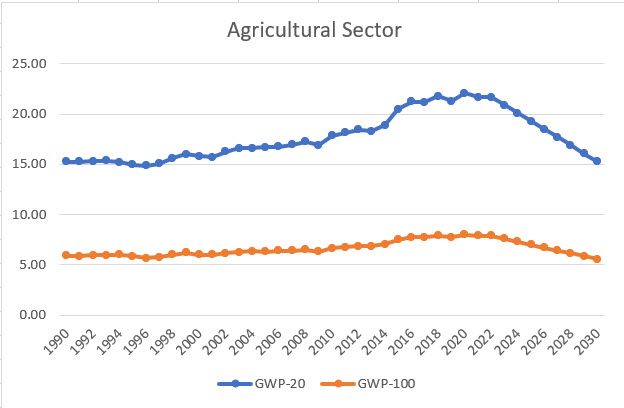
One of the difficulties addressing the Climate Leadership & Community Protection Act (Climate Act) is that there are so many numbers associated with so many aspects of the mandated transition to net zero. One problem with the numbers is that quality varies so much . There is one source of New York electric system data that is of such high quality that it is the gold standard and has been referred to as the gold book for many years. This post provides links to the latest version that came out on April 28 and provides an example of how I use the data.
I have been following the Climate Act since it was first proposed. I submitted comments on the Climate Act implementation plan and have written over 300 articles about New York’s net-zero transition because I believe the ambitions for a zero-emissions economy embodied in the Climate Act outstrip available renewable technology such that the net-zero transition will do more harm than good. The opinions expressed in this post do not reflect the position of any of my previous employers or any other company I have been associated with, these comments are mine alone.
Climate Act Background
The Climate Leadership & Community Protection Act (Climate Act) established a New York “Net Zero” target (85% reduction and 15% offset of emissions) by 2050 and an interim 2030 target of a 40% reduction by 2030. The Climate Action Council is responsible for preparing the Scoping Plan that outlines how to “achieve the State’s bold clean energy and climate agenda.” In brief, that plan is to electrify everything possible and power the electric gride with zero-emissions generating resources by 2040. The Integration Analysis prepared by the New York State Energy Research and Development Authority (NYSERDA) and its consultants quantifies the impact of the electrification strategies. That material was used to write a Draft Scoping Plan. After a year-long review the Scoping Plan recommendations were finalized at the end of 2022. In 2023 the Scoping Plan recommendations are supposed to be implemented through regulation and legislation.
Gold Book
The New York Independent System Operator (NYISO) 2023 Load & Capacity Data Report (also known as the “Gold Book”) is now available and has been posted on the NYISO website: 2023 Load & Capacity Data Report (Gold Book). The overview describes the contents:
In this Load and Capacity Data report (“Gold Book”), the New York Independent System Operator, Inc. (“NYISO”) presents load and capacity data for 2023 and future years. Energy and peak forecasts are provided through 2053 by NYISO Load Zone (referenced in the rest of this document as “Zone”) and for the New York Control Area (“NYCA”). Generating capacity is projected through 2033. The information reported in this document is current as of March 15, 2023, unless otherwise noted. The seven sections of this Gold Book address the following topics:
Historical and forecast seasonal peak demand and energy usage, and energy efficiency, electrification, and other distributed energy resources and load-modifying impacts;
Existing and proposed generation and other capacity resources; and
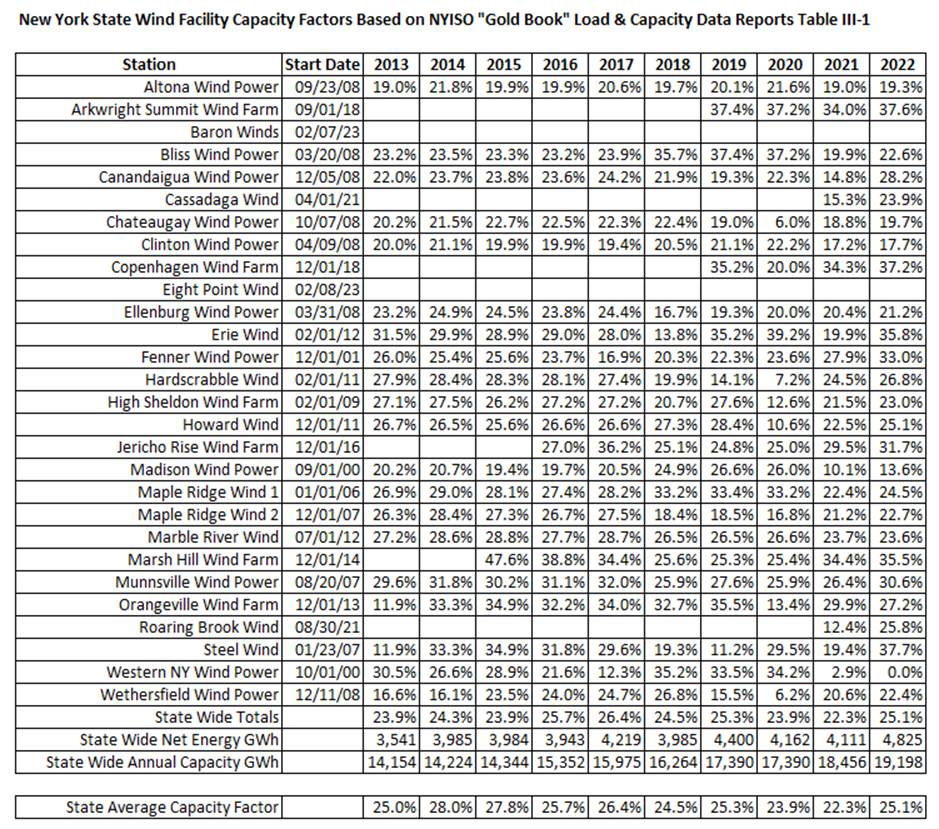
The capacity factor is a useful metric to understand electric generation resources. The annual capacity factor equals the actual observed generation (MWh) divided by maximum possible generation (capacity (MW) times the 8,760 hours. Table III – 2a in the NYCA existing generating facilities spreadsheet lists generating station data that can be used to calculate capacity factors for each generating facility in the state. I developed a spreadsheet that calculates the capacity factors for all the current New York State wind facilities, excerpted below. Note that these are all onshore wind facilities because no offshore wind has been developed yet.
Last year I used the Gold Book data to evaluate New York wind resources. I found that there are limitations to New York’s wind resource capability. Dietmar Detering and I have corresponded about the Integration Analysis wind resource projections. He has found that “The Integration Analysis predicts between 10,997 MW and 13,239 MW of land-based wind installed within New York by 2050, and estimates annual generation between 31,224 GWh and 37,896 GWh which corresponds to a capacity factor of about 33%. The capacity factor table shows that the maximum state-wide capacity was 28% in 2014 and was 25.1% in 2022. In order to accurately estimate how many wind resources will be needed those discrepancies need to be reconciled.
In last year’s post I discussed the results. In 2021 the lowest value was the most recent so I suggested that New York’s decreasing capacity factors could reflect the age of the fleet. However, in 2022 the capacity factor went up again. I don’t see any general relationship between the age of most of the units and capacity factor reductions except for the two oldest facilities. The Madison and Western NY facilities came on line in 2000. Given that there was no generation in 2022 for Western NY I presume that it has been retired. Madison capacity factors the last two years have been about half of the generation in previous years. As far as I can tell the Integration Analysis assumes “indefinite” expected lifetimes for energy storage, wind and solar infrastructure and assigns lifetimes to other resources despite the fact that expected renewable resource lifetimes are half that of other resources. Based on this information ignoring expected lifetimes is inappropriate.
Finally, there is another aspect of the Integration Analysis that is too simplistic. The observed capacity factors over the last ten years show quite a bit of variability between the various wind facilities and between each year. In order to provide adequate renewable energy, this variability must be considered. In particular, if the average wind capacity factors are used to project how much wind capacity is needed, then when there is a year with low wind availability there won’t be enough energy available. I have seen no indication that the Integration Analysis considered this aspect.
Conclusion
The aptly named Gold Book is the ultimate source for New York electricity system data. There is a wealth of information about New York’s load and generating resources. This post showed just one example of the usefulness of the data relative to understanding the Climate Act transition plan. Unfortunately, the Integration Analysis did not incorporate information in the Gold Book. As shown here the Scoping Plan estimates of wind resources needed apparently do not consider inter-annual variability. The capacity factor used in the analysis is more representative of an upper bound than a realistic value for planning purposes. As a result, the projected wind resources needed are lower than what will be needed to keep the lights on and the costs needed to provide the power are lower than they should be.
One of the difficulties associated with describing the challenge of the Climate Leadership & Community Protection Act (Climate Act) is that many of the concepts are difficult to describe to the general public. Tyler Duren writing at Zero Hedge published an article, The Renewable Intermittency Challenge, that did a good job introducing the challenges associated with intermittency. This post expands upon his article because I think he underestimates the difficulty of a solution.
I have been following the Climate Act since it was first proposed. I submitted comments on the Climate Act implementation plan and have written over 300 articles about New York’s net-zero transition because I believe the ambitions for a zero-emissions economy embodied in the Climate Act outstrip available renewable technology such that the net-zero transition will do more harm than good. The opinions expressed in this post do not reflect the position of any of my previous employers or any other company I have been associated with, these comments are mine alone.
Climate Act Background
The Climate Leadership & Community Protection Act (Climate Act) established a New York “Net Zero” target (85% reduction and 15% offset of emissions) by 2050 and an interim 2030 target of a 40% reduction by 2030. The Climate Action Council is responsible for preparing the Scoping Plan that outlines how to “achieve the State’s bold clean energy and climate agenda.” In brief, that plan is to electrify everything possible and power the electric gride with zero-emissions generating resources by 2040. The Integration Analysis prepared by the New York State Energy Research and Development Authority (NYSERDA) and its consultants quantifies the impact of the electrification strategies. That material was used to write a Draft Scoping Plan. After a year-long review the Scoping Plan recommendations were finalized at the end of 2022. In 2023 the Scoping Plan recommendations are supposed to be implemented through regulation and legislation.
Over many years New York electric planners have developed modeling procedures that project the resource adequacy necessary to maintain current reliability standards that keep the lights on when needed the most. The current reliability procedures were developed for generation resources that can be turned on, ramped up, ramped down, and turned off as needed, have well understood forced outage rates, and do not necessarily stop operating all at the same time. Wind and solar resources do not have any of those characteristics which makes future reliability planning much more difficult. This post looks at the problem of intermittency.
Intermittency Challenge
All quotations below are from the article The Renewable Intermittency Challenge. To be fair my criticisms of this work are based on the presumption that intermittency is a significant problem when the energy system is intended to get to a net-zero target. Author Tyler Duren introduces the challenge by giving an overview of the electric system:
The U.S. has a dynamic electricity mix, with a range of energy sources generating electricity at different times of the day.
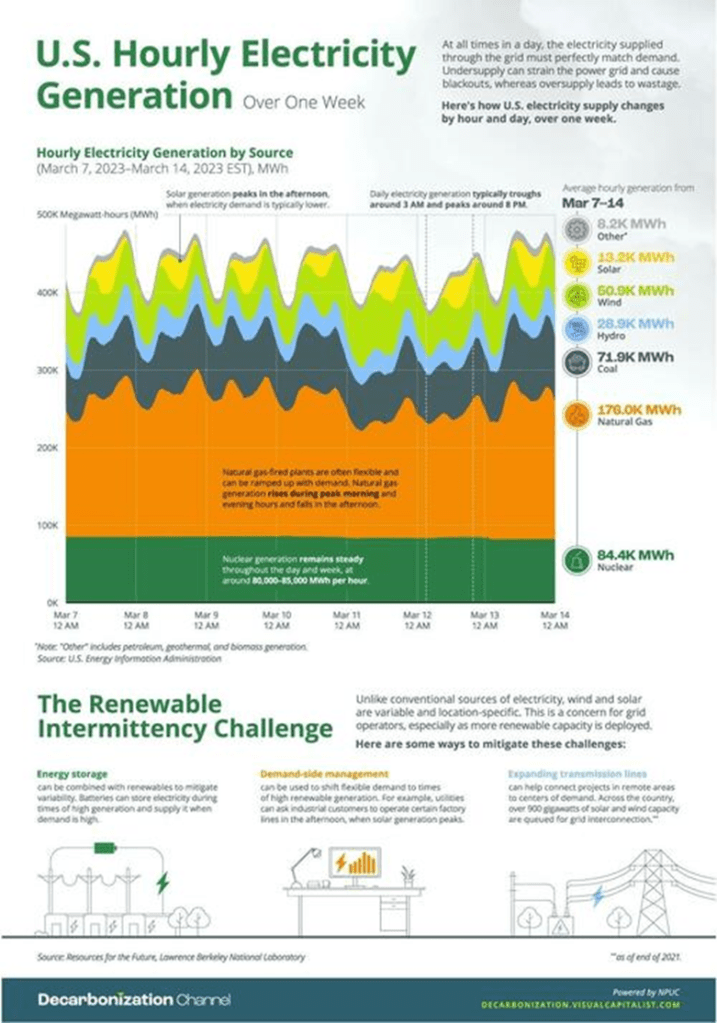
At all times, the amount of electricity generated must match demand in order to keep the power grid in balance, which leads to cyclical patterns in daily and weekly electricity generation.
It may difficult to read the summary of the renewable intermittency challenge in the previous figure. It says “Unlike conventional sources of electricity, wind and solar are variable and location-specific. This is a concern for grid operators, especially as more renewable capacity is deployed”. I agree with this description.
Duren goes on to explain that the electric load is met with three types of power plants. He describes daily load cycles and the use of these power plants. In my opinion, some peaking power plants are not normally used for daily load variations. Some of these units only are operated at times of high loads like an extended period of hot weather and high loads.
The Three Types of Power Plants
Before diving in, it’s important to distinguish between the three main types of power plants in the U.S. electricity mix:
Base load plants generally run at full or near-full capacity and are used to meet the base load or the minimum amount of electricity demanded at all times. These are typically coal-fired or nuclear power plants. If regionally available, geothermal and hydropower plants can also be used as baseload sources.
Peak load or peaking power plants are typically dispatchable and can be ramped up quickly during periods of high demand. These plants usually operate at maximum capacity only for a few hours a day and include gas-fired and pumped-storage hydropower plants.
Intermediate load plants are used during the transitory hours between base load and peak load demand. Intermittent renewable sources like wind and solar (without battery storage) are suitable for intermediate use, along with other sources.
This simplistic overview did not explain the difficulties facing a system that relies on intermittent wind and solar. In an article co-authored with Russel Schussler we explained some of the issues with peaking power when most of the energy is supplied by wind and solar.
Duren goes on to show how electricity generation meets load on an hourly basis.
Zooming In: The U.S. Hourly Electricity Mix
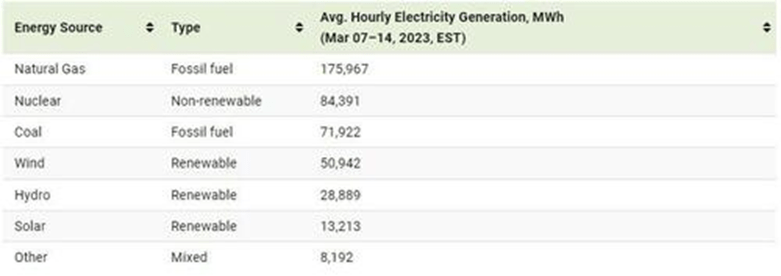
With that context, the table below provides an overview of average hourly electricity generation by source for the week of March 7–March 14, 2023, in the Eastern Time Zone.
It’s worth noting that while this is representative of a typical week of electricity generation, these patterns can change with seasons. For example, in the month of June, electricity demand usually peaks around 5 PM, when solar generation is still high, unlike in March.
Natural gas is the country’s largest source of electricity, with gas-fired plants generating an average of 176,000 MWh of electricity per hour throughout the week outlined above. The dispatchable nature of natural gas is evident in the chart, with gas-fired generation falling in the wee hours and rising during business hours.
Meanwhile, nuclear electricity generation remains steady throughout the given days and week, ranging between 80,000–85,000 MWh per hour. Nuclear plants are designed to operate for long durations (1.5 to 2 years) before refueling and require less maintenance, allowing them to provide reliable baseload energy.
On the other hand, wind and solar generation tend to see large fluctuations throughout the week. For example, during the week of March 07–14, wind generation ranged between 26,875 MWh and 77,185 MWh per hour, based on wind speeds. Solar generation had stronger extremes, often reaching zero or net-negative at night and rising to over 40,000 MWh in the afternoon.
Because wind and solar are often variable and location-specific, integrating them into the grid can pose challenges for grid operators, who rely on forecasts to keep electricity supply and demand in balance. So, what are some ways to solve these problems?
Duren suggests that these challenges can be solved. His suggestions will be the focus of the remainder of this post. Rafe Champion describes the issue of wind droughts that undermines the ability of these solutions to work in a system that relies heavily on wind and solar. If the renewables are only intended to augment the existing system much of the following discussion is appropriate. However, the only reason to install wind and solar is to mitigate climate change which requires a net-zero solution so I do not believe there is any reason to consider limited penetration of renewables.
Solving the Renewable Intermittency Challenge
As more renewable capacity is deployed, here are three ways to make the transition smoother.
Energy storage systems can be combined with renewables to mitigate variability. Batteries can store electricity during times of high generation (for example, in the afternoon for solar), and supply it during periods of peak demand.
Demand-side management can be used to shift flexible demand to times of high renewable generation. For instance, utilities can collaborate with their industrial customers to ensure that certain factory lines only run in the afternoon, when solar generation peaks.
Expanding transmission lines can help connect high-quality solar and wind resources in remote regions to centers of demand. In fact, as of the end of 2021, over 900 gigawatts of solar and wind capacity (notably more than the country’s current renewable capacity) were queued for grid interconnection.
Energy Storage
Duren makes a common mistake when describing the electric system. He only talks about average conditions. His description of energy storage systems only addresses daily variations: “Batteries can store electricity during times of high generation (for example, in the afternoon for solar), and supply it during periods of peak demand.” The bigger problem is that wind and, to a lesser extent, solar can also be subject to longer periods of reduced output that complicates energy storage requirements. In a net-zero electric system I believe that wind droughts are a fatal flaw because existing energy storage technology is too limited and too expensive.
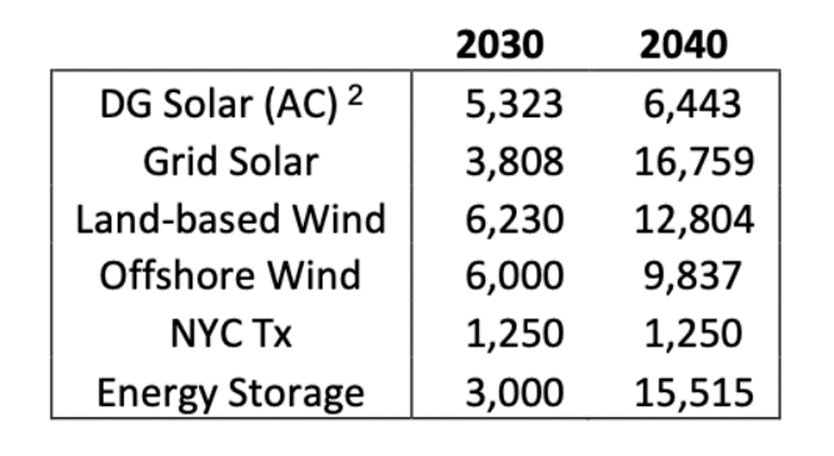
Francis Menton writing at the Manhattan Contrarian described work by Bill Ponton that addressed energy storage requirements for the Climate Act transition plan over longer time periods than a day. They evaluated “Initial Report on the New York Power Grid Study” which includes the following table of how much wind, solar and storage capacity needed to meet the net-zero transition targets of the Climate Act .
Menton describes the energy storage provisions:
But far more absurd is the provision in this Report for prospective energy storage. Note the numbers in the table above — 3 GW in 2030 and 15.5 GW in 2040. As usual they leave out the duration of the batteries. But Ponton wrote to the lead author of the Report from the Brattle Group, a guy named Hannes Pfeifenberger, to get the information. Result:
I asked one of the principal authors of the NY Power Grid study report, Hannes Pfeifenberger, how did he intend to balance fluctuations in wind power and he stated that the biggest factor was 17 GW of battery storage with a maximum duration of 6-hr, totaling 102 GWh. His response is surprising. I calculated that with wind power capacity of 84 GW, there was 59,851 GWH of wind energy curtailed and 48,071 GWH of gas turbine energy used. In theory, the curtailed wind energy could be stored and then subsequently discharged to substitute for the energy provided by the gas turbines, but would require energy storage of 12,000 GWH.
102 GWh versus 12,000 GWh. So, as usual with the studies we can find for places like New York and California, they’re off on the storage requirement by a factor of more than 100.
I have tried to make my own estimates of energy storage requirements and they are the same order of magnitude as described here. The main point is that Duren does not address this problem at all.
Demand-Side Management
Simplistic evaluations of net-zero transition programs also suggest that reducing load through programs like demand-side management can be a viable solution. There are two issues. The first is that net-zero programs refer to the entire economy and emission reductions from transportation and residential heating, hot water, and cooking, rely on electrification which necessarily increases load. This is a particular problem when loads are highest. Duren writes that “Demand-side management can be used to shift flexible demand to times of high renewable generation. For instance, utilities can collaborate with their industrial customers to ensure that certain factory lines only run in the afternoon, when solar generation peaks.” There is a limited amount of load shifting possible when temperatures are coldest, electric vehicle charging and battery capabilities are lowered, and everyone needs electricity to keep warm.
Expanding Transmission Capabilities
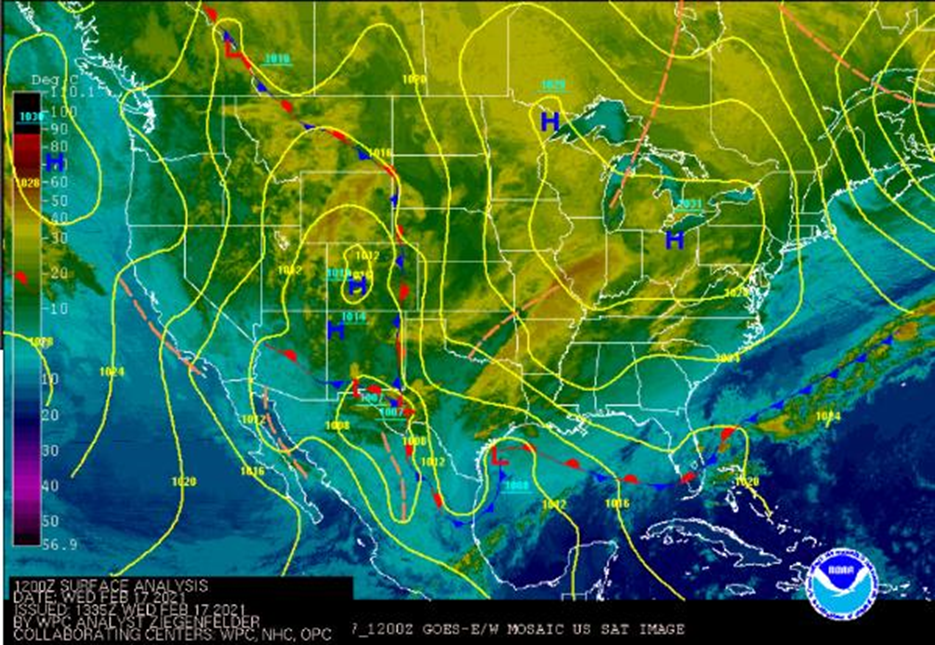
Another favorite solution of naïve energy analysts is predicated on the concept that the wind is always blowing somewhere. Duren writes: “Expanding transmission lines can help connect high-quality solar and wind resources in remote regions to centers of demand. In fact, as of the end of 2021, over 900 gigawatts of solar and wind capacity (notably more than the country’s current renewable capacity) were queued for grid interconnection.” In general that is true and that might work for a net-zero electric system on average. Unfortunately, the coldest and hottest weather, and thus the highest load, is strongly correlated with high pressure systems that also have the lowest wind resources.
In a presentation describing my skeptical concerns about the Climate Act I addressed this problem in detail. In brief, consider the following weather map of February 17, 2021 during the period of the Great Texas Freeze. This event was associated with an intensely cold polar vortex huge high-pressure system. Remember that winds are higher when the isobars are close together. On this day there are light winds from New York to the southeast, west, and north including the proposed New York offshore wind development area. There are packed isobars in northeastern New England, in the western Great Plains, and central Gulf Coast where wind resources would be plentiful. For New York to guarantee wind energy availability from those locations, wind turbines and the transmission lines between New York and those locations would have to be dedicated for our use. Otherwise, jurisdictions in between would claim those resources for their own use during these high energy demand days. It is unreasonable to expect that this could possibly be an economic solution.
Conclusion
I liked the introduction of Duren’s article. He gives a good overview of the balancing act necessary to constantly match generating resources with the load. The graphics illustrate his points well too. He does not explicitly address net zero targets and that avoids addressing the problem that what works for today’s systems will not work when the system relies on intermittent renewables. In the context of a net-zero electric system that eliminates fossil-fired generation, I do not believe his conclusion that there are readily available solutions that address the intermittency challenge is correct.
If the future electric system has to rely on weather-dependent resources, then the question of worst-case availability has to be addressed. Analyses done to date in New York State have all shown that there are wind lulls in the winter that are difficult to address using existing energy storage technology. The Integration Analysis and the New York Independent System Operator Resource Outlook analyses of future resource requirements have both concluded that the solutions recommended by Duren are inadequate and a new dispatchable emissions-free resource (DEFR) must be developed to address the wind lull intermittency problem. The Resource Outlook notes “The lead time necessary for research, development, permitting, and construction of DEFR supply will require action well in advance of 2040 if state policy mandates under the CLCPA are to be achieved”.
In addition to the challenge of developing an entirely new resource, in order to determine the resource capabilities necessary for the worst-case, a comprehensive analysis of wind and solar resource availability is needed. If that analysis does not get the right resource availability, then there will not be enough energy available to supply everyone who needs it during the worst conditions. If either of these challenges is not met adequately, people will freeze to death in the dark.
On April 4, 2023 Citizens Campaign for the Environment hosted “Lunch & Learn: Whale Tales and Whale Facts”. I have published a couple of articles about whales and offshore wind development recently so I am providing this for more information. I have incorporated comments from a retired fisheries expert who was a colleague of mine and an update of all the recent dead sea mammals washing ashore along the NY/NJ coastline.
I have been following the Climate Act since it was first proposed. I submitted comments on the Climate Act implementation plan and written over 300 articles about New York’s net-zero transition because I believe the ambitions for a zero-emissions economy embodied in the Climate Act outstrip available renewable technology such that the net-zero transition will do more harm than good. The opinions expressed in this post do not reflect the position of any of my previous employers or any other company I have been associated with, these comments are mine alone.
Climate Act Background
The Climate Leadership & Community Protection Act (Climate Act) established a New York “Net Zero” target (85% reduction and 15% offset of emissions) by 2050 and an interim 2030 target of a 40% reduction by 2030. The Climate Action Council is responsible for preparing the Scoping Plan that outlines how to “achieve the State’s bold clean energy and climate agenda.” In brief, that plan is to electrify everything possible and power the electric gride with zero-emissions generating resources by 2040. The Integration Analysis prepared by the New York State Energy Research and Development Authority (NYSERDA) and its consultants quantifies the impact of the electrification strategies. That material was used to write a Draft Scoping Plan. After a year-long review the Scoping Plan recommendations were finalized at the end of 2022. In 2023 the Scoping Plan recommendations are supposed to be implemented through regulation and legislation. The net-zero transition plan anticipates extensive offshore wind development. The Climate Act mandates 9 GW of offshore wind by 2035 and the Integration Analysis recommends 14 GW by 2040. Note that the NYISO projection for offshore wind is 9 GW. I am particularly concerned because the state projects 14GW of offshore wind but has only attempted to address the cumulative environmental impacts of 9 GW – a more than 55 increase.
Dead Sea Mammal Holocaust
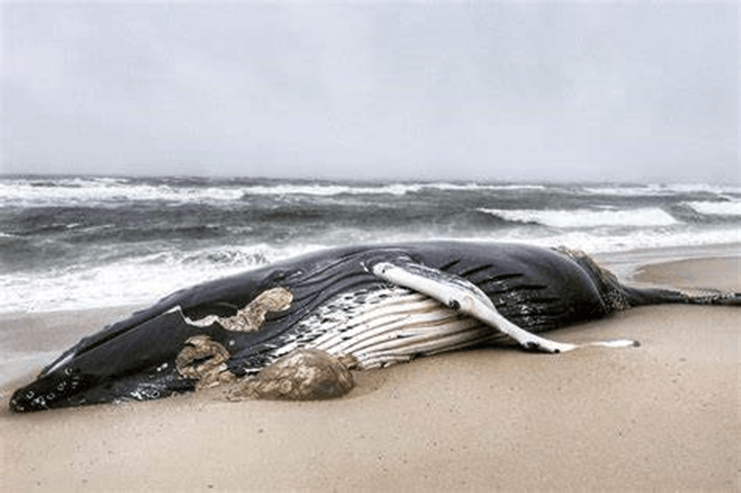
There is no question that there has been a marked increase in sea mammal deaths since 2016. Mark Sertoff compiled the following list of recent deaths and suggested that I publish it.
www.nytimes.com/…/east-coast-whale-deaths.html In all, 23 dead whales have washed ashore along the East Coast since early December, including 12 in New Jersey and New York, according to the National Oceanic and Atmospheric Administration….
www.app.com/story/news/local/land-environment/... Across the Jersey Shore, 10 dead whales — mostly humpbacks — washed ashore or have been seen off the coast since Dec. 1, 2022. The strandings are part of what federal authorities are calling…
www.usatoday.com/story/graphics/2023/03/15/east... USA TODAY Since Dec. 1, 23 whales have been found dead along the Atlantic Coast, part of a trend in unusually high deaths among three whale species since 2016-2017. The National Oceanic and…
www.usatoday.com/story/news/nation/2023/02/15/... 78 dead whales were reported in 2017, including humpbacks and right whales, and 59 in 2018, 2019, and 2020. An average of 52 whales have died each year along the coast since 2007. In 2022,…
www.app.com/story/news/local/land-environment/... Six dead whales washed ashore in the past 33 days across New Jersey and New York, according to the environmental group Clean Ocean Action, one of five groups who called for an investigation….
www.wshu.org/long-island-news/2023-01-11/6-dead... Six endangered whales have washed up dead on the shores of Long Island and New Jersey over the past month, an unprecedented number for this area in the last half century. These whales…
nypost.com/2023/02/13/dead-whale-washes-onto... A dead whale was found on a New Jersey beach Monday — the ninth one to wash ashore in the New York-New Jersey area since early December in what activists are calling an alarming uptick. The…
www.nj.com/news/2023/02/another-dead-whale... Since January 2016, 181 dead stranded humpback whales were reported across 13 states, including 24 in New Jersey and 35 in New York. A ship strike or entanglement with fishing gear accounted…
newjersey.news12.com/16-dolphins-dead-along-new... Eight dolphins died Wednesday after getting stranded along a beach in Cape May County. According to the Marine Mammal Stranding Center, a pod of eight dolphins became stranded on the beach on Tuesday. Two dolphins died and the other six were euthanized to prevent further suffering of the animals.
www.nytimes.com/2023/03/22/nyregion/dolphins... March 22, 2023 Eight dolphins were dead after a pod of the marine mammals washed ashore in a mass stranding in Sea Isle City, N.J., on Tuesday, the authorities said, prompting questions over…
www.npr.org/2023/03/22/1165249049 A pod of eight dolphins washed ashore in New Jersey, all of which have died, according to a local animal rescue organization. Two common dolphins, an adult and a calf were first found on a…
abcnews.go.com/US/8-dolphins-dead-after-washing... Eight dolphins were stranded on a beach in Sea Isle, N.J., on March 21, 2023. WPVI A pod of eight dolphins died after being stranded on two beaches in New Jersey on Tuesday, according to an animal rescue and rehabilitation center.
abcnews.go.com/US/wireStory/officials-8-dolphins... Marine animal welfare officials say eight dolphins have died after they became stranded on a beach in New Jersey By The Associated Press March 21, 2023, 4:51 PM SEA ISLE CITY, N.J. — Eight dolphins have died after they became stranded on a beach in New Jersey, marine animal welfare officials said.
www.reddit.com/r/newjersey/comments/115mw4u/wtf... WTF is happening with dead whales and dolphins in NJ? So I just saw that 3 dolphins beached themselves and died in Sandy Hook during low tide TODAY, literally about an hour ago. This on top of the dead whales we’ve seen so far in the past few weeks and also in Long Island.
abc7ny.com/dead-dolphins-sandy-hook-bay-new... The dolphin deaths come after a surge of whales washing up in both New York and New Jersey in recent months. Since the beginning of December, there have been at least nine whale deaths.
www.usatoday.com/story/news/nation/2023/03/21/... 1:15. Six dolphins found off the shore of New Jersey were euthanized Tuesday and another two were found dead after a pod was discovered in a “mass stranding event,” according to a non-profit …
Since 2016, we have witnessed an increase in whale strandings and whale deaths off the coast of America’s shores. These endangered species are under threat from several sources, including ship strikes, fishing gear, plastic pollution, and climate change. Unfortunately, misinformation about whale deaths and an association with offshore wind development has led to concerns about transitioning from fossil fuels to renewable energy. These local wind projects are crucial to combat climate change, which is not only a threat to whales but also to marine mammals, fisheries, and our communities.
CCE works at the local, state, regional, and federal level to advance solutions to the climate crisis. We advocate for comprehensive energy policies that support renewable energy (such as offshore wind and solar power) and energy efficiency, while ending our dependence on dirty, polluting fossil fuels.
In addition, Wind Works Long Island collaborated with CCE for the meeting. Wind Works Long Island is a coalition of environmental, labor, clergy, and community groups, and the force behind educating the Long Island community on the benefits of renewable energy, particularly offshore wind.
The virtual forum had “whale experts” from Atlantic Marine Conservation Society, the New York State Department of Environmental Conservation and the US Bureau of Ocean Energy Management. They talked about the recent whale strandings and deaths, what is being done on the local, state, and federal level to protect whales.
Before the “whale experts” spoke three hosts introduced the topic. Adrienne Esposito, Executive Director, Citizens Campaign for the Environment was the moderator. She argued that there are factors (what are the factors)that have increased the number of whales close to shore and that there are causes of whale deaths that are more likely causes for the observed whale strandings and deaths. Julie Tighe, President, New York League of Conservation Voters, said that disinformation is a problem for the offshore wind industry. Fred Zalcman, Director, New York Offshore Wind Alliance, emphasized that the developers are committed to responsible offshore wind development.
I encourage interested readers to watch the video. I learned a lot and have a better understanding of the situation. However, I still have concerns. In the following I summarize my notes.
Meghan Rickard, Marine Zoologist, NYS Department of Environmental Conservation described the baseline monitoring program that the state did (video at 11:55 of the recording). She said there is no long-term data but they seem to be increasing especially in the New York Bight. The emphasis of the DEC has been on baseline monitoring but they are planning to continue to monitor. Unfortunately, she noted that the funding available is half of what was available for the baseline.
Erica Staaterman, Division of Environmental Assessment and Center for Marine Acoustics, US Bureau of Ocean Energy Management (BOEM) described the fisheries regulations (video starting at 26:51). She explained:
“The term take means to harass, hunt, capture, or kill, or attempt to harass, hunt, capture, or kill any marine mammal” – MMPA. In general for BOEM activities, very little lethal take is ever authorized by NOAA. NOAA is not authorizing any lethal take for offshore wind activities. NOAA fisheries can authorize incidental (unintentional) take of small numbers of marine mammals for certain activities, like offshore wind development. Two types of incidental take:
“Level A” = injury. For acoustics, this is auditory injury, i.e. permanent hearing loss. Acoustic thresholds are established by NMFS and differ by species group.
“Level B” = behavioral disturbance. For acoustics, this includes behavioral disturbance from a sound source and possibly temporary (i.e. recoverable) hearing loss. Threshold is 160 dB re 1 µPa for all species.
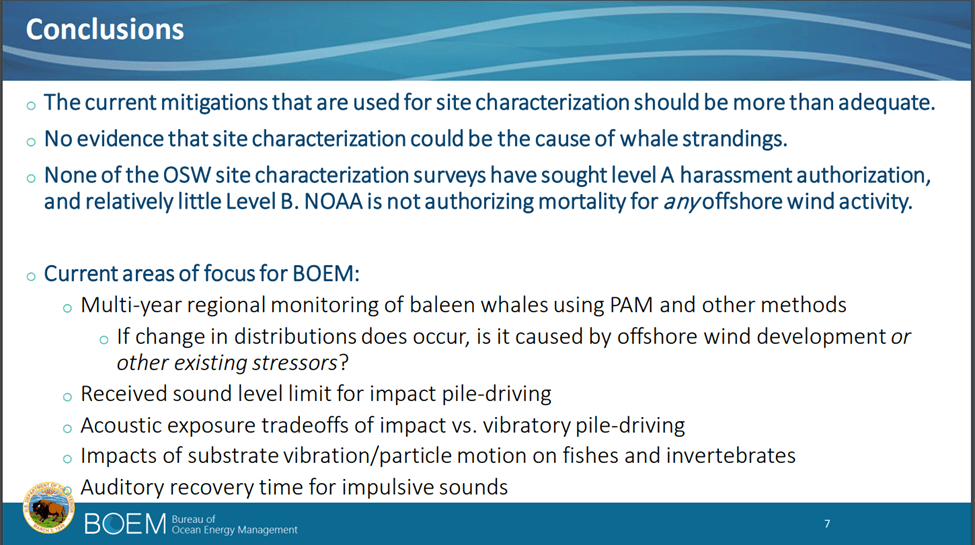
I found her presentation very enlightening. She explained that most of the offshore wind activities to this point are mapping the seafloor using high-resolution geophysical (HRG) sources. They are lower in energy and have key characteristics that set them apart from most other manmade noise sources. Importantly they are directional. She stated that “There is no evidence that HRG sources used by offshore wind companies could cause mortality of whales, nor any evidence that they are responsible for the recent whale strandings.” The following slide presents her conclusions.
Robert DiGiovanni, Founder and Chief Scientist, Atlantic Marine Conservation Society convinced me that this is a complicated issue in his presentation (video starting at 42:18). He explained that the environment has changed recently there are simply many more whales although inter-annual variability of whale locations makes counting the whales difficult. He said that most deaths are due to ship strikes and noted that we cannot use the experience in the European offshore wind farms to project what might happen here because whales there are different.
The question and answer session (video starting at 1:00:00) was interesting but I am not going to take the time to go over it.
Discussion
I am not a fisheries biologist do I asked a former colleague who is an expert to review this post. My takeaway was that that even though there is a correlation between the recent uptick in whale mortality and the offshore wind site characterization work that I do not disagree with the BOEM conclusion that there is no evidence that work is the cause of the recent whale strandings. However, that does not mean that this is still not an issue.
My expert reviewer said that the presentation missed a few key points:
What are the studies underway to identify and build upon the European experience given the ecosystem differences. Do they have the funding to do this work adequately. As we work to decrease the impact of vessel strikes and fishing gear do we understand what the windfarms will do to migratory patterns; feeding; prey behavior etc. Will offshore windfarm noise when the turbines become operational become a problem with new noise pollution. They failed to acknowledge NOAA research identifying chronic anthropomorphic noise as a significant issue for marine mammals.
The presentation showed that there are several reasons that the site characterization work is not a likely cause of the recent observed whale morality. Those reasons include the following: the sounds generated by the mapping equipment do not overlap much with whale hearing ranges, the sounds are intermittent, the mapping uses short pulses of sound with relatively long periods of silence, and the sounds are directional into the seafloor. The problem not addressed in this forum is that these reasons are not characteristic of offshore wind turbine construction. The BOEM is focusing their work now on construction impacts including a sound level limit for impact pile-driving, acoustic exposure tradeoffs of impact vs. vibratory pile-driving, impacts of substrate vibration/particle motion on fishes and invertebrates, and auditory recovery time for impulsive sounds. The following table shows that construction impacts overlap whale hearing ranges.
My reviewer pointed out that the lack of funds for this important effort is appalling (only $2.6 M for both the Great Lakes and Ocean). With billions allocated to green initiatives this makes no sense given the potential impacts. The real issue is what happens when construction starts on the offshore turbines with sound characteristics that are very likely to disorient the whales. The whales may not die from the cacophony of construction noise throughout the New York bight but the likelihood that the din could disorient the whales so that they could become much more susceptible to vessel strikes was not addressed in this forum.
The New York Offshore Wind Alliance claims that the developers are committed to responsible offshore wind development. It is time to stop the slogans and prove it. They should ensure that the New York whale monitoring program is fully funded and be prepared to stop development if their construction activities do adversely affect whales until such time that mitigating activities can be incorporated into their construction plans.
Given all the unknowns the rational approach would be to determine if there are adverse construction impacts before starting the development of the all the infrastructure necessary to build the offshore wind resources proposed. Clearly it is appropriate to accelerate the BOEM analyses of potential construction activities. Moreover, given the immense political pressure to develop offshore wind there should be an independent evaluation of the impact of construction activities. If that work indicates that there any adverse impacts can be mitigated then the development should be allowed to proceed.
My reviewer made some other relevant points.
The lack of funding for independent research is criminal given the enormous public tax funded budgets behind offshore wind development. In a nutshell, why race to install a tiny fraction of electrical resource of offshore wind development that will have no demonstrated impact on the global climate just to feel good or as a symbolic gesture? The Climate Act proposal for 9 GW can in no way be adequate to keep pace with current electrical demand let alone the push for electrification of everything (cars, heat, and cooling) but can have an irreversible impact on the coastal offshore environment.
We clearly have vast information concerning the impacts of terrestrial onshore wind development and operation, primarily because we are terrestrial. The terrestrial environment is comparatively extremely easy to study, we can touch, feel, measure, and observe with our own eyes. This is not so with the ocean and its biota of which we only understand a miniscule amount. We are naïve to think we can hastily dive headlong into the abyss we know so little about to develop a very limited resource when we know we cannot accurately measure the effect of this development on global climate. The use of terms such as misinformation or disinformation in the current political environment when whales are dying and people have common sense concerns is disingenuous and only leads to more distrust. The whale experts provided some valuable insight into the current knowledge of acoustic survey work and its minimal potential to be the cause behind whale deaths. Moving to actual construction should be the primary concern and this was not addressed. Additionally, the current level of funding for monitoring alone was discussed and it appears wholly inadequate for such a significant project and raises concerns that cumulative impact analysis for the proposed offshore wind development will never be sufficient to determine if there are unacceptable adverse impacts.
Conclusion
I have observed that the more vociferous/louder the criticisms made by a stakeholder the more likely that the stakeholder is guilty of the same thing. The introductions to the webinar mentioned that disinformation is a problem for the offshore wind industry. They went on to state that “these endangered species are under threat from several sources, including ship strikes, fishing gear, plastic pollution, and climate change”. They offered no proof how climate change could affect whales but their emotional attachment to that disinformation narrative that the existential threat of climate change affects everything is such that it is just presumed.
They are facing a quandary now that there is a correlation between whale deaths and offshore wind site surveys. They state that it is disinformation to claim that this correlation suggests that there are concerns about transitioning from fossil fuels to renewable energy. The organizers of the forum clung to the conviction that the site survey characteristics are unlikely to be the cause of the whale strandings observed to date. Based on the specific information provided by the experts who spoke I tend to agree. However, I also want to point out that their existential threat narrative is based on a similar correlation between GHG emissions and climate change. If they were willing to consider the possibility that might be similarly flawed then the fact that correlation does not necessarily mean causation could destroy the entire rationale for risking the welfare of the whales.
Ultimately the problem with the forum is that they ignored the fact that construction noises will be substantially different than the ongoing site surveys and will probably be much more extensive when the massive planned construction starts. Those differences are more likely to impact whales. Despite all the talk of responsible offshore wind development no one has offered a plan to ensure that if construction impacts are found that they will change their plans. In my opinion, it is irresponsible to continue the headlong dash to develop offshore wind resources without first determining whether the construction and operation of the massive number of wind turbines will unacceptably affect the whale’s future.
The forum did clearly inform listeners about the lack of funding for monitoring necessary to address the many concerns with massive offshore wind development to allay the concerns of the public. It is particularly galling that the offshore wind proponents who claim to be in favor of responsible offshore wind development are not stepping up to ensure that future monitoring efforts are adequate. Maybe they don’t want to know the answer if the concerns are real.
A couple of recent articles caught my attention as very good summaries of the challenges of the Climate Leadership & Community Protection Act (Climate Act) transition plan to achieve net zero by 2050. I provide summaries with extensive quotes but I recommend readers take the time to go to the original articles and read the whole thing.
I have been following the Climate Act since it was first proposed. I submitted comments on the Climate Act implementation plan and written over 300 articles about New York’s net-zero transition because I believe the ambitions for a zero-emissions economy embodied in the Climate Act outstrip available renewable technology such that the net-zero transition will do more harm than good. The opinions expressed in this post do not reflect the position of any of my previous employers or any other company I have been associated with, these comments are mine alone.
Climate Act Background
The Climate Act established a New York “Net Zero” target (85% reduction and 15% offset of emissions) by 2050. The Climate Action Council is responsible for preparing the Scoping Plan that outlines how to “achieve the State’s bold clean energy and climate agenda.” In brief, that plan is to electrify everything possible and power the electric gride with zero-emissions generating resources by 2040. The Integration Analysis prepared by the New York State Energy Research and Development Authority (NYSERDA) and its consultants quantifies the impact of the electrification strategies. That material was used to write a Draft Scoping Plan. After a year-long review the Scoping Plan recommendations were finalized at the end of 2022. In 2023 the Scoping Plan recommendations are supposed to be implemented through regulation and legislation.
The New York official Climate Act webpage describes the Scoping Plan as the “framework for how New York will reduce greenhouse gas emissions and achieve net-zero emissions, increase renewable energy use, and ensure all communities equitably benefit in the clean energy transition”. It has also been aptly described as “a true masterpiece in how to hide what is important under an avalanche of words designed to make people never want to read it”. Importantly, the basis of the document, the Integration Analysis, does not provide enough detail to determine if the conglomeration of control strategies that they have cobbled together will actually work together as proposed in general, and, in particular, on the arbitrary schedule mandated by the Climate Act.
New York GHG emissions are less than one half of one percent of global emissions and global emissions have been increasing on average by more than one half of one percent per year since 1990. This does not mean that New York State should not do something, but it certainly eviscerates any claims that we do not have time to fully evaluate what has been recommended in the Scoping Plan framework.
Francis Menton writing at the Manhattan Contrarian and Arnold Wallenstein writing at Utility Dive both argue that there are fundamental flaws in the transition plan that will add costs and reduce reliability. However, in the land of Albany politics the disconnect between aspirations and reality is not apparent.
Samar Khurshid writing at the Gotham Gazette wrote a good overview of the current status of the 2023 implementation push entitled Major Climate and Energy Policies Being Decided in Albany State Budget Negotiations. He quoted Senator Pete Harckham, a Westchester Democrat who chairs the Senate’s Committee on Environmental Conservation, as saying:
“Consumers are eventually going to be paying less on their utility bills, because energy will be less expensive,” he added. “We’ll lower our health care costs and we’ll be creating 130,000 high-paying union jobs. So there are a lot of upsides to this as we go forward.”
The idea that utility bills will go down is so incredibly out of touch that I can only attribute that belief as religious dogma. The only way someone can believe that is if they do not understand the difference between power and energy. In brief, you pay for energy so the comparison metric should be energy produced by wind and solar. It does not matter if wind and solar provide cheaper power than a fossil plant. Because those resources are intermittent it is necessary to backup them up when the wind is not blowing and the sun is not shining. When the costs to provide reliable energy are included New York will find, just like every other jurisdiction that has attempted this transition, that the costs are enormous. Enough from me the rest of the post summarizes the opinions of two others who share my view.
Menton on the Climate Act Transition Plan
Francis Menton is a retired attorney and author of the Manhattan Contrarian blog where over the he has published well over 1000 articles on issues of public policy. Close to one-third of the posts at Manhattan Contrarian deal with the subject of climate change broadly defined, including such topics as the application of the formal scientific method to what passes for climate “science” in today’s academia, and evaluation of the potential costs and practical difficulties of attempting to replace our current energy systems with intermittent wind and solar electricity generation. He is a board member and current President of the American Friends of the Global Warming Policy Foundation.
In his article, New York Goes Full Central Planning For The Electricity Sector, Menton writes that the only option considered in the Climate Act transition is full speed ahead. There hasn’t been a feasibility study or consideration of a demonstration project so there is no clue whether this will work or not. In his article he reviews a document that supposedly gives more detail as to how New York is going to accomplish the net zero transition.
Let me start with a few thoughts on the Con Edison Report. It is lots of verbiage and plenty of charts and graphs. And it is more or less exactly what you would expect if you think for say, one minute, about what position Con Edison might take. As a deeply regulated entity, they are completely required to affirm the directives and applaud the wisdom of their government overlords. But more than that, they are clearly salivating over the prospect of getting to make billions of dollars of new investments, all of which will earn a guaranteed, regulated rate of return for their investors — and if we are really, really lucky, the end result will be that we get the exact same electricity for much higher cost. If we aren’t so lucky, we will get much less reliable electricity for the much higher cost. The cost factor is played down throughout the Report, and we never get any meaningful quantification.
But all the verbiage and charts and graphs mainly have the purpose of obscuring the fact that Con Ed does not take responsibility for making sure that there is enough electricity availability to supply customer demand on the grid. That’s somebody else’s job.
To set the tone, here is a quote from page 1:
[W]e are committed to being the next-generation, clean energy company that our customers deserve and expect. We will play a critical role in delivering on the ambitious climate and clean energy goals set by New York State and New York City, including reaching net-zero greenhouse gas (GHG) emissions by 2050. In addition, the need for safe, reliable, and secure energy infrastructure remains paramount.
OK, where in there did you say that you take responsibility for there being enough electricity to meet demand?
Cost barely gets mentioned in the introductory section. It finally turns up in the last paragraph.
Here’s how they spin it:
We recognize this transition to a net-zero GHG emissions energy system will require significant investment. We seek to make investments that achieve the goals of this transition as cost- effectively as possible, which necessitates growing our electric system while maintaining our gas and steam systems to achieve clean energy goals.
In other words, whoo-boy is there a lot of money for us to make here!
He goes on to discuss that Con Ed does not take responsibility to build the things necessary they only offer support for “interconnection” and “balance.” Then he addresses energy storage and note that Con Ed does not make the proper delineation between power and energy.
And how about the trillions of dollars worth of energy storage that will be needed when the sun doesn’t shine and the wind doesn’t blow? See if you can decode this word salad:
“We have developed plans to build the necessary electric transmission and distribution infrastructure by 2050 to . . . [d]evelop and facilitate up to 12.6 GW of energy storage through direct utility investments and customer programs at customer and utility scales.”
Where even to start? “12.6 GW” of storage? They don’t even know the correct units to discuss this issue. If these are four-hour duration lithium ion batteries (unspecified, but what else could they be talking about?), that will give you 50.4 GWh of storage — enough to cover New York State for a couple of hours at most of low sun and wind. Competent calculations indicate a storage requirement of more like 20 to 30 days of storage to deal with the seasonality of the sun and wind. So this is at best a small fraction of one percent of what will be needed to back up the solar/wind grid of the future.
But what does Con Ed care? They’re not actually saying here that they are taking responsibility for making the new system work, let alone even providing the batteries themselves. They’re only saying that they have “developed plans” to “facilitate” the storage, which could occur either through “utility investments” or “customer programs.” In other words, I guess, hey sucker, use your electric car battery to power the house when the grid goes down.
Arnold Wallenstein on the Climate Act Transition Plan
Arnold R. Wallenstein is a Boston-based attorney who represents independent power producers in New York and other states and is the principal member of the EnergyLawGroup.org. Wallenstein explains in New York’s plan for transforming its electricity generation will reduce reliability at extreme cost that there are obstacles to meeting the ambitious schedule of the Climate Act net-zero transition. He explains why he thinks the transition plan is doomed to failure:
The Climate Action Council projects current electric load in New York to triple by 2040 due to the electrification of transportation and 100% building electrification. By 2040, when all electricity generation must be zero emissions, NYISO, the independent New York grid operator, states that at least 95 GW of new generation must be developed to make up for generation plant retirements and increased electrical demand. This goal is unrealistic and unachievable because the state only added 12.9 GW over the last 23 years, and it is highly unlikely that 95 GW of new generation capacity will be added in 17 years due to state permitting and grid interconnection delays.
The Climate Action Council’s final Scoping Plan also reveals that New York will need 15 GW to 45 GW of new “zero emission dispatchable electric generation” by 2040 to meet increased electric demand and maintain electric system reliability. This is emission-free electric generation that can be dispatched, i.e., turned on, by NYISO at night or stormy conditions when there is no solar radiation or during calm wind conditions. But the Scoping Plan also admits that this 15 GW – 45 GW target “cannot be currently met” with existing technologies.
This dire prediction is confirmed by NYISO, which has issued reports stating that the New York grid may experience as much as a 10% deficiency, and possibly more, in generation capacity by 2040, and will require 32 GW of new zero-emission dispatchable generation by 2040 — which would almost double the current New York grid’s 37 GW generation capacity. NYISO also warns that such zero-emission dispatchable generation technologies “are not commercially available.” Electricity shortages will occur if these new emission-free generation plants do not materialize in time as hoped for by the state. Hope is not an action plan to solve electric reliability deficits.
Electric power deficiency is already starting to occur. A report just issued on April 14 by NYISO points out that New York City and the Lower Hudson Valley may have electric reliability problems and generation shortages starting in 2025 due to generation plant retirements caused by the New York Department of Environmental Conservation shutdown of NOx producing peaker plants and if there are extreme weather events, worsening through 2032, where there may a 600 MW generation deficiency in New York City and environs.
The Climate Action Council’s climate plan — if fully implemented by the state as is currently being debated in the legislature — risks placing New York in an electricity shortage that could result in blackouts and brownouts. The New York grid operator pointed out that if existing gas-fired electric generation is shut before new resources come on line, there is a risk that NYISO will not be able to provide a reliable electric system.
NYISO also said fossil fuel generators — natural gas and oil-fired — will be needed to maintain reliability until non-emitting dispatchable resources can effectively replace the fossil-fired generation plants to provide grid reliability as a back up to intermittent, weather-dependent renewable energy resources. NYISO also predicts than in 2040 when fossil-fueled generators are shut down by state’s climate law, zero-emissions dispatchable generation, which doesn’t yet exist, will still be required to supply 10% or more of New York’s electricity, depending on how many megawatts of new renewable and “dispatchable” emission-free generation is actually operational by 2040.
These warnings of future electric deficiencies are echoed by the New York State Electric Reliability Council and the North American Electric Reliability Corp., the entities tasked with monitoring electric reliability in New York as well as the U.S.
Blackouts during cold winter months can cost lives. When Texas experienced an unprecedented freeze in 2021 between 246 (direct) and 700 (indirect) people died because of power outages. Similarly, many people died in Buffalo’s Christmas 2022 blizzard. That cannot be allowed to happen in New York because of a poorly designed climate plan.
If that wasn’t enough, the cost to implement New York’s climate plan may be stratospheric: authoritative commentators, including the Empire Center for Public Policy, have suggested New York taxpayers and ratepayers will pay $340 billion to $500 billion to transition the New York electric system to primarily relying on solar and wind power supplemented by battery storage.
But no overall cost analysis was provided by the State’s Climate Action Council.
Gavin Donohue, CEO of the Independent Power Producers of New York, refused to vote for the climate plan, and said it would take pure “magic” to make the plan work.
And how much will this costly plan contribute to reduction of greenhouse gases: only 0.4% of global GHG emissions according to recent commentators.
A reliable supply of electricity that can be generated at all times during cold nights and low wind conditions is absolutely essential to our modern economy and our standard of living. The state’s climate plan’s proposed radical changes to the New York electricity generation sector should not be fully implemented by the state until it can guarantee that there will be adequate generation at all times. This means keeping in service some natural gas-fired generation which can quickly ramp up when solar and wind plants are not operating. NYISO warns that with even with increased renewable energy generation by 2040, “at least 17,000 MW of existing fossil generation must be retained to reliably serve forecasted demand.”
Conclusion
The difference between these articles that clearly are based in reality and Harckham’s statement that “Consumers are eventually going to be paying less on their utility bills, because energy will be less expensive” could not be starker. The innumeracy of anyone who thinks that intermittent wind and solar power can ever be cheaper is astounding because the numbers are so straight-forward. It must be that they simply don’t want to hear anything that runs contrary to their cherished narrative. At what point will they concede the risks of this insane policy.
Both authors echo my concerns about the lack of adequate feasibility planning to maintain current reliability standards and the absence of a complete accounting of the costs. This blog is dedicated to the idea that environmental regulation should concentrate on tradeoffs and consideration of all the impacts. Both authors argue that this pragmatic approach is not a characteristic of the Climate Act transition. I agree with Wallenstein that “the New York Climate Action Council’s climate plan, if carried out as intended, will probably not be able to supply New York state with a reliable supply of electricity. And it will cost New York taxpayers and utility customers (i.e., everyone) hundreds of billions of dollars to create a less reliable electric system than New York now enjoys.”
This is a guest post by Mark Stevens, a regular reader at this blog. Mark is a retired science and technology teacher from Long Island. He has put together a good overview of issues associated with Long Island wind power.
The stampede to build offshore wind turbines to replace fossil fuel generation is loaded with concerns that have not been thought through or been resolved.
1- There is no climate crisis: thousands of scientists and meteorologists around the world have published studies that LOCAL extreme events are caused by cyclical weather (decades, centuries, millennia): solar activity, ocean cycles, cosmic ray intensity, volcanic activity (surface and undersea), orbital cycles and planetary cycles to name some. CO2 is NOT causing global warming. In fact, its role is trivial and it is enabling record plant, forest, and crop production. Sea level rise is often due to land subsidence (sinking). There is record polar ice, polar bears are flourishing, and the earth has cooled over the last decade. Coral reefs are fine and Pacific Islands are increasing in area. United Nations Intergovernmental Panel on Climate Change (IPCC) doom and gloom reports have been crying for decades that the end of the planet is here; the reports use faulty input data, have extreme projections divorced from reality, and are written by people with political and career agenda.
2- The call to close reliable, cost-effective fossil and nuclear power plants will lead to blackouts and higher costs. In 2021 New York onshore wind nameplate capacity output was 22% and utility-scale solar nameplate capacity was 18%. Although the Scoping Plan claims higher values in the future, the sun does not always shine and the wind does not always blow. The wind turbines need 10 times more steel, concrete and rare earths (foreign sourced) than conventional power. Mining and refining the massive amounts of copper, aluminum, rare earths and steel disrupts the environment and emits many times more CO2 than the manufacture of conventional generation. They shut down in weather extremes (Texas and N. Carolina) and have a significantly shorter life in the harsh marine environment. End-of-life disposal of giant turbine blades is expensive and difficult.
3- Thousands of miles of redundant new transmission cables and towers must be built (increasing pollution emissions) and billions spent in backup battery power when the unreliables (renewable wind and solar) fail. Several battery storage facilities have ignited in unquenchable, toxic fires. Fossil plants must be constantly running anyway for spinning reserves when unreliable wind and solar fail. Starting and stopping loads increases emissions in the fossil-fueled generators.
4- The recent mass deaths of whales and dolphins from New England to Mid-Atlantic is directly correlated with offshore wind site surveys. Seismic surveys, machine gun sonar, pile driving, blasting and other construction sounds are greatly amplified and transmitted underwater to mammals like whales and dolphins. They become deaf, have nervous system infections, and get disoriented which facilitate beaching and ship collisions. Even if it turns out that the mapping activities are not the cause, construction activities are different and there are no plans to evaluate those concerns before construction begins.
5- The massive turbines create subsonic sounds which are vastly amplified via underwater transmission and injure whales’ and dolphins’ hearing.
6- The huge turbine blades kill thousands of sea and land birds, including Bald Eagles and bats each year.
7- The turbine blades weighing hundreds of tons, are not recyclable and pose a massive disposal problem.
8- Wind and solar require hundreds of times more seabed and land area than the equivalent fossil generation. This area is forever damaged for natural purposes.
9- Europe and the UK, especially Germany, have embraced wind and solar for years. The power delivery has been so poor that they are reopening many coal power plants. The price of electricity has increased 600% rendering Europe’s industry non-competitive and many factories have shuttered.
10- If unreliables (wind and solar power) were so good, they would not need hundreds of billions of taxpayer subsidy dollars shoved into foreign and domestic companies.
11- With Russia, China, India and other countries opening hundreds of fossil fuel and nuclear plants, a zero-emission New York State will have NO measurable effect on global pollution.
12- The Governor’s plan to electrify heating, cooking and vehicles in New York will require quantities of electricity and backup storage that will be impossible to obtain and afford. Europe has tried it resulting in electricity costs so high and unreliable that businesses and manufacturing have closed and many must choose between heating and buying food. Before our leaders see the disaster, they caused, we can only work toward reversing this coming disaster.
13- Fossil and nuclear power plants must remain open and running (spinning reserves) to plug the frequent gaps in solar and wind generation. There is little or no emissions reduction and rates shoot up to pay for both systems of generation.
14- The Unreliables (wind and solar) industry, foreign and domestic, have spent millions lobbying for these projects. Gore, Kerry, Bloomberg and others have made billions trading carbon credits and investing in “green” companies. Foreign and domestic wind and solar companies are making a windfall in government taxpayer subsidies. They will get rich while we burn candles.
On April 13 the New York Department of Environmental Conservation (DEC) announced that “the Municipal Zero-Emission Vehicle (ZEV) Infrastructure Grant Program has awarded over $8.3 million in funding to 70 municipalities to install electric vehicle charging stations for public use.” This post looks at the cost details included in this component of the Climate Leadership & Community Protection Act (Climate Act) net zero transition plan.
I have been following the Climate Act since it was first proposed. I submitted comments on the Climate Act implementation plan and written over 300 articles about New York’s net-zero transition because I believe the ambitions for a zero-emissions economy embodied in the Climate Act outstrip available renewable technology such that the net-zero transition will do more harm than good. The opinions expressed in this post do not reflect the position of any of my previous employers or any other company I have been associated with, these comments are mine alone.
Climate Act Background
The Climate Act established a New York “Net Zero” target (85% reduction and 15% offset of emissions) by 2050 and an interim 2030 target of a 40% reduction by 2030. The Climate Action Council is responsible for preparing the Scoping Plan that outlines how to “achieve the State’s bold clean energy and climate agenda.” In brief, that plan is to electrify everything possible and power the electric gride with zero-emissions generating resources by 2040. The Integration Analysis prepared by the New York State Energy Research and Development Authority (NYSERDA) and its consultants quantifies the impact of the electrification strategies. That material was used to write a Draft Scoping Plan. After a year-long review the Scoping Plan recommendations were finalized at the end of 2022. In 2023 the Scoping Plan recommendations are supposed to be implemented through regulation and legislation.
Municipal ZEV Infrastructure Grant Program
According to the program fact sheet grants are available to municipalities for the purchase and installation of electric vehicle supply equipment or hydrogen fuel cell filling station components available primarily for public use. There is a match of 0 to 20 percent of the total project cost requirement based, in part, on the median household income of the municipality.
The Department of Environmental Conservation (DEC) Municipal Zero-Emission Vehicle (ZEV) Infrastructure Grant Program has awarded over $8.3 million in funding to 70 municipalities to install electric vehicle charging stations for public use. The transportation sector is the second-largest source of greenhouse gas emissions in New York, and these electric vehicle charging stations will help the state achieve the greenhouse gas emission reduction requirements under the Climate Leadership and Community Protection Act (Climate Act) and provide more opportunities across the state for electric vehicle drivers to charge.
The 2022 round of the ZEV Infrastructure Grant Program made 131 awards to 70 municipalities totaling $8.38 million toward the installation of 454 Level 2 charging ports and 28 direct current fast charger pedestals throughout New York State, the largest award amount since the program began. More than 42 percent of the grant funding was awarded for projects located in disadvantaged communities based on the draft criteria. The Climate Justice Working Group recently finalized criteria for disadvantaged communities that will ensure 35 percent, with a goal of 40 percent, of overall benefits of spending on clean energy and energy efficiency programs – one of several ways the Climate Act prioritizes climate justice.
ZEV infrastructure grants are available to cities, towns, villages, and counties across New York under the DEC Municipal ZEV Program. The program also offers rebates for zero-emission fleet vehicles. The 2022 rebate awards for municipal zero-emission fleet vehicles were announced in December. Since its inception in 2016, the Municipal ZEV Program has awarded more than $16 million in rebates and grants (including this round) towards the purchase of 114 plug-in hybrid vehicles and 182 all-electric vehicles, 1,076 Level 2 charging ports, 44 fast charge pedestals, and three hydrogen fuel cell filling nozzles.
More information about the DEC Municipal ZEV Infrastructure Grant Program, as well as Municipal ZEV Rebates, is available on DEC’s website.
This grant program is part of the Final Scoping Plan Chapter 11 – Transportation transition strategy. The following component describes what is proposed:
Invest in and remove barriers for ZEV charging and fueling infrastructure: To support the level of ZEV adoption anticipated by 2030, New York must quickly increase the number of EV charging stations and hydrogen filling stations in the State. New York should fund rebates or investment in EV charging stations and hydrogen filling stations, either directly through programs run by NYSERDA and/or NYPA or through market-based mechanisms like the clean transportation standard discussed below that would generate resources for ZEV infrastructure. All focus on investments in Disadvantaged Communities, programs in this area should focus on charging at multi-unit dwellings, on-street charging, and convenient urban fast charging, especially in areas with less access to home charging. Strategies should also prioritize fast charging along travel corridors, especially in rural areas, and support market segments that have been slow to attract private investment, including hydrogen fueling stations for appropriate applications. Through the National Electric Vehicle Infrastructure formula program, DOT will identify opportunities to support the creation of a safe, reliable, convenient, and equitable EV fast charging infrastructure network to allow EV drivers to reach interstate, regional, and long-distance destinations. DOS should incorporate EV charging into building codes to ensure new construction is EV-ready.
Program Numbers
I copied the data provided in the press release list of awardees and put the data into a table. The grants total $8.4 million and fund 462 level 2 chargers and 29 DCFC pedestals (“fast chargers”). The level 2 charger costs averaged $10,713 and ranged from $41,090 to $3,326. I think that reflects an economy of scale when a whole bank of chargers is installed. The DCFC chargers averaged $125,715 and ranged from $250,000 to $40,316. In the following I extrapolate these cost estimates to the total needed for the total net-zero transition.
In the strategy quoted above it states that “All focus on investments in Disadvantaged Communities, programs in this area should focus on charging at multi-unit dwellings, on-street charging, and convenient urban fast charging, especially in areas with less access to home charging.” What does providing LMI car owners in Disadvantaged Communities entail? I assume that it means Level 2 charging systems must be provided despite the suggestion that convenient fast charging is a focus. According to Kelley Blue Book EV charging stations: everything you need to know:
“In broad terms, Level 2 charging stations charge at about 6 kilowatts (kW) or a little higher and can add about 20 miles of range in an hour of charging at home or using a public charging station. DC fast chargers use high-voltage direct current to charge at 50 kW and up to 350 kW if the car can accept that rate. It’s not uncommon for EVs to gain 80% charge in about 30 minutes or less during quick charging.”
Not surprisingly there is insufficient detail in the Integration Analysis to determine how many Level 2 chargers are needed to fulfill this Scoping Plan target. I found that in the Open NY list of disadvantaged communities that the population distribution was 6,993,023 residents (36%) in disadvantaged communities and 12,579,296 in the other communities. According to the Integration Analysis there are 10,215,644 light duty vehicles in 2022. I assumed that the proportion of vehicles owned by residents in disadvantaged communities equals the total number of vehicles times 36% multiplied by an arbitrary 20% representing number of residents owning a vehicle to come up with an estimate of disadvantaged community vehicles: 729,993. I furthered assumed that one third of those vehicles will need a public charging station because they won’t have access to a private charger so 243,307 Level 2 chargers will be needed. At the average cost in the Municipal ZEV Infrastructure Grant Program awards, $2,607 million would be needed and even at the minimum cost $809 million would be needed just for Level 2 chargers.
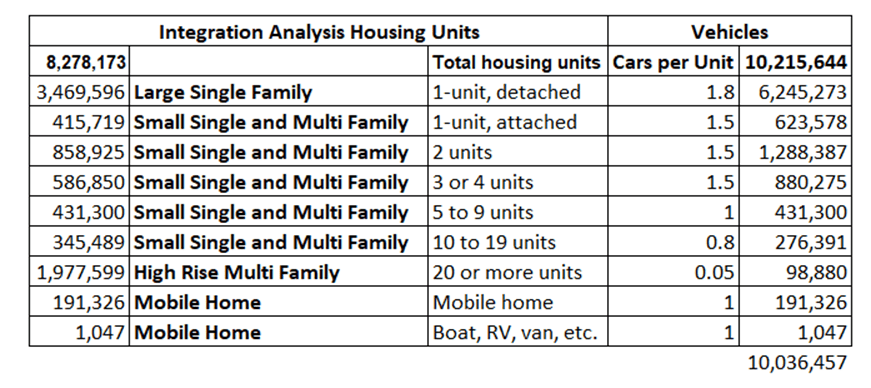
I also made an estimate of the number of chargers needed throughout the state. The integration analysis lists the number of housing units for nine categories. I assumed the number of light duty vehicles (LDVs) per unit and calculated how many LDVs for each category.
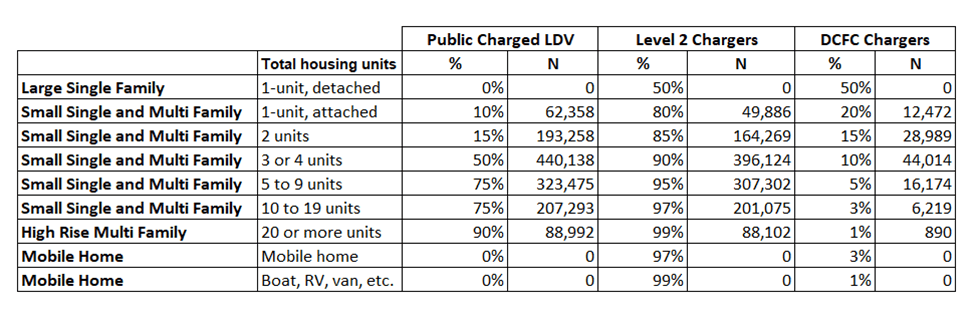
In the next step I estimated the percentage of vehicles that would be charged at public charging stations for each residential category. For example, I assumed that no 1-unit detached homes would charge their electric vehicle at a public station but that 90% of the vehicles in high rise multi-family units would. I also estimated the percentage of level 2 chargers and DCFC chargers by housing unit type. The result was the number of level 2 and DCFC chargers that would be needed for residential public charging.
The number of charges was multiplied by the average and minimum cost for the Level 2 and DCFC systems to get a range of expected costs for public chargers based on the results of this announcement. I estimate that between $8.4 billion and $26.6 billion would be needed for residential public charging systems. Note that this does not include public charging systems for the traveling public or office parking lots.
The Hochul Administration narrative is that the costs of inaction for the net zero Climate Act transition outweigh the costs of action but that statement is misleading unless the caveat that the costs in the Scoping Plan do not include the costs “already implemented” programs like the Municipal ZEV Infrastructure Grant Program. As far as I can tell the Integration Analysis did include the benefits of already implemented programs. In other words, the Administration claim does not include all the costs to transition to net-zero. According to the final scoping plan the societal benefits of the Climate Act net zero transition plan are greater than the costs by between $115 and $130 billion. Properly including this Grant Program as a necessary cost to get to meet the Climate Act mandates reduces the alleged benefits to between $89 and $122 billion. I believe that when all the other costs to electrify the transportation sector are included, the real costs will exceed the societal benefits.
Conclusion
Every component of the Climate Act that I have evaluated has turned out to be more complicated, the ease of transition more uncertain, and the costs greater than admitted in the Scoping Plan. In this example, the Scoping Plan does not differentiate or address the differences between home charging and the more complicated public charging requirements. The Scoping Plan suggests that implementation should “focus on charging at multi-unit dwellings, on-street charging, and convenient urban fast charging, especially in areas with less access to home charging” but does not acknowledge the uncertainties associated with finding the room for those assets. Finally, the Integration Analysis lists the cost for Light Duty Vehicle Battery Electric Vehicle Supply Equipment: Per-Vehicle Cost as $2,826 in 2022, but the minimum cost in the 2022 awards was $3,326 and the average cost was $10,713.
Given the complications, uncertainties and higher costs there is no way the Hochul Administration net-zero transition is going to work as glibly promised. For all the talk about inspiring other jurisdictions to follow New York’s lead and commit to the same GHG emission reductions targets the possibility that rushing ahead without addressing feasibility issues might end in a debacle that sets their cause back has been ignored. The Climate Act’s appeal to emotion and values rather than a rational energy policy is not going to end well for the state or their cause.
The New York State Department of Environmental Conservation held an informational webinar (presentation slides and recording) on April 11, 2023 on the proposed solid waste management plan for New York State. This post looks at the relationship between this plan and the Climate Leadership & Community Protection Act (Climate Act). The Climate Act mandates emission reductions from all sectors of the economy but has not provided analyses supporting the feasibility of achieving those reductions on the schedule required.
I have been following the Climate Act since it was first proposed. I submitted comments on the Climate Act implementation plan and written over 300 articles about New York’s net-zero transition because I believe the ambitions for a zero-emissions economy embodied in the Climate Act outstrip available renewable technology such that the net-zero transition will do more harm than good. The opinions expressed in this post do not reflect the position of any of my previous employers or any other company I have been associated with, these comments are mine alone.
Climate Act Background
The Climate Act established a New York “Net Zero” target (85% reduction and 15% offset of emissions) by 2050 and an interim 2030 target of a 40% reduction by 2030. The Climate Action Council is responsible for preparing the Scoping Plan that outlines how to “achieve the State’s bold clean energy and climate agenda.” In brief, that plan is to electrify everything possible and power the electric gride with zero-emissions generating resources by 2040. The Integration Analysis prepared by the New York State Energy Research and Development Authority (NYSERDA) and its consultants quantifies the impact of the electrification strategies. That material was used to write a Draft Scoping Plan. After a year-long review the Scoping Plan recommendations were finalized at the end of 2022. In 2023 the Scoping Plan recommendations are supposed to be implemented through regulation and legislation.
Solid Waste Proposed Plan
This section lists material from the DEC Draft New York State Solid Waste Management Plan website. This plan is subtitled: Building the Circular Economy Through Sustainable Materials Management (2023 – 2032). DEC writes:
To protect communities and mitigate the effects of climate change, the New York State Solid Waste Management Plan (Plan) builds upon sustained efforts to reduce waste and advance the state’s transition to a circular economy, helping to change New Yorkers’ understanding of waste and their relationship to it. The Plan intends to guide actions over the next decade, from the beginning of 2023 to the end of 2032, and builds upon the State’s 2010 Beyond Waste Plan.
The Plan sets forth six major Focus Areas with goals and action items to move the circular economy and materials management industry forward in New York State:
Waste Prevention, Reduction, and Reuse
Recycling and Recycling Market Development and Resiliency
Product Stewardship and Extended Producer Responsibility
Organics Reduction and Recycling
Toxics in Products
Design and Operation of Solid Waste Management Facilities and Related Activities
The DEC also noted that people wishing to comment on the draft New York State Solid Waste Management Plan have the opportunity to submit written comments until May 15, 2023. Comments can be submitted by email to NYSSolidWastePlan@dec.ny.gov. Please include “Comments on SSWMP” in the subject line of the email.
Waste Sector and the Climate Act
The following graph lists historical and projected waste sector GHG emissions using two global warming potential accounting approaches: one over 20 years and the other over 100 years. More details on the differences and the data source are provided in a recent article. In the graph historical data are used from 1990 to 2020, there are a couple of years that mix available data and projections, and from 2023 to 2030 the projected values assume a linear reduction each year to meet the 2030 Climate Act target of a 40% reduction in GHG emissions from the 1990 baseline. The waste sector emissions trends are interesting. Note that a 30% emissions reduction (12.6 MMT CO2e) is required from 2020 to 2030 in order to meet the 40% reduction from the 1990 baseline mandate. Note, however that while the GWP-100 required emission reduction is only 4.6 MMT CO2e it still represents a 30% reduction. I am not aware of any control technology that can be expected to provide that kind of reduction. The question of the day is whether the DEC’s solid waste management plan provides a strategy to meet these targets.
Overview of the DEC Plan
At 16:02 of the meeting recording the DEC describes the “vision” of the plan shown in the following slide. The presentation said they think we can achieve these visions. Subsequently, the presentation expanded on the “climate change mitigation is fully implemented” component. In 2020 the waste sector emissions were 12% of the total so reductions must be implemented in order to meet the Climate Act targets. Also note that a major point of emphasis in the presentation was the point that solid waste facilities are located primarily in disadvantaged communities.
J.D. Allen writing on the WSHU radio website did an excellent job describing the plan and the current status of waste in the state. He explained:
New York is hearing feedback from communities that have been disproportionately impacted by waste disposal and transfer facilities. It’s part of a solid waste management plan the state works on every 10 years.
The plan is intended to guide the state over the next decade — from the beginning of 2023 to the end of 2032 — to reduce waste and advance the state’s transition to a circular economy, said David Vitale, division director for materials management at the state Department of Environmental Conservation.
The public is allowed to comment on New York’s solid waste management plan through May 15. However, environmental advocates, municipal leaders and the private sector are dubious about some sections of the proposal.
Allen went on to quote David Vitale:
“Waste management is different in different parts of our state,” Vitale said about the plan based on statewide data from 2018 — well before the pandemic disrupted the system and information collection. “We have different programs, we have different needs and different challenges. And so all of that is captured in there.”
“[But] waste is a concept of the past,” he continued.
He said that will mean changing New Yorkers’ understanding of waste and their relationship to it by reducing the amount of plastic, paper and organic waste that enter the waste stream, while finding innovative ways to reuse and recycle waste that would typically end up in landfills and other facilities.
Allen also explained:
This is compounded by state goals to protect communities and mitigate the effects of climate change. By 2030, New York seeks to curb greenhouse gas emissions to 40% of 1990 levels by 2030 and 85% by 2050. Waste makes up 12% of the state’s contribution.
Vitale reminded New Yorkers during an informational meeting on the statewide draft plan on Tuesday that it’s also important to get involved in conversations about how trash is handled locally.
“The primacy for solid waste management rests with local governments,” he said. “We are a home-ruled state. That’s how the laws are set up; That’s where the authorities are. The state doesn’t have that particular authority.”
“So it’s most important to have this information available and to be used as part of that […] local solid waste management planning process,” Vitale continued.
Allen wrote:
Towns on Long Island have been critical of the state Department of Environmental Conservation for not taking a more active role in creating regional waste management plans. Vitale said it’s a responsibility that falls on towns on Long Island — and counties in the rest of New York, under state law. Six of 13 towns on Long Island have yet to update their expired local waste management plans.
More than half of New York state’s waste stream — and nearly 90% of New York City’s total waste stream — is managed in facilities located in disadvantaged communities. Last month, the state identified these communities to steer millions of dollars in funding to reduce greenhouse gas emissions that contribute to climate change. “The concerns from some of those committees now have data to validate those issues that they have dealt with,” Vitale said.
On Long Island, most of the 85 U.S. Census tracts selected are communities of color, and have existing or remnants of waste infrastructure. This includes around the Brookhaven Landfill, one of two facilities remaining in the region that handles the disposal of waste from more than two million residents — and which is scheduled to close over the next few years.
Residents have organized to call for the town to open hearings to brainstorm around a zero waste and equitable waste management. Yet, the Town of Brookhaven’s local solid waste management plan expired in 2009. According to freedom of information requests, the town has no record of any zero-waste planning between January 2020 and March 2023.
Vitale said unburdening these communities of waste infrastructure could be considered as part of state and local solid waste management planning. By 2050, New York has a goal to reduce landfilling by 85%. “It’s intended to be as open and transparent as we can with our processes. And the data that we have in these plans, hopefully can be used for that purpose,” he said
Statewide, the draft plan recommends 33 legislative actions aligned with the 2019 Climate Leadership and Community Protection Act. The plan calls on New York to expand existing law to require smaller businesses to donate food and scrap organic waste, and adopt an Extended Producer Responsibility law to shift the responsibility of reducing paper and plastic waste to manufacturers.
Another proposal would create a surcharge on the thousands of tons of waste being landfilled or burned into ash in New York and all waste generated and being sent out of state. Several projects statewide — including four waste transfer stations that are in different stages of approval on Long Island — seek to haul garbage to landfills in Ohio, Pennsylvania and other states.
Allen went on to explain:
“There needs to be a state plan for organics composting to avert combining clean organics with inherently contaminated sewer sludge and spreading/generating pollution through landfilling and burning,” Mary Arnald, co-founder of Civics United for Railroad Environmental Solutions (CURES) in Queens, said in a comment during the video conference. “This can’t be left to the private sector because that’s setting up a wild west of competition.”
A surcharge — at least $5 per ton — could not only “help disincentivize disposal, but also generate $133 million per year” to provide financial support for reduction, reuse and recycling projects, according to the draft plan. Over 30 states already use some form of fee structure.
“Without industry within New York state to create the circular economy to process, and little literature published or released from the state-funded education institution research,” Brookhaven Town Waste Management Commissioner Christine Fetten warned that a per-ton disposal disincentive surcharge “would result in an increase in illegal dumping.”
Professionals and everyday New Yorkers alike want an extension to the comment period to allow testimony for a few more days to an additional month.
Discussion
My first impression is that the Solid Waste Management Plan proposal is long on slogans and short on action items starting with “Waste is a thing of the past”. For example, the presentation says it will “empower residents to compost at home or through community programs”. This is a needed to reduce organic material methane emissions. That sounds great but in practice it is a gigantic pain in the neck based on my personal experience. In order to compost you must have space for a separate container to collect compostable material, space for a separate container for pickup for a community program or your own personal compost bin, and time to work the compost and use the composted material. Oh, by the way, if not done correctly, compost making can create odors and spread disease and weeds when used. The thought that this be universally adopted so “waste is a thing of the past” is magical thinking.
Allen described a couple of the recommendations. The first is for New York to expand existing law to require smaller businesses to donate food and scrap organic waste, and adopt an Extended Producer Responsibility law to shift the responsibility of reducing paper and plastic waste to manufacturers. He also noted that there is a proposal to create a surcharge on the thousands of tons of waste being landfilled or burned into ash in New York and all waste generated and being sent out of state. In both instances those plans would necessarily add costs for consumers.
Conclusion
This is not the first solid waste management plan. I would bet a lot of money the last plan had many similar goals and targets. There was no documentation provided that showed how well New York’s plan has been working to date which suggests they had nothing to show. Why in the world do they think it will work as planned this time?
This is yet another component of the Climate Act that is long on slogans, wishful thinking, and magical solutions but totally devoid of realistic plans with supporting feasibility analyses and cost estimates. This will come to a head as soon as the cap and invest program starts tracking emission reduction progress against the Climate Act mandates. When that happens the gap between observed reductions and needed reductions can no longer be ignored. Reality will eventually win.
On April 4 I published an article about the Hochul Administration’s proposal to make some changes to the greenhouse gas emissions accounting approach in the Climate Leadership & Community Protection Act (Climate Act). After a “firestorm of opposition from environmentalists” the proposal to use a different global warming potential value was removed from budget negotiations but the topic will still be addressed later this year. This post provides information on this Climate Act component to try to clear up some misconceptions that I noticed in the recent dustup and to explain what the two methodologies mean to required emission reductions.
I have been following the Climate Act since it was first proposed. I submitted comments on the Climate Act implementation plan and written over 300 articles about New York’s net-zero transition because I believe the ambitions for a zero-emissions economy embodied in the Climate Act outstrip available renewable technology such that the net-zero transition will do more harm than good. The opinions expressed in this post do not reflect the position of any of my previous employers or any other company I have been associated with, these comments are mine alone.
Climate Act Background
The Climate Act established a New York “Net Zero” target (85% reduction and 15% offset of emissions) by 2050 and an interim 2030 target of a 40% reduction by 2030. The Climate Action Council is responsible for preparing the Scoping Plan that outlines how to “achieve the State’s bold clean energy and climate agenda.” In brief, that plan is to electrify everything possible and power the electric gride with zero-emissions generating resources by 2040. The Integration Analysis prepared by the New York State Energy Research and Development Authority (NYSERDA) and its consultants quantifies the impact of the electrification strategies. That material was used to write a Draft Scoping Plan. After a year-long review the Scoping Plan recommendations were finalized at the end of 2022. In 2023 the Scoping Plan recommendations are supposed to be implemented through regulation and legislation.
Global Warming Potential
The recent controversy involved changes to the Greenhouse Gas (GHG) emissions accounting approach used by the Climate Act to account for methane or natural gas emissions. The Environmental Protection Agency (EPA) explains that the Global Warming Potential (GWP) was “developed to allow comparisons of the global warming impacts of different gases”. EPA explains that GHGs affect the rate at which energy from the surface escapes to space. The explanation notes:
Different GHGs can have different effects on the Earth’s warming. Two key ways in which these gases differ from each other are their ability to absorb energy (their “radiative efficiency”), and how long they stay in the atmosphere (also known as their “lifetime”).
The EPA explanation goes on to state:
Specifically, it is a measure of how much energy the emissions of 1 ton of a gas will absorb over a given period of time, relative to the emissions of 1 ton of carbon dioxide (CO2). The larger the GWP, the more that a given gas warms the Earth compared to CO2 over that time period. The time period usually used for GWPs is 100 years. GWPs provide a common unit of measure, which allows analysts to add up emissions estimates of different gases (e.g., to compile a national GHG inventory), and allows policymakers to compare emissions reduction opportunities across sectors and gases.
CO2, by definition, has a GWP of 1 regardless of the time period used, because it is the gas being used as the reference. CO2 remains in the climate system for a very long time: CO2 emissions cause increases in atmospheric concentrations of CO2 that will last thousands of years.
Methane (CH4) is estimated to have a GWP of 27-30 over 100 years (Learn why EPA’s U.S. Inventory of Greenhouse Gas Emissions and Sinks uses a different value.). CH4 emitted today lasts about a decade on average, which is much less time than CO2. But CH4 also absorbs much more energy than CO2. The net effect of the shorter lifetime and higher energy absorption is reflected in the GWP. The CH4 GWP also accounts for some indirect effects, such as the fact that CH4 is a precursor to ozone, and ozone is itself a GHG.
Nitrous Oxide (N2O) has a GWP 273 times that of CO2 for a 100-year timescale. N2O emitted today remains in the atmosphere for more than 100 years, on average.
Chlorofluorocarbons (CFCs), hydrofluorocarbons (HFCs), hydrochlorofluorocarbons (HCFCs), perfluorocarbons (PFCs), and sulfur hexafluoride (SF6) are sometimes called high-GWP gases because, for a given amount of mass, they trap substantially more heat than CO2. (The GWPs for these gases can be in the thousands or tens of thousands.)
EPA also explains that there are alternatives to using the 100-year GWP:
The United States primarily uses the 100-year GWP as a measure of the relative impact of different GHGs. However, the scientific community has developed a number of other metrics that could be used for comparing one GHG to another. These metrics may differ based on timeframe, the climate endpoint measured, or the method of calculation.
For example, the 20-year GWP is sometimes used as an alternative to the 100-year GWP. Just like the 100-year GWP is based on the energy absorbed by a gas over 100 years, the 20-year GWP is based on the energy absorbed over 20 years. This 20-year GWP prioritizes gases with shorter lifetimes, because it does not consider impacts that happen more than 20 years after the emissions occur. Because all GWPs are calculated relative to CO2, GWPs based on a shorter timeframe will be larger for gases with lifetimes shorter than that of CO2, and smaller for gases with lifetimes longer than CO2. For example, for CH4, which has a short lifetime, the 100-year GWP of 27–30 is much less than the 20-year GWP of 81–83.
Climate Act Global Warming Potential
The ideologues who wrote the Climate Act chose to use GWP measured over 20 years rather than 100-years. I believe that this was a deliberate choice to emphasize the “value” of methane and natural gas reductions. At the time the Act was passed this was a unique choice and since then only one jurisdiction (the state of Maryland) has chosen this approach. Everybody else, all the other states, the EPA, and the Intergovernmental Panel on Climate Change, all use GWP measured over 100 years. The proposal to change this accounting was greeted with vociferous opposition from New York’s environmental community because it was perceived as reducing the value of reductions of oil, gas, and bio-fuels.
If adopted, S6030 would cast New York’s newly-adopted climate plan into limbo by changing the figures that provide the foundation for its 400-plus pages of policy recommendations. It would also have brought New York’s accounting in line with the way methane is counted by most other states and the federal government — a method climate scientists say is outdated, and that underestimates the outsized impact that natural gas leaks and other major methane sources have on climate change.
If I had the time, I would respond to the entire article because it exemplifies the rationale of the NY environmental community relative to this issue. Unfortunately, there are too many issues on my plate to address all of it. However, the last sentence quoted above must be addressed. As I noted previously both the EPA and the IPCC use GWP-100. It is hypocritical for activists to demand that New York follow the “Science” as espoused by the IPCC except when it is inconvenient. The claim that “a method climate scientists say is outdated” cherry picks a limited number of scientists. In New York that would be Robert Howarth Ph.D. who has repeatedly claimed that he played a key role in the drafting of the Climate Act.
Dr. Howarth is a biogeochemist and ecosystem scientist who has assumed the mantle of venerated Climate Scientist™. Everything he says is taken as holy writ by New York climate activists. It is not clear to me why the David R. Atkinson Professor of Ecology & Environmental Biology at Cornell University is considered a climate scientist with impeccable qualifications that preclude any criticism of his arguments. I have no doubts of his expertise related to methane chemistry and the comparison to carbon dioxide in the laboratory. However, his understanding and that of the New York climate activist community, on the role of methane on global warming is flawed. I charitably ascribe his incorrect views to his lack of background in atmospheric physics. I have summarized the methane issues ignored by Howarth. It boils down to one issue that even the EPA description overlooks. The GWP values are based on laboratory molecular measurements which are only appropriate in that setting. In the atmosphere where the effect on global warming actually occurs, the relative differences between carbon dioxide and methane due to concentrations, the particular wavelengths affecting the out-going radiation, and the saturation effect all mean that carbon dioxide is much more important than methane. If considered properly the EPA and IPCC approach is appropriate and the use of the 20-year GWP is not justified as mandated in the Climate Act
New York State GHG Emissions Inventory GWP-20 and GWP-100
The primary purpose of this post is to document the differences between the emissions associated with the two global warming potential methodologies. The differences are being portrayed as hugely important. Marie French writes:
But the numbers — and previous work by state staff — show that New York would be required to take less aggressive action to slash greenhouse gasses if Gov. Kathy Hochul, despite dropping an immediate push for it Wednesday, ultimately cuts a deal with lawmakers to change the climate law, an effort first reported by POLITICO. “Overall, you’re saying we don’t need to reduce emissions as much,” said Bob Howarth, a Cornell University professor and member of the Climate Action Council that was set up to chart a path to achieving the state’s climate goals. “This is a big retrenchment from the climate goal, particularly on the use of natural gas.”
In order to look at the numbers I developed a spreadsheet that uses the NYS GHG emissions by Global Warming Potential for 20-year and 100-year time frames. The observed data from 1990 to 2020 are from the 2022 Statewide GHG Emissions Report and the associated data on Data NY for Statewide GHG Emissions.
My spreadsheet also makes projections for 2021-2030. I made some educated guesses for the 2021 and 2022 emissions. Electricity sector emissions in 2021 and 2022 are available from EPA. I assumed that the ratio of direct CO2 emissions to all the other GHG emissions in the sector for the last three years would be the same as for 2021 and 2022 to estimate the total electricity sector emissions. The emissions from all the other sectors are the average of the last three years. On the long list of unresolved questions is how the emission reduction target of 2030 will be apportioned amongst the different sectors. A portion of the agricultural and industrial sector emissions are off the table. Does that mean the other sectors have to produce reductions to make up the difference? For this analysis I just assumed that all sectors have to reduce their emissions 40% less than their 1990 baseline emissions. I assumed a linear reduction from 2022 to 2030 to estimate the annual emissions.
The total emissions shown in the following graph shows that GWP-20 values are significantly higher than GWP-100 values. In the baseline year of 1990 the total GWP-20 emissions were 404 million metric tons of carbon dioxide equivalent (MMT CO2e) and the GWP emissions were 314 MMT CO2e or 29% higher. In the last year of observed data, 2020, the GWP-20 emissions were 345 MMT CO2e and the GWP emissions were 245 MMT CO2e or 41% higher. Does that mean that changing to GWP-100 will the State can take less aggressive action to reduce emissions? Between 1990 and 2020 the total GWP-20 emissions dropped 15%. In order to meet the 2030 targets GWP-20 emissions will have to be reduced 29% almost double the reductions observed over 30 years. On the other hand, GWP-100 emissions dropped 23% between 1990 and 2020 and will “only” have to be reduced a further 22% to meet the
mandated reduction of 40% of total GHG emissions by 2030. It does appear that less aggressive action is needed but as shown below I don’t think the 2030 target is achievable for either accounting system.
One other feature of the plots needs to be discussed before we can address the question whether the target is likely for either accounting approach. The last year of observed emissions was 2020 and that value is sharply lower than the general trend because of the pandemic shutdown of society. I chose not to make any sophisticated attempt to adjust emissions for that outlier. However, note that emissions in 2021 are higher than 2019 despite the general downward trend. That is entirely due to the State’s misguided shutdown of Indian Point and the resulting increase in emissions.
To gain a perspective of the relative importance of sector specific emissions I list the emissions by sector for each GWP accounting methodology below:
One of my biggest concerns with the Scoping Plan is that it did not include a feasibility analysis. This is particularly troublesome with regards to the schedule for the mandated targets. If we consider the following graphs for each sector specifically looking at the rate of reductions required compared to historical emissions it does not appear to me that the targets are achievable.
I am most familiar with the electric sector. The following graph shows the GWP-20 and GWP-100 emissions for just that sector. The increased emissions associated with the shutdown of Indian Point and resulting fossil fuel generation emissions increase to replace that zero-emissions resource is clearly visible. The first reaction looking at the emission trends could be that the slope of both emission trajectories from 2006 to 2018 is roughly consistent with the trend necessary to meet the 2030 target from 2022 to 2300. There is a problem with that perception however. The observed reductions from 2006 to 2018 were primarily due to fuel switching away from coal and residual oil to natural gas. There are no more opportunities for fuel switching emission reductions. In order to reduce electric sector emissions, zero-emissions wind and solar resources must be deployed to displace fossil generation at the same time load is expected to increase due to the electrification of other sectors. I believe that the lack of a feasibility analysis to prove this is possible will prove problematic by 2030.
I am not familiar with the control strategies for other sectors but the same unsettling emission trajectory reduction rates are apparent. The biggest source of emissions using GWP-20 is buildings. Because GWP-20 accentuates the effect of natural gas, there will have to be a real concerted effort to switch existing building sector gas away from natural gas. In my opinion neither emission reduction trajectory rate looks realistic relative to historical emissions but the GWP-20 rate (31% between 2020 and 2030) is more unlikely.
Transportation is the next highest emitting sector for GWP-20 accounting and is greater than buildings for GWP-100. From 2010 to 2018 both emission trajectories were very similar. Clearly the emission reductions necessary in this decade are considerably faster than anything observed in the past. I am not aware of any indications that the public is ready to embrace electric vehicles at the rate necessary to meet this reduction trajectory.
The industrial sector emissions reductions have been steadily decreasing since the mid 1990’s. Unfortunately, that is more a reflection of the business climate of New York rather than any clean energy strategy. The Climate Act includes provisions that are supposed to prevent further reductions in this sector to save jobs but no details have been provided. This is another instance where it may be decided that other sectors must provide reductions so that the state GHG emissions meet the 2030 target.
The waste sector emissions trends are interesting. I did not try to figure out what was going on between 2008 and 2009 when there is an obvious step change in GWP-20 emissions from 43 MMT to 38 MMT CO2e. In my experience with emission inventories any change that drastic was caused by some error in my work. More importantly, a 30% emissions reduction (12.6 MMT CO2e) is required from 2020 to 2030 in order to meet the 40% reduction from the 1990 baseline mandate. Note, however that while the GWP-100 required emission reduction is only 4.6 MMT CO2e it still represents a 30% reduction. I am not aware of any control technology that can be expected to provide that kind of reduction.
I include the agricultural sector for completeness but caution that I don’t know how the emissions will be handled. I know that some emissions are exempt but exactly how many I do not know. In any event the effect of the methane bias is obvious. It also is obvious that expecting the agricultural sector to make its share of emission reductions is unlikely.
Discussion
I do not think the proponents of the Climate Act understand how difficult it is to reduce GHG emissions. In the electric sector the only readily available emission reduction approach is to switch to a lower emitting fuel. There are no more opportunities to fuel switch in New York and there is no add-on cost-effective control option available. As a result, the only control option left is to reduce operations. The Scoping Plan presumes that wind and solar will be deployed such that the fossil generators will be displaced as required by the Climate Act schedule. However, the Integration Analysis did not include a feasibility study to prove that would be possible while current reliability standards are maintained.
As difficult as it is for the electric sector to reduce GHG emissions, that is the sector where reductions are most feasible. In general, the problem with all the “clean energy” solutions is that they don’t work all the time and the time when they don’t work is the time, they are needed the most. For example, in the building sector, air source heat pumps are touted as the replacement for fossil-fired furnaces. Despite the claims that they work fine, there is a point when air source heat pumps do not provide sufficient heat in really cold weather. That issue can be addressed by upgrades to the building shell but that in turn requires upgrades to the ventilation system. In order to provide a system as resilient as a fossil-fired furnace the costs of all the additions to the home will be so great that they are not saving enough energy to make the investments cost effective. The Integration Analysis did not include a feasibility study to demonstrate what would be needed to maintain the same level of resiliency for residential home heating or any of the other components of the net zero transition.
When Governor Hochul tried to sneak in a fossil-fueled methane accounting method that would gut New York State’s Climate Act during the final push of budget negotiations, New York’s climate and environmental justice movement responded swiftly and powerfully. NY Renews is proud to stand with a movement that stopped—for now—changes to New York’s progressive 20-year methane accounting method as written in law.
Based on these numbers I don’t disagree that using the 100-year GWP makes the emission reductions less problematic. However, the emission reduction rate trajectories necessary to meet the 2030 40% reduction mandate are so much greater than anything in the past that I do not think the accounting approach is going to matter. As a result, the over-the-top rhetoric about the importance of the 20-year GWP accounting approach is unwarranted.
The Hochul Administration lost control of the Climate Action Council and allowed naïve and uneducated ideologues to control the narrative. The global warming potential issue is one example of a technical consideration that was chosen based on emotion rather than a full understanding of the ramifications. In this instance the one unarguable negative aspect of the 20-year GWP is that it precludes New York from joining any other emissions market program with other jurisdictions. If New York cannot join other jurisdictions, then they will have to develop all the infrastructure for their system on their own.
Inevitably, there will be another flash point issue. The lack of a feasibility analysis to prove that reductions at the rate necessary for any sector to meet the 2030 targets kicked the problem down the road. The insistence that the Climate Action Council could not consider a “plan B” if targets could not be met means there is no contingency plan in place. When the reality that the 2030 40% reduction mandate cannot be met becomes obvious that will incense New York’s climate and environmental justice movement who will undoubtedly demand that the targets must be met. As explained above the ultimate control strategy is to stop burning fossil fuels. Hochul will have to choose between keeping the lights on, gasoline obtainable at the pump, and natural gas available for homes against meeting the arbitrary emissions reduction mandate of the Climate Act.
This is a guest post written by Gary R. Schoonmaker. Gary sent me four essays he wrote describing his concerns about the Climate Leadership and Community Protection Act’s impacts on freedom of choice and the implementation of the Act. Because I think he raises some important issues I am publishing his essays in this post.
Gary R. Schoonmaker is a lifetime citizen of New York State; a licensed Landscape Architect with over 18 years experience at an electric and gas utility in New York State; and involvement in many environmental organizations in Central New York. He designed and built an energy efficient home in 1978 which had an air-to-air heat pump and now has solar panels; and has over 40 years experience in real estate development. I published a post describing his comments on the Climate Act last spring.
Where is Freedom Going? The threat to Freedom in the United States is serious, but here in New York State the situation is dire!!! What has happened to the desire for freedom here? Are we really so willing to submit to the tyranny of the Democrat legislature and governor; to be taken care of by the nanny state that we will leave our freedom in the rear view mirror?
We are being told that the government knows so much better than we do what is best for us! When did we get to the point that we are willing to accept that? There are many examples over the last few years, but my principal concern today is with the Climate action initiatives. The state is on a path to do away with any but electric cars and using electricity for everything. Why is it reasonable that the state can dictate such a policy? What happened to our free will/agency as citizens/human beings?
No natural gas or propane appliances – stoves, furnaces, dryers; no gasoline operated vehicles or equipment; no wood burning at all. When did we give them the authority to dictate those conditions where we have no choice?
Our ancestors who worked so hard to give us this country/State would kick our butts for letting this happen!! My ancestors have lived and worked in New York State since before 1650 and I shudder to think what Hendrick would say if he was to show up and see what we have allowed our representatives to do. Frederick helped finance the American side in the Revolutionary War; do you really think he would support us giving up our freedoms to choose for ourselves what kind of transportation, heating, or other appliances are best for us?
If we allow this situation to continue, we have ceased being citizens and become subjects.
Which is more stable: A one legged stool or one with three or more legs?
The Climate Action Council is moving quickly to implement a program to terminate the use of any energy in the State of New York except electricity. That would leave us with an energy stool sitting on one leg. Have you ever tried to sit on a one-legged stool?
Right now, we have a stool with multiple legs: we have electricity yes, but we also have natural gas, propane, gasoline, etc. Why, when so many people are clamoring for diversity, and financial advisors recommend that no one put all their money in a single investment; does the State legislature and Governor think it wise to get rid of all forms of energy except electricity? I won’t argue in this article about the efficacy of the climate change arguments, but just ask that you consider the wisdom of the proposed action.
If a fire had to be put out, would it be wise to only have water? Today, fire departments have a large number of options, depending on the type of fire they are asked to fight. Would it be advisable for the Legislature to dictate that the fire department only be able to use water? If the logical answer is no, then why is it wise to allow the legislature to dictate that we citizens only be able to use electricity to address our individual energy needs?
Beyond the logic is one significant threat that accompanies the sole use of electricity. There are two possible situations where this threat manifests itself: solar flares and an electromagnetic pulse (EMP). Either of these threats can destroy the electrical grid as well as each and every unprotected appliance/vehicle. That is a threat today, but the threat to our survival is magnified many times if the only energy we are allowed to have is electricity, because as opposed to today, we would have no backup for heat, cooking or transportation.
Can you say 1850?
Is there some kind of media blackout around the Climate Action Council’s Activities?
The New York State government (Legislature and governor), passed a law in 2019 called the Climate Leadership and Community Protection Act (Climate Act). That act set a goal of “net-zero carbon emissions for the entire state economy by 2050”. In order to implement that goal the legislation commissioned a Climate Action Council to develop a draft Action Plan and then a Final Action Plan. In January 2022, the draft action plan was published and public hearings were subsequently held across New York State. If this is news to you, I expect you are in the majority of citizens of New York State.
When I heard about the public hearing in Syracuse, it was only a couple of days before they were to be held and I had seen nothing on the news or in newspapers about them. I heard about it on a local Saturday morning radio program discussing how to maintain your home. I got online and researched what they were talking about and couldn’t believe what I was reading.
I labored about what to do, if anything, and finally decided to go to the public hearing and express my deep concerns for what they were proposing. Imagine my surprise when I got to the only public hearing in Central New York to find there was not a single news crew covering the event. Maybe there was a reporter there (I didn’t see one), but no one was doing tv or interviewing any of the presenters as far as I could see. You know how these things usually are, reporters crowding around fighting to ask questions or get a quote for a story they are writing.
After waiting for over three hours, I got to make my two minute presentation. Many of the other people were from universities or environmental advocacy groups. There were a few people from business or unions there advising caution, but the vast majority of presenters were supportive of the State’s climate initiative.
When I got home, I watched the local news and saw not a word about the hearing that had just finished up regarding one of the most consequential plans to affect New York State since the Erie Canal. CRICKETS!! Over the following weeks, I saw no reports about any of the other hearings either. How is that possible? After the hearings, there was an opportunity to provide written comments so I sent in a six-page document elaborating on my two-minute presentation at the hearing. I still heard nothing in news programs about the Climate action plan. So, I decided to send my written comments to local and national news outlets and commentators. I received no response from any of them, nor was there any report about the plan, the council, or the comments. The closest I got was a brief acknowledgement on the Saturday morning radio program that had started me on my journey. To their credit, they have continued to talk about the plan off and on.
But beyond them….very little recognition of the building tyranny!
Is there really a legitimate Constitutional basis for New York State’s Climate Action Plan?
There are many ways to address this question: first, is climate change really an existential threat to New York State; and even if it is, does the State have the constitutional authority to take such draconian measure as are being proposed? While I personally do not believe that climate change is anything more than the natural order of the earth (Remember your elementary school studies where we were told that New York State was covered by thousands of feet of ice just 10,000 years ago?), I will leave that subject to others to debate. I don’t believe that it is in the governments’ authority to dictate the proposals being promoted in the Climate Action Plan (CAP).
It is part of our national fabric that freedom is a primary right of citizens. Everybody claims it personally and collectively, and yet the CAP is a direct assault on our personal freedom to choose and make our own decisions. Can anyone disagree with that? The Preamble to New York State’s Constitution states: “We the people of the State of New York, grateful to Almighty God for our freedom, in order to secure its blessings, DO ESTABLISH THIS CONSTITUTION.” The CAP unilaterally prohibits people from choosing what cars to drive, what heat to have in their homes, and how to cook their food, for a start. How is that securing the blessings of freedom for the people of the State of New York?
They are effectively destroying businesses that now sell natural gas, propane, gas appliances, firewood, and all associated businesses like auto repair, the list is endless! When we transitioned in the past, (think horses to autos, or kerosene to electricity etc…) people chose the change themselves. If you thought the change would be good for you, you invested your resources to make the change. If you had to buy a car, or wire your house you paid for it because you chose to do so. If you wanted to forgo the “modernization” you could do so also. Even today, we are still free to choose to light our houses with candles or kerosene, or ride horses instead of driving a car. Under the State’s CAP, we lose the ability to make those choices for ourselves (although perhaps we could still ride a horse, but who knows for sure?). So, who pays for the businesses that go out of business? In the past changes, businesses either adjusted or went out of business because their customers made personal decisions to not buy their products. But under CAP, businesses are being put out of business by an action of the State. Both the New York State and United States Constitutions prohibit the taking of private property for public use without just compensation. Can anyone really argue that closing down businesses (private property) for the CAP (a public use) doesn’t qualify for just compensation? The CAP does not plan for that, but it should!
I am not a constitutional attorney, but it seems pretty clear that the State constitution does not grant the government the right to unilaterally void the freedoms of our citizens. On the contrary, the constitution explicitly states that it was created to secure the blessings of freedom for the people of the State of New York.
The Climate Action Plan does exactly the opposite!
Concluding Remarks from the Pragmatic Environmentalist
In my opinion, the Climate Action Council did not do a good job justifying its actions. They have not provided adequate documentation documenting the costs of the control strategies that they have recommended and only now appear to be willing to acknowledge that it will be expensive. From what I have seen lately the real costs will be far in excess of what they are acknowledging now because the devil is in the details, More importantly, the Scoping Plan has not addressed reliability in enough detail to determine if the conglomeration of control strategies that they have cobbled together will actually work. Finally, the Hochul Administration has not updated its cumulative environmental impact statement to consider their latest estimates of the solar, onshore wind, offshore wind, energy storage, and whatever resource has to be deployed to provide zero-emissions dispatchable electricity. Combine that with the fact that the life-cycle of those resources have not been considered the Scoping Plan is an insult to environmental protections. Ultimately, the ideological insistence on zero emissions has taken alternative strategies off the table that would likely be less costly, maintain current standards of reliability, and have fewer environmental impacts. Against that backdrop there is absolutely no justification to implement the draconian policies described by Schoonmaker.
According to Merriam-Webster a kerfuffle is a disturbance or commotion typically caused by a dispute or conflict and it perfectly describes the response to the Hochul Administration’s proposal to make some changes to the greenhouse gas emissions accounting approach in the Climate Leadership & Community Protection Act (Climate Act). It is being described as revisions that will gut the Climate Act and reward the evil fossil fuel industry. This post explains why I think it injects a bit of sanity in the transition plan but misconceptions abound on both sides of all the ramifications.
I have been following the Climate Act since it was first proposed and have submitted comments on the Climate Act implementation plan and written over 300 articles about New York’s net-zero transition because I believe the ambitions for a zero-emissions economy embodied in the Climate Act outstrip available renewable technology such that the net-zero transition will do more harm than good. The opinions expressed in this post do not reflect the position of any of my previous employers or any other company I have been associated with, these comments are mine alone.
Climate Act Background
The Climate Act established a New York “Net Zero” target (85% reduction and 15% offset of emissions) by 2050. The Climate Action Council is responsible for preparing the Scoping Plan that outlines how to “achieve the State’s bold clean energy and climate agenda.” In brief, that plan is to electrify everything possible and power the electric gride with zero-emissions generating resources by 2040. The Integration Analysis prepared by the New York State Energy Research and Development Authority (NYSERDA) and its consultants quantifies the impact of the electrification strategies. That material was used to write a Draft Scoping Plan. After a year-long review the Scoping Plan recommendations were finalized at the end of 2022. In 2023 the Scoping Plan recommendations are supposed to be implemented through regulation and legislation.
Greenhouse Gas Emission Accounting System Revisions
– Reverts New York’s emissions accounting methodology to one using a one hundred year timeframe for assessing the global warming impact of emissions, moving away from the demanding accounting system mandated by the Climate Leadership and Community Protection Act. In doing so, this makes New York’s approach comparable to that employed by the IPCC, the U.S. Environmental Protection Agency, and the three other states – California, Oregon, and Washington – that have explicitly adopted a GHG accounting methodology.
– It specifically requires using full life-cycle analysis (using the Argonne Labs GREET model) for all systems resulting in GHG emissions in New York State, which will align the state with recent federal green incentive programs adopted in the Inflation Reduction Act. Access to those federal incentives will promote additional green energy investments in New York.
– Consistent with the use of full life-cycle analysis, it specifically requires the inclusion in the state’s emission inventory emissions related to the production and transmission of biofuels imported into New York State.
– It more appropriately measures the net emissions from renewable fuels, making these clearer alternative fuels available to New Yorkers at lower costs, by excluding from the state’s GHG inventory CO2 emissions from the combustion of biomass and biofuels. This approach is consistent with the United Nation’s Intergovernmental Panel on Climate Change’s accounting approach, and the GREET model, as these emissions were recently removed from the atmosphere and will be removed again in future growing seasons.
The Hochul Administration claims that changing the accounting methodology will also change the costs to consumers. Climate Action Council co-chairs Doreen Harris and Basil Seggos argued that:
“First and foremost, the governor is trying to maintain New York’s leadership on climate. It’s a core principle that she brought into office and we have been carrying that out for several years,” said Seggos.
But Gov. Hochul instructed both the DEC and NYSERDA to look at the affordability of Cap & Invest.
“We began running the numbers on that, based on some of the metrics being used by Washington state and some of our own, and revealed some…potentially extraordinary costs affiliated with the program,” Seggos explained. “So that’s really what this is. It isn’t a focus necessarily on methane itself, or any particular pollutant. It is how do we implement the CLCPA in a way that doesn’t put extraordinary costs on the pockets of New Yorkers.”
The task before DEC and NYSERDA is three-fold: To launch Cap & Invest, generate revenue to offset the cost of the transition and keep the whole system affordable.
The Climate Action Council’s scoping plan was released in December using the 20-year methane metrics. When asked if there had been a more recent analysis, NYSERDA’s Doreen Harris said yes.
“What the governor has asked us to do, and what we have now delivered, is an analysis around one piece (of the CLCPA), answering the question of how does one get from here to there,” Harris said. “This Cap & Invest proposal is an important part of not only capping emissions, but also investing revenues toward the change that we seek.”
Harris explained that under the CLCPA’s accounting framework, New Yorkers would be paying “substantially more out of their pockets, at the pump, to heat their homes and beyond.”
At the same time, she agreed that the original cost analysis of the transition by the Climate Action Council indicated that the benefits of action, using the 20-year methane metric, far outweighed the costs of the transition.
I don’t know what to make of these arguments. In the first place they offered no documentation to support it. In the second place Harris re-iterated the claim that “the benefits of action, using the 20-year methane metric, far outweighed the costs of the transition” without mentioning the caveat that the Scoping Plan only considered the costs of the Climate Act and not the costs of already implemented programs so the total costs of the transition were not considered in the claim. Importantly all the costs will directly affect New Yorkers but the benefits are societal benefits that provide indirect benefits. When all the costs and benefits are unraveled the Hochul Administration claim that the benefits out-weigh the costs are nothing more than a shell game. Finally, I think the Hochul Administration is worried about the ratepayer costs of the cap and invest program but that is only a revenue stream. The actual, and yet to be provided, costs are those associated with all the control strategies buried in the Scoping Plan recommendations. I am not sure how much of an effect, if any, the 20-year GWP accounting has on the amount of wind, solar, and energy storage resources needed for the net zero transition.
Activist Responses to the Proposed Revisions
In one word the response to the legislation has been “meltdown”. For example, NY Renews, a coalition of over 300 environmental, justice, faith, labor, and community groups that bills itself as the “force behind the nation’s most progressive climate law” had this to say:
S6030/A6039 is part of a larger pattern of attacks by the fossil fuel industry that threaten to sabotage New York’s nation-leading climate law, the Climate Leadership and Community Protection Act, and roll back hard-won standards for accurately accounting for the impacts of greenhouse gas emissions, particularly methane. If passed, the bill would change how the state measures methane and carbon dioxide emissions, pave the way for polluting corporations to emit without consequence, and harm the health and well-being of frontline community members who live, work, play, and pray in neighborhoods across NYS.
NY Renews unequivocally opposes the inclusion of this bill in the state budget and any deal that would include it. We’re calling on the state legislature to uphold the Climate Act as written into law and reject amendments that would threaten its power to protect and prepare New Yorkers facing the worst effects of the climate crisis.
Another example of the response is the April 3, 2023 “Save the CLCPA Action Party” webinar. It was an hour-long rally the troops to contact elected representatives. The meeting was in coordination with the Climate Action Now application that simplifies lobbying with actions in the app:
Like contacting your elected officials, emailing CEOs, or Tweeting at celebrities to step up – can be taken with just a few touches in just a few seconds. We’ve done all the work for you so that you don’t have to. Don’t know who your elected officials are? Give the app your location, and it will tell you. Don’t know how to contact them? The app has their phone numbers and Twitter handles. Don’t know what to tell them? We give you personalized, boilerplate messages that you can accept or modify.
As a result of the webinar 1500 messages were sent to elected representatives claiming that this legislation will eviscerate the Climate Act.
Finally, in an example of “if we don’t get our way we aren’t going to play” there was a Climate Act meeting boycott. On April 3, 2023 the Department of Environmental Conservation announced a meeting of the Climate Justice Working Group for the next day. This meeting was to include the approval of minutes from the previous meeting and a group discussion following the finalization of the disadvantaged communities criteria on March 27. All the Environmental Justice members of the Working Group boycotted or left the call because of this legislation so the call ended after only 45 minutes.
Discussion
I think this legislation introduces some rationality into the implementation process. There are no changes to the basic structure and objectives of the Climate Act so the claims of egregious harm of the proponents are unwarranted. The emission reduction targets and schedules stay the same but it will have several significant beneficial impacts.
The ideologues who wrote the Climate Act placed an inordinate emphasis on vilifying the use of natural gas to the point that they mandated a unique accounting methodology. Global warming potential (GWP) weighs the radiative forcing of a gas against that of carbon dioxide over a specified time frame so that it is possible to compare the effects of different gases. The Climate Act mandated the use of a 20-year GWP at the time when every other jurisdiction was using a 100-year GWP. One of the cornerstones of the Hochul Administration’s plan to fund the transition is a market-based program called cap and invest. If New York is ever to become a part of such a program with other jurisdictions it is necessary that our accounting is the same as everybody else.
There are effects on the achievability of the Climate Act reduction mandates relative to the use of the 100-year GWP rather than the 20-year GWP. It will reduce baseline and observed emissions on the order of 20 percent. It also shifts the emphasis on what needs to be controlled in each sector and the relative importance of sector emissions. I have no idea whether that makes achieving the targets easier or not.
I am intrigued by the provision that requires using full life-cycle analysis using the Argonne Labs Greenhouse gases, Regulated Emissions, and Energy use in Technologies (GREET) model. I am not familiar with that model but I believe that it is necessary for New York State’s cap and invest model to use standardized and replicable emissions accounting for the proposed cap and invest program. This model will likely fulfill that requirement.
Proponents of the proposed legislation claim that it will allow investors in New York to access significant federal tax incentives under the Inflation Reduction Act of 2022 (IRA) credits for clean fuel and clean hydrogen production, as these tax credit programs specifically require the use of the GREET model to determine climate impact scores. The discussion at the “Save the CLCPA Action Party” claimed that Senator Schumer had said that there was no link between the IRA and whether New York uses GWP-20 year accounting. I suspect that there is a technical issue here. If the IRA requires the use of GREET and GREET uses 100-year GWP, then I think it is an implicit requirement.
Ultimately NY Renews and its membership have an irrational hatred of methane that was exemplified by the 20-year GWP accounting methodology. During the “Save the CLCPA Action Party” each speaker argued that Dr. Robert Howarth’s vision of methane and the 20-year GWP accounting was correct and that he represented the best science on the subject. It is not clear to me why the David R. Atkinson Professor of Ecology & Environmental Biology at Cornell University is considered a climate scientist with impeccable qualifications that preclude any criticism of his arguments. His understanding of the role of methane on global warming is flawed. I charitably ascribe his incorrect views to his lack of background in atmospheric physics. I have summarized the methane issues ignored by Howarth. For starters, the measurements that quantify the difference between carbon dioxide and methane effects on radiative transfer are done on a molecule-to-molecule basis. The effect of those pollutants on global warming, which is the reason for the Climate Act, should account for the differences of those pollutants in the atmosphere not in the lab on a molecule-to-molecule basis. If the world outside a laboratory effects of concentrations in the atmosphere, the molecular weights instead of mass, the wavelengths where methane acts on outgoing radiation, and the saturation effect of GHG concentrations are considered correctly, the use of the 20-year GWP is not justified as mandated in the Climate Act.
Conclusion
On one hand it is encouraging to see that the Hochul Administration has recognized that their plans will have significant affordability impacts and are trying to do something about it. On the other hand, there still is no comprehensive accounting for their cost projections so we have to guess at the effects. In any event, the proposed legislation is a marked improvement over the existing Climate Act. If the goal is an ideologically pure green new deal then opposition is warranted. On the other hand, if the goal is to implement a GHG emissions reduction program that has an improved chance of actually working then it makes sense.
The following picture describes the Climate Act as it stands. As long as the State goes straight and does not have to consider what happens if we have to make a turn then it might work. When that does not happen there will be consequences.