
Investment of RGGI Proceeds Report for 2021

This is the sixth installment of my annual updates on the Regional Greenhouse Gas Initiative (RGGI) annual Investments of Proceeds report.  This post compares the claims about the success of the investments against reality.  As in my previous posts I have found that the claims that RGGI successfully provides substantive emission reductions are unfounded.

I have been involved in the RGGI program process since its inception.  I blog about the details of the RGGI program because very few seem to want to provide any criticisms of the program. The opinions expressed in this post do not reflect the position of any of my previous employers or any other company I have been associated with, these comments are mine alone.

Background

RGGI is a market-based program to reduce greenhouse gas emissions (Factsheet). It has been a cooperative effort among the states of Connecticut, Delaware, Maine, Maryland, Massachusetts, New Hampshire, New York, Rhode Island, and Vermont to cap and reduce CO2 emissions from the power sector since 2008.  New Jersey was in at the beginning, dropped out for years, and re-joined in 2020. Virginia joined in 2021 and is getting out at the end of this year.  Pennsylvania has joined but is not actively participating in everything due to on-going litigation. According to a RGGI website: “The RGGI states issue CO2 allowances which are distributed almost entirely through regional auctions, resulting in proceeds for reinvestment in strategic energy and consumer programs. Programs funded with RGGI investments have spanned a wide range of consumers, providing benefits and improvements to private homes, local businesses, multi-family housing, industrial facilities, community buildings, retail customers, and more.”

Proceeds Investment Report

The 2021 investment proceeds report was released on June 27, 2023.  According to the press release:

The participating states of the Regional Greenhouse Gas Initiative (RGGI) today released a report tracking the investment of proceeds generated from RGGI’s regional CO2 allowance auctions. The report tracks investments of RGGI proceeds in 2021, providing state-specific success stories and program highlights. The RGGI states have individual discretion over how to invest proceeds according to state-specific goals. Accordingly, states direct funds to a wide variety of programs, touching all aspects of the energy sector.

In 2021, $374 million in RGGI proceeds were invested in programs including energy efficiency, clean and renewable energy, beneficial electrification, greenhouse gas abatement, and direct bill assistance. Over their lifetime, these 2021 investments are projected to provide participating households and businesses with $1.2 billion in energy bill savings and avoid the emission of 4.4 million short tons of CO2.

The largest share of the investments was directed to energy efficiency, with 51% of the 2021 total. Other categories receiving significant investments include direct bill assistance, clean and renewable energy programs, beneficial electrification, and greenhouse gas abatement and climate adaptation programs. For more details on both 2021 and cumulative investments and benefits.

The report breaks down the investments into five major categories:

Energy efficiency makes up 51% of 2021 RGGI investments and 55% of cumulative investments. Programs funded by these investments in 2021 are expected to return about $418 million in lifetime energy bill savings to more than 34,000 participating households and over 570 businesses in the region and avoid the release of 2.3 million short tons of CO2.

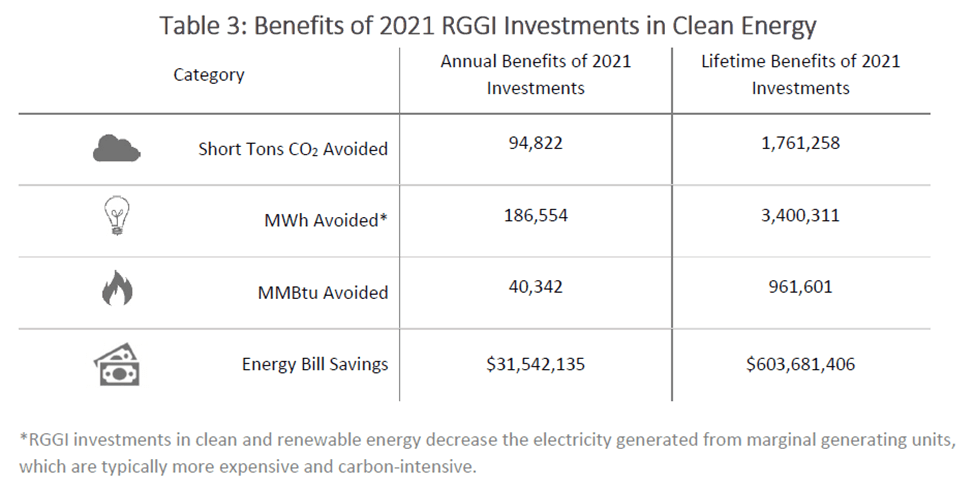
Clean and renewable energy makes up 4% of 2021 RGGI investments and 13% of cumulative investments. RGGI investments in these technologies in 2021 are expected to return over $600 million in lifetime energy bill savings and avoid the release of more than 1.7 million short tons of CO2.

Beneficial electrification makes up 13% of 2021 RGGI investments and 3% of cumulative investments. RGGI investments in beneficial electrification in 2021 are expected to avoid the release of 370,000 short tons of CO2 and return nearly $164 million in lifetime savings.

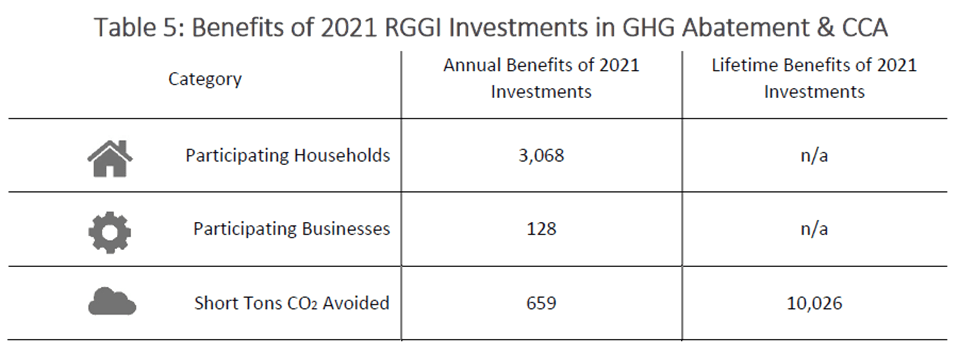
Greenhouse gas abatement and climate change adaptation makes up 11% of 2021 RGGI investments and 8% of cumulative investments. RGGI investments in greenhouse gas (GHG) abatement and climate change adaptation (CCA) in 2021 are expected to avoid the release of more than 10,000 short tons of CO2 and to return over $20 million in lifetime savings.

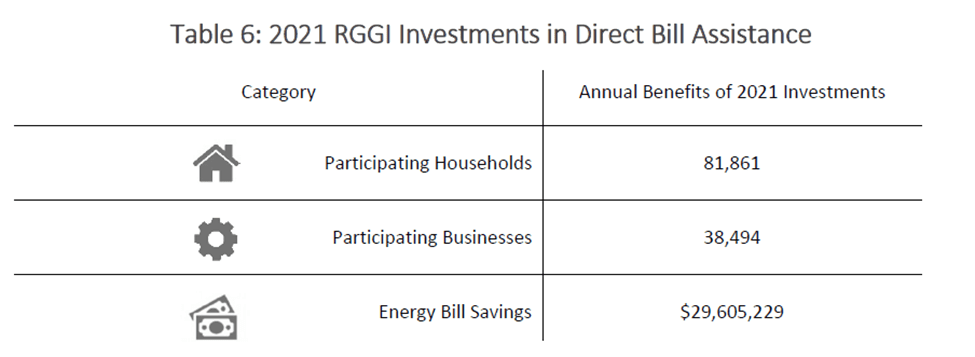
Direct bill assistance makes up 14% of 2021 RGGI investments and 13% of cumulative investments. Direct bill assistance programs funded through RGGI in 2021 have returned over $29 million in credits or assistance to consumers.

Emissions Reductions

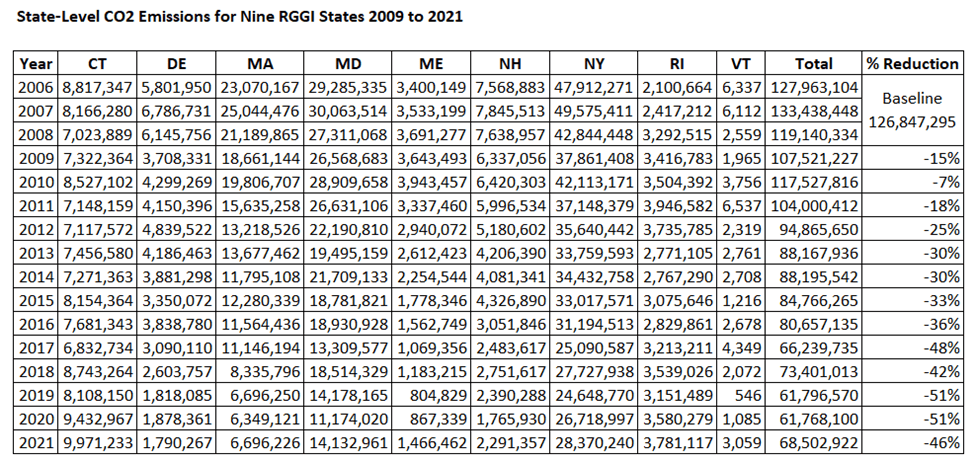
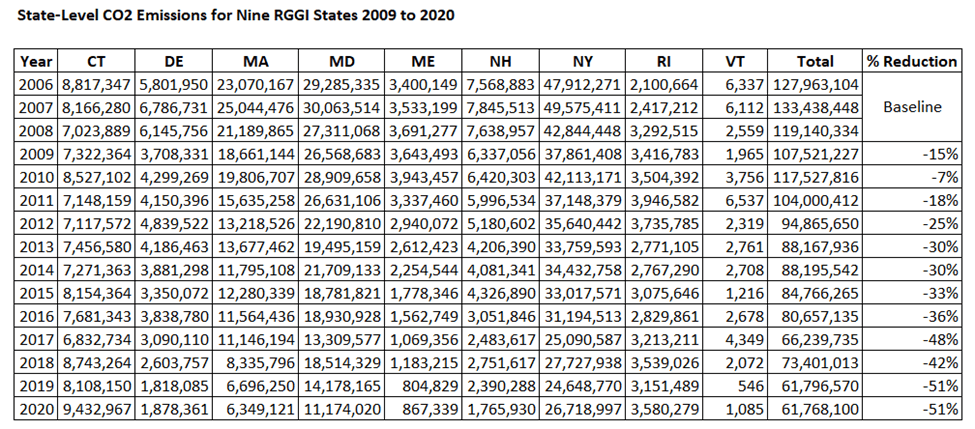
In my previous articles on the Proceeds reports, I have argued that RGGI mis-leads readers when they claim that the RGGI states have reduced power sector CO2 pollution over 50% since 2009. In the following table, I list the 9-state RGGI emissions and percentage reduction from a three-year baseline before the program started in 2009.

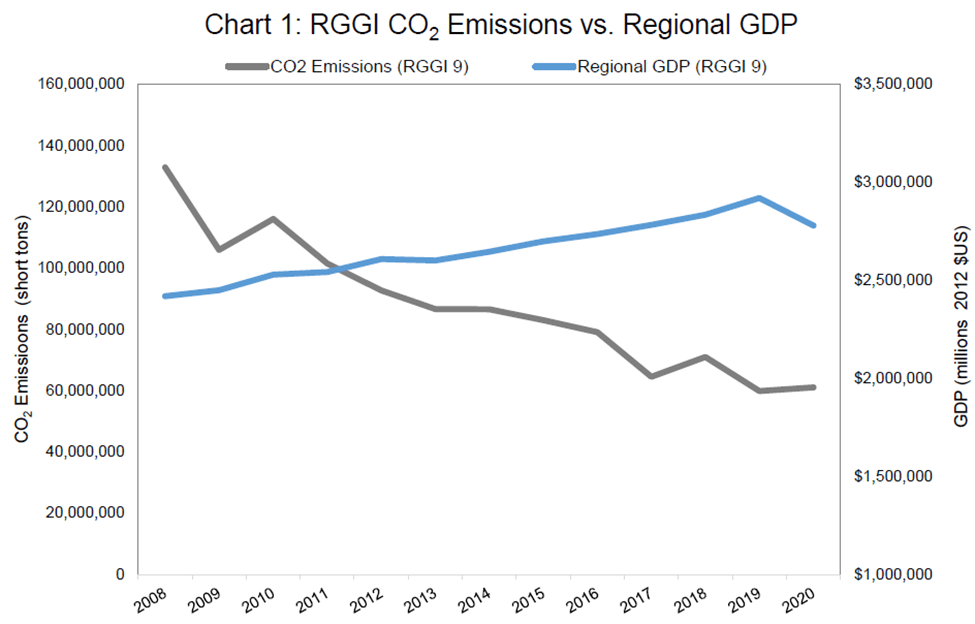
I have argued that the implication in the report’s 50% claim is that the RGGI program investments were primarily responsible for the observed reduction even as the economy grew (Figure 1 from the report).

I believe that their insinuation that RGGI was primarily responsible for the emission reductions is wrong.  The following table lists the emissions by fuel types for these nine RGGI states.  It is obvious that the primary cause of the emission reductions was the fuel switch from coal and residual oil to natural gas.  This fuel switch occurred because it was economic to do so.  I believe that RGGI had little to do with these fuel switches because fuel costs are the biggest driver for operational costs and the cost adder of the RGGI carbon price was too small to drive the use of natural gas over coal and oil. 

I believe that the appropriate measure of RGGI emissions reductions is the decrease due to the investments made with the auction proceeds so I compared the annual reductions made by RGGI investments.  The biggest flaw in the RGGI report is that it does not provide the annual RGGI investment CO2 reduction values accumulated since the beginning of the program.  In order to make a comparison to the CO2 reduction goals I had to sum the values in the previous reports to provide that information. 

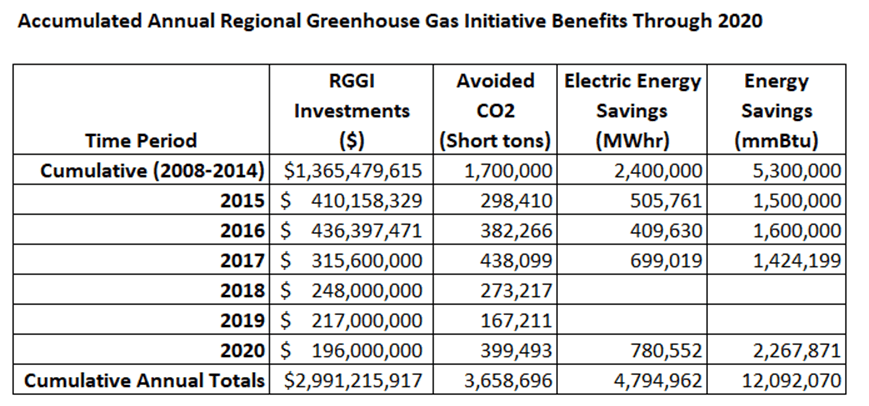
The following table lists the annual avoided CO2 emissions generated by the RGGI investments from previous reports.  The accumulated total of the annual reductions from RGGI investments is 3,893,925 tons while the difference between the three-year baseline of 2006-2008 and 2021 emissions is 58,334,373 tons.  The RGGI investments are only directly responsible for 6.7% of the total observed annual reductions over the baseline to 2021 timeframe! 

Although proponents claim that this program has been an unqualified success I disagree.  Based on the numbers there are some important caveats to the simplistic comparison of before and after emissions.   The numbers in the previous paragraph show that emission reductions from direct RGGI investments were only responsible for 6.7% of the observed reductions.   In a detailed article I showed that fuel switching was the most effective driver of emissions reductions since the inception of RGGI and responsible for most of the reductions.

Benefits

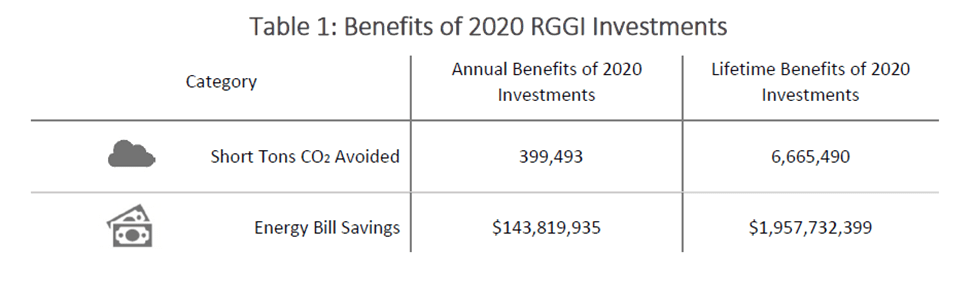
Table 1 from the report lists two benefits of 2021 RGGI Investments: emission reductions and energy bill savings.  Energy bill savings derive from investments in energy efficiency savings and other efforts that directly reduce costs to consumers.  These energy saving benefits typically account for total savings over the lifetime of the project investment.  RGGI does the same thing with the CO2 emission reductions but I think that is misleading because the emission reduction metric is annual emissions and not lifetime emissions. 

Emission Reduction Cost Efficiency

There is another aspect of this report that is mis-leading and after arguing with RGGI and New York State about the issue, I have concluded that the deception is intentional.  In particular, I believe that a primary concern for GHG emission reduction policies is the cost effectiveness of the policies and I have argued that this report should provide the information necessary to determine a cost per ton reduced value for control programs for comparison to the social cost of carbon.  If the societal benefits represented by the social cost of carbon for GHG emission reductions are greater than the control costs for those reductions, then there is value in making the reductions.  If not, then the control programs are not effective.

Recall that RGGI provides lifetime CO2 emission reductions but I think that is misleading because it suggests that the emission reduction cost efficiency of the investments is the total investments divided by the lifetime benefits of those benefits.   For example, dividing the 2021 investments of $374 million by the lifetime avoided CO2 emissions (4,445,594) yields a value of $84.  The Biden administration is re-evaluating the social cost of carbon values but for the time being has announced an initial estimate of $51 per ton and this suggests that RGGI investments are close to being cost effective relative to the Federal social cost of carbon.

However, the social cost of carbon value is calculated for an annual reduction of one ton.  In particular, the social cost of carbon is an estimate, in dollars, of the present discounted value of the benefits of reducing annual emissions by a metric ton. I believe that using the lifetime emissions approach is wrong because it applies the social cost multiple times for each ton reduced.  It is inappropriate to claim the benefits of an annual reduction of a ton of greenhouse gas over any lifetime or to compare it with avoided emissions.  In my comments on the New York Climate Act Scoping Plan, I explained that the value of carbon for an emission reduction is based on all the damages that occur from the year that the ton of carbon is reduced out to 2300.  Clearly, using cumulative values for this parameter is incorrect because it counts those values over and over.  I contacted social cost of carbon expert Dr. Richard Tol about my interpretation of the use of lifetime savings and he confirmed that “The SCC should not be compared to life-time savings or life-time costs (unless the project life is one year)”. 

In order to calculate the CO2 emissions reduction efficiency consistent with the social cost of carbon, the proper estimate is the total investments since the start of the program divided by sum of the annual emission reductions.  The problem is that the RGGI reports do not provide that total and instead only provide the sum of the annual lifetime CO2 avoided emissions.  The Proceeds reports always include a caveat that the states continually refine their estimates and update their methodologies, but the annual numbers are not updated to reflect those changes.  Ideally to get the best estimate of the annual numbers the RGGI states should provide the revised annual numbers for each year of the program. Because that is not the case, I have had to rely on the original annual numbers provided in previous editions of the report.  I sum the values in the previous reports to provide that information as shown in the Accumulated Annual Regional Greenhouse Gas Initiative Benefits Through 2021 table shown above.  The accumulated total of the annual reductions from RGGI investments is 3,893,925 tons through December 31, 2021. The sum of the RGGI investments in the previous table is $3,608,950,013 over that time frame.  The appropriate comparison to the social cost of carbon is $3.609 billion divided by 3,893,925 tons or $927 per ton reduced. 

Conclusion

The 2021 RGGI Investment Proceeds report tries to put a positive spin on the poor performance of RGGI auction proceeds reducing CO2.  The alleged purpose of the program is to reduce CO2 from the electric generating sector to alleviate impacts of climate change.  Since the beginning of the RGGI program RGGI funded control programs have been responsible for 6.7% of the observed reductions.  The report does not directly provide the numbers necessary to calculate that estimate which I have come to believe is deliberate.  When the sum of the RGGI investments is divided by the sum of the annual emission reductions the CO2 emission reduction efficiency is $927 per ton of CO2 reduced.  I conclude that although RGGI has been effective raising revenues it is not an effective CO2 emission reduction program.

RGGI Third Program Review

This is version of an article that was published at Watts Up With That.

The Regional Greenhouse Gas Initiative (RGGI) is a carbon dioxide control program in the Northeastern United States.  One aspect of the program is a program review that is a “comprehensive, periodic review of their CO2 budget trading programs, to consider successes, impacts, and design elements”.  Because it is often cited as a successful cap and invest control program it is worthwhile to review the status of the Third Program Review after the March 29, 2023 public meeting.

I have been involved in the RGGI program process since its inception.  I blog about the details of the RGGI program because very few seem to want to provide any criticisms of the program.  The opinions expressed in this post do not reflect the position of any of my previous employers or any other company I have been associated with, these comments are mine alone.

Background

RGGI is a market-based program to reduce greenhouse gas emissions. According to RGGI:

The Regional Greenhouse Gas Initiative (RGGI) is a cooperative effort among the states of Connecticut, Delaware, Maine, Maryland, Massachusetts, New Hampshire, New Jersey, New York, Pennsylvania, Rhode Island, Vermont, and Virginia to cap and reduce power sector CO2 emissions. 

RGGI is composed of individual CO2 Budget Trading Programs in each participating state. Through independent regulations, based on the RGGI Model Rule, each state’s CO2 Budget Trading Program limits emissions of CO2 from electric power plants, issues CO2 allowances and establishes participation in regional CO2 allowance auctions.

Proponents tout RGGI as a successful program because participating states have “cut carbon pollution from their power plants by more than half, improved public health by cutting dangerous air pollutants like soot and smog, invested more than $3 billion into their energy economies, and created tens of thousands of new job-years”.  Others have pointed out that RGGI was not the driving factor for the observed emission reductions.  My latest evaluation of RGGI results found that the investments from RGGI auction proceeds were only directly responsible for 6% of the total observed annual reductions over the baseline to 2020 timeframe and that those investments reduced emissions at a rate of $818 per ton of CO2.  The primary driver of observed reductions was cost-efficient fuel switching from coal and residual oil to natural gas not RGGI.  I concluded that RGGI successfully raised money but has not provided cost-effective emission reductions or has had much to do with the observed CO2 emission reductions in the electric generating sector of the NE United States.

Third Program Review

The RGGI states periodically review the “successes, impacts, and design elements” of the program.  On March 29, 2023 RGGI Inc. and the participating states gave an update on the status of the third program review.  The presentation gave an overview of the program, explained how the review process works, described state activities, and described the electric sector analysis.  Meeting materials including comments submitted after the meeting are available:

The March 29 public meeting was more of an overview than anything else.  Nonetheless a couple of interesting points made.  The overview emphasized that program components allow for regional compatibility because each state has its own implementing regulations.  I believe this is recognition of the fact that different state emission targets need to be considered in the program more than in the past.  There is a new environmental justice (EJ) component that includes a regional CO2 mapping tool.  I think this component will be of particular interest to WUWT readers because EJ considerations are a component of all recent environmental initiatives.

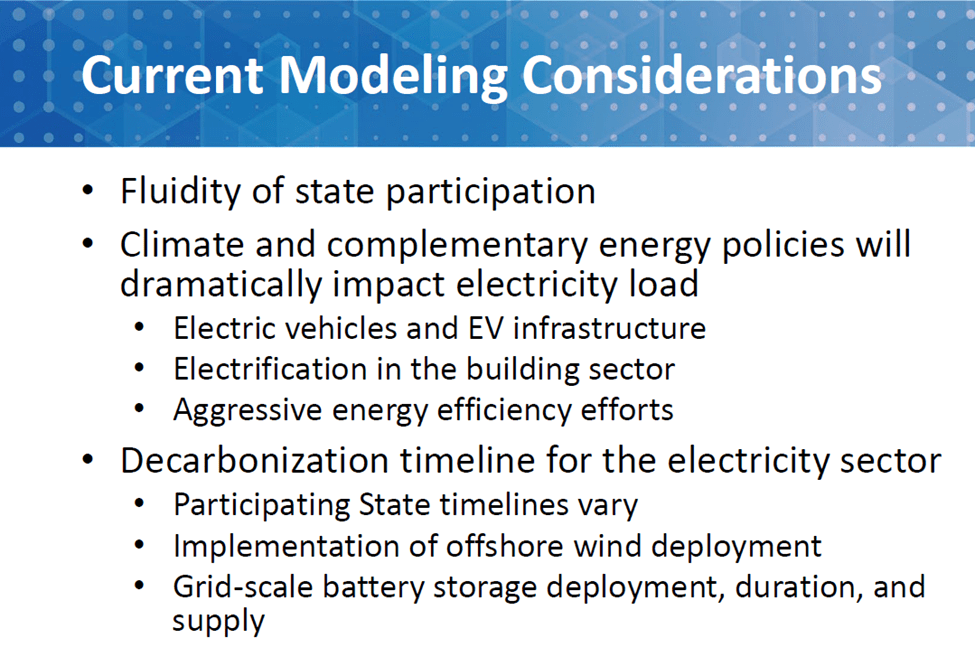
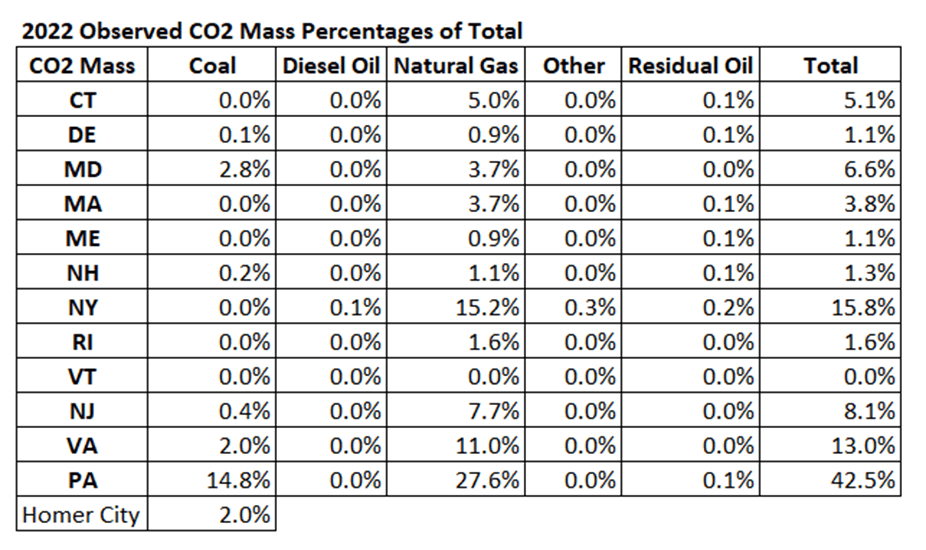
The primary technical considerations for the planned program review modeling are the regional cap trajectory, Cost Containment and Emissions Containment Reserves changes, and  adjustments for banked allowances.  This round of modeling must contend with the “fluidity of state participation” which translates to what to do about Pennsylvania and Virginia.  Pennsylvania participation is “still in effect” but it is still in litigation so there is a major uncertainty relative to the modeling.  Virginia is going to cease participation at the end of 2023 and they have told RGGI that their participation should not be included in the modeling.  The emissions from these two states are a significant portion of the current inventory so participation affects the potential for regional emission reductions as shown in the following table.  In 2022 Pennsylvania emissions were 42.5% of the total CO2 emissions of all RGGI states and Virginia was another 13% as shown below. From the standpoint of potential emission reductions note that Pennsylvania still had a significant amount of coal in 2022.  Note that the recently announced retirement of Homer City will result in a 2% reduction of overall RGGI emissions.

There are two other factors that complicate this modeling effort.  The presentation noted that “climate and complementary energy policies will dramatically impact electricity load”.  In other words, when transportation and residential/commercial  energy use is converted to electricity the load will go up. In addition, the decarbonization timeline for the electricity sector in states vary.  The presentation also highlighted the implementation of offshore wind deployment and grid-scale battery storage deployment, duration, and supply as factors that add challenges and uncertainty to the modeling.

In order to address these issues, they are looking at different ways of dealing with the uncertainty by developing “assumption sets based on load forecasts and availability of low-emitting generation” and various allowance supply scenarios.  They think that adding cases will cover the range of outcomes given current electricity-sector developments and that the “results will inform development of potential policy cases”.

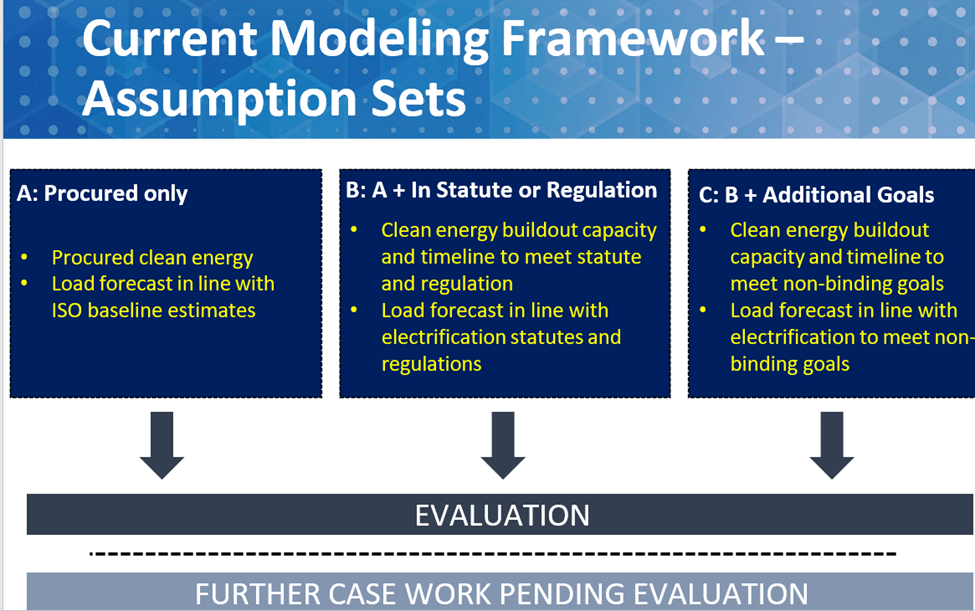
The load forecast and availability of low-emitting generation discussion (video at 21:20) provides the modeling framework.  As shown in the slide below they are considering three assumption sets ranging from “procured” clean energy and energy forecasts in line with ISO baseline estimates to two levels of additional clean energy and load growth.  I think this is particularly important because the timelines have major implications.  An increasingly large percentage of future electric generation unit emission reductions is only possible if clean energy deployment displaces fossil generating facilities.  There are significant uncertainties associated with clean energy development because of supply chain issues, lack of experienced personnel, and the need for extensive supporting infrastructure.  If allowance supply trajectories presume greater displacement of emitting sources than occurs, then there will not be enough permits to emit which could lead to artificial energy shortages.  The assumption sets should consider those timing issues.

Stakeholder Comments

Four specific questions for input from stakeholders were posed (video at 30:19)

  • How comfortable are you with the assumptions that have been included?
  • Are there other assumptions that need to be included in these scenarios?
  • Is there anything that we can do to improve the understanding of the differences between the cases?
  • For which scenarios are stakeholders most interested in seeing results for further Program Review consideration?

Written comments were submitted in response to the request for input from, an emissions trading group, an organization representing New York generating companies, one individual (that would be me), one affected generating company, and six environmental/social justice organizations.  The International Emissions Trading Association (IETA), Environmental Energy Alliance of New York, and myself addressed the specific questions raised as the primary focus.  LS Power Development mentioned the questions asked but was more interested in furthering their own renewable energy development agenda.  The six environmental/social justice organizations (Alternatives for Community & Environment et al., Conservation Law Foundation et al., Earthjustice et al., Environmental Defense Fund, Interreligious Eco-Justice Network et al., and RGGI Advocates Coalition) were primarily concerned with the EJ component.

RGGI Environmental Justice

Environmental justice (EJ) is a featured component of recent environmental policies. It also is a feature of the Green New Deal that “has been used to describe various sets of policies that aim to make systemic change”.  In my opinion the rationale that the transition away from fossil fuels is required is only  a pretext for all the systemic changes desired by advocates who are a primary constituency of the Progressive Democrats.  The question is how do these factors get integrated into environmental policy.

Democrats are not the only ones trying to cater to “environmental justice communities, tribal groups, the labor sector, and other equity groups” that the Conservation Law Foundation mentions in its comments.  It turns out that the big green environmental organizations are going out of their way to cater to these groups as part of a larger goal to impact the nation’s culture.  Environmental organizations are trying to align with social justice organizations to strengthen their bona fides with the Progressives.  The Acadia Center report RGGI Findings and Recommendations for the Third Program Review was referenced by four of the six organizations so I will use it to illustrate the objectives.  .

The Acadia report claims that RGGI states have experienced both a more rapid increase in GDP per capita and a more rapid decline in both power sector CO2 emissions and retail electricity prices relative to other states.  I am not going to address this because I don’t have time and it does not directly address the EJ concerns.  Instead consider the following quotes from the Executive Summary:

The objective of RGGI is, first and foremost, reducing greenhouse gas emissions while supporting economic growth. Although RGGI is not directly an air quality program, because it applies to power plants, it can be an effective vehicle to deliver reductions in criteria air pollutants and better outcomes to communities that are located near power plants. RGGI has delivered important ancillary benefits like an 85% reduction in nitrogen oxides (NOx) in RGGI-regulated power plants over the entire region. Criteria emissions, particularly NOx, can have significant detrimental health impacts including damaging the respiratory tract and increasing vulnerability to respiratory infections and asthma.

In order to connect GHG emission reductions with immediate effects, the relationship with other air pollutants is used.  As mentioned previously RGGI was not the primary driver for the CO2 reductions observed and the situation is the same for NOx.  Moreover, during this period there were NOx-specific control programs that contributed to the observed reductions.

However, the approach of reducing CO2 emissions in aggregate across the region does not necessarily result in a more rapid rate of decline in NOx emissions in EJ communities compared to other areas. Acadia Center analysis found that, between 2008 and 2021:

  • NOx emissions from power plants within 3 miles of a community with high EPA Environmental Justice Socioeconomic Indicators (“EPA EJSI community,”see sidebar for more information) declined by 85%, compared to the rest of the RGGI power plant fleet, where NOx emissions declined by 88%
  • Over a third of RGGI plants that are releasing NOx emissions near communities suffering from disproportionately high rates of asthma
  • Over two-thirds of RGGI plants do not have any active air quality monitoring sites within a 3-mile  radius to measure the impact on neighboring communities – and over three quarters of these unmonitored plants are located near an EPA EJSI community or high asthma communities (see the highlight at the end of this section for more details on both community classifications)

Organizations like the Acadia Center are selectively choosing what information to present both in these comments and to the environmental justice community.  The suggestion that there is a significant difference between communities within three miles of a power plant with “only” an 85% decrease as compared to an 88% decrease elsewhere suggests greater accuracy than warranted.  Unremarked is whether the 85% reduction in emissions had any observable effect on the asthma rates.  I would be more sympathetic if they could show a relationship.  In order to prove or disprove the relationship claimed emissions are only part of the picture.  The bigger point is that NOx impacts are local and must be assessed using air quality modeling. The final bullet about air quality monitoring is a bogus argument.  State and Federal air quality monitoring programs have a long history.  Every power plant in the country has been modeled to confirm local air quality impacts do not exceed the National Ambient Air Quality Standards and most also had an ambient air quality monitoring network at one time to verify that the modeling was correct.  I know this because I did work as a consultant to EPA evaluating the models using the monitoring data and later was responsible for monitoring networks at four power plants.  The bottom line is that the history of modeling and monitoring is so extensive that if there was any question that there could be an issue with these facilities, then it was laid to rest long ago.  That is why there are no nearby air quality monitors today.  Despite this history one of the EJ recommendations is to do community air quality modeling which I believe is not up to the same standard as regulatory air monitoring programs.

In addition to the demand for local air quality monitoring, commenters argued that more public participation is necessary.  For example, the Conservation Law Foundation comments argued that “It is imperative that equity and environmental justice considerations be more thoroughly integrated into modeling, rather than treated as a separate issue for resolution”.  They went on to suggest:

More specifically, the RGGI program and the RGGI Program Review process must be reformed to improve the amount and quality of public participation, develop and conduct equity analyses, and increase investments in overburdened communities.

We must ensure that environmental justice communities, tribal groups, the labor sector, and other equity groups have access to the financial and technical resources they need to meaningfully participate in the RGGI Program Review process. RGGI, Inc. can accomplish this by publishing public notices of RGGI Program Review meetings and comment periods more widely, including by social media and using physical notices in high-traffic gathering places such as grocery stores and community centers.

Color me skeptical but I doubt that any individual who hears about RGGI public meetings from a public notice posted in a grocery store is going to be able to provide meaningful comment on the design elements of RGGI.   The suggestion that these groups have “access to the financial and technical resources” necessary to participate seems to be a recommendation designed to garner funding so the environmental organizations can, for example, “develop and conduct equity analyses” for problems that the environmental justice communities did not even know they had. 

The other major component in the EJ comments was a recommendation to allocate a major share of the proceeds in the disadvantaged communities.  The Conservation Law Foundation comments state that “By taking the funds received from RGGI and reinvesting them in communities most unduly burdened by lack of resources, unequal access to energy infrastructure, and who pay a disproportionate amount of their income to necessities such as utility bills, these monies can have an additive effect that will help to accelerate state and federal decarbonization goals in a just and equitable manner.”  In my opinion these organizations are doing a dis-service to these communities by pushing these decarbonization goals despite over-whelming evidence that the costs to decarbonize are enormous.  I cannot imagine that investments in energy efficiency, retrofitting and electrifying homes in these areas, and providing other energy reduction measures in these communities will offset the increased costs to those least able to afford them.

Conclusion

The third RGGI program review process has some difficult technical issues to address.  At the top of the list is that in order to further reduce electric generation CO2 emissions it is necessary to rely on wind and solar resources to displace the need for the existing units to operate as much.  If the future RGGI allowance caps don’t consider the feasibility of the transition to alternative generation, then it is possible that the caps will limit generation simply because in the absence of permits to emit aka allowances, the only way for an affected source to comply with the regulations is to stop running.

In order to address this concern, the feasibility of the wind and solar implementation schedule should be assessed and consider supply chain, trained personnel, and permitting limitations.  Obviously, the costs are also a factor.  There is an unrecognized RGGI auction revenue dynamic between the need to invest in the control strategies that reduce emissions and the demands of the environmental activists claiming to act in the best interests of the disadvantaged communities.  The money spent on community air quality monitoring, reaching out to EJ communities, and evaluating equity access all do not reduce CO2 emissions directly or indirectly by reducing energy use.  If too much money is spent on programs that do not lead to emission reductions, then the necessary investments won’t be made and the targets won’t be met.

The addition of the environmental justice component to the program review is a diversion to the RGGI CO2 emission reduction efforts.  I think an emphasis on energy efficiency and energy conservation efforts in disadvantaged communities is necessary to limit the effect of the transition to more expensive electricity.  However, RGGI auction funding should prioritize emission reductions over funding any other EJ programs that do not reduce emissions.  The state emission reduction targets are arbitrary and failing to consider technical feasibility and the funding necessary to provide zero-emissions resources to displace energy from the RGGI-affected sources will not end well.

Comments on RGGI Third Program Review

The Regional Greenhouse Gas Initiative (RGGI) is a carbon dioxide control program in the Northeastern United States.  One aspect of the program is a program review that is a “comprehensive, periodic review of their CO2 budget trading programs, to consider successes, impacts, and design elements”.  This post described the comments I submitted on the third program review process that is underway.

I have been involved in the RGGI program process since its inception.  I blog about the details of the RGGI program because very few seem to want to provide any criticisms of the program.  RGGI is a market-based emissions market program similar to what has been proposed for the Climate Leadership & Community Protection Act (Climate Act.  I have written over 300 articles about New York’s net-zero transition because I believe the ambitions for a zero-emissions economy embodied in the Climate Act outstrip available renewable technology such that the net-zero transition will do more harm than good.  The opinions expressed in this post do not reflect the position of any of my previous employers or any other company I have been associated with, these comments are mine alone.

Background

RGGI is a market-based program to reduce greenhouse gas emissions. According to RGGI:

The Regional Greenhouse Gas Initiative (RGGI) is a cooperative effort among the states of Connecticut, Delaware, Maine, Maryland, Massachusetts, New Hampshire, New Jersey, New York, Pennsylvania, Rhode Island, Vermont, and Virginia to cap and reduce power sector CO2 emissions. 

RGGI is composed of individual CO2 Budget Trading Programs in each participating state. Through independent regulations, based on the RGGI Model Rule, each state’s CO2 Budget Trading Program limits emissions of CO2 from electric power plants, issues CO2 allowances and establishes participation in regional CO2 allowance auctions.

Proponents tout RGGI as a successful program because participating states have “cut carbon pollution from their power plants by more than half, improved public health by cutting dangerous air pollutants like soot and smog, invested more than $3 billion into their energy economies, and created tens of thousands of new job-years”.  Others have pointed out that RGGI was not the driving factor for the observed emission reductions.  My latest evaluation of RGGI results found that the investments from RGGI auction proceeds were only directly responsible for 5.6% of the total observed annual reductions over the baseline to 2020 timeframe and that those investments reduced emissions at a rate of $818 per ton of CO2.  I conclude that RGGI successfully raised money but has not provided cost-effective emission reductions or has had much to do with the observed CO2 emission reductions in the electric generating sector of the NE United States.

Third Program Review

One aspect of the program is a program review that is a “comprehensive, periodic review of their CO2 budget trading programs, to consider successes, impacts, and design elements”.  On March 29, 2023 RGGI Inc. and the participating states gave an update on the status of the third program review.  The presentation gave an overview of the program, explained how the review process works, described state activities, and described the electric sector analysis.  Meeting materials are available:

The description of the program review update (video here) used the following slide.  The process is initiated by the states defining revised goals and ambitions which kicks off technical modeling and analysis and a public stakeholder process.  If you have questions about the process this is a good overview.

The meeting described the current modeling considerations, explained the approach and assumptions, and asked for comments on specific aspects of the modeling.  My comments relate to the modeling analyses.  David Coup from NYSERDA described the modeling analysis (video starting at 11:52) using the following slide. The presentation explained that the program review modeling is concerned with the regional cap trajectory, Cost Containment and Emissions Containment Reserves changes, and  adjustments for banked allowances. 

This round of modeling must contend with the “fluidity of state participation” which translates to what to do about Pennsylvania and Virginia.  Pennsylvania participation is “still in effect” but it is still in litigation so there is a major uncertainty relative to the modeling.  Virginia is going to cease participation at the end of 2023 and they have told RGGI that their participation should not be included in the modeling.  The emissions from these two states are a significant portion of the current inventory so participation affects the potential for regional emission reductions.  In 2022 Pennsylvania emissions were 42.5% of the total CO2 emissions of all RGGI states and Virginia was another 13% as shown below. From the standpoint of potential emission reductions note that Pennsylvania still had a significant amount of coal in 2022 and also note that the recently announced retirement of Homer City will result in a 2% reduction of overall RGGI emissions.

There are two other factors that complicate this modeling effort.  The presentation noted that “climate and complementary energy policies will dramatically impact electricity load”.  In other words, the primary decarbonization strategy for buildings and transport is electrification which will necessarily increase load.  In addition, the decarbonization timeline for the electricity sector in states vary.  Those timelines are primarily based on aspirational goals rather than a feasibility analysis to determine how fast wind and solar resources must be deployed to displace existing electric generation to make the mandated emission reductions. The presentation recognized that the implementation of offshore wind deployment and grid-scale battery storage deployment, duration, and supply as factors that add challenges and uncertainty to modeling the decarbonization transition.

In order to address these issues, they are looking at different ways of dealing with the uncertainty by developing “assumption sets based on load forecasts and availability of low-emitting generation” and various allowance supply scenarios.  They think that adding cases will cover the range of outcomes given current electricity-sector developments and that the “results will inform development of potential policy cases”.  While I appreciate the thought, I am concerned that political pressures will preclude any cases that don’t fit the narrative that political timelines will mandate development as needed to meet the schedules.

The load forecast and availability of low-emitting generation discussion (video at 21:20) provides the modeling framework.  As shown in the slide below they are considering three assumption sets ranging from “procured” clean energy and energy forecasts in line with Independent System Operator baseline estimates to two levels of additional clean energy and load growth.  Their definition of procured is that the project is “under contract”.  This is a good example of my concern about the schedule because projects under contract may still be abandoned due to several reasons.  My main concern is that the timelines have major implications.  An increasingly large percentage of future EGU emissions reductions is only possible if clean energy deployment displaces fossil generating facilities because there are no other options left.  There are significant uncertainties associated with clean energy development because of supply chain issues and the need for extensive supporting infrastructure. 

Four specific questions for input from stakeholders were posed (video at 30:19)

  • How comfortable are you with the assumptions that have been included?
  • Are there other assumptions that need to be included in these scenarios?
  • Is there anything that we can do to improve the understanding of the differences between the cases?
  • For which scenarios are stakeholders most interested in seeing results for further Program Review consideration?

My comments addressed two of these questions: How comfortable are you with the assumptions that have been included and are there other assumptions that need to be included in these scenarios?

Fifth Compliance Period Status

One of my concerns about the assumptions included is that there are other uncertainties not included.  In my initial comments on the Third Program Review my overall recommendation was to make no changes and see how the RGGI allowance market plays out the transition to the unprecedented emissions trading situation in which the majority of the RGGI allowances are held by entities who purchased allowances for investment rather than compliance purposes. 

My comments described in detail my latest analysis of allowance holdings and emissions confirms compliance entities will have to obtain allowances from non-compliance entities to meet compliance obligations at the end of 2023.  At the end of the fourth quarter of 2022 the RGGI Market Monitoring Report Q4 2022 noted that there were 231 million allowances in circulation.  The report noted that approximately 148 million of the allowances in circulation (64 percent) are believed to be held for compliance purposes.  I estimate that there were 176.6 million allowances in circulation at end of March 2023 and that approximately 89.8 million allowances (51%) were held for compliance purposes.  I estimated the allowance status at end of the 2021-2023 compliance period as 224.9 million allowances in circulation before allowances are surrendered for 2023 emissions with 105.8 million allowances held for compliance purposes.  Assuming that 2023 emissions would be equal to 2022 emissions for all the RGGI states including Pennsylvania means total emissions will be 193.3 million tons.  That means 87.5 million allowances must be obtained from non-compliance entities for compliance and that the next compliance period will start with an allowance bank of only 31.6 million.

Those two unprecedented concerns are not included in the modeling assumptions.  In the fifth compliance period ending December 31, 2023 the compliance entities are going to have to use allowances now held by non-compliance entities and in the sixth compliance period the allowance cap is going to be binding.  I define a binding cap as one chosen arbitrarily without any feasibility evaluation.  The environmental community has demanded a binding RGGI cap for years and it looks like they are going to get their wish in the 2024-2026 compliance period.  My comments stated that these issues should included in the “are there other assumptions that need to be included in these scenarios?” question posed at the March 29 meeting.  Given the importance of these uncertainties I expanded on my concerns.

Non-Compliance Entities

Based on the evaluation described above I estimate that compliance entities will be required to obtain allowances for compliance from non-compliance entities.  In my opinion, it is reasonable to expect that the non-compliance entities that own allowances for investment purposes will expect a premium for their allowances because they know that the penalties for an out of compliance affected source are severe.   This is unprecedented and no one knows what will happen so it is reasonable to see what happens before there are any decisions regarding changes to the allowance allocation trajectories.

There is another non-compliance entity issue.  In previous comments I pointed out that at least one non-governmental environmental entity has purchased allowances and “will be retiring these allowances so that no power plant can use them to emit greenhouse gas”.  I suggested that this ownership entity should be included as a new category in the Potomac Economics market monitoring reports and that a surrender account be established for individuals and organizations that want to use RGGI allowances for offsetting purposes.  The recommendation was ignored so we are left to hope that the Potomac Economics market monitoring report non-compliance entity category has at least 87.5 million allowances that will be available for compliance purposes.

Observed Emission Reductions to Date

There is another uncertainty associated with future emission reductions.  In my previous comments, I showed that fuel switching from coal and residual oil to natura gas has been the primary CO2 reduction methodology to date.   Of particular importance to the future program is that the potential for future fuel switching is limited outside of Pennsylvania.  The following table lists CO2 emissions for each state by primary fuel type.  The retirement of the coal-fired Homer City facility was recently announced and that facility was responsible for 2% of 2022 emissions.   If Pennsylvania joins RGGI as a full-fledged member and coal retirements from its facilities occur in the future the current reduction trajectory is feasible.  If those conditions do not occur then the only way to produce reductions is by displacement with zero-emissions generating sources.  Eventually, investments in zero-emissions resources will be the only method for reducing affected source emissions.

One of my problems with the RGGI cap and invest program is that while it is supposed to be a pollution control program in which the auction proceeds are invested in emission reduction strategies, the proceeds have not prioritized emission reductions.  In my previous comments I noted that the total of the annual reductions claimed by RGGI in their annual Investments of Proceeds updates since 2009 is 2,818,775 tons while the difference in annual emissions between the baseline of 2006 to 2008 compared to 2019 emissions is 72,908,206 tons.  Therefore, the RGGI investments are only directly responsible for less than 5% of the total observed reductions since RGGI began in 2009.  (Note that I did an update for information through 2020 that did not change these findings.)

Binding Cap

Another uncertainty not included in the issues raised at the March 29 meeting is the binding cap.  I define a binding cap as one chosen arbitrarily to meet some emission reduction target without considering the feasibility of emission reductions necessary to meet that target.  The problem that advocates apparently do not understand is that CO2 control is different than other pollutants because there are no cost-effective controls available for existing facilities.  Instead, CO2 reductions at electric generating facilities require development of zero-emissions resources to displace the need for electric energy output at affected sources.  If the energy from those zero-emissions resources is insufficient to replace affected source generation, then the only compliance alternative left is to stop running.  Unplanned outages due to a lack of allowances could lead to reliability issues.

The binding cap must be considered in the context of the reason for the observed emission reductions and the impact of inefficient RGGI proceeds for reductions.  I recommended that assumptions addressing the binding cap issues need to be included in the RGGI scenarios.  The RGGI states all have various CO2 emission reduction mandates that rely on electrification of other sectors.  This will necessarily increase load at the same time the deployment of low-emitting generation will be the primary emission reduction methodology.  EPA cap and trade programs such as the Cross State Air Pollution Rule established caps based on technological evaluation of control options.  The RGGI reduction trajectory was established based more on arbitrary decarbonization timelines than a deployment schedule supported by a feasibility analysis.  The modeling for this program review must include modeling analyses that consider the zero-emissions deployment schedules.  Sensitivity analyses that consider delays to the deployment of wind and solar resources should also be included.

Conclusion

The March 29 meeting raised the important point that there are new uncertainties that need to be incorporated in the assumptions used for the modeling analyses associated with the third program review.  My comments raised additional issues that add uncertainty and should be considered too.

RGGI asked “how comfortable are you with the assumptions that have been included.”  Because future reductions will rely more heavily upon displacement of affected source energy production by wind and solar at the same time emission reductions in other sectors rely on increased electrification, I am particularly concerned about the load forecasts and availability of low-emitting generation assumptions.  The impact of future load growth and the schedule for low-emitting generation deployment should be considered in the modeling at least by sensitivity analyses.

RGGI also asked if there are other assumptions that need to be included in these scenarios?  The RGGI presentation noted significant uncertainties.  I believe that two other uncertainties need to be considered.  My analysis of the status of emissions and allowances shows that compliance entities will have to depend on allowances from the non-compliance entities for the fifth compliance period ending this year.  That analysis also shows that when the sixth compliance period starts in 2024 there will be an extremely small allowance bank.  I believe that these added uncertainties need to be addressed in the modeling for this program review.

The potential problems associated with a cap on allowances that forces affected sources to comply by not operating is an unrecognized issue.  If an overly stringent cap results in an artificial energy shortage, then it will not reflect well on the RGGI states.

Response to RGGI Operating Plan Amendment Comments

In early January I posted an article describing my comments on the New York State Energy Research & Development Authority (NYSERDA) Regional Greenhouse Gas Initiative (RGGI) Operating Plan Amendment (“Amendment”) for 2023.  This is a follow-up that describes what happens to comments in that process.

I have been involved in the RGGI program process since its inception.  I blog about the details of the RGGI program because very few seem to want to provide any criticisms of the program.   I submitted comments on the Climate Leadership and Community Protection Act (Climate Act).  implementation plan and have written over 270 articles about New York’s net-zero transition because I believe the ambitions for a zero-emissions economy embodied in the Climate Act outstrip available renewable technology such that the net-zero transition will do more harm than good.  The opinions expressed in this post do not reflect the position of any of my previous employers or any other company I have been associated with, these comments are mine alone.

NYSERDA Board Background

This article describes the NYSERDA Board approval process for the 2023 RGGI Operating Amendment.  The NYSERDA Board description shows that this is another example of a process controlled by the Governor:

NYSERDA is governed by a board consisting of 13 members, including the Commissioner of the Department of Transportation, the Commissioner of the Department of Environmental Conservation, the Chair of the Public Service Commission, and the President and CEO of the Power Authority of the State of New York, who serve ex officio. The remaining nine members are appointed by the Governor of the State of New York with the advice and consent of the Senate and include, as required by statute, an engineer or research scientist, an economist, an environmentalist, a consumer advocate, an officer of a gas utility, an officer of an electric utility, and three at-large members.

At this time only 11 members are listed for the Board.  Three are Department Commissioners, two are from NYSERDA, and the head of the New York Power Authority rounds out six people who are for all intents and purposes part of the Hochul Administration.  All the others have some tie to climate resiliency and sustainability in their past working history or present titles.  

My Comments

NYSERDA designed and implemented a process to develop and annually update an Operating Plan which summarizes and describes the initiatives to be supported by RGGI auction proceeds.  On an annual basis, the Authority “engages stakeholders representing the environmental community, the electric generation community, consumer benefit organizations and interested members of the general public to assist with the development of an annual amendment to the Operating Plan.”  New York State claims that RGGI “has helped reduce greenhouse gases from power plants by more than half and raised nearly $6 billion to support cleaner energy solutions”.  I submitted detailed comments on the RGGI Operating Plan Amendments because the State has not figured out that there are ramifications to the historical success of the RGGI program and compliance implications associated with the RGGI auction proceed investments.

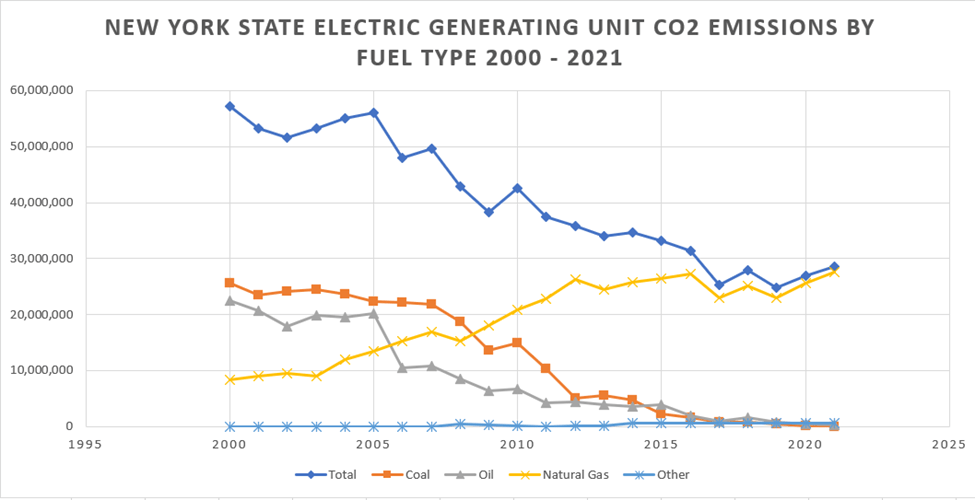
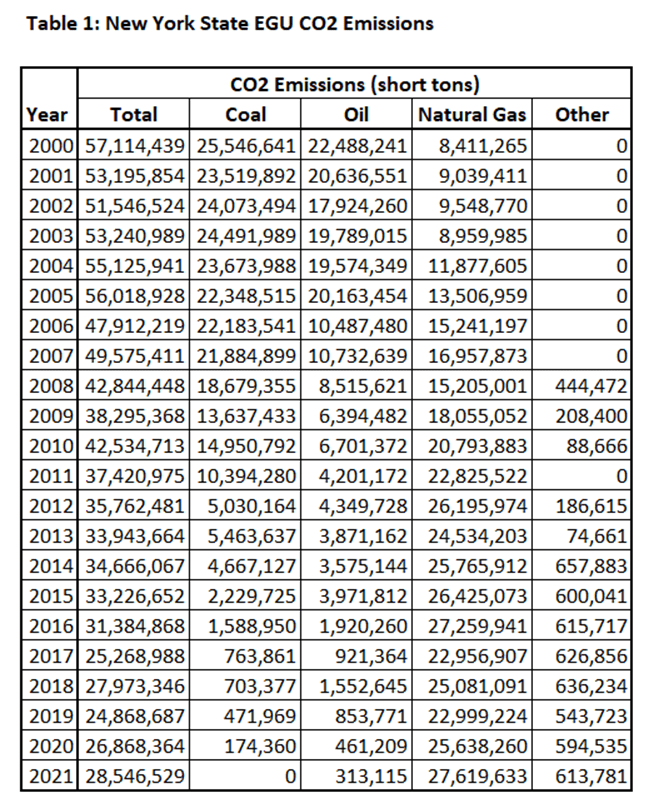
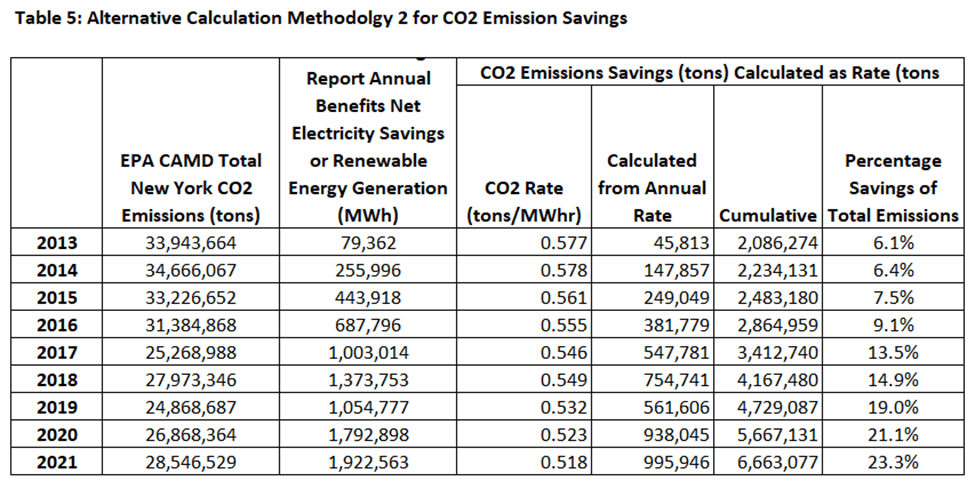
My comments evaluated the CO2 emissions trend of sources that are in the RGGI program.  I showed that between 2000 and 2021 New York EGU emissions have dropped from 57,114,438 tons to 28,546,529 tons, a decrease of 50%.  NYS EGU CO2 emissions were 39% lower in 2021 than the three-year baseline emissions before RGGI started.  However, I showed that emissions have dropped primarily because coal and oil fueled generation has essentially gone to zero.  Natural gas has increased to cover the generation from those fuels but because it has lower CO2 emission rates New York emissions have gone down.  I also evaluated the emission reductions that could be attributed to RGGI investments based on NYSERDA reports. I found that RGGI investments account for only 16% of the observed reductions.  This means that RGGI was not particularly successful as an emission reduction control program.

On the other hand, RGGI has successfully raised revenues for New York State.  From the start of the program through the start of the fiscal years considered in the Operating Plan RGGI auctions have raised nearly $6 billion.  My concern is that the relative lack of emission reductions attributable to New York’s RGGI auction proceeds was related to the fact that there was no emphasis on using the proceeds to provide emission reductions.  Because of the success of fuel switching reductions this has not been a concern but now there are no more fuel switching opportunities and because of the Indian Point shutdown, the RGGI unit emissions have gone up.  Going forward it will be increasingly difficult to make emission reductions.  Carbon dioxide emissions are directly tied to fossil-fuel combustion and energy production.  If, for any number of reasons, zero-emissions are not deployed fast enough to displace the energy produced by RGGI sources there might not be enough credits available to cover the emissions necessary to provide energy requirements. I concluded that it is incumbent upon the state to incentivize and subsidize carbon-free generation so that the RGGI sources can reduce operations and not jeopardize system reliability. 

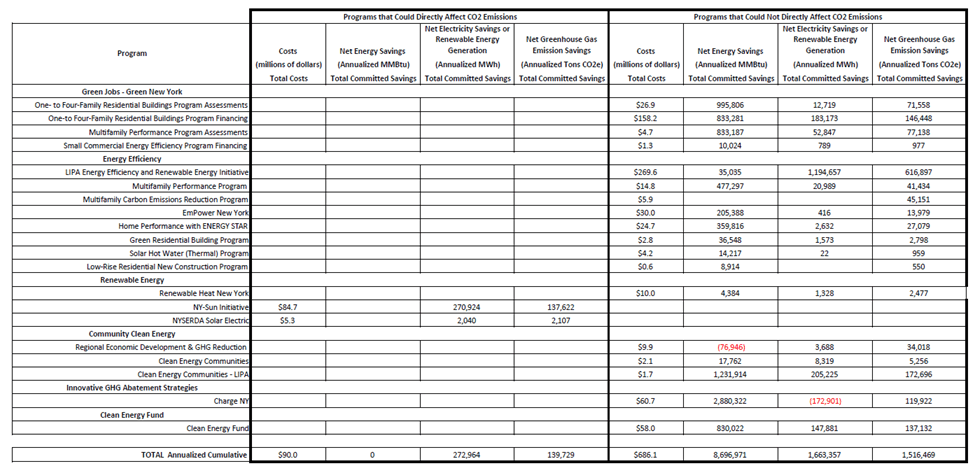
As part of my comments, I also evaluated the programs in the Operating Amendment relative to their value for future EGU emission reductions.  The comments included descriptions of all the programs in the FY23-26 Amendment.  I commented briefly on each proposed program and classified each program relative to six categories of potential RGGI source emission reductions.  The first three categories cover programs that directly, indirectly or could potentially decrease RGGI-affected source emissions.  Those programs total 45% of the investments.  I also included a category for programs that will add load that could potentially increase RGGI source emissions such as programs to incentivize electrification, which totals 27% of the investments.  Programs that do not affect emissions are funded with 21% of the proceeds and administrative costs total another 7%. 

My comments noted that the draft Amendment explains that the programs in the portfolio of initiatives are designed to “support the pursuit of the State’s greenhouse gas emissions reduction goals”.  However, of the five goals only one addresses emission reductions.  The others are vague cover language to justify the use of RGGI auction proceeds as a slush fund for hiding administrative expenses, costs related to Climate Act implementation, and other politically favored projets at the expense of programs that affect CO2 emissions from RGGI affected sources.  To date this has not been an issue because fuel switching has provided the necessary emission reductions.  However, there could be a problem in the next several years because no more fuel switching reductions are available at the same time that RGGI allowance allocations continue to decrease.  This exacerbates the potential of system reliability issues

Response to Comments

The question that intrigued me was what actually happened with the public stakeholder comments.  There is no response to comments document. There is a memo that presumably summarizes the three-year plan and might describe the public stakeholder’s comments.  If I ever get a copy of that memo, I will update this post.  The public had two opportunities to present comment described below.

The first opportunity for public input ( available at the discussion portion of the meeting video) was at the December 12, 2022 meeting.  The presentation noted that comments at the meeting would be treated as written comments and posted on the website.  Conor Bambrick, Environmental Advocates of New York, spoke at the meeting.  He asked whether the New York Sun program applied to Long Island and was told that it does not.  However, there is another program that does.  He asked whether there were any success stories available for the community heat pump program but the program has not reached that point yet.  He had specific question about components of the clean energy taskforce development program.  He also had some clarifying questions about various programs.  I don’t think any of his questions specifically asked for changes.  There was a comment that funding should not be provided for Hydrogen Hubs because a pilot project showed hydrogen could emit more NOx and Ozone than natural gas.  I am familiar with that project and he got his wires crossed because that is not what happened in the pilot project he referenced.  I do not think that any of these comments warranted a follow-up response so it is not surprising that the website does not include anything from the meeting.

The second opportunity was to submit written comments and two written comments submitted.  The New York Municipal Electric Utilities Association commented that the “Municipal Pilot Program” should be expanded.  As far as I can tell the only change to that program was to shift the dates but the total allocation remains $2.5 million.  My comment was the other one.  I mentioned that the Scoping Plan Implementation Research program was important because there are unresolved issues associated with the Scoping Plan.  The allocation for that program was reduced $1 million to $3 million.

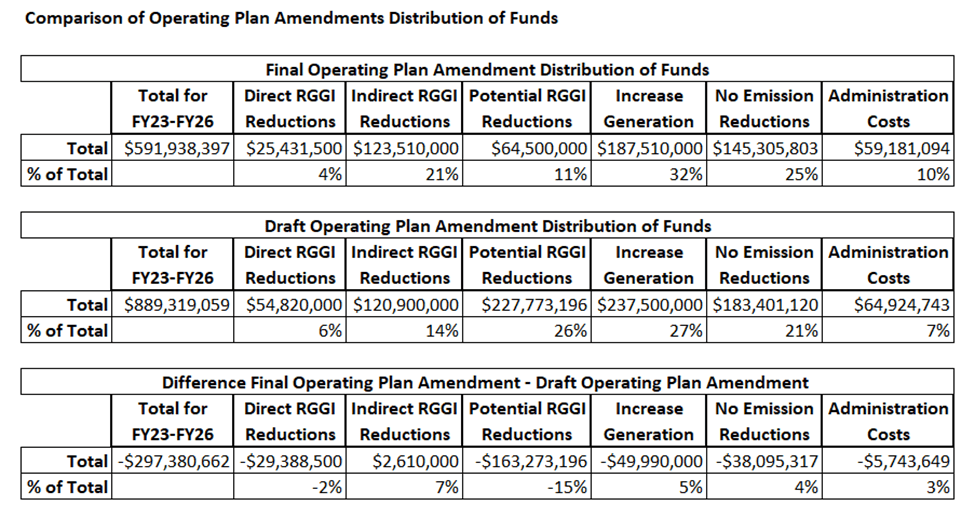
As I noted above, my comments explained that if the operating plan for the RGGI auction proceeds did not invest sufficiently in programs that directly reduce emissions then there is a possibility that affected units may not be able to provide power when needed because they don’t have sufficient allowances to cover operations.  My point was that programs that do not directly, indirectly or could eventually reduce RGGI source emissions by displacing the energy they provide should be emphasized and programs that increase RGGI source emissions should be de-emphasized.  The following table shows that the final version of the amendment plan for RGGI auction proceeds does the exact opposite.  The total funding for RGGI reduction programs drops by $190 million and the % of the total goes down 9% to only 36%.

The NYSERDA Use of Auction Proceeds website describes the operating plan and provides links to the operating plan, the meeting materials for the Stakeholder meeting, and the Comments on the 2023 Draft Amendment.  The  approved Operating Plan Amendment and the transcript for the Board meeting where the Amendment was approved are both available.  I extracted the discussion for the operating plan approval but have not been able to find the memo referred to in the presentation.

The transcript for the meeting includes the following overview by John Williams, Executive Vice President for Policy and Regulatory Affairs  at NYSERDA: 

We’ll move this one along pretty quickly. We’re here with our annual routine RGGI approval process. So the, the Members have received both the three year plan that we’re proposing as well as a memo of summarizing all that. Just some high points here for awareness. You know, we did engage our annual process to come up with our proposal and present that to stakeholders. And on December 12th we held a webinar for receipt of stakeholder input on that. So some participation there and some exchange of thoughts happening at that December 12th webinar. The proposal was also open for written public comments through January 6th, and we did receive a couple of comments there. The proposal you have was you know, does take those public feedback into account

It is obvious that NYSERDA was going through the motions of the stakeholder process.  They had a meeting for stakeholder input, check.  They had a public comment period, check.  They posted both comments received, check.  John Williams told the Board that public feedback was taken into account, check.  They had a  discussion of the Operating Plan Amendment at the Board meeting, check.  John Williams responded to questions that came up during the discussion, check.   The Board voted to approve the Amendment, check.  Mission accomplished.

Response to Comments

The question that intrigued me was what actually happened with the public stakeholder comments.  There is no response to comments document. There is a memo that presumably summarizes the three-year plan and might describe the public stakeholder’s comments.  If I ever get a copy of that memo, I will update this post.  The public had two opportunities to present comment described below.

The first opportunity for public input ( available at the discussion portion of the meeting video) was at the December 12, 2022 meeting.  The presentation noted that comments at the meeting would be treated as written comments and posted on the website.  Conor Bambrick, Environmental Advocates of New York, spoke at the meeting.  He asked whether the New York Sun program applied to Long Island and was told that it does not.  However, there is another program that does.  He asked whether there were any success stories available for the community heat pump program but the program has not reached that point yet.  He had specific question about components of the clean energy taskforce development program.  He also had some clarifying questions about various programs.  I don’t think any of his questions specifically asked for changes.  There was a comment that funding should not be provided for Hydrogen Hubs because a pilot project showed hydrogen could emit more NOx and Ozone than natural gas.  I am familiar with that project and he got his wires crossed because that is not what happened in the pilot project he referenced.  I do not think that any of these comments warranted a follow-up response so it is not surprising that the website does not include anything from the meeting.

The second opportunity was to submit written comments and two written comments submitted.  The New York Municipal Electric Utilities Association commented that the “Municipal Pilot Program” should be expanded.  As far as I can tell the only change to that program was to shift the dates but the total allocation remains $2.5 million.  My comment was the other one.  I mentioned that the Scoping Plan Implementation Research program was important because there are unresolved issues associated with the Scoping Plan.  The allocation for that program was reduced $1 million to $3 million.

As I noted above, my comments explained that if the operating plan for the RGGI auction proceeds did not invest sufficiently in programs that directly reduce emissions then there is a possibility that affected units may not be able to provide power when needed because they don’t have sufficient allowances to cover operations.  My point was that programs that do not directly, indirectly or could eventually reduce RGGI source emissions by displacing the energy they provide should be emphasized and programs that increase RGGI source emissions should be de-emphasized.  The following table shows that the final version of the amendment plan for RGGI auction proceeds does the exact opposite.  The total funding for RGGI reduction programs drops by $190 million and the % of the total goes down 9% to only 36%.

The bottom line is that there is no description describing the response to the comments.  From what I could ascertain the comments received were not “taken into account”. The final amendment did the opposite of what was recommended for two program-specific suggestions.  My overall concern about emphasizing programs that could reduce RGGI emissions was also ignored and funding changed directly opposite of my suggestion.

Conclusion

The only indication that I have that someone read my comments is that I pointed out a typographical error that was corrected.  There is no evidence supporting the John Williams claim to the Board that “The proposal you have was you know, does take those public feedback into account”.  The fact is that the recommendations of the two written comments were ignored.  This is typical for New York stakeholder outreach, the only thing that matters to State Agencies is the process because the answer is in the back of the book.  The Hochul Administration picked the projects and selected the Board members who approved them to further their objectives.  The Administration only pretends to care about public stakeholder input.

So why do I bother submitting comments.  In this instance the Hochul Administration is getting themselves out on thin ice.  Carbon dioxide emissions are directly tied to fossil-fuel combustion and energy production.  If State investments do not displace energy use at the RGGI electric generating units at the same time that RGGI allowance availability shrinks, the time may come when the only compliance option available is to not operate.  That is the reason that I argued that a change of emphasis for RGGI allowance proceeds to prioritize emission reduction efforts was appropriate.  I submit comments because if there is a problem in the future the politicians will not be able to say they were not warned.

Making Climate Policy Work, RGGI, and New York Cap and Invest

One of my pragmatic interests is market-based pollution control programs.  In this post I am going to address the take on the Regional Greenhouse Gas Initiative (RGGI)  in an influential book Making Climate Policy Work.  There are also important lessons to be heeded as New York considers a Cap and Invest program.

I follow and write about the RGGI market-based CO2 pollution control program for electric generating units in the NE United States.   I have extensive experience with air pollution control theory, implementation, and evaluation having worked on every cap-and-trade program affecting electric generating facilities in New York including the Acid Rain Program, RGGI, and several Nitrogen Oxide programs. The opinions expressed in this post do not reflect the position of any of my previous employers or any other company I have been associated with, these comments are mine alone.

Making Climate Policy Work Overview

The description of the book states:

For decades, the world’s governments have struggled to move from talk to action on climate. Many now hope that growing public concern will lead to greater policy ambition, but the most widely promoted strategy to address the climate crisis – the use of market-based programs – hasn’t been working and isn’t ready to scale.

Danny Cullenward and David Victor show how the politics of creating and maintaining market-based policies render them ineffective nearly everywhere they have been applied. Reforms can help around the margins, but markets’ problems are structural and won’t disappear with increasing demand for climate solutions. Facing that reality requires relying more heavily on smart regulation and industrial policy – government-led strategies – to catalyze the transformation that markets promise, but rarely deliver.

The authors recognize the enormity of the challenge to transform industry and energy use on the scale necessary for deep decarbonization.  They write that the “requirements for profound industrial change are difficult to initiate, sustain, and run to completion.”  Because this is hard, they call for “realism about solutions.”  Cullenward and Victor recommend clear thinking and strategy as opposed to “Efforts spent tilting at ephemeral, magical policy solutions waste scarce resources that should instead be invested in things that work.”  The goal of their book is to explain how market-oriented climate policies have fallen far short and how they might be modified so that they work.

RGGI Results

One of my first posts at this blog is still in the top ten viewed articles: Academic RGGI Economic Theory of Allowance Management.  In that article I argued that economic value theory for an allowance market fails to account for the behavior of the affected sources.  In particular, the owners and operators of sources treat the allowances primarily as compliance instruments and not as financial assets.  The important difference is that the academic economic theory holds that affected sources are looking years down the road but in reality, there is no such long-term time horizon for affected sources.  Compliance entities decide to buy allowances based on their expected operations in the period between auctions or, at most, the entire 3-year compliance period including a small margin for operational variations and regulatory compliance.  Contrary to theory there is little attempt to make the allowances a profit center.

I have regularly evaluated RGGI performance on this blog.  Last December I evaluated the 2020 RGGI Investment Proceeds report that describes the results of RGGI investments over the entire region.  I found that since the beginning of the RGGI program CO2 emissions have been reduced more than 50% but that RGGI funded control programs have been responsible for only 5.6% of the observed reductions.  In late December I did a similar analysis of just the New York investment proceed results and found that in New York since the beginning of the RGGI program to 2021 CO2 emissions have been reduced 39% but the reduction was 47% until the State shutdown the Indian Point nuclear station.  The RGGI funded control programs have been responsible for only 16% of the observed reductions.  The main reason for the reductions in RGGI and New York State has been fuel switching to natural gas unrelated to RGGI.

I also recently evaluated New York’s operating plan that guides the investment of RGGI proceeds.  In the next fiscal year, the operating plan has 30 programs but only two programs claim direct CO2 reduction savings.  Over the years 2013 to 2021, the total investment for those two programs is $565 million and the claimed savings are 1,684,616 MWh and 861,442 tons of CO2e with a calculated cost benefit of $656 $/ton.  I classified each program relative to six categories of potential RGGI source emission reductions.  The first three categories cover programs that directly, indirectly or could potentially decrease RGGI-affected source emissions.  Those programs total 45% of the investments.  I also included a category for programs that will add load that could potentially increase RGGI source emissions which totals 27% of the investments.  Programs that do not affect emissions are funded with 21% of the proceeds and administrative costs total another 7%.  In summary, even though the ostensible purpose of RGGI proceeds is to reduce emissions from RGGI-affected sources, less than half of the investments expect to do so.

Even though many RGGI proponents claim the program has been a success, my work shows that depends on how success is defined.  If success is defined as significant cost-effect emission reductions from affected sources then that is not the case.  If success is defined as a functional market-based system that provides proceeds then it is a success.  There is no question the program components work well.  The misuse of RGGI funds for affected source emission reductions is not the fault of the system but the politicians who control fund disbursement. 

Making Climate Policy Work and RGGI

I wondered if this book talked about RGGI and how they rated its results relative to my analyses.  I went through the document searching for and documenting every reference to RGGI to see whether I agreed with their description and evaluation of the program.

The first chapter describes the vision and the reality of carbon reduction market-based policies.  Three example policies are described, including RGGI.  The RGGI description states:

RGGI’s vision is the most realistic and generally applicable precisely because it is the most pragmatic about what is able to be achieved. The program encompasses states with varied political interests around climate change, ranging from the highly ambitious to the cautiously engaged. It covers only the electricity sector – where the technologies for cutting emissions are most mature – with transparent and predictable program rules. Even in the power sector, however, RGGI is not the only or even main show in decarbonizing its participating states’ electric grids. Other policy programs are having a bigger impact, including state renewable portfolio standards; subsidies that keep nuclear power plants, which are prodigious suppliers of zero-carbon power, from shutting down; and other government-managed regulatory and procurement efforts all aimed at making the RGGI states’ power infrastructure less carbon-intensive. In many respects, the RGGI system represents the high-water mark for what subnational markets can do: RGGI supports the broader goal of deep decarbonization, generates discretionary revenue streams for participating governments, and increases the static economic efficiency of a policy portfolio – all in a single sector. Its benefits are clear and relatively  modest. Among purists, RGGI is often mocked because its prices are low (about $5–6 per metric ton of CO2 emissions in 2019) and coverage is limited to just one sector. We see the experience through a completely different lens: RGGI works because its architects knew what they were doing and designed a system that is politically feasible and durable.

I have slightly different takes on some of these points but overall I agree with their characterization.

The next two chapters and Chapter 5 only mention RGGI in passing.  Chapter 2: Ambition makes the case that the theory of flexible and economically efficient carbon markets should make them ideal for maximizing the effort to control carbon pollution. This chapter explains why carbon markets have failed to live up to the expectations.  The only reference to RGGI discussed the political process that underpins participation.  The RGGI framework is flexible enough so that the addition and deletion of participating states when political regimes change does not affect the viability of the overall program.  It concludes: “Firms and governments participating in RGGI know that states may come or go, with the consequences managed through an informal political process rather than a legal one.”  Chapter 3 on coverage and allocation notes that RGGI is limited to the electric sector.  Chapter 5 on offsets notes that even though offsets are allowed they have not been a factor in RGGI.  I agree with their characterizations. 

Chapter 4: Revenue and Spending delves into the disbursement of funds collected in the market.  The total RGGI cumulative auction proceeds at the time of this writing is $5,895,274,757.14 since the first auction in September 2008 so RGGI has successfully generated revenues. With regards to spending the chapter notes that “How societies spend the money raised through these sales is vital to understanding the politics of emissions trading.” 

The chapter discussion on RGGI points out that each state controls its revenue spending.  There is a graph from the 2017 RGGI proceeds investment report that describes revenue uses in three categories: general funds; revenue recycling (earmarking revenues for spending that benefits citizens); and green spending (energy efficiency, clean energy, and climate mitigation).  Given the difficulties I have had trying to interpret the RGGI proceeds reports, it is not surprising that there isn’t more detail.

The authors did pick up on some of the revenue problems in RGGI:

The RGGI program also reveals some of the political dynamics that can emerge when political leaders decide to re-purpose funds. The Governors of New York and New Jersey have both diverted RGGI revenues to the state’s general fund at points in the program’s history, raising concern from environmental NGOs and others who have supported a green spending agenda.  

In a section within this chapter titled “Why green spending becomes green pork” the authors explain that there is not much scrutiny how the money is spent.  They define pork as an expenditure that is designed to disproportionately benefit a special interest rather than the broader public good.  They claim that “the organizations that spend RGGI funds are better designed to provide more discipline and accountability on how those funds are spent” than the other example programs discussed. While that may be true with respect to RGGI as a whole, it is not the case for New York.  For example, the authors did not manage to tease out the fact from various unclear reports that New York uses RGGI funds to cover costs that were covered by general funds, i.e., a hidden diversion of revenue to the general fund.  I am sure that had the authors looked into New York’s operating plan for RGGI auction proceed expenditures they would have agreed with my conclusion that green pork is a prominent part of New York’s expenditures.

Chapter 6: Market Links discusses the “institutional challenges of managing cross-border market governance”.  With regards to RGGI I agree with their characterization:

Critically, what holds this system together is not law and the creation of robust, tradeable property rights, but rather a shared vision of parallel efforts at low levels of ambition. Design decisions are made according to the evolving political views of current and prospective participants. And because RGGI features so many parties – none of which hegemonically dominates the group’s overall agenda – the program  must be transparent and predictable. The largely egalitarian cooperation of RGGI states works because it is anchored in stability-oriented market design features that make market behavior more predictable and risk management more tractable.

Chapter 7: Getting the Most Out of Markets explains how to increase program ambition, for example, attracting more jurisdictions or setting more ambitious targets.  The RGGI discussion does a good job explaining how the program addressed an oversupply condition:

The northeastern United States’ RGGI program takes a similar approach through a pair of one-time cap adjustments, as well as a dynamic intervention that resembles the Market Stability Reserve. Like the EU ETS, RGGI experienced market oversupply conditions and very low prices in the 2010s. The situation with RGGI was more extreme, however, because this cap-and-trade program only applies to the electricity sector and the United States’ electricity sector began a profound transformation alongside (but not because of) RGGI. Not only did many of its participating states implement aggressive renewable energy and energy efficiency regulations, but also the rise of cheap natural gas from fracking dramatically accelerated the replacement of high-emitting coal-fired electricity with relatively clean natural  gas and zero-carbon renewables. Emissions have been falling steadily, despite – not because of – anemic RGGI prices. As emissions fell owing to exogenous forces, the market became oversupplied. In response, RGGI’s two cap adjustments removed almost 140 million allowances – about two years’ worth of total emissions – from the supply of allowance budgets through program year 2020.[1]

In addition to these one-time adjustments, RGGI also developed a dynamic mechanism to alter the supply of allowances.[2] This additional market feature is triggered by observed market prices, rather than the EU ETS Market Stability Reserve’s measurement of excess allowance supplies. Like the EU ETS Reserve, RGGI’s approach is two-fold: RGGI features a Cost Containment Reserve that releases 10% of the program-wide allowance budget into the market if prices reach $13 per allowance in 2021; and if prices fall below $6 per allowance in 2021, an Emissions Containment Reserve will absorb 10% of the program’s annual allowance budget and remove these allowances from circulation. When the market remains in between the two triggering prices, allowances supplies are fixed – just as in the EU ETS, where supplies are fixed so long as the total number of surplus allowances stays within a specified range. (Both triggering prices increase at 7% per year to increase ambition over time, but not even the high-end prices are significant when compared to the policy incentives supporting renewable or nuclear energy in participating RGGI states.)[3]

The final chapter is entitled “Rightsizing markets and industrial policy”.  One of the problems identified in the book is that the level of expenditures needed to implement the net-zero transition vastly exceeds the “funds that can be readily appropriated from market mechanisms”.  The chapter describes RGGI as the “the cap-and-trade system  whose design is most purely oriented around generating and spending revenue”.  The authors note that the October 2019 report “The Investment of RGGI Proceeds in 2017” indicates that New York has mobilized just $100 million per year for green spending.  My review of the latest plan to invest New York RGGI auction proceeds indicates that the design plan is supposed  to “support the pursuit of the State’s greenhouse gas emissions reduction goals”.  Of the five goals listed, only one addresses emission reductions.  The others are vague cover language to justify the use of RGGI auction proceeds as a slush fund for hiding administrative expenses and costs related to Climate Act implementation at the expense of programs that affect CO2 emissions from RGGI affected sources. 

Making Climate Policy Work and New York Cap and Invest

Governor Hochul recently announced a plan to use a market-based Cap and Invest program to raise funds for the Climate Leadership & Community Protection Act.  I submitted comments on the Draft Scoping Plan that made opposed the recommendation for such a program.  My initial impression of the Cap and Invest program is that it is more style than substance.  If I had read this book before drafting the comments or my initial impression article, I would have highlighted the findings in this book as part of my arguments against this approach.

The program public relations summary claims that “A Cap-and-Invest Program is the most feasible, efficient, and affordable method to attain a more sustainable future.”  I have been surprised by the amount of support for the plan.  At the February 14, 2023 New York Senate Environmental and Ways and Mean legislative public hearing on the 2023 executive budget the majority of the speakers supported the proposal.  I don’t think that any of the comments that support the program realize the many flaws in that proposal that are described in this book.

In my opinion, a fundamental flaw in the Scoping Plan is that it does not include feasibility analyses to determine whether the laundry list of control strategies will be feasible.  The Plan does not demonstrate that the proposed strategies will be maintain current standards of reliability and safety or can keep energy costs affordable.  This lack of analysis extends to the Cap and Invest proposal.  Proponents claim that it is the most feasible option but that is relative to a short list of options and does not necessarily mean that it will work as proposed.  The preface of the book notes the importance of feasibility:

In telling the story of how market-based climate policy works in the real world, we adopt the premise that idealized markets would be desirable if they were feasible. We hope this choice allows us to reach readers who identify strongly with the power of market forces, since we hope to change their minds. We want them to understand how political forces constrain what market-based policies can do, especially at the early stages of deep decarbonization, because wishing those forces away isn’t practical and hasn’t worked.

The Cap and Invest fact sheet notes that this program will be similar to RGGI that “has helped reduce greenhouse gases from power plants by more than half and raised nearly $6 billion to support cleaner energy solutions”.  As noted previously my analyses show that RGGI was only a minor cause of the observed emission reductions.  Chapter 1 this book also argues that RGGI is not the primary cause: “Other policy programs are having a bigger impact, including state renewable portfolio standards; subsidies that keep nuclear power plants, which are prodigious suppliers of zero-carbon power, from shutting down; and other government-managed regulatory and procurement efforts all aimed at making the RGGI states’ power infrastructure less carbon-intensive.”  Based on my work I believe fuel switching has been the primary cause of New York observed reductions but there are two aspects to consider.  The reductions were because natural gas was a cheaper alternative than coal and oil.  However, the subsidies for nuclear power plants kept emissions from rising.  That is until the State made the irrational decision to shut down 2,000 MW of nuclear power at Indian Point.  Since 2019, when the staged closure began, New York electric utility CO2 emissions have increased 5.8 million tons or 23%.

The Scoping Plan recommendation for an economy-wide strategy to address the financing and emission limitations is based on a naïve understanding of market-based programs.  Cullenward and Victor explain the reality:

Market-based policies on a planetary scale, the theory goes, would empower firms and governments with the flexibility to focus investment on the least expensive options for controlling emissions. Flexibility would reduce costs, allowing more environmental protection with fewer resources; in turn, frugality would make it easier to mobilize business and voter support for ever-deeper climate pollution reductions.

They go on to explain that this vision has completely failed:

Many pollution markets exist, but nearly all are smokescreens that create the impression that market forces are cutting emissions when, in fact, other policies are doing most of the real work of decarbonization. Almost everywhere that market systems are in place they operate at prices that are so low as to have little impact on key decisions such as whether to invest in or deploy new technologies.

The Cap and Invest solution is being marketed as both a compliance and financing tool.  The belief is that the cap will establish compliance limits and the auction will provide the funding to make the reductions.  There are issues with these tools.

The use of the cap as a binding compliance mechanism is unprecedented.  Consider, for example, the EPA Cross State Air Pollution Rule (CSAPR).  This cap-and-trade program is in place to limit nitrogen oxide (NOx) emissions in the eastern United States for ozone compliance.  There have been multiple iterations of this rule that have progressively reduced the cap.  The distinction between CSAPR and a binding cap is that EPA evaluated emissions, existing control technology, and potential improvements or additions for all the sources in the CSAPR-affected states.  The cap was determined using this control technology evaluation to set a feasible limit.  A binding cap is one chosen arbitrarily without any such feasibility evaluation.  In 2030 New York GHG emissions must be 40% lower than the 1990 baseline but this is an arbitrary target mandated by the Climate Act. 

There is another aspect of any GHG emissions reduction program.  There are no cost-effective add-on control technologies available for existing sources.  The only options available for an affected source are to change the fuel to something with lower GHG emissions, make the system more efficient, to reduce operations, or shut down.  As noted previously, New York reduced its electric system emissions significantly because of fuel switching but that strategy is tapped out for any future significant reductions.  In order to get more reductions from the electric generating system, zero-emissions resources must be deployed to displace the fossil resources.  This is particularly difficult because the loss of Indian Point’s zero emissions generation has increased recent emissions.  The control strategies are similar for all other sectors. 

Cullenward and Victor make the point that it is easier to make reductions with existing technology:

In a few places, carbon prices from market-based policies have been powerful enough to induce some changes in emission patterns – such as when firms decide whether to produce electricity from high-emission coal plants or lower-emission rivals. Those impacts, however, have nearly always involved commercially mature technologies competing in stable environments and under other highly restrictive conditions.

In order to meet the 2030 GHG emissions target technology that has not been proven commercially viable at the necessary scale is needed.  This challenge is a problem with the Climate Act deep de-carbonization targets that the Scoping Plan recommendations ignore:

On another front, what markets do best – creating transparent, marginal price signals that encourage firms and households to optimize their choices – is misaligned with the industrial challenges facing deep decarbonization today. In most sectors the world is not far along with deep decarbonization: key technologies, demonstration projects, and the emergence of new firms to back low-carbon technologies are fledgling at best (see Figure 1.2).9 Industrial firms and consumers aren’t waiting for a faint, marginal signal from markets to nudge their behavior. Instead, they need active programs to mobilize and apply resources to new technologies that, with time and effort, will launch the global process of deep decarbonization and displace incumbent industries. Well-designed market signals, at best, are good at encouraging optimization when technologies are commercially mature and strategic choices are clear – such as when the UK electricity market had a signal to select mature renewable energy technologies and gas instead of coal. The hardest challenges of deep decarbonization involve redirecting  investment toward technologies and businesses that are the opposite: beset with risk and danger for first movers. Creating those new industries requires a policy strategy – industrial policy, in effect – that is focused on the problem at hand, rather than inducing marginal changes in behavior with known technologies and production methods.

The authors address three issues related to the fact that the existing systems have failed to live up to expectations.  The first issue is related to the technology issues noted above:

We explain why idealized, “first-best” designs for pollution markets envision systems that produce high carbon prices as a powerful incentive for change. In the real world, the outcome has been the opposite: prices are low and often volatile, which undercuts the incentive to invest in ambitious new technologies and to make changes in production methods beyond those that are straightforward with few risks. First-best visions for pollution markets also imagine that markets should cover many sectors simultaneously, allow extensive interconnection with markets overseas, raise large amounts of revenue, and spend those revenues efficiently to offset distortions in the economy. On every front the real world has produced outcomes that are the opposite from theory: markets are fragmented, links are few, sectoral coverage mostly is narrow, and revenues raised are small.

Details for the proposed Cap and Invest program are sketchy but my impression from what I have heard is that it will also be the opposite of this theory.

As an alternative, the author describe how to make market-based programs more effective.  Their second issue is necessary market reforms:

Some reforms are needed to make market signals more reliable – an outcome that requires shifting away from cap-and-trade systems, where market structures create volatile prices, and toward systems where prices are managed within narrow bands. In effect, cap-and-trade systems can be made more effective when they are designed to behave more like taxes; it is no accident that the few jurisdictions with the highest prices and the greatest level of effort use taxes, not cap-and-trade. More stable prices will make it easier for firms to invest in anticipation of market signals and to build political coalitions that are supportive of that investment. Systems that are designed like taxes also perform better in the real world where market policies are implemented alongside other regulatory programs. In that setting, cap-and-trade schemes merely trade the residual and get little work done in cutting emissions – they are Potemkin markets. Tax approaches, by contrast, create a clear incentive for change (the specified tax level), which persists even as other policy instruments have big impacts on behavior as well.

This approach is basically RGGI without a binding cap.  Unfortunately, Climate Act proponents are convinced that the transition schedule is possible despite the lack of any evidence supporting evidence and that the climate crisis necessitates the aggressive schedule of the Climate Act.  Even though New York GHG emissions are less than one half of one percent of global emissions and global emissions have been increasing by more than one half of one percent per year this rationale for the Climate Act schedule is a major obstacle against this common sense approach.

In addition to the compliance mechanism the proposed Cap and Invest program is intended to provide revenues for the transition.  I have no doubts that the program will generate revenues and suspect that the Hochul Administration will decide the revenue targets based on just how much they think they can get away with rather than basing them on the results of their RGGI auction proceeds.  Cullenward and Victor address this aspect:

Our playbook for market reform offers some insights into why so many of the visions for market-oriented climate policy won’t happen under real-world political conditions. For  example, many advocates for market-based policies imagine that the adoption of market schemes will occur alongside massive policy reforms that roll back regulation. We explain why, politically and administratively, those regulatory and industrial policies are not easily rolled back. Moreover, we explain why pushing for that outcome would be a bad idea – since those other regulatory policies, in fact, are doing most of the serious work in cutting emissions.

One of the most important contributions of markets is among the least appreciated today: well-designed market schemes can raise revenue. A politically savvy strategy for market reforms requires paying closer attention to how program revenues are spent – and specifically to allocating funds to activities that will build experience with new technologies and thus also catalyze new interest groups that are supportive of accelerating deep decarbonization.

Because of the enormity of the challenge another issue is discussed.  In particular, what else is needed:

The key is to channel resources into the sectors that are critical for deep decarbonization. Rather than link all sectors together into a common market system, each must be treated independently because each has its own political economy and state of technology. In sectors where technologies are immature, industrial policy should focus on research, development, and demonstration (RD&D) in a diverse array of options – an approach that yields knowledge and also builds political coalitions around new low-carbon industries.

The New York Climate Act covers all sectors.  It may be possible to breakout the sectors based on such a recommendation.  However, the looming problem is that a binding cap will limit emissions even if the zero-emissions resources are not available to displace the existing emissions.  Carbon dioxide emissions are directly tied to fossil-fuel combustion and energy production.  If for any number of reasons, the zero-emissions are not deployed fast enough in all the sectors there won’t be enough credits available to cover the emissions necessary to provide the energy needs.  In the worst case, an electric generating unit needed to keep the lights on will refuse to operate because they have insufficient allowances. 

The obvious solution to this concern is a feasibility analysis of the schedule for technological innovations necessary to maintain affordability and reliability.  The authors suggest “Doing better requires recognizing the structural limits to what is achievable with market-based approaches – limits that are rooted in how the politics and technological opportunities are organized in each sector.”

Conclusion

The Hochul Administration proposes a Cap and Invest program that will provide revenues and establish a compliance mechanism.  I agree with the authors that the results of RGGI and other programs suggest that the Cap and Invest proposal will generate revenues.  However, we also agree that the amount of money needed for decarbonization is likely more than any such market can bear.  The problem confronting the Administration is that in order to make the emission reductions needed they have to invest between $15.5 and $46.4 billion per year.  I don’t think that range is politically palatable.

The use of Cap and Invest as a compliance mechanism is more of a problem.  The Hochul Administration has not acknowledged or figured out that the emission reduction ambition of their Climate Act targets is inconsistent with technology reality.  Because GHG emissions are equivalent to energy use, limiting GHG emissions before there are technological solutions that provide zero-emissions energy means that compliance will only be possible by restricting energy use.  Unless a miracle occurs in 2030 when there are insufficient allowances someone has to choose who gets to operate.

This is a good book and I recommend it to anyone interested in energy and climate policy and emissions trading programs.


[1] The Regional Greenhouse Gas Initiative, “Elements of RGGI,” https://www.rggi.org/program-overview-and-design/elements; see also The Regional Greenhouse Gas Initiative, “RGGI Program Review: Summary of Proposed Changes to RGGI Regional CO2 Allowance Budget” (Nov. 21, 2013); The Regional Greenhouse Gas Initiative, “Second Control Period Interim Adjustment for Banked Allowances Announcement” (March 17, 2014).

[2] The Regional Greenhouse Gas Initiative (2014), supra note 11.

[3] New York and Illinois (the latter of which is not in RGGI) created the first zero-emission credit (ZEC) subsidy programs for nuclear energy in the United States. See Nuclear Energy Institute, “Zero-Emission Credits” (Apr. 2018). These policies were challenged in court  and ultimately upheld in two parallel cases. Coalition for Competitive Electricity v. Zibelman, 906 F.3d 41 (2nd Cir. 2018) (New York); Electric Power Supply Association v. Star, 904 F.3d 518 (7th Cir. 2018) (Illinois). Following these favorable outcomes, New Jersey (once again part of RGGI) adopted a similar program. Robert Walton, “New Jersey moves ahead on nuke subsidies, approving ZEC application process,” Utility Dive (Nov. 21, 2018). For an overview of state renewable energy policies, see Galen L. Barbose, “US Renewables Portfolio Standards: 2019 Annual Status Update,” Lawrence Berkeley National Laboratory (2019), https://emp.lbl.gov/projects/renewables-portfolio.

New York RGGI Operating Plan Amendment 2023

I recently published a summary of the Regional Greenhouse Gas Initiative (RGGI) Investments of Proceeds annual report and followed that up with a post on the New York-only report.  This post describes my comments on the New York State Energy Research & Development Authority (NYSERDA) Regional Greenhouse Gas Initiative (RGGI) Operating Plan Amendment (“Amendment”) for 2023.  This document describes the plans to use the RGGI proceeds in the next several years.  There are implications not only to the RGGI program but also for the Climate Leadership and Community Protection Act (Climate Act).  Although supporters of RGGI claim that it is a successful model to emulate my analyses show that it is not nearly as successful as claimed.

I have been involved in the RGGI program process since its inception.  I blog about the details of the RGGI program because very few seem to want to provide any criticisms of the program.   I submitted comments on the Climate Act implementation plan and have written over 270 articles about New York’s net-zero transition because I believe the ambitions for a zero-emissions economy embodied in the Climate Act outstrip available renewable technology such that the net-zero transition will do more harm than good.  The opinions expressed in this post do not reflect the position of any of my previous employers or any other company I have been associated with, these comments are mine alone.

Background

RGGI is a market-based program to reduce greenhouse gas emissions (Factsheet). It has been a cooperative effort among the states of Connecticut, Delaware, Maine, Maryland, Massachusetts, New Hampshire, New York, Rhode Island, and Vermont to cap and reduce CO2 emissions from the power sector since 2008.  New Jersey was in at the beginning, dropped out for years, and re-joined in 2020. Virginia joined in 2021 and Pennsylvania has joined but is not actively participating in auctions due to on-going litigation. According to a RGGI website: “The RGGI states issue CO2 allowances which are distributed almost entirely through regional auctions, resulting in proceeds for reinvestment in strategic energy and consumer programs. Programs funded with RGGI investments have spanned a wide range of consumers, providing benefits and improvements to private homes, local businesses, multi-family housing, industrial facilities, community buildings, retail customers, and more.” 

NYSERDA Operating Plan Amendment

NYSERDA designed and implemented a process to develop and annually update an Operating Plan which summarizes and describes the initiatives to be supported by RGGI auction proceeds.  On an annual basis, the Authority “engages stakeholders representing the environmental community, the electric generation community, consumer benefit organizations and interested members of the general public to assist with the development of an annual amendment to the Operating Plan.”

The draft Amendment explains that New York State invests RGGI proceeds to support comprehensive strategies that best achieve the RGGI greenhouse gas emissions reduction goals pursuant to 21 NYCRR Part 507.  The programs in the portfolio of initiatives are designed to support the pursuit of the State’s greenhouse gas emissions reduction goals by:

  • Deploying commercially available energy efficiency and renewable energy technologies;
  • Building the State’s capacity for long-term carbon reduction;
  • Empowering New York communities to reduce carbon pollution, and transition to cleaner energy;
  • Stimulating entrepreneurship and growth of clean energy and carbon abatement companies in New York; and
  • Creating innovative financing to increase adoption of clean energy and carbon abatement in the State.

The draft Amendment notes that the initiatives described represent program activity proposed for the 2023 Operating Plan. The funding levels for each program include previously approved and the amounts proposed for FY23-24 through FY25-26.  The annual RGGI Operating Plan Stakeholder Meeting was held on December 12, 2022 to review the proposed Operating Plan Amendment.

This post summarizes the comments I submitted on the proposed Operating Plan Amendment.  My comments were separated into two main parts.  The first described the observed New York State (NYS) emission reductions from the electric sector since 2000 and the lessons that should be learned.  Those results and implications were discussed in my previous post.  The second section offered my comments on the specific programs in the Amendment.

NYSERDA Operating Plan Amendment Comments – Emission Trend Implications

The first section showed that between 2000 and 2021 New York EGU emissions have dropped from 57,114,438 tons to 28,546,529 tons, a decrease of 50%.  NYS EGU CO2 emissions were 39% lower in 2021 than the three-year baseline emissions before RGGI started.  However, I showed that emissions have dropped primarily because coal and oil fueled generation has essentially gone to zero.  Natural gas has increased to cover the generation from those fuels but because it has lower CO2 emission rates New York emissions have gone down.

My evaluation discovered issues associated with the NYSERDA RGGI Funding Status reports related to the observed CO2 reductions compared to estimates of direct CO2 savings and projections using heat input (mmBtu) and generation (MWhr) projected savings.  Consequently, the best estimate of observed emission reductions that can be attributed to RGGI are from the only two programs that claim direct CO2 reduction savings: NY-Sun Initiative and NYSERDA Solar Electric.  Over the years 2013 to 2021, the total investment for those programs is $565 million and the claimed savings are 1,684,616 MWh and 861,442 tons of CO2e with a calculated cost benefit of 565 $/ton.  The observed emissions decrease between 2013 and 2021 is 5,397,135 tons so the only CO2 reductions that can conclusively be claimed from RGGI investments account for 16% of the observed emission reduction.  Because observed coal CO2 emissions went from 5,463,637 tons in 2013 to zero in 2021 and oil CO2 emissions went from 3,871,162 tons to 313,115 tons, I conclude that the primary reason for the observed electric sector emission reductions in New York was due to fuel switching.

These observations are relevant for the future of EGU emission reductions required for RGGI and the Climate Act. Coal and oil emissions from the RGGI affected sources are as low as they are going to get without retirement of oil-fired sources.  The average CO2 emissions reduction per year from RGGI investments has been 95,716 tons since 2013.  New York Part 242 CO2 Budget Trading Program specifies an annual reduction of RGGI allowances of 880,493 per year starting in 2022 and continuing to 2030.  That reduction is nearly ten times more than the reductions from RGGI auction proceed investments.  The Climate Act is going to require even more emission reductions.  Electric generating unit owners and operators have no options available for additional emission reductions other than reducing their operating times.  It is incumbent upon the state to incentivize and subsidize carbon-free generation so that the RGGI sources can reduce operations and not jeopardize system reliability.  It is not clear where those reductions will come from given the poor record of RGGI-funded program investments and the lack of RGGI focus on direct emissions reduction programs.

NYSERDA Operating Plan Amendment Comments – Operating Plan Amendments

In the second section of my comments, I evaluated the programs in the Operating Amendment relative to their value for future EGU emission reductions.  The comments included descriptions of all the programs in the FY23-26 Amendment.  I commented briefly on each proposed program and classified each program relative to six categories of potential RGGI source emission reductions.  The first three categories cover programs that directly, indirectly or could potentially decrease RGGI-affected source emissions.  Those programs total 45% of the investments.  I also included a category for programs that will add load that could potentially increase RGGI source emissions which totals 27% of the investments.  Programs that do not affect emissions are funded with 21% of the proceeds and administrative costs total another 7%. 

I evaluated potential emissions for five Integration Analysis and New York Independent System Operator (NYISO) scenario projections of load through 2030.  They all agree that fossil generating resource loads will increase or remain nearly constant until 2026 when large amounts of renewable resources are expected to come on line.  On the other hand, RGGI allowance allocations decrease so that NY emissions are projected to exceed the annual RGGI allocations.  This problem peaks in 2025 but in that year NYISO Resource Outlook scenario 1 projects EGU emissions are 10% higher than the RGGI allocation. 

In order to address the need for strategies that can displace RGGI-affected source generation the RGGI Operating Plan amendment needs to reevaluate priorities.  I argued that NYSERDA must verify that other investments will provide the necessary reduction in RGGI-affected source emissions in order to justify spending more than half the RGGI proceeds on programs unrelated to RGGI emissions.  My comments on specific amendments recommended that most of the unrelated programs not be funded.

I only had specific comments on one proposed program. The Climate Act is pushing the envelope of zero-emissions technology so the Scoping Plan Implementation Research program is certainly appropriate.  I recommended that this program fund projects for dispatchable emissions-free resource DEFR) requirements and the question of wind and solar resource availability during winter doldrums.

Conclusion

The draft Amendment explains that the programs in the portfolio of initiatives are designed to “support the pursuit of the State’s greenhouse gas emissions reduction goals”.  Of the five goals only one addresses emission reductions.  The others are vague cover language to justify the use of RGGI auction proceeds as a slush fund for hiding administrative expenses and costs related to Climate Act implementation at the expense of programs that affect CO2 emissions from RGGI affected sources.  To date this has not been an issue because fuel switching has provided the necessary emission reductions.  However, there could be a problem in the next several years because no more fuel switching reductions are available at the same time that RGGI allowance allocations continue to decrease.  In the worst case, affected units may not be able to come on line because they don’t have sufficient allowances to cover operations.

New York RGGI Funding Status Report CO2 Emission Reductions

I recently published a summary of the annual analysis of the Regional Greenhouse Gas Initiative (RGGI) annual Investments of Proceeds report.  New York State publishes its own version that I have not bothered to analyze because the reporting metrics are not as clear as the RGGI report.  However, the Climate Action Council has recommended: a tax or fee establishing a carbon price or a “cap-and-invest” program similar to RGGI  to provide funding for the Climate Leadership and Community Protection Act (Climate Act).  Supporters of RGGI claim that it is a successful model to emulate so I decided to evaluate how effective RGGI funding has been to reduce New York carbon dioxide (CO2) emissions.

I have been involved in the RGGI program process since its inception.  I blog about the details of the RGGI program because very few seem to want to provide any criticisms of the program.   I submitted comments on the Climate Act implementation plan and have written over 250 articles about New York’s net-zero transition because I believe the ambitions for a zero-emissions economy embodied in the Climate Act outstrip available renewable technology such that the net-zero transition will do more harm than good.  The opinions expressed in this post do not reflect the position of any of my previous employers or any other company I have been associated with, these comments are mine alone.

This is a long and technical post so I have brought the discussion and conclusion to the beginning.

Discussion

This analysis wades through the New York RGGI funding reports prepared by the New York State Energy Research & Development Authority (NYSERDA).  Those reports describe the expected emission (tons CO2e), load (MWhr), and heat input (mmBtu) savings from programs funded by RGGI proceeds.  I compared the emission savings to the observed RGGI emissions from 2013 to 2021.  The only two programs that directly affect CO2 emissions are the NY-Sun Initiative and NYSERDA Solar Electric programs.  All the other programs in the Green Jobs – Green New York, Energy Efficiency, Community Clean Energy, Clean Energy Communities, and Charge NY categories affect CO2 emissions indirectly so the emission savings reductions claimed do not necessarily affect RGGI source emissions.

The observed New York State emissions from RGGI-affected sources decreased between 2013 and 2021 by 5,397,135 tons.   If just the CO2 reduction savings that are listed for the NY-Sun Initiative and NYSERDA Solar Electric programs are considered over the years 2013 to 2021, the total investment is $565 million and the claimed savings are 861,442 tons of CO2e with a calculated cost benefit of 565 $/ton.  Those CO2 reductions account for 16% of the observed emission reduction.  Because observed CO2 emissions from coal-firing went from 5,463,637 tons in 2013 to zero in 2021 and CO2 emissions from oil-firing went from 3,871,162 tons to 313,115 tons, I conclude that the primary reason for the observed electric sector emission reductions in New York was due to fuel switching.  I believe that the RGGI cost adder to fuel costs is a much smaller component than the cost of fuel itself so fuel switching was not driven by the cost of RGGI allowances.

There are implications for future emission reduction requirements. Coal and oil emissions from the RGGI affected sources are as low as they are going to get without retirement of oil-fired sources.  The average CO2 emissions reduction per year has been 95,716 tons since 2013.  New York Part 242 CO2 Budget Trading Program specifies an annual reduction of RGGI allowances of 880,493 per year starting in 2022 and continuing to 2030.  That reduction is nearly ten times more than the reductions from RGGI auction proceed investments.  The Climate Act is going to require even more emission reductions.  It is not clear where those reductions will come from.

Conclusion

RGGI is supposed to be a CO2 emissions reductions control program.  Proponents of RGGI brag about the emission reductions observed and the value of auction proceed investments.  However, the observed emission reductions are primarily due to fuel switching in New York.  NYSERDA has not focused its RGGI proceed investments on emission reductions which has not been a problem to this point but that strategy is about to hit a wall.  The RGGI-affected sources have been running more the last two years because the State shut down 2,000 MW of zero-emissions nuclear generating capacity. Couple that with insignificant investment in new zero-emissions generating resources from the RGGI proceeds to ramp up actual electric generating emission reductions, the potential problem is that the RGGI-affected sources will not have sufficient allowances to operate. The RGGI allowance market is so confused now with states coming in and out, the potential problem of insufficient allowances to operate may be kicked down the road.  However, there are implications that, so far, have not been acknowledged by the state.

On December 19, 2022 the Climate Action Council approved and adopted the Final Scoping Plan that outlines a plan to make the New York electric system zero-emissions by 2040.  I expect that this mandate will be incorporated into the New York electric generating unit emission caps with even more stringent limits.  The Scoping Plan proposes to use a “cap and invest” program similar to RGGI to provide funds for the electric system zero-emissions transition by 2040 and the overall net-zero by 2050 target.  The ramifications of the poor RGGI-funded program investments record of actually reducing emissions has not been considered.  This is yet another example why the ambitions of the Climate Act will flounder on the shoals of reality.

Background

RGGI is a “cooperative effort among eleven Eastern states to reduce carbon dioxide (CO2) emissions from power plants within each participating state” (Factsheet). This market-base program among the states of Connecticut, Delaware, Maine, Maryland, Massachusetts, New Hampshire, New York, Rhode Island, and Vermont set a cap to reduce CO2 emissions starting in 2009.  New Jersey was in at the beginning, dropped out for years, and re-joined in 2020. Virginia joined in 2021 and Pennsylvania has joined but is not actively participating in auctions due to on-going litigation. According to a RGGI website: “The RGGI states issue CO2 allowances which are distributed almost entirely through regional auctions, resulting in proceeds for reinvestment in strategic energy and consumer programs. Programs funded with RGGI investments have spanned a wide range of consumers, providing benefits and improvements to private homes, local businesses, multi-family housing, industrial facilities, community buildings, retail customers, and more.” 

The Climate Act establishes a “Net Zero” target (85% reduction and 15% offset of emissions) by 2050. The Climate Action Council is responsible for preparing the Scoping Plan that will outline how to “achieve the State’s bold clean energy and climate agenda.”  The Scoping Plan was approved by the Council on December 19, 2022.  Chapter 17 in the Plan describes economywide strategies:

After initially identifying three options for consideration, the Council narrowed its consideration to two economywide GHG policies: a tax or fee establishing a carbon price and a program that caps emissions across the economy, or within particular sectors, and allocates emission allowances primarily through an auction mechanism that provide revenues for investment, known as “cap-and-invest.” The Council concluded that clean energy supply standards, which would require providers of energy across the economy to reduce the carbon intensity of fuels they introduce into commerce, can complement economywide structures as discussed in this chapter, but because such standards apply only to energy sources, they do not offer the same comprehensive coverage and opportunities for cross-sector efficiency. For this reason, the Council determined that clean energy supply standards (like the Clean Energy Standard [CES] for electricity and clean transportation standard) should be considered separately under sectoral chapters.

A carbon tax/fee would establish the price per ton of greenhouse gas (GHG) emissions that regulated entities would pay. Carbon tax/fee proposals have been considered by the New York State Legislature, and the New York Independent System Operator (NYISO) put forward a proposal for a fee on every ton of carbon dioxide (CO2) emission from the electricity sector. A cap-and-invest program would also result in a price on emissions, but indirectly as the government entity establishes the emissions cap while the price is determined based on the available supply of and demand for emission allowances, rather than directly by the government entity. It would require regulated entities to purchase emission allowances, usually at an auction, to match their emissions. The difference from carbon tax/fee, however, is that a cap-and-invest program provides emissions certainty. A cap-and-invest program would limit the number of allowances sold, with the available amount decreasing year-by-year to ensure that overall aggregate emissions decline. Cap-and-invest programs have been implemented economywide in California and Quebec, and Washington recently passed legislation and adopted a rule to establish such a program. There are also existing sector-specific cap-and-invest programs, such as the Regional Greenhouse Gas Initiative (RGGI), that cover emissions from the electricity sector and include New York as a participant. In contrast to a carbon tax or fee, which would have to be enacted by the Legislature, the New York State Department of Environmental Conservation (DEC) could promulgate regulations establishing a cap-and-invest program using its existing authority to adopt regulations that reduce emissions.

Both carbon tax/fee and cap-and-invest programs provide a price signal stimulating lower emission choices and a source of funding for public investment and incentive programs. Both would regulate the bulk of energy, industrial, and other emissions in New York, including both fossil fuels and alternative fuels consistent with the requirements of the Climate Act. Both would be structured to comply with Environmental Conservation Law (ECL) § 75-0117, which requires that at least 35% of the overall benefits of spending be directed to Disadvantaged Communities, with a goal of 40%. But they have one fundamental difference: while both types of programs place a charge on emissions and invest the revenues, only a cap-and-invest program would implement a declining, enforceable cap on emissions overall and a mechanism for State enforcement of such limits against individual sources, thus ensuring that aggregate emissions do not exceed the statewide emission limits.

RGGI Success Narrative

I have written multiple articles that argue that RGGI advocates mis-lead the public when they imply that RGGI programs were the driving force behind the observed over 50% reduction in power sector CO2 emissions since the start of the program.  In my latest evaluation I found that since 2009 RGGI funded control programs have been responsible for 5.6% of the observed reductions.  The Investment of RGGI Proceeds in 2020 report does not directly provide the numbers necessary to calculate that estimate which I have come to believe is deliberate.  When the sum of the RGGI investments is divided by the sum of the annual emission reductions the CO2 emission reduction efficiency is $818 per ton of CO2 reduced.  I concluded that RGGI is not an effective CO2 emission reduction program.

The latest New York RGGI funding report prepared by the New York State Energy Research & Development Authority (NYSERDA) is the Semi-Annual Status Report through June 30, 2022.  It states that:

This report is prepared pursuant to the State’s RGGI Investment Plan (2020 Operating Plan) and provides an update on the progress of programs through the quarter ending June 30, 2022. It contains an accounting of program spending; an estimate of program benefits; and a summary description of program activities, implementation, and evaluation. An amendment providing updated program descriptions and funding levels for the 2021 version of the Operating Plan was approved by NYSERDA’s Board in January 2022.

The State invests RGGI proceeds to support comprehensive strategies that best achieve the RGGI CO2 emission reduction goals. These strategies aim to reduce global climate change and pollution through energy efficiency, renewable energy, and carbon abatement technology.

New York Power Sector CO2 Emissions

The first step in evaluating the effect of RGGI on CO2 emissions is to determine the observed trend of New York electric utility emissions.  My background is in the electric generating sector and I have been involved in the reporting process for electric generating unit (EGU) continuous emissions monitoring system (CEMS) data since the Environmental Protection Agency (EPA) mandated these systems for the Acid Rain Program.  EPA’s Clean Air Markets Division maintains a data base of all the emissions data collected by every power plant in the United States since the mid-1990’s.  Those data are used for RGGI program compliance and are used in this article.

The following graph shows New York State CO2 emissions since 2000 based on data in spreadsheet NY RGGI Funded Program Status Report Summary.  These data are the sum of all New York units that are required to submit CEMS data to EPA for any air pollution control program.  The EPA database includes supplemental information such as the primary fuel type of each generating unit and I have listed CO2 emissions by fuel type.  In 2000, New York EGU emissions were 57,114,438 tons and in 2021 they were 28,546,529 tons, a decrease of 50% (Table 1).  In NYS 2021 CO2 emissions are 39% lower than the three-year baseline emissions before RGGI started.  The reason that emissions have dropped is because coal and oil fuels have essentially gone to zero as shown in the following graph.  Natural gas has increased to cover the generation from those fuels but because it has lower CO2 emission rates the New York emissions have gone down.

New York RGGI Program Investment Reductions

In the RGGI funding reports Chapter Summary of Portfolio and Program Benefits describes the NYSERDA tracking process:

NYSERDA begins tracking program benefits once project installation is complete and provides estimated benefits for projects under contract that are not yet operational (pipeline benefits). Estimated benefits are based on the expected lifetime benefits from installed and pipeline savings. The metrics presented in this section are estimates and not evaluated unless otherwise noted. Future evaluation and status reports will present the results as they are available. NYSERDA expects verified net savings to be incorporated in the year-end 2022 report. Program benefits may be reported prior to the financial reporting of funds spent, as fund transfers may lag behind the installation date. At this time, the program benefits include some projects that are jointly supported by other non-RGGI funding sources administered by NYSERDA.

The NYSERDA RGGI funding report formats and material presented have changed over time.  I found that only since 2013 were the reports consistent enough for my purposes.  I do not understand the quote in the preceding paragraph: “metrics presented in this section are estimates and not evaluated unless otherwise noted.”  I used the numbers as they were presented in the report. 

The estimated cumulative annual net GHG emissions savings as of the end of the reporting period for each of the reports since 2013 are shown in Table 2.  I did not use the “lifetime” savings data because I have always felt that was inappropriate.  In this application I am trying to compare the RGGI program benefits reductions to the RGGI compliance metric of an annual emission cap.  Lifetime reductions are clearly irrelevant.  The document description “Estimated benefits are based on the expected lifetime benefits from installed and pipeline savings” suggests that the values shown are lifetime values but the table includes both power (MMBtu) and energy (MWhr) savings where lifetime values are more appropriate for energy efficiency program accounting. 

Emission trends over short periods are unreliable as indicators of policy implementation because there are other factors affecting the operation of generating units.  The biggest outside factor is weather.  If the year was abnormally hot or cold then the emissions would go up because the units operated more.  There also can be issues related other units going down to problems or retirements.  For example, the recent CO2 trend is New York is strongly affected by the closure of 2,000 MW of zero-emissions generating at Indian Point and I understand the units on Long Island have run more the last couple of years due to issues with transmission cables under Long Island Sound.  Keep this issue in mind when looking at Table 3 that compares New York CO2 emissions with the cumulative RGGI net GHG emission savings.  The emissions decrease between 2013 and 2021 is 5,397,135 tons but the RGGI investments claimed total 7,460,423 tons.  NYSERDA is claiming that RGGI investments were responsible for all the emission reductions!

I don’t believe that the RGGI investments could actually be responsible for all the observed reductions.  I think that fuel switching is more likely to be the cause of the emission reductions observed.  Over this time period the last coal units shut down and the oil-fired units reduced their emissions about as low as I expect they can go and still provide capacity support. Another possible reason is that I assumed that the annual installed and pipeline emission savings represented an actual annual projection and not lifetime emission savings.  That could account for the unrealistically high emission reduction claim.

There is another possible explanation.  Appendix A, Section A.2 in Semi-Annual Status Report through June 30, 2022  describes the CO2 reduction savings methodology:

Emissions factors translate the energy savings data into annual GHG emission reduction values. The GHGs evaluated in the report include carbon dioxide, methane, and nitrous oxide. Because each of these gases has a different global warming potential, emissions for gases other than carbon dioxide are converted into carbon dioxide equivalent units (CO2e) through multiplication with their appropriate Intergovernmental Panel on Climate Change (IPCC) global warming potential value, shown in Table A-1.

Therefore, the other possibility for the discrepancy is that the cumulative RGGI net GHG emission savings in Table 2 of the status reports is not just CO2 but also includes methane and nitrous oxide.  If that is the case then it would explain some of the inconsistency.  It also would be inappropriate.  RGGI is supposed to be a CO2 emissions reduction program.  This document should report on the efficacy of RGGI-program investments and provide evidence how it will work in the future.  In order to determine the value of the RGGI investments relative to the RGGI emission targets the only relevant GHG is CO2.  Including methane and nitrous oxides misleads readers because it suggests higher emissions than what can be expected for investments needed to meet the RGGI emission reduction targets.

Appendix A goes on to say:

NYSERDA uses the emission factors shown in Table A-2 to calculate emissions from on-site fuel combustion derived from the U.S. Environmental Protection Agency (EPA) emission coefficients. The CO2e values represent aggregate CO2, CH4, and N2O emissions. If a program covers more than one sector, then the estimated reduction is based on a calculated average emission factor for the affected sectors.

Without more documentation I will admit to being flummoxed.  This paragraph states that the emission factors used “represent aggregate CO2, CH4, and N2O emissions” but the values in the following paragraph are close to the observed CO2 only emission rates observed.  This suggests that if the methane and nitrous oxide components of the aggregate emission rates are included that they are very small.  It would be helpful if the documentation provided an example calculation showing how the aggregate factors were developed.

The final relevant section of Appendix A states:

For projects installed prior to 2016, a marginal emission factor of 1,160 pounds of CO2e/MWh estimates emission reductions associated with electricity use reductions for all sectors. When a project is installed and committed from 2016 onward, a marginal emission factor of 1,103 pounds of CO2e/MWh is applied to estimate emission reductions associated with electricity use reductions for all sectors. Although electricity savings may not lead to near-term emission reductions under the RGGI CO2 cap, savings will potentially reduce imports of electricity to NYS; the demand for CO2 allowances, leading to a possible future reduction in the cap; and the carbon footprint of end users, as they will be responsible for a smaller percent of the emissions associated with electricity production.

Even if the marginal emission factors represent aggregate rates for CO2 that incorporate methane and nitrous oxides, this is an over-estimate of current CO2 emission rates.  The following table lists the calculated marginal emission rate for New York State electric generating units subject to RGGI.  The fact is that current New York CO2 emissions are almost exclusively due to natural gas emissions that are significantly lower than the marginal emission factors quoted.  At a minimum, there should be another methodology adjustment to correct for this over-estimate of emission reductions that could be expected when RGGI investments reduce energy use.

Alternative RGGI Program Investment Reduction Methodologies

I calculated CO2 annual emissions in two alternative ways.  In the status reports Table 2: Summary of Expected Cumulative Annual Program Benefits lists the net energy savings (annual MMBtu) and net electricity savings or renewable energy generation (annual MWh).  The EPA emissions data includes those parameters so that an annual New York emission rate based on both parameters can be calculated.  Once the calculated emission rate is determined then it can be multiplied by the projected annual savings due to RGGI funded programs to get an annual total emissions estimate.

Table 4 uses the heat input (MMBtu) data to calculate annual CO2 emission “savings”.  Using this methodology, the cumulative total CO2 emissions expected from the RGGI-funding programs is 2,040,461 tons or 7.1% of the 2021 annual emissions.  Recall that the emissions decrease between 2013 and 2021 is 5,397,135 tons so at least this estimate is less than the observed emission reduction. 

Table 5 uses the load (MWhr) data to calculate annual CO2 emissions.  Using this methodology, the cumulative total CO2 emissions expected from the RGGI-funding programs is 6,663,077 tons or 23.3% of the 2021 annual emissions.  Recall that the emissions decrease between 2013 and 2021 is 5,397,135 tons so this estimate is greater than the observed emission reduction. 

RGGI-Funded Program Reductions

I believe that the underlying cause for the differences between the observed CO2 reductions using CO2 savings directly or the heat input (mmBtu) and generation (MWhr) data is that most of the RGGI-funded programs indirectly affect emissions.  All the programs in the Green Jobs – Green New York, Energy Efficiency, Community Clean Energy, Clean Energy Communities, and Charge NY categories affect CO2 emissions indirectly.  In the Renewable Energy category only the NY-Sun Initiative and NYSERDA Solar Electric programs fund programs that subsidize renewable energy projects that directly offset generation from fossil-fired generating units affected by RGGI.  All the other programs reduce energy use that indirectly reduces the need for RGGI-affected unit generation. 

Table 6 classifies the savings into two categories: direct and indirect effects on CO2 emissions for the latest year.  The only two programs (NY-Sun Initiative and NYSERDA Solar Electric) that directly affect emissions invested $90 million through June 30, 2022 and are responsible for 272,964 MWh and 139,729 tons of CO2e savings with a calculated cost benefit of $644 $/ton.  All the other programs listed in the latest NY RGGI Funding Status report invested $686 million through June 30, 2022 and are responsible for 1,663,357 MWh, 8,696,971 mmBtu and 1,516,469 tons of CO2e savings with a calculated cost benefit of $452 $/ton. Note that the report does not report heat input (mmBtu) savings for the direct CO2 reduction programs.

Table 6: Summary of Expected Cumulative Annualized Program Benefits through 30 June 2022

The key point of this long and technical article is to make the point that the total CO2 savings listed in the reports are not necessarily reductions that can be credited towards the observed emission reductions.  Energy efficiency programs reduce the fuel needed to heat homes and lead to direct emission reductions in the building sector if oil, gas, or propane are used for heating.  Energy efficiency reductions reduce electric generating load for cooling and homes that use electric heat but trying to figure out just how much that affects RGGI emissions is not straight-forward.  I have never seen a state report quantify that reduction.

If just the CO2 reduction savings that are listed for the NY-Sun Initiative and NYSERDA Solar Electric programs are considered over the years 2013 to 2021, the total investment is $565 million and the claimed savings are 1,684,616 MWh and 861,442 tons of CO2e with a calculated cost benefit of $565$/ton.  Recall that the emissions decrease between 2013 and 2021 is 5,397,135 tons so the only CO2 reductions that can conclusively be claimed account for 16% of the observed emission reduction.  Because observed coal CO2 emissions went from 5,463,637 tons in 2013 to zero in 2021 and oil CO2 emissions went from 3,871,162 tons to 313,115 tons, I conclude that the primary reason for the observed electric sector emission reductions in New York was due to fuel switching.

Investment of RGGI Proceeds Report for 2020

Normally I publish an annual analysis of the Regional Greenhouse Gas Initiative (RGGI) annual Investments of Proceeds update soon after the release of the report but I was busy preparing comments on the New York Climate Leadership & Community Protection Act so this update is very late. This is the fifth installment of my annual updates on the RGGI proceeds report.  This post compares the claims about the success of the investments against reality.  As in my previous posts I have found that the claims that RGGI successfully provides substantive emission reductions are unfounded.

I have been involved in the RGGI program process since its inception.  I blog about the details of the RGGI program because very few seem to want to provide any criticisms of the program. The opinions expressed in this post do not reflect the position of any of my previous employers or any other company I have been associated with, these comments are mine alone.

Background

RGGI is a market-based program to reduce greenhouse gas emissions (Factsheet). It has been a cooperative effort among the states of Connecticut, Delaware, Maine, Maryland, Massachusetts, New Hampshire, New York, Rhode Island, and Vermont to cap and reduce CO2 emissions from the power sector since 2008.  New Jersey was in at the beginning, dropped out for years, and re-joined in 2020. Virginia joined in 2021 and Pennsylvania has joined but is not actively participating in auctions due to on-going litigation. According to a RGGI website: “The RGGI states issue CO2 allowances which are distributed almost entirely through regional auctions, resulting in proceeds for reinvestment in strategic energy and consumer programs. Programs funded with RGGI investments have spanned a wide range of consumers, providing benefits and improvements to private homes, local businesses, multi-family housing, industrial facilities, community buildings, retail customers, and more.” 

The latest investment proceeds update was released in May 2022.   The Investment of RGGI Proceeds in 2020 report tracks the investment of the RGGI proceeds and the benefits of these investments throughout the region. According to the report, the RGGI states invested $196 million in 2020 auction proceeds and expect lifetime benefits of the RGGI investments made in 2020 to include $1.9 billion in lifetime energy bill savings and 6.6 million short tons of CO2 emissions avoided.  The report breaks down the investment categories as follows:

  • Energy efficiency makes up 35% of 2020 RGGI investments and 53% of cumulative investments. Programs funded by these investments in 2020 are expected to return about $1.2 billion in lifetime energy bill savings to more than 56,000 participating households and over 700 businesses in the region and avoid the release of 4.6 million short tons of CO2.
  • Clean and renewable energy makes up 18% of 2020 RGGI investments and 14% of cumulative investments. RGGI investments in these technologies in 2020 are expected to return over $600 million in lifetime energy bill savings and avoid the release of more than 1.7 million short tons of CO2.
  • Beneficial electrification makes up 11% of 2020 RGGI investments and 3% of cumulative investments. RGGI investments in beneficial electrification in 2020 are expected to avoid the release of 177,000 short tons of CO2 and return nearly $90 million in lifetime savings.
  • Greenhouse gas abatement makes up 5% of 2020 RGGI investments and 8% of cumulative investments. RGGI investments in greenhouse gas (GHG) abatement in 2020 are expected to avoid the release of more than 160,000 short tons of CO2 and to return over $51 million in lifetime savings.
  • Direct bill assistance makes up 19% of 2020 RGGI investments and 16% of cumulative investments. Direct bill assistance programs funded through RGGI in 2020 have returned over $37 million in credits or assistance to consumers.

There was a change in these categories in this report relative to previous reports.  This is the first version of this report which includes beneficial electrification as its own investment category.  In previous versions of this report, investments in beneficial electrification programs were included within the other major investment categories.

Emissions Reductions

In my previous articles on the Proceeds reports, I have argued that RGGI mis-leads readers when they claim that the RGGI states have reduced power sector CO2 pollution over 50% since 2009. In the following table, I list the 9-state RGGI emissions and percentage reduction from a three-year baseline before the program started in 2009.

I have argued that the implication in the 50% claim is that the RGGI program were primarily responsible for the observed reduction even as the economy grew (Figure 1 from the report).

I believe that their insinuation that RGGI was primarily responsible for the emission reductions is wrong.  The following table lists the emissions by fuel types for these nine RGGI states.  It is obvious that the primary cause of the emission reductions was the fuel switch from coal and residual oil to natural gas.  This fuel switch occurred because it was economic to do so.  I believe that RGGI had very little to do with these fuel switches because fuel costs are the biggest driver for operational costs and the cost adder of the RGGI carbon price was too small to drive the use of natural gas over coal and oil. 

I believe that the appropriate measure of RGGI emissions reductions is the decrease due to the investments made with the auction proceeds so I compared the annual reductions made by RGGI investments.  The biggest flaw in the RGGI report is that it does not provide the annual RGGI investment CO2 reduction values accumulated since the beginning of the program.  In order to make a comparison to the CO2 reduction goals I had to sum the values in the previous reports to provide that information. 

The following table lists the annual avoided CO2 emissions generated by the RGGI investments from previous reports.  The accumulated total of the annual reductions from RGGI investments is 3,658,696 tons while the difference between the three-year baseline of 2006-2008 and 2020 emissions is 65,079,196 tons.  The RGGI investments are only directly responsible for 5.6% of the total observed annual reductions over the baseline to 2020 timeframe! 

Although proponents claim that this program has been an unqualified success I disagree.  Based on the numbers there are some important caveats to the simplistic comparison of before and after emissions.   The numbers in the previous paragraph show that emission reductions from direct RGGI investments were only responsible for 5.6% of the observed reductions.   In a detailed article I showed that fuel switching was the most effective driver of emissions reductions since the inception of RGGI and responsible for most of the reductions.

Benefits

Table 1 from the report lists two benefits of 2020 RGGI Investments: emission reductions and energy bill savings.  Energy bill savings derive from investments in energy efficiency savings and other efforts that directly reduce costs to consumers.  These energy saving benefits typically account for total savings over the lifetime of the project investment.  RGGI does the same thing with the CO2 emission reductions but I think that is misleading because the emission reduction metric is annual emissions and not lifetime emissions. 

Emission Reduction Cost Efficiency

There is another aspect of this report that is mis-leading and after arguing with RGGI and New York State about the issue, I have concluded that the deception is intentional.  In particular, I believe that a primary concern for GHG emission reduction policies is the cost effectiveness of the policies and I have argued that this report should provide the information necessary to determine a cost per ton reduced value for control programs for comparison to the social cost of carbon.  If the societal benefits represented by the social cost of carbon for GHG emission reductions are greater than the control costs for those reductions, then there is value in making the reductions.  If not, then the control programs are not effective.

Recall that RGGI provides lifetime CO2 emission reductions but I think that is misleading because it suggests that the emission reduction cost efficiency of the investments is the total investments divided by the lifetime benefits of those benefits.   For example, dividing the 2020 investments of $196 million by the lifetime avoided CO2 emissions yields a value of $29.  The Biden administration is re-evaluating the social cost of carbon values but for the time being has announced an initial estimate of $51 per ton and this suggests that RGGI investments are cost effective relative to the social cost of carbon.

However, the social cost of carbon value is calculated for an annual reduction of one ton.  In particular, the social cost of carbon is an estimate, in dollars, of the present discounted value of the benefits of reducing annual emissions by a metric ton. (Note that my numbers do not include the relatively small conversion to metric tons for a proper comparison to the social cost of carbon.) In order to calculate the CO2 emissions reduction efficiency consistent with the social cost of carbon, the proper estimate is the total investments since the start of the program divided by sum of the annual emission reductions.  The problem is that the RGGI reports do not provide that total and instead only provide the sum of the annual lifetime CO2 avoided emissions.

The Proceeds reports always include a caveat that the states continually refine their estimates and update their methodologies, but the annual numbers are not updated to reflect those changes.  Ideally to get the best estimate of the annual numbers the RGGI states should provide the revised annual numbers for each year of the program. Because that is not the case, I have had to rely on the original annual numbers provided in previous editions of the report.  As noted previously, I sum the values in the previous reports to provide that information as shown in the Accumulated Annual Regional Greenhouse Gas Initiative Benefits Through 2020 table.  The accumulated total of the annual reductions from RGGI investments is 3,658,696 tons through December 31, 2020. The sum of the RGGI investments in the previous table is $2,991,215,917 over that time frame.  The appropriate comparison to the social cost of carbon is $2.991 billion divided by 3,658,696 tons or $818 per ton reduced. 

Conclusion

The 2020 RGGI Investment Proceeds report tries to put a positive spin on the poor performance of RGGI auction proceeds reducing CO2.  The alleged purpose of the program is to reduce CO2 from the electric generating sector to alleviate impacts of climate change.  Since the beginning of the RGGI program RGGI funded control programs have been responsible for 5.6% of the observed reductions.  The report does not directly provide the numbers necessary to calculate that estimate which I have come to believe is deliberate.  When the sum of the RGGI investments is divided by the sum of the annual emission reductions the CO2 emission reduction efficiency is $818 per ton of CO2 reduced.  I conclude that RGGI is not an effective CO2 emission reduction program.

RGGI Third Program Review Listening Session 5 October 2021

The Regional Greenhouse Gas Initiative (RGGI) is a carbon dioxide control program in the Northeastern United States.  One aspect of the program is a program review that is a “comprehensive, periodic review of their CO2 budget trading programs, to consider successes, impacts, and design elements”.  This article describes the first listening session of the third RGGI program review.

I have been involved in the RGGI program process since its inception.  I blog about the details of the RGGI program because very few seem to want to provide any criticisms of the program. The opinions expressed in this post do not reflect the position of any of my previous employers or any other company I have been associated with, these comments are mine alone.

Background

RGGI is a market-based program to reduce greenhouse gas emissions. It is a cooperative effort among the states of Connecticut, Delaware, Maine, Maryland, Massachusetts, New Hampshire, New Jersey, New York, Rhode Island, Vermont, and Virginia to cap and reduce CO2 emissions from the power sector.  According to a RGGI website:

“The RGGI states issue CO2 allowances which are distributed almost entirely through regional auctions, resulting in proceeds for reinvestment in strategic energy and consumer programs. Programs funded with RGGI investments have spanned a wide range of consumers, providing benefits and improvements to private homes, local businesses, multi-family housing, industrial facilities, community buildings, retail customers, and more.” 

Proponents tout RGGI as a successful program because participating states have “cut carbon pollution from their power plants by more than half, improved public health by cutting dangerous air pollutants like soot and smog, invested more than $3 billion into their energy economies, and created tens of thousands of new job-years”.  Others have pointed out that RGGI was not the driving factor for the observed emission reductions.  My work supports that conclusion and points out that the cost-effectiveness of the investments from this carbon tax reduce CO2 emissions at a cost of $858 per ton which is far greater than the social cost of carbon metric.  In other words, RGGI investments not a cost-effective way to reduce CO2 emissions.

Third Program Review Listening Session 5 October 2021

The slides for the listening session and the meeting recording for the listening session give a good overview of what is planned.  Briefly the RGGI states are looking for input on the allowance cap, trajectory for changing the cap, allowance bank, compliance mechanisms and requirements, offsets, and “comment on how states can further address environmental justice and other equity concerns, including through program design and/or the use of RGGI auction proceeds to support underserved and/or otherwise affected communities.”

I posted an article that described my initial comments on the program review.  My comments recommend making no changes.  In the next few years, the RGGI allowance market will change to the unprecedented emissions trading situation in which the majority of the RGGI allowances are held by entities who purchased allowances for investment rather than compliance purposes.  No one knows how the market will react and the compliance mechanisms are working well as is so there is no need to change anything at this time.  I showed that RGGI investments only were directly responsible for less than 5% of the total observed reductions since RGGI began in 2009 the rest of the observed reductions occurred due to other factors, primarily fuel switching. Based on that observation, it appears to me that the goal of RGGI should be to balance the cap with emissions so that the allowance bank is only used for year-to-year variations in weather-related excess emissions.  Over time it may become necessary to adjust the emission reduction trajectory but that should be based on observations and not model projections.

The 5 October 2021 listening session consisted of three parts.  Presenters from RGGI and the RGGI states described the program and goals of the third program review in the first part.  They allocated time for questions and answers about the process and goals.  Finally, they offered stakeholders the opportunity to present oral comments.  The remainder of this post addresses those comments.

Ten people presented appropriate comments.  A couple of other people asked questions that were out of scope for the purpose of the meeting and I did not include their comments in this summary.  I classified the commenters into five categories.  The first category is “Little Green”.  There were two of these grass roots advocacy organizations which are usually non-profits, have small staff, address limited local and regional issues, and have not been around for a long time.  There were three commenters in the second category, “Green Analysis”.  These are consultants that have technical staff available to analyze environmental issues and policies.  The third category, “Green Legal”, had two commenters.  These are organizations that have lawyers who address environmental legal issues.  The fourth organization category is “Big Green”.  Both the National Resources Defense Council and the Environmental Defense Fund made comments.  These are large organizations that have advocates, scientists and lawyers, have been around for a long time and have large revenues and endowments.  Finally, there is a category for organizations that commented on RGGI solely because they are interested in the money available.  Only one commenter fit this description.

All of the commenters explicitly or implicitly claimed that RGGI has been a success.  Most of the commenters managed to request that future emissions reductions be “equitable” and that investments from auction proceeds consider disadvantaged communities.  Phelps Turner from the Conservation Law Foundation went so far as to suggest that 70% of the proceeds should be invested in disadvantaged communities.

Some commenters only addressed a single issue.  Paul R. from a land trust in Rhode Island argued that RGGI funds should be allocated to organizations like his so that they can set-aside land for carbon sequestration.  Laura H. from the Partnership for Policy Integrity wants the exclusion for biomass rescinded because the emissions from other pollutants than CO2 are high from these sources.  Kai S from the Green Energy Consumers Alliance wants revisions to the voluntary renewable energy credit market.  Nate B. from the Southern Environmental Law Center argued that vertically integrated utilities should be treated differently than non-regulated generating companies in the auction process.

Six of the commenters said that the emission caps should be tightened to reduce zero emissions by a date certain.  For example, Drew Stilson, from the Environmental Defense Fund said that the RGGI emissions cap should be updated to be in line with “what the science says is necessary to avoid the worst impacts of climate change”.  He said that emissions from the electricity sector must be reduced by  “at least 80% by 2030” because it is critical in “achieving the Biden Administration’s commitment to a 50% reduction across the economy by 2030”.  My impression is that most believe that RGGI state CO2 emissions should be zero by 2035.

Zero Emissions Trajectory

None of the commenters who advocated for a zero emissions cap by 2035 to satisfy a political target without any regulatory authority have any responsibilities for keeping the lights on. Easy for them to say and no personal consequences if their aspirational goals fail.  It appears that the emotional need to meet this target because their selected science says it is necessary over rides the common-sense question whether such a target is feasible. 

This section looks at an example zero-emissions cap by 2035.  Based on the third program review timeline I don’t think a revised cap could be implemented before 2024 which is appropriate because that is the start of a new compliance period. 

In my previous analysis I argued that continued fuel switching could produce zero-emissions from the more carbon intensive sources by 2030 so I calculated a linear reduction to zero out those emissions by 2030 from all but natural gas and “other fuel” sources.  For the zero emissions trajectory for the remaining sources by 2035, I calculated a similar trajectory of reduced heat input from those fuels and estimated an emissions trajectory to zero by 2035.  If RGGI were to make its emissions caps consistent with those trajectories then the total allocations from 2024 to 2035 cap would have to equal the cumulative emissions in the fuel source type trajectories over that period minus the allowance bank at the end of 2023. A revised cap that reduces the allowance bank and the allowance allocations is shown in the revised cap column of Table 1, Eleven-State RGGI Projected Emissions and Allowance Margin for Zero-Emissions By 2035 Scenario.  

Feasibility of Zero-Emissions by 2035

In order to eliminate natural gas-powered generation, a total of 118,815,096 MMBtu of replacement energy must be found to displace its use every year between 2024 and 2035.  Using the average of the last three years of EPA Clean Air Markets Division ratio data between heat input (MMBtu) and gross load (MWh) the natural gas displacement heat input is equivalent to 15,000,000 MWh.  The average of the last three years energy output at the now retired Indian Point unit 3 was 8,594,967 or 57% of the displaced natural gas energy output.  In 2020 New York had 1,985 MW of installed onshore wind energy that had a capacity factor of 25.2% and at that rate 6,780 MW (3.4 times) additional wind capacity would be needed to match the natural gas output.  For new onshore wind with a capacity factor of 35% 4,881 MW per year of new generation would have to be built.  Offshore wind with a capacity factor of 50% would only need to develop 3,417 MW but 8,543 MW of solar with a capacity factor of 20% would need 8,543 MW developed. 

In addition, the generation from natural gas and nuclear is dispatchable so comparing the energy output between them is apples to apples.  However, because wind or solar is not dispatchable a direct energy comparison is not appropriate which means that additional resource development and energy storage would also have to be included.  A recent presentation by the New York State Reliability Council described how the New York electric system is operated to maintain reliability and some of the challenges presented when renewable energy sources are increased significantly.  In my article on the presentation, I noted that the New York reserve margin will have to increase to over 100% relative to the current reserve margin of about 20%.  In other words, in order to ensure that current reliability standards are maintained the amounts listed in the previous paragraph would have to be doubled.

Conclusion

In my initial comments to RGGI on the third program review I made the point that the most important planning consideration to keep in mind is that CO2 control is different than sulfur dioxide, nitrogen oxides and particulate matter because there are no cost-effective retrofit controls available for existing facilities.  The data show that fuel switching has been the primary reason for the observed emission reductions in the RGGI states.  Once the facility has changed to a lower emitting fuel the only options at a power plant are to become more efficient and burn less fuel or stop operating all together.  While it is easy for the commenters to say that would be a good thing the reality is that the real impacts of a blackout caused by unavailable generating resources would be much greater than the alleged impacts of global warming.  I concluded that if it ever comes to the point that allowances are unavailable to operate that could threaten reliability, so it is imperative that RGGI never tighten the cap so low that affected sources are unable to operate due to unavailable allowances. 

With respect to the comments demanding that a zero-emissions trajectory by a certain date it is clear that they are ignoring the performance of RGGI to date.  In my initial comments I showed that the RGGI investments to date are only directly responsible for less than 5% of the total observed reductions since RGGI began in 2009.  Also note that the cumulative annual RGGI investments are $2,795,539,789 and that means that the cost per ton reduced is $857.74.    If the RGGI states have to rely on RGGI investments to make the annual 7,143,044 ton reduction needed, that cost per ton rate would mean an annual cost of $6.1 billion.

As the RGGI states embark on another program review process I hope that they will ignore the calls for emission caps consistent with an aspirational emissions reductions target.  It is also important that they consider the actual results of the program to date.  The fact is that any emissions trading approach for CO2 has to acknowledge that there are limited options for cost-effective reductions and that most of the observed RGGI state reductions have not been due to the RGGI program.  Because of the limited options available and relative ineffectiveness of RGGI investments it is absurd to establish the future emissions caps based on zero emissions by 2035.  That could only lead to reliability issues when affected sources run out of allowances to operate but are still needed to run to keep the lights on.

RGGI Third Program Review

The Regional Greenhouse Gas Initiative (RGGI) is a carbon dioxide control program in the Northeastern United States.  One aspect of the program is a program review that is a “comprehensive, periodic review of their CO2 budget trading programs, to consider successes, impacts, and design elements”.  This post describes my comments at the start of the third program review public participation process.

I have been involved in the RGGI program process since its inception.  I blog about the details of the RGGI program because very few seem to want to provide any criticisms of the program. The opinions expressed in this post do not reflect the position of any of my previous employers or any other company I have been associated with, these comments are mine alone.

Background

RGGI is a market-based program to reduce greenhouse gas emissions. It is a cooperative effort among the states of Connecticut, Delaware, Maine, Maryland, Massachusetts, New Hampshire, New Jersey, New York, Rhode Island, Vermont, and Virginia to cap and reduce CO2 emissions from the power sector.  According to a RGGI website:

“The RGGI states issue CO2 allowances which are distributed almost entirely through regional auctions, resulting in proceeds for reinvestment in strategic energy and consumer programs. Programs funded with RGGI investments have spanned a wide range of consumers, providing benefits and improvements to private homes, local businesses, multi-family housing, industrial facilities, community buildings, retail customers, and more.” 

Proponents tout RGGI as a successful program because participating states have “cut carbon pollution from their power plants by more than half, improved public health by cutting dangerous air pollutants like soot and smog, invested more than $3 billion into their energy economies, and created tens of thousands of new job-years”.  Others have pointed out that RGGI was not the driving factor for the observed emission reductions.  My work supports that conclusion and points out that the cost-effectiveness of the investments from this carbon tax reduce CO2 emissions at a cost of $858 per ton which is far greater than the social cost of carbon metric.  In other words, this is not a cost-effective way to reduce CO2 emissions.

Third Program Review

According to the program review link on the RGGI website:

The RGGI states completed the First Program Review in February 2013 and completed the Second Program Review in December 2017, resulting in the 2017 Model Rule. Now the states have initiated the Third Program Review to consider further updates to their programs.

On February 2, 2021, the RGGI states released a statement announcing the plan for the Third Program Review, and in Summer 2021 the states released a preliminary timeline for conducting the Third Program Review. Note that this timeline is subject to change and may be revised over time.

To support the Third Program Review, the states will:

      • Conduct technical analyses, including electricity sector modeling, to inform decision-making related to core Program Review topics, such as the regional CO2emission cap.
      • Solicit input from communities, affected groups, and the general public on the Program Review process and timeline, core topics and objectives, modeling assumptions and results, and other policy and design considerations.
      • Convene independent learning sessions with experts and other interested parties on key design elements.

Public participation is a key component of a successful Program Review. The RGGI states will conduct public engagement throughout Program Review, including periodic public meetings and accompanying open comment periods, to share updates and solicit public feedback.

RGGI has released a list of issues to be considered in its Topics for Public Discussion.  The RGGI states are seeking comments on the future size and reduction trajectory of the allowance caps and the allowance bank.  Comporting with the current fad they are also considering environmental justice and equity considerations.  The RGGI program includes auction mechanisms and they have asked for comments on them.  They also asked for comments on the compliance mechanism and the offset program.

In brief, my comments recommend making no changes.  In the next few years, the RGGI allowance market will change to the unprecedented emissions trading situation in which the majority of the RGGI allowances are held by entities who purchased allowances for investment rather than compliance purposes.  No one knows how the market will react and the compliance mechanisms are working well as is so there is no need to change anything at this time.  The purpose of this post is to describe why I believe changes to the allowance cap and reduction trajectory are unnecessary.

I have prepared a simple analysis that projects the margin between allowances available and emissions (Table 1) for a first cut estimate of the RGGI allowance market and compliance requirements.  I downloaded CO2 mass, heat input, and primary fuel use data from the EPA Clean Air Markets Division database from 2009 to 2020 for Acid Rain Program units rather than RGGI program units so that I could include data from New Jersey and Virginia. 

While Table 1 lists totals for five categories of fuel use: natural gas, coal, residual oil, diesel oil, and other fuels, it is instructive to look at a breakdown of the fuels over time.  Table 2 lists the CO2 mass, heat input and calculated CO2 rate (lbs/hr) by fuel category for the combined nine states that have been in RGGI since 2009, New Jersey and Virginia.  The final row lists the percentage change between the first three years of RGGI and the latest three years.  In nine-state RGGI CO2 mass is down 39%, heat input is down 28% and the CO2 rate is down 16%.  However, the fact that the CO2 rates for New Jersey and Virginia are down more than the RGGI states indicates that the economics of fuel switching to natural gas is the primary reason that CO2 emissions have decreased as observed in the RGGI region. 

Table 1 lists the allowance cap and adjusted cap from 2009 to 2030 in the first three data columns.  The observed CO2 mass and heat input totals for the five fuel categories are in the last columns.  Starting in 2021, the estimated total allowances available expected at the end of each year are listed.  The 2021 value is based on the latest Potomac Economics  report on the secondary market report.  From a compliance standpoint the key parameter is the margin between the allowances available and the emissions.  For each year subsequent to 2021 the allowances available equals the previous year allowances minus that year’s emissions plus the allowances from the adjusted cap through 2025 and unadjusted cap through 2030.

Based on the observation that fuel switching is the primary CO2 reduction methodology to date, the emission projection in the table forces coal, residual oil and diesel oil to go to zero by 2030.  The projected emissions are summed and the margin (difference between allowances available and emissions) is calculated.  Using these assumptions, the allowance bank and the margin continue to decrease suggesting that there will be no major upheavals in compliance strategies or allowance prices.  Of course, projecting future emissions is fraught with difficulties and uncertainties but this approach is probably conservative and actual reductions will likely be greater. 

It is also appropriate to review the emission reduction results of RGGI relative the Social Cost of Carbon (SCC) cost-effectiveness parameter.  I believe that the only reductions from RGGI that can be traced to the program are the reductions that result from direct investments of the RGGI auction proceeds. Information necessary to evaluate the performance of the RGGI investments is provided in the RGGI annual Investments of Proceeds updates.  In order to determine reduction efficiency, I had to sum the values in the previous reports because the reports only report lifetime benefits.  In order to account for future emission reductions against historical levels and to compare values with the SCC parameter, the annual reduction parameter must be used.  Table 3, Accumulated Annual RGGI Benefits, lists the sum of the annual avoided CO2 emissions generated by the RGGI investments from previous reports.  The total of the annual reductions is 2,259,203 tons while the difference between the baseline of 2006 to 2008 compared to 2019 emissions is 72,908,206 tons.  Therefore, the RGGI investments are only directly responsible for less than 5% of the total observed reductions since RGGI began in 2009.  Also note that the cumulative annual RGGI investments are $2,795,539,789 and that means that the cost per ton reduced is $857.74.

Based on comments in previous program reviews there will undoubtedly be calls to make the allowance cap “binding” that is to say force emission reductions to meet a particular emission reduction trajectory.  While the projections above do not reduce emissions as much as the arbitrary 3% reduction target from the previous program review, there are potential consequences if a more stringent reduction is mandated. 

The most important consideration to keep in mind is that CO2 control is different than sulfur dioxide, nitrogen oxides and particulate matter because there are no cost-effective controls available for existing facilities.  As the data show, fuel switching is the primary reason for the observed emission reductions but once the facility has changed to a lower emitting fuel the only options at a power plant is to become more efficient and burn less fuel or stop operating all together.  Fuel costs are a major factor affecting the price of generation so keeping that price as low as possible to improve competitiveness has always been a priority objective.  Consequently, it is unlikely that this could be a source of many future reductions. If it ever comes to the point that allowances are unavailable to operate that could threaten reliability, so it is imperative that RGGI never tighten the cap so low that affected sources are unable to operate due to unavailable allowances.

Theory suggests that as the market gets tighter that the allowance price will rise.  If the allowance price exceeds the Cost Containment Reserve trigger price, then allowances equal to 10% of the cap will be released to the market.  Because that is greater than the 3% reduction target, that suggests that discouraging a tight market supports greater emission reductions.

Conclusion

As the RGGI states embark on another program review process I hope that they will consider the actual results of the program to date.  RGGI has demonstrated that a cap-and-auction emissions trading program can be set up and work well.  However, the fact is that any emissions trading approach for CO2 has to acknowledge that there are limited options for cost-effective reductions.  I believe that political considerations have diluted the effectiveness of RGGI investments for emission reductions so that the investments are not cost effective relative to the social cost of carbon value of reductions. 

I believe that the goal of RGGI should be to balance the allowance cap with observed emissions so that the allowance bank is only used for year-to-year variations in weather-related excess emissions.  Over time as RGGI investments fund zero-emission energy sources it may become necessary to adjust the emission reduction trajectory but that should be based on observations and not model projections.  If this recommended approach is chosen then the RGGI program can continue to operate without threatening reliability and continue to produce revenues for the RGGI states.