Climate Act Revisions Kerfuffle

Update: There is an update to this issue available here: Climate Act – Global Warming Potential 4/11/2023

According to Merriam-Webster a kerfuffle is a disturbance or commotion typically caused by a dispute or conflict and it perfectly describes the response to the Hochul Administration’s proposal to make some changes to the greenhouse gas emissions accounting approach in the Climate Leadership & Community Protection Act (Climate Act).  It is being described as revisions that will gut the Climate Act and reward the evil fossil fuel industry.  This post explains why I think it injects a bit of sanity in the transition plan but misconceptions abound on both sides of all the ramifications.

I have been following the Climate Act since it was first proposed and have submitted comments on the Climate Act implementation plan and written over 300 articles about New York’s net-zero transition because I believe the ambitions for a zero-emissions economy embodied in the Climate Act outstrip available renewable technology such that the net-zero transition will do more harm than good.  The opinions expressed in this post do not reflect the position of any of my previous employers or any other company I have been associated with, these comments are mine alone.

Climate Act Background

The Climate Act established a New York “Net Zero” target (85% reduction and 15% offset of emissions) by 2050. The Climate Action Council is responsible for preparing the Scoping Plan that outlines how to “achieve the State’s bold clean energy and climate agenda.”  In brief, that plan is to electrify everything possible and power the electric gride with zero-emissions generating resources by 2040.  The Integration Analysis prepared by the New York State Energy Research and Development Authority (NYSERDA) and its consultants quantifies the impact of the electrification strategies.  That material was used to write a Draft Scoping Plan.  After a year-long review the Scoping Plan recommendations were finalized at the end of 2022.  In 2023 the Scoping Plan recommendations are supposed to be implemented through regulation and legislation.

Greenhouse Gas Emission Accounting System Revisions

The proposed S.6030 (Parker)/A.6039 (Barrett) legislation has been endorsed by the Hochul Administration.  The Business Council explains that the bill:

– Reverts New York’s emissions accounting methodology to one using a one hundred year timeframe for assessing the global warming impact of emissions, moving away from the demanding accounting system mandated by the Climate Leadership and Community Protection Act. In doing so, this makes New York’s approach comparable to that employed by the IPCC, the U.S. Environmental Protection Agency, and the three other states – California, Oregon, and Washington – that have explicitly adopted a GHG accounting methodology.

– It specifically requires using full life-cycle analysis (using the Argonne Labs GREET model) for all systems resulting in GHG emissions in New York State, which will align the state with recent federal green incentive programs adopted in the Inflation Reduction Act. Access to those federal incentives will promote additional green energy investments in New York.

– Consistent with the use of full life-cycle analysis, it specifically requires the inclusion in the state’s emission inventory emissions related to the production and transmission of biofuels imported into New York State.

– It more appropriately measures the net emissions from renewable fuels, making these clearer alternative fuels available to New Yorkers at lower costs, by excluding from the state’s GHG inventory CO2 emissions from the combustion of biomass and biofuels. This approach is consistent with the United Nation’s Intergovernmental Panel on Climate Change’s accounting approach, and the GREET model, as these emissions were recently removed from the atmosphere and will be removed again in future growing seasons.

The Hochul Administration claims that changing the accounting methodology will also change the costs to consumers.  Climate Action Council co-chairs Doreen Harris and Basil Seggos argued that:

“First and foremost, the governor is trying to maintain New York’s leadership on climate. It’s a core principle that she brought into office and we have been carrying that out for several years,” said Seggos.

But Gov. Hochul instructed both the DEC and NYSERDA to look at the affordability of Cap & Invest.

“We began running the numbers on that, based on some of the metrics being used by Washington state and some of our own, and revealed some…potentially extraordinary costs affiliated with the program,” Seggos explained. “So that’s really what this is.  It isn’t a focus necessarily on methane itself, or any particular pollutant. It is how do we implement the CLCPA in a way that doesn’t put extraordinary costs on the pockets of New Yorkers.”

The task before DEC and NYSERDA is three-fold: To launch Cap & Invest, generate revenue to offset the cost of the transition and keep the whole system affordable.

The Climate Action Council’s scoping plan was released in December using the 20-year methane metrics. When asked if there had been a more recent analysis, NYSERDA’s Doreen Harris said yes.

“What the governor has asked us to do, and what we have now delivered, is an analysis around one piece (of the CLCPA), answering the question of how does one get from here to there,” Harris said. “This Cap & Invest proposal is an important part of not only capping emissions, but also investing revenues toward the change that we seek.”

Harris explained that under the CLCPA’s accounting framework, New Yorkers would be paying “substantially more out of their pockets, at the pump, to heat their homes and beyond.”

At the same time, she agreed that the original cost analysis of the transition by the Climate Action Council indicated that the benefits of action, using the 20-year methane metric, far outweighed the costs of the transition.

I don’t know what to make of these arguments.  In the first place they offered no documentation to support it.  In the second place Harris re-iterated the claim that “the benefits of action, using the 20-year methane metric, far outweighed the costs of the transition” without mentioning the caveat that the Scoping Plan only considered the costs of the Climate Act and not the costs of already implemented programs so the total costs of the transition were not considered in the claim.  Importantly all the costs will directly affect New Yorkers but the benefits are societal benefits that provide indirect benefits.  When all the costs and benefits are unraveled the Hochul Administration claim that the benefits out-weigh the costs are nothing more than a shell game.  Finally, I think the Hochul Administration is worried about the ratepayer costs of the cap and invest program but that is only a revenue stream.  The actual, and yet to be provided, costs are those associated with all the control strategies buried in the Scoping Plan recommendations.  I am not sure how much of an effect, if any, the 20-year GWP accounting has on the amount of wind, solar, and energy storage resources needed for the net zero transition.

Activist Responses to the Proposed Revisions

In one word the response to the legislation has been  “meltdown”.  For example, NY Renews, a coalition of over 300 environmental, justice, faith, labor, and community groups that bills itself as the “force behind the nation’s most progressive climate law” had this to say:

S6030/A6039 is part of a larger pattern of attacks by the fossil fuel industry that threaten to sabotage New York’s nation-leading climate law, the Climate Leadership and Community Protection Act, and roll back hard-won standards for accurately accounting for the impacts of greenhouse gas emissions, particularly methane. If passed, the bill would change how the state measures methane and carbon dioxide emissions, pave the way for polluting corporations to emit without consequence, and harm the health and well-being of frontline community members who live, work, play, and pray in neighborhoods across NYS. 

NY Renews unequivocally opposes the inclusion of this bill in the state budget and any deal that would include it. We’re calling on the state legislature to uphold the Climate Act as written into law and reject amendments that would threaten its power to protect and prepare New Yorkers facing the worst effects of the climate crisis.

Another example of the response is the April 3, 2023 “Save the CLCPA Action Party” webinar.  It was an hour-long rally the troops to contact elected representatives.  The meeting was in coordination with the Climate Action Now application that simplifies lobbying with actions in the app:  

Like contacting your elected officials, emailing CEOs, or Tweeting at celebrities to step up – can be taken with just a few touches in just a few seconds. We’ve done all the work for you so that you don’t have to. Don’t know who your elected officials are? Give the app your location, and it will tell you. Don’t know how to contact them? The app has their phone numbers and Twitter handles. Don’t know what to tell them? We give you personalized, boilerplate messages that you can accept or modify.

As a result of the webinar 1500 messages were sent to elected representatives claiming that this legislation will eviscerate the Climate Act.

Finally, in an example of “if we don’t get our way we aren’t going to play” there was a Climate Act meeting boycott. On April 3, 2023 the Department of Environmental Conservation announced a meeting of the Climate Justice Working Group for the next day.  This meeting was to include the approval of minutes from the previous meeting and a group discussion following the finalization of the disadvantaged communities criteria on March 27.  All the Environmental Justice members of the Working Group boycotted or left the call because of this legislation so the call ended after only 45 minutes. 

Discussion

I think this legislation introduces some rationality into the implementation process.  There are no changes to the basic structure and objectives of the Climate Act so the claims of egregious harm of the proponents are unwarranted.  The emission reduction targets and schedules stay the same but it will have several significant beneficial impacts.

The ideologues who wrote the Climate Act placed an inordinate emphasis on vilifying the use of natural gas to the point that they mandated a unique accounting methodology.  Global warming potential (GWP) weighs the radiative forcing of a gas against that of carbon dioxide over a specified time frame so that it is possible to compare the effects of different gases.  The Climate Act mandated the use of a 20-year GWP at the time when every other jurisdiction was using a 100-year GWP.  One of the cornerstones of the Hochul Administration’s plan to fund the transition is a market-based program called cap and invest.  If New York is ever to become a part of such a program with other jurisdictions it is necessary that our accounting is the same as everybody else.

There are effects on the achievability of the Climate Act reduction mandates relative to the use of the 100-year GWP rather than the 20-year GWP.  It will reduce baseline and observed emissions on the order of 20 percent.  It also shifts the emphasis on what needs to be controlled in each sector and the relative importance of sector emissions.  I have no idea whether that makes achieving the targets easier or not.

I am intrigued by the provision that requires using full life-cycle analysis using the Argonne Labs Greenhouse gases, Regulated Emissions, and Energy use in Technologies (GREET) model.  I am not familiar with that model but I believe that it is necessary for New York State’s cap and invest model to use standardized and replicable emissions accounting for the proposed cap and invest program.  This model will likely fulfill that requirement.   

Proponents of the proposed legislation claim that it will allow investors in New York to access significant federal tax incentives under the Inflation Reduction Act of 2022 (IRA)  credits for clean fuel and clean hydrogen production, as these tax credit programs specifically require the use of the GREET model to determine climate impact scores.  The discussion at the “Save the CLCPA Action Party” claimed that Senator Schumer had said that there was no link between the IRA and whether New York uses GWP-20 year accounting.  I suspect that there is a technical issue here.  If the IRA requires the use of GREET and GREET uses 100-year GWP, then I think it is an implicit requirement.

Ultimately NY Renews and its membership have an irrational hatred of methane that was exemplified by the 20-year GWP accounting methodology.  During the “Save the CLCPA Action Party” each speaker argued that Dr. Robert Howarth’s vision of methane and the 20-year GWP accounting was correct and that he represented the best science on the subject.  It is not clear to me why the David R. Atkinson Professor of Ecology & Environmental Biology at Cornell University is considered a climate scientist with impeccable qualifications that preclude any criticism of his arguments.  His understanding of the role of methane on global warming is flawed.  I charitably ascribe his incorrect views to his lack of background in atmospheric physics.  I have summarized the methane issues ignored by Howarth.  For starters, the measurements that quantify the difference between carbon dioxide and methane effects on radiative transfer are done on a molecule-to-molecule basis.  The effect of those pollutants on global warming, which is the reason for the Climate Act, should account for the differences of those pollutants in the atmosphere not in the lab on a molecule-to-molecule basis.  If the world outside a laboratory effects of concentrations in the atmosphere, the molecular weights instead of mass, the wavelengths where methane acts on outgoing radiation, and the saturation effect of GHG concentrations are considered correctly, the use of the 20-year GWP is not justified as mandated in the Climate Act.

Conclusion

On one hand it is encouraging to see that the Hochul Administration has recognized that their plans will have significant affordability impacts and are trying to do something about it.  On the other hand, there still is no comprehensive accounting for their cost projections so we have to guess at the effects.  In any event, the proposed legislation is a marked improvement over the existing Climate Act.  If the goal is an ideologically pure green new deal then opposition is warranted.  On the other hand, if the goal is to implement a GHG emissions reduction program that has an improved chance of actually working then it makes sense. 

The following picture describes the Climate Act as it stands.  As long as the State goes straight and does not have to consider what happens if we have to make a turn then it might work.  When that does not happen there will be consequences.

Reliability is the Fatal Flaw of Net Zero

The plan for New York’s  Climate Leadership & Community Protection Act (Climate Act) net zero transition is to electrify everything possible using wind and solar generating resources.   My primary concern is the reliability risks associated with the transition of the electric grid that took decades to develop based on dispatchable generating resources to one that depends upon intermittent and diffuse wind and solar by 2040.  This blog post highlights articles that reinforce my fear that the reliability of any electric grid that relies on wind and solar is fatally flawed.

I submitted comments on the Climate Act implementation plan and have written over 300 articles about New York’s net-zero transition because I believe the ambitions for a zero-emissions economy embodied in the Climate Act outstrip available renewable technology such that the net-zero transition will do more harm than good.  The opinions expressed in this post do not reflect the position of any of my previous employers or any other company I have been associated with, these comments are mine alone.

Climate Act Background

The Climate Act established a New York “Net Zero” target (85% reduction and 15% offset of emissions) by 2050. The Climate Action Council is responsible for preparing the Scoping Plan that outlines how to “achieve the State’s bold clean energy and climate agenda.”  In brief, that plan is to electrify everything possible and power the electric gride with zero-emissions generating resources by 2040.  The Integration Analysis prepared by the New York State Energy Research and Development Authority (NYSERDA) and its consultants quantifies the impact of the electrification strategies.  That material was used to write a Draft Scoping Plan.  After a year-long review the Scoping Plan recommendations were finalized at the end of 2022.  In 2023 the Scoping Plan recommendations are supposed to be implemented through regulation and legislation.

Australian Renewables Integration

Chris Morris – a semi-retired power station engineer from New Zealand, and Russ Schussler – an electrical System Planning Engineer, have written a series of three articles about the unfolding disaster in Australia as they implement a net-zero electric grid. 

The first article explains what they are doing in Australia and what is happening to their electric grid.  Although there are significant differences between the Australian electric system and the North American system, there are proposals that will reduce those differences.  In particular, the Biden Administration plan to eliminate fossil fuels as a form of energy generation in the U.S. by 2035 with targets of 80% renewable energy generation by 2030 and 100% carbon-free electricity five years later, will inevitably lead to the same problems already observed.

The authors explain that:

Wind and solar, the unreliables, are now a significant part of the current NEM generation but the backbone is still coal – over 60% of the energy. Wind is less than 15% and grid solar 5%.

They note that “There is also the significant presence of domestic PV”.   Importantly. they found that:  “even at those levels, the intermittency and unpredictability has had major detrimental impacts on power stability.”  In particular, they state:

Management of the grid on a day-to-day basis depends on reliable generation and dispatchability. The renewables offer neither. For wind, there is often the mantra that the wind is blowing somewhere. The actual data does not back that up. A skeptic has for a number of years compiled the daily wind generation on the NEM. The results are revealing. The graph shown below is for just one month, June 2022. There is a synchronicity in the output of all the windfarms. To cope with the drop in those declines from wind, that is a lot of power that needs to be quickly ramped up.  If the wind isn’t blowing and it is night-time, where will the energy to make up the dip come from? The mainstay 400MW+ coal units that form the background of the energy supply can take three days to get to full load if cold.

I maintain that current wind, solar, and energy storage technology is inadequate to support an electric system that can maintain current standards of reliability.  The second article describes some of the innovations that are being tried in the Australian transition and note that they hype about “success” does not match reality.  Both authors are engineers and describe some issues associated with the required new technologies.  For example, there is a tendency to dismiss identified problems because there is a project or work by academics that claims industry changing innovations are just around the corner.  They show that these “claims are often overblown or misunderstood”.

Advocates make claims about the penetration of wind and solar resources in components of the grid without admitting that the numbers they cite are only possible because of support from outside the component traditional generating resources.  One major problem with wind and solar is that fossil-fired, nuclear, and hydro generating units produce electricity by spinning turbines that are synchronized to run at 3600 revolutions per minute.  That inherent characteristic provides necessary support to the transmission system.  Wind and solar generators are asynchronous and do not provide that service.  The authors explain the ramifications:

Not too long ago many pointed towards Germany as showing how a grid could accommodate high levels of renewables. This was a very misleading picture. The physics of the grid do not care who owns what. Synchronous resources from a neighbor’s generators provide support across the European grid, despite differences in language and nationality. Electricity flows quickly, approaching the speed of light, over every potential path to support all parts of the system regardless of who owns what. The German component is supported by conventional generation from neighboring systems including coal resources in Poland.

The article goes on to evaluate specific claims about the South Australian component of the grid related to synchronous power.  It turns out that in South Australia they have installed “synchronous condensers to maintain the grid without their synchronous gas generating units”. When anyone claims that wind and solar are cheaper than natural gas units, they are not incorporating the cost of some technology like synchronous condensers necessary to keep the lights on. 

Schussler has previously explained that there are two major problem areas with the net zero transition: getting energy from renewables instead of fossil fuels and having the grid work with intermittent asynchronous renewable resources.  Clearly if we are to have a working system it is necessary to address them together.  As it stands now the emphasis in Australia and New York for that matter, has been on the first problem.  The authors note “It is mind-boggling that an entity committed to an energy transition would seek to maximize efforts in regard to changing energy resources while hoping a miracle will occur allowing that energy to be delivered in an economic and reliable manner.”  They go on to say (their emphasis included):

It is simple to take out coal, if you don’t care what happens next. It is going to be incredibly difficult, if at all possible, to enable the replacement.  Significant roles will be demanded from all resources but that may not be enough. A lot of attention needs to be paid when baseload generation comes off, and a lot of challenges without practical solutions will likely emerge.  A lot of needed things needed don’t exist yet and may not ever exist. The energy system may be unrecognizable, maybe because it will no longer resembles an economic and reliable power system.

The third article discusses other ancillary services that are necessary to keep the electric system operating reliably and then goes on to see how the grid is being impacted by increasing levels of wind and solar resource deployment.  I am not going to describe their concerns about reactive power, frequency control, & inertia, reserves, load shedding, system functions during frequency excursions except to note that all these issues were ignored in the Scoping Plan.   If you are interested in reliability issues, I recommend the article.  The authors conclude:

The above is a simplified explanation of what is needed for reliable grid operation. Proponents of renewable energy do not want to discuss concerns of this sort, particularly the costs involved. When forced to address these issues, they rely on magical thinking, advocating for technologies that either do not yet exist or have not yet been proven to work reliably on a grid. The known solutions are expensive, but the renewable sector doesn’t want to pay for them – their mantra remains that renewables are cheaper than fossil fuels so the others should pay for them – hiding the expense. Add in the costs from the needed system support requirements described above, then renewables are significantly more expensive (and less reliable) than conventional generation. The extra costs of renewables support are being paid for a deteriorating quality of electricity supply. That is why there is a new industry adage – Cheap renewables are very expensive.

Futility of Wind Power

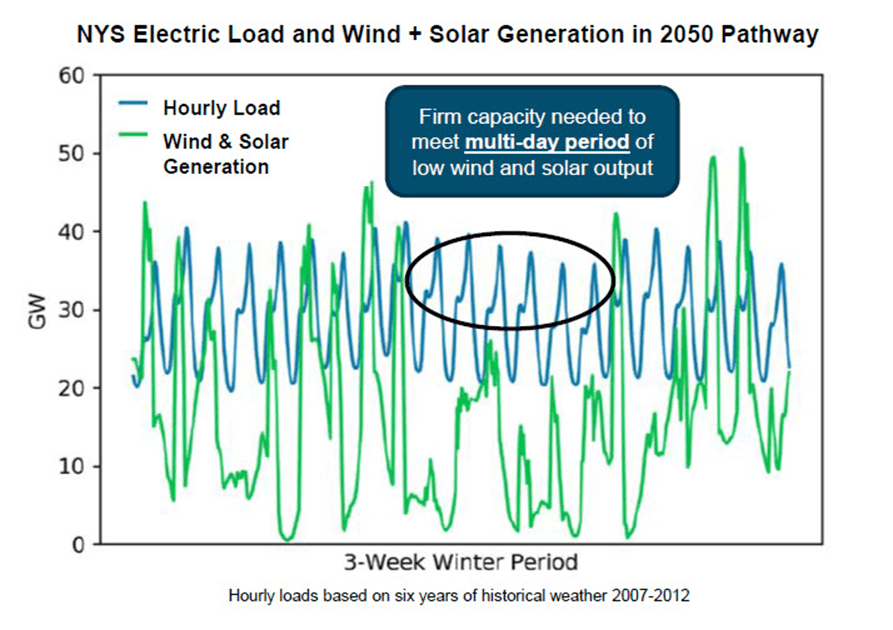
Francis Menton writing at the Manhattan Contrarian describes a new report by Bill Ponton that explores the effects and costs of continuing increases in generation of electricity from wind titled “The Cost of Increasing UK Wind Power Capacity: A Reality Check.” .  This analysis addresses what I call the ultimate problem of an electric grid relying on wind and solar.  The variability of those two resources is so great that there are huge issues trying to plan and develop the resources needed for periods when both resources are weak or nonexistent. 

Ponton examines the relationship between energy generation and power capacity for wind resources.  This is the same issue mentioned in the first article described above.  In particular, advocates claim that all that needs to be done is to have the political will to build enough renewable generation capacity.  What they don’t consider is just how much would be needed. In Ponton’s analysis he increases the wind generation capacity for every hour in a record of generation and load for 2022.  He finds that because the wind lulls cover so many facilities that doubling the generation capacity does not double the percent of UK electricity from wind from 24% to 48%, but only to 40%. He then goes on to triple and quadruple the wind resource capacity to produce the following graph:

Note that the percent of generation from wind approaches a limit asymptotically.  The percentage of electricity generated from wind deployment in any scenario still experience rapidly slowing increases as more wind capacity is added, and will approach a limit asymptotically. Menton points out that “This means that each incremental addition of wind generation capacity produces electricity that is more and more costly, with the costs accelerating rapidly after the tripling of existing capacity.”  Menton promises that he will follow up with more results from the Ponton report so stay tuned.

Conclusion

All of these articles raise significant reliability concerns that were ignored in the Scoping Plan.  Morris and Schussler believe it is “most likely that costs will increase significantly and reliability will degrade considerably” even if Australians do a great job of implementing all the planned changes. I agree with their conclusion that “Higher energy costs will hurt their consumers and industry while moving manufacturing and industry away from Australia to areas with cheaper (fossil fuel based) energy. The end result may cause far greater environmental harm.”  If New York fails to heed these warning the result will be the same.

Offshore Wind Transmission Cost Subsidies

The expected costs associated with the  Climate Leadership & Community Protection Act (Climate Act) for the net zero transition plan are poorly documented.  This article describes costs associated with offshore wind transmission requirements as part of my on-going effort to consolidate cost estimates in one place.

Update 22 June 2023: NYISO chose Propel Alternate Solution 5 at $3.28 billion.

My original plan to track Climate Act costs was to provide expected additional costs to ratepayers for various implementation programs.  That information is not provided or is hidden so well that I could not find it for most programs.  In order to address other cost considerations, I am tracking costs in different categories: Typical Residential Customer Costs, Direct Climate Act Subsidies, Indirect Climate Act Subsidies, Climate Act Cost Overruns, and Climate Act Integration Analysis Assumed Costs and Updated Costs Differences. This article describes the cost to export power generated by offshore wind facilities from Long Island to the rest of the State which is an indirect cost subsidy that will be paid for by all New Yorkers.

Everyone wants to do right by the environment to the extent that they can afford to and not be unduly burdened by the effects of environmental policies.  I submitted comments on the Climate Act implementation plan and have written over 300 articles about New York’s net-zero transition because I believe the ambitions for a zero-emissions economy embodied in the Climate Act outstrip available renewable technology such that the net-zero transition will do more harm than good.  Every indication is that the costs will be astronomical as well.  The opinions expressed in this post do not reflect the position of any of my previous employers or any other company I have been associated with, these comments are mine alone.

Background

The implementation plan for New York’s Climate Act “Net Zero” target (85% reduction and 15% offset of emissions) by 2050 is underway.  At the end of 2022 the Climate Action Council completed a Scoping Plan that recommends strategies to meet the targets.   The Hochul Administration is developing regulations and proposing legislation to respond to those recommendations in 2023.

Unfortunately, the Scoping Plan is just a conglomeration of control strategies that are projected to provide the emission reductions required.  The inadequate analysis and documentation do not demonstrate the feasibility of the recommended strategies.  Furthermore the costs of the program and potential costs to individual New Yorkers are hidden in a shell game con for hiding the true costs.  In the Scoping Plan, costs are compared to a Reference Case that includes already “incremented programs”.  As a result, the costs that are presented do not include all the costs of the net-zero transition. 

Long Island Offshore Wind

The Department of Public Service has an Order for Public Policy Transmission Need (PPTN) (Case 20-E-0497) regarding Climate Act requirements related to offshore wind that drive the need to expand the number of transmission facilities between Long Island and the rest of the State.  Climate Act goals include the development of 9,000 MW of offshore wind generation by 2035, with perhaps 6,000 MW connected into New York City. The Public Service Commission has concluded that offshore wind generation connected to Long Island is identified as “high” risk and would be curtailed unless something is done. Transmission expansion that increases the transfer capability from Long Island to the rest of New York is expected to significantly reduce the potential for offshore wind curtailment.

The New York Independent System Operator (NYISO) Electric System Planning Working Group  (March 24, 2023 and April 3, 2023) is addressing independent cost estimates developed by NYISO’s consultant for proposed projects to address this issue.  This is all preliminary work so the cost estimates are subject to change but they give an idea of what is needed to get the offshore wind generated to where it is needed.  The cost estimates considered required material and labor cost by equipment, engineering and design work, permitting, site acquisition, procurement and construction work, and commissioning.  The analysis found that the primary cost drivers were terrestrial and submarine cable length, HVDC converter systems and PARs, and the scope of the project (i.e., number/size of transmission facilities). 

Cost estimates for sixteen projects were evaluated as shown in the following table.    The average total cost estimate was $7.1 billion, the maximum was $16.9 billion and the minimum was $2.1 billion.

The draft NYISO Long Island Public Policy Transmission Need (PPTN) report predicts that the transmission upgrades will provide savings to the system:

The Long Island PPTN project simulations all show improvements in the export capability of Long Island by adding tie lines between Long Island and the lower Hudson Valley. This added transfer capacity and upgrades to the internal Long Island system reduce the amount of curtailment from offshore wind resources. The energy produced through reduced curtailment of offshore wind resources can then be used to offset more expensive generation to meet New York’s energy demand and, therefore, produce a production cost savings. Production cost savings are also created by offsetting high-cost energy imports from neighboring regions with lower cost New York-based generation that was previously inaccessible due to transmission congestion.

In general, all of the proposed projects produce savings by unbottling offshore wind resources in Long Island and reducing the amount of imports from neighboring regions. The figure below shows the estimated production cost savings for each project over a 20-year period in 2022 real million dollars.

The baseline scenario estimated 20-year production cost savings (2022 $M) average $99 million, the maximum is $110 million, and the minimum is $39 million.  The policy case scenario savings average $347 million, the maximum is $458 million, and the minimum is $291 million.  (I don’t have the costs for the Policy + B-VS scenario so I do not discuss that scenario.)  The difference between the total estimated cost and the production cost savings is the amount that must be subsidized indirectly to the ratepayers.  The annual subsidies over 20 years range from $823 million to $90 million and average $339 million.

I am not impressed.  Without this connection upgrade as much as 92% of the 3000 MW of off-shore wind which costs $15 billion would not be deliverable.  However, it comes at an annual average subsidy of $339 million.

Discussion

Unfortunately, the indirect subsidy costs described are not the only costs.  These costs are only for the new transmission and do not include additional costs associated with the impacts on the existing transmission and distribution systems on Long Island.  In addition, this is the cost associated with 3,000 MW of offshore wind.  The Climate Act goal is for 9,000 MW and the Scoping Plan Integration Analysis projects that 12,675 MW of offshore wind will be needed by 2040 in the Strategic Use of Low-Carbon Fuels mitigation scenario.  If the transmission costs are proportional that would mean that this indirect subsidy alone would be at least $1,356 million a year for the Integration Analysis.

There are a couple of other things to keep in mind.  The Integration Analysis cost documentation is inadequate so I cannot be sure but I am confident that none of these costs were included in the Integration Analysis.  This further weakens any claim that the net zero transition will provide cost-effective emission reductions.  The other thing is that the only cost number associated with the cap and invest program proposed by the Hochul Administration is for a universal Climate Action Rebate that is “expected to drive more than $1 billion in annual cap-and-invest proceeds to New Yorkers.”   In other words, the State will make a big deal about giving New Yorkers a rebate at the same time there will be indirect cost subsidies that are approximately the same.  This is yet another example of shell game scams with the Climate Act costs.

Conclusion

There are two reasons that the Hochul Administration has not provided comprehensive cost estimates.  The first is that they don’t know the all-in costs because those numbers can only be developed on the basis of detailed analyses like this proceeding.  The second is that they don’t want to know and they certainly don’t want the voters to know the mind-numbing costs.  

This example of one aspect of the transition plan shows that the capital costs for getting the offshore wind to where it can be used most effectively are enormous, and the savings are miniscule which means enormous subsidies to be paid for by all New Yorkers.  New York GHG emissions are less than one half of one percent of global emissions and global emissions have been increasing on average by more than one half of one percent per year since 1990.  This does not necessarily mean that we should not do something, but it does mean that we have time do something that we can afford.  Until such time that detailed analyses like the kind of analysis described here are completed this process should be paused.

What About the Latest UN Climate Panic Report?

The latest Intergovernmental Panel on Climate Change (IPCC) Synthesis Report was recently released.  Cloaked in the veneer of “the science” it claims that human activities have “unequivocally caused global warming, with global surface temperature reaching 1.1°C above 1850–1900 in 2011–2020.”  The reality is much more nuanced.

The opinions expressed in this post do not reflect the position of any of my previous employers or any other company I have been associated with, these comments are mine alone.

Background

The Climate Leadership & Community Protection Act (Climate Act) has been a primary focus of this blog the last several years.  I have written over 300 articles about New York’s net-zero transition because I believe the ambitions for a zero-emissions economy embodied in the Climate Act outstrip available renewable technology such that the net-zero transition will do more harm than good.  I have not published many articles about the climate change rationale for the Climate Act because I don’t think the political momentum to do something in New York can be slowed because of the religious devotion to the existential climate threat narrative.   The latest IPCC report will further that narrative but it turns out that was the purpose of the report.  Since the release of the IPCC report, two authors who have had extensive experience with the IPCC process have published articles that demonstrate that the IPCC has “strayed far from its role to assess the scientific literature in support of policy making”.  As a result there is more politics than science behind the headlines about the IPCC analysis dominating the recent news.

Roger Pielke, Jr.

Dr. Pielke argues that the IPCC has outlived its usefulness and needs to be overhauled:

Before proceeding, it is important to understand that the IPCC is not a single entity or group of people. It is many different groups doing many different things, with many strengths — for instance, WG1 on extremes was particularly good. The IPCC also has some notable weaknesses — its reliance on out-of-date scenarios most obviously. The Synthesis Report was written by a small group of people. For better or worse, the work of this small group of people reflects upon the entire IPCC and the years of effort leading to this week’s report.

If I were an IPCC participant not involved with the Synthesis Report, I’d be pretty upset. My view is that the IPCC has strayed far from its role to assess the scientific literature in support of policy making. Its has increasingly taken on a stance of explicit political advocacy and as it does so it has ignored and even misrepresented relevant science. The IPCC needs a complete overhaul.

He goes on to argue that the document has become scientific assessment minus the science:

Six reports, dozens of drafts, hundreds of authors, thousands of citations, tens of thousands of pages, almost a decade of effort – and after all that, here is the top-line conclusion of the past nine years of work under the umbrella of the Intergovernmental Panel on Climate Change: “Urgent climate action can secure a liveable future for all”

That’s it. Generic and empty political exhortation that is all-so-common in climate advocacy. No science at all.

What is a “liveable future” we might ask?

Who knows? It is not a scientific term, and it is not even defined by the IPCC. The phrase appears in the IPCC AR6 Working Group 2 report and can also be found in the IPCC Special Report on 1.5 degrees Celsius. It comes from a part of the academic literature that emphasizes “climate-resilient development.”

The new report downplays research showing that extreme scenarios are increasingly implausible and once again centers research that emphasizes RCP8.5 and SSP5-8.5. The report justifies this emphasis when it states in a footnote buried deep in the report: “Very high emission scenarios have become less likely but cannot be ruled out.”

This is far too clever. An alien invasion next week is also low likelihood, but cannot be ruled out.

None of the relevant literature on scenario plausibility is cited in the Synthesis Report, despite appearing in the most recent IPCC assessment reports. The “cannot ruled out” gambit gives the IPCC a way to keep extreme scenarios at the center of the report while evading any discussion of plausibility.

Pielke’s particular expertise is quantification of loss and damage impacts of extreme weather.  The IPCC relies on loss and damage as the rationale why action is needed: Economic impacts attributable to climate change are increasingly affecting peoples’ livelihoods and are causing economic and societal impacts across national boundaries”. Pielke explains that rather than explaining what they mean and quantifying those impacts, the IPCC “relies on a series vague, imprecise and readily mis-interpretable statements.”  There is a reason.  There is a lot of research that runs contrary to the narrative:

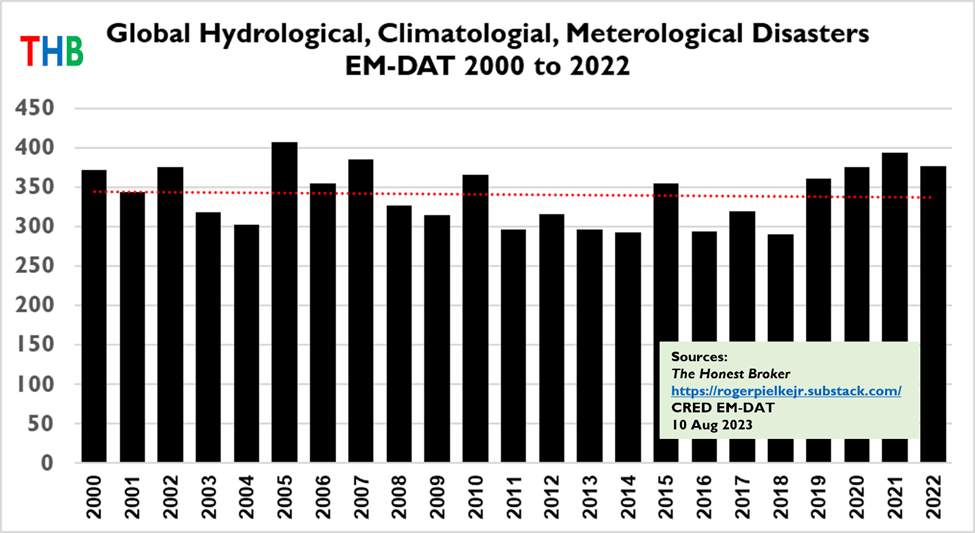
Readers here will know that the overall number of weather and climate disasters have decreased so far this century, economic losses as down as a proportion of economic activity and deaths and people affected by extremes are sharply down in recent decades.

In an effort to aid the work of the IPCC in 2020 I published a literature review of 54 studies on loss and damage which quantified the relative roles of climate and development in economic losses from weather extremes. The IPCC not only ignored my review, but in its literature review it also ignored 53 of the 54 papers, choosing to cite only one paper which asserted the attribution of losses to greenhouse gas emissions – the other 53 did not. None of this data or research gets mentioned by the IPCC, which is just remarkable.

Judith Curry

Dr. Curry describes the latest report:

The new IPCC Report is a synthesis of the three reports that constitute the Sixth Assessment Report, plus three special reports.  This Synthesis Report does not introduce any new information or findings.  While the IPCC Reports include some good material, the Summary for Policy Makers for the Synthesis Report emphasizes weakly justified findings on climate impacts driven by extreme emission scenarios, and politicized policy recommendations on emissions reductions.

It is important to understand that projections for future impacts are dependent upon two things: the atmospheric effects of greenhouse gases in the atmosphere and the amount of emissions entering the atmosphere.  Curry and Pielke have both argued for years that the IPCC has used biased emissions estimates.  Curry states:

The most important finding of the past 5 years is that the extreme emissions scenarios RCP8.5 and SSP5-8.5, commonly referred to as “business-as-usual” scenarios, are now widely recognized as implausible. These extreme scenarios have been dropped by UN Conference of the Parties to the UN Climate Agreement.  However, the new Synthesis Report continues to emphasize these extreme scenarios, while this important finding is buried in a footnote: “Very high emission scenarios have become less likely but cannot be ruled out.”

The extreme emissions scenarios are associated with alarming projections of 4-5oC of warming by 2100.  The most recent Conference of the Parties (COP27) is working from a baseline temperature projection based on a medium emissions scenario of 2.5oC by 2100. Since 1.2oC of warming has already occurred from the baseline period in the late 19th century, the amount of warming projected for the remainder of the 21st century under the medium emissions scenario is only about one third of the warming projections under the extreme emissions scenario.

She ties these emission scenarios to the “loss and damage” rationale used by the IPCC:

The Synthesis Report emphasizes “loss and damage” as a central reason why action is needed. It is therefore difficult to overstate the importance of the shift in expectations for future extreme weather events and sea level rise, that is associated with rejection of the extreme emissions scenarios. Rejecting these extreme scenarios has rendered obsolete much of the climate impacts literature and assessments of the past decade, that have focused on these scenarios. In particular, the extreme emissions scenario dominates the impacts that are featured prominently in the new Synthesis Report.

Clearly, the climate “crisis” isn’t what it used to be.  Rather than acknowledging this fact as good news, the IPCC and UN officials are doubling down on the “alarm” regarding the urgency of reducing emissions by eliminating fossil fuels. You might think that if warming is less than we thought, then the priorities would shift away from emissions reductions and towards reducing our vulnerability to weather and climate extremes.  However, that hasn’t been the case.

The IPCC has been characterized as a “knowledge monopoly,” with its dominant authority in the UN climate deliberations. The IPCC claims that it is “policy-neutral” and “never policy-prescriptive.” However, the IPCC has strayed far from its chartered role of assessing the scientific literature in support of policy making. The entire framing of the IPCC Reports is now around the mitigation of climate change through emissions reductions.

Not only has the IPCC increasingly taken on a stance of explicit political advocacy, but it is misleading policy makers by its continued emphasis on extreme climate outcomes driven by the implausible extreme emissions scenarios.  With its explicit political advocacy, combined with misleading information, the IPCC risks losing its privileged position in international policy debates.

The impact of these alarming IPCC reports and rhetoric by UN officials is this. Climate change has become a grand narrative in which human-caused climate change has become a dominant cause of societal problems. Everything that goes wrong reinforces the conviction that there is only one thing we can do to prevent societal problems—stop burning fossil fuels. This grand narrative leads us to think that if we solve the problem of burning fossil fuels, then these other problems would also be solved. This belief leads us away from a deeper investigation of the true causes of these other problems. The end result is a narrowing of the viewpoints and policy options that we are willing to consider in dealing with complex issues such as energy systems, water resources, public health, weather disasters, and national security.

Conclusion

I wanted to publish something about the latest IPCC report because it is being promoted as definitive science.  The thing to keep in mind is that the scientists who wrote the analyses in the IPCC reports, were not the primary authors of the Synthesis Report and had no hand in the Summary of the Synthesis Report that is the basis for all the news reports.  As a result, do not panic over the claims of doom and gloom.

Both Pielke and Curry argue that the IPCC process is flawed.  Pielke concludes: “Between the IPCC Synthesis Report’s evasion of the most recent literature on scenarios and the games it has played with loss and damage research and evidence, the IPCC is skating close to becoming a source of climate misinformation.”  Curry concludes that “The IPCC Reports have become “bumper sticker” climate science – making a political statement while using the overall reputation of science to give authority to a politically manufactured consensus.”

New York Building Decarbonization is Destined to Fail

Richard Ellenbogen frequently copies me on emails that address various issues associated with New York’s Climate Leadership and Community Protection Act (Climate Act).  I asked his permission to present his analysis explaining why New York’s building decarbonization push it is going to fail, just as Germany’s has, and will drive up state GHG emissions and raise utility costs for decades.  He has consolidated all of his material on this topic in one document and has included recommendations for an alternative approach.

I have published other articles by Ellenbogen because he truly cares about the environment and the environmental performance record of his business shows that he is walking the walk.   Ellenbogen is the President of Allied Converters  that manufactures food packaging.  His facility is about 55,000 square feet and does a lot of manufacturing with heat to seal the bags, all electrically driven.  The facility has solar panels and uses co-generation.  He explains:

In 2008, the average energy cost per square foot for a commercial facility in  Westchester was $1.80.  We were at 16% of that 12 years later and even with the increases, we are at 62% of that 14 years later.  That has been done while having a carbon footprint 30% – 40% lower than the utility system.  The $1.80 per foot  also included commercial office space and our operation is far more energy intensive than an office.  We use energy extremely efficiently and as a result, our bills are much lower than everyone else. 

Ellenbogen on Building Decarbonization

While it is being proposed with good intentions, NY State’s building decarbonization push is going to fail, just as Germany’s has, and will drive up state GHG emissions and raise utility costs for decades.  The analysis to justify that conclusion follows.  While there is new material included, a portion is a synopsis  of prior emails but as NY State gets closer to committing energy suicide, I felt obligated to put it all in one document.  As it is written, the state’s energy plan is going to be the fossil fuel company’s best friend.  NY State is adopting a “Chicken Little” approach to energy policy.  It is so focused on the acorn of fossil fuels and a belief that the sky is falling that it is ignoring science in the process.  As a result, the state will fall victim to the fox of energy failures, high GHG emissions,  and incredibly high utility rates that are going to eat NY State citizens and businesses.  For those who declare that  NY State must exhibit “Climate Leadership”, this policy isn’t that.  It is copying a failed policy from Germany.  For those not interested in the minutiae of the reasoning, the figure headlines and the final recommendations will give an accurate picture of the problems.
There is a way to get about a 44% GHG reduction in NY State while also having enough generation to support the system without imposing extremely high costs on the state’s residents and businesses.  It can be implemented in one-quarter  the time of the state’s current plan using a combination of improved fossil fuel plants and renewables, while replacing old gas equipment with newer gas equipment that won’t require an entire rewiring of NY State.

In lieu of doing something that will actually work, the state’s plan will face the following issues:

1 – Cost – Trillions of Dollars

First of all, the cost of the project will not be anywhere near as inexpensive as the $200 billion figure that is being thrown around.  Going through all of the figures, it will be at least $600 billion for the electrification portion, before adding storage and renewable generation to the totals.   For anyone that doubts that, the cost of a single 400 mile cable from Quebec to NY City has now risen to $6 billion and try to name a single infrastructure project in NY State that has come in on budget.  The Champlain Hudson Power Express Cable was projected to cost $2 billion in 2013.  That cost is now up to $6 billion, a 232% increase in inflation adjusted dollars.  Does anyone seriously believe that the entire state can be rewired for less than 100 times that cost?  If you add in storage costs at the present cost of Lithium Ion Batteries, the cost rises to approximately $4 trillion plus the cost of the renewable generation.  Even if you could get a 75% reduction in storage costs using a different technology, the total cost will be well over $1.5 trillion and much of that will depend on the usable life of the new storage.   At present, battery storage only lasts 10 years.   Pumped Storage would likely be much more cost effective but where in NY State can a utility site a large reservoir.  Also, based upon Con Ed’s experience with Storm King Mountain between 1960 and 1980, no utility will even try to build a pumped storage facility.

2 – Logistics – Size of Project and Lack of Labor will result in it requiring Over 60 Years – Policy is going to create situations where the mandates cannot be fulfilled

There are 112,000 miles of roads in NY State.  Of those, about 22,000 miles are major highways and likely don’t have electric distribution lines on them, leaving about 90,000 miles of distribution lines that were designed and sized for an era where onsite heating was delivered from fossil fuels or wood.  The vast majority of the transformers and conductors will not handle a tripling of the electric load during the during the winter.  If you eliminate 18,000 miles (20%) for areas upstate that are already using electric heat, that leaves 72,000 miles of distribution network to be rewired.  8,000 of those miles are in NY City where a substantial portion of the infrastructure is buried and the costs will be higher still.

When I did the utility project with Con Ed back in 2010 where we demonstrated that we could reduce transmission loads and line losses using reactive power correction on the local distribution system,  I added power monitoring devices to four transformers.  On hot days during the summer, three of the four transformers where the project was executed were operating at or near their capacity on a hot summer day. If heat pumps are added to the system, the winter time load on a cold day will be substantially higher than the summer time load on a hot day.  That is not my speculation.  The NYISO has determined that NY State will need an additional 25 Gigawatts of generation to support heat pumps in NY State. during the winter.  Winter peaks are expected to exceed summer peaks starting in the early 2030’s.

As a result, a substantial portion of that 90,000 miles will need to be rewired to support onsite electrification.  Using an existing project in California as a reference, PG&E has been required to bury 10,000 miles of high voltage transmission lines in the fire prone areas.  In 2022, they replaced 71 miles of cable.  By 2025, they expect to increase that to a rate of 1200 miles per year.  That doesn’t include replacing transformers or services to people’s homes which would be required to electrify onsite heating.  Even larger conductors will have to be added in rural areas of NY State where they expect to interconnect large solar arrays so that the projects don’t keep getting canceled because of interconnection costs.  While replacing overhead lines would take less time than burying them, replacing old equipment with higher capacity equipment for the larger heating loads and the additional time needed to increase the service sizes into people’s homes would about offset the time difference.

At 1200 miles per year, rewiring 72,000 miles of distribution lines in NY state will take 60 years to upgrade.  They have been burying larger electric and gas services in New Rochelle to support the extra 9,000 units of housing that they are building here and the roads have been like a slalom course for about 4 years to fix about 10 miles of services so the 60 years is not an unrealistic estimate.  NY City may take even longer to rewire and that is 40% of the state’s population.  What is going to happen to the people that cannot replace their gas equipment in areas where the service has not been upgraded to support the higher electric loads imposed on the system by NY State policy ?

3 – Bad Science Is Driving Initiatives – Results Will be Far worse than Estimated and It will add Enormous Costs On the Backs of the State’s Citizens

I have read extensively about the PAF (Population Attributable Fraction) technique that was used as the analytical tool to do the analysis for the recent paper about gas stoves and childhood asthma.  A slide from an upcoming PowerPoint that I will be presenting is below.  The caption at the bottom of the slide was copied from the introduction of a paper discussing PAF by people that developed an improvement to PAF.  However, the improved version needs very specific data directed at the variables involved, and not 30 – 40 year old data that was not asking the necessary questions from a time when the focus on health issues was very different.   Every PAF study with multiple variables warns of bias in the study and questionable results, whether it is from sugar intake  and type 2 diabetes to comorbidities and Covid.  Asthma falls into the multiple variable category.  Risk factors can include tree pollen, second hand smoke, proximity to large emission sources such as factories or power plants, pet dander, vehicle exhaust, nutrition, and yes, even gas stoves, among others.  But unless all of the data on the other variables was collected in the survey, PAF will return garbage, even in the updated format proposed by the authors of the PAF improvement.  Thus, the conclusions of the gas stove report have no validity.  

Another issue never explained by the authors of the gas stove study is why the top ten states for cases of asthma in the US are all 80% electric stoves and the top eight states for childhood asthma are 80% electric stoves.  If gas stoves were that large of a factor, at least one of the five states that is primarily gas stoves would appear higher on those lists.   The conclusions of the study could possibly be correct, but no one could be sure because the study was so poorly conceived, conducted, and analyzed.  It certainly should not be used as the basis for a public policy affecting 19.5 million people that is going to add an additional $72 billion in costs onto the backs of the state’s utility customers.  Results that will be at least 95% – 98% as effective can be obtained at a fraction of that cost using other techniques.

4 – Existing Transmission and Distribution System Will Not Support Installation of Large scale Renewable Generation – Too Many Resources are Being Wasted on Projects that will Yield No Environmental Benefits.  Not Enough is being spent On Grid Infrastructure to support renewables and vehicle electrification.

Another major issue, and one that is severely impacting the installation of renewables is the fact that the state’s utility system is wired backwards for what policy makers are trying to do with it.  The utility system was wired to have large sources of generation distributing energy outward from a few locations.   Now, the state is trying to site large generation sources in remote locations where the infrastructure won’t support it.  As a result, renewable generation installers are faced with long transmission line runs to interconnect into the system, making the projects non-cost effective.  The projects are being cancelled and as a result, NY State is falling well behind in their installation schedule that was already insufficient to fulfill the state’s requirements. 

This is also apparent with regard to the 9 GW of offshore wind.  There is a major concern about the availability of space to run the cables to interconnect the energy to where it is needed.  One possibility is running the cables across Long Island in an environment where every infrastructure project is faced with lawsuits.  As a result, even if they can build the 9 GW of Atlantic Wind, they may only be able to interconnect about 6 GW to where it is needed.  That is clearly  shown in another slide from the upcoming PowerPoint documenting a critical page in a NY State Power Grid report,  below.  Transferring renewable generation installation projects to NYPA may increase the rate of installation slightly but the node analyses will still have to be done that takes five years at present and the transmission lines will still have to be installed so the price will not be reduced.

5 – Air Source Heat Pumps On a System Not Fully Supported By Renewable Generation Will Not Reduce GHG.  There are not Enough Drillers to install Ground Source Heat Pumps, which actually work, in any time frame that will yield significant results.

As is clearly documented in the slide below, putting electric onsite heating into buildings that are not fully supported by renewables just shifts the load to existing generating plants.  In Germany, heat pump installation, primarily air source,  exceeds gas combustion installation.  However, despite installing massive amounts of renewable generation, while their household carbon emissions have declined by 28% since 1999, their utility system carbon emissions only declined by 3.4%.  While they closed nuclear plants, they actually installed more Gigawatt hours of renewables.  They should have seen a large GHG decrease, but heat pumps running on a system that uses fossil fuel generation add marginal additional load to the fossil fuel plants with higher emissions than an efficient gas boiler/furnace.   

Germany is playing “Whack-A-Mole” with its building emissions and NY State is about to do the same thing.  They beat down the emissions in one place and they pop up somewhere else.  That chart was copied from a Yale publication “Can Germany revive its stalled energy transition?” published in about 2018.  Based upon events 4 years later, the answer has been a resounding “NO”  Even prior to the war in Ukraine, Germany was reopening coal plants.  After the war started and they lost their gas supply, they opened even more coal plants and there were news articles about people across Europe stealing firewood,  cutting down trees, and burning anything that they could find to stay warm.  That will be the future of NY State with the proposed policies.  Germany has been exceedingly lucky this year with a relatively warm winter, however they recently signed an agreement with Qatar to import 20 million metric tons of Liquid Natural Gas over the next ten years.

As the chart shown below from a Cornell Geothermal report clearly show, all additional load added to the system is supported by fossil fuel generation.  Blue and Brown lines were added after to explain the difference between the upstate and downstate generation sources which in 2019 were within 5% of each other.  However, in terms of zero emissions sources, they were worlds apart.  The downstate system is almost entirely supplied by fossil fuels.

6 – Battery Storage is being added to the System Prematurely.  The batteries will wear out at least 50 years before the state has enough renewable generation to charge them.  As a result, they will be charged with fossil fuel generation with a 15% – 20% higher carbon footprint than the actual generation.

As all marginal generation in NY State is provided by fossil fuel generation, all new battery systems that are added will increase fossil fuel generation by a minimum of 15% related to that stored energy as 15% of the battery’s energy is lost in the Charge/Discharge cycle.  The batteries will need to be replaced after about 10 years, well before the system will be supported by renewable generation.  This is great news for Elon Musk, but not that good for the taxpayers and utility customers in NY State.  The following slide was also borrowed from the same report.

7 – An Energy “Shell Game” is Being Used to Make the New Micron Technology Facility Appear Greener than it Actually Will Be under CLCPA rules.  However, it could be made far “Greener” in reality by siting a combined cycle generating plant next to the Micron Facility.  Nuclear generation would be better still, but that would take far longer to build and would have much higher upfront costs.

The New Micron Technology Facility in Clay, NY will eventually use more energy than the state of Vermont.  NY State and NYPA have said that they will provide 140 Megawatts of NY Hydro to the plant.   For lack of a better word, that policy is a farce.  All of the NY State Hydro has been allocated for years.  If they allocate it to the Micron Facility, those customers that are currently using it will then effectively be using fossil fuels.  They want Micron to use all renewable energy.  From Where?  A solar array that could generate enough energy to support that facility would occupy 100 square miles.  They want Micron the buy Carbon Credits.  From whom?  NY State’s two largest neighbors to the south and west, Pennsylvania and Ohio, average 1.5% renewable energy.  If NY State has to import energy from either of those states to support the Micron facility, it will all be from fossil fuel generation, gas or coal fired, at a lower efficiency than a combined cycle generator.  The import of energy from long distances to the Micron Site will increase transmission line losses by approximately 350 Gigawatts compared with a generator on-site.  The new rules are going to make the Micron facility less energy efficient, more polluting,  and also increase Micron’s operational costs while imposing environmental costs on the state.  Forcing Micron to buy Carbon Credits does nothing to help the environment.  It literally papers over the problem while raising Micron’s costs and doing nothing tangible to reduce greenhouse gas emissions.

8 – Renewable Generation Installation Rates are Insufficient to Support NY State’s Plan

Even prior to many of the recent cancellations of renewable generation projects, NY State was not going to have enough renewable generation installed for about 60 years.  Prior to the cancellations, NY State was going to be at least 120,000 Gigawatt hours short of what it would need to support the system on all renewables by 2035 as is shown in the slide below.  With onsite fossil fuel combustion about to be banned in new building and replacement equipment banned after 2035,  while EV’s are mandated for all sales after 2035, the system load is going to grow far more rapidly than the expansion of renewable generation resulting in an energy shortfall.  Beyond the transmission issues facing the Atlantic Wind projects mentioned earlier, the Jones Act is going to slow the rate of installation for offshore wind by limiting the number of jack ships that will be available.   While NY State is short on land, money, and grid capacity, the one thing that NY State has in abundance is lawyers so that any renewable project will be faced with years of NIMBY lawsuits and the resulting delays.

Just because California tried it that doesn’t mean that NY State should.  California has a Mediterranean climate and is 20 degrees warmer in the winter so the orange and gray “energy blocks” in the fossil fuel column A on the chart below are much smaller.  If NY State had the same climate as California, it would eliminate a need for about 150,000 Gigawatt hours of renewable generation on the future system.  Keep in mind that California is having difficulty keeping the lights on without the albatross of onsite heating around their neck.

Four columns on the chart above are labeled A,B,C,D and are referred to in the conclusion. 

“A” is the Existing Fossil Fuel Consumption in NY State.  “B” is the Electric Load if all of that was converted to  electric technologies on a fully GHG free generation system.  “C” is 6 GW of 1000 hour storage as mentioned in the NY State Energy Storage report.  Current cost using Lithium-Ion batteries, $3.4 Trillion.  NY State is betting on technologies that don’t exist commercially yet and at present, have shorter lifespans than the 10 years of Lithium-Ion.  “D” was the projected renewable installation for 2035 estimated in 2019 using figures provided by NY State.  With solar projects being canceled, in 2023 that is an overly optimistic estimate.

Even if all of the existing fossil fuel generation remained static and no fossil fuel plants are closed, the additional load being mandated is going to outstrip the rate of renewable installation.  As NY State is not allowed to build any new fossil fuel generation, one of two things will happen as a result of the energy shortfalls shown in the slide above.  NY State citizens will be without lights and heat, or NY State will have to import large amounts of fossil fuel generation from out of state, just as California has had to do.  When the neighboring states don’t have it available, NY State will have to impose rolling blackouts just as California now does, only the blackouts will occur on the coldest days of winter which will be far more deadly than the hot days during the California summer.

If Climate Change is truly the existential crisis that the authors of the CLCPA claim it to be, and if the recent UN report about the need to halve atmospheric carbon within 10 years is true, then NY State’s 60 – 70 year plan that is going to increase carbon emissions for at least the first 30 years needs some rethinking.

 Keep in mind that NY States total GHG emissions are 350 million metric tons annually.   Worldwide GHG emissions increased in 2021 by 2 billion metric tons, 40% of that from increased coal combustion in China, India, Germany, Japan, and other countries.  So, the increase in worldwide GHG emissions in 2021 was six times NY State’s total annual emissions. 

Because of the above fact, it is apparent that the rate of Climate Change is not in the purview of NY State policy makers.  As resources are limited, instead of wasting money on building electrification that will yield no holistic improvements in GHG emissions, resources should be used to harden infrastructure against the inevitable negative effects of Climate Change, whether that is on grid infrastructure or flood mitigation.  The most expensive and severe impacts of Sandy were on the underground infrastructure of NY City and along the Hudson River.  Venice type barriers might be considered for under the Verrazano and the Triborough Bridges, however that will never happen if the state wastes $600 billion on an electrification plan with no positive upside.

A Better Plan –

The following, if executed properly could result in the energy chart, below, where the right hand column actually can supply NY State’s energy needs at a fraction of the cost of the current plan while also reducing fossil fuel energy use and the associated GHG emissions by 44%.  However, people will have to allow techniques that don’t meet the current standard of ideological purity in NY State.

By eliminating the push to electrify buildings, the energy savings and carbon reductions will actually be greater than what the CLCPA will yield in practice.  This alternative plan will need far less labor and storage resources.  Existing resources can be allocated to grid infrastructure to support renewable installation and vehicle electrification.  Vehicle electrification is the fastest way to improve GHG emissions.   Eliminating storage requirements will reduce battery demand and costs, making EV’s cheaper.

All is not Doom and Gloom

What can be done to reduce GHG emissions considering the state’s lack of financial resources and the lack of sufficient renewable generation for at least seven decades?  The following is a list of ten ideas that can be implemented relatively quickly that will help to rapidly lower GHG without breaking the piggy bank while also slowing or reversing the increase in utility bills

  1. Do not electrify buildings that run on natural gas – while it will reduce GHG at the building, it will increase it as much at the generating plants while forcing residents and the utilities to incur enormous rewiring costs. There will be no reduction in current fossil fuel energy, Column A in the New York Fossil Fuel Energy Load figure. Also, the gas stove analysis that was done recently was mathematically flawed and should not be used to set public policy.
  2. Focus heat pump efforts on locations that use oil heat or that use radiant electric heat. Those locations will see a significant reduction of GHG and heat pumps will reduce grid load when compared to radiant electric heat.
  3. Focus resources on expanding grid infrastructure. This will reduce the cost of installing solar in Upstate locations and reduce the number of system cancellations allowing the state to increase the proposed renewable generating resources, Column D in the New York Fossil Fuel Energy Load figure.
  4. Increasing grid infrastructure will also help with the installation of chargers for the electric vehicle wave that is about to arrive, with or without the state mandate.
  5. Do not install large amounts of battery storage until there is sufficient renewable generation to support the storage. It will increase current fossil fuel energy (Column A in the New York Fossil Fuel Energy Load figure) while incurring an enormous capital outlay and starving other projects of funding. They will also decay well before sufficient renewable generation is installed.
  6. Replace older generating plants with higher efficiency combined cycle natural gas generating plants. The state will need the energy to support the EV’s and the newer plants are far more efficient. It will lower Column A, reduce gas usage and put downward pressure on the commodity price.
  7. Place an emphasis on hydrogen injection into natural gas combustion plants. It will decrease gas usage and increase combustion temperatures which reduces NOx emissions and lowers current fossil fuel energy, Column A. It will greatly lower GHG emissions related to those generating plants
  8. Focus available natural gas resources on combined heat and power systems. It will reduce the utility bills for the system owners while also reducing requirements for grid infrastructure. Allow multiple building to form micro-grids to utilize the thermal output and increase the generation capacity. It will greatly reduce Column A
  9. Allow Micron Technolgies to build a combined cycle plant the size of Cricket Valley Energy Center on their property. The Micron facility will use more energy than the state of Vermont. Instead of letting them be “green” on paper by buying carbon credits, let them be green in reality with high efficiency generation and have lower energy costs to make them more competitive and able to recoup the $5 billion rebate without faking it. That will eliminate the increase in column a related to the facility.
  10. Figure out how the utilities can interconnect the 9 GW of offshore wind because at the moment, no one is certain how to do it. There is limited space for underwater cables. Without that, energy curtailments will occur and impede the increase of column d, unless they use the alternative idea which is to run transmission lines across Long Island.

Ellenbogen Conclusion

Ellenbogen Follow Up

The next day Ellenbogen followed up with another email with this warning.

In a speech to the British Parliament in 1948, Winston Churchill said, ‘Those who do not learn history are doomed to repeat it”.

As a conclusion to my email of yesterday, March 28, the following should serve as a warning to those proposing the current NY State Energy plan and expensive projects that are going to raise utility rates but do little for the environment. 

The statement above by Churchill not only applies to NY State following Germany’s failed energy program.  It also applies to something that happened just across Lake Ontario, much closer to home.

In 2009, Ontario, Canada passed the Green Energy Act.  Ontario has a similar population distribution to NY State with large population centers to the south and more rural areas to the north. Hardships were incurred by the more rural areas in the building of renewable generation and sending the energy to the wealthier, more densely populated southern areas.  In reading some articles on the subject, it was portrayed as a class war.   The act might have survived that issue, except energy costs skyrocketed along with the perceived injustices and the combination led to the repeal of the Act after only 10 years.   The Green Energy Act from 2009 is available here and an article documenting the repeal is here.

As I documented above, the state’s energy policies are going to cost trillions of dollars with far fewer carbon emission reductions than could otherwise be obtained at a far lower cost.  Hundreds of square miles of solar arrays and wind farms are going to have to be built in rural areas that are already exhibiting a substantial resistance to the projects.  The 2019 repeal of the act gave municipalities the right to control  what energy projects could be built within their borders, just the opposite of NY State’s proposed legislation.

The quest for the perfect will be anything but and the inevitable voter rebellion that is going to occur in the not-too-distant future is going to leave the state with massive debt, extremely high utility costs, and little to no GHG reduction to show for it.  In the interim, a decade will have passed where functional, inexpensive programs could be implemented that will actually reduce GHG in the real world, as opposed to the current program that only might work in Mark Zuckerberg’s fantasy Metaverse.  It certainly hasn’t worked in any cold climate on Earth where it has been tried.

Utility customers are already feeling enormous amounts of pain.  I have been receiving emails of late from politicians excoriating Con Ed for raising rates, however most of the increase is needed to comply with the mandates of the CLCPA.   The increases are due to terrible policy and not utility rate gouging.   As a clear example of how upside down this policy is, it actually has me defending Con Ed after they said some rather nasty things about me in a tariff hearing 12 years ago.  I have a long memory and no love for Con Ed but this energy policy is going to end up turning the state’s utilities into piñatas through no fault of their own. 

The utility rate increases are going to be far worse going forward as the costs documented in my email of yesterday are not figments of my imagination.  The plan will not be sustainable.  The state can’t borrow its way out of trillions of dollars of costs in an effort to subsidize utility rate payers to ease the pain that will be caused by this.

Beyond the actual costs, there is going to be a huge opportunity cost in terms of lost time imposed by the CLCPA that prevents working solutions from being executed, along with a souring of popular attitudes towards any future programs to reduce GHG. 

In their overreach for an unrealistic fantasy, they are going to achieve nothing.  Unfortunately, as bad as that is, that situation will be the best-case scenario.  The worst-case scenario will be that they continue to push forward, ignoring utility customers pain, still achieving no GHG reductions, while creating energy shortages that result in loss of life. 

The current energy policy has no long-term positive outcomes.

Caiazza Concluded Remarks

I could quibble with a few numbers and my take is slightly different for a few aspects but I am in complete agreement that this cannot possibly work.  The biggest flaw in the Hochul Administration’s net-zero transition plan is the lack of a feasibility analysis.  In 2018 I wrote the following.

We’re choosing between as yet undefined but surely expensive options trying to understand which one (or what mix) will be the least expensive. Unfortunately we don’t know but we need to start now because we’ve been told that we have to make reductions by 2030.  If we make a good pick then we’ll spend the least amount of a lot of money and will be left with the fewest negative outcomes, but if we get it wrong, we will be left with many more negative outcomes and even higher costs for a long time. 

Since then, the only thing I would change is that it is not just about the money, the possibility of catastrophic reliability outcomes must be considered because present wind, solar, and energy storage technology must be coupled with other ill-defined and speculative resources in order to work reliably.  Clearly the first step and priority should be a feasibility analysis before anymore time and money is spent on this. 

Other Voices on the Futility of the Climate Act

This blog post highlights an article and report that address New York’s  Climate Leadership & Community Protection Act (Climate Act).   I am highlighting them here because they make good points in ways that I think clearly show the futility of the Climate Act. 

I submitted comments on the Climate Act implementation plan and have written over 300 articles about New York’s net-zero transition because I believe the ambitions for a zero-emissions economy embodied in the Climate Act outstrip available renewable technology such that the net-zero transition will do more harm than good.  The opinions expressed in this post do not reflect the position of any of my previous employers or any other company I have been associated with, these comments are mine alone.

Climate Act Background

The Climate Act established a New York “Net Zero” target (85% reduction and 15% offset of emissions) by 2050. The Climate Action Council is responsible for preparing the Scoping Plan that outlines how to “achieve the State’s bold clean energy and climate agenda.”  In brief, that plan is to electrify everything possible and power the electric gride with zero-emissions generating resources by 2040.  The Integration Analysis prepared by the New York State Energy Research and Development Authority (NYSERDA) and its consultants quantifies the impact of the electrification strategies.  That material was used to write a Draft Scoping Plan.  After a year-long review the Scoping Plan recommendations were finalized at the end of 2022.  In 2023 the Scoping Plan recommendations are supposed to be implemented through regulation and legislation.

Trying to Head Off New York’s Total Self-Destruction

Francis Menton writing at the Manhattan Contrarian blog wrote an excellent story about New York’s budget proposals that includes a section on energy policy.  He described the Empire Center’s just released Next New York report that offers “counter-proposals in the major policy areas: public safety, K-12 education, Medicaid and healthcare, energy, transportation and transit, housing, and so forth”.  
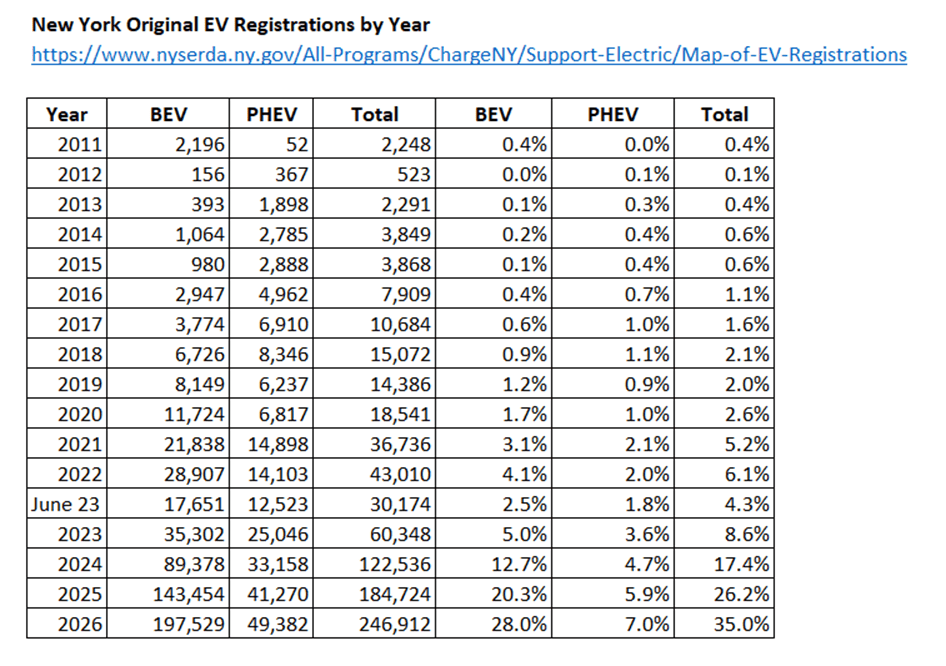
Menton’s article addressed energy policy. The energy section of the Next New York report, titled “Heading off New York’s Home-Made Energy Crisis,” begins at page 69, and was written by the Empire Center’s energy guru, James Hanley.  The following is a direct quote from the Menton’s article :

I guess it’s fair to say at this point that we do have an “energy crisis” in New York, but the key word is “home-made.” Everything about energy in New York that could remotely be called a “crisis” is entirely the creation of our politicians. There is no rational reason why energy policy should even be a significant political issue in New York. We have a perfectly good, functional energy system. By far the larger part of it — the non-electrified part, including nearly all transportation, industry, agriculture, and home heat outside the large cities — came into being through private initiative and works with little to no input or interference from politicians and bureaucrats. The other, smaller part — the electrified portion plus urban natural gas distribution — has historically been subject to substantial government regulation, but until quite recently the whole point of the regulation was only to prevent the monopoly utilities from raising their rates to a point of overcharging the customers.

Then our politicians got the idea that there was an imperative to address and solve “climate change” through the device of a politically-directed total re-do of the energy system into something that has never previously been tried nor proven to work. (Don’t get me started on the question of how a place like New York, with a fraction of 1% of world greenhouse gas emissions, is supposed to be able to affect “climate change” by using less fossil fuels, when the places that emit the large majority of world GHGs, like China and India, are adding new coal power plants as fast as they can build them.).

At pages 69-75 of the Report, Hanley provides a brief history of how this subject of reducing GHG emissions got a toe-hold in New York and then rapidly metastasized. Governors Pataki and Paterson began the game in the 90s and 00s, with things like a “renewable portfolio standard” and joining the Regional Greenhouse Gas Initiative (2005). Andrew Cuomo (first elected Governor in 2010) ramped things up by blocking fracking in the extensive Marcellus Shale that underlies a large part of the state, and by having his environmental bureaucrats block natural gas pipelines on bogus “water quality” concerns. But the full suppression of fossil fuels and the wind/solar mania did not really take full control in New York until 2019, when the progressive Democrats finally took both houses of the State Legislature. They used that control to pass something called the Climate Leadership and Community Protection Act (CLCPA), which was then signed by Cuomo.
Suddenly, we are on a crash program to get rid of all fossil fuels, electrify everything, and depend completely on the wind and sun for the generation of our energy. Hanley:

The CLCPA’s overarching goal is an 85 percent reduction in greenhouse gas emissions and a net-zero state economy by 2050. Intermediate steps on the way include 6,000 megawatts of installed solar and 185 trillion BTU savings in energy efficiency by 2025, 70 percent renewable energy production and 3,000 megawatts of battery storage by 2030, 9,000 megawatts of offshore wind production by 2035 and 100 percent zero-emissions electricity production by 2040.

I believe that I have used terms like “ridiculous,” “preposterous,” “incompetent,” and “irresponsible” to characterize the legally-mandated goals to which the CLCPA commits our state. Hanley is much more gentle in his use of words:

To say the CLCPA’s goals are ambitious is an understatement, and yet they will not be adequate to provide the state with sufficient clean energy to ensure the continuing reliability of the electrical grid.
One place where Hanley makes a real contribution to the debate is by producing a chart, based on data from the federal Energy Information Administration and Department of Energy, that makes the absurdity of the CLCPA goals apparent:

In the eleven years from 2010 to 2020, the percent of New York’s electricity coming from “renewables” inched up from about 22% to about 28%. But most of that 6% increase came from that blue line, “hydro,” aka almost entirely the Niagara Falls power plant, going from about 18% to about 22% of state electricity production. Meanwhile, in that 11 year period when everyone was starting to obsess about wind and solar and federal subsidies ramped up dramatically, the percent of electricity from wind (the orange line near the bottom of the graph) went all the way from about 2% to about 4%. And the percent from solar remained a barely-perceptible 1% or so, represented by a gray line that is so close to the x-axis of the graph that you can barely see it next to the brown line representing wood.

And then supposedly the percent of electricity from renewables takes off like the blade of a hockey stick in 2020 and gets to 70% by 2030. Unmentioned is that we don’t have another Niagara Falls. Therefore this whole increase now has to come from wind and solar. Oh, and we’re already two years in since the data in Hanley’s graph. How much of this has happened so far? Almost none.

Meanwhile the consumption of electricity is supposedly going to double or so, due to the electrification of automobiles and home heating.

I’ll throw in a few figures from research of my own to further illustrate the absurdity. According to EIA data here, New York’s electricity consumption in 2021 was 141,423,778 MWh. If that doubles from electrification of automobiles and heating, then we’ll need about 280 million MWh in a year. Per Hanley’s summary of the CLCPA above, the state authorities are calling for adding 6000 MW of solar and 9000 MW of offshore wind by 2035. At highly optimistic capacity factors of 25% for solar and 40% for wind, here’s what that will get you:

6000 x 0.25 x 8760 + 9000 x 0.40 x 8760 = 44,676,000 MWh

In other words, as ambitious as the plans for wind and solar may be, even if all gets built this will provide less than a sixth of the electricity that will be needed. And with wind and solar generation, such electricity as gets generated will come at random times that could include long weeks of no wind and almost no sun in the dead of winter.

But meanwhile they are proceeding apace to shut down the existing natural gas capacity.

Hanley concludes his section of the Report with a series of highly sensible recommendations, like ending the fracking ban, ending the pipeline moratorium, and scaling back renewable energy subsidies and tax credits. I actually think we will likely be better off going full speed ahead on the innumerate nonsense and running hard into the green energy wall.

Conclusion

The demand that we do something as quickly as possible does not square with reality. New York GHG emissions are less than one half a percent of global GHG emissions and global GHG emissions have been increasing by more than one half a percent per year.  Anything we do will be replaced by global GHG emission increases in less than a year.  That does not mean that we should not do something but it does mean that we should take the time to do “something” that it does not do more harm than good. Menton and Hanley show that the proposed implementation timeframe is extraordinarily risky and unlikely.  Their concerns must be addressed or the reliability and affordability of New York electricity will be unacceptably at risk.

The demand for compliance certainty inherent in the cap and invest proposed plan exacerbates the risks and impacts. In my last post on the cap and invest program proposal I noted that developing sufficient zero-emissions renewable energy to displace enough fossil-fired electric generation to meet the mandated emissions targets would be a challenge.  Both Hanley and Menton clearly show that the expectation that New York State can convert the electric energy system to meet the 2030 goal of 70% renewable energy is a dream and that meeting the emissions targets is a stretch.  Of particular concern is that the cap and invest approach includes penalties when those targets are not met.  Affected sources are going to err on the side of caution relative to their compliance obligations.  These results and that outlook increase the chance of an artificial energy shortage.

New York State Cap and Invest Politician Briefing

On January 10, 2023 New York Governor Kathy Hochul delivered her 2022 State of the State Address and provided legislation in her Budget Bill that proposed market-based Cap and Invest program.  Since then legislative amendments (Senate Bill 4008-B) to the Hochul Administration bill have been proposed.  I developed this briefing for politicians that provides specific comments about the proposed legislation and background information about market-based pollution control programs.  This article consolidates information from previous articles on Cap and Invest programs so there is a lot of repetitive information.

I submitted comments on the Climate Act implementation plan including one that specifically addressed the economy-wide strategy that recommended a Cap and Invest approach.  I have written over 300 articles about New York’s net-zero transition because I believe the ambitions for a zero-emissions economy embodied in the Climate Act outstrip available renewable technology such that the net-zero transition will do more harm than good.  I also follow and write about the Regional Greenhouse Gas Initiative (RGGI) market-based CO2 pollution control program for electric generating units in the NE United States.    I have extensive experience with air pollution control theory, implementation, and evaluation having worked on every cap-and-trade program affecting electric generating facilities in New York including the Acid Rain Program, RGGI, and several Nitrogen Oxide programs. The opinions expressed in this post do not reflect the position of any of my previous employers or any other company I have been associated with, these comments are mine alone.

I want to publicly thank my Senator, John Mannion (D 50th Senate District), for giving his time to Ken Pokalsky, (VP New York Business Council) and myself for a briefing on this topic.  Ken and I both have spent a lot of time recently trying to understand the implications of the proposed Cap and Invest program but it seems like no one is listening.  Ken described the general issues facing the state’s business community and his concerns (summarized here)  I covered the technical side of the plan.  The slides used are available and the following material was submitted as backup.  Both the slides and the documentation are boiled down to the key points in the summary that was all we had time to address.

Overview Issues Summary

Market-based pollution control programs are a well-established strategy but past success does not guarantee future results.  The most common market approach is to use emissions trading whereby a limit is set on pollution levels and tradable allowances equal to the cap limit are issued to affected sources.  The Federal Acid Rain cap and trade program lowered sulfur dioxide (SO2) and nitrogen oxides (NOx) emissions more than expected at far lower costs.  The Regional Greenhouse Gas Initiative has generated over $1.7 billion in revenues for New York.  There are differences between the goals and results of those programs relative to the New York Cap and Invest proposal that cast doubt on the optimistic projections of its proponents.  More importantly, there are components in the proposed legislation that will work against future success.

There are multiple challenges for a New York only Cap and Invest program.  Greenhouse gases (GHG) are difficult to reduce because there are limited control options available.  There are no viable add-on controls for most GHG emissions so switching fuels has been the primary driver of recent observed emission decreases.  The only remaining options are to displace the use of fossil fuels with zero-emissions resources or to run less.  That raises the threat of an artificial energy shortage if there are insufficient allowances for sources to run.

This documentation describes the current status of emissions relative to the Climate Act 2030 limit of a 40% reduction in GHG  emissions from the 1990 baseline.  In order to meet that mandate an unprecedented buildout of wind and solar are necessary to provide the energy needed to displace fossil-fired electric generation.  At the same time, electrification is the primary emission reduction strategy for buildings and transportation which is going to increase load.  The Scoping Plan recommendations for changes to New York’s Energy Plan did not include a feasibility analysis casting doubts on the viability of this effort.

Of particular concern is that there are features in the legislation that undermine aspects of previous market-based pollution control programs.  Climate Act § 75-0109, Promulgation of regulations to achieve statewide greenhouse  gas emissions reductions (1) lays out a public stakeholder process to promulgate rules and regulations to ensure compliance with the statewide emissions reduction limits that should be allowed to play out before any new legislation is promulgated.  There are numerous technical and logistical issues that must be addressed so that a Cap and Invest market-based program can be successfully implemented.  Naïve legislation could thwart an effective program.

Background

Emission market-based pollution control programs have proven to be an efficient approach if implemented correctly.  The reasons that such a program is being considered in New York were laid out in the Final Scoping Plan:

The Climate Action Council (Council) has identified the need for a comprehensive policy that supports the achievement of the requirements and goals of the Climate Act, including ensuring that the Climate Act’s emission limits are met . A well-designed policy would support clean technology market development and send a consistent market signal across all economic sectors that yields the necessary emission reductions as individuals and businesses make decisions that reduce their emissions. It would provide an additional source of funding, alongside federal programs, and other funding sources, to implement policies identified in this Scoping Plan, particularly policies that require State investment or State funding of incentive programs, including investments to benefit Disadvantaged Communities.  Equity should be integrated into the design of any economywide strategy, prioritizing air quality improvement in Disadvantaged Communities and accounting for costs realized by low- and moderate income (LMI) New Yorkers. Pursuant to the Climate Act, a policy would be designed to mitigate emissions leakage. Finally, an economywide strategy would be implemented as a complement to, not as a replacement for, other strategies in the Scoping Plan. A well-designed economywide program will bring about change in the market and promote equity in a way that does not unduly burden New Yorkers or with the global economy.

In general, emission reductions based on market signals rather than explicit directives offers flexibility which should reduce costs and encourages innovation.  The most common market approach is to use emissions trading whereby a limit is set on pollution levels and tradable allowances equal to the cap limit are issued to affected sources.  In order to comply, the sources must surrender one allowance for each ton of pollution emitted.  In order for such a program to succeed there has to be a realistic cap and reduction trajectory, the pollutant has to be have regional or global impacts, and the implementation schedule has to provide time for the market to react.

New York has participated in successful emissions trading programs.  It is unfortunate that the important condition that past success does not guarantee future results has been overlooked particularly because there are conditions on the past successes.  The Clean Air Act Amendments of 1990 established the Acid Rain Program to reduce acidic deposition.  This was a cap-and-trade program for the electric generating sector that issued free allowances based on historical operating characteristics.  Initially intended to provide a 50% reduction in sulfur dioxide and nitrogen oxides emissions it was ratcheted down because emissions were reduced lower and at costs significantly lower than expected.  There is an important caveat.  The original concept was that coal-fired power plants would install control equipment to get the reductions necessary.   However, railroad deregulation at the same time lowered coal transportation costs so much that it enabled switching to low sulfur coal from Wyoming across the country.  Power plants figured out how to burn that coal and achieved reductions on the order of 90%.  The Acid Rain Program incentivized the electric industry to reduce emissions but the ultimate results were influenced by other factors.

New York was an original participating state in the Regional Greenhouse Gas Initiative (RGGI).  This is a Cap and Invest program in which the affected sources purchase their allowances in auctions. New York was a primary driver for RGGI and has consistently touted its success by pointing out that carbon dioxide emissions are down by more than 50% since 2000 and that they have raised over $1.5 billion.  However, I have shown that this success is conditional.  The primary reason New York generating unit RGGI emissions are down is because the fracking revolution reduced the cost of natural gas so much that it displaced coal and residual oil fuels. I have determined that since the beginning of the RGGI program RGGI funded control programs have been responsible only for 5.6% of the observed reductions. I believe that RGGI had very little to do with these fuel switches because fuel costs are the biggest driver for operational costs and the cost adder of the RGGI carbon price was too small to drive the use of natural gas over coal and oil.  

There is no question that RGGI has successfully raised revenues but the results of those investments are disappointing.  According to the latest NYSERDA RGGI funding status report the projected costs of the current programs are $776.1 million, the net greenhouse gas emission savings are 1,656,198 tons and that works out to emission cost per ton removed of $469.  If all the RGGI administrative and operating costs are included another $113 million is added to the total and the emissions cost per ton removed is $537 per ton.  

There is a very important pollution control consideration.  Sulfur Dioxide (SO2) emissions can be controlled with add-on pollution control equipment or by switching to a lower sulfur fuel.  Nitrogen Oxides (NOx) emissions can also be controlled with add-on control equipment or by combustion modifications but fuel switching does not provide much of a reduction.  On the other hand, Carbon Dioxide (CO2) add-on carbon capture and sequestration control systems are not viable as an add-on control system.  The only ways to reduce CO2 is to switch to a lower emitting fuel or combust less fuel.  However, combusting less fuel means that less energy (for electricity, transportation, or heating) is available to meet societal needs.

Hochul Cap and Invest Proposal

I have consolidated in one document the Hochul Administration description of Cap and Invest including links to the Climate Act Scoping Plan Toolkit , references to Cap and Invest in the Scoping Plan Executive Summary, references to it in the State of the State materials, and the relevant Chapter from the Final Scoping Plan.

Hochul has said “New York’s Cap-and-Invest Program will draw from the experience of similar, successful programs across the country and worldwide that have yielded sizable emissions reductions while catalyzing the clean energy economy.”  My main concern is that drawing from the experience of previous programs is not nearly as simple as implied, particularly for people not familiar with the caveats and conditions associated with previous program “success”.

Hochul’s Budget Bill claims that it would be based on “best practices” gleaned from RGGI success.  It goes on to note that RGGI auction proceeds were invested in “energy efficiency, renewable energy, and other programs that save consumers money on energy bills and hasten the transition to cleaner energy”; that the proposed Cap and Invest will be specifically designed to “enable public agencies to focus the investment of allowance auction proceeds in communities with particular needs”; that

“A portion of the auction revenue generated will be returned to consumers to mitigate average costs to New Yorkers”; and that the program will be designed with the capacity to join other current or future programs.

In the previous section I noted that there are caveats to RGGI success claims.  One of my primary concerns is that RGGI investments did not produce cost-effective GHG emission reductions or very many reductions.  I have argued that the State has to change its investment strategies to focus on emission reductions to improve that performance because future reductions are going to depend on effective investments.  The low-hanging fruit of potential reductions is disappearing and that has compliance target ramifications.

Unfortunately, many programs that save consumers money on energy bills or focus on investments in disadvantaged communities with particular needs are not very effective producing significant emission reductions.  Policy makers should keep this conundrum in mind.  There is no resolution to the tradeoff between the need to provide ratepayers, especially those with least ability to pay, with the means to reduce energy use and the need to make emission reductions to reach the targets. 

To this point I have not addressed costs.  In no small part that is because so little information is available.  Hochul mentioned that there would be climate rebate fund of $1 billion and I saw somewhere that represented 30% of the total expected revenues.  That yields $3.3 billion for total revenues and an economy wide allowance price of $8.66.  If the allowance price equals the current RGGI price of $13 per ton, then the total revenues rises to $5 billion.  The New York Value of Carbon in 2022 is $129 per ton and using that would provide $50 billion per year.  If the Cap and Invest proceeds are set at the rate necessary to meet projected required emission reductions, a cost estimate using the historical cost per ton reduced from RGGI investments and tons reduced per year can be determined.  Depending on the interpretation of how the funding is allocated I estimate the revenues would range between $46 and $10 billion.  For this spread of revenues I estimate that this will translate to $0.08 and $1.14 per gallon of gasoline and between $0.47 and $7.04 for Mcf of natural gas.

The final Hochul goal was the capacity to join other current or future programs.  There are two reasons that this is unlikely.  Firstly, the Climate Act has a unique emission accounting system that is incompatible with other jurisdictions.  That would have to change to join other programs. The

Climate Act emission accounting system also mandates consideration of upstream emissions.  Trying to extract another jurisdiction from upstream emissions would be difficult if not impossible.

Scoping Plan Evaluation Criteria

The Final Scoping Plan recommendation included evaluation criteria for an economy-wide strategy.  Those criteria included certainty of emission reductions, price certainty, prioritizing emission reductions and avoiding hotspots in disadvantaged communities, and mitigating risk of leakage.

Advocates claim that the emissions cap guarantees emission reductions consistent with the Climate Act mandate. This is a naïve presumption apparently based on the fact that all the Acid Rain Program, RGGI, and the other cap and trade programs for NOx have all had emissions compliant with the caps.  EPA explains that “The cap is intended to protect public health and the environment and to sustain that protection into the future, regardless of growth in the sector.”  For the Acid Rain Program, the cap was originally intended to reduce emissions by 50% but later was tightened down.  In the NOx cap and trade programs the caps were set based on a technological evaluation of the control technology available to affected sources.  The industry – agency issues with those caps centered on whether the agency estimates for additional control levels were reasonable.  Importantly, the SO2 and NOx caps were based on the feasibility of affected source characteristics and were not binding in and of themselves.

On the other hand, the CO2 cap in RGGI and the New York cap-and-invest caps are not based on technical evaluation.   I define a binding cap as one chosen arbitrarily without any feasibility evaluation.  In 2030 New York GHG emissions must be 40% lower than the 1990 baseline but this is an arbitrary target mandated by the Climate Act.  The  Scoping Plan for this transition did not include an analysis to see if this target was feasible so I think this will be risky.

The following graph lists NY GHG emissions by sector from 1990 to 2030.  The data from 1990 to 2020 is from the New York 2022 GHG emission inventory.  Electric sector emissions are available through 2022 and I used those with estimates based on recent averages to project emissions for the other sectors in 2021 and 2022.  The emissions shown for 2023-2030 simply represent the straight-line interpolation between the 2022 emissions and the 2030 emission limits consistent with the state’s Climate Act mandate that 2030 emissions must be 40% less than the 1990 baseline emissions.

I estimate that meeting the 2030 emissions limit will require a 4.5% annual decrease from each sector from 2023 to 2030.  That is an unprecedented reduction trajectory.  Those percentages translate to annual reductions of 2.73 million metric tons of CO2e (MMT) for the electricity sector, 0.97 MMT for agriculture, 5.32 MMT for buildings, 1.59 MMT for industry, 4.89 MMT for transportation, and 1.88 MMT for the waste sector. 

The Climate Act has exemptions for certain sectors.  All components in the agriculture sector are not required to meet the 40% mandate and energy-intensive and trade exposed industries also get some sort of a pass.  Even a cursory examination of the data in the graph suggests that the presumption that a binding cap will necessarily ensure compliance is magical thinking.  The historical trend in electricity sector emission reductions appear similar to the trend necessary to meet the 2030 target but the historical trend was caused by fuel switching and there are no more reductions to be had in that regard.  In order to reduce electricity sector emissions, the energy output will have to be displaced with wind and solar.  Waste sector emissions have been more or less constant since 1990.  An entirely new technology has to be implemented in the next seven years to get a 4.5% per year reduction in emissions. 

Transportation can only reduce emissions if the transition to zero-emissions vehicles accelerates a lot.  When I point out that there has been no feasibility analysis, my concern is that the Scoping Plan did not analyze whether the necessary technologies are likely to be available and deployed as needed and there was no consideration of what if questions.  At the top of that list is “what if technology rollout is delayed?”

Another Scoping Plan criterion was price certainty.  The RGGI design includes s price control mechanism.  If the price gets higher than the RGGI ceiling price, additional allowances are added to the auction.  If the price gets too low, then subsequent auctions reduce the number of allowances available.  Obviously, adding allowances to limit high prices is incompatible with the compliance certainty criterion.  Also note that these mechanisms only affect auction prices.  There will be a secondary market price that will be largely unaffected by any similar mechanisms in the Cap and Invest program.  The important point is that the cost of allowances that consumers pay is the uncontrollable secondary market price.

The Climate Act, Scoping Plan, the Hochul Budget Bill and at least one amendment to the Budget Bill establish a goal of prioritizing emission reductions and avoiding hotspots in disadvantaged communities.  Chapter 6. Advancing Climate Justice in the Scoping Plan states:

Prioritizing emissions reduction in Disadvantaged Communities should help to prevent the formation or co-pollutant emissions despite a reduction in emissions statewide. A broad range of factors may contribute to high concentrations of pollutants in a given location that create a hotspot. The result can be unhealthy air quality, particularly for sensitive populations such as expectant mothers, children, the elderly, people of low socio-economic status, and people with pre-existing medical conditions.

The poster child for egregious harm from hotspots is fossil-fired peaking power plants. I believe the genesis of this contention is the arguments in Dirty Energy, Big Money and I have shown that that analysis is flawed because it relies on selective choice of metrics, poor understanding of air quality health impacts,  unsubstantiated health impact analysis, and ignorance of air quality trends.  In this context, I have seen indications that there are some people who believe that GHG emissions themselves have some kind of air quality impact exacerbated in disadvantaged community hot spots.  That is simply wrong – there are no health impacts associated with carbon dioxide emissions at current observed ambient levels.  Dirty Energy, Big Money and arguments in the Scoping Plan are based on co-pollutant emissions (NOx and PM2.5) that allegedly cause impactful hot spots that result in unhealthy air quality.  Note that all facilities in New York State have done analyses that prove that their emissions do not directly produce concentrations in the vicinity of power plants that contravene National Ambient Air Quality Standards (NAAQS) mandated to protect human health and welfare.  Trying to make the Cap and Invest program, that is appropriate for controlling GHG emissions to mitigate global warming, also address a neighborhood air quality problem already covered by other air quality rules is not in the best interests of a successful Cap and Invest program.  I do not know how the allowance tracking system could be modified to address hot spots without creating major unintended consequences.

The final evaluation criterion in the Scoping Plan is mitigating risk of leakage.  Pollution leakage refers to the situation where a pollution reduction policy simply moves the pollution around geographically rather than reducing it.  Ideally the carbon price should apply to all sectors across the globe so that leakage cannot occur. Preventing leakage in an area as small as New York is impossible because, for example,  car owners on the border will simply cross the border to purchase fuel.  Any program conditions to limit emissions in smaller areas of New York will guarantee problems.

Cap and Invest Concerns

Implementation of a Cap and Invest program requires consideration of a myriad of technical and logistical issues best addressed by subject matter experts unencumbered by restrictive legislation.  Climate Act § 75-0109, Promulgation of regulations to achieve statewide greenhouse  gas emissions reductions lays out a public stakeholder process to promulgate rules and regulations to ensure compliance with the statewide emissions reduction limits that should be allowed to play out before any new legislation is promulgated. 

There are numerous technical and logistical issues that must be addressed so that a Cap and Invest market-based program can be successfully implemented.  Previous Cap and Trade programs relied on emissions estimates from instruments and EPA has developed a comprehensive and transparent reporting methodology.  Instruments cannot be used to estimate emissions from every automobile in the state so emissions estimates based on fuel use must be used.  The logistics to develop such a system will take time and must be considered when deadlines are set.

The arbitrary 40% reduction by 2030 target codifies an aggressive reduction schedule by limiting allowance availability in the Cap and Invest proposal. The required emission reductions per year to meet the 2030 mandate are so aggressive that it is unlikely that there will be sufficient allowances available for all sectors to meet that mandate.  The result will be an artificial energy shortage that will limit electric production as well as gasoline and natural gas availability.  The stakeholder process must develop a plan to address this potential outcome.

The stakeholder process cannot operate in a vacuum.  In order for the stakeholder process to function properly the Hochul Administration is going to have to commit to some revenue target and allocation of funds.  Although emission reduction priorities in certain areas of the state is a noble concept it is incompatible with the global impacts of GHG emissions.  More importantly putting it into practice is extraordinarily difficult.

Senate Bill 4008-B

The legislative amendments (Senate Bill 4008-B) to the Hochul Administration bill should be rejected out of hand because they are not based on how emissions market systems work.  They represent nothing more than ideological misunderstanding of these systems.  If implemented the Cap and Invest program will fail.  The problematic provisions address hot spots, allowance banking, allowance trading, and emission offsets.

I already addressed hot spots above.

The allowance banking proposed amendments to Hochul’s budget bill include a new section to the existing Climate Act law.  Proposed § 75-0123. Use of allowances states that:

  1. Allowances must be submitted to the department for the full amount of greenhouse  gas emissions emitted during such compliance period.  If greenhouse gas emissions exceed allowances submitted for the  compliance  period, such shortfall shall be penalized pursuant to section 75-0129 of this article.
  2. Any allowances not submitted at the end of the compliance period in which  they  are  issued by the authority shall automatically expire one hundred eighty days after the end such compliance period if not  submitted prior to such date.

The provision for expiring allowances would prohibit allowance banking.  Allowance banking is a feature of all existing cap and trade programs and is one of the reasons that they have been successful.  Banking enables affected sources to handle unexpected changes in operation, compliance monitoring problems, and long-term planning.

The authors of this amendment have not figured out that the primary source of GHG emissions is energy production.  One major difference between controlling CO2 and other pollutants is that there are no cost-effective control technologies that can be added to existing sources to reduce emissions.  Combine that with the fact that CO2 emissions are directly related to energy production, the result is that after fuel switching the primary way to reduce emissions is to reduce operations.  Consequently, CO2 emission reductions require replacement energy production that can displace existing production. 

A feature of RGGI that addresses the link between energy use and CO2 emissions is a three-year compliance period with banking.  It is included because it was recognized that in a year when it is either really cold or really hot GHG emissions go up as energy use goes up.  In a year when it is mild, energy use goes down and emissions go down.  To address that variability RGGI has a three-year compliance period and allows sources to bank allowances for this balancing inter-annual variability.  The inevitable result of this amendment language would be insufficient allowances in a year with high energy use and that translates to an artificial shortage of energy.

There also is a provision addressing allowance trading.  There is no better example of ideological passion over-riding reality than language in the proposed amendments to Hochul’s budget bill that prohibits allowance trading.  Proposed § 75-0123. Use of allowances states that:

3. Allowances shall not be tradable, saleable, exchangeable or otherwise transferable.

Words cannot describe how little I think of the authors’ understanding of cap and invest based on this language.  Cap and invest programs are a form of cap-and-trade programs.  Anyone who thinks that a program that excludes allowance exchanges has no concept whatsoever of how these programs are supposed to work and how they have been successfully working.

There is one aspect of the proposed cap and invest legislation that is conspicuous by its absence – offsets.  In RGGI a CO2 offset allowance represents “a project-based greenhouse gas emission reduction outside of the capped electric power generation sector.”  In the California program  Offset Credits are issued to “qualifying projects that reduce or sequester greenhouse gases (GHG) pursuant to six Board-approved Compliance Offset Protocols.”  Recall that Hochul stated that “New York’s Cap-and-Invest Program will draw from the experience of similar, successful programs across the country and worldwide that have yielded sizable emissions reductions while catalyzing the clean energy economy.” Furthermore, the Climate Act has a net-zero target.  In other words, emissions from certain sectors that can never be expected to reduce their GHG emissions to zero (like aviation) will have those emissions offset by programs that reduce or sequester GHG emissions. 

In a rational world, it is obvious that the agriculture and forestry sectors that are the likely sources of most offsets in New York would get incentives to develop offsets compliant with qualification protocols used in other successful programs.  After all the Climate Act needs offsets to meet its net-zero targets and offset programs are components of the similar, successful programs New York wants to emulate.

New York’s Climate Act is not rational.  Chapter 17 in the Final Scoping Plan explains why offsets are not mentioned:

The inclusion of offset programs in some cap-and-invest programs, such as RGGI, has engendered some criticism, particularly from environmental justice organizations that contend that the availability of offsets reduces the certainty of emission reductions from the regulated sources. In any cap-and-invest program adopted to meet Climate Act requirements, the role of offsets would have to be strictly limited or even prohibited in accordance with the requirements of ECL § 75-0109(4). Under that provision, DEC would have to ensure that any Alternative Compliance Mechanism that is adopted would meet various requirements specified in that provision of the Climate Act. Therefore, offsets would have little, if any, role under a cap-and-invest program designed to comply with the Climate Act.

In short, because there was “some criticism” from environmental justice organizations, the Progressive Democrats in control of the Administration and Legislature are excluding this “important cost-containment element” used in other successful programs.  Given that offsets are a necessary component for meeting the net-zero by 2050 target I expect that a different subsidy will be used to incentivize offsets.

Conclusion

I have tried very hard to not get involved with politicians over my career because I don’t think there is much interest in my nuts-and-bolts concerns.  Unfortunately for me, the Climate Act is at its heart a political construct.  In order to try to get some rationality into the implementation process it is apparent that I have to engage with politicians.  In that regard, Senator Mannion is to be commended for listening to the technical side of the Cap and Invest proposal and I appreciate his time very much.

There have been a couple of positive notes.  According to Buffalo Business First, New York DEC Commissioner Basil Seggos says the regulations forming the state’s cap-and-invest program likely won’t be ready before a deadline this year.  Both Senator Mannion and Ken Pokalsky said they don’t believe the Cap and Invest program language will be included in the final Budget Bill.  That suggests that there will be time to develop a plan that addresses all the technical and logistical issues inherent in a New York only Cap and Invest program without legislative naïve interference.

NY Climate Act Cap and Invest Plan Going Off the Rails

One of my pragmatic interests is market-based pollution control programs. As part of New York’s budget process Governor Kathy Hochul announced a plan to use a market-based program to raise funds for Climate Leadership & Community Protection Act (Climate Act) implementation that is included in the Budget Bill.  I have looked at the language for proposed amendments to the original Budget Bill proposal and am stunned at the disconnect between reality and the perceptions of the authors of the amendments.

I submitted comments on the Climate Act implementation plan and have written over 290 articles about New York’s net-zero transition because I believe the ambitions for a zero-emissions economy embodied in the Climate Act outstrip available renewable technology such that the net-zero transition will do more harm than good.  I also follow and write about the Regional Greenhouse Gas Initiative (RGGI) market-based CO2 pollution control program for electric generating units in the NE United States.    I have extensive experience with air pollution control theory, implementation, and evaluation having worked on every cap-and-trade program affecting electric generating facilities in New York including the Acid Rain Program, RGGI, and several Nitrogen Oxide programs. The opinions expressed in this post do not reflect the position of any of my previous employers or any other company I have been associated with, these comments are mine alone.

Climate Act Background

The Climate Act established a New York “Net Zero” target (85% reduction and 15% offset of emissions) by 2050. The Climate Action Council is responsible for preparing the Scoping Plan that outlines how to “achieve the State’s bold clean energy and climate agenda.”  In brief, that plan is to electrify everything possible and power the electric grid with zero-emissions generating resources by 2040.  The Integration Analysis prepared by the New York State Energy Research and Development Authority (NYSERDA) and its consultants quantifies the impact of the electrification strategies.  That material was used to write a Draft Scoping Plan that was released for public comment at the end of 2021 and approved on   December 19, 2022. 

The Final Scoping Plan included recommendations for a comprehensive economy-wide policy to support implementation.  The recommendations included a cap and invest market-based emissions control approach similar to the Regional Greenhouse Gas Initiative (RGGI).  The policy is supposed to provide compliance certainty and “support clean technology market development and send a consistent market signal across all economic sectors that yields the necessary emission reductions as individuals and businesses make decisions that reduce their emissions.”  The “market signal” translates into an additional source of funding to implement policies identified in the Scoping Plan.  But that’s not all.  A key narrative in New York’s version of the Green New Deal is equity and the cap and invest recommendation includes “prioritizing air quality improvement in Disadvantaged Communities and accounting for costs realized by low- and moderate income (LMI) New Yorkers.”   

New York Cap and Invest

Hochul’s state of the state address included a proposal for a cap and invest program.  It stated that “New York’s Cap-and-Invest Program will draw from the experience of similar, successful programs across the country and worldwide that have yielded sizable emissions reductions while catalyzing the clean energy economy.”  Subsequently other legislators have jumped on the bandwagon and offered legislation to modify the Hochul proposal.  My first article on this plan, initial impression of the New York cap and invest program, gave background information on the Climate Act’s  economy-wide strategy and my overarching concerns.  I looked at potential revenue targets in a couple of subsequent posts here and here.  More recently I compared the emissions reduction trajectory necessary to meet the 40% GHG emission reduction by 2030 mandate relative to observed emissions trends.

My analyses to date indicate that New York’s belief that the proposed cap and invest program can build on “the experience of similar, successful programs across the country and worldwide” is misplaced. The idea that the RGGI market signal was a significant driver for the observed emissions reductions is inaccurate because the primary driver was fuel switching to cheaper natural gas caused by the fracking success in other states.  New York has been investing RGGI auction proceeds for years and the cost per ton reduced is no less than $469.  At that rate, if the program were to fund all of the reductions necessary, auction revenues of anywhere between $10 billion per year and over $40 billion per year would be needed depending on the assumptions used.  Finally, the required emission reductions per year to meet the 2030 mandate are so aggressive that it is unlikely that there will be sufficient allowances available for all sectors to meet that mandate.  The result will be an artificial energy shortage that will limit electric production as well as gasoline and natural gas availability.

Incredibly, the legislative amendments (Senate Bill 4008-B) to the Hochul Administration bill proposal described below would make things worse for New Yorkers.

Fatal Flaws for Cap and Invest

In my opinion, the Hochul Administration and other Progressive legislators have been trying too hard to incorporate environmental and climate justice concerns into the net-zero transition plans.  In the first place, I don’t think that constituency will ever be satisfied because their insistence on zero-risk policies ultimately requires a shut down of all power sources.  There is no benign way to make power or use energy so ignoring the possibility of pragmatic tradeoffs means they will never be placated.  Worse, their rationale for the tenets of their beliefs is flawed.

The Climate Act requires the state to invest or direct resources in a manner designed to ensure that disadvantaged communities to receive at least 35 percent, with the goal of 40 percent, of overall benefits of spending on:

  • Clean energy and energy efficiency programs
  • Projects or investments in the areas of housing, workforce development, pollution reduction, low-income energy assistance, energy, transportation, and economic development 

In order to implement these goals, the Climate Act created the Climate Justice Working Group (CJWG) which is comprised of representatives from Environmental Justice communities statewide, including three members from New York City communities, three members from rural communities, and three members from urban communities in upstate New York, as well as representatives from the State Departments of Environmental Conservation, Health, Labor, and NYSERDA.  The 22 members of the Climate Action Council were chosen mostly because of their ideology but most at least had relevant expertise.  None of the representatives appointed to the CJWG outside of the agency staff have any energy or climate science background.  Nonetheless, all of their comments on the Draft Scoping Plan were explicitly addressed and responses to their concerns are evident in the cap and invest plan.

There are four CJWG concerns that legislators are trying to incorporate into the cap and invest proposed laws or are in the Climate Act itself that make the proposed approach unworkable.  Their four concerns are “hot spots”, allowance banking, allowance trading, and the use of offsets.  I will address each one below.  In each case, CJWG members, climate activists, and environmental justice advocates have seized on an issue based on poor understanding or something else and are demanding their concerns be considered and the legislators are addressing their concerns.

Hot Spots

As mentioned previously a key consideration in the Climate Act is “prioritizing air quality improvement in Disadvantaged Communities”.  Chapter 6. Advancing Climate Justice in the Scoping Plan states:

Prioritizing emissions reduction in Disadvantaged Communities should help to prevent the formation or co-pollutant emissions despite a reduction in emissions statewide. A broad range of factors may contribute to high concentrations of pollutants in a given location that create a hotspot. The result can be unhealthy air quality, particularly for sensitive populations such as expectant mothers, children, the elderly, people of low socio-economic status, and people with pre-existing medical conditions.

The poster child for egregious harm from hotspots is fossil-fired peaking power plants. I believe the genesis of this contention is the arguments in Dirty Energy, Big Money and I have shown that that analysis is flawed because it relies on selective choice of metrics, poor understanding of air quality health impacts,  unsubstantiated health impact analysis, and ignorance of air quality trends.  In this context, I have seen indications that there are people who believe that GHG emissions themselves have some kind of air quality impact exacerbated in disadvantaged community hot spots.  That is simply wrong – there are no health impacts associated with carbon dioxide emissions at current observed ambient levels.  Dirty Energy, Big Money and arguments in the Scoping Plan are based on co-pollutant emissions (NOx and PM2.5) that allegedly cause impactful hot spots that result in unhealthy air quality.  Note that all facilities in New York State have done analyses that prove that their emissions do not directly produce concentrations in the vicinity of power plants that contravene National Ambient Air Quality Standards (NAAQS) mandated to protect human health and welfare.  Trying to make the cap and invest program, that is appropriate for controlling GHG emissions to mitigate global warming, also address a neighborhood air quality problem already covered by other air quality rules is not in the best interests of a successful cap and invest program.  I do not know how the allowance tracking system could be modified to address hot spots without creating major unintended consequences.

Allowance Banking

The proposed amendments to Hochul’s budget bill include a new section to the existing Climate Act law.  Proposed § 75-0123. Use of allowances states that:

  1. Allowances must be submitted to the department for the full amount of greenhouse  gas emissions emitted during such compliance period.  If greenhouse gas emissions exceed allowances submitted for the  compliance  period, such shortfall shall be penalized pursuant to section 75-0129 of this article.
  2. Any allowances not submitted at the end of the compliance period in which  they  are  issued by the authority shall automatically expire one hundred eighty days after the end such compliance period if not  submitted prior to such date.

The provision for expiring allowances would prohibit allowance banking.  Allowance banking is a feature of all existing cap and trade programs and is one of the reasons that they have been successful.  Banking enables affected sources to handle unexpected changes in operation, compliance monitoring problems, and long-term planning.

The authors of this amendment have not figured out that the primary source of GHG emissions is energy production.  One major difference between controlling CO2 and other pollutants is that there are no cost-effective control technologies that can be added to existing sources to reduce emissions.  Combine that with the fact that CO2 emissions are directly related to energy production, the result is that after fuel switching the primary way to reduce emissions is to reduce operations.  Consequently, CO2 emission reductions require replacement energy production that can displace existing production. 

A feature of RGGI that addresses the link between energy use and CO2 emissions is a three-year compliance period with banking.  It is included because it was recognized that in a year when it is either really cold or really hot GHG emissions go up as energy use goes up.  In a year when it is mild, energy use goes down and emissions go down.  To address that variability RGGI has a three-year compliance period and allows sources to bank allowances for this balancing inter-annual variability.  The inevitable result of this amendment language would be insufficient allowances in a year with high energy use and that translates to an artificial shortage of energy.

Allowance Trading

There is no better example of ideological passion over-riding reality than language in the proposed amendments to Hochul’s budget bill that prohibits allowance trading.  Proposed § 75-0123. Use of allowances states that:

3. Allowances shall not be tradable, saleable, exchangeable or otherwise transferable.

Words cannot describe how little I think of the authors’ understanding of cap and invest based on this language.  Cap and invest programs are a form of cap-and-trade programs.  Anyone who thinks that a program that excludes allowance exchanges has no concept whatsoever of how these programs are supposed to work and how they have been successfully working.

Offsets

There is one aspect of the proposed cap and invest legislation that is conspicuous by its absence – offsets.  In RGGI a CO2 offset allowance represents “a project-based greenhouse gas emission reduction outside of the capped electric power generation sector.”  In the California program  Offset Credits are issued to “qualifying projects that reduce or sequester greenhouse gases (GHG) pursuant to six Board-approved Compliance Offset Protocols.”  Recall that Hochul stated that “New York’s Cap-and-Invest Program will draw from the experience of similar, successful programs across the country and worldwide that have yielded sizable emissions reductions while catalyzing the clean energy economy.” Furthermore, the Climate Act has a net-zero target.  In other words, emissions from certain sectors that can never be expected to reduce their GHG emissions to zero (like aviation) will have those emissions offset by programs that reduce or sequester GHG emissions. 

In a rational world, it is obvious that the agriculture and forestry sectors that are the likely sources of most offsets in New York would get incentives to develop offsets compliant with qualification protocols used in other successful programs.  After all the Climate Act needs offsets to meet its net-zero targets and offset programs are components of the similar, successful programs New York wants to emulate.

New York’s Climate Act is not rational.  Chapter 17 in the Final Scoping Plan explains why offsets are not mentioned:

The inclusion of offset programs in some cap-and-invest programs, such as RGGI, has engendered some criticism, particularly from environmental justice organizations that contend that the availability of offsets reduces the certainty of emission reductions from the regulated sources. In any cap-and-invest program adopted to meet Climate Act requirements, the role of offsets would have to be strictly limited or even prohibited in accordance with the requirements of ECL § 75-0109(4). Under that provision, DEC would have to ensure that any Alternative Compliance Mechanism that is adopted would meet various requirements specified in that provision of the Climate Act. Therefore, offsets would have little, if any, role under a cap-and-invest program designed to comply with the Climate Act.

In short, because there was “some criticism” from environmental justice organizations, the Progressive Democrats in control of the Administration and Legislature are excluding this “important cost-containment element” used in other successful programs.  Given that offsets are a necessary component for meeting the net-zero by 2050 target I expect that a different subsidy will be used to incentivize offsets.

Conclusion

There are four CJWG concerns that legislators are trying to incorporate into the cap and invest proposed laws or are in the Climate Act itself that will make New York’s cap and invest plan fail.  All cap and invest programs are intended to reduce emissions that have regional or global impacts.  Trying to combine cap and invest global obligations with “hotspot” neighborhood air quality obligations already covered by other air quality rules would be difficult if not impossible to do without unintended consequences.  Prohibiting allowance banking eliminates a compliance mechanism widely used in all existing emission market programs.  Cap and invest is a variant of cap-and-trade emission market programs so eliminating trading is absurd.  Emission offsets are a necessary component of economy-wide net-zero targets.  If offsets are prohibited in the cap and invest plan they will be subsidized elsewhere.

A primary component of New York’s Climate Act and cap and invest legislation was to address climate justice.  I do not dispute that is a reasonable goal but appeasement of the naïve and misguided demands of the CJWG on cap and invest components will make that program unworkable and cause reliability, affordability, and safety problems.  When those problems occur, the communities that will be impacted the most will be the ones this mis-guided appeasement is intended to protect.

Peaker Power Plants and Environmental Injustice

The PEAK coalition has stated that “Fossil peaker plants in New York City are perhaps the most egregious energy-related example of what environmental injustice means today.”  The influence of this position on current New York State environmental policy has led to this issue finding its way into multiple environmental initiatives. However, the presumption of egregious harm is based on selective choice of metrics, poor understanding of air quality health impacts,  and ignorance of air quality trends. 

I am a retired electric utility meteorologist with over 45 years-experience analyzing the effects of meteorology on electric operations.  I have been involved with the peaking power plants in particular for over 20 years both from a compliance reporting standpoint and also evaluation of impacts and options for these sources.  The opinions expressed in this post do not reflect the position of any of my previous employers or any other company I have been associated with, these comments are mine alone.

Caveat

There is no question that disadvantaged communities suffer disproportionate environmental impacts but it is important to understand what causes the harms and balance expectations and potential solutions.  I believe the concerns about fossil peaker plants are misguided.  Moreover, there is no currently available technology that has been proven at the scale necessary that can replace fossil-fired generation in New York City safely, reliably, and affordably. If safety, reliability, and affordability are not prioritized, then it could easily result in an electric system that does not maintain current standards.  More importantly, problems associated with them impact disadvantaged communities more than other communities so those concerns must be considered when decisions are made about peaking power plants. 

Peaker Power Plant Articles

I have written multiple articles about peaking power plants and alleged health impacts of these facilities in response to opinion pieces, reports, and policy proposals

I believe that the PEAK Coalition report entitled: “Dirty Energy, Big Money” is the reason that environmental justice organizations vilify all New York City peaking power plants.  I have described this work in three posts.  I published a post that provided information on the primary air quality problem associated with these facilities, the organizations behind the report, the State’s response to date, the underlying issue of environmental justice and addressed the motivation for the analysis.  The second post addressed the rationale and feasibility of the proposed plan to replace these peaking facilities with “renewable and clean energy alternatives” relative to environmental effects, affordability, and reliability.  Finally, I discussed the  Physicians, Scientists, and Engineers (PSE) for Healthy Energy report Opportunities for Replacing Peaker Plants with Energy Storage in New York State that provided technical information used by the PEAK Coalition.

A post describing my comments on the New York State Department of Environmental Conservation (DEC) decision to deny the NRG Astoria Gas Turbine Power Replacement Project Title V Permit Application summarizes issues and implications of premature retirements.

In February 2023 I wrote an article about the risks of the zero-risk philosophy of environmental justice advocates who vilify peaking power plants.  However noble the concept of eliminating any risks from any source of pollution, if it is construed to mean that anything that might be contributing to bad health must be prohibited, then society basically cannot function.  Peaking power plant issues were discussed as an example of this problem in the article.  The over-arching concern in this article is that the Environmental Rights Amendment to the New York constitution will inevitably set a high hurdle for permitting a new facility or keeping an existing source in operation.  The amendment states: “Each person shall have a right to clean air and water, and to a healthful environment.”  It is likely that a debate about what constitutes clean air will ensue for every permit application.

Air Quality and Health Metrics

The Clean Air Act established the primary metric to protect human health and welfare codified in a scientifically-based regulatory program.   The National Ambient Air Quality Standards (NAAQS) “provide public health protection, including protecting the health of ‘sensitive’ populations such as asthmatics, children, and the elderly”.  My air pollution meteorology career is based on the presumption that air quality that meets the NAAQS is acceptable.

Over my career air quality has improved markedly.  The Environmental Protection Agency keeps track of air quality trends in the country.  The following graph shows air pollution concentration averages.

There is no graph available for the Northeastern US but the data show similar decreases.

For the most part New York air quality reflects national and regional trends.  According to the EPA nonattainment/maintenance status summary, there are multiple counties In New York that do not attain the NAAQS for ozone and New York County does not meet the coarse particulate matter standard.  Note that all of New York State meets the inhalable particulate (PM2.5) NAAQS.  All the other pollutants are in attainment. 

Despite the fact that there have been significant improvements and New York is mostly in attainment with the NAAQS there is another approach to air quality health impacts that regulators and activists have used to claim more reductions are necessary.

Even though New York City is in attainment for inhalable particulates, this pollutant is used as a rationale for shutting down peaking power plants because of claims that reducing inhalable air quality impacts is beneficial.   For example, the New York City Department of Health and Mental Hygiene’s (DOHMH) Air Pollution and the Health of New Yorkers report is often referenced in this regard.  The DOHMOH report concludes: “Each year, PM2.5  pollution in [New York City] causes more than 3,000 deaths, 2,000 hospital admissions for lung and heart conditions, and approximately 6,000 emergency department visits for asthma in children and adults.” These conclusions are for average air inhalable particulate pollution levels in New York City over the period 2005-2007 of 13.9 µg/m3.

In my comments on the Draft Scoping Plan I explained that the following paragraph from Scoping Plan Appendix G: Section II summarizes the fundamental assumption for these health impacts:

Nevertheless, the health impact functions included in COBRA were developed from a specific population exposed to specific levels and compositions of PM2.5, and conditions in NYS have changed since these functions were developed. For example, the health impact function from the Krewski study was based on examining mortality impacts from 500,000 people in 116 U.S. cities between 1980 and 2000. The levels and compositions of PM2.5 have decreased substantially since 2000, as discussed above, with sharp declines in ammonium sulfate, making ammonium nitrate and secondary organic aerosols relatively more important components of PM2.5 However, the synthesis of the research into PM2.5 impacts on public health conducted for EPA’s draft Integrated Science Assessment for Particulate Matter indicates that the literature provides evidence that the health impact functions may be linear with no threshold below which reductions in exposure to PM2.5 provides no benefits. In other words, even though PM2.5 concentrations have been reduced in NYS in the time since the health impact functions were developed, the evidence suggests that the functions can adequately estimate changes in health impacts even at relatively low levels of PM2.5 Similarly, EPA’s draft Integrated Science Assessment finds that the literature is unclear as to whether changes in the composition of secondary PM2.5 species results in differential changes to health impacts. For this reason, this health analysis, along with most other similar benefits analyses, uses the total change in PM2.5 concentrations to evaluate health impacts rather than looking separately at impacts by the different PM2.5 species.

In brief, the Scoping Plan air quality health assessment depends on a linear no-threshold model.  Originally used for radiation assessment, it suggests that each time radiation is deposited in the susceptible target there is a probability of tumor initiation.  Note, however, that its use in radiation assessment is controversial

It is important to note that these relationships are not Clean Air Act mandates despite the fact that they are used constantly to justify further emission reductions.  Furthermore, their use in air quality assessments is also controversial.  The epidemiological data used by the Environmental Protection Agency have never been independently reviewed and another health impact study of all deaths in California between the years 2000 to 2012 (more than 2 million) reported no correlation between PM2.5 and death.  Furthermore, I also submitted comments on the Draft Scoping Plan where I showed that the 2018-2020 average PM2.5 concentration was 7.4 µg/m3 which is substantially lower than the DOHMOH goal of 10.9 µg/m3.  If the epidemiological linear no-threshold model is correct, then because inhalable particulate levels have come down uniformly across the country then there should be significant observed health benefits across the country and in New York City.  DOHMOH has not verified their projections against observations.  Until such time that the projected health impacts using this approach are validated with observed data, I will be skeptical of this metric.

Air Quality Impacts of Peaking Power Plants

Even if you accept the inhalable particulate health benefit premise, I don’t think that the arguments made in Dirty Energy, Big Money make a convincing case that the peaking power plants are the primary driver of air quality environmental burdens on neighboring communities.  The ultimate problem with this approach is that the argument relies on environmental burdens from ozone and particulate matter air quality impacts.  However, ozone is a secondary air pollutant and the vast majority of ambient PM2.5 from power plants is also a secondary pollutant.  As a result, there is a lag between the time emissions are released and creation of either ozone or PM2.5. By the time the precursor pollutants convert to ozone or PM2.5 they have moved out of the neighborhood. That means that the peaking power plants do not contribute to the air quality impact problems alleged to occur to the environmental justice communities located near the plants.  In fact, because NOx scavenges ozone the peaker plants reduce local ozone if they have any effect at all. 

Other Consequences

The alleged effects of peaking power plants also is a consideration in the Climate Leadership & Community Protection Act.  Chapter 6. Advancing Climate Justice in the Final Scoping Plan states:

Prioritizing emissions reduction in Disadvantaged Communities should help to prevent the formation or co-pollutant emissions despite a reduction in emissions statewide. A broad range of factors may contribute to high concentrations of pollutants in a given location that create a hotspot. The result can be unhealthy air quality, particularly for sensitive populations such as expectant mothers, children, the elderly, people of low socio-economic status, and people with pre-existing medical conditions.

This contention is based on the arguments in Dirty Energy, Big Money.  I have seen indications that there are people who believe that GHG emissions themselves have some kind of air quality impact exacerbated in disadvantaged community hot spots.  That is simply wrong – there are no health impacts associated with carbon dioxide emissions at current observed ambient levels.  Dirty Energy, Big Money and the Scoping Plan arguments are based on co-pollutant emissions (NOx and PM2.5) that allegedly cause impactful hot spots that result in unhealthy air quality.  Note that all facilities in New York State have done analyses that prove that any locations with higher concentrations in the vicinity of power plants do not contravene the NAAQS.  Trying to make the cap and invest program, that is appropriate for controlling GHG emissions to mitigate global warming, also address a neighborhood air quality problem already covered by other air quality rules is not in the best interests of a successful cap and invest program.

Conclusion

The argument that peaking power plants are a source of egregious harm to disadvantaged communities is based on selective choice of metrics, poor understanding of air quality health impacts,  unsubstantiated health impact analysis, and ignorance of air quality trends. 

I maintain that the appropriate metric for determining the impact to human health and welfare is the NAAQS process.  Using a linear no-threshold model approach is not an appropriate metric for permitting decisions related to peaking power plants.  Appeasing activists who demand zero-risks ultimately means that no emissions will be allowed and that will shut down society.

The argument that peaking power plants affect neighborhoods as portrayed is flawed.    The air pollutants that are alleged to be the cause of a significant health impacts in disadvantaged communities near peaking plants are the secondary pollutants ozone and PM2.5.  Because it takes time for the conversion from precursor pollutants, they are unlikely to affect adjacent neighborhoods simply because they are blown downwind during the conversion phase. 

Inhalable particulates (PM2.5) are frequently cited as the primary cause of health impacts but independent studies offer contrary results.  Taken to the ultimate level this concern would ban camp fires.  When the wind shifts and the smoke blows towards a camper, they got a dose of inhalable particulates.  If one person stays in the smoke for days, then there will be a health impact.  On the other hand the campers that sit around a campfire and get a dose of smoke several times a year get much less of a health effect.  The linear no-threshold approach gets its estimates of health impacts by multiplying low health impacts by many people.  In this case if there are a million campers and if the impact is one millionth of the impact to the guy who stayed in the smoke for days, then it is presumed that one out of a million people would get sick the same way. 

The biggest flaw in the argument is that activists argue that the health-related impacts are increasing at the same time that PM2.5 concentrations in the atmosphere are decreasing.  All the air quality trends are going down.  If proponents can show that there have been substantial benefits associated with the observed concentration reductions then I might be more sympathetic to the arguments.

At some point New York State regulators are going to have to step and be the adults in the room.  It is entirely proper to consider environmental justice considerations in disadvantaged communities.  However, that consideration cannot be the final word on the continued operation of peaking power plants.  This overt deference to environmental justice concerns could easily lead to impacts on the reliability, affordability, and safety of the electric grid.  If problems ensue the communities that will be impacted the most will be the ones this mis-guided deference is intended to protect.

Climate Act and the Broken Window Fallacy

One recurring narrative by proponents of the Climate Leadership & Community Protection Act (Climate Act) is that it will create significant economic activity.  However, it has always seemed counter-intuitive to me that all this economic activity requires subsidies but I have not been able to make that point well enough for an article.  A recent post at Climate Discussion Nexus does an excellent job refuting that narrative and I reprint it in its entirety here.

Everyone wants to do right by the environment to the extent that they can afford to and not be unduly burdened by the effects of environmental policies.  I submitted comments on the Climate Act implementation plan and have written over 290 articles about New York’s net-zero transition because I believe the ambitions for a zero-emissions economy embodied in the Climate Act outstrip available renewable technology such that the net-zero transition will do more harm than good.  Every indication is that the costs will be astronomical as well.  The opinions expressed in this post do not reflect the position of any of my previous employers or any other company I have been associated with, these comments are mine alone.

Background

The Climate Act Growing Economic Opportunities webpage extolls the value of the Climate Act and jobs.

Our actions and investments are creating new economic activity right here in New York. The clean energy industry is growing before our eyes and the number of clean energy jobs in New York State reached a record level of 165,000 workers at the end of 2021. These jobs have helped lead New York’s COVID-19 economic recovery, the clean industry showing a faster recovery than other sectors. This recent growth is part of a larger trend in the State, with clean energy employment growing 17 percent since 2015 and continued growth on the horizon.

In partnership with businesses, schools, labor and trade organizations, we are supporting the creation of a clean energy workforce pipeline and providing new training opportunities for workers of all experience levels. These opportunities include programs designed to enhance skills in clean heating, energy efficiency, renewables, and other clean technology sectors. Our programs also assist businesses with recruiting, hiring, and onboarding costs for new employees. These efforts prioritize training programs for the state’s most underserved populations – low-income individuals, veterans, disabled workers, single parents, and the formerly incarcerated – and will also help integrate displaced workers into this new promising industry.

That means long-term economic opportunities for all New Yorkers.

I have looked at the New York Clean Energy Industry Report and found that the state’s clean job estimate claims are misleading and inaccurate.  However, I have not described the basic fallacy.  These jobs only occur because the entire existing energy system will be destroyed.  The Climate Discussion Nexus article explains this problem very well.  The following section presents the entire article.

 Stop them if you’ve heard it before

“Stop!” shouts Terry Corcoran in the Financial Post, saying all the “green economy” hype basically repeats the “Broken Window Fallacy” Frederic Bastiat smashed in his 1850 essay that inspired Henry Hazlitt’s 1944 Economics In One Lesson which is one more lesson than the “parade of corporate and political heavyweights, such as U.S. climate czar John Kerry” have had. As Corcoran writes, “In the parable, a boy smashes the window in a town shop, creating an expense and loss for the shopkeeper.

But a bystander observes that there is an economic benefit to smashing windows: Glassmakers get more business, a conclusion glibly summarized in one commentary: ‘It’s a good thing to break windows — money gets circulated and the industry thrives.’” And so, Corcoran laments, this nonsense is even more prevalent in 2023 than in 1850 because now there actually are formal programs to go about breaking glass on a massive scale to enhance prosperity: “as governments in the Western world attempt to smash the windows of the energy system and replace it with an all-new net-zero energy regime.” And chortle about the opportunities they’re creating for glass-makers, freight carriers, window-installers, painters, and who knows what all? For instance Canary Media burbling “Chart: US climate law to spur thousands of new jobs in every state”.

They don’t. As Corcoran growls, “The broken window fallacy in such thinking, if I can presume to condense Bastiat, is that the real cost of breaking windows is ignored.”

In some sense the Canary claim that “Each U.S. state could gain between 2,000 and 140,000 clean energy jobs by 2030 thanks to investments spurred by the Inflation Reduction Act, according to a new analysis by the think tank RMI” is a no-brainer. But we don’t mean it in a good way. They say that:

“RMI analyzed the amount of money that could be invested in the 48 contiguous U.S. states as consumers, manufacturers and other businesses take advantage of tax credits and rebates provided by the climate law.”

But quite apart from the fatuity of trying to figure out how much “could be invested” in the United States’ incredibly complex $23 trillion economy, if something is only profitable with subsidies it is another way of saying it is not profitable, which means it is worth less than it cost to make so this “investment” destroys wealth rather than creating it. Thus for David Wallace-Wells to snicker in the New York Times that “G.O.P. elites are simply lagging behind their states” because the Inflation Reduction Act offers subsidies so huge even Republicans will take the money is not proof that the climate zealots have won the debate or that they are boosting prosperity, just that far too few commentators understand the very basic economic point that you have to subtract the subsidy from the nominal profit to see if the thing actually benefited society.

Heck no, he says. Rather:

“The Inflation Reduction Act is a spigot of spending designed to produce a decarbonization boom — indeed, while it is often described as a $370 billion piece of legislation, that analysis seems likely to significantly underestimate the ultimate size of its tax incentives, which could stretch much closer to $1 trillion with rapid renewable development.”

To borrow from Adam Smith, since we’re taking a trip to the land of economic fundamentals, for a trillion dollars you could support a wine industry in Wales. But the net cost would be huge.

It may seem futile to seek to refine economic theory in the face of such persistent obtuseness. Including Clean Prosperity’s:

“The government could also look at strategic financial support for industries where Canada can compete globally and generate significant economic benefits, good jobs, and manufacturing value added. We point to direct air capture, sustainable aviation fuel, and the electric-vehicle value chain.”

Ooooh. Strategic. Sure beats the other kind of financial support where you hurl money out windows and hope it hits voters. But if “Canada” can compete globally, and we didn’t even know it was a company, then why in the name of all handouts does something that generates significant economic benefits and add value require a subsidy?

Having thus harrumphed we need to stress that Bastiat’s metaphor goes even deeper than Adam Smith’s pointed observation that those who clamour for government support in the national interest are by no means such fools as those who believe them. It actually is true that, once the window is broken, the process of making a new one in the marketplace is socially beneficial because it plugs the ugly gap in the store front, protecting the merchandise and sheltering customers and staff from inclement weather, something we already knew was worth the expense because the shop keeper previously incurred it to install the former window.

So yes, once the window has been broken, replacing it is economically rational including for the shopkeeper. But the cost incurred a second time, to replace the broken window, merely restores what was previously there, so the shopkeeper ends up poorer by the cost of replacing the window than they were before it was broken. So if something flattened all our power plants, we’d be better off after we replaced them (if we replaced them with something that worked) than if we didn’t. But we would be worse off than we were before they got flattened.

The whole Green New Deal, Just Transition, Energiewende and all its ignorant destructive cousins around the world miss this key insight. They are not proposals to make us better off, they are proposals to vandalise the economy then incur costs repairing it. They include the vandalism as a feature not a bug, and hope to get us back to where we were (though as we’ve made clear elsewhere we have grave doubts about the enormous engineering obstacles to generating enough power with wind and solar let alone distributing it) with the entire cost of the replacement a net loss.

If proponents of the “energy transition” understood this point, and insisted that it was actually beneficial to smash the old window anyway because it refracted light in such a way that it would necessarily set the shop on firea much better way we could engage them in rational discussion. But as long as they babble that it’s all gain, that “It’s a good thing to blow up power plants” it is not possible to talk sense with them, just at them.

They do babble it, in forum after forum. For instance The Economist with its headline “Saving the rainforests would be a bargain/ Far more money is needed to make conservation more profitable than slash and burn”. Um no. If it’s a “bargain”, it requires less money than other deals on the table.

The people at The Economist are not quite the economic illiterates their like-minded fellows at most other publications seem to be. They actually claim that:

“Profits from chopping down rainforests are surprisingly meagre. The land is not particularly fertile. A freshly cleared hectare of the Amazon fetches an average price of only around $1,200. By contrast, the social costs of clearing it are immense. Some 500 tonnes of carbon dioxide are pumped into the atmosphere. By a conservative estimate, that does $25,000 of harm by accelerating climate change.”

So they are making a version of the argument that the existing window, while seeming to provide shelter, entice customers and so on, actually is going to ignite the merchandise and the occupants. It’s just that their $25,000 number is highly suspicious despite bearing the PR-friendly label “conservative”. Others are not even that lucid.

In something called The Liberal Patriot, another in a long weary line of attempts to make modern progressive thought rational and palatable to normal people, Brian Katulis writes that what really concerns normal people is economic security. Thus, he notes:

“During his first two years in office, President Joe Biden introduced three pieces of legislation totaling at least $2 trillion of public investments in high-tech and clean energy aimed at re-making America’s economy…. it will require a strong focus on implementation and clear arguments for how these measures are making the lives of working-class Americans better. Advancing a clear argument on this front will be make-or-break for Biden’s re-election chances.”

He then takes a fairly level-headed look at the implementation challenges and the risks of the mercantilist “Buy American” provisions of the IRA. But when he gets off onto “a public communications strategy that convinces the American public about the value of these investments and how they are improving their lives in tangible ways” he misses the point. Scrapping America’s energy infrastructure then spending trillions to get back to the same level of production will leave the nation as a whole poorer.

Katulis says “The story is simple. No place in America will be left behind.” But the simple story is that Bastiat had it right. If you break every window in America then replace them all, the nation will be better off with fixed windows than with broken ones. But it cannot be better off than before the windows were broken because fixing them all only restores the benefits of having the original windows, but all the labour and raw material required to replace them is gone for good.

As for the guff about job creation, as Hazlitt said, if you want to make work ban trucks and require goods to be transported on people’s backs, and ban power tools and force them to dig with hand shovels. They will be poorer not despite there being more work, but because it now takes more work to get anything. It is incredible that such things must be explained again in 2023. But if we have forgotten Bastiat and Smith, there is nothing we have not forgotten.

Conclusion

I agree with everything in this article, but I do want to emphasize one point.  The Climate Act is an ignorant cousin in the Green New Deal, Just Transition, Energiewende family and they all not only want to destroy the existing energy system but they don’t have a replacement that has any chance of working.  The advocates who claim all these new jobs will occur should also, for example, include the costs to repair broken water pipes when the power goes out in the winter when there is no wind.