Balancing the risks and benefits of environmental initiatives
Author: rogercaiazza
I am a meteorologist (BS and MS degrees), was certified as a consulting meteorologist and have worked in the air quality industry for over 40 years. I author two blogs. Environmental staff in any industry have to be pragmatic balancing risks and benefits and (https://pragmaticenvironmentalistofnewyork.blog/) reflects that outlook. The second blog addresses the New York State Reforming the Energy Vision initiative (https://reformingtheenergyvisioninconvenienttruths.wordpress.com). Any of my comments on the web or posts on my blogs are my opinion only. In no way do they reflect the position of any of my past employers or any company I was associated with.
I have been so busy lately with net-zero transition implementation issues that I have not had time to put together an article about every relevant topic I have discovered. This is a summary of articles that I think would be of interest to my readers.
I have been following the Climate Leadership & Community Protection Act (Climate Act) since it was first proposed and most of the articles described below are related to the net-zero transition. I have devoted a lot of time to the Climate Act because I believe the ambitions for a zero-emissions economy embodied in the Climate Act outstrip available renewable technology such that the net-zero transition will do more harm than good. The opinions expressed in this article do not reflect the position of any of my previous employers or any other company I have been associated with, these comments are mine alone.
Video
In a new short film written for Net Zero Watch, Dr John Constable reminds us that human wealth in the broadest sense, from the smallest gadget to a tolerant and diverse society, is an improbable state of physics that results from work done by energy.
Video description of a new motion picture entitled Climate: The Movie funded by the CO2 Coalition, Heartland Institute, and CFACT.
Let’s Discuss the Facts Now About New York’s Energy Future
I highly recommend this description of the New York Jobs new social media campaign, “Energy Red Flag for NY” intended to raise public awareness of the opportunities, challenges and costs of implementing New York’s ambitious efforts to decarbonize the state’s economy. Working closely with The Business Council of New York State, New York Jobs Now’s goal is to provide data and analysis to help educate the public on the impact of these ambitious climate goals. Our reasoning is very clear and we write this op-ed with an eye towards clearly stating our goals and reasoning behind this campaign.
The summary concludes:
Responding to climate change, and implementing New York’s CLCPA, can provide immediate and long-term benefits for New Yorkers, but will also be complex, expensive and disruptive. The implementation decisions we make will determine how well we balance costs and benefits. New Yorkers should be demanding more complete, more accessible information on major state climate change programs – how much they cost, how they are being paid for, what they are achieving, and how New Yorkers are benefiting.
Hatred of Fossil Fuels
Francis Menton asks “What is it about fossil fuels and the people who produce them that brings forth such uncontrolled hatred, anger, and vengefulness in a very large segment of the population?” After pointing all the value of concentrated and affordable energy he points out that those who advocate to ban fossil fuels continue to use them. He suggests:
Here’s my proposal for the next phase of this game. The fossil fuel producers, either individually or through trade associations, should pick a state, logically a relatively small one (Vermont might be a good place to start), and go to the legislature with this proposition: Ban us! Make the sale or use of fossil fuels in your state illegal, starting at some early date, like for example tomorrow. We will then withdraw. And your citizens will then find out whether they prefer life with fossil fuels, or without them.
In other words, stop being such pansies. It’s time to call their bluff.
My only disagreement with his proposal is that I would start smaller with a virtue-signaling college town. My candidate for calling the bluff is Ithaca, NY.
On the other hand, Maine was considering legislation that would prohibit natural gas companies from charging ratepayers for the construction and expansion of gas service mains and gas service lines beginning Feb. 1, 2025 (see Maine Debates Democrat Bill to Limit New Natural Gas Customers). Jim Willis notes that the language of the bill has been modified to account for reality.
Note that the usual suspects are clamoring for similar natural gas limitations in New York. They hope to sneak it through as part of the budget because if it was considered openly the public would catch on and demand a reality slap.
A state Senate committee on Monday advanced a bill that would authorize a public referendum on amending the state’s Constitution to ban construction of new power plants that burn natural gas or other fossil fuels. But the measure was changed to allow the construction of such plants if they are to be primarily used as emergency backup power sources. This addresses the fact that wind and solar resources have their lowest availabilities when needed most.
Offshore Wind
I have been meaning to do a post on offshore wind issues. David Wojick has done some good work lately.
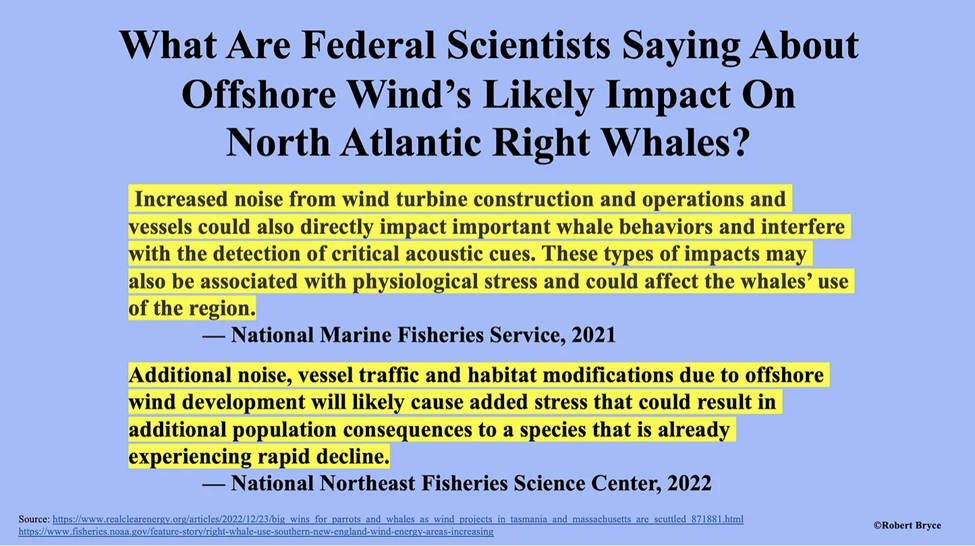
Proposal to Use Different Foundations One of my concerns is that the monopiles proposed for the monster turbines require disruptive pile driving that I think will adversely affect fisheries. Wojick describes a less disruptive method.
One of the “features” of the wind and solar deployment is the use of “community benefit agreements” aka bribes. Robert Bradley notes that Ocean City, MD refused offshore wind developer payola.
A contact of mine here in Ontario had recently informed me he had a heat pump installed to replace his furnace and told me his electricity usage had quadrupled* since having the heat pump installed! Quiring him about the total costs of installation and the potential rebate he informed me the total, including conversion of his service from 100 amp to 200 amp as well as a new hydro line cost almost $21K and his grant rebate will be $7,100 so his net costs will be almost $14K!** At a current approximate cost of 18 cents/kWh we should suspect that will add somewhere between $1,200 to $2,000 per year to his electricity bill or perhaps about what he was previously paying for a natural gas supply!
Blair King writing at the A Chemist in Langley blog has been a continuing inspiration to me because of his pragmatic approach. In this post he addresses claims by the Canadian Association of Physicians for the Environment that air pollution from fossil fuels has severe health impacts. They claim that “air pollution from the burning of fossil fuels is one of the leading causes of premature mortality in Canada” but King shows “the citation used does not support that claim.” The second claim to be examined is “the suggestion that fossil fuel pollution is responsible for one in seven premature deaths in Canada”. He demonstrates that the claim is “so obviously wrong as to be incredibly puzzling and clearly represents a failure in the peer review process”.
A slightly different version of this article also was published at Watts Up With That.
An article about response plans for pandemics by Joe Nocera writing at the Free Press described the plans by the scientist credited for eradicating smallpox for combatting an epidemic. I was struck by the parallels between the differences between his recommendations and the lockdown plan response to Covid and the Climate Leadership & Community Protection Act (Climate Act plans to transition the electric system to net-zero greenhouse gas emissions.
I have followed the Climate Act since it was first proposed, submitted comments on the Climate Act implementation plan, and have written over 400 articles about New York’s net-zero transition. The opinions expressed in this post do not reflect the position of any of my previous employers or any other organization I have been associated with, these comments are mine alone.
Overview
The Climate Act established a New York “Net Zero” target (85% reduction in GHG emissions and 15% offset of emissions) by 2050. It includes an interim 2030 reduction target of a 40% reduction by 2030 and a requirement that all electricity generated be “zero-emissions” by 2040. The Climate Action Council (CAC) is responsible for preparing the Scoping Plan that outlines how to “achieve the State’s bold clean energy and climate agenda.” In brief, that plan is to electrify everything possible using zero-emissions electricity. The Integration Analysis prepared by the New York State Energy Research and Development Authority (NYSERDA) and its consultants quantifies the impact of the electrification strategies. That material was used to develop the Draft Scoping Plan outline of strategies. After a year-long review, the Scoping Plan was finalized at the end of 2022. In 2023 the Scoping Plan recommendations were supposed to be implemented through regulation, PSC orders, and legislation. Not surprisingly, the aspirational schedule of the Climate Act proved to so difficult that many of the goals for 2023 were not achieved. Many aspects of the transition are falling behind, and the magnitude of the necessary costs is coming into focus.
D. A. Henderson
The Free Press has a weekly series of articles, The Prophets, about “fascinating people from the past who predicted our current moment and make our world more understandable today.” Joe Nocera’s article “spotlights D.A. Henderson, the epidemiologist who warned that pandemic lockdowns won’t stop a disease but could instead lead to a public health disaster.” It is a very interesting article and I recommend it highly. He writes:
In 2006, ten years before his death at the age of 87, the legendary epidemiologist D.A. Henderson laid out a plan for how public health officials should respond to a major influenza pandemic. It was published in a small journal that focused mainly on bioterrorism—and was quickly forgotten.
As it turns out, that paper, titled “Disease Mitigation Measures in the Control of Pandemic Influenza,” was Henderson’s prescient bequest to the future. If we had followed his advice, our country—indeed, our world—could have avoided its disastrous response to Covid.
Nocera describes Henderson’s background. After graduation from medical school, he took a job at the U.S. Communicable Disease Center—the original name for the Centers for Disease Control and Prevention, or CDC. In 1960 as the head of the CDC’s new disease surveillance department smallpox was “high on his list of concerns—and for good reason. Ancient, airborne, and highly contagious, smallpox was estimated to have caused around 300 million deaths in the twentieth century alone.” At that time smallpox was under control in the United States but he was worried about the possibility that an infected person could come and start an outbreak. “When the World Health Organization announced a program aimed at eradicating smallpox, Henderson’s superiors at the CDC transferred him to the WHO in 1966 to take charge of what many scientists believed was a futile mission.”
There was an effective vaccine for smallpox but many thought that it wasn’t possible to vaccinate enough people to eradicate the disease. Henderson’s plan was to place doctors and volunteers in all the places where the disease was still rampant and respond to breakouts as quickly as possible. Quarantines and better vaccination technology enabled people to rapidly vaccinate everyone associated with a local breakout of the disease. Henderson was the driving force to implement the plan across the world. Nocera states:
In 1980, after two years without a single recorded case of smallpox, the World Health Organization declared it eradicated. Science writer Richard Preston, who wrote the introduction to Henderson’s book on the effort, described this feat as “arguably the greatest lifesaving achievement in the history of medicine.”
Pandemic Response
During G. W. Bush’s Administration, a program to develop a plan for a pandemic was put in place:
This was prompted by the book he brought on vacation in 2005, The Great Influenza, a terrifying account of the 1918 flu pandemic estimated to have killed 50 million people worldwide. Bush had already been caught flat-footed on 9/11. He did not want the government to be unprepared in the case of a killer virus. So he ordered that a plan be devised for responding to such a deadly microbe. “Look,” the president said, “this happens every hundred years. We need a national strategy.”
Nocera explains the response developed:
When a team of government scientists completed the plan two years later, among its central tenets was that schools and other institutions should be closed, and that there should be “reduced contact among adults in the community and the workplace.” This meant lockdowns. This was exactly the opposite of the wisdom about pandemics Henderson had acquired during his long career. He tried to tell them that, but his words fell on deaf ears.
The lockdown plan was based on a computer model advocated by Robert Glass, a senior scientist at Sandia National Laboratories in New Mexico:
Robert Glass found that when he entered different variables on how to stop a respiratory virus from spreading, the most effective way was to close schools—along with other parts of society as necessary. Glass managed to get this model to the two government scientists leading the team developing Bush’s pandemic plan, Dr. Carter Mecher and Dr. Richard Hatchett, who quickly embraced it.
Though none of them were epidemiologists, Mecher, Hatchett, and Glass were convinced that computer modeling would transform epidemiology. In The Premonition, Glass reflected on old-school scientists like Henderson with a kind of pity. “I asked myself, ‘Why didn’t these epidemiologists figure it out?’ ” he told Lewis. “They didn’t figure it out because they didn’t have the tools.” Tools like computer models.
At this point I was struck by the similarity between these modelers and the academic energy system modelers. In particular, the arrogance that their models are the be all and end all tool to address the problem at hand and the condescension towards experts in the field.
Nocera notes that Henderson tried to respond:
Henderson, on the other hand, believed that basing pandemic mitigation strategies on hypothetical models—models that themselves were based on hypothetical assumptions—could lead policymakers deeply astray. He said that people behaved in unpredictable ways that models could not capture.
Before the plan was finalized Henderson and other epidemiologists met with the modeling team. The meeting did not go well with the epidemiologists all “berating the Bush team for failing to back up their draconian shutdown proposals with real-world evidence”.
But Mecher and Hatchett stuck by their model, and that was reflected in the pandemic plan, which was published in 2007. Henderson never stopped believing that the path the Bush administration chose was potentially disastrous.
The paper Henderson and his three younger colleagues wrote in 2006, after Henderson’s meeting with Bush’s team, was their last-ditch effort to stop the lockdown plans of the modelers. In retrospect, it was more than a mere journal article. It was a warning about what public health should and shouldn’t do during an outbreak of a highly contagious respiratory illness. It was also a manifesto about the purposes, and limits, of public health.
As he and his co-authors wrote in the 2006 paper:
What computer models cannot incorporate is the effects that various mitigation strategies might have on the behavior of the population and the consequent course of the epidemic. There is simply too little experience to predict how a 21st century population would respond, for example, to the closure of all schools for periods of many weeks to months.
We now know exactly how school closures affected the nation. The answer is very badly.
Nocera describes the negative consequences. For example, the performance of students during the lockdown was disastrous and will have long-term effects. If the lockdown had been effective at stopping the spread of the virus there would at least be a mitigating factor. Nocera quotes Michael Osterholm, the prominent University of Minnesota epidemiologist, , “Look at what happened in China. They locked down for years, and when they finally relaxed that effort, they had a million deaths in two weeks.”
Parallels to the Net-Zero Energy System Transition
D. A. Henderson was a hands-on epidemiologist. His mentor taught him the value of “shoe-leather epidemiology” which is shorthand “for the activities of an epidemiologist who left his office to personally investigate epidemics—collecting data and interviewing patients and officials”. He also demonstrated hands on leadership in the fight to eradicate smallpox. My point his position was developed based on personal experience.
My primary concern is the New York Climate Leadership & Community Protection Act net-zero transition. As part of that transition the Climate Action Council (CAC) is responsible for preparing the Scoping Plan that outlines how to “achieve the State’s bold clean energy and climate agenda.” Throughout the CAC deliberations of the draft scoping plan the State never refuted the claims by academic energy modelers that no new technologies would be needed for the transition and that there were no reliability issues. There have been two modeling approaches for the transition plan. The entities responsible for electric system reliability rely on bottom-up models based on decades of experience with the all the components of the electric system. On the other hand, the basis of the Scoping Plan is modeling by academics that is a top-down approach. I am convinced that the top-down modeling to date overlooks too many critical aspects of the electric system to be credible. That the state has not reconciled the differences between the New York Independent System Operator electric system projections and the analyses performed by the New York State Energy Research & Development Authority is a prescription for the same disastrous outcome as the pandemic response.
Conclusion
I have enough modeling experience to opine on their use. Observations always trump model projections. The reliance on models like the Global Climate Models used to claim that there is an existential threat from climate change can never be properly verified by comparison to observations. That must always be kept in mind but it has been totally ignore in the New York process. In addition, the future energy system has to be modeled. The net-zero transition energy modeling is in two camps. The academic top-down approach can be verified but the results are unimpressive. Even the bottom-up models used by the entities responsible for electric system reliability have issues but there is a constant improvement based on refinements to address observations.
This article clearly shows that the Covid response should have relied on the epidemiologists whose observations suggested a different approach more akin to what Sweden did. “Sweden’s death rate wound up being one of the lowest in the world—4 percent during 2020 and 2021. The U.S. excess death rate in the same period was 19 percent.” I fear that ignoring the experience of responsible energy experts and relying on theoretical energy system modeling will have similarly disastrous impacts.
Finally, note that the United States plan for the next pandemic has to be changed. I can only hope that the advice of D. A. Henderson will be heeded this time.
For the first two months of the year the New York State Department of Environmental Conservation (DEC) and the New York Energy Research & Development Authority (NYSERDA) have been working on the New York Cap-and-Invest (NYCI) Program stakeholder engagement process. Although I have not posted on this process since I discussed the cost projections, I have been evaluating the pre-proposal outline of issues. This post summarizes the comments I submitted.
I have followed the Climate Leadership & Community Protection Act (Climate Act) since it was first proposed, submitted comments on the Climate Act implementation plan, and have written over 400 articles about New York’s net-zero transition. The opinions expressed in this post do not reflect the position of any of my previous employers or any other organization I have been associated with, these comments are mine alone.
Overview
The Climate Act established a New York “Net Zero” target (85% reduction in GHG emissions and 15% offset of emissions) by 2050. It includes an interim 2030 reduction target of a 40% reduction by 2030 and a requirement that all electricity generated be “zero-emissions” by 2040. The Climate Action Council (CAC) is responsible for preparing the Scoping Plan that outlines how to “achieve the State’s bold clean energy and climate agenda.” In brief, that plan is to electrify everything possible using zero-emissions electricity. The Integration Analysis prepared by the New York State Energy Research and Development Authority (NYSERDA) and its consultants quantifies the impact of the electrification strategies. That material was used to develop the Draft Scoping Plan outline of strategies. After a year-long review, the Scoping Plan was finalized at the end of 2022. In 2023 the Scoping Plan recommendations were supposed to be implemented through regulation, PSC orders, and legislation. Not surprisingly, the aspirational schedule of the Climate Act has proven to be more difficult to implement than planned. Many aspects of the transition are falling behind, and the magnitude of the necessary costs is coming into focus.
Cap-and-Invest
The Climate Action Council’s Scoping Plan recommended a market-based economywide cap-and-invest program. The program works by setting an annual cap on the amount of greenhouse gas pollution that is permitted to be emitted in New York: “The declining cap ensures annual emissions are reduced, setting the state on a trajectory to meet our greenhouse gas emission reduction requirements of 40% by 2030, and at least 85% from 1990 levels by 2050, as mandated by the Climate Leadership & Community Protection Act (Climate Act).” In addition to the declining cap, it is supposed to limit potential costs to New Yorkers, invest proceeds in programs that drive emission reductions in an equitable manner, and maintain the competitiveness of New York businesses and industries. The stakeholder engagement process is supposed to refine the proposal over the next several months, DEC will and NYSERDA will propose regulations by summer, and the final rules are supposed to be in place by the end of the year.
Late last year DEC and NYSERDA released the pre-proposal outline of issues that included a long list of topics. The Agencies said that they are “seeking and appreciate any feedback provided on these pre-proposal program leanings to inform final decisions in the State’s stakeholder-driven process to develop these programs.” The Pre-Proposal Outline topic list follows:
The Mandatory Greenhouse Gas Reporting Program (forthcoming 6 NYCRR Part 253)
Types of GHG Emission Sources
Minor Modifications
Major Modifications
Threshold Categories
Data Collection
Verification
The Cap-and-lnvest Program
Obligated Sectors and Entities
Demonstrating Compliance
Compliance Periods
Allowance Retirement Obligations
Establishing a GHG Emissions Cap and Allowance Budget
Setting the 2025 GHG Emissions Cap
GHG Emissions Cap Trajectory
Establishing Annual Allowance Budgets
Implementation of Non-Obligated Adjustment
Banking Adjustments
Emissions-lntensive and Trade-Exposed Industries
Identification of EITEs
Emissions Intensity
Trade Exposure
Threshold for EITE Designation
EITE Emissions Allowances
Application and Annual Reporting
Consignment of EITE Allowances
Increasing Affordability via Potential Electric Utility Consignment
Program Stability Measures and Cost Containment
Price Floor
Cost Containment Reserve (CCR)
Emissions Containment Reserve (ECR)
Price Ceiling
Allowance Banking
NYCI Program Considerations to Ensure No Disproportionate Impacts in Disadvantaged Communities
No Offsets in NYCI
Other Potential Regulatory Mechanisms
Complementary Programs and Requirements
Auction Logistics and Mechanics
Implementation of Auctions
Registration Requirements
Auction Format
Simplified Bidding Option
Publication of Results
Initial Auction Period
Market Integrity and Market Manipulation Prevention
Prohibition of Collusion
Auction Purchase Limits
Holding Limits
Minimum Hold Times
Associations
Market Monitoring
Responding to each of these items is an enormous effort and the agencies requested comments by March 1. Providing substantive comments is very difficult because of a lack of documentation. There were three second-stage engagement webinars in late January and the session recording and a slide deck is available for each which is the primary source of information. The agencies promised to provide more documentation but a spreadsheet with some of the data used in the presentations was not available in a usable format until February 29. The documentation provided does not include narrative descriptions of the analyses.
This perfunctory stakeholder process is consistent with all previous Climate Act stakeholder processes. The Climate Action Council’s Scoping Plan has been described as a “true masterpiece in how to hide what is important under an avalanche of words designed to make people never want to read it.” Similarly, the modeling analyses for the NYCI proposal use an avalanche of technical jargon and impressive sounding phrases to suggest credibility and discourage questions. They do not provide adequate information for detailed review.
One of the key questions to be addressed is the limits on emissions set by the allowance auctions. The modeling analysis must determine the expected emissions starting in 2025 to set the auction limits. As far as I can tell the analyses used for NYCI projections are updates of the Integration Analysis for the Scoping Plan completed in early 2022. A lot has changed since that time as inflation, supply chain, and other issues have increased prices and delayed implementation, but it is not clear if those problems were used to modify the analysis. The Integration Analysis projections have never been reconciled with electric system projections by the New York Independent System Operator. There has been no acknowledgement of the comments made on the Integration Analysis much less any attempt to incorporate issues raised. My point is that I do not believe that there is any reason to bother providing detailed comments because past history indicates they will not be considered.
Core Principles of Cap-and-Invest Program
Instead of wasting my timeaddressing specific technical issues, the comments I submitted only addressed general issues. I focused my comments on the NYCI principles. According to the NYCI website, Governor Hochul laid out five core principles for the Cap-and-Invest Program:
Affordability – Governor Hochul’s Consumer Climate Action Account will deliver at least 30 percent in future Cap-and-Invest proceeds to New Yorkers every year to mitigate consumer costs.
Funding a sustainable future – the Climate Investment Account established in the FY24 Budget will direct two-thirds of future Cap-and-Invest proceeds to support the transition to a less carbon-intensive economy.
Climate leadership – The program will be designed with the capacity to link with other current or future programs to further catalyze a nationwide movement towards carbon pricing, which can lower the price of the transition overall.
Creating jobs and preserving competitiveness – The program will launch new investment in industries that will create tens of thousands of good paying, family sustaining jobs of the future that can lift up entire communities.
Investing in disadvantaged communities – Cap-and-Invest will prioritize the frontline disadvantaged communities in our state that for far too long have suffered from pollution and environmental injustice.
The remainder of this article describes my comments on these principles and one overarching concern.
New York Auction Proceed Investment Effectiveness
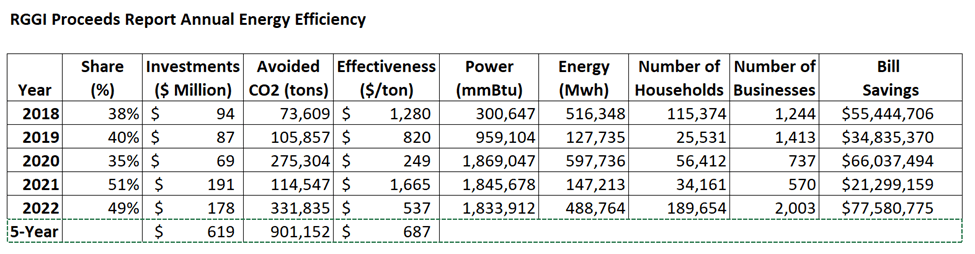
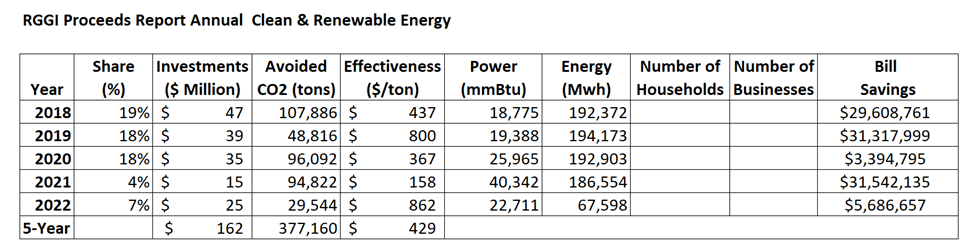
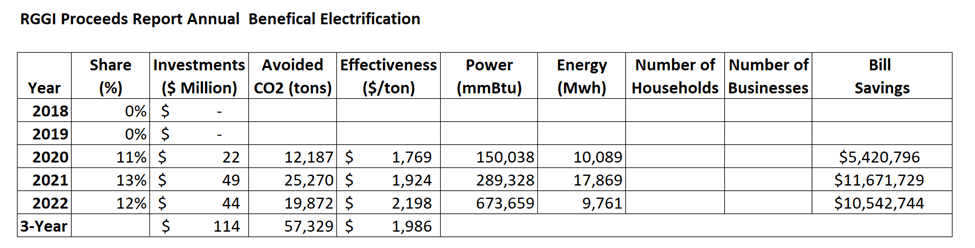
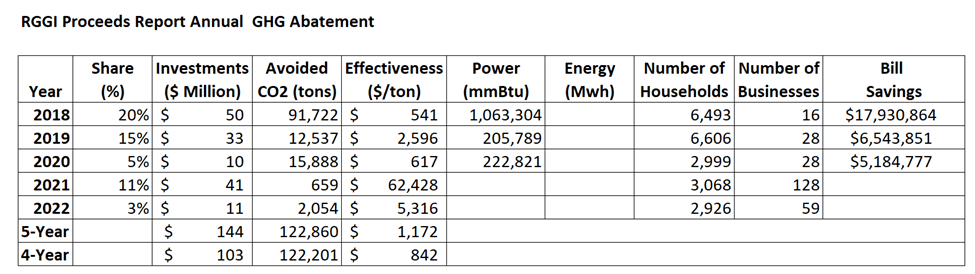
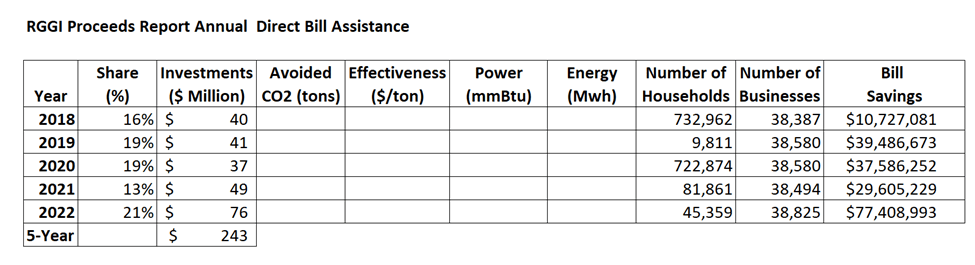
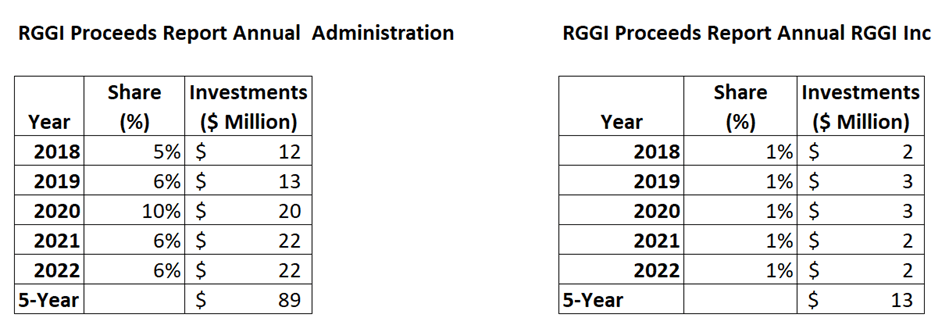
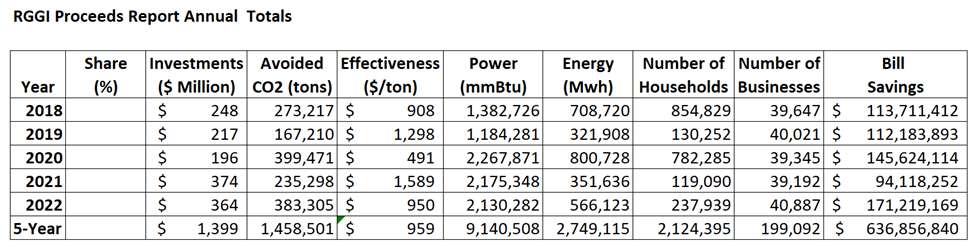
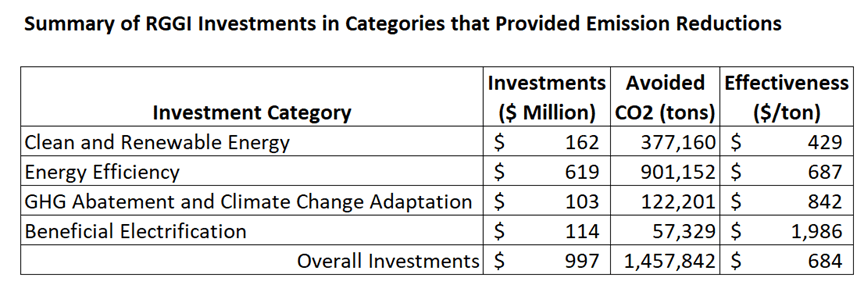
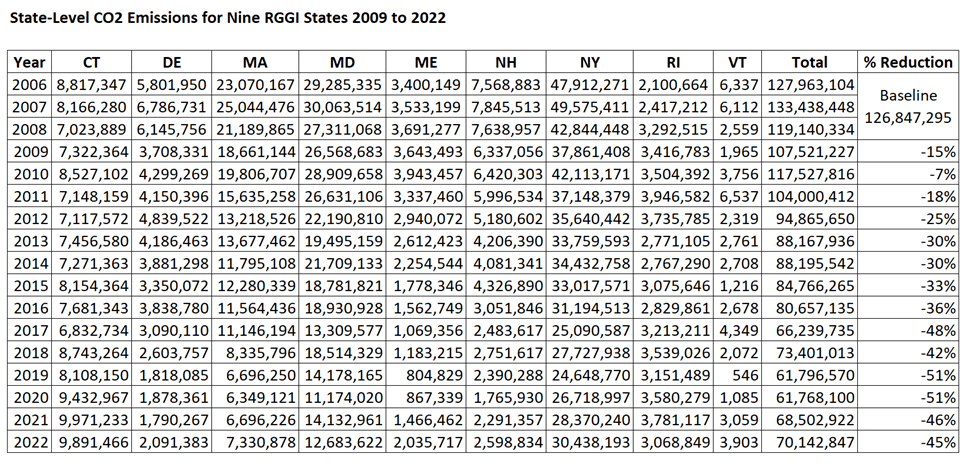
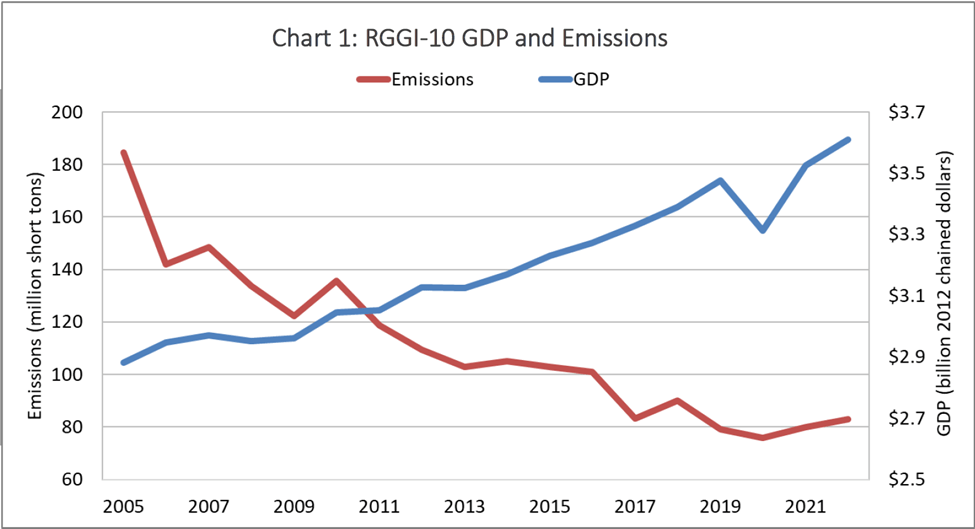
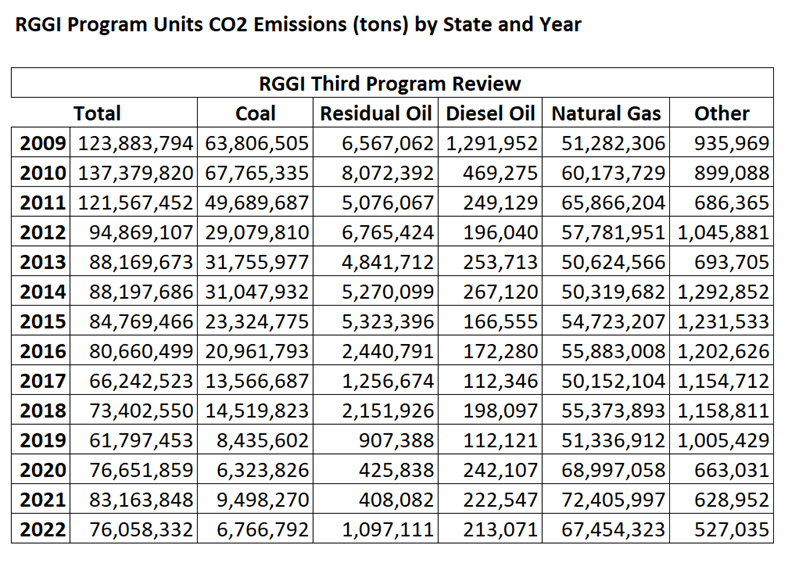
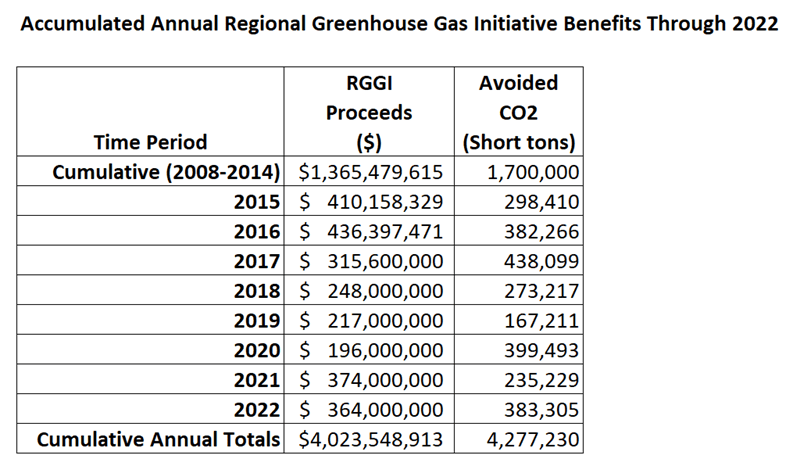
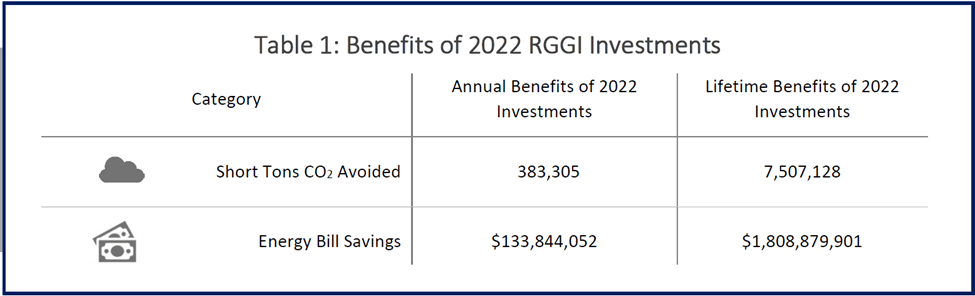
There is an overarching issue with NYCI planning. I believe that supporting ambitious clean energy investments is more difficult than acknowledged. In my comments on the 2024 New York State Energy Research & Development Authority (NYSERDA) Regional Greenhouse Gas Initiative (RGGI) Operating Plan Amendment I explained that I had reviewed the historical investment results of RGGI auction proceeds and found that RGGI has not been very effective at making emission reductions. This is the template for NYCI, and the results are not encouraging. According to Table 2 in Semi-Annual Status Report through December 31, 2022, the cumulative annual net greenhouse gas emission committed savings are 1,725,544 tons through the end of 2022. That is 9.5% of the observed reduction of 16,196,531 tons since the three-year baseline before the start of RGGI in 2009. I conclude that the primary reason for the observed electric sector emission reductions in New York was due to fuel switching due to low natural gas prices and not RGGI investments.
These observations are relevant for the future of electric sector emission reductions required for NYCI. In the electric sector, fuel switching is no longer an option in New York. Coal is no longer used and oil emissions from NYCI affected sources are as low as they are going to get without retirement of oil-fired sources. The average CO2 emissions reduction per year from RGGI investments has been 95,716 tons since 2013. New York Part 242 CO2 Budget Trading Program specifies an annual reduction of RGGI allowances of 880,493 per year starting in 2022 and continuing to 2030. That reduction is nearly ten times more than the reductions from RGGI auction proceed investments. The Climate Act is going to require even more emission reductions. Electric generating unit owners and operators have no options available for additional emission reductions other than reducing their operating times. It is incumbent upon NYCI to invest auction revenues to effectively incentivize and subsidize carbon-free generation and reduce energy use so that the affected sources can reduce operations and not jeopardize system reliability. The same issues are present for all other energy sectors. There are no low-hanging options for emission reductions in New York. If the sources are unable to reduce operations safely, then the Climate Act targets will be jeopardized.
My RGGI Operating Plan Amendment comments determined the cost effectiveness of RGGI investments for reducing emissions. I found that the cumulative annual net greenhouse gas emission committed savings are 1,923.951 tons and that cumulative total investments are $945,900,000. That equates to $492 per ton removed. The 2023 Update to the NYS Value of Carbon Guidance lists the social cost of carbon dioxide, at a 2% discount rate, as $120 per short ton and $391 at a 1% discount rate. This indicates that the investments are not producing emission reductions at a rate that is less than the societal benefits which suggests a fundamental problem with the NYSERDA investment strategies. It also indicates that providing sufficient funds for NYCI emission reductions will be a challenge.
In my comments related to this issue I compared the allowance trajectory needed to meet the Climate Act mandates with the proposed allowance prices. I found that the proposed allowance prices and allowance reduction trajectories are incompatible with the observed RGGI investment results such that the mandates will not be met
Affordability
The Hochul Administration has never clearly admitted the expected costs of the Climate Act net-zero transition. I believe this is deliberate because the costs are politically toxic. The first principle “Craft a program to deliver money back to New Yorkers to ensure energy affordability” is an attempt to claim the costs are under control.
My comments raised the point that there is an important tradeoff ignored in this principle. A fundamental component of a greenhouse gas emissions market control program is raising energy prices to incentivize the adoption of zero-emissions technologies. If costs do not increase, then the public does not have any reason to invest in the more expensive zero-emissions technologies necessary to reduce emissions.
Another issue with any carbon cost scheme is that it is regressive affecting those least able to afford to pay more for energy the most. I commented that delivering money back to New Yorkers should prioritize low- and middle-income consumers least able to afford regressive energy price increases with investments in programs that reduce their energy use. This should cut their energy costs and will reduce emissions.
Funding a Sustainable Future
Another bit of missing documentation concerns the funding necessary to make the emission reductions necessary to meet the Climate Act mandates. The primary Climate Act emission reduction strategy is to displace fossil fuel energy use by building wind and solar while electrifying buildings and transportation. This principle acknowledges that this needs to be addressed: “Support ambitious clean energy investment”.
My comments emphasized the need for investment in zero-emissions technologies that can displace greenhouse gas emitting technologies. NYCI allowance allocations must be consistent with Climate Act mandates. No documentation of a feasibility analysis of the costs and deployment schedule for the proposed control strategies has been mentioned, much less provided. Ideally, the Integration Analysis projections should be compared to the observed results so that the analysis can be updated. In my Scoping Plan comments I evaluated bits and pieces but could only nibble around the edges. Importantly I found issues even at that level that were never acknowledged,
Climate Leadership
The political slogan to “Catalyze other states to join New York and allows linkage to other jurisdictions” has little value. I do not believe that it is possible to link to other jurisdictions as long as New York GHG emission accounting is different. Incompatible features with the states of California and Washington and the Province of Quebec include the use of Global Warming Potential based on a 20-year period, the inclusion of upstream and downstream emissions, and the use of offsets. My comments said that the State must make its accounting compatible or abandon this principle.
Creating Jobs and Preserving Competitiveness
One of the favored Hochul constituencies is labor so the “Protect existing jobs and support new and existing industries in New York” principles was included. My comments argued that results in Europe suggest that the idea that transitioning away from fossil fuels and maintaining existing Emissions-Intensive and Trade-Exposedindustries is impossible. Robert Bryce explains:
The headline on a February 9 Bloomberg article concisely sums up Europe’s unfolding disaster: “Germany’s days as an industrial superpower are coming to an end.” The article says, “Manufacturing output in Europe’s biggest economy has been trending downward since 2017, and the decline is accelerating as competitiveness erodes.” All across Europe, industrial capacity is shrinking. Last month, Tata Steel announced it would close its last two blast furnaces in Britain by the end of this year, a move that will result “in the loss of up to 2,800 jobs at its Port Talbot steelworks in Wales.”
These slides and the ongoing destruction of European heavy industry bring to mind the trenchant lines that John Constable of Britain’s Renewable Energy Foundation delivers in our new five-part docuseries, Juice: Power, Politics & The Grid.Constable, who is also the energy editor at the Global Warming Policy Foundation, delivers a stark warning., he says, “I tell decision-makers in the United States to study the European example very, very carefully. I mean, you have no excuse for not looking at Europe and learning. We’ve tested this for you.”
I do not believe it is possible to create more jobs than lost due to the increased costs inherent in a net-zero transition. My comments stated that this principle cannot be achieved unless there are triggers to pause implementation when established differences in energy costs are exceeded.
Investing in Disadvantaged Communities
I do not think that the general public understands that the Climate Act includes a strong emphasis on climate justice “to ensure that frontline and otherwise underserved communities benefit from the state’s historic transition to cleaner, greener sources of energy, reduced pollution and cleaner air, and economic opportunities”. The relevant principle “Ensure 35%+ of investments benefit Disadvantaged Communities” is a direct response the Climate Act requirement to “invest or direct resources in a manner designed to ensure that disadvantaged communities receive at least 35 percent, with the goal of at least 40 percent, of overall benefits of spending.”
New York’s climate justice community organizers have the misplaced belief that peaking power plants in New York City are “perhaps the most egregious energy-related example of what environmental injustice means today” and are demanding that they be shut down as soon as possible. However, in the “Role of Cap-and-Invest” webinar the following slide describes the sources that create inhalable air pollution burdens in New York. It points out that:
Individually controlled (permitted) stationary sources yield a minority of the air pollution emissions in New York.
In 2020, electric generation units represented 8.5% of non-wood fuel combustion PM25 emissions in NY, and other permitted sources represented approximately 3.5%.
Area and mobile sources dominate, which means that individual stationary source-focused policy is important but doesn’t address the bulk of sources.
My comments noted that NYCI should focus on Disadvantaged Community investments that address the emissions from the buildings and transportation sectors that the NYCI analysis shows are the primary contributors to air quality impacts in those communities.
The same activists have also latched on to outlier analyses that claim that market-based programs lead to disproportionate impacts in disadvantaged communities and are lobbying for market restrictions. Emission trading programs are an effective solution for emissions like greenhouse gases that have regional or global impacts but are not designed to address local impacts of specific sources. The Pre-Proposal Outline described the regulatory programs that address local issues. My comments argued that those programs should be used to address local issues and NYCI should not be modified to try to address co-pollutant emissions with local impacts.
Discussion
One of the characteristics of the proposed net-zero Climate Act transition is over-reliance on the presumption that control strategies that have worked elsewhere will work in this application. NYCI is a prime example. However, past performance does not guarantee future success. This is especially true if fundamental design components change. Previous successful Environmental Protection Agency allowance caps have been based on feasibility whereas the Climate Act caps are aspirational political limits that have not been tested for practicability. Options of limits on trading and banking allowances have been proposed that are incompatible to any emissions trading program. An overarching issue is that control options for SO2 and NOx control are different than for GHG which has unacknowledged implications.
My submittal included comments on the proposed additional limits on the distribution of allowances intended to address real and imagined issues with past programs. I did not describe them here because there are too technical. My comments noted that all these patches overly complicate the program and may or may not have the desired effect while risking unintended consequences.
Conclusion
Hochul’s NYCI principles are political slogans destined to fail. Claiming affordability is possible is unlikely because NYCI is going to markedly increase prices. Politicians have glommed on to the auction proceeds and dictated how they should be distributed without consideration of the need to fund effective GHG emission reduction programs. The goal to link with other current or future programs to further catalyze a nationwide movement towards carbon pricing is impossible with New York’s current GHG emission accounting requirements. Creating jobs and preserving competitiveness ignores the observed effects of net-zero in Europe. It is appropriate to invest in disadvantaged communities, but no proof has been offered that those least able to afford increased energy prices will not be adversely impacted even with this principle.
I believe that the political calculus driving NYCI implementation is perverting the effectiveness of this market-based program to the point that it will not work. I do not think that New York’s leadership understands how best to make climate policy work. Last year I described the book Making Climate Policy Work. The authors recommend clear thinking and strategy as opposed to “Efforts spent tilting at ephemeral, magical policy solutions waste scarce resources that should instead be invested in things that work.” The goal of their book is to explain how market-oriented climate policies have fallen far short and how they might be modified so that they work. NYCI is just such a magical policy solution that has been modified so it will not work. I believe NYCI will flounder on the shoals of reality.
I recently published an article about the difference between weather and climate that was in response to a friend who consistently links weather events to climate change on his Facebook account. The reason for this post is his response to my latest explanation that ended with him saying “I’m comfortable with being wrong. It’s not a death match.” This post explains why it matters.
I will explain the problem with the successful propaganda campaign to convince the general population that unusual weather events justify New York’s Climate Leadership & Community Protection Act (Climate Act). I have followed the Climate Act since it was first proposed, submitted comments on the Climate Act implementation plan, and have written over 400 articles about New York’s net-zero transition. The opinions expressed in this post do not reflect the position of any of my previous employers or any other organization I have been associated with, these comments are mine alone.
Overview
The Climate Act established a New York “Net Zero” target (85% reduction in GHG emissions and 15% offset of emissions) by 2050. It includes an interim 2030 reduction target of a 40% reduction by 2030 and a requirement that all electricity generated be “zero-emissions” by 2040. The Climate Action Council (CAC) is responsible for preparing the Scoping Plan that outlines how to “achieve the State’s bold clean energy and climate agenda.” In brief, that plan is to electrify everything possible using zero-emissions electricity. The Integration Analysis prepared by the New York State Energy Research and Development Authority (NYSERDA) and its consultants quantifies the impact of the electrification strategies. That material was used to develop the Draft Scoping Plan outline of strategies. After a year-long review, the Scoping Plan was finalized at the end of 2022. In 2023 the Scoping Plan recommendations were supposed to be implemented through regulation, PSC orders, and legislation. Not surprisingly, the aspirational schedule of the Climate Act has proven to be more difficult to implement than planned and many aspects of the transition are falling behind.
Examples of the Causal Link
In order to keep the public’s support for the Climate Act net-zero transition the Hochul Administration links recent extreme weather events to climate change. The impetus of this article were two recent Facebook posts by my friend. The first said that “So it wasn’t so long ago that there was a thing called “snow” and included a memory of a hike during the winter of 2014-2015 when there were “MASSIVE snow dumps in the Catskills”. Yesterday the second post noted that he had heard spring peepers. This small chorus frog is “one sure sign of spring” and my friend noted that hearing them on March 8 was “by far the EARLIEST EVER”.
Climate Change and California Atmospheric Rivers
In my articles responding to the presumption that these weather events are tied to climate change I have explained that according to the National Oceanic and Atmospheric Administration’s National Ocean Service “Weather reflects short-term conditions of the atmosphere while climate is the average daily weather for an extended period of time at a certain location.” That article goes on to explain “Climate is what you expect, weather is what you get.” Rather than trying to expand on my arguments I think this recent article by Chris Martz provides good insight.
In his article Martz addresses those who will claim that the recent rounds of atmospheric rivers that have brought rainfall for days and recent heavy snowfalls to California are linked to climate change. He describes the news cycle that had been harping for years on the “megadrought” that would put California in a permanent drought because of climate change. The last two years of above average precipitation have destroyed that story. Martz writes:
Faced with the reality that these “forever drought” predictions from nearly a decade ago were woefully wrong, academics and their media mouthpieces have had one of two options, either:
Admit that the “permanent drought” prediction was wrong, or,
Change their tune quietly to say that human-induced climate change is making California wetter by “fueling” the atmospheric rivers that provide the bulk of the state’s annual rainfall budget, and hope the rest of us don’t notice.
And, of course, the second option is the one academics and government scientists decided to go with (Figure 5).
Martz goes on to describe atmospheric rivers and their potential for serious impacts. Then he addresses the question whether “human-induced climate change plays a role, and to what extent if that is indeed the case.” He notes:
I should prepend this discussion with the disclaimer that climate change itself does not cause any single weather event to occur. Climate is nothing but a statistical measure of various atmospheric state variables over a period of at least 30-years, preferably longer. The statistics may be organized into averages or “climate normals,” distributions and extremes. Each provides some sort of insight as to the weather one might expect at any given point in space or time. As the old saying goes, “climate is what you expect, weather is what you get.” Climate changes, both naturally and through man-made forcings, over a period of several decades. The equations of motion which physically explain how extreme weather phenomena occur do not change with the climatic base state.
I think he does a good job explaining what meteorologists should consider when trying to attribute weather events to climate change.
So, the question becomes, how does a changing climatic base state alter specific characteristics of atmospheric river events? In this case, there are two facets that atmospheric scientists care about:
Has there been a detectable increase in extratropical cyclone activity [and the accompaniment intense winds] that atmospheric rivers are associated with in the observational record? How is this expected to change in the future?
How has extreme rainfall associated with atmospheric rivers changed as the climate has warmed? How is this expected to change in the future?
In a nutshell, depending on which of the two key issues above are examined, we reach contrasting conclusions, showcasing the sheer complexity of the coupled ocean-atmosphere system. To elaborate, if we make the assumption that the planet continues to warm, extratropical cyclone activity and their associated extreme winds should wane, but extreme rainfall, on the contrary, should be enhanced.
Like every other aspect of climate change policy this is much more complicated than it appears at first glance. He does a great job breaking down all the factors at play. For example, the warmer climate means more moisture “super-charging” extreme weather. He says in response: “Simply put, just because more water vapor can occupy the air at higher temperatures does not mean that it will.” I recommend reading his article in its entirety to understand how difficult it is to make a definitive link between climate change and weather events.
Why it Matters
After I sent the link to the article to my friend he responded:
I might quibble with “The equations of motion which physically explain how extreme weather phenomena occur do not change with the climatic base state.” No, the equations don’t change, but the inputs do, right? So, more heat = more [whatever], etc. I appreciate the skepticism, but, clearly, there is something going on out there beyond the bounds of “normal”. But then again, you can be skeptical and say that my human timeframe is far too short to make such judgments – perhaps. But even beyond my mere mortal years, it seems that we’re seeing the furthest outliers of “weather” data that you might expect for a given season.
The frustration to me is that he gets it when he says, “my human timeframe is far too short to make such judgments”. Anecdotal evidence linking weather events and climate change is going to always be wrong because weather is what you get and climate is what you expect and our time frame is too short for climate comparisons.
However, that is not the problem. The issue is his concluding remarks:
I’m comfortable with being wrong. It’s not a death match.
My concern is that ultimately the conflation of every unusual weather event to climate change is linked to the preposterous idea that if New York converts its energy system to meet the Climate Act net-zero goals there will be an effect on the unusual weather events observed. I am convinced that the present trajectory of the Climate Act mandates aspirational goals that are dangerous. In February 2021, the Texas electric grid failed to provide sufficient energy when it was needed. The storm was the worst energy infrastructure failure in Texas history and resulted in at least 246 people dying and total damages were at least $195 billion. The Hochul Administration has not demonstrated that the Climate Act goals are feasible and will not endanger the reliability of the New York electric system. The same thing that happened to Texas could happen in New York.
Discussion
There is another related weather and climate related issue. I fear that the emphasis on ever more dangerous weather in the future due to climate change is diverting resources away from addressing observed weather problems. There is a limit to the resources available to address weather-related issues despite the value in doing so. Over building infrastructure in one place to account for potential issues related to climate change likely means that improving infrastructure elsewhere for observed weather events will not be funded.
I am often surprised how California state and local entities craft policies they believe would put us on the path to addressing the complex dynamics of what we label climate change. Whether these efforts—a bullet train to and from small cities, banning the sale of gasoline cars by 2035, limiting the use of gas appliances, and similar aggressive policies—make real-world sense or whether they are a virtue-signaling crystal ball without a feasible way of measuring those efforts remains to be seen.
This is the nub of the Climate Act problem. Can we come up with net-zero transition policies that will not do more harm than good. Nalven’s article describes how Curry lays out the wicked problem of whether climate action is necessary and how it should be addressed given the uncertainties. Nalven sums up:
Curry’s approach stands in stark contrast to the overreach and catastrophizing by climate justice warriors. Those warriors and their acolytes are unlikely to be persuaded by Curry’s pragmatic, but seemingly slower, approach to a changing climate.
There is no magic wand, no scientific alchemy, that can easily upend cognitive catastrophizing about weather events.
“The disconnect between historical data for the past 100 years and climate model-based projections of worsening extreme weather events presents a real conundrum regarding the basis on which to assess risk and make policies when theory and historical data are in such disagreement.”
Conclusion
Chris Martz sums up my concern about the mis-allocation of resources based on the fear of climate change:
Whether or not climate change is having any meaningful impact on the extreme weather events we care about is irrelevant in the need to raise awareness to the fact that we continue to develop in disaster-prone areas and the necessity to improve societal resilience through better zoning codes and community planning. Mother Nature always has and always will throw curveballs in our direction, regardless of what the climate is doing in the long-term, and being better equipped to mitigate disaster losses or prevent them in the first place must be a focal point of engineers, emergency managers and policymakers in the years and decades to come.
Sitting on our hands and blaming climate change for everything is really a waste of time that would be better spent finding solutions to real-world problems such that our children and grandchildren have a safer world to live in.
Against this backdrop, the cartoon-like presumption that any unusual weather is tied to climate change and thus needs to be addressed whatever the cost needs to be confronted. The difference between weather and climate does matter. N
Irina Slav on energy Substack is described as “All things energy. Challenging the dominant narrative because facts matter”. Her latest article “Burn, Hollywood, burn” calls out the blatant indoctrination and propaganda associated with Hollywood today. As always when you dig deeper it is all about money for the shills.
I have followed issues related to climate change and the net-zero energy transition for many years. The opinions expressed in this post do not reflect the position of any of my previous employers or any other organization I have been associated with, these comments are mine alone.
In her introduction, Slav expressed a concern that is common to many readers of Watts Up With That:
A couple of days ago, in a conversation with David Blackmon on X, I unthinkingly commented that we’ve reached peak idiocy in the transition narrative. David wisely reminded me that we keep getting proven wrong in this by the narrative constantly discovering new peaks to strive for and conquer. Alas, I couldn’t disagree.
In my work here I’ve mostly focused on calling out the climate indoctrinators in the media, in politics, and, occasionally, in schools. But there is an indoctrination channel I have so far steered clear of, for reasons of mental self-preservation. I get angry about things, you see, and I don’t really like being angry. When I saw this article on Rolling Stone a while ago, however, I got too angry to bother about disliking being angry.
The article is a symphony of climate propaganda done absolutely openly and eagerly, with an unshakeable conviction that amplifying climate catastrophism is the right thing to do. Through all means necessary.
She explains how this article is evidence of the incessant indoctrination of the masses regarding climate change. Earlier the emphasis was on social justice but now there is a shift:
That was the social justice stage of the indoctrination drive. Now, we seem to have reached the next stage, which is all about climate change, a distillate of social justice issues, if you will, since every single problem we have today can be traced back to climate change by the eager narrative pushers. Why so eager, you might ask? Well, because there’s money and fame in it.
The most revealing part of her article for me was her description of the organization called Good Energy. She describes it thusly:
Said organisation exists with the sole purpose of making climate change a central topic in movies and TV shows. Because it’s important, of course. The most important topic ever. And these gracious people are there to guide film folk on the journey to internalising this so they can make more climate change-centric movies and TV shows.
Here’s an excerpt: “We aim to make it as easy as possible to weave climate into any aspect of a story. Applying the Climate Lens™ to your narrative can reveal complexities in character and setting, add conflict, and unlock touching, funny, and surprising storylines — all of them backed by climate science, psychology, and lived experiences.”
Incidentally, while helping writers, directors and producers “weave climate into any aspect of a story” and why not every single aspect of a story, they’d make some money from this because these consulting services are not free. Indoctrination is a mission but that doesn’t mean it can’t be a business at the same time, and how cool is that!
The Good Energy “Library of Experts” is interesting for a couple of reasons: the wide range of expertise disciplines that claim a link to their work and climate change and the number of individuals who loyal readers here might recognize like Dr. Peter Kalmus. Slav goes on to expose a potential driver for their concern about climate change:
Speaking of money, the Daily Sceptic has done a great job in exposing the financial backing of Good Energy and similar organisations or shall I say formations because it certainly sounds more appropriate. You won’t be surprised to learn that this backing comes from climate obsessed billionaires. Bloomberg Philanthropies and the Sierra Club pop out among the list of backers, along with the Walton Family Foundation and One Earth.
She takes an optimistic view of this:
Sad as all this may be there is a silver lining and that silver lining lies in the fact that propaganda has never, ever produced quality art of any form or quality entertainment. Good art and good entertainment tell stories, invoke various emotions, and, if done really well, result in some form of catharsis.
Climate propaganda does not tell stories. It only aims to invoke one emotion and that’s fear. It hammers in a message disguised as a story that is so solid and unwieldy it defies interpretation. You can only swallow it whole. Or ridicule it, of course, because it is ridiculous.
Since climate propaganda in film – and in literature, too – is so rigid, it’s doomed to failure, just like the identity politics trend in literature. The reason for this is that while there may be many people with a mental age of four when it comes to discriminating between art and propaganda, there are many more who instinctively sense the difference and sooner or later shun the latter.
I hope she is correct. I tend to be a bit more pessimistic because I think that the inevitable reality slap of the insane transition policies may occur after irreparable harm. I encourage you to read all of her article and consider subscribing to her Substack.
I have been so busy lately with net-zero transition implementation issues that I have not had time to put together an article about every relevant post I have read. This is a summary of posts that I think would be of interest to my readers.
I have been following the. Climate Leadership & Community Protection Act (Climate Act) since it was first proposed and most of the articles described below are related to the net-zero transition. I have devoted a lot of time to the Climate Act because I believe the ambitions for a zero-emissions economy embodied in the Climate Act outstrip available renewable technology such that the net-zero transition will do more harm than good. The opinions expressed in this article do not reflect the position of any of my previous employers or any other company I have been associated with, these comments are mine alone.
The Empire Center’s Ken Giradin has written an exhaustive guide to New York’s drive to lower emissions. I recommend it highly. The Executive Summary states:
New York in 2019 adopted a sweeping climate law designed to reduce greenhouse gas emissions through bans, regulations and taxes. The law, the Climate Leadership and Community Protection Act (CLCPA), sets ambitious goals: 70 percent of electricity from renewables and a 40-percent economywide reduction in emissions by 2030, with an electric grid that uses only “zero emission” technology by 2040 and an economy that has effectively zero emissions by 2050.
The state’s approach to these goals is, however, deeply flawed. The Climate Act leaves the bulk of the decisions about how emissions will be reduced to state agencies under direct control of the governor, vesting them with policymaking powers that are supposed to be reserved for New York’s senators and assemblymembers.
The process that has played out in the five years since the law’s passage has been marred by a lack of transparency, with state officials failing to issue legally required cost estimates and crucial studies designed to guide state energy policy. There is growing evidence that the state will be unable to achieve its goals without significantly affecting the cost of living and doing business in New York and harming the reliability of its electric grid.
Giradin offers recommendations including “demanding updated state energy studies, as required by state law and the development of proper cost estimates.” Other steps include:
Giving the Legislature the final say on any regulation or set of regulations with gross compliance costs of $100 million or more;
Ceating an “off-ramp” in case of recession or other financial emergency;
Setting renewable energy credit (REC) purchase requirements through legislation rather than administrative rulemaking;
Pausing awards for offshore wind developers amid exploding costs and making more technologies eligible for zero-emission subsidies; and
Eliminating obstacles to reducing emissions with steps such as making more types of zero-emission power plants such as nuclear, biogas and hydroelectric eligible for state subsidies and seeking an exemption from the federal Jones Act.
So whose grid is it? Is the grid supposed to provide flexible and dependable electricity to the customers when and where they need power? Or is the grid sub-servant to wind and solar? Is it the customer’s job to be ‘flexible’ to accommodate inflexible renewables? Who is the grid supposed to serve:
A. The customer?
or
B. Whatever power source is politically favored at the moment?
Fundamental Climate Model Concern
One of the reasons that I distrust climate models is because they do not model clouds well. It turns out that there is another issue with moisture. Pierre Gosselin explains that “A new study published in PNAS has demonstrated, once again, that climate models fail to simulate what happens in the real world with regard to fundamental climate change variables like water vapor. This is a devastating finding, as water vapor is the most significant greenhouse gas due to its alleged “feedback” capacity, accelerating warming well beyond what CO2 is said to be capable of alone.
The Institute for Energy Research reports that Massachusetts utilities are asking for rate increase:
Eversource and National Grid, the major utilities in Massachusetts, are requesting rate hikes to enhance the power grid and accommodate the growing demand from electric vehicles and heat pumps. They are requesting approximately $2.4 billion over the next five years for grid improvements to convert the grid for renewable energy production and make it more resilient and capable of handling the surge in electrification. That is because Biden’s and the state’s climate agenda will result in Massachusetts homes consuming nearly three times as much electricity by 2050 than they do today. To deliver all that power, Eversource and National Grid will have to invest billions in grid infrastructure upgrades with ratepayers picking up much of the cost. The two utilities have asked the state Department of Public Utilities to begin the process of recouping their investments in converting the electric grid by raising rates over a five-year period.
Taxpayer subsidies and utility profit motives are converging to incentivize the premature destruction and replacement of wind installations throughout America, and this trend will almost certainly become more common as an increasing number of wind turbines are added to the nation’s electric grid. Utility companies and wind turbine operators will seek to renew their access to the PTC to reduce the need for curtailment and to increase their government-approved profits on capital expenditures as long as these subsidies are available.
For your information New York’s October 2023 land-based renewable energy procurement included 612 MW of wind turbine re-powering.
Fundamental Greenhouse Gas Effect Concern
The Science and Environmental Policy Project Weekly Climate and Energy News Roundup #588 explains that physicist Howard Hayden demonstrates that AR6 is inconsistent with itself and with the Stefan-Boltzmann law which specifies the amount of radiation emitted per unit of time from a specific area of a blackbody. A webpage describing observations of infrared radiation compares radiation measurements with temperature measurements. The following results are described:
Both upward and downward infrared radiation can be measured by pyrgeometers mounted 1.5 to 2 meters (4.5 to 6 feet) above the ground. These measurements vary seasonally and by year. The example shown by the Japan Meteorological Agency at Tsukuba, Japan, the home of Tsukuba Science City and the headquarters of the Japan Aerospace Exploration Agency shows this variation and a modest increase in downward infrared radiation but not an appreciable increase in upward infrared radiation indicating a warming.
A couple of years ago I posted an article about New York GHG emissions and found that they are less than one half of one percent of global emissions and that global emissions have been increasing on average by more than one half of one percent per year since 1990. I was recently asked to document that claim and updated that analysis. This post describes the results.
I have followed the Climate Act since it was first proposed, submitted comments on the Climate Act implementation plan, and have written over 400 articles about New York’s net-zero transition. The opinions expressed in this post do not reflect the position of any of my previous employers or any other organization I have been associated with, these comments are mine alone.
Overview
The Climate Act established a New York “Net Zero” target (85% reduction in GHG emissions and 15% offset of emissions) by 2050. It includes an interim 2030 reduction target of a 40% reduction by 2030 and a requirement that all electricity generated be “zero-emissions” by 2040. The Climate Action Council (CAC) is responsible for preparing the Scoping Plan that outlines how to “achieve the State’s bold clean energy and climate agenda.” In brief, that plan is to electrify everything possible using zero-emissions electricity. The Integration Analysis prepared by the New York State Energy Research and Development Authority (NYSERDA) and its consultants quantifies the impact of the electrification strategies. That material was used to develop the Draft Scoping Plan outline of strategies. After a year-long review, the Scoping Plan was finalized at the end of 2022. In 2023 the Scoping Plan recommendations were supposed to be implemented through regulation, PSC orders, and legislation. Not surprisingly, the aspirational schedule of the Climate Act has proven to be more difficult to implement than planned and many aspects of the transition are falling behind. In addition, there has not been any additional documentation provided that proves that the transition will be affordable, keep the same standards of energy reliability, or not have unacceptable cumulative environmental impacts.
GHG Emissions
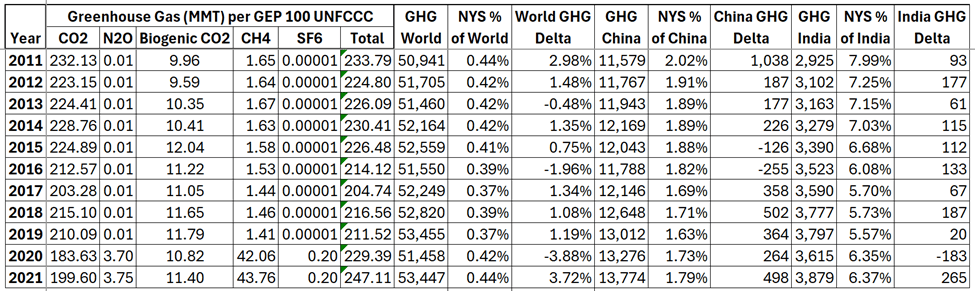
I frequently note that New York greenhouse gas emissions are less than one half of one percent of global emissions, and global emissions have been increasing by more than one half of one percent per year since 1990. This post shows that the claim is still true.
I originally used information from my post Climate Act Emission Reductions in Context to support that claim. I recently updated the analysis. I found CO2 and GHG emissions data for the world’s countries and consolidated the data in a spreadsheet. There is interannual variation, but the five-year annual average has always been greater than 0.79% until the COVID year of 2020. For the New York data I used GWP-100 data from Open Data NY through 2021 as documented in this post. New York’s share of global GHG emissions is 0.42% in 2019 so this means that global annual increases in GHG emissions are greater than New York’s total contribution to global emissions.
The data used are shown in the following table.
Global and New York State GHG and CO2 Emissions (million metric tonnes)
The following graph lists the five-year annual average GHG and CO2 NY emissions and the annual change in the five-year global GHG and CO2 emissions. Note that for most years the global change in emissions is greater than New York emissions. Anything New York does to reduce emissions will be supplanted by emission increases elsewhere in less than a year.
Conclusion
By any measure New York’s complete elimination of GHG emissions is so small that there will not be any effect on the state’s climate and global climate change impacts to New York. I previously showed that although New York’s economy would be ranked ninth relative to other countries, New York’s emissions are only 0.45% of global emissions which ranks 35th. This post graphically shows New York emissions are negligible compared to global emissions. The change to global warming from eliminating New York GHG emissions is only 0.01°C by the year 2100 which is too small to be measured much less influence any of the purported damages of greenhouse gas emissions. Finally, this post shows global emissions have increased more than New York’s total share of global emissions consistently since 1990. In other words, whatever New York does to reduce emissions will be supplanted by global emissions increases in a year.
The only possible conclusion is that the Climate Act emissions reduction program is nothing more than virtue-signaling. Given the likely significant costs, risks to reliability, and other impacts to New York society, I think that the schedule and ambition of the Climate Act targets needs to be re-assessed for such an empty gesture.
Richard Ellenbogen recently submitted comments as part of the record for the Department of Public Service Proceeding 15-E-0302 related to the net -zero mandate of the Climate Leadership and Community Protection Act (CLCPA), Last spring the New York State Public Service Commission (PSC) recently initiated an “Order initiating a process regarding the zero-emissions target” that will “identify innovative technologies to ensure reliability of a zero-emissions electric grid”. His comments discuss “a viable, affordable, and rapidly executable Plan B to assist NY State in reducing its carbon footprint using technologies that actually exist at scale, unlike the technologies proposed by the CLCPA which only exist at scale in the fantasies of its proponents.” I think it is important that his message gets out to all New Yorkers to try to avert the inevitable collision between aspiration and reality..
Ellenbogen is the President [BIO] Allied Converters and frequently copies me on emails that address various issues associated with the CLCPA. I have published other articles by Ellenbogen, a description of his keynote address to the Business Council of New York 2023 Renewable Energy Conference Energy titled: “Energy on Demand as the Life Blood of Business and Entrepreneurship in the State -video here: Why NY State Must Rethink Its Energy Plan and Ten Suggestions to Help Fix the Problems”, and another video presentation he developed describing problems with CLCPA implementation. There are only a few people in New York that are trying to educate people about the risks of the CLCPA with as much passion as I am, but Richard certainly fits that description. He comes at the problem as an engineer who truly cares about the environment and how best to improve the environment without unintended consequences. He has spent an enormous amount of time honing his presentation summarizing the problems he sees but most of all the environmental performance record of his business shows that he is walking the walk. The comments described here put his thoughts on the record.
CLCPA Overview
The CLCPA established a New York “Net Zero” target (85% reduction and 15% offset of emissions) by 2050. It includes an interim 2030 reduction target of a 40% reduction by 2030 and a requirement that all electricity generated be “zero-emissions” by 2040. The Climate Action Council (CAC) is responsible for preparing the Scoping Plan that outlines how to “achieve the State’s bold clean energy and climate agenda.” In brief, that plan is to electrify everything possible using zero-emissions electricity. The Integration Analysis prepared by the New York State Energy Research and Development Authority (NYSERDA) and its consultants quantifies the impact of the electrification strategies. That material was used to develop the Draft Scoping Plan. After a year-long review, the Scoping Plan recommendations were finalized at the end of 2022. In 2023 the Scoping Plan recommendations are supposed to be implemented through regulation and legislation.
Although vocal members of the Climate Action Council refused to acknowledge that not all the technology necessary for net-zero transition is available today the PSC zero-emissions target order recognizes that is not true. The Council ideologues ignored the fact that the Integration Analysis recognized that “as renewable resources and storage facilities are added to the State’s energy supply, additional clean-energy resources capable of responding to fluctuating conditions might be needed to maintain the reliability of the electric grid”. I published a post last summer summarizing the proceeding, including an overview of the questions raised by the PSC, and describing t comments I submitted.
I described the first set of comments for this Order submitted by Ellenbogen last summer. In order to make it easier for readers I have copied his submittal here. I converted his footnotes into inline references because footnotes do not lend themselves to blog posts.
About the Author
The first section of his comments describes his background and its relevance to the Proceeding.
Richard Ellenbogen an active party in the case , a resident of the State of New York, the CEO of Allied Converters, and welcomes the opportunity to provide comments as requested by the Commission in the above referenced proceeding, issued in the May 18, 2023 “Order Initiating Process Regarding Zero Target”.
I am a Former Bell Labs Engineer that has done work on the Utility System with NYSERDA and Con Ed. I also decarbonized my factory starting in 1999 and those measurements resulted in the Public Service Commissions Case 08-E-0751 to reduce power line losses. I was an invited speaker to a PSC Utility Conference in 2008 for that case on Line Loss Reduction that was initiated by Steven Keller based upon my work at the factory and a paper written at the request of Con Ed after a factory visit. I was the Keynote Speaker at the 2023 Business Council of NY Renewable Energy Conference and an invited speaker at the Dutchess County Chamber of Commerce meeting on Energy. I was an early adopter of renewable technologies going back to the 1990’s and decarbonized both my home and my business two decades ago. Between 2006 and mid-2023, the business recycled or repurposed 100% of its waste and sent nothing to a landfill. Over the past 20 years, the factory has generated between 60% and 85% of its electrical energy onsite with a carbon footprint approximately 30% lower than the Con Ed System, even prior to the closing of Indian Point.
I have lived live in an “electric” house since 2004 with a solar array and a geo-thermal heating system with 100% radiant heat using 95–100-degree water with a COP between 5.5 – 6.0, far more efficient than what most places will build under NY State guidelines, and I have driven an EV for six years. As all of the parameters in both the house and factory are measured three times per minute, I see firsthand what implementing the CLCPA will do to the load every day. The house was written up in the NY Times in November, 2008 under “Going Green: Still Challenging Turf” and the factory was written up in the Wall Street Journal under, “Westchester Plastics Maker Embraced Renewable Energy Decades Before The Gas Moratorium”.4 Additionally, I defeated Con Ed in a tariff hearing (NY State Public Service Commission Case 08-E-1426 Allied Converters, Inc. – Petition For a Declaratory Ruling on the Administration of Solar Net Metering Provisions at Locations Where Multiple (Hybrid) Energy Efficient Generation Technologies Are Installed) in 2008-2009 to allow additional interconnection of renewables and the factory became the first building in NY State with multiple sources of high efficiency grid connected generation.
It is through this lens that I have developed an understanding of the shortcomings of renewables after over 20 years of living with them. They are a great way to reduce the reliance on fossil fuels but attempting to run the entire system on them is going to be an unmitigated disaster which will be documented in the following pages. The requirement in the CLCPA for 25 – 37 Gigawatts of Dispatchable Emission Free Generation (DEFR) by 2040 is problematic at best and is impossible to execute in the stated sixteen year time frame, especially when considering that a single 1.2 GW Power Cable will have taken nearly that long to plan, construct, and get operational (2011 – 2026). I recommend that this DEFR proceeding determine whether there is a dispatchable emissions-free resource that can provide sufficient baseload and, if not, recommend a Plan B.
Introduction
The introduction lays out reasons that things have changed since last summer that could affect the schedule and viability of the Scoping Plan list of control strategies.
Since the original filing was made in August, a lot has changed in the NY State energy landscape. Renewables projects requested $12 billion in infaltionary increases that were declined by the Public Service Commission and that led to the cancellation of numerous projects, including solar, offshore wind, and battery storage. Those resources are now being rebid, likely at a significantly higher price.
The NYISO has indicated that the peaker plants will be operating far longer than planned because of a lack of renewables needed to replace them. Champlain Hudson Power Express (CHPE) is running into issues with landholders in upstate NY and may have to make eminent domain filings for certain parcels. It will not cripple the project but may delay it.
As mentioned in the earlier filing, the NYSERDA 6 GW Energy Storage Report, on page 94 of the 104 pages documents a need for 1000+ hours of storage or 6000 GWh of storage. Text from page 94 follows in italics.
Solar output is highest in the summer and lowest in the winter, and wind output is complementary to solar, as shown in Figure 40. With seasonal storage (1000+ hours), the availability of a specific resource during critical weeks – or in between multiple critical weeks in a season matters less; instead, the cheapest form of energy, such as solar in the spring and summer, can be stored and discharged over multiple winter weeks.
Column C in Figure 1, below, shows the 6,000 GWh of storage on the same scale of generation and demand. It is almost non-existent relative to the loads and will be totally inadequate to support the system. Far more storage than that will be needed to support a renewable system, however the NYSERDA report also documents a cost of $560 per KWh. At that price, the 6,000 GWh will cost $3.4 trillion, or about 16 times NY State’s annual budget. Some have been proposing using EV batteries to support the system. Having driven an EV for six years, I am almost never near a charger except when I am charging so there would be no way to feed energy back into the system. Further, how many people will willingly use their car to support the utility when they find out they will rescive 20% less revenue for discharging than they paid for charging and that the more frequent cycling will shorten the battery life. There are also capacitive batteries now being manufactured that will have a longer life span and a greatly reduced fire risk, however that are not ready for mass distribution. They also have a much lower energy density which makes them larger. That will work for utility scale storage but not EV’s. However, the price is roughly comparable to Lithium-Ion batteries so they will still be prohibitively expensive if used to support the utility system..
The Renewable Generation shown in column D was based upon 2019 projections that are no longer applicable as several Offshore Wind contracts have been canceled and several land based solar and wind projects have been canceled and others are meeting local resistance.
Additional Issues
Ellenbogen explains that these are not the only issues.
We are reaching a crossroads in New York State whereby the cost of the renewable generation and other mandates included in the CLCPA may make it impossible to live or work here.
The New Jersey nuclear plants announced this past week that they no longer need state subsidies because of the Inflation Reduction Act (IRA) subsidies that are now available to them. This raises the question, what does nuclear generation cost relative to the renewables that NY State is having enormous difficulty getting installed? Is there a viable carbon free Plan B?
This link is from a paper from September, 2022, published by the Cato Institute, regarding the costs of different generating options and the effect of the IRA on the cost of nuclear generation.
If you look at Table 2 below, from the paper, in the lower left hand column (Baseline), you will see that the UNSUBSIDIZED HIGH CONSTRUCTION cost for nuclear generation is 14.4 cents per KWh. The expected bids for Offshore wind are expected to come in substantially higher than that and the earlier bids were nearly that large. The recently canceled wind bids in NY State varied from $107 per MWh to $118 per MWh, despite Wind generation in the United States being heavily subsidized.
The next table shows the recently canceled wind bids and their costs. The requested increase had an average cost of $167/MWh. These are going to be rebid at a higher price and many will not be available for over 6 years, at a minimum, if they are ever built. Also note that the total capacity listed is 5 GW short of NY State’s ultimate goals. I referred to the High-Cost nuclear construction scenario because that is approximately what the recently built Vogtle reactors costs correlate with. This is a worst-case comparison of nuclear generation compared to the renewable generation.
Bids For Offshore Wind In NY State
According to information developed by David Stevenson (described here) ) the new projects were approved by NYSERDA with an average nominal cost MWh of $145.07 which compares to $167.07 in the table above. The table prices were requested in December 2023 while the new projects bids were likely made in early 2023 and may not reflect the tine cost needed to obtain financing today. The projects in the table most likely would have started construction in 2025 while the new projects are slated to start in 2030. It is highly likely that by 2030 the projects could not be built at these prices and the developers will come back for higher prices.
A recent blog post presented by Parker Gallant Energy Perspectives and highlighted in a recent post by Roger Caiazza of The Pragmatic Environmentalist, analyzed the costs of various generation types in Ontario, Canada. The results are shown in the table below. In Ontario, Nuclear Generation is approximately 30% less expensive than wind and 40% less than solar despite the claims that wind and solar are less expensive. Combined cycle gas generation is slightly less than nuclear in Canada.
That shows that unsubsidized nuclear is less expensive than OSW and doesn’t kill any birds or people, despite the claims of the fear mongers. OSW and solar could cost NY State ratepayers 30% more than nuclear generation, not including the costs of the required batteries and the more extensive transmission lines needed for those technologies due to their low capacity factor. If batteries are added in to support the intermittent renewables, the costs will be higher still. As shown in the earlier analysis of battery costs based upon the NYSERDA Energy Storage Report, the required batteries will cost more than the nuclear generation, independent of the costs of the renewable generation.
Again, I have developed an understanding of the shortcomings of renewables after over 20 years of living with them. In my experience, I believe that they are a great way to reduce the reliance on fossil fuels but expectations that they can completely replace fossil fuels are misplaced. A primary concern is cost and maintaining public support for the process. Public support will evaporate quickly with the current projected costs of the wind, solar, and batteries.
Regarding “Cap and Invest”, Table 3 below is also from the Cato Paper. It shows the carbon taxes required to achieve parity between nuclear and fossil fuel generation. With the High Cost nuclear, the carbon tax required to bring nuclear into parity with combined cycle gas generation is $196 per Metric Ton of CO2. According to the EIA, combined cycle gas generation will yield 2.25 MWh per metric ton of CO2 (976 pounds per MWh). With wind being more expensive than nuclear by between 20% and 30%, it will cost between $235 – $275 per metric ton to bring wind and Combined cycle gas generation into parity. Doing the math, $235 / 2.25 to make wind cost effective when compared to natural gas, even with the current subsidies, the taxes would be over $100/MWh. It would double the cost of the energy in the entire downstate region. If electric heat is forced upon the downstate residents, a current doubling of operating costs will morph to a tripling or quadrupling of heating bills for downstate residents.
Keep in mind that natural gas prices have dropped since 2022 so the actual tax would have to be higher in 2024.
These are the kinds of taxes that Cap and Invest will have to assess to make the plan work and they are ludicrous. Even without Cap and Invest, these are the additional costs that are going to be incurred by NY State ratepayers if the CLCPA keeps progressing. What makes this situation even worse is that the state can’t effectively install generation that won’t be taxed, building owners don’t have space or can’t afford upgrades to avoid penalties from the mandates, and the proponents of this plan can’t define who is going to pay the tax, acting as if the ratepayers and the taxpayers are mutually exclusive. A Venn Diagram of NY State ratepayers and NY State taxpayers will have an enormous amount of overlap.
A Viable Low Carbon / Carbon Free Solution That Will Not Bankrupt NY State Residents and Businesses
Ellenbogen offers a pragmatic alternative.
As nuclear generation takes years to get approved and sited, new combined cycle natural gas generation that feeds the CO2 emissions into greenhouses will provide low carbon energy at a low cost for NY State ratepayers in the near term. It is the least expensive generation to build and at present, it is also the least expensive generation to operate. It can provide baseload generation so it will eliminate the cost of battery storage. As it operates with a capacity factor two to seven times higher than renewables, the cost per MWh of transmission will be that much less expensive. As an initial step, siting a large combined cycle generating plant in Central New York, near the Western end of CleanPath, would provide easy access to natural gas from Pennsylvania while also allowing CleanPath to be fully utilized, reducing its costs to taxpayers. Additionally, there is available land in Central NY that is already used for farming that would be ideal to support large greenhouses. Routes 81, 86, and 88 provide easy access for shipping the agricultural products to population centers in NY State within four hours.
As can be seen in the following graph (Figure 2) a comparison of the emissions of Long Island Generating plants, the newer Caithness plant, shown on the right, operates far more cleanly than the E F Barret Plant shown on the left. E F Barret, which is a conventional steam generating plant that is operating well past its useful lifetime because of flawed NY State policy, was supposed to be replaced by a combined cycle plant six years ago. However, the expectation that Offshore Wind would replace it has fallen flat and Long Island residents are suffering with higher emissions and twice the energy cost of what could have been built six years ago. The Offshore Wind, if it is ever built, will reduce the emissions but based upon the current cost structure, it will not improve upon the operating costs of the old plant. This issue was addressed at length in the earlier filing.
By feeding the CO2 output of the combined cycle plants into large greenhouses, it can be used to increase crop yield by providing a twelve month growing season for NY State farms and increase food security in the state while using less land and water than existing farms. It will also use far less land than renewable generation. Additionally, it will harden farming in NY State to the effects of climate change.
Unlike the 25–37 Gigawatts of as yet unknown and non-existent Dispatchable Carbon Free Generation fantasized about in the CLCPA, this technology exists now and the greenhouses will cost far less than the batteries while also generating revenue and extremely high crop yields. The greenhouses will also last well beyond the 10 year lifespan of the batteries so they are a far more cost effective capital investment to make.
Additionally, operating EV’s from combined cycle gas generation is far more energy efficient than using internal combustion engines and will greatly reduce harmful pollutant emissions in the population centers.
Conclusion
Ellenbogen concludes that an alternative that does not go to zero provides a better solution.
Interim Combined Cycle Natural Gas Generation phasing to nuclear over time is a far more cost effective and secure way to power the state than what the CLCPA is mandating. Recovering the Combined Cycle emissions in greenhouses will mitigate the negative effect of the carbon emissions. That will also provide energy security that renewables can’t, while simultaneously providing food security as climate change makes food production more challenging.
Pragmatic Environmentalist Conclusion
The Hochul Administration has supported the ideological insistence that the schedule is necessary, and that zero-emissions in the electric sector by 2040 is mandatory. This is a political construct that does not stand up to any realistic evaluation. I have shown that New York’s GHG emissions are less than one half of one percent of global emissions and that global emissions are increasing by more than one half of one percent per year. That fact destroys any urgency arguments. We have time to do this right. This also implies that not reaching zero will not influence the alleged impacts to global warming. Ellenbogen’s alternative does not meet the ideological mandates but would be affordable, reliable, and have fewer environmental impacts. I endorse his comments.
Offshore wind (OSW) is a key component of the Climate Leadership & Community Protection Act (Climate Act). This article highlights material on costs and the leasing process that suggests it is not going to end well. Affordability is a major concern of mine and the costs for offshore wind are extraordinarily high. David Stevenson prepared a summary of costs that deserves wider distribution. Bud’s Offshore Energy blog argued that unrealistic power generation deadlines should not be the focus of the Bureau of Ocean Energy Management (BOEM) leasing policy.
I have followed the Climate Act since it was first proposed, submitted comments on the Climate Act implementation plan, and have written over 400 articles about New York’s net-zero transition. The opinions expressed in this post do not reflect the position of any of my previous employers or any other organization I have been associated with, these comments are mine alone.
Overview
The Climate Act established a New York “Net Zero” target (85% reduction in GHG emissions and 15% offset of emissions) by 2050. It includes an interim 2030 reduction target of a 40% reduction by 2030 and a requirement that all electricity generated be “zero-emissions” by 2040. Because nothing says sound energy policy like one designed politicians, the Climate Act also includes a requirement for 9 GW of offshore wind by 2035. The Climate Action Council (CAC) is responsible for preparing the Scoping Plan that outlines how to “achieve the State’s bold clean energy and climate agenda.” In brief, that plan is to electrify everything possible using zero-emissions electricity. The Integration Analysis prepared by the New York State Energy Research and Development Authority (NYSERDA) and its consultants quantifies the impact of the electrification strategies. That material was used to develop the Draft Scoping Plan outline of strategies. After a year-long review, the Scoping Plan was finalized at the end of 2022. In 2023 the Scoping Plan recommendations were supposed to be implemented through regulation, PSC orders, and legislation. Not surprisingly, the aspirational schedule of the Climate Act has proven to be more difficult to implement than planned and many aspects of the transition are falling behind.
Offshore Wind Costs
Richard Ellenbogen recently submitted comments that compared nuclear costs to other proposed dispatchable emissions-free resources which I cover in another post. His analysis included an assessment of OSW, but he was unable to come up with good cost numbers. David Stevenson has some numbers available which are shown below. David has spent the last twelve years as the Director of the Center for Energy & Environment for the Caesar Rodney Institute, a bipartisan free market think tank. He has published over 150 analytic studies including major studies on the Regional Greenhouse Gas Initiative, the EPA Clean Power Plan, electric grid reliability, the public policy drivers of energy cost, offshore wind, electric vehicles, carbon capture, nuclear energy, and climate change.
But this recent growth in the offshore wind industry does not necessarily reflect its long-term health. Two substantial headwinds threaten to make projects uneconomical. One is the recent high inflation, which raised the costs of materials and labor across all industries, and the other is bottlenecked supply chains that are causing a bidding-up of the prices of materials and components needed for building wind turbines.
Hanley explained the ramifications to the OSW projects in New York and linked to the request for increases:
Stevenson produced this summary of the costs associated with these requests for more money.
At issue was a request in June by ACE NY, as well as Empire Offshore Wind LLC, Beacon Wind LLC, and Sunrise Wind LLC, which are putting up the offshore wind tower farms.
All told, the request, which was in the form of a filing before the PSC, represented four offshore wind projects totaling 4.2 gigawatts of power, five land-based wind farms worth 7.5 gigawatts and 81 large solar arrays.
All of these projects are underway but not completed. They have already been selected and are under contract with the New York State Energy Research and Development Authority, or NYSERDA, to help New York transition to a clean power grid, as called for in the Climate Leadership and Community Protection Act, approved by the state Legislature and signed into law in 2019.
Developer response suggests that “a number of planned projects will now be canceled, and their developers will try to rebid for a higher price at a later date — which will lead to delays in ushering in an era of green energy in New York”. Karlin also quotes Fred Zalcman, director of the New York Offshore Wind Alliance: “Today’s PSC decision denying relief to the portfolio of contracted offshore wind projects puts these projects in serious jeopardy,”
Later in October new projects were approved by NYSERDA with an average nominal cost/ MWh of $145.07 which compares to $167.07 in the table above. Stevenson explains that the table prices were requested in December 2023 while the new projects bids were probably made in early 2023 and may not reflect the true cost needed to obtain financing today. The original four projects cancelled most likely would have started construction in 2025 while the new projects are slated to start in 2030.
Here is what NYSERDA reported about the recent projects that include Attentive Energy One at 1,404 MW, Community Offshore Wind at 1,314 MW, and Excelsior Wind at 1,314 MW:
“The weighted average strike price of the awarded offshore wind projects over the (25 year) life of the contracts is $96.72 per megawatt hour in 2023 (real) dollars, which equates to a nominal weighted average strike price of $145.07 per megawatt hour. The strike prices comprising the weighted average cited above are subject to certain adjustments in accordance with the terms of the awarded contracts, including, in some cases, adjustments based on certain price indices, interconnection costs and/or receipt of qualifying federal support.”
Stevenson said “it looks to me that the award allows prices to increase 3% a year”. The strike price is the guaranteed price. The premium payment to the wind developer will be reduced by any revenue they receive from selling the wholesale power and any capacity value which might total about $60/MWh over the life of the projects so the net premium price might be about $85/MWh. In addition, there may be other inflation adders based on NYSERDA’s wording.
Soon after the Public Service Commission refused to approve the higher costs for four contracts last October, the Hochul Administration announced that expedited offshore wind solicitations for the state will be held early in 2024.
Projects that previously petitioned the New York State Public Service Commission for financial relief can choose to participate, though the solicitation will also emphasize competition between these and other projects, ensuring the integrity of the process and best value for New York electricity consumers, according to the press release.
The solicitations were announced in January and the deadline for submittals recently passed. The results will be announced soon.
Stevenson also provided cost estimated for two new projects have been approved in New Jersey that he expects will be similar to the expedited New York solicitations. The 2,400 MW Invenergy project will average $152.91/MWh, and the 1,342 MW Attentive One will average $187.83 over their twenty-year life considering their 2.5% and 3% per year allowed price increases. In addition, each of the 2032 startups expect 30% federal Investment Tax Credits, and New Jersey is allowing up to 15% additional inflation adjusters that could bring average costs to $175.84 and $216.01/MWh. The New York projects may have a similar inflator.
He notes that Attentive Wind One is projecting a ridiculously high 56% capacity factor. Most projects estimate capacity factors of 42% to 44%, like actual results from the five turbine Block Island and two turbine Coastal Virginia projects. Two factors suggest much lower capacity factors for larger projects. Below is the annual production curve for six years at Block Island. Notice the highest generation occurs in the spring and fall when electric demand is lowest. The Virginia turbines show a similar pattern. With many large projects all doing the same the regional grids will not be able to take all the power produced so turbines will have to be shut down, or curtailed. PJM expects average capacity factors will be 37% because of this curtailment.
European studies of offshore wind show a second impact known as the “Wake Effect”. The first row of turbines absorb wing power leaving succeeding rows with less wind energy. The impact could be to drop electric generation another 5% to 10%. Lower generation means higher guaranteed prices will be needed. We will most likely see future nominal strike prices routinely above $200/MWh.
Deadlines and Wind Deployment
Bud’s Offshore Energy blog points out that unrealistic power generation deadlines should not be the focus of the Bureau of Ocean Energy Management (BOEM) leasing policy. This argument also applies to the Climate Act’s arbitrary offshore wind deployment requirements. In reference to wind leasing issues in Oregon he explained:
As concerns about wind leasing mount, it is becoming increasingly apparent that the rush to hold auctions may not be in the best long-term interest of the wind program. The primary objective should be cost-effective and responsible development, not gigawatt deadlines.The administration’s vision for wind energy capacity, particularly the 15 GW goal for floating turbines by 2035, is unlikely to be achieved and rushing the process is not helpful.
The Confederated Tribes of Coos, Lower Umpqua and Siuslaw tribal council unanimously passed a resolution opposing offshore wind energy development off the Oregon coast.
“The federal government states that it has ‘engaged’ with the Tribe, but that engagement has amounted to listening to the Tribe’s concerns and ignoring them and providing promises that they may be dealt with at some later stage of the process. The Tribe will not stand by while a project is developed that causes it more harm than good – this is simply green colonialism.”
These two perspectives address my concerns about affordability and reliability. The Climate Action Council got bogged down in its Scoping Plan review with ideological discussions. For example, an inordinate amount of time was spent arguing whether natural gas should instead be called fossil gas in the Scoping Plan.. As a result, the Council never established criteria for affordability and reliability presuming that because the Integration Analysis projections supported their narrative that those issues would not arise.
I believe that the issues are rapidly approaching the fan of reality and they will hit soon. Soon the reality that the aspirational schedule is untenable, the costs are higher than admitted, and there are ramifications to reliability because no new fossil power are being built to replace the irreplaceable aging fossil plants before the magical resources are developed. There is a safety valve that can be used by the Public Service Commission that gives me hope that this mess can be averted. New York Public Service Law § 66-p (4). “Establishment of a renewable energy program” includes safety valve conditions for affordability and reliability. § 66-p (4) states: “The commission may temporarily suspend or modify the obligations under such program provided that the commission, after conducting a hearing as provided in section twenty of this chapter, makes a finding that the program impedes the provision of safe and adequate electric service; the program is likely to impair existing obligations and agreements; and/or that there is a significant increase in arrears or service disconnections that the commission determines is related to the program”. The political ramifications of employing this would be enormous but the impacts of the failure to pause this absurd energy plan would be much worse. I believe that the Public Service Commission should assure that New Yorkers can continue to have access to reliable and affordable electricity by defining standards for those affordability and reliability criteria.
Conclusion
I cannot over-emphasize how much I agree that the primary objective of offshore wind development “should be cost-effective and responsible development, not gigawatt deadlines”. With the addition of evolving development costs as supply chain and infrastructure support requirements become clear, it is not in the interests of New York to continue the mad rush to try to meet arbitrary gigawatt deadlines. This also applies to the development of ll solar and wind. Legitimate affordability, reliability, and environmental concerns are being ignored in the rush to build as much as possible as soon as possible.
I have been a persistent critic of the Hochul Administration’s consistent linking of any extreme weather event to climate change as rationale for the Climate Leadership & Community Protection Act (Climate Act). In my articles responding to the claims I explain that according to the National Oceanic and Atmospheric Administration’s National Ocean Service “Weather reflects short-term conditions of the atmosphere while climate is the average daily weather for an extended period of time at a certain location.” The referenced article goes on to explain “Climate is what you expect, weather is what you get.” This post is in respond to a friend who says that he has “grappled with this statement in the past, but still don’t fully understand it”
I have followed the Climate Act since it was first proposed, submitted comments on the Climate Act implementation plan, and have written over 400 articles about New York’s net-zero transition. The opinions expressed in this post do not reflect the position of any of my previous employers or any other organization I have been associated with, these comments are mine alone.
Overview
The Climate Act established a New York “Net Zero” target (85% reduction in GHG emissions and 15% offset of emissions) by 2050. It includes an interim 2030 reduction target of a 40% reduction by 2030 and a requirement that all electricity generated be “zero-emissions” by 2040. The Climate Action Council (CAC) is responsible for preparing the Scoping Plan that outlines how to “achieve the State’s bold clean energy and climate agenda.” In brief, that plan is to electrify everything possible using zero-emissions electricity. The Integration Analysis prepared by the New York State Energy Research and Development Authority (NYSERDA) and its consultants quantifies the impact of the electrification strategies. That material was used to develop the Draft Scoping Plan outline of strategies. After a year-long review, the Scoping Plan was finalized at the end of 2022. In 2023 the Scoping Plan recommendations were supposed to be implemented through regulation, PSC orders, and legislation. Not surprisingly, the aspirational schedule of the Climate Act has proven to be more difficult to implement than planned and many aspects of the transition are falling behind. In order to keep the public’s support for the transition the Hochul Administration links recent extreme weather events to climate change.
Weather vs. Climate
The link between extreme weather and climate is commonly made by the mass media egged on by climate activists. In response I have a page devoted to rebuttals to these claims. I also have another page addressing climate change attribution. I have noted that the standard climatological average is 30 years. In order to think about a change in today’s climate averages you really should compare the current 30 years against the previous 30 years. In order to get a trend, you need to look at as much data as possible. On the face of it that might seem easy but the reality is that the conditions for a representative trend are difficult to achieve. Ideally you need to use the same instruments, the same methodology, and keep the conditions around the observing location the same.
My reader friend still doesn’t understand why I am so dismissive of these claims. He wrote:
Perhaps there is a different way for you to say it that I will understand. It seems reasonable to conclude that an individual weather event can be plausibly linked to a changing climate, if the question can be asked: “But for ____ ______, would this have happened?”
I think that laypeople have heard the narrative that climate change is affecting weather today so often that it “seems reasonable that an individual weather event can be plausibly linked to a changing climate”. When I did a search on the term “what conditions can impact the weather” all that came up were articles arguing that there is a link. This story is everywhere so the presumption that there is a plausible link is logical. I show why that is wrong below.
My Response
I have given some thought to his perception relative to mine. For the record, I have a BS and a MS in meteorology, have been working in the field for 50 years, but have limited forecasting experience because my emphasis has been air pollution meteorology. I think that as a result of my background I know what is involved with weather forecasting and when I weigh all the parameters affecting a weather event relative to the limited effects associated global warming, I dismiss claims that climate change can cause any weather events. There might be a tweak in the observed observations but that is all.
Let me explain by considering what is involved with a weather forecast. Weather.US lists results from different weather forecast models. This link provides a response to the question what are weather forecast models?:
Numerical Weather Prediction
Weather models, known formally as “Numerical Weather Prediction” are at the core of modern weather forecasts. All the forecast information you see at weather.us is powered by weather models, do what are they and how do they work?
Weather models are simulations of the future state of the atmosphere out through time. Millions of observations are used as initial conditions in trillions of calculations, producing a three dimensional picture of what the atmosphere might look like at some time in the future. Massive computers are used to do these calculations at incredibly fast speeds to enable simulations to cover the entire globe, and extend up to two weeks into the future.
Global vs Regional models
There are two general types of weather models, global models and regional models. Global models produce forecast output for the whole globe, generally extending a week or two into the future. Because these models cover a wider area, and a longer timespan, they’re generally run at a lower resolution, both spatially (fewer forecast points per given area) and temporally (fewer time points get a forecast).
Regional models on the other hand have much higher resolutions, but only cover some part (region) of the globe, and only provide forecasts a couple days out in time. The advantage with these models is that their higher resolution lets them “see” features that the global models miss, most notably including thunderstorms.
Why are there so many models and how are they different?
Many different national weather centers have supercomputers that run weather models. Each of these is slightly different, using different equations to solve for various physical processes that shape our weather patterns. Many of them also have slightly different resolutions, and use slightly different combinations of initial data sources.
These slight differences multiply out through time because the atmosphere is a chaotic system. This also means any errors that the models make in the near term become exponentially larger with time. This is why the forecast for a week from now is far less accurate than the forecast for tomorrow.
Weather modelling centers attempt to control for the influence of chaos by running ensemble systems that each use slightly different initial conditions. Each ensemble “member” then produces a forecast as if its set of initial conditions were correct. This provides some way of quantifying how likely a given forecast outcome is, helping to show forecast uncertainty.
My education and background included an emphasis on measuring parameters that affect weather forecasts. The discussion above notes that models start with initial conditions that are based on these meteorological variables. The World Meteorological Organization Measurement of Meteorological Variables report describes measuring techniques for the following parameters that all affect weather forecasts:
Present weather
Past weather
Wind direction and speed
Cloud amount
Cloud type
Cloud-base height
Visibility
Temperature
Relative humidity
Atmospheric pressure
Precipitation
Snow cover
Sunshine and/ or solar radiation
Soil temperature
Evaporation
Keep in mind that the initial conditions must not only include the surface observations but also observations of wind, temperature, and humidity in layers above ground. As noted above, there are many different types of forecasts and the use of these parameters is determined by the type of forecast. For example, if I was forecasting the impacts of air pollution within 50 miles of a source, I would not be concerned about soil temperature and evaporation.
In this response I am addressing whether individual extreme weather events (less than a week) can be linked to climate change associated with the greenhouse gas (GHG) effect. Increased GHGs reduces long-wave radiation (earth surface temperature) creating warming. No weather forecast model incorporates long-wave radiation measurements because the variation is so small over a week. Claims that climate change is affecting weather events associated with the GHG effect presume that there is warming that affects the events.
Given all the parameters that affect weather forecasts I do not think that a tweak in temperature can be linked to the cause of a specific event for two reasons. The first is that the temperature effect associated with the greenhouse effect is only of many parameters associated with weather events and I don’t think it has a high impact on extreme events. The second reason is related to the discussion above about the chaotic atmosphere. It states that “Weather modelling centers attempt to control for the influence of chaos by running ensemble systems that each use slightly different initial conditions.” The change in atmospheric radiation due to GHG emissions is smaller than the initial conditions variation.
Given my lack of forecasting experience it is appropriate to consider another source. Presumably climate change would have the greatest impact on heat wave. Dr. Cliff Mass describes the effect of global warming on the Pacific Northwest Heatwave of 2021. His synopsis:
Society needs accurate information in order to make crucial environmental decisions. Unfortunately, there has been a substantial amount of miscommunication and unscientific handwaving about the recent Northwest heatwave, and this blog post uses rigorous science to set the record straight. First, the specific ingredients that led to the heatwave are discussed, including a high-amplitude ridge of high pressure and an approaching low-pressure area that “supercharged” the warming. Second, it is shown that global warming only contributed a small about (1-2F) of the 30-40F heatwave and that proposed global warming amplification mechanisms (e.g., droughts, enhanced ridging/high pressure) cannot explain the severe heat event. It is shown that high-resolution climate models do not produce more extreme high temperatures under the modest global warming of the past several decades and that global warming may even work against extreme warming in our region. Importantly, this blog demonstrates that there is no trend towards more high-temperature records. Finally, the communication of exaggerated and unfounded claims by the media, some politicians, and several activists are discussed.
Conclusion
The premise that it seems reasonable in the statement “It seems reasonable to conclude that an individual weather event can be plausibly linked to a changing climate, if the question can be asked: ‘But for ____ ______, would this have happened?’ “ is flawed. The greenhouse effect is only one of many parameters affecting weather and the change in atmospheric radiation due to GHG emissions is smaller than the initial conditions variation used to address chaotic atmospheric conditions means that there is no provable link. The suggestion that climate change causes unusual weather events ultimately is an unfalsifiable hypothesis because no test can ever show that it is not real because it cannot be detected.