Skeptical Overview of the Climate Act Presentation 2

This is a summary of the presentation I am giving to the Mohawk Valley Environmental Information Exchange on March 8, 2023 explaining why I believe that the risks, costs, and impacts of the Climate Leadership and Community Protection Act (Climate Act) exceed the protections, savings, and benefits.  It is very similar to a presentation I made last December.

Everyone wants to do right by the environment to the extent that they can afford to and not be unduly burdened by the effects of environmental policies.  I submitted 23 comments on the Climate Act implementation plan and have published over 250 blog posts on  New York’s net-zero transition because I believe the ambitions for a zero-emissions economy embodied in the Climate Act outstrip available renewable technology such that this supposed cure will be worse than the disease.  The opinions expressed in this post do not reflect the position of any of my previous employers or any other company I have been associated with, these comments are mine alone.

Introduction

I explained that given the time constraints it was only possible to give sound bites to describe why I am skeptical of the ultimate impacts of the Climate Act.  This blog post gives an overview of the presentation and, more importantly, a link to detailed information supporting my arguments.  Everything presented draws on my blog posts and Draft Scoping Plan comments.

I discussed three primary concerns: reliability, affordability and environmental impacts.  In every instance, my evaluation of the components of the transition plan has found that issues are more complicated, uncertain, and costly than portrayed by the State.   Moreover, they have not provided a feasibility analysis to document whether their list of control strategies could work.  In addition there is no implementation plan.  The Climate Act is simply too fast and too far.

Overview of the Climate Act

I described the transition plan for New York’s Climate Act “Net Zero” target (85% reduction and 15% offset of emissions) by 2050.  The Climate Action Council developed an outline of plans to implement the Act in 2022.  The 22 members of the Council were chosen for their ideology and not their expertise. As a result of the lack of clear direction by the Hochul Administration their plan misplaced priorities.  Instead of focusing on overarching policy issues there was  inordinate attention to personal concerns of Council members. 

Over the summer of 2021 the New York State Energy Research & Development Authority (NYSERDA) and its consultant Energy + Environmental Economics (E3) prepared an Integration Analysis to “estimate the economy-wide benefits, costs, and GHG emissions reductions associated with pathways that achieve the Climate Act GHG emission limits and carbon neutrality goal”.  Integration Analysis quantitative implementation strategies were incorporated into the Draft Scoping Plan when it was released at the end of 2021.  After an extended comment period and ostensible review of the comments the Council released the Final Scoping Plan at the end of 2022.

I expressed my disappointment with the public stakeholder process associated with the Draft Scoping Plan comments. Seven hundred people spoke at Climate Act Public Hearings and around 35,000 comments were received.  However, on the order of 25,000 comments were “potentially the same or substantially similar”, i.e., form letters.  That still left 10,000 unique comments that the Council promised would be “acknowledged”.  In my opinion, the comment process was treated as an obligation not as an opportunity to improve, correct, or clarify the scoping plan.

Of course it is unreasonable to expect that the Council members could be expected to review all the comments themselves.  Agency staff categorized the comments and then filtered them in presentations to the Climate Action Council that described themes with very little specificity.  I think there was a clear bias in the presentations.  Anything inconsistent with Administration’s narrative was disparaged, downplayed, or ignored.  I was most disappointed that no comments on the fundamental basis of the Draft Scoping Plan, that is to say, the Integration Analysis, were mentioned, much less discussed.

I also addressed the Climate Act mandates for 2023.  The expectation is that the regulations that implement policies that force the transition away from fossil fuels will be implemented by the end of 2023.  However, the Climate Act also mandates a public comment and consultation process before promulgating regulations.  It requires the Department of Environmental Conservation (DEC) to complete a public comment and consultation process before it can promulgate the 2024 Implementing Regulations.  This process includes public workshops and consultation with the Climate Action Council, the Environmental Justice Advisory Group, the Climate Justice Working Group, representatives of regulated entities, community organizations, environmental groups, health professionals, labor unions, municipal corporations, trade associations and other stakeholders. At least two public hearings and a 120-day public comment period must be provided. Only after this extensive stakeholder process concludes is DEC authorized to propose the implementing regulations.  When the regulations are formally proposed the State Administrative Procedures Act requires a 60 day public comment period, public hearings, and that the agency respond to all comments.  I think this is a very ambitious plan.

Electric Grid Risks

Many of the most vocal supporters of the Climate Act believe that existing renewable technology is sufficient to transition the New York electric grid to zero-emissions resources by 2040 and that suggestions that may not be true are misinformation.  In order to address that fallacy my presentation concentrated on my concerns about the reliability risks of an electric grid that is dependent upon intermittent and diffuse renewable resources.  The electric grid is crucial to New York’s energy future because the primary de-carbonization strategy is to electrify everything possible using those resources.  I described the existing grid, generation resource planning, the current New York State system, and the projected New York State system.  Electric grid reliability requires that generation resources match electric load at all times and the challenges associated with wind and solar in this regard are ignored by those who believe that existing technology is sufficient.

I made the point that failure to adequately plan will mean an inevitable catastrophic blackout like the

Texas February 2021 blackout.  In short, weather related issues due to freezing rain, snow and then an extended period of cold weather led to periods when the generating resources did not match the load necessary.  The storm was the worst energy infrastructure failure in Texas history.  Over 4.5 million homes and residences were without power, at least 246 people died, and total damages were at least $195 billion. 

In order to illustrate the basic electric grid I included the following diagram.  It shows that generating station provide power using turbine generators that convert mechanical energy into electric energy using water, steam, or other means to spin the turbines.  I have heard the argument that the grid is inefficient because there are power losses between the generating station and the users but the fact is that New York will always be dependent upon a transmission system because there is insufficient space in New York City for sufficient renewable resources to provide the energy needed to keep the lights on.  Power output from generating plants is stepped up at substation transformers for long distance transmission and then substation transformers step down the power for the distribution system for use by consumers.

I included the following diagram to make the point that New York is in the Eastern Interconnection which is the largest machine in the world.  Incredibly all the fossil, hydro, and nuclear generating stations in the Eastern Interconnection work together.  In order to provide 60 Hz power the generating turbines are synchronized to run at 3600 revolutions per minute.  Operators keeps the voltages as constant as possible in the entire area but have the advantage that those turbines provide inertia and they can dispatch generating resources as necessary.  Unfortunately, wind and solar resources are inverter based and cannot be dispatched as needed.

New York State has its own regional operator – the New York Independent System Operator (NYISO).  Within Power the Eastern Interconnection system operators match the load with the generation in smaller regional systems. Regional system operators manage imports and exports between neighboring systems.  New York has unique system constraints related to New York City and Long Island that warrant its own system operator.

NYISO operates the electric grid for New York State.  There are 11 control areas with specific load, interconnection, and generation characteristics that must be addressed on a six-second basis to keep the lights on.  New York State’s major challenge is that there are limits to transmission to the highly populated New York City and Long Island control areas.  The NYISO has to address different time scales for load management

  • Sub-minute fluctuations are addressed automatically
  • Hourly and daily fluctuations are handled by operators
  • Annual peaks require planning so that operators can respond

New York’s high reliability performance standards are the result of decades of experience working with dispatchable resources and implementation of specific metrics developed after blackouts in 1965 and 1977.

In order to educate those who believe that existing renewable resources are sufficient for maintaining current reliability standards I described generation resource planning.  The following load duration curve is a key concern of load management planning.  There are three general resources.  Baseline resources ideally are dispatched so they can run at a constant rate which enables the resource owners to tune the units to run as efficiently as possible.  Daily load variations require some resources to follow load during the day.   The biggest planning challenge is capacity and energy for peak loads that occur when temperatures are highest or lowest.  Before deregulation, each utility was responsible for meeting all these resource needs.  In New York City the solution for the peak load problem was a fleet of simple-cycle turbines dedicated for use to provide peaking power when and where needed.

The problem with existing renewable resource technology is matching load when the system is dependent upon renewable resources that cannot be dispatched and provide variable energy.  This is a new and difficult challenge.  It is exacerbated by intermittent renewable energy availability associated with peak loads. Load peaks with the coldest and hottest weather but those conditions typically are low wind resource periods.  Wind lulls in the winter when solar is low availability is the critical reliability issue.

The NYISO 2022 Power Trends Report  includes this description of the capacity (power available in MW) for the existing system.  It shows that 70% of installed capacity is fossil fueled and 25% is zero emissions.

Wind and other renewables (solar energy, energy storage resources, methane, refuse, or wood) account for only 6% of installed capacity.  Note that NYISO does not measure distributed solar directly.  In their accounting it reduces the load so less generation is needed.

The NYISO 2022 Power Trends Report  includes this description of Energy Production (MWh).  Note that 50% of New York’s generated electricity is zero-emissions.  There is a Climate Act target to “Increase renewable sources to 70 percent by 2030” that does not include zero-emissions nuclear. One reason that I am skeptical of the Climate Act is because 24% of renewable source energy produced is hydro and hydro pumped storage.  Wind and other renewables (solar energy, energy storage resources, methane, refuse, or wood) account for 5% of energy produced.  The 29% of the energy produced  from renewable sources is far less than the 70% by 2030 target. I don’t think that it is feasible to develop over 29GW of renewable resources between now and 2030 with supply chain issues, constraints on permitting, procurement, and construction when development of supporting infrastructure is also needed for off-shore wind development.

The capacity factor is a useful metric to understand electric generation resources.  The annual capacity factor equals the actual observed generation (MWh) divided by maximum possible generation (capacity (MW) times the 8,760 hours.  In New York nuclear is a key contributor but the Administration recently shut down 2,000 MW at Indian Point.  As a result, CO2 emissions from the electric sector increased by 23% since the phased-in shutdown of Indian Point started.  At this time the simple-cycle peaking turbines are being phased out and peaking power is produced by oil-fired units and spare capacity in the gas and dual fuel units.  Oil burning is a unique New York resource.  Imagine the difficulty replacing that capacity with a resource that would only need to run 1% of the time.  Note that in 2021 New York land-based wind only had a 22% capacity factor.

It is commonly argued that renewables are the cheapest type of new electric generating resources.  For example, that was the claim in a Dave Davies interview on National Public Radio Fresh Air: “A new climate reality is taking shape as renewables become widespread” with New York Times staff writer David Wallace-Wells.  Wallace-Wells said: “In fact, according to one study, 90% of the world now lives in places where building new renewable capacity would be cheaper than building new dirty capacity. And indeed, in a lot of places, it’s already cheaper to build new renewables than even to continue running old fossil fuel plants.” He went on to say “…we should be going all in on renewables here. We shouldn’t be building new coal or new oil or new gas capacity.”

The key to this claim is the reference to capacity.  If that were the only factor involved in getting the electricity when and where it is needed 24-7, 365 days a year without losing load due to extreme (one in ten year) conditions then his argument that we shouldn’t be building new coal, oil, or natural gas capacity” would be valid.  It is not.  Obviously electric users want power even when the wind is not blowing at night.  Electric system innumerates under-estimate the challenge of the energy storage requirements for extreme renewable resource lulls which correlate well with weather events that are safety threats because of extreme cold and heat. 

Given time restraints I could not fully describe all the NYISO’s planning responsibilities.  I did not include the following slide and made the point that their modeling analyses incorporate all of the complexities of the New York electric system.  I did not describe the three primary components of their responsibilities: comprehensive system planning which examines near-term and longer-term issues impacting reliability, economic, and public policy transmission planning; interconnection planning to evaluate the reliability implications of resources interconnecting and deactivating from the grid; and

Inter-regional planning with neighboring grid operators. One of the primary functions of the NYISO is electric system planning.  NYISO modeling incorporates all the complexities of the eleven control areas in the New York energy system.

I included the following summary of the NYISO Comprehensive System Planning Process to show all the components and to highlight the recent addition of a new component.  In order to address the Climate Act NYISO added “Develop the System & Resource Outlook” component that looks at a longer planning horizon that was included previously. 

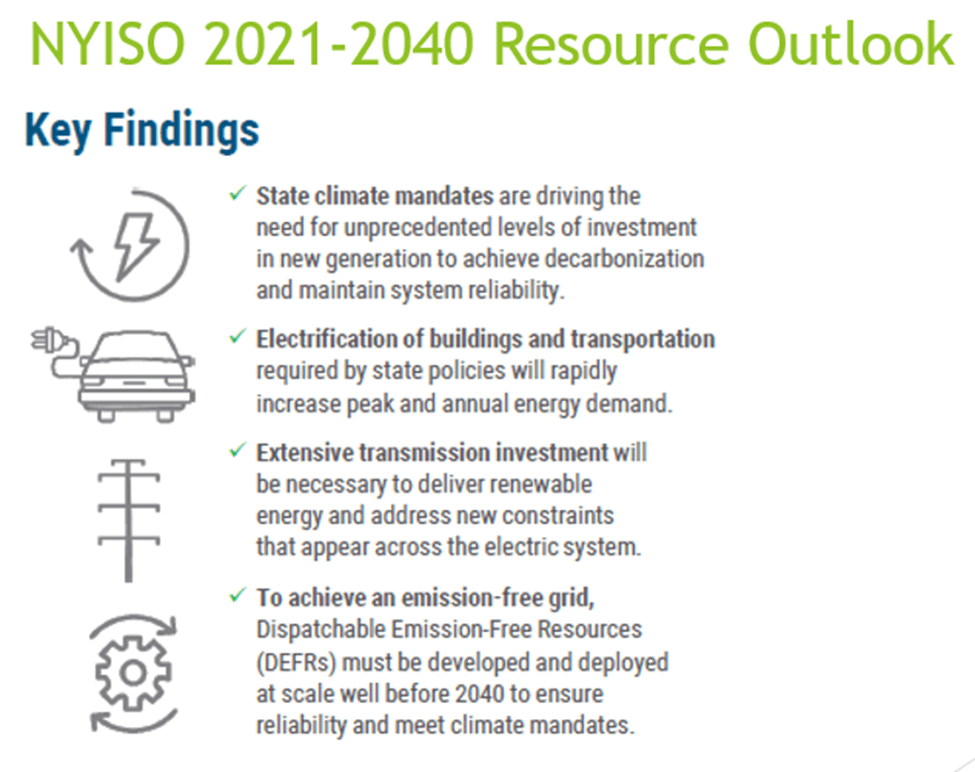
The first report for the resource outlook component was released a couple of months ago.  The 2021-2040 System & Resource Outlook can be downloaded from NYISO and a datasheet summary of key takeaways of the Outlook report is also available.  The summary describes the four key findings: an unprecedented buildout of new generation is needed, load will increase when we electrify everything, transmission is necessary and must be expended to get diffuse renewables to New York City and a new resource has been identified: Dispatchable Emissions-Free Resource (DEFR).  That resource is essentially a fossil-fueled turbine without any emissions. 

I compared the NYISO Resource Outlook modeling analysis with the Integration Analysis modeling.  The Outlook analysis was based on three scenarios.  In order to evaluate the effects of different policy options, this kind of modeling analysis projects future conditions for a baseline or business-as-usual case.  The evaluation analysis makes projections for different policy options, and then the results are compared relative to the business-as-usual case.  NYISO ran two policy scenarios: one based on their estimates of future demand and one that tried to simulate the Integration Analysis projections.  I compared their scenario 1 to the Integration Analysis in the presentation.

I compared the NYISO Resource Outlook modeling analysis with the Integration Analysis modeling.  The Outlook analysis was based on three scenarios.  In order to evaluate the effects of different policy options, this kind of modeling analysis projects future conditions for a baseline or business-as-usual case.  The evaluation analysis makes projections for different policy options, and then the results are compared relative to the business-as-usual case.  NYISO ran two policy scenarios: one based on their estimates of future demand and one that tried to simulate the Integration Analysis projections.  I compared their scenario 1 to the Integration Analysis in the presentation.

The Integration Analysis modeling was used to develop the Draft Scoping Plan.  It is important to note that contrary to usual practice the Integration Analysis baseline was a reference case that included “already implemented” programs.  In other words there are some programs incorporated into the Reference Case that only exist to reduce GHG emissions.  This definition of the Reference Case instead of a Business-As-Usual case is different practice and motivated to get a specific answer.

The Integration Analysis considered four different policy projections.  The first considered the Advisory Panel recommendations for control measures, but the modeling showed that they did not meet the Climate Act targets.  The Integration Analysis came up with three mitigation scenarios that did meet the targets.  The model used for the analysis is not as sophisticated as the NYISO model.  Modelers plugged in a set of control measures at varying efficiencies until they met the targets.  Note, however, they have not claimed that the scenario measures as scoped out will provide electricity that meets current reliability standards.  In my opinion this approach gave the impression to the Council that meeting the targets would be relatively easy.  Council members requested scenarios that considered a faster implementation schedule and more reductions that the 85% target.   The cost/benefit results claim that those more stringent scenarios provide more benefits primarily because of reduced costs.  I think that is a counter-intuitive result so my comparison was against Scenario 2: Strategic Use of Low-Carbon Fuels.

I compared the installed capacity for the two models in the next table.  As noted by the NYISO, an extraordinary development of renewables by 2030 is required and both models agree on that.  There also are some key differences.  The NYISO modeling projects more onshore wind, less offshore wind, less solar, and more DEFR.  The NYISO model simultaneously optimizes resource capabilities and costs to come up with a least-cost solution. I think the wind differences are due to cost and availability differences.  The two modeling approaches handle distributed solar differently.  NYISO does not measure generation from distributed sources and only considers it as a way to reduce the load needed.  The Integration Analysis explicitly includes distributed solar capacity and generation as an output.  Note that existing storage is pumped hydro but any new storage will be batteries.  Finally, it is notable that both modeling analyses project that 2040 DEFR will be comparable to existing fossil capacity albeit NYISO projects significantly more and Integration Analysis a little less.

I compared the energy produced (GWh) for the two models in the next table.  The largest difference between the models is that NYISO projects that DEFR generates ten times more energy.  It turns out that NYISO has DEFR generating 14% of the total energy in 2040 but Integration Analysis projects only 1%.  NYISO projects more onshore wind than offshore wind and the Integration Analysis projects the opposite.  There is huge difference between solar but I believe that is related to the fact that NYISO does not explicitly include distributed solar.   Clearly the two models handle storage differently.

I noted earlier that I was disappointed that the Hochul Administration ignored my comments on the Integration Analysis.  The capacity factor table shows one of the points I made in my comments.  I pointed out that the Integration Analysis land-based wind capacity factors were unrealistically high.  The model projected the 2020 generation with a capacity factor of 29% but the 2021 observed capacity factor was only 22%.  The model could not even get the starting year correct.  As a result the Integration Analysis projections for the land-based wind needed to meet the load is too low.  For all renewable resources the Integration Analysis capacity factors are higher than the NYISO projections.  I prefer the projections from the organization responsible for New York reliability to those from the unelected bureaucrats who have no such responsibilities. 

There is one other point in this table.  The DEFR capacity factors are different.  To this point the extra capacity needed to keep the lights on during peaking periods was provided by relatively cheap sources of energy.  When new peaking resources were needed, cheap simple-cycle turbines were installed.  Currently peak energy resources are primarily from existing old, amortized facilities.  As we shall see, the new DEFR required to keep the system working will use much more expensive resources.  In our deregulated system the NYISO will have to develop a market payment scheme to cover those increased costs.

As noted earlier, I believe that the NYISO projections based on more sophisticated modeling has a much better chance than the Integration Analysis to describe a mix or resources that will maintain current reliability standards.  Nonetheless, I have reservations about any projections because the future electric grid will depend on unprecedented amounts of renewable energy resources.  The following slide lists six of concerns for an electric system dependent upon renewable resources.  For my presentation I only mentioned the first three.  Because wind and solar are intermittent that means you have to have storage for daily, seasonal, and peak load requirements.  The lack of an implementation plan ignores that wind and solar success is location specific.  New York needs a plan that encourages development where the resource is better during the winter lulls.  Specifically, it is not a good idea to offer the same incentives to utility-scale developments on the Tug Hill plateau where over 200” of snow are common as areas where snowfall amounts are lower.  The third concern is reliability services and they are a reason that wind and solar are far more expensive for deliverable energy than fossil.

I found a good summary of the essential reliability services in a paper by National Renewable Energy Laboratory authors entitled Getting to 100%: Six strategies for the challenging last 10%.   It describes ancillary services that must be provided to keep the transmission system going.    Wind and solar do not provide those services so someone, somewhere else has to provide them at some additional cost.

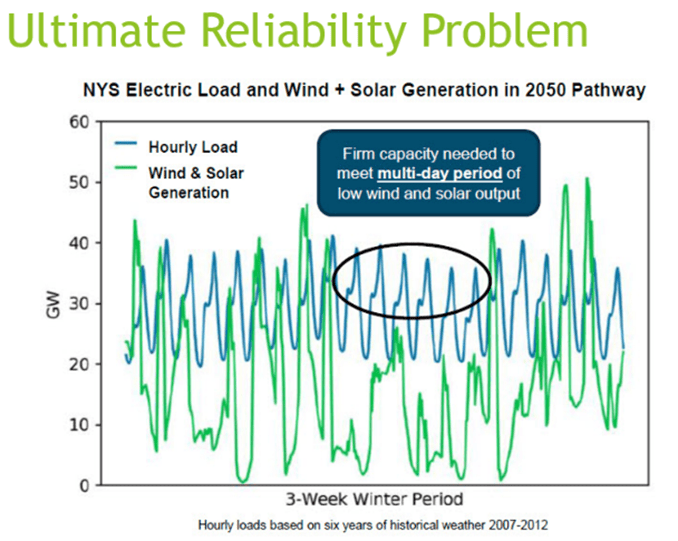
The ultimate reliability problem is illustrated in the following figure.  This graph illustrates the long-duration wind lull problem from an early presentation to the Climate Action Council.  It explicitly points out that firm capacity (DEFR) is needed to meet multi-day periods of low wind and solar resource availability.  The Council has known about the problem all along but have basically pushed it aside as inconvenient.  The thing to remember is that in order to prevent catastrophic blackouts caused because intermittent wind and solar are unavailable NYISO and the Integration Analysis are both banking on DEFR capacity.  Using wind, solar and storage exclusively makes meeting the worst-case renewable resource gap much more difficult.

There is no doubt that the fate of future reliability is inextricably tied to DEFR success.  The next slide discusses DEFR options.  The Scoping Plan acknowledges the need for DEFR and proposes seasonal hydrogen storage as a placeholder technology.  NYISO, while explaining that the resource is necessary, has offered no recommendations what technology could fill the need.  The NREL authors of Getting to 100%: Six strategies for the challenging last 10% described six DEFR strategies

  • Seasonal storage which could be hydrogen or some other kind of long term storage solution
  • Renewable energy is basically overbuilding with battery energy storage.  I believe this represents the preferred approach of those who claim existing technology is sufficient.
  • Existing technology adherents also claim that demand side resources can flatten the load peaks so much that less DEFR is needed
  • The problem with other renewables (e.g. hydro) in New York is that they cannot be scaled up enough to meet identified needs
  • Nuclear is the only proven and scalable DEFR technology currently available but it is a toxic option for NY politicians
  • Carbon capture is unacceptable to the activists and has technological challenges that make it an unlikely a DEFR option.
  • Because of the challenges of carbon sequestration to net out the 15% net-zero emissions, the Scoping plan mentions the CO2 removal strategy but in my opinion it is unlikely.

There are two approaches advocated by those who believe that existing technology is sufficient to maintain electric system reliability in a zero-emissions electric grid.  Some claim that only minimal storage is needed because renewables are available somewhere else, that is to say, the wind is always blowing somewhere.  Others claim that overbuilding renewables supplemented with battery energy storage systems is a viable solution.

While the concept that the wind is always blowing somewhere else is indisputably true, the issue is that in order to keep the lights on we need power at specific times and places from a dedicated source.  New York City’s peaking turbines were located in specific locations to maintain reliability and they were dedicated to that application.  New York’s reliability standards were developed based on decades of experience that showed that a certain installed reserve margin would guarantee that New York reliability standards could be maintained.   Against that backdrop consider the following weather map on February 17, 2021.  The Texas energy debacle was associated with this intensely cold polar vortex huge high pressure system.  Remember that winds are higher when the isobars are close together.  On this day there are light winds from New York to the southeast, west, and north including the proposed New York offshore wind development area.  There are packed isobars in northeastern New England, in the western Great Plains, and central Gulf Coast.  In order for New York to guarantee wind energy availability from those locations, wind turbines and the transmission lines between New York and those locations would have to be dedicated for our use.  Otherwise I think it is obvious that jurisdictions in between would claim those resources for their own use during these high energy demand days.  It is unreasonable to expect that this could possibly be an economic solution.

Another way of looking at this issue is to consider the NYISO fuel mix data available at the NYISO Real-Time Dashboard.  I downloaded four days of February 2021 data to generate the following table.  It shows that a high pressure system reduces wind resource availability across the state.  The data show that less than a quarter of the daily wind capacity is available for this period. Note that the worst-case hour on 2/18/21 at 7:00 AM wind production was only 138 MW out of a New York total of 1,985 MW for a capacity factor of 7%.  If we were to overbuild wind resources to replace fossil capacity 7,191 MW on that hour you would need 102,729 MW.   

Clearly, overbuilding alone is not a viable solution.  You have to have new energy storage and the currently available technology is battery energy storage systems.  Both the Integration Analysis and NYISO Resource Outlook optimized the balance between renewables and storage but still found that DEFR was needed.  Existing-technology proponents claim that over-building wind, solar, and storage is viable but have not countered the NYISO or Integration Analysis modeling results.  I am concerned about the risks associated with the current preferred technology: lithium-ion storage battery systems.  The first risk is logistical inasmuch as battery storage footprints are larger than the existing peaking turbine sites so finding space for the batteries is an issue.  Worse is the fact that lithium-ion storage batteries have the risk of thermal runaway fires and explosions that trade an acute health risk for chronic, and speculative in my opinion, risks.  Paul Christensen, Professor of Pure and Applied Electrochemistry at Newcastle University in the United Kingdom gave a presentation at PV magazine’s Insight Australia event in 2021 that describes the risks. His videos of thermal runaway tests are terrifying.  He is one of the world’s leading experts on battery fires and safety and said global uptake of lithium-ion battery technology has “outstripped” our knowledge of the risks.  He also stated that he is “astounded and appalled that if there is no appreciation of the safety issues involved” with large battery energy storage systems.  This is another feasibility issue that is unaddressed by the Scoping Plan.

Hydrogen storage is the Scoping Plan DEFR placeholder technology.  The plan is to use wind and solar electrolysis to produce “green” hydrogen from water.  The stored hydrogen would either be combusted to power turbines or used in fuel cells.  There are fundamental issues associated with the use of hydrogen that I detail on my blog.  Hydrogen generation, storage and use loses much more energy than alternatives and may not even have a net energy benefit so it is unlikely to be sustainable.  In order for it to provide the necessary peaking power in New York City a colorless, odorless, hard to store explosive gas will have to be stored and used.  I don’t think that the technology will be embraced in the City.  All the infrastructure necessary to produce, store, and use will have to be built and paid for to meet a projected capacity factor of 2%.  I doubt that makes economic sense.

I concluded my discussion of the risks to electric system reliability by summing up the NYISO Resource Outlook Key Findings Datasheet.  According to the organization that is responsible for keeping the lights on, DEFR is necessary for future reliability.  Because a politically acceptable DEFR that can be scaled up to meet the levels needed for reliability is not currently available, a new technology has to be developed, tested, and put on line well before 2040.  The NYISO makes the point that until you have the necessary DEFR technology on line shutting down existing fossil generation is inappropriate.  I am disappointed that the NYISO Resource Outlook has not mentioned any costs.  This is likely to be a particular issue relative to DEFR.  Clearly conditional implementation dependent upon the availability of DEFR would be a rational approach.

There is no documentation that lists the specific costs of control strategies, the expected benefits, or the expected emission reductions making it impossible to estimate the total costs of the Climate Act.  That information is necessary to determine whether the Integration Analysis projections are feasible. The Scoping Plan claims that the cost of inaction is more than the cost of action but a variation of this graph is the only documentation for that claim.  I directly addressed this misleading and inaccurate statement in my comments at the Syracuse public hearing but there was no response or mention of the issues I raised at any Climate Action Council meeting or in the Final Scoping Plan documentation. 

The statement is misleading because costs are given relative to the Reference Case and not a business-as-usual case as explained earlier.  In other words, the Hochul Administration is not presenting all the costs to make the transition to net-zero by 2050.   The Reference Case described as “Business as usual plus implemented policies” includes the costs of the following policies:

  • Growth in housing units, population, commercial square footage, and GDP
  • Federal appliance standards
  • Economic fuel switching
  • New York State bioheat mandate
  • Estimate of New Efficiency, New York Energy Efficiency achieved by funded programs: HCR+NYPA, DPS (IOUs), LIPA, NYSERDA CEF (assumes market transformation maintains level of efficiency and electrification post-2025)
  • Funded building electrification (4% HP stock share by 2030)
  • Corporate Average Fuel Economy (CAFE) standards
  • Zero-emission vehicle mandate (8% LDV ZEV stock share by 2030)
  • Clean Energy Standard (70×30), including technology carveouts: (6 GW of behind-the-meter solar by 2025, 3 GW of battery storage by 2030, 9 GW of offshore wind by 2035, 1.25 GW of Tier 4 renewables by 2030)

Note that the costs for electric vehicles, charging infrastructure, and distribution system upgrades necessary for electric vehicle charging are excluded from the cost of action.  Correcting that “trick” alone would undoubtedly show the costs of action are more than the costs of inaction. 

There is another egregious cheat that further undermines the claim.  It is inaccurate because the Scoping Plan counts the societal benefits of avoided greenhouse gas emissions multiple times.  My Draft Scoping Plan comments on benefits documents why I believe that their claim for $235 billion in societal benefits should only be $60 billion.  Their approach is equivalent to me saying that because I lost 10 pounds five years ago, I can say that I lost 50 pounds.  Correcting that error would also by itself invalidate their benefits claim.  Bottom line is that I estimate that the real costs are at least $760 billion more than the imaginary claimed benefits.

I wrote a post on this shell game description of costs and benefits.  I concluded that a shell game is defined as “A fraud or deception perpetrated by shifting conspicuous things to hide something else.”  In the Scoping Plan shell game, the authors argue that energy costs in New York are needed to maintain business as usual infrastructure even without decarbonization policies but then include decarbonization costs for “already implemented” programs in the Reference Case baseline contrary to standard operating procedure to use a status quo baseline for this kind of modeling.  The documentation for Reference Case assumptions was missing in the draft documents. Shifting legitimate decarbonization costs to the Reference Case because they are already implemented and hiding the documentation fits the shifting condition of the shell game deception definition perfectly. 

In my opinion one of the biggest environmental success stories in my lifetime is the reintroduction of Bald Eagles to New York State.  When I moved to Syracuse in 1981 it was inconceivable that it would be possible to see a Bald Eagle from my home but I have seen several in the last few years.  One of the missing pieces of the Climate Act implementation plan is an update of the Cumulative Environmental Impact Statement to reflect the latest estimates of the number of wind turbines and areal extent of solar panels. I worry that the combined effect of all that development will threaten Bald Eagles.

The following table was not included in the presentation but shows the capacity of the resources not considered in the cumulative impact statements. Clearly, much more renewable capacity will be required than has been evaluated.

Comparison of Integrated Analysis Projected Capacity and Cumulative Environmental Impact Statements (MW)

The following table used in the presentation shows the number of wind turbines and areal extent considered in the completed cumulative impact statements relative to the projected numbers in the Integration Analysis.  The Scoping Plan calls for at least 497 more onshore wind turbines, 493 more offshore wind turbines and 602 more square miles covered with solar equipment than has been evaluated in cumulative analysis.

I have considered the avian impact of the Bluestone Wind Project in Broome County New York to show impacts for a single facility. It will have up to 33 turbines and have a capability of up to 124 MW covering 5,652 acres. Over the 30-year expected lifetime of the facility the analysis estimates that 85 Bald Eagles and 21 federally protected Eastern Golden Eagles will be killed. A first-order approximation1 is to scale those numbers to the total capacity projected for the Scoping Plan. This back of the envelope approximation suggests that at least 216 Bald Eagles could be killed every year when there are 9,445 MW of on-shore wind. There were 426 occupied bald eagle nest sites in New York in 2017. In my comments on this topic I stated that the Final Scoping Plan must include proposed thresholds for unacceptable environmental impacts like this.  There has been no response whatsoever to my comment.

When New York’s GHG emissions are considered relative to global emissions I conclude that New York only action is pointless.  In the presentation I compared New York emissions to global emissions in two graphs.  I used CO2 and GHG emissions data for the world’s countries and consolidated the data in a spreadsheet.  I used the New York State GHG data set CO2e AR4 100 year global warming potential GHG values for consistency.   Plotted on the same graph New York GHG and CO2 emissions cannot be differentiated from zero.

When the New York emissions are plotted relative to global emission increases the futility of New York affecting global emissions is shown.  The trend results indicate that the year-to-year trend in GHG emissions was positive 21 of 26 years and for CO2 emissions was positive 24 of 30 years.  In order to show this information graphically I calculated the rolling 3-year average change in emissions by year.  New York’s emissions are only 0.45% of global emissions and the average change in three-year rolling average emissions is greater than 1%.  In other words, whatever New York does to reduce emissions will be supplanted by global emissions increases in less than a year.

Climate Act advocates frequently argue that New York needs to take action because our economy is large.  I analyzed that claim recently and summarized the data here.  The 2020 Gross State Product (GSP) ranks ninth if compared to the Gross Domestic Product (GDP) of countries in the world.  However, when New York’s GHG 2016 emissions are compared to emissions from other countries, New York ranks 35th.  More importantly, a country’s emissions divided by its GDP is a measure of GHG emission efficiency.  New York ranks third in this category trailing only Switzerland and Sweden.

Despite the fact that the ostensible rationale for GHG emission reduction policies is to reduce global warming impacts, the Scoping Plan continues an unbroken string of the Administration analyses not reporting the effects of a policy proposal on global warming.   The reason is simple.  The change to global warming from eliminating New York GHG emissions are simply too small to be measured much less have an effect on any of the purported damages of greenhouse gas emissions.  I have calculated the expected impact on global warming as only 0.01°C by the year 2100 if New York’s GHG emissions are eliminated.

Conclusion

My presentation explained why I am skeptical of the value of the Climate Act.  Attempting to get to zero emissions is an extraordinary challenge that is downplayed by the Climate Act, the Council and the Scoping Plan so most people are unaware of the likelihood of success.  The experts say we need DEFR but it has to be developed for New York in less than a decade which I believe is unlikely.  There is no reason to expect that the costs won’t be huge and the Hochul Administration has covered up of costs and benefits.  The cumulative impacts of the required renewable developments have not been evaluated and could be unacceptable. 

The fact that our emissions are less than one half of one percent of global emissions and global emissions have been increasing by more than one half of one percent per year may not mean that we should not do something but it does mean that we have time to make sure we don’t do more harm than good.  Before any implementing legislation or regulations are even considered a feasibility analysis that asks “what if” questions should be completed to prove current standards of reliability and safety can be maintained.  In the meantime the state should develop an implementation plan to make sure that renewable resource development is consistent with the Scoping Plan.

Finally, what is going to happen when we have electrified everything and there is an ice storm?  Extreme weather events can have devastating consequences on a more fragile wind and solar electricity network.  I am particularly worried about ice storms.  On a local level it is not clear how the public will be able to survive a multi-day power outage caused by an ice storm when the Climate Act mandates electric heat and electric vehicles but the bigger reliability concern is that fact that ice storms can take out transmission lines.  The January 1998 North American ice storm struck the St Lawrence valley causing massive damage and required weeks to reconstruct the electric grid.  When everything is electrified how will it be possible to rebuild?

NYS Proposed Amendments to Vehicle Emission Standards

I lost track of this proposed regulation so I did not let my New York readers know that there was the opportunity to comment on the proposed rulemaking that will incorporate the State of California’s Advanced Clean Cars into New York’s regulations.  This is the implementing regulation for the state law to switch to zero emission vehicles.  It is unlikely that it will do any good but it would be appropriate to comment and express any misgivings you have about the requirement for a battery electric vehicle.  The comment deadline is 5 pm, Monday, March 6, 2023. Written comments may be submitted by e-mail to air.regs@dec.ny.gov. Put Part 218 in subject line.

This is another article about my evaluation of the Climate Act that I have written because I believe the ambitions for a zero-emissions economy embodied in the Climate Act outstrip available renewable technology such that the net-zero transition will do more harm than good. The opinions expressed in this post do not reflect the position of any of my previous employers or any other company I have been associated with, these comments are mine alone.

Part 218 Advanced Clean Cars

The rulemaking is described at the New York State Department of Environmental Conservation (DEC) Air Pollution Regulatory Revisions webpage.  It explains that:

Emergency Rulemaking – Parts 200, General Provisions, and 218, Emissions Standards for Motor Vehicles and Motor Vehicle Engines. The emergency/proposed rulemaking will incorporate the State of California’s Advanced Clean Cars II (ACC II) regulation. The proposed amendments establish new zero emission vehicle (ZEV) and low emission vehicle (LEV IV) standards intended to reduce GHG (greenhouse gas) and NMOG + NOx (non-methane organic gas + oxides of nitrogen) emissions from light- and medium-duty on-road vehicles.


The ZEV amendments include an annual ZEV sales requirement for original equipment manufacturers (OEMs), minimum technical requirements, ZEV assurance measures, regulatory flexibilities, and simplified credit accounting. The proposed ZEV amendments will apply to 2026 and subsequent model year light-duty passenger cars (PC), light-duty trucks (LDT), and medium-duty passenger vehicles (MDPV). Starting with model year 2026, OEMs, will be required to deliver an increasing annual percentage of their sales that are ZEVs or PHEVs. This percentage requirement will start at 35% in model year 2026 and increase to 100% of sales for 2035 and subsequent model years. The proposed LEV IV amendments will apply to 2026 and subsequent model year PC, LDT, and medium-duty vehicles (MDV).


The Notice of Emergency Rulemaking will be available in the December 28, 2022 issues of the State Register and the Environmental Notice Bulletin. A virtual hearing is scheduled for March 1, 2023 at 1 pm. The comment deadline is 5 pm, Monday, March 6, 2023. Written comments may be submitted to NYSDEC, 625 Broadway, Albany, NY 12233-3254, ATTN: James Clyne, P.E., or by e-mail to air.regs@dec.ny.gov.

My Comments

For what it is worth I had been accumulating material for comments so I manage to put together something to submit.  I include a link to my comments and describe them below.  I submitted comments to the Department of Environmental Conservation (DEC) because the proposed rulemaking ignores feasibility, affordability, and life-cycle environmental impacts.  The primary rationale for this emergency rulemaking is to implement the control strategy recommendations included in the Climate Leadership & Community Protection Act (Climate Act) Scoping Plan.  The Climate Action Council deferred a feasibility analysis of reliability, affordability, and environmental impacts to the rule-making phase.  The result of this irresponsible avoidance of responsibility is a regulation that could very well not be in the best interests of New York

New York agencies are begrudgingly following their mandates for public comments.  In the past each rulemaking had its own web page with a bit more description.  More importantly the web page would have links to each component of the regulatory package.  Admittedly they often would only be in html format so trying to develop comments required downloading and reformatting.  This proposed amendment refers to a single pdf format file Part 218 Advanced Clean Cars II (ACC II) that includes all the components in one massive file.  If they wanted to encourage public input then they would have everything on a dedicated web page and include links to the pdf format components.

It gets worse because the rationale provided in the proposed amendment documentation is insulting.  The program boils down to California did it so we can too.  There is no consideration of the potential that circumstances in New York differ from California.  The two-county Buffalo–Niagara Falls Metropolitan Statistical Area (MSA) had an estimated population of 1.1 million in 2020 and can be crippled by winter storms. Blizzard conditions with winds excess of 70 mph and heavy lake effect snow in the Buffalo area on Christmas Eve 2022  resulted in devastating impacts across the Buffalo area.   Battery electric vehicles (BEV) mandated by this proposed rule do not do well in those conditions.  Thirty-nine people died in this storm and more surely would have died if electric vehicles were the only option available.  California has no similar major metropolitan areas subject to this type of extreme weather so relying on their analysis so suggesting that it will work here too is disingenuous at best.

The Climate Act mandates a full life-cycle analysis of fossil-fuel use.  On the other hand, the life-cycle impacts of the so-called “zero -emissions” alternatives are ignored.  BEVs may not have emissions when operating but the volume of materials needed to access the rare earth elements necessary for those technologies certainly have environmental impacts when mined and processed. The vehicles mandated by proposed Part 218 require between 1,000 and 2,000 percent more minerals to deliver the same amount of power and on the order of 400% more metals to manufacture the same vehicles.  The consequence of this is that many more materials will be required.  The Part 218 Regulatory Impact Statement should address where the materials necessary for BEVs come from and whether there will be sufficient quantities available for the New York transition. 

I also addressed disposal of electric vehicles.  The modern gas automobile is one of the most highly recycled products in human existence. After initial creation, each vehicle has an average life cycle of about 20 years. At that point it is dis-assembled and its parts are sold used in a global used parts chain, which is the most profitable part of the whole life cycle.  In comparison, a Tesla has a plastic body, and a battery assembled from thousands of 18650-type cells, so it is extremely hard to recycle. The body can’t be recycled.  According to recent Tesla documents the batteries are “valorized” by grinding them up and putting their waste in construction cement. In contrast, Toyota/Honda hybrid batteries are easily re-used and recycled.

The rationale for this action is that “zero-emissions” vehicles in New York are good for the planet.  However, the proposed amendment simply exports emissions elsewhere.  I referenced a horror story of the Indonesia Morowali Industrial Park where the danger and pollution involved in mining nickel is at a rapid pace to meet the demand for EVs.  I asked how this proposed amendment comports to the environmental justice cornerstone of the Climate Act.

The regulatory documents associated with the Proposed Amendment do not address a critical feasibility problem.  DEC has to address BEV charging requirements and existing on-street parking.  Who is responsible for providing the on-street charging infrastructure for car owners that do not have a dedicated charging resource?

The proposed amendment mandates that starting with model year 2026, car makers, will be required to deliver an increasing annual percentage of their sales that are ZEVs or PHEVs. This percentage requirement will start at 35% in model year 2026 and increase to 100% of sales for 2035 and subsequent model years.  Despite tremendous publicity and extensive subsidies nothing can obscure the fact that EVs remain extremely costly for consumers and offer unproven maintenance and reliability records.  I will never buy a BEV because I cannot afford a car that does not offer the same flexibility and convenience as an ICE vehicle.  Moreover, I do not want to deal with home charging infrastructure and the safety risk of Lithium-Ion battery chargers below my bed room.  What happens when the public does not buy enough of these vehicles to meet those quotas? 

Conclusion

This is another instance of a regulation that affects most New Yorkers but only a few are aware of its existence.  I expect that the climate activists will mobilize their acolytes to submit comments supporting the rule-making.  DEC will count the pro and con comments and consider implementation as a mandate from the public because more comments in favor than against will be submitted.  If everyone was aware of this I am sure there number of people opposed would far outweigh the number in favor.

Worse is the complete disregard for rigor in the analysis.  The primary rationale is “California said they could do it and we agree”.  I did not spend sufficient time to develop comments on the California analysis but given the record of the state’s response to my comments it would only have been a waste of time. 

I encourage readers to send a comment.  I think it is sufficient to say that the state needs to prove that this is feasible, affordable, and doesn’t cause more environmental harm than good.  They have not done that work so this should be delayed until they can prove their case.

Micron Electrical Needs and the Climate Act

One of the few members of the New York State media who has been taking the time to evaluate the potential impacts of the Climate Leadership and Community Protection Act (Climate Act) is Tim Knauss writing for the Syracuse Post Standard.  He recently had another good article published that addressed the energy needs of Micron Technology’s planned semiconductor fabrication plant,  His takeaway message was that, when fully complete, would consume more energy than the State of Vermont.  Richard Ellenbogen frequently copies me on emails that address various issues associated with New York’s Climate Act.  I asked his permission to present his evaluation of this article.

I believe that Ellenbogen truly cares about the environment and the environmental performance record of his business shows that he is walking the walk.   Ellenbogen is the President of Allied Converters  that manufactures food packaging.  His facility is about 55,000 square feet and does a lot of manufacturing with heat to seal the bags, all electrically driven.  The facility has solar panels and uses co-generation.  He explains:

In 2008, the average energy cost per square foot for a commercial facility in  Westchester was $1.80.  We were at 16% of that 12 years later and even with the increases, we are at 62% of that 14 years later.  That has been done while having a carbon footprint 30% – 40% lower than the utility system.  The $1.80 per foot  also included commercial office space and our operation is far more energy intensive than an office.  We use energy extremely efficiently and as a result, our bills are much lower than everyone else. 

Micron and the Climate Act

Knauss wrote an article that asked the question: How would Micron’s electricity-hogging plant here live with NY’s war on fossil fuels?  He explained:

When fully built, the complex of four chip fabs would use 640 million kilowatt-hours a month, more than enough for 1 million average New York homes.

Micron has promised to buy all that electricity from renewable sources, a promise that reflects New York state’s commitment to have an emission-free electric grid by 2040.  But Micron could find it tough to keep that promise unless the floodgates open to new wind and solar farms.

It’s one of the least-discussed challenges of the Micron project, as New York’s signature economic development success story collides with a major environmental aspiration.

Micron announced in October that it planned to invest up to $100 billion building four giant chip fabs at a 1,400-acre site in Clay. The fabs would employ up to 9,000 people directly and could spin off 40,000 more jobs, state officials said.

The development won’t happen all at once. Micron said it plans to start producing chips in 2026 and will fully build the complex within 20 years.

Knauss explained that the construction schedule coincides with implementation of the Climate Act.  By 2040 the law mandates the elimination of fossil fuels from the electric system.  As part of the plan to eliminate fossil fuel emissions everything possible will be electrified which means that load is going to have to go up:

Even before Micron surfaced, operators of the statewide electric grid were estimating an 8.7% increase in electricity consumption by 2035, according to forecasts by the New York Independent System Operator.

Micron could add another 5%, according to estimates worked up by National Grid and Micron as part of a term sheet agreement with state officials. The documents indicate that Micron could draw an average of 928 megawatts – the output of a large nuclear plant – as soon as 2035.

I have not followed the Micron agreement very closely but it depends a lot upon Federal and State incentives.  Those incentives come with strings attached:

Micron’s promise to use all renewable power is more than goodwill. Its ability to collect up to $5.5 billion in state subsidies depends on that pledge.

According to the term sheet Micron signed with economic development officials, the company agreed to use “100% renewable energy for electricity.”

Micron must enter a state-approved sustainability plan in exchange for the billions in aid. The plan has not been finalized yet, but there will be plenty of wiggle room. State economic development officials aren’t likely to box in Micron if it prevents the company from building.

There is a relevant component to the agreement.  According to their plans Micron intends to use natural gas for heating. Knauss claims (I have not verified) that “the company also would be exempt, as a manufacturer, from proposed state legislation that would require most buildings eventually to go all-electric.”

Ellenbogen Fact Check and Alternative Approach

Ellenbogen has a number of recipients on his email chain and one of them sent him the link to the Knauss article and asked the following question:

Rich, check out the following article. Micron is making promises about 100% renewable energy that they can’t keep without cheating. Maybe they will buy credits for curtailed electricity that never gets on the grid from solar panels in California. Also note the exceptions they are getting to use gas for heating while everyone else needs to electrify.  According to this, Micron will consume more electricity than all of Vermont. If so, they ought to be building their own on-site nuclear plant. (Seriously.) That would actually give them the process heat they need, too.

Ellenbogen responded with the following analysis.

I fact checked his information and the Micron chip factory actually will use more electric energy than the state of Vermont.  The factory will use 8.12 Terawatt hours per year and Vermont’s annual electric load is only 5 Terawatt hours, with a Terawatt Hour equaling 1,000 Gigawatt Hours.  Wondering how Vermont’s electric load could be so small, I checked and their onsite heating is only 6.26% electrified with the other 93.74% coming from fossil fuels or wood.  A pie chart documenting that is below and everything that you might ever want to know about Vermont’s electric utility system is in this pdf.

Ellenbogen hits the nail on the head when he points out that fossil-fired backup is necessary:

What I find interesting is that all companies want to locate in upstate NY and then claim that they are only using “green” energy from Niagara Falls or the upstate nuclear plants, ignoring the fact that all marginal generation in NY State will be provided by fossil fuels for many decades into the future.  While the Micron facility justifies the energy expense because of the 9,000 jobs, a realistic analysis has to be done regarding the best way to provide energy for that facility.

A nuclear plant would be a great zero-emissions alternative but the politically driven energy policy of New York would have to change dramatically to address the practical issues he points out:

While the person that sent me the email is correct about the use of a nuclear plant being the most environmentally friendly way to supply this facility, the $15 billion for a one gigawatt nuclear plant would add 15% to the projected $100 billion price tag and might make it non-cost effective.  It would also take a very long time to get the approvals and build the facility.   Additionally, the words “Nuclear Energy” might be the only words uttered in NY State that are more toxic than the words “Fossil Fuels”.   Chip manufacturing facilities use ovens at about 1000 degrees-C to bake the silicon wafers accounting for their enormous energy use.  Many processes use high energy lasers and microwaves, as well.

Ellenbogen goes on to evaluate how much solar would be needed.  I have some questions about the battery storage requirements and cost numbers but my numbers come to the same conclusion:

If we look at renewable options, to supply the 8.12 Terawatt hours  with solar arrays  at this facility,  accounting for storage losses,  would require a 9.28 Gigawatt array.  At 7.5 acres per megawatt of solar array would require 69,600 acres or 110 square miles of solar arrays.  To acquire farmland upstate to support that at the going rate of $3200 per acre, the land alone would cost about $221 million.  The array, at $2/watt would cost $18.56 billion and we haven’t calculated the storage costs or the interconnection costs yet, but 1 Gigawatt of storage for 90 days, which is the minimum that would be needed, would require a 2.16 billion KWh battery.    At $500 per KWh,  less than last year’s battery cost, the battery would cost $ 1.08 trillion.  Coupled with the array cost and the land, the total cost will be $ 1.098 trillion dollars or more than ten times the cost of the fabrication facility.    A large percentage of the $1.098 trillion battery packs would have to be replaced every 10 years as the batteries decayed and became unusable.

Even without the battery storage, the 9.3 Gigawatt array would cost more than the nuclear generating plant and would be unable to support the Micron facility (without batteries). It would add almost 20% to the project cost.  Renewables are less expensive than fossil fuel generation per kilowatt-hour if the batteries are not included.  However, where a fossil fuel or nuclear powered utility system does not need batteries, an intermittent renewable system will and that is where the price comparison collapses as the battery storage makes the renewables non cost competitive.

Ellenbogen also looks at using offshore wind.  Importantly he draws on his practical experience with carbon credits to discredit this alternative:

Alternatively, instead of solar the facility would require about 3 GW of the proposed 9 GW of offshore wind but the batteries would still be needed.  Either way, the numbers for this are ludicrous and no business will locate to NY State under these conditions.  Alternatively, the state is going to require Micron to buy carbon credits which is just putting lipstick on a pig because the emissions will still be there.  They will just be gone on paper.  I am familiar with carbon credits as I have been selling the credits from my arrays to utilities in Washington DC for 12 years.  They are designed as an incentive to make utilities want to install their own renewables rather than purchase the credits.  However, if they truly worked as planned, after 12 years the utilities would have installed the renewables and there would be a glut of credits available causing the price to drop.  In 2010, I was receiving about $440 per megawatt-hour of solar energy that we generated.  Last month, I sold them for $410 per megawatt-hour so the price has only dropped by 7% in 12 years.  While renewable generation has been installed to support Washington’s utility system, the credits have not been enough to induce the utilities to invest heavily in renewable construction.   If the Washington DC Government raised the price of the credits high enough to  induce the utilities to build their own renewables,  the utility bills would increase too much and the public would scream at the policy makers. 

Recall that Ellenbogen has developed an energy-efficient solution for his manufacturing facility.  He explains how that could work for Micron:

A far better solution that would also be cost effective would be to site a 1 Gigawatt combined cycle gas generating facility next to the Micron plant to provide its energy needs without long transmission lines that will increase line losses.  By doing that, the Micron facility could also take advantage of the excess thermal energy for its heating and air conditioning needs, which will be substantial.  It would be a co-generating plant on steroids and would relieve a lot of stress on the state’s transmission system.  A generating plant the size of the recently built Cricket Valley Energy Center (1.1 Gigawatts) would suffice.  That only cost $ 1.58 billion which is a small investment of an additional 1.6% compared to the $100 billion facility cost and would save the company money on its energy bills and simultaneously make them more cost competitive.  Additionally, the Cricket Valley Energy Center sits on 193 acres, 0.002 or 0.2% of the land area of the equivalent solar array.  Micron would recoup the $1.58 billion cost from energy savings..  Rather than the state forcing Micron to pretend to be environmentally friendly, Micron would actually be environmentally friendly.  However, the gas bans will preclude using this option all over the state because it doesn’t meet the ideological purity test.

He concludes his writeup:

This is what I was saying regarding the state’s policy actually increasing carbon footprint.  NY State’s energy policy may seem environmentally friendly, but it is just the opposite and will increase carbon emissions.  The policies don’t make any sense from an economic standpoint or an environmental standpoint.

Conclusion

Tim Knauss continues to impress me. He has done another fine job evaluating a technical issue clearly and accurately devoid.

With regards to the Micron plan – reality is always going to win.  The state’s hocus pocus shell game of energy and environmental policies don’t actually decrease costs.  Ellenbogen has offered an alternative that has worked for him and will work for Micron.   Unfortunately, the ideologues in the State won’t consider his approach.  I hope that this does not scuttle the implementation of the Micron plans.

Ellenbogen’s cover email concludes: “This is a classic example of how NY State’s Climate Law is going to raise Carbon Footprint, raise energy costs,  and damage the state economy, echoing my remarks at the Capital on Monday.”

Roger Pielke, Jr. “When scientific integrity is undermined in pursuit of financial and political gain”

Roger Pielke, Jr. has been analyzing climate change risks since 1994.  This post highlights his  article published today that explains “explosive testimony this week argues that climate research has a serious conflict of interest problem.”  At a recent meeting I heard several people who have caught on that this is a problem based on their gut instincts.  Here’s documentation proving that they are correct.

Pielke’s climate research has strayed from the orthodoxy so he has been decried as a heretic.  As he puts it:

I have argued that climate change poses risks and deserves significant action in response. I’ve also argued that our response efforts to date have been woefully inadequate. My views, which I have not been shy about sharing, have led some to try to exclude or remove  me from the discussion, with some considerable success.

Blowback to his work is so bad now that when I did an internet search for his credentials the popup list of search suggestions included “Roger Pielke Jr climate denier”.  He must have struck a nerve when he documented the fact that the continuing litany of so-called proof of climate apocalypse is not supported by the data because he was attacked by many.  Based on the flak he receives he must be over the target because powerful people have tried all sorts of things to shut him up.

Here is his article in its entirety

Recently I was surprised to see a Tweet from a climate researcher who I’ve known for a while that looked like an advertisement for a particular renewable energy company. The researcher was promoting the company to his many followers. Reading on, I saw that the researcher disclosed that he was being paid by the company and had an equity interest. So it was an advertisement. Academics can also be investors, right? So no problem?

Well, here is the problem. This researcher was one of the central analysts whose work was used to design and then promote the passage of the Inflation Reduction Act. The company he is promoting is a direct beneficiary of that legislation. At the same time, the researcher claims that his analyses offer an “independent environmental and economic evaluation of federal energy and climate policies.” BS. There’s a sucker born every minute.

I called out the researcher on Twitter for taking money not just from one but from many companies that are direct beneficiaries of the legislation he helped to design and sell to policymakers and the public. He responded to me in a huff — proclaiming his noble intent and track record of advocacy for renewable energy for many years (almost as bad as the climate researcher who told me she could not have a conflict of interest because her husband was a preacher). All that may well be true, but goodness, this absolutely stinks.

I’m not naming the researcher (you can find him easily enough), because his case is far from unique in climate research these days, and this post is about a far bigger more important issue.

There is a gold rush going on in climate research right now, as researchers scramble to cash in on their new-found access to politicians and philanthropists. As Professor Jessica Weinkle of the University of North Carolina-Wilmington stated in her opening remarks in testimony before the U.S. Senate last week, “Today, it is not easy to separate the going-ons in climate change research from the special interests of financial institutions.”

She continues:

The landscape of climate change research is made complicated by an outcropping of non-profit advocacy organizations that double as analytic consultants, hold contracts with private companies and government entities, and engage in official government expert advisory roles- all while publishing in the peer reviewed literature and creating media storms.

This is not really an issue of any one entity. It is pervasive.

Experts monetizing their expertise is one important reason why people become experts, and there is no problem with people seeking to make a buck. But where expertise and financial interests intersect, things can get complicated. That is why there are robust mechanisms in place for the disclosure and mitigation of financial conflicts of interest, a subject I’ve focused on for decades.

All of this is just common sense. Your doctor can’t prescribe you drugs from a company that pays him fees. You wouldn’t think much of a report on smoking and health from a researcher supported by the tobacco industry. Should climate researchers play by a different set of rules, because the cause is so important?

Call me a stickler, but in my view, the more important the cause, the more important it is to enforce standards of research integrity.

Following her testimony, Weinkle addressed a few questions that were raised at the Senate hearing. Here is her response to the first one:

Well… I don’t know if it was really a question. It was a set up to imply that the only conflicts of interest that should matter are those coming from the fossil fuel industry.

I don’t agree. At. All.

Frankly, that’s absurd.

In fact, when people argue that the only conflicts of interest that matter are those held by their opponents they are saying that the rules of the game don’t apply to themselves or those that support them.

Conflicts of interest are a concern for scientific integrity no matter where the money is coming from.

Further, it was implied in the hearing that only the fossil fuel industry hides what they are doing by donating to non profit groups that then do research. No.

I encourage you to read Professor Weinkle’s testimony in full. She cites three examples of many that raise serious questions of financial conflicts of interest in climate research (see the testimony for all the footnotes, which I removed here):

  • Central bank stress testing scenarios are developed by researchers who are also lead authors on IPCC reports and have important roles in organizing the international modeling community in the development of IPCC scenarios. Funding for central bank scenario development and the most recent meeting of the scenario modeling community comes from influential organizations including, Bloomberg Philanthropies, ClimateWorks, and the Bezos Earth Fund.
  • McKinsey & Company used a climate consultancy to produce a series of widely influential reports on climate change financial risks. In defense of their use of RCP 8.5 the report cited a peer-reviewed publication written by its own consultants. The researchers did not declare their COI as consultants for McKinsey or their association with the asset management firm, Wellington. Shortly after publication of the article one of its authors landed a political position while the authors’ home institution announced coordinated efforts with Wellington to influence SEC regulatory decisions.
  • The Risky Business Project, an academic-industry research collaboration was organized by three wealthy politicians with the goal to “mak[e] the climate threat feel real.” Research products are important components to national climate and sea level rise assessments, and a policy advocacy tool used to evaluate real estate flood risk. Core members of the research collaboration move seamlessly between private consulting, policymaker science advisory positions, and academic research.

Again, this stinks.

Nothing could be more delegitimizing to climate science and policy than a toxic combination of unmitigated financial conflicts of interest and claims that climate researchers, by virtue of the noble cause, are exempt from the rules that govern every other setting where expertise and money intersect.

I’ll let Professor Weinkle have the last word today:

Climate change science demonstrates an underappreciated dynamic system of conflicts of interest among climate change researchers, advocacy organizations, and the financial industry.

If you haven’t subscribed to Professor Weinkle’s Substack, called Conflicted — run, don’t walk, and sign up — link below.

Conflicted  Musings on the relationships among climate change science, financial interests, policy, and politics By Jessica Weinkle

My Comment

Early this year I described the outsized influence of a few individuals on the Climate Act and the Climate Action Council.  When the Council deigned to address any dissenting comments regarding the implementation analyses, most of the members dismissed those considerations as misinformation funded by the fossil fuel industry.  I believe they ignored a more serious instance of a conflict of interest.

New York Assemblyman Al Stirpe Town Hall Budget Meeting

I attended a town hall meeting for the 2023 Budget sponsored my New York State Assemblyman, Al Stirpe, to explain why I am opposed to any legislation in the budget supporting implementation of any aspect of the Climate Leadership and Community Protection Act  (Climate Act).  The meeting format did not lend itself to presenting anything as detailed as the comments I wanted to make.  This post documents the Climate Act-related issues that came up at the meeting and the comments I wanted to make.

This is another article about my evaluation of the Climate Act that I have written because I believe the ambitions for a zero-emissions economy embodied in the Climate Act outstrip available renewable technology such that the net-zero transition will do more harm than good.  Moreover, the costs will be enormous and hurt those least able to afford increased costs the most.  I have worked over 40 years as an air pollution meteorologist in the electrical generating sector. After retirement, I served as Director of the Environmental Energy Alliance of New York, and later started the Pragmatic Environmentalist of New York blog that debates the challenges of balancing the risks and benefits of environmental issues. The opinions expressed in this post do not reflect the position of any of my previous employers or any other company I have been associated with, these comments are mine alone.

Everyone wants to do right by the environment to the extent that they can afford to and not be unduly burdened by the effects of environmental policies.  New York environmental policies have lost sight of the need to balance the risks and benefits of environmental initiatives.  I submitted comments on the Climate Act Scoping Plan and have prepared a layman’s summary of issues associated with the Climate Act.  Those resources provide more backup to the references linked in the following.

Meeting Notes

Assemblyman Stirpe took an hour to go through the proposed legislative budget.  He went through quite a bit of detail of all the components.  The Climate Act component of the discussion was no more than five minutes of the presentation.   

I got to the meeting a little early and there were people talking about the effects of the Climate Act, especially the electric vehicle mandate and the gas ban.  Clearly, they were not in favor of either component.  Someone in the audience made the point that most people still aren’t aware of the ramifications of the Climate Act and suggested that more outreach would have been appropriate.  His response insinuated that people were getting wrong information from the fossil fuel interests.  Several other people made comments that were skeptical of the rationale of an existential threat from climate change and others complained about components of the Climate Act. 

Mr. Stirpe incorrectly responded to a couple of comments.  To the climate change is not that big a deal comment he said he has been shoveling less snow and insinuated that climate change was to blame.  I pointed out that he did not know the difference between weather and climate.  Near the end of the meeting he insinuated that air quality has not improved much since 1970 and the first earth day.  I was tempted to respond at the meeting but by that point everyone was tired and I thought he wouldn’t appreciate my response.  The fact is that according to the EPA Air Quality Trends website Northeast air quality improvements from 2000 to 2021 have been significant:

  • Carbon monoxide has decreased 61%;
  • Nitrogen dioxide has decreased 35%;
  • Sulfur dioxide has decreased 90%;
  • Ozone has decreased 16%;
  • Particulate matter has decreased 31%; and
  • Inhalable particulate matter has decreased 43%.

Air quality is much better than it has been in the past.  This misunderstanding is particularly problematic for a New York legislator because Environmental Justice activists have lobbied policymakers into accepting the PEAK coalition conclusion that “Fossil peaker plants in New York City are perhaps the most egregious energy-related example of what environmental injustice means today” and are putting tremendous pressure on the legislature to act.  However, the analysis that forms the basis of that conclusion is flawed.  The health impacts claimed in that analysis are for ozone and inhalable particulates that are secondary pollutants that form far downwind of the adjoining neighborhoods of peaking power plants. 

My Climate Act Comments

I gave Assemblyman Stirpe a document with the following information.

I am opposed to any legislation implementing the Climate Act because the Hochul Administration has not done a feasibility analysis that proves that the Scoping Plan list of control strategies can maintain current levels of reliability, will be affordable, and will not do more environmental harm than good.  I have written over 290 articles on my Pragmatic Environmentalist of New York blog about the Climate Act and I am convinced that the state is on a dangerous path.

New York greenhouse gas emissions are less than one half percent of global emissions per year but global greenhouse gas emissions have been increasing by more than one half percent per year on average since 1993.  Anything we do will be supplanted by emissions elsewhere in less than a year.  That does not mean we should not do something but it does mean that we can take the time to do it right.

The New York Independent System Operator recently published “Information for Policy Makers” that summarizes their activities “to design and implement the operations, planning and market enhancements necessary for the grid in transition.”  I have noted that their work describes the situation well.  New York electric gird is a complex system that has evolved over many years. It is a highly reliable system using proven hardware and procedures. Reliance on unprecedented levels of wind and solar has not been demonstrated successfully anywhere. The energy storage system technology to account for intermittent wind and solar has not been tested on the scale necessary for the proposed use. These facts make it an ill-conceived plan that will likely end in blackout.  Furthermore, the rush to electrify everything is not safe.  What will happen when everything has been converted to electricity and there is an ice storm?

The Scoping Plan does not include a detailed accounting of the costs to consumers. The administration claims that the costs of inaction are greater than the costs of action but that claim is misleading and inaccurate. It is misleading because the Scoping Plan costs of action only includes the costs of the Climate Act and do not include all the costs to meet the net-zero by 2050 target, including vehicle electrification. It is inaccurate because it double counts the societal benefits of reductions.

The Climate Act only accounts for fossil fuel life-cycle costs and environmental impacts while ignoring the lifecycle impacts of wind, solar, and energy storage technologies. Those “zero-emissions” resources may not have emissions when generating electricity but the volume of materials needed to access dilute wind and solar energy and the rare earth elements necessary for those technologies certainly have environmental impacts when mined and processed. The large number of wind turbines and solar panels will also create massive amounts of waste when they are retired. Furthermore, the cumulative environmental impacts of thousands of wind turbines and square miles of solar panels has not been evaluated for the levels proposed in the Scoping Plan.

Opposition to Following Legislation

My submittal noted that I oppose the following legislative proposals.  I oppose all components of the NY Renews Climate Jobs, and Justice package including the Climate and Community Protection Fund as well as the following specific bills:

A4592/S2016 “NY Home Energy Affordable Transition Act”;Aligns utility regulation with state climate justice and emission reduction targets; repeals provisions relating to continuation of gas service; repeals provisions relating to the sale of indigenous natural gas for generation of electricity.  

A4306/S732 DEC to establishes a carbon dioxide emissions price for electric generation from carbon-based fuel; creates a carbon dioxide emissions fund; distribute revenue to low-income individuals and communities and to support mass transit. 

A920/S562 the “all-electric building act”; provides that the state energy conservation construction code shall prohibit infrastructure, building systems, or equipment used for the combustion of fossil fuels in new construction statewide no later than December 31, 2023 if the building is less than seven stories and July 1, 2027 if the building is seven stories or more.  

A279/S4134“New York State Build Public Renewables Act”; requires the New York power authority to provide only renewable energy and power to customers; requires such authority to be the sole provider of energy to all state owned and municipal properties; requires certain New York power authority projects and programs pay a prevailing wage and utilize project labor agreements.

S4854/no same as. Requires agencies to develop recommendations regarding  the  establishment  of microgrids at critical facilities.  

A4393/S2007. Establishing a one hundred percent clean renewable energy system for electricity by two thousand thirty-four; such energy system shall include solar, wind, geothermal and tidal sources.

A4866/no same as. “fossil fuel facilities replacement and redevelopment blueprint act” requires NYSERDA, DPS and DEC to prepare a blueprint to guide the replacement and redevelopment of the oldest and most-polluting fossil fuel facilities and their sites by 2030.

A411/S3581 Declares a climate emergency and places a ban on fossil fuel infrastructure projects but shall not apply to repair or maintenance of existing infrastructure.

Support for following legislation:

I listed the following two legislative proposals as ones I think will help address my concerns.

S2030/no same as Directs the public service commission in consultation with NYSERDA to conduct a full cost benefit analysis of the technical and economic feasibility of renewable energy systems in the state of New York and to compare such directly with other methods of electricity generation within nine months after the effective date and every four years thereafter.

A4999/S2474 Directs the state energy planning board to conduct a study of the technical and economic feasibility of a one hundred percent renewable energy system and a reduction in greenhouse gas emissions.

Conclusion

I don’t think Assemblyman Stirpe understands just how poorly informed he is because of the mis-information in the Scoping Plan and the constant propaganda from the media and climate activists.  I had offered in the past to give him a briefing but he refused.  I do not expect to hear anything as a result of the comment I gave him.  If did respond I would ask him to put pressure on the Hochul Administration to give a full accounting of the costs, do a feasibility study of the effects on electric system reliability and do a cumulative environmental impact analysis of the Scoping Plan recommendations for wind and solar resources.  Until the Scoping Plan is proven to be feasible, it is inappropriate to support any implementing legislation.

NYS Senate Republican Smart Energy Solutions

According to a press release: “New York State Senate Republican Leader Rob Ortt, members of the Senate Republican Conference, and statewide energy stakeholders today unveiled a package of smart energy policies to pursue a cleaner energy future. The plan puts affordability and reliability first for New York ratepayers, in sharp contrast to some of the radical proposals coming out of Albany.”  I am highlighting a link to the press conference where this is announced because Richard Ellenbogen did a masterful job explaining his concerns about the net-zero transition plan and they match my worries.

This is another article about the Climate Act implementation plan that I have written because I believe the ambitions for a zero-emissions economy embodied in the Climate Act outstrip available renewable technology such that the net-zero transition will do more harm than good.  The opinions expressed in this post do not reflect the position of any of my previous employers or any other company I have been associated with, these comments are mine alone.

Background

The implementation plan for New York’s Climate Act “Net Zero” target (85% reduction and 15% offset of emissions) by 2050 is underway.  At the end of 2022 the Climate Action Council completed a Scoping Plan that makes recommends strategies to meet the targets.   The Hochul Administration is developing regulations and proposing legislation to respond to those recommendations in 2023.

Unfortunately, the Scoping Plan is just a conglomeration of control strategies that are projected to provide the emission reductions required.  The Plan did not do any feasibility analyses or address any “what if” questions raised by the NYISO or anyone else for that matter.  As a result, I am convinced that it will fail.

I recently published Richard’s analysis of New York’s energy storage plan as a guest post.   Ellenbogen is the President of Allied Converters  that manufactures food packaging.  His facility is about 55,000 square feet and does a lot of manufacturing with heat to seal the bags, all electrically driven.  The facility has solar panels and uses co-generation.  He explains:

In 2008, the average energy cost per square foot for a commercial facility in  Westchester was $1.80.  We were at 16% of that 12 years later and even with the increases, we are at 62% of that 14 years later.  That has been done while having a carbon footprint 30% – 40% lower than the utility system.  The $1.80 per foot  also included commercial office space and our operation is far more energy intensive than an office.  We use energy extremely efficiently and as a result, our bills are much lower than everyone else. 

NYS Senate Republican Conference for Smart Energy Solutions

The event was an announcement for “smarter energy solutions”.  The Republicans are calling for several alternatives and affordable amendments to the state’s current course of action, including:

  • Independent cost studies and full transparency;
  • Supporting diverse energy sources;
  • Keeping needed power supply online to ensure the reliability of New York’s power grid; and
  • Repealing and opposing anti-market mandates on consumers.

Richard was introduced as during the press conference to describe his technical concerns.  He explained that he was representing an engineer’s perspective of the Climate Act Scoping Plan.  I think his comments are a nice short and sweet description of the underlying technical issues that make the net-zero transition a very risky proposition that will cost too much for the state to afford.  His email to me said:

The following link is to my presentation at today’s Senate Republican Press Conference at the Capital in Albany.  I want to thank them, and Senator Mattera in particular, for offering me the platform to present reality to a wider audience before State policy causes major damage to our energy systems, public health, and to the state economy.

https://www.youtube.com/watch?v=tQd-QlkDCbk

The full press conference is at the following link.

https://www.youtube.com/watch?v=C9E3bSeutAg&t=4s

His presentation referenced a bar graph and the energy storage report.

During the question and answer period Richard said he made a power point presentation that explained his concerns about the proposed net-zero energy transition before the Climate Act was signed.  That document and other information is available on his website

Conclusion

There are a few minor issues I might quibble with but overall this is a great summary of the issues facing New York with this plan.  I only hope that it wakes some people up.

Updates to Pragmatic Environmentalist Pages  

This is another summary of updates I made to the pages I maintain at  Pragmatic Environmentalist of New York and Reforming the Energy Vision Inconvenient Truths.  I have an extensive list of reference materials on my original blog that I occasionally update when I run across an article that is particularly interesting and relevant and this blog also has reference material.  This article describes some recent page updates and I also have highlighted a few recent articles that don’t fit my needs on those pages.

I started blogging in late 2017 on New York’s energy policies because I was convinced that they are going to end as an expensive boondoggle driving electricity prices in particular and energy prices in general significantly higher. Reforming the Energy Vision (REV) was the previous comprehensive energy strategy for New York. I wrote about the inconvenient unpublicized or missing pieces of New York State’s REV policy: implementation plan, costs and impacts. At some point I should probably combine that blog with this one but in the meantime, I maintain them both.  The opinions expressed in this post do not reflect the position of any of my previous employers or any other company I have been associated with, these comments are mine alone.

I ran across an intriguing video that sums up the future of New York’s energy future under the Climate Leadership and Community Protection Act and linked to it in my page for lessons to be learned from othersAndrew Bolt describes the effects of green energy policies on Australia.  He makes that point that “willful ignorance” on climate change is making people “poorer and weaker”.  New York is not as far along as Australia on our transition but the same thing is going to happen here.   

I updated theClimate Claims page that addresses the alleged threat of a climate driven existential threat with links to a two part series by Kip Hansen “Reprise — Why I Don’t Deny: Confessions of a Climate Skeptic”.  Hansen updated his original five-year old articles after a conversation with a colleague who’s only understanding of the issue came from main stream media.  The articles update the originals with newer information.  In the first part, he describes the temperature and explains that the temperatures have been increasing since 1650 – 1700.  That is important because that is 150 to 200 years before the start of increased GHG emissions associated with the industrial revolution.  He explains that he agrees that global warming is happening and  human activity causes [some of] it.] but he does not agree with the assertion that CO2 and other anthropogenic emissions  are “the dominant cause of the observed warming since the mid-20th century.”  He says that he disagrees with the attribution and the effect size.

In the second article Hansen provides his reasoning for this position.  He shows that sea-level rise that is also attributed to anthropogenic warming follows the temperature record.  It has been rising since 1700 when it bottomed out at the end of the Little Ice Age.  He also presents data on snow and ice cover that behave similarly.  He concludes that:

The IPCC and the Climate Science community have, so far, failed to rule out the CO2 driven global warming hypothesis —  nothing more.    They have, however, shown in their historical reconstructions that the main bodies of evidence their hypothesis relies on — surface air temperature, sea level rise, snow and ice cover —  all started changing long before COconcentrations could possibly had any appreciable effect.

I also added a link to Judith Curry’s latest presentation on climate uncertainty and risk.  She gave a 20-minute presentation at the ICCC Conference and the blog post summarizes the main points.  She does a great job explaining “what we know, versus what we don’t and cannot know” and how that should but does not affect climate policy.  It all comes back to how climate risk is characterized and she argues that is not being done will today. 

I updated my renewable energy feasibility page with this zoning requirements link.  Kevon Martis has prepared wind and solar zoning talks that have the pro-renewable groups spun up because they effectively provide information to keep local control of wind and solar siting.  Robert Bradley writes about a hit piece describing him of sowing fear and misinformation about renewable energy.  When asked by people wanting help, Martis gives a 40-60 minute wind or solar zoning talk, answers questions and then goes home. The links to the two talks are here and here

The Climate Act and all its components repeatedly claim that that weather events are getting worse as the justification for the net-zero transition.  I provide examples of problems with those claims at the Climate Change Impacts page.  The Climate Fact Sheet: January 2023 Edition addresses media claims in January 2023 that all run counter to the popular narrative.  

I added a link on my Electric Vehicle Issues page “Are electric vehicle charging stations really worth taxpayer money?”.  Steve Goreham looks into the costs of electric vehicle charging stations and concludes that it’s unlikely that charging fees can cover the capital and operating costs of public chargers or make money for investors.  Ultimately, he predicts that public charging stations will eventually owned by the electric utilities paid for by higher electricity prices and hidden subsidy costs to consumers.

Finally, I have added a page with links to relevant videos.  The following videos are included:

Climate Science

  • Unsettled Climate Science:  Link is to a post that includes videos of a discussion between Jordan Peterson and Steven Koonin, on-line material, and a couple of debates.
  • Climate Change: What do scientists say? Prager University presentation by Richard Lindzen

New York Net-Zero Transition

Implementation Issues

  • Mark Mills: The energy transition delusion: inescapable mineral realities shows that the amount of mining necessary to provide the raw materials needed for the net-zero transition is so large that the transition is impossible.
  • Li-Ion battery fires: Paul Christensen, Professor of Pure and Applied Electrochemistry at Newcastle University in the United Kingdom gave a presentation at PV magazine’s Insight Australia event in 2021 that describes the risks  of thermal runaway fires in li-ion batteries. His videos of thermal runaway tests are terrifying.   
  • Problems with hydrogen: Link to a post with a video and description of contents

Climate Change Issues

New York Independent System Operator Information for Policy Makers

I have published three previous articles about New York Independent System Operator (NYISO) analyses related to New York’s Climate Leadership and Community Protection Act (Climate Act).  This post describes their new webpage that summarizes their activities “to design and implement the operations, planning and market enhancements necessary for the grid in transition.”  It does a good job explaining some of the issues associated with a net-zero transition.  The only thing left is to get New York policy makers to listen.

This is another article about the Climate Act implementation plan that I have written because I believe the ambitions for a zero-emissions economy embodied in the Climate Act outstrip available renewable technology such that the net-zero transition will do more harm than good.  The opinions expressed in this post do not reflect the position of any of my previous employers or any other company I have been associated with, these comments are mine alone.

Background

The implementation plan for New York’s Climate Act “Net Zero” target (85% reduction and 15% offset of emissions) by 2050 is underway.  At the end of 2022 the Climate Action Council completed a Scoping Plan that makes recommends strategies to meet the targets.   The Hochul Administration is developing regulations and proposing legislation to respond to those recommendations in 2023.

Unfortunately, the Scoping Plan is just a conglomeration of control strategies that are projected to provide the emission reductions required.  The Plan did not do any feasibility analyses or address any “what if” questions raised by the NYISO.  I have written three posts that described issues raised by NYISO,  The first post (New York Climate Act: Is Anyone Listening to the Experts?) described the NYISO 2021-2030 Comprehensive Reliability Plan (CRP) report (appendices).  The difficulties raised in the report are so large that I raised the question whether any policy maker in New York was listening to this expert opinion.  The second post (New York Climate Act: What the Experts are Saying Now) highlighted results shown in a draft presentation for the 2021-2040 System & Resource Outlook that all but admitted meeting the net-zero goals of the Climate Act are impossible on the mandated schedule.  The third article described the final version of the 2021-2040 System & Resource Outlook.  It shows that in order to minimize the storage and renewable over-build requirements that a Dispatchable Emissions-Free Resource (DEFR) is needed but goes on to point out that DEFRs such as hydrogen, renewable natural gas, and small modular nuclear reactors are not commercially viable today. “DEFRs will require committed public and private investment in research and development efforts to identify the most efficient and cost-effective technologies with a view towards the development and eventual adoption of commercially viable resources.” 

The NYISO oversees system reliability and the competitive electric market in New York.  They are responsible for “keeping the lights on for New Yorkers by managing today’s energy flows and by planning the grid far into the future.”  Frankly, with regards to the Climate Act transition they are in a very difficult position because New York’s Climate Act was written by climate activists who had a very poor understanding of the challenges of a transition to a zero-emissions grid.  There are two options for the future.  If the State comes to its senses and takes the work done by the NYISO to heart and chooses a path consistent with their recommendations, then NYISO will be characterized as obstructionists who just don’t understand that academics know better than anyone in the industry.  If the State ignores their warnings and there is a catastrophic blackout, then they will be blamed for improperly implementing the vision of the academics.  Either way they will be scapegoats.

Information for Policy Makers

The new website (pdf copy) is obviously designed to try to explain the complexities of electric system operations and planning for a non-technical audience.  The documentation has three main sections: “Planning for Reliability”, “Wholesale Electric Markets”, and “Our Independence and Transparency”.  Because the information is a useful overview, I will summarize each section below.

The Planning for Reliability section explains that the NYISO is responsible not only for the real-time matching of generation with load operations for the electric system, but also “planning far into the future to make sure the electric system and its interrelated components can meet customer demand.”   The introduction concludes: “The acceleration of New York’s transition to a zero-emission grid is creating a system of new, intermittent generation, which benefits the environment but can make it more challenging to keep the system reliable.”  So how does the website describe the challenges?

They explain that wind and solar are not dispatchable resources and are intermittent so energy storage is needed.  They point out that the current energy technology is limited.  The website goes on to explain:

The grid will always need sufficient flexible and dispatchable resources to balance variations in wind and solar resource output. These resources need to be long-duration, dispatchable, and emission-free.  Essentially, they must have the attributes of fossil generators (responding quickly to rapid system changes) without the emissions. Such resources are not currently commercially available and may not be for many years.

This is a wind-up to make the point that:

The retirement of fossil-based resources is outpacing the development of new renewable-based resources and other dispatchable, emissions-free resources. The effect is that reliability margins will thin to concerning levels beginning in 2023, highlighting the need for a careful transition that maintains grid reliability and resilience.

 I am a bit disappointed with this description.  In order to really emphasize the risk involved it is necessary to understand the current reliability standards are the result of decades of experience and evaluation.  The resulting standards have done a good job preventing blackouts.  However, in the future there are potential issues because the standards are based on the presumption that the system is static.  The unprecedented introduction of significant amounts of new intermittent and non-dispatchable resources changes things a lot.  I don’t think this discussion explains how much riskier planning is becoming as a result.

This section also points out the importance of transmission.  The fact is that New York City will never be able to produce enough electricity from in-City wind and solar so the power necessary will have to be transmitted from elsewhere.  They are constraints on this transmission regionally and also locally where upgrades are needed to get the power from newly developed wind and solar projects.  The website explains the transmission planning process and concludes: “A historic level of investment in the transmission system is currently underway, with projects that will deliver more clean energy to consumers while enhancing grid resilience and reliability”. 

The website raises a little discussed aspect of the transition process.  There is an interconnection procedure where the NYISIO determines if a proposed new resource will have reliability issues and whether transmission system upgrades are needed to address them.  The website brags about the transparency of their process but does not bring up another uncertainty.  In particular, the interconnection hardware for intermittent resources must be able to differentiate between power fluctuations caused by variable wind, for example, and transient power changes in the grid.  If they don’t handle this correctly problems ensue.  For example, the 2022 Odessa Texas disturbance illustrates the “need for immediate industry action to ensure reliable operation of the bulk power system with the ever-increasing penetrations of inverter-based resources”.

This section of the website concludes with a description of the planning process and “NYISO’s role in identifying system needs, and finding solutions, is part of the process of planning for the grid of the future.”

The next section, Wholesale Electric Markets, gives an overview of competitive wholesale electric markets.  It is not surprising that they extoll the virtues of market-based solutions including consumer benefits because that is the basis for their existence.  Nevertheless, it also is a useful overview of how the markets work. 

In order to match the generation with the load the NYISO has three markets: the energy market, ancillary service market, and capacity market. 

These three markets work together. In simple terms:

  • Energy markets secure resources to supply the demand on a minute-to-minute basis.
  • Ancillary service markets procure a variety of additional services to protect the electric system and balance supply and demand to meet system needs instantaneously.
  • Capacity markets provide incentives to generation resources to maintain additional energy reserves over a longer period. Through the capacity market, we determine how much capacity is needed to meet the expected peak demand for the year plus a margin of additional resources to call on, if necessary.

According to the NYISO website the wholesale market can support New York’s Climate Act goals. It states:

Competitive, wholesale markets can help with the transition to a zero-emission grid by sending the right economic signals to developers to invest in new technologies in the right geographic area to best serve the grid. These markets leverage competition to keep electricity as cost-effective and efficient for New Yorkers as possible, and to help make sure there are adequate resources in place in the future.

I disagree with the implication of the statements that “Competitive markets have over time created pressure on the generating fleet to switch to newer, more efficient generation plants” and “Since 2000, electric generators that primarily combust natural gas increased from less than 50% to more than 60% of the generating capacity in the state”.   This is the same argument that proponents of the Regional Greenhouse Gas Initiative make when they argue that emissions have come down significantly and insinuate that the emissions trading system was a primary factor in the emission reductions.  The price of natural gas came down so much relative to other fuels that the generating fleet would have switched to newer, more efficient generating plants with or without the RGGI program. I believe that the conversions would have happened even without competitive markets.

I am disappointed with the following explanation how the market can support the Climate Act:

Additionally, the NYISO has implemented market enhancements to support climate goals and to position the NYISO as a national leader in competitive wholesale electricity markets. Through engagement with stakeholders and regulators, new market rules for energy storage integration, participation in our wholesale electricity markets by distributed energy resources, and new ancillary services products support reliability and minimize costs for consumers. Market rules that incentivize investment in resources that can respond rapidly to changing conditions will be essential for maintaining reliability of the grid of the future.

In my opinion, the transformation of the electric system that was built up over decades using dispatchable synchronous generating resources into a system that relies on a significant amount of intermittent, asynchronous generating resources is an enormous challenge.  NYISO planners have to not only attempt to anticipate all the effects of all these changes to the electric grid but also try to design market rules that provide the resources needed.  The addition of the market component should have been highlighted as a significant additional challenge to get a system that works.

The final portion of this section discussed electricity prices in the NYISO region.

The Our Independence and Transparency section explains how the NYISO was formed and how it operates.  It provides a concise overview of the regulatory and reliability organization oversight requirements for any independent system operator.  There is a description of the governance policies and budgeting.

They also emphasize their independence but there is some backstory here.  At one point in the previous Mario Cuomo Administration, the current chairman of the New York State Energy Research & Development Authority, Richard Kauffman was Cuomo’s energy czar.  In a filing to the Public Service Commission, the NYISO noted that in order to meet Cuomo’s Clean Energy Standard, a predecessor regulation to the Climate Act, New York would have to install over 1,000 new miles of bulk transmission lines at great cost and effort.  In response, , Richard Kauffman, accused NYISO Director Brad Jones and his NYISO report as “misleading, incomplete, and grossly inaccurate…revealing an alarming lack of developed analysis into the imperative to address climate change…” Kauffman’s letter accused Jones of protecting fossil fuel generators and said that he was “dismayed by [Jones’] public comments. Not long after that Jones left and ever since comments have been much more guarded.  Kaufmann also authored a commentary for The Hill  about a “carbon bubble” that claimed that government intervention will be necessary if the market response to climate change is delayed too long.  In this political climate it is not surprising that all NYISO planning reports are carefully worded to not antagonize the Administration. In my opinion, however, the Administration needs to hear the unvarnished truth.

Discussion

The title for this webpage says it is information for policy makers.  New York climate policy is driven by the Climate Act’s Climate Action Council.  That body consists of 22 members that were chosen by ideology not expertise. Their contribution to the Climate Act implementation was the Scoping Plan that was approved last December.  The Council only paid lip service to any pretense of addressing reliability concerns with the NYISO so even if this document had been available at the start of the Scoping Plan development process I doubt that the majority of the members would have read it, much less acted on the recommendations.

This year the Hochul Administration is pushing to implement the recommendations of the Scoping Plan either by new legislation or by proposing new regulations.   When pressed about the lack of feasibility analyses in the Scoping Plan the Climate Action Council has said those concerns would be addressed in the regulatory process.  I imagine the policy makers who are responsible for the new legislation and regulations are the target audience.  Unfortunately, I fear their minds are already made up and the issues raised here will be ignored.

The summary for policy makers has several key messages that New York policy makers need to consider as they develop legislation and regulations.  The state should not shutdown existing fossil-fuel generators until sufficient clean energy resource are available.  A new resource is needed but is not ready for use and may not be available for “many” years so an emphasis on developing that resource must be a priority.   Because New York’s fossil resources are retiring faster than new resources are coming on line there already are concerns about the reliability margin. Unprecedented upgrades to the transmission system will be required to get the power from wind and solar projects to New York City where it is needed the most.

Conclusion

I think this is a very useful overview of policy issues that the NYISO is considering relative to the implementation of the Climate Act.  However, I am not optimistic that the target audience will consider these issues as implementation proceeds.  In the political climate of Albany it is not clear how to get policy makers to consider the risks of ignoring the issues raised.

Response to RGGI Operating Plan Amendment Comments

In early January I posted an article describing my comments on the New York State Energy Research & Development Authority (NYSERDA) Regional Greenhouse Gas Initiative (RGGI) Operating Plan Amendment (“Amendment”) for 2023.  This is a follow-up that describes what happens to comments in that process.

I have been involved in the RGGI program process since its inception.  I blog about the details of the RGGI program because very few seem to want to provide any criticisms of the program.   I submitted comments on the Climate Leadership and Community Protection Act (Climate Act).  implementation plan and have written over 270 articles about New York’s net-zero transition because I believe the ambitions for a zero-emissions economy embodied in the Climate Act outstrip available renewable technology such that the net-zero transition will do more harm than good.  The opinions expressed in this post do not reflect the position of any of my previous employers or any other company I have been associated with, these comments are mine alone.

NYSERDA Board Background

This article describes the NYSERDA Board approval process for the 2023 RGGI Operating Amendment.  The NYSERDA Board description shows that this is another example of a process controlled by the Governor:

NYSERDA is governed by a board consisting of 13 members, including the Commissioner of the Department of Transportation, the Commissioner of the Department of Environmental Conservation, the Chair of the Public Service Commission, and the President and CEO of the Power Authority of the State of New York, who serve ex officio. The remaining nine members are appointed by the Governor of the State of New York with the advice and consent of the Senate and include, as required by statute, an engineer or research scientist, an economist, an environmentalist, a consumer advocate, an officer of a gas utility, an officer of an electric utility, and three at-large members.

At this time only 11 members are listed for the Board.  Three are Department Commissioners, two are from NYSERDA, and the head of the New York Power Authority rounds out six people who are for all intents and purposes part of the Hochul Administration.  All the others have some tie to climate resiliency and sustainability in their past working history or present titles.  

My Comments

NYSERDA designed and implemented a process to develop and annually update an Operating Plan which summarizes and describes the initiatives to be supported by RGGI auction proceeds.  On an annual basis, the Authority “engages stakeholders representing the environmental community, the electric generation community, consumer benefit organizations and interested members of the general public to assist with the development of an annual amendment to the Operating Plan.”  New York State claims that RGGI “has helped reduce greenhouse gases from power plants by more than half and raised nearly $6 billion to support cleaner energy solutions”.  I submitted detailed comments on the RGGI Operating Plan Amendments because the State has not figured out that there are ramifications to the historical success of the RGGI program and compliance implications associated with the RGGI auction proceed investments.

My comments evaluated the CO2 emissions trend of sources that are in the RGGI program.  I showed that between 2000 and 2021 New York EGU emissions have dropped from 57,114,438 tons to 28,546,529 tons, a decrease of 50%.  NYS EGU CO2 emissions were 39% lower in 2021 than the three-year baseline emissions before RGGI started.  However, I showed that emissions have dropped primarily because coal and oil fueled generation has essentially gone to zero.  Natural gas has increased to cover the generation from those fuels but because it has lower CO2 emission rates New York emissions have gone down.  I also evaluated the emission reductions that could be attributed to RGGI investments based on NYSERDA reports. I found that RGGI investments account for only 16% of the observed reductions.  This means that RGGI was not particularly successful as an emission reduction control program.

On the other hand, RGGI has successfully raised revenues for New York State.  From the start of the program through the start of the fiscal years considered in the Operating Plan RGGI auctions have raised nearly $6 billion.  My concern is that the relative lack of emission reductions attributable to New York’s RGGI auction proceeds was related to the fact that there was no emphasis on using the proceeds to provide emission reductions.  Because of the success of fuel switching reductions this has not been a concern but now there are no more fuel switching opportunities and because of the Indian Point shutdown, the RGGI unit emissions have gone up.  Going forward it will be increasingly difficult to make emission reductions.  Carbon dioxide emissions are directly tied to fossil-fuel combustion and energy production.  If, for any number of reasons, zero-emissions are not deployed fast enough to displace the energy produced by RGGI sources there might not be enough credits available to cover the emissions necessary to provide energy requirements. I concluded that it is incumbent upon the state to incentivize and subsidize carbon-free generation so that the RGGI sources can reduce operations and not jeopardize system reliability. 

As part of my comments, I also evaluated the programs in the Operating Amendment relative to their value for future EGU emission reductions.  The comments included descriptions of all the programs in the FY23-26 Amendment.  I commented briefly on each proposed program and classified each program relative to six categories of potential RGGI source emission reductions.  The first three categories cover programs that directly, indirectly or could potentially decrease RGGI-affected source emissions.  Those programs total 45% of the investments.  I also included a category for programs that will add load that could potentially increase RGGI source emissions such as programs to incentivize electrification, which totals 27% of the investments.  Programs that do not affect emissions are funded with 21% of the proceeds and administrative costs total another 7%. 

My comments noted that the draft Amendment explains that the programs in the portfolio of initiatives are designed to “support the pursuit of the State’s greenhouse gas emissions reduction goals”.  However, of the five goals only one addresses emission reductions.  The others are vague cover language to justify the use of RGGI auction proceeds as a slush fund for hiding administrative expenses, costs related to Climate Act implementation, and other politically favored projets at the expense of programs that affect CO2 emissions from RGGI affected sources.  To date this has not been an issue because fuel switching has provided the necessary emission reductions.  However, there could be a problem in the next several years because no more fuel switching reductions are available at the same time that RGGI allowance allocations continue to decrease.  This exacerbates the potential of system reliability issues

Response to Comments

The question that intrigued me was what actually happened with the public stakeholder comments.  There is no response to comments document. There is a memo that presumably summarizes the three-year plan and might describe the public stakeholder’s comments.  If I ever get a copy of that memo, I will update this post.  The public had two opportunities to present comment described below.

The first opportunity for public input ( available at the discussion portion of the meeting video) was at the December 12, 2022 meeting.  The presentation noted that comments at the meeting would be treated as written comments and posted on the website.  Conor Bambrick, Environmental Advocates of New York, spoke at the meeting.  He asked whether the New York Sun program applied to Long Island and was told that it does not.  However, there is another program that does.  He asked whether there were any success stories available for the community heat pump program but the program has not reached that point yet.  He had specific question about components of the clean energy taskforce development program.  He also had some clarifying questions about various programs.  I don’t think any of his questions specifically asked for changes.  There was a comment that funding should not be provided for Hydrogen Hubs because a pilot project showed hydrogen could emit more NOx and Ozone than natural gas.  I am familiar with that project and he got his wires crossed because that is not what happened in the pilot project he referenced.  I do not think that any of these comments warranted a follow-up response so it is not surprising that the website does not include anything from the meeting.

The second opportunity was to submit written comments and two written comments submitted.  The New York Municipal Electric Utilities Association commented that the “Municipal Pilot Program” should be expanded.  As far as I can tell the only change to that program was to shift the dates but the total allocation remains $2.5 million.  My comment was the other one.  I mentioned that the Scoping Plan Implementation Research program was important because there are unresolved issues associated with the Scoping Plan.  The allocation for that program was reduced $1 million to $3 million.

As I noted above, my comments explained that if the operating plan for the RGGI auction proceeds did not invest sufficiently in programs that directly reduce emissions then there is a possibility that affected units may not be able to provide power when needed because they don’t have sufficient allowances to cover operations.  My point was that programs that do not directly, indirectly or could eventually reduce RGGI source emissions by displacing the energy they provide should be emphasized and programs that increase RGGI source emissions should be de-emphasized.  The following table shows that the final version of the amendment plan for RGGI auction proceeds does the exact opposite.  The total funding for RGGI reduction programs drops by $190 million and the % of the total goes down 9% to only 36%.

The NYSERDA Use of Auction Proceeds website describes the operating plan and provides links to the operating plan, the meeting materials for the Stakeholder meeting, and the Comments on the 2023 Draft Amendment.  The  approved Operating Plan Amendment and the transcript for the Board meeting where the Amendment was approved are both available.  I extracted the discussion for the operating plan approval but have not been able to find the memo referred to in the presentation.

The transcript for the meeting includes the following overview by John Williams, Executive Vice President for Policy and Regulatory Affairs  at NYSERDA: 

We’ll move this one along pretty quickly. We’re here with our annual routine RGGI approval process. So the, the Members have received both the three year plan that we’re proposing as well as a memo of summarizing all that. Just some high points here for awareness. You know, we did engage our annual process to come up with our proposal and present that to stakeholders. And on December 12th we held a webinar for receipt of stakeholder input on that. So some participation there and some exchange of thoughts happening at that December 12th webinar. The proposal was also open for written public comments through January 6th, and we did receive a couple of comments there. The proposal you have was you know, does take those public feedback into account

It is obvious that NYSERDA was going through the motions of the stakeholder process.  They had a meeting for stakeholder input, check.  They had a public comment period, check.  They posted both comments received, check.  John Williams told the Board that public feedback was taken into account, check.  They had a  discussion of the Operating Plan Amendment at the Board meeting, check.  John Williams responded to questions that came up during the discussion, check.   The Board voted to approve the Amendment, check.  Mission accomplished.

Response to Comments

The question that intrigued me was what actually happened with the public stakeholder comments.  There is no response to comments document. There is a memo that presumably summarizes the three-year plan and might describe the public stakeholder’s comments.  If I ever get a copy of that memo, I will update this post.  The public had two opportunities to present comment described below.

The first opportunity for public input ( available at the discussion portion of the meeting video) was at the December 12, 2022 meeting.  The presentation noted that comments at the meeting would be treated as written comments and posted on the website.  Conor Bambrick, Environmental Advocates of New York, spoke at the meeting.  He asked whether the New York Sun program applied to Long Island and was told that it does not.  However, there is another program that does.  He asked whether there were any success stories available for the community heat pump program but the program has not reached that point yet.  He had specific question about components of the clean energy taskforce development program.  He also had some clarifying questions about various programs.  I don’t think any of his questions specifically asked for changes.  There was a comment that funding should not be provided for Hydrogen Hubs because a pilot project showed hydrogen could emit more NOx and Ozone than natural gas.  I am familiar with that project and he got his wires crossed because that is not what happened in the pilot project he referenced.  I do not think that any of these comments warranted a follow-up response so it is not surprising that the website does not include anything from the meeting.

The second opportunity was to submit written comments and two written comments submitted.  The New York Municipal Electric Utilities Association commented that the “Municipal Pilot Program” should be expanded.  As far as I can tell the only change to that program was to shift the dates but the total allocation remains $2.5 million.  My comment was the other one.  I mentioned that the Scoping Plan Implementation Research program was important because there are unresolved issues associated with the Scoping Plan.  The allocation for that program was reduced $1 million to $3 million.

As I noted above, my comments explained that if the operating plan for the RGGI auction proceeds did not invest sufficiently in programs that directly reduce emissions then there is a possibility that affected units may not be able to provide power when needed because they don’t have sufficient allowances to cover operations.  My point was that programs that do not directly, indirectly or could eventually reduce RGGI source emissions by displacing the energy they provide should be emphasized and programs that increase RGGI source emissions should be de-emphasized.  The following table shows that the final version of the amendment plan for RGGI auction proceeds does the exact opposite.  The total funding for RGGI reduction programs drops by $190 million and the % of the total goes down 9% to only 36%.

The bottom line is that there is no description describing the response to the comments.  From what I could ascertain the comments received were not “taken into account”. The final amendment did the opposite of what was recommended for two program-specific suggestions.  My overall concern about emphasizing programs that could reduce RGGI emissions was also ignored and funding changed directly opposite of my suggestion.

Conclusion

The only indication that I have that someone read my comments is that I pointed out a typographical error that was corrected.  There is no evidence supporting the John Williams claim to the Board that “The proposal you have was you know, does take those public feedback into account”.  The fact is that the recommendations of the two written comments were ignored.  This is typical for New York stakeholder outreach, the only thing that matters to State Agencies is the process because the answer is in the back of the book.  The Hochul Administration picked the projects and selected the Board members who approved them to further their objectives.  The Administration only pretends to care about public stakeholder input.

So why do I bother submitting comments.  In this instance the Hochul Administration is getting themselves out on thin ice.  Carbon dioxide emissions are directly tied to fossil-fuel combustion and energy production.  If State investments do not displace energy use at the RGGI electric generating units at the same time that RGGI allowance availability shrinks, the time may come when the only compliance option available is to not operate.  That is the reason that I argued that a change of emphasis for RGGI allowance proceeds to prioritize emission reduction efforts was appropriate.  I submit comments because if there is a problem in the future the politicians will not be able to say they were not warned.

Here is What New York Climate Activists Want

Gov. Kathy Hochul’s proposed budget for fiscal year 2024 includes billions of dollars for climate-related funding but climate activists are not satisfied.  This post highlights things they want to implement in the Climate Leadership and Community Protection Act  (Climate Act).  I also want to point out that these are only the acknowledged parts of the funding because there are major costs buried in the utility costs that won’t be counted by the Governor.

This is another article about the Climate Act implementation plan that I have written because I believe the ambitions for a zero-emissions economy embodied in the Climate Act outstrip available renewable technology such that the net-zero transition will do more harm than good.  The opinions expressed in this post do not reflect the position of any of my previous employers or any other company I have been associated with, these comments are mine alone.

Governor Hochul’s Executive Budget Climate Act – Funding

The impetus for this post was an article in the Gothamist titled Gov. Hochul’s state budget prioritizes climate fixes — but will it be enough?  The introduction states:

Even with its billions of dollars in climate-related funding, policy experts said Gov. Kathy Hochul’s proposed budget for fiscal year 2024 needs more vigor to meet the urgency of the climate emergency.

The article mentioned that the budget package includes specific items that will add costs.  There is a proposal for a cap and invest program. To my knowledge the Hochul Administration has not admitted how much this is expected to cost.  The Executive Budget would also add 231 new staff positions at the DEC to enact and enforce regulations for climate laws.  The article notes that “The budget is sprinkled with incentives such as $200 million to start EmPower Plus, a program from the state’s energy research and development authority that will provide 200,000 low-income residents with free energy-efficiency solutions for their homes, such as insulation, electrification and energy-saving appliances.”  I was not surprised by the statement in the introductory paragraph because I think costs will be enormous.

What did catch my attention were the comments by Julie Tighe, president of the New York League of Conservation Voters.   “We know ultimately it’s going to take a lot more money to do that,” Tighe said. “It’s a good down payment to make sure that we’re starting to take action and helping people who are least able to afford it.”  I want readers to know her vision:

The governor’s budget also includes big-ticket items like more than $9 billion for mass transit improvements, a historic amount that’s 10% more than last year. But the state continues to invest record amounts on infrastructure for modes of transportation that are responsible for 28% of the state’s greenhouse gas emissions, such as roads and bridges. Tighe contends that massive counterinvestments are needed to get New Yorkers to stop driving and use cleaner forms of transportation that are also affordable and viable alternatives.

“We can’t drive our way out of the climate crisis,” Tighe said. “We need people to take mass transit. We need people to be taking e-bikes and walking more and using regular bikes.”

An organization that is located at 30 Broad Street in New York City has mass transit options.  For those of us that live in upstate New York public transit options are limited and e-bikes, walking and regular bikes are not a credible option in the winter even if there are no distance limitations. 

It has been educational to watch the gas ban messaging unfold.  The Gothamist explains:

The executive budget, for example, features a controversial gas ban for new buildings, except it doesn’t go as far as some state legislators and environmental experts think it could. The All-Electric Building Act — a state bill currently stalled in the Senate’s finance committee — would prohibit the use of fossil fuels in newly constructed buildings and require those structures to rely completely on the electrical grid on a faster timeline than the governor is recommending.

Hochul’s version also comes with many exemptions and later deadlines for switching from gas to electric in homes and buildings. Buildings are the state’s largest climate polluters, responsible for 32% of total greenhouse gas emissions. Experts have called the electrification of buildings “low-hanging fruit” when it comes to making an impact in mitigating global warming.

That sums up the climate activist position.  But the reality is that they are a small, albeit loud, constituency. I suspect that the majority of those currently using gas want to continue using it.  In response to concerns raised by those folks, there also has been a flurry of news articles worried that “misinformation is spreading about Governor Kathy Hochul’s plans with a phase-out of fossil fuel systems.”  James Hanley eviscerates the Administration response to the gas stove ban:

As the old Marx Brothers joke goes, “Who are you going to believe, me or your own eyes?”

Doreen Harris, president and CEO of the New York State Energy Research and Development Authority,  told lawmakers that she was setting the record straight, and that “We are not taking away gas stoves, as one example of perhaps misinformation we need to correct.”

But the Climate Action Council that she Co-Chaired produced a Climate Leadership and Community Protection Act (CLCPA)  Scoping Plan – which she voted to approve – that says the state will in fact be taking away gas stoves.

It’s right there on page 190, in the chapter on buildings, for all the world to read.

So where’s the misinformation?

Indeed, where is the misinformation?  My position is that much of the misinformation is coming from the Hochul Administration.  Most of this is political gamesmanship where the exact wording of the legislative or regulatory proposal allows some wiggle room when confronted with an inconvenient question.  In the instance of the gas stove ban she falls back on claiming that she only wants to ban gas in new homes and moves on before the Scoping Plan reference can be brought up.  The biggest item of the Administration’s overt misinformation is the ultimate cost to get to the Climate Act target of net-zero by 2050.  The Administration claim in the Scoping Plan is that the “costs of inaction are more than the costs of action”.  Aside from the biases and exaggerations of the alleged benefits, the official line consistently ignores the caveat that the Scoping Plan costs only include the costs of the Climate Act itself and not the costs of “already implemented” programs that are necessary to get to net-zero by 2050.  The already implemented programs include the following:

  • Growth in housing units, population, commercial square footage, and GDP
  • Federal appliance standards
  • Economic fuel switching
  • New York State bioheat mandate
  • Estimate of New Efficiency, New York Energy Efficiency achieved by funded programs: HCR+NYPA, DPS (IOUs), LIPA, NYSERDA CEF (assumes market transformation maintains level of efficiency and electrification post-2025)
  • Funded building electrification (4% HP stock share by 2030)
  • Corporate Average Fuel Economy (CAFE) standards
  • Zero-emission vehicle mandate (8% LDV ZEV stock share by 2030)
  • Clean Energy Standard (70×30), including technology carveouts: (6 GW of behind-the-meter solar by 2025, 3 GW of battery storage by 2030, 9 GW of offshore wind by 2035, 1.25 GW of Tier 4 renewables by 2030)

Needless to say when the costs of these programs are added to the Climate Act program costs, the costs of the actions necessary to get to the Climate Act net-zero by 2050 target far exceed the costs of inaction.  Nonetheless, the climate activists want more funding:

“The governor’s budget proposal is lacking when it comes to ambitious climate funding,” said Elizabeth Moran, a New York policy advocate with EarthJustice, a nonprofit public interest environmental law organization. “There’s some funding there, but it’s far from what we know is needed.”

Governor Hochul’s Executive Budget – Buildings

The Gothamist article describes proposed policies for buildings:

When it comes to carbon emissions from buildings, Hochul has planted some long-awaited policies in her budget, including a mandate for all-electric new construction that includes a few exemptions, such as commercial kitchens.

But the timeline is delayed relative to other state proposals and some local laws. For smaller buildings, Hochul’s plan would take effect in 2026. That differs from the All-Electric Building Act, which calls for the electrification of new smaller buildings by 2024. Likewise, New York City’s Local Law 97 wants to electrify any new building larger than 25,000 square feet by next year.

Hochul’s plan would delay this regulation for new commercial buildings until 2029. The All-Electric Building Act calls for implementation by July 2027. Facilities such as laundromats and hospitals would not be required to comply. Fossil fuels will continue to be used in backup generators.

I am opposed to any “all-electric” legislation or regulation because of safety: what happens when there is an extended electric outage?  The article notes that the Adminstration tries to get around this by saying “fossil fuels will contine to be used in backup generators”.  What is the percentage of fossil fuel sales for backup gnerators sold by suppliers?  My guess is that it is a small fraction, at most 10%, of their sales.  Is there any scenario where those suppliers will be able to remain viable when they lose 90% of their business?

Another example of the desires of climate activists is an accelerated schedule.  It can be argued that the state’s leading climate activist is Robert W. Howarth, Ph.D., the David R. Atkinson Professor of Ecology & Environmental Biology at Cornell University.  In his statement supporting his vote to approve the Scoping Plan, he reiterated his claim that he played a key role in the drafting of the Climate Act, developed the irrational methane requirements, and credited one politician for getting the Act passed. The article noted his desire and others that the phase-in should speed up:

Dr. Robert Howarth, a member of the Climate Action Council, said there is no reason to wait to require electric appliances in new construction, especially when they will have to be replaced in the case of heating and hot water, when laws take effect. Howarth said following the new regulations could save homeowners money in the long run while also cutting emissions faster. More than a third of building emissions come directly from natural gas use in cooking, heating and hot water. And a year does make a difference when the total leaks nationwide from turned-off gas stoves add up to the annual carbon dioxide emissions from half a million cars.

To speed up the transition, more incentives and assistance for homeowners in the budget could go a long way, said Dr. Gernot Wagner, a climate economist at Columbia Business School. Even homeowners who don’t qualify may also switch to electric as a result of wider adoption. The proposed $200 million for the EmPower program is a drop in the bucket when there are more than 7.5 million households in the state, and Tighe said assistance is needed for other homeowners, even large building owners, especially since New York is the country’s No. 1 user of heating oil.

Under Hochul’s proposal, new buildings can’t have cooking appliances that use fossil fuels such as natural gas. Existing buildings won’t be required to swap their gas stoves for electric models, even when purchasing replacements. By 2030, the governor would ban fossil fuel-powered heating or hot water equipment in homes.

The author of this article did not pick up on the fact that the Scoping Plan recommends that existing buildings will have to replace any fossil-fired appliance with an electric appliance starting in 2035.  By then it will be somebody else’s problem and Hochul will be long gone.

Governor Hochul’s Executive Budget – Energy

The Gothamist article discussed two aspects of the electric energy system.  Apparently because there isn’t enough interest by the private sector to build the infrastructure necessary for the net-zero transition, the Executive Budget proposed letting the public power operator get involved:

The Hochul is empowering the New York Power Authority to develop, finance, construct, own, operate and maintain renewable energy projects. This move will ensure that enough zero-emissions power sources are built. The governor is calling for the phaseout of electricity production from gas-fired peaker plants by 2035, and wants to support the training of a green power workforce.

The private sector and customers have traditionally shouldered the cost of renewable energy projects. They’re handled outside of the budget, mostly through renewable energy credits.

I have no opinion on the value of this approach but picking and choosing when the State depends on the market for electricity supply seems to be a slippery slope.  The other aspect concerns transmission projects:

“The state budget does not include funding for transmission infrastructure,” said Jason Gough, deputy communications director for the governor’s office. “Utilities typically pay for the cost of power infrastructure, including transmission lines. These costs are passed to utility ratepayers through the delivery charge for electric service.”

Let me translate Gough’s comments. “These costs are passed to utility ratepayers through the delivery charge for electric service” means “The costs of the Administration’s policies that we won’t let the utility companies itemize for their ratepayers, are passed on so that the ratepayers will vent their anger at the utility companies rather than the Administration”.  The next press release will say “The utility bill increase is not our fault, it is greedy industry’s fault.”

The article goes on:

But transmission lines and other infrastructure are needed to bring clean power to the downstate grid, which is mostly dependent on fossil fuels. New York City doesn’t have the space, Tighe said, to build enough solar and wind power. The absence of direct funding for this key infrastructure could hinder the city in reaching its goal of a zero-emission grid.

“New York City needs a lot more power lines going toward the city in order to enable the sort of clean energy transition, the rapid transition that is necessary now,” Wagner said. “Transmission is the biggest bottleneck to decarbonize New York state.”

Several days ago, I wrote about the hidden costs for this infrastructure.  The New York Public Services Commission recently approved rate increases for this purpose in case 20-E-0197.  The transmission upgrade projects will cost $4.4 billion to support 3.5 GW of renewable energy or $1.26 billion per GW. An additional 2.8 GW is expected by 2025 and another 4.1 GW by 2030 according to Scenario 2 of the Scoping Plan.  At that rate, ratepayers will be on the hook for a total of $13.05 billion through 2030.  It is disappointing to me that Upstate ratepayers are on the hook for bill impacts up to and exceeding twice the bill impacts of Con Ed ratepayers who need Upstate power to reach the goal of a zero-emission grid.  If the Hochul Administration would stop pandering to her political base and have the courage to be responsible for these costs then they should be spread equitably over all the state. 

Governor Hochul’s Executive Budget – Transportation

The Gothamist article describes proposed policies for transportation:

Public transportation will receive a big boost in the proposed budget. The MTA could get around $8 billion, a 10% increase. The funds will address the revenue deficit incurred as a result of a drop in ridership during the pandemic. But Moran said additional financial support is needed for faster fleet electrification, and more of it.

For individual vehicle electrification, the DOT expects to receive $175 million from the federal government as part of the Infrastructure Investment and Jobs Act over the next five years to build fast charging stations along New York’s interstate highways.

Hochul has also included congestion pricing as a revenue stream to help fund the ailing transportation authority. Tighe applauded the measure as a “good incentive for people to stop driving in Manhattan.”

The governor’s proposal also wants to fund mass transit outside of New York City. It includes nearly $1 billion for non-MTA public transportation, including some bus electrification and rehabilitation of upstate light rail.

Affordability is important in making public transportation a viable alternative to driving, Tighe said.

As noted previously, climate activists are big proponents of public transit.  Unfortunately, that is only a solution in urban areas.  None of these proposals benefit rural Upstate New York.

Cleaner modes of transportation require more funding to substantially reduce emissions, Wagner said. New bike lanes and the expansion of car-free pedestrian areas would make an impact on reaching goals and encourage these commuting modes, he added. The budget proposal doesn’t specify how much money will go to these environmentally friendly travel alternatives, and there are no direct amounts either. But these projects can be funded through the state DOT’s small umbrella programs such as the Transportation Alternatives Program and clean air funding initiatives.

Other climate activist strategy favorites are bike lanes and pedestrian areas.  One of the issues with these green solutions is that they don’t work all the time but the activists demand complete compliance.  In the winter bike lanes in many parts of the state are dangerous and pedestrian areas challenging.  Winter is also a reason that many Upstaters are reluctant to depend completely on battery electric vehicles. 

“Is this [budget] going to set us on a completely different path commensurate with the challenge? No,” said Wagner. “It is doing a lot of good things. Not to be ungrateful, but I thought we all recognized that we are in a climate crisis here.”

New York’s Greenhouse Gas (GHG) emissions are less than one half one percent of global emissions and since 1990 global GHG emissions have increased by more than one half a percent per year.  That does not mean that we should not do something but it does mean that even if there is a climate crisis New York cannot do anything about it alone.  We must make sure that we are not doing more harm than good with the net-zero implementation.

Discussion

This is just a part of the legislative initiatives to meet the Climate Act targets.  There are many member items also up for consideration.  In addition, there are also regulatory initiatives.  For example, the Department of Environmental Conservation is promulgating Part 218: Advanced Clean Cars II (ACC II) as part of the reckless push for all electric transportation.  The emergency/proposed rulemaking will incorporate the State of California’s Advanced Clean Cars II (ACC II) regulation into New York’s existing rules. 

My overarching problem with all these initiatives to meet the recommendations of the Scoping Plan is that the Integration Analysis that provided the background for the Plan did not include a feasibility analysis.  The Integration Analysis is simply a list of potential control strategies with estimated emission reductions that when combined together provide the controlled emissions appropriate for the emission targets.  There was no consideration of “what if and how about” questions like how are all the people who live in homes that have to park on the street going to be able to charge their cars?  What if the magical solution necessary to keep the lights on called dispatchable emissions-free resources is not available on the schedule of the Climate Act.  The Hochul Administration has not given consumers the expected costs or addressed the question what happens after everything is electrified and there is an ice storm.

Consider the feasibility of just one control strategy component.  The article notes that NYSDOT expects funding of $175 million from the federal government as part of the Infrastructure Investment and Jobs Act over the next five years to build fast charging stations along New York’s interstate highways..  A gas station fuel pump costs about $20,000 and can serve a customer in less than six minutes. A 50-kilowatt fast DC charger costs about $100,000 and can serve an EV customer in about 30 minutes. The gas pump can serve five times as many customers for one-fifth of the capital cost of a high-speed charger.  Think about the feasibility issues.  The $175 million can only fund 1,750 fast chargers.  The closest NYS Thruway service center to my home has ten automotive fuel pumps but is a small service center.  Consider what would be needed to maintain the same level of refueling capacity.  The service center would need 50 charging stations to provide the same amount of refueling capacity and I suspect that would blow through the $175 million for the 27 service centers on the NYS Thruway.  The space available and energy needed for those chargers means physical upgrades are needed at the service centers.  Throw in the fact that for a long time it will be necessary to provide gasoline too.  Finally, the NYS Thruway is just under 500 miles and the total NYS interstate mileage is 1730 miles so the $175 million would provide recharging support for less than half the interstate mileage.  The implementation logistics for this component of the electric vehicle requirement appear unrealistics so the onus should be on the State to prove that this can work.  They have not done this for any of the control strategies included in the Scoping Plan.

If any reader has concerns similar to mine, I encourage you to contact your elected officials and demand answers to these “what if” and “how about” questions before they vote on or support any legislation related to the Climate Act.  There are opportunities to comment on regulations.  A virtual hearing is scheduled for March 1, 2023 at 1 pm for Part 218: Advanced Clean Cars II (ACC II).  The comment deadline is 5 pm, Monday, March 6, 2023. Written comments may be submitted to NYSDEC, 625 Broadway, Albany, NY 12233-3254, ATTN: James Clyne, P.E., or by e-mail to air.regs@dec.ny.gov.

Conclusion

Climate activists like Robert Howarth and Julie Tighe are pushing the state down a road towards a canyon without a bridge.  Howarth’s arguments that Mark Jacobson’s academic analysis of wind, water, and solar energy is proof that a net-zero transition is cost-effective and possible is misplaced.  The reality is that the Climate Act is promoting a system with less stability, robustness, and reliability that will undoubtedly raise costs a lot. 

It is not only the disconnect relative to technical limitations but the attitude of the activists that disappoints.  Tighe said: “We can’t drive our way out of the climate crisis” relegating everyone in the State who must rely on driving because they have no viable alternative to second class citizenship. This is no less demeaning than Marie Antoinette’s infamous “Let them eat cake”.  Unfortunately, it can only get worse.  Now there are climate scientists who are arguing for rationing to fight climate change

If the Hochual Administration wants to solve their alleged climate crisis then they have to come up with a solution that provides the developing world with the prosperity and quality of life that comes with abundant and cheap energy.  It is immoral to deny them that right because the best adaptation strategies for extereme weather require prosperous societies.  The onus is on New York to provide them with affordable emissions-free energy technology or get out of the way.  At home, the only means left to avoid the Climate Act stampede that will destroy our existing reliable and affordable energy system is to speak up now and vote anyone who supports this out of office before the we go over the cliff.