Integration Analysis Transportation Incremental Benefits Associated with Scenario 4

New York’s Climate Leadership and Community Protection Act (Climate Act) has a legal mandate for New York State greenhouse gas emissions to meet the ambitious net-zero goal by 2050. The Climate Action Council has released for public comment the Draft Scoping Plan that outlines the implementation plan for the Climate Act. The document is huge as it covers all aspects of New York’s energy system.  This post looks at one minor component of the Scoping Plan’s mitigation scenarios to determine if the numbers presented are reasonable.

I have written extensively on implementation of the Climate Act because I believe the ambitions for a zero-emissions economy outstrip available technology such that it will adversely affect reliability and affordability, risk safety, affect lifestyles, will have worse impacts on the environment than the purported effects of climate change in New York, and cannot measurably affect global warming when implemented.   The opinions expressed in this post do not reflect the position of any of my previous employers or any other company I have been associated with, these comments are mine alone.

Climate Act Background

The Climate Act establishes a “Net Zero” target by 2050. The Climate Act requires the Climate Action Council to “[e]valuate, using the best available economic models, emission estimation techniques and other scientific methods, the total potential costs and potential economic and non-economic benefits of the plan for reducing greenhouse gases, and make such evaluation publicly available” in the Scoping Plan.  The Integration Analysis developed by the New York State Energy Research and Development Authority (NYSERDA) and its consultants was used to develop the Draft Scoping Plan that was released for public comment on December 30, 2021.

The Integration Analysis developed four scenarios to compare with a reference case that describes the New York energy system without the Climate Act.  The first scenario is based on Advisory Panel inputs but did not meet the Climate Act targets.  According to Appendix G, Integration Analysis Technical Supplement, Section I, page 13:

Transformative levels of effort are required across all sectors, and scenarios include high levels of electrification including Scenario 2, which also incorporates strategic use of low-carbon fuels. Scenario 3 pushes harder on accelerated electrification to meet the emission limits using a very low-bioenergy and low-combustion mix of strategies. Scenario 4 pushes beyond 85% direct reductions in 2050 by including use of some low-carbon fuels, examining very high VMT reductions, and assuming high (but also highly uncertain) levels of innovation in the waste and agriculture sectors. The Council expressly seeks feedback on the components of these scenarios of which detailed information can be found in the sector strategies portions of the sectoral chapters in this draft Plan.

This article describes only one component of the strategies.  Make no mistake there is so much information presented and the documentation is so marginal that it is impossible to evaluate all the components in any detail.  For this article I am going to address one aspect of the transportation sector plan. The addendum to this article consolidates relevant information in Appendix G, Integration Analysis Technical Supplement, Transportation in Section I starting on page 35 where the components of the transportation sector scenarios are described.

Transportation Component Comment

The mitigation scenarios reduce transportation emission by reducing the miles traveled by vehicles, adoption of zero-emission vehicles, electrification of non-road sectors, and targeted low-carbon fuel use. Reducing energy consumption means that GHG emissions are reduced within the transportation sector.

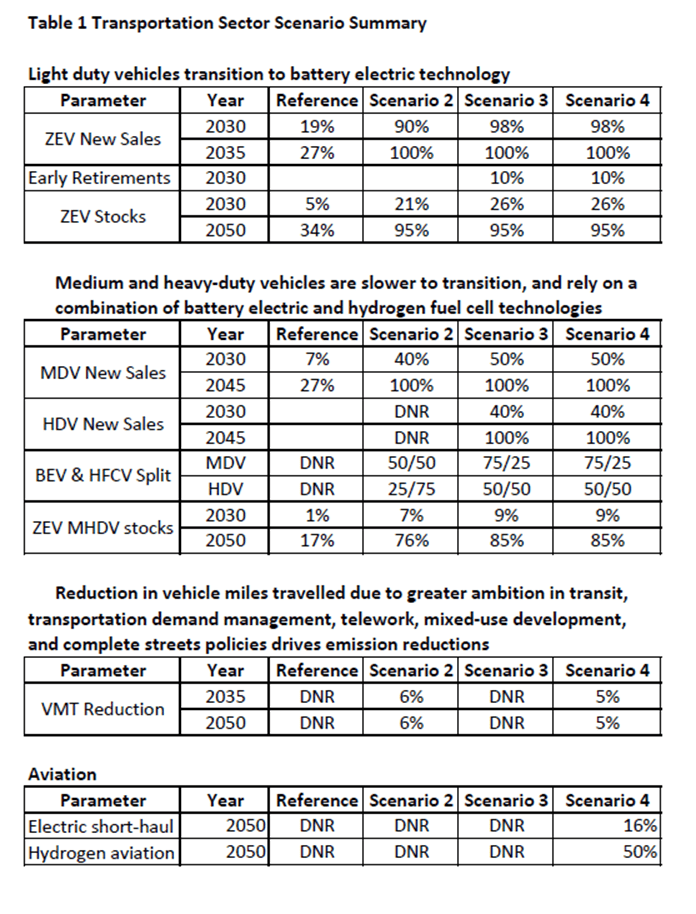
When I evaluate a regulatory proposal my first step is to try to reproduce the proposal’s numbers so that I can verify that the assumptions used are reasonable.  Even though I limited myself to just the transportation sector there still are far too many aspects to consider them all.  The scenarios proposed to reduce vehicle miles traveled using smart growth, expanded public transit, telework and demand management programs but all of those strategies are broader than I want to deal with at this time.  I considered discussing the suggestion that there could be a “small role for electric aviation in decarbonizing short distance flights by 2050, and hydrogen aviation to decarbonize medium distance flights”.   The claim that “hydrogen and electric aviation displace 47% of remaining aviation fuel demand in Scenario 4” sets off my BS detector but I chose instead to use a different claim in this article to see if the numbers can be trusted.

In this example I will address the enhanced transit & mobility claims related to the Scenario 4 alternative “Incremental reductions from enhanced in-state rail aligning with 125 MPH alternative detailed in Empire Corridor Tier 1 Draft EIS”.  In particular, I am only going to address the rail improvements measure shown in Table 11 of Appendix G: 200 million light duty vehicle miles can be reduced relative to Scenarios 2 and 3 at a per unit cost of $6 per mile.

57 Moving Cooler: http://www.reconnectingamerica.org/assets/Uploads/2009movingcoolerexecsumandappend.pdf, accessed November 2021

Empire Corridor Draft 1 Tier EIS: https://railroads.dot.gov/environment/environmental-reviews/empire-corridor, accessed November 2021

EU Hydrogen Aviation Study:

https://www.fch.europa.eu/sites/default/files/FCH%20Docs/20200720_Hydrogen%20Powered%20Aviation%20report_FINAL%20web.pdf, accessed November 2021

58 Scenario 2 and Scenario 3 include 9 billion LDV miles reduced in 2050 relative to Reference scenario, from enhanced transit and mobility; telework and travel demand management; smart growth and mode shifting to biking/walking; No $/mile cost was assessed for tranche of VMT reduction achieved in Scenarios 2-3. Table above shows incremental investment relative to Scenarios 2-3

Table 11 documents transportation-related incremental costs associated with Scenario 4.  It claims that the per-unit cost is $6 per mile and that 200 million light duty vehicle miles will be reduced relative to Scenarios 2 and 3 in 2050.  The plain reading of this is that the 200 hundred million light duty vehicles miles reduced will cost $6 per mile or $1.2 billion.  The basis of the claim is the “Empire Corridor Draft 1 Tier EIS” which is an analysis of improvements that could be made to railroad passenger service in New York.

Empire Corridor Rail Passenger Improvements

The Federal Railroad Administration (FRA), in cooperation with the New York State Department of Transportation (NYSDOT) completed the Empire Corridor Environmental Impact Statement (EIS) in 2014 to “evaluate proposed system improvements to intercity passenger rail services along the 463-mile Empire Corridor, connecting Pennsylvania (Penn) Station in New York City with Niagara Falls Station in Niagara Falls, New York.”  The components of the EIS include the following:

Completing an EIS always takes a long time but the fact that the FRA anticipates publishing the final report in 2022, eight years after it was completed suggests that there were issues.  For this evaluation the point is that there were four alternatives considered to upgrade railroad service from New York City to Niagara Falls.  There were two alternatives to raise passenger train speeds to 90 mph between Albany and Buffalo and one to raise passenger train speeds to 110 mph that all use the existing right-of-way.  The fourth alternative would raise the passenger train speeds to 125 mph but that would require the development of a “new electrified (with overhead catenary), two-track, grade-separated high-speed rail corridor of 283 miles between Albany/Rensselaer Station and a new Buffalo station”.  The following table highlights the differences between the alternatives. 

According to Appendix G, Scenario 4 would get additional vehicle miles traveled reductions by using the “125 MPH alternative detailed in Empire Corridor Tier 1 Draft EIS”.  As this document is the sum total of the documentation a certain degree of guessing is required to deduce what that means.  Although never mentioned it seems likely that Scenarios 2 and 3 use Alternative 110 from the Empire Corridor EIS to project reductions in vehicle miles traveled and using the “125 MPH alternative detailed in Empire Corridor Tier 1 Draft EIS” appears to provide incremental improvements.

It is possible to check the projected numbers.  Table 11 claims that “200 million light duty vehicle miles will be reduced relative to Scenarios 2 and 3 in 2050” at a per unit cost of $6 per mile.  Recall, however, that I previously interpreted this to mean that the 200 hundred million light duty vehicles miles reduced will cost $6 per mile or $1.2 billion.  The capital cost difference between Alternative 110 ($6.3 billion) and Alternative 125 ($14.7 billion) is $8.4 billion, far more than that per unit cost. 

There is another possible check.  Exhibit 6-7 in the Empire Corridor EIS estimates the annual reductions in auto trips in 2035 for the different alternatives.  Assuming that using the “125 MPH alternative detailed in Empire Corridor Tier 1 Draft EIS” means that the proposed improvement is the difference between the 110 and 125 alternatives, then that means that 307,475 autos are diverted from highways. 

In order to estimate the vehicle miles traveled reduction from the estimate of 307,475 autos diverted from highways, the distribution of where the passenger boarded and exited is needed.  Exhibit 2-21 provides that information for 2009.  I have an issue with these data.  In particular, while the total appears consistent with the numbers in the rest of the document it is worrisome that the origin and destination numbers match exactly.  I interpret this table to state that 320,155 people boarded trains in New York to go to Albany reading down the first column to New York City then across to the third column under the heading Albany.  For the people going from Albany to New York City read down the trip origins column to Albany and then over to the second column for New York City.  I believe it is highly unlikely that exact number of people going from Albany to New York City and vice-versa would be identical.  Furthermore, the fact that the station pairs in all instances are the same means that there is an issue with the numbers.  Because I don’t expect that there would be a big difference between the numbers and the total is consistent, I have ignored this issue.

Unfortunately, there is no similar breakdown of boardings for the alternatives.  Exhibit 6-6 does break down total ridership by alternative in 2035.

My spreadsheet Empire Corridor Data uses the information from these three tables and the distances between the stations listed along the Empire Corridor (Markets tab) to estimate the vehicle mile traveled reduction expected in 2035 if the 125-mph alternative is implemented rather than the 110-mph alternative.  I assume that the relative ridership between stations remains the same as that shown in Exhibit 2-21 and that the diversion from highways estimates are proportional to the passenger boardings.  The difference in auto trips diverted from highways between the 110-mph alternative (177,603) and the 125-mph alternative (485,078) is 307,475.  The number of diverted auto trips for each station is proportional to the station boardings per station in 2009 multiplied by 307,475 divided by the total number of boardings in 2009 (932,801).  The vehicle mile traveled reduction is the number of trips per station pair times the distance per station pair.  The sum of the distances for all these diverted trips is 64.7 million miles in 2035.  The Table 11 projected number of light-duty vehicle miles traveled is 200 million miles in 2050.  Even though the dates are different I think it is clear that the numbers, and therefore the methodology, are incompatible.

There are a couple of ways to interpret these discrepancies.  It could simply be that my interpretation of the Scoping Plan total costs and mileage reductions for this strategy are incorrect.  On the other hand, I think it is more likely due to a methodology difference.  Due to the lack of documentation, it is impossible to determine how the Integration Analysis estimated the costs and mileages.  I suspect, but cannot prove, that the Integration Analysis assumed some sort of a relationship between railroad passenger investments and vehicle mile reductions based on the results of the Empire Corridor EIS.  Unfortunately, the existence of a relationship does not mean that you can estimate benefits for anything other than the total costs of the alternative.  The cost difference between the 110-mph alternative and the 125-mph alternative is $6.3 billion and diverts 307,475 auto trips away from the roads to the trains.  It is not appropriate, for example, to assume that an investment of $3 billion would divert half as many trips but I think that something along those lines was done.

Conclusion

Without herculean effort by many people over a long period it is impossible to evaluate all the cost-benefit claims in the Draft Scoping Plan.  It is not only that there are many components to the New York energy system but the lack of documentation means that a large part of the analysis is trying to guess how the numbers were generated.  The only alternative is to evaluate a few discrete components and to see if the estimates are reasonable.

This analysis evaluated the transportation sector vehicle miles traveled difference between Scenarios 2 and 3 relative to Scenario 4.  The Draft Scoping Plan claims that “Incremental reductions from enhanced in-state rail aligning with 125 MPH alternative detailed in Empire Corridor Tier 1 Draft EIS” will provide a reduction of 200 million light duty vehicle miles at a per unit cost of $6 per mile or $1.2 billion.  I estimate that the only valid cost for the difference between the rail alternatives is $8.4 billion and that it would only provide a reduction of 64.7 million miles.  While my estimate is for 2035, consistent with the Empire Corridor evaluation, and the Draft Scoping Plan is for 2050, I don’t think there is any question that the numbers are inconsistent.

Every time I have dug into the numbers, for example residential heating retrofit electrification, the Draft Scoping Plans numbers are not a reasonable estimate compared to my work. I have consistently found that the Scoping Plan costs estimates are biased high and the benefits proposed are biased low.  I conclude that there is little reason to trust the cost estimates in the Draft Scoping Plan because of the issues I have found.

All indications at the March 3, 2022 Climate Action Council meeting were that the plan for public involvement will simply going through the motions.  For example, there is no provision for the kind of discrepancy documented here to be reconciled as a result of public comments.  This example is trivial and has no major bearing on Climate Act implementation.  The terrifying prospect is that the issues associated with reliability raised at last summer’s Reliability Planning Speaker Session could possibly be treated the same, that is to say ignored.  Those issues must be addressed or the result could lead to people freezing to death in the dark.

Climate Act Upstream Emissions

The Draft Scoping Plan that outlines the implementation strategy for New York’s Climate Leadership and Community Protection Act (Climate Act) has been released for public comment by the Climate Action Council. This article discusses the implications of the Climate Act requirement to consider upstream emissions from fossil fuels imported into New York.  I believe that only considering the impacts of fossil fuels and not the impacts of “clean” energy development is biased and hypocritical.

If you are more interested in a video that addresses the point of this article there is an option.  Ron Clutz at Science Matters provides a post with a link and excerpted transcript to a video prepared by Deutsche Welle News, the German international broadcaster.  He explains:

The theme is described by adding a bit to the title: The Price of Green Energy Will Destroy Us.  The message is not about the exorbitant expense so much as the destruction of the world’s environment in order to save it.  The imagery in the video is compelling.

I have written extensively on implementation of the Climate Act because I believe the ambitions for a zero-emissions economy outstrip available renewable technology such that it will adversely affect reliability and affordability, risk safety, affect lifestyles, will have worse impacts on the environment than the purported effects of climate change in New York, and cannot measurably affect global warming when implemented.   The opinions expressed in this post do not reflect the position of any of my previous employers or any other company I have been associated with, these comments are mine alone.

Climate Act Background

The Climate Act establishes a “Net Zero” target by 2050. The Climate Action Council is responsible for preparing the Scoping Plan that will “achieve the State’s bold clean energy and climate agenda”.  The Climate Act requires the Climate Action Council to “[e]valuate, using the best available economic models, emission estimation techniques and other scientific methods, the total potential costs and potential economic and non-economic benefits of the plan for reducing greenhouse gases, and make such evaluation publicly available” in the Scoping Plan. Starting in the Fall of 2020 seven advisory panels developed recommended strategies to meet the targets that were presented to the Climate Action Council in the spring of 2021.  Those recommendations were translated into specific policy options in an integration analysis by the New York State Energy Research and Development Authority (NYSERDA) and its consultants.  The integration analysis was used to develop the Draft Scoping Plan that was released for public comment on December 30, 2021. The public comment period extends through at least the end of April 2022, and will also include a minimum of six public hearings. The Council will consider the feedback received as it “continues to discuss and deliberate on the topics in the Draft as it works towards a final Scoping Plan for release by January 1, 2023”.  Once complete an updated Energy Plan will guide New York’s energy policy going forward.

The Draft Scoping Plan “Key Milestones and Implementation Steps To-Date” is on page 21 and states (my emphasis added):

This draft Scoping Plan and recommendations outline measures and other State actions to ensure attainment of the statewide GHG emission limits and net zero emission goal. The statewide GHG emission limit rulemaking is the first regulatory action to implement the Climate Act, the foundation for multiple components of the Climate Act, and critically important for successful implementation of the Climate Act. DEC promulgated 6 NYCRR Part 496 that established the two statewide GHG emission limits called for in the Climate Act: a limit for 2030 that is equal to 60% of 1990 GHG emission levels and a limit for 2050 that is equal to 15% of 1990 emission levels. Specifically, using a 20-year global warming potential (GWP) and including upstream emissions from fossil fuels imported into New York as required by the Climate Act, the statewide GHG emission limit for 2030 is 245.87 million metric tons (MMT) of carbon dioxide equivalent (CO2e), and the statewide GHG emission limits for 2050 is 61.47 MMT CO2e. DEC, in consultation with NYSERDA, continues to update the inventory of GHGs and will publish the annual statewide GHG emissions report that reflects these updates.

This article concentrates on the significance and utter hypocrisy of the implications of “including upstream emissions from fossil fuels imported into New York as required by the Climate Act” into the Climate Act implementation process. 

Zero Emissions

The Climate Act is hypocritical.  Throughout the Draft Scoping Plan electricity generated by wind and solar resources and the energy storage systems required to cover for the intermittency of those renewable resources is referred to as “zero” emissions.  Of course, there are no emissions when these resources generate electricity.  However, in the Climate Act accounting framework fossil fuel generation includes not only direct emissions but also any upstream GHG emissions attributable to the extraction, transmission, and use of fossil fuels or electricity imported into the State.  The development of wind, solar, and energy storage resources on the scale necessary for the Climate Act certainly have environmental and emissions impacts for extraction of the rare earth metals necessary for those technologies, the construction of the massive number of structures needed, and the disposal of the enormous quantities of wind turbine blades and solar panels at the end of their useful lives.  This article summarizes references to these issues that I have documented on my “Clean” Energy Environmental Issues page

Paul Driessen summarizes my concerns in the Real Climate Crisis where he argues that the ecological destruction and human death tolls of the green energy transition is worse than the purported impacts of climate change.  He states:

They would require mining on scales unprecedented in human history, much of it by slave and child laborers, and nearly all using fossil fuels – bringing massive habitat and wildlife losses, air and water pollution, and horrific human health and safety problems. But since most of the mining, ore processing and manufacturing will occur in other countries, far from the USA, politicians and promoters of climate crisis can say this “alternative energy” is “clean and green.”

Rare Earth Metals

The EIA special report, The Role of Critical Minerals in Clean Energy Transitions, is the most comprehensive global study to date on the central importance of minerals such as copper, lithium, nickel, cobalt and rare earth elements in a secure and rapid transformation of the global energy sector.   The report explains that:

The types of mineral resources used vary by technology. Lithium, nickel, cobalt, manganese and graphite are crucial to battery performance, longevity and energy density. Rare earth elements are essential for permanent magnets that are vital for wind turbines and EV motors. Electricity networks need a huge amount of copper and aluminum, with copper being a cornerstone for all electricity-related technologies.

The reason this is an issue is because the clean energy technologies require more of these materials.  The report notes that:

A typical electric car requires six times the mineral inputs of a conventional car, and an onshore wind plant requires nine times more mineral resources than a gas-fired power plant. Since 2010, the average amount of minerals needed for a new unit of power generation capacity has increased by 50% as the share of renewables has risen.

The following graphic shows the increases needed.


French journalist and documentary filmmaker Guillaume Pitron has been following the global trade in rare earth metals. Unfortunately, mining these materials come with heavy environmental and social costs. Mining generates massive amounts of polluted wastewater, which left untreated, poisons crops and makes people sick. Guillaume documents these issues in his 2018 book “Rare Metals War’. Recently his work was summarized in the article Toxic secrets behind your mobile phone:

Above all, our dependence on rare metals brings two very big problems. The first is that mining, refining and recycling them is immensely polluting, thereby giving the lie to the idea that our increasingly digital and electricity-powered life is greener than one reliant on fossil fuels.

Second, one country – China – has a near stranglehold on the production and supply of rare metals. The Beijing government is not just seeking to control the metals found in its lands but also to control the production of rare metals wherever they are found on the globe. It has used barely credible chicanery to position itself as the sole supplier. It’s as if Saudi Arabia, which holds the world’s largest oil reserves, took it upon itself to control the reserves of the 13 other main petroleum-exporting countries.

The fact is that the European Union and the United States have little leverage to prevent Russia from invading Ukraine because they rely on Russia for the fossil fuels necessary to keep the lights on, homes heated, and transportation systems operating.  It seems obvious to me that it is imprudent to set up an energy system that is entirely dependent upon another nation whose interests may not be in our best interests.

Mark Mills’ Mines, Minerals, and “Green” Energy: A Reality Check paper from the Manhattan Institute picks up on the same themes: 

This paper turns to a different reality: all energy-producing machinery must be fabricated from materials extracted from the earth. No energy system, in short, is actually “renewable,” since all machines require the continual mining and processing of millions of tons of primary materials and the disposal of hardware that inevitably wears out. Compared with hydrocarbons, green machines entail, on average, a 10-fold increase in the quantities of materials extracted and processed to produce the same amount of energy.

This means that any significant expansion of today’s modest level of green energy—currently less than 4% of the country’s total consumption (versus 56% from oil and gas)—will create an unprecedented increase in global mining for needed minerals, radically exacerbate existing environmental and labor challenges in emerging markets (where many mines are located), and dramatically increase U.S. imports and the vulnerability of America’s energy supply chain.

Renewable Waste Disposal

Because the quantity of materials needed for wind turbines and solar panels is so much larger and those machines have shorter life expectancies, the inevitable result will be a waste disposal problem.  Consider wind turbine waste disposal.  They are so big that they have to be cut up and because they were designed to handle strong winds they cannot be “crushed, recycled or repurposed”.   As a result, the sheer volume of material is an issue.

Robert Bradley describes a Harvard Business Review article, The Dark Side of Solar Power, that concludes that “given the current very high recycling costs, there’s a real danger that all used panels will go straight to landfills”.  Bradley excerpts some passages from the article:

      • Economic incentives are rapidly aligning to encourage customers to trade their existing panels for newer, cheaper, more efficient models. In an industry where circularity solutions such as recycling remain woefully inadequate, the sheer volume of discarded panels will soon pose a risk of existentially damaging proportions.
      • The International Renewable Energy Agency (IRENA)’s official projections assert that “large amounts of annual waste are anticipated by the early 2030s” and could total 78 million tonnes by the year 2050. That’s a staggering amount, undoubtedly. But with so many years to prepare, it describes a billion-dollar opportunity for recapture of valuable materials rather than a dire threat. The threat is hidden by the fact that IRENA’s predictions are premised upon customers keeping their panels in place for the entirety of their 30-year lifecycle. They do not account for the possibility of widespread early replacement.
      • The industry’s current circular capacity is woefully unprepared for the deluge of waste that is likely to come. The financial incentive to invest in recycling has never been very strong in solar. While panels contain small amounts of valuable materials such as silver, they are mostly made of glass, an extremely low-value material. The long lifespan of solar panels also serves to disincentivize innovation in this area.
      • The direct cost of recycling is only part of the end-of-life burden, however. Panels are delicate, bulky pieces of equipment usually installed on rooftops in the residential context. Specialized labor is required to detach and remove them, lest they shatter to smithereens before they make it onto the truck. In addition, some governments may classify solar panels as hazardous waste, due to the small amounts of heavy metals (cadmium, lead, etc.) they contain. This classification carries with it a string of expensive restrictions — hazardous waste can only be transported at designated times and via select routes, etc.
      • The same problem is looming for other renewable-energy technologies. For example, barring a major increase in processing capability, experts expect that more than 720,000 tons worth of gargantuan wind turbine blades will end up in U.S. landfills over the next 20 years. According to prevailing estimates, only five percent of electric-vehicle batteries are currently recycled – a lag that automakers are racing to rectify as sales figures for electric cars continue to rise as much as 40% year-on-year. The only essential difference between these green technologies and solar panels is that the latter doubles as a revenue-generating engine for the consumer. Two separate profit-seeking actors — panel producers and the end consumer — thus must be satisfied in order for adoption to occur at scale.

Conclusion

Andy West’s statement about another aspect of net-zero policies is equally applicable to the Climate Act mandate to consider upstream fossil fuel emissions while ignoring the impacts of “zero” emissions environmental impacts: “Ardent belief in cultural fairy-stories creates a pretty effective blindfold against glaring truths”.  The Climate Act’s war on fossil fuels is based entirely on the popular belief that climate change is an existential threat.  Authors of the law incorporated every opportunity to inflate the impact of fossil fuels and ignored any negative ramifications.  It is evident that there are significant issues associated with the materials necessary for the clean energy transition.  The Climate Act ignores them in a blatant example of hypocrisy.

NY Business Council Climate Act Scoping Plan Overview

The Draft Scoping Plan outlines the implementation strategy for New York’s Climate Leadership and Community Protection Act (Climate Act) has been released for public comment by the Climate Action Council. The NY Business Council recently published a summary of the Draft Scoping Plan that I think is an excellent overview of the Plan. 

I have written extensively on implementation of the Climate Act because I believe the ambitions for a zero-emissions economy outstrip available renewable technology such that it will adversely affect reliability and affordability, risk safety, affect lifestyles, will have worse impacts on the environment than the purported effects of climate change in New York, and cannot measurably affect global warming when implemented.   The opinions expressed in this post do not reflect the position of any of my previous employers or any other company I have been associated with, these comments are mine alone.

Climate Act Background

The Climate Act establishes a “Net Zero” target by 2050. The Climate Action Council is responsible for preparing the Scoping Plan that will “achieve the State’s bold clean energy and climate agenda”.  The Climate Act requires the Climate Action Council to “[e]valuate, using the best available economic models, emission estimation techniques and other scientific methods, the total potential costs and potential economic and non-economic benefits of the plan for reducing greenhouse gases, and make such evaluation publicly available” in the Scoping Plan. Starting in the Fall of 2020 seven advisory panels developed recommended strategies to meet the targets that were presented to the Climate Action Council in the spring of 2021.  Those recommendations were translated into specific policy options in an integration analysis by the New York State Energy Research and Development Authority (NYSERDA) and its consultants.  The integration analysis was used to develop the Draft Scoping Plan that was released for public comment on December 30, 2021. The public comment period extends through at least the end of April 2022, and will also include a minimum of six public hearings. The Council will consider the feedback received as it “continues to discuss and deliberate on the topics in the Draft as it works towards a final Scoping Plan for release by January 1, 2023”.  Once complete an updated Energy Plan will guide New York’s energy policy going forward.

The NY Business Council is the “voice of business and employers in New York State Representing 3,500 business of all sizes, in all sectors Including nearly 100 local chambers and business groups”.  At a recent webinar Ken Pokalsky referenced a summary of the Draft Scoping Plan that he prepared.  I asked for permission to publicize his summary and this post is the result. 

The summary of thescoping plan points out that the document and supporting documents “amount to more than 1,000 pages and provide significant details on the Climate Action Council’s analysis and recommendations. It explains that “Some sections, i.e., transportation and buildings, provide specific recommendations and timelines for action” and that “Others, including sections on the electric power and natural gas sectors, and on industry, provide far less in the way of a detailed implementation plan.”

The distinction between the sections is an important point.  In order to be a credible basis for the Energy Plan’s roadmap for “providing clean, reliable, and lower-cost energy to all New Yorkers” the State has to prove that it is feasible.  While the transportation and building sector sections provide more detail it is barely sufficient for a feasibility analysis. There clearly isn’t anything approaching a feasibility analysis for the electric power and natural gas sectors.  I believe that this is partially due to the complexities of the electric and gas sectors.  Unfortunately, a main driver of policy is the political calculus to incorporate social and environmental justice concerns.  As a result, appeasing those interests is over-riding technological feasibility concerns.

Benefits and Costs

The following lists the benefits and costs presented with my indented and italicized comments.

  • The plan discusses the range of adverse impact caused by climate change and asserts that climate change will be affected by the actions proposed in the scoping plan.

Pokalsky recently gave a presentation at the Real Cost of New York’s Climate Leadership and Community Protection Act webinar.  My post on the webinar made the point that technical feasibility of wind, solar, and energy storage should be a primary concern but only one of six presenters raised that point because it is politically incorrect to argue the point.  Pointing out that the Intergovernmental Panel on Climate Change technical reports don’t agree with the range of adverse impacts listed in the Draft Scoping plan and that the state has never quantified the effect of any New York GHG emission reduction program on global warming itself is even more of a politically incorrect argument.

 In addition to reducing the impacts of climate change, it recognizes that the state will need to adapt to risks that cannot be avoid.

I agree.

 While the report provides few specifics on the cost of implementation measures, it reports on macro-level models of the cost and benefits of multiple compliance scenarios, each of which projects that benefits will significantly outweigh implementation costs, with benefits including public health benefits from improved air quality Improvements in air quality, increased active transportation, and “energy efficiency interventions” in homes generating health benefits ranging from approximately $165 billion to $170 billion. However, this analysis compares the costs of implementing this state specific scoping plan with benefits, including estimates of avoided economic damage from climate change at up to $250 billion, benefits that would require actions beyond those proposed in this scoping plan to achieve.

I have shown that the health benefits claimed exaggerate the projected values, that the estimates of avoided economic damages from climate changes are manipulated to be 5.4 times higher than other jurisdictions, and, despite all the biased calculations, the benefits are not greater than the macro-level cost estimates unless the benefits of reductions are counted multiple times.  If only that error is corrected the total benefits range from negative $74.5 to negative $49.5 billion instead of positive net benefits ranging from $90 billion to $120 billion.

 The scoping plan applies an analytic framework that projects approximately $140 billion in annual New York State energy system expenditures, including capital expenditures and fuel costs, representing 8.9 percent of gross state product. A significant share of that amount, including $30 billion of $50 billion in fuel costs, leaves the state. In part, the economic impact study discusses the effect of redistributing these annual expenditures to achieve the state’s renewable energy and energy efficiency objectives.

In the absence of detailed cost numbers, it is difficult to comment on the analytic framework for costs.  This is a good description of what is available.

 Public health benefits from reduced GHG emissions will include those related to heat, flooding and food, water, and vector-based diseases, and will result in indirect benefits from the reduction of emissions of GHG co-pollutants including particulates and various toxic emissions.

The heat, flooding, food, water and vector-based disease benefits are associated with the social cost of carbon calculations.  I have prepared a white paper on these alleged benefits for anyone who wants to get into the technical details.

  • The scoping plan focuses significantly on historic disparate impacts on disadvantaged communities. Throughout the document, the scoping plan references recommendations of the Climate Justice Work Group (CJWC) and the extent to which they were not adopted by the Climate Action Council.

This is an important point that I have not addressed in my work yet.

  • The plan asserts that it establishes “the country’s – and perhaps even the planent’s – strongest GHG emission reduction and clean energy requirements,” and it will serve as a model for other jurisdictions.

At the end of the day, I believe that this is the only benefit of the plan.  New York’s politicians will have bragging rights.  Of course, the owners of the Titanic had bragging rights on their maiden voyage too.

 The scoping plan will result in a cleaner environment and a more competitive economy, and will support new jobs, new businesses, and new economic opportunities. (The CAC also issued a report on projected job creation resulting from CLCPA implementation.) It contains several recommendations for retraining workers displaced by CLCPA mandates, and for offsetting any adverse economic consequences on communities impacted by the loss of facilities. It recognizes that CLCPA implementation will require an expanded, trained workforce, and supports measures such as project labor and community workforce agreements on CLCPA-related projects.

This is a primary concern for the Business Council.  I have not addressed this in my work yet and given the amount of material will more than likely defer to the Business Council’s opinion.

  • It recognizes the potential impact of emission leakage due to actions that increase the cost of energy, reduces the reliability of energy, or increase the cost of GHG emissions, and recommends some approaches, including credits for early action and targeted incentives.

This is another topic I have not addressed.  Based on my work with Regional Greenhouse Gas Initiative emissions leakage I am pretty sure that leakage is inevitable but that the numbers can be manipulated to make it look like less of an issue.

Conclusion

The Business Council memo is intended to provide an overview of the most significant energy-related proposals impacting major sectors of the New York State’s economy. It does an excellent job in that regard.  The memo points out that “Most businesses will be impacted by the recommendations of multiple sector-specific proposals”. The Business Council urges its members to review the scoping plan and get involved with their internal comment development process.  I recommend that all New Yorkers review the plan and comment too.

Air Permit Applications and the Climate Act

The implementation strategy for New York’s Climate Leadership and Community Protection Act (Climate Act) is being finalized by the Climate Action Council  in 2022.  Because the schedule is so ambitious the Council has been pushing for the implementation of policies even before the strategies are finalized.  This post addresses the New York State Department of Environmental Conservation (DEC) proposed policy DAR-21: The Climate Leadership and Community Protection Act and Air Permit Applications that is supposed to establish the procedures staff will use to review permit applications with respect to the Climate Act.  This turns out to be another example of the Climate Act putting the cart before the horse.

I have written extensively on implementation of the Climate Act because I believe the ambitions for a zero-emissions economy outstrip available renewable technology such that it will adversely affect reliability and affordability, risk safety, affect lifestyles, will have worse impacts on the environment than the purported effects of climate change in New York, and cannot measurably affect global warming when implemented.   The opinions expressed in this post do not reflect the position of any of my previous employers or any other company I have been associated with, these comments are mine alone.

Climate Act Background

The Climate Act establishes a “Net Zero” target by 2050. The Climate Action Council is responsible for preparing the Scoping Plan that will “achieve the State’s bold clean energy and climate agenda”.  The Climate Act requires the Climate Action Council to “[e]valuate, using the best available economic models, emission estimation techniques and other scientific methods, the total potential costs and potential economic and non-economic benefits of the plan for reducing greenhouse gases, and make such evaluation publicly available” in the Scoping Plan. Starting in the Fall of 2020 seven advisory panels developed recommended strategies to meet the targets that were presented to the Climate Action Council in the spring of 2021.  Those recommendations were translated into specific policy options in an integration analysis by the New York State Energy Research and Development Authority (NYSERDA) and its consultants.  The integration analysis was used to develop the Draft Scoping Plan that was released for public comment on December 30, 2021. The public comment period extends through at least the end of April 2022, and will also include a minimum of six public hearings. The Council will consider the feedback received as it “continues to discuss and deliberate on the topics in the Draft as it works towards a final Scoping Plan for release by January 1, 2023”.  Once that is complete the Energy Plan will be revised to set the state’s energy policies. The goal of the Energy Plan process is to “map the state’s energy future by showing how the state can ensure adequate supplies of power, reduce demand through new technologies and energy efficiency, preserve the environment, reduce dependence on imported gas and oil, stimulate economic growth, and preserve the individual welfare of New York citizens and energy users”.

The Proposed Policy DAR-21: The Climate Leadership and Community Protection Act and Air Permit Applications describes “the content of analyses required by the Division of Air Resources (DAR) pursuant to the requirements of Section 7(2) of the Climate Leadership and Community Protection Act (CLCPA). Chapter 106 of the Laws of 2019”. It further describes “the procedures staff in DAR will follow when reviewing those analyses for conformance with the requirements of the CLCPA”. Finally, this policy “establishes the types of air pollution control permit actions required to prepare an analysis as part of the permit application process”.

My Comments

I submitted comments on the proposed rule.  My main concern is that if DEC refuses to permit individual existing air permit applications without considering whether the facility is needed for reliability then problems could occur.  Importantly, DEC has no such responsibility so they should work with the New York Independent System Operator (NYISO) to cover this concern.

The policy document outlines the requirements for analyses developed “pursuant to Section 7(2) of the Climate Leadership and Community Protection Act (CLCPA) in support of air pollution control permit applications”. The document notes that the CLCPA went into effect January 1, 2020 (Chapter 106 of the Laws of 2019). It also notes that the CLCPA also establishes a Climate Action Council that is given three years (by January 1, 2023) to finalize a Scoping Plan providing recommendations for meeting those limits, and requires the DEC to promulgate regulations on GHG emission sources within four years (by January 1, 2024) that will ensure those limits are met. I commented that this policy is putting the cart before the horse. It is inappropriate to require analysis before regulations are promulgated simply because no standards have been established.

Ultimately the problem with the guidance document can be traced back to the CLCPA presumption that a transition to net-zero can be accomplished by 2050 if only there is political will. The reality is that there are enormous technological challenges particularly for the mandated schedule. As a result, there is a gaping hole in the Scoping Plan because it does not include a feasibility plan for the specific technology and schedule that the Climate Action Council proposes. It is not clear to me when and how the organizations responsible for electric system reliability will review and sign off on an implementation plan. Until that happens it is inappropriate for DEC to put any limitations on fossil-fired generation.

My comments argued that it is obvious that there are serious limitations with existing technology and the aggressive schedule. The New York Independent System Operator (NYISO) 2021-2030 Comprehensive Reliability Plan is the most recent reliability study in New York. It states:

Moving to 2040, the CLCPA requires generation to be emission-free. The Climate Change Study looked at 100 x 40 (emission-free electric grid by 2040). It noted the significant amount of dispatchable resources that would be needed to meet that goal but did not describe the technology that would be able to provide a dispatchable resource, instead choosing to refer to generic dispatchable, emission-free resources. Not surprisingly, the Climate Change report found that a similar amount of dispatchable resources as the RNA case would be needed to maintain reliability under baseline assumptions. However, under CLCPA assumptions, the amount of dispatchable emission-free resources needed increases to over 32,000 MW in 2040, approximately 6,000 MW more than the total fossil-fueled generation fleet on the grid in 2021. The Climate Change Study noted that the current system is heavily dependent on existing fossil-fueled resources to maintain reliability and eliminating these resources from the mix “will require an unprecedented level of investment in new and replacement infrastructure, and/or the emergence of a zero-carbon fuel source for thermal generating resources” (emphasis added). The Climate Change Study did note that while the amount of installed capacity (MW) of dispatchable resources is significant, the amount of energy generated (MWh) required from such resources would likely not be significant, with the percent of total energy being in the range of 10% ― 20% range depending on the penetration level of intermittent resources.

This guidance and the Draft Scoping Plan don’t consider one component of the CLCPA. The Public Service Commission mandate in Public Service (PBS) CHAPTER 48, ARTICLE 4, § 66-p. Establishment of a renewable energy program (4) that states:

The commission may temporarily suspend or modify the obligations under such program provided that the commission, after conducting a hearing as provided in section twenty of this chapter, makes a finding that the program impedes the provision of safe and adequate electric service; the program is likely to impair existing obligations and agreements; and/or that there is a significant increase in arrears or service disconnections that the commission determines is related to the program.

Given that the Energy Plan has to consider the provision for safe and adequate electric service, and it will not be prepared until 2023, it is premature for DEC to pick any winning or losing technologies in this guidance or any other permitting decisions for that matter. I recommended that the effective data be made contingent upon the completion of an Energy Plan that meets PBS Chapter 48, Article 4, § 66-p. Establishment of a renewable energy program requirement for safe and adequate electric service. Because reducing emissions is so dependent upon electrification the electric service criterion is a good surrogate for all permitting activities covered by the guidance.

There is another aspect of NYISO) 2021-2030 Comprehensive Reliability Plan (CRP) report that the guidance should consider.  My comments highlighted some risk factors that threaten electric system reliability in the report.  The CRP states:

As generators age and experience more frequent and longer duration outages, the costs to maintain the assets increase. These costs may drive aging generation into retirement. A growing amount of New York’s gas-turbine and fossil fuel-fired steam-turbine capacity is reaching an age at which, nationally, a vast majority of similar capacity has been deactivated. As shown in Figure 11, by 2028 more than 8,300 MW of gas-turbine and steam-turbine based capacity in New York will reach an age beyond which 95% of these types of generators have deactivated. 

The impact of the unavailability of system resources can readily be seen through tipping point evaluations. While transmission security within New York City (Zone J) is maintained through the ten-year period in accordance with design criteria, the margin would be very tight starting in 2025 and would be deficient beginning in 2028 if forced outages are experienced at the historical rate, as shown in Figure 12. Transmission security within Long Island (Zone K) is also maintained through the ten-year period, with the slimmest margin in the first few years as shown in Figure 13. If forced outages are experienced at the historical rate the Long Island margin would be sufficient through the study period.

My comments pointed out that using history as a guide, there will be forced outages from these old generating resources.  Obviously not renewing permits will exacerbate this problem.

Replacement Permit Applications

Obliviously, DEC has rejected permits for new replacement generating facilities that addresses this risk factor.  This was outside the scope of the guidance document but is important for readers to understand. In the DEC’s “Notice of Denial of Title V Air Permit” for the Danskammer Energy Center (DEC ID: 3-3346-00011/00017) and its “Notice of Denial of Title V Air Permit” for the Astoria Gas Turbine Power Project (DEC ID: 2-6301-00191/00014), the DEC rejected the use of both hydrogen and renewable natural gas (RNG) as a 2040 compliance mechanism because the DEC labeled them “speculative” and “aspirational”. However, the Scoping Plan’s placeholder for a dispatchable, emission-free resource is hydrogen. Governor Hochul’s recent State of the State address proposes that New York position itself to compete for nearly $10 billion in federal funding for green hydrogen R&D under the federal infrastructure bill. Obviously, it is in the state’s best interest to preserve the option to use hydrogen in the future. In the meantime, the options to supplant the dispatchable energy from those facilities with energy storage and renewable energy alternatives are no less “speculative” and “aspirational”.   In my comments I argued that the proposed guidance must incorporate a process similar to that used for the Peaker Rule (6NYCRR Part 227-3) whereby the NYISO works with DEC to ensure reliability issues are addressed for any permit application affecting electric generation viability.

Conclusion

The zeal of the State of New York to implement the Climate Act before the plan is complete is endangering the security of the electric grid.  In particular, there are many generating units in the state and New York City in particular that are nearing the end of their useful life. I submitted comments arguing that the DAR-21 Guidance must be revised to incorporate electric system reliability considerations.  Firstly, as shown above there are reliability concerns related to existing electrical generators.  The guidance must not preclude continued operation of existing units.  Secondly, DEC should not prevent operators from developing modern generating units that are more reliable than the existing aging units.  Even if the state plans to shut down all fossil-fired units by 2040 the owners know that and it can be addressed with a permit condition.  Finally, the Energy Plan has to consider the provision for safe and adequate electric service at the same time that the Draft Scoping Plan is proposing the use of currently unavailable technology.  For all three reasons it is premature for any DEC application to limit, shut down or prevent upgrades at existing electrical generation facilities.

The Real Cost of the Climate Act

On February 16, 2022 New Yorkers for Affordable Energy hosted a Zoom webinar titled The Real Cost of New York’s Climate Leadership and Community Protection Act.  The sponsor said to “feel free to share this with anyone you think would enjoy it” so this post describes the webinar.

I have written extensively on implementation of the Climate Act because I believe the ambitions for a zero-emissions economy outstrip available renewable technology such that it will adversely affect reliability and affordability, risk safety, affect lifestyles, will have worse impacts on the environment than the purported effects of climate change in New York, and cannot measurably affect global warming when implemented.   The opinions expressed in this post do not reflect the position of any of my previous employers or any other company I have been associated with, these comments are mine alone.

Climate Act Background

The Climate Act establishes a “Net Zero” target by 2050. The Climate Action Council is responsible for preparing the Scoping Plan that will “achieve the State’s bold clean energy and climate agenda”.  The Climate Act requires the Climate Action Council to “[e]valuate, using the best available economic models, emission estimation techniques and other scientific methods, the total potential costs and potential economic and non-economic benefits of the plan for reducing greenhouse gases, and make such evaluation publicly available” in the Scoping Plan. Starting in the Fall of 2020 seven advisory panels developed recommended strategies to meet the targets that were presented to the Climate Action Council in the spring of 2021.  Those recommendations were translated into specific policy options in an integration analysis by the New York State Energy Research and Development Authority (NYSERDA) and its consultants.  The integration analysis was used to develop the Draft Scoping Plan that was released for public comment on December 30, 2021. The public comment period extends through at least the end of April 2022, and will also include a minimum of six public hearings. The Council will consider the feedback received as it “continues to discuss and deliberate on the topics in the Draft as it works towards a final Scoping Plan for release by January 1, 2023”.

The The Real Cost of New York’s Climate Leadership and Community Protection Act webinar was organized by New Yorkers for Affordable Energy, “a coalition of community, labor, business and industry leaders from across the state who support greater access to clean, reliable and affordable sources of energy for residential and business consumers.”  They understand that reliability and affordability are at risk due to the Climate Act and are starting to get the word out to consumers who have no idea what is involved with the state’s plan to do “something” about climate change. There is a recording of the Zoom meeting but this article will focus on presentations made by six speakers.

New Yorkers for Affordable Energy

Michelle Hook, the Executive Director of New Yorkers for Affordable Energy (NYAE) gave the first presentation.  The mission for NYAE is “to educate New Yorkers about the impacts of New York energy policy on their personal livelihood and advocate for a pragmatic and balanced approach to our state’s energy decisions”.  She explained that there are active bills that could have major impacts:

  • S.8008/A.9008 Budget Bill TED, Part EEE and S.6841 (Kavanaugh) A.8431 (Gallagher) – “All Electric Buildings Act”
    • Both bills prohibit any new construction that is not all electric.
  • S.8198 (Krueger) – Statewide Natural Gas Transition Plan
    • Requires the PSC to develop a statewide gas transition plan that decreases gas sales and decommissions natural gas systems
  • S.5939-A (Ramos)/A.6761-A (Mamdani) – “Clean Futures Act”
    • Prohibits the development of any new major electric generating facilities that would be powered in whole or part by any fossil fuels.

She also brought up the issue of aging power plants and the potential impact to reliability.

New York Independent Power Producers

Gavin Donohue, the President and CEO of the New York Independent Power Producers is also a member of the Climate Action Council.  He explained that of the 22 members of the Council only two appointees are from the traditional energy sector, him and Donna DeCarolis of National Fuel Gas Distribution Company His presentation outlined the requirements of the Climate Act.  I will reproduce much of his material and, in the rest of the article, highlight differences between his take and the other presentations.

He listed the following recommendations from the Draft Scoping Plan:

  • Moratoriums on new gas infrastructure (NOT a Council-wide recommendation)
  •  No new natural gas service to existing buildings
  •  Prohibit propane, natural gas and oil equipment in new homes in 2024
  •  Prohibit traditional heating systems in existing homes in 2030
  •  Ban use of natural gas appliances (dryers, stoves, etc.) in homes in 2030
  •  No gasoline vehicles sold in New York in 2035

Donohue described the following gaps and challenges:

  • Gas and oil resources currently make up more than two-thirds of the energy downstate and one-third statewide overall
  • New York’s grid operator (NYISO) says quick-start power options are essential
  •  State power reserves are thin (no wiggle room for very hot/cold days or broken units)
    • NYSERDA says electrification and electric vehicles increases electric demand 65 to 80%
  • No consensus on what qualifies as Zero-Emission Dispatchable Technologies for 2030 and beyond
  • Increased electrification results in electric consumption doubling by 2050
    • Approximately 1 to 2 million homes will need to be electrified with heat pumps by 2030
  • Approximately 3 million zero-emission vehicles will need to be sold by 2030
  • Necessary to create emission-reducing or eliminating technologies like carbon capture, hydrogen fuel cells, offshore wind and battery storage
  • Redefining/retraining state labor force
  • Diversion of organic waste from landfills
  • Management of manure and animal feeding practices

Donohue presented a list of Draft Scoping Plan positives:

  • No recommendation to ban wood burning
  • Acknowledges need for nuclear facilities through 2029
  • Low-carbon fuels such as bioenergy or green hydrogen have a role
  • Investments in development of zero emitting resources
  • Includes carbon pricing as an option

Then he followed up with what he thought was the biggest issue: How much will this cost?

  • No comprehensive cost analysis on how to pay for any of the recommendations:
    • Geothermal/heat pumps
    • Electric vehicles
    • Home appliances
    • Grid electrification
    • Expansion transmission, renewables and energy storage

I agree with most of the points raised by Donohue and all the gaps and challenges points raised.  I suppose it is unreasonable to expect that a member of the Climate Action Council could question the value of the law itself.  However, New York’s share of global GHG emissions is less than a half a percent of total emissions and, on average, over the last three decades the annual increase in GHG emissions is more than half a percent, so any reductions made in New York will be replaced by global emission increases in a year. As a result, I think that any presentation on the Climate Act should ask the question “What is the point”.   I agree that costs are the biggest issue. I would add that the Draft Scoping Plan does not document any of the costs provided so not only isn’t there an analysis on how to pay, but there isn’t satisfactory documentation supporting what it might cost.

National Fuel Gas

National Fuel Gas is a “diversified, integrated energy company with a complementary mix of natural gas assets located in the heart of the prolific Appalachian basin” that serves customers in western New York Donna DeCarolis is President and also a member of the Climate Action Council. Her presentation emphasized the need to balance the goals and objectives of the Climate Act with consumer impacts. 

Her list of items in the Draft Scoping Plan is the same as Donohue’s. 

The presentation by DeCarolis includes the following slide pointing out all the items that are not included in the natural gas system transition.  Clearly National Fuel Gas is in a fight for its existence so their plan is to support the New York narrative that a transition to low and no-carbon is necessary.  From what I have seen there isn’t enough renewable natural gas to make much of a difference and problems with metal embrittlement with hydrogen will prevent the use of the existing natural gas system for its use.

Her list of what is missing in the Draft Scoping Plan includes the following:

  • Existing “electric-based clean energy technologies” can’t meet forecasted demand & maintain reliability
  • Unprecedented level of NEW renewable energy generation development in next 8 years.
    • 26% current   
    • 70% required
  • NYISO published its concern about declining levels of reliability beginning as early as 2023
  • Measures will likely increase consumer cost for potentially less reliability
  • Full assessment of affordability
  • Recognition of upstate and downstate differences
    • Plan will be more burdensome for western New York residents
      • Weather is 56% colder
      • 94% of energy used on the coldest WNY winter day is natural gas
      • Older, larger Upstate housing stock
      • Burden falls hardest on Upstate residents – Downstate produces more emissions

National Fuel Gas proposes an “all-of-the-above” pathway based on three building blocks:

  • Widespread energy efficiency that emphasizes weatherization
  • Dual-energy heating and cooling systems
  • Use of the existing natural gas infrastructure to incorporate low carbon fuels

The presentation expands on these points and DeCarolis argued that it is possible to meet the goals of the Climate Act.  Given that anyone who “questions” the value of reducing GHG emissions will be labeled a “denier”, National Fuel Gas has decided not to argue much about the futility of the Climate Act having an effect on global warming so they are presenting their plan as a more viable option to get the same result.

Empire Center

The Empire Center for Public Policy is an independent, non-partisan, non-profit think tank based in Albany, New York.  Their mission is “to make New York a better place to live and work by promoting public policy reforms grounded in free-market principles, personal responsibility, and the ideals of effective and accountable government.”  

Senior Policy Analyst James E. Hanley gave a presentation that did not have pull its punches because of vested interests within the organization.  He argued that utility customers expect electricity when and where needed at all times.   However, the drive for electrification will increase electricity demand by 65% to 80% at the same time New York policy is shutting traditional sources of electricity.  As a result, adequacy margins are already shrinking.  Donohue’s presentation claimed that electricity demand would double and I believe he is correct.

Hanley pointed out that the Climate Act forces an unprecedented shift to variable renewable resources.  The Draft Scoping Plan projects that in addition to a massive buildout of wind and solar that dispatchable emissions-free resources are needed for reliability.  He explains that the Plan suggests advanced fuels such as green hydrogen and renewable natural gas might fill the reliability gap: ”if scalability, feasibility, and environmental impact and air quality issues can be addressed.”  The biggest problem is that it is not known if any advanced technology will be deployable at scale and how much it will cost by 2040 when fossil fuels are banned from the New York grid.  He also argues that energy storage on the necessary scale is “science fiction”.  He concludes that “nuclear closures, non-permitting of new sources, and aging and closure of existing fossil-fuel sources could mean NY inadvertently “sleepwalks” into an era of energy unreliability”.  These points all imply that the Climate Act targets and schedule are not likely to be achieved so Council members Donohue and DeCarolis steered clear of these arguments.  I personally think that Hanley’s feasibility assessment is optimistic.

New York Business Council

Ken Pokalsky, Vice President of the NY Business Council, also gave a presentation.  The Business Council is the “voice of business and employers in New York State Representing 3,500 business of all sizes, in all sectors Including nearly 100 local chambers and business groups”.  He referenced a summary of the Draft Scoping Plan that he prepared and made the point that feedback during the public comment process is essential. 

Pokalsky described how the Draft Scoping Plan handles the industrial, transportation, buildings, and waste management sectors.  He described key considerations for business:

  • Most businesses will feel multiple impacts
  • Limited focus on direct costs, opportunity costs, return on investments
    • Risk for emission and economic leakage is real
  • The legislature wants to act now!
    • S.4264-A (Parker)/A.6967 (Cahill) – “Climate and Community Protection Act”
    • S 6843-A  (Kavanagh)/A.8431 (Gallagher) – Electric building mandate
    • S.8198 (Krueger) – Mandated restructuring of electric and gas utilities
    • Others and more to come . . .
  • You need to be engaged!!

For the most part his arguments were consistent with Donohue.

United Association

John Murphy is the International Representative for New York State, United Association Plumbers & Pipefitters and was a member of the Environmental Justice and Just Transition Working Group. (I am not sure if this was one of the Climate Act working groups.) His presentation argued that the costs of the Climate Act will be astronomical if not done right. 

Murphy argued that high utility bills, escalating consumer prices and massive job losses are likely and that the poor and energy workers will be hit the hardest.  As an example, he pointed out the Department of Environmental Conservation’s permit denials for a couple of natural gas generating plants will eliminate over 1,000 jobs and two sources of clean and reliable power.  This is just the tip of the iceberg because the Climate Act will phase out 66 natural gas plants and 3 nuclear plants which will “eliminate tens of thousand of good middle-class jobs”.  He argued that an all-of-the-above approach is the sensible solution.  He concluded that “following the narrow path of renewables only will drive high costs, result in widespread outages & massive job losses”, but that the all-of-the-above strategy can ensure adequate and reliable power, generate tens of thousands of good jobs and provide a big part of carbon-free power.

The Draft Scoping Plan argues that Climate Act implementation will create job growth and some unions have bought into that argument.  Murphy’s presentation points out that there will be significant job losses too.  However, he also supports the idea that we have to act using a strategy that includes nuclear and natural gas.  I agree that if you want to keep the lights on that is absolutely necessary.

Conclusion

The webinar offered good summaries of issues and alternative solutions for New York’s energy future.  It is notable that the vested interests and corporate business plans of most of the organizations represented influence their recommendations for the Climate Act.  Only Hanley from the Empire Center emphasized the point that technical feasibility of wind, solar, and energy storage should be a primary concern.  The Business Council did not address feasibility.  The IPPNY, National Fuel Gas, and United Association presentations all suggested that renewable energy issues could be addressed by an all-of-the-above strategy. I think the risks and costs of an electric system that relies mostly on wind, solar, and energy storage out-weigh the benefits of this unprecedented transition.

One of the major themes of the webinar was that New Yorkers must get educated and involved if they want to have an affordable and reliable energy system in the future.  In my opinion that boils down to preventing passage of the proposed legislation described in the presentations.  I encourage all New York residents to contact your legislators and tell them that you are not willing to give up natural gas.

Nuclear New York Comments on Proposed Tier 4 Contracts of NYSERDA

Last December I posted an article that compared residential cost impacts of the recently announced New York State Energy Research and Development Authority (NYSERDA) contracts with Clean Path New York LLC for its Clean Path NY (CPNY) project and H.Q. Energy Services (U.S.) Inc. (HQUS) for its Champlain Hudson Power Express (CHPE) with the energy needed as part of the Scoping Plan.  I was recently contacted by Dietmar Detering from Nuclear New York who called my attention to the comments that they submitted to the Department of Public Service on those contracts.  This post reproduces their comments and describes their context relative to the Climate Leadership and Community Protection Act (Climate Act). I have written extensively on implementation of the Climate Act because I believe the ambitions for a zero-emissions economy outstrip available renewable technology such that it will adversely affect reliability and affordability, risk safety, affect lifestyles, will have worse impacts on the environment than the purported effects of climate change in New York, and cannot measurably affect global warming when implemented.   The opinions expressed in this post do not reflect the position of any of my previous employers or any other company I have been associated with, these comments are mine alone.

Background

The Climate Action Council is responsible for preparing the Scoping Plan that will “achieve the State’s bold clean energy and climate agenda”.  The Climate Act requires the Climate Action Council to “[e]valuate, using the best available economic models, emission estimation techniques and other scientific methods, the total potential costs and potential economic and non-economic benefits of the plan for reducing greenhouse gases, and make such evaluation publicly available” in the Scoping Plan. Starting in the fall of 2020 seven advisory panels developed recommended strategies to meet the targets that were presented to the Climate Action Council in the spring of 2021.  Those recommendations were translated into specific policy options in an integration analysis by the New York State Energy Research and Development Authority (NYSERDA) and its consultants.  The integration analysis was used to develop the Draft Scoping Plan that was released for public comment on December 30, 2021. The NYSERDA contracts described here are one component of Climate Act implementation.

Tier 4

I described this effort in a previous post.  According to the NYSERDA Tier 4 webpage:

The Public Service Commission’s October 15, 2020 Order [PDF]establishes a new Tier 4 within the Clean Energy Standard (CES) in response to NYSERDA’s CES White Paper. The new Tier 4 will increase the penetration of renewable energy into New York City (NYISO Zone J), which is particularly dependent on polluting fossil fuel-fired generation. NYSERDA’s CES White Paper found that without displacing a substantial portion of the fossil fuel-fired generation that New York City currently relies upon, the statewide 70 by 30 Target would be difficult to achieve. Through Tier 4, the State will procure the unbundled environmental attributes (in the form of Tier 4 RECs) associated with renewable generation delivered into Zone J. These environmental attributes include the avoidance of GHG emissions, as well as the avoidance of local pollutants such as NOx, SOx, and fine particulate matter.

On November 30, 2021 New York Governor Kathy Hochul announced that finalized contracts for two projects to meet this solicitation had been awarded.  In order to complete this process NYSERDA and the Department of Public Service (DPS) submitted “a petition for approval this Petition and two contracts for renewable energy credits (RECs) entered into under Tier 4 of the Clean Energy Standard (CES)”.  These documents are available on the DPS website for this matter.  For the reader’s information and because trying to access the DPS website is a challenge I have posted the petition, press release, cost analysis, and the contracts on this website.  According to the petition:

Tier 4 was established by the Public Service Commission (Commission) in October 2020 to overcome the challenge of New York City’s reliance on fossil fuels and to help accelerate achievement of New York’s target of 70% renewable energy by 2030. To this end, the Commission instructed NYSERDA to proceed with a Tier 4 solicitation that will increase the penetration of renewable energy into New York City (Zone J). NYSERDA issued its solicitation in January 2021 and received a highly competitive response with seven projects submitting proposals.

Following a robust and comprehensive evaluation process, which considered bid prices, viability and economic benefits, in September of 2021, the selection of two projects was announced: (1) the Clean Path New York (CPNY) project; and (2) the Champlain Hudson Power Express (CHPE) project. Contract negotiations have now concluded, and in accordance with the Commission’s instructions, NYSERDA and Staff are submitting the signed contracts for the Commission’s consideration and approval. The selected projects are expected to deliver 18 million megawatt-hours of renewable energy per year to Zone J, more than a third of New York City’s annual electric consumption, from a diverse generation portfolio including onshore wind, solar and hydroelectric power from Upstate New York and Québec.

The bid evaluation document describes the two projects.  The CPNY proposal has three main components:

    • New Tier 4 renewable generation to be built in New York (CPNY Resources), located largely upstate,
    • A new 1,300 MW HVDC controllable link from upstate to New York City, and
    • The use of the New York Power Authority owned Blenheim Gilboa pump storage facility to store energy produced by the CPNY resources that is generated in excess of the Tier 4 transmission capacity.

The CHPE project is an underground transmission line from Quebec to New York City that will deliver 1,250 MW of hydro generation from Hydro Quebec.  Both projects terminate in New York City so that it can be considered “in-city” generation.

Nuclear New York Comments

Last November the DPS submitted “a petition for approval this Petition and two contracts for renewable energy credits” and asked for public input.  Nuclear New York submitted a comment on 2/14/22.  They were “formed in response to the travesty of shutting down Indian Point” and support long-term investments in zero-emission infrastructure.  The comments note that: “Most importantly, the contracts will provide system benefits and emission avoidance for much longer than the thirteen years used to calculate them (2028–2040), an aspect overlooked by some commenters.”  I reproduce the following nine points made in their comment letter below with my italicized and indented comments.

  1. CPNY gets to use NY Power Authority’s Blenheim-Gilboa pumped storage facility presumably free of charge. The estimated dollar price of this unique facility would be about $2 billion should New York build it today. In reality, Blenheim-Gilboa is priceless: New York will most likely be unable to build another like it. Yet, there is barely any mention of this gift by the people of New York in the Tier 4 Bid Evaluation, making the comparison with CHPE, which gets no such gift, unfair. Without Blenheim-Gilboa, CPNY’s intermittent generation would be much less valuable to NYC and the proposed transmission line much too undersized. The connection would either sit idle when variable renewables are not generating or simply transmit electricity from fossil combustion to NYC most of the time.

In my Tier 4 article I pointed out that the CPNY capacity factor for the new Tier 4 renewable generation is so high because the project plan uses the Blenheim Gilboa pump storage facility.  However, Blenheim Gilboa was built in 1973.  It has been in daily use storing energy when prices are low and producing energy when prices are high.  It does not represent anything new even if the plan is to use it differently.  As pointed out in the Nuclear New York comments this is just a shell game. 

 2. The annual bid quantity for CHPE is higher than that of CPNY, which is also reflected in the higher costs and system value of CHPE over CPNY. However, NYSERDA expects cumulative carbon abatements of 49 million metric tons by CPNY but only 37 million metric tons by CHPE over the 13 years under evaluation. Per kWh, this translates to 479 grams of carbon avoided by CPNY, and only 274 grams per kWh avoided by CHPE. It is slightly worse in NYSERDA’s Benefit Cost tables: $50 per MWh in Carbon Value delivered by CPNY, but only $27 for CHPE. Even more extreme is the valuation for air quality improvements, where CPNY scores $27 per MWh vs. CHPE’s disappointing $12. If there is a clear explanation for this somewhere, we haven’t seen it.

The proposal treats CPNY as an entirely new sources of carbon abatement but that is not the case.

 3. If anything, the Carbon Benefits that NYSERDA calculated for CPNY should be lower than those of CHPE given that most of CPNY’s wind and solar projects are already planned and, so far, tallied as so-called Tier 1 Renewable Energy Credit (REC) projects. Little is being won with CPNY since it is difficult to add additional Tier 1 projects upstate due to the ever growing number of transmission-constrained “pockets”. These pockets can host the same projects either for Tier 1 or Tier 4, but to benefit from both credit schemes requires additional transmission investments, ignored in NYSERDA’s Bid Evaluation analysis.

Nuclear New York makes the point that it is even worse than I claimed because the State already took credit for the Tier 1 renewable energy projects.

  1. NYSERDA and the PSC need to examine how extreme weather may impact New York’s expected energy imports. In the payment formula, both projects get the promised Strike Price “minus the simple (not load-weighted) average of Zone J’s marginal price” for each MWh delivered during that month. This is treating both CPNY and CHPE like baseload power sources but without actually getting baseload service. Quebec and NYC often experience the same weather. Consequently, CHPE will deliver electricity during low or moderate demand periods. But Hydro Quebec will keep all power at home during grim winter weeks, such as on January 22 of this year: Exports to ISO-NE (the New England grid) were reduced to the contracted minimum, and, instead of exporting power to New York, Quebec needed to import power from New York. On really cold days in the Northeast, NYC will get no power via CHPE and will again rely on fossil-fueled “peaker plants”. Yes, CHPE and CPNY will get paid little for their electricity in the wholesale market if they fail to serve NYC in times of most desperate need. However, New Yorkers are still going to pay plenty for the RECs generated during “nice weather” hours.

This is a very important point.  The Climate Action Council is supposed to develop the Scoping Plan that will direct the future Energy Plan.  Reliability is a crucial requirement for the Energy Plan but I have not seen any indication in the Draft Scoping Plan or during deliberations of the Council that they understand the primary problem with providing electricity when it is needed most is during peak load periods.  The future New York electric grid is going to peak in the winter and the really cold days issue is a big problem.  If Hydro Quebec “keeps all power at home during grim winter weeks” this resource will be worthless when needed most.

 5. While CPNY cannot make any enforceable guarantees as to when they are able to deliver their weather-dependent power, CHPE could. However, the only assurances that the CHPE contract provides is a vague Minimum Delivery Requirement, calculated over the six months of “Winter” or “Summer”. This incentive structure does nothing to guarantee New Yorkers access to hydropower at times when it is needed most to balance intermittent wind- and solar-based generation and to protect against deadly power shortages, such as seen during the Texas Freeze of 2021. Therefore, neither project will help displace the need for fossil-fuel-based backup power plants.

I have long believed that one of the hidden problems with the Climate Act transition to zero emissions by 2040 is that market mechanisms have to be developed that will provide the services needed when needed.  This example supports my concern that serious problems are inevitable.

 6. Both contracts sound strong in Sections 4.03/4.04: NYSERDA is going to pay nothing for RECs created during hours in which the marginal price of electricity in NYC is zero or negative. However, this provision expires after the first 200 such hours in a year – a mere 2.3% of the time. However, over the lifespan of the contracts, NYSERDA is planning to connect not 9,000 MW, but possibly 19,000 MW of offshore wind power to NYC and Long Island. Often, these facilities will produce no electricity at all, but when the wind blows NYSERDA is obligated to accept all the generated power or pay for curtailment. Given federal production tax credits, this will force NYC wholesale electricity prices into negative values, perhaps for thousands of hours every year. The contracts’ pricing formula, however, forces NYSERDA to compensate CHPE and CPNY for these depressed prices, irrespective of whether NYC needs their output or not.

The Nuclear New York comments provide another example where the contract language is not going to be in the best interests of New York ratepayers.  In this instance it appears that costs will be higher than would be expected in an ideal system.  I am confident that the Draft Scoping Plan Integration Analysis does not include curtailment costs as part of the total costs of implementing the Climate Act.

  1. NYSERDA and others expect New York’s peak electricity load to move to Winter as heat pumps replace gas boilers for space heating. Thus, capacity market prices will be much higher in Winter than in Summer. The REC pricing formula for both contracts subtract the capacity value of each project from the respective strike price. However, for the CHPE contract, this adjustment only happens in the six months of “Summer”. For the “Winter Capability Period”, this adjustment is set to zero and New Yorkers are “paying” CHPE, via the unadjusted strike price, for capacity that CHPE is not guaranteeing. Adding insult to injury, all the careful clauses of the contract, for “Loss Factor”, “Unavailability Factor”, and “Mitigation Factor” are being multiplied by the same “zero capacity” factor in Winter, when they should matter most.

One of the problems with Climate Act implementation is that there is no master plan.  We know peak load planning is important and we know that the winter peak will be the future issue. Is it in the best interests of New York to support a solar project on the Tug Hill downwind of Lake Ontario where 300” of snow per year are common when we know we cannot rely on energy from there when it is needed most?  This example in the comments reveals an astounding disconnect between future needs and the contracted resources from CHPE. 

 8. NYSERDA calculates the “Carbon Benefit” using the globally-suffered Social Costs of Carbon as calculated by the New York State Department of Environmental Conservation. However, this value has been calculated using a 2% discount rate, whereas everything else in NYSERDA’s Bid Evaluation is using a discount rate of 3.68%. NYSERDA is mixing apples and oranges, and no one seems bothered. In partial acknowledgement, NYSERDA is offering a “low carbon value scenario”, employing a social cost of carbon calculated at a 3% discount rate. But this is still a HIGH carbon value scenario in the context of this analysis. The only Carbon Benefit we should be looking at would be one based on the same discount rate used elsewhere in the analysis, 3.68%, yet NYSERDA denies us this clarity.

I have previously shown that NYSERDA’s carbon benefit calculations are biased, incorrect, and inconsistent with other jurisdictions.  These comments show that they are also inconsistent with other state policies.  There is no question in my mind that NYSERDA knows full well that they are running a con game with this metric in a desperate attempt to claim the transition benefits will out-weigh the costs.

  1. Sadly, the benefits of both projects combined already show a diminishing rate of return. With relatively cheap Quebecoise hydropower tapped out, and priceless Blenheim-Gilboa pumped hydro power given away for free, how is NYSERDA planning to sell New Yorkers on the next Tier 4 projects, which will be more expensive and offer smaller benefits?

This is an excellent point.  The comments correctly point out that the best chances for substantial renewable resources have been used.  Moreover, existing renewable resource developments are likely sited in the best locations so any future developments will also be more expensive and have smaller benefits. 

Cost Estimates

My previous post on this topic looked at costs.  The petition includes the following cost estimates:

The costs of program payments for the purchase of Tier 4 RECs from the projects are projected as $5.9 – $11.6 billion, equating to an estimated increase in customer electric bills of 2.1 – 4.1% (or $2.08 – $4.08 per month for the average residential customer) on average across the State for the 25-year period of the Tier 4 contracts. The range of these projections reflects future uncertainties including energy and capacity prices and includes the benefits to ratepayers from the expected purchase of Tier 4 RECs by the City, which reduces the ratepayer impact by $0.8-$1.7 billion. Additional cost reductions could occur as a result of federal transmission tax credits, which could reduce the remaining costs of Tier 4 to ratepayers to 1.8 – 3.8%. Voluntary purchase of Tier 4 RECs by New York City organizations with interest in switching to renewable energy could reduce ratepayer impact even further.

Keep in mind that these comments point out that CHPE won’t necessarily provide power to NYC when needed the most in the winter, that the costs listed here do not incorporate curtailment costs, and that the CPNY does not represent a significant addition to renewable resources because it is mostly a re-packaging of the priceless Blenheim-Gilboa hydro pumped storage assets.  Throw in irregularities in the cost calculations and these comments should be considered in the petition process. 

Conclusion

Clearly the utter hypocrisy of claiming that there is an existential threat due to climate change but shutting down 2,000 MW of emissions-free dispatchable generating capacity is a major flaw in the Climate Act.  The Nuclear New York comments are completely consistent with my concerns about the viability of a New York zero-emissions electric system without using nuclear energy.  The comments point out numerous issues related to contracts associated with one of many future contracts necessary to implement the Climate Act.  This does not portend well for the transition.  The comments also reinforce my concern that the hurdles for the transition are not limited to technological constraints and costs.  If the market mechanisms and contracts don’t deliver what is needed, then New York ratepayers will be left holding the bag. 

Climate Act Draft Scoping Plan Comment on Residential Heating Electrification

New York’s Climate Leadership and Community Protection Act (Climate Act) has a legal mandate for New York State greenhouse gas emissions to meet the ambitious net-zero goal by 2050. This post describes comments on residential heating electrification retrofits that I submitted on 2/15/22.  I found that the documentation is insufficient and that the cost estimates are low.

I have written extensively on implementation of the Climate Act because I believe the ambitions for a zero-emissions economy outstrip available technology such that it will adversely affect reliability and affordability, risk safety, affect lifestyles, will have worse impacts on the environment than the purported effects of climate change in New York, and cannot measurably affect global warming when implemented.   The opinions expressed in this post do not reflect the position of any of my previous employers or any other company I have been associated with, these comments are mine alone.

Climate Act Background

The Climate Act establishes a “Net Zero” target by 2050. The Climate Action Council is responsible for preparing the Scoping Plan that will “achieve the State’s bold clean energy and climate agenda”.  The Climate Act requires the Climate Action Council to “[e]valuate, using the best available economic models, emission estimation techniques and other scientific methods, the total potential costs and potential economic and non-economic benefits of the plan for reducing greenhouse gases, and make such evaluation publicly available” in the Scoping Plan. Starting in the Fall of 2020 seven advisory panels developed recommended strategies to meet the targets that were presented to the Climate Action Council in the spring of 2021.  Those recommendations were translated into specific policy options in an integration analysis by the New York State Energy Research and Development Authority (NYSERDA) and its consultants.  The integration analysis was used to develop the Draft Scoping Plan that was released for public comment on December 30, 2021. The public comment period extends through at least the end of April 2022, and will also include a minimum of six public hearings. The Council will consider the feedback received as it continues to discuss and deliberate on the topics in the Draft as it works towards a final Scoping Plan for release by January 1, 2023.

The Integration Analysis estimates that the buildings sector is the largest source of existing GHG emissions.  In all the future scenarios building emissions reductions are driven by “rapid electrification, increased energy efficiency, and improved building shells”.  For home heating electrification that means conversion to heat pumps and improvements to building shells to minimize the energy needed to heat homes.  Late last year I published an article that provided background for this sector.  It also included a table that was updated last month that used the Integration Analysis documentation that could estimate the costs to replace existing home heating systems with all electric systems.  More recently, I documented my fruitless search for the cost numbers presented as graphs in the Draft Scoping Plan.  My comment was based in large part on the material in those posts.

Summary of the Comments

The comment submittal is available along with the calculation spreadsheet.  In my opinion, home electrification is a primary concern for New Yorkers given the importance of affordability and the widespread impact to every household.  Accordingly, I spent a lot of time trying to replicate the costs to retrofit existing furnaces with heat pumps so that I could provide substantive comments explaining whether I thought they were doing it right.  Unfortunately, the documentation was not of sufficient quality to enable me to match their numbers.

One of the points of my comments is that this level of documentation is not acceptable. The Climate Act requires the Climate Action Council to “[e]valuate, using the best available economic models, emission estimation techniques and other scientific methods, the total potential costs and potential economic and non-economic benefits of the plan for reducing greenhouse gases, and make such evaluation publicly available” in the Scoping Plan (my emphasis added).  The fact that the only description of net direct costs is a bar chart without a breakdown of the cost components clearly demonstrates that this Climate Act requirement has been ignored in the Draft Scoping Plan.

I also pointed out that there is a Public Service Commission mandate that needs to be considered.  Public Service (PBS) CHAPTER 48, ARTICLE 4, § 66-p. Establishment of a renewable energy program (4) states:

The commission may temporarily suspend or modify the obligations under such program provided that the commission, after conducting a hearing as provided in section twenty of this chapter, makes a finding that the program impedes the provision of safe and adequate electric service; the program is likely to impair existing obligations and agreements; and/or that there is a significant increase in arrears or service disconnections that the commission determines is related to the program.

I maintain that the only way to ensure that there won’t be a significant increase in arrears or service disconnections is to provide fully documented cost numbers.

In addition to the comment document, I attached a spreadsheet that replicated relevant tables from the Integration Analysis spreadsheets, explained how I thought the cost to retrofit residences with heat pumps should be calculated and compared that to what was available.  The comments describe the missing documentation that is needed to replicate their projections.

My analysis found that a primary driver of home heating electrification is the building shell cost.  I argued that a more refined climatology of cold weather was appropriate.  The Draft Scoping Plan claims only 26% of residences need deep shell upgrades.  I estimate that more than half actually will need to have deep shell upgrades using a more refined climatology.  As far as I can tell from the graphs, I estimate that the entire building sector component cost is $230 billion relative to the reference case in the Draft Scoping Plan.  I calculated that just the residential retrofit heat electrification costs range between $259 billion and $370 billion using one methodology and between $295 billion and $370 billion using a different methodology.  The primary driver of costs is the number of residences that need deep building shell upgrades.   

In order to support my contention that there was insufficient documentation I documented my calculations to show where the documentation is inadequate.  While some aspects of the cost projections are documented in the Integration Analysis spreadsheets, there are critically important numbers missing.  Moreover, the calculation flow is not documented well enough to reproduce the cost projections.  It is unacceptable that the component costs shown in the figures of the Draft Scoping Plan are not provided.

The residential home heating retrofit component of building costs discussed in my comments are a good example of what should be provided for a publicly available evaluation.  The spreadsheets should provide all the data used in the calculations and describe the flow of data between table calculations should also be provided.

Other additional information is needed. I provided examples from my evaluation of the residential heating retrofit spreadsheet.  I suspect that the device costs vary over time but there is no documentation.  Any other values that change with time should also be documented. Building shell assumptions and values used are particularly important given their out-sized impact on the final costs.  What was the rationale for the values used?  Was there an uncertainty analysis of the effect of these assumptions?  How were the building shell assumptions used to estimate air and ground source heat pump distributions?  How were mobile homes addressed?  How many residences were deemed inappropriate for heat pumps?  What is the technology expected for those residences in the future?

Finally, I recommend that the Climate Action Council have a technical workshop that focuses on home electrification.  It is important that this workshop explain how the Integration Analysis calculated all the numbers presented.  An opportunity for stakeholders to provide questions beforehand to be addressed at the workshop would be appropriate as well as the chance for stakeholders to ask clarifying questions during the workshop itself.  The emphasis should be on the exchange of technical information without any opportunity for personal comments.  Throughout the implementation process to date, only one side of the transition challenge has been heard.  It is time to open up the discussion.

Conclusion

My comments on the Draft Scoping Plan addressed several issues related to the lack of documentation and provided suggestions for going forward.  The Climate Act requires the Climate Action Council to make evaluation of the total potential costs and potential economic and non-economic benefits “publicly available”. The fact that the only description of the net direct costs in the Draft Scoping Plan are bar charts without a breakdown of the cost components clearly demonstrates that this Climate Act requirement has been ignored in Plan.  I outlined what is needed to provide satisfactory information in the supporting spreadsheets and suggested that a technical workshop focused on electrification of residential heating given that impacts to most citizens.

My analysis highlighted the importance of building shell technology on heating electrification.  Because the documentation is so limited it is difficult to determine the assumptions used to project the requirements.  However, I believe that the Draft Scoping Plan underestimates the number of buildings that need deep shell upgrades.  That affects the cost projections significantly.

Limits to Green Energy Are Becoming Much Clearer

The Climate Leadership and Community Protection Act (Climate Act) establishes a “Net Zero” target by 2050. The Draft Scoping Plan defines how to “achieve the State’s bold clean energy and climate agenda”.  However, there is increasing evidence that this dream is unrealistic.  This post describes an article by Gail Tverberg at Our Finite World that explains that “It is becoming clear that modelers who encouraged the view that a smooth transition to wind, solar, and hydroelectric is possible have missed some important points”.

I have written extensively on implementation of the Climate Act because I believe the ambitions for a zero-emissions economy outstrip available technology such that it will adversely affect reliability and affordability, risk safety, affect lifestyles, will have worse impacts on the environment than the purported effects of climate change in New York, and cannot measurably affect global warming when implemented.   The opinions expressed in this post do not reflect the position of any of my previous employers or any other company I have been associated with, these comments are mine alone.

Background

The Climate Action Council is responsible for preparing the Scoping Plan that will “achieve the State’s bold clean energy and climate agenda”.  The Climate Act requires the Climate Action Council to “[e]valuate, using the best available economic models, emission estimation techniques and other scientific methods, the total potential costs and potential economic and non-economic benefits of the plan for reducing greenhouse gases, and make such evaluation publicly available” in the Scoping Plan. Starting in the fall of 2020 seven advisory panels developed recommended strategies to meet the targets that were presented to the Climate Action Council in the spring of 2021.  Those recommendations were translated into specific policy options in an integration analysis by the New York State Energy Research and Development Authority (NYSERDA) and its consultants.  The integration analysis was used to develop the Draft Scoping Plan that was released for public comment on December 30, 2021.

The Climate Act authors presumed that implementing the net-zero target was simply a matter of political will.  The Draft Scoping Plan does not incorporate a feasibility analysis to determine if this transition can occur without impacting reliability and affordability.  This post describes an independent analysis of the feasibility of any similar transition.

Gail Tverberg is an actuary interested in finite world issues – oil depletion, natural gas depletion, water shortages, and climate change. She argues that oil limits look very different from what most expect, with high prices leading to recession, and low prices leading to financial problems for oil producers and for oil exporting countries. We are really dealing with a physics problem that affects many parts of the economy at once, including wages and the financial system. She tries to look at the overall problem.  I have found her work to be insightful and compelling.  However, I think she downplays the potential for human ingenuity to resolve energy depletion problems.

Discussion

Tverberg describes six different reasons why she thinks the net-zero transition is not going as advocates claimed that it would.  I summarize her points below but encourage readers to go to her article for a more complete description.  Where appropriate I comment on the applicability to New York’s Climate Act.

Her first point is that variability is a major problem. She explains that the belief was that with the use of enough intermittent renewables or by using long transmission lines it would enable enough transfer of electricity between locations to largely offset variability. However, in the third quarter of 2021, weak winds were a significant contributor to a European power crunch. Europe’s largest wind producers (Britain, Germany and France) produced only 14% of installed capacity during this period, compared with an average of 20% to 26% in previous years. Because no one had planned for this kind of three-month shortfall prices skyrocketed.

Secondly, she states:

Adequate storage for electricity is not feasible in any reasonable timeframe. This means that if cold countries are not to “freeze in the dark” during winter, fossil fuel backup is likely to be needed for many years in the future.

One workaround for electricity variability is storage. A recent Reuters’ article is titled, Weak winds worsened Europe’s power crunch; utilities need better storage. The article quotes Matthew Jones, lead analyst for EU Power, as saying that low or zero-emissions backup-capacity is “still more than a decade away from being available at scale.” Thus, having huge batteries or hydrogen storage at the scale needed for months of storage is not something that can reasonably be created now or in the next several years.

This is of particular concern for New York’s implementation of the Climate Act.  In particular, the fossil fuel phaseout on a date-certain schedule is going to run up against the timing of the “still more than a decade away from being available at scale” outlook.  In my opinion, the outlook she quoted is optimistic for the availability of the technology.  Permitting, acquisition and construction for new technology is almost certain to take longer than proposed by the New York Draft Scoping Plan.

She goes on to point out that capacity for multiple months of electricity storage is needed. “Such storage would require an amazingly large quantity of materials to produce.”  She goes on to point out that: “Needless to say, if such storage were included, the cost of the overall electrical system would be substantially higher than we have been led to believe.”  I have found no indication whatsoever that these costs are adequately addressed in the Draft Scoping Plan.

Her third point is that despite many years of subsidies and mandates, today’s green electricity is only a tiny fraction of what is needed to keep our current economy operating.  Advocates have simply underestimated how difficult it would be to ramp up green electricity.  While New York may be ahead of many jurisdictions in its proportion of renewable energy that is primarily due to the hydro power resources at Niagara Falls and the Saint Lawrence River.  Any addition renewable development is going to be much more difficult to ramp up.

Tverberg s fourth point is renewables comprised a relatively small share of percentage of electricity in 2020.  She explains why this is important:

Wind and solar don’t replace “dispatchable” generation; they provide some temporary electricity supply, but they tend to make the overall electrical system more difficult to operate because of the variability introduced. Renewables are available only part of the time, so other types of electricity suppliers are still needed when supply temporarily isn’t available. In a sense, all they are replacing is part of the fuel required to make electricity. The fixed costs of backup electricity providers are not adequately compensated, nor are the costs of the added complexity introduced into the system.

If analysts give wind and solar full credit for replacing electricity, as BP does, then, on a world basis, wind electricity replaced 6% of total electricity consumed in 2020. Solar electricity replaced 3% of total electricity provided, and hydro replaced 16% of world electricity. On a combined basis, wind and solar provided 9% of world electricity. With hydro included as well, these renewables amounted to 25% of world electricity supply in 2020.

Her final two points paint a very pessimistic view of the future of the world economy.  Both are based on the idea that resource availability will eventually lead to shortages because there is no way the system can ramp up needed production in a huge number of areas at once so supply lines will break. She argues that this means “Recession is likely to set in.”  This is based on the following:

The way in which the economy would run short of investment materials was simulated in the 1972 book, The Limits to Growthby Donella Meadows and others. The book gave the results of a number of simulations regarding how the world economy would behave in the future. Virtually all of the simulations indicated that eventually the economy would reach limits to growth. A major problem was that too large a share of the output of the economy was needed for reinvestment, leaving too little for other uses. In the base model, such limits to growth came about now, in the middle of the first half of the 21st century. The economy would stop growing and gradually start to collapse.

She goes on to argue that there are signs that this is happening now.

I don’t want to debate this worldview so I will just point out that The Limits to Growth states: “If all the policies instituted in 1975 in the previous figure are delayed until the year 2000, the equilibrium state is no longer sustainable. Population and industrial capital reach levels high enough to create food and resource shortages before the year 2000.”  This did not happen and I am uncomfortable accepting this belief completely.  If Chicken Little said “the sky is falling – this time for sure” I don’t think I would have more confidence in the projection. As a result, I am more inclined to support the analysis of Robert Bradley who disagrees with the Limits to Growth outlook.

One of the arguments for switching to renewable energy is that fossil fuels will eventually run out and we need to have a sustainable source of energy in place.  However, Tverberg’ s analysis explains that the same resource availability concerns are relevant for the materials needed to produce electricity from wind and solar facilities.  In particular, production of the rare earth elements needed for the magnets and batteries that are critical to wind and solar deployment may be less sustainable than continued development of fossil fuels.  Although these elements aren’t all that rare, they are assigned that descriptor because economically feasible deposits are difficult to come by – when the elements are discovered in high enough concentrations to be mined, they are found together in complex mixtures that require substantial effort to further purify. For instance, to manufacture each electric auto battery 25,000 pounds of brine for the lithium, 30,000 pounds of ore for the cobalt, 5,000 pounds of ore for the nickel, and 25,000 pounds of ore for copper must be processed. All told, you dig up 500,000 pounds of the earth’s crust for just – one – electric vehicle battery.  In my opinion, the combination of few locations where the elements are in high enough concentrations to economically process, the mass of ore needed to extract the elements and the environmental effects of the purification process combine to make their resource availability concern larger than fossil fuel availability.

Conclusion

I think that the points she makes about renewable variability, energy storage, and the lack of substantial progress implementing renewable energy despite many years of subsidies are important.  I don not believe that the Draft Scoping Plan adequately addresses those issues.

Although I disagree with some of the issues raised by Tverberg, I find her conclusion that “Modelers and leaders everywhere have had a basic misunderstanding of how the economy operates and what limits we are up against” compelling. This is especially important in the context that these modelers and leaders want to completely change the current energy system.  She argues that:

The real problem is that diminishing returns leads to huge investment needs in many areas simultaneously. One or two of these investment needs could perhaps be handled, but not all of them, all at once.

Despite the lack of historical evidence that resource availability problems cannot be resolved by human ingenuity, I think it is still appropriate to consider those problems.  In the context of a green energy transition, the question becomes which is the more feasible approach for the huge investments needed for global energy? In my opinion, I think that investments in fossil fuel infrastructure are the better choice because of the rare earth element sustainability issues described here.  That is an ironic conclusion given that one of the reasons that Climate Act proponents want to transition away from fossil fuels is because of their belief that fossil fuels will run out soon.

Climate Act Scoping Plan Cost Documentation Failures

The Climate Leadership and Community Protection Act (Climate Act) establishes a “Net Zero” target by 2050 and the Draft Scoping Plan defines how to “achieve the State’s bold clean energy and climate agenda”.   It is the right of every New Yorker to know how the agenda will affect affordability and reliability.  This post documents my fruitless search for the cost number documentation that would enable me or anyone else to evaluate their cost claims.

I have written extensively on implementation of the Climate Act because I believe the ambitions for a zero-emissions economy outstrip available technology such that it will adversely affect reliability and affordability, risk safety, affect lifestyles, will have worse impacts on the environment than the purported effects of climate change in New York, and cannot measurably affect global warming when implemented.   The opinions expressed in this post do not reflect the position of any of my previous employers or any other company I have been associated with, these comments are mine alone.

Background

The Climate Action Council is responsible for preparing the Scoping Plan that will “achieve the State’s bold clean energy and climate agenda”.  The Climate Act requires the Climate Action Council to “[e]valuate, using the best available economic models, emission estimation techniques and other scientific methods, the total potential costs and potential economic and non-economic benefits of the plan for reducing greenhouse gases, and make such evaluation publicly available” in the Scoping Plan. Starting in the fall of 2020 seven advisory panels developed recommended strategies to meet the targets that were presented to the Climate Action Council in the spring of 2021.  Those recommendations were translated into specific policy options in an integration analysis by the New York State Energy Research and Development Authority (NYSERDA) and its consultants.  The integration analysis was used to develop the Draft Scoping Plan that was released for public comment on December 30, 2021. This draft includes results from the integration analysis on the benefits and costs to achieve the Climate Act goals. The public comment period extends through at least the end of April 2022, and will also include a minimum of six public hearings. The Council will consider the feedback received as it continues to “discuss and deliberate on the topics in the Draft” as it works towards a final Scoping Plan for release by January 1, 2023.

The Climate Action Council claims that the integration analysis was developed to estimate the economy-wide benefits, costs, and GHG emissions reductions associated with pathways that achieve the Climate Act greenhouse gas emission limits and carbon neutrality goal. It incorporates and builds from Advisory Panel and Working Group recommendations, as well as inputs and insights from complementary analyses, to model and assess multiple mitigation scenarios. In addition, there is historical/archived information is available through the Support Studies section of the Climate Resources webpage, and can found as part of the Pathways to Deep Decarbonization in New York State – Final Report.

During the development of the Draft Scoping Plan, consumer affordability was a major Climate Action Council feedback topic of discussion.  The Draft Scoping Plan provides societal net direct costs but does not provide any consumer costs.  The leader of the Integration Analysis effort at NYSERDA is Carl Mas.  At 17:45 of the Climate Action Council meeting recording where this issue was debated, he explained that they were able to analyze for the technologies and the system changes in the scenarios to determine incremental cost to society. 

In order to determine the actual costs to society you need to have specificity to distribute those costs.  Is it going to be a ratepayer program?  It is going to be a tax credit or incentive?  How much is the Federal government going to weigh in to help buy down some of the cost.  Without those types of programmatic specifics, we can’t actually analyze how much individual parts of our society should pay. 

He went on to claim that: “It is really important to have articulated what the incremental costs would be and what the benefit cost analysis is, which is that we’ve done.”  He concluded at 18:37 that:

I hope people don’t walk away thinking that waiting for implementation means that somehow there is kind of a done deal at that point.  I mean, at that point is when we see the specific policy proposals that flow from a scoping plan.  That’s when we can continue to debate and discuss how we implement these proposals.

Draft Scoping Plan Documentation

The purpose of this post is to document what information was provided for stakeholder assessment of costs.  Starting on page 80 the Draft Scoping Plan section 10.3 Key Benefit-Cost Assessment Findings describes costs.  However, the technical documentation is in Appendix G: Integration Analysis Technical Supplement and two spreadsheets:

The following section lists all references to “direct costs” in the Appendix G text with some clarifying additions and my indented and italicized comments.

Page 61:  Estimated system expenditures do not reflect direct costs in some sectors that are represented with incremental costs only. These include investments in industry, agriculture, waste, forestry, and non-road transportation.

No comment

Pages 64-68: Integration Analysis Costs

This whole section is included because it is the primary documentation source.

The integration analysis includes calculations for three different cost metrics: Net Present Value (NPV) of net direct costs, annual net direct costs, and system expenditure.

  • NPV of Net Direct Costs: NPV of levelized costs in each scenario incremental to the Reference Case from 2020-2050. All NPV calculations assume a discount rate of 3.6%. This metric includes incremental direct capital investment, operating expenses, and fuel expenditures.
  • Annual Net Direct Costs: Net direct costs are levelized costs in a given scenario incremental to the Reference Case for a single year snapshot. This metric includes incremental direct capital investment, operating expenses, and fuel expenditures.
  • System Expenditure: System expenditure is an estimate of absolute direct costs (not relative to Reference Case). Estimates of system expenditure do not reflect direct costs in some sectors that are represented with incremental costs only. These include investments in industry, agriculture, waste, forestry, and non-road transportation.

I don’t have the appropriate background, so cannot speak to the calculation choices for these different cost metrics.  However, I have been unable to find any numerical documentation (e.g., spreadsheets) that support the estimated cost metric expenditures.

Cost categories included in the metrics listed above are shown in Table 4.


The spreadsheet Annex G: Inputs and Assumptions lists some of these costs and some of the assumptions made for these categories.

The NPV of net direct costs in Scenarios 2, 3, and 4 are in the same range given uncertainty and are primarily driven by investments in buildings and the electricity system (Figure 47). All scenarios show avoided fossil fuel expenditures due to efficiency and fuel-switching relative to the Reference Case (shown in the chart as negative costs). Scenario 2: Strategic Use of Low-Carbon Fuels includes significant investment in renewable diesel, renewable jet kerosene, and renewable natural gas. Scenario 3: Accelerated Transition Away from Combustion meets emissions limits with greater levels of electrification, which results in greater investments in building retrofits, zero-emission vehicles, and the electricity system. Scenario 4: Beyond 85% Reductions includes additional investment in transportation (rail, aviation, VMT reductions) and methane mitigation, and mitigates the need to invest in any negative emissions technologies. Scenario costs are sensitive to the price of fossil fuels and technology cost projections, as reflected in error bars.

In order to provide meaningful comments on these estimates much more information is needed.  At an absolute minimum there should be a table that lists the values of the components of the Figure 47 bar charts.  The Appendix G spreadsheet annexes document many of the figures in the Scoping Plan but none of the figures with direct costs are documented. 

When viewed in from a systems expenditure perspective (Figure 48), the NPV of net direct costs for Scenarios 2, 3, and 4 are moderate, ranging from 11-12% as a share of the NPV of reference case system expenditures ($2.7 trillion). Because significant infrastructure investment will be needed to maintain business as usual infrastructure within the state irrespective of further climate policy, redirecting investment away from status quo energy expenditures and toward decarbonization is key to realizing the aims of the Climate Act.

Not only are the Draft Scoping Plan Integration Analysis cost calculations undocumented but there is mis-leading reporting as in this paragraph.  These numbers represent the total costs of all their mitigation actions minus all the costs of a reference case.  The statement “redirecting investment away from status quo energy expenditures and toward decarbonization is key to realizing the aims of the Climate Act” overlooks their estimate that status quo expenditures are already $2.7 trillion.  There is no discussion whether that $2.7 trillion only represents current consumer costs or includes additional infrastructure spending.  I expect that investments above and beyond what consumers are already are paying are needed so the actual consumer costs are being understated by this way of presenting the societal costs.

Annual net direct costs show the timing of key investments required to meet Climate Act emissions limits. Scenario 2 includes significant investment in renewable diesel, renewable jet kerosene, and renewable natural gas starting in the mid-2020s. Scenario 3 includes greater levels of electrification compared to Scenario 2, which results in greater investments in building retrofits, zero-emission vehicles, and the electricity system. Scenario 4 layers on even further investments in transportation and non-energy mitigation than Scenario 3 and includes a targeted investment in low-carbon renewable fuels, although not as intensive as that in Scenario 2. Both Scenarios 2 and 3 include investment in negative emissions technologies (NETs) to achieve net zero emissions by 2050, while Scenario 4 does not require any NETs to meet carbon neutrality by 2050. In 2030, annual net direct costs are on the order of $15 billion per year, approximately 0.6% of GSP; in 2050, costs increase to $45 billion per year, or roughly 1.4% of GSP.

This represents the description of the cost differences between the three scenarios.  In order to provide full documentation, all the numbers associated with the assumptions used to derive the numbers have to be presented and they don’t even list the component numbers of the bar charts.  For example, consider NETs.  Obviously, the final cost needs to be presented but we also need to know the costs per type of negative technology, the control efficiency expected, the number of these magical technology systems that do not exist at commercial scale that will be needed, and the assumed location assume for them because all those factors affect cost.  I could find no reference to these technologies in the Appendix G appendices.  Moreover, I have been unable to find the necessary documentation for any of the technologies proposed for the mitigation scenarios at a level where it is possible to provide meaningful comments.

Net direct costs are measured relative to the Reference Case, but system expenditures are evaluated on an absolute basis. System expenditures increase over time as New York invests in infrastructure and clean fuels to meet Climate Act emissions limits. As a share of overall system expenditures, costs are moderate: 9-11% in 2030 and 25-26% in 2050 relative to current estimated expenditure levels.

This figure also demonstrates the need for more information for meaningful comments.  If the current system expenditures were documented then we could understand what is incorporated in their numbers.  It would also be possible to verify their approach by comparing their estimates to other sources of data.  It might also be possible to figure out whether their reference estimated expenditure costs represent increases to current levels? 

Page 70: Benefit-Cost Findings

  • Net direct costs are small relative to the size of New York’s economy. Net direct costs are estimated to be 0.6-0.7% of GSP in 2030, and 1.4% in 2050.

No comment

Page 70: 3.5 Uncertainty and Sensitivity Analysis

There also are references to “direct cost” associated with the following figures in this section:

  • Figure 52. NPV of Net Benefit of Mitigation Scenarios (2020-2050): Range Including Uncertainty in Fuel Cost, Technology Cost
  • Figure 53. NPV of Scenario Net Direct Costs: Fuel cost sensitivity for Scenarios 2 through 4 For biofuels
  • Figure 54. NPV of Scenario Net Direct Costs: Biofuel cost sensitivity for Scenarios 2 through 4
  • Figure 55. NPV of Scenario Net Direct Costs: Technology cost sensitivity

This represents the Integration Analysis information that is supposed to address the concerns I raised here.  Clearly without complete documentation it is impossible to agree or disagree that these cost sensitivities are complete or accurate.

Integration Analysis Documentation

The Integration Analysis technical documentation is in Appendix G: Integration Analysis Technical Supplement and two spreadsheets:

This section describes the cost information provided in these spreadsheets.

As noted previously, neither spreadsheet documents the numbers presented in Figures 45-55 in Appendix G: Integration Analysis Technical Supplement.  In addition, there is insufficient information to determine how the numbers were calculated.  Some of the assumed technology costs are included but there are gaps in either information or methodology that prevent replication of the values presented.  Consequently, it is impossible to provide substantive comments on the costs claimed.

Conclusion

The Climate Act requires the Climate Action Council to “[e]valuate, using the best available economic models, emission estimation techniques and other scientific methods, the total potential costs and potential economic and non-economic benefits of the plan for reducing greenhouse gases, and make such evaluation publicly available” in the Scoping Plan (my emphasis added).  The fact that the only description of the net direct cost is a bar chart without a breakdown of the cost components clearly demonstrates that this Climate Act requirement has been ignored in the Draft Scoping Plan.

If it were not so important for the future of New York State it would be tempting to laugh at the coverup of the numbers.  Unfortunately based on everything I have seen the coverup is deliberate because the projected costs are extremely high.  This is an inevitable result as shown in the United Kingdom where “the press seems to have finally woken up to the huge damage already being wreaked on the country, all as a result of successive governments’ climate policies”.  It is almost as if the authors of the Draft Scoping Plan are hoping to get the plan approved before the public catches on.

In the absence of sufficient publicly available information to evaluate the cost projections, New Yorkers are expected to trust these numbers.  I was able to evaluate the Draft Scoping Plan benefit numbers to verify whether trust is warranted.  The Draft Scoping Plan claims that “The cost of inaction exceeds the cost of action by more than $90 billion.”  I have shown that the Integration Analysis incorrectly calculates avoided GHG emissions benefits by applying the value of an emission reduction multiple times.  If only that error is corrected the total benefits range from negative $74.5 to negative $49.5 billion instead of net benefits ranging from $90 billion to $120 billion.  I conclude that New Yorkers should not trust the cost values in the Draft Scoping Plan and that comments demanding adequate documentation be provided are appropriate.

Scoping Plan Reliability Feasibility – Renewable Variability Costs

Note: the last paragraph in the conclusions was updated on 2/9/2022

The Climate Leadership and Community Protection Act (Climate Act) establishes a “Net Zero” target by 2050 and the Draft Scoping Plan defines how to “achieve the State’s bold clean energy and climate agenda”.   However, there hasn’t been a feasibility plan that fully addresses the cost and technology necessary to provide reliable energy in the future all-electric net-zero New York energy system.  This is the fourth post in a series of posts describing the problem and the Scoping Plan’s failure to provide a proposal that adequately addresses the problem.  This post shows why extremely high prices are a feature and not a bug for any electric system that relies on intermittent wind and solar generation for the majority of its power.

I have written extensively on implementation of the Climate Act because I believe the ambitions for a zero-emissions economy outstrip available technology such that it will adversely affect reliability and affordability, risk safety, affect lifestyles, will have worse impacts on the environment than the purported effects of climate change in New York, and cannot measurably affect global warming when implemented.   The opinions expressed in this post do not reflect the position of any of my previous employers or any other company I have been associated with, these comments are mine alone.

Background

The Climate Action Council is responsible for preparing the Scoping Plan that will “achieve the State’s bold clean energy and climate agenda”.  The Climate Act requires the Climate Action Council to “[e]valuate, using the best available economic models, emission estimation techniques and other scientific methods, the total potential costs and potential economic and non-economic benefits of the plan for reducing greenhouse gases, and make such evaluation publicly available” in the Scoping Plan. Starting in the fall of 2020 seven advisory panels developed recommended strategies to meet the targets that were presented to the Climate Action Council in the spring of 2021.  Those recommendations were translated into specific policy options in an integration analysis by the New York State Energy Research and Development Authority (NYSERDA) and its consultants.  The integration analysis was used to develop the Draft Scoping Plan that was released for public comment on December 30, 2021. This draft includes results from the integration analysis on the benefits and costs to achieve the Climate Act goals. The public comment period extends through at least the end of April 2022, and will also include a minimum of six public hearings. The Council will consider the feedback received as it continues to discuss and deliberate on the topics in the Draft as it works towards a final Scoping Plan for release by January 1, 2023.

The Climate Action Council claims that the integration analysis was developed to estimate the economy-wide benefits, costs, and GHG emissions reductions associated with pathways that achieve the Climate Act greenhouse gas emission limits and carbon neutrality goal. It incorporates and builds from Advisory Panel and Working Group recommendations, as well as inputs and insights from complementary analyses, to model and assess multiple mitigation scenarios. In addition, there is historical/archived information is available through the Support Studies section of the Climate Resources webpage, and can found as part of the Pathways to Deep Decarbonization in New York State – Final Report.

This is one of a series of posts describing the reliability problem and the Scoping Plan’s failure to provide a plan that adequately addresses the problem.  In the first post I described how the Texas blackouts of February 2021 are the inevitable outcome if the Scoping Plan does not address renewable variability correctly.  The second post explained why renewable variability requires massive amounts of over-building to replace existing firm capacity.  The New York Independent System Operator’s Comprehensive Reliability Plan documents reliability issues that one of the state’s organizations responsible for reliability is worried about relative to the transition to an emissions-free generating system.  This post shows why extremely high prices are an inevitable feature and not a bug for any electric system that relies on intermittent wind and solar generation for the majority of its power.

Renewable Variability and High Electricity Prices

A recent article at Timera Energy, Wind intermittency driving requirement for UK flexibility, includes the following figure.   The graph plots the daily wind generation in the United Kingdom and the electricity market day ahead (DA) price.  According to the article:

The UK requires significant wind capacity growth in order to reach challenging 2030 & 2035 decarbonisation targets. This renewable rollout comes with challenges however, with the grid already required to cope with periods of wind generation above 14 GW, and below 1 GW. Low wind events (which are often synchronised across NW Europe) have been driving prices upwards in an already high price environment, with only 3 GW of average wind generation coinciding with a National Grid electricity capacity market notice called on 24th Jan (the shaded grey area on the chart) and a £110/MWh day on day increase in DA prices.

The graph highlights why intermittent wind and solar will always lead to high prices.  First point is that there is tremendous variation in the wind energy resource.  Adding significant solar to the mix changes things a bit but the point is that there will always be times when renewable energy resources are very low.  When those resources are low, the price of electricity goes up a lot because the replacement resources are so expensive.  Importantly, also note that when the renewable resources are high, the price of electricity goes down a lot.  The remainder of this article will consider each of these issues in more detail.

Renewable Variability

As a meteorologist I am particularly concerned about the variability of wind and solar resources.  My over-riding concern is the need to develop a robust estimate of the minimum amount available.  If we don’t know that, then it is impossible to develop adequate resources that can provide electricity when it is needed most.  Unfortunately, it turns out that the highest loads (very cold and very hot weather) correlate very well to the lowest wind energy resources. 

I plan to eventually write an article about this issue in the context of New York.  For this post I will describe the issue by referring to a recent article:  Storage requirements in a 100% renewable electricity system: Extreme events and inter-annual variability reference that uses a German example.  The authors found that this issue is getting increased academic and political attention. Their analysis “explores how such scarcity periods relate to energy storage requirements”. The authors hypothesized a German 100% renewable electricity system and estimated how large the wind, solar, and energy storage components would have to be to provide reliable electricity at all times.  Their analysis used 35 years of hourly time series data. Interestingly, “While our time series analysis supports previous findings that periods with persistently scarce supply last no longer than two weeks, we find that the maximum energy deficit occurs over a much longer period of nine weeks”. This occurred because they found that multiple scarce periods can closely follow each other. This means that the energy storage systems have problems re-charging between energy deficit periods.  They conclude that focusing on short-duration extreme events or single years can lead to an underestimation of storage requirements and costs of a 100 % renewable system.

Low Renewable Resource Availability Impacts

The ultimate problem with low renewable resource periods is that backup resources are needed to maintain reliability.  The German example highlights a couple of points: an extensive time period is needed to find the worst case and the worst case is rare.  In my opinion, the Integration Analysis that supports the Draft Scoping Plan document did not evaluate a long enough time period to determine the worst case and I am sure that it did not address the re-charging problem identified in the German example.  In the current New York State electric system there are generating units that only operate to provide power during the several times a year when the load peaks.  In the future this kind of resource will be needed not only for peak load periods but also low renewable resource availability periods.

In an emissions-free electric system there are two possible solutions.  Most straight-forward is to use energy storage during low wind and solar resources periods because the storage could be built in New York such that it is integrated into the existing network.  Renewable advocates often argue that if there was a more extensive transmission system that power from locations where the wind and solar resources aren’t low could be used.

I believe that energy storage is the more likely solution for New York.  New York has unique reliability constraints because New York City and Long Island are essentially a load pocket.  Experience based on historical blackouts has led to the nation’s strictest set of reliability standards designed to promote reliability for New York consumers, including specific reliability rules for the New York City metropolitan area.  I believe that those rules will ultimately mean that energy storage resources will have to be used.

Unfortunately, there are issues with energy storage.  In the first place, long-duration energy storage batteries that would be a solution for wind and solar deficits are not commercially available. It is difficult to size currently available batteries properly and they are expensive.  One alternative is to overbuild wind and solar resources using the rationale that if the resources only can produce half as much expected then build twice as much to avoid energy storage costs.  However, as the German example shows the worst case is essentially no wind and solar so over-building is not a complete solution.  This is the first inevitable reason that an electric system dependent upon renewable resources is going to be expensive.

The advocates who claim that the wind is always blowing someplace overlook the logistics of such a solution.  The worst-case meteorological situation is a large high-pressure system that causes light winds over large areas.  Weather patterns are governed by atmospheric longwaves (Rossby waves) that affect the jet stream and pressure systems.  The point for this discussion is that “The length of longwaves vary from around 3,700 mi (6,000 km) to 5,000 mi (8,000 km) or more”.  In the worst case it is possible that a high-pressure system could cover a significant fraction of the longwave.  In other words, to get energy from where the wind is blowing for a wind lull on the East Coast you would have to go to the Rocky Mountains.  Imagine all the wind turbines and transmission lines needed to provide all the power needed for the eastern seaboard and all points in between for the worst case.  Worse, understand that these resources have to be there but won’t be used except for the, for example, one in ten-year wind lull.  A US graph similar to the UK graph example above would show prices much, much higher.

High Renewable Resource Availability Impacts

There is another aspect of over-building as a solution.  Current electric pricing schemes pay generators for their cost to operate.  Fuel costs are a main driver of their fees and wind has no fuel cost.  Consequently, wind generators can offer their power generated at little to no cost.  The UK graph shows that effect when the prices are low during periods of high wind generation availability.

This affects overall costs in multiple ways.  Because wind and solar displace dispatchable generation sources like nuclear and hydro, it affects their cost recovery.  Those resources are needed for reliability so subsidies are needed to keep them solvent. Those subsidies increase overall costs.

Donn Dears explained that there are other hidden costs.  For example, the latest natural gas combined cycle (NGCC) power plants can have efficiencies as high as 63%, but with wind and solar on the grid these plants would have to operate in following mode where they respond to wind and solar output ups and downs and adjust output to match intermittent variability.  This decreases their efficiency.  At some point this inefficiency will lead to higher consumer costs.

Conclusion

In my opinion, the biggest electricity planning problem is ensuring that resources are available for the worst case.  In the past this planning has focused on the annual peak load.  Decades of experience has led to a resilient system based on dispatchable resources that can meet load during these periods in New York but the experience in Texas in February 2021 indicates that problems can still arise. 

In the future, this planning will become more difficult because many of the generating resources are not dispatchable.  The Draft Scoping Plan does not adequately address the feasibility of meeting this challenge. The New York Independent System Operator 2021-2030 Comprehensive Reliability Plan notes: “While there are hundreds of projects in the NYISO interconnection queue, there are none that would be capable of providing dispatchable emission-free resources that could perform on a multi-day period to maintain bulk power system reliability. Such resources are not yet widely commercially available.”  This concern is basically ignored.

The United Kingdom graph of electricity prices and wind generation output illustrates the inevitable problem with renewable resource prices.  There are further examples that costs are increasing markedly there (here and here) and no sign that the Climate Action Council is aware of the problem.

I conclude that maintaining current reliability standards with an electric system that relies heavily on renewable energy sources must increase prices significantly.  This is because providing power during peak loads relies on a small set of resources that are rarely used.  In the current system when new resources are needed for this application combustion turbines were used because they are the cheapest dispatchable generating technology.  In any future zero-emissions system, the required resources will probably be energy storage which is much more expensive and has not been deployed for this application at scale.  Proponents that claim that because the wind is always blowing somewhere that all we need to do is develop more transmission underestimate the scale of the resources needed or the distances to locations where the wind is “always” blowing.  As a result, this “solution” would be even more expensive..