Ithaca Public Housing Climate Act Investment

The Climate Leadership and Community Protection Act (Climate Act) includes a commitment for environmental justice goals.  As part of that effort the Climate Act created the Climate Justice Working Group (CJWG) who has been tasked to help decide what that commitment entails.  This article describes one project that I believe will be considered part of the environmental justice financial investments.

The Climate Act establishes a “Net Zero” target (85% reduction and 15% offset of emissions) by 2050.  I have written extensively on implementation of the Climate Act.  Everyone wants to do right by the environment to the extent that efforts will make a positive impact at an affordable level.  Based on my analysis of the Climate Act I don’t think that will be the case.  I believe that the ambitions for a zero-emissions economy outstrip available renewable technology such that the transition to an electric system relying on wind and solar will do more harm than good.  The opinions expressed in this post do not reflect the position of any of my previous employers or any other company I have been associated with, these comments are mine alone.

Climate Act Background

The Climate Act is “Working to ensure all New Yorkers are represented in the State’s transition to a cleaner energy future and benefit from investments and opportunities provided by this historic transition”.  In other words, they are addressing environmental justice.  According to EPA: “Environmental justice is the fair treatment and meaningful involvement of all people regardless of race, color, national origin, or income, with respect to the development, implementation, and enforcement of environmental laws, regulations, and policies.”

One key part of that commitment is investment in disadvantaged communities.  According to the Climate Justice Working Group (CJWG) webpage:

The Climate Act requires the state to invest or direct resources in a manner designed to ensure that disadvantaged communities to receive at least 35 percent, with the goal of 40 percent, of overall benefits of spending on: clean energy and energy efficiency programs and projects or investments in the areas of housing, workforce development, pollution reduction, low-income energy assistance, energy, transportation, and economic development

As I noted in a recent post on my CJWG disadvantaged community criteria comments, the distribution of those investments is sure to be contentious.  I believe that the State is going to invest money in public housing for low- and middle-income housing as part of those investments.  There are two concerns: is this what the CJWG thinks is appropriate and is this a good investment for society as a whole?

Ithaca Public Housing Rehabilitation

In what I believe is a prototype for public housing investments, on August 5, 2022 Governor Kathy Hochul announced a $75 million project to upgrade and preserve two outdated Ithaca Housing Authority properties with a total of 36 apartments and to replace another obsolete Authority property with 82 new affordable apartments. The 118-unit Ithaca Housing Authority Redevelopment is designed to be all-electric and was awarded funding through the Clean Energy Initiative program for multifamily buildings. A rendering of the project is shown below.

According to the press release:

Governor Hochul: “My administration is steadfast in our commitment to preserving and creating affordable housing that is sustainable, high-quality, and comfortable,” Governor Hochul said. “Today’s $75 million investment will help strengthen communities and provide new opportunities for Ithaca residents. We will continue to upgrade and modernize New York’s supply of public housing in the Southern Tier to provide a more stable and equitable future for the next generation.”

The Ithaca Housing Authority Redevelopment complements Governor Hochul’s sweeping plans to make housing more affordable, equitable, and stable. In the 2022-23 State Budget, the Governor introduced and successfully secured a new $25 billion, five-year, comprehensive housing plan that will increase housing supply by creating or preserving 100,000 affordable homes across New York including 10,000 with support services for vulnerable populations, plus the electrification of an additional 50,000 homes.

The first component of the Ithaca Housing project will be redevelopment at Overlook Terrace and Southview Gardens.  The plan will renovate two buildings with 46 apartments, a community building, and a building for laundry and mechanical equipment. Major capital improvements will include the replacement of water heaters and furnaces to an all-electric option; upgraded laundry facilities; the replacement of entry doors, vinyl and aluminum siding, soffits and trim, windows, and roofs.; and site landscaping. 

The other component is a complete rebuild of 70 apartments at The Northside Developments.  The new affordable development will have 17 residential buildings with a total of 82 apartments – 12 more than the original thanks to a reconfiguration that adds much-needed one-bedroom apartments. The new development will include a one-story community building with a kitchen, office spaces, and a laundry room.

The press release notes that:

In total, there will be 20 one-bedroom units, 34 two-bedroom units, 40 three-bedroom units, 22 four-bedroom units, and two five-bedroom units. All of the apartments will be for households earning at or below 80 percent of the Area Median Income.

The press release also describes the funding sources:

State funding for the $75 million Ithaca Housing Authority Redevelopment includes $10.6 million in permanent tax-exempt bonds, Federal Low Income Housing Tax Credits that will generate $29.7 million in equity, and $18.8 million in subsidy from New York State Homes and Community Renewal. The development was awarded $1.4 million from the Clean Energy Initiative. Other funding sources include $9.3 million from the Ithaca Housing Authority, $300,000 from Tompkins County Community Housing Fund, and nearly $91,000 from Ithaca Urban Renewal.

Finally, the press release says:

The Clean Energy Initiative developed by New York State Homes and Community Renewal and the New York State Energy Research and Development Authority to create more than 1,500 energy-efficient, all-electric or electric-ready, climate-friendly affordable homes in existing multifamily buildings across the state.

What about the Numbers?

I have added an addendum with quotes included in the press release.  To hear those people this is the greatest thing ever.  For example, New York State Energy Research and Development Authority President and CEO Doreen M. Harris said, “NYSERDA is pleased to see construction commence on the Ithaca Housing Authority redevelopment project, which demonstrates that clean, resilient and affordable housing can be accessible to all New Yorkers”.  The pragmatic approach is to look into the numbers to see if this is likely.

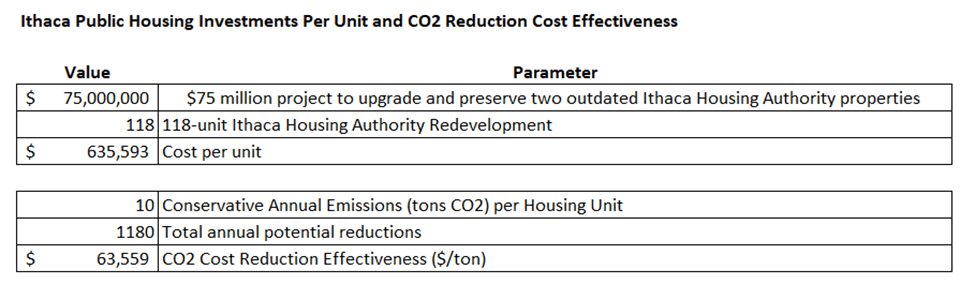
According to the press release this is a $75 million project to upgrade and preserve outdated Ithaca Housing Authority properties that will renovate or rebuild a total of 118 housing units.  That works out to $635,593 per unit. The two components of the project both include a community building that also has mechanical equipment but however you calculate the cost per housing unit it is extremely high.  According to the Ithaca Journal the typical cost of a home in Ithaca’s county in June 2022 was $357,450 and the cost of these units is well above that value.

 The Press Release notes that:

All three properties will be highly energy-efficient and have an all-electric building design pursuant to the New York’s nation-leading Climate Leadership and Community Protection Act to curb building emissions. Additional energy efficiency measures will include heat-reflective roofing systems with tapered insulation, ENERGY STAR rated appliances, energy-efficient lighting and low-flow plumbing fixtures for a projected 15 percent in total energy savings.

The Draft Scoping Plan for the Climate Act does not provide detailed enough data to determine an estimate of the typical residential greenhouse gas emissions per year.  The New York State Energy Research and Development Authority Patterns and Trends document gives estimates of total household energy for different fuels.  I used Energy Information Administration carbon dioxide emission coefficients by fuel and found that the highest estimated emissions for the New York are for homes using fuel oil.  As a conservative surrogate for the largest potential impact that these projects could possibly have, I used that estimate of 10 tons per year.  If we assume that the existing housing units are responsible for ten tons of GHG emissions per year and that the project will eliminate all the emissions that means that the annual reduction of GHG emissions is 1,180 tons.  The resulting cost per ton of CO2 removed is $63,559.
Discussion

This article addressed two concerns: is this what the CJWG thinks is appropriate and is this a good investment for society as a whole?  I believe that this project is an appropriate environmental justice investment because “All of the apartments will be for households earning at or below 80 percent of the Area Median Income”.   As far as I can tell however, only Southview Gardens is in a draft Disadvantaged Community so it remains to be seen of all or only part of this investment is of the “least 35 percent, with the goal of 40 percent” investment target.

I have two relevant concerns about the Climate Act transition to net-zero.  The first is affordability and the second is feasibility.  The press release quotes Doreen M. Harris as saying “NYSERDA is pleased to see construction commence on the Ithaca Housing Authority redevelopment project, which demonstrates that clean, resilient and affordable housing can be accessible to all New Yorkers”.  The numbers are worrisome relative to the claim that this project will demonstrate that affordable housing that meets the standards for the Climate Act is viable.  Seriously, given that there are probably at least one million housing units similar to these, can New York afford to upgrade public housing to those standards at a cost over $600,000 per unit or over $600 billion in total? 

As noted above the typical cost of a home in Ithaca’s county in June 2022 was $357,450.  It is notable that there is such a big difference in cost relative to the redevelopment costs.  Without a lot of work, it is not possible to break down the cost estimates to see how much of the projected costs are due to the energy transition enhancements. If those costs are a significant driver in the difference, then it is appropriate to ask whether this is an appropriate environmental justice investment.  In my opinion, it is more appropriate to address environmental justice concerns for impacted communities today than it is to make investments that are futile unless all jurisdictions in the world also make similar commitments.  Given that there is a limited amount of money available, then providing more upgraded housing is a better investment than limiting the housing upgrades because of the increased costs of the net-zero transition.

Conclusion

It will be interesting to see how this plays out.  The Ithaca Housing Authority projects meet all the criteria for appropriate environmental justice investments except that most of the housing affected is outside of a Draft Disadvantaged Community.  Will the CJWG recommend that all or only part of the funding be included in the 35% target and what will the State say?

The numbers are not encouraging from an affordability standpoint.  If this is any indication of the potential costs for environmental justice investments then there will be problems.  In addition to the magnitude of the per housing unit cost, the cost reduction efficiency is an issue.  According to the Integration Analysis in 2020 the building sector emitted 105 million metric tons of carbon dioxide equivalent.  Until such time that the cost per ton reduced for the building sector is brought down three orders of magnitude ($63 instead of $63,000 per ton reduced), I cannot imagine that the emissions reductions are affordable.

Addendum for Press Release Quotes:

Homes and Community Renewal Commissioner RuthAnne Visnauskas said, “This $75 million investment in the Ithaca Housing Authority speaks to our commitment to upgrading and protecting our existing affordable housing assets. The redesign of these apartments will yield modern and highly energy-efficient homes for 118 households and will preserve affordability and extend the useful life of these buildings for decades to come. Governor Hochul’s bold and forward-looking housing agenda is ensuring a brighter and more secure future for public housing residents in Ithaca and across the entire state.”

New York State Energy Research and Development Authority President and CEO Doreen M. Harris said, “NYSERDA is pleased to see construction commence on the Ithaca Housing Authority redevelopment project, which demonstrates that clean, resilient and affordable housing can be accessible to all New Yorkers. Through the Clean Energy Initiative, we are working with our sister agency, New York State Homes and Community Renewal, to make strategic investments in multifamily buildings like those being developed through this project, that reduce greenhouse-gas emissions and provide healthier, comfortable and resilient living spaces.”

Senator Chuck Schumer said, “Every New Yorker deserves access to safe affordable housing, but historic underinvestment has created a housing crisis in places like Ithaca. I am proud that the federal Low-Income Housing Tax Credit that I have fought hard to protect and expand has supplied the millions needed to make these new affordable homes a reality. Housing is a human right and I will keep fighting to get every dollar of federal support needed to help lay the foundation in Ithaca for a brighter, ‘gorges’, and more equitable future for all residents.”

State Senator Tom O’Mara said, “State investments in safe and affordable housing continue to strengthen the fabric of neighborhoods and the quality of life for tenants and residents in the city of Ithaca and communities across this region and state.  It’s an important commitment that will deliver critical short- and long-term benefits.”

Assemblymember Anna Kelles said, “I am encouraged to see this project move forward at a moment when rising rents, increased home prices, and lack of supply have exacerbated the housing and affordability crisis. We must continue to create affordable and safe housing for low- and middle-income families. This project addresses this need by rehabilitating 36 units, and fully replacing 70 units that were outdated and potentially unsafe with 82 new, safe, and sustainable units. This 118 unit project will add 12 new units, including one and two bedroom units which are currently in acute deficit in Ithaca and all units will be rented at 80% area median income (AMI). Hopefully this is just one more step in a long needed road of adding to our affordable housing stock. I also applaud the project’s sustainability goals with all of the units in this housing project constructed all-electric with air source heat pumps providing heating and cooling, in line with the city of Ithaca and Tompkins County aggressive climate goals.” 

Acting Ithaca Mayor Laura Lewis said, “The city of Ithaca is pleased to have the support of so many partner agencies in the redevelopment of critically needed low-income housing. Substantial renovations of Overlook Terrace and Southview Garden and, at Northside Apartments the complete replacement of outdated buildings that were first constructed decades ago, will provide families with high quality and environmentally efficient homes. This investment in our community will benefit generations of Ithacans.”

Tompkins County Legislature Chairwoman Shawna M. Black said, “This project is an excellent example of re-invigorating our affordable housing options in Tompkins County. We’re proud of what Ithaca Housing Authority offers to our community and that these projects will be energy efficient and align with New York State’s Climate Leadership and Community Protection Act. Thank you to New York State, Ithaca Housing Authority, and our Tompkins County Community Housing Fund for contributing to these developments. I can’t wait to see construction begin and to get people back into their homes.”

3d Development Group President Bruce Levine said, “Our focus was on the needs of the existing tenants, future tenants, the community at large, and the global need for improved energy sustainability and reducing fossil fuel emissions. This project was made possible by the support received from the state, federal and local government agencies. Because everyone got on board and believed in the goals and initiative, the final result will transform the Ithaca Northside neighborhood for decades to come.”

Ithaca Housing Authority Executive Director Brenda Westfall said, “Our vision and end goal is to provide quality affordable housing for our current and future tenants while ensuring that the properties are energy efficient and meet energy sustainability goals for decades to come. As a lifelong resident of the city of Ithaca, it is extremely rewarding to witness the commitment and support that many different agencies brought forth in bringing our vision to life. This project will both improve and preserve the quantity and quality of affordable housing we are able to provide while complimenting the landscape of the neighborhoods in which the properties are located.”

Climate Act Draft Scoping Plan Benefits Comment

The Climate Leadership and Community Protection Act (Climate Act) has a legal mandate for New York State greenhouse gas emissions to meet the ambitious net-zero goal by 2050.  This article describes the comments that I submitted addressing all the alleged benefits claimed in the Draft Scoping Plan.

Everyone wants to do right by the environment to the extent that they can afford to and not be unduly burdened by the effects of environmental policies.  I have written extensively on implementation of New York’s response to that risk because I believe the ambitions for a zero-emissions economy embodied in the Climate Act outstrip available renewable technology such that it will adversely affect reliability, impact affordability, risk safety, affect lifestyles, and will have worse impacts on the environment than the purported effects of climate change in New York.  New York’s Greenhouse Gas (GHG) emissions are less than one half one percent of global emissions and since 1990 global GHG emissions have increased by more than one half a percent per year.  Moreover, the reductions cannot measurably affect global warming when implemented.   This page documents all the comments that I submitted as part of the Climate Leadership and Community Protection Act implementation process. The opinions expressed in this post do not reflect the position of any of my previous employers or any other company I have been associated with, these comments are mine alone.

Climate Act Background

The Climate Act establishes a “Net Zero” target (85% reduction and 15% offset of emissions) by 2050. The Climate Action Council is responsible for preparing the Scoping Plan that will “achieve the State’s bold clean energy and climate agenda”.  They were assisted by Advisory Panels who developed and presented strategies to the meet the goals to the Council.  Those strategies were used to develop the integration analysis prepared by the New York State Energy Research and Development Authority (NYSERDA) and its consultants that quantified the impact of the strategies.  That material was used to write Draft Scoping Plan that was released for public comment at the end of 2021. The Climate Action Council will revise the Draft Scoping Plan based on comments and other expert input in 2022 with the goal to finalize the Scoping Plan by the end of the year.

Comments

The Climate Leadership and Community Protection Act Scoping Plan claims that “The cost of inaction exceeds the cost of action by more than $90 billion”.   However, the benefit claims are poorly documented, misleading and the largest benefit is dependent upon an incorrect application of the value of carbon.  My comments address the Scoping Plan benefit claims and explain how the value of carbon is used incorrectly.

The Scoping Plan claims net benefits range from $90 billion to $120 billion. The Plan describes health benefits totaling $165 to $170 billion due to improvements in air quality, increased active transportation ($39.5 billion), and energy efficiency interventions in LMI homes ($8.7 billion).  The benefit claims are not documented well enough to confirm those estimates but they appear to be biased high.  The claimed benefits for the avoided cost of GHG emissions range between $235 and $250 billion.  However, Climate Act guidance incorrectly calculates avoided GHG emissions benefits by applying the value of an emission reduction multiple times.  If the multiple-counting error is corrected, the avoided carbon damage benefits range from negative $74.5 to negative $49.5 billion.  These errors should be corrected in the Final Scoping Plan.

The Scoping Plan air quality improvement benefits range between $100 billion and $103 billion for the low values and the high values range between $165 billion and $172 billion.  These benefits are due to an air quality improvement for PM2.5 of 0.35 µg/m3 that is supposed to “avoid tens of thousands of premature deaths, thousands of non-fatal heart attacks, thousands of other hospitalizations, thousands of asthma-related emergency room visits, and hundreds of thousands of lost workdays”. However, the modeled impacts rely on a linear no-threshold model.  The observed PM2.5 reduction in New York City since 2005-2007 is 5.6 µg/m3 and that is 16 times higher than the projected decrease due to the Climate Act.  Using the linear no-threshold model that means that we should be able to observe sixteen times tens of thousands of premature deaths, sixteen times thousands of non-fatal heart attacks, sixteen times thousands of other hospitalizations, sixteen times thousands of asthma-related emergency room visits, and sixteen times hundreds of thousands of lost workdays.  When the Climate Action Council and Final Scoping Plan verifies that these reductions have been observed I will accept these benefits.

The Scoping Plan admits that the health benefits from increased active transportation “should be considered a first-order approximation of the benefits of increased active transportation”.  The active transportation health theory claims that as people are forced out of their personal vehicles some will switch to walking and biking.  Those activities are healthier so there is a benefit.  However, the analysis was conducted at the state level, rather than modeling changes in walking and biking activity due to changes in vehicle miles traveled within counties or individual communities.  Because the actual number of places where this strategy could actually encourage more walking and bicycling to work is small relative to the state as a whole, the $39.5 billion health benefit claim is far too high.  The Final Scoping Plan active transportation benefits should be revised to take into account the number of places where this might work.

The majority of the health benefits from energy efficiency interventions in Low and Middle Income (LMI) homes are the result of “non-energy interventions”.  The Climate Act intends to transform the energy sector so it is disingenuous to claim health benefits not directly related to energy efficiency programs themselves.  Of the $8.7 billion in benefits claimed $3 billion is due to reduction in asthma-related incidents resulting from better ventilation not directly due to energy efficiency.  The $2.4 billion in benefits from reduced trip or fall injuries and reduced carbon monoxide poisoning benefits are non-energy interventions and should not be claimed as benefits for GHG emission reduction programs.  The “non-energy interventions” benefits should not be included in the Final Scoping Plan.

The Scoping Plan claims that 2020-2050 societal benefits are greater than societal costs by between $90 and $120 billion.  The largest proposed benefits come from avoided GHG emission impacts on climate change due to emission reductions.  The Climate Act Scoping Plan manipulates the emissions, the emissions accounting, and calculation of social cost of carbon benefits to inflate these benefits to claim that there are net benefits.  In order to maximize the benefits from emission reductions the Scoping Plan uses non-conventional assumptions to contrive increased emission estimates that are 1.9 times higher in 1990 and 2.3 times higher in 2019 than conventional, or UNFCCC, format for emissions accounting used by other jurisdictions.  New York’s Value of Carbon guidance chooses a lower discount rate that places lower value on immediate benefits relative to higher delayed benefits received in the future.  The combined effect of the higher emissions and lower discount rate means that New York’s societal benefits of GHG emission reductions are 4.5 times higher for 1990 emissions and 5.4 times higher for 2019 emissions than other jurisdictions.  Most importantly, it is inappropriate to claim the benefits of an annual reduction of a ton of greenhouse gas over any lifetime or to compare it with avoided emissions. The Value of Carbon guidance incorrectly calculates benefits by applying the value of an emission reduction multiple times.  Using that trick and the other manipulations results in New York societal benefits more than 21 times higher than benefits using everybody else’s methodology. When the over-counting error is corrected, the total societal benefits range between negative $74.5 billion and negative $49.5 billion.  The Final Scoping Plan should only take credit for societal climate change benefits based on total emission reductions from the baseline, the maximum observed total emissions or the most recent total emissions.

Conclusion

If anyone wants an example of a report that was written to justify a politically driven preconceived notion the Draft Scoping Plan fits the bill.  No where is this more evident in the cost-benefit analysis that had to show that the plan would have benefits greater than the costs.  The costs are poorly documented but it is still obvious that overt manipulation was used to claim lower costs in many ways.  Furthermore, the costs are presented relative to a Reference Case that does not represent business-as-usual per usual practice.  Instead, the Reference Case includes programs that even they are already implemented would not be considered were it not for the Climate Act.

The benefits assessment is nearly as bad.  While it is common practice to claim health benefits to air quality improvements no one has validated the methodology used by comparing health outcomes with the significant air quality improvements observed since the 1990 Clean Air Act.  The benefits analysis also claims benefits because people will walk more when they take away personal transportation options.  In a desperate attempt to find benefits for low and middle-income communities they included “non-energy interventions” benefits which clearly is outside the scope of Draft Scoping Plan implementation strategies.

The largest of the so-called benefits comes from the reduction of societal impacts when New York greenhouse gas emissions are reduced.  New York has a unique accounting system enshrined in the Climate Act law by politicians who had no idea of the implications.  Even though the machinations project benefits multiple times greater than other jurisdictions it was still not enough to get the benefits large enough to out-weigh the costs.  The Draft Scoping Plan incorrectly calculates the societal benefits by applying the value of an emission reduction multiple times.   If you lost five pounds five years ago you cannot claim that you lost 25 pounds but that is what the Draft Scoping Plan is doing. 

Worst of all is that the Climate Action Council propaganda is working.  I see many reports that reference the claim that the cost of inaction exceeds the cost of action by more than $90 billion.   That claim is simply not true.  The benefits are imaginary but the costs will be real.

Failure of the Climate Change Scoping Plan to Meet the Requirements of the Climate Act

This post describes the comments submitted on the Draft Scoping Plan by Herschel Specter. If I knew how to do guest posts on this site, I would have made this a guest post.  My apologies but I am going to have to wing it.

Herschel Specter is the President of Micro-Utilities, Inc. and holds a BS in Applied Mathematics from the Polytechnic Institute of Brooklyn and a MS from MIT in Nuclear Engineering. He is a Licensed Professional Engineer in the New York.  He is a passionate supporter of nuclear power.  While I don’t agree with everything in his comments there are many great points.  I asked Herschel if I could make his comment letter into a post and he agreed.  The following text is from his cover letter.  I have posted his comments here.

Overall Conclusions

(A) The largest challenge facing the CAC and NY State is to regain the confidence of the people of New York that its energy plan is fact-based, technically agnostic and sound, and is forward looking, free of any past political or ideological influences. The Scoping Plan does not convey such confidence-building characteristics, and 

(B) The scoping plan fails to implement the Community Protection (CP) portion of the Climate Leadership and Community Protection Act (CLCPA), detailed below. Even if this NYSERDA scoping plan could work, what good is it if most people cannot afford the electricity this scheme would produce, and,

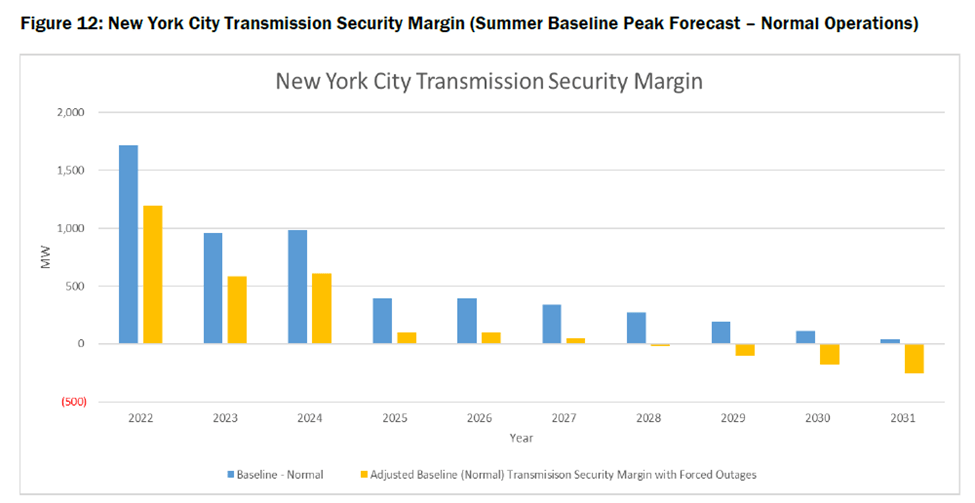
(C) The claim in Section 3.1 of the scoping plan that NY State is a leader in dealing with climate change is unsupported by the facts. For years NY State has favored imported fracked gas over building renewable energy infrastructure, while also opposing further expansion of clean nuclear power. (See Appendix C, page 43, of the attached critique). It is not convincing that NY is a leader in climate change when a major state agency, NYISO, recently reported that the State, and especially New York City, face dangerous shortages this decade in electricity generation and in electricity transmission. (See Reference 2 of the attached critique).

Specific Comments

1.High Costs. Electricity is a critical commodity, but its cost is regressive. High electricity prices disproportionately burden LIM (low income-to-middle income) families. The scoping plan places near exclusive reliance on renewable energy (solar and wind). Yet other studies have shown a mix of variable energy sources (solar and wind) joined with firm energy sources (nuclear and/or fossil fuels with no net carbon) are far less expensive. In one study a mix of energy sources reduced the electricity costs of a proposed all renewable electricity future from 15 cents/kilowatt hour to 9 cents per kilowatt hour. (See Table A4, page 20, of the attached critique). NYSERDA should have investigated which combinations of variable and firm energy sources are the least burdensome for low and middle income families. High electricity costs can cause businesses to relocate outside of New York, causing job losses.

2.Jobs-1. How many jobs will actually be created in New York when developing offshore wind capacity compared to jobs outside of New York? The Empire Wind Project is instructive. Two huge oil companies, British Petroleum (UK) and Equinor (Norway), have secured a contract from NY State to build the Empire Wind Project.  Not being in the wind turbine business, these oil companies turned to Vestas, a Danish wind turbine company, to build a huge (600 to 700 feet tall) wind turbine off of NYC. This assumes that the conditions of the Jones Act can be met. British Petroleum and Equinor recently filed a request with the Federal Energy Regulatory Commission for a one and a half year delay. Delays do not produce jobs. Importing wind turbines produces  jobs, overseas.

3. Jobs-2. It takes a special type of ship, called a jack ship, to lift the very heavy offshore wind turbine hub (the nacelle) and football field length turbine blades into place while at sea. New York does not make or own such jack ships. There is only one jack ship under construction, for a different state in the USA, large enough to install the huge 15 MW Vestas design. This specialized ship has a cost of $500 million dollars and requires three years to construct. However China makes such huge specialized ships with the latest one deployed off of the east coast of England. It takes an enormous crane to lift the nacelle and turbine blades. New York does not manufacture such huge cranes, but many overseas companies do. What is the NYSERDA plan to install these very large offshore wind turbines? How many MWs/year can be installed considering the limited number of jack ships? Per NY taxpayer dollar, how many pennies go to New York workers to build and install this mammoth offshore project and how much money goes out of state?

4.Jobs-3/ land use. According to the Daily News [“State reaffirms Alle-Catt wind farm”, Matt Surtel, September 30,2020] the 30,000 acre Alle-Cat wind farm will employ 182 jobs during construction, but this will decrease to just 13 permanent jobs to operate the facility. At that rate, a million acres of onshore wind farms would only create 400 permanent jobs, less than half the number of jobs lost when Indian Point was closed. This 340 megawatt wind farm will need 125 times the area of the Indian Point site to produce less than 5% of the electricity that was generated  at Indian Point.

5.Public anger-1 Upstate communities have taken NY State to court because they were stripped of  Home Rule protection while solar and  wind farms are being imposed on them. This hardly seems like implementing the Community  Protection portion of the CLCPA. Fishermen off of Long Island are similarly aggravated with the State’s offshore wind  program and complain of being ignored by the State. Where is consent-based siting? About 1,000 high paying jobs were lost, as well as substantial tax revenue, as a result of NY State’s actions to press for the closure of Indian Point nuclear plants and replace these two nuclear units with gas. Citizens of New York have not forgotten that they were told by former Governor Andrew Cuomo that Indian Point would be replaced by non-carbon sources. That never happened. Such actions are not confidence building. After years of reducing the carbon intensity per KWh of NY’s electricity, it is on the rise again because clean electricity from Indian Point was replaced by gas. The price  for electricity and home heating and making hot water with gas has skyrocketed. This is partly due to world conditions, but as  newspapers in the Hudson Valley point out, it is also due to the closure of Indian Point which did not burn fossil fuels, but rather produced 80% of the carbon-free electricity in downstate New York..

6. Public anger-2  The Danskammer plant in  Newburgh, NY, originally was an old coal burning plant that  was shutdown. It was refurbished to run on gas, but a special regional surtax on people was set up to pay for this refurbishment. If the people are paying  for new gas infrastructure, why don’t they own this gas infrastructure? Moreover, people were told that this refurbished plant would only be used infrequently; during times of peak demand. Later there was an effort to allow Danskammer to run full time, which angered local people, many of whom live in nearby environmental justice areas. Thanks to Governor Hochul and the DEC, this expansion of Danskammer use was not permitted, nor was a large new gas plant in Astoria, Queens approved. But as NYISO makes clear, this compounds the dangerous electricity reliability issue. No State agency has come forward with a plausible plan to provide clean electricity while reducing greenhouse gases in a time frame that would avert the potential blackouts this decade that NYISO has warned about. How does NY State simultaneously deal with climate change and continue to meet reliability requirements using realistic renewable energy manufacturing and installation capacities? This emerging crisis NYISO identified would not be pending if the Indian Point units were still operating.

7. Still more public anger-3. It appears that the CPV gas plant has been allowed to operate without all required permits and this plant has EJ areas nearby. If this lack of all necessary permits is still true, the DEC should require full compliance or shut CPV down.

8. Security issues. Increased use of natural gas for electricity production, home heating, and in making hot water has prompted gas delivery utilities to seek additional pipeline infrastructure. The former Governor was opposed to this, which led to open conflict between the former Governor and these gas utilities. This has been temporarily resolved by allowing some gas to be delivered by trucks, even though pipelines are safer and less expensive. This compromise has created a new class of terrorist targets; “truck bombs” that drive on our neighborhood streets.

9. Land use. In order to implement the NYSERDA scoping plan an estimated 24.4 million solar panels, each 25 square meters in size, would be needed. (See page 43 of the critique). A “rule of thumb” published in recent solar literature is that each megawatt of solar energy capacity requires about ten acres of land. At that rate it would take about 950 square miles. of New York farm and forest lands to accommodate this massive solar buildout. What will be the reaction of upstate New Yorkers to such a huge expansion? Yet solar energy is the least attractive choice for dealing with climate change. It is inherently less resilient to climate change than firm energy sources (See section 6.3 of the attached critique) It has the lowest capacity factor of any clean energy source, around 14%, as reported by NYISO, while nuclear is over 90%. Without expensive storage It is not dispatchable and is incapable of reducing the peak demand in winter which occurs after sunset. As NY State moves towards being a winter peaking state, this winter limitation of solar energy becomes an even larger negative attribute. Further, such extensive reliance on solar energy furthers  upstate/ downstate friction. Upstate people are to make sacrifices in values they hold dear, such as not being a victim of renewable energy industrialization in their back yard, just  to provide electricity  to downstate areas and NY City. NYSERDA should clearly and completely discuss the future use of present upstate nuclear plants which many upstate people support, particularly since their land use per KW hour is far less than renewable energy sources and jobs at these units pay well..

Land use is a highly charged subject. Not only is it an issue in upstate NY, it shows up  everywhere. For example, people in White Plains recently rejected the installation of solar panels in a cemetery because doing so  would have required the cutting down of a large stand of trees.  The two nuclear units at Indian Point supplied enough clean electricity to power 25% of the electricity in New York City and Westchester County, yet their land use was less than one half of one square mile. 

10.Data  errors. The NYSERDA plan has serious data errors in the capacity factors it used (See Section 8 of the attachment) . These data errors, collectively, would produce a capacity shortfall are almost the size of the whole NY State present electricity capacity.

11. Modeling errors. In 2021 an estimated 702 people died and almost $200 billion dollars worth of damage occurred in Texas when there was a gap in the supply of electricity during a polar vortex. Two things are happening simultaneously which call for a careful analysis of what is needed to design a NY  future electric grid. We  will experience extreme temperatures, hot and cold, more frequently and for longer durations. Also, we are moving towards a more electrified future we are far more dependent on electricity.. When there is an electricity gap during a time of extreme heat or cold,  people may die.  It appears that the  NYSERDA draft plan is not based on preventing an energy gap during extreme conditions like a polar vortex or very high statewide temperatures, but is just designed to meet the  typical energy needs during a week of cold weather in January, 2050. (See Section 9.2 of the attachment). To prevent loss of lives the grid should be designed to cope with extreme temperatures, with an additional margin  for unanticipated losses of generation and transmission. Further, NYSERDA did not account for very large and long duration wind lulls like that which occurred last year over all of northern England (See Reference 6  in the attached critique). There are other modeling errors identified in the attachment, as well as very questionable assumptions about the rate renewable energy devices, like offshore wind turbines, can be built and installed.

12. Energy storage. Unlike nuclear plantswhere energy storage is built right into the uranium pellets in the fuel rods, renewable energy needs energy storage because of its variability and for times when the sun is not shining and/or the wind is not blowing.  Unlike other New York energy future  studies which relied on Renewable Natural Gas, an undeveloped technology, NYSERDA turned to hydrogen for energy storage. It is hard to imagine a more difficult material to work with. Because of its very small molecular size, hydrogen has a much higher propensity than natural gas to leak out of piping and storage systems. Hydrogen leakage is important from a safety point of view; hydrogen has an ignition range six times wider than what natural gas has. (See TABLE A-8 of the attached critique.)

The volumetric energy density of hydrogen is very low. In order to achieve economically attractive volumetric energy densities, hydrogen would either have to be compressed to pressures in the 10,000 to 15,000 PSI (pounds per square inch) range or cooled to minus 253 degrees C, which is approaching absolute zero. Because of the required very high pressures, hydrogen cannot be distributed through the present natural gas piping or used in present gas storage infrastructure. It takes a significant amount of energy to cool hydrogen down to an extremely low temperature and to maintain this very low temperature. Hydrogen also embrittles steel. How did the NYSERDA plan account for this?

These challenging attributes of hydrogen make it difficult to store or distribute at reasonable costs. In practice, when hydrogen is used in industry, its source and the end user, like a refinery, are co-located on the same site. This co-location minimizes hydrogen storage and distribution issues. The distributed nature of NYSERDA’s energy sources and NYSERDA’s end users greatly limits co-location opportunities. The scoping plan describes a process of using solar energy to make hydrogen from water by  electrolysis. This (compressed?) hydrogen would be stored for months then, assumedly, burned  in some kind of a hydrogen fueled gas turbine (now under development) or fuel cells to convert the stored hydrogen back into electricity. NYSREDA assigns a 50% round trip energy loss for this process. It is not clear if this includes hydrogen losses through leakage while in storage, or the energy it takes to compress or cool the hydrogen, or the energy losses in the gas turbine. If the source of electricity is solar energy and NYISO’s 14% solar capacity factor is used, the overall efficiency of the solar/hydrogen storage/ burning in gas turbines to get back to electricity would be, at best, about (0.14)((0.50) = 0.07. Would a 7% efficient energy storage system result in a low-cost electricity as needed by LIM families? If it becomes obvious that hydrogen storage is unworkable, what is NYSERDA’s backup storage plan?

About the Author

Herschel Specter, President of Micro-Utilities, Inc., holds a BS in Applied Mathematics from the Polytechnic Institute of Brooklyn and a MS from MIT in Nuclear Engineering. He is a Licensed Professional Engineer in the State of New York. At the Atomic Energy Commission in the 1970s he was responsible for the licensing of the Indian Point 3 nuclear power plant. In the 1980s the New York Power Authority hired Mr. Specter to defend its Indian Point 3 nuclear plant in a federal adjudicatory trial. He and his team of experts prevailed in court. Mr. Specter served at diplomat rank for 5 years at the International Atomic Energy Agency in Vienna, Austria where he led an international effort writing design safety standards for nuclear power plants.

Mr. Specter has been Chairman of two national committees on nuclear power plant emergency planning and was a guest lecturer for several years on emergency planning at Harvard’s School of Public Health. He analyzed emergency responses for a hypothetical terrorist attack on the Indian Point power plants which were located in the nation’s highest population density area. Mr. Specter has presented testimony at the National Academy of Sciences on the Fukushima accident and on other nuclear safety matters and has been a guest speaker at many universities on matters of energy policy.Today he is one of 14 Topic Directors in Our Energy Policy Foundation, a group of about 1500 energy professionals who seek to bring unbiased and comprehensive energy information to our political leaders and members of the public.

Mr. Specter has been active in social and environmental matters. He has been a Big Brother and in 1971 had the honor of being selected as “Big Brother of the Year” for all of the USA and Canada. While voluntarily serving as President of Big Brothers of Washington, D.C., the number of boys the agency helped was doubled. He also received a personal letter of commendation from the President of the United States for his work with the Youth Conservation Corps.

Mr. Specter was born in White Plains, NY and lives there now.

New York Climate Act: Cost Estimate Sleight of Hand

The major concerns for any net-zero transition program are the effects on reliability and affordability.  On March 25, 2022 an article of mine was posted: New York Climate Act: What the Experts are Saying Now that explained why the experts responsible for the reliability of the New York electric grid are concerned about the mandated transition to a “zero-emissions” electric grid by 2040. This post addresses affordability showing that the costs presented in the plan for the transition are mis-leading at best.

Background

New York’s Climate Leadership and Community Protection Act (Climate Act) was passed in 2019 and became effective on 1/1/2020. The Climate Action Council has been working since then to develop plans to implement the Act.  Over the summer of 2021 the New York State Energy Research & Development Authority (NYSERDA) and its consultant Energy + Environmental Economics (E3) prepared an Integration Analysis to “estimate the economy-wide benefits, costs, and GHG emissions reductions associated with pathways that achieve the Climate Act GHG emission limits and carbon neutrality goal”. Three Integration Analysis implementation strategies were incorporated into the Draft Scoping Plan when it was released for public comment at the end of 2021.  These scenarios include different policy options to meet and exceed the Climate Act targets. 

My last post highlighted results shown in a draft presentation at a New York Independent System Operator (NYISO) meeting about an analysis being done to project the amount and type of generating capacity needed to transition the New York electric grid to “zero-emissions” by 2040.  The experts at the meeting are concerned because “Some scenarios do not represent realistic system performance” and the total projected wind, solar, energy storage and “dispatchable emissions-free resources” capacity additions projected are on the order of double the total current capacity.   The 2021-2030 Comprehensive Reliability Plan report concludes “While there are hundreds of projects in the NYISO interconnection queue, there are none that would be capable of providing dispatchable emission-free resources that could perform on a multi-day period to maintain bulk power system reliability. Such resources are not yet widely commercially available.”   That resource alone is greater than the total existing capacity so there certainly are reliability concerns.

A couple of weeks ago I posted an article on my blog showing an egregious example of hiding the true costs of the Scoping Plan. While I was drafting an overview presentation on the Draft Scoping Plan for my state Senator, I took another look at information supporting the assertion that the “cost of inaction exceeds the cost of action by more than $90 billion”.  I realized my concerns with the cost projections could be more clearly explained using the figures in Draft Scoping Plan Appendix G: Integration Analysis Technical Supplement Section I (Appendix G).  This post is the result.

Benefits and Costs Summary

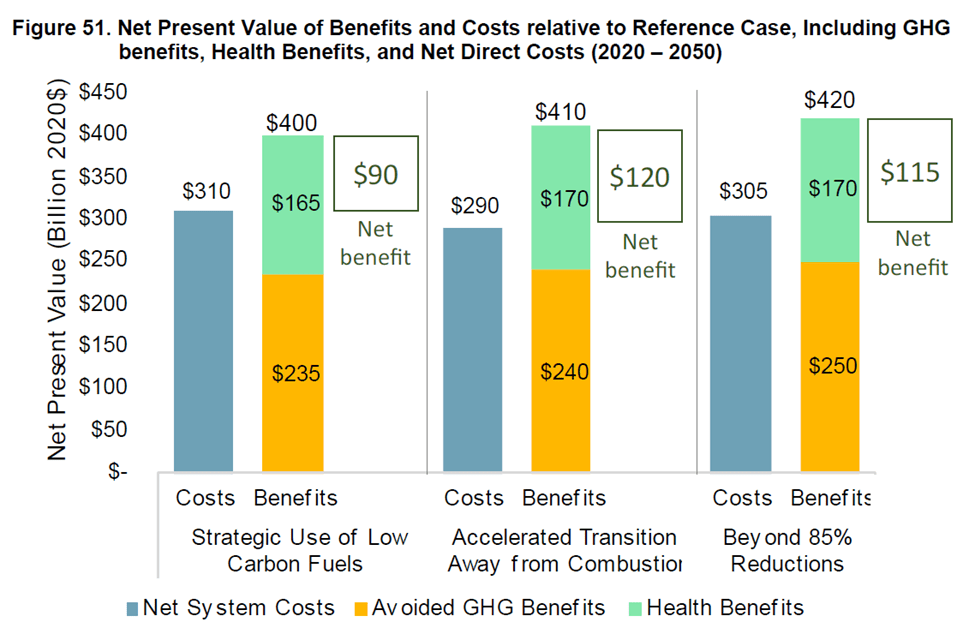
Appendix G Figure 51. Net Present Value of Benefits and Costs relative to Reference Case, Including GHG benefits, Health Benefits, and Net Direct Costs (2020 – 2050) on page 69 is the primary documentation for the assertion that the “cost of inaction exceeds the cost of action by more than $90 billion”.  Note that three scenarios are shown: “Strategic use of low carbon fuels”, “Accelerated transition away from combustion”, and “Beyond 85% Reductions”.  This net-zero program plans to reduce greenhouse gas emissions by 85% and then offset the remaining 15% to get to “net-zero”. The $90 billion number is the net benefit difference between the net system costs and the total benefits.  My first impression was that these numbers represented the total costs for New York State to meet the net-zero mandate.  I should have known better. 

Unpacking the title: the numbers are the “net present values”.  According to the Draft Scoping Plan the integration analysis included calculations for three cost metrics: net present value (NPV) of net direct costs, annual net direct costs, and system expenditures.  The Plan defines NPV of Net Direct Costs as the levelized costs in a given scenario incremental to the Reference Case from 2020 through 2050 using a discount rate of 3.6% and including incremental direct capital, investment, operating expenses, and fuel expenditures.  The annual Net Direct Costs are defined as the levelized costs in a given scenario incremental to the Reference Case for a single year snapshot and include incremental direct capital investment, operating expenses, and fuel expenditures.  I don’t have the background to comment on the impact of these definitions relative to the acceptability of the projections. 

System Expenditures

System Expenditures are defined as an estimate of absolute direct costs (not relative to the Reference Case) and do not reflect direct costs in some sectors that are represented with incremental costs only. Appendix G Figure 48, New Present Value of System Expenditures in Reference Case and Scenarios 2-4 (2020-2050) shown below describes these costs.   

An important aside: the Climate Act requires the Climate Action Council to “[e]valuate, using the best available economic models, emission estimation techniques and other scientific methods, the total potential costs and potential economic and non-economic benefits of the plan for reducing greenhouse gases, and make such evaluation publicly available” in the Scoping Plan.   This figure and the others included represent most of the cost documentation.  For example, the component costs in the reference case in this figure are not included in any supporting documentation.  There are spreadsheets that document other figures in the Draft Scoping Plan with the data tables used to generate the figures but I have been unable to find this information for any of the cost figures.  I submit that the Council has not fulfilled this requirement.

Figure 51 notes that the values listed are relative to the Reference Case.  Figure 48 is important because other than a text mention that the Reference Case is $2.7 trillion, it is the only documentation for Reference Case values.  It looks like the scenarios are all approximately $3 trillion consistent with the difference relative to the Reference Case ~$300 billion costs in Figure 51. 

In my recent article looking at this issue I described what was included in the Reference Case.  I searched the Draft Scoping Plan and the technical supplements for the phrase “Reference Case” for the analysis.  The best description of the Reference Case contents was in Appendix G, Section I on page 12 in a footnote for Figure 4: Gross Greenhouse Gas Emissions by Mitigation Scenario:

The Reference Case is used for evaluating incremental societal costs and benefits of GHG emissions mitigation. The Reference Case includes a business as usual forecast plus implemented policies, including but not limited to federal appliance standards, energy efficiency achieved by funded programs (Housing and Community Renewal, New York Power Authority, Department of Public Service, Long Island Power Authority, NYSERDA Clean Energy Fund), funded building electrification, national Corporate Average Fuel Economy standards, a statewide Zero-emission vehicle mandate, and a statewide Clean Energy Standard including technology carveouts.

If the documentation included a cost component breakdown that would enable readers to determine whether the reference case is a reasonable estimate of the costs without the Climate Act.  In my opinion many of those programs should not be in the Reference Case.  Looking at the bar chart the four biggest cost components are electricity, transportation investment, buildings investment and fossil liquids.  Note that the transportation investment (~700 billion) does not vary much between the four bars.  Keep that in mind.

Costs Relative to Reference Case

Appendix G Figure 47 lists the NPV of net direct costs relative to the reference case.  This illustrates what is meant by the net direct costs label.  In each of the mitigation scenarios there are avoided fossil fuel expenditures that are subtracted from the total costs of the implementation strategies to get the ~$300 billion net direct costs. 

Note that the transportation investments listed are no more than $30 billion for the scenario, Beyond 85%”, with the highest costs.  My original impression of Figure 51 was that it represented all the costs necessary for New York to get to net-zero.  Clearly $30 billion is nowhere near the cost to replace all the approximately 10 million vehicles in New York with electric vehicles that use batteries or fuel cells even if the cost differential was $3,000.  The total cost has to be higher to include the cost for personal electric charging stations or public electric chargers, at least. 

I think that the true cost to electrify New York transportation is shown in Figure 48.  The system expenditures listed suggest the transportation investment component cost is around $700 billion which makes more sense.  The justification to put those costs in the Reference case is a bit of semantic sleight of hand based on the footnote that says that the Reference Case includes a “business as usual forecast plus implemented policies”.  It is true that New York passed legislation setting a goal for all new passenger cars and trucks sold in New York State to be zero-emissions by 2035 in April 2021 so the Scoping Plan is consistent with the only explanation of the Reference Case components.

However, suggesting that this “implemented policy” should not be included in the Climate Act implementation costs is disingenuous. The press release announcing that the Governor signed the legislation states: “The actions announced today in advance of Climate Week 2021 support New York’s ambitious goal of reducing greenhouse gas emissions by 85 percent by 2050, as outlined in the Climate Leadership and Community Protection Act.”  It goes on to quote Governor Hochul: “New York is implementing the nation’s most aggressive plan to reduce the greenhouse gas emissions affecting our climate and to reach our ambitious goals, we must reduce emissions from the transportation sector, currently the largest source of the state’s climate pollution”.  I think that these statements pretty well represent any dispassionate observer’s belief that the only reason for the law is to support the Climate Act.  As such those are not legitimate Reference Cases costs.

Conclusion

The major concerns for any net-zero transition program should be the effects on reliability and affordability.  It is not in the best interests of society to implement a policy that does more harm than good.  Ultimately the underlying problem for the Texas Energy Debacle of February 2021 was poor reliability planning. As mentioned here, the rush to implement an energy policy that depends on a non-existent dispatchable emissions-free resources technology surely increases the possibility of a similar blackout in New York.  This post that the total costs for the New York energy system (2020-2050) are on the order of $3 trillion but that the costs attributable to the Climate Act are subject to interpretation. The affordability comparison of costs and benefits is strongly affected by that interpretation.

Appendix G Figure 51: Net Present Value of Benefits and Costs relative to Reference Case shows that costs relative to the Reference Case are on the order of $300 billion and that benefits are on the order of $400 billion to justify the claim that the “cost of inaction exceeds the cost of action by more than $90 billion”.  The Draft Scoping Plan claimed that vehicle electrification costs should be included in the Reference Case because the electric vehicle legislative mandate was an “implemented policy”.  However, the $700 billion costs to electrify the transportation investment component of Figure 48 system expenditures are a necessary cost for the net-zero transition and should not be included in the Reference Case.  Clearly those costs are a necessary transition expense.  If those costs are moved from the Reference Case to the mitigation scenarios where they belong, the costs are much greater than the benefits.

The Draft Scoping Plan was written to prove the desired conclusion that the benefits were greater than the costs.  In order to make that case both benefits and cost estimates have been perverted.  I have shown elsewhere that the benefits are uniformly exaggerated and the largest benefit is dependent upon an incorrect application of the social cost of carbon. The cost estimates are inadequately documented and, as shown here, a semantic trick was used to claim that the cost to de-carbonize transportation was claimed to be “business as usual” because the electric vehicle conversion legislation was already “implemented”.

—————————————————————————————————————————————

Roger Caiazza blogs on New York energy and environmental issues at Pragmatic Environmentalist of New York.  More details on the Climate Leadership & Community Protection Act are available here. This represents his opinion and not the opinion of any of his previous employers or any other company with which he has been associated.

Scoping Plan Renewable Energy Resource Availability Analysis

New York’s Climate Leadership and Community Protection Act (Climate Act) has a legal mandate for New York State greenhouse gas emissions to meet the ambitious net-zero goal by 2050. The Climate Action Council is responsible for preparing the Scoping Plan that will “achieve the State’s bold clean energy and climate agenda”.  This post describes comments I submitted to the Council about the inadequate analyses of renewable energy resources in New York.  It is important to get this right because the availability of renewable energy resources informs the basis of resource adequacy planning.

I have written extensively on implementation of the Climate Act because I believe the ambitions for a zero-emissions economy outstrip available renewable technology such that it will adversely affect reliability and affordability, risk safety, affect lifestyles, will have worse impacts on the environment than the purported effects of climate change in New York, and cannot measurably affect global warming when implemented.   The opinions expressed in this post do not reflect the position of any of my previous employers or any other company I have been associated with, these comments are mine alone.

Climate Act Background

The Climate Act establishes a “Net Zero” target by 2050. The Climate Act requires the Climate Action Council to “[e]valuate, using the best available economic models, emission estimation techniques and other scientific methods, the total potential costs and potential economic and non-economic benefits of the plan for reducing greenhouse gases, and make such evaluation publicly available” in the Scoping Plan.  The integration analysis developed by the New York State Energy Research and Development Authority (NYSERDA) and its consultants was used to develop the Draft Scoping Plan that was released for public comment on December 30, 2021. The Scoping Plan has to be finalized by the end of 2022 and a recent meeting discussed issues that need to be addressed to meet that schedule.

New York’s unprecedented transition to a zero-emission electric generating system means that the system will be heavily dependent upon wind and solar resources.   Because those resources are intermittent it is imperative that New York energy planning determine the frequency and duration of periods when wind and solar resources are low.  This article summarizes comments that I submitted on the problem, describes analyses that address this issue completed elsewhere, and recommends that New York agencies develop an appropriate study centered on New York.

Problem

The comments included a description of New York blackouts and the responses made to prevent reoccurrences.  I believe that, despite the best efforts of those responsible for the reliability of the electric grid, the transition to an electric power system that relies on intermittent wind and solar resources introduces so many changes that it will be impossible to anticipate them all.  As a result, grid resilience will decrease and blackouts are inevitable.   For example, consider that a team of researchers from the University of Nottingham recently addressed the effect of renewable energy resources on power grid stability.  The abstract from the paper states:

Contemporary proliferation of renewable power generation is causing an overhaul in the topology, composition, and dynamics of electrical grids. These low-output, intermittent generators are widely distributed throughout the grid, including at the household level. It is critical for the function of modern power infrastructure to understand how this increasingly distributed layout affects network stability and resilience. This paper uses dynamical models, household power consumption, and photovoltaic generation data to show how these characteristics vary with the level of distribution. It is shown that resilience exhibits daily oscillations as the grid’s effective structure and the power demand fluctuate. This can lead to a substantial decrease in grid resilience, explained by periods of highly clustered generator output. Moreover, the addition of batteries, while enabling consumer self-sufficiency, fails to ameliorate these problems. The methodology identifies a grid’s susceptibility to disruption resulting from its network structure and modes of operation.

My comments included a description of the Texas blackout of February 2021.  Ultimately the reason for the blackout was poor planning.  When the people of Texas needed electric power the most the generating resources available were unable to meet those needs.  In order to prevent the same thing from happening in New York it is necessary to provide sufficient energy at all times.

Reliability planning in the past relied on dispatchable generating resources.  The Climate Act future electric generating system will rely on intermittent renewable wind and solar that is not dispatchable.  Energy storage resources are needed to cover periods when wind and sun energy is not available to provide dispatchable electricity.  The problem is that we have to know what the worst-case renewable resource availability is in order to size the energy storage resources correctly.

Last year I described issues related to this as the Climate Act’s ultimate problem. Although there have been analyses that have identified winter wind lull periods are a problem, I do not believe that they addressed this analysis correctly because they used relative short periods as the basis for their projections.  As far as I can tell the Integration Analysis did not even consider the same period for wind and solar resources in their analysis.  As a result, I believe the Draft Scoping Plan projections for the amount of resources during these periods is incorrect.

Proposed Analysis

In order to do this right, the critical consideration is the frequency, duration, and severity of periods when wind and solar resources are in “droughts” or low resource availability.  I described several recent applicable papers that estimate the frequency and duration of periods with those conditions using a meteorological reanalysis data base.  In this approach historical observations are re-analyzed using current weather forecast models.  The first step in developing a weather forecast is to incorporate meteorological observations to setup the weather maps that are the starting point for weather forecast calculations.  That component of the models is used to develop weather maps for the observations and the forecast component is used to provide hourly data until the net observation period.

In order to provide a robust estimate of the wind and solar availability during worst case conditions it is necessary to analyze as long a time period of historical meteorological data as possible. The ERA5 global reanalysis data base generated using this reanalysis technique provides hourly estimates of a large number of atmospheric, land and oceanic climate variables. The data cover the Earth on a 30km grid and resolve the atmosphere using 137 levels from the surface up to a height of 80km. That information is then used to estimate the availability of hourly wind and solar resources for any area of the globe.

Last fall I described a paper that included an approach that might work for an analysis centered on New York.  Since then, I have been in touch with the author and I am not confident that using these data would be provide invaluable information. 

In my comments I strongly recommended an analysis in New York using the complete (1950 to present) ERA5 meteorological database to determine the frequency and duration of renewable resource droughts in order to estimate the appropriate worst case.  The goal of the project would be three-fold:

  • Determine historical intensity, frequency, duration and seasonality of wind and solar droughts in New York;
  • Identify co-occurrence of wind and solar droughts with high demand periods (heating/cooling degree days); and
  • Interpret the droughts and high demand periods: seasonal, weather regimes, interannual variability (e.g. El Niño-Southern Oscillation), multi-decadal climate regimes, and trend associated with global warming

Conclusion

I have submitted comments in various proceedings and have tried to work behind the scenes to get this analysis completed because I don’t think it is possible to adequately project the renewable resources necessary to keep the lights on when needed most without this information.  I submitted these comments to get on the record again that this work has to be done to ensure that sufficient renewable energy generation and energy storage is developed to prevent blackouts.

Air Permit Applications and the Climate Act

The implementation strategy for New York’s Climate Leadership and Community Protection Act (Climate Act) is being finalized by the Climate Action Council  in 2022.  Because the schedule is so ambitious the Council has been pushing for the implementation of policies even before the strategies are finalized.  This post addresses the New York State Department of Environmental Conservation (DEC) proposed policy DAR-21: The Climate Leadership and Community Protection Act and Air Permit Applications that is supposed to establish the procedures staff will use to review permit applications with respect to the Climate Act.  This turns out to be another example of the Climate Act putting the cart before the horse.

I have written extensively on implementation of the Climate Act because I believe the ambitions for a zero-emissions economy outstrip available renewable technology such that it will adversely affect reliability and affordability, risk safety, affect lifestyles, will have worse impacts on the environment than the purported effects of climate change in New York, and cannot measurably affect global warming when implemented.   The opinions expressed in this post do not reflect the position of any of my previous employers or any other company I have been associated with, these comments are mine alone.

Climate Act Background

The Climate Act establishes a “Net Zero” target by 2050. The Climate Action Council is responsible for preparing the Scoping Plan that will “achieve the State’s bold clean energy and climate agenda”.  The Climate Act requires the Climate Action Council to “[e]valuate, using the best available economic models, emission estimation techniques and other scientific methods, the total potential costs and potential economic and non-economic benefits of the plan for reducing greenhouse gases, and make such evaluation publicly available” in the Scoping Plan. Starting in the Fall of 2020 seven advisory panels developed recommended strategies to meet the targets that were presented to the Climate Action Council in the spring of 2021.  Those recommendations were translated into specific policy options in an integration analysis by the New York State Energy Research and Development Authority (NYSERDA) and its consultants.  The integration analysis was used to develop the Draft Scoping Plan that was released for public comment on December 30, 2021. The public comment period extends through at least the end of April 2022, and will also include a minimum of six public hearings. The Council will consider the feedback received as it “continues to discuss and deliberate on the topics in the Draft as it works towards a final Scoping Plan for release by January 1, 2023”.  Once that is complete the Energy Plan will be revised to set the state’s energy policies. The goal of the Energy Plan process is to “map the state’s energy future by showing how the state can ensure adequate supplies of power, reduce demand through new technologies and energy efficiency, preserve the environment, reduce dependence on imported gas and oil, stimulate economic growth, and preserve the individual welfare of New York citizens and energy users”.

The Proposed Policy DAR-21: The Climate Leadership and Community Protection Act and Air Permit Applications describes “the content of analyses required by the Division of Air Resources (DAR) pursuant to the requirements of Section 7(2) of the Climate Leadership and Community Protection Act (CLCPA). Chapter 106 of the Laws of 2019”. It further describes “the procedures staff in DAR will follow when reviewing those analyses for conformance with the requirements of the CLCPA”. Finally, this policy “establishes the types of air pollution control permit actions required to prepare an analysis as part of the permit application process”.

My Comments

I submitted comments on the proposed rule.  My main concern is that if DEC refuses to permit individual existing air permit applications without considering whether the facility is needed for reliability then problems could occur.  Importantly, DEC has no such responsibility so they should work with the New York Independent System Operator (NYISO) to cover this concern.

The policy document outlines the requirements for analyses developed “pursuant to Section 7(2) of the Climate Leadership and Community Protection Act (CLCPA) in support of air pollution control permit applications”. The document notes that the CLCPA went into effect January 1, 2020 (Chapter 106 of the Laws of 2019). It also notes that the CLCPA also establishes a Climate Action Council that is given three years (by January 1, 2023) to finalize a Scoping Plan providing recommendations for meeting those limits, and requires the DEC to promulgate regulations on GHG emission sources within four years (by January 1, 2024) that will ensure those limits are met. I commented that this policy is putting the cart before the horse. It is inappropriate to require analysis before regulations are promulgated simply because no standards have been established.

Ultimately the problem with the guidance document can be traced back to the CLCPA presumption that a transition to net-zero can be accomplished by 2050 if only there is political will. The reality is that there are enormous technological challenges particularly for the mandated schedule. As a result, there is a gaping hole in the Scoping Plan because it does not include a feasibility plan for the specific technology and schedule that the Climate Action Council proposes. It is not clear to me when and how the organizations responsible for electric system reliability will review and sign off on an implementation plan. Until that happens it is inappropriate for DEC to put any limitations on fossil-fired generation.

My comments argued that it is obvious that there are serious limitations with existing technology and the aggressive schedule. The New York Independent System Operator (NYISO) 2021-2030 Comprehensive Reliability Plan is the most recent reliability study in New York. It states:

Moving to 2040, the CLCPA requires generation to be emission-free. The Climate Change Study looked at 100 x 40 (emission-free electric grid by 2040). It noted the significant amount of dispatchable resources that would be needed to meet that goal but did not describe the technology that would be able to provide a dispatchable resource, instead choosing to refer to generic dispatchable, emission-free resources. Not surprisingly, the Climate Change report found that a similar amount of dispatchable resources as the RNA case would be needed to maintain reliability under baseline assumptions. However, under CLCPA assumptions, the amount of dispatchable emission-free resources needed increases to over 32,000 MW in 2040, approximately 6,000 MW more than the total fossil-fueled generation fleet on the grid in 2021. The Climate Change Study noted that the current system is heavily dependent on existing fossil-fueled resources to maintain reliability and eliminating these resources from the mix “will require an unprecedented level of investment in new and replacement infrastructure, and/or the emergence of a zero-carbon fuel source for thermal generating resources” (emphasis added). The Climate Change Study did note that while the amount of installed capacity (MW) of dispatchable resources is significant, the amount of energy generated (MWh) required from such resources would likely not be significant, with the percent of total energy being in the range of 10% ― 20% range depending on the penetration level of intermittent resources.

This guidance and the Draft Scoping Plan don’t consider one component of the CLCPA. The Public Service Commission mandate in Public Service (PBS) CHAPTER 48, ARTICLE 4, § 66-p. Establishment of a renewable energy program (4) that states:

The commission may temporarily suspend or modify the obligations under such program provided that the commission, after conducting a hearing as provided in section twenty of this chapter, makes a finding that the program impedes the provision of safe and adequate electric service; the program is likely to impair existing obligations and agreements; and/or that there is a significant increase in arrears or service disconnections that the commission determines is related to the program.

Given that the Energy Plan has to consider the provision for safe and adequate electric service, and it will not be prepared until 2023, it is premature for DEC to pick any winning or losing technologies in this guidance or any other permitting decisions for that matter. I recommended that the effective data be made contingent upon the completion of an Energy Plan that meets PBS Chapter 48, Article 4, § 66-p. Establishment of a renewable energy program requirement for safe and adequate electric service. Because reducing emissions is so dependent upon electrification the electric service criterion is a good surrogate for all permitting activities covered by the guidance.

There is another aspect of NYISO) 2021-2030 Comprehensive Reliability Plan (CRP) report that the guidance should consider.  My comments highlighted some risk factors that threaten electric system reliability in the report.  The CRP states:

As generators age and experience more frequent and longer duration outages, the costs to maintain the assets increase. These costs may drive aging generation into retirement. A growing amount of New York’s gas-turbine and fossil fuel-fired steam-turbine capacity is reaching an age at which, nationally, a vast majority of similar capacity has been deactivated. As shown in Figure 11, by 2028 more than 8,300 MW of gas-turbine and steam-turbine based capacity in New York will reach an age beyond which 95% of these types of generators have deactivated. 

The impact of the unavailability of system resources can readily be seen through tipping point evaluations. While transmission security within New York City (Zone J) is maintained through the ten-year period in accordance with design criteria, the margin would be very tight starting in 2025 and would be deficient beginning in 2028 if forced outages are experienced at the historical rate, as shown in Figure 12. Transmission security within Long Island (Zone K) is also maintained through the ten-year period, with the slimmest margin in the first few years as shown in Figure 13. If forced outages are experienced at the historical rate the Long Island margin would be sufficient through the study period.

My comments pointed out that using history as a guide, there will be forced outages from these old generating resources.  Obviously not renewing permits will exacerbate this problem.

Replacement Permit Applications

Obliviously, DEC has rejected permits for new replacement generating facilities that addresses this risk factor.  This was outside the scope of the guidance document but is important for readers to understand. In the DEC’s “Notice of Denial of Title V Air Permit” for the Danskammer Energy Center (DEC ID: 3-3346-00011/00017) and its “Notice of Denial of Title V Air Permit” for the Astoria Gas Turbine Power Project (DEC ID: 2-6301-00191/00014), the DEC rejected the use of both hydrogen and renewable natural gas (RNG) as a 2040 compliance mechanism because the DEC labeled them “speculative” and “aspirational”. However, the Scoping Plan’s placeholder for a dispatchable, emission-free resource is hydrogen. Governor Hochul’s recent State of the State address proposes that New York position itself to compete for nearly $10 billion in federal funding for green hydrogen R&D under the federal infrastructure bill. Obviously, it is in the state’s best interest to preserve the option to use hydrogen in the future. In the meantime, the options to supplant the dispatchable energy from those facilities with energy storage and renewable energy alternatives are no less “speculative” and “aspirational”.   In my comments I argued that the proposed guidance must incorporate a process similar to that used for the Peaker Rule (6NYCRR Part 227-3) whereby the NYISO works with DEC to ensure reliability issues are addressed for any permit application affecting electric generation viability.

Conclusion

The zeal of the State of New York to implement the Climate Act before the plan is complete is endangering the security of the electric grid.  In particular, there are many generating units in the state and New York City in particular that are nearing the end of their useful life. I submitted comments arguing that the DAR-21 Guidance must be revised to incorporate electric system reliability considerations.  Firstly, as shown above there are reliability concerns related to existing electrical generators.  The guidance must not preclude continued operation of existing units.  Secondly, DEC should not prevent operators from developing modern generating units that are more reliable than the existing aging units.  Even if the state plans to shut down all fossil-fired units by 2040 the owners know that and it can be addressed with a permit condition.  Finally, the Energy Plan has to consider the provision for safe and adequate electric service at the same time that the Draft Scoping Plan is proposing the use of currently unavailable technology.  For all three reasons it is premature for any DEC application to limit, shut down or prevent upgrades at existing electrical generation facilities.

The Real Cost of the Climate Act

On February 16, 2022 New Yorkers for Affordable Energy hosted a Zoom webinar titled The Real Cost of New York’s Climate Leadership and Community Protection Act.  The sponsor said to “feel free to share this with anyone you think would enjoy it” so this post describes the webinar.

I have written extensively on implementation of the Climate Act because I believe the ambitions for a zero-emissions economy outstrip available renewable technology such that it will adversely affect reliability and affordability, risk safety, affect lifestyles, will have worse impacts on the environment than the purported effects of climate change in New York, and cannot measurably affect global warming when implemented.   The opinions expressed in this post do not reflect the position of any of my previous employers or any other company I have been associated with, these comments are mine alone.

Climate Act Background

The Climate Act establishes a “Net Zero” target by 2050. The Climate Action Council is responsible for preparing the Scoping Plan that will “achieve the State’s bold clean energy and climate agenda”.  The Climate Act requires the Climate Action Council to “[e]valuate, using the best available economic models, emission estimation techniques and other scientific methods, the total potential costs and potential economic and non-economic benefits of the plan for reducing greenhouse gases, and make such evaluation publicly available” in the Scoping Plan. Starting in the Fall of 2020 seven advisory panels developed recommended strategies to meet the targets that were presented to the Climate Action Council in the spring of 2021.  Those recommendations were translated into specific policy options in an integration analysis by the New York State Energy Research and Development Authority (NYSERDA) and its consultants.  The integration analysis was used to develop the Draft Scoping Plan that was released for public comment on December 30, 2021. The public comment period extends through at least the end of April 2022, and will also include a minimum of six public hearings. The Council will consider the feedback received as it “continues to discuss and deliberate on the topics in the Draft as it works towards a final Scoping Plan for release by January 1, 2023”.

The The Real Cost of New York’s Climate Leadership and Community Protection Act webinar was organized by New Yorkers for Affordable Energy, “a coalition of community, labor, business and industry leaders from across the state who support greater access to clean, reliable and affordable sources of energy for residential and business consumers.”  They understand that reliability and affordability are at risk due to the Climate Act and are starting to get the word out to consumers who have no idea what is involved with the state’s plan to do “something” about climate change. There is a recording of the Zoom meeting but this article will focus on presentations made by six speakers.

New Yorkers for Affordable Energy

Michelle Hook, the Executive Director of New Yorkers for Affordable Energy (NYAE) gave the first presentation.  The mission for NYAE is “to educate New Yorkers about the impacts of New York energy policy on their personal livelihood and advocate for a pragmatic and balanced approach to our state’s energy decisions”.  She explained that there are active bills that could have major impacts:

  • S.8008/A.9008 Budget Bill TED, Part EEE and S.6841 (Kavanaugh) A.8431 (Gallagher) – “All Electric Buildings Act”
    • Both bills prohibit any new construction that is not all electric.
  • S.8198 (Krueger) – Statewide Natural Gas Transition Plan
    • Requires the PSC to develop a statewide gas transition plan that decreases gas sales and decommissions natural gas systems
  • S.5939-A (Ramos)/A.6761-A (Mamdani) – “Clean Futures Act”
    • Prohibits the development of any new major electric generating facilities that would be powered in whole or part by any fossil fuels.

She also brought up the issue of aging power plants and the potential impact to reliability.

New York Independent Power Producers

Gavin Donohue, the President and CEO of the New York Independent Power Producers is also a member of the Climate Action Council.  He explained that of the 22 members of the Council only two appointees are from the traditional energy sector, him and Donna DeCarolis of National Fuel Gas Distribution Company His presentation outlined the requirements of the Climate Act.  I will reproduce much of his material and, in the rest of the article, highlight differences between his take and the other presentations.

He listed the following recommendations from the Draft Scoping Plan:

  • Moratoriums on new gas infrastructure (NOT a Council-wide recommendation)
  •  No new natural gas service to existing buildings
  •  Prohibit propane, natural gas and oil equipment in new homes in 2024
  •  Prohibit traditional heating systems in existing homes in 2030
  •  Ban use of natural gas appliances (dryers, stoves, etc.) in homes in 2030
  •  No gasoline vehicles sold in New York in 2035

Donohue described the following gaps and challenges:

  • Gas and oil resources currently make up more than two-thirds of the energy downstate and one-third statewide overall
  • New York’s grid operator (NYISO) says quick-start power options are essential
  •  State power reserves are thin (no wiggle room for very hot/cold days or broken units)
    • NYSERDA says electrification and electric vehicles increases electric demand 65 to 80%
  • No consensus on what qualifies as Zero-Emission Dispatchable Technologies for 2030 and beyond
  • Increased electrification results in electric consumption doubling by 2050
    • Approximately 1 to 2 million homes will need to be electrified with heat pumps by 2030
  • Approximately 3 million zero-emission vehicles will need to be sold by 2030
  • Necessary to create emission-reducing or eliminating technologies like carbon capture, hydrogen fuel cells, offshore wind and battery storage
  • Redefining/retraining state labor force
  • Diversion of organic waste from landfills
  • Management of manure and animal feeding practices

Donohue presented a list of Draft Scoping Plan positives:

  • No recommendation to ban wood burning
  • Acknowledges need for nuclear facilities through 2029
  • Low-carbon fuels such as bioenergy or green hydrogen have a role
  • Investments in development of zero emitting resources
  • Includes carbon pricing as an option

Then he followed up with what he thought was the biggest issue: How much will this cost?

  • No comprehensive cost analysis on how to pay for any of the recommendations:
    • Geothermal/heat pumps
    • Electric vehicles
    • Home appliances
    • Grid electrification
    • Expansion transmission, renewables and energy storage

I agree with most of the points raised by Donohue and all the gaps and challenges points raised.  I suppose it is unreasonable to expect that a member of the Climate Action Council could question the value of the law itself.  However, New York’s share of global GHG emissions is less than a half a percent of total emissions and, on average, over the last three decades the annual increase in GHG emissions is more than half a percent, so any reductions made in New York will be replaced by global emission increases in a year. As a result, I think that any presentation on the Climate Act should ask the question “What is the point”.   I agree that costs are the biggest issue. I would add that the Draft Scoping Plan does not document any of the costs provided so not only isn’t there an analysis on how to pay, but there isn’t satisfactory documentation supporting what it might cost.

National Fuel Gas

National Fuel Gas is a “diversified, integrated energy company with a complementary mix of natural gas assets located in the heart of the prolific Appalachian basin” that serves customers in western New York Donna DeCarolis is President and also a member of the Climate Action Council. Her presentation emphasized the need to balance the goals and objectives of the Climate Act with consumer impacts. 

Her list of items in the Draft Scoping Plan is the same as Donohue’s. 

The presentation by DeCarolis includes the following slide pointing out all the items that are not included in the natural gas system transition.  Clearly National Fuel Gas is in a fight for its existence so their plan is to support the New York narrative that a transition to low and no-carbon is necessary.  From what I have seen there isn’t enough renewable natural gas to make much of a difference and problems with metal embrittlement with hydrogen will prevent the use of the existing natural gas system for its use.

Her list of what is missing in the Draft Scoping Plan includes the following:

  • Existing “electric-based clean energy technologies” can’t meet forecasted demand & maintain reliability
  • Unprecedented level of NEW renewable energy generation development in next 8 years.
    • 26% current   
    • 70% required
  • NYISO published its concern about declining levels of reliability beginning as early as 2023
  • Measures will likely increase consumer cost for potentially less reliability
  • Full assessment of affordability
  • Recognition of upstate and downstate differences
    • Plan will be more burdensome for western New York residents
      • Weather is 56% colder
      • 94% of energy used on the coldest WNY winter day is natural gas
      • Older, larger Upstate housing stock
      • Burden falls hardest on Upstate residents – Downstate produces more emissions

National Fuel Gas proposes an “all-of-the-above” pathway based on three building blocks:

  • Widespread energy efficiency that emphasizes weatherization
  • Dual-energy heating and cooling systems
  • Use of the existing natural gas infrastructure to incorporate low carbon fuels

The presentation expands on these points and DeCarolis argued that it is possible to meet the goals of the Climate Act.  Given that anyone who “questions” the value of reducing GHG emissions will be labeled a “denier”, National Fuel Gas has decided not to argue much about the futility of the Climate Act having an effect on global warming so they are presenting their plan as a more viable option to get the same result.

Empire Center

The Empire Center for Public Policy is an independent, non-partisan, non-profit think tank based in Albany, New York.  Their mission is “to make New York a better place to live and work by promoting public policy reforms grounded in free-market principles, personal responsibility, and the ideals of effective and accountable government.”  

Senior Policy Analyst James E. Hanley gave a presentation that did not have pull its punches because of vested interests within the organization.  He argued that utility customers expect electricity when and where needed at all times.   However, the drive for electrification will increase electricity demand by 65% to 80% at the same time New York policy is shutting traditional sources of electricity.  As a result, adequacy margins are already shrinking.  Donohue’s presentation claimed that electricity demand would double and I believe he is correct.

Hanley pointed out that the Climate Act forces an unprecedented shift to variable renewable resources.  The Draft Scoping Plan projects that in addition to a massive buildout of wind and solar that dispatchable emissions-free resources are needed for reliability.  He explains that the Plan suggests advanced fuels such as green hydrogen and renewable natural gas might fill the reliability gap: ”if scalability, feasibility, and environmental impact and air quality issues can be addressed.”  The biggest problem is that it is not known if any advanced technology will be deployable at scale and how much it will cost by 2040 when fossil fuels are banned from the New York grid.  He also argues that energy storage on the necessary scale is “science fiction”.  He concludes that “nuclear closures, non-permitting of new sources, and aging and closure of existing fossil-fuel sources could mean NY inadvertently “sleepwalks” into an era of energy unreliability”.  These points all imply that the Climate Act targets and schedule are not likely to be achieved so Council members Donohue and DeCarolis steered clear of these arguments.  I personally think that Hanley’s feasibility assessment is optimistic.

New York Business Council

Ken Pokalsky, Vice President of the NY Business Council, also gave a presentation.  The Business Council is the “voice of business and employers in New York State Representing 3,500 business of all sizes, in all sectors Including nearly 100 local chambers and business groups”.  He referenced a summary of the Draft Scoping Plan that he prepared and made the point that feedback during the public comment process is essential. 

Pokalsky described how the Draft Scoping Plan handles the industrial, transportation, buildings, and waste management sectors.  He described key considerations for business:

  • Most businesses will feel multiple impacts
  • Limited focus on direct costs, opportunity costs, return on investments
    • Risk for emission and economic leakage is real
  • The legislature wants to act now!
    • S.4264-A (Parker)/A.6967 (Cahill) – “Climate and Community Protection Act”
    • S 6843-A  (Kavanagh)/A.8431 (Gallagher) – Electric building mandate
    • S.8198 (Krueger) – Mandated restructuring of electric and gas utilities
    • Others and more to come . . .
  • You need to be engaged!!

For the most part his arguments were consistent with Donohue.

United Association

John Murphy is the International Representative for New York State, United Association Plumbers & Pipefitters and was a member of the Environmental Justice and Just Transition Working Group. (I am not sure if this was one of the Climate Act working groups.) His presentation argued that the costs of the Climate Act will be astronomical if not done right. 

Murphy argued that high utility bills, escalating consumer prices and massive job losses are likely and that the poor and energy workers will be hit the hardest.  As an example, he pointed out the Department of Environmental Conservation’s permit denials for a couple of natural gas generating plants will eliminate over 1,000 jobs and two sources of clean and reliable power.  This is just the tip of the iceberg because the Climate Act will phase out 66 natural gas plants and 3 nuclear plants which will “eliminate tens of thousand of good middle-class jobs”.  He argued that an all-of-the-above approach is the sensible solution.  He concluded that “following the narrow path of renewables only will drive high costs, result in widespread outages & massive job losses”, but that the all-of-the-above strategy can ensure adequate and reliable power, generate tens of thousands of good jobs and provide a big part of carbon-free power.

The Draft Scoping Plan argues that Climate Act implementation will create job growth and some unions have bought into that argument.  Murphy’s presentation points out that there will be significant job losses too.  However, he also supports the idea that we have to act using a strategy that includes nuclear and natural gas.  I agree that if you want to keep the lights on that is absolutely necessary.

Conclusion

The webinar offered good summaries of issues and alternative solutions for New York’s energy future.  It is notable that the vested interests and corporate business plans of most of the organizations represented influence their recommendations for the Climate Act.  Only Hanley from the Empire Center emphasized the point that technical feasibility of wind, solar, and energy storage should be a primary concern.  The Business Council did not address feasibility.  The IPPNY, National Fuel Gas, and United Association presentations all suggested that renewable energy issues could be addressed by an all-of-the-above strategy. I think the risks and costs of an electric system that relies mostly on wind, solar, and energy storage out-weigh the benefits of this unprecedented transition.

One of the major themes of the webinar was that New Yorkers must get educated and involved if they want to have an affordable and reliable energy system in the future.  In my opinion that boils down to preventing passage of the proposed legislation described in the presentations.  I encourage all New York residents to contact your legislators and tell them that you are not willing to give up natural gas.

Nuclear New York Comments on Proposed Tier 4 Contracts of NYSERDA

Last December I posted an article that compared residential cost impacts of the recently announced New York State Energy Research and Development Authority (NYSERDA) contracts with Clean Path New York LLC for its Clean Path NY (CPNY) project and H.Q. Energy Services (U.S.) Inc. (HQUS) for its Champlain Hudson Power Express (CHPE) with the energy needed as part of the Scoping Plan.  I was recently contacted by Dietmar Detering from Nuclear New York who called my attention to the comments that they submitted to the Department of Public Service on those contracts.  This post reproduces their comments and describes their context relative to the Climate Leadership and Community Protection Act (Climate Act). I have written extensively on implementation of the Climate Act because I believe the ambitions for a zero-emissions economy outstrip available renewable technology such that it will adversely affect reliability and affordability, risk safety, affect lifestyles, will have worse impacts on the environment than the purported effects of climate change in New York, and cannot measurably affect global warming when implemented.   The opinions expressed in this post do not reflect the position of any of my previous employers or any other company I have been associated with, these comments are mine alone.

Background

The Climate Action Council is responsible for preparing the Scoping Plan that will “achieve the State’s bold clean energy and climate agenda”.  The Climate Act requires the Climate Action Council to “[e]valuate, using the best available economic models, emission estimation techniques and other scientific methods, the total potential costs and potential economic and non-economic benefits of the plan for reducing greenhouse gases, and make such evaluation publicly available” in the Scoping Plan. Starting in the fall of 2020 seven advisory panels developed recommended strategies to meet the targets that were presented to the Climate Action Council in the spring of 2021.  Those recommendations were translated into specific policy options in an integration analysis by the New York State Energy Research and Development Authority (NYSERDA) and its consultants.  The integration analysis was used to develop the Draft Scoping Plan that was released for public comment on December 30, 2021. The NYSERDA contracts described here are one component of Climate Act implementation.

Tier 4

I described this effort in a previous post.  According to the NYSERDA Tier 4 webpage:

The Public Service Commission’s October 15, 2020 Order [PDF]establishes a new Tier 4 within the Clean Energy Standard (CES) in response to NYSERDA’s CES White Paper. The new Tier 4 will increase the penetration of renewable energy into New York City (NYISO Zone J), which is particularly dependent on polluting fossil fuel-fired generation. NYSERDA’s CES White Paper found that without displacing a substantial portion of the fossil fuel-fired generation that New York City currently relies upon, the statewide 70 by 30 Target would be difficult to achieve. Through Tier 4, the State will procure the unbundled environmental attributes (in the form of Tier 4 RECs) associated with renewable generation delivered into Zone J. These environmental attributes include the avoidance of GHG emissions, as well as the avoidance of local pollutants such as NOx, SOx, and fine particulate matter.

On November 30, 2021 New York Governor Kathy Hochul announced that finalized contracts for two projects to meet this solicitation had been awarded.  In order to complete this process NYSERDA and the Department of Public Service (DPS) submitted “a petition for approval this Petition and two contracts for renewable energy credits (RECs) entered into under Tier 4 of the Clean Energy Standard (CES)”.  These documents are available on the DPS website for this matter.  For the reader’s information and because trying to access the DPS website is a challenge I have posted the petition, press release, cost analysis, and the contracts on this website.  According to the petition:

Tier 4 was established by the Public Service Commission (Commission) in October 2020 to overcome the challenge of New York City’s reliance on fossil fuels and to help accelerate achievement of New York’s target of 70% renewable energy by 2030. To this end, the Commission instructed NYSERDA to proceed with a Tier 4 solicitation that will increase the penetration of renewable energy into New York City (Zone J). NYSERDA issued its solicitation in January 2021 and received a highly competitive response with seven projects submitting proposals.

Following a robust and comprehensive evaluation process, which considered bid prices, viability and economic benefits, in September of 2021, the selection of two projects was announced: (1) the Clean Path New York (CPNY) project; and (2) the Champlain Hudson Power Express (CHPE) project. Contract negotiations have now concluded, and in accordance with the Commission’s instructions, NYSERDA and Staff are submitting the signed contracts for the Commission’s consideration and approval. The selected projects are expected to deliver 18 million megawatt-hours of renewable energy per year to Zone J, more than a third of New York City’s annual electric consumption, from a diverse generation portfolio including onshore wind, solar and hydroelectric power from Upstate New York and Québec.

The bid evaluation document describes the two projects.  The CPNY proposal has three main components:

    • New Tier 4 renewable generation to be built in New York (CPNY Resources), located largely upstate,
    • A new 1,300 MW HVDC controllable link from upstate to New York City, and
    • The use of the New York Power Authority owned Blenheim Gilboa pump storage facility to store energy produced by the CPNY resources that is generated in excess of the Tier 4 transmission capacity.

The CHPE project is an underground transmission line from Quebec to New York City that will deliver 1,250 MW of hydro generation from Hydro Quebec.  Both projects terminate in New York City so that it can be considered “in-city” generation.

Nuclear New York Comments

Last November the DPS submitted “a petition for approval this Petition and two contracts for renewable energy credits” and asked for public input.  Nuclear New York submitted a comment on 2/14/22.  They were “formed in response to the travesty of shutting down Indian Point” and support long-term investments in zero-emission infrastructure.  The comments note that: “Most importantly, the contracts will provide system benefits and emission avoidance for much longer than the thirteen years used to calculate them (2028–2040), an aspect overlooked by some commenters.”  I reproduce the following nine points made in their comment letter below with my italicized and indented comments.

  1. CPNY gets to use NY Power Authority’s Blenheim-Gilboa pumped storage facility presumably free of charge. The estimated dollar price of this unique facility would be about $2 billion should New York build it today. In reality, Blenheim-Gilboa is priceless: New York will most likely be unable to build another like it. Yet, there is barely any mention of this gift by the people of New York in the Tier 4 Bid Evaluation, making the comparison with CHPE, which gets no such gift, unfair. Without Blenheim-Gilboa, CPNY’s intermittent generation would be much less valuable to NYC and the proposed transmission line much too undersized. The connection would either sit idle when variable renewables are not generating or simply transmit electricity from fossil combustion to NYC most of the time.

In my Tier 4 article I pointed out that the CPNY capacity factor for the new Tier 4 renewable generation is so high because the project plan uses the Blenheim Gilboa pump storage facility.  However, Blenheim Gilboa was built in 1973.  It has been in daily use storing energy when prices are low and producing energy when prices are high.  It does not represent anything new even if the plan is to use it differently.  As pointed out in the Nuclear New York comments this is just a shell game. 

 2. The annual bid quantity for CHPE is higher than that of CPNY, which is also reflected in the higher costs and system value of CHPE over CPNY. However, NYSERDA expects cumulative carbon abatements of 49 million metric tons by CPNY but only 37 million metric tons by CHPE over the 13 years under evaluation. Per kWh, this translates to 479 grams of carbon avoided by CPNY, and only 274 grams per kWh avoided by CHPE. It is slightly worse in NYSERDA’s Benefit Cost tables: $50 per MWh in Carbon Value delivered by CPNY, but only $27 for CHPE. Even more extreme is the valuation for air quality improvements, where CPNY scores $27 per MWh vs. CHPE’s disappointing $12. If there is a clear explanation for this somewhere, we haven’t seen it.

The proposal treats CPNY as an entirely new sources of carbon abatement but that is not the case.

 3. If anything, the Carbon Benefits that NYSERDA calculated for CPNY should be lower than those of CHPE given that most of CPNY’s wind and solar projects are already planned and, so far, tallied as so-called Tier 1 Renewable Energy Credit (REC) projects. Little is being won with CPNY since it is difficult to add additional Tier 1 projects upstate due to the ever growing number of transmission-constrained “pockets”. These pockets can host the same projects either for Tier 1 or Tier 4, but to benefit from both credit schemes requires additional transmission investments, ignored in NYSERDA’s Bid Evaluation analysis.

Nuclear New York makes the point that it is even worse than I claimed because the State already took credit for the Tier 1 renewable energy projects.

  1. NYSERDA and the PSC need to examine how extreme weather may impact New York’s expected energy imports. In the payment formula, both projects get the promised Strike Price “minus the simple (not load-weighted) average of Zone J’s marginal price” for each MWh delivered during that month. This is treating both CPNY and CHPE like baseload power sources but without actually getting baseload service. Quebec and NYC often experience the same weather. Consequently, CHPE will deliver electricity during low or moderate demand periods. But Hydro Quebec will keep all power at home during grim winter weeks, such as on January 22 of this year: Exports to ISO-NE (the New England grid) were reduced to the contracted minimum, and, instead of exporting power to New York, Quebec needed to import power from New York. On really cold days in the Northeast, NYC will get no power via CHPE and will again rely on fossil-fueled “peaker plants”. Yes, CHPE and CPNY will get paid little for their electricity in the wholesale market if they fail to serve NYC in times of most desperate need. However, New Yorkers are still going to pay plenty for the RECs generated during “nice weather” hours.

This is a very important point.  The Climate Action Council is supposed to develop the Scoping Plan that will direct the future Energy Plan.  Reliability is a crucial requirement for the Energy Plan but I have not seen any indication in the Draft Scoping Plan or during deliberations of the Council that they understand the primary problem with providing electricity when it is needed most is during peak load periods.  The future New York electric grid is going to peak in the winter and the really cold days issue is a big problem.  If Hydro Quebec “keeps all power at home during grim winter weeks” this resource will be worthless when needed most.

 5. While CPNY cannot make any enforceable guarantees as to when they are able to deliver their weather-dependent power, CHPE could. However, the only assurances that the CHPE contract provides is a vague Minimum Delivery Requirement, calculated over the six months of “Winter” or “Summer”. This incentive structure does nothing to guarantee New Yorkers access to hydropower at times when it is needed most to balance intermittent wind- and solar-based generation and to protect against deadly power shortages, such as seen during the Texas Freeze of 2021. Therefore, neither project will help displace the need for fossil-fuel-based backup power plants.

I have long believed that one of the hidden problems with the Climate Act transition to zero emissions by 2040 is that market mechanisms have to be developed that will provide the services needed when needed.  This example supports my concern that serious problems are inevitable.

 6. Both contracts sound strong in Sections 4.03/4.04: NYSERDA is going to pay nothing for RECs created during hours in which the marginal price of electricity in NYC is zero or negative. However, this provision expires after the first 200 such hours in a year – a mere 2.3% of the time. However, over the lifespan of the contracts, NYSERDA is planning to connect not 9,000 MW, but possibly 19,000 MW of offshore wind power to NYC and Long Island. Often, these facilities will produce no electricity at all, but when the wind blows NYSERDA is obligated to accept all the generated power or pay for curtailment. Given federal production tax credits, this will force NYC wholesale electricity prices into negative values, perhaps for thousands of hours every year. The contracts’ pricing formula, however, forces NYSERDA to compensate CHPE and CPNY for these depressed prices, irrespective of whether NYC needs their output or not.

The Nuclear New York comments provide another example where the contract language is not going to be in the best interests of New York ratepayers.  In this instance it appears that costs will be higher than would be expected in an ideal system.  I am confident that the Draft Scoping Plan Integration Analysis does not include curtailment costs as part of the total costs of implementing the Climate Act.

  1. NYSERDA and others expect New York’s peak electricity load to move to Winter as heat pumps replace gas boilers for space heating. Thus, capacity market prices will be much higher in Winter than in Summer. The REC pricing formula for both contracts subtract the capacity value of each project from the respective strike price. However, for the CHPE contract, this adjustment only happens in the six months of “Summer”. For the “Winter Capability Period”, this adjustment is set to zero and New Yorkers are “paying” CHPE, via the unadjusted strike price, for capacity that CHPE is not guaranteeing. Adding insult to injury, all the careful clauses of the contract, for “Loss Factor”, “Unavailability Factor”, and “Mitigation Factor” are being multiplied by the same “zero capacity” factor in Winter, when they should matter most.

One of the problems with Climate Act implementation is that there is no master plan.  We know peak load planning is important and we know that the winter peak will be the future issue. Is it in the best interests of New York to support a solar project on the Tug Hill downwind of Lake Ontario where 300” of snow per year are common when we know we cannot rely on energy from there when it is needed most?  This example in the comments reveals an astounding disconnect between future needs and the contracted resources from CHPE. 

 8. NYSERDA calculates the “Carbon Benefit” using the globally-suffered Social Costs of Carbon as calculated by the New York State Department of Environmental Conservation. However, this value has been calculated using a 2% discount rate, whereas everything else in NYSERDA’s Bid Evaluation is using a discount rate of 3.68%. NYSERDA is mixing apples and oranges, and no one seems bothered. In partial acknowledgement, NYSERDA is offering a “low carbon value scenario”, employing a social cost of carbon calculated at a 3% discount rate. But this is still a HIGH carbon value scenario in the context of this analysis. The only Carbon Benefit we should be looking at would be one based on the same discount rate used elsewhere in the analysis, 3.68%, yet NYSERDA denies us this clarity.

I have previously shown that NYSERDA’s carbon benefit calculations are biased, incorrect, and inconsistent with other jurisdictions.  These comments show that they are also inconsistent with other state policies.  There is no question in my mind that NYSERDA knows full well that they are running a con game with this metric in a desperate attempt to claim the transition benefits will out-weigh the costs.

  1. Sadly, the benefits of both projects combined already show a diminishing rate of return. With relatively cheap Quebecoise hydropower tapped out, and priceless Blenheim-Gilboa pumped hydro power given away for free, how is NYSERDA planning to sell New Yorkers on the next Tier 4 projects, which will be more expensive and offer smaller benefits?

This is an excellent point.  The comments correctly point out that the best chances for substantial renewable resources have been used.  Moreover, existing renewable resource developments are likely sited in the best locations so any future developments will also be more expensive and have smaller benefits. 

Cost Estimates

My previous post on this topic looked at costs.  The petition includes the following cost estimates:

The costs of program payments for the purchase of Tier 4 RECs from the projects are projected as $5.9 – $11.6 billion, equating to an estimated increase in customer electric bills of 2.1 – 4.1% (or $2.08 – $4.08 per month for the average residential customer) on average across the State for the 25-year period of the Tier 4 contracts. The range of these projections reflects future uncertainties including energy and capacity prices and includes the benefits to ratepayers from the expected purchase of Tier 4 RECs by the City, which reduces the ratepayer impact by $0.8-$1.7 billion. Additional cost reductions could occur as a result of federal transmission tax credits, which could reduce the remaining costs of Tier 4 to ratepayers to 1.8 – 3.8%. Voluntary purchase of Tier 4 RECs by New York City organizations with interest in switching to renewable energy could reduce ratepayer impact even further.

Keep in mind that these comments point out that CHPE won’t necessarily provide power to NYC when needed the most in the winter, that the costs listed here do not incorporate curtailment costs, and that the CPNY does not represent a significant addition to renewable resources because it is mostly a re-packaging of the priceless Blenheim-Gilboa hydro pumped storage assets.  Throw in irregularities in the cost calculations and these comments should be considered in the petition process. 

Conclusion

Clearly the utter hypocrisy of claiming that there is an existential threat due to climate change but shutting down 2,000 MW of emissions-free dispatchable generating capacity is a major flaw in the Climate Act.  The Nuclear New York comments are completely consistent with my concerns about the viability of a New York zero-emissions electric system without using nuclear energy.  The comments point out numerous issues related to contracts associated with one of many future contracts necessary to implement the Climate Act.  This does not portend well for the transition.  The comments also reinforce my concern that the hurdles for the transition are not limited to technological constraints and costs.  If the market mechanisms and contracts don’t deliver what is needed, then New York ratepayers will be left holding the bag. 

New York State Net Zero Plan

The Draft Scoping Plan Overview was recently posted and it included a figure with GHG emissions that I thought would reinforce my recent articles showing that the Draft Scoping Plan benefit claims are overblown.  Instead of putting it on this website I decided to get the following published at Watts Up With That.  

It has been a month since I updated Watts Up With That readers on New York’s net-zero by 2050 plan the Climate Leadership and Community Protection Act (Climate Act).  My last post explained that the Draft Scoping Plan that defines how to “achieve the State’s bold clean energy and climate agenda” had been released and is available for comment.  This post notes that there is a new Draft Scoping Plan Overview available.  I also want to address their claim that the “cost of inaction exceeds the cost of action by more than $90 billion.

Background

The Climate Act was passed in 2019 and became effective on 1/1/2020. The Climate Action Council has been working since then to develop plans to implement the Act.  Starting in the fall of 2020 seven advisory panels developed recommended policies to meet the targets that were presented to the Climate Action Council in the spring of 2021.  Over the summer of 2021 the New York State Energy Research & Development Authority (NYSERDA) and its consultant Energy + Environmental Economics (E3) prepared an Integration Analysis to “estimate the economy-wide benefits, costs, and GHG emissions reductions associated with pathways that achieve the Climate Act GHG emission limits and carbon neutrality goal”.  Three Integration Analysis implementation strategies were incorporated into the Draft Scoping Plan when it was released at the end of 2021. 

The Draft Scoping Plan document is huge.  The document is 861 pages long and the body of the Scoping Plan report itself is 330 pages.  There are eight appendices available individually:

  • Appendix A: Advisory Panel Recommendations
  • Appendix B: CJWG Feedback on Advisory Panel Recommendations
  • Appendix C: JTWG Recommendations to the Council on Measures to Minimize the Carbon Leakage Risk and Minimize Anti-Competitiveness Impacts of Potential Carbon Policies and Energy Sector Mandates
  • Appendix D: Power Generation Sites Identified by the JTWG
  • Appendix E: JTWG Recommendations to the Council on Issues and Opportunities Related to the EITE Entities
  • Appendix F: Environmental and Health Data for Quantifying Health Benefits of Climate Policy
  • Appendix G: Integration Analysis Technical Supplement
  • Appendix H: Adaptation & Resilience Recommendation Components

The newly released Draft Scoping Plan Overview gives some more details on the implementation plan and is a pretty good introduction to New York’s green new deal law.  Not only does the law mandate net-zero GHG emissions by 2050 but there are social justice components as well.  I am only going to touch on one aspect of the overview because it epitomizes the charade of the Climate Act.

Cost of Inaction Exceeds the Cost of Action

Slide 9 Key Benefit-Cost Findings in the Overview summary claims that the “Cost of Inaction Exceeds the Cost of Action by more than $90 billion”.  It goes on to explain: “There are significant required investments to achieve Climate Act GHG Emissions Limits, accompanied by even greater external benefits and the opportunity to create hundreds of thousands of jobs”. 

Slide 10, Benefit-Cost Assessment, in the Overview provides some details for the costs and benefits.  It is telling that the numbers behind the $310 billion, $290 billion and $305 billion number labels of the columns in the figure are not available.  The only representation of the breakdown of how those costs were apportioned across all energy sectors of New York is another graph.  That makes providing meaningful comments nearly impossible and also, in my opinion, represents a deliberate attempt to obfuscate the cost calculations.

I have written several posts on Scoping Plan benefits at my blog over the last couple of months.  Climate Act Scoping Plan Benefits summarized all the findings in those articles.  I also prepared a white paper, Scoping Plan Costs and Benefits,  that describes all the calculations and provides details. 

In brief, the benefits are over-stated.  The Plan describes health benefits totaling $165 to $170 billion due to improvements in air quality.  Air quality has improved markedly since 2000 and the observed reductions from 2000 to 2019 are 16 times greater than the improvements projected for the Climate Act in the Scoping Plan.  Until such time that the State can show benefit improvements from the observed air quality changes since 2000 are 16 times greater than the benefits claimed here, then I am dubious of the claim.  The increased active transportation benefit of $39.5 billion is based on a “first-order approximation based on state-wide numbers” that translates to “we guessed a benefit ignoring the fact that this will claim could only occur in certain areas not the whole state”.  As a result, the benefit estimate is far too high.  Energy efficiency interventions benefits in low- and middle-income homes are claimed to total $8.7 billion but $2.4 billion of that is from non-energy interventions and should not be claimed as benefits for Climate Act GHG emission reduction programs. 

The boast that the Climate Act has more benefits than costs is based on the claimed benefits for the avoided cost of GHG emissions that range between $235 and $250 billion.  The Climate Act manipulates emissions to increase benefits and uses a lower discount rate than current Federal guidance resulting in societal benefits of GHG emission reductions that are 4.5 times higher for 1990 emissions and 5.4 times higher for 2019 emissions than other jurisdictions. 

Calculation of Societal Benefits of Avoided Impacts for GHG Emission Reductions

All the aforementioned machinations and dubious attempts to inflate the benefits of the Climate Act so that the costs of inaction out-weigh the costs of action failed to get a positive number so the authors used an inaccurate method to calculate social cost of carbon benefits.  This section explains how they cheated.

Slide 3, GHG Emissions Reductions, graphically shows current (2019) estimated GHG emissions, 1990 base year emissions and the targets in 2030 and 2050.  Consistent with the lack of documentation for the cost figures, the calculation of the societal benefits numbers are unavailable. I could not reproduce the $235 billion to $250 billion estimates from the information available.  I believe this represents a deliberate attempt to cover up the “on thin ice” calculations.

It does not matter to my point that the claim of positive impacts is bogus however.  Figure ES.1 in the New York Department of Environmental Conservation (DEC) GHG inventory shows the annual statewide emissions from 1990 to 2019.  DEC did not provide the actual numbers used to generate this graphic and you will forgive me for pointing out the obvious tendency to avoid any numbers that could embarrass the narrative.  The only numbers provided are the 1990 baseline value of 402.54, the maximum in 2005 of 458.55 and the 2019 value of 379.43.  All these values are in million metric tons of carbon dioxide equivalent in terms of GWP20. 

For the sake of this argument, we can even ignore New York’s unconventional gaming of the value of carbon system that gives different numbers than any other jurisdiction.  The only reference to values comparable to other inventories states “As a point of comparison, when applying the conventional, or UNFCCC, format for governmental accounting, emissions declined 21% percent from 1990 to 2019, or from a net emission rate of 210.43mmt to 165.46 mmt CO2e GWP100”.

The Social Cost of Carbon (SCC) or Value of Carbon is a measure of the avoided costs from global warming impacts out to 2300 enabled by reducing a ton of today’s emissions.  We don’t even have to worry about the biases in the values of the SCC calculations used to show their claim is bogus.  We know that the NYS GHG inventory numbers are the 1990 baseline value of 402.54, the maximum in 2005 of 458.55 and the 2019 value of 379.43 million metric tons of CO2 equivalent in terms of GWP20.  We also know the New York values of carbon in the same unit of measure.   If the Climate Act eliminates New York GHG emissions from any of the three values listed, the societal benefit is that emission total multiplied by the NY value of carbon. The state recommends using the 2% discount rate which gives societal benefits ranging between $46.7 billion and $56.4 billion using the 2021 values depending on which historical emission value is used. 

Despite all the machinations the societal benefits in the Scoping Plan are not large enough to claim positive net benefits. The Scoping Plan games the system by relying on flawed DEC Value of Avoided Carbon Guidance.  In the Guidance section entitled “Estimating the emission reduction benefits of a plan or goal” an example is included:

“The net present value of the plan is equal to the cumulative benefit of the emission reductions that happened each year (adjusted for the discount rate). In other words, the value of carbon is applied to each year, based on the reduction from the no action case, 100,000 tons in this case. The Appendix provides the value of carbon for each year. For example, the social cost of carbon dioxide in 2021 at a 2% discount rate is $127 per metric ton. The value of the reductions in 2021 are equal to $127 times 5,000 metric tons, or $635,000; in 2022 $129 times 10,000 tons, etc. This calculation would be carried out for each year and for each discount rate of interest.”

I believe that the guidance approach is wrong because it applies the social cost multiple times for each ton reduced. As shown above, using any of the observed total GHG emission values multiplied by a social cost number representing all the societal benefits if those emissions are reduced out to the year 2300 gives benefits between $46.7 billion and $56.4 billion.  Using the DEC  guidance comes up with benefits of between $235 billion and $250 billion.  If only that error is corrected the total benefits range from negative $74.5 to negative $49.5 billion instead of net benefits ranging from $90 billion to $120 billion.

Conclusion

Despite their best efforts to game their numbers to claim that the cost of inaction exceeds the cost of action for the Climate Act New York State has to rely on obviously incorrect guidance.  Using their lifetime approach someone who lost 10 pounds five years ago can claim that they lost 50 pounds.  It is absurd and illustrates the lengths the supporters of the Climate Act will go to in order to get the “right” answer.

It is also telling that the Draft Scoping Plan and the technical documentation does not provide any numerical backup information for these societal benefits of GHG emission reductions or the cost projections.  Cynics like me believe that indicates that they know their numbers are bogus.

There is nothing preventing anyone from commenting on the Draft Scoping Plan.  Comments submitted now in New York may prevent some similar atrocity coming to your jurisdiction in the future so please comment.

—————————————————————————————————————————————

Roger Caiazza blogs on New York energy and environmental issues at Pragmatic Environmentalist of New York.  This represents his opinion and not the opinion of any of his previous employers or any other company with which he has been associated.

Review of Costs in Green Scheme: The Climate Action Council’s Climate Transition Cost Analysis

The Empire Center paper Green Scheme: The Climate Action Council’s Climate Transition Cost Analysis (“Green Scheme”) by James E. Hanley looks at the costs and benefits of the Climate Leadership and Community Protection Act (Climate Act).  A recent interview with Hanley by North Country Public Radio summarizes the main points.  I have previously evaluated Climate Act costs and this article compares the cost, but not benefit, arguments in this paper to my work. 

I have written extensively on implementation of the CLCPA because I believe the solutions proposed will adversely affect reliability and affordability, will have worse impacts on the environment than the purported effects of climate change, and cannot measurably affect global warming when implemented.   The opinions expressed in this post do not reflect the position of any of my previous employers or any other company I have been associated with, these comments are mine alone.

Background

The Climate Action Council is responsible for preparing the Scoping Plan that will “achieve the State’s bold clean energy and climate agenda”.  Starting in the fall of 2020 seven advisory panels developed recommended policies to meet the targets that were presented to the Climate Action Council in the spring of 2021.  Their policies were converted into specific strategies by the New York State Energy Research & Development Authority over the summer of 2021.  The integration analysis implementation strategies will be incorporated into the draft Scoping Plan by the end of 2021. 

The integration analysis finds that the transition will cost $280-$340 billion, while producing $420-$430 billion in benefits, for a net benefit of $80 to $150 billion. The Green Scheme report looks at different aspects of the proposed costs and benefits.  The following quotes sections of the Green Scheme report comments on cost issues with my indented and italicized notes.

Megaproject

First, the scale of the Climate Act qualifies this transition as a megaproject (a project that costs billions of dollars and takes many years to complete).   Megaprojects typically come in 50 percent or more over budget while also overstating benefits by just as much[1].  Because of this, initial cost estimates should be seen only as down payments rather than the true full cost[2]. If that pattern holds for this analysis of the Climate Act, the costs may be as much as $420–$510 billion, and benefits as low as $210–$215 billion. If so, the net value of the Climate Act could be negative, resulting in a net cost to New Yorkers of $205–$300 billion (See chart). That would mean the net loss per New York resident over the next 29 years would be between $10,000 and $15,000.

I agree that large projects are usually over budget and overstate benefits but can offer no substantive comments.


Biased Analysis

Second, the Council was not created to be a disinterested source of information but to plan the implementation of the Climate Act. A positive estimate of benefits to costs is necessary to the Council’s purposes, whatever the reality may be. This is true for all public agencies responsible for megaprojects, which is why they are so predictably wrong in their analyses. Finally, unlike past reports from its consultants, the Council has not yet made the transition cost analysis public so that independent analysts can review it. Instead, it has released a report that obscures some key assumptions of the analysis.

I agree with all these points.

Unrealistic Building Retrofit Target Assumptions

The analysis assumes that by 2050, 92 percent of building stock will have improved building shells to enhance energy efficiency. Neither the Council’s public report nor the previous reports by its consultants explains how extensive these improvements will have to be, nor whether this can really be accomplished in the desired time frame. New York City alone has more than 1 million buildings. To retrofit 92 percent of them in the next 29 years will require over 31,000 building shell retrofits annually, just in New York City. The analysis does not address whether there is even sufficient construction labor available to accomplish this while meeting other construction and building renovation needs.

This is a huge problem with the Climate Act integration analysis. The definition of the building shell improvements is unavailable and critical to determining the validity of the proposed numbers.   Clearly, the analysis has to define the building shell standards expected because the preferred heating technology is heat pumps.  There is an international standard for passive buildings that includes efficient heat generation aka heat pumps.  It includes the following measures:

Note, however, that even the passive house website notes that “Not all buildings can be renovated to the Passive House Standard without great difficulty and cost”.  Until the Integration Analysis explains their building shell improvements relative to these measures necessary for using heat pumps, we have no idea of the magnitude of this component of the plan.  That means we cannot check their cost estimates.

Unrealistic Heat Pump Sales Target Assumptions

The analysis further assumes 100 percent sales of heat pumps for heating and cooling by 2030. Although the report gives little detail, this appears to apply to all furnace replacements as well as to new home construction. While heat pumps can pay for themselves over time, their upfront costs are considerably more than a furnace and air conditioner combination. This target is only nine years out, and heat pump prices are unlikely to decline so quickly as to make them affordable for all New Yorkers. The only way to achieve this goal is to ban the sales of alternative heating and cooling systems.  Such a ban would either impose higher costs on consumers or require large public subsidies.

I believe that it is correct that all furnaces in New York will have to become heat pumps.  Another problem in addition to those listed is that a backup heat system is necessary unless a ground-source heat pump is used so there are additional costs.  There also is a safety issue because going all in for electric homes is an issue when there is a prolonged electric outage.  The bigger problem is that in order for any heat pump technology to work in New York’s winters the building shell has to be improved and those costs, as shown above, are not clearly defined.

A Zero-Emission Vehicle Fleet

In the transportation sector, the analysis assumes that 98 percent of new automobile and light-duty truck sales will be zero-emission vehicles (ZEVs) by 2030, only nine years from now. While the cost of electric vehicles is declining, only about 1 percent of sales are fully electric at this time.  New York has banned the sale of new fossil fuel vehicles starting in 2034, four years after the analysis’s target date. This ban will likely lead to a rush on buying new internal-combustion cars and light trucks before 2034, making the 98 percent ZEV sales by 2030 goal an implausible target.

The Integration Analysis Reference Scenario that just includes existing programs and not the additional mandates of the Climate Act projects that battery electric light duty vehicle sales will be 2% in 2022 and will rise to 7% in 2025.  The Climate Act scenarios increase those sales levels to greater than 13% by 2025.  I cannot see a scenario where there will be that many people switching in that short a time.  I agree that the targets for later years are implausible. 

Christian Twiste nails a huge overlooked problem in the Integration Analysis. He quotes a Washington Post article and then goes on to explain:

“In urban neighborhoods where residents lack driveways or garages and must rely on street parking, public chargers are a necessity to persuade consumers to buy electric cars. Yet without EVs in place, there is no commercial incentive to install them.”  Rarely has a single statement so successfully glossed over the albatross around the neck of widespread EV adoption, avoiding the simple truth that should have been obvious all along:  Electric Vehicles are only practical if you have a garage and your own (expensive) charging station in that garage.  This way you can plug in your car every night without fear of the weather or a lack of access, and then rely on public stations for road trips and other long drives.  The idea that owners are going to regularly plug their cars in on a busy inner city street is absurd on its face.  It’s hard enough to get a public parking spot in a big city as it is, just imagine what that would look like if everyone suddenly needed to charge up as well.  This assumes public charging stations are even accessible, as they would not be after a big snow storm or a cold winter where the snow doesn’t melt.

The analysis also assumes reductions in the total stock of fossil fuel vehicles so that 26 percent of all automobiles and light-duty trucks are ZEVs by 2030. The Council’s consultants stated that “Consumer decision-making is especially important in passenger vehicle turnover.” But in the transition cost analysis the reality of consumer decision-making is ignored. The average age of automobiles in the U.S. is 12 years, suggesting that at least half the cars bought since 2018 will still be on the road in 2030.

I agree.

Unless ZEVs are half of all light-duty vehicle sales over the next nine years, the state cannot meet this target. The analysis further calls for 95 percent of light-duty vehicle stock to be ZEV by 2050. Approximately 25 percent of cars are 16 or more years old. With only 16 years between the 2034 ZEV mandate and 2050, we can assume that far more than 5 percent of the cars bought in the years right before the mandate takes effect will still be on the road in 2050. In addition, as current low sales of ZEVs demonstrate, many people do not want an electric vehicle. Therefore, many auto owners may hold onto their gas-powered cars and trucks longer than they otherwise would, slowing the transition to an all-ZEV fleet.

I agree with these comments.  Another hidden cost not well defined in the integration analysis is the cost of the electric vehicle infrastructure.  I think that when the estimates include all the costs that the price will be much higher than in the analysis.

“Active Transportation”

Another unlikely target is the hoped-for increase in “active transportation” (walking and bicycling). The analysis assumes a combination of education and smart growth will suffice to achieve this goal. But people already know that exercise improves health, and a public education campaign is unlikely to change their behavior.  Smart growth will not solve the problem, either.  We cannot fundamentally transform the basic infrastructure of existing communities in a mere 29 years. Nor can we expect developers to build enough new smart communities in a state that is losing population.

This is an excellent description of a strategy that only an ideologue dedicated to changing the entire fabric of today’s communities, thinks is appropriate.  In order for active transportation to work the population density of the community has to be much greater than a typical suburb.  Great in theory, but in practice not so much.

 Offshore Wind Energy

Finally, the analysis assumes the building of 16–19 gigawatts (16-19 thousand megawatts) of offshore wind energy by 2050, as much as twice the nine gigawatts the Climate Act envisions by 2035. The state currently has no offshore wind capacity, but has approved 4.3 gigawatts of offshore wind projects. The earliest is scheduled to come on-line in 2024. That leaves 26 years for complete buildout. Assuming technology-leading 12-megawatt turbines, over 1,500 turbines will be required to achieve 19 gigawatts of capacity.  This will require the completion of more than one turbine a week between 2024 and 2050. The most efficient sites will have been the first selected, so the remaining 12-15 gigawatts of offshore turbines will be in increasingly less productive, and possibly more controversial, sites. These may be more environmentally sensitive or perhaps closer inshore where the turbines may be visible from land, in either case stirring up opposition.  The regulatory siting and approval process is unlikely to move fast enough to accommodate this buildout, and predictable legal challenges to at least some of the siting decisions will further slow their development.

All this is true.  Implied but not explicitly pointed out is that it is not only the turbines that have to be built, it is the entire infrastructure to install the turbines.  Harbors have to be upgraded and ships procured to do the necessary work.  All those considerations add to the costs.

Unconsidered Costs

The analysis considers only direct costs of transition and ignores real but indirect costs. Among these are the personal costs of active transportation and the higher cost of construction and home repairs due to increased demand for construction labor for building shell retrofitting. While indirect costs are challenging to measure or estimate, the Council should insist that its analysts not ignore them entirely.

The lack of detail in the documentation is a systemic problem.  I cannot find anything to dispute the assertion that indirect costs are not included. 

Based on the public report, the analysis also appears to ignore the additional cost of upgrading the grid to handle less reliable renewable power sources, as opposed to the lower cost of upgrading the grid for continued reliance on reliable sources such as hydropower, nuclear, and natural gas with carbon capture. While New York’s grid will require substantial investment in the coming decades regardless, a smart grid that can effectively distribute only intermittent renewable sources is more complex and more expensive to develop. The analysis should clearly address the additional cost of building this grid. If it already does account for this, the Council’s report should have clearly demonstrated that it does so.

The Integration Analysis is not a feasibility study.  The Analysis does not include an engineering evaluation to determine how the grid has to be upgraded to maintain current reliability standards much less how much it will cost.  One feasibility aspect that is included is a technology to cover the need for zero emissions, firm dispatchable resources.  The analysis proposes using hydrogen resources for this aspect of the system but that technology has not been proven at the scale necessary for New York’s requirements.  Any cost estimates of an unproven technology are wildly uncertain.  In addition, I cannot find any reference to necessary transmission ancillary services support so I agree that the grid issues raised have been overlooked.

Finally, the analysis does not address effects on the economy from transitioning to renewable energy. Previous studies have found substantial economic effects when states adopt renewable portfolio standards, with nearly 14 percent decreases in industrial electricity sales, significant declines in real personal income of over $4,000 per family, and a ten percent increase in the unemployment rate. The effective expansion of New York’s Renewable Portfolio Standards can likewise be expected to have a substantial negative macroeconomic effect, which the analysis does not appear to consider.

I agree.

Ratepayer Effects

The paper also discusses consumer impacts.  I recently addressed the discussion of consumer impacts on the Climate Action Council.  I include just one paragraph from Green Schemes on this subject here.

The analysis conducted for the Council was limited to determining net costs and benefits, leaving the question of how to pay for the decarbonization transition beyond the scope of the study. As NYSERDA’s Carl Mas said, “that comes in the articulation of the Scoping Plan.” Nonetheless, New York’s utility ratepayers, who already pay among the highest energy prices in the country, have an interest in knowing what the cost will be of transitioning to carbon-free electricity.

During the lengthy Climate Action Council discussion about the net costs and benefits several points were emphasized.  The costs presented to date are societal incremental costs without much specificity.   Carl Mas said “In order to determine the actual costs to society you need to have specificity to distribute those costs.  Is it going to be a ratepayer program?  It is going to be a tax credit or incentive?  How much is the Federal government going to weigh in to help buy down some of the cost.  Without those types of programmatic specifics, we can’t actually analyze how much individual parts of our society should pay.”  The final resolution offered by Sarah Osgood (at 22:25 of the meeting recording) was to make it clear that as any of the policies get more well-formed that every policy should have an assessment of ratepayer or of consumer impacts as early as possible. 

 Conclusion

The Green Scheme’s paper concludes:

The Climate Action Council’s public report on the Transition Cost Analysis is a missed opportunity to provide transparency in the implementation of the Climate Leadership and Community Protection Act. New Yorkers can justly be skeptical of the findings. New Yorkers may support the reduction of carbon emissions without supporting the vague terms of the Climate Act or the still-to-be-produced Scoping Plan of the Climate Action Council. Or they may find the cost of transition to a carbon-neutral economy too high. If New York is going to follow a legislatively-mandated timeline to transition to carbon-free electrical production and a carbon-neutral economy, the state’s citizens have a right to know the true costs and benefits of that transition and how they are expected to pay for it.

As Mr. Hanley points out the Climate Act information provided to date does not provide sufficient information to evaluate cost claims directly. Given that affordability is a primary concern for all New Yorkers this is unacceptable.

[1] Flyvbjerg, Bent. 2017. “Introduction: The Iron Law of Megaproject Management.” The Oxford Handbook of Megaproject Manage­ment. Oxford University Press. Pp.1-18.

[2] Flkbjerg, Bent. 2017. “MegaProjects: Over Budget, Over Time, Over and Over.” Cato Institute Policy Report, January/February.