Making Climate Policy Work, RGGI, and New York Cap and Invest

One of my pragmatic interests is market-based pollution control programs.  In this post I am going to address the take on the Regional Greenhouse Gas Initiative (RGGI)  in an influential book Making Climate Policy Work.  There are also important lessons to be heeded as New York considers a Cap and Invest program.

I follow and write about the RGGI market-based CO2 pollution control program for electric generating units in the NE United States.   I have extensive experience with air pollution control theory, implementation, and evaluation having worked on every cap-and-trade program affecting electric generating facilities in New York including the Acid Rain Program, RGGI, and several Nitrogen Oxide programs. The opinions expressed in this post do not reflect the position of any of my previous employers or any other company I have been associated with, these comments are mine alone.

Making Climate Policy Work Overview

The description of the book states:

For decades, the world’s governments have struggled to move from talk to action on climate. Many now hope that growing public concern will lead to greater policy ambition, but the most widely promoted strategy to address the climate crisis – the use of market-based programs – hasn’t been working and isn’t ready to scale.

Danny Cullenward and David Victor show how the politics of creating and maintaining market-based policies render them ineffective nearly everywhere they have been applied. Reforms can help around the margins, but markets’ problems are structural and won’t disappear with increasing demand for climate solutions. Facing that reality requires relying more heavily on smart regulation and industrial policy – government-led strategies – to catalyze the transformation that markets promise, but rarely deliver.

The authors recognize the enormity of the challenge to transform industry and energy use on the scale necessary for deep decarbonization.  They write that the “requirements for profound industrial change are difficult to initiate, sustain, and run to completion.”  Because this is hard, they call for “realism about solutions.”  Cullenward and Victor recommend clear thinking and strategy as opposed to “Efforts spent tilting at ephemeral, magical policy solutions waste scarce resources that should instead be invested in things that work.”  The goal of their book is to explain how market-oriented climate policies have fallen far short and how they might be modified so that they work.

RGGI Results

One of my first posts at this blog is still in the top ten viewed articles: Academic RGGI Economic Theory of Allowance Management.  In that article I argued that economic value theory for an allowance market fails to account for the behavior of the affected sources.  In particular, the owners and operators of sources treat the allowances primarily as compliance instruments and not as financial assets.  The important difference is that the academic economic theory holds that affected sources are looking years down the road but in reality, there is no such long-term time horizon for affected sources.  Compliance entities decide to buy allowances based on their expected operations in the period between auctions or, at most, the entire 3-year compliance period including a small margin for operational variations and regulatory compliance.  Contrary to theory there is little attempt to make the allowances a profit center.

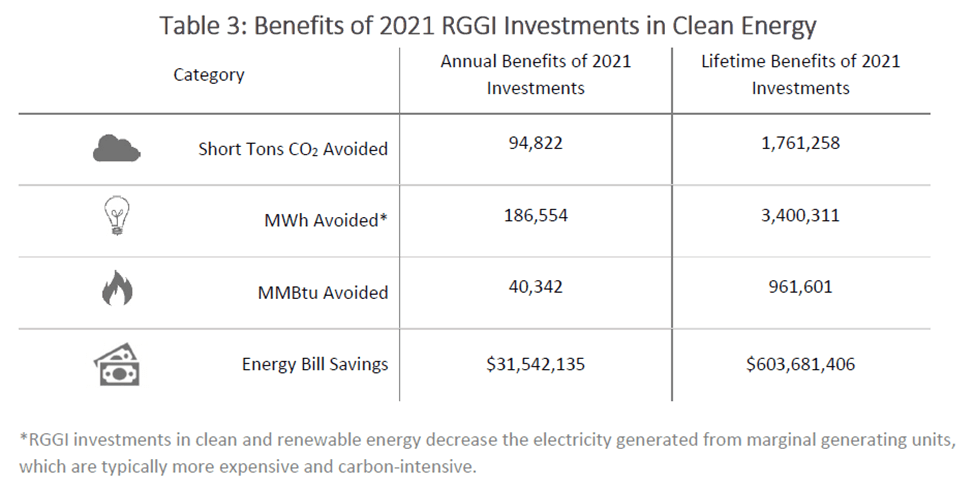
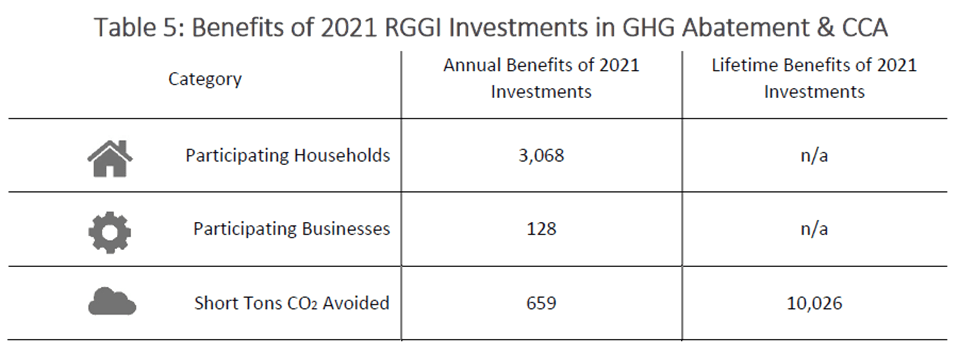
I have regularly evaluated RGGI performance on this blog.  Last December I evaluated the 2020 RGGI Investment Proceeds report that describes the results of RGGI investments over the entire region.  I found that since the beginning of the RGGI program CO2 emissions have been reduced more than 50% but that RGGI funded control programs have been responsible for only 5.6% of the observed reductions.  In late December I did a similar analysis of just the New York investment proceed results and found that in New York since the beginning of the RGGI program to 2021 CO2 emissions have been reduced 39% but the reduction was 47% until the State shutdown the Indian Point nuclear station.  The RGGI funded control programs have been responsible for only 16% of the observed reductions.  The main reason for the reductions in RGGI and New York State has been fuel switching to natural gas unrelated to RGGI.

I also recently evaluated New York’s operating plan that guides the investment of RGGI proceeds.  In the next fiscal year, the operating plan has 30 programs but only two programs claim direct CO2 reduction savings.  Over the years 2013 to 2021, the total investment for those two programs is $565 million and the claimed savings are 1,684,616 MWh and 861,442 tons of CO2e with a calculated cost benefit of $656 $/ton.  I classified each program relative to six categories of potential RGGI source emission reductions.  The first three categories cover programs that directly, indirectly or could potentially decrease RGGI-affected source emissions.  Those programs total 45% of the investments.  I also included a category for programs that will add load that could potentially increase RGGI source emissions which totals 27% of the investments.  Programs that do not affect emissions are funded with 21% of the proceeds and administrative costs total another 7%.  In summary, even though the ostensible purpose of RGGI proceeds is to reduce emissions from RGGI-affected sources, less than half of the investments expect to do so.

Even though many RGGI proponents claim the program has been a success, my work shows that depends on how success is defined.  If success is defined as significant cost-effect emission reductions from affected sources then that is not the case.  If success is defined as a functional market-based system that provides proceeds then it is a success.  There is no question the program components work well.  The misuse of RGGI funds for affected source emission reductions is not the fault of the system but the politicians who control fund disbursement. 

Making Climate Policy Work and RGGI

I wondered if this book talked about RGGI and how they rated its results relative to my analyses.  I went through the document searching for and documenting every reference to RGGI to see whether I agreed with their description and evaluation of the program.

The first chapter describes the vision and the reality of carbon reduction market-based policies.  Three example policies are described, including RGGI.  The RGGI description states:

RGGI’s vision is the most realistic and generally applicable precisely because it is the most pragmatic about what is able to be achieved. The program encompasses states with varied political interests around climate change, ranging from the highly ambitious to the cautiously engaged. It covers only the electricity sector – where the technologies for cutting emissions are most mature – with transparent and predictable program rules. Even in the power sector, however, RGGI is not the only or even main show in decarbonizing its participating states’ electric grids. Other policy programs are having a bigger impact, including state renewable portfolio standards; subsidies that keep nuclear power plants, which are prodigious suppliers of zero-carbon power, from shutting down; and other government-managed regulatory and procurement efforts all aimed at making the RGGI states’ power infrastructure less carbon-intensive. In many respects, the RGGI system represents the high-water mark for what subnational markets can do: RGGI supports the broader goal of deep decarbonization, generates discretionary revenue streams for participating governments, and increases the static economic efficiency of a policy portfolio – all in a single sector. Its benefits are clear and relatively  modest. Among purists, RGGI is often mocked because its prices are low (about $5–6 per metric ton of CO2 emissions in 2019) and coverage is limited to just one sector. We see the experience through a completely different lens: RGGI works because its architects knew what they were doing and designed a system that is politically feasible and durable.

I have slightly different takes on some of these points but overall I agree with their characterization.

The next two chapters and Chapter 5 only mention RGGI in passing.  Chapter 2: Ambition makes the case that the theory of flexible and economically efficient carbon markets should make them ideal for maximizing the effort to control carbon pollution. This chapter explains why carbon markets have failed to live up to the expectations.  The only reference to RGGI discussed the political process that underpins participation.  The RGGI framework is flexible enough so that the addition and deletion of participating states when political regimes change does not affect the viability of the overall program.  It concludes: “Firms and governments participating in RGGI know that states may come or go, with the consequences managed through an informal political process rather than a legal one.”  Chapter 3 on coverage and allocation notes that RGGI is limited to the electric sector.  Chapter 5 on offsets notes that even though offsets are allowed they have not been a factor in RGGI.  I agree with their characterizations. 

Chapter 4: Revenue and Spending delves into the disbursement of funds collected in the market.  The total RGGI cumulative auction proceeds at the time of this writing is $5,895,274,757.14 since the first auction in September 2008 so RGGI has successfully generated revenues. With regards to spending the chapter notes that “How societies spend the money raised through these sales is vital to understanding the politics of emissions trading.” 

The chapter discussion on RGGI points out that each state controls its revenue spending.  There is a graph from the 2017 RGGI proceeds investment report that describes revenue uses in three categories: general funds; revenue recycling (earmarking revenues for spending that benefits citizens); and green spending (energy efficiency, clean energy, and climate mitigation).  Given the difficulties I have had trying to interpret the RGGI proceeds reports, it is not surprising that there isn’t more detail.

The authors did pick up on some of the revenue problems in RGGI:

The RGGI program also reveals some of the political dynamics that can emerge when political leaders decide to re-purpose funds. The Governors of New York and New Jersey have both diverted RGGI revenues to the state’s general fund at points in the program’s history, raising concern from environmental NGOs and others who have supported a green spending agenda.  

In a section within this chapter titled “Why green spending becomes green pork” the authors explain that there is not much scrutiny how the money is spent.  They define pork as an expenditure that is designed to disproportionately benefit a special interest rather than the broader public good.  They claim that “the organizations that spend RGGI funds are better designed to provide more discipline and accountability on how those funds are spent” than the other example programs discussed. While that may be true with respect to RGGI as a whole, it is not the case for New York.  For example, the authors did not manage to tease out the fact from various unclear reports that New York uses RGGI funds to cover costs that were covered by general funds, i.e., a hidden diversion of revenue to the general fund.  I am sure that had the authors looked into New York’s operating plan for RGGI auction proceed expenditures they would have agreed with my conclusion that green pork is a prominent part of New York’s expenditures.

Chapter 6: Market Links discusses the “institutional challenges of managing cross-border market governance”.  With regards to RGGI I agree with their characterization:

Critically, what holds this system together is not law and the creation of robust, tradeable property rights, but rather a shared vision of parallel efforts at low levels of ambition. Design decisions are made according to the evolving political views of current and prospective participants. And because RGGI features so many parties – none of which hegemonically dominates the group’s overall agenda – the program  must be transparent and predictable. The largely egalitarian cooperation of RGGI states works because it is anchored in stability-oriented market design features that make market behavior more predictable and risk management more tractable.

Chapter 7: Getting the Most Out of Markets explains how to increase program ambition, for example, attracting more jurisdictions or setting more ambitious targets.  The RGGI discussion does a good job explaining how the program addressed an oversupply condition:

The northeastern United States’ RGGI program takes a similar approach through a pair of one-time cap adjustments, as well as a dynamic intervention that resembles the Market Stability Reserve. Like the EU ETS, RGGI experienced market oversupply conditions and very low prices in the 2010s. The situation with RGGI was more extreme, however, because this cap-and-trade program only applies to the electricity sector and the United States’ electricity sector began a profound transformation alongside (but not because of) RGGI. Not only did many of its participating states implement aggressive renewable energy and energy efficiency regulations, but also the rise of cheap natural gas from fracking dramatically accelerated the replacement of high-emitting coal-fired electricity with relatively clean natural  gas and zero-carbon renewables. Emissions have been falling steadily, despite – not because of – anemic RGGI prices. As emissions fell owing to exogenous forces, the market became oversupplied. In response, RGGI’s two cap adjustments removed almost 140 million allowances – about two years’ worth of total emissions – from the supply of allowance budgets through program year 2020.[1]

In addition to these one-time adjustments, RGGI also developed a dynamic mechanism to alter the supply of allowances.[2] This additional market feature is triggered by observed market prices, rather than the EU ETS Market Stability Reserve’s measurement of excess allowance supplies. Like the EU ETS Reserve, RGGI’s approach is two-fold: RGGI features a Cost Containment Reserve that releases 10% of the program-wide allowance budget into the market if prices reach $13 per allowance in 2021; and if prices fall below $6 per allowance in 2021, an Emissions Containment Reserve will absorb 10% of the program’s annual allowance budget and remove these allowances from circulation. When the market remains in between the two triggering prices, allowances supplies are fixed – just as in the EU ETS, where supplies are fixed so long as the total number of surplus allowances stays within a specified range. (Both triggering prices increase at 7% per year to increase ambition over time, but not even the high-end prices are significant when compared to the policy incentives supporting renewable or nuclear energy in participating RGGI states.)[3]

The final chapter is entitled “Rightsizing markets and industrial policy”.  One of the problems identified in the book is that the level of expenditures needed to implement the net-zero transition vastly exceeds the “funds that can be readily appropriated from market mechanisms”.  The chapter describes RGGI as the “the cap-and-trade system  whose design is most purely oriented around generating and spending revenue”.  The authors note that the October 2019 report “The Investment of RGGI Proceeds in 2017” indicates that New York has mobilized just $100 million per year for green spending.  My review of the latest plan to invest New York RGGI auction proceeds indicates that the design plan is supposed  to “support the pursuit of the State’s greenhouse gas emissions reduction goals”.  Of the five goals listed, only one addresses emission reductions.  The others are vague cover language to justify the use of RGGI auction proceeds as a slush fund for hiding administrative expenses and costs related to Climate Act implementation at the expense of programs that affect CO2 emissions from RGGI affected sources. 

Making Climate Policy Work and New York Cap and Invest

Governor Hochul recently announced a plan to use a market-based Cap and Invest program to raise funds for the Climate Leadership & Community Protection Act.  I submitted comments on the Draft Scoping Plan that made opposed the recommendation for such a program.  My initial impression of the Cap and Invest program is that it is more style than substance.  If I had read this book before drafting the comments or my initial impression article, I would have highlighted the findings in this book as part of my arguments against this approach.

The program public relations summary claims that “A Cap-and-Invest Program is the most feasible, efficient, and affordable method to attain a more sustainable future.”  I have been surprised by the amount of support for the plan.  At the February 14, 2023 New York Senate Environmental and Ways and Mean legislative public hearing on the 2023 executive budget the majority of the speakers supported the proposal.  I don’t think that any of the comments that support the program realize the many flaws in that proposal that are described in this book.

In my opinion, a fundamental flaw in the Scoping Plan is that it does not include feasibility analyses to determine whether the laundry list of control strategies will be feasible.  The Plan does not demonstrate that the proposed strategies will be maintain current standards of reliability and safety or can keep energy costs affordable.  This lack of analysis extends to the Cap and Invest proposal.  Proponents claim that it is the most feasible option but that is relative to a short list of options and does not necessarily mean that it will work as proposed.  The preface of the book notes the importance of feasibility:

In telling the story of how market-based climate policy works in the real world, we adopt the premise that idealized markets would be desirable if they were feasible. We hope this choice allows us to reach readers who identify strongly with the power of market forces, since we hope to change their minds. We want them to understand how political forces constrain what market-based policies can do, especially at the early stages of deep decarbonization, because wishing those forces away isn’t practical and hasn’t worked.

The Cap and Invest fact sheet notes that this program will be similar to RGGI that “has helped reduce greenhouse gases from power plants by more than half and raised nearly $6 billion to support cleaner energy solutions”.  As noted previously my analyses show that RGGI was only a minor cause of the observed emission reductions.  Chapter 1 this book also argues that RGGI is not the primary cause: “Other policy programs are having a bigger impact, including state renewable portfolio standards; subsidies that keep nuclear power plants, which are prodigious suppliers of zero-carbon power, from shutting down; and other government-managed regulatory and procurement efforts all aimed at making the RGGI states’ power infrastructure less carbon-intensive.”  Based on my work I believe fuel switching has been the primary cause of New York observed reductions but there are two aspects to consider.  The reductions were because natural gas was a cheaper alternative than coal and oil.  However, the subsidies for nuclear power plants kept emissions from rising.  That is until the State made the irrational decision to shut down 2,000 MW of nuclear power at Indian Point.  Since 2019, when the staged closure began, New York electric utility CO2 emissions have increased 5.8 million tons or 23%.

The Scoping Plan recommendation for an economy-wide strategy to address the financing and emission limitations is based on a naïve understanding of market-based programs.  Cullenward and Victor explain the reality:

Market-based policies on a planetary scale, the theory goes, would empower firms and governments with the flexibility to focus investment on the least expensive options for controlling emissions. Flexibility would reduce costs, allowing more environmental protection with fewer resources; in turn, frugality would make it easier to mobilize business and voter support for ever-deeper climate pollution reductions.

They go on to explain that this vision has completely failed:

Many pollution markets exist, but nearly all are smokescreens that create the impression that market forces are cutting emissions when, in fact, other policies are doing most of the real work of decarbonization. Almost everywhere that market systems are in place they operate at prices that are so low as to have little impact on key decisions such as whether to invest in or deploy new technologies.

The Cap and Invest solution is being marketed as both a compliance and financing tool.  The belief is that the cap will establish compliance limits and the auction will provide the funding to make the reductions.  There are issues with these tools.

The use of the cap as a binding compliance mechanism is unprecedented.  Consider, for example, the EPA Cross State Air Pollution Rule (CSAPR).  This cap-and-trade program is in place to limit nitrogen oxide (NOx) emissions in the eastern United States for ozone compliance.  There have been multiple iterations of this rule that have progressively reduced the cap.  The distinction between CSAPR and a binding cap is that EPA evaluated emissions, existing control technology, and potential improvements or additions for all the sources in the CSAPR-affected states.  The cap was determined using this control technology evaluation to set a feasible limit.  A binding cap is one chosen arbitrarily without any such feasibility evaluation.  In 2030 New York GHG emissions must be 40% lower than the 1990 baseline but this is an arbitrary target mandated by the Climate Act. 

There is another aspect of any GHG emissions reduction program.  There are no cost-effective add-on control technologies available for existing sources.  The only options available for an affected source are to change the fuel to something with lower GHG emissions, make the system more efficient, to reduce operations, or shut down.  As noted previously, New York reduced its electric system emissions significantly because of fuel switching but that strategy is tapped out for any future significant reductions.  In order to get more reductions from the electric generating system, zero-emissions resources must be deployed to displace the fossil resources.  This is particularly difficult because the loss of Indian Point’s zero emissions generation has increased recent emissions.  The control strategies are similar for all other sectors. 

Cullenward and Victor make the point that it is easier to make reductions with existing technology:

In a few places, carbon prices from market-based policies have been powerful enough to induce some changes in emission patterns – such as when firms decide whether to produce electricity from high-emission coal plants or lower-emission rivals. Those impacts, however, have nearly always involved commercially mature technologies competing in stable environments and under other highly restrictive conditions.

In order to meet the 2030 GHG emissions target technology that has not been proven commercially viable at the necessary scale is needed.  This challenge is a problem with the Climate Act deep de-carbonization targets that the Scoping Plan recommendations ignore:

On another front, what markets do best – creating transparent, marginal price signals that encourage firms and households to optimize their choices – is misaligned with the industrial challenges facing deep decarbonization today. In most sectors the world is not far along with deep decarbonization: key technologies, demonstration projects, and the emergence of new firms to back low-carbon technologies are fledgling at best (see Figure 1.2).9 Industrial firms and consumers aren’t waiting for a faint, marginal signal from markets to nudge their behavior. Instead, they need active programs to mobilize and apply resources to new technologies that, with time and effort, will launch the global process of deep decarbonization and displace incumbent industries. Well-designed market signals, at best, are good at encouraging optimization when technologies are commercially mature and strategic choices are clear – such as when the UK electricity market had a signal to select mature renewable energy technologies and gas instead of coal. The hardest challenges of deep decarbonization involve redirecting  investment toward technologies and businesses that are the opposite: beset with risk and danger for first movers. Creating those new industries requires a policy strategy – industrial policy, in effect – that is focused on the problem at hand, rather than inducing marginal changes in behavior with known technologies and production methods.

The authors address three issues related to the fact that the existing systems have failed to live up to expectations.  The first issue is related to the technology issues noted above:

We explain why idealized, “first-best” designs for pollution markets envision systems that produce high carbon prices as a powerful incentive for change. In the real world, the outcome has been the opposite: prices are low and often volatile, which undercuts the incentive to invest in ambitious new technologies and to make changes in production methods beyond those that are straightforward with few risks. First-best visions for pollution markets also imagine that markets should cover many sectors simultaneously, allow extensive interconnection with markets overseas, raise large amounts of revenue, and spend those revenues efficiently to offset distortions in the economy. On every front the real world has produced outcomes that are the opposite from theory: markets are fragmented, links are few, sectoral coverage mostly is narrow, and revenues raised are small.

Details for the proposed Cap and Invest program are sketchy but my impression from what I have heard is that it will also be the opposite of this theory.

As an alternative, the author describe how to make market-based programs more effective.  Their second issue is necessary market reforms:

Some reforms are needed to make market signals more reliable – an outcome that requires shifting away from cap-and-trade systems, where market structures create volatile prices, and toward systems where prices are managed within narrow bands. In effect, cap-and-trade systems can be made more effective when they are designed to behave more like taxes; it is no accident that the few jurisdictions with the highest prices and the greatest level of effort use taxes, not cap-and-trade. More stable prices will make it easier for firms to invest in anticipation of market signals and to build political coalitions that are supportive of that investment. Systems that are designed like taxes also perform better in the real world where market policies are implemented alongside other regulatory programs. In that setting, cap-and-trade schemes merely trade the residual and get little work done in cutting emissions – they are Potemkin markets. Tax approaches, by contrast, create a clear incentive for change (the specified tax level), which persists even as other policy instruments have big impacts on behavior as well.

This approach is basically RGGI without a binding cap.  Unfortunately, Climate Act proponents are convinced that the transition schedule is possible despite the lack of any evidence supporting evidence and that the climate crisis necessitates the aggressive schedule of the Climate Act.  Even though New York GHG emissions are less than one half of one percent of global emissions and global emissions have been increasing by more than one half of one percent per year this rationale for the Climate Act schedule is a major obstacle against this common sense approach.

In addition to the compliance mechanism the proposed Cap and Invest program is intended to provide revenues for the transition.  I have no doubts that the program will generate revenues and suspect that the Hochul Administration will decide the revenue targets based on just how much they think they can get away with rather than basing them on the results of their RGGI auction proceeds.  Cullenward and Victor address this aspect:

Our playbook for market reform offers some insights into why so many of the visions for market-oriented climate policy won’t happen under real-world political conditions. For  example, many advocates for market-based policies imagine that the adoption of market schemes will occur alongside massive policy reforms that roll back regulation. We explain why, politically and administratively, those regulatory and industrial policies are not easily rolled back. Moreover, we explain why pushing for that outcome would be a bad idea – since those other regulatory policies, in fact, are doing most of the serious work in cutting emissions.

One of the most important contributions of markets is among the least appreciated today: well-designed market schemes can raise revenue. A politically savvy strategy for market reforms requires paying closer attention to how program revenues are spent – and specifically to allocating funds to activities that will build experience with new technologies and thus also catalyze new interest groups that are supportive of accelerating deep decarbonization.

Because of the enormity of the challenge another issue is discussed.  In particular, what else is needed:

The key is to channel resources into the sectors that are critical for deep decarbonization. Rather than link all sectors together into a common market system, each must be treated independently because each has its own political economy and state of technology. In sectors where technologies are immature, industrial policy should focus on research, development, and demonstration (RD&D) in a diverse array of options – an approach that yields knowledge and also builds political coalitions around new low-carbon industries.

The New York Climate Act covers all sectors.  It may be possible to breakout the sectors based on such a recommendation.  However, the looming problem is that a binding cap will limit emissions even if the zero-emissions resources are not available to displace the existing emissions.  Carbon dioxide emissions are directly tied to fossil-fuel combustion and energy production.  If for any number of reasons, the zero-emissions are not deployed fast enough in all the sectors there won’t be enough credits available to cover the emissions necessary to provide the energy needs.  In the worst case, an electric generating unit needed to keep the lights on will refuse to operate because they have insufficient allowances. 

The obvious solution to this concern is a feasibility analysis of the schedule for technological innovations necessary to maintain affordability and reliability.  The authors suggest “Doing better requires recognizing the structural limits to what is achievable with market-based approaches – limits that are rooted in how the politics and technological opportunities are organized in each sector.”

Conclusion

The Hochul Administration proposes a Cap and Invest program that will provide revenues and establish a compliance mechanism.  I agree with the authors that the results of RGGI and other programs suggest that the Cap and Invest proposal will generate revenues.  However, we also agree that the amount of money needed for decarbonization is likely more than any such market can bear.  The problem confronting the Administration is that in order to make the emission reductions needed they have to invest between $15.5 and $46.4 billion per year.  I don’t think that range is politically palatable.

The use of Cap and Invest as a compliance mechanism is more of a problem.  The Hochul Administration has not acknowledged or figured out that the emission reduction ambition of their Climate Act targets is inconsistent with technology reality.  Because GHG emissions are equivalent to energy use, limiting GHG emissions before there are technological solutions that provide zero-emissions energy means that compliance will only be possible by restricting energy use.  Unless a miracle occurs in 2030 when there are insufficient allowances someone has to choose who gets to operate.

This is a good book and I recommend it to anyone interested in energy and climate policy and emissions trading programs.


[1] The Regional Greenhouse Gas Initiative, “Elements of RGGI,” https://www.rggi.org/program-overview-and-design/elements; see also The Regional Greenhouse Gas Initiative, “RGGI Program Review: Summary of Proposed Changes to RGGI Regional CO2 Allowance Budget” (Nov. 21, 2013); The Regional Greenhouse Gas Initiative, “Second Control Period Interim Adjustment for Banked Allowances Announcement” (March 17, 2014).

[2] The Regional Greenhouse Gas Initiative (2014), supra note 11.

[3] New York and Illinois (the latter of which is not in RGGI) created the first zero-emission credit (ZEC) subsidy programs for nuclear energy in the United States. See Nuclear Energy Institute, “Zero-Emission Credits” (Apr. 2018). These policies were challenged in court  and ultimately upheld in two parallel cases. Coalition for Competitive Electricity v. Zibelman, 906 F.3d 41 (2nd Cir. 2018) (New York); Electric Power Supply Association v. Star, 904 F.3d 518 (7th Cir. 2018) (Illinois). Following these favorable outcomes, New Jersey (once again part of RGGI) adopted a similar program. Robert Walton, “New Jersey moves ahead on nuke subsidies, approving ZEC application process,” Utility Dive (Nov. 21, 2018). For an overview of state renewable energy policies, see Galen L. Barbose, “US Renewables Portfolio Standards: 2019 Annual Status Update,” Lawrence Berkeley National Laboratory (2019), https://emp.lbl.gov/projects/renewables-portfolio.

New York Good Intentions Unsullied  by Reality 

My entire career as an air pollution meteorologist has been devoted to upholding the Clean Air Act (CAA).  Several New York initiatives are combining to undermine the very foundation of that law.  Furthermore, these initiatives are contrary to the premise of my Pragmatic Environmentalist of New York blog that practical tradeoffs of environmental risks and societal benefits are necessary for workable solutions.  This post describes the initiatives and what I believe will be the inevitable consequence.

I have extensive experience with air pollution control theory, implementation, and evaluation over my entire career.  I write about New York energy and environmental issues at the Pragmatic Environmentalist of New York blog.  The opinions expressed in this post do not reflect the position of any of my previous employers or any other company I have been associated with, these comments are mine alone.

Background

It has been over 50 years since Congress established the basic structure of the Clean Air Act in 1970.  The EPA summary describes control of common pollutants:  

“To protect public health and welfare nationwide, the Clean Air Act requires EPA to establish national ambient air quality standards for certain common and widespread pollutants based on the latest science. EPA has set air quality standards for six common “criteria pollutants“: particulate matter (also known as particle pollution), ozone, sulfur dioxide, nitrogen dioxide, carbon monoxide, and lead.”

“States are required to adopt enforceable plans to achieve and maintain air quality meeting the air quality standards.   State plans also must control emissions that drift across state lines and harm air quality in downwind states.”

“Other key provisions are designed to minimize pollution increases from growing numbers of motor vehicles, and from new or expanded industrial plants.  The law calls for new stationary sources (e.g., power plants and factories) to use the best available technology, and allows less stringent standards for existing sources.”

My first professional job in 1976 was with a consulting company that did contract work for the Environmental Protection Agency developing emission factors that could be used to analyze and project impacts to public health and welfare.  Later I worked for other consultants that evaluated the air quality dispersion models to make sure they provided adequate estimates of predicted air quality impacts from polluting sources.  Eventually I went to work for an electric utility where I was responsible for maintaining air quality compliance at their facilities.  All my work was a tiny part of the national effort to develop a robust methodology to protect public health and welfare nationwide.  On behalf of all my colleagues I want to say it is a pretty darn good system.

The goal of the regulatory process is to maintain air quality impacts below the National Ambient Air Quality Standards (NAAQS).  The Clean Air Act established two types of national air quality standards.  The primary standards protect public health with an adequate margin for safety.  The secondary standards are “designed to protect the public welfare from adverse effects, including those related to effects on soils, water, crops, vegetation, man-made (anthropogenic) materials, animals, wildlife, weather, visibility, and climate; damage to property; transportation hazards; economic values, and personal comfort and wellbeing”.  The entire point of this background section is that United States air quality regulation is built around the concept that there is a threshold for adequate safety and if the measured or projected air quality is below those standards then public health is protected.

New Paradigm

In the past several years the Precautionary Principle, a strategy to cope with possible risks where scientific understanding is incomplete, has led many to rely on the idea that to be safe we have to eliminate all risks as a precaution.  At its core that means that there is no such thing as a threshold for adequate public health safety.

David Zaruk has explained that the resulting problem is that policy-makers and politicians have confused this uncertainty management tool with risk management.  He authors the Risk Monger blog “meant to challenge simplistic solutions to hard problems on environmental-health risks”. He is a professor at Odisee University College where he lectures on Communications, Marketing, EU Lobbying and Public Relations. 

I recently compared his analysis of this approach to risk management in the European Union relative to New York’s Climate Leadership and Community Protection Act (Climate Act) implementation.  He explained that “patronizing activists with special interests solely dedicated to seeing industry and capitalism fail is destroying trust in all industries (excluding them from the policy process and equating the word “industry” with some immoral interpretation of lobbying)”.  The activists are using the same tactics that worked with the decline of the tobacco industry: “Using the emerging communications tools to create an atmosphere of fear and hate, these activists have successfully generated a narrative that the only solution to our problems is no risks and no thresholds.”  Policymakers, perceiving these loud voices as representative, have adopted the path of virtue politics rather than Realpolitik (that is to say policy by aspiration and ideology rather than practical solutions relying on the best available evidence).

Three Zero-Risk Initiatives

There are three examples of initiatives in New York that rely on the zero-risk approach.  The Climate Act has a net-zero by 2050 goal that presumes that all GHG emissions have risks and must be eliminated.  The New York Department of Environmental Conservation (DEC) has an Environmental Justice initiative.  It includes Commissioner Policy 29 (CP-29) that provides guidance for incorporating environmental justice concerns into DEC environmental permit review process and the DEC application of the State Environmental Quality Review Act (SEQR).  Finally, in November 2021, New York State passed an Environmental Rights Amendment to the New York constitution.  It added  a new section to the state constitution that reads: “Each person shall have a right to clean air and water, and to a healthful environment.  This Amendment will be the focus of this article.

I was prompted to write this article after reading Celebrating the 1-Year Anniversary of the New York Environmental Rights Amendment written by a litigation assistant at Earth Justice.  This article includes a link to a webinar: “The environmental rights amendment: by and for New Yorkers” that lays bare the planned use of the Equal Rights Amendment to further the agenda of New York activists who apparently want to see industry fail.  I don’t claim that they necessarily want industry to fail but their expectation that aspirational environmental demands based on ideology are compatible with overall societal needs is naïve such that the end result of their vision will be the shutdown of all industry including power generation.

The four webinar speakers were Anthony Rogers-Wright, New York Lawyers for the Public Interest; Rebecca Bratspies, City University of New York School of Law; Maya van Rossum, Green Amendment for the Generations & Delaware Riverkeeper Network; and Michael Youhana, Earthjustice.  I am comfortable saying that these folks epitomize the special interest activists described by Zaruk.

I suggest that anyone interested in this issue take the time to listen to the entire webinar.  I am not going to dissect every speaker’s presentation, but I do want to highlight the comments of Professor Bratspies starting at 15:46 of the recording.  She was asked how the Environmental Rights Amdendment could be used to influence decision making.

Bratspies explained that environmental justice is about “fair treatment and meaningful involvement” of people in decision making that affects them.  She believes that the New York regulatory program is about process and not substance.  People get to participate but they “have no substantive hook” to affect the outcome.  She referred to a Supreme Court decision that “prohibits uninformed rather than unwise decision making.”  She said that the Environmental Rights Amendment changes that because it puts fair treatment of how environmental burdens and benefits are distributed on the table:  “Now it is not just about process, it is about substance.”  She then stated that now there is a substantive right to a clean environment, not just a right to participate in the process.

She went to explain that the Amendment creates new possibilities for challenging “unequal” decisions.  As an example, she thinks this can be used when permitting decisions are made.  The following is a lightly edited version of her end game explanation starting at 17:55 of the  webinar recording:

“All the polluting infrastructure in New York City requires permits from the government in order to operate.  Those permits specify levels of pollution that facility is allowed to emit.  Those levels of pollution are set based on a pretty complicated formulas about national standards.  But now the people who live nearby who have been so long viewed as in energy sacrifice zones can go in and say that I have the right to breathe clean air.  You can’t let this facility emit so much pollution that it impacts my ability to breath clean air.  My kids have the right to not have asthma.  Pollution and asthma are intimately intwined.“

This interpretation of the Environmental Rights Amendment presumes that it is supposed to provide assurance of good health (e.g., no asthma) for all.  Individuals in EJ communities near existing sources of air pollution believe that poor health outcomes are attributable to those sources based on environmental activist studies.   They do not understand the proven NAAQS protections for the population.  Activists have stoked their fears by funding projections that claim there is no threshold for health impacts and that there is a relationship between health impacts and ambient concentrations below the NAAQS standards.

At its core this argument relies on a zero-risk approach.  Bratspies espouses the view that the NAAQS are not protective of human health because pollutants are still emitted and present in the air.  She believes that asthma observed in EJ neighborhoods must be caused by local facilities.  The fact that there are decades of experience that support the ambient air quality standards and the methodologies used to ensure that no one is subjected to air quality over those standards are immaterial.  New York City EJ activists, like all the speakers on the webinar, believe the PEAK coalition conclusion that “Fossil peaker plants in New York City are perhaps the most egregious energy-related example of what environmental injustice means today.”  Unfortunately, the analysis that forms the basis of that conclusion is flawed.  The health impacts claimed are for ozone and inhalable particulates that are secondary pollutants that form far downwind of the adjoining neighborhoods.  Bratspies believes that air pollution and asthma are “intimately intwined” but does not acknowledge that ambient air pollution levels have gone down over the same period that asthma rates have gone up. 

This approach threatens the viability of any facility that emits pollution  From the get go, if clean air is defined as zero then no emissions from power plants are allowed.  But where does it end?  No emissions from natural gas for heating or cooking?  No emissions from the cooking process itself? If you can smell something cooking that is a volatile organic compound pollutant that is a precursor to ozone which is regulated by the Clean Air Act.  The intentions of the Environmental Rights Act are good but they are also based on an incomplete understanding of the situation and science.

The other two initiatives have similar issues.  New York’s Climate Act has an aggressive schedule that mandates a zero-emissions or zero-risk electric generating sector by 2040.  Buried in the law is a requirement that State agencies are supposed to consider the Climate Act requirements in their actions.  Late last year the DEC issued a policy document that outlines the requirements for Climate Act analyses as part of the air pollution control permit applications.  As part of the zero-risk mindset even the risks of a permitted source somehow affecting Climate Act implementation must be addressed and discussed even though there are no specific promulgating regulations. 

Finally, the DEC Environmental Justice initiative includes Commissioner Policy 29 (CP-29) that provides guidance for incorporating environmental justice concerns into DEC environmental permit review process.  The guidance explicitly addresses the need for meaningful public participation by minority or low-income communities in the permit process; the availability or accessibility of certain information to the public early in the permit process; and the need for the permit process to address disproportionate adverse environmental impacts on minority and low-income communities.  Based on the webinar this is still insufficient for the activists because it does not guarantee the right to clean air and a healthful environment.  

Conclusion

However noble the concept of eliminating any risks from any source of pollution, if it is construed to mean that anything that might be contributing to bad health must be prohibited, then there will be massive consequences. 

A zero-risk standard sets a high hurdle for permitting a new facility or keeping an existing source in operation.   All applicants follow the existing permitting requirements demonstrating that their facility does not exceed the applicable air quality standards.  New York’s new permitting guidance then requires public hearings and consultation with stakeholders whose goal is no risk.  At the very least the permitting process is slowed down to go through more public stakeholder steps which adds time and expenses for the source owners. When the activists say “It is not just about process, it is about substance” what they mean is we must get the answer we want and if we don’t, it is clear from the webinar that their planned response is to litigate on the grounds of the right to clean air. 

Going to court always adds time and expense but could also shut down the state.  The court is going to have to decide what clean air means.  It is easy to see an argument that a standard must be developed but once that approach is initiated, it is hard to imagine a new standard that is more defensible than the existing NAAQS.  We already have a process to evaluate permits relative to those standards so what is the point? Rationally I would hope that the court would decide in favor of the Clean Air Act but who knows.  If the definition of clean air and water is zero pollution, then the State might as well shut down now because nothing meets that standard. 

There is no question that past inequities in environmental burdens were wrong and should be avoided in the future.  Nor is there any question that everyone deserved the right to clean air and water.  The problem is that if this good intentioned solution insists on zero risk, then the reality is that it requires no emissions.  If no tradeoffs are allowed then the only solution is to shut down or not build.

Thanks to Russell Schussler for comments and the title.

New York Annual Climate Act Cap and Invest Revenue Targets

One of the biggest questions related to Governor Hochul announced plan to use a market-based program to raise funds for the Climate Leadership & Community Protection Act (Climate Act) is the revenue target.  I incorporate the latest 2020 GHG emissions inventory data and some other bits of information to follow up on a couple of earlier posts that addressed this issue. 

I submitted personal comments on the Climate Act implementation plan and have written over 280 articles about New York’s net-zero transition because I believe the ambitions for a zero-emissions economy embodied in the Climate Act outstrip available renewable technology such that the net-zero transition will do more harm than good.  I also follow and write about the Regional Greenhouse Gas Initiative (RGGI) market-based CO2 pollution control program for electric generating units in the NE United States.   Before I retired I had extensive experience with air pollution control theory, implementation, and evaluation having worked on every cap-and-trade program affecting electric generating facilities in New York including the Acid Rain Program, RGGI, and several Nitrogen Oxide programs. The opinions expressed in this post do not reflect the position of any of my previous employers or any other company I have been associated with, these comments are mine alone.

Background

The first related article I posted gave my initial impression of the New York cap and invest program.  That post gives background information on the Climate Act’s  economy-wide strategy and my overarching concerns.  I explained that I had evaluated New York’s RGGI auction proceeds funding status report and found that the projected costs of the current programs are $776.1 million, the net greenhouse gas emission savings are 1,656,198 tons and that works out to emission cost per ton removed of $469.  If all the RGGI administrative and operating costs are included another $113 million is added to the total and the emissions cost per ton removed is $537 per ton.   I also evaluated existing emissions and the reduction trajectory necessary to meet the 2030 Climate Act emissions target.  Those numbers will be updated in this post.  The post also lists some practical considerations that should be a concern for this initiative.

The second related article determined different annual revenue targets.  I determined the emissions reduction trajectory needed to meet the 2040 GHG emissions target, calculated the control cost per ton removed based on the RGGI auction proceed investments, and found that a total of $7.9 billion per year is needed.  That is the low-end cost of the projections.  At the upper end three projections exceed $45 billion a year.  I will update those projections below.

New York GHG Emissions

In order to understand the challenge it is necessary to know where we stand for our GHG emissions.  The following table (the link is to the full table because I cannot figure out how to make tables in the text get bigger when a reader clicks on it) lists the New York State GHG emissions (MMT CO2e AR5 20 yr) by sector from the DEC emissions inventory .  It also includes the annual change in emissions since 1997.

I evaluated current emissions relative to the 2030 Climate Act target of a 40% reduction by 2030.  The following table lists the trajectory of observed, projected, and interpolated emissions consistent with the 2030 requirement to reach 245.87 million metric tons of CO2e.   New York State has released the official GHG emissions for New York State for 2018, 2019, and 2020 and they are highlighted in gold.  I estimated emissions for 2021 and 2022 using the observed electric generating unit emissions and historical averages for other sectors.  Note that emissions increase due to the shutdown of the Indian Point nuclear generating facility.  The 2030 levels are fixed and are highlighted in rose. There are six columns that list the emissions trajectory necessary to get from the observed emissions (gold) to the target.  The annual reduction in the trajectory is the difference between the observed emissions and the 2030 target divided by the number of years.  For example, the estimated GHG emissions in 2021 were 381 million metric tons. If the emissions are reduced by 15 million tons per year, then in 2030 the emissions will meet the target of 245.87 million metric tons.  Two projections are listed for 2022 that give bounds to the reductions necessary.  One uses the estimated emissions and the other assumes that total state GHG emissions stay constant between 2020 and 2022. 

Ostensibly the goal of the cap and invest program is to generate the revenues necessary to make the required reductions.  The following table uses the range of 2022 emission estimates (384.92 and 345 million metric tons of CO2e) and the range of cost per ton reduced ($533.79 and $487.75) to place bounds on the required reduction costs.  If the assumption is made that all the reduction costs will be financed by auction proceed investments, then the annual revenue needed for the high bound is $9.278 billion and the low bound is $6.044 billion.  That assumes that all the money collected is invested.  However, Hochul announced that there would be a Climate Action Rebate of 30%.  In order to maintain the revenue needed to meet the emission targets that means that the total collected has to increase from $9.278 billion to $12.254 billion increasing the cost per ton reduced to $763.  In addition, she announced another 3% for small businesses and, this being New York, I assume that the administrative costs will be the same as the 7% as in RGGI.  Incorporating those costs raises the total needed to between $15.463 million and $10.073 billion.  That assumes that all the environmental justice targeted money can be invested in reductions that benefit environmental justice communities.  If the interpretation of the 40% for environmental justice communities is in addition to the investments needed to meet the reduction targets, then the annual totals increase between $46.390 billion and $30.219 billion.

There are a couple of other potential annual revenue target methodologies.  The clearing price at the last RGGI auction was $12.99 and assuming that 385 million allowances were auctioned off the revenues would be $5 billion.  The highest auction clearing price would increase revenues to $5.35 billion.  Keep in mind that that the allowances auctioned will decrease over time so this is the upper bound.  In addition, there are mandates for set asides so that is not a true reflection of the number of allowances that would be auctioned.  The annual reductions could also be set to the NYS Value of Carbon which is set at $129 in 2025 and $172 in 2050.  The estimates for those revenues range between $1.6 and $3.0 billion.

Discussion

The sectors affected by the Climate Act Cap and Invest Program are most interested in the revenue target for the auction.  Regulatory staff claim that they are interested in the emission reductions and not the revenues which would argue for setting the cap at a defensible value that could provide the reductions necessary.  There are many issues with this simple approach.  It is assumed that there are no other sources of funding to make the reductions.  It also assumes that the cost per ton reduced is constant but control programs will increase as control efficiencies necessarily get tighter.  There are also issues with how the EJ set-aside is invested and how much money is used for administration.

Conclusion

There is no clear and obvious revenue target.  As with all GHG market-based control programs the real concern is that the costs necessary to make reductions are so high that they exceed the Value of Carbon and the likely limits of the public’s willingness to pay.

There is another concern.  The Scoping Plan requires an ambitious emission reduction trajectory.  Because there are no cost-effective control options for GHG emissions, the reductions will have to come from indirect displacement of fossil-fired energy use or simply reducing fossil-fuel use.  The ultimate compliance control strategy is stop operating when there are no allowances available to be had.  Energy demand is inelastic so there will be interesting times ahead as this plays out.

Following the Climate Crisis Money

I have been helping provide research support to readers of my blog when they have questions about the implementation of Climate Leadership and Community Protection Act  (Climate Act).  In this instance a question came up about an organization that is helping the New York Columbia County Climate Smart Task Force.  Every time I look into any aspect of the Climate Act, I find support for my conviction that the primary driver is all about the money.

This is another article about the Climate Act implementation plan that I have written because I believe the ambitions for a zero-emissions economy embodied in the Climate Act outstrip available renewable technology such that the net-zero transition will do more harm than good.  Moreover, the costs will be enormous and hurt those least able to afford increased costs the most.  The opinions expressed in this post do not reflect the position of any of my previous employers or any other company I have been associated with, these comments are mine alone.

The Money

I have been meaning to document the fact that major new organizations are getting funding to provide climate change coverage and this seems to be a good time to explain.  The Associated Press has assigned more than two dozen journalists to cover climate issues paid for through philanthropic grants of $8 million.  Last fall National Public Radio launched a “climate desk”:

NPR’s climate expansion has also been made possible by the Chan Zuckerberg Initiative, whose funding is helping NPR to add a new Climate Solutions reporter, as well as The Rockefeller Foundation, whose support will allow for more local and regional reporting on how climate change affects the most vulnerable populations.

There is no plausible reason to expect that these organizations will not provide coverage that suits their funding sources. If evidence surfaces that contradicts the narrative, how long will they ignore it?

In my post about the New York plans for a gas stove ban I referenced a post by Robert Bryce titled  The billionaires behind the gas bans.  He explained that “despite numerous claims about how nefarious actors are blocking the much-hyped ‘energy transition’” that the non-governmental organization-corporate-industrial-climate complex has far more money than the pro-hydrocarbon and pro-nuclear groups. He showed that the five biggest anti-hydrocarbon NGOs are now collecting about $1.5 billion per year from their donors and that is roughly three times more than the amount being collected by the top five non-profit associations that are either pro-hydrocarbon or pro-nuclear.

It is not just the news organizations and NGOs that plan to cash in on the climate change crisis narrative.  Now the State is lobbying local communities to pledge to fight the battle with the lure of funding for “green and clean” infrastructure.

New York Climate is a Crisis Money

The Climate Act has prompted an enormous private industry to implement the net-zero transition that has a vested interest in spending as much money as possible as soon as possible all in the name of saving the planet.  In addition, local governments are eyeing the gravy train.  As part of the transition, the Climate Act Scoping Plan Chapter 20 strategy for Local Government recommended:

Support capacity-building for local governments and related public entities: The State should provide educational materials and training to local governments and related public entities, so that they understand what resources are available to them and are prepared to receive funding.

The lure of this pot of money has led to a rush for the cash.  For example, on January 30 2023, newly elected Ulster County executive Jen Metzger presented the first executive order of her four-year term.  Metzger’s order aims to bring county operations into alignment with the Climate Act.  According to Hudson Valley One:

All government buildings will be assessed for on-site solar and battery storage, with the goal of fulfilling the electricity needs of the government by 2030. All major renovations of county buildings will require electric-only power sources and be equipped with EV charging as well. All new construction will require solar systems.  “We’re setting a goal,” said Metzger, “of diverting 100 percent countywide organic waste and incinerators by 2030.”

A key part of the executive order are efforts to attract more state and federal assistance and incentives.” Metzger sees “tremendous opportunity coming down the pipe from the Inflation Reduction Act, and she intends that Ulster County will be ready for it.”

There already is a state program in place that addresses the recommended strategy in the Scoping Plan. The Climate Smart Communities (CSC) program helps local governments take action to reduce greenhouse gas emissions and adapt to a changing climate. In fact, Ulster County was the first county in New York to be silver-certified as a climate-smart community.   According to the CSC fact sheet:

Climate Smart Communities (CSC) is a New York State program that supports local governments in leading their communities to reduce greenhouse gas emissions, adapt to the effects of climate change, and thrive in a green economy. The benefits of participating include leadership recognition, free technical assistance, and access to grants. Local governments participate by signing a voluntary pledge and using the CSC framework to guide progress toward creating attractive, healthy, and equitable places to live, work, and play.

The State claims a few CSC Benefits:

  • Receive funding for climate change mitigation and adaption projects via the DEC CSC Grant program.
  • Reduce the cost of clean vehicles and associated charging/fueling stations via the DEC Municipal Zero emission Vehicle Rebate program.
  • Receive free technical assistance for clean energy and climate change initiatives from regional
  • coordinators.
  • Discover online guidance and decision-support tools via webpages.
  • Learn about best practices through CSC webinars.
  • Network with like-minded community leaders at CSC events and workshops.

The fact sheet describes how communities participate:

Columbia County Climate Smart Communities

One of my readers has attended meetings of the Columbia County Climate Smart Communities Task Force.  That organization has a coordinator who organizes the county’s response to the CSC program.  The goal of local communities is to become certified as “climate smart” community. To date five towns have achieved bronze certification in Columbia County.  A friend who is more attuned to this program explained there are climate committees in every village all chasing money for charging stations and many of the same people are pushing back against fossil infrastructure projects.

I was asked to provide some information about an organization that was present at a recent Task Force meeting.  In particular, the question was about the ICLEI. According to their website:

ICLEI is the first and largest global network of local governments devoted to solving the world’s most intractable sustainability challenges. Our standards, tools, and programs credibly, transparently, and robustly reduce greenhouse gas emissions, improve lives and livelihoods and protect natural resources in the communities we serve. 

I spent a long time trying to figure out the acronym but ended using Wikipedia:

ICLEI – Local Governments for Sustainability (or simply ICLEI) is an international non-governmental organization that promotes sustainable development. ICLEI provides technical consulting to local governments to meet sustainability objectives.

Founded in 1990 and formerly known as the International Council for Local Environmental Initiatives, the international association was established when more than 200 local governments from 43 countries convened at its inaugural conference, the World Congress of Local Governments for a Sustainable Future, at the United Nations in New York in September 1990.

As of 2020, more than 1,750 cities, towns, counties, and their associations in 126 countries are a part of the ICLEI network.

As of 2021, ICLEI has more than 20 offices around the world.

ICLEI’s role in the CSC process is support to help communities prepare components of their certification program. I believe but did not confirm that the New York State Energy Research & Development Authority provides funding for communities that need their services.  ICLEI has developed an online program for the GHG inventory, forecasts, climate action plans, and monitoring of communities.  Another aspect of the CSC plan is preparing a contribution plan and ICLEI has a toolkit for that.  They have other tools and resources. 

Discussion

From the top to the bottom of the “climate change is a crisis” NGO-corporate-industrial-climate complex  there is an enormous pot of money available for those who adhere to the party line.  In New York any community willing to adopt the CSC Pledge has access to resources and funding.  The pledge is interesting:

I offer a challenge to the local governments that have made this pledge.  Go for it, but not just this virtue-signaling public relations gesture to get some money.  Francis Menton writing at the Manhattan Contrarian blog wrote that a demonstration project of a mainly renewables-based electrical grid is a common sense prerequisite before there are any more plans or pledges.  Climate Smart Communities of New York should prove their bona fides and develop a demonstration project for their community to address the issues he raised:

Could anybody possibly be stupid enough to believe the line that wind and solar generators can provide reliable electricity to consumers that is cheaper than electricity generated by fossil fuels? It takes hardly any thought about the matter to realize that wind and solar don’t work when it is calm and dark, as it often is, and particularly so in the winter, when it is also generally cold. Thus a wind/solar electricity system needs full backup, or alternatively storage — things that add to and multiply costs. Surely, our political leaders and top energy gurus are fully aware of these things, and would not try to mislead the public about the cost of electricity from a predominantly wind/solar system.

……………..

Nobody would be happier than me to see a demonstration project built that showed that wind and solar could provide reliable electricity at low cost. Unfortunately, I know too much about the subject to think that that is likely, or even remotely possible. But at least the rest of us need to demand a demonstration project from the promoters of these fantasies.

Conclusion

I wanted to make a few points about the climate crisis money trail so this response to one small component of New York’s Climate Act gave me the opportunity.  The world is filled with seemingly authoritative voices asserting with complete confidence that wind and solar generators are the answer to providing consumers with cheaper electricity and solving the climate crisis.  Their arguments are long on emotion and short on facts.  It is particularly troubling to me that major news organizations are funded by organizations that ascribe to that narrative.  No wonder that few if any of the practical considerations are mentioned by those organizations.

Given the constant drumbeat of climate doom and fantastical energy solutions that are clean and cheap, it is no wonder that communities across New York are signing the CSC pledge to reduce GHG emissions.  If I ever run short of topics to address the pledge itself certainly deserves a response.  It is a perfect example of the politically correct narrative that climate change is an existential threat.  Most of the articles posted on this blog address and dispute that story.  I will stand corrected if any jurisdiction develops a system to always provide reliable electricity at low cost that relies on intermittent wind and solar.

In the absence of a demonstration project it is all about the money.  Climate Smart Communities are at the top of the list for electric vehicle chargers that are considered a marketing advantage.  They also get support developing plans that are supposed to attract the clean energy jobs that are a selling point for the Climate Act.  I cannot help but wonder why if all these plans have so many advantages, why they depend upon direct subsidies.

Finally, the answer to the original question.  ICLEI is an organization that provides technical support to local communities who want to “solve” climate change by reducing GHG emissions, in this case, the New York Climate Smart Communities.  It would be a good question to ask County legislators whether the costs for ICLEI are covered by NYSERDA or there is some cost-sharing agreement.  If NYSERDA picks up the entire tab localities that is one thing.  However, if Columbia County does have to contribute funding for ICLEI services I think it is appropriate to ask what benefits accrue to county residents.

Guest Post – NYS Energy Storage

Richard Ellenbogen frequently copies me on emails that address various issues associated with New York’s Climate Act.  I asked his permission to present his analysis of the New York State Energy Storage Roadmap Report as a blog post here.

I believe that he truly cares about the environment and the environmental performance record of his business shows that he is walking the walk.   Ellenbogen is the President of Allied Converters  that manufactures food packaging.  His facility is about 55,000 square feet and does a lot of manufacturing with heat to seal the bags, all electrically driven.  The facility has solar panels and uses co-generation.  He explains:

In 2008, the average energy cost per square foot for a commercial facility in  Westchester was $1.80.  We were at 16% of that 12 years later and even with the increases, we are at 62% of that 14 years later.  That has been done while having a carbon footprint 30% – 40% lower than the utility system.  The $1.80 per foot  also included commercial office space and our operation is far more energy intensive than an office.  We use energy extremely efficiently and as a result, our bills are much lower than everyone else. 

NY State Energy Storage Report

On December 28, 2022 the New York Department of Public Service and New York State Energy Research and Development Authority released New York’s 6 GW Energy Storage Roadmap: Policy Options for Continued Growth in Energy Storage (Roadmap Report).  I did a couple of posts (here and here) on the Roadmap Report that concentrated on the costs.  Ellenbogen’s analysis fills in another part of the story.  His lightly edited description of the feasibility follows.

This is another document of such questionable quality that had I presented it to my superiors when I worked for Bell Labs and asked them to implement a multi-billion dollar project based upon it, they first would have rolled on the floor laughing thinking it was a joke, and then when they realized that I was serious,  they would have promptly terminated me.   No sane entity would embark on a project based upon such questionable parameters as are shown in this document.  This is not science or engineering.  This is politics disguised under a veneer of technical terms designed to delude the public that won’t take the time to read its 104 pages.  The fact that this policy is being pursued based upon documents such as this is borderline criminal  (And maybe not so borderline.  Just plain criminal).

Note that the page numbers I list are the pages of the pdf and not the document page numbers to enable easy searching of the document using Acrobat.

We can start with the fantasy on page 31 in Figure 5 (Also duplicated in the analysis in Appendix A) that immediately makes the entire document questionable.  It has all of the storage being charged by renewable energy by 2040 which will be impossible based upon NY State’s rate of renewable installation and the rate at which loads are being mandated to be added to the system.  (See below.  There is no fossil fuel generation even listed and it doesn’t list the composition of the “Imports”.  If they are like California’s imports, they will be coal generation.  Very environmentally friendly.)  Germany has been doing this for 32 years and has reached a 34% carbon free system with very few EV’s on the road.  While NY State is starting at 41% carbon free because of Niagara Falls and its upstate nuclear plants, the new renewables are not even going to offset the added load that has been mandated by state policy starting in 2024 and going into overdrive in 2030 and 2035 for EV’s and Heat Pumps, let alone replace all of the fossil fuel generation.  2040 is only 17 years away.  By 2050, the upstate nuclear plants will be 75 years old and nearing the end of their useful lifespan.  What will replace them?

Also, why are they using shoulder months in the analysis?  What will happen in July, August, January, and February when the electric load peaks?  That is what has to be analyzed as that is the worst-case scenario and is when the system will be most likely to fail.  The most likely reason for that is that the numbers and graphs looked so bad for those months, even in fantasy land, that they couldn’t be displayed for what they would show.

If you look at the following graph (link), the right-hand column documents the new renewables that will be available to offset the loads that they will be adding and it is clearly insufficient even if only 30% of the vehicle fleet is electrified and 10% of the buildings. 

Instead of Figure 5, the reality will be closer to Figure 5d below, produced by Cornell University and the National Renewable Energy Laboratory,  which show the batteries being charged from fossil fuels and 15% to 20% of that energy being lost because of charge/discharge losses, which is actually going to increase NY State’s carbon footprint.  The storage losses are acknowledged in the Roadmap Reprt document on page 99 where it says that the battery owner will have to buy 1.15 MWh in order to sell 1.0 MWH, implying a 15% energy loss.   

If that isn’t bad enough, on page 89 the Energy Roadmpa says, 

Customer load shifting can provide many of the same flexibility attributes as battery storage, by enabling reductions in peak demand, and shifting demand to times of high renewable output. As a result, there are direct impacts of lower or higher amounts of end use flexibility on the economics of battery storage. In  the base case, 12.5% of the light duty EV charging load is assumed to be flexible by 2030, increasing to 25% by 2050. In addition, 50% of the hydrogen required economy-wide is assumed to be generated via electrolysis within New York, and this electrolysis load is assumed to be highly flexible as well to make the most of excess renewable energy when it exists.

As clearly documented, WHAT EXCESS?  What are these people looking at?  THIS DOCUMENT IS NOT BASED UPON REALITY!!!

Further, Hydrogen electrolysis loses 20% of the energy when Hydrogen is generated from the water and then about 60% of what is remaining is lost during combustion for a total energy loss approaching 70%. That’s not a great tradeoff when you don’t have enough energy to  start with.

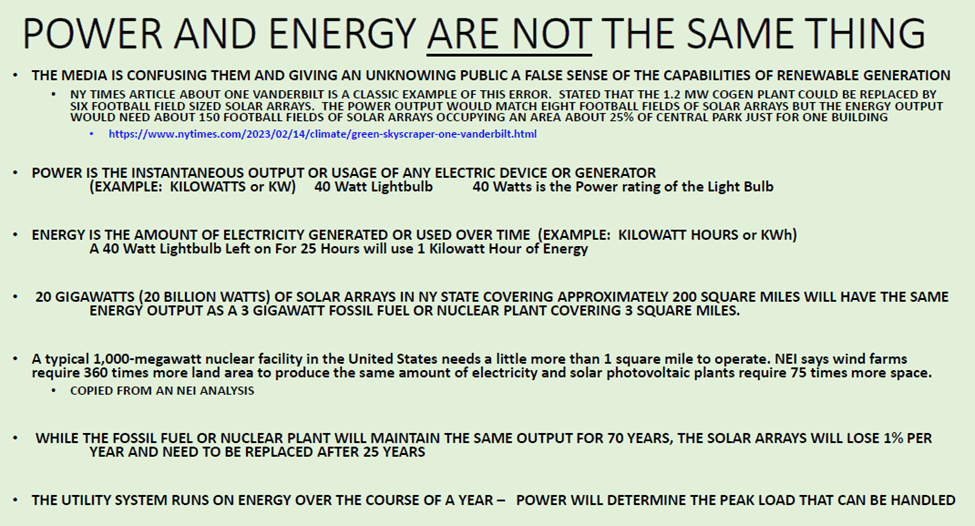
For some reason the filed report on the NYS DPS DMM site for Case 18-E-0130 – In the Matter of Energy Storage Deployment Program includes a cover letter.  That letter lists the storage capacity as a power value and not as an energy value.  The title of the cover letter is “Re: Case 18-E-0130 – In the Matter of Energy Storage Deployment Program” and then at the top of the next page the cover page of the document says New York’s 6 GW Energy Storage Roadmap:  Policy Options for Continued Growth in Energy Storage  however, Gigawatts (GW) are Power, not Energy.  While some may think that this is nitpicking, it isn’t.  Engineering students can fail tests over incorrect units.  All of the energy storage targets are listed as power, not energy.  The system runs on energy and with an intermittent renewable driven system, the storage duration is critical.  Nowhere will anyone be able to determine how long the storage will support the system except  on page 15 and those figures should be included with the question, “Are you kidding me?” next to it.  The explanation is below.

In fact, if anyone searches the entire pdf for “WH” to find all of the references to energy that are contained in it (Gigawatt Hours – GWh, Megawatt Hours – MWh, and Kilowatt Hours – KWh) the vast majority are devoted to information about rebates and costs and not what will be available to run the system.  Most of what was found were “What”, “Why”, “Which”, but very little about system capacity except in a couple of places.  On page 15 the Energy Roadmap discusses the cancellation of 20% of the battery projects:

While the program initially procured 580 MW and 1,654 MWh of energy storage, cancellations have brought these numbers down to 480 MW and 1,314 MWh.

Keep in mind that the pre-cancellation figure of  1654 MWh of battery storage with a 580 MW Power Capacity is less than THREE hours of storage for the bargain price of $193 million in state incentives.  During a heat wave, peaker plants can run for days.  On page 25 of the pdf, it states that many of the peakers only run 5% to 10% of the year,  which equates to 440 – 880 hours annually, however much of that time is contiguous during periods of high load and is far longer than 3 hours so how can a 3 Hour battery keep the system running if replacing a peaker plant?

On page 27, the Energy Roadmap discusses the possibility of using EV’s to offset a shortage of storage.   You can tell that whoever wrote this lives in Albany and not downstate where  a large number of people live in apartments.  Vehicles parked on streets are not going to be able to discharge to support the system in times of need.  Are they planning on putting a bidirectional charger on every parking spot in every downstate garage and on every parking spot on the street?    What will that cost and who will install it?   In New Rochelle, it took several months to install about ten internet kiosks with multiple street cuts to house data cables.  How long will it take to install thousands of chargers supported by far larger megawatt power cables to enable vehicle charging?  Also, having driven a Tesla for nearly six years now, I can safely say that trying to run a domicile for any extended period with the car’s battery and still having energy remaining to commute are mutually exclusive.  Again, times of peak load can run for days during the summer.  Winter peak load durationss will be similar in NY State during future winters when large numbers of heat pumps are installed.

On page 40 of the pdf, under 4.3 “Barriers To Energy Storage”, it says:  

As highlighted in other sections of this Roadmap, one of the most critical barriers to energy storage projects relates to the uncertain and insufficient nature of the revenue available through existing markets and tariffs, particularly capacity revenue. Retail or distribution-level projects, participating in certain regions through VDER, provide investors with a more certain revenue stream; however, these projects are still difficult to underwrite given the variable nature of both capacity and energy prices. 

On page 9, it says:  

Over the past year, supply chain constraints, material price increases, and increased competition for battery cells have driven up the cost of energy storage technologies, particularly lithium-ion batteries. Many of the drivers of cost increases are expected to persist until at least 2025. These cost increases may impact the cost of any new programs designed to procure storage to be installed by 2030.  

How they can predict the cost of commodities out past five years is beyond me, but it is safe to say that with everyone trying to install storage and at least nine states mandating electric vehicles, the demand is only going to make the price of storage go up and the materials will be scarce.  That doesn’t require a Crystal Ball, only a small degree of common sense.

The document states that the residential incentive is $ 250/KWh as seen on page 17, however if you look on page 37 it says:

Since July 2021, prices for lithium carbonate, a key ingredient of lithium-ion batteries, have increased 500%. Among projects awarded NYSERDA incentives, average total installed costs for non-residential, retail projects averaged $567/kWh for installations occurring in 2022 and 2023, up from $464/kWh for installations in 2020 and 2021, an over 20% increase in total costs.  This is consistent with recent industry reports that indicate near-term increases in storage costs.

That cost increase helps to explain the battery project cancellations.

Then on page 104, it says “Stakeholders across all segments that were surveyed or engaged with brought up increases in lithium-ion battery pricing over the course of 2021 and 2022 as a fundamental challenge to deploying storage and the development of the storage market going forward.”

On page 94 it does imply that 1000 hours of storage will be needed.   “With seasonal storage (1000+ hours), the availability of a specific resource during critical weeks – or in between multiple critical weeks in a season matters less; instead, the cheapest form of energy”

Coincidentally, that is almost the same time frame (40 days) that I showed on the graph above that was created about 5 weeks ago.  However, at the current average national cost of utility grade storage of $283 per KWh, 4 GW of storage that will last for 960 hours will cost over $1 TRILLION.  The 6 GW will cost over $1.5 TRILLION.  But with the escalating costs of Lithium, that figure could easily reach $ 3 TRILLION.  That figure is fourteen times the entire NY State budget for 2023.  The Inflation Reduction Act had $387 billion allocated for renewable energy projects for the entire United States.  That will just be the cost of the storage, independent of the cost of the renewable generation needed to charge it.

Conclusion

So  basically what they are saying is, “We aren’t sure how the economics of this is going to work but we are going to mandate its installation in lieu of fossil fuel plants, with an unknown price structure, increased energy losses when there already isn’t enough energy to support the system, insufficient capacity to replace the peaker plants that we are trying to close, rapidly escalating costs for the battery storage that already is not affordable and are only going to get more expensive in the future, and cross our fingers that this won’t make it impossible to complete the installation of 6 GW of energy storage.  However, in the interim, we will have shuttered the energy plants that we have for ones that we can’t afford to install.”

They are pushing forward with it anyway when it is doomed to fail.  This  goes way beyond money.   The inevitable failure is going to cost lives and they don’t even seem to care.  I was able to produce this analysis in hours.  They’ve had years to ponder these issues.  This is insanity and again, it is borderline criminal.

If they gave a damn, they would say, “Wait a minute.  This isn’t going to work.  We’re going to kill a bunch of people.  Maybe we should rethink this.”  Unfortunately, they aren’t doing that.   

Caiazza Closing Thoughts

New York State’s GHG emissions are less than one half a percent of global emissions.  Global GHG emissions have been increasing on average by more than one half a percent per year since 1990.  That does not mean that we should not do something but it surely calls into question why these limitations of the proposed plans are being ignored.  There is time to make sure the net-zero transition does not do more harm than good. I fully agree with Ellenbogen’s frustration that fundamental feasibility questions are not being addressed and his conclusion that this is insanity.

New York State GHG Emissions Update

The Climate Leadership and Community Protection Act (Climate Act) includes a target for a 40% reduction of greenhouse gas (GHG) emissions from 1990 levels by 2030.  This post describes the latest New York State (NYS) GHG emission inventories and some implications.

This is another article about Climate Act implementation activities that I have written because I believe the ambitions for a zero-emissions economy embodied in the Climate Act outstrip available renewable technology such that the net-zero transition will do more harm than good.  The opinions expressed in this post do not reflect the position of any of my previous employers or any other company I have been associated with, these comments are mine alone.

NYS Electric Generating Unit Emissions

According to the Environmental Protection Agency (EPA): “Emissions trading, sometimes referred to as ‘cap and trade’ or ‘allowance trading,’ is an approach to reducing pollution that has been used successfully to protect human health and the environment.”  One of the requirements for such a program is a monitoring system that consistently and accurately measures the emissions.  NYS electric generating units are in different emissions trading systems and have developed an accurate measuring system that relies on continuous emissions monitoring systems that record pollution levels that are reported to EPA. 

The only GHG monitored and reported to EPA is CO2.  In 2022 the units that report to EPA emitted 30.7 million short tons.  The NYS GHG inventory reports emissions as million metric tons and the 2022 emissions were 27.8 million metric tons.  As shown in the following table NYS emissions had been trending down until 2019 as generation from coal and oil was displaced by generation from natural gas.  The last three years the effect of the shutdown of the Indian Point nuclear generating station and the loss of its zero-emissions capacity have become evident.  Since 2019 CO2 emissions have increased 5.8 million tons or 23%.

NYS GHG Emissions

At the end of 2022 the New York State Department of Environmental Conservation (DEC) released the 2022 statewide GHG emissions report (2022 GHG Report).  I published an overview post of this greenhouse gas (GHG) inventory last year that described the games played using that inventory to “prove” that there are societal benefits for the emission reduction programs needed to meet the Climate Act targets. 

New York State greenhouse gas (GHG) emissions accounting it includes upstream emissions and is biased against methane.  Obviously if upstream emissions are included then the total increases but at the same time it makes the inventory incompatible with everybody else’s inventory.  There are two methane effects.  Global warming potential (GWP) weighs the radiative forcing of a gas against that of carbon dioxide over a specified time frame so that it is possible to compare the effects of different gases.  The values used by New York are compare the effect on a molecular basis not on the basis of the gases in the atmosphere so the numbers are biased.  Almost all jurisdictions use a 100-year GWP time horizon but the Climate Act mandates the use of the 20-year GWP which increases carbon dioxide equivalent values.  In addition, I believe the State is using higher emission estimates for methane production, transport, and processing.  As a result, NY GHG emission inventory estimates are nearly double values determined by other jurisdictions.

The 2022 GHG Report includes the following documents:

In order to calculate all the emissions in New York and estimate the upstream emissions it took DEC, the New York State Energy Research & Development Authority (NYSERDA) and consultants two years to produce the reports.  This article is concerned only with electricity generation especially as it relates to overall emission trends and emissions data could be used for a market-based control program. 

2020 GHG Emissions

Table ES.2 in the Summary Report presents emissions for different sectors.  Electric generation emissions are listed as electric power fuel combustion, imported electricity, and as part of imported fossil fuels.  In 2020, GHG gas emissions from electric power fuel combustion totaled 22.12 million metric tons of carbon dioxide equivalent (mmt CO2e) using a 20-year global warming potential.  Imported electricity totaled 7.81 mmt CO2e.  Fuel combustion and imported electricity emissions were primarily CO2.  The Table ES.2 imported fossil fuel value shown covers all fossil fuel used in other sectors.  I found another source that breaks out the electric upstream emissions that I used to calculate emissions.

When I first started looking at the electric sector numbers, I compared the State numbers to the emissions reported by the generating companies to EPA.  The reported 2020 EPA numbers were 24.4 mmt CO2e but the 2022 GHG Report electric sector emissions were 52.3 mmt CO2e.  The 2022 GHG Report Sectoral Report 1: Energy chapter on electricity generation does not provide much detail but references a NYSERDA report: Technical Documentation: Estimating Energy Sector Greenhouse Gas Emissions Under New York State’s Climate Leadership and Community Protection Act that does provide details.  I provide more details on the calculation methodology here.  The following table combines Table 28 electric sector emissions by fuel type in that document with EPA Clean Air Markets Division emissions data.  In Table ES.2 above the total imported fossil fuel emissions in 2020 were 94.08 mmt CO2e and in the NYSERDA technical documentation the upstream emissions are 21.7 mmt CO2e.  New York’s biased accounting methodology doubles electric sector emissions from the emissions reported to EPA.  The claim that upstream emissions are on the order of direct emissions is not credible.

NYS GHG Emissions Data

The 2020 GHG Report includes a sectoral report covering the energy sector.   The results section notes:

The most significant emission reduction in this report was the decrease in fuel combustion emissions in the electricity sector from 1990 to current by over 60%. This is related to the transition away from fuels with higher combustion emissions to those with lower combustion emissions; as natural gas usage has increased, the use of coal and petroleum fuels such as residual fuel oil has declined. As described in NYSERDA (2022a), the emissions from the extraction, processing, transmission, and distribution of these fuels have not followed the same pattern.

I also evaluated the data used in the report.  It is available along with just about everything else at the NYS data website. This is part of the Open NY initiative described as:

Open NY is the award-winning initiative of policies, programs and tools that provide public access to digital data for collaboration and analysis. Empowering the public and government with data for the digital age.

Everything may be there but it is not easy to use.

The data used in the 2020 GHG emissions report are available.  I have developed a spreadsheet (documentation) that simplifies the use of the data for more refined evaluation. 

One finding in my evaluation is that there are changes in the total emissions reported relative to last year’s inventory.  The spreadsheet lists all the differences.  Importantly there is a difference between the regulatory Part 496 1990 baseline emissions of 409.78 million metric tons and this inventory that says 1990 emissions were 404.26 and last year’s baseline emissions were 402.54.  Recall that Part 496 determines the 2030 emissions limit, 245.87 million metric tons and 2050 emission limit, 61.47 million metric tons as percentages of the baseline.  At some point DEC will have to address these differences.

Another interesting result is the distribution of emissions by economic sector as shown in the following figure.  Overall emissions have been going down since the mid-2000’s.  The electric sector reductions have been the primary cause.  As noted previously electric sector emissions were decreasing over time until 2019 but started increasing since then.   

Projected 2021 and 2022 NYS GHG Emissions

In order to determine where NYS stands relative to the 2030 target currently, it is necessary to combine the EPA and NYS datasets.  The 2020 GHG Report notes that the pandemic shutdowns affected 2020 emissions.  In order to project 2021 emissions, I used the average of the years 2016-2020 for all sectors except electricity and for 2022 I used the average of 2017-2021 excluding 2020. 

Because the electric sector emissions include upstream and imported electricity emissions, I had to do something more refined.  The direct emissions used the EPA reported emissions.  The upstream and imported electricity emissions are in Table 28: electric sector emissions by fuel type of the  NYSERDA (2022a) technical documentation.  I took the average of the 2019 and 2020 data for the imported component.  The upstream emissions are related to the direct emissions.  I assumed that relationship was equal to the ratio of the 2019 and 2020 average EPA emissions to the out-of-state upstream emissions.  Using these assumptions, I project that the 2022 emissions increase to levels not seen since 2018.

Discussion

The Climate Act includes a target for a 40% reduction of greenhouse gas (GHG) emissions from 1990 levels by 2030.  The NYS Part 496 1990 baseline emissions are 404.26 mmt CO2e.  The total 2020 NYS emissions were 344.85 mmt CO2e which is a 15% reduction from the baseline.  The 2030 limit is 245.9 CO2e which will require a further 29% reduction.

I looked at alternative emission reduction trajectories to get to the 2030 limit.  The following table estimates the emissions needed to meet the targets from starting points in 2018 to 2022.  Using the observed 2020 emissions noted above would require a 2.96% reduction per year.  Using the projected 2021 emissions (381.00 mmt CO2e) the annual reduction rate would be 3.94%.  Similarly, for 2022 because the emissions have gone up the annual reduction rate would have to be 4.52%.  Even if the 2022 emissions turn out to equal the 2020 emissions the annual reduction rate would have to be 3.59%.

Because of the variation of weather-related fuel usage GHG emissions have quite a bit of interannual variability (on the order of 3%).  My impression is that the annual reduction rates required to meet the 2030 target will be a significant challenge.  It is not clear what will happen if anyone of many issues causes delays in the implementation compliance trajectory.

There is another aspect of these data that is relevant with respect to the proposed cap and invest program.  The electric generating sector has developed a verifiable emissions reporting system that provides compliance data two months after the end of the year.  That system uses traceable direct measurements.  The 2020 GHG emissions report that represents the “official” compliance reporting by the DEC takes two years to produce.  It uses fuel use data, emission factors, and many assumptions in a process that is anything but open and transparent.  There have been three iterations of NYS GHG emission inventories and the historical data has changed in each subsequent iteration.  That approach does not meet the EPA emissions trading system recommendation for a timely, consistent, and accurate emissions reporting system.

Conclusion

There are a few takeaway points with these data.  The EPA electric generating unit emissions for 2022 increase over past years because of the NYS decision to shut down 2,000 MW of zero-emissions generating capacity at Indian Point.  Clearly, if the net-zero transition is to succeed then maintaining and expanding the state’s nuclear resources is necessary.  The data also show that the emission reduction trajectory is ambitious and, I believe, unlikely to be met.

The Climate Act GHG emission reporting requirements double the electric sector emissions over the direct measurements used by EPA.  The reporting system developed for EPA gets the results in two months but the reporting system used to generate the Climate Act GHG emissions takes two years. One of the arguments used by the Climate Action Council to justify the proposal for a cap and invest market-based control program was that the Regional Greenhouse Gas Initiative (RGGI) trading system was a successful model that could be used.  RGGI uses the EPA reporting data to provide timely, consistent, and accurate data for compliance requirements.  There is no favorable comparison between the EPA system and the Climate Act reporting system.  The reality that the NYS GHG emissions reporting data are incompatible with any emissions trading system is just one of the practical problems that the cap and invest proposal must address before it can be implemented.

Arctic Blast Foreshadows Problems with Climate Act Renewable Future

This past Friday and Saturday (February 3-4 2023) there was a brief shot intensely cold air to the Northeast US.  This post includes a couple of descriptions of the implications of this weather event relative to the Climate Leadership and Community Protection Act  (Climate Act) and I present some data describing the event.

This is another article about the Climate Act implementation plan that I have written because I believe the ambitions for a zero-emissions economy embodied in the Climate Act outstrip available renewable technology such that the net-zero transition will do more harm than good.  The opinions expressed in this post do not reflect the position of any of my previous employers or any other company I have been associated with, these comments are mine alone.

I am Thankful – Mark Stevens

Mark is a regular reader at this blog and has contributed several recent items for posting.  He is a retired science and technology teacher from Long Island.  His email to me this weekend is a perfect introduction to the issues raised by this weather event.

It was 3 degrees F Saturday morning with a wind chill of -3 degrees.  All night the north wind raged, rattling “sealed” windows and doors but still blowing frigid air through them. I did everything I could: raise the boiler’s temperature, cover the big expanse of glass on the patio doors windows, pull the shades.  I even added an electric heater in the room my tropical parrot resides so he doesn’t get a fatal pneumonia.

The possibility of a power failure crossed my mind with the overhead wires, high winds, many surrounding trees, and almost monthly power interruptions in the past.  It would be an absolutely worst-case scenario if the power went out tonight. Frozen pipes next? I have a backup generator but the thought of going out in the howling cold night, fueling it, hooking it up, starting it, and monitoring the systems wasn’t that appealing.

But LIPA’s tree trimming maintenance and generation/distribution system upkeep allowed the power to stay on through the night and into the next day as I write this. We’re cozy, comfortable and safe.  This kind of cold can kill.

I’m thankful we have a reliable, cost-effective electrical generation and distribution system.  I’m thankful I have a natural gas-fired boiler that works 24/7 keeping me and my family safe and alive.  I am thankful that I don’t rely on intermittent, expensive wind and solar generation as electricity sources that can fail at any time leaving me without power.  I’m grateful I don’t have to rely on “backup” battery power that is grossly inadequate, expensive, highly polluting to manufacture and can cause a non-extinguishable toxic gas fire. I pray it does not change.

What’s Keeping the Heat On – James Hanley

James is a Fellow at the Empire Center.  His post yesterday is a great overview of the problem facing New York as it continues the implementation of the Climate Act.

As another Arctic blast hits the Northeast and temperatures plunge, more energy is needed to keep New Yorkers warm.   Where is that energy coming from? 

A lot of it comes from natural gas, but there’s a big supply problem. Because of the state’s ban on fracking and its refusal to allow new and upgraded natural gas infrastructure, not enough gas can get to power plants to generate the electricity needed to keep the lights and heat on in everyone’s houses during times of extreme demand. 

What gas is available gets bid up to eye-wateringly high prices. It’s hard to speak meaningfully of an average price for natural gas because the market is volatile, but the 2022 high price in Pennsylvania was $12.95 per million British thermal units (mmbtu). According to one energy industry source, during last Christmas’s cold snap, the price in New York hit $100 per mmbtu. 

That translated into an electricity price of nearly 90 cents per kilowatt hour, compared to the average New York price of 19 cents. 

That assumes the power plant can even get the gas it needs to operate. With such severe gas shortages, some natural gas-fired plants had to shut down for lack of fuel. What gets burned to take their place – fuel oil – is not only expensive, but also much dirtier and producing more carbon dioxide than natural gas. 

So, ironically, because New York has limited the supply of the much cleaner burning natural gas in order to prevent pollution and CO2, the power industry has no choice at times but to spew more pollution into disadvantaged communities and add more carbon to the atmosphere. 

The hope is that renewables will one day suffice to supply the electricity we need to heat our homes on a day like this. That hope is irresponsible, because wind and solar aren’t reliable and there is no available “clean” backup power source. 

Below is a graph from the New York Independent System Operator’s (NYISO) real-time dashboard, showing fuel use on February 2 into the early hours of February 3. On what was otherwise a reasonably good day for wind power (the light green line), we can see it declining in the early hours of February 3 as the cold front moved in, while the use of dual fuel generators (the top line), which can burn fuel oil, dramatically increased. Building more wind turbines has limited effect – as the wind drops across the state, all the turbines decrease in output. 

NYISO has repeatedly warned – and the Climate Action Council’s Scoping Plan admits – that wind and solar will not be sufficient. New York will need between 25 and 45 gigawatts of dispatchable power – power that unlike wind and sun, but like natural gas, fuel oil, and hydro, can be turned on and off at will. 

To comply with the Climate Leadership and Community Protection Act (CLCPA), these sources are supposed to be emissions free, leading NYISO to coin the ugly acronym DEFRs – dispatchable emissions-free resources. But they coined that term because they can’t identify any source that meets that standard and is currently available at utility scale and a commercially competitive price. 

This means that for the foreseeable future, fossil fuels will be the only proven source of dispatchable backup to keep the heat and lights on during weather that is killingly cold. Since New York no longer has any coal plants, that can be oil – which is more polluting and has higher carbon content – or natural gas. 

The CLCPA has a clear goal of eliminating all greenhouse gas emitting power production by 2040, which would mean shutting down all natural gas-fired power plants. But it also provides a path for keeping open those plants that are necessary to ensure a reliable electrical supply. That path, however, faces considerable political opposition. 

New York will soon be forced to make a choice: plunging forward with shutting down natural gas-fired power plants, risking rolling blackouts during extreme cold, or moving forward more slowly on its emissions goals, but keeping the heat on. There is no third way.

The Numbers

The past two days were ideally suited to staying inside.  I am a numbers guy so I spent time the last several days watching the weather and the electric system using two different resources.  The go to resource for weather observations in New York is the NYS Mesonet At UAlbany.  I watched the arctic air come into the region and then tracked the event over time.  The NYISO Real-Time Dashboard is a fascinating link into the New York electricity market.  I suspected correctly that this weather would cause a spike in electric load and I could see that play out over the period.

The weather data presented here is all from the NYS Mesonet at the University of Albany.  The following graph lists the last seven days of temperature, dew point temperature, and solar irradiance data at Elbridge, NY which is near my home.  Note that at the time I write this it is February 5 at 8:00 AM and that corresponds to 05/13 or 1300 universal coordinated time or Greenwich mean time, the standard for meteorological observations.  On the night of February 2 the temperature (red) was around 38oF about 7:00 PM EST or 0000 UTC.  Then the front came through and the temperature plunged overnight and during the day before briefly leveling out a few degrees above zero until nightfall when it dropped down to 7 or so below.

The next graph is for the same time period but shows the wind speed, wind gusts, and pressure.  Frontal passage was accompanied with a dip in the station pressure.  The pressure gradient was strong for most of the period so winds were steady slightly above 10 mph with gusts peaking at 38 mph.

The NYISO Real-Time Dashboard has two relevant graphical displays:  the load and real-time fuel mix. The following graph shows the actual and forecast New York total load on February 3-4 (all times are EST).  It is noteworthy that the actual loads on both days were  significantly higher than forecast loads.  The load peaked on 2/3 at 6:50 PM at 23,447 MW and at 6:10 PM on 2/4 at 21,990 MW. 

The NYISO 2022 Load and Capacity Data report winter peak demand projections are all greater than the observed peak loads so this should not have been a demand response problem with the existing fleet.

The real-time fuel mix data shows how the existing fleet met the peak loads during this weather event.  The following table lists the daily statistics for the different fuel types.  The fuel-mix categories are Nuclear; Hydro, including pumped storage; Dual Fuel, units that burn natural gas and other fossil fuels; Natural Gas only; Other Fossil Fuels, units that burn oil only; Other Renewables are facilities that produce power from solar, energy storage resources, methane, refuse or wood; and Wind (at this time exclusively land-based wind).

The graphs show how important the fossil fuel units are to keeping the lights on.  One notable feature of the fuel type data on 2/3 is that the wind generation was not very high even though winds across the state were quite high.  I believe this is because wind turbines don’t provide optimal power if the winds are too light or too strong.  The strong winds on this date apparently affected the wind production so even on a windy day New York’s land based wind provided only 65% of the maximum potential capability.

On 2/4/2023 the wind resource was affected by light winds.  On this date New York’s land based wind provided only 32% of the maximum potential capability.

Conclusion

Stevens explains how important it is for our safety and well-being to have fossil fuels available during extremely cold weather.  Hanley showed that natural gas played an important role keeping the lights on during this arctic blast and described some of the uncertainty associated with the planned net-zero transition.  My contribution was to provide more documentation for the weather, resulting electric load peak, and the contribution of different fuels to meeting that peak.  I am going to follow up on this post with a deeper dive into the resource availability and implications to the Scoping Plan recommendations for generating resource allocations.

Hanley’s conclusion is spot on:

New York will soon be forced to make a choice: plunging forward with shutting down natural gas-fired power plants, risking rolling blackouts during extreme cold, or moving forward more slowly on its emissions goals, but keeping the heat on. There is no third way.

Empire Center Ten Reasons Climate Act May Cost More Than It Is Worth

James Hanley from the Empire Center published Ten Reasons the Climate Leadership and Community Protection Act May Cost More than It’s Worth (“Ten Reasons”) that explains why massive political promises like the Climate Leadership & Community Protection Act (Climate Act) often cost more than they’re worth, wasting taxpayers’ money.  While I agree with his ten reasons, this post explains why the costs are even worse than he describes.

I submitted comments on the Climate Act implementation plan and have written over 275 articles about New York’s net-zero transition because I believe the ambitions for a zero-emissions economy embodied in the Climate Act outstrip available renewable technology such that the net-zero transition will do more harm than good.  The opinions expressed in this post do not reflect the position of any of my previous employers or any other company I have been associated with, these comments are mine alone.

Background

The Climate Act established a “Net Zero” target (85% reduction and 15% offset of emissions) by 2050. The Climate Action Council is responsible for the Scoping Plan that outlines how to “achieve the State’s bold clean energy and climate agenda.”  In brief, that plan is to electrify everything possible and power the electric gride with zero-emissions generating resources by 2040.  The Integration Analysis prepared by the New York State Energy Research and Development Authority (NYSERDA) and its consultants quantifies the impact of the electrification strategies.  That material was used to write a Draft Scoping Plan that was revised in 2022 and the Final Scoping Plan  was approved on  December 19, 2022.  In 2023 the plan is to develop regulations and legislation to implement the Scoping Plan recommendations.

In the following section I reproduce Hanley’s post with my bold italicized comments.

Ten Reasons

Over budget, over time, over and over – that’s the iron law of megaprojects.  

Megaprojects are transformational, multi-billion-dollar, multi-year projects involving numerous public and private stakeholders. 90 percent come in over budget, often two, three or even more times over, and they often underdeliver on the promised benefits.  

In short, despite political promises to the contrary, they often cost more than they’re worth, wasting taxpayers’ money. 

Some notable examples of megaproject cost overruns include California’s high speed rail (years behind schedule and at least three times over budget), Boston’s Big Dig (completed five years late and more than five times over budget) and New York’s own Long Island Railroad East Side Access (12 years behind schedule and – with a budget that’s grown from $3.5 billion to between $11 and $15 billion – three to four times over budget). And that’s not New York’s only over-budget transit project

Those are all small potatoes compared to New York’s Climate Leadership and Community Protection Act (CLCPA). The overall benefit-cost analysis for the CLCPA predicts a cost of $280-$340 billion – around 20 times the cost of the East Side Access project – to radically transform New York to a net-zero greenhouse gas emissions economy. The benefit is supposed to be $420-$430 billion, for a net gain of $80-$150 billion.  

The Scoping Plan benefit-cost analysis is a shell game disguising misleading and inaccurate information.  In short, the $280-$340 billion costs only represent the costs of the Climate Act itself and not the total costs to meet the net-zero by 2050 target.  The Scoping Plan costs specifically exclude the costs of “Already Implemented” programs including the following:

  • Growth in housing units, population, commercial square footage, and GDP
  • Federal appliance standards
  • Economic fuel switching
  • New York State bioheat mandate
  • Estimate of New Efficiency, New York Energy Efficiency achieved by funded programs: HCR+NYPA, DPS (IOUs), LIPA, NYSERDA CEF (assumes market transformation maintains level of efficiency and electrification post-2025)
  • Funded building electrification (4% HP stock share by 2030)
  • Corporate Average Fuel Economy (CAFE) standards
  • Zero-emission vehicle mandate (8% LDV ZEV stock share by 2030)
  • Clean Energy Standard (70×30), including technology carveouts: (6 GW of behind-the-meter solar by 2025, 3 GW of battery storage by 2030, 9 GW of offshore wind by 2035, 1.25 GW of Tier 4 renewables by 2030)

The Scoping Plan documentation is not sufficiently detailed to determine the expected costs of these programs or to determine if the benefits calculations included the benefits of the emission reductions from these programs.  I have not doubt, however, that if these costs are included that the total would be greater than the benefits and I suspect very strongly that the benefits from these programs were included even if the costs were not. The shell game definition: “A fraud or deception perpetrated by shifting conspicuous things to hide something else”  is certainly an apt description of the Scoping Plan benefit-cost analysis.

That’s a good deal, if it really works out that way. Unfortunately, based on the history of megaprojects, it’s unlikely to provide so much benefit.  

Based on my evaluation it is not a good deal from the get go.  All of Hanley’s discussion of megaprojects below is in addition to the inaccurate starting point.

If we take the lower end cost estimate and assume the policy only costs half again as much – which would make it a rare megaproject success story – the cost would rise to $420 billion, exactly wiping out the lower end estimate of the gains.  

If it came in at twice the low-end cost estimate – which is common for such big and complex programs – it would cost $560 billion, resulting in a net loss of at least $220 billion. Three times over budget would mean a net loss of at least $410 billion – closing in on half a trillion dollars wasted. 

And if the benefits are less than predicted – which is also common – the outcome gets even worse. 

The issue is not that there aren’t any benefits. At least some of the claimed benefits are real. But just like buying a car or a meal, it’s possible to overpay for what we’re getting.  

Part of the general reason for the predictable cost overruns is that these projects tend to be exceptionally complex and innovative, novel ideas which nobody really knows how to execute well due to lack of experience. New York’s CLCPA-supporting politicians and advocates love to boast about the CLCPA being a nation-leading policy, which is to say it’s something nobody has experience doing. 

Another reason – known both from research and from the mouth of a famous politician – is that advocates sometimes intentionally mislead the public about the costs and benefits of megaprojects. Perhaps no CLCPA supporters are consciously lying about its costs, but it seems evident that it would be uncomfortable for them to dig deeply into the issue of megaproject cost, and whatever doubts they may have they are not voicing them.  

Ultimately the Climate Act is a political initiative designed to appeal to specific constituencies within the state.  In that context the Scoping Plan itself is just a tool to cater to those constituencies.  Authors of the Scoping Plan may not have lied but they did intentionally mislead the public as I have explained in posts and comments.  The response to comments submitted did not address any of the issues I raised.

But we shouldn’t look at the CLCPA as just a single megaproject. It’s actually a large group of them. Among the projects within the CLCPA that are, or may ultimately scale up to the size of, megaprojects are:  

  1. The build-out of electric vehicle charging infrastructure; 
  2. Transitioning the state’s school buses to all electric; 
  3. Transitioning the state’s public transit buses to all-electric; 
  4. Promotion of smart-growth for mobility-oriented (biking and walking) development. 
  5. Electrifying 85 percent of residential/commercial space by 2050; 
  6. Achieving 70 percent renewable electricity by 2030; 
  7. Developing 6 megawatts of battery storage; 
  8. Building 9,000–18,000 megawatts of offshore wind; 
  9. Building the grid for renewable energy transmission; 
  10. The overall agricultural and forestry portion of the CLCPA Scoping Plan
  11. Achieving dramatic reductions in the amount of solid waste being produced and disposed of; 
  12. Decarbonizing the statewide natural gas distribution system. 


That comes to at least 12 distinct policy areas within the CLCPA that are each likely to be multi-billion dollar projects on their own. Depending on how one analyzes the Act and its Scoping Plan, this may be an incomplete list. 

Keep in mind the “already implemented program” costs in the $280-$340 billion costs of the Scoping Plan.  Those programs at least include: The build-out of electric vehicle charging infrastructure; transitioning the state’s school buses to all electric; transitioning the state’s public transit buses to all-electric; developing 3 MW of the 6MW of battery storage; and building 9,000 MW of the 18,000 MW of offshore wind.

This means at least 12 opportunities for mega-failure in the CLCPA. And with 90 percent of megaprojects coming in over budget, we should expect at least 10 or 11 of these to experience substantial cost overruns. 

But saying that megaprojects tend to come in over budget and short on benefits is not enough. It’s fair to ask why this particular set of megaprojects that collectively make up the CLCPA are likely to do so. So, in addition to the sheer innovative complexity of the CLCPA’s bid to transition New York to a net zero economy, here are 10 reasons why the Climate Act’s costs may be understated, and its benefits overstated. 

  1. Inflation Bites   
    Projects that take multiple years to complete face the risk of inflation. When the CLCPA’s benefit-cost analysis was conducted, the analysts could not have anticipated that inflation would surge, pushing up the cost of materials and labor. Particularly hard hit so far have been offshore wind projects. 

    Inflation has moderated somewhat lately, but on-going large federal deficits could cause it to remain at higher levels than anticipated.
  1. Cap-and-Invest May Cause Business Flight
    Policies that cap emissions of particular chemicals, then reduce those caps over time and allow trading of emissions allowances, can be the most cost-effective way of reducing emissions when done at the national or multi-national level. Even if businesses move their operations to another country, a tariff on their emissions can be levied to either make businesses pay for those emissions or incentivize firms to reduce them.

    But cap-and-invest is ill-suited to the state level. First, it is easier for businesses to move out of state – or refuse to move into the state – than to move out of country. It is likely that other states competing for business investment will use the Empire State’s emissions cap as a way to leverage firms to look to their states for investment rather than to New York.

    This means a state-level cap-and-invest scheme is likely to diminish business investment, reducing the state’s economic growth and therefore tax revenues.

    Second, a state cannot enact an emissions tariff because it would violate the U.S. Constitution’s interstate commerce clause, so there is no cudgel to force emissions reductions on businesses that move operations out of state.  This means less overall reduction in greenhouse gas emissions because those emissions just occur elsewhere.

    This emissions “leakage,” and loss of tax revenue, can also occur if GHG-emitting in-state businesses become less competitive due to compliance costs and lose market share to out-of-state competitors.

    This kind of leakage has long plagued California’s cap-and-trade program. In New York’s case, because a majority of the CLCPA’s claimed benefits come from greenhouse gas reductions, it means a potentially very large reduction in the benefits of the policy.

    To minimize business flight and emissions leakage, the Climate Action Council proposes giving away emissions allowances to emissions-intensive and trade-exposed businesses – those that are most likely to find it more cost-effective to leave than to buy emissions allowances. But this may only be a temporary reprieve for these industries, as the number of emissions allowances is required to decline over time, and some businesses may never find it more cost-effective to reduce their emissions than to move operations out of state.

    Giving away emissions allowances also means the state will take in less revenue from auctions of emissions permits, having given away many for free, and so will have less money to invest in CLCPA policies, further reducing the law’s benefits.
  1. Union Job Requirements Drive Up Costs
    The Climate Action Council’s Scoping Plan – the roadmap for Climate Act implementation – calls for the use of union labor and project-labor agreements. But jobs go on the cost side of the ledger rather than the benefits side, so anything that increases the cost of labor increases the overall cost of the policy.

    How much this will drive up the total cost of the Climate Act has not been analyzed, but past reporting by the Empire Center shows that prevailing wage requirements can add 13 to 25 percent to project costs. And it’s not as though there aren’t New Yorkers willing to give the public a better deal – around two-thirds of workers in New York’s construction sector are non-unionized, but they will be locked out of CLCPA projects.
  2. Overbuilding of Renewable Energy and Building Energy Backup Is Costly
    The most undeniable truth about wind and solar power is that they are unreliable – the wind can fail, the sky can become clouded or night can fall, just when you need the electricity most. According to the New York Independent System Operator, New York must develop 15-45 GW of dispatchable zero-emission electricity generation resources. That’s in comparison to a total of roughly 40 gigawatts of total installed capacity today, and it must be in addition to any new wind and solar power developments.

    At a minimum, this means we have to overbuild solar and wind resources in the hopes that somewhere in the state the wind will be blowing and the sun shining. But because New York is too geographically small to ensure that the wind is always blowing, or the sun always shining, somewhere in the state, New York will also need to build backup energy sources.

    What these greenhouse gas emission-free resources will be – and how much they will cost – is currently unknown, because none are yet commercially available or competitively priced. Hydrogen is a possibility, but the cost will have to fall dramatically and quickly to keep backup power affordable.

    Batteries are also intended to be part of the backup system, although they are only good for meeting peak demand for a few hours. They are currently very expensive, even though – like all technologies – the learning curve continues to push down their price. However, materials costs for batteries may remain high for years, because demand is growing rapidly while supply chains are hindered both by political opposition to minerals mining and geopolitical constraints on mining and refining.
  3. The Cost of Redeveloping the Grid Is Unpredictable
    New York currently has, in effect, two largely – although not completely – separate power grids. One is upstate and draws heavily on hydroelectric and nuclear power. The other is mostly downstate and based on natural gas and dual-fuel power plants. Both are based on controllable and dispatchable forms of electricity production.

    To eliminate fossil fuel electricity generation and rely much more heavily on variable, uncontrollable, sources like wind and solar, New York must expand its transmission grid to move electricity from where it will be produced – primarily upstate and off-shore – to where it is needed. But this grid will have to be built so that energy can be delivered from whichever sources happen to be producing at a given time, which means more miles of high voltage transmission lines than ever before.

    Experts can make a first-pass estimate of the cost of building out all this new transmission, but the complexity of working through multiple political jurisdictions and satisfying numerous stakeholders is one of the leading causes of megaproject cost overruns. Few people want high-voltage transmission lines near their homes, and merely fighting the political battles to site these lines across numerous municipalities and counties could drive up the end cost significantly.

There is another aspect of the transmission system that the Scoping Plan glossed over.  Because wind and solar resources are inverter-based they do not provide ancillary services necessary to keep the transmission system stable.  As far as I can tell this issue was not addressed by the Scoping Plan and that means there are unaddressed technological and cost issues.

  1. The Jones Act Increases Offshore Windpower Costs
    The Jones Act is a law requiring ships moving cargo between U.S. ports to be U.S. built, owned, crewed, and flagged. There are no Jones Act compliant off-shore wind turbine building vessels in the U.S., although at least one is under construction (at an inflated cost because it has to be U.S. built). Because of the Jones Act, the available ships have to operate out of Canada or rely on the more expensive and dangerous process of having Jones Act compliant “feeder barges” bring materials out to the work site.
  2. The True Social Cost of Carbon Is Unknown
    Most of the benefit of the Climate Act doesn’t go to New Yorkers but is a world-wide benefit from the reduction of CO2 emissions. To estimate this benefit, a social cost per ton of CO2 has to be estimated. New York’s Department of Environmental Conservation (DEC) set the cost at $124 per ton for 2022, rising each year.

    But nobody truly knows the social cost of CO2. The number varies wildly between different models used to estimate it. The Biden administration has tentatively set the social cost of CO2 at $51 per ton, while it works to develop a new official estimate. Even if their estimate comes in higher than the tentative setting, it may be considerably lower than what the DEC estimates.

    Even the DEC’s own estimates diverge dependent on the discount rate used, and they chose to use only low discount rates that mathematically increase the social cost of CO2 emissions. There is no expert agreement on what discount rate should be used, and if a higher discount rate was used the social cost of CO2 would be much lower, and therefore the benefit from eliminating it would be much lower.

    While it’s not impossible that the DEC has underestimated the social cost of carbon – which would make the benefits of the CLCPA even larger than estimated – it’s at least as, if not more, likely that they’ve overestimated the social cost for political reasons, meaning the benefits could be far lower than predicted.

The primary driver of the benefits is the social cost of carbon and Hanley’s description of these issues is spot on.  There are other issues associated with social cost of carbon that I discussed in my Draft Scoping Plan comments.  The biggest inaccuracy is that it is inappropriate to claim social cost of carbon benefits of an annual reduction of a ton of greenhouse gas over any lifetime or to compare it with avoided emissions. The Value of Carbon guidance incorrectly calculates benefits by applying the value of an emission reduction multiple times.  Using that trick and the other manipulations results in New York societal benefits more than 21 times higher than benefits using everybody else’s methodology. When just the over-counting error is corrected, the total societal benefits range between negative $74.5 billion and negative $49.5 billion. 

  1. Some Alleged Benefits Are Dubious
    Not all of the claimed benefits in the benefit-cost analysis pass the sniff test. The most dubious of these is the assumption that indoor trip-and-fall hazards will be mitigated while weatherizing homes, producing almost $2 billion in health improvements. But there is no inherent connection between weatherization – replacing old windows adding insulation, sealing drafts – and removing interior trip hazards. It could happen, but to say it will is purely speculative.

    Another dubious assumption is that people will walk and bike significantly more, creating a claimed $40 billion health benefit – nearly 10 percent of all estimated benefits. But this requires major reconstruction of cities and reduced suburbanization, all in less than three decades. If that doesn’t happen and people fail to change their behavior, this benefit will be drastically reduced at best, and quite possibly come in at close to zero.

My comments on Scoping Plan benefit claims agreed with these dubious claims and also noted that the if the claims related to air quality improvements were accurate then we should be able to observe improvements due to the sixteen times greater observed air quality improvements than the projected improvements due to the Climate Act.  Until their projections are verified, I do not accept their projections.

  1. Subsidies Will Need to Increase, Creating Deadweight Economic Losses
    The Scoping Plan proposes transitioning most homes to heat pumps. Currently the only subsidies are $5,000 for geothermal systems, which is too small an amount to enable moderate- to low-income homeowners to afford them. To accomplish this goal, subsidies will have to increase substantially. Most likely this subsidy will be paid for by increases in utility rates, a de facto tax increase on ratepayers.

    But both taxes and subsidies create deadweight economic losses, increasing the cost of the policy in ways that were probably not accounted for in the benefit-cost model.

    The loss caused by the subsidy will be at least partially offset by the positive externality of reduced carbon emissions, but how much so is challenging to determine (in part because we don’t know the social cost of CO2). Ultimately, the size of these deadweight costs is unknown – and may remain so – but they are real and potentially significant.
  2. There Is No Focused Benefit-Cost Analysis of Individual Projects
    The benefit-cost analysis is a global analysis of the whole Climate Act, produced before the consultants even knew what specific policies would be proposed. None of the individual policies proposed have received a focused benefit-cost analysis.

    Even getting those right might be challenging, given that so many of these individual projects are megaprojects all on their own. But by focusing on specific policies, there is at least a better chance of achieving accuracy.

    An example of a missed opportunity is the requirement that all school districts shift to electric school buses. This will cost at least $8 – $15 billion – a broad estimate that needs to be narrowed down – but the value of the benefits is unknown. While benefits such as reductions in air pollution and improvements in student health are real, we have no dollar amount estimate of them.

    We do know that much of the benefit could be gained less expensively by shifting to clean fuel vehicles or buying newer – cleaner burning – diesel buses. Which of these approaches would provide the best benefit to cost ratio, making for the best use of taxpayer dollars? We don’t know because no analysis was conducted before creating the policy. 

Conclusion  

Perhaps not all these problems will come to pass. Inflation could moderate and remain low. Business flight and avoidance of New York due to cap-and-invest might be reduced if other states join a regional plan. Supply chain challenges for battery materials might be overcome. But others are sure to play a role, such as unionization of green jobs, the effect of the Jones Act, and the deadweight economic loss from subsidies and taxation. In addition, there could be other issues not addressed here that could cause CLCPA costs to increase. This is not intended to be a complete list.  

For these reasons, as well as the dismal history of such gigantic public ventures, it’s virtually certain that at least some, if not most, of the individual megaprojects within the CLCPA will be over budget. By how much is anyone’s guess, but it takes an unwarranted leap of faith to be confident that this time will be different. And as noted above, all it would take is for the cumulative effect of budget overruns to push the CLCPA’s cost up by half – a far better performance than most megaprojects – to completely wipe out any gains.

When the fact that the Scoping Plan costs do not include the “already implemented” programs are considered this analysis is overly optimistic.  Even without considering all the problems described in this analysis the total costs of all the programs necessart to meet the net-zero by 2050 target are greater than the alleged and impossibly optimistic benefits cited in the Scoping Plan.  Any claims that the costs of inaction are greater than the costs of inaction by proponents of the Climate Act are simply wrong.

Climate Act Scoping Plan Toolkit

The Climate Leadership & Community Protection Act (Climate Act) website was extensively revised at the start of 2023.  It includes a link for the Scoping Plan Toolkit which is described as “resource to help community and partner organizations” with specific “resources to facilitate conversations about New York’s climate work.”  As I was working on an article about the cap and invest program I noticed that there were two fact sheet pdf files for cap and invest: Cap-and-Invest One Pager [PDF] and Cap-and-Invest vs. Cap-and-Trade vs. Carbon Tax [PDF].  This is a short post about the new format of the website and the cap and invest “toolkits”.

The opinions expressed in this post do not reflect the position of any of my previous employers or any other company I have been associated with, these comments are mine alone.

Climate Act Website

The Climate Act website was revised at the start of 2023.  Now it is a public relations site to sell the Climate Act.  It has been revised so that it is more accessible to smart phones with large text fonts and splashy graphics.  The main internal links cover “Our Impact”, “Get Involved”, News & Events”, “Resources” and “Partner Toolkit”.  I list the links within each of these categories below:

“Our Impacts”

“Get Involved”

“News & Events”

“Resources”

“Partner Toolkit” Fact Sheets

There is blog post fodder in every one of these links. For example, the lead for the Addressing Energy Affordability Concerns link says “As energy prices rise, we must power our future focused on clean and renewable resources.”  Not included in the platitudes and talking points within the link is a reference to the experience of any jurisdiction that has pushed the use of wind and solar resources over fossil fuel that has actually lowered consumer bills.  It is all flash and style for pushing the narrative without substance. 

Cap and Invest Toolkit Fact Sheets

This post is going to introduce issues associated with the cap and invest toolkits.  There are two fact sheets for the cap and invest program:  Cap-and-Invest One Pager [PDF] and Cap-and-Invest vs. Cap-and-Trade vs. Carbon Tax [PDF].  When I first started looking at these resources. I found that they both linked to the cap and invest program one pager.  I alerted a contact I have known for years because there is no contact on the web pages.  The next morning the link to the Cap-and-Invest vs. Cap-and-Trade vs. Carbon Tax  was changed so someone else caught the problem.  I also question the label of the one pager document. The author’s interpretation is that a one pager means two sides of one page.  I think the generally accepted implication is to condense the summary to a single page.

I am going to do a more detailed post on the cap and invest plan toolkits but for now I just want to make one point.  Both fact sheets extoll the virtues and success of the Regional Greenhouse Gas Initiative (RGGI) cap and invest program.  New York utilities have been covered by that program since 2009 and New York agencies never lose the opportunity to claim that it has been a success.  I have been involved in the RGGI program process since its inception and have written many articles about the details of the RGGI program.

In early December I evaluated the 2020 RGGI Investment Proceeds report that describes the results of RGGI investments over the entire region.  I found that since the beginning of the RGGI program CO2 emissions have been reduced more than 50% but that RGGI funded control programs have been responsible for only 5.6% of the observed reductions.  The main reason for the reductions has been fuel switching to natural gas.  When the sum of the RGGI investments is divided by the sum of the annual emission reductions the CO2 emission reduction efficiency is $818 per ton of CO2 reduced. 

In late December I did a similar analysis of just the New York investment proceed results.  I found that in New York since the beginning of the RGGI program CO2 emissions have been reduced 39% in 2021 but the reduction was 47% until the State shutdown the Indian Point nuclear station.  The RGGI funded control programs have been responsible for only 16% of the observed reductions.  The main reason for the reductions has been fuel switching to natural gas.  When the sum of the RGGI investments is divided by the sum of the annual emission reductions the CO2 emission reduction efficiency is $565 per ton of CO2 reduced. 

I conclude that RGGI is not an effective CO2 emission reduction program and that because the emission reduction efficiency of the RGGI investments is far greater than any social cost of carbon metric yet proposed that the investments are not cost-effective.  RGGI success is the eye of the beholder.

The Climate Act and Gas Stove Bans

Mention of a ban on gas stoves recently caused a national uproar.   Closer to home the New York State Climate Leadership & Community Protection Act (CLCPA) implementation plan calls for zero-emission equipment, including stoves, in new and existing buildings.  When pressed about New York’s plans Governor Hochul said “”I know it’s a concern because a lot of people are misrepresenting what this is all about”.  I think the misrepresentation is on the part of the Hochul Administration,

I submitted comments on the Climate Act implementation plan and have written over 275 articles about New York’s net-zero transition because I believe the ambitions for a zero-emissions economy embodied in the Climate Act outstrip available renewable technology such that the net-zero transition will do more harm than good.  The opinions expressed in this post do not reflect the position of any of my previous employers or any other company I have been associated with, these comments are mine alone.

Background

The Climate Act established a “Net Zero” target (85% reduction and 15% offset of emissions) by 2050. The Climate Action Council is responsible for the Scoping Plan that outlines how to “achieve the State’s bold clean energy and climate agenda.”  In brief, that plan is to electrify everything possible and power the electric gride with zero-emissions generating resources by 2040.  The Integration Analysis prepared by the New York State Energy Research and Development Authority (NYSERDA) and its consultants quantifies the impact of the electrification strategies.  That material was used to write a Draft Scoping Plan that was revised in 2022 and the Final Scoping Plan  was approved on  December 19, 2022. 

There are multiple aspects of a ban on gas stoves that I have wanted to address.  Fortunately, most of the points I wanted to make have already been made so this post is more of an overview of other work than original effort on my part.

Childhood Asthma and Gas Stoves

The initial reason for the recent uproar about gas stoves was a study published in an open-source journal called Population Attributable Fraction of Gas Stoves and Childhood Asthma in the United States (Gruenwald et al., 2022).  The sound bite takeaway from the study was that gas stoves are responsible for 12.7% of childhood asthma in the US.  I don’t have a lot of faith in any study that claims an air pollution association with asthma rates but was not relishing trying to develop an analysis.

Blair King writing on his blog did a masterful job eviscerating the claims in the paper.  In brief, the study was based upon a 2013 paper that used old data from the 1980’s and 1990’s.  The analysis was done using a 70-year-old statistical tool called PAF which is widely used in epidemiological studies.  However, the tool breaks down when multiple risk factors (confounding variables) are present.  For asthma, there are no fewer than seven risk factors so the analytical tool becomes useless.  I recommend reading his article but the conclusion nails the issue:

To conclude, I can only restate that the Gruenwald et al paper seems to have some clear challenges that would typically preclude it from consideration in a policy-making process.

  • Its underlying data is of low statistical power.
  • Its conclusion is directly contradicted by more recent studies with significantly greater statistical power. and
  • It relies on a statistical tool that is considered invalid in situations with confounding variables yet it is being used to analyze an association that is absolutely rife with confounding variables.

Put simply, this is not the study I would rely on to make a major policy change that will affect millions of people and will cost billions to implement. As to its conclusion: are 12.7% of childhood asthma cases in the US attributable to cooking with natural gas? Based on the points above, that conclusion is almost certainly not the case.

This isn’t the first time that a study that is weak science is used as an argument for sweeping policy changes.  What did surprise me is how quickly the story raced through the media.  Robert Bryce explained how that happened in his post The billionaires behind the gas bans.  I highly recommend that you read the whole thing but I present some highlights below.

He explained that he started looking into a new organization called the Climate Imperative Foundation in late 2021 when he read a story that the new group has a planned budget of $180 million annually over five years for a total of $900 million.  When he investigated the source of the money, he discovered that two of the  most recognizable names on the six-person board are Silicon Valley venture capitalist John Doerr and Laurene Powell Jobs, the widow of late Apple CEO Steve Jobs. Forbes magazine estimates that Doerr has a net worth of $12.7 billion. Forbes puts Jobs’ net worth at $17.7 billion. Unsurprisingly Bryce found that most of the money is coming from Doerr and Jobs.

His article explains why the emergence of the Climate Imperative Foundation is important:

First, it shows that the effort to “electrify everything” and ban the use of natural gas in homes and businesses – and that includes gas stoves — is part of a years-long, lavishly funded campaign that is being bankrolled by some of the world’s richest people.

Second, despite numerous claims about how nefarious actors are blocking the much-hyped “energy transition,” the size of Climate Imperative’s budget provides more evidence that the NGO-corporate-industrial-climate complex has far more money than the pro-hydrocarbon and pro-nuclear groups. Indeed, the anti-hydrocarbon NGOs (most of which are also stridently anti-nuclear) have loads of money, media backing, and momentum. As can be seen in the graphic below, the five biggest anti-hydrocarbon NGOs are now collecting about $1.5 billion per year from their donors. (All data is from Guidestar.) That sum is roughly three times more than the amount being collected by the top five non-profit associations that are either pro-hydrocarbon or pro-nuclear.

Third, banning the direct use of natural gas in homes and businesses may be worse for the climate. You read that right. Burning gas directly allows consumers to use about 90% of the energy contained in the fuel. Using gas indirectly — by converting it into electricity and then using that juice to power a heat pump, stove, or water heater — wastes more than half of the energy in the fuel. That point was made by Glenn Ducat, in his excellent new book, Blue Oasis No More: Why We’re Not Going to “Beat” Global Warming and What We Need To Do About It. Ducat is a Ph.D. nuclear engineer who worked at Argonne National Lab, as well as at two electric utilities. He explains “Burning natural gas by residential commercial and industrial customers is at least twice as efficient and emits about half as much CO2 as processes that use electricity produced from fossil fuels. Converting process-heat applications to electricity before the electricity grid is completely carbon-free will increase CO2 emissions.” (Emphasis in the original.)

In the interest of full disclosure, I note that the New York plan is to eventually use electricity from zero-emissions sources.  However, there are life-cycle energy use issues with wind, solar and energy storage that mean the Climate Act transition does not reduces CO2 as much as it claims because of the efficiency of burning  natural gas directly for heating, cooking and hot water.

Bryce documents how the efforts to demonize gas stoves has rolled out since 2020.  One of the authors of the 12.7% asthma paper is employed by the Rocky Mountain Institute (RMI) which has published other articles that make the same claims.  He provides other evidence that this paper doesn’t stand up to scrutiny. 

He went on to investigate where RMI gets their funding. 

Some of it is coming from Amazon billionaire Jeff Bezos. In 2020, the Bezos Earth Fund gave RMI $10 million, which the group said will be used to “reduce GHG emissions from homes, commercial structures, and other buildings, enabling RMI to increase its current work with a coalition of partners in key states. The project will focus on making all U.S. buildings carbon-free by 2040 by advocating for all-electric new construction…”

Bezos also has provided $100 million grant to the National Resources Defense Council.  The Sierra Club is getting funds from Michael Bloomberg’s Bloomberg Philanthropies, including $500 million to the Beyond Carbon project.  His article clearly shows that the narrative that the fossil and nuclear industries are providing massive money to funding disinformation while the noble NGOs struggle to find enough money to counter their claims is false. 

Bryce makes two final points:

The first is the hypocrisy of billionaires funding efforts to slash hydrocarbon use while they are consuming staggering amounts of hydrocarbons. According to a 2020 article in Vanity Fair, Michael Bloomberg owns eight houses in New York state alone, and “he also reportedly owns several properties in London, Florida, Colorado, and Bermuda.” Thus, Bloomberg may own a dozen houses. How many of those houses have gas stoves? I’ll make a wild guess and bet that it’s more than one. Oh, and according to Vanity Fair, while he was mayor of New York, Bloomberg “was known to spend weekends” at his house in Bermuda, “traveling back and forth on private jets.” And what is fueling those private jets? I’m guessing here, but it’s probably not organic quinoa.

The final bit of hypocrisy at work here is the regressive nature of the gas bans. Indeed, it’s clear that banning natural gas will mean higher costs for consumers. Last March, in the Federal Register, the Department of Energy published its annual estimate for residential energy costs. It found that on a per-BTU basis, electricity costs about 3.5 times more than natural gas. It also found that gas was, by far, the cheapest form of in-home energy, costing less than half as much as fuels like kerosene, propane, and heating oil.

That means that efforts to ban natural gas are, in practice, an energy tax on the poor and the middle class. During a recent interview, Jennifer Hernandez, a California-based lawyer who represents The 200, a coalition of Latino groups that has sued the state over its climate policies, told me that “Natural gas is the last source of in-home affordable energy. And these climate extremists can’t stand it.”

The Scoping Plan and All-Electric Homes

Governor Hochul has been pushing back on the notion that her Administration is coming after residential gas stoves.  The final thing I wanted to address was the Scoping Plan strategies for buildings particularly as they relate to electric appliances.  Table 11 (page 183) from the Scoping Plan Chapter on Buildings explicitly says adopt standards for zero-emission equipment.  Clearly that precludes gas stoves at some point.

James Hanley from the Empire Center wrote a great explanation of the truths of the Scoping Plan and the gas stove ban.  I reproduce his post in its entirety below:

Governor Hochul is pushing back against the fear that she’s coming after homeowners’ gas stoves. She insists that she’s not, and that she’d “like to deal in the truth here because a lot of that isn’t getting out.”  

Fair enough, so let’s deal with that truth. 

First, it’s true that Hochul didn’t recommend a gas stove ban in her 2023 State of the State address. While she did say she wants to “prohibit the sale of any new fossil fuel heating equipment by no later than 2030 for smaller buildings, and no later than 2035 for larger buildings,” she made no mention of prohibiting the sale of other fossil fuel appliances – stoves, hot water heaters, and clothes dryers. 

But the Governor’s silence on those appliances doesn’t settle the issue, and any suggestion that it does violates her urging that we “deal in the truth.” 

The truth is that the Climate Action Council’s Scoping Plan explicitly recommends banning sales of fossil-fuel fired hot water heaters in 2030 and fossil-fuel fired clothes dryers and stoves in 2035.  

The truth is that this Scoping Plan is the roadmap that the state legislature and all state agencies are supposed to follow to implement the Climate Leadership and Community Protection Act (CLCPA). 

The truth is that the Governor or her successor(s) could follow up this year’s recommendations for action in future years, or the legislature could on its own. 

The truth is that the Department of Environmental Conservation is supposed to make rules implementing the CLCPA and could begin the regulatory rule-making process to ban these appliances without the Governor’s direct prompting. 

And the truth is that advocates of eliminating all fossil-fuel equipment from New York’s economy are not going to give up in despair just because the Governor didn’t – at least not yet – advocate every recommendation from the Scoping Plan. 

There’s another, less visible truth, as well. The goal of anti-fossil fuel activists is to continually reduce the use of natural gas until the pipeline distribution system becomes economically unsustainable. The Scoping Plan has a whole chapter discussing the “strategic downsizing” of the gas system. And while the goal of making it economically unsustainable is not made explicit, it is the foreseeable result of this downsizing strategy.  

The more homes that are forced or incentivized to switch to all-electric, the fewer gas customers there are left to cover the cost of maintaining this large distribution system. That will put cost pressure on those remaining gas customers, forcing more of them to switch to electricity. That puts further cost pressure on the remaining customers, and so on, until maintaining the system is no longer financially sustainable. 

With this long-range strategy, no explicit ban is even necessary.  

This will not affect propane stoves and appliances, of course, because they are not fed by a pipeline system. So they may get at least a temporary reprieve. But they are clearly targeted by the Scoping Plan and anti-fossil fuel activists as well.  

In brief, while it’s true that Hochul did not propose a ban on replacement fossil fuel-powered appliances in this year’s State of the State address, there is plenty of time between now and 2035 for her, a successor, or the DEC to act in conformity to the recommendations set out in the state’s CLCPA Scoping Plan. Even if they don’t act to enact an explicit ban, the Scoping Plan lays out of goal of diminishing the infrastructure for gas delivery.  

So don’t believe those who are now naysaying the idea of a gas appliance ban. Gas and propane users will need to organize effectively to make their voices heard if they are to prevent a forced transition to electric appliances. 

For the record the Scoping Plan Chapter on Buildings on page 190 states the following for residential applications:

These zero-emission standards across a range of equipment types should apply starting in the years noted below.

2030: Adopt zero-emission standards that prohibit replacements (at end of useful life) of residential-sized equipment used for the combustion of fossil fuels for heating and cooling and hot water. The standards beginning in 2030 should regulate equipment sized to typically serve single-family homes and low-rise residential buildings with up to 49 housing units.

2035: Adopt zero-emission standards that prohibit replacements (at end of useful life) of fossil fuel appliances for cooking and clothes drying.

Discussion

It has been said of the Scoping Plan that “The plan is a true masterpiece in how to hide what is important under an avalanche of words designed to make people never want to read it”.   I have spent most of last year trying to interpret what is important and can confirm that statement.  It is a political document intended to push the agenda of the Hochul Administration which is apparently to pander to the emotional needs of the constituency that believes that there is a climate crisis and an easy and painless solution.  There are enormous ignored tradeoffs associated with the complete transformation of the energy system that has been built up over one hundred years to one with zero-emissions in the 27 years to 2050.  Nothing is as simple as portrayed in the Plan or the politician’s descriptions of what is going to happen. 

The biggest problem with the Scoping Plan is that it does not address any of the many “what if?” questions.  Consider the electrification of home cooking appliances in this regard.  I believe that the overarching what if question related to all-electric homes is what if there is an ice storm.  During an extended wintertime blackout, a gas or propane stove can be used for cooking and for limited heating.  An all-electric home without electricity has nothing. Those differences could mean a life or death situation.

Richard Ellenbogen mentioned some transition issues in a letter:

Additionally, if you ban the sale of gas ranges, what happens if your existing gas range breaks.  Do you have to rewire your home to install a new stove and then buy all new pots to work with an inductive cook top?  What are you supposed to do for cooking while you wait a month for an electrician to install a service that can cost thousands of dollars depending on the existing service?  I have a breaker panel within thirty feet of the stove in my house and my house has an existing 400 amp service which is far larger than most will.  Even if I had to switch ranges, it would cost at least $2000 for the electrical work, excluding patching and painting of the holes needed to run the cable, just to run the service.  That is beyond the cost of the range.  Inductive cook tops, which are safer and use less energy, are three times the cost of a gas range, independent of the $400 set of pots and pans that will work with it.   If the existing service and breaker panels were inadequate, you can add $6000 to that figure, at least.  What if you live in a high-rise apartment and the board or building management doesn’t have the funds to rewire the entire building when your stove breaks?  The gas range in my daughter’s apartment needed replacing.  We had a new one installed for $750, delivered.  Not that we could have installed an electric range anyway because the electrical service wasn’t there, but an equivalent inductive range started at $2000 and went up from there.  $2400 with pots and pans.  That was two years ago.

Finally, the effect of the billionaire funding sources should not be ignored.  Anyone associated in any way with the fossil fuel industry is portrayed as a shill such that their work should be disregarded as propaganda.  Because funding sources are a legitimate concern, I maintain that it is important to understand the source of anyone’s funding.  To say that an organization that gets its funding from a donor with a specific agenda is not exactly the same situation as a fossil fuel shill is naïve.  In both cases it does not mean that the results are wrong but that they must stand up on their merits.  (By the way that is the reason that my posts typically include references.)  In this instance the claims of significant health impacts of gas stoves do not withstand scrutiny so the publicized studies do not warrant banning their future use.

Conclusion

The Hochul Administration’s war on natural gas and propane is irrational.  While methane does have a more potent impact on the greenhouse effect than carbon dioxide in a molecular comparison, in the atmosphere methane does not have anywhere near the effect of carbon dioxide.  The atmospheric residence time is on the order of 12 years so methane does not build up in the atmosphere.  Furthermore, there is a large body of evidence showing that the claimed health impacts of methane combustion are weak.  Those fundamental flaws destroy the rationale to eliminate the use of natural gas and propane as planned in the Scoping Plan. 

On the other hand, there are significant benefits for the use of natural gas and propane. It is cheaper.  It is energy dense and can be transported easily so when it is combusted in a modern high efficiency appliance you get a lot of bang for the buck with relatively small impacts.  I suspect that many New Yorkers appreciate its dependability relative to electricity.  It allowed my family to survive two extended blackouts and I am not sure what we would have done without it.

I have found that New York’s emissions are less than one half of one percent of global emissions and that the average increase in global emissions is greater than one half of one percent.  In other words, even if we eliminate our emissions, the increase in global emissions will replace our reductions in less than a year.  That does not mean we should not do something but it does mean that we can and should take the time to be sure that the things we mandate do not do more harm than good.  Until such time that the Hochul Administration is held accountable to answer the what if questions not addressed in the Scoping Plan it is likely that the transition to net-zero will do more harm than good.

The politicians who are downplaying the idea of a gas appliance ban are just kicking the can down the road to be somebody else’s problem.  Someway or somehow every building in New York State is going to be electrified to the maximum extent possible according to the Scoping Plan.  Gas and propane users must make their voices heard if they are to prevent a forced transition to electric appliances. Please contact your elected officials and tell them we must have full accountability before a mandated transition.